
A complete issue · 36 pages · 1929
Judge — June 1, 1929
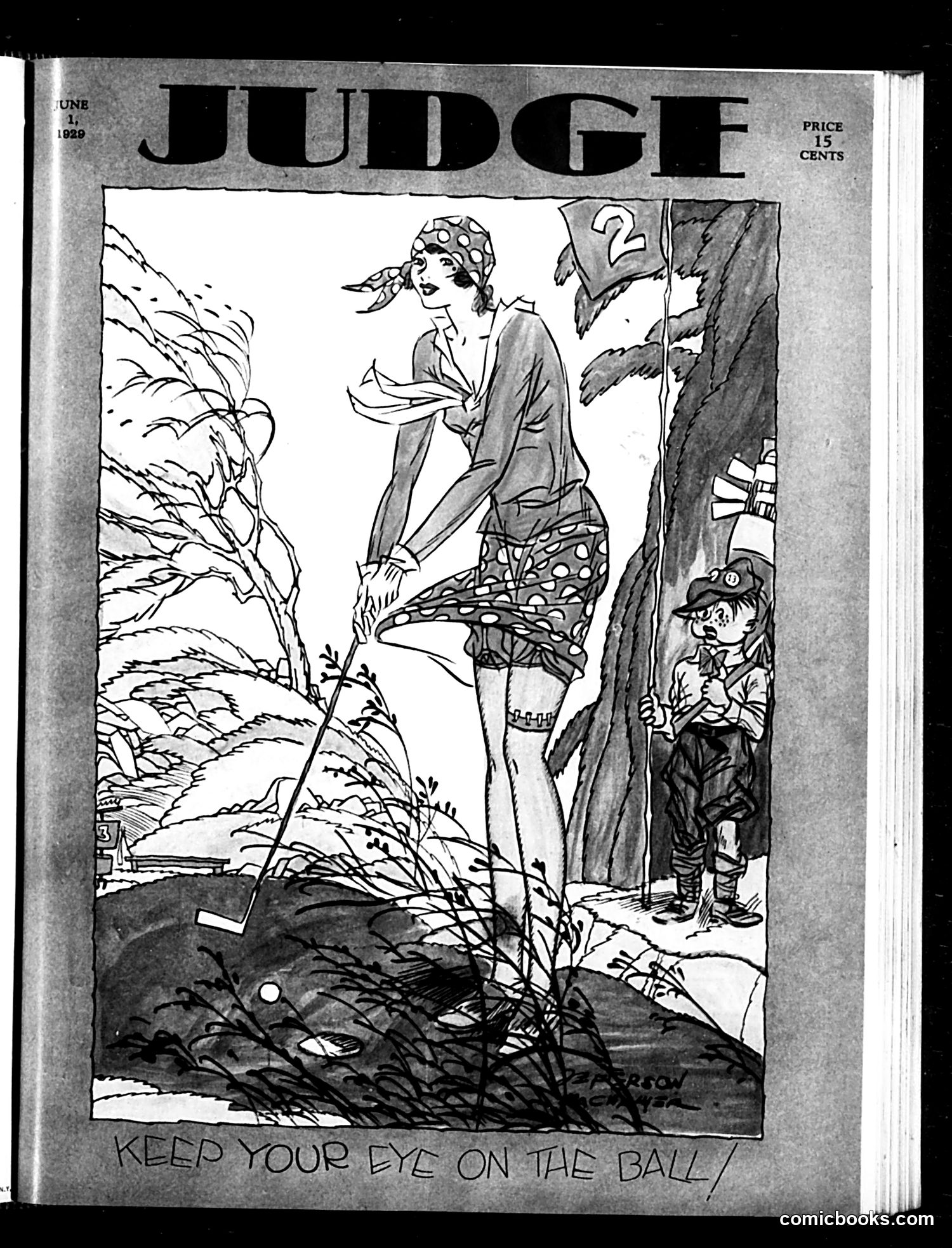
This Judge magazine cover from June 1929 depicts a woman planting a small tree while a child watches from behind a larger tree. The caption "KEEP YOUR EYE ON THE BALL" suggests the joke relies on a double meaning—literally about watching something grow, but likely a sports reference. The timing (1929) and the woman's fashionable attire and bobbed hair suggest commentary on the "modern woman" of the Jazz Age. The satire may critique women's new independence and activities, or possibly comment on economic growth/investment occurring just months before the October stock market crash. Without additional context, the exact satirical target remains unclear, though it appears to mock either contemporary gender roles or optimistic economic sentiment of that period.
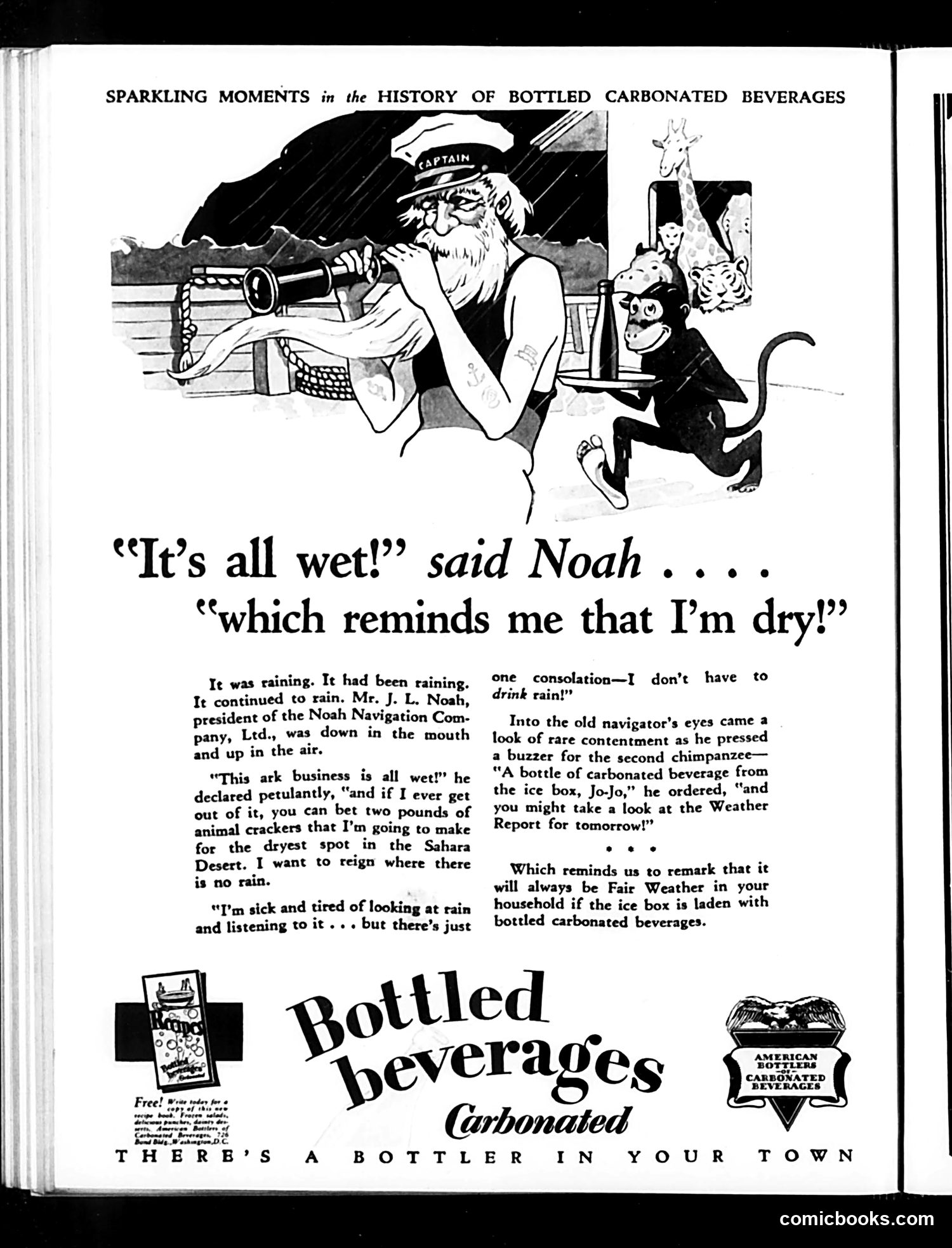
This is primarily an advertisement for bottled carbonated beverages, disguised as humorous editorial content. The page depicts a sea captain (labeled "Noah") and a chimpanzee in a maritime setting. The joke plays on Noah's biblical association with rain and flood—he quips that though "it's all wet" outside, this "reminds me that I'm dry," prompting him to order carbonated beverages. The humor relies on weather-related thirst and the implicit endorsement: even someone famously associated with water (Noah and his ark) prefers drinking bottled carbonated drinks instead. The "Fair Weather" closing line suggests these beverages ensure contentment regardless of weather conditions. The advertisement's framing as a "sparkling moment" in beverage history suggests this targets early-to-mid 20th-century readers with disposable income.
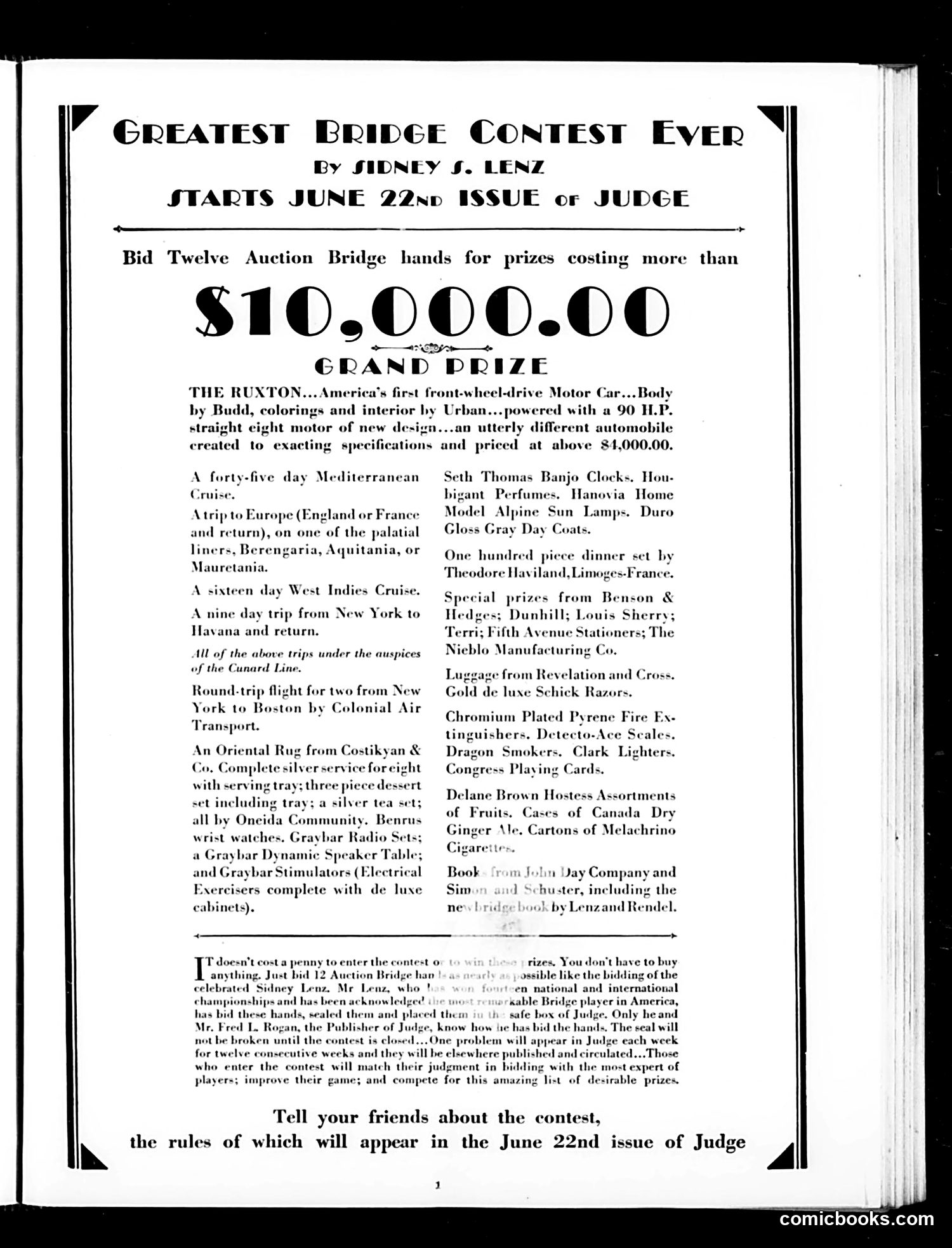
This page is primarily **advertising content**, not a cartoon or satirical piece. It announces "The Greatest Bridge Contest Ever" by Sidney S. Lenz, starting June 22nd in Judge magazine. The contest invites readers to bid on twelve auction bridge hands for prizes exceeding $10,000, with a grand prize being a Ruxton automobile. Additional prizes include Mediterranean cruises, Caribbean trips, flights, and luxury goods from various companies. The appeal emphasizes that Sidney Lenz—described as a celebrated championship bridge player and "knowledgeable" expert—has personally selected and sealed the bridge hands. The contest promises to match readers' bidding judgment against expert play. This reflects the 1920s-30s fascination with bridge as a popular parlor game, combining it with Judge's typical audience of affluent readers interested in luxury prizes and games of skill.
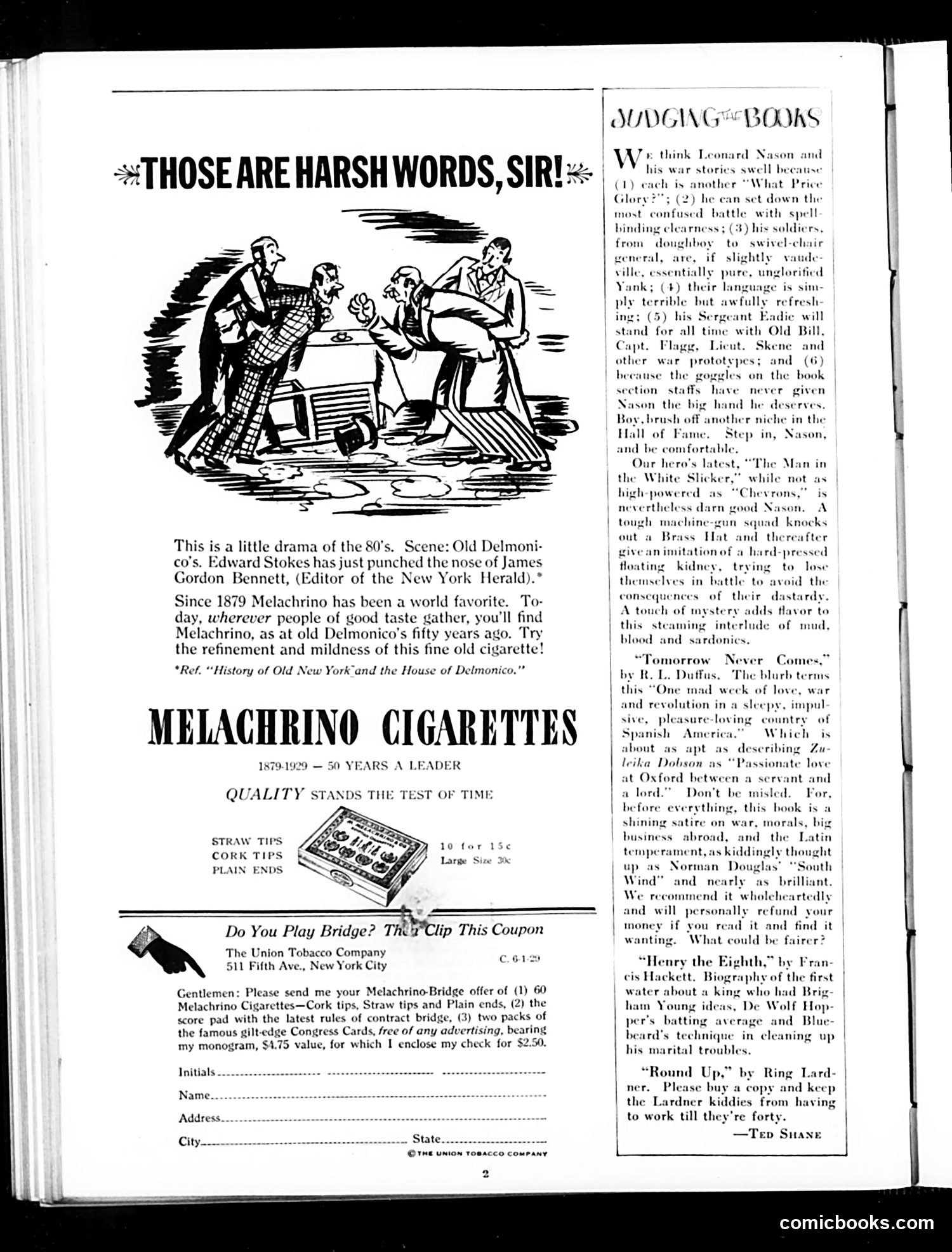
This page is primarily **advertising**, not political satire. The main cartoon illustrates a scene from 1880s New York, showing Edward Stokes punching James Gordon Bennett (Editor of the New York Herald) — referencing an actual historical incident. The caption frames it as entertainment, promoting Malachrino cigarettes by association with "refined" depictions of gentlemanly conflict. Below is a coupon ad for Malachrino cigarettes, emphasizing their 50-year market leadership. The right column contains book reviews praising Leonard Nason's war stories and other literary works. The satire is mild: the cartoon presents a crude brawl as genteel entertainment, ironically promoting luxury cigarettes. This reflects late 1920s advertising's use of historical/cultural references to establish product prestige among educated readers.
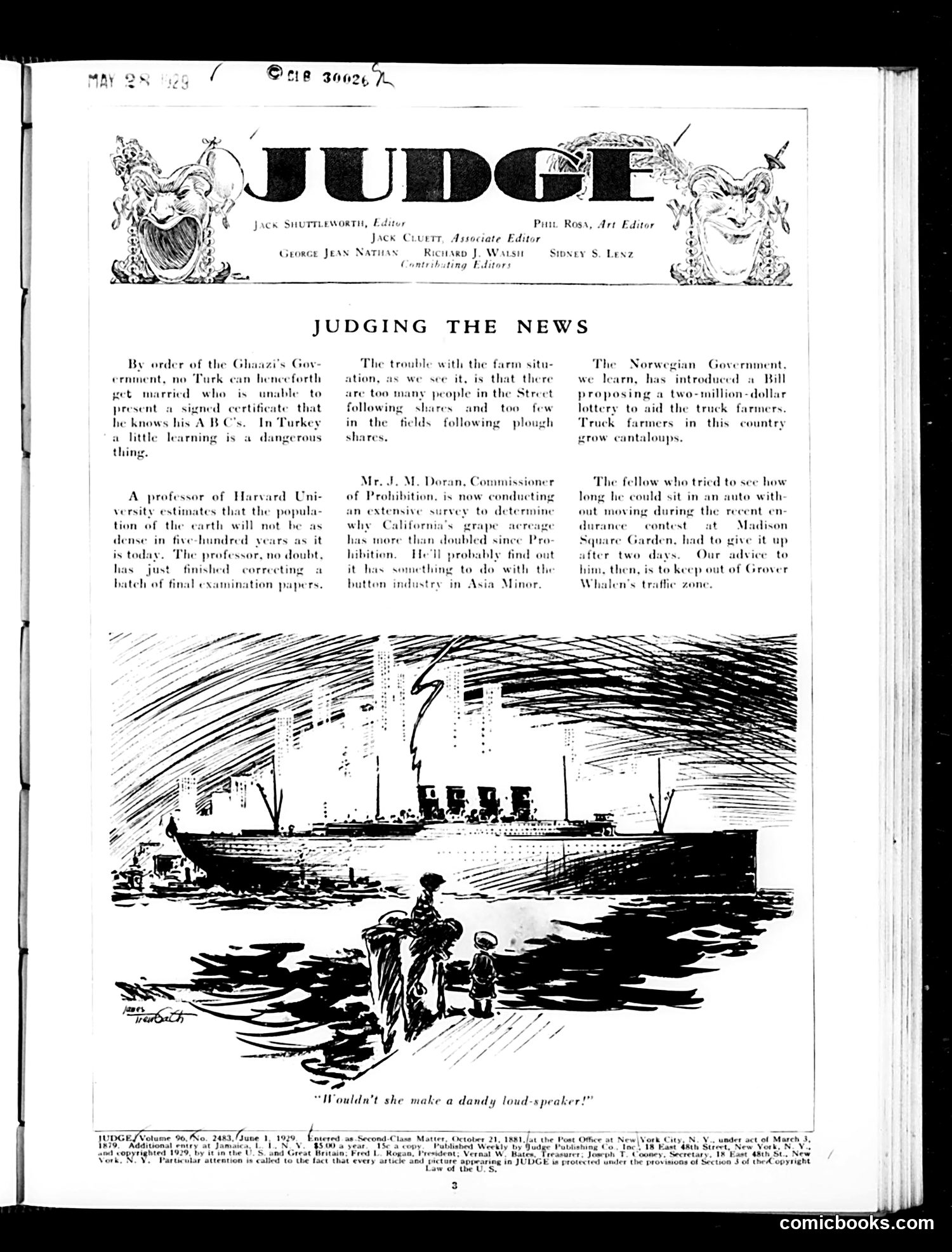
This page features a satirical cartoon about maritime safety or labor conditions. The image shows a small figure (appears to be a woman or worker) standing before a large steamship, with the caption "Wouldn't she make a dandy loud-speaker?" The joke likely mocks either: (1) a proposal to use human voices for ship announcements before modern amplification, or (2) commentary on a specific person's prominent public role or activism related to maritime issues. The "Judging the News" section above contains brief satirical takes on contemporary topics: Turkish marriage law, California's grape acreage during Prohibition, and Norwegian agricultural subsidies. Without additional historical context about the specific date or referenced events, the precise target of ridicule remains unclear, though the cartoon appears to criticize either maritime industry practices or a particular public figure's involvement in shipping matters.
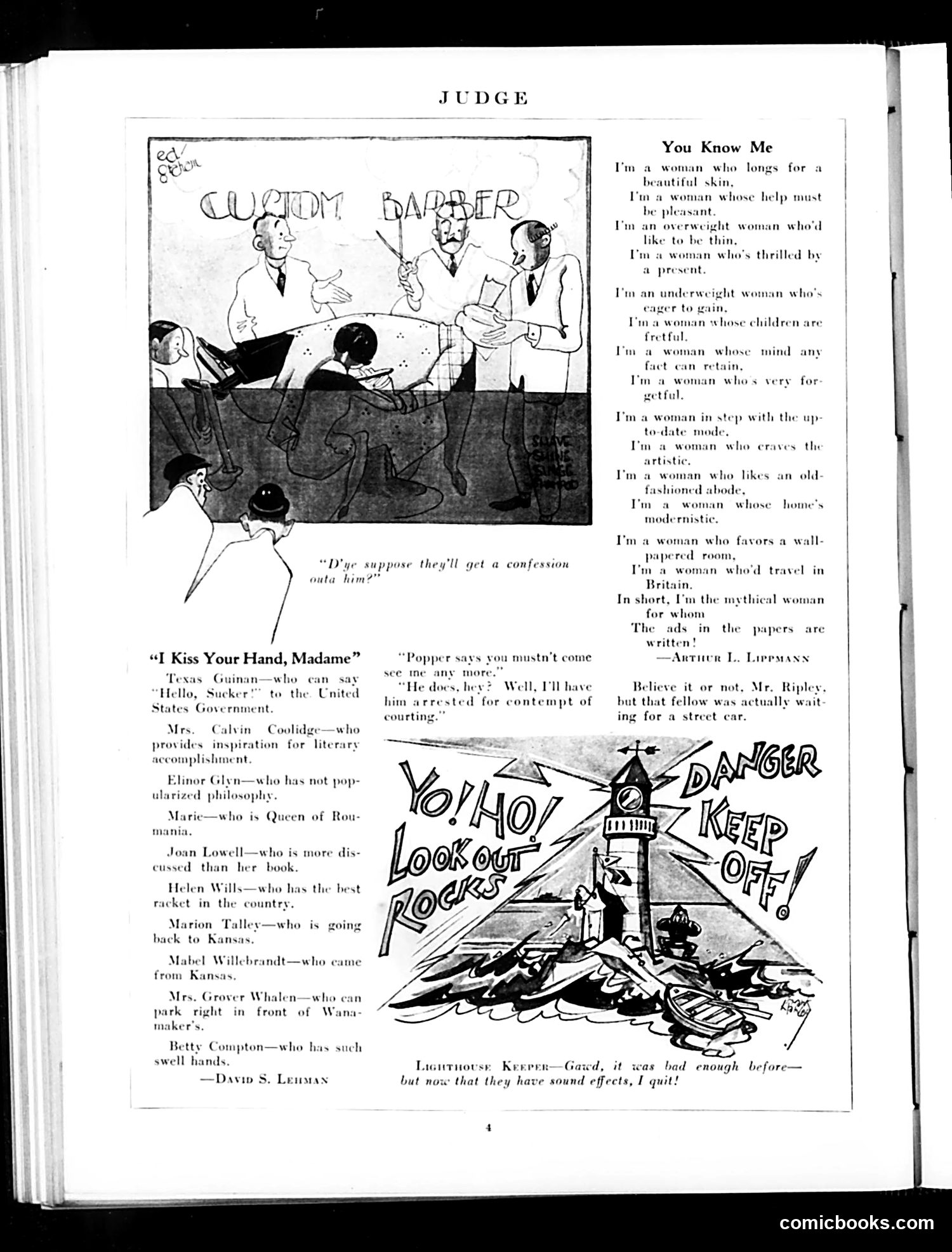
The page contains two distinct cartoons satirizing early 20th-century American society. **"Custom Barber"**: Shows three barbers examining a prone patient, with the caption "D'ye suppose they'll get a confession outa him?" This appears to be dark satire about torture or coercive interrogation disguised as a barbershop visit—suggesting authorities extract confessions through dubious means. **"Yo! Ho! Danger Keep Off!"**: A lighthouse keeper warns of rocks, but the cartoon jokes that modern sound effects from ships pose greater danger than the actual maritime hazard. This satirizes how contemporary technology (ship horns/signals) creates new problems alongside traditional dangers. The page also includes celebrity commentary and advertisements typical of Judge's format—witty observations about public figures by David S. Lehman and others, positioning the magazine as commentary on American culture and society.
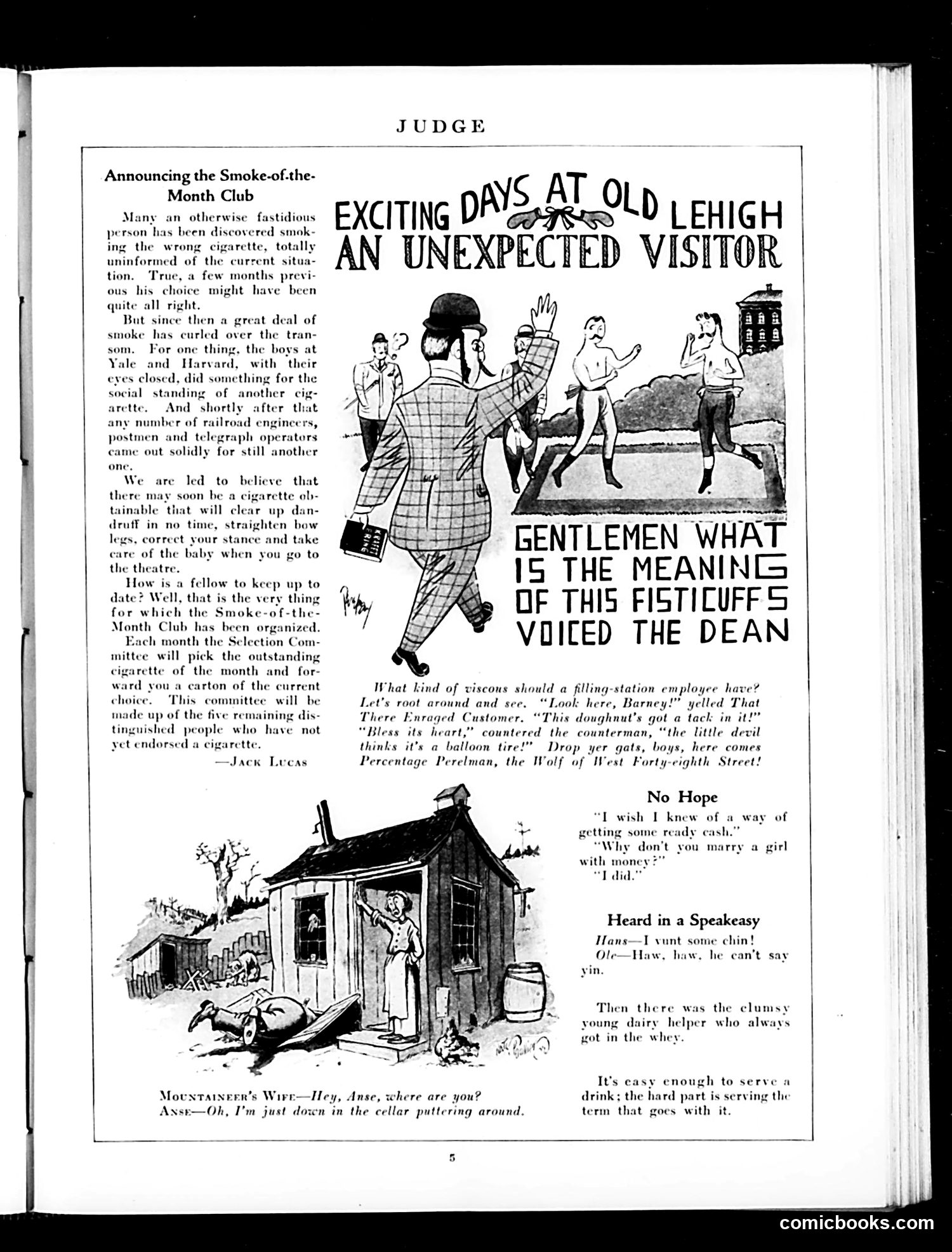
This page contains satirical humor pieces typical of early-to-mid 20th century Judge magazine. **Main cartoon** ("Exciting Days at Old Lehigh"): Depicts a man in a bowler hat and checkered suit arriving at Lehigh University, causing commotion among students. The satire appears to mock either a notable visitor's unexpected arrival or commentary on campus social disruption—though the specific identity remains unclear from the image alone. **Secondary elements**: Brief humorous anecdotes ("No Hope," "Heard in a Speakeasy") reference 1920s Prohibition-era culture, including references to speakeasies (illegal bars) and the era's social tensions around marriage, money, and alcohol. **Left cartoon**: Shows a mountaineer domestic scene with crude humor, typical of period stereotyping. The page emphasizes social observation humor rather than explicit political satire.
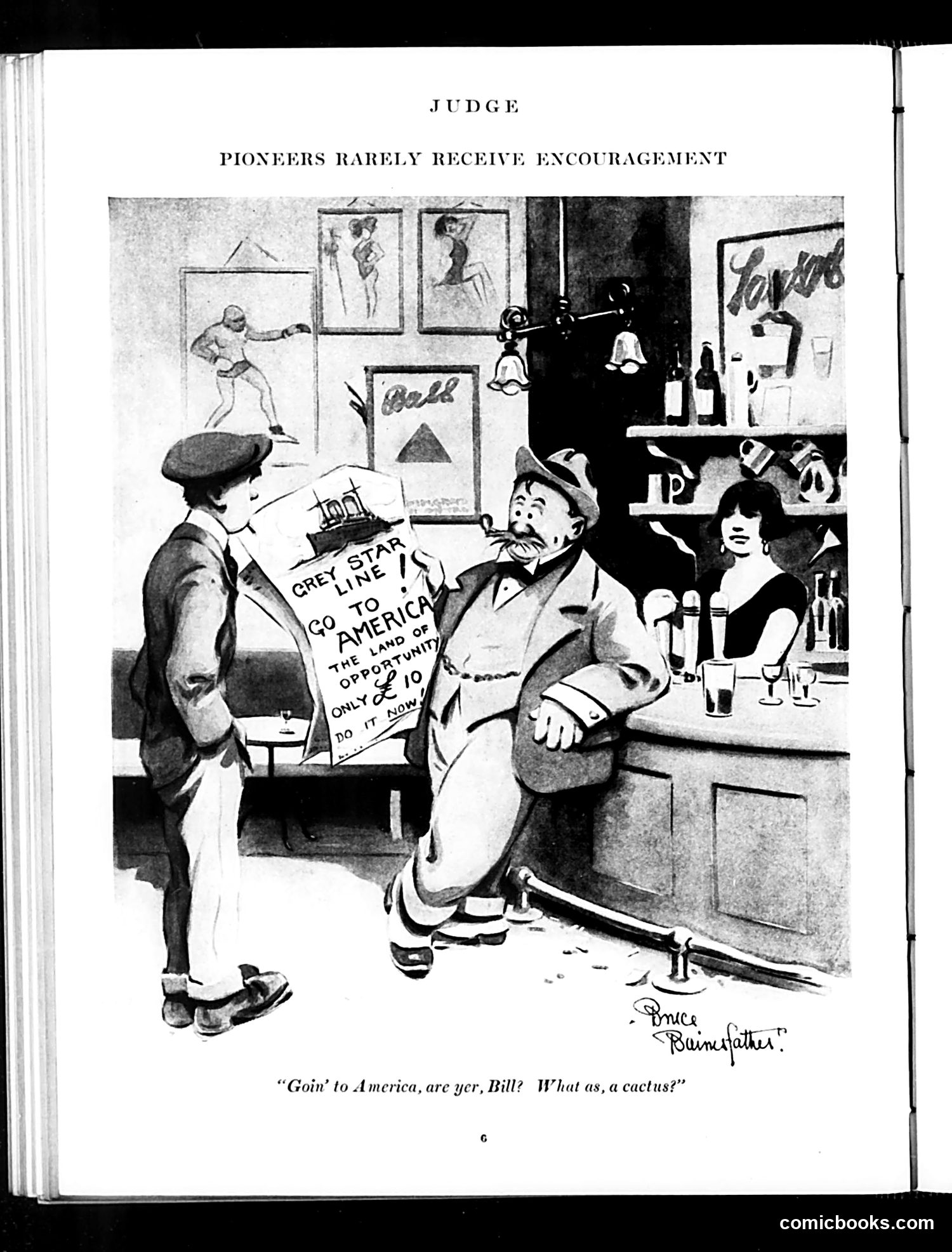
This Judge magazine cartoon satirizes American attitudes toward pioneers and innovation. Two men in a bar discuss a poster advertising "Grey Star Lite to America" — described as "The Land of Opportunity" with an entry fee of only 10 cents ("Do it Now"). One man, apparently skeptical or mocking, responds to his companion's enthusiasm about going to America with "What as, a cactus?" — suggesting pioneers face a harsh, desolate landscape rather than genuine opportunity. The satire critiques the gap between America's promotional mythology as a land of limitless opportunity and the actual difficult conditions pioneers encountered. The cartoon's title reinforces this: those who venture into new frontiers receive little real encouragement or support, despite the rhetoric.
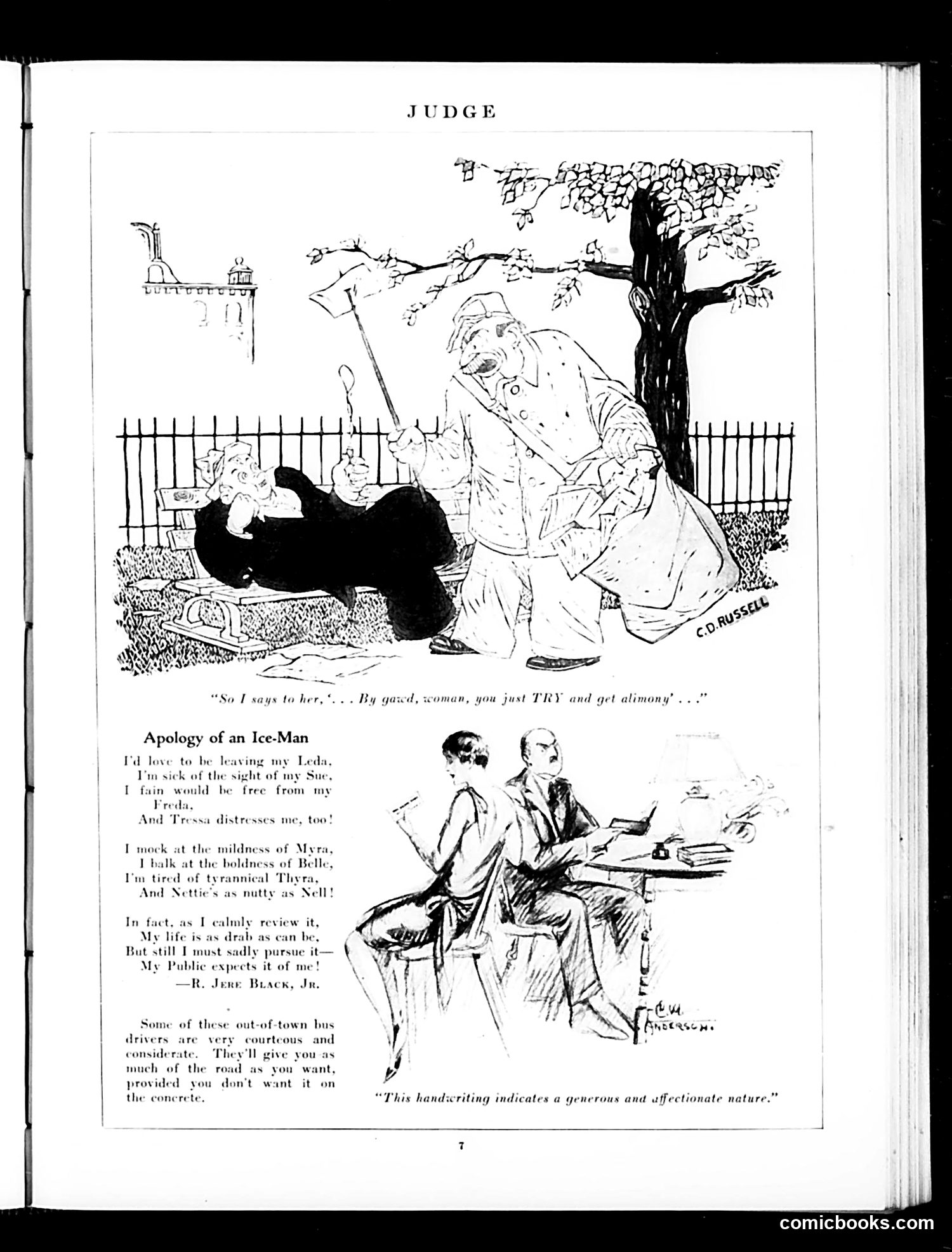
The page contains two satirical pieces: **Top Cartoon**: A large man threatens a woman with a club, claiming she won't get alimony if she tries to leave. This satirizes men's legal and physical dominance in marriage during an era when women had limited divorce rights and property claims. The brutish character represents the sexist attitude that wives were property without independent legal standing. **"Apology of an Ice-Man"**: A humorous poem by R. Jerre Black Jr. mocks a serial philanderer who complains about multiple women (Leda, Sue, Freda, etc.) but continues pursuing them anyway because "the Public expects it." This likely satirizes men who publicly lament domestic entanglements while privately pursuing affairs—performing victimhood while maintaining social respectability. **Bottom Item**: A brief joke about discourteous bus drivers who give pedestrians "as much road as you want, provided you don't want it on the concrete"—dark humor about traffic accidents.
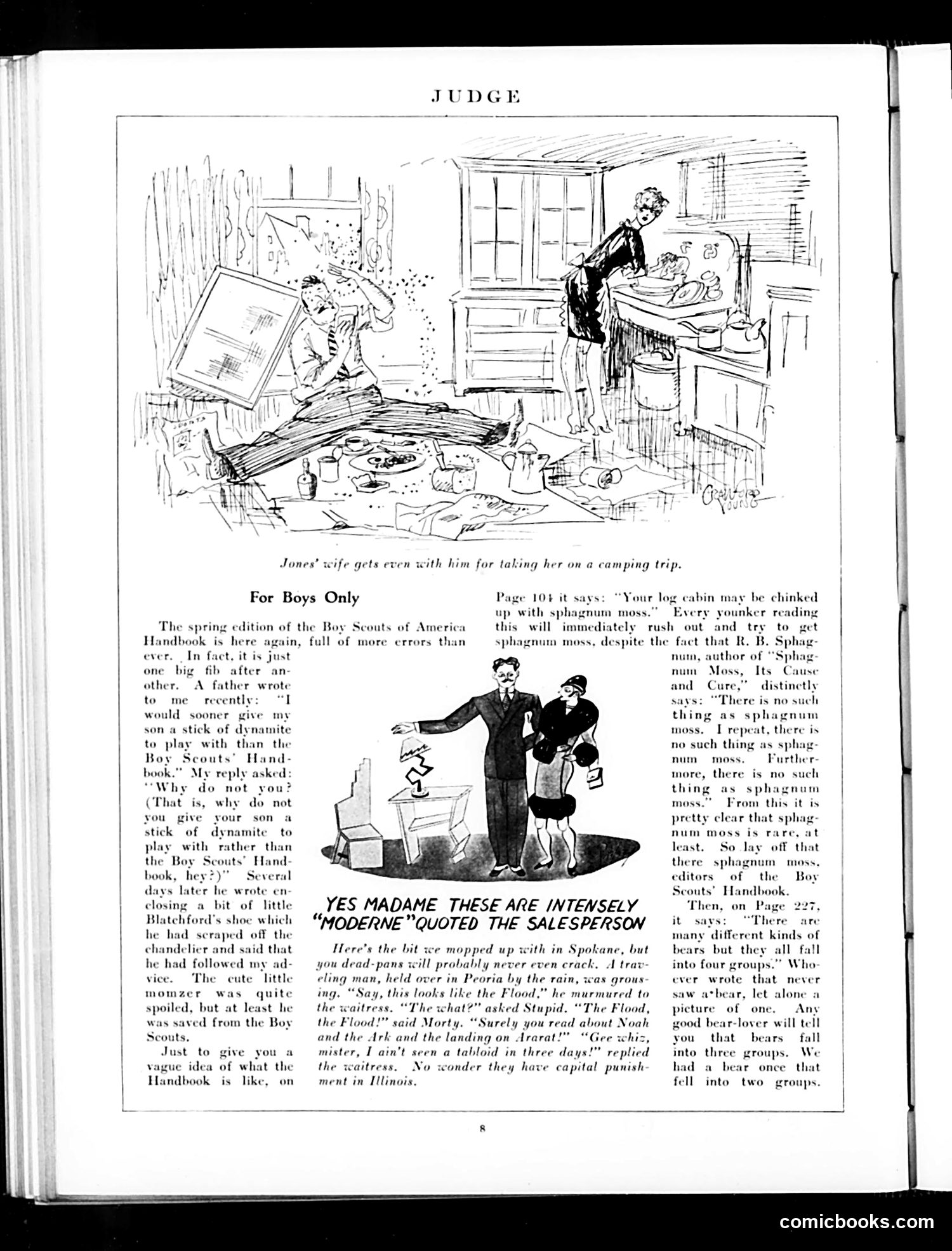
This page ridicules the Boy Scouts of America Handbook, attacking it as filled with factual errors and nonsense. The main text mocks the Handbook's incompetence through absurdist humor: a father claims he'd rather give his son dynamite than the handbook; a contributor sarcastically reports following the magazine's advice caused injury. The author then catalogues alleged errors—claims about "sphagnum moss" that contradict the handbook's own statements, and false assertions about bear classification. The cartoon at top shows domestic chaos (a man holding a large plank amid scattered debris) captioned about a wife being "even with him for taking her on a camping trip"—likely suggesting the Handbook's camping advice is dangerously flawed. The lower illustration depicts a salesman using the nonsensical word "moderne" to describe goods, satirizing commercial humbug alongside institutional incompetence. The satire suggests the Handbook is unreliable guidance for youth, combining factual errors with impractical advice presented confidently.
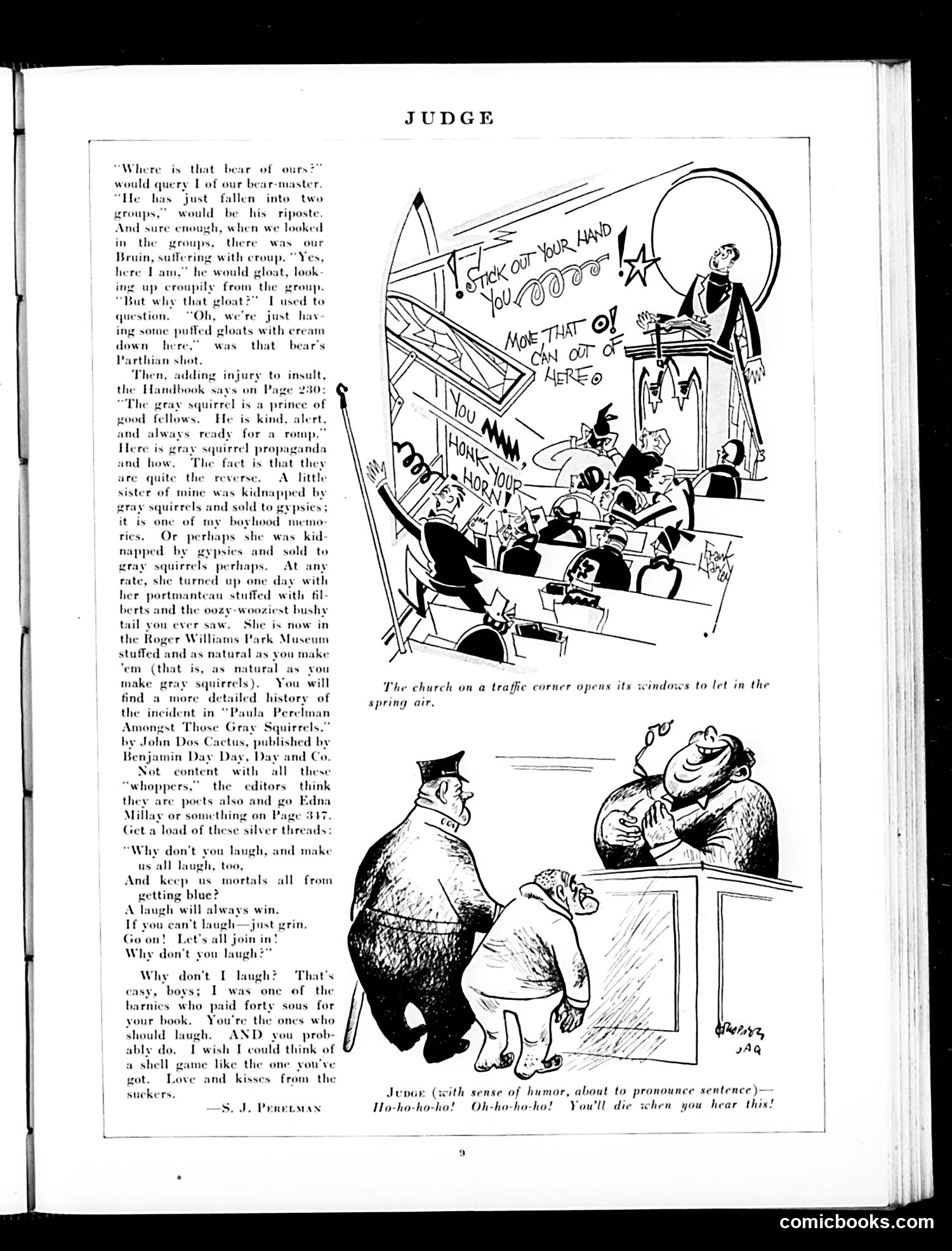
This page contains two satirical cartoons by S.J. Perelman mocking sentimentality and false cheerfulness. **Top cartoon:** Depicts a church opening its windows on a traffic corner, with the caption suggesting ironic contrast between spiritual peace and urban chaos—likely critiquing how churches present idealized tranquility disconnected from real city life. **Bottom cartoon:** Shows a jovial judge about to pronounce sentence, laughing "Ho-ho-ho!" The surrounding text is Perelman's sarcastic essay attacking forced optimism. He mocks self-help rhetoric urging people to "laugh" and "grin" to avoid depression, arguing this advice comes from those profiting from others' misery (referencing those who "paid forty sous for your book"). The judge's impending laughter while sentencing someone exemplifies Perelman's point: cheerfulness becomes grotesque when disconnected from human suffering. He attacks both false wisdom literature and the hypocrisy of those promoting it. The satire targets 1920s-30s American optimism culture and commercial exploitation of motivational platitudes.
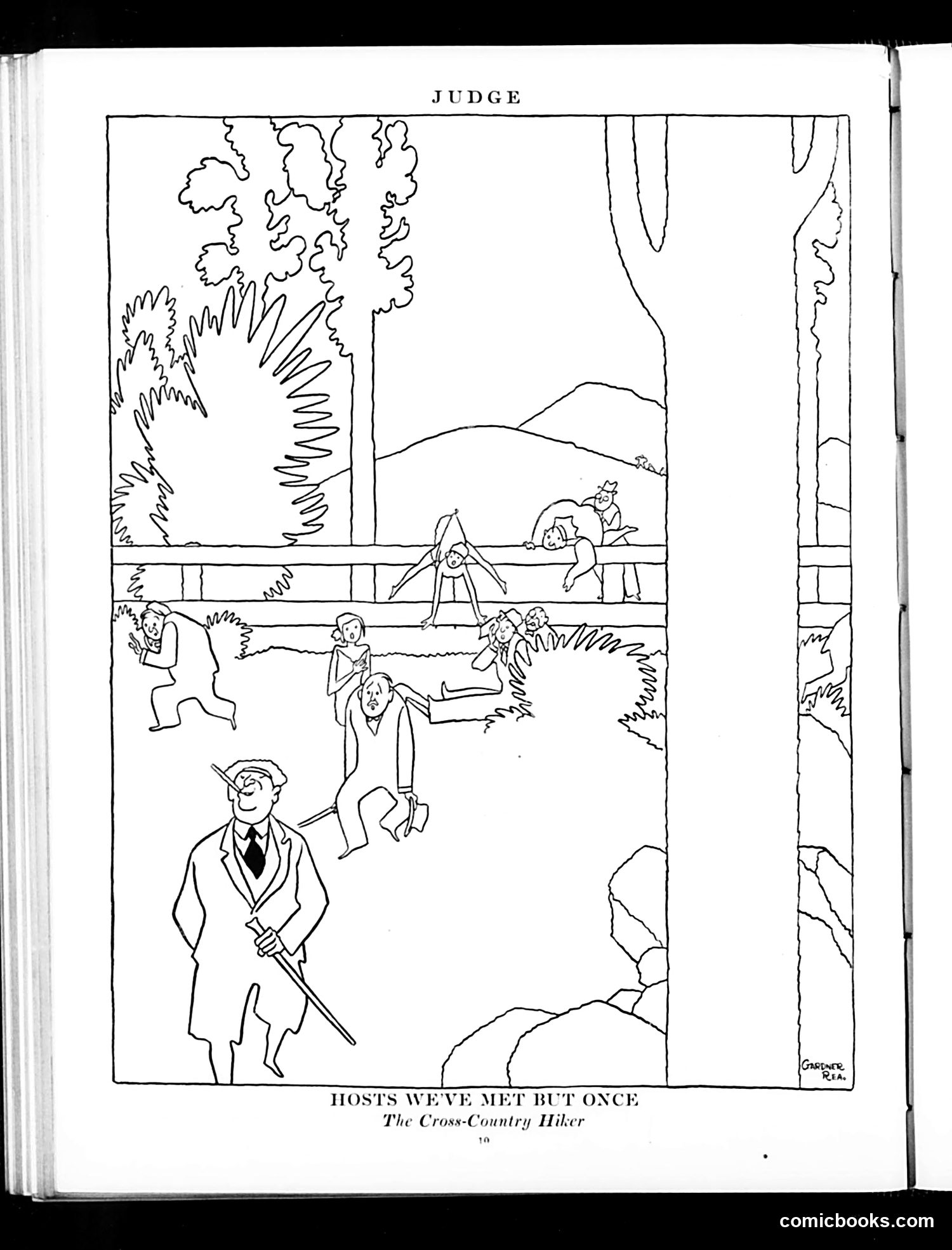
This cartoon satirizes the experience of cross-country hiking during the early 20th century. A well-dressed man with a rifle stands prominently in the foreground—apparently a homeowner confronting an unexpected visitor. In the background, a bedraggled hiker interacts with various rural residents and their children, suggesting a traveling vagrant or drifter passing through. The humor lies in the awkward social encounters between transient travelers and settled townspeople who meet them only briefly. The armed homeowner's defensive posture suggests wariness of strangers, while the chaotic scene behind him (with children playing and various reactions) captures the disruption a wanderer brings to quiet rural life. This reflects period anxieties about vagrancy and unfamiliar travelers.
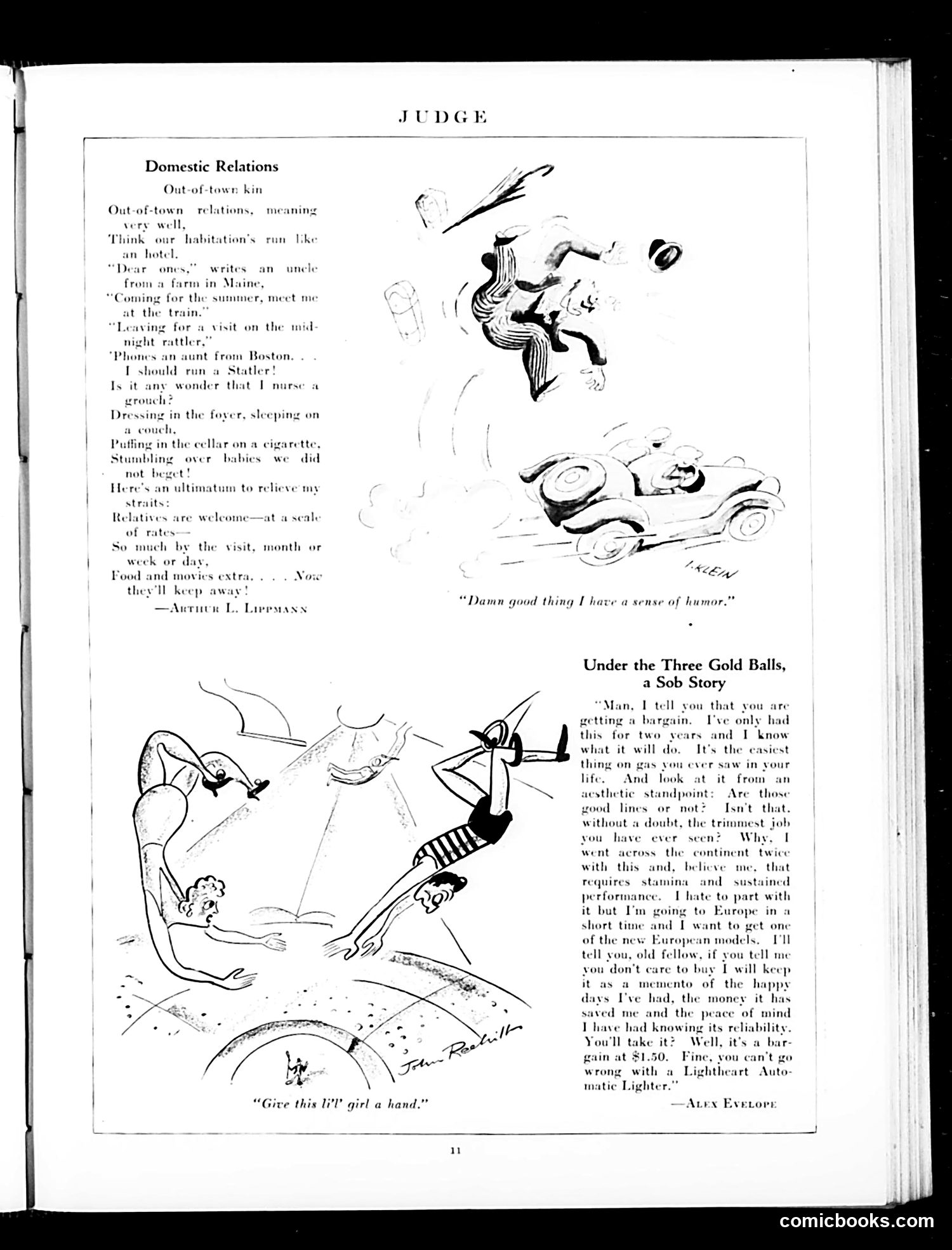
**"Domestic Relations"** satirizes out-of-town relatives who treat a host's home like a hotel. The poem, credited to Arthur L. Lippmann, catalogs their entitled behavior: sleeping on couches, smoking indoors, leaving babies unattended, and treating hosts as staff. The accompanying cartoon shows a frazzled family member literally upended by visiting relatives' chaos. The joke: relatives overstay and consume resources ("Food and movies extra") without contributing. The solution offered—charging relatives per visit—reflects early 20th-century middle-class anxieties about hospitality obligations and family freeloading during an era when travel and visits were becoming more common. **"Under the Three Gold Balls"** (the pawnshop symbol) presents a salesman's pitch for a Lightheart Automatic Lighter, credited to Alex Everope. The emotional manipulation is the satire: the seller romanticizes the item's history and reliability while emotionally blackmailing the buyer ("if you tell me you don't care to buy I will keep it"). At $1.50, it's absurdly cheap yet marketed with fabricated sentiment—mocking both aggressive sales tactics and consumer gullibility of the era.
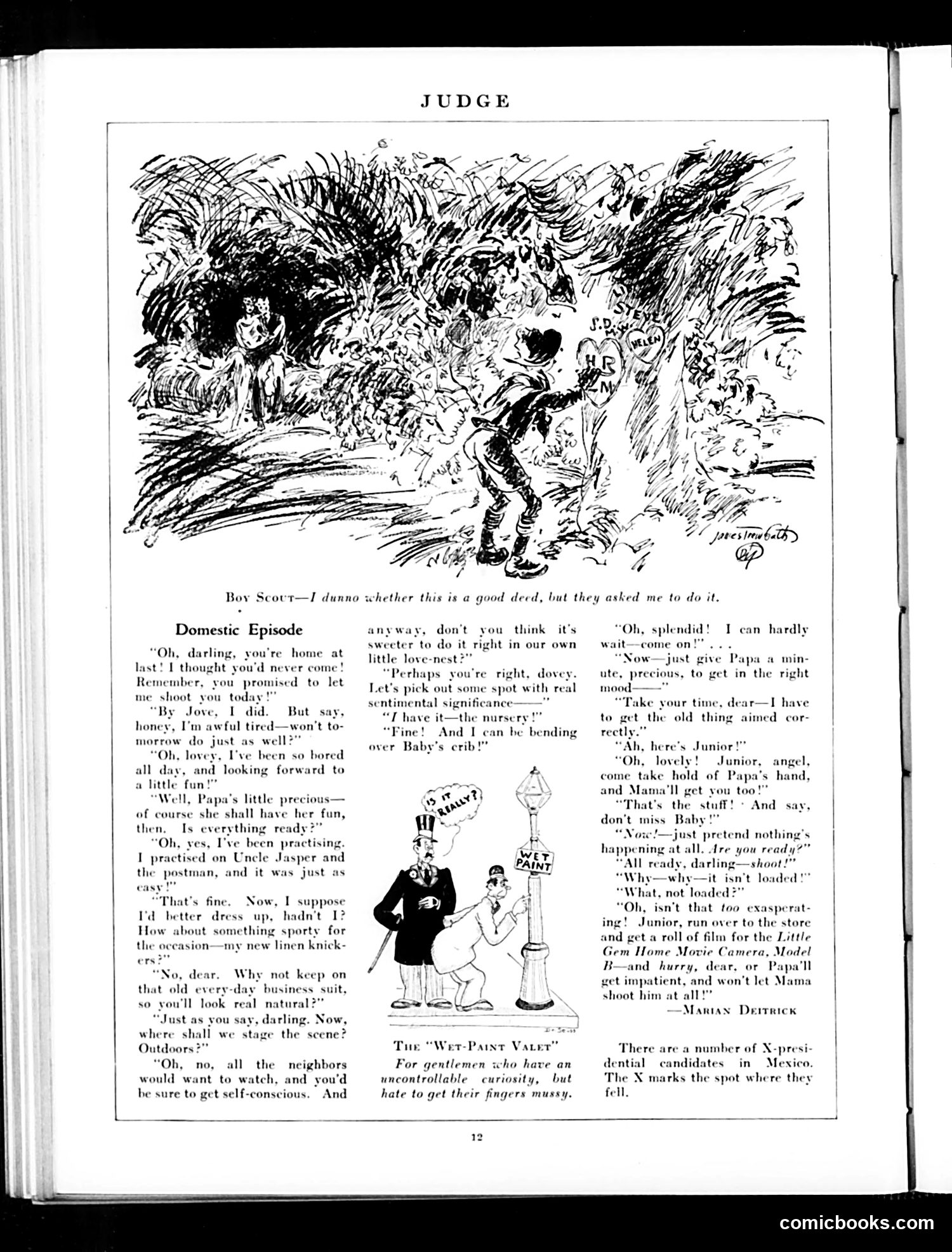
The top cartoon satirizes the Boy Scout movement's emphasis on doing good deeds. A scout awkwardly performs an act he admits he doesn't understand—he was simply "asked" to do it—mocking how scouts might mechanically follow orders without genuine moral comprehension. The "Domestic Episode" story jokes about a married couple's home movie-making hobby. The wife eagerly wants to film her husband, but their scene repeatedly falters: he's tired, the camera isn't loaded, they must fetch film. The satire targets 1920s-30s enthusiasm for home movie cameras as a novel domestic entertainment, depicting the wife's obsessive eagerness and the husband's reluctant participation. The innuendo ("shoot," intimate settings) adds adult humor beneath the surface domesticity. "The Wet-Paint Valet" is a brief advertisement-style piece promoting a product for men who want to inspect wet paint without soiling their hands—satirizing fastidious gentlemen and unnecessary products. The Mexico reference mocks political instability there, using "X" to mark where presidential candidates "fell"—a dark joke about assassination.
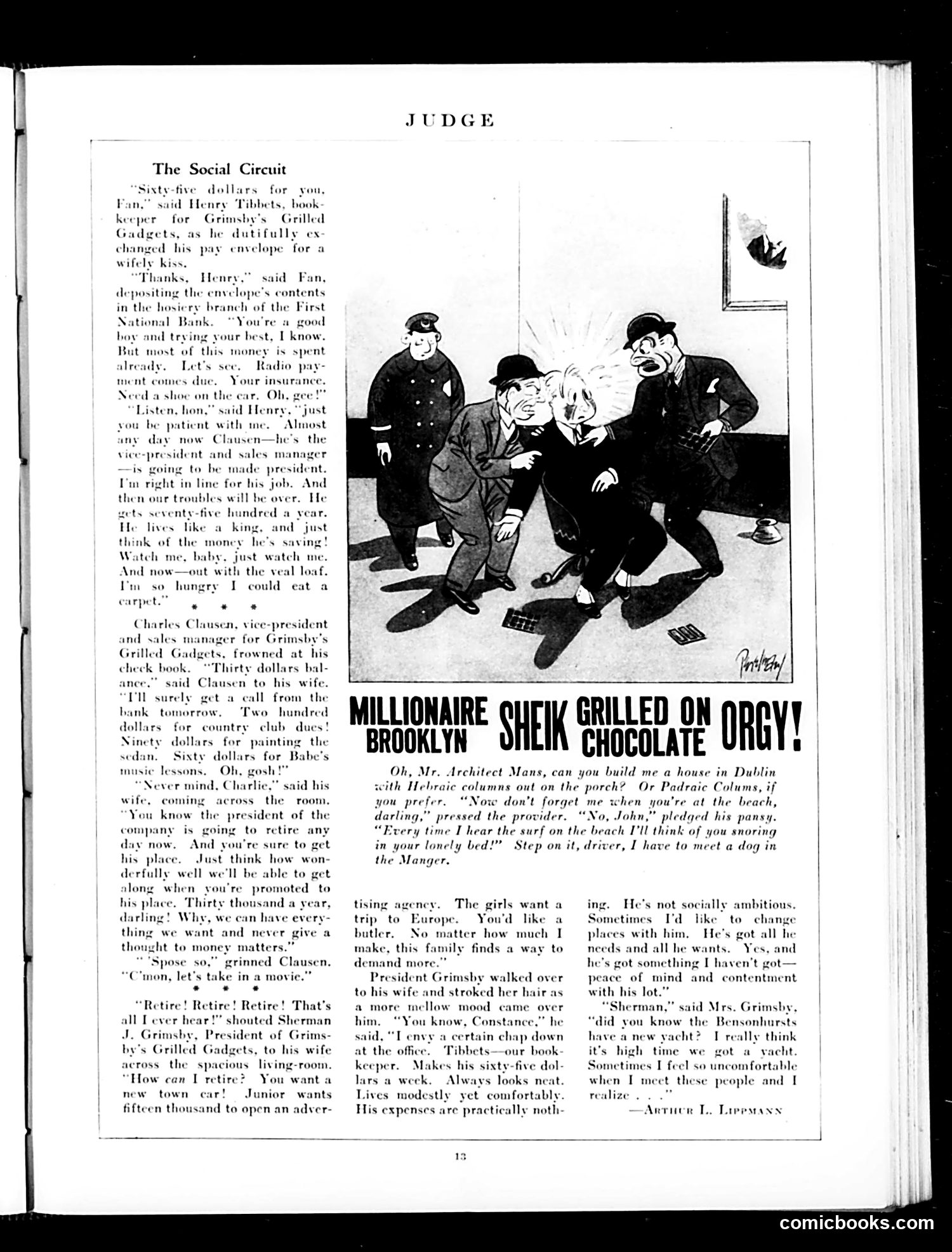
This Judge page satirizes **American consumer culture and status anxiety** through three interconnected vignettes about money and social climbing. The cartoon depicts a hierarchy of desire: Henry Tibbets, a modest bookkeeper, dreams of promotion to vice-president; his boss Charles Clausen, already a VP, worries about country club dues and his sedan; and their employer Sherman J. Grimsby, a wealthy company president, envies Tibbets's simple contentment. **The satire's point**: Each social level assumes the next rung up holds happiness, but discovers only greater expenses and anxiety. Grimsby, having achieved wealth, realizes he's less happy than his poor employee—he has "peace of mind and contentment with his lot" that Grimsby lacks. The title cartoon appears to mock extravagant millionaire excess ("Sheik...Orgy"). The piece critiques how **capitalism creates perpetual dissatisfaction**—more money enables more spending rather than more happiness. It's a Depression-era commentary on the hollowness of wealth-chasing and status competition among American workers and elites.
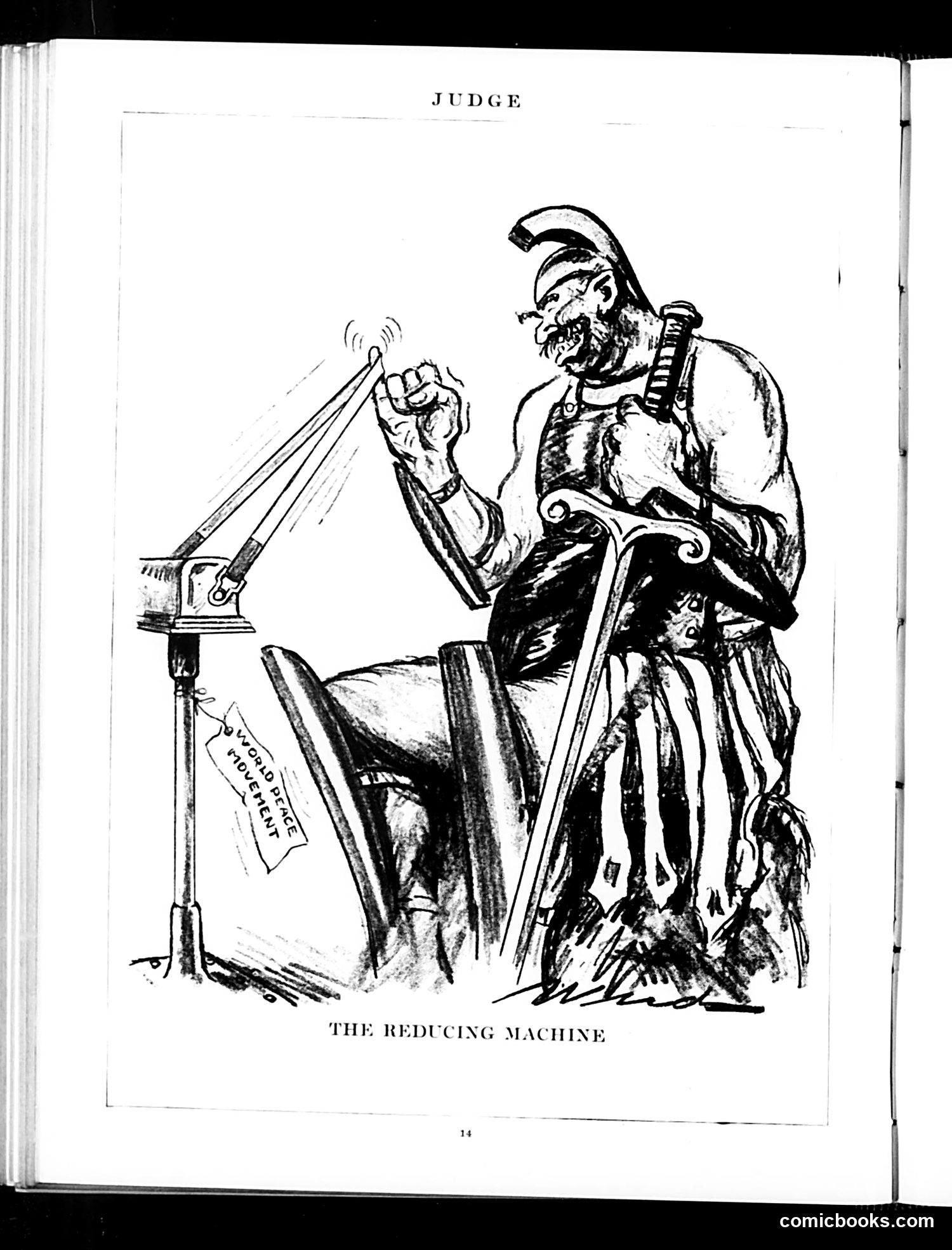
This political cartoon depicts a bearded figure (styled as an authoritarian ruler, possibly representing a European monarch or military leader) operating a mechanical device labeled "THE REDUCING MACHINE." The machinery appears designed to forcefully compress or diminish something labeled "GOOD FRUIT" (visible on the base). The satire critiques authoritarian suppression—the "reducing machine" metaphorically represents how autocratic rulers use force and machinery of state to crush or eliminate positive forces (the "good fruit"). The figure's menacing expression and control over this destructive apparatus emphasize the violence inherent in such governance. Without a specific date visible, the exact historical reference remains unclear, though the style suggests late 19th or early 20th-century political commentary on European authoritarianism.
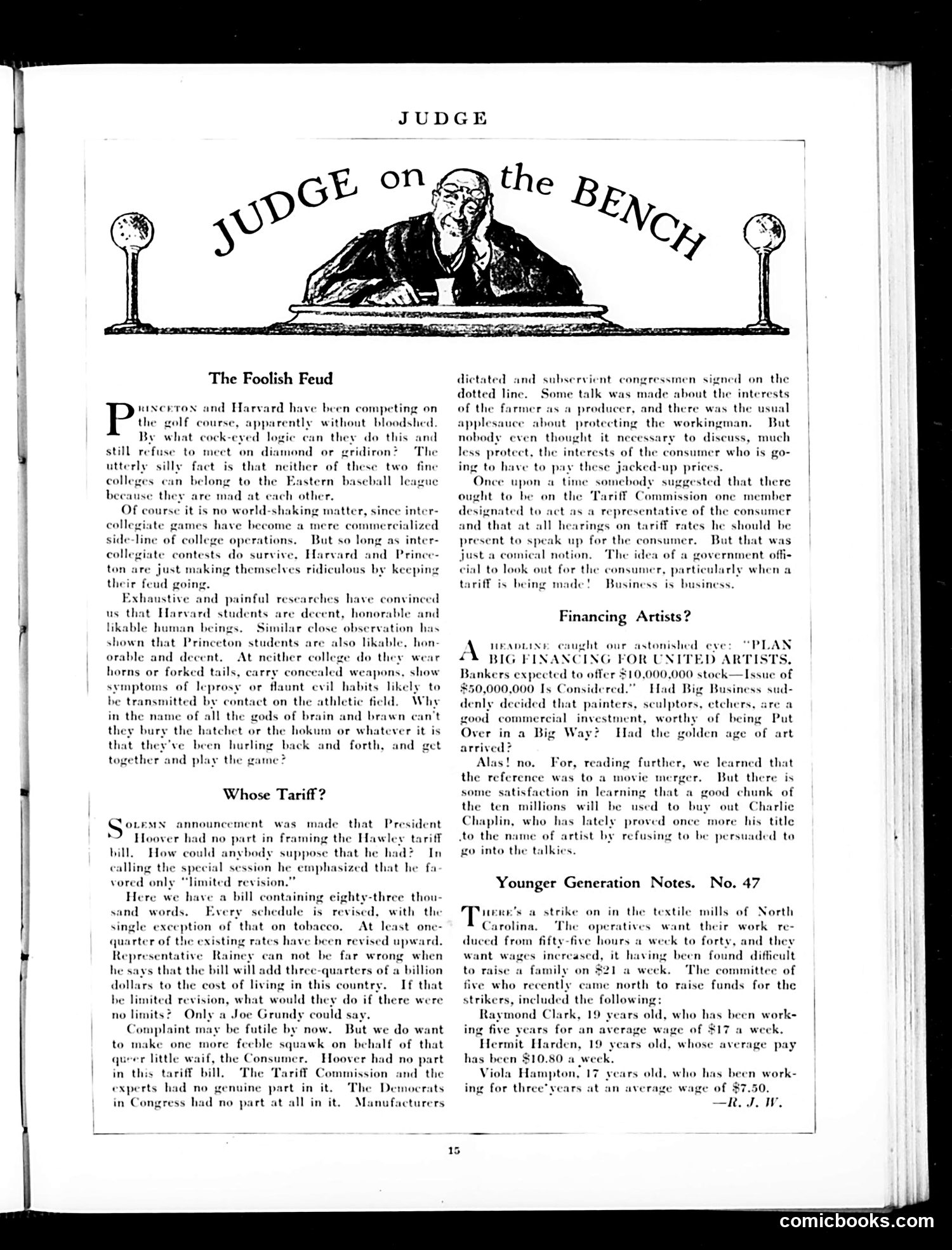
This page contains three satirical commentary pieces: **"The Foolish Feud"** mocks Princeton and Harvard's rivalry—they refuse to compete in baseball against each other despite their athletic excellence, making both institutions look ridiculous. The satire suggests the feud is petty and unfounded, as observations show students at both schools are decent people. **"Whose Tariff?"** criticizes President Hoover's Hawley Tariff Bill. Despite Hoover claiming he wanted only "limited revision," the bill contains 83,000 words with massive rate increases. The piece sarcastically notes that nobody—not the President, Tariff Commission, Democrats, or experts—represented the consumer's interests. The joke: "Business is business," implying profit matters more than protecting ordinary people from higher prices. **"Financing Artists?"** reports that bankers planned $50 million stock financing for "United Artists." The satirist initially hoped this meant art patronage, but discovered it was merely a movie-industry deal involving buying out Charlie Chaplin—mocking the confusion between "artists" (painters/sculptors) and entertainment industry figures.
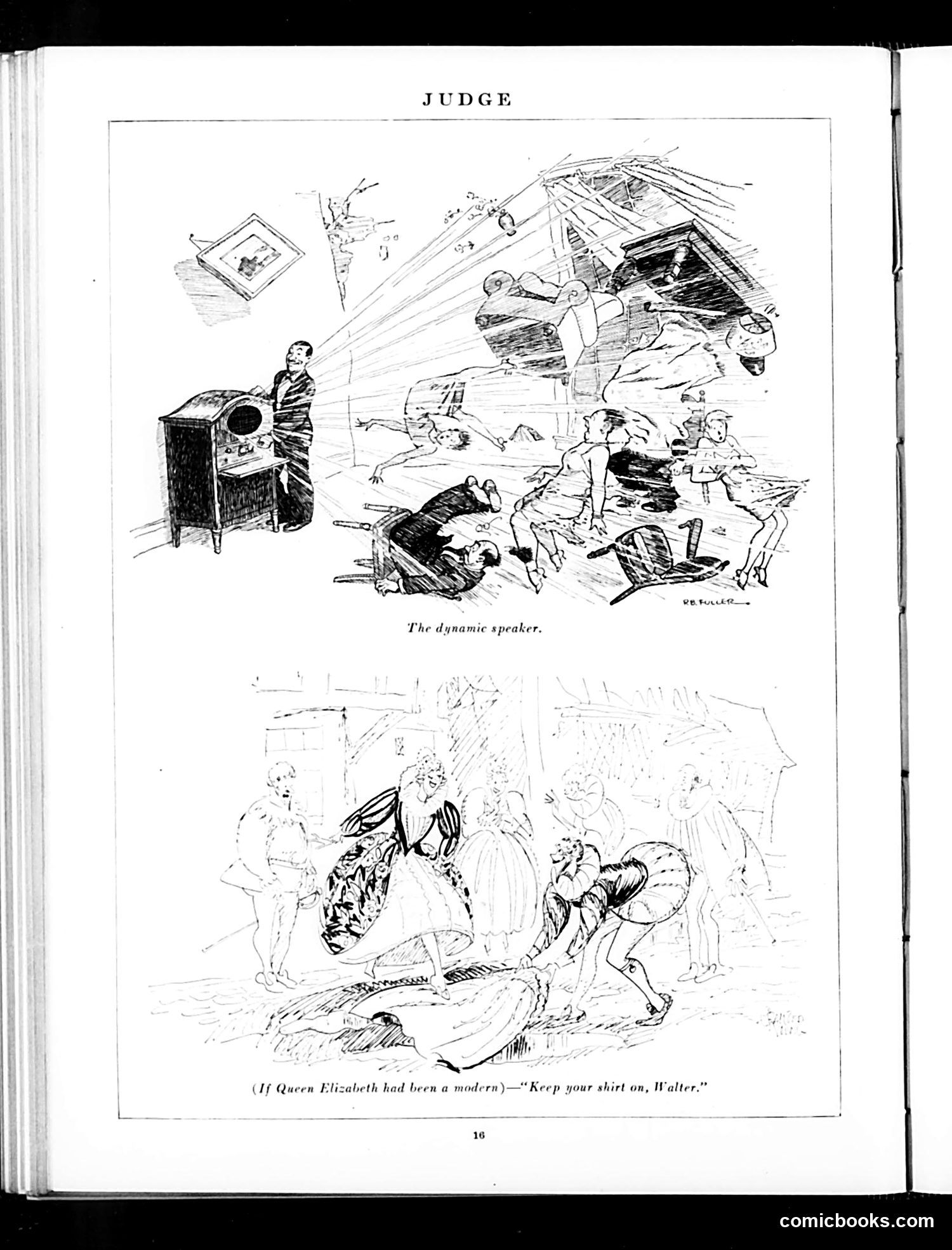
This page contains two cartoons satirizing public speaking and behavior: **Top cartoon** ("The dynamic speaker"): Shows a chaotic scene where an animated speaker at a podium is literally launching audience members through the air with the force of his words. The exaggerated violent reactions mock overly bombastic or aggressive public speakers—those who "dynamically" assault audiences rather than persuade them. **Bottom cartoon**: A caption reads "(If Queen Elizabeth had been a modern)—'Keep your shirt on, Walter.'" The scene depicts what appears to be a modern, undignified interpretation of Queen Elizabeth, with a man removing his clothing. This is a humorous counterfactual: the joke contrasts the historical Queen's formality and decorum with how a "modern" (contemporary to Judge's publication) version might behave—casual, irreverent, and improper. The humor relies on the absurdity of imagining royalty behaving so informally.
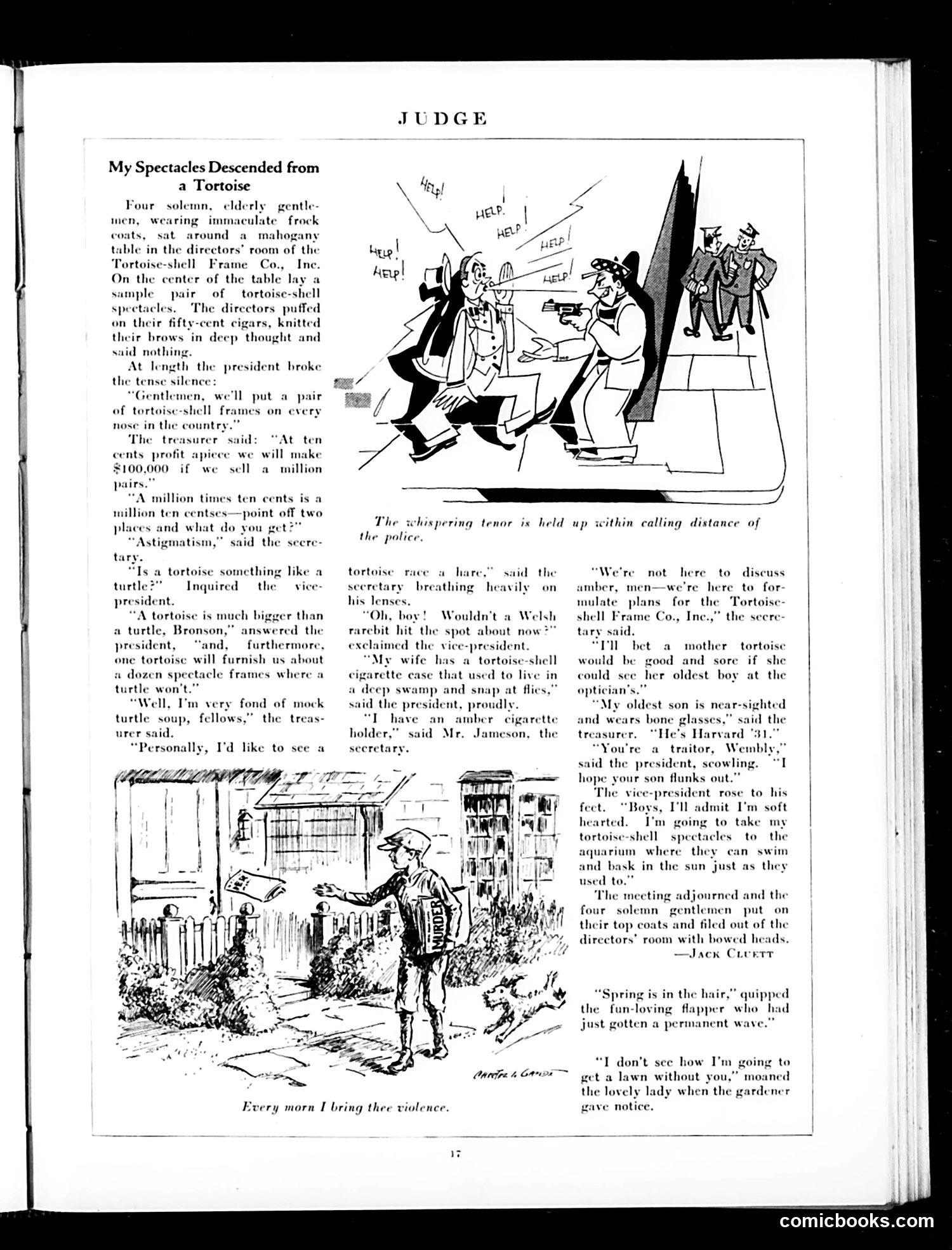
This Judge magazine piece satirizes **turn-of-the-century business culture** through absurdist humor. Four corporate directors of a tortoise-shell spectacle frame company sit pompously discussing mass production ("sell a million pairs"), but repeatedly digress into irrelevant personal anecdotes about turtle soup, Welsh rarebit, cigarette cases, and their sons' academic choices—utterly missing the point of their business meeting. The satire targets **corporate boardroom pretension**: these "solemn, elderly gentlemen" in formal dress behave as though they're engaged in serious deliberation, yet constantly lose focus on profit and productivity to indulge trivial nostalgia and one-upmanship. The vice-president's sentimental concern for the tortoises' welfare (wanting to return them to an aquarium) undercuts any actual business purpose. The humor mocks how **wealthy businessmen prioritize social performance and personal status** over rational economic activity. The secondary cartoons and jokes about flapper hairstyles and gardening occupy the page's margins, emphasizing how easily distracted these supposedly serious figures become.
This is a theatre review column by George Jean Nathan, a prominent drama critic of the early 20th century. The main text attacks the N.S.R. Productions company for presenting "The First Law," a Russian adaptation that Nathan considers worthless trash. He harshly announces he will refuse future review tickets from them and several other theatre groups he considers incompetent (Lenox Hill Players, Michael Kallesser, Butler Davenport, Clyde Elliott). Nathan's tone is deliberately caustic and insulting—he declares the production so bad he'll throw away their tickets unread. The satire lies in his exaggerated contempt and theatrical self-righteousness as a tastemaker. The "Theatre Digest" section below lists brief reviews of current Broadway shows, mostly dismissive. This reflects early 20th-century theatre criticism's reputation for arrogant, personal attacks on producers and performers.
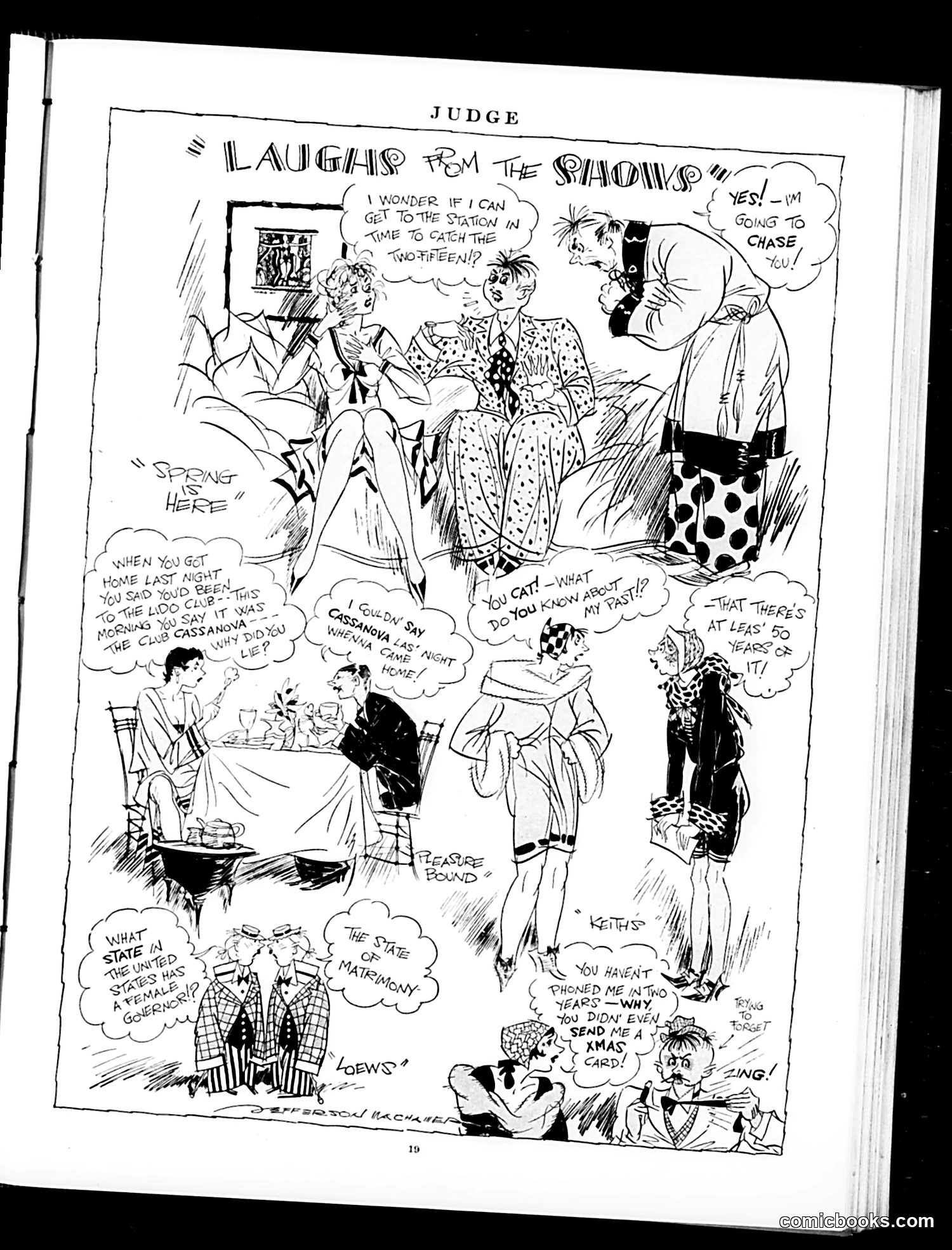
This is a multi-panel comic satirizing theatrical life and romance, likely from the early 20th century. The title references the Rialto, Broadway's theater district. The scenes depict couples and theater people in various romantic entanglements and domestic disputes. Key dialogue fragments suggest marital infidelity and neglect: references to someone not being home, not phoning in two years, and never sending a Christmas card. One panel mentions "the stage of matrimony," equating marriage to theatrical performance. The satire targets the artificiality of theatrical people's lives—suggesting their onstage dramatic personas bleed into their personal relationships, which are equally theatrical, hyperbolic, and unstable. The humor relies on the audience recognizing that actors' real lives mirror their performed dramatics, particularly regarding romantic entanglements. The comic mocks both theatrical society and modern marriage instability.
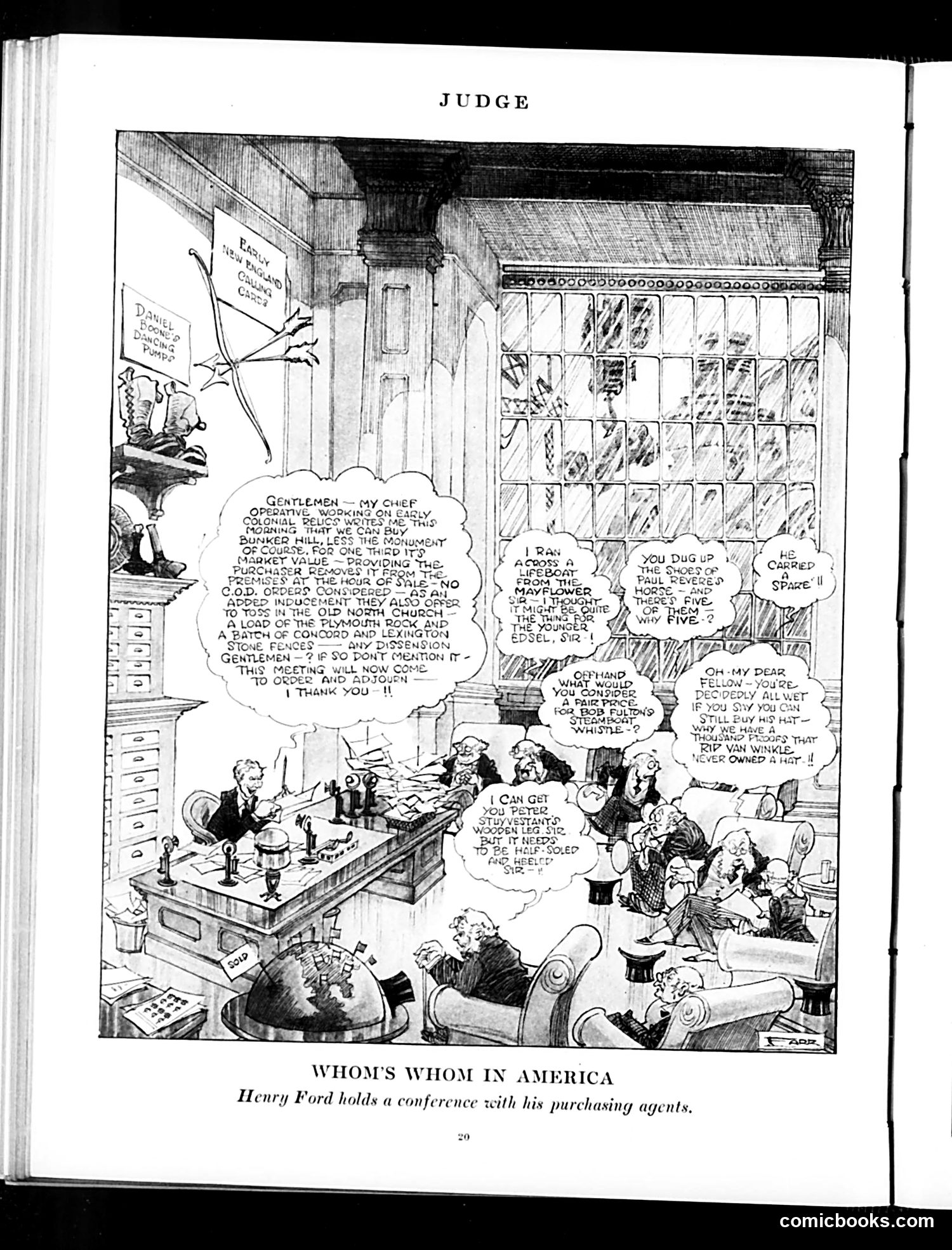
This satirical cartoon depicts **Henry Ford** (identifiable from the caption) holding a conference with his purchasing agents in what appears to be a corporate office. The joke centers on Ford's famously aggressive cost-cutting and "American efficiency" philosophy. The agents are proposing absurd "cost-saving measures": removing historical landmarks (Bunker Hill Monument, Plymouth Rock, Concord and Lexington stone fences) and selling them as scrap; offering old church materials as building supplies; and other ridiculous schemes. The satire mocks Ford's reputation for ruthless modernization and dismissal of tradition in pursuit of profit and efficiency. The agents' increasingly outlandish proposals—culminating in references to Van Winkle and whistles—suggest how Ford's philosophy, taken to its logical extreme, would destroy America's historical heritage for marginal financial gain. The cartoon criticizes both Ford's business practices and the broader American tendency to sacrifice cultural patrimony for commercial advantage during the industrial era.
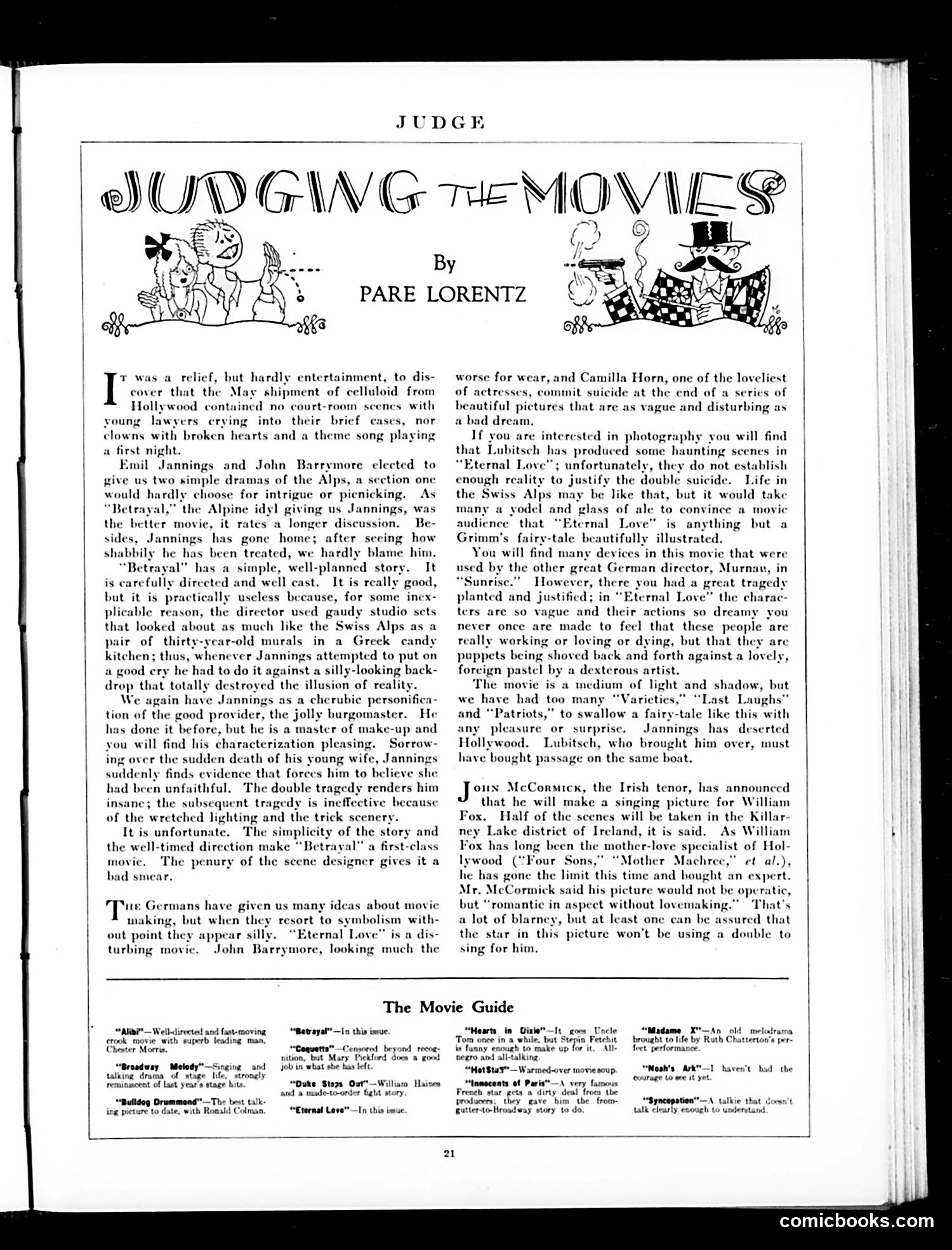
This is a film criticism column reviewing recent German and European cinema. Lorentz discusses three films: **"Betrayal"** (starring Emil Jannings): Lorentz praises its simple Alpine story and Jannings' performance as a grieving husband discovering his wife's infidelity, though he criticizes the artificial studio sets that undermine the mountain setting's realism. **"Eternal Love"** (with John Barrymore and Camilla Horn): Lorentz finds it pretentious and emotionally hollow—visually beautiful but narratively vague, with characters feeling like "puppets" rather than real people. He contrasts it unfavorably with Murnau's "Sunrise," which had greater emotional justification for its tragedy. **A John McCormick project for William Fox**: Announced as a singing picture set in Ireland's Killarney Lake district, which Lorentz dismisses as "blarney" (Irish bluster). The satire targets German Expressionist cinema's overuse of visual symbolism without narrative substance—style overwhelming emotional authenticity.
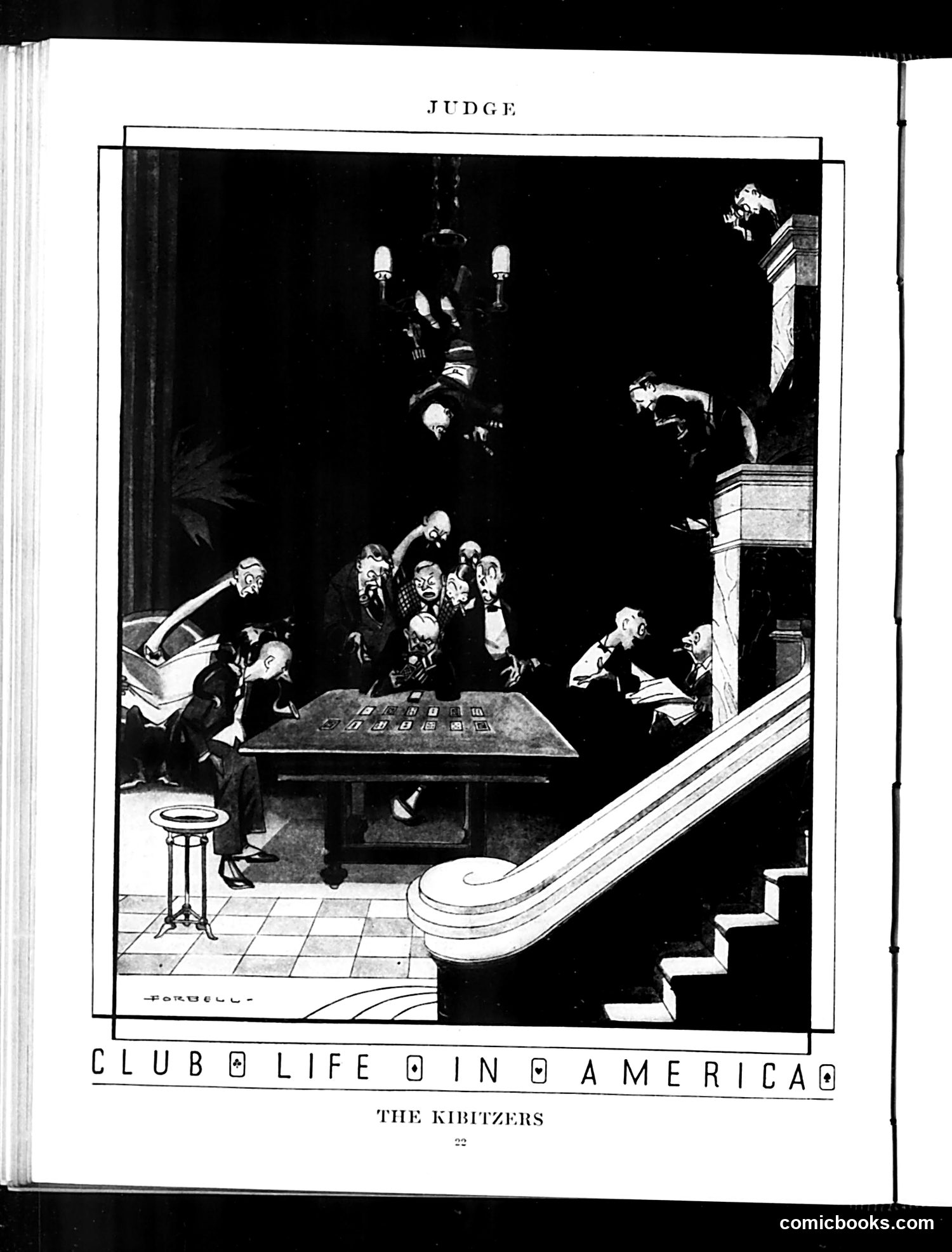
This cartoon satirizes "kibitzers"—unsolicited advice-givers who watch others play games. The scene shows a group of exaggerated caricatured figures crowding around a gaming table in what appears to be an upscale club, with observers peering down from above and others gesturing animatedly. The satire targets a recognizable social type: people who intrude on card games or other pastimes to offer unwanted commentary and suggestions. The cramped, chaotic composition emphasizes how annoying these hangers-on become. The title "Club Life in America" suggests this was a commentary on American social habits, likely mocking the prevalence of kibitzers in leisure spaces frequented by the wealthy. The caricatured faces appear exaggerated in typical Judge fashion to emphasize the foolishness of the behavior being ridiculed.
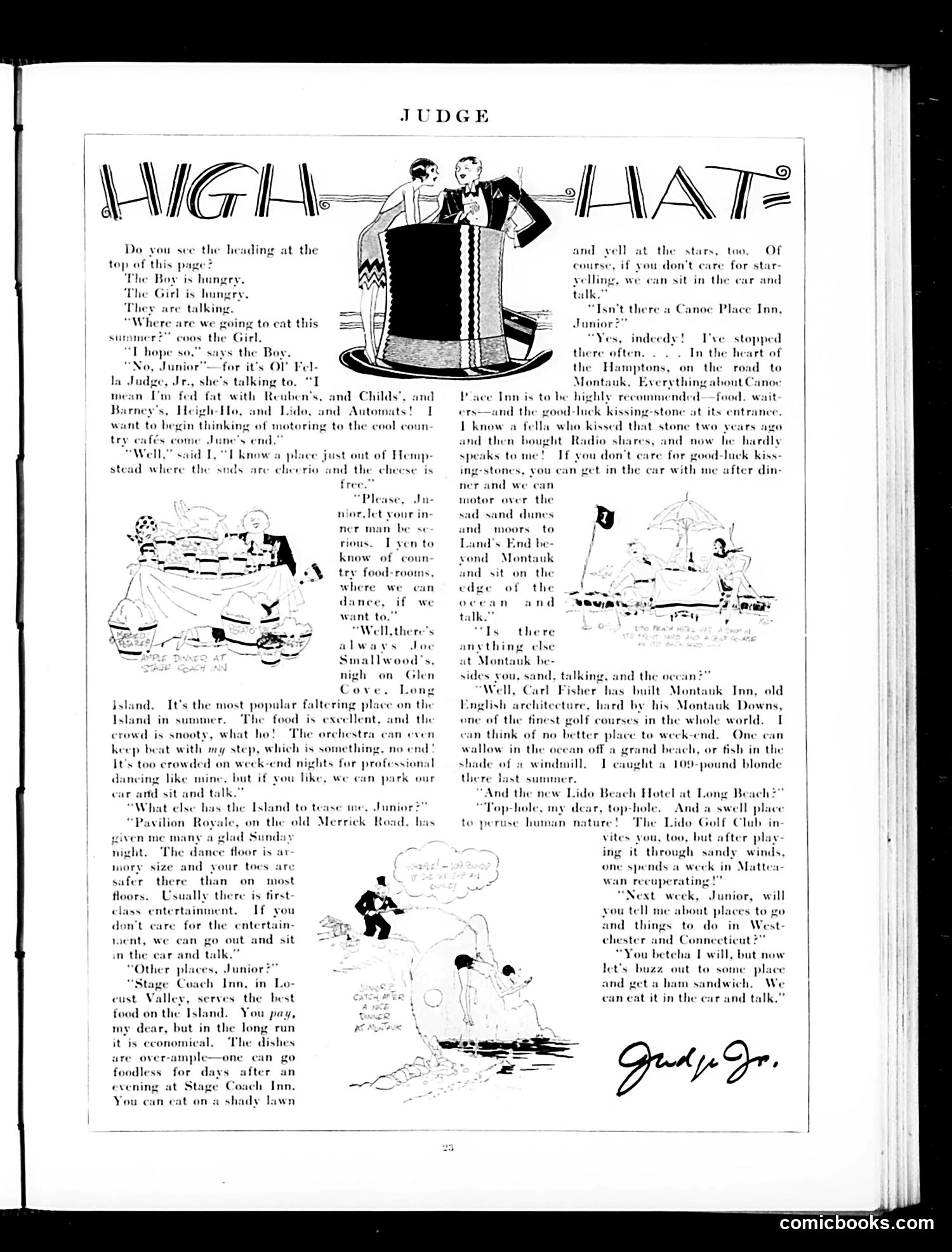
This page satirizes upper-class summer leisure culture of the 1920s. Two wealthy young people discuss where to dine and socialize during summer vacation on Long Island and beyond. The satire targets: 1. **Affluent dining culture**: The boy boasts of eating at fashionable spots (Reuben's, Childs', Automats, Montauk Inn, Lido Beach Hotel), suggesting conspicuous consumption and snobbery. 2. **The "motoring" craze**: Taking cars to country restaurants and casual outdoor dining represents new leisure activities for the wealthy. 3. **Affected sophistication**: References to "snooty" crowds, "top-hole" establishments, and the "good-luck kissing-stone" mock pretentiousness. 4. **Romantic posturing**: The boy uses elaborate suggestions (watching stars, ocean-side conversation) as flirtation tactics. The cartoon's title "HIGH HAT" refers to snobbish, uppity behavior—this couple's casual wealth and casual affairs exemplify the frivolous leisure class during the prosperous 1920s Jazz Age.
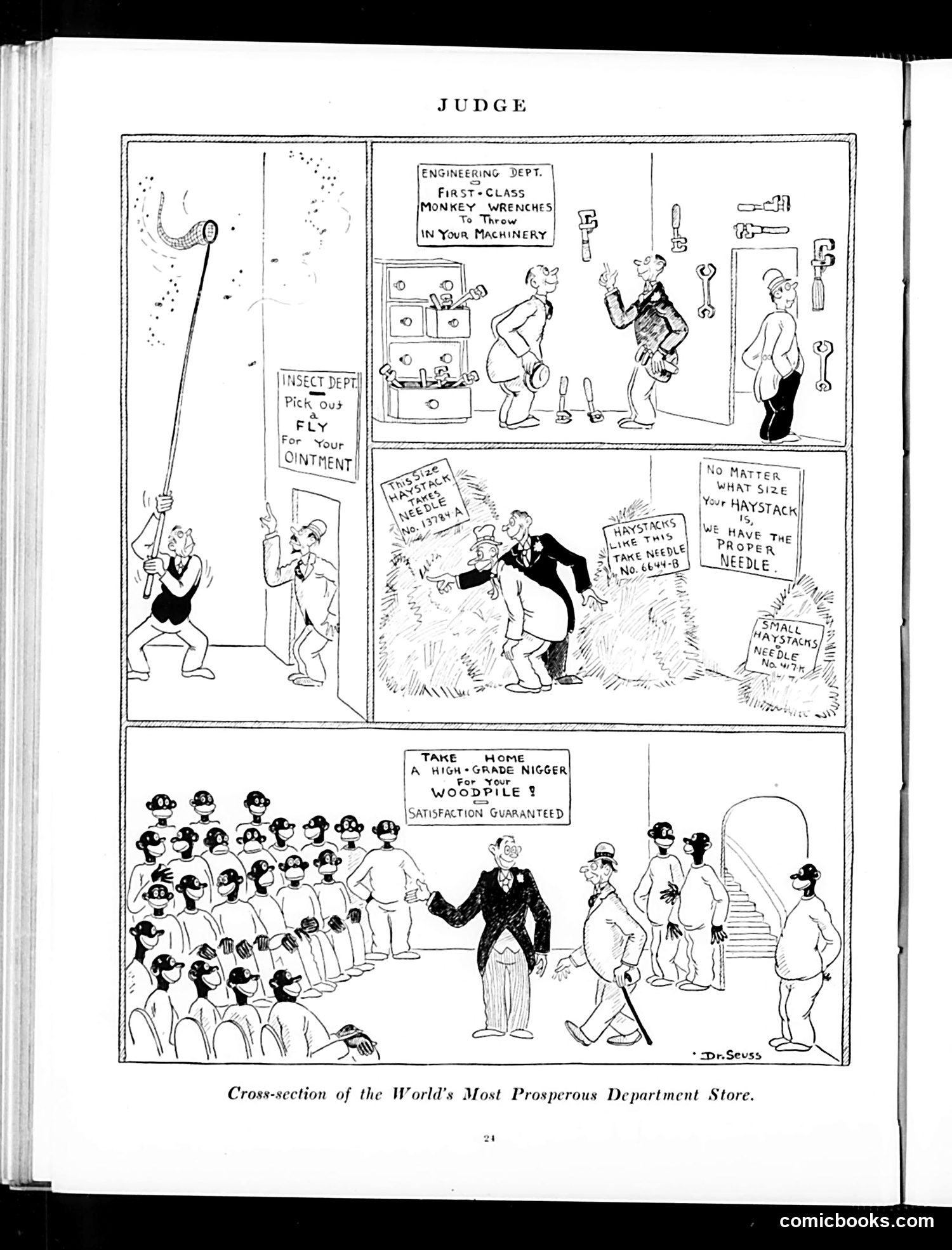
This Dr. Seuss cartoon satirizes a department store's absurd product offerings through mock "departments." The Engineering Department advertises monkey wrenches for machinery; the Insect Department sells fly ointment. The bottom panel shows a manager presenting enslaved Black people as merchandise—labeled a "high-grade" product for sale with "satisfaction guaranteed"—to customers at what's called "the World's Most Prosperous Department Store." The satire targets the dehumanization of slavery by presenting it as commercial transaction, alongside ridiculous products. This reflects early-20th-century Judge magazine's occasional anti-racist commentary through grotesque exaggeration. The racial caricatures and slur reflect the publication's era, though the cartoon's intent appears critical of slavery's commodification rather than endorsing it. This represents historically significant but offensive satire that modern readers must contextualize within both its time period and Seuss's later anti-racist advocacy.
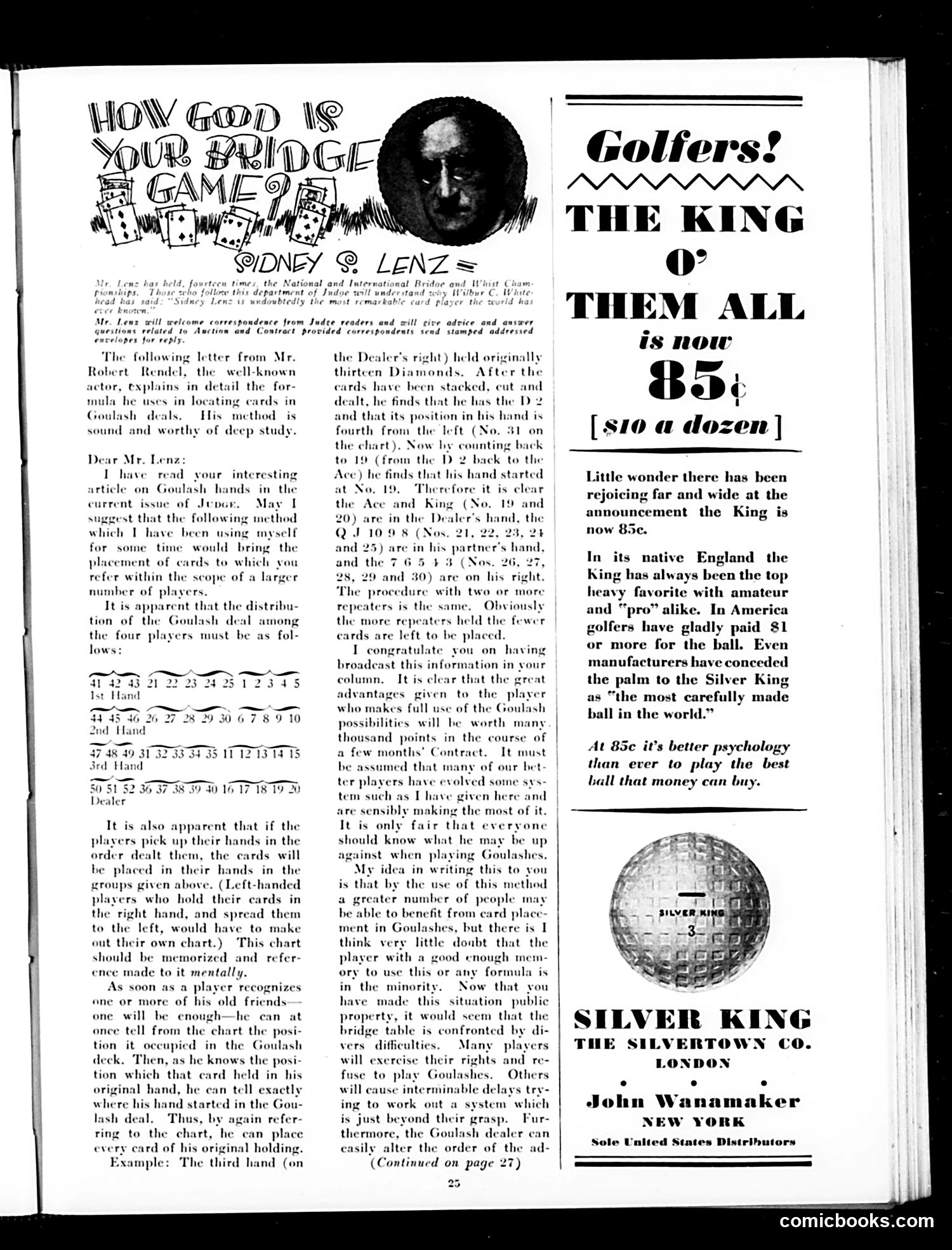
This page is primarily **instructional and advisory content about contract bridge**, not political satire. It contains: **Main Content:** - A letter from actor Robert Rendel explaining a mathematical formula for memorizing card positions in "Goulash" (a bridge card-dealing variant), addressed to bridge expert Sidney Lenz - Discussion of how skilled players can use memory techniques to gain advantage in this game **Right Column Advertisement:** - An ad for "Silver King" golf balls, now priced at 85¢ per dozen - Marketed as superior quality, made in England, favored by amateur golfers - Distributed by John Wanamaker in New York and The Silvertown Co. in London **Context:** Contract bridge was enormously popular in 1920s-30s America among the wealthy and educated classes. This page reflects the era's enthusiasm for the game and anxiety about competitive play tactics. The golf ball ad targets the same affluent demographic. **No political content or caricature is present** on this page—it's a straightforward mix of bridge instruction and luxury goods advertising.
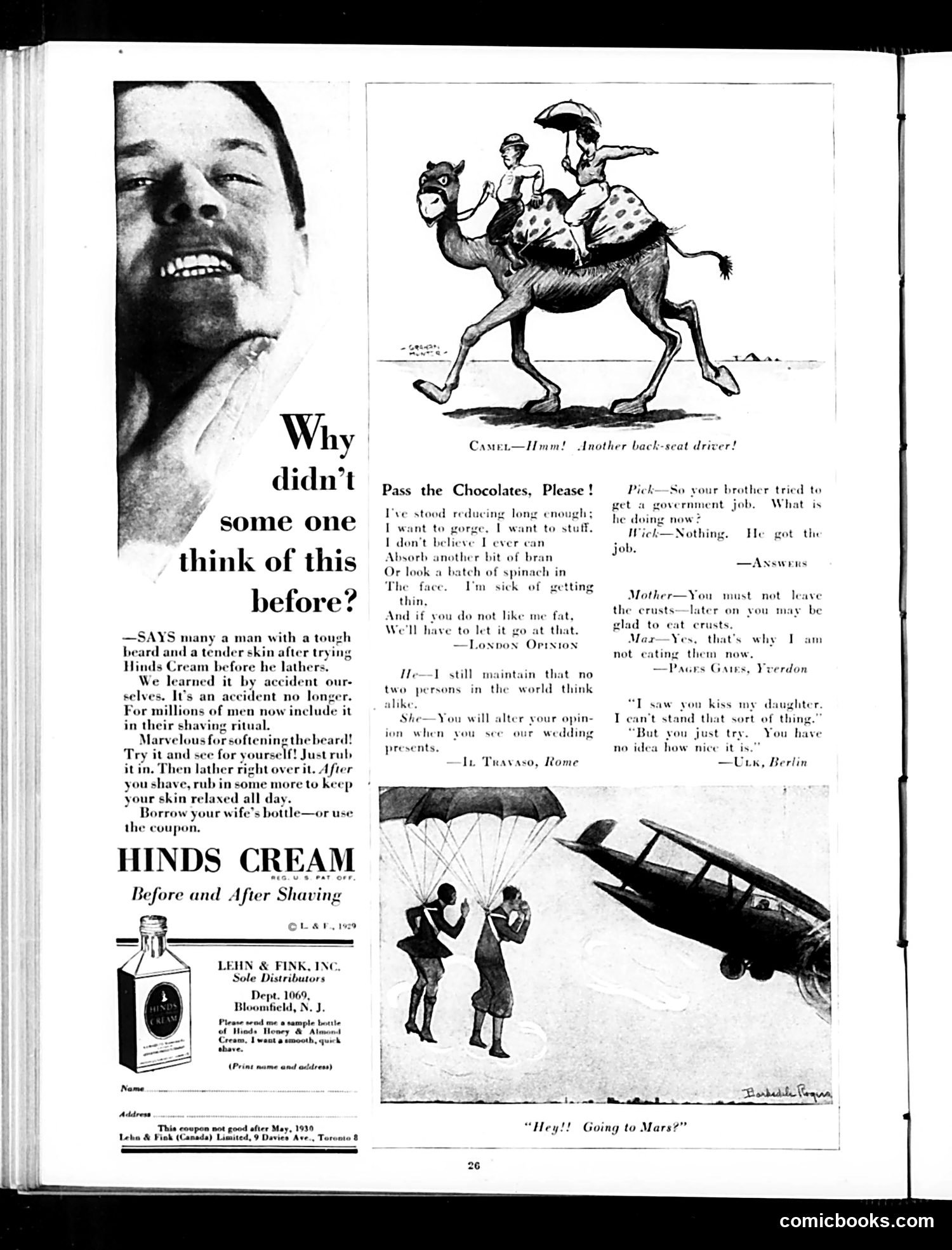
This page contains **multiple unrelated cartoons and a shaving cream advertisement** (Hinds Cream). The cartoons are brief humorous exchanges: 1. **"Camel—Hmm! Another back-seat driver?"** depicts a camel carrying two riders in desert attire, satirizing backseat drivers—passengers who offer unwanted driving advice. 2. **"Pass the Chocolates, Please!"** shows a domestic dispute where a wife, tired of eating healthy foods (bran, spinach), demands chocolate and threatens to get fat if her husband objects. 3. **"Hey! Going to Mars?"** shows two figures with a parachute near an airplane, likely joking about an absurd destination. 4. Several short joke exchanges mock marital disputes and social conventions (weddings, parental authority). The page is primarily **advertising-driven**, with the large Hinds Cream ad dominating the left side. The cartoons appear filler content typical of 1920s-30s magazines—lighthearted domestic humor with no political significance.
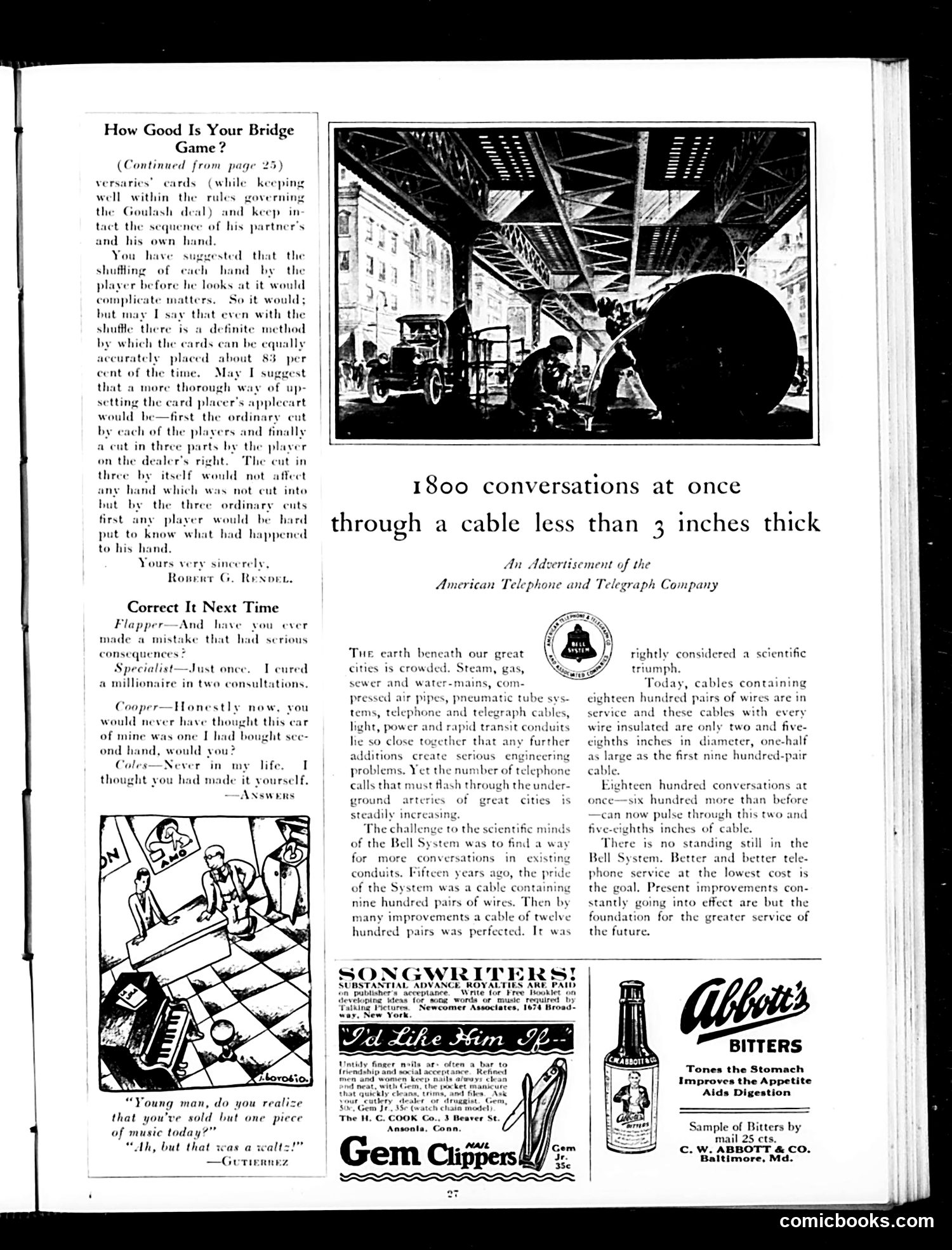
The page contains advice on improving bridge card game tactics—specifically debating shuffling methods to prevent card-marking fraud. This reflects bridge's enormous popularity during the Jazz Age. The small cartoon shows a music dealer and customer: a "flapper" (fashionable young woman) has sold only one piece of music that day. The punchline—"but that was a waltz"—satirizes the era's generational divide: older people associated waltzes with respectability, while flappers and youth preferred modern jazz and dance music. The humor mocks both the flapper's commercial failure and the obsolescence of traditional tastes. The dominant content is advertising: Bell Telephone's boast that modern cables transmit 1,800 simultaneous conversations through thin cables—showcasing technological progress. Period advertisements for Gem Clippers, Abbott's Bitters (a "medicinal" tonic), and songwriter royalty services fill remaining space, typical of Judge magazine's revenue model.
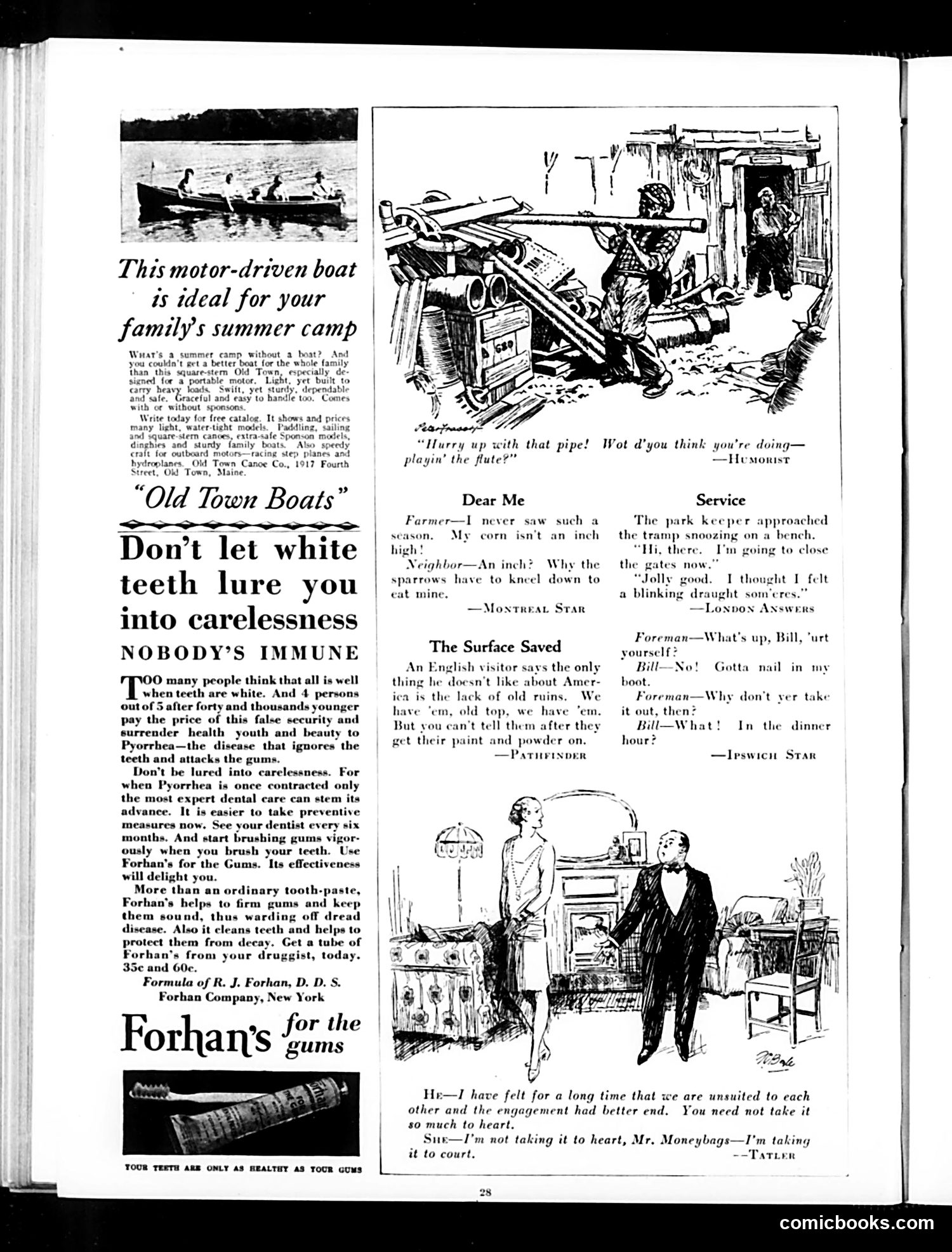
This page is primarily **advertising with light humor content**, typical of Judge magazine's format. The main advertisements promote **Old Town motor boats** for summer recreation and **Forhan's toothpaste**, emphasizing gum health and the dangers of pyorrhea—a serious dental disease that was a genuine public health concern in this era before modern dentistry. The cartoon/humor sections contain brief, unrelated jokes: - A rural exchange about crop failure (farmer's corn vs. neighbor's sparrows) - An English visitor's complaint about America lacking "old ruins" - Service-industry interactions (park keeper and tramp, foreman and worker) - A final joke about a woman taking her ex-fiancé "to court" (legal action) rather than taking the breakup emotionally These are typical early-20th-century Judge fare: lighthearted, inconsequential social observations with no political content. The sketches use working-class and British dialect humor common to the period's satirical magazines.
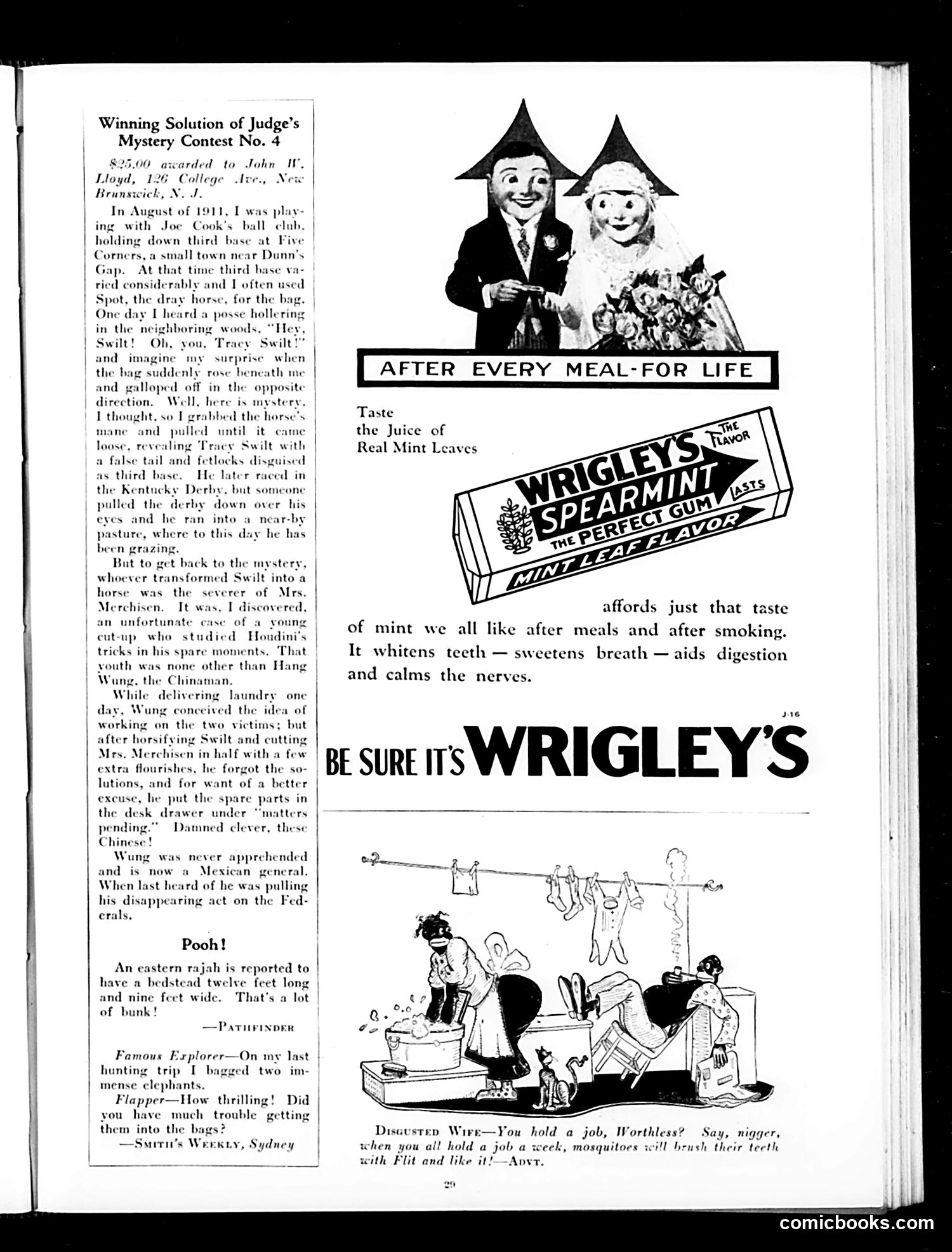
This page combines a contest-winning mystery story with vintage advertising and humor snippets. **Main Content:** The featured mystery solution (awarding $25 to a New Jersey reader) describes an absurdist 1911 baseball tale: a third baseman discovers the actual base is a disguised horse, which gallops away revealing a man beneath. The mystery's "solution" attributes the transformation to Hang Wung, a Chinese magician/laundry worker who studied Houdini tricks. The racist conclusion: Wung disappeared and became a Mexican general, evading law enforcement. **Advertisement:** A Wrigley's Spearmint gum ad occupies the center, promoting mint flavor for post-meal freshness and dental health. **Humor Snippets:** Include xenophobic and racist jokes typical of the era—one references a "rajah's bedstead," another uses a racial slur in a joke about mosquitoes and insecticide. **Historical Context:** This reflects early-20th-century American attitudes: casual racism, ethnic caricaturing, and stereotypes were standard magazine fare. The content would be considered deeply offensive today.
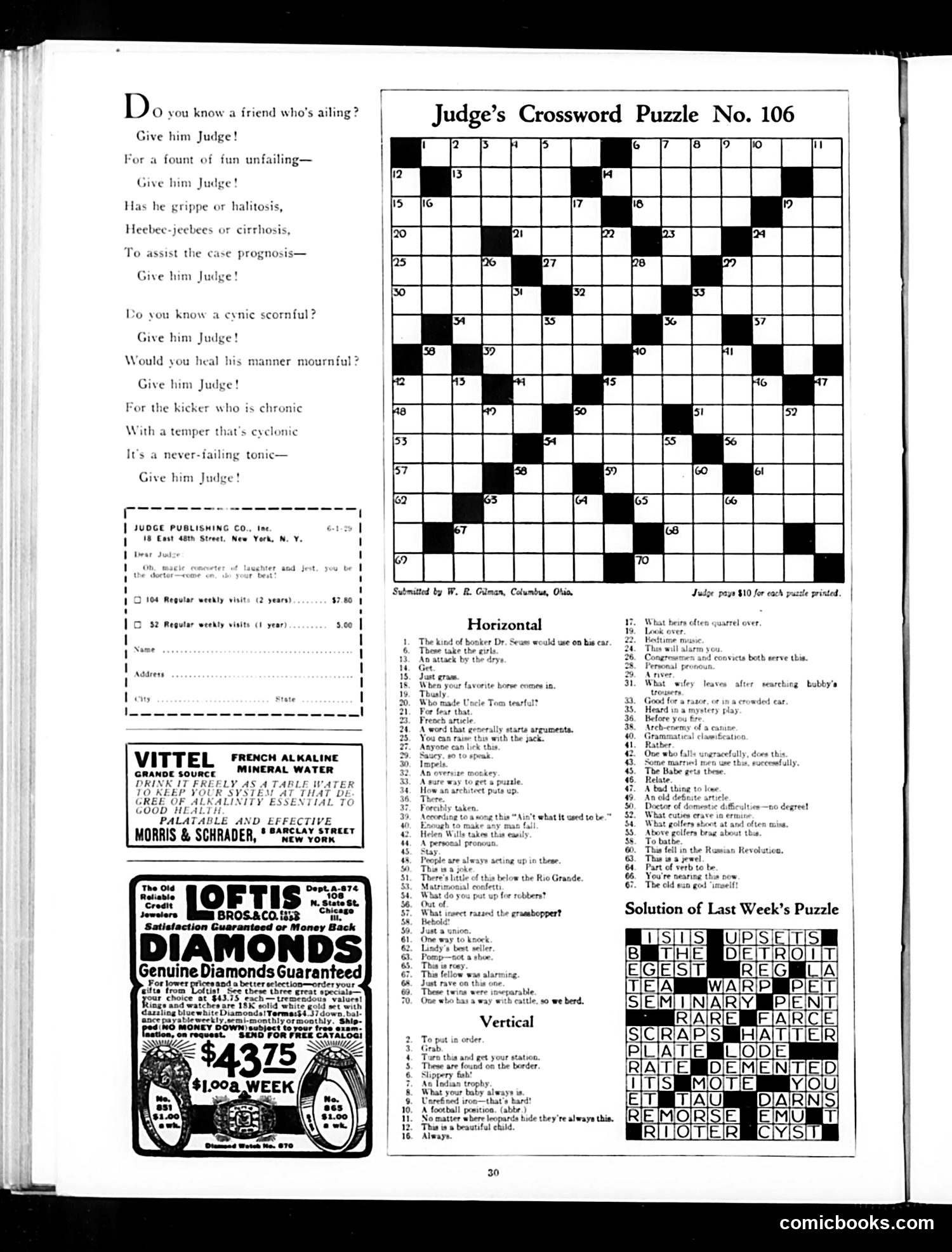
This page is primarily a **crossword puzzle** (#106) with accompanying advertisements and a humorous poem. The poem is an advertisement for *Judge* magazine itself, promoting it as a cure-all tonic for various ailments and personality problems—"grippe" (flu), "halitosis," "cirrhos[is]," and cynicism. The satire suggests that laughter and humor are medicinal. The page includes ads for **Vittel mineral water**, **Loftis jewelry**, and **diamonds**, typical of early 20th-century magazine advertising. The crossword clues reference period-specific slang and situations (Helen Wills, the Rio Grande, "grambopper," etc.) now obscure to modern readers. No political cartoon is visible on this page—it's primarily a puzzle and advertisement section typical of *Judge's* lighter content, using humor as a selling point for both the magazine and consumer products.
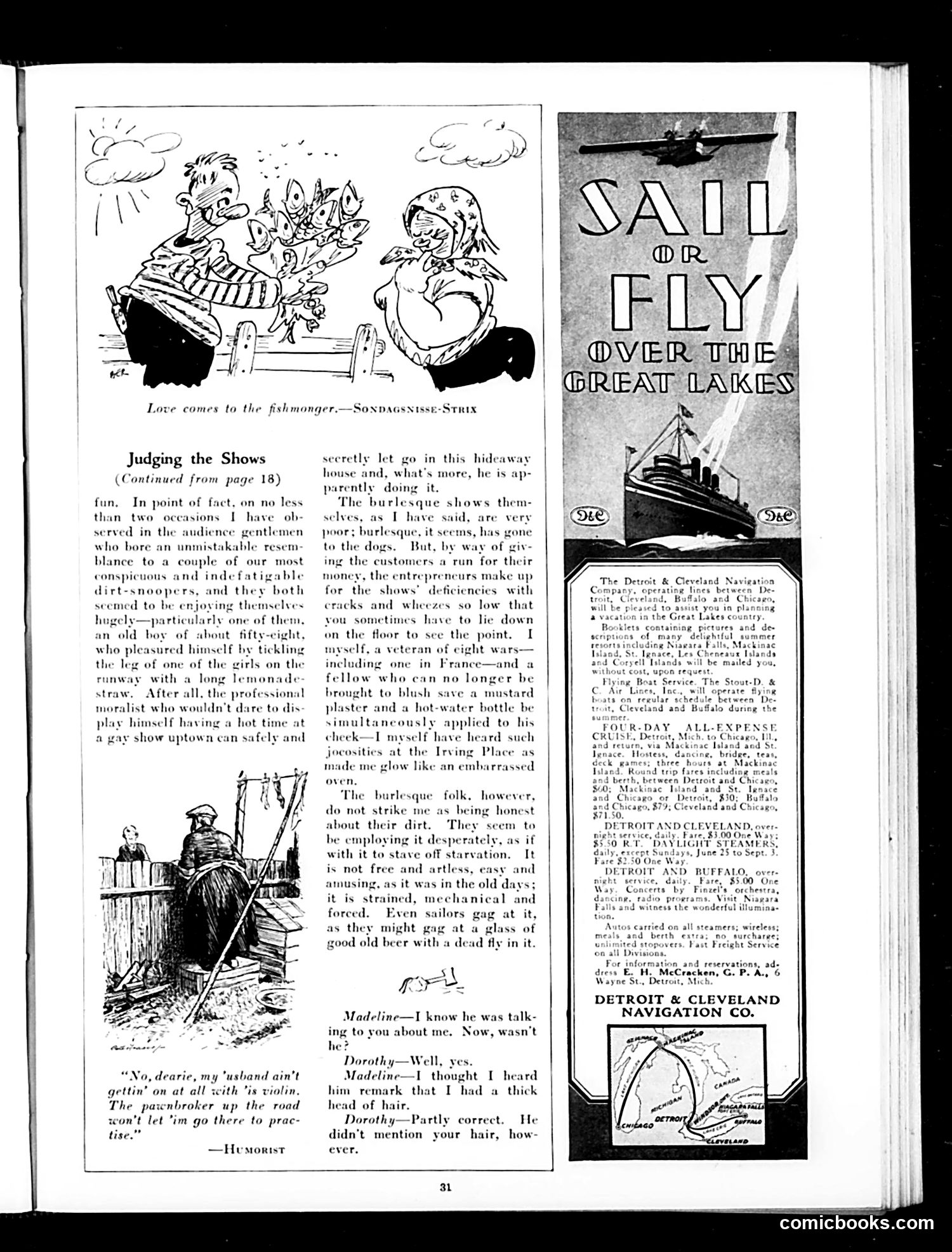
The page contains two distinct elements: **Left side — "Judging the Shows":** A theater critic discusses burlesque performances, noting their poor quality but acknowledging audiences enjoy them anyway. He observes that even self-righteous moral crusaders ("dirt-snoopers") secretly attend these shows. The humor lies in exposing hypocrisy—the same people publicly condemning indecent entertainment privately enjoy it. The accompanying cartoon shows a fishmonger receiving romantic attention, likely a visual gag about desire crossing class lines. **Bottom dialogue:** A brief exchange where Dorothy deflects Madeline's suspicion about a compliment, jokingly implying the man said something unflattering about her appearance instead. **Right side:** Advertisements for Great Lakes steamship cruises operated by the Detroit & Cleveland Navigation Company—unrelated to the satirical content. The page satirizes moral double standards and hypocrisy prevalent in early 20th-century American society.
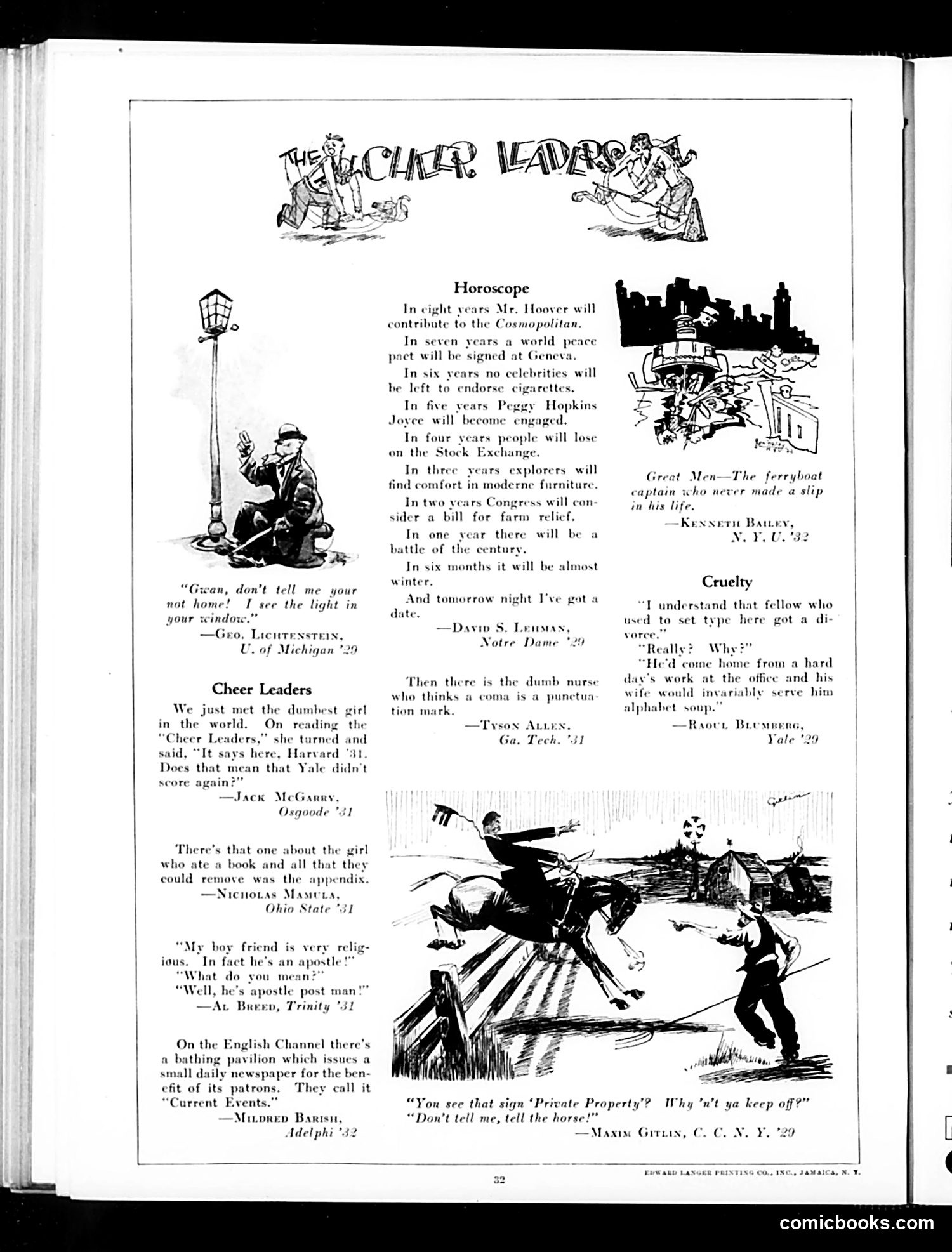
This page collects humorous quips and cartoons primarily from college students, typical of Judge's "Tattler" humor section. The jokes are mostly lightweight collegiate wit: **Main Content:** - **"Cheer Leaders"**: A riff on Yale's athletic reputation, joking that cheerleaders are unintelligent - **"Horoscope"**: Satirical predictions about 1929 America—Hoover's frugality, celebrity endorsements, farm relief, the stock market (relevant given the 1929 crash context), and modern furniture trends - **"Cruelty"**: A crude domestic joke about a divorcing typesetter whose wife served alphabet soup **Bottom Cartoon:** Shows a man on a horse trespassing on private property; when confronted about ignoring the "Private Property" sign, he deflects blame to the horse—a simple visual gag about refusing responsibility. The page reflects typical college humor of the late 1920s: wordplay, mild satire of contemporary figures (Hoover), and domestic/relationship jokes. Most humor now seems dated or groan-worthy rather than genuinely funny.
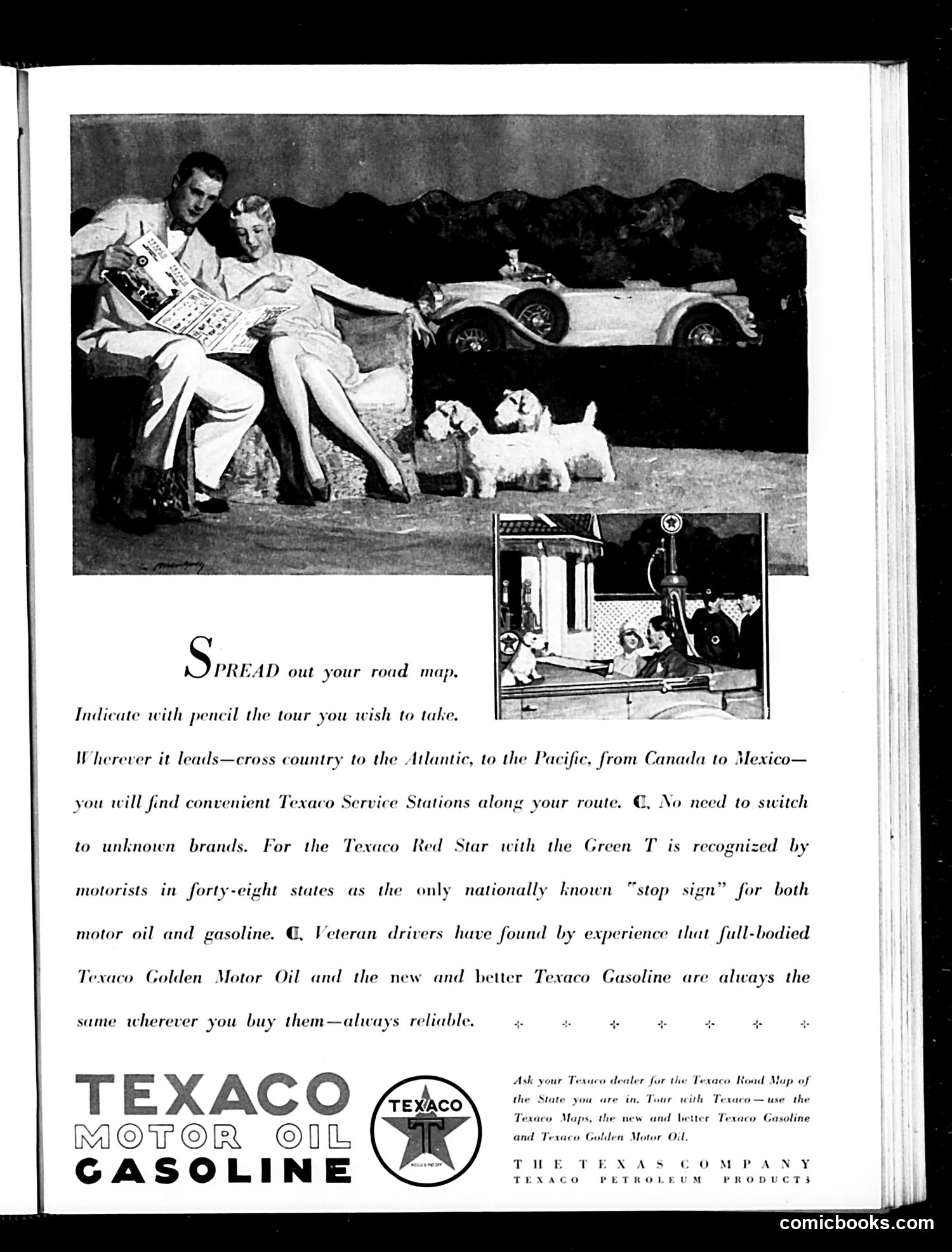
This is a **Texaco gasoline advertisement**, not political satire. The page depicts a leisure scene from what appears to be the 1930s-40s: a well-dressed couple planning a cross-country road trip with a road map, while small dogs play nearby and a stylish convertible sits in the background. The ad's pitch emphasizes Texaco's nationwide reliability and brand recognition—the "Red Star with the Green T" is promoted as the only nationally recognized gas station sign across all forty-eight states. It appeals to motorists' desire for consistency and trustworthiness during long-distance travel, urging drivers to use Texaco products rather than "unknown brands." The accompanying smaller photograph shows a Texaco service station interior, reinforcing availability and infrastructure. This is essentially consumer advertising leveraging the era's growing car culture and American road-trip optimism, rather than containing editorial commentary or satire.
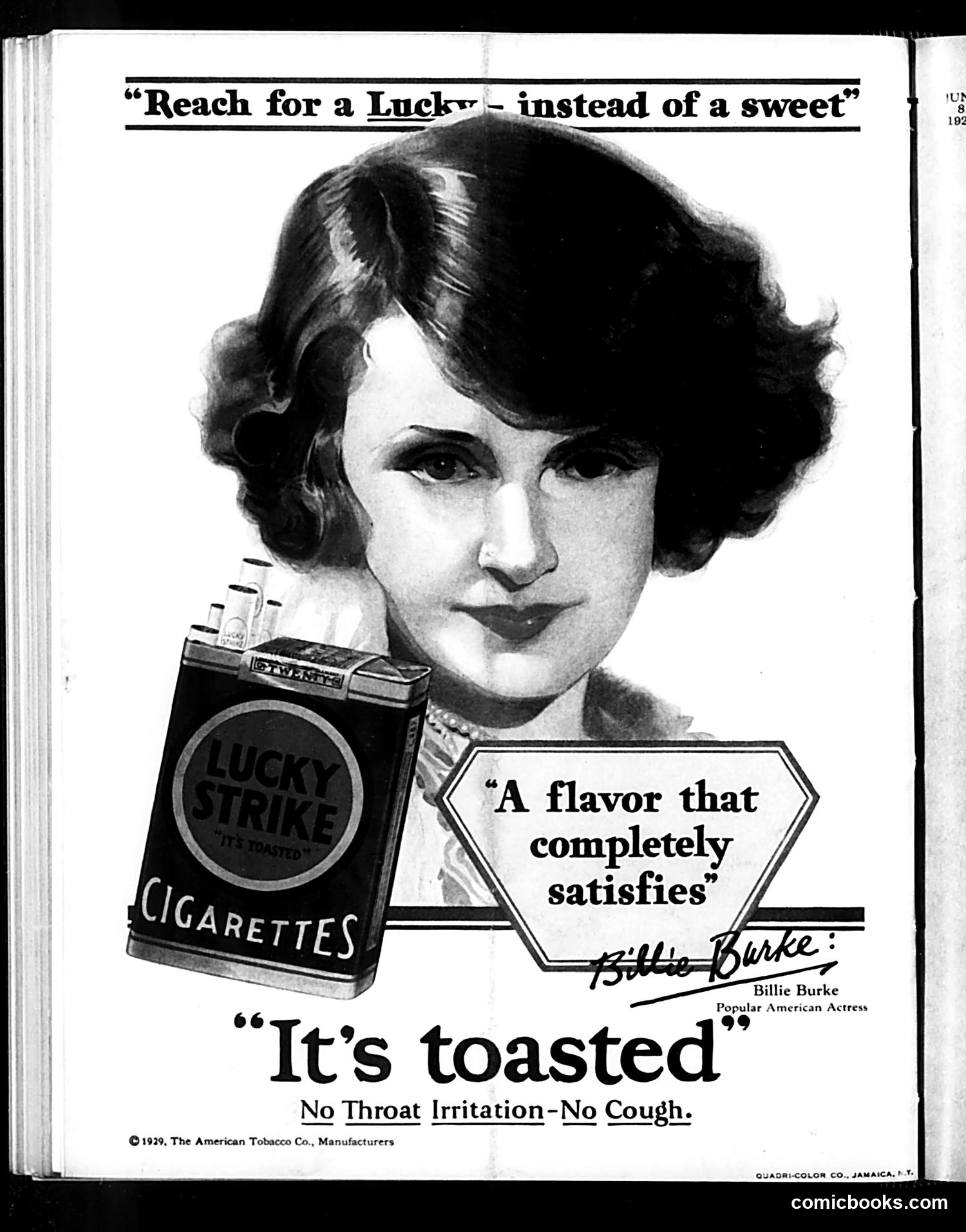
This is a cigarette advertisement, not a political cartoon. It features actress Billie Burke endorsing Lucky Strike cigarettes. The ad employs health claims now recognized as misleading: "No Throat Irritation—No Cough" and promises that the "toasted" process eliminates irritation. The tagline "Reach for a Lucky—instead of a sweet" suggests cigarettes as appetite suppressants, likely targeting weight-conscious consumers, particularly women. This represents early celebrity endorsement advertising and predates tobacco health warnings by decades. By modern standards, the ad is striking for its brazenly false health claims and the casual way a respected actress lends credibility to a harmful product—practices now heavily regulated and ethically condemned.