
A complete issue · 36 pages · 1929
Judge — May 25, 1929
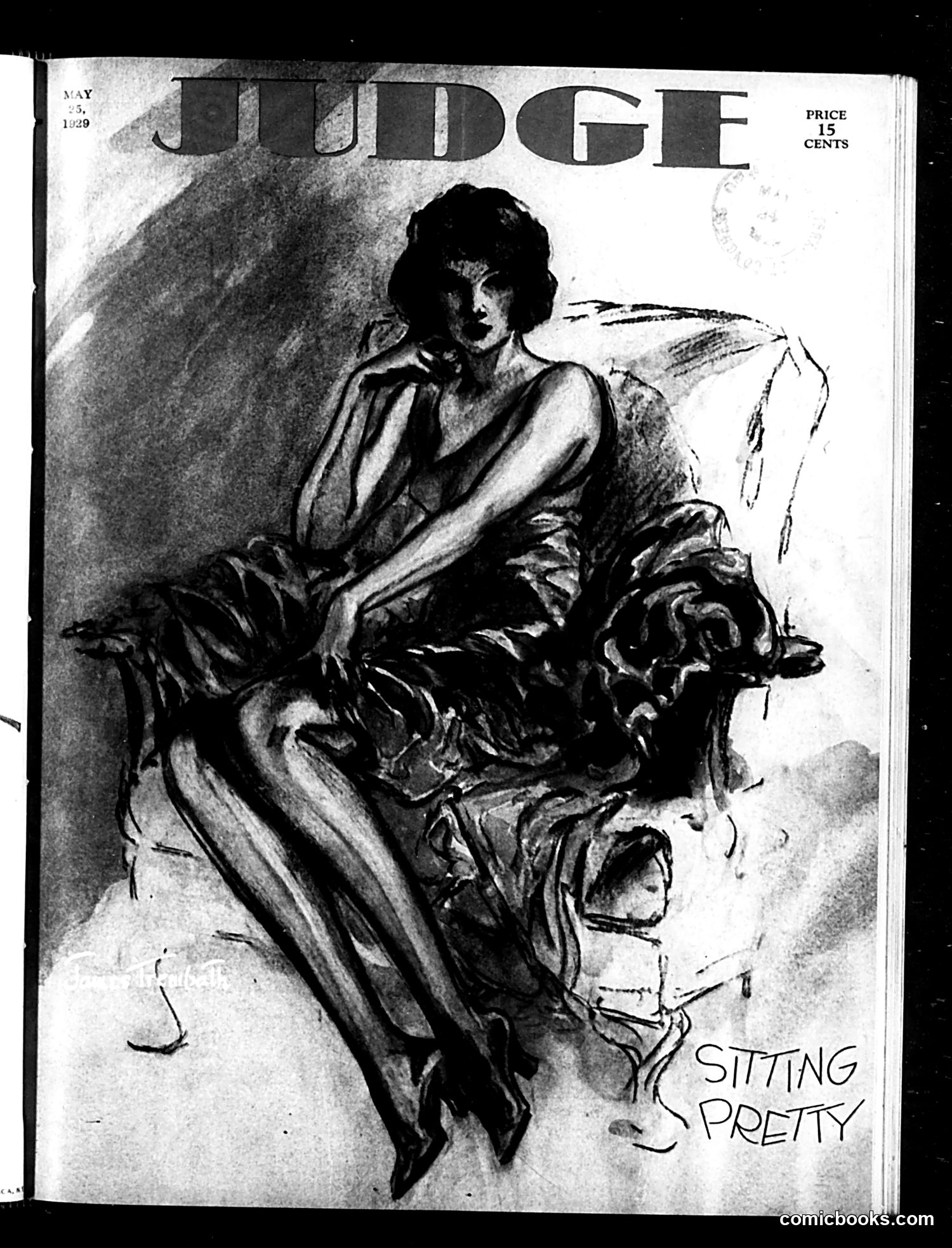
This cover illustration depicts a woman in classical drapery seated upon oversized sculptural heads, titled "Sitting Pretty." The image appears to be a commentary on women's social position or status in the late 1920s. Given the 1929 date—just before the stock market crash—"sitting pretty" likely references women who benefited from 1920s prosperity and newfound freedoms (voting rights granted in 1920, increased employment, cultural liberation). The classical artistic style suggests irony about women's elevated social standing versus traditional constraints. The sculptural heads beneath may represent male authority figures or institutions literally supporting women's newfound confidence, satirizing whether this empowerment was genuine or merely superficial positioning atop existing male-dominated structures.
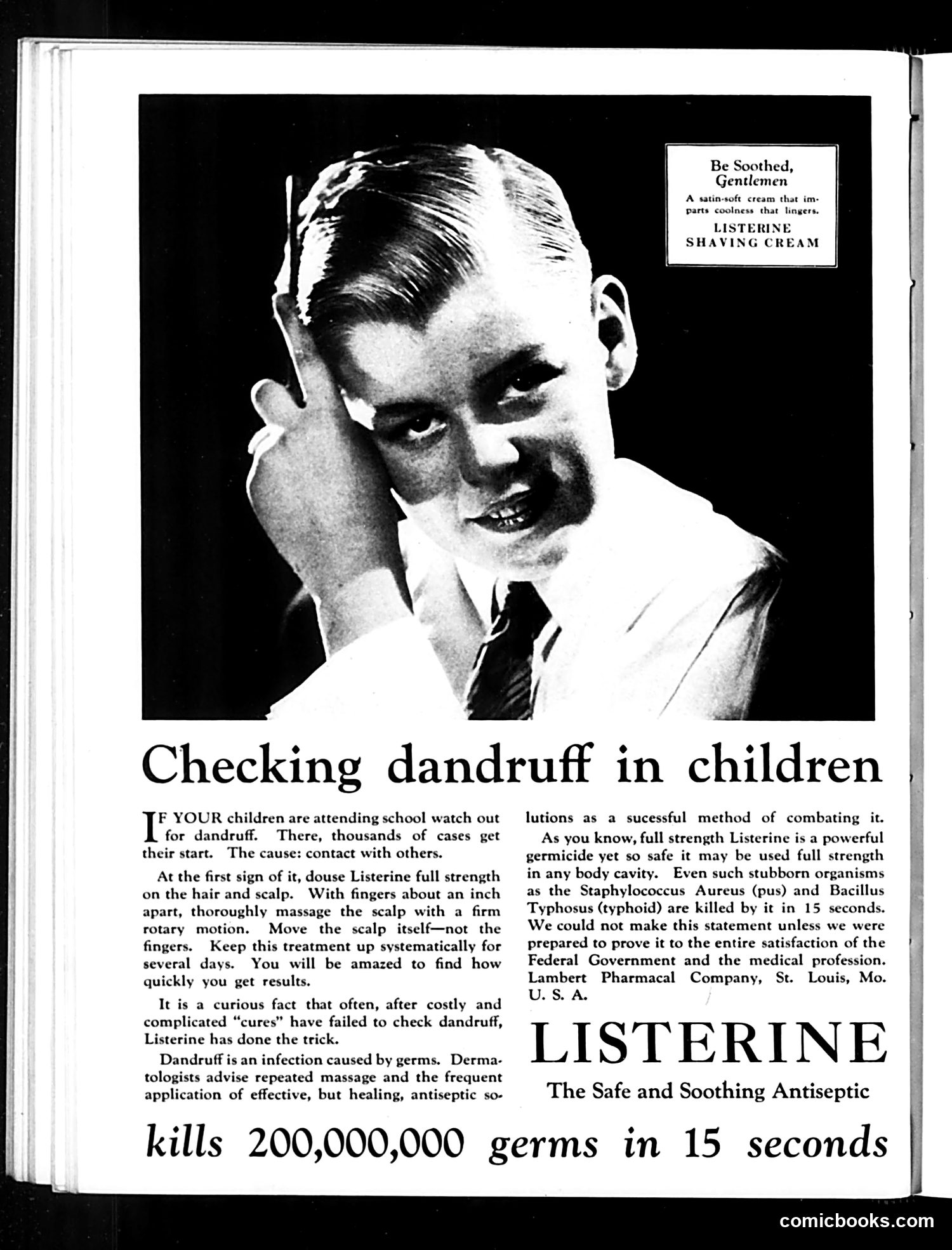
This page is primarily a **product advertisement**, not satirical content. It advertises Listerine antiseptic mouthwash and shaving cream to address dandruff in children. The photograph shows a man demonstrating the product with the tagline "Checking dandruff in children." The ad promotes Listerine as a powerful germicide, claiming it "kills 200,000,000 germs in 15 seconds" and references endorsement by the Federal Government and medical profession. Notable to modern readers: the advertisement makes direct medical claims (killing specific numbers of germs, treating infections) that would violate today's FDA regulations. The casual mention of using full-strength antiseptic on children's scalps reflects early-20th-century medical practices now considered potentially harmful. This represents how aggressively pharmaceutical companies marketed medicinal products before modern consumer protection standards.
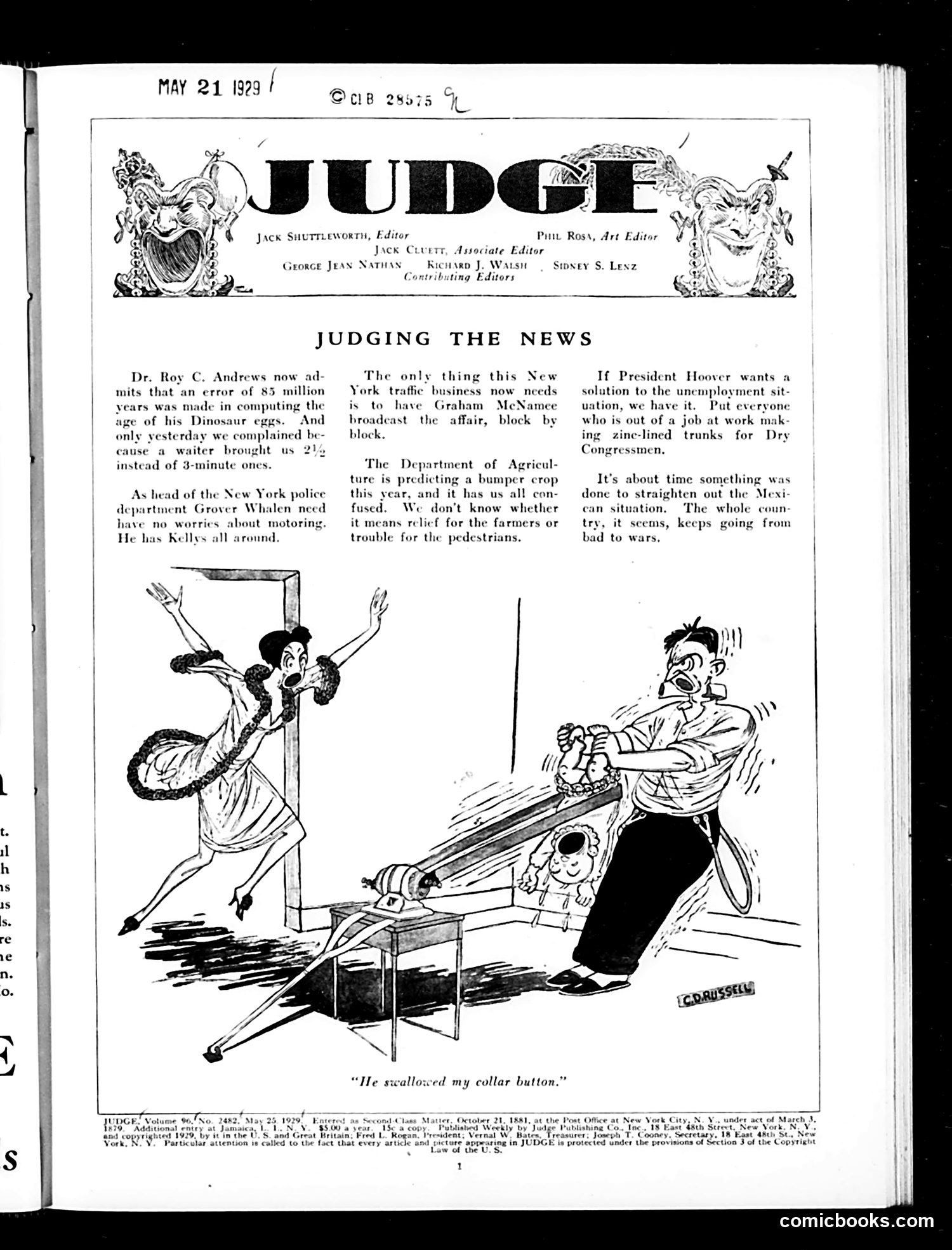
This page features editorial commentary under "Judging the News" alongside a cartoon captioned "He swallowed my collar button." The cartoon depicts a domestic scene where a man appears distressed while a woman (likely his wife) gestures wildly, and a small child sits on the floor. The man seems to be blaming the child for swallowing his collar button—a mishap treated as a major domestic crisis. The satire likely mocks overblown domestic complaints and marital discord over trivial matters. The exaggerated reactions suggest the cartoonist is poking fun at how couples dramatize minor household incidents. The editorial text references Dr. Roy Andrews's dinosaur egg findings, NYC police concerns, agricultural predictions, and unemployment issues—typical early-1929 topics predating the stock market crash later that October.
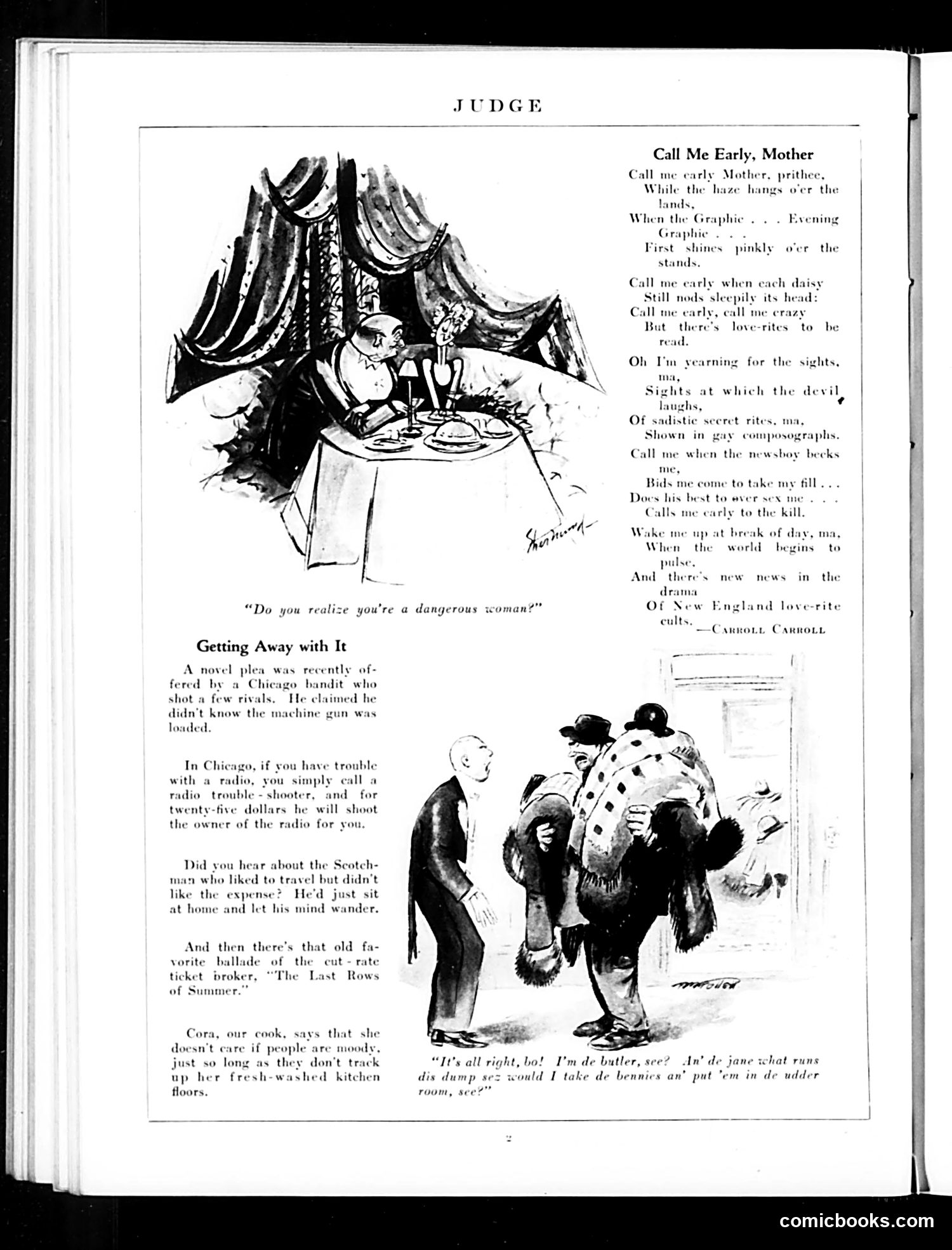
This page contains two separate pieces: **"Call Me Early, Mother"** (top right) is a poem by Carroll Carroll about yearning for excitement and scandal—referencing "New England love-rite cults" and "gay composographs." It appears to satirize women's appetite for sensational news and risqué content. **"Getting Away with It"** (bottom) mocks Chicago's lenient attitude toward crime. It describes a bandit claiming ignorance about a loaded machine gun, and references a "radio trouble-shooter" willing to kill radio owners for $25. The accompanying cartoon shows what appears to be mobsters or criminals conducting illicit business. The satire suggests Chicago authorities overlooked criminal activity during Prohibition era gangsterism, with the cook's indifference to tracking kitchen floors paralleling larger negligence about serious crimes.
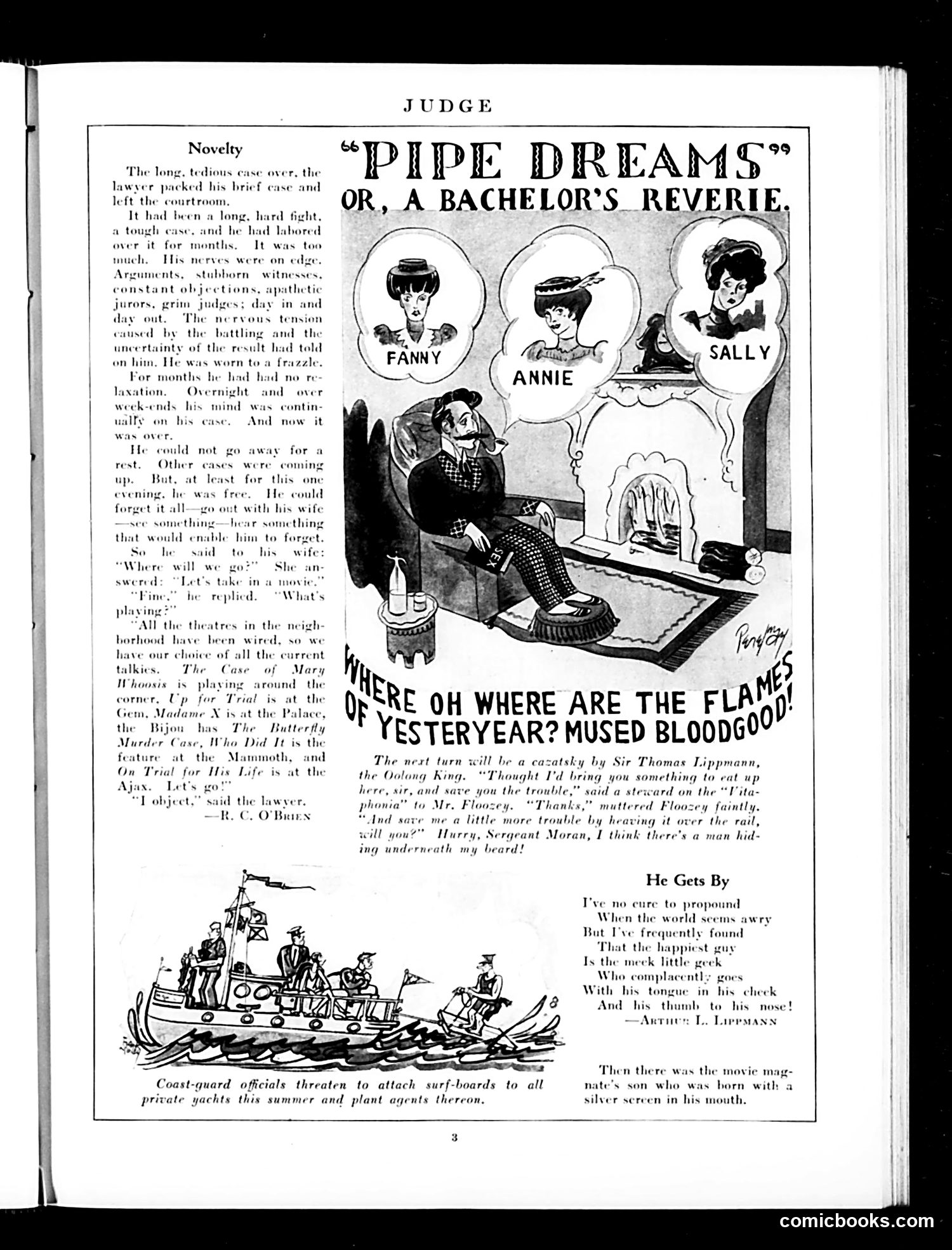
This page contains two satirical pieces: **"Pipe Dreams" (main illustration):** A bachelor daydreams about three women—Fanny, Annie, and Sally—while sitting in his living room. The satire mocks the fantasy life of unmarried men, suggesting their romantic imaginings are disconnected from reality. The "pipe dreams" reference alludes to opium pipes, implying these thoughts are as unreal as drug-induced hallucinations. **"He Gets By" (poem):** A humorous verse about an unnamed "meek little greek" who succeeds through wit and charm rather than conventional means—using his tongue and thumb to his nose (a mocking gesture). **Bottom illustration:** Coast guard officials threatening to attach surfboards to private yachts as a summer deterrent—likely satirizing either wealth-flaunting or boating regulations of the era. The overall tone is lighthearted social commentary on bachelor life and contemporary leisure culture.
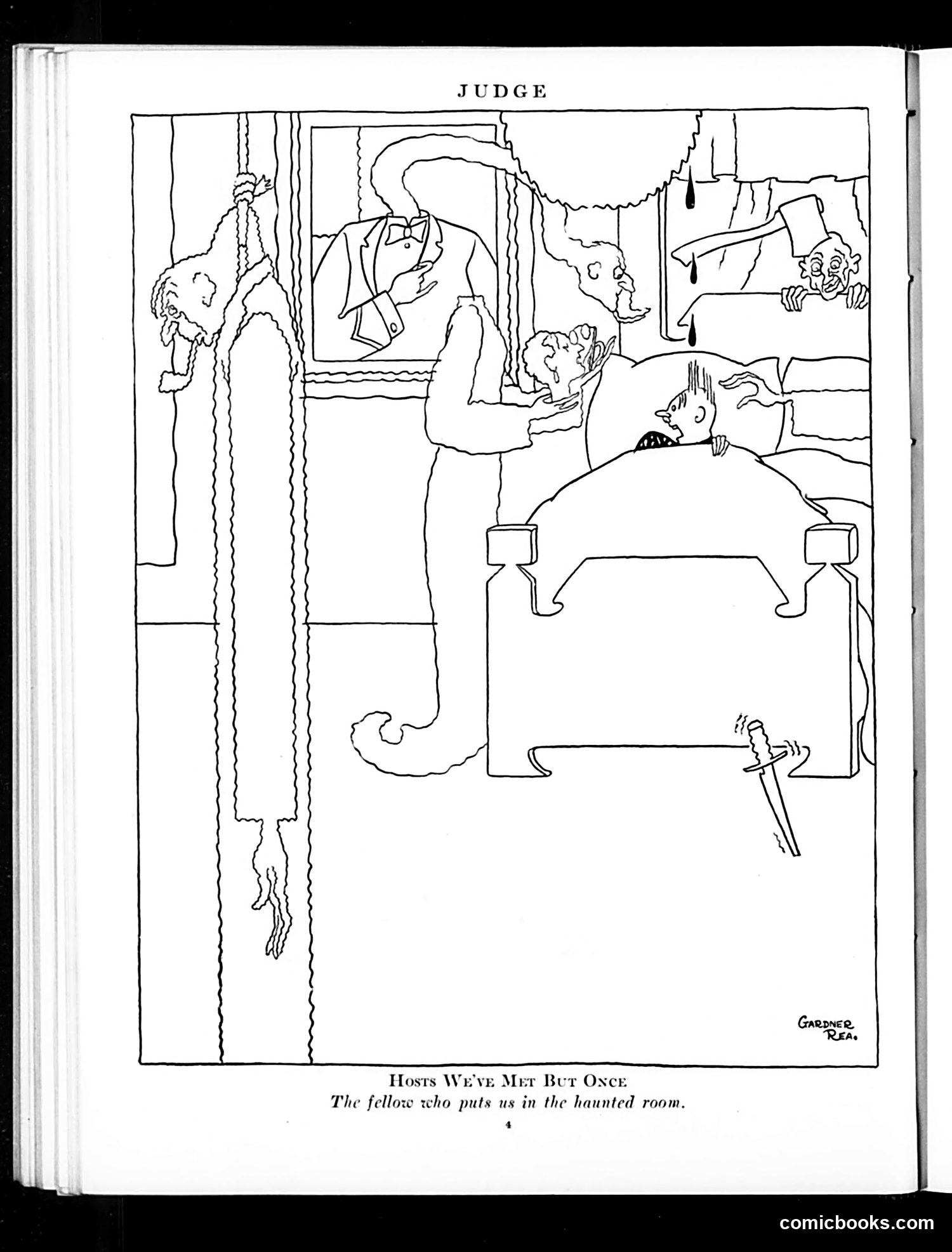
**Title & Setup:** "Hosts We've Met But Once: The fellow who puts us in the haunted room" **The Joke:** This is a social satire about inconsiderate hosts. The cartoon depicts a well-dressed man (the host) showing guests into a bedroom with obvious problems—hanging ropes (suggesting suicide), supernatural disturbances (floating figures in windows), and generally creepy/ominous conditions. **The Satire:** The humor targets hosts who assign guests to deliberately unpleasant or "haunted" accommodations, apparently as a prank or from careless indifference. It mocks the gap between social pleasantries ("we've met but once") and actual hospitality—the host maintains a courteous facade while obviously placing guests in uncomfortable or absurd situations. **Artist:** Credited to Gardner Read This reflects early 20th-century etiquette commentary about proper social behavior among the upper classes.
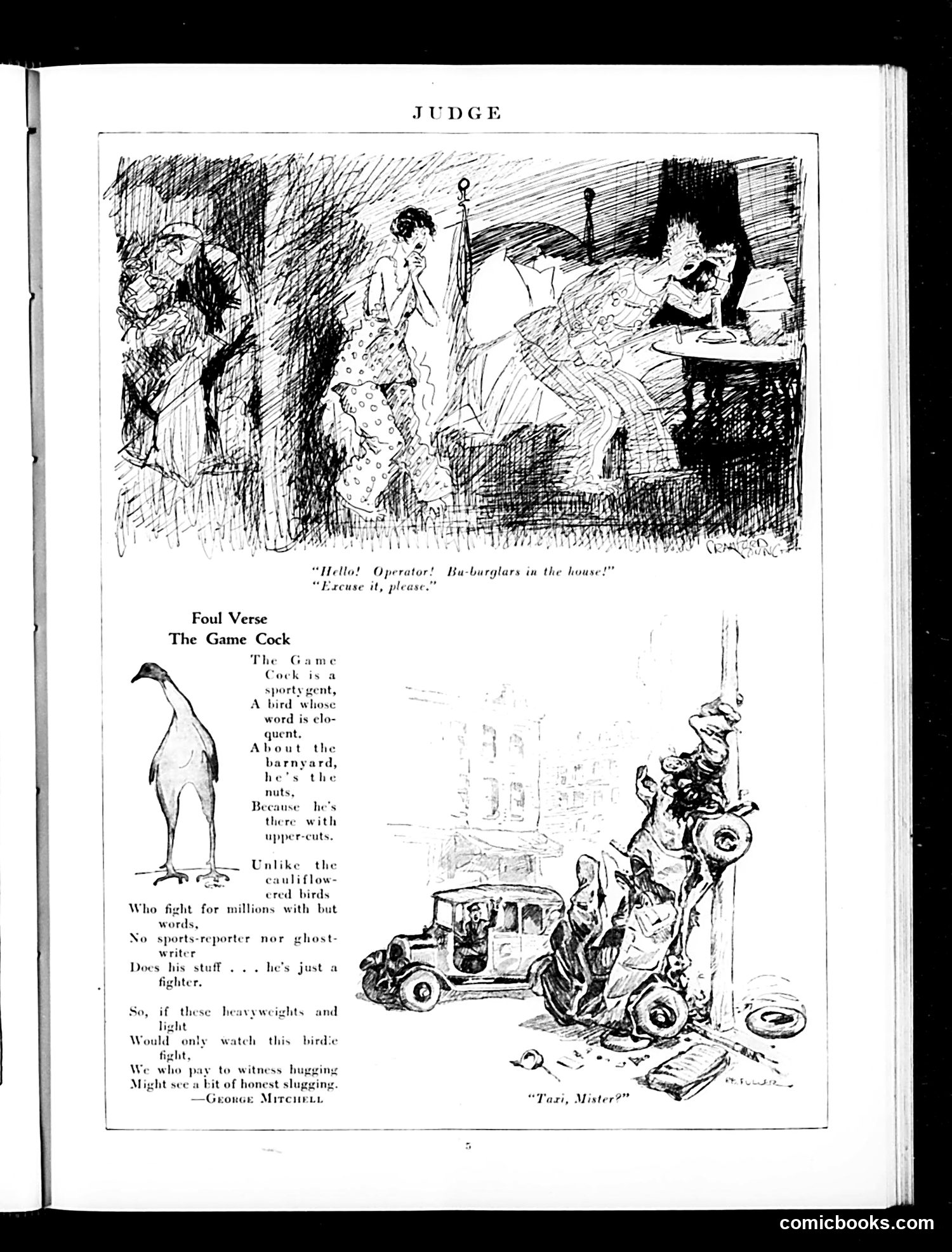
**Top Cartoon**: Shows a woman calling an operator about burglars in her house while appearing to be in bed. The humor relies on the era's telephone technology—she's using the operator as an emergency service, a common practice before 911 existed. **Bottom Section - "Foul Verse: The Game Cock"**: A poem by George Mitchell celebrating cockfighting as a "sport" involving fighting birds. The accompanying illustration shows a car crash, likely commenting on dangerous pastimes. The poem defends cockfighting against critics, arguing these birds are natural fighters "unlike the cultivated birds / Who fight for millions with but words"—apparently a dig at wealthy boxers or athletes who fought for prize money rather than sport's sake. The satire critiques both cockfighting enthusiasts and professional fighters as morally equivalent.
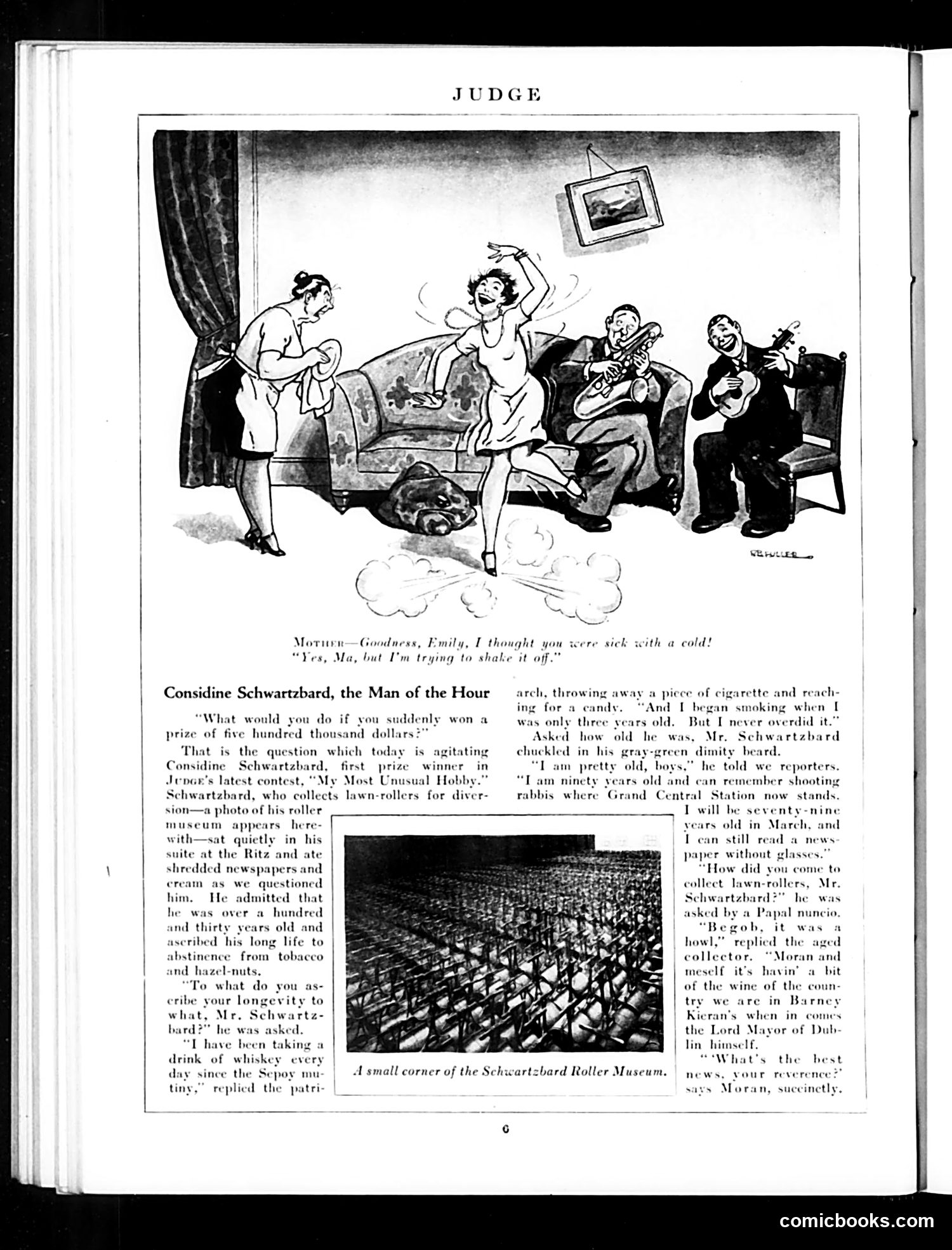
This page features "Considine Schwartzbard, the Man of the Hour," a biographical article about an elderly Irish immigrant who collects lawn-rollers for a museum at Grand Central Station. **The Main Cartoon** (top) satirizes domestic life: a woman dances wildly while musicians play, suggesting she's performing for her husband and guests. The caption jokes about her claiming to have a cold—a transparent excuse for her energetic display. **The Satire:** The humor appears to target both the absurdity of Schwartzbard's unusual hobby (collecting lawn-rollers) and the working-class Irish immigrant experience. The cartoon mocks pretense in domestic situations—the wife's false claim about illness paralleling broader themes about authenticity and social performance. The page reflects early 20th-century American attitudes toward immigration and working-class life, mixing gentle mockery with curiosity about "colorful" immigrant characters.
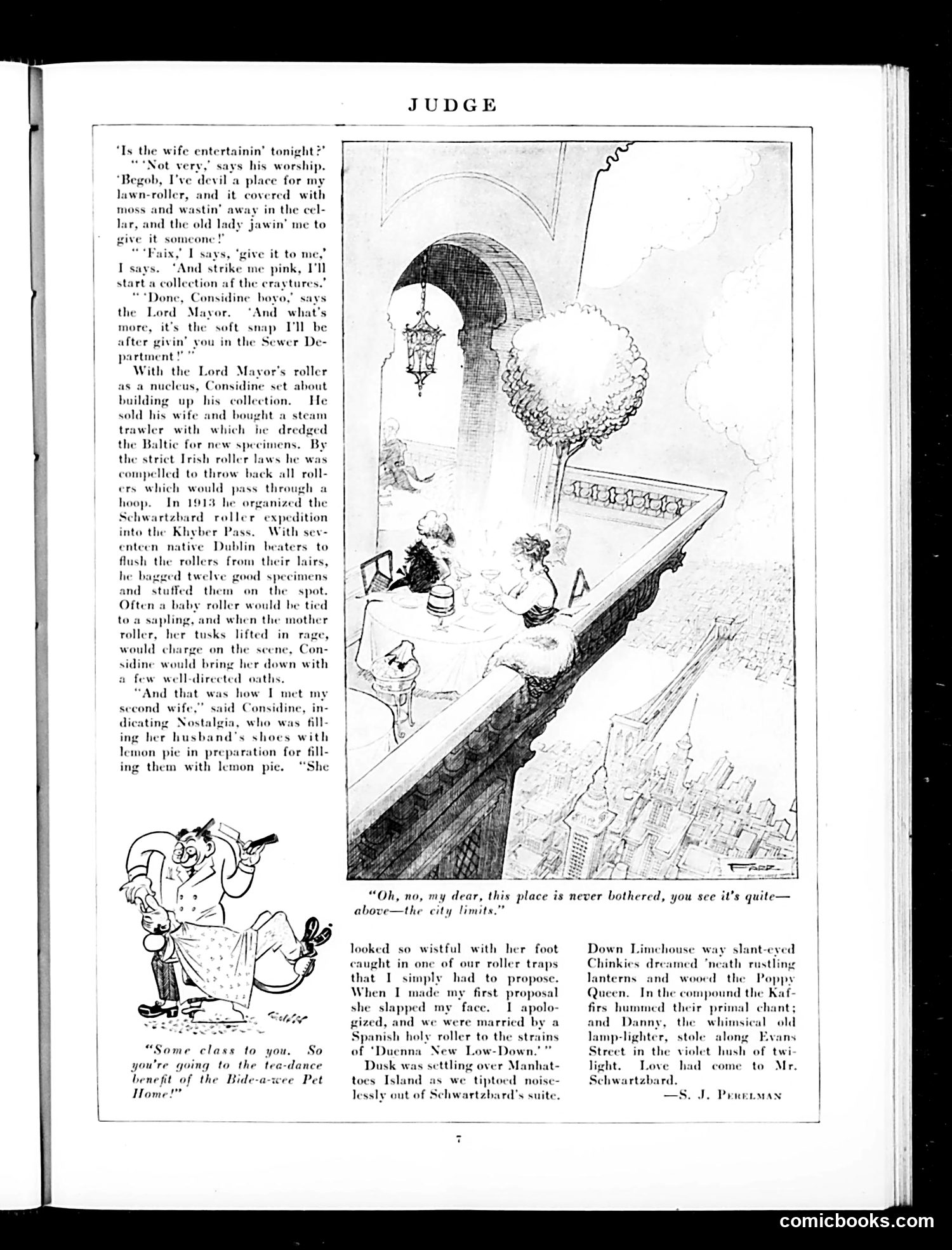
This page satirizes Irish immigrants and their stereotypical speech patterns through absurdist humor. The main narrative, told in exaggerated Irish dialect ("Begob," "Faix"), describes a character named Considine who begins collecting "lawn-rollers" after receiving one from the Lord Mayor—a joke playing on Irish accent confusion or misunderstanding. The humor escalates absurdly: Considine hunts rollers globally (the Baltic, Khyber Pass), treats them like game animals with "native Dublin beaters," and even marries a woman he found "caught in one of our roller traps." The small cartoon at bottom-left features a caricatured figure boasting about attending a "Bide-a-wee Pet Home" tea-dance benefit. The satire relies on ethnic stereotyping common to early 20th-century American humor—mocking Irish dialect, perceived foolishness, and working-class status. The absurdist escalation suggests mockery of Irish immigrants' social pretensions and supposed naïveté.
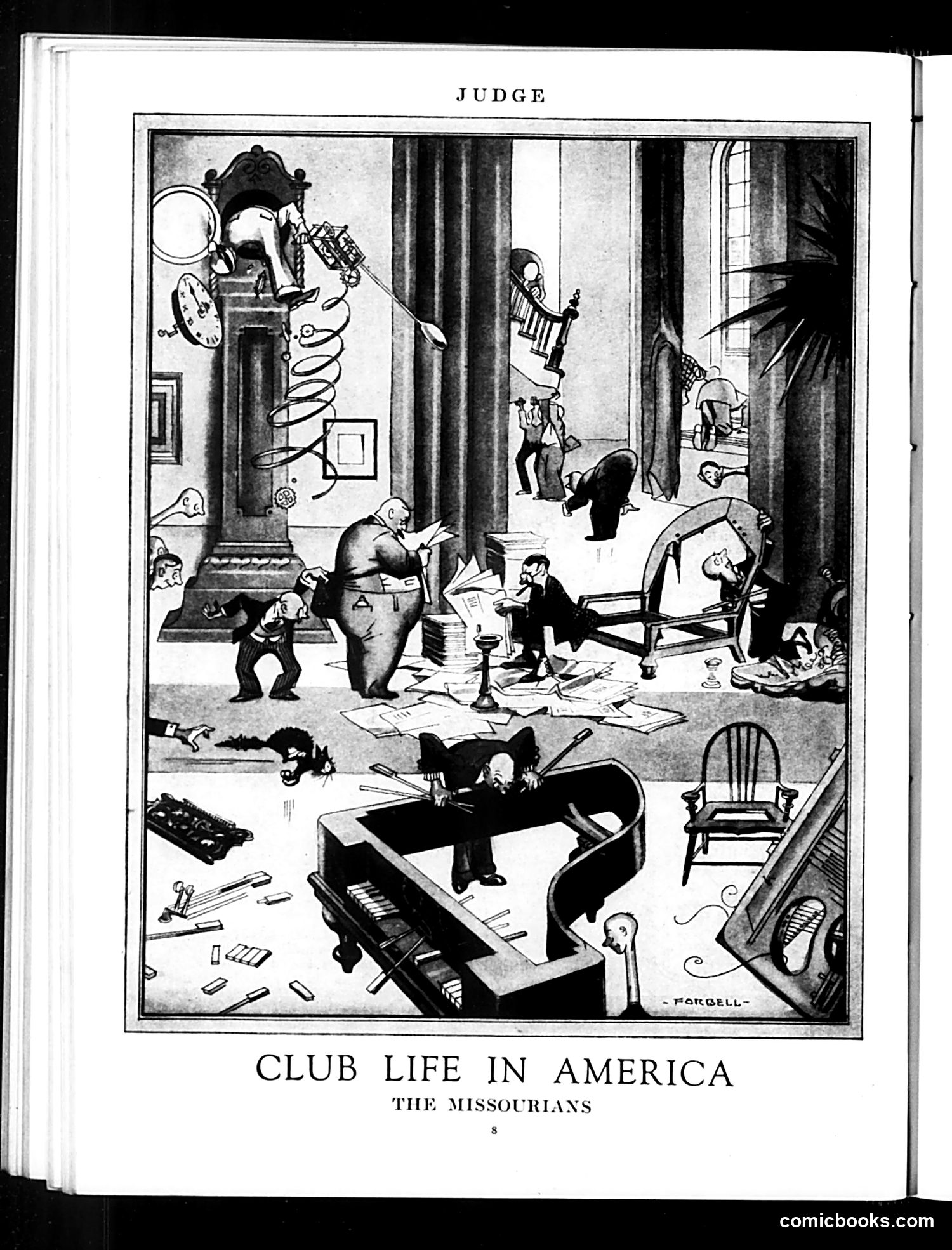
This Judge magazine cartoon satirizes "Club Life in America," specifically targeting "The Missourians"—likely a reference to a Missouri-based group or political faction. The chaotic courtroom scene depicts judicial proceedings in disarray: figures juggle furniture and documents, a large man dominates the center, and people appear to conduct business haphazardly rather than orderly. The title "JUDGE" at the top plays on the courtroom setting. The satire appears to mock the conduct or operations of this group—suggesting their approach to governance or organization is incompetent, disorganized, or corrupted. The cartoon implies they're conducting serious business (law/justice) in an absurdly chaotic manner, a common Judge magazine technique for criticizing political or social institutions. Without additional historical context about "The Missourians," the specific target remains unclear, though the criticism of disorder and mismanagement is evident.
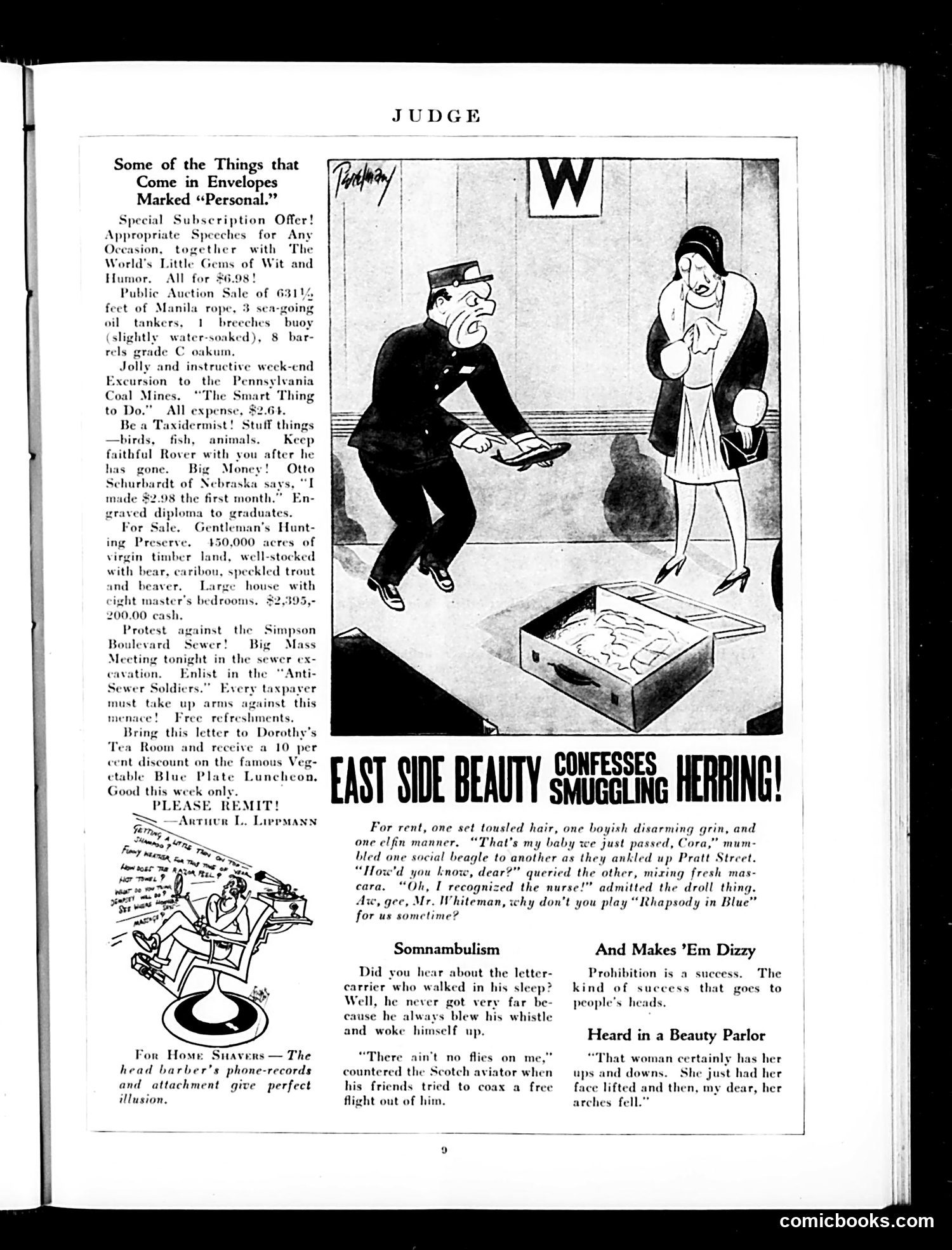
The main cartoon depicts a customs or police official confronting a woman about smuggling contraband. The headline "East Side Beauty Confesses Smuggling Herring!" suggests this is satirizing Prohibition-era smuggling, specifically of herring—likely a coded reference to bootlegging or illegal alcohol trade rather than literal fish smuggling. The accompanying joke texts riff on 1920s slang and social commentary: references to "ankled up Pratt Street" (walked), beauty treatments ("face lifted"), and Prohibition's supposed "success." The page is primarily humorous filler content—short jokes, classified-style ads, and quips typical of Judge magazine's satirical format. The satire works on multiple levels: mocking Prohibition enforcement, East Side immigrant communities (stereotyped as smugglers), and contemporary beauty culture trends. The cartoon's exaggerated expressions and the woman's fashionable dress suggest class commentary alongside the Prohibition jokes.
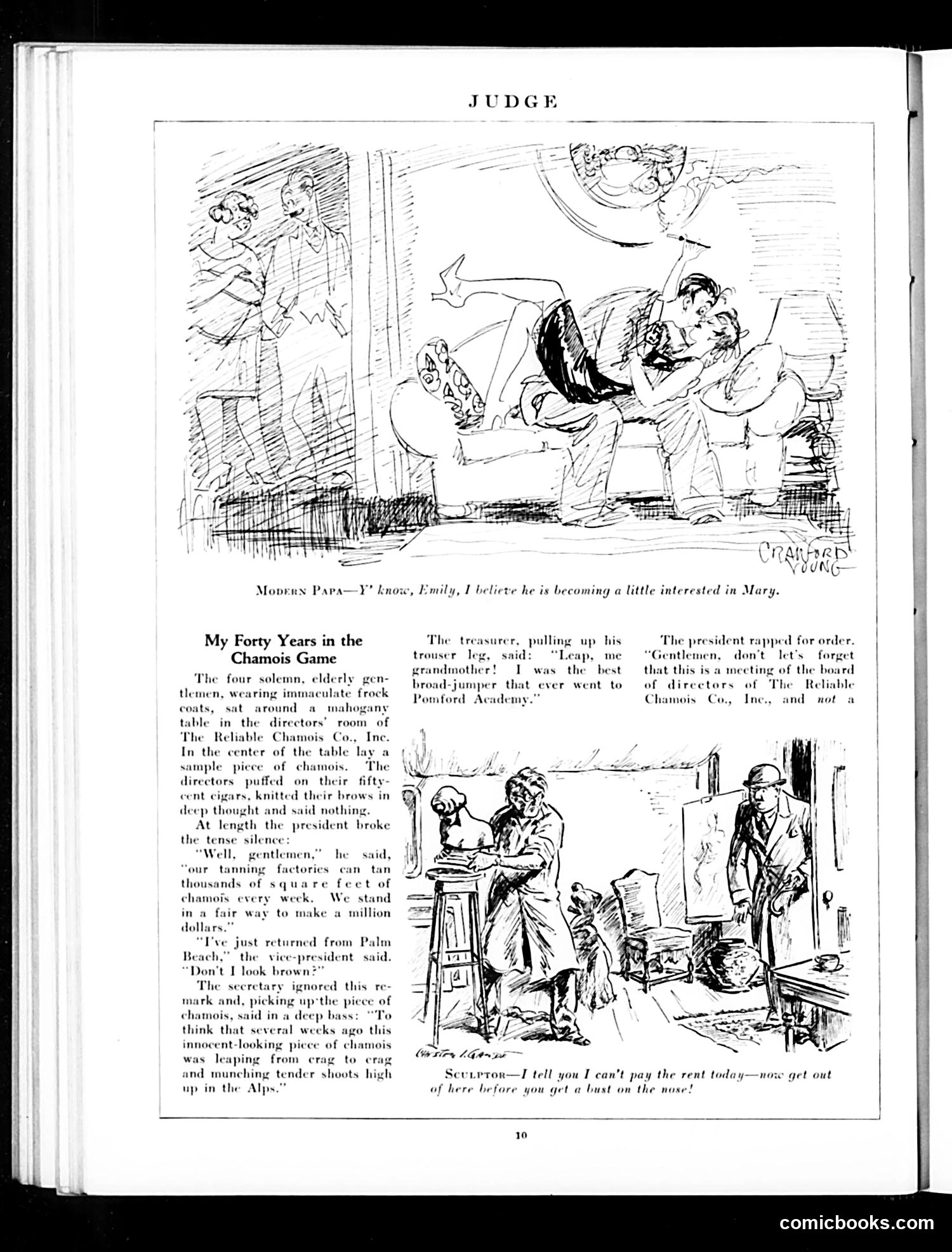
This page contains two separate satirical pieces from *Judge* magazine: **Top cartoon**: A domestic scene where a father observes his son becoming interested in a girl named Mary—gentle family humor about childhood romance. **"My Forty Years in the Chamois Game"**: A business satire mocking corporate pomposity. Four stuffed-shirt directors of a chamois (leather) tanning company meet formally. They boast about production capacity and profit potential, yet reveal themselves as disconnected from reality: one brags about his athletic youth at "Pomford Academy," another returns from Palm Beach asking if he "looks brown," and the secretary delivers the punchline—he describes their product (chamois leather) as if it were still a living alpine animal "leaping from crag to crag." The satire targets corporate executives who are detached, vain, and seemingly ignorant of their own business operations. **Bottom cartoon**: A sculptor unable to pay rent threatens an eviction officer with violence—straightforward dark humor about poverty and desperation.
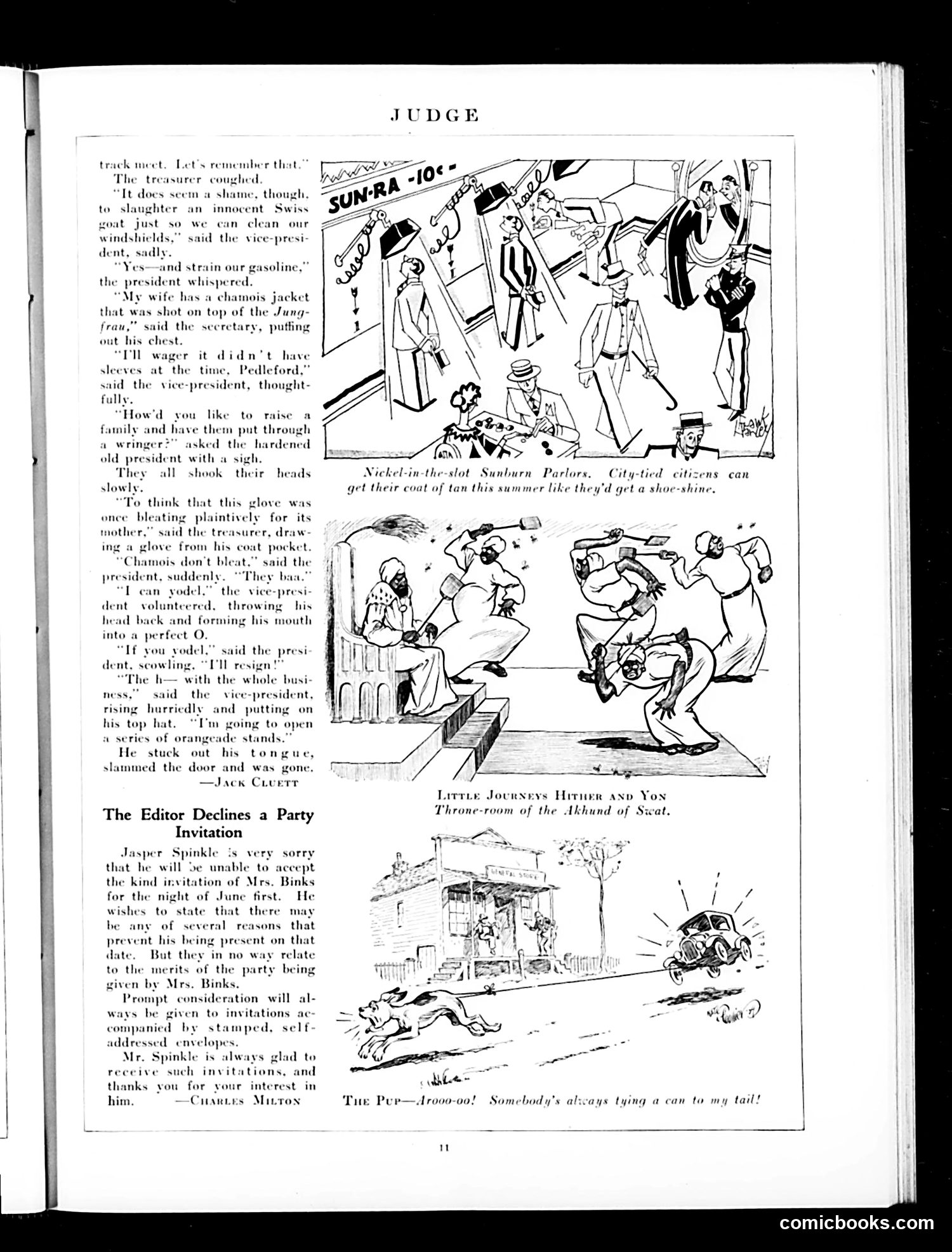
This page contains three satirical pieces typical of early 20th-century Judge magazine humor. **Top cartoon ("Nickel-in-the-slot Sunburn Parlors")**: Mocks a commercial trend offering mechanical tanning booths—a modern convenience citizens could use "like they'd get a shoe-shine." The satire targets both consumer culture and the absurdity of industrializing leisure. **Middle section ("The Editor Declines a Party Invitation")**: A satirical letter from editor Jasper Spinkle politely refusing Mrs. Binks's party invitation while maintaining formal courtesy. The humor lies in the elaborate, evasive bureaucratic language used to decline a social obligation. **Bottom cartoon ("Little Journeys Hither and Yon")**: Features a dog tied to a car being dragged along, captioned "Somebody's always tying a can to my tail!" References the period practice of literally tying cans to dogs as pranks. The large top illustration shows civilians boarding what appears to be a "Sun-Ra" tanning vehicle, satirizing mechanized beauty treatments.
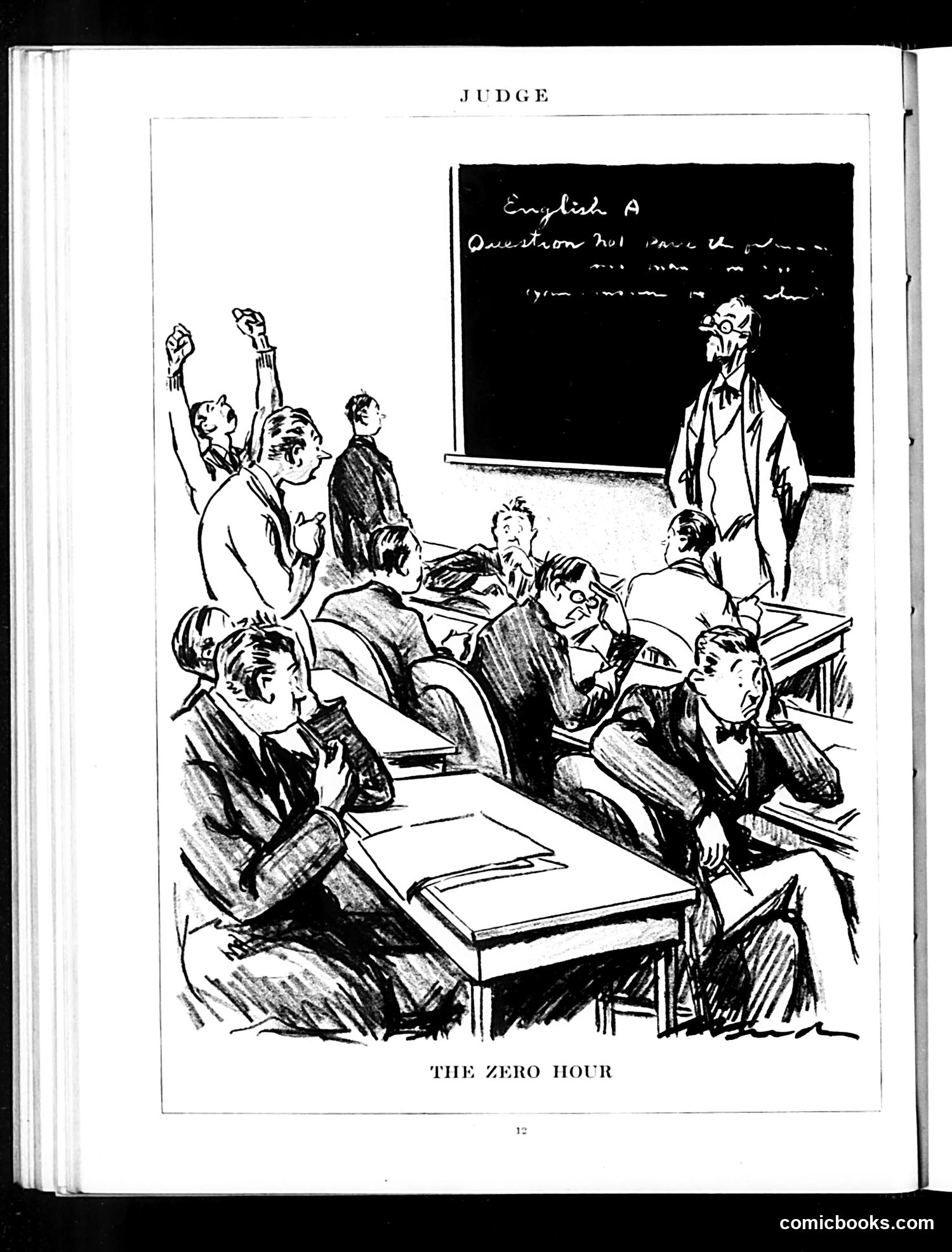
This cartoon depicts a courtroom scene titled "The Zero Hour," satirizing what appears to be a dramatic legal proceeding. A judge stands at a blackboard while several men in suits sit below—some with raised fists in what may be celebratory or emphatic gestures. The composition suggests a moment of judicial decision or verdict that has provoked strong reactions. The OCR'd text is largely illegible, making it difficult to identify the specific case or figures involved. Without clearer context, the cartoon likely comments on a notable trial or legal controversy of Judge magazine's era, possibly involving labor disputes, corruption, or political conflict. The theatrical arrangement and dramatic poses suggest the cartoon criticizes either the judicial process itself or the parties involved. The exact satirical point remains unclear without additional historical context.
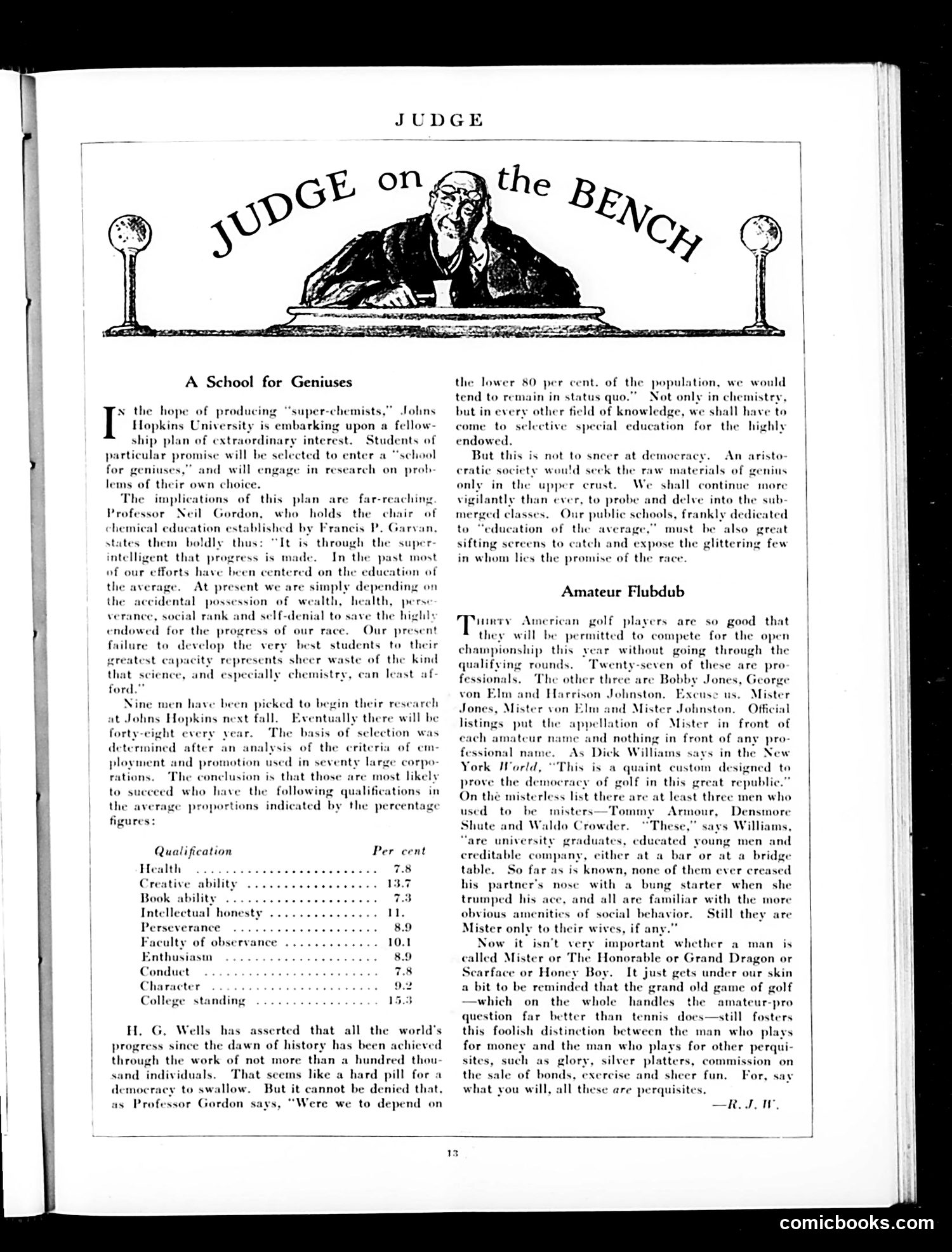
This page contains two satirical articles from Judge magazine (a Gilded Age/Progressive Era publication): **"A School for Geniuses"** criticizes Johns Hopkins University's plan to create an elite fellowship program for exceptional chemistry students selected by rigid criteria. The satire targets the implicit eugenic/aristocratic assumptions: the article acknowledges that limiting advancement to the "upper crust" while neglecting the "lower 80 per cent" contradicts democratic ideals, yet the university proceeds anyway. The cartoon's stern judge presides over this tension between meritocracy rhetoric and elitist practice. **"Amateur Flubdub"** mocks golf's social conventions—specifically the practice of granting "Mister" titles to amateur golfers while denying them to professionals. The satire highlights the absurdity: some former professionals (Armour, Shute, Crowder) are "mistered" as amateurs, while current professionals are excluded. This arbitrary status distinction pretends to democratize golf while reinforcing class hierarchy. Both pieces satirize Progressive Era attempts to maintain genteel exclusivity while claiming democratic principles.
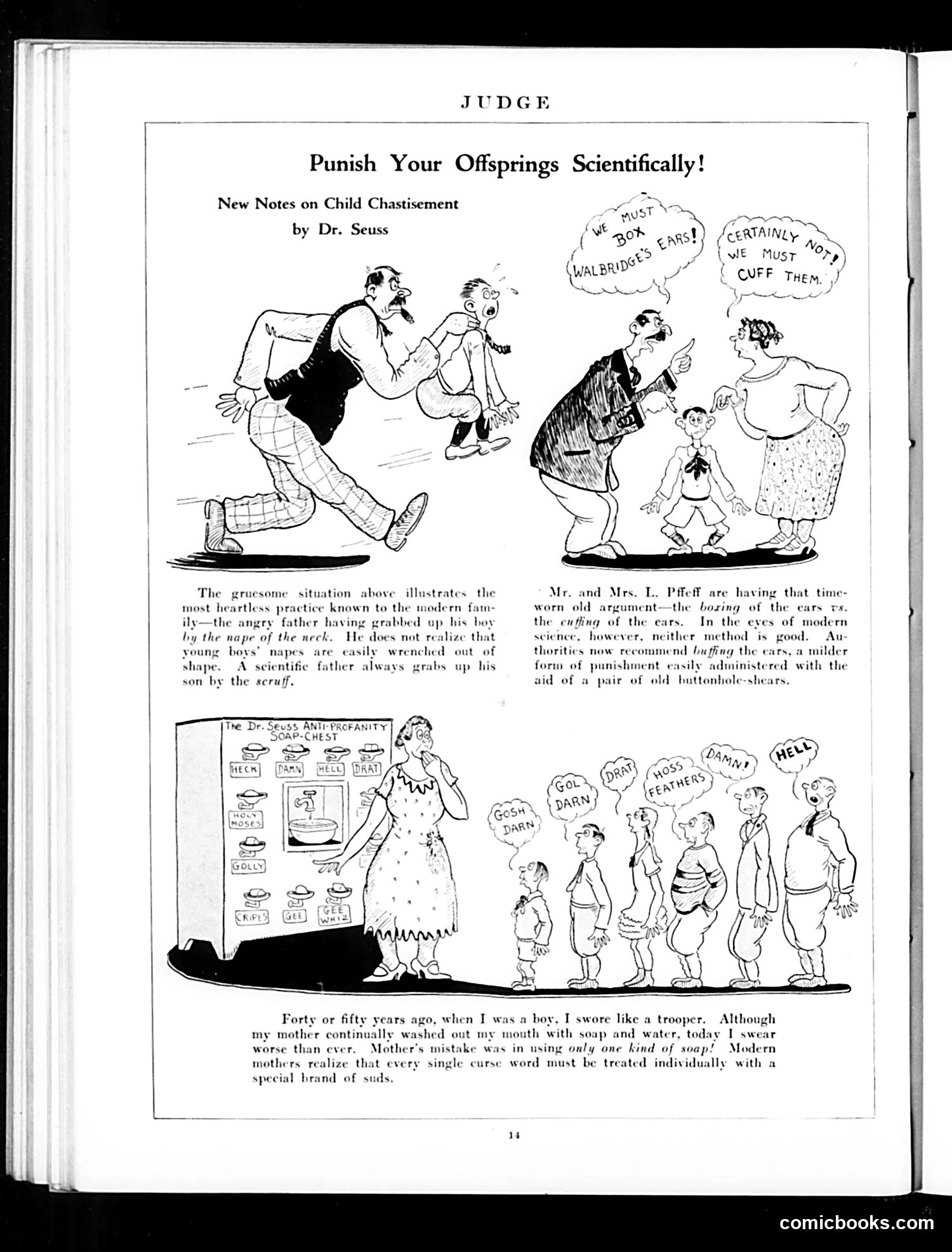
This is satirical commentary on child discipline practices, attributed to "Dr. Seuss" (likely a pseudonymous contributor). The cartoons mock outdated and harsh parenting methods through absurdist exaggeration. The top illustration ridicules grabbing children by the neck, suggesting the "scientific" alternative is the scruff instead. The middle scene parodies parents debating ear-boxing versus ear-pinching, proposing "buffing" ears with buttonhole-shears as the "modern" approach. The bottom panel's lengthy caption satirizes ineffective punishment: the author swore as a boy despite soap-washing his mouth; the joke is that mothers now need *different* soaps for *each* curse word—an absurd extension of the same failed logic. The overall satire critiques how each generation believes its harsher discipline methods are more "scientific" or "modern," when the fundamental approach remains cruel and ineffective. The piece gently mocks both outdated and contemporary parenting philosophies through exaggerated pseudoscience.
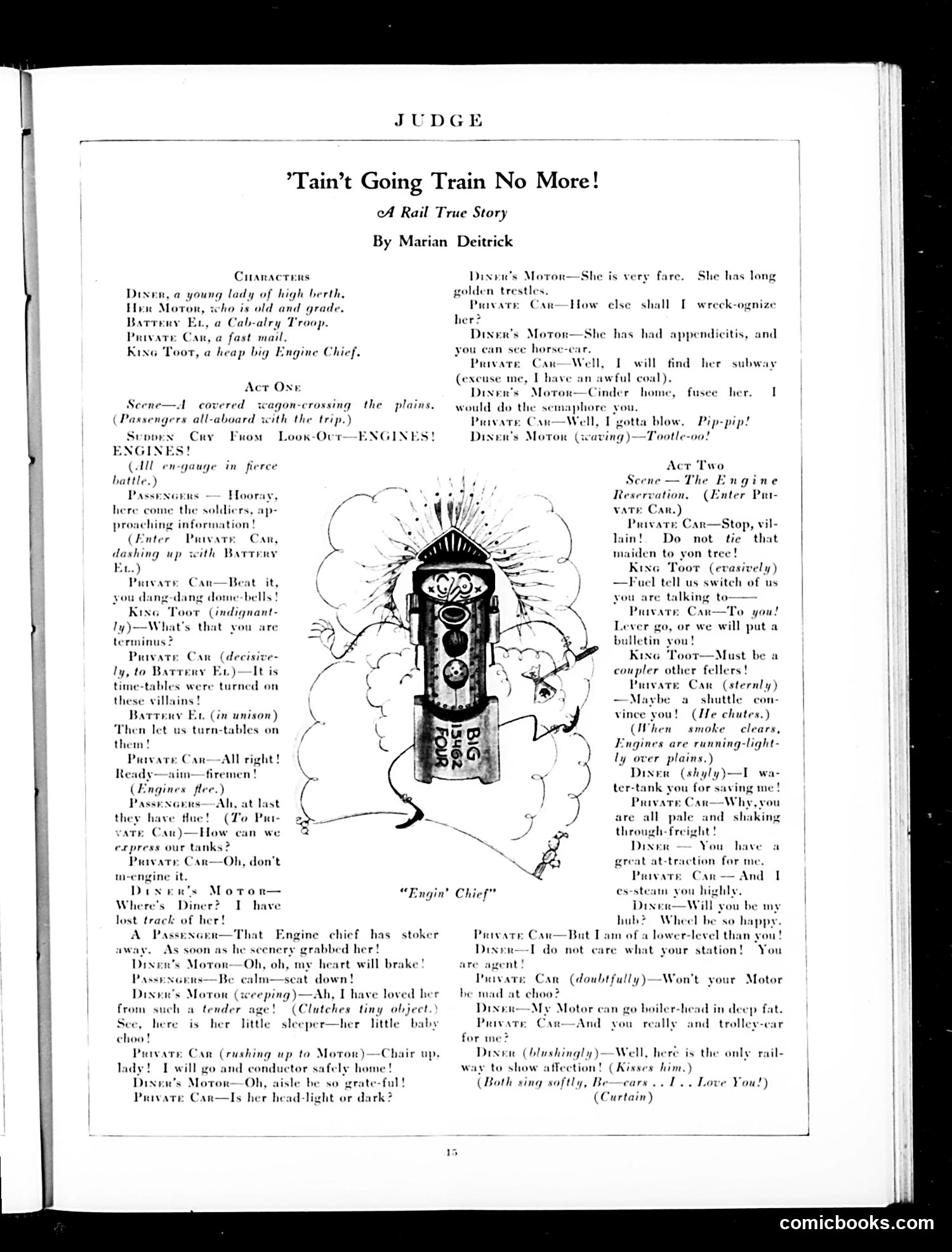
This is a comedic play script using anthropomorphized trains and railroad equipment as characters in a melodramatic romance. The humor derives from puns mixing railroad terminology with human emotions and relationships. The plot: "Diner" (a young passenger car) loves "Diner's Motor" (an older locomotive). When an "Engine Chief" abducts her, "Private Car" (a mail car) rescues her. The dialogue consists entirely of railroad puns—"wreck-ognize," "boiler-head," "trolley-car for me," "semaphore," "furze her" (fuse), etc. This appears to be lighthearted wartime or early-20th-century humor exploiting Americans' fascination with trains. The joke relies on contemporary readers recognizing technical railroad language well enough to appreciate the wordplay. The illustration of an anthropomorphic locomotive reinforces this anthropomorphization throughout the narrative.
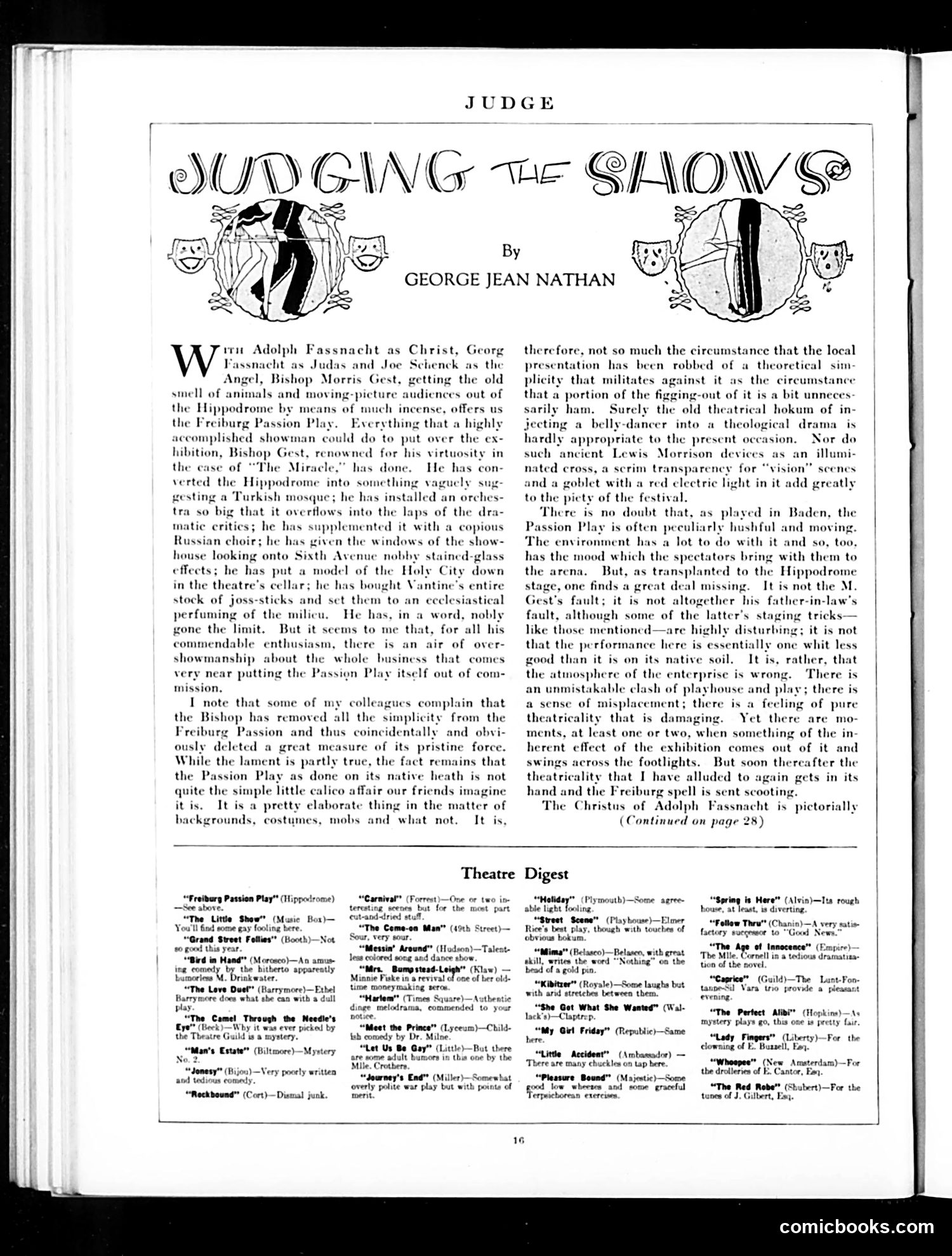
This page contains a theater review by George Jean Nathan critiquing a production of the Freiburg Passion Play staged at New York's Hippodrome theater. The review discusses how Bishop Morris Gest, a prominent theater producer, has transformed the classical religious drama into an elaborate spectacle—complete with a massive orchestra, Russian choir, stained-glass windows, and exotic theatrical flourishes. Nathan's satire targets the excessive staging: he questions whether adding belly-dancers, ornate crosses, and electrical effects to a sacred Passion Play represents legitimate enhancement or "unnecessary ham." The critic acknowledges the production's ambition while arguing that transplanting the austere Freiburg original to a commercial New York venue fundamentally damages its spiritual impact through overdone theatricality. The accompanying "Theatre Digest" section lists contemporary Broadway shows with brief descriptions of their appeal or merit.
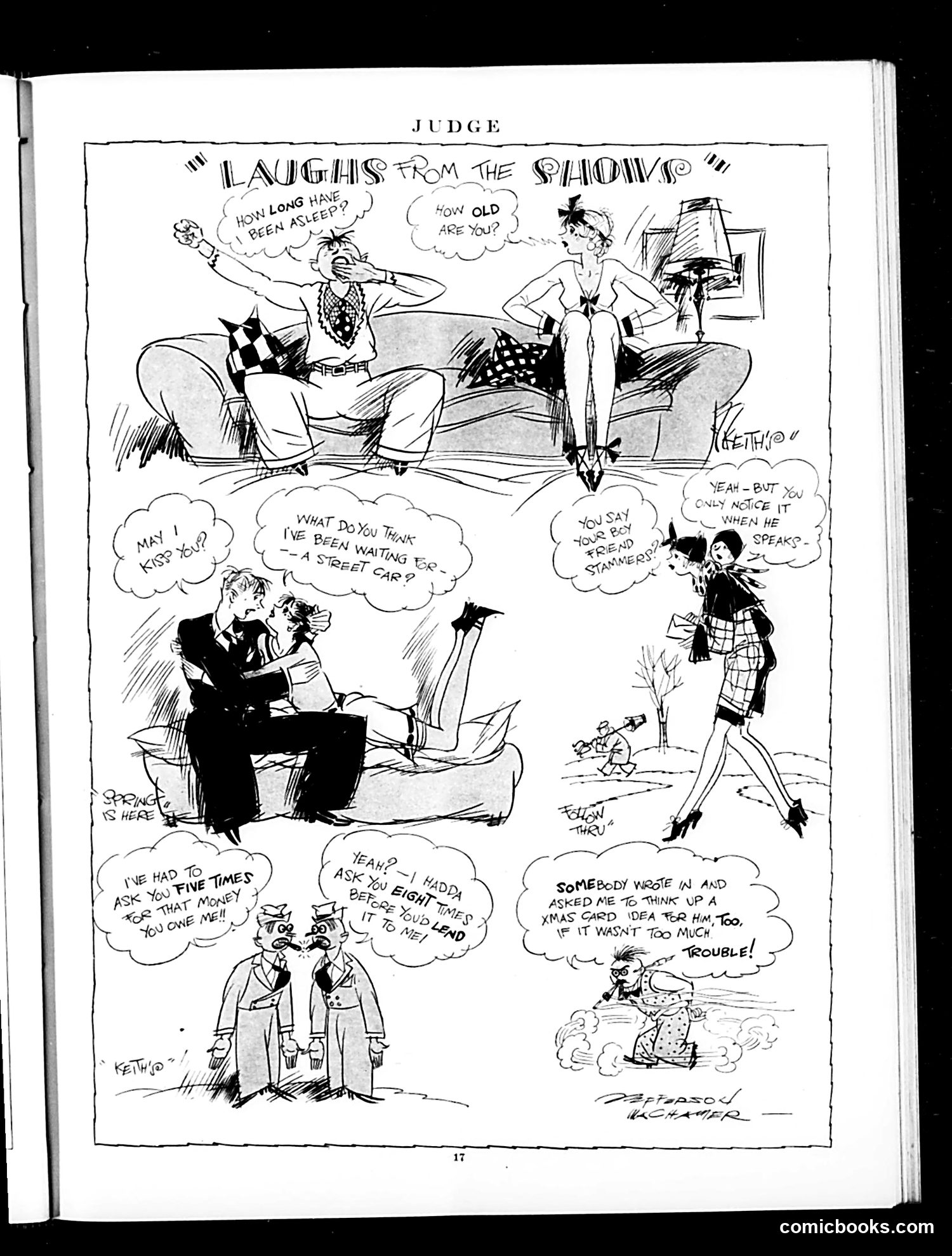
This is a multi-panel comic satirizing common romantic and social situations, likely from the early-to-mid 20th century. The humor relies on dated stereotypes and gender dynamics: **Panel 1:** A couple on a couch exchanges awkward questions ("How long have I been asleep?" / "How old are you?") — mocking the superficiality of courtship. **Panel 2:** A man asks to kiss a woman waiting for a streetcar; she responds with her own question about his financial reliability ("What do you think I've been waiting for—a street car?"). **Panel 3:** A man discusses repeatedly asking women for money to lend. **Panel 4:** A woman describes an absurd Christmas card request — suggesting someone asked her to design one without adequate compensation. The overall theme appears to be the awkwardness and venal nature of romantic interactions and social favors. The cartoonist is credited but unclear from the image.
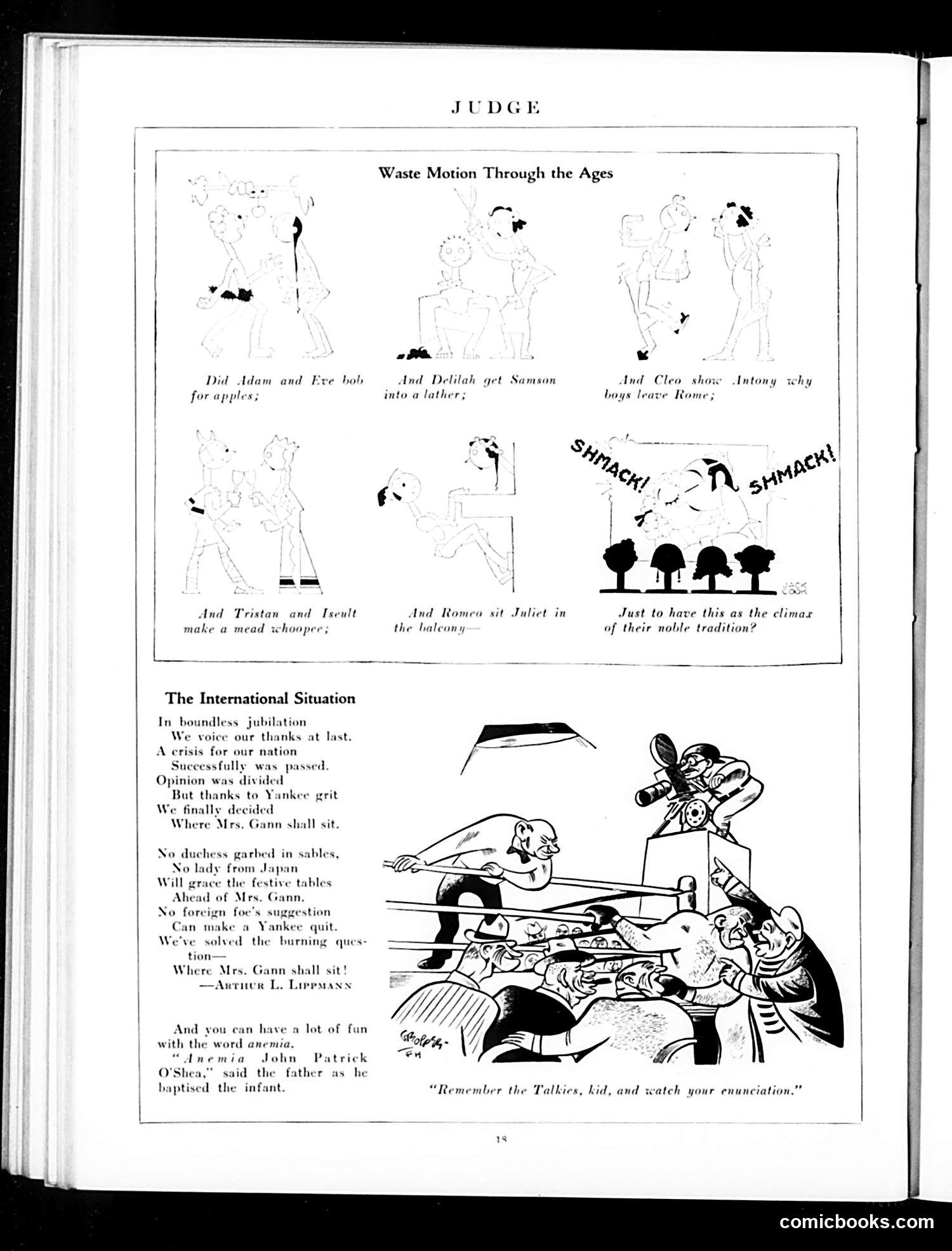
The top cartoon satirizes romantic/dramatic scenes throughout history (Adam and Eve, Samson and Delilah, Cleopatra and Antony, Romeo and Juliet, Tristan and Iseult) by reducing them to physical slapstick—characters hitting each other. The final panel mocks these "noble traditions" by showing people literally spanking each other as climax, suggesting historical romance is just repetitive violence. The bottom section, "The International Situation," references the **Gann Controversy** (likely early 1930s)—a diplomatic row over protocol seating. The poem sarcastically celebrates resolving "a crisis for our nation" by deciding "where Mrs. Gann shall sit," mocking how American leaders obsessed over a minor etiquette question while framing it as patriotic problem-solving. The accompanying cartoon shows figures in diplomatic chaos, suggesting the absurdity of treating protocol disputes as major national achievements. Both pieces mock American culture—one for romanticizing violence, the other for prioritizing trivial social rank over substantive governance.
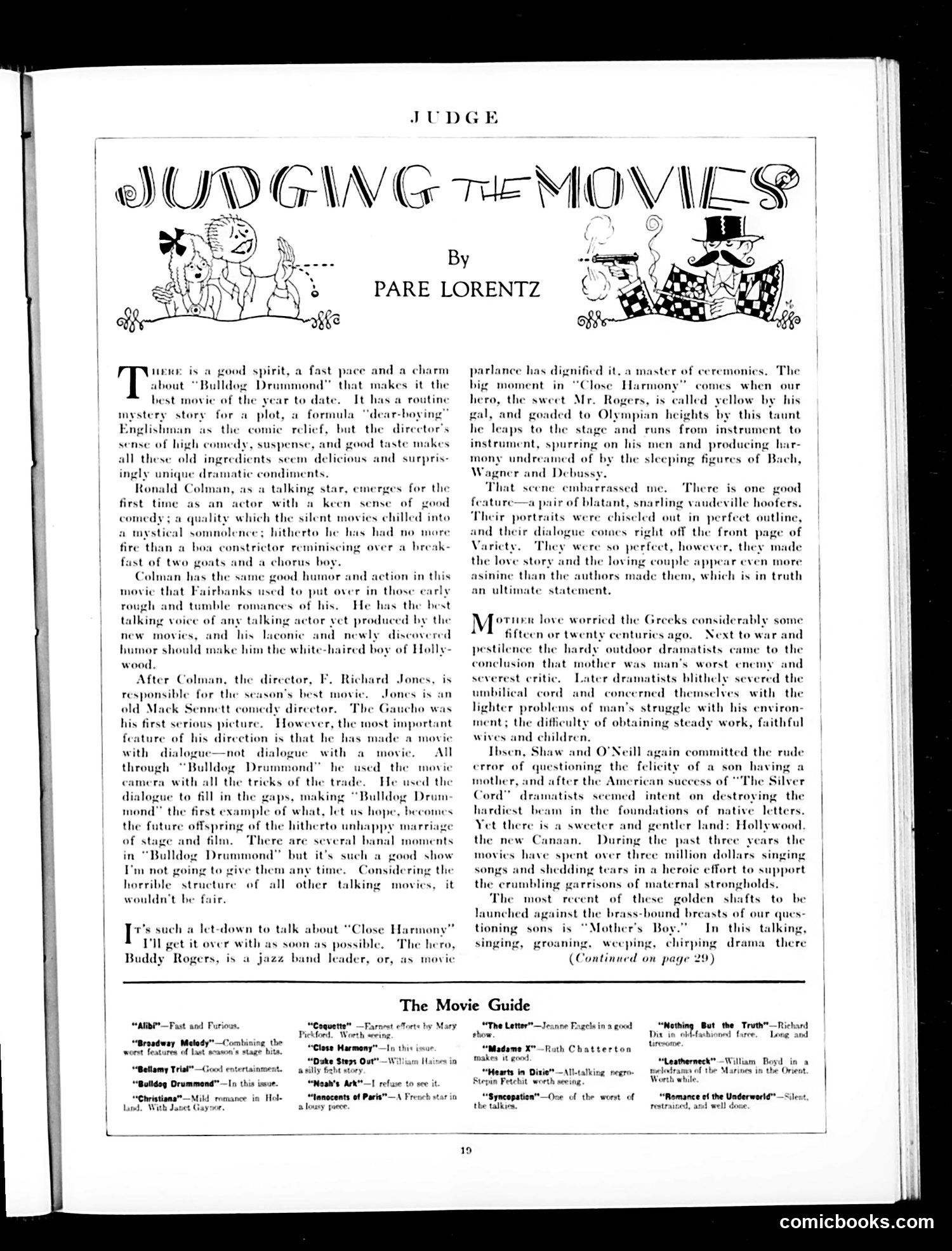
This is a film review column by Pare Lorentz critiquing recent "talking pictures" (early sound films). The main review praises "Bulldog Drummond," starring Ronald Colman, as the year's best movie. Lorentz notes Colman's successful transition from silent films to talkies, praising his voice and comedic timing—comparing him favorably to Douglas Fairbanks from the silent era. The column also reviews "Close Harmony" (featuring Buddy Rogers as a jazz band leader) less favorably, finding its plot contrived and its supporting characters crude vaudeville types. The sidebar "Movie Guide" lists other current films with brief assessments. This page reflects the early 1930s fascination with sound cinema as a revolutionary technology, with critics closely scrutinizing how actors adapted to speaking dialogue.
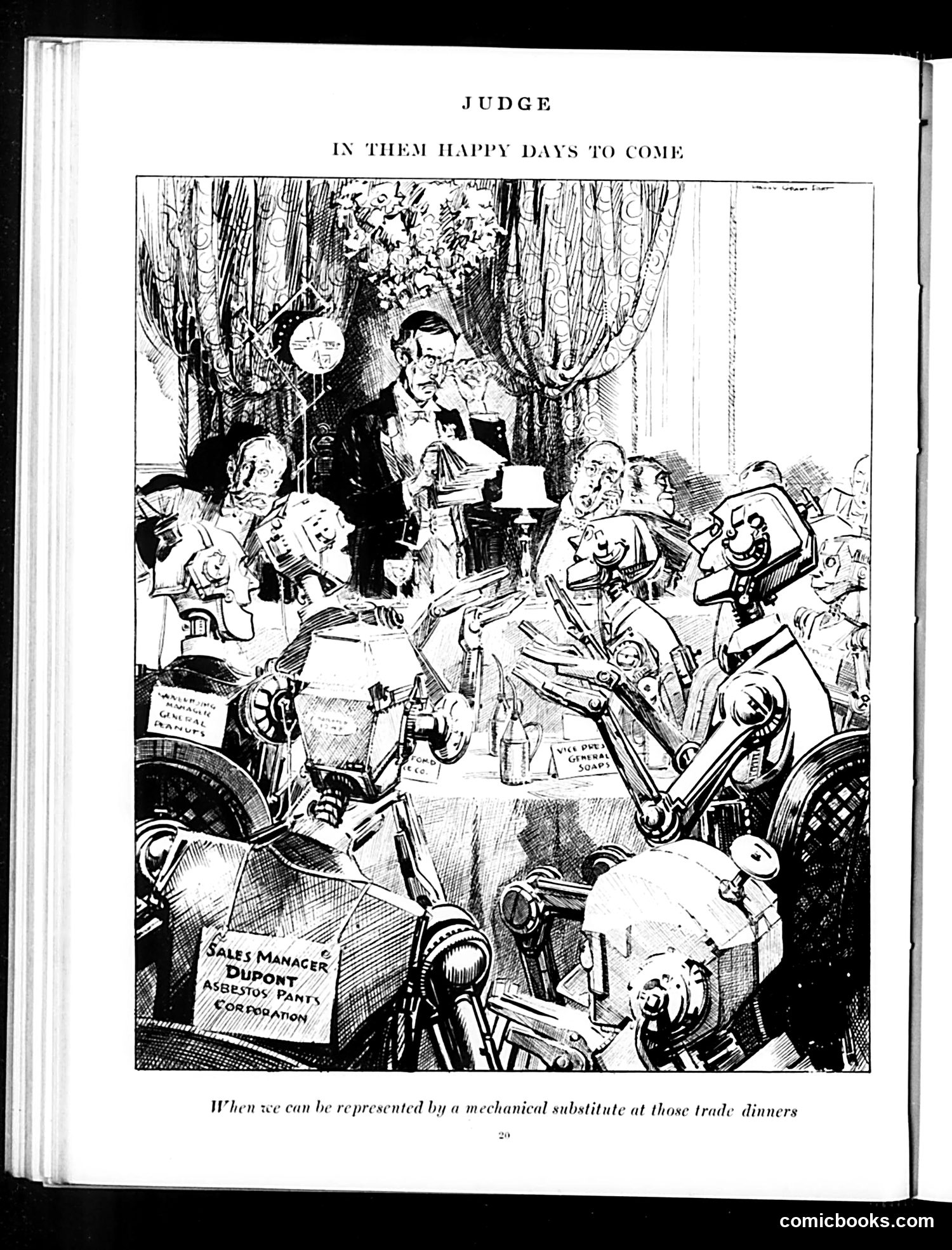
This satirical cartoon depicts a formal dinner scene where mechanical robots or automatons have replaced human salespeople and business representatives. The illustration shows these mechanical substitutes seated at a dining table with elegant furnishings and floral decorations. The caption reads: "When we can be represented by a mechanical substitute at those trade dinners." The satire targets early-20th-century anxieties about automation and technological replacement of human labor. One visible label reads "Sales Manager Report Asbestos Parts Corporation," suggesting specific industrial concerns. Judge magazine is mocking the notion that businessmen might one day be entirely replaced by machines at professional social functions—a commentary on both mechanization fears and the absurdity of reducing human business relationships to pure mechanical efficiency.
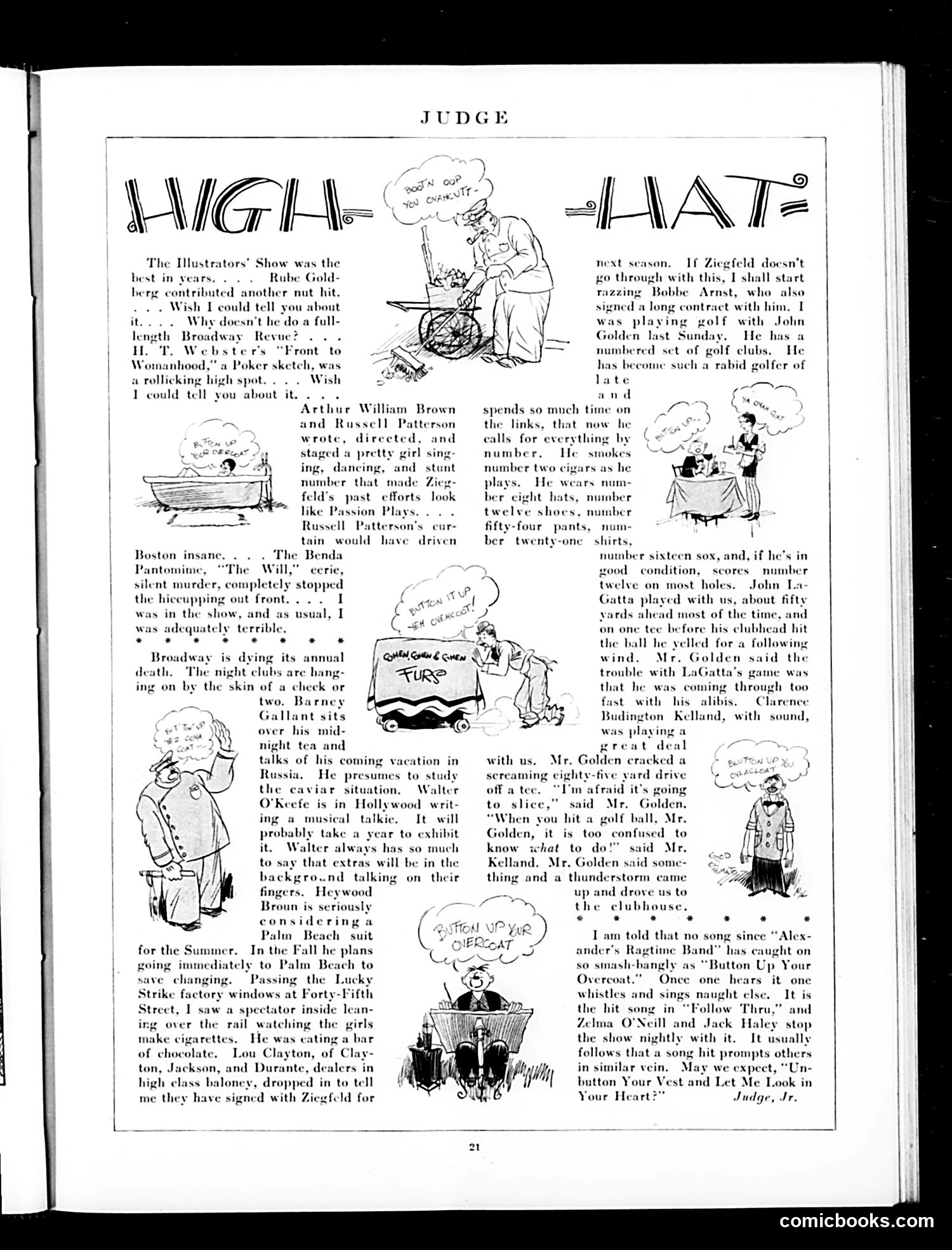
This page from **Judge** magazine contains theater and entertainment gossip and commentary, not political cartoons. The author (signed "Judge, Jr.") reviews Broadway shows and personalities from the 1920s era. Key references include: - **Zigfeld** (likely Florenz Ziegfeld, famous Broadway impresario) and contract disputes with performers - **Rube Goldberg, H.T. Webster, Arthur William Brown, Russell Patterson**—cartoonists/illustrators whose work appeared in shows - Various Broadway productions: *The Illustrators' Show*, *Passion Plays*, *The Will*, and pantomimes - Entertainment figures like **Barney Gallant, Walter O'Keefe, Heywood Broun** (prominent columnist) - A lengthy golf anecdote about "Mr. Golden" and others, using humor about obsessive behavior The illustrations show performers and show scenes. The satire targets Broadway's commercial decline ("dying its annual death"), bohemian personalities, and entertainment industry pretensions. The tone is gossipy, insider commentary typical of Judge's theatrical coverage.
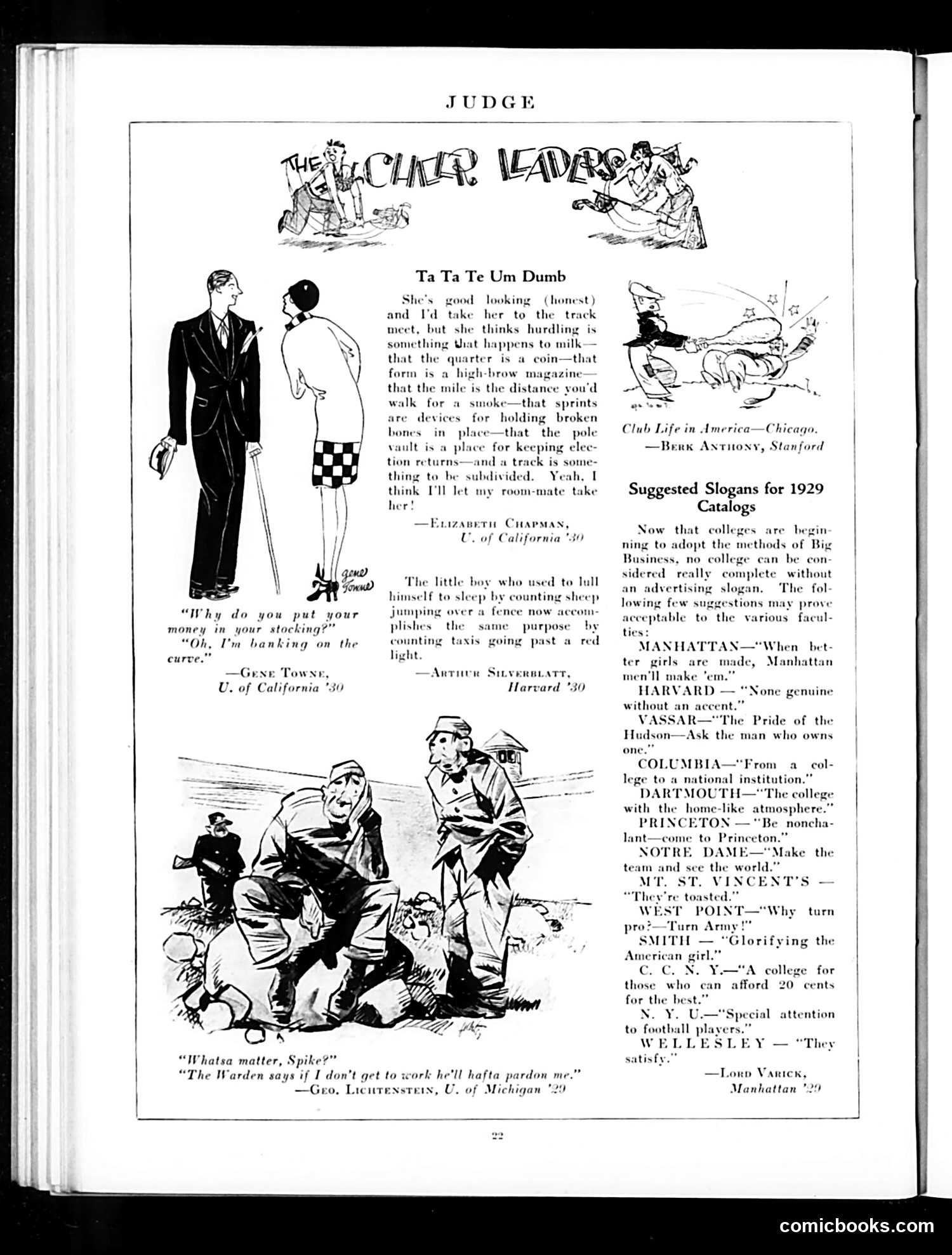
This page features humor about 1920s college life and advertising. The main cartoon mocks a young woman's ignorance of athletics—she confuses track-and-field terminology with everyday concepts (hurdling with milk processing, pole vault with election returns). The joke reflects period anxieties about women's education and their supposed unsuitability for serious intellectual or athletic pursuits. The secondary cartoons are brief gags: one about Depression-era banking habits, another about prison labor. The "Suggested Slogans" section satirizes colleges adopting corporate advertising methods—a new 1929 trend. Each slogan parodies actual advertising campaigns of major brands (like Chesterfield cigarettes' "They satisfy"), applying them mockingly to universities. The humor assumes readers recognized these commercial catchphrases, critiquing how institutions were becoming increasingly commercialized and marketing-focused.
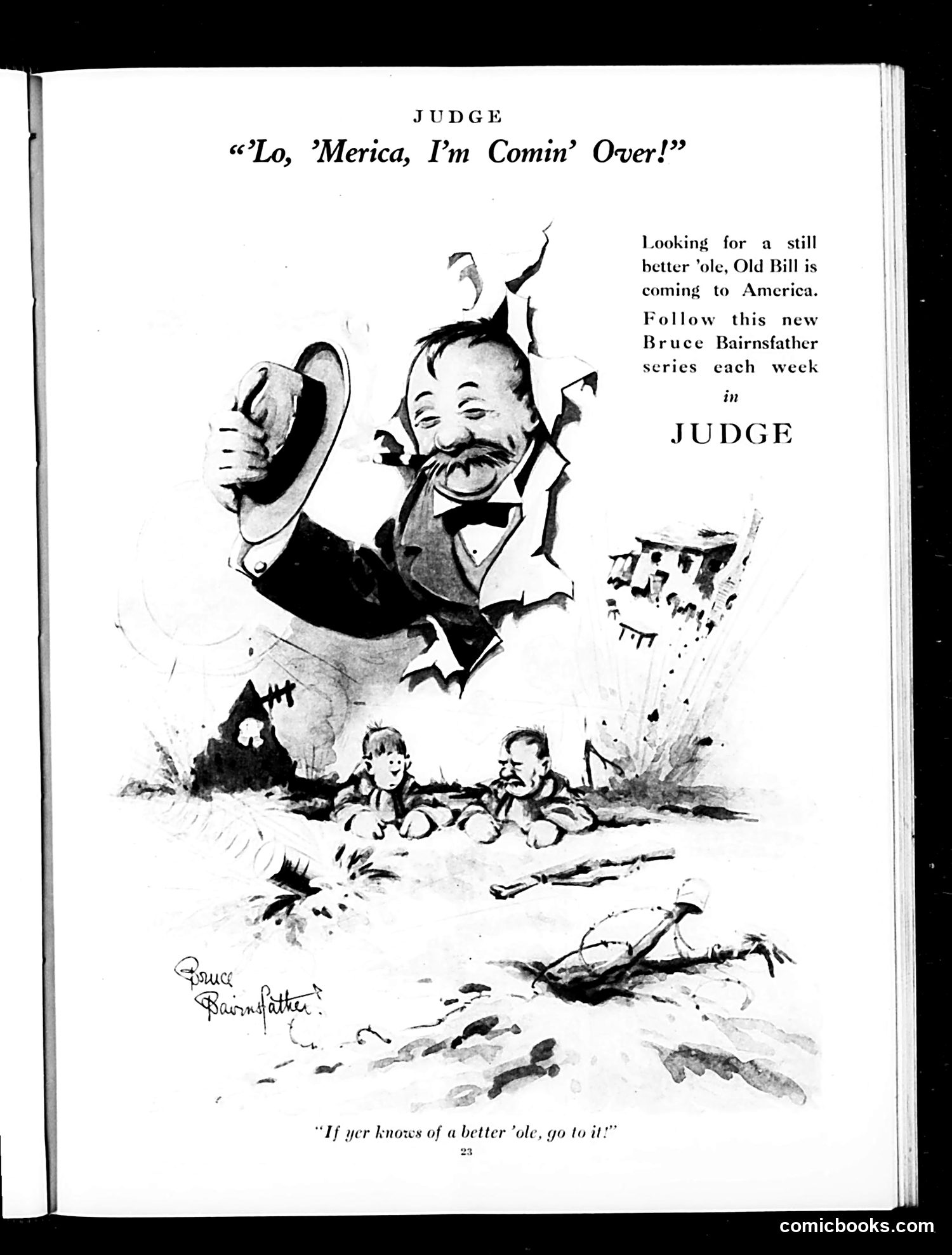
This page advertises a new comic series by Bruce Bairnsfather featuring "Old Bill," a character known from Bairnsfather's WWI cartoons. The caricatured figure at top appears to represent this British character coming to America. The catchphrase "If yer knows of a better 'ole, go to it!" was Bairnsfather's signature line from his famous wartime comics about soldiers in trenches. The satire plays on post-WWI nostalgia and the character's popularity. "Old Bill" was beloved for depicting working-class British soldiers' humor amid hardship. The phrase "looking for a still better 'ole" suggests bringing this wartime sensibility to peacetime America. The small figures at bottom appear to be civilians discovering this character arriving in their midst, representing Judge magazine's promotion of importing this established British comic talent for American audiences.
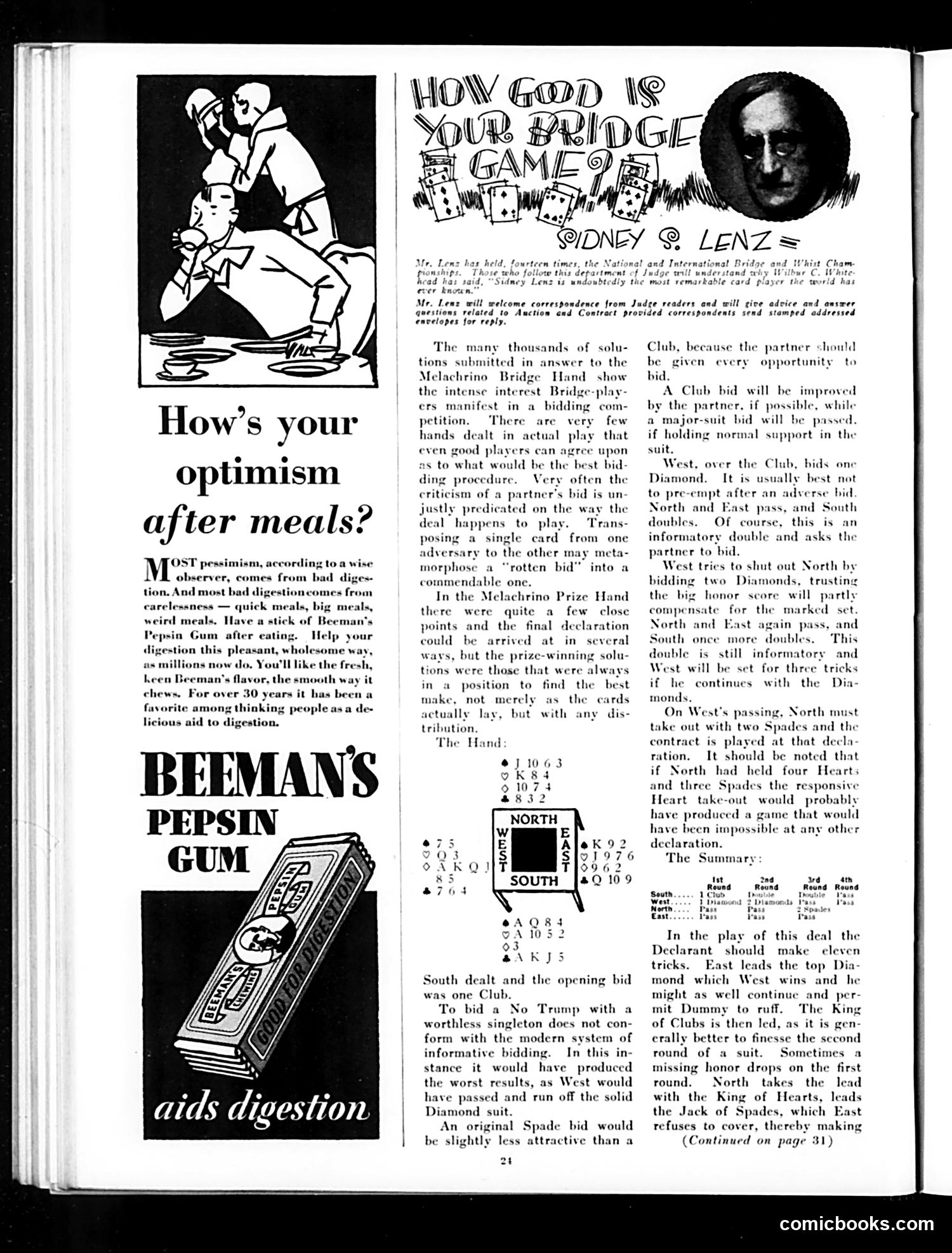
This page primarily features a **bridge card game instructional column** by Sidney S. Lenz, a famous bridge player of the era. The content is not political satire but rather educational entertainment. The visible cartoon (top left) shows three figures playing cards in a casual setting—likely illustrating the social context of bridge as a parlor game among educated classes. The main content is Lenz's analysis of the "Melachrino Prize Hand," a bridge problem submitted by readers. He critiques various bidding strategies and explains the optimal play, demonstrating why certain bids succeed or fail. This was typical of Judge magazine's blend of humor and highbrow content for educated readers interested in card games. The **Beeman's Pepsin Gum advertisement** below is unrelated—a period advertisement claiming the product aids digestion. The page reflects early 20th-century American leisure culture among the educated classes, where bridge was a serious intellectual pursuit worthy of magazine coverage alongside satire.
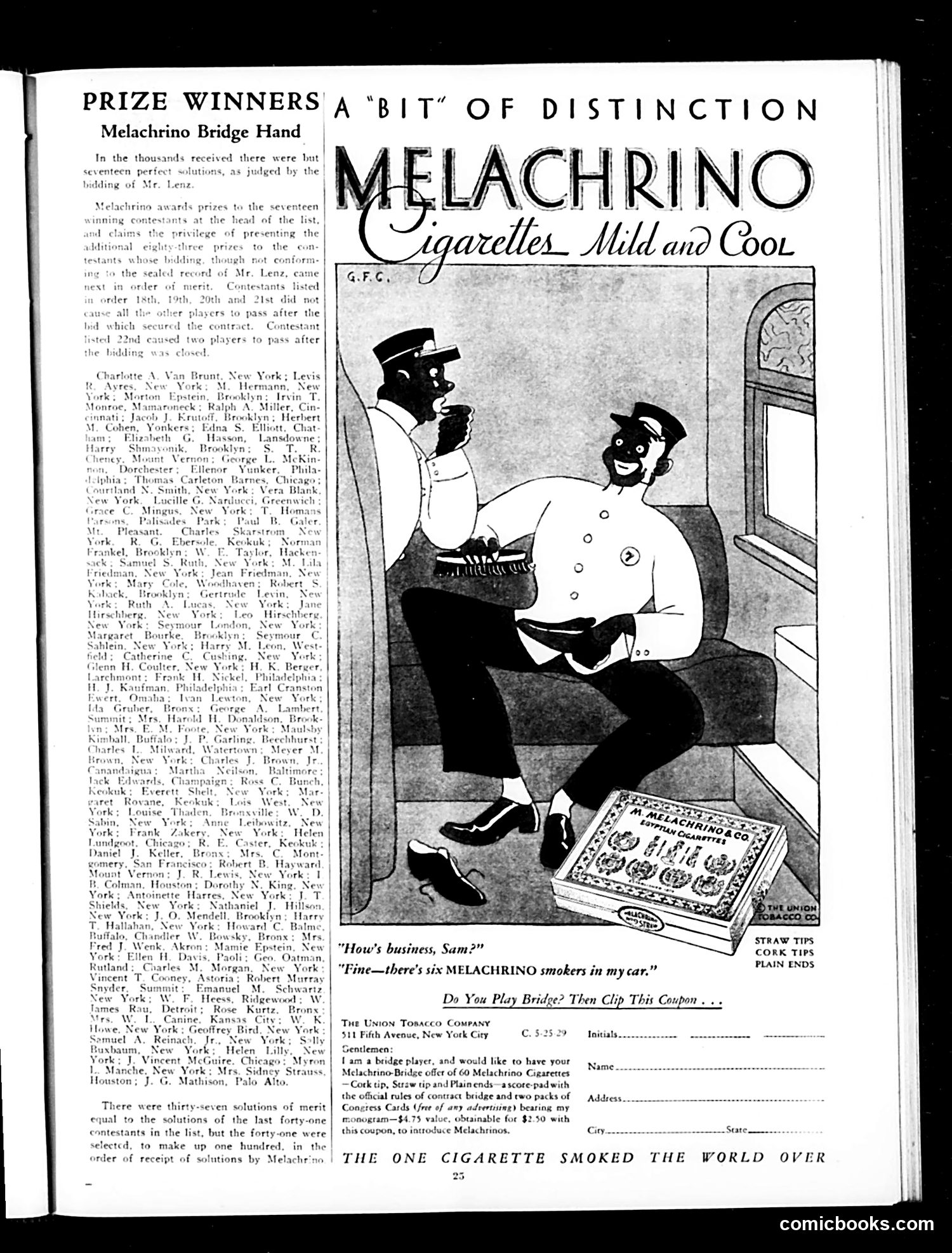
This page is primarily a **cigarette advertisement** for Melachrino brand, disguised as editorial content about a bridge card game contest. The main cartoon shows two men in a car; one asks "How's business, Sam?" and the other replies "Fine—there's six MELACHRINO smokers in my car"—a humorous claim that the cigarette brand is ubiquitous and successful. The "Prize Winners" section lists contest winners from a Melachrino-sponsored bridge hand puzzle competition, lending the ad credibility through apparent editorial coverage. The bottom half offers a mail-in coupon: readers can purchase a bridge score pad and card deck (value $4.75) for just $2.50 if they buy Melachrino cigarettes. This was a common mid-20th-century marketing tactic—bundling cigarettes with desirable merchandise. The tagline "THE ONE CIGARETTE SMOKED THE WORLD OVER" emphasizes the brand's claimed global popularity. No political satire is present; this is straightforward commercial advertising.
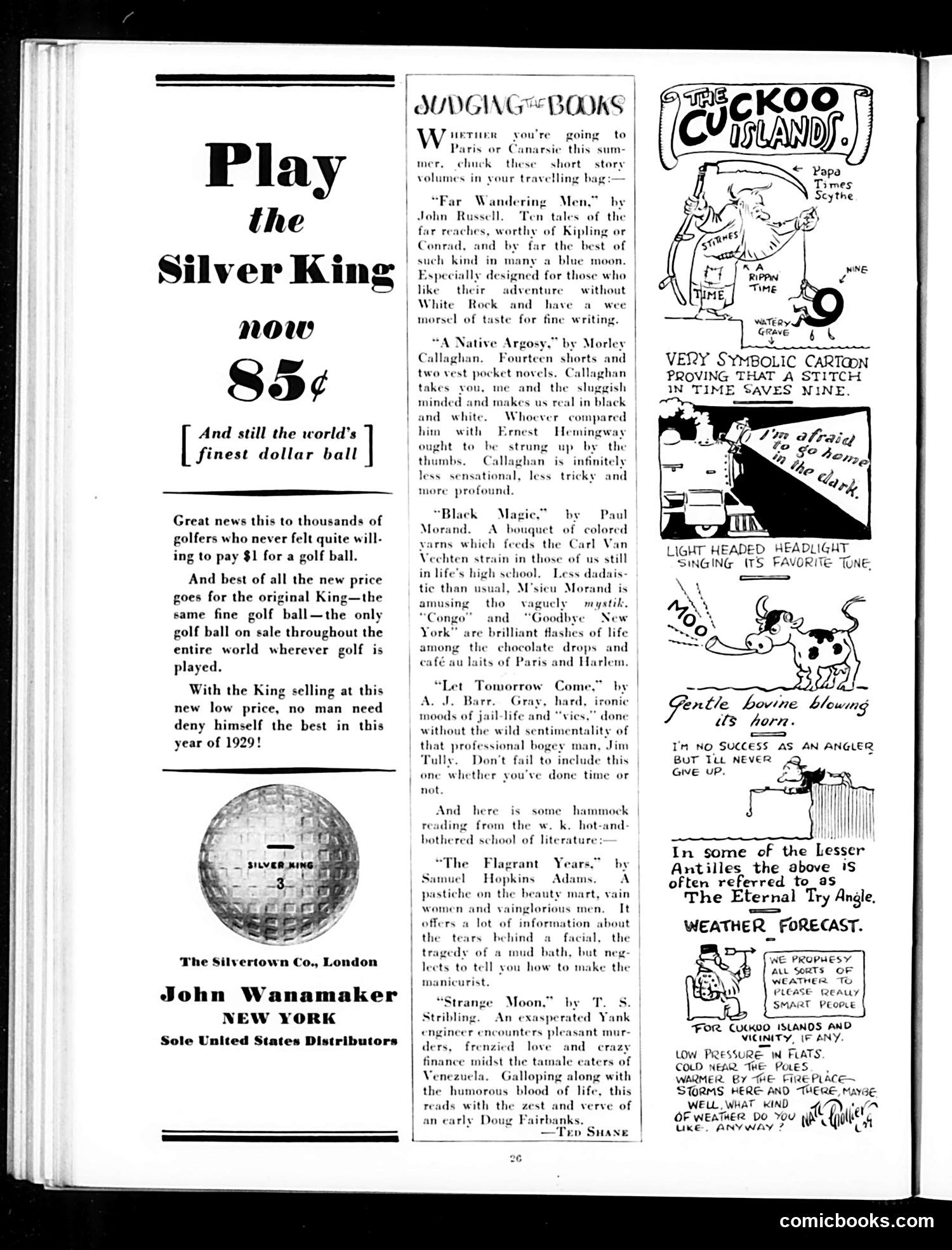
This page combines advertisements with humorous cartoons typical of Judge's satirical style. **Main Content:** The left side advertises the "Silver King" golf ball at the reduced price of 85¢, marketed as affordable luxury for golfers in 1929. A book review section recommends travel reading from authors like John Russell, Morley Callaghan, and Paul Morand. **Cartoons (Right Side):** These are light, non-political gag cartoons: 1. "The Cuckoo Islands" - A surreal comic about time-saving, playing on the nursery rhyme "a stitch in time saves nine" 2. A cow with a car headlight - absurdist humor about a "light-headed" bovine 3. A fishing angler who "never gives up" - the punchline references this persistence as "The Eternal Try Angle" in the Lesser Antilles 4. A weather forecast section offering deliberately vague, humorous predictions These cartoons reflect Judge's tradition of whimsical wordplay and visual puns rather than sharp political satire. The overall page targets educated, affluent readers interested in travel, literature, and leisure activities.
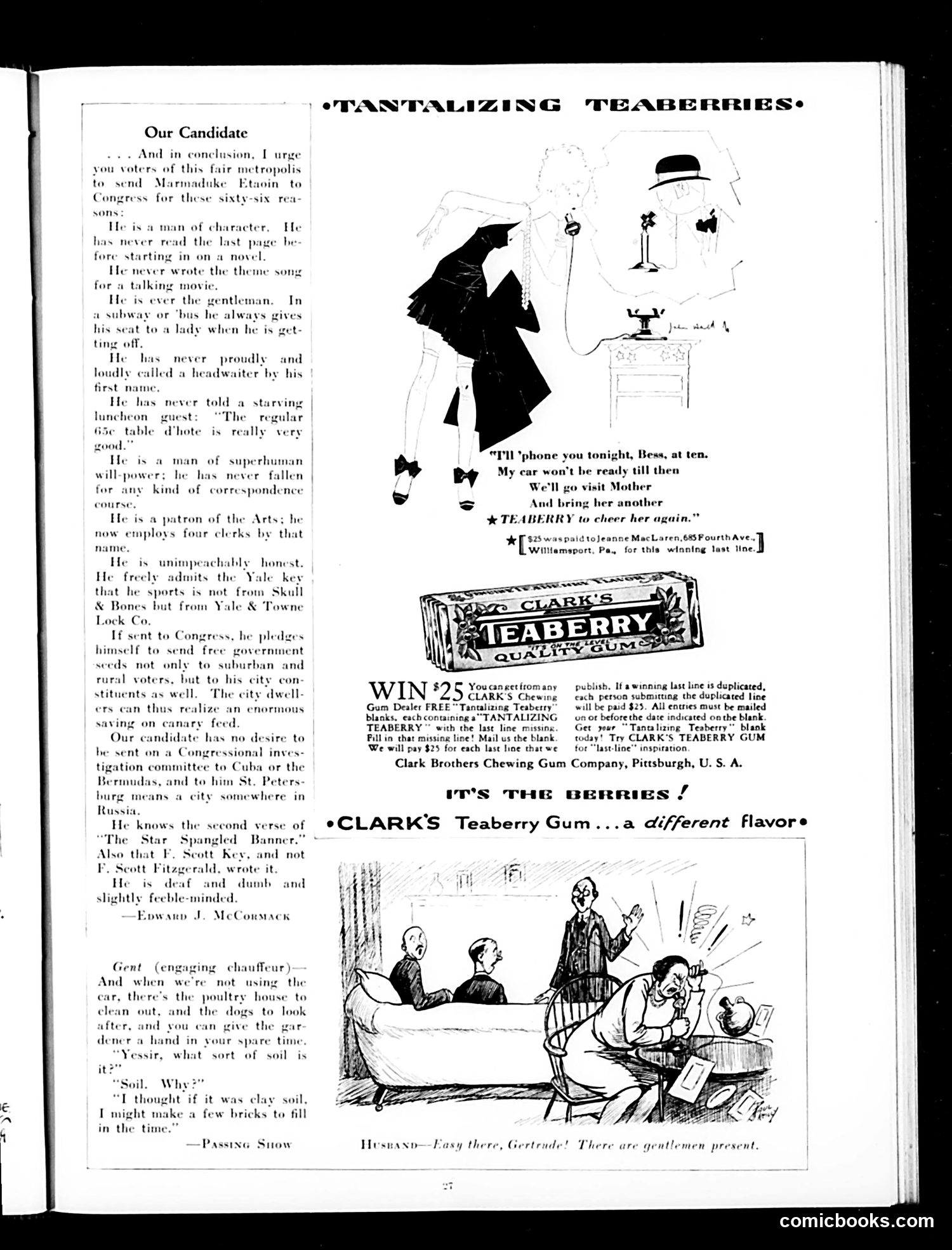
This page combines political satire with advertising. The main content is a mock endorsement of "Marmaduke Etaoin" as a congressional candidate. The satire works by listing absurdly trivial or contradictory qualifications—he's never read novels properly, gives his subway seat to ladies while getting off (illogical), calls headwaiters by first names, and most damningly, "is daft and dumb and slightly feeble-minded." The final admission undermines the entire endorsement, suggesting the candidate is unfit for office. The author (E.J. McCormack) is mocking the kind of vapid campaign rhetoric and lowered standards for public office that apparently existed in this era. The page also features Clark's Teaberry Gum advertisements, including a consumer contest offering $25 for completing jingles—typical early-20th-century promotional strategies. A small cartoon at bottom shows a domestic humor joke about a husband filling the house with soil for bricks while the wife entertains guests.
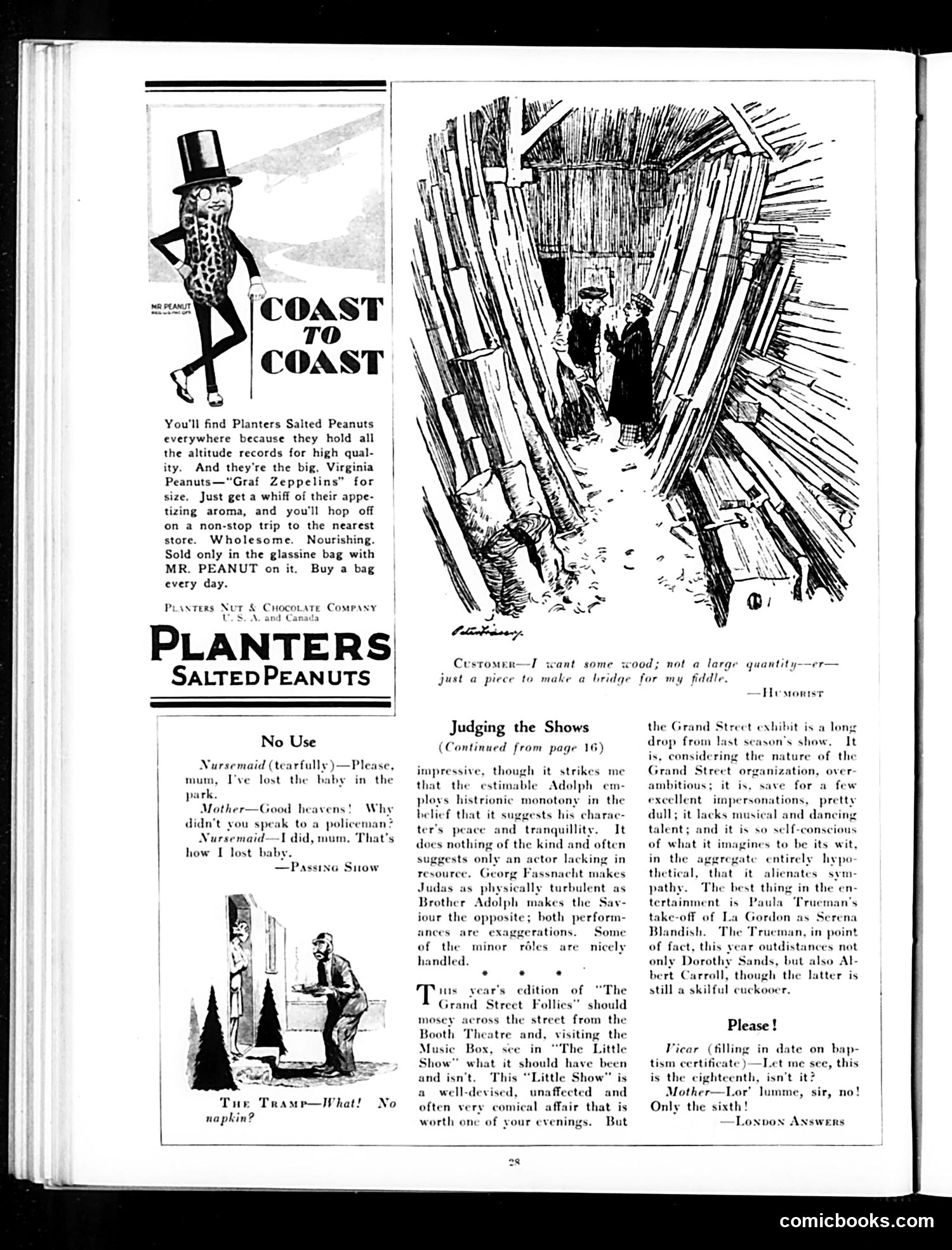
This page from *Judge* magazine contains mostly **advertisements and humor columns** rather than political cartoons. The **Planters Peanuts ad** uses contemporary 1920s marketing language, comparing peanut size to "Graf Zeppelins"—referencing the famous German airships of that era as a symbol of impressive scale. The **humor pieces** are brief comedic vignettes unrelated to politics: - "No Use" depicts a nursemaid who lost a baby in the park, then lost the baby again while speaking to a policeman (the joke being her poor communication) - "The Tramp" shows a beggar's response to being asked why he has no napkin - Theater reviews critique Broadway shows like "The Grand Street Follies" and "The Little Show," discussing performances by actors like Adolph (likely Adolph Menjou) The final section contains reader Q&As about mundane matters like baptism dates. **The page is primarily entertainment and advertising content**, not political or social satire.
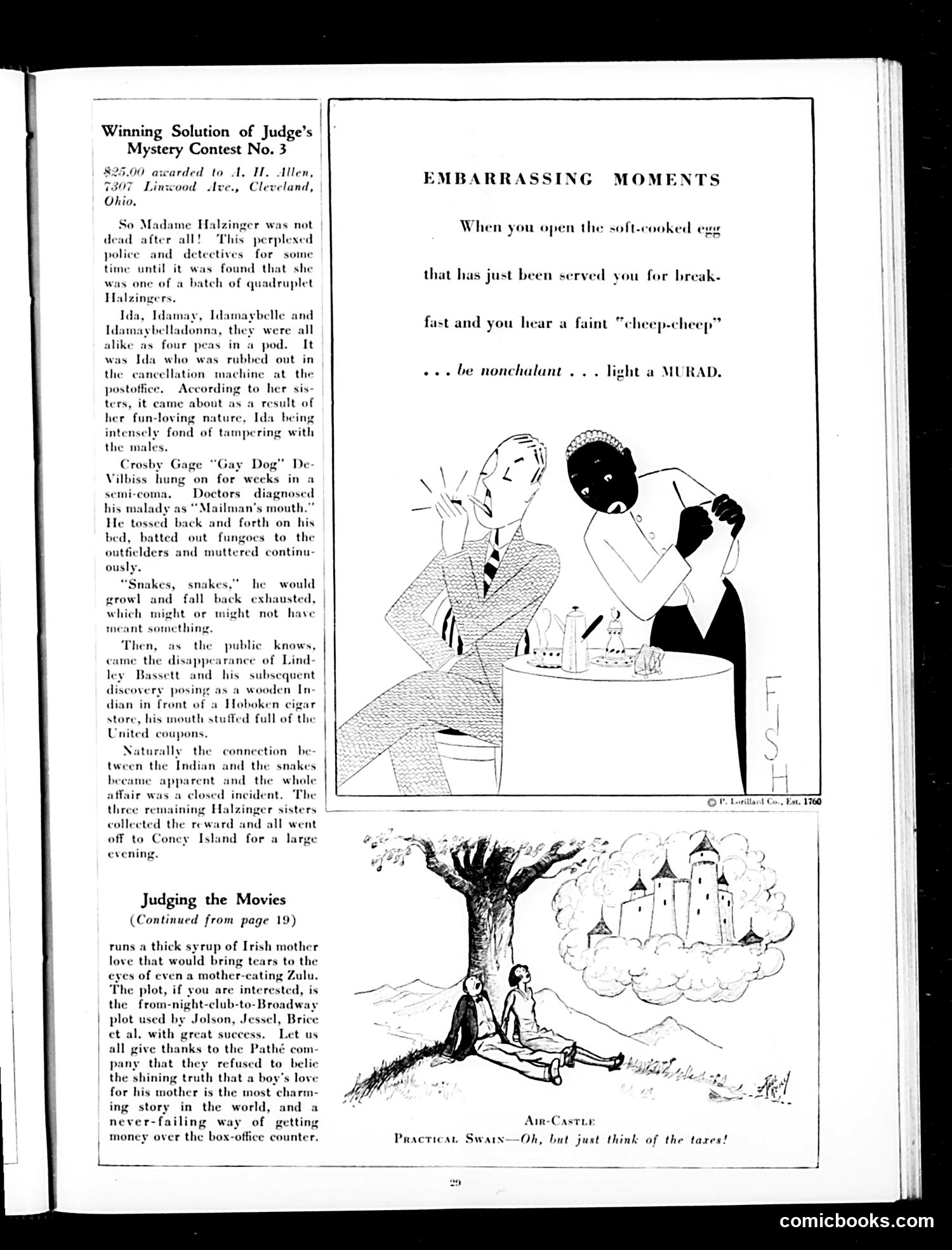
This page contains two distinct elements: **Left side:** The winning solution to Judge magazine's mystery contest—a humorous short story about the quadruplet Halzinger sisters, where one identical sister was accidentally killed in a postal cancellation machine. The absurdist plot involves mistaken identities, a mailman afflicted with "Mailman's mouth," and hidden connections with snakes and trading coupons. **Right side:** An "Embarrassing Moments" humor feature showing a man opening a soft-boiled egg at breakfast and hearing a chick's chirp inside. The joke: maintain composure by lighting a MURAD cigarette (an advertisement). Below, a separate cartoon titled "Air-Castle" depicts people daydreaming of a castle in clouds, captioned with a pun about "tares" (presumably "airs"). The page exemplifies Judge's blend of absurdist satire, advertising, and gentle social humor typical of early 20th-century American magazines.
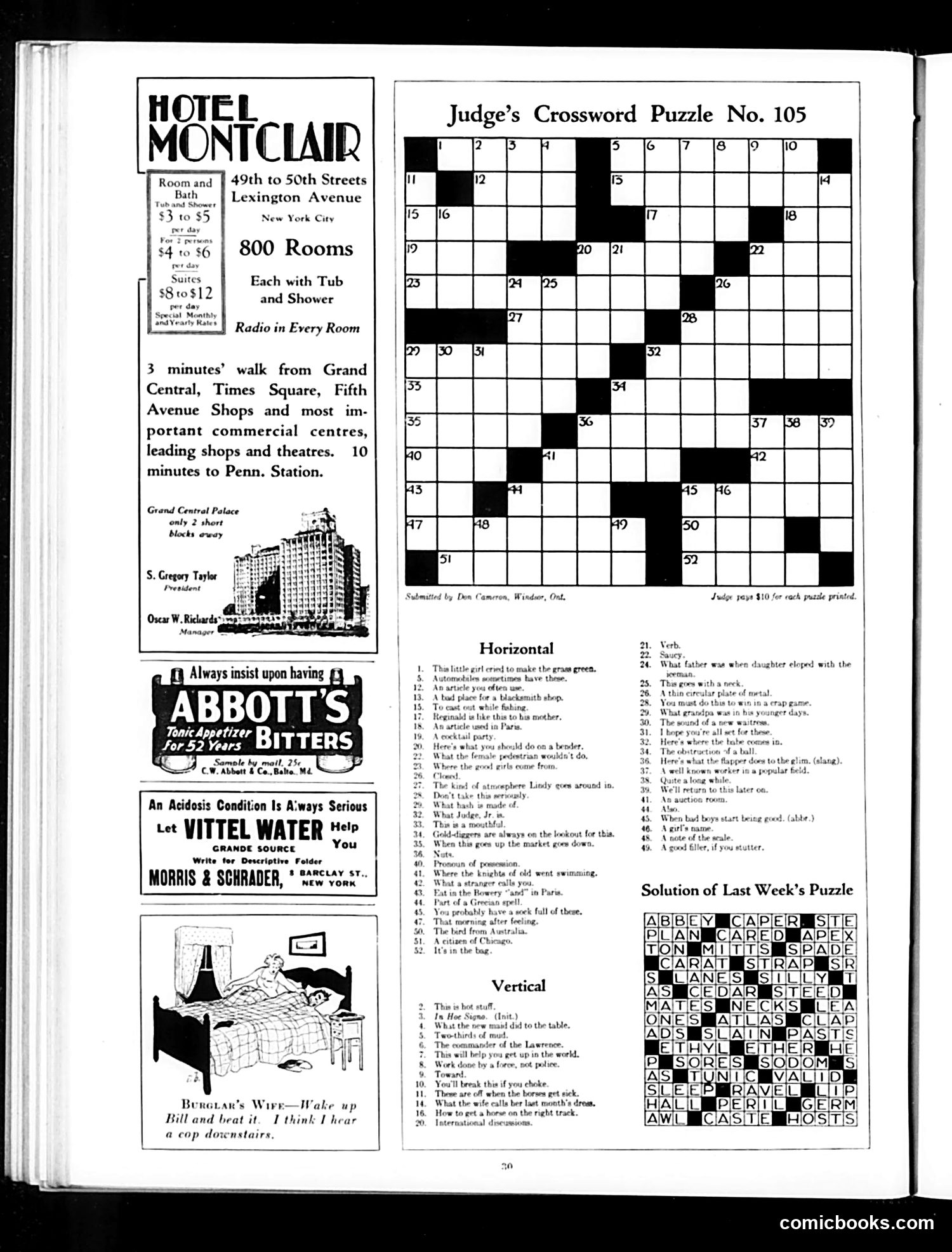
This page is primarily a **crossword puzzle** (Judge's Crossword Puzzle No. 105) with accompanying advertisements—not a political cartoon requiring satire analysis. The advertisements reflect **1920s-30s American commercial culture**: the Hotel Montclair promotes affordable urban lodging ($3-$5/day) near Manhattan's commercial centers; Abbott's Bitters and Vittel Water advertise patent medicines/tonics (common in this era when such products made unregulated health claims); and Morris & Schraeder promotes Vittel Water as treatment for "acidosis"—a pseudo-medical condition heavily marketed during this period. The small cartoon at bottom ("Burglar's Wife") depicts a domestic scene with comedic timing: a wife waking her burglar husband, hearing police downstairs—a brief humorous vignette unrelated to political satire. This page represents **ordinary magazine content**—puzzles and consumer advertising typical of Judge's revenue model, rather than the satirical commentary the magazine was known for.
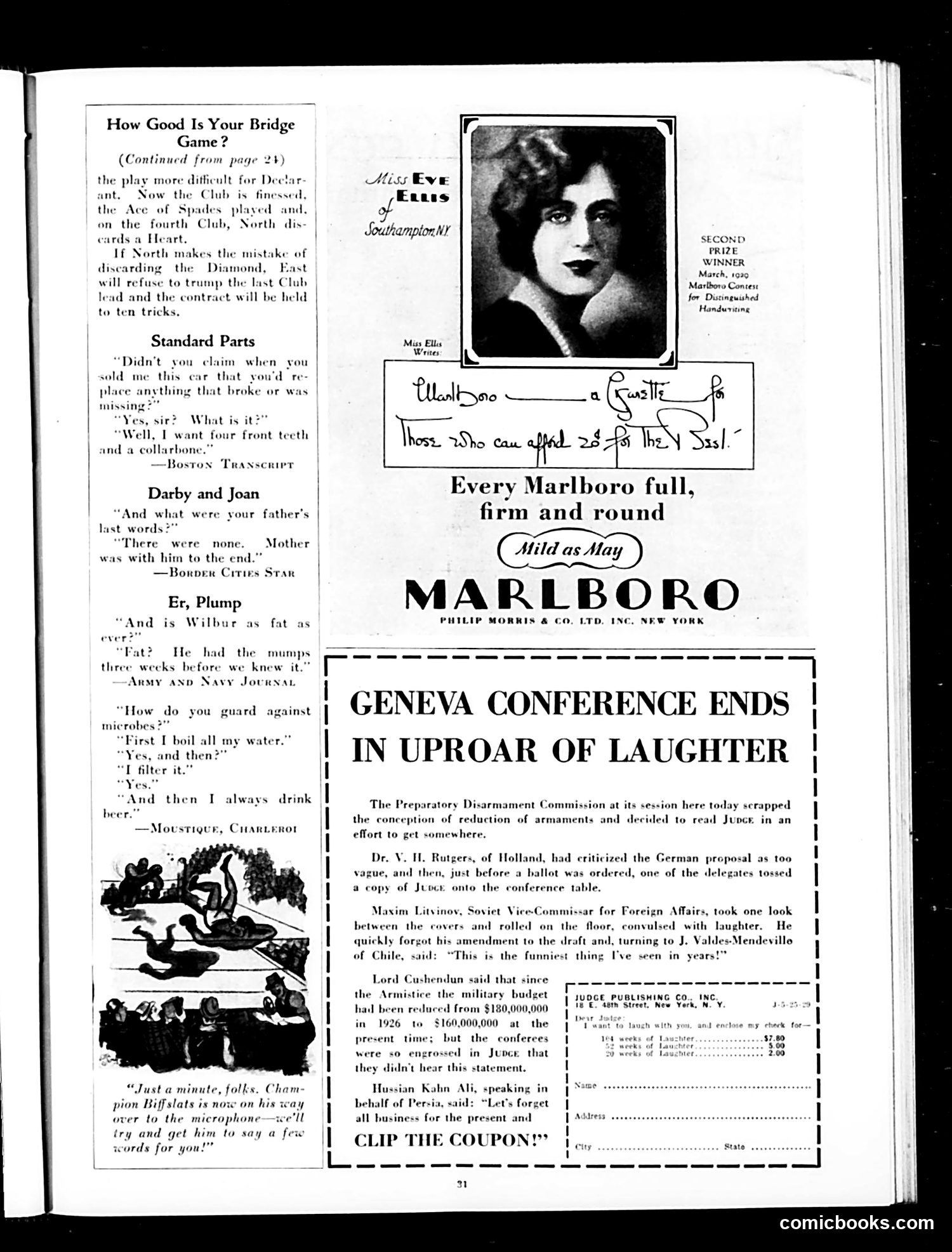
This page mixes humor columns, a cigarette advertisement, and satirical news commentary typical of Judge magazine. **The Main Satire:** The "Geneva Conference Ends in Uproar of Laughter" article mocks the 1929 League of Nations disarmament talks. It reports that Soviet official Maxim Litvinov found the proceedings so absurd he laughed uncontrollably after someone threw a copy of *Judge* magazine onto the conference table. The joke satirizes the conference's failure to achieve meaningful results—treating serious international disarmament negotiations as a joke so ridiculous that even Soviet diplomats couldn't maintain composure. **Context:** These early Cold War-era disarmament conferences were frequently deadlocked and ineffective. Judge's satire suggests the delegates' posturing was farcical rather than substantive. **Secondary Content:** Bridge game tips, humorous quotations ("Standard Parts," "Darby and Joan"), and a Marlboro cigarette ad with a handwriting contest winner complete the page.
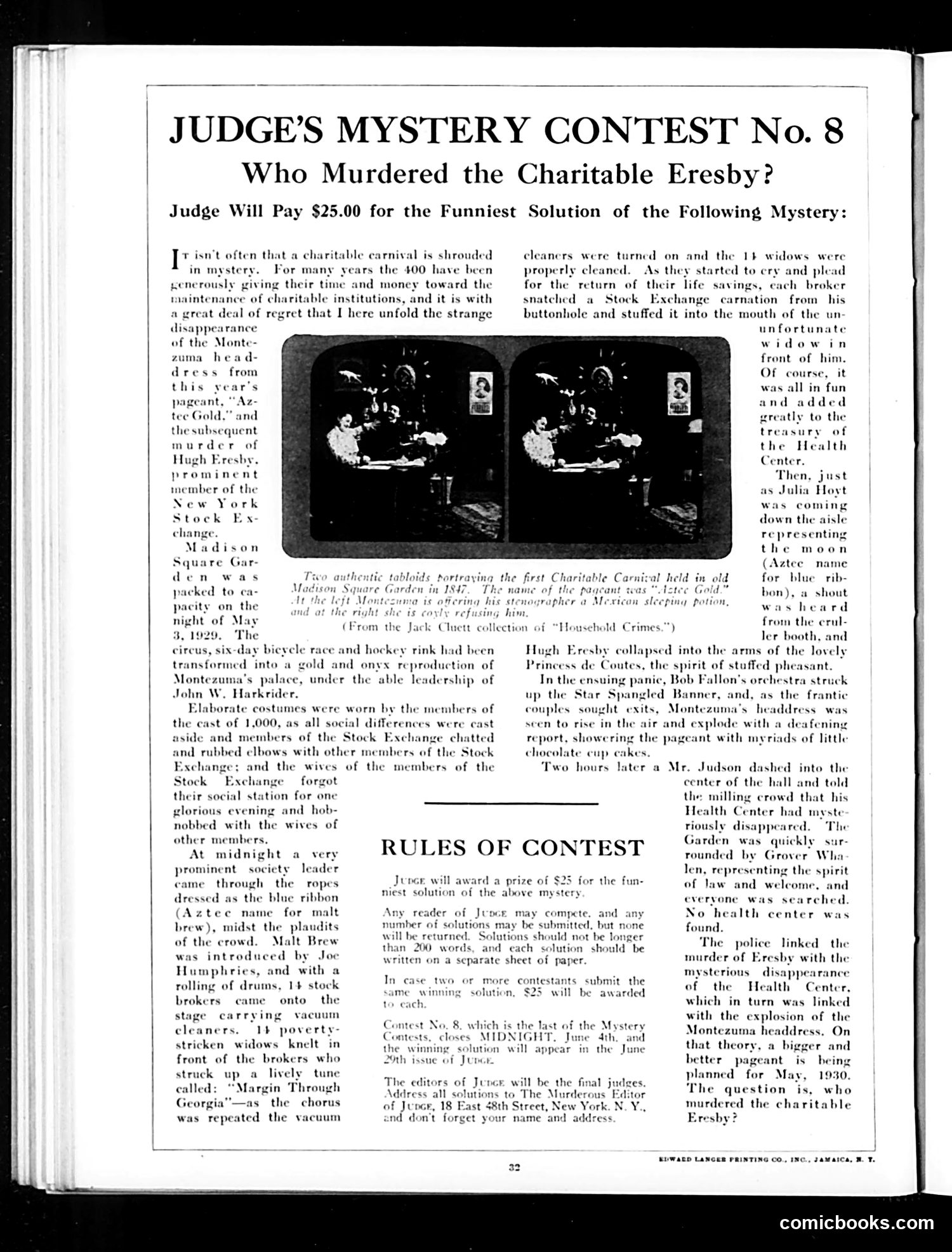
This page presents a humorous murder mystery contest from Judge magazine, a satirical publication. The setup parodies 1920s society: a lavish "Aztec Gold" themed carnival at Madison Square Garden celebrating charity (May 3, 1929) becomes the scene of a murder when Hugh Eresby, a prominent New York Stock Exchange member, dies during the pageant. The satire targets the wealthy "400" elite and Stock Exchange brokers who attend charity events. The accompanying stereoscopic image shows the actual 1847 Charitable Carnival that inspired this fictional version. The humor lies in readers submitting funny solutions to "Who murdered Eresby?"—likely poking fun at both the pretensions of high society and Wall Street's greed (stock brokers are depicted stealing from widows' life savings). The $25 prize incentivizes readers to submit comedic theories. This was typical Judge entertainment: mock-detective fiction satirizing contemporary social hierarchies and financial institutions.
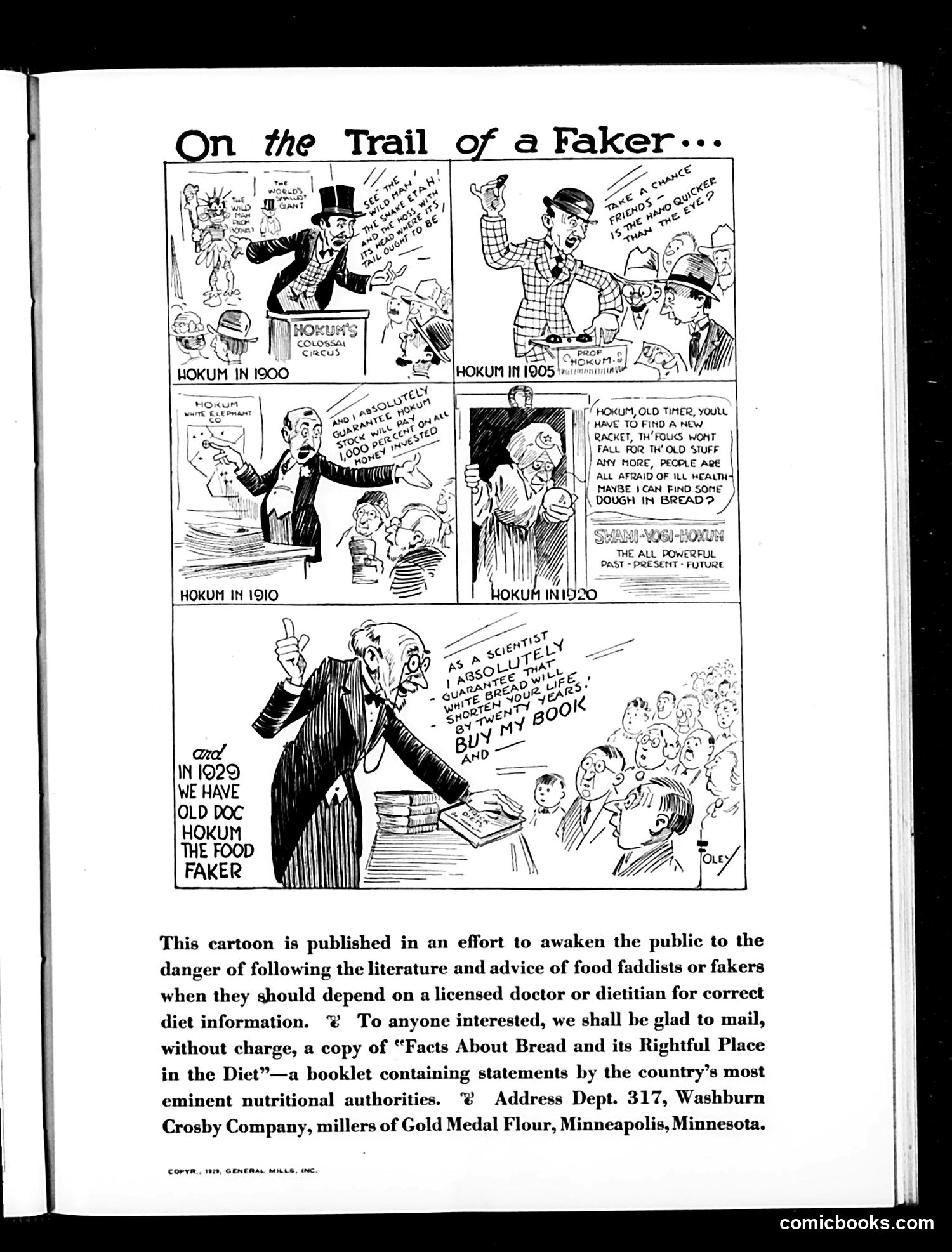
This is **advertising disguised as public service journalism**—a four-panel cartoon by Washburn Crosby Company (Gold Medal Flour) attacking "food faddists." The cartoon follows a con man character ("Doc Hokum") from 1900 to 1929, showing his evolving fraudulent pitches: a circus performer (1900), a wellness scheme promoter (1905), a doctor selling dubious health guarantees (1910), and finally a self-proclaimed "scientist" hawking books about bread's dangers (1929). The satire targets **dietary pseudoscience and quack doctors**—people selling false health claims. The accompanying text warns readers not to follow food fad literature, but instead consult licensed doctors or dietitians. **The irony**: This is actually a **flour company's advertisement** positioned as consumer protection. By discrediting "faddists," they're implicitly endorsing bread as safe and healthy—and selling their own product as trustworthy. The "free booklet" is marketing material disguised as authoritative nutritional advice.
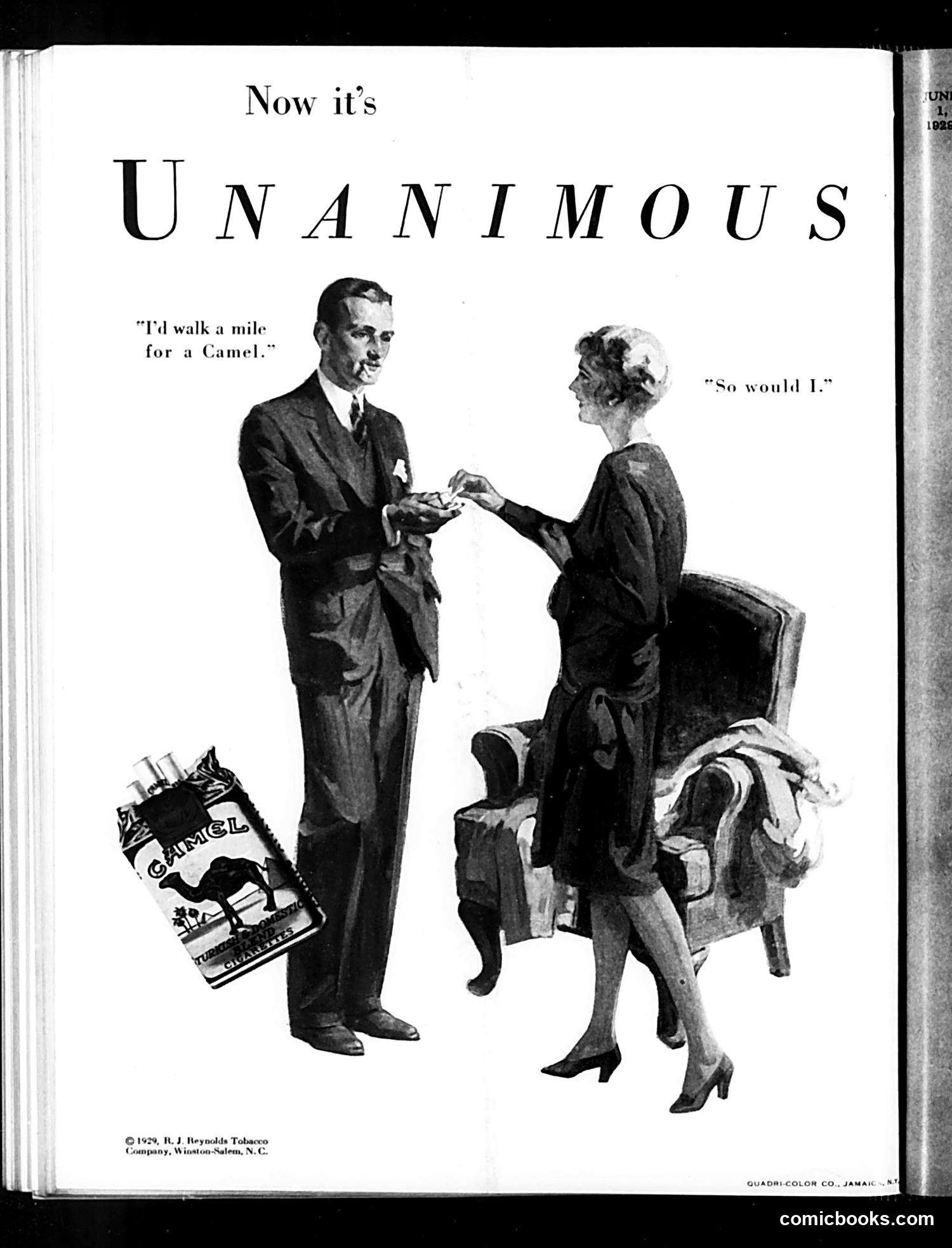
This is a Camel cigarettes ad, not political satire. It depicts a well-dressed man offering a cigarette to a seated woman, with the slogan "I'd walk a mile for a Camel" (the brand's famous advertising tagline). She responds "So would I," suggesting her enthusiastic agreement. The joke plays on the gendered marketing of the era: the ad humorously suggests that even women—traditionally excluded from cigarette advertising—would go to great lengths for this product. The "unanimous" headline emphasizes universal appeal across gender lines. This represents 1920s advertising's gradual shift toward marketing cigarettes to women, a controversial marketing strategy at the time.