
Judge, 1929-05-25 · page 26 of 36
Judge — May 25, 1929 — page 26: what you’re looking at
What you’re looking at
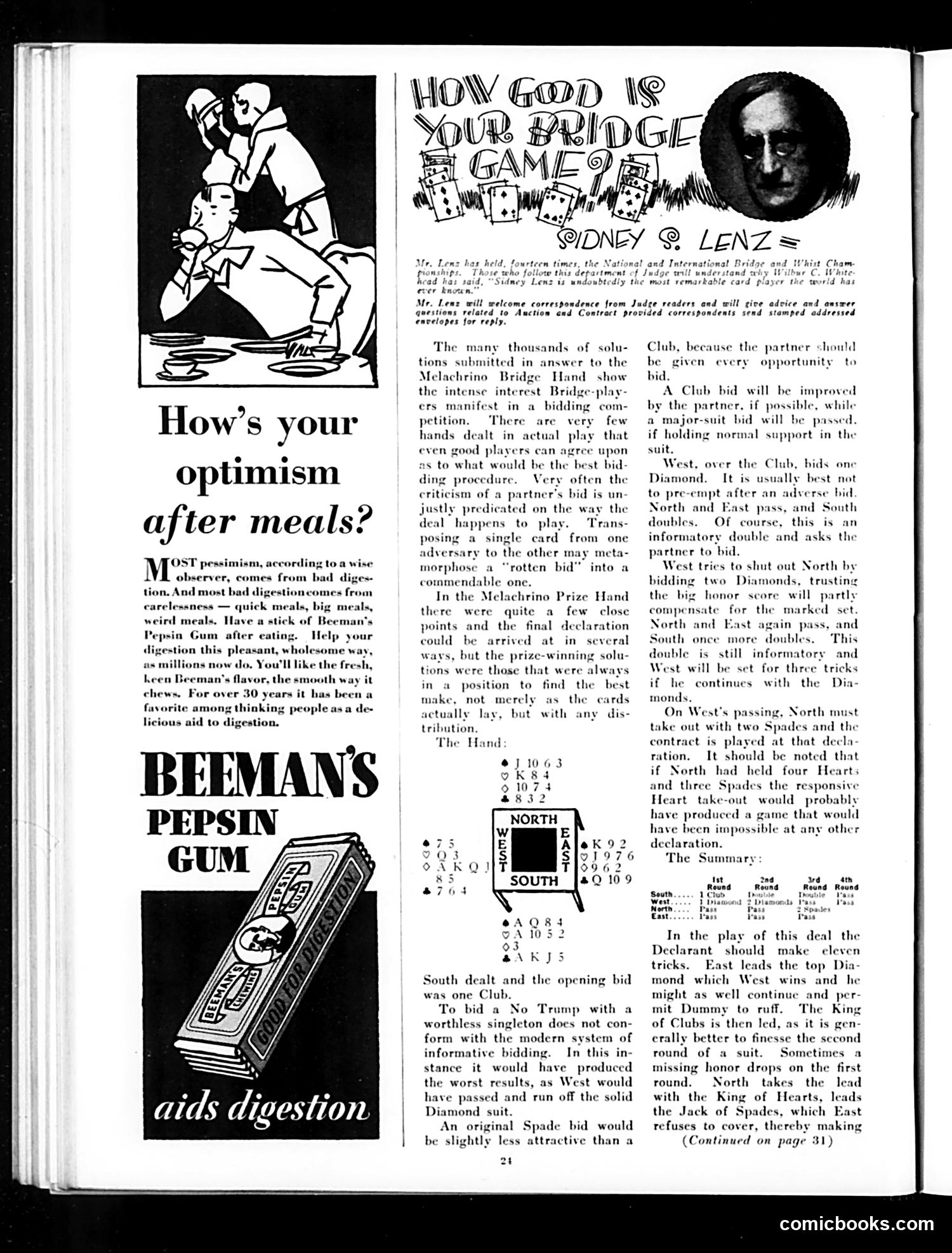
This page primarily features a **bridge card game instructional column** by Sidney S. Lenz, a famous bridge player of the era. The content is not political satire but rather educational entertainment. The visible cartoon (top left) shows three figures playing cards in a casual setting—likely illustrating the social context of bridge as a parlor game among educated classes. The main content is Lenz's analysis of the "Melachrino Prize Hand," a bridge problem submitted by readers. He critiques various bidding strategies and explains the optimal play, demonstrating why certain bids succeed or fail. This was typical of Judge magazine's blend of humor and highbrow content for educated readers interested in card games. The **Beeman's Pepsin Gum advertisement** below is unrelated—a period advertisement claiming the product aids digestion. The page reflects early 20th-century American leisure culture among the educated classes, where bridge was a serious intellectual pursuit worthy of magazine coverage alongside satire.
📄 Transcribed text from this page (OCR, searchable)
Machine-transcribed from the original scan — historical spelling and the odd misread are preserved.
How’s your optimism ifter meals? OST pessimism, accordin LVE observer, comes from b carelessness — q ird meals, Have a st Pepsin Gum after eatin tion this pleasant, wholesome way, ions now do. You'll like the fi eman’s flavor, the smooth way it chews. For over 30 years it has been a favorite among think us aid t Help your ¢ people asa de- gestion. BEEMANS SIDNEY @ LENZ = en times, the National and In e this department of Jud Lund why I i is undoubtedly the most remarkable card player the pionsiip! head ha ever known. Sidney Len and Whist Ci onal Bridge Mr. Lenz will welcome correspondence from Judge readers and will give advice and answer questions related to Auction end Contract provided correspondents send stamped addressed envelopes for reply. The many thousands of solu- tions submitted in answer to the Melachrino Bridge Hand show the intense interest Bridge-play- ers manifest in a bidding com- petition. There are very few hands dealt in actual play that even good players can agree upon as to what would be the best bid- ding procedure. Very often the criticism of a partner's bid is un justly predicated on the way the deal happens to play. ‘Trans- posing a single card from one adversary to the other may me morphose a “rotten bid” commendable one. In the Melachrino Prize Hand there were quite a few close points and the final declaration could be arrived at in several ways, but the prize-winning solu- tions were those th: x in a into a were alw: find the best make, not merely as the cards actually lay, but with any dis- tribution. The Hand position to South de was one Club. To bid a No Trump with a worthless singleton does not con- form with the modern system of informative bidding. In this in- stance it would have produced the worst results, as West would have passed and run off the solid Diamond suit. An original Spade bid would be slightly less attractive than a > opening bid Club, because the partner should be given opportunity to bid. A Club bid will be improved by the partner, if possible, while a’ major-suit bid will be passed. if holding normal support in the suit. West. over the Club, bids one Diamond. It is usually best not to pre-empt after an adverse bid North and East pass, and South doubles. Of course, this is an informatory double and asks the partner to bid. West tries to shut out North by bidding two Diamonds, trusting the big honor score will partly compensate for the marked set. North and East again pass, and South once more doubles. This double is still informatory and West will be set for three tricks if he continues with the Dia- monds, On West's passing, North must take out with two Spades and the contract is played at that decla ration. It should be noted that if North had held four Hearts and three Spades the responsive Heart take-out would probably ave produced a game that would have been impossible at dec The Summary every South wi In the play of this deal the Declarant should) make eleven tricks. East leads the top Dia mond which West wins and he might as well continue and per- mit Dummy to ruff. The King of Clubs is then led, as it is gen- crally better to finesse the second round of a suit. Sometimes a missing honor drops on the first round. North takes the lead with the King of Hearts, ds Spades, which East s to cover, there making (Continued on page 31) comicbooks.com