
A complete issue · 36 pages · 1929
Judge — February 16, 1929
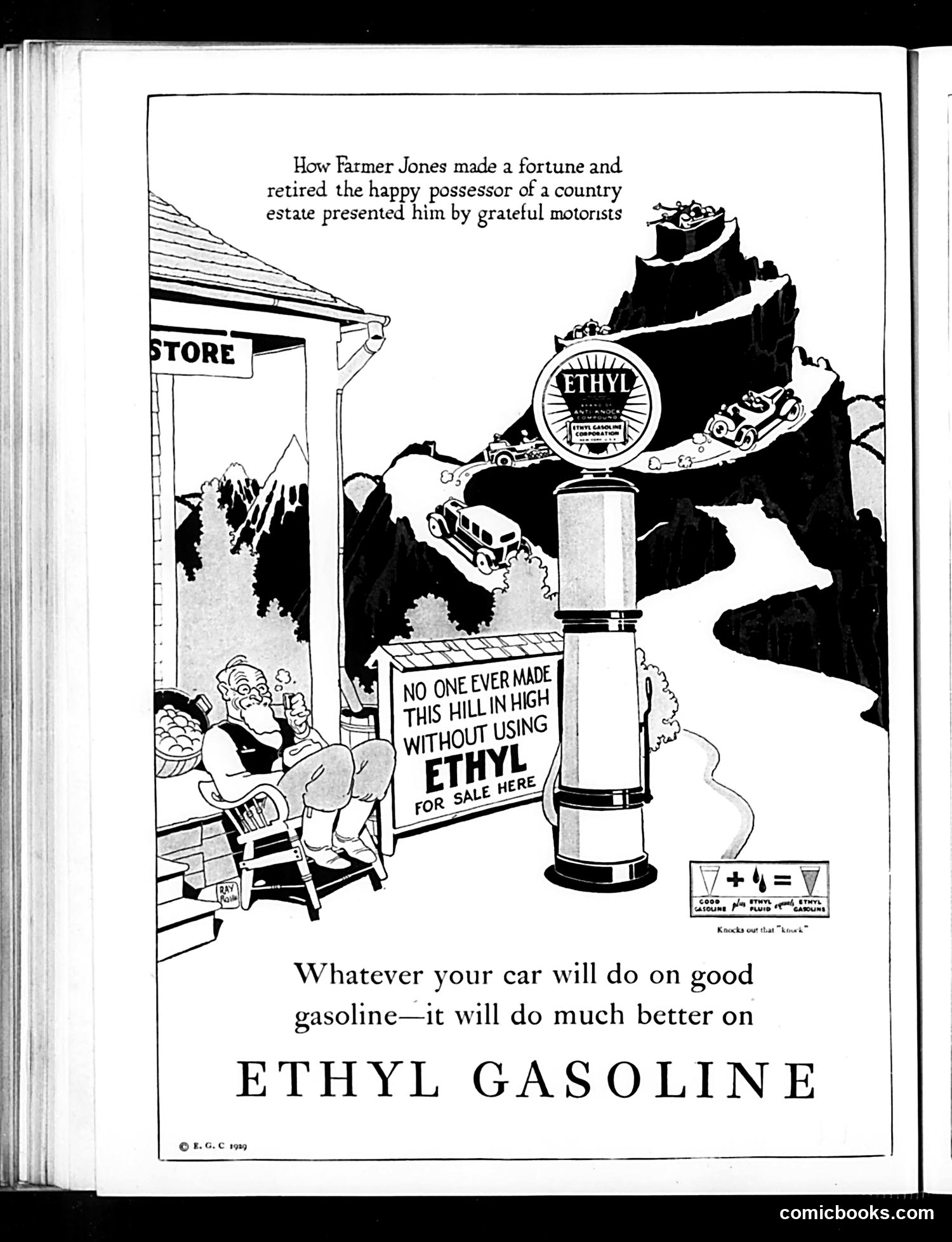
This is primarily a **commercial advertisement** rather than political satire, though it employs Judge magazine's characteristic humor. The page depicts "Farmer Jones" retiring wealthy after selling his land, now a country estate owner—a success story attributed to selling ethyl gasoline. The visual pun shows motorists climbing a steep hill, with the caption claiming "NO ONE EVER MADE THIS HILL IN HIGH WITHOUT USING ETHYL." The joke plays on double meaning: the hill both represents automotive performance and Jones's social elevation. The advertisement suggests ethyl gasoline's superiority over regular fuel for engine performance, particularly for challenging driving conditions like steep grades. This reflects 1920s-era marketing when **leaded gasoline (ethyl)** was promoted as a premium product, before its health dangers became known.
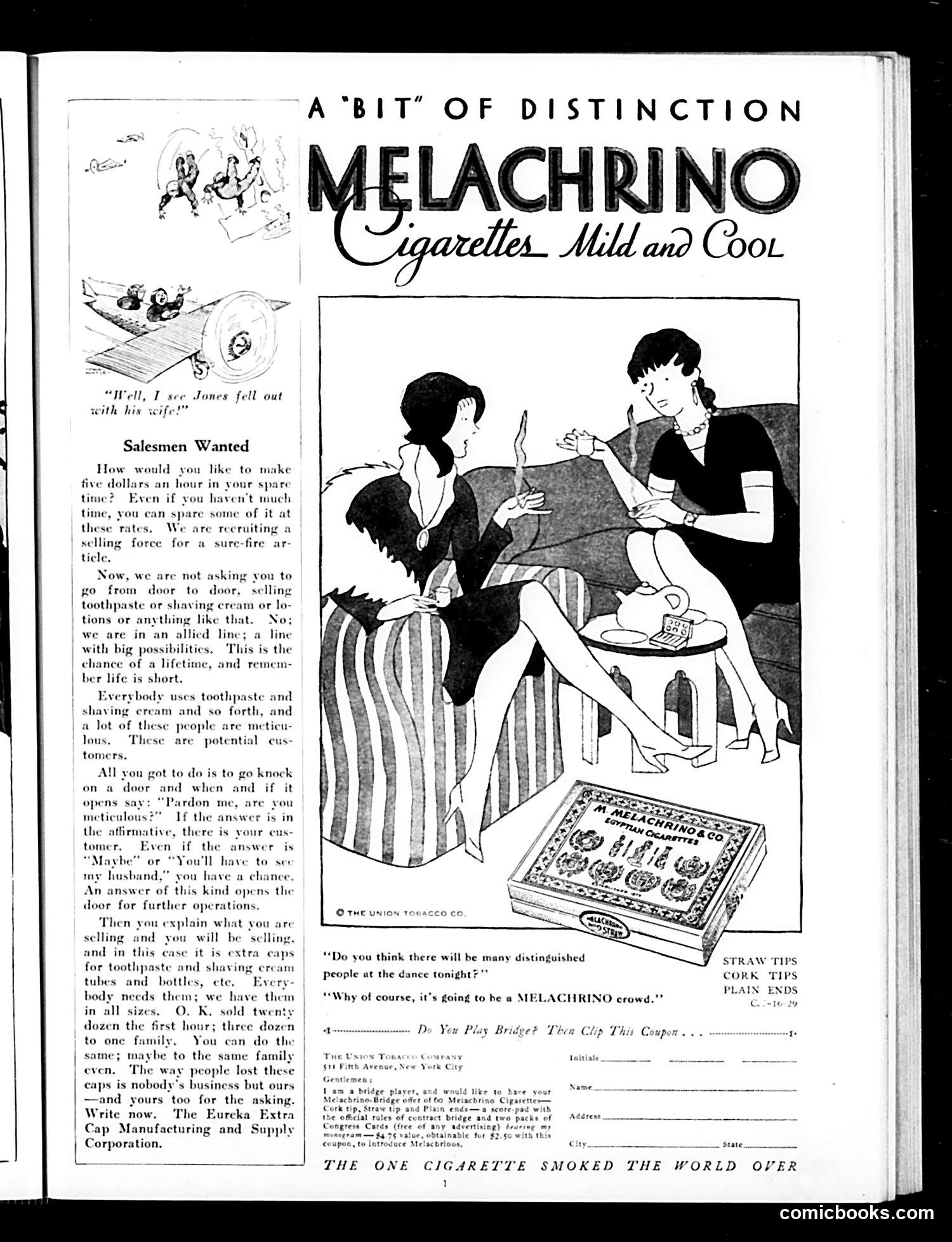
This page is primarily a **cigarette advertisement**, not political satire. The main illustration shows two women in 1920s-30s attire discussing an evening social event, with one saying they expect "a MELACHRINO crowd" at the dance. The left column contains a recruitment pitch for cigarette salesmen, offering five dollars per hour in "spare time" by selling door-to-door, specifically toothpaste, shaving cream, and other toiletries—using cigarette sales as the entry point. The satire appears mild: the ad's premise humorously assumes that smoking Melachrino cigarettes marks one as socially distinguished enough to attract an elite crowd. The "bit of distinction" slogan implies the product conveys status and sophistication to consumers and salespeople alike. This reflects early 20th-century advertising strategy linking consumer goods to social aspiration.
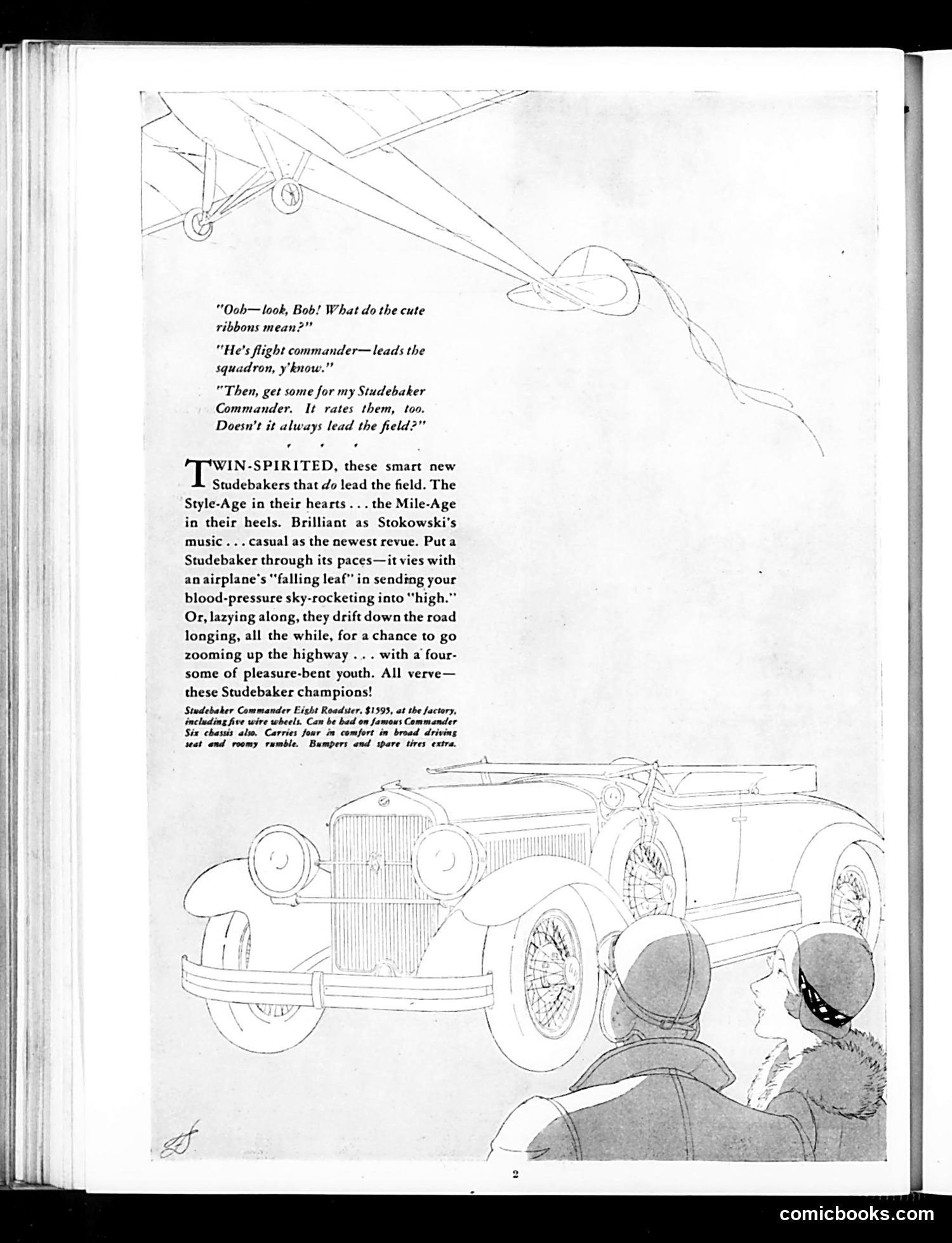
This page is primarily a **Studebaker automobile advertisement**, not political satire. The dialogue at top depicts two young people admiring the car's "cute ribbons" (decorative details), with one identifying it as belonging to a "flight commander" who "leads the squadron." The ad then uses military/aviation imagery to market the Studebaker Commander Eight Roadster as a high-performance vehicle for aspirational youth—comparing its capabilities to an airplane's "falling leaf" maneuver and emphasizing speed ("zooming up the highway"). The illustration shows two young people viewing the convertible, reflecting 1920s-30s consumer culture where automobiles signified status and modernity. The military references appear purely metaphorical rather than satirical—using contemporary aviation excitement as marketing appeal for a luxury car priced at $1,395.
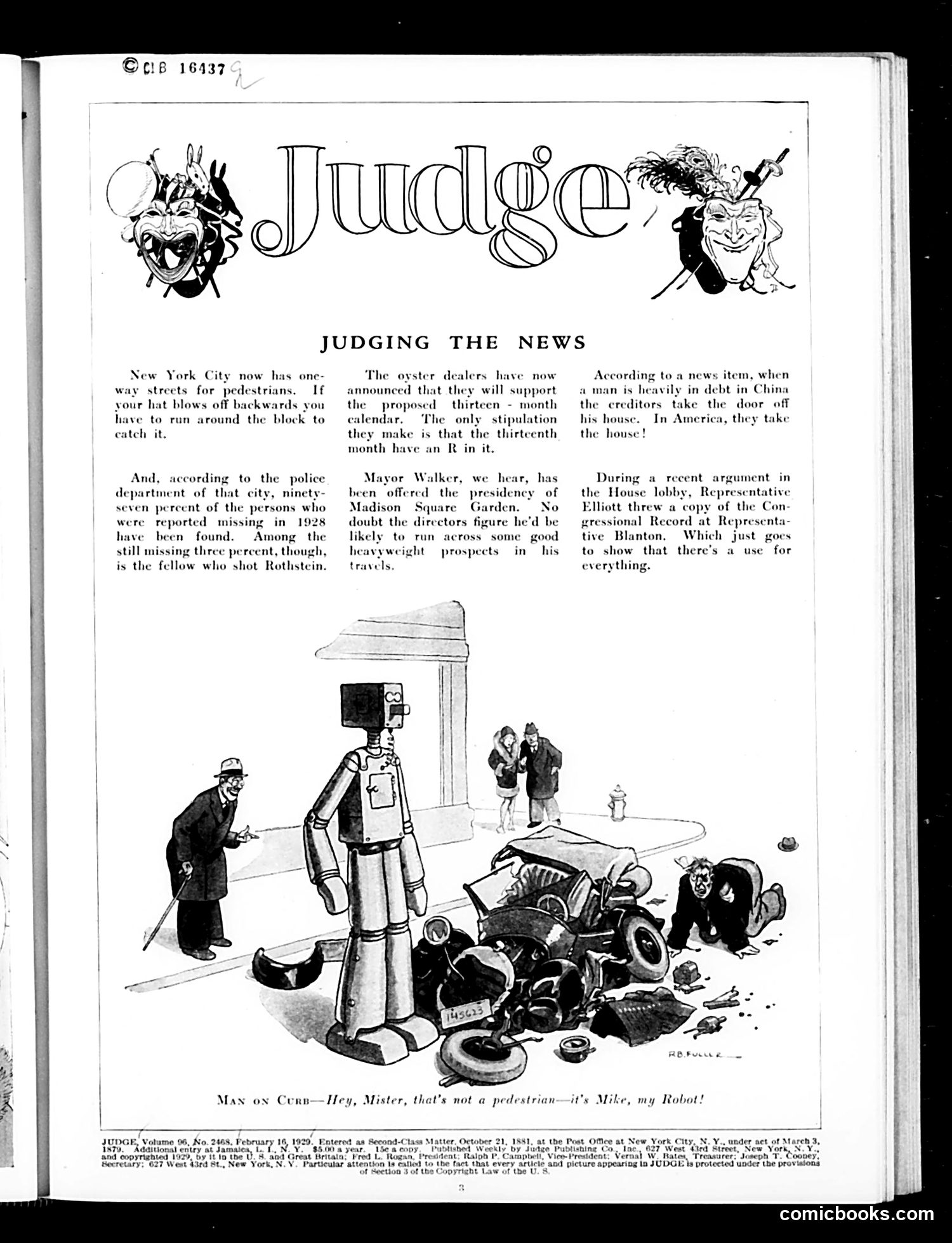
This 1929 cartoon satirizes pedestrian safety in New York City. The caption "Man on Curb" reads: "Hey, Mister, that's not a pedestrian—it's Mike, my Robot!" The joke reflects contemporary anxiety about automobile accidents. The text above notes NYC's one-way streets for pedestrians and that police reported 60% of 1928's missing persons were hit by vehicles. The robot's presence—a figure with a camera head standing amid traffic chaos and scattered auto parts—suggests mechanized urban life has become so dangerous that humans are being replaced by machines. The cartoon mocks both the city's failure to protect pedestrians and the absurdity of suggesting robots as a solution. It's dark humor about modernity's toll on urban safety.
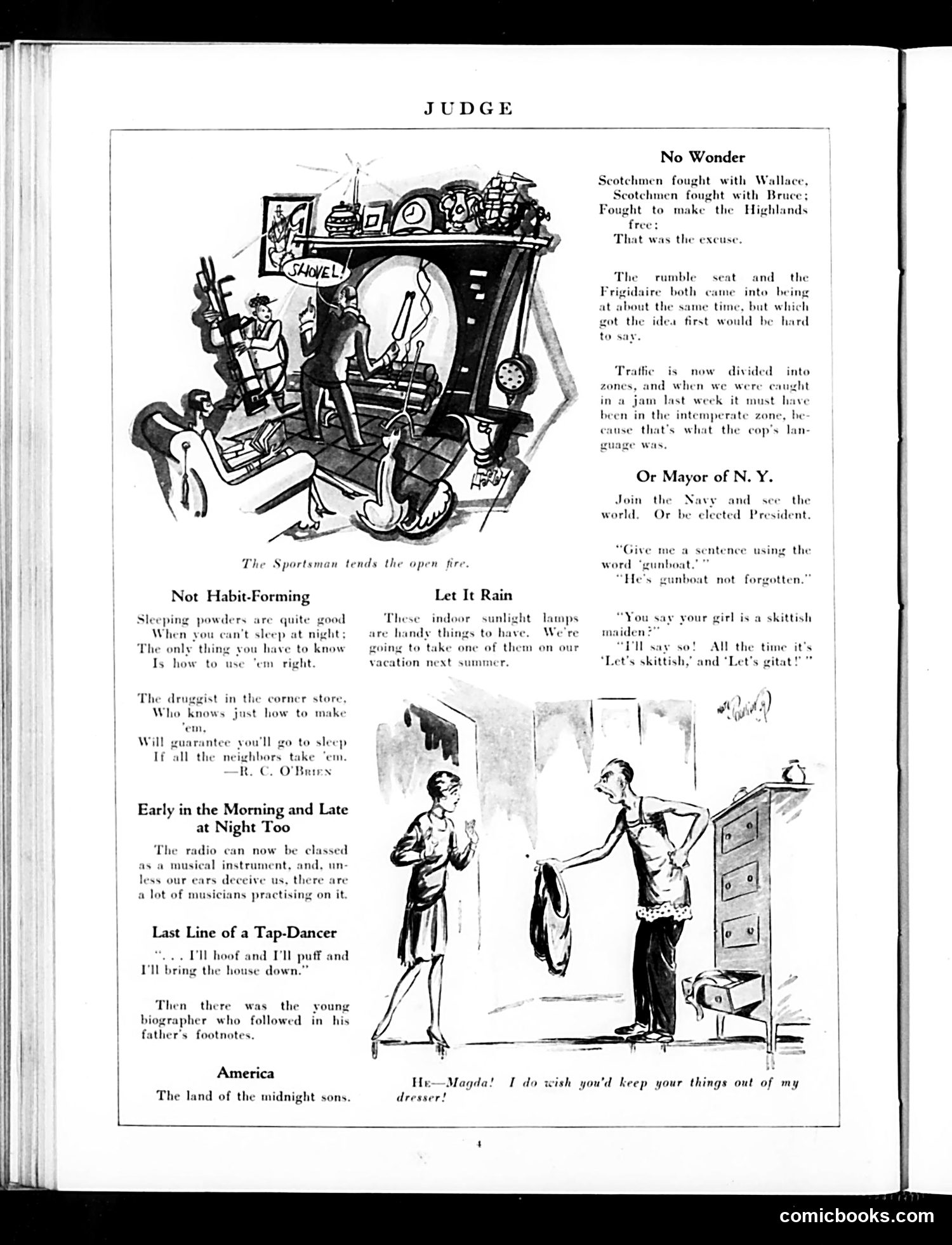
This page contains several short humorous pieces and illustrations typical of Judge's satirical style. **"No Wonder"** mocks Scottish-English conflicts by suggesting Scots fought various enemies as an "excuse" for their nature. **"The Sportsman tends the open fire"** shows a figure tending a large decorated hearth, likely satirizing leisure-class affectations. **"Not Habit-Forming"** jokes about sleeping powders and a druggist's corner store—early 20th-century commentary on patent medicines and their casual availability. **"Let It Rain"** humorously discusses indoor sunlamps for vacations. The cartoon showing a man exasperatedly telling "Magda" to keep things out of his dresser satirizes domestic friction between couples over tidiness. Other pieces make light of radio as a musical instrument, tap-dancing, and Scottish stereotypes.
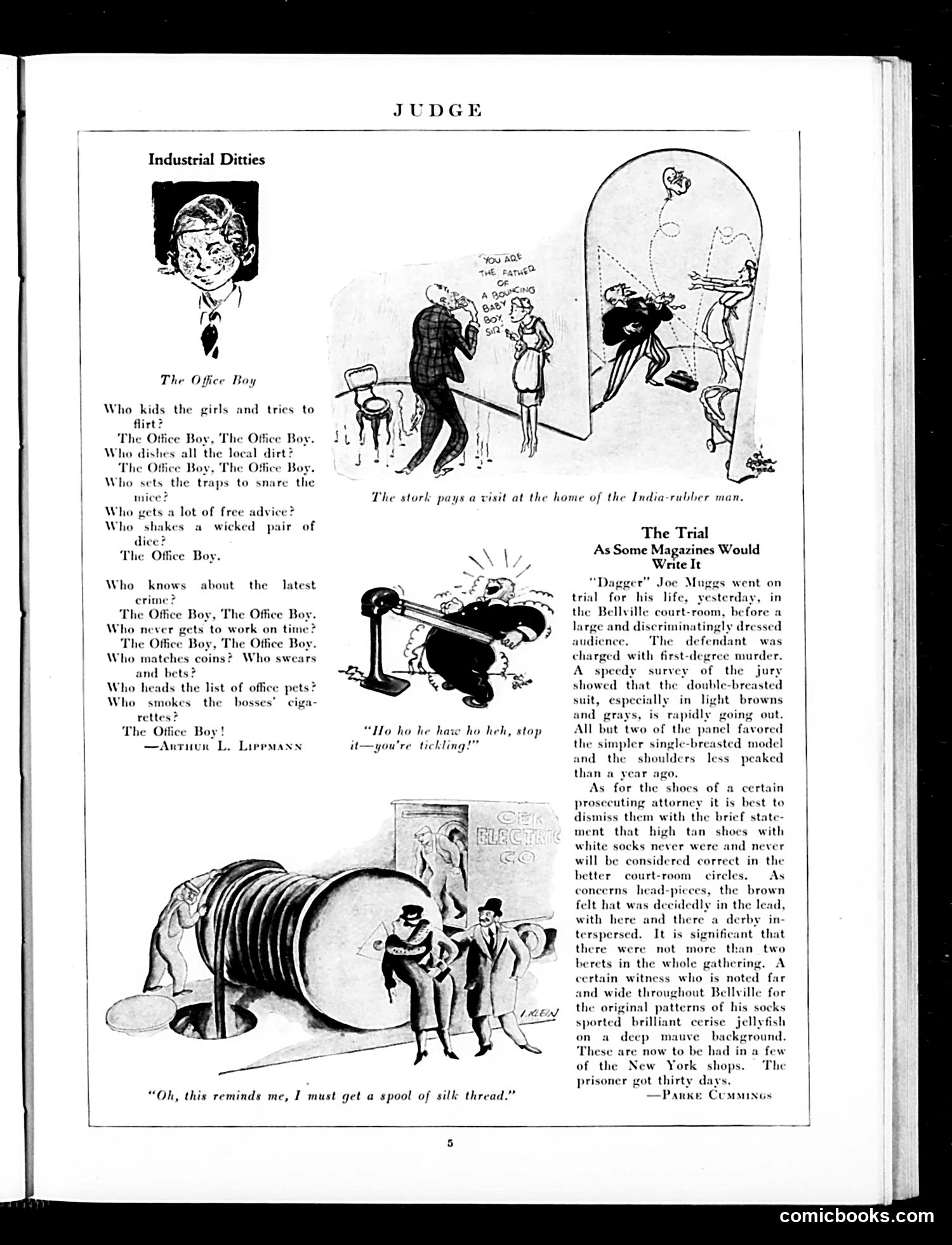
This page contains three distinct pieces of satire: **"The Office Boy"** (left): A humorous poem by Arthur L. Lippmann that mocks office culture, depicting the office boy as a know-it-all busybody who meddles in workplace affairs, spreads gossip, smokes, and generally irritates authority figures. **"The Stork Pays a Visit"** (top right): A cartoon showing a stork delivering a baby to an "India-rubber man"—likely satirizing someone in the rubber/manufacturing industry, with the stork appearing to struggle with the delivery. **"The Trial"** (right): A court satire by Parke Cummings about a murder trial where jury selection and evidence focus absurdly on trivial details: the defendant's suit color, shoes, and socks—mocking how trials sometimes fixate on irrelevant minutiae rather than substantial guilt or innocence. All target turn-of-the-century urban American society.
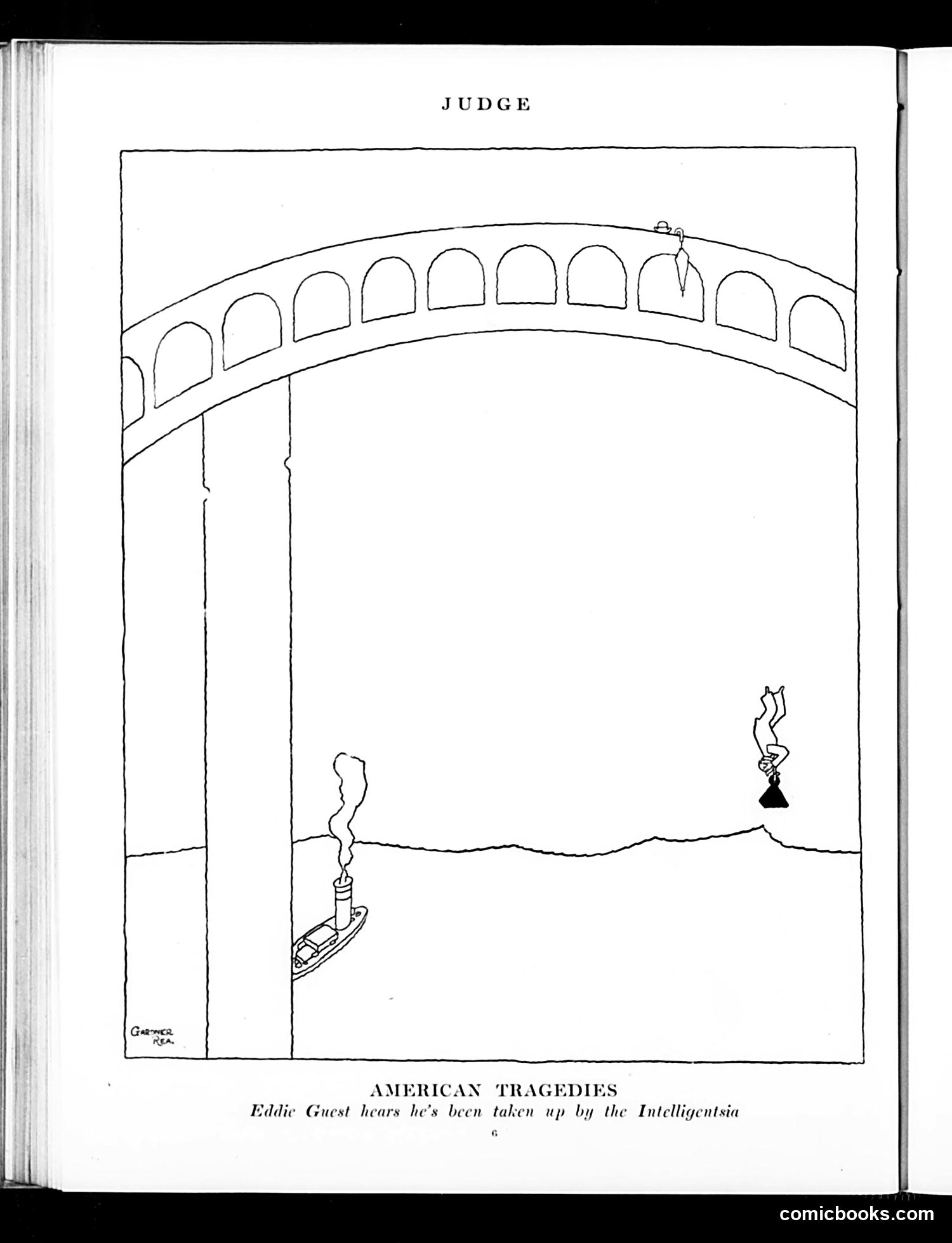
This cartoon, titled "American Tragedies," depicts a classical Roman amphitheater (suggesting grandeur and public spectacle) with two small boats on water below. One boat holds a candle, the other a torch—both appear to be burning. The caption reads: "Eddie Guest hears he's been taken up by the Intelligentsia." This is satirizing Eddie Guest (a popular American poet of the early 20th century) being embraced by intellectual elites. The joke appears to be that Guest's accessible, sentimental verse—represented by humble candles/torches—is being elevated to high-culture status by the "Intelligentsia." The amphitheater setting suggests this adoption is grandiose and absurd, mocking both Guest's work and pretentious intellectuals who claim to appreciate it.
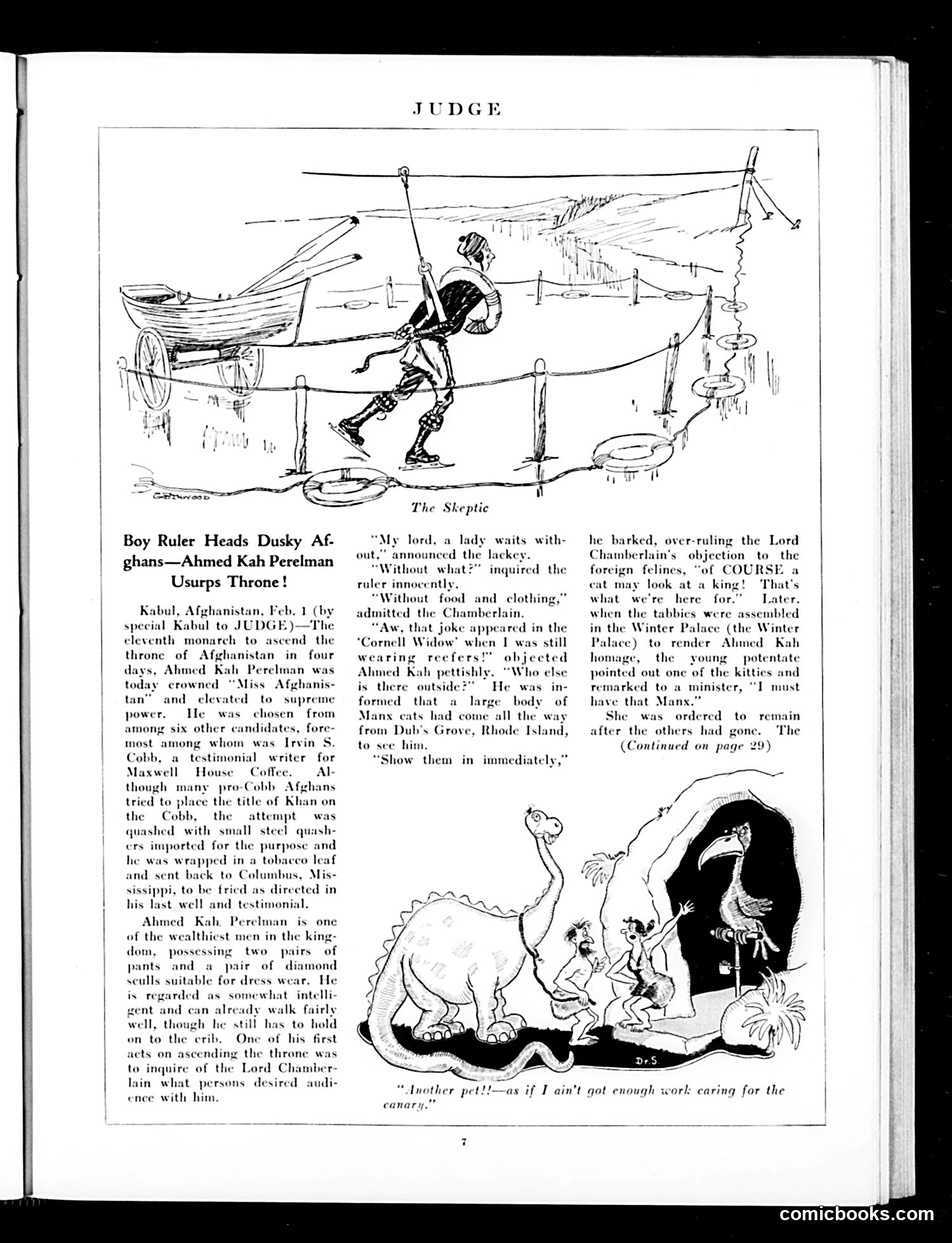
This is a humorous political satire mocking Afghan political instability and American celebrities. The article satirizes the revolving-door leadership of Afghanistan ("eleventh monarch to ascend the throne...in four days"), presenting it as absurdly chaotic. The joke centers on Ahmed Kah Perelman—likely a fictional character mixing an Afghan name with American humorist S.J. Perelman's surname—being crowned ruler. The text ridicules the process by including irrelevant American figures like Irvin S. Cobb (a famous humorist/testimonial writer for Maxwell House Coffee) as a competing candidate. The secondary cartoon ("The Skeptic") jokes about the new ruler's sophistication: he rejects a conventional joke about a lady in need because he'd already heard it at Cornell University, then inexplicably prioritizes seeing Manx cats over serious governance. The final panel pun ("Another pet!!") suggests he's more interested in acquiring animals than ruling. The satire mocks both Afghan political turmoil and American celebrity culture's irrelevance to serious governance.
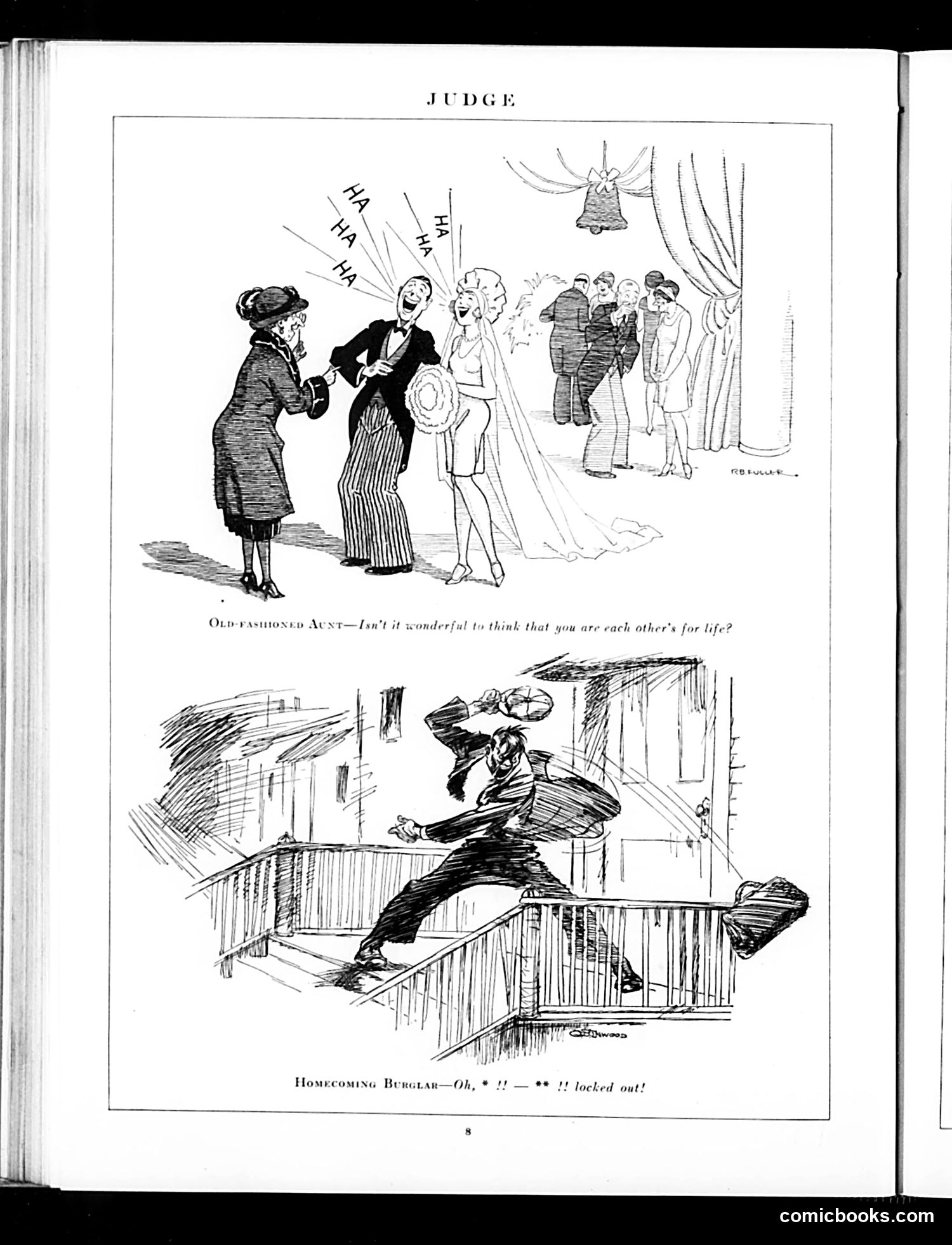
This page contains two satirical cartoons: **Top cartoon ("Old-Fashioned Aunt"):** An elderly woman confronts a couple at what appears to be a formal wedding or church event (note the bell and curtains). She laughs ("Ha Ha Ha") while commenting on their lifelong commitment, suggesting she finds their romantic notions quaint or amusing. The satire mocks old-fashioned attitudes toward modern courtship. **Bottom cartoon ("Homecoming Burglar"):** A burglar is locked out of a house while attempting entry through windows, tumbling backward in frustration. The joke plays on irony: a criminal "homecoming" to his own house but unable to get in—likely satirizing either the futility of crime or absurd domestic situations. Both cartoons use physical comedy and situational irony typical of early 20th-century Judge magazine humor.
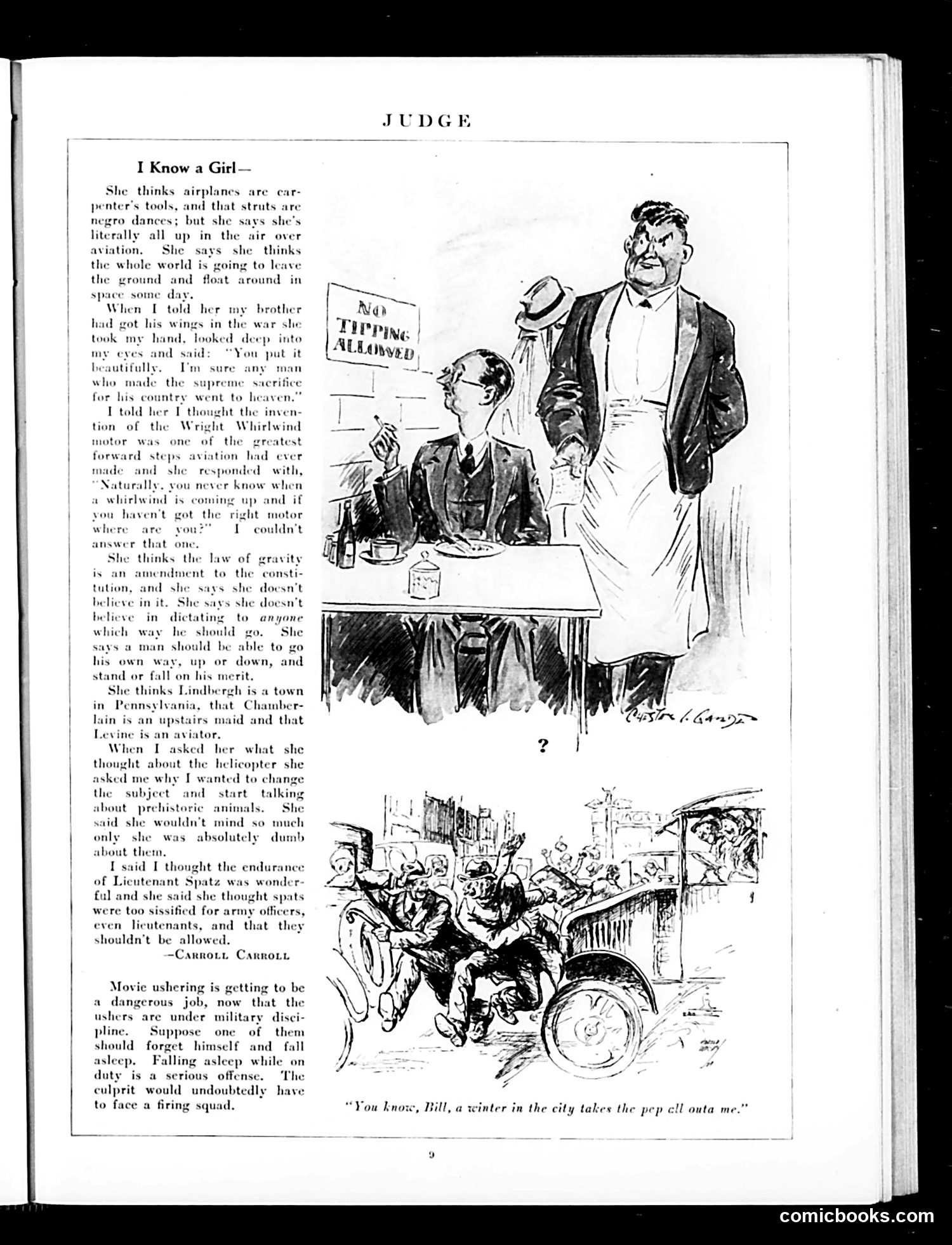
This humor piece by Carroll Carroll satirizes a woman's profound ignorance about aviation—a cutting-edge topic in the 1920s. The author repeatedly attempts to discuss modern flight achievements (the Wright brothers, Charles Lindbergh, the Whirlwind engine, Lieutenant Spatz's endurance records), but she consistently misunderstands or deflects. Her confusion is deliberate comedy: she thinks "struts" are dances, confuses Lindbergh with a Pennsylvania town, and believes Levine is a pilot rather than understanding his actual significance. Most absurdly, when asked about helicopters, she asks why he's changing the subject to "prehistoric animals." The accompanying cartoon shows a man at a desk with a "No Tipping Allowed" sign, confronted by another man—illustrating society's class anxieties about propriety and behavior. The satire targets both willful female ignorance about modern achievement and the broader cultural gap between aviation's rapid advancement and public understanding of it.
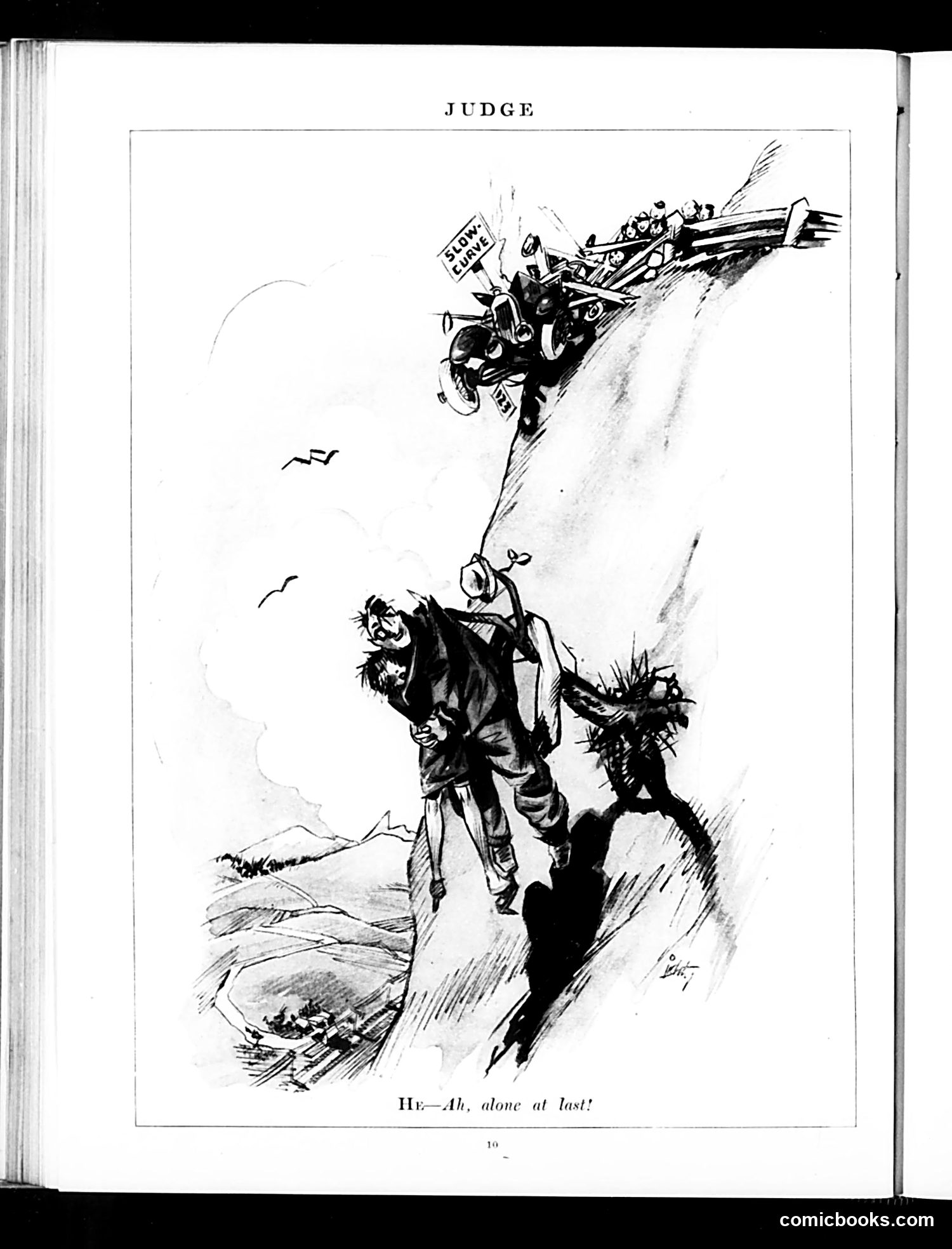
This political cartoon depicts a figure climbing a steep slope while being pursued by what appears to be a mob or crowd at the bottom. The climber carries a sign reading "BLOW BACK" and reaches toward a vehicle or vessel at the summit carrying multiple passengers, suggesting escape or rescue. The caption "He—Ah, alone at last!" ironically undercuts the image, as the figure is clearly *not* alone but rather fleeing pursuers. The cartoon likely satirizes a political or public figure attempting to evade criticism, scandal, or consequences by seeking refuge with allies or supporters. Without clearer identification of the specific figure or date, the exact political context remains unclear, though the theme appears to be about escape from accountability or backlash.
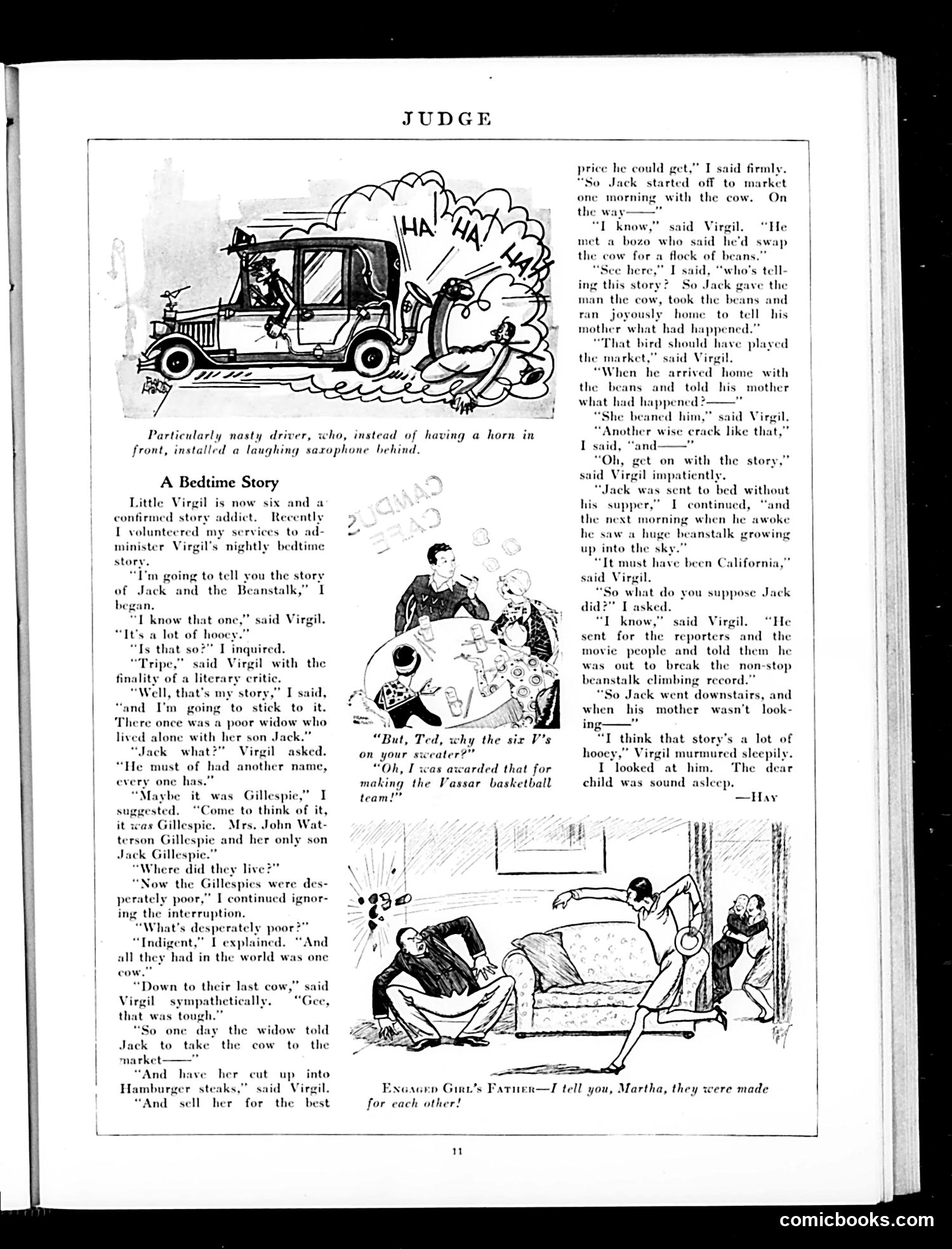
This is a humorous domestic piece about a father attempting to tell his six-year-old son Virgil the classic fairy tale "Jack and the Beanstalk." The joke is that modern child Virgil constantly interrupts with worldly, cynical observations inappropriate for a bedtime story. The satire targets both the child and contemporary 1920s culture: Virgil makes wisecracks about the stock market ("That bird should have played the market"), references Vassar basketball and movie publicity stunts, and treats the magical tale as absurdly literal. He's a precocious, wise-guy child obsessed with modern entertainment and commerce rather than wonder. The narrator's frustration—and final irony that despite the "lot of hooey" complaint, Virgil falls asleep anyway—gently mocks both overstimulated modern children and parents' struggles with storytelling in an age of competing media. The top cartoon depicts a car with a "laughing saxophone" horn, satirizing annoying urban drivers of the era.
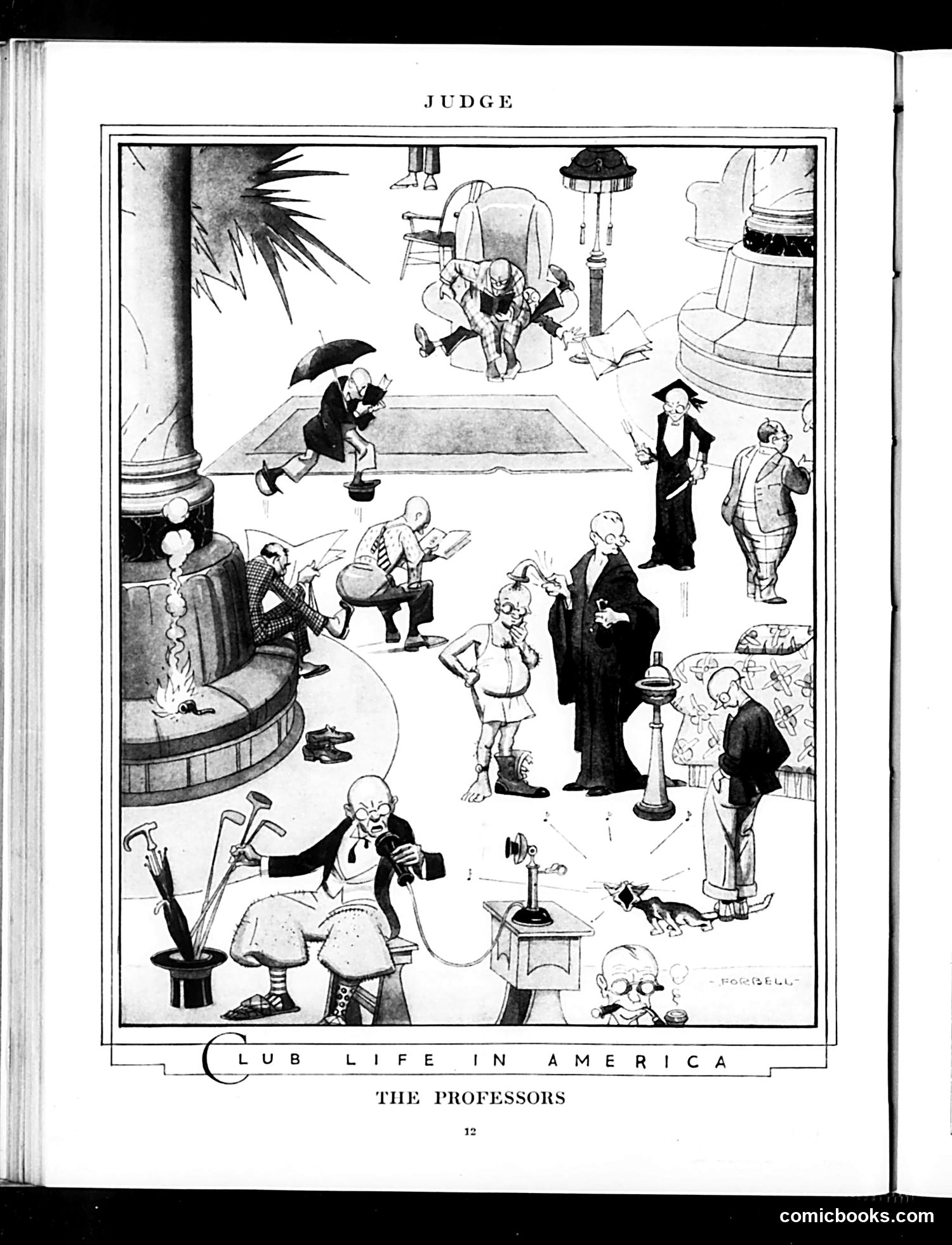
This satirical illustration depicts academic life in an American club setting, titled "Club Life in America." The cartoon shows various professors engaged in eccentric behaviors—some appearing disheveled, others engaged in unconventional activities around a fireplace and tropical setting. The satire likely mocks the pretensions and oddities of academic intellectuals, a common target of Judge magazine's humor. The exaggerated caricatures and chaotic scene suggest the cartoonist is ridiculing professorial vanity, impracticality, or social awkwardness. Without clearer identification of specific individuals, the exact targets remain unclear, but the general point appears to be poking fun at academia's eccentricity and detachment from practical life—a recurring theme in early 20th-century American satire.
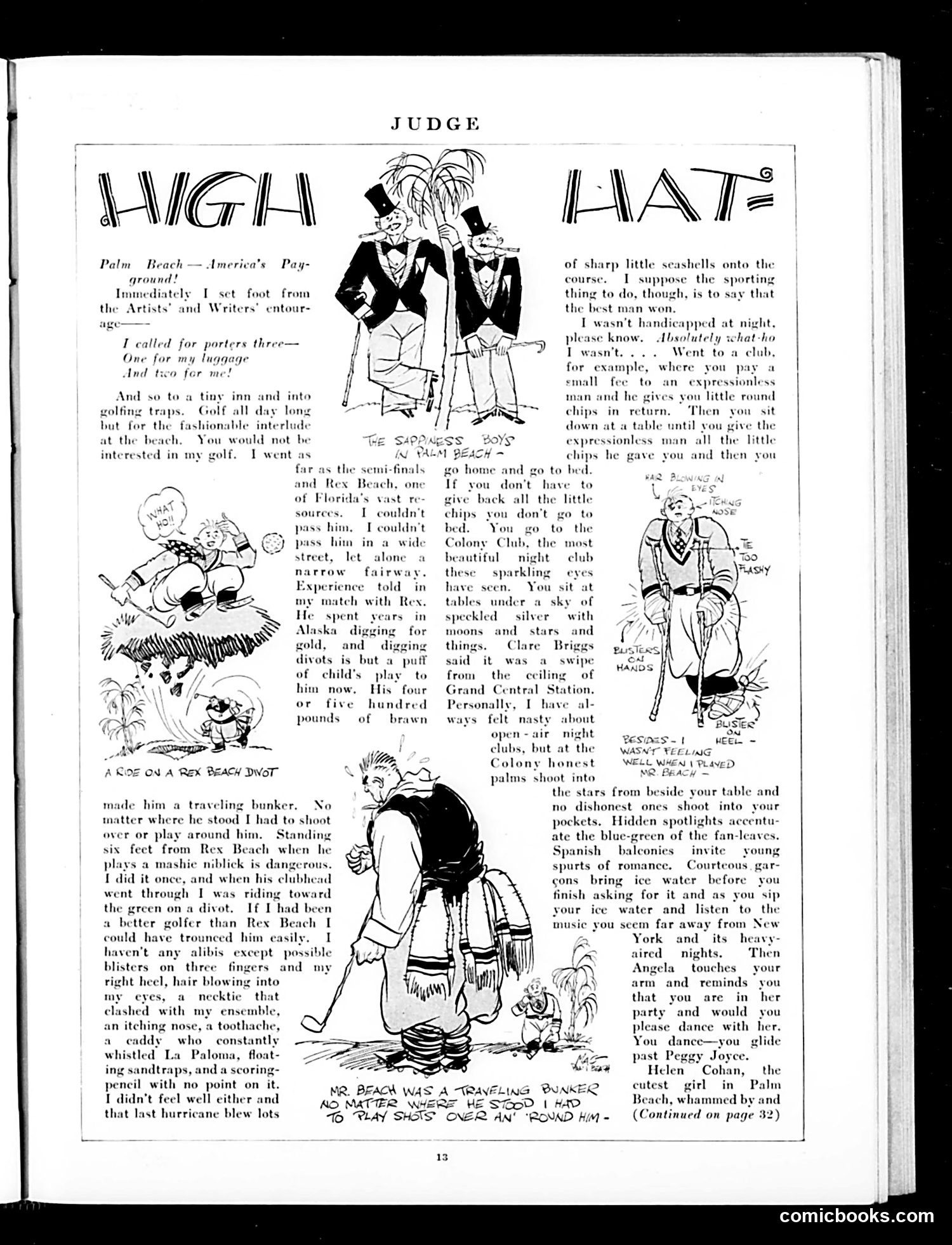
This is a humorous essay with accompanying cartoons about the author's golfing experience in Palm Beach, Florida. The piece satirizes: **The Setting**: Palm Beach as a fashionable American resort destination, contrasting its glamorous reputation with the author's actual experiences. **The Main Joke**: The author describes playing golf against Rex Beach (a real writer/adventurer known for Alaska stories), who is so physically large and powerful that he functions as an immovable obstacle on the course—the author must literally play shots around him rather than compete fairly. **Social Commentary**: The essay mocks pretentious nightlife, particularly the "Colony Club," describing its manufactured exoticism (fake starlight, controlled romance, obsequious service) with evident disdain. The detailed critique of casinos' chip-exchange system suggests satirizing gambling's illusions. **The Cartoons**: Illustrate the golfing mishaps and the contrast between fantasy and reality at upscale establishments. The overall tone is satirical social commentary wrapped in a golf anecdote—typical Judge magazine fare mocking wealthy leisure culture.
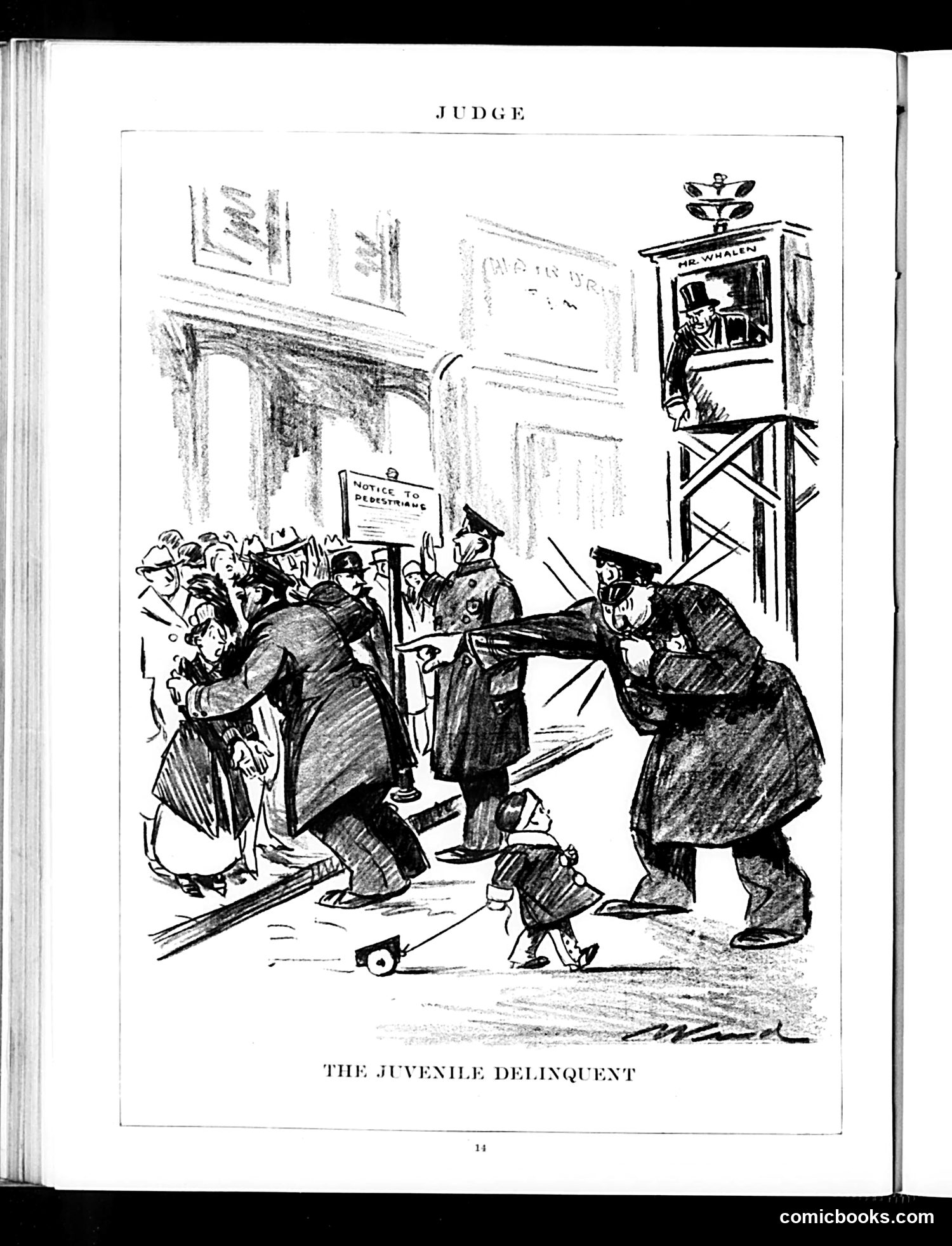
This satirical cartoon depicts a street scene where police officers are confronting a small child while a crowd gathers. A "Notice to Defendants" sign is visible, suggesting a legal proceeding or arrest. The cartoon appears to satirize harsh law enforcement practices against children—the absurdity of treating a tiny child with the same severity as adult criminals, complete with formal legal notices. The joke targets either overly strict juvenile justice systems or aggressive policing tactics of the era. By exaggerating the disproportion between the child's size and the official response, the cartoonist critiques what he sees as excessive or inappropriate punishment of youth offenders. The crowd's presence suggests public concern about these practices.
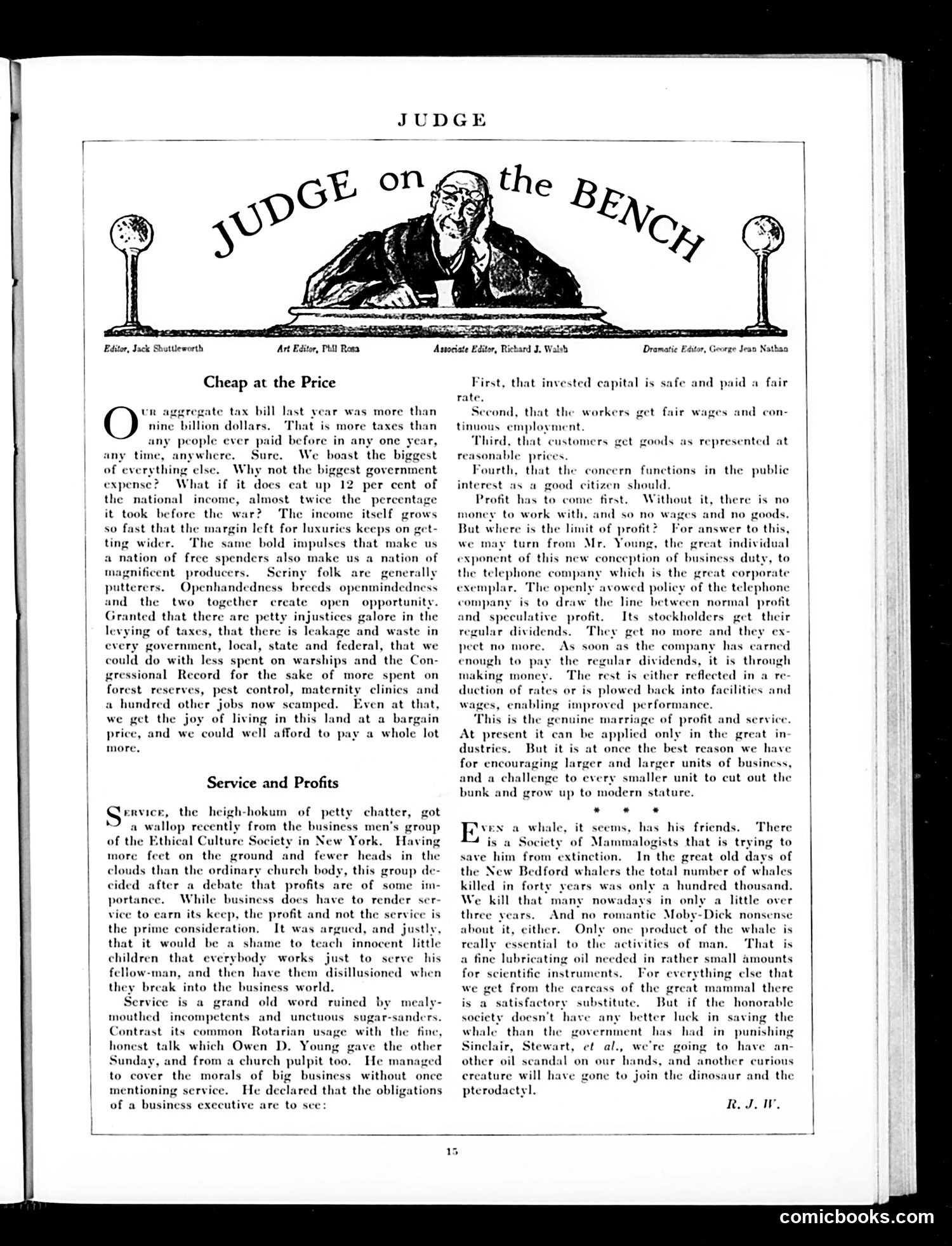
This is an editorial/opinion page rather than a cartoon. The masthead shows a judge figure overseeing content by editors including Jack Shuttleworth and Pull Rosa. **"Cheap at the Price"** defends the nine-billion-dollar tax bill (likely post-WWI), arguing Americans can afford higher taxes given national prosperity. It reframes government spending as the cost of living in an advanced society. **"Service and Profits"** critiques the overuse of "service" rhetoric in business. It praises Owen D. Young and the telephone company for openly acknowledging that **profit must come first**—not as greed, but as economic necessity. The article argues that without profit, wages and goods cannot exist. The telephone company exemplifies balance: paying stockholder dividends while reinvesting surplus into rate reductions and infrastructure. The satire targets sanctimonious business leaders who disguise profit-seeking as moral "service," while praising those honest enough to admit profit's primacy in capitalism.
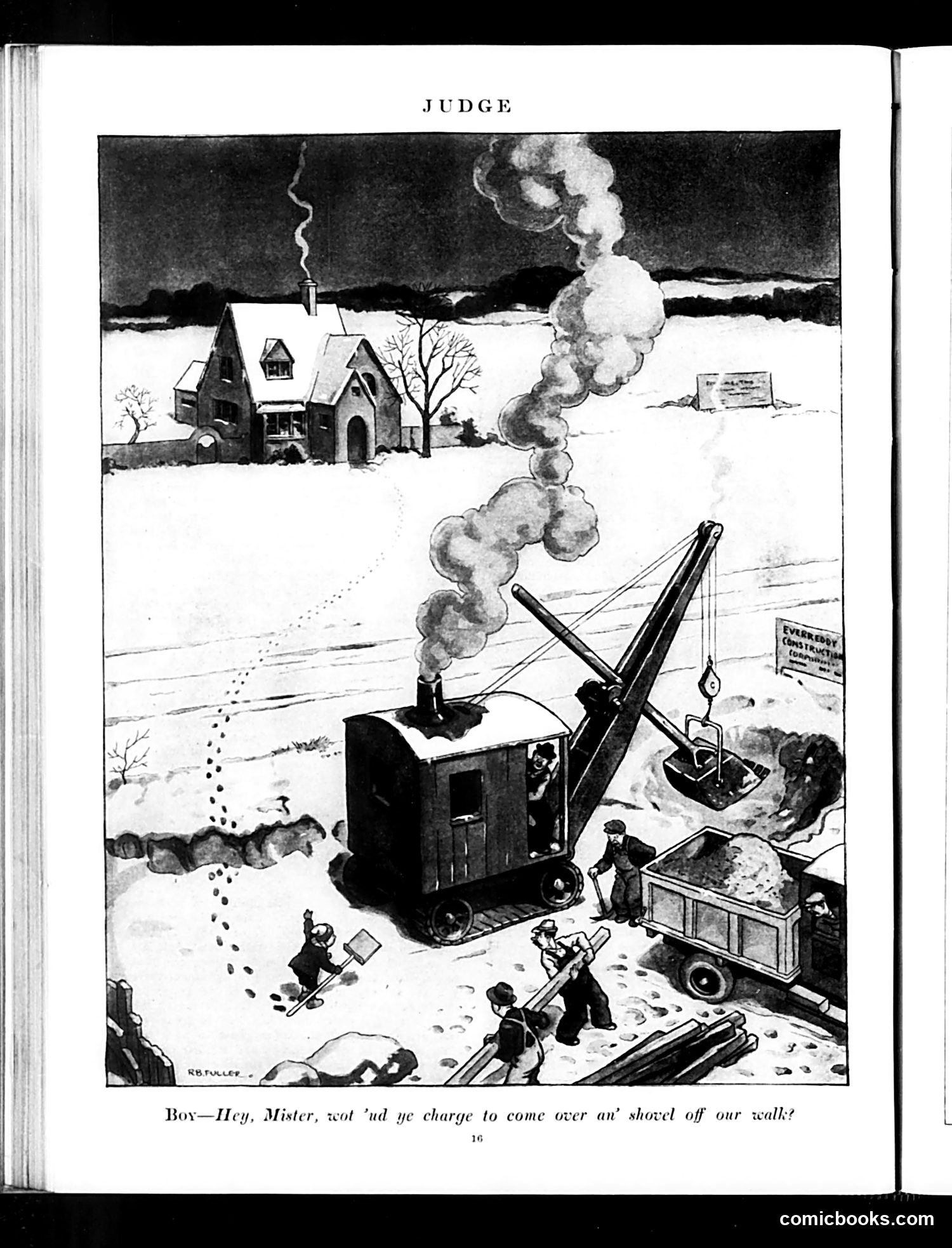
This single-panel cartoon depicts a snowy winter scene with satirical commentary on labor and pricing. A boy asks a man operating an industrial snow-removal machine what he'd charge to shovel snow from their residential walkway—a modest, small-scale job. The satire lies in the absurd disproportion: the man operates heavy industrial equipment (a large mechanical digger with smoking chimney) and employs multiple workers for what should be a simple residential task. The cartoon mocks either: 1. Industrial inefficiency and waste applied to minor problems, or 2. Inflated pricing/labor costs for trivial work when expensive machinery is involved. The boy's casual dialect ("wot 'ud ye") suggests working-class perspective encountering commercial overkill. The specific target remains unclear without knowing Judge's contemporary context.
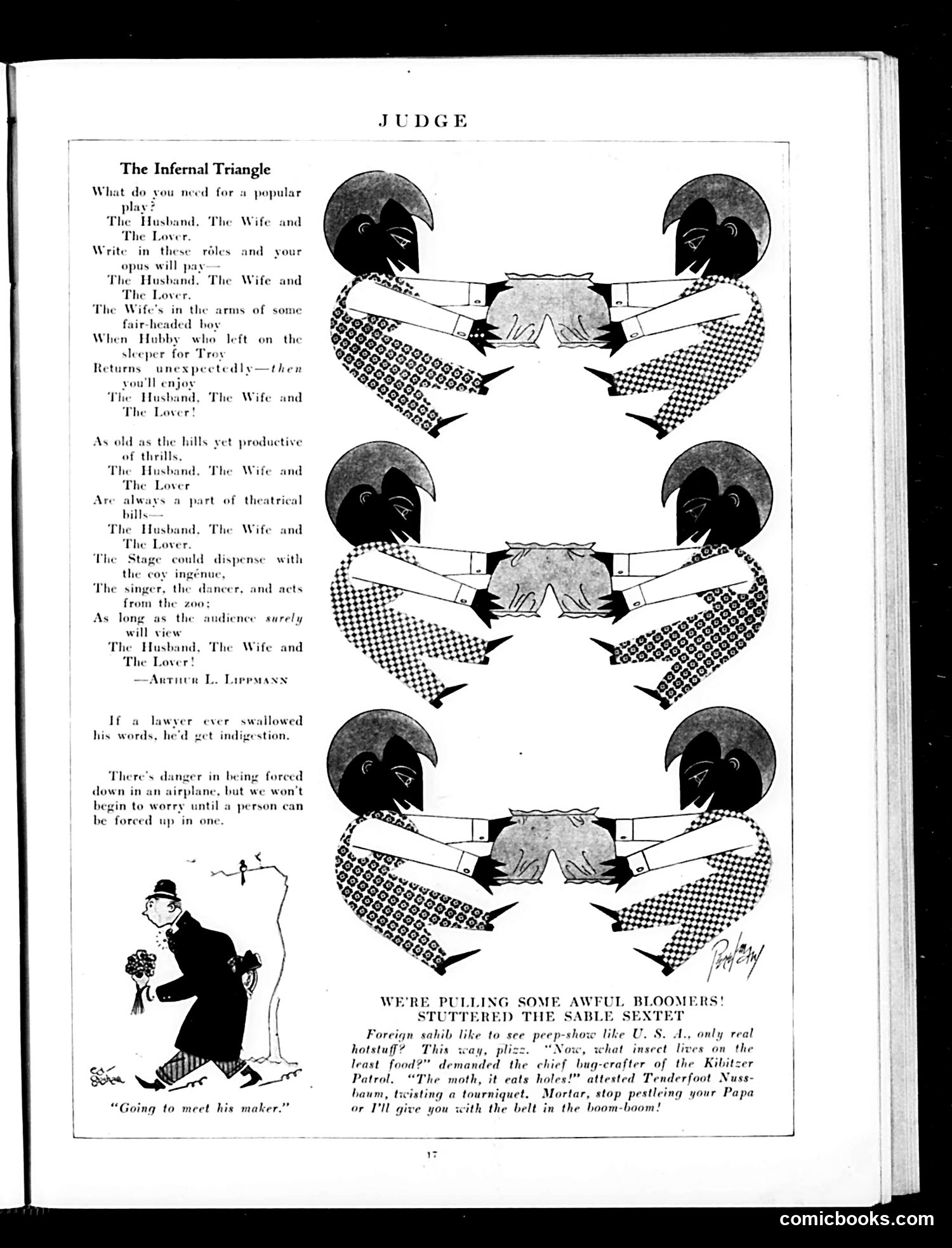
This page satirizes the formulaic predictability of early 20th-century theatrical melodramas. The central section mocks how playwrights relied on the same tired plot device—a romantic triangle involving a husband, wife, and lover—to guarantee commercial success, regardless of artistic merit. The repeated phrase "The Husband, The Wife and The Lover" functions as a jingle, emphasizing how mechanically this plot was recycled. The text argues audiences will tolerate mediocre performers and poor production values so long as this love-triangle drama appears on stage. The accompanying illustrations show two silhouetted figures (likely representing the generic husband and lover) quarreling over a woman's affections—visualizing the interchangeable, formulaic nature of the stock scenario. The bottom section includes unrelated comic quips about lawyers and airplane safety, typical of Judge's miscellaneous humor. The "peep-show" reference appears to mock vaudeville or burlesque entertainment alongside legitimate theater.
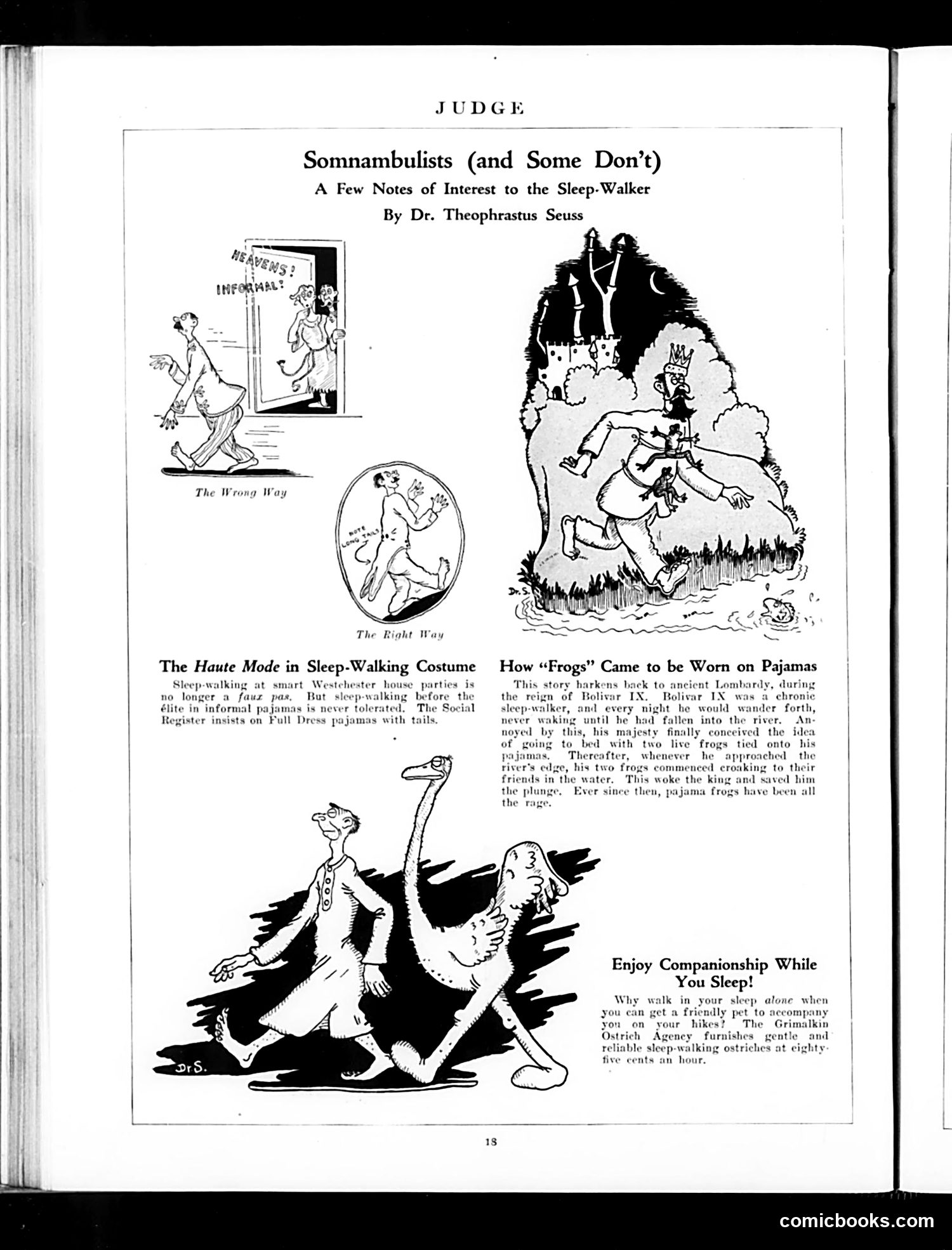
This humorous Judge page satirizes sleep-walking fashions and behaviors. The cartoons illustrate: **"The Wrong Way" and "The Right Way"**: contrasts improper sleep-walking (entering through windows, disheveled) with proper etiquette (formal full dress required, even while asleep). **"The Haute Mode in Sleep-Walking Costume"**: mocks upper-class pretension by showing people in elaborate pajamas with tails—absurdly over-dressed for nocturnal wandering. **"How 'Frogs' Came to be Worn on Pajamas"**: a tongue-in-cheek origin story claiming a medieval Italian king tied frogs to his pajamas during sleep-walks, starting a fashion trend. **"Enjoy Companionship While You Sleep"**: advertises the "Grimalkin Ostrich Agency," humorously suggesting one hire an ostrich as a sleep-walking companion. The satire targets early 20th-century high society's obsession with proper dress codes and formality, extending the rule even to private, unconscious activities.
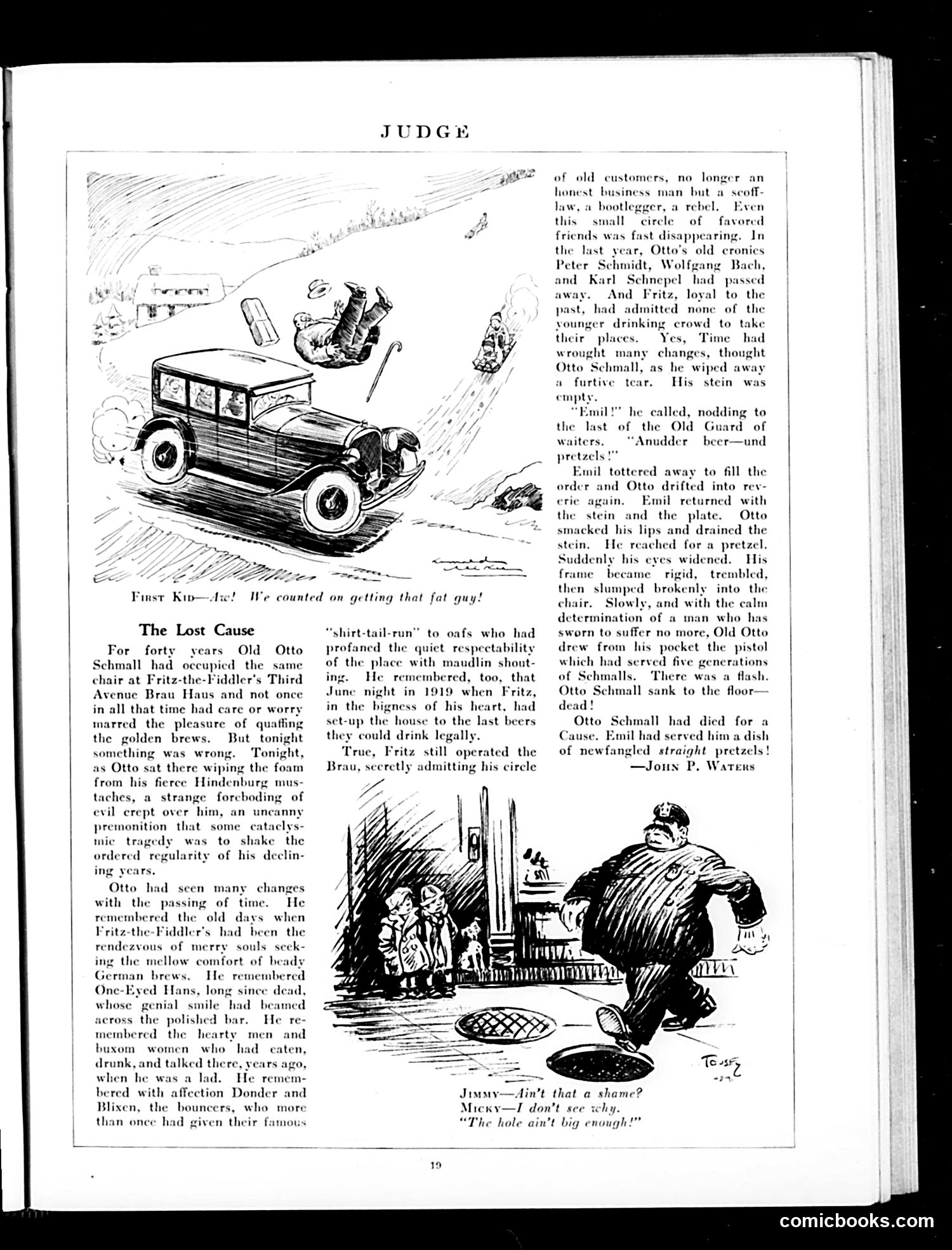
This satirical story, "The Lost Cause," mocks German-American immigrants and Prohibition-era nostalgia through dark comedy. Otto Schmall, a German immigrant who spent 40 years at a beer hall, has watched his world disappear: old friends have died, Prohibition ended legal beer sales (1919), and the younger generation won't patronize the speakeasy. The joke culminates absurdly when Otto shoots himself—not over Prohibition's hardships or lost friends, but because Emil serves him a pretzel with a hole in it. The punchline (bottom cartoon) shows two men debating whether a larger hole would be more appropriate for suicide. The satire targets sentimental German-American identity (references to "Hindenburg mustaches," nostalgic beer-hall culture) while ridiculing both Prohibition and immigrant attachment to old ways. The exaggerated tragedy-over-a-pretzel is meant to puncture any romanticizing of the pre-Prohibition era.
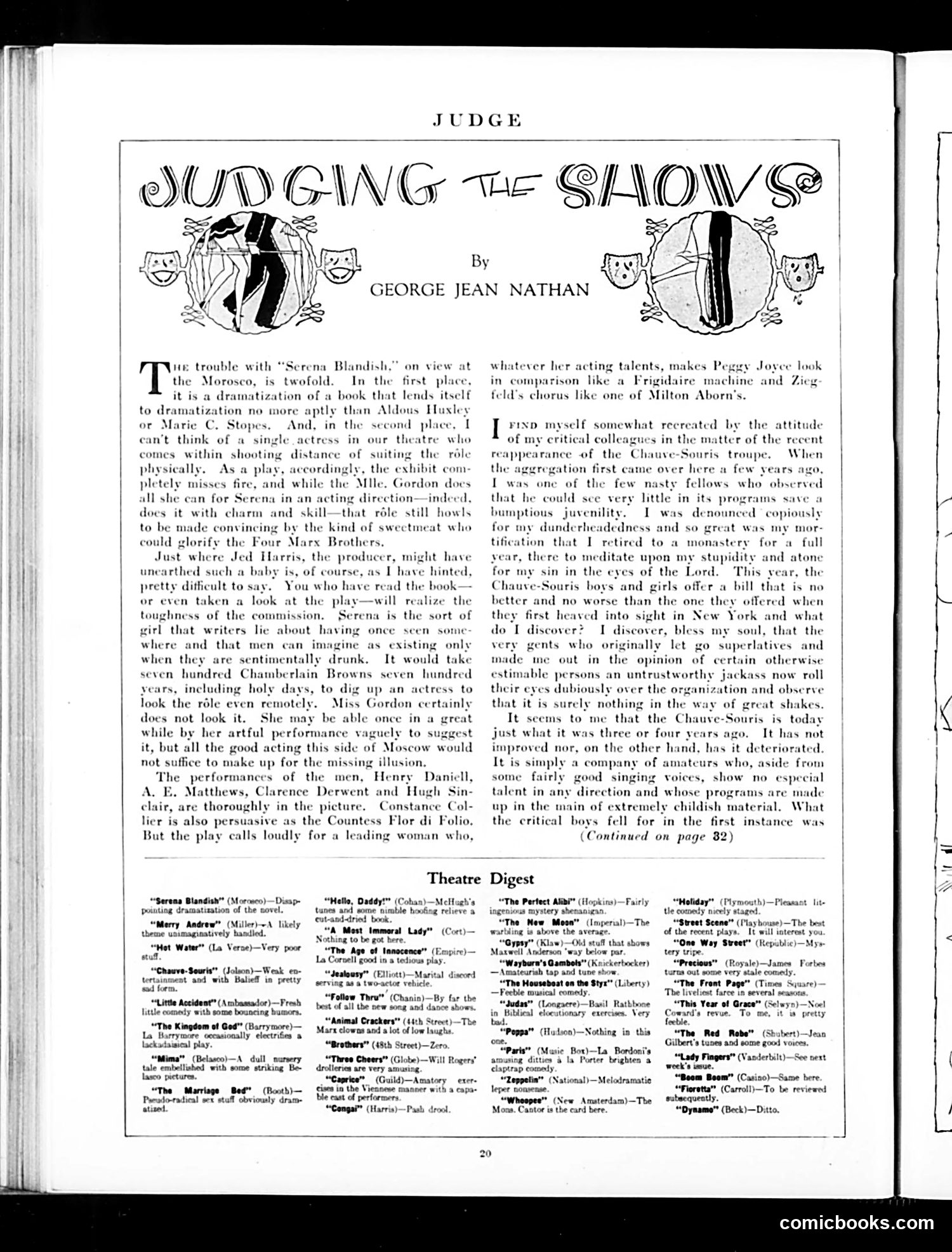
This page presents theater reviews by **George Jean Nathan**, a prominent American drama critic. The main article critiques **"Serena Blandish,"** a play adaptation of a novel at the Morosco Theatre. Nathan argues the production fails on two counts: the source material (compared unfavorably to Aldous Huxley and Marie Stopes—serious literary figures) doesn't adapt well to stage, and no actress in American theater could properly embody the lead character. He praises supporting male actors (Henry Daniell, Clarence Derwent, Hugh Sinclair, Constance Collier) but laments the play's demands for an idealized leading woman. Nathan also discusses **Chauve-Souris**, a Russian theatrical troupe. He admits initial critical skepticism was unfair, but now observes the group remains unchanged—still amateur performers with childish material, suggesting his earlier harsh judgment wasn't entirely wrong. The **Theatre Digest** section lists current productions with brief dismissive or approving notes, representing typical Broadway fare of the period (likely 1920s based on references).
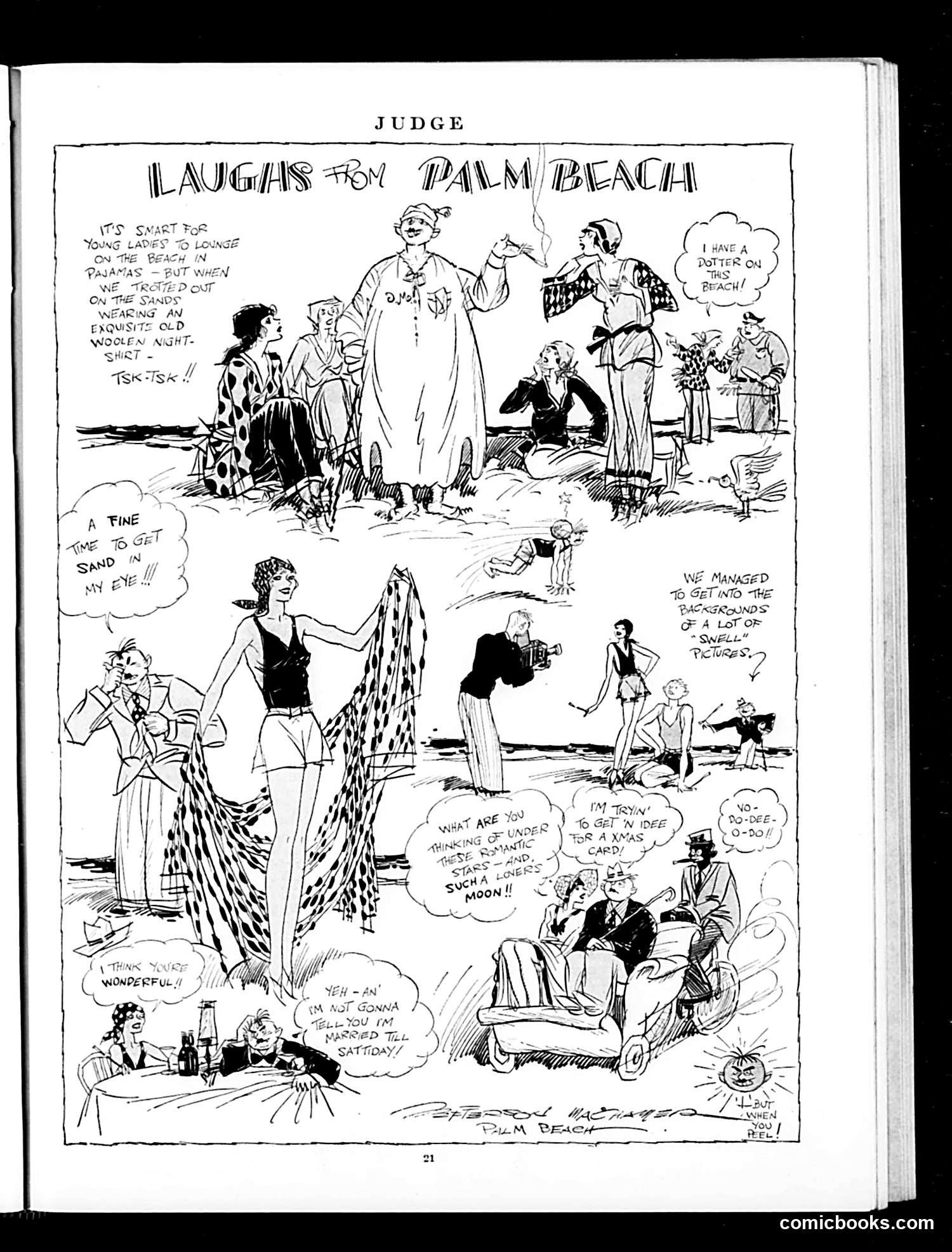
This Judge cartoon satirizes the social pretensions and absurdities of wealthy visitors to Palm Beach, Florida—then (as now) an exclusive resort destination. The humor centers on beachgoers' attempts to appear sophisticated while engaging in ridiculous behavior: people getting sand in their eyes, excessive photography of themselves, romantic entanglements, and general chaos on the beach. The repeated dialogue emphasizes vanity ("I think you're wonderful!") and social climbing ("We managed to get into the backgrounds of a lot of swell pictures"). The satire mocks how wealthy tourists prioritize being seen and photographed over actually enjoying the beach itself—a timeless critique of status-conscious leisure culture. The cartoonist appears to be poking fun at the gap between Palm Beach's glamorous reputation and the undignified reality of actual beachgoers.
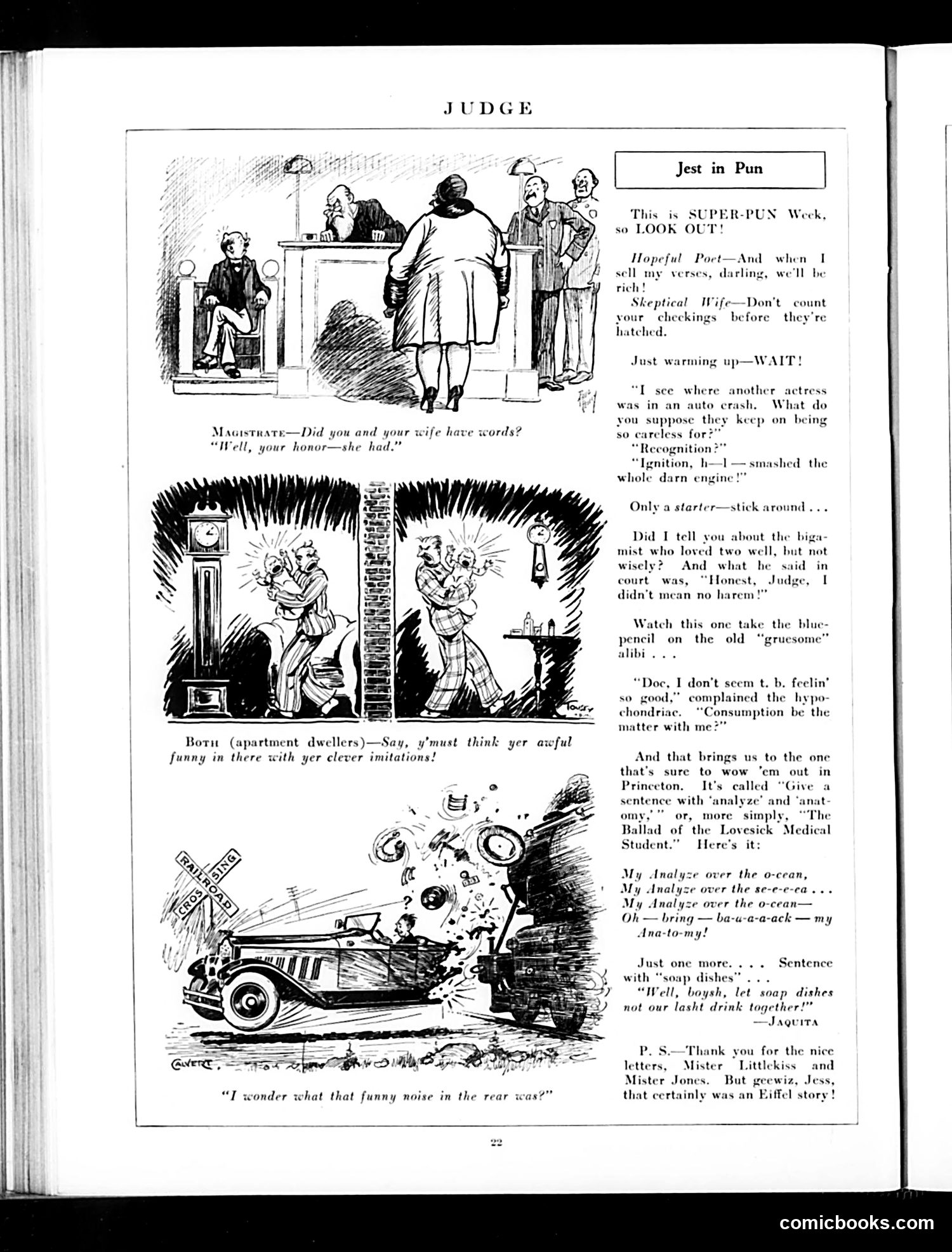
This page from Judge magazine's "Jest in Pun" section collects short humorous quips and visual gags typical of 1920s-30s American satire. The cartoons mock everyday social situations: a magistrate hearing a marital dispute where the wife dominates conversation; apartment dwellers annoyed by neighbors' "clever imitations"; and a car crash where a woman driver is blamed for carelessness. The written jokes target stereotypes: a naïve poet expecting wealth from verses; a hypochondriac; and clever wordplay exploiting puns (the "Ballad of the Lovesick Medical Student" twists "analyze" into "ana-to-my"). The humor relies on predictable domestic friction, gender stereotypes (skeptical wives, careless drivers), and forced puns—typical of Judge's lighthearted satirical style. The magazine positions itself as wholesome family entertainment while gently mocking middle-class pretensions and human follies.
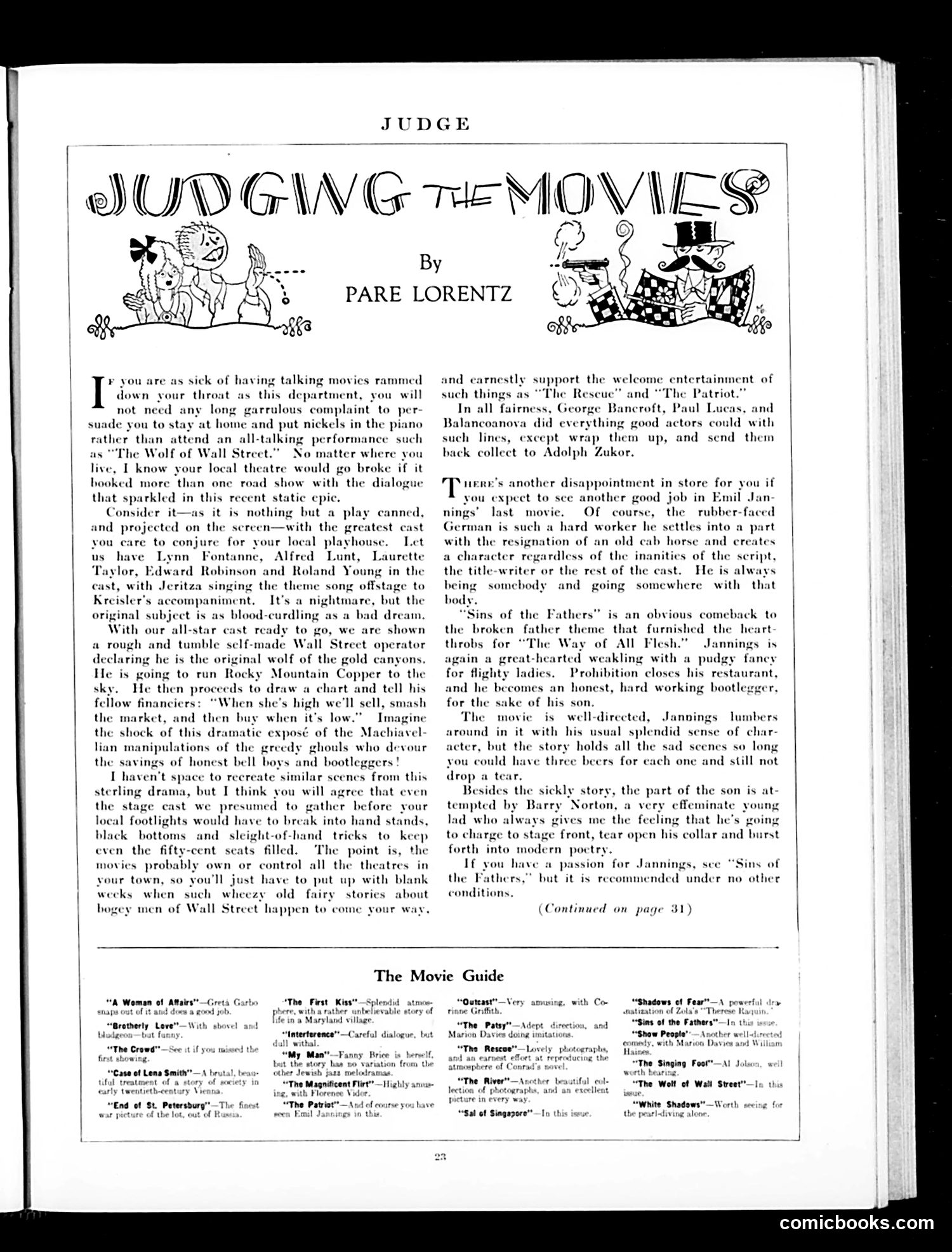
This page reviews recent talking pictures for Judge magazine's satirical readership. Critic Pare Lorentz opens by mocking the proliferation of "all-talking" films, using "The Wolf of Wall Street" as his example—a movie about scheming financiers manipulating stock markets and defrauding working people. Lorentz expresses nostalgia for stage productions featuring stars like Lynn Fontanne and Alfred Lunt, suggesting cinema has monopolized entertainment while producing inferior content. He then reviews Emil Jannings' film "Sins of the Fathers," criticizing both the melodramatic storyline (about a Prohibition-era restaurant owner turned bootlegger) and young co-star Barry Norton's overly theatrical performance. The satire targets Hollywood's control of theaters and its reliance on hackneyed plots and overwrought acting, contrasting them unfavorably with legitimate theater. The piece reflects 1920s anxieties about the film industry's economic dominance and artistic mediocrity during the early sound-film era.
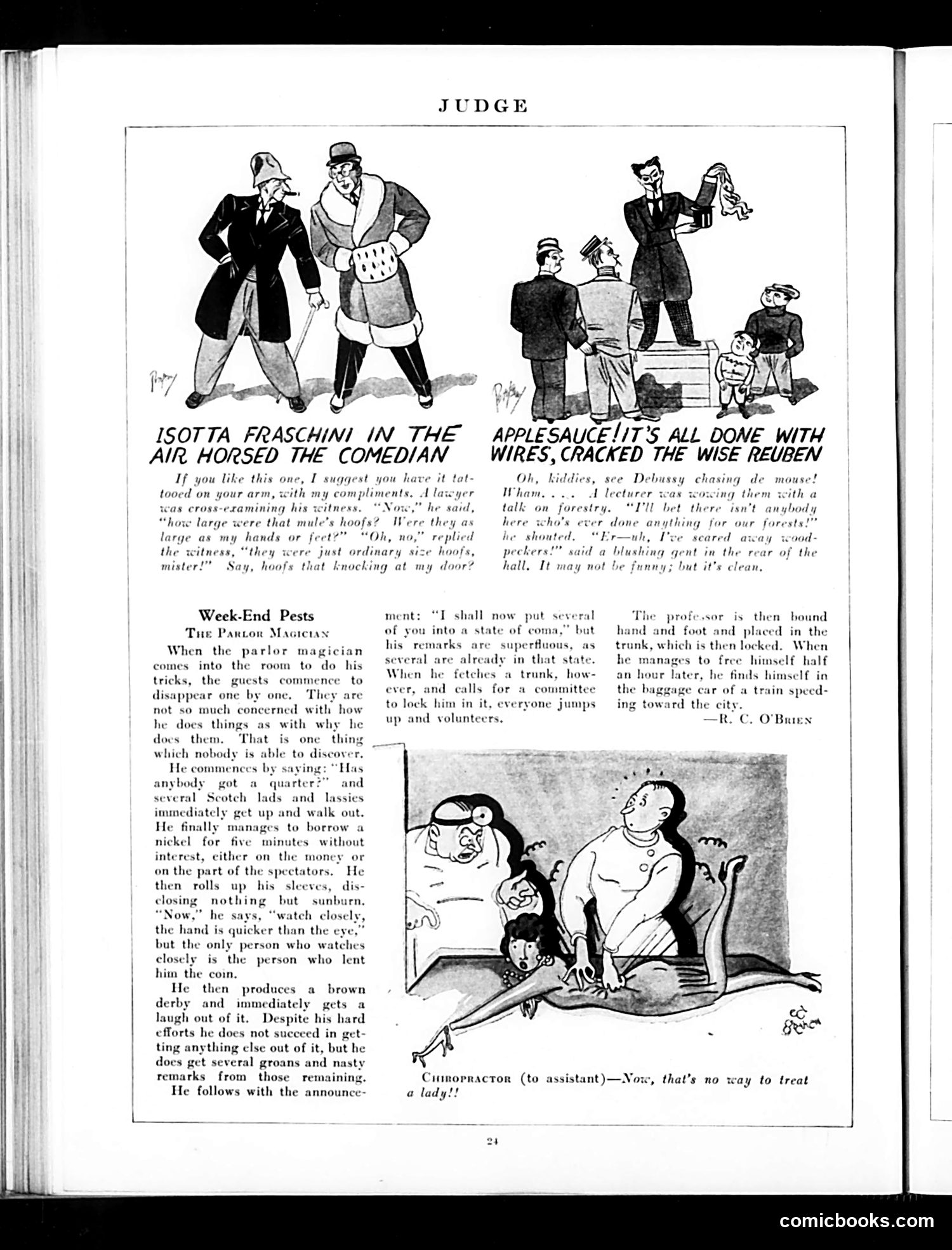
This page contains satirical humor typical of early 20th-century Judge magazine. The top section features two cartoon vignettes poking fun at theatrical performances and legal testimony. "Isotta Fraschini in the Air" mocks a magician's stage tricks and a lawyer's cross-examination of a witness about a mule's hoofs—the humor relies on absurdist dialogue about the witness's door being knocked on by hoofs. The main article, "Week-End Pests: The Parlor Magician," satirizes amateur magicians performing at social gatherings. It describes their typical tricks—borrowing coins, producing derby hats—and notes that guests leave during the performance. The satire targets both the magician's poor skills and the audience's politeness in enduring bad entertainment. The bottom cartoon shows a chiropractor roughly manipulating a female patient, with the caption "Now, that's no way to treat a lady!!"—mocking unprofessional medical practitioners. The references to "Debussy chasing de mouse" and "wise Reuben" remain unclear without additional context.
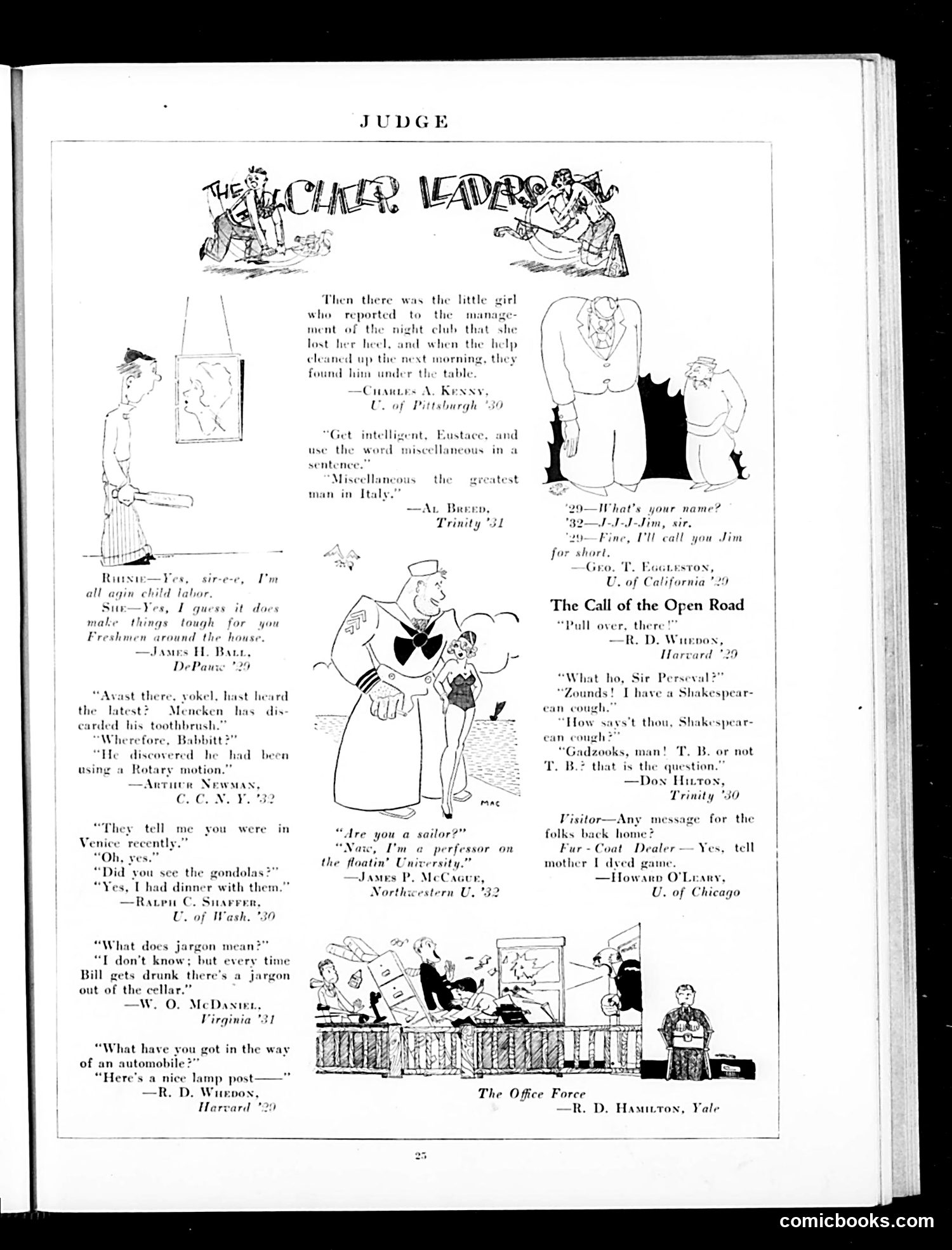
This is a collection of humor shorts and cartoons from Judge magazine, likely from the late 1920s (based on graduation years cited: '29, '30, '31). The page presents college-era jokes submitted by students from various universities. **Key content includes:** - **Mencken joke**: References H.L. Mencken, the famous satirist and social critic, mocking his intellectual pretensions (he discarded his toothbrush because he discovered a "Rotary motion") - **Venice/gondolas pun**: A play on dinner dates with gondoliers - **Jargon joke**: Wordplay about drunkenness and cellar activity - **"The Call of the Open Road"**: A satirical bit about reckless driving - **Shakespeare parody**: Mocking pretentious college students butchering famous quotes - **Various sight gags**: Cartoons about child labor attitudes, night club mishaps, and university life The humor targets college culture, intellectual pretension, Prohibition-era drinking, and contemporary public figures. The cartoons are crude but typical of 1920s undergraduate satire magazines.
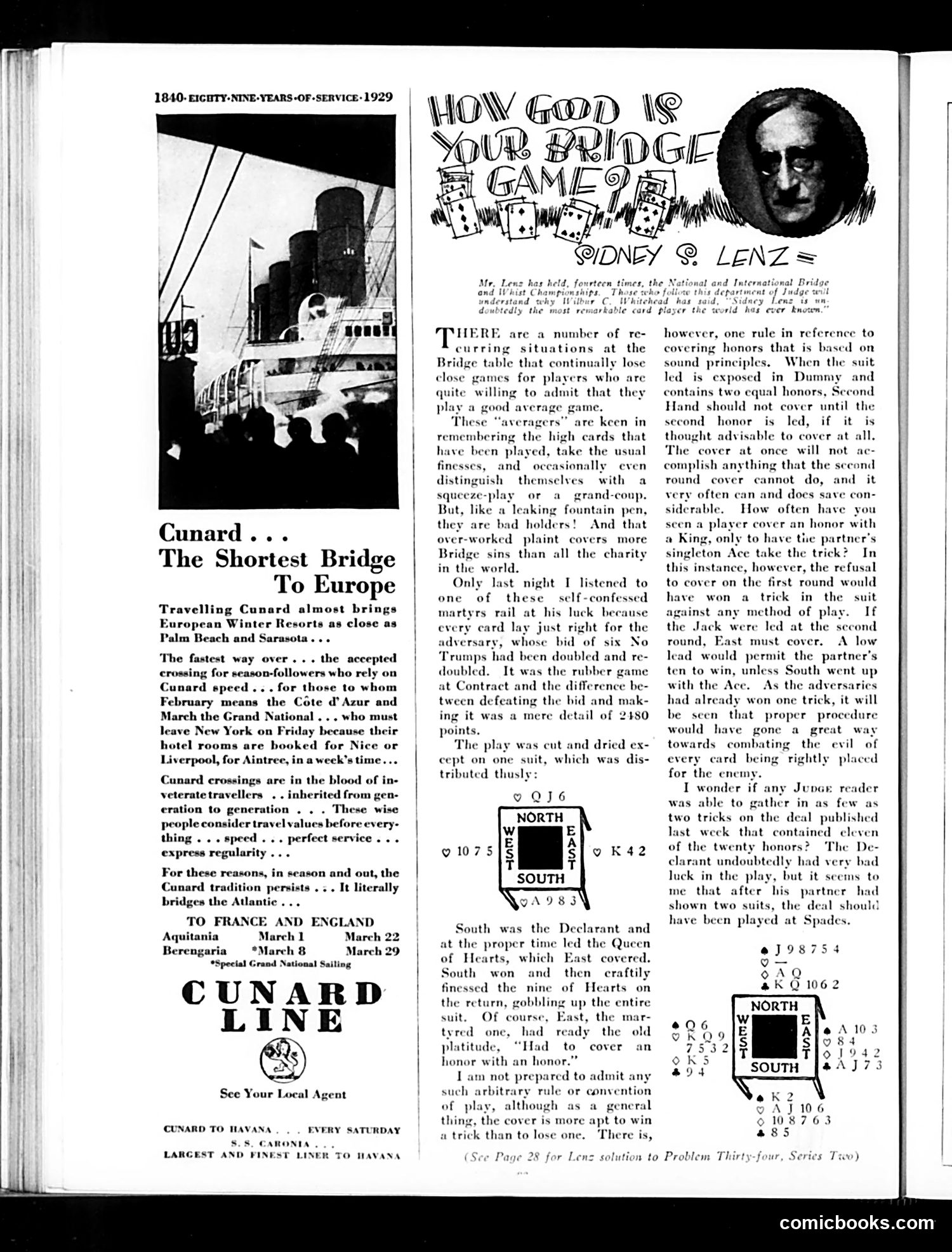
This page combines a luxury ocean liner advertisement with a bridge card game strategy column. **The Advertisement (Left):** Cunard Line promotes its transatlantic steamships, emphasizing speed and reliability for wealthy travelers heading to European winter resorts. The reference to "1840-Eighty-Nine-Years-of Service-1929" celebrates the company's long history. This targets affluent Americans who seasonally escape to places like the French Riviera or English horse races. **The Content (Right):** "How Good Is Your Bridge Game?" by Sidney Lenz features card game strategy and a hand analysis. Lenz, a renowned bridge authority, discusses proper technique—specifically whether players should "cover" (play a higher card) when opponents lead honors. He argues against the arbitrary rule "cover an honor with an honor," instead recommending sound strategic principles. **Context for Modern Readers:** Bridge was enormously popular among the wealthy in the 1920s-30s. The pairing reflects Judge's affluent readership: leisure travel and sophisticated card games epitomized upper-class leisure culture during this era.
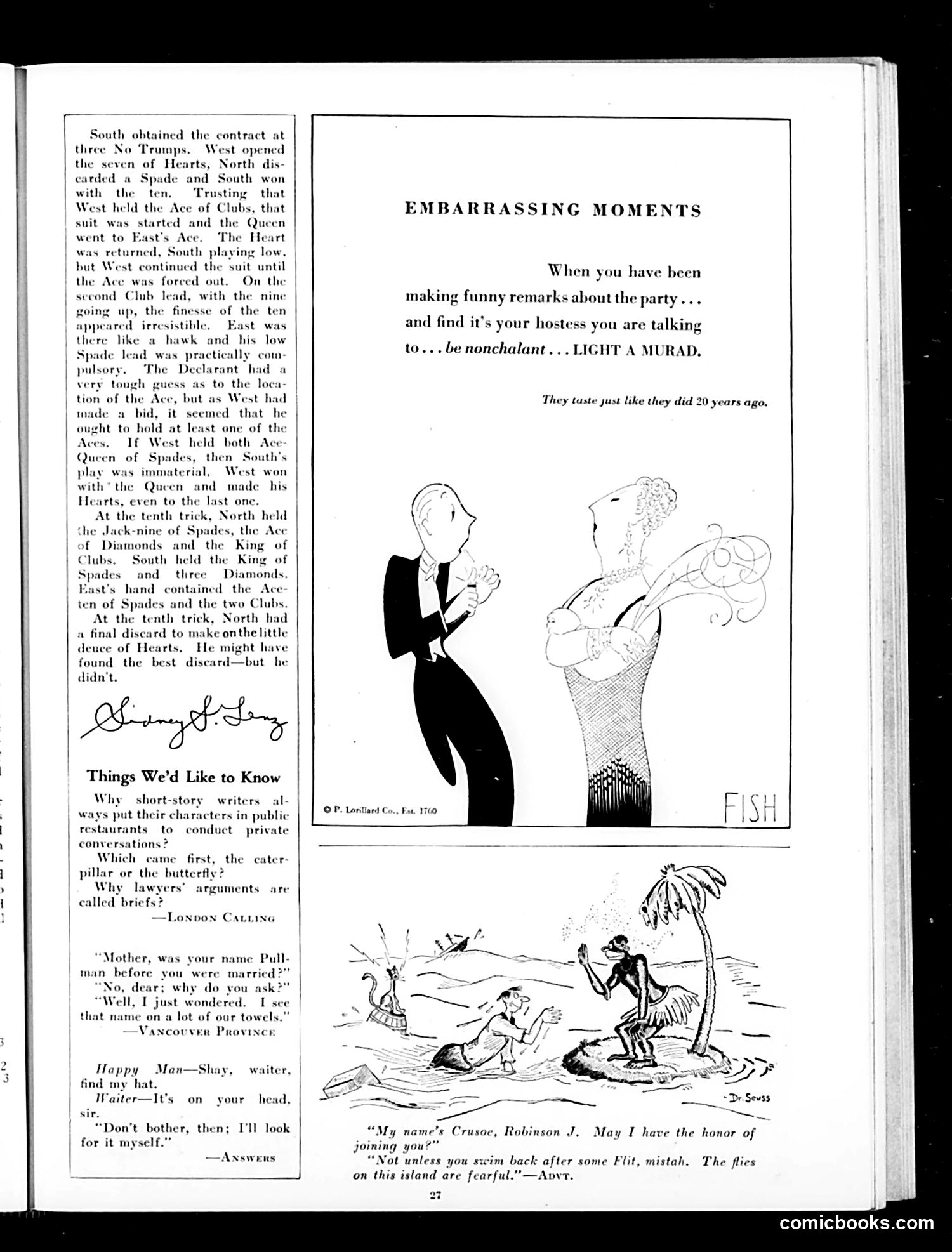
This page contains three distinct elements: **Upper cartoon ("Embarrassing Moments")**: Shows a man in formal wear awkwardly addressing a woman at a party. The joke: he's been making insulting remarks and just realized she's the hostess. The solution advertised is lighting a Murad cigarette to appear nonchalant. This reflects 1920s-30s social anxiety about etiquette and the era's normalization of smoking as a social cover for embarrassment. **Lower cartoon (Robinson Crusoe)**: A castaway named "Robinson J. Crusoe" meets another man on a desert island and invites him to join. The man refuses, citing dangerous flies—and mentions needing "Flit" (an insecticide brand). This is an advertisement disguised as humor, playing on the famous Crusoe story while promoting pest control products. **Left column**: Contains bridge card-game analysis, social humor ("Things We'd Like to Know"), and brief anecdotes—typical Judge magazine filler content mixing light satire with period-specific references. The page is primarily advertising-driven entertainment rather than political commentary.
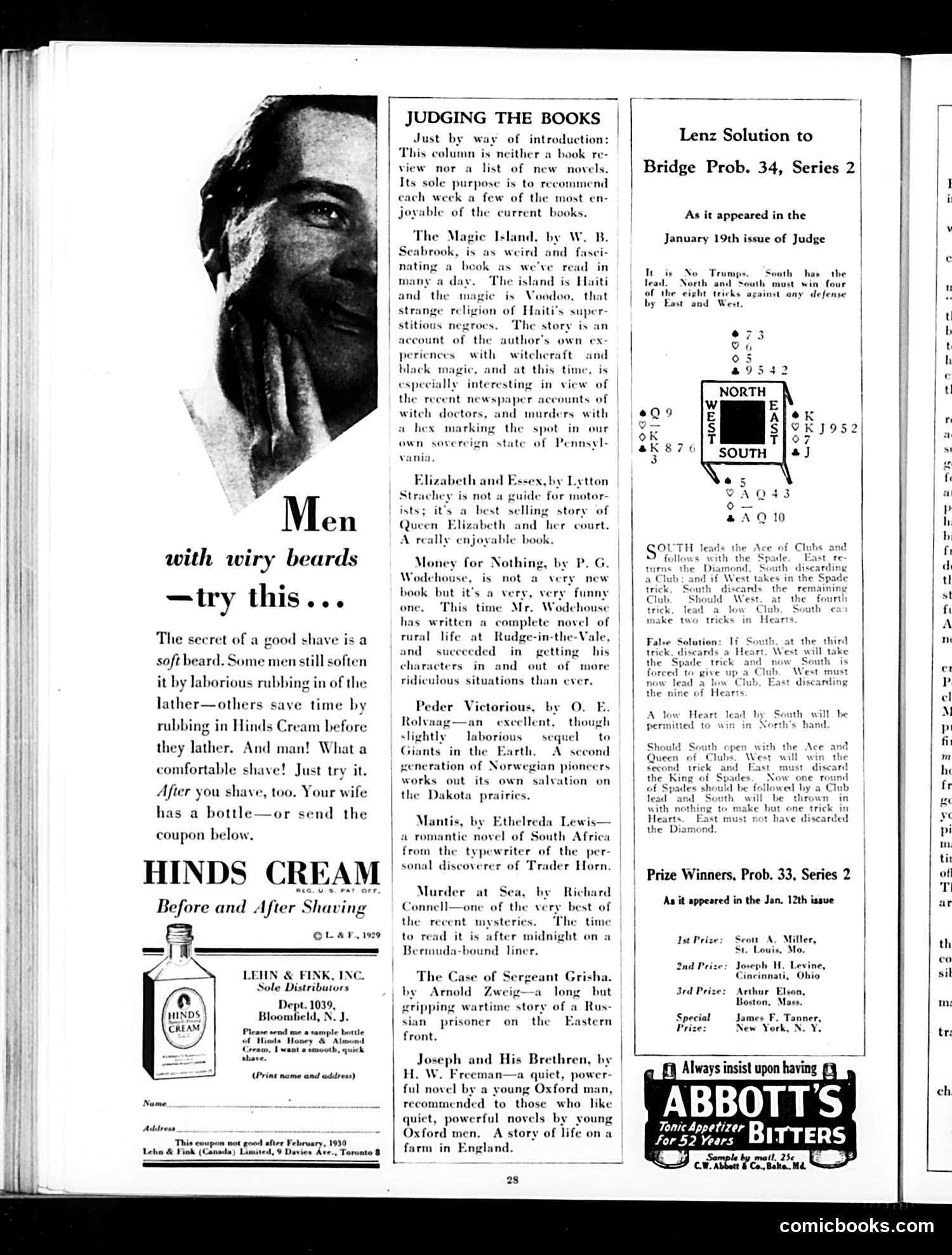
This page is primarily **advertising and book recommendations**, not political satire. The main content is a **Hinds Cream shaving product advertisement** featuring an illustrated man with a prominent beard. The ad claims the cream softens whiskers before shaving, making the process more comfortable. This reflects 1929 grooming standards when wiry beards were common and the advertising angle was selling comfort and ease. The rest of the page contains: - **"Judging the Books"** — brief recommendations of current novels (by Seabrook, Strachey, Wodehouse, etc.), typical of literary columns in magazines of this era - **Bridge problem solutions** and prize winners from prior issues - **Abbott's Bitters advertisement** at bottom There is no political cartoon or satire visible. The page is a standard mix of advertisements and editorial content typical of Judge magazine's format during this period.
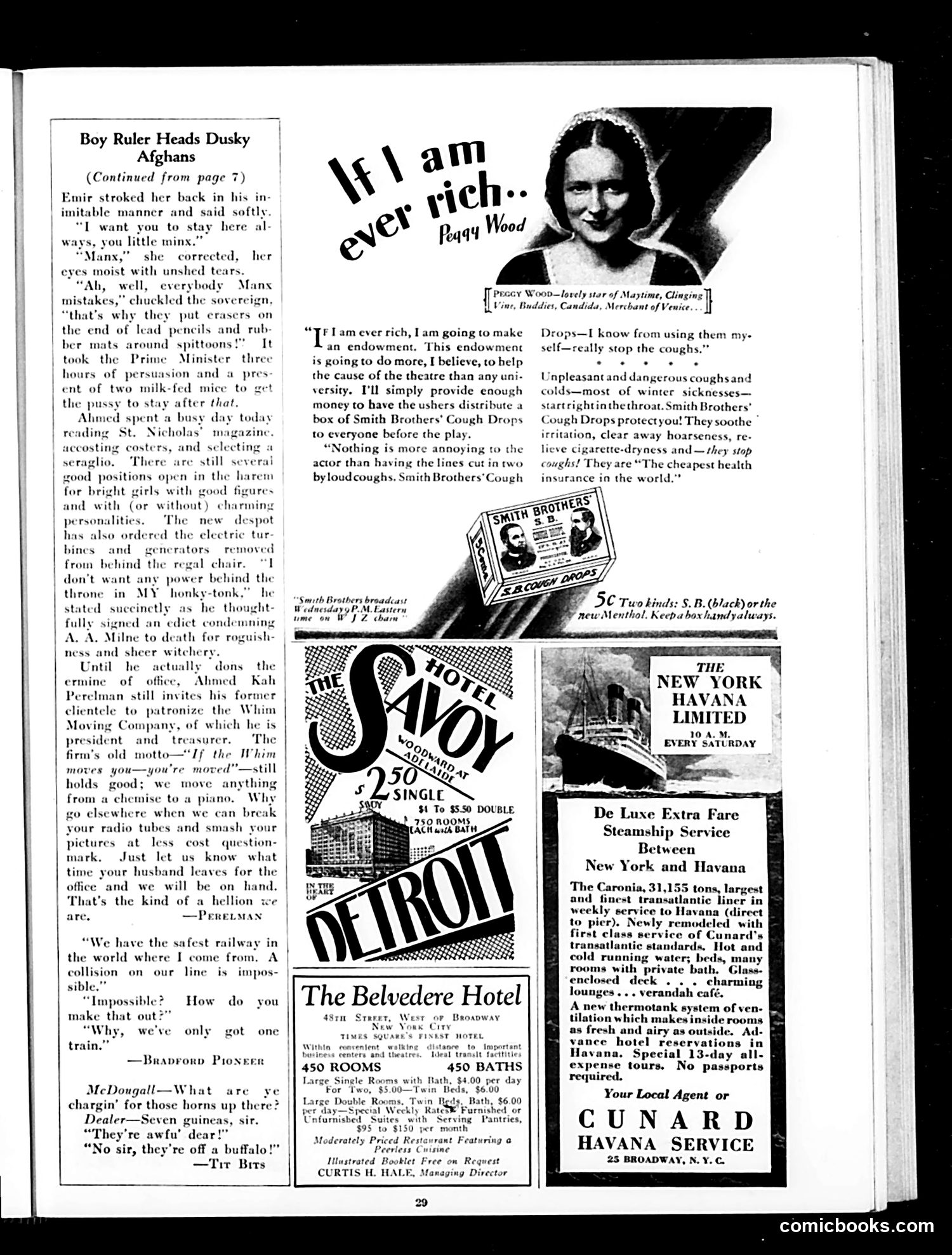
This page combines a serialized comic story ("Boy Ruler Heads Dusky Afghans," a satirical fantasy about a young ruler of Afghanistan) with advertisements and a celebrity endorsement piece. The main content is **Peggy Wood's testimonial** for Smith Brothers' Cough Drops. Wood was a stage actress (known for *Maytime* and other productions), and she endorses the product by claiming that as a theatre patron, she'd fund cough drops for all theatre-goers to prevent audience disruptions during performances—a humorous exaggeration of her philanthropic ambitions. The page reflects early 20th-century advertising strategy: leveraging celebrity endorsements and theatrical personalities to sell consumer products. The ads below (Savoy Hotel Detroit, Belvedere Hotel NYC, steamship services to Havana) target affluent readers. The serial story's humor relies on absurdist colonial-era stereotypes now considered offensive, though it appears designed as light political satire aimed at contemporary readers.
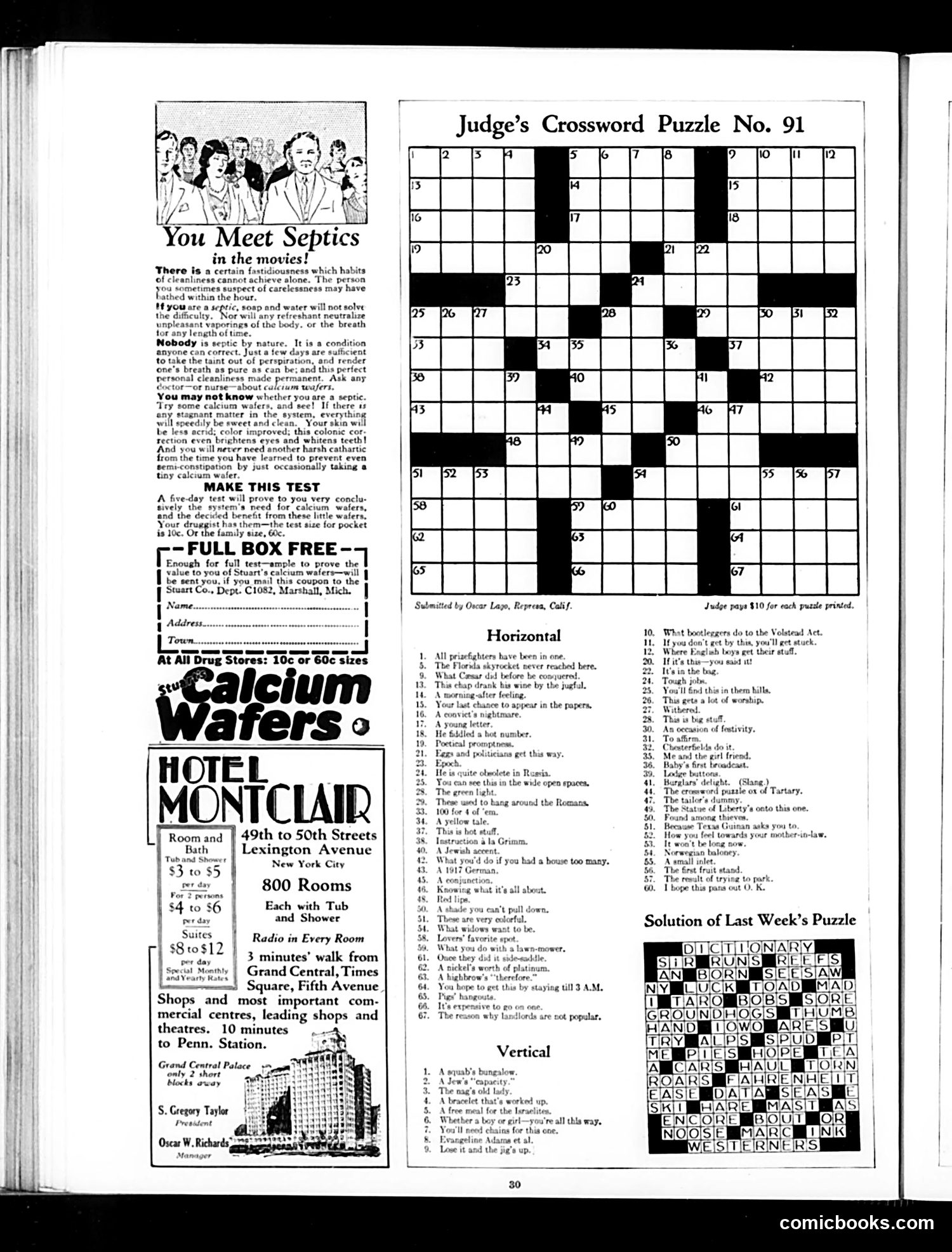
This page is primarily **advertising and puzzle content** rather than political satire. The main feature is "Judge's Crossword Puzzle No. 91" with clues and a solution grid. The left side contains a **health product advertisement** for "Calcium Wafers," which claims to cure "septics"—a period term for people with poor personal hygiene or digestive issues. The ad promises the wafers will improve skin, freshen breath, and solve constipation through "colonic correction." This reflects early 20th-century pseudoscientific marketing common in such magazines. The cartoon header "You Meet Septics in the Movies!" uses film as a relatable reference point, suggesting even glamorous Hollywood types might suffer from this supposed condition—a typical advertising tactic of the era. Below are hotel advertisements for the Hotel Montclair in New York City. The page demonstrates how **Judge magazine mixed satirical content with contemporary advertisements**, reflecting the publication's business model and the medical/hygiene concerns of its time period.
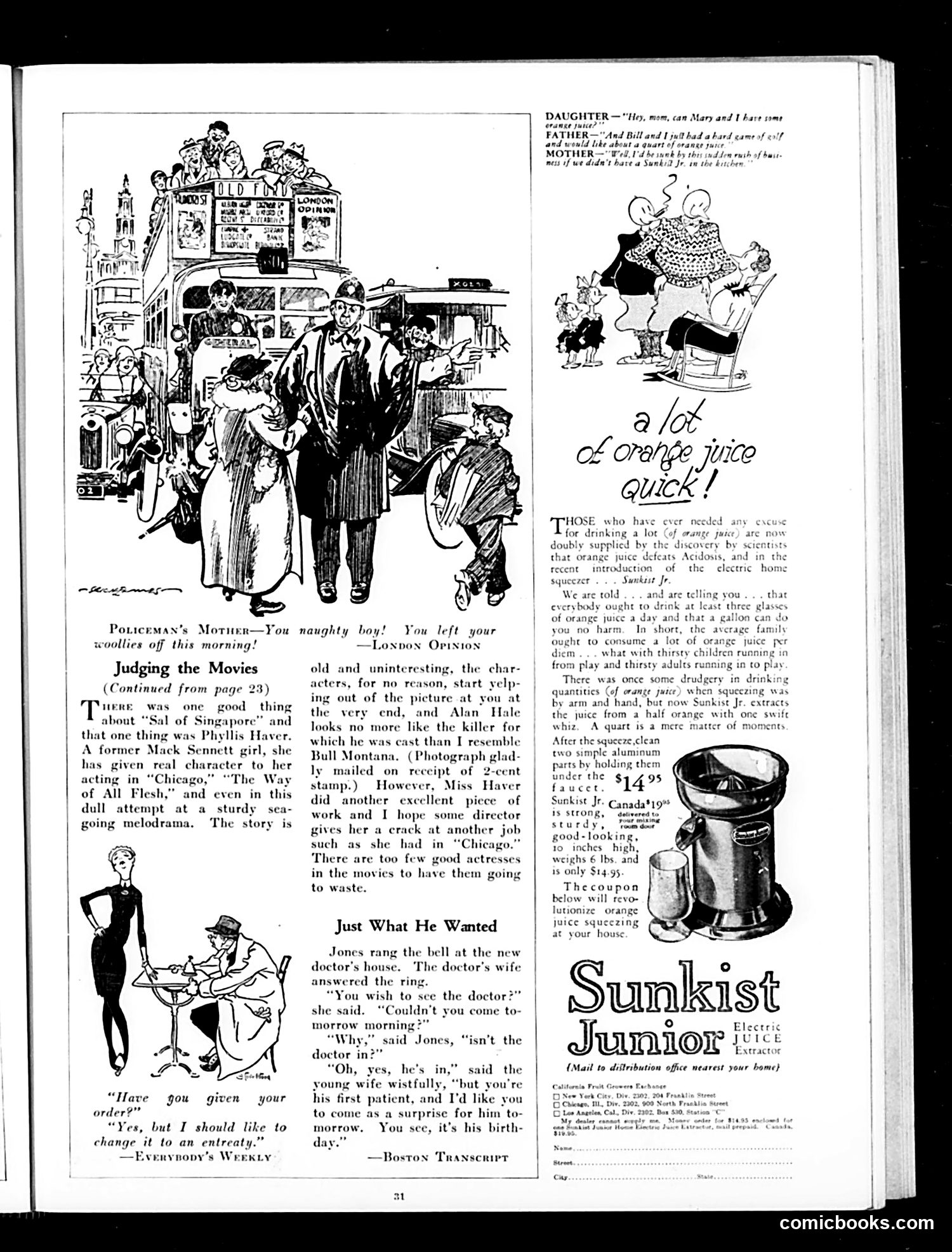
This page contains film criticism and domestic humor typical of 1920s-era Judge magazine. **"Judging the Movies"** reviews recent films, praising actress Phyllis Haver's performances in "Chicago" and "The Way of All Flesh" while criticizing the male lead Alan Hale in an unnamed sea-going melodrama, saying he's miscast—humorously comparing him unfavorably to wrestler Bull Montana. **The dialogue jokes** are light domestic humor: one involves a wife asking her husband to change a dinner order to an "entreaty" (wordplay on "entrée"), another depicts a new doctor's wife asking a patient to return tomorrow, only for him to eagerly accept since he'll be the doctor's first patient—making it a "surprise." **The advertisement section** promotes the Sunkist Jr. electric orange juice squeezer ($14.95), claiming orange juice prevents "acidosis" and recommending families consume gallons daily. This reflects 1920s health fads and the marketing of new electrical appliances for the modern home. The page blends entertainment criticism with consumer advertising, both aimed at middle-class readers.
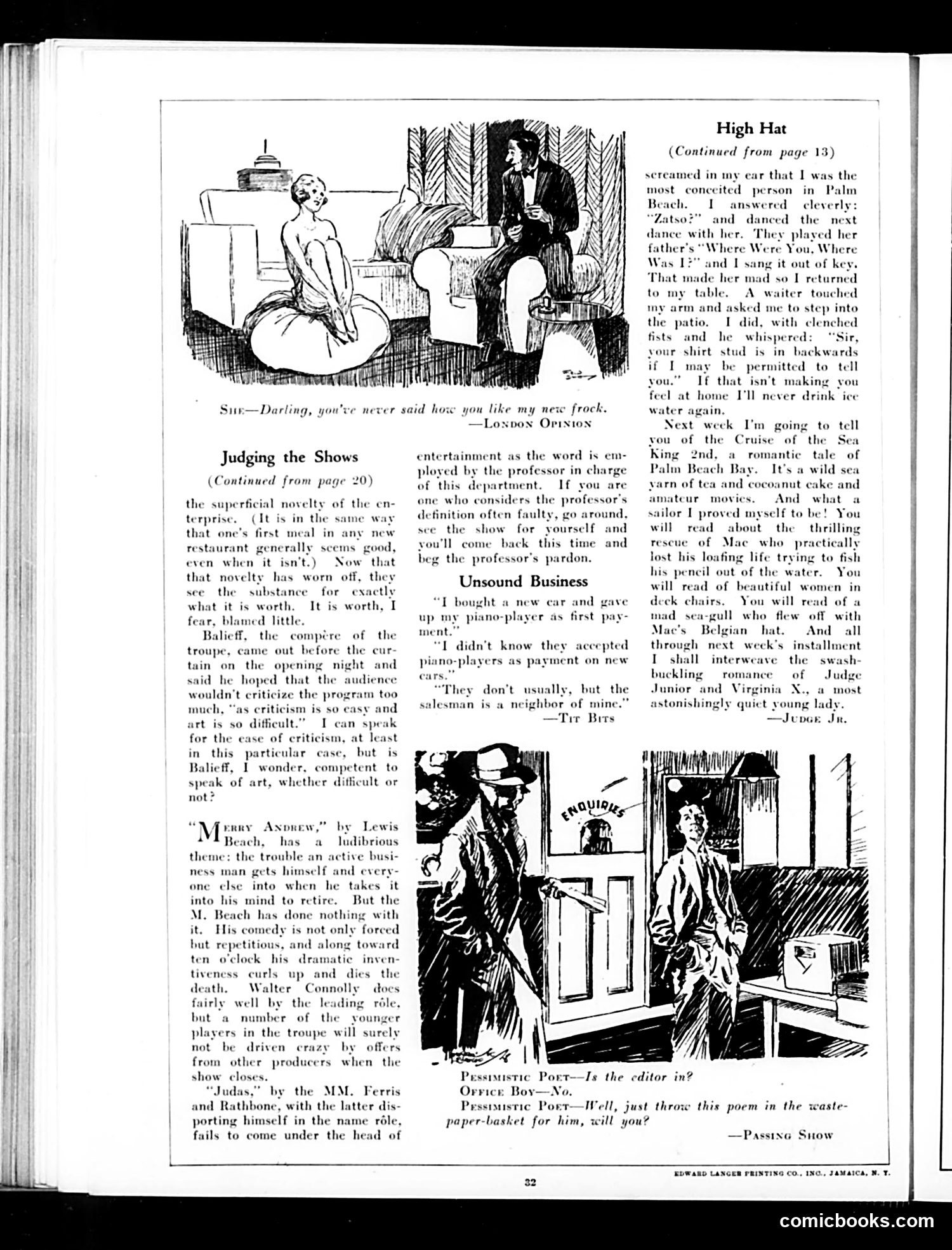
This page contains theater reviews and comic anecdotes typical of Judge's satirical humor. **"Judging the Shows"** critiques theatrical productions, particularly mocking the Ballets Russes' opening-night manager (Balieff) for defensively asking audiences not to criticize, claiming "art is difficult." The reviewer sardonically agrees criticism is easy but questions whether Balieff himself understands art. Reviews of specific plays ("Merry Andrew" and "Judas") fault their forced comedy and weak execution despite competent lead actors. **"Unsound Business"** jokes about economic absurdity: a man trades his piano-player (presumably meaning a piano) as down payment on a car, claiming the salesman accepted because they're neighbors. The humor mocks both the implausible barter and desperate Depression-era financial creativity. **"High Hat"** recounts a socialite's embarrassing Palo Beach encounter—singing off-key at a party, then being quietly informed by a waiter his shirt stud was backwards. The satire targets pretentious social climbers humbled by minor indignities. The final cartoon shows an editor rejecting poetry, representing Judge's broader mockery of artistic pretension.
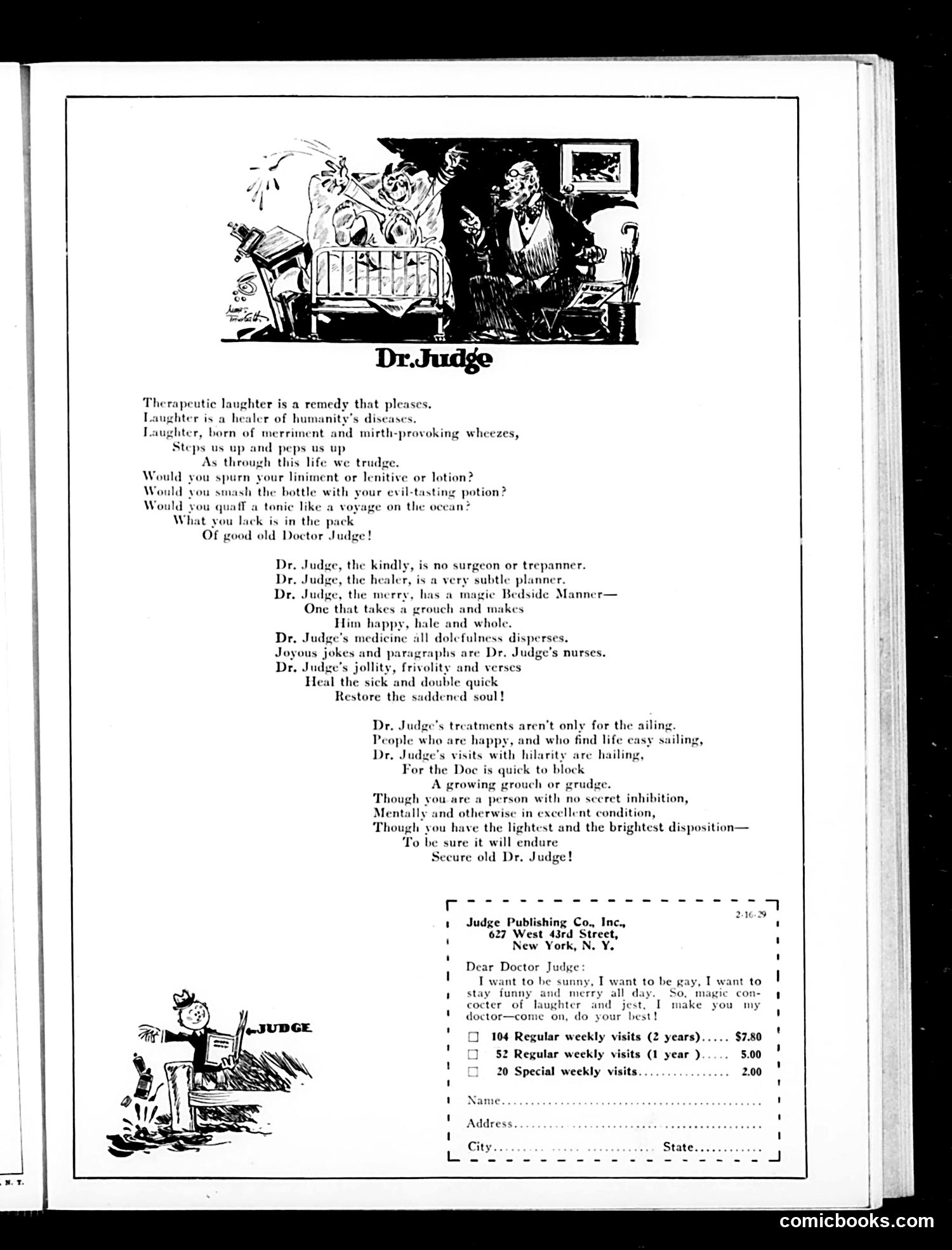
This is an advertisement for *Judge* magazine itself, personified as "Dr. Judge"—a quack doctor who prescribes laughter as medicine. The cartoon plays on early 20th-century patent medicine advertising, which made exaggerated health claims. The satire works on two levels: it mocks contemporary snake-oil salesmen while promoting *Judge*'s own product (humorous content). The accompanying illustrations show a chaotic domestic scene and a cartoonish doctor figure. The subscription offer below treats readers as "patients" needing weekly doses of humor at $7.80-$2.00, depending on frequency. The copy promises that laughter cures ailments, prevents grouchiness, and improves disposition—a playful jab at dubious medical claims while selling the magazine's value as entertainment and stress relief. This reflects *Judge*'s self-positioning as essential to American life.
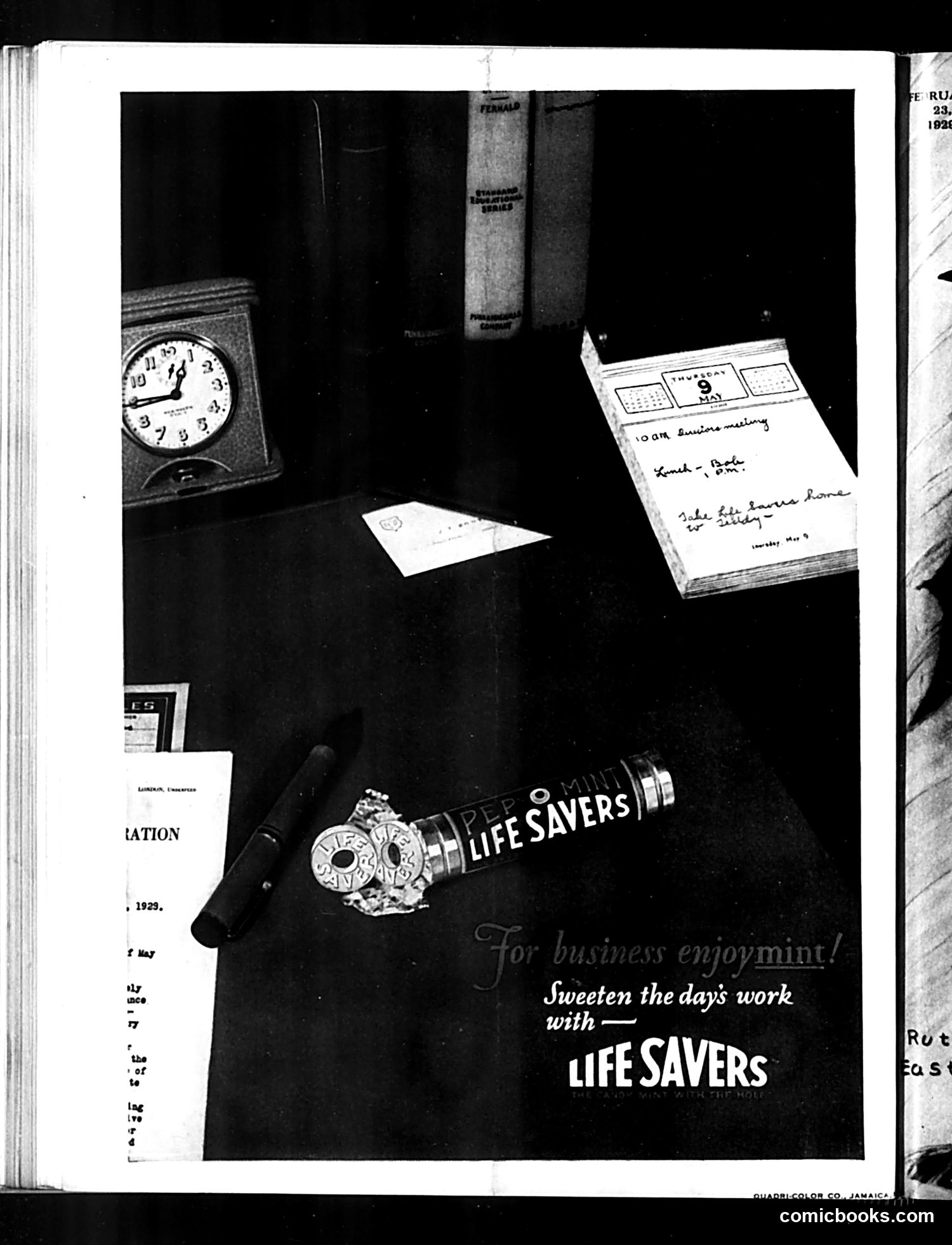
This page is primarily an **advertisement, not editorial content or satire**. It promotes Life Savers candy with a styled product photograph showing a roll of Life Savers alongside a desk setup: a clock, calendar, notepad with handwritten notes, and what appears to be business correspondence. The tagline reads "For business enjoyment! Sweeten the days work with—LIFE SAVERS." The ad targets office workers, suggesting Life Savers candies as a morale booster during the workday. The visual composition—emphasizing a busy desk environment—was typical 1920s advertising strategy, using aspirational imagery of professional work life to market consumer products. There is no discernible political or satirical content on this page; it's a straightforward commercial advertisement placed within the Judge magazine.