
Judge, 1929-02-16 · page 22 of 36
Judge — February 16, 1929 — page 22: what you’re looking at
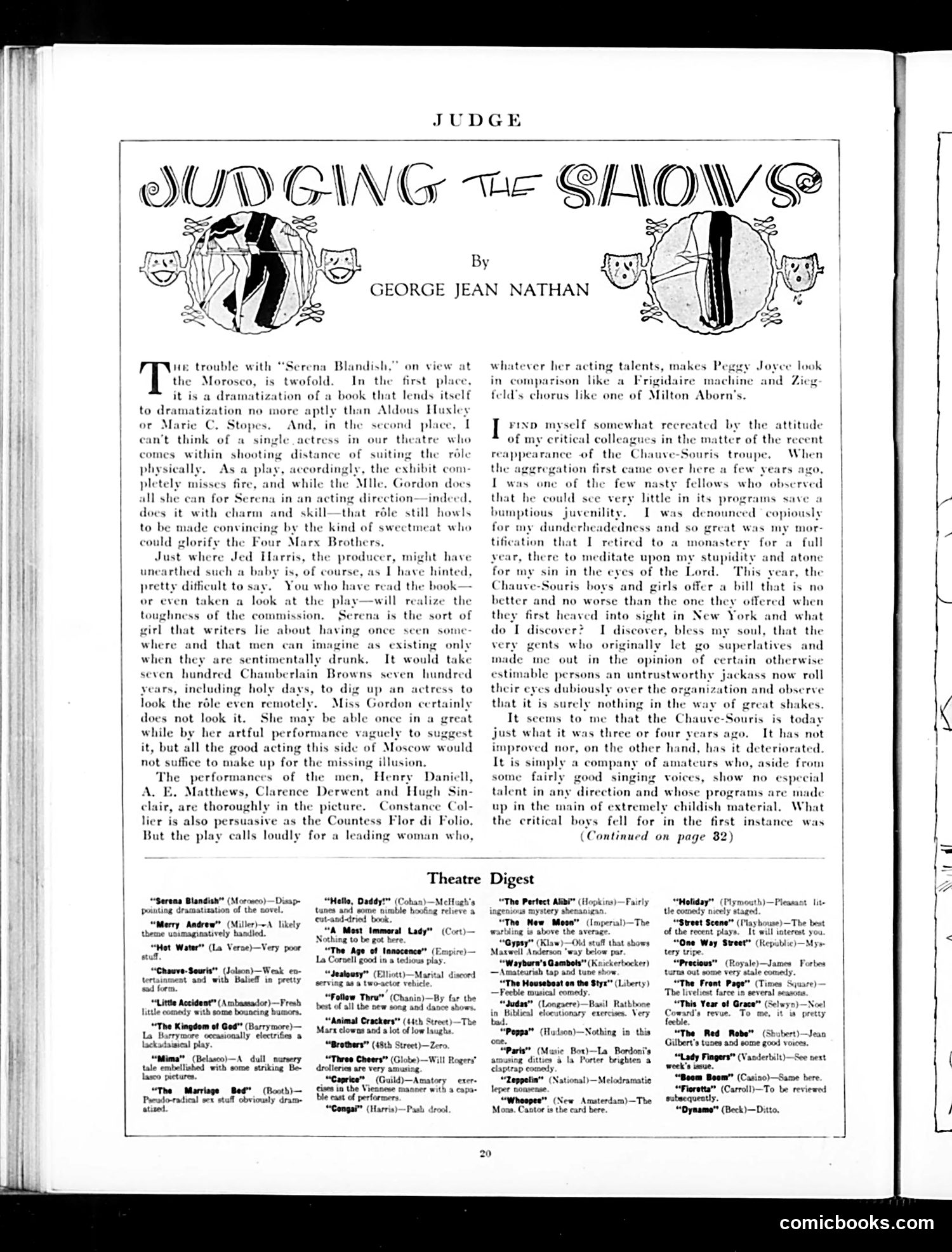
A restored page from Judge, 1929-02-16. Page through the whole issue in the reader above.
📄 Transcribed text from this page (OCR, searchable)
Machine-transcribed from the original scan — historical spelling and the odd misread are preserved.
JUDGE ue trouble with “Serena Blandish,”” on view at | the Morosco, is twofold. In the first place, it is a dramatization of a book that lends itself to dramatization no more aptly than Aldous Huxley or Marie C. Stopes. And, in the second place, 1 can’t think of a single actress in our theatre who comes within shooting distance of suiting the role physically. As a play, accordingly, the exhibit com pletel and while the Mile, Gordon does all she can for Serena in an acting direction—indeed, does it with charm and skill—that réle still howls to be made convincing by the kind of swectmeat who could glorify the Four Marx Brothers. Just where Jed Harris, the producer, might have unearthed such a baby is, of course, as I have hinted, pretty difficult to sz You who have read the book— or even taken a look at the play—will realize the toughness of the commission. Serena is the sort of girl that writers lie about having once seen some where and that men can imagine as existing only when they are sentimentally drunk. It would take seven hundred Chamberlain Browns seven hundred years, including holy days, to dig up an actress to look the réle even remot does not look it. She may while by her artful performance vaguely to su it, but all the good acting this side of not suffice to make up for the missing illusion, performances of the men, Henry Daniell, Matthews, Clarence Derwent and Hugh Sin- are thoroughly in the picture. Constance Col- also persuasive as the Countess Flor di Folio. But the play calls loudly for a leading woman who, misses fir Miss Gordon certainly t gest oscow would be able once in a g By GEORGE JEAN NATHAN i e = whatever her acting talents, makes Peggy Joye« in comparison like a Frigidaire machine and feld’s chorus like one of Milton Aborn’s. ated by the attitude > matter of the re: When sregation first came over here a few years ago, I was one of the few nasty fellows who observed that he could see very little in its programs sav bumptious juvenility. I Fino myself somewhat reer of my critical colleagues in th arance of the Chauve-Souris troupe. a I was denounced ‘copiously for my dunderheadedness and so t was my mor- tification that I retired to a monastery for a full year, there to meditate upon my stupidity and atone for my sin in the eyes of the Lord. This year, the Chauve-Souris boys and girls offer a bill that is no better and no worse than the one they offered when they first heaved into sight in New York and what ? I discover, bless my soul, that the nts who originally let go super made me out in the opinion of certain estimable persons an untrustworthy jackass now roll their eyes dubiously over the organization and observe that it is surely nothing in the way of great shakes. It scems to me that the Chauve-Souris is today just what it was three or four years It has not improved nor, on the other hand, has it deteriorated. It is simply a company of amateurs who, aside from some fairly 1 singing voices, show ne talent in any direction and whose programs are made up in the main of extremely childish material. What the crit boys fell for in the first instance was (Continued on page 82) re do [ discove very tives and therwise especial Theatre “Serena Blandish” (Morasco)—Disap- Daddy!” (Cohan)—McHoah's ing dramatization of the sovel. tunes and some nimble hoofing relieve a ut-and-dried book. “Merry Andrew” (Miller)-A likely vies me usimaginatively handled. i ft ihageg por ved Lady" (Cort) — “Hot Water” (La Verne)—Very poor The Age ef Innocence” (Expire) — 4 La Cornell good in a tedious play ‘Jealoasy” (Ellictt)—Marital discord “Chauve-Seuris” (Jolson)—Weak en- Digest “The Pertect ANDI” (Hopkins) —Pairly _ “*Meliday’ vas mystery shenanigan. tle coment The New Moon” (Imperial)—The warbling i above the average. “Gypsy” (Klaw)—Old stuff that shows Plymouth)—Pleasant lit- nicely staged. “Street Scene” ((ayhouse)—The best of the recent plays. It will interest you. “One Way Sweet” (Kepublic)—Mys- Maxwell Anderson ‘way below par tery tripe. ““Waybura’s Gambols”( stocker) “Precious (Royale)—James Forbes —Amateurish tap and tune show. turns out some very stale comedy tertainment and with Baliel in pretty sad form. “Littie Accident” (Ambassador) —Presh little comedy with some bouncing humors. “The Kingdom of Ged” (Barrymore) — La Barrymare occasionally electrifies a lackadaisical play. “tima” (Belasco)—A dull nursery tale embellished with some striking Be- lasco pictures. “The Preudo-radical set stuff obvic tized. Booth) — ly dram serving at a two-actor vehicle “Follew Thru” (Chanin)—By best of all the new song and dance “Animal Crackers” (44th Street) —The Marx clowns and a lot of low laughs “Brothers” (48th Street) —Zero. “Three Cheers” (Globe) —Will Rogers? drolleries are very amusing. “Caprice” (Guild)—Amatory exer: ¢isea in the Viennese manner with a capa: ble cast of performers “Conga” (Harris) —Pasb dro “The Houseboat on the Styx" (Literty) —Feeble musical comedy “Judas (Longacre) —Basil Ratbb in Biblical elocutionary exercises. tad. “The Front Page” (Times Square)— ‘The liveliest farce in several seasons. “This Year of Grace” (Selwyn) —Noel ry Coward's revue. To me, it is pretty feeble. “Poppa” (Husoon)—Nothing in this “The one. Red Rede” (Shubert)—Jean Se cine | Gilbert's tunes and some good voices, Ui Renee brghsce S_ “Landy Flagery™ (Vasderbilt)—See next iy week's nave, “Zeppelin” (Nationsl)—Melodramatic “Boom Boom” (Casino) —Same bere. leper nonsense. “Fieretta” (Carroll)—To be reviewed i. " (New Amsterdam)—The subsequently. Mons. Cantor is the card bere. “Dyname”™ (Beck)—Ditto. amusin claptrap, comicbooks.com z ES A]