
Judge, 1929-02-16 · page 17 of 36
Judge — February 16, 1929 — page 17: what you’re looking at
What you’re looking at
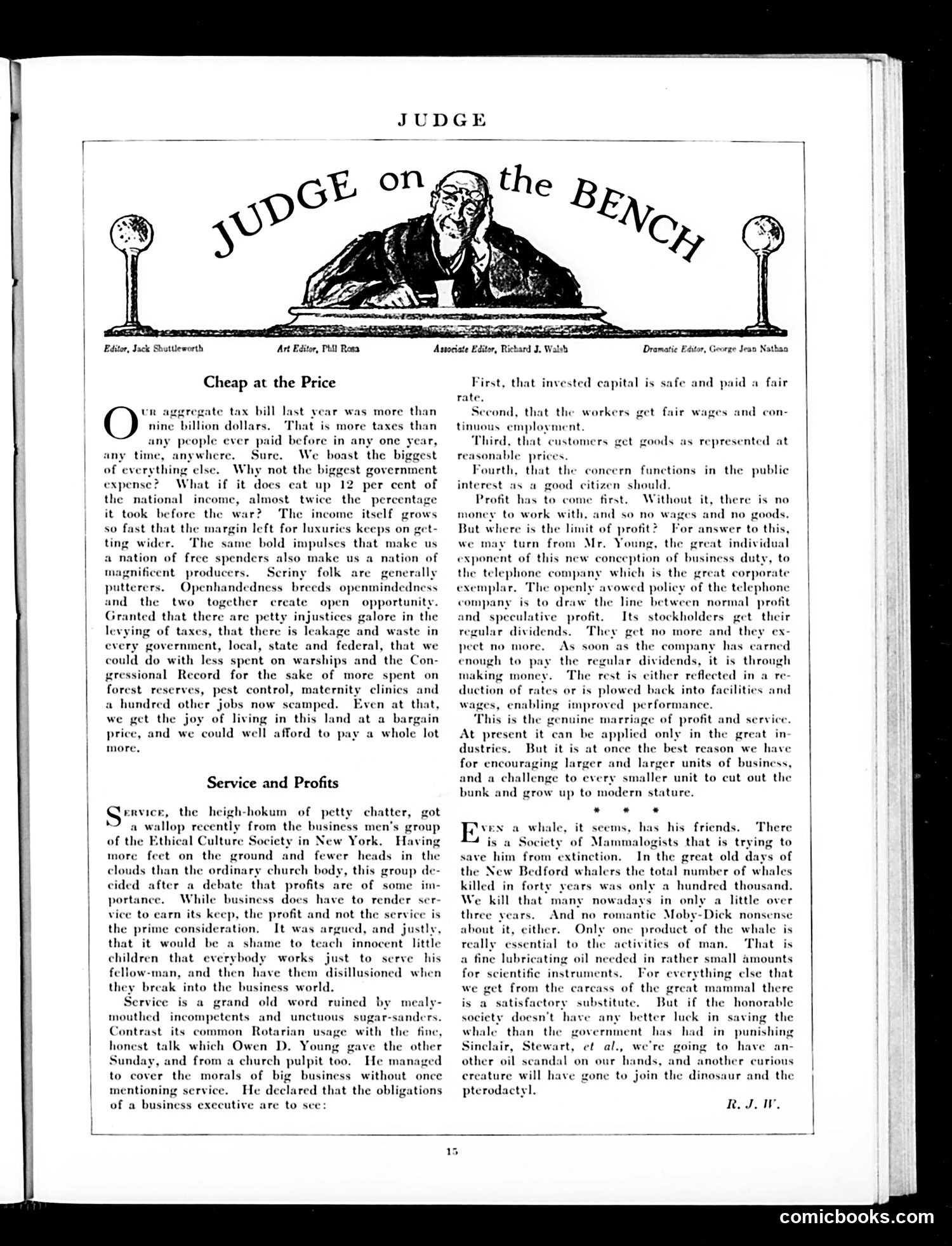
This is an editorial/opinion page rather than a cartoon. The masthead shows a judge figure overseeing content by editors including Jack Shuttleworth and Pull Rosa. **"Cheap at the Price"** defends the nine-billion-dollar tax bill (likely post-WWI), arguing Americans can afford higher taxes given national prosperity. It reframes government spending as the cost of living in an advanced society. **"Service and Profits"** critiques the overuse of "service" rhetoric in business. It praises Owen D. Young and the telephone company for openly acknowledging that **profit must come first**—not as greed, but as economic necessity. The article argues that without profit, wages and goods cannot exist. The telephone company exemplifies balance: paying stockholder dividends while reinvesting surplus into rate reductions and infrastructure. The satire targets sanctimonious business leaders who disguise profit-seeking as moral "service," while praising those honest enough to admit profit's primacy in capitalism.
📄 Transcribed text from this page (OCR, searchable)
Machine-transcribed from the original scan — historical spelling and the odd misread are preserved.
Editor, Pull Rosa Editor, Jack Shuttleworth Cheap at the Price tn aggregate tax bill last year was more than O nine billion dollars, That is more taxes than any people ever paid before in any one year, any time, anywhere. Sure. We boast the biggest of everything else. Why not the biggest government expense? What if it does cat up 12 per cent of the national income, almost twice the percentage it took before the war? The income itself grows so fast that the margin left for luxuries keeps on get- ting wider. ‘The same bold impulses that make us a nation of free spenders also make us a nation of magnificent producers. Scriny folk are generally putterers. Openhandedness breeds openmindedness the two together create open opportunity. nted that there are petty injustices galore in the ng of taxes, that there is leakage and waste in every government, local, state and federal, that we could do with less spent on warships and the Con- gressional Record for the sake of more spent on forest reserves, pest control, maternity clinics and a hundred other jobs now scamped. Even at that, we get the joy of living in this land at a bargain price, and we could well afford to pay a whole lot more, Service and Profits Srevice, the heigh-hokum of petty chatter, got ‘Da wallop recently from the business men’s group of the Ethical Culture Society in w York. Having more feet on the ground and fewer heads in the clouds than the ordinary church body, this group de- cided after a debate that profits are portance. While business does have to render ser- vice to earn its keep, the profit and not the service is the prime consideration. It was argued, and justly, that it would be a shame to teach innocent little children that everybody works just to serve his fellow-man, and then have them disillusioned when they break into the business world. Service is a grand old word ruined t 3 mouthed incompetents and unctuous sugar-sanders. Contrast its common Rotarian usage with the fine, honest talk which Owen D. Young gave the other Sunday, and from a church pulpit too. He managed to cover the morals of big business without once mentioning service. He declared that the obligations of a business executive are to see: of some im- Astociate Editor, Richard J. Walsh re Jean} First, that invested capital is safe and paid a fair rate, Second, that the workers get fair wages and con- tinuous employment. Third, that customers get goods as represented at reasonable prices. Fourth, that the concern functions in the public interest as a good citizen should. Profit has to come first. Without it, there is no moncy to work with, and so no wages and no goods, But where is the limit of profit? For answer to this, we may turn from Mr. Young, the great individual exponent of this new conception of business duty, to the telephone company which is the great corporate exemplar. The openly avowed policy of the telephone company is to draw the line between normal profit and speculative profit. Its stockholders get their regular dividends. They get no more and they ex- pect no more. As soon as the company has earned enough to pay the regular dividends, it is through making mon The rest is either reflected in a duction of rates or is plowed back into facilities wages, enabling improved performance. This is the genuine marr of profit and service. At present it can be applied only in the great in dustries. But it is at once the best reason we have for encouragi arger and larger units of business, and a challenge to every smaller unit to cut out the bunk and grow up to modern stature. * is, has his friends. ‘There mmalogists that is trying to ye him from extinction, In the great old days of the New Bedford whalers the total number of whales killed in forty years was only a hundred thousand. We kill that’ m ys in only a little over three years. And no romantic Moby-Dick nonsense about ‘it, either. Only one product of the whale is really essential to the activities of man, That is a fine lubricating oil needed in rather small amounts for scientific instruments. For everything else that we get from the carcass of the great mammal there is satisfactory substitute. But if the honorable society doesn't have any better luck in saving the whale than the government has had in’ punishing Sinclair, Stewart, et al., we're going to have an- other oil scandal on our hands, Society nd another curious ture will have gone to join the dinosaur and the RJ.W. comicbooks.com