
A complete issue · 36 pages · 1928
Judge — December 15, 1928
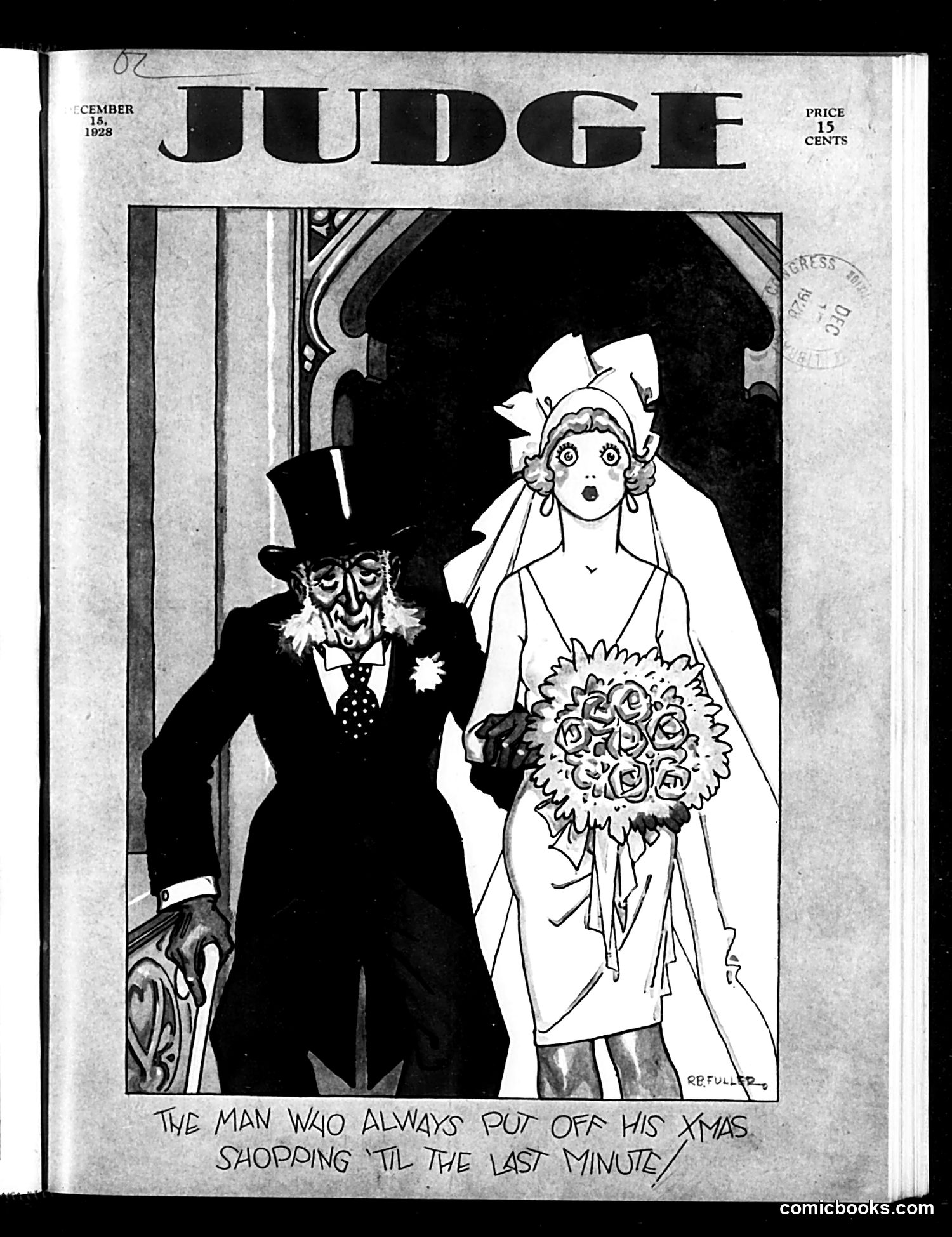
This is a satirical cartoon about Christmas procrastination. The caption reads: "The Man Who Always Put Off His Xmas Shopping 'Til The Last Minute!" The image shows a bride in wedding attire looking shocked, paired with a groom figure (rendered as a grotesque, skeletal creature in formal wear and top hat). The joke appears to be a dark pun: a man who perpetually delays Christmas shopping until the last possible moment has now delayed so long that he's arriving to his own *wedding* at the last minute—with no gift, unprepared, and looking dreadful. The humor relies on exaggeration and the contrast between the bride's horror and the groom's decrepit appearance, typical of Judge's satirical style mocking common social failings.
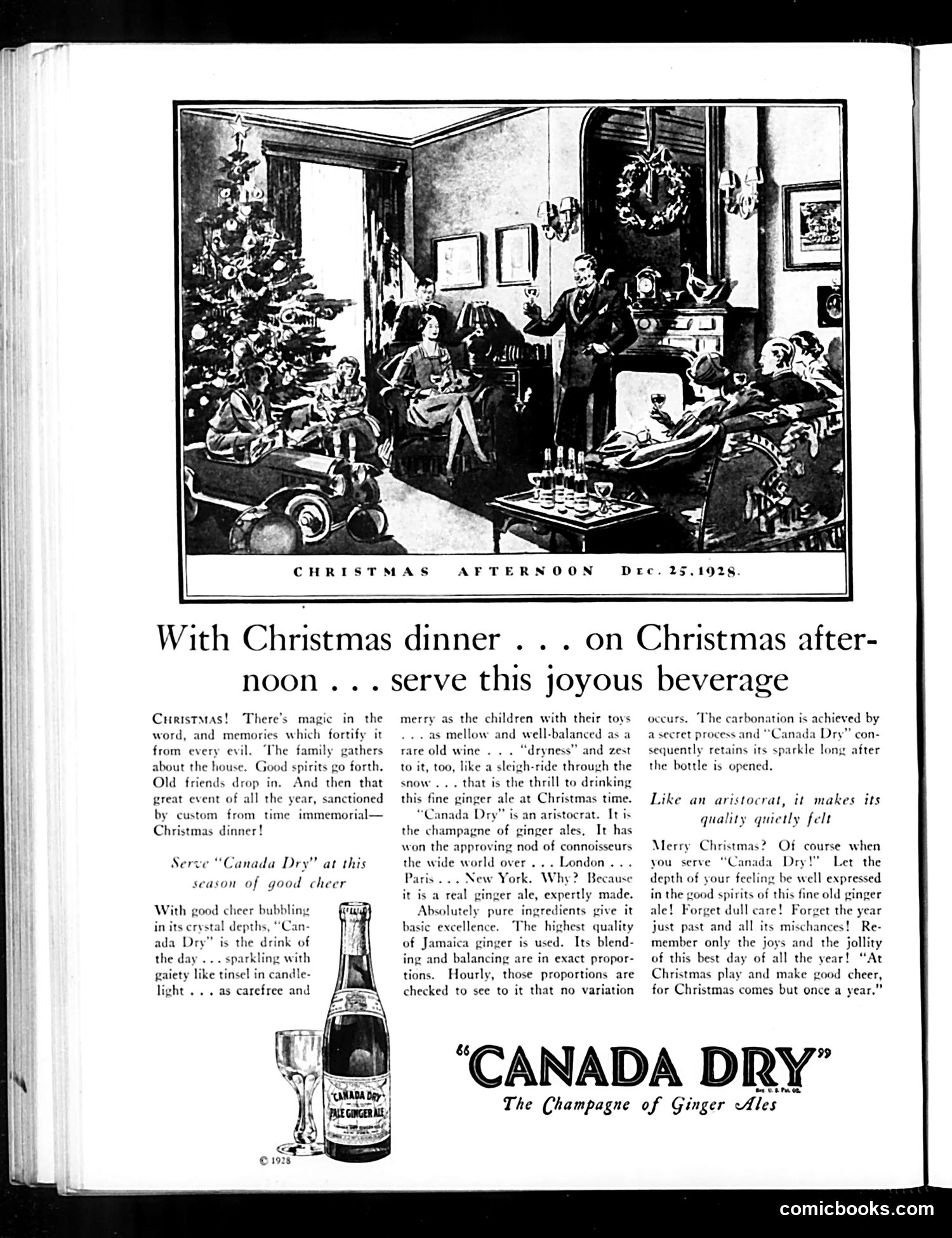
This page is primarily **advertising rather than satire or political commentary**. It features a 1928 advertisement for "Canada Dry" ginger ale, positioned as an appropriate Christmas beverage. The illustration depicts a wealthy family's Christmas afternoon gathering—children opening presents by a decorated tree, adults socializing, playing chess, and relaxing. The ad copy emphasizes Canada Dry as a refined, aristocratic drink suitable for holiday entertaining. **Historical context**: This advertisement predates Prohibition's repeal (1933), yet Canada Dry is being promoted openly. The product was marketed as a "ginger ale" (technically non-alcoholic) but the ad's emphasis on "sparkle," "magic," and "good cheer" suggests its actual use as a mixer with alcohol during the Prohibition era. The content reflects 1920s consumer culture and advertising strategies rather than political satire.
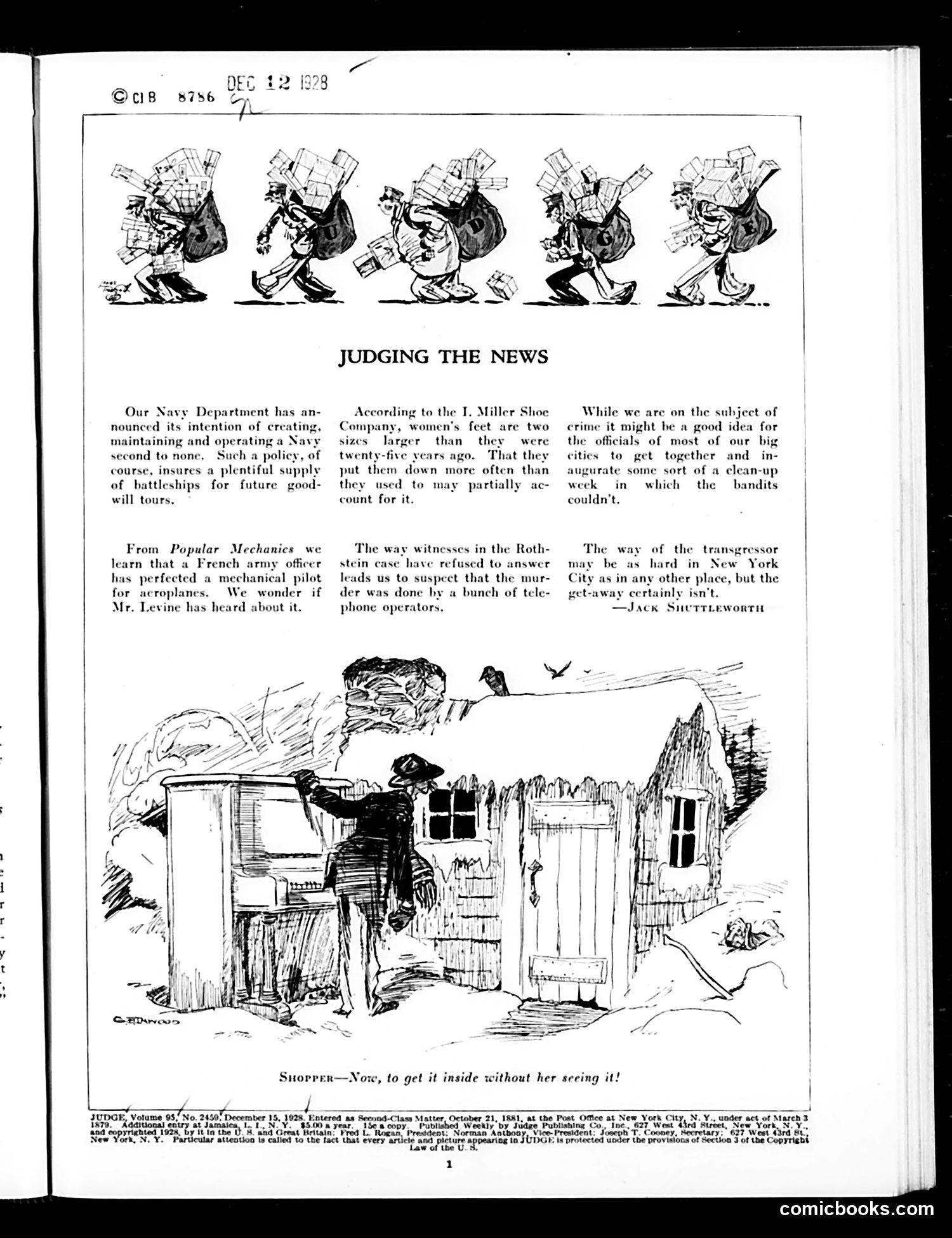
This satirical column features four commentary pieces on contemporary issues: 1. **Navy shipbuilding**: Critiques the Navy Department's plan to maintain and operate a second naval base, suggesting it wastes resources. 2. **Women's feet**: References the I. Miller Shoe Company's claim that women's feet have grown two sizes larger than 25 years prior—mocking this as exaggerated marketing. 3. **Crime investigation**: Suggests New York City officials should organize a "clean-up week" targeting bandits, implying current law enforcement is ineffective. 4. **The cartoon**: Depicts a burglar attempting to steal from a home while the owner sleeps, captioned "Shopper—Now, to get it inside without her seeing it!" The joke satirizes spousal conflict over purchases or infidelity, typical of period domestic humor.
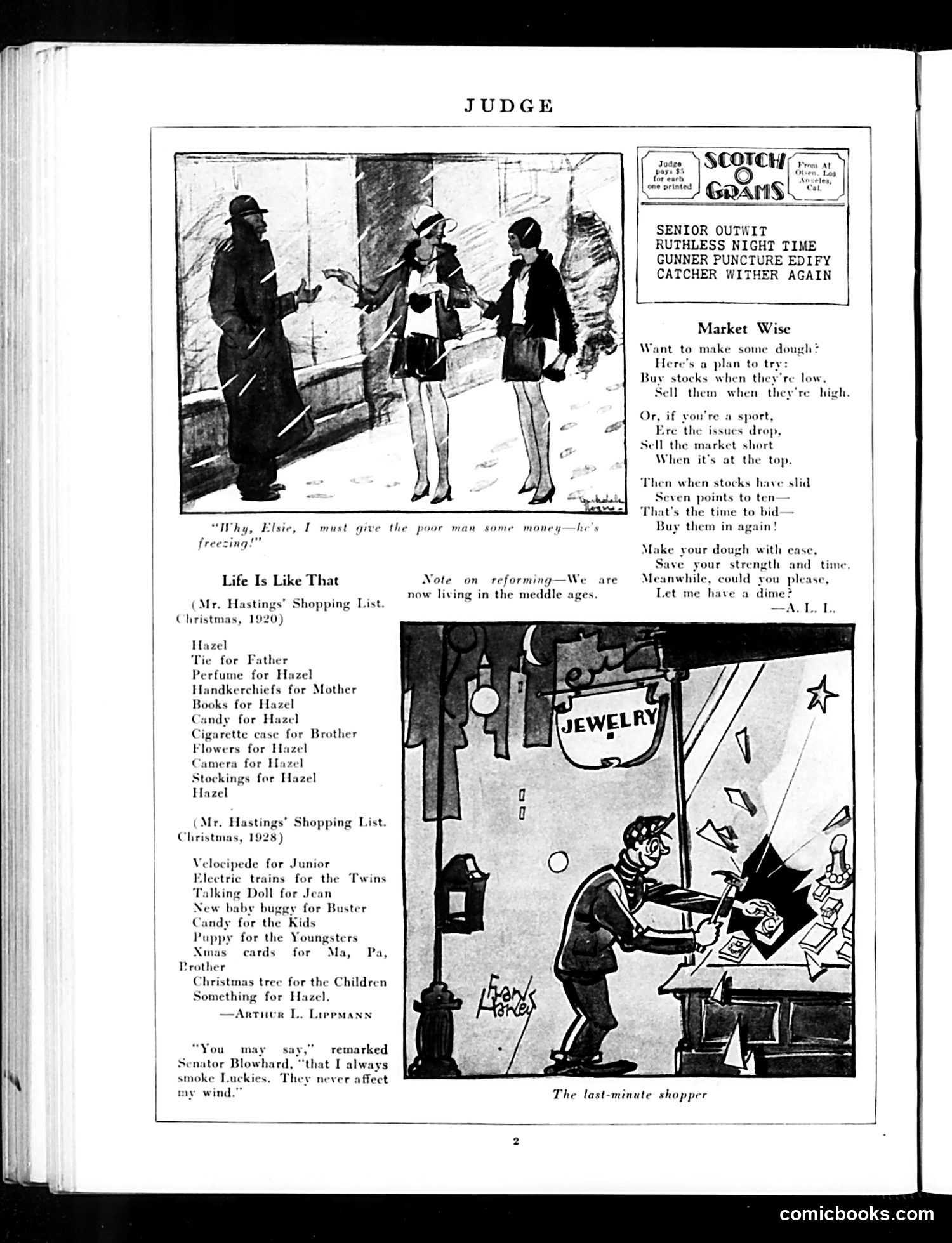
This page contains several distinct pieces of social satire: **"Life Is Like That"** presents shopping lists from Mr. Hastings' Christmas purchases in 1920 versus 1928, satirizing inflation and changing consumer priorities. The 1920 list includes luxury items (perfume, camera, cigarette case), while the 1928 list emphasizes practical goods (trains, dolls, candy). This reflects the economic strain of the late 1920s pre-Depression era. **"Market Wise"** offers tongue-in-cheek stock market advice—buy low, sell high, short-sell—suggesting ordinary people were gambling in stocks during the speculative 1920s boom. **"The last-minute shopper"** cartoon depicts a harried burglar stealing jewelry from a shop, humorously commenting on desperate holiday shopping behavior. The overall theme critiques consumerism, economic anxiety, and the frenetic pace of modern American life in the Jazz Age.
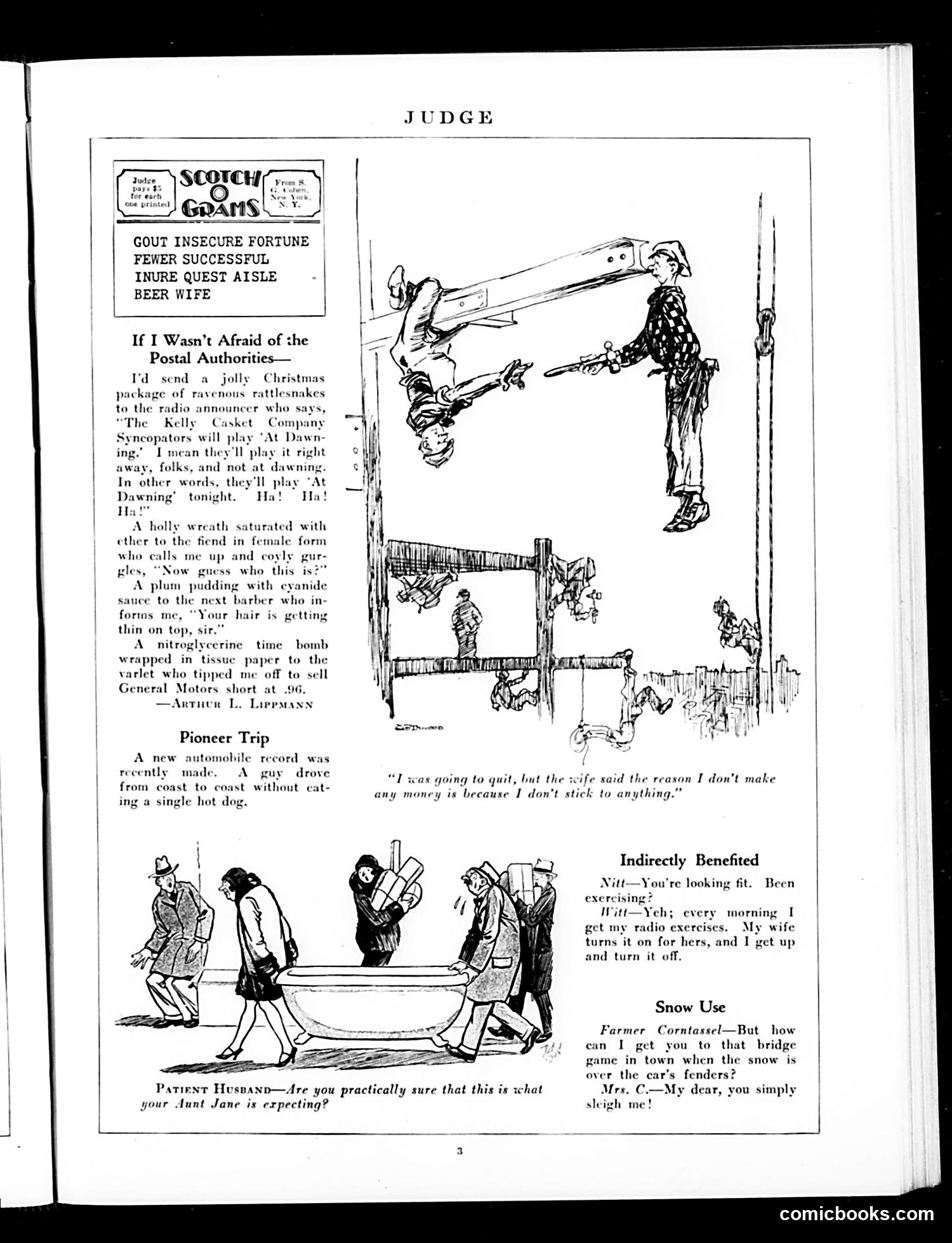
This page contains multiple comic segments satirizing early 20th-century American life: **Main Cartoon**: Shows a man on a gallows being hanged, with the caption suggesting his wife won't let him quit his job because she needs his income—dark humor about marital financial dependency. **"Pioneer Trip"**: Jokes about a cross-country automobile journey without eating hot dogs, likely mocking early car travel's limited amenities. **"Indirectly Benefited"**: A radio exercise joke where a husband benefits from his wife's morning radio routine by getting out of bed on schedule. **"Snow Use"**: Satirizes winter inconveniences, showing people struggling with a bathtub (possibly frozen or stuck), with humor about sleigh transportation during snow. The page reflects pre-Depression era anxieties about work, marriage dynamics, and technological change.
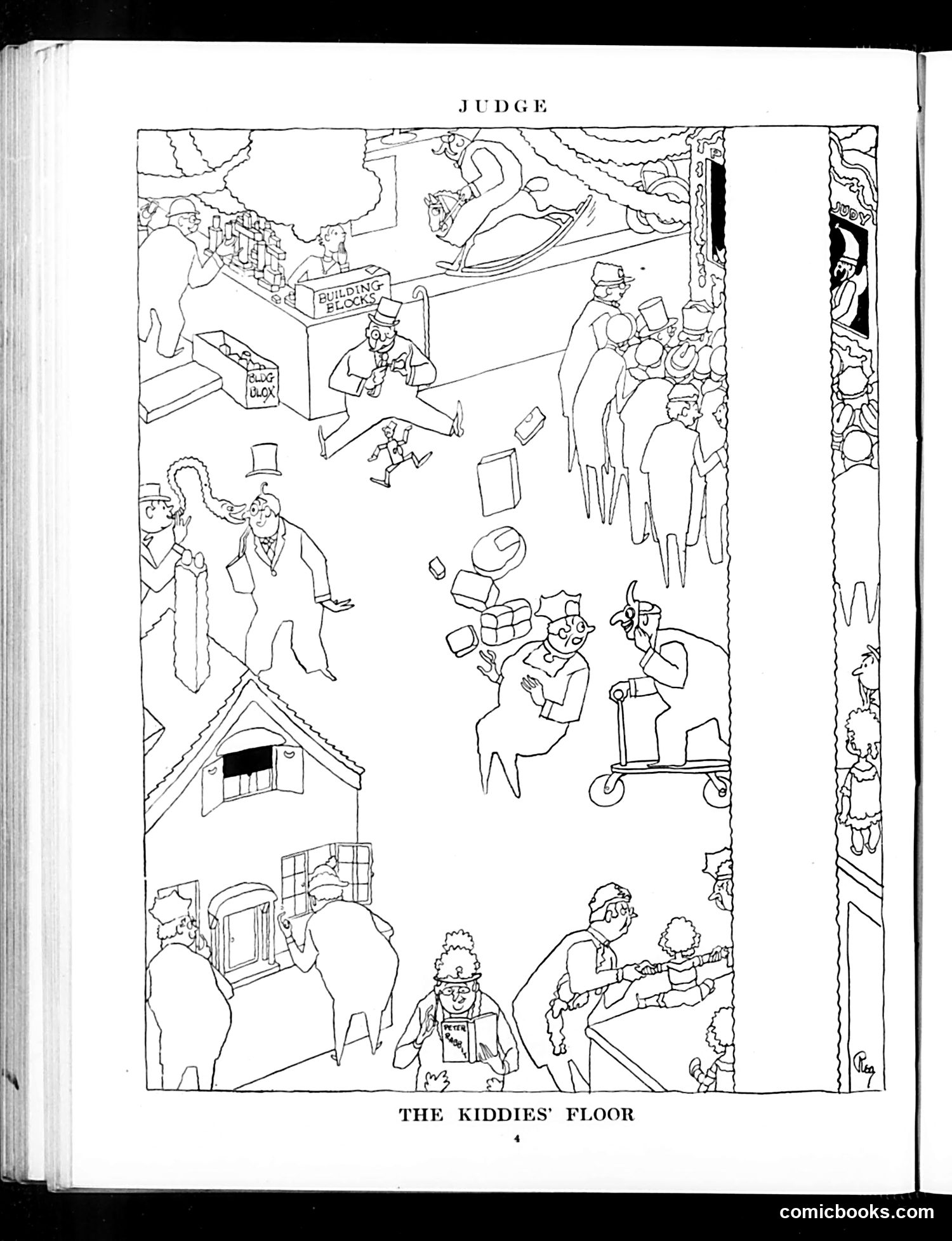
This Judge cartoon satirizes a chaotic children's department or play area, likely in a large store or public building. The scene depicts youngsters engaged in destructive and dangerous behavior—climbing, fighting, breaking items, riding scooters recklessly, and generally creating mayhem while adults (appearing to be supervisors or parents) struggle to maintain order. The satire targets either inadequate childcare supervision or the inherent chaos of unsupervised children in a commercial space. The "Building Blocks" sign suggests a toy department. The joke critiques the impossibility of controlling children in such environments, or potentially mocks parents' expectations that commercial venues can peacefully accommodate their kids. The artistic style and publication date remain unclear from this image alone.
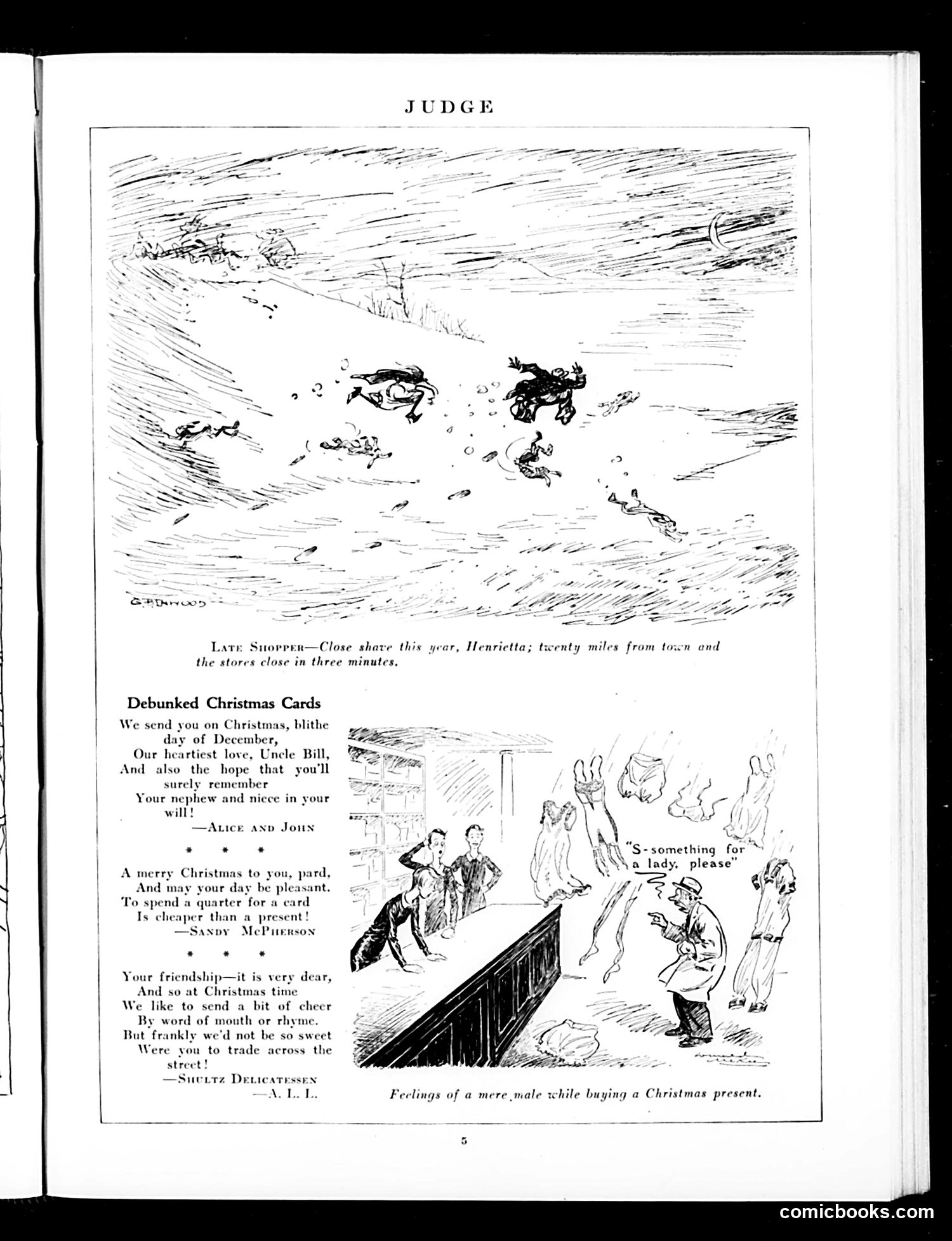
This page contains two distinct sections: **Top Image**: A sketch labeled "Late Shopper" depicting someone near Henrietta, twenty miles from town, with stores closing in three minutes—likely satirizing last-minute Christmas shopping and the difficulty of rural access to stores. **"Debunked Christmas Cards"**: A humorous section featuring several satirical Christmas messages. One mocks the expense of greeting cards ("Is cheaper than a present!"). Another cynically addresses a male friend, noting that Christmas greetings "would be so sweet / Were you to trade across the street!"—suggesting the recipient is an unpleasant neighbor. The bottom cartoon illustrates a man uncomfortably shopping for a Christmas gift while observing women's reactions ("'S-something for a lady, please?"), satirizing male discomfort with gift-buying. The overall theme critiques commercialization of Christmas and social awkwardness around the holiday.
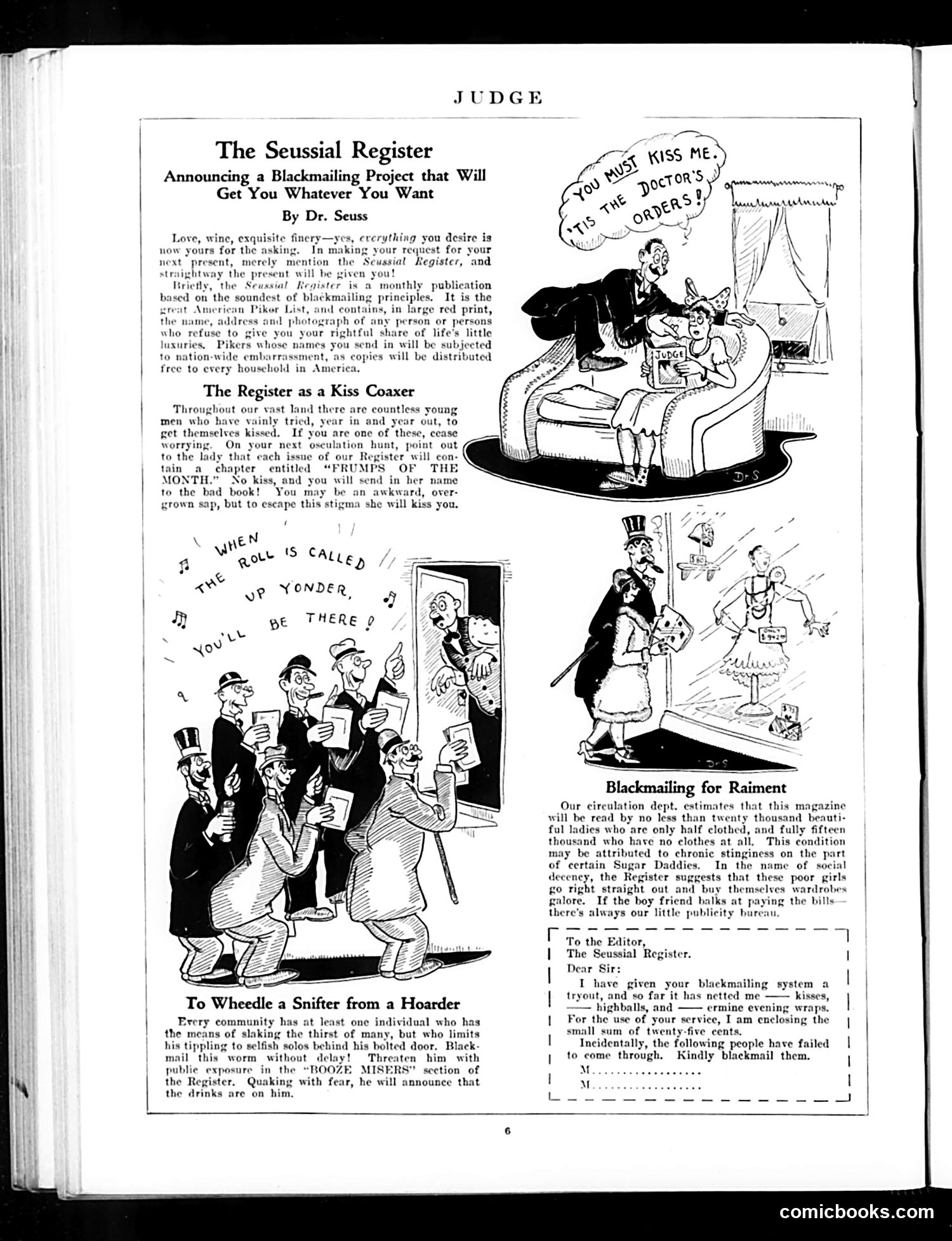
This early Dr. Seuss piece satirizes blackmail as a humorous solution to everyday desires. The "Seussial Register" is a fictional monthly publication that publishes names of people who refuse to give others what they want—forcing compliance through public shame. The satire targets three social scenarios: reluctant gift-givers, women withholding kisses, and wealthy men hoarding alcohol. The cartoons show blackmail victims being threatened with public exposure in sections like "FRUMPS OF THE MONTH" and "BOOZE MISERS." A reader's letter at bottom demonstrates the concept's "success," listing people who supposedly refused to comply with demands. The joke relies on treating extortion as an absurdly practical solution to petty social frustrations, typical of Seuss's early comedic work. It's darkly humorous in ways that would raise eyebrows today, though clearly meant as exaggerated satire rather than literal endorsement.
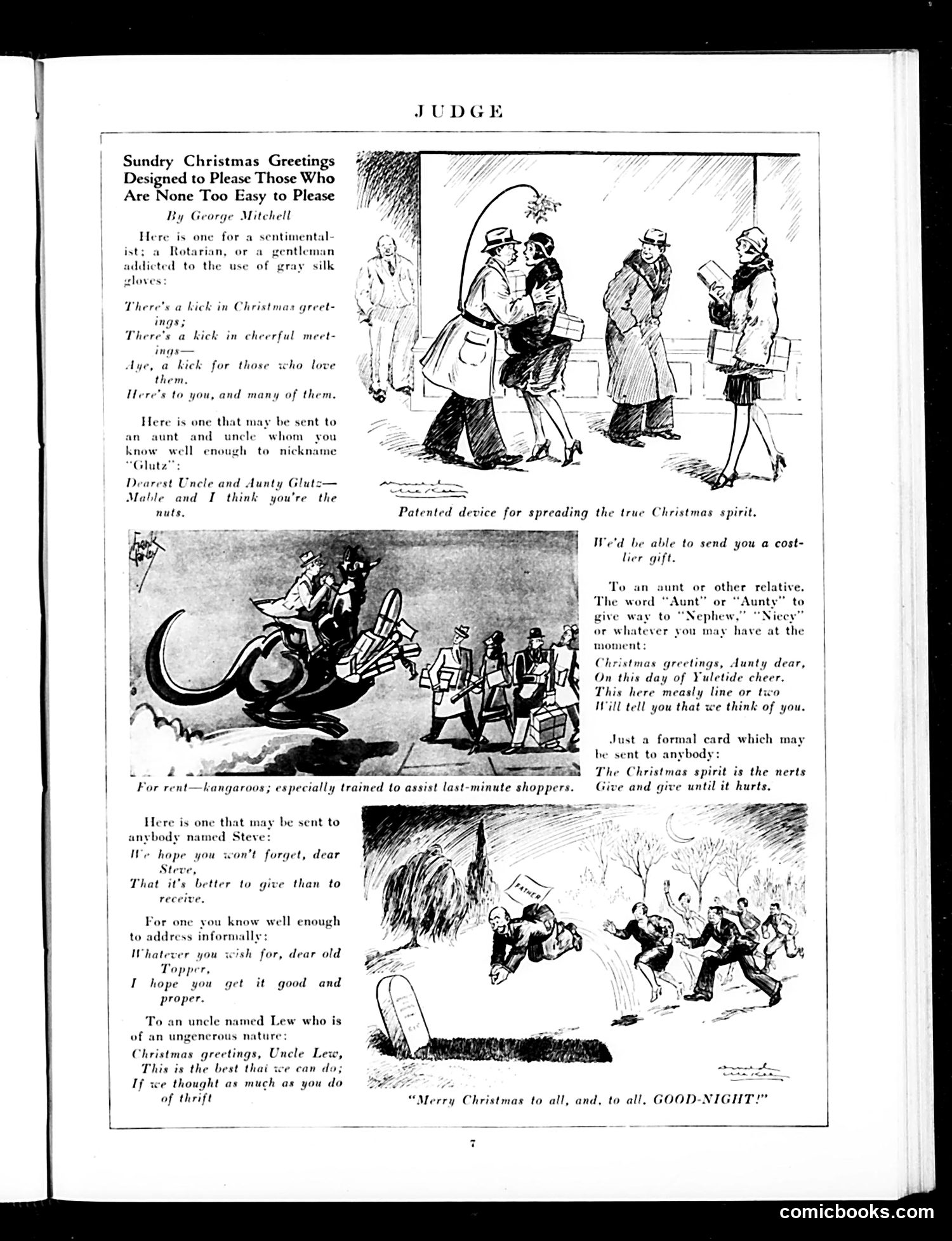
This is a humorous piece by George Mitchell offering mock Christmas cards for difficult relatives and acquaintances. Rather than political satire, it's social comedy targeting common personality types. The jokes ridicule: - Cheapskates (the kangaroo "rental" for last-minute shoppers; Uncle Lew's stinginess) - Gluttons (Uncle and Aunt "Glutz") - Generic recipients (formal cards for people named Steve or Topper) - The obligatory nature of holiday greetings to people one barely tolerates The cartoons illustrate the absurdity: people exchanging gifts while appearing miserable, a man flying in on a kangaroo as a delivery method. The final image shows people trudging through snow, emphasizing the joyless obligation. The satire targets middle-class holiday customs and the performative cheerfulness expected during Christmas, suggesting that genuine generosity ("give and give until it hurts") is rare among the greedy and stingy relatives one must acknowledge anyway.
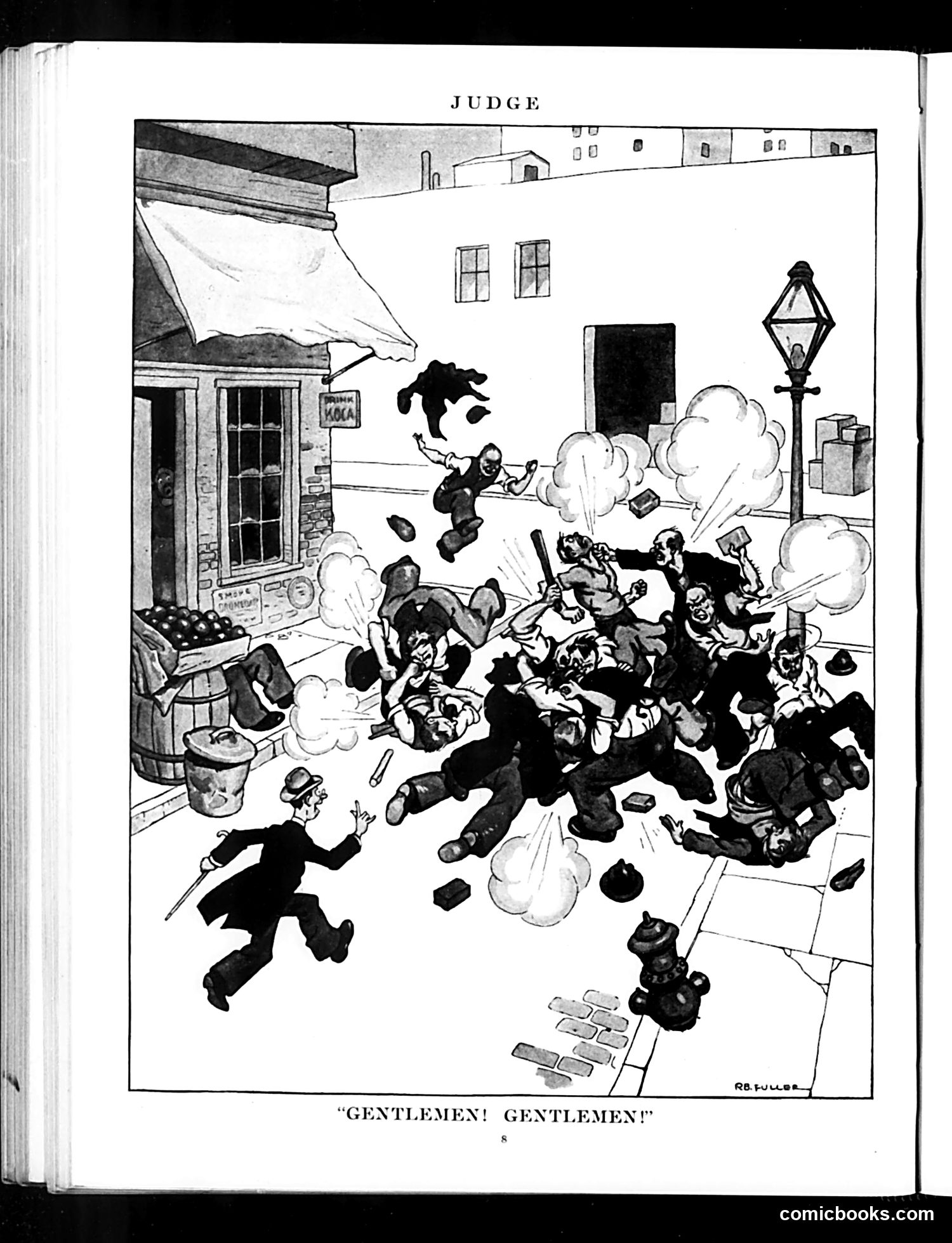
This cartoon depicts a chaotic street brawl in what appears to be an urban alley or courtyard. Multiple men in dark suits are fighting—throwing punches, wielding sticks or clubs, and scattering amid explosive clouds (likely representing smoke or dust). One figure at left appears to be attempting to restore order, gesturing and calling "Gentlemen! Gentlemen!" to the combatants. The satire appears to target political or business elites—the formal dress and "gentlemen" framing suggest these are supposedly respectable figures engaged in undignified conflict. The cartoon likely mocks either labor disputes, political rivalries, or corporate competition of the era, exposing the hypocrisy between genteel pretense and brutal real-world conduct. The title's plea for civility contrasts sharply with the anarchic violence depicted.
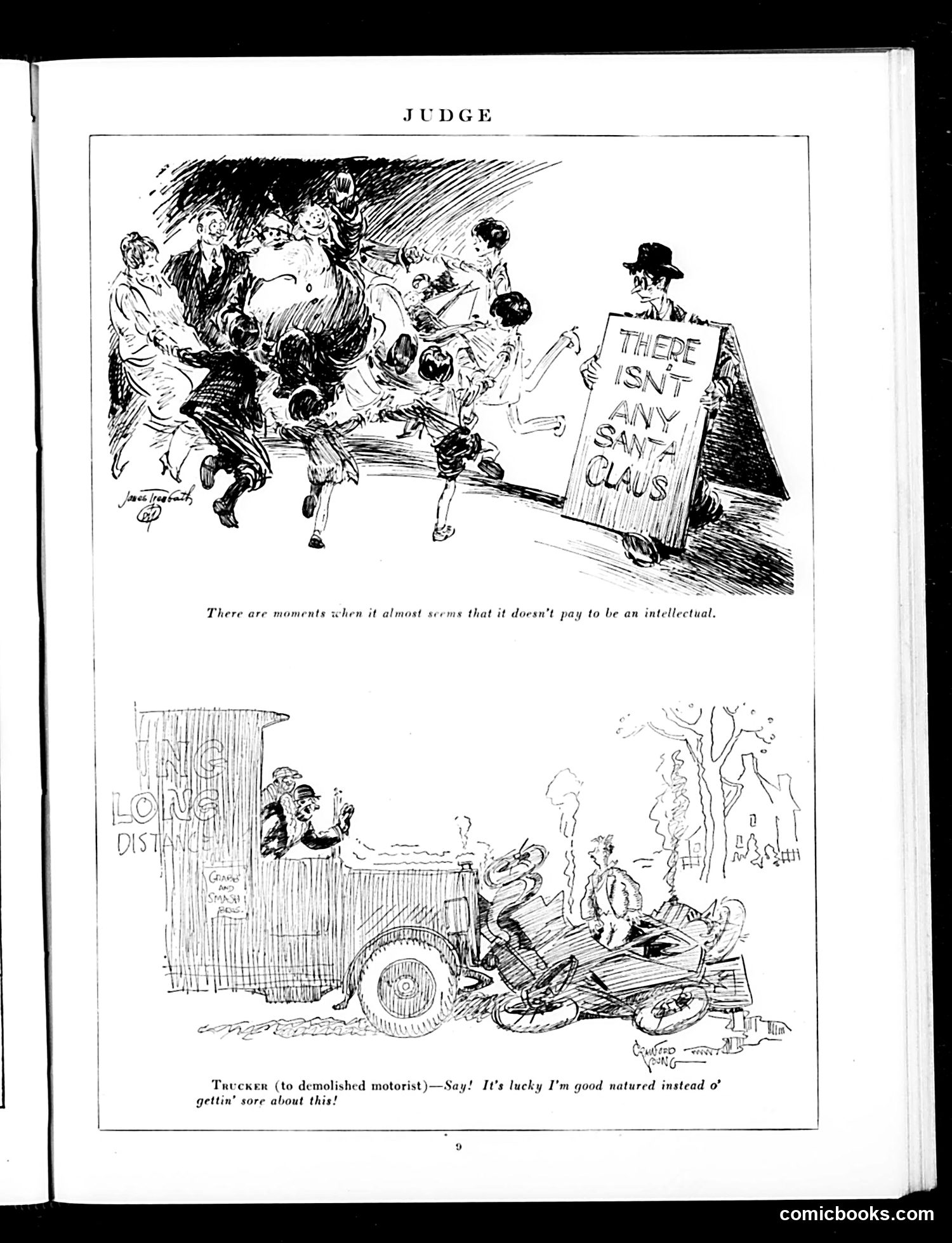
This page contains two cartoons satirizing anti-intellectualism and class conflict. **Top cartoon**: Children holding a sign reading "THERE ISN'T ANY SANTA CLAUS" confront an adult, illustrating the caption about intellectualism being unrewarding—the harsh truth-telling of the "intellectual" destroys others' joy. **Bottom cartoon**: A truck driver (labeled "LONG DISTANCE") whose vehicle has hit and demolished a motorist's car claims good nature rather than anger about the accident. The satire targets working-class figures who boast of their temperament while causing damage, suggesting crude toughness masquerades as virtue. Both cartoons mock different social types—the pedantic intellectual and the blunt laborer—for their respective failings. The humor derives from period class tensions and stereotypes about education, sensibility, and working-class behavior.
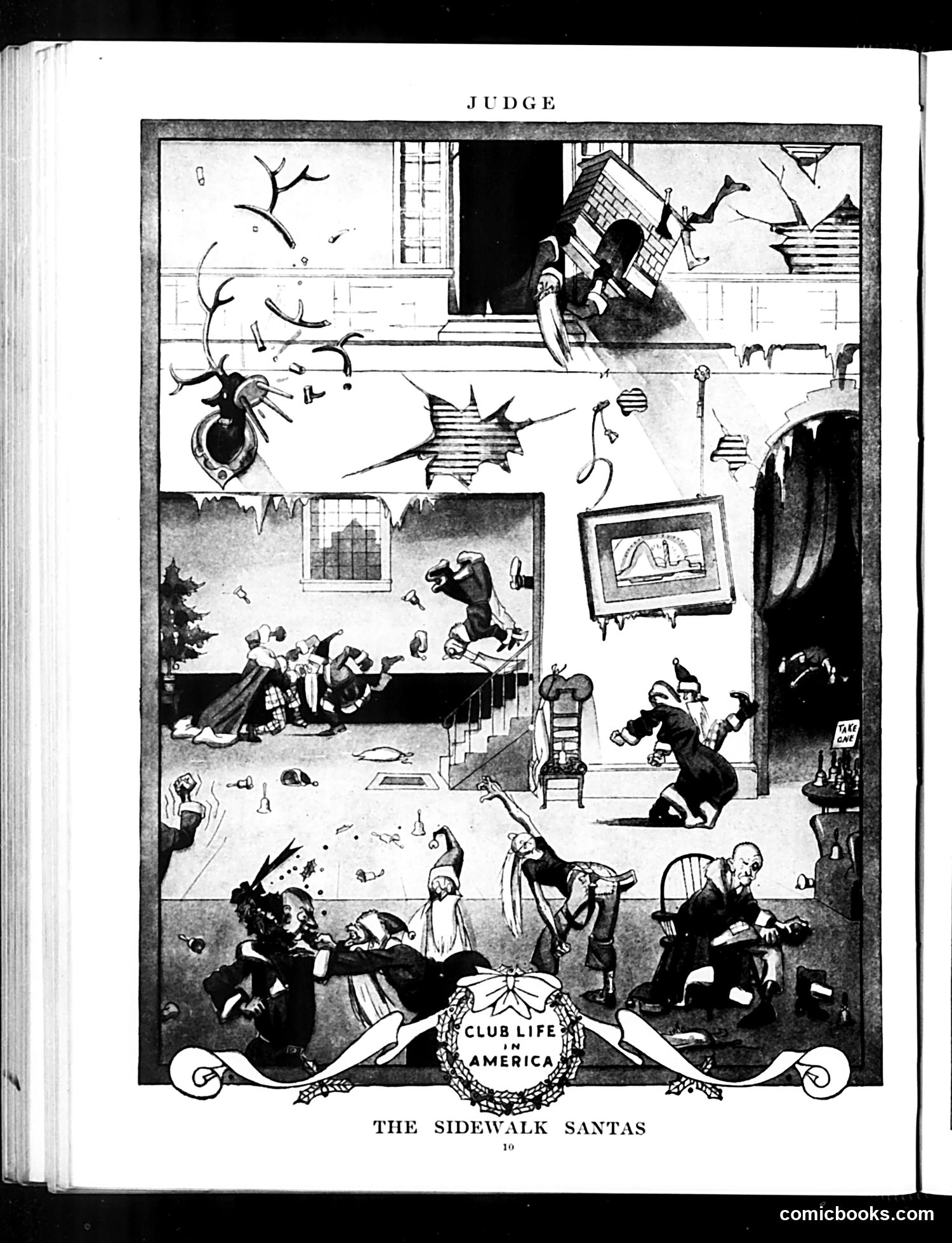
This satirical illustration from *Judge* magazine depicts the chaos of Christmas charity on city streets. The multi-panel cartoon shows various figures dressed as Santa Claus operating on sidewalks—some appear to be soliciting donations while others engage in disruptive behavior. The satire targets the proliferation of street-corner Santas during the holiday season, likely criticizing both fraudulent charity collectors and the general nuisance they created in urban areas. The chaotic, layered scenes suggest confusion about which Santas are legitimate charitable operations versus opportunistic imposters exploiting holiday goodwill. The title "Sidewalk Santas" combined with the disorderly composition mocks how commercial Christmas fundraising had become a fixture of American cities, with competing solicitors creating public disorder.
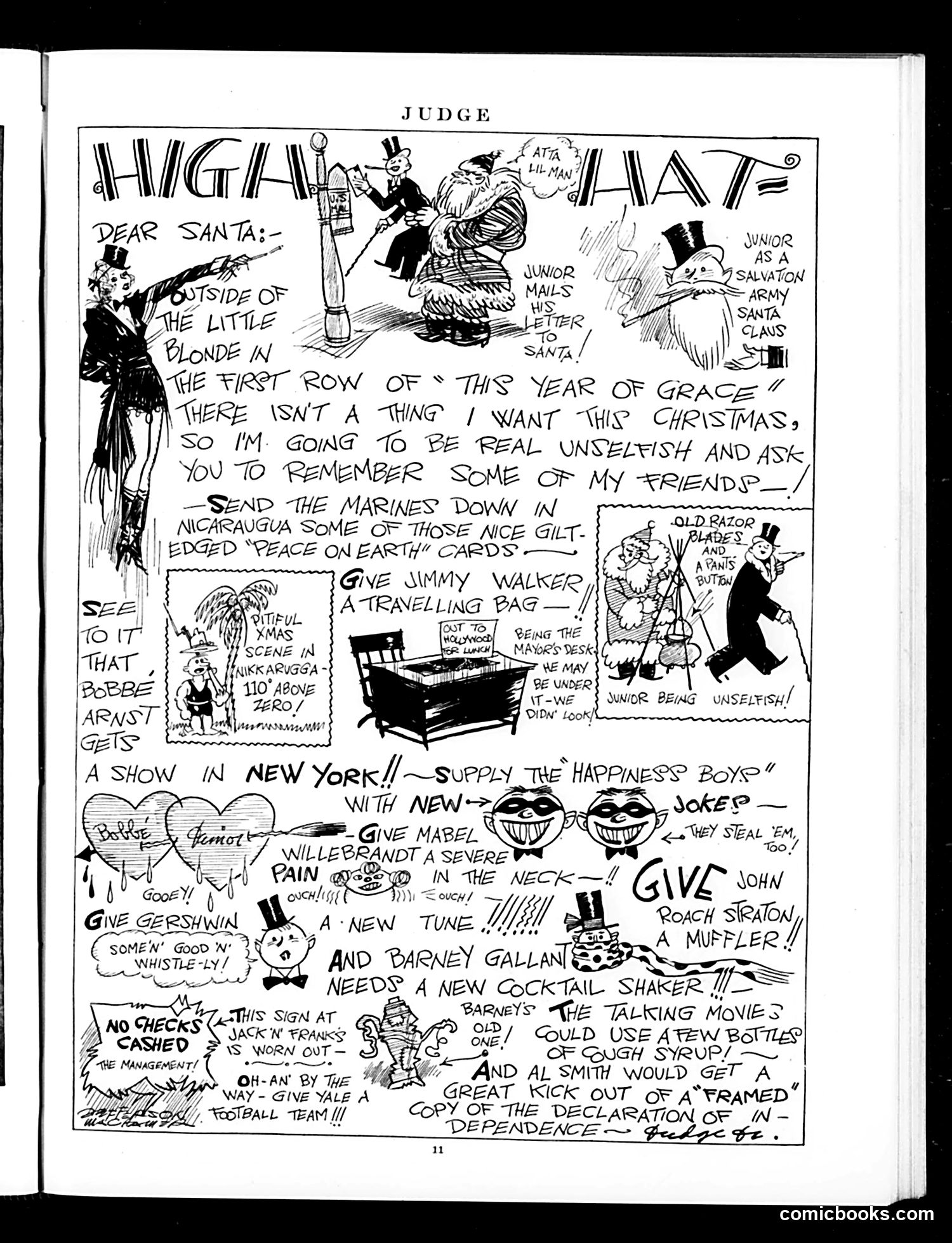
This is a Christmas-themed satirical letter to Santa Claus by someone identified as "a little blonde in the first row," requesting unselfish gifts for friends rather than personal items. The targets include: - **Marines in Nicaragua**: Reference to U.S. military intervention (likely early 1900s-1920s) - **Named entertainers**: Jimmy Walker, Gershwin, Willbrandt, John Roach Straton, Barney Gallant, and Al Smith—contemporary popular figures and personalities - **The Talking Movies**: A newer entertainment technology at the time The satire mocks both the requestor's performative unselfishness and the frivolous desires of celebrities and public figures (peace cards for war zones, new musical compositions, cocktail shakers). Al Smith's mention suggests political relevance, likely related to Prohibition-era debates. The overall joke: presenting wealthy entertainers' trivial wants as deserving Christmas charity, while actual humanitarian needs (military intervention, suffering civilians) are presented matter-of-factly.
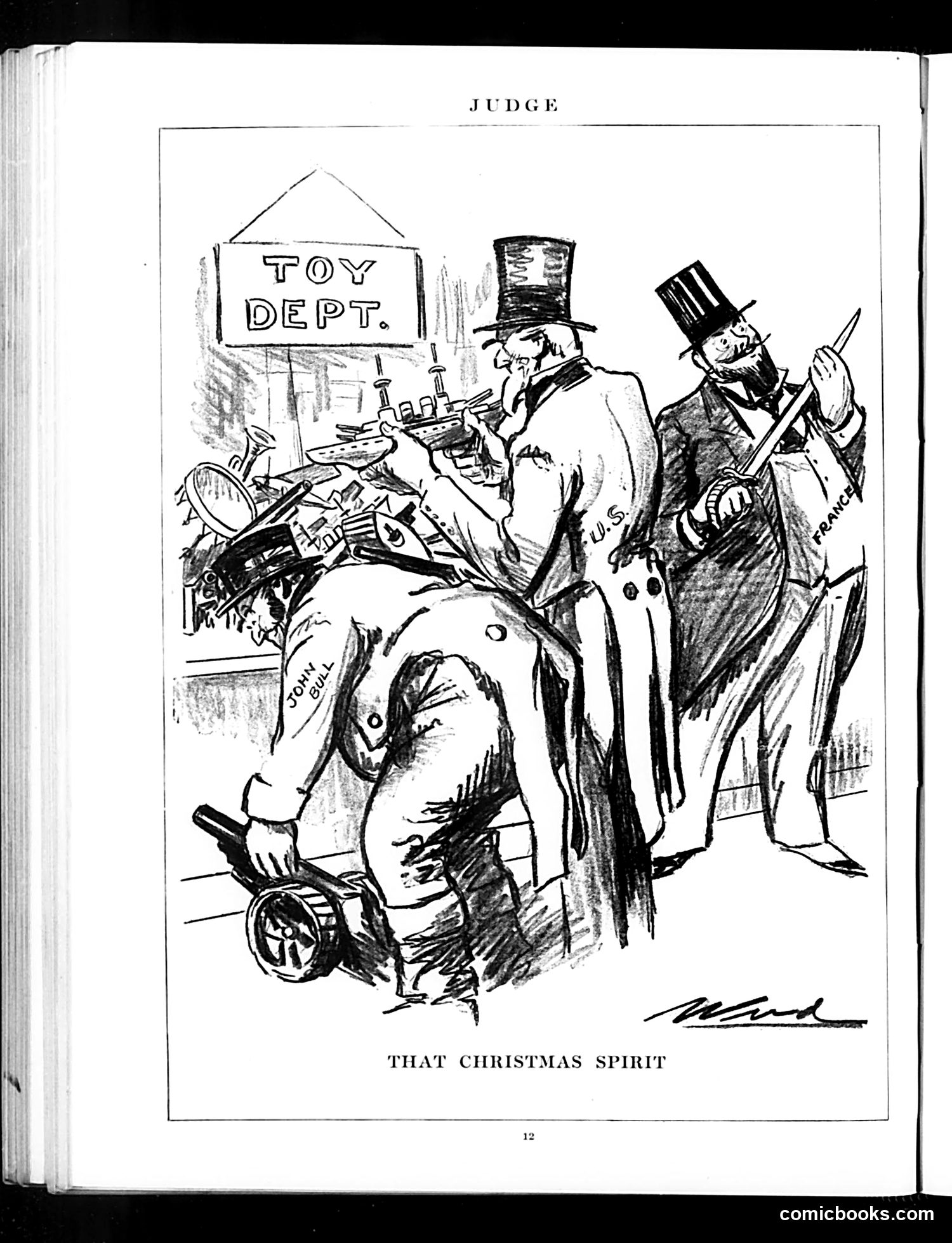
This political cartoon depicts two well-dressed gentlemen in top hats examining toys at a "TOY DEPT." counter. One figure is labeled "U.S." The cartoon satirizes the contrast between the Christmas season's supposed spirit of generosity and goodwill versus the commercialism and materialism of toy purchasing. The "Christmas Spirit" caption suggests irony—these figures appear to be inspecting merchandise with calculating interest rather than genuine holiday sentiment. The detailed rendering of various toys suggests commentary on consumer excess or the commodification of Christmas. Without a visible date, the specific political context remains unclear, though Judge magazine typically addressed contemporary social issues. The cartoon likely critiques how commercial interests overshadow authentic charitable impulses during the holiday season.
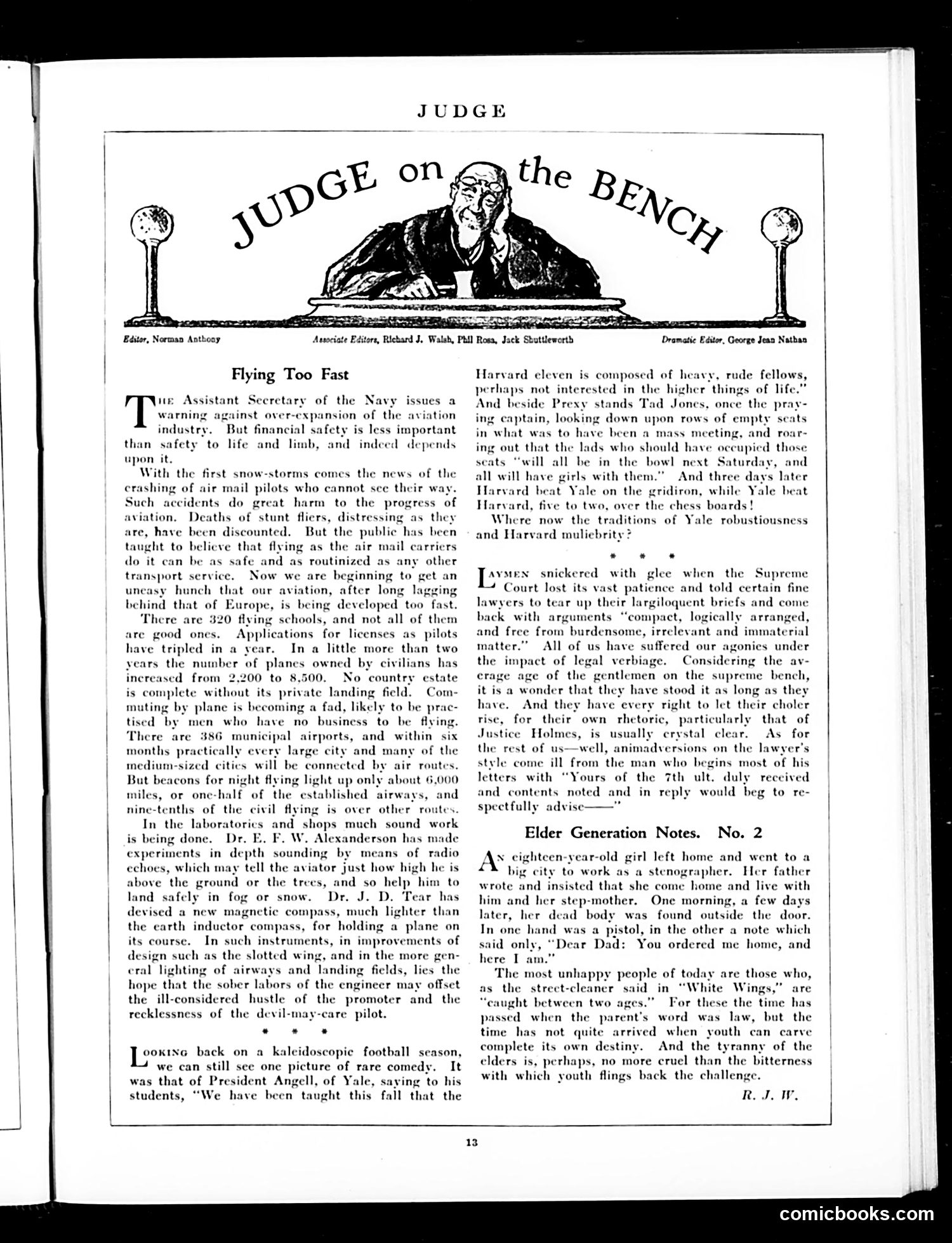
This page from *Judge* contains two separate pieces: **"Flying Too Fast"** discusses the dangerous rapid expansion of American aviation. The piece warns that while aircraft technology has improved (citing advances in radio echoes and compass design), the industry is growing recklessly—320 flying schools now exist, civilian plane ownership has jumped from 2,200 to 8,500 in two years, and private citizens are buying personal landing fields. The critique is that this growth prioritizes profit over safety; unqualified "devil-may-care" pilots and promoters are operating planes on poorly-lit routes, causing crashes that harm aviation's reputation. **"Judge on the Bench"** comments on recent Yale-Harvard rivalry. It mocks President Angell of Yale and coach Tad Jones for their dismissive attitudes toward academics, with Jones claiming future athletes will arrive with girlfriends rather than attending a mass meeting. The piece also notes Supreme Court justices' frustration with verbose legal arguments, suggesting their age makes lengthy briefs unbearable. Both pieces are satirical critiques of excess and recklessness in American institutions.
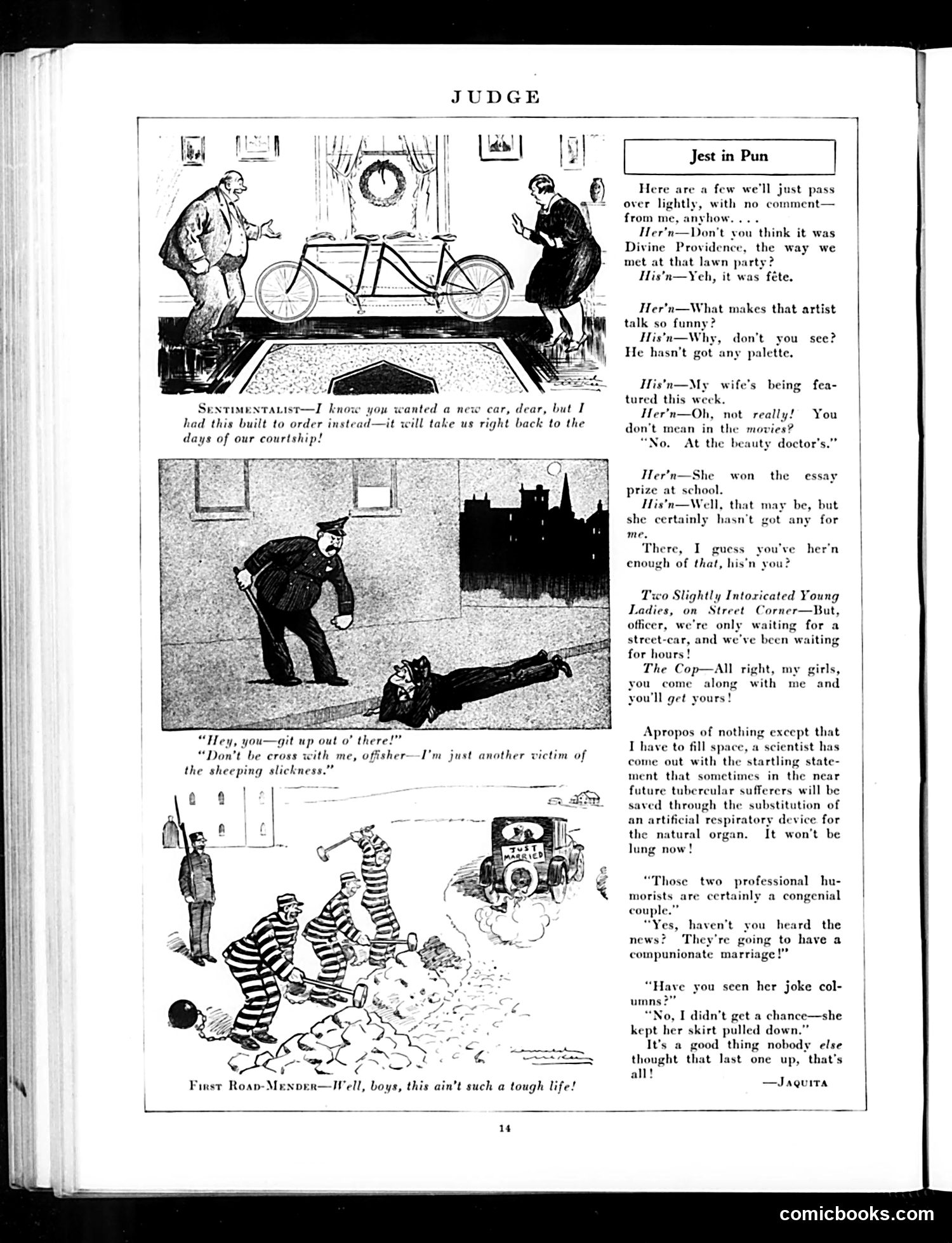
This page from *Judge* contains multiple brief humorous items typical of the magazine's format: **Top cartoon**: A sentimental husband shows his wife a tandem bicycle he built instead of buying a car, hoping to recreate their courtship romance. The satire mocks both excessive nostalgia and impractical gift-giving. **Middle cartoon**: A police officer confronts two intoxicated women loitering on a street corner. They claim they're waiting for a streetcar; he suggestively invites them along, implying arrest or worse. The humor relies on period double-entendre about moral danger to women. **"Jest in Pun" section**: A collection of brief joke exchanges between "Her'n" and "His'n" (his and hers perspectives), including wordplay about palettes/artists, beauty doctors, and essay prizes—gentle domestic humor. **Bottom item**: Brief jokes about a scientist's respiratory device invention and a "companionate marriage" (a 1920s concept of marriage based on companionship rather than tradition). The overall tone reflects 1920s-era humor: sentimental, domestically focused, with mild sexual innuendo and wordplay.
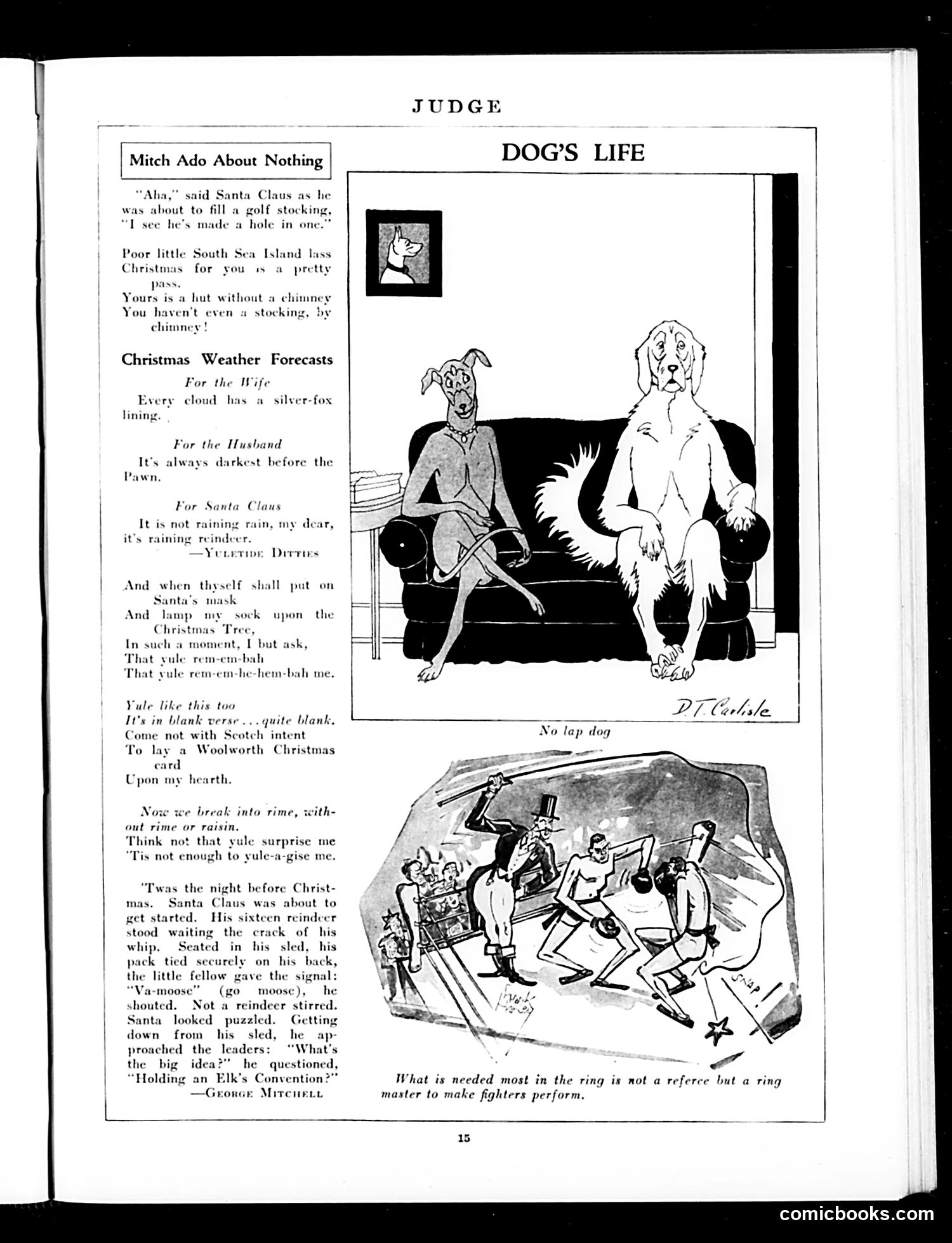
This page from *Judge* contains holiday-themed humor mixing Christmas jokes with dog illustrations and social commentary. **Top cartoon ("Dog's Life"):** Two anthropomorphized dogs sit on a couch in formal attire, with one labeled "No lap dog." The humor contrasts domestic comfort with independence—likely satirizing social pretension among wealthy pet owners versus working dogs. **Bottom cartoon:** Depicts Santa's reindeer refusing to move, with Santa wondering if they're attending an "Elk's Convention." This is absurdist holiday humor playing on the Elks Lodge (a fraternal organization popular in early 20th-century America). The joke suggests even reindeer get distracted by social clubs. **Left column:** Contains Christmas weather "forecasts" for wives, husbands, and Santa—puns playing on stereotypes (wives get luxury goods like furs, husbands lose money at cards, Santa deals with rain instead of snow). The overall tone is light, family-oriented satire typical of *Judge*'s approach—mocking social conventions and holiday excess rather than engaging serious political critique.
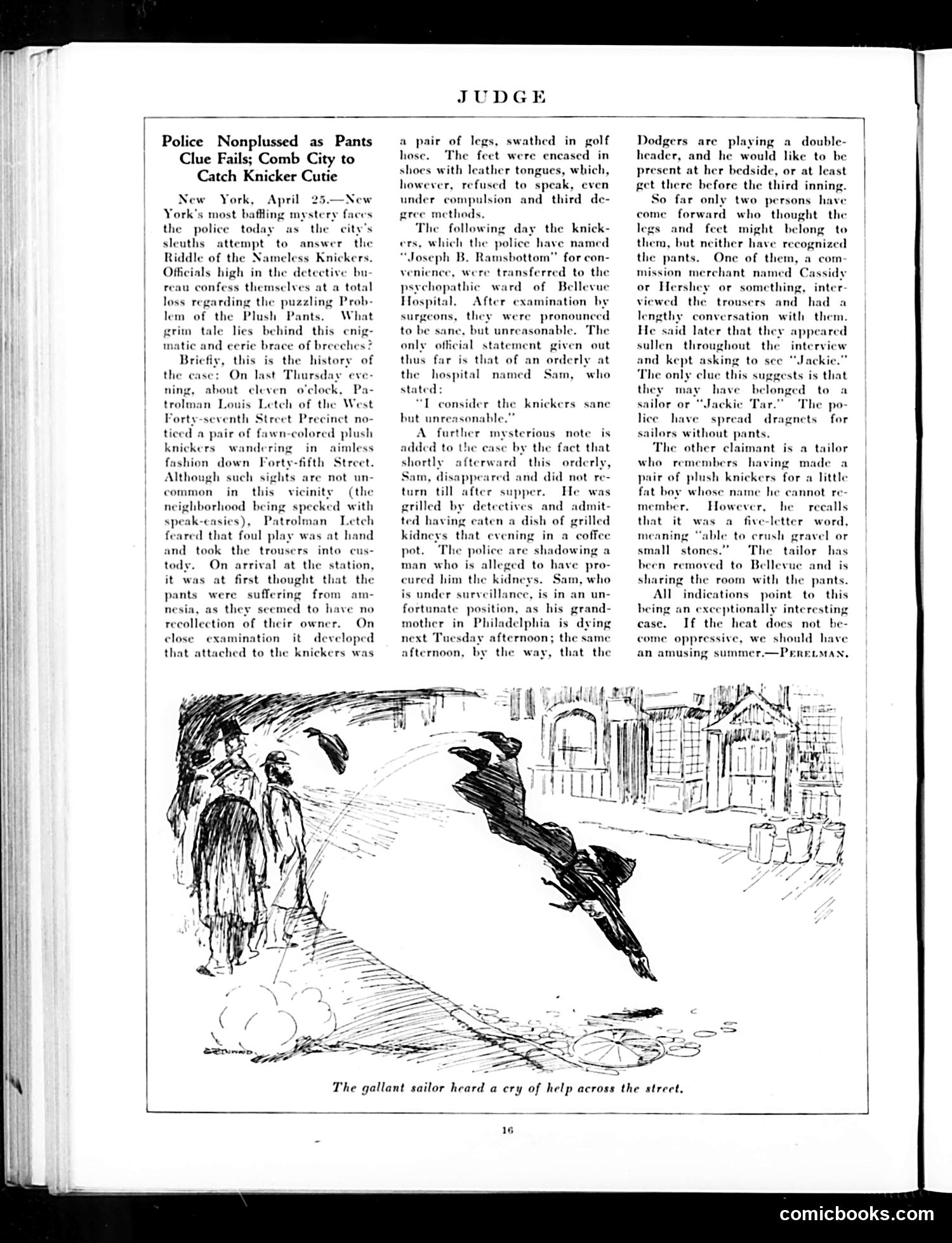
This is a mock-serious newspaper article parodying sensationalist crime reporting. The "mystery" concerns a pair of abandoned plush knickers (pants) found wandering a New York street, treated as a genuine police investigation. The satire works through absurd escalation: police interrogate the pants themselves, transfer them to a psychiatric ward at Bellevue Hospital, interview witnesses who claim ownership, and pursue elaborate investigative leads (including a suspicious orderly who ate kidneys). The wordplay and circular logic—such as identifying the pants as "Joseph B. Ramsbottom" for convenience, or the tailor's cryptic five-letter description—mock both police incompetence and overwrought journalistic coverage of trivial matters. References to Prohibition-era speakeasies and the Dodgers baseball schedule ground the humor in 1920s New York specifics. The final illustration shows a sailor in distress, suggesting the pants belonged to someone from the docks. The joke satirizes how newspapers sensationalize minor incidents into major mysteries.
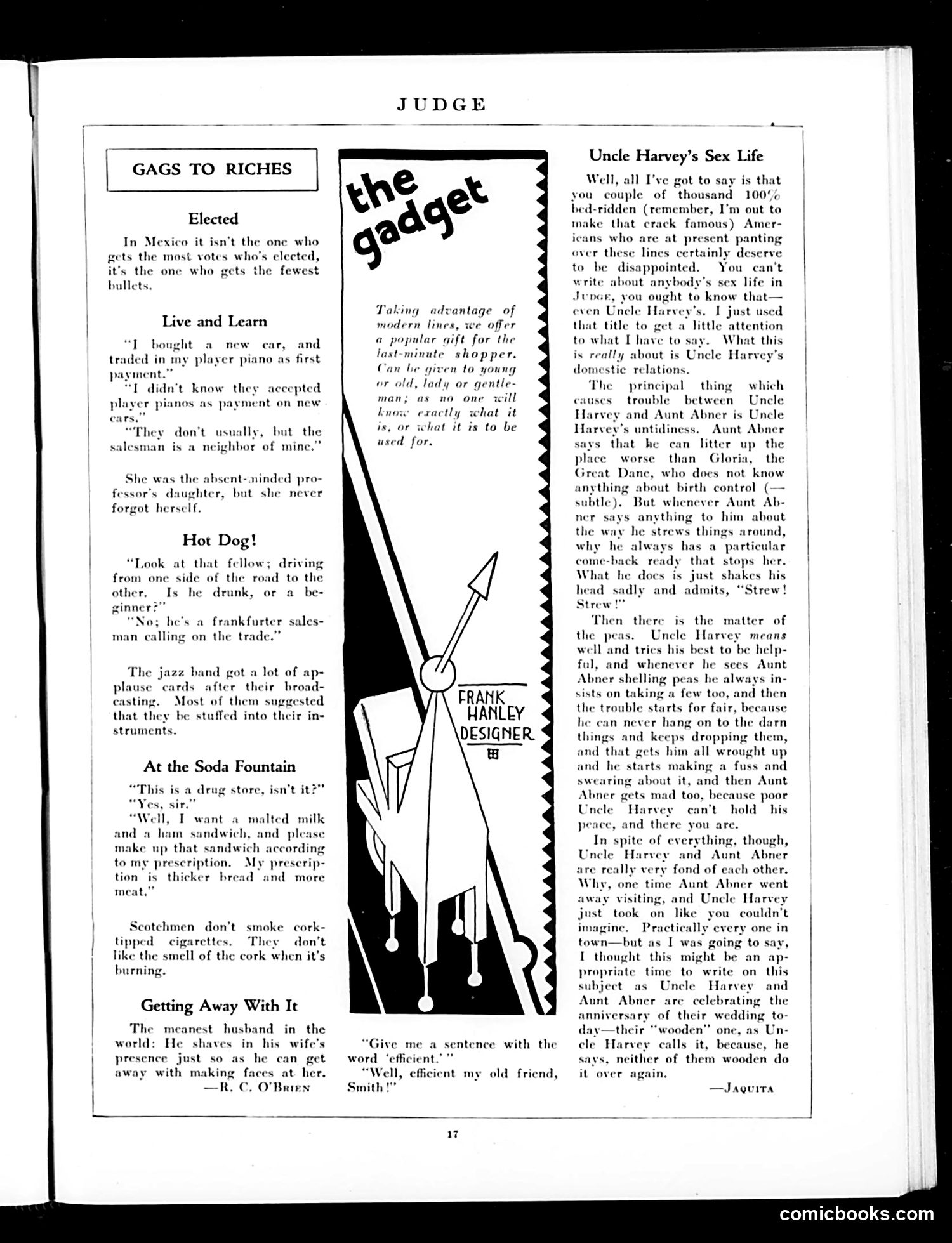
This page from *Judge* contains several short humor pieces ("Gags to Riches") and a longer satirical column about fictional characters Uncle Harvey and Aunt Abner. **The Short Gags** mock contemporary American life: Mexican electoral violence, player pianos as trade-ins, a frankfurter salesman, a jazz band's poor reception, and prescription-strength sandwiches. These reflect 1920s-era consumer culture and social absurdities. **"The Gadget"** (center illustration by Frank Hanley) advertises a mysterious gift item—deliberately vague because "no one will know exactly what it is." This satirizes modern consumer marketing and last-minute gift-giving desperation. **"Uncle Harvey's Sex Life"** is the main feature. The author (Jaquita) deliberately uses a provocative title to bait readers, then delivers domestic humor instead. The piece chronicles Uncle Harvey and Aunt Abner's marital squabbles—his messiness, pea-shelling disasters, and general untidiness—ultimately affirming their affection despite constant bickering. It's gentle, middle-class domestic satire typical of the era's humor magazines. The page reflects *Judge*'s formula: quick satirical jabs at modern life mixed with character-driven domestic comedy.
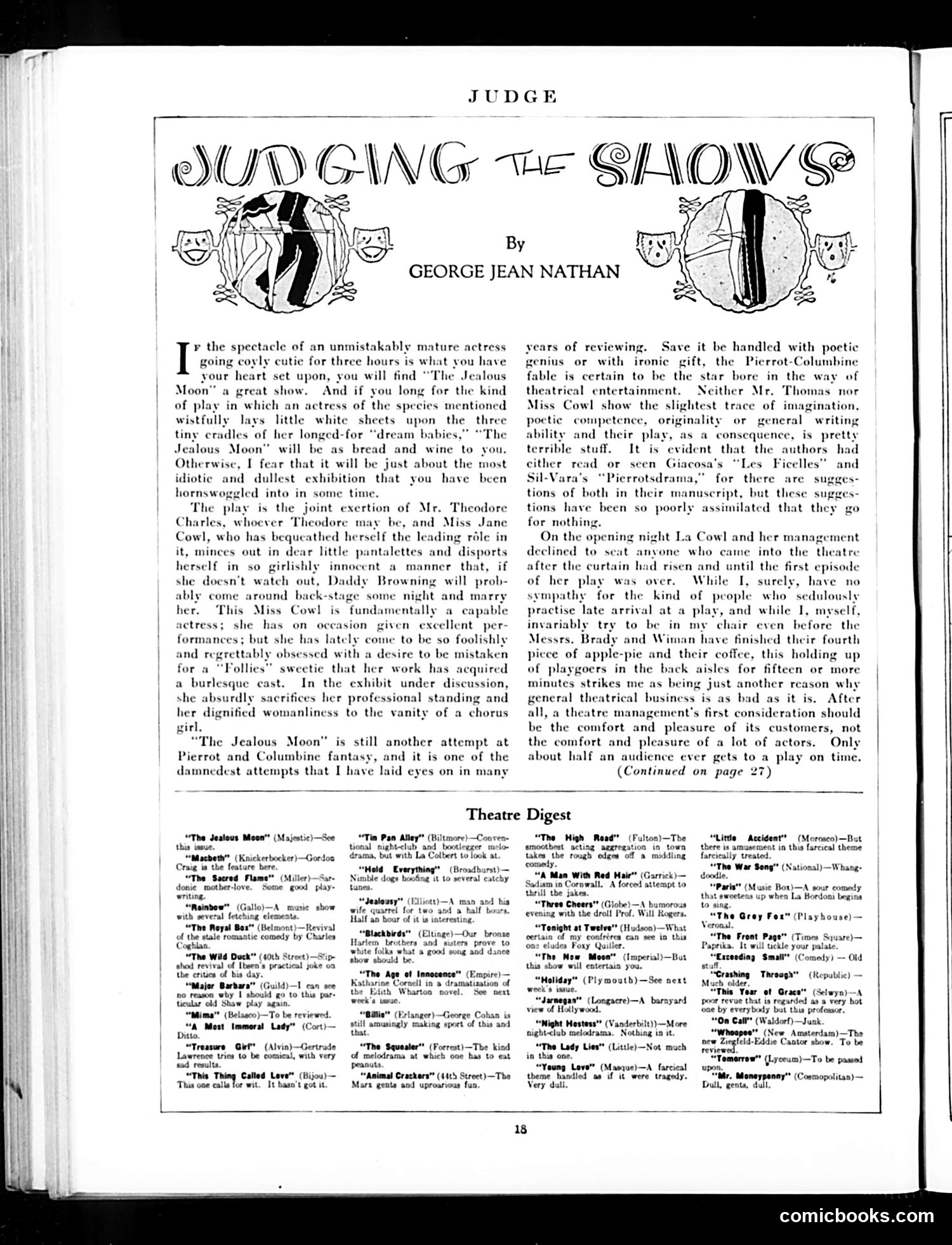
This is a theater review column by George Jean Nathan critiquing "The Jealous Moon," a play starring actress Jane Cowl. Nathan's satire targets both the production and Cowl's career choices. **The Main Critique:** Nathan mocks the play as a derivative "Pierrot and Columbine fantasy"—shallow theatrical fare. He argues that while Cowl is a genuinely capable actress, she has recently compromised her professional standing by accepting roles in frivolous material (notably "Follies" shows) and is now absurdly "sacrificing her professional standing" to play childish parts. **The Social Jab:** A reference to "Daddy Browning" (a 1920s scandal involving an older wealthy man and a young showgirl) implies Cowl's current roles make her look undignified and inappropriately juvenile for a mature actress. **The Theater Management Complaint:** Nathan also criticizes La Cowl's management for refusing entry to latecomers, calling this petty and bad for business—a practical complaint about theater etiquette standards. The column reflects 1920s theatrical snobbery: serious actresses shouldn't debase themselves in commercial comedies.
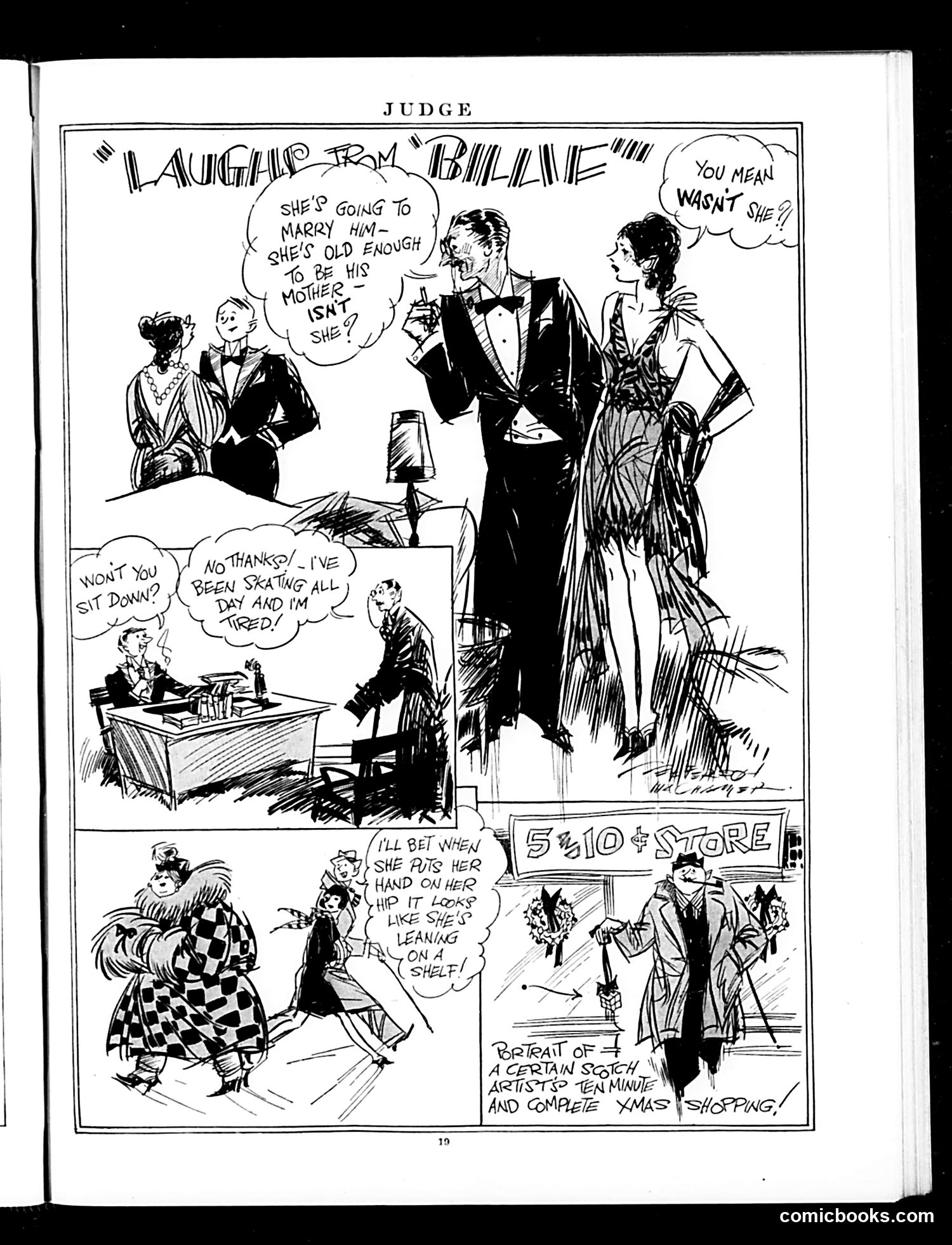
This cartoon satirizes high society marriage customs and materialism. The main scene depicts an elegant couple discussing a woman's impending marriage, with the man noting she's "old enough to be his mother" — suggesting the bride is considerably older than the groom, implying a marriage of financial convenience rather than romance. The lower panels mock the superficiality of wealthy socialites, particularly in gift-giving and holiday shopping. The final panel parodies the rushed, materialistic nature of Christmas shopping among the elite, depicting a "sketch artist's ten-minute" portrait session as a gift — a humorous jab at both artistic pretension and the performative nature of upper-class gift-giving. The overall satire targets the vanity and transactional nature of wealthy society during this era.
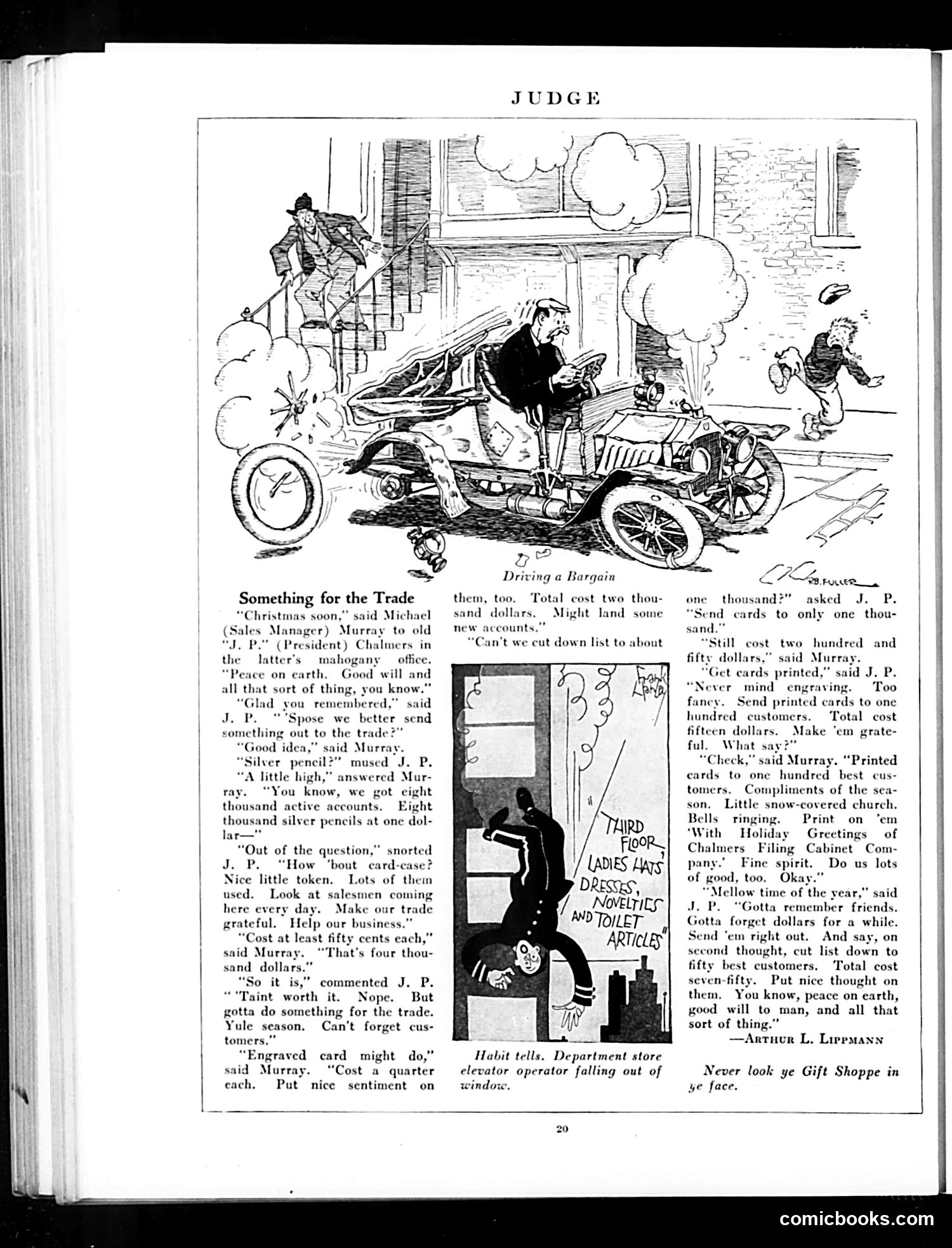
This is a satirical dialogue between two businessmen—Sales Manager Murray and President J.P.—debating what Christmas gift to send their company's clients. The humor lies in watching the gift shrink from eight thousand silver pencils ($8,000) down to printed cards for fifty customers ($7.50), as J.P. repeatedly cuts costs while rhetorically invoking sentimental Christmas values like "peace on earth" and "good will to man." The satire mocks corporate hypocrisy: executives talk about remembering friends and forgetting dollars during the holidays, yet obsessively pare down spending. The accompanying cartoon shows a car salesman demonstrating a vehicle with aggressive salesmanship, reinforcing the cynical view that "the trade" (salesmen/business) operates on manipulation rather than genuine sentiment. The final caption—"Never look ye Gift Shoppe in ye face"—puns on "never look a gift horse in the mouth," suggesting that corporate gifts are inherently deceptive tokens masking profit-focused motivations.
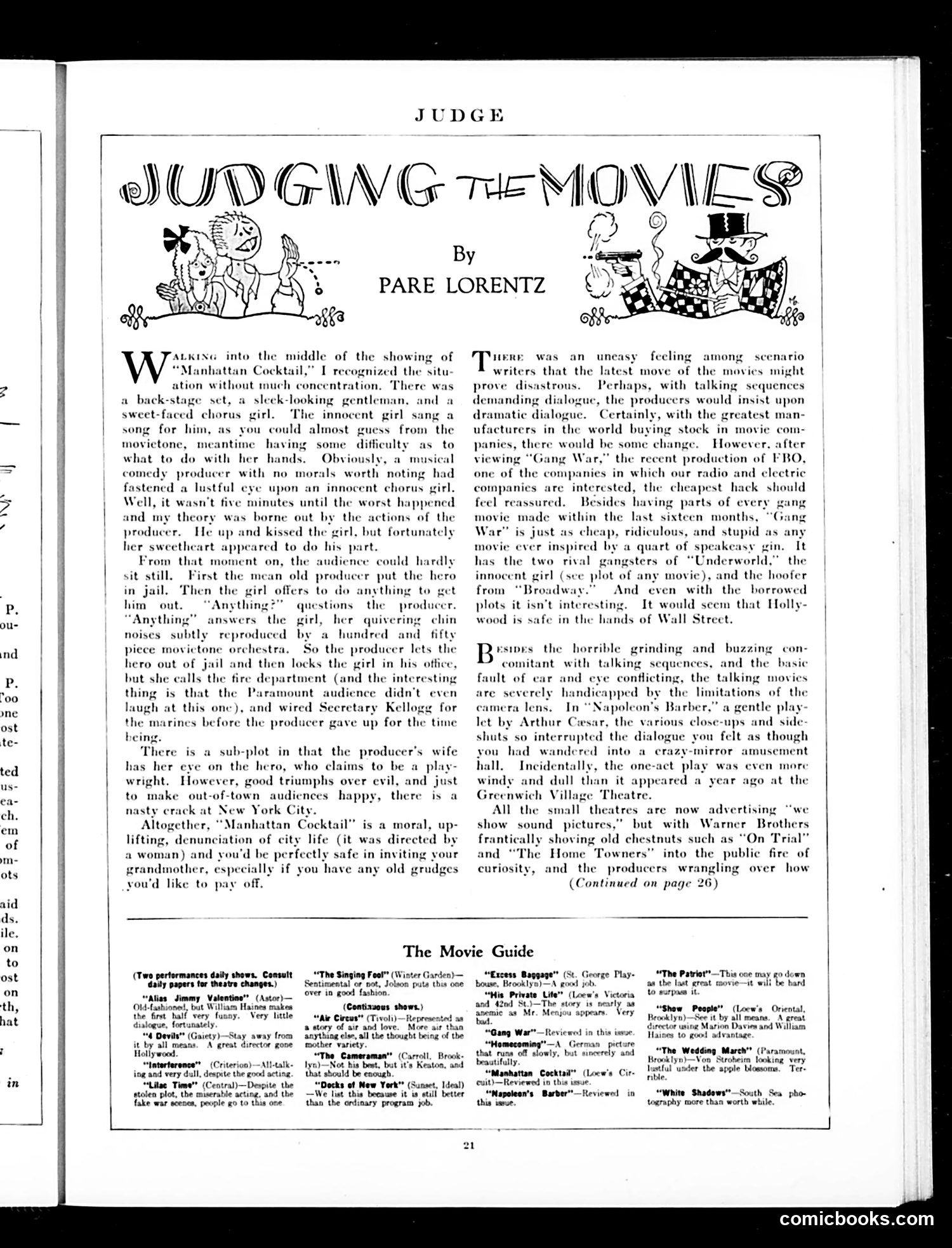
This is a film criticism column reviewing current movies, not a political cartoon. The page critiques 1920s silent films with talking sequences—a new technology causing technical problems. Lorentz mocks "Manhattan Cocktail" as a morality tale about a lustful producer seducing a chorus girl, calling it hypocritical moralizing from an immoral industry. He notes that talking pictures are severely limited by camera constraints and poor dialogue, making even recycled plots worse. He criticizes "Gang War" as cheap and ridiculous, and observes that despite Hollywood's supposed moral reformation, "Wall Street" controls the industry's output. The column reviews multiple current releases, praising some performances (William Haines) while condemning poor acting, stolen plots, and technical incompetence. The satire targets Hollywood's pretense of moral authority while prioritizing profit over quality.
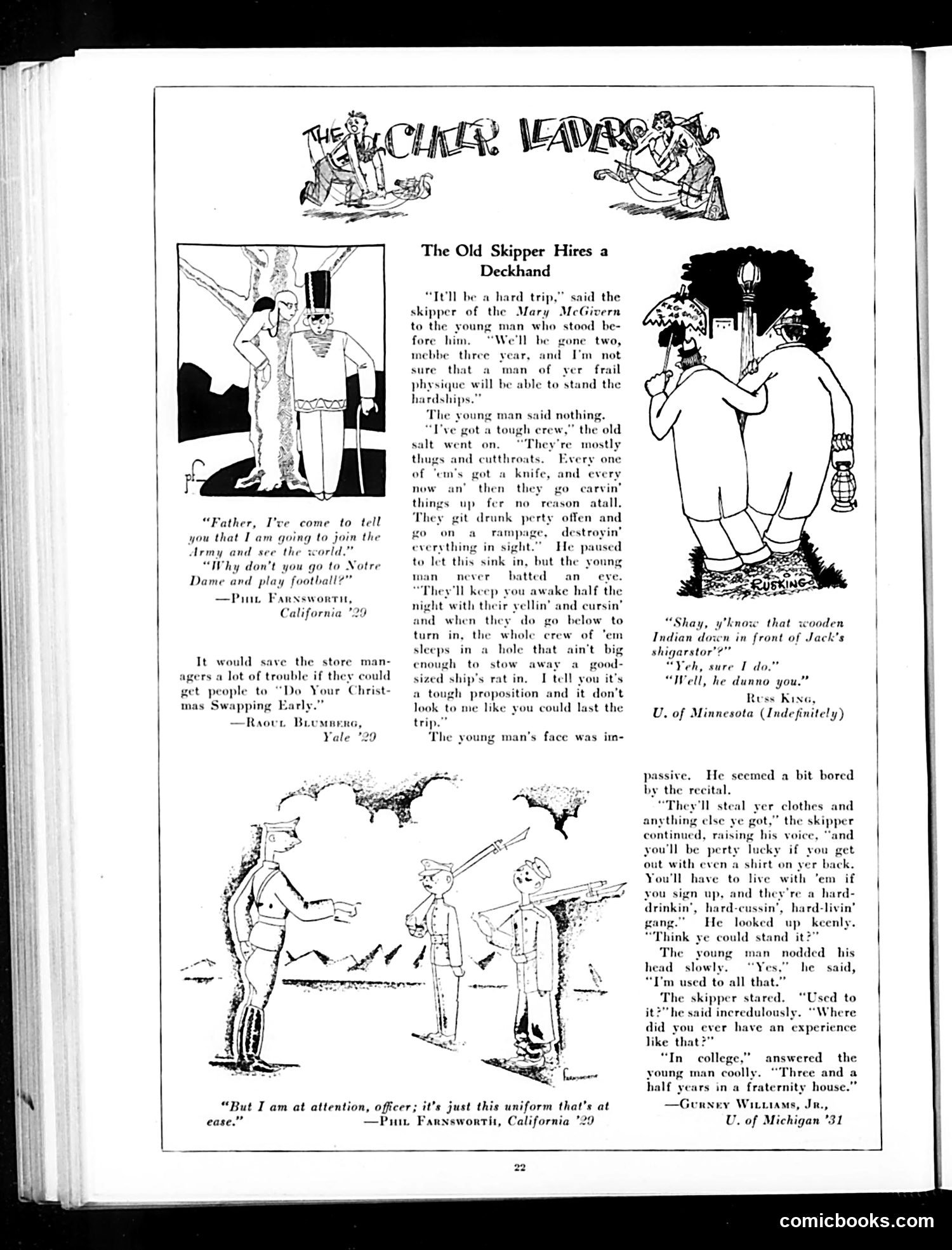
This page contains a humorous short story illustrated with period pen-and-ink drawings. The narrative follows a ship's captain interviewing a prospective deckhand for the *Mary McGivern*. The skipper graphically details the hardships: a rough, violent crew of "thugs and cutthroats" who drink heavily, fight, steal, and keep the ship in constant chaos. The young man remains unmoved by these warnings. The punchline reveals he's a recent college graduate who claims fraternity life prepared him for anything—the implication being that college fraternities of the late 1920s were notorious for drunken rowdiness and brutality. The joke satirizes both the recklessness of college "Animal House" culture and suggests fraternity hazing rivals actual maritime danger. The page also includes unrelated advertisements and humor snippets typical of Judge magazine's format.
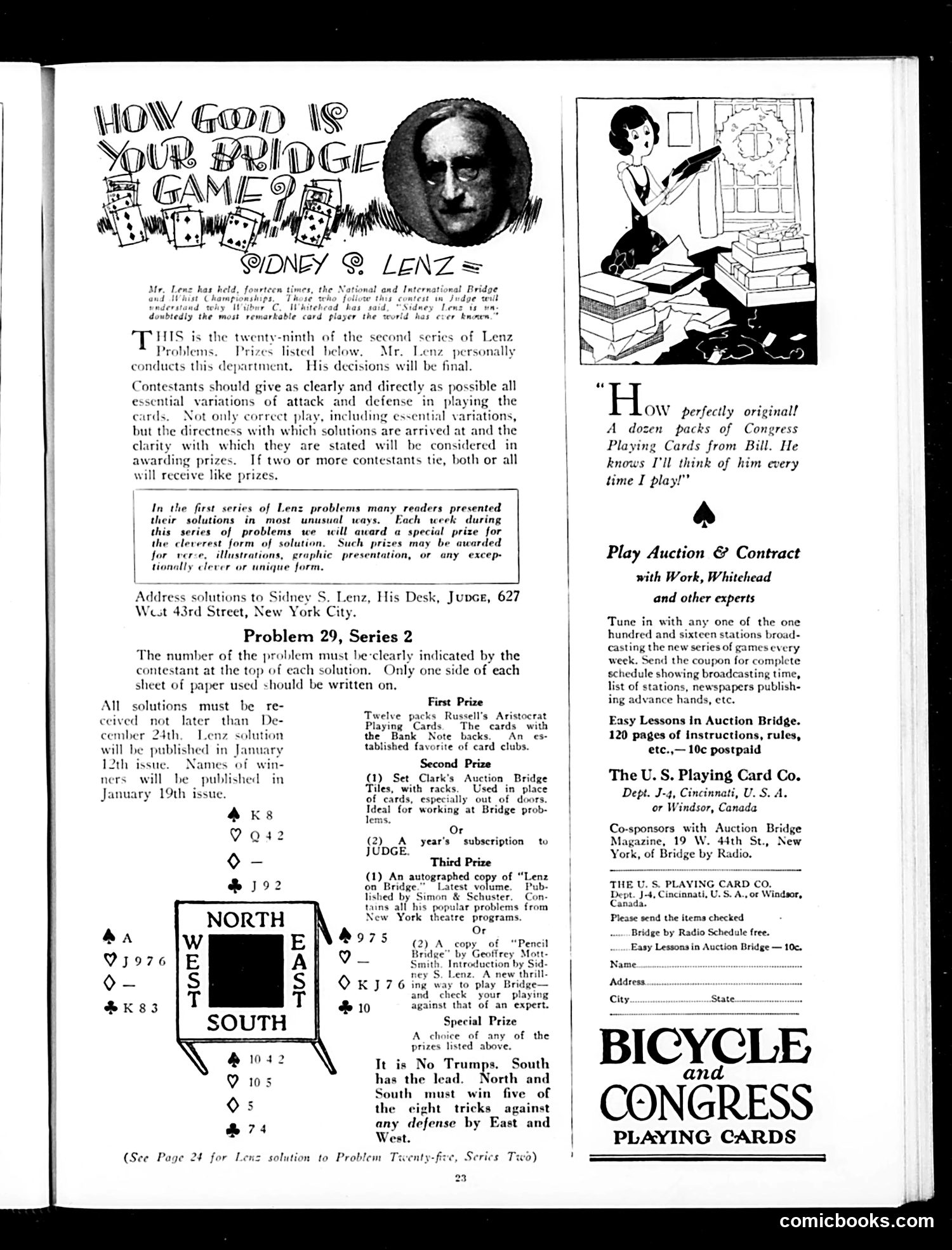
This page is primarily a **bridge card game problem column**, not political satire. The circular portrait at top shows **Sidney Lenz**, a renowned bridge champion who conducted this problem-solving competition in Judge magazine. The text explains this is the 29th problem in his second series, with Lenz serving as final judge of solutions. The small cartoon on the right depicts a woman arranging bridge cards and strategy materials—illustrating the hobby's popularity. The quote "How perfectly original! A dozen packs of Congress Playing Cards from Bill" is a humorous advertisement wrapped in dialogue, suggesting bridge was a fashionable pastime. The bulk of the page contains the actual bridge problem with card positions (the "NORTH/SOUTH/EAST/WEST" diagram) and prize announcements for solutions—ranging from Russell's Aristocrat playing cards to Judge magazine subscriptions to autographed bridge instruction books. **This reflects 1920s-30s America's bridge craze**, when the game was enormously popular among middle and upper classes, with competitions, radio broadcasts, and instructional materials widely promoted in mainstream magazines.
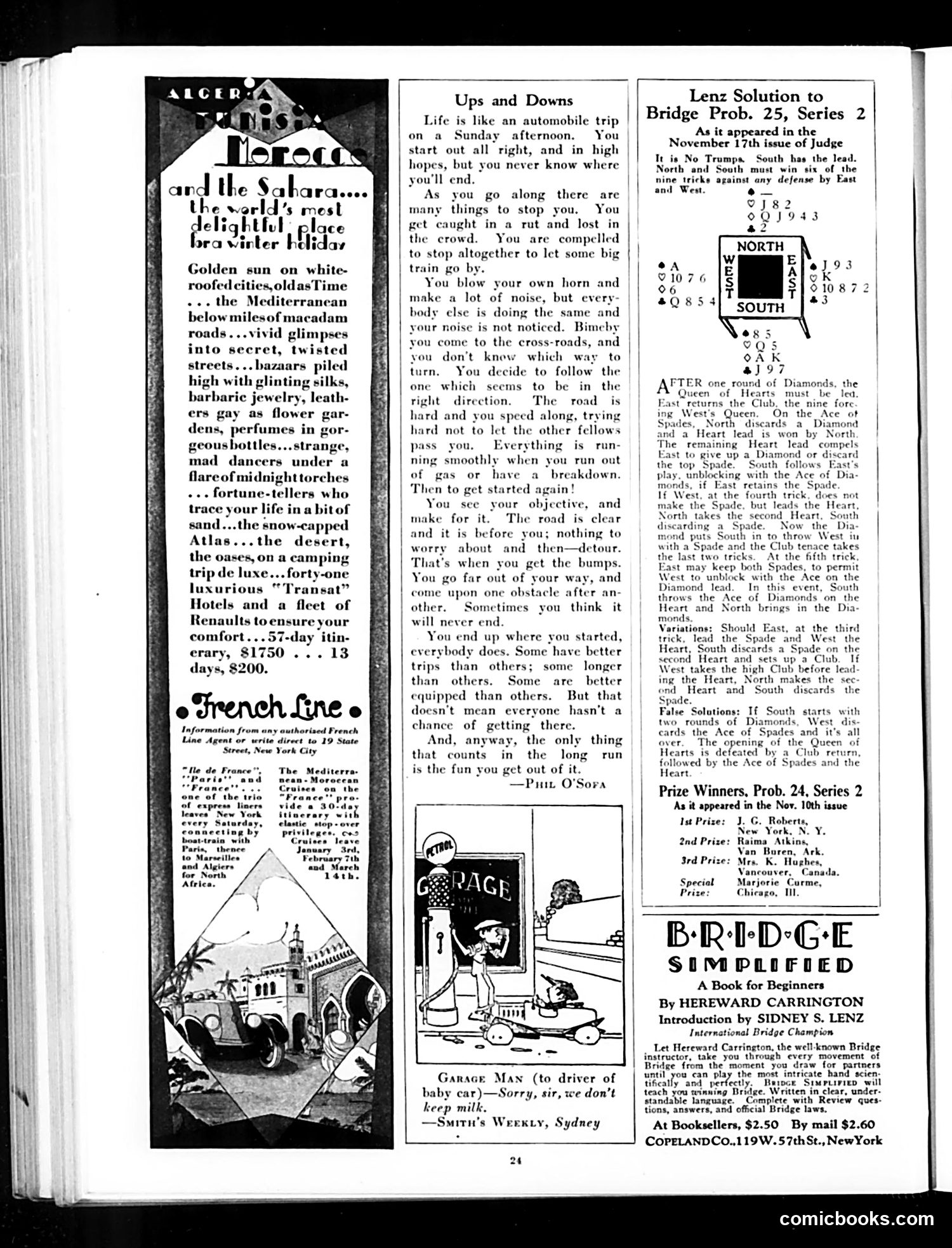
This page mixes travel advertising with bridge instruction and light humor. **Main Content:** The left side features a **French Line cruise advertisement** promoting luxurious Mediterranean travel to Algeria and North Africa, emphasizing exotic imagery (golden cities, bazaars, desert scenery). It advertises 57-day trips at $1,750-$2,200. **"Ups and Downs"** is a philosophical essay comparing life to a Sunday automobile drive—getting lost in crowds, hitting obstacles, experiencing breakdowns—ultimately arguing that only the "fun you get out of it" matters. This reflects 1920s-30s era optimism mixed with pragmatism. The **right side contains bridge problem solutions** from Judge's recurring puzzle feature, with prize winners listed. A small cartoon labeled **"Garage Man"** shows a service attendant apologizing to a customer with a baby carriage: "Sorry, sir, we don't keep milk." This is gentle domestic humor—the customer apparently expected the garage to stock milk, a mundane joke about modern life's conveniences. **Overall tone:** Light, aspirational entertainment mixed with practical games and advertising.
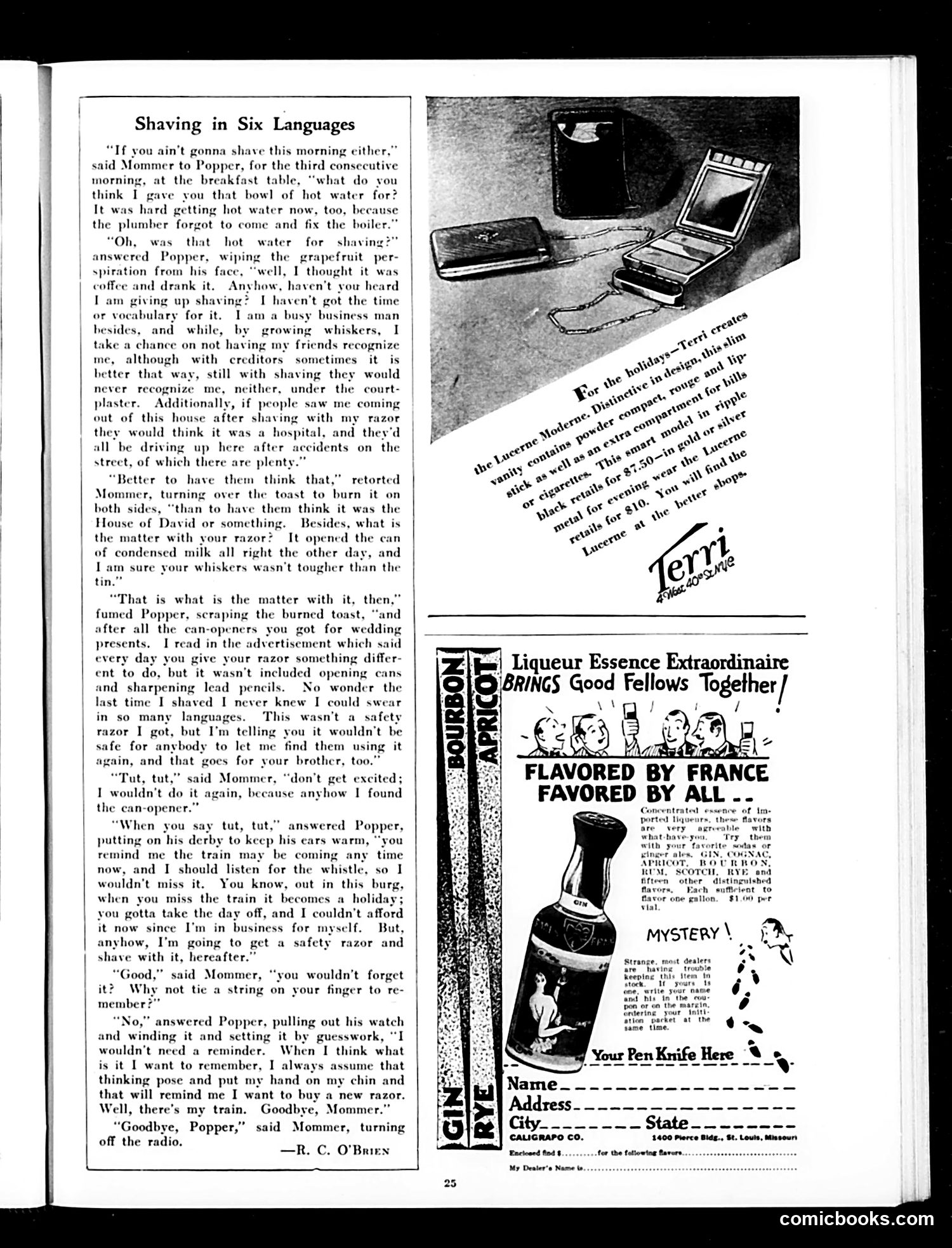
This is a domestic comedy sketch between "Mommer" and "Popper" (working-class characters representing typical American parents). The humor centers on Popper's incompetence and excuses: he drank the hot water meant for shaving, claims he's too busy to shave, and blames his dull razor for making him "swear in so many languages" while shaving—the title's joke being his cursing in multiple languages from frustration. The satire gently mocks: - **Male laziness and irresponsibility** (Popper avoids grooming with absurd excuses) - **Post-WWI domestic life** (references to wedding presents, safety razors, train schedules, and radio) - **Class anxieties** (fear creditors won't recognize him; worry about missing work) Mommer's exasperated responses and practical solutions (she found the can-opener) position her as the competent spouse managing household chaos. The sketch's humor relies on recognizable marital dynamics and the mundane frustrations of everyday life—timeless themes, though specific to 1920s-era details.
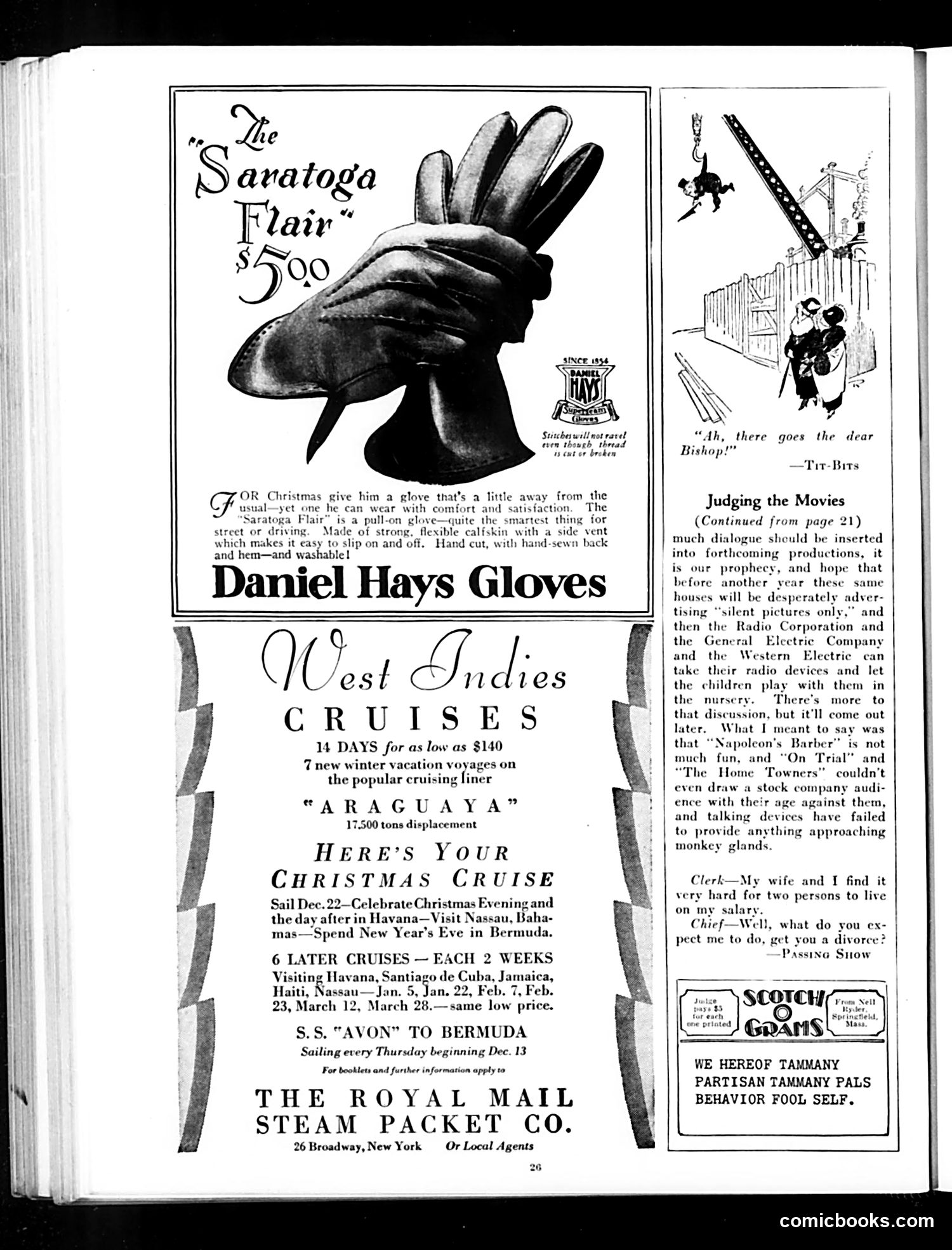
This is primarily an **advertising page** from Judge magazine, likely from the 1920s based on styling and references. The main content consists of three advertisements: 1. **Daniel Hays Gloves** - A Christmas gift advertisement for "Saratoga Flair" pull-on gloves ($5.00), emphasizing their quality construction and washability. 2. **West Indies Cruises** - Promotional material for the Royal Mail Steam Packet Company offering Caribbean vacation voyages, with Christmas and New Year cruises starting at $140 for 14 days. 3. **"Judging the Movies"** - A column continuing from page 21, discussing whether dialogue should be included in forthcoming film productions, with skepticism about "talking pictures" and references to specific films like "Napoleon's Barber." The page also contains brief humor items: a caption "'Ah, there goes the dear Bishop!'" from *Tit-Bits*, a dialogue joke about marriage economics, and a crude political jab at Tammany Hall. The content reflects 1920s concerns about emerging "talking pictures" technology and period humor conventions.
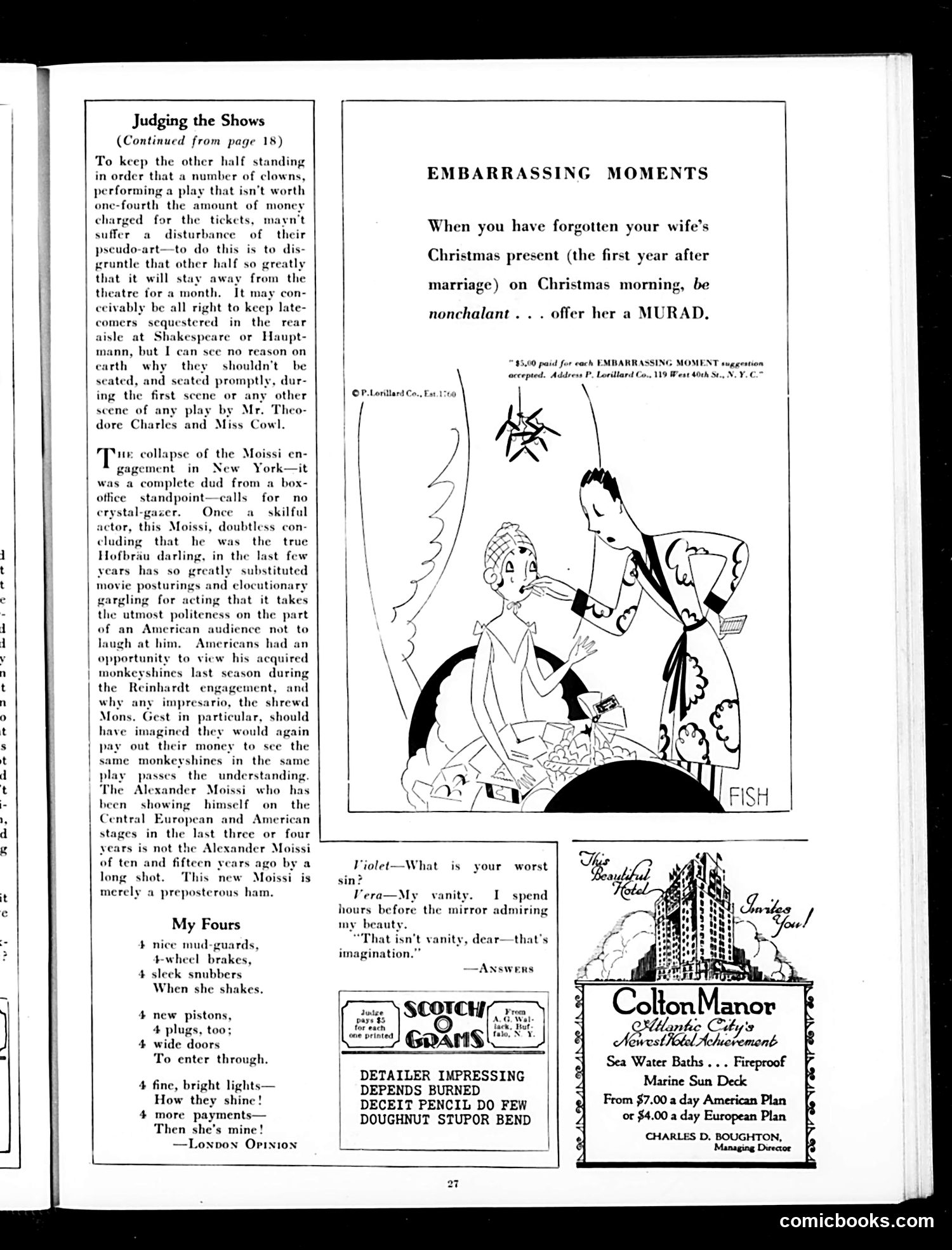
This page contains **mostly advertisements and filler content** rather than political satire. The main editorial piece critiques **Alexander Moissi**, a Central European actor performing in New York. The author argues Moissi, once a skilled performer, has devolved into a "preposterous ham," relying on exaggerated movie-style gestures and theatrical posturing rather than genuine acting. The piece mocks both Moissi's deteriorated talent and American audiences for tolerating his performances. The cartoon "Embarrassing Moments" is a **sponsored humor feature** where Murad cigarettes (a tobacco brand) pays for submitted jokes about awkward social situations—here, a husband forgetting his wife's first Christmas gift after marriage. Other content includes an automobile advertisement (the "My Fours"), a joke about vanity, and hotel advertising. The page reflects 1920s concerns about theatrical authenticity and early advertising integration into magazine humor.
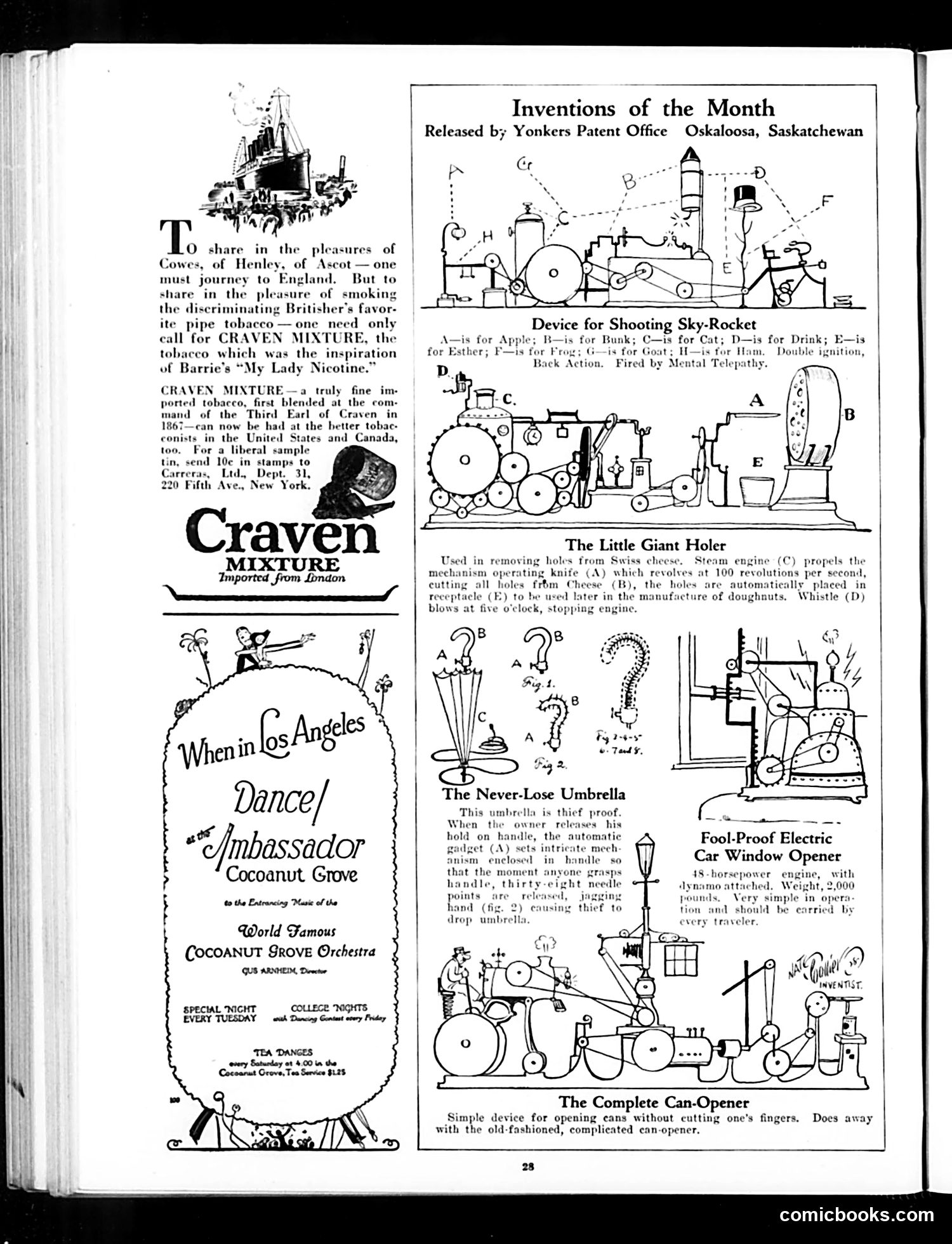
This page satirizes absurdly over-engineered gadgets and ridiculous patent claims. The "Inventions of the Month" section mocks the proliferation of unnecessarily complex contraptions marketed as solutions to everyday problems. The devices shown—a sky-rocket launcher, a "never-lose umbrella" with anti-theft mechanisms, an elaborate window opener, and a complicated can-opener—represent the era's tendency toward gadgetry overkill. Each invention solves a simple task through baroque mechanical means, the humor lying in their impracticality. The Yonkers/Oskaloosa Patent Office attribution is clearly fictional, suggesting any inventor could patent anything. This reflects early 20th-century frustration with patent proliferation and manufacturers hawking dubious contraptions as modern "innovations." The Craven Mixture tobacco advertisement and Cocoanut Grove dance hall ads are period commercial content, not satire. The page demonstrates Judge's formula: mixing social commentary through cartoon mockery with genuine era advertising.
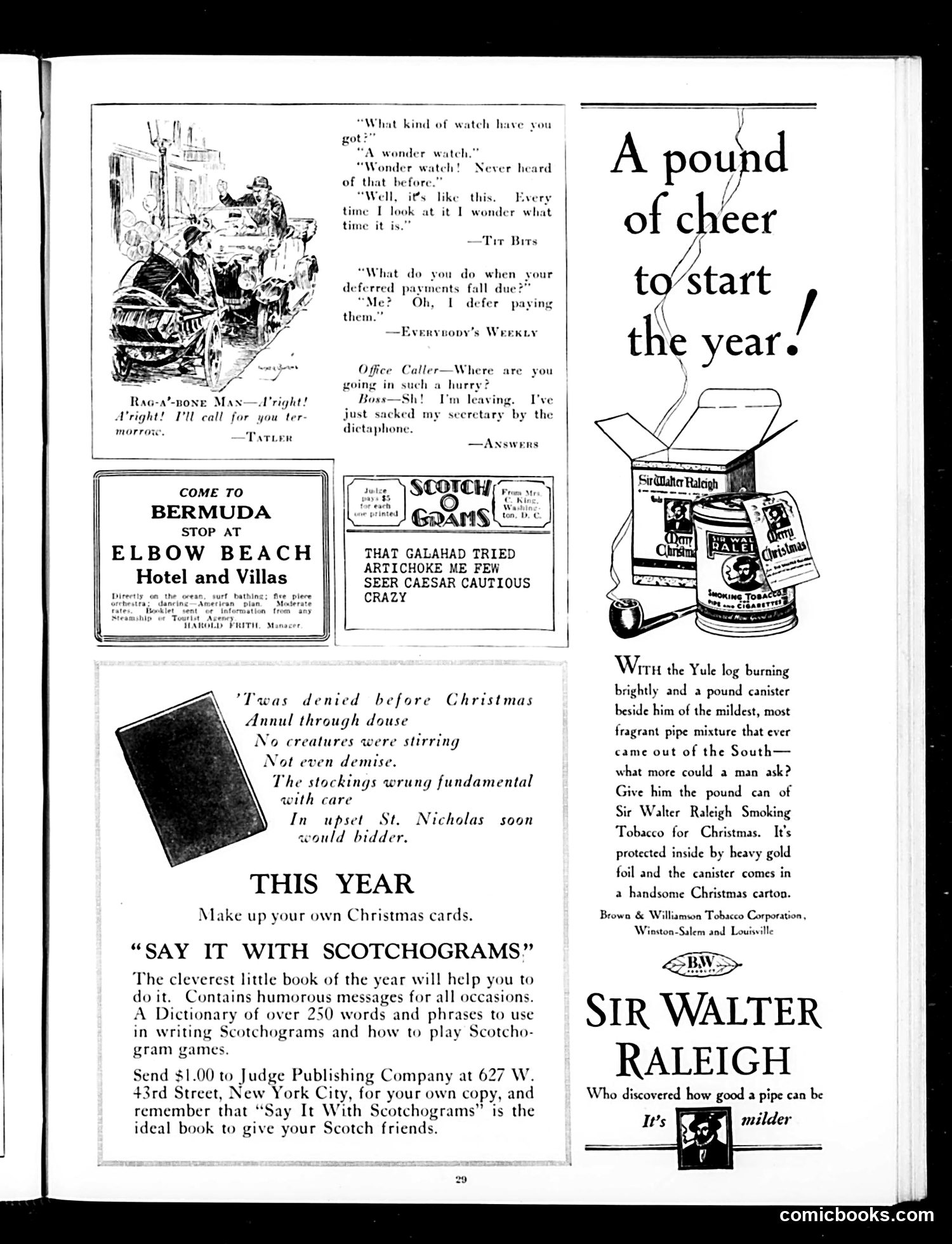
This page contains several satirical jokes typical of Judge's humor, plus period advertisements: **The cartoons mock everyday frustrations:** - A "wonder watch" that never shows the correct time - Deferred payment avoidance (deferring payment of deferred payments) - A boss firing his secretary via dictaphone—a new technology allowing remote communication, treated as impersonal and absurd **The "Rag-a-bone Man" sketch** (top left) depicts a street vendor in comedic haste. **"Say It With Scotchograms"** advertises a novelty gift book—puns on Scottish dialect phrases for Christmas cards, playing on the ethnic humor common to the era. **Advertisements** include travel (Bermuda hotel), and prominently, **Sir Walter Raleigh Smoking Tobacco**, featuring period copy emphasizing "mildness" and Christmas gift-giving. The page reflects 1920s consumer culture, modern technology anxiety, and casual ethnic stereotyping typical of Judge's demographic: middle-class readers amused by labor inconveniences and commercial product pitches.
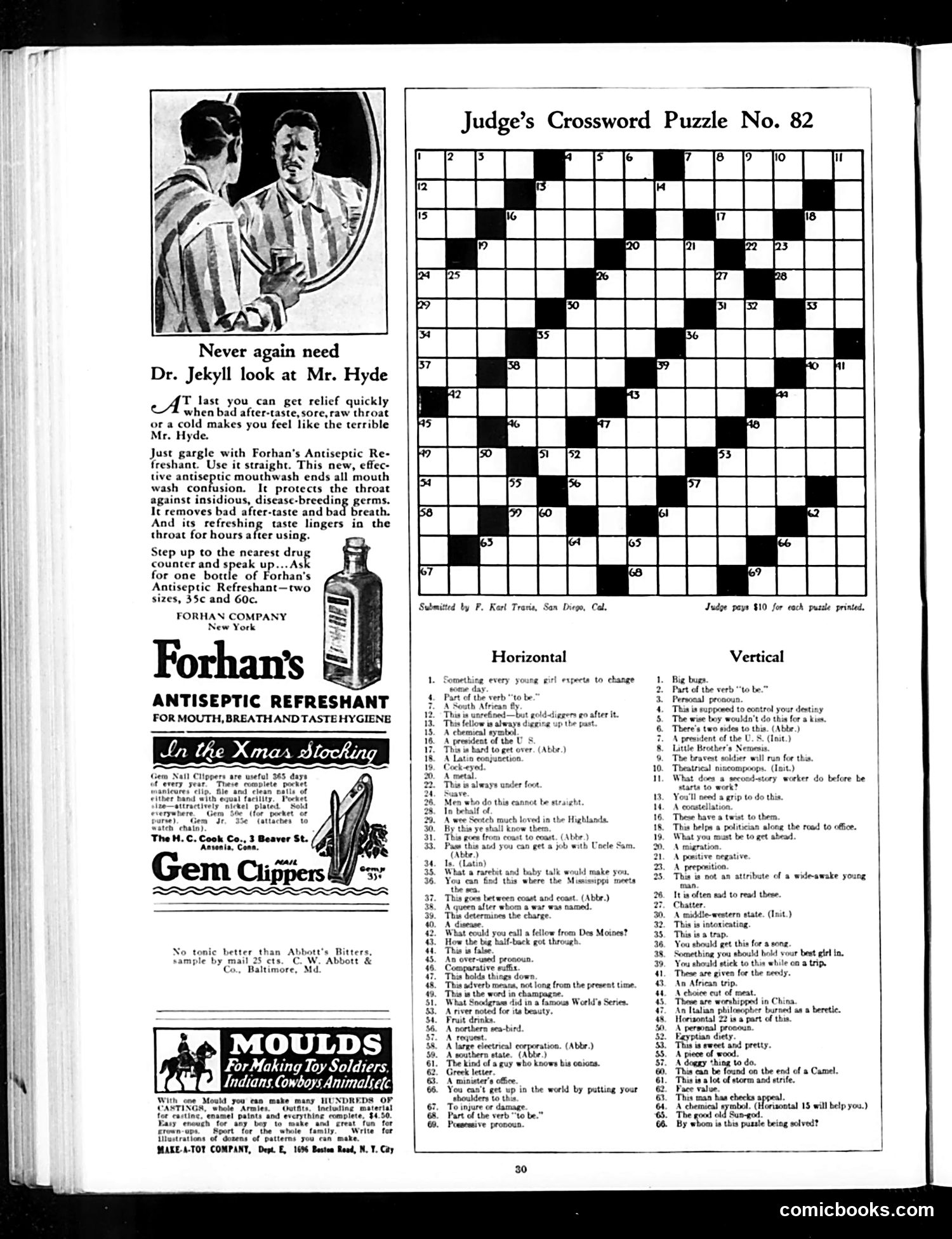
This page primarily features **advertising rather than satirical content**. The main illustration shows a man looking in a mirror at his distorted reflection, captioned "Never again need Dr. Jekyll look at Mr. Hyde." The reference is to Robert Louis Stevenson's *The Strange Case of Dr. Jekyll and Mr. Hyde* (1886), the famous novella about a man with a dual personality. Here, it's being used as a metaphor for how throat ailments and bad breath make someone feel terrible or unpleasant—like the monstrous Mr. Hyde. The advertisement claims that Forhan's Antiseptic Refreshant mouthwash will cure these problems, restoring one's pleasant appearance and demeanor. Below this main ad are several smaller advertisements (Gem Clippers, Moulds toy soldiers, Abbott's Bitters) and a crossword puzzle. There is **no political satire** on this page—it's a typical Judge magazine layout mixing entertainment with commercial advertising.
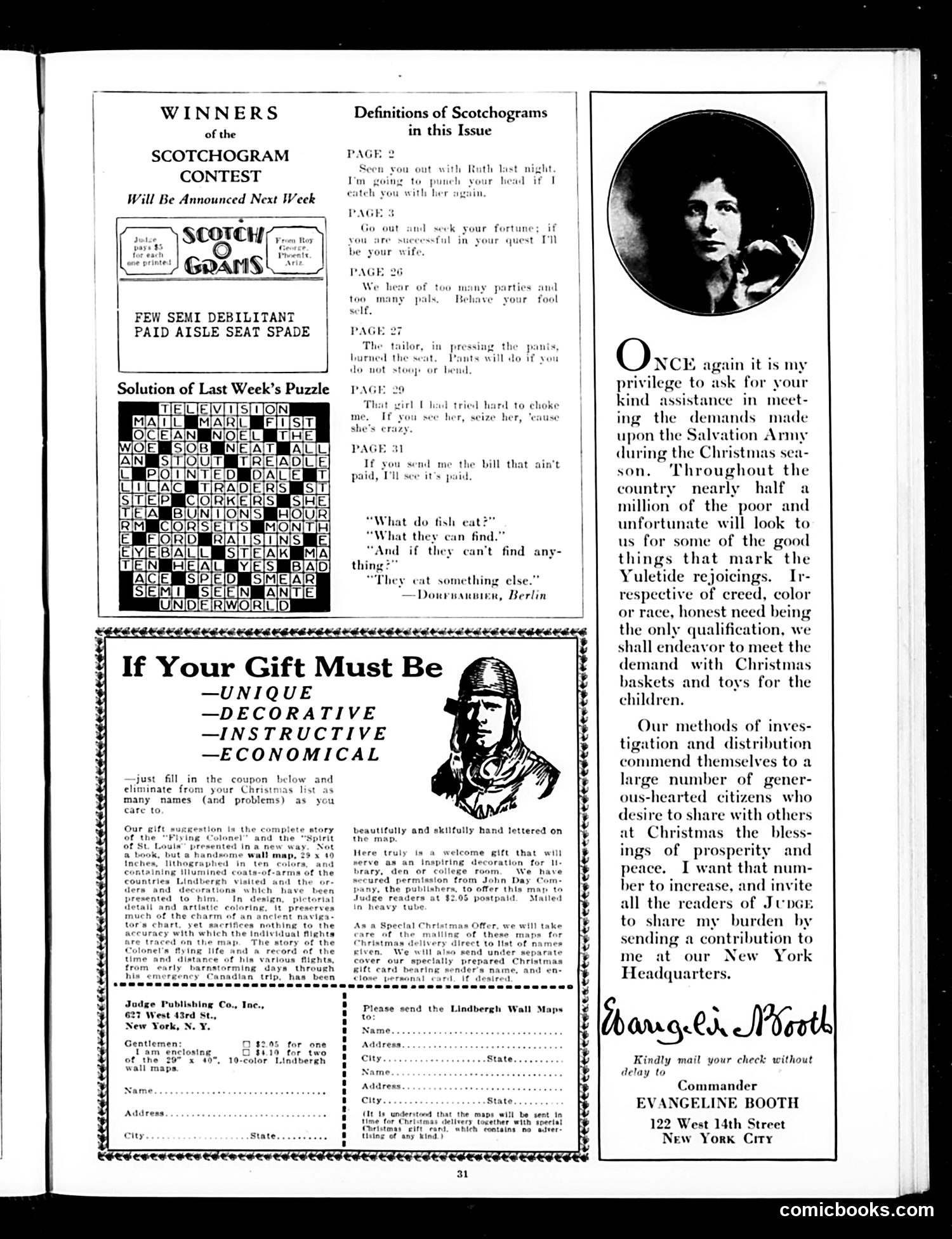
This page is primarily **advertising and announcements** rather than satirical content. The main features are: 1. **Scotchogram Contest**: Judge announces winners of a word-puzzle contest will be revealed next week. The "definitions" shown are humorous one-liners (scotch whisky jokes disguised as definitions). 2. **Crossword Puzzle**: A solved puzzle from the previous week is displayed—standard magazine filler content. 3. **Gift Advertisement**: A commercial ad for Lindbergh wall maps positioned as unique Christmas gifts. Charles Lindbergh's 1927 transatlantic flight made him enormously famous, so his image was valuable for marketing. 4. **Salvation Army Appeal**: Commander Evangeline Booth (actual leader of the Salvation Army) solicits Christmas donations for the poor. This represents the magazine's charitable positioning. The page demonstrates Judge's mix of humor, puzzles, and advertising during the interwar period, with Lindbergh's celebrity used as a marketing tool.
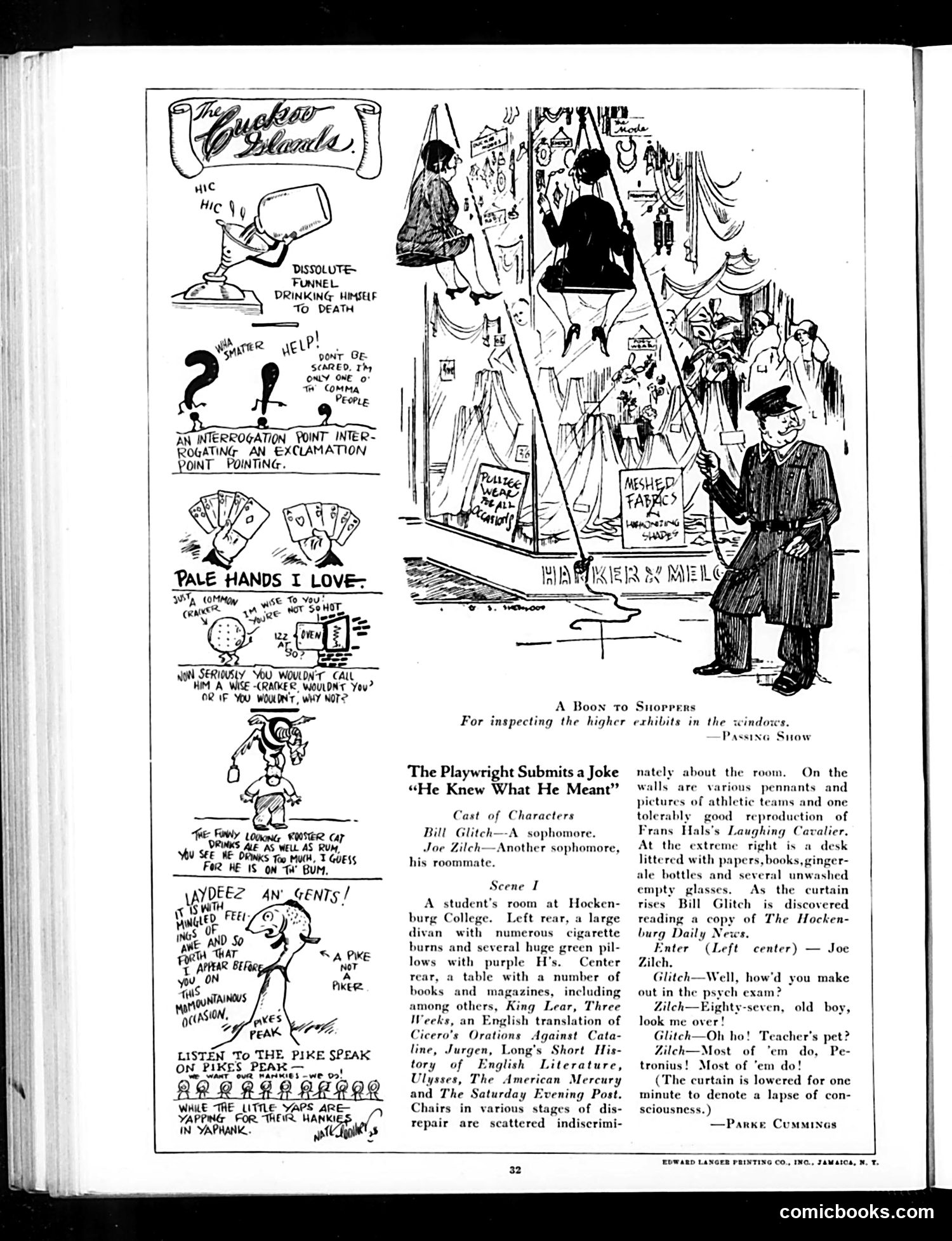
This page contains two distinct sections: **Left side:** A series of humorous comic sketches by what appears to be different cartoonists, featuring drinking jokes, romantic humor, and enlisted men's slang (reference to "Yaphank" suggests WWI-era military). The cartoons use exaggeration and crude drawing styles typical of period humor magazines. **Right side:** A one-act comedy sketch titled "The Playwright Submits a Joke: 'He Knew What He Meant'" set in a college dormitory. Two sophomores discuss exam performance—one claims to have scored 87, and the other sarcastically calls him "Teacher's pet." The joke's punchline (delivered after curtain falls) plays on the double meaning of the title, though the actual joke isn't fully visible. The overall tone is collegiate humor and drinking culture typical of 1920s-era satirical magazines. The content reflects period attitudes toward alcohol, gender relations, and military service, presented without the modern sensitivity we'd expect today.
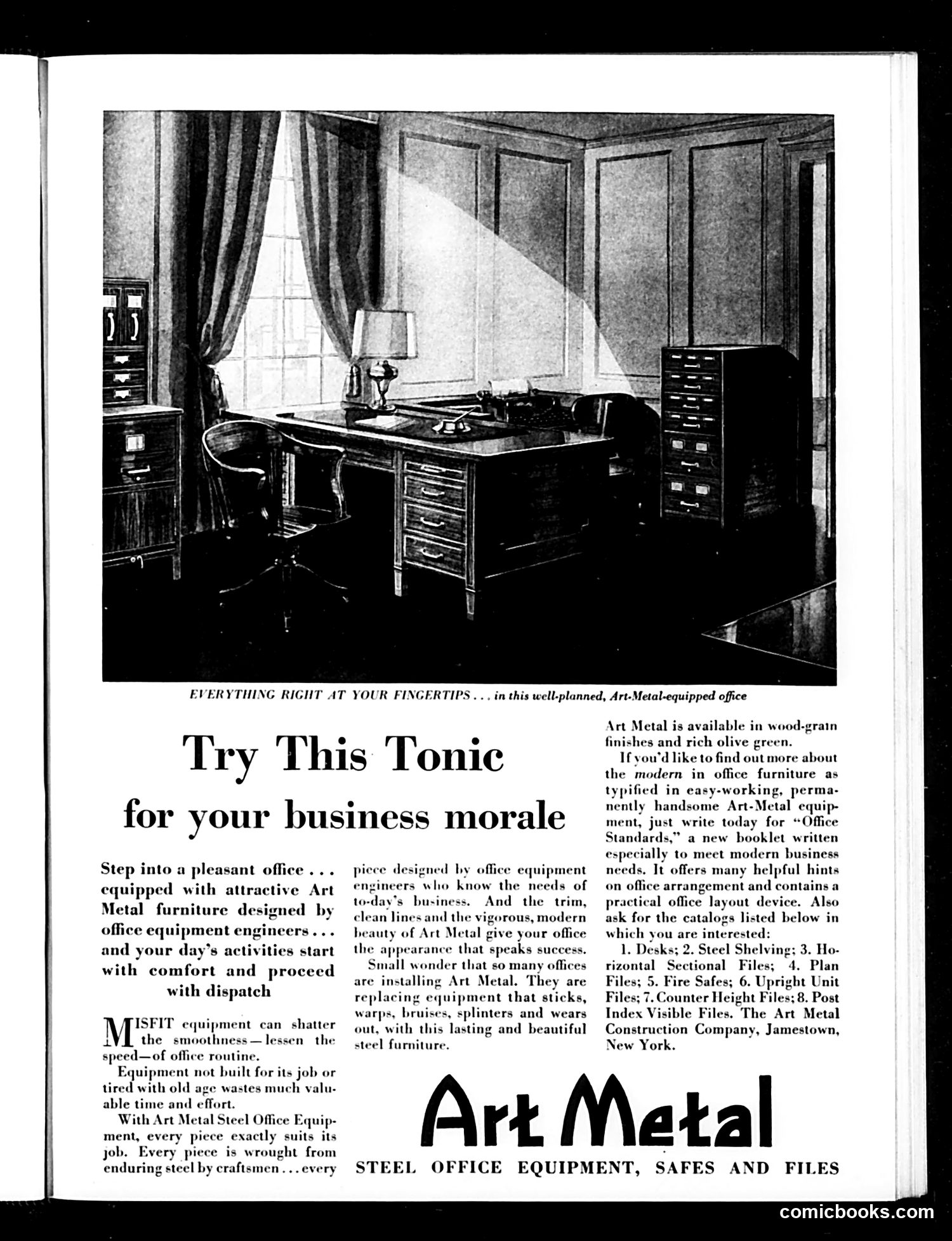
This is primarily a **full-page advertisement**, not a cartoon or satire. It promotes Art Metal steel office furniture and equipment. The ad uses a photograph of an idealized modern office interior to sell the product. The accompanying text frames quality office equipment as a "tonic" for business morale—arguing that well-designed, durable furniture improves workplace efficiency and projects success to clients. The pitch contrasts Art Metal's purpose-built steel equipment against "misfit" worn-out furniture that "wastes valuable time and effort." The rhetoric appeals to business managers by suggesting that modern, aesthetically pleasing office design directly impacts profitability and worker productivity. This reflects early-to-mid 20th-century American advertising's tendency to link consumer goods with psychological and professional well-being. There is **no political satire or caricature** present—it's straightforward commercial promotion.
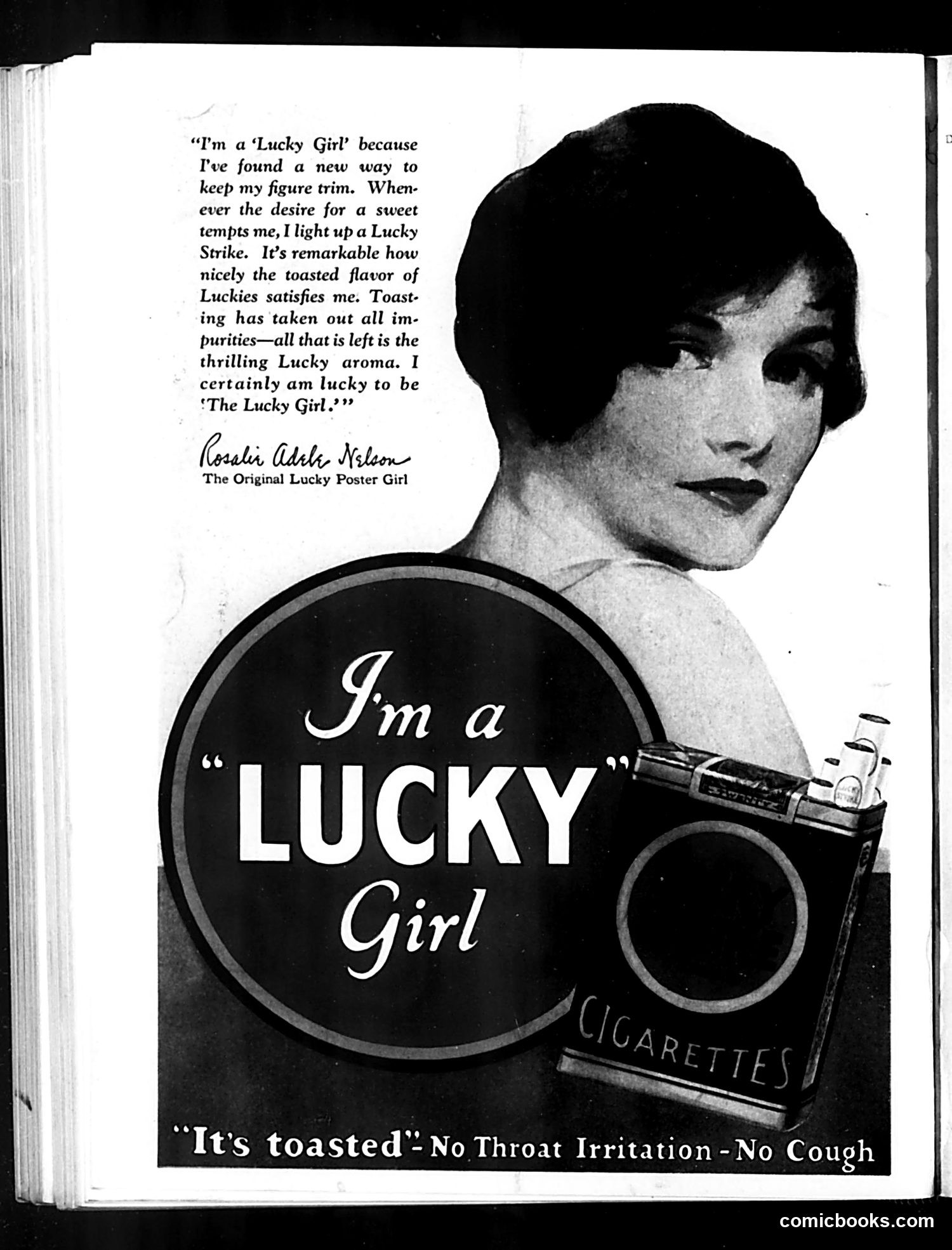
This is a **cigarette advertisement**, not political satire. It features Rosalii Aale Nilson, identified as "The Original Lucky Poster Girl," endorsing Lucky Strike cigarettes. The ad uses a common early-20th-century marketing tactic: claiming cigarettes suppress appetite and help maintain a slim figure. The "Lucky Girl" uses smoking as a diet aid, claiming that lighting a cigarette satisfies sweet cravings while keeping her trim. The emphasis on "toasted" flavor and "no throat irritation, no cough" reflects contemporary tobacco advertising claims—assertions that would later be proven false and eventually become illegal to make. This represents how cigarette companies once marketed directly to women through glamorous endorsements and health/beauty claims.