
A complete issue · 36 pages · 1928
Judge — December 8, 1928
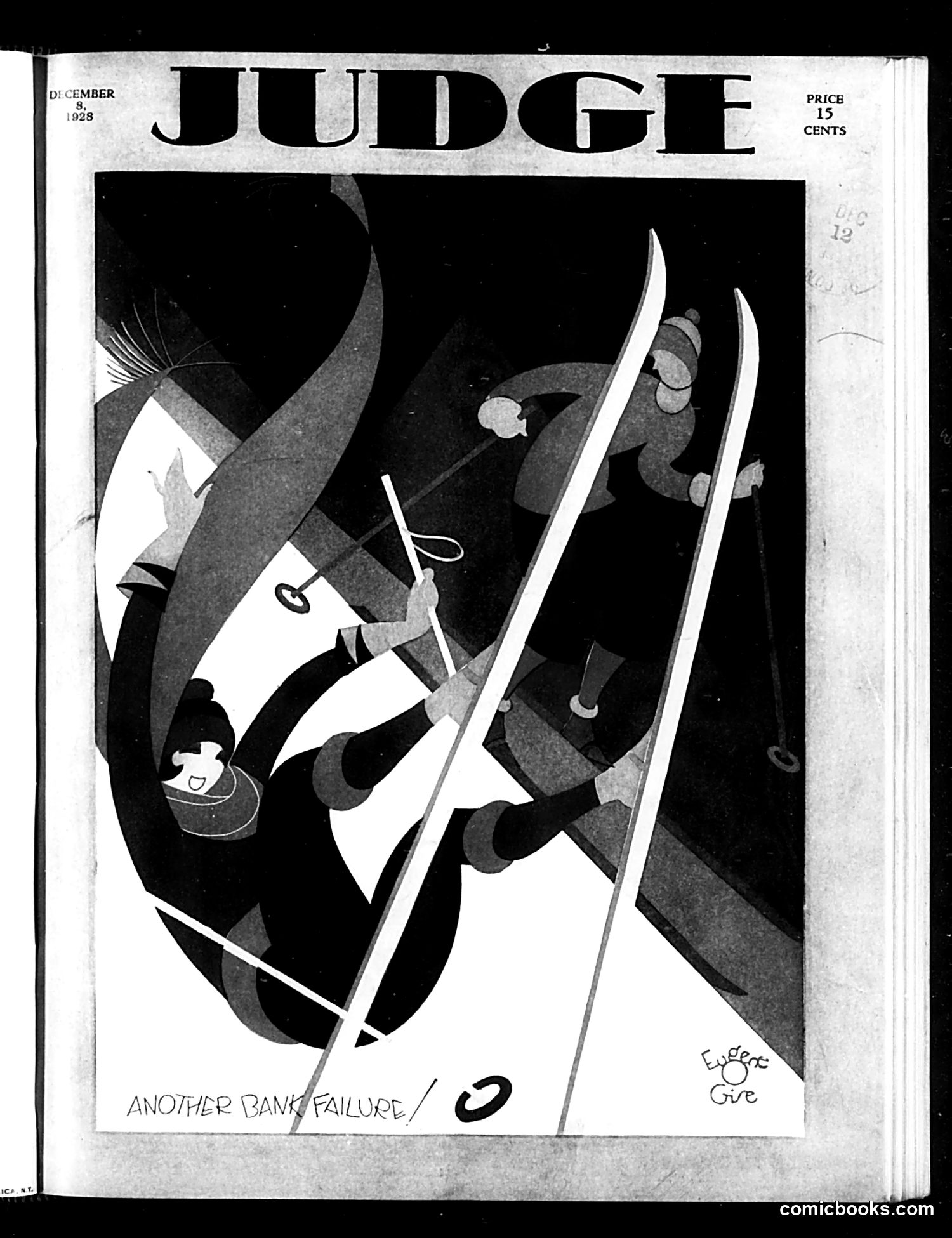
This cover depicts "Another Bank Failure," a satirical commentary on financial instability during the late 1920s. The cartoon shows figures (likely bankers or financial institutions personified) skiing downward on a steep, dark slope—a visual metaphor for rapid financial collapse. The skiing imagery suggests loss of control and inevitable descent. The 1920s experienced periodic bank failures, culminating in the catastrophic stock market crash of October 1929, just weeks after this issue's publication. The artist (signed E. Gee) uses the downhill skiing metaphor to mock financial institutions' recklessness and the public's powerlessness to stop such disasters. The casual winter sport becomes a darkly comic image of economic catastrophe, resonating with contemporary anxieties about banking stability and wealth preservation.
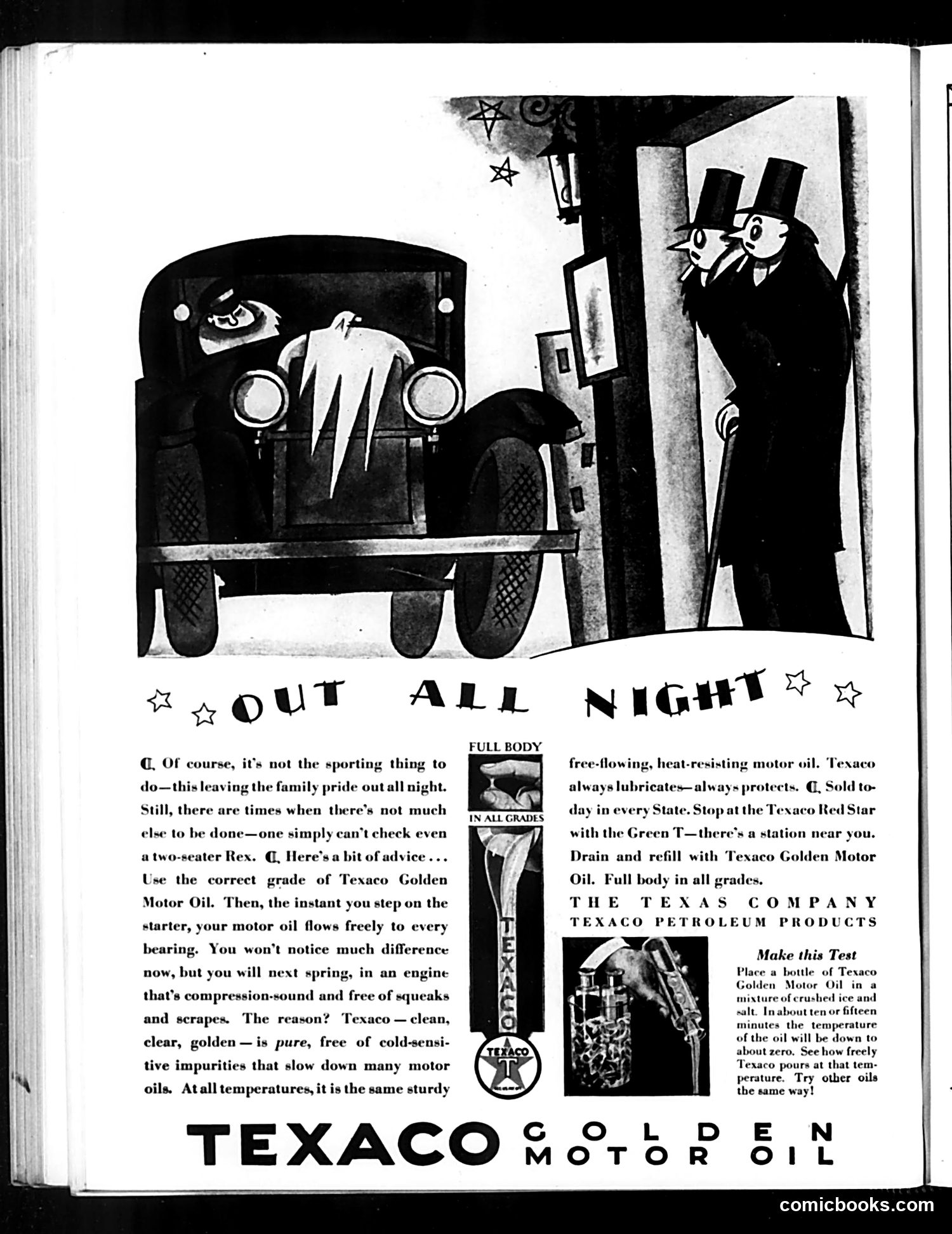
This page is primarily a **Texaco motor oil advertisement**, not political satire. The illustration shows a humorous domestic scenario: a man arriving home very late in an automobile while two formally-dressed gentlemen (appearing to be clergy or dignitaries, identifiable by top hats) wait at the door—likely representing the family or moral authorities concerned about his nocturnal activities. The joke plays on the premise that proper motor oil allows reliable late-night driving, while the caption's tone suggests mild social disapproval of staying out all night. The advertisement emphasizes Texaco Golden Motor Oil's reliability at all temperatures and its "purity," positioning the product as dependable for any driving situation, however questionable the hour.
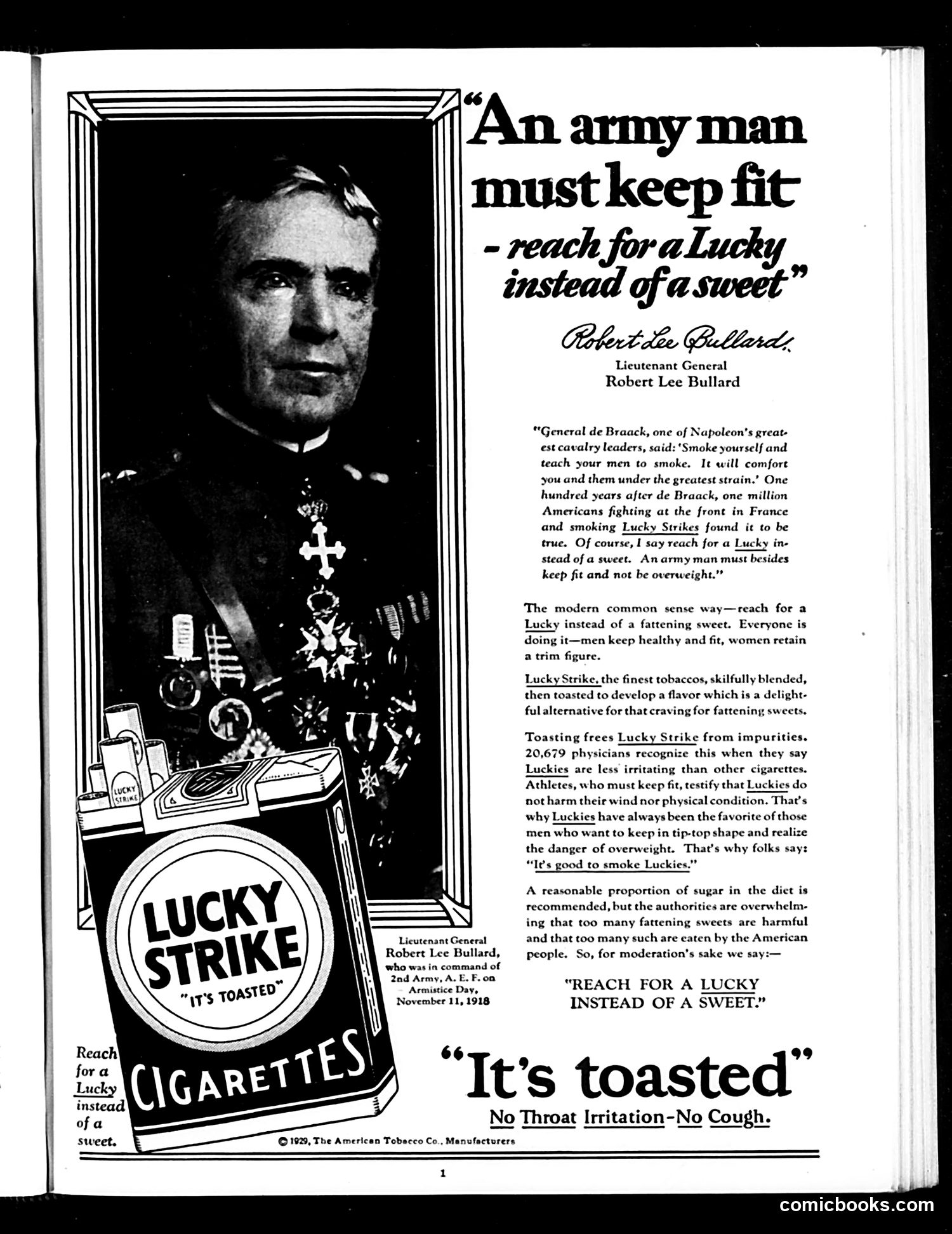
This is primarily a **Lucky Strike cigarette advertisement** rather than satire. It features Lieutenant General Robert Lee Bullard, a real WWI commander, endorsing cigarettes by quoting a (purported) Napoleon general about soldiers smoking to manage strain. The ad uses Bullard's military authority to legitimize smoking as healthful. It claims "20,679 physicians recognize this when they say Luckies are less irritating than other cigarettes" and emphasizes the toasted process reduces throat irritation. The tagline "Reach for a Lucky instead of a sweet" encourages weight-conscious consumers—particularly women—to substitute cigarettes for candy. By modern standards, this is shocking: using a decorated military figure and fraudulent health claims to market an addictive, carcinogenic product. The "physicians recognize" statistic is almost certainly fabricated.
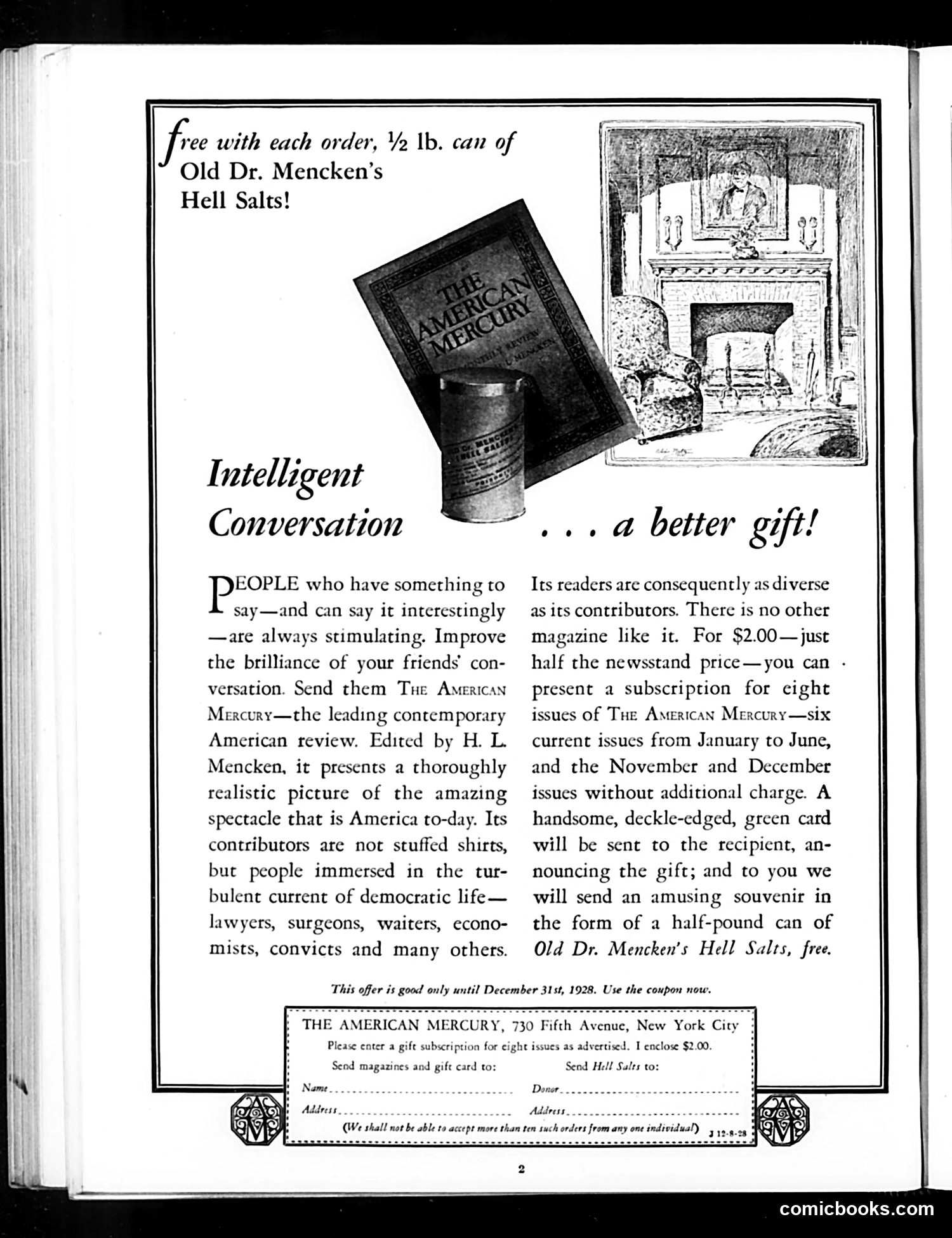
This page is primarily **advertising rather than satire**. It promotes *The American Mercury* magazine and offers a gift subscription deal for $2.00 (half the newsstand price), valid until December 31, 1928. The ad emphasizes the magazine's intellectual credibility by noting it's "edited by H. L. Mencken" and features diverse contributors—"lawyers, surgeons, waiters, economists, convicts and many others"—representing "democratic life." This suggests *The American Mercury* positioned itself as a serious contemporary review reflecting American society. The promotional gimmick is a free half-pound can of "Old Dr. Mencken's Hell Salts"—likely a humorous, tongue-in-cheek gift playing on Mencken's reputation as a sharp-tongued, caustic social critic. The interior illustration shows a domestic setting, emphasizing the gift's appeal to refined households.
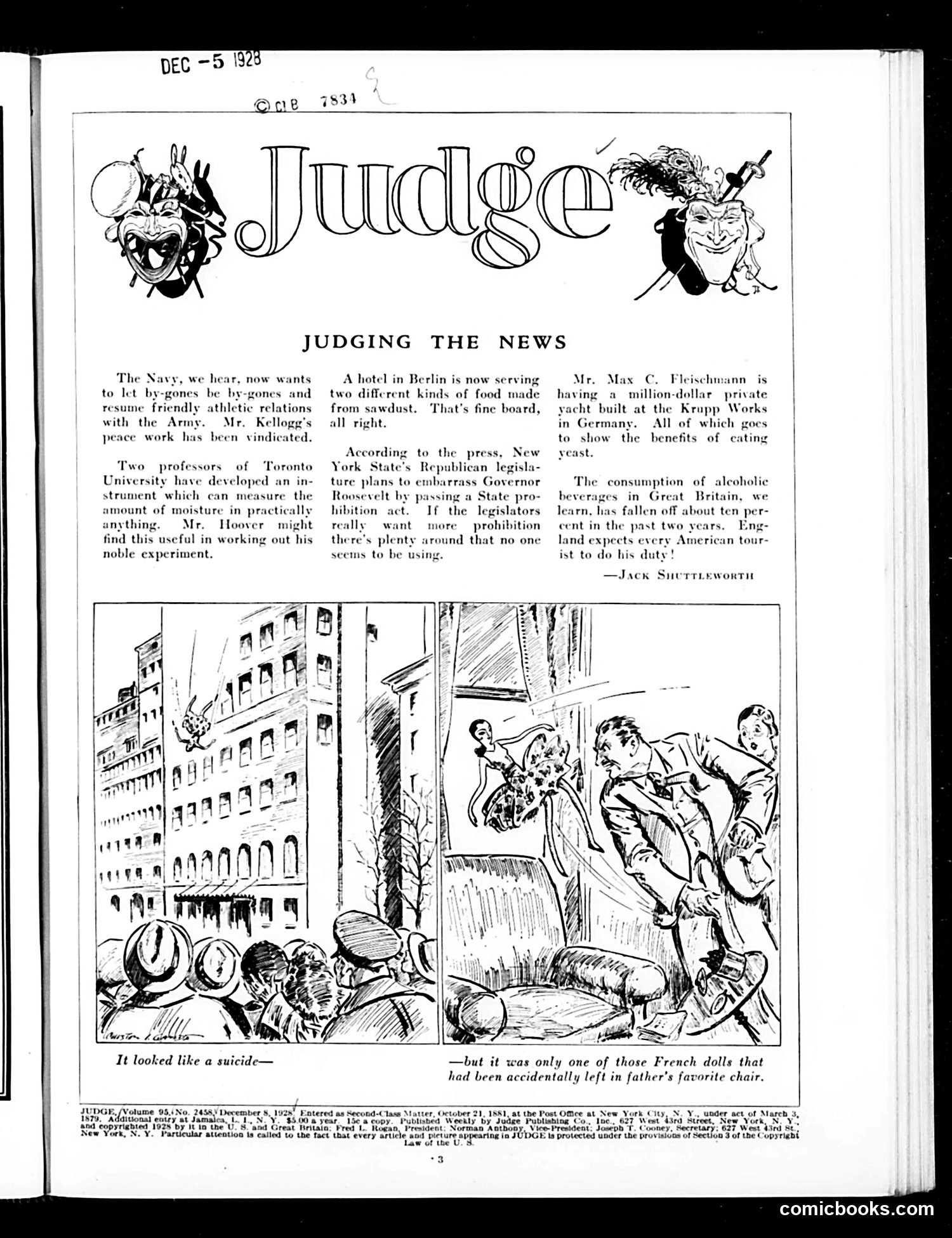
The two-panel cartoon satirizes a dramatic incident, likely involving a suicide attempt or death near a tall building. The left panel shows crowds gathering below a multi-story building ("It looked like a suicide—"), while the right panel reveals the actual outcome: men examining what appears to be a French doll that had fallen from an upper window ("—but it was only one of those French dolls that had been accidentally left in father's favorite chair"). The joke relies on the era's anxieties about urban accidents and the double entendre around "French dolls"—a euphemism for sex dolls or similar items—suggesting humorous misunderstanding and embarrassment. The cartoon mocks both public panic and the implied impropriety of the doll's presence in a family home.
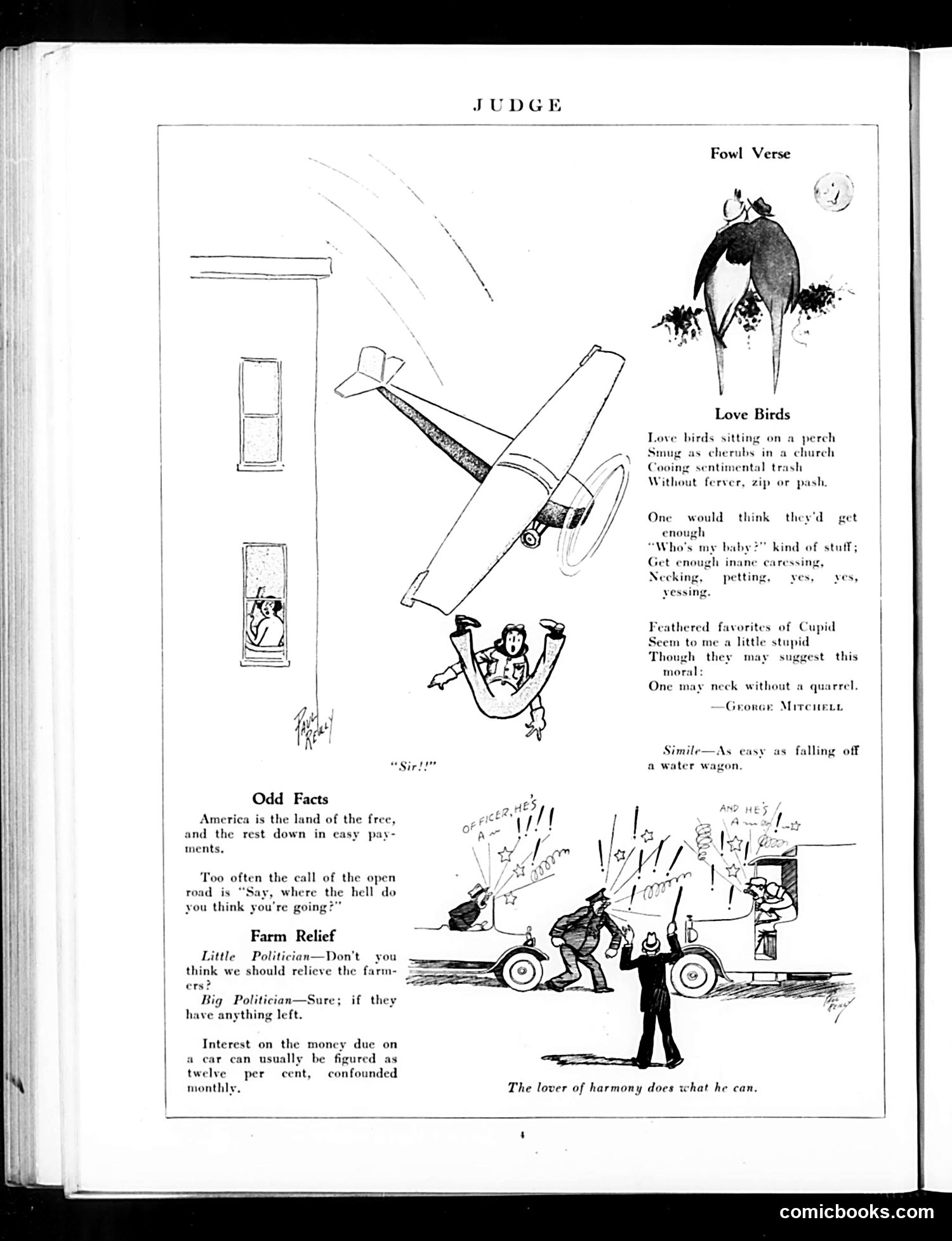
This page contains several satirical pieces: **"Love Birds"** mocks sentimental romantic poetry with crude reality—lovers coo sweetly but end up bickering ("Necking, petting, yes, yes, yessing"). George Mitchell's moral: couples can disagree without quarreling. **"Odd Facts"** offers sardonic observations about American life and freedom. **"Farm Relief"** satirizes Depression-era agricultural policy through a dialogue between a "Little Politician" and "Big Politician" about farm aid—suggesting politicians offer empty promises while farmers have "nothing left." **The automobile cartoon** ("The lover of harmony does what he can") depicts chaos from a car accident, with the protagonist attempting to restore order amid mayhem—satirizing futile efforts to manage disorder. The overall tone is cynical about politics, relationships, and American life.
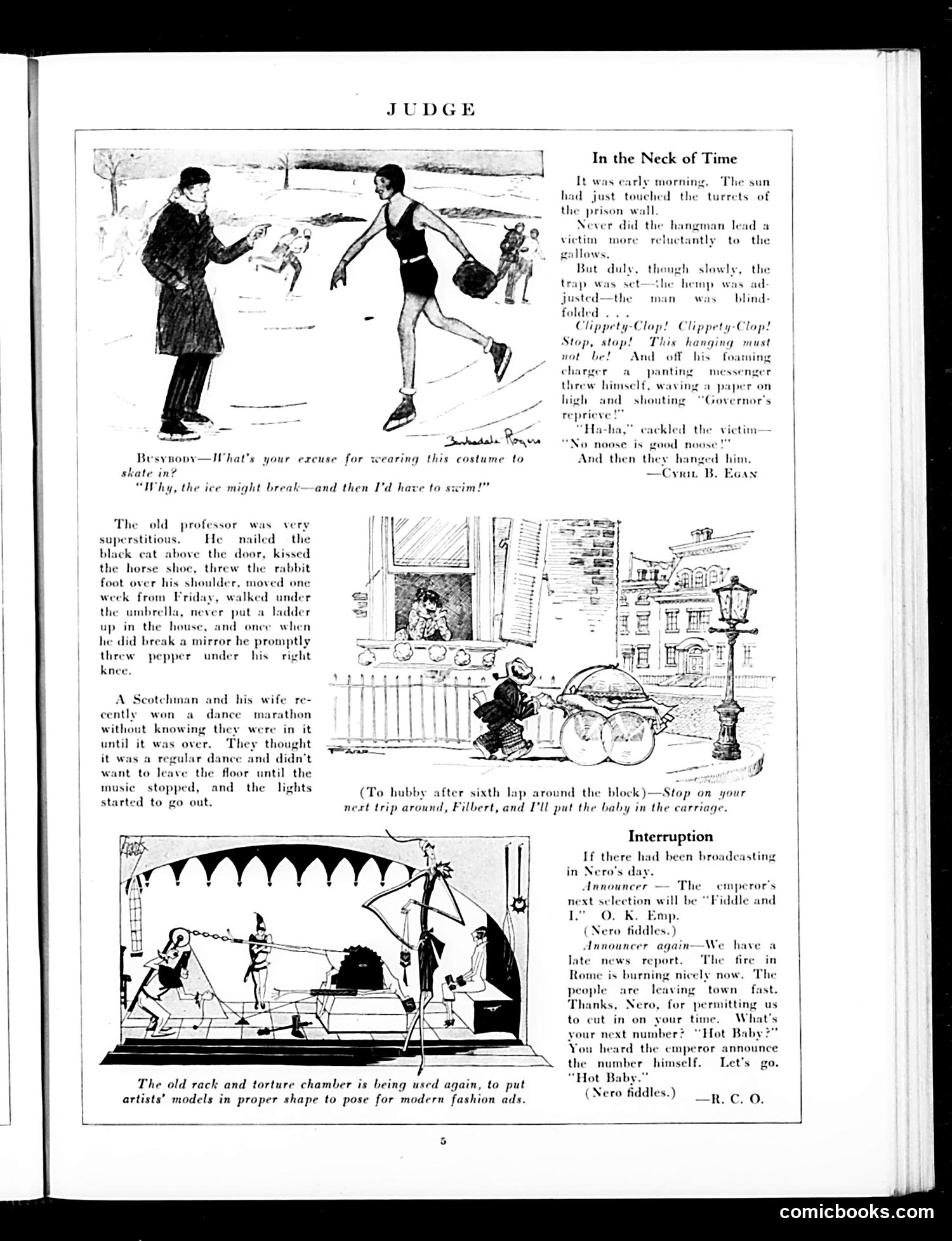
This page contains four distinct humorous pieces satirizing early 20th-century social anxieties: 1. **"In the Neck of Time"**: A darkly comedic story about a botched execution, attributed to Cyril B. Egan. The joke plays on bureaucratic incompetence during capital punishment. 2. **Top cartoon**: A woman in swimming attire is confronted by a man about her "excuse for wearing this costume to church." The satire targets evolving social norms around women's fashion and public decency standards. 3. **Middle cartoon**: Depicts superstitious behavior—an old professor's ritualistic practices (black cat, broken mirror, salt). Social satire on pseudoscience and folk beliefs. 4. **Bottom cartoon**: Shows a "rack and torture chamber" repurposed for modern fashion photography—satire on the discomfort inflicted by beauty standards and posing requirements in contemporary advertising. The overall theme mocks social pretension and changing modern mores.
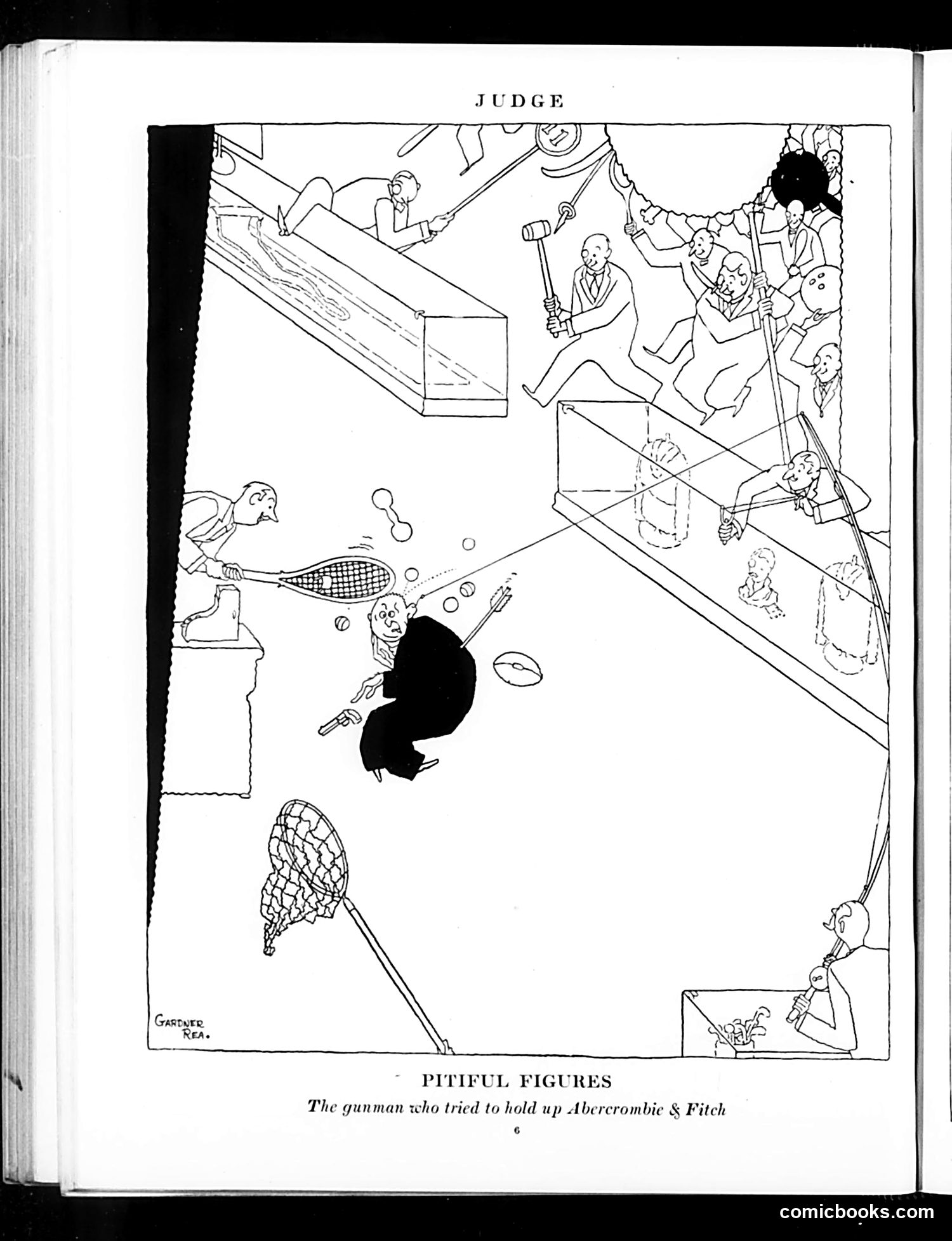
This cartoon satirizes an attempted robbery of Abercrombie & Fitch, the upscale sporting goods retailer. The humor lies in depicting the would-be gunman as a pathetic figure literally trying to rob a store filled with weapons, hunting equipment, and fishing gear—exactly the merchandise of an arms dealer. The cartoon shows the gunman surrounded by well-dressed customers and store fixtures, while sporting equipment (nets, fishing rods) litter the scene. The implicit joke: attempting to rob a gun shop with a gun is absurd, as the store is better armed than the robber. The "pitiful figures" title reinforces this mockery of the criminal's ineptitude. The cartoon likely dates to an era when Abercrombie & Fitch was primarily known for sporting and hunting goods rather than casual fashion.
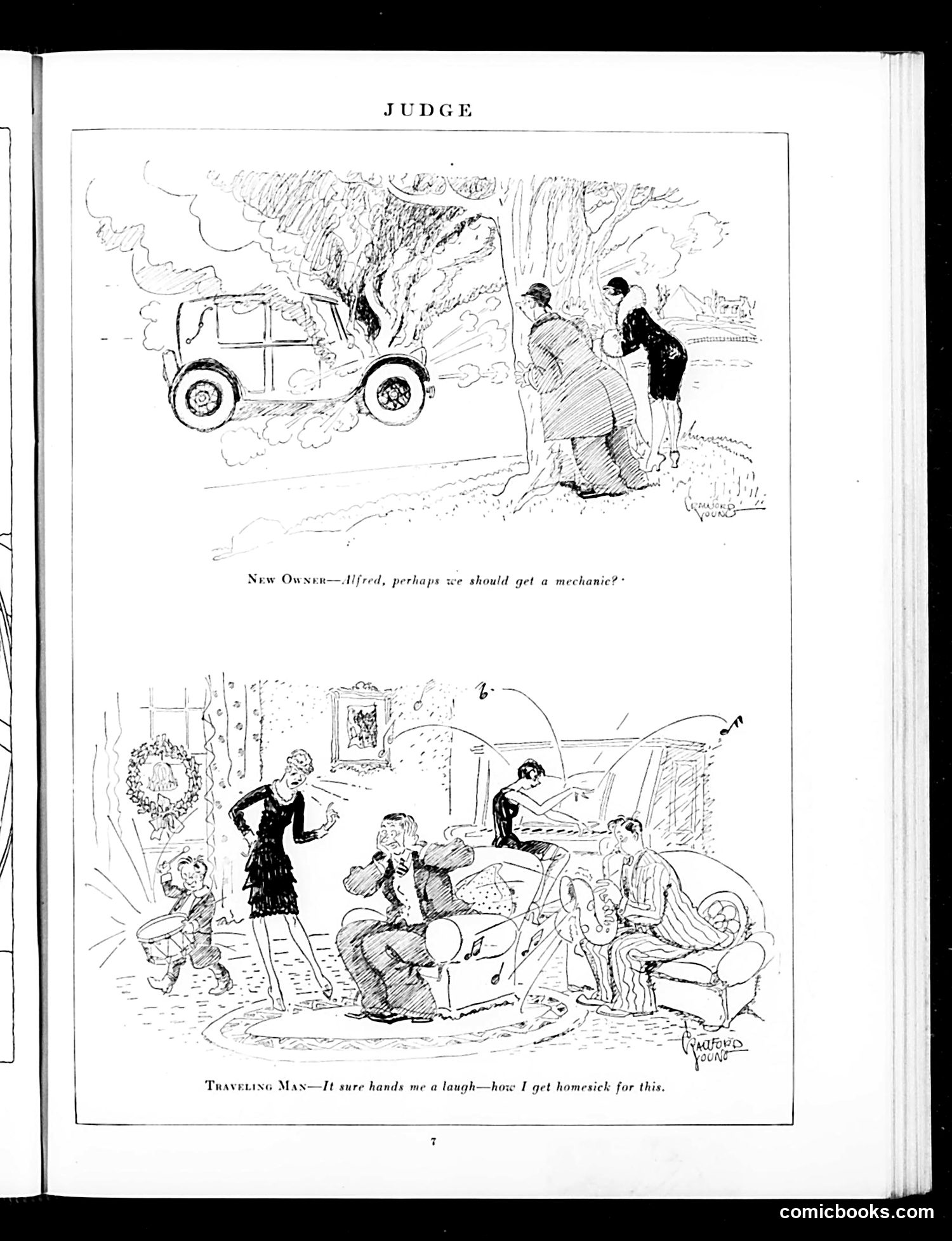
This page contains two satirical cartoons about automobiles and early motoring culture. **Top cartoon:** A new car owner named Alfred stands with a woman beside a broken-down vehicle stuck in a tree. His suggestion to hire a mechanic mocks the unreliability of early automobiles—the car has crashed so badly it's literally embedded in foliage, making mechanical repair seem insufficient. **Bottom cartoon:** A "Traveling Man" sits amid chaos in a home where his arrival has caused complete domestic upheaval—children running, women gesturing frantically, furniture overturned, a car visible outside. His comment about getting homesick satirizes how automobiles disrupted family life and domestic order, treating the vehicle as an intrusive, destabilizing force on traditional household routines. Both cartoons reflect early-20th-century anxiety about automobiles as dangerous, unreliable novelties disrupting society.
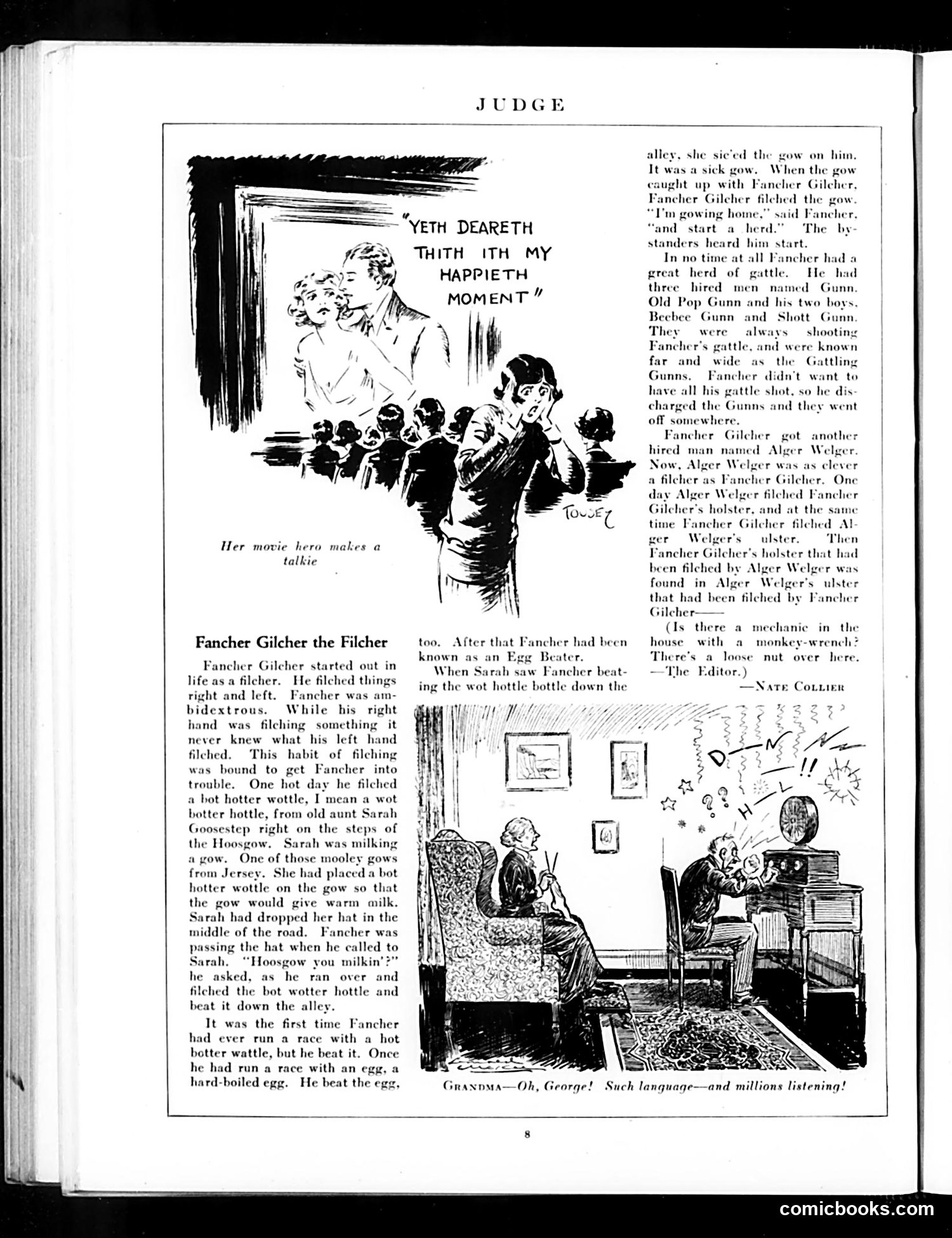
This appears to be a humorous tall tale from Judge magazine, a satirical publication. The main story concerns **Fancher Gilcher**, a compulsively dishonest character who steals everything ("filches") with both hands simultaneously. The narrative follows his improbable escalation from petty theft to cattle ranching. A comical subplot involves hired hands named "the Gattling Gunns" (a pun on the Gatling gun), who shoot his livestock. Another involves a character named Alger Welger, leading to absurdly recursive theft: Fancher steals Welger's holster while Welger steals Fancher's—objects later found in each other's coats. The lower cartoon mocks early "talkie" (sound) films, showing a grandmother's shocked reaction to movie dialogue, with a tongue-in-cheek editorial note about "loose nuts." The entire piece is nonsensical wordplay and physical comedy—typical Judge fare mocking early cinema, property crime, and American tall-tale traditions.
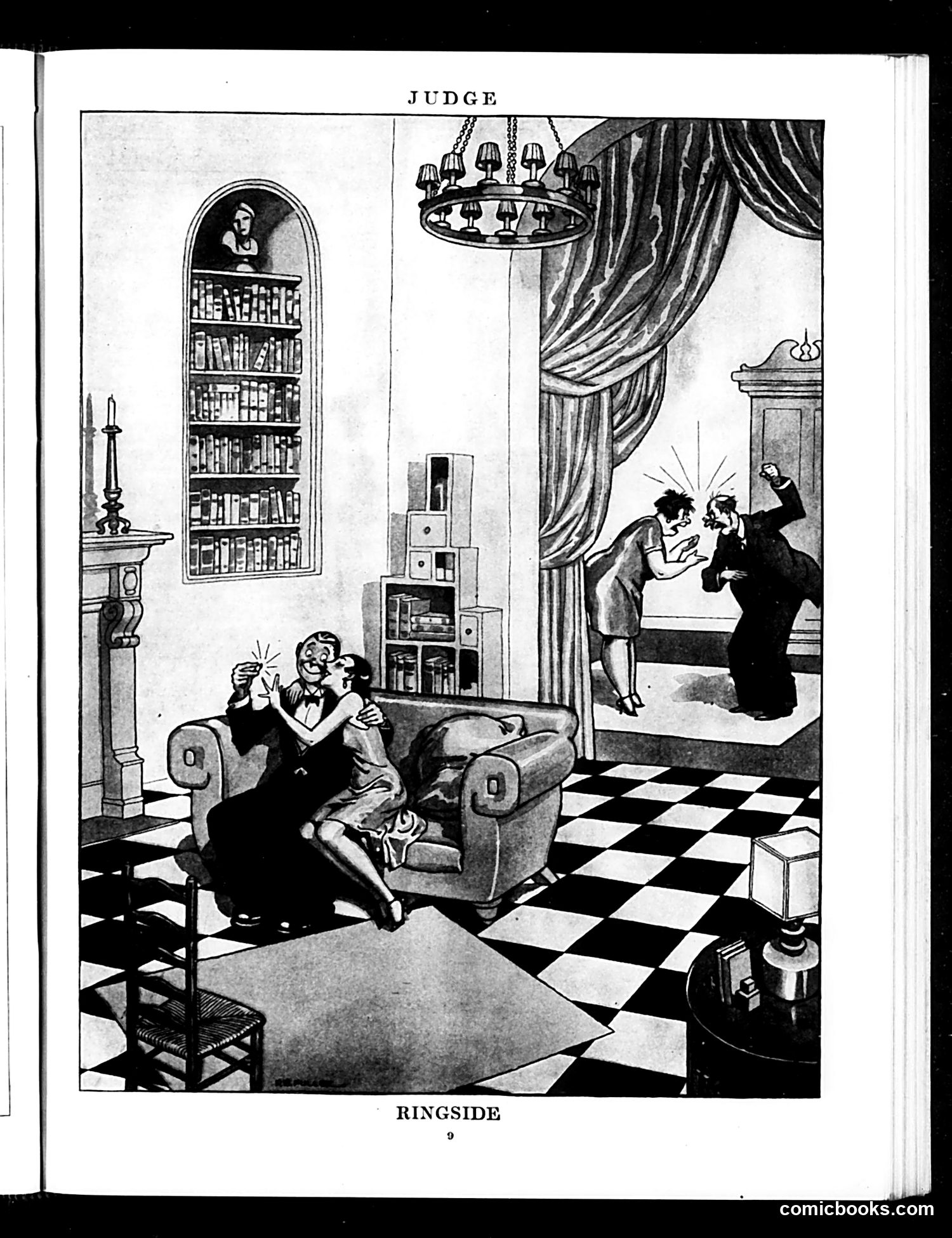
This page titled "Ringside" (page 9) appears to be a single satirical cartoon depicting a domestic scene. A couple sits on a couch in an ornate living room with bookshelves, chandelier, and checkered floor. The man and woman are engaged in what appears to be a physical altercation or heated argument—both are gesturing dramatically with raised hands. In the background, through curtains, two figures appear to be observing or witnessing the scene. The title "Ringside" suggests the cartoon is satirizing domestic quarrels as entertainment or spectacle, comparing a marital dispute to boxing match "ringside" seats. The joke likely mocks either the violence of domestic disputes or, conversely, trivializes them as public entertainment. Without additional context, the specific social critique remains unclear.
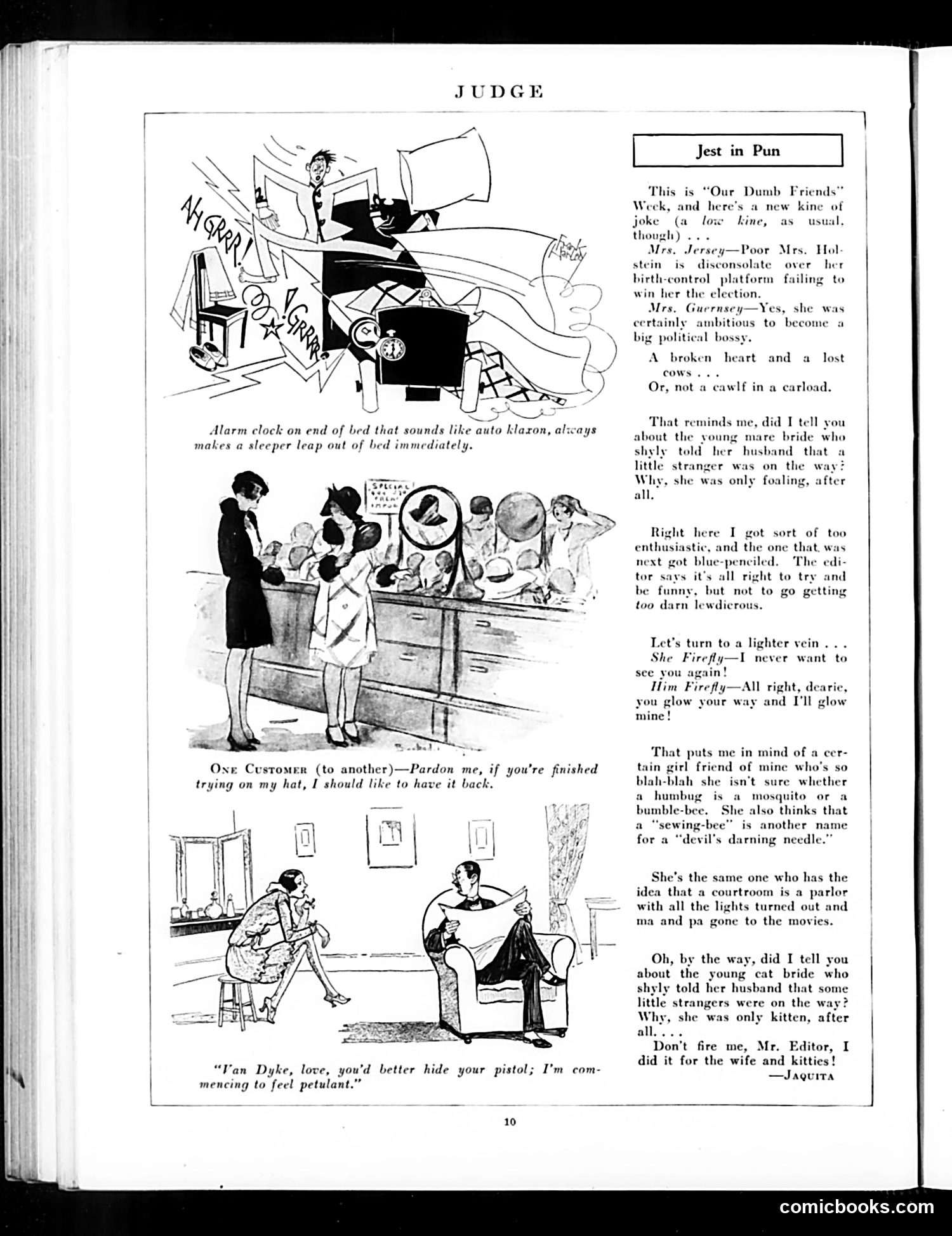
This page collects several joke formats typical of Judge's humor. The cartoons mock everyday situations: an alarm clock that startles sleepers, a hat-trying-on mishap in a shop, and marital tension ("hide your pistol; I'm commencing to feel petulant"). The "Jest in Pun" section satirizes animal-related wordplay. It references "Our Dumb Friends" week and makes puns on animal terminology: a cow's "birth-control platform" failing in elections, a mare bride who is "foaling" (pun: "only fooling"), and a kitten bride expecting "kittens" (pun on "kitten"). The humor relies heavily on double meanings between animal reproduction terms and human situations. One joke mocks a girl friend's confusion between real insects and slang terms ("humbug," "sewing-bee," "devil's darning needle"). The overall tone is light domestic humor aimed at 1920s-30s readers, combining visual gags with wordplay. The editor's note acknowledges pushing boundaries but remaining "not too darn lewdicrous."
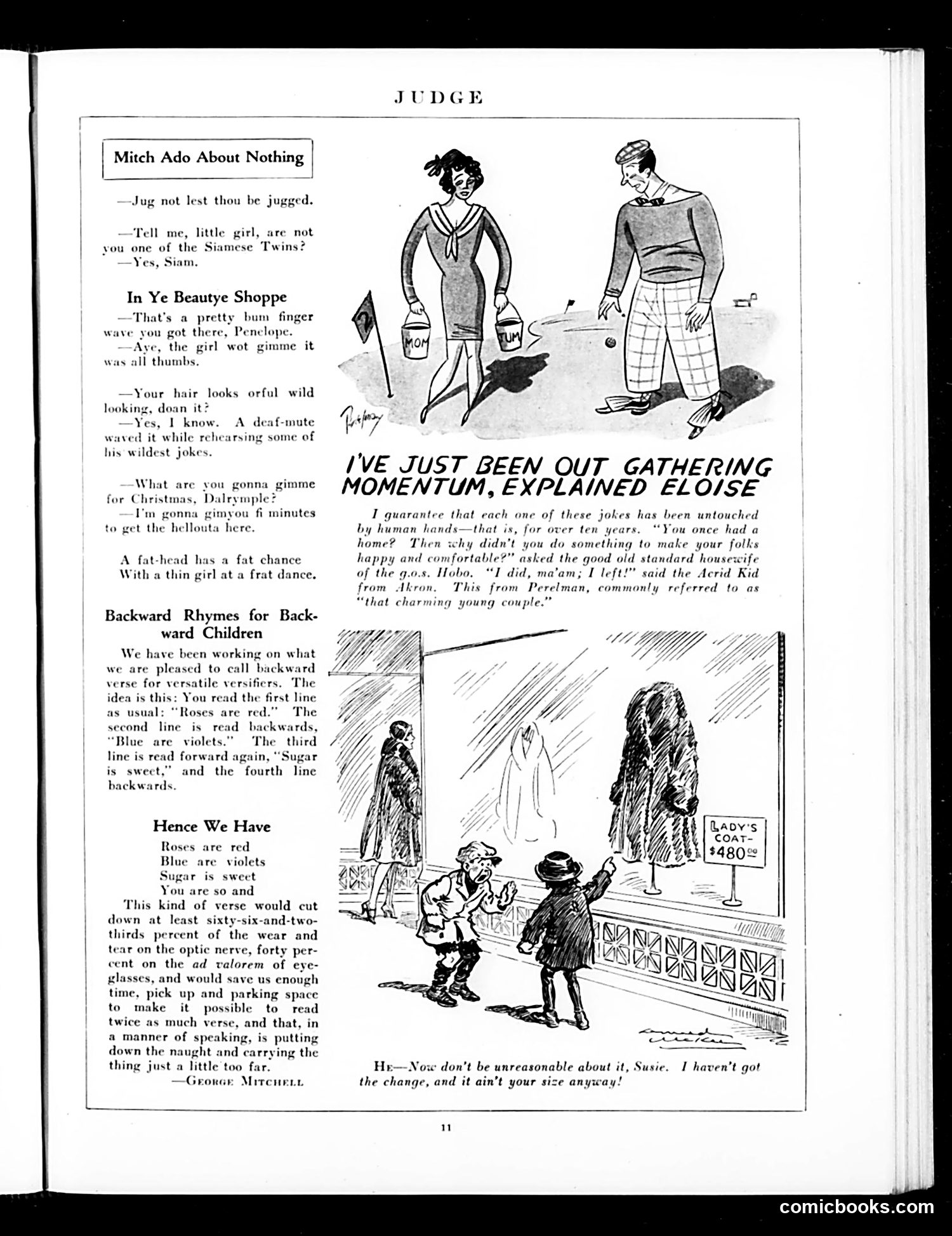
This page contains several brief satirical humor pieces typical of Judge magazine's style: **"Mitch Ado About Nothing"** offers quick one-liners mocking contemporary figures and situations—references to "Siamese Twins" (likely vaudeville performers), beauty salon incompetence, and Christmas gift-giving. **The main cartoon** depicts a man and woman at a store window (marked "$480"), with the caption about "gathering momentum" while explaining jokes. The satire appears to target either marital discord or financial irresponsibility—the man claims he's been gathering momentum (excuses) rather than earning money. **"Backward Rhymes for Backward Children"** is a playful linguistic experiment where poetry lines alternate between forward and backward reading. It's self-aware satire about modernist experimentation, with author George Mitchell's commentary suggesting this clever gimmick is excessive—"putting down the naught and carrying the thing just a little too far." The humor relies on wordplay, domestic comedy, and gentle mockery of contemporary trends rather than specific political content.
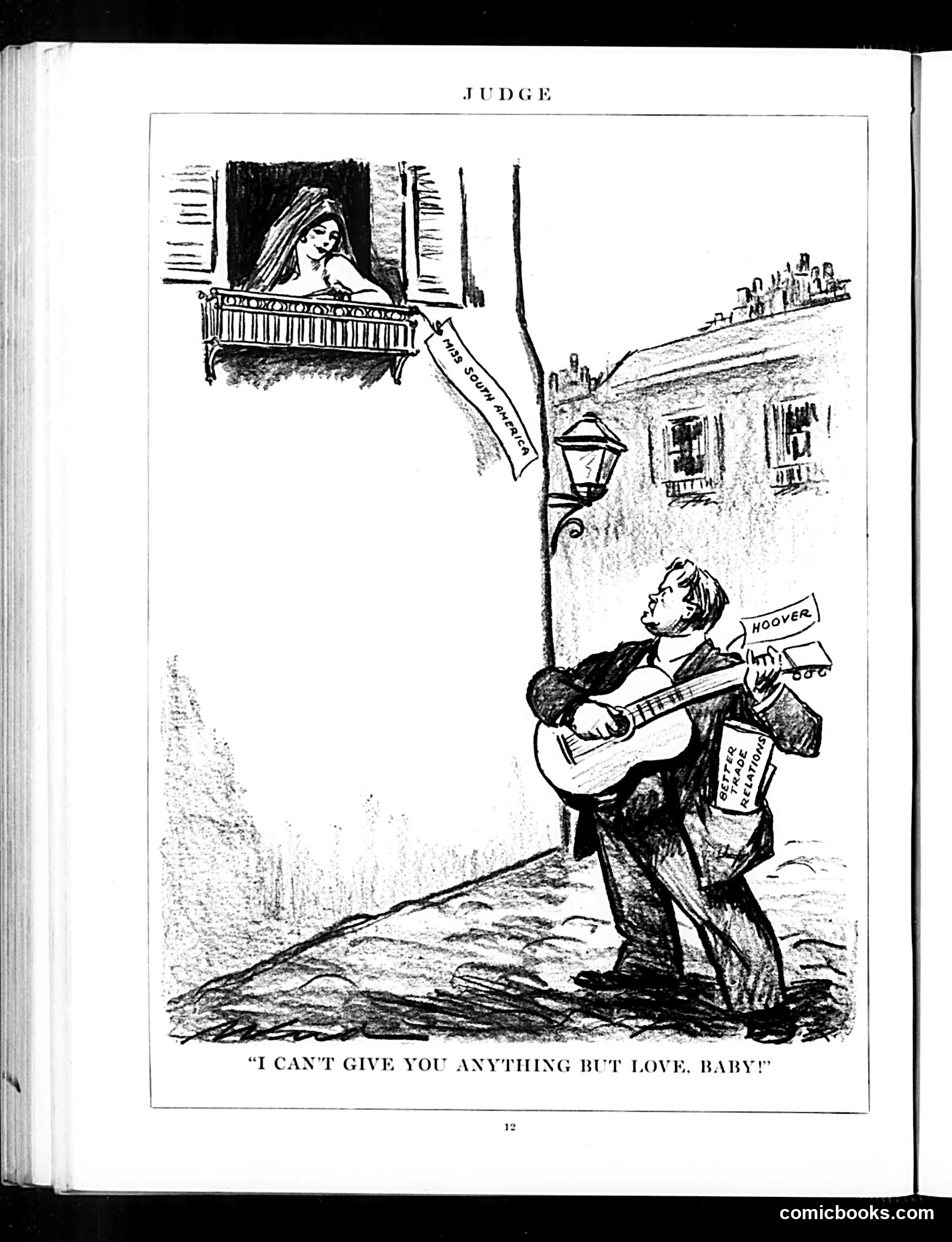
This single-panel cartoon titled "I Can't Give You Anything But Love, Baby!" depicts a street musician serenading a woman at a window. The figure labeled "HOOVER" plays guitar while holding papers labeled what appears to be economic documents or policies. The satire references President Herbert Hoover during the Great Depression era. The cartoon mocks Hoover's inability to provide material economic relief to Americans, suggesting his only offering is romantic sentiment ("love") rather than substantive help. The woman at the window represents the American public waiting for assistance. This reflects contemporary criticism that Hoover's response to the economic crisis was inadequate, relying on optimistic rhetoric rather than direct government intervention—a major political issue of his presidency.
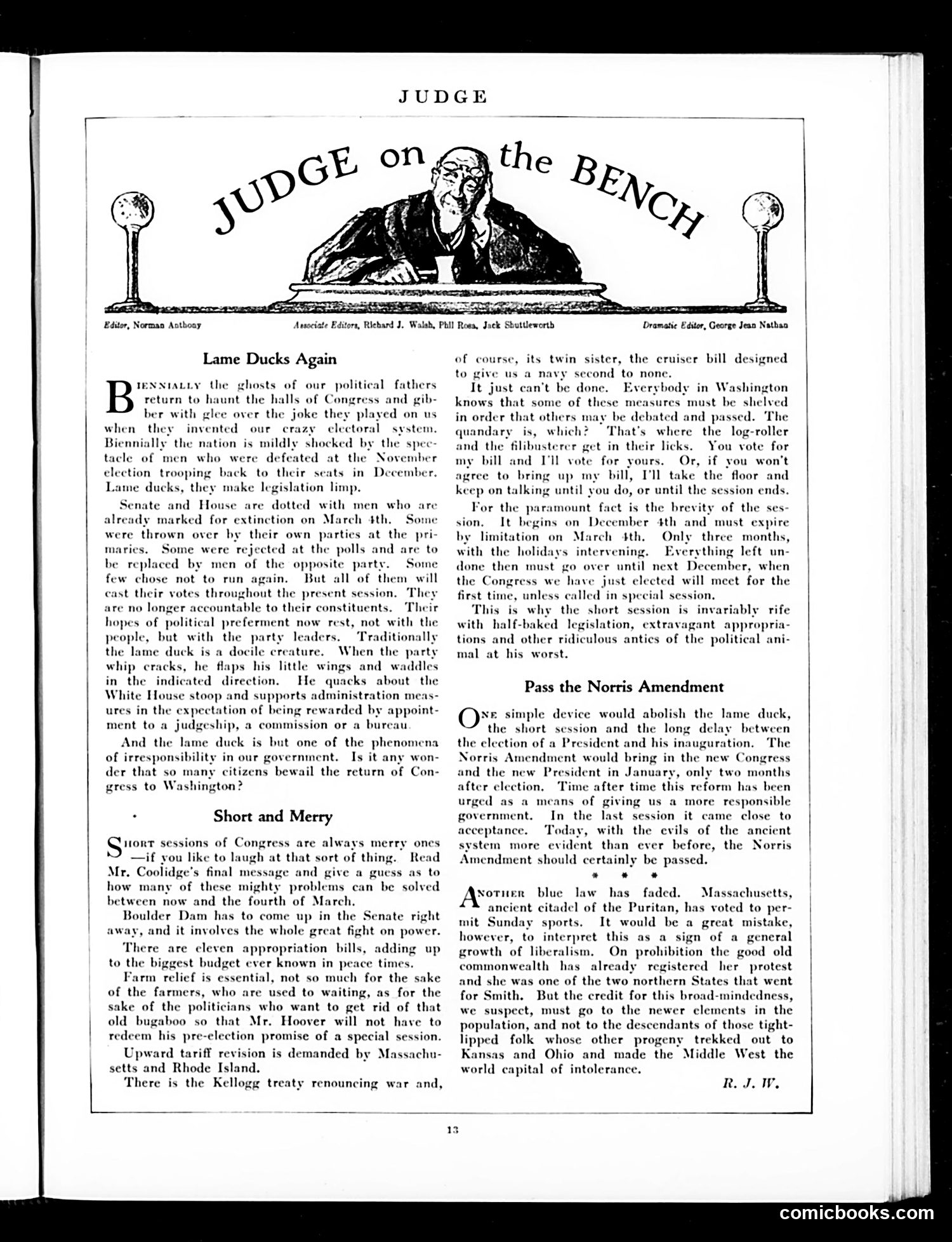
This page attacks the "lame duck" problem in American government—legislators defeated in November elections who remain voting members until March 4th. The satire criticizes how these politically vulnerable representatives become tools of party leadership, hoping for patronage appointments (judgeships, commissions) rather than serving constituents. The main complaint: Congress operates under artificial time pressure (December to March), forcing compromised legislation through log-rolling (vote trading) and filibustering. Urgent bills like farm relief, tariff revision, and naval appropriations get sacrificed to political maneuvering. The proposed fix mentioned: the **Norris Amendment**, which would speed presidential transition and eliminate the lame-duck session's dysfunction. The cartoon's judge figure represents institutional authority observing this legislative absurdity. The satire's point: America's electoral system creates unnecessary chaos and irresponsibility in government.
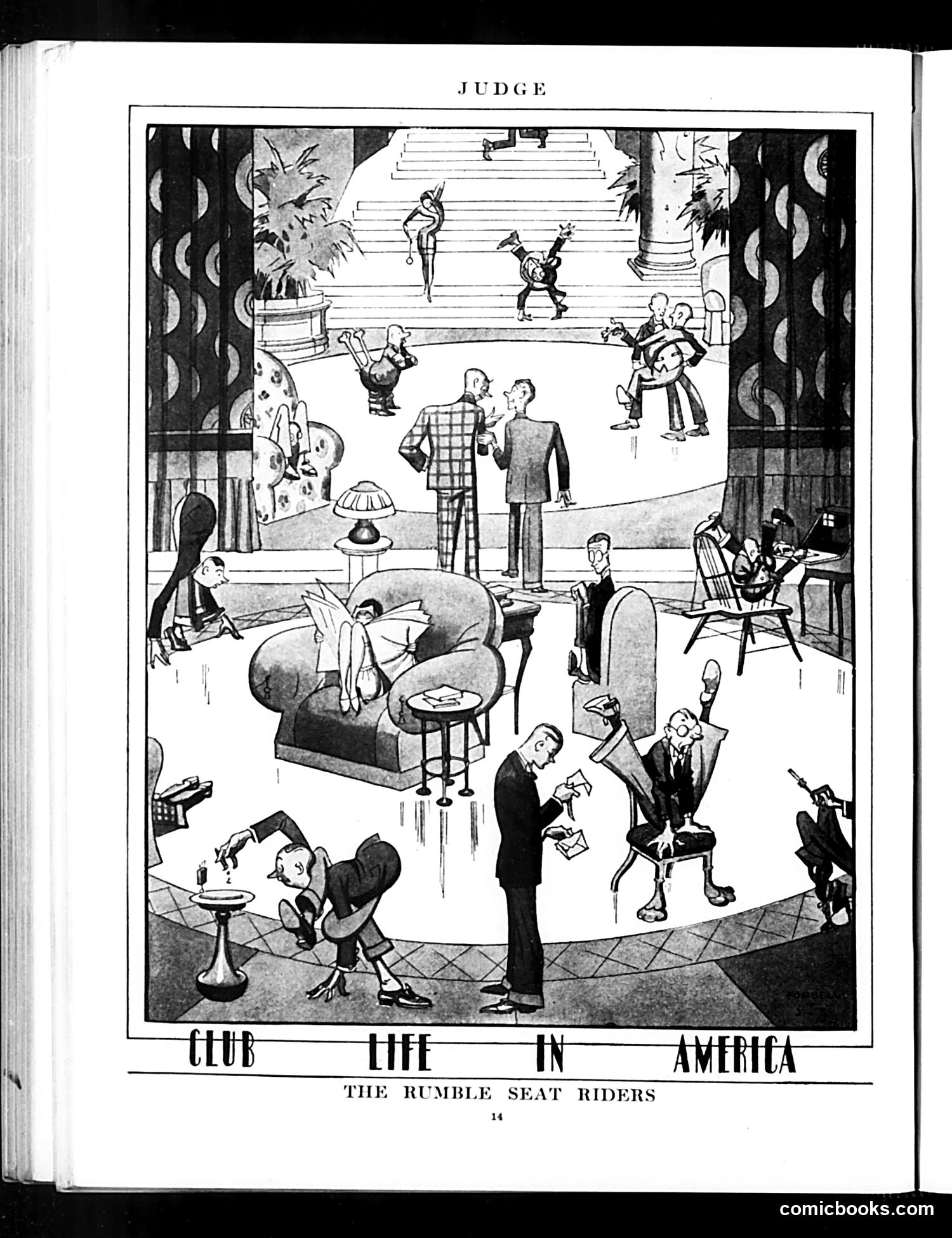
This satirical cartoon from Judge depicts a chaotic social club scene titled "Club Life in America." The illustration mocks the behavior of young people in the 1920s-30s era, particularly those who rode in automobile "rumble seats" (open rear seats). The cartoon shows various figures engaged in rowdy, undignified conduct in what appears to be an upscale venue—people tumbling from furniture, engaging in raucous behavior, and generally causing disruption. The satire targets the younger generation's perceived lack of decorum and social propriety. The "rumble seat riders" reference suggests young people known for wild, unsupervised automobile joyrides. The cartoon critiques both their behavior and the establishments that tolerate such conduct, reflecting contemporary anxieties about youth culture, changing social norms, and the decline of traditional manners during the post-Prohibition era.
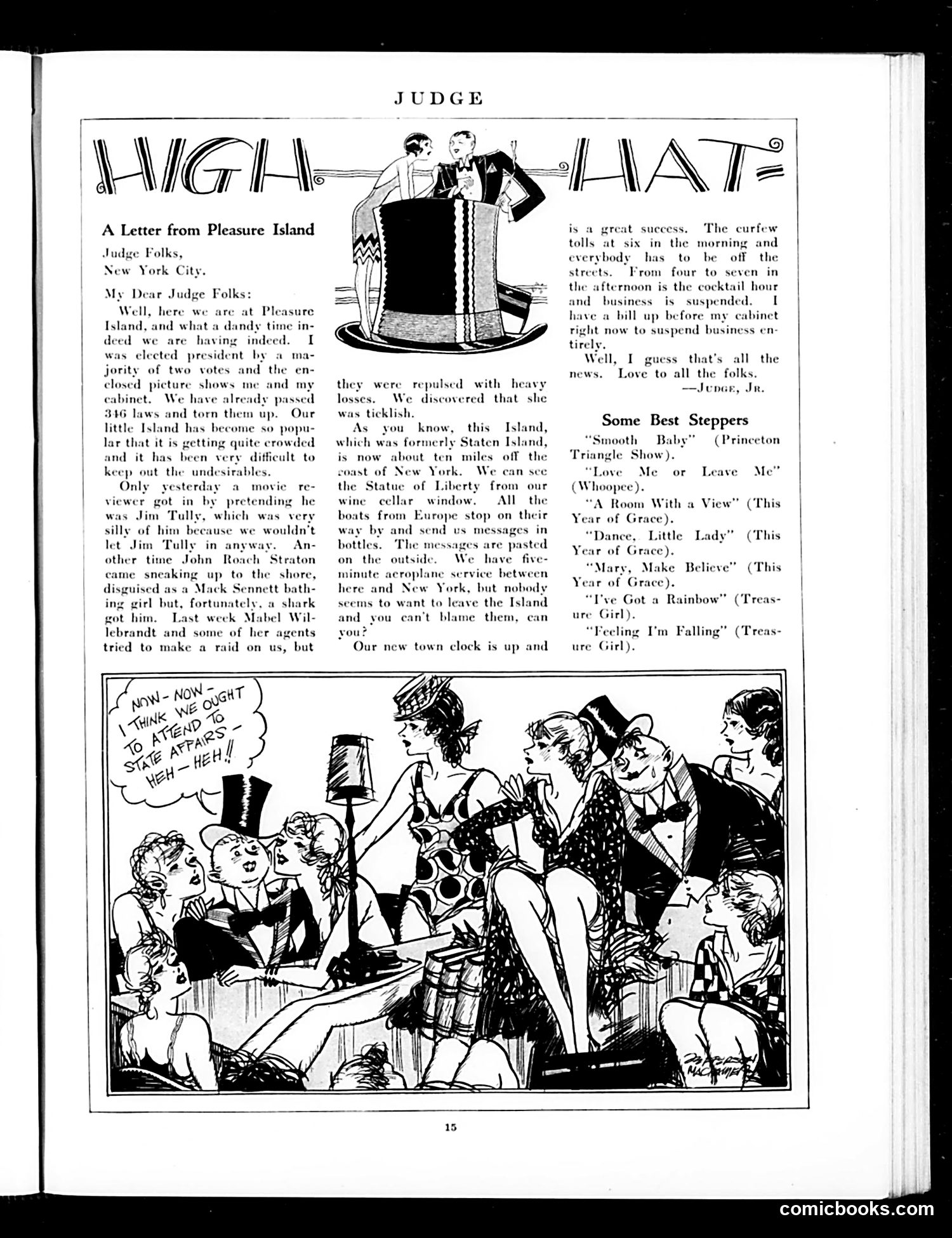
This is a satirical piece about Prohibition-era excess and lawlessness. The writer describes an imaginary island off New York where he's been elected president, claiming they've repealed 346 laws immediately. The satire targets: **The Figures:** Appears to reference actual Prohibition enforcers—notably "Mabel Willebrandt," the real Assistant U.S. Attorney General famous for aggressive Prohibition enforcement, whose "raid" is humorously repulsed. **The Joke:** The island operates as a lawless paradise with "cocktail hours" and suspended business rules—mocking both Prohibition's unpopularity and the era's general disregard for federal alcohol laws. The curfew and early morning regulations parody governmental control. **The Context:** This reflects 1920s public cynicism about Prohibition, portraying it as unenforceable and ridiculous. The cartoonish violence against Willebrandt and references to avoiding detection (disguises, shark attacks) mock the cat-and-mouse game between bootleggers and authorities. The accompanying cartoon (lower half) depicts a party scene supporting this hedonistic theme.
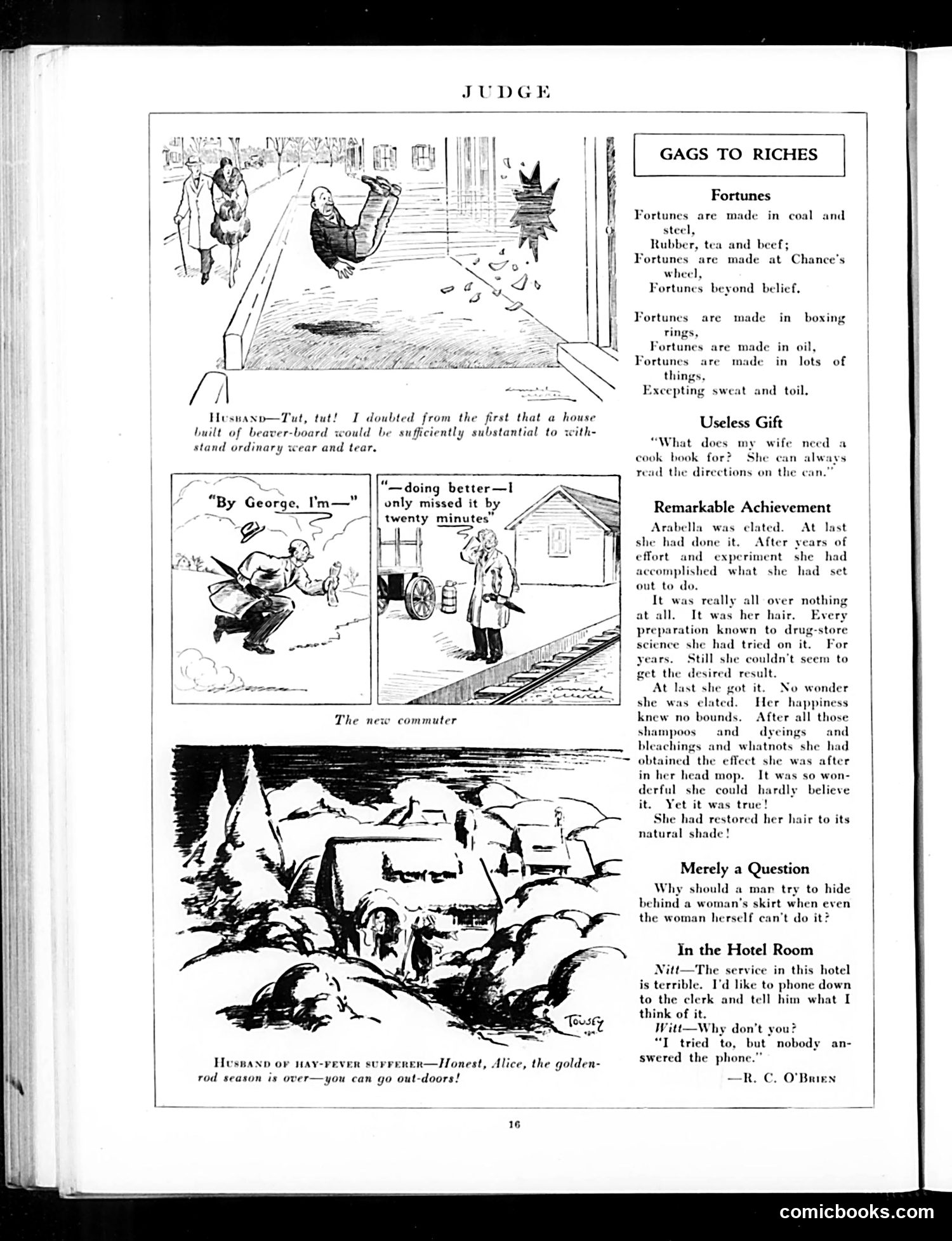
This Judge magazine page contains several satirical jokes reflecting early 20th-century concerns: **Top cartoon**: A husband criticizes his wife's new beaver-board house for collapsing. The satire targets flimsy, cheap building materials marketed to homeowners—particularly relevant to postwar housing booms and consumer product quality. **"The new commuter"**: A man slips on ice while commuting, illustrated through slapstick. This jokes about the hazards of winter commuting, likely during the era of early automobiles and unreliable winter travel. **Bottom cartoon**: A hay-fever sufferer's wife urges him outdoors during "golden-rod season," implying he's using allergies as an excuse to avoid outdoor work. Hay fever was commonly mocked as a wealthy person's ailment. **Side text**: Short humorous quips about wealth-making ("Gags to Riches"), gender dynamics (women hiding behind skirts), and hotel service complaints. These reflect period attitudes toward class, gender roles, and consumer frustrations with emerging service industries.
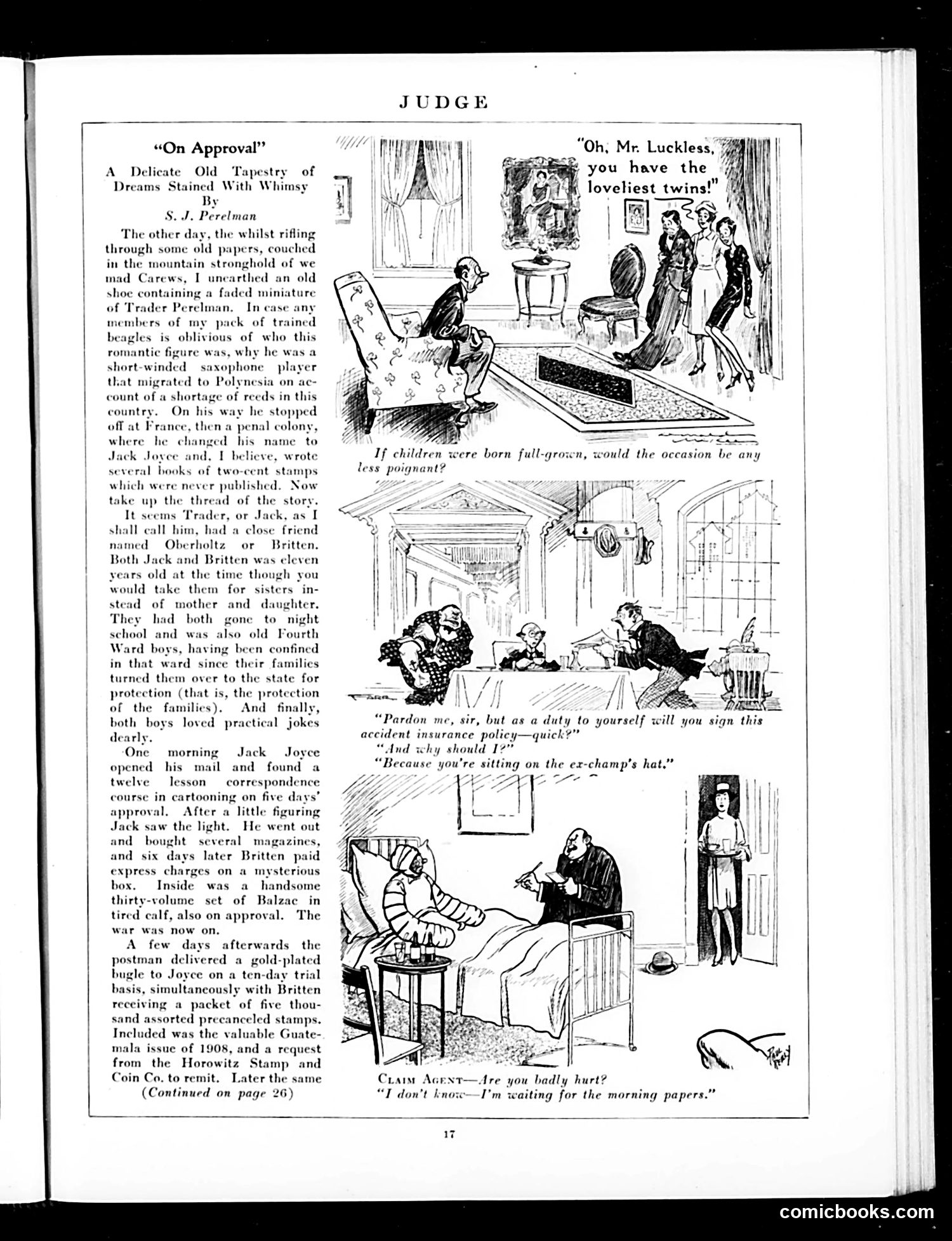
This page contains **three separate satirical cartoons** with no political content: 1. **"On Approval"** (top): S.J. Perelman's humorous short story about two orphan boys engaged in an escalating "prank war" using mail-order approval purchases—sending each other increasingly absurd items (correspondence courses, encyclopedias, bugles, stamps) without paying, forcing the other to refuse delivery. The joke satirizes both mail-order business practices and juvenile mischief. 2. **"Loveliest Twins"** (upper right): A man is complimented on his twins, but the cartoon implies something absurd about the situation—though the specific joke is unclear from the image alone. 3. **"Insurance Policy"** and **"Morning Papers"** (lower section): Two brief gag cartoons about an accident claim adjuster and someone waiting for newspapers, playing on mundane domestic situations for comedic effect. The page is **social satire focused on everyday life and consumer culture**, not political commentary.
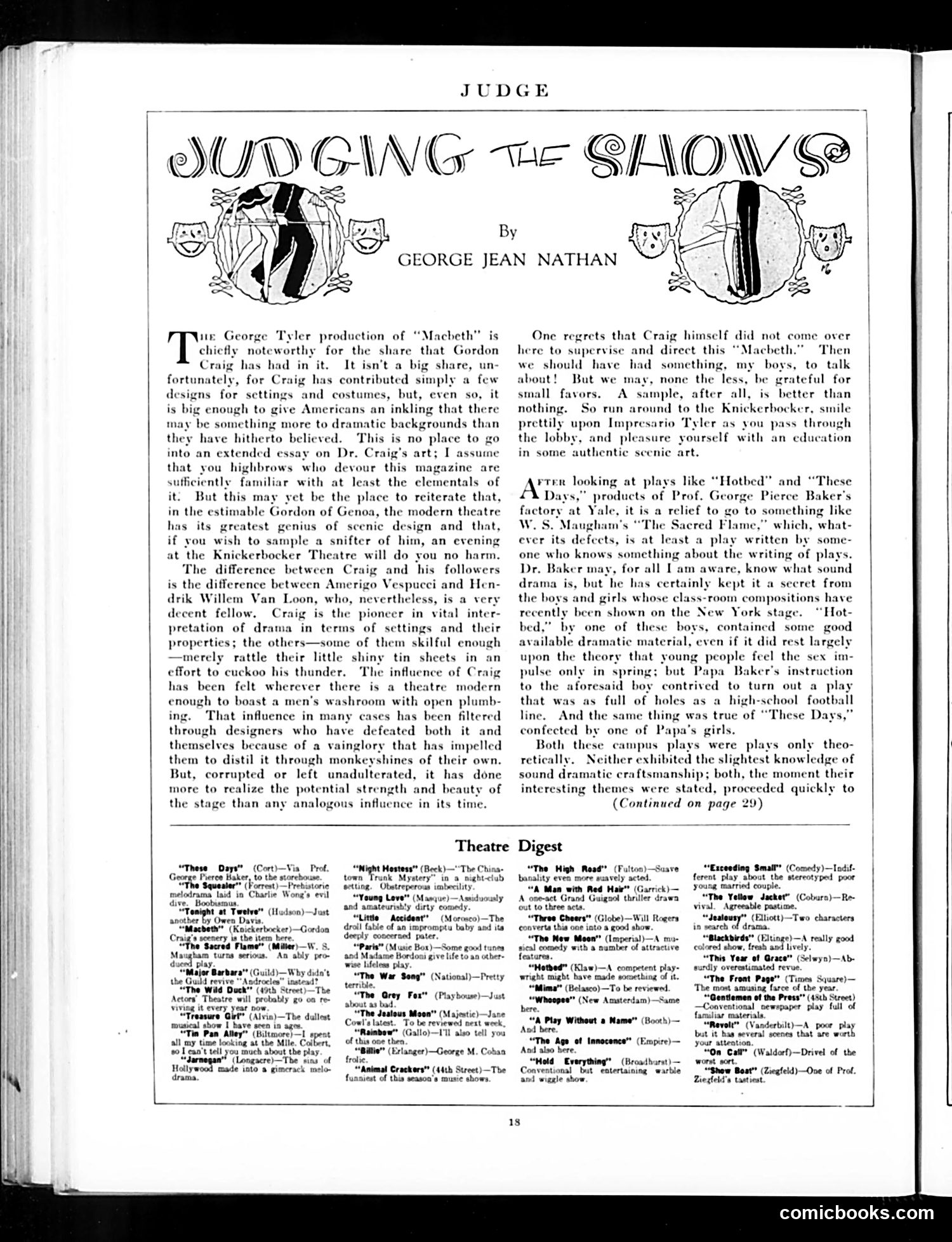
This is a theater criticism column, not a political cartoon. Nathan reviews Gordon Craig's scenic design for a production of "Macbeth" at the Knickerbocker Theatre, directed by George Tyler. **The main points:** Craig is praised as a pioneering theater designer whose influence modernized stage settings, though Nathan regrets Craig didn't supervise the production directly. The piece contrasts Craig's innovative work with derivative designers who imitate his style poorly. Nathan also criticizes student plays from Prof. George Pierce Baker's Yale playwriting workshop—specifically "Hotbed" and "These Days." While acknowledging they contained interesting dramatic material, Nathan argues the plays lack sound dramatic craftsmanship, suggesting Baker's instruction failed to help students develop their themes properly. The "Theatre Digest" section lists current Broadway shows with brief descriptions.
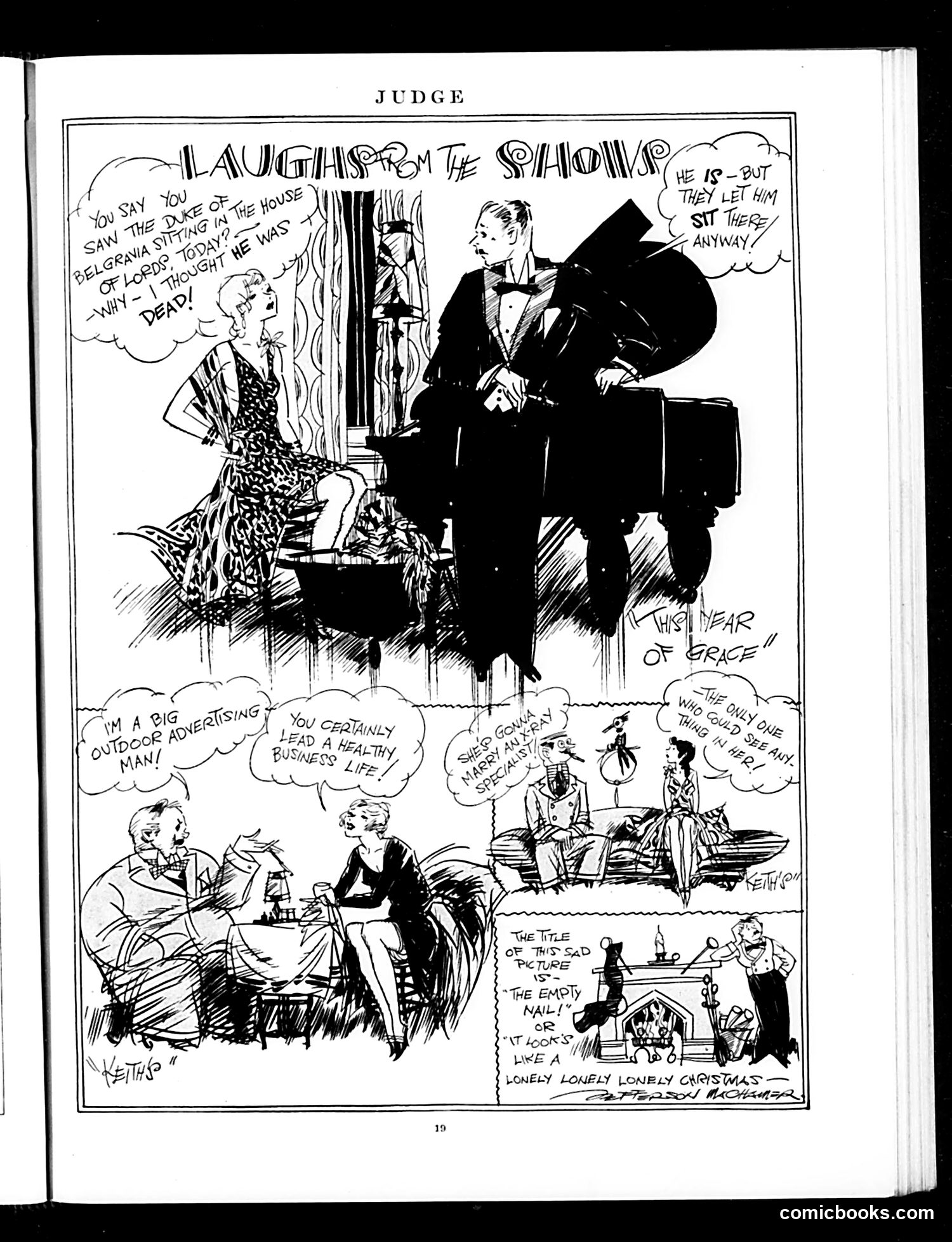
This page contains a multi-panel satirical cartoon titled "Laughs from the Shows." The top panel depicts a wealthy man in formal attire dismissing a woman's complaint about his sitting in the House of Lords despite being dead—he says "they let him sit there anyway," suggesting aristocratic privilege supersedes mortality itself. The lower panels feature society figures making cynical observations about materialism and social climbing: one boasts of "big outdoor advertising," another of leading a "healthy business life." The final panel references "The Empty Mail" or similar, connecting to Christmas themes and loneliness. The satire critiques upper-class pretension, the superficiality of wealth-based status, and the hollowness of materialistic pursuits, particularly during the holiday season. The artwork style and social commentary are typical of Judge's early-20th-century satirical approach to elite American society. The specific political figures or events referenced are unclear from the OCR text.
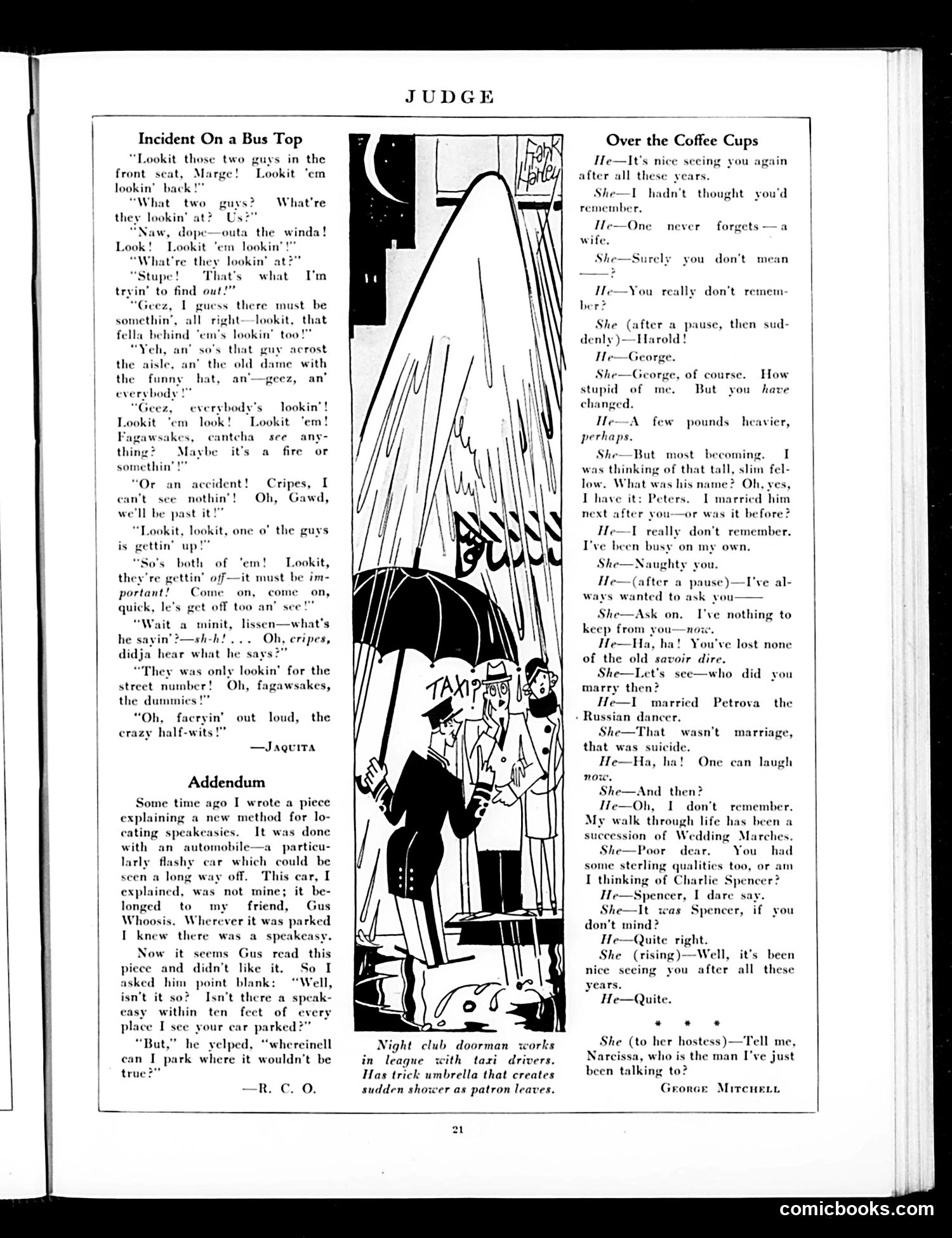
This page contains three humor pieces typical of Judge's satirical style: **"Incident On a Bus Top"** mocks urban rubbernecking culture. Passengers on a bus become obsessed watching other pedestrians stare at something outside, creating a chain reaction of curiosity. The joke satirizes mindless conformity—everyone follows everyone else's gaze without knowing what they're looking at. **"Addendum"** is a brief anecdote about using a flashy car to locate speakeasies (illegal bars during Prohibition). The author notes the car is so conspicuous it reveals speakeasy locations—a dry joke about how obvious these establishments were despite Prohibition laws. **"Over the Coffee Cups"** presents a satirical dialogue between two former lovers who've married multiple people and can't remember each other's names or previous spouses. It mocks the era's casual attitude toward serial marriages and infidelity among the wealthy, suggesting a cynical, directionless approach to relationships. The humor comes from their mutual amnesia about their own romantic histories.
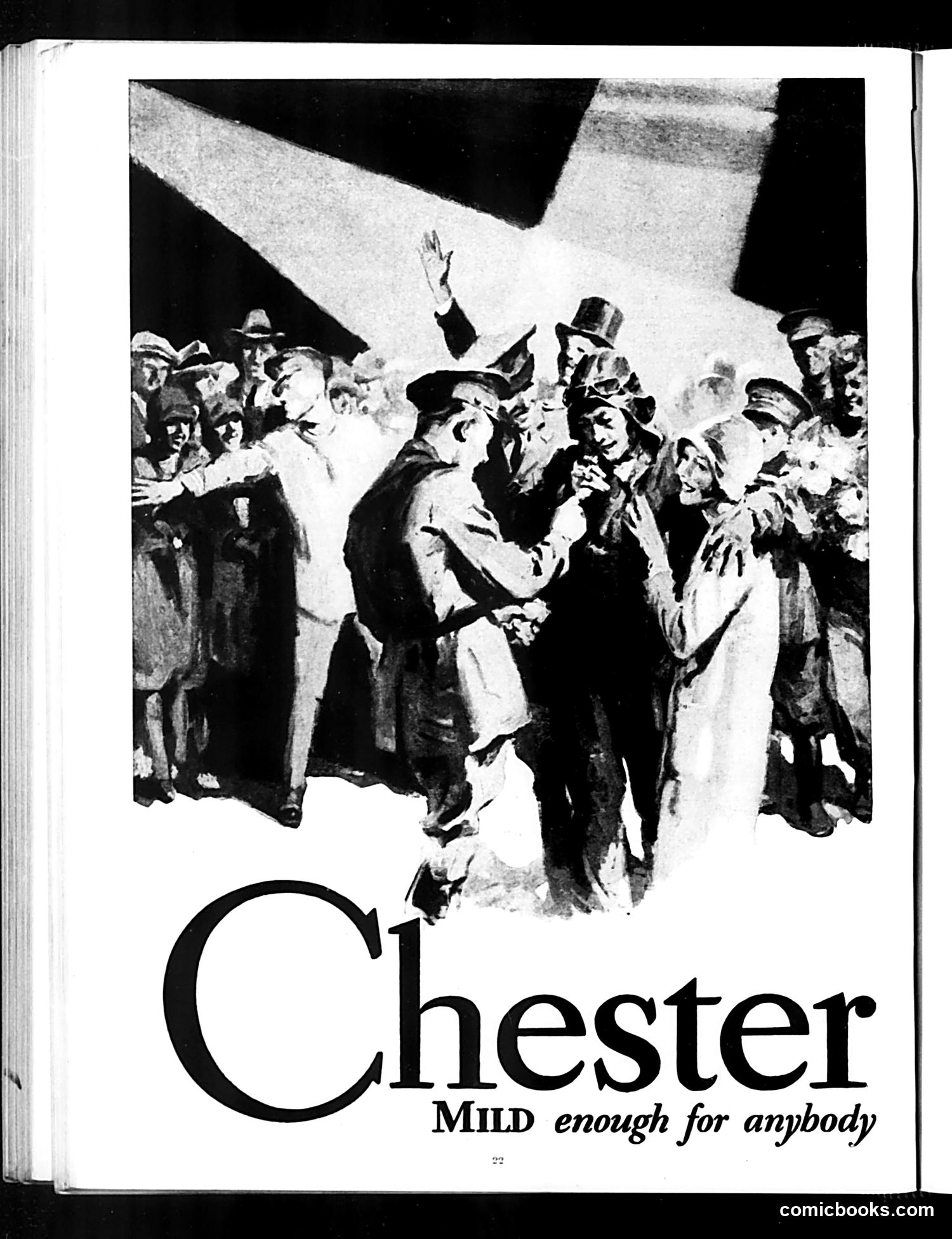
This is a cigarette advertisement from *Judge* magazine featuring the Chester brand. The image depicts a crowd of working-class men in various attire and hats gathered around a central figure, apparently celebrating or endorsing the product. The tagline "Mild enough for anybody" suggests the ad's marketing pitch: that Chester cigarettes were gentle enough for universal consumption. The illustration's style and composition—with its dramatic lighting and crowd scene—mimics popular advertising techniques of the early-to-mid 20th century designed to create social approval and broad appeal. The ad reflects historical cigarette marketing practices before health warnings, when brands freely advertised mildness as a selling point to expand their market beyond traditional smokers.
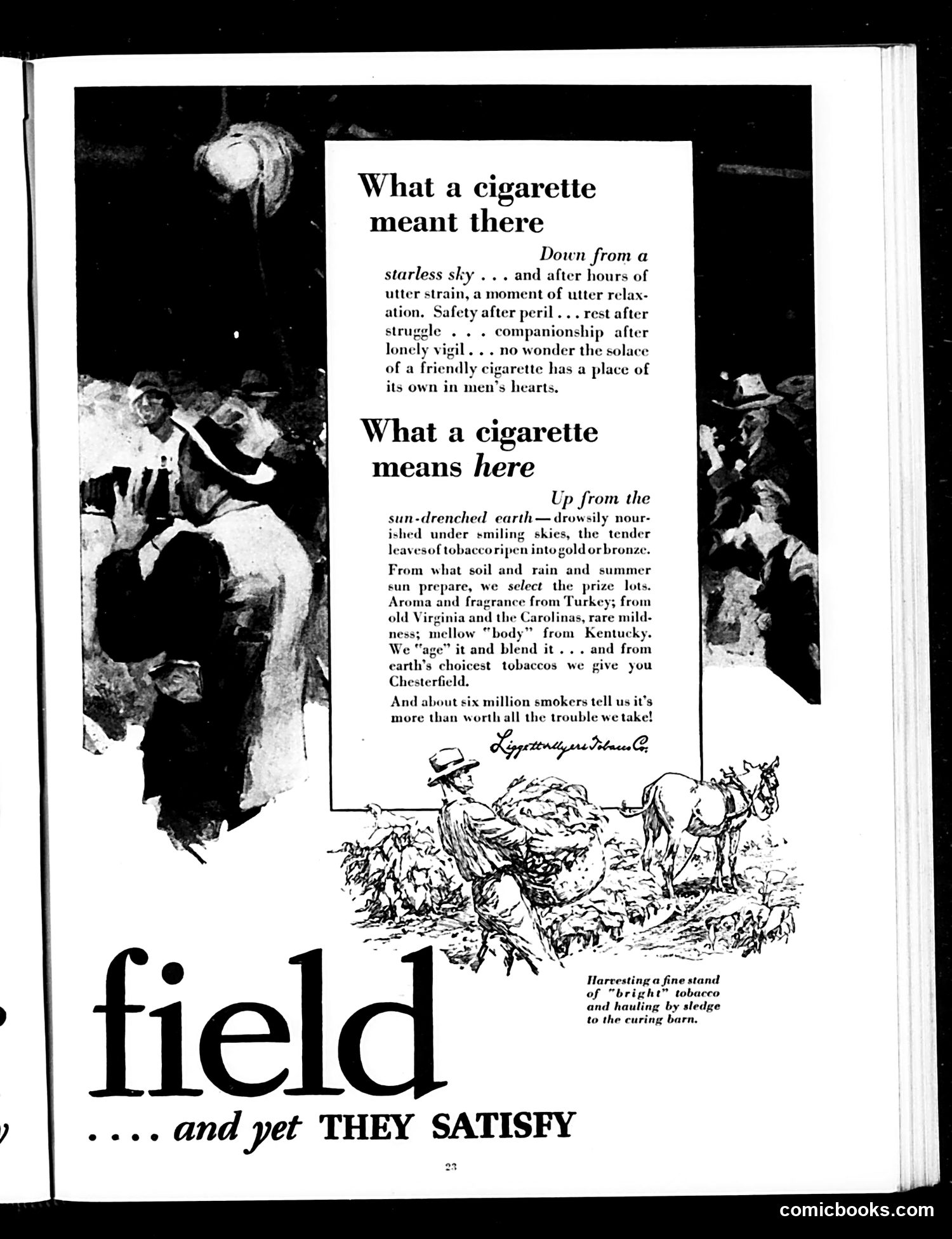
This is a **Chesterfield cigarette advertisement**, not political satire. The page contrasts two meanings of cigarettes: **"There"** (wartime context): Cigarettes as emotional relief—comfort during hardship, danger, and loneliness. The accompanying photograph shows soldiers or military personnel in distress, suggesting combat or wartime strain. **"Here"** (domestic context): Cigarettes as agricultural products, emphasizing the careful cultivation and blending of tobacco from Turkey, Virginia, the Carolinas, and Kentucky. An illustration depicts tobacco harvesting. The ad's tagline—"field...and yet they satisfy"—plays on the contrast between the humble agricultural origins and the refined final product. The message appeals to smokers' patriotism and quality-consciousness during what appears to be the **World War II era**, when cigarettes were marketed as morale-boosters for soldiers while simultaneously promoting domestic tobacco farming.
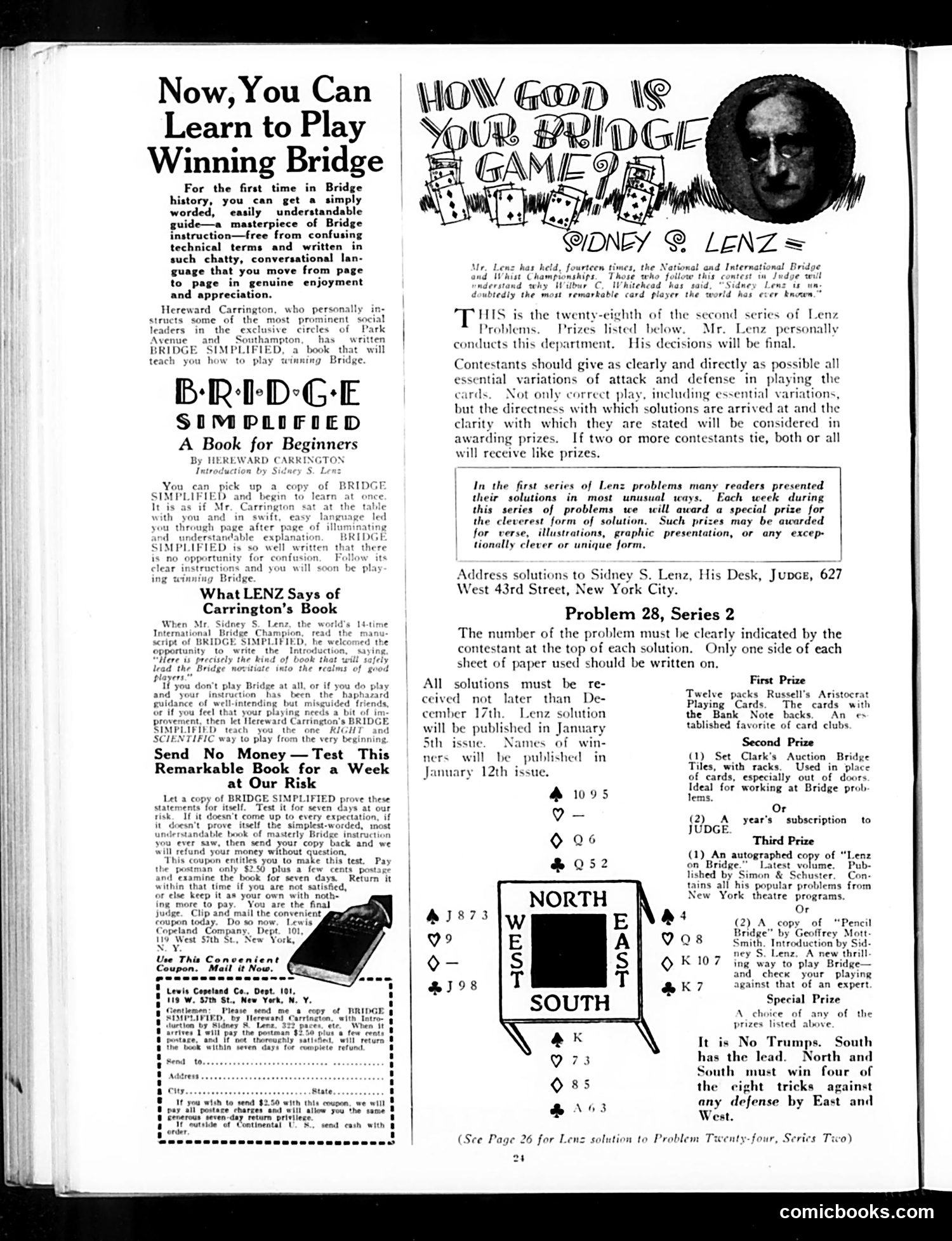
This page from *Judge* magazine features bridge instruction and a bridge problem contest sponsored by Sidney S. Lenz, described as the "world's titling International Bridge Champion." The main content is advertising for "Bridge Simplified," a beginner's guide by Hereward Carrington with an introduction by Lenz. The advertisement emphasizes the book's accessibility and includes an endorsement from Lenz himself praising Carrington's approach. The satirical cartoon appears minimal here—the page is primarily instructional and commercial. The visual humor ("How God Is Your Bridge Game?") makes a light joke treating bridge expertise as almost religious in importance. The broader context: bridge was enormously popular in 1920s-30s America among the wealthy and middle class. Lenz was a genuine celebrity card player; the magazine leverages his fame to promote instruction books and his own problem-solving contests, which readers could enter competitively.
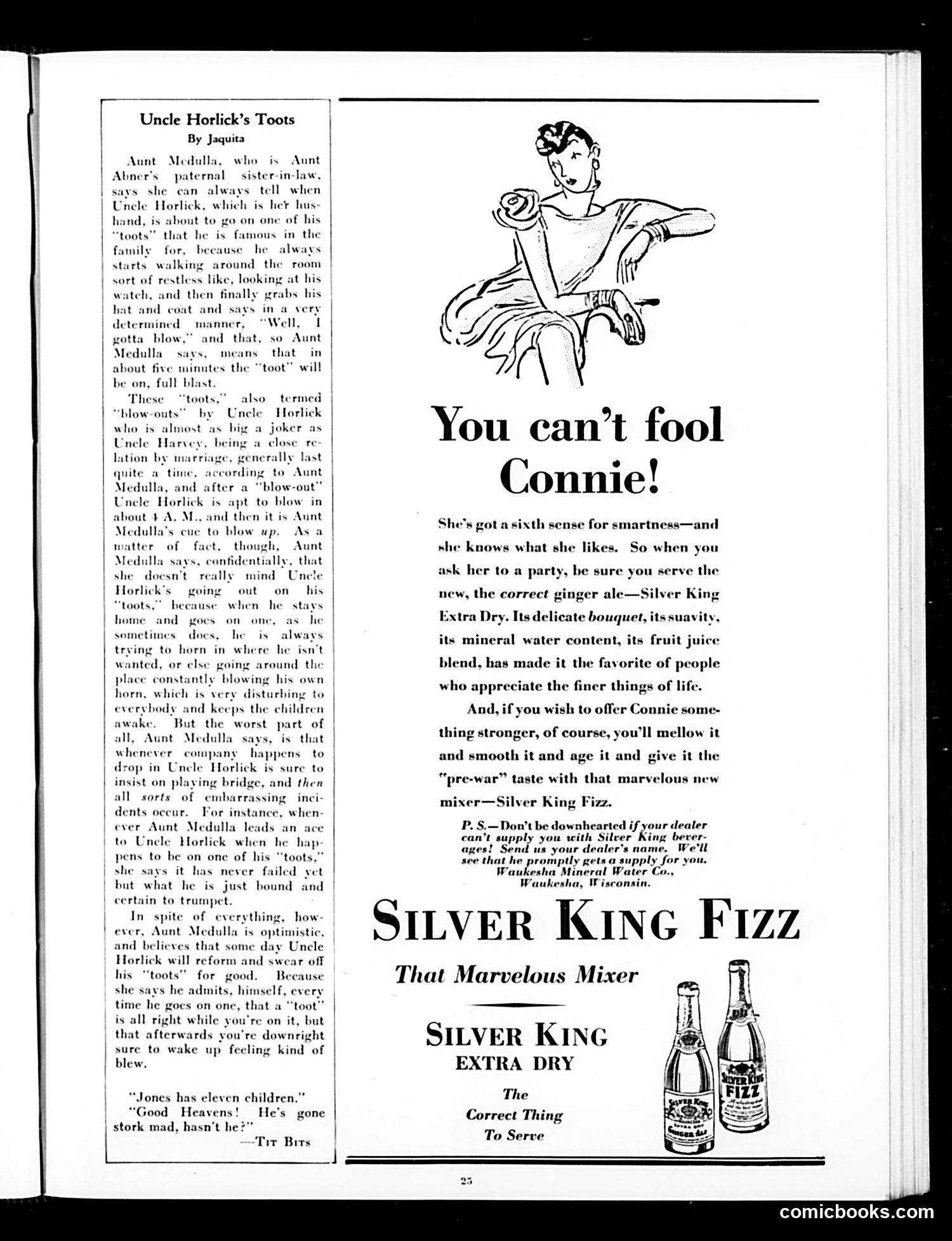
This Judge page combines a humorous domestic sketch with a ginger ale advertisement. **The Cartoon Story:** "Uncle Horlick's Toots" is a light family comedy about a relative notorious for drinking binges (called "toots" or "blow-outs"). Aunt Medulla can predict when Uncle Horlick will go on a drinking spree by his restless behavior—pacing, checking his watch, then announcing "Well, I gotta blow." The joke hinges on double meanings: "toot" suggests both drunken revelry and the sound of a horn. When drunk, he embarrassingly "blows his own horn" (brags), disrupts bridge games, and behaves obnoxiously. His family hopes he'll eventually reform. **The Advertisement:** The ad uses the story's female character ("Connie") as endorsement for Silver King ginger ale and fizz mixer—premium beverages for sophisticated entertaining. The implicit irony: while Uncle Horlick gets drunk on stronger drinks, the discriminating hostess serves refined alternatives. It's aspirational marketing positioning ginger ale as the choice of refined people with good taste.
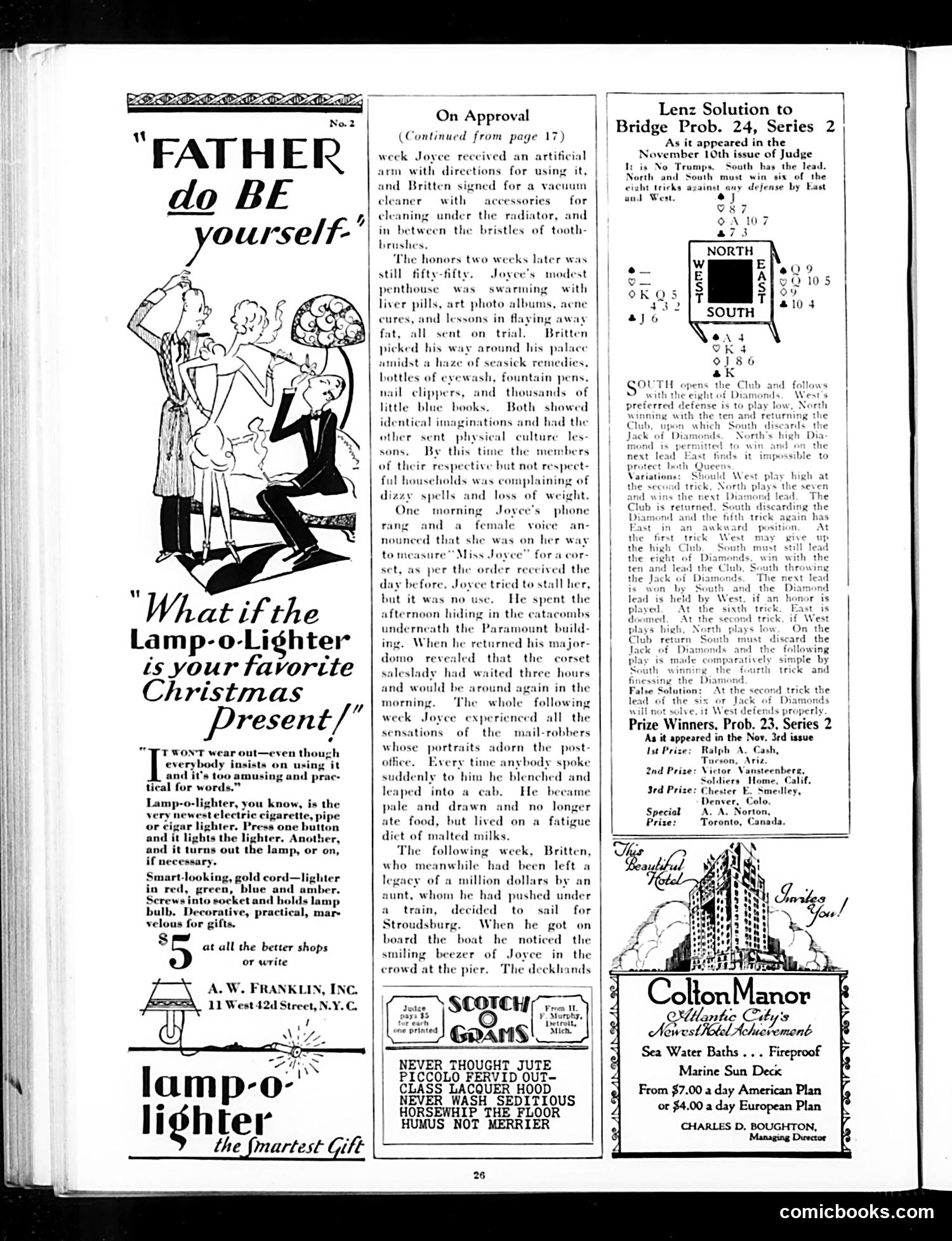
This page contains a serialized humorous story titled "Father, Do Be Yourself" (No. 2) about two men, Joyce and Britten, engaged in a competitive gift-sending war via mail order. **The Plot:** Joyce receives an artificial arm; Britten counters with a vacuum cleaner. They escalate by sending each other increasingly ridiculous items (acne cures, diet pills, art books, physical culture lessons). A corset saleslady becomes so persistent in measuring Joyce that he hides for days, suffering psychological distress. By the story's end, Britten has inherited a fortune and unexpectedly encounters Joyce at a dock. **The Satire:** The humor satirizes 1920s consumer culture—the proliferation of mail-order products and aggressive salesmanship. It mocks how competitive one-upmanship through purchasing ridiculous items can spiral absurdly, and how pushy salespeople terrorized customers. The story suggests the absurdity of consumerism itself. The page also includes advertisements (Lamp-o-Lighter, Scotch Grains, Colton Manor hotel) typical of magazine advertising from this era.
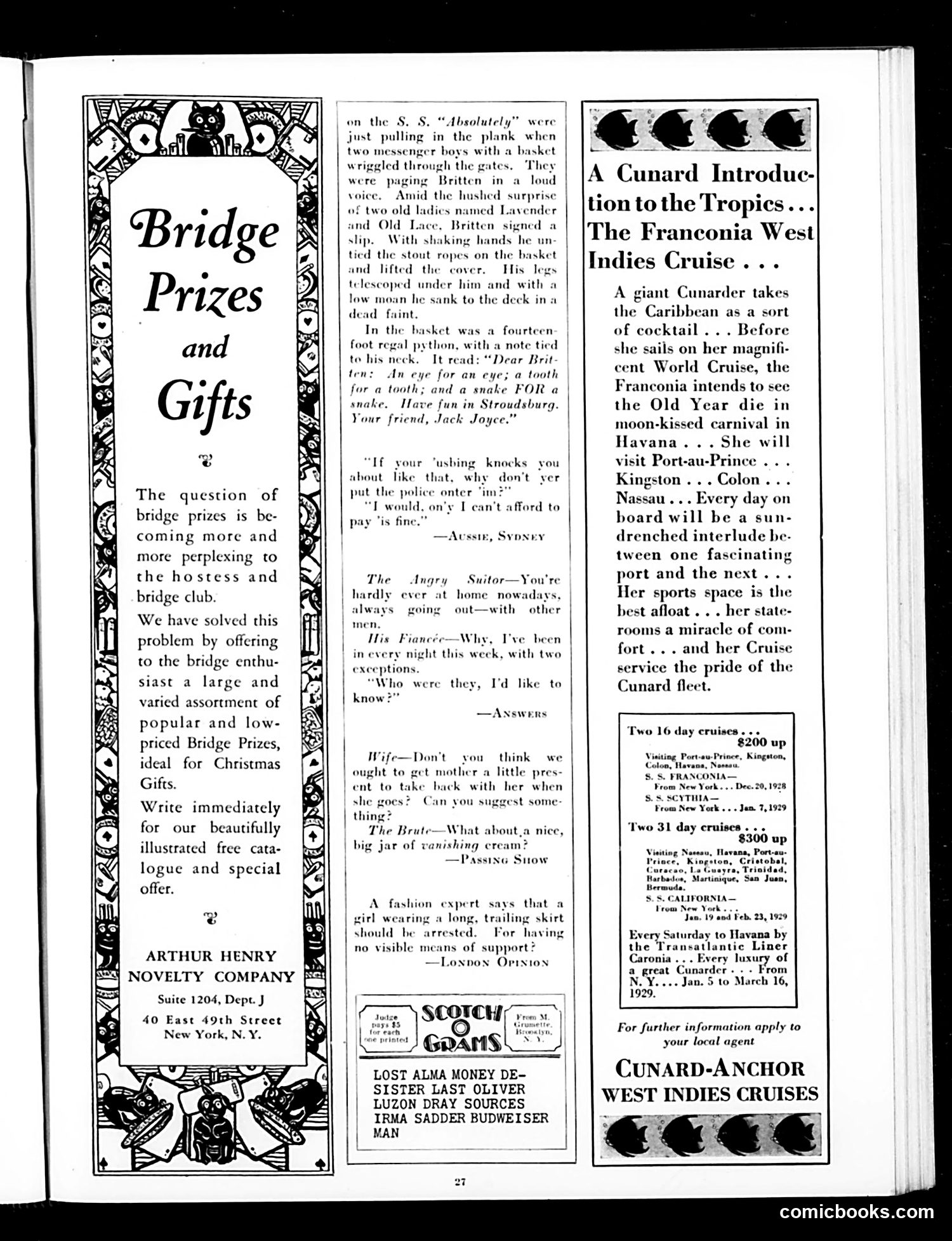
This page is primarily **advertisements and advice columns** rather than political satire. The content includes: **Main Elements:** - A Bridge Prizes advertisement (left column) from Arthur Henry Novelty Company - Multiple gossip/advice columns featuring humorous domestic scenarios—an angry suitor questioning his fiancée's nighttime activities, a wife suggesting vanishing cream as a gift, fashion commentary on trailing skirts - Cunard cruise ship advertisements promoting Caribbean vacations **The "Jokes":** The humor is mild domestic comedy: a man receives a fourteen-foot python from a friend named "Jack Joyce" as revenge; a fiancé suspects infidelity; wives and husbands banter about gifts and fashion. **Context for Modern Readers:** This reflects 1920s leisure culture—bridge playing was a popular social activity, Caribbean cruises signaled wealth and sophistication, and the gossip columns represent early "advice column" entertainment. The page captures period attitudes toward marriage, gender dynamics, and conspicuous consumption rather than political commentary.
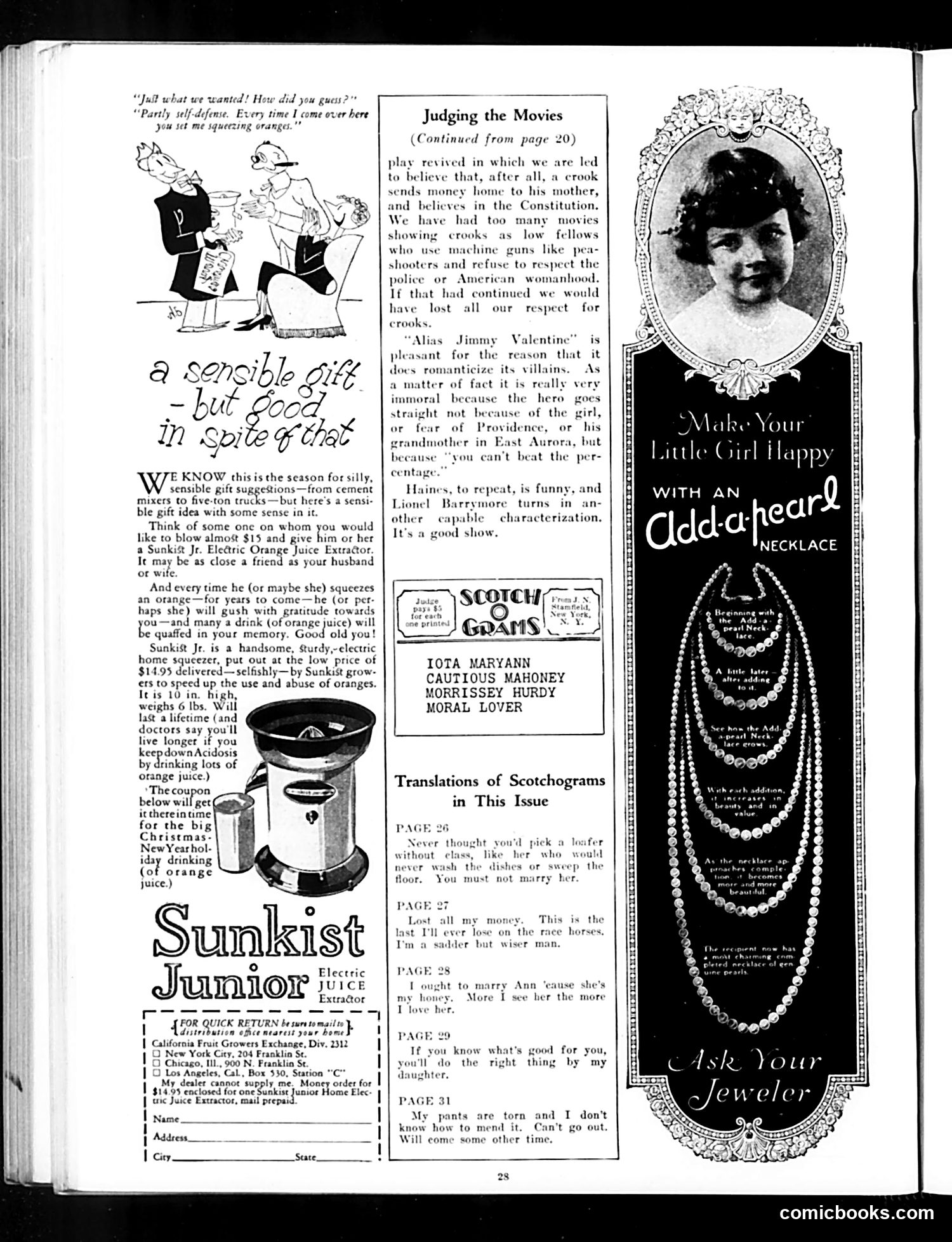
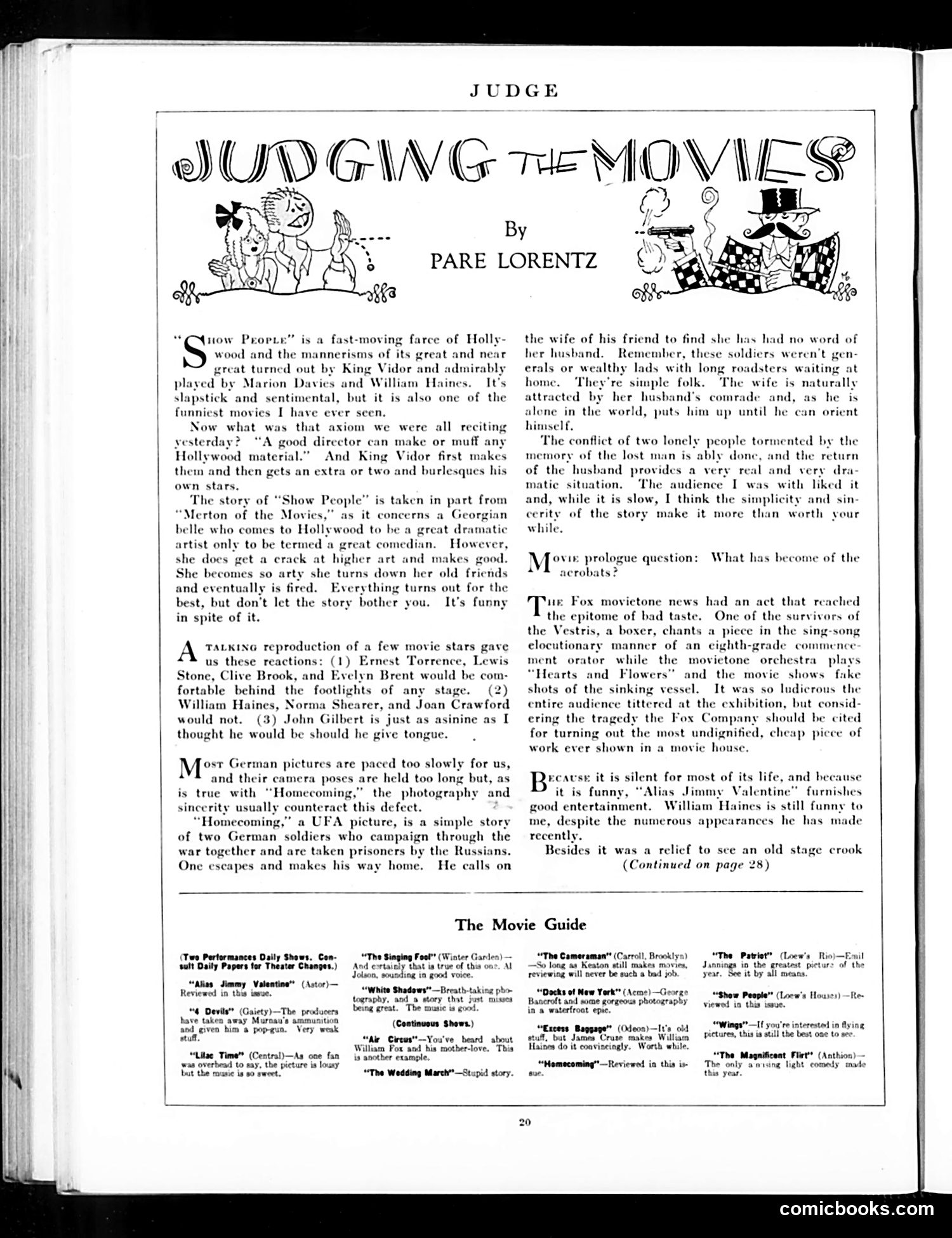
This page contains two distinct elements: **advertising** (dominant) and **film criticism** (secondary). The main content is a Sunkist orange juice extractor advertisement disguised as editorial advice. The small cartoon at top left depicts a domestic scene—a wife squeezing oranges repeatedly, with her husband recognizing this as a hint for a gift. The satire is gentle: the ad humorously positions the $14.95 electric juicer as a practical, "sensible" luxury gift that will inspire lifelong gratitude, then ironically notes recipients will "live longer" drinking orange juice to avoid acidosis. The "Judging the Movies" column briefly reviews two films, praising "Alias Jimmy Valentine" for romanticizing crooks and making them sympathetic (sarcastically critiquing Hollywood's moral decline), and praising Lionel Barrymore's performance in another film called "Haines." The right page advertises an "Odd-a-Pearl" necklace from a jeweler, featuring a photo of a young woman wearing multiple pearl strands. This is primarily **a commercial publication**—the editorial content serves mainly to frame advertisements as lifestyle advice.
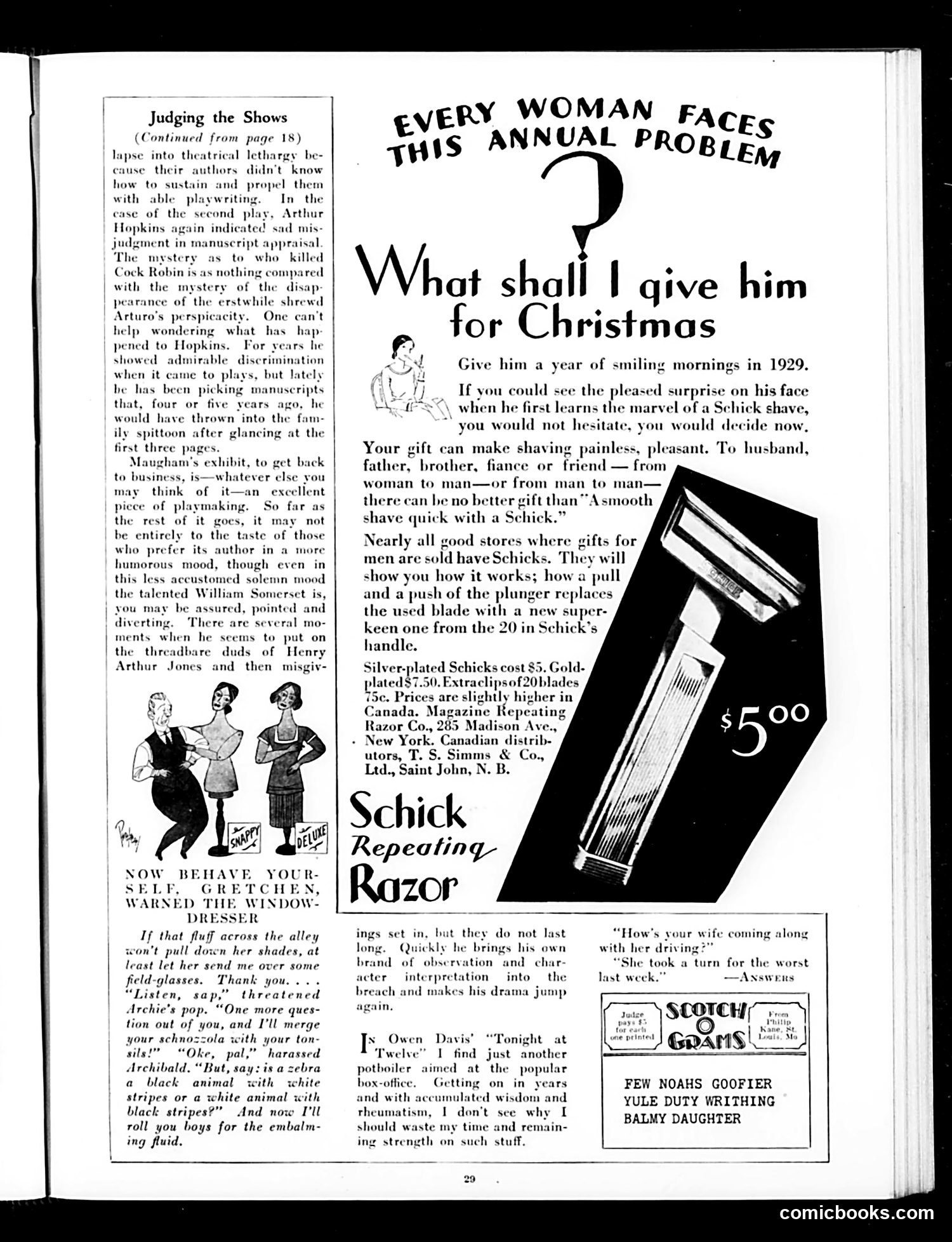
This page combines theater criticism with advertising. The left column critiques recent Broadway plays, discussing authors like Arthur Hopkins and William Somerset Maugham—expressing disappointment that Hopkins's formerly reliable taste in scripts has declined, and that Maugham's serious work, while skillfully written, lacks his usual humor. The main content is a **Schick razor advertisement** disguised as advice. It addresses the recurring "problem" every woman faces: deciding what gift to give men for Christmas. The ad argues that an electric Schick razor represents the perfect gift—painless, pleasant shaving for "husband, father, brother, fiancé or friend." This reflects 1920s gender assumptions: women are positioned as gift-givers for male relatives/partners, and the razor is marketed as solving an intimate domestic concern. The price ($5 for silver-plated, $7.50 gold-plated) and Canadian distributor information anchor it as a genuine period advertisement within the satirical magazine's pages.
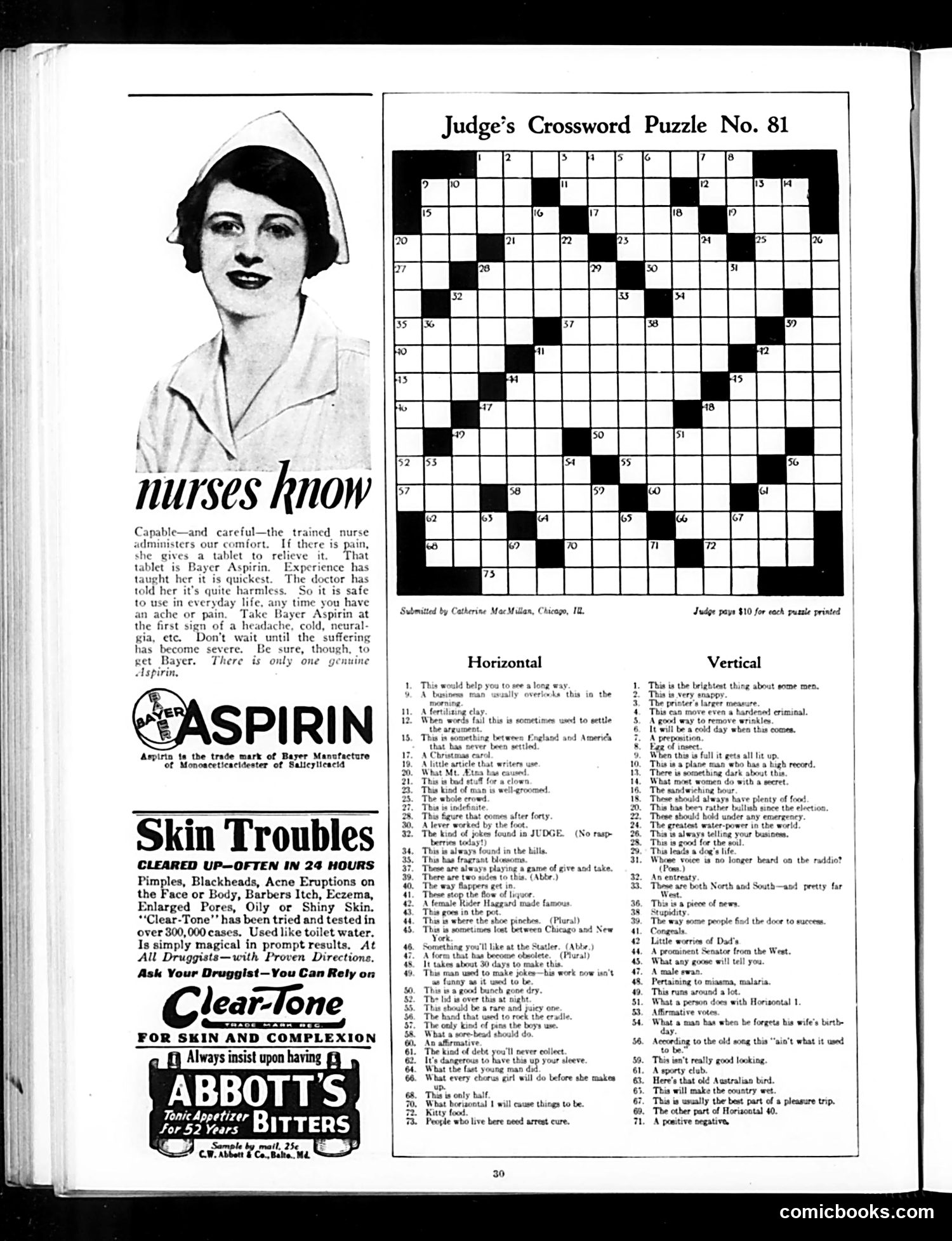
This page is primarily a **crossword puzzle** with accompanying advertisements—not a political cartoon. The puzzle itself contains no satirical content; it's a standard word game. The page is dominated by **advertisements for patent medicines and beauty products** typical of the 1920s-30s era: Bayer Aspirin (emphasizing a nurse's endorsement), Clear-Tone skin treatment (promising results in 24 hours), and Abbott's Bitters. These ads reflect the era's unregulated marketing of medicinal products, often making exaggerated health claims. The puzzle's clues reference contemporary life—business culture, popular entertainment (referencing Rider Haggard), and social customs—but contain no political satire or social commentary worth noting. The photograph shows a nurse, tying into the Aspirin advertisement's messaging about medical authority endorsing the product. This is essentially a **commercial puzzle page**, not a vehicle for satire.
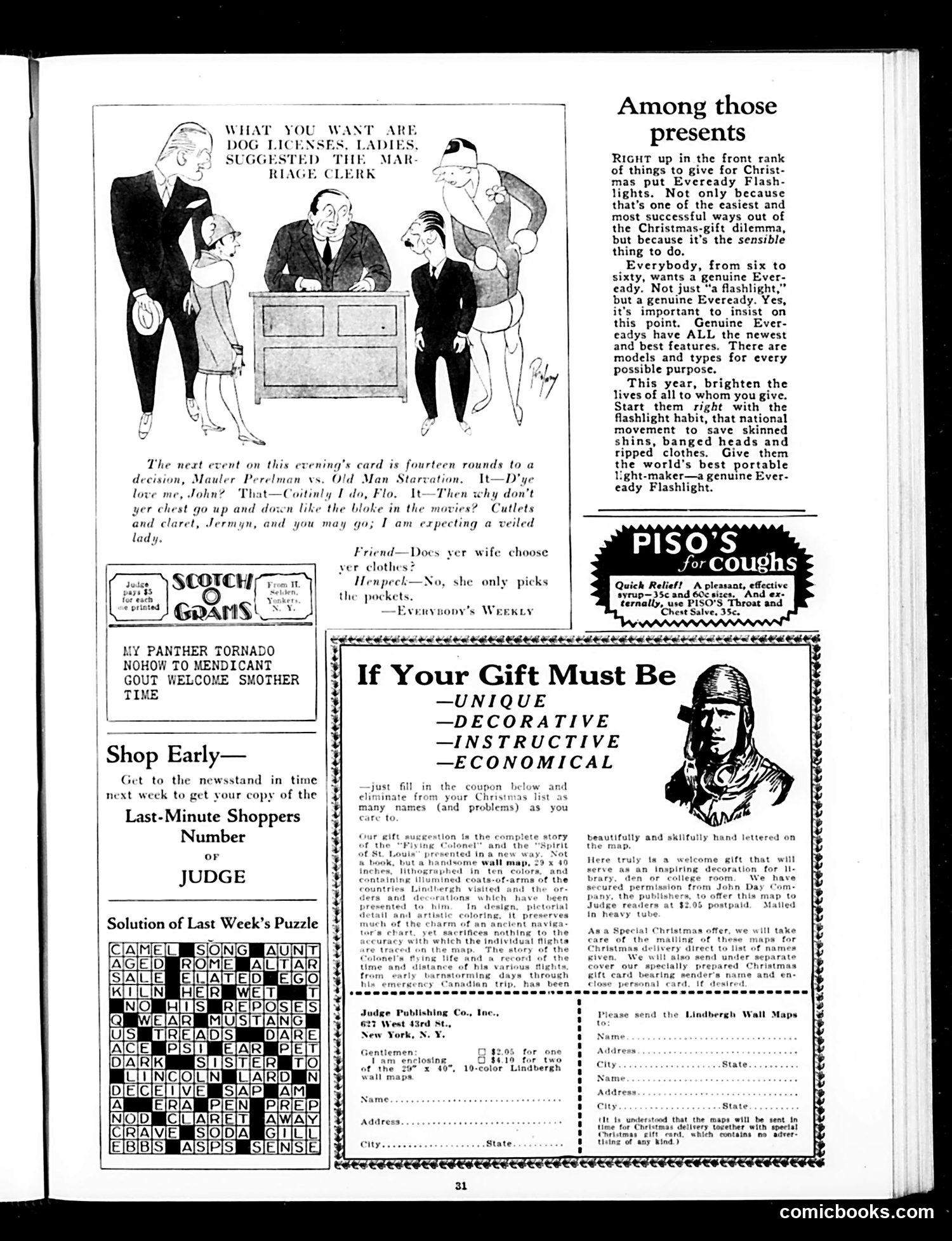
This page is primarily **advertising and filler content** rather than political satire. The main elements are: **The Cartoon:** A small illustration showing a marriage clerk's office with men discussing a boxing match ("Mauler Perelman vs. Old Man Starvation"). The joke is domestic humor—a wife asks her husband why his chest doesn't move like boxers in movies; he replies he needs "cutlets and claret" (food and wine) to perform athletically. **Advertisements:** The page is dominated by product ads—Eveready Flashlights, Piso's cough syrup, and Scotch Grams—typical Christmas gift promotions. A Lindbergh Wall Map advertisement appears, referencing the famous aviator's contemporary relevance. **Other Content:** A crossword puzzle solution and announcement for next week's "Last-Minute Shoppers Number." The page reflects 1920s-30s consumer culture and domestic comedy rather than political commentary. The tone is lighthearted, middle-class oriented, and focused on holiday shopping and humor about marriage and health products.
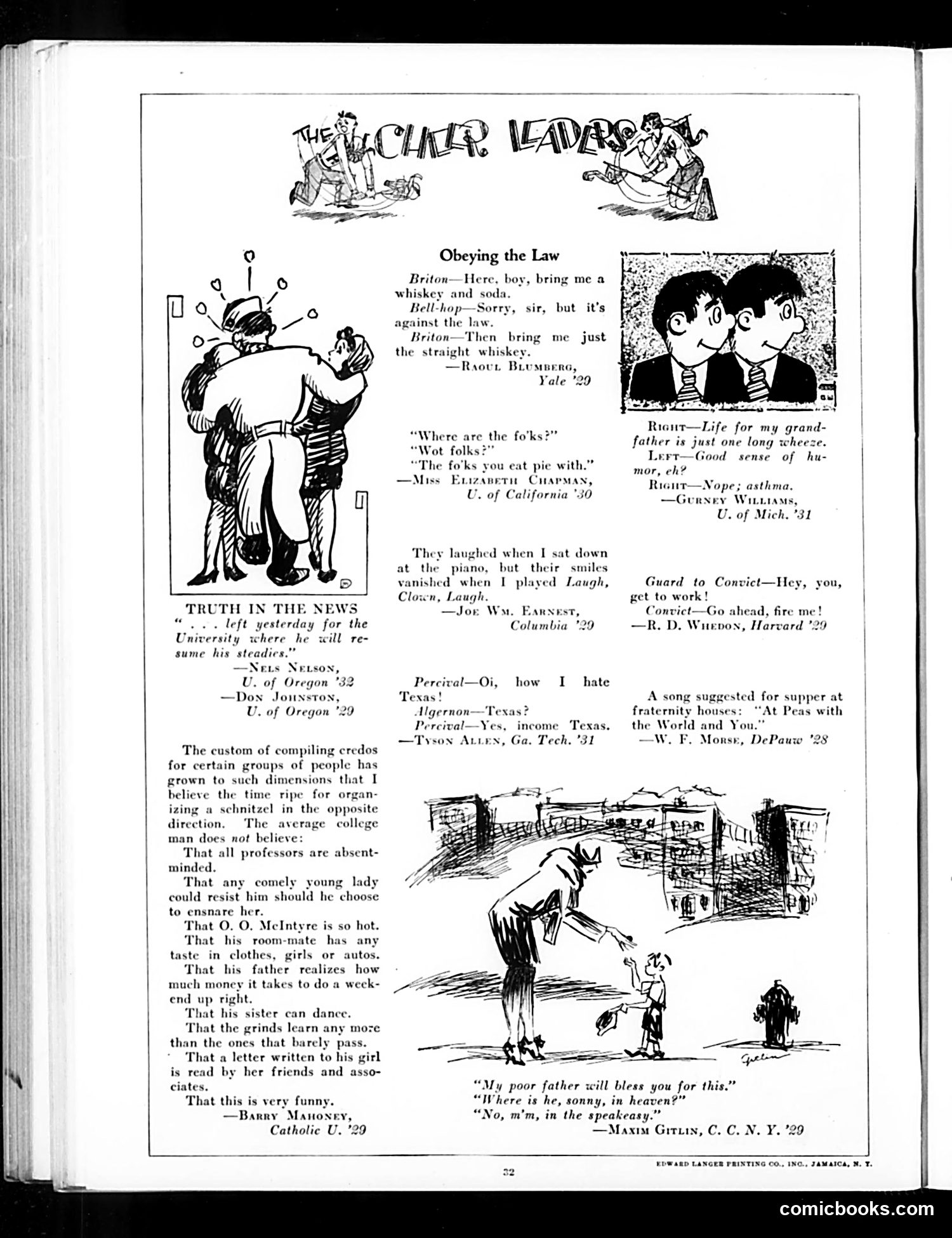
This page from Judge magazine compiles humorous student submissions from various colleges (circa 1928-1931). The content reflects 1920s college life during Prohibition. **Key humor themes:** 1. **"Obeying the Law"** satirizes Prohibition's absurdity—a British guest requests whiskey; the bellhop refuses, so the guest asks for "straight whiskey" instead, suggesting the law's ineffectiveness. 2. **"Truth in the News"** and the college "credos" mock student pretensions and naïveté about romance, money, and social status. 3. **"My poor father..."** The final cartoon's joke relies on Prohibition irony: a father is in a "speakeasy" (illegal bar), not heaven—implying even respectable fathers broke the law. **Overall context:** These are crowd-sourced college humor submissions poking fun at student life, romantic mishaps, and the era's widespread disregard for Prohibition laws, which were widely flouted and mocked in popular culture.
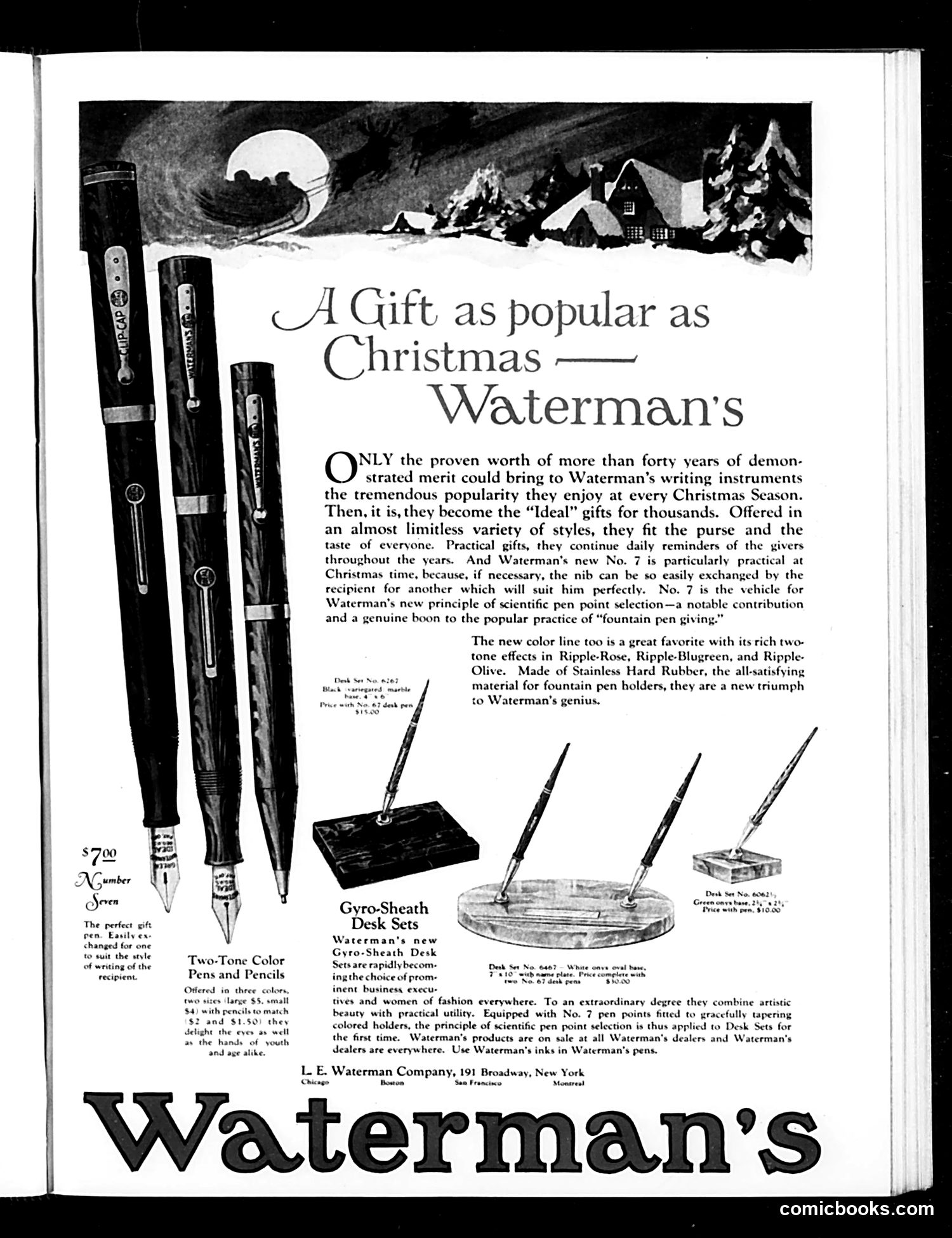
This is not a political cartoon but rather a full-page **advertisement for Waterman's fountain pens**, positioned as a Christmas gift guide. The ad emphasizes that Waterman pens have enjoyed "forty years of demonstrated merit" and are ideal holiday presents because they're practical, long-lasting reminders of the giver. The company highlights their new **No. 7 model** with an innovative interchangeable nib system—allowing recipients to swap nibs to suit their preferences, a notable selling point. The ad showcases various product lines: two-tone colored pens, desk sets, and desk accessories. Pricing ranges from $7.00 upward. The copy appeals to both practical gift-givers and aspirational consumers by framing the pens as suitable for "business executives and women of fashion everywhere." This represents early 20th-century luxury marketing: positioning a functional writing instrument as a sophisticated, thoughtful gift for the refined consumer.
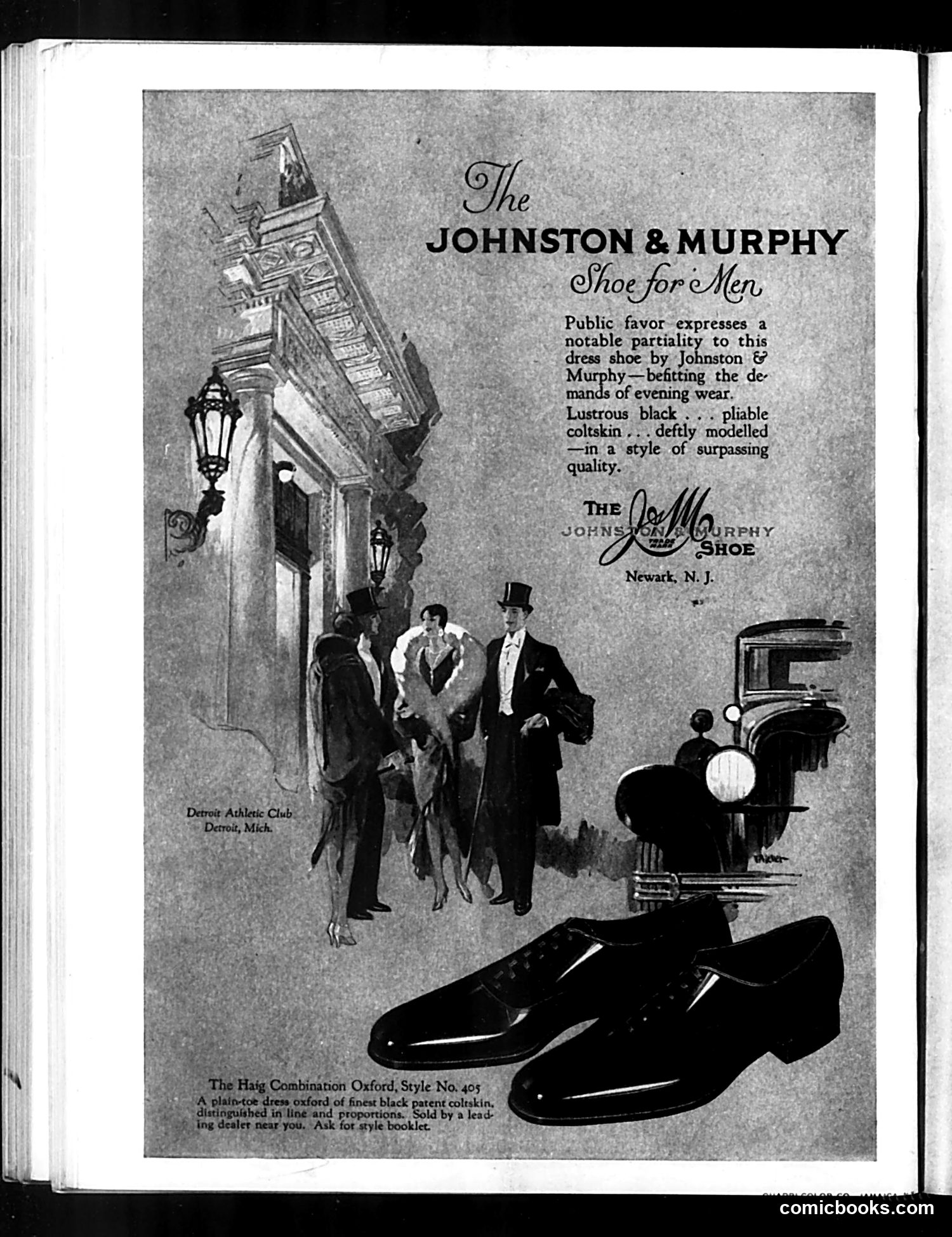
This is primarily a **product advertisement**, not political satire. It promotes Johnston & Murphy dress shoes for men, specifically "The Haig Combination Oxford, Style No. 405" — a black patent leather shoe marketed for evening wear. The advertisement uses aspirational imagery typical of the era: well-dressed men in formal attire (top hats and tails) departing what appears to be an elegant venue, with period automobiles visible. A clock tower suggests an upscale urban setting, likely meant to evoke sophistication and social status. The shoe itself is displayed prominently at bottom. The ad emphasizes quality materials ("finest black patent coltskin") and craftsmanship. There is **no apparent political or social satire** on this page — it's straightforward commercial advertising using glamorous lifestyle imagery to sell luxury footwear to affluent male readers of *Judge* magazine.