
A complete issue · 36 pages · 1928
Judge — November 24, 1928
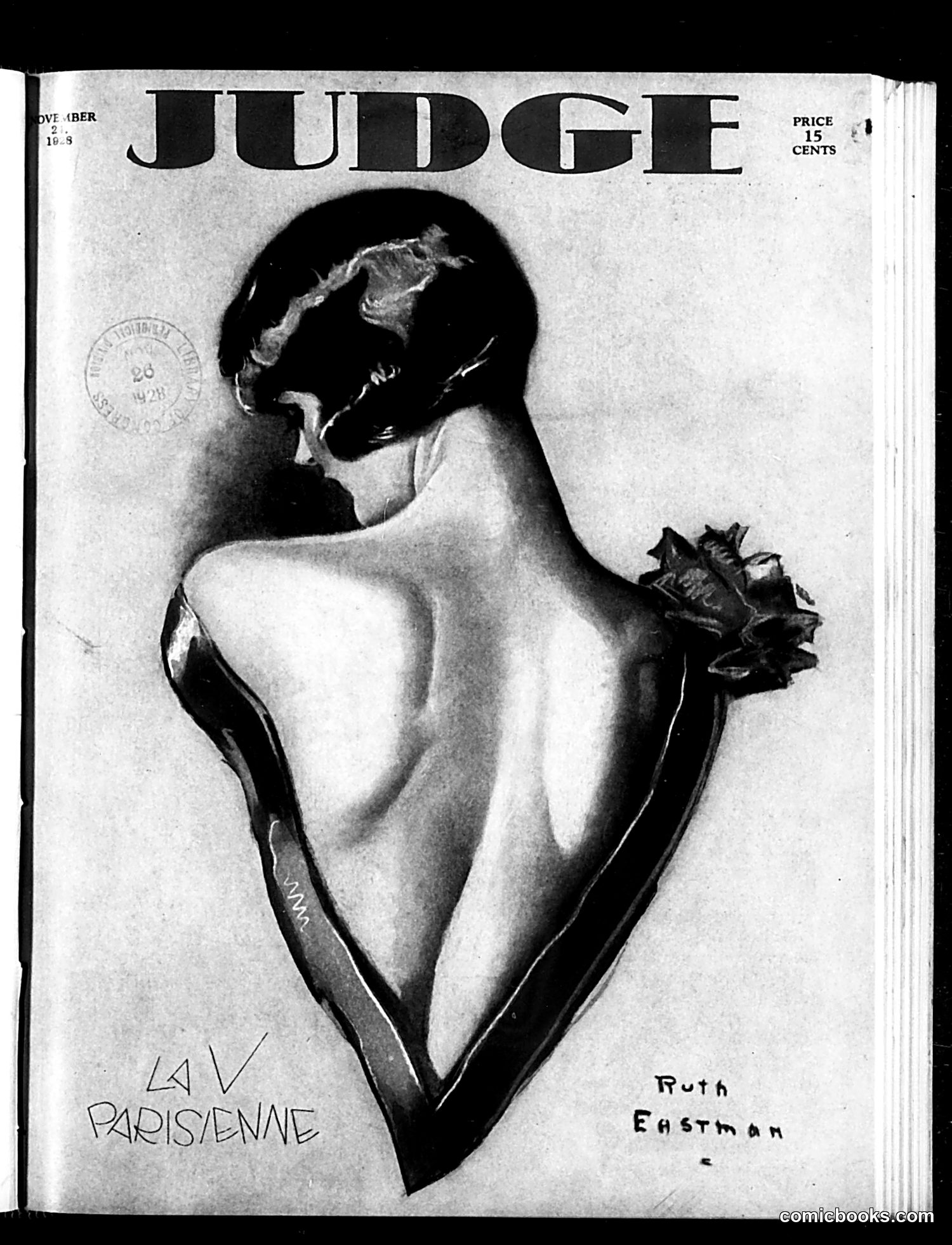
This is the cover of *Judge* magazine (November 1921, 15 cents). The illustration is credited to "La V. Parisienne" and features "Ruth Eastman." The image shows a stylized portrait of a woman's face and shoulders in profile, with dramatic shadowing and art deco styling typical of 1920s design. She wears a dark headpiece or hat and holds flowers. Without additional context about Ruth Eastman or specific events from November 1921, I cannot definitively explain the satirical intent. The cover appears to be a glamorous portrait rather than a political cartoon. It may reference a theatrical performer, socialite, or public figure of that era, but identifying the specific subject and satire requires additional historical information beyond what the image alone conveys.
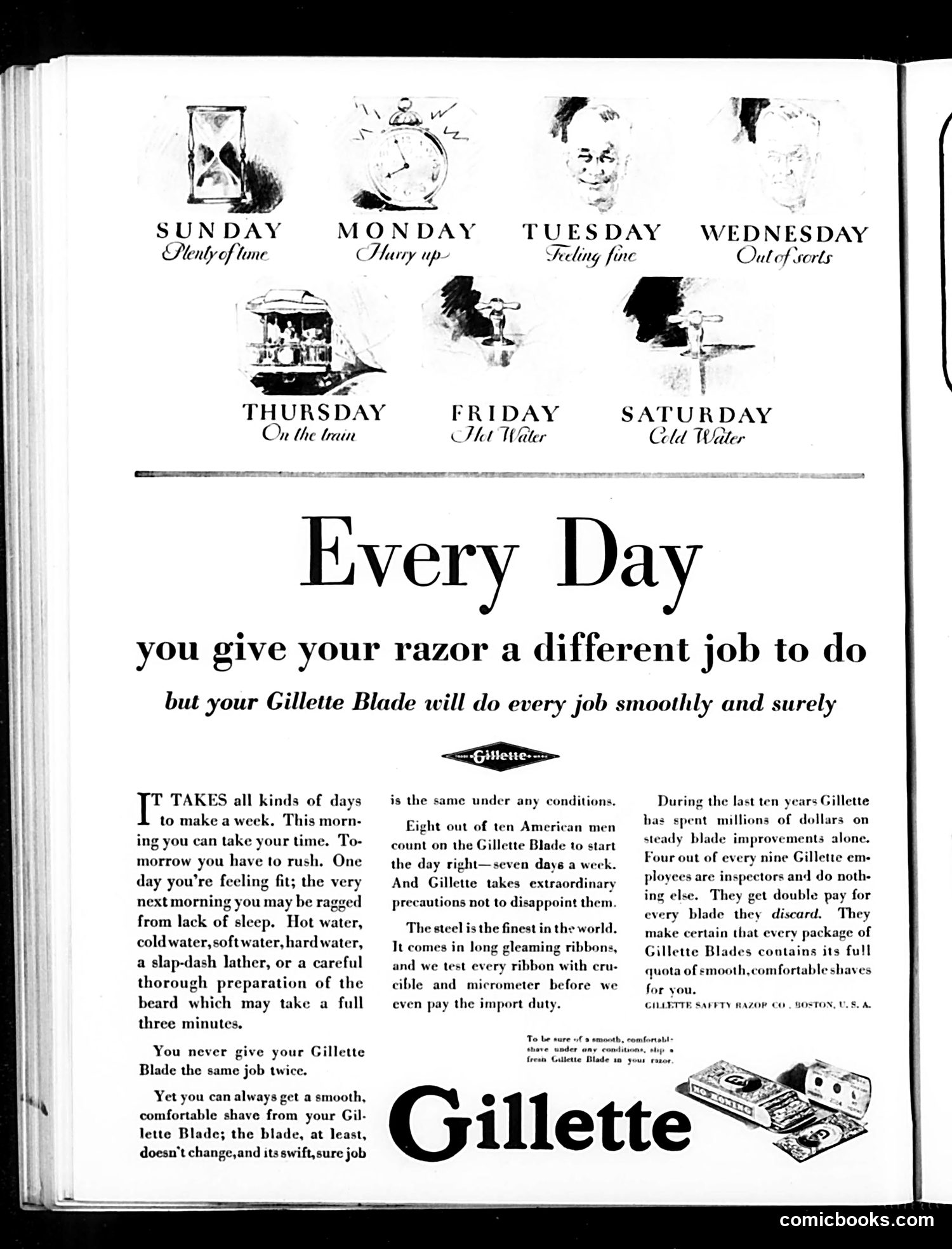
This page is **primarily an advertisement** for Gillette razor blades, not satire or political commentary. The top section shows a humorous weekly calendar where a razor faces different fictional challenges each day (hourglass running out, alarm clock, thermometer, train, water conditions). The joke is gentle and commercial: despite these "different jobs," Gillette blades supposedly perform consistently well under all conditions. The text emphasizes quality control and reliability—inspectors discarding imperfect blades, testing materials rigorously. While published in *Judge*, a satirical magazine known for political cartoons, **this particular page contains no political or social satire**—it's simply an extended product advertisement using light humor to market razor blades to American men in what appears to be the early-to-mid 20th century.
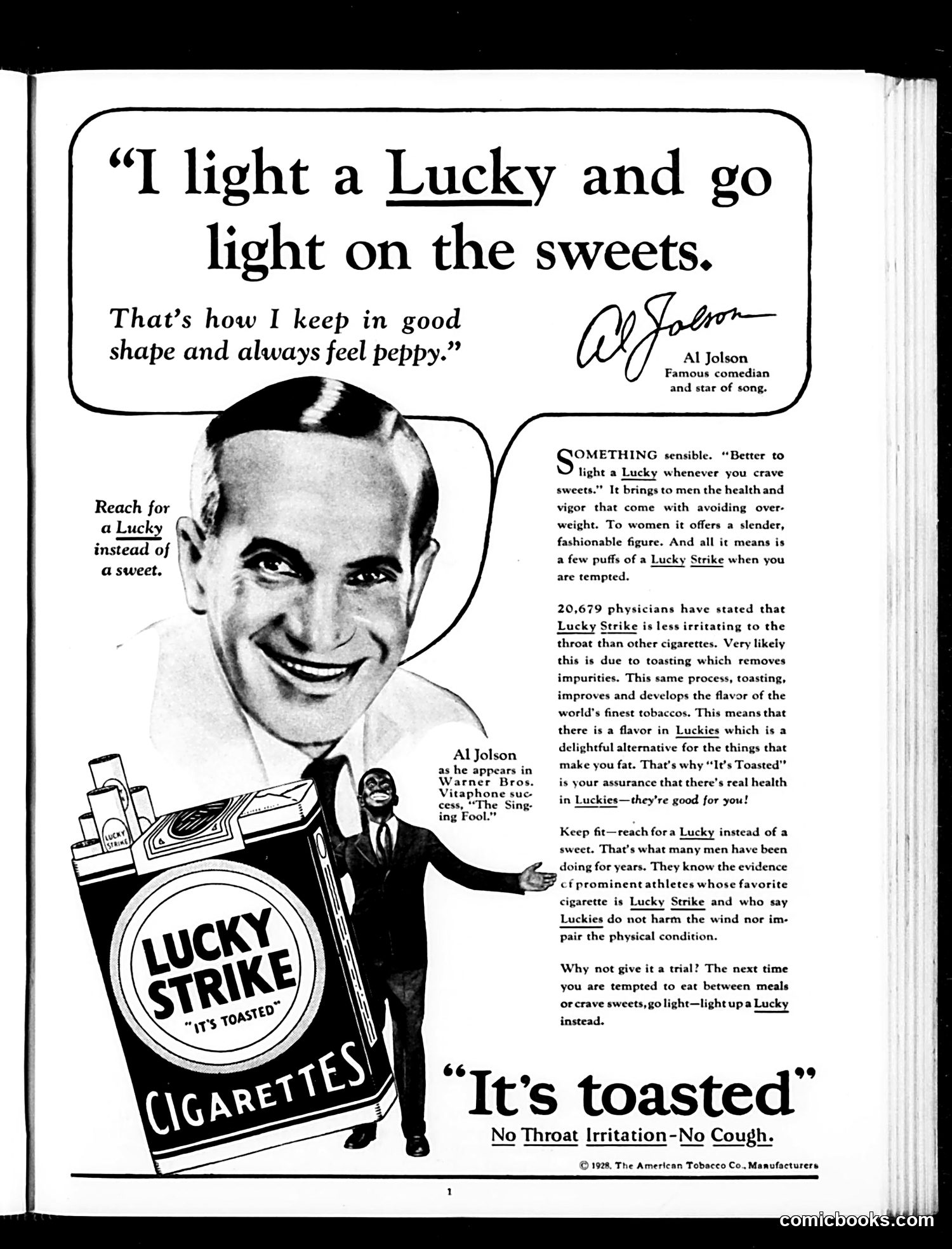
This page is primarily a **Lucky Strike cigarette advertisement**, not editorial content. It features comedian **Al Jolson** endorsing the product with a quote about lighting "a Lucky and go light on the sweets" to stay fit. The ad makes health claims typical of 1920s tobacco marketing: that Lucky Strikes are "less irritating to the throat" due to a "toasting" process, and that smoking suppresses appetite better than eating sweets—making them preferable for weight management and athletic performance. The text cites "20,679 physicians" supporting these claims, a common advertising tactic of the era before cigarette health dangers were widely acknowledged. This represents pre-regulation advertising that would be illegal today, mixing celebrity endorsement with unsubstantiated medical claims.
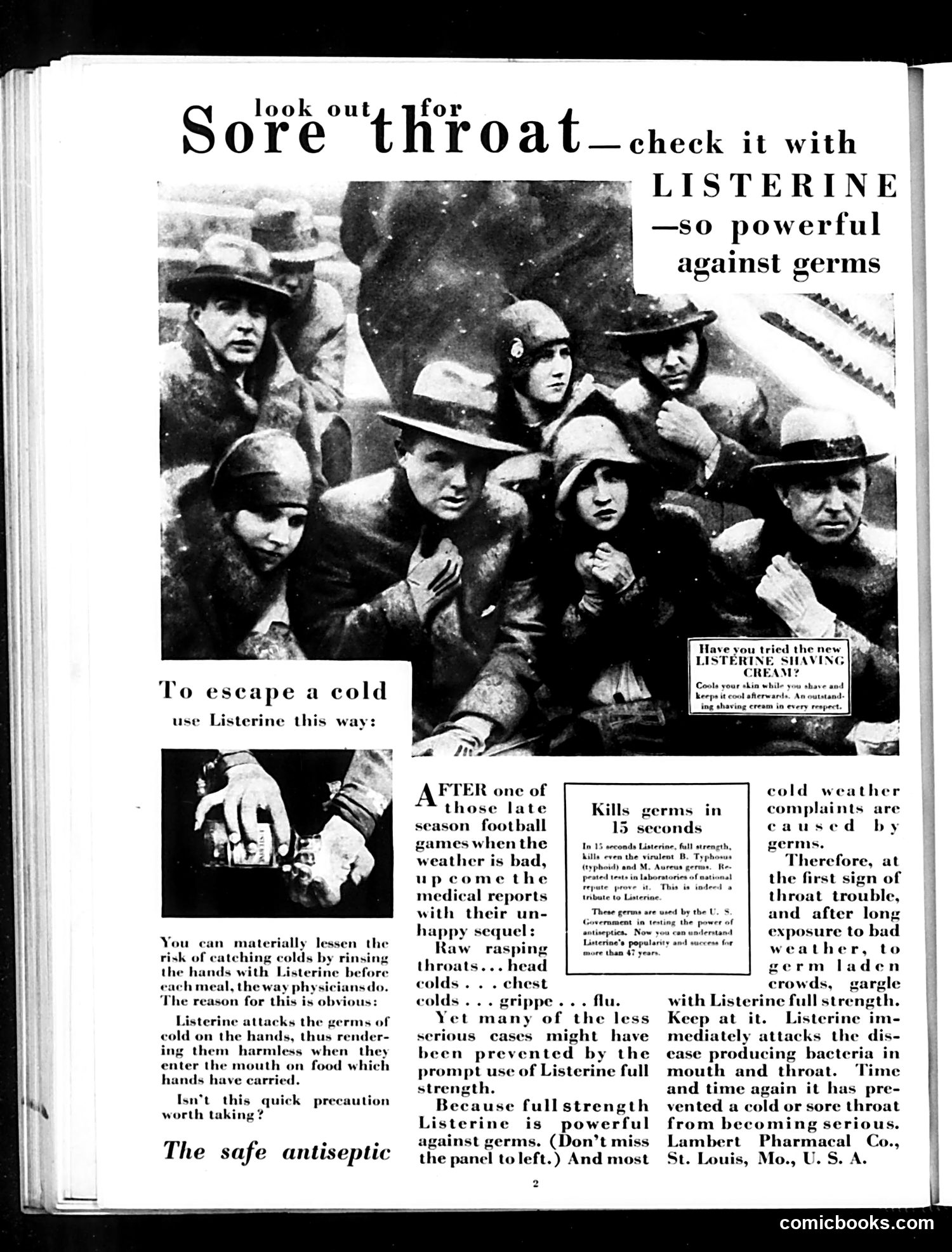
This page is primarily a **Listerine mouthwash advertisement**, not political satire. The central image shows a crowd of people in winter coats and hats, apparently illustrating "cold weather complaints" like sore throats and colds that the product claims to prevent. The ad promotes Listerine as an antiseptic that "kills germs in 15 seconds" and argues that rinsing with it before eating prevents colds from entering the mouth. It includes smaller instructional images demonstrating the rinsing technique. There's a minor reference to a "new Listerine shaving cream" in a corner box, suggesting product line expansion. The page reflects early 20th-century medical marketing claiming germ-killing powers for everyday hygiene products—claims that would face modern skepticism.
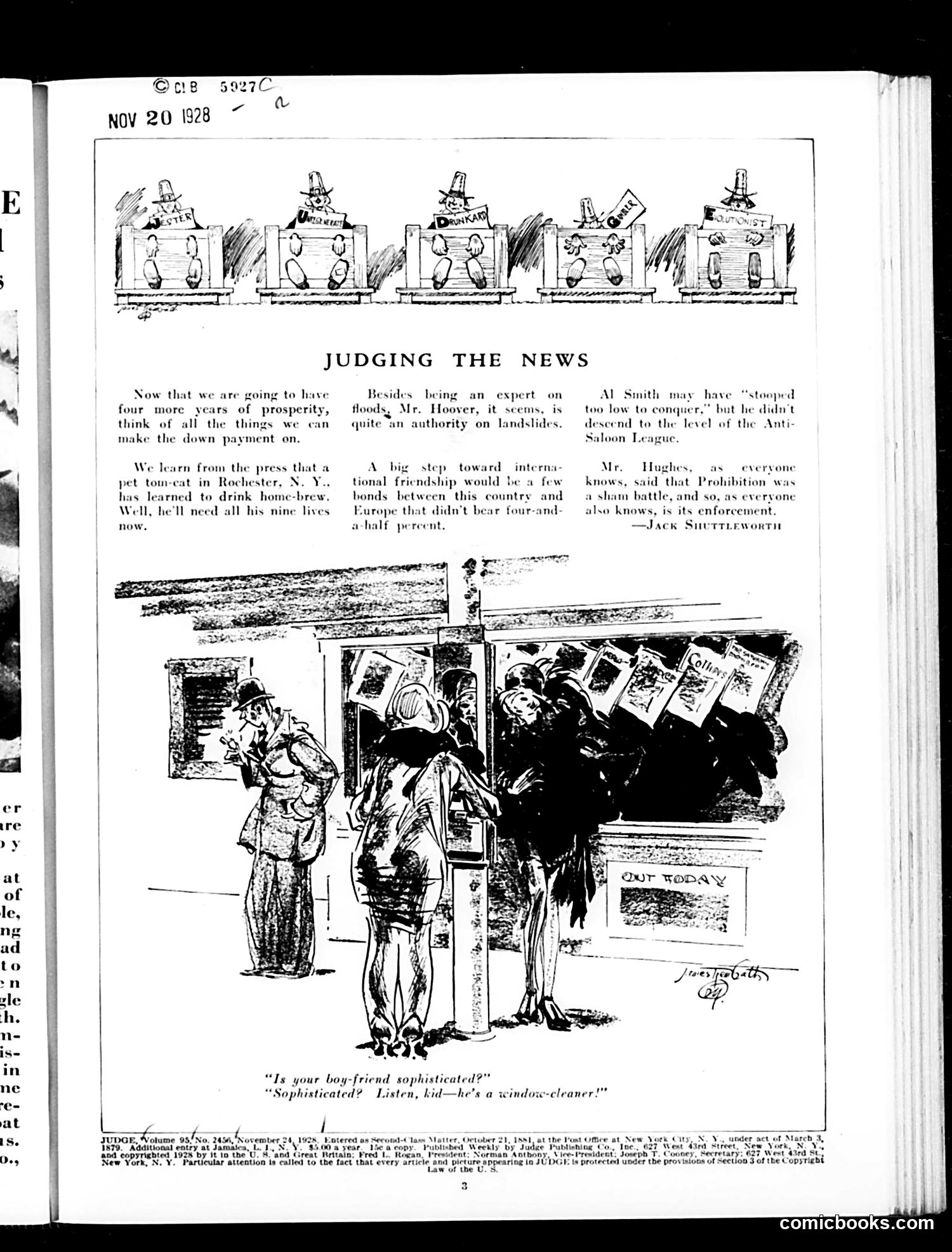
This page satirizes contemporary news stories through editorial commentary. The top section features small cartoon vignettes (mostly illegible) depicting various news items with judges evaluating them. The main cartoon below shows a street newsstand scene where a man asks another, "Is your boy-friend sophisticated?" The reply: "Sophisticated? Listen, kid—he's a window-cleaner!" The joke relies on class-based humor: the questioner assumes "sophistication" is a romantic quality worth discussing, but the punchline deflates this pretension—the boyfriend's humble job (window-cleaner) supposedly proves he's the opposite of sophisticated. This reflects 1920s attitudes about working-class status and courtship standards among middle-class readers.
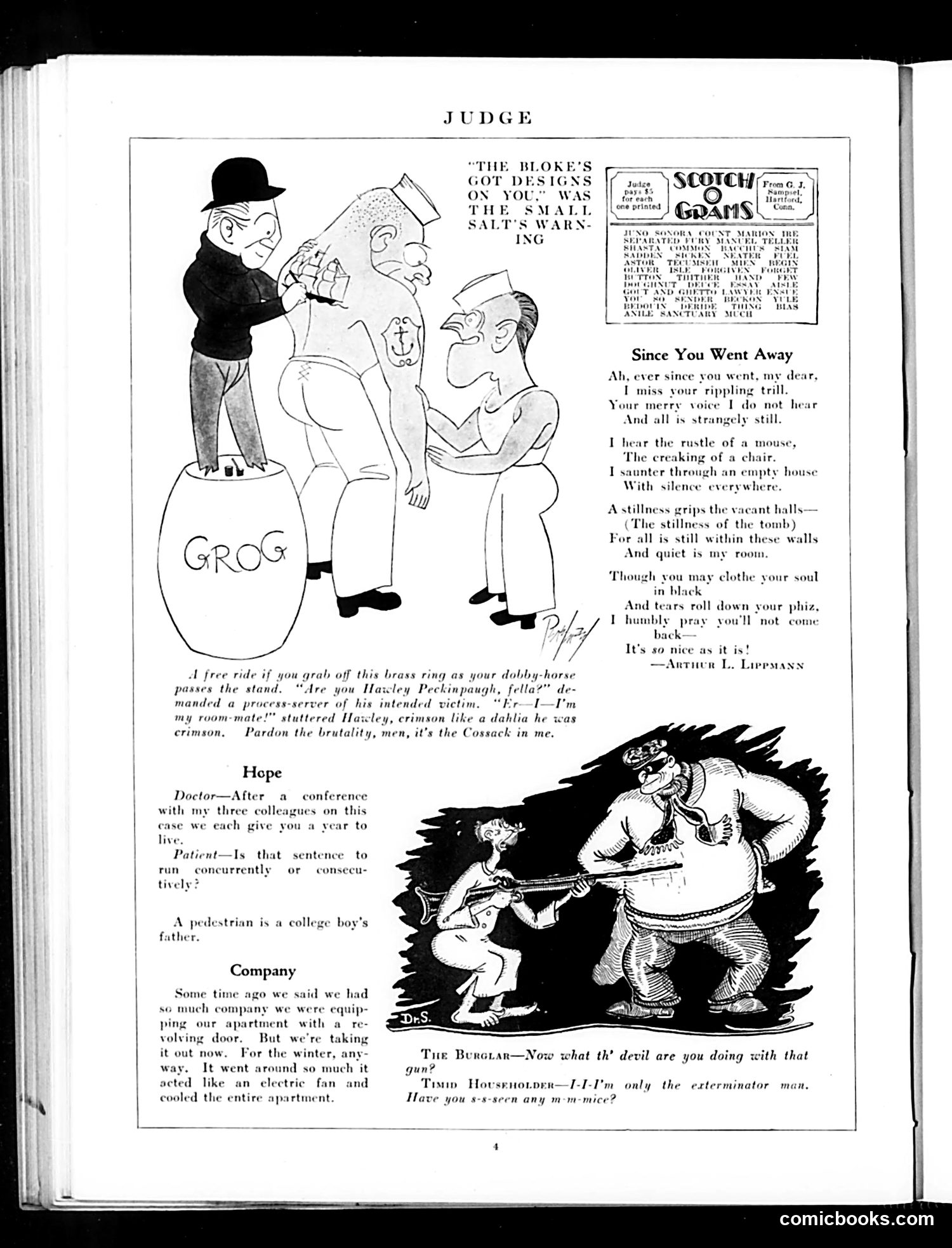
This page contains three distinct pieces: **Top cartoon ("The Bloke's Cot Designs on You")**: A man labeled "GROCER" stands on a barrel, appearing to apply salt to two figures. The caption warns about a "bloke's" small salt warning—likely satirizing deceptive commercial practices or adulteration of goods, a recurring concern in early 20th-century consumer advocacy. **Middle poem "Since You Went Away"**: A sentimental verse about absence and loss, seemingly unrelated to political satire—appears to be general magazine filler content. **Bottom cartoons**: Include a joke about a doctor-patient exchange and a burglar/householder interaction about mice and exterminators—standard domestic humor unrelated to politics. The page is primarily humorous content rather than political satire, mixing commercial critique with light domestic comedy typical of Judge's satirical entertainment approach.
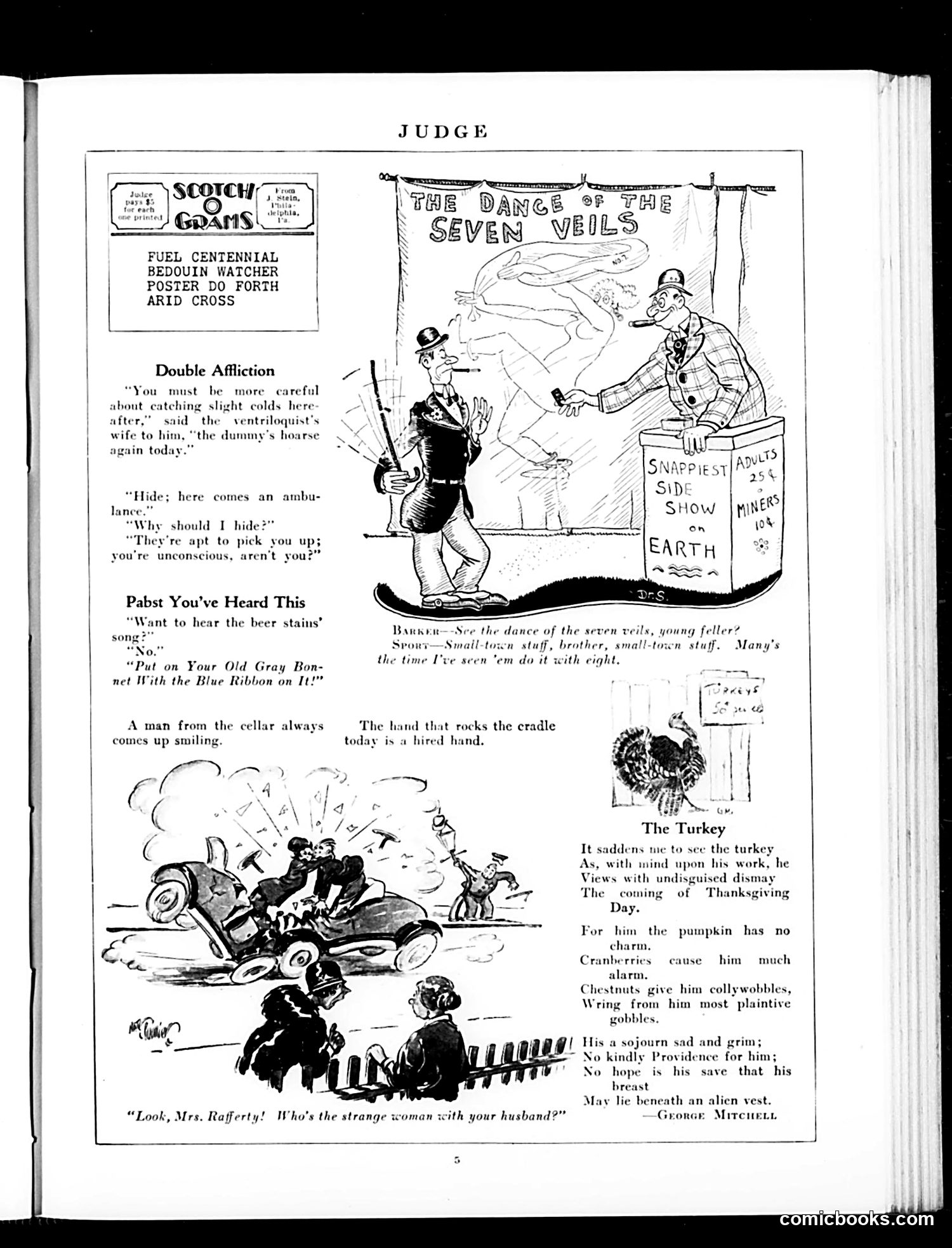
This page contains several unrelated humor pieces typical of Judge's format: **"Double Affliction"** and **"Pabst You've Heard This"** are brief joke columns with no clear political content—domestic humor and beer advertising wordplay. **"A man from the cellar always comes up smiling"** shows a car accident, likely satirizing reckless driving or automobile safety concerns of the era. **"The Dance of the Seven Veils"** references the famous striptease scandal (originally performed by Salome), here applied to a circus sideshow, mocking lowbrow entertainment. **"The Turkey"** poem by George Mitchell appears to be seasonal Thanksgiving satire, though its specific target remains unclear from the text alone. The page reflects early 20th-century American humor: domestic comedy, automotive-era mishaps, and commentary on popular entertainment and holidays.
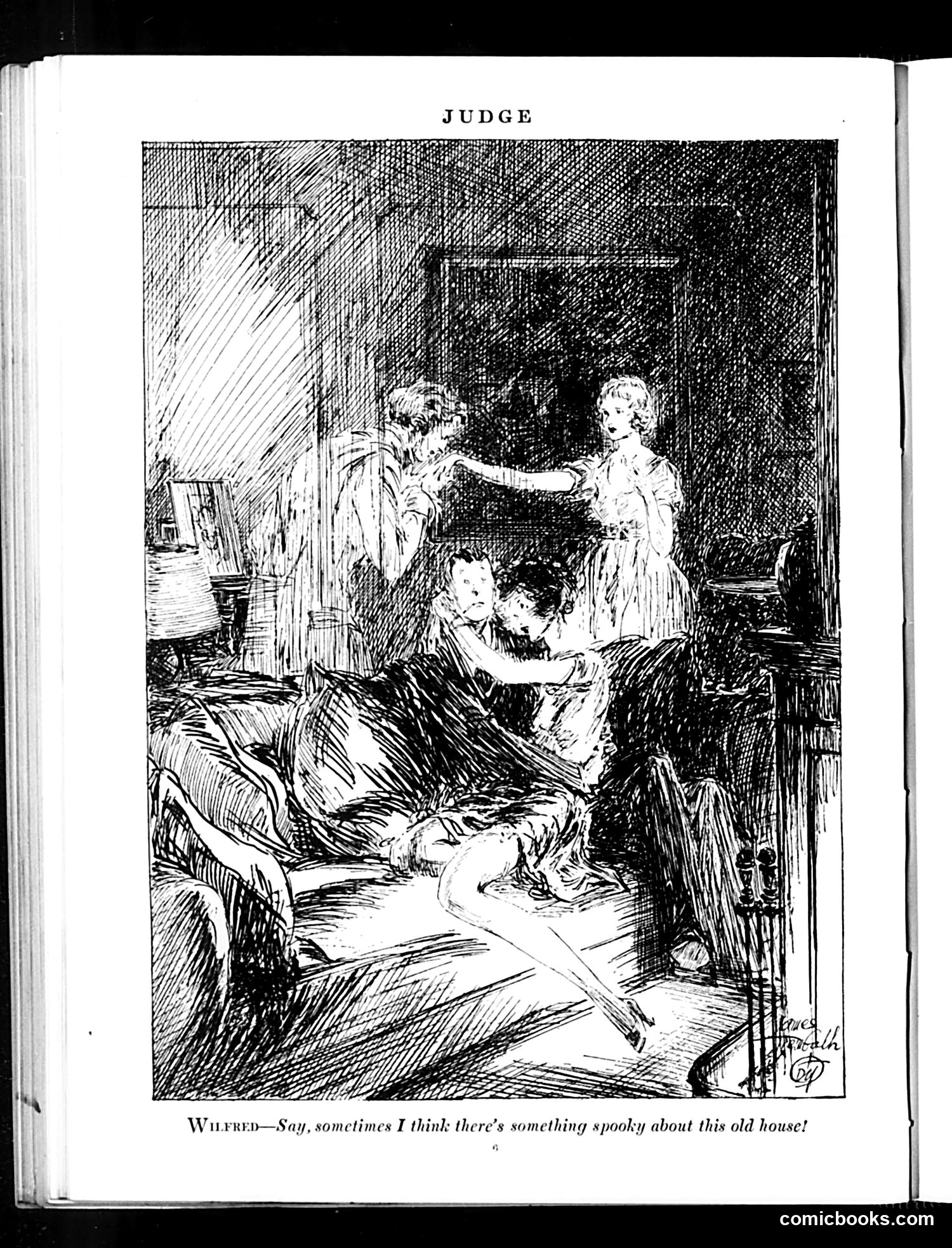
This single-panel cartoon depicts a domestic scene where a woman reclines on a couch while another woman stands nearby and a cherub or cupid figure appears above. A man sits separately, seemingly distressed or uncomfortable. The caption suggests the woman finds the house "spooky," but the visual context—with the cherub, intimate positioning, and the man's apparent discomfort—implies the humor involves marital tensions or romantic anxieties rather than actual supernatural concerns. The cartoon likely satirizes either domestic discord, infidelity concerns, or the awkwardness of social situations within the home. Without additional context about Judge magazine's specific date and focus, the exact social commentary remains unclear, though it appears to comment on middle-class domestic life.
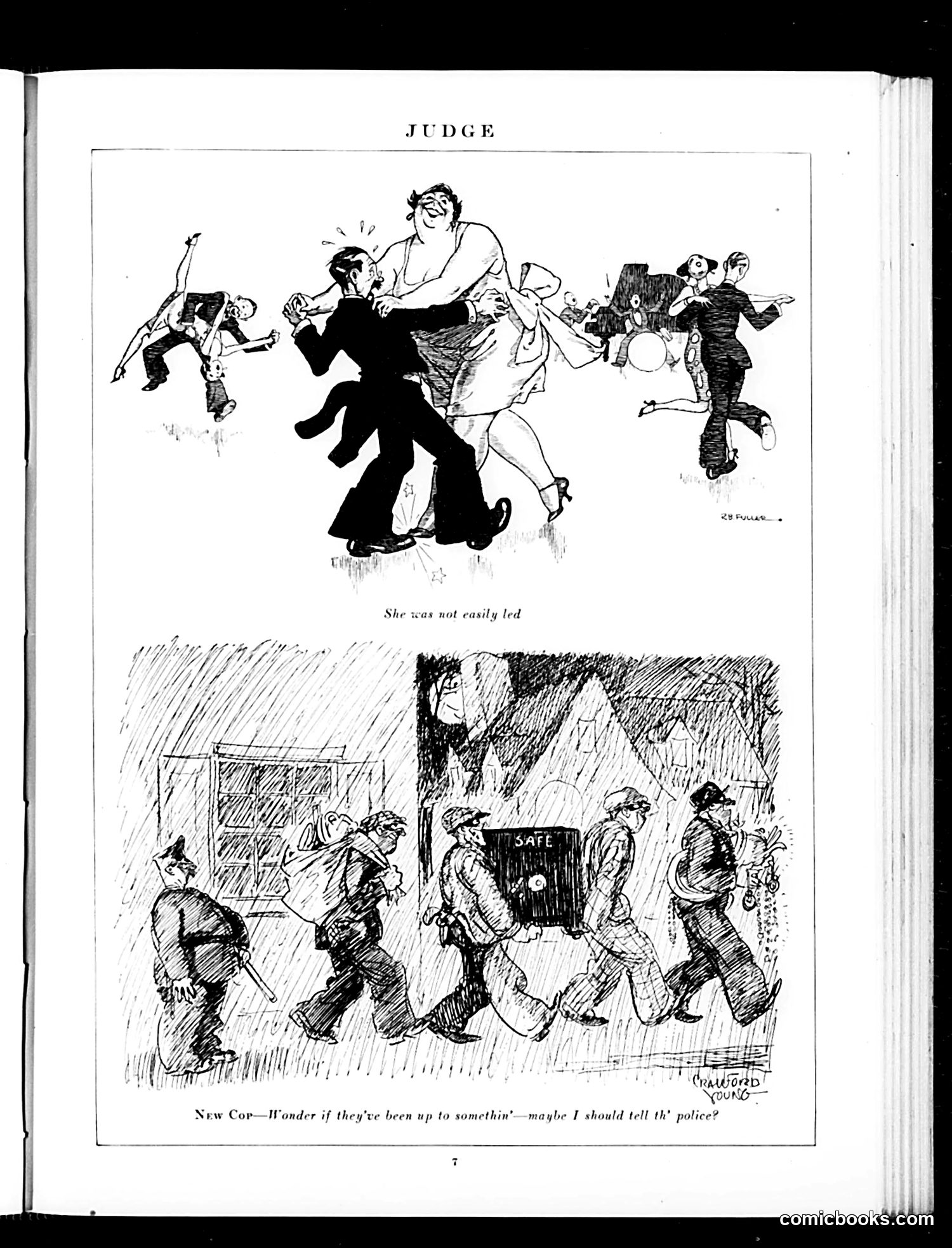
This page contains two Judge magazine cartoons satirizing law enforcement and authority. **Top cartoon ("She was not easily led"):** Shows a woman resisting arrest or control by multiple men, including what appears to be a judge or official figure. The satire likely mocks judicial or law enforcement overreach, or comments on resistance to male authority. **Bottom cartoon ("New Cop"):** A newly appointed police officer observes suspicious activity near a gate marked "SATE" (possibly "STATE"). His naive comment—wondering if he should report fellow officers to police—is self-satirizing. The joke appears to mock either police incompetence, corruption among officers, or the absurdity of institutional accountability when police investigate police. Both cartoons suggest skepticism toward legal and law enforcement institutions, characteristic of early-20th-century Judge satire.
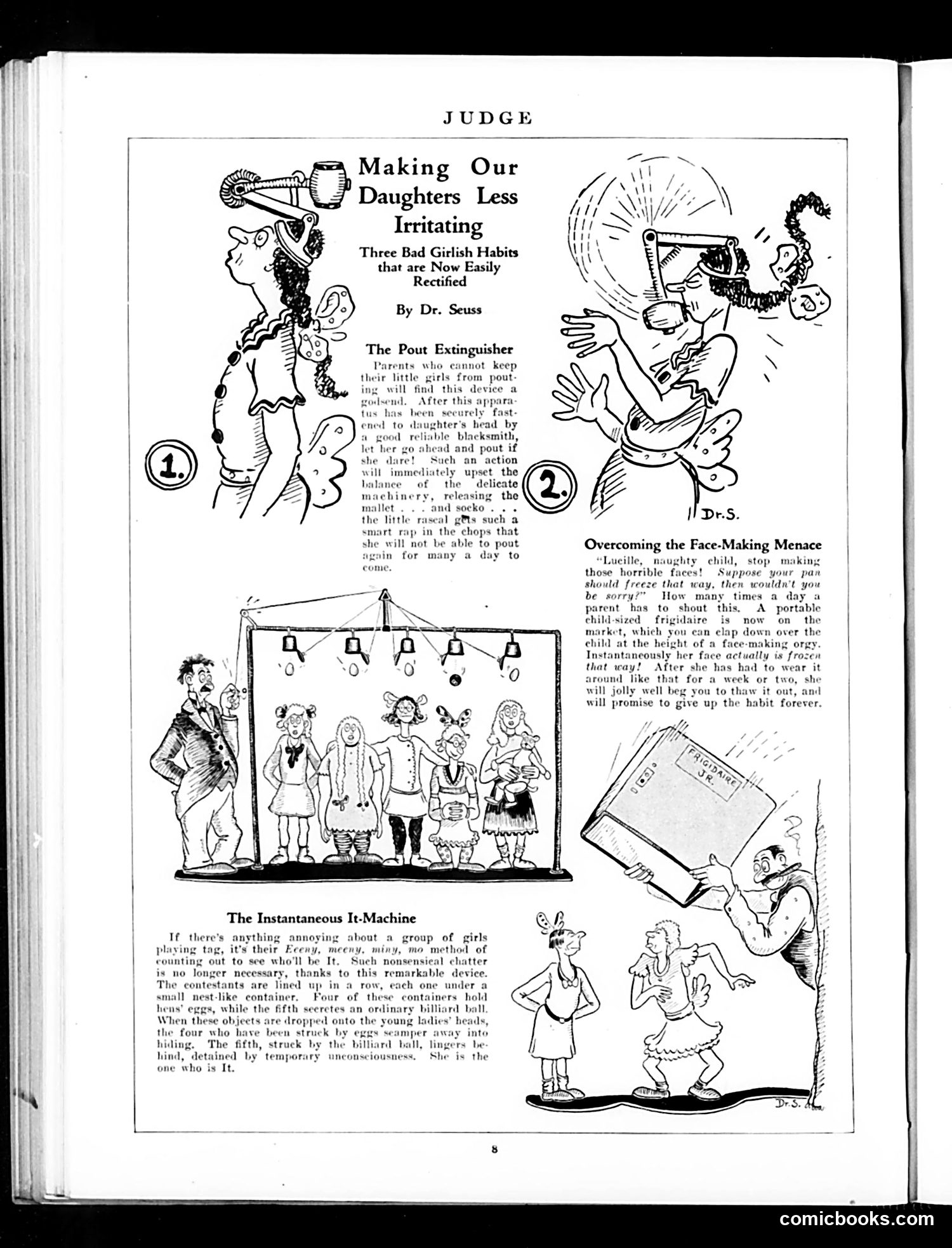
This 1920s-era satirical piece by Dr. Seuss mocks parenting advice and social attitudes toward girls' behavior. Three inventions are presented as humorous "solutions" to annoying girlish habits: 1. **The Pout Extinguisher**: A mechanical device that strikes a pouting child in the face—satirizing overly harsh discipline disguised as modern innovation. 2. **Overcoming the Face-Making Menace**: A refrigeration box to "freeze" a child's face, mocking the old threat that grimaces will become permanent. 3. **The Instantaneous It-Machine**: A contraption for selecting who's "It" in children's games, poking fun at parents' desire to mechanize everyday activities. The satire targets not children but *adults*—both parents seeking quick fixes for normal behavior and the pseudo-scientific "expert advice" culture. Seuss criticizes the era's dismissive, sometimes brutal approach to child-rearing by presenting absurd mechanical "solutions" that expose the underlying cruelty of such methods.
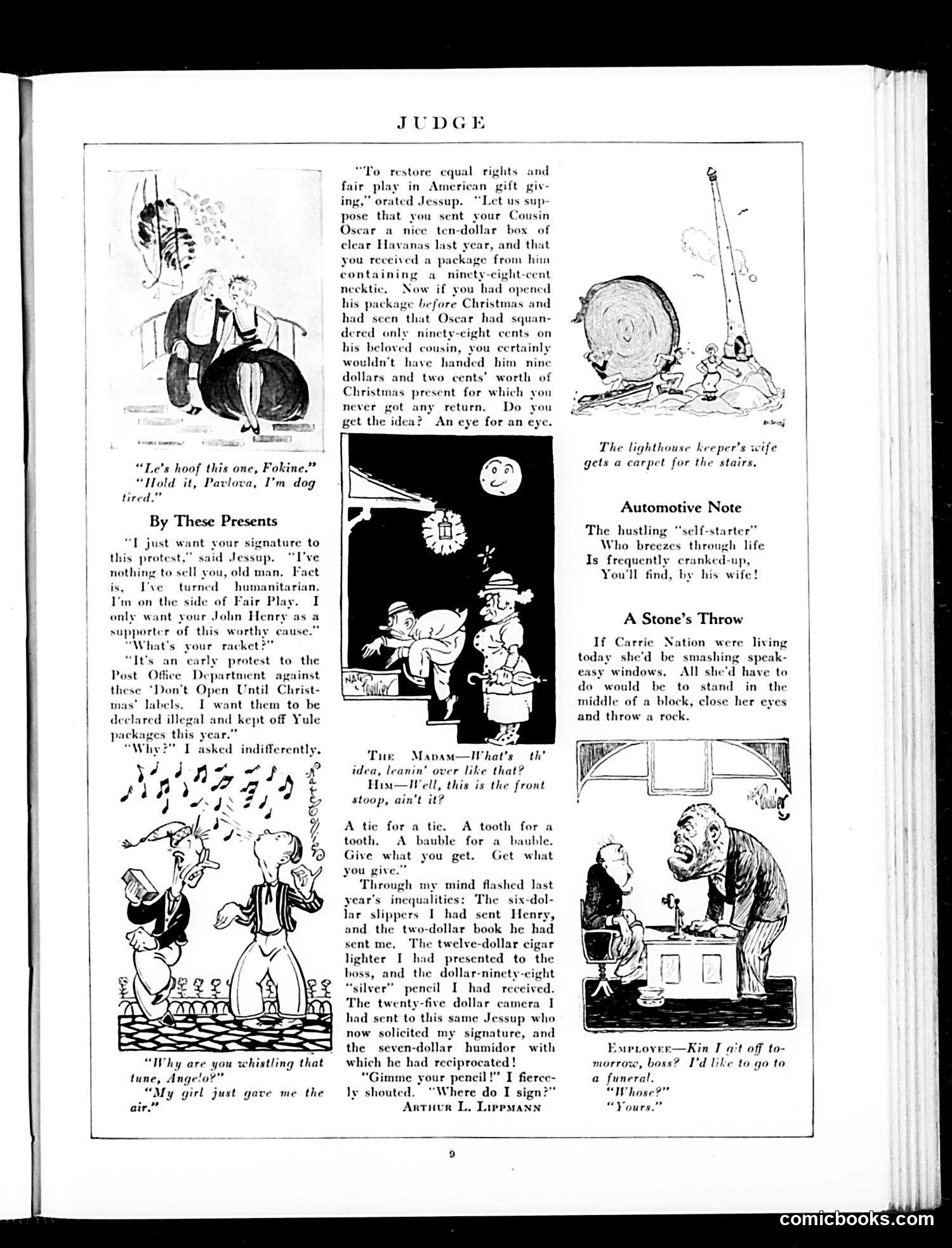
This page satirizes the problem of unequal gift-giving among friends and relatives. The main story, "By These Presents," depicts a man named Jessup recruiting signatures for a protest against "Don't Open Until Christmas" labels. His argument: if recipients knew the true value of gifts received beforehand, they wouldn't overspend in return. The narrator realizes Jessup is right after recalling past inequities—he gave his cousin a $25 camera and received a $7 humidor back. The satire targets middle-class anxiety about social obligation and reciprocity. The phrase "An eye for an eye" suggests gift-giving should be strictly transactional rather than generous or emotional. Secondary humor includes brief jokes about a dog and ballet dancer (likely Pavlova), unequal relationships, and workplace dynamics. The cartoons are largely standalone gags rather than political commentary.
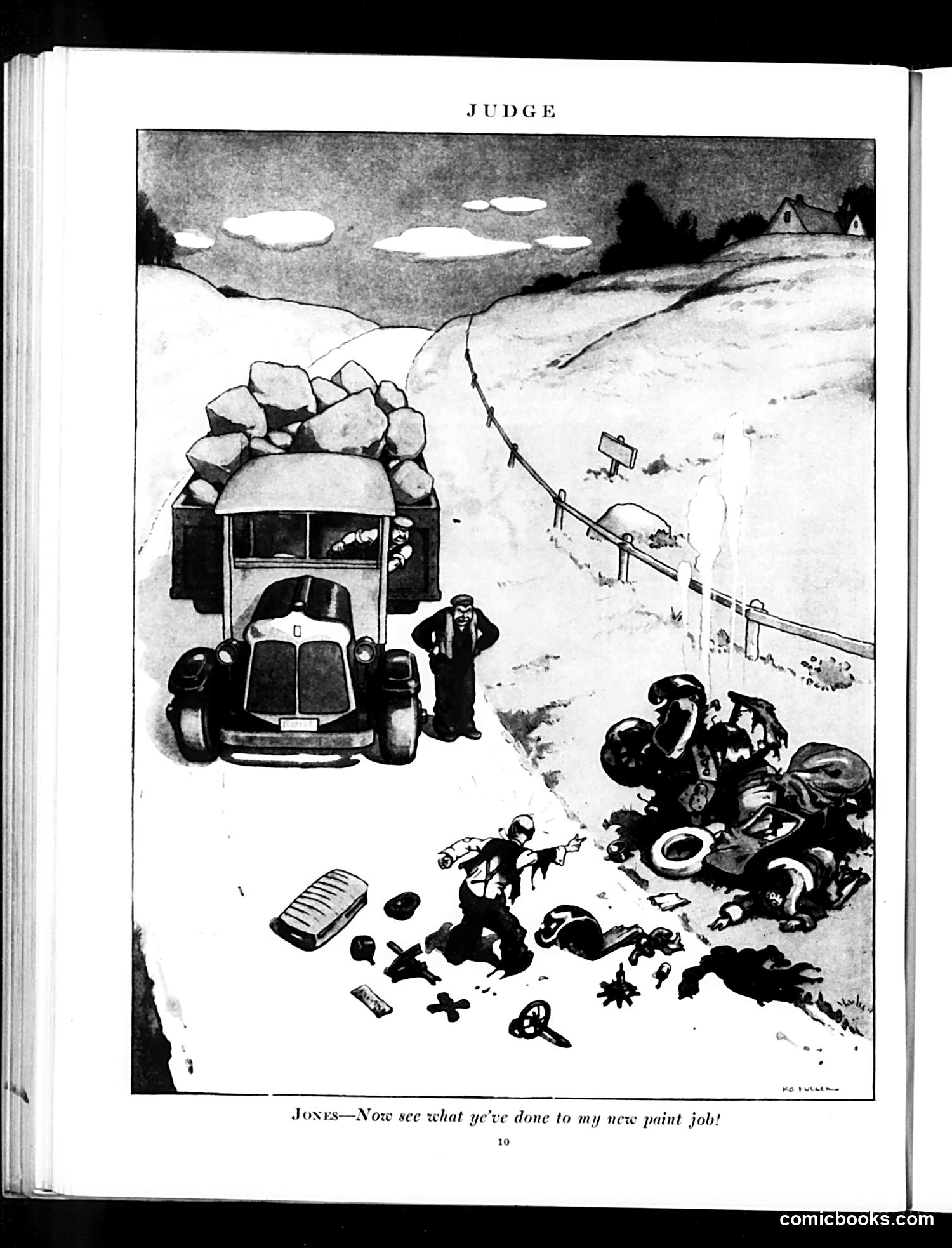
This cartoon depicts a car heavily laden with rocks, driven by someone addressed as "Jones," who is confronting an angry man about damage to his "new paint job." The vehicle appears overloaded with cargo, and scattered on the ground are various automotive parts and debris—suggesting either a collision or the vehicle's deterioration from carrying excessive weight. The satire likely critiques overloading or misuse of vehicles, possibly reflecting early 20th-century concerns about automotive care or labor practices. The ironic humor centers on Jones's apparent obliviousness: he's damaged the car through negligent overloading, yet complains about the paint damage—prioritizing cosmetic concerns over mechanical abuse. Without additional context, the specific social or political target remains unclear, though it appears to mock either carelessness or misplaced priorities.
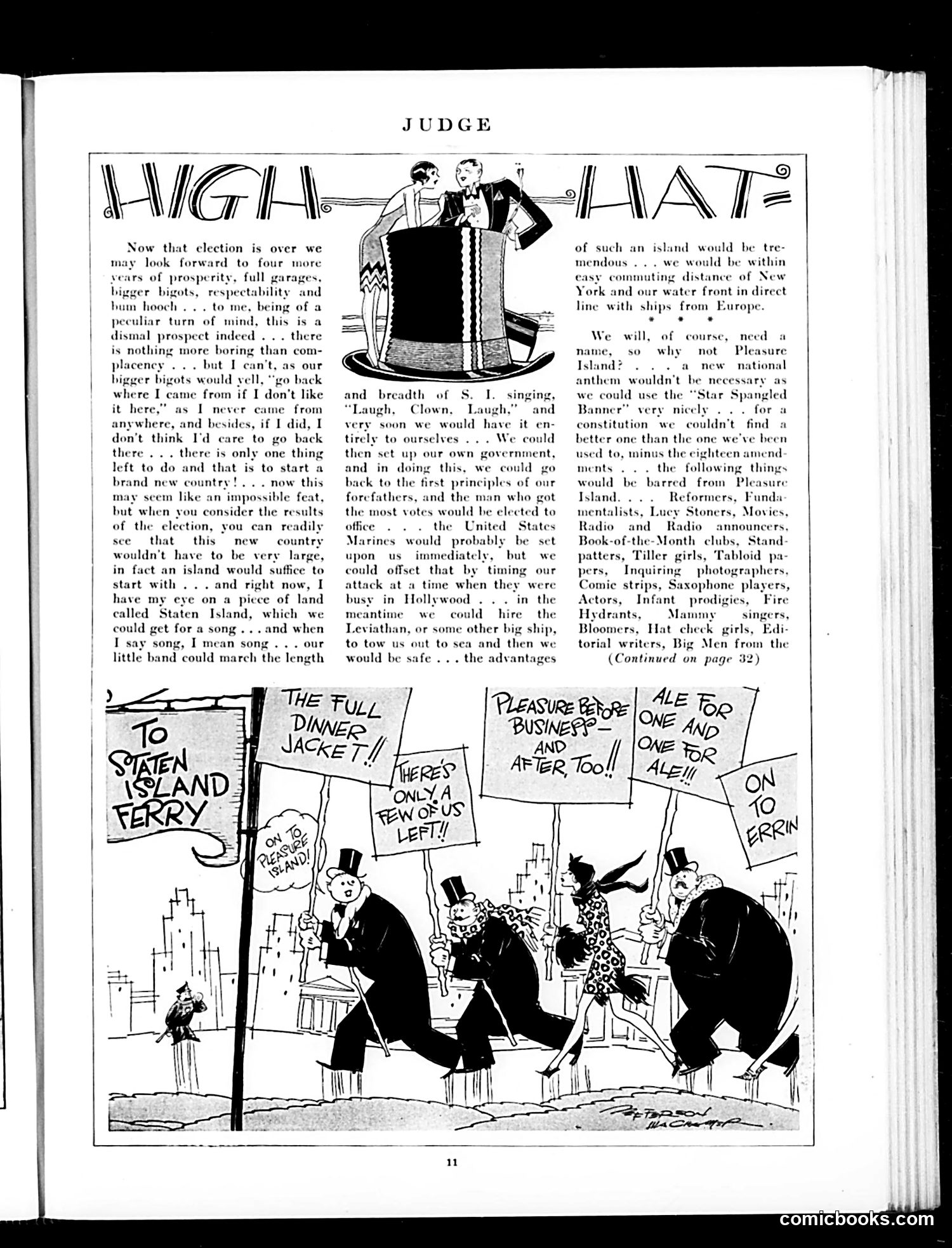
This Judge magazine piece satirizes post-election disillusionment through a tongue-in-cheek proposal to create "Pleasure Island" on Staten Island. The author, frustrated by election results and what they perceive as growing conformity and "respectability," jokingly proposes establishing a new nation with selective membership. The cartoon depicts protesters at a Staten Island ferry, holding signs about exclusions and fees—mocking the elitist fantasy described above. The satire targets prohibition-era complaints (mentions of "hooch"), cultural anxieties about modernization (saxophone players, tabloid papers, "Mammy" singers), and social movements the author opposes (reformers, fundamentalists, "Lucy Stoners"—women's suffrage advocates). The piece reflects 1920s-era conservative anxiety about social change, presenting escapist fantasy as commentary on political resignation and cultural conflict among the magazine's affluent readership.
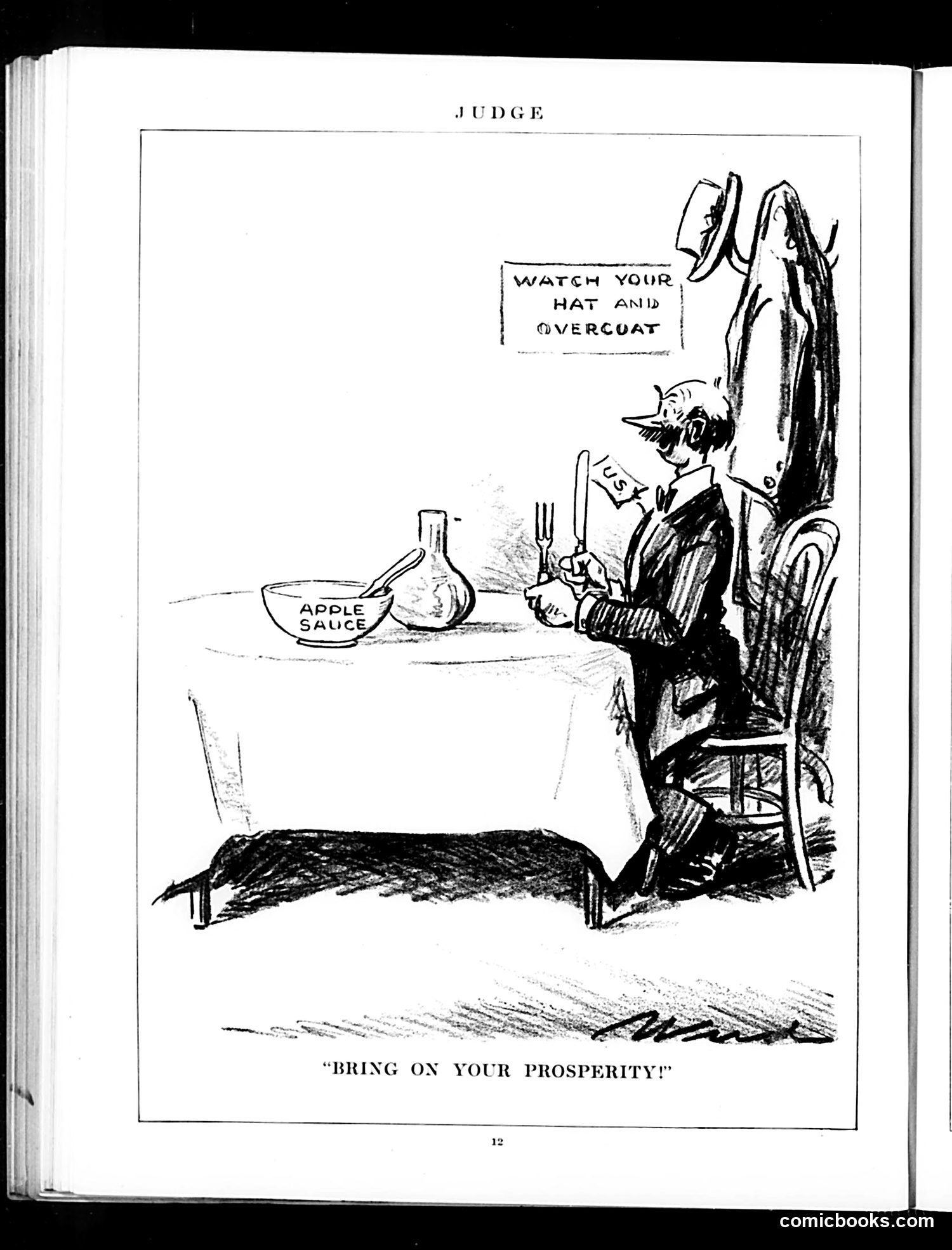
This single-panel cartoon satirizes economic inequality during a period of claimed "prosperity." A well-dressed gentleman dines alone at a table with apple sauce and wine, while a skeletal figure (representing Death or deprivation) looms menacingly behind him, holding his coat and hat. The warning "Watch your hat and overcoat" suggests theft or loss amid plenty. The caption "Bring on your prosperity!" appears ironic—the cartoon critiques the gap between official proclamations of economic good times and the grim reality facing ordinary people. The starving specter represents those left behind by prosperity, existing in shadow while the wealthy dine obliviously. This reflects common Judge magazine themes criticizing economic disparity and the human cost of capitalist excess.
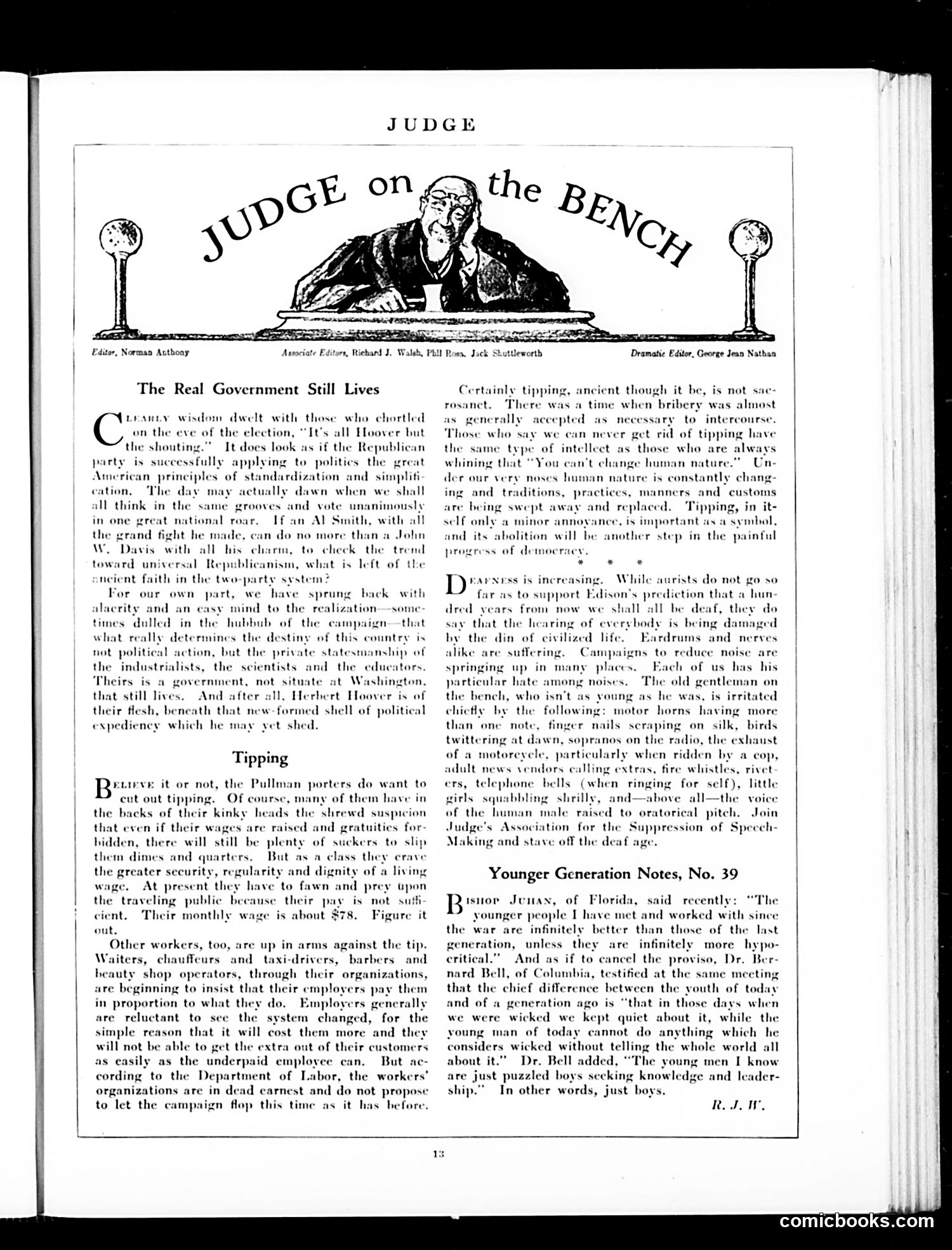
This page from *Judge* magazine presents three distinct pieces of social commentary circa the late 1920s. **"The Real Government Still Lives"** discusses the 1928 election, referencing Herbert Hoover and Al Smith. The piece argues that real power lies not with politicians but with industrialists, scientists, and educators—the "true government" operating outside Washington. **"Tipping"** addresses labor agitation against the tipping system. Workers (Pullman porters, waiters, taxi drivers, barbers) organized to demand regular wages instead of relying on gratuities. The article notes employers resisted because tips effectively subsidized their payroll costs, making the campaign difficult. **"Younger Generation Notes, No. 39"** quotes Bishop Julien and Dr. Bernard Bell discussing whether modern youth are better or worse than previous generations—concluding they're simply "just boys" seeking knowledge and adventure. The header illustration shows a judge seated at a bench, establishing the magazine's satirical voice evaluating contemporary society. The page addresses labor reform, generational anxiety, and political disillusionment typical of 1920s American discourse.
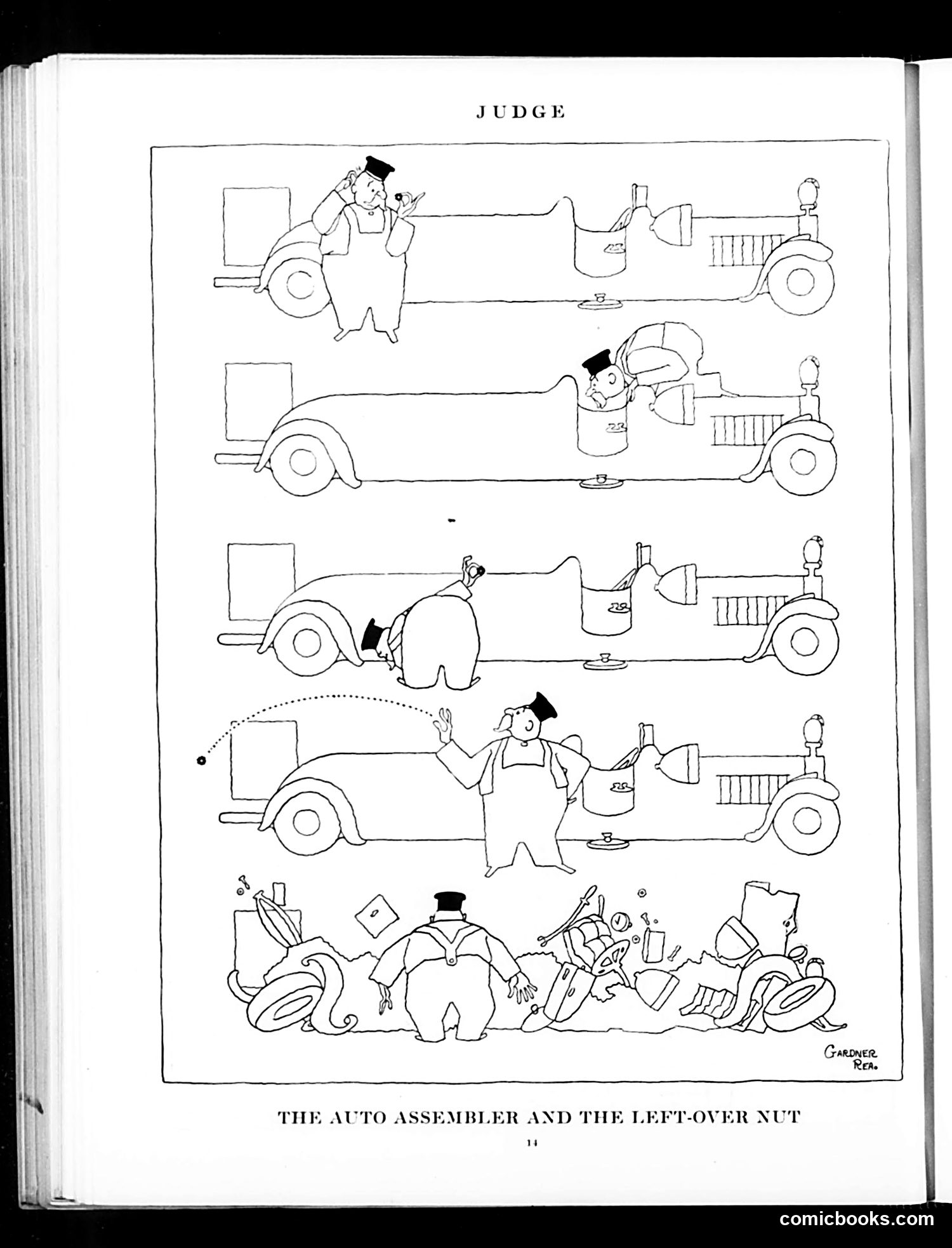
This Judge cartoon satirizes early automobile manufacturing, specifically assembly line production. The sequential panels show a factory worker repeatedly encountering the same problem: after completing car assembly, there's always one leftover nut he cannot place. The humor lies in the contrast between industrial efficiency and human fallibility. Assembly lines promised perfect organization, yet this worker—depicted as portly and somewhat bumbling—consistently fails to use all parts correctly. The final panel shows him surrounded by scattered automotive debris, suggesting accumulated frustration. The satire likely critiques either worker competence or assembly line methodology itself. By 1920s standards, this would mock the gap between manufacturing's mechanical ideals and messy reality.
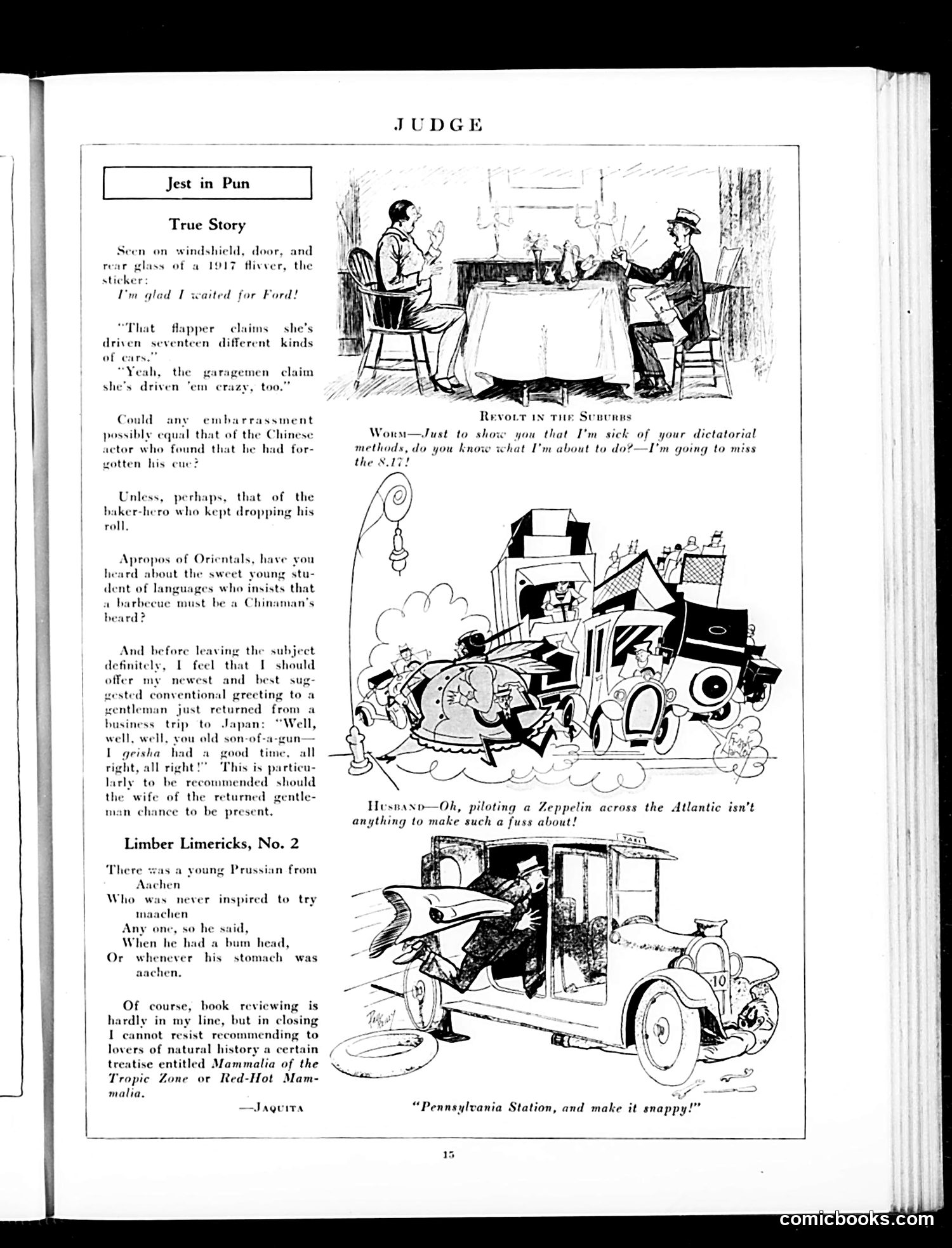
This page from *Judge* contains satirical humor spanning several topics: **"Jest in Pun"** section offers quick jokes mocking Chinese stereotypes (common in 1910s-20s American humor), a "flapper" joke about women drivers, and puns about returning businessmen from Japan. **Top cartoon** depicts a marital dispute where a woman threatens to leave her husband, who pilots a Zeppelin across the Atlantic—his response that this achievement is unremarkable is the joke's punchline, satirizing masculine bravado and modern technological achievement being dismissed as trivial compared to domestic drama. **Bottom cartoon** shows a man at Pennsylvania Station instructing a taxi driver to "make it snappy," depicting urban impatience and the frenetic pace of modern life. The **Limber Limericks** mock a Prussian who lacks inspiration except when hungover—likely playing on post-WWI anti-German sentiment and stereotypes. The page reflects 1920s preoccupations: gender dynamics, emerging technology, xenophobia, and urban modernity.
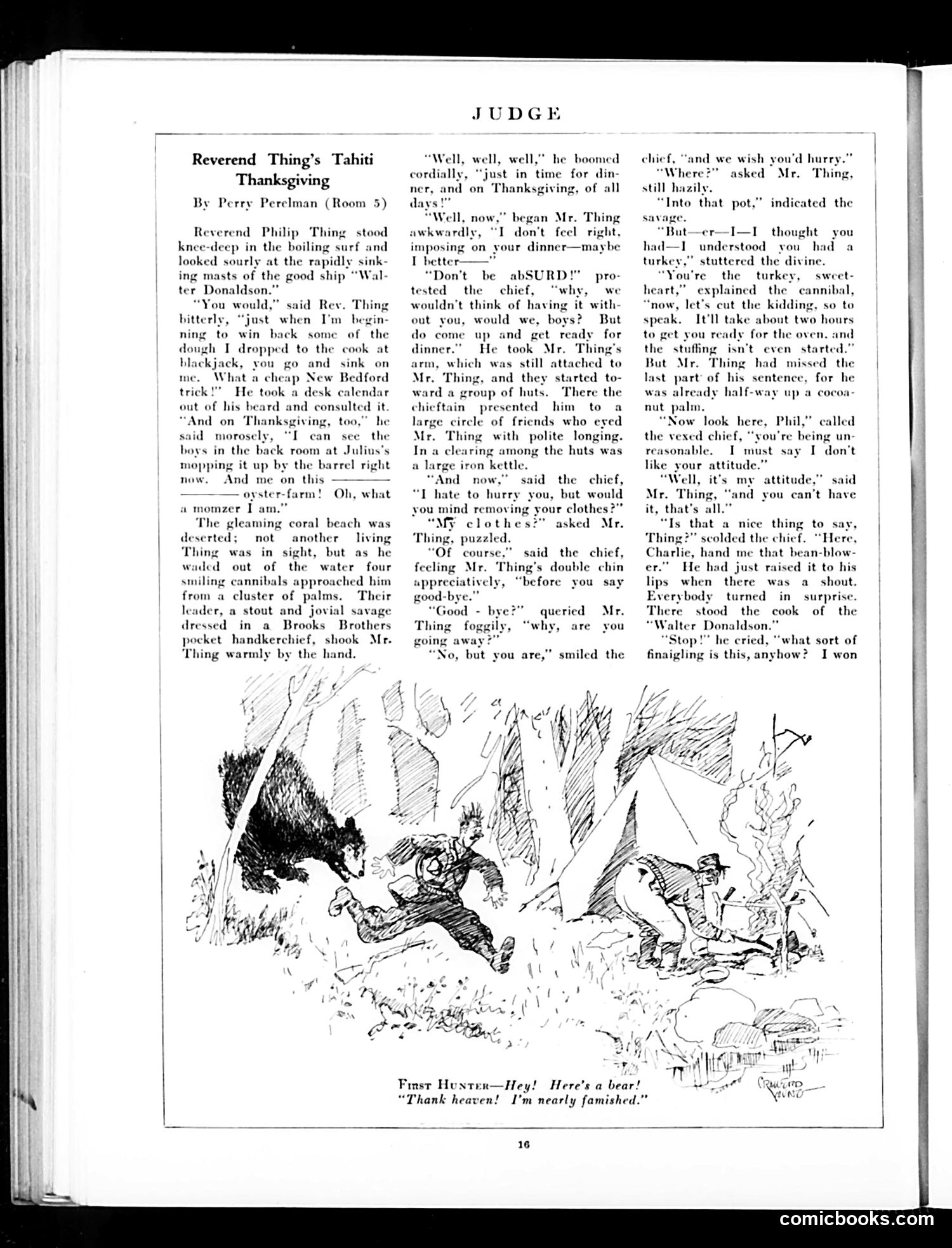
This is a humorous short story illustrated with a cartoon. It satirizes both religious hypocrisy and the "cannibal" stereotypes common in early 20th-century entertainment. **The Setup:** Reverend Philip Thing, a clergyman shipwrecked in Tahiti on Thanksgiving, encounters cannibals who appear cultured (one wears Brooks Brothers clothing, speaks politely). They invite him to dinner—ostensibly as a guest, but he gradually realizes *he* is the meal. **The Satire:** The story mocks: - The reverend's materialism (he's upset about losing gambling winnings, not spiritual matters) - Racial stereotypes depicting Pacific Islanders as cannibals, though humorously reversed—here they're portrayed as sophisticated and courteous - The irony of civilized behavior masking violent intent **The Final Twist:** The ship's cook appears, suggesting Thing's actual rescue—undercutting the whole scenario with absurdist humor typical of Judge magazine's style. The cartoon below depicts Thing fleeing up a coconut palm while the chief prepares a blowgun, visualizing the farcical danger.
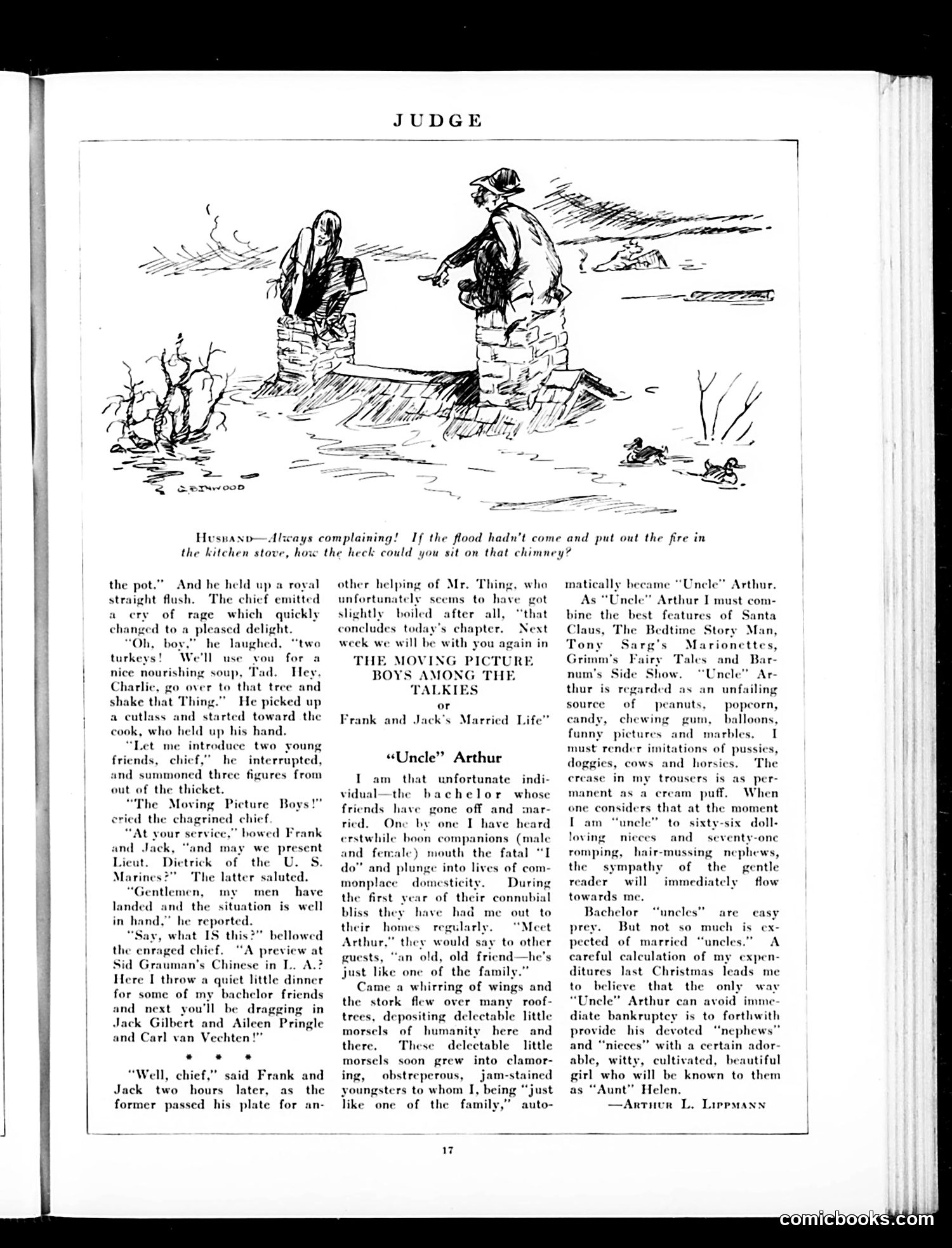
This page contains a humorous short story titled "Uncle Arthur" by Arthur L. Lipmann, illustrated by C. E. Underwood. The narrative follows two characters—Frank and Jack—whose adventures involve "Moving Picture Boys" and encounters with a chief (in what appears to be a colonial adventure scenario). The main satire targets the social role of unmarried uncles in early 20th-century America. The text humorously describes how "Uncle" Arthur has become an unpaid entertainer for sixty-six nieces and seventy-one nephews, obligated to provide candy, toys, marbles, and animal imitations. The joke's punchline suggests his only escape from financial bankruptcy is to marry a woman named Helen, transforming her into "Aunt Helen" to distribute expenses among the extended family. The satire gently mocks both the exploitative expectations placed on bachelor relatives and the desperation such social obligations create. This reflects broader early-20th-century anxieties about family duty and bachelor life.
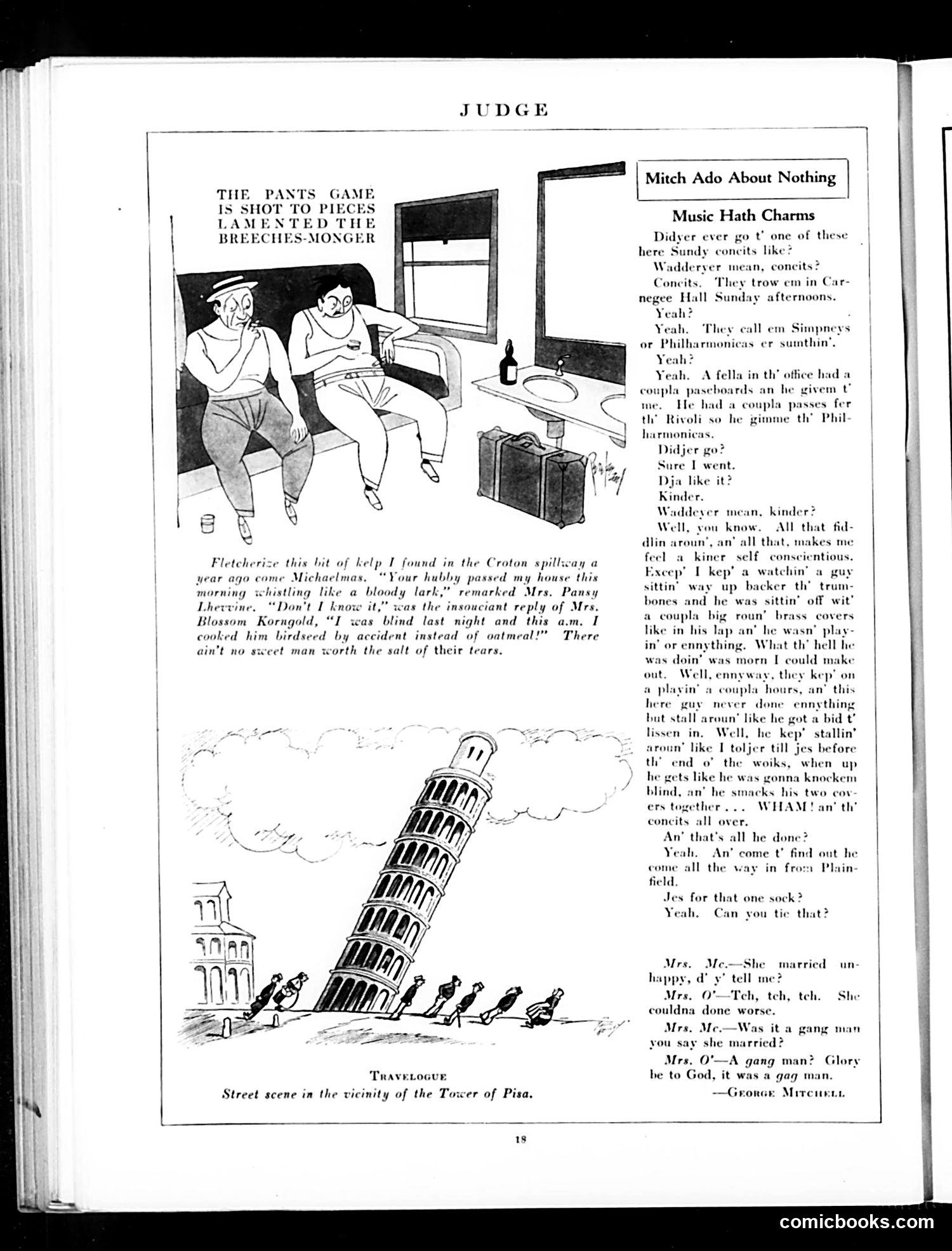
This page contains two unrelated pieces from Judge magazine: **Top cartoon**: "The Pants Game" depicts two women gossiping about domestic mishaps—one accidentally serving her husband birdseed instead of oatmeal. The humor relies on slapstick domestic comedy typical of early 20th-century satire, mocking housewives' incompetence. **Bottom cartoon**: A travelogue illustration of the Leaning Tower of Pisa with people being thrown from it—likely satirizing the tower's famous tilt as a hazard. **Right column**: "Mitch Ado About Nothing" and "Music Hath Charms" are written dialect humor pieces using exaggerated working-class speech ("Didyer," "ennyway"). One describes someone attending a symphony concert and being confused by a percussionist; another jokes about a woman marrying a "gang man." The heavy use of phonetic dialect humor reflects period attitudes toward working-class and immigrant speech as inherently comedic. The page's satire targets domestic life, tourism clichés, and class-based language differences rather than specific political figures.
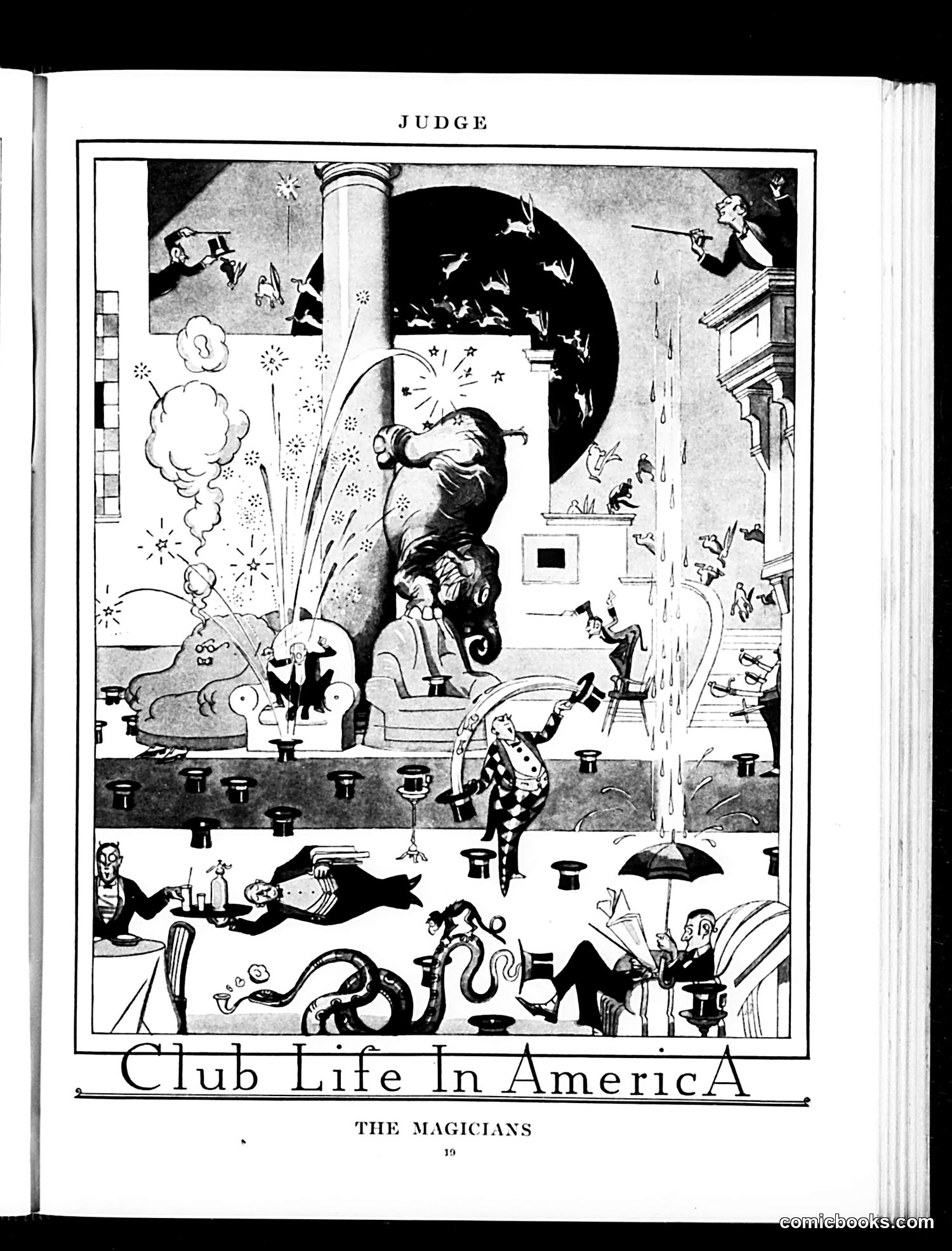
This *Judge* cartoon satirizes magicians and illusionists performing in American clubs. The central figure depicts a magician producing rabbits and doves from a top hat—classic stage magic tricks of the era. The surrounding chaos shows the magician's act entertaining a club audience, with various spectators reacting to the performance. The satire likely mocks both the magicians themselves (presenting their tricks as genuine "magic") and the gullible audiences who attend such performances. The elaborate, chaotic composition emphasizes the theatrical spectacle and absurdity of the act. The page title "Club Life in America" suggests this is part of a series documenting American social venues and entertainment culture. Without additional context, the specific political angle remains unclear.
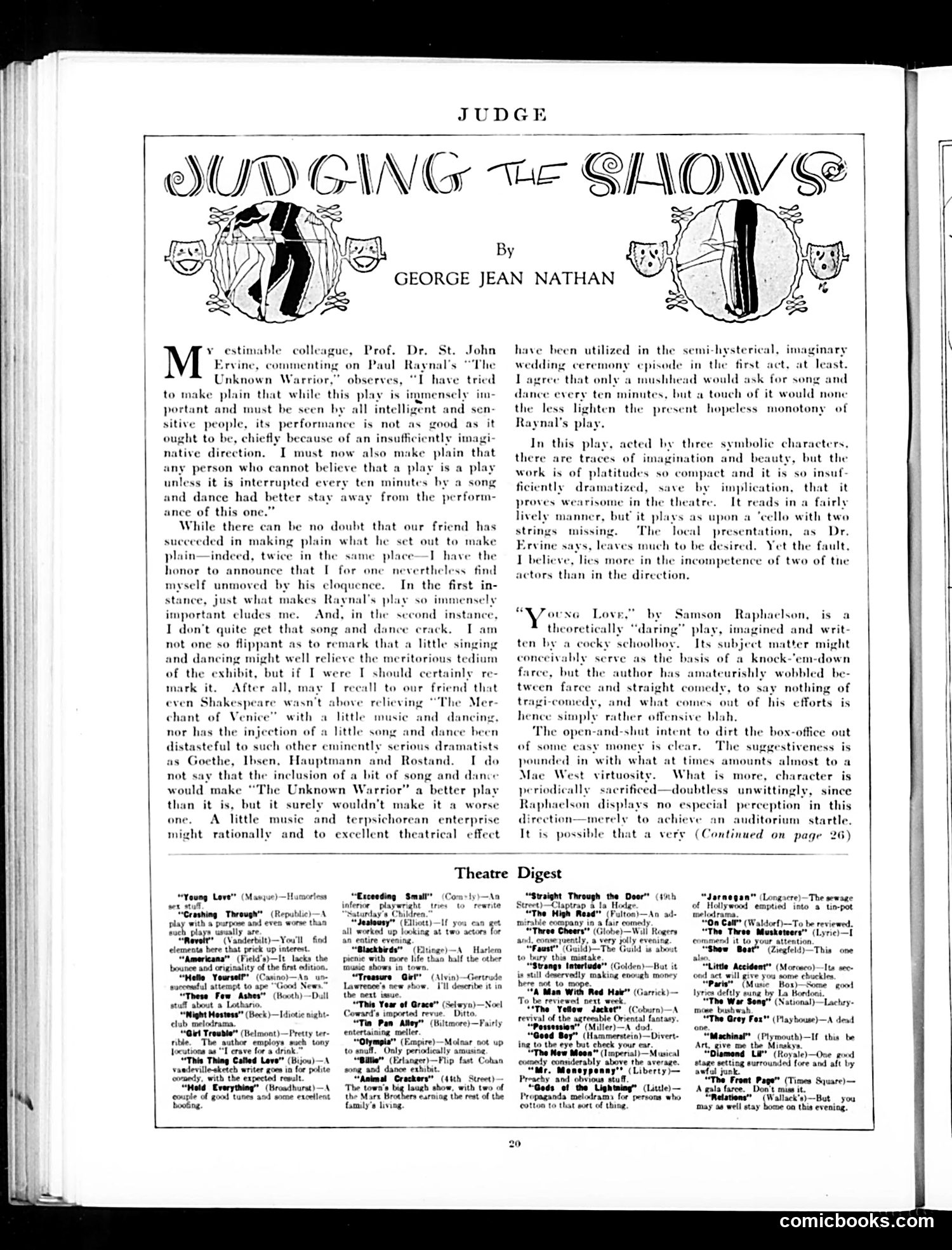
This is a theater review column by George Jean Nathan, a prominent drama critic of the early 20th century. The main article critiques Paul Raynal's play *"The Unknown Warrior,"* which appears to be a serious, semi-historical work about a wedding ceremony. Nathan argues that while the play contains imagination and beauty, it's undermined by incompetent direction and acting. He disputes another critic's (Prof. Dr. St. John Ervine's) claim that the play *requires* constant musical interludes to maintain audience interest. Nathan defends this position by noting that even Shakespeare used music judiciously, not as a crutch for weak drama. The review also briefly covers "Young Love" (deemed humorless) and critiques another play for attempting crowd-pleasing theatricality over genuine character development—a common tension in commercial theater. The "Theatre Digest" section provides capsule reviews of current productions.
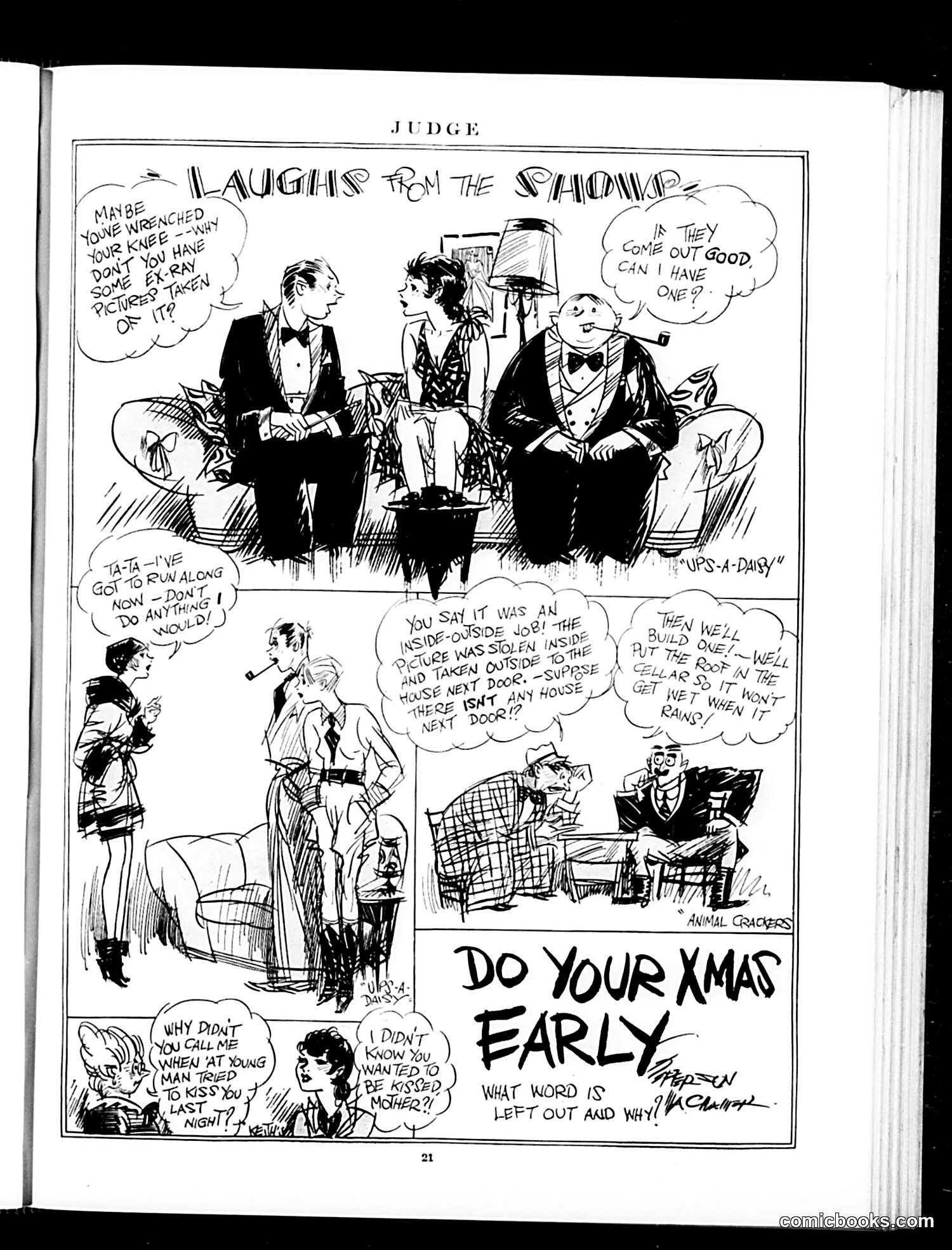
This page contains two separate comedic sketches satirizing social behavior: **Top Panel ("Laughs from the Swamp"):** Depicts formally-dressed figures at what appears to be a social gathering discussing stolen artwork and burglary—treating serious crimes as casual conversation fodder. The satire mocks upper-class pretension and desensitization to criminal activity. **Bottom Panels:** Feature domestic comedy sketches about Christmas timing and romantic relationships. One depicts a woman confronting a man about not calling her; another shows someone suggesting doing Christmas shopping early. The humor relies on period gender dynamics and dating conventions. The overall satire targets genteel society's shallow concerns and the gap between formal propriety and actual behavior. The crude hand-drawn style and speech bubbles suggest this is mid-20th century American humor emphasizing social observation over political commentary.
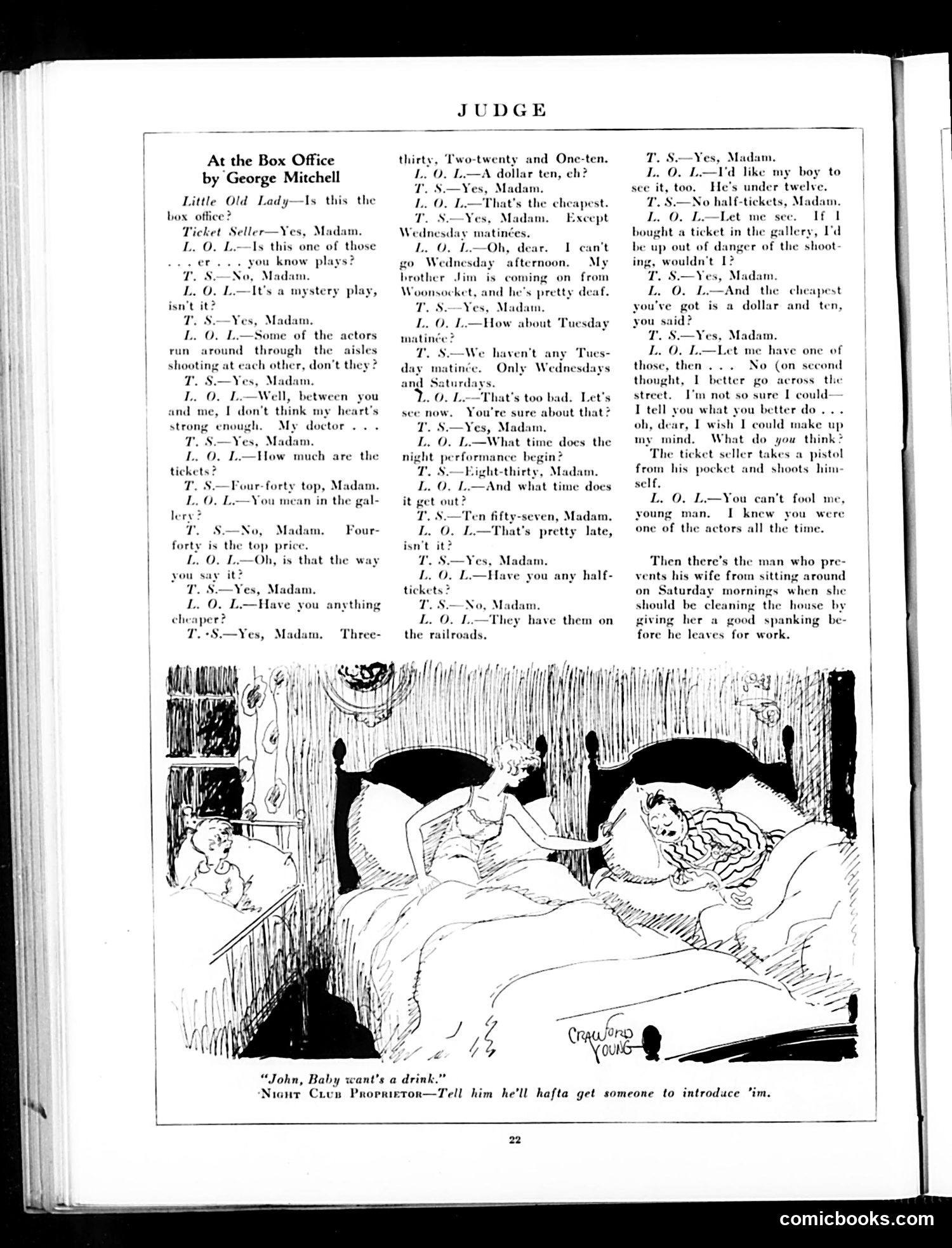
This is a satirical dialogue between a ticket seller (T.S.) and an indecisive customer (L.O.L.) trying to buy theater tickets. The humor mocks the customer's paralyzing uncertainty—repeatedly asking about prices, showtimes, matinee availability, and half-tickets while constantly second-guessing decisions. The joke culminates when the exasperated ticket seller shoots himself in frustration, and the customer accuses him of being an actor all along—suggesting the whole exchange was a theatrical performance rather than genuine interaction. The cartoon below jokes darkly about domestic control: a husband "prevents" his wife from lounging on Saturday mornings by spanking her before work, framed as beneficial behavior. This reflects early 20th-century attitudes normalizing spousal discipline as marital management. Both segments satirize contemporary social behavior—consumer indecision and male authority in marriage—through absurdist and dark humor typical of Judge magazine's satirical style.
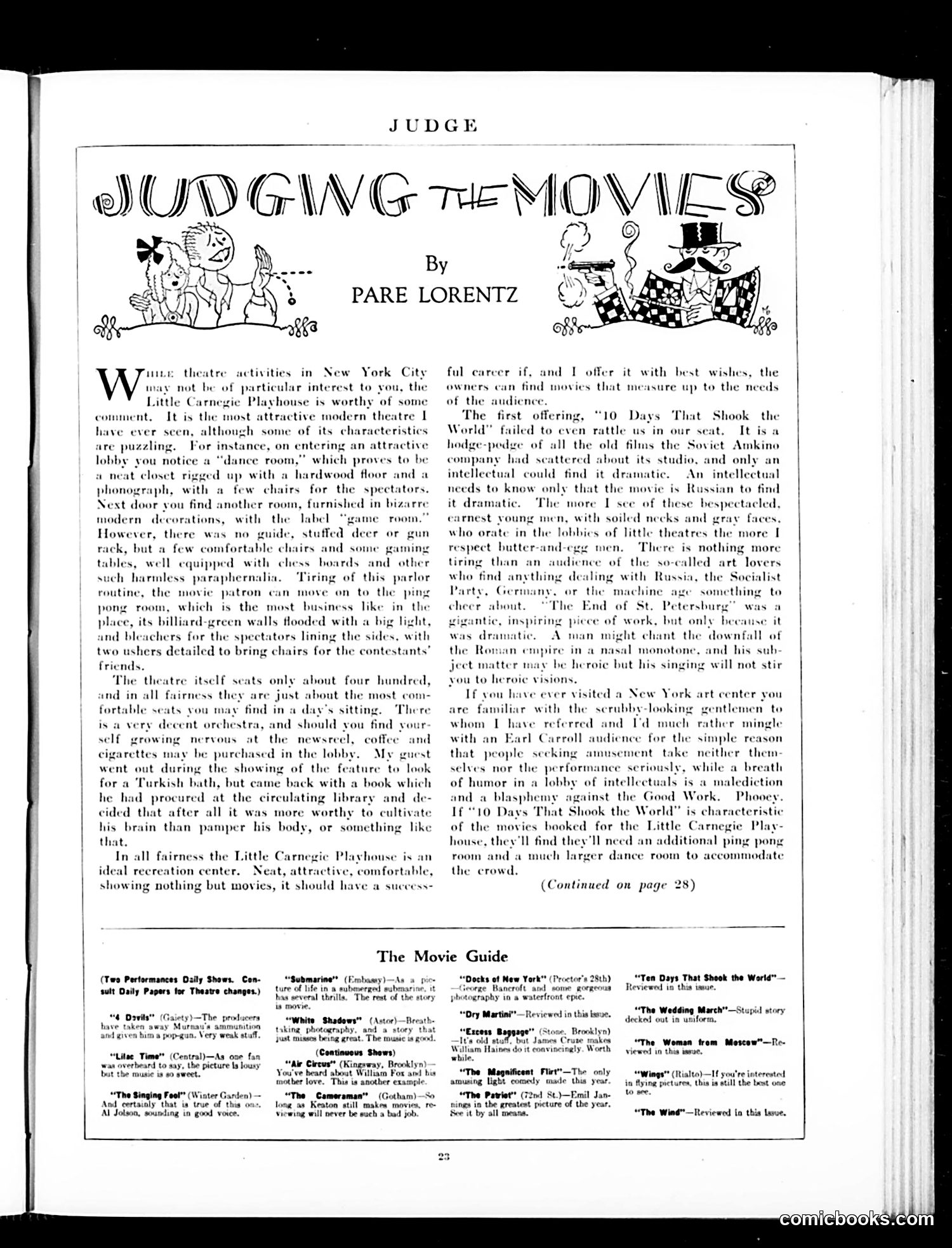
This page is a theater review by Pare Lorentz examining the Little Carnegie Playhouse in New York City. Rather than a political cartoon, it's a satirical essay critiquing both the venue and contemporary art-house cinema. Lorentz describes the playhouse's peculiar amenities (billiard room, game tables, Turkish bath aspirations) with bemused detachment, suggesting pretentious discomfort masquerading as sophistication. His real target is the intellectual audience and films shown there: he mocks "earnest young men" in spectacles who pontificate in lobbies, and dismisses offerings like "10 Days That Shook the World"—a Soviet propaganda film—as dramatically inert despite its "inspiring" subject matter. The satire targets 1920s-30s avant-garde cinema culture: intellectuals who valorize difficult, politically-charged foreign films while disdaining entertainment, and venues catering to this audience's self-regard rather than genuine aesthetic experience. Lorentz suggests these spaces attract pompous poseurs, not sincere art appreciators.
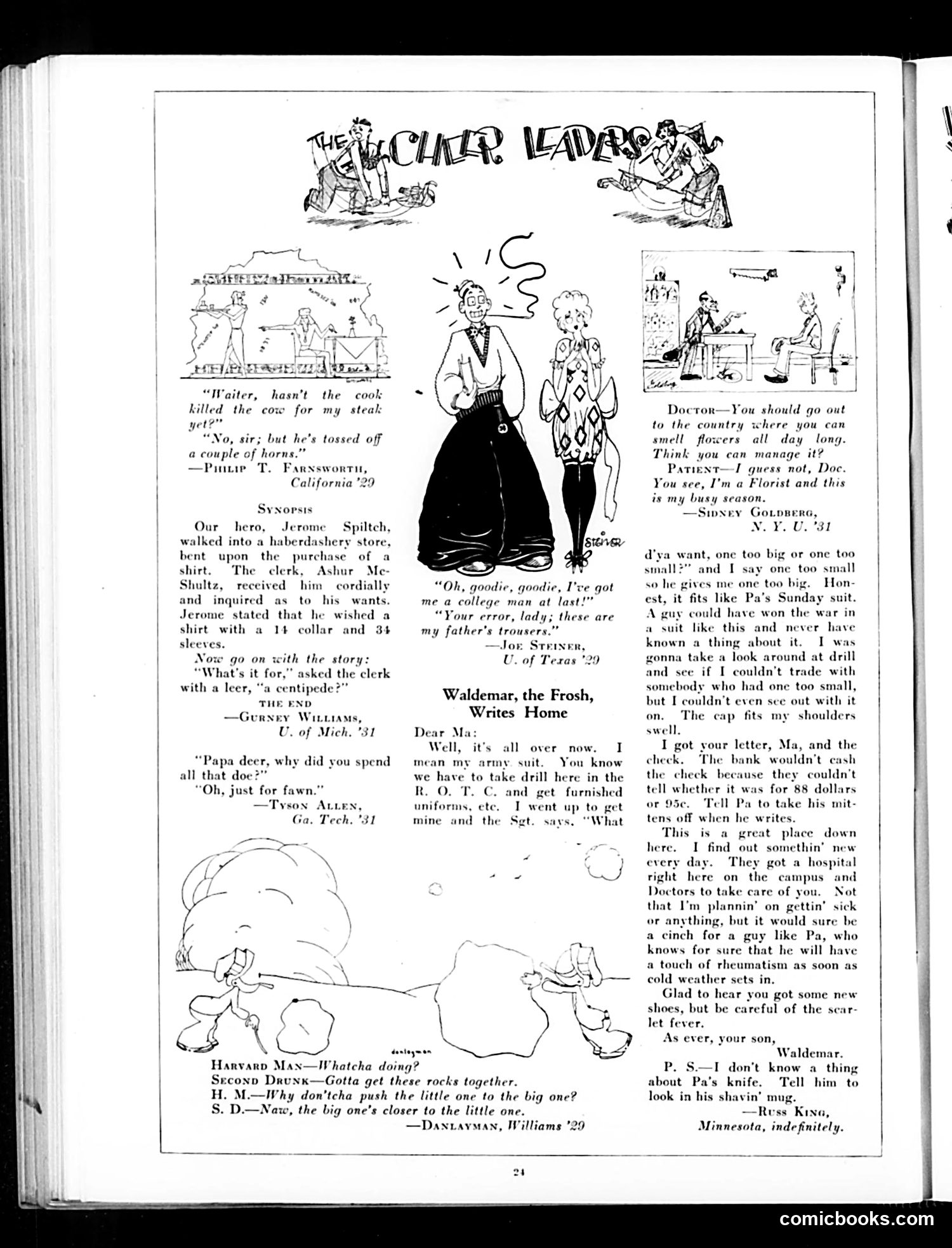
This page collects humorous submissions from college students, circa 1929-1931. The satire centers on **generational and collegiate humor** rather than politics. The jokes target familiar college-era situations: poor dining hall food ("cook killed the cow"), clothing mishaps (a haberdasher's absurd shirt measurements), and military training (ROTC drills with ill-fitting uniforms). "Waldemar, the Frosh, Writes Home" parodies the earnest letters new college students send parents—boasting about campus life while revealing naïveté. References to ROTC (Reserve Officers' Training Corps), campus hospitals, and homesickness were standard college experiences. The humor lies in Waldemar's innocence about army uniforms and his father's apparent incompetence (writing checks illegibly, hiding things in a shaving mug). The Harvard dialogue about moving rocks is absurdist physical comedy requiring no context. Overall, this reflects **1920s-30s college culture**: mandatory military training, distinctive fashion, and the universal experience of young men away from home for the first time.
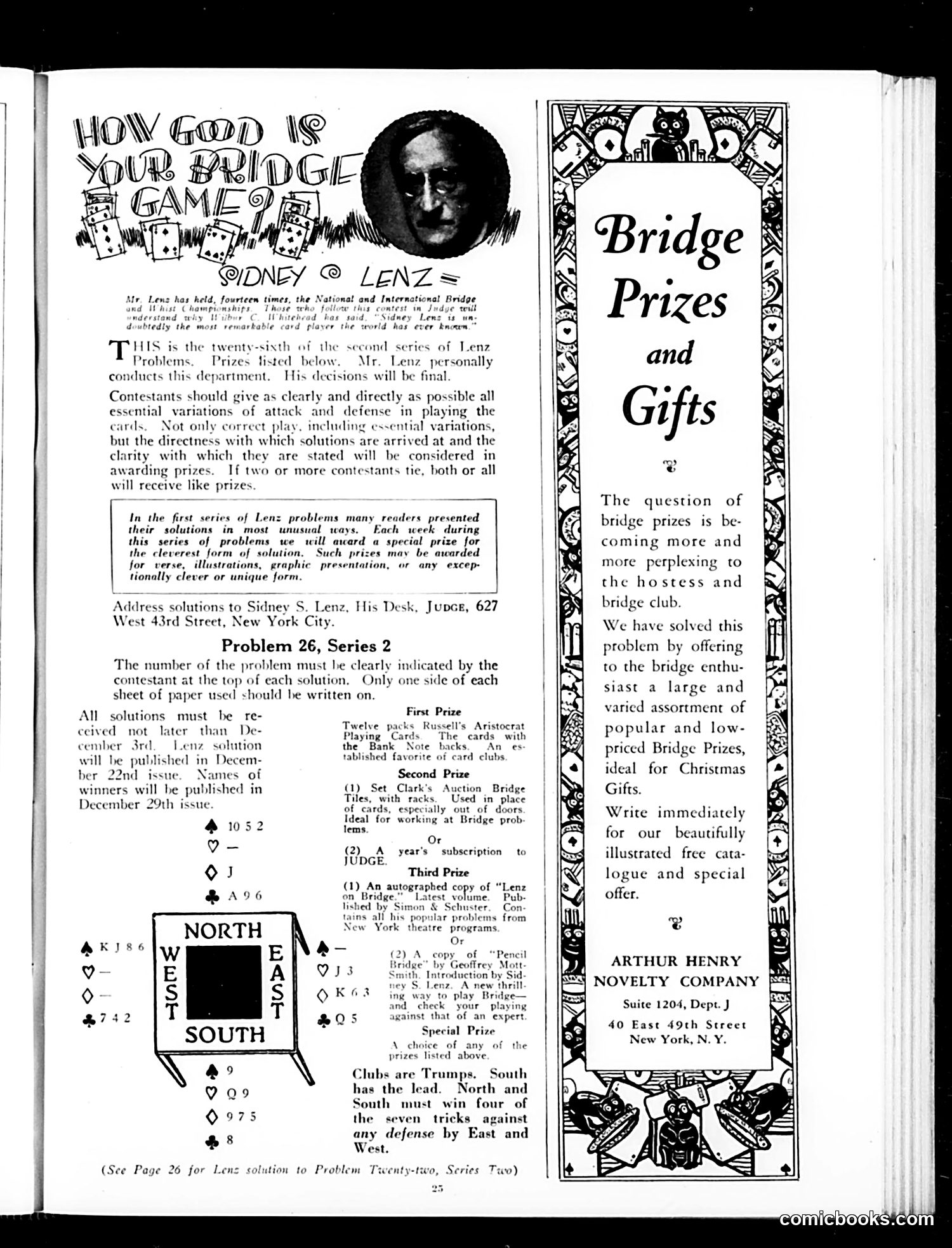
This page from *Judge* magazine features Sidney Lenz, a renowned bridge champion (mentioned as fourteen-time national and international champion), presenting the twenty-sixth problem in a series for readers to solve. The primary content is **not satirical cartooning** but rather a **bridge instruction/competition feature**. Lenz poses a card game problem ("Problem 26, Series 2") with specific rules: North and South must win four of seven tricks against East and West's defense, with clubs as trump. The page includes prize offerings for creative solutions—ranging from playing card sets to Lenz's own published bridge guides—emphasizing prizes "for verse, illustrations, graphic presentation, or any exceptionally clever or unique form." An advertisement for Arthur Henry Novelty Company promotes bridge-related gifts appears alongside, capitalizing on the growing popularity of bridge as a social game and hostess concern in this era. This represents mainstream recreational content rather than political satire.
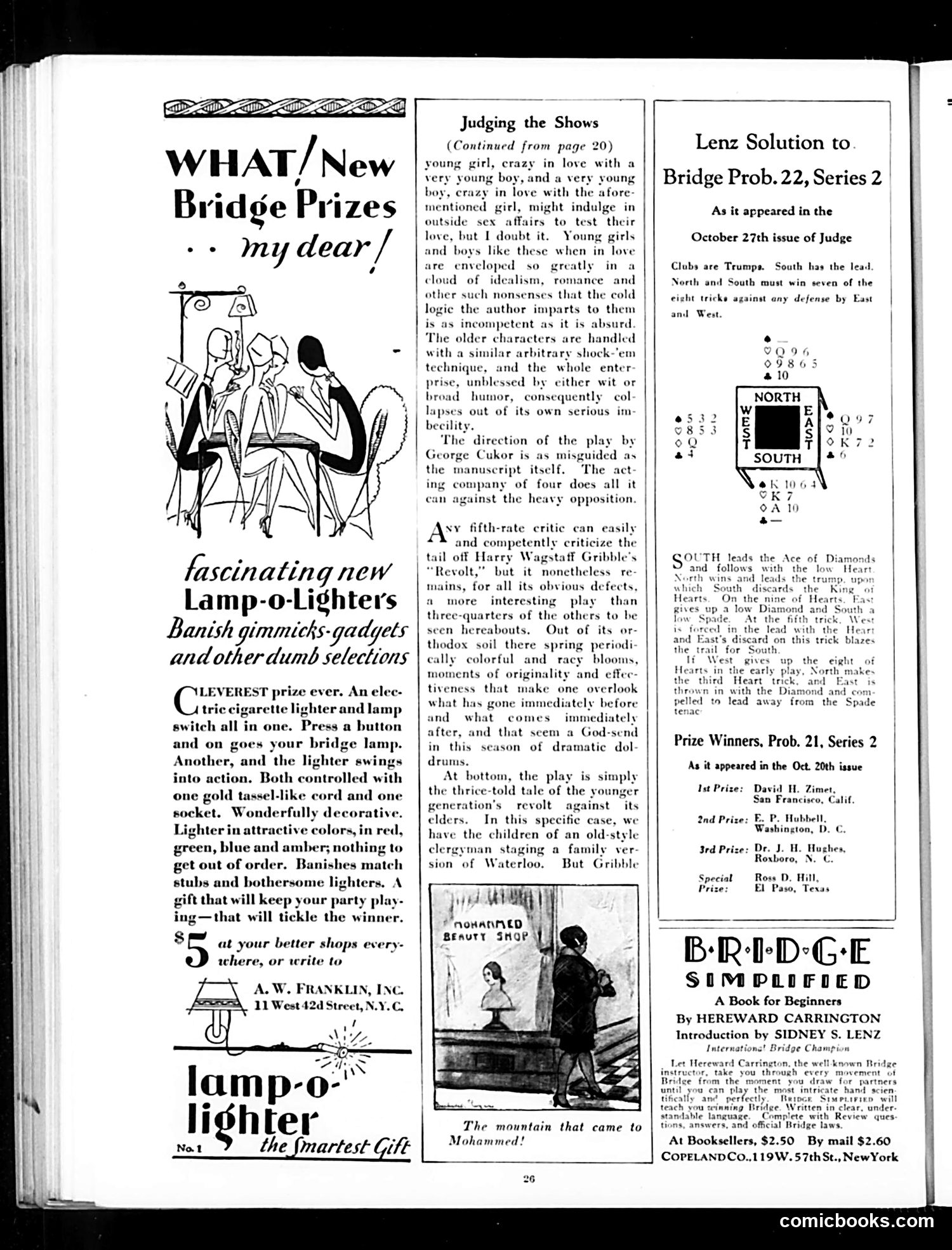
This page is primarily **advertising and bridge content**, not political satire. The main elements are: **"Lamp-o-Lighters" Ad**: A humorous advertisement for an electric cigarette lighter disguised as a bridge lamp. The copy mockingly calls it "the smartest Gift," positioning it as an upscale novelty for bridge parties—playing on 1920s-30s sophistication and the social cachet of hosting bridge games. **"Judging the Shows" Theater Critique**: A review of a play called "Revolt" by Harry Wagstaff Gribble, directed by George Cukor. The critic dismisses it as derivative (the "thrice-told tale" of youth rebelling against elders) but acknowledges occasional moments of interest. **Bridge Problem Solutions**: Technical bridge instruction and prize winners—reflecting Judge's educated, leisure-class readership who played competitive bridge. The satire is subtle: the ads and content collectively mock upper-middle-class entertainments and the somewhat precious world of bridge enthusiasts, but without sharp political edge.
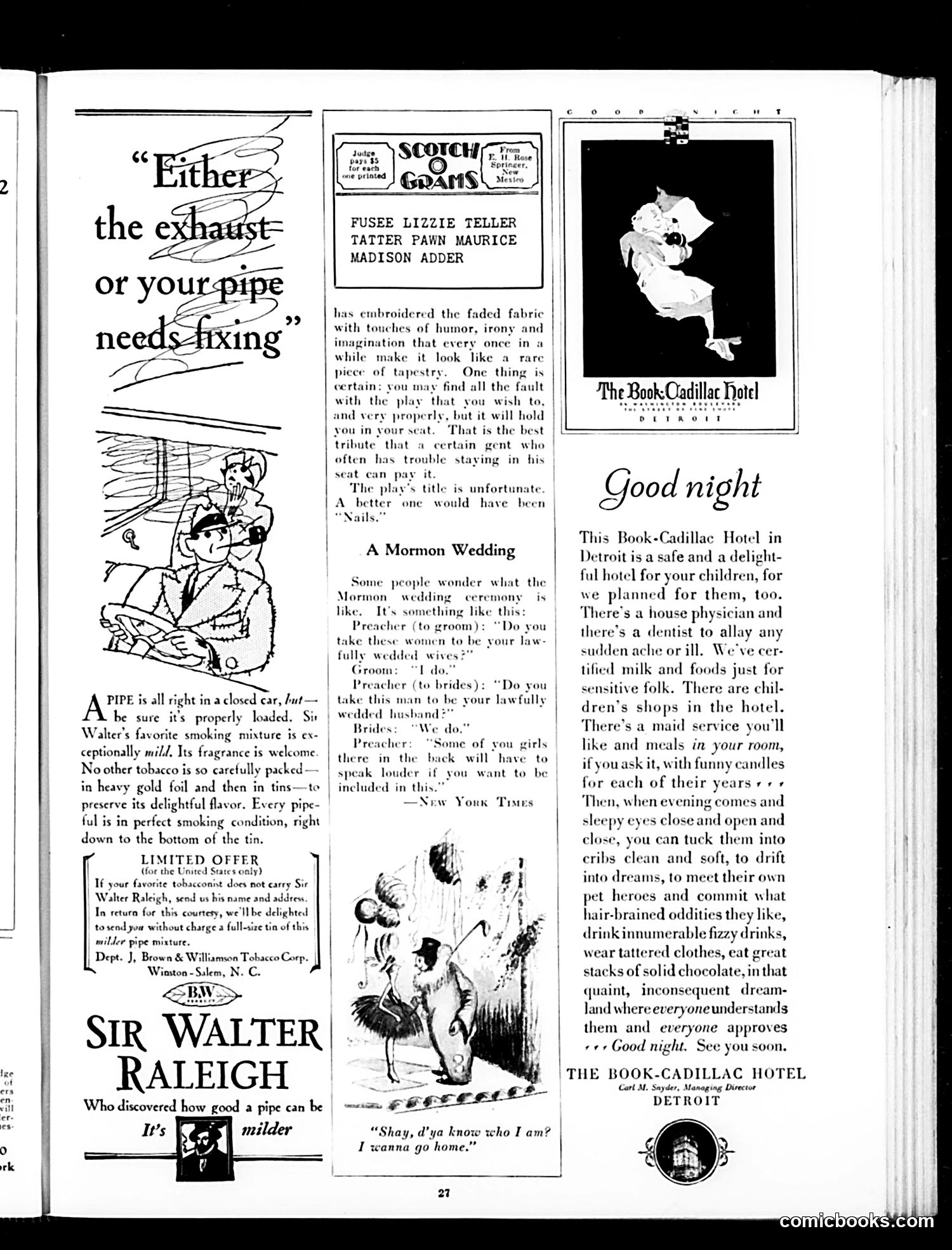
This page mixes advertising with theatrical criticism and humor. The main satirical content is the "Mormon Wedding" joke, which mocks the practice of polygamy by imagining a wedding ceremony where the preacher addresses multiple brides at once. The humor relies on contemporary anti-Mormon sentiment—polygamy was a notorious aspect of early Mormon practice and a frequent target of American satire. The theatrical review discusses a play titled with an "unfortunate" name (appears to be about nails/prostitution based on context), praising its ability to hold audience attention despite weak plotting. The advertisements dominate: Sir Walter Raleigh pipe tobacco and the Book-Cadillac Hotel in Detroit. These ads are straightforward marketing, emphasizing product quality and family-friendly amenities respectively, with no satirical intent. The page reflects early 20th-century attitudes toward Mormonism and period consumer culture.
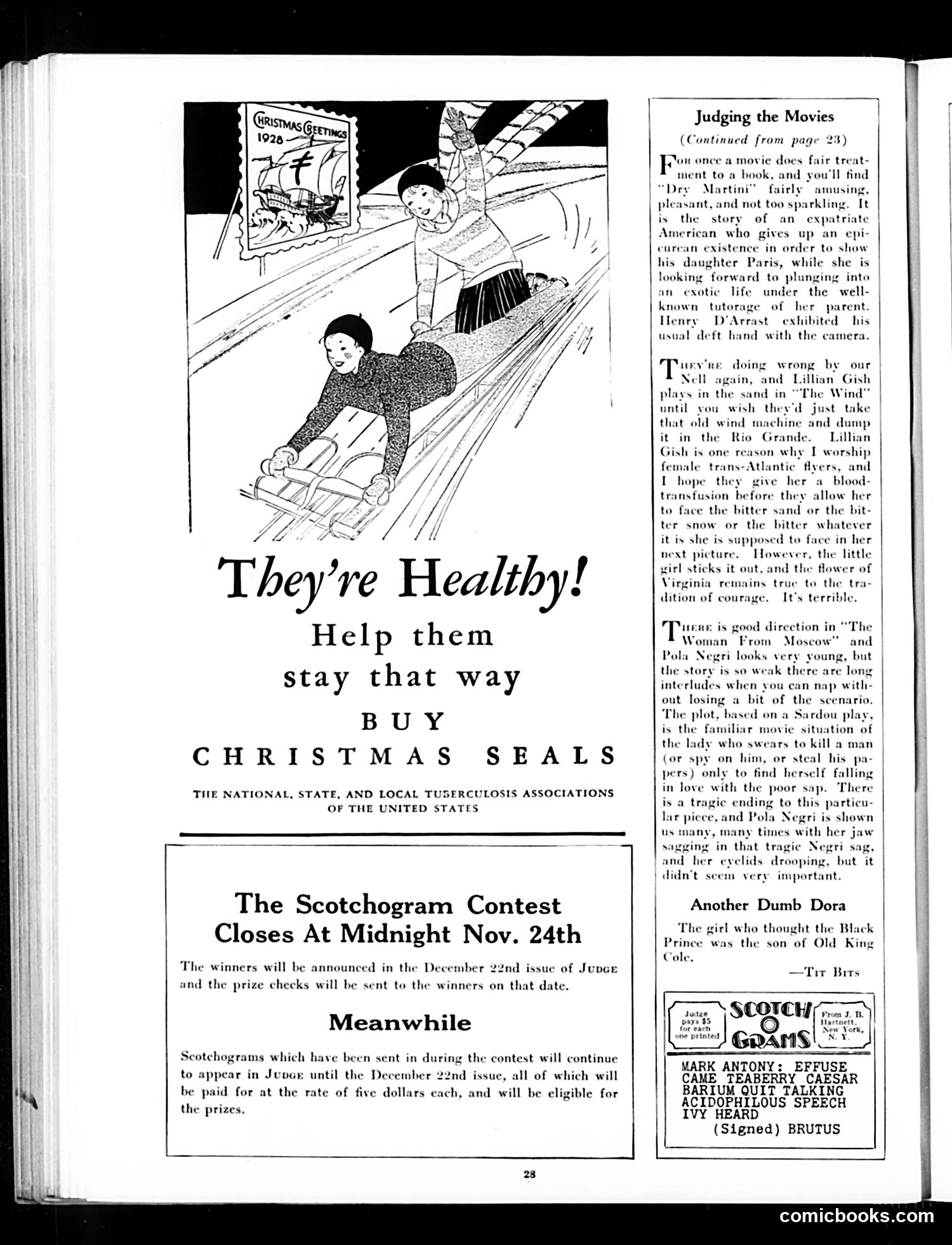
The main image shows two children sledding, accompanying a **Christmas Seals advertisement** promoting tuberculosis prevention. This was a genuine public health campaign by tuberculosis associations during the 1920s—Christmas Seals were charity stamps sold to fund TB treatment and prevention. The "healthy children" caption emphasizes the campaign's goal: protecting youth from this widespread, often-fatal disease. Below that is a **"Scotchogram Contest"** announcement—Judge magazine's puzzle/caption competition closing November 24th, with winners announced in the December 22nd issue. The magazine notes submitted scotchograms (brief humorous quips) will continue appearing and pay contributors five dollars each. The right column contains **movie reviews** critiquing contemporary films, including comments on actors like Lillian Gish and Pola Negri. A brief humor item called "Another Dumb Dora" mocks a female character's stupidity (referencing the period's "dumb blonde" stereotype). This page reflects 1920s concerns: public health awareness, Judge's reader-participation contests, and cinema criticism.
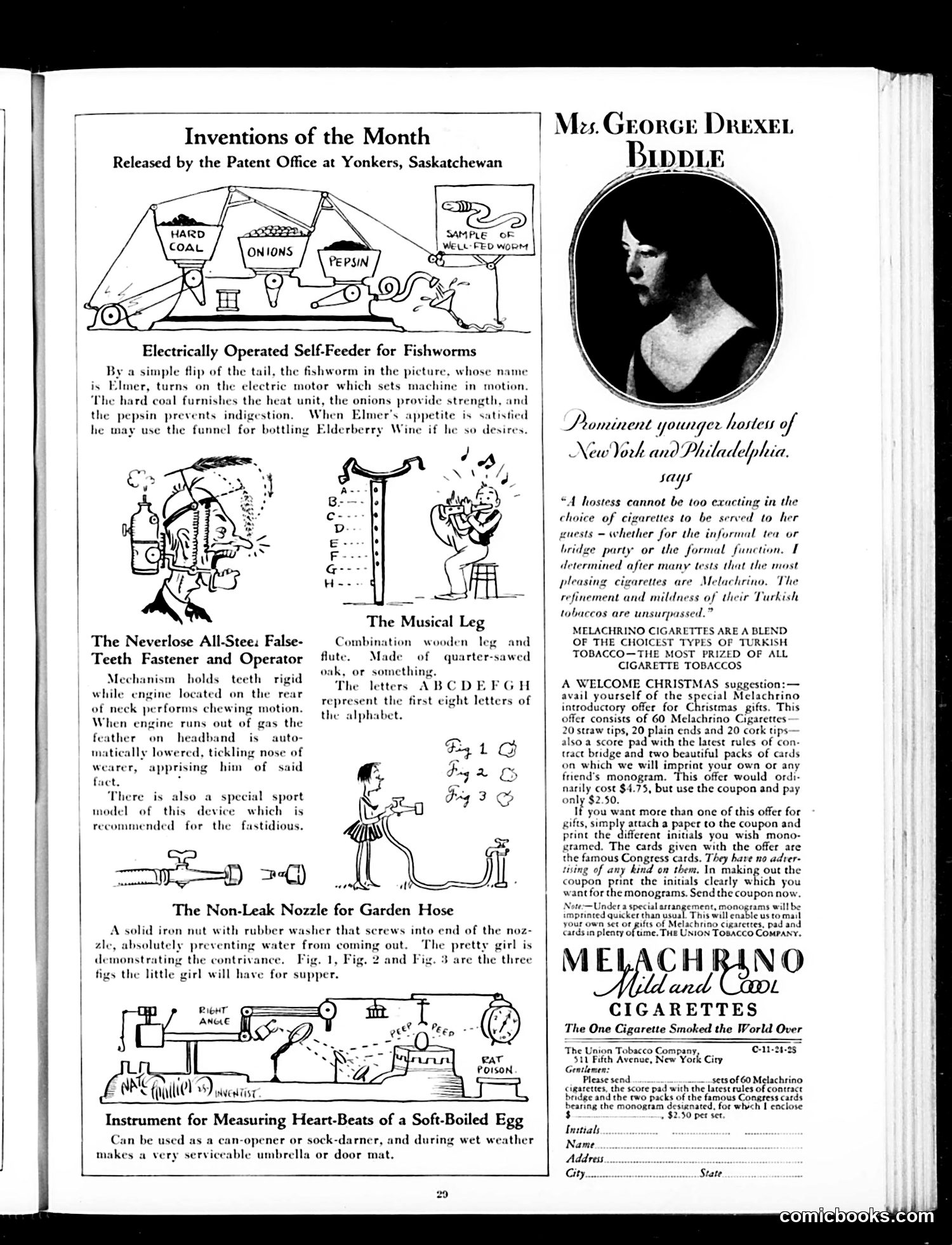
This page satirizes absurd patent applications through deliberately ridiculous "inventions." The humor relies on creating patently impractical devices presented with mock-serious technical descriptions: - An **electrically-operated self-feeder for fishworms** (named "Elmer") uses hard coal, onions, and pepsin to sustain a worm - A **musical leg** combines a wooden prosthetic with a flute - A **false-teeth fastener** uses a neck engine for chewing - A **non-leak garden hose nozzle** that prevents water flow entirely - A **heart-beat measuring device** for soft-boiled eggs serving multiple household purposes Each invention solves non-existent problems through absurd over-engineering. The satire likely mocks both the era's enthusiasm for patent filings and the Patent Office's apparent willingness to approve questionable innovations. The page also includes cigarette advertising, typical of 1920s magazines.
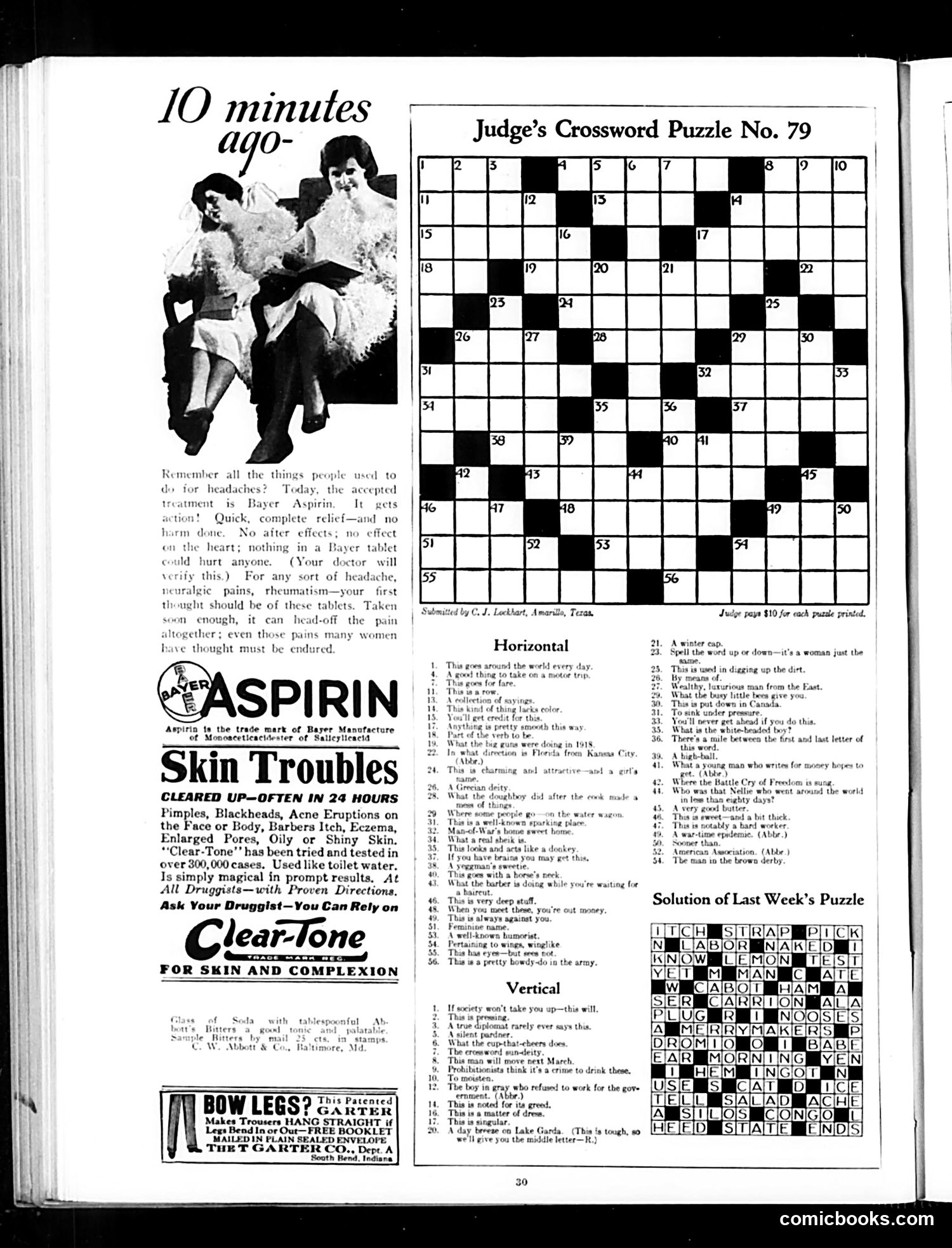
This page is primarily **advertising and puzzle content** rather than political satire. It features: **Main Content:** - Judge's Crossword Puzzle No. 79 (the primary feature) - Solution grid for the previous week's puzzle **Advertisements:** The page is dominated by period product ads typical of early 20th-century magazines: 1. **Bayer Aspirin** - promoting aspirin as a modern headache remedy, emphasizing speed and safety ("no harm done") 2. **Clear-Tone** - a skin treatment product claiming to cure acne, blackheads, and various skin conditions in 24 hours 3. **T-Garter** - a novelty garter designed to make trousers hang straight on people with bow legs The small illustration at top left ("10 minutes ago") appears to be a generic scene of two women, likely meant to evoke the "before" scenario that these products address. **Historical Context:** This reflects early 1900s consumer culture emphasizing medical/cosmetic solutions to perceived social problems. No specific political figures or current events are referenced.
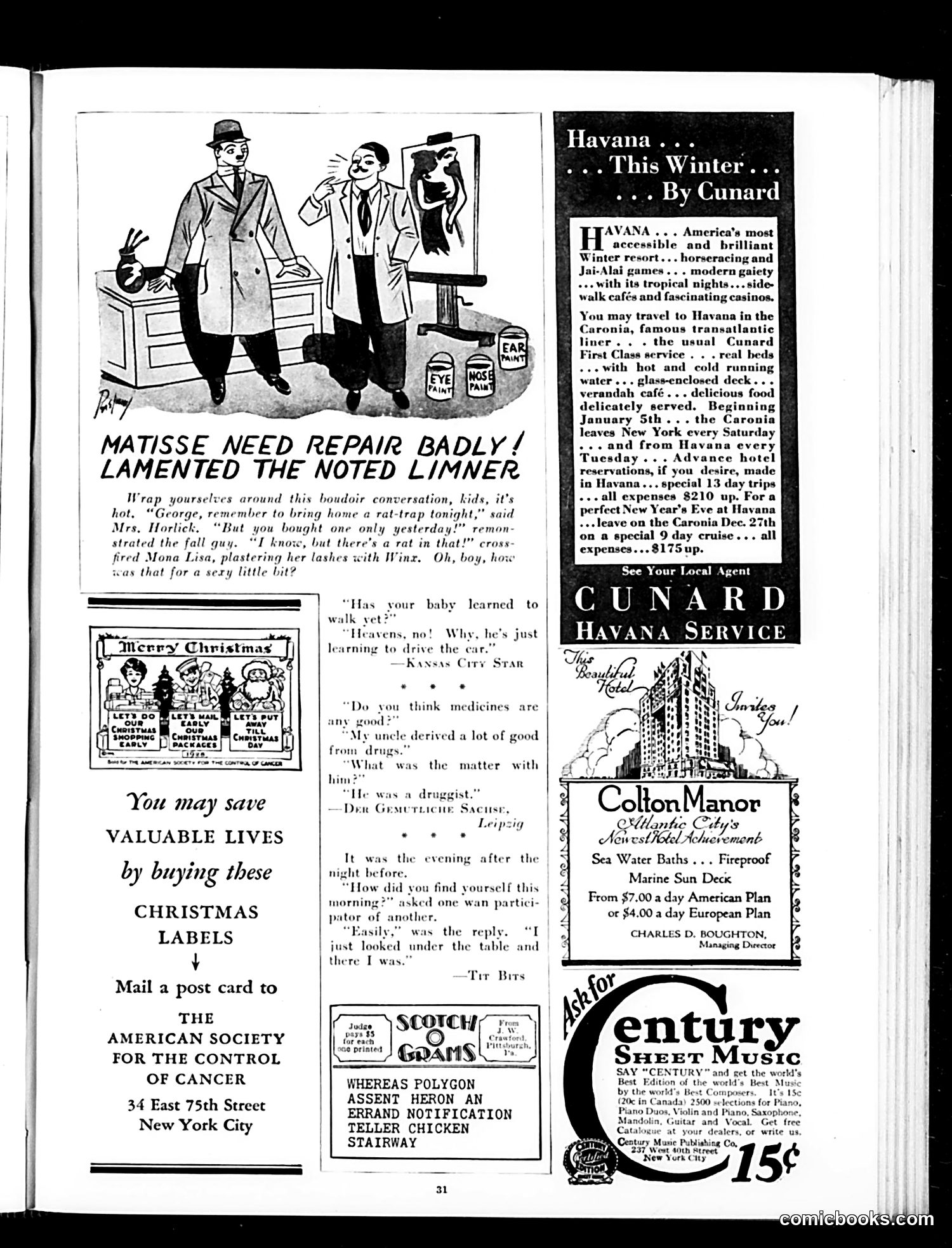
This page is primarily **advertising**, with one small cartoon at the top. The cartoon "Matisse Need Repair Badly" is a **visual pun** about the modern artist Henri Matisse. The setup presents him as a "limner" (painter) who requires repair work—the joke conflates the artist's name with "mattress" (which needs fixing). The accompanying text presents domestic banter jokes unrelated to the cartoon itself. The page's main content consists of **travel and hotel advertisements** (Cunard cruise line to Havana, Colton Manor hotel, Century Music catalog) and a **public service notice** promoting Christmas labels to benefit the American Society for the Control of Cancer—an early fundraising awareness approach. The cartoon jokes scattered throughout (about babies learning to drive cars, a druggist who was ill) are typical of the era's lighthearted, pun-based humor common to satirical magazines like Judge, showing how popular comedy relied heavily on wordplay and domestic situations rather than political satire.
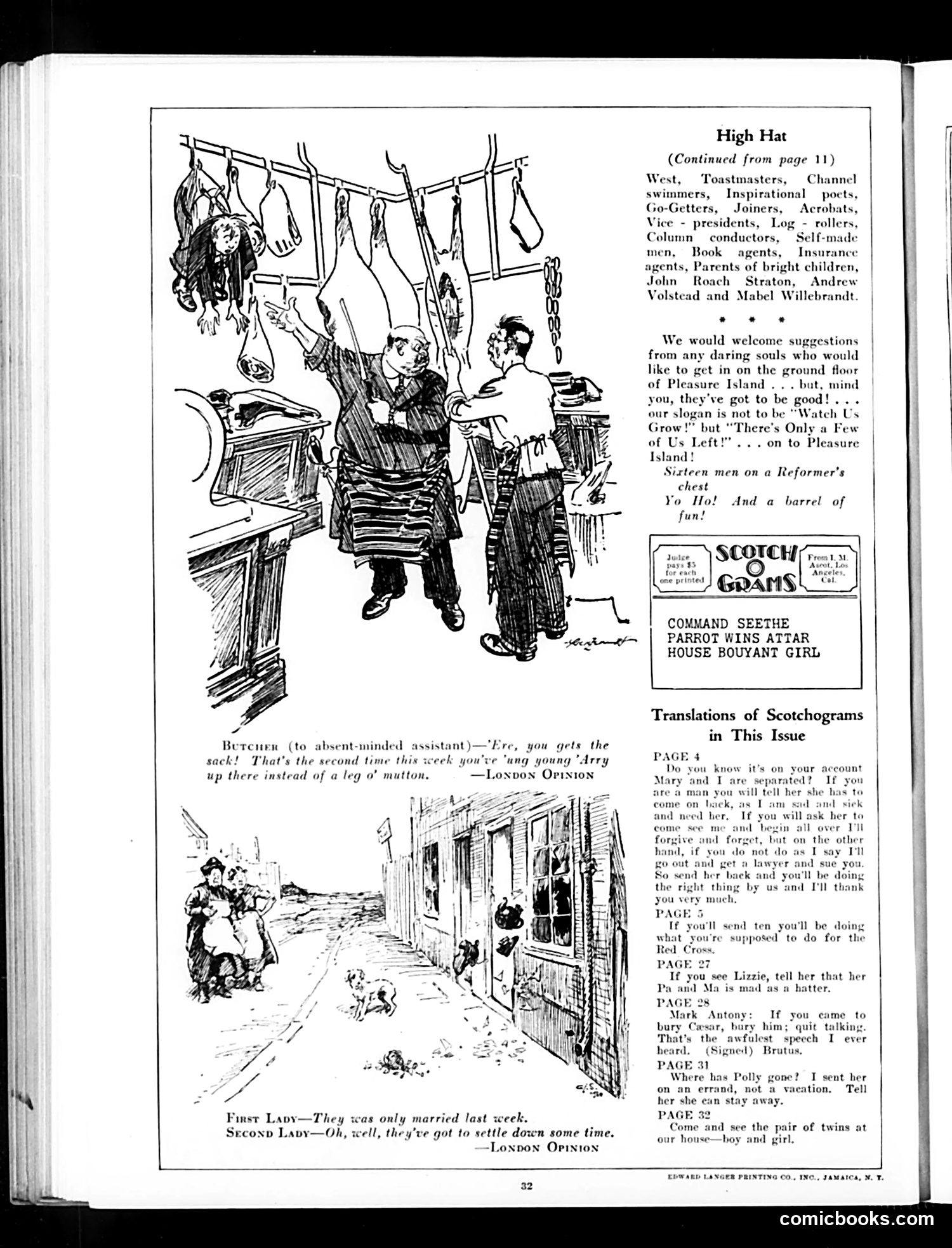
This page contains two separate cartoons with British humor, both playing on class and domestic situations. **Top cartoon**: A butcher scolds his young assistant "Harry" for the second time hanging a person (implied to be a customer or vagrant) instead of a leg of mutton on the meat hooks. The joke relies on the absurdist premise that the assistant is so absent-minded he'd confuse a human body with merchandise—satirizing working-class incompetence or carelessness. **Bottom cartoon**: Two upper-class ladies gossip about newlyweds. One notes they "only married last week," and the other responds they "must settle down sometime"—suggesting that newlyweds are too wild and need to become domestic. The humor derives from understated British social commentary about marriage and class expectations. Both cartoons appear credited to "London Opinion," indicating they're reprinted British content. The "High Hat" section above discusses various American types (toastmasters, joiners, reformers), representing Judge's satirical commentary on American society circa the Prohibition/reform era.
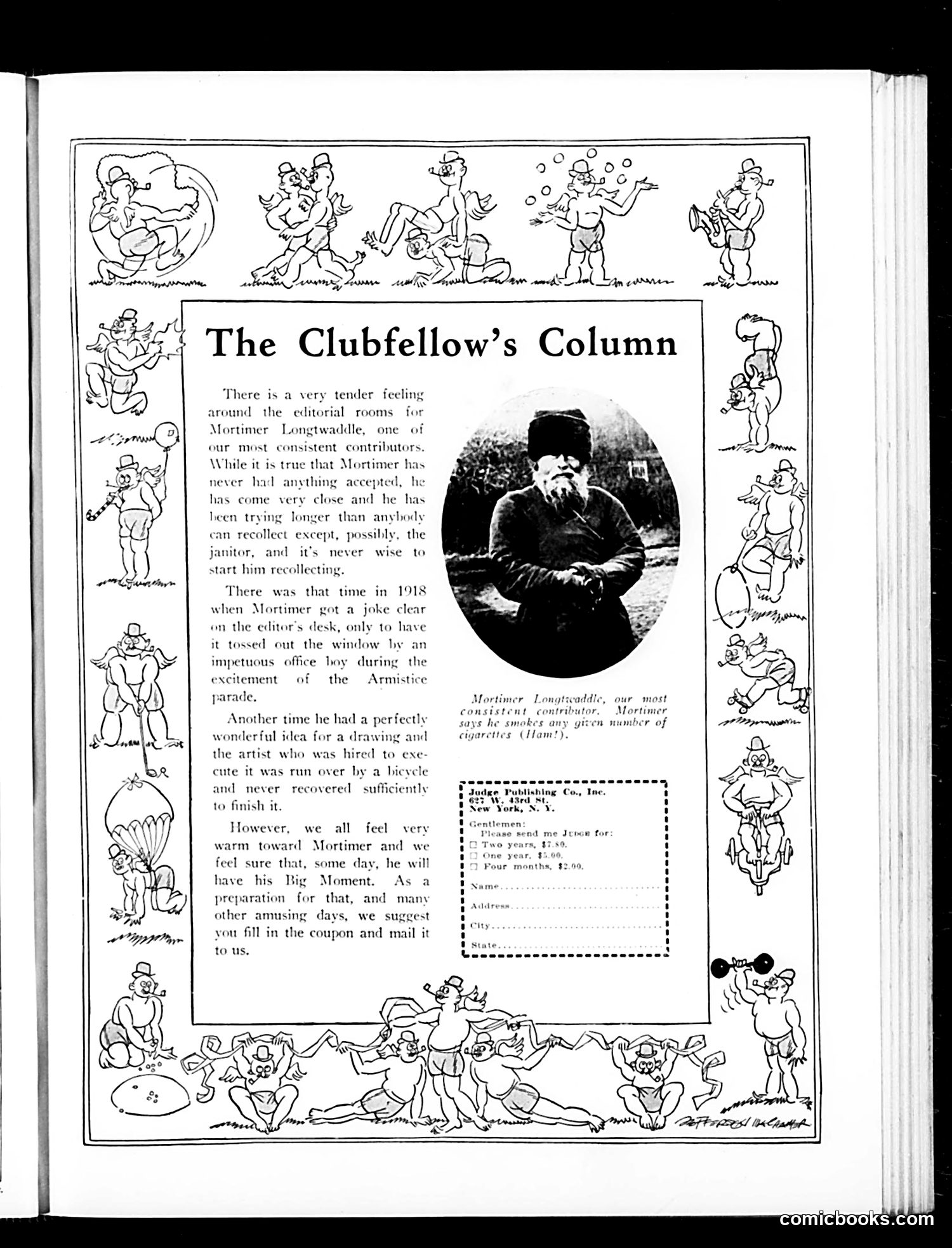
This is a humorous editorial piece about "Mortimer Longtwaddle," a fictional perpetual contributor to *Judge* magazine who has never had work accepted despite trying for years. The satire mocks both Mortimer's persistent rejection and the magazine's affectionate tolerance of him. The joke hinges on absurd bad luck: a joke was blown out a window during the 1918 Armistice celebration chaos, and an artist hired to illustrate his idea was hit by a bicycle and couldn't finish. The piece humorously suggests readers subscribe to *Judge* by filling out the coupon—positioning this loyal failure as reason enough to support the magazine. The cartoon border features whimsical characters performing various physical gags, typical of *Judge*'s visual style. The overall effect gently satirizes both struggling contributors and magazine culture itself.
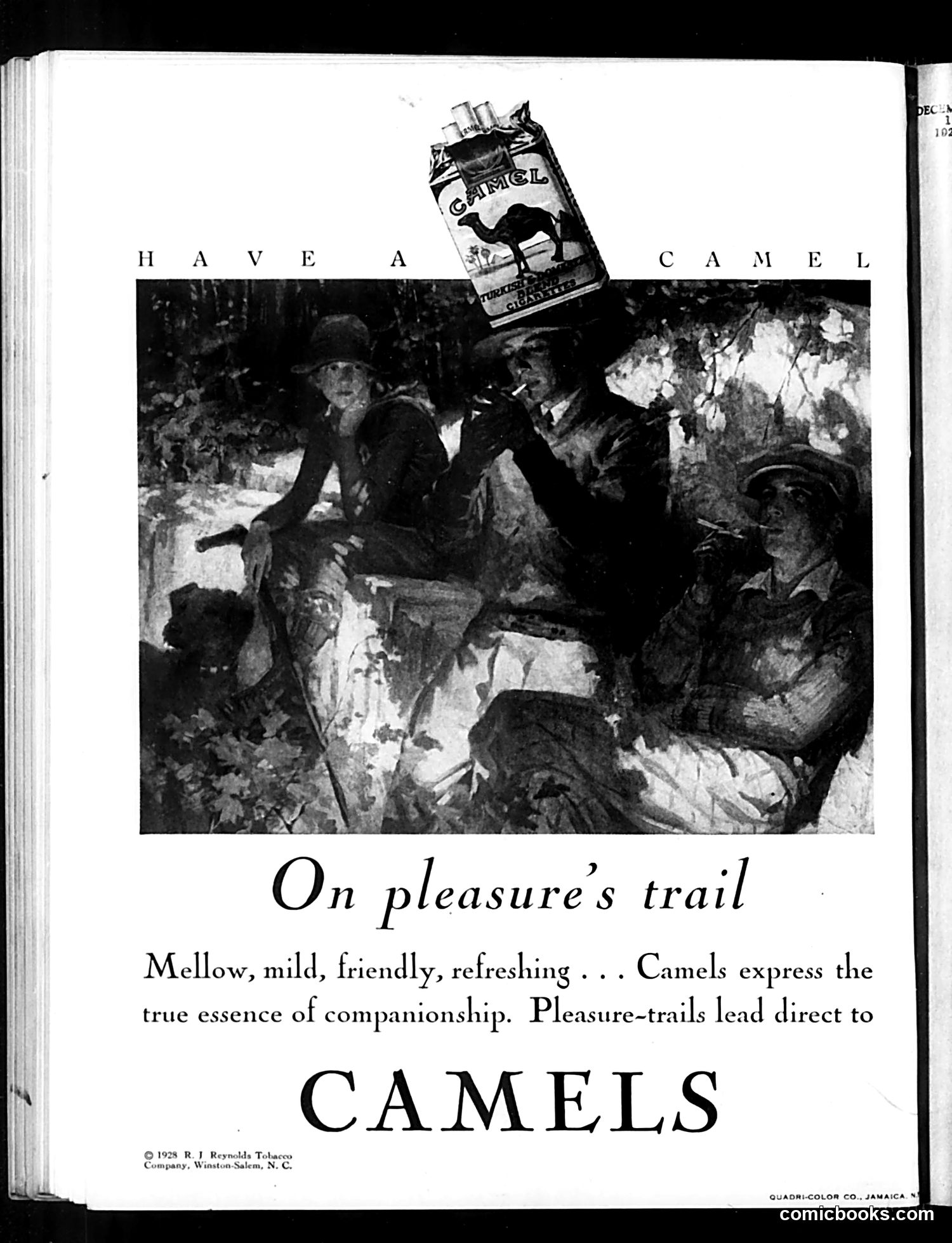
This is a **Camel cigarette advertisement**, not political satire. The page shows a black-and-white photograph of several men in work clothes and hats gathered together outdoors, apparently on a break or social occasion. The ad copy uses the slogan "On pleasure's trail," describing Camels as "mellow, mild, friendly, refreshing" and claiming they "express the true essence of companionship." For modern readers: this represents mid-20th century cigarette marketing that **openly associated smoking with leisure, friendship, and social bonding**—claims now recognized as deceptive. The working-class men in the photo were likely chosen to suggest Camels appealed to ordinary Americans. This advertisement predates the surgeon general's warnings and regulatory restrictions on tobacco marketing.