
Judge, 1928-11-24 · page 15 of 36
Judge — November 24, 1928 — page 15: what you’re looking at
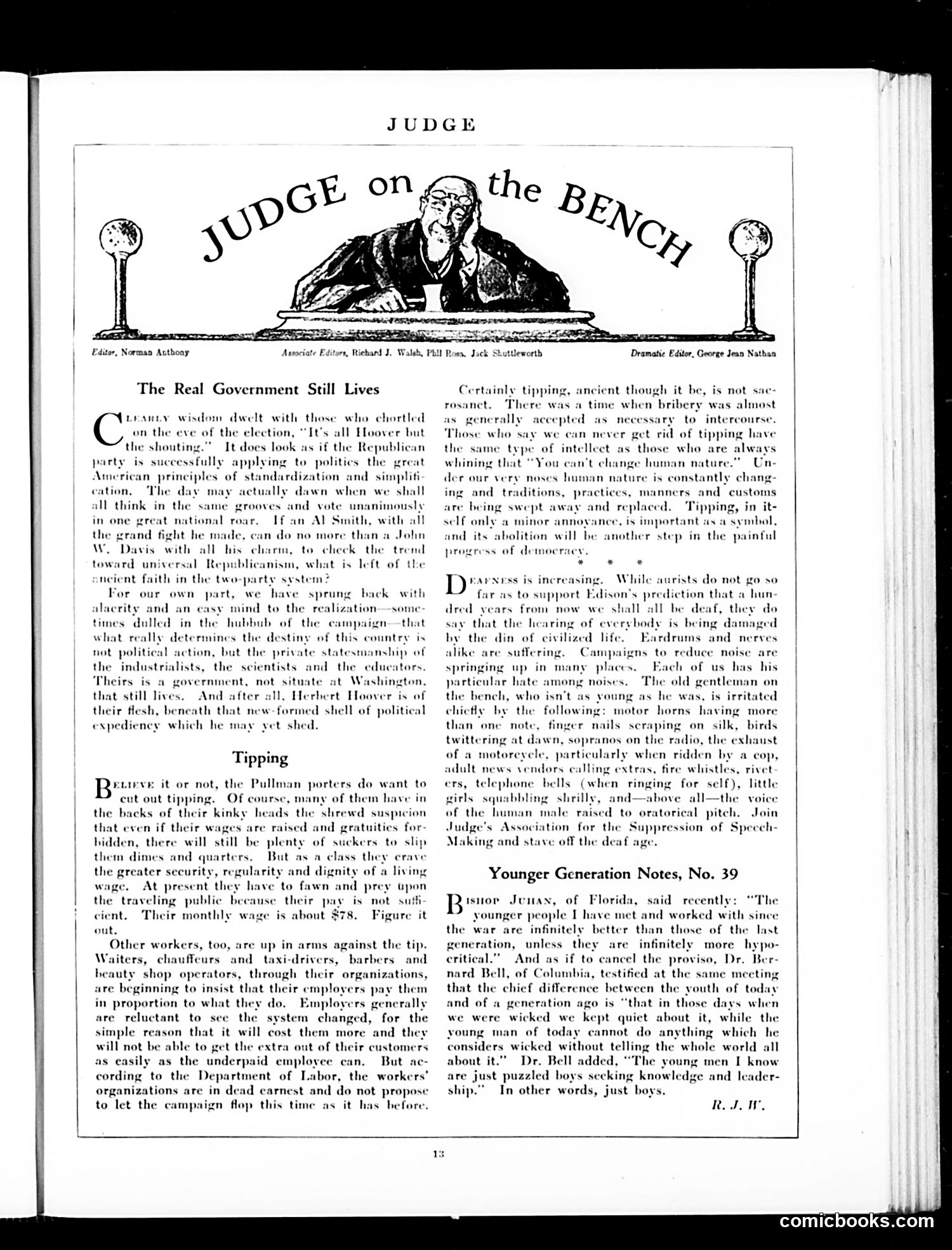
What you’re looking at
This page from *Judge* magazine presents three distinct pieces of social commentary circa the late 1920s. **"The Real Government Still Lives"** discusses the 1928 election, referencing Herbert Hoover and Al Smith. The piece argues that real power lies not with politicians but with industrialists, scientists, and educators—the "true government" operating outside Washington. **"Tipping"** addresses labor agitation against the tipping system. Workers (Pullman porters, waiters, taxi drivers, barbers) organized to demand regular wages instead of relying on gratuities. The article notes employers resisted because tips effectively subsidized their payroll costs, making the campaign difficult. **"Younger Generation Notes, No. 39"** quotes Bishop Julien and Dr. Bernard Bell discussing whether modern youth are better or worse than previous generations—concluding they're simply "just boys" seeking knowledge and adventure. The header illustration shows a judge seated at a bench, establishing the magazine's satirical voice evaluating contemporary society. The page addresses labor reform, generational anxiety, and political disillusionment typical of 1920s American discourse.
📄 Transcribed text from this page (OCR, searchable)
Machine-transcribed from the original scan — historical spelling and the odd misread are preserved.
Editer, Norman Avthoay The Real Government Still Lives teanty wisdom dwelt with those who chortled C on the eve of the election, “It's all Hoover but the shouting.” It does look as if the Republican party is successfully applying to politics the great American principles of standardization and simpliti cation, ‘The day mi ll think in the sam in one actually dawn when we shall grooves t national roar, If the grand fight he made, can de than a John W. Davis with all his charm, to check the trend toward universal Republicanisin, what is left of the neient faith in the two-party system For have sprun: alacrity and an easy mind to the reali times dulled in the hubbub of th what really determines the destiny not politics! action, but the the industrialists, the sei and the educa Theirs is a government, not situate at Washin that still lives. And after all, Herbert Hoover is of their flesh, beneath that new-formed shell of political expediency which he may yet shed. nd vote unanimously Al Sinith, with all no wi hack tion our own part, we with some- that f this country is campaign statesmanship of Tipping Bu" ve it or not, the Pullman porters do want to cut out tipping. Of course, many of them have in the backs of their kinky heads tl that even if their wages are raise nd hidden, there will still be plenty them dimes and quarters. But as a class they erave the greater security, regularity and dignity of a living . At present they have to fawn and prey upon the traveling public because their pay is not Their monthly wa Figure it Shrewd suspicion atuities for of suckers to slip suthi cient. out. Other workers, too, are up in arms against the tip. Waiters, chauffeurs and taxi-drivers, barbers beauty shop operators, through their organizs are beginning to insist that their employers in proportion to what they do. Employers generally are reluctant to see the system changed, for the simple reason that it will cost them more and the will not be able to get the extra out of their customers as easily as the underpaid employee can. But ac- cording to the Department of Labor, the workers’ organizations are in dead carnest and do not propo to let the campaign flop this tim ge is about § as it has before. Dramatic Editor, George Jean Nathan Certainly tippi is not sac- rosanct, ancient though it b There was a time when briber, as generally accepted as necessary to. intercourse. Those who say we can never get rid of tipping | the same type of intellect as those who are whining that “You can't change human natur der our very noses human nature is constantly chang ing and traditions, practices, manners and customs are being swept away and replaced. ‘Tipping, in it- self only a minor annoyance, is important asa symbol, and its abolition will be another step in the painful progress of democracy, D' ArNrss is increasing. far as to support Edison's prediction that s almost While aurists do not go so chun f, they do of everybody is being aged life. rdrums and nerves Campaigns to reduce nois dred years from now we shall all be ¢ say that the hearir by the din of civilized alike are suffering. springing up in many places. | particular hate among noises. are hoof us has his The old gentleman on the bench, who isn’t as young as he was, is irritated chiefly by the following: motor horns having more than one note, finger nails scraping on silk, birds twittering at dawn, sopranos on the radio, the exhaust of a motoreycle, particularly when ridden by a cop, adult news vendors calling extras, fire whistles, rivet bells (when ringing for self), little shrilly, and—above all—the the ale raised to oratorical pitch Judg Association for the Making and stave off the deaf ers, telephone rly squabb! voice ‘any Join uppression of Speceh- Younger Generation Notes, No. 39 Bier Juan, of Flori said recently: “The younger people I have met and worked with since the war are infinitely better than those of the last generation, unless they are infinitely more hypo- critic And as if to cancel the proviso, Dr. Ber- nard Bell, of Columbia, testified at the same meeting that the chief difference between the youth of toc and of a ion ago is “that in those days when we were wicked we kept quiet about it, while the young man of today cannot do anything which he considers wicked without telling the whole world all about it.” Dr. Bell added, “The young men I know are just puzzled boys secking kne ship.” In other words, just bo comicbooks.com