
A complete issue · 36 pages · 1928
Judge — October 27, 1928
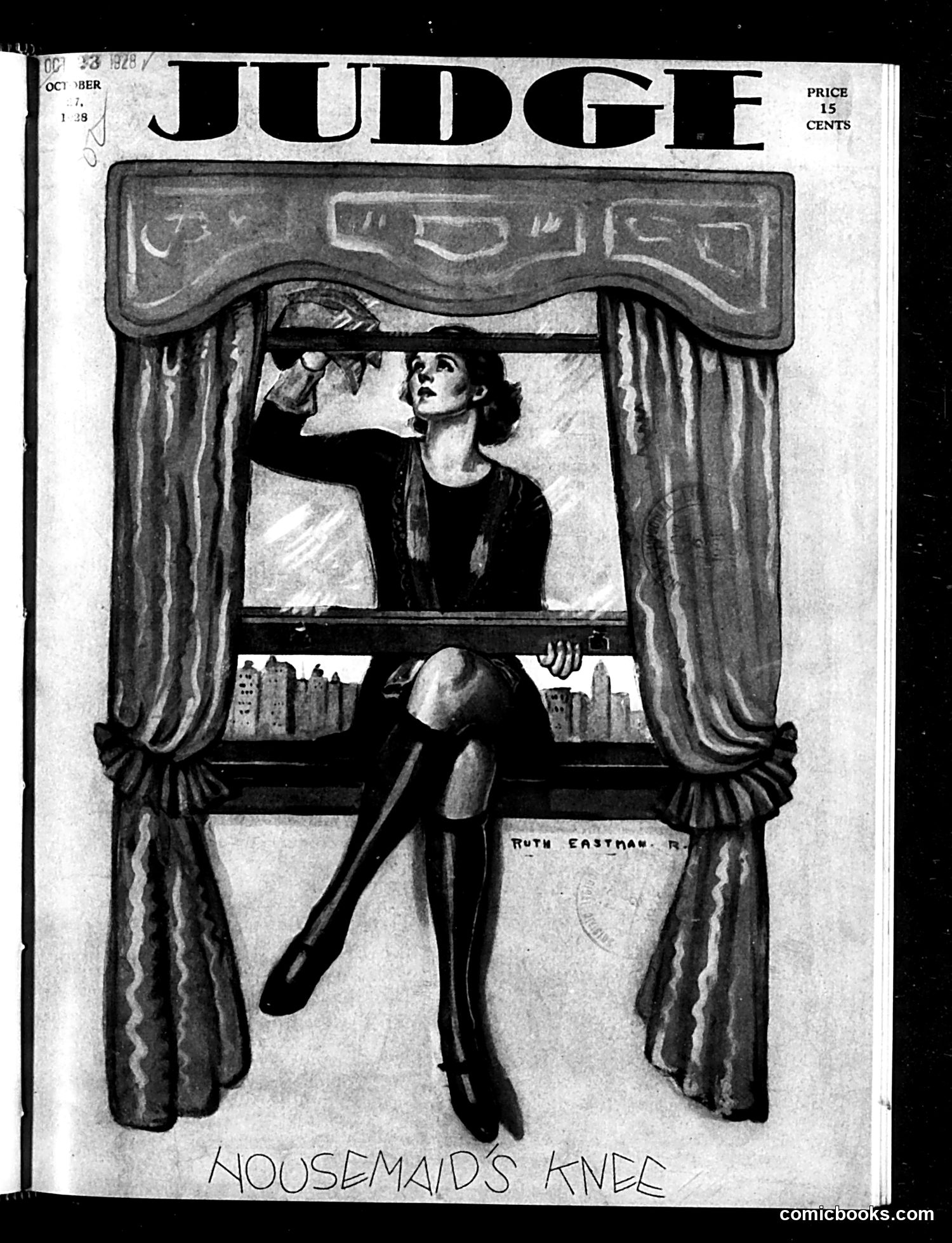
This is a visual pun playing on the medical term "housemaid's knee"—an occupational injury (bursitis) that domestic workers developed from kneeling while cleaning. The cartoon shows a woman at a window, her leg extended prominently, with the caption punning on this condition. The satire likely comments on the physical toll of domestic labor, a common social concern in early 20th-century America. By literalizing the medical condition as a visual joke, the cartoonist draws attention to working-class women's exploitation while maintaining the magazine's satirical tone. The artist is credited as "Ruth Eastman, R." The illustration appeared in Judge, known for its commentary on social and political issues of the era.
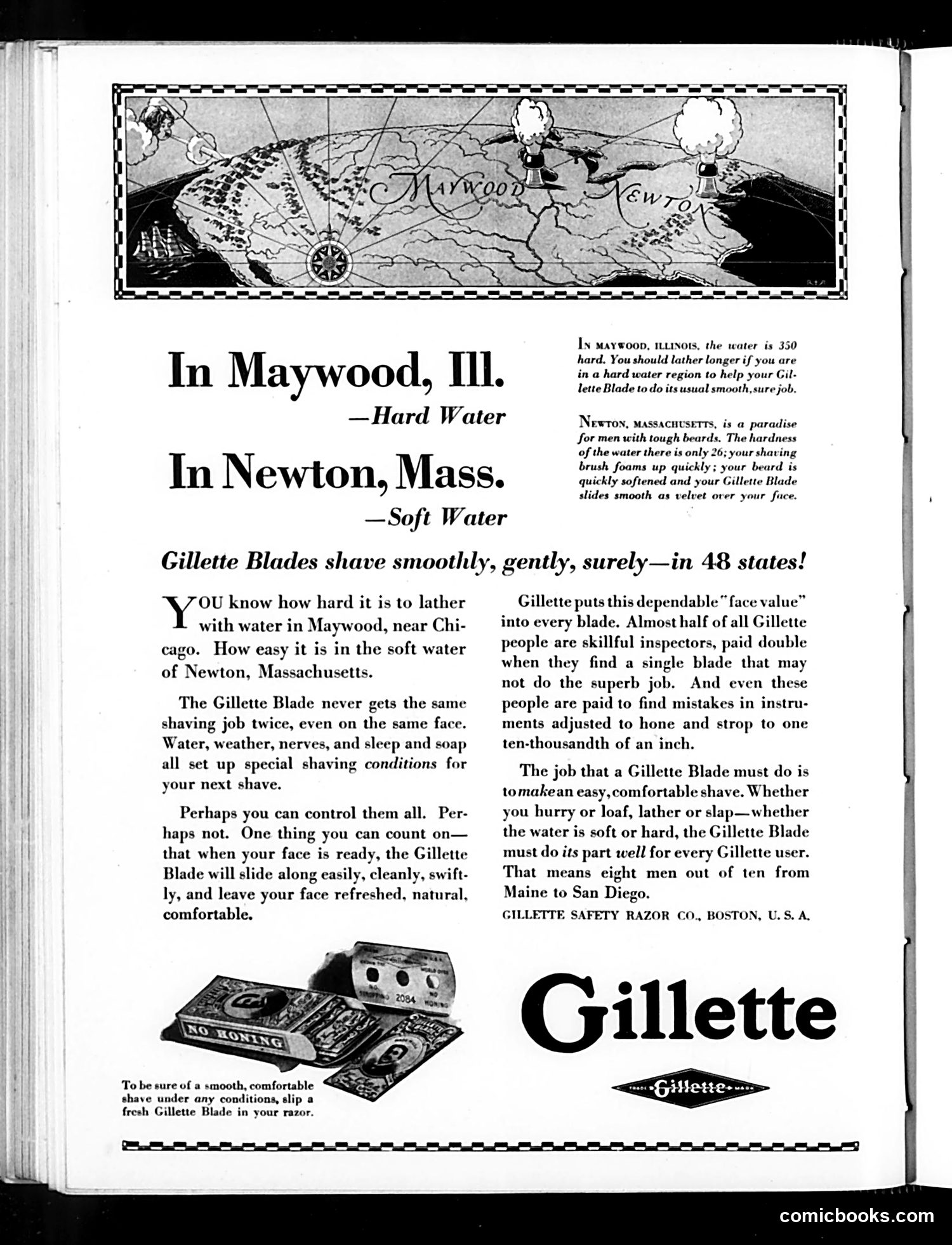
This page is primarily a **Gillette razor advertisement**, not political satire. The decorative header shows a map comparing Maywood, Illinois (hard water region) and Newton, Massachusetts (soft water region), with ships and compass roses. The ad's central conceit is that Gillette blades perform reliably regardless of water conditions—a practical selling point for early 20th-century consumers who lacked modern plumbing consistency. The text emphasizes quality control, claiming "almost half of all Gillette people are skilled inspectors" ensuring blade uniformity. There is **no political cartoon or satire present**. This is straightforward product marketing using geographical comparison as a consumer benefit demonstration. The page reflects period concerns about water hardness affecting shaving comfort.
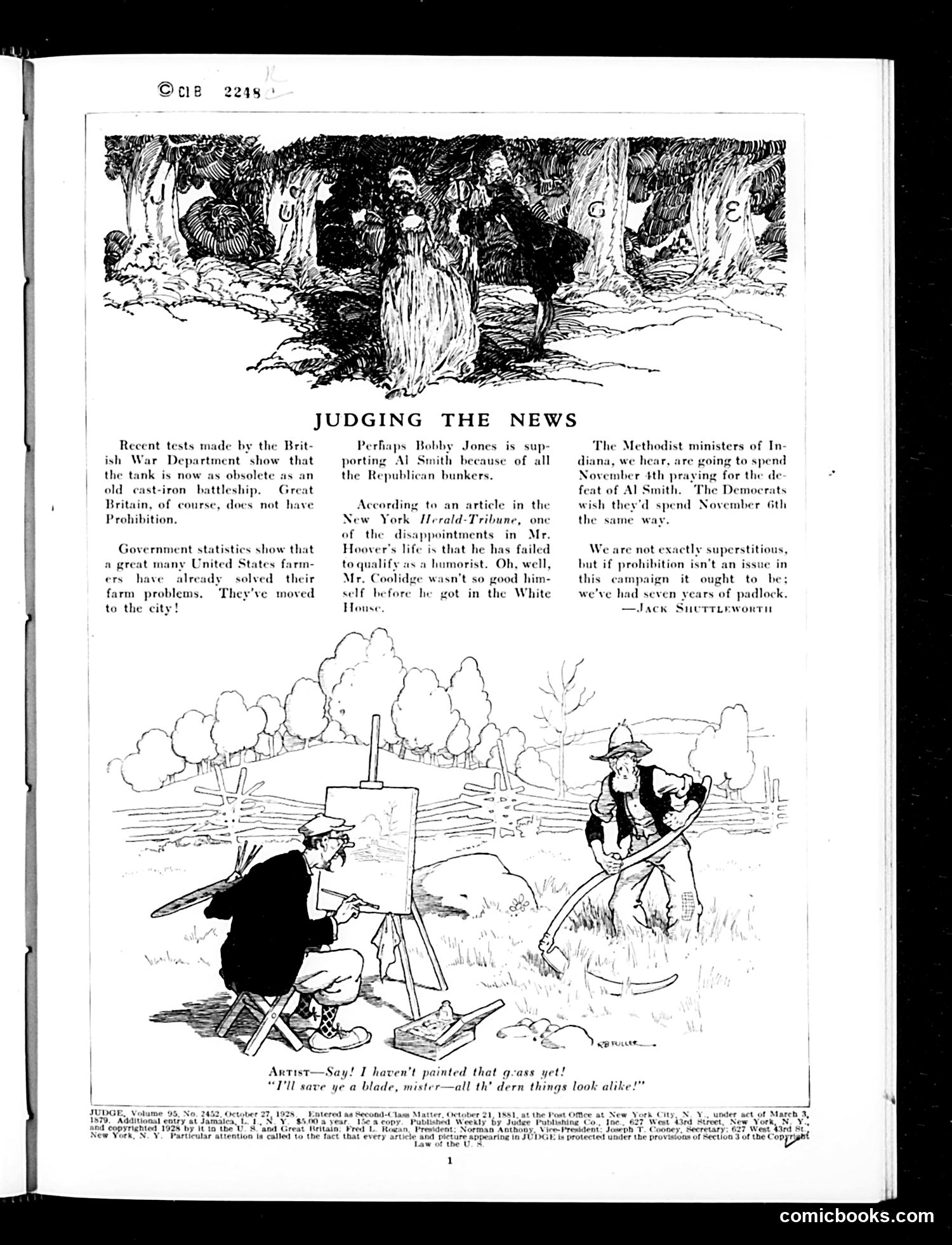
This page contains political commentary and a cartoon satirizing artistic pretension. The top section mocks various political figures and issues: British war tanks, farming problems, and prohibition-era politics. It references "Bobby Jones" (likely golfer Bobby Jones), "Al Smith" (Democratic presidential candidate), and mentions Calvin Coolidge's inadequacy as president. The main cartoon depicts two painters: one sitting, one standing with arms raised, discussing a landscape painting. The artist claims he hasn't finished the grass yet—a joke about artistic incompleteness or pretension. The caption suggests one painter is critiquing the other's unfinished work, satirizing artists who over-explain or defend incomplete pieces. This appears to be general social satire rather than political commentary.
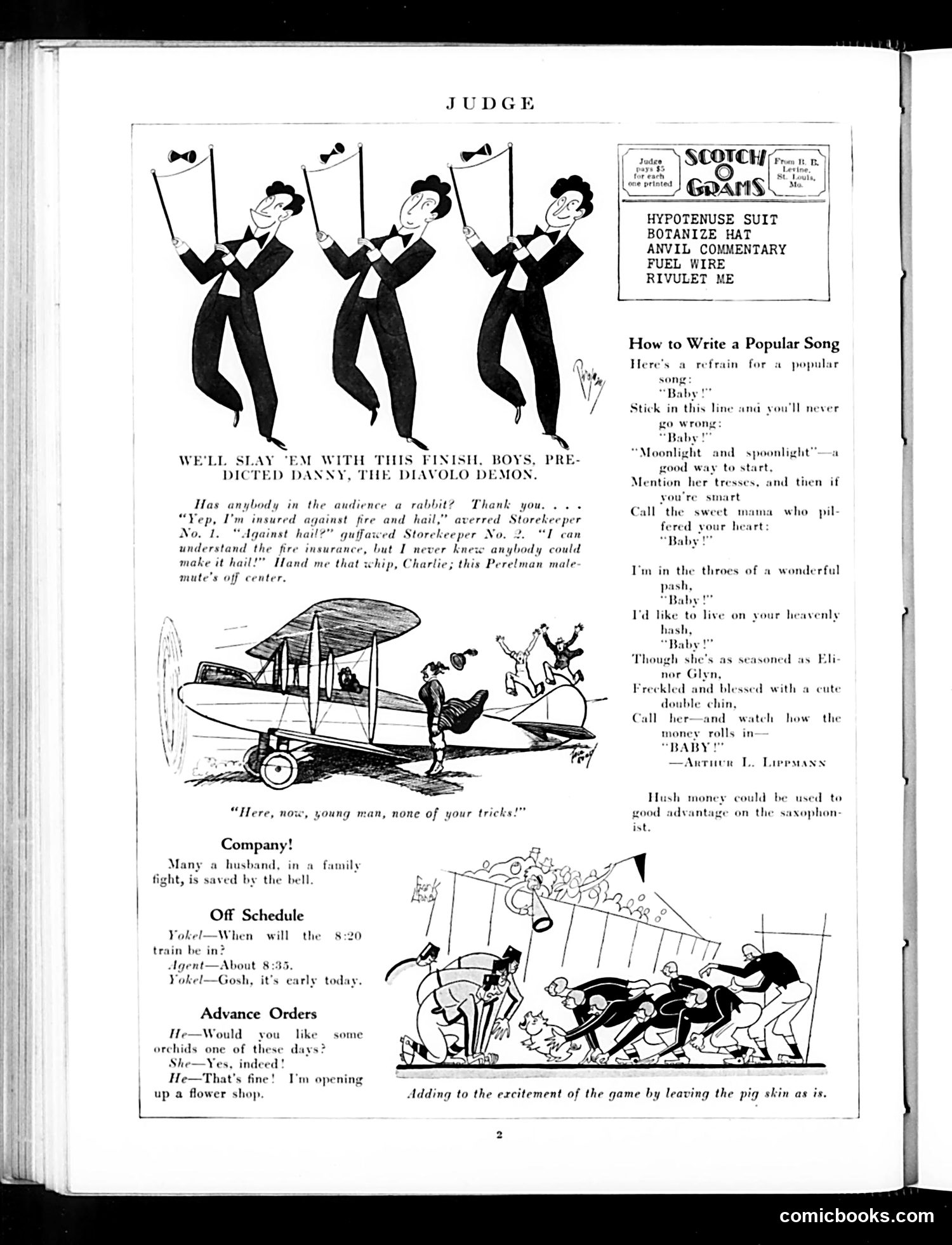
This page contains mostly humorous sketches and brief comedic pieces rather than political cartoons. The top cartoon shows three judges with gavels, captioned about "slaying 'em with this finish, boys," likely mocking judicial theatricality or courtroom drama. The middle section includes a sketch of an airplane with the caption "Here, now, young man, none of your tricks!" — apparently satirizing early aviation safety or reckless flying behavior. Below that are short humor pieces: "Company!" (a domestic joke), "Off Schedule" (a train-station dialogue), and "Advance Orders" (a flower-shop exchange about orchids). The right side features "How to Write a Popular Song" — a parody of commercial songwriting formulas, credited to Arthur L. Lippmann. The bottom cartoon shows people being ejected from what appears to be a pig-skin (football), captioned as "Adding to the excitement of the game." Overall, this appears to be a lighter entertainment page rather than serious political satire.
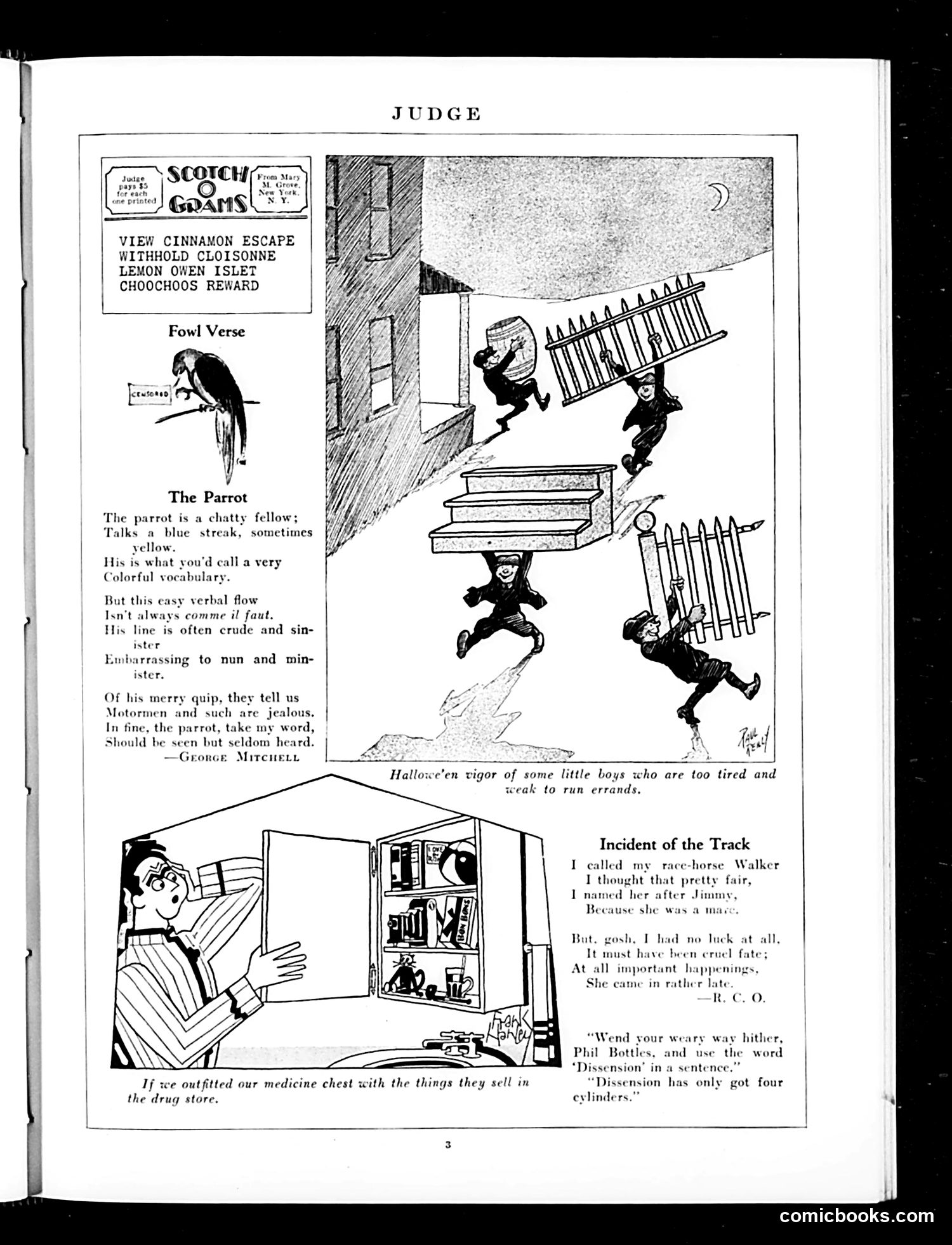
This page contains **humorous verse and cartoons** rather than political satire. The content includes: **"The Parrot"** — A poem by George Mitchell about parrots' crude vocabulary and chatty nature, illustrated with a bird drawing. **"Halloween vigor"** — A cartoon showing children carrying ladders and fences, captioned as boys "too tired and weak to run errands," likely mocking laziness or mischief-making during the holiday. **"Incident of the Track"** — A poem (attributed R.C.O.) about a racehorse named Walker that performed poorly, personified as female and arriving "rather late." **Medicine chest cartoon** — Shows someone opening a crowded cabinet, captioned "If we outfitted our medicine chest with the things they sell in the drug store," satirizing excessive patent medicine advertising common in that era. The page is primarily **entertainment and social humor** rather than political commentary.
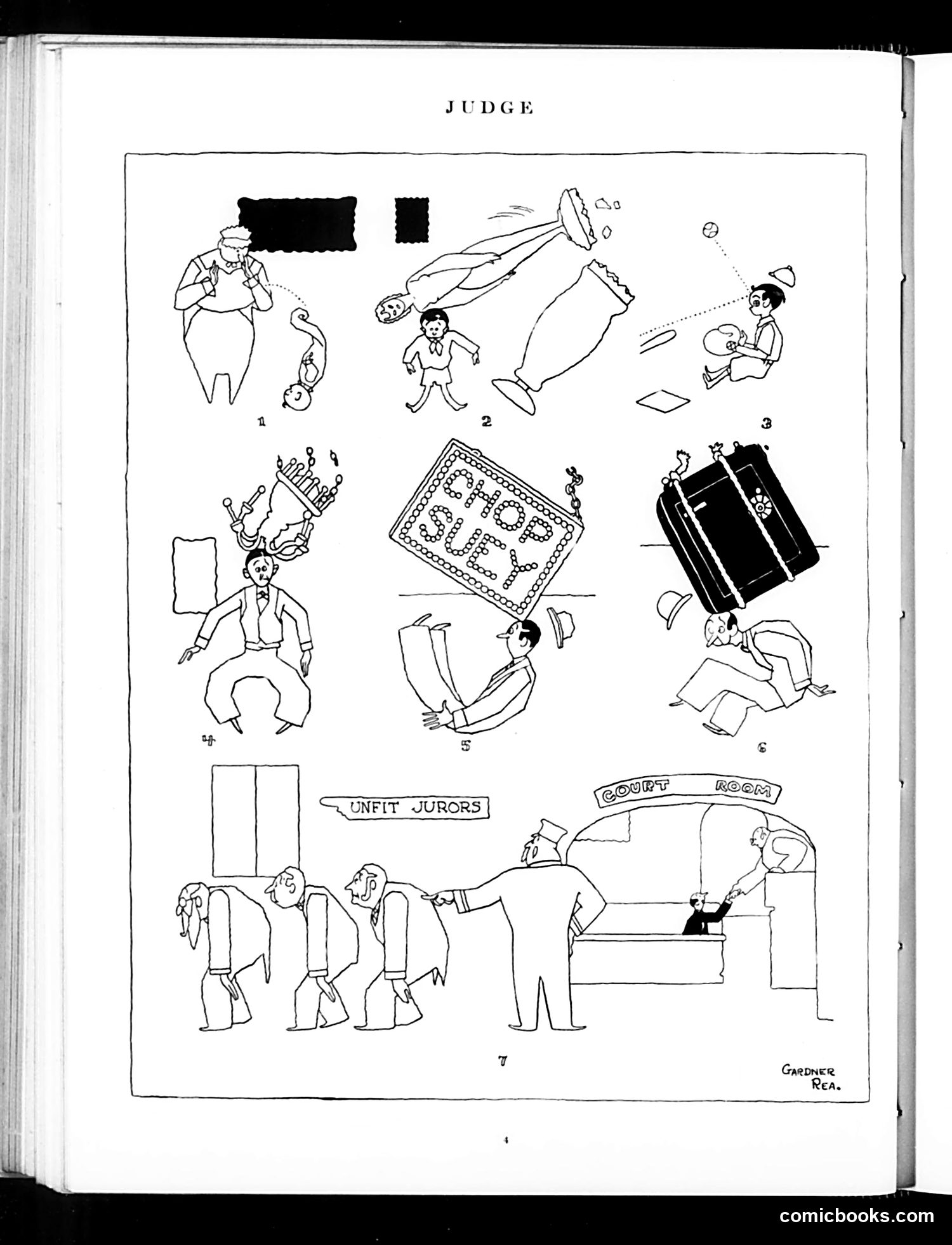
This satirical page depicts various aspects of the judicial system through exaggerated cartoon vignettes. Panel 1 shows a judge with a small defendant, establishing the power imbalance. Panel 2 illustrates a judge kicking a small figure—suggesting judicial abuse or harsh sentencing. Panel 3 depicts a child at play, possibly contrasting innocent behavior with judicial seriousness. Panel 4 shows an ornately dressed official (likely a corrupt judge or politician), while panel 5 presents a game board labeled "PUFFERY SUE," satirizing frivolous lawsuits. Panel 6 depicts a figure crushed under luggage, possibly commenting on legal burdens. The final panel labeled "UNFIT JURORS" shows three drooping figures being presented to a judge in a courtroom, mocking the quality or competence of jury selection in the legal system. The cartoons collectively critique judicial inefficiency, corruption, and systemic failures.
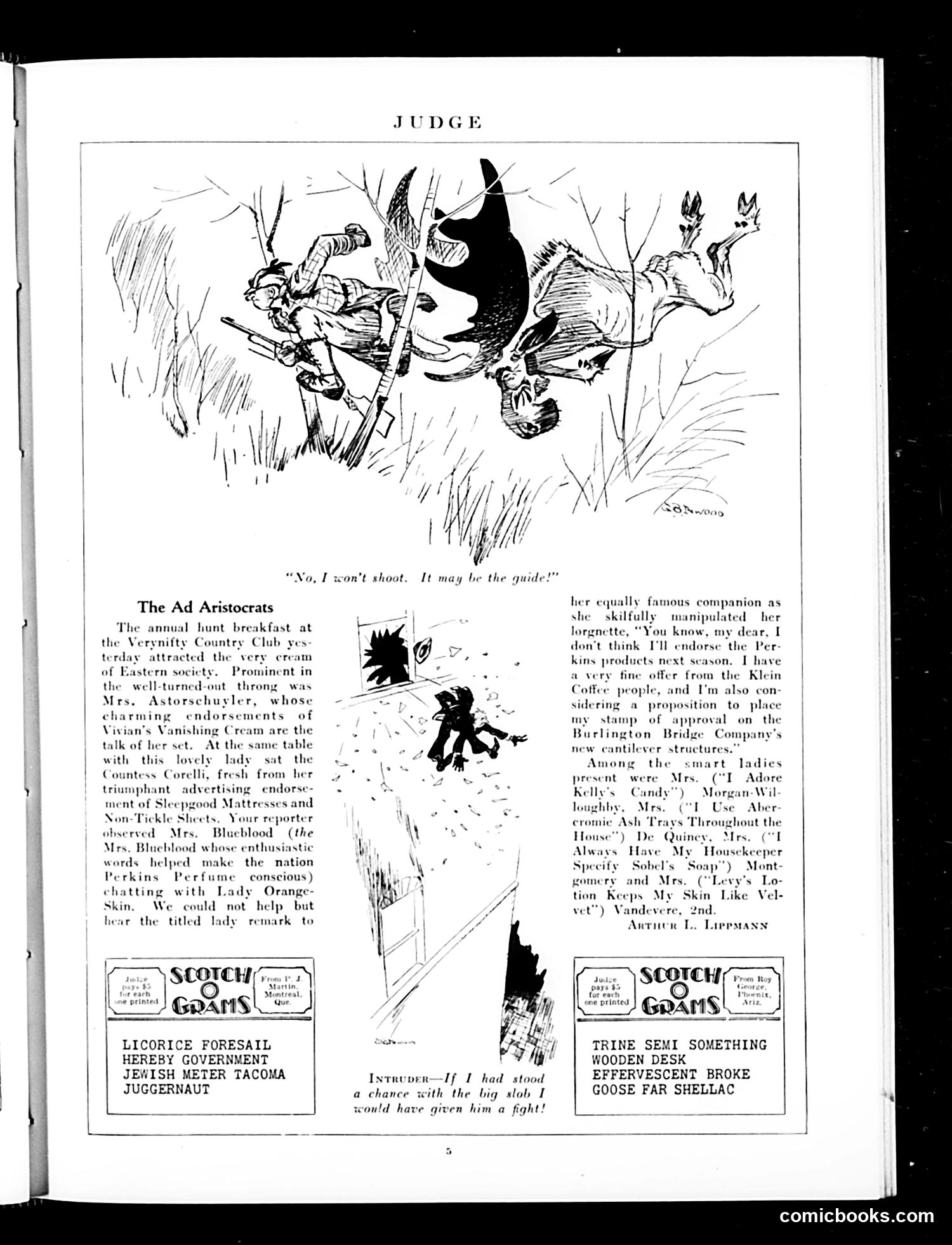
This page features a satirical cartoon titled "Judge" depicting a hunting scene with the caption "No, I can't shoot. It may be the guide!" The accompanying article, "The Ad Aristocrats," discusses the annual hunt breakfast at the Veruity Country Club, satirizing East Coast high society. It humorously critiques wealthy women's obsession with product endorsements and advertisements, particularly Mrs. Astorschuyler's endorsement of Vivian's Vanishing Cream and other luxury brands (Perkins Perfume, Shepard Mattresses, Non-Tickle Sheets). The cartoon likely mocks aristocratic pretension—the hunter's reluctance to shoot due to uncertainty about class status suggests satire of society's rigid hierarchies and the absurdity of upper-class conventions.
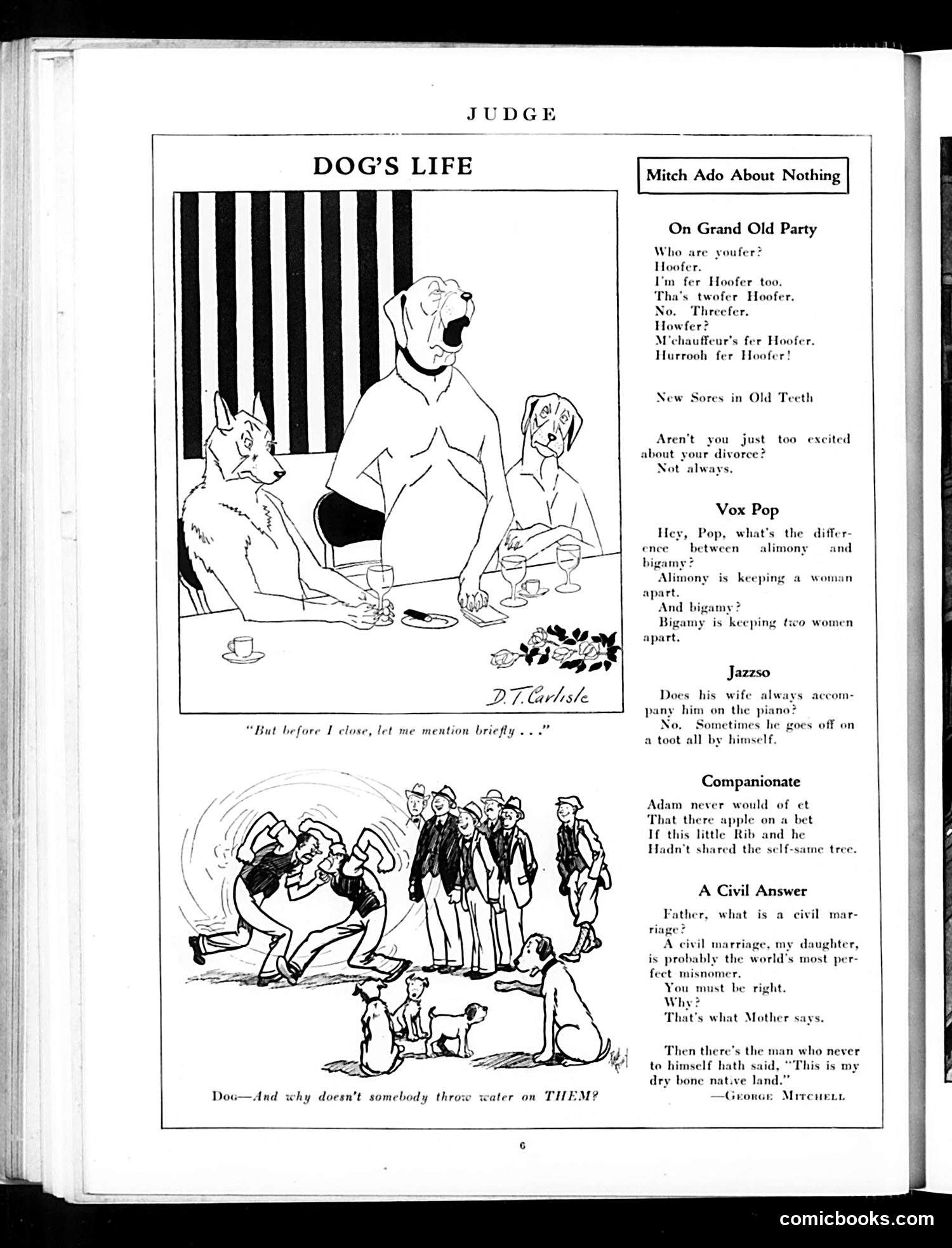
This page features satirical humor typical of early 20th-century Judge magazine. The main cartoon "Dog's Life" by D.T. Carlisle depicts a man yawning while addressing two dogs at a dinner party, with the caption suggesting someone should "throw water" on the boring speaker—treating humans and dogs equally in their indifference. The right-side humor pieces mock contemporary social concerns: "Mitch Ado About Nothing" parodies political enthusiasm (possibly referencing support for a politician nicknamed "Hoofer"); several jokes target modern anxieties like divorce, alimony, and "companionate marriage" (a 1920s concept emphasizing emotional partnership over tradition); and jazz-age behavior ("going on a toot"). The overall tone satirizes rapid social change—loosening sexual and marital conventions, modern entertainment, and frivolous political engagement—presenting them as absurd through deadpan wit. The content reflects Jazz Age skepticism toward traditional institutions.
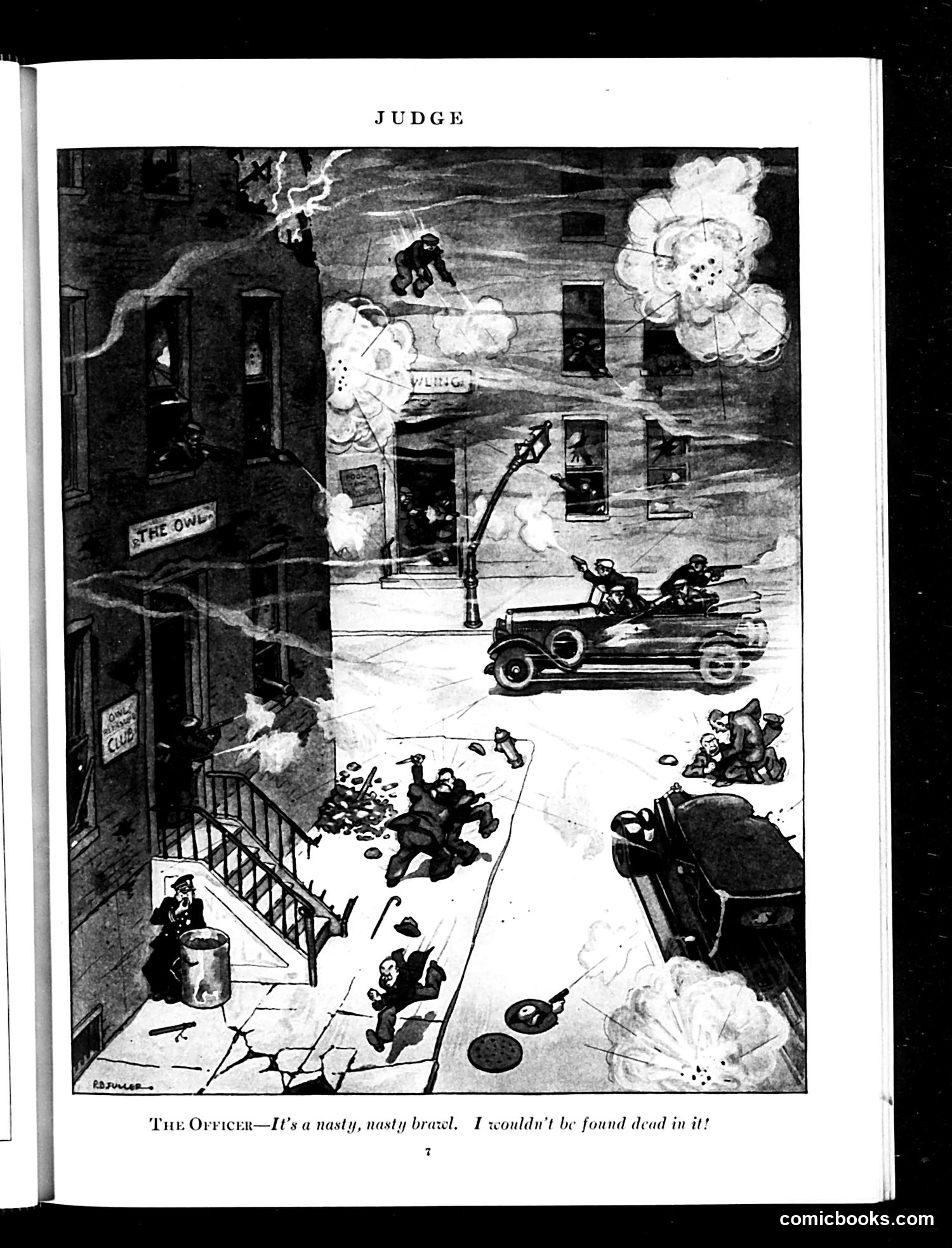
This is a single satirical cartoon titled "The Officer" depicting a chaotic street brawl with multiple figures fighting, explosions, and a car crash. An officer stands safely apart, declaring he wouldn't be caught dead in such a mess. The satire critiques police avoidance of dangerous situations—the officer's refusal to intervene in obvious chaos. The cartoon mocks law enforcement reluctance to engage with public disorder, suggesting hypocrisy: officers are meant to maintain order yet dodge messy confrontations. The phrase "nasty brawl" and the officer's detachment from visible violence (explosions, multiple combatants, overturned vehicles) underscore the joke: his job is precisely what he's refusing to do. This likely reflects broader contemporary frustrations with police accountability or responsiveness, though the specific historical context remains unclear without a date.
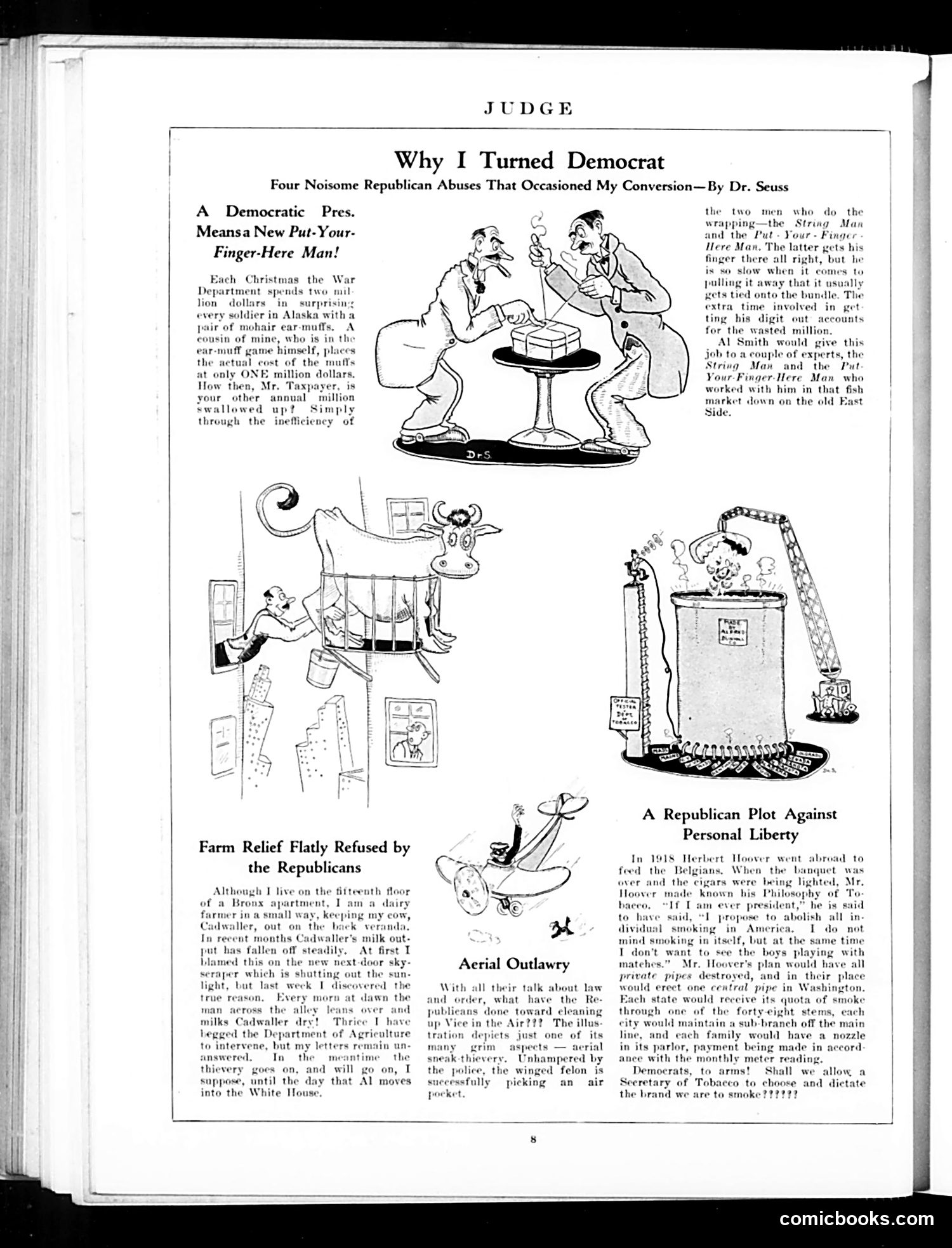
This page presents four satirical arguments for why a Republican voter converted to the Democratic Party, attributed to "Dr. Seuss" (Theodor Geisel). Each cartoon critiques Republican policies: 1. **"Put-Your-Finger-Here Man"**: Mocks wasteful military spending—the War Department sends expensive mohair earmuffs to soldiers in Alaska instead of practical aid. 2. **Farm Relief**: A Bronx apartment dweller sympathizes with rural farmers whose milk production fell. Republicans allegedly refused farm relief despite departmental requests. 3. **Aerial Outlawry**: Criticizes Republicans for allowing air-based crime without legal regulation or police enforcement. 4. **Anti-Smoking Plot**: References Herbert Hoover's alleged 1918 proposal to ban individual smoking and create one centralized pipe per state—presented as authoritarian overreach. The satire uses absurdist humor and exaggeration typical of Judge's style to argue Republicans mismanaged military budgets, ignored agricultural crises, tolerated lawlessness, and threatened personal freedoms.
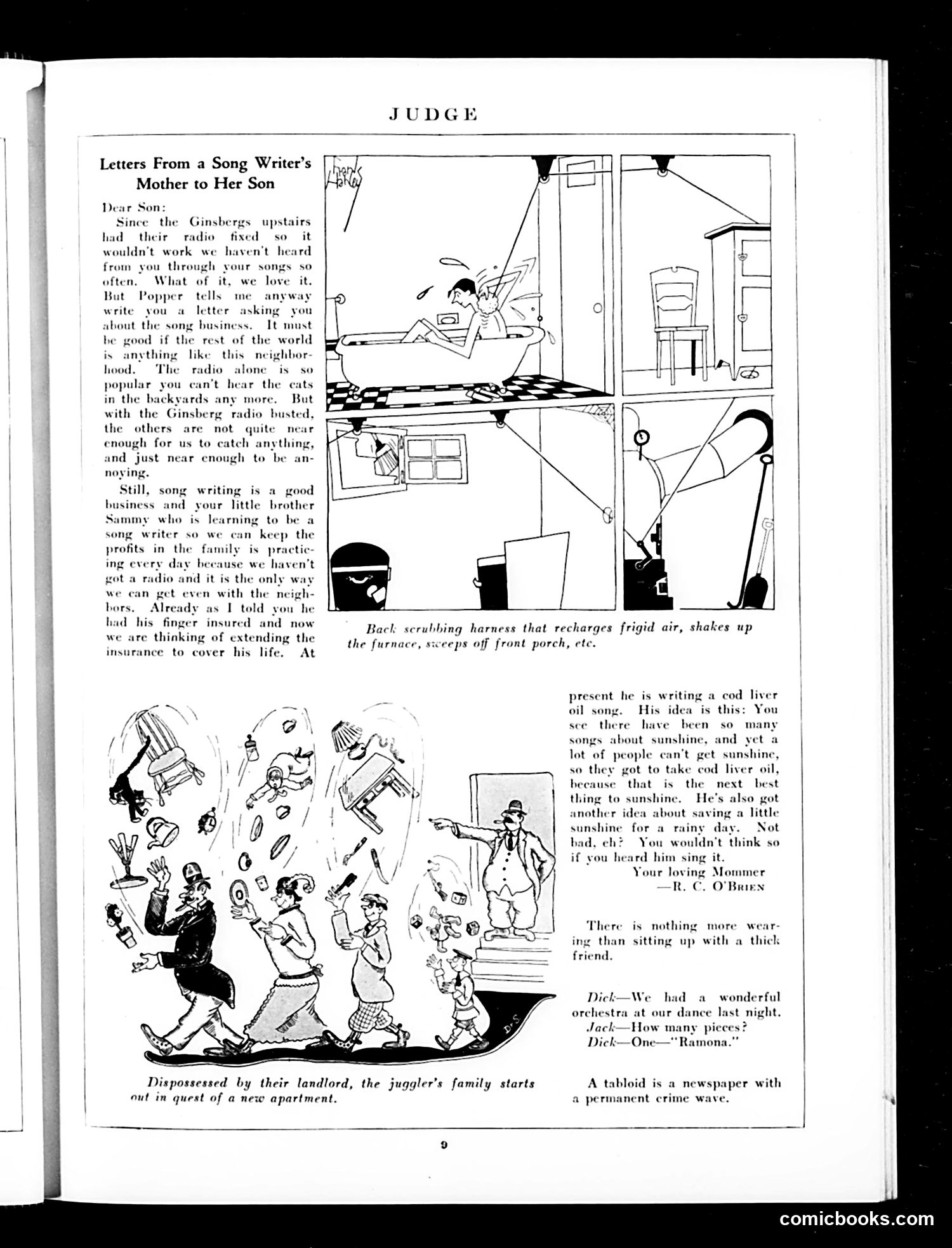
This page satirizes 1920s-30s American popular culture and commercialism. The letter format presents a mother's perspective on her son's songwriting career, mocking how aggressively songs are marketed and consumed. **The Satire:** The mother complains that radios are so ubiquitous and popular that neighborhood noise has become unbearable—yet she views songwriting as profitable precisely *because* of this cultural obsession. The joke exposes how commercial interests exploit trends; her younger son is already being trained as a songwriter, even having his finger "insured" for protection. **The Humor:** The absurd "cod liver oil song" exemplifies forced commercialization—turning even undesirable products into pop songs. The cartoon below of the "juggler's family" evicted and searching for apartments suggests economic instability masked by entertainment culture. **Context:** This reflects genuine 1920s-30s anxieties about mass media's grip, radio's dominance, and the commodification of culture. The casual mention of finger insurance and extending life insurance hints at working-class economic precarity underlying the entertainment industry.
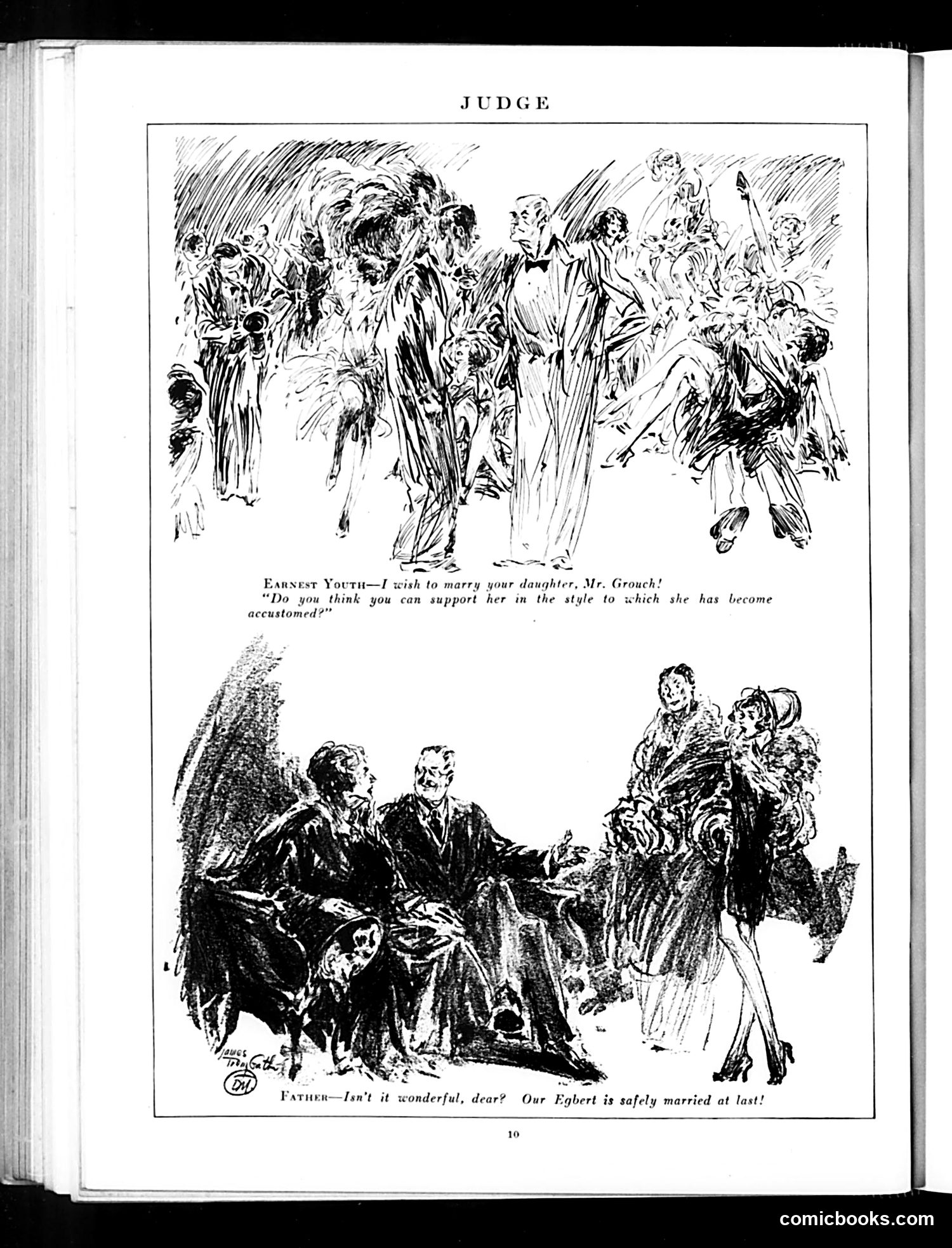
This page contains two satirical cartoons about marriage and social class. The **top cartoon** shows a young man (labeled "Earnest Youth") proposing to a woman while her father (Mr. Grouch) interrogates him about finances. The father's concern—whether the suitor can maintain his daughter's lifestyle—mocks the materialistic expectations of wealthy families. The crowded, chaotic background suggests the social upheaval surrounding such negotiations. The **bottom cartoon** presents the resolution: the father is delighted that his daughter is "safely married at last," suggesting relief that she's secured a husband despite her expensive tastes. The wife's extravagant dress and demeanor emphasize that the marriage prioritizes luxury over love or compatibility. Together, these cartoons satirize Gilded Age marriage customs, where financial status and conspicuous consumption determined marital suitability rather than genuine affection.
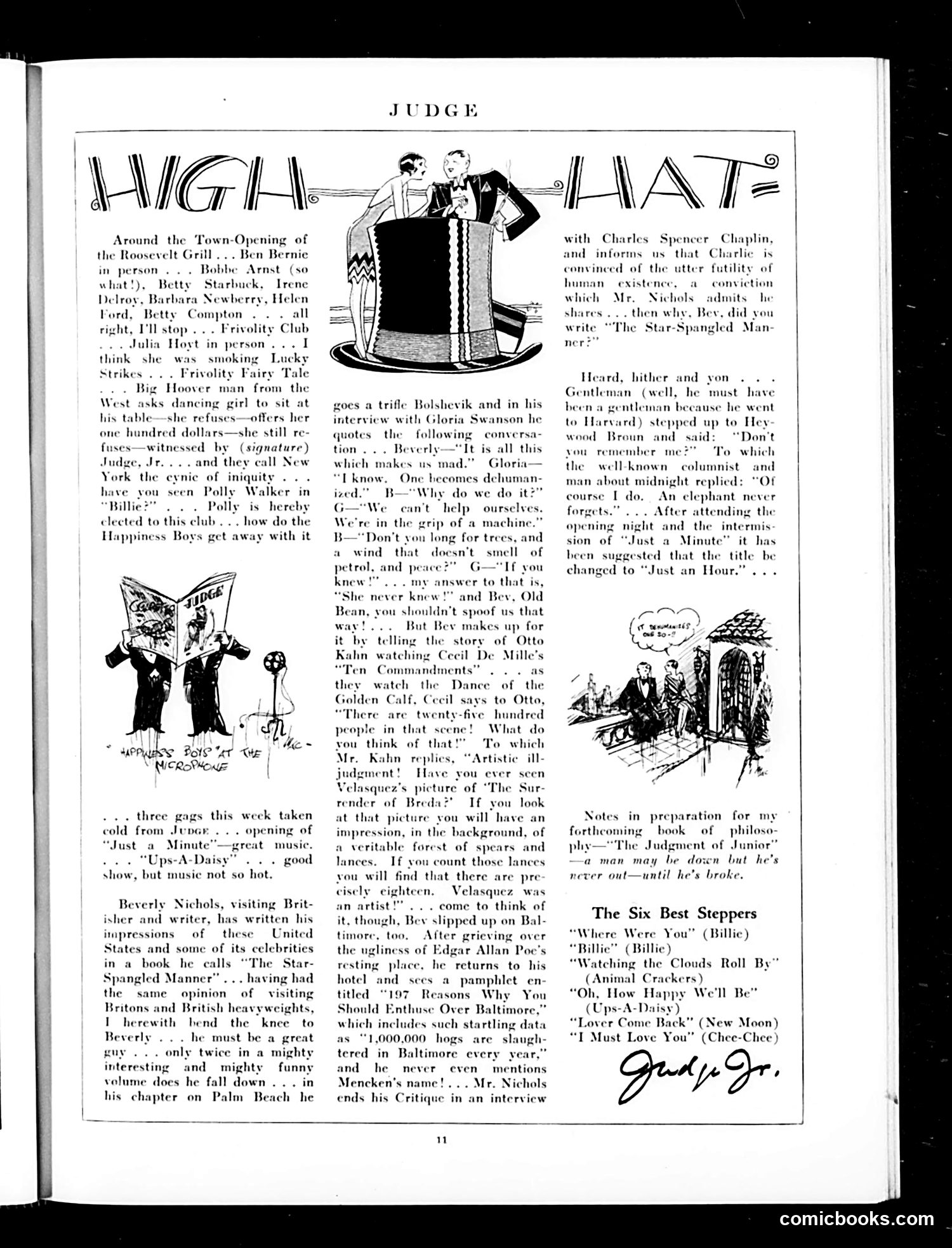
This is a gossip and entertainment column reporting on New York nightlife and celebrity culture. The page satirizes several targets: **The main cartoon** (top) depicts a waiter serving drinks at the Roosevelt Grill—a fashionable venue where the columnist reports on socialites and entertainers mingling. **Key satirical points:** 1. **Beverly Nichols critique**: A visiting British writer published a book criticizing American society as dehumanizing ("the grip of a machine"). The columnist mocks Nichols for simultaneously complaining about American ugliness while praising Baltimore's hog-slaughter statistics—exposing his hypocrisy. 2. **Charlie Chaplin jab**: The columnist jokes that Chaplin claims human existence is futile, yet wrote optimistic material ("The Star-Spangled Manner"), contradicting himself. 3. **Social pretension**: A Harvard-educated man tries impressing Heywood Broun (a famous columnist) but isn't remembered—humorously deflated by Broun's quip about elephants never forgetting. The column's tone is lighthearted mockery of celebrities, social climbers, and visiting intellectuals who expose their own contradictions.
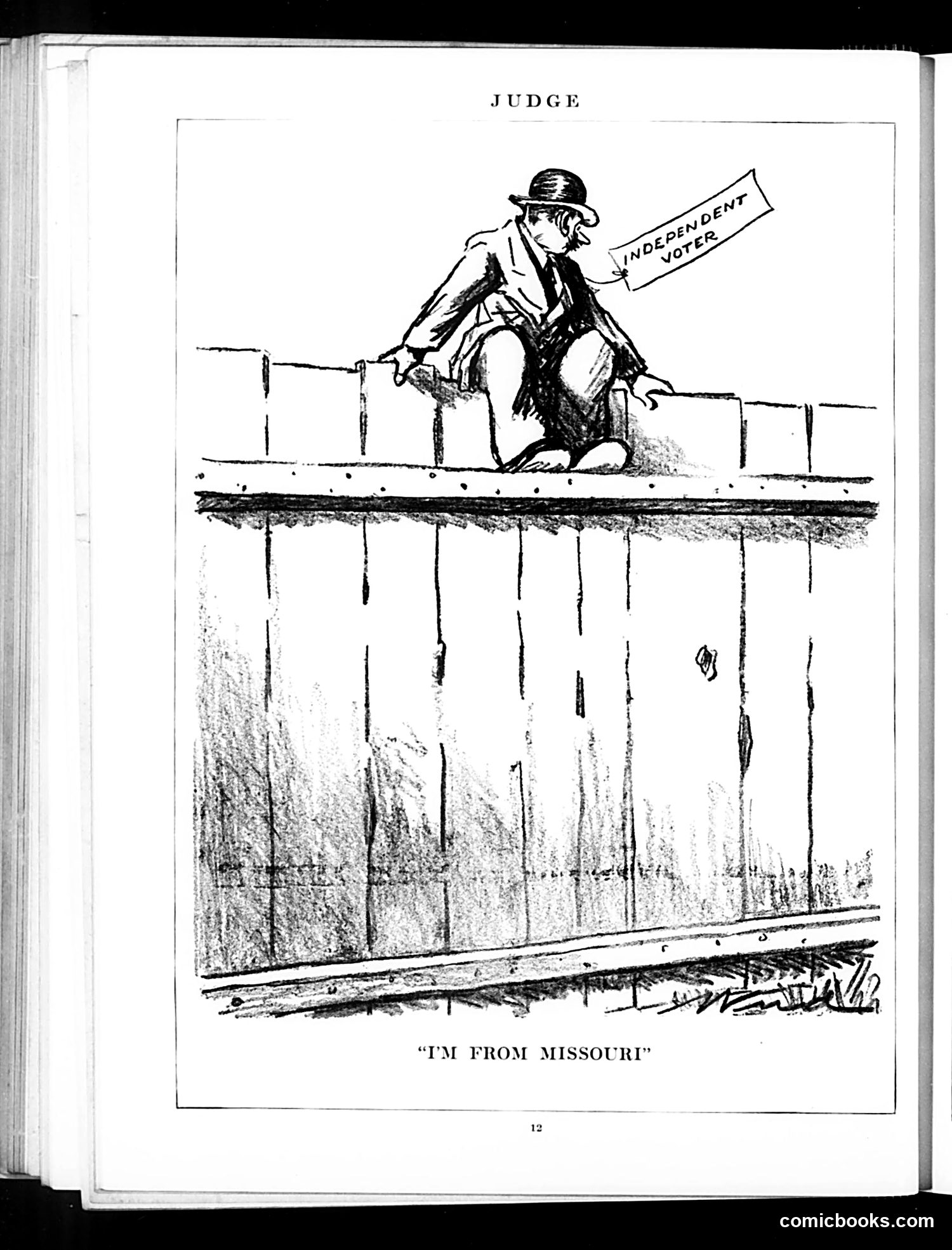
This political cartoon depicts a figure labeled "Judge" sitting atop a fence, holding a banner reading "Independent Voter." Below the fence appears to be turbulent or murky water/conditions. The caption "I'm from Missouri" references the state's famous skepticism—the phrase "I'm from Missouri, you have to show me" means requiring proof before believing claims. The cartoon satirizes independent voters as fence-sitters who demand evidence before committing to either major political party during what appears to be an election period. The figure perched precariously on the fence symbolizes political neutrality and hesitation, while the unstable conditions below suggest the chaos of partisan politics. Judge magazine uses this to mock independent voters as overly cautious or indecisive, unable or unwilling to take a clear political stance.
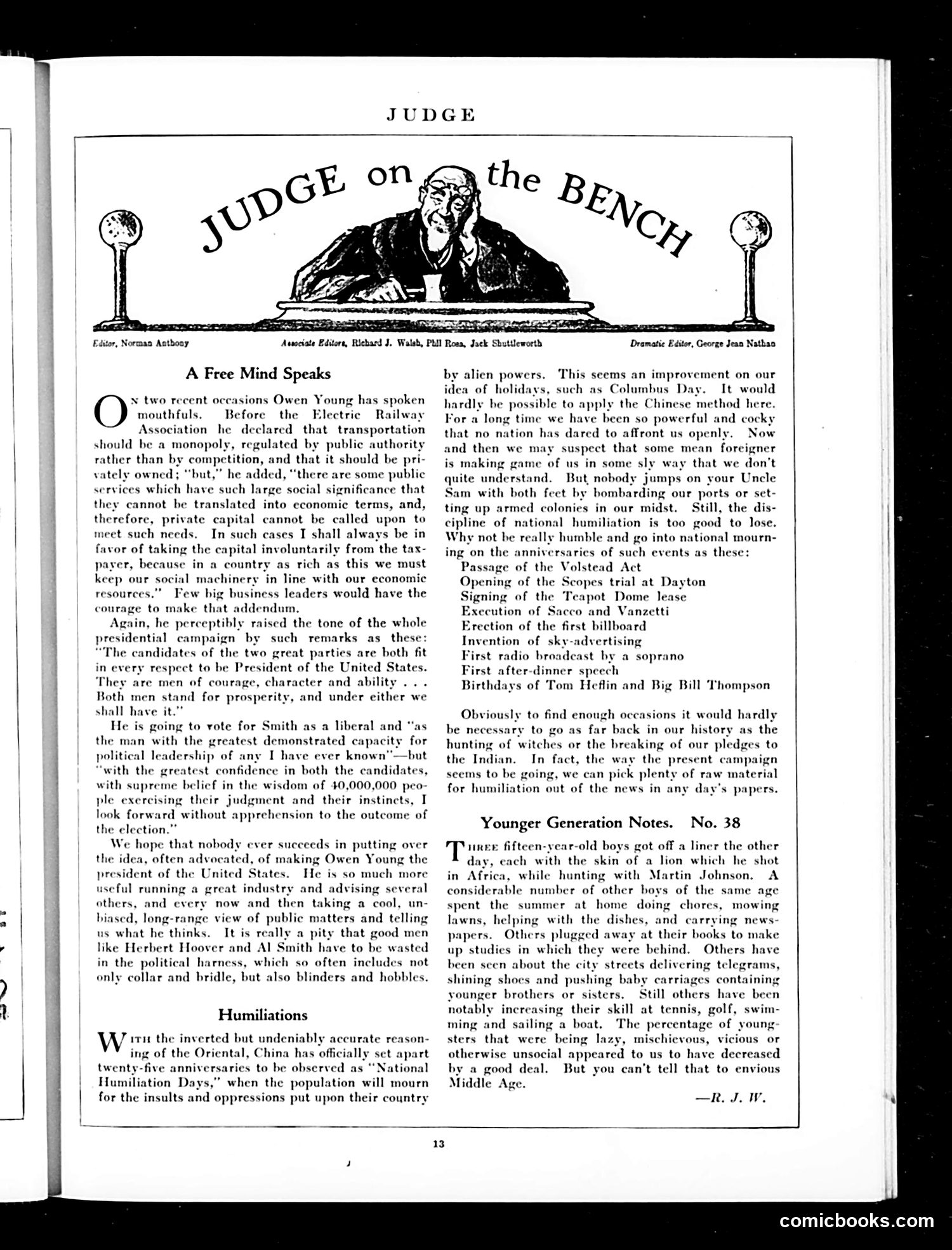
This page from *Judge* magazine contains two satirical pieces from the 1928 presidential campaign. **"A Free Mind Speaks"** praises industrialist Owen Young for his candid political remarks—notably that both major presidential candidates (Herbert Hoover and Al Smith) are qualified, and that he'll vote for Smith while respecting either outcome. The satire celebrates Young's intellectual honesty as a refreshing break from typical campaign rhetoric, while ironically suggesting he's too valuable to waste as president. **"Humiliations"** sarcastically proposes that America adopt China's practice of commemorating national humiliations. The piece then lists American embarrassments: Prohibition (Volstead Act), the Scopes "Monkey Trial," the Teapot Dome scandal, Sacco and Vanzetti's execution, billboards, and radio broadcasts. The satire criticizes American hypocrisy and moral failures while mocking the notion that acknowledging such failures would produce national improvement.
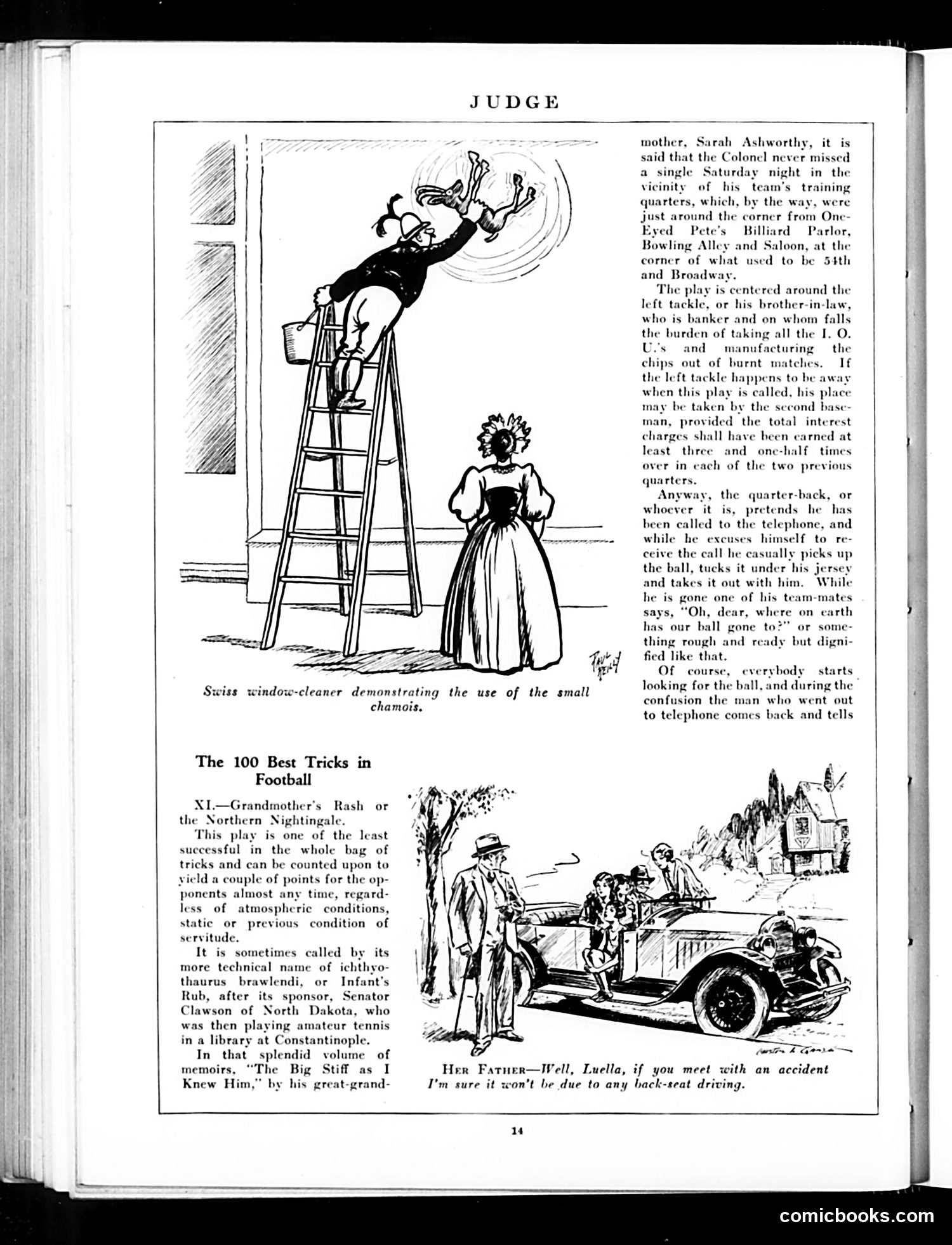
This page contains two satirical pieces: **Top Cartoon:** A Swiss window-cleaner on a ladder demonstrates using a chamois cloth while a woman watches. The joke appears to be a visual pun—the woman's surprised expression suggests an unintended double entendre about the "small chamois" and its demonstration. **"The 100 Best Tricks in Football" Section:** This is mock-instructional satire mocking overly-elaborate football strategy names and pretentious sports writing. It ridicules the tendency to give simple plays absurdly technical nomenclature (like "ichthyo-thaurus brawlendi"). The described play involves the quarterback faking a phone call to steal the ball—obviously ridiculous and unworkable. The satire targets bombastic sports journalism and the gap between complex-sounding strategy names and actual effectiveness. **Bottom Cartoon:** A father warns his daughter about back-seat driving, implying her future husband might drive recklessly—contemporary humor about automotive courtship anxieties. The overall theme mocks pretension and absurdity in contemporary discourse.
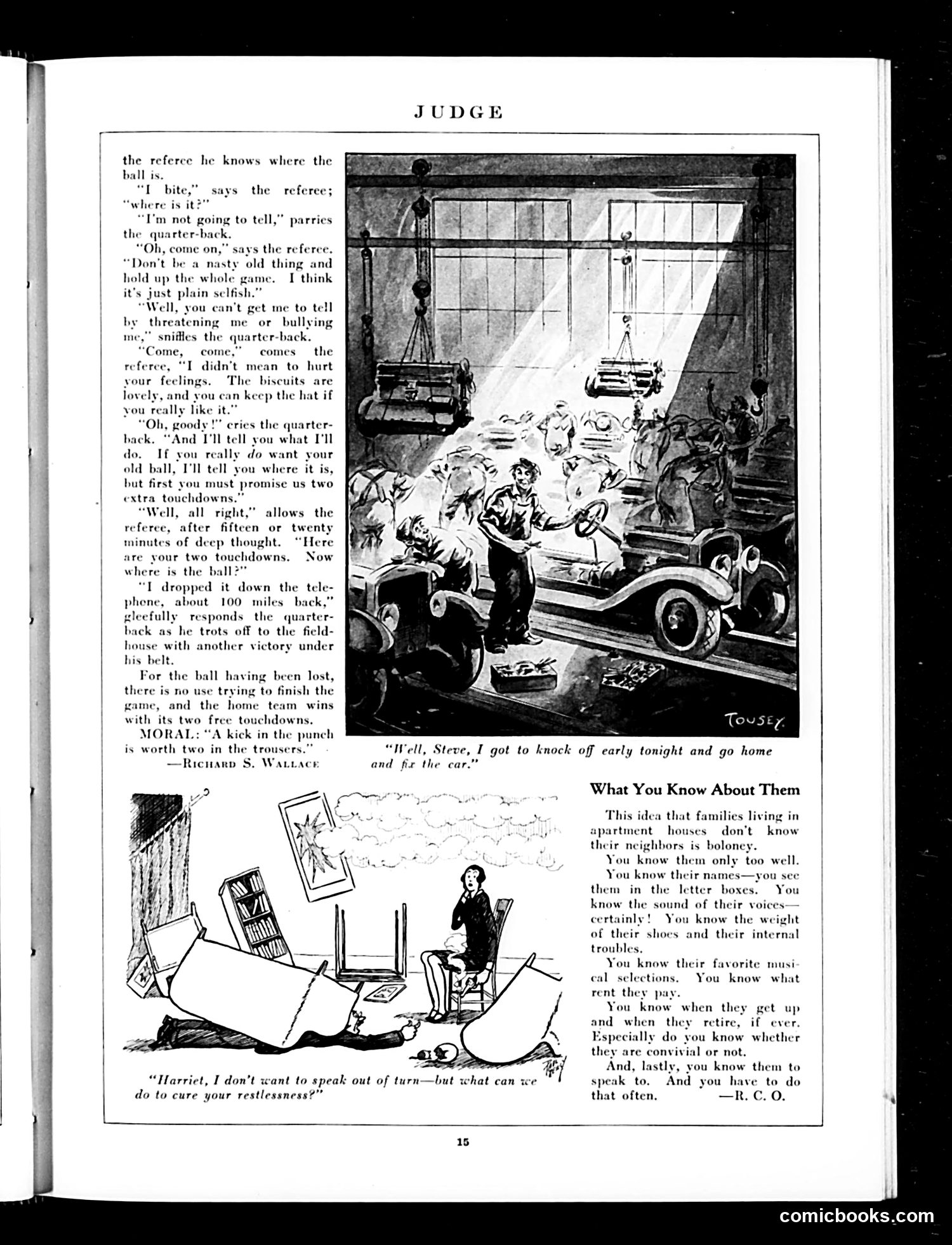
This page contains two satirical cartoons reflecting early 20th-century concerns: **Top cartoon**: A humorous sports story where a quarterback refuses to tell a referee where a football went, then extorts "two extra touchdowns" as payment for revealing he dropped it down a telephone line 100 miles away. The satire mocks poor sportsmanship and rule-bending in football, suggesting that winning through corruption is absurd. The moral—"A kick in the punch is worth two in the trousers"—appears to be a play on risk-taking. **Bottom cartoons**: Two separate pieces. One shows domestic chaos (papers scattered, furniture overturned) with a husband asking his restless wife how to help; she responds she needs to leave early to work on "the car"—satirizing how automobiles were becoming central to women's lives and independence. The second brief cartoon ("What You Know About Them") humorously catalogs how apartment-dwellers inevitably know their neighbors' intimate details despite urban anonymity myths. All reflect 1920s-era social transitions around sports integrity, women's independence, and urban living.
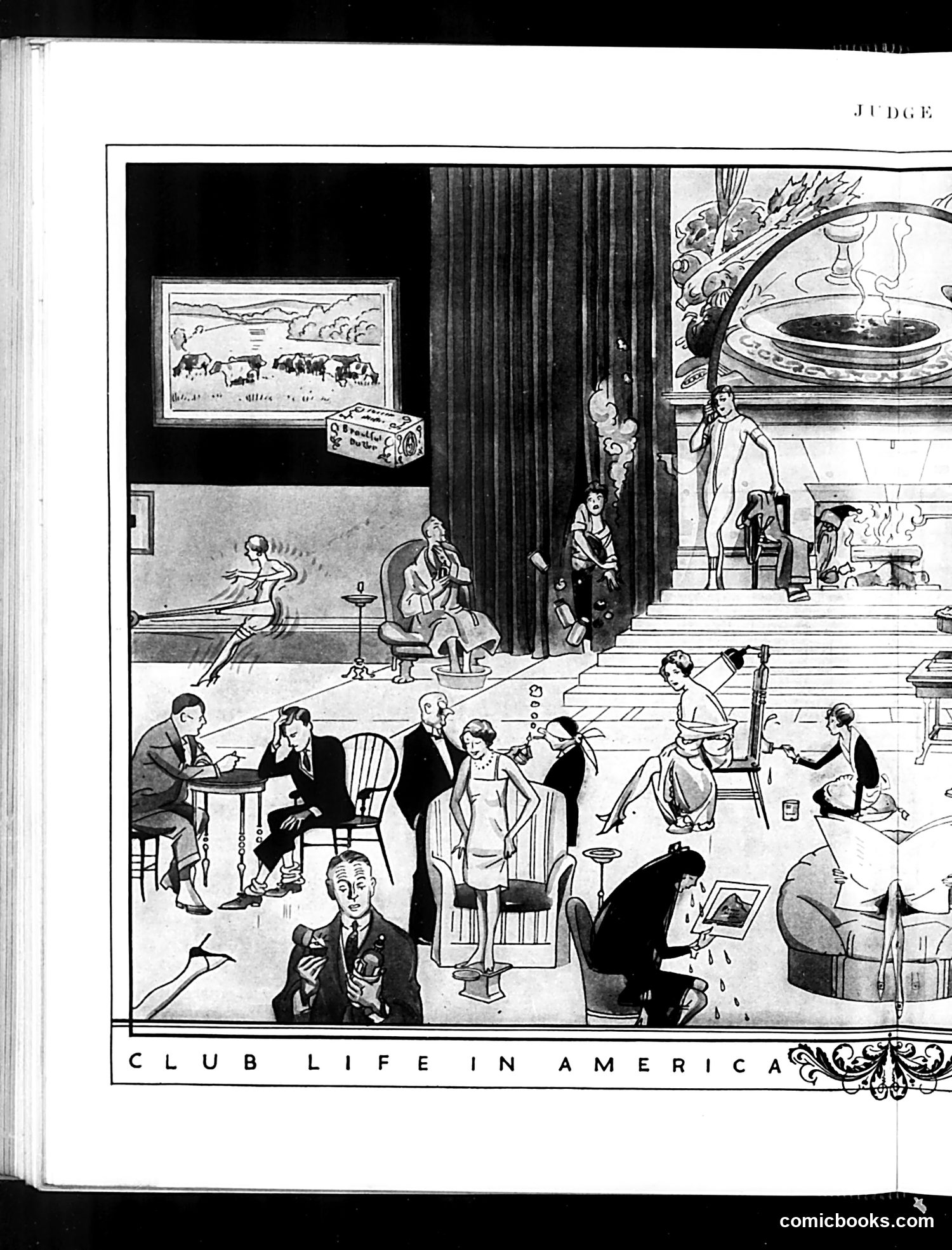
This satirical illustration depicts the interior of an exclusive American club, likely from the early 20th century. The cartoon mocks the leisure activities and pretensions of wealthy club members through exaggerated scenes of idle pursuits: patrons lounging, socializing, dining, and engaging in frivolous entertainment. The satire appears to critique the self-indulgent lifestyle of the upper class—particularly their disconnect from productive work. The elaborate interior architecture and leisurely poses suggest both luxury and vapidity. The framed landscape painting on the wall may reference escape fantasies, contrasting the members' sheltered existence with the broader world. Without additional context or byline visible, the specific club or figures remain unclear, though the piece targets the exclusivity and social insularity of such institutions as characteristic of American wealth and privilege.
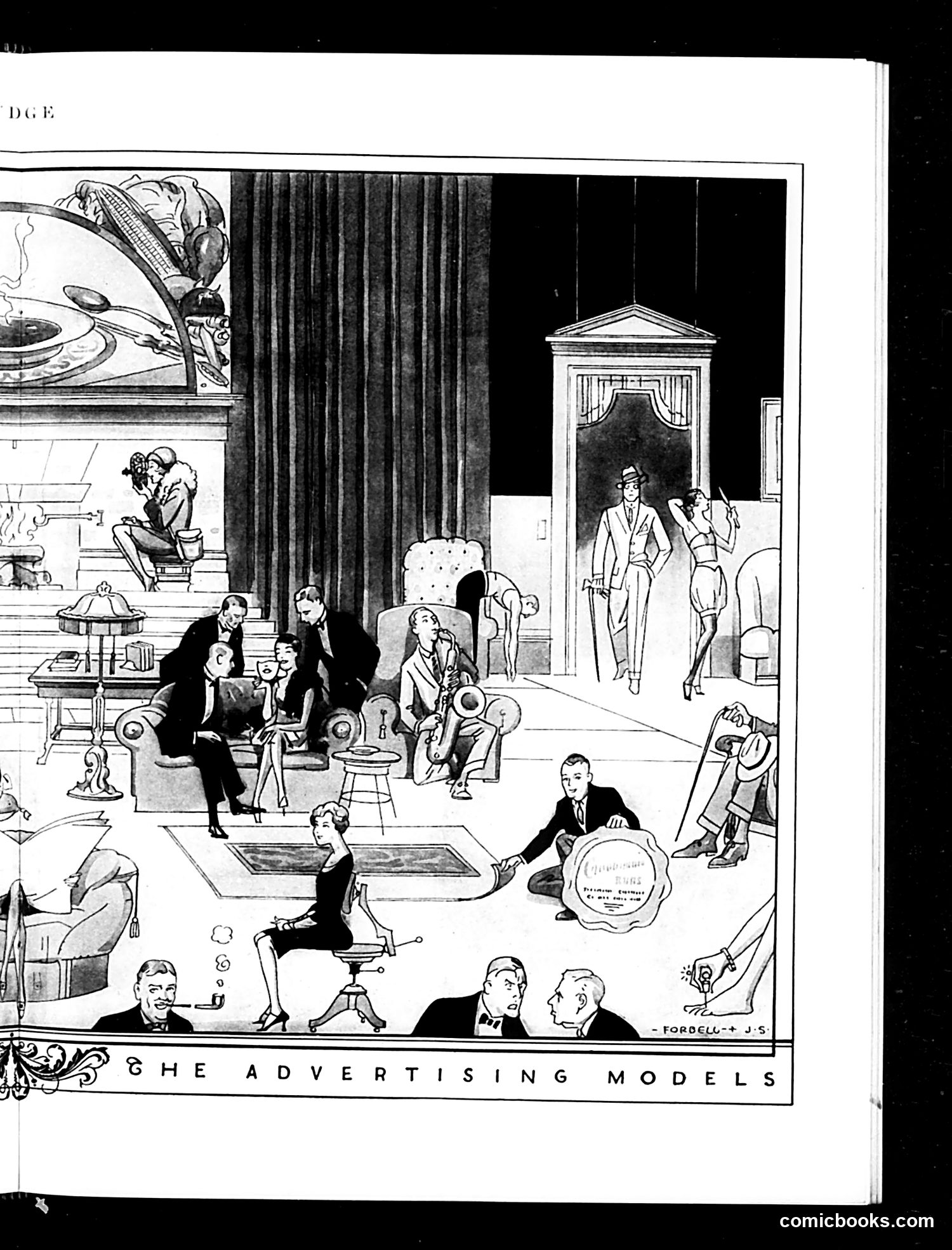
This Judge magazine illustration satirizes the advertising industry and the models who promote consumer products. The scene depicts an elegant interior where various well-dressed figures display goods—visible are food items, fashion, and household products arranged throughout an upscale living space. The satire targets how advertising uses attractive people and glamorous settings to sell ordinary merchandise. The figures pose and gesture dramatically to showcase products, suggesting the artificial theatricality of advertising appeals. The detailed interior, with its fashionable furniture and architectural details, emphasizes how ads associated products with aspirational lifestyles. The cartoon likely critiques both the superficiality of advertising practices and consumers' susceptibility to such appeals—a common Judge theme reflecting early 20th-century skepticism toward modern marketing techniques.
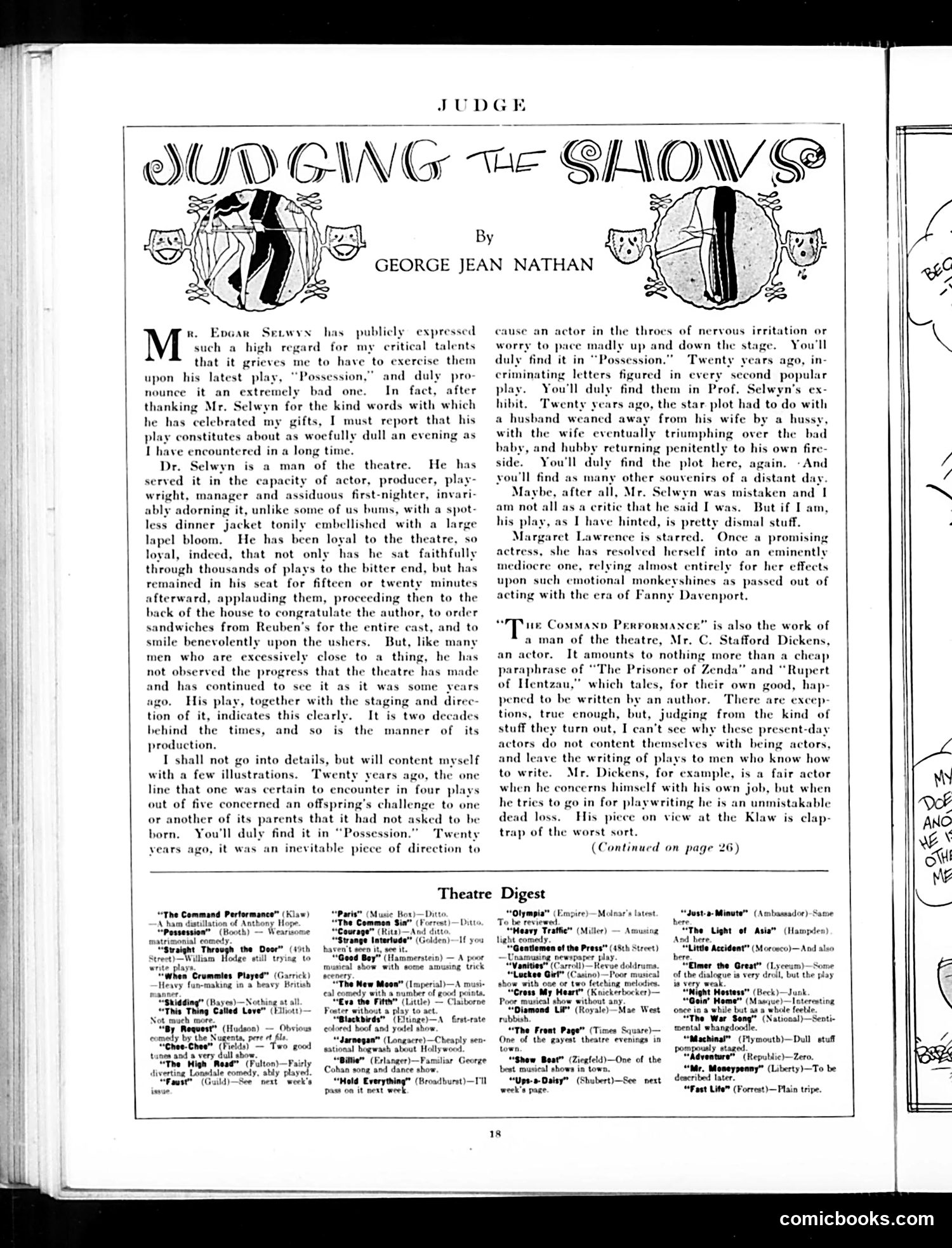
This is a theatre review column by George Jean Nathan critiquing recent Broadway productions. The article attacks two plays as outdated and poorly written: **"Possession"** by Edgar Selwyn is dismissed as "woefully dull," criticized for relying on theatrical clichés from twenty years prior: offspring challenging parents about being born, nervous pacing, blackmail letters, and a tired plot about a husband lured away by a seductress before reconciliation. Nathan blames Selwyn—a respected theatre man—for not recognizing theatrical progress, remaining "two decades behind the times." He also criticizes lead actress Margaret Lawrence for relying on outdated "emotional monkeyshines" from the Fanny Davenport era. **"The Command Performance"** by actor C. Stafford Dickens is condemned as a cheap knock-off of *The Prisoner of Zenda* and *Rupert of Hentzau*. Nathan's broader complaint: contemporary actors should stick to performing rather than playwriting, as they lack the craft of professional dramatists.
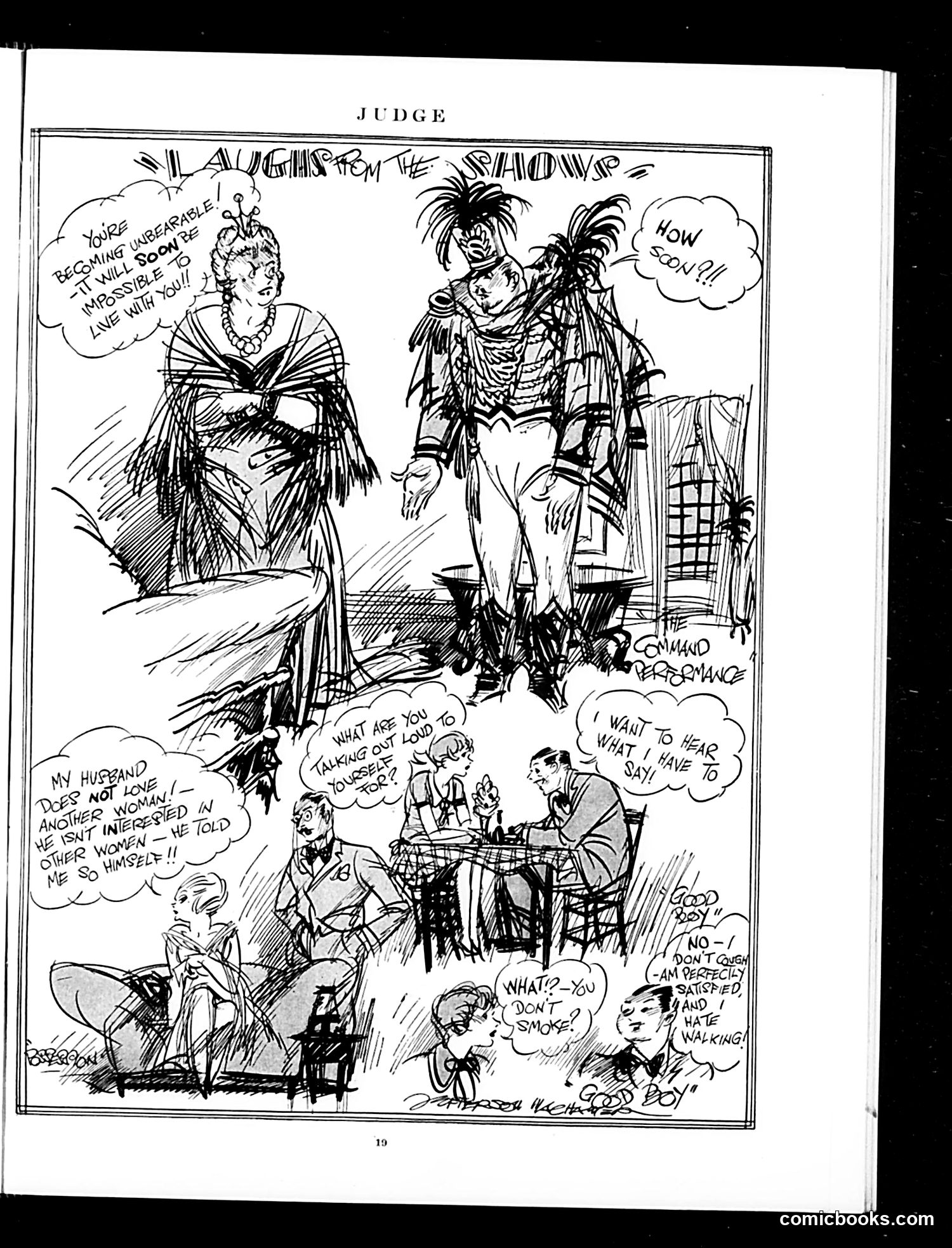
This single-panel cartoon satirizes marital infidelity and double standards. The scene depicts a social gathering where a well-dressed man confronts a woman about her husband's affair. The key figures include an elegantly dressed woman (upper left) who appears to be the wronged wife, commenting on her husband's infidelity. Below, various characters discuss the scandal at what seems to be a social event or salon. The satire targets hypocrisy: while the husband is unfaithful with other women, he's apparently scandalized by his wife's behavior or independence. The title "Judge" suggests the cartoon comments on how society judges women's conduct more harshly than men's, particularly regarding fidelity and respectability—a common theme in early 20th-century satirical commentary on gender and morality.
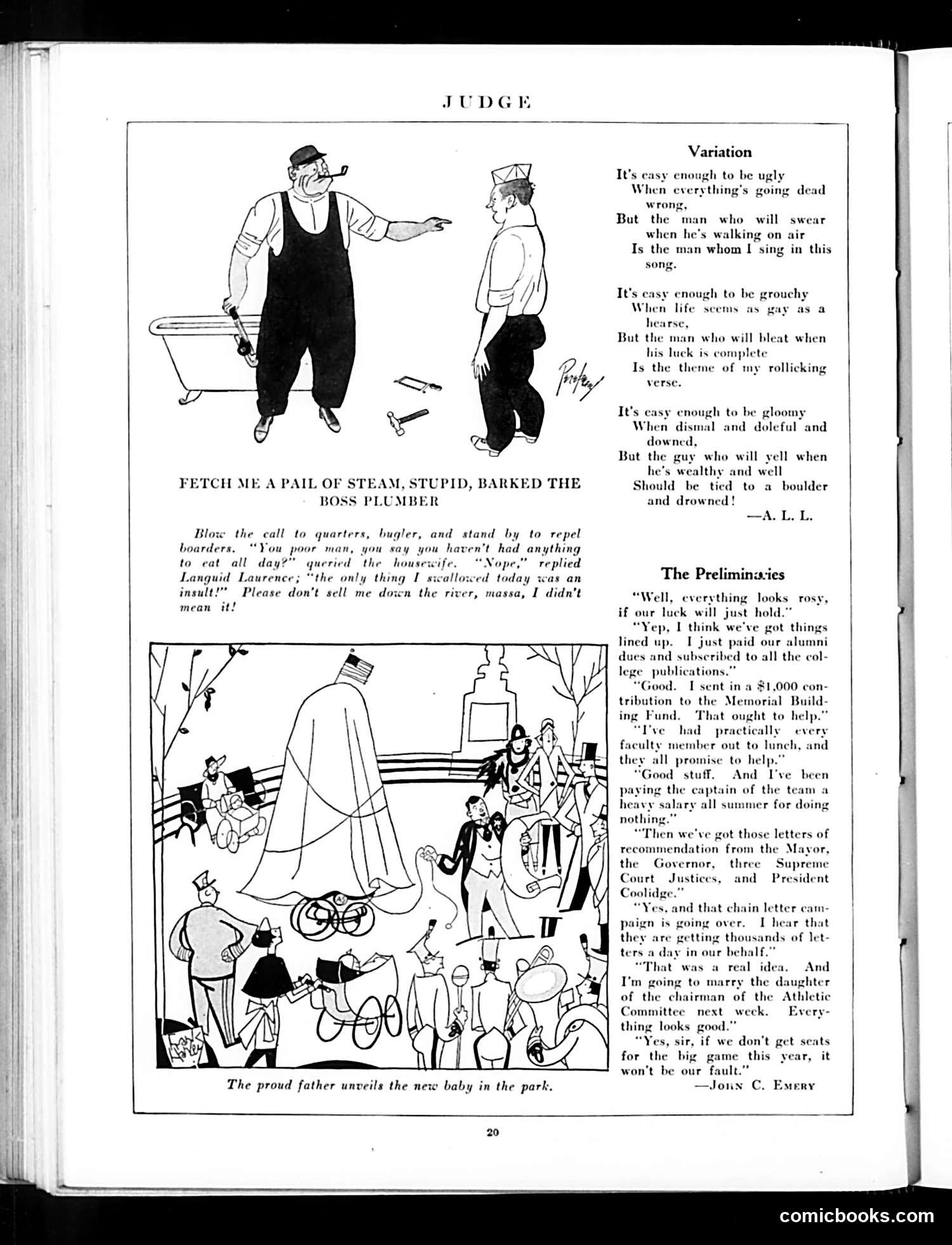
This Judge magazine page contains three distinct pieces of 1920s humor: **Top cartoon:** A plumber's assistant complains to a housewife that despite working all day without food, his only compensation was an insult from his boss. The joke satirizes working-class exploitation—the man is literally starving while the boss treats him poorly. **Poem "Variation":** A tongue-in-cheek moral verse mocking people who complain during good fortune. It suggests wealthy, lucky people who still gripe should be drowned, poking fun at chronic complainers regardless of circumstance. **Bottom cartoon & dialogue "The Preliminaries":** Two men discuss securing an athletic team's success through bribery and influence—contributing $1,000 to a building fund, courting faculty and judges, obtaining letters from the Governor and President Coolidge, and arranging a marriage to the Athletic Committee chairman's daughter. The satire exposes how college athletics were openly corrupted through wealth and political connections, treating recruitment as a transaction requiring systematic institutional capture.
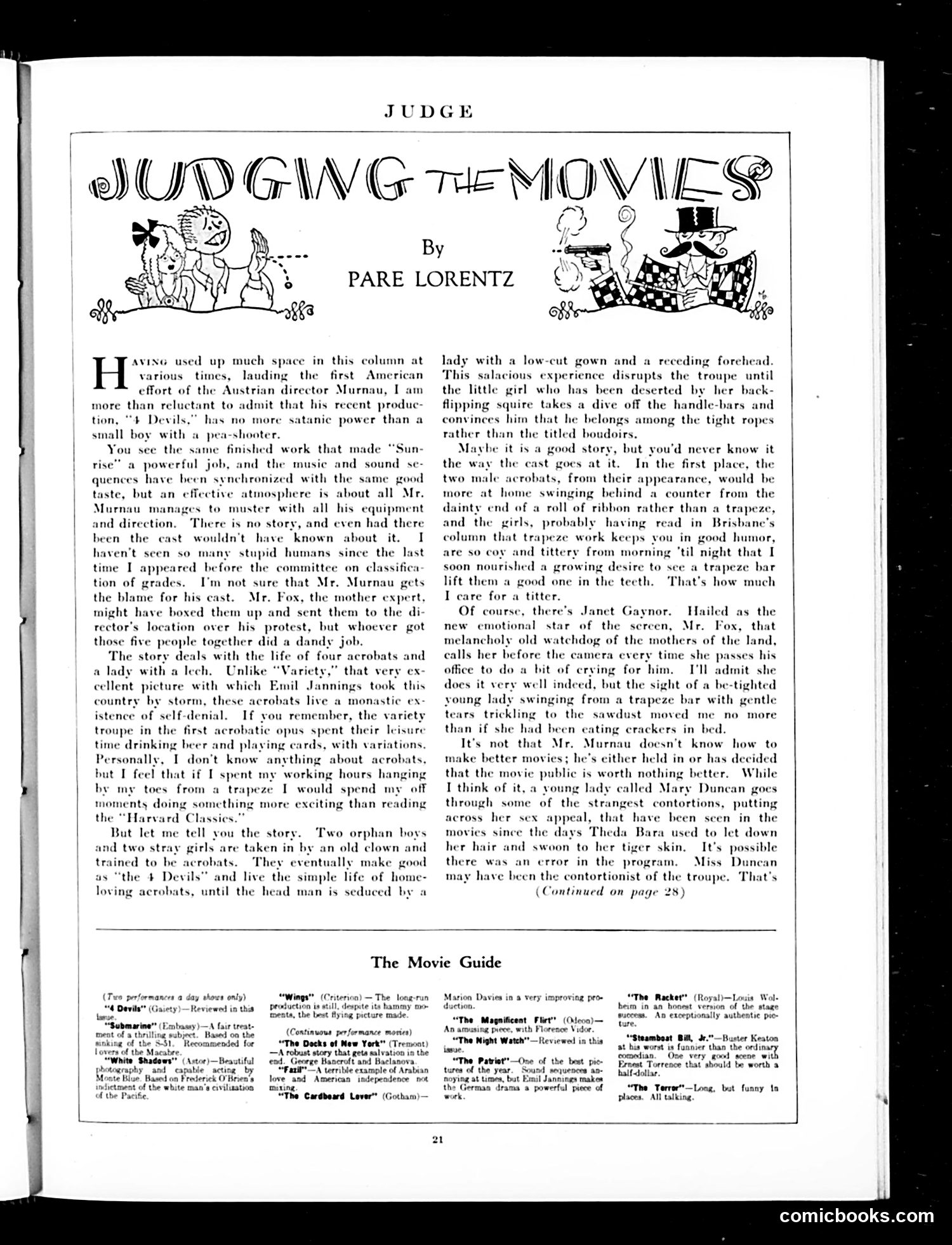
This is a film review column by Pare Lorentz critiquing director F.W. Murnau's "4 Devils," a silent film about circus acrobats. The reviewer dismisses the film despite praising Murnau's earlier work "Sunrise," calling the plot thin and the cast unconvincing—the male acrobats look more suited to retail work than circus performance. The satire targets both the film and contemporary cinema practices: Lorentz mocks the emotional manipulation of audiences through actresses' tears and sex appeal (Janet Gaynor and Mary Duncan), suggesting studios prioritize spectacle over substance. He compares it unfavorably to "Variety," another acrobat film with Emil Jannings that genuinely captivated audiences. The review reflects 1920s attitudes about cinema's artistic potential versus commercial exploitation, and gender representation in Hollywood's reliance on female performers' physical attractiveness and emotional performance.
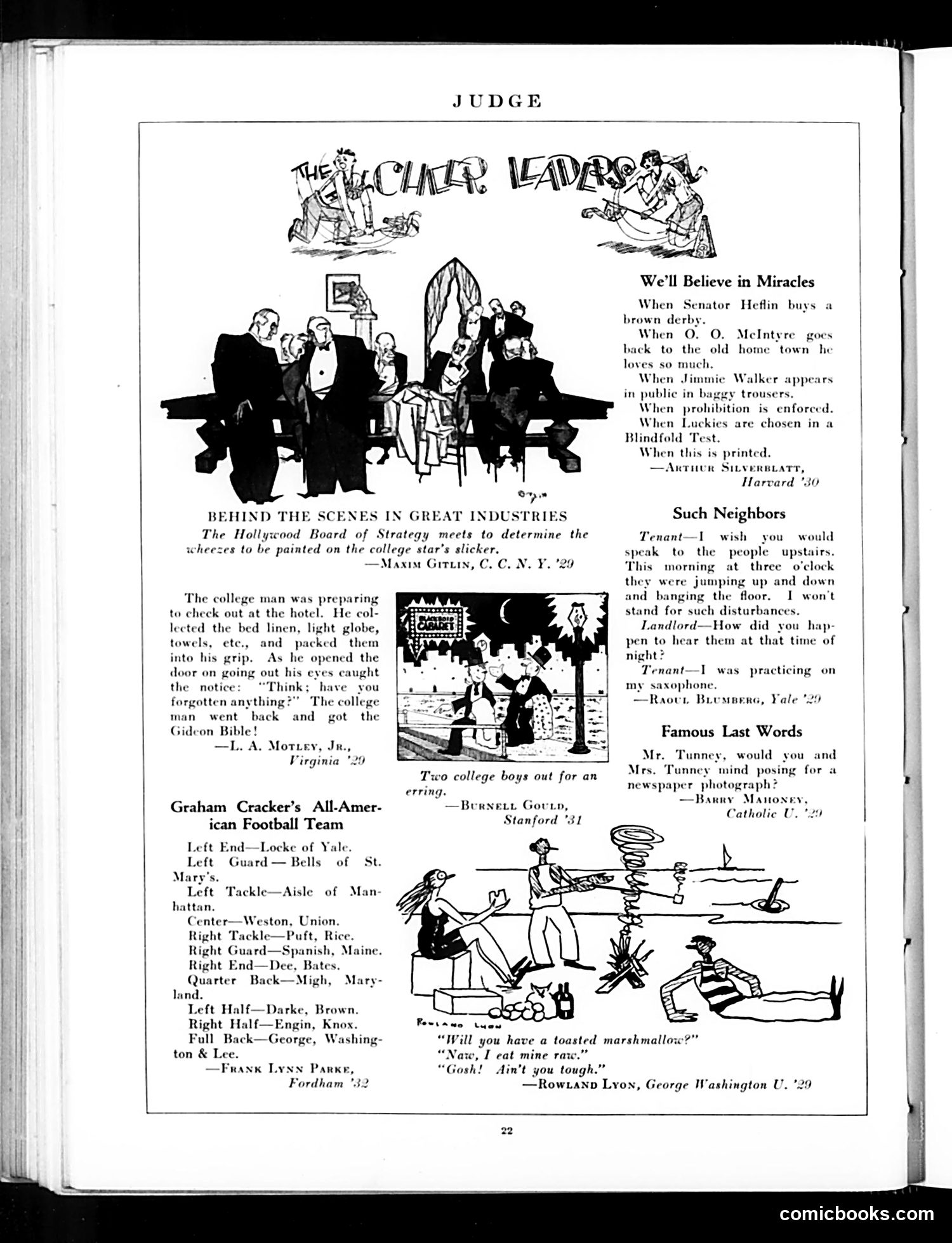
This page collects humorous college-oriented satirical pieces from 1929-1930. The main cartoon depicts Hollywood producers planning publicity stunts for a college star—satirizing the film industry's manufactured image-making. The other jokes target contemporary figures and concerns: - **Senator Heflin/O.O. McIntyre/Jimmie Walker**: References to public figures whose behavior contradicts their public personas or stated positions - **Prohibition**: Still a contentious political issue (the 18th Amendment, enacted 1920) - **Lucky Strike cigarettes**: Mockery of advertising claims about product superiority - **Gene Tunney**: The famous boxer, referenced in "Famous Last Words" The "Graham Cracker's All-American Football Team" is a pun-based joke listing colleges disguised as player names (Yale's "Locke," St. Mary's "Bells," etc.). These are typical Judge satires targeting Prohibition enforcement failures, celebrity hypocrisy, and advertising dishonesty—issues resonating with 1920s-30s readers but largely obscure today without historical context.
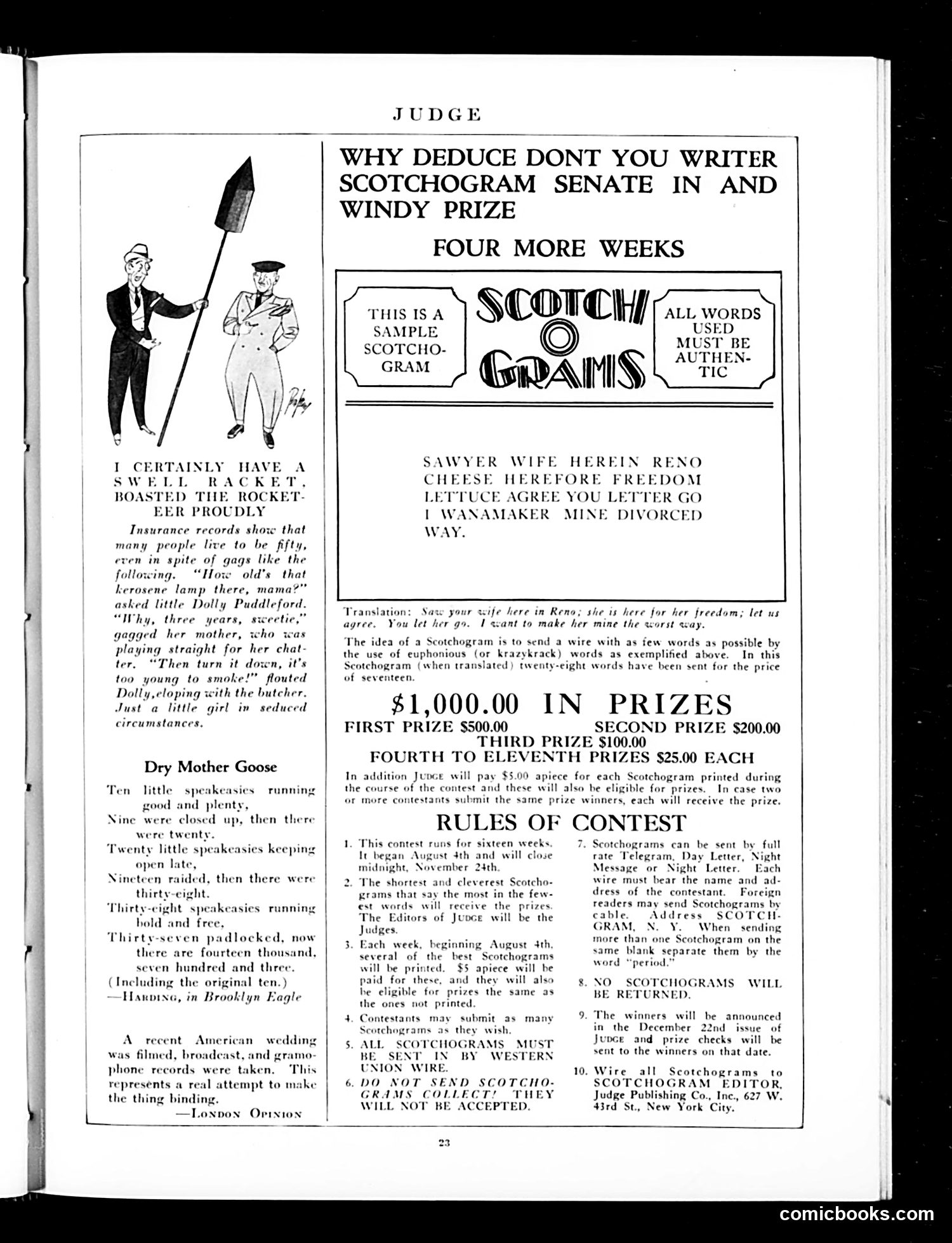
This page combines humor and advertising for a "Scotchogram" contest (1920s-era). **The Cartoons/Humor:** The left side features satirical poems mocking Prohibition-era America. "Dry Mother Goose" jokes about speakeasies (illegal bars) multiplying despite raids—when one closes, more open elsewhere. Another gag references a scandalous wedding filmed and broadcast, sarcastically suggesting modern media makes marriage "binding." **The Main Feature:** The "Scotchogram" contest advertises a word-compression game where participants send brief, cleverly-worded telegrams. The sample shows a divorce scenario using euphemisms to minimize costs. The contest offered $1,000 in prizes for the cleverest submissions. **Historical Context:** This reflects 1920s concerns: Prohibition's failure, modern technology (radio/film/telegraphy), and marital dissolution. The humor targets contemporary anxieties while promoting Judge's reader engagement through the competition.
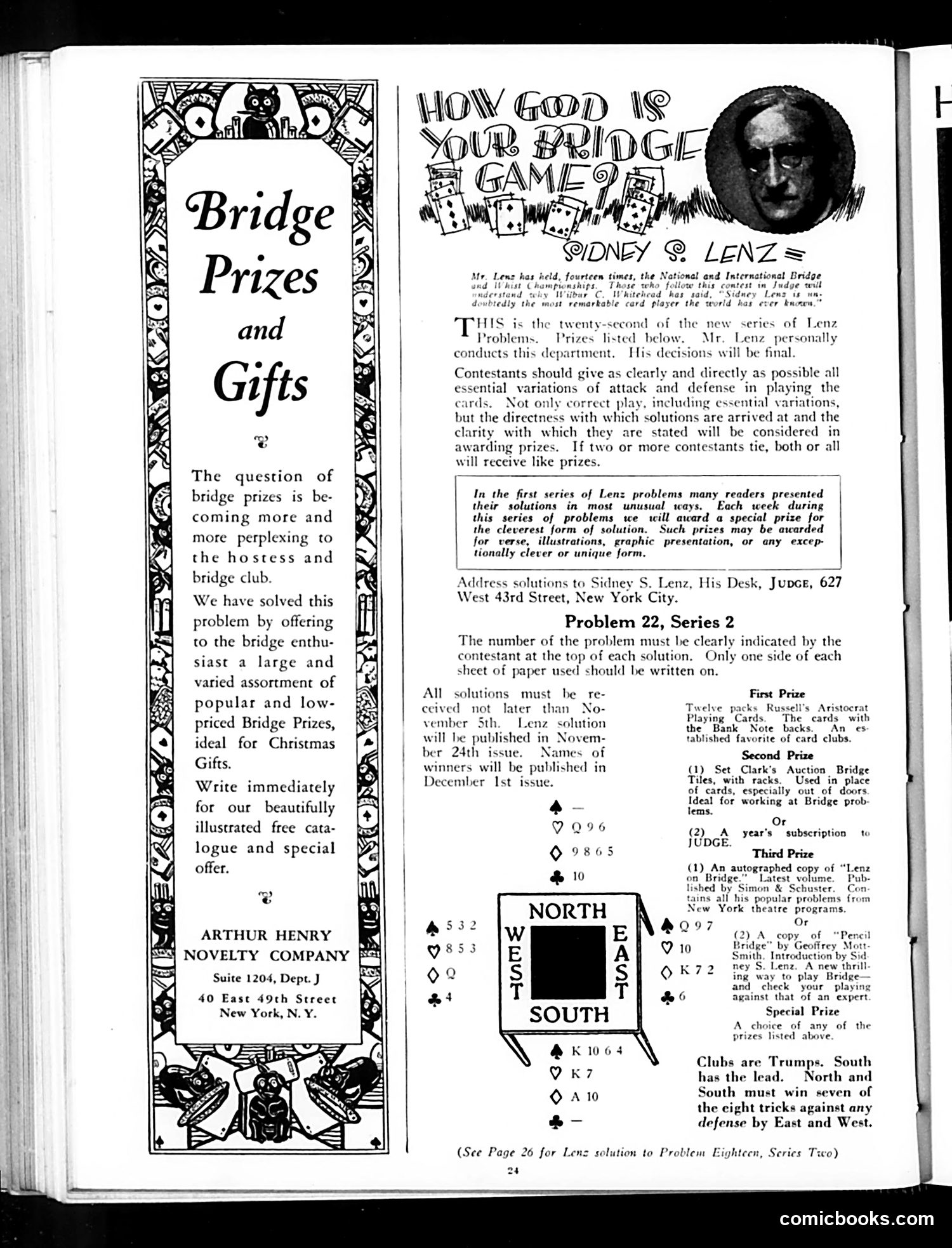
This page is primarily **advertising and a bridge puzzle contest**, not political satire. The main content features **Sidney S. Lenz**, a prominent bridge expert of the era, who conducts a recurring "Problems" column in Judge magazine. The cartoonish header with his portrait is promotional—bridge was a popular social game among middle and upper-class Americans in the 1920s-30s. The left side advertises bridge prizes from Arthur Henry Novelty Company—playing cards, tiles, and books—marketed as Christmas gifts for bridge enthusiasts, reflecting how seriously the game was taken as both hobby and social marker. The puzzle itself presents a bridge hand requiring readers to determine how South can win seven of eight tricks. Winners received prizes for both correct solutions and creative presentation (verse, illustrations, etc.). This reflects the era's fascination with bridge as intellectual entertainment for the genteel classes.
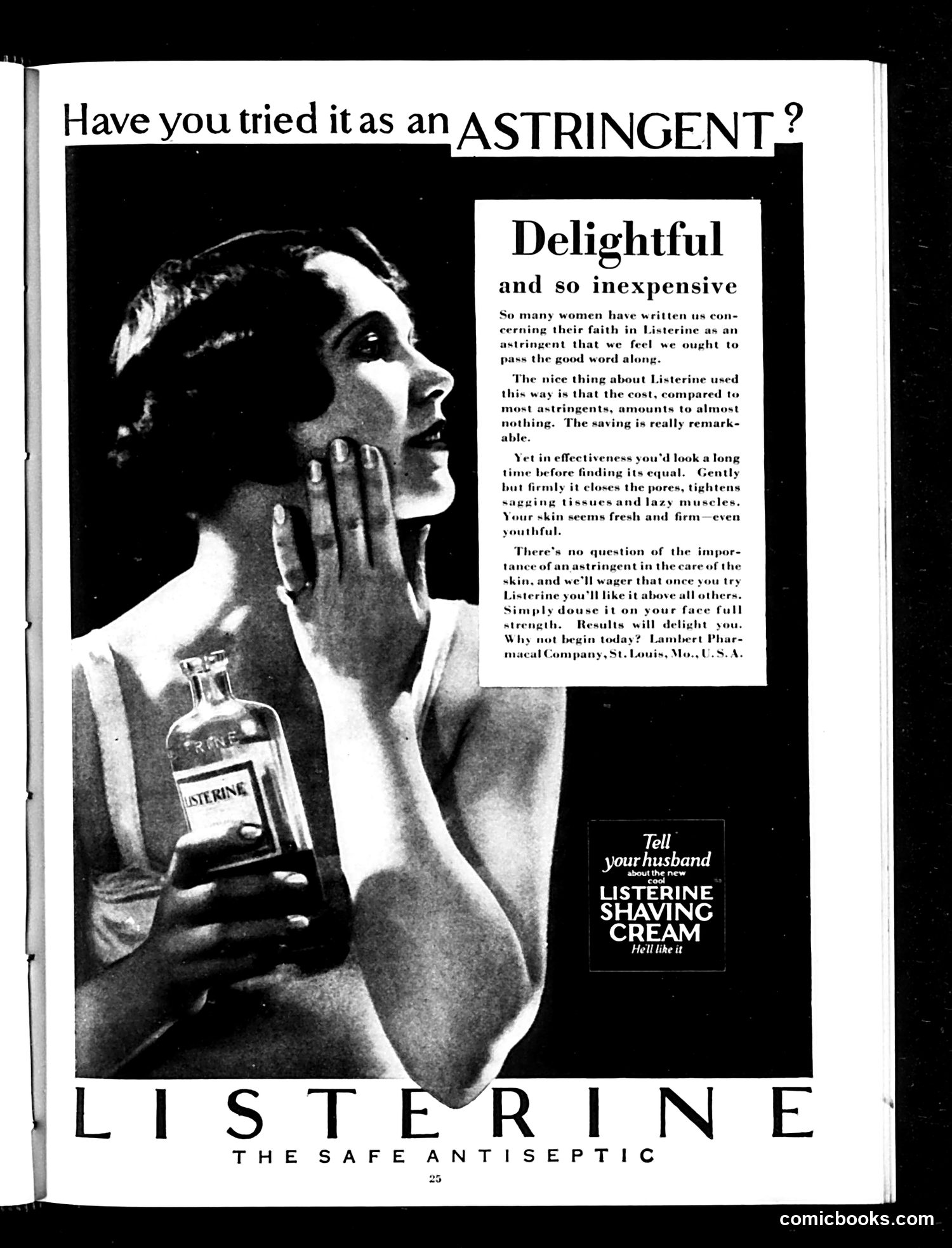
This is primarily a **Listerine advertisement**, not political satire. The page promotes Listerine as an astringent facial product for women, emphasizing its low cost and skin-tightening effects. The image shows a woman applying the product to her face, touching her cheek contemplatively. The ad copy highlights that Listerine closes pores, tightens sagging tissues, and makes skin appear "fresh and firm—even youthful." A secondary advertisement at bottom promotes "Listerine Shaving Cream," instructing women to "Tell your husband about the new...Hell like it"—suggesting women should recommend grooming products to their husbands. **No political satire is evident.** This appears to be a commercial page from Judge magazine's advertising section, typical of early-to-mid 20th century marketing that made dubious medical claims about cosmetic products.
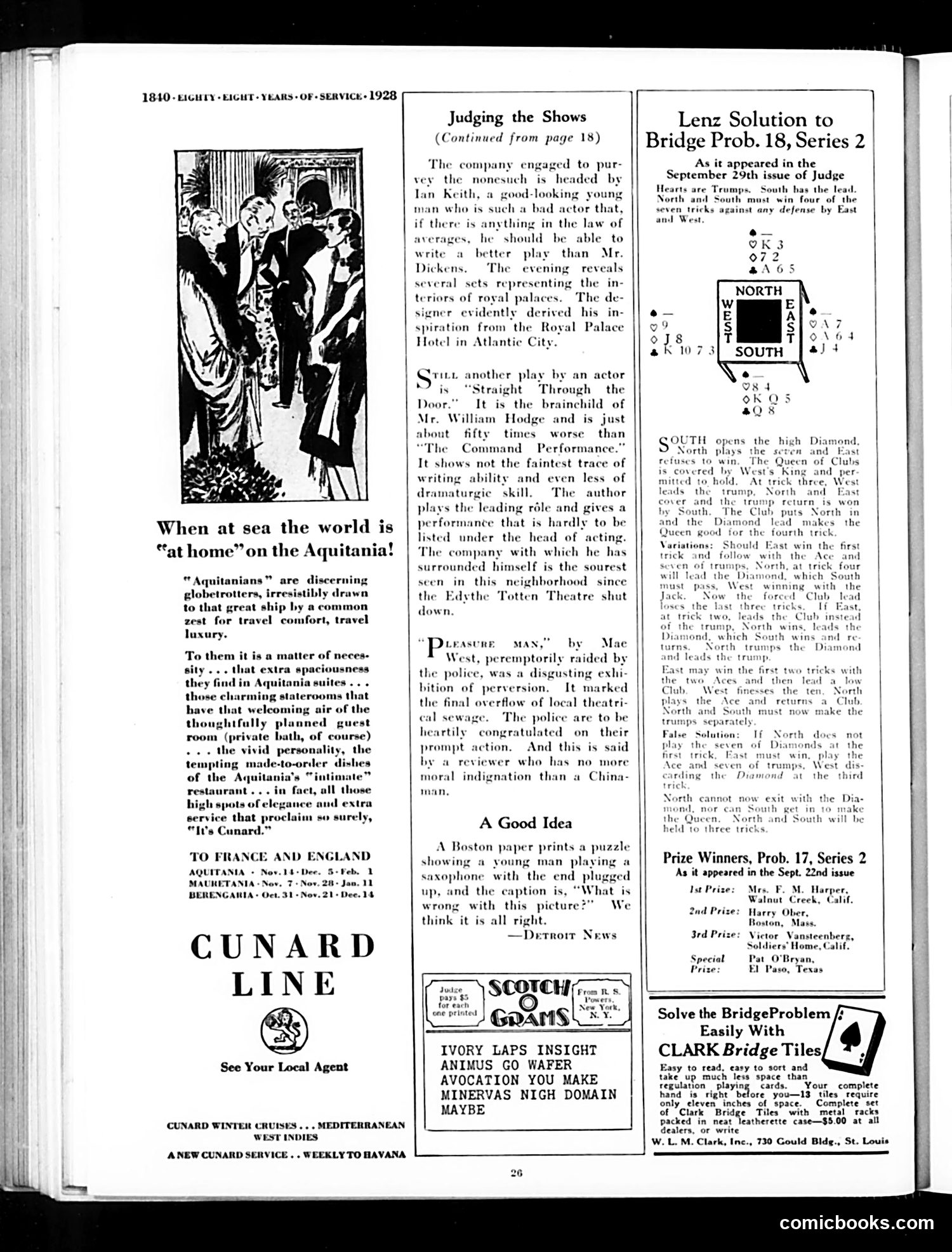
This page is primarily **advertising and puzzle content** rather than political satire. The main cartoon at top-left depicts well-dressed passengers aboard a luxury ocean liner—illustrating the Cunard Line advertisement below it. The page's humor comes from **theater reviews** mocking contemporary Broadway plays. The critic harshly dismisses actor Ian Keith's production (derived from Dickens) and William Hodge's "Straight Through the Door" as incompetently written and performed. A third review condemns "Pleasure Man" by Mae West as obscene—notable because the critic ironically claims moral indignation despite having "no more moral indignation than a Chinaman" (a period ethnic stereotype). The "Good Idea" section jokes about a Boston puzzle showing a saxophonist with the instrument's bell pointing upward, asking "what's wrong?"—the implicit answer being improper technique. Remaining content consists of bridge game problems and solutions—typical Judge magazine filler material.
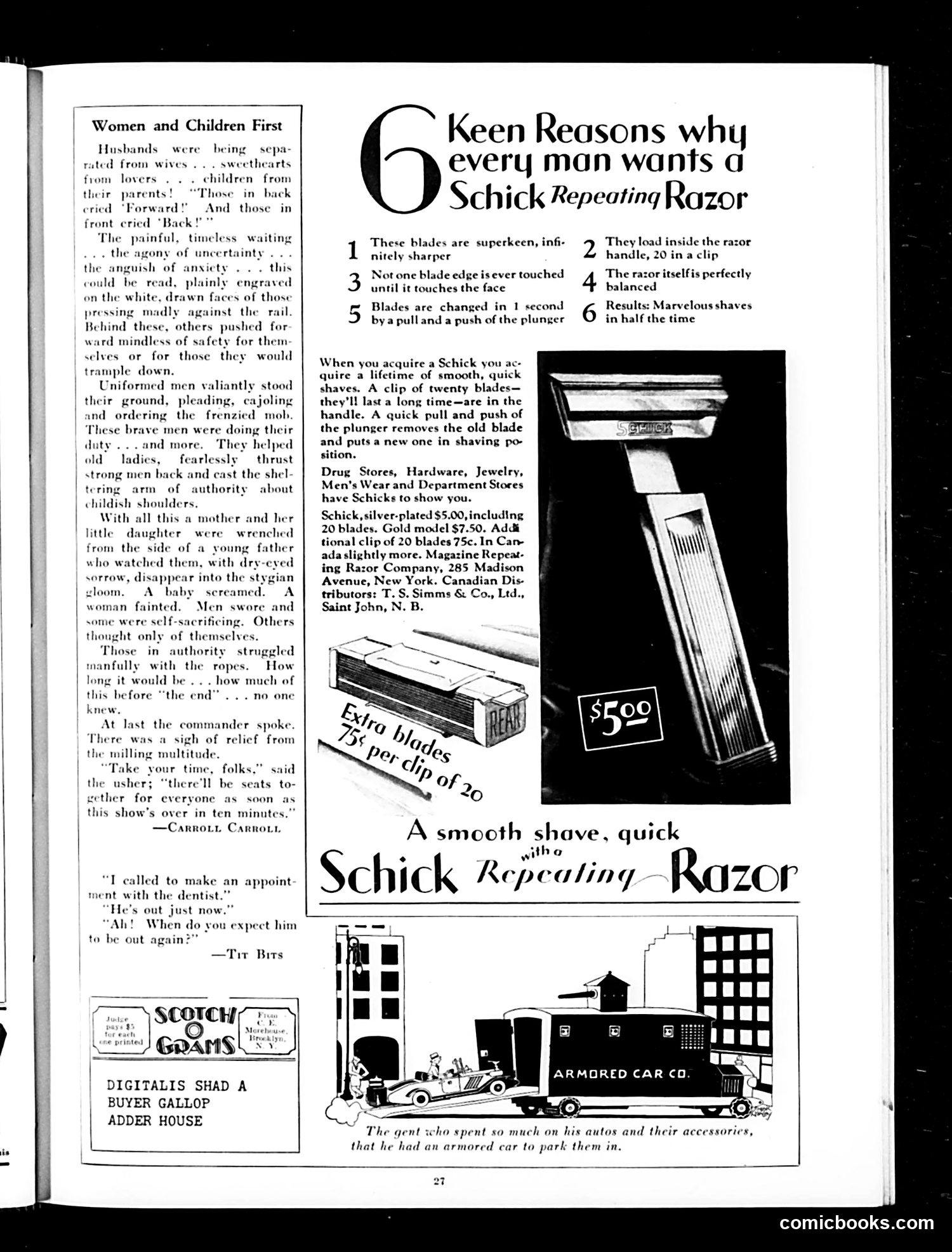
The left column presents a serious narrative about a maritime or transportation disaster using the phrase "women and children first"—the protocol for evacuation. The prose describes the chaos: separated families, panicked crowds, uniformed men imposing order, mothers torn from fathers, screaming babies, fainting women. It builds tension toward a climactic moment when "the commander spoke" and the crowd sighs with relief... **The punchline**: the usher announces they're just a theater audience, and seats will be available "in ten minutes" when the show ends. The satire mocks the overwrought emotional responses of audiences to dramatic entertainment—their genuine panic and hysteria over a fictional scenario. It's poking fun at both the melodrama of stage productions and the audience's susceptibility to theatrical manipulation. The right side is purely advertising for Schick Repeating Razors and an Armored Car Company joke. These are unrelated to the satirical content.
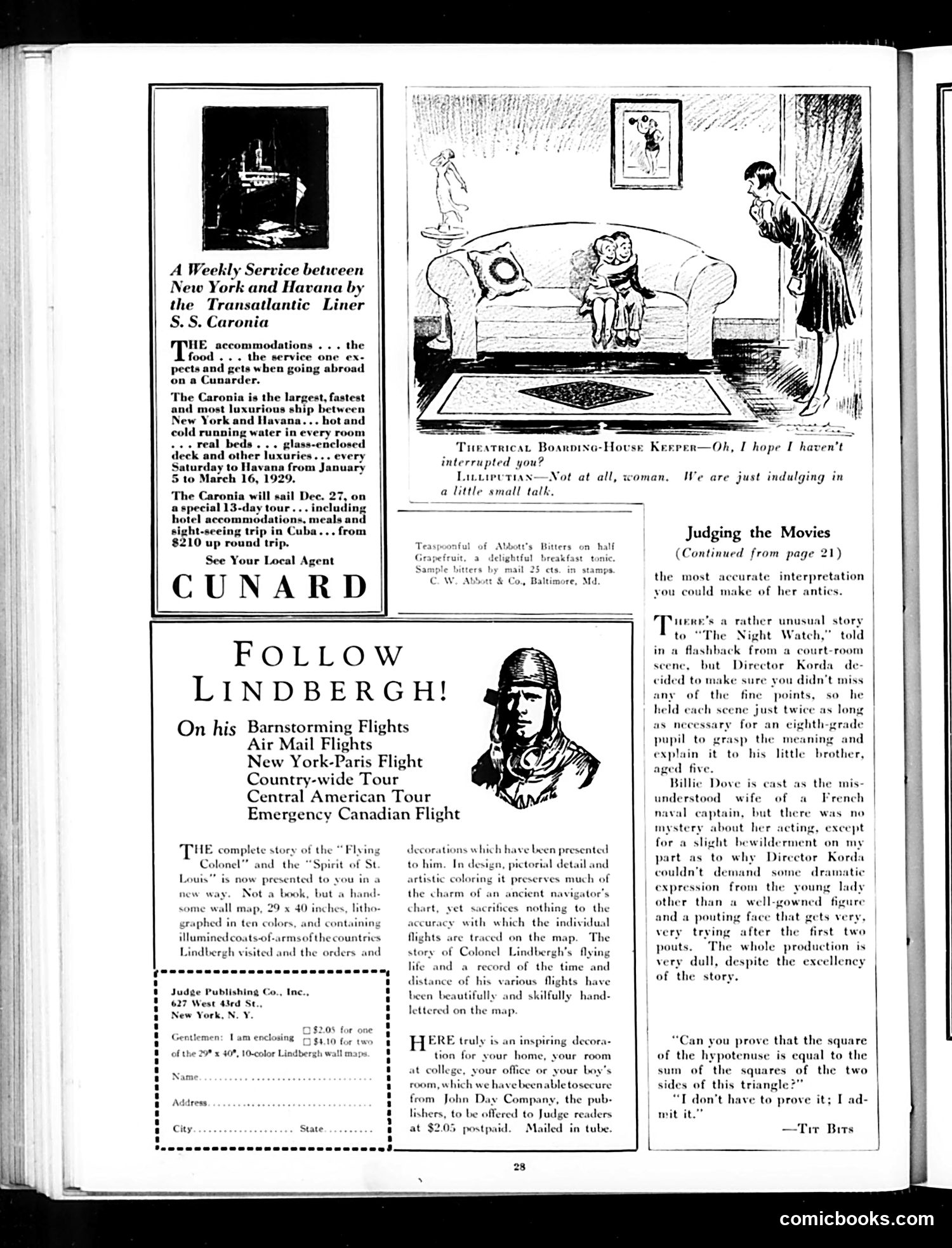
This page is primarily **advertising and promotional content** rather than satirical commentary. The main features are: 1. **Cunard Line advertisement** for the S.S. Caronia steamship offering weekly service between New York and Havana (1929), targeting wealthy travelers. 2. **"Follow Lindbergh!" promotional map** selling an illustrated 29x40-inch lithograph tracking Charles Lindbergh's famous flights, including his 1927 Paris crossing and subsequent barnstorming tours. This capitalizes on Lindbergh's immense popularity in the late 1920s. 3. **"Judging the Movies" film review** critiquing "The Night Watch," complaining the director (Korda) holds scenes too long, treating audiences like children. Actress Billie Dove is criticized for wooden acting. 4. A brief **joke** about geometric proofs. The page reflects 1920s consumer culture—luxury travel, celebrity merchandise, and emerging film criticism—with no significant political satire evident.
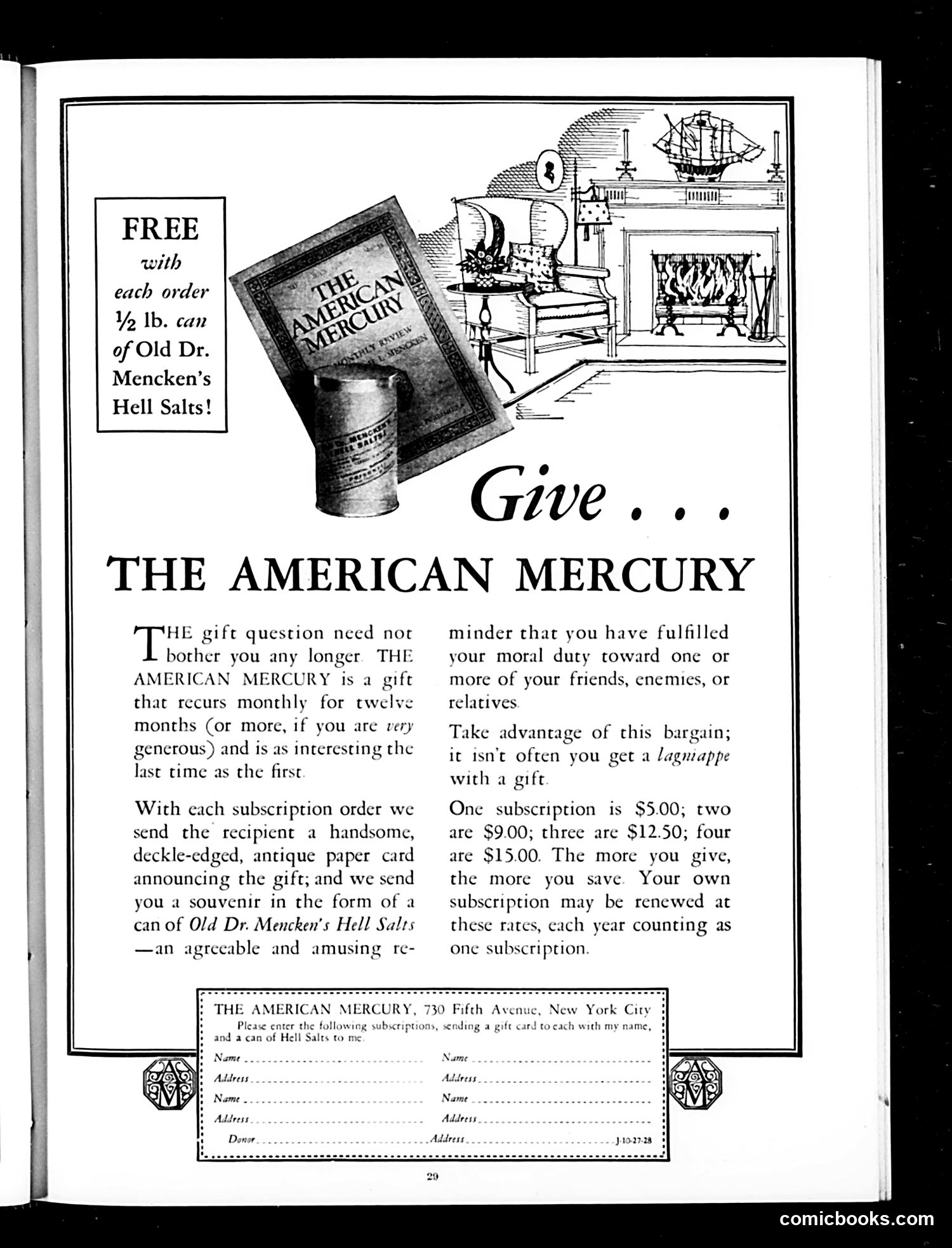
This is primarily a **magazine subscription advertisement**, not a political cartoon. It promotes *The American Mercury*, a literary and cultural magazine, as a gift subscription option. The satire lies in the promotional gimmick: subscribers receive a novelty can of "Old Dr. Mencken's Hell Salts" as a souvenir. This is a playful joke referencing **H.L. Mencken**, the magazine's editor and a famous satirist known for his acerbic social criticism. "Hell Salts" is a pun—both a mock medicinal product (playing on old patent medicine packaging) and a witty reference to Mencken's caustic, fiery writing style and his reputation for scorching commentary on American culture and morality. The ad humorously suggests that giving a subscription fulfills your "moral duty" toward friends or enemies alike, with tongue-in-cheek pricing that rewards bulk gifting. The overall tone is sophisticated, ironic satire aimed at *Judge*'s educated readership.
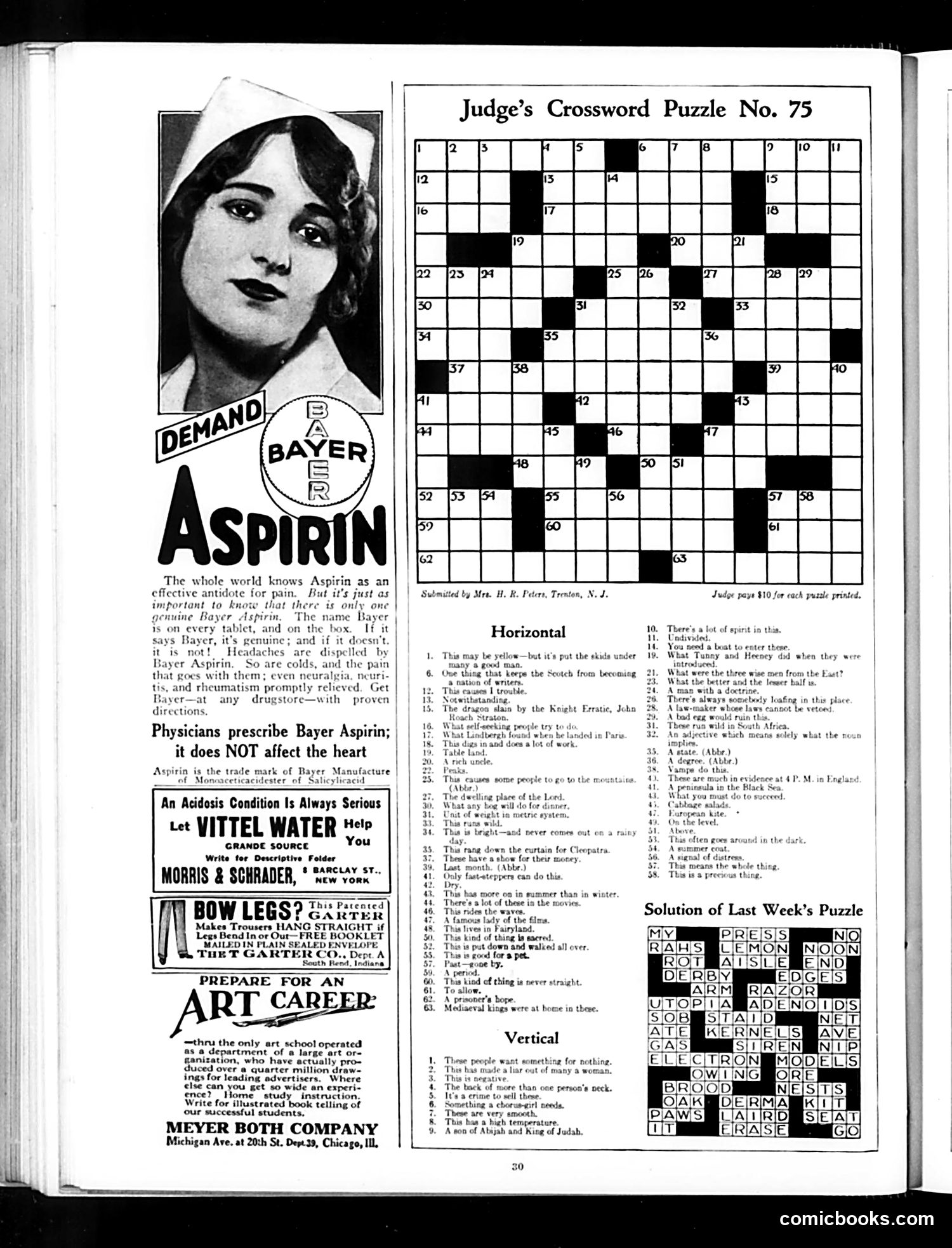
This page is primarily **a crossword puzzle with advertisements**—not a political cartoon. The main visual element is a promotional photograph of a woman's face advertising **Bayer Aspirin**, emphasizing that only genuine Bayer brand is effective pain relief. The advertisements surrounding the puzzle reflect early 20th-century consumer concerns: Bayer Aspirin's safety for the heart, Vittel Water for digestive health, a "bow legs" corrective garter, and art school correspondence courses. These ads target middle-class readers worried about bodily ailments and self-improvement. The crossword itself contains literary and historical clues (references to Job, Cleopatra, King of Judah), typical of Judge magazine's educated readership. No satire or political commentary is evident on this particular page—it's a straightforward puzzle and advertising feature.
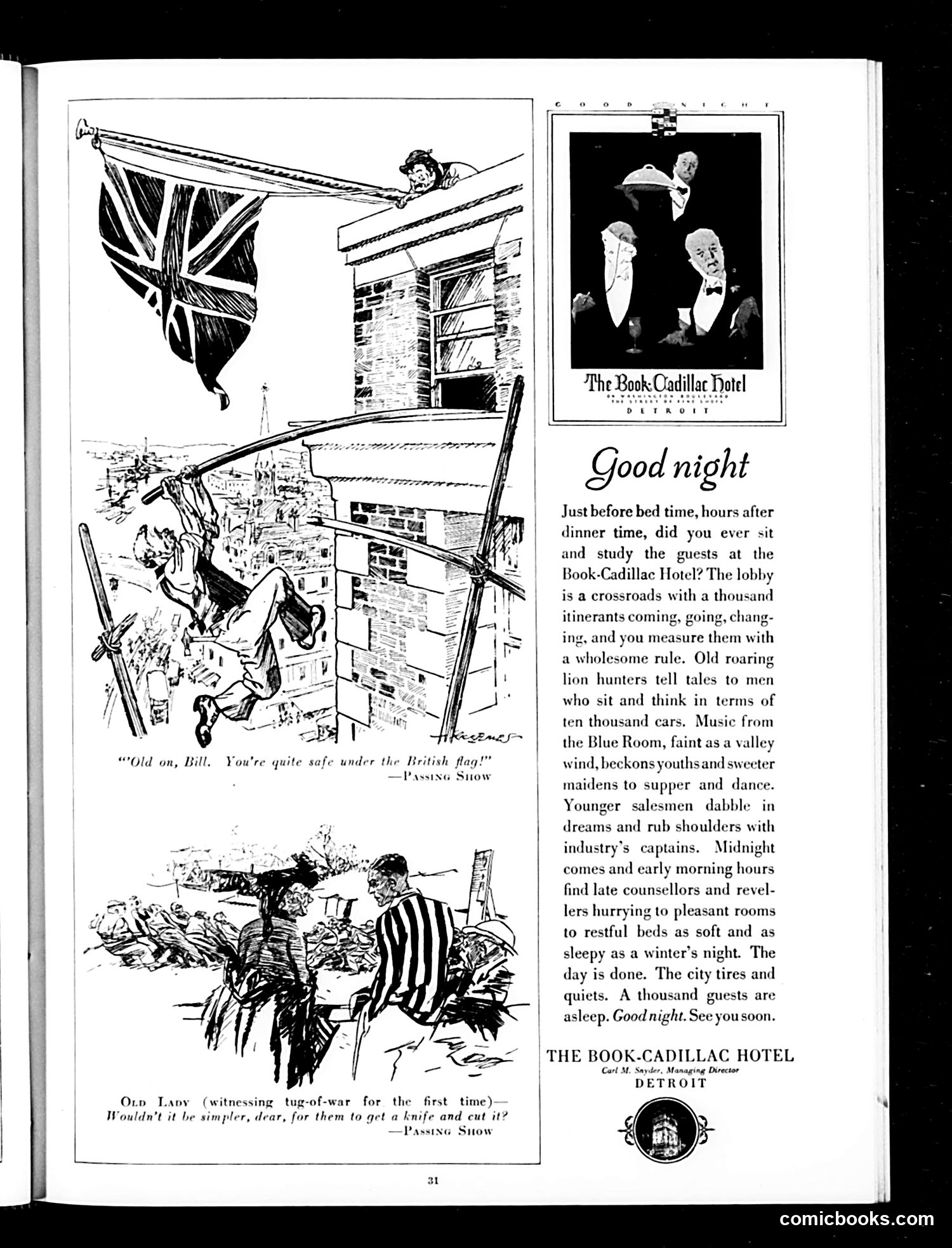
This page is primarily **advertising** for Detroit's Book-Cadillac Hotel, with two small cartoons serving as decorative accompaniment. The cartoons are generic humor rather than political satire: 1. **Top cartoon**: Shows someone under a British flag during what appears to be a tug-of-war, with the caption implying safety under British protection—likely a WWI-era reference to Britain's military strength, though the exact context is unclear. 2. **Bottom cartoon**: An "Old Lady" observes a tug-of-war and suggests simply cutting the rope instead—a joke about naive innocence or foreign unfamiliarity with English customs. The main content is a prose advertisement celebrating the Book-Cadillac Hotel as a glamorous social hub where traveling salesmen, business captains, and young people mingle, dance, and conduct business. It emphasizes the hotel's cosmopolitan activity and comfort—standard luxury hotel marketing of the era.
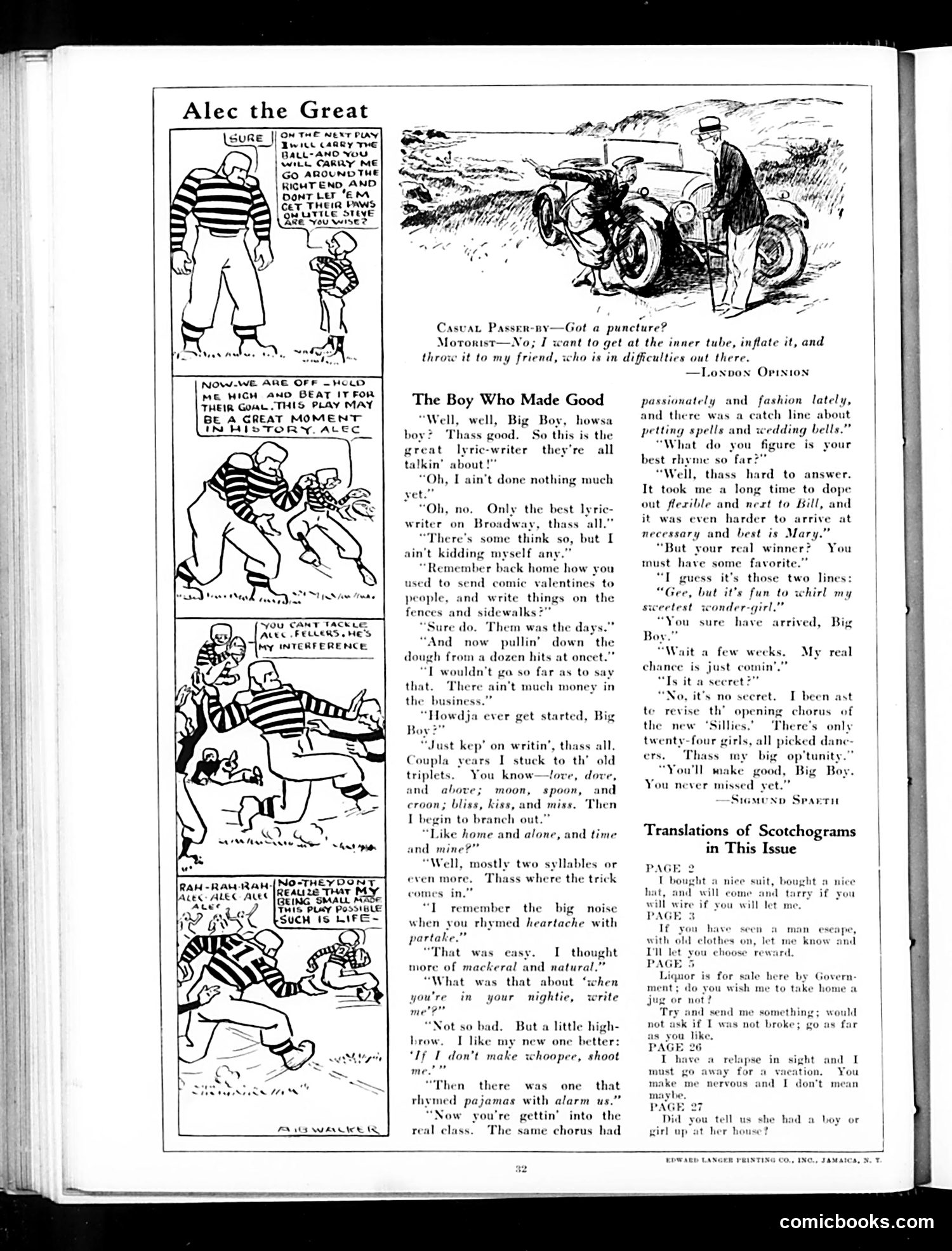
**Left panel ("Alec the Great"):** A series of comic strips depicting a large, muscular man (likely a football player or athlete named Alec) coaching smaller figures through football plays. The humor appears to rest on his overconfidence—calling this ordinary play "a great moment in history" while his small charges struggle with basic interference blocking. **Right panel ("The Boy Who Made Good"):** A dialogue between two men discussing a successful Broadway lyricist. The piece satirizes the formulaic nature of popular song-writing of the era—heavy reliance on simple rhyming couplets (love/dove, moon/spoon) and novelty lyrics for stage shows. The "Big Boy" character represents the ambitious songwriter who's found commercial success through catchy, if artistically modest, songwriting. The humor mocks both the low artistic bar and the character's self-aware acknowledgment that he's "not kidding himself" about his work's quality. Both pieces reflect early 20th-century popular entertainment: sports culture and Broadway song production.
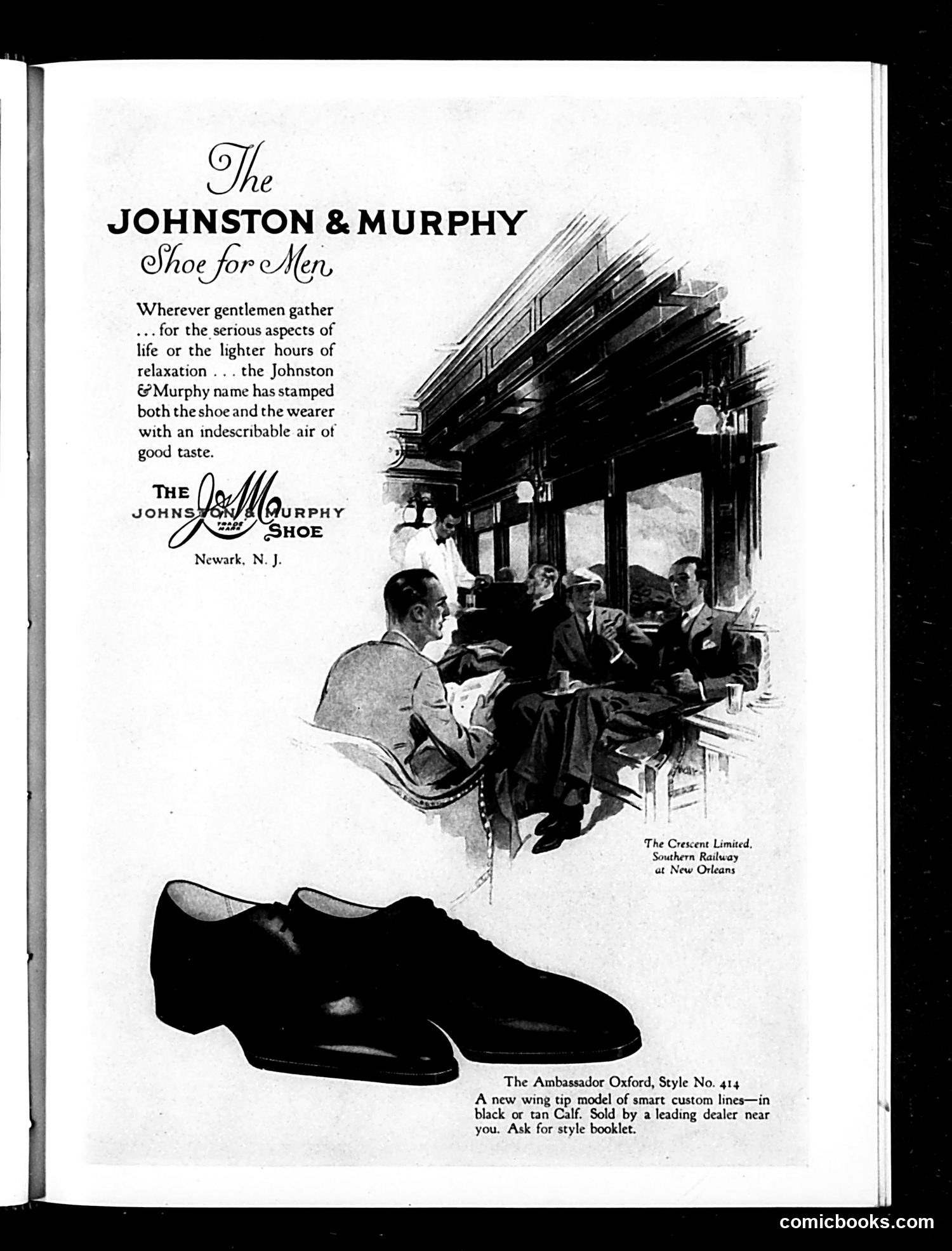
This page is **primarily a shoe advertisement**, not political satire. It promotes Johnston & Murphy men's shoes from Newark, New Jersey. The illustration depicts gentlemen in a railway observation car (labeled "The Crescent Limited, Southern Railway at New Orleans"), establishing an aspirational context—the shoes are associated with leisure, sophistication, and upscale travel. The message: wearing Johnston & Murphy shoes signals "good taste" and social refinement. The featured shoe, "The Ambassador Oxford, Style No. 414," is presented as a "smart custom" wing-tip design available in black or tan leather. The advertisement's rhetoric emphasizes that the brand "stamps both the shoe and the wearer" with distinction. This is commercial advertising typical of early 20th-century magazines like *Judge*, using lifestyle imagery rather than humor or political commentary to sell premium menswear.
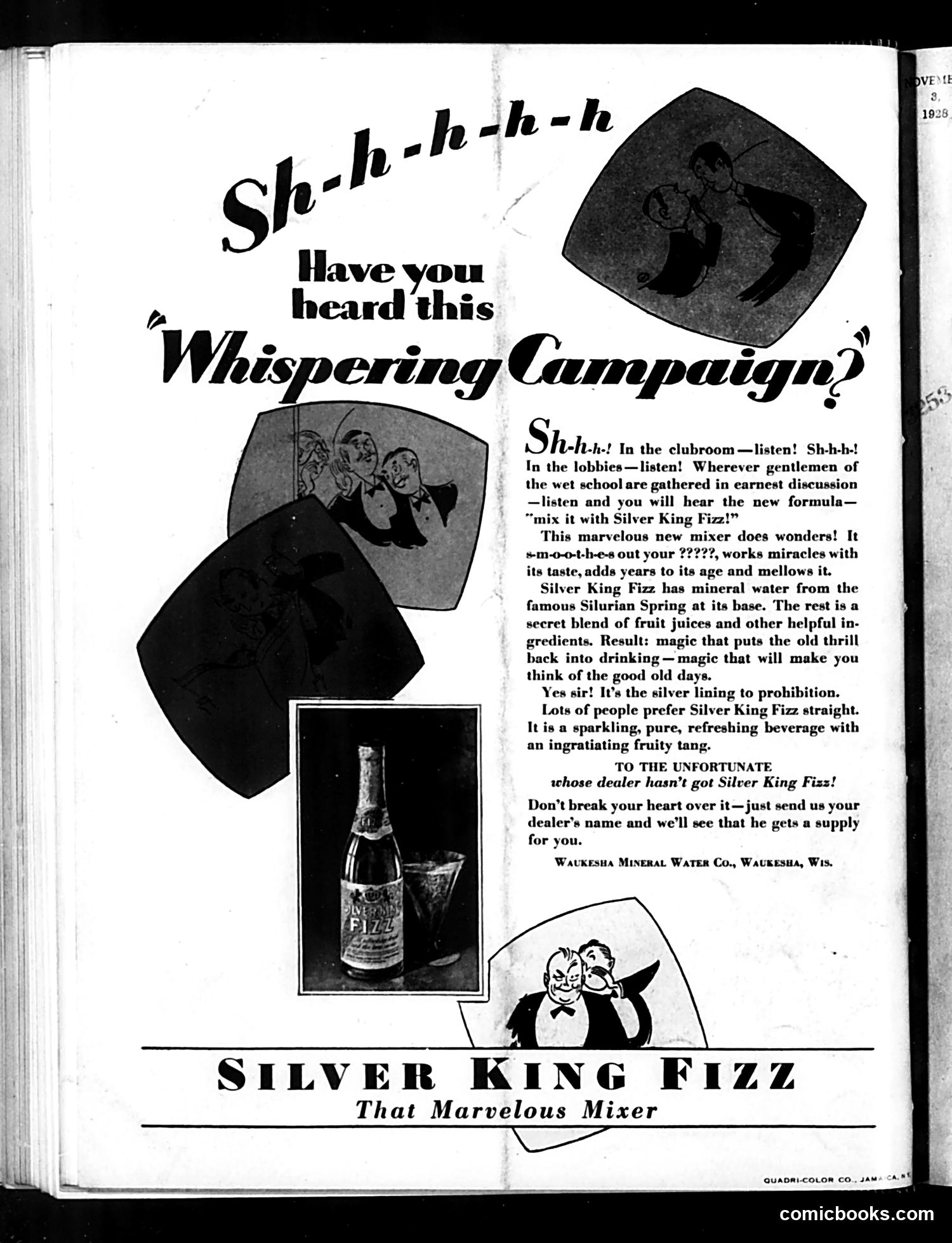
This is primarily a **prohibition-era advertisement** (likely 1920s), not political satire. The "whispering campaign" concept satirizes how people secretly discuss alcoholic drinks during Prohibition, when alcohol was illegal in the U.S. The ad markets Silver King Fizz as a "mixer"—ostensibly for combining with non-alcoholic beverages, but the language ("puts the old thrill back into drinking," "silver lining to prohibition") clearly suggests it's marketed to those who want to make illicit alcohol more palatable. The cartoon figures show gentlemen in clubrooms and lobbies conspiratorially discussing the product, mocking the secretive culture around alcohol during this enforcement period. The humor targets both Prohibition's unpopularity and the creative workarounds people employed. **Judge magazine** used this advertisement space to lampoon Prohibition while carrying what was technically a legal product ad.