
Judge, 1928-10-27 · page 15 of 36
Judge — October 27, 1928 — page 15: what you’re looking at
What you’re looking at
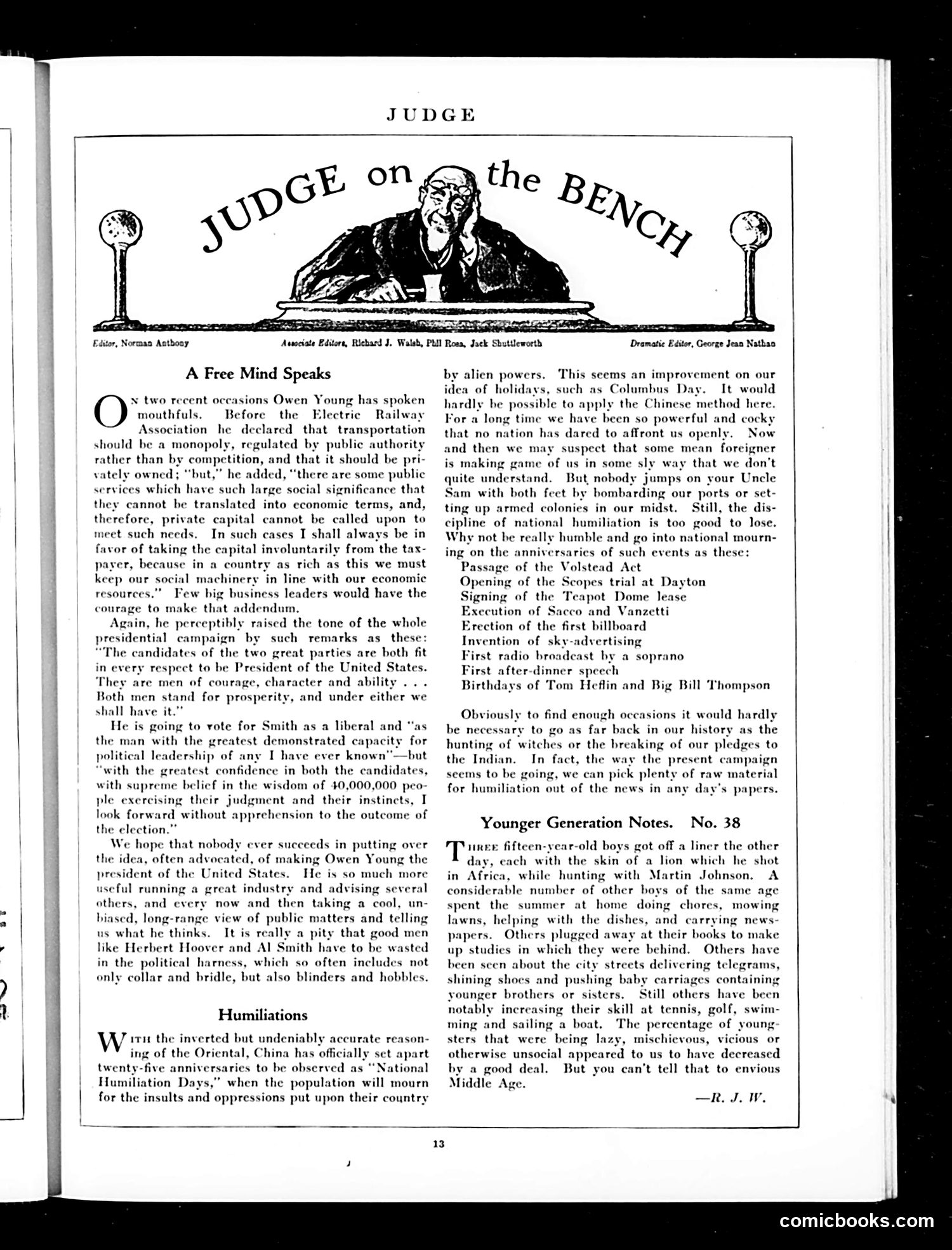
This page from *Judge* magazine contains two satirical pieces from the 1928 presidential campaign. **"A Free Mind Speaks"** praises industrialist Owen Young for his candid political remarks—notably that both major presidential candidates (Herbert Hoover and Al Smith) are qualified, and that he'll vote for Smith while respecting either outcome. The satire celebrates Young's intellectual honesty as a refreshing break from typical campaign rhetoric, while ironically suggesting he's too valuable to waste as president. **"Humiliations"** sarcastically proposes that America adopt China's practice of commemorating national humiliations. The piece then lists American embarrassments: Prohibition (Volstead Act), the Scopes "Monkey Trial," the Teapot Dome scandal, Sacco and Vanzetti's execution, billboards, and radio broadcasts. The satire criticizes American hypocrisy and moral failures while mocking the notion that acknowledging such failures would produce national improvement.
📄 Transcribed text from this page (OCR, searchable)
Machine-transcribed from the original scan — historical spelling and the odd misread are preserved.
JUDGE Zz formas Astbony A Free Mind Speaks N two recent occasions Owen Young has spoken O mouthfuls. Before the Electric Railway Association he declared that transportation should be a monopoly, regulated by rather than by competition, and that it should be pri vately owned; “but,” he added, “there are some public s which have such | ance that annot be translated into economic terms, and, therefore, private capital cannot be called upon to meet such needs. In such cases I shall always be in favor of taking the capital involuntarily from the tax- payer, because in a country as rich as this we must p our social machinery in line with our economic "Few big business leaders would have the courage to make that addendum. Again, he perceptibly raised the tone of the whole presidential campaign by such remarks as_ these: “The candidates of the two great parties are both fit in every respect to be President of the United States. They are men of courage, character and ability... Both men stand for prosperity, and under either we shall have it.” He is going to vote for Smith as a liberal a the man with the greatest demonstrated capa political leadership of any I have ever known"—but “with the greatest confidence in both the candidates, with supreme belicf in the wisdom of 40,000,000 peo ple exercising their judgment and their instincts, I look forward without apprehension to the outcome of the election.” servi they resources, We hope that nobody ever succeeds in putting over the idea, often advocated, of making Owen Young the ident of the United States. He is so much more ful running a great industry and advising several others, and every now and then taking a cool, un- hiased, long-range view of public matters and telling us what he thinks. It is really a pity that good men like Herbert Hoover and Al Smith have to be wasted in the political harness, which so often includes not only collar and bridle, but also blinders and hobbles. pre Humiliations W rit the inverted but undeniably accurate reason- ing of the Oriental, China has offici, twenty-five anniv Humiliation Dz for the insults Hy set apart rsaries to be observed as “National when the population will mourn and oppressions put upon their country = oa hs ates Associate Editors, Richard J. Walab, Pill Rosa, Jack Sbutdeworth Dramatic Editor, George Jean Natha: by alien powers. This seems an improvement on our idea of holidays, such as Columbus Day. It would hardly be possible to apply the Chinese method he: For a long time we have been so powerful and cocky that no nation has dared to affront us openly. Now and then we may suspect that some mean foreigner is making game of us in some sly way that we don't quite understand. But nobody jumps on your Uncle Sam with both feet by bombarding our ports or set- ting up armed colonies in our midst. Still, the dis- cipline of national humiliation is too good to lose. Why not be really humble and go into national mourn- ing on the anniversaries of such events as these: Passage of the Volstead Act Opening of the Scopes trial at Dayton Signing of the Teapot Dome lease Execution of Sacco and Vanzetti Erection of the first billboard Invention of sky-advertising First radio broadcast by a soprano First after-dinner speech Birthdays of Tom Heflin and Big Bill ‘Thompson Obviously to find enough occasions it would hardly 'y to go as far back in our history as the hunting of witches or the breaking of our pledges to the Indian. In fact, the way the present campaign seems to be going, we can pick plenty of raw material for humiliation out of the news in any be necess: “'s papers. No. 38 nner fifteen-year-old boys got off a liner the other d ch with the skin of a lion which he shot in Afric while hunting with Martin Johnson. A considerable number of other boys of the same age spent the summer at home doing chores, mowing lawns, helping with the dishes, and carrying news- papers. Others plugged away at their books to make up studies in which they were behind. Others have seen about the city streets delivering telegra shining shocs and pushing iag younger brothers or sisters, Still others have be notably increasing their skill at tennis, golf, swim- ming and sailing a boat, The percentage of young sters that were being lazy, mischiev otherwise unsocial appeared to us to h by a good deal. Middle Age. Younger Generation Notes. 1s, vicious or decre: But you can’t tell that to envious —h.J.W. comicbooks.com