
A complete issue · 36 pages · 1928
Judge — October 20, 1928
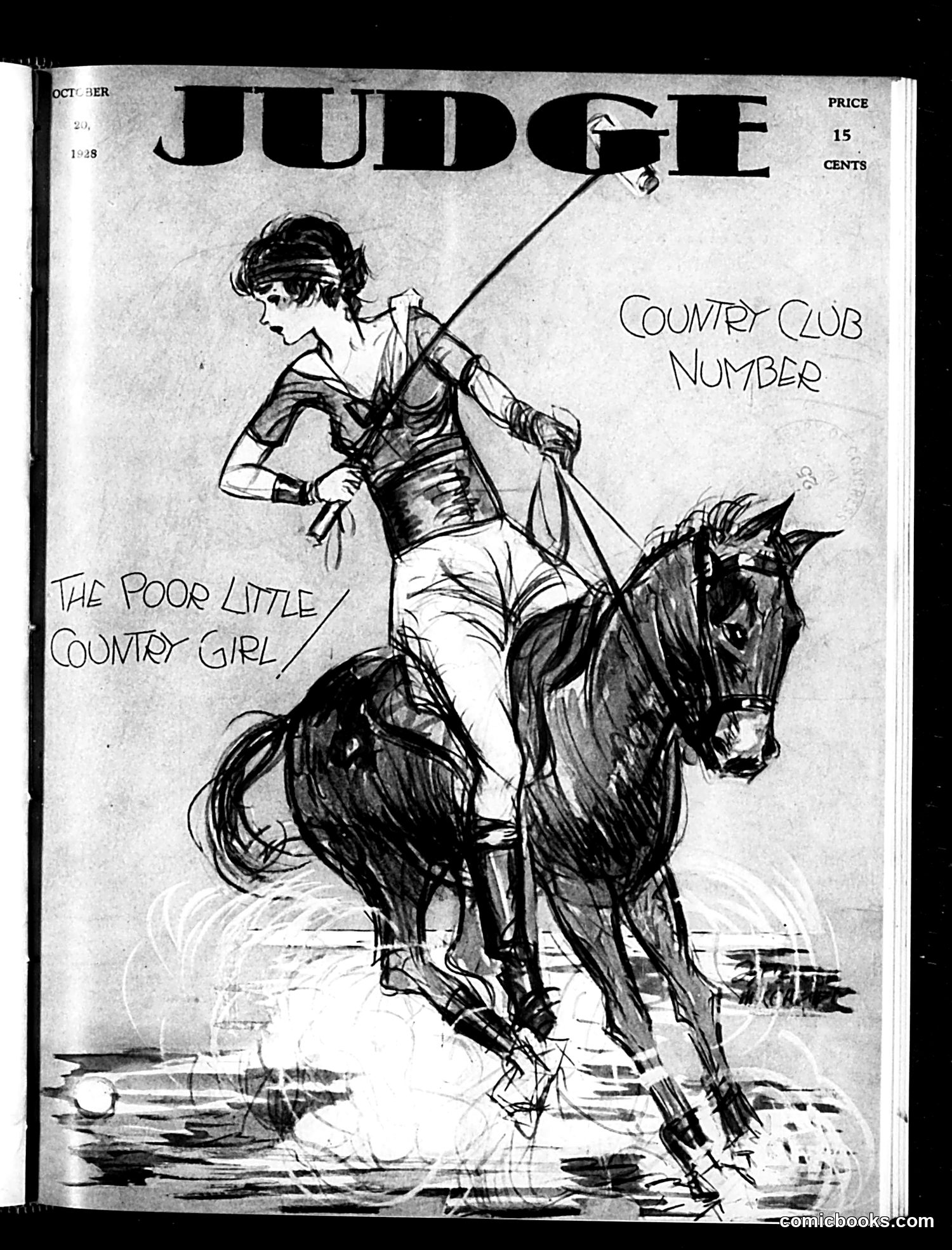
This is the cover of *Judge* magazine (October 1938, 15 cents). The illustration depicts a young woman riding a horse while wielding a polo mallet, labeled "The Poor Little Country Girl" with a "Counter Club Number" notation. The satire appears to mock wealthy women who adopt a "poor country girl" persona or aesthetic while engaging in elite leisure activities like polo. The irony lies in the contradiction: she's labeled poor yet depicted engaging in an expensive, exclusive sport associated with the wealthy upper class. This likely satirizes a social trend of the 1930s where affluent women affected rural or working-class identities as a fashionable affectation, while maintaining their privileged lifestyles. The cartoon's humor depends on recognizing this class performance and hypocrisy.
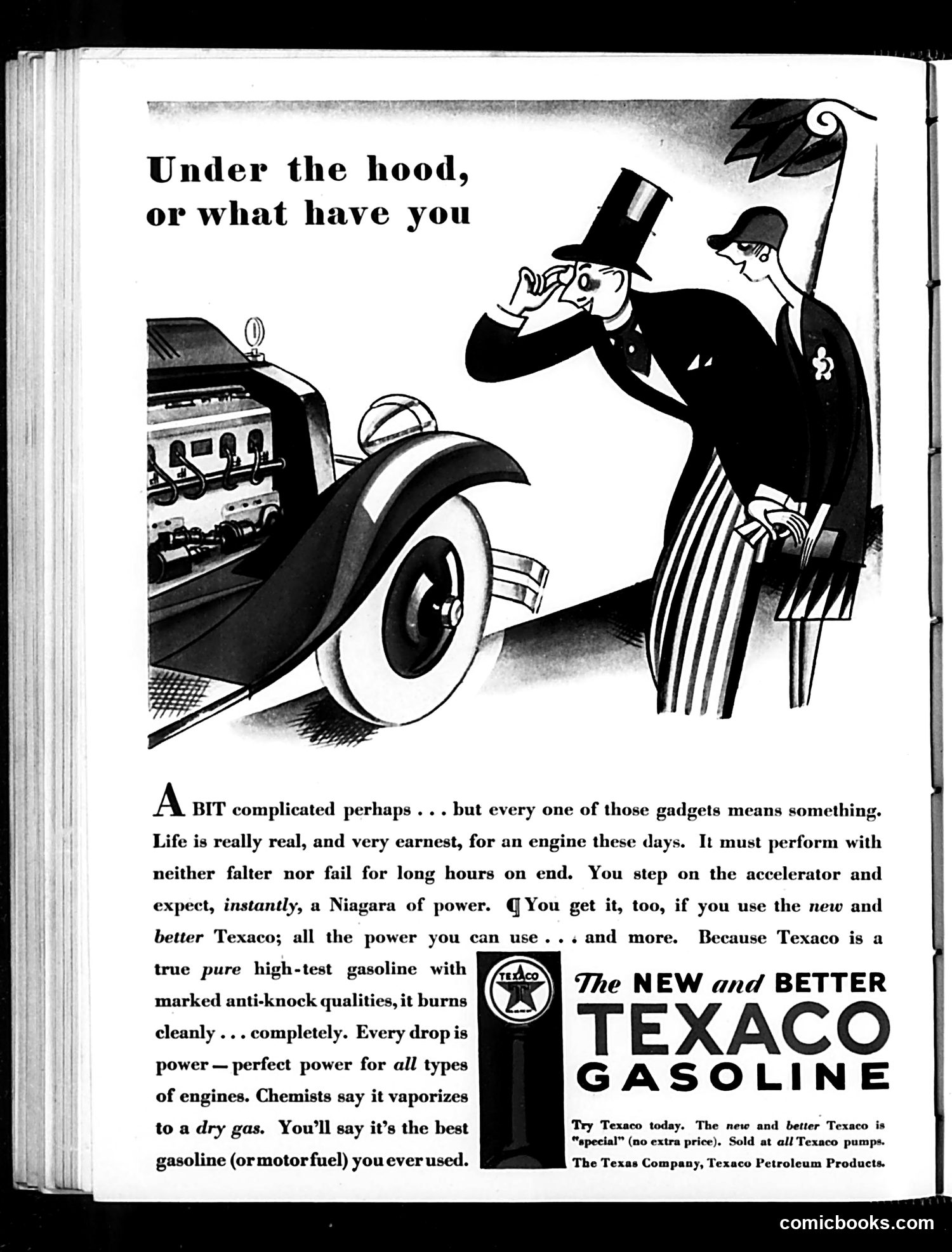
This page is primarily **advertising for Texaco gasoline**, not political satire. The illustration shows two well-dressed men examining a car's engine, with the headline "Under the hood, or what have you." The joke is straightforward: modern engines are complex with many components ("a bit complicated perhaps"), but Texaco gasoline supposedly ensures reliable performance. The ad emphasizes that Texaco is a "pure high-test gasoline" that "vaporizes to a dry gas," providing consistent power for demanding engines. The cartoon figures appear to be generic businessmen of the era—one adjusting his top hat—used to represent the typical car owner. This reflects 1920s-30s advertising conventions where well-dressed men symbolized quality and sophistication. The ad ran in *Judge*, a satirical magazine, but this particular page functions as paid advertising rather than editorial satire.
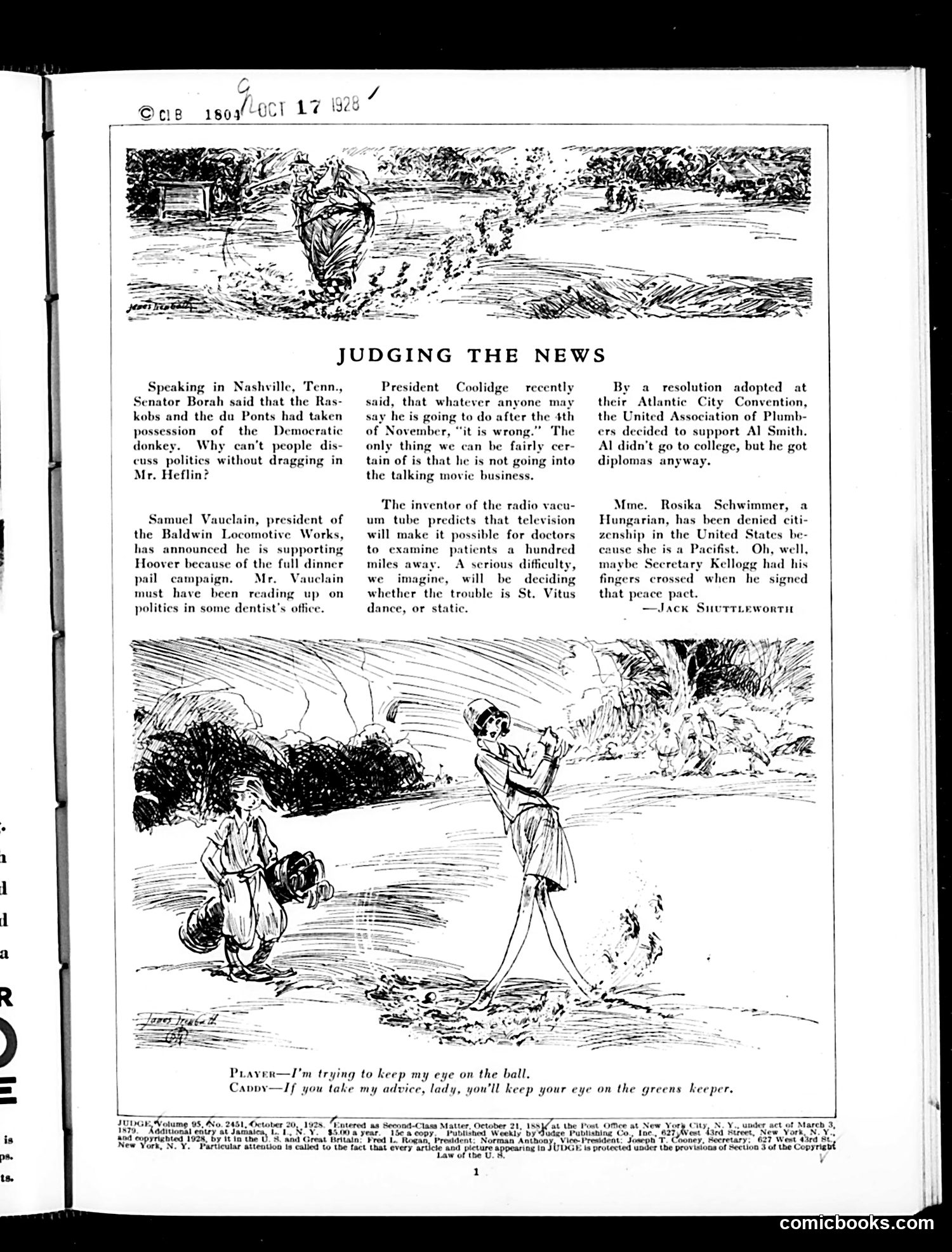
This October 1928 *Judge* page combines brief political commentary with an unrelated cartoon joke. **Top section:** Three satirical news items mock current figures—Senator Borah's criticism of the Democrats, President Coolidge's dismissal of election concerns, and a humorous note about Al Smith's lack of college credentials. These reflect 1928 election-year politics. **Bottom cartoon:** Shows a female golfer and male caddy. The player says she's "trying to keep my eye on the ball"; the caddy advises that if she watches the greens keeper instead, "you'll keep your eye on the greens keeper." This is a flirtation joke playing on the double meaning of "keeping an eye on" someone—romantic rather than athletic focus. The page juxtaposes serious politics with frivolous humor, typical of *Judge*'s satirical style.
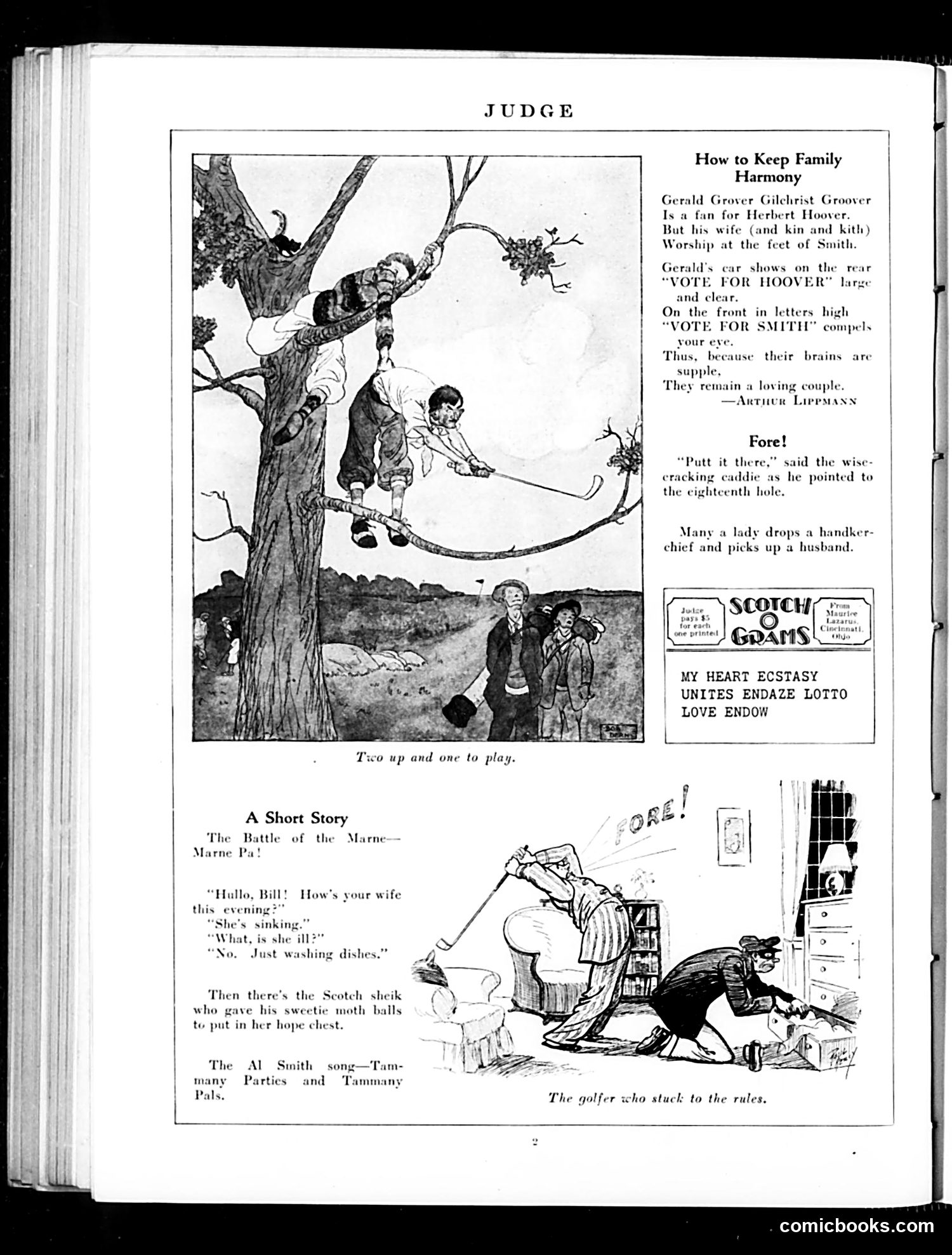
This page contains political and social humor from an unspecified era. **Top illustration** ("Two up and one to play"): Shows children on a tree swing, captioned as commentary on keeping "Family Harmony." The text references Gerald Grover Gilchrist Groomer supporting Herbert Hoover, while his wife supports Smith—likely referencing the **1928 presidential election** between Herbert Hoover and Al Smith, where the joke is that political disagreement threatens domestic peace. **"Fore!" section**: Golf humor about dropping handkerchiefs and husbands. **Bottom story** ("The Battle of the Marne—Marne Pa!"): Domestic humor where "Bill's" wife is "sinking" while washing dishes; a Scotch candy vendor and Al Smith references provide period detail, though the exact satirical point is unclear without additional context. The page blends political commentary with domestic comedy typical of 1920s Judge magazine.
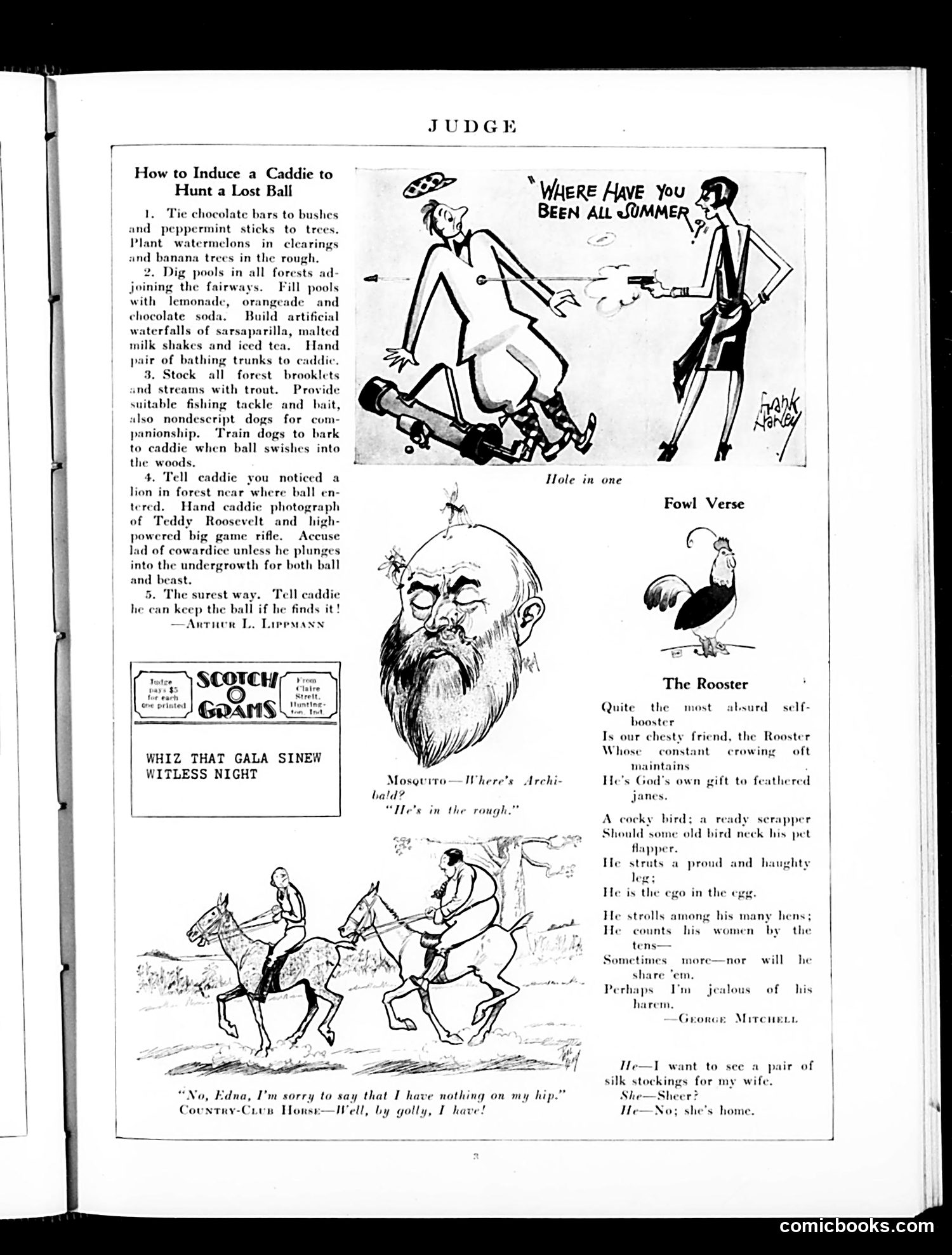
This page contains several distinct humor pieces: **"How to Induce a Caddie to Lose a Golf Ball"** satirizes wealthy golfers' contemptuous treatment of caddies through absurdist suggestions (planting chocolate bars in bushes, stocking streams with trout). The implicit joke critiques class exploitation on golf courses. **"Hole in One"** shows a well-dressed man confronting a disheveled golfer, asking where he's been all summer—likely mocking someone neglecting social obligations for obsessive golf. **"Fowl Verse" and "The Rooster"** are humorous animal verses. The rooster poem parodies self-important boasting. **The Country Club Horse exchange** depicts two mounted riders; one apologizes for having "nothing on my hip" (no flask), the other responds "by gotta, I have!"—joking about Prohibition-era drinking culture among the wealthy elite. The overall page satirizes upper-class leisure activities and social hypocrisy.
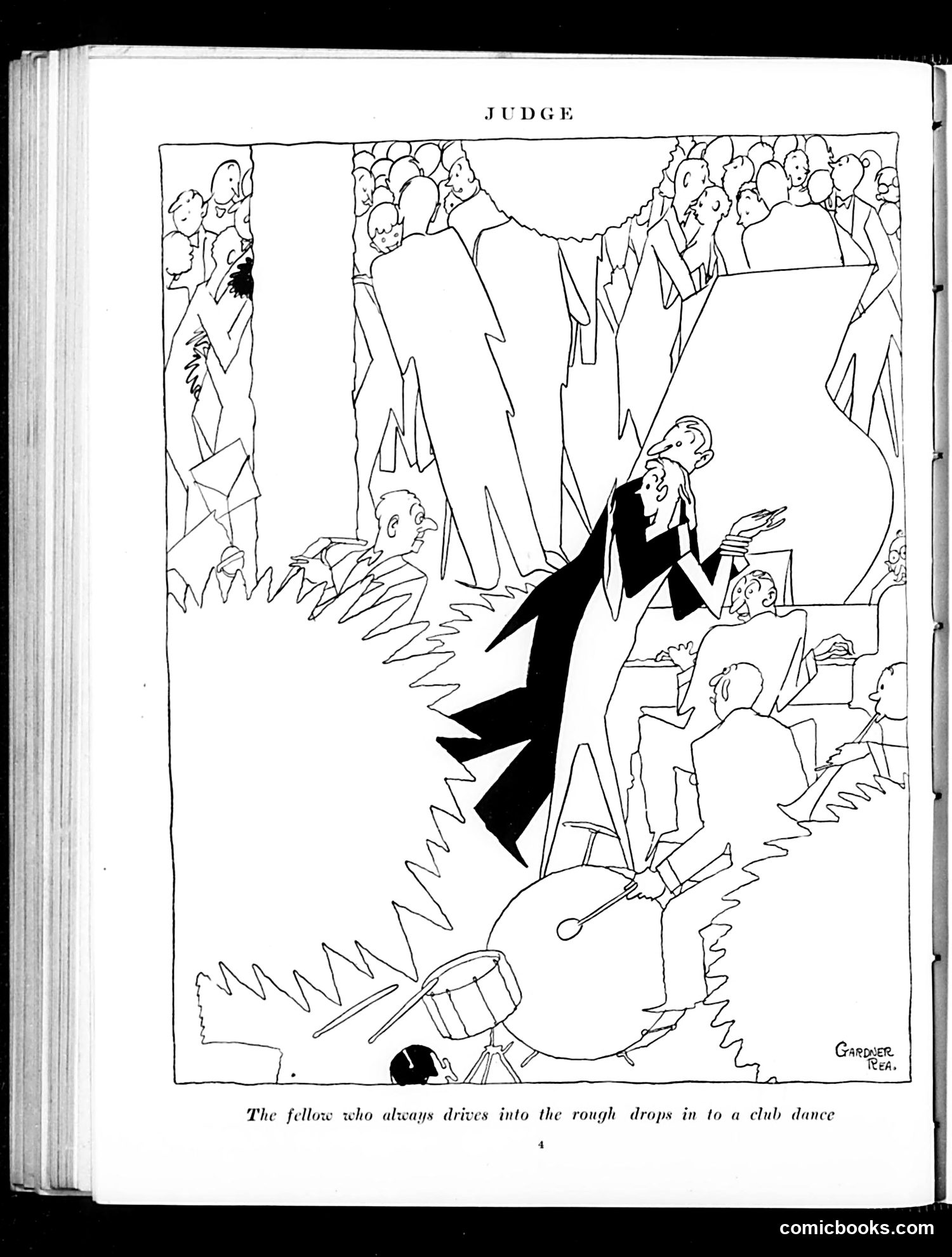
This cartoon satirizes reckless driving behavior at social events. The caption reads: "The fellow who always drives into the rough drops in to a club dance." The humor relies on a golf metaphor applied to automotive driving. In golf, "the rough" refers to unmowed grass areas bordering fairways where balls land off-target. The joke suggests someone who consistently drives poorly on the golf course ("always drives into the rough") brings that same reckless driving behavior to a club dance—literally driving a car into the venue with abandon, creating chaos among dancers. The cartoon depicts an automobile crashing through what appears to be a dance hall, with formally-dressed attendees scattering in alarm. The satire targets both poor drivers and the social disruption they cause, using the double meaning of "driving" (golfing versus automobiles) for comedic effect.
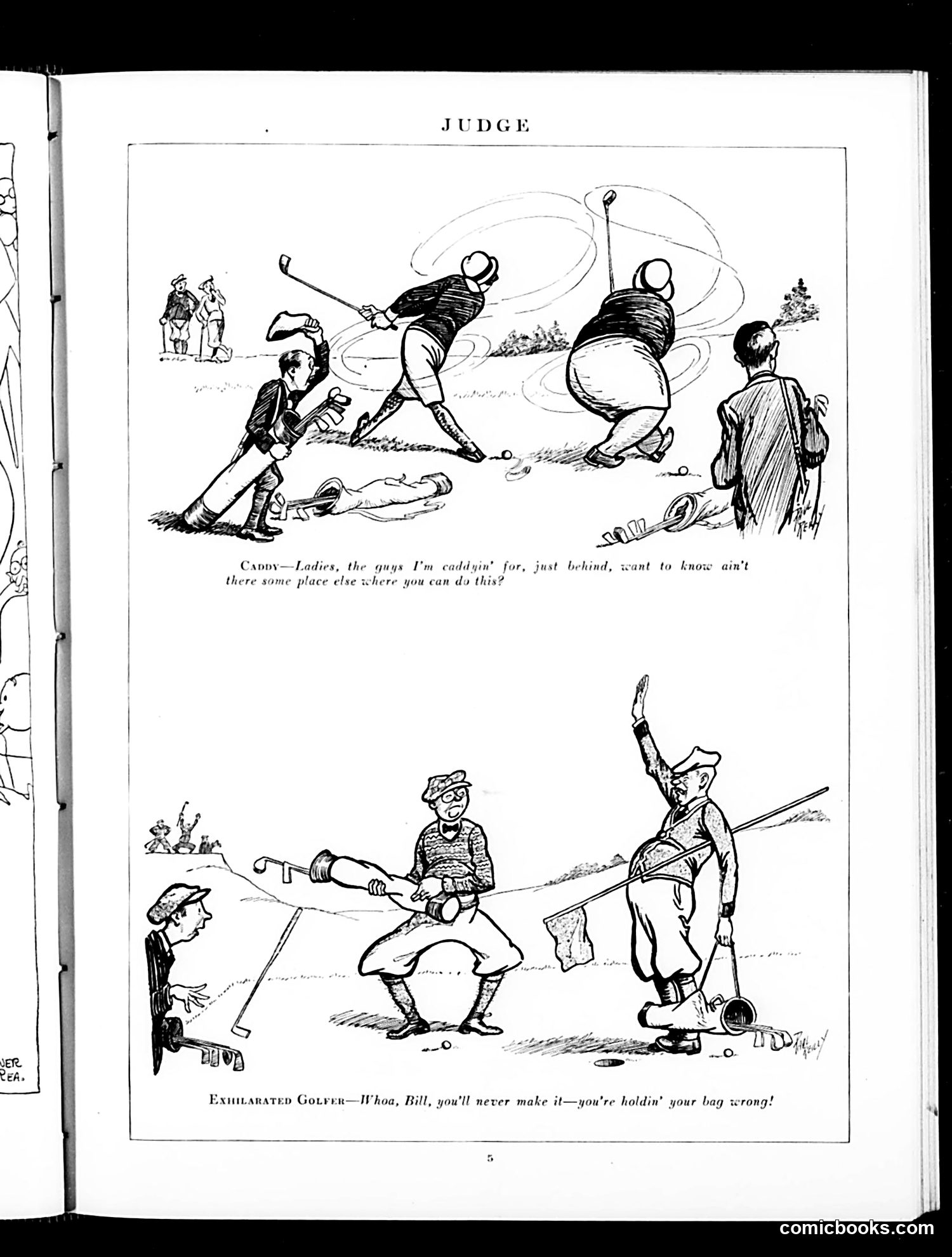
This page contains two golf-themed cartoon panels satirizing amateur golfers' excuses and incompetence. The top cartoon mocks women golfers making excuses ("Ladies, the guys I'm cadyin' for, just behind, want to know ain't there some place else where you can do this?"), suggesting female golfers obstruct male players and lack skill. The bottom cartoon ridicules a male golfer's poor technique ("Whoa, Bill, you'll never make it—you're holdin' your bag wrong!"), showing him swinging wildly while his caddy and companion observe in dismay. Both cartoons use exaggerated physical comedy and dialect humor typical of early Judge magazine. The satire targets golf's growing popularity among amateur players—both men and women—who lack proper form and etiquette, disrupting the sport's genteel reputation.
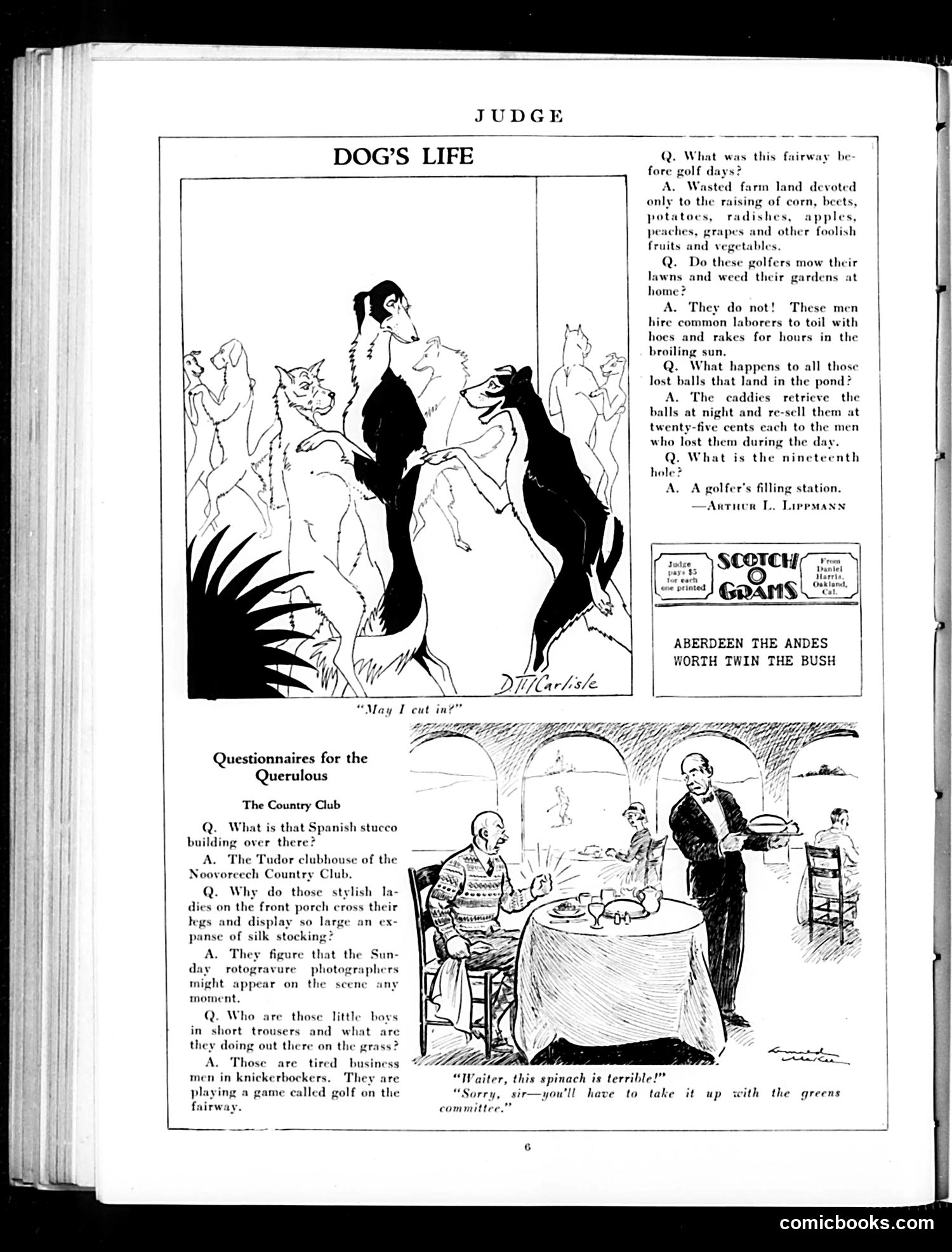
This page from *Judge* magazine satirizes wealthy country club culture and golf obsession in early 20th-century America. **"Dog's Life"** (top): A cartoon mocking golfers' hypocrisy. The Q&A format humorously exposes that wealthy golfers won't maintain their own yards but hire laborers to work in "broiling sun," while they spend leisure time on the golf course. It also jokes about lost golf balls being resold by caddies and calls the nineteenth hole (the clubhouse bar) a "filling station"—suggesting golfers are perpetually drinking. **"Questionnaires for the Querulous"** (bottom): A satirical interview format critiquing country clubs as pretentious spaces. It mocks: the fake "Tudor clubhouse" with Spanish stucco (architectural phoniness), wealthy women displaying expensive silk stockings for newspaper photographers, and businessmen disguising themselves as boys in knickerbockers to play golf instead of working. The restaurant cartoon jokes that even the greens committee can't fix bad food—another golf reference. The satire targets leisure-class excess and hypocrisy during an era of stark wealth inequality.
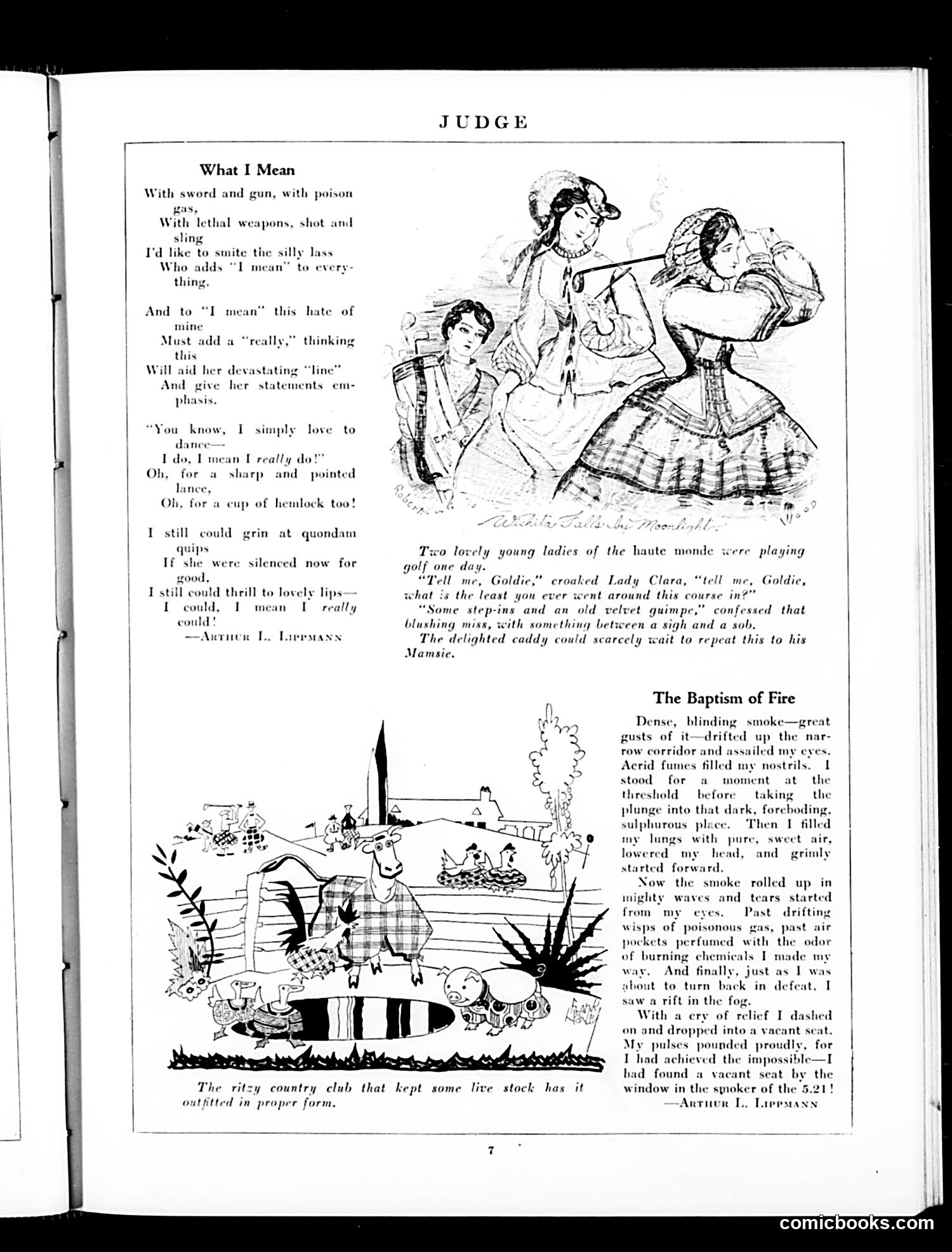
This page contains two satirical pieces mocking early 20th-century social affectations: **"What I Mean"** ridicules women who habitually insert "I mean" and "really" into conversation for emphasis. The male narrator expresses violent frustration toward this verbal tic, wishing he could silence such women. The satire targets pretentious speech patterns among upper-class women. **The golf anecdote** mocks wealthy women's propriety. Two society ladies playing golf discuss one woman's minimal undergarments—a shocking admission for the era. The humor derives from the contrast between their refined pretenses and the scandalous confession about wearing almost nothing beneath her dress. **"The Baptism of Fire"** is a mock-heroic piece about enduring the smoker car on a train (the "5.21"). The flowery language describing navigating through toxic smoke and poisonous fumes treats finding a vacant window seat as an epic achievement worthy of pride. All three pieces satirize upper-class affectation, pretension, and the gap between social appearances and reality in the Jazz Age/1920s era.
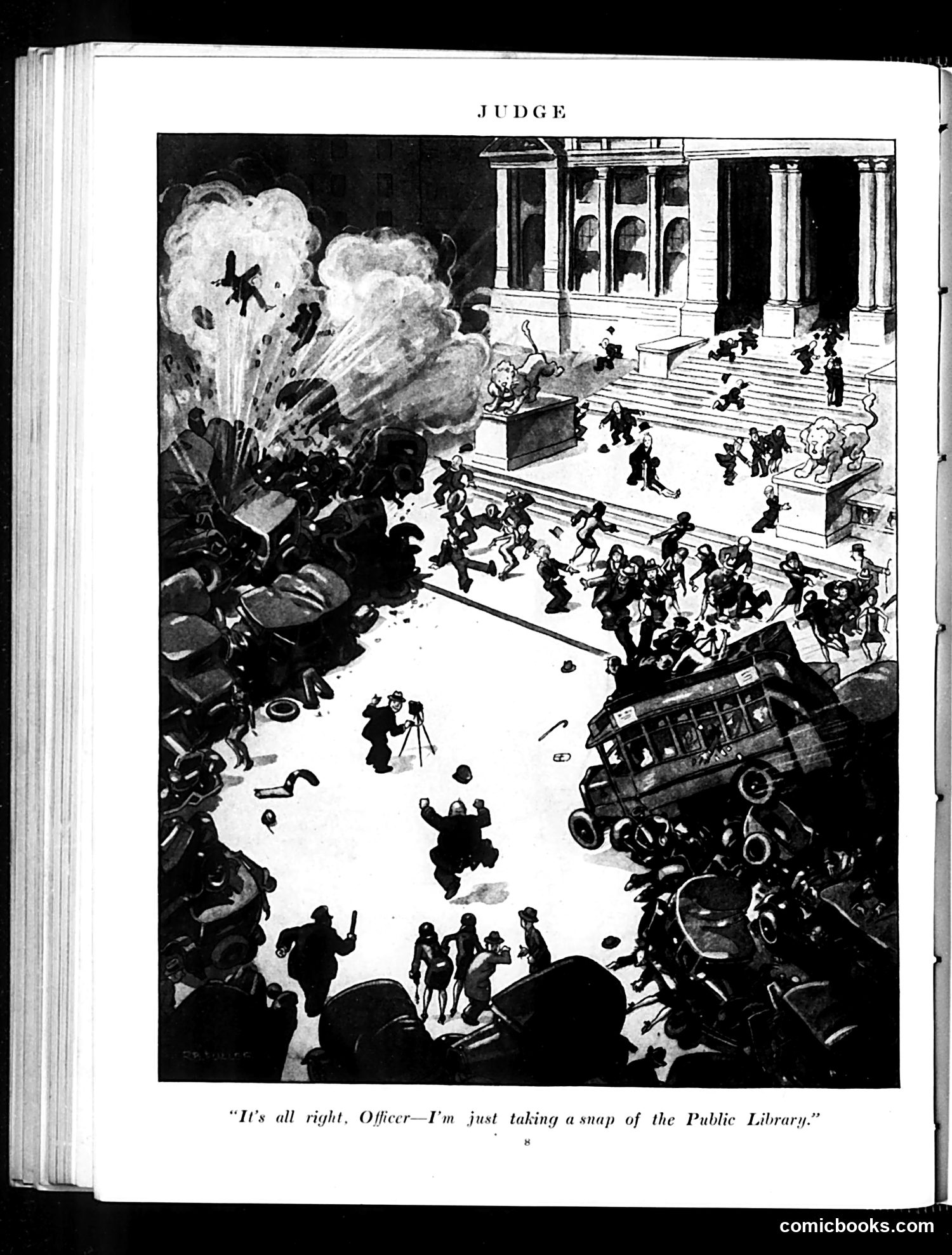
This Judge magazine cartoon satirizes the destruction of public institutions during civil unrest. The scene depicts chaos outside a grand courthouse or civic building, with explosions, fires, overturned vehicles, and crowds in disorder on the steps and plaza. The humor is darkly ironic: a man tells a police officer he's "just taking a snap of the Public Library"—suggesting he's looting or destroying it—while claiming everything is "all right." The officer appears to accept this absurd excuse during the mayhem around them. The cartoon likely comments on either labor riots, anti-government violence, or civil disorder of the early 20th century, mocking both the perpetrators' casual attitude toward destroying shared public resources and the authorities' apparent inability or unwillingness to stop such destruction. The juxtaposition of civility ("It's all right, Officer") with anarchic violence creates the satirical effect.
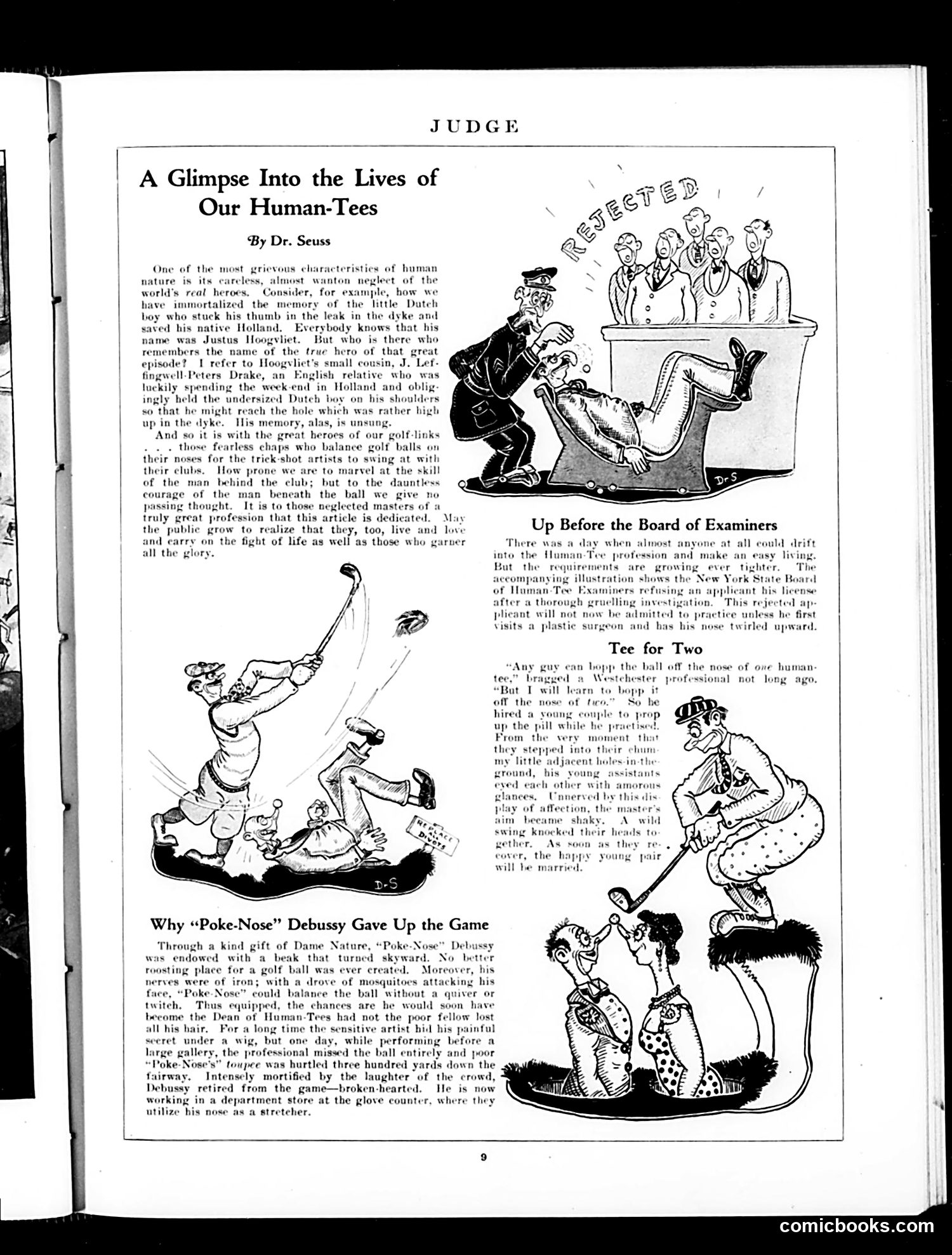
This 1920s satirical piece lampoons golf's obsessive culture by imagining "Human-Tees"—people used as living golf tees. The humor works on multiple levels: **The Setup:** Seuss critiques society's tendency to glorify famous figures while ignoring unsung heroes. His example: everyone knows the Dutch boy who plugged the dyke, but forgets the boy holding him up. **The Satire:** Three vignettes follow showing golf professionals who've become famous despite physical disabilities or mishaps—yet society celebrates the golfers, not these brave "Tees." One character ("Poke-Nose" Debussy) abandons golf after his toupee flies off during a public match, causing ridicule. **The Point:** The cartoons mock both golf's triviality and society's misplaced values—we celebrate those who *use* talent while ignoring those who *enable* it. The exaggerated illustrations emphasize the absurdity of this human-as-equipment concept.
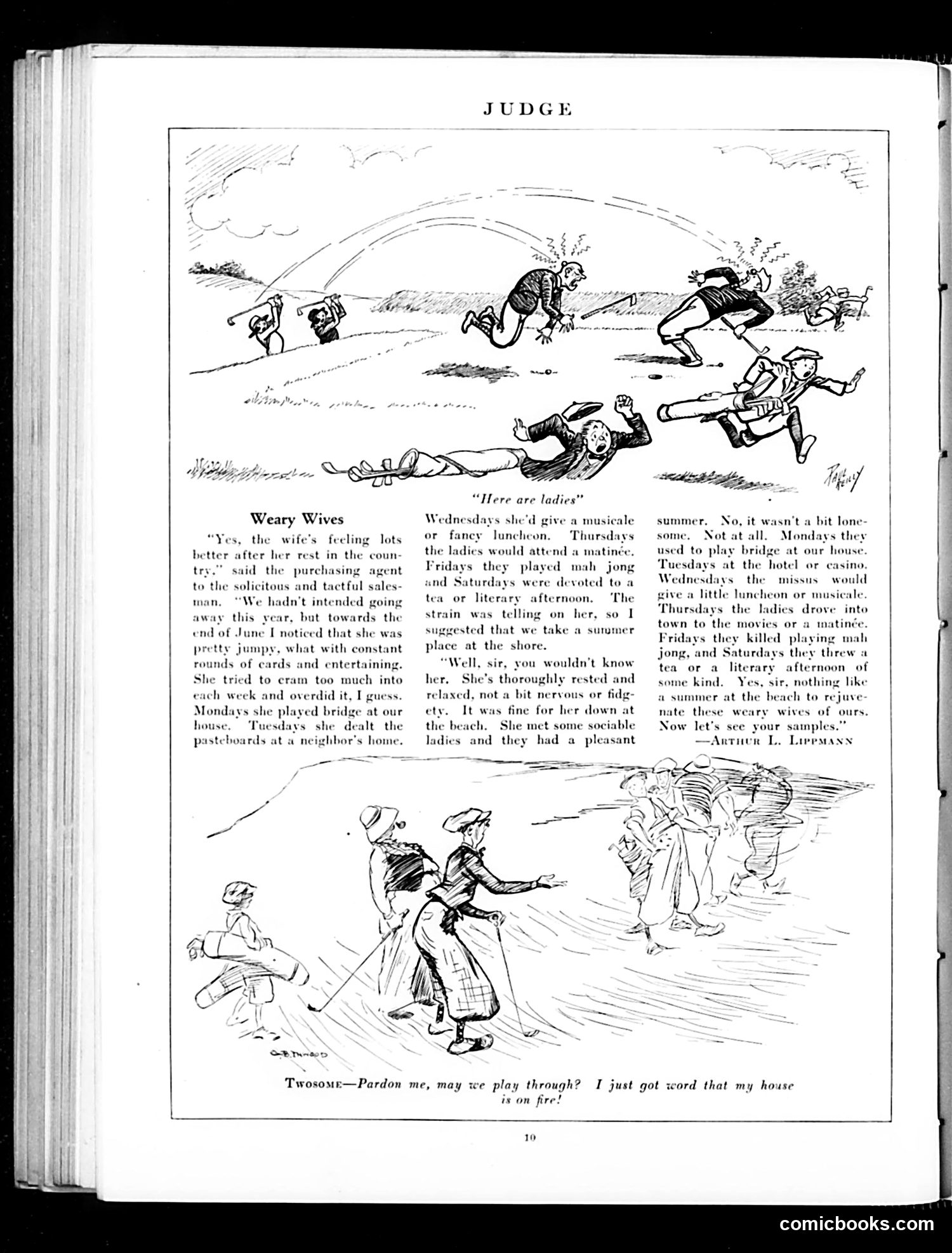
This page satirizes the exhaustion of upper-middle-class wives circa early 20th century. The humor hinges on irony: a husband believes a beach vacation will rest his wife from her exhausting social calendar of bridge games, luncheons, matinees, mah jong, and literary afternoons. However, she simply replicates the identical schedule at the shore, defeating the vacation's purpose. The bottom cartoon shows a woman interrupting a golf game—she's so caught up in social activities that leisure time intrudes everywhere. The satire critiques both the shallow, activity-packed lives wealthy women led and the obliviousness of husbands who think a location change will solve the problem. The wife wasn't tired from the *activities* themselves but from their relentless repetition—which she voluntarily recreates. The joke exposes how wives filled time with meaningless engagements to maintain social status.
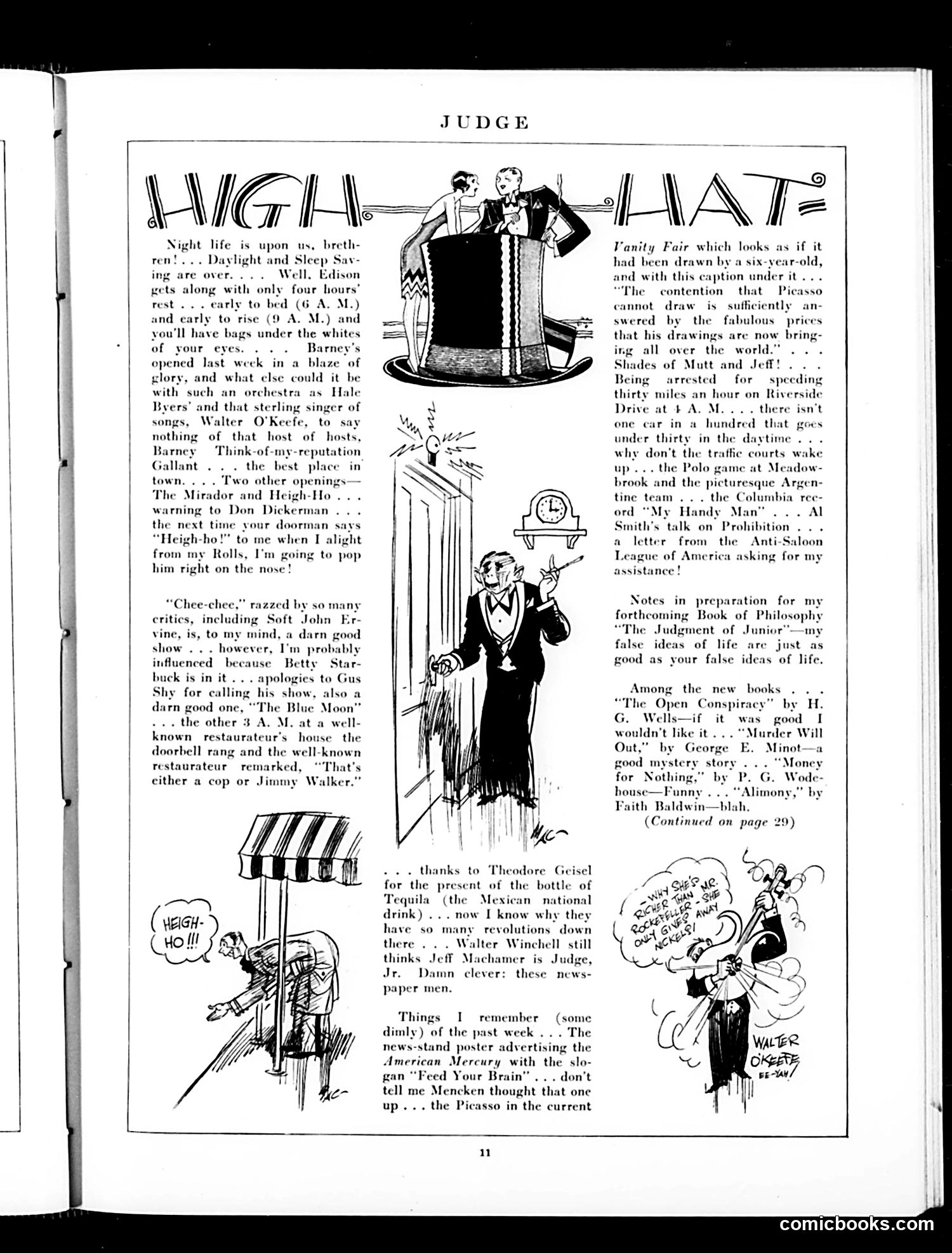
This is a **satirical gossip/commentary column** by what appears to be the magazine's editor, written in a breezy, name-dropping style typical of 1920s entertainment journalism. **Key references:** - **Nightlife openings**: References to new venues like "The Mirador" and "Heigh-Ho," featuring entertainer Walter O'Keefe - **Picasso controversy**: Mocks criticism of Picasso's abstract art by noting high prices justify his work's value—satirizing how art market hype overrides artistic merit - **Traffic/Prohibition era**: Comments on speeding arrests and references to the Anti-Saloon League (Prohibition enforcement) - **Book reviews**: Brief quips on contemporary literature, including H.G. Wells and P.G. Wodehouse - **Tequila/Mexican revolutions**: A joke thanking Theodore Geisel (later Dr. Seuss) for tequila, with a quip about Mexico's political instability - **H.L. Mencken reference**: Jabs at the editor of *American Mercury* magazine The tone is **gossipy, irreverent, and self-consciously witty**—typical Judge magazine commentary mixing entertainment industry chatter with light social satire.
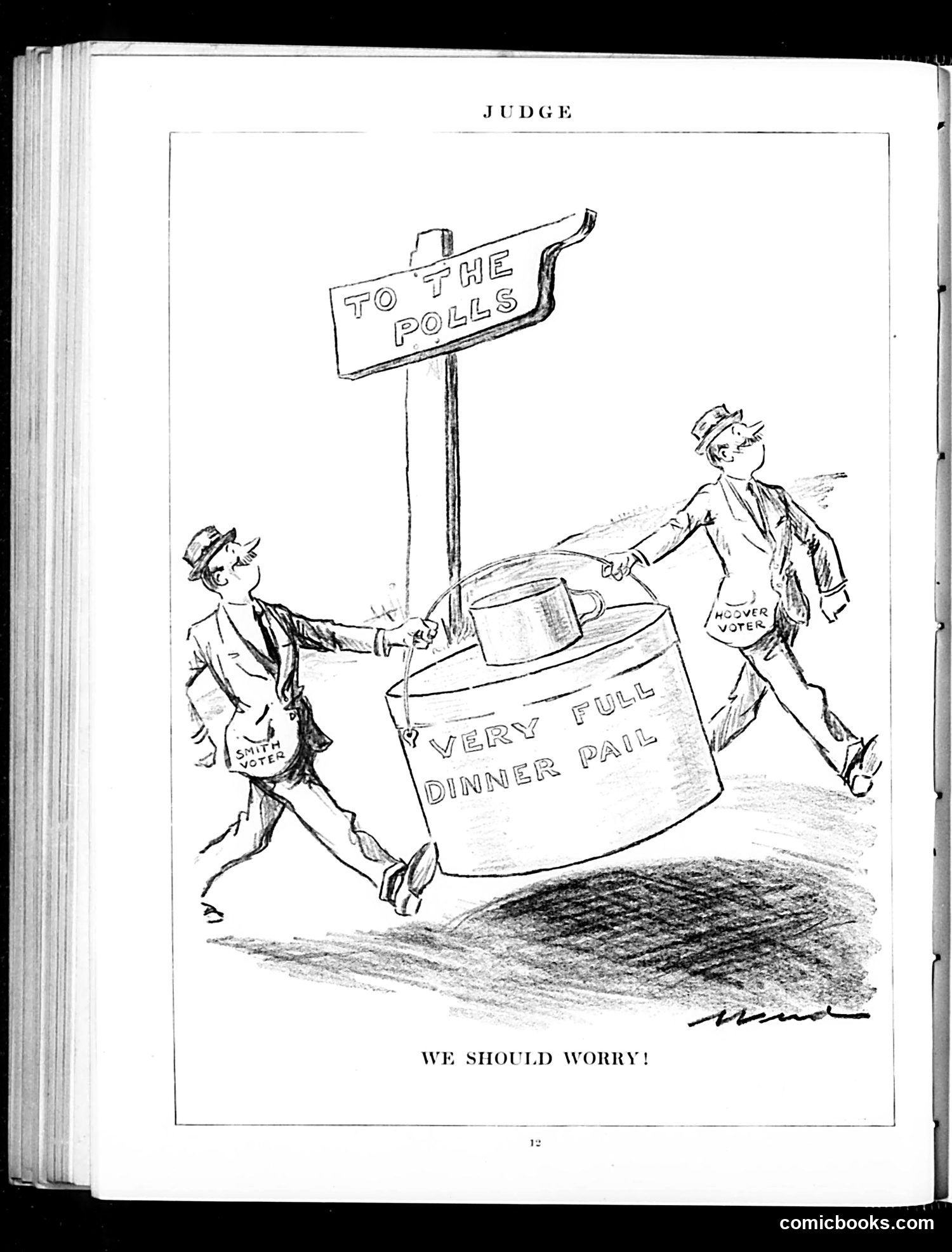
This political cartoon shows two men labeled as "voter" carrying a large pot marked "EVERY FULL DINNER PAIL" toward a signpost reading "TO THE POLLS." The title "We Should Worry!" suggests ironic reassurance. The cartoon satirizes voters' concerns about economic security during an election. The "full dinner pail" was a campaign slogan promising prosperity and employment. The figures appear confident despite carrying their hopes to the polls, but the ironic title suggests the cartoonist doubts whether voting will actually deliver on these promises. This likely reflects early 20th-century anxieties about whether elections genuinely address working-class economic needs, or merely offer false reassurances.
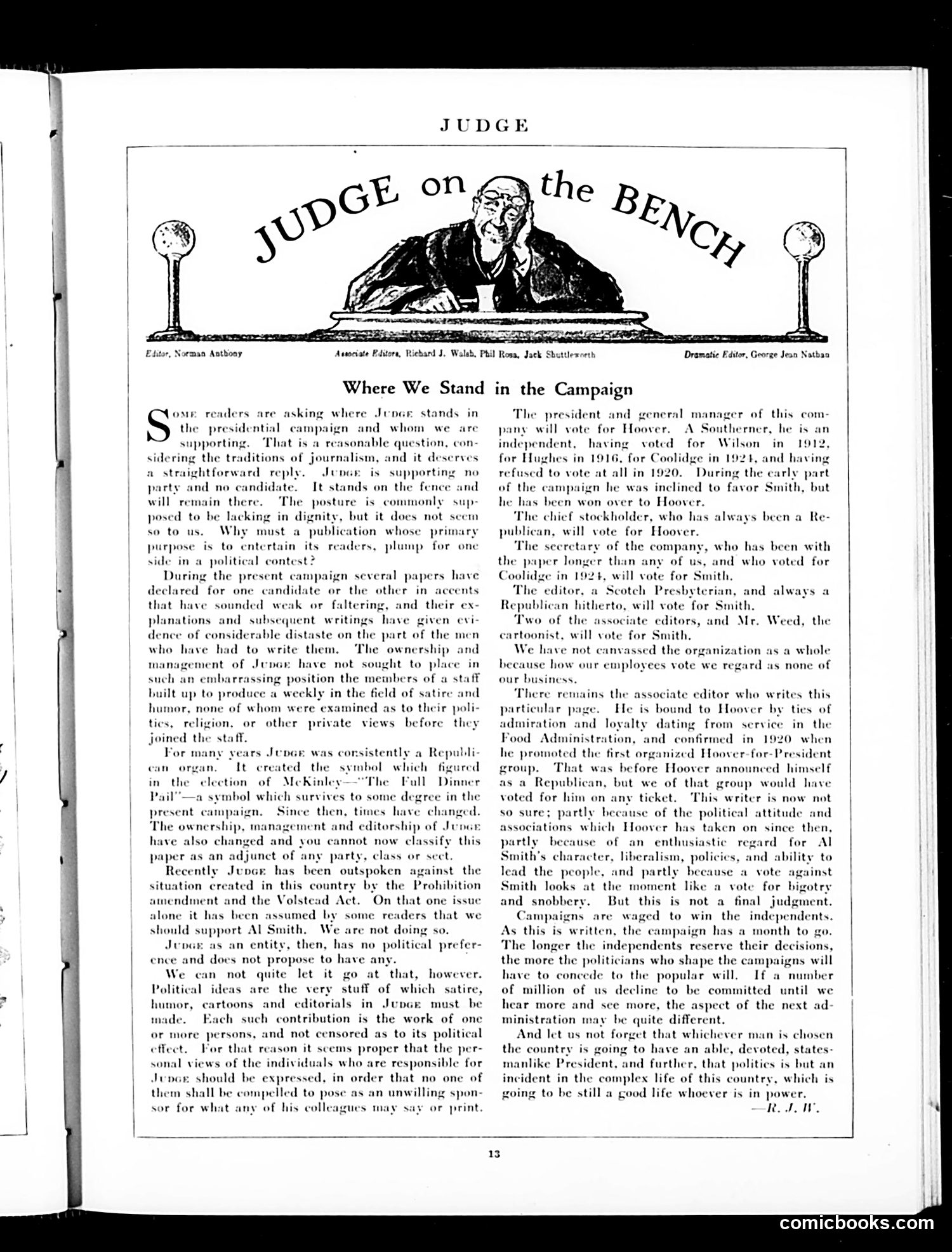
This page presents Judge magazine's official position on the 1928 presidential campaign between Republican Herbert Hoover and Democrat Al Smith. The masthead cartoon shows a judge on the bench—a visual pun on the publication's name. The editorial declares Judge will remain neutral ("on the fence"), though it acknowledges the staff's individual political views vary significantly. Notably, the editor himself—a "Scotch Presbyterian" and lifelong Republican—plans to vote for Smith, while the president and major stockholder support Hoover. The magazine explicitly refuses to endorse either candidate, arguing that satirical publications shouldn't be constrained by partisan loyalty. The piece also references Judge's historical opposition to Prohibition (the Volstead Act), which some readers mistakenly interpreted as support for Smith, the wet candidate. Judge clarifies this doesn't determine their overall position. This reflects the tension between journalism's emerging independence and the era's partisan expectations.
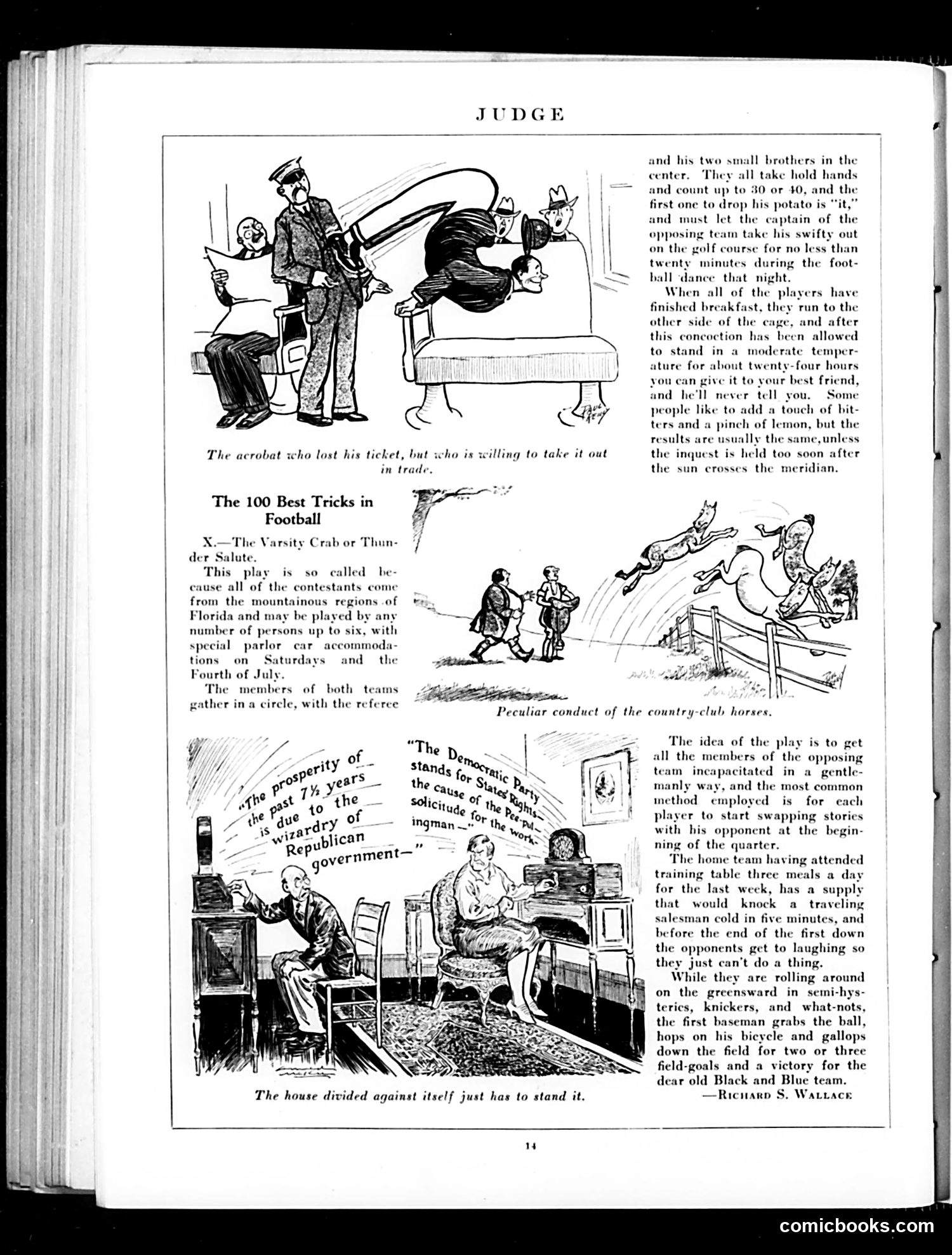
This page satirizes American politics and football culture circa early 1900s. The main cartoon, "The house divided against itself just has to stand it," depicts a domestic argument over politics—likely referencing the 1896-1912 era when the Republican and Democratic parties were sharply divided. The figures appear to be a husband and wife quarreling over party allegiance (visible text fragments mention "Democratic party" and "Republican government"), suggesting satirical commentary on how political divisions poisoned American households. The surrounding football "trick" content parodies absurdist sports logic and college culture excess—frivolous plays, elaborate travel accommodations, and alcohol-fueled team traditions. This juxtaposes trivial football spectacle against serious political fracture, implying Americans obsessed over sports while their nation remained politically "divided against itself." The satire critiques both partisan rigidity and the distracting escapism of popular entertainment.
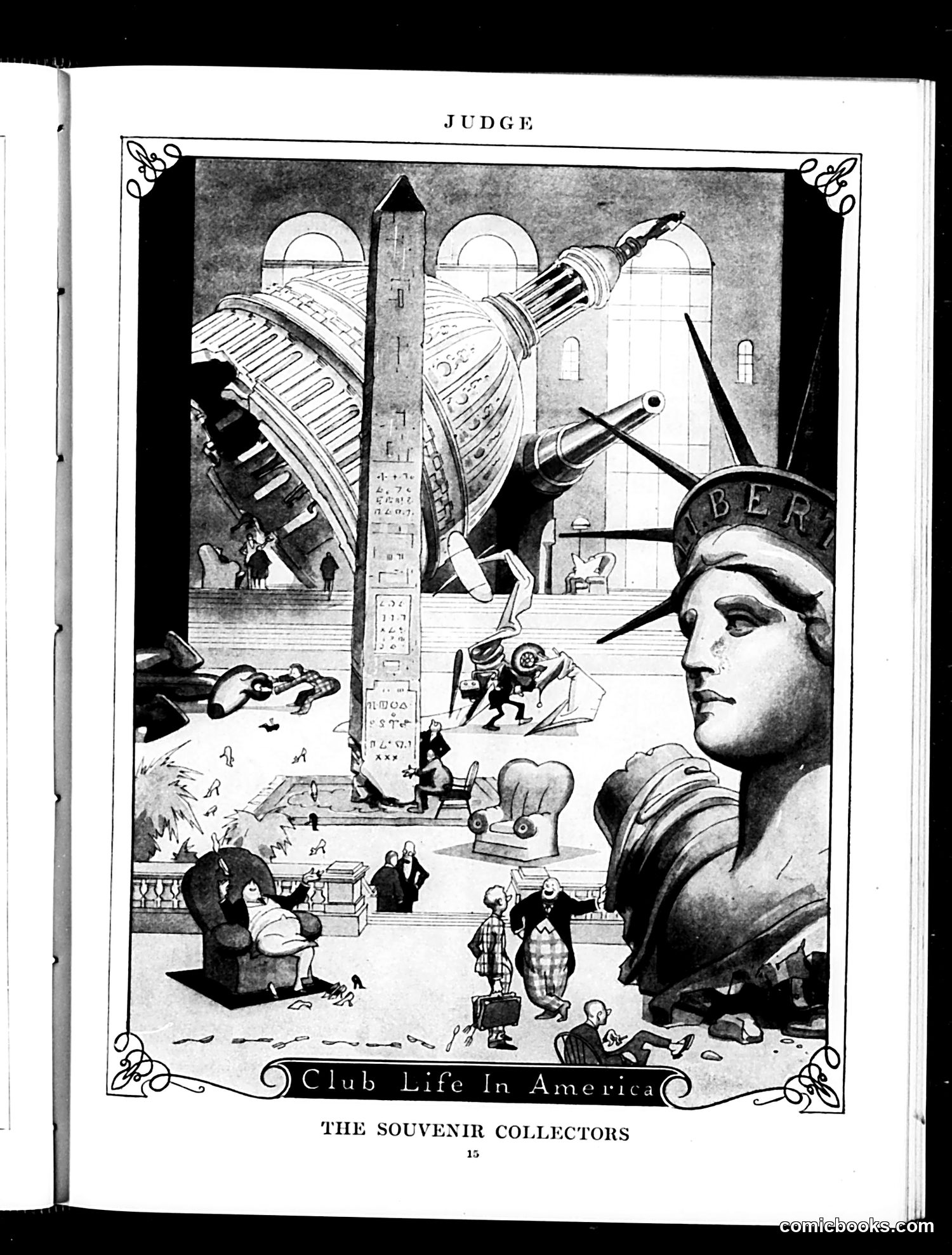
This satirical illustration depicts a giant figure wearing a spiked "Berlin" helmet (identifying him as German/Prussian) observing tiny human figures collecting souvenirs amid architectural ruins and military wreckage. The scene shows civilians gathering artifacts from destroyed buildings, crashed aircraft, and military equipment scattered across a devastated landscape. The cartoon appears to satirize European (particularly German) tourism and souvenir-collecting practices in the aftermath of World War I. It mocks the seemingly casual approach to collecting memorabilia from sites of destruction and death. The massive militaristic German figure looming over the scene suggests commentary on German militarism's role in creating these ruins, while the "souvenir collectors" represent the darker impulse to commodify or trivialize war's devastation.
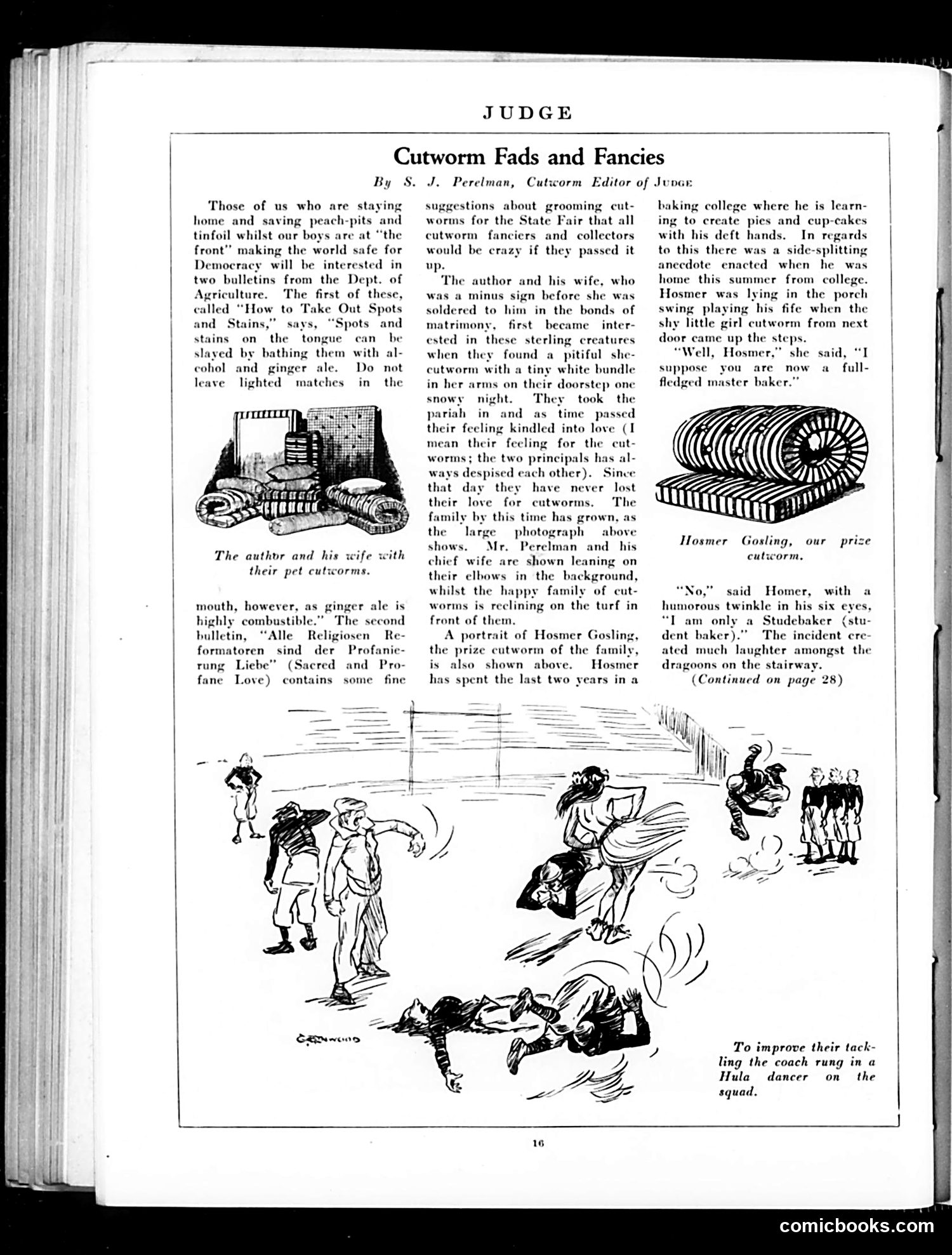
This is a humorous piece by S.J. Perelman satirizing wartime absurdity and agricultural bulletins. While Americans were sacrificing for WWI ("making the world safe for Democracy"), the Department of Agriculture issued bizarre advice about removing tongue stains and—more ridiculously—grooming cutworms for state fairs. The satire focuses on Perelman and his wife's supposedly genuine obsession with pet cutworms, complete with a prize specimen named Hosmer Gosling who attends "baking college." The joke culminates in a pun: when asked if he's become a master baker, Hosmer replies he's only a "Studebaker" (student baker)—a play on the automobile brand. The bottom illustration appears unrelated: it shows a football team with a Hula dancer added as coaching staff, another absurdist jab at contemporary trends. The humor targets both wartime rationing anxiety and the gap between serious national priorities and frivolous civilian pursuits.
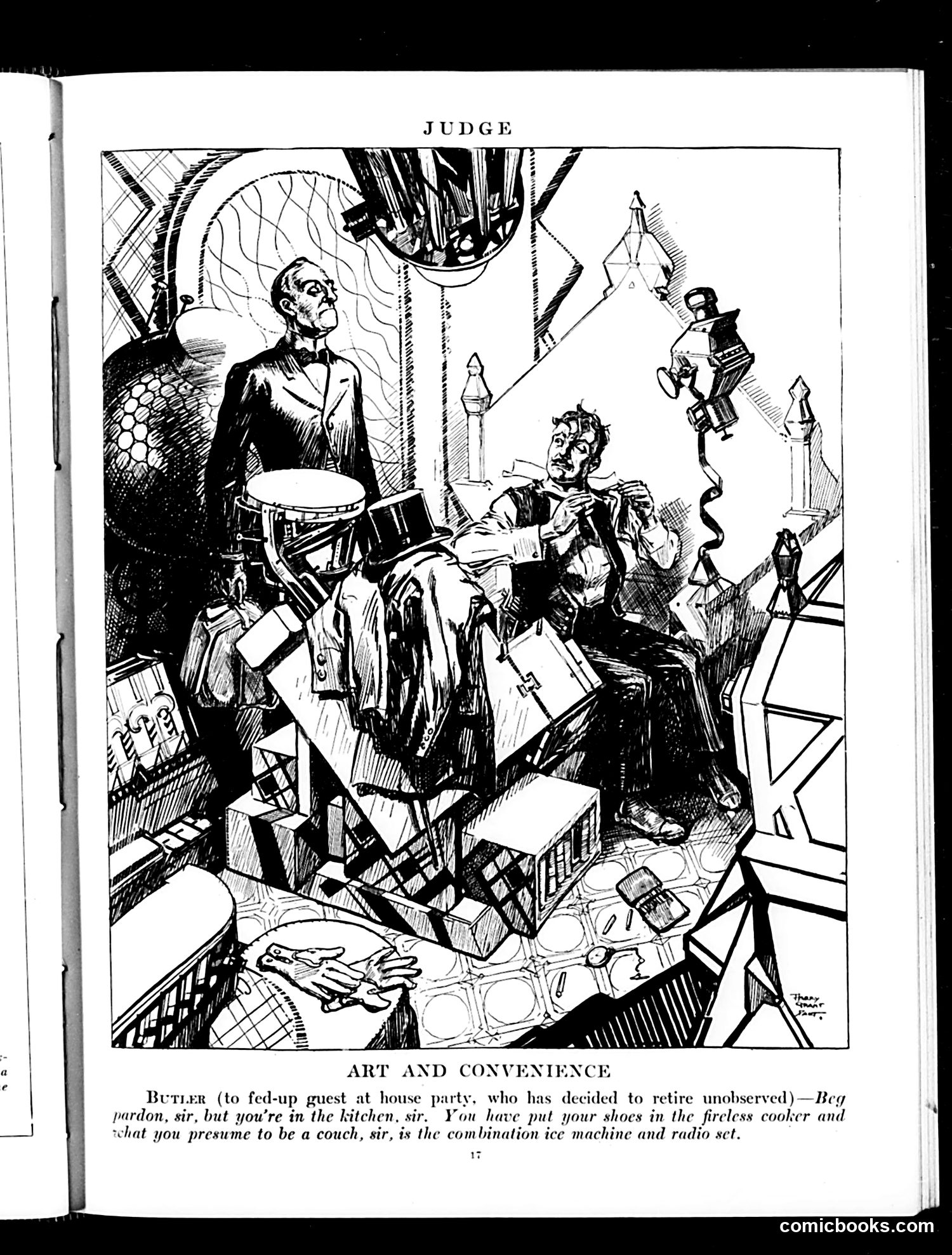
This satirical cartoon mocks the impracticality of modern appliances disguised as furniture. A fed-up party guest, attempting to sneak away for rest, has unknowingly placed his shoes in a "fireless cooker" and tried to nap on what he thought was a couch—actually a "combination ice machine and radio set." The humor targets 1920s-30s design trends that prioritized technological novelty and space-saving over basic functionality and clarity. The butler's formal correction emphasizes the absurdity: modern "convenience" has become so poorly integrated into household design that guests can't distinguish appliances from furniture. The cartoon satirizes both consumer culture's obsession with gadgetry and interior design's failure to serve actual human needs—a commentary that likely resonated with Judge's middle-class readership navigating the rapid, sometimes bewildering modernization of home life.
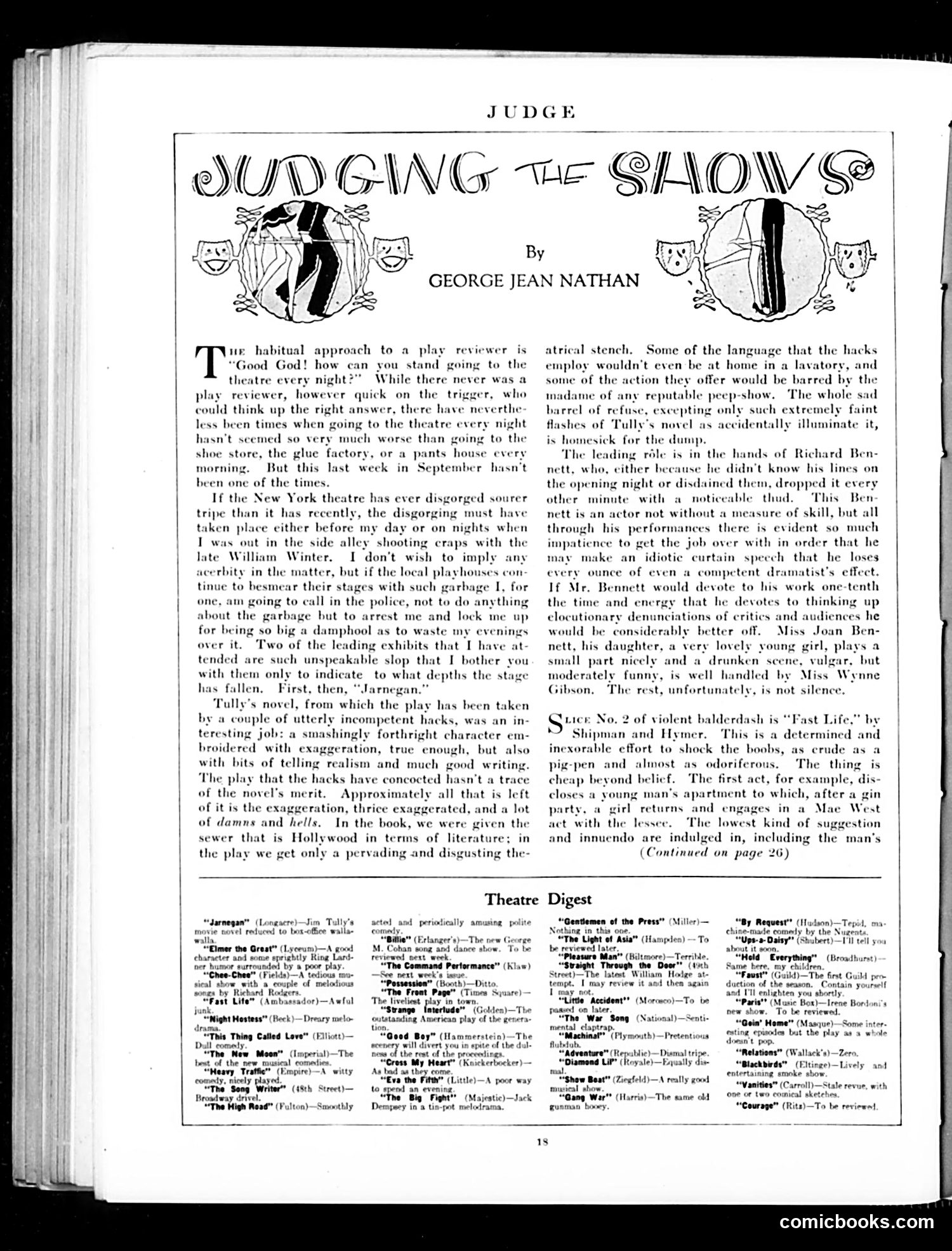
This page features George Jean Nathan's theatrical review column attacking two Broadway productions with savage wit. Nathan, a prominent drama critic of the era, dismisses "Jarnegan" (adapted from Jim Tully's novel) as incompetent hack work—excoriating its obscene language, exaggerated acting by Richard Bennett, and complete loss of the source material's merit. He reserves equally scathing criticism for "Fast Life" by Shipman and Hymer, calling it crude shock-theater designed to offend ("boobs"). The satire targets both the plays themselves and theatrical pretension generally. Nathan mocks playgoers who endure nightly theater-going, comparing it unfavorably to visiting glue factories. His barbs—calling the productions "damns and hells," "pervading disgusting theatrical stench," and "cheap beyond belief"—exemplify the acerbic, profanity-adjacent criticism Nathan was known for. The column represents early-twentieth-century highbrow theater criticism's contempt for commercial Broadway mediocrity.
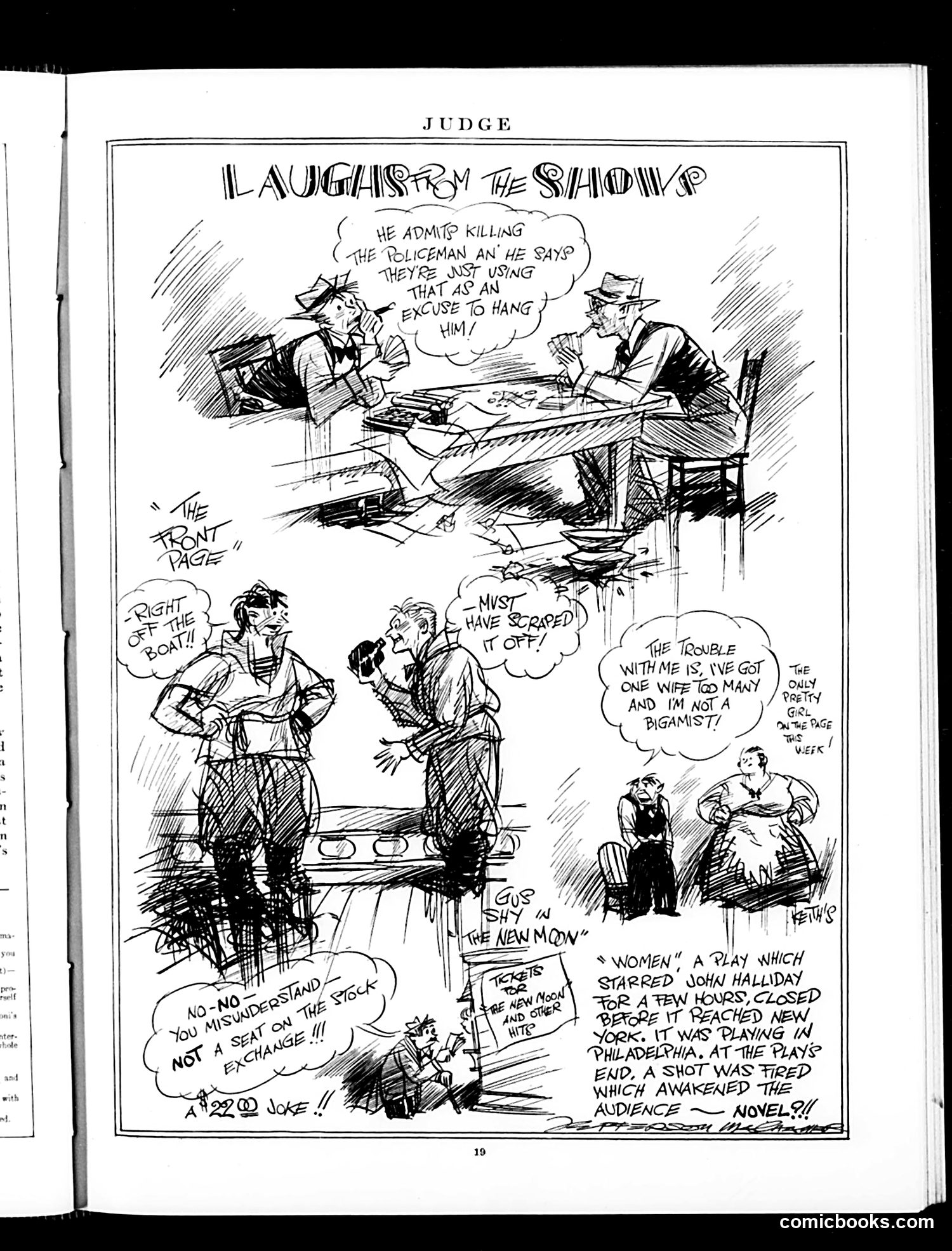
This is a multi-panel cartoon satirizing a Broadway play called "Women" starring John Halliday. The play closed in Philadelphia before reaching New York after a shot was fired during performance, which awakened the audience. The cartoon depicts men discussing the incident with crude humor. The upper panel shows two figures debating whether killing a policeman justifies hanging someone. Lower panels include maritime/nautical jokes about "getting off the boat" and marital infidelity gags about "one wife too many" and accusations of bigamy. The satire targets both the sensational theater scandal and contemporary attitudes toward law enforcement, marriage, and entertainment. The crude dialogue and slapstick illustrations are typical of Judge's early-20th-century satirical style, mocking both the incident's seriousness and the men's reaction to it.
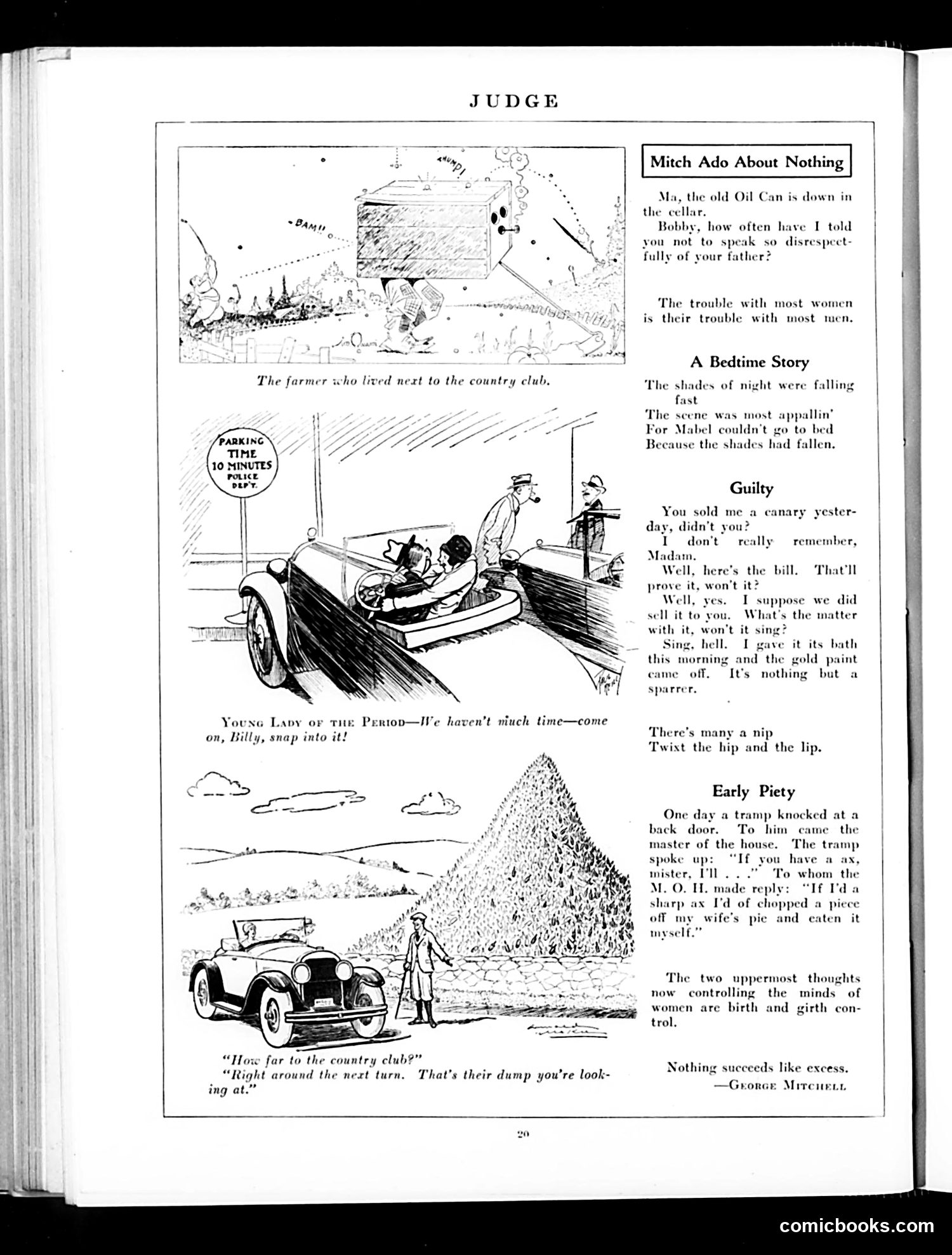
This page collects several satirical humor pieces targeting early 20th-century social conventions: **Main cartoons:** Two sketches mock the wealthy and automobiles. The first shows a couple racing to a country club; the second depicts them passing a large haystack, which a local dismissively calls "their dump"—mocking nouveau riche pretension. **Text humor pieces** include: - A mother offended when her son disrespectfully calls his father "the old Oil Can" (a cheapskate) - A vendor caught selling a "canary" that's actually a sparrow with painted gold coating - A tramp's crude joke about chopping pie from his wife **Social satire targets:** Women's role anxieties (birth control and weight management), class aspirations among the newly wealthy, marital discord, and working-class irreverence toward authority. The magazine mocks both upper-class pretension and lower-class vulgarity. Recurring themes: women's "trouble with men," infidelity anxiety, and consumerism's emptiness. The satirical tone assumes readers share disdain for social climbers and appreciate crude humor.
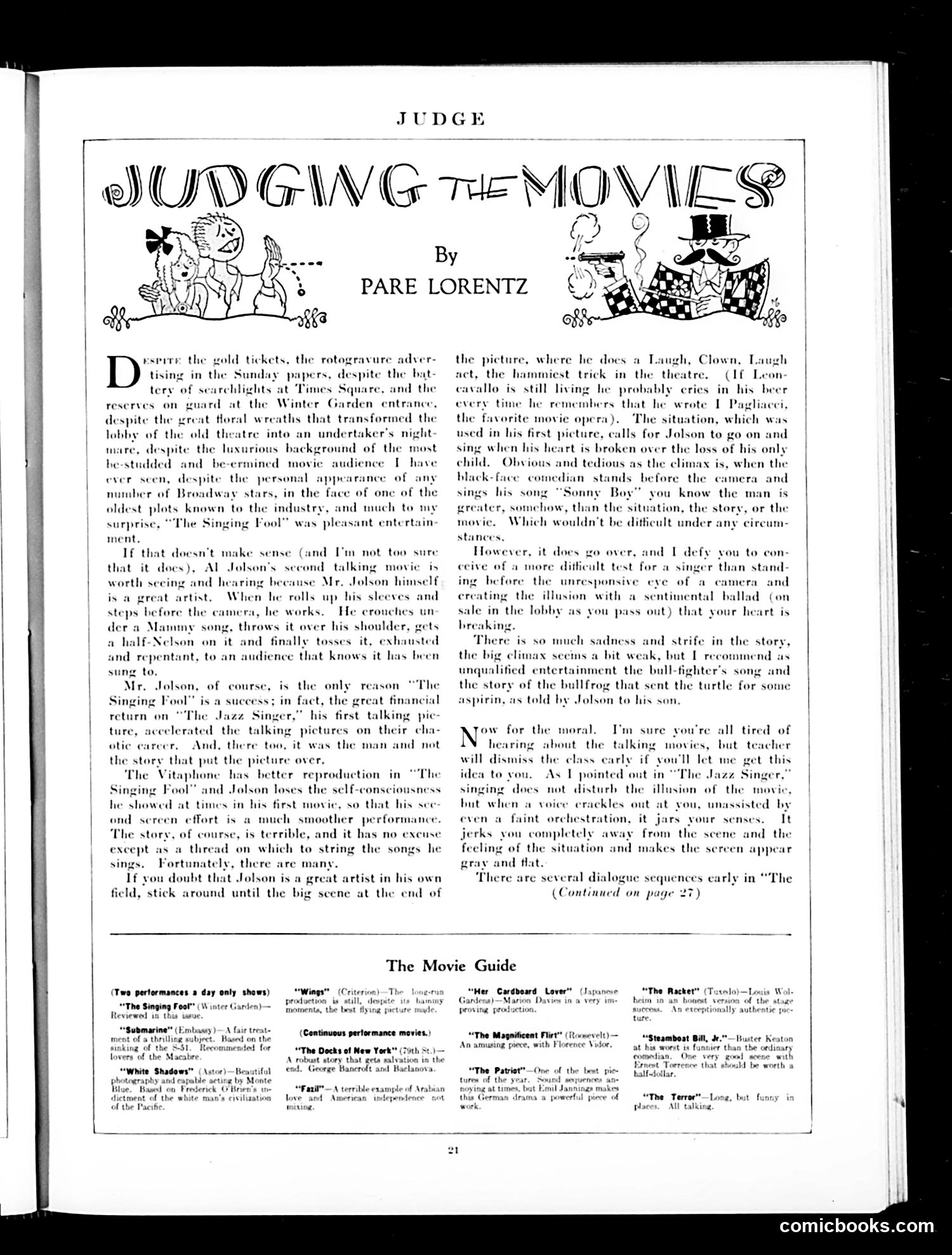
This is a film review column, not a political cartoon. Critic Pare Lorentz assesses Al Jolson's second talking picture, *The Singing Fool* (1928). **The Subject:** Lorentz argues that Jolson—not the film's weak plot—is the draw. He praises Jolson's talent as a performer, noting his physical comedy and vocal power can overcome terrible material. The reviewer criticizes the film's story as "one of the oldest plots known to the industry" but acknowledges Jolson's emotional performance in the climactic "Laugh, Clown, Laugh" scene rescues the picture. **Key Point:** Lorentz makes a technical observation about talking pictures: dialogue that intrudes without musical accompaniment "jars your senses" and breaks cinematic illusion, whereas sung performances integrate naturally into film. The page includes a "Movie Guide" section listing other contemporary films below the main review.
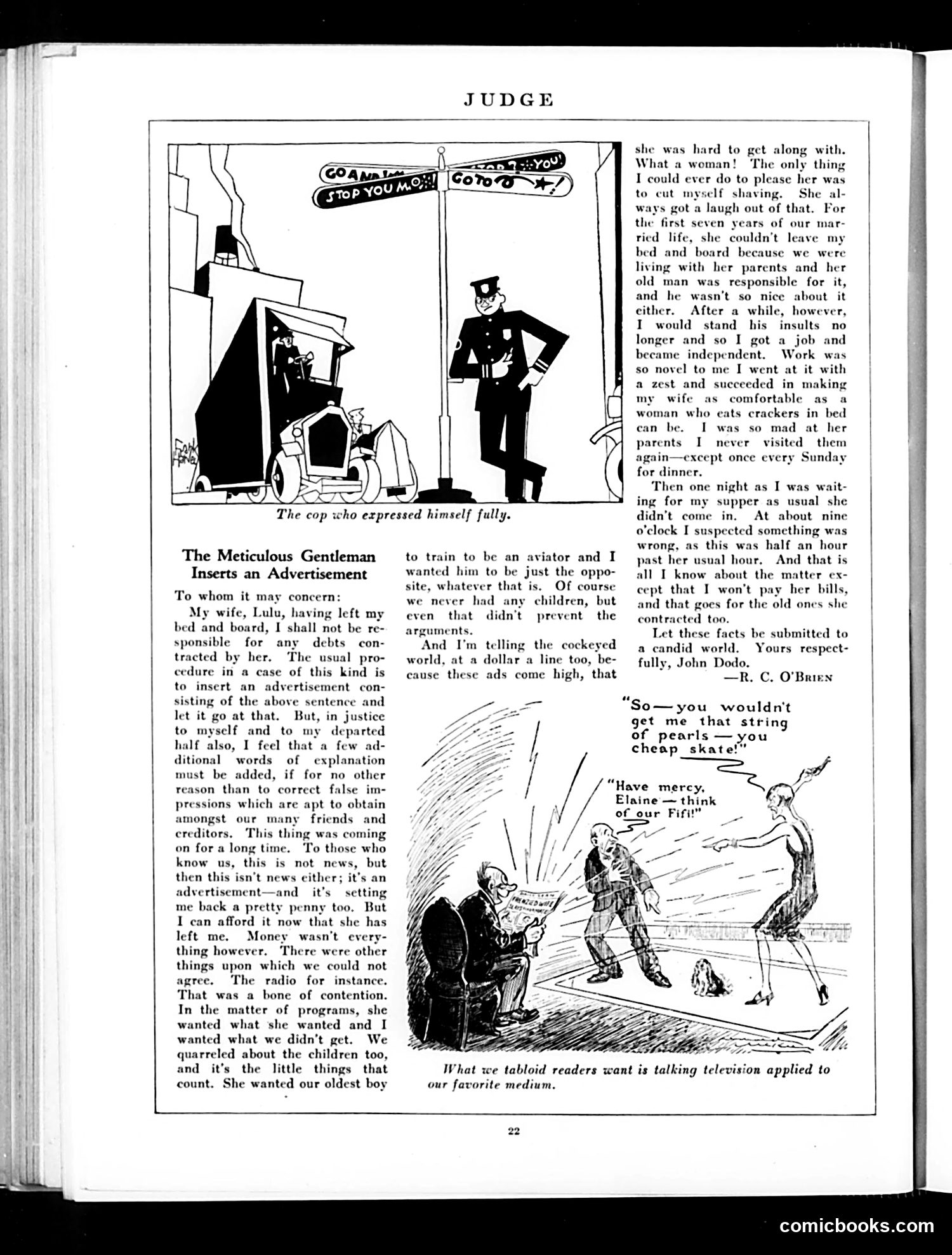
This page satirizes two distinct social phenomena: **"The Meticulous Gentleman" (main piece):** A lengthy, elaborate "abandoned wife" advertisement parodies the verbose, self-justifying legal notices common in newspapers. The humor lies in the protagonist's pedantic over-explanation—he's supposed to simply disclaim responsibility for her debts, but instead provides exhaustive grievances (radio program preferences, hypothetical children disagreements, in-laws). The absurdity peaks with "John Dodo" as a pseudonym, suggesting foolishness. The satire mocks both marital discord and the peculiar public nature of personal disputes aired through classified ads. **Lower cartoon:** Depicts a domestic quarrel about material goods ("string of pearls"). The caption requests "talking television applied to our favorite medium"—satirizing tabloid readers' apparent desire for sensationalized domestic drama with audio, suggesting *Judge* readers want radio drama applied to print journalism. Both pieces mock the era's obsession with public airing of private marital failures and the growing appetite for entertainment centered on domestic conflict.
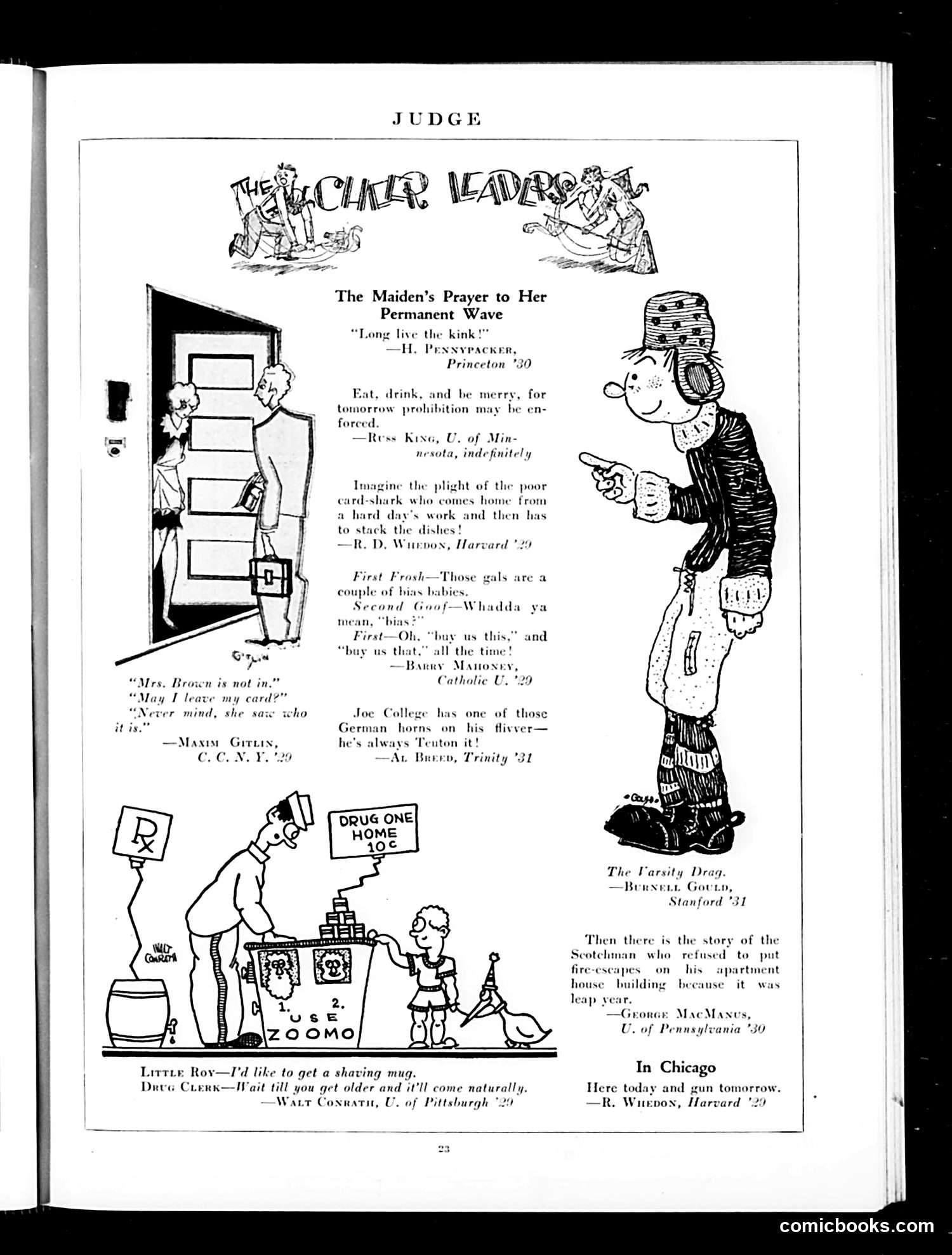
This page satirizes 1920s college culture and social trends through brief humorous quotes attributed to various universities. The central cartoon depicts "The Varsity Drag"—a popular dance of the era—shown as an exaggerated, mechanized figure. The jokes target contemporary concerns: **Prohibition** (the alcohol ban), **permanent waves** (newly fashionable women's hairstyles), **gender relations** (wives demanding purchases, maids avoiding housework), and stereotypical ethnic humor (a Scotsman's supposed frugality, "German horns" on cars). A lower cartoon depicts a drugstore soda fountain scene, referencing the era's youth culture and "drug store" as social hangouts during Prohibition. The satirical method is typical for Judge: mocking college students' affectations, modern social changes, and contemporary fads through exaggeration and crude caricature. The attributed quotes suggest these represent authentic student attitudes from Princeton, Harvard, Stanford, and other universities—likely fabricated for comedic effect.
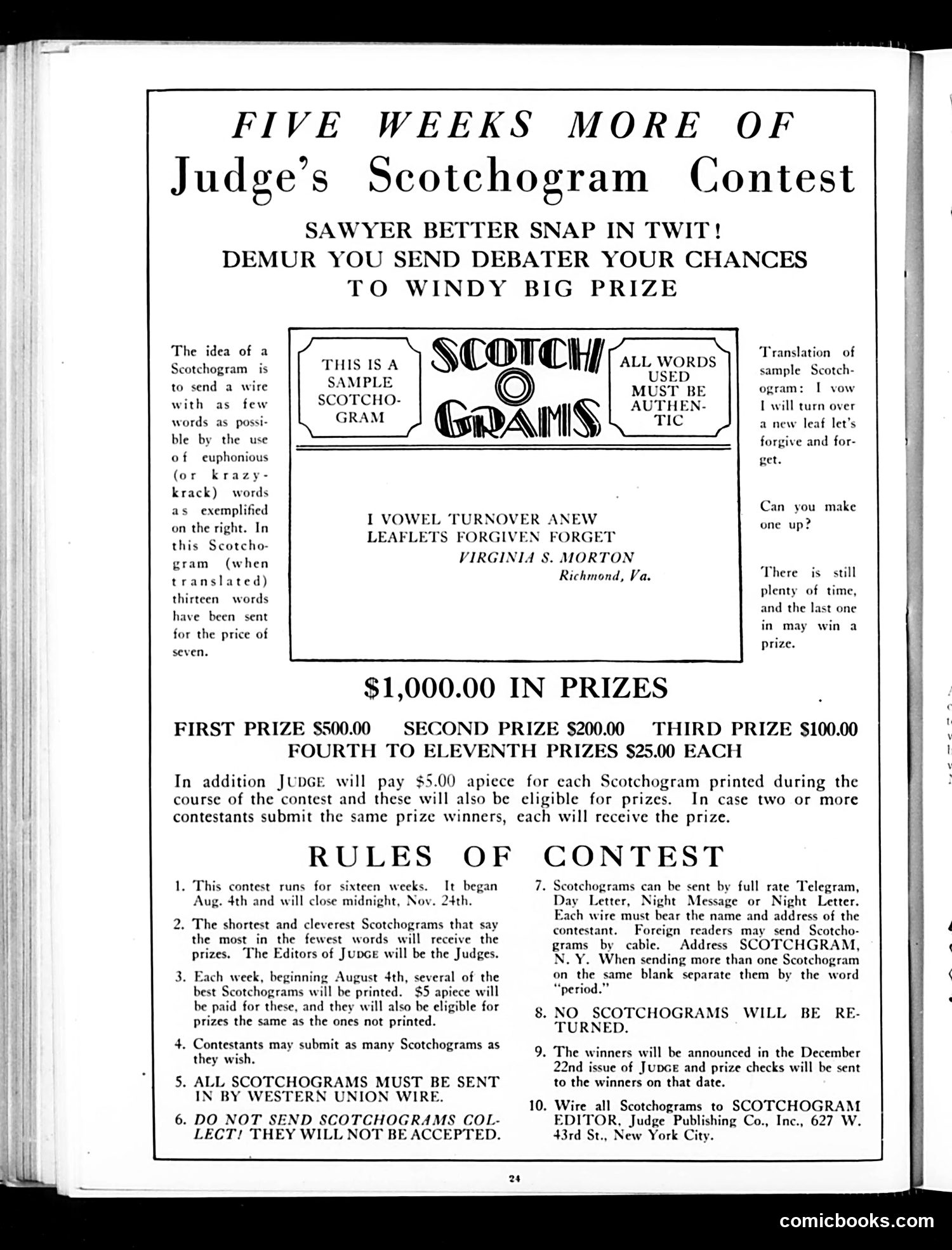
This is primarily a **contest advertisement**, not a political cartoon. Judge magazine is running a word-puzzle competition where readers create "Scotchograms"—extremely condensed telegraph messages using creative, euphonious words to convey meaning in the fewest possible words. The example shows "I vowel turnover anew leaflets forgiven forget" condensing to "I vow I will turn over a new leaf, let's forgive and forget." The contest runs 16 weeks (August-November) with $1,000 in total prizes. Entries must be sent via Western Union telegram. The appeal combines **wordplay cleverness with practical economy**—mirroring the real-world cost-savings of sending brief telegrams. The playful header language ("SAWYER BETTER SNAP," "DEMUR YOU SEND DEBATER") itself demonstrates the condensed style being promoted, creating a self-referential advertisement that models its own product.
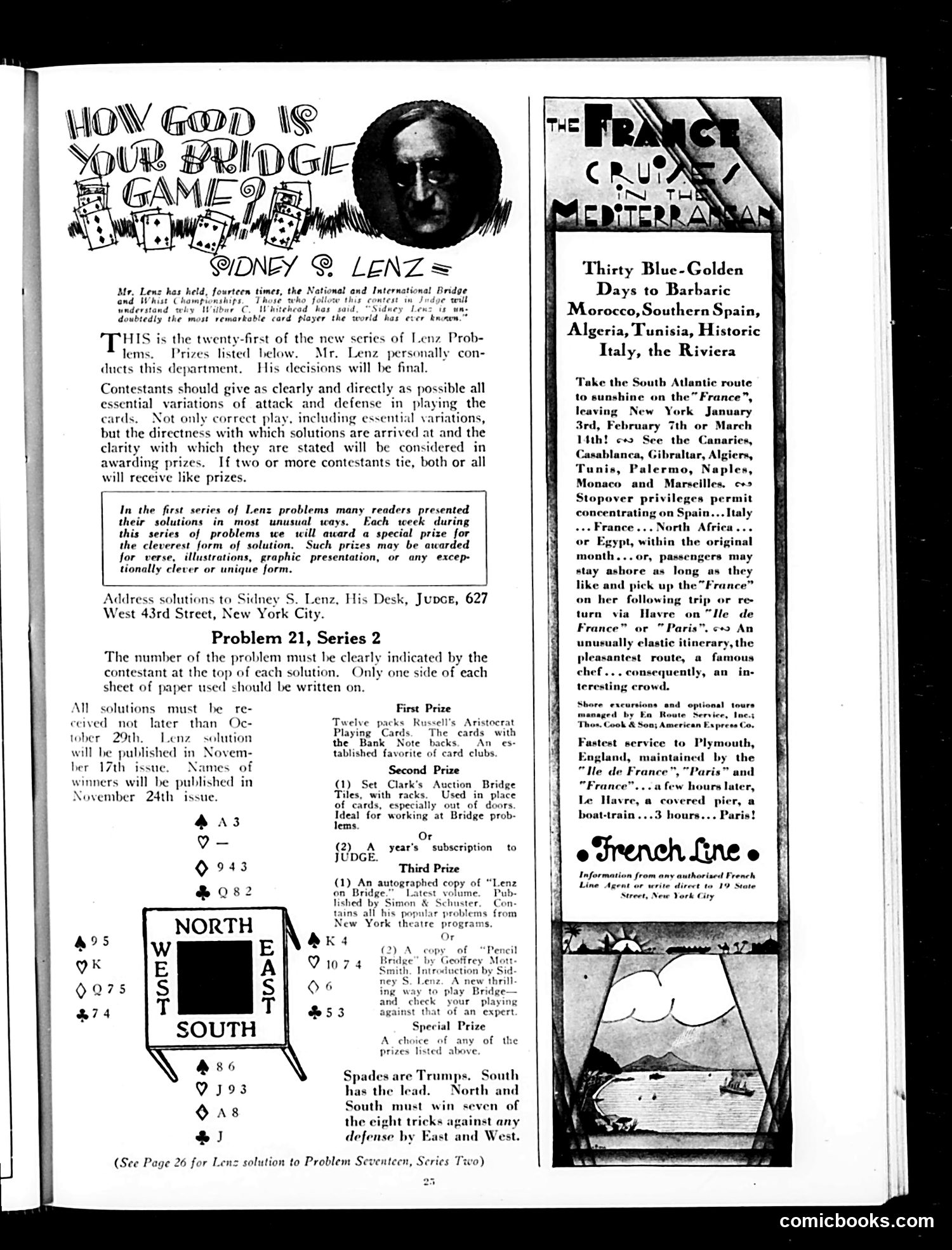
This page features a **bridge card game problem** by Sidney S. Lenz, a famous bridge champion. The circular portrait shows Lenz himself—identified in the header as having won fourteen national and international bridge championships and described as "undoubtedly the most remarkable card player the world has ever known." The content presents "Problem 21, Series 2"—a bridge puzzle where readers compete to solve card-playing scenarios. Lenz personally judges solutions, awarding prizes including playing card sets, a Judge magazine subscription, and autographed bridge instruction books. The page also contains **advertising** for the French Line steamship "France," offering Mediterranean cruises to North Africa and Europe. This reflects the 1920s-30s fascination with bridge as an intellectual pursuit and popular entertainment among educated audiences. Judge magazine used Lenz's expertise to attract readers interested in competitive card games.
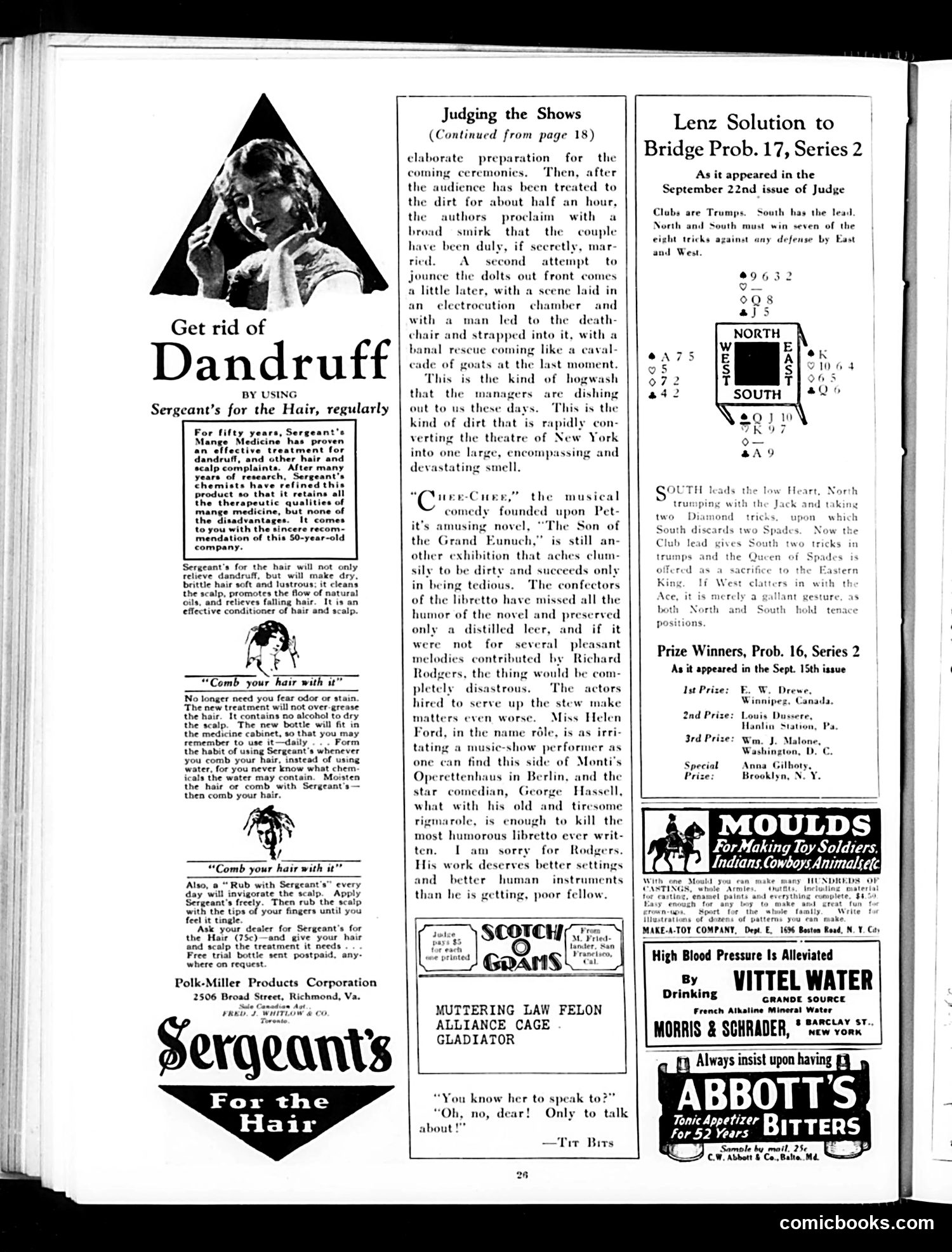
This page is primarily **advertising and puzzle solutions**, not political satire. **Main Content:** - Large advertisement for "Sergeant's for the Hair," a dandruff treatment (Polk-Miller Products Corporation) - "Judging the Shows" theater review criticizing contemporary musicals for being crude and tedious - Bridge problem solution - Prize winners from previous bridge competitions - Various product advertisements (Scotch Grains, Moulds toys, Vittel Water, Abbott's Bitters) **Theater Criticism Context:** The review attacks unnamed Broadway productions for relying on shock value—specifically mentioning an electrocution scene and sexual innuendo—rather than genuine humor. The critic dismisses "Chee-Chee," a musical adaptation based on a novel, as missing the source material's actual humor while preserving only "a distilled leer." **Historical Note:** This reflects early 1920s concerns about theatrical "dirtiness" and lowbrow entertainment standards. The tone suggests cultural anxiety about modernizing entertainment priorities. The page contains no political cartoons or caricatures—it's a standard magazine miscellany of ads and features.
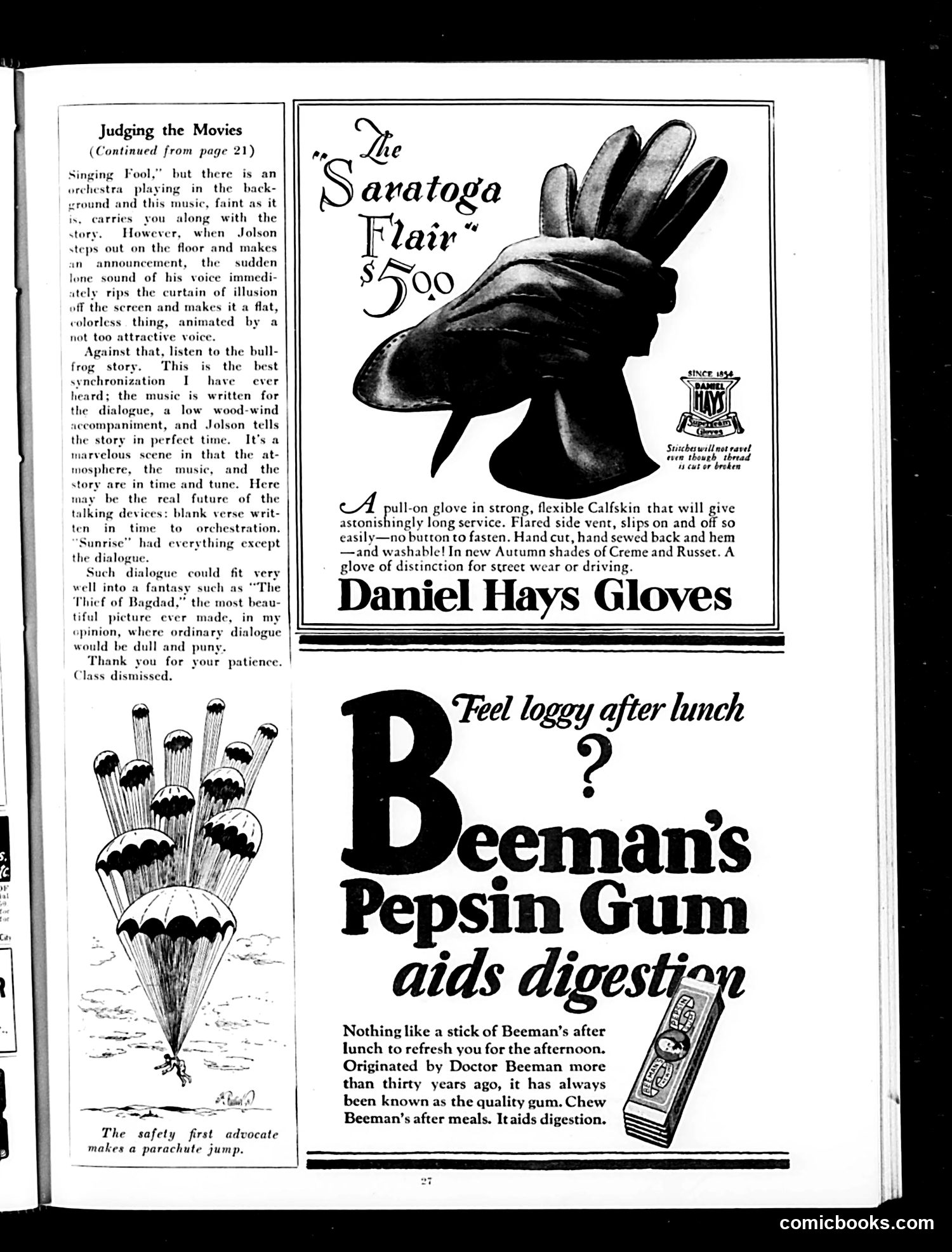
This Judge magazine page is primarily **advertisements with a brief film review column**. The "Judging the Movies" section critiques early sound films, comparing Al Jolson's performances in "Singing Fool" and a "bullfrog story" (likely "Singin' in the Rain"). The reviewer praises synchronized sound and music but criticizes Jolson's speaking voice as breaking the film's emotional illusion—a common complaint about early "talkies" when synchronized dialogue was still technically awkward. The cartoons are advertisements: Daniel Hays Gloves and Beeman's Pepsin Gum. The parachute jump illustration appears to advertise safety equipment (gloves for parachuting). The humor is minimal—mostly product marketing dressed up as editorial content, typical of 1920s magazines that blurred advertising and journalism. The "loggy after lunch" pun in the gum ad represents era-appropriate gentle wordplay.
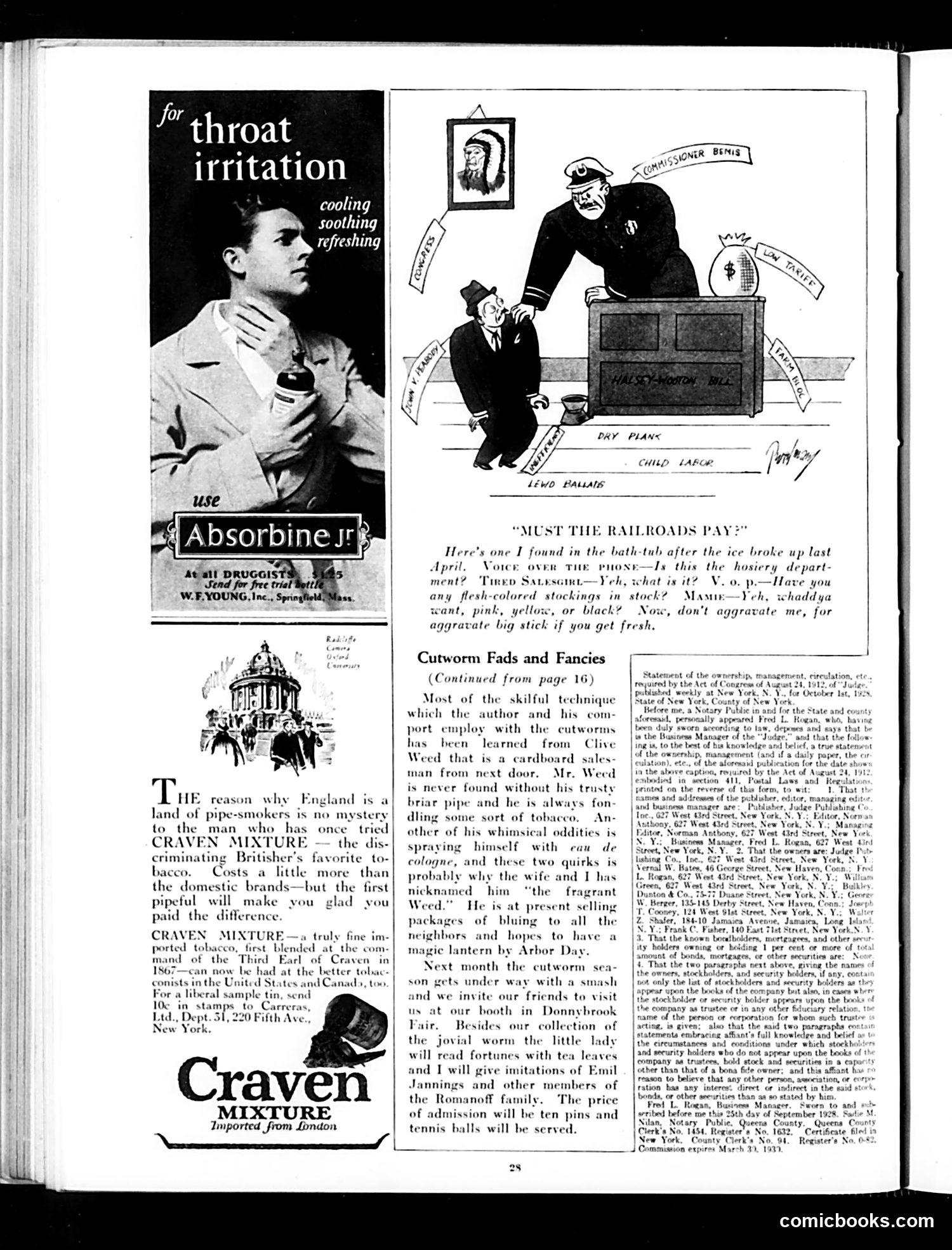
This page contains primarily **advertisements** for consumer products rather than political cartoons. The main visual content includes: 1. **Absorbine Jr. ad** (left): A throat-irritation remedy advertisement featuring a man using the product—straightforward product marketing. 2. **"Must the Railroads Pay?" cartoon** (top right): A humorous domestic dispute scene where a wife questions her husband about bath-tub finds and stockings. The "big stick" reference appears to be casual (threatening to hit if he gets fresh), not a political allusion. 3. **Craven Mixture tobacco ad** (bottom left): An import advertisement emphasizing quality British tobacco. 4. **"Cutworm Fads and Fancies" article** (right): A fictional humor piece about cutworms and various characters, with substantial fine-print disclaimers and property notices below. The page is primarily **commercial content** rather than political satire. The limited cartoon is domestic humor rather than social commentary. No identifiable public figures or political events are evident.
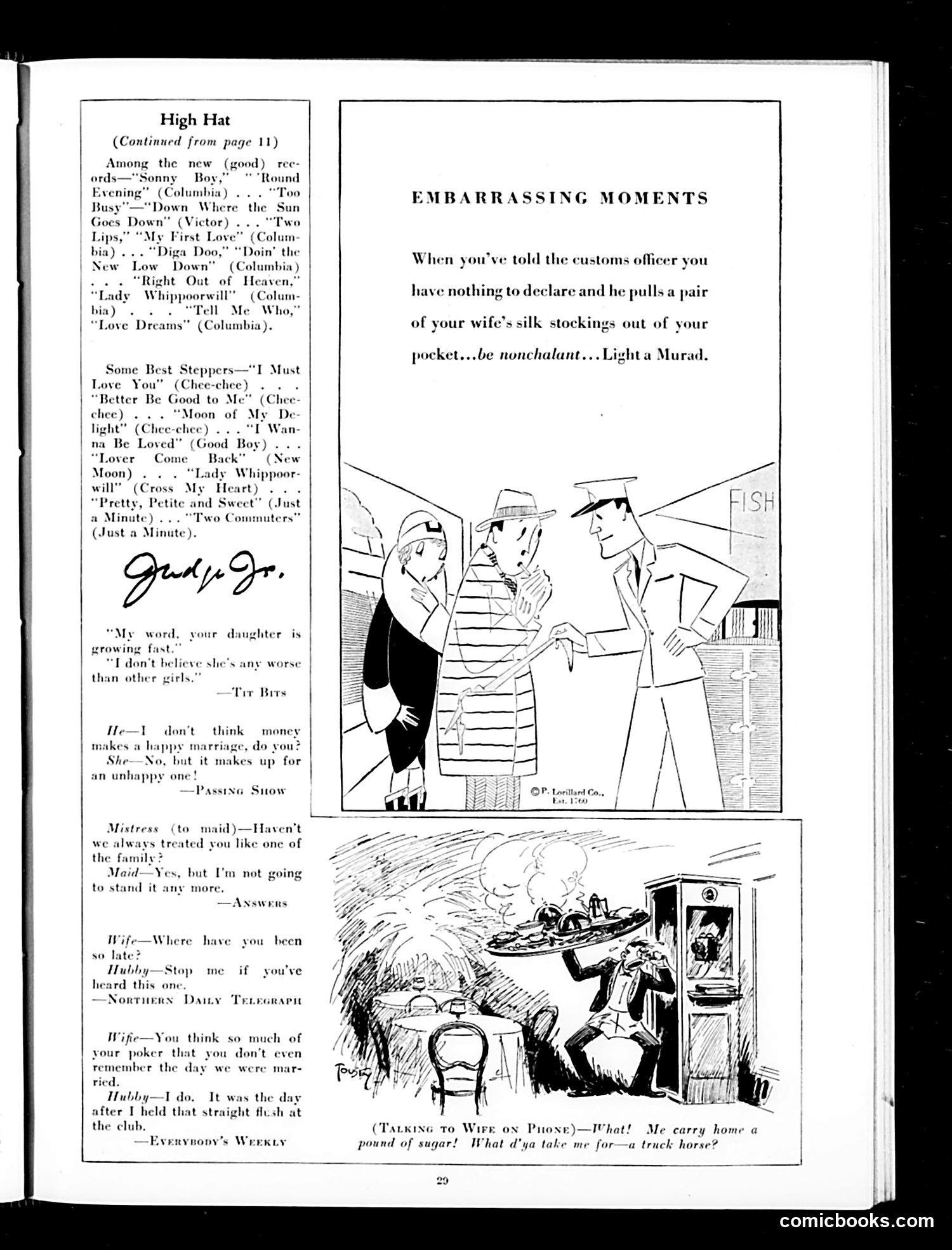
This page contains two distinct sections: **Left side**: A compilation of short humorous quotes and music recommendations ("High Hat" column), including jokes about marriage and gender dynamics typical of 1920s-30s humor—notably condescending observations about women's behavior and marital power dynamics. **Right side**: Two cartoon scenarios satirizing marital embarrassment and social awkwardness: 1. **Top cartoon**: A customs inspection scene where a husband is caught with silk stockings in his pocket—implying either infidelity or smuggling. The caption advises being "nonchalant" while smoking a Murad cigarette (an advertisement). The joke plays on the husband's suspicious predicament and suggests composure as the solution. 2. **Bottom cartoon**: A husband on the phone denying his wife's request to bring home sugar, humorously asking if she thinks he's a "truck horse." This mocks marital nagging and domestic obligations. Both cartoons reflect period anxieties about marriage, gender relations, and social propriety, while the advertisements integrate product placement into the humor.
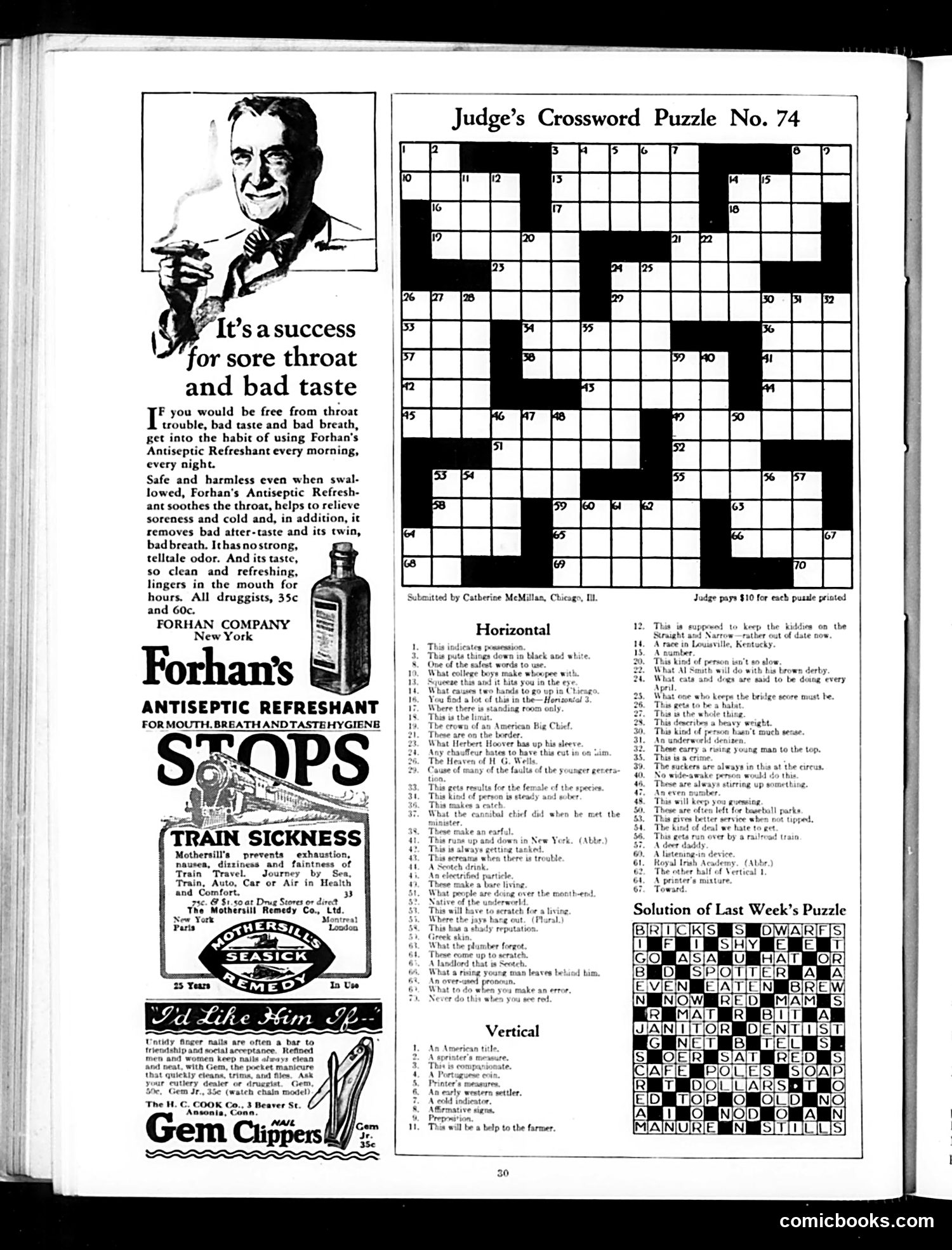
This page is primarily **advertising**, not editorial satire. It features vintage patent medicine and product ads typical of early-to-mid 20th century magazines. The main content includes advertisements for: - **Forhan's Antiseptic Refreshant** (throat lozenge/mouthwash) - **Mothersill's** (anti-nausea remedy for travel) - **Gem Clippers** (razors) The small cartoon at top-left appears to be a generic illustration of a man using the product, not a political figure or satirical commentary. The page also contains **Judge's Crossword Puzzle No. 74** with clues and a solution grid. **For modern readers:** This represents how magazines monetized through advertising, with dubious health claims (common before FDA regulation). The products promised cure-alls with minimal evidence—typical of the patent medicine era. No political satire or social commentary is present on this particular page.
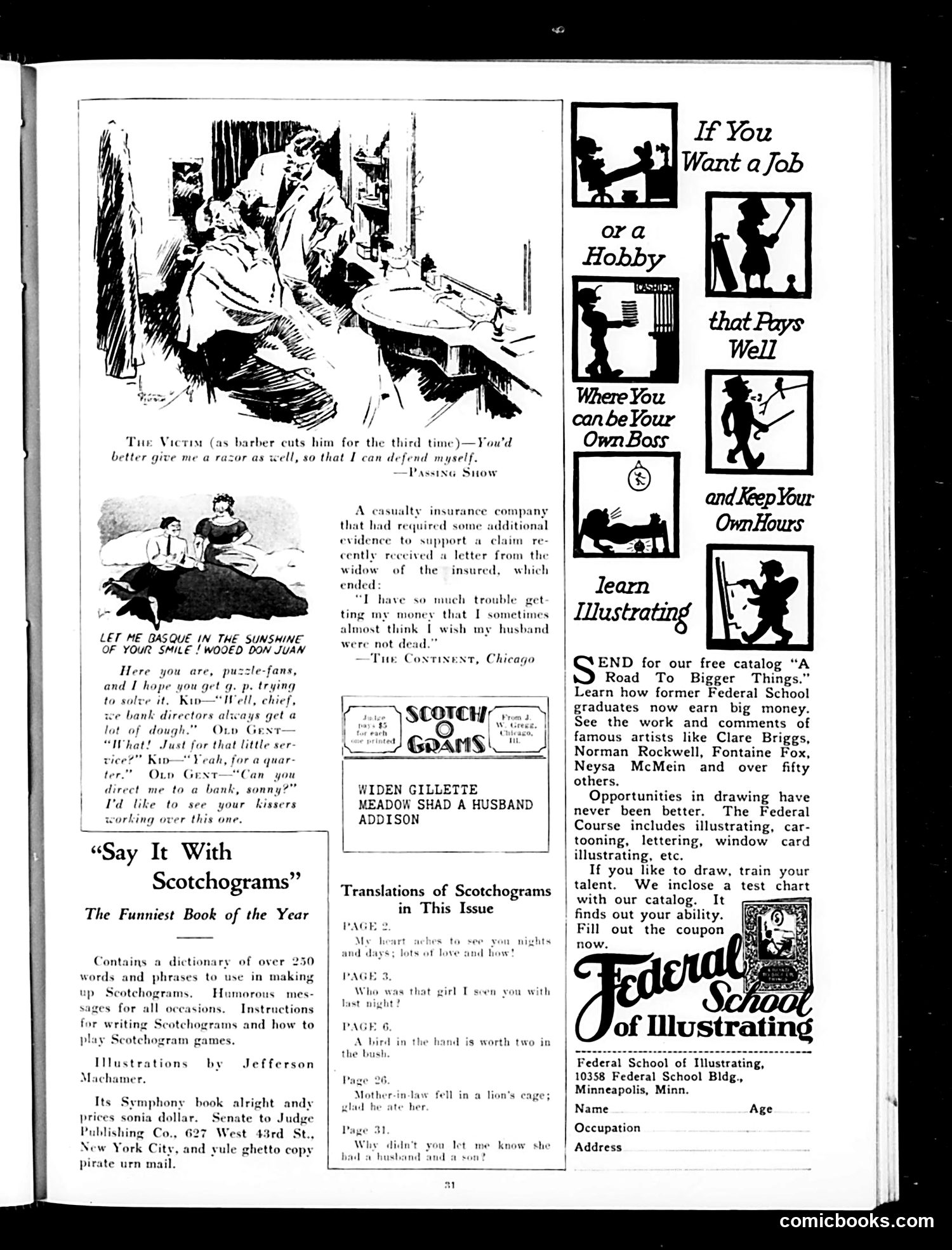
This page contains several satirical cartoons and advertisements from an early 20th-century American humor magazine. **Main Cartoon:** The top image depicts a barber repeatedly cutting a customer, who jokes he needs a razor for self-defense—likely satirizing either incompetent barbers or, possibly, anxieties about violence or crime of the era. **Puzzle Section:** A riddle mocking bank directors' wealth, suggesting they profit disproportionately from minor services. **"Scotchograms":** A Scottish-themed word game book being advertised. The translated examples below show ethnic humor typical of the period—playing on Scottish frugality and stereotypes, plus crude jokes (mother-in-law eaten by lion). **Sidebar Advertisement:** The Federal School of Illustrating recruits students by showcasing successful graduates like Norman Rockwell and Clare Briggs, promoting cartooning and commercial art as lucrative careers. The overall tone reflects 1920s-era ethnic comedy conventions and the emerging commercial art industry.
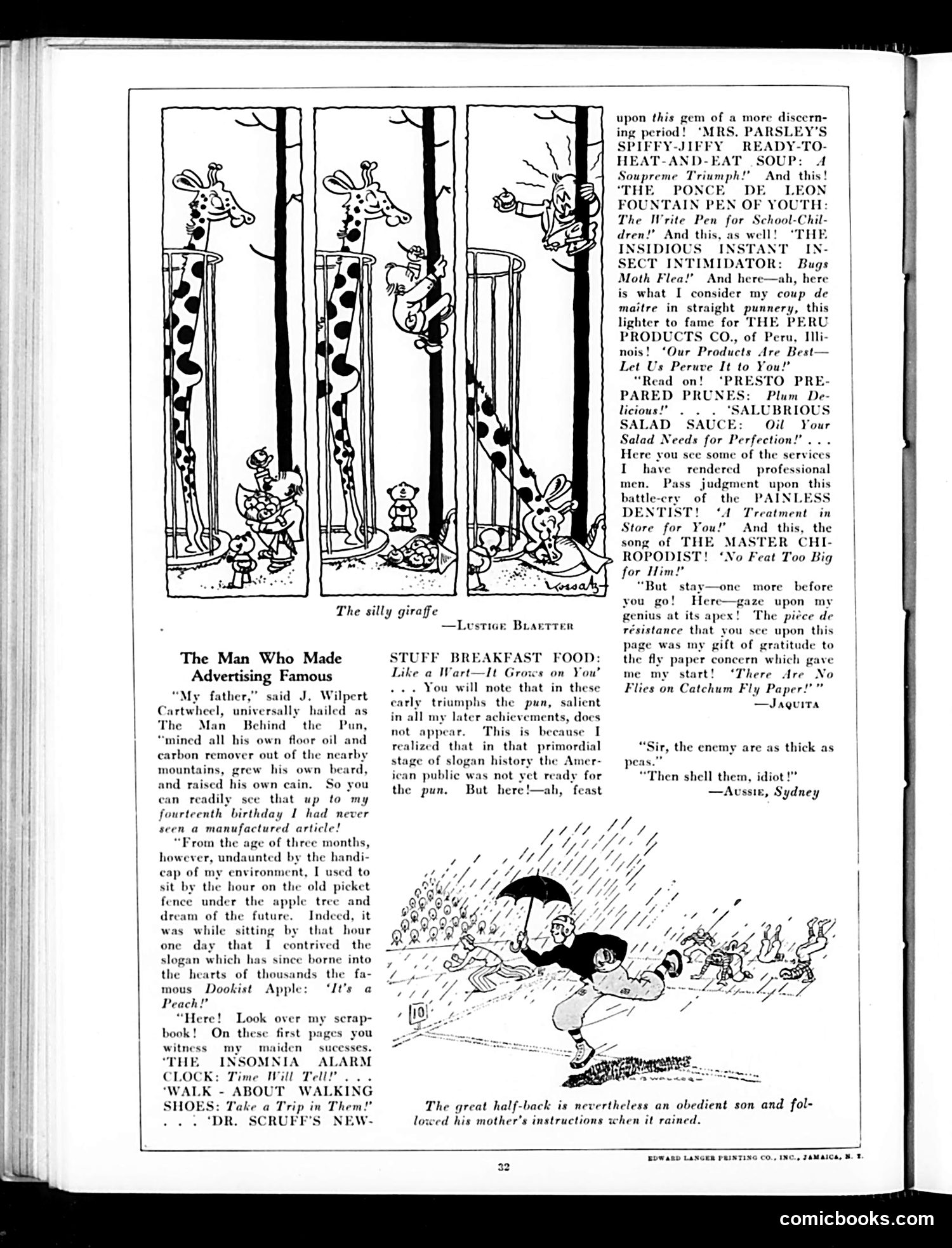
This satirical piece mocks the emerging advertising industry and pun-based slogans of early 20th-century America. The narrator, J. Wilpert Cartwheel, boasts about inventing famous advertising campaigns built entirely on terrible puns: "Dookist Apple: It's a Peach," "Mrs. Parsley's Spiffy-Jiffy Soup: A Soupreme Triumph," and "Catchum Fly Paper: There Are No Flies on Catchum Fly Paper." The satire targets how advertisers relied on cheap wordplay and dubious claims to sell products—a new and increasingly prevalent practice. By having Cartwheel present these groan-inducing puns as genuine achievements, Judge ridicules the low standard of commercial persuasion and the public's apparent acceptance of it. The accompanying cartoon (showing someone following mother's umbrella advice in rain) reinforces themes of blind obedience to authority and instruction.
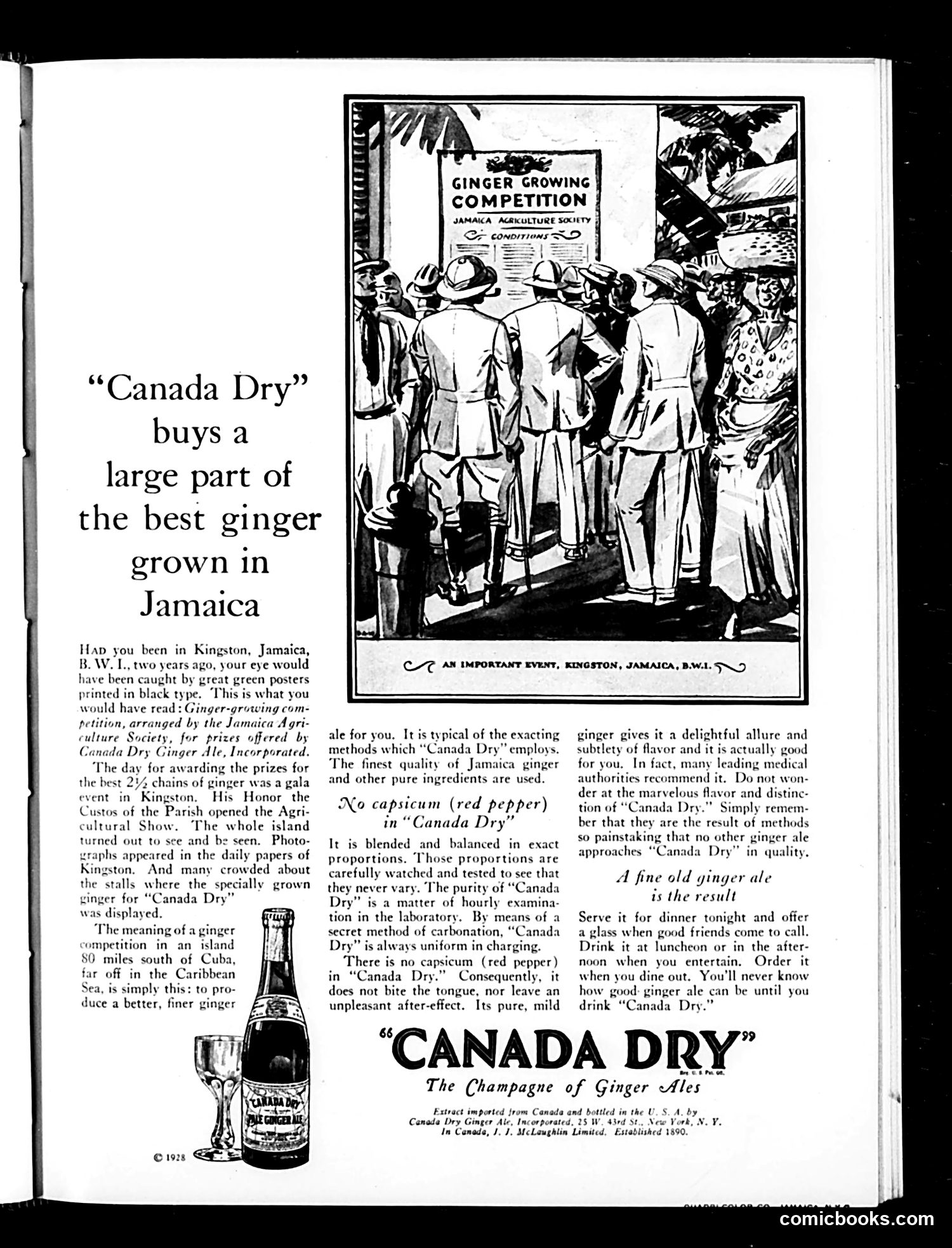
This is primarily a **ginger ale advertisement**, not political satire, though it uses an illustrative narrative to market the product. The image depicts a **ginger-growing competition in Kingston, Jamaica**, sponsored by Canada Dry in 1923 (approximately). The illustration shows colonial-era officials and Jamaican farmers gathered around a competition announcement board—depicting what the company presents as evidence of their commitment to sourcing "the best ginger grown in Jamaica." The advertisement argues that Canada Dry's superiority stems from rigorous quality control: careful sourcing, precise blending, and a "secret method of carbonation." Notably, it emphasizes the product contains **no capsicum (red pepper)**, positioning this as a refinement over competitor brands that apparently did include it. The tone reflects early-20th-century imperial commerce: Canada Dry sources premium ingredients from Jamaica, a British Caribbean colony, positioning themselves as discriminating and scientifically rigorous—qualities associated with respectability and medical endorsement at the time.
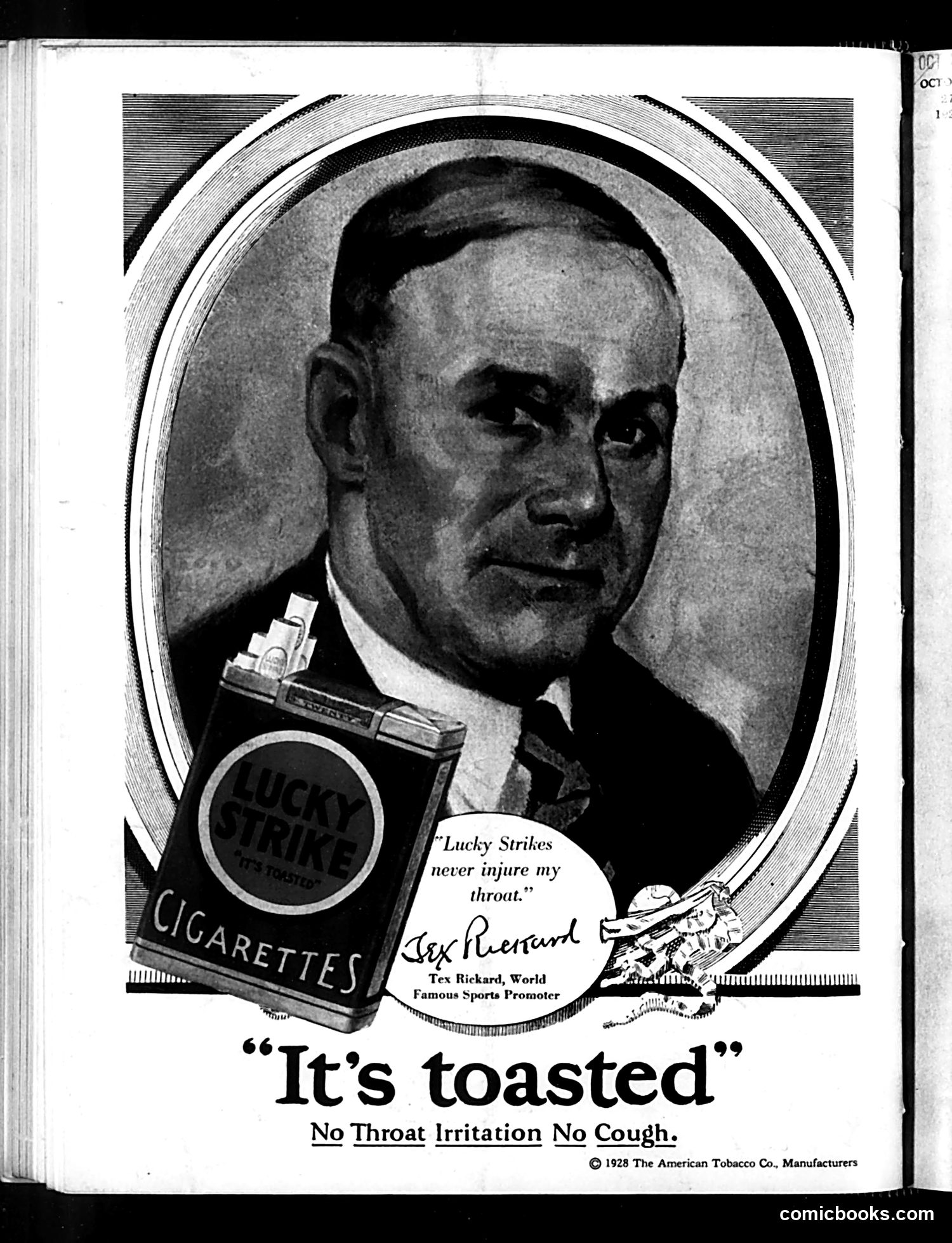
This is a **Lucky Strike cigarette advertisement**, not political satire. The page features a testimonial from **Tex Rickard**, identified as a "World Famous Sports Promoter" (he was a legendary boxing promoter). The ad claims Lucky Strikes are "toasted" and therefore cause "No Throat Irritation No Cough"—marketing the product as gentler than competitors. Rickard's endorsement lends credibility: if a prominent public figure smokes them without throat problems, consumers should trust the brand. This reflects 1928 advertising practices when health claims were unregulated and celebrity endorsements were common. The irony for modern readers is the casual promotion of cigarettes as a health product, before tobacco's dangers were publicly acknowledged.