
A complete issue · 36 pages · 1928
Judge — September 29, 1928
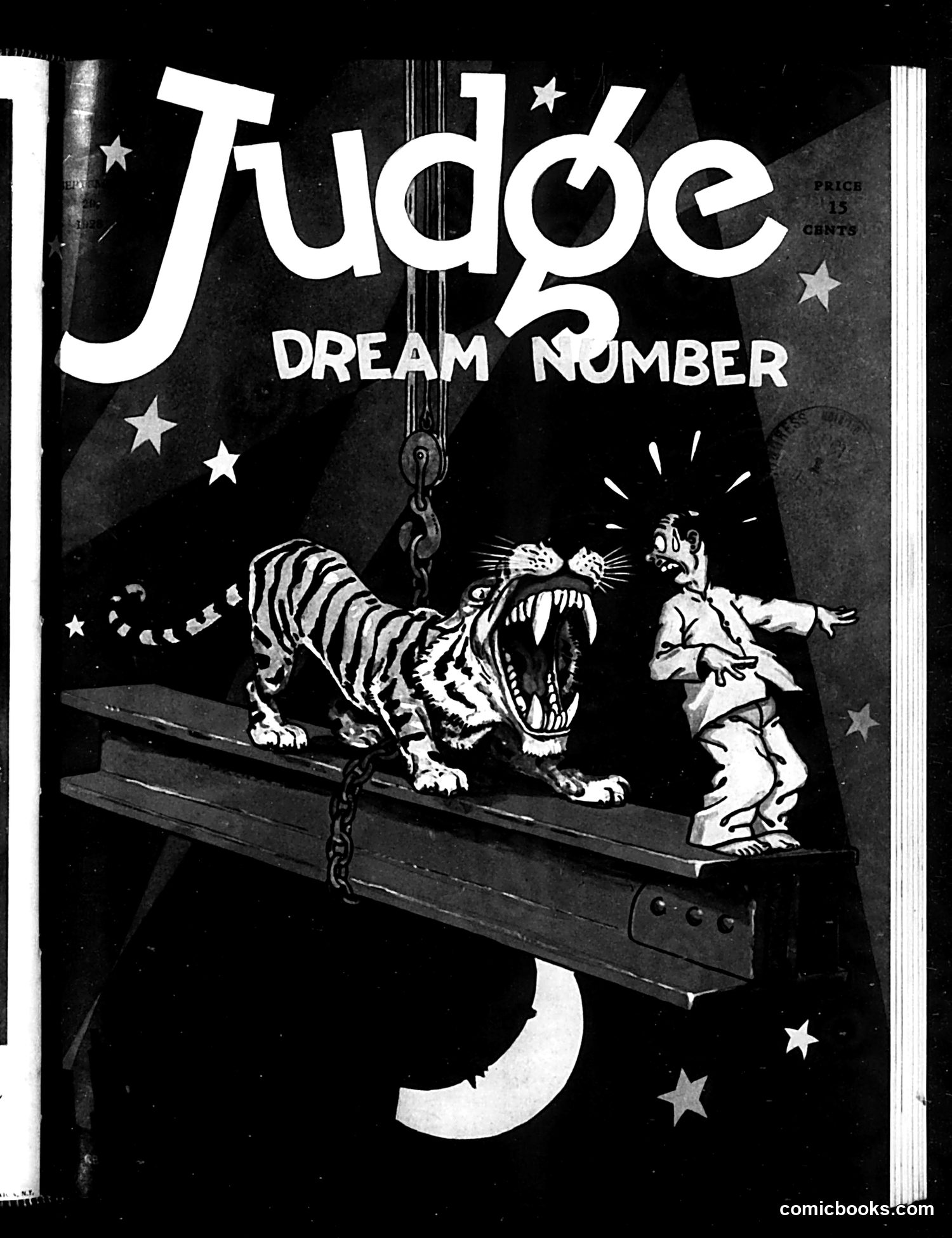
This is a "Dream Number" issue of Judge magazine (price 15 cents), a satirical publication. The cover depicts a surreal nightmare scene: a man cowers before a ferocious tiger suspended on a chain above a wooden beam. The tiger appears ready to strike, while the terrified man gestures defensively. Stars and a crescent moon populate the dark background. The "dream number" format suggests this illustrates anxieties or fears of the era. The tiger likely symbolizes an external threat—possibly war, economic danger, or a political adversary—while the vulnerable man represents the common citizen or nation. The grotesque exaggeration and dreamlike staging are typical of Judge's satirical approach to contemporary social and political concerns, though the specific historical reference remains unclear without additional context.
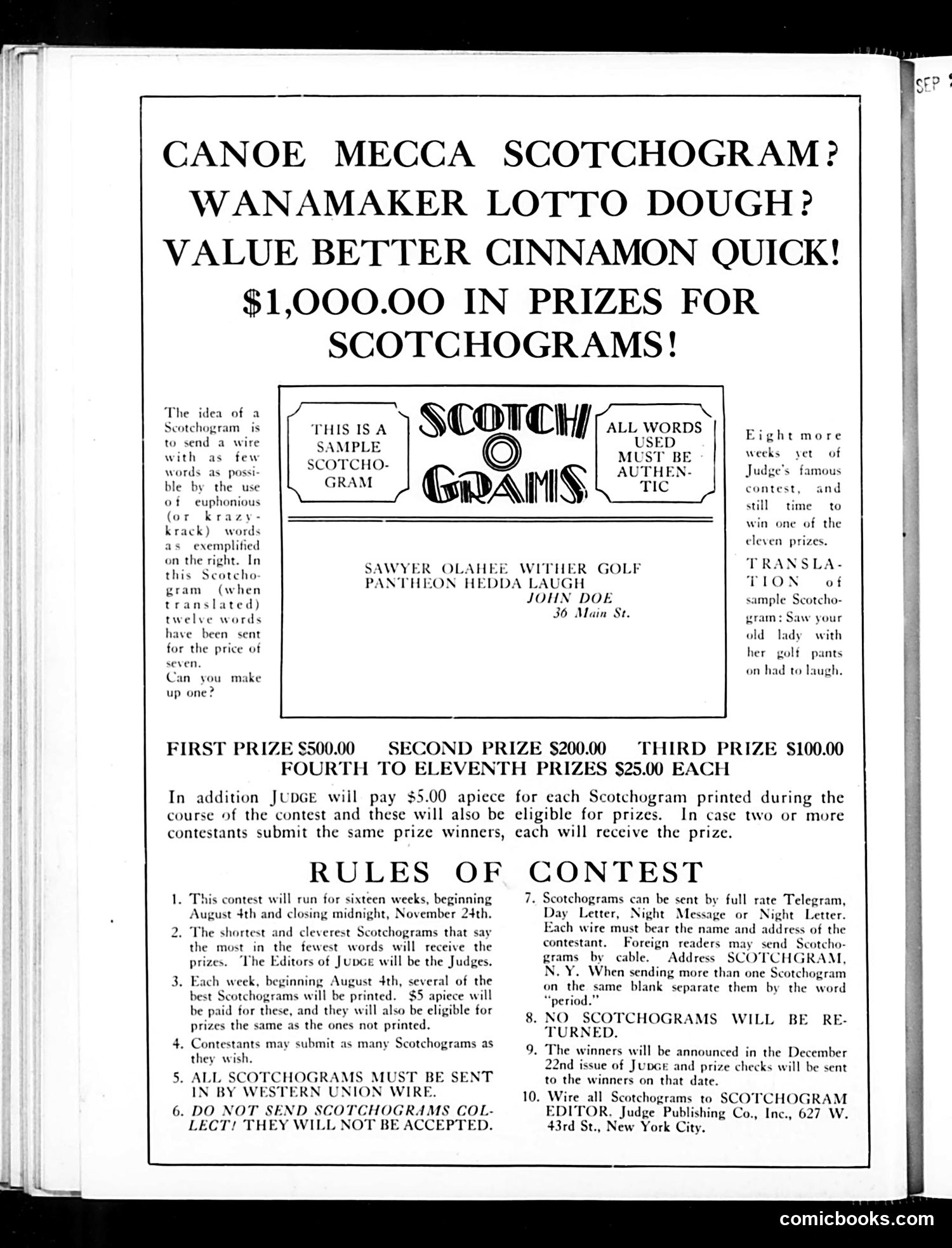
This page is primarily a **contest advertisement** rather than political satire. Judge magazine is promoting a "Scotchogram" competition—a word puzzle game where contestants create short, witty phrases using only authentic words, submitted via Western Union telegram. The sample "Scotchogram" shown translates: "Sawyer olahee wither golf / Pantheon hedda laugh / John Doe, 36 Main St."—demonstrating the playful, nonsensical style valued in entries. The contest offers **$1,000 in total prizes** (first prize $500), running sixteen weeks starting August 16th. The humor lies in the absurdist nature of the word puzzles themselves—deliberately nonsensical combinations of real words intended to amuse. This represents Judge's engagement with popular parlor games and linguistic humor popular in the early-to-mid 20th century.
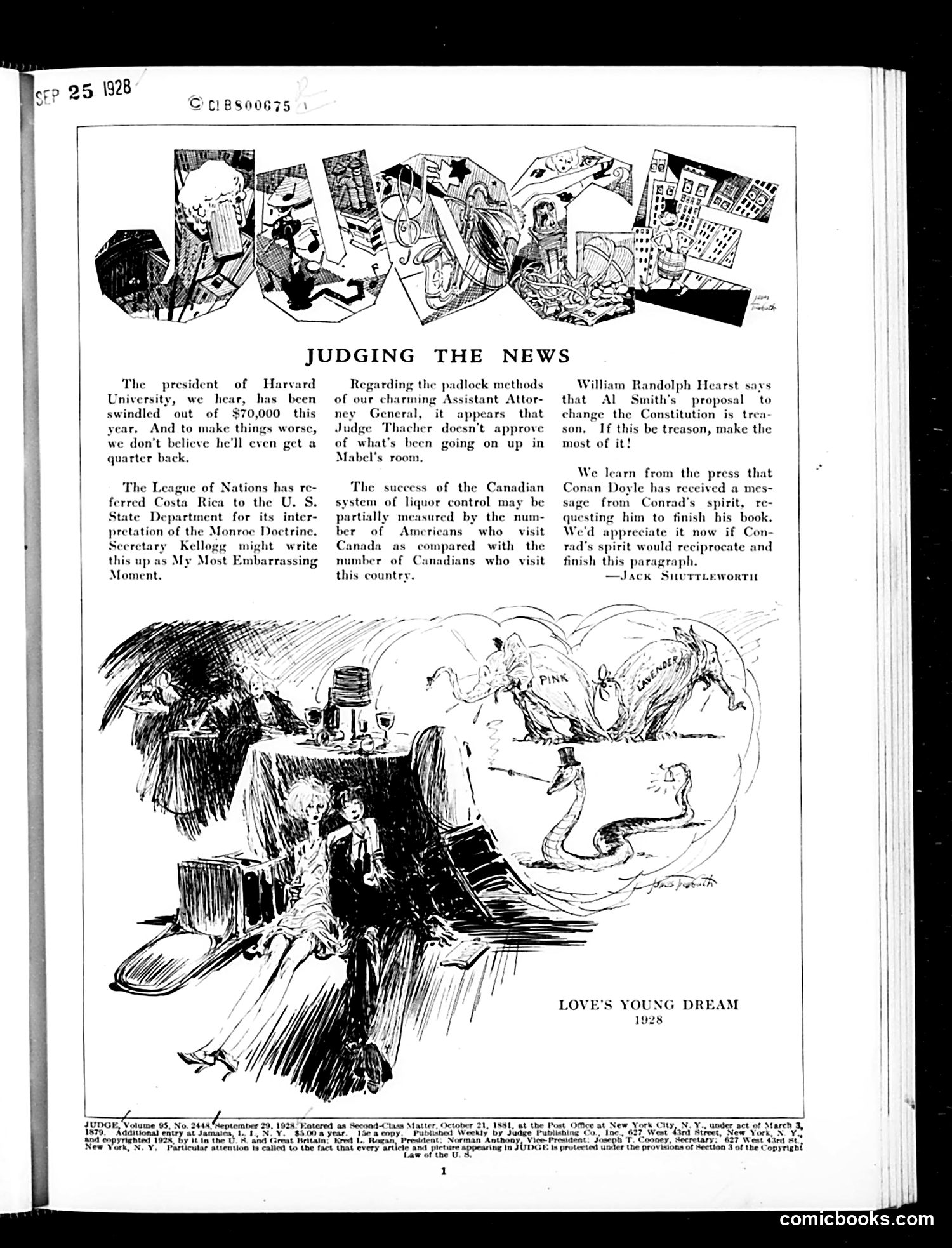
This satirical page combines brief political commentary with an illustrated cartoon titled "Love's Young Dream" (1928). The commentary mocks several contemporary figures and events: Harvard's president receiving a $75,000 salary while avoiding quarterback duty; the League of Nations' referral of Costa Rica (relating to the Monroe Doctrine); and debates over Canadian liquor control and Al Smith's proposal to amend the Constitution regarding Prohibition. The main cartoon depicts a young couple's romantic fantasy, with the woman imagining idealized scenes while reality intrudes—likely satirizing youthful optimism about love against harsh real-world circumstances. The contrast between her dreams (shown in the thought bubble with pastoral scenes) and their actual modest circumstances reflects 1920s social commentary on romance and economic reality during the pre-Depression era.
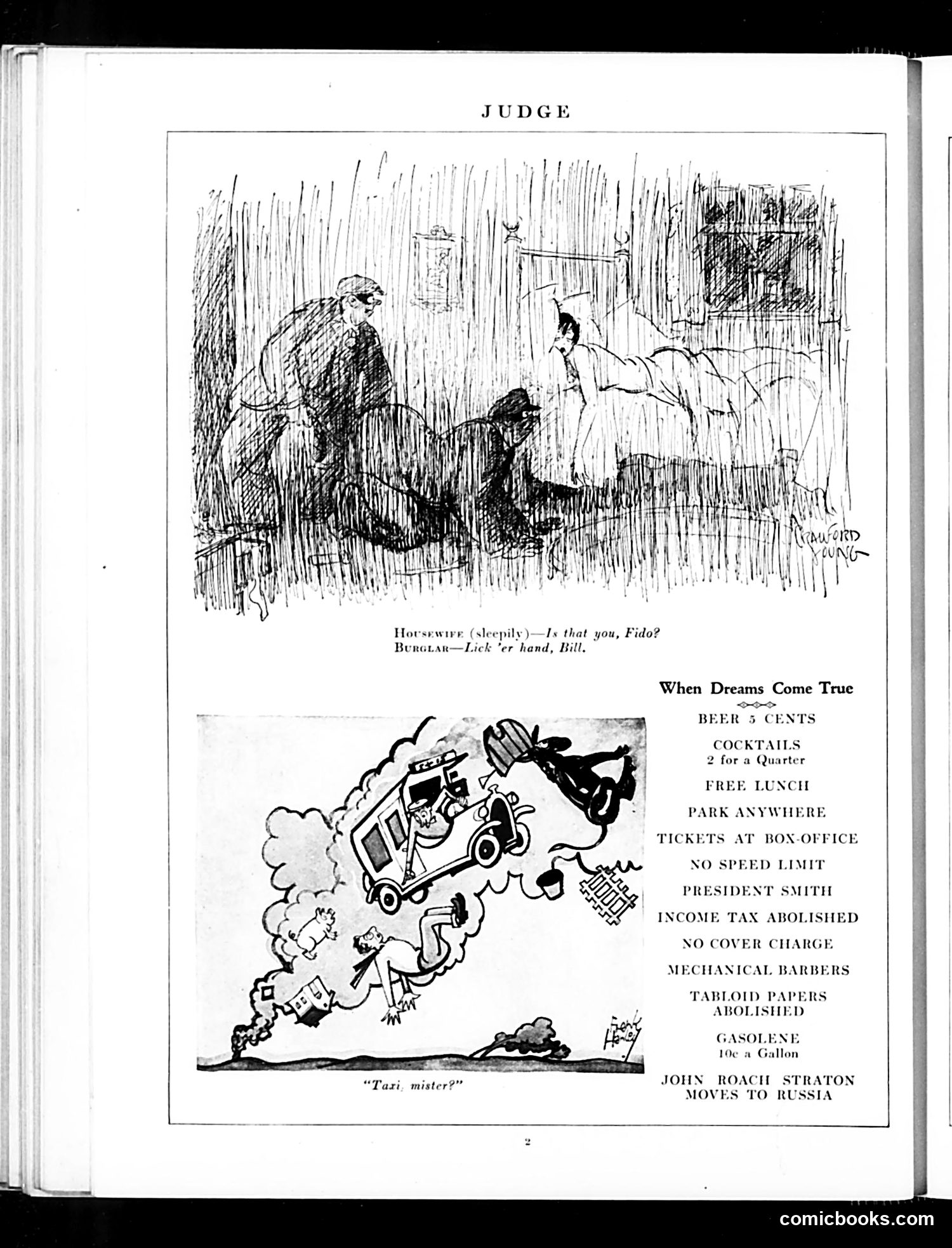
**Top Cartoon:** A sketch labeled "JUDGE" depicts a housekeeper and burglar. The housekeeper (sleepily) asks "Is that you, Fido?" while the burglar responds "Lick 'er hand, Bill"—a domestic comic scenario playing on mistaken identity and humor about burglary. **Bottom Section:** Titled "When Dreams Come True," this is primarily satirical advertising rather than political commentary. It mocks utopian fantasies through a whimsical illustration of a fantastical flying vehicle, accompanied by a humorous list of impossible/absurd promises: free lunch, no speed limits, income tax abolished, mechanical barbers, gasolene at 10¢/gallon, etc. The satire critiques unrealistic campaign promises or fantasy proposals by presenting them as equally ridiculous dreams—though the specific political context (which election or politician) remains unclear without additional dating information.
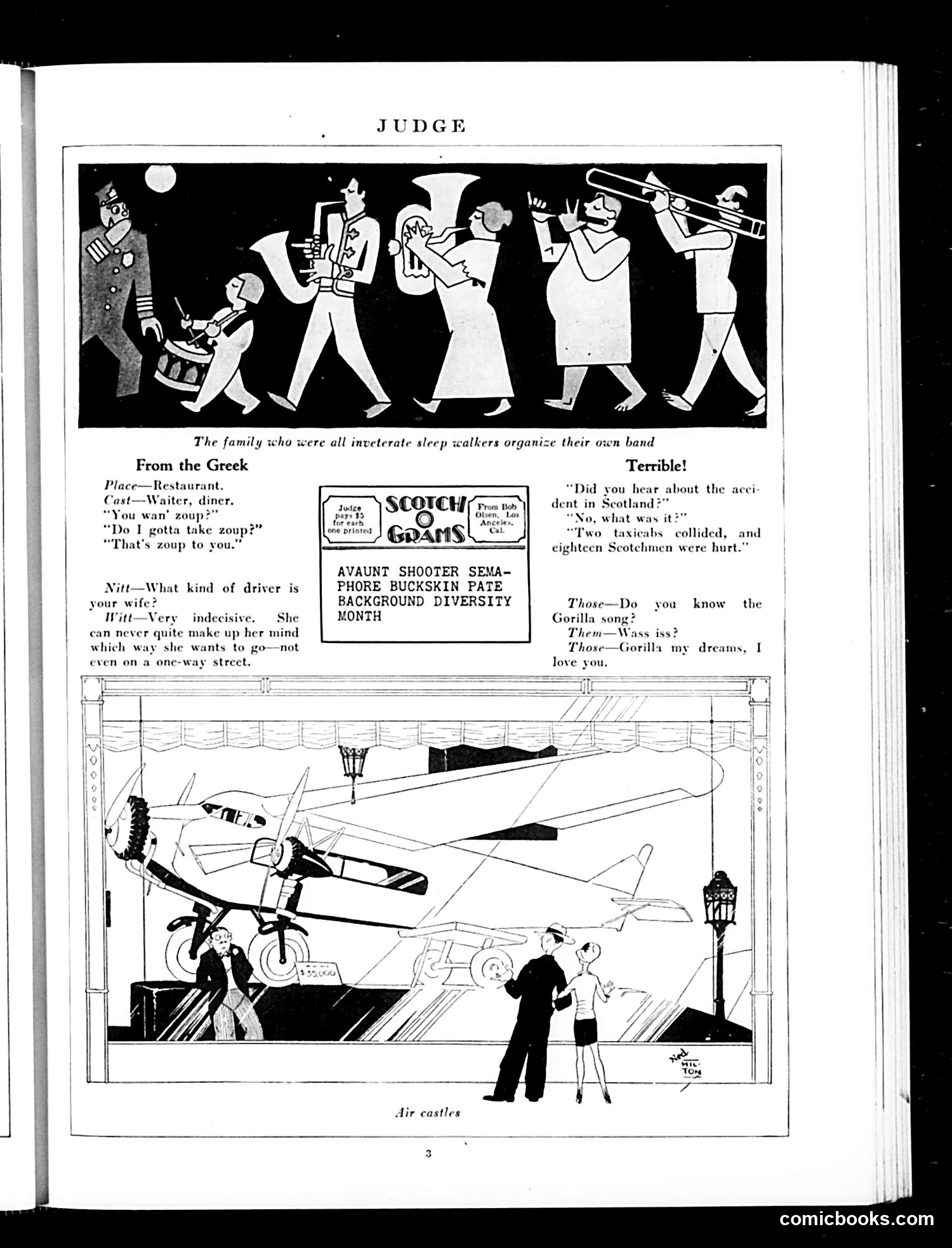
This page contains three distinct items: **Top cartoon**: "The family who were all inveterate sleep walkers organize their own band" depicts a humorous family marching band composed entirely of sleepwalkers, playing various instruments while apparently unconscious. **Middle section**: Mostly consists of short humor pieces and an advertisement for "Scotch Grams" (a commercial product). **Bottom cartoon**: Titled "Air castles," shows a man and woman viewing an airplane display in what appears to be a shop window. The joke likely plays on the phrase "air castles" (meaning unrealistic dreams or fantasies), contrasting imaginary aspirations with actual aircraft technology on display—satirizing how modern aviation was becoming tangible reality rather than mere fantasy. The page represents typical Judge magazine content: light humor and social satire aimed at general audiences.
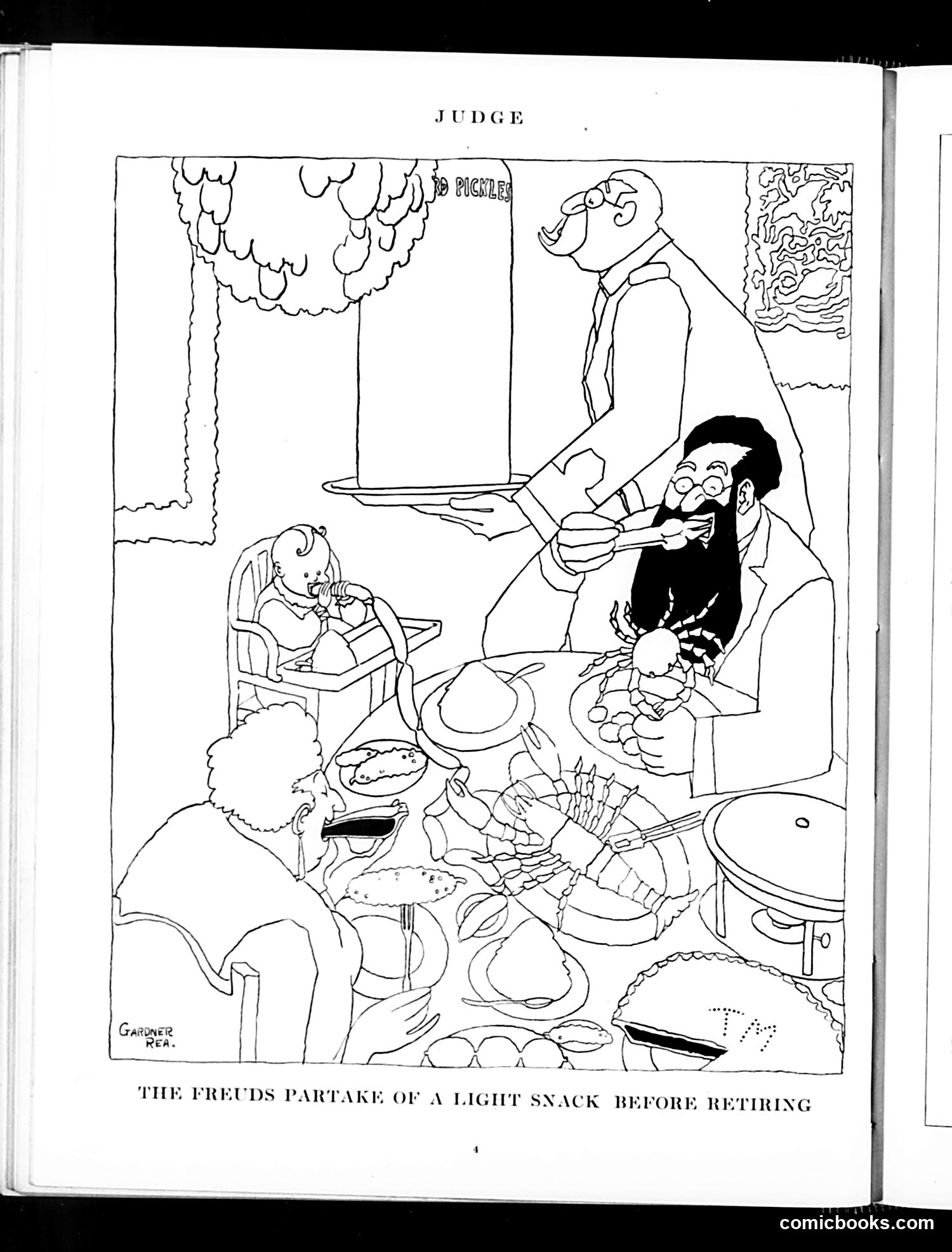
This cartoon satirizes Sigmund Freud and his family, likely from the early 20th century when psychoanalysis was becoming fashionable in America. The title's pun—"light snack" versus the psychoanalytic concept of examining unconscious thoughts—suggests the humor. The cartoon appears to mock Freudian analysis by depicting the Freud family eating casually before bed, with exaggerated physical features typical of period caricature. The artist (Gardner Rea, signed lower left) likely aims at contemporary enthusiasm for Freud's theories, suggesting that even Freud himself—the originator of analyzing behavior—simply eats normally, not constantly psychoanalyzing mundane activities. The satire targets the popular mystification and perhaps absurd application of Freudian psychology in American culture.
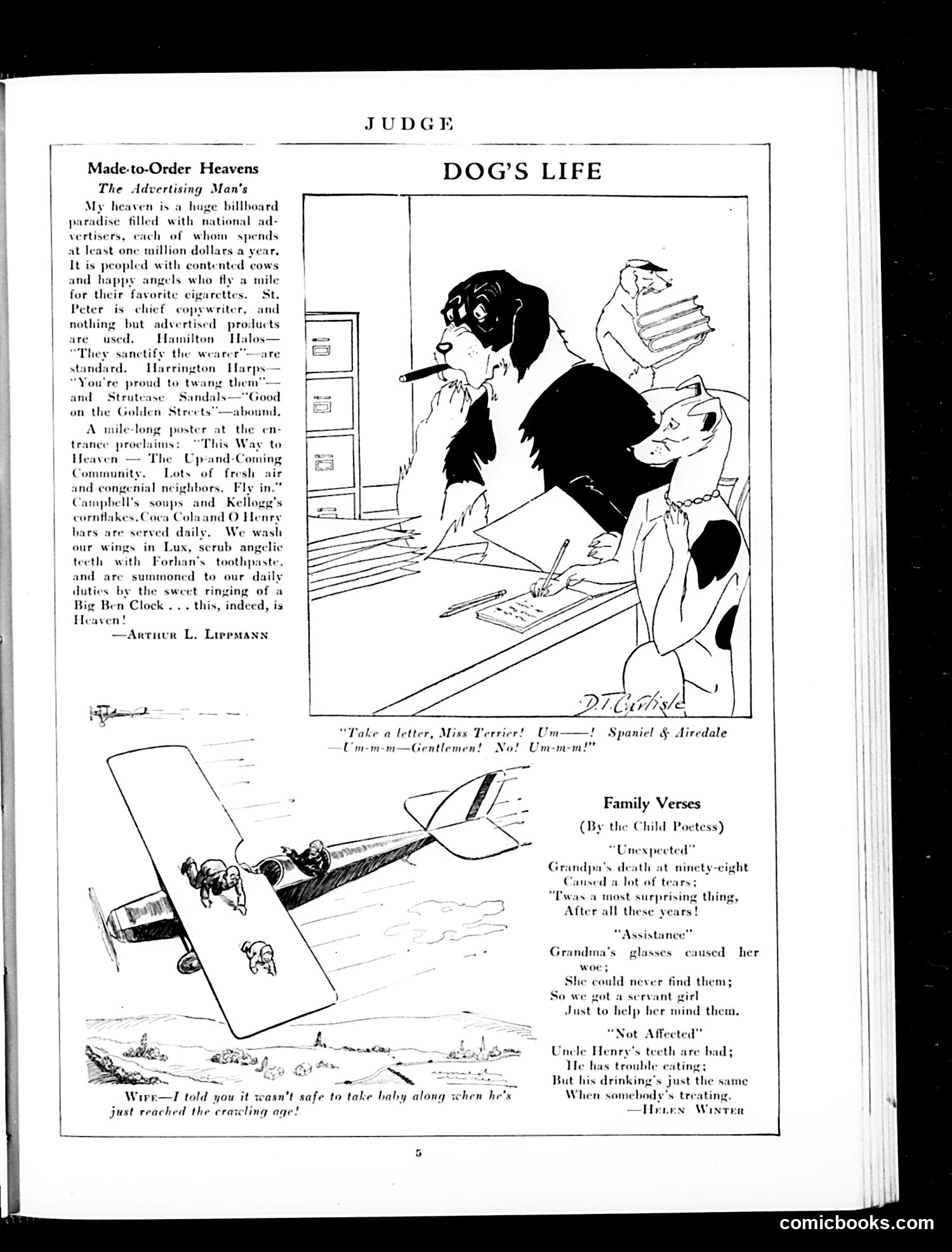
This page satirizes advertising's pervasiveness in 1920s America through "Made-to-Order Heavens," where Arthur L. Lippmann imagines a heaven tailored to different professionals. The advertising man's heaven features billboards, national advertisers spending millions annually, and contented consumers—a biting critique of how commercial culture had become all-consuming, even as an ideal afterlife. The main cartoon shows dogs in an advertising office, with the caption "Take a letter, Miss Terrier!" It anthropomorphizes office workers as dogs, likely mocking the dehumanizing nature of advertising work and corporate culture more broadly—reducing workers to obedient animals following orders. The "Family Verses" section contains mild domestic humor about family life, unrelated to the advertising satire above.
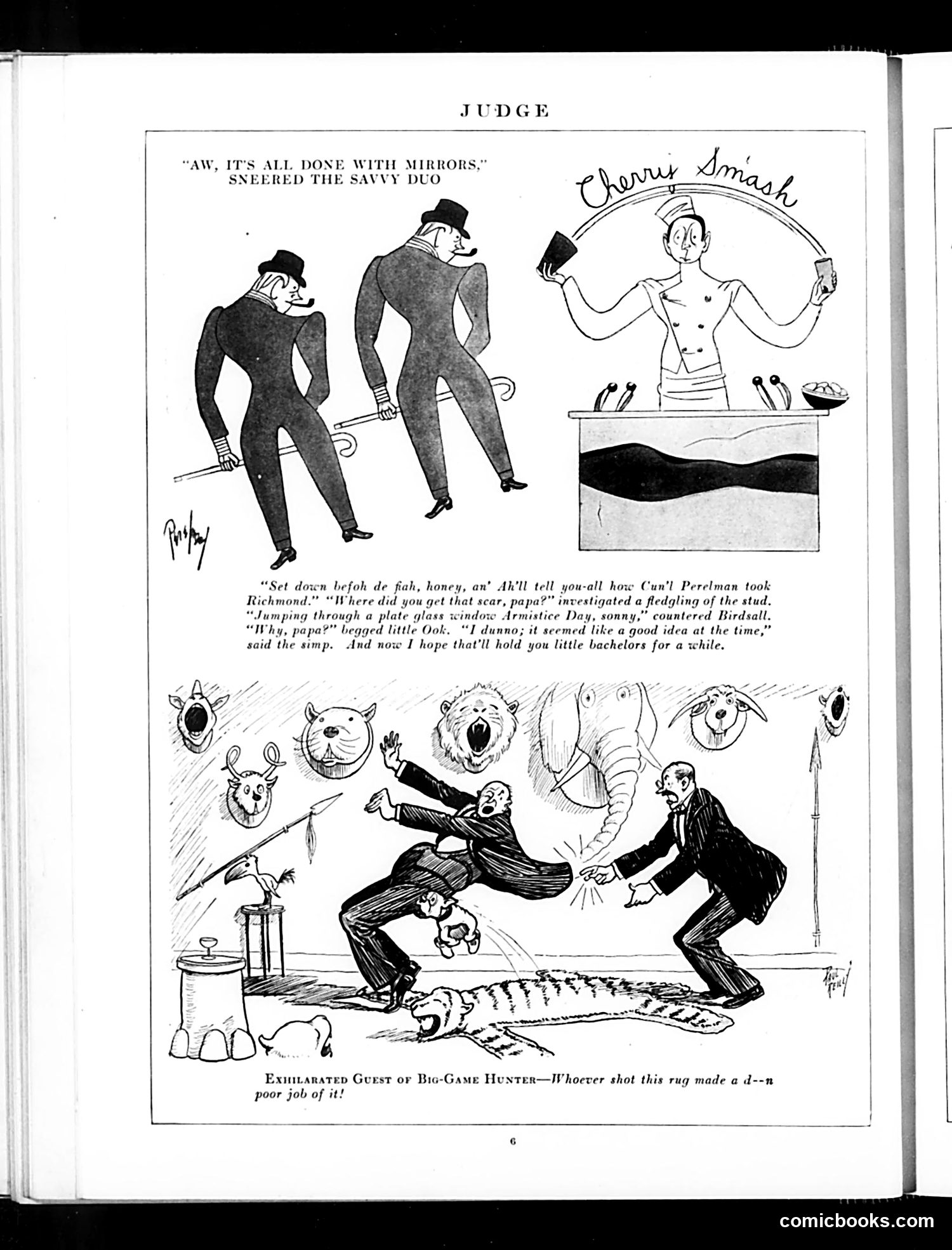
This page contains two separate cartoons satirizing different targets. **Top cartoon**: Two con men in top hats with canes boast about pulling off a scheme "with mirrors"—a metaphor for deception. The "Savvy Duo" likely references contemporary confidence tricksters or fraudsters. The dialogue below mocks tall tales and implausible war stories (references to "Colonel Perelman" and Richmond suggest Civil War-era boasting), with absurd explanations for injuries that strain credibility. **Bottom cartoon**: Depicts two men in formal dress frantically gesturing at a large dead animal (appears to be an elephant or large game) mounted as a trophy on the wall, surrounded by taxidermied animal heads. The caption jokes that whoever shot this "rug" (the dead animal) did a terrible job—likely satirizing incompetent big-game hunters or mocking the pretensions of wealthy sportsmen displaying dubious hunting trophies. Both cartoons mock masculine braggadocio and deception through exaggeration and absurdist humor typical of Judge's satirical style.
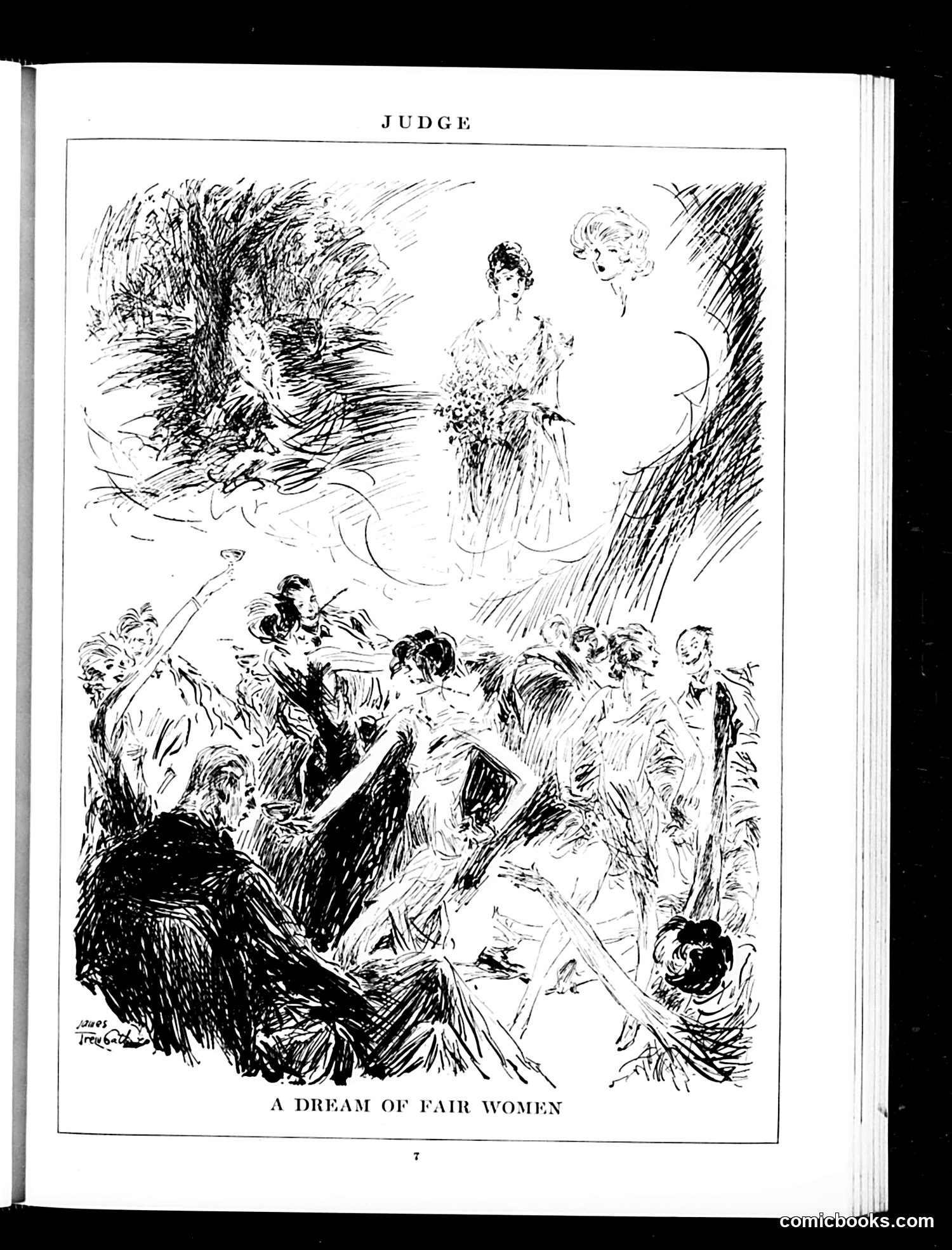
This illustration from *Judge* magazine depicts a courtroom scene titled "A Dream of Fair Women." The cartoon shows a male judge or authority figure (depicted in heavy black ink, lower left) appearing to preside over or observe a group of elegantly dressed women in the upper portion of the image. The composition suggests a satirical commentary on women in legal or judicial contexts—likely mocking either women's exclusion from the judiciary or anxieties about female participation in law and governance. The "dream" framing implies this scenario is fantastical or absurd to the artist's contemporary audience. Without a visible date, the exact historical moment remains unclear, but the style suggests late 19th or early 20th-century concerns about women's expanding social and professional roles.
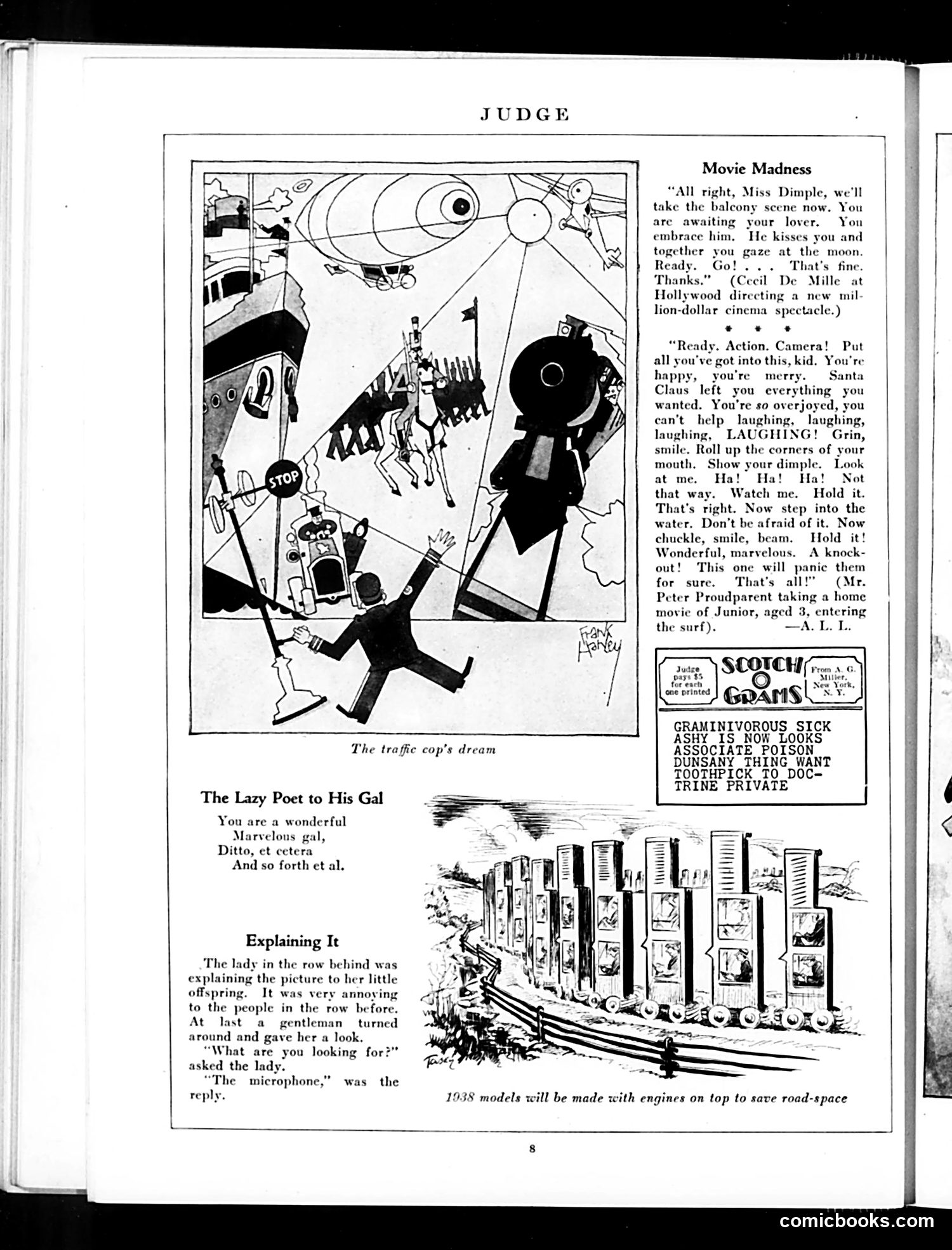
This page contains three separate satirical pieces mocking 1920s-30s popular culture and behavior: **"Movie Madness"** ridicules Hollywood's obsessive directing methods. Cecil B. DeMille (the famous film director) is caricatured barking overwrought instructions to actors about emotional performance, then contrasted with an amateur father doing the same thing filming his toddler at the beach—suggesting both are equally ridiculous in their theatrical excess. **"The traffic cop's dream"** (cartoon) depicts a surreal fantasy where a cop has total control over urban chaos—airplanes, cars, pedestrians—with a giant camera-like device. It's wish-fulfillment satire about enforcing order on modern city traffic. **"Explaining It"** jokes about cinema etiquette: a woman loudly explains the film to her child, annoying patrons. When confronted, she sarcastically asks if he's "looking for the microphone"—implying her commentary is so loud and performative she might as well be amplified. All three target the absurdity of modern entertainment and public behavior during the early sound-film era.
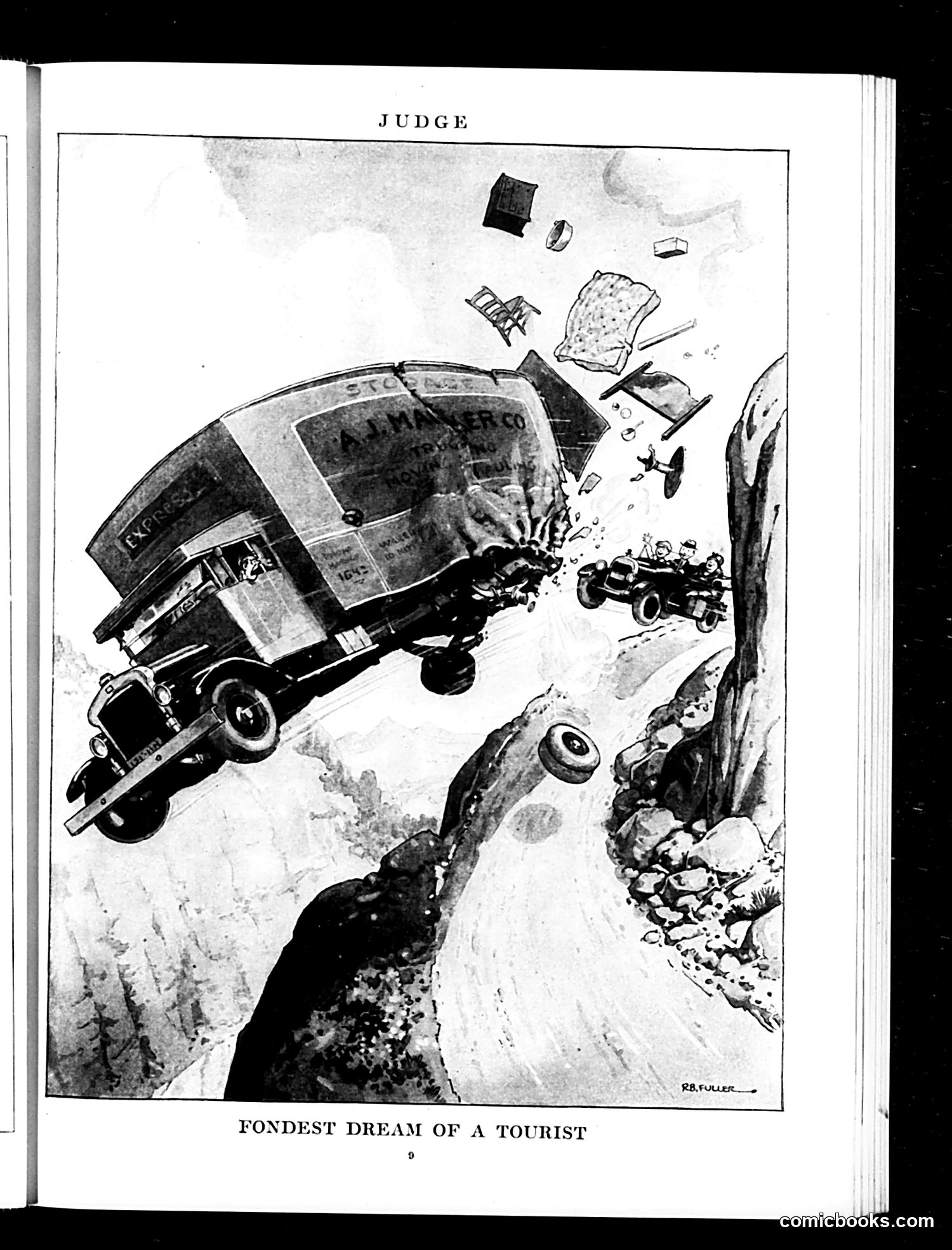
This cartoon satirizes dangerous driving and road safety. It depicts a truck careening off a cliff while scattering its cargo—furniture, luggage, and goods—across a ravine. A smaller vehicle below witnesses the disaster. The satire targets tourists who drive recklessly, particularly on mountain roads. The "fondest dream" is darkly ironic: rather than celebrating tourism's pleasures, Judge suggests the ultimate tourist fantasy is a catastrophic crash. The scattered belongings emphasize the destruction and chaos of the accident. This reflects early 20th-century anxieties about automobile safety, as cars became increasingly common and road accidents more frequent. The cartoon mocks both reckless drivers and the emerging tourist culture enabled by automobiles, presenting the worst-case scenario as commentary on dangerous behavior.
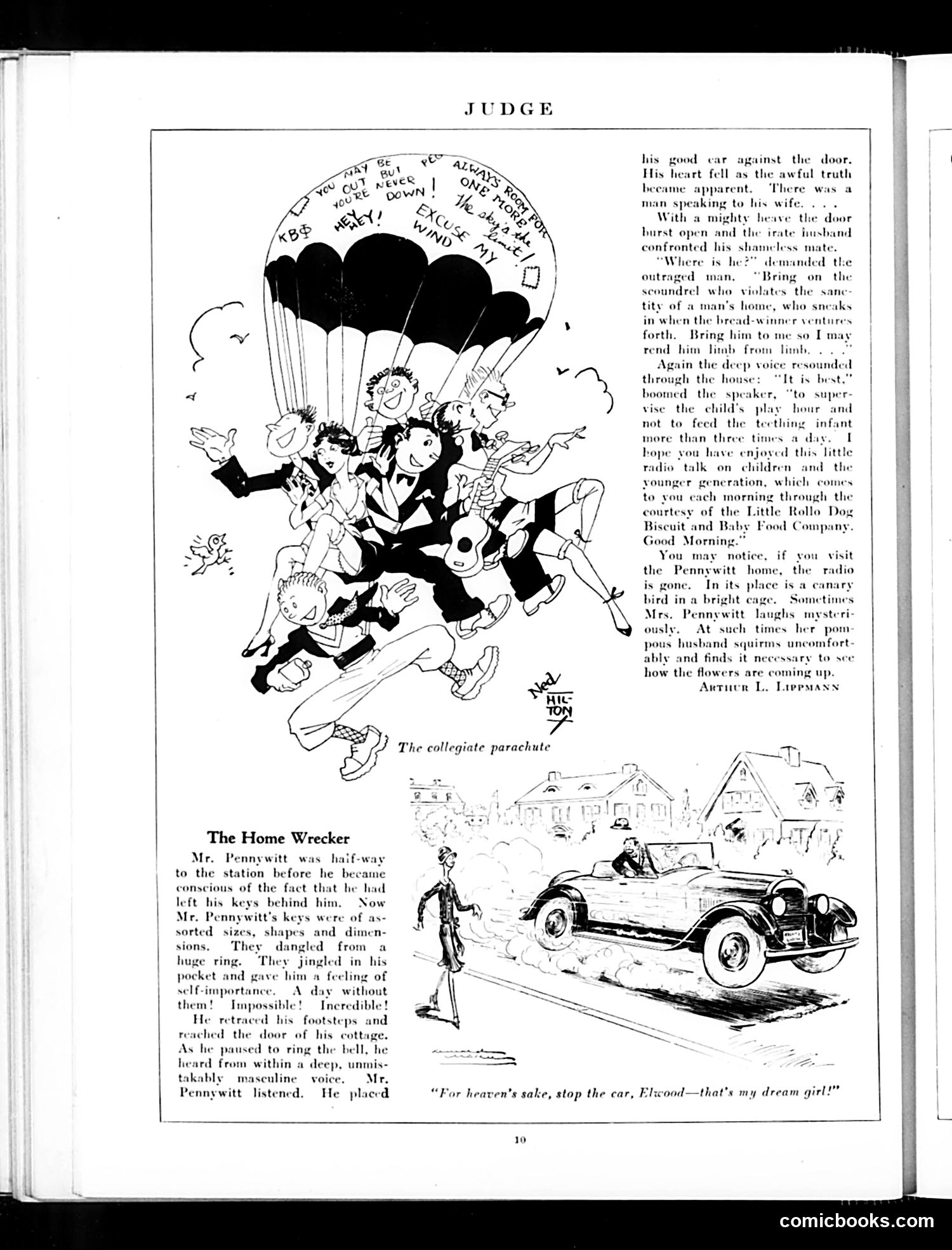
This page contains two satirical pieces mocking domestic life and radio culture in early 20th-century America. **"The Collegiate Parachute"** (top): A whimsical cartoon showing college students descending by parachute while their worried parents listen to a radio broadcast about child-rearing. The satire targets both the frivolous behavior of privileged youth and the era's obsession with expert parenting advice delivered via radio. Mrs. Pennywitt ironically ignores the broadcast's wisdom while her pompous husband squirms—suggesting the disconnect between media advice and actual family life. **"The Home Wrecker"** (bottom): Mr. Pennywitt forgets his keys and returns home, hearing a man's voice inside. The caption hints at infidelity—his "dream girl" is apparently in his home. The joke plays on middle-class anxieties about marital betrayal and the irony of a man concerned with propriety (his important key ring symbolizing respectability) discovering potential scandal. The vintage automobile suggests 1920s-30s era leisure culture. Both pieces satirize American middle-class pretensions and anxieties.
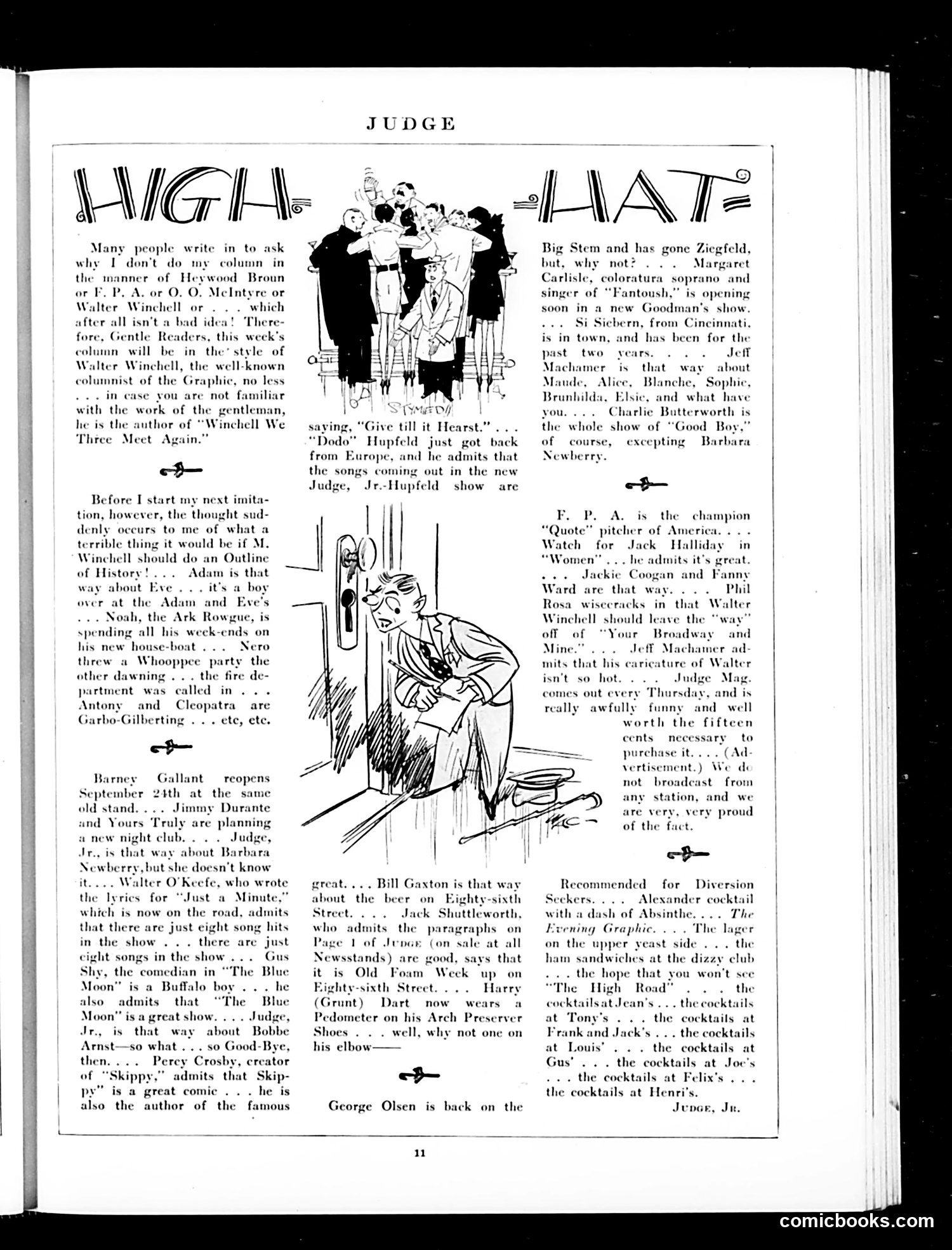
This is a gossipy entertainment column mimicking the style of Walter Winchell, a famous Broadway/showbiz gossip columnist of the 1920s-30s. The author parodies Winchell's signature rapid-fire, name-dropping style with ellipses and casual innuendo. The content references theatrical figures and shows of the era: Margaret Carlisle (soprano), performers in "Good Boy" and "Fantoush," and various entertainers. The cartoon illustration shows someone at a door, likely depicting one of these theatrical figures. The satire mocks both Winchell's breathless, gossipy tone and the entertainment world's obsessions—romantic entanglements, who's opening where, and trivial details elevated to importance. References to beer "on Eighty-sixth Street" and multiple bars (Tony's, Louis', Gus') reflect Prohibition-era speakeasy culture. The column ends with Judge Magazine's self-promotion, emphasizing its comedic value and that it doesn't broadcast from radio (unlike competitors), suggesting mid-1920s competition between print and emerging broadcast media.
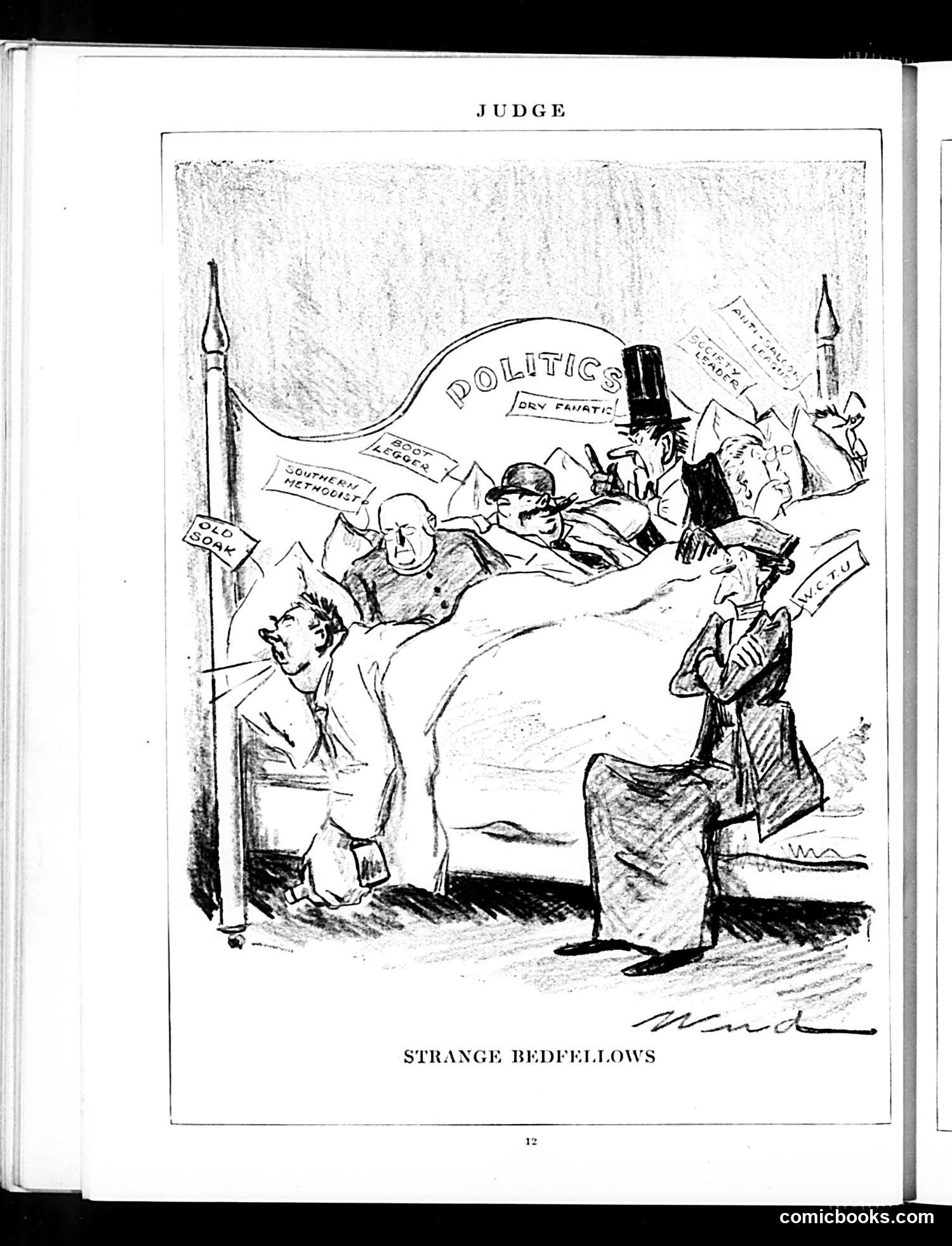
This political cartoon satirizes an unusual political alliance. The caption "Strange Bedfellows" suggests incompatible figures forced together. Visible labels in the tent include "Politics," "Dry Fanatic," and references to "Southern Nero" and "Legree," likely alluding to political factions or controversial figures of the era. The figures inside the tent appear to represent different political interests awkwardly sharing space. On the left stands a man saluting a flagpole labeled "Some [unclear]," while a uniformed official on the right observes. The cartoon criticizes political coalitions that unite ideologically opposed groups for convenience. Without the publication date, the specific political moment remains unclear, but the satire targets the uncomfortable compromises required in political alliances—a recurring Judge magazine theme.
This page contains two distinct articles under the banner "Judge on the Bench," a satirical advice column. **"The Hopeful Freshmen"** critiques American higher education, arguing that college success depends less on individual student effort than on the rigid, outdated institutional system. The piece sarcastically advises freshmen to "be yourself" while acknowledging the system will likely fail them anyway — a commentary on educational reform and systemic rigidity circa the 1920s. **The Tennis/Golf Section** attacks the hypocrisy of amateur athletics. It mocks the "twisted standard" that honors amateurs while disparaging professionals like Karel Kozeluh and Vinnie Richards, despite professionals often displaying greater integrity. The article notes golf is "more democratic" because it allows professional-amateur competition, implying tennis's amateurism rules are arbitrary class-based gatekeeping. **The Speeding Laws Section** briefly notes increased speed limits across 23 states—a topical reference to 1920s automotive safety debates. The overall tone is sardonic social criticism typical of Judge's editorial voice.
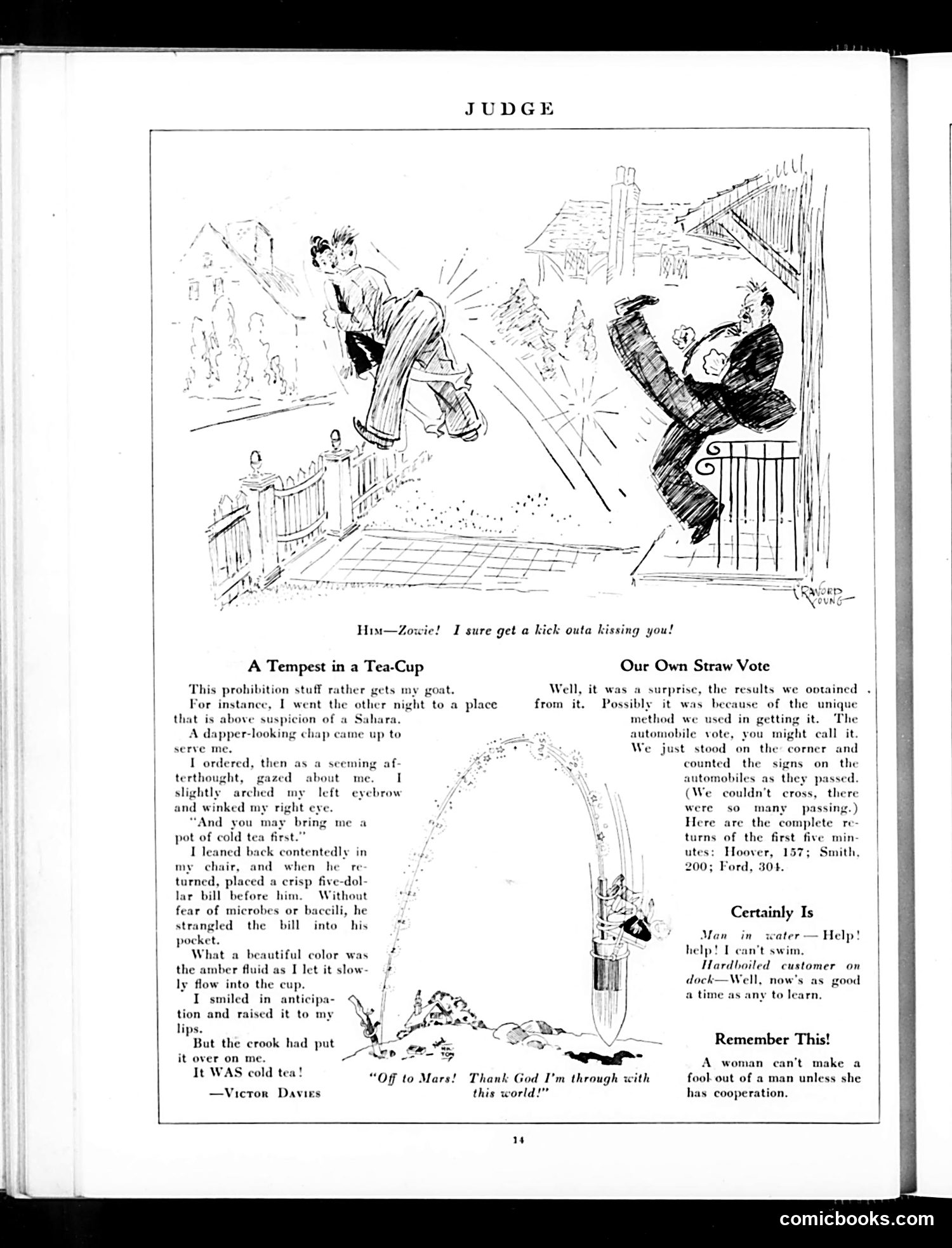
This page contains three satirical pieces from the Prohibition era (likely 1920s-early 1930s): **"A Tempest in a Tea-Cup"**: Mocks Prohibition enforcement. A man orders "cold tea" at a speakeasy but suspects it's actually alcohol disguised. The joke inverts expectations—the waiter tricks him by serving *actual* cold tea instead, exploiting the secrecy around illegal drinking. **"Our Own Straw Vote"**: Satirizes election polling methods. The writer counts political candidate signs on passing automobiles as an informal survey, finding "Ford, 304" leading over Hoover and Smith. This likely references the 1928 presidential election, mocking crude polling techniques. **The top cartoon**: Shows a man fleeing a woman who's apparently assaulted him, captioned about getting "a kick outa kissing"—likely satirizing changing social attitudes toward physical affection or dating. The page reflects 1920s preoccupations: Prohibition's unpopularity, emerging polling methods, and social modernization around gender and courtship.
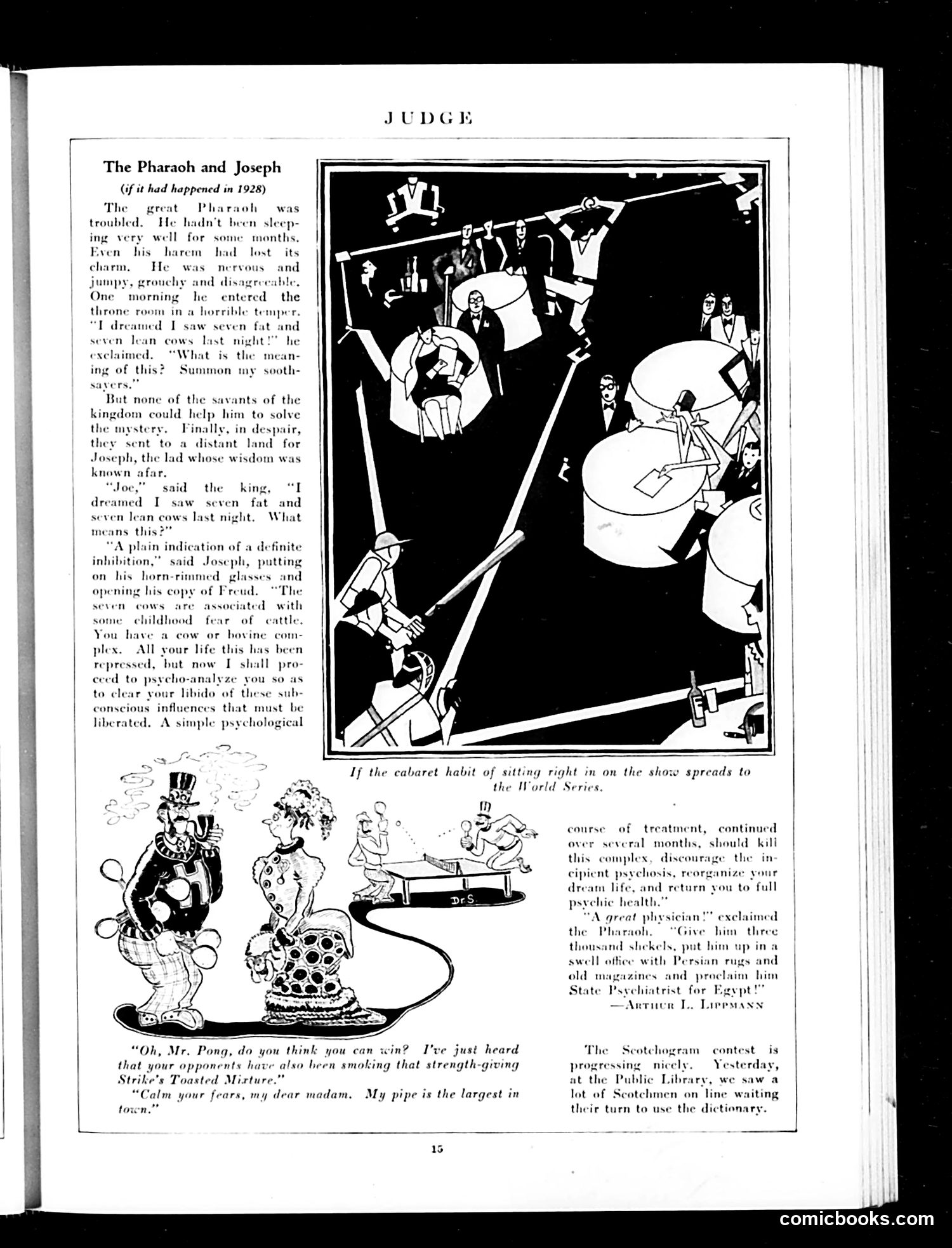
This satirical piece updates the biblical story to mock 1920s psychoanalysis and Freudian theory. When Pharaoh describes his dream of seven fat and lean cows, Joseph—now equipped with horn-rimmed glasses and a copy of Freud—diagnoses a "cow or bovine complex" rooted in childhood cattle anxiety. He prescribes months of psychoanalysis to "clear your libido" and "liberate" repressed influences. The joke targets the era's enthusiastic adoption of Freudian psychology as a cure-all for neurosis and anxiety. By applying such pseudo-scientific explanations to a straightforward prophetic dream, Judge ridicules how intellectuals were applying trendy psychological jargon to everything. The cartoon also includes unrelated satirical sketches about cabaret behavior and a Scotch whisky advertisement parody.
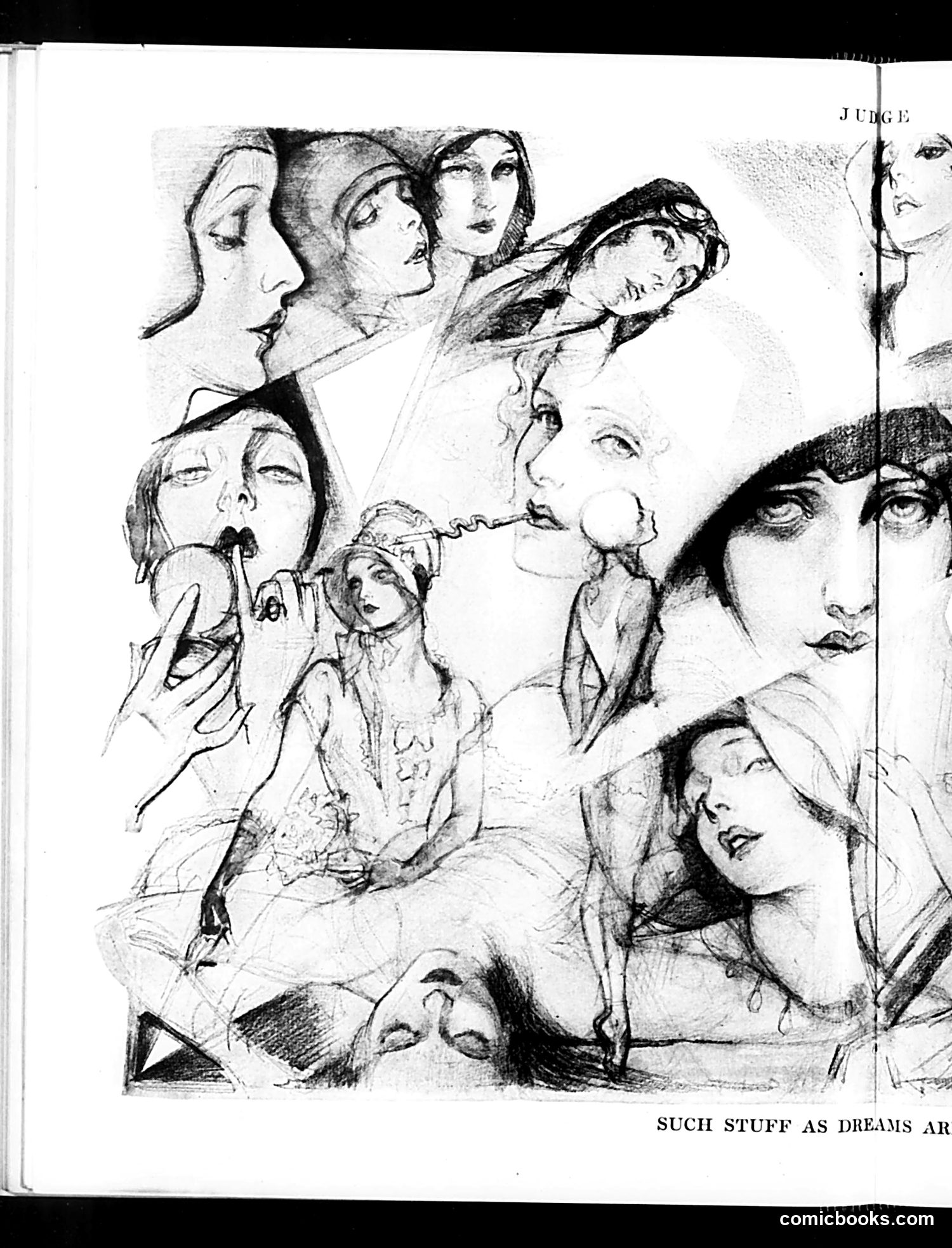
This appears to be an illustration titled "Such Stuff as Dreams Are" from *Judge* magazine, featuring multiple overlapping female faces and figures rendered in a sketchy, expressive style. The composition suggests a dreamlike or psychological theme—possibly commenting on female ambitions, desires, or fantasies of the era. Without a complete date or additional context visible on the page, I cannot identify specific historical figures or events being satirized. The artistic style appears early-to-mid 20th century. The title's reference to Shakespeare's "The Tempest" ("such stuff as dreams are made on") suggests the satire concerns the gap between women's aspirations and reality, though the specific social or political commentary remains unclear from the image alone.
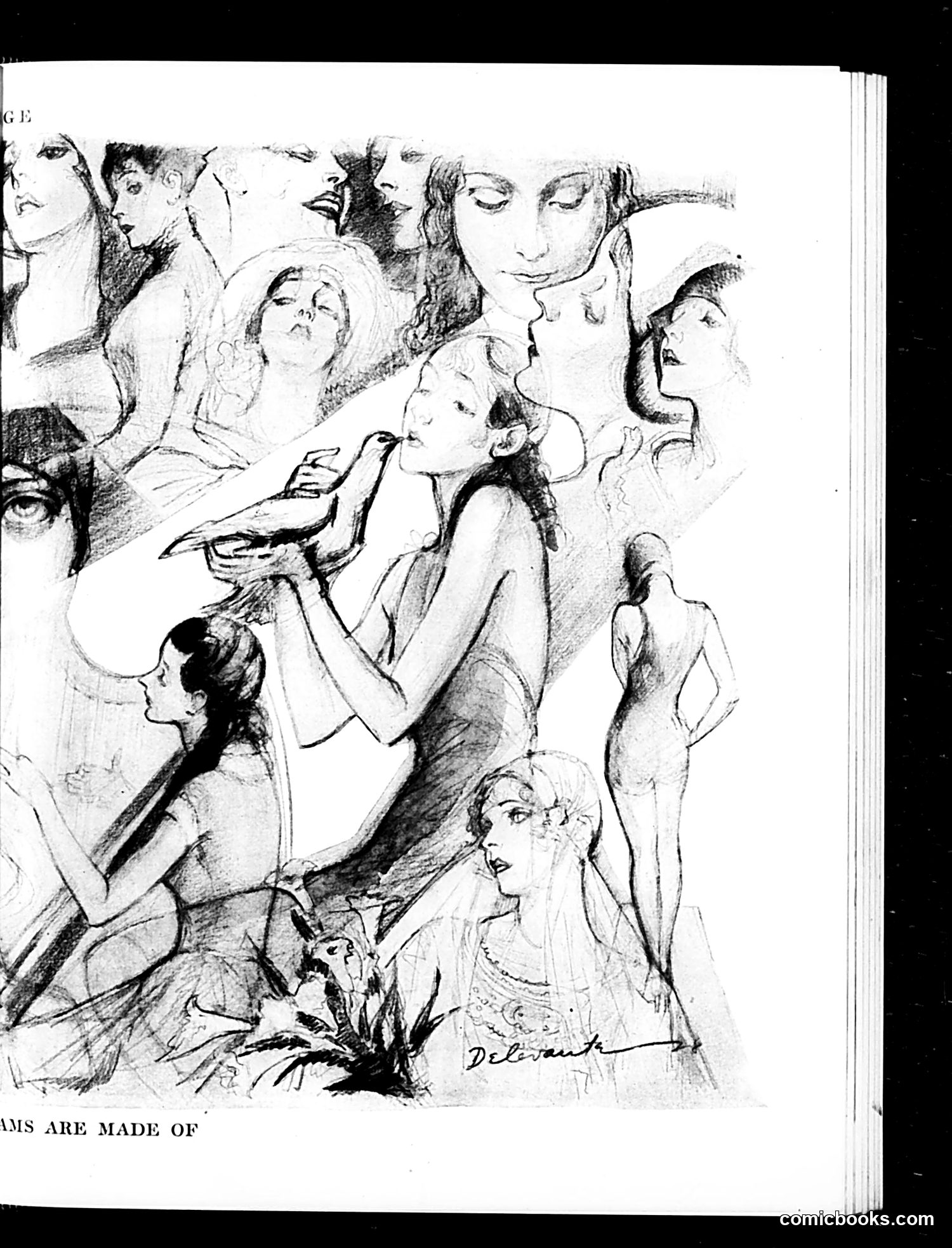
This appears to be a sketch page from *Judge* magazine featuring multiple portrait studies of women's faces and figures in various poses and expressions. The visible text fragment reads "AMS ARE MADE OF" (likely part of a larger caption or title now cut off). The drawing style suggests early-to-mid 20th century illustration work, signed by what appears to be "Delaunois" or similar. Without the complete caption, the satirical point remains unclear—it could reference fashion, beauty standards, theatrical types, or social commentary about women. The multiple studies suggest either a character study for satirical commentary or possibly an advertisement or fashion-related illustration rather than a traditional single-panel political cartoon.
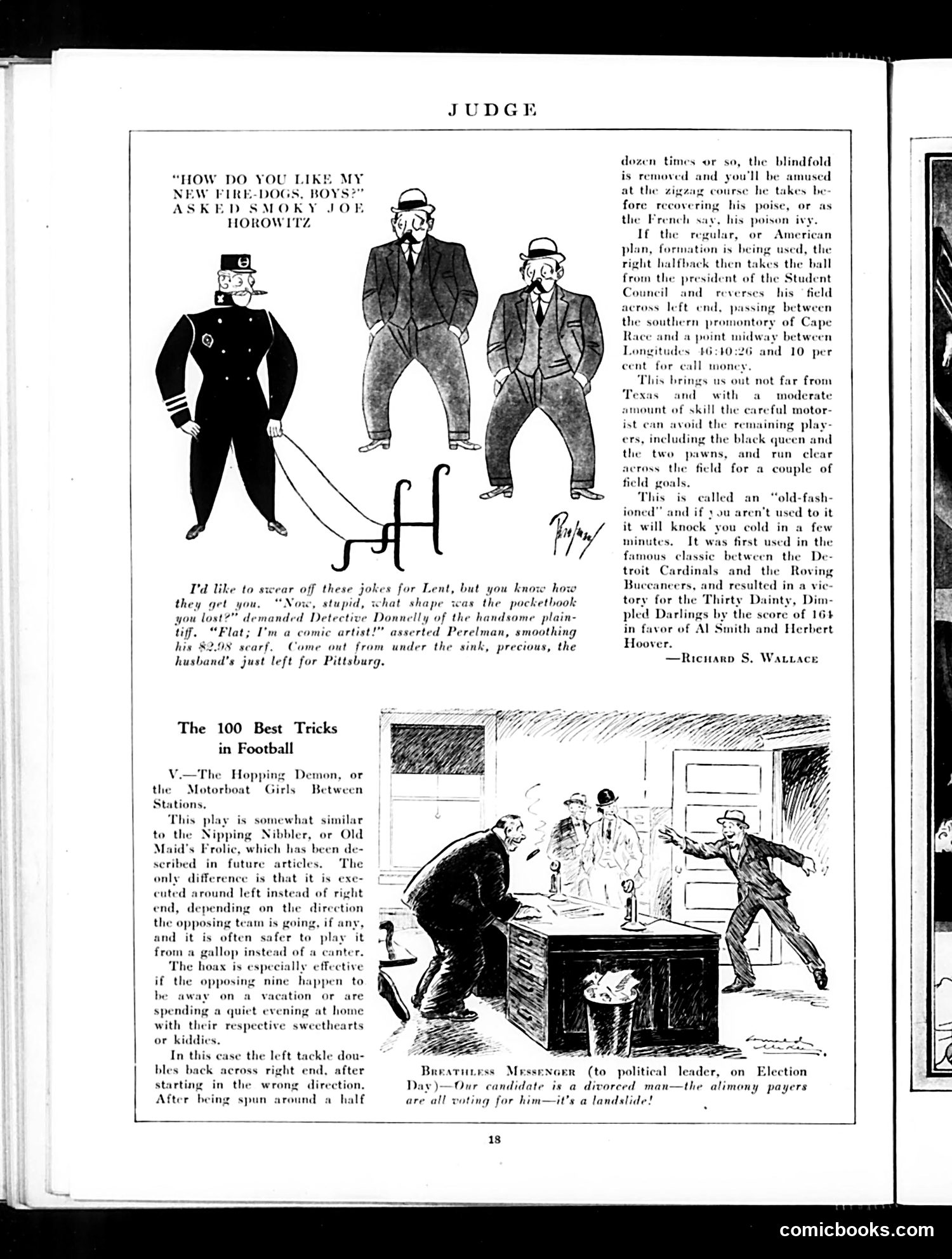
This *Judge* page contains two satirical pieces: **Top cartoon**: A joke about fire-dogs (decorative andirons) featuring what appears to be Smoky Joe Horowitz asking someone about his "new fire-dogs." The accompanying text mocks a "comic artist" named Perelman who claims to Detective Donnelly he lost his scarf. The humor is obscure without more context, likely relying on period references to vaudeville or local personalities. **Bottom section**: "The 100 Best Tricks in Football" parodies sports instruction by describing an absurdly complicated football play that devolves into nonsense (mentioning Cape Race, longitudes, chess pieces, and election results). It's mock-serious pseudo-technical writing meant to ridicule overly complex sports strategy explanations. **Cartoon below**: A "Breathless Messenger" announces a political candidate is actually divorced, claiming alimony-payers will vote for him as a "landslide." This satirizes how candidates manipulate voting blocs and highlights class/economic divisions in elections—likely referencing 1920s-era politics.
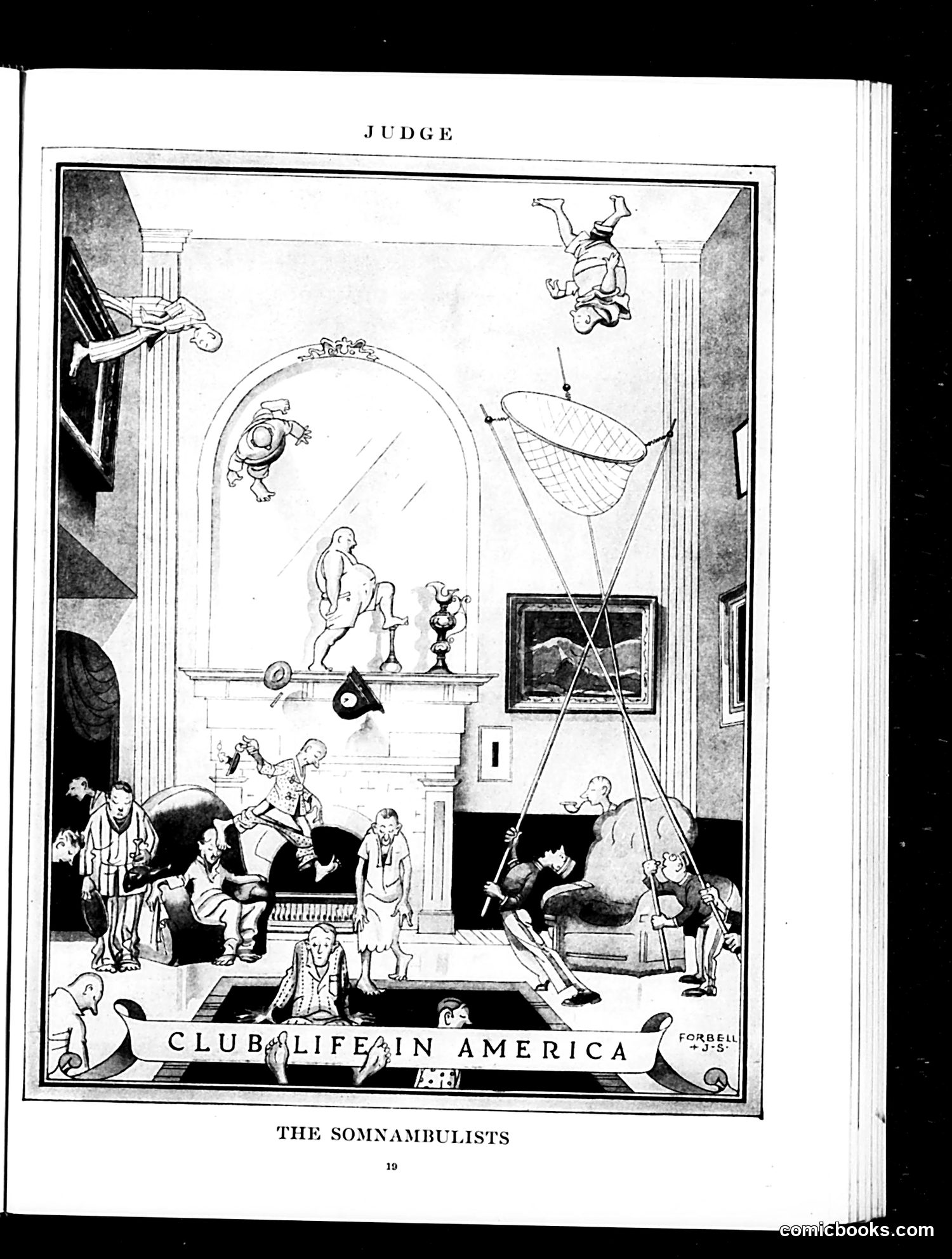
This Judge cartoon satirizes wealthy American club life as essentially sleepwalking through existence. The title references somnambulists—people walking while asleep—suggesting club members move through their leisure activities unconsciously or aimlessly. The illustration depicts an elaborate interior where wealthy patrons engage in various activities: acrobats perform overhead, people lounge and socialize, gymnastics occur on platforms, and servants attend to members. The chaos and surreal arrangement of activities implies these spaces encourage mindless excess and frivolous pursuit of entertainment without deeper purpose. The satire targets the upper-class obsession with clubs as centers of social status, suggesting members drift through these spaces in a kind of stupor, pursuing entertainment for its own sake rather than engaging meaningfully. It's a critique of gilded-age leisure culture as hollow and unconscious indulgence.
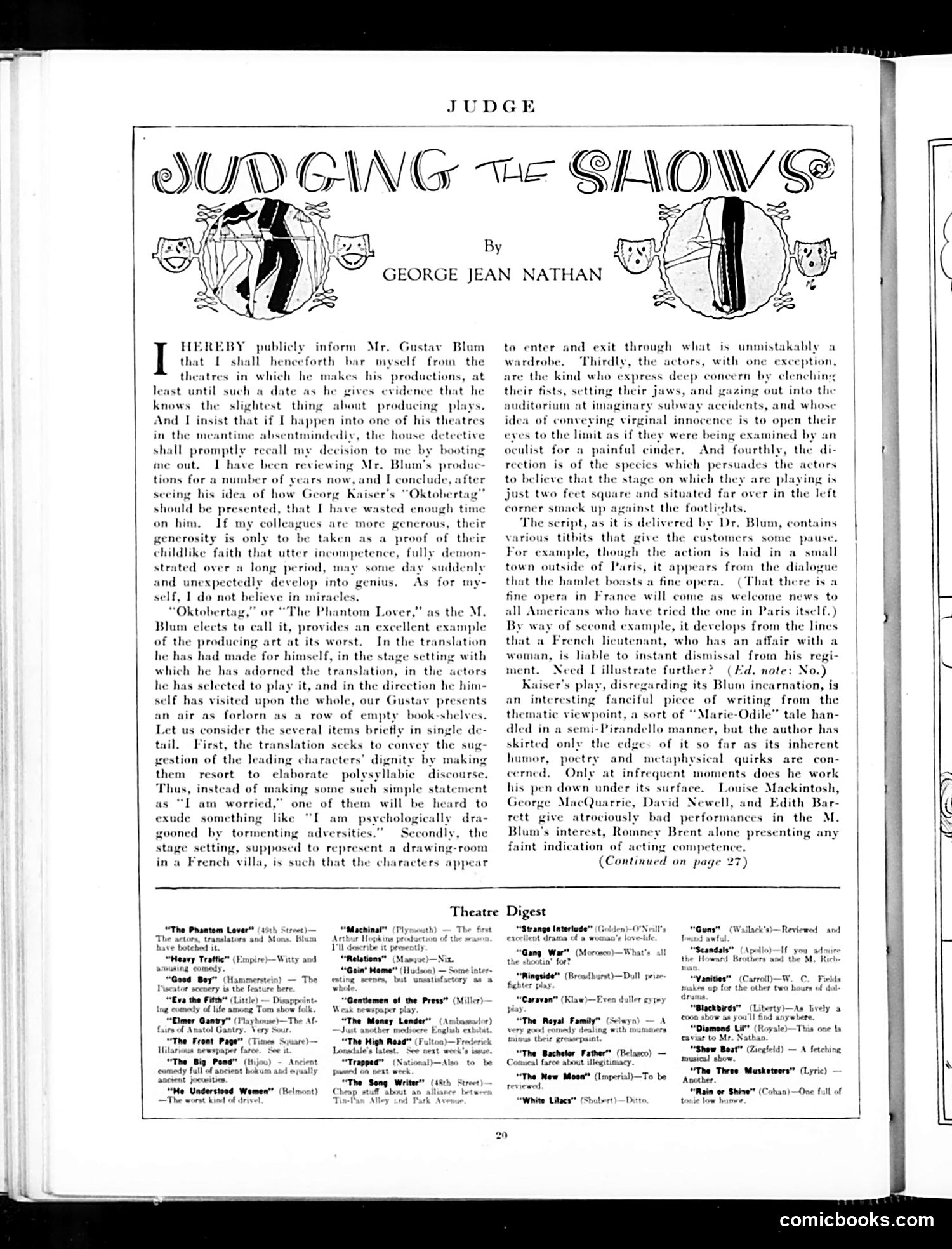
This is a theater criticism column by George Jean Nathan, Judge's drama critic, attacking producer Gustay Blum's production of Georg Kaiser's play "Oktobertag" (presented as "The Phantom Lover"). Nathan systematically demolishes the production across four dimensions: the translation uses pretentious polysyllabic language instead of natural speech; the stage design absurdly has actors entering through a wardrobe instead of proper doors; the actors use clichéd emotional expressions (clenched fists, wide eyes); and the direction confines action to an implausibly small stage area. Nathan also ridicules plot inconsistencies—a small French town supposedly having a fine opera, and a French officer facing instant dismissal for an affair. He acknowledges Kaiser's script has merit but condemns Blum's execution as incompetent, dismissing the cast's performances except for Romney Brent. The piece exemplifies Judge's satirical theater criticism, using specific production failures to mock incompetent directing.
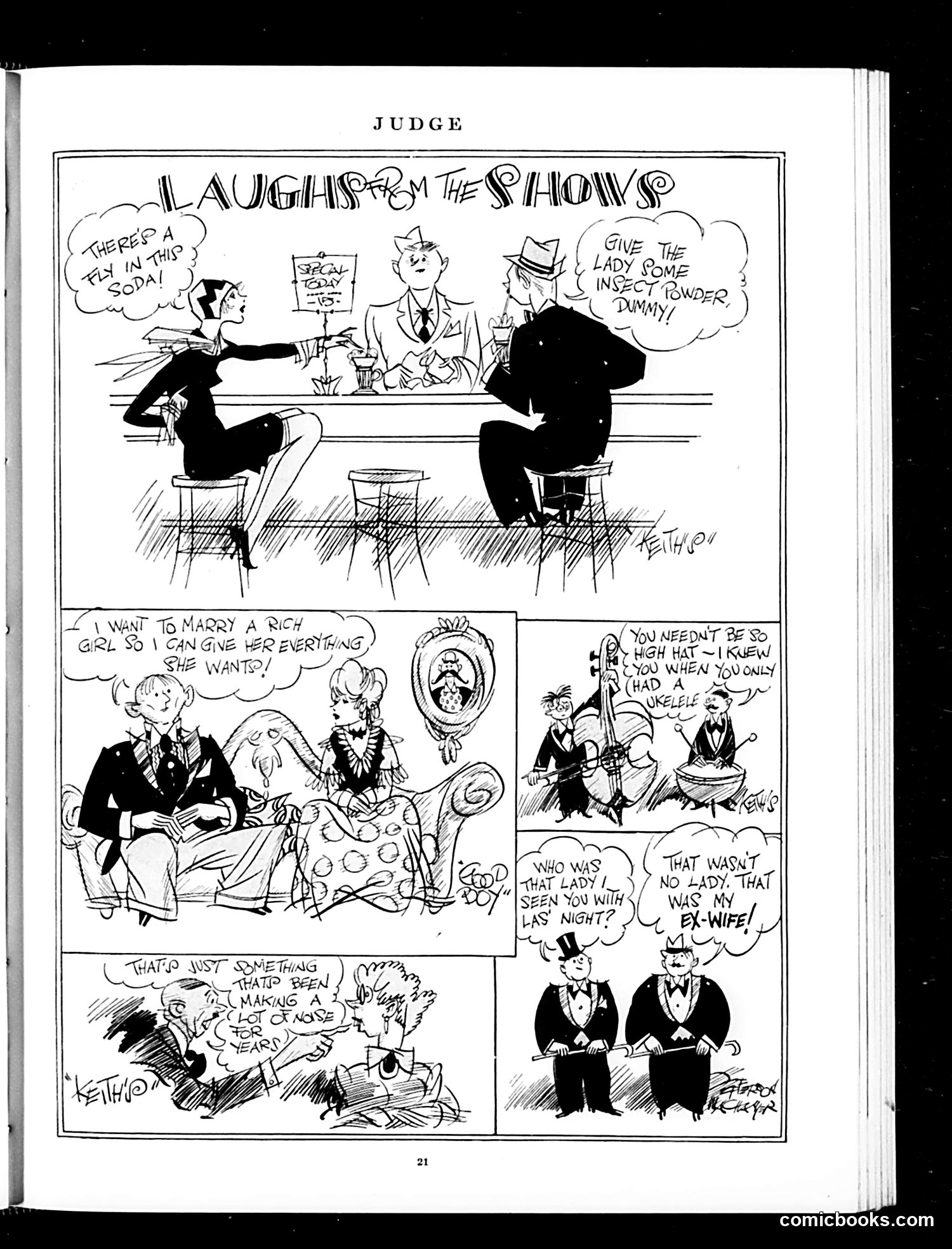
This is a theatrical satire featuring a judge presiding over courtroom-style "shows" (likely vaudeville or stage performances). The top panel mocks judges critiquing performers with absurd demands: "fleas in this soda," "give the lady some insect powder dummy." The lower panels depict a matrimonial dispute. A man claims he wants to marry a rich girl to give her everything she desires. His companion responds sarcastically that he needn't be so "high hat" since he only had an ukulele when they first met. The final panels reveal the punchline: the woman seen with him last night was his ex-wife, not a new romantic interest—a joke about marital complications and the man's questionable character. The satire targets both theatrical pretension and male romantic/financial hypocrisy, using the judge framework to mock superficial social climbing and dishonesty in relationships.
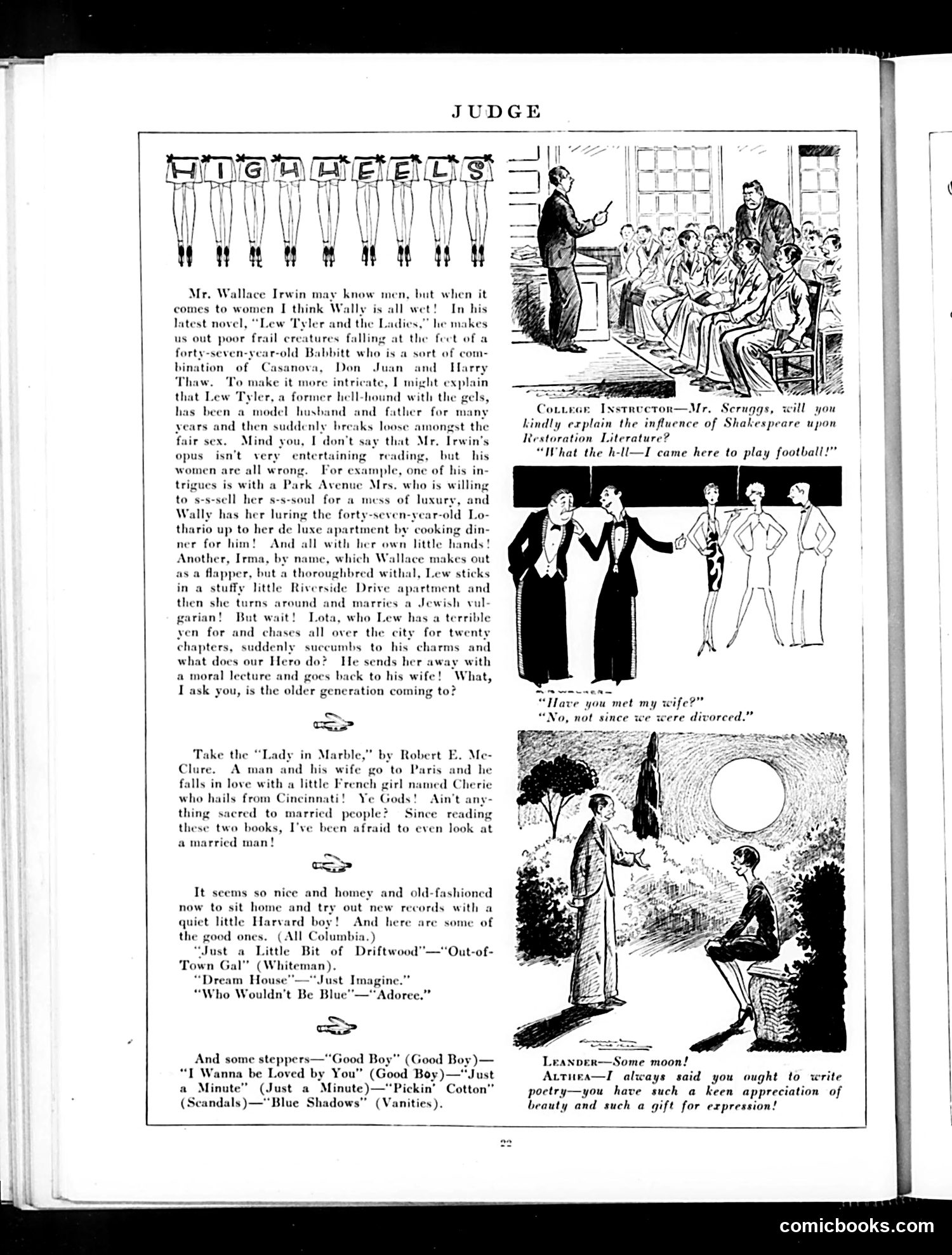
This page satirizes modern literature and morality through literary criticism. The main essay attacks novelist Wallace Irwin's novel "Lew Tyler and the Ladies," mocking its portrayal of women as easily seduced by a middle-aged man. The critic—appearing to be a woman—ridicules the implausible plots where respectable wives abandon their families for luxury, flappers marry unsuitable men, and even virtuous women succumb to a philanderer who then lectures them morally before returning to his wife. The accompanying cartoons mock social hypocrisy: a college classroom scene where a student admits he came to "play football," not study Shakespeare; a divorced couple awkwardly meeting; and a romantic scene where a man praises a woman's "gift for expression" in poetry. The satire's point: modern fiction presents unrealistic, immoral scenarios about infidelity and seduction, while society pretends shock at such behavior. The cartoons underscore widespread duplicity about respectability and actual conduct.
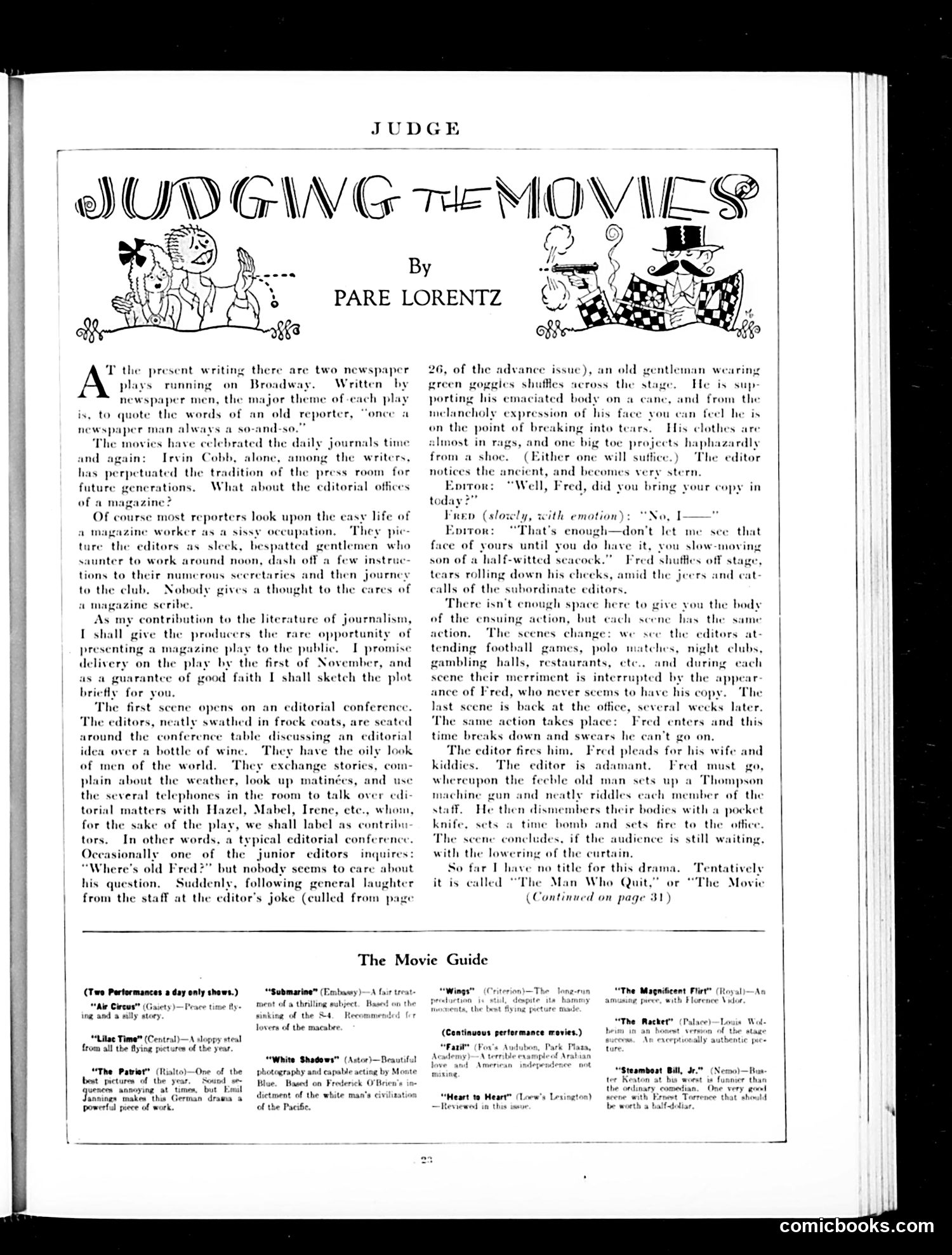
This is a theatrical critique disguised as a play proposal. Lorentz satirizes the supposedly "easy" life of magazine editors by contrasting their leisured workplace culture with the mistreatment of working writers like "Fred." The satire's setup: editors in frock coats lounge around conference tables, making phone calls to attractive women (Hazel, Mabel, Irene), attending sporting events and nightclubs—living the high life while subordinates labor. Fred, a shabby, desperate writer, repeatedly fails to deliver copy and endures public humiliation. The joke's darkening twist: the play culminates in violent fantasy—Fred dismembers the entire editorial staff with a Thompson machine gun, then sets the office ablaze. **The satirical point**: Lorentz critiques the exploitative magazine industry hierarchy, where editors enjoy leisure and authority while writers face casual cruelty and impossible demands. The escalating violence functions as absurdist commentary on workplace degradation—exaggerated to expose the system's inherent injustice.
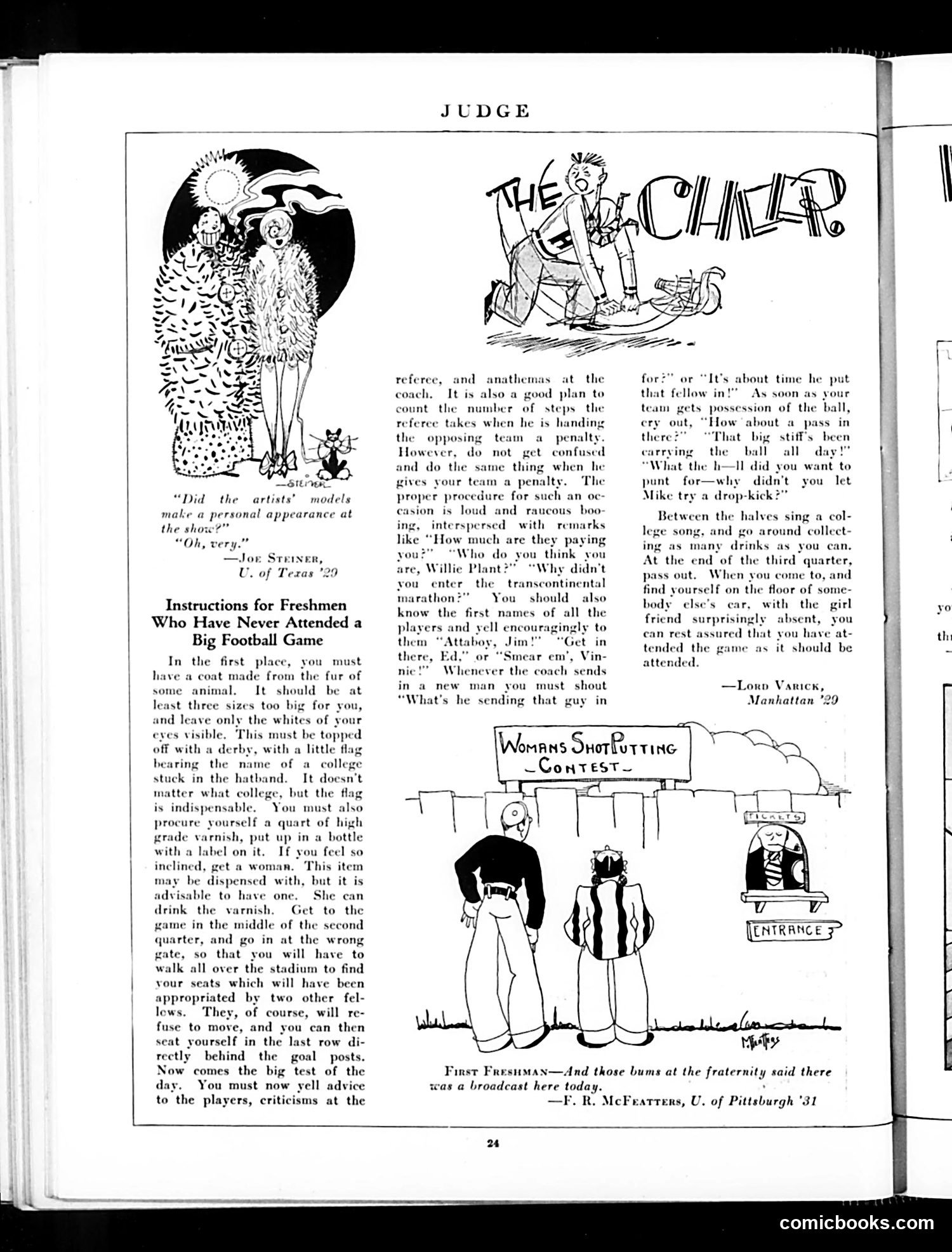
This page satirizes collegiate football culture of the late 1920s through two main pieces: **"Instructions for Freshmen"** mocks nouveau riche football fans—particularly wealthy undergraduates attending their first game. The satire targets their ostentatious displays: oversized fur coats (status symbols), flasks of liquor ("varnish"), bringing women as accessories, and arriving late to get lost in the stadium. The humor lies in detailed instructions for behaving badly—heckling players and referees, getting drunk, and passing out before the game ends. **"Woman's Shot-Putting Contest"** cartoon depicts women attempting to enter a stadium event, suggesting the era's gender segregation at sporting venues and the novelty/controversy of female athletic participation. Both pieces lampoon 1920s college excess—drinking, status-seeking, and athletic enthusiasm—while reflecting period attitudes about appropriate fan behavior and gender roles at public sporting events.
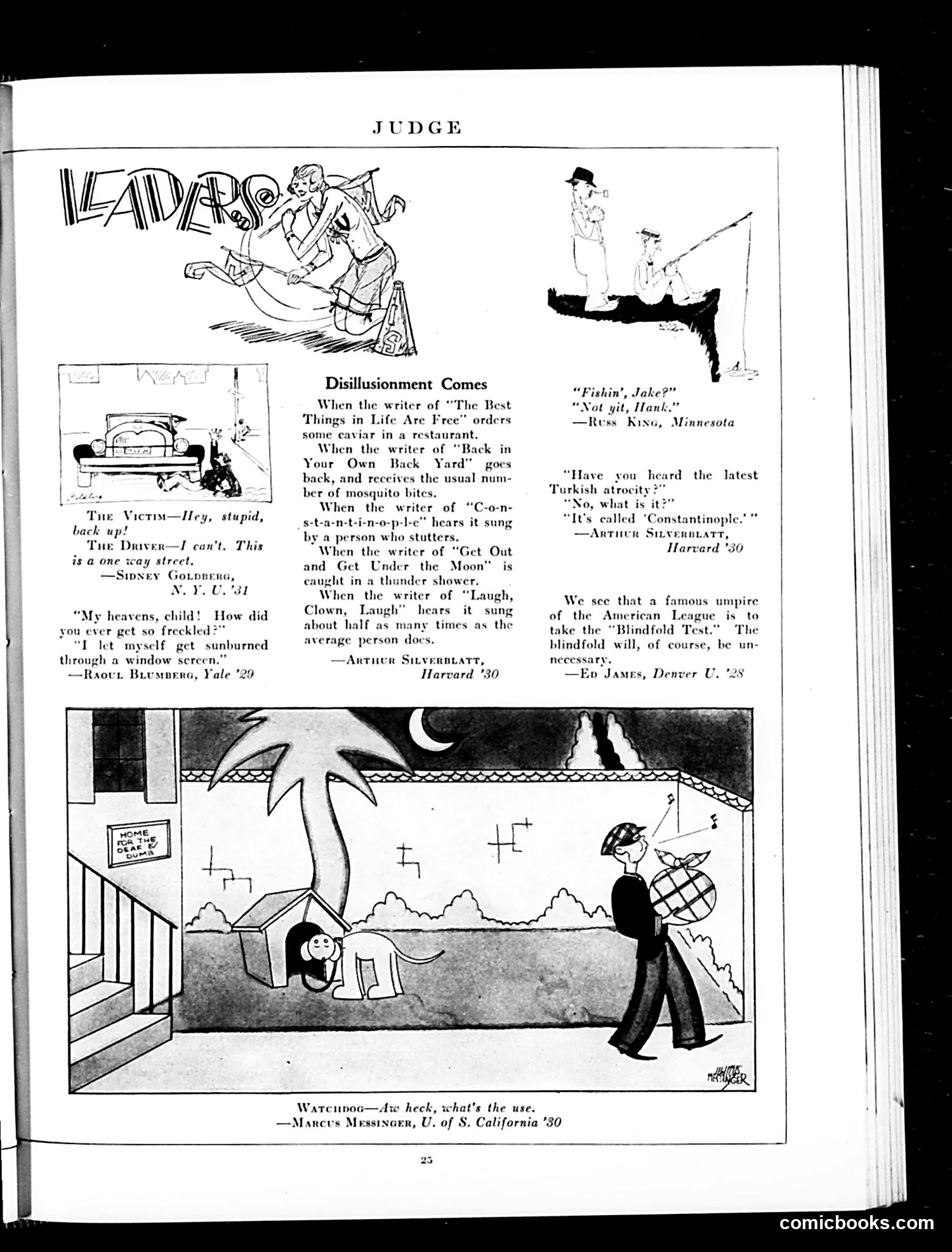
This page collects humorous observations about disillusionment—the gap between idealistic popular songs and mundane reality. The central conceit: songwriters who penned optimistic ditties ("The Best Things in Life Are Free," "Back in Your Own Back Yard," "Laugh, Clown, Laugh") face ironic consequences when their lyrics meet real life. A caviar restaurant bill contradicts "free" things; returning home brings mosquito bites instead of nostalgia; stutterers can't sing "Constantinople." The scattered cartoons mock everyday frustrations: a driver stuck on a one-way street; sunburned skin from a window screen; a man watching someone fly a kite at night with resignation ("what's the use"). A baseball joke references an umpire taking a "Blindfold Test"—the humor being that umps already appear blind to rule violations, so an actual blindfold wouldn't matter. The humor is gentle, non-partisan satire about the disconnect between sentimental popular culture and actual lived experience—typical of Judge's satirical approach to American manners and pretensions.
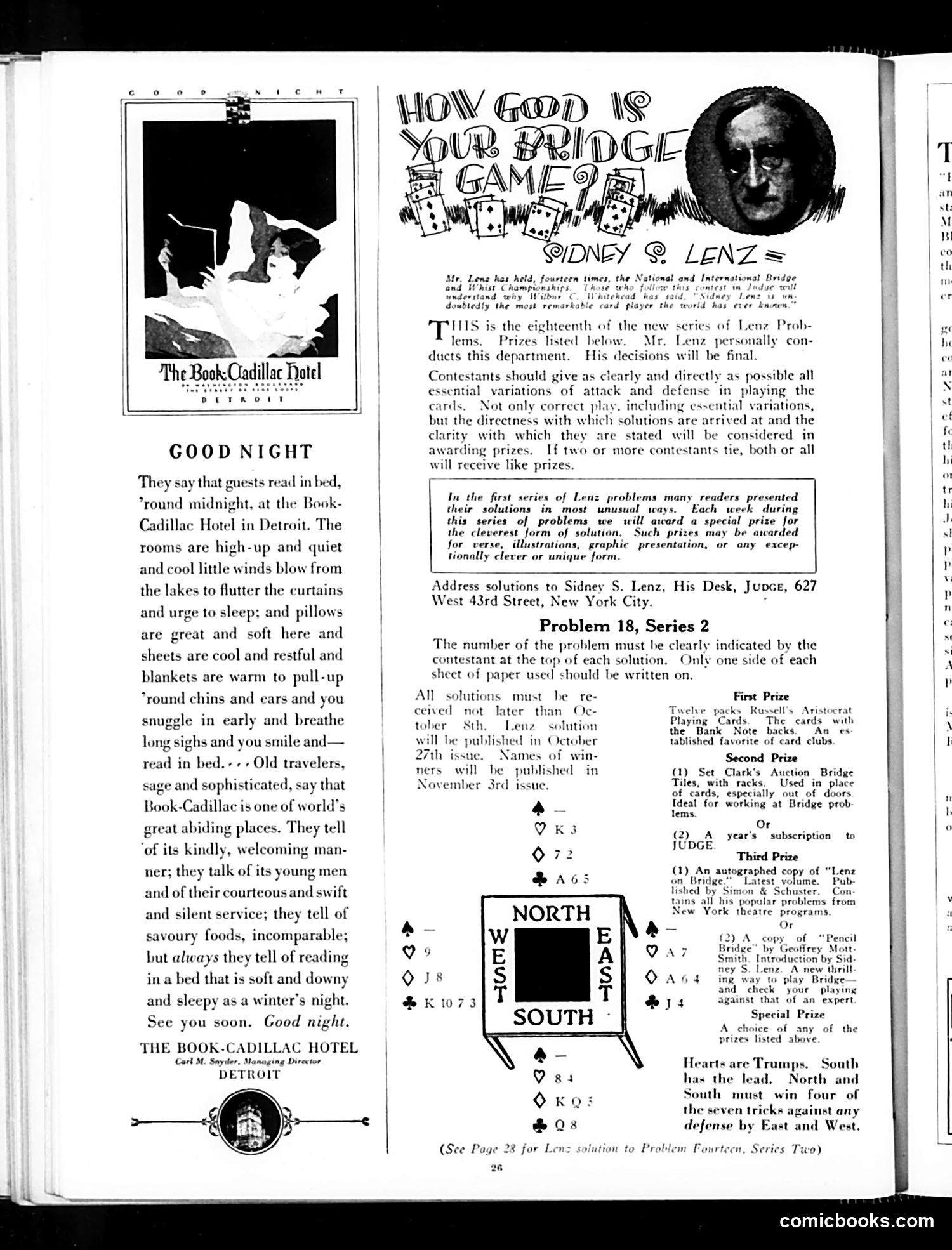
This page is primarily **advertising and instructional content** rather than political satire. The main elements are: **Book-Cadillac Hotel Advertisement** (left): A luxurious Detroit hotel promotes itself through evocative copy about comfortable reading in bed—emphasizing amenities like high rooms, lake breezes, soft linens, and courteous service. This is straightforward hospitality marketing common in early 20th-century magazines. **Bridge Problem Contest** (right): The bulk of the page announces an eighteenth-series bridge card game puzzle competition run by Sidney S. Lenz, a renowned bridge expert. Contestants submit solutions competing for prizes including card decks, subscriptions to *Judge* magazine, and autographed bridge instruction books. **No political cartoon or satire is present** on this page. The content reflects the era's combination of luxury hotel promotion and intellectual entertainment (bridge was hugely popular among educated audiences). The page demonstrates how magazines like *Judge* monetized through both advertising and reader-participation contests.
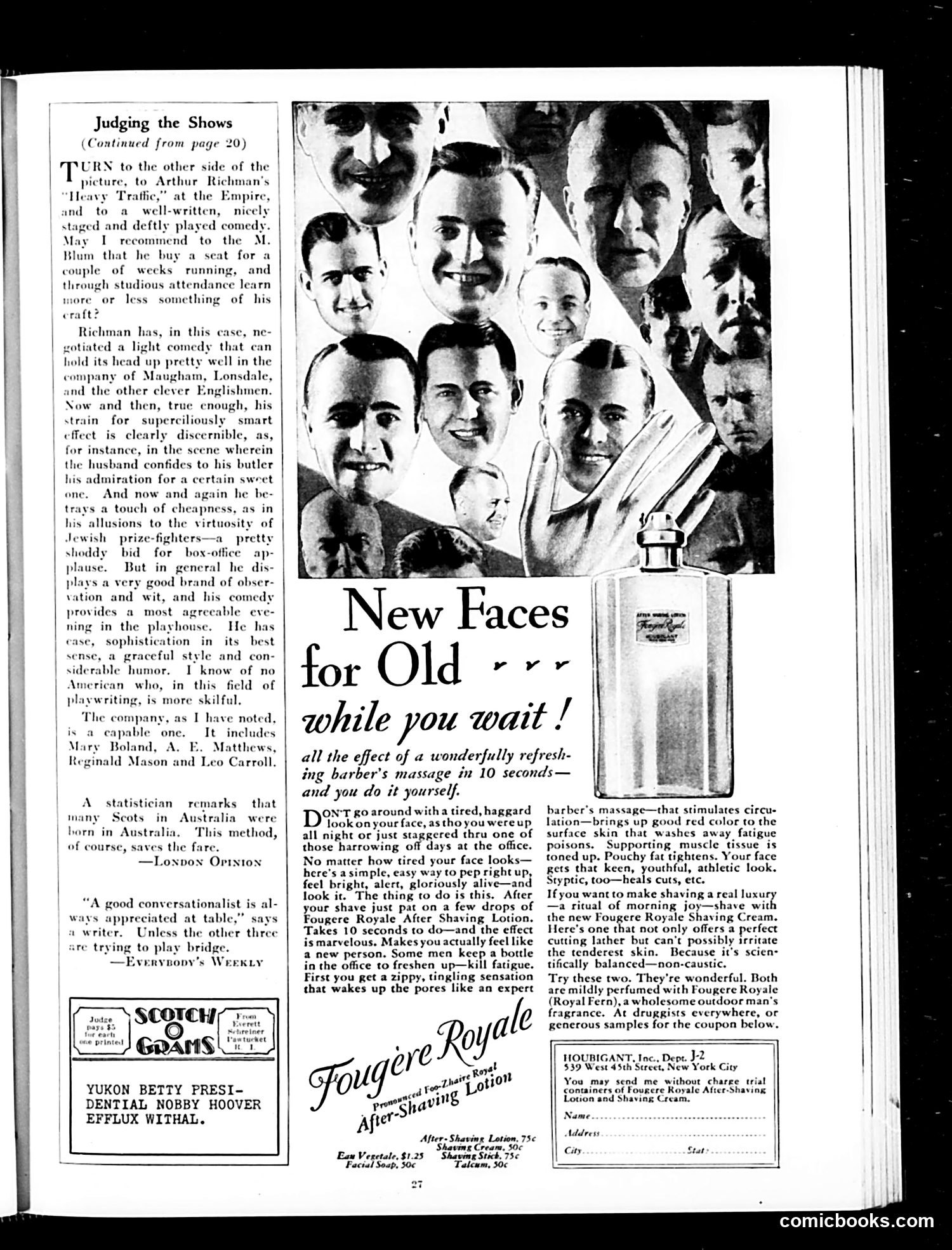
This page contains **theater criticism and advertising**, not political cartoons. **The Theater Review:** Critic Arthur Richman's "Heavy Traffic" (at the Empire Theatre) receives qualified praise. The reviewer commends the writing and cast—including Mary Boland and Leo Carroll—but criticizes Richman's occasional lapses into cheap humor, particularly "allusions to the virtuosity of Jewish prize-fighters," which the critic dismisses as pandering for applause. The piece acknowledges Richman as a skilled American playwright comparable to British contemporaries like Maugham and Lonsdale. **The Advertisements:** The bulk of the page promotes Fougère Royale men's grooming products (after-shaving lotion and shaving cream). The ad uses period-typical appeals about appearing energetic and youthful, suggesting office workers should "freshen up" during the day. A small ad promotes "Scotch Grams." **Historical context:** This appears to be from Judge magazine's theatrical section, typical of 1920s-era entertainment criticism focusing on Broadway productions.
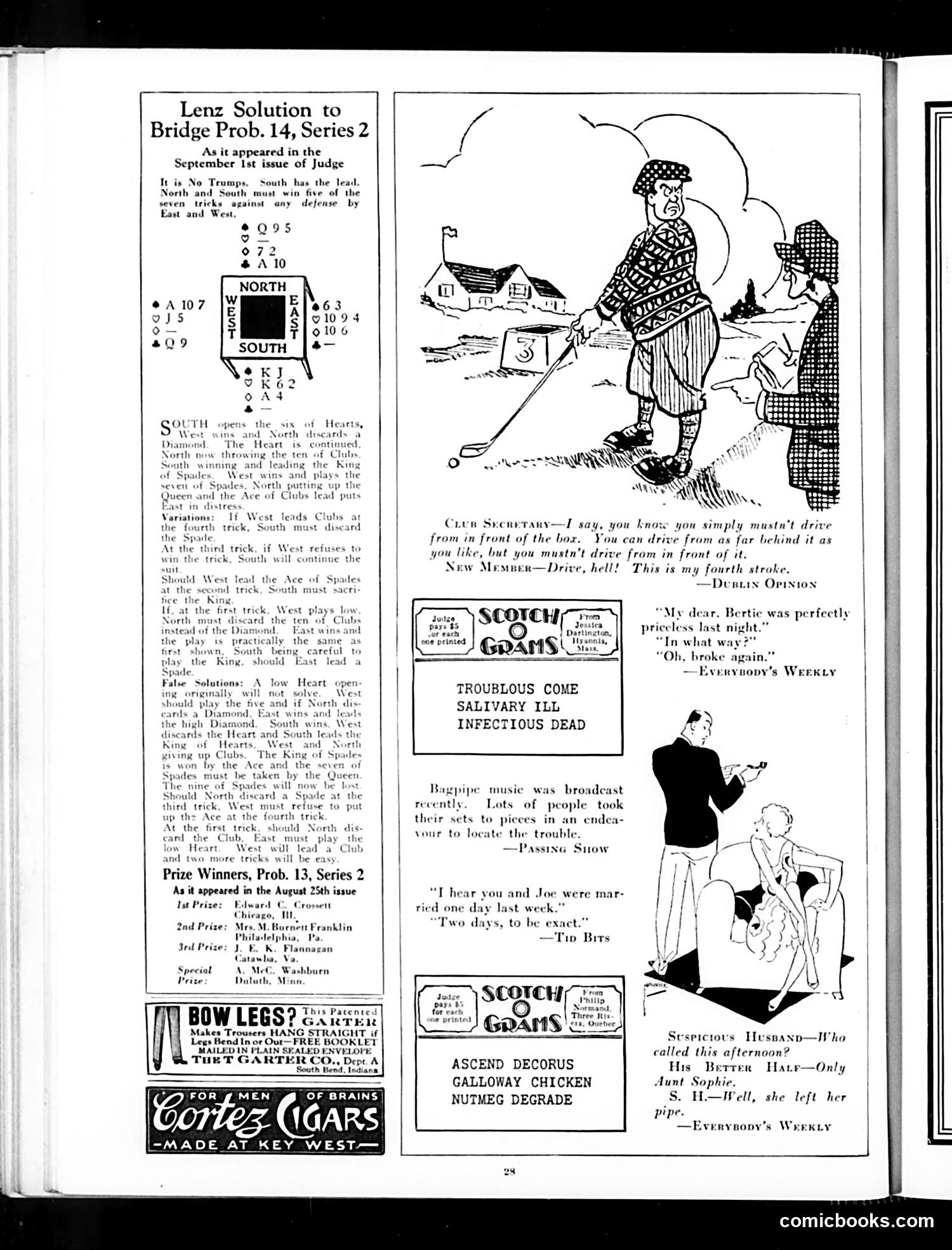
This page combines bridge problem solutions with humor content typical of early 20th-century American satirical magazines. **Main Content:** The left column presents the technical solution to "Bridge Problem 14," a card game puzzle, along with prize winners from a previous problem. This reflects bridge's popularity as sophisticated entertainment among Judge's educated readership. **Cartoons & Humor:** The right side contains several brief jokes and a cartoon about golf etiquette. The "Club Secretary" cartoon depicts a conflict between established rules (driving from behind the box) and a new member's impatience (wanting to drive from the front). The humor satirizes both stuffy club formality and modern impatience with tradition. **Supporting Content:** Scattered advertisements (Scotch Grams cigars, bow-leg garters, Cortez cigars) and brief quips about bagpipe broadcasts and marriages fill remaining space—typical filler for 1920s-era magazines mixing aspiration (bridge, golf clubs) with working-class humor (crooked husbands, domestic complaints). The page reflects Judge's target audience: educated, leisure-class readers concerned with propriety, games, and urban social dynamics.
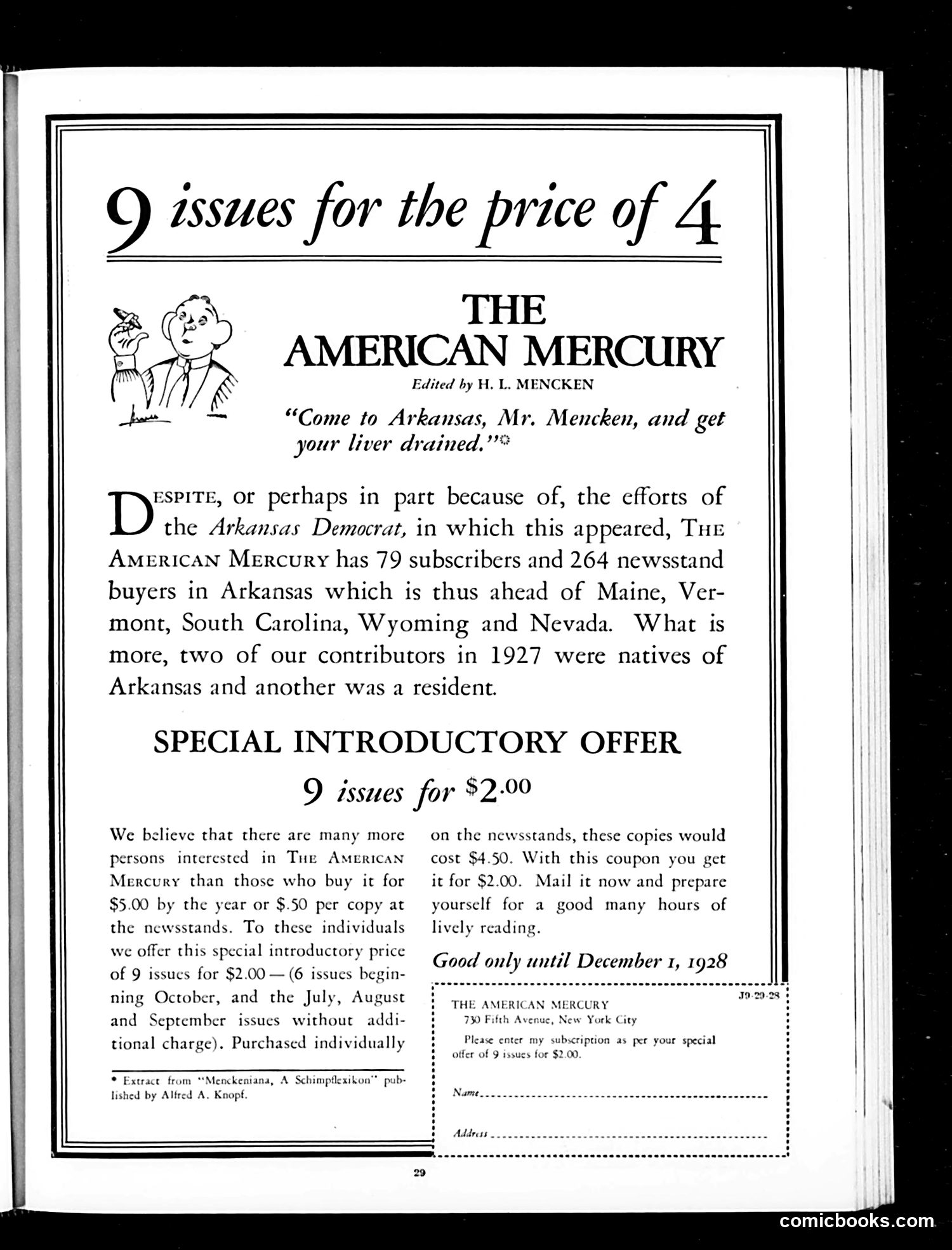
This is primarily a subscription advertisement for *The American Mercury*, edited by H.L. Mencken, a prominent satirical magazine of the 1920s. The small cartoon shows two figures discussing the magazine—one appears to be soliciting the other with a crude reference to liver-draining, likely alluding to Arkansas's reputation (possibly related to folk remedies or stereotypes about rural Southern practices). The joke is defensive: despite the Arkansas Democrat's skeptical or mocking coverage, *The American Mercury* actually has strong Arkansas circulation compared to other states. The ad presents this as evidence that even in a state making fun of Mencken's magazine, it outsells competitors. The "liver-draining" jab is sarcastic—implying Arkansans are unsophisticated, yet they're buying the magazine anyway. The special offer (9 issues for $2) is a genuine subscription pitch, not satire. The extract attribution to "Menckeniana, A Schimpflexikon" (*Schimpflexikon* = "book of insults") reinforces Mencken's reputation as a fearless critic.
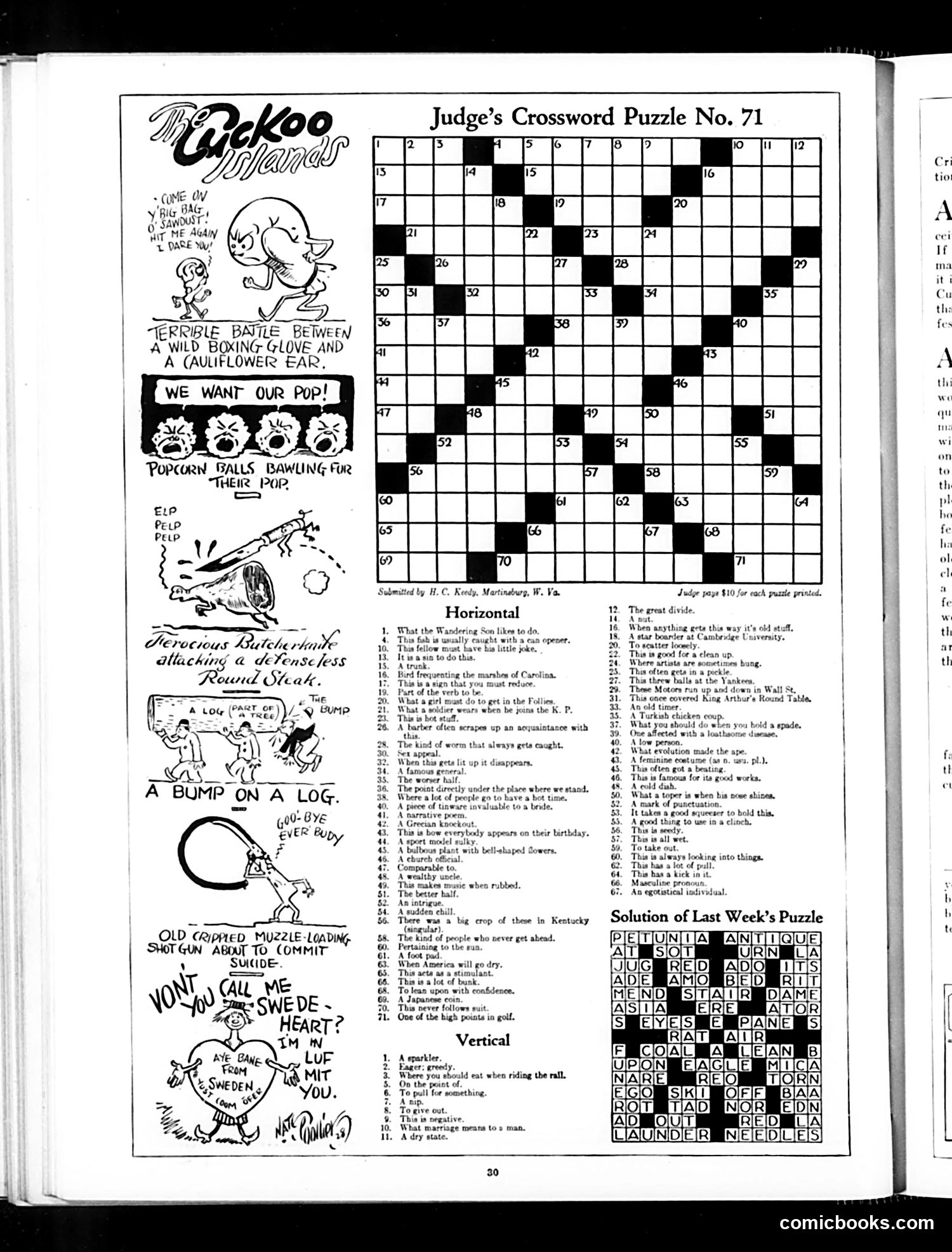
This page from *Judge* magazine presents a crossword puzzle (No. 71) alongside several humorous cartoon vignettes typical of early-to-mid 20th century satirical humor. The cartoons employ visual puns and wordplay common to the era: "A Terrible Battle Between a Wild Boxing Glove and a Cauliflower Ear" plays on the boxer's injury; "A Bump on a Log" depicts literal slapstick; "Popcorn Balls Bawling for Their Pop" anthropomorphizes food items; and "Old Crippled Muzzle-Loading Shotgun About to Commit Suicide" personifies an antique weapon. The recurring motif involves linguistic double meanings and physical comedy rather than political satire. One cartoon references "Eld, Eld, Eld" (mimicking weeping sounds), and another shows a Dutch rhinoceros attacking a "round steak"—playing on animal and food imagery. The puzzle's clues themselves contain light wordplay and contemporary references (e.g., "Wall Street," "Kentucky"). This represents *Judge*'s characteristic blend of visual humor, puns, and domestic American comedy aimed at educated readers.
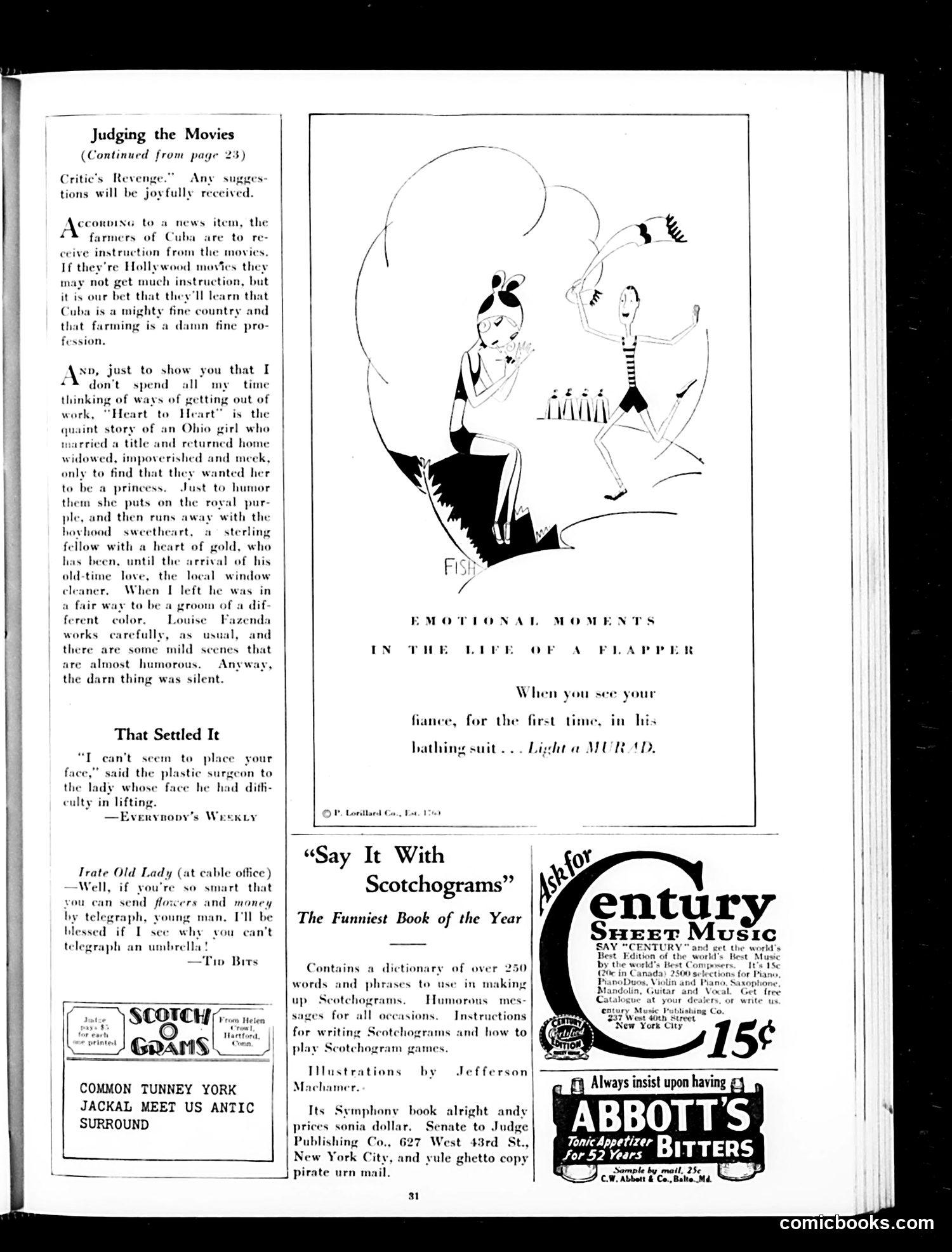
This page mixes film criticism with period advertising. The main content discusses how Cuban farmers will receive movie instruction—a satirical jab at Hollywood films' educational value. The critic notes that while these movies may not teach farming, they'll at least promote Cuba as "a mighty fine country." The referenced films include "Heart to Heart" (an Ohio girl story) and "Louise Fazenda" comedies, highlighting early 1920s silent cinema's melodramatic plots. The cartoon titled "Emotional Moments in the Life of a Flapper" depicts a young woman in fashionable 1920s dress reacting to seeing her boyfriend in a bathing suit—likely poking fun at the flapper's exaggerated emotional responses and modern dating culture. The page is otherwise dominated by advertisements for "Scotchograms" (a novelty gift book), Century Sheet Music, and Abbott's Bitters—typical period advertising reflecting 1920s consumer products.
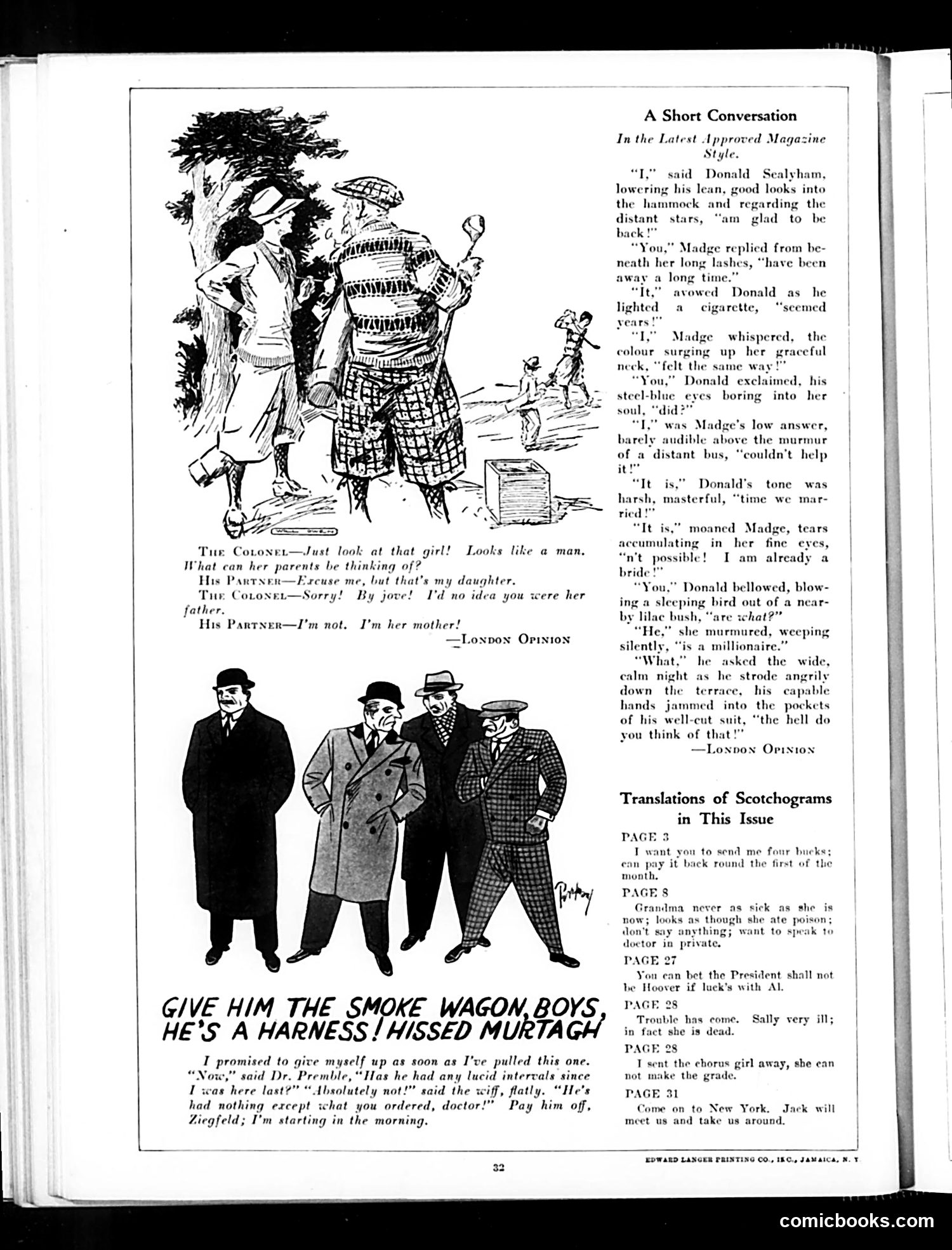
This page contains three satirical pieces typical of early 20th-century Judge humor: **"A Short Conversation"** mocks pretentious literary magazines' florid romance writing. The dialogue between Donald and Madge drips with overwrought sentiment—gazing at stars, cigarettes, meaningful silences—yet the mood shatters when a bus rumbles past. The satire targets the gap between affected sophistication in published fiction and mundane reality. **The Colonel cartoon** jokes about androgynous fashion. A colonel mistakes a masculine-looking woman for a man; her companion corrects him—she's the woman's *mother*, not father. The humor derives from gender confusion and the implication that modern women's appearance has become indistinguishable from men's. **"Give Him the Smoke Wagon"** appears to reference an asylum or medical setting, with Dr. Premble treating an apparently delusional patient. Ziegfeld's involvement suggests theatrical satire, though context is unclear. The "Scotchograms" section translates Scottish dialect messages—mostly domestic complaints about illness and money.
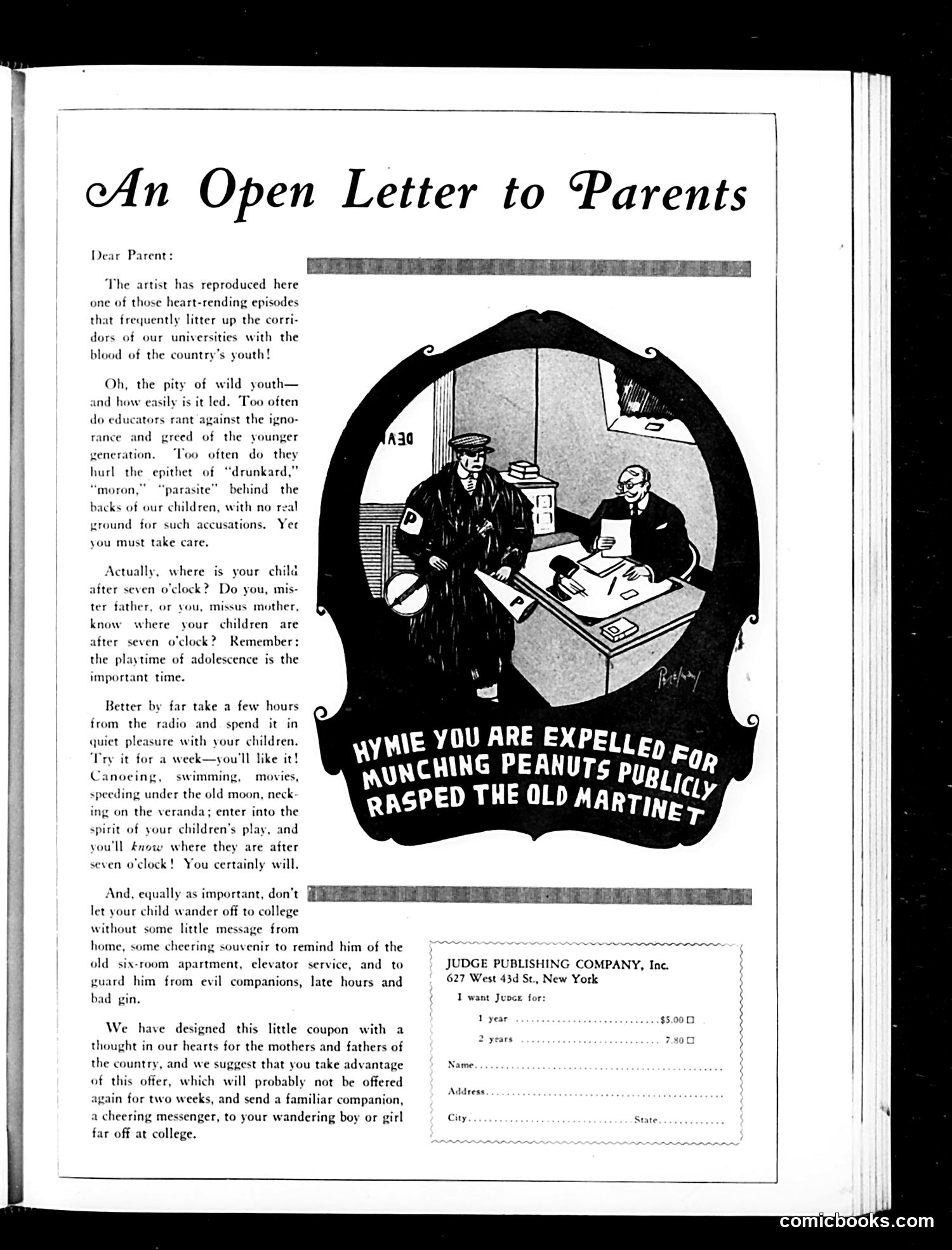
This Judge magazine page satirizes parental anxiety about college-aged youth. The main cartoon depicts a dean or authority figure expelling a student for "munching peanuts publicly" and "rasped the old martinet"—mocking overly strict institutional discipline and petty rule-enforcement. The accompanying letter ironically addresses parents' concerns about their children's whereabouts and moral corruption. It employs faux-earnest rhetoric to critique both generational misunderstanding and parental neglect, suggesting parents don't know where their children are after 7 PM and shouldn't let them leave for college without receiving Judge magazine as a "cheering messenger" and moral guide. The satire targets multiple targets: strict educators, anxious parents, and institutional hypocrisy—while ultimately promoting Judge's subscription as the solution. The cartoon's absurd punishment exemplifies institutional overreach, undercutting the serious tone of the accompanying advertisement/coupon.
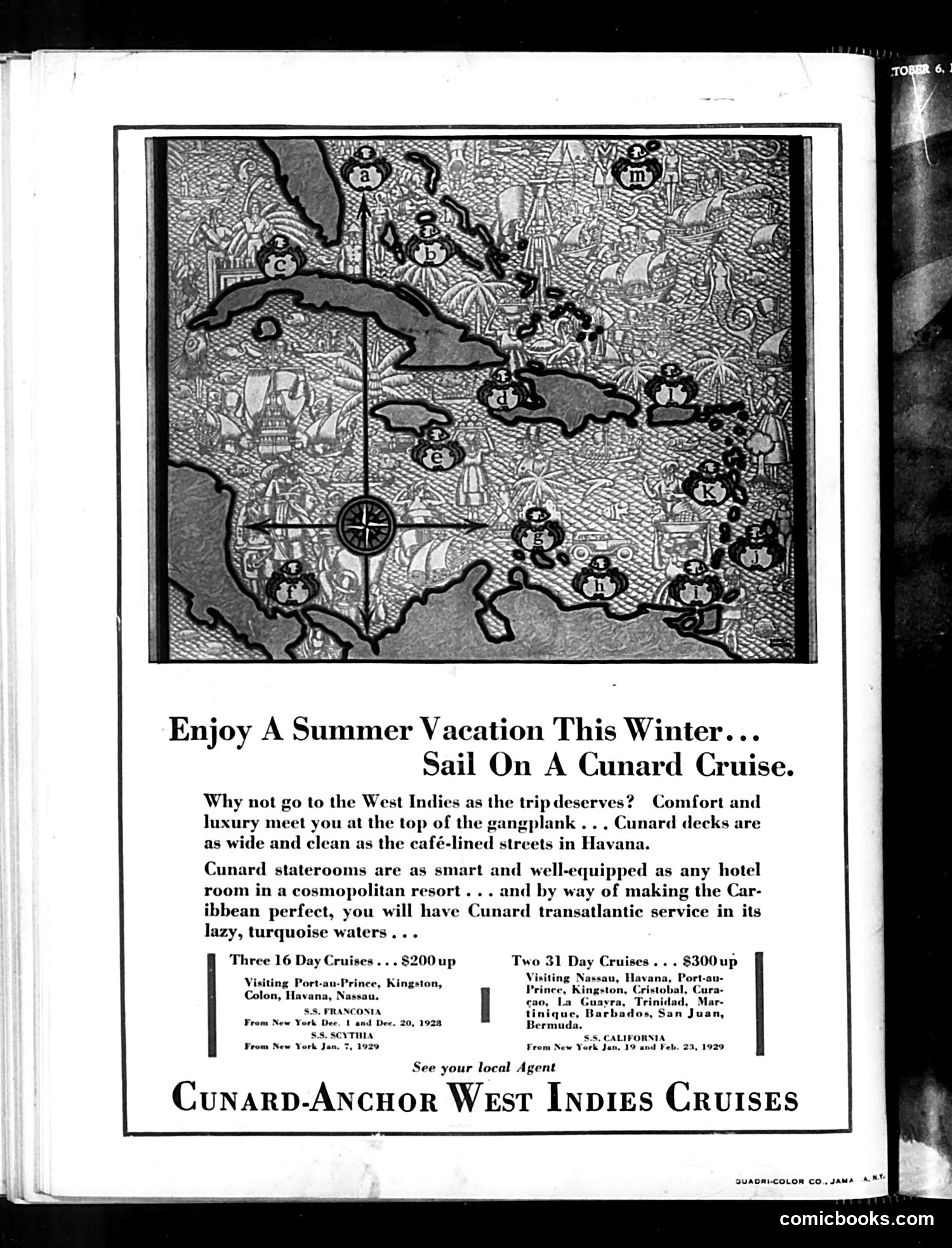
This page is **primarily an advertisement**, not political satire. It's a Cunard-Anchor cruise line ad from the late 1920s promoting winter vacations to the Caribbean. The decorative map at the top shows various West Indies ports of call with small illustrated emblems marking destinations. The ad emphasizes luxury and comfort—comparing Cunard ship decks to Havana's "café-lined streets" and staterooms to cosmopolitan hotels. The three cruise options (ranging from $200-$300) departed from New York to ports including Port-au-Prince, Kingston, Nassau, Trinidad, and Bermuda. Sailing dates listed are December 1928 and January-February 1929. This reflects the **pre-Depression travel boom** when Caribbean cruises represented accessible luxury for the American middle and upper-middle classes. The casual references to colonial Caribbean destinations reflect the era's imperial attitudes toward those regions as exotic vacation playgrounds.