
Judge, 1928-09-29 · page 22 of 36
Judge — September 29, 1928 — page 22: what you’re looking at
What you’re looking at
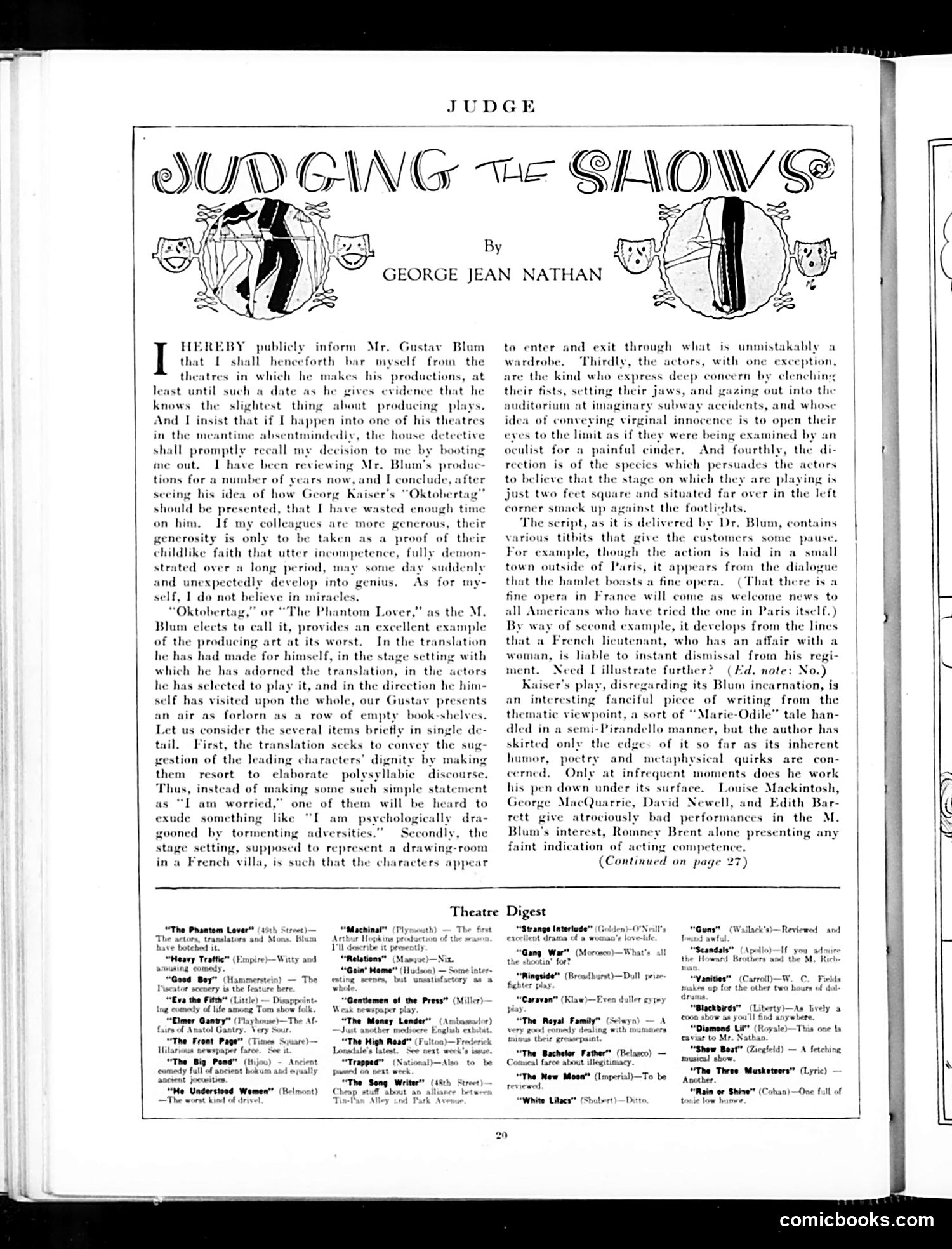
This is a theater criticism column by George Jean Nathan, Judge's drama critic, attacking producer Gustay Blum's production of Georg Kaiser's play "Oktobertag" (presented as "The Phantom Lover"). Nathan systematically demolishes the production across four dimensions: the translation uses pretentious polysyllabic language instead of natural speech; the stage design absurdly has actors entering through a wardrobe instead of proper doors; the actors use clichéd emotional expressions (clenched fists, wide eyes); and the direction confines action to an implausibly small stage area. Nathan also ridicules plot inconsistencies—a small French town supposedly having a fine opera, and a French officer facing instant dismissal for an affair. He acknowledges Kaiser's script has merit but condemns Blum's execution as incompetent, dismissing the cast's performances except for Romney Brent. The piece exemplifies Judge's satirical theater criticism, using specific production failures to mock incompetent directing.
📄 Transcribed text from this page (OCR, searchable)
Machine-transcribed from the original scan — historical spelling and the odd misread are preserved.
JUD By \ \ HEREBY publicly inform Mr. Gustay Blum I that [shall henceforth bar myself from the theatres in which he makes his productions, at least until such a date as he gives evidence that he knows the sl about producing plays. And I insist that if I happen into one of his theatres in the meantime absentmindedly, the house detective shall promptly recall my decision to me by booting me out. I have been reviewing Mr. Blum’s produc- tions for a number of years now, and I conclude, after secing his idea of how Georg Kaiser's “Oktobertag’” should be presented, that I have wasted enough time on him. If my colleagues are more generous, their generosity is only to be taken as a proof of their childlike faith that utter incompetence, fully demon- strated over a long period, may some day suddenly and unexpectedly develop into genius. As for mj self, I do not believe in miracles, “Okt r The Phantom Lover,” as the M. Blum e 1 it, provides an excellent example | of the producing art at its worst. In the translation he has had made for himself, in the stage setting with which he has adorned the translation, in the actors he has selected to play it, and in the direction he him- self has visi itest thing -d upon the whole, our Gustay presents an air as forlorn as a row of empty book-shelves. Let us consider the several items brietly in single di I. First, the translation secks to convey the su gestion of the leading characters’ dignity by makin them resort to elaborate polysyllabic Thus, instead of making some such simple statement as “To am worri one of them will be heard to exude something like “I am psychologically dra- gooned by tormenting adversities.” Secondly, the stage setting, supposed to represent a drawing-room in a French villa, is such that the characters appear discourse, GEORGE JEAN NATHAN GE to enter and exit through what is unmistakably a wardrobe, Thirdly, the actors, with one exception, the kind who express deep concern by clenchins their fists, setting their jaws, and gazing out into the nts, and whose idea of conveying virginal innocence is to open their eves to the limit as if they were being examined by an oculist for a painful cinder. And fourthly, the di- rection is of the species which persuades the actors to believe that the s on which they 1 just two feet sq id situated far over in the left corner smack up against the footlishts, The script, as it is delivered by Dr. Blum, contains various titbits that give the customers some pause. For example, though the action is laid in town outside of Paris, it appears from the ¢ that the hamlet boasts a fine opera fine opera in France will come as welcome news to all Ameri ve tried the one in Paris itself.) By way of second example, it develops from the lines that a French lieutenant, who has an affair with woman, is liable to instant dismissal from his reg ment. Need I illustrate further? (Ed. note: No.) ser's play, disregarding its Blum incarnation, is an interesting fanciful piece of writing from the thematic viewpoint, a sort of “Marie-Odile” tale han- dled in a semi-Pirandello manner, but the author has skirted only the edge. of it so far as its inherent humor, poetry and metaphysical quirks are con- cerned, Only at infrequent moments does he work his pen down under its surface. Louise Mackintosh, George MacQuarrie, David Newell, ar dith Bar- rett give atroc in the M. Blum’s interest, Romney Brent alone presenting any faint indication of acting competence. (Continued on page 27) auditorium at im: rary subway accic re ns who ha pusly bad performan Theatre “The Phantom Lover” (4th Street)— _“Machinal” (1 D be fir ‘The actors, translators and Moos. Blum — Arthur He have botebed it I'll deverite it ly “Meavy Tratfie” (Empire)—Witty and “Relations” (Masyue)—Nix. amusing comedy “Goin? Home” (Hudson) — Some inter “Good Bey” (Hammerstein esting scenes, but unsatisfactory aa a ator scenery is the the Fitth’ ( whole itlemen of the Press™ (Miller) — fairs of Anatol Gantry. Very Sour Front Page” (Times Syuare)— 4 newspaper farce. See it pasend on pert week, “The Song Writer” (48h Street “He Understood Women” (Helmont) Cheap stuf about an The worst kine of drivel Tinea nd Ph Ave Lu Digest Strange Interlude” ot drama of Gang. War (Moroaco)—What's foe? the sbom “Ringside” (Broadburst)—Dull peire- fighter play “Caravan” (Klaw)—Eve “Guns (Wallack’s)—Reviewed and Apsllo)—If you ad the Howard Brothers and the M. Riet Vanities (Carroll) —W. C. Fields om up for the other two hours of dol- duller ey rey lackbirds” (Liberty)—As lively a bow as you'll find anywhere. jiamend Li" (Royale)—T Mr. Natha 1” (Ziegfeld) — A fetching els _ "The Bachelor Father" (Belasco) — Conueal farce about illegitimacy. aa 1 “The Mew Meee” (Imperial)—To be ,,chey nee Mutheteers” (Lyric) . “Rain or Shine” (Cohan)—One full of “white Lilaes™ (Shubert) Ditto tonic tow homee comicbooks.com