
A complete issue · 36 pages · 1928
Judge — July 7, 1928
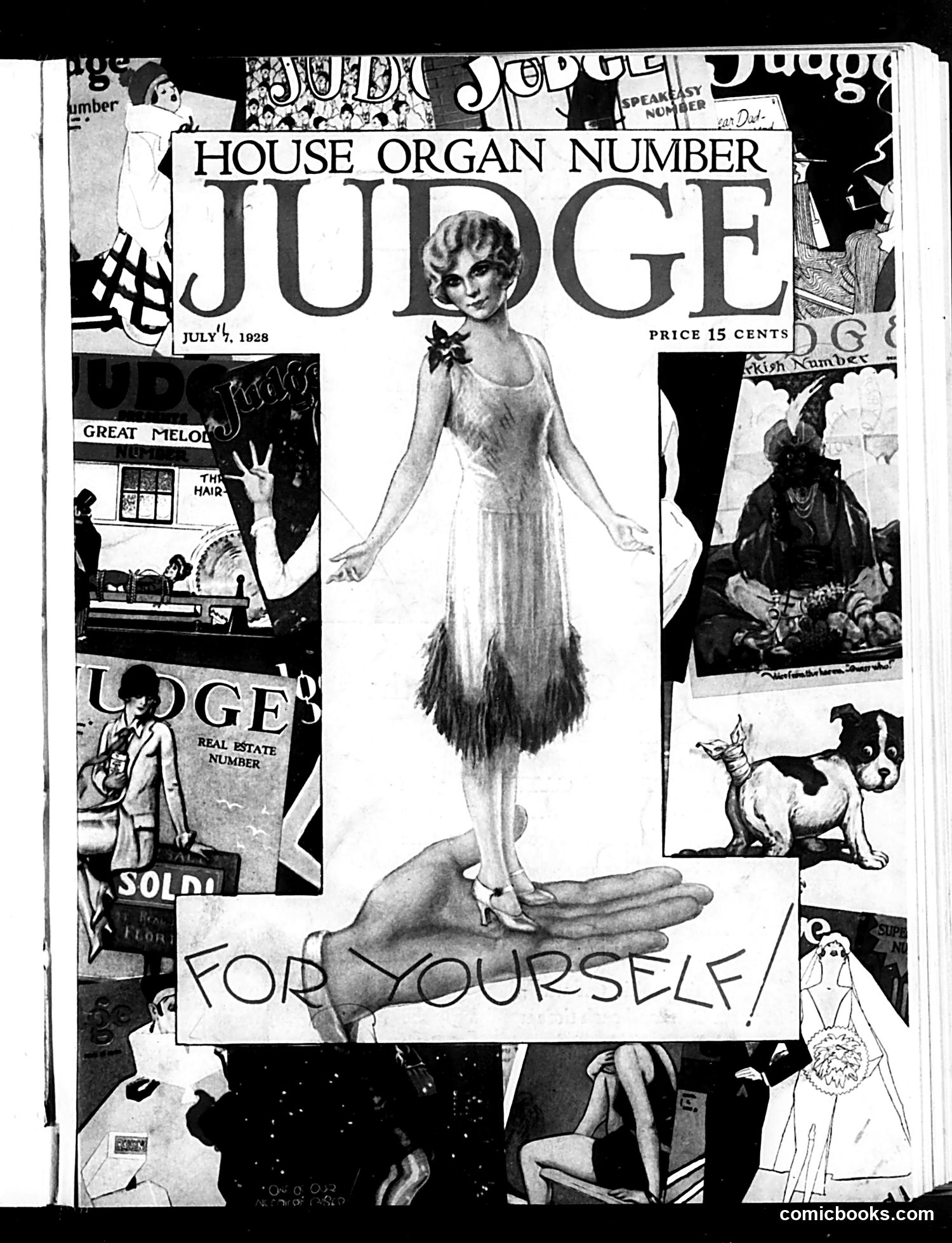
This is a cover for Judge, a satirical weekly magazine priced at 15 cents. The central illustration depicts a woman in a flapper-style dress standing on a large hand, with the caption "FOR YOURSELF!" This appears to reference 1920s consumer culture and the "New Woman" - the independent, modern female figure of the Jazz Age. The imagery suggests themes of female autonomy, self-determination, and consumerism during the prosperous pre-Depression era. The hand cradling the woman may represent either protection or, conversely, commerce literally supporting the new consumer-driven lifestyle marketed to women. The surrounding material includes advertisements and other Judge content typical of the period, reflecting the magazine's mix of satirical commentary and commercial messaging.
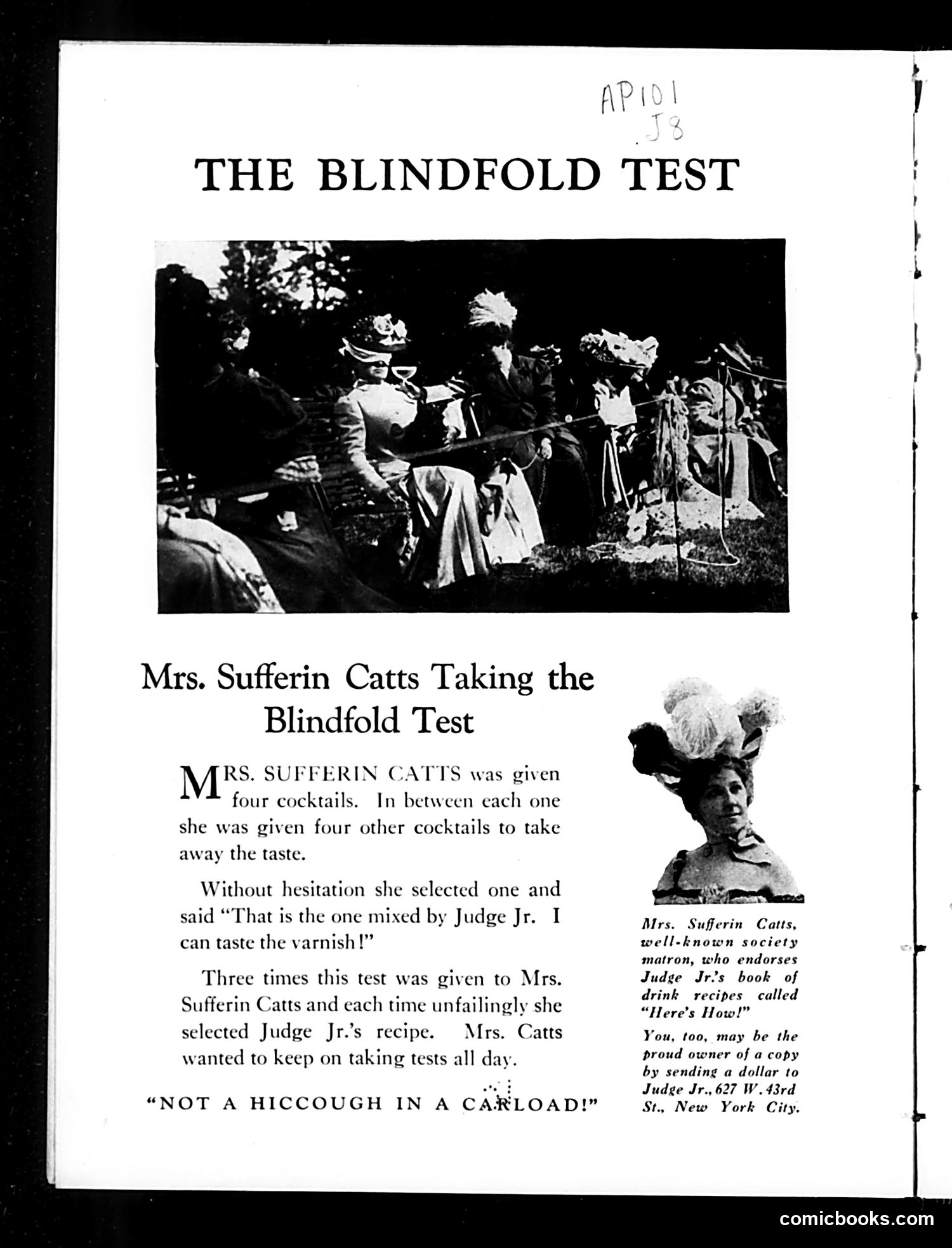
This page from *Judge* magazine documents a social experiment testing whether Mrs. Sufferin Catts could identify cocktails by taste alone. The article describes her participating in a blindfold taste test where she sampled four cocktails, with palate-cleansers between rounds. The satire targets the cocktail culture of the Prohibition or early post-Prohibition era, when mixed drinks were fashionable among the upper classes. Mrs. Catts's confident identification of "Judge Jr.'s" recipe—claiming she could "taste the varnish"—suggests the joke is about either the poor quality of homemade cocktails or the pretentiousness of those claiming expertise in cocktail connoisseurship. The advertisement promoting Judge Jr.'s drink recipe book reinforces this was likely promotional content disguised as humorous reportage.
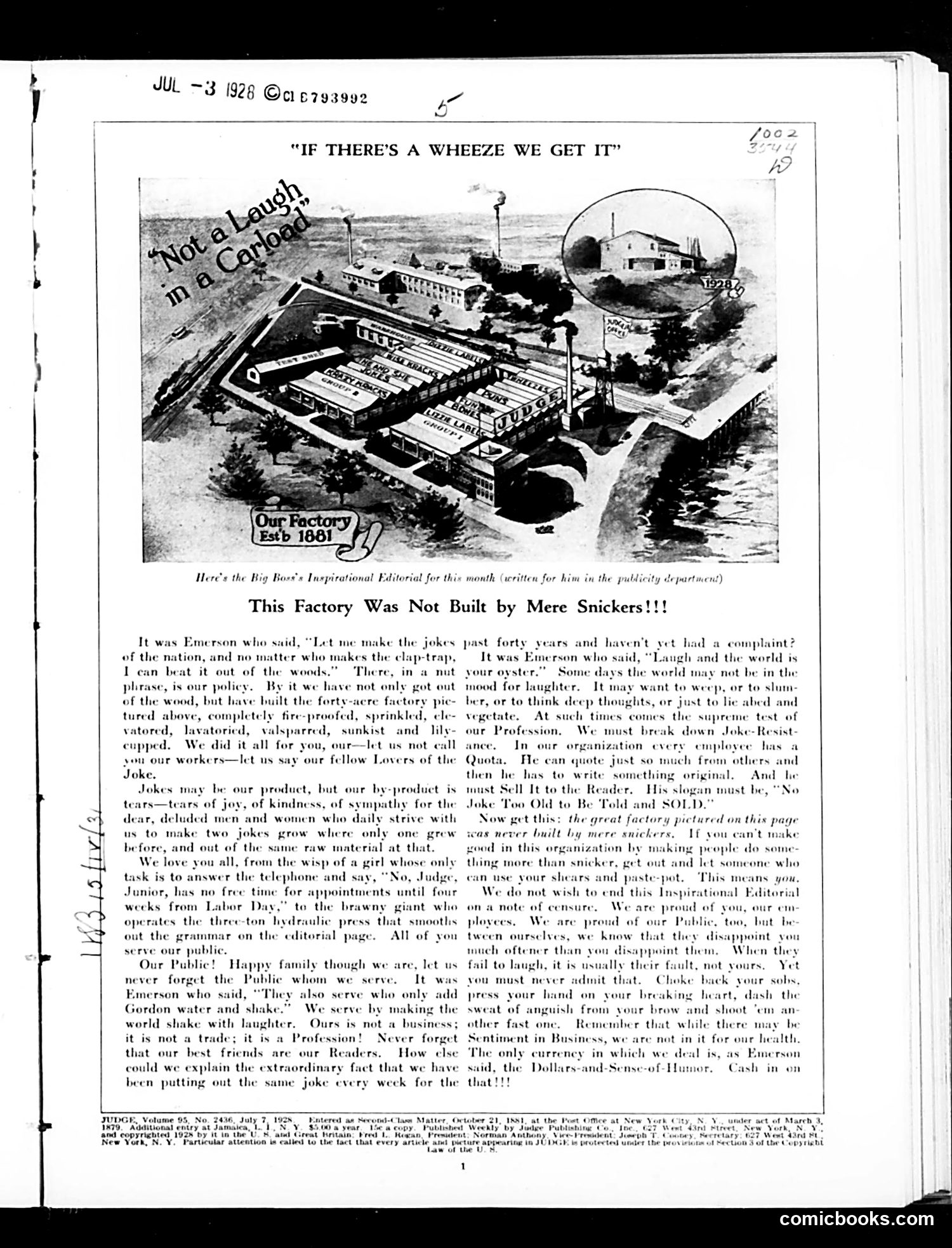
This page presents an aerial photograph of an industrial factory complex established in 1861, with the headline "If There's a Wheeze We Get It" and "This Factory Was Not Built by Mere Snickers!!! The editorial argues that the factory's success stems not from jokes or humor, but from serious professional dedication. It references Ralph Waldo Emerson's quote about making jokes for forty years without complaints, suggesting the organization operates on genuine work ethic rather than frivolity. The piece appears to be an inspirational corporate message emphasizing that while humor may be a byproduct, the real foundation is hard work, professional standards, and commitment to quality. It's unclear what specific company or criticism prompted this response, though it defends industrial manufacturing pride against perceived dismissiveness.
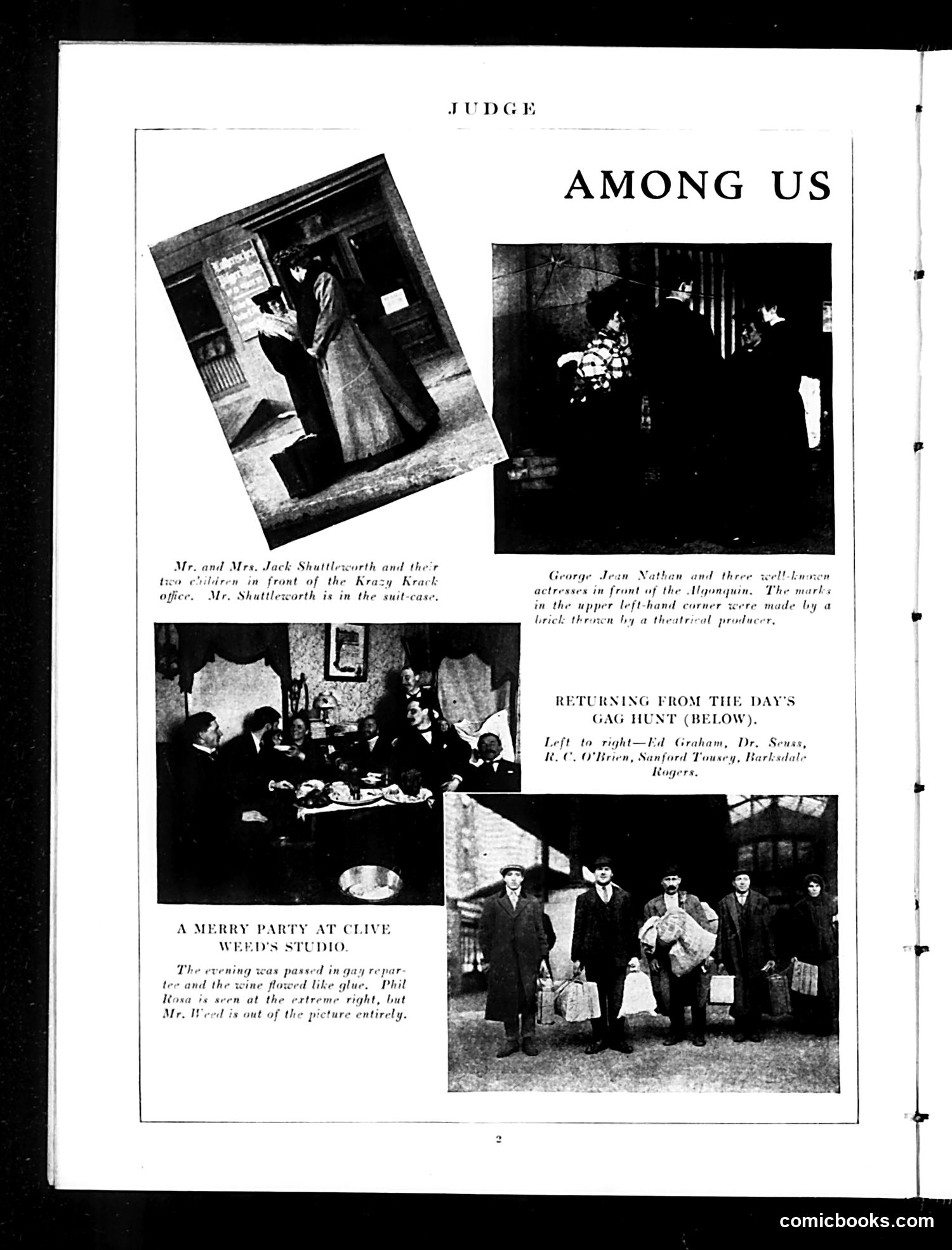
This page from *Judge* magazine appears to be a photo-spread labeled "Among Us" documenting social and entertainment events rather than political satire. The images show: 1. **Top left**: Mr. and Mrs. Jack Shuttleworth at the Krazy Kract office 2. **Top right**: George Jean Nathan with actresses at the Algonquin (theatrical producer marks visible) 3. **Bottom left**: "A Merry Party at Clive Weed's Studio" - a social gathering where participants engaged in gag repartee; wine allegedly tasted like glue 4. **Bottom right**: "Returning from the Day's Gag Hunt" - identifies Ed Graham, Dr. Seuss, R.C. O'Brien, Sanford Tousey, and Barksdale Rogers Rather than political commentary, this is celebrity/entertainment industry gossip photography typical of *Judge's* society coverage, capturing New York's theater and humor-writing circles during this period.
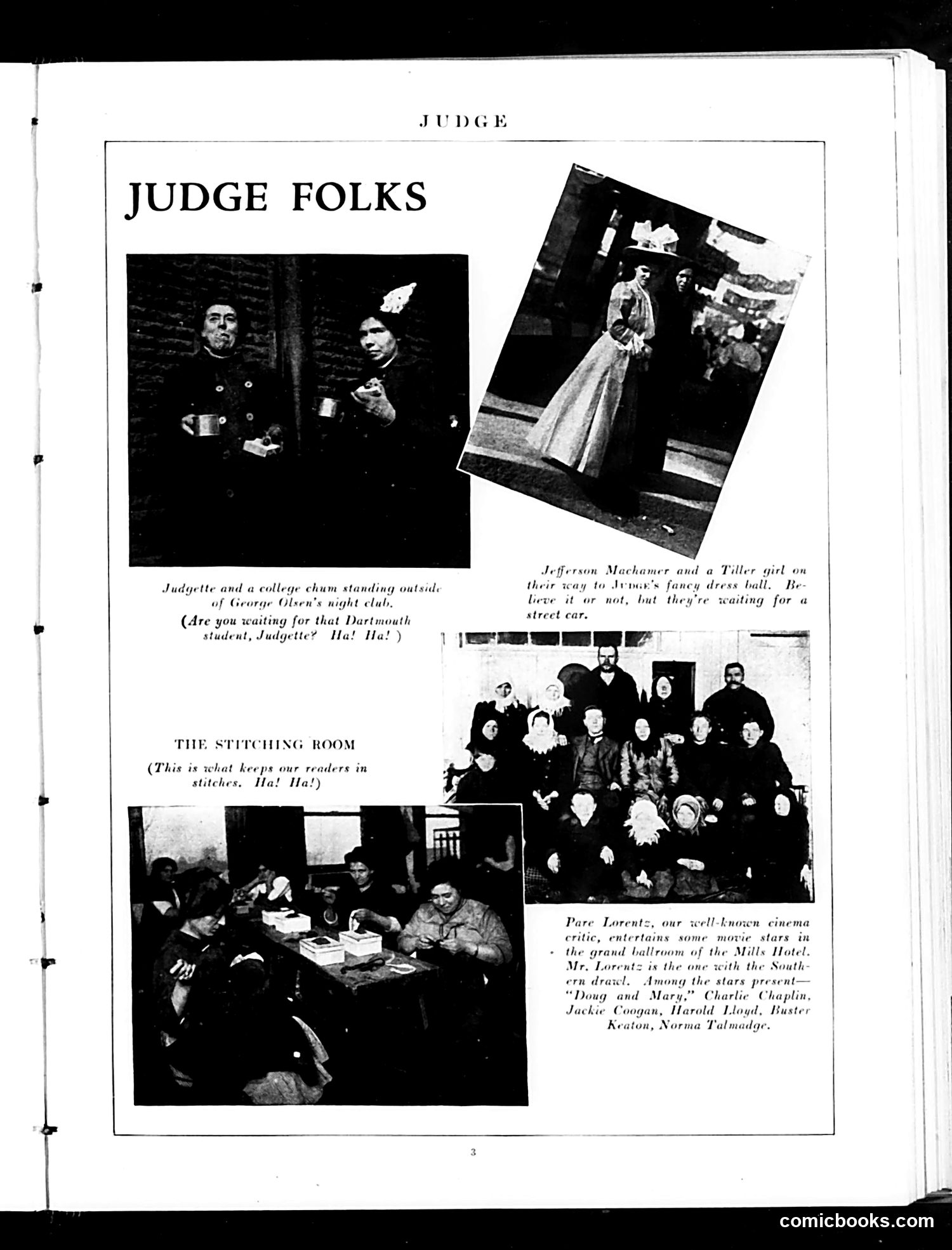
This page from *Judge* magazine showcases scenes from the film "Judge Folks," featuring Jefferson Machwer and a "Tiller girl" attending a fancy dress ball. The top caption humorously questions whether readers are "waiting for that Dartmouth student, Judgette?" The middle section, titled "The Stitching Room," appears to satirize factory or workshop conditions where women laborers work—the parenthetical joke suggests this detail "keeps our readers in stitches." The bottom photograph shows Pave Lorentz, identified as a cinema critic, entertaining cinema stars at the Mills Hotel ballroom. Named attendees include Charlie Chaplin, Jackie Coogan, Harold Lloyd, Buster Keaton, and Norma Talmadge—major silent-film celebrities of the 1920s era. The satire likely comments on class contrasts between entertainment industry elites and working-class laborers, typical of *Judge's* social commentary.
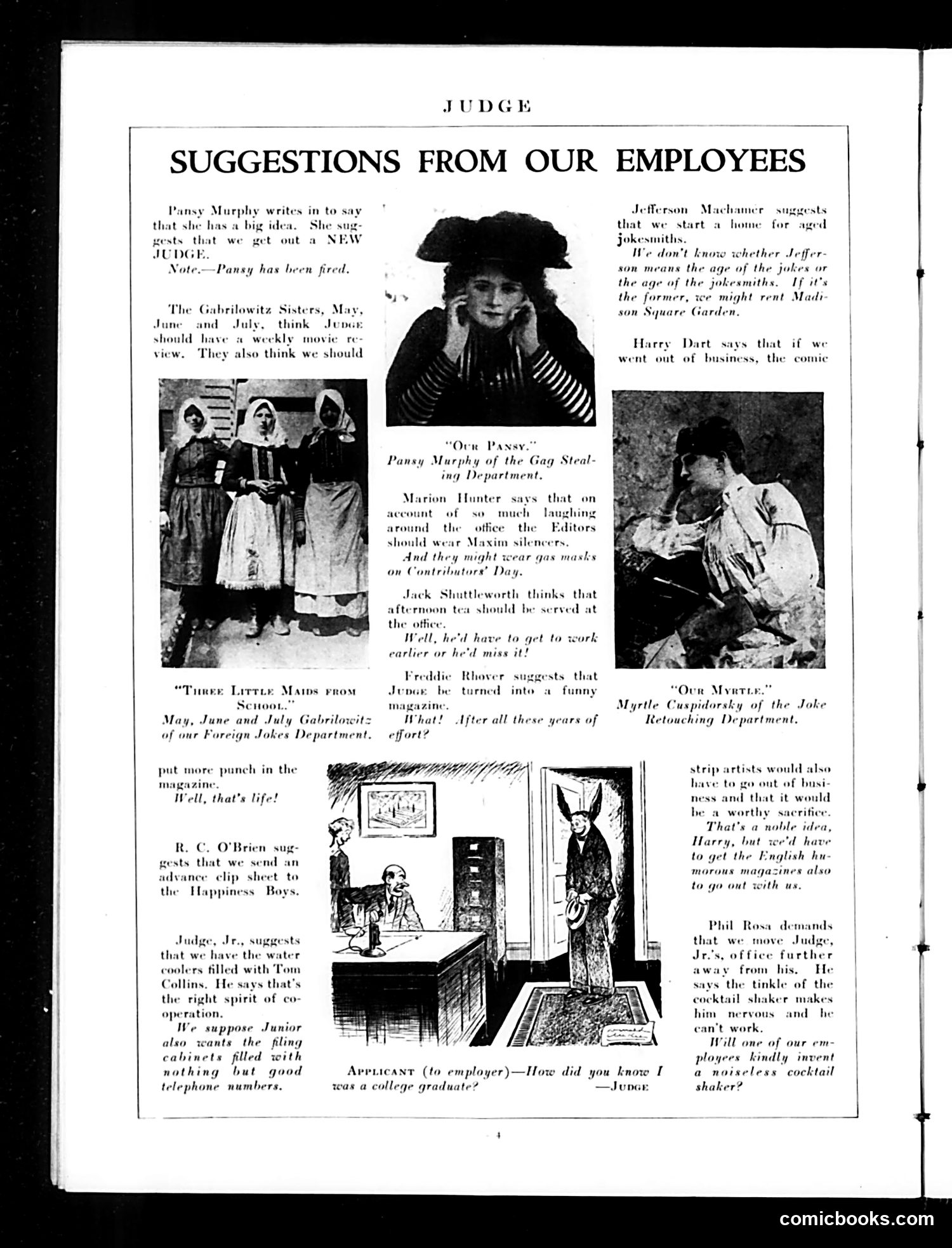
This Judge magazine page presents humorous employee suggestions to management. The satirical format mocks workplace culture through exaggerated proposals: - Pansy Murphy suggests a "big idea" (she's fired for it) - The Gablowitz Sisters propose weekly movie reviews and a dress code - Marion Hunter jokes about editors wearing Maxim silencers and gas masks on "Contributors' Day" - Jack Shuttleworth suggests afternoon tea service - Freddie Rhorer proposes converting Judge into a funny magazine The central cartoon depicts a job interview where an applicant asks "How did you know I was a college graduate?"—likely satirizing either obvious markers of education or the irrelevance of credentials for the position. The page mocks both employee impertinence and management inefficiency through absurdist humor typical of early-20th-century satirical magazines.
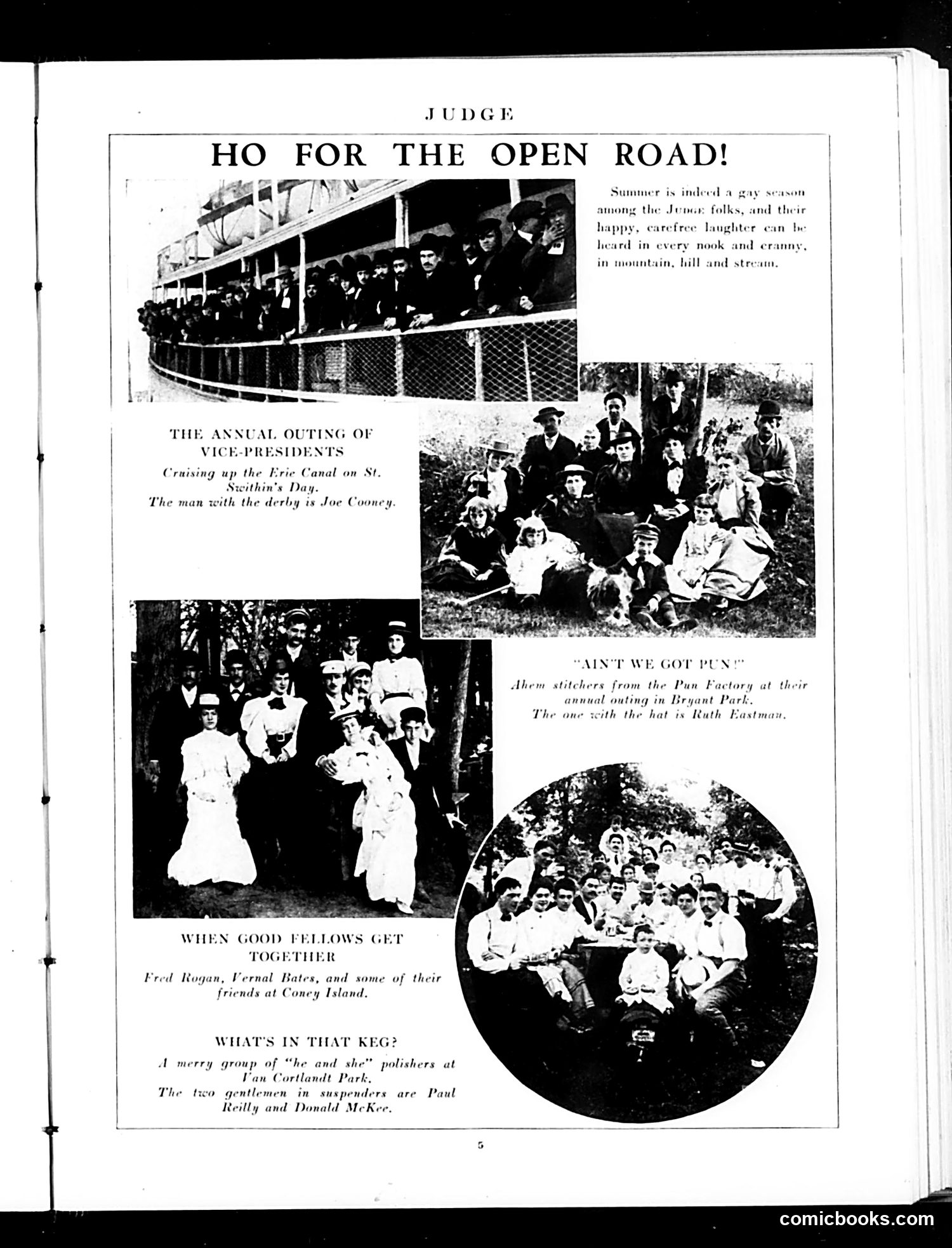
This page from *Judge* magazine features photographs of various social outings rather than political cartoons. The content includes: 1. **Vice-Presidents' Annual Outing** — A boat excursion on St. Neithor's Day, featuring someone named Joe Cooney with a derby hat. 2. **"When Good Fellows Get Together"** — Fred Regan, Vernal Bates, and friends at Coney Island. 3. **"Ain't We Got Fun?"** — Alms stitchers from the Pan Factory at their Bryant Park outing, with Ruth Eastman identified. 4. **"What's in That Keg?"** — A group of "he and she" polishers at Van Cortlandt Park, with Paul Reilly and Donald McKee noted. The page celebrates leisure activities and social gatherings among working-class and white-collar groups, reflecting early 20th-century American recreational culture without obvious political satire.
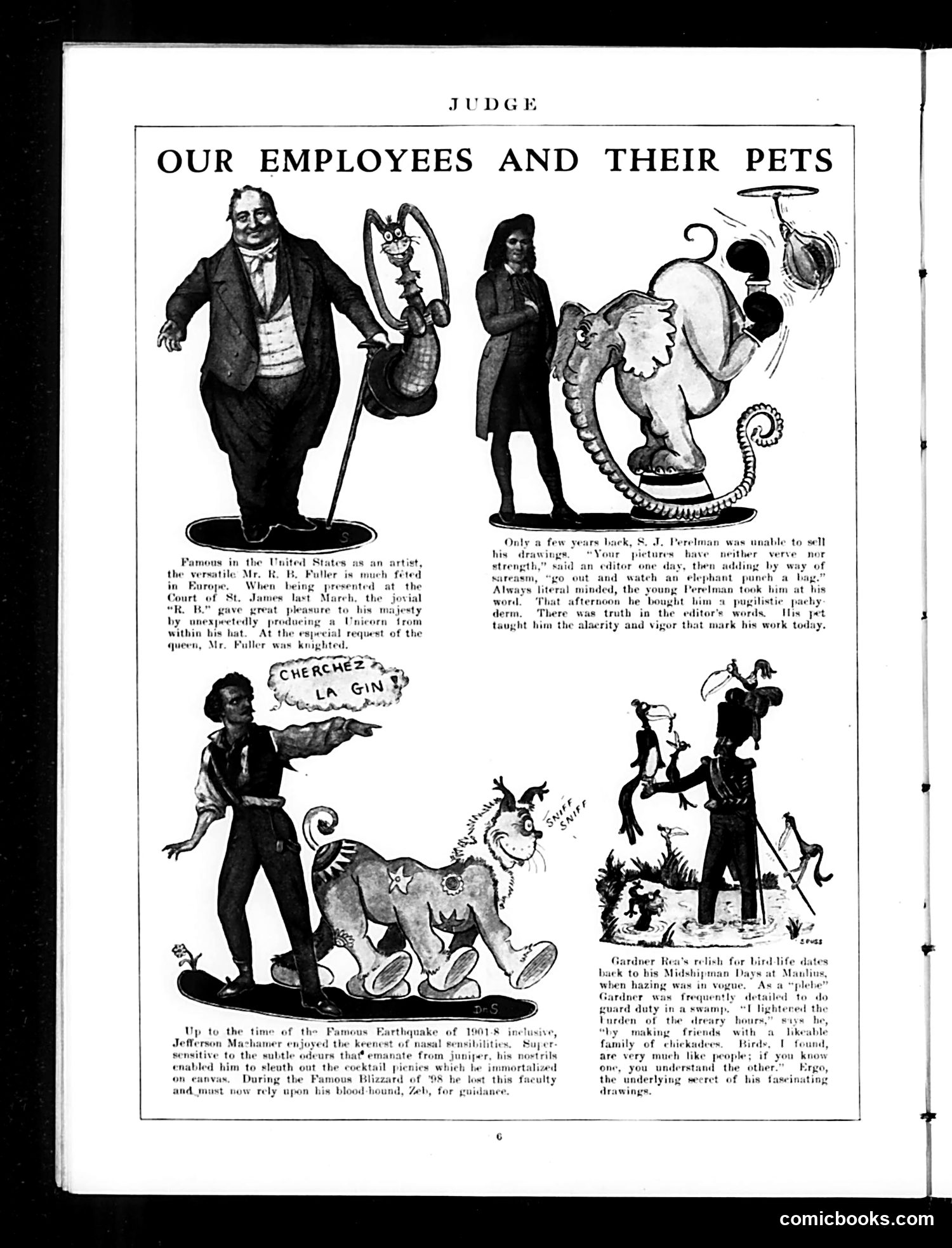
This satirical page from *Judge* magazine pairs caricatured staff members with absurd or incongruous "pets" as a humorous commentary on their personalities or professional traits. The examples visible include: - **Mr. Fuller**, described as a famous artist who presented a unicorn to the Queen, earning a knighthood—a fantastical exaggeration of artistic success - **S.J. Perelman** (or similar), paired with an elephant, referencing his supposed inability to sell drawings but later success - **Jefferson Mashamer**, depicted with a goat, noted for his keen sense of smell and ability to detect subtle scents—the goat a visual pun on this sensitivity - **Gardner Rea**, shown with birds, recalling his naval academy days when befriending birds during unpleasant duties made them bearable The satire mocks both the employees' quirks and professional reputations through exaggerated visual pairing. The "pets" humorously illustrate personality traits or career moments, creating inside jokes for *Judge*'s readers familiar with these contributors.
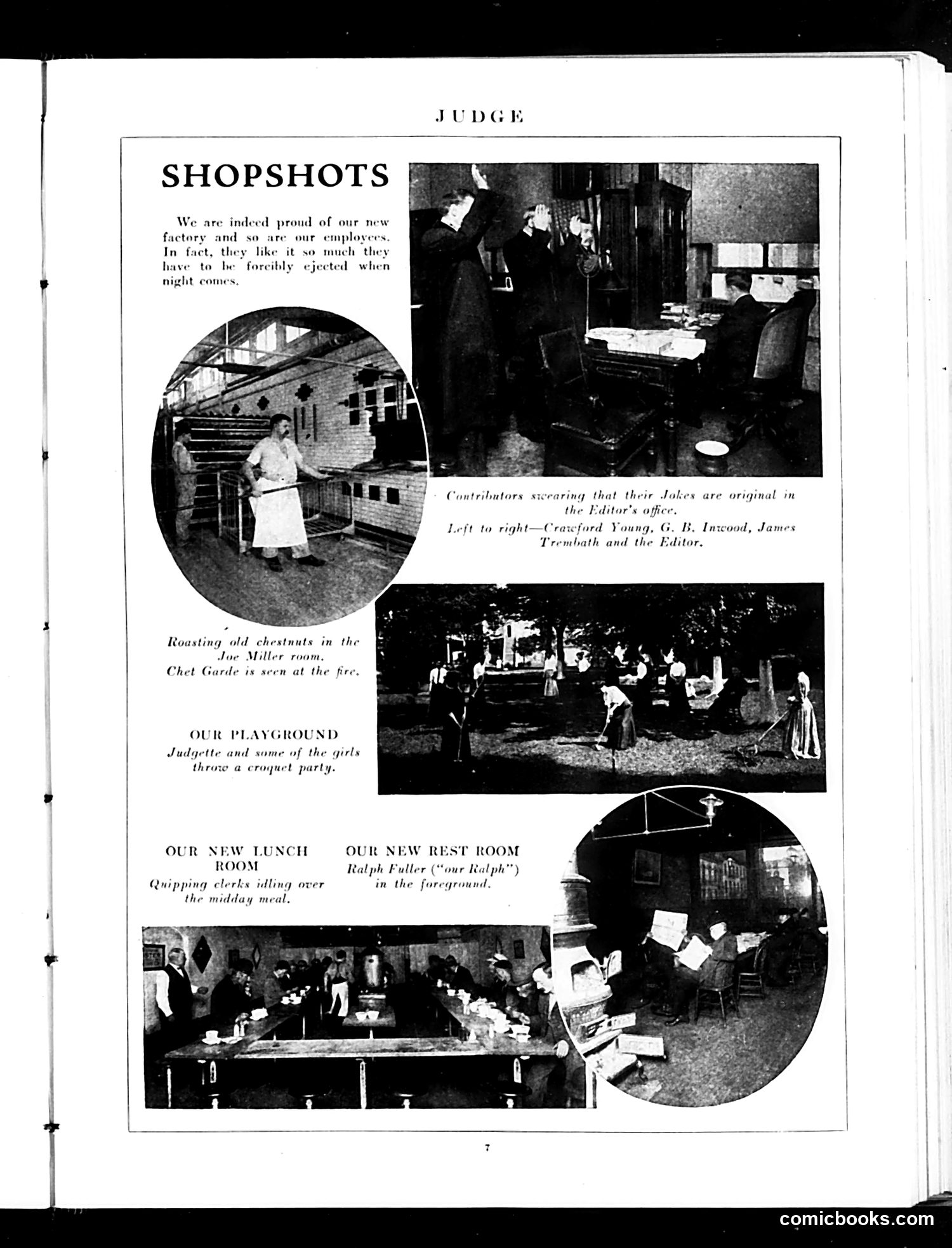
This is an in-house feature showcasing Judge magazine's own offices and employees—not satire, but workplace pride. The page presents four scenes of the publication's operations: 1. **Factory/Office Tour**: Employees enjoy the new workspace so much they resist leaving at night. 2. **"Joe Miller Room"**: Staff relax by a fireplace, joking around (Joe Miller was slang for old, worn-out jokes). 3. **Playground**: Female staff ("Judgettes") play croquet during breaks. 4. **Lunch Room & Rest Room**: Clerks socialize during meals; Ralph Fuller and others relax in the foreground. The humor is gentle and self-congratulatory—Judge is advertising its modern, employee-friendly workplace with comfortable amenities. The final caption humorously suggests contributors jokingly "swear" their jokes are original, a light jab at the creative process. This reads as institutional boosterism rather than satirical commentary.
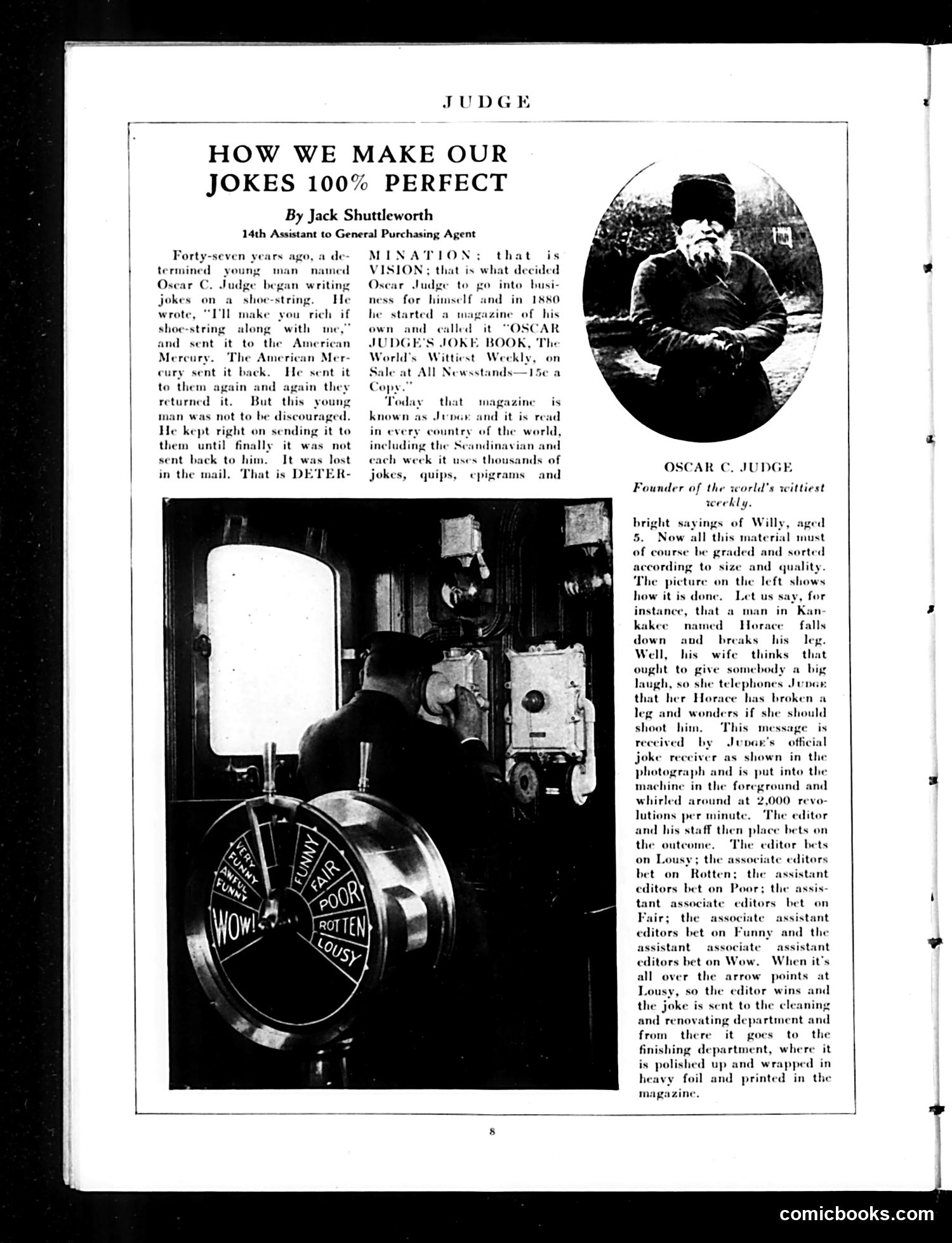
This is a humorous behind-the-scenes piece about **Oscar C. Judge**, founder of *Judge* magazine (a real satirical weekly). The article satirizes the magazine's own joke-creation process through absurdist exaggeration. The joke: Judge describes an elaborate, ridiculous system where submitted jokes are fed into a mechanical "grading machine" (shown in the photograph) that spins at 2,000 revolutions per minute. Different staff members bet on whether jokes will be rated "Lousy," "Rotten," "Poor," "Fair," "Funny," or "Wow"—with the result supposedly determining the joke's quality. The satire mocks: - The magazine's self-importance and formulaic approach - Corporate bureaucracy and over-systematization - The pretense that humor can be mechanically perfected The absurdist wheel and betting system lampoon the impossibility of manufacturing comedy through rigid processes. It's self-aware satire about *Judge* magazine's own operations, poking fun at the notion that wit can be manufactured, graded, and polished like industrial products.
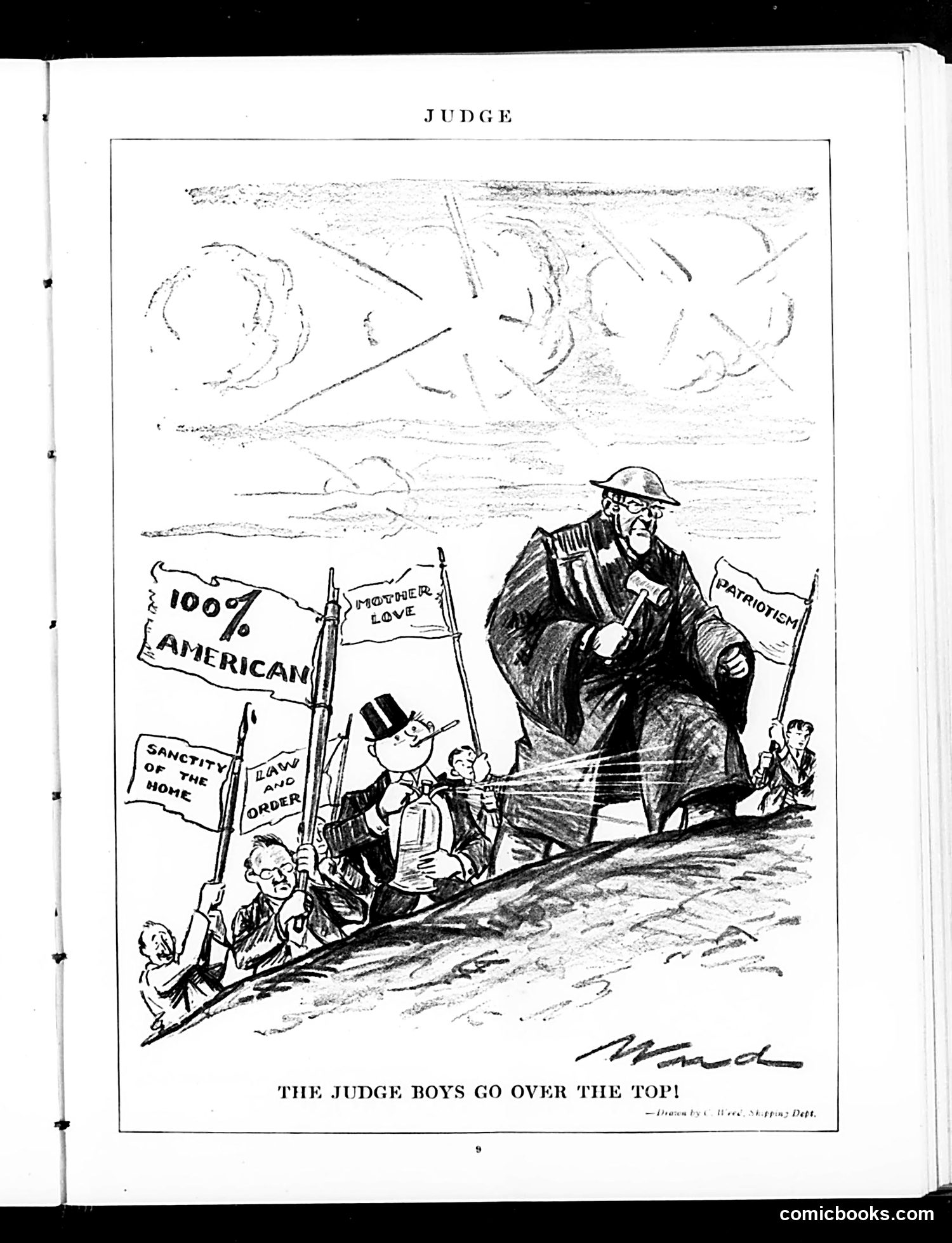
This Judge magazine cartoon satirizes American patriotism during what appears to be World War I (the military uniform and "going over the top"—a trench warfare reference—suggest this context). The large military figure represents American authority or leadership. The smaller figures below carry flags labeled "100% American," "Mother Love," "Patriotism," "Law and Order," and "Sanctity of Home"—idealized patriotic values. The satire appears critical: these noble ideals are being weaponized or manipulated by those in power, carried like banners into conflict. The cartoon suggests that abstract patriotic concepts are being exploited to mobilize "the Judge boys" (likely American youth or citizens) toward war, using emotional appeals rather than reasoned argument. The artistic style and heavy shading emphasize the grim reality beneath patriotic rhetoric.
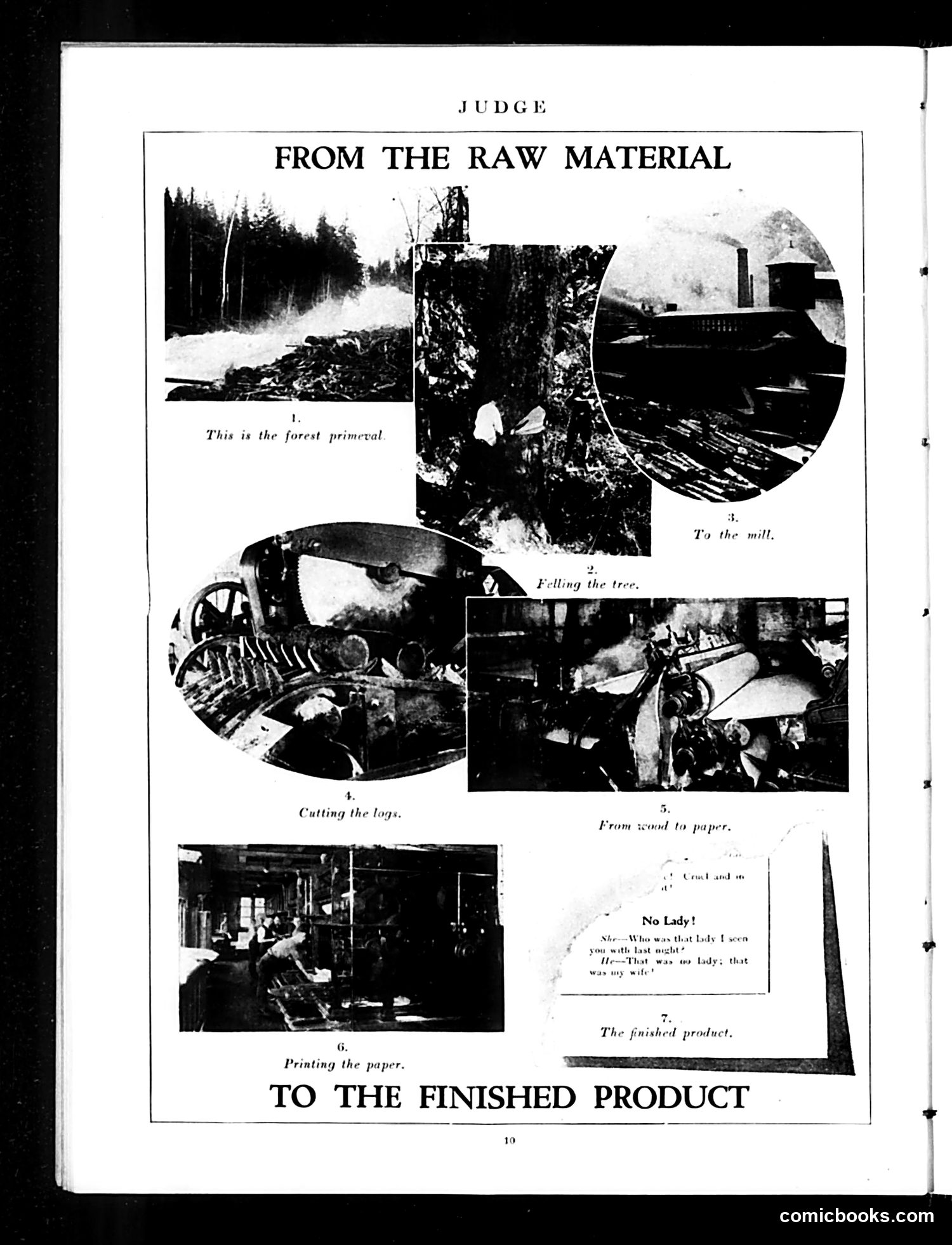
This page presents an educational infographic sequence showing paper manufacturing, from forest to finished product. The seven numbered images illustrate: 1. Forest primeval 2. Felling trees 3. Logs transported to mill 4. Cutting logs 5. Processing wood to paper 6. Printing the paper 7. Finished product (a printed page) The page includes a small humorous dialogue box labeled "No Lady!" with a brief exchange about mistaken identity. This appears to be **not political satire, but rather an informational feature** showing industrial processes—typical of Judge magazine's occasional educational content mixed with humor. The "finished product" likely demonstrates how raw materials become printed media, potentially reflecting early 20th-century industrial optimism. The small joke seems unrelated to the main infographic's purpose.
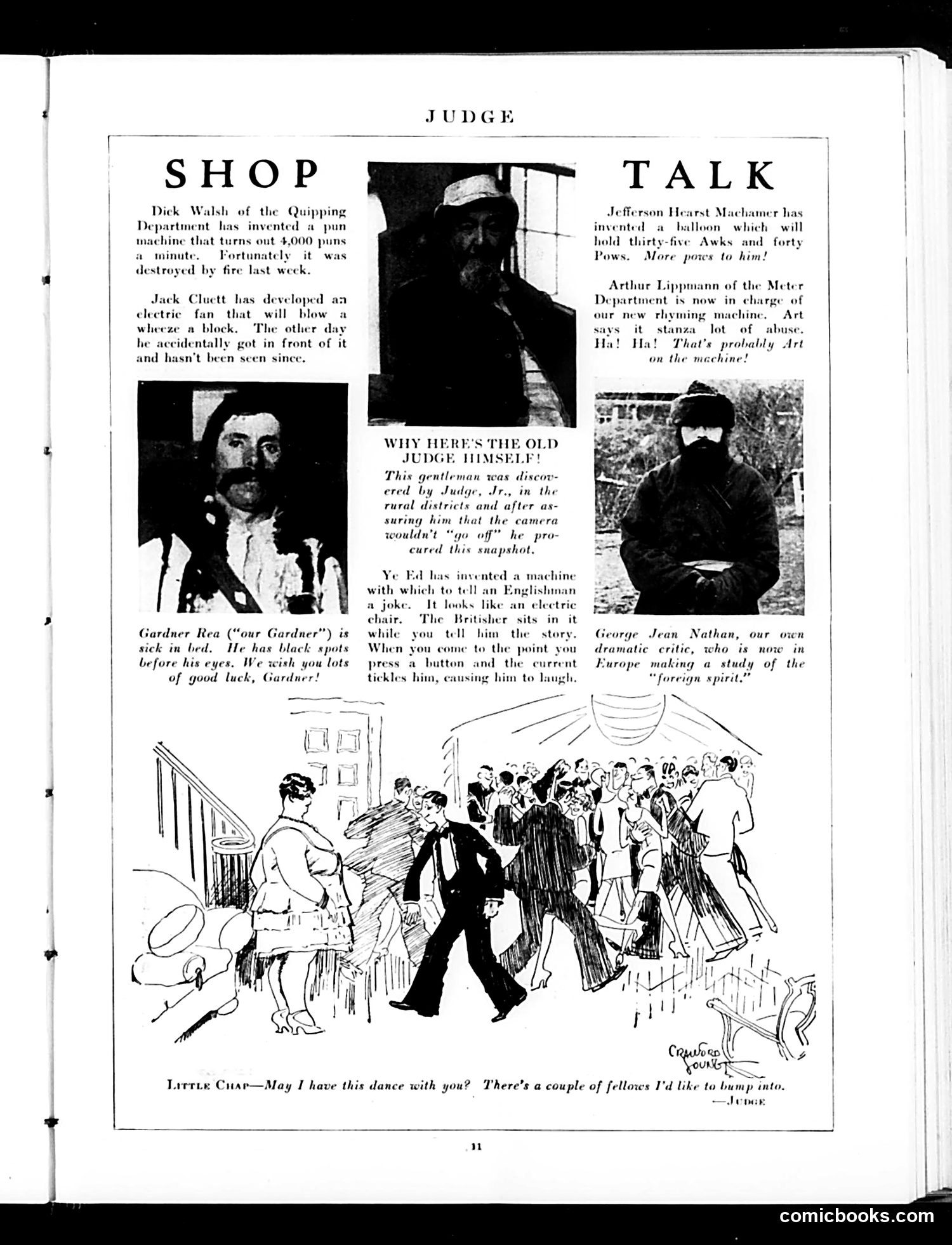
This page consists of office humor about Judge magazine's own staff and departments. The "Shop Talk" section features brief jokes about employees' inventions and mishaps: **Left side**: Dick Walsh invented a pun machine (destroyed by fire—implying its output was so bad burning it was fortunate); Jack Cluett's electric fan invention backfired literally; Gardner Rea is ill with mysterious black spots. **Center**: A rural man discovered by "Judge, Jr." is presented as "the old Judge himself"—a joke about finding an unsophisticated person in the countryside. **Right side**: More staff inventions are credited—a balloon for sound effects, a rhyming machine ("stanza lot of abuse"—a pun). George Jean Nathan, the magazine's drama critic, is noted as being in Europe. **Bottom**: A cartoon captioned "Little Chap" shows a crowded dance where someone asks to dance, wanting to "bump into" fellows. The humor is entirely internal—workplace jokes mocking the magazine's own departments and staff, typical of period office culture satire.
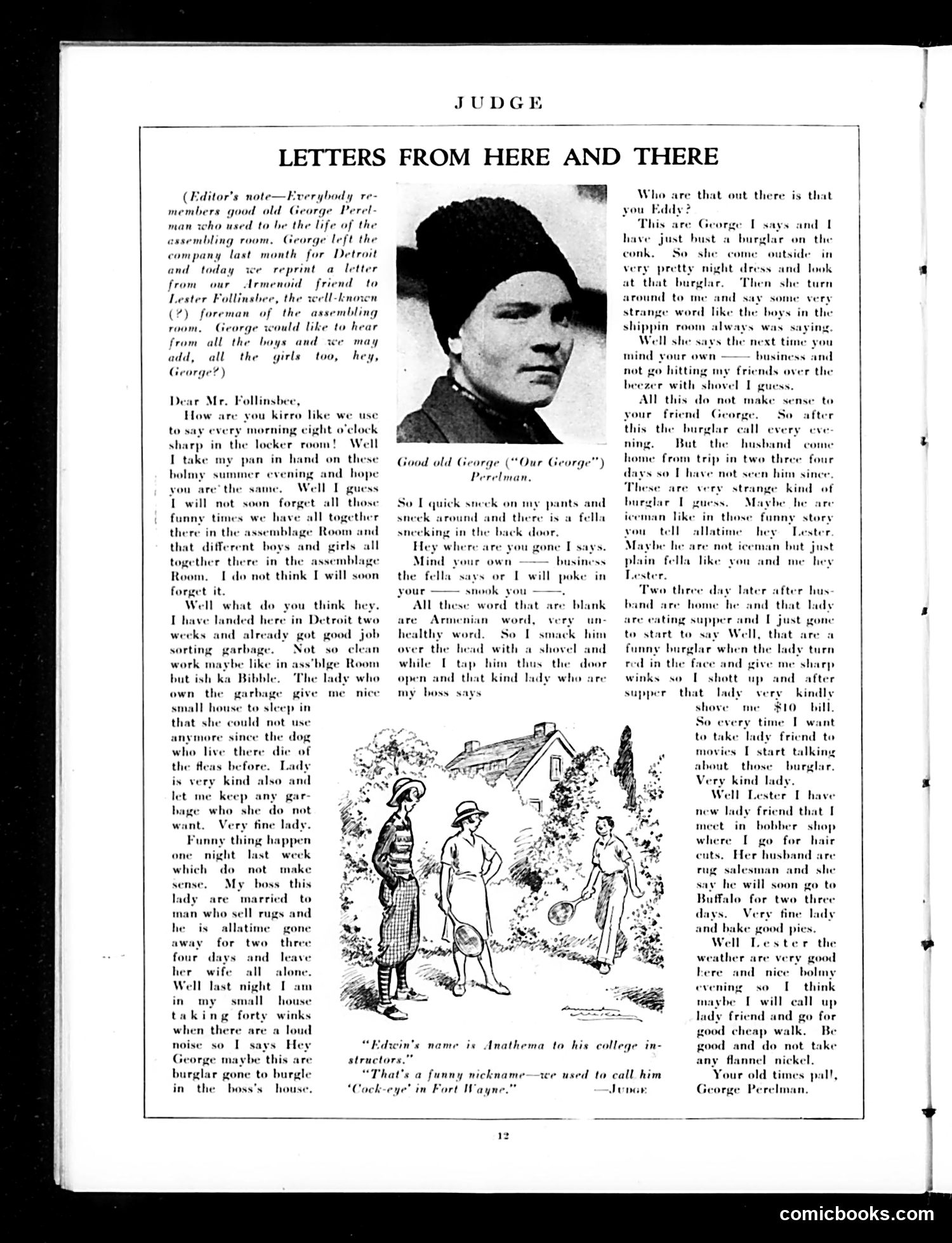
This page presents humorous letters from "George Perelman," an Armenian immigrant factory worker in Detroit, writing to his former coworkers. The satire exploits early 20th-century ethnic stereotypes: Perelman's broken English, malapropisms ("bust a burglar on the conk"), and immigrant perspective are played for comedy. The main anecdote involves Perelman catching a burglar, after which the burglar mysteriously returns nightly to court the boss's wife—a domestic comedy scenario. The joke relies partly on Perelman's confusion about social norms and his colorful descriptions of confrontation ("smack him over the head with a shovel"). The accompanying illustration shows a domestic scene with figures in period dress, seemingly depicting one of Perelman's stories. The humor is period-typical: urban working-class life, immigrant characters rendered as amusing outsiders, and simple domestic mishaps. The "Editor's note" frames this as entertaining nostalgia from a departed coworker.
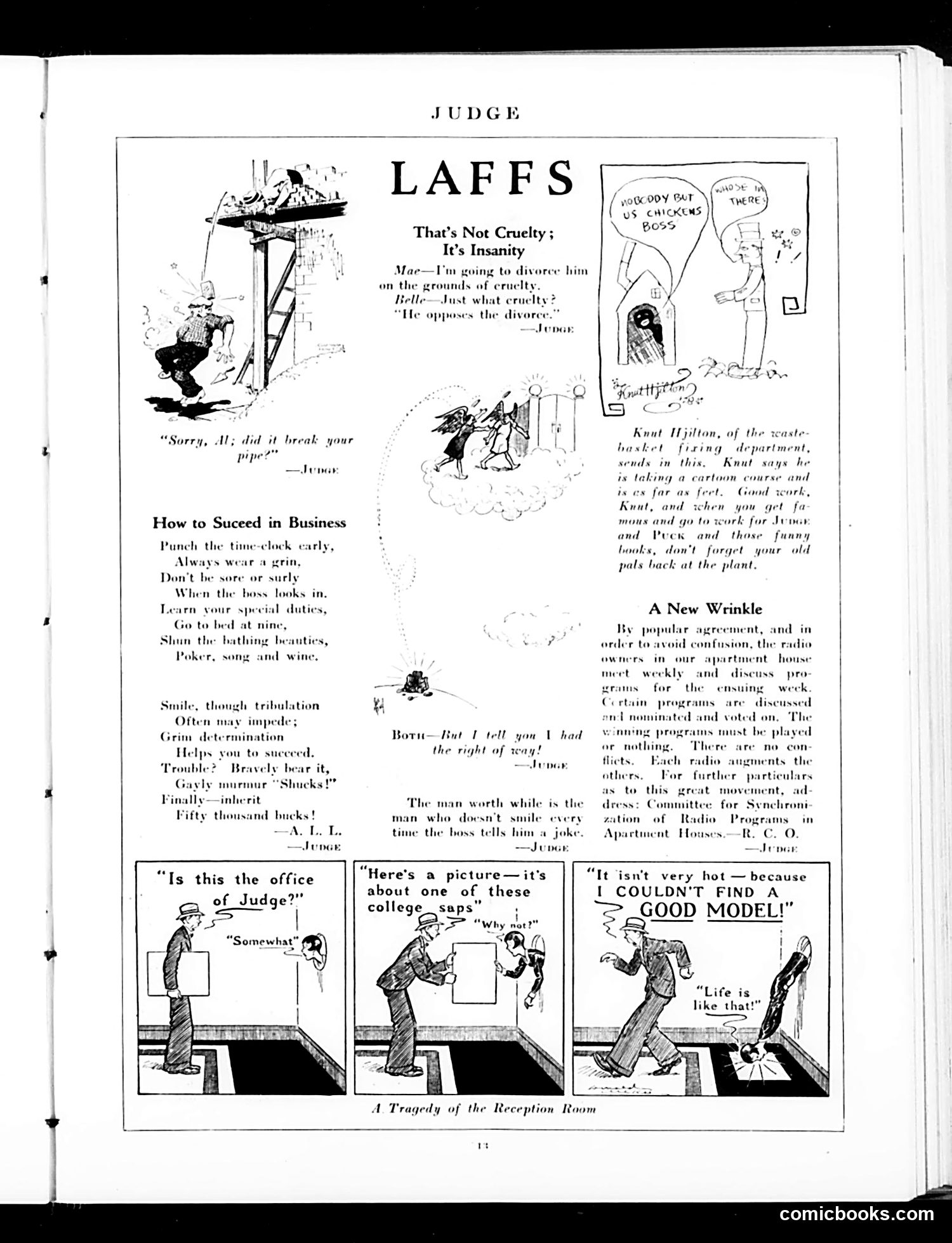
This page contains satirical humor typical of early 20th-century Judge magazine. The main sections include: **"That's Not Cruelty; It's Insanity"**: A brief dialogue joke about a woman divorcing her husband because he "opposes the divorce"—absurd logic presented as grounds for marital dissolution. **"How to Succeed in Business"**: Satirical advice mocking workplace conformity, including contradictory instructions (work hard but also drink and gamble, smile despite troubles, eventually inherit wealth). The joke critiques both ambitious workers and the arbitrary nature of business success. **"A New Wrinkle"**: Comments on apartment building radio programs and their scheduling committees. **"A Tragedy of the Reception Room"**: A three-panel comic strip showing a man at Judge's office presenting a college photograph, then being told it's not "very hot" because he "couldn't find a good model"—mocking both the college student and Judge's editorial standards. The humor targets workplace dynamics, marriage law, and corporate culture through exaggeration and wordplay rather than specific political figures.
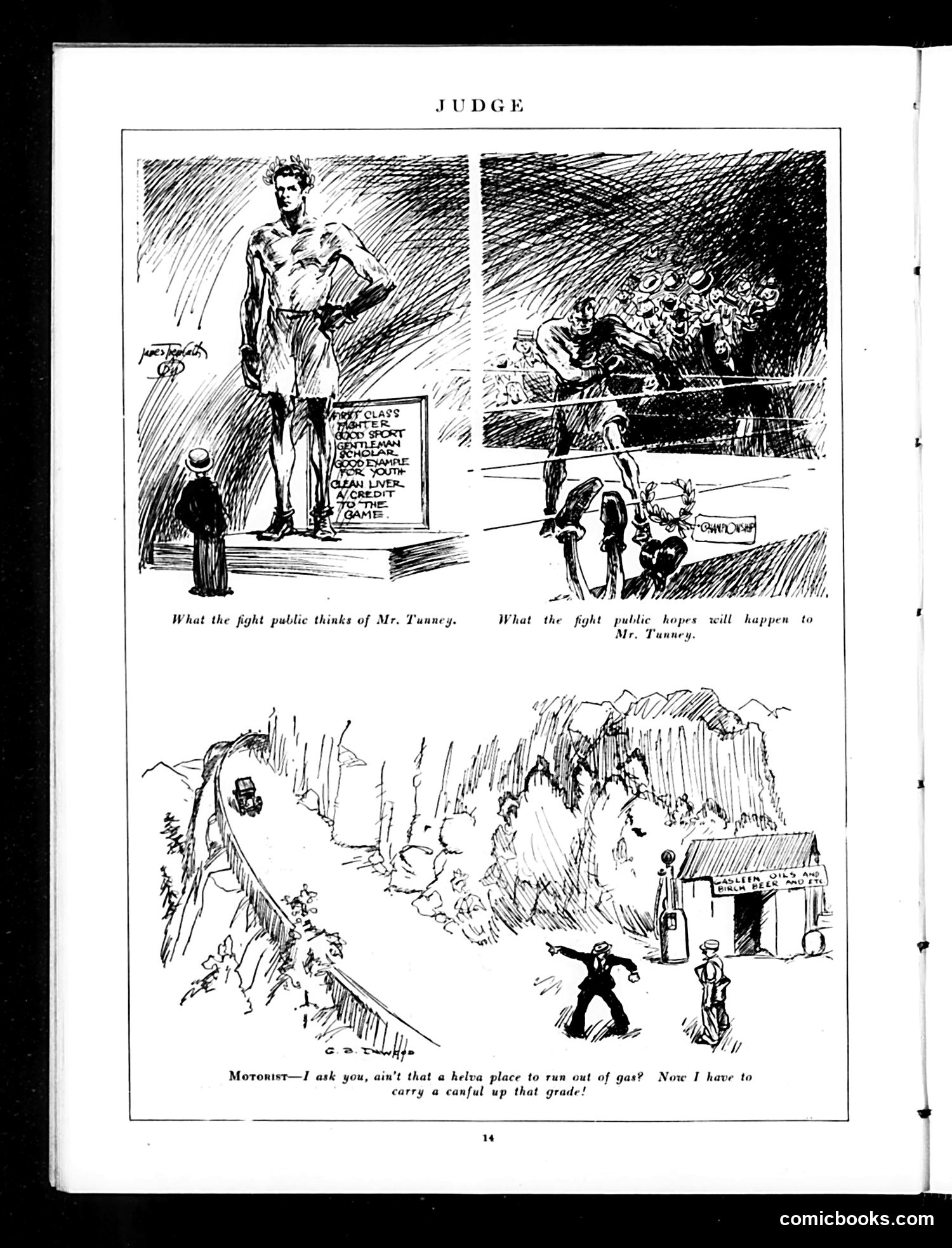
This page satirizes boxer Gene Tunney, likely during his heavyweight championship reign in the 1920s. The top panels contrast public perception: the left shows Tunney as an idealized classical figure on a pedestal (labeled with accomplishments like "Harvard Scholar" and "Ocean Liner Credit"), while the right depicts what fight fans actually *hope* happens—him being knocked down in the ring by a more brutal competitor. The bottom cartoon is unrelated humor about a motorist stranded on a steep hill, complaining he must carry gasoline uphill to refuel. The Tunney cartoons mock the boxer's intellectual pretensions and gentlemanly image, suggesting ordinary fight fans preferred more savage, working-class boxing styles.
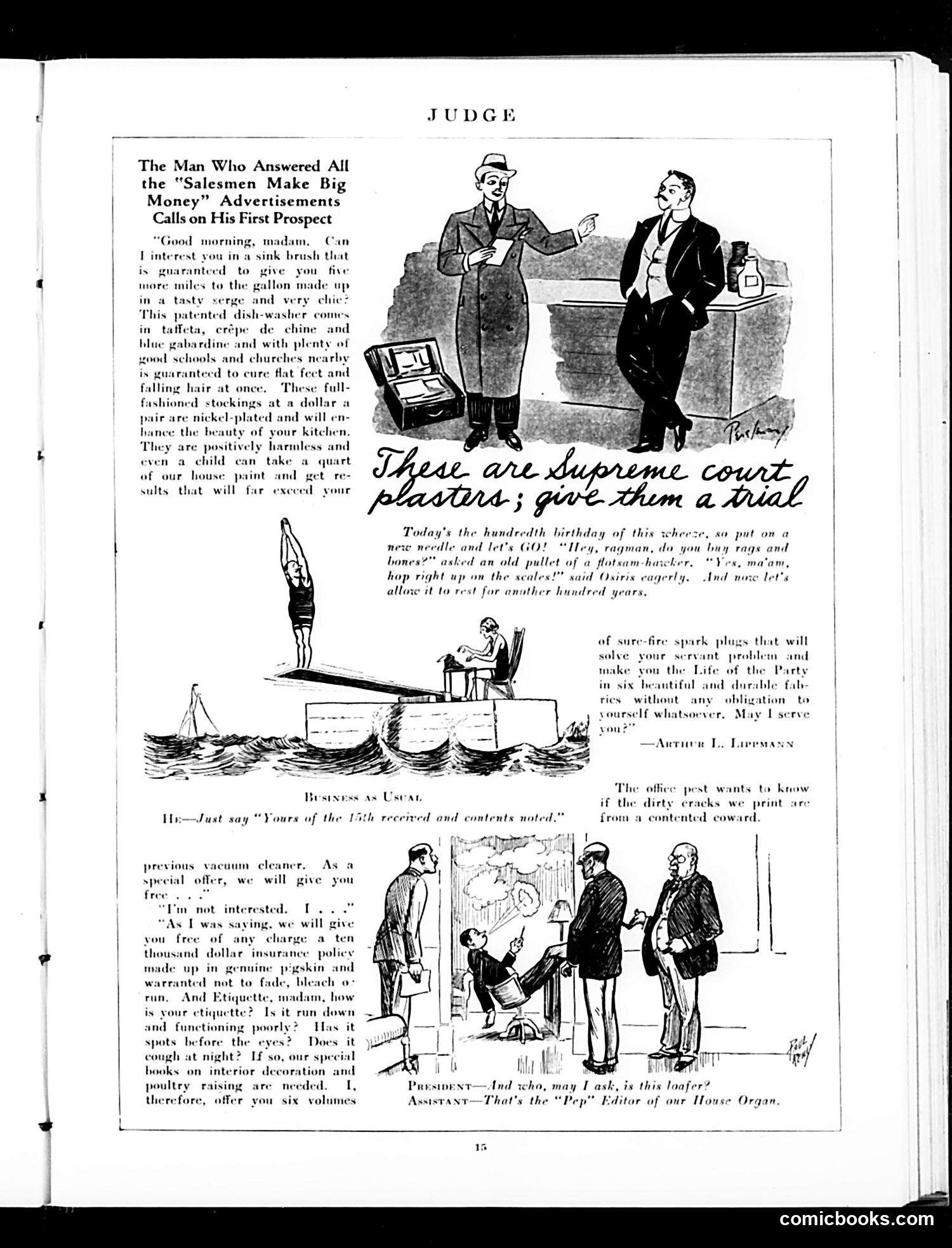
This page satirizes the proliferation of mail-order "get rich quick" schemes and dubious sales pitches popular in early 20th-century America. The main cartoon shows a bumbling salesman who has taken seriously all those "Salesmen Make Big Money" advertisements. He arrives at a prospect's home and absurdly pitches unrelated products simultaneously—sink brushes, dish-washers, stockings, insurance policies—mixing up their supposed benefits in nonsensical ways (a brush giving "five more miles to the gallon"). The satire targets both the con-artist advertisers promising easy wealth to anyone selling their products, and the gullible people who believe them. The salesman's incoherent pitch—combining product claims chaotically—mocks how these ads make outlandish, unsubstantiated claims. The bottom cartoon adds office humor about an ineffectual "Pep Editor," suggesting motivational workplace culture produces useless employees. Together, the page lampoons American commercial hucksterism and advertising excess.
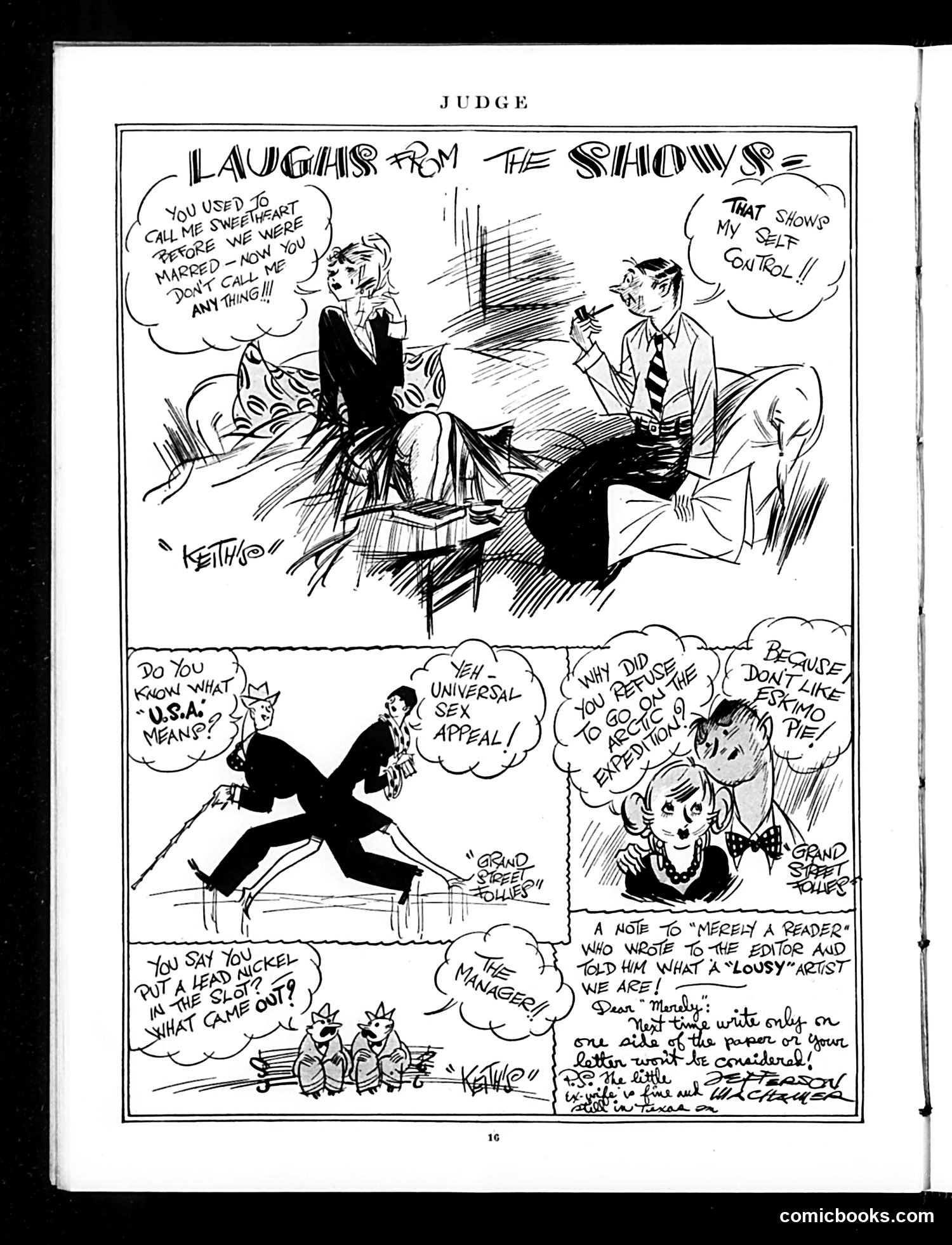
This page contains a multi-panel comic strip satirizing theatrical and entertainment industry figures. The top panel depicts what appears to be a judge or authority figure confronting performers about excessive ad-libbing and loss of control during shows. Subsequent panels reference "Universal Sex Appeal," "Grind Street Follies," and a "U.S.A." reference—likely mocking vaudeville and burlesque entertainment popular in the era. The final panel includes a meta-commentary: an editor's note to a reader who criticized the artist's work as "lousy," inviting such critics to submit their own cartoons. This is self-referential satire about artistic criticism and the magazine's relationship with its audience—a common practice in Judge's pages where editors directly addressed reader complaints about quality or taste.
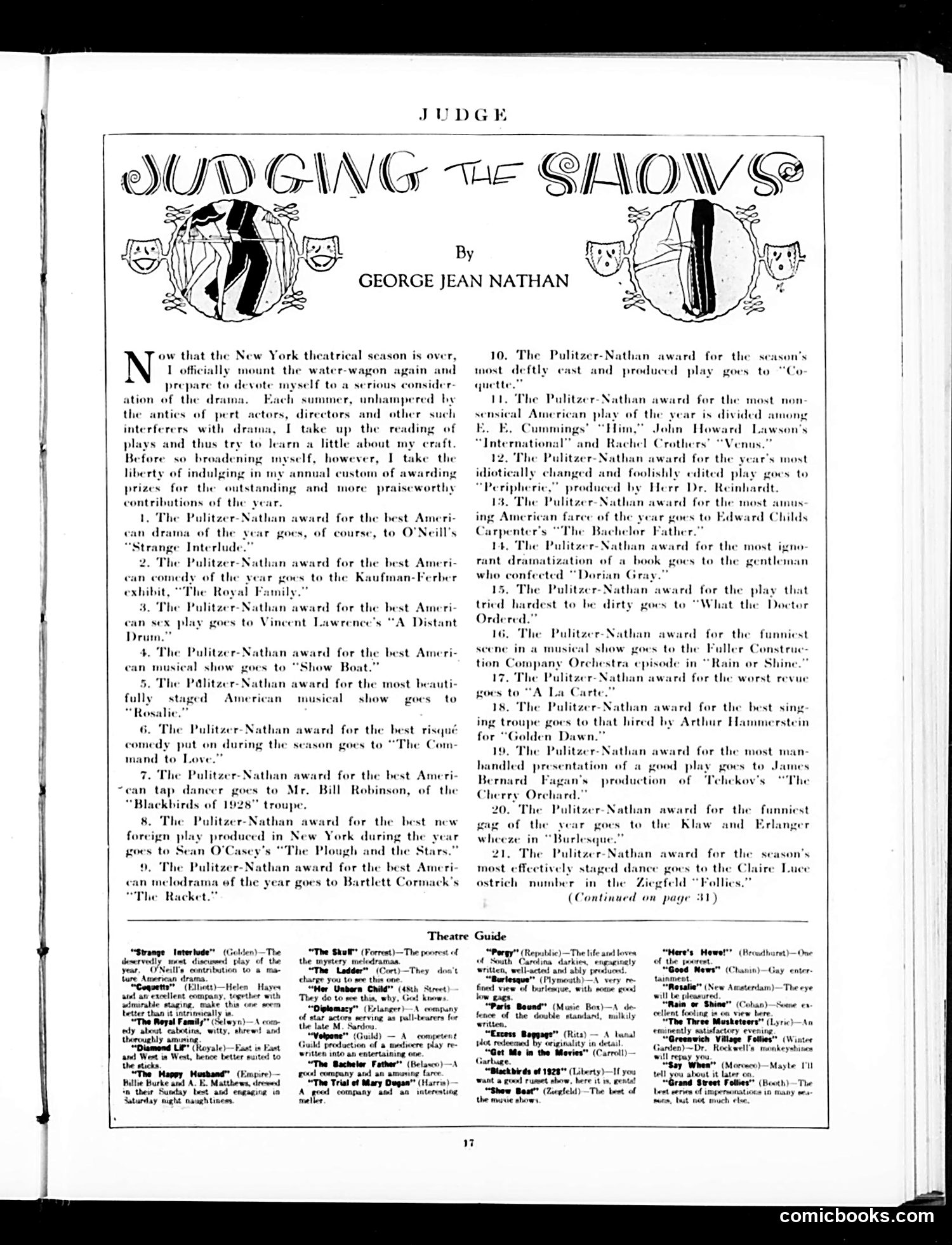
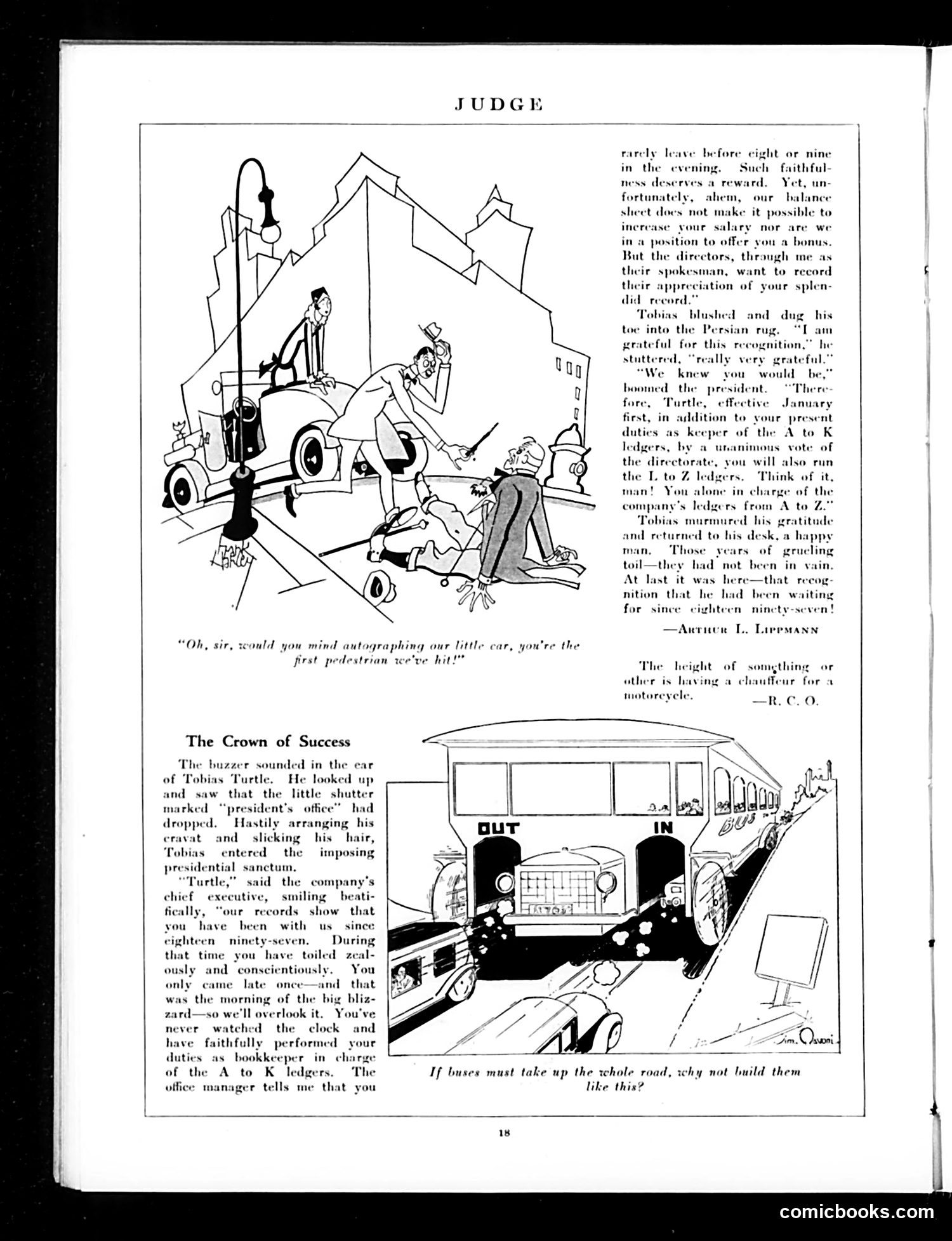
This two-part page satirizes corporate workplace dynamics. The main story follows Tobias Turtle, a bookkeeper who has worked faithfully for 18 years with perfect attendance. Called to the president's office, he expects a raise or bonus but instead receives only a title expansion: he'll now manage ledgers A-to-Z instead of A-to-K—*additional responsibility with no pay increase*. The joke is the cruel irony of "recognition" that costs the company nothing while increasing his workload. The top cartoon mocks pedestrian car culture, showing a chauffeur asking someone to autograph "our little car" as the "first pedestrian we've hit"—dark humor about early automotive dangers. The bottom cartoon suggests a satirical solution to bus congestion: make buses wide enough to monopolize roads entirely. The page reflects Jazz Age anxieties about corporate hierarchy, worker exploitation, and rapidly changing urban transportation.
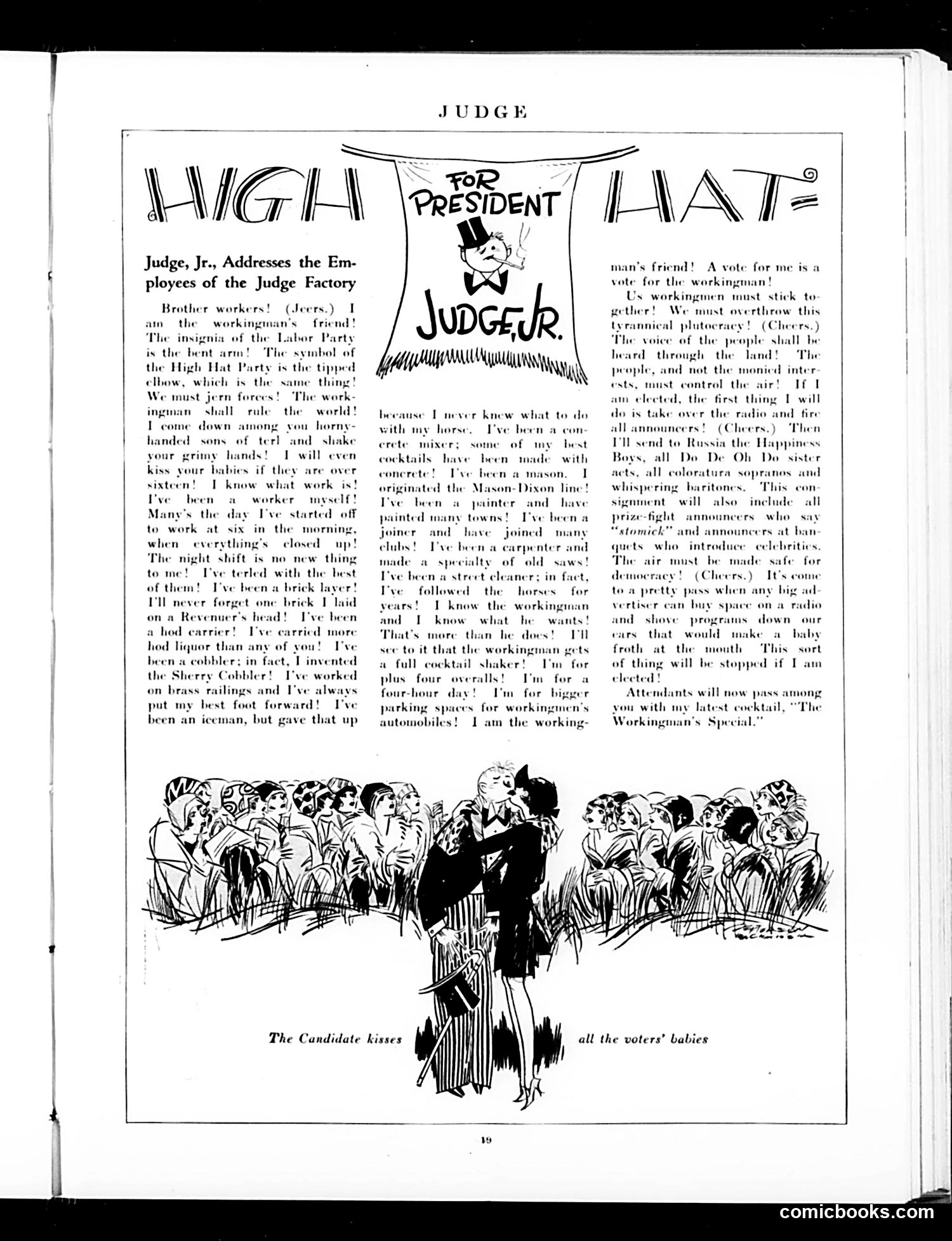
This is a satirical attack on a populist political candidate (labeled "Judge Jr.") addressing factory workers. The cartoon mocks politicians who pose as "friends of the workingman" while actually being elitists—note the top hat, formal wear, and affected speech despite claims of manual labor. The satire works through absurd exaggeration: Judge Jr. claims to have done every working-class job imaginable (brick layer, hod carrier, cobbler, ice man, street cleaner following horses), yet his descriptions reveal he understands none of it—he made "cocktails with concrete" as a "concrete mixer" and doesn't know what to do with a horse. His campaign promises are ridiculous (radio takeover, banning announcers, sending entertainers to Russia) and self-serving—ultimately just another con to gain votes by pandering. The bottom illustration shows him kissing "all the voters' babies," the classic corrupt politician's move. Judge magazine was attacking demagogic populism and hypocrisy in politics circa the 1920s-30s.
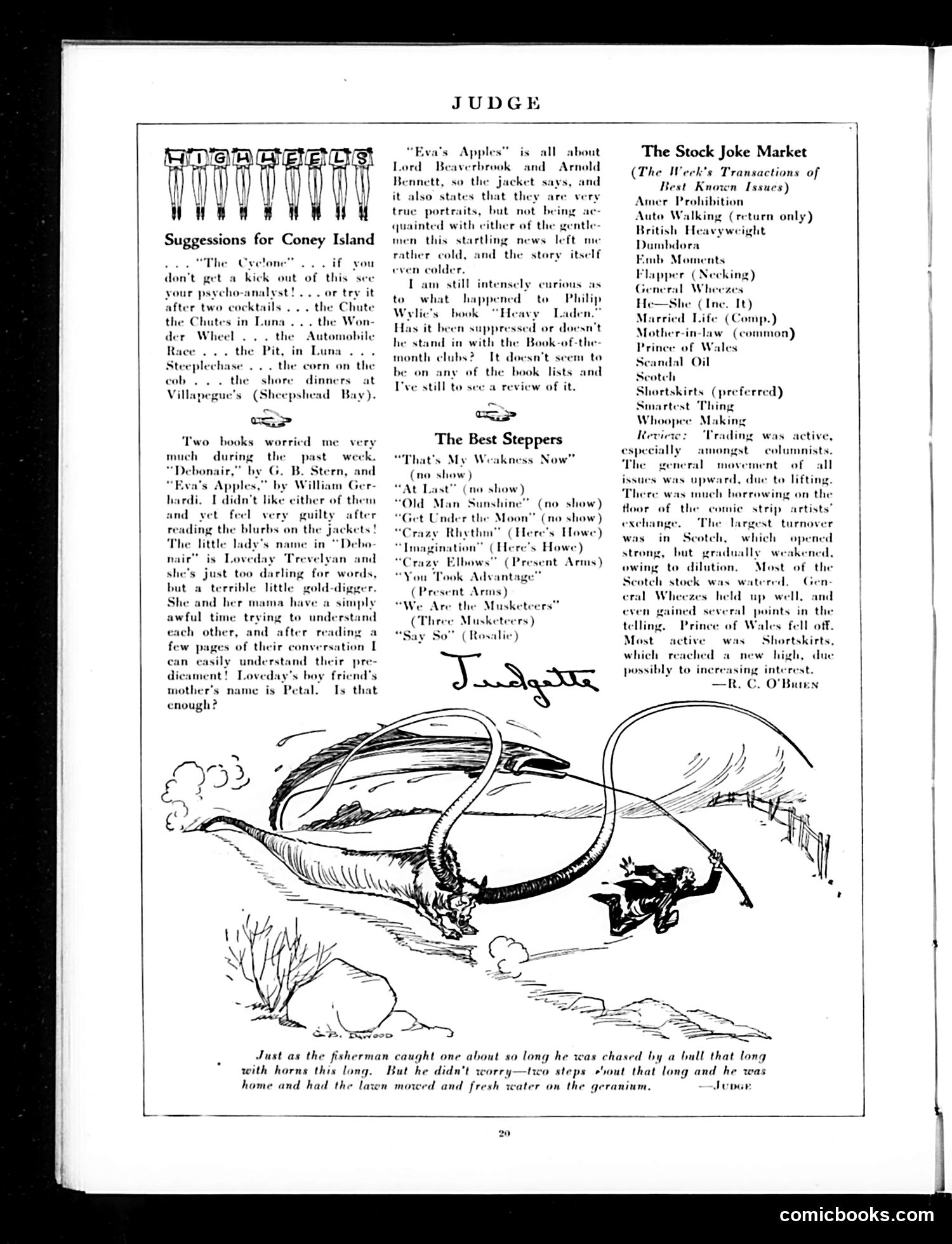
This page from *Judge* satirizes contemporary popular culture and publishing through humor columns and a stock-market parody. **Main Content:** The page features book reviews mocking recent novels ("Eva's Apples," "Debonair") with deliberately absurd character names (Loveday, Petal) to ridicule literary pretension. A theater section lists popular Broadway shows' success rates. **Key Satire - "The Stock Joke Market":** The central joke parodies financial reporting by treating comedy topics as tradeable stocks. Items like "Prohibition," "Necking," "Mother-in-law," and "Shortskirts" are listed with mock trading data. This satirizes how comedians recycled the same tired jokes repeatedly—these topics were so worn out they're presented as exhausted commodities. The note that "Scotch stock was watered" (diluted) is a Prohibition-era pun. **The Cartoon:** A fisherman with an enormous fish on a line is chased by a horned bull. The joke's punchline (visible at bottom) appears to mock the "long story, short solution" format common to joke-telling. Overall, the page mocks both literary pretension and comedy's reliance on predictable, overused material.
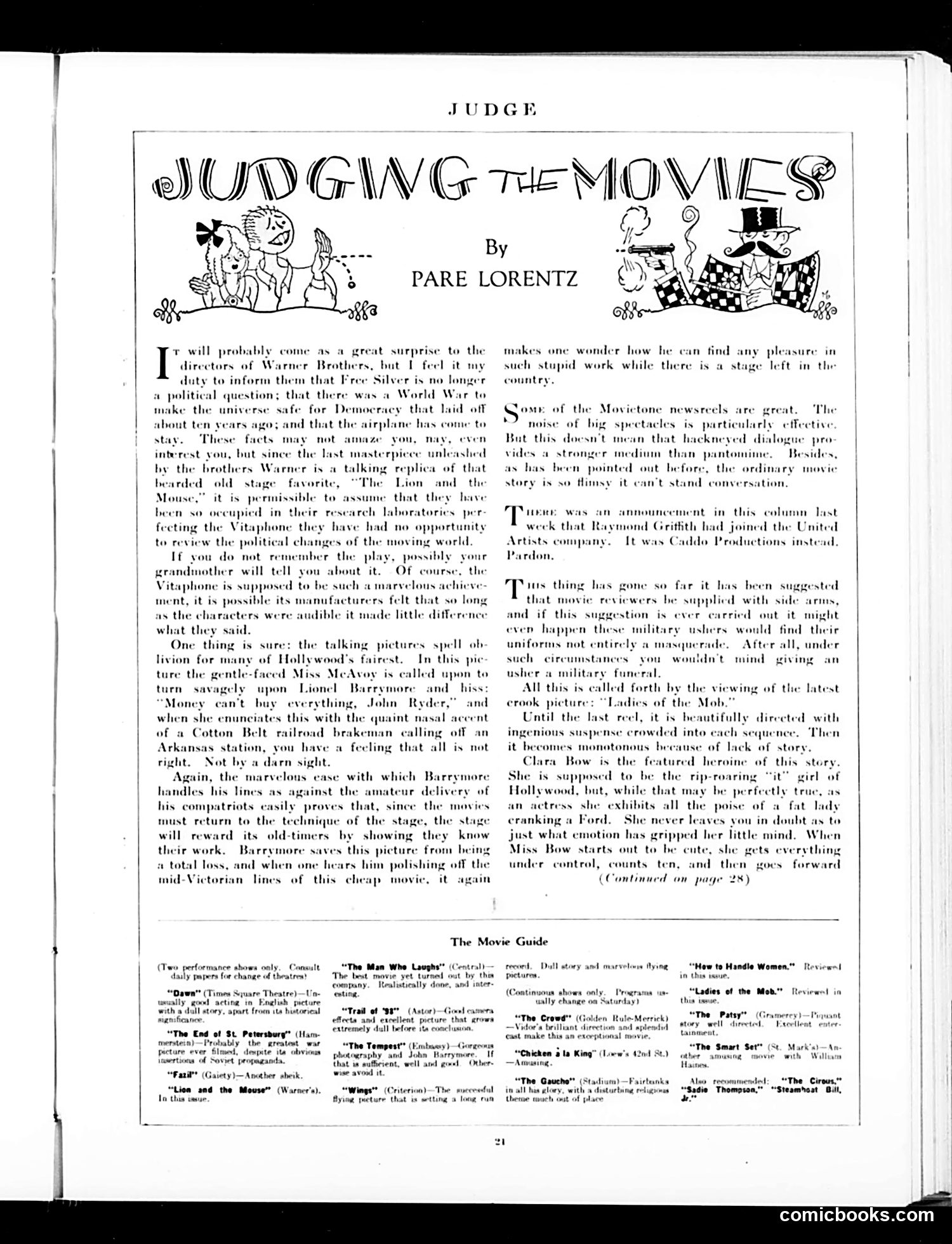
This is a film criticism column reviewing early talking pictures ("talkies"). The cartoons show figures reacting to cinema—likely representing film industry figures or the public encountering this new technology. Lorentz critiques Warner Brothers for making talking pictures when they should focus on silent films. He mocks the political references in *Free Silver* debates and World War I as outdated concerns, contrasting them with modern cinema problems. He praises Lionel Barrymore's stage technique in movies but harshly judges Clara Bow's acting in "Ladies of the Mob," describing her as lacking finesse—"all the poise of a fat lady cranking a Ford." The satire targets Hollywood's transition to sound technology and criticizes actors unprepared for dialogue delivery, while praising veteran stage actors adapting to film. Lorentz suggests silent pantomime and newsreels work better than poorly-written talking pictures.
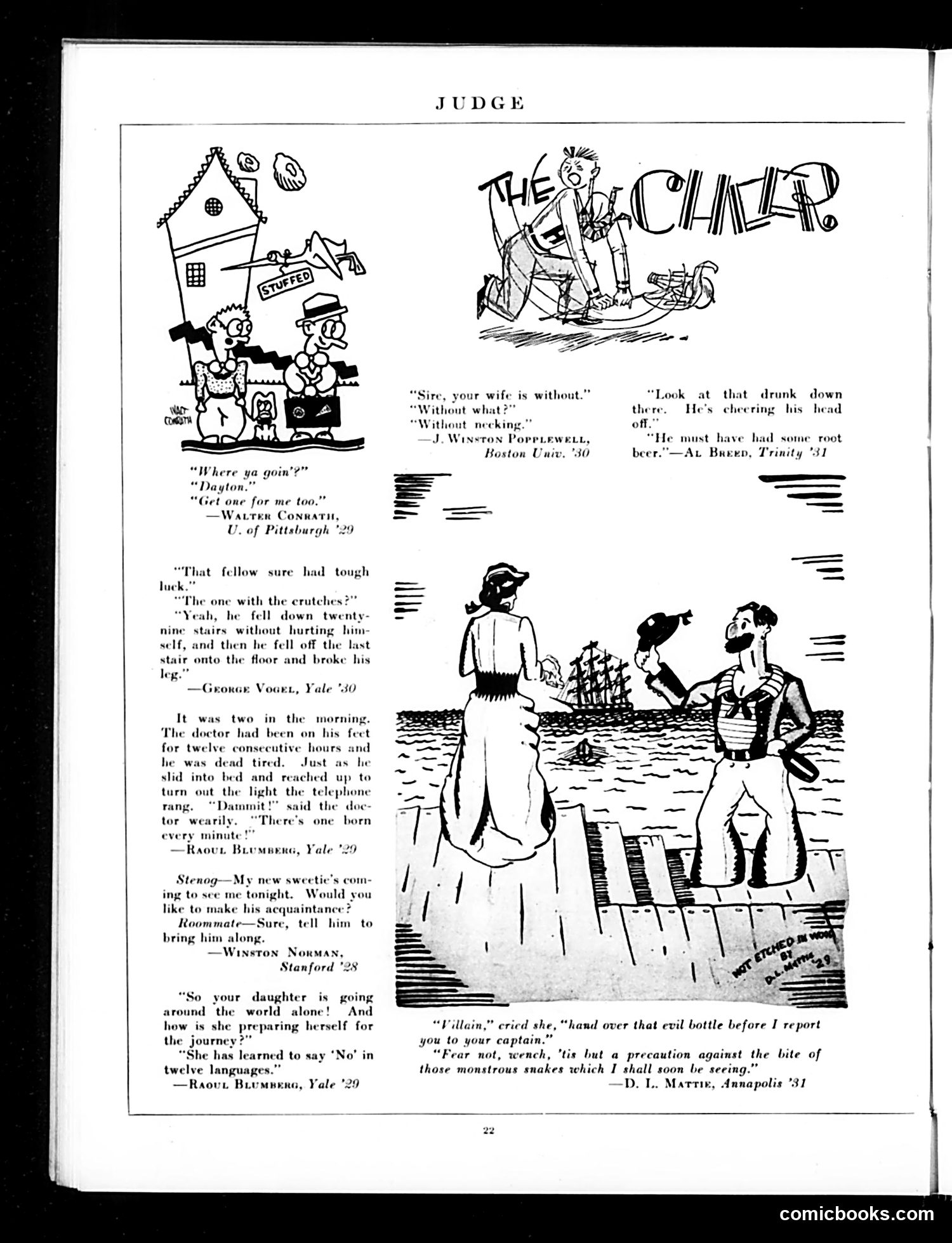
This page from Judge presents a collection of college humor jokes and cartoons submitted by students from various universities (Yale, Stanford, Pittsburgh, etc.), typical of 1920s-30s collegiate comedy. The jokes reflect period concerns: prohibition-era drinking references ("Get one for me too" regarding Dayton, likely a bootlegging hub), slapstick physical comedy, and gender dynamics. "The Chili" cartoon depicts a shipwreck scene where a woman demands a sailor surrender a bottle, which he claims protects against snake bites—a tall tale excusing drinking. Other gags involve romantic mishaps, workplace absurdities (stenographer's roommate confusion), and a tired doctor's interrupted sleep. The humor is largely innocent by modern standards: puns, exaggeration, and observational comedy about college life. The page represents Judge's role as a receptacle for student submissions, popularizing collegiate wit among broader audiences during an era when college humor was a distinct cultural product.
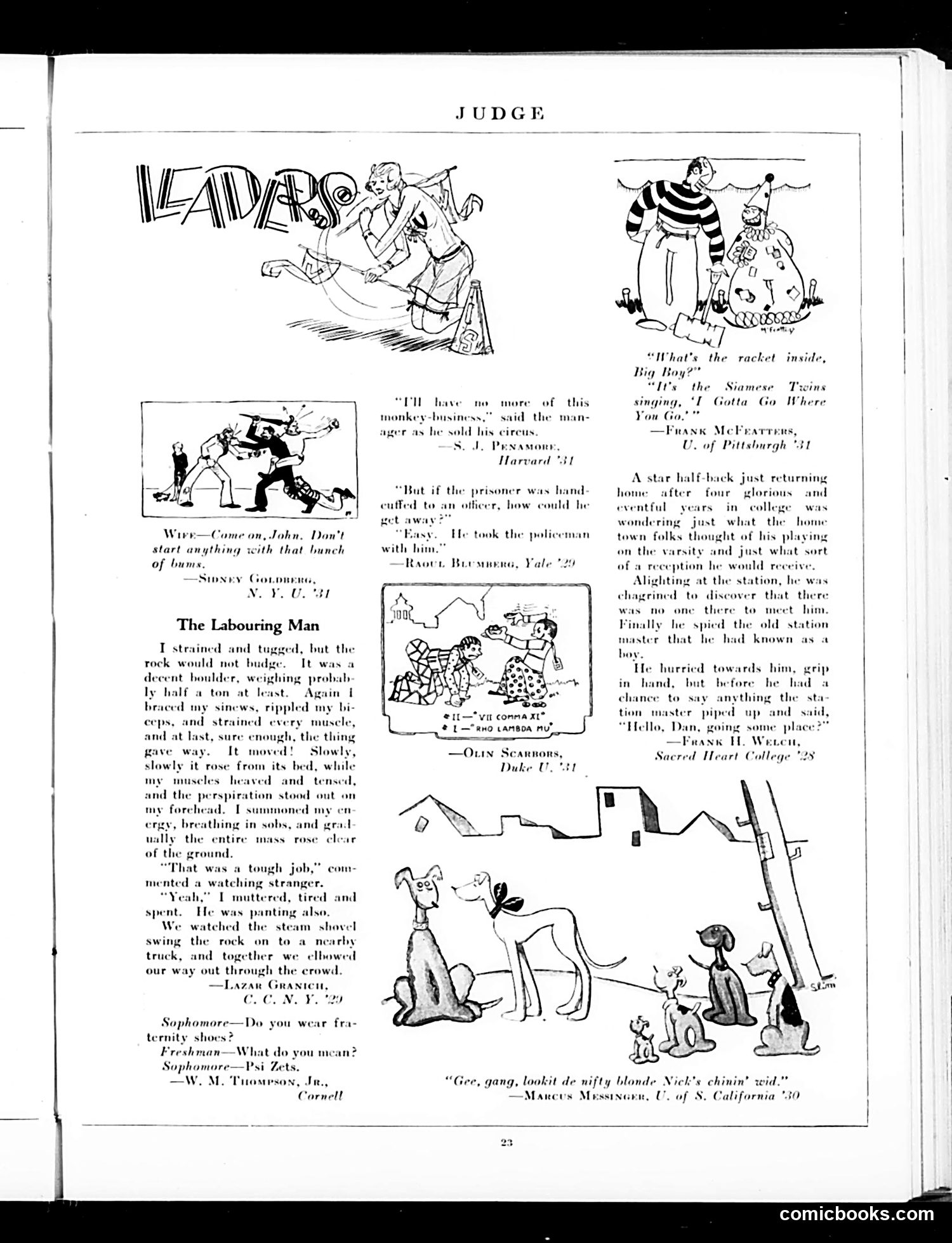
This page from Judge magazine contains several humor pieces typical of the era: **"The Labouring Man"** is a narrative comic about manual labor—a worker strains to move a boulder by hand, only to watch a steam shovel effortlessly accomplish the task. The satire critiques obsolete labor methods and the human effort rendered pointless by mechanical progress. **"Laddie"** (top left) shows physical comedy of someone being thrown or falling. **The college humor pieces** feature typical early-20th-century fraternity/university jokes: fraternity shoes (likely referring to initiation rituals or hazing), dialogue between sophomores and freshmen establishing class hierarchies. **"Big Boy"** references vaudeville or performance acts—someone complaining about "monkey-business singing." **The legal joke** plays on absurdity: if a prisoner was handcuffed to an officer, escape would be impossible. **The bottom cartoon** depicts the homecoming of a college athlete discovering nobody remembered to greet him at the station. The humor assumes readers familiar with college life, vaudeville entertainment, mechanical progress, and early-twentieth-century social conventions.
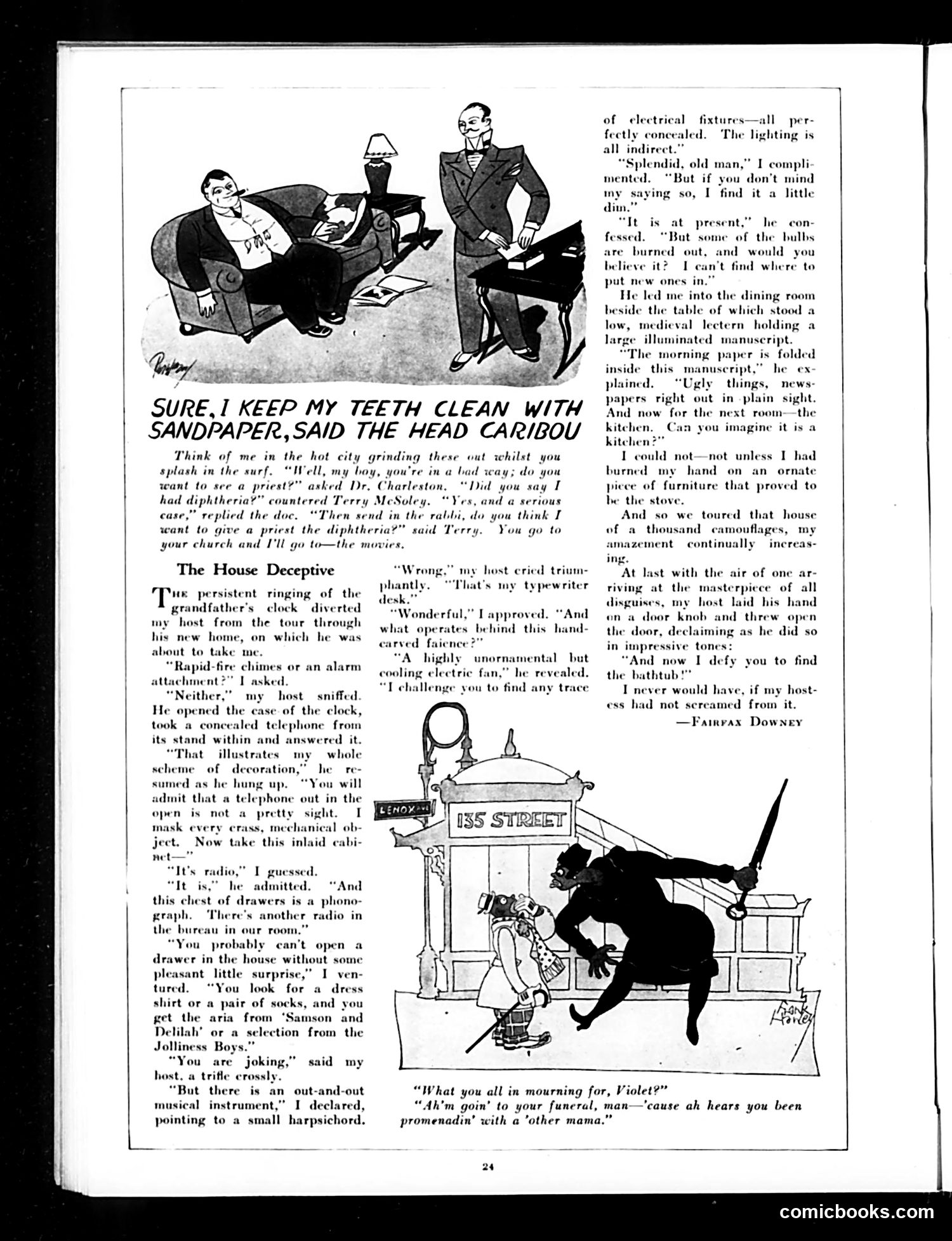
This is a humorous story by Fairfax Downey mocking the 1920s-30s design trend of disguising modern conveniences as period furniture or decorative objects. The host obsessively hides every mechanical device: a telephone concealed in a clock case, a phonograph disguised as a drawer, a radio hidden in furniture, a cooling electric fan camouflaged as ornamental decor, and a stove that *looks* like ornate furniture (burning the narrator's hand). His ultimate triumph: a bathtub so thoroughly concealed that his wife has to scream from inside it to reveal its location. The satire targets wealthy homeowners attempting to maintain a pseudo-medieval or "tasteful" aesthetic while possessing all modern conveniences—treating technology as something shameful that must be hidden rather than acknowledged. The joke is the absurdity of this contradiction: why own these devices if you're too embarrassed to display them? The page also includes an unrelated cartoon caption about dental hygiene and a brief blues-music joke at bottom.
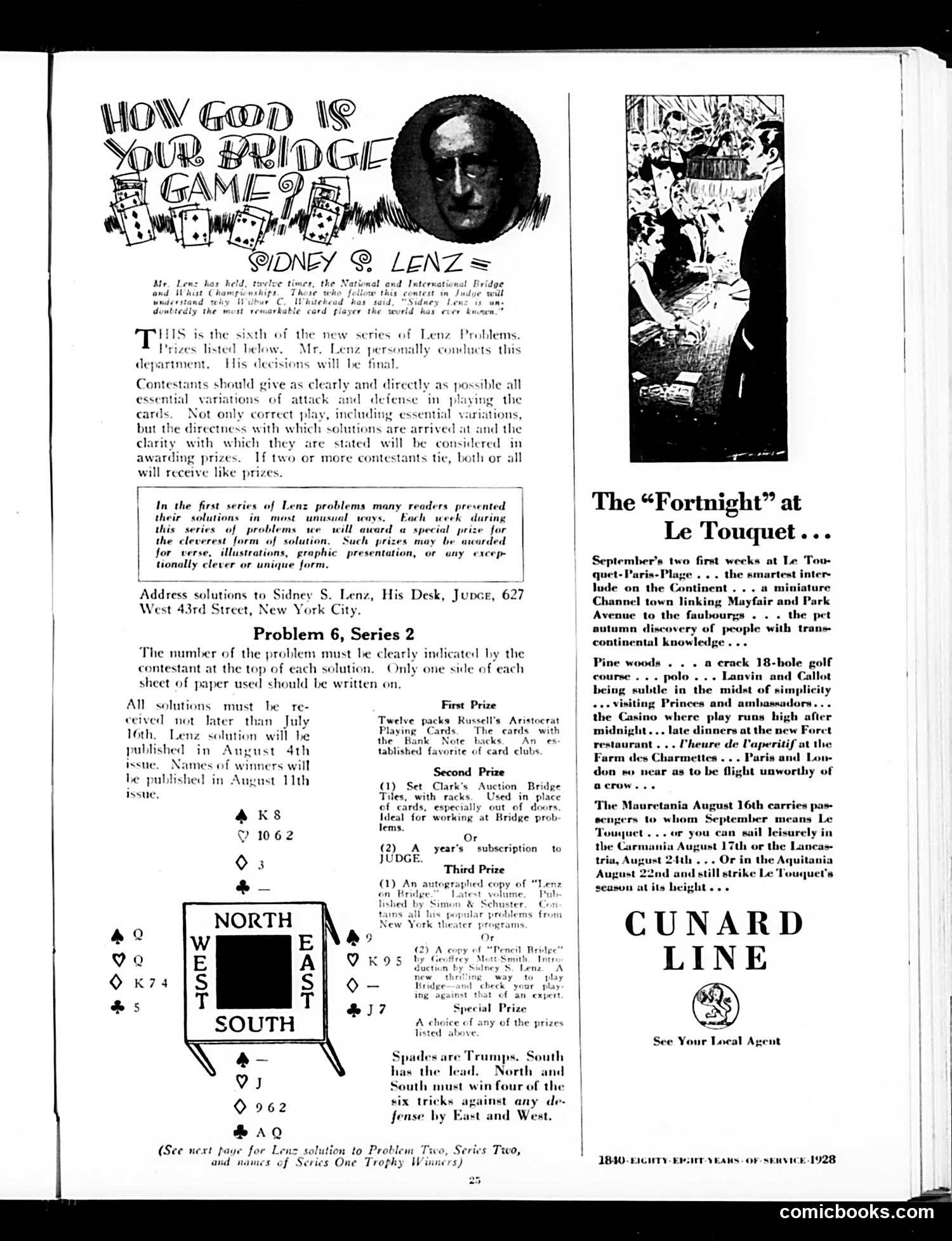
This page consists primarily of **bridge card game content**, not political satire. The main feature is "Problem 6, Series 2" of the Lenz Problems—a bridge competition where readers submit solutions to card-playing scenarios. Sidney S. Lenz, identified as conducting the department, poses a bridge hand where "Spades are Trumps" and South must win four of six tricks against any defense by East and West. The page offers prizes for the best solutions: playing cards, an auction bridge set, a Judge subscription, and autographed problem books. It emphasizes that solutions should be clearly presented, with bonus prizes for particularly clever or creative forms (verse, illustrations, etc.). The right side contains a **Cunard Line cruise advertisement** promoting Le Touquet (a fashionable French resort) and transatlantic passage, and a **Cunard shipping company logo**. This appears to be a typical Judge magazine page blending recreational competition with luxury travel advertising for affluent readers.
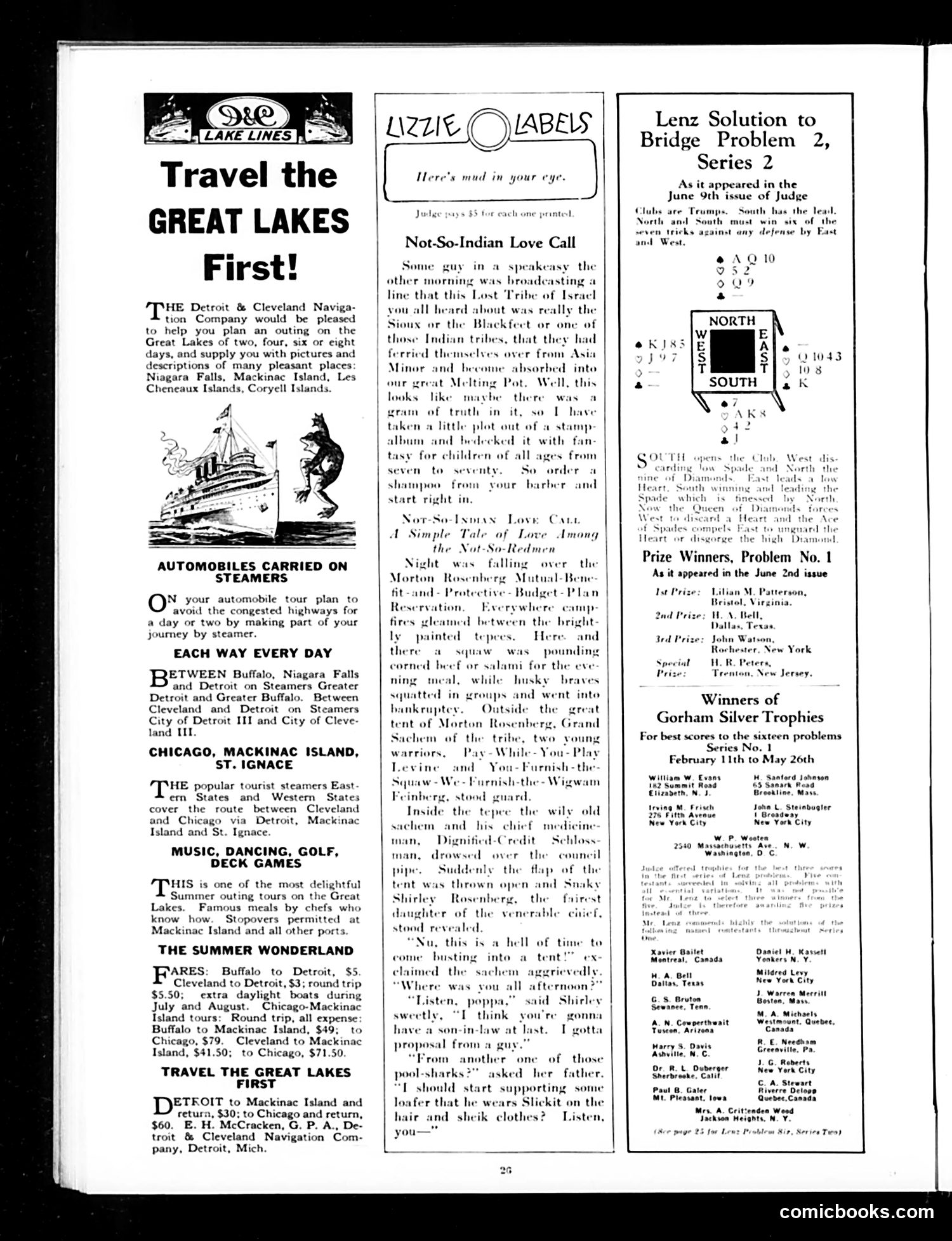
This is a satirical short story rather than a political cartoon, appearing in Judge magazine's humor section. The satire mocks 1920s-era pseudo-intellectual claims about Native American origins (a "Lost Tribe of Israel" theory apparently circulating at the time). The author deflates this pretentious speakeasy conversation by creating an absurdist narrative. The joke operates through incongruity: Native Americans are depicted using Yiddish-inflected names (Feinberg, Levine, Rosenberg) and discussing 1920s urban financial concerns—"bankruptcy," "budget plans," installment buying ("Pay-While-You-Play")—rather than traditional tribal matters. The "Melting Pot" reference underscores American assimilation themes. The romantic plot concerns Shirley Rosenberg, the chief's daughter, receiving a marriage proposal from an unsuitable "pool-shark" loafer. This domestic comedy echoes contemporary Jazz Age concerns about courtship and class. The satire simultaneously mocks: pretentious anthropological theories, the assumption that ethnicity determines behavior, and 1920s consumer culture. It's ethnic humor typical of the era, though the ridicule ultimately targets the speakeasy braggart's absurd claims rather than Native Americans themselves.
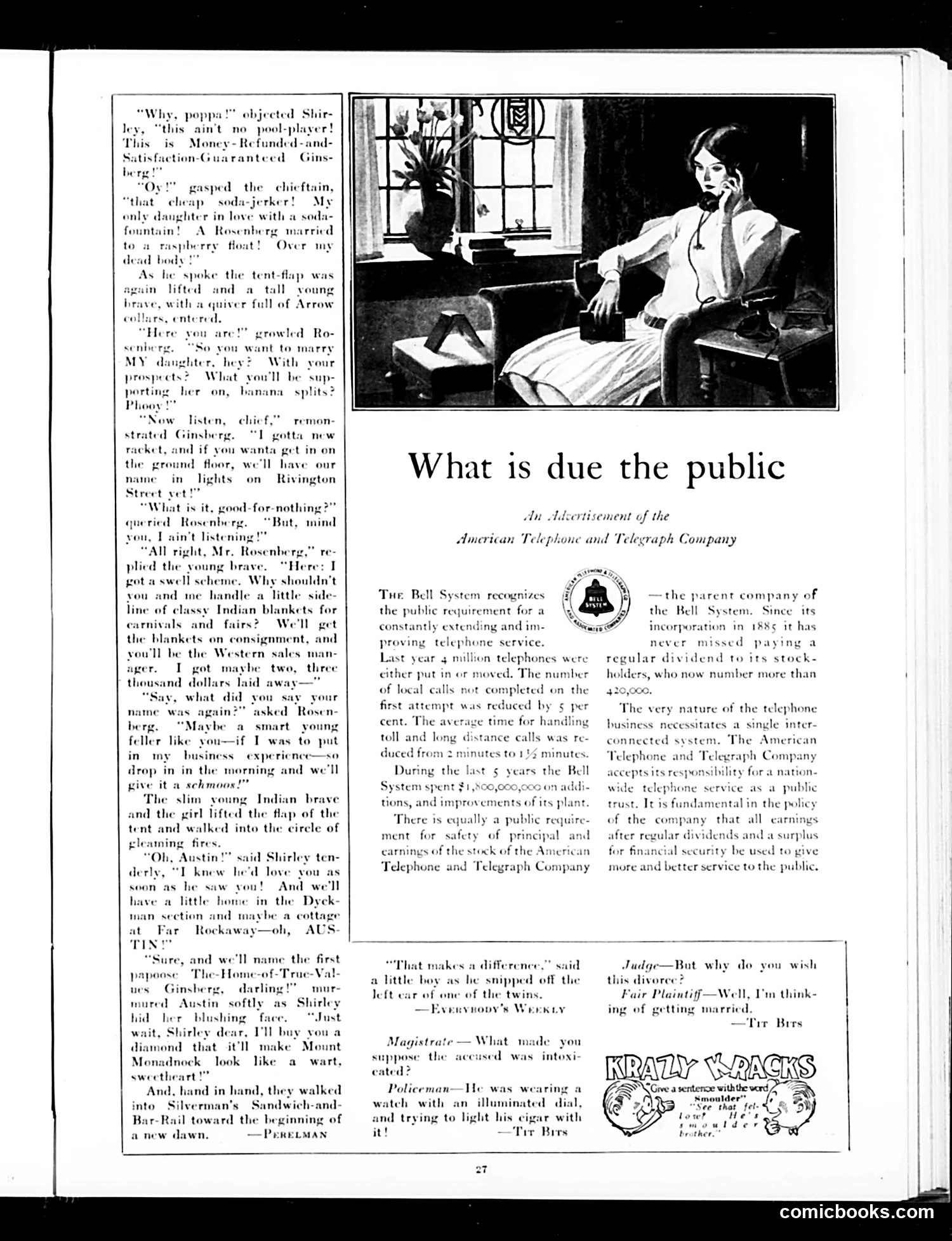
This page contains a serialized humor story about a Jewish businessman named Ginsberg who encounters a young Native American brave seeking to marry his daughter Shirley. The narrative plays on ethnic stereotypes common to 1920s-era comedy: the pragmatic Jewish entrepreneur, the romantic young couple, and the "noble savage." The main satire appears to target commercial opportunism. Ginsberg quickly pivots from objecting to the suitor's prospects to recruiting him into a scheme selling "Indian blankets for carnivals and fairs"—exploiting Native American identity for profit while promising the young man a business partnership. The page also includes a formal advertisement from American Telephone and Telegraph Company explaining their public service obligations and dividend policies—presented as a civic responsibility statement. Below are three brief joke items using stock characters: a parent's observation about twins, a police anecdote about a drunk man, and a divorce joke. These represent typical "filler" humor from the era. The overall tone reflects 1920s attitudes toward minorities and commerce.
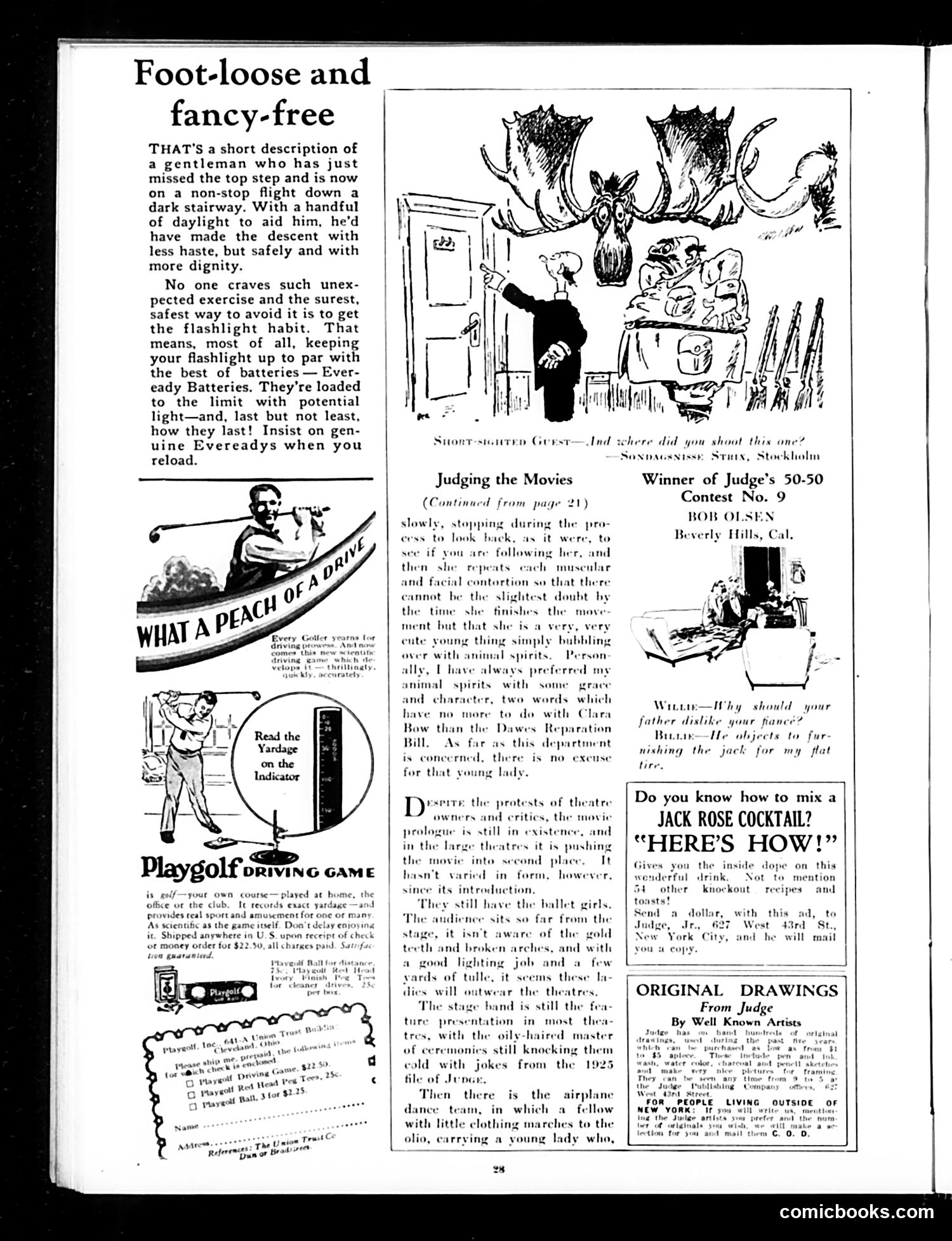
This is primarily an **advertising and content page** from Judge magazine, circa 1920s-1930s. **Main Content:** - **"Foot-loose and fancy-free"**: An Eveready Batteries advertisement using dark humor—a man falling down stairs in darkness to argue for keeping flashlights charged. The "foot-loose" pun plays on the man's uncontrolled descent. - **"Judging the Movies"**: A film criticism column discussing Clara Bow (a famous silent-film star of the era). The critic dismissively notes her appeal relies on physical performance and "animal spirits" rather than genuine talent or character, contrasting her unfavorably with more sophisticated actresses. - **Cartoons/Ads**: Include a Playgolf driving game advertisement, a Jack Rose cocktail recipe promotion, and a contest winner announcement. **Social Context:** The page reflects 1920s consumer culture and the critical divide over "flapper" actresses like Bow—glamorous but dismissed by highbrow critics as substantively lacking. The emphasis on modern gadgets (flashlights, games) and cocktail recipes captures post-Prohibition leisure culture.
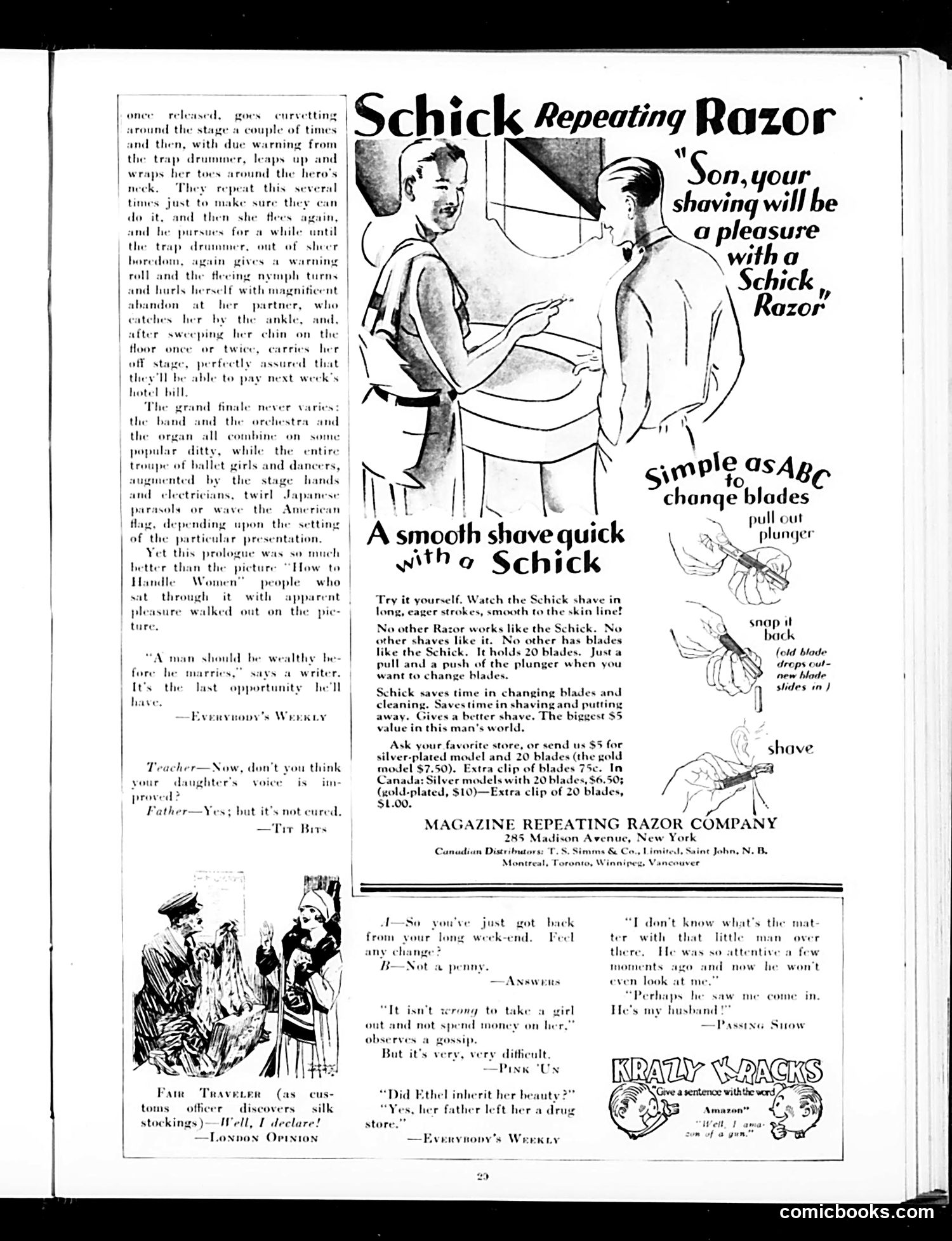
This page is primarily **advertising**, not political satire. The dominant content is a large Schick Repeating Razor advertisement featuring a father-son conversation about shaving. The small cartoon and joke snippets scattered around the margins are typical of Judge magazine's filler content—they're domestic humor unrelated to politics or social commentary: - A "Fair Traveler" discovers a woman's silk stockings (suggesting illicit behavior) - A teacher-father joke about a daughter's singing voice - Gossip about a man and woman (likely marital infidelity humor) These reflect early 20th-century magazine conventions: light, somewhat risqué domestic comedy aimed at male readers. The stockings reference and the husband-ignoring-wife joke would have carried mild scandalous undertones for the era. The razor ad itself shows typical period marketing—promoting a new technology (replaceable blades) through masculine bonding ("son, your shaving will be a pleasure"). **No significant political content is present on this page.**
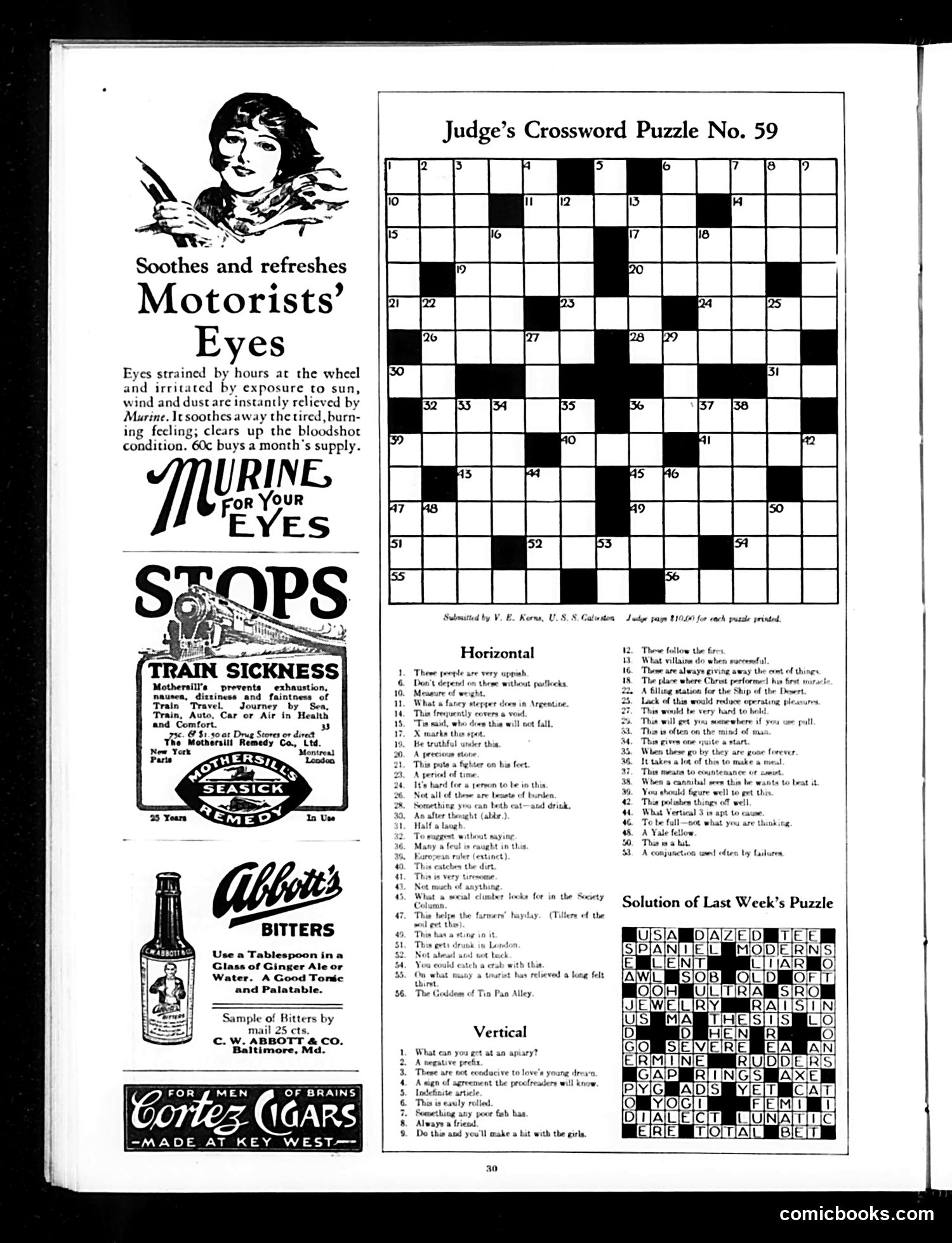
This page is primarily **advertising**, not political satire. It features vintage advertisements for early 20th-century products targeting motorists and travelers: **Main Advertisements:** - **Maurine** eye drops for "motorists' eyes" strained from driving - **Mothersill's** remedy for travel sickness (train, sea, auto) - **Stops Train Sickness** remedy - **Abbott's Bitters** digestive tonic - **Cortez Cigars** for men The page includes a crossword puzzle ("Judge's Crossword Puzzle No. 59"), which was a popular feature in magazines of this era. **Historical Context:** These ads reflect early automotive culture when driving was new and eye strain, motion sickness, and digestive issues from travel were genuine commercial concerns. The products and marketing language are characteristic of pre-FDA regulation patent medicines and tonics. There is **no political cartoon or satire visible** on this page—it's a straightforward advertising and puzzle section.
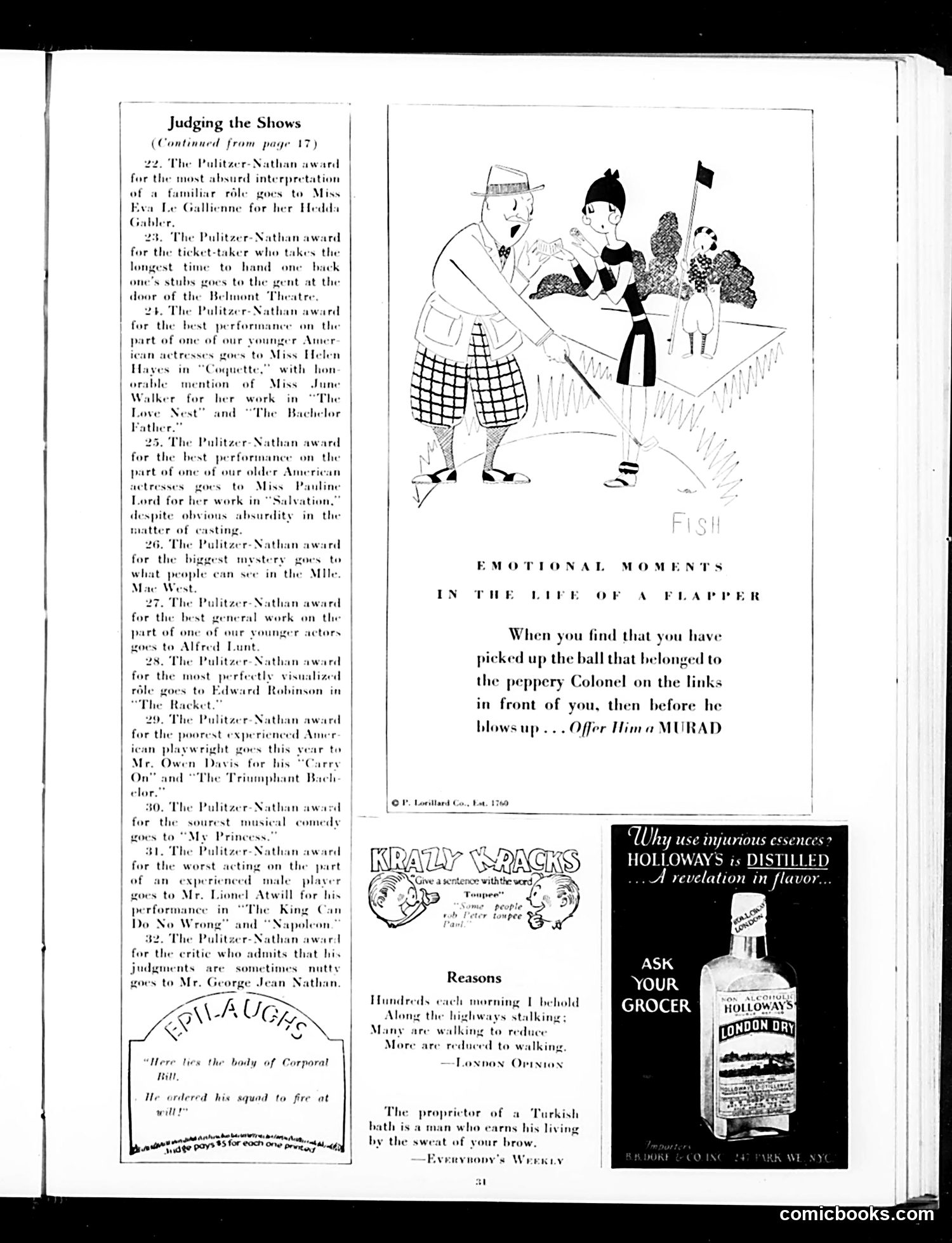
This page satirizes theater awards through mock "Pulitzer-Nathan awards"—a humorous invention critiquing both Broadway performances and theater-going experiences. The judges award absurd categories: worst ticket-taker service, most ridiculous casting choices, and poorest acting performances by established actors. Notable targets appear to include Eva Le Gallienne (mocked for her interpretation of Hedda Gabler) and Lionel Atwill (criticized for acting in specific productions). The accompanying cartoon, "Emotional Moments in the Life of a Flapper," depicts a young woman offering a cigarette (Murad brand) to a golfer after she's picked up his ball—a lighthearted scenario about flapper social behavior and product placement. The page also includes unrelated advertisements and humorous quotes about transportation and Turkish baths. Overall, it's period satire of 1920s theater culture and social manners.
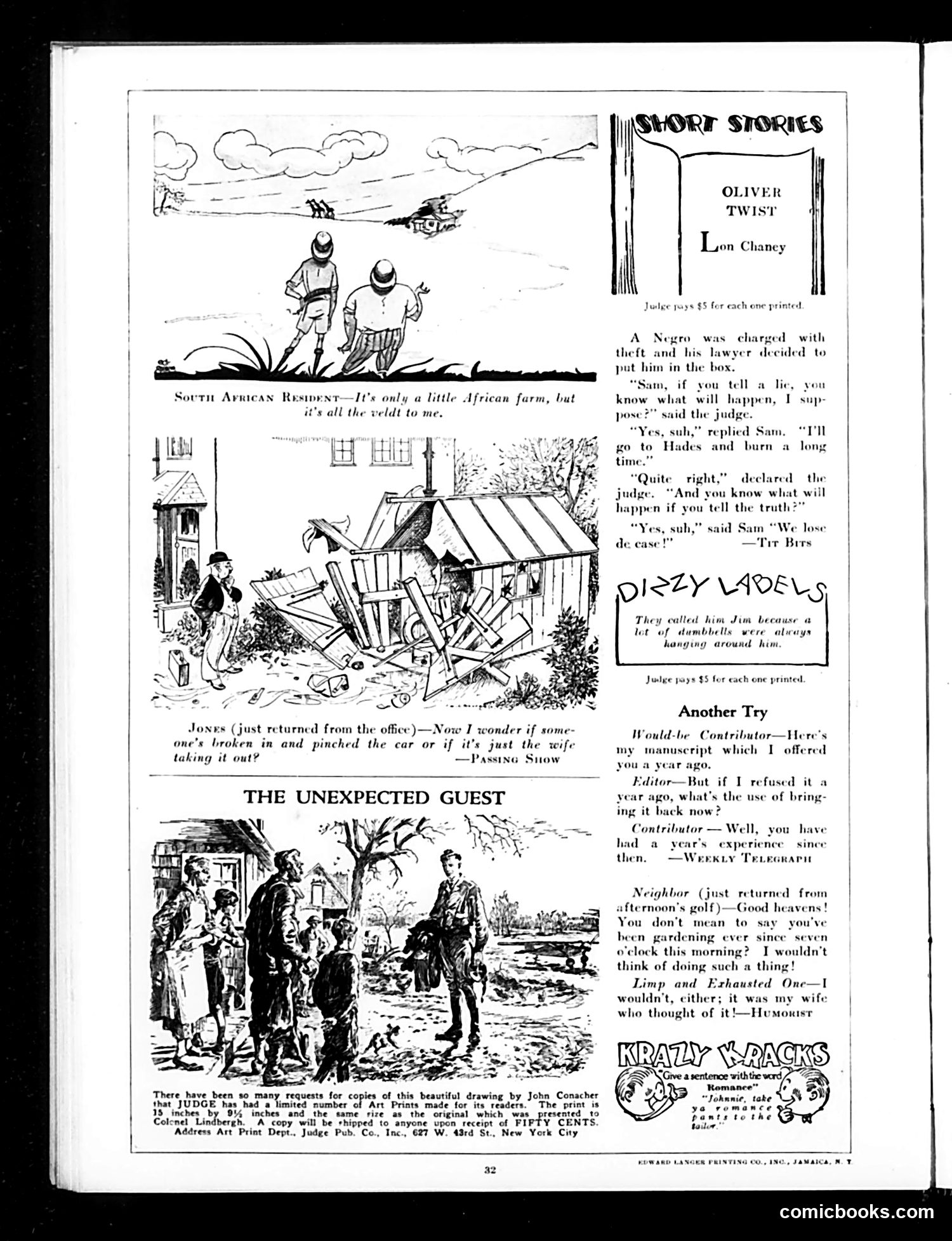
This page contains multiple short humor pieces typical of 1920s-30s satirical magazines: **"Oliver Twist" (Lon Chaney reference):** A racist joke about a Black defendant warned by his lawyer that lying will send him to Hell, while telling the truth will lose his case—playing on stereotypes about both legal corruption and Black defendants. **"South African Resident":** A captioned illustration about colonial life in Africa. **"Dizzy Daisels":** A one-liner about someone nicknamed "Jim" because "dumbbells were always hanging around him"—implying he's stupid. **"The Unexpected Guest":** An illustration by John Conacher (promoted as a limited art print available for 50 cents) depicting a rural scene. **Other brief jokes** about marital discord, office life, and golf. The page reflects period attitudes: casual racism, gender stereotypes (wives as nuisances), and workplace humor. Most content is lightweight social satire aimed at middle-class readers, with no overt political messaging beyond the racist framing typical of the era.
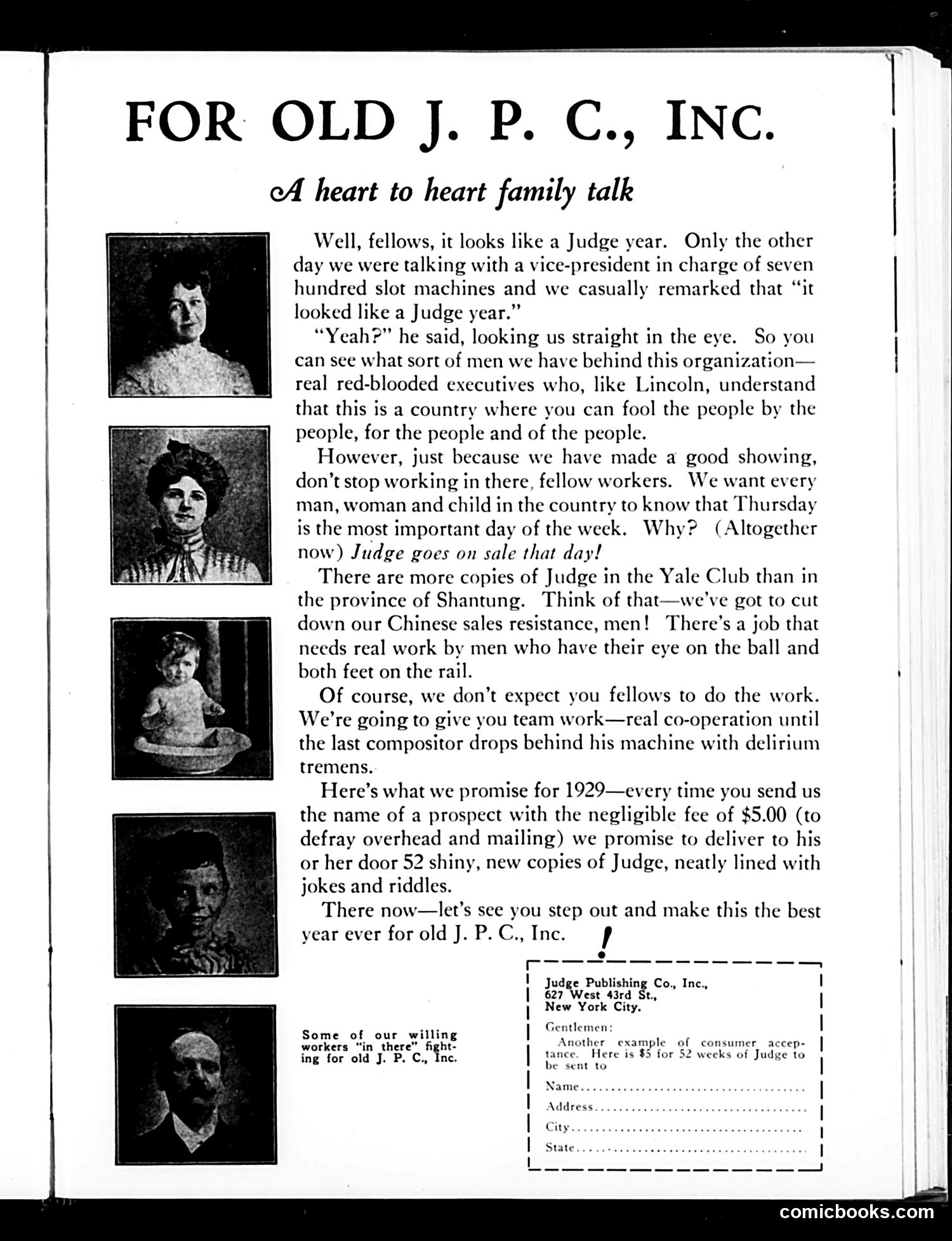
This is a satirical self-promotional piece for *Judge* magazine itself, disguised as an internal pep talk. The text mocks corporate sales tactics and American consumer culture through exaggerated earnestness. **Key satire points:** - **The slot-machine executive**: Represents cynical corporate leadership who understand mass manipulation ("fool the people by the people")—a twisted Lincoln reference mocking capitalist hypocrisy - **"Judge year"**: The magazine falsely claims it's becoming culturally dominant, then admits they're actually losing sales in China - **Thursday deadline**: Urgently promotes *Judge*'s publication day with absurd urgency - **The $5 subscription scheme**: Mocks predatory sales tactics, offering small commissions to recruit subscribers - **"Delirium tremens" compositor**: Dark humor about overworked printing staff The five portrait photographs alongside appear to be *Judge* staff or contributors, presented as the "real red-blooded executives" steering this enterprise. The piece satirizes American business's combination of cynicism, desperate growth metrics, and self-aggrandizing rhetoric—all wrapped in fake patriotic language.
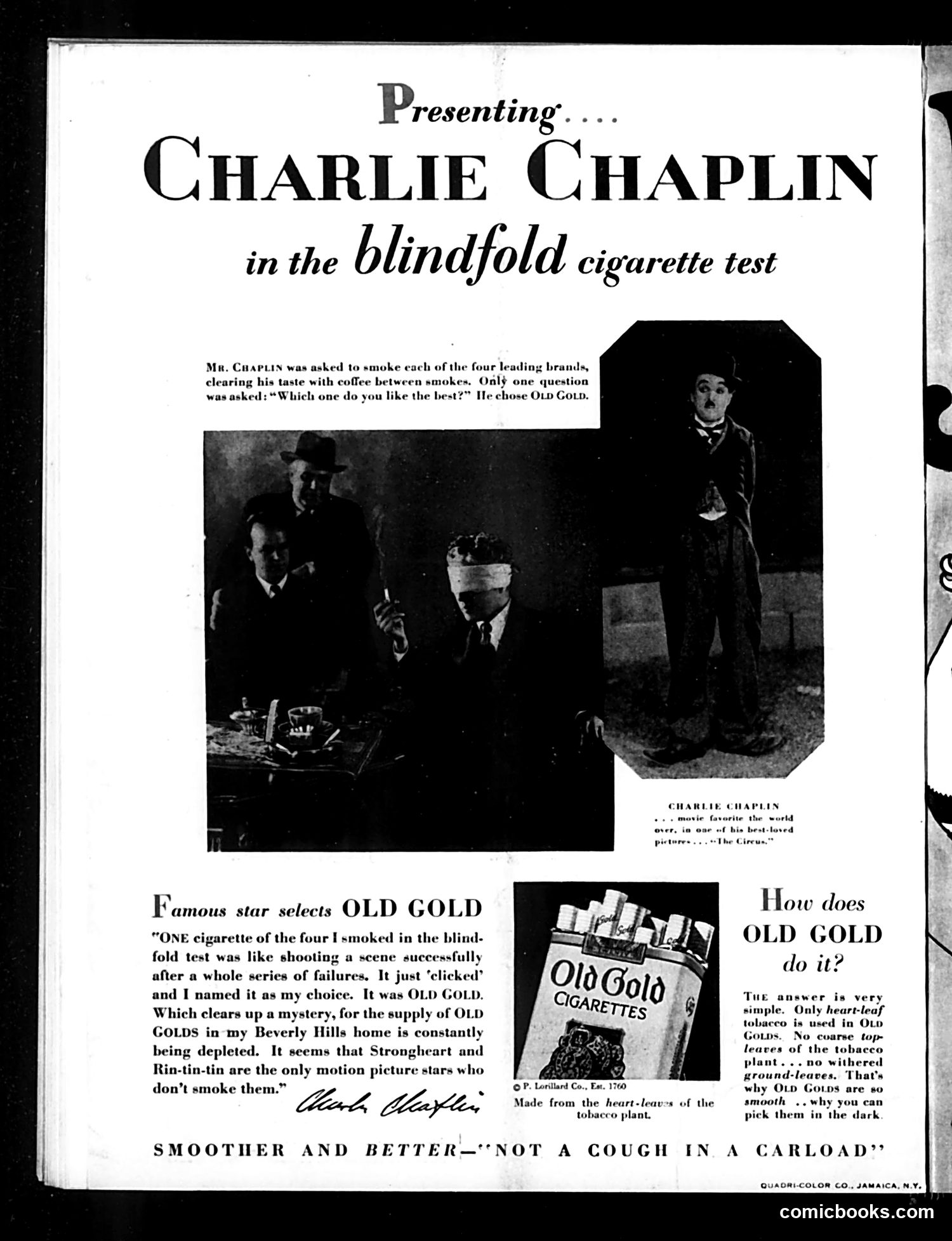
This is a **cigarette advertisement** disguised as celebrity endorsement, not a political cartoon. It features Charlie Chaplin (the famous silent film comedian) participating in a "blindfold test" where he supposedly smokes four leading cigarette brands and chooses Old Gold. The ad's humor relies on several period details: 1. **Celebrity endorsement as "proof"**: Using a famous actor's preference to market cigarettes was standard 1920s-30s advertising. 2. **The "blindfold test" gimmick**: Framed as objective, scientific evidence of superiority—a marketing technique that would be considered deceptive today. 3. **The joke about his dogs**: Chaplin quips that his dogs Strongheart and Rin-tin-tin are "the only" stars who don't smoke—implying even animals would smoke if they could. 4. **Health claim**: "Not a cough in a carload" was an actual Old Gold slogan, falsely suggesting cigarettes were safe. The page exemplifies how openly cigarettes were marketed to the public before health warnings became mandatory.