
A complete issue · 37 pages · 1928
Judge — June 30, 1928
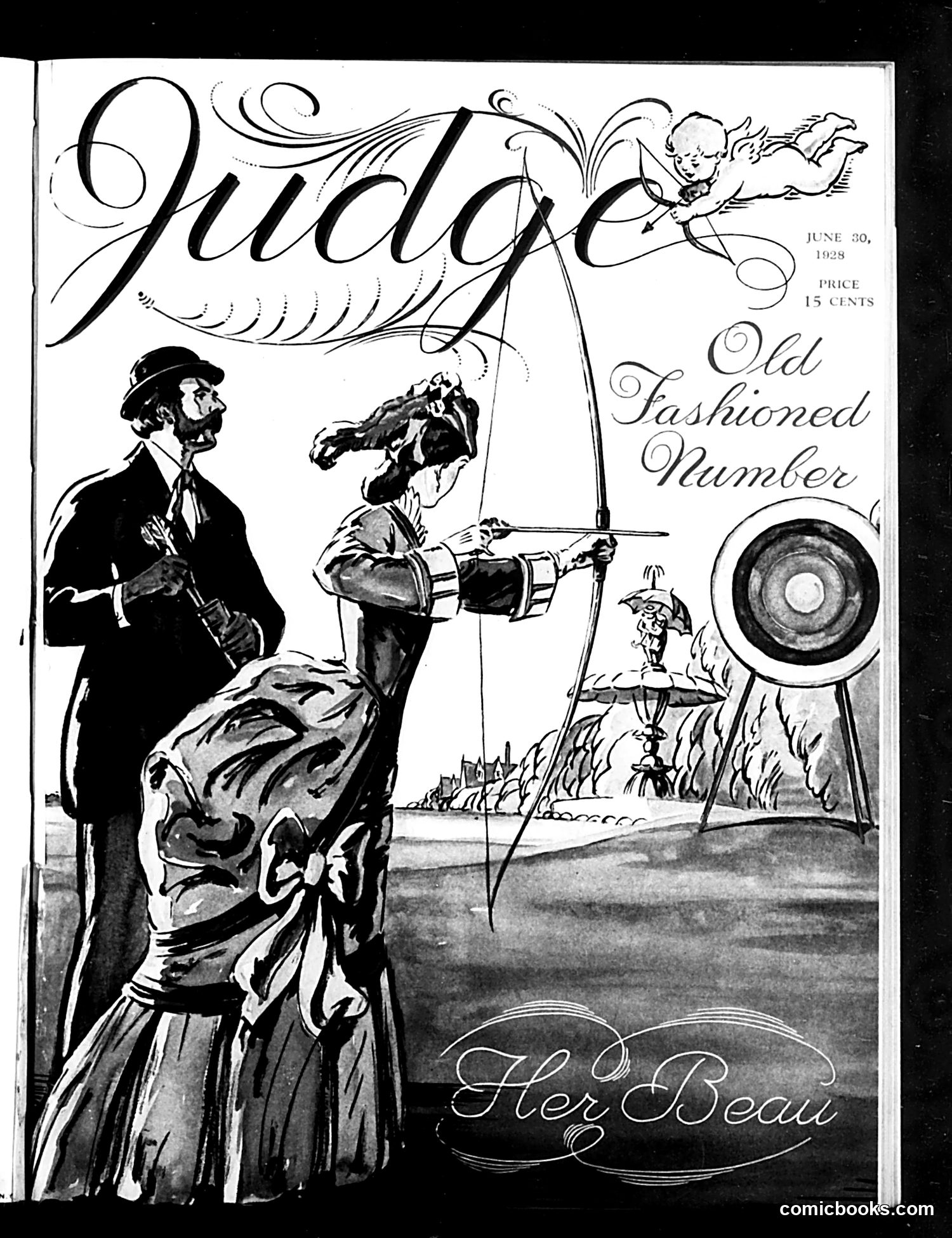
This is the cover of Judge magazine from June 30, 1928 (price 15 cents). The main illustration depicts a dramatic scene with classical/mythological elements: a woman in period dress points a sword or staff toward a burning city while a bearded man in formal attire watches. A cherub floats above, and a landscape with flames appears in the background. The title reads "Old Fashioned Number" with "Her Beau" as a subtitle. The imagery appears to reference classical or historical themes of conflict and romance, though the specific satirical target—whether political, social, or literary—is unclear without additional context. The "old fashioned" framing suggests commentary on outdated attitudes or historical parallels relevant to 1928 readers.
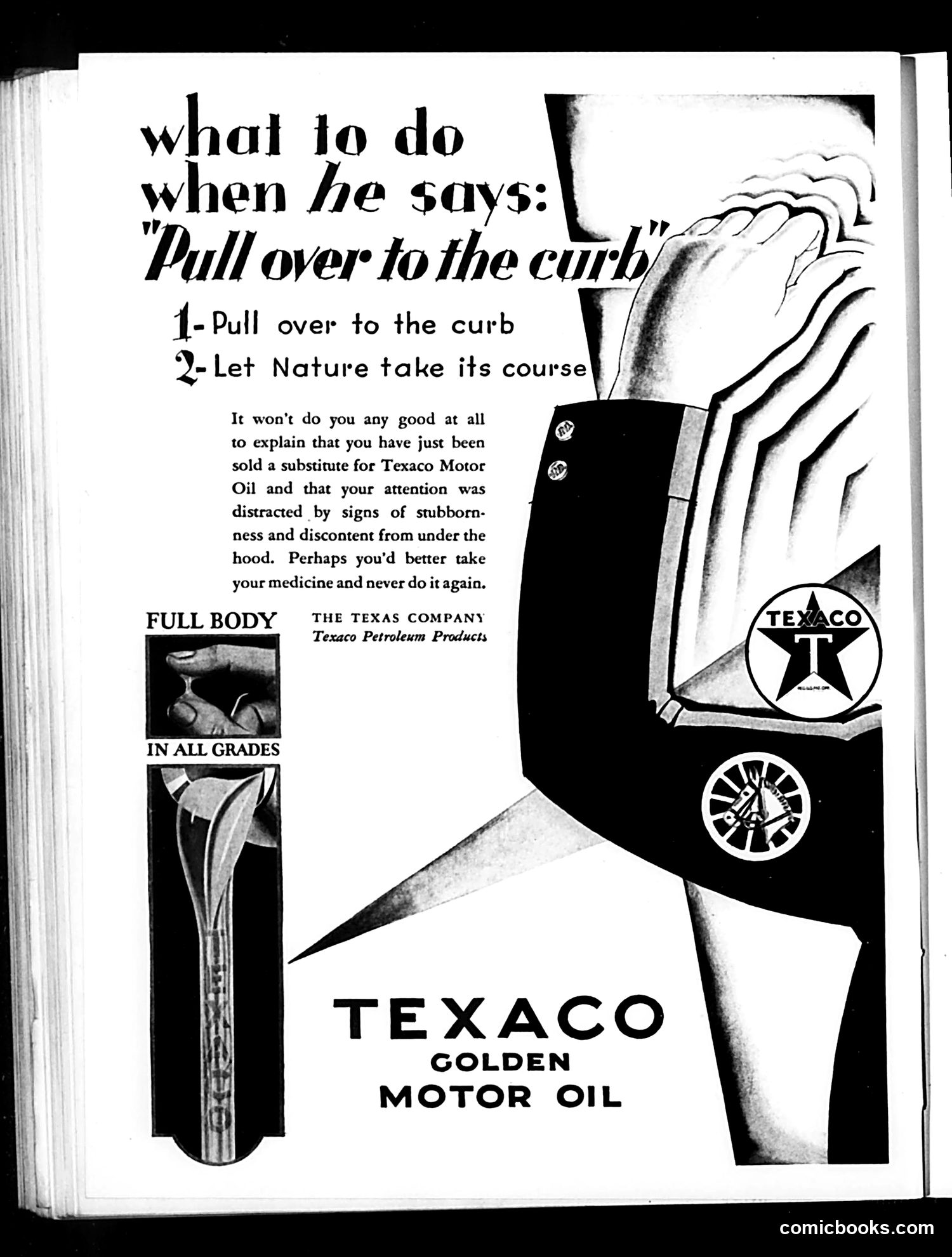
This is primarily a **Texaco motor oil advertisement**, not a political cartoon. The satirical element is minimal—it's a humorous ad playing on the phrase "pull over to the curb." The joke presents two responses when a man says "Pull over to the curb": 1. Actually pull over to the curb 2. "Let Nature take its course" The ad suggests that using a counterfeit motor oil will cause engine problems—stubborn behavior and discontent under the hood—requiring you to pull over. The implication is darkly comedic: buying fake Texaco oil will damage your engine, literally forcing you to stop at the curb. The "FULL BODY IN ALL GRADES" imagery shows oil flowing, emphasizing product quality. This is essentially a cautionary advertisement warning against substitutes.
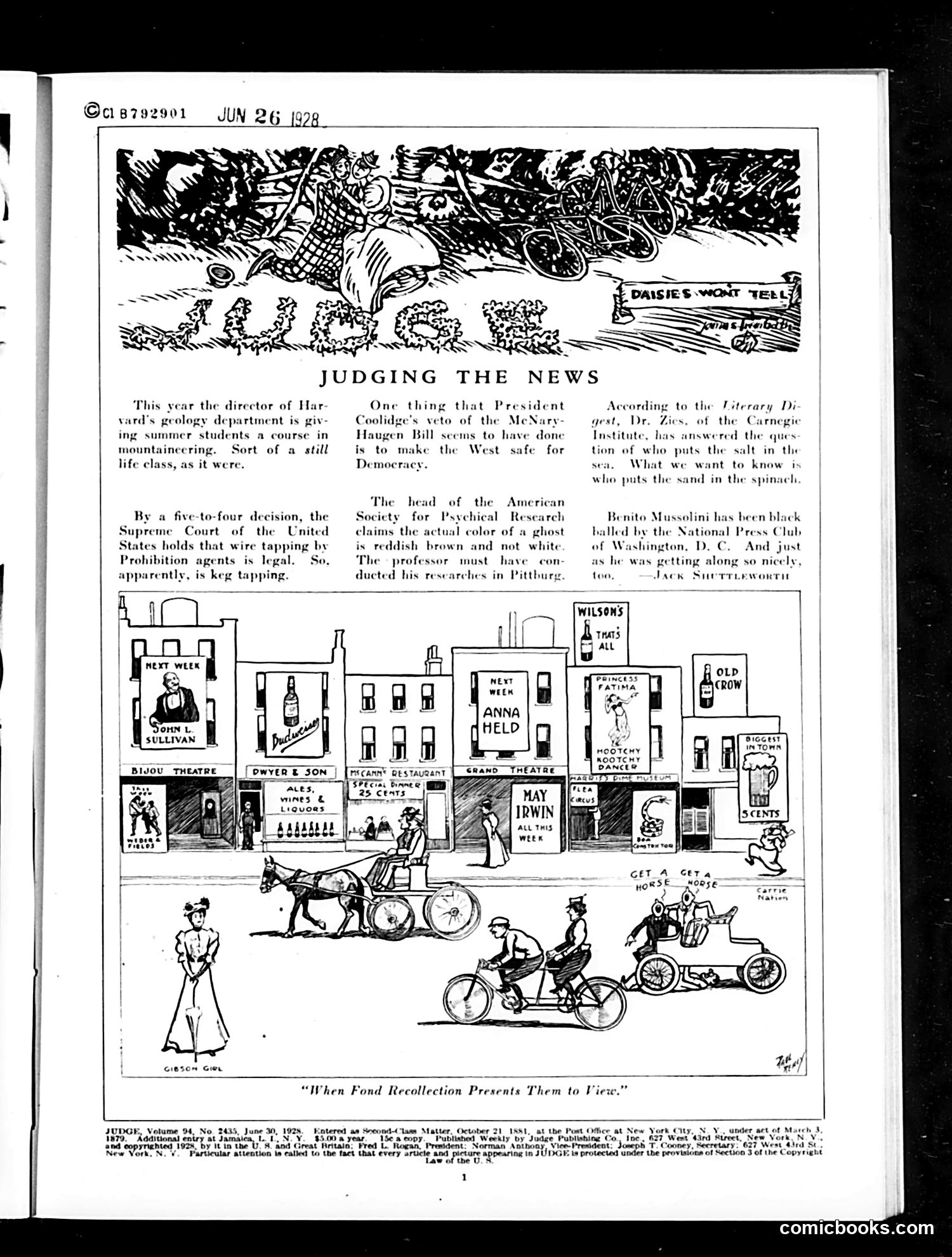
This Judge page satirizes current events through brief commentary and an illustration titled "When Fond Recollection Presents Them to View." The text references: - **Harvard geology students mountaineering** (implied critique of frivolous academia) - **Supreme Court wire-tapping decision** legalizing prohibition enforcement - **President Coolidge's McNary-Haugen Bill veto** regarding farm aid - **Ghost color research** at Pittsburg University (appears to mock pseudoscientific claims) - **Benito Mussolini** receiving criticism from the National Press Club The street-scene cartoon depicts various shops, theaters, and period transportation (horse cart, bicycles, automobiles) populated with figures labeled "Gideon Girl," "Get a Horse," and "Get a Nose." The illustration appears to nostalgically mock outdated or ridiculous consumer goods and fashions of the era, contrasting old and new.
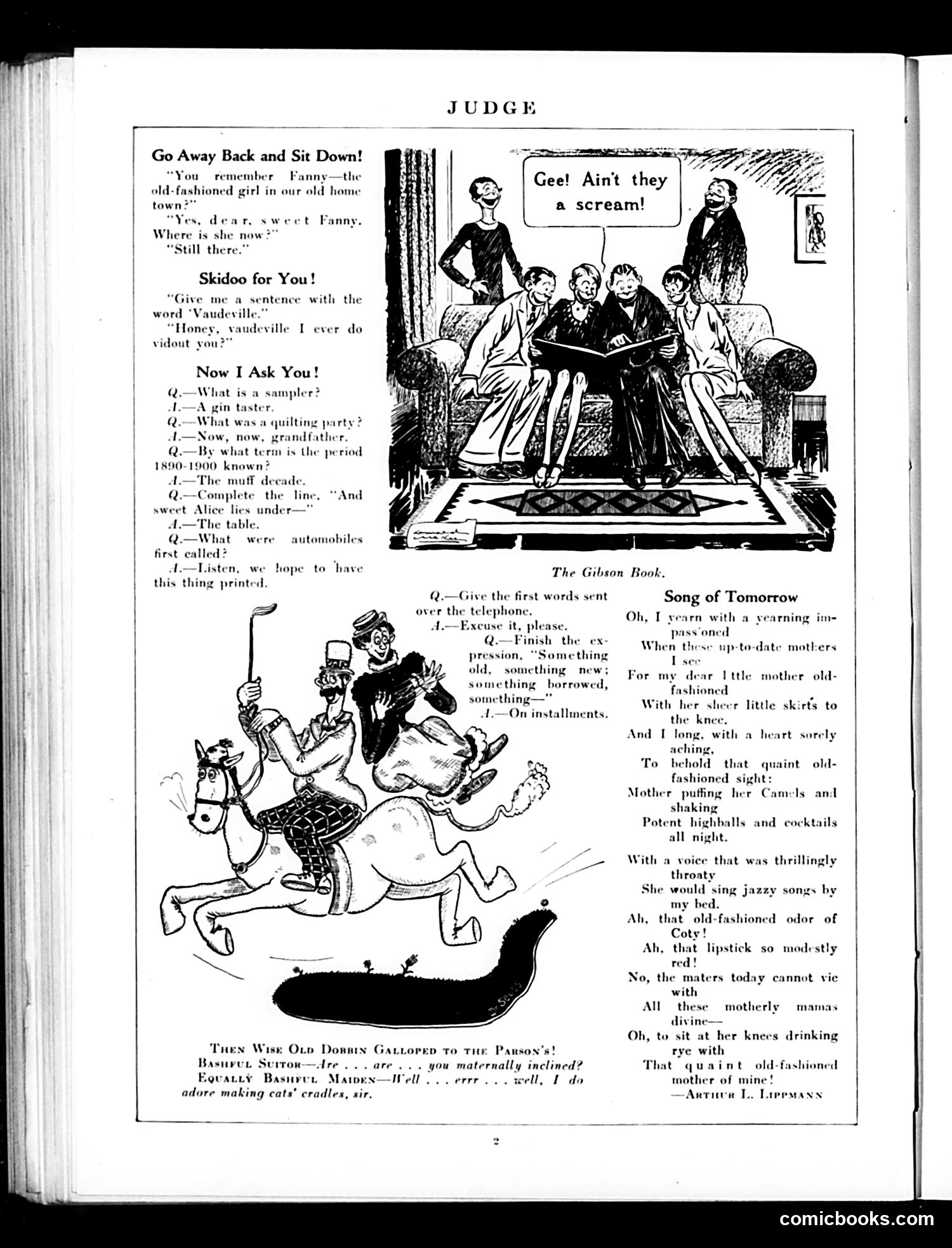
This page contains several humor pieces typical of early 20th-century Judge magazine: **Top cartoon ("Go Away Back and Sit Down")**: A nostalgic piece about an old-fashioned girl named Fanny, likely satirizing changing social norms and women's evolving roles. **"Skidoo for You!"**: A wordplay joke about "Vaudeville," playing on period slang ("23 skidoo"). **Middle cartoon**: Two figures on what appears to be a horse or donkey, captioned about making "cats' cradles"—likely physical comedy satirizing foolish behavior. **"The Gibson Book" and "Song of Tomorrow"**: A poem by Arthur L. Livermore nostalgically lamenting modern mothers who smoke, drink cocktails, and wear fashionable clothes, contrasting them with idealized "old-fashioned" mothers. This reflects period anxiety about women's changing social roles and the "New Woman" of the era. The overall tone reflects early 1900s attitudes toward social change.
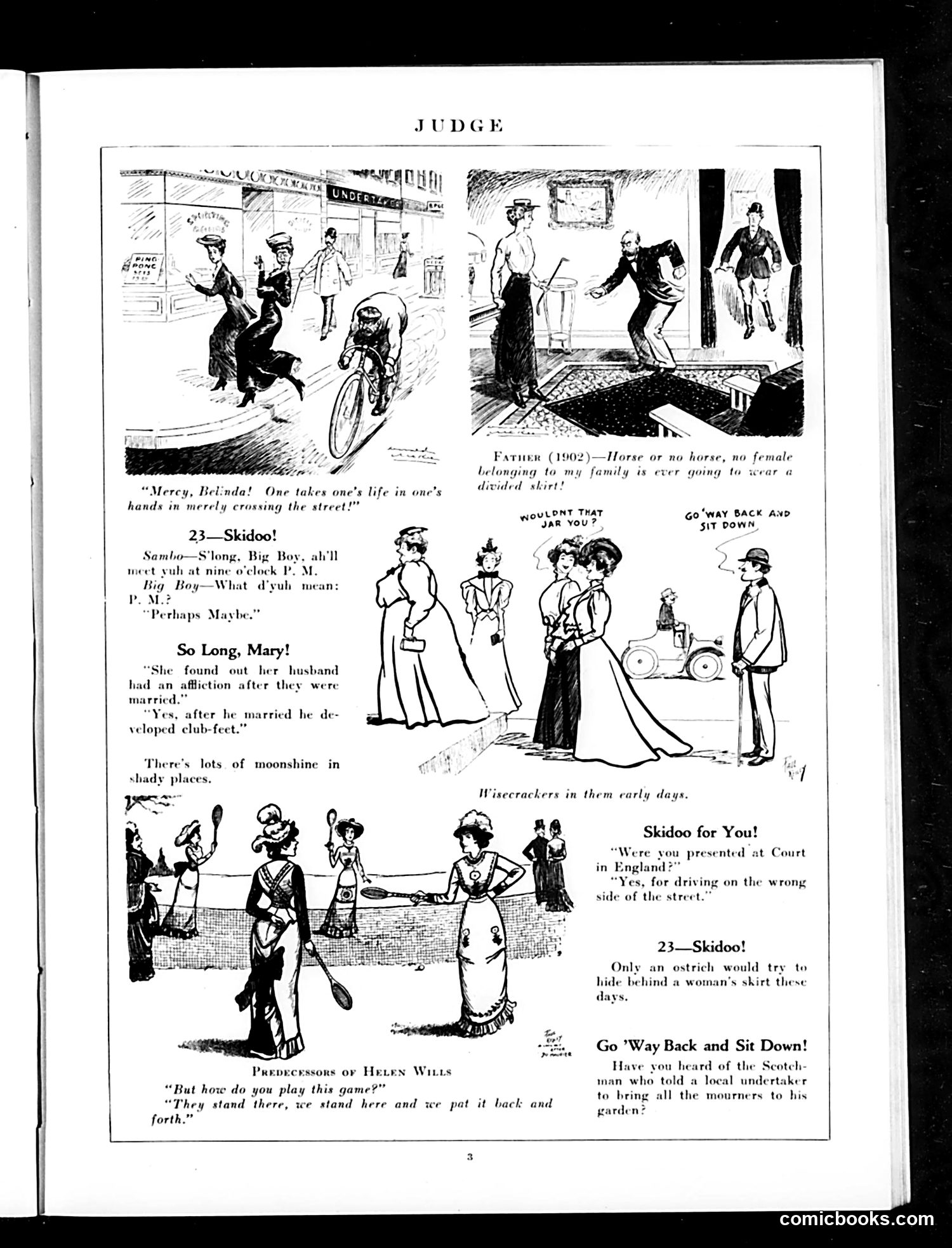
This page satirizes the early 1900s fad term "23 Skidoo"—slang meaning to leave hastily or to die. The cartoons mock various social situations where the phrase became trendy. The content ridicules: 1. **Street safety**: A bicycle collision where "one takes one's life in one's hands" crossing streets 2. **Women's fashion**: A "Father" (1902) joke about women refusing to wear divided skirts on horseback 3. **Social etiquette**: Various scenarios where people inappropriately invoke "Skidoo"—including a court case about wrong-side driving in England and a Scottish undertaker's dark humor The satire targets how "Skidoo" became overused jargon across all classes and situations. The cartoons show both the absurdity of the catchphrase's ubiquity and period anxieties about modern life, women's independence, and traffic dangers.
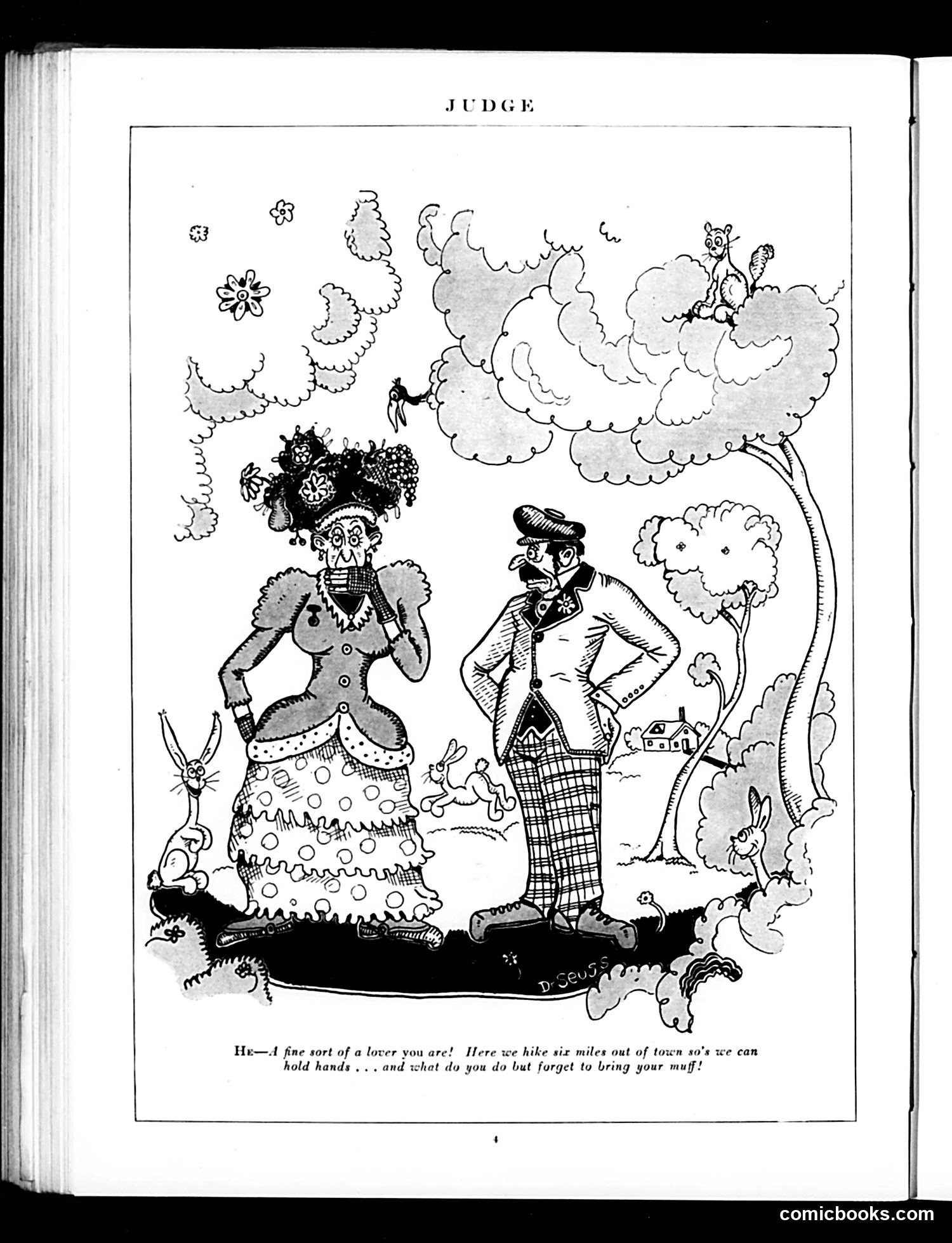
This page titled "JUDGE" contains a single cartoon depicting two figures in a romantic outdoor setting. A woman in an elaborate, decorative dress with a large feathered hat stands beside a man in plaid trousers and formal jacket. The caption reads: "Hi—I fine sort of a lover you are! Here we hike six miles out of town so's we can hold hands . . . and what do you do but forget to bring your muff!" The joke appears to satirize romantic courtship customs of the era—specifically, the irony that despite elaborate preparation for a romantic outing, the man forgot to bring the woman's muff (a cylindrical hand warmer, standard women's accessory). The humor lies in this mundane oversight undermining the romantic gesture.
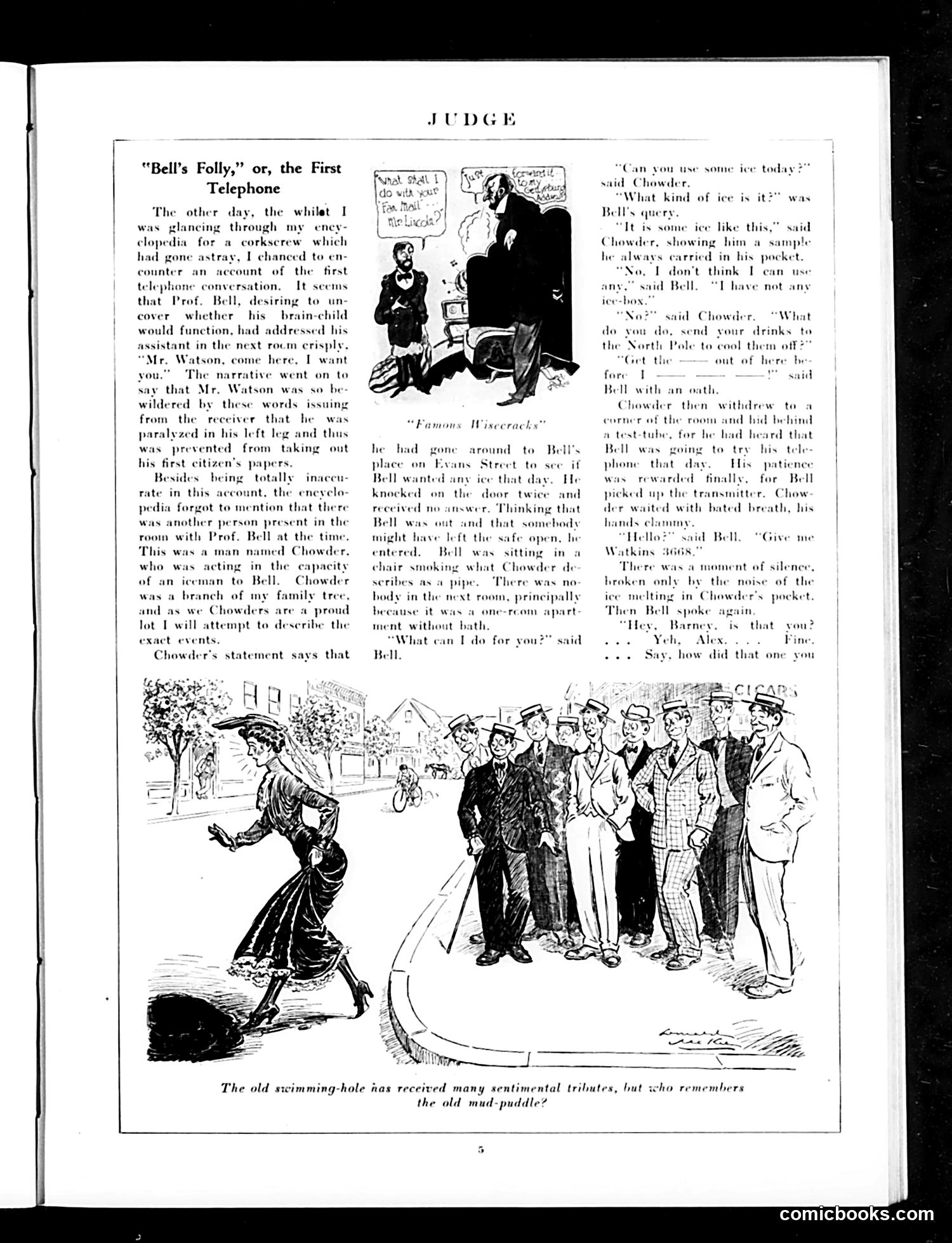
This page contains two cartoons satirizing British life. The upper cartoon, titled "Famous Wisecracks," depicts a humorous exchange about ice delivery—likely mocking British understatement and class pretensions around practical matters. The lower cartoon's caption references "the old swimming-hole" receiving "sentimental tributes, but who remembers the old mud-puddle?" This appears to be social satire contrasting romanticized nostalgia with overlooked everyday realities. The image shows a woman jumping in mud while well-dressed men observe, suggesting satire about class consciousness, selective memory, or perhaps gender role expectations. The cartoons employ typical Judge-era visual humor: exaggerated figures, domestic or genteel settings, and wordplay targeting middle-class pretension and British social conventions.
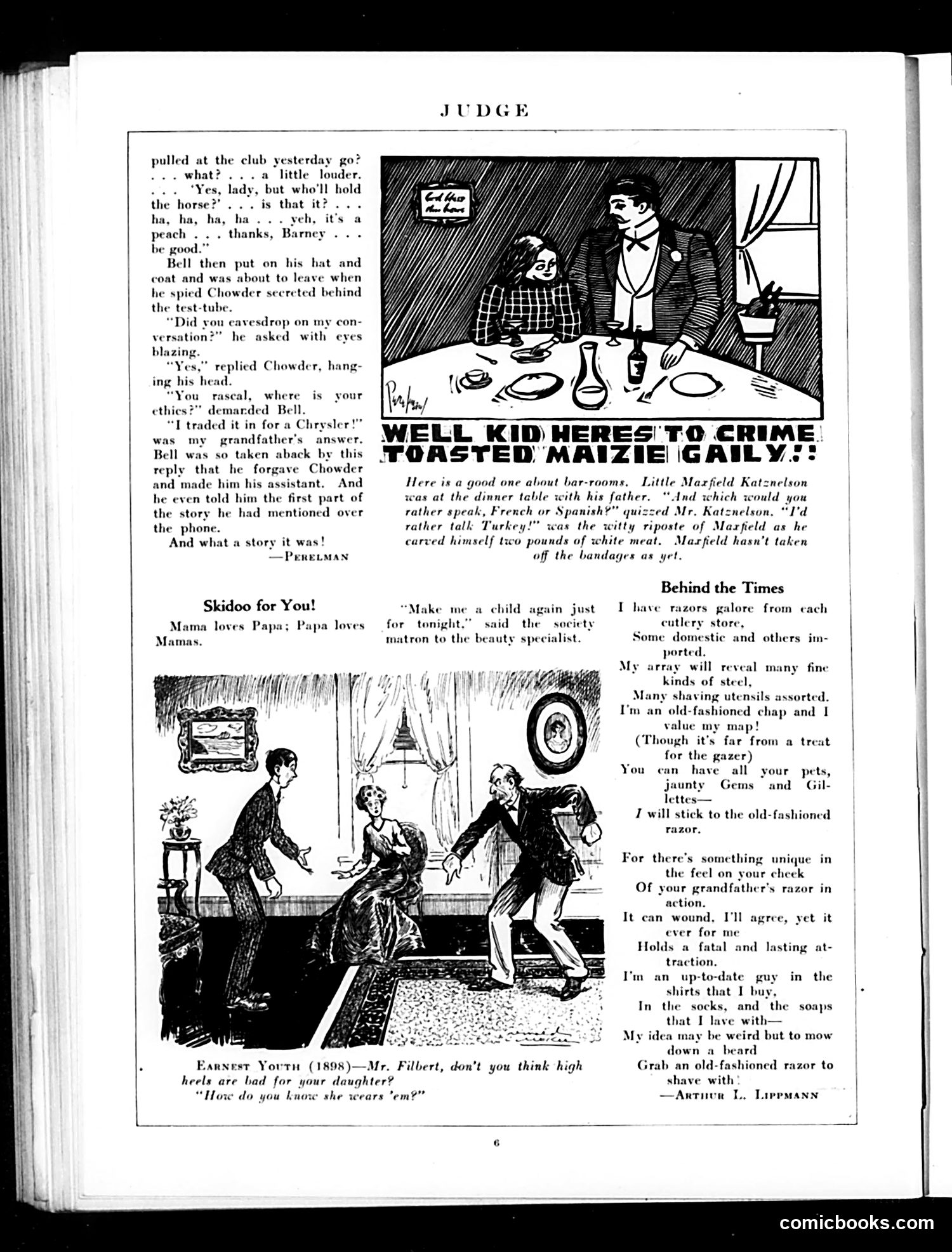
This page contains three distinct satirical pieces: **"Well Kid Here's to Crime Toasted Maizie Gaily"** (top cartoon): Shows a dinner scene where young Maxfield Katznelson makes a cutting remark to his father about language—sarcastically preferring "Turkey" over French or Spanish. The joke's punchline is that his wit was so biting he "carved himself two pounds of white meat" and still wears bandages, satirizing precocious children who think their clever remarks are harmless. **"Skidoo for You"** (lower left): A domestic scene where a husband and wife appear to be dancing or socializing, illustrating the rhyme "Mama loves Papa; Papa loves Mamas"—gentle marital satire. **"Behind the Times"** (right): A poem defending old-fashioned straight razors against modern safety razors and grooming products, nostalgia-tinged humor about a man stubbornly clinging to grandfather's-era shaving methods despite acknowledging modernity in other areas (shirts, socks, soaps). All reflect early-20th-century American middle-class domestic humor and consumer culture.
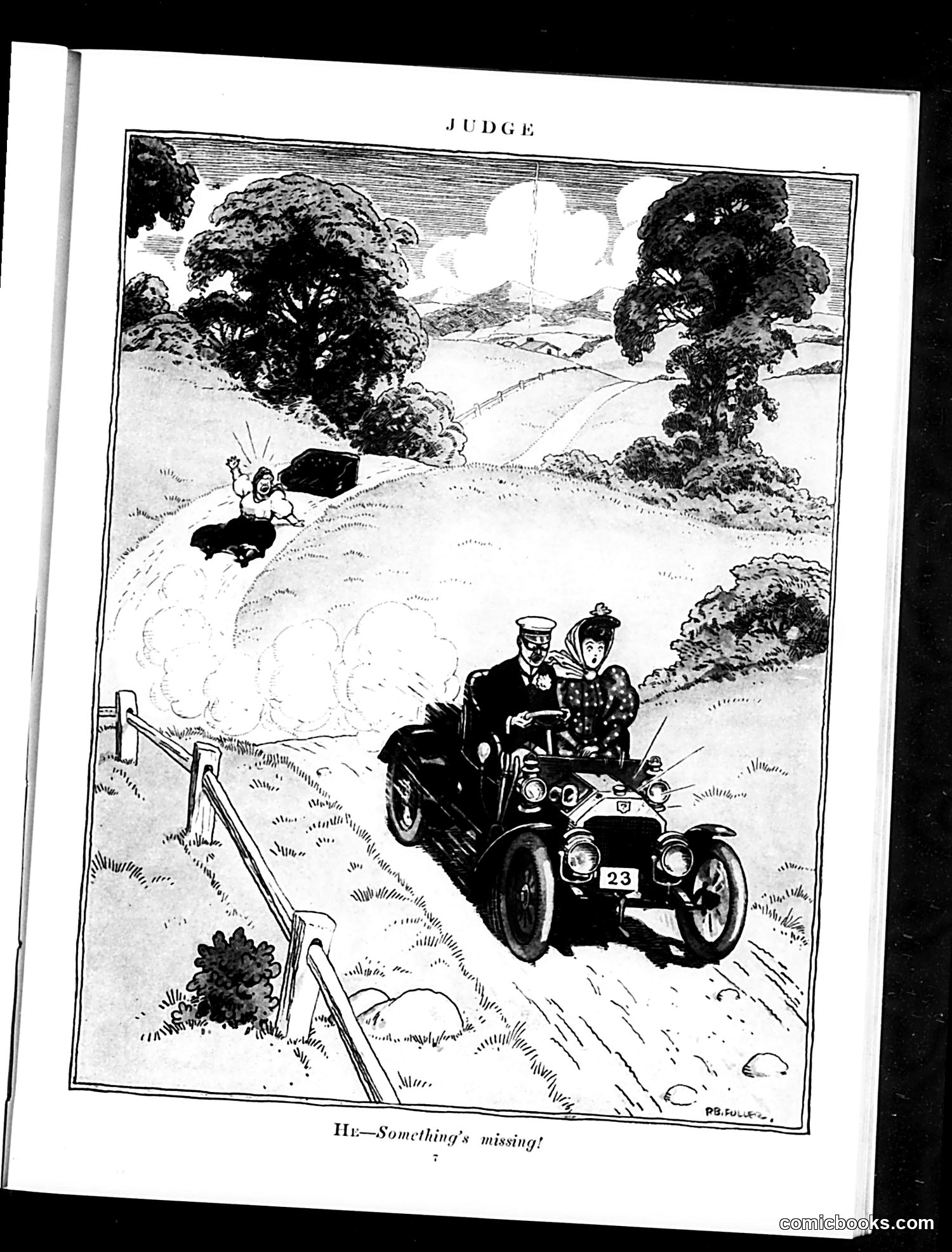
This cartoon depicts a couple in an early automobile (numbered 23) on a country road. The man in military or formal uniform and the woman beside him appear to be on an outing. The caption "HE—Something's missing!" suggests the man has noticed an absence of something. Without additional context about the specific issue date or accompanying text, the precise satirical target is unclear. However, given Judge magazine's satirical nature, this likely comments on courtship customs, automobile culture, or social proprieties of the early 20th century. The "something's missing" may reference a chaperone (common for proper young women), a specific accessory, or perhaps marriage itself—typical subjects for Judge's humor about modern courtship and changing social mores.
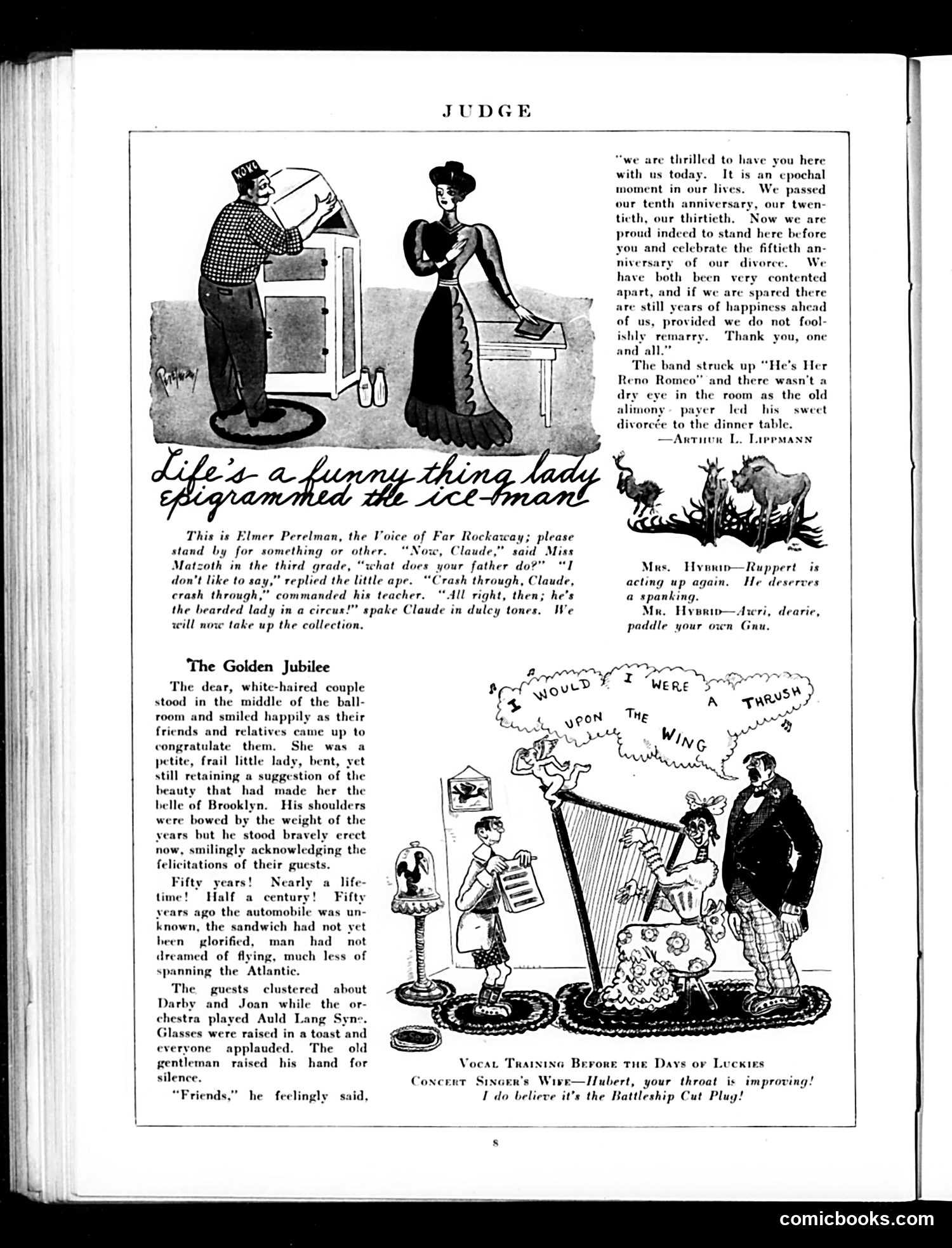
This page contains three satirical pieces from Judge magazine: **"Life's a Funny Thing, Lady"**: A domestic cartoon mocking the "voice of Far Rockaway"—likely a regional dialect character—showing a couple at home. The humor involves a child's embarrassing answer about his father's job at a circus. **"The Golden Jubilee"**: The main satire celebrates a couple's 50th wedding anniversary—but with a dark twist: they're actually commemorating 50 years of **divorce**, not marriage. The old gentleman toasts their separation and warns against "foolishly remarry[ing]." This jokes about post-WWI divorce culture and the "Reno Romeo" reference (Reno was the divorce capital of America). The satire mocks both marital breakdown and alimony complications. **"Vocal Training Before the Days of Luckies"**: A brief joke about a concert singer's wife using tobacco (Battleship Cut Plug brand) to improve his throat/voice. The page reflects 1920s attitudes toward divorce as scandalous yet increasingly common—worthy of satirical commentary.
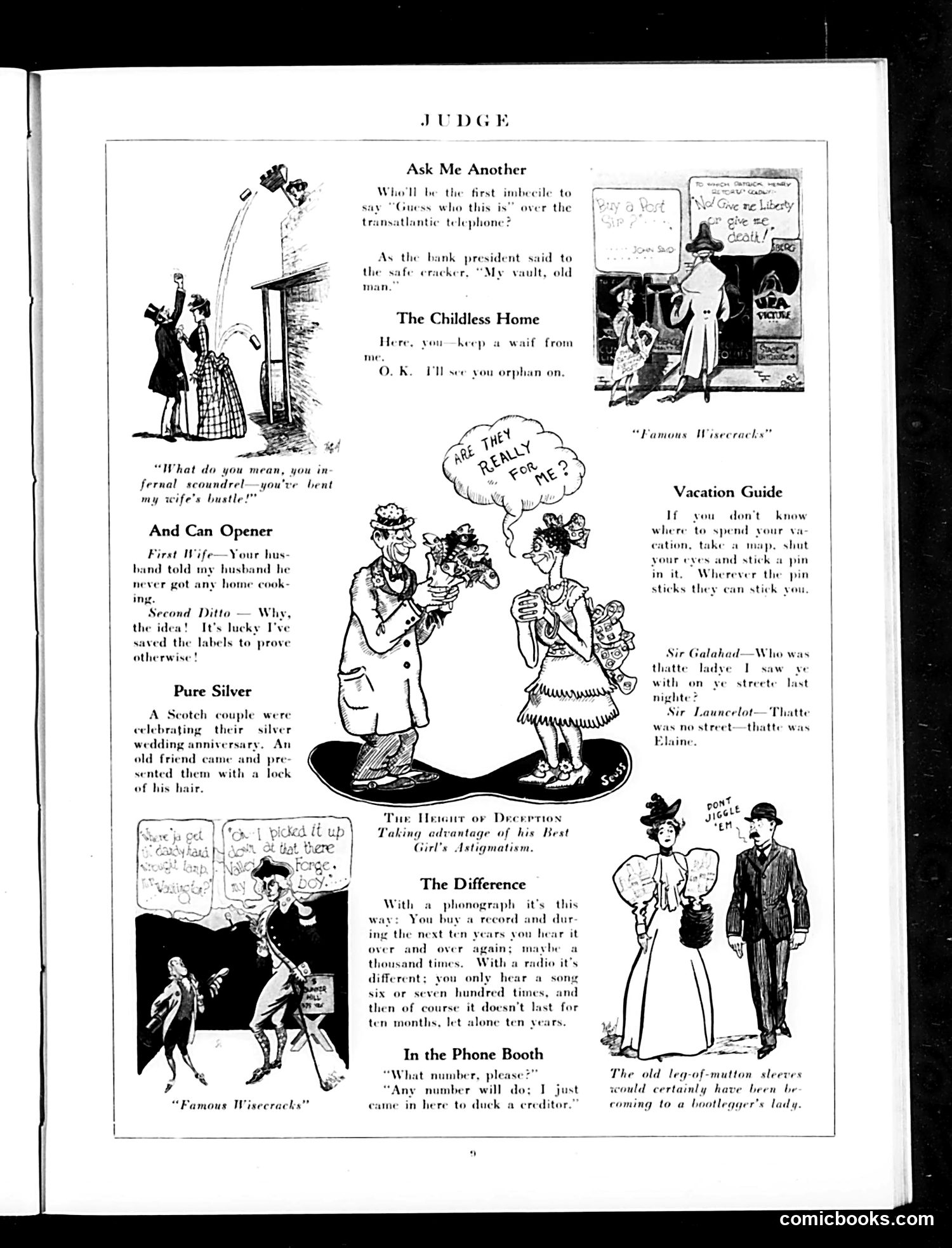
This page collects brief satirical jokes and comic vignettes typical of early 20th-century American humor. The jokes target domestic life, new technology, and social pretension: **Key satire themes:** - **Transatlantic telephone**: Mocks the novelty of long-distance calling and class anxieties about who might use it - **"Childless Home"**: Dark humor about orphan adoption as casual social obligation - **"Pure Silver"**: Satirizes Scottish stinginess (a common ethnic stereotype of the era) - **"The Difference"**: Compares phonographs vs. radios—phonographs wear out from repetitive play; radio broadcasts fade quickly - **"Vacation Guide"**: Cynical joke about tourist destinations being unwelcoming - **"Phone Booth"**: Dodging creditors via telephone—reflects Depression-era financial anxiety - **Medieval references**: Arthurian legend jokes appear garbled/nonsensical, typical of period puns The overall tone is genteel, somewhat cynical humor aimed at middle-class readers, with period-typical ethnic stereotyping.
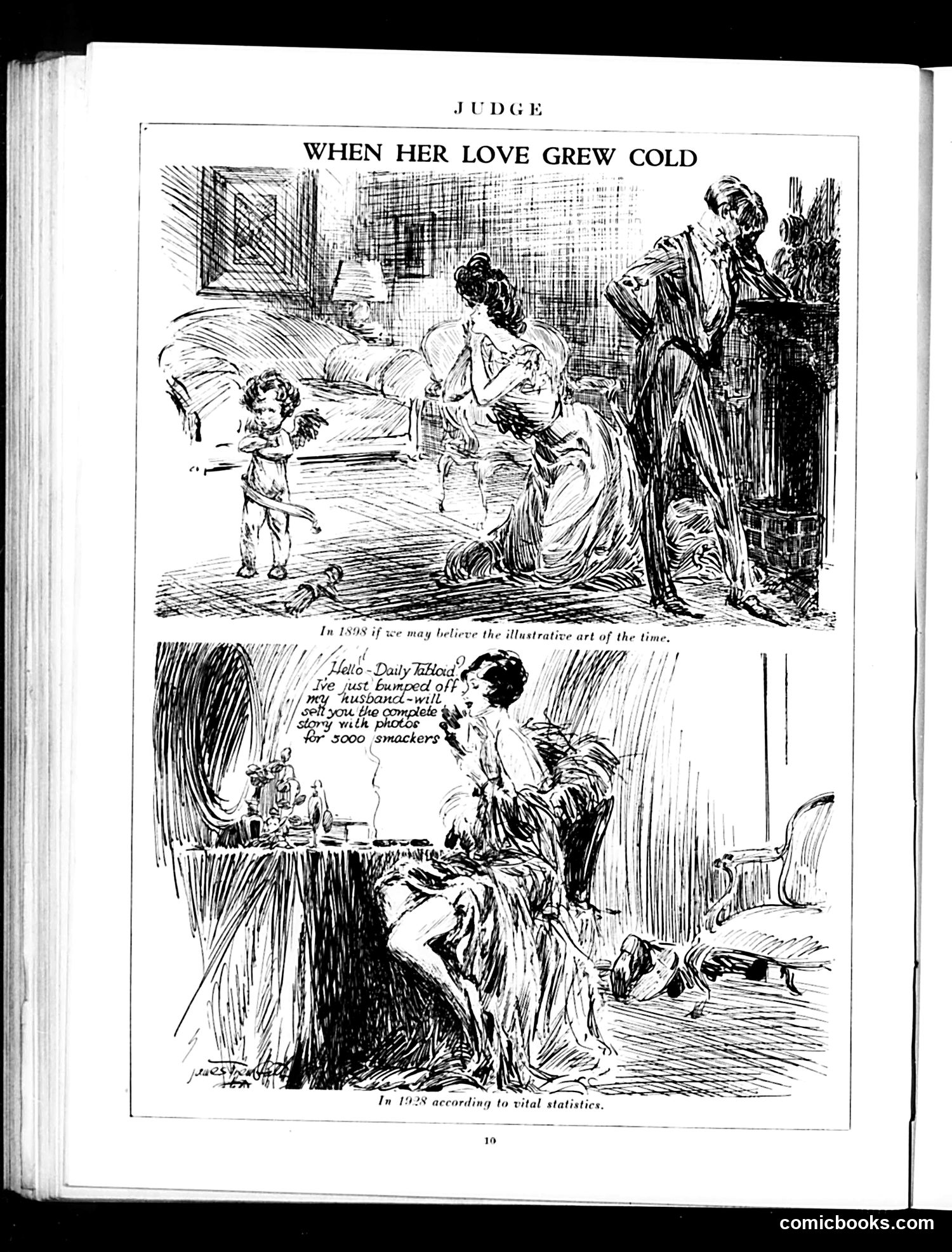
This page satirizes changing attitudes toward romance and marriage between 1898 and 1928. The **top panel (1898)** depicts a domestic scene where a woman appears distressed while a man and another figure observe—suggesting traditional melodrama around infidelity or abandonment. The **bottom panel (1928)** shows a dramatically different scenario: a woman casually announces she's "just bumped off" her husband, with bodies scattered about. A small cherub/cupid figure sits amid the chaos. The satire contrasts Victorian-era romantic tragedy with 1920s cynicism. Where 1898 society treated lost love as tragic and scandalous, the 1928 version suggests modern women respond with violent indifference—a dark joke about changing gender dynamics and the "flapper" era's rejection of sentimentality. The cherub's presence mocks the contrast between traditional romantic ideals and contemporary attitudes.
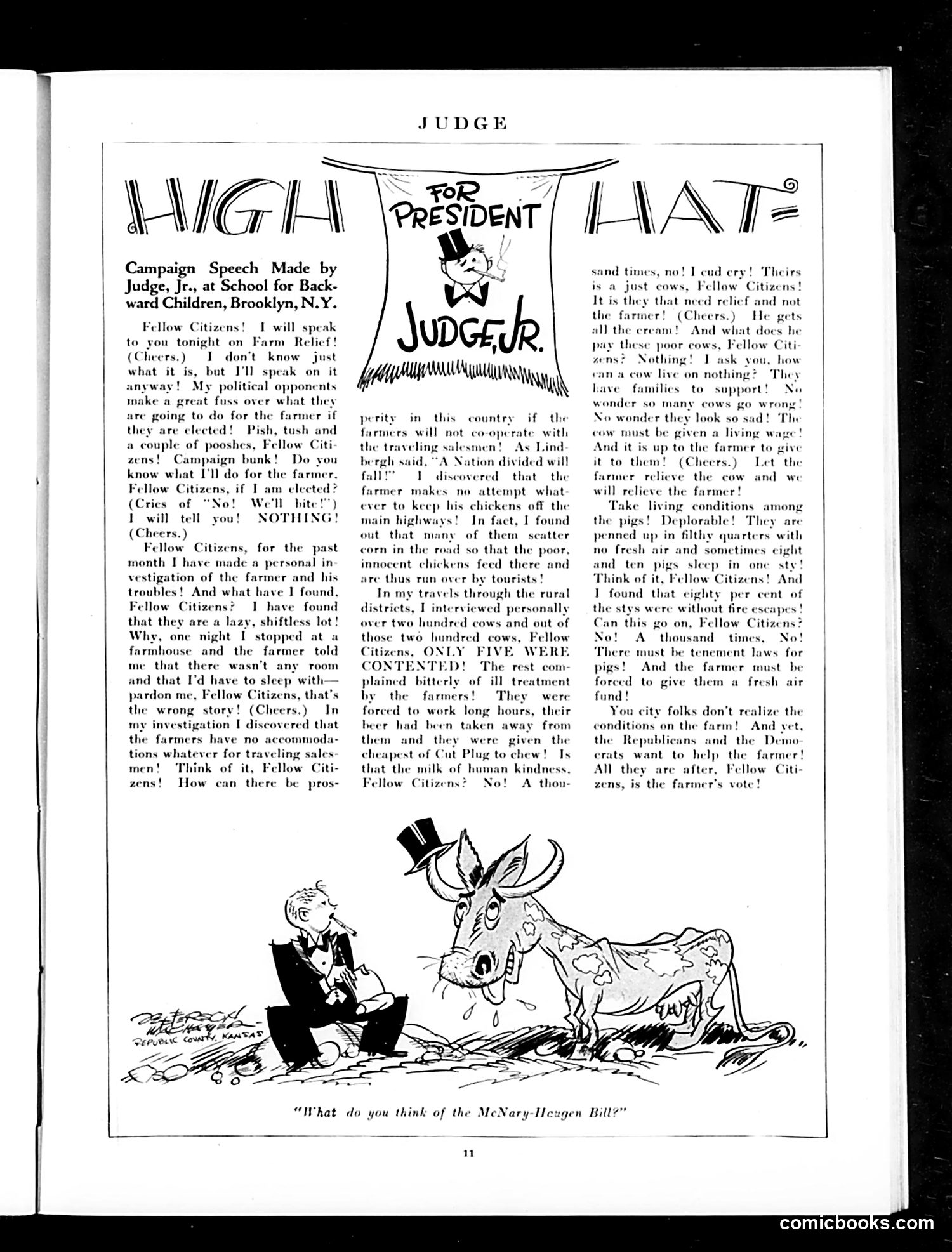
This is satirical commentary on empty political campaign rhetoric about farm relief, a major 1920s issue. "Judge Jr." represents a foolish politician making absurd promises to farmers at a "School for Backward Children"—a deliberate insult suggesting voters are gullible. The satire mocks several targets: politicians who claim to support farmers while offering nothing substantive; the disconnect between city and rural America; and the patronizing exploitation of agricultural voters. The absurd "evidence" (interviewing cows about their contentment, complaining farmers won't keep chickens off highways) ridicules the fabricated reasoning politicians use. The bottom cartoon shows a well-dressed politician making grand promises to a distressed farmer, visually emphasizing the gap between political rhetoric and rural reality. The underlying critique: both major parties (Republicans and Democrats) exploited farm issues solely to win votes, not from genuine concern for agricultural conditions.
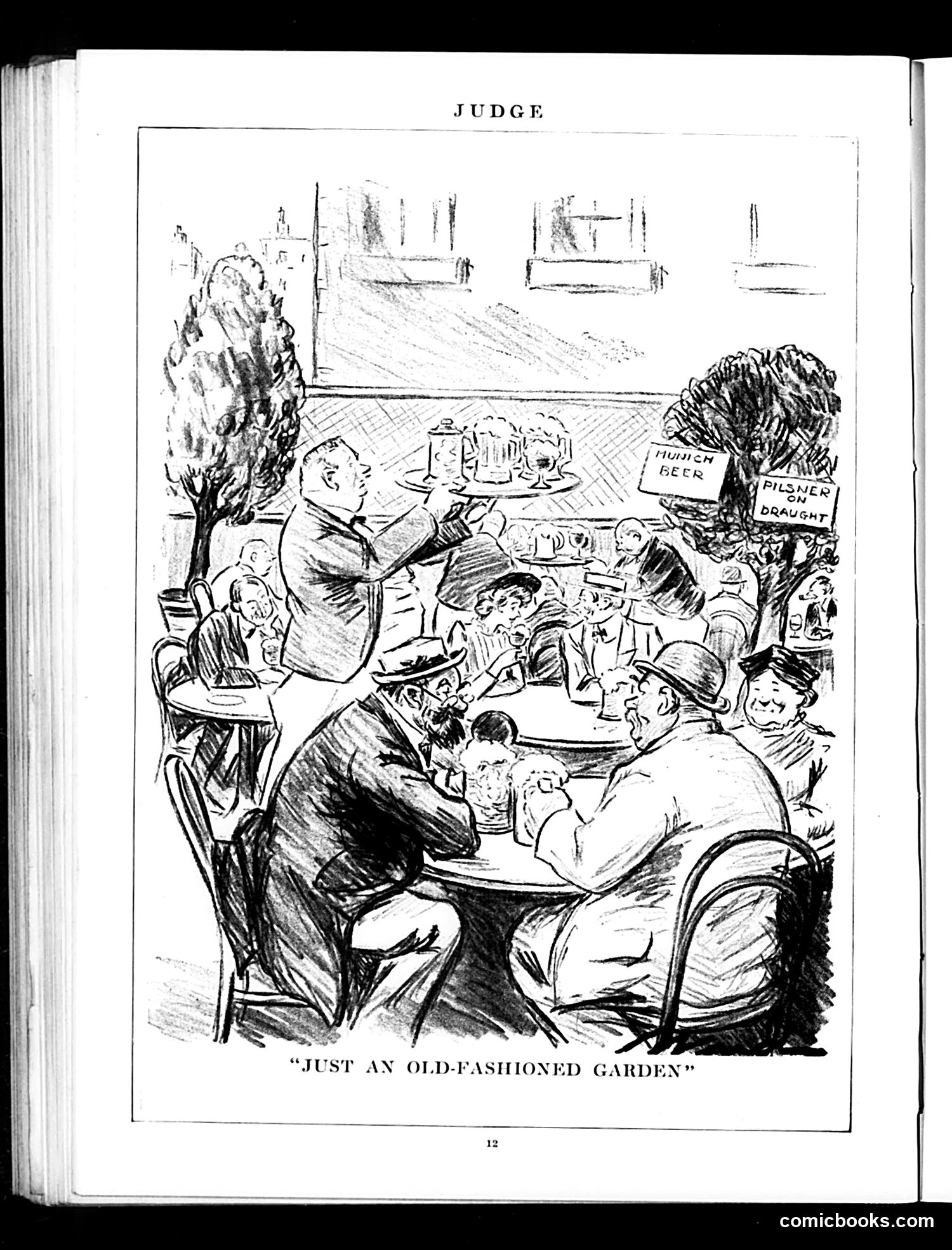
This cartoon depicts a lively outdoor beer garden scene. Multiple figures are seated at tables drinking and socializing, with visible signage advertising "Munich Beer" and "Pilsner on Draught." The satire appears to target Prohibition-era attitudes toward German beer culture and immigrant communities. The title's ironic tone—calling this bustling, clearly modern establishment an "old-fashioned garden"—suggests commentary on nostalgia for pre-Prohibition drinking establishments or immigrant cultural practices. The cartoon likely mocks either anti-German sentiment during or after WWI, or criticizes those who romanticized traditional beer gardens while Prohibition was being debated or enforced in America. The depiction emphasizes the social appeal and normalcy of beer consumption within immigrant communities.
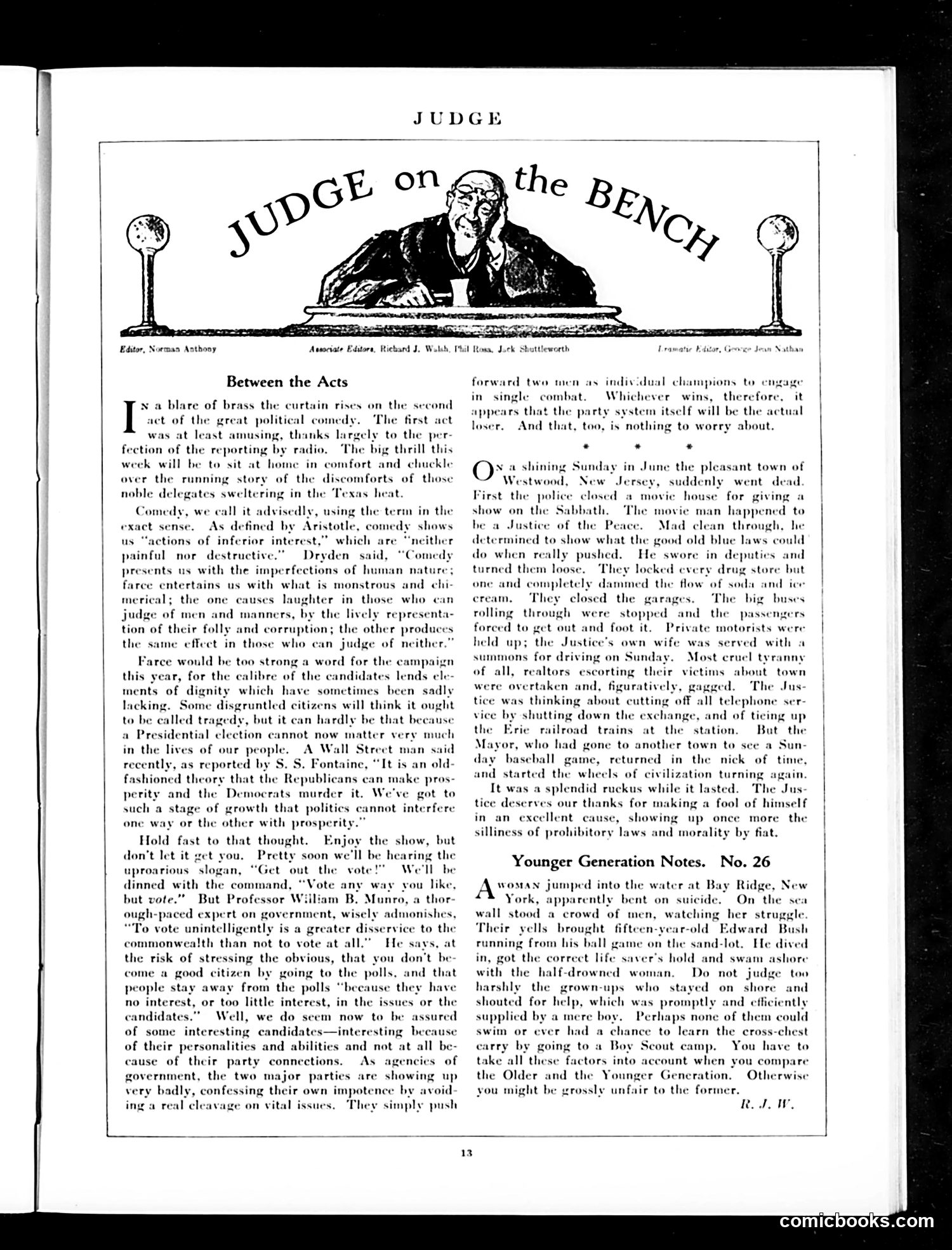
The main cartoon depicts a judge presiding over political proceedings—likely referencing the 1912 Presidential campaign mentioned in the accompanying text. The illustration shows a stern judicial figure at a bench, symbolizing how the magazine views the election as judicial theater rather than serious governance. The text critiques the 1912 election campaign, arguing that it lacks real substance. A Wall Street source is quoted claiming that politics no longer meaningfully affect prosperity—the outcome matters little. The article sarcastically notes candidates are presented as "individual champions" in combat, with whichever party loses the election being the real loser since the party system itself appears impotent. A secondary satirical story mocks Westwood, New Jersey's overzealous enforcement of blue laws (Sabbath restrictions) by a Justice of the Peace, who shut down movie houses, drug stores, garages, and even stopped automobiles on Sunday—until the Mayor intervened. This exemplifies government overreach and the "silliness of prohibitory laws," mocking rigid moral enforcement.
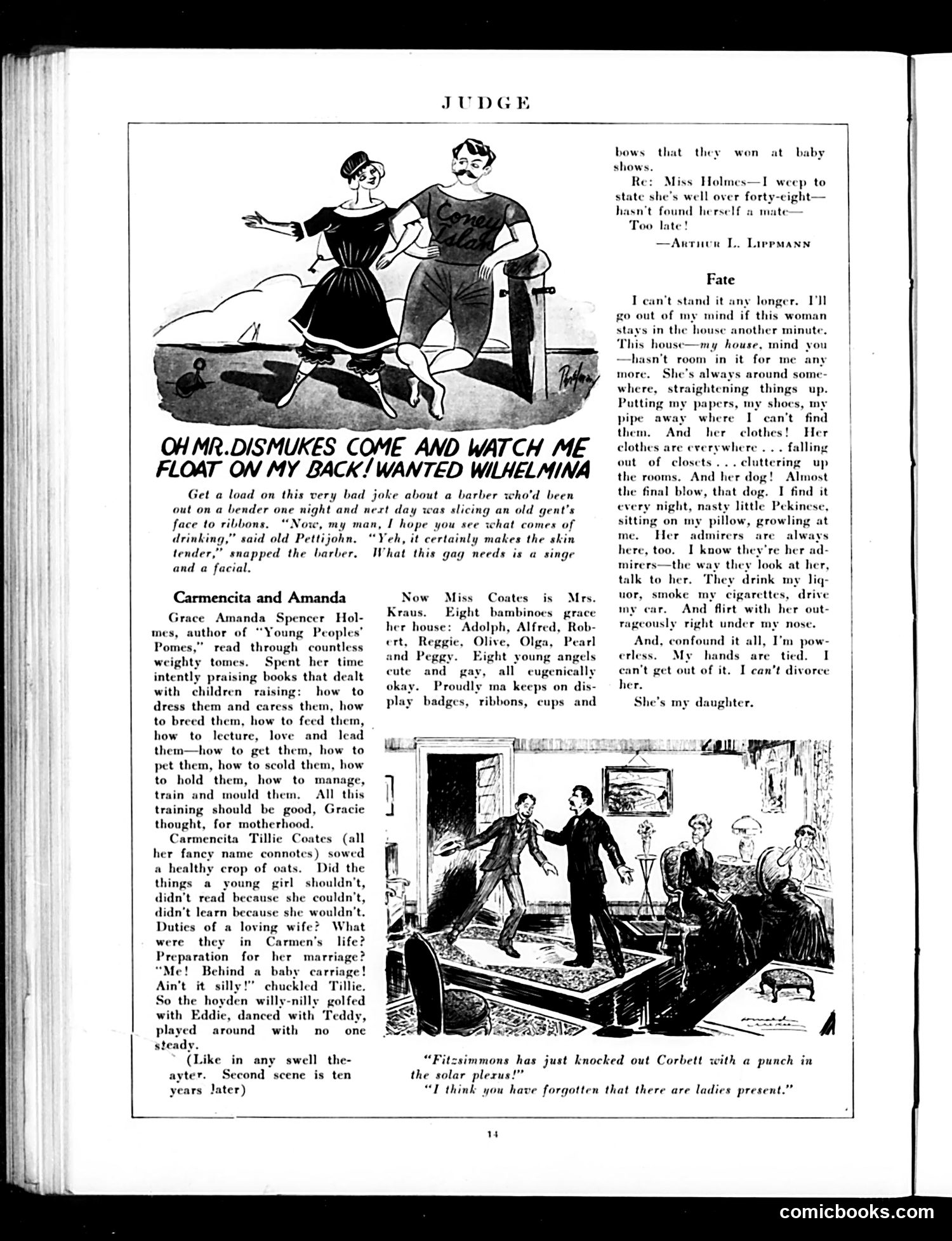
This page contains two satirical pieces typical of early 20th-century Judge magazine humor: **"Carmencita and Amanda"** contrasts two girls: studious Grace Holmes, who read countless parenting books, versus wild Carmencita Coates, who ignored propriety—golfing and dancing instead of preparing for marriage. The joke's twist: ten years later, Carmencita has eight children (all award-winners), while the well-prepared Holmes remains unmarried at 48. The satire mocks both excessive domesticity advice and the unpredictability of life outcomes. **"Fate"** depicts a husband complaining bitterly about a woman constantly organizing his house, entertaining admirers, and disrupting his life—then reveals the punchline: she's his *daughter*, not his wife. The humor relies on the frustration of a man unable to control a woman in his own home, and his powerlessness because of familial obligation. Both pieces reflect period attitudes about gender, courtship, and domestic life, using ironic reversals of expectations for comedic effect.
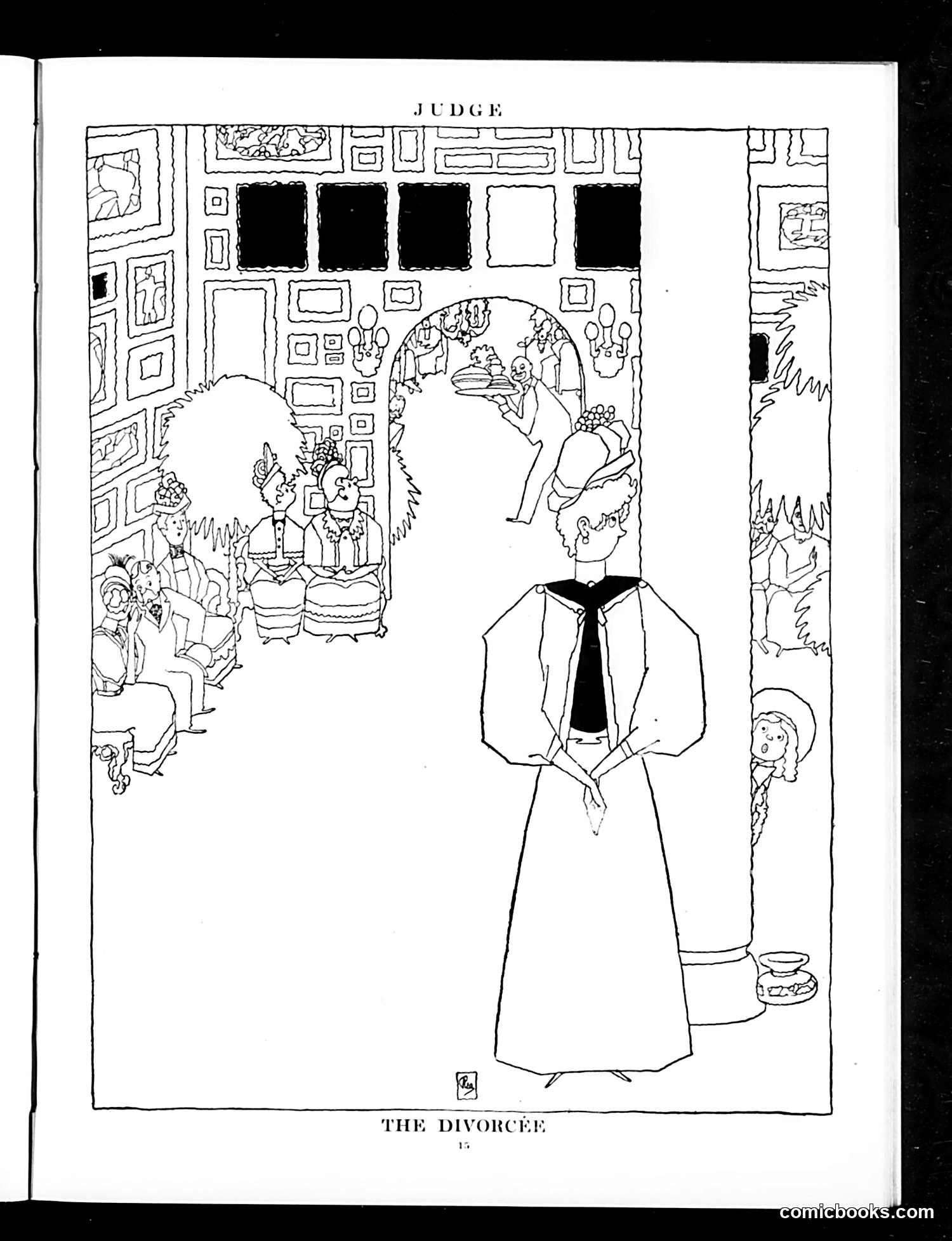
This satirical illustration depicts a woman in a courtroom setting, her head replaced with an elaborate scene of frivolous luxury and indulgence. The title "The Divorcée" suggests social commentary on divorce and women's post-marital behavior. The woman wears formal court attire (jacket and long skirt), but her head contains images of fine dining, servants, entertainment, and revelry—suggesting that divorced women were stereotyped as pursuing pleasure and extravagant lifestyles. The judge's head (top of page) appears equally distracted or corrupted. The satire likely mocks both the perceived moral failings of divorcing women and judges who enable them through generous settlements, reflecting early 20th-century anxieties about women's independence and changing social norms around divorce.
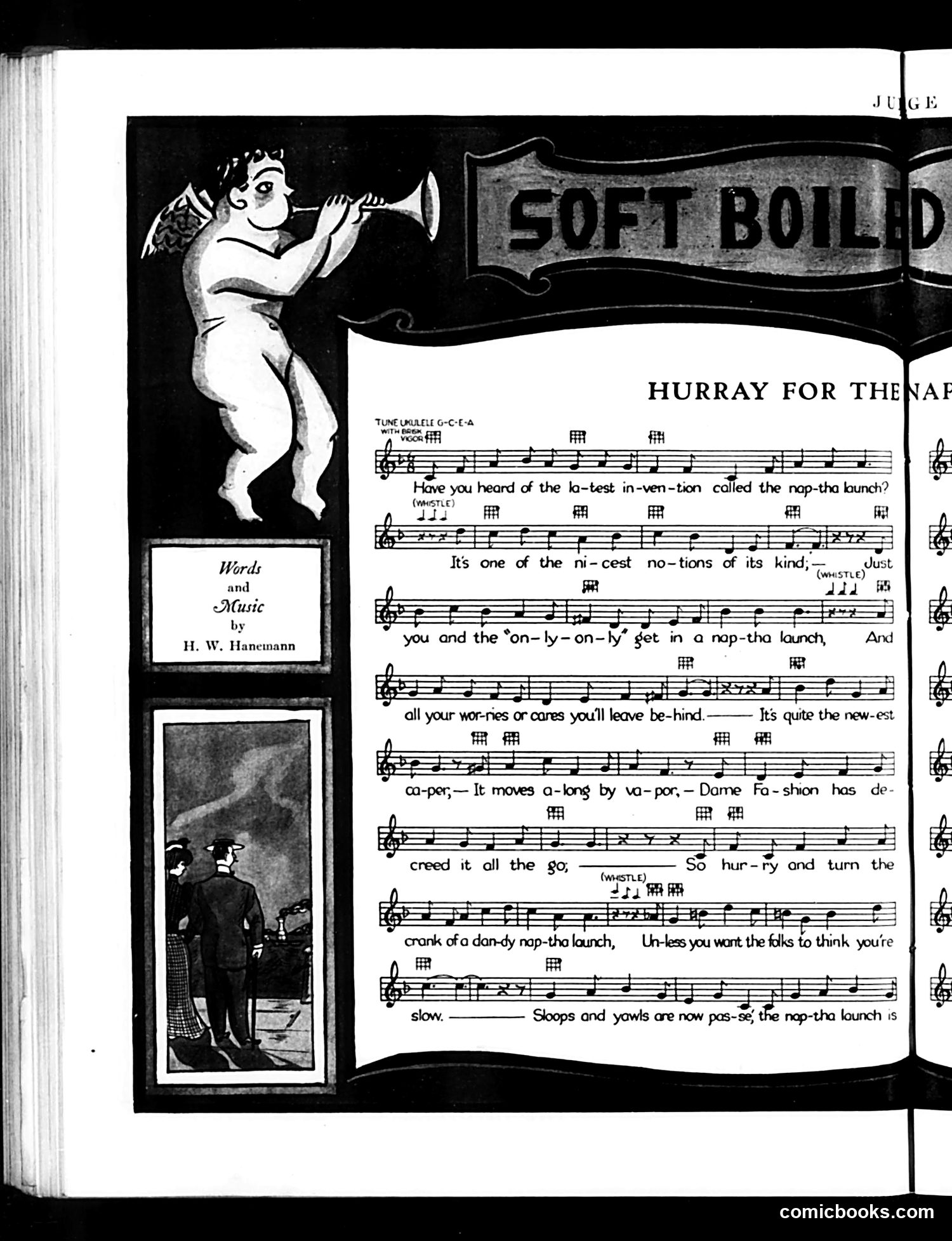
This is a song page from Judge magazine celebrating the naphtha launch—an early motorboat powered by naphtha (a volatile petroleum product). The satire targets the era's obsession with new technologies and fashionable innovations. The humor lies in mocking both the invention itself and society's blind adoption of whatever "Dame Fashion has decreed." The song promises that this newfangled contraption will whisk away your "worries and cares," typifying exaggerated advertising claims of the era. The cherub-faced character and illustrations reinforce the lighthearted tone. The page suggests early 20th-century Americans' gullible enthusiasm for technological novelties, presented here as a vapid fashion trend rather than genuine progress. The ukulele accompaniment (then itself a trendy novelty) adds to the overall comedic effect of celebrating something simultaneously ridiculous and fashionable.
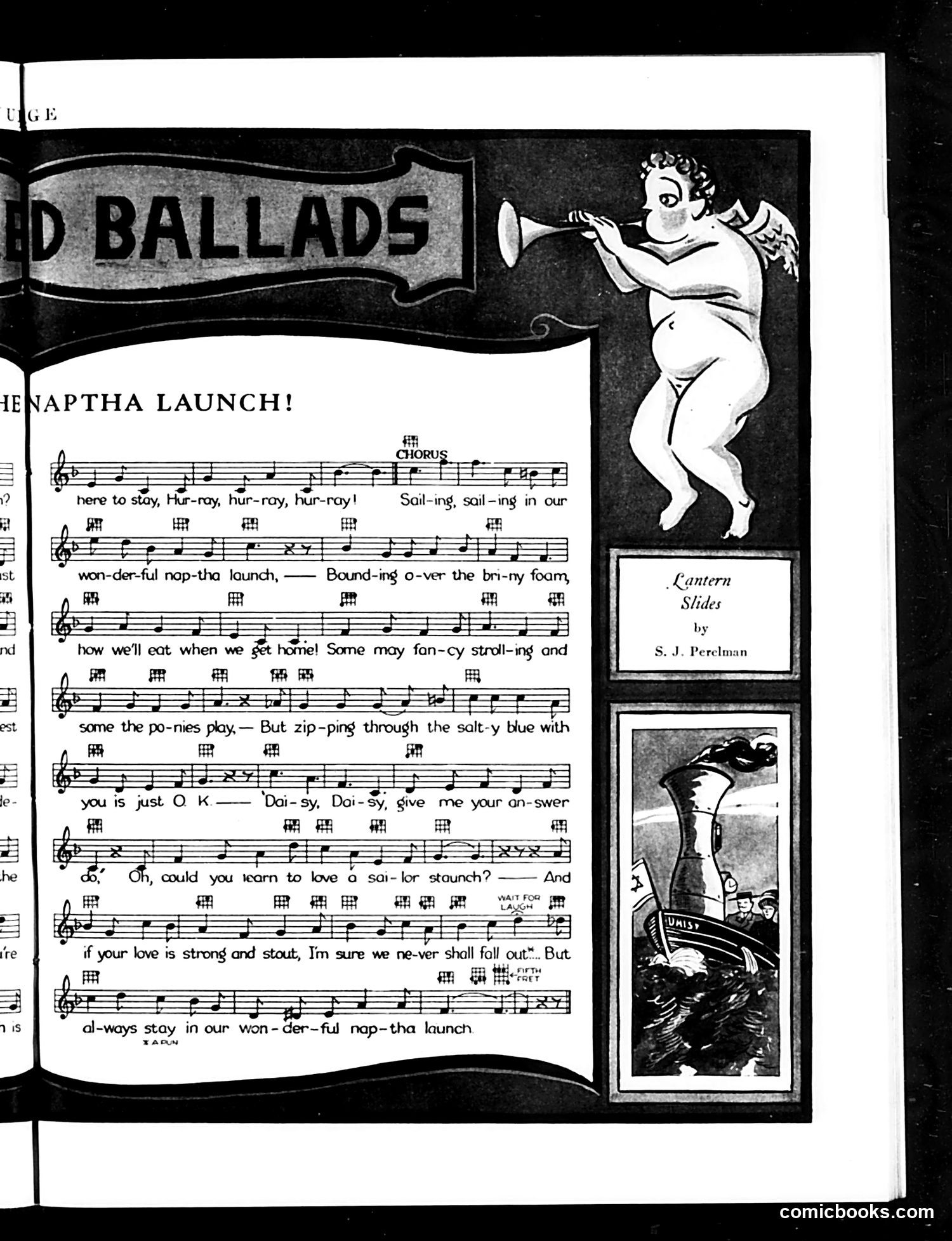
This page features sheet music for a novelty song celebrating the naphtha launch—an early motorboat powered by naphtha (a petroleum distillate). The cherub illustration advertising the song reflects the era's enthusiasm for new technology. The lyrics humorously depict courtship aboard this modern vessel. A sailor propositions "Daisy," promising adventure ("sailing in our wonderful naphtha launch") rather than conventional activities like "strolling" or watching "ponies play." The romantic pitch suggests that shared modern thrills—zipping through "salt-y blue" waters—will cement their love. The satire likely targets both technological boosterism and the absurdity of using a speedboat as a seduction device. The "Lantern Slides by S.J. Perelman" credit suggests accompanying visual comedy. This reflects the 1920s-30s fascination with motorization and its promised transformations of leisure and romance—themes Judge frequently mocked.
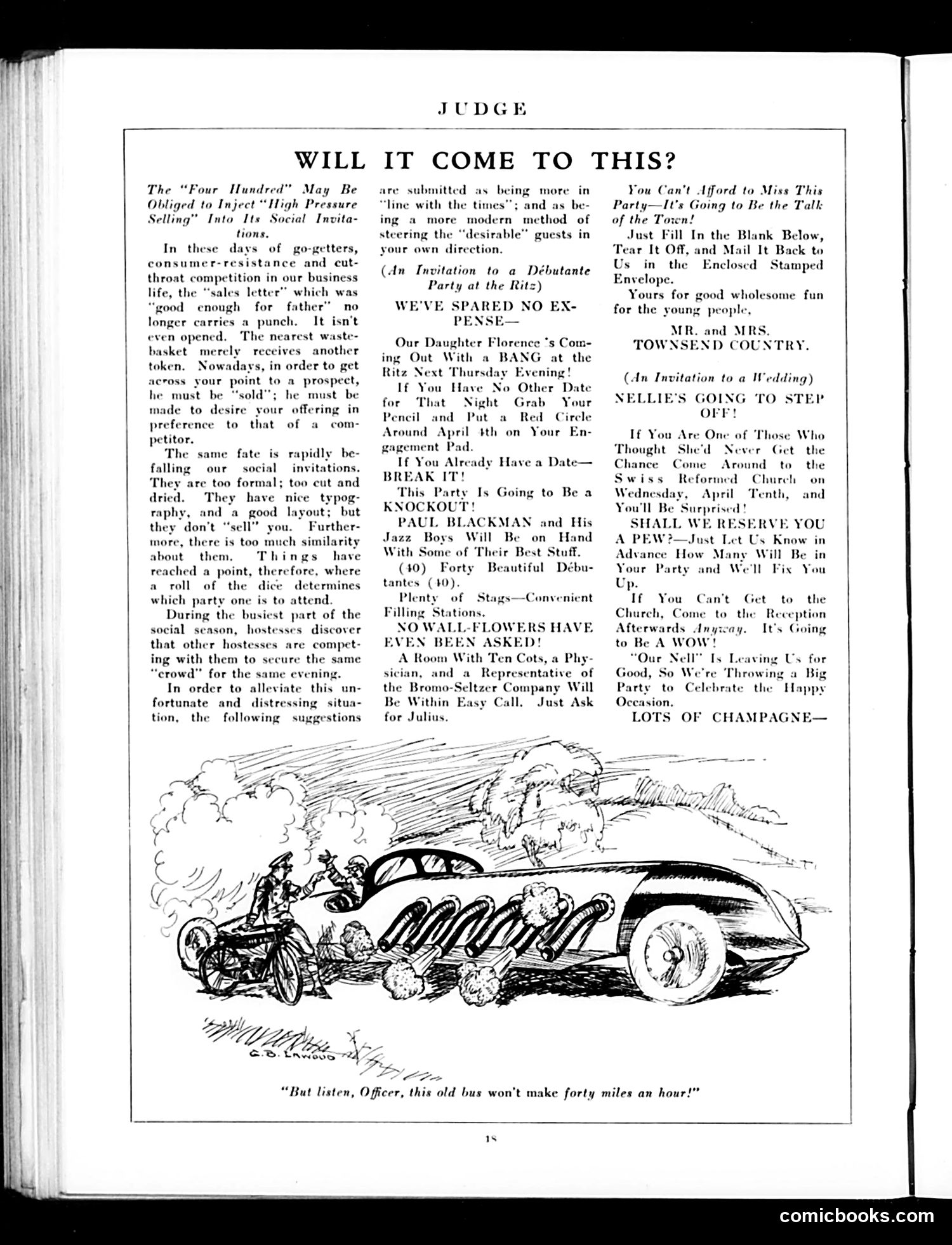
This satirical piece critiques the commercialization of high society's social rituals. Judge's editors argue that aggressive "high-pressure selling" tactics—common in 1920s business—are infiltrating the traditionally genteel world of the "Four Hundred" (New York's social elite). The cartoon illustrates the absurd endpoint: a comically over-equipped vehicle (resembling a military machine or hot rod) representing the forceful marketing methods threatening to "crash" into polite society. The officer's complaint about speed mirrors society's worry that modern commercial aggression is incompatible with traditional values. The mock invitations parody how hostesses now employ advertising gimmicks—bold capitalization, urgency, entertainment guarantees, even medical supplies (a physician on standby for hangovers)—to compete for guests. The satire mocks both the nouveaux riches' desperate social climbing and how capitalism's competitive ethos is eroding genteel tradition, reducing even a daughter's debutante to a market-driven "event."
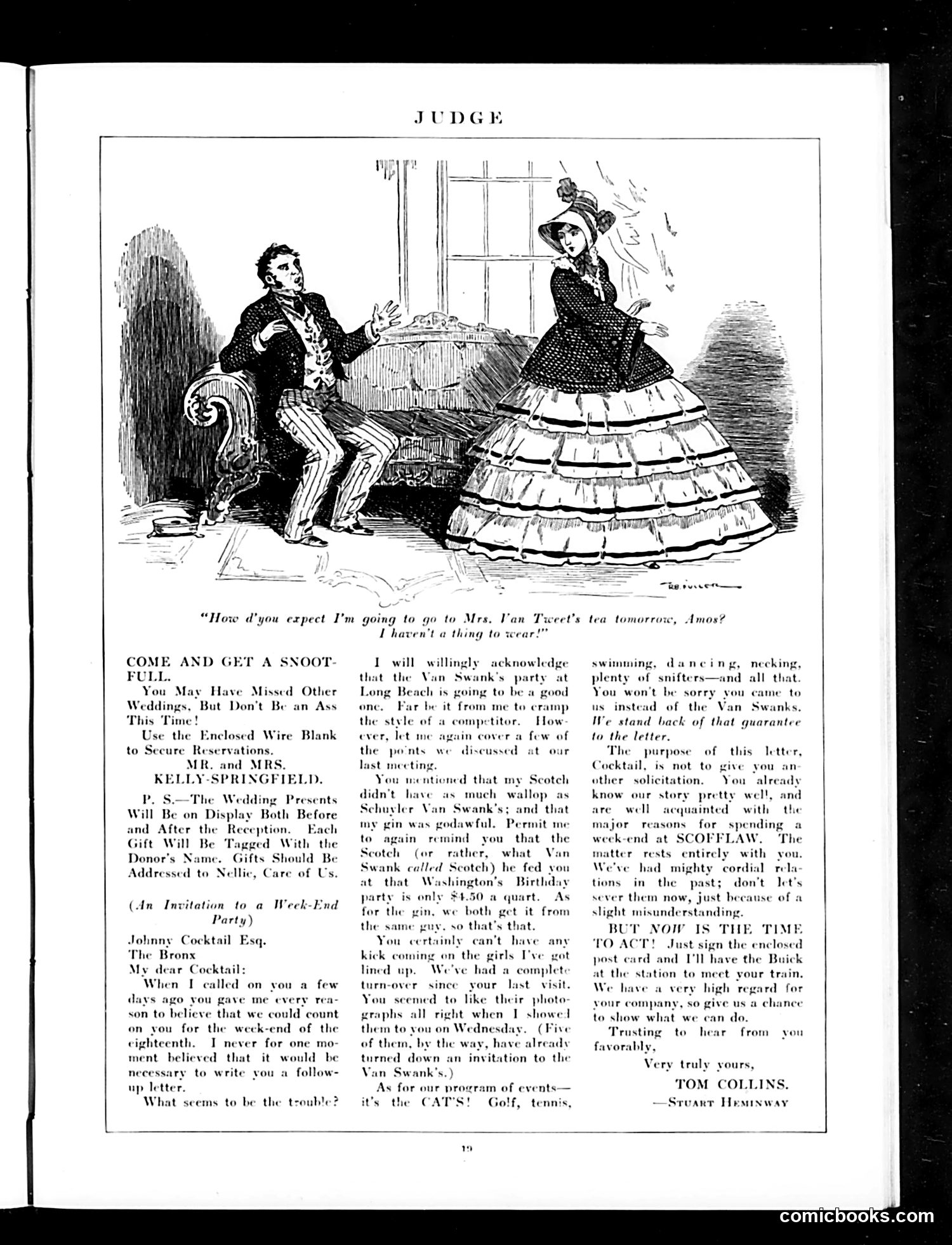
This page satirizes the competitive social climbing and conspicuous consumption of the American wealthy class, likely from the 1920s era. **The Main Cartoon** depicts a woman with an absurdly voluminous crinoline skirt complaining to her husband about having "nothing to wear" to a rival's tea party—a classic joke about feminine excess and status anxiety. **The Letter Satire** is more pointed: "Tom Collins" and "Stuart Hemingway" (a likely pseudonym) mock the desperate social rivalry between wealthy hosts competing for the same guests. The fictional "Johnny Cocktail" is being pressured to attend their party instead of the "Van Swanks'" through a humiliating follow-up letter. The hosts boast about their liquor quality, guest lists, and entertainment while transparently admitting they're losing to competitors. The satire targets: excessive drinking ("snootfull"), ostentatious gift displays, and the shallow status-obsessed world where hosting parties is a competitive sport. Names like "Scofflaw," "Van Swank," and "Johnny Cocktail" mock both the pretentiousness and the Prohibition-era drinking culture underlying this social hierarchy.
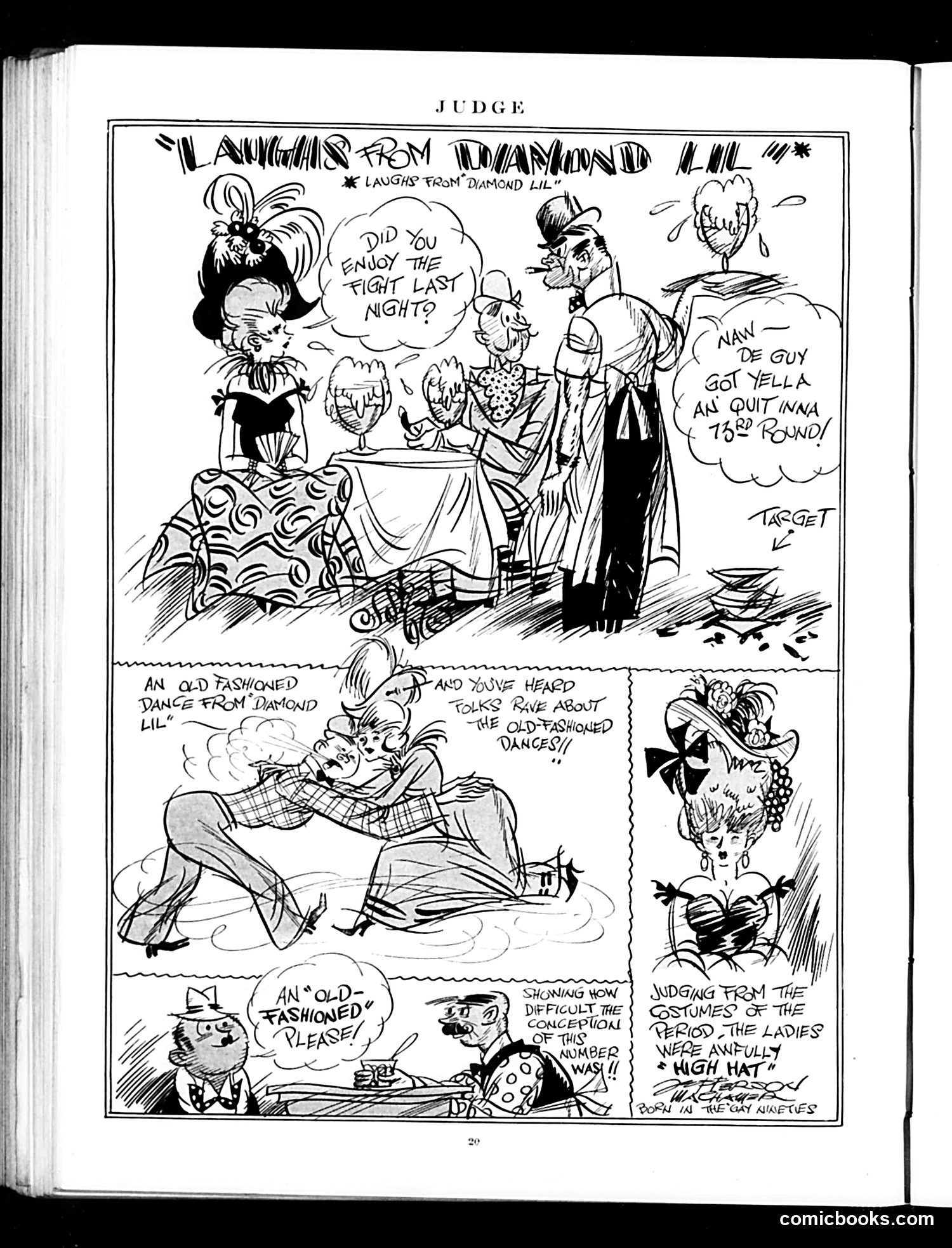
This page satirizes the stage production *Diamond Lil*, a 1928 play featuring risqué comedy and dance numbers. The cartoon mocks the show's attempt to revive "old-fashioned dances" as entertainment, suggesting the concept is poorly executed and awkwardly conceived. The top panel shows audience members discussing the previous night's fight scene, with someone commenting negatively on a performer quitting mid-show. The lower panels mock the difficulty of presenting these dances and criticize the costumes—specifically the "high hat" worn by female performers—as pretentious or ridiculous staging choices. Judge's satire suggests the production's nostalgia angle is forced and that the performance quality doesn't match its promotional hype. The humor targets both the show's artistic pretensions and audience gullibility in finding entertainment value in poorly executed revival acts.
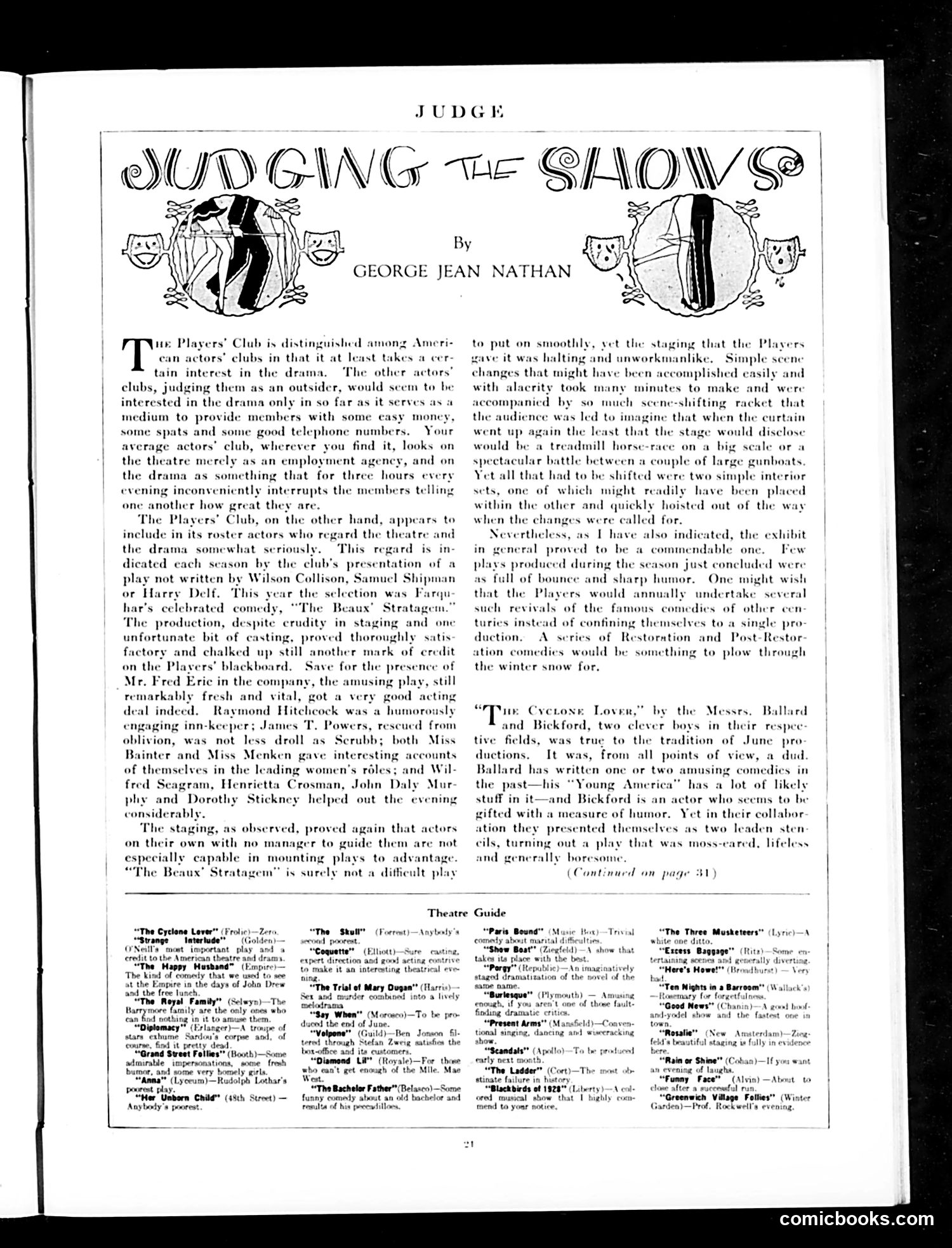
This is a theater review column by George Jean Nathan, a prominent drama critic. The page discusses the Players' Club, a prestigious actors' organization that produces theatrical productions. Nathan praises the club's serious approach to drama, contrasting it with typical actors' clubs that treat theater as mere employment. He reviews their season's production of Farquhar's restoration comedy "The Beaux' Stratagem," noting crude staging but solid performances by Raymond Hitchcock, James T. Powers, and others. The piece critiques another production, "The Cyclone Lover" by Ballard and Bickford, calling it a "dud" despite the writers' occasional cleverness. Nathan suggests the Players Club should revive more classic comedies rather than commissioning contemporary plays. The "Theatre Guide" section at bottom lists current productions with brief capsule reviews—a standard feature of such magazines.
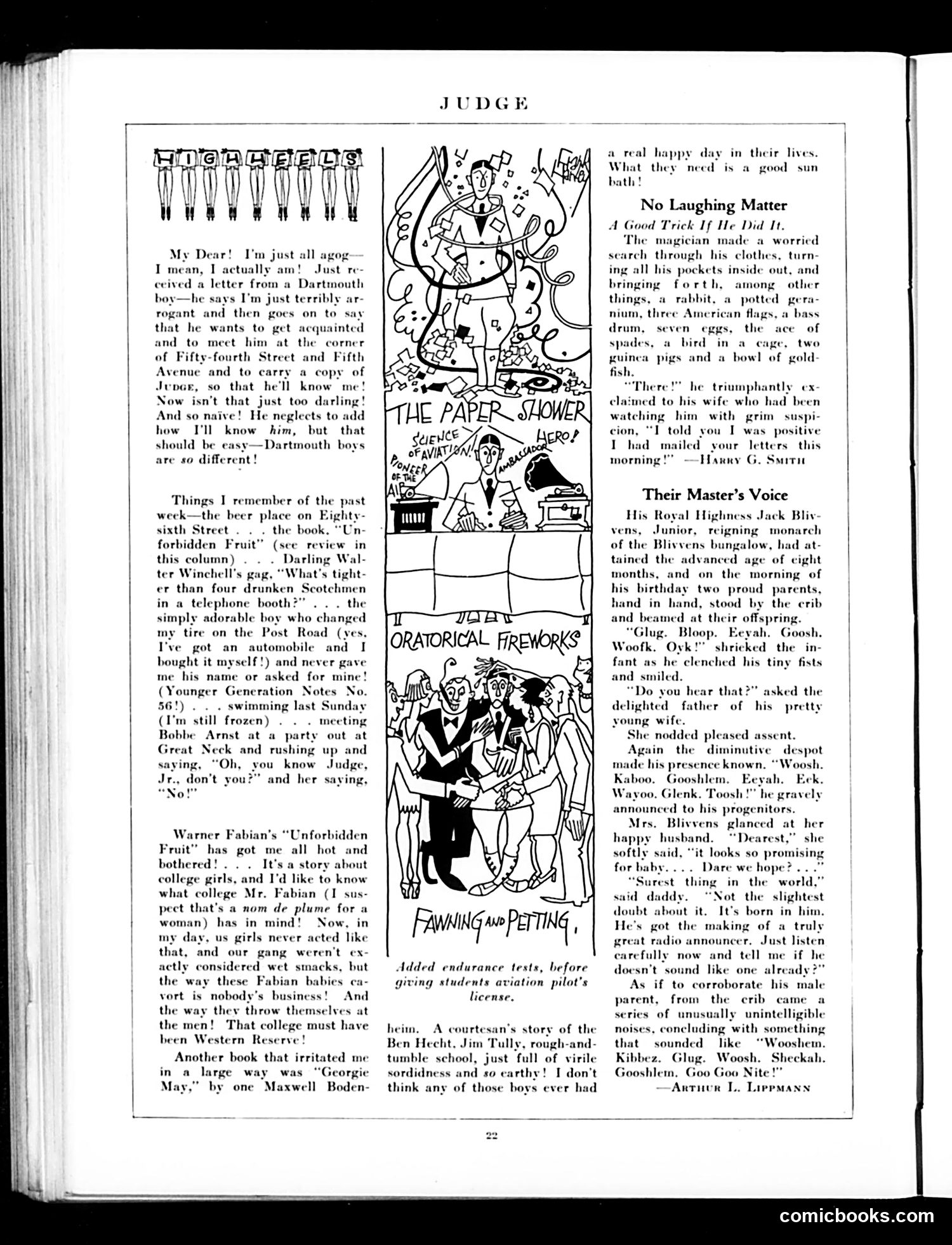
This page contains three satirical pieces reflecting 1920s social commentary: 1. **"The Paper Slower"** (top): A visual gag about a woman receiving a letter from a Dartmouth college boy proposing to meet her at Fifth Avenue, identifiable by carrying a copy of *Judge* magazine. The satire mocks both the boy's naiveté and the woman's vapid excitement about "Dartmouth boys" being "so different." 2. **"No Laughing Matter"** (middle): A magician's trick where he produces a rabbit and other items from his pockets while claiming he *had* mailed his wife's letters. The joke relies on obvious misdirection—he clearly didn't mail them. 3. **"Their Master's Voice"** (bottom): Satirizes proud parents of an eight-month-old infant making unintelligible baby noises. The father boasts the child will become a "radio announcer" based on these meaningless sounds. This mocks both parental delusion and the era's fascination with radio as a glamorous profession. All three pieces target human vanity and self-deception through light humor typical of *Judge*'s satirical style.
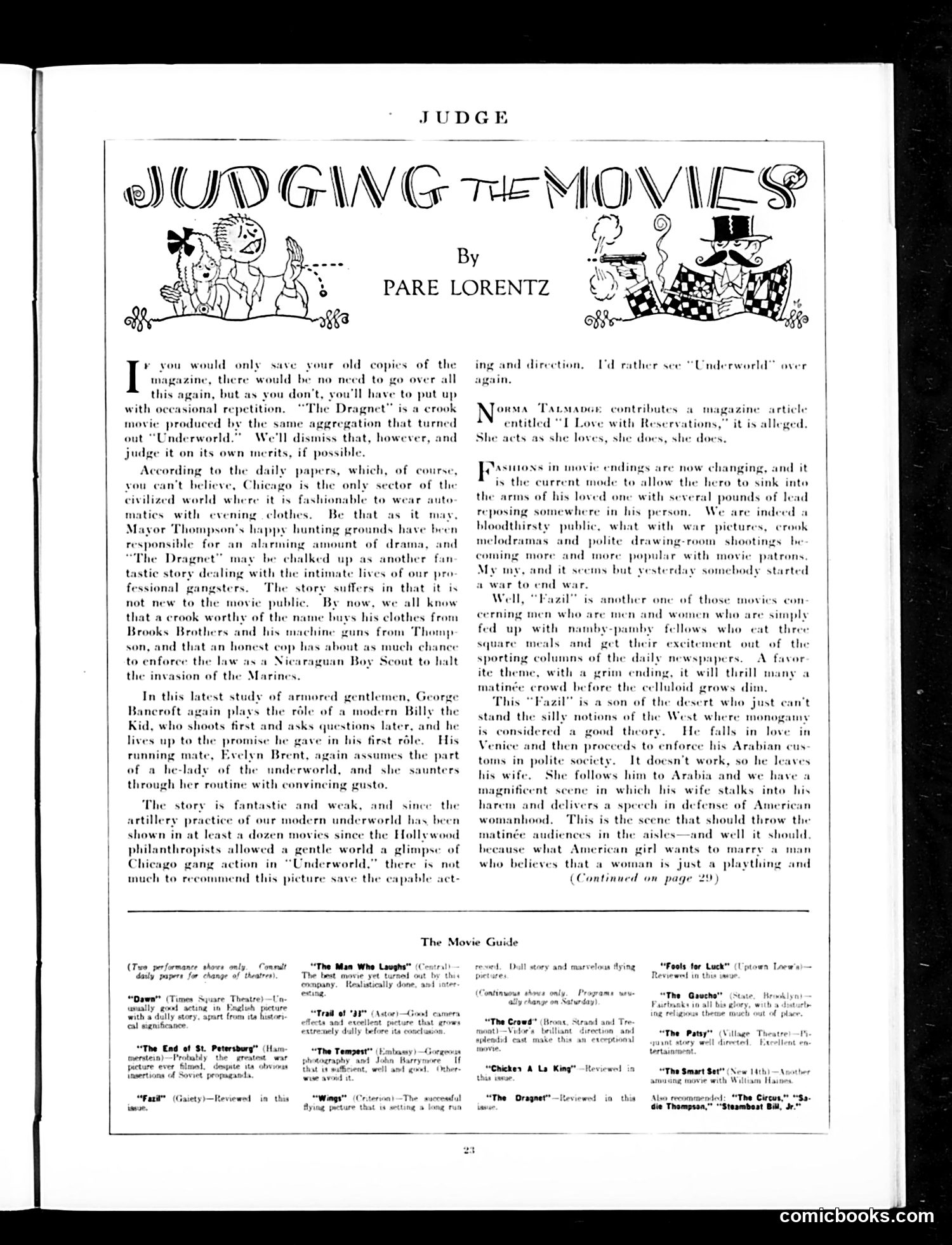
This is a film criticism column reviewing contemporary movies, not a political cartoon. Lorentz critiques several 1920s crime dramas, particularly "The Dragnet" and "Fazil." The satire targets Chicago's notorious gangster culture and Hollywood's romanticization of it. Lorentz mocks how these films present criminals as sophisticated (buying clothes from Brooks Brothers, Thompson guns) while depicting honest cops as powerless—comparing law enforcement to a "Nicaraguan Boy Scout" trying to stop U.S. Marine invasions. He references Mayor Thompson's Chicago as responsible for "an alarming amount of drama." Lorentz also critiques changing movie conventions: allowing heroes to die with "several pounds of lead" in them, reflecting audiences' appetite for violent content. He observes Americans have become a "bloodthirsty public" consuming war pictures and crime melodramas. "Fazil" receives particular ridicule for its premise: a desert man enforcing "Arabian customs" on his American wife until she delivers a patriotic speech defending American womanhood—Lorentz sarcastically notes this "should throw the matinee audiences in the aisles."
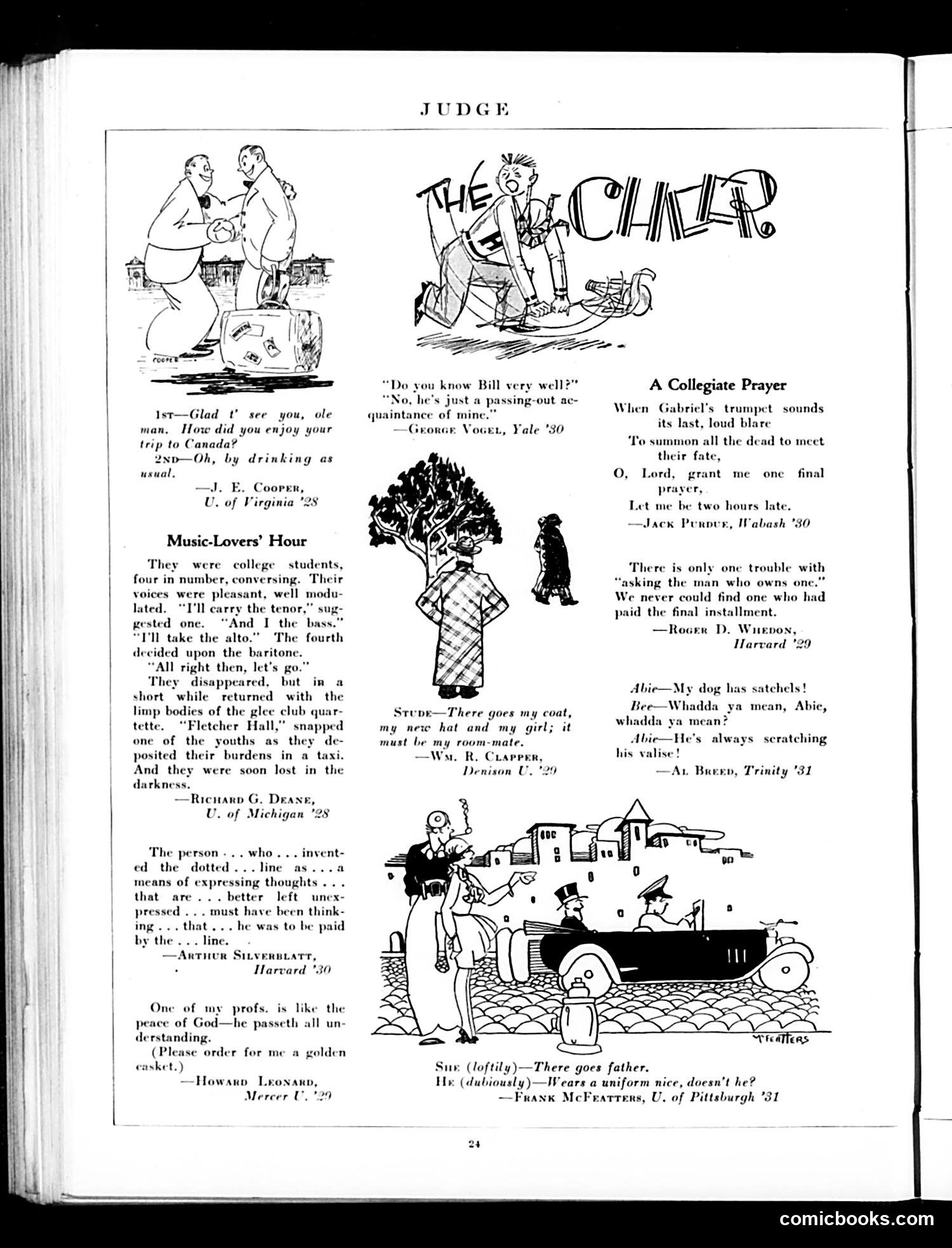
This page from Judge presents college humor circa 1928-1931, featuring satirical observations about undergraduate life. The cartoons and quips mock familiar college stereotypes: **"The Cheer"** depicts a student with a megaphone—poking fun at enthusiastic but chaotic school spirit. **"Music-Lovers' Hour"** jokes that college singers can only successfully perform by kidnapping people—a absurdist exaggeration of their talent level. **Collegiate exchanges** satirize student types: the dismissive rich kid ("passing-out acquaintance"), the broke student losing possessions to roommates, and the immigrant character Abie with a scratching dog. **"A Collegiate Prayer"** mocks student priorities, requesting divine permission to oversleep rather than attend. The final cartoon jokes that uniforms (military service) substitute for actual character—suggesting contemporary anxieties about masculinity and status. Overall, the page reflects 1920s-30s college culture: drinking, dating, financial struggles, and social climbing among mostly privileged young men.
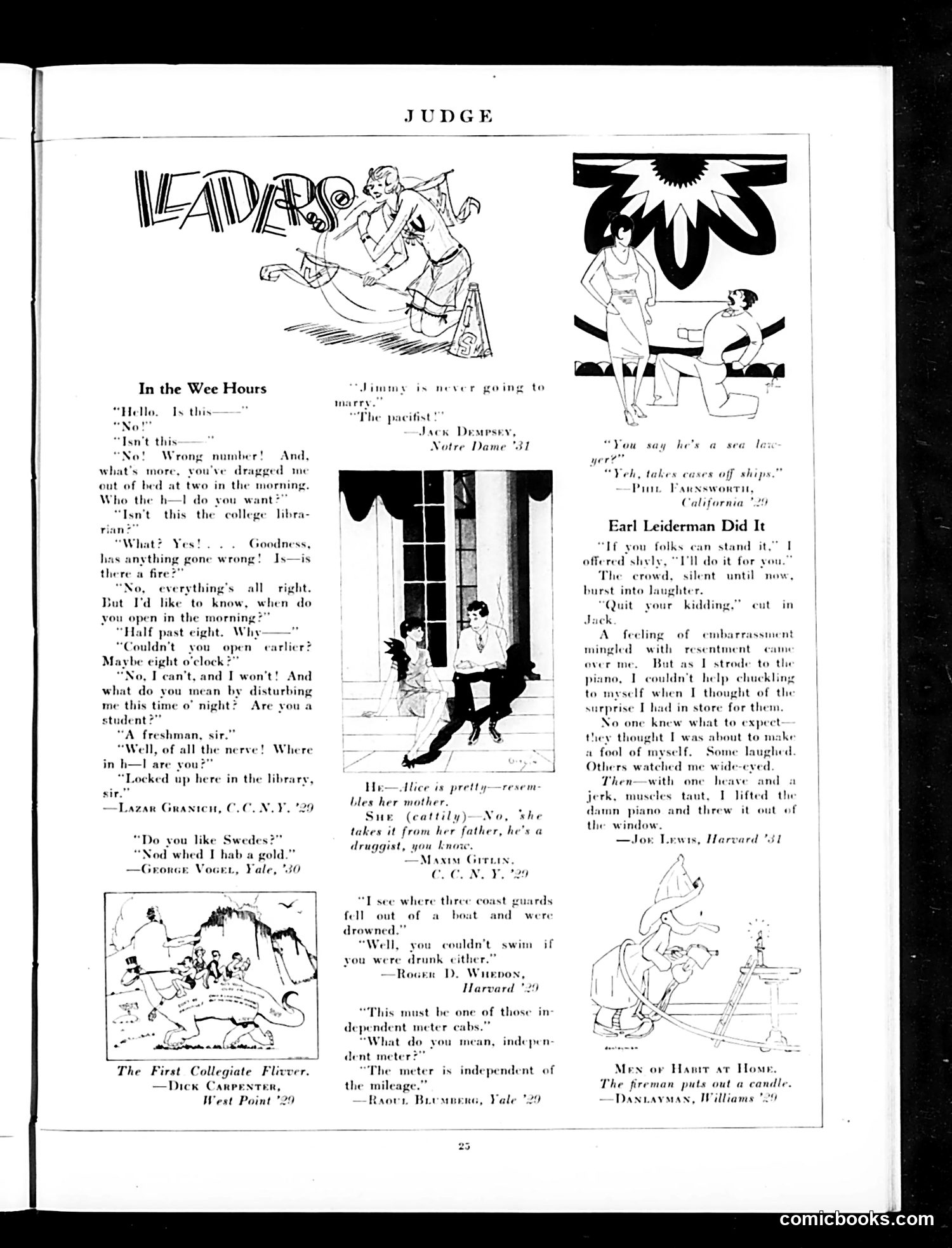
This page contains college humor anecdotes and cartoons from circa 1929-1931, contributed by students from various universities. The jokes satirize collegiate life and social pretensions of the era: **"In the Wee Hours"** mocks freshman naïveté—a confused freshman calls the library at 2 AM asking when it opens, annoying the librarian. **"Earl Leiderman Did It"** is a shaggy-dog story playing on audience expectations: the narrator builds suspense about performing at a piano before an impressed crowd, then subverts the reveal by literally throwing the piano out a window—absurdist humor. **Other vignettes** include mild romantic jokes (Alice's appearance, Swan's dating prospects) and wordplay ("independent meter cabs"—a pun on taxi meters). The cartoons depict typical college scenarios: a drunk phone call, couples socializing, and a fireman with a candle. This represents mainstream collegiate humor of the Jazz Age: simple pranks, physical comedy, and gentle mockery of student life—contemporary entertainment for educated young readers.
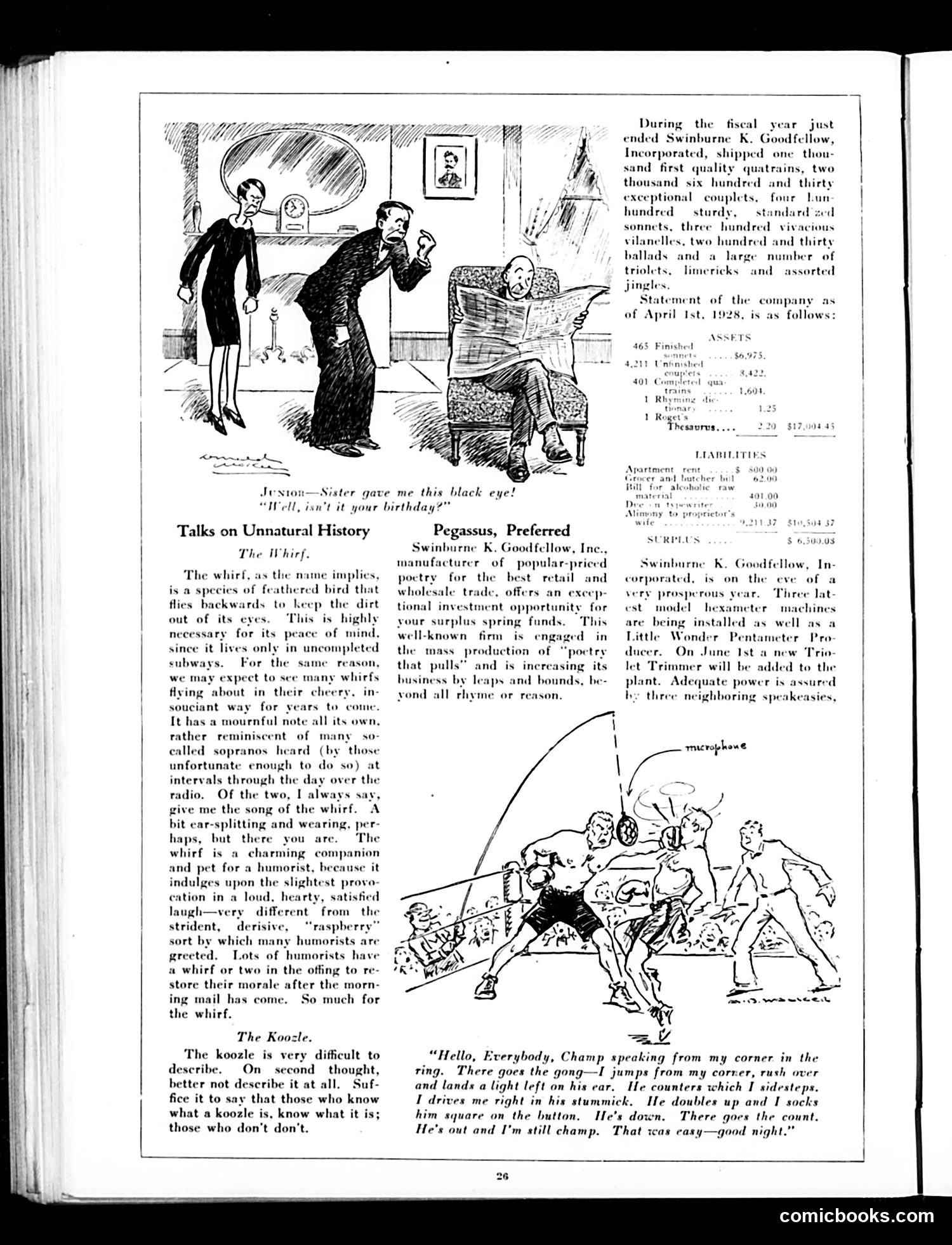
**Top Cartoon**: A domestic humor joke. A young man sports a black eye; when asked if it's his birthday, he replies that his sister gave it to him. The humor is absurdist—the non-sequitur response plays on the expectation of a birthday explanation. **"Talks on Unnatural History"**: Satirical pseudo-scientific descriptions of fictional creatures. The "whirf" is a backward-flying bird presented as humorous relief for radio listeners tired of annoying programs. The "koozle" is deliberately left undescribed—the joke is the refusal to explain it. This parodies pretentious nature writing and 1920s radio culture's dominance. **"Pegassus, Preferred" (Advertisement)**: A satirical investment pitch for "Swinburne K. Goodfellow, Inc.," a factory mass-producing poetry ("poetry that pulls"). The financial statement lists assets and liabilities humorously, and mentions "speakeasies" for power—a Prohibition-era joke. The ad mocks both commercialized art and get-rich-quick schemes. **Bottom Cartoon**: A boxing match narration. The unnamed "Champ" describes his victory in colloquial language, capturing 1920s prize-fighting culture and radio sports broadcasting.
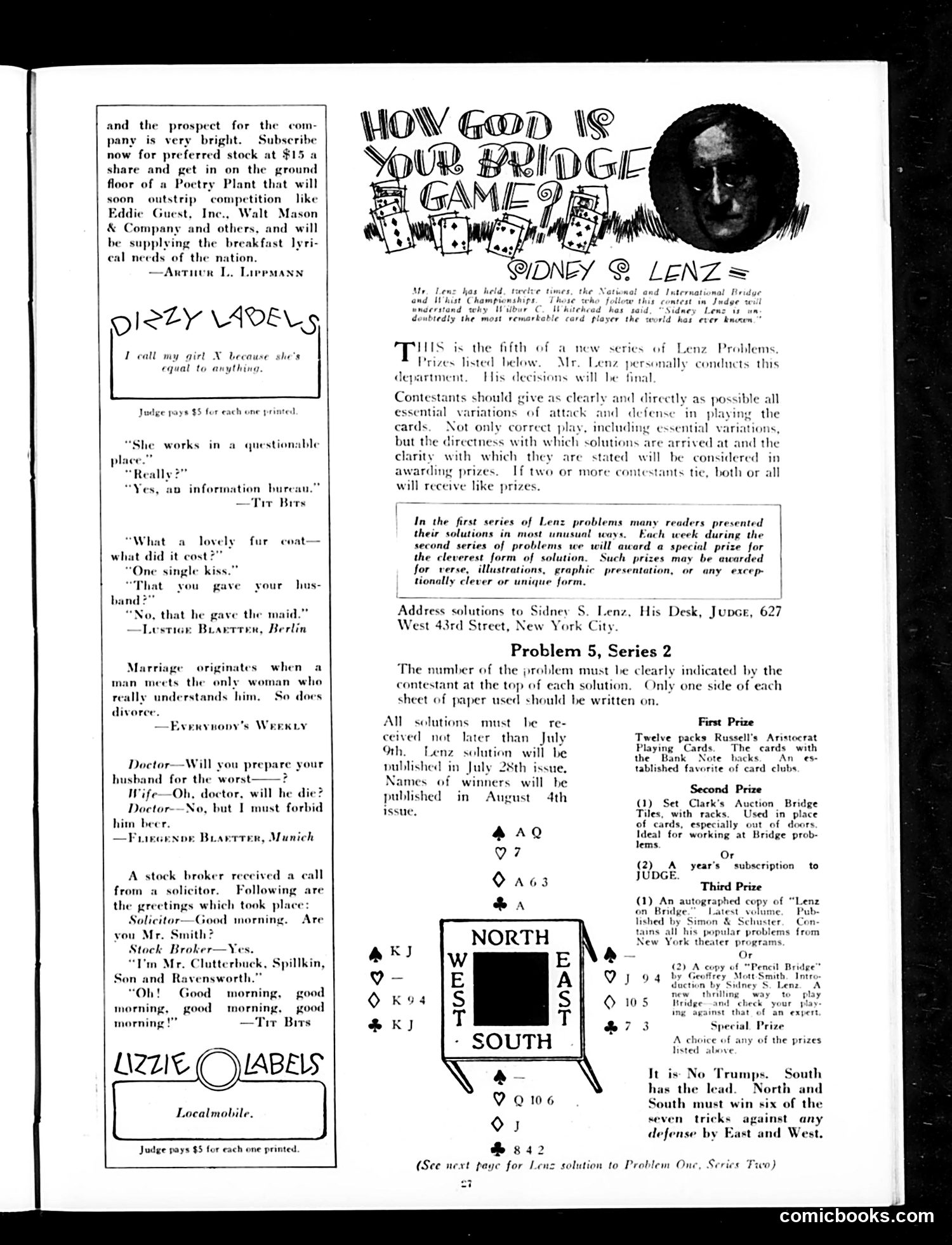
This page from Judge magazine (a satirical publication) contains several distinct elements: **Main Content:** The centerpiece is "How God Is Your Bridge Game?" — a bridge card problem by Sidney S. Lenz, a famous bridge expert. This is the fifth in a series of puzzles Judge offered to readers, with prizes including Russell's playing cards, subscriptions, and autographed bridge books. **Surrounding Humor:** The page is framed by short jokes and witticisms typical of Judge's style, including: - A satire on stock promotion (a "Poetry Plant" mimicking real companies like Eddie Guest, Inc.) - Brief comedic exchanges about marriage, marital infidelity, and workplace matters - "Dizzy Labels" and "Lizzie Labels" — likely caption competitions Judge ran **Context for Modern Readers:** Bridge was enormously popular among educated, middle-class Americans in the early 20th century. Judge regularly featured bridge content for its upscale readership. The page reflects an era when magazine competitions and parlor games were major entertainment, and when satirical magazines mixed sophisticated humor with practical puzzles.
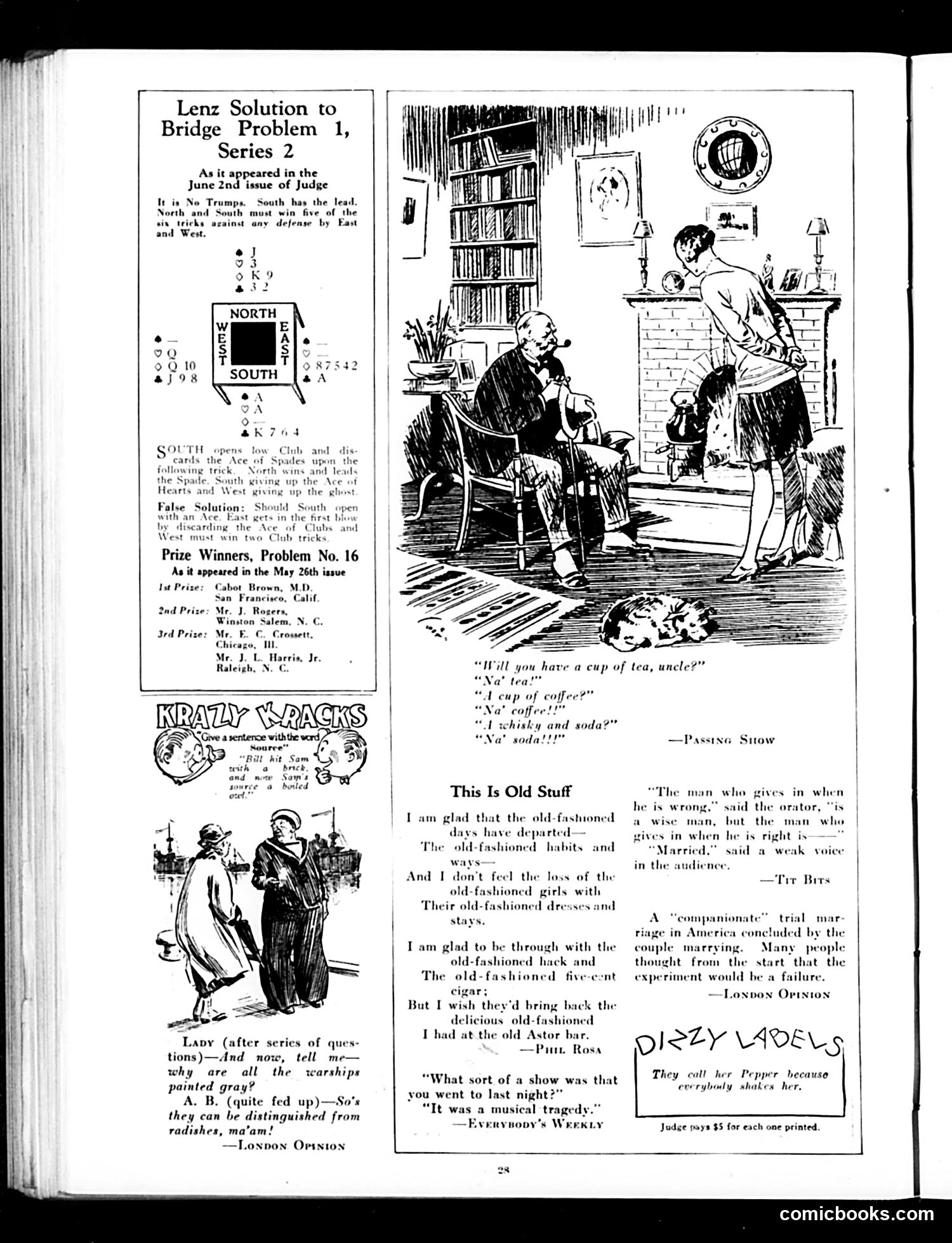
This page contains **bridge game solutions and editorial humor** rather than political satire. The top section presents a bridge card game problem and its solution, listing prize winners from a previous issue—typical instructional content Judge regularly published. The humor pieces focus on **social observation**: - "Krazy Kracks" jokes about naval ships painted gray (a practical wartime measure, apparently), with an exchange between a lady and a sarcastic man. - "This Is Old Stuff" is nostalgic verse lamenting the loss of old-fashioned things while wishing back old bars and cigars—gentle social commentary on modernity. - "Dizzy Labels" is a brief joke about someone nicknamed "Pepper" because people shake her (likely a flirtation joke). The scattered quotations address marriage, weakness, and entertainment—general life observations rather than partisan politics. This appears to be a typical mixed-content page from Judge blending puzzles, light verse, and wordplay humor for general readers.
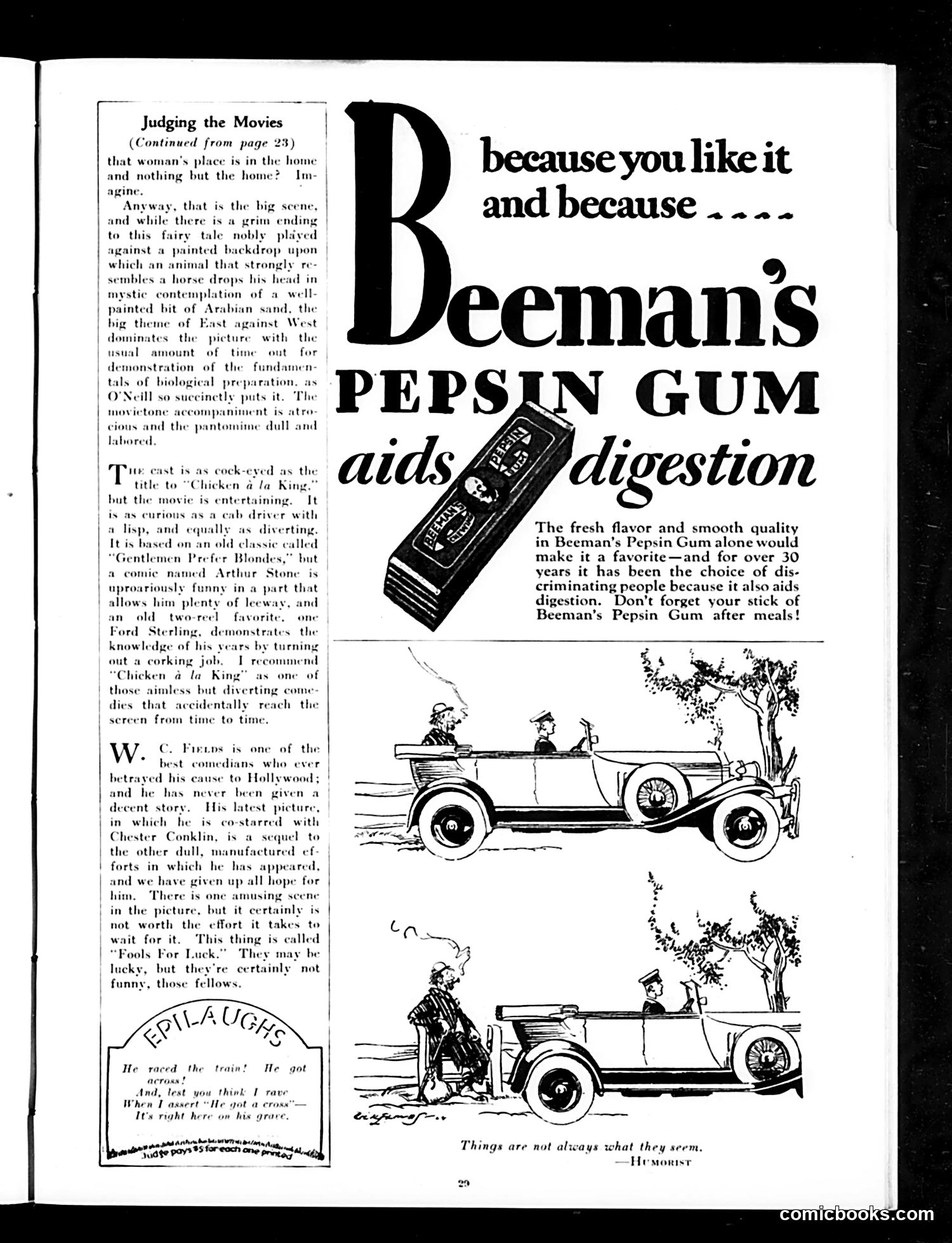
This page mixes movie reviews with advertising. The left column critiques several films: one about a woman defying convention by working outside the home; "Chicken à la King" (called entertainingly "cock-eyed" despite its silly premise); and a W.C. Fields comedy deemed disappointing. A small comic titled "Epilaugh" makes a dark joke about a train accident. The dominant content is a **Beeman's Pepsin Gum advertisement** occupying the right half. It emphasizes that people buy the product because they "like it" and because it aids digestion—a common health claim for gum in the early 20th century. The illustrated scenes show people chewing gum in everyday situations. The small cartoon at bottom—showing the same car in two scenarios with the caption "Things are not always what they seem"—likely serves as visual humor for the ad, though its exact satirical point remains unclear.
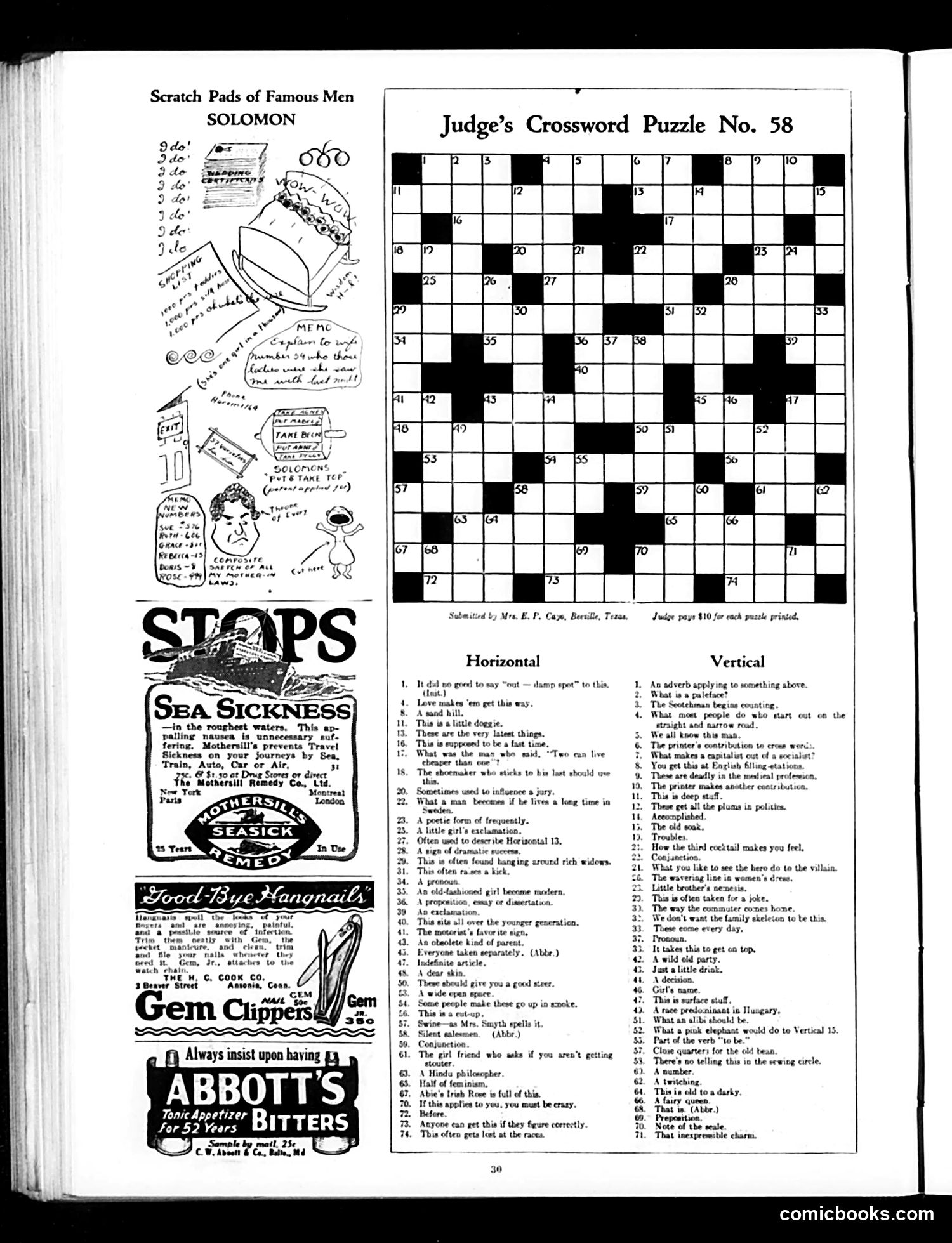
This page from Judge magazine features a crossword puzzle (No. 58) with accompanying advertisements and a sketch labeled "Scratch Pads of Famous Men: Solomon." The Solomon sketch appears to be satirical doodling—cartoon notes showing various items and phrases associated with the biblical figure known for wisdom. The scribbles include references to typical "scratch pad" musings, though the specific satire is difficult to parse from the reproduction quality. The page is primarily **advertising-focused**, showcasing period products: Mothersill's (seasickness remedy), Gem Clippers (nail care), Abbott's Bitters (a medicinal tonic), and "Good Bye Hangnails." These ads represent typical early 20th-century patent medicines and personal grooming products marketed with grandiose health claims. The crossword puzzle itself uses contemporary slang and cultural references of the era ("flapper," "motorist," "capitalist vs. socialist") that would have been familiar to Judge's urban, educated readership but now require historical context to decode.
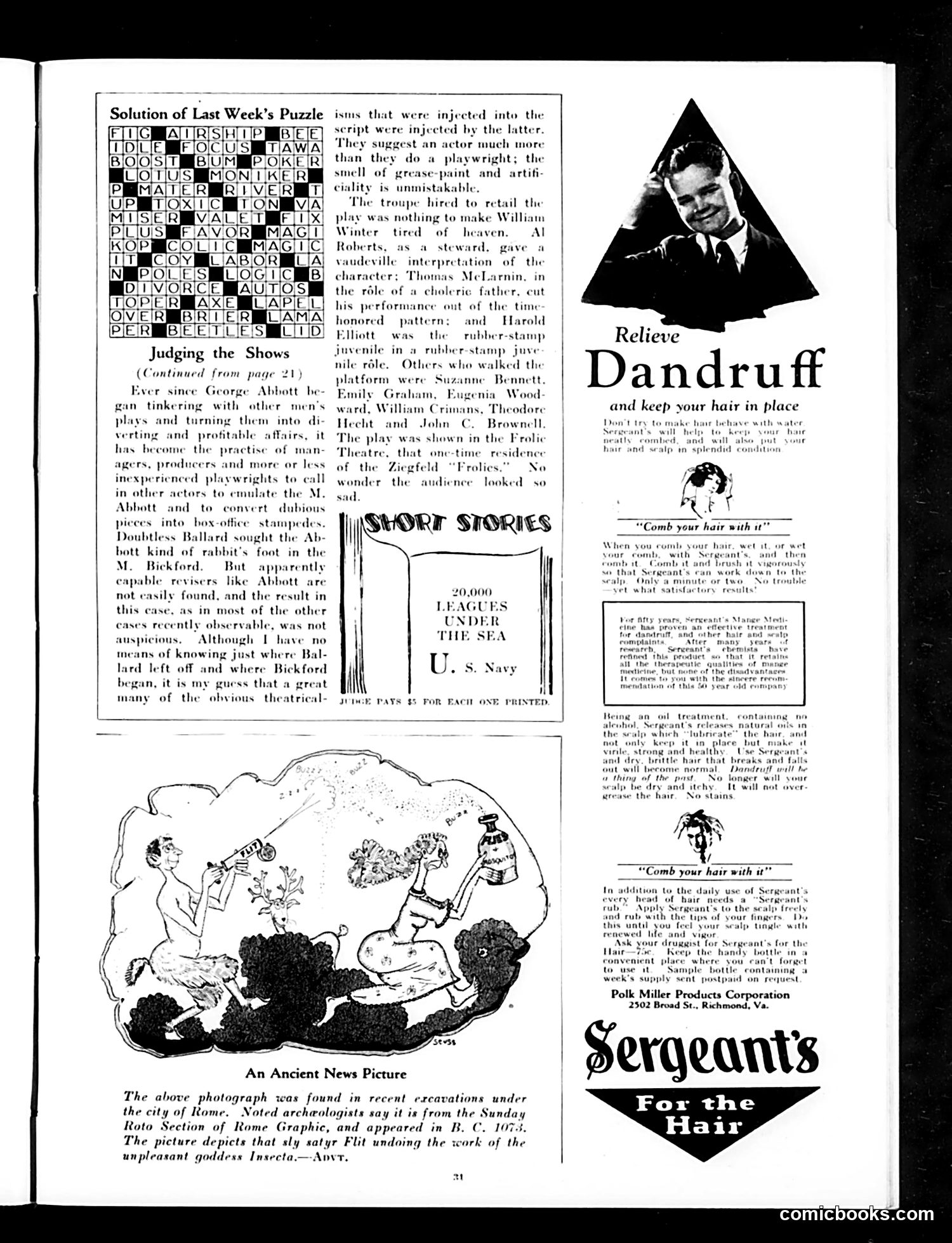
This page contains theatre criticism and advertising, not political cartoons. The main content is "Judging the Shows," a theatre review discussing a play's poor production quality. The critic notes that while the script had merit, the hired troupe—including actors Al Roberts, Thomas McLarnin, and Harold Elliott—delivered mediocre performances, with actors misinterpreting their roles or delivering generic, uninspired work. The piece critiques producer Ballard for failing to hire capable revisers (like George Abbott, apparently the standard for fixing weak productions). The "Ancient News Picture" is a humorous filler piece: a crude drawing supposedly from 1 B.C. Rome showing a satyr (Flit) fighting insects, presented as an archaeological discovery. It's absurdist humor playing on the magazine's satirical tone. The advertisements for Dandruff Reliever and Sergeant's Hair Products occupy the right side—standard period grooming ads featuring testimonials about hair treatment.
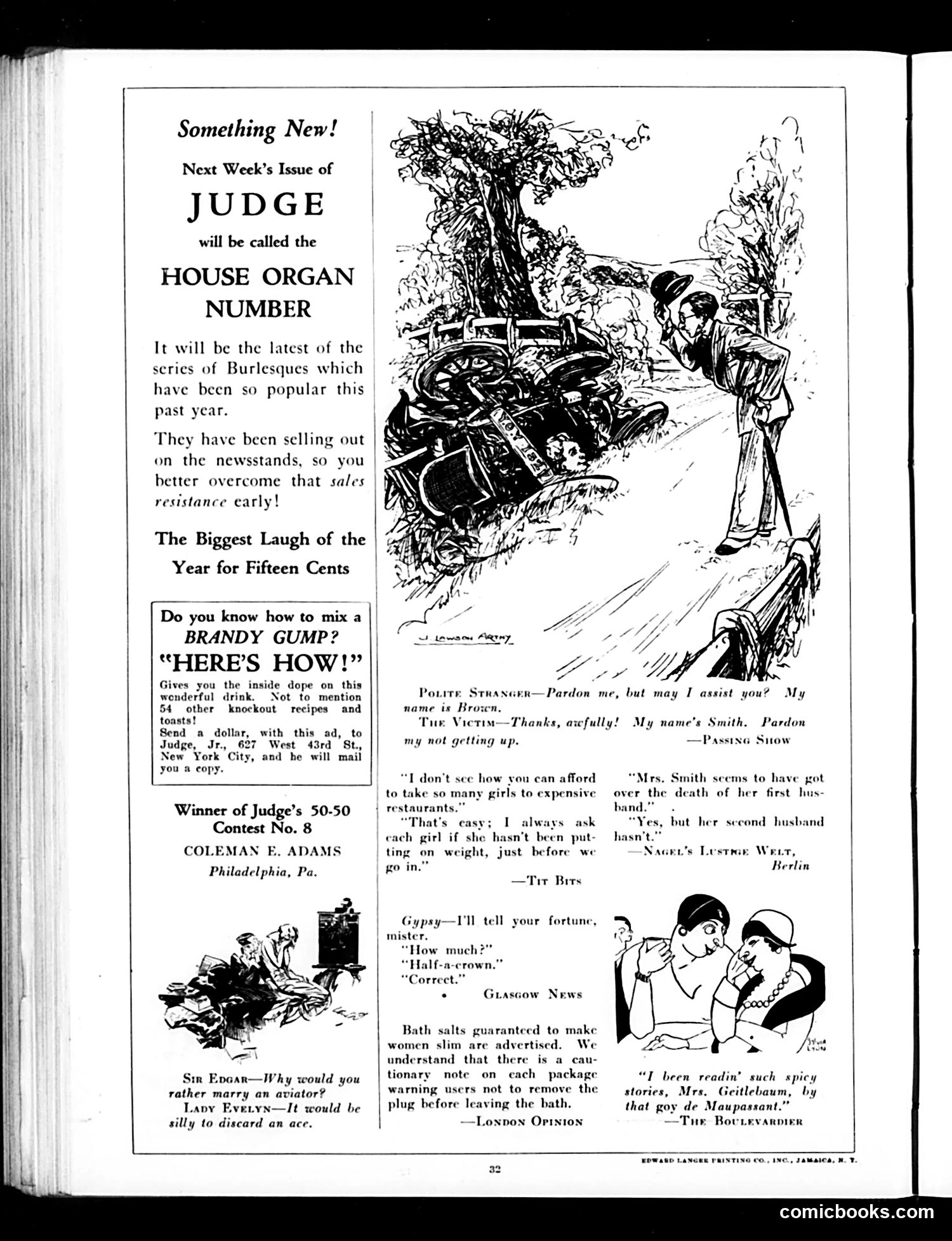
This page announces Judge's upcoming "House Organ Number"—a special issue spoofing corporate publications. The main content consists of brief humorous anecdotes and jokes typical of Judge's satirical format. The cartoons and jokes target various social conventions: a woman's remarriage ("got over" her first husband quickly), dating economics (a man screening girls by weight before expensive outings), and advertising absurdities (bath salts with warnings about removing plugs). There's wordplay on aviation ("discard an ace"), fortune-telling overpricing, and a reference to Guy de Maupassant's risqué stories. The illustrations show everyday scenarios—a car accident, a fortune teller, people dining—rendered in Judge's characteristic line-drawing style. The humor relies on period-specific social anxieties: gender dynamics, class-conscious dating, and Victorian propriety about literature and bathing. This reflects early 20th-century American middle-class preoccupations with propriety, dating etiquette, and changing social mores.
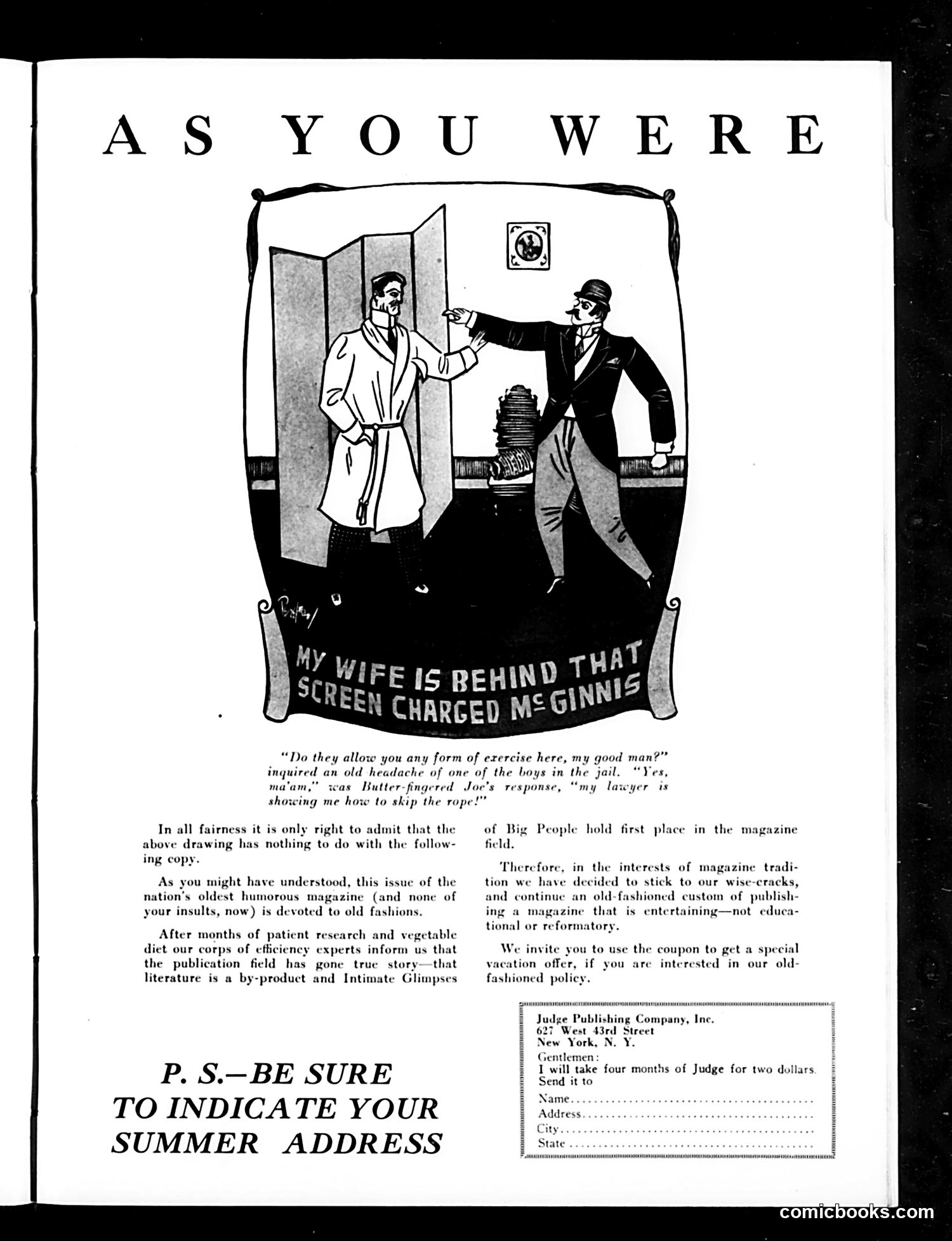
This page from Judge magazine contains a jail-themed joke cartoon and accompanying editorial commentary about the magazine's content strategy. **The Cartoon:** A visitor asks an imprisoned man ("Butter-fingered Joe") about exercise opportunities in jail. The joke plays on a double meaning: the lawyer is teaching him to "skip the rope"—both a literal exercise and a euphemism for escaping execution by hanging. **The Editorial Context:** Judge defends its focus on entertainment and humor rather than educational or reformatory content. The editors acknowledge that the magazine field increasingly prioritizes celebrity gossip ("Intimate Glimpses of Big People") over traditional literature. They position Judge as maintaining "old-fashioned" entertaining standards rather than pursuing social improvement. **The Satire:** Judge satirizes both modern magazine publishing trends (sensationalism over substance) and its own deliberate choice to remain entertainment-focused rather than educational—a somewhat self-aware, tongue-in-cheek defense of frivolity. The page concludes with a subscription coupon offering four months for two dollars.
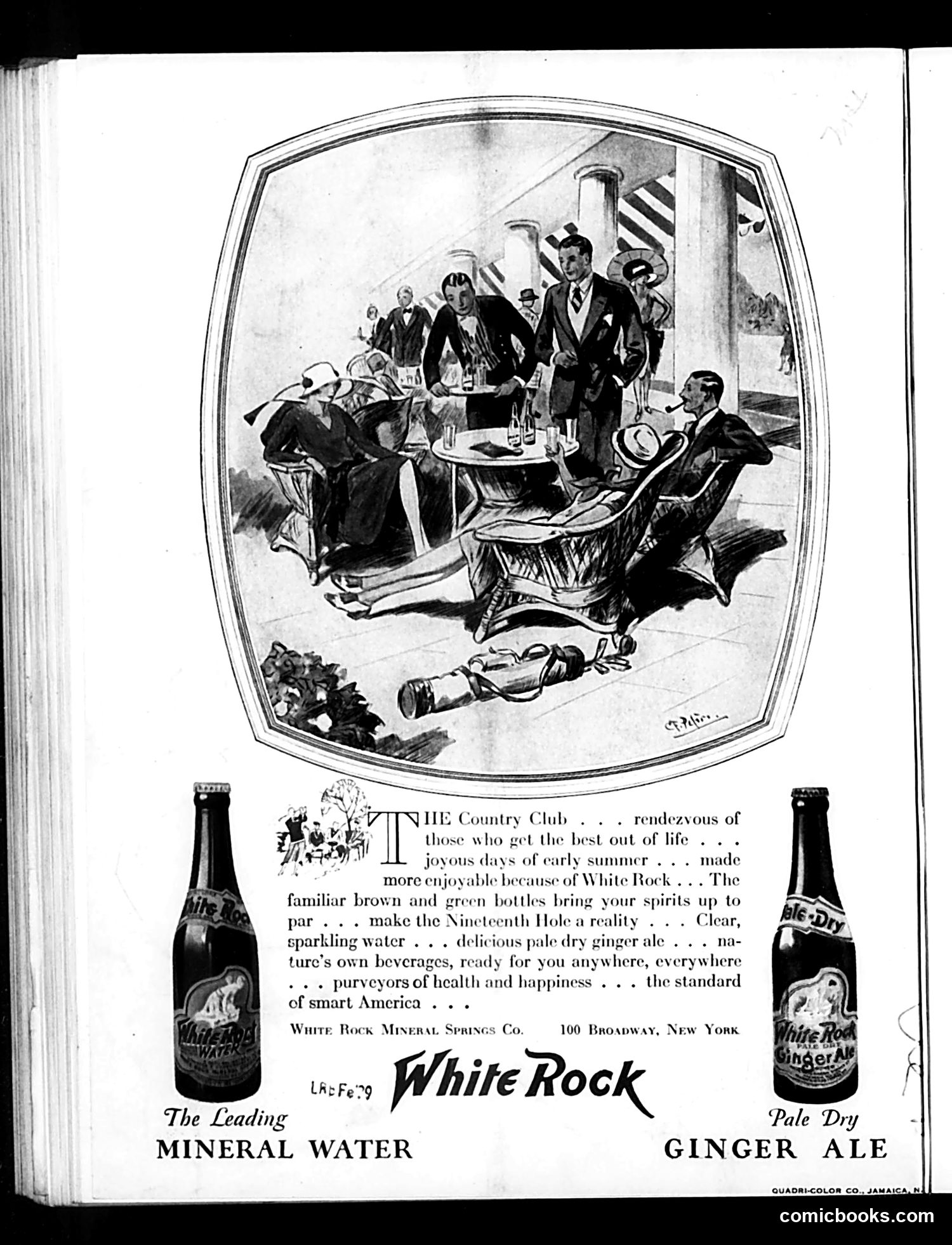
This is primarily a **beverage advertisement**, not political satire. It depicts an affluent country club scene with well-dressed men relaxing, establishing White Rock as aspirational—associated with leisure, wealth, and refinement. The ad positions White Rock mineral water and ginger ale as essential to upper-class leisure, mentioning "the Nineteenth Hole" (golf reference) and "smart America." The text uses marketing language common to the era: these beverages are "nature's own" and "purveyors of health and happiness." The illustration shows no caricature or political commentary—rather, it's straightforward lifestyle advertising targeting Judge's affluent readership. The page demonstrates how early-20th-century magazines mixed editorial content with full-page advertisements designed to appeal to aspirations of class status and sophistication.

I can see this is a page from Judge magazine, but the image appears to be almost entirely blank or blank. There is a binding mark on the left side and what appears to be a small notation or mark near the bottom left, but no visible cartoon, text content, or illustrations that would allow me to identify figures, political references, or satirical commentary. Without visible content to analyze, I cannot explain what the cartoon means or identify any caricatures or historical references. If this is the intended image, the page may be a blank page from the publication, or the scan quality may be too poor to render the content visible.