
Judge, 1928-06-30 · page 26 of 37
Judge — June 30, 1928 — page 26: what you’re looking at
What you’re looking at
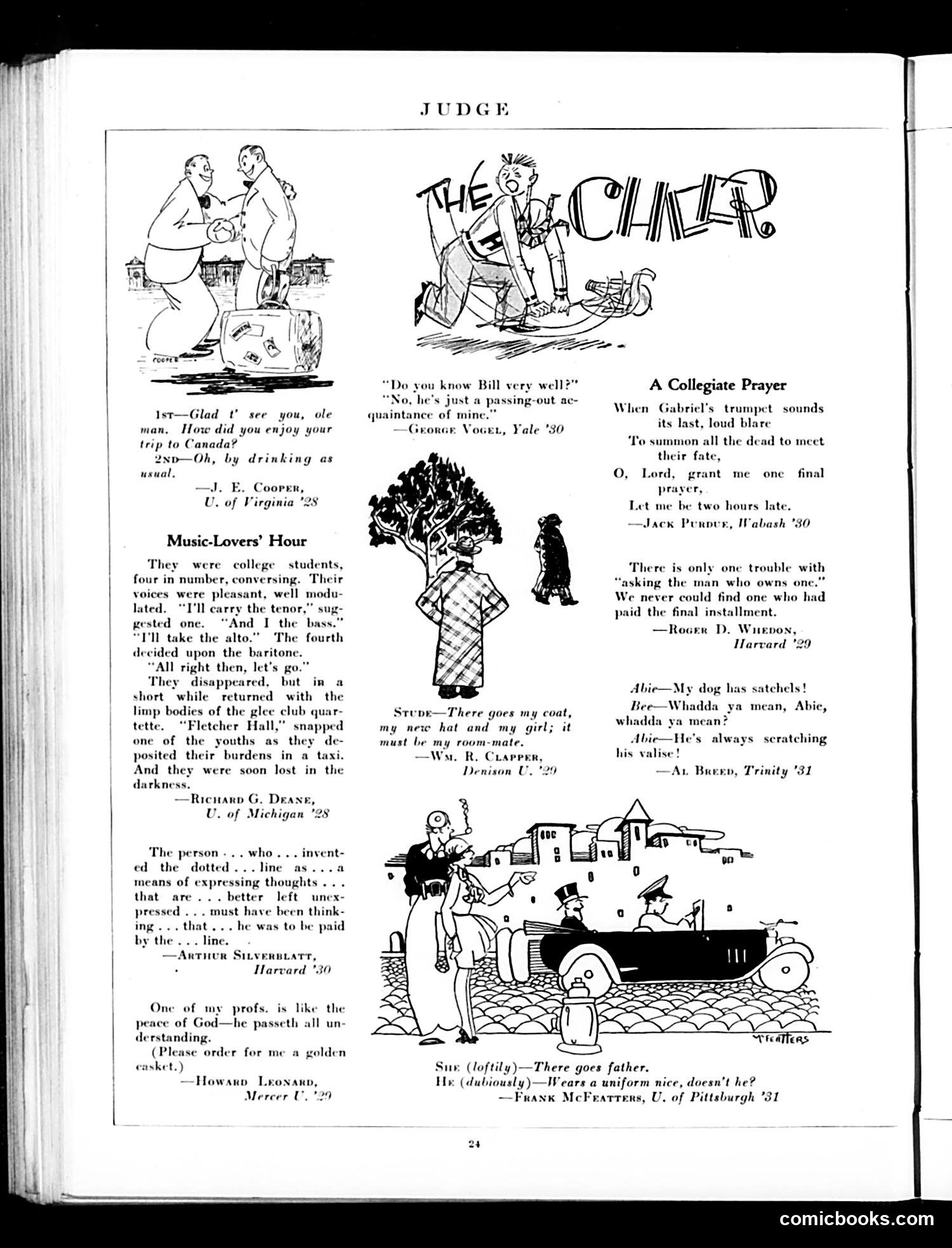
This page from Judge presents college humor circa 1928-1931, featuring satirical observations about undergraduate life. The cartoons and quips mock familiar college stereotypes: **"The Cheer"** depicts a student with a megaphone—poking fun at enthusiastic but chaotic school spirit. **"Music-Lovers' Hour"** jokes that college singers can only successfully perform by kidnapping people—a absurdist exaggeration of their talent level. **Collegiate exchanges** satirize student types: the dismissive rich kid ("passing-out acquaintance"), the broke student losing possessions to roommates, and the immigrant character Abie with a scratching dog. **"A Collegiate Prayer"** mocks student priorities, requesting divine permission to oversleep rather than attend. The final cartoon jokes that uniforms (military service) substitute for actual character—suggesting contemporary anxieties about masculinity and status. Overall, the page reflects 1920s-30s college culture: drinking, dating, financial struggles, and social climbing among mostly privileged young men.
📄 Transcribed text from this page (OCR, searchable)
Machine-transcribed from the original scan — historical spelling and the odd misread are preserved.
JUDGE “Do you know Bill very well?” A Collegiate Prayer | 's just a passing-out ac- Fiem (Cahefalte : Ist—Glad t’ see you, ole quaintance of mine.” Mher Gabiciels tee sounds | man. How did you enjoy your Groror Voorn, Yale ‘30 its last, loud blare ‘To summon all the dead to meet their fate, O, Lord, grant me one final pray Let me be two hours late. trip to Canada? 2np—Oh, by drinking as | usual. E. Coorer, . of Virginia '28 er, —Jack Purpour, Wabash °30 Music-Lovers’ Hour They were college students, There is only one trouble with | four in number, conversing. Their “asking the man who owns one.” } | voices were pleasant, well modu- We never could find one who had | lated. “I'll carry the tenor,” su paid the final installment. | gested one. “And I the bass. ‘Roden D: Wieson “I'll take the alto.” ‘The fourth ee Harcerd 189 { | decided upon the baritone. i} | All right then, let's go.” iH | They disappeared; but in 2 Abie—My dog has satchels! iG | short while returned with the ae . limp bodies of the glee club quar- Stupe—There goes my coat, Bee—Whadda ya mean, Abie, | tette. “Fletcher Hall,” snapped my new hat and my girl; it whadds ya:mean? - i one of the youths as they de- must be my room-mate. _Abie—He's always seratching | posited their burdens in a taxi. —Wa. R. Crarrer, his | And they were soon lost in the Denison U. '29 j darkness. | | —Ricitann G. De U. of Michigan '28 The person... who. ed the dotted... line nvent- H means of expressing thoughts . that are... better left une pressed... must have been think- ing th: he was to be paid by the —Antiur Sitverseatt, . Harvard "30 One of my profs. is like the peace of God—he passeth all un- derstanding. (Please order for me a golden | casket.) Sur (loftily)—There goes father. | | Howann Lronano, Hr (dubiously)—Wears a uniform nice, doesn't he? | Mercer U. "29 wank McFearrens, U. of Pittsburgh ’31 comicbooks.com