
A complete issue · 36 pages · 1928
Judge — June 16, 1928
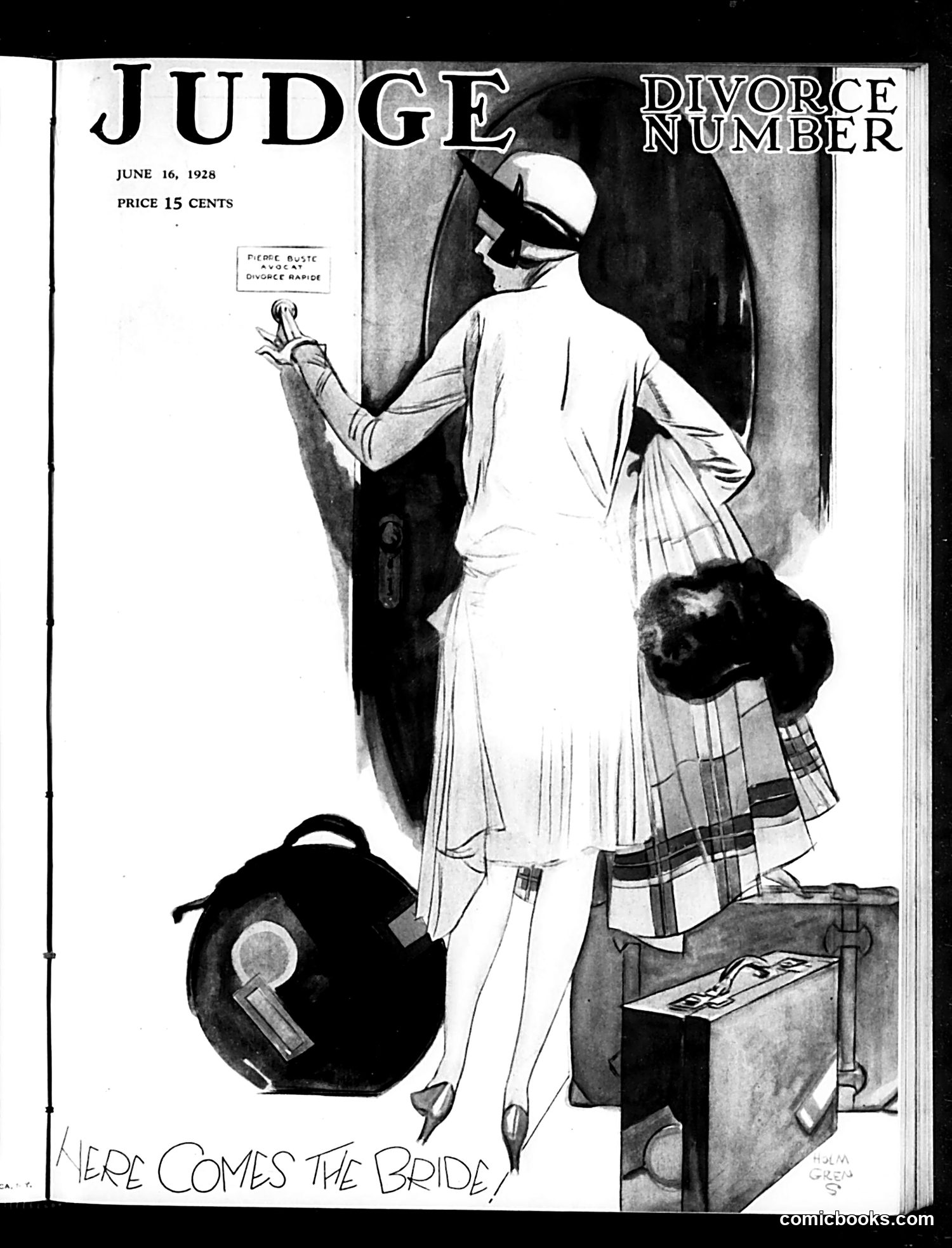
This June 16, 1928 *Judge* cover satirizes divorce through the figure labeled "Here Comes the Bride." The illustration shows a fashionably dressed woman entering through a doorway, carrying a large suitcase and wearing a cloche hat—typical 1920s flapper attire. The "Divorce Number" heading indicates this issue focuses on marriage dissolution. The satire targets the apparent ease and frequency of divorce in the 1920s. The bride's luggage, packed and ready, suggests she's prepared for marriage to fail from the start—implying divorce is inevitable rather than exceptional. This reflects contemporary anxieties about changing marriage attitudes and women's increasing independence during the Jazz Age, when divorce rates were rising and viewed as socially scandalous by conservatives.
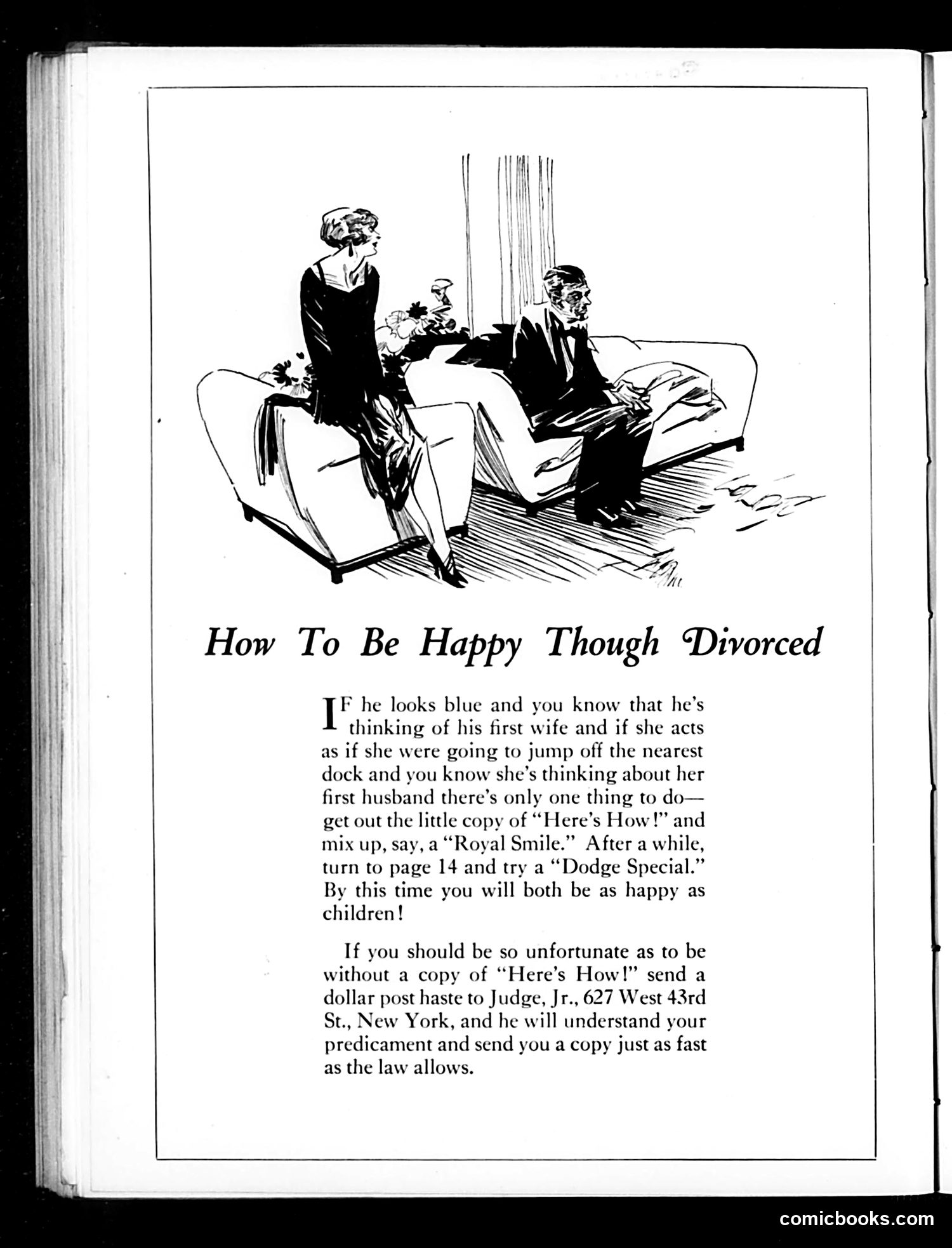
This satirical piece from *Judge* magazine mocks post-divorce unhappiness by suggesting cocktails as a remedy. The cartoon shows a divorced couple sitting separately on a couch, both looking miserable—he contemplating his first wife, she her first husband. The "solution" humorously recommends mixing alcoholic drinks (a "Royal Smile," then a "Dodge Special") from a fictional cocktail guide called "Here's How!" to achieve happiness. The satire targets both Prohibition-era drinking culture (referencing cocktail recipes during a period when alcohol was officially banned) and the growing divorce rate of the 1920s. It suggests that material solutions—here, booze—cannot genuinely resolve emotional pain, while poking fun at modern marital instability and the era's apparent fascination with quick fixes.
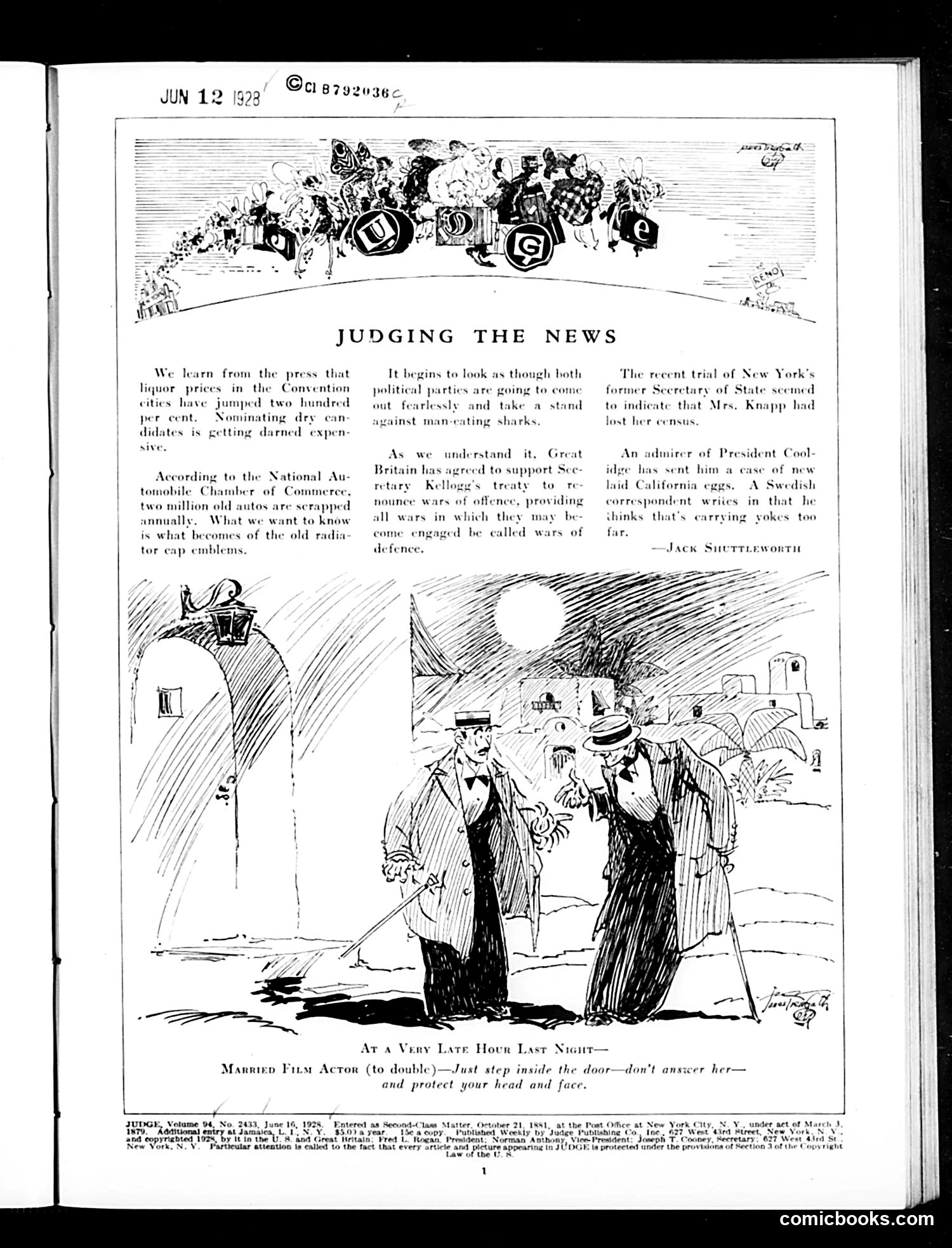
This satirical page critiques contemporary news stories through brief commentary and cartoons. The main cartoon depicts two men in formal wear during a rainstorm, with the caption "At a Very Late Hour Last Night—Married Film Actor (to double)—Just step inside the door—don't answer her—and protect your head and face." This appears to mock Hollywood marital infidelity scandals common in 1920s tabloids. The joke suggests a married actor instructing his body double to take his place at home to avoid his wife—satirizing both the absurdity of celebrity scandals and the era's moral anxieties about Hollywood. The page's other brief commentary items reference dry candidates, international treaties, and a New York secretary of state trial, using sardonic tone typical of Judge's political satire.
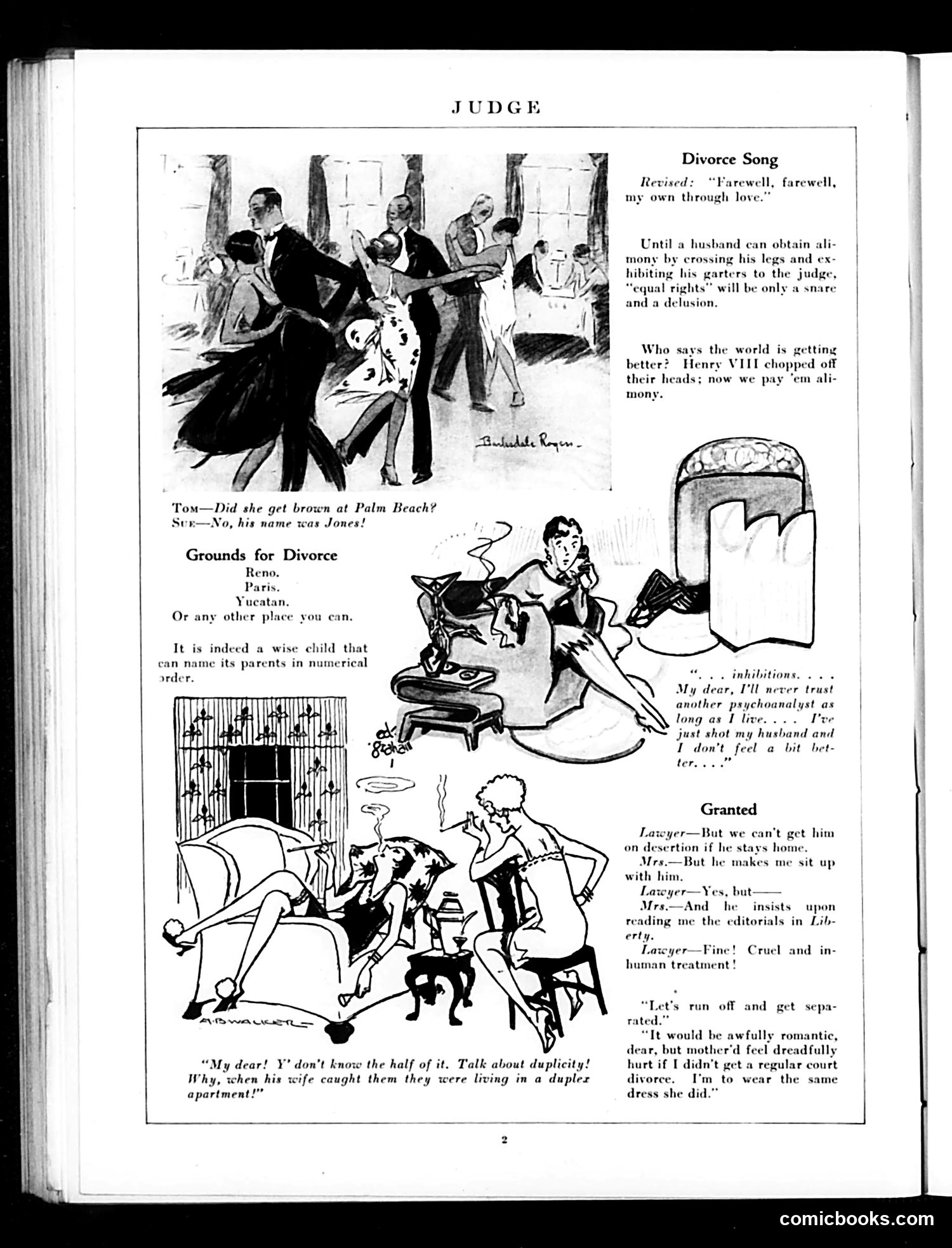
This page satirizes 1920s divorce culture and its social consequences. The cartoons mock both the ease of obtaining divorces and women's newfound legal equality in marriage dissolution. **Key satirical points:** 1. **"Grounds for Divorce"** mocks how divorce locations (Reno, Paris, Yucatan) became fashionable destinations, suggesting divorces were treats rather than serious matters. 2. **"Divorce Song"** references Henry VIII's beheadings, sardonically suggesting modern alimony payments replace historical violence—progress of a sort. 3. **"Granted"** dialogue satirizes wives' frustrations: husbands won't leave home or grant desertion grounds, yet insist on reading newspapers aloud—depicting modern marriage as mutually miserable. The humor targets both divorce's trivialization and marital discord, reflecting post-suffrage anxieties about changing gender dynamics and marriage instability.
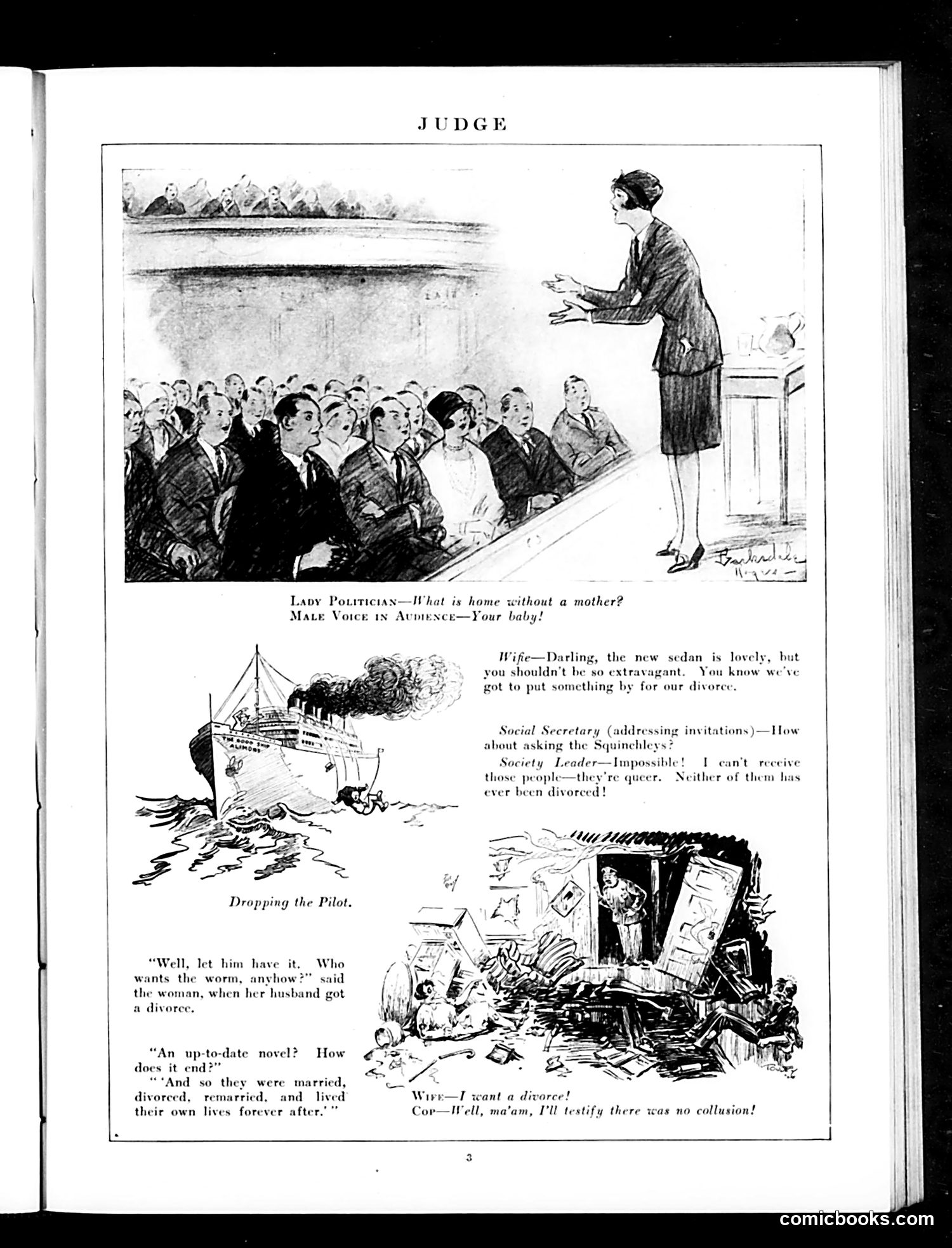
This page satirizes early 20th-century social attitudes toward divorce and women's roles. The top cartoon mocks a female politician speaking to an audience—a male voice heckles her with "Your baby?"—suggesting society questioned whether women could manage both public life and motherhood. Subsequent vignettes ridicule divorce through exaggerated scenarios: a wife casually seeking divorce while her husband's away, a society leader refusing to invite divorced guests, and a woman claiming collusion to avoid scandalous divorce proceedings. The satire targets multiple targets: women entering politics as unseemly; divorce as increasingly common but socially shameful; and the legal/social absurdities surrounding marital dissolution. The humor relies on readers' assumed disapproval of both female ambition and marital dissolution.
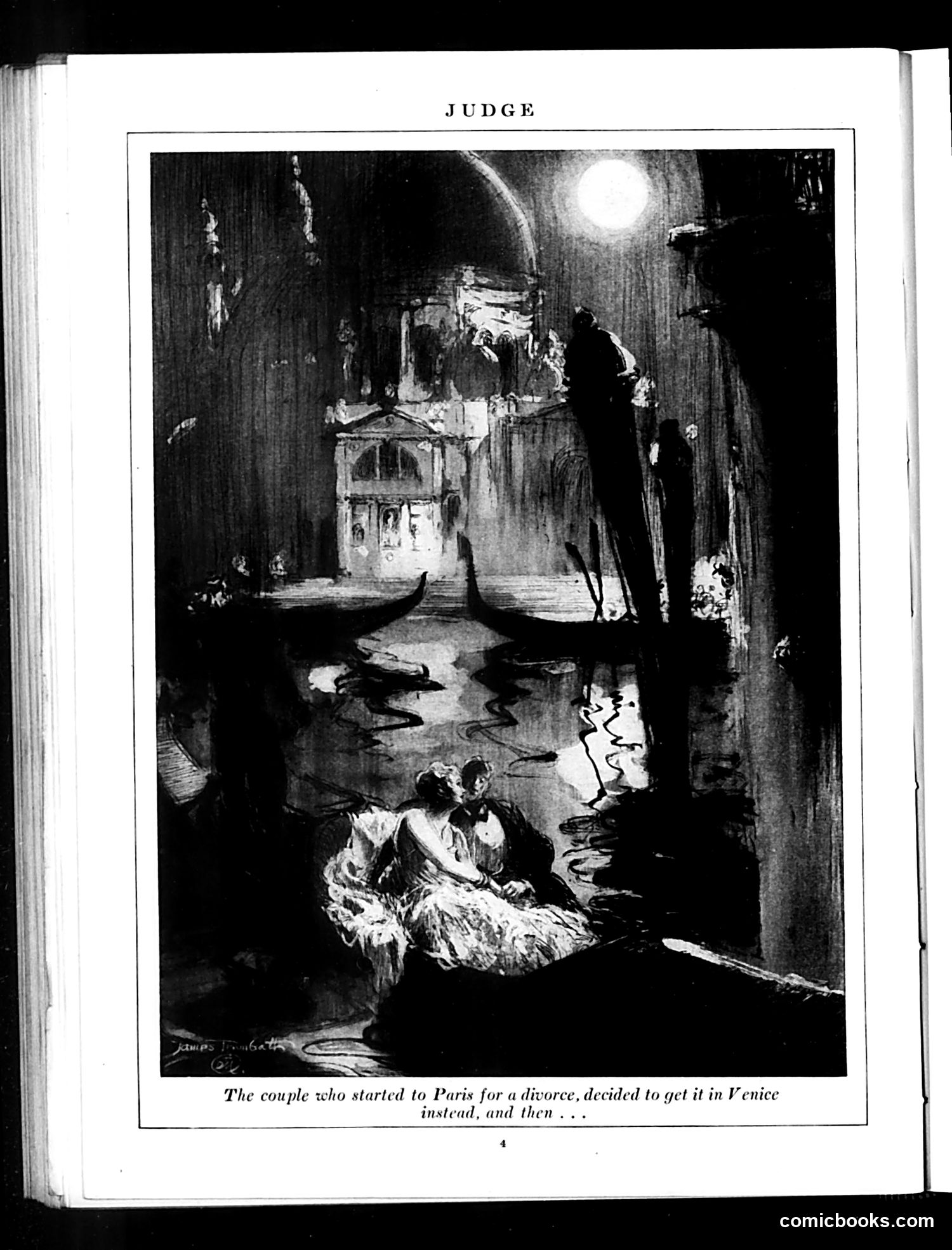
This illustration satirizes romantic dissolution in early 20th-century society. The caption reads: "The couple who started to Paris for a divorce, decided to get it in Venice instead, and then..." The image depicts a couple in Venice's famous canals and architecture, shown in an intimate moment despite their intention to divorce. The satire works on two levels: first, the irony that a couple traveling to end their marriage instead finds romantic reconciliation in Venice's notoriously romantic setting; second, the implicit suggestion that Venice's atmosphere undermines their practical legal intentions. The dark, atmospheric illustration emphasizes the city's legendary romantic power—suggesting that even divorce-bound couples cannot resist Venice's seductive environment. The joke reflects contemporary attitudes about marriage dissolution and the perceived irresistibility of romantic European locales.
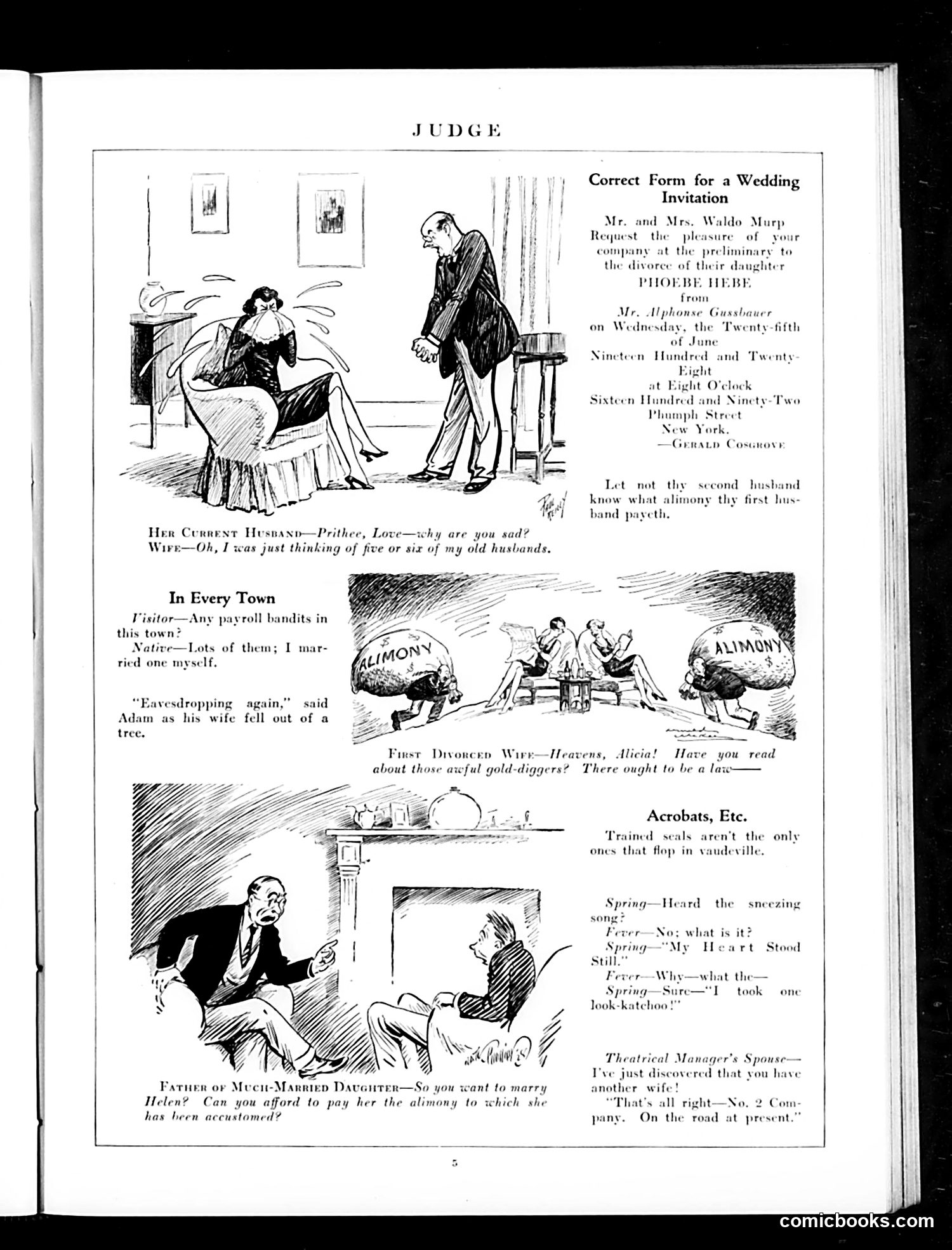
This page contains several satirical humor pieces typical of early 20th-century Judge magazine: 1. **"Correct Form for a Wedding Invitation"** mocks overly formal wedding etiquette through an exaggerated invitation, with the joke that the preliminary is to a "divorce" rather than a wedding. 2. **"In Every Town"** features brief jokes about common social types—visitors, natives, and eavesdropping (a husband's wife falling from a tree). 3. **"Acrobats, Etc."** and related sections present punny dialogue about theatrical performers and acrobatics. 4. The cartoons satirize social pretension, marital discord, and theatrical life. The humor relies on wordplay and stereotypes about marriage instability and social climbing typical of the era's satirical magazines.
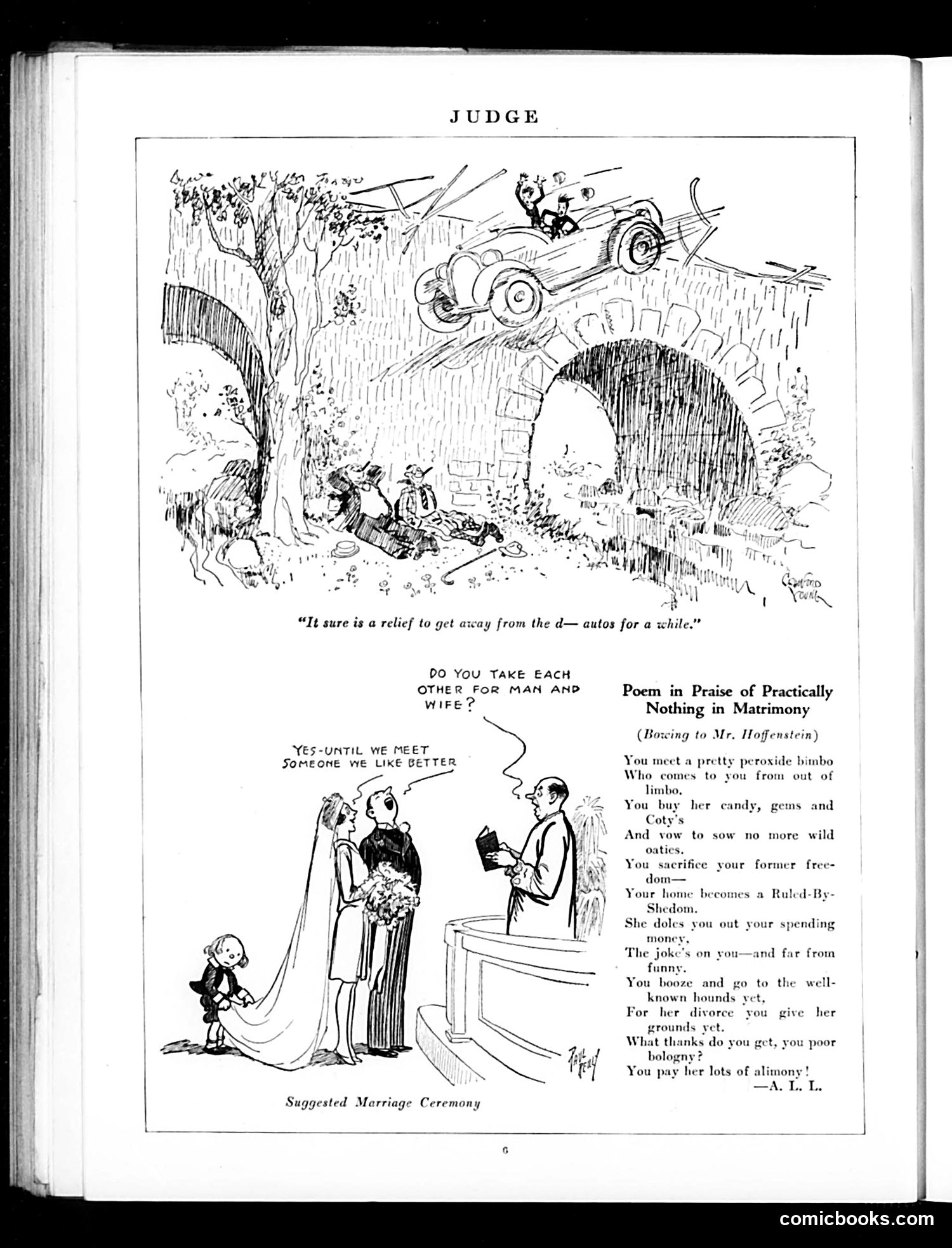
This Judge magazine page contains two satirical pieces about marriage, reflecting early-20th-century cynicism about matrimony. The **top cartoon** depicts a couple escaping traffic via an absurd flying automobile—commentary on automobiles' growing presence and danger, treated as relief from modern life's chaos. The **"Suggested Marriage Ceremony"** cartoon mocks marriage vows, with a couple answering they'll remain faithful "until we meet someone we like better"—cynical humor about marital commitment. The **poem "Practically Nothing in Matrimony"** (attributed to Mr. Hoffenstein) is bitter satire listing marriage's supposed drawbacks: losing freedom, financial control by wives, divorce costs, and alimony payments. It depicts marriage as a poor bargain where men sacrifice independence and money for an unstable arrangement. The overall tone is misogynistic by modern standards, presenting wives as financial drains and marriage as men's loss of autonomy—reflecting period anxieties about women's increasing economic and legal rights.
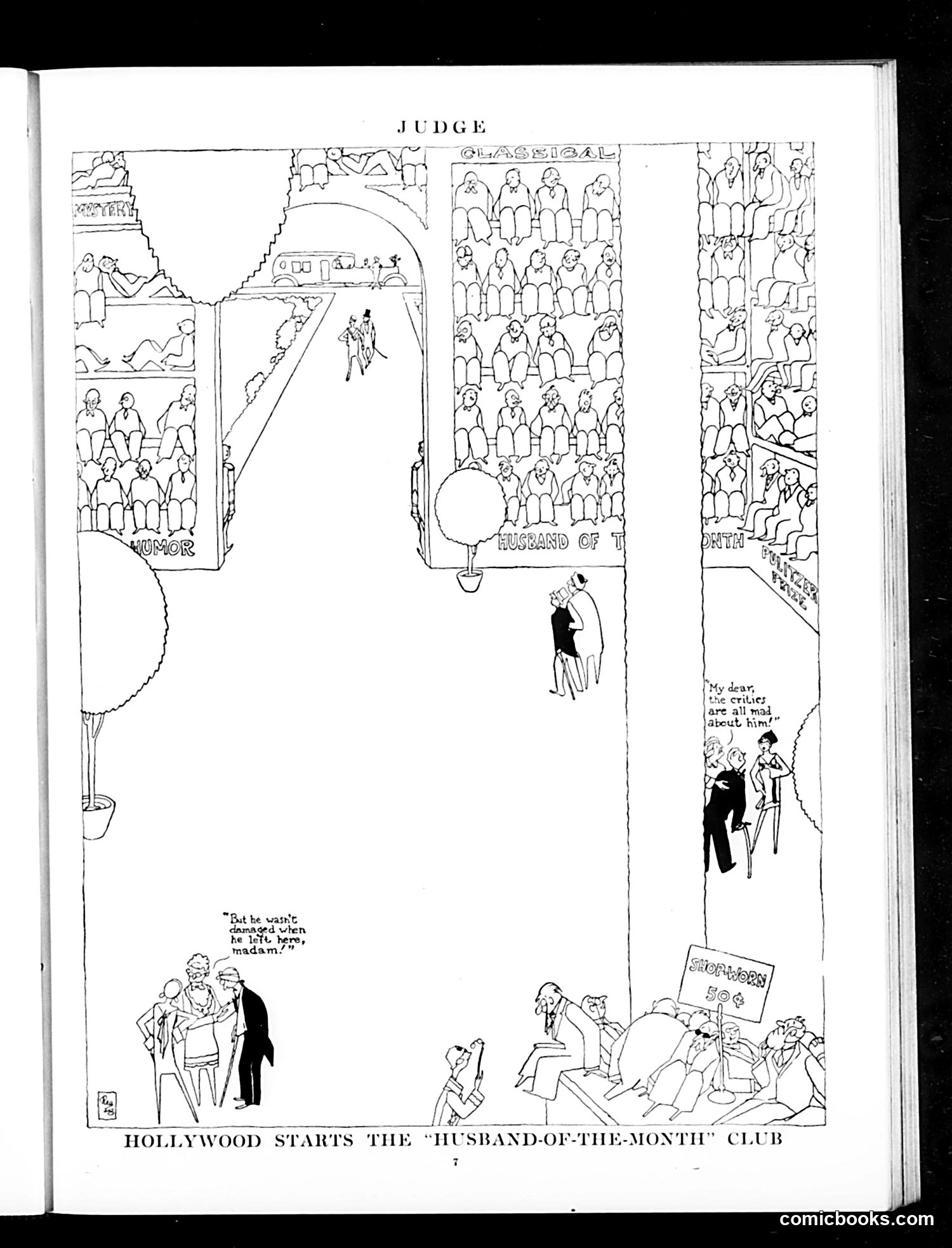
This satirical cartoon critiques the nascent "Husband-of-the-Month Club" in Hollywood. The multi-panel layout shows crowded stadium seating filled with spectators observing the club's activities—suggesting Hollywood marriages are treated as public entertainment spectacles. The dialogue bubble states: "But he wasn't damaged when he left here, madam?"—implying husbands cycle through the club and emerge "damaged" from serial marriages. The satire targets Hollywood's reputation for frequent divorces and remarriages during the early-to-mid 20th century, when celebrity marriages were volatile and heavily publicized. The joke treats matrimony as a commercial enterprise where husbands are exchanged like consumer goods, with public fascination turning intimate relationships into spectator sport. The cartoon mocks both Hollywood's marital instability and celebrity culture's sensationalism.
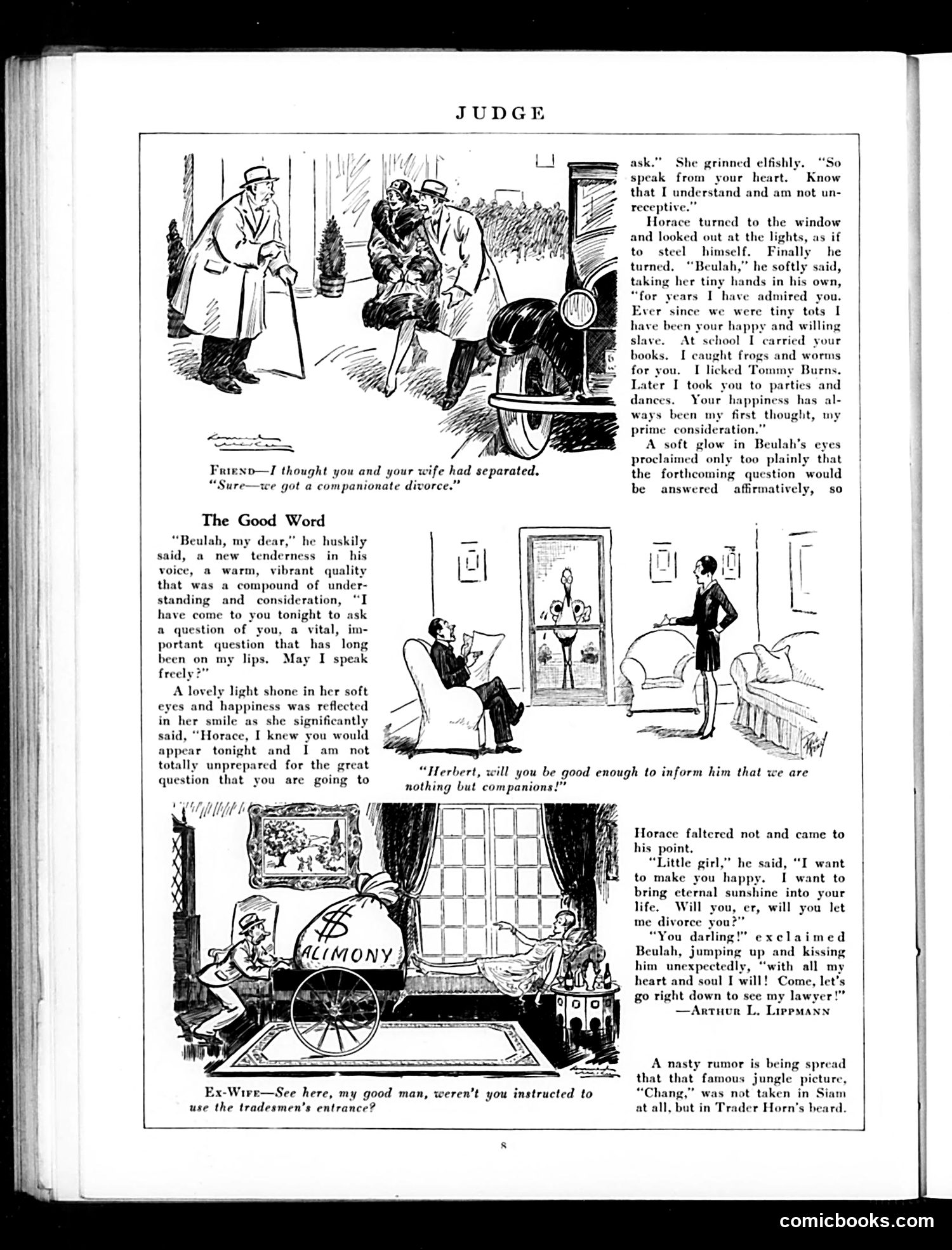
This page satirizes the 1920s trend of "companionate divorce" — a legal arrangement allowing couples to separate amicably rather than through adversarial proceedings. The main cartoon mocks this practice's absurdity: Horace's elaborate romantic confession builds to a marriage *dissolution* proposal, not a proposal of marriage. Beulah accepts "divorce" with joy, treating it as a romantic gesture. The satire suggests the concept is so backwards that even genuine affection now culminates in legal separation rather than commitment. The top cartoon about "separated" spouses obtaining a "companionate divorce" reinforces the joke — the term itself was oxymoronic to traditional readers. The page also includes a minor joke about the film "Chang" (1927) and references to "Trader Horn," suggesting this is from the late 1920s when such divorce liberalization was scandalizing conservative audiences.
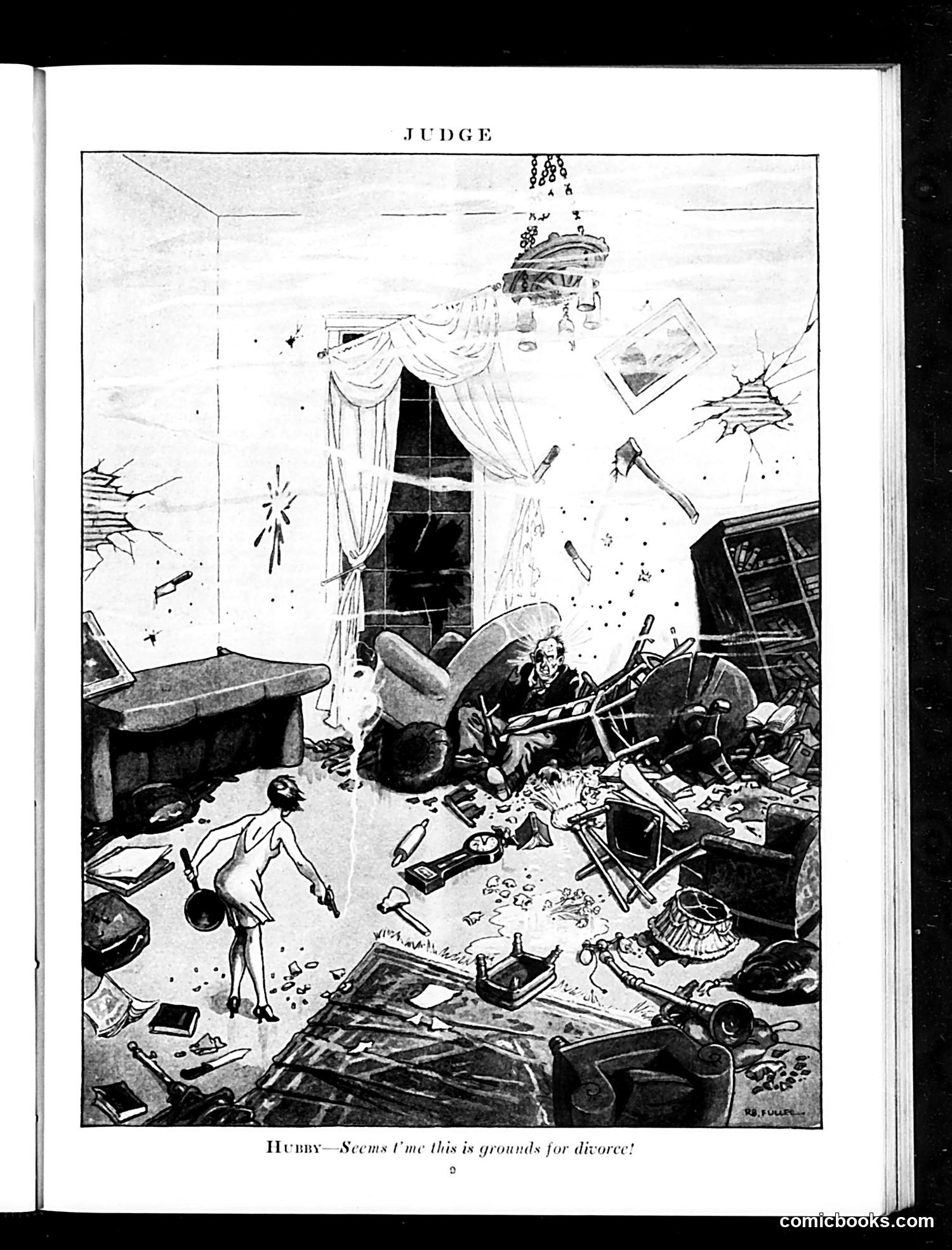
This single-panel cartoon titled "Seems I'm grounds for divorce!" depicts a chaotic domestic interior in complete disarray. A woman stands amid scattered furniture, broken items, and debris, addressing a man (labeled "Hubby") who appears distressed. The room's destruction—overturned chairs, shattered picture frames, scattered tools and household goods—creates the literal visual pun of the caption. The satire plays on legal language: "grounds" simultaneously means both the physical foundation/basis for divorce proceedings and the literal ground (floor) covered in wreckage. The cartoon mocks marital discord by suggesting the wife's destructive behavior or the couple's chaos itself provides sufficient legal justification for dissolution of marriage. It's domestic humor typical of early 20th-century Judge magazine, using visual exaggeration to comment on marriage troubles and divorce proceedings.
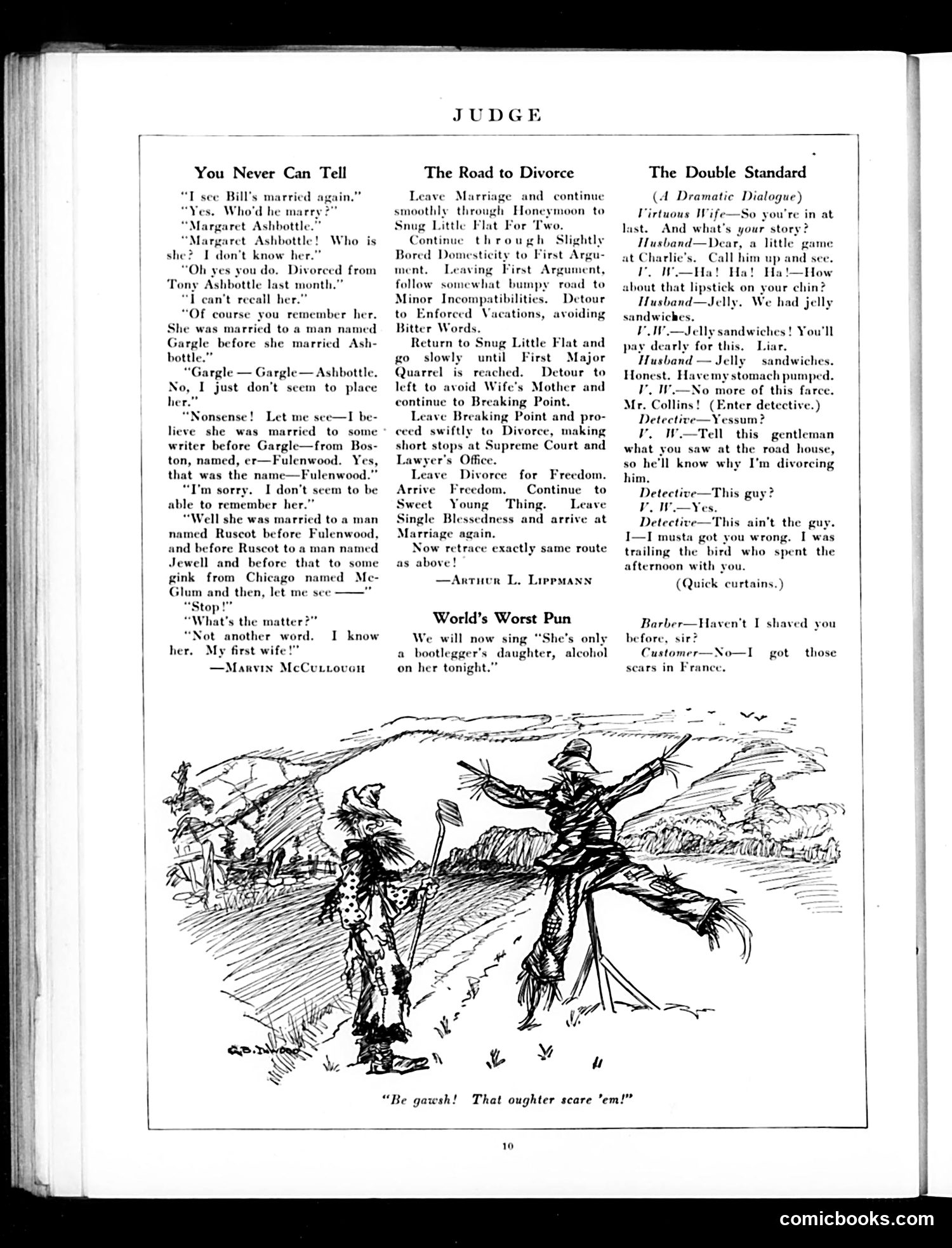
This page contains three satirical pieces mocking 1920s American social attitudes: **"You Never Can Tell"** jokes about serial marriage—a man's new bride has been married so many times he eventually realizes she was his own first wife. The satire targets the era's rising divorce rates and the social awkwardness around remarriage. **"The Road to Divorce"** by Arthur L. Lippmann presents marriage as a mapped journey with literal stops at "Bored Domesticity," "First Argument," and "Breaking Point," culminating in divorce. It satirizes how predictable and inevitable marital failure seemed to contemporary observers. **"The Double Standard"** depicts a wife interrogating her unfaithful husband about lipstick on his chin while he makes excuses. When a detective arrives to investigate *her* infidelity instead, it reveals the era's sexual hypocrisy—wives were surveilled and expected to remain faithful while husbands' affairs were tacitly accepted. The cartoon below shows scarecrows, accompanying a pun about a "bootlegger's daughter"—referencing Prohibition-era drinking.
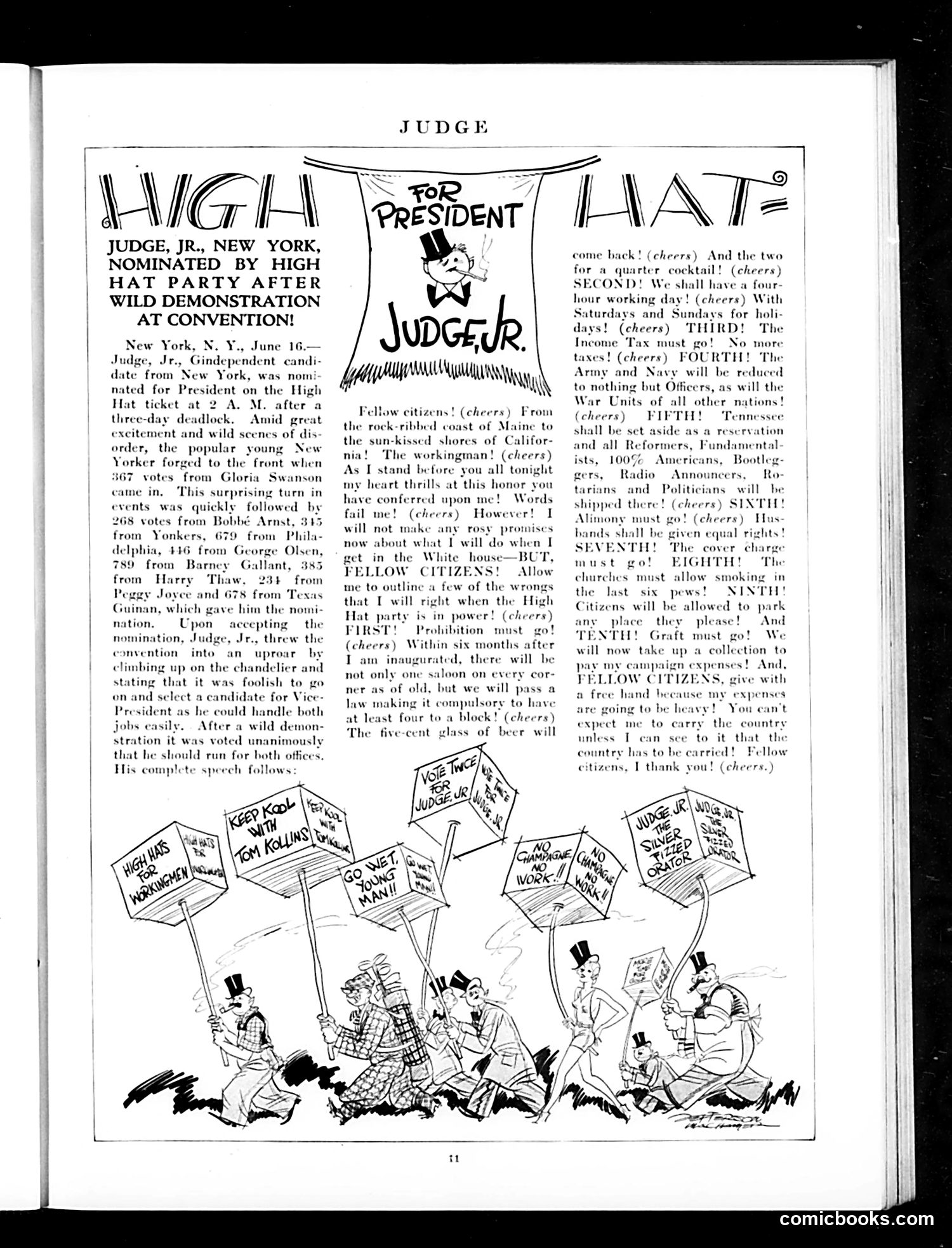
This 1920s satirical cartoon mocks political conventions and empty campaign promises. "Judge, Jr." is a fictional candidate nominated by the absurdist "High Hat Party" after a deadlocked convention. The cartoon parodies how politicians make grandiose, contradictory pledges to win votes. Judge Jr.'s platform exposes the hypocrisy: he promises to restore saloons (mocking Prohibition's failure), implement a four-hour workday, eliminate income taxes, reduce the military to officers only, and exile "undesirables" to reservations—all while asking voters to fund his campaign expenses. The demonstration at the bottom shows protesters with umbrellas bearing slogans like "Keep Tom Killins," "Go Genna," and "No Smoking," representing competing special interests. The satire suggests that political conventions are chaotic circuses where contradictory factions demand impossible things, and candidates promise anything to gain power while actually serving special interests.
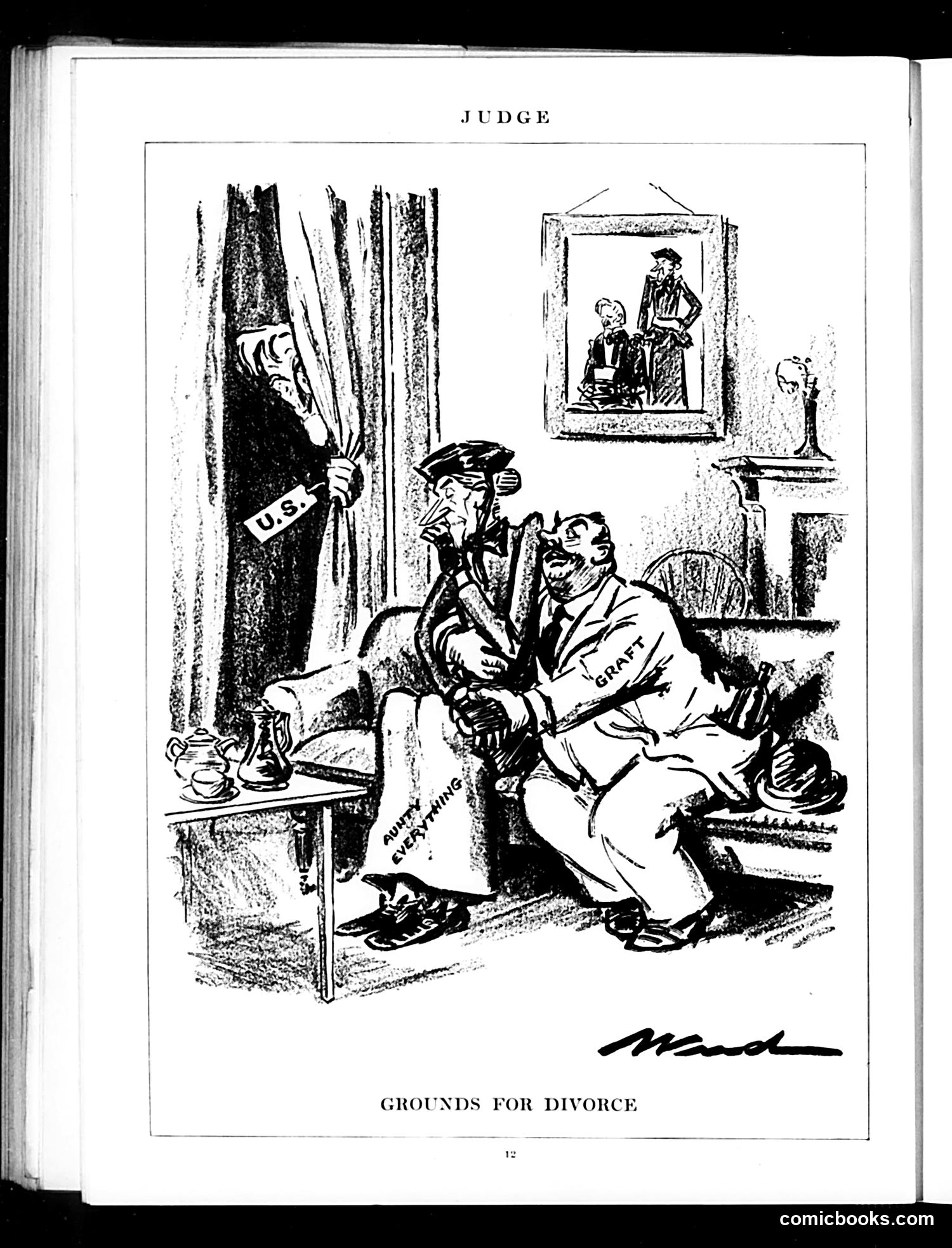
This political cartoon satirizes divorce proceedings. A man labeled "GRAFT" sits in what appears to be a judge's chambers, being questioned by two officials. Behind a curtain marked "U.S." peers a figure (likely representing the government or justice system). A portrait on the wall shows what appears to be legal authority figures overseeing the scene. The satire equates "graft" (corruption/bribery) with a spouse, suggesting that corruption has become so embedded in American institutions that grounds exist to "divorce" it from government. The cartoon critiques how corruption persists despite judicial oversight, using marriage dissolution as metaphor for attempts to remove systemic dishonesty from public office. The setting and formal proceedings mock the bureaucratic processes meant to address corruption, implying they're ineffectual.
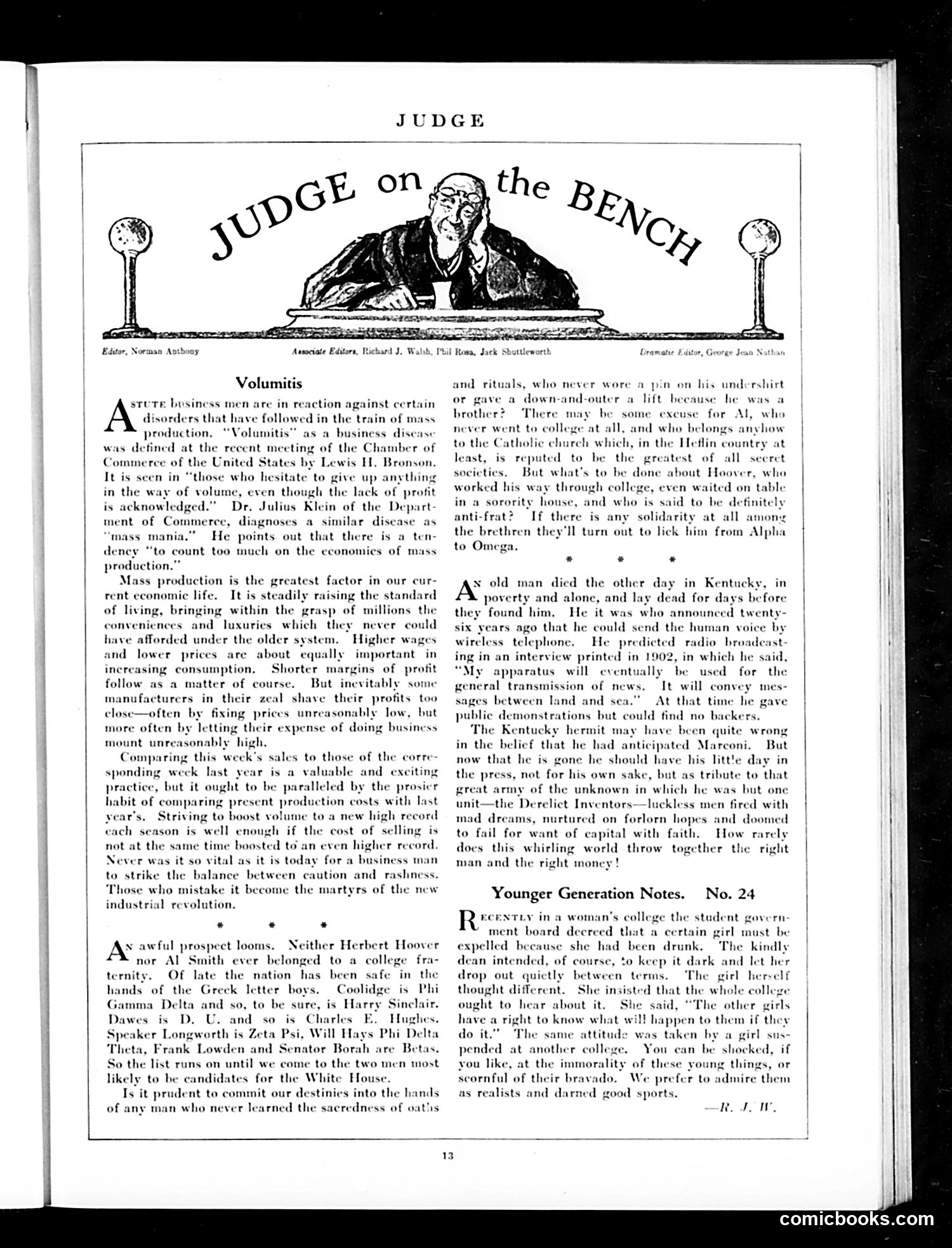
This page satirizes American business and social attitudes of the 1920s. The main article "Volumitis" mocks a disease afflicting manufacturers who pursue maximum production volume at any cost, sacrificing profit margins and business sense. The piece advocates for balance—comparing sales growth should be paired with cost analysis, not just chasing higher records recklessly. The second section attacks fraternity culture among presidential candidates. It sarcastically notes that neither Herbert Hoover nor Al Smith belonged to college fraternities, unlike many predecessors. The author questions whether non-fraternity men understand "the sacredness of oaths and rituals," mocking fraternity elitism while ironically defending their exclusivity. The tone suggests fraternity membership was considered a marker of character and fitness for office. A brief item honors a Kentucky hermit who predicted radio broadcasting in 1902 but died poor and unrecognized—commenting on society's neglect of inventors until fame arrives posthumously.
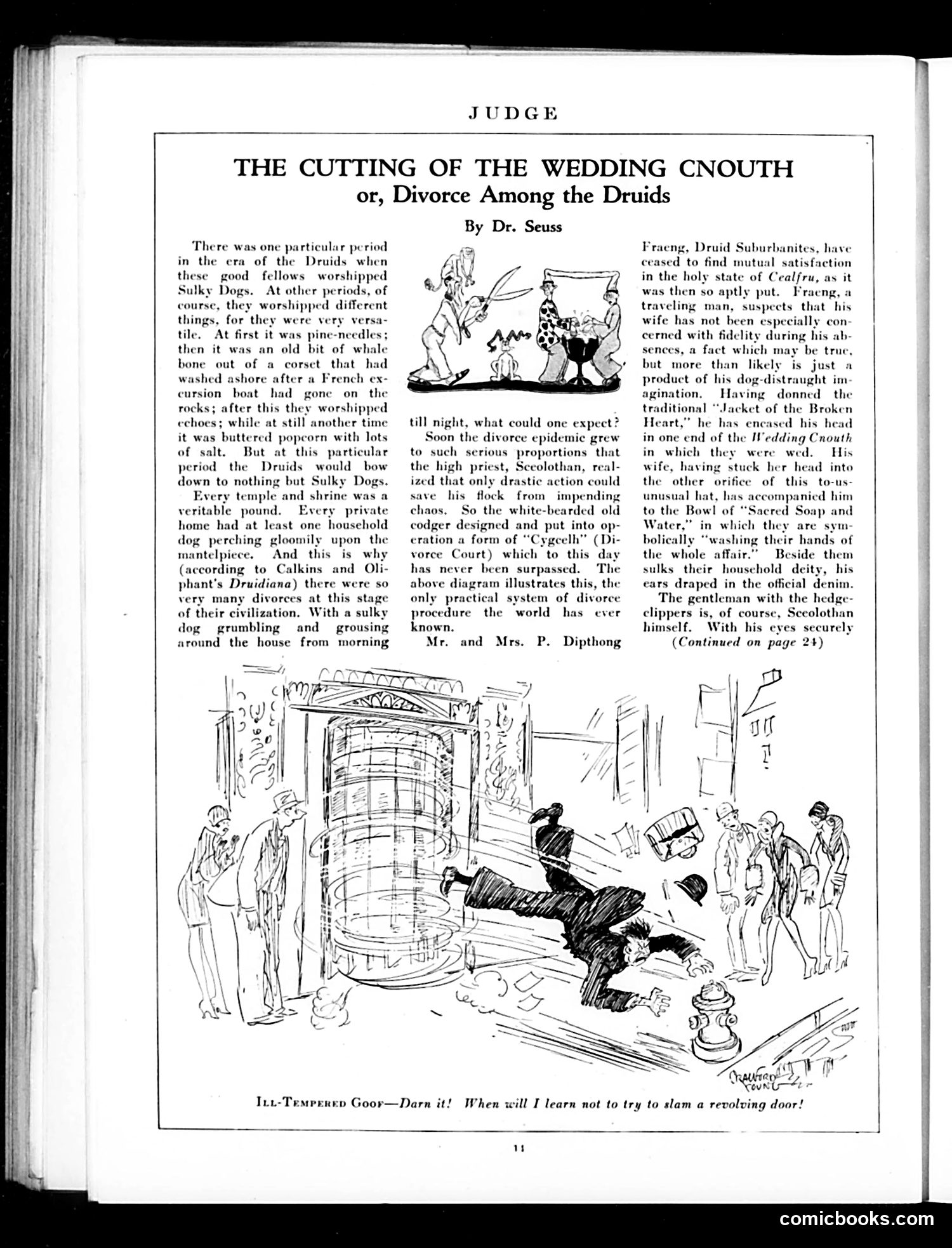
This is a Dr. Seuss satirical piece mocking contemporary divorce proceedings. The fictional "Druids" worship sulky dogs—a stand-in for the petty grievances that destroy modern marriages. The elaborate "Cygeelh" (divorce court) ceremony depicts a couple, Mr. and Mrs. P. Dipthong, literally joined in a shared "Wedding Cnouth" (a play on "knout," a whip), forced to jointly "wash their hands" of the marriage. The satire targets how divorce has become mechanized and absurd: the couple must physically cooperate in their separation ceremony, wearing a shared garment while a high priest (Sceolothan) performs the cutting. The lower cartoon shows slapstick chaos in the actual court proceedings—a man sprawled after hitting a revolving door. The joke: modern divorce is as ritualistic and ridiculous as imagined Druid practices, treating the dissolution of marriage with overwrought ceremony while actual human messiness (the revolving-door accident) goes ignored.
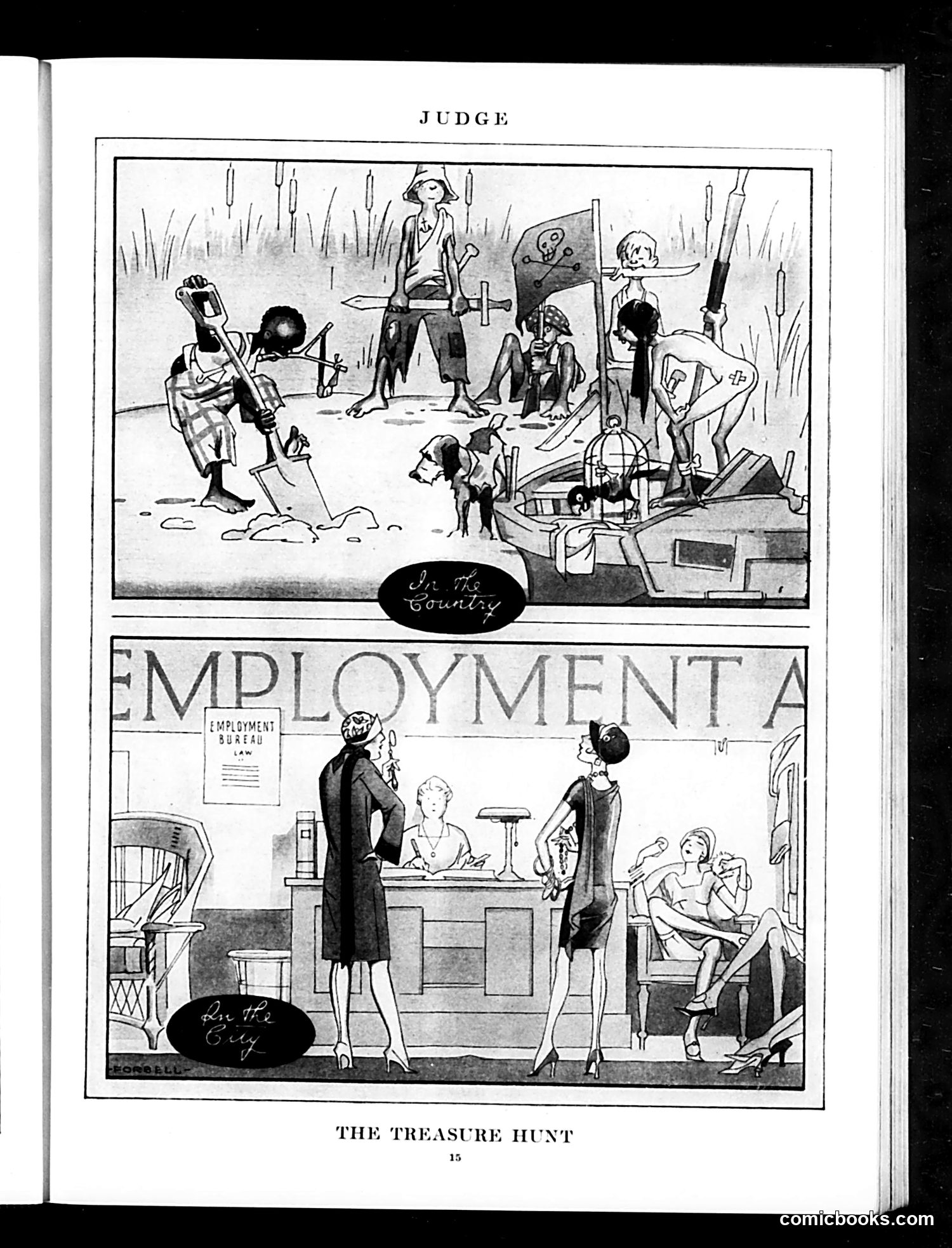
This two-panel cartoon contrasts rural and urban employment during what appears to be an economic downturn (likely the Great Depression era, based on the "Employment Bureau" storefront). **Top panel ("Out the Country"):** Children dressed as pirates conduct a playful treasure hunt amid rural poverty—crude shelters, bare landscape, and makeshift weapons. The satire suggests rural communities are reduced to childish fantasies to cope with destitution. **Bottom panel ("In the City"):** An Employment Bureau office where job-seekers wait hopefully. The contrast is stark: urban unemployment is bureaucratized and somewhat organized, while rural joblessness appears desperate and primitive. The cartoon satirizes how both rural and urban populations desperately hunt for economic survival—one through fantasy, one through official channels—during hard times.
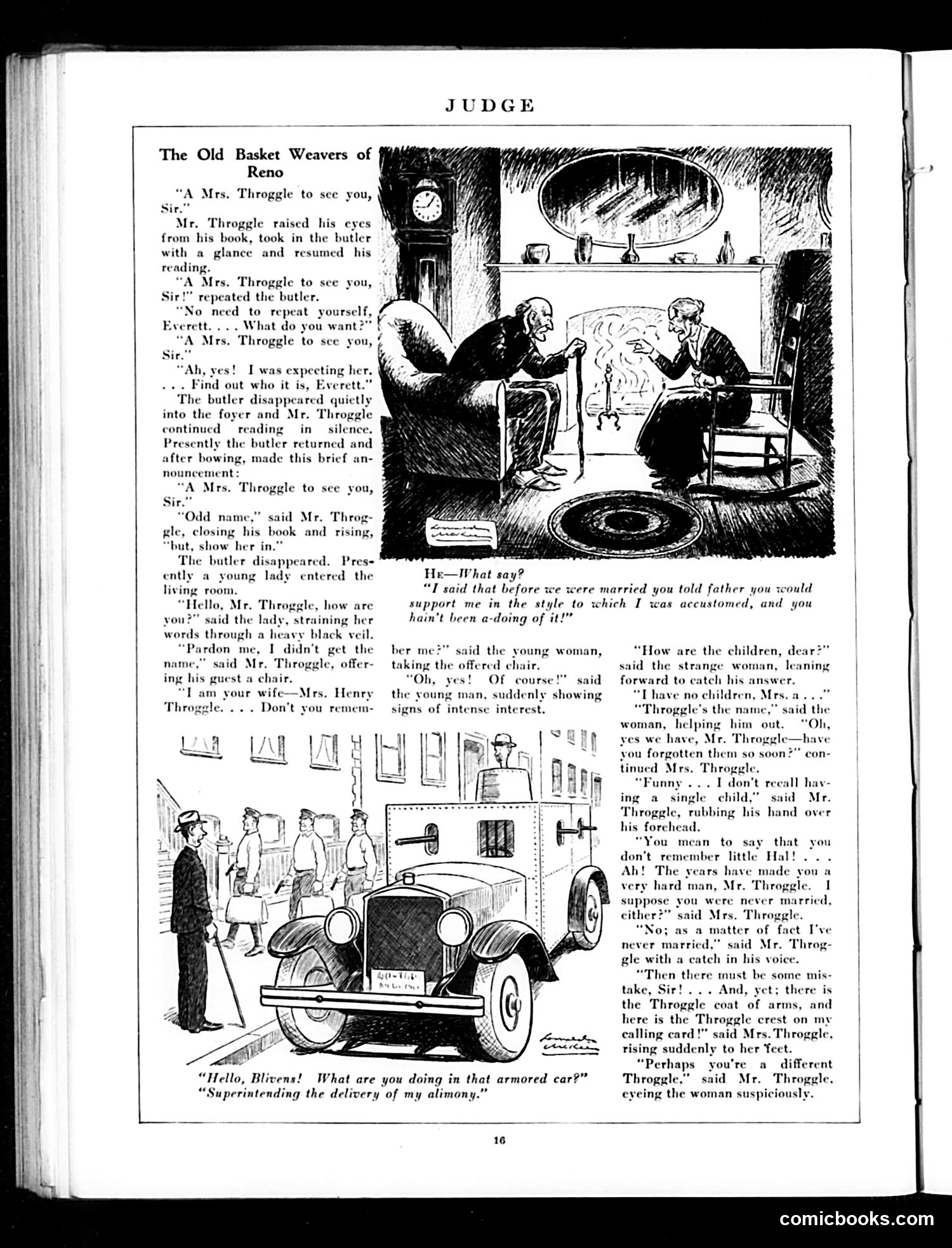
This satirical story depicts a marital confrontation in Reno, Nevada—historically famous as a divorce destination due to lenient laws. The narrative follows Mr. Throggle, whose wife repeatedly interrupts his reading with complaints about his failure to maintain the lifestyle he promised before marriage. The joke centers on Reno's reputation: Mrs. Throggle suggests Mr. Throggle may be seeing another woman, implying he's considering divorce. Mr. Throggle denies being married at all, claiming he "never married" despite their obvious domestic situation. The cartoon satirizes both divorce culture and marital discord, with the "basket weavers" title likely referencing the leisurely pursuits of wealthy divorcees in Reno during the Jazz Age. The accompanying automobile cartoon shows someone arriving for "alimony" delivery.
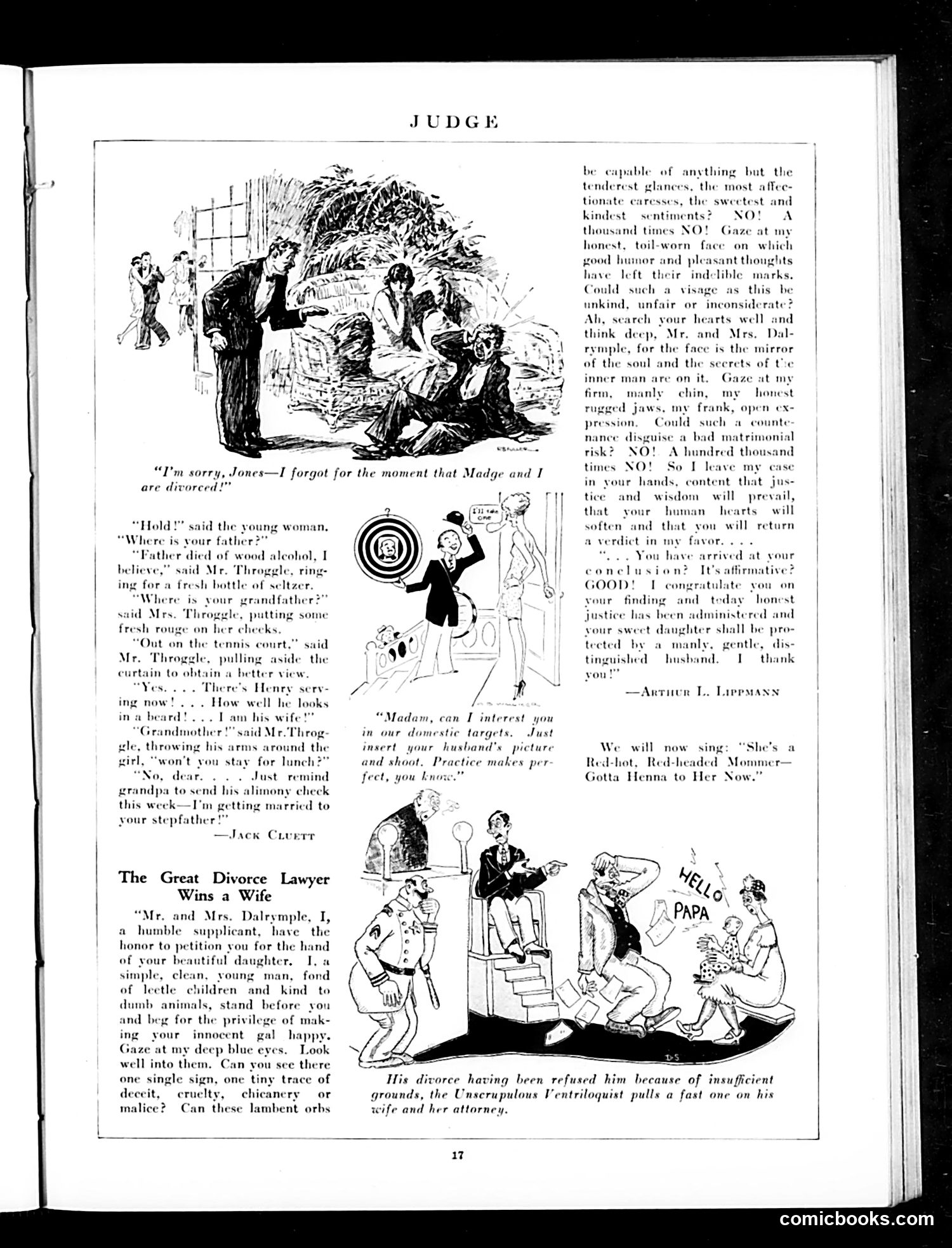
This page contains three separate satirical pieces mocking divorce culture and marital instability in early 20th-century America: **"Judge" (top):** A young woman asks a man about his family, discovering his father died from wood alcohol poisoning, his grandfather plays tennis, and his mother is remarrying—to the man's stepfather. The joke ridicules the casual acceptance of serial marriages and family chaos among the wealthy. **"The Great Divorce Lawyer Wins a Wife" (center):** A manipulative lawyer delivers an absurdly theatrical pitch to parents, using flattery and pseudo-philosophical appeals about his "honest face" revealing his character. He successfully wins their daughter's hand—satirizing both the lawyer's calculated dishonesty and parents' gullibility. **"The Unscrupulous Ventriloquist" (bottom):** After divorce is refused on insufficient grounds, a man uses ventriloquism to make his wife appear to confess during court proceedings—mocking both legal loopholes and marital deception. Overall, Judge critiques the era's loose divorce standards, opportunistic lawyers, and the instability of modern marriage.
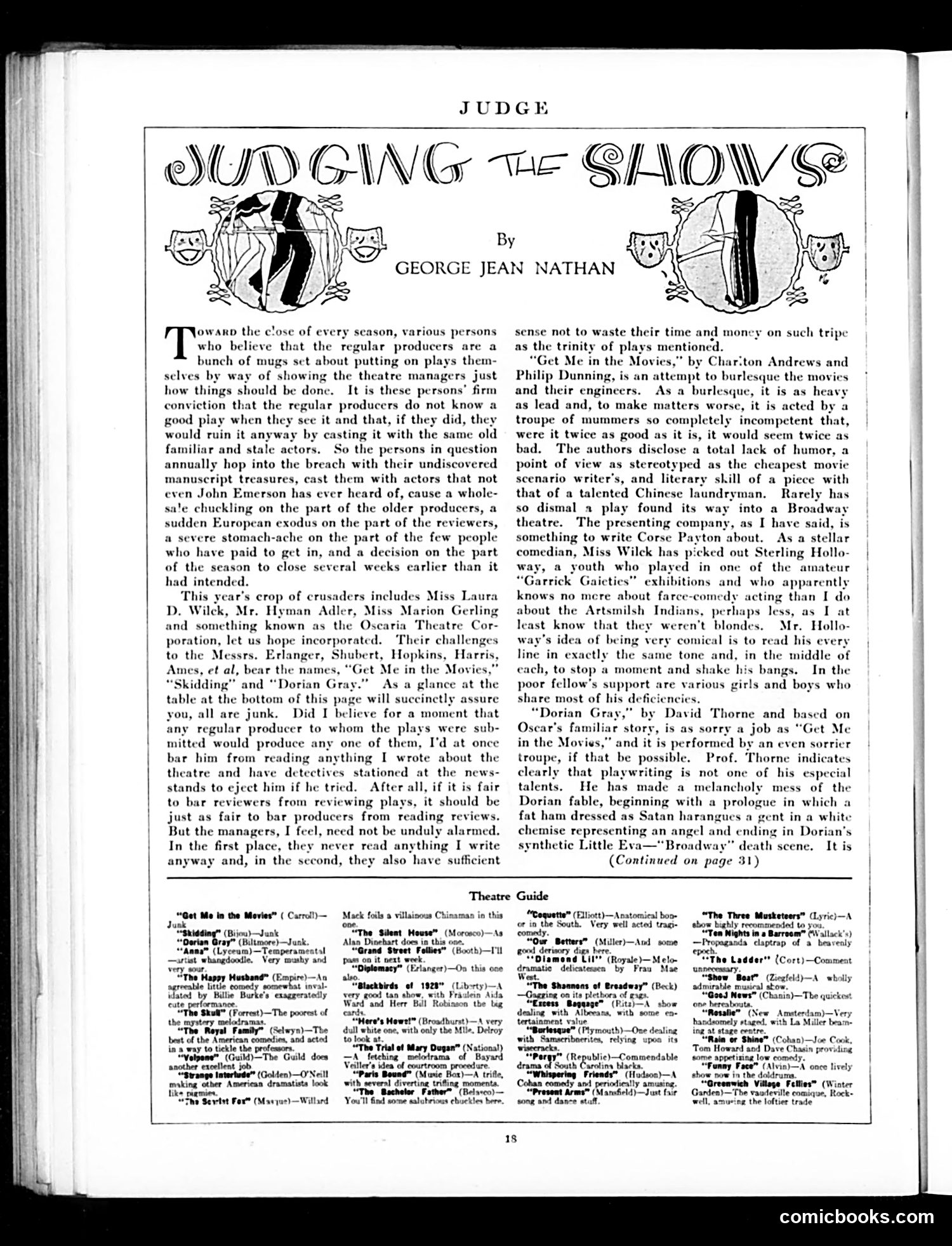
This page is a theater critic's column by George Jean Nathan attacking amateur theatrical producers who annually attempt to challenge established Broadway managers (Erlanger, Shubert, Hopkins, Harris, Ames). Nathan sarcastically argues these amateur "crusaders" submit terrible plays with unknown casts, yet convince themselves professional producers lack judgment. The satire targets the pretension of these amateurs who believe established producers are "mugs" incapable of recognizing good theater. Nathan dismissively catalogs the season's amateur offerings—"Get Me in the Movies," "Skidding," and "Dorian Gray"—as "junk," claiming they inevitably fail and force early season closures. The accompanying theater guide rates current Broadway productions, with Nathan praising O'Neill's "Strange Interlude" and Sherwood's "The Royal Family" while dismissing amateur efforts. The satire captures the perpetual tension between Broadway establishment and aspiring theatrical outsiders, mocking amateur pretentiousness while defending professional judgment—albeit Nathan's own notoriously caustic critical perspective.
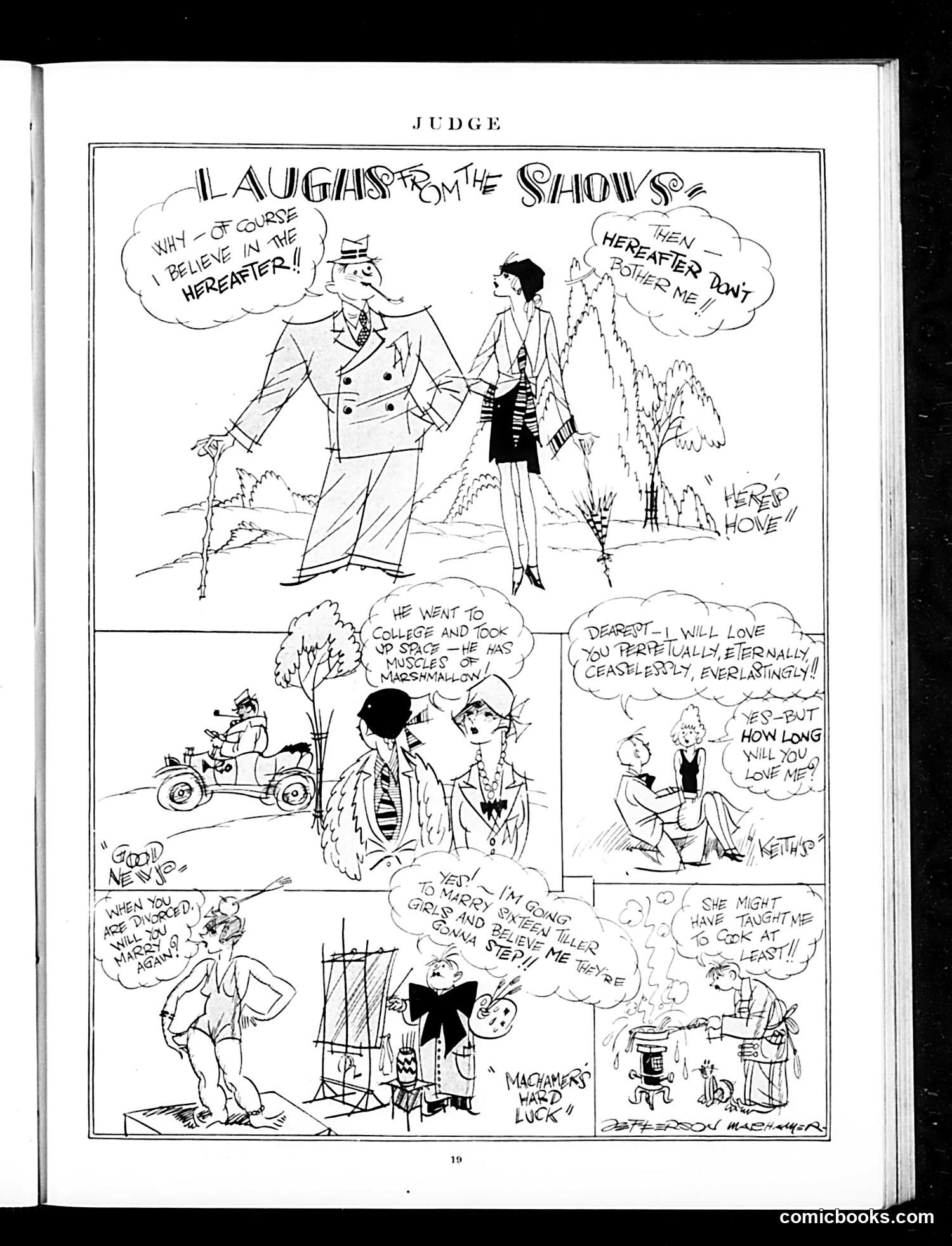
This Judge cartoon satirizes romantic comedies and melodramas popular in early 20th-century theater. The comic follows a predictable plot arc: a man professes belief in the afterlife to win a woman, then she demands eternal devotion. The subsequent panels mock standard theatrical tropes—college romance, muscular suitors, declarations of everlasting love, and emotional manipulation ("She might have forgotten by next"). The satire targets both sentimental stage conventions and the absurdity of romantic promises. Each panel escalates the melodramatic declarations, mocking how theater audiences accepted such overwrought dialogue. The title "Laughs at the Shows" suggests Judge is ridiculing contemporary theater's reliance on exaggerated sentiment and formulaic romance plots rather than genuine humor or sophisticated storytelling. The cartoon critiques the entertainment industry's shameless recycling of emotional clichés.
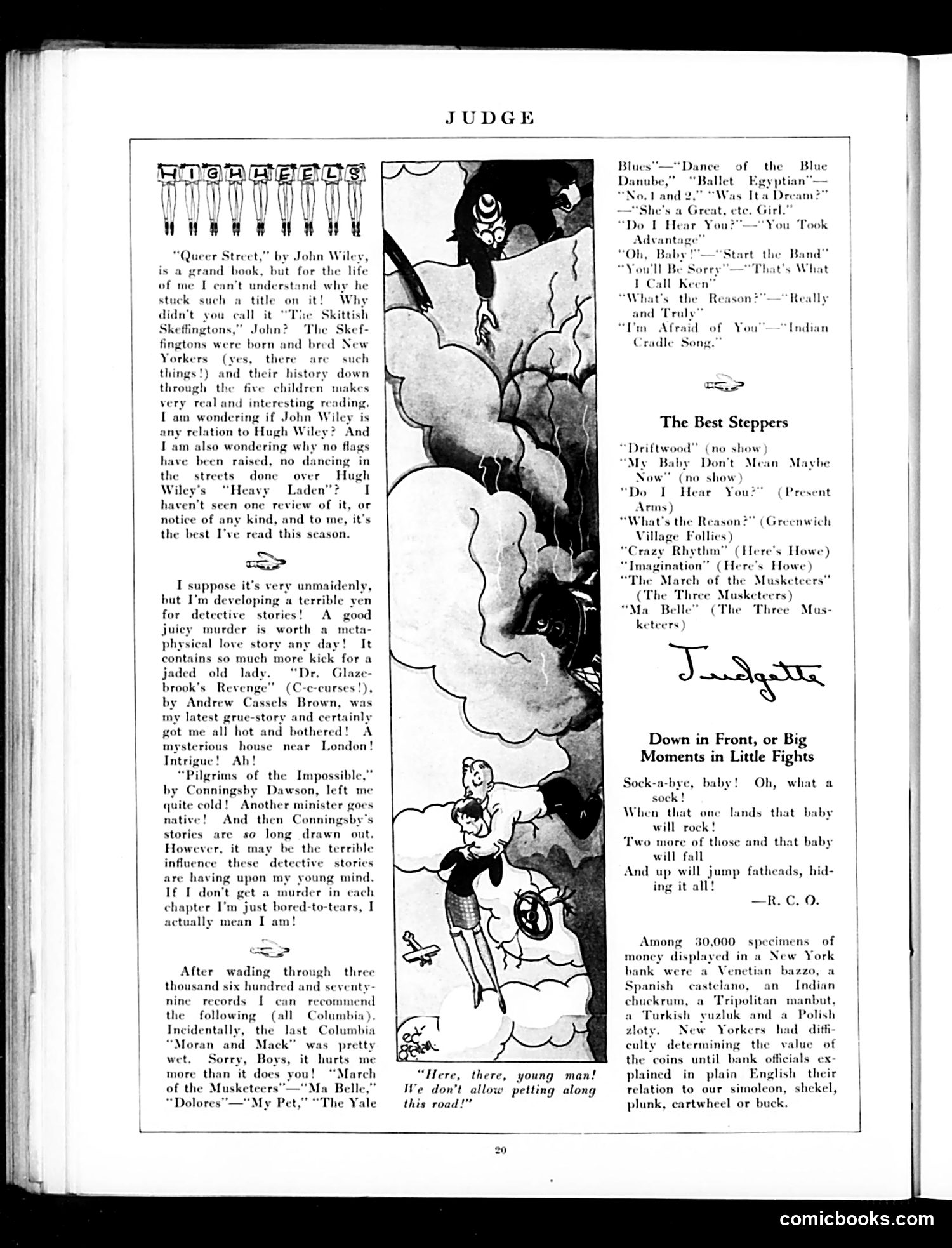
This page mixes book reviews with entertainment recommendations and a cartoon. The left column contains a reader's critique of recent novels, including John Wiley's "Queer Street" and works by Andrew Cassels Brown and Conningsby Dawson—expressing preference for mystery stories over romance. The central illustration depicts a flapper-era couple in a car; the caption "Here, there, young man! We don't allow petting along this road!" satirizes the emerging "petting" culture of the 1920s and moral anxieties about young people's increasingly casual physical behavior in automobiles. This was a common contemporary concern—cars provided unsupervised privacy that shocked older generations. The right side lists popular song recordings and dance numbers of the era, likely from 1920s Columbia Records releases, reflecting the Jazz Age entertainment landscape. The monetary note at bottom describes curious foreign coins in a New York bank display, offering lighthearted cultural observations about different cultures' currencies.
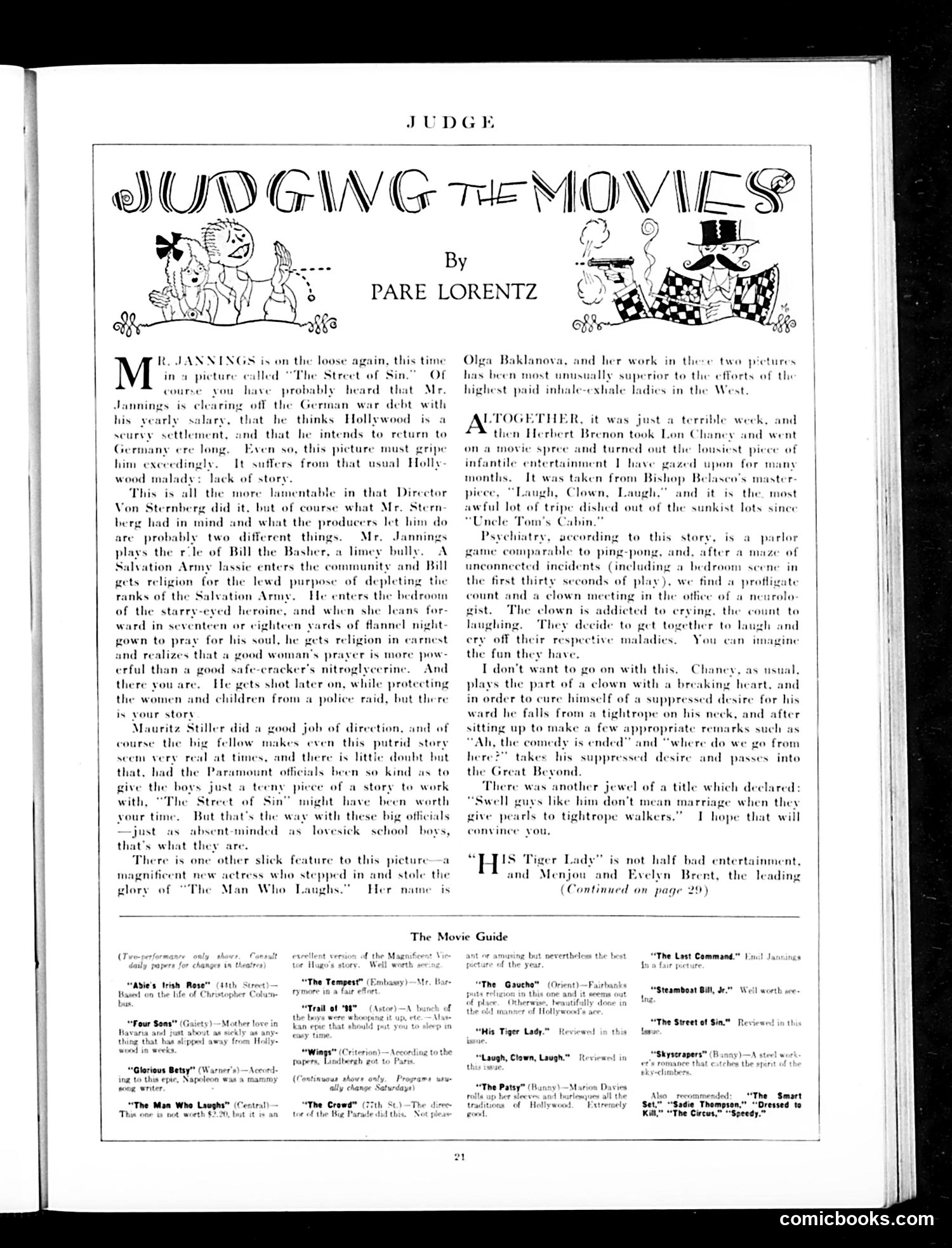
This page contains a film review column by Pare Lorentz critiquing recent Hollywood movies. The cartoonish header illustrations are decorative rather than satirical. The key target is **Emil Jannings**, a German actor whose salary Lorentz sarcastically notes is so high he's paying off Germany's war debt. Lorentz mocks "The Street of Sin" for its threadbare plot—a Salvation Army woman reforms a criminal bully through the power of prayer. He criticizes director Von Sternberg for unclear vision and praises a new actress, **Olga Baklanova**, for outshining more expensive stars. The harshest criticism targets Herbert Brenon's adaptation of "Laugh, Clown, Laugh" with **Lon Chaney**, calling it infantile entertainment. The premise—a clown and count try curing their emotional ailments through shared laughter and tears—is ridiculed as nonsensical. The satire is straightforward: Lorentz exposes how big-budget Hollywood produces shallow, plot-poor dramas while overpaying foreign stars and established directors who deliver mediocrity.
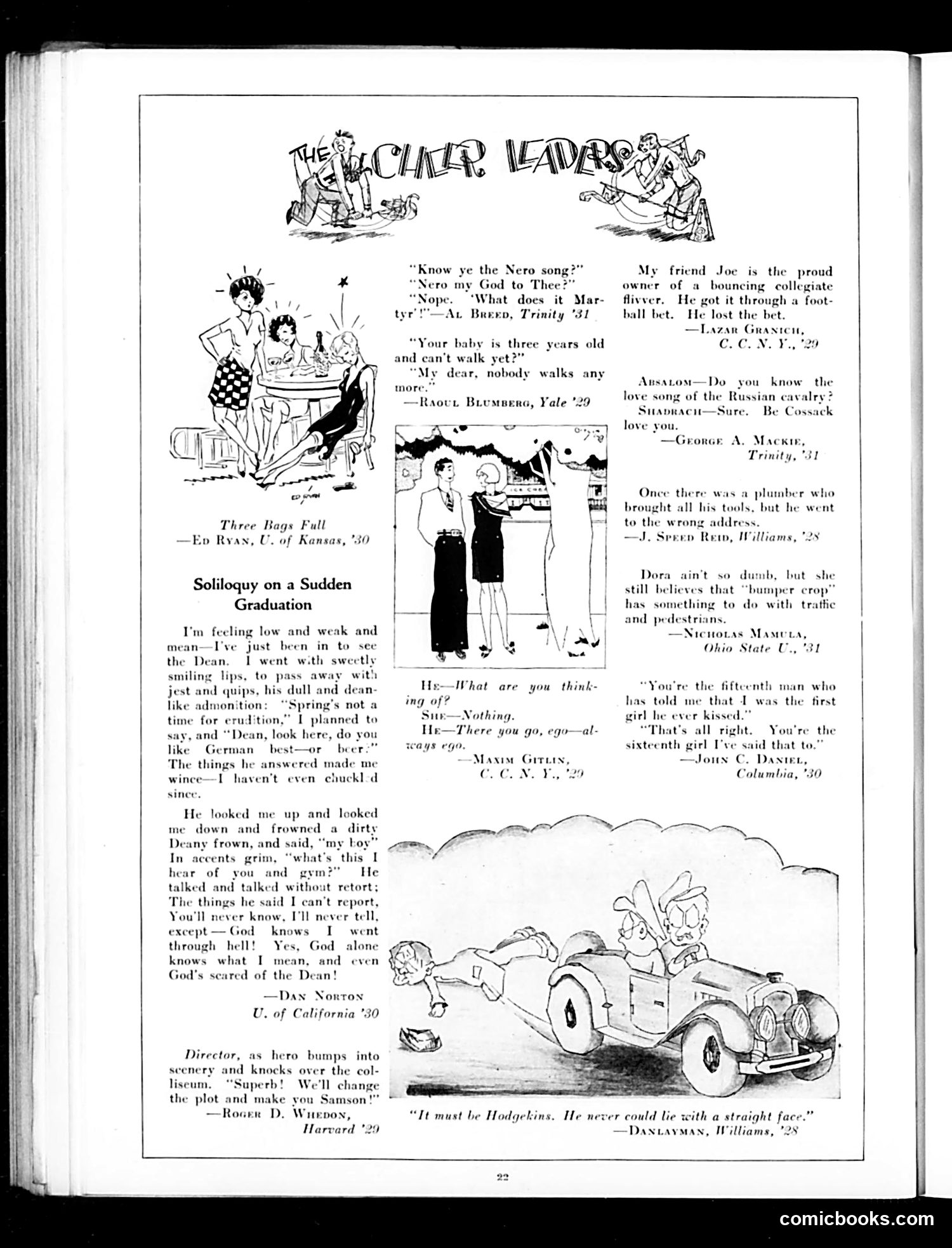
This is a college humor page from Judge magazine, circa 1928-1931, collecting witty observations and jokes submitted by students from various universities (Columbia, Yale, Harvard, Williams, etc.). The content satirizes **college life and youth culture**: academic authority (the intimidating Dean), romantic mishaps, stupid misunderstandings, and the gap between youthful pretense and reality. The cartoons illustrate representative jokes—one shows a dinner party scene, another depicts a car accident with cartoon characters. The humor is largely **self-deprecating collegiate humor**: students admitting their incompetence with tasks (the plumber going to the wrong address), romantic confusion (counting how many girls claimed to be "the first"), and anxiety about authority figures. The "Soliloquy on a Sudden Graduation" depicts a student terrified by the Dean's stern lecture. The overall tone reflects **1920s-30s upper-class college culture**—these are university students publishing in a national satirical magazine, finding humor in their own social world rather than broader political issues.
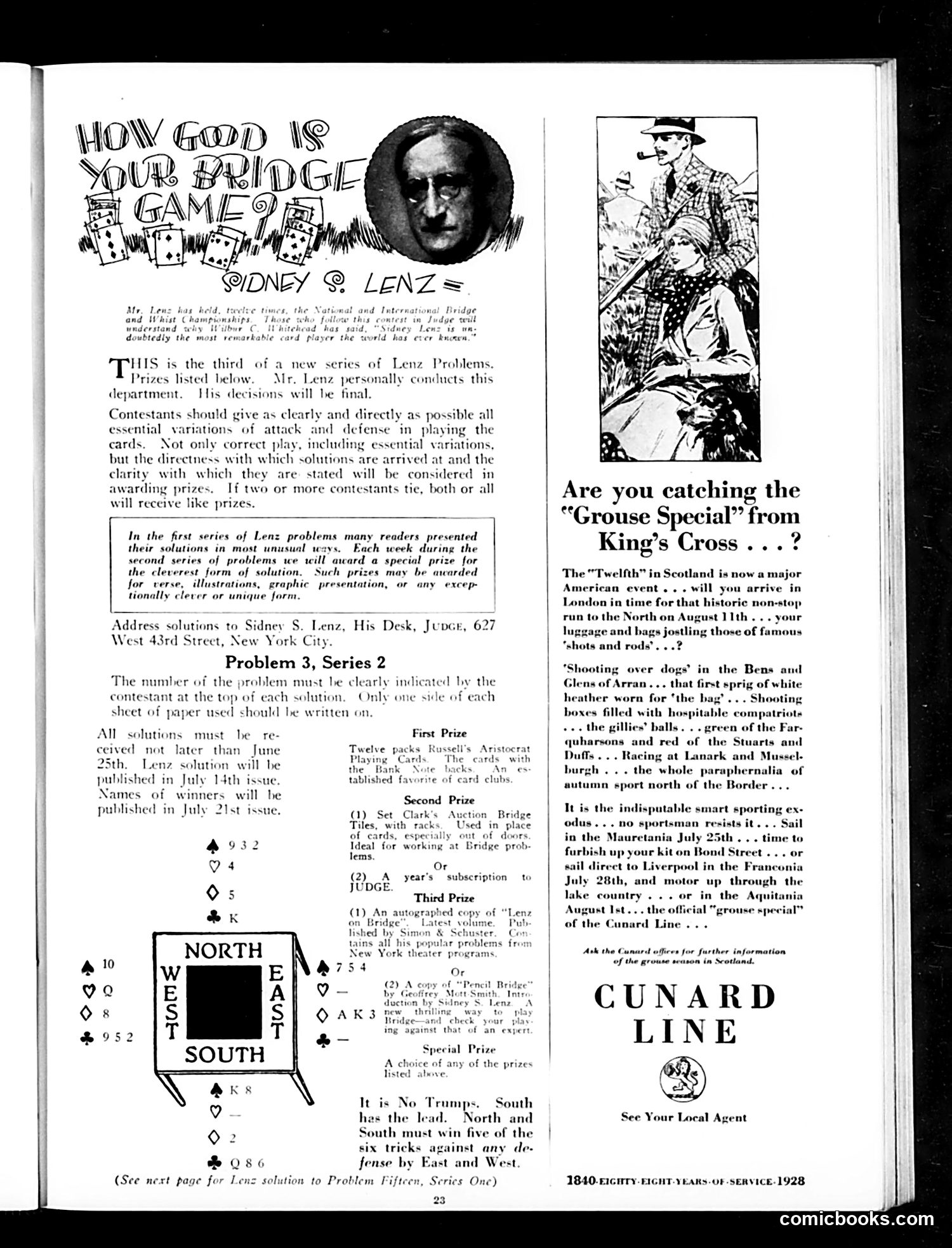
This page combines a **bridge card game puzzle** with **travel advertising**. ## Main Content: Sidney Lenz Bridge Problem The prominent feature is a contest by **Sidney Lenz**, described as "the most remarkable card player the world has ever known." Lenz was a famous contract bridge expert of the 1920s. Judge magazine ran a series of bridge problems he personally judged, offering prizes (playing card sets, Judge subscriptions, theater tickets) for the best solutions. Contestants were judged not just on correct play, but on how clearly and cleverly they explained their reasoning. ## Advertisement: Cunard Line The right side advertises the **Cunard Line's transatlantic steamship service**, promoting travel to Scotland for "The Twelfth"—the opening day of grouse hunting season (August 12th), a major event for wealthy British and American sportsmen. The ad lists Scottish hunting regions and promises fast passage to London and onward travel. The contrast reflects Judge's affluent readership: intellectual card games for the mind, luxury travel for the body.
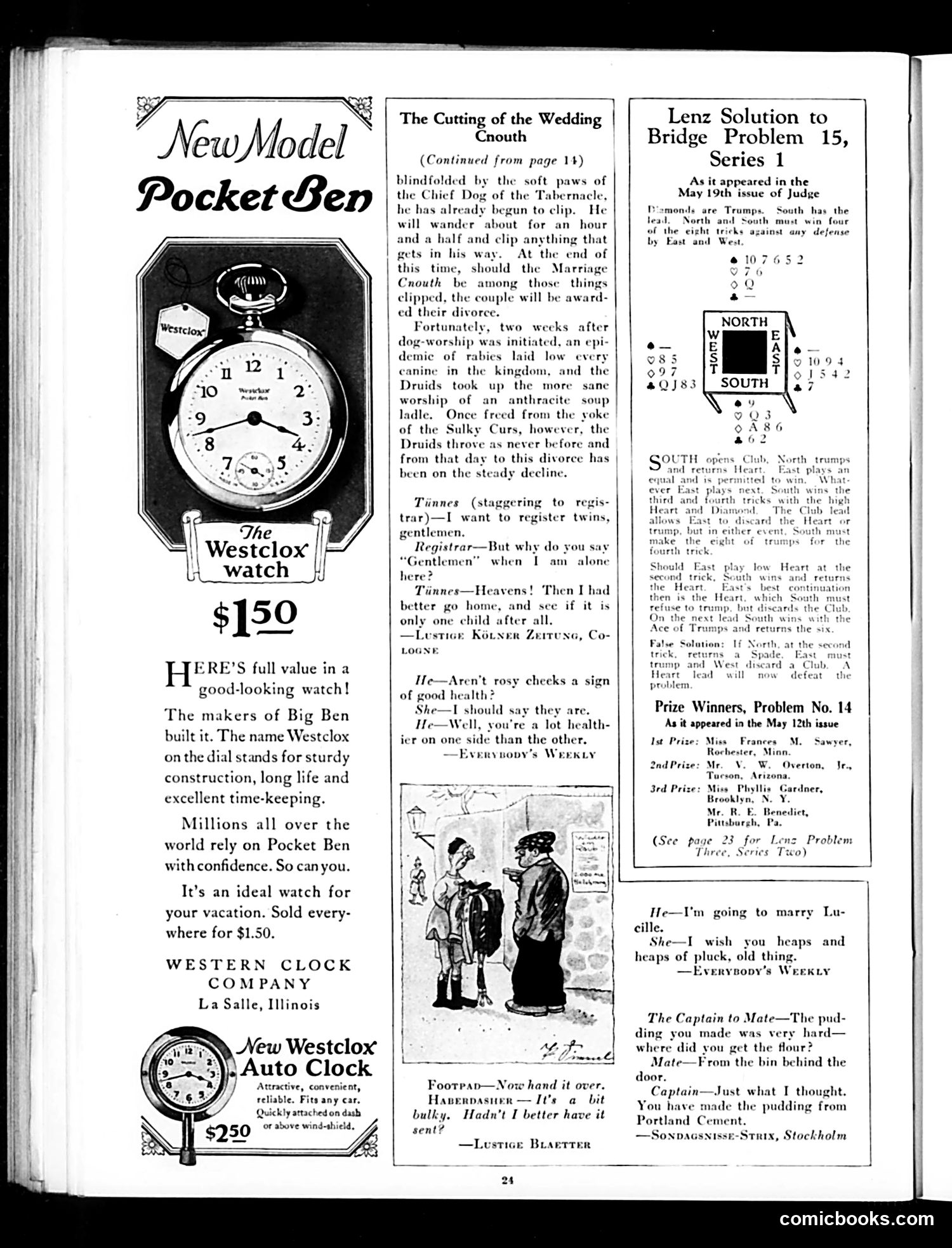
This page is primarily **advertising**, featuring a Westclox pocket watch and auto clock prominently. The editorial content consists of brief humorous quips and a bridge problem solution. The cartoons/jokes are light social satire typical of Judge magazine: - **"The Cutting of the Wedding Cnouth"** is a mock-serious fictional narrative about a bizarre Druid divorce ritual involving a blindfolded dog, eventually replaced by soup-ladle worship. It's absurdist humor satirizing divorce practices. - **Brief jokes** scattered throughout target marital dynamics and gender relations ("He—Aren't rosy cheeks a sign of good health?"), with punchlines suggesting women's dishonesty or health issues depending on which side of their face you observe. - A **seafaring joke** about inferior flour mistaken for Portland cement in pudding. These represent typical early 20th-century Judge humor: domestic comedy, absurdist scenarios, and gentle mockery of marriage and relationships. The tone is lighthearted rather than cutting political satire.
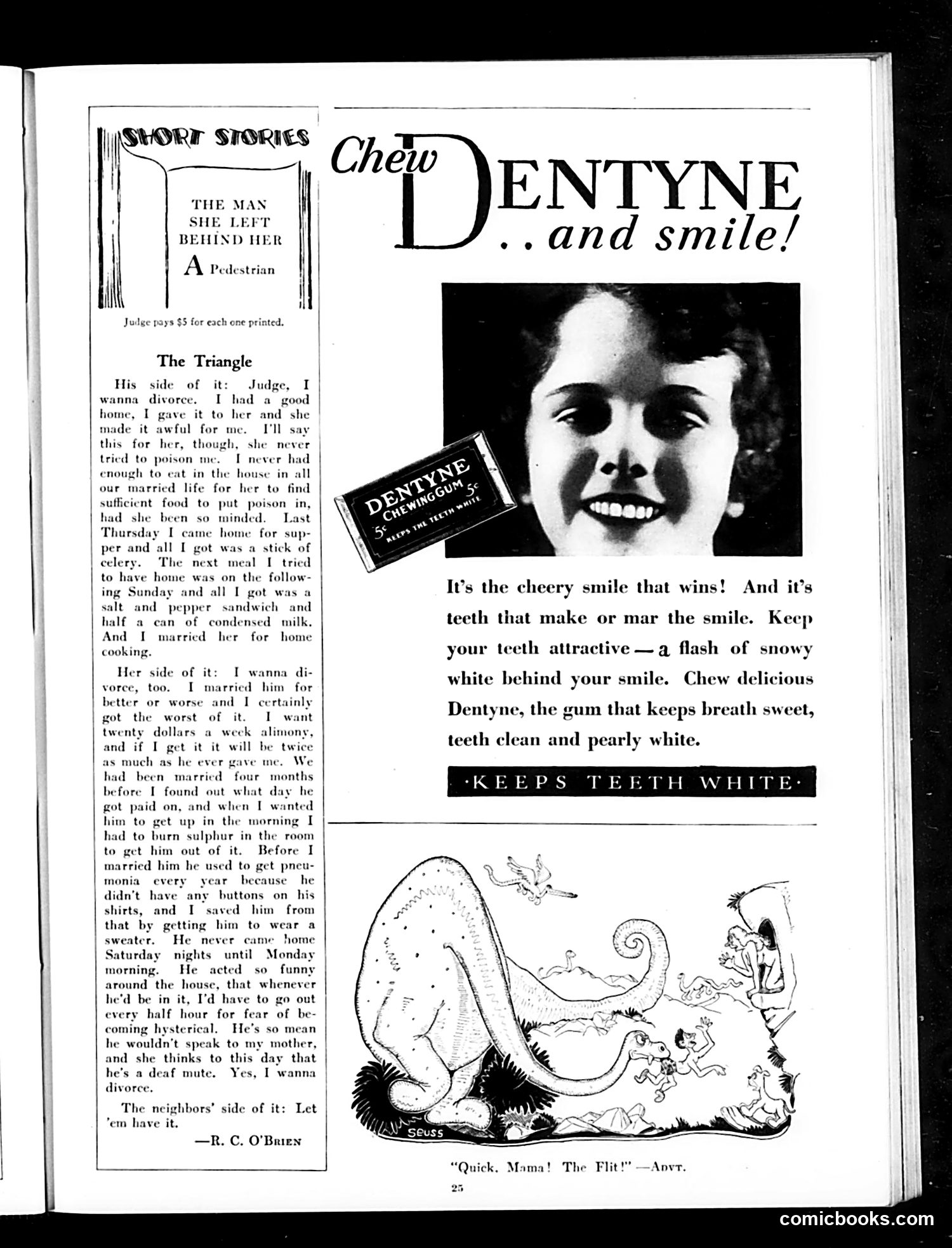
This page contains two distinct elements: **Left side:** A short story titled "The Triangle" by R.C. O'Brien about a divorce dispute. A husband and wife each present their grievances to a judge—he complains she starved him; she counters that he was unemployable and emotionally abusive. The joke's punchline is the "neighbors' side," which dismisses both: "Let 'em have it" (divorce each other). This satirizes the messy, mutually-blaming nature of marital discord and suggests both parties are equally at fault. **Right side:** A full-page advertisement for Dentyne chewing gum, featuring a woman's photograph and a Dr. Seuss cartoon illustration. The ad promises that attractive teeth and fresh breath ("the cheery smile that wins") improve one's appearance and social success. The tagline "Keeps Teeth White" emphasizes cosmetic benefits. The page juxtaposes marital misery with consumer optimism—suggesting gum-chewing offers an escape from life's problems through improved appearance.
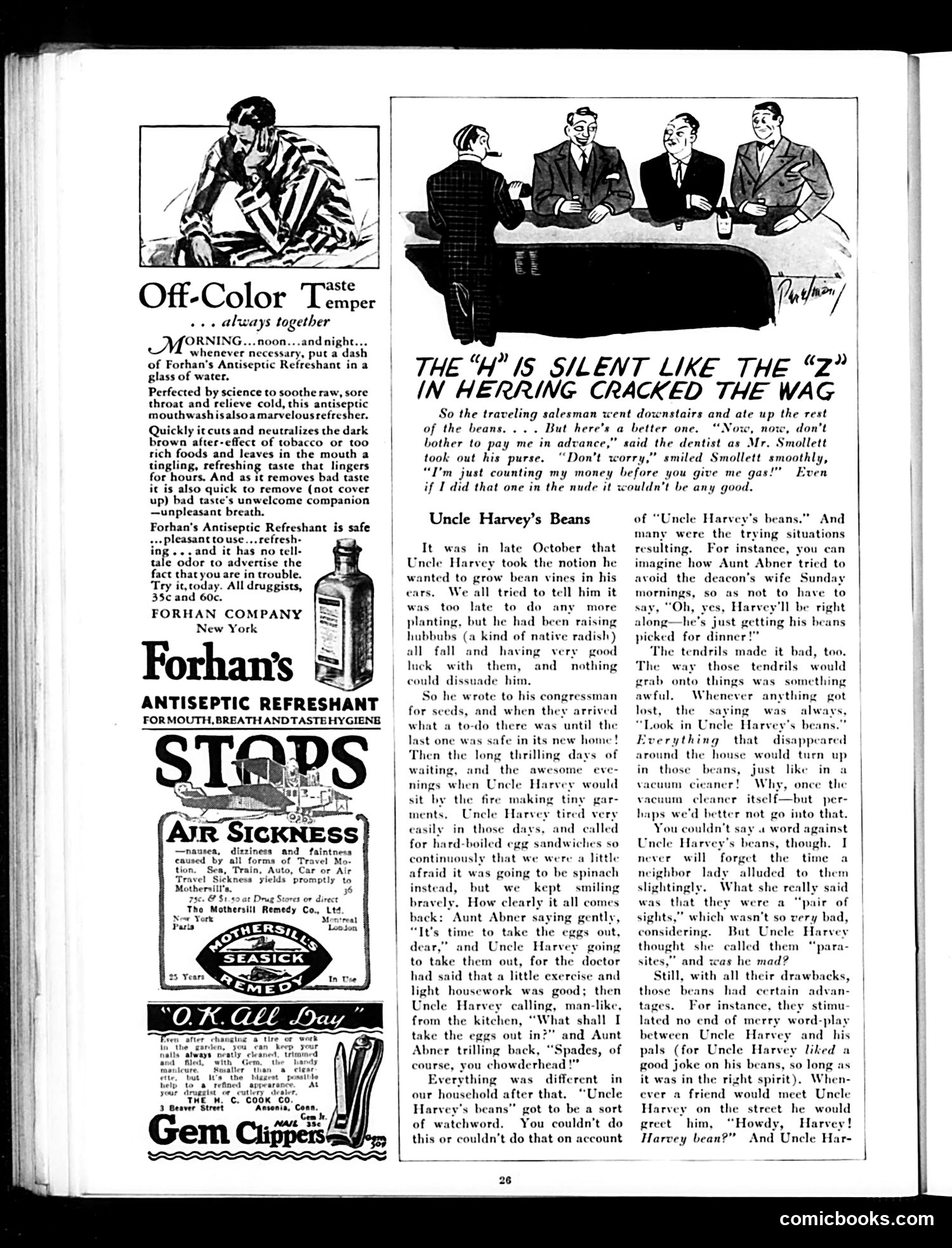
This page mixes advertisements with humorous fiction. The main cartoon/illustration titled "THE 'H' IS SILENT LIKE THE 'Z' IN HERRING CRACKED THE WAG" depicts a traveling salesman at a dining table with businessmen. The joke appears to be a play on words about silent letters—a salesman eats someone else's beans, then makes a pun about being "in the nude" regarding payment, suggesting wordplay confusion. The bulk of the page is the short story "Uncle Harvey's Beans"—a comedic domestic narrative about an elderly uncle who inexplicably plants bean vines in late autumn. The humor derives from the absurdity of the endeavor, the family's patient indulgence despite obvious failure, and how "Uncle Harvey's beans" becomes a household catchphrase for chaos and lost items. The advertisements (Forhan's Antiseptic Refreshant, Mothersill's Remedy, Gem Clippers) are period typical. The satire targets neither politics nor current events—it's purely domestic humor emphasizing family eccentricity and gentle mockery of stubborn elderly relatives.
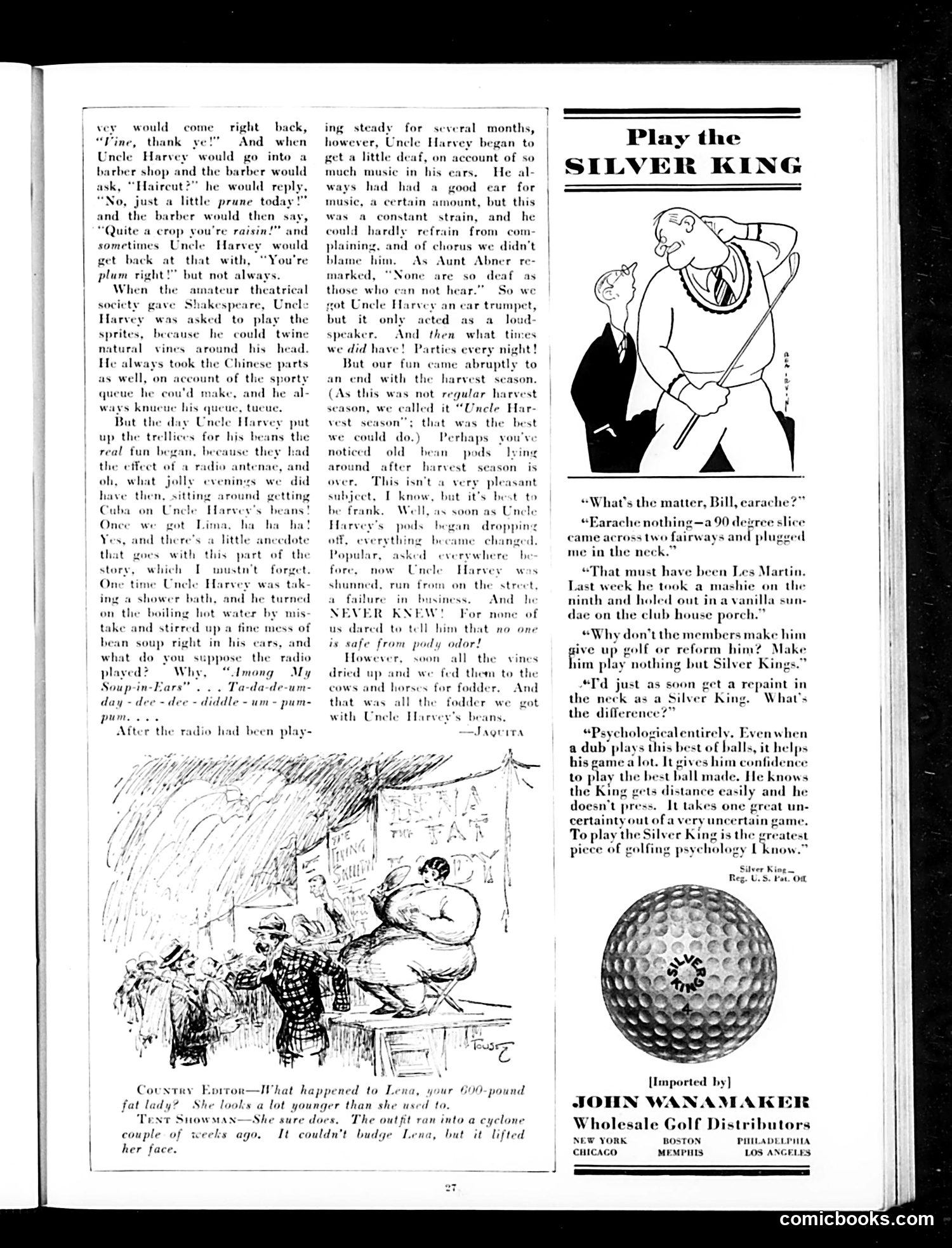
This page contains a humorous short story about "Uncle Harvey," a man famous for growing large bean plants. The main joke: Uncle Harvey becomes deaf from a radio antenna he fashioned from his bean vines, then installs an ear trumpet that functions as a loudspeaker, turning his home into an unwanted concert venue for neighbors. When his bean plants eventually fail and stop producing, he's mysteriously shunned—he never learns that everyone avoided him because of the notorious "pody odor" (body odor) from his rotting beans. The cartoon below depicts a country editor discussing a 600-pound tent-show performer ("Lena") who was unharmed by a cyclone that destroyed her circus—the joke being her immense weight made her immovable. The right side is a **golf equipment advertisement** for "Silver King" golf balls, distributed by John Wanamaker stores. The advertiser claims the ball's psychological effect builds player confidence and improves performance.
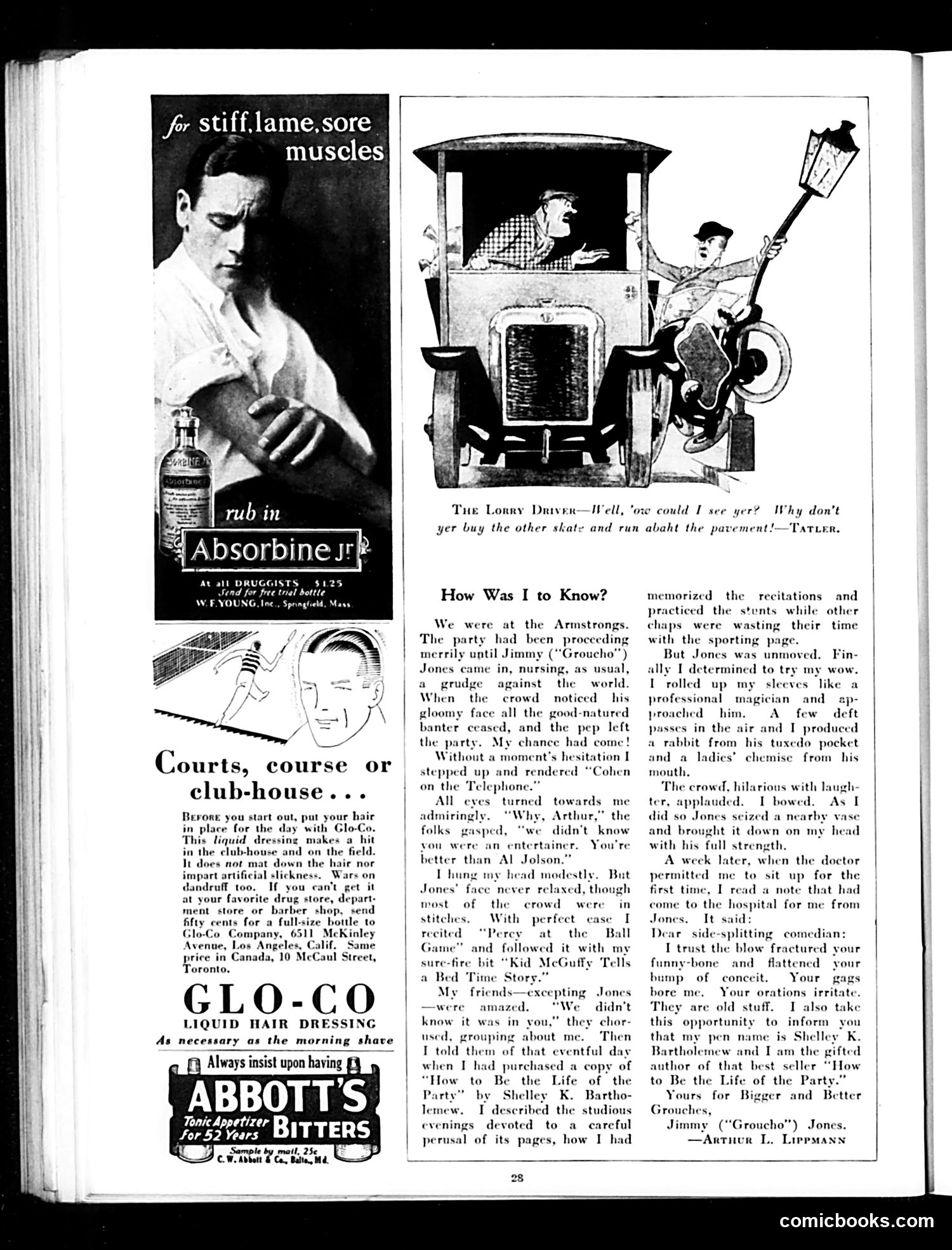
This page contains advertisements and a humorous short story titled "How Was I to Know?" The narrative satirizes amateur entertainers who overestimate their talent. The protagonist, Arthur, attends a party where the famously grouchy Jimmy Jones is present. Seizing the opportunity to impress the crowd, Arthur performs recitations and magic tricks, claiming he learned them from a self-help book titled "How to Be the Life of the Party" by Shelley K. Bartholomew. The crowd loves his act—until Jones violently hits him with a vase. The punchline: Jones reveals he *wrote* that self-help book and considers Arthur's performance derivative and irritating. The satire mocks both Arthur's presumption that following a guide makes him entertaining, and the broader era's self-improvement book culture. The cartoon at top depicts a lorry driver's complaint about visibility—unrelated to the main story.
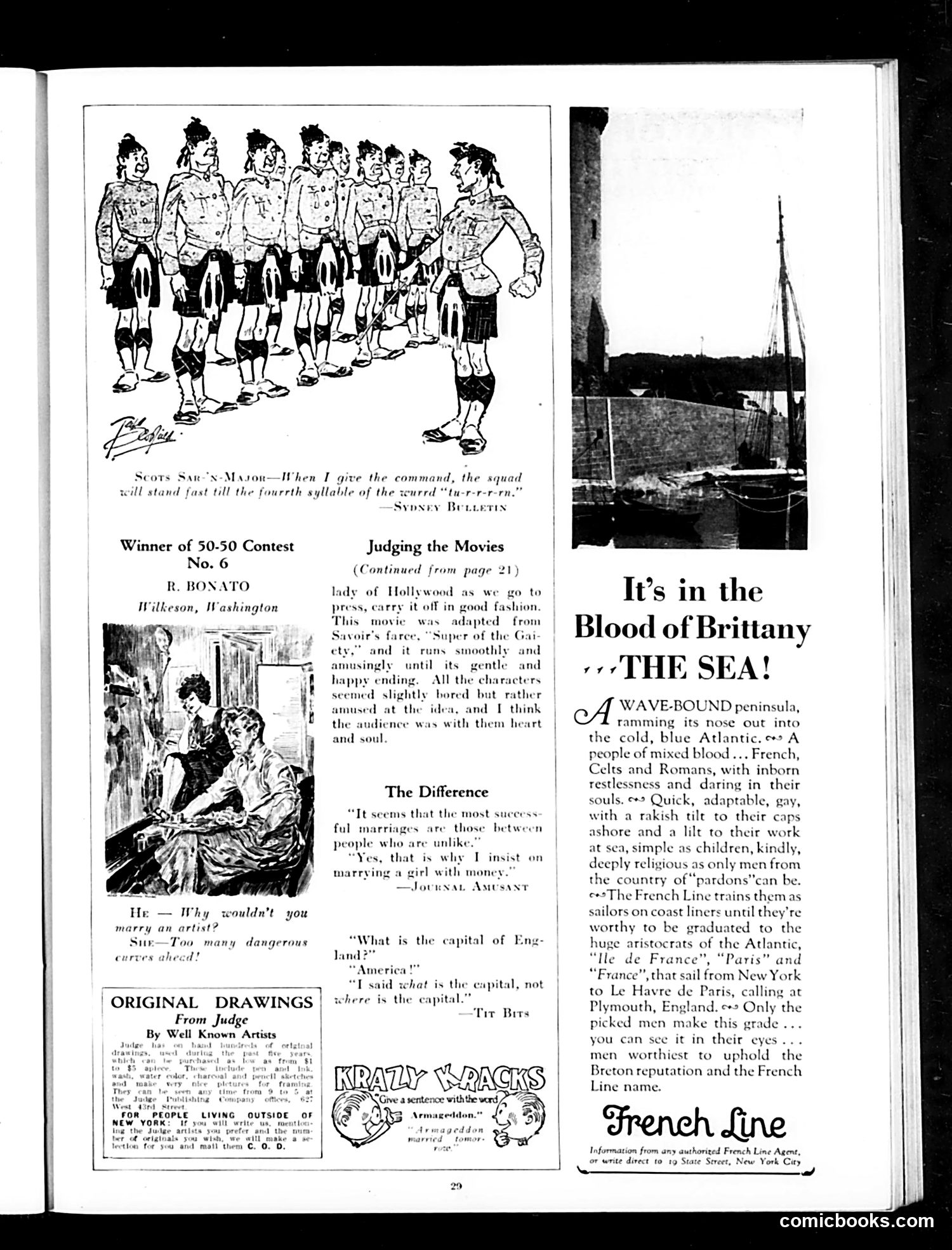
This page contains several distinct elements: **The cartoon at top** depicts a Scottish military sergeant ordering troops to pronounce a command with precise syllable timing—a joke about Scottish accent's difficulty with the rolled "r" sound in "turn." **The "Winner of 50-50 Contest"** shows a domestic humor comic: a man explains why he married a woman with money (rather than an artist, which would be "dangerous")—satirizing mercenary marriages and the stereotype of struggling artists. **"Judging the Movies"** is a film review section discussing a movie adaptation. **"The Difference"** is a brief joke contrasting successful marriages between opposites with the man's motivation (marrying for money). **The large right-side advertisement** promotes the French Line shipping company, romanticizing Breton sailors as naturally suited to maritime work due to their mixed Celtic-Roman heritage. This reflects early 20th-century ethnic essentialism—the pseudo-scientific belief that ancestry determined occupational aptitude. The page is primarily humorous content with advertising, typical of Judge's satirical format.
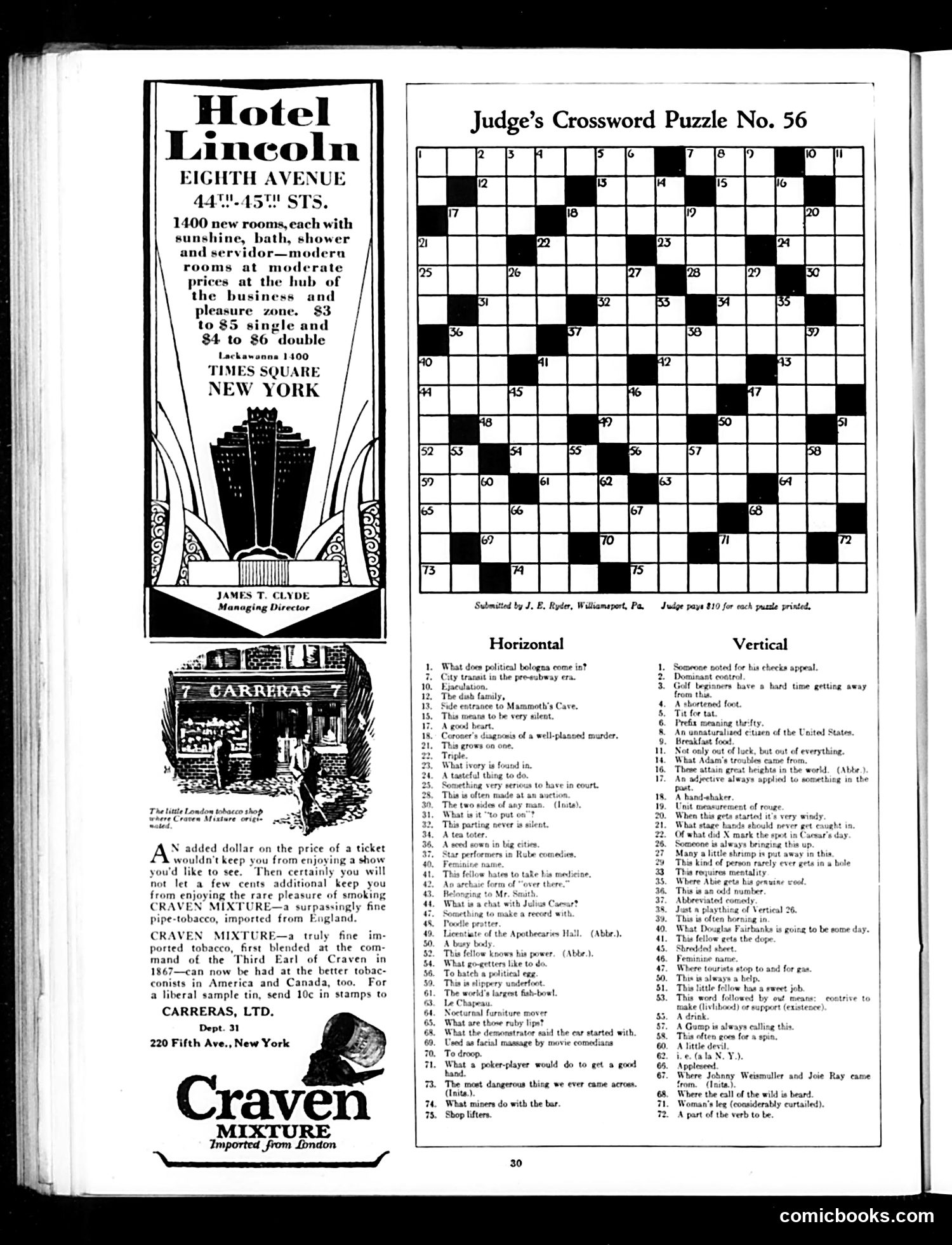
This page is primarily a **crossword puzzle** ("Judge's Crossword Puzzle No. 56") with clues listed horizontally and vertically. The puzzle itself contains no political satire—it's a straightforward word game submitted by J.B. Ryder of Williamsport, PA, with Judge paying $10 for each puzzle printed. The page also features **advertisements**: a Hotel Lincoln ad (Times Square, New York), and prominent advertising for **Craven Mixture**, an imported English pipe tobacco. The tobacco ad emphasizes the product's luxury and heritage (supposedly blended since 1867 for the Third Earl of Craven). There is a small illustration of what appears to be a London tobacco shop, and another Carreras Ltd. tobacco company advertisement. **No political content or satire is present on this page**—it represents Judge magazine's typical mix of entertainment puzzles and period advertising.
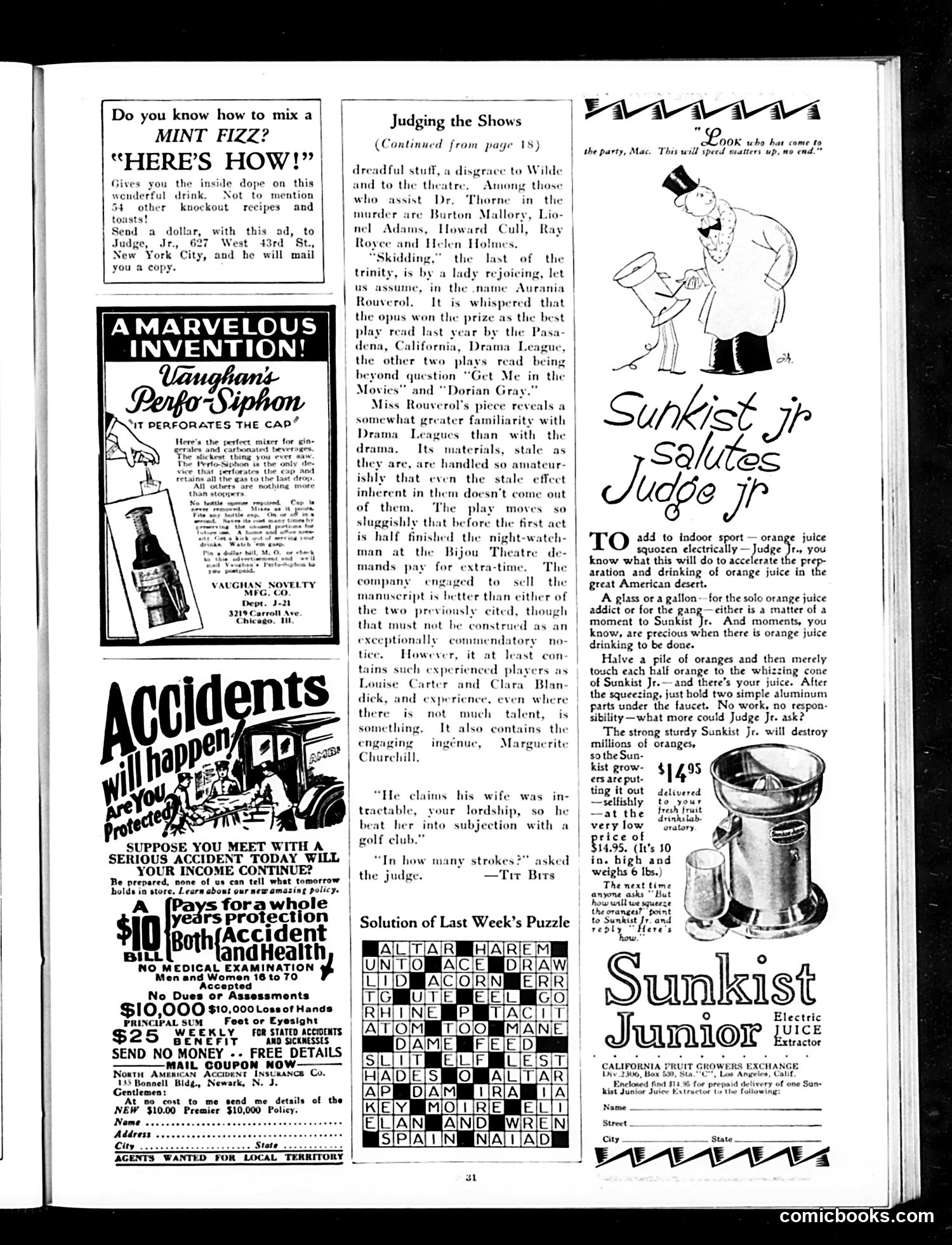
This page is primarily **advertising and product promotion**, with a small theatre review section. The main content includes: **"Judging the Shows"** reviews three theatrical productions, critiquing their quality. The reviewer dismisses plays like "Get Me in the Movies" and "Dorian Gray" as clichéd, while discussing "Skidding" by Aurania Rouverol—noting it won a Pasadena Drama League prize but criticizing its amateurish execution despite featuring experienced actors like Louise Carter and Clara Blandick. **The cartoons/jokes** are minimal: a small illustration of "Sunkist Jr." salutes "Judge Jr." (a playful product endorsement), and a brief joke about a man beating his wife with a golf club for being "intractable"—dark humor typical of 1920s publications. **Advertisements** dominate: Vaughan's Perfo-Siphon (a carbonation device), accident insurance policies, and the Sunkist Junior Electric Juice Extractor—the page's featured product promoting electric orange juice extraction as modern convenience. The overall tone reflects 1920s consumer culture and casual attitudes toward domestic violence now considered deeply offensive.
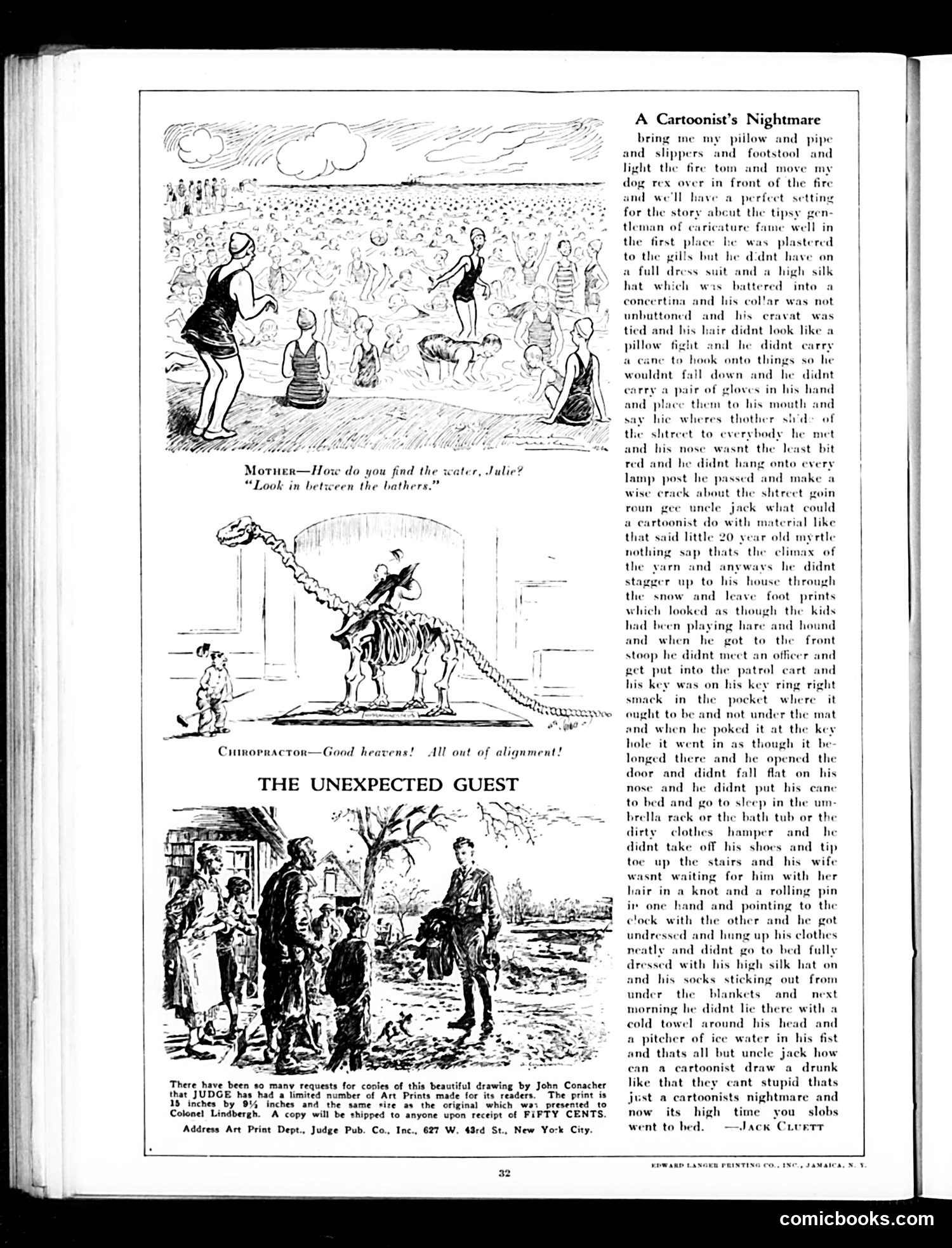
This page contains three distinct pieces from *Judge* magazine: **Top cartoon** ("A Cartoonist's Nightmare"): A humorous meta-commentary on cartooning conventions. The joke: a cartoonist describes an impossibly *sober* drunk man—no slurred speech, proper dress, functional motor skills—and complains he has no material to work with. It satirizes how cartoonists rely on exaggerated physical comedy and stereotypes (the "tipsy gentleman") rather than subtle character work. The humor comes from reversing expectations: sobriety becomes the real nightmare. **Middle cartoon** ("Chiropractor"): Shows a chiropractic adjustment gone hilariously wrong, with a patient's spine comically extended. It mocks the emerging chiropractic profession's claims through slapstick visual humor. **Bottom section** ("The Unexpected Guest"): An illustration by John Conacher, apparently presented to Colonel Lindbergh (the famous aviator), now being sold as an art print. The text doesn't explain the narrative, making its specific meaning unclear from this page alone. The advertisements promote these artworks to readers.
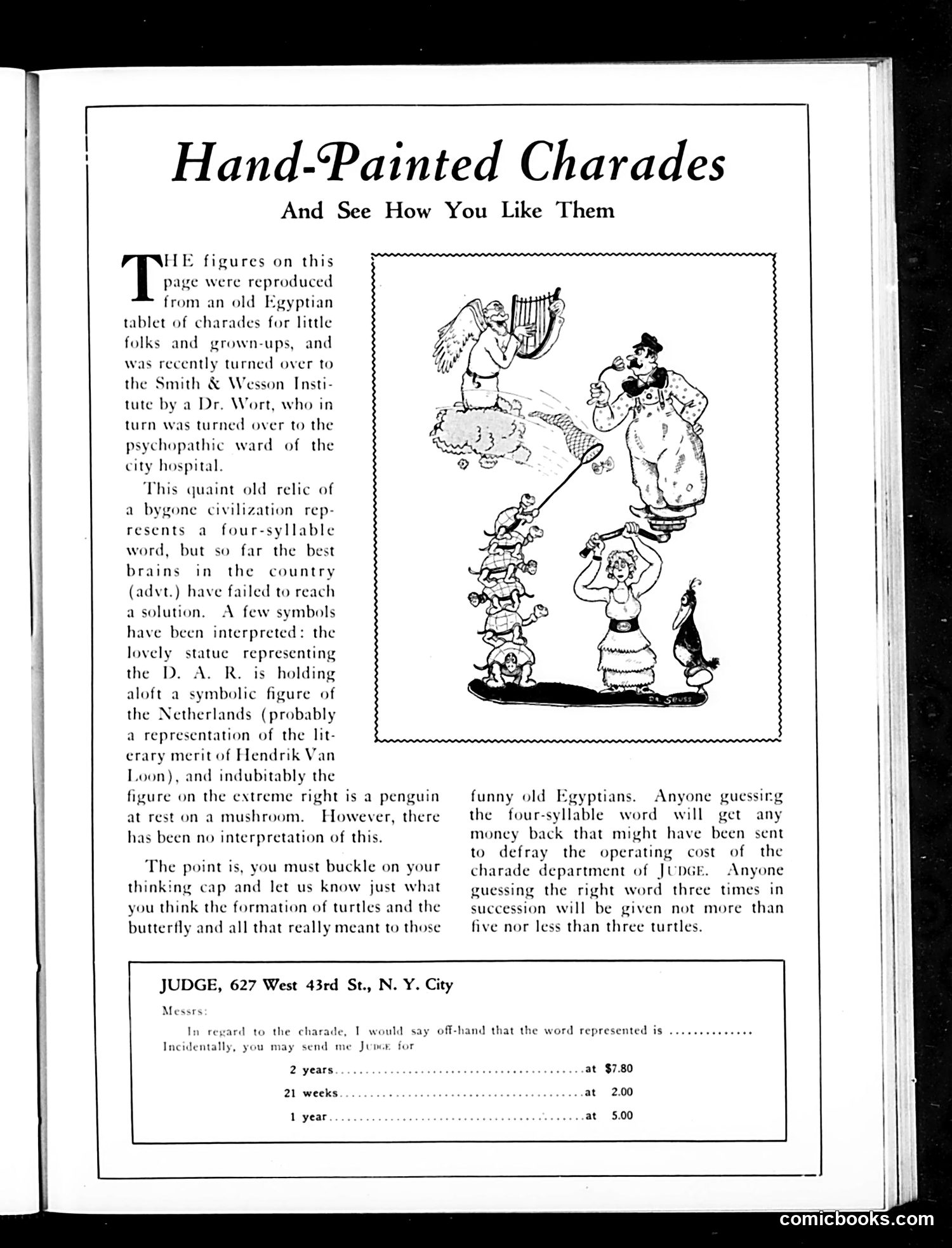
This is a humorous puzzle page masquerading as satirical commentary. Judge presents an alleged "Egyptian charades tablet" and invites readers to guess a four-syllable word represented by the illustrated figures. The cartoon includes recognizable satirical jabs: a "D.A.R." (Daughters of the American Revolution) statue holding aloft a figure representing the Netherlands, likely mocking the D.A.R.'s cultural pretensions and possibly referencing Dutch-American literary figure Hendrik Van Loon. A penguin on a mushroom appears inexplicably, adding absurdist humor. The joke operates on multiple levels—the fake "ancient tablet" premise parodies pseudo-intellectual discourse, while the impossible puzzle and the magazine's deadpan offer to return money (knowing no one will solve it correctly) is self-aware humor about the magazine itself. The subscription rates listed suggest this was also promotional material.
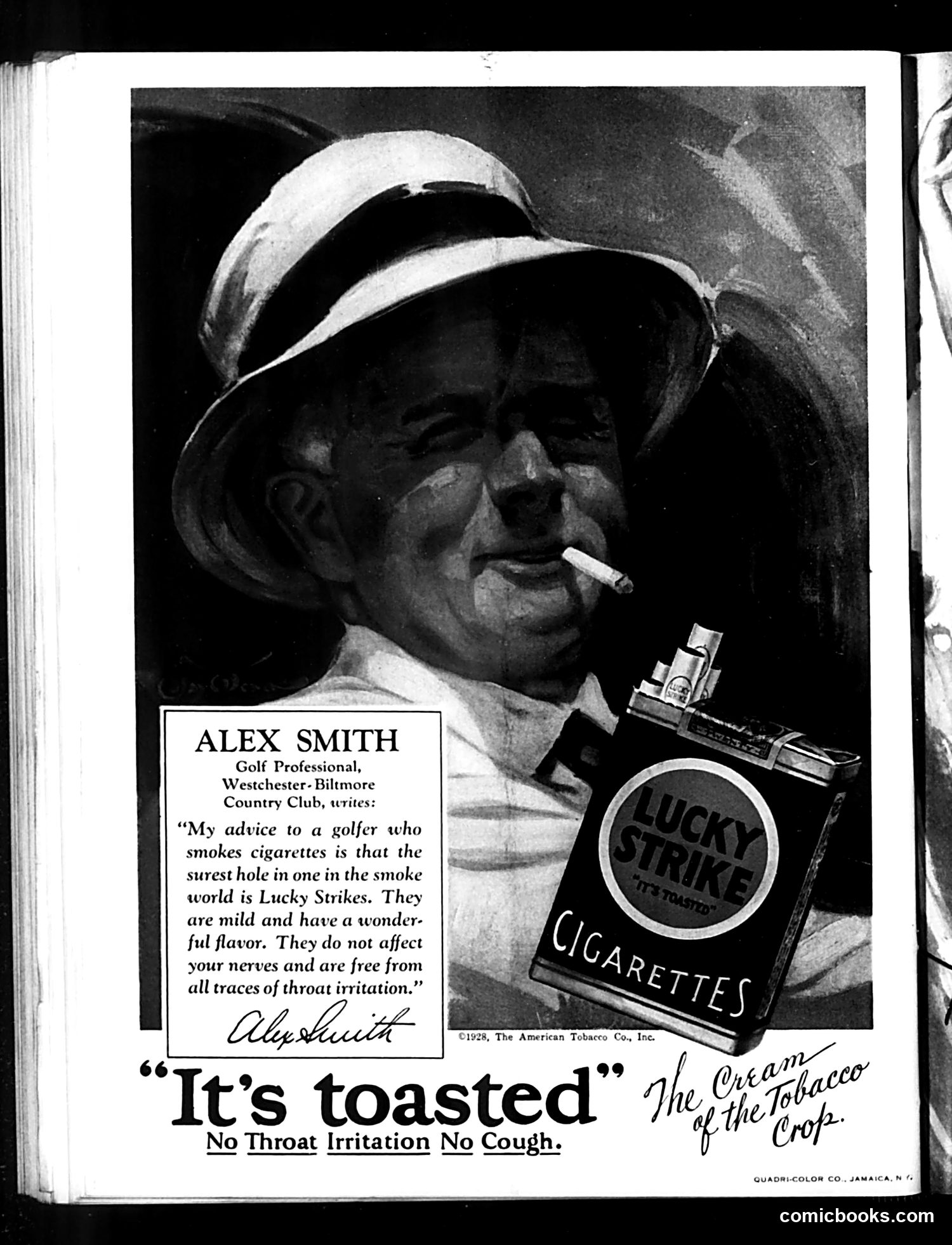
This is a **cigarette advertisement**, not satire. It features Alex Smith, a golf professional, endorsing Lucky Strike cigarettes. The ad claims the cigarettes are "mild," have "wonderful flavor," don't affect nerves, and cause "no throat irritation"—typical health claims that tobacco companies made before modern regulation. The "joke" is a pun: Smith calls Lucky Strikes "the surest hole in one in the smoke world," conflating golf terminology with smoking. The tagline "It's toasted" was Lucky Strike's actual marketing slogan. By modern standards, this advertisement is striking for its false health claims and use of a professional athlete's endorsement to market a harmful product—practices now illegal in most countries.