
Judge, 1928-06-16 · page 12 of 36
Judge — June 16, 1928 — page 12: what you’re looking at
What you’re looking at
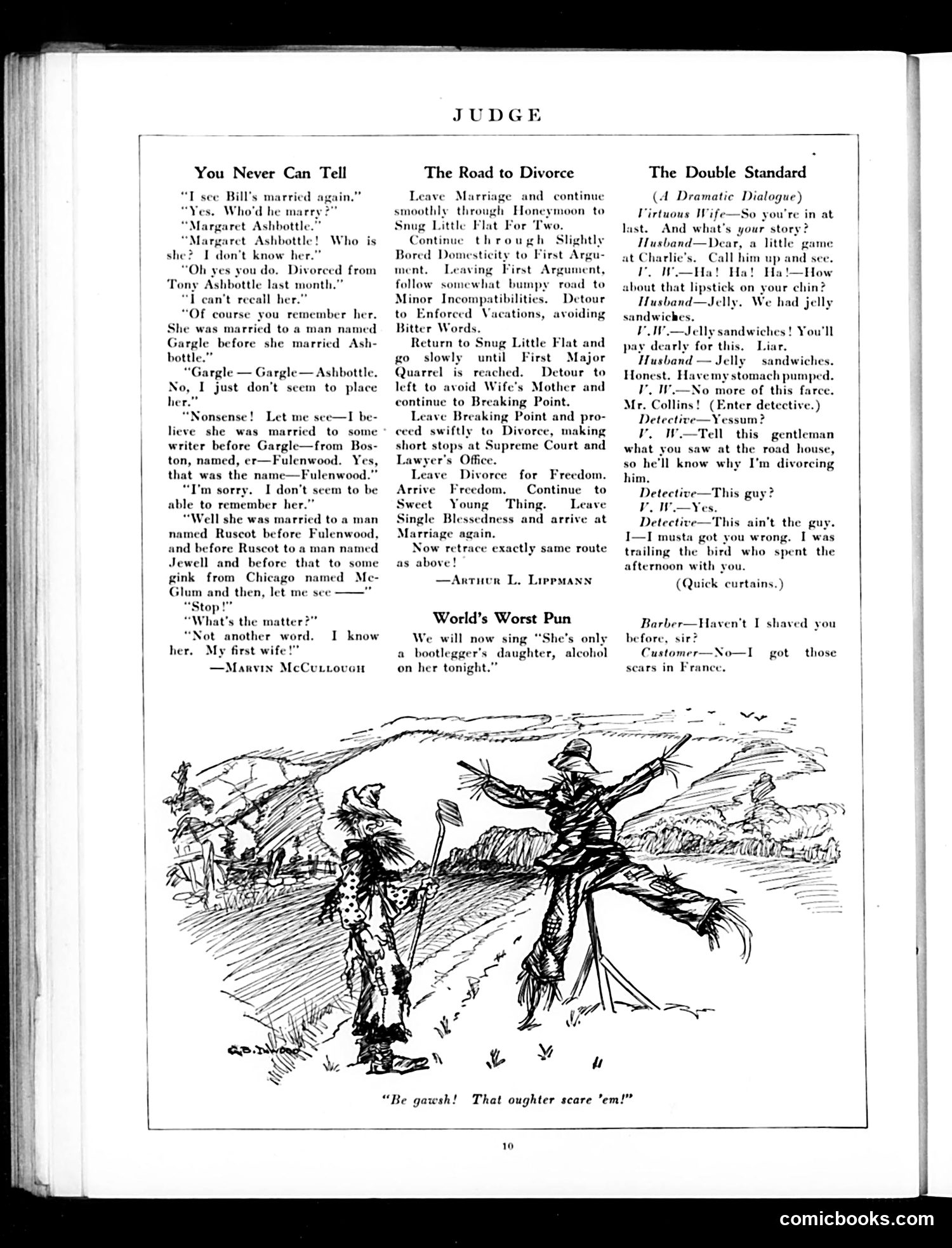
This page contains three satirical pieces mocking 1920s American social attitudes: **"You Never Can Tell"** jokes about serial marriage—a man's new bride has been married so many times he eventually realizes she was his own first wife. The satire targets the era's rising divorce rates and the social awkwardness around remarriage. **"The Road to Divorce"** by Arthur L. Lippmann presents marriage as a mapped journey with literal stops at "Bored Domesticity," "First Argument," and "Breaking Point," culminating in divorce. It satirizes how predictable and inevitable marital failure seemed to contemporary observers. **"The Double Standard"** depicts a wife interrogating her unfaithful husband about lipstick on his chin while he makes excuses. When a detective arrives to investigate *her* infidelity instead, it reveals the era's sexual hypocrisy—wives were surveilled and expected to remain faithful while husbands' affairs were tacitly accepted. The cartoon below shows scarecrows, accompanying a pun about a "bootlegger's daughter"—referencing Prohibition-era drinking.
📄 Transcribed text from this page (OCR, searchable)
Machine-transcribed from the original scan — historical spelling and the odd misread are preserved.
You Never Can Tell “T sce Bill's married ag “Yes. Who'd he marry? largaret Ashbottle.” irgarct Ashbottle! Who is I don’t know her.” Yh yes you do. Divorced from Tony Ashbottle last month.” “To can’t recall her.” “Of course you remember her. She was married to a man named Gargle before she married Ash- bottle.” “Gargle — Gargle— Ashbottle. No, I just don’t seem to place her.” “Nonsense! Let me see—I be- lieve she was married to some writer before Gargle—from Bo: ton, named, er-—Fulenwood. Ye that was the name—Fulenwood.” “T'm sorry. I don’t scem to be able to remember her.” “Well she was married to a man named Ruscot before Fulenwood, and before Ruscot to a man named Jewell and before that to some gink from Chicago named Me- Glum and then, let me see ——" Stop!” What's the matter?” “Not another word. I know her. My first wif —Marvin McCutrovan ain” “Be gawsh! JUDGE The Road to Divorce Leave Marriage and continue smoothly through Honeymoon to Snug Little Flat For Two. Continue through Slightly Bored Domesticity to First Argu- ment. Leaving First’ Argument, follow somewhat bumpy road to Minor Incompatibilities. Detour to Enforced Vacations, avoiding Bitter Words. Return to Snug Little Flat and go slowly until First) Major Quarrel is reached. Detour to left to avoid Wife's Mother and continue to Breaking Point. Leave Breaking Point and pro- ceed swiftly to Divorce, making short stops at Supreme Court and Lawyer's Office. Leave Divorce for Freedom. Arrive Freedom. Continue to Sweet Young Thing. Leave Single Blessedness and arrive at Marriage a: Now ret above! tly same route —Artucr L. Lippmann World’s Worst Pun We will now sing “She's only a bootlegger’s daughter, alcohol on her tonight.” The Double Standard (4 Dramatic Dialogue) Virtuous Wife—So you're in at last. And what's your story? Husband—Dear, a little game at Charlie's. Call him up and see. Vv. W.—Ha! Ha! H How about that lipstick on your chin? Husband—Jelly.. We had jelly sandwiches. VW.—Jelly sandwiches! You'll pay dearly for this. Liar. Husband — Jelly sandwiches. my stomach pumped. o more of this farce. Mr. Collins! (Enter detective.) Detective—Yessum? Vv. W.—Tell this gentleman what you saw at the road house, so he'll know why I'm divorcing him. Detective—This guy? V.Wi—Yes. Detective—This ain't the guy. I—I musta got you wrong. I was trailing the bird who spent the afternoon with you. (Quick curtains.) H Barber—} before, sir Customer—No—I got those sears in France. aven't I shaved you That oughter scare ’em!” comicbooks.com