
A complete issue · 36 pages · 1928
Judge — June 2, 1928
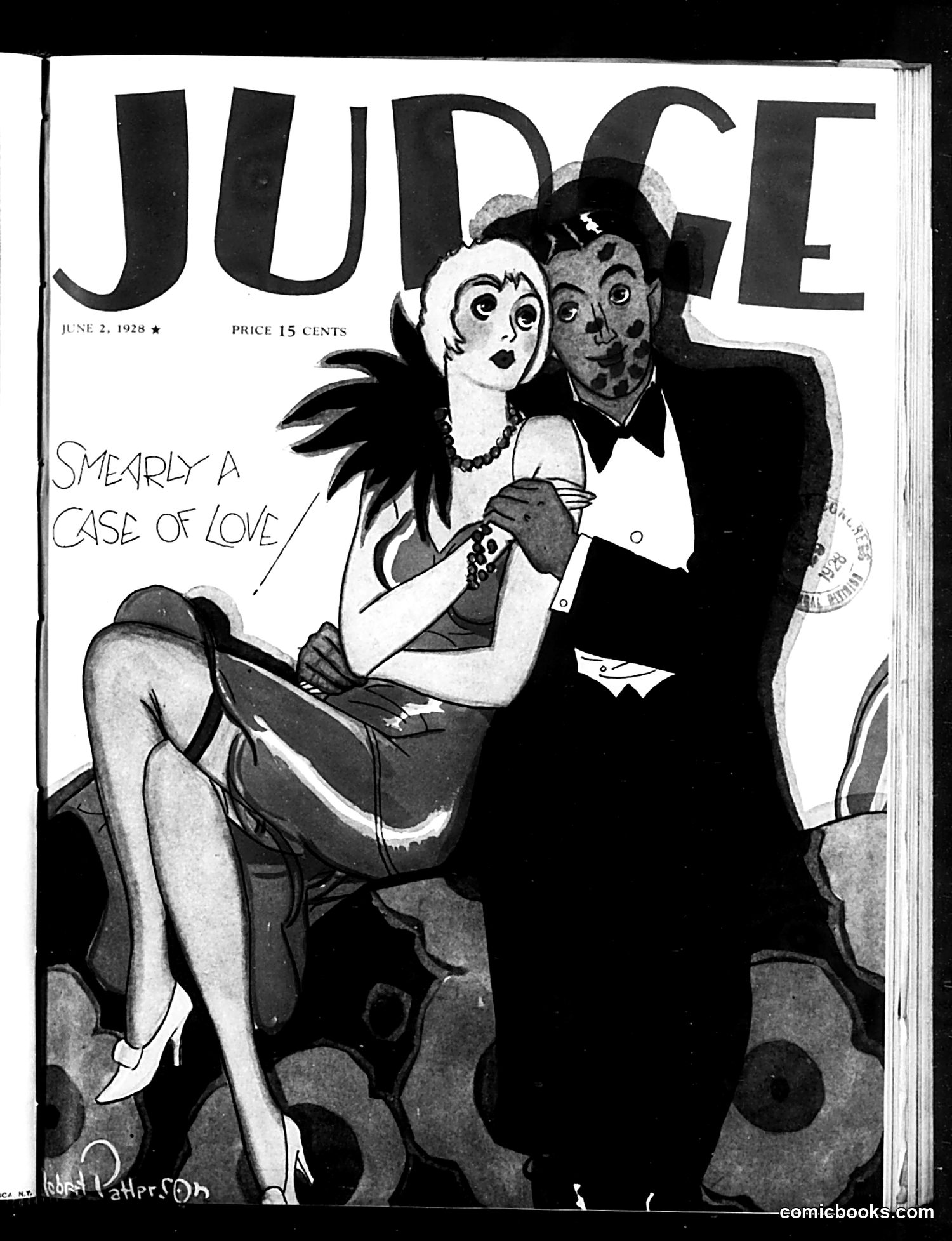
This cover depicts a romantic/comedic scenario titled "Smearyl A Case of Love." A woman in 1920s flapper attire (short dark hair, pearl necklace, raised hemline) is being carried by a demonic or devilish male figure with exaggerated features and horns. The satire likely plays on Jazz Age anxieties about modern romance and changing courtship norms. The "devilish" suitor characterization suggests social commentary on contemporary dating practices or "modern love" that conservative readers might have viewed as morally questionable. The theatrical exaggeration and the woman's dramatic expression create comedic effect. The 15-cent price and June 1928 date place this during the height of 1920s cultural tension between traditional and progressive values regarding gender and romance.
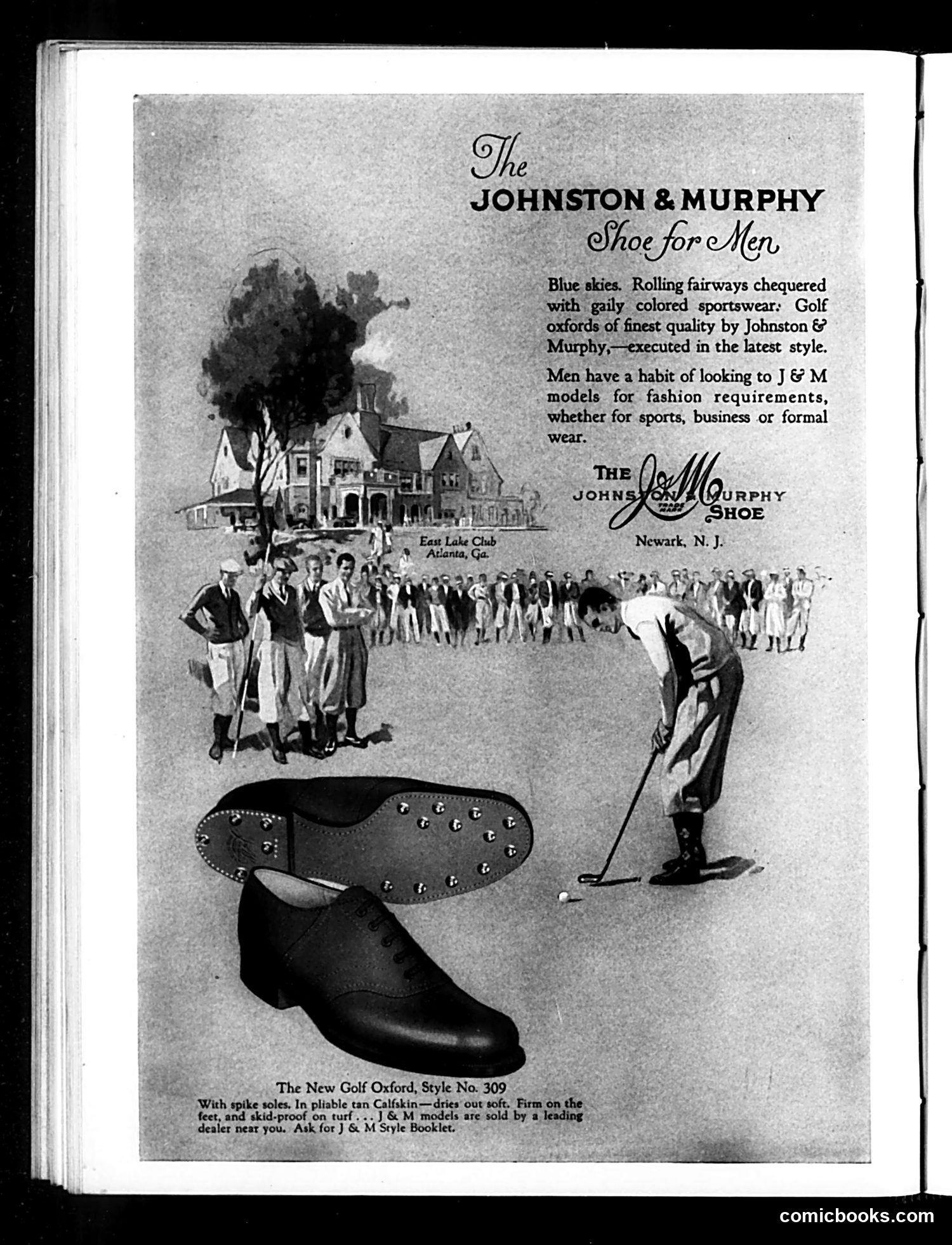
This is a straightforward **advertisement, not satire or political commentary**. It promotes Johnston & Murphy shoes for men, manufactured in Newark, New Jersey. The ad emphasizes that men routinely consult J&M models for fashion guidance across various occasions—sports, business, and formal wear. The imagery depicts a golf scene at East Lake Club in Atlanta, Georgia, showing well-dressed men at leisure. The featured product is "The New Golf Oxford, Style No. 309," described as having spike soles in pliable tan calfskin for durability and comfort on the golf course. This represents early 20th-century advertising strategy: associating quality footwear with aspirational leisure activities and social status among affluent men.
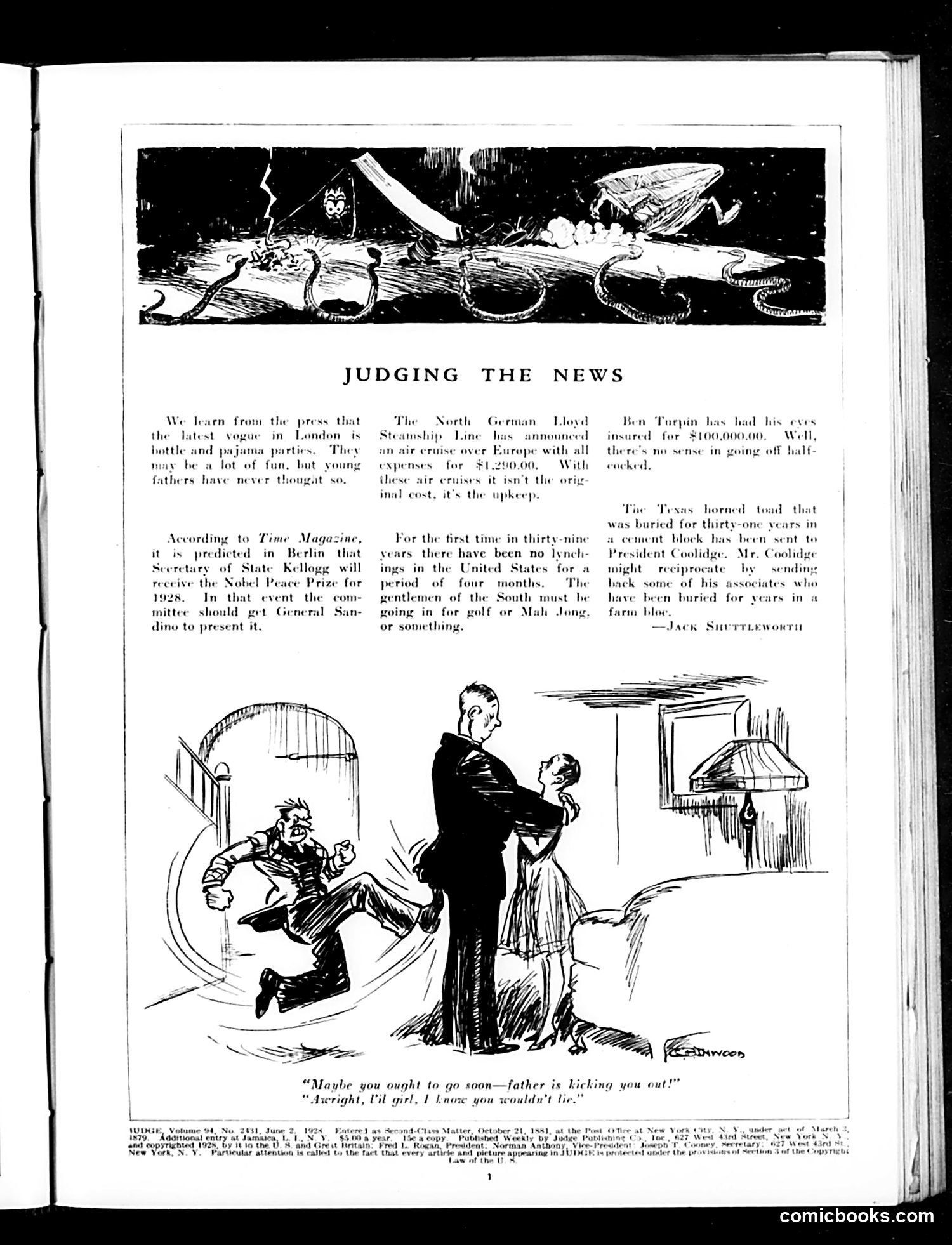
This satirical section mocks contemporary news stories. The main cartoon depicts a domestic scene: a man kicks a small figure (labeled "Father") out a door while holding a young woman, who protests "Maybe you ought to go soon—father is kicking you out!" and he replies "Alright, I'd girl, I know you wouldn't lie." The joke satirizes changing social mores in the 1920s—specifically young couples' unsupervised time together and a suitor's casual disregard for parental authority. The "father" being literally small and powerless emphasizes how traditional parental control had weakened during the Jazz Age. The text above references frivolous wealthy pastimes (London bottle parties), military expenses, golf trips, and a buried cement block—typical examples of news Judge ridiculed as absurd or wasteful.
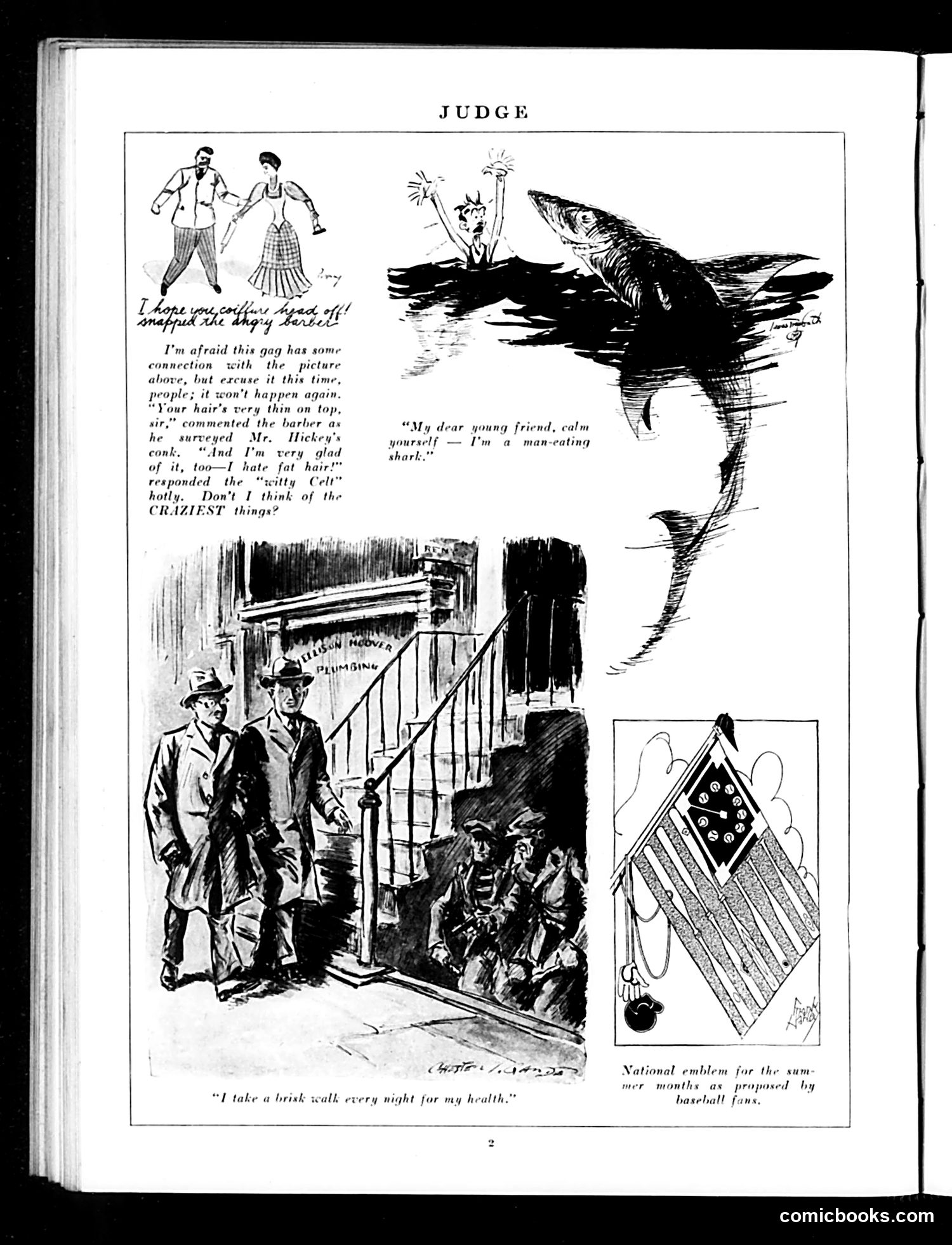
This page contains four separate satirical cartoons: 1. **Top left**: A couple arguing about a man's thin hair—the barber defends his work, calling the result "the CRAZIEST things." 2. **Top right**: A shark threatens a tiny person, saying "My dear young friend, calm yourself—I'm a man-eating shark." This appears to be a humorous visual pun about predatory behavior. 3. **Bottom left**: Two men in hats observe someone entering a building marked "ROOMS," captioning "I take a brisk walk every night for my health"—likely satirizing infidelity or secret activities disguised as exercise. 4. **Bottom right**: A proposed national emblem for summer months showing a baseball flag design, appealing to baseball fans' priorities. The page demonstrates Judge's variety of social and domestic humor targeting early 20th-century American audiences.
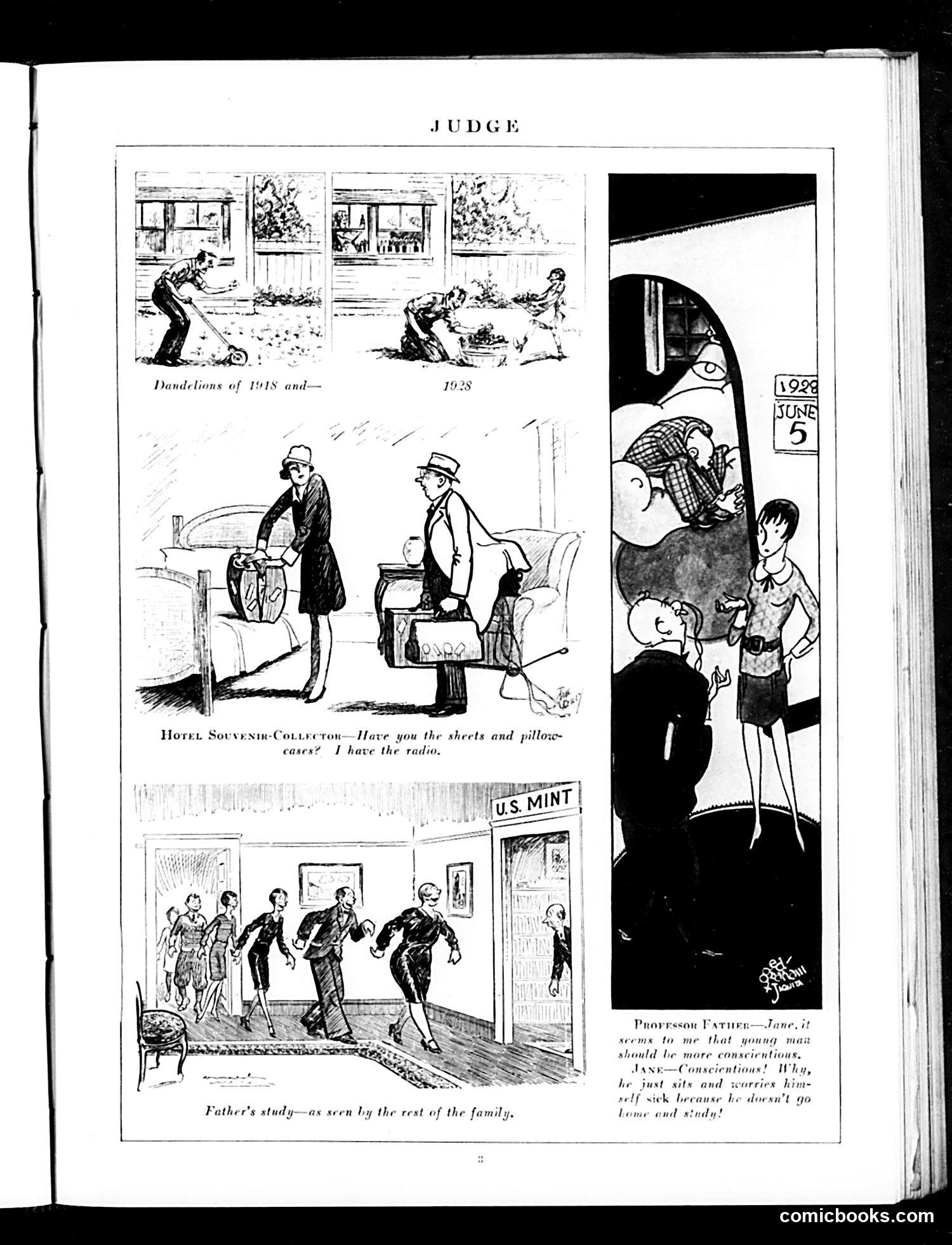
This page contains several satirical cartoons commenting on early 20th-century domestic life and social conventions. **Top panels** ("Dandelions of 1918 and 1928"): Compare yard maintenance across decades, suggesting changing standards or laziness. **Hotel Souvenir-Collector cartoon**: A hotel porter jokes with a guest about stealing linens and pillows rather than purchasing souvenirs—satirizing petty theft by travelers. **Father's Study panel**: Shows a family observing the father in his study, mocking male domestic withdrawal or the sanctuary men created from family life. **Right panel** (dated June 5, 1928): Features dialogue between "Professor Father" and "Jane" about young men's moral standards and conscientiousness, suggesting generational anxieties about youth declining to maintain parental values regarding diligence and propriety. The overall theme reflects 1920s social concerns about changing morality and domestic behavior.
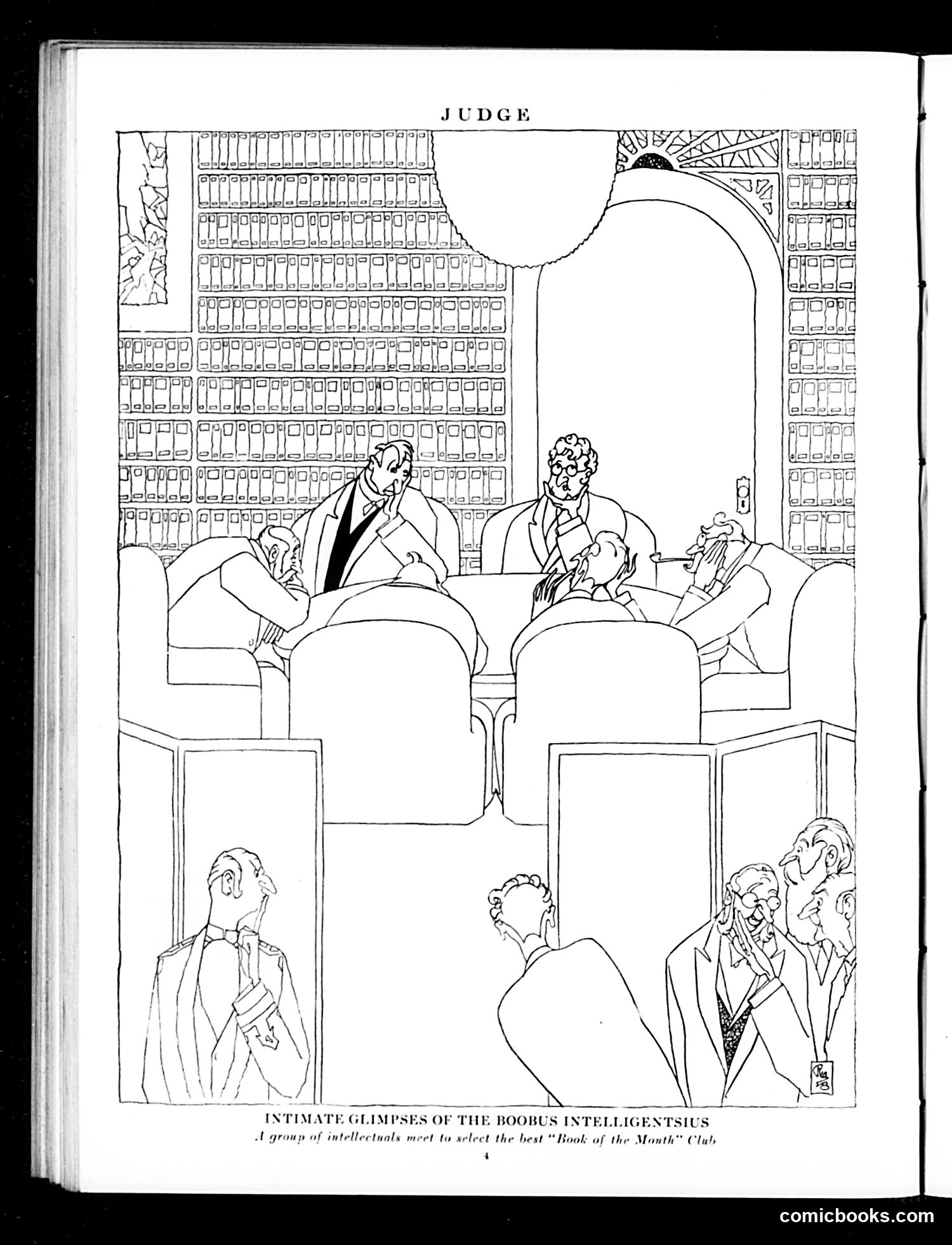
This satirical cartoon depicts intellectuals meeting to select the best "Book of the Month" Club selection. The title references H.L. Mencken's famous term "Boobus Americanus" (describing average Americans), here mockingly applied to "intelligentsius" — pretentious intellectuals affecting sophistication. The scene shows well-dressed men in a library setting engaged in what appears to be serious deliberation. The satire targets the Book of the Month Club's then-popular practice of having panels of "experts" choose books for subscribers. Judge ridicules these self-appointed arbiters of taste as pretentious pseudo-intellectuals, suggesting their selections reflect affected elitism rather than genuine literary merit. The cartoon mocks both the Club's gatekeeping authority and the vanity of intellectuals who claimed cultural authority over American reading habits.
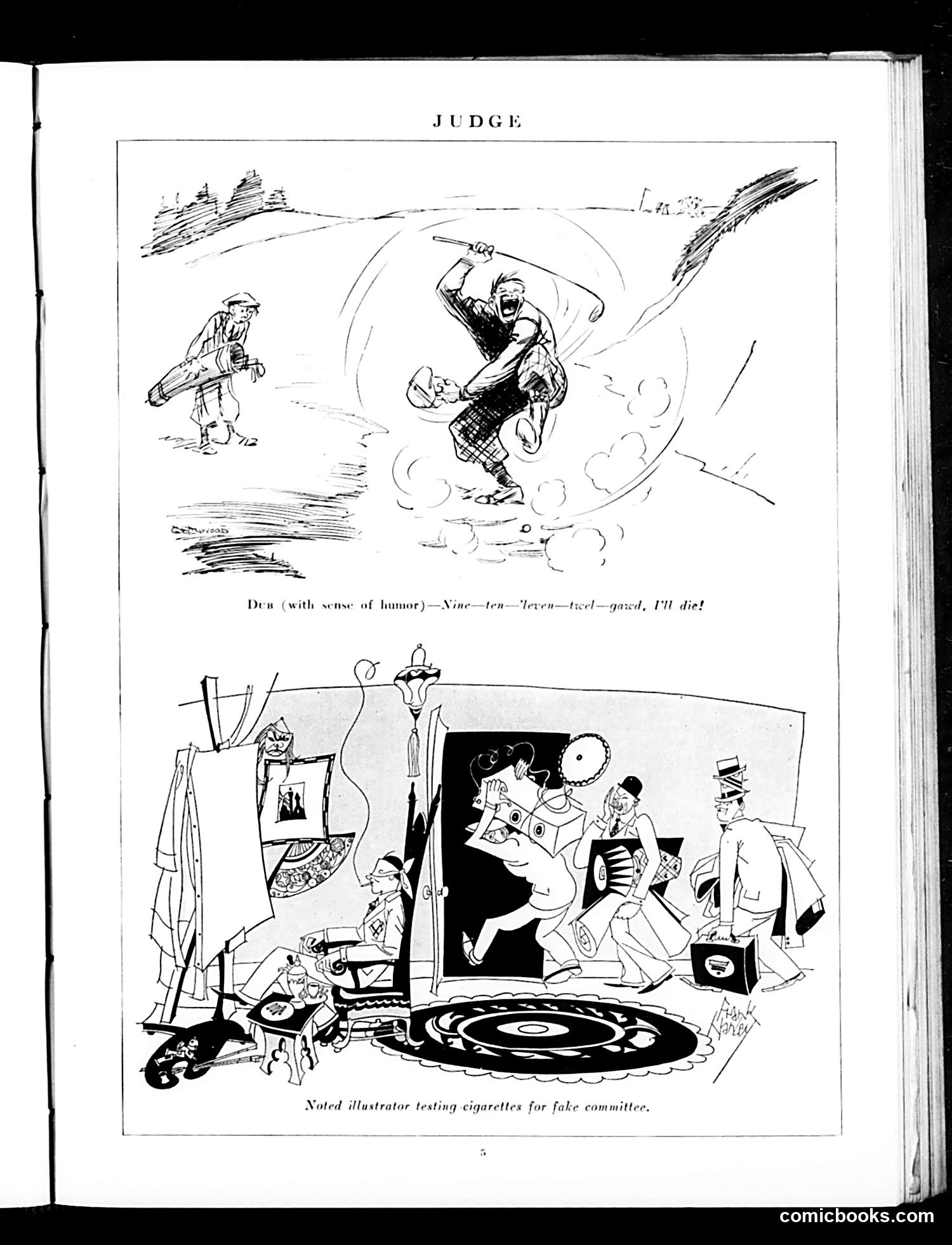
This page contains two satirical cartoons: **Top cartoon:** A Scotsman in traditional dress is caught in what appears to be a whirlwind or tornado, with the caption "Died (with sense of humor)—Nine-ten-leven-tzel-gazed, I'll diet!" The humor plays on Scottish dialect and likely references a specific death or accident involving a Scotsman, though the exact event is unclear. **Bottom cartoon:** Titled "Noted illustrator testing cigarettes for fake committee," it depicts multiple figures in what appears to be an artist's studio examining cigarettes. The satire likely mocks fraudulent health claims about cigarettes or false advertising testimonials by illustrators paid to endorse products. This reflects early 20th-century skepticism about tobacco industry practices and dubious "scientific" endorsements.
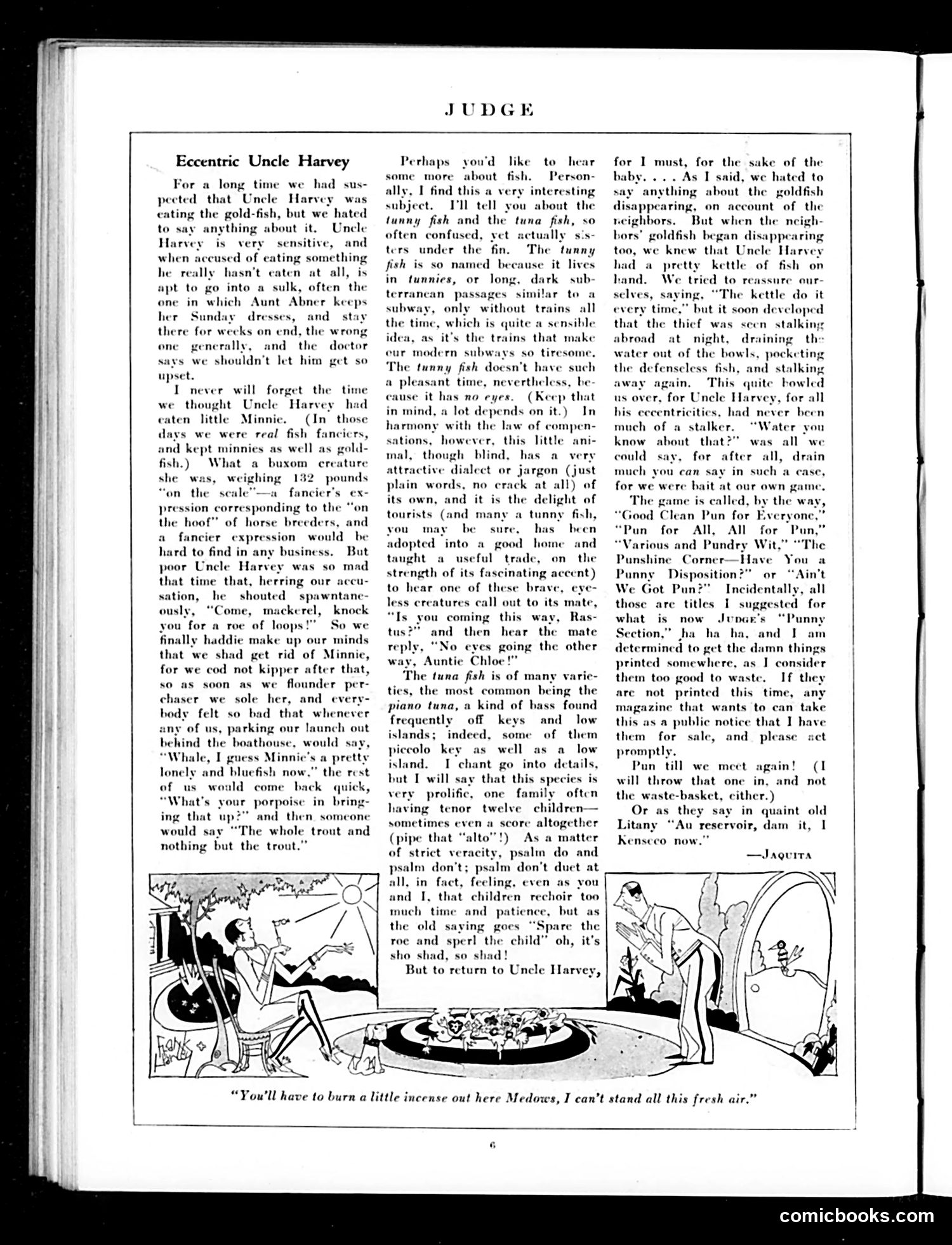
This is a humorous short story titled "Eccentric Uncle Harvey" from *Judge* magazine, a satirical publication. The narrative is largely a fish-themed pun-fest rather than political satire. The basic plot: Uncle Harvey, a sensitive eccentric relative, is suspected of eating the family's goldfish. When accused, he reacts so poorly that the family avoids confronting him. Later, when neighbors' goldfish also disappear and are found stolen at night, the family realizes Uncle Harvey is the culprit—but describe him as a "stalker" rather than a thief, playing on the word "stalk." The bulk of the text consists of elaborate fishing puns (tuna/tunny fish wordplay, references to "mackerel," "kipper," "flounder," etc.) that are clearly meant to demonstrate the author's wit through extensive fish-related double entendre. The cartoon at bottom shows the family trying to conceal fish odors by burning incense indoors—the visual punchline to Uncle Harvey's ongoing aquatic thievery. The humor relies entirely on puns and absurdist character comedy, not contemporary political commentary.
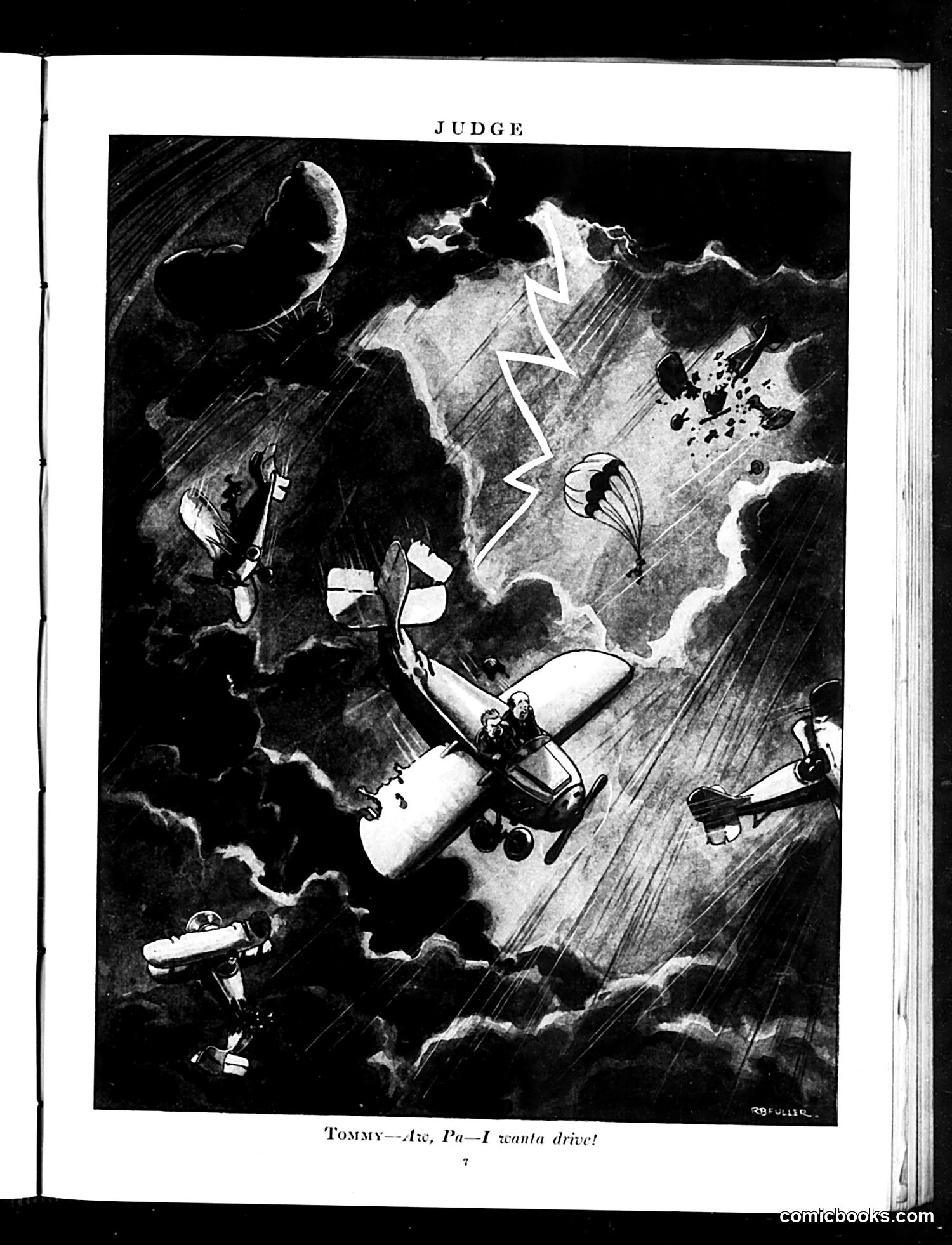
This is a single satirical cartoon titled "Tommy—Aye, Pa—I wanna drive!" The image depicts an aerial bombardment scene with military aircraft dropping bombs during what appears to be World War I or II. A small child figure is visible among the chaos and destruction below, seemingly wanting to "drive" or operate the bombing aircraft above. The satire appears to criticize either: 1. Child-like or reckless military leadership conducting aerial bombing campaigns, or 2. The normalization of warfare and violence to the point where children aspire to participate in bombing missions The contrast between innocent childhood desire ("I wanna drive") and the horrific reality of aerial bombardment creates dark humor typical of Judge magazine's political satire.
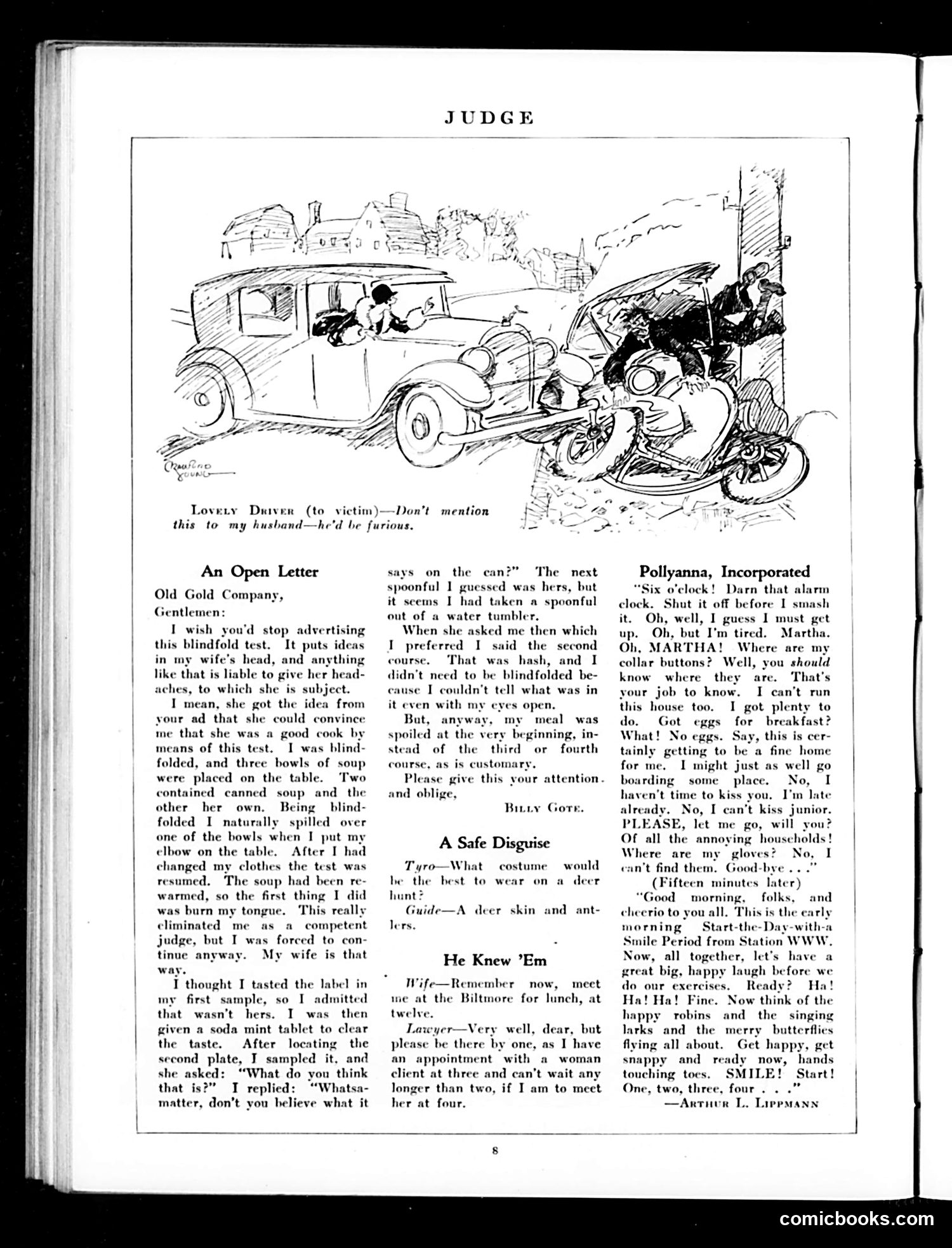
The main cartoon depicts a car accident where a woman driver (the "Lovely Driver") tells the injured motorcyclist not to mention the incident to her husband, implying she caused the accident through careless driving. This satirizes women drivers as incompetent and irresponsible—a common early 20th-century stereotype. The written pieces are humorous complaint letters: 1. **"An Open Letter"**: A man complains that Old Gold's blindfold taste-test advertising gave his wife ideas to prove she's a good cook. The joke mocks both the advertisement's premise and marital dynamics—his wife is clearly a poor cook, and he resents her ambitions. 2. **"A Safe Disguise"**: A brief joke about wearing deer skin as camouflage for hunting. 3. **"He Knew 'Em"**: A lawyer schedules appointments with a woman client at three and four o'clock, meeting his wife at noon—implying infidelity or dishonesty about his schedule. 4. **"Pollyanna, Incorporated"**: A satirical contrast between a man's grumpy morning complaints and a cheerful radio personality's upbeat morning broadcast—mocking artificial positivity versus reality.
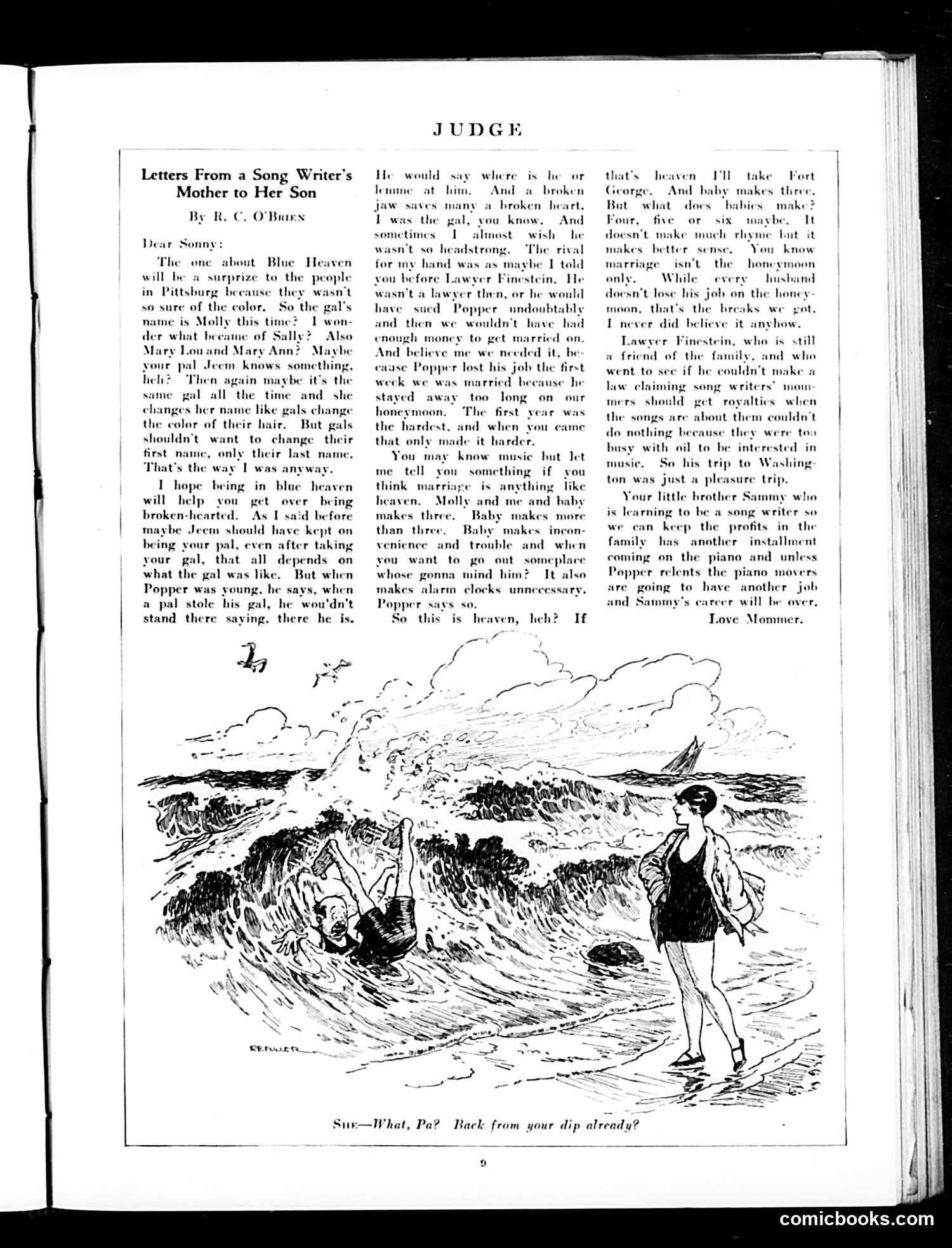
This is a humorous advice column disguised as letters from an old-fashioned mother ("Mommer") to her son, a struggling songwriter. The satire targets early 1920s popular music and domestic life. The mother critiques her son's romantic song "Blue Heaven," wondering why Pittsburgh residents were surprised by the color choice. She rambles through complaints about his love life, comparing his heartbreak to her own marriage to "Popper," a man who once got into a fistfight over a woman and later lost his job on his honeymoon. The humor derives from her contradictory, malaprop-filled wisdom: she claims babies "make more than three" and suggests that having children prevents needing alarm clocks (because babies wake you). She mentions a lawyer friend trying—unsuccessfully—to secure royalties for mothers of songs written about them. The cartoon below shows beachgoers, illustrating domestic leisure themes. The column mocks both sentimental popular songs and small-town American family dynamics of the era.
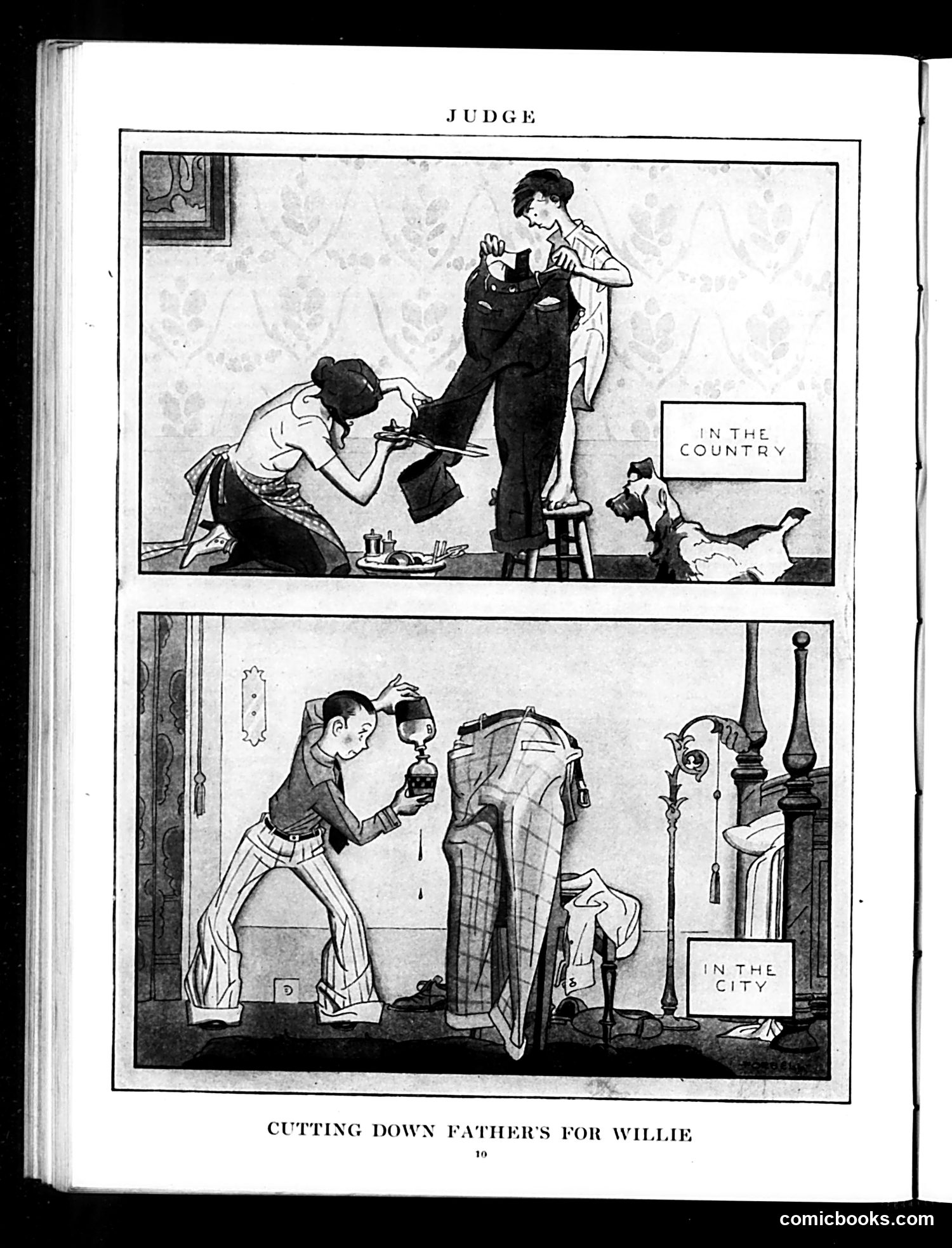
This two-panel cartoon satirizes parental indulgence of children. The title references the nursery rhyme "Father's Day Off," and depicts parents literally "cutting down" (altering/repurposing) the father's clothing for their son Willie. **Top panel ("In the Country"):** A woman tailors the father's pants while he stands on a chair, being fitted. **Bottom panel ("In the City"):** A woman sprays/dyes the father's suit jacket to create a children's outfit, with tailoring supplies visible. The satire mocks how wealthy parents sacrifice their own comfort and dignity—even their clothing—to satisfy their children's demands. The "country vs. city" contrast likely emphasizes that this materialistic excess occurs in both settings. It's a critique of child-centered parenting and parental weakness in disciplining or denying offspring.
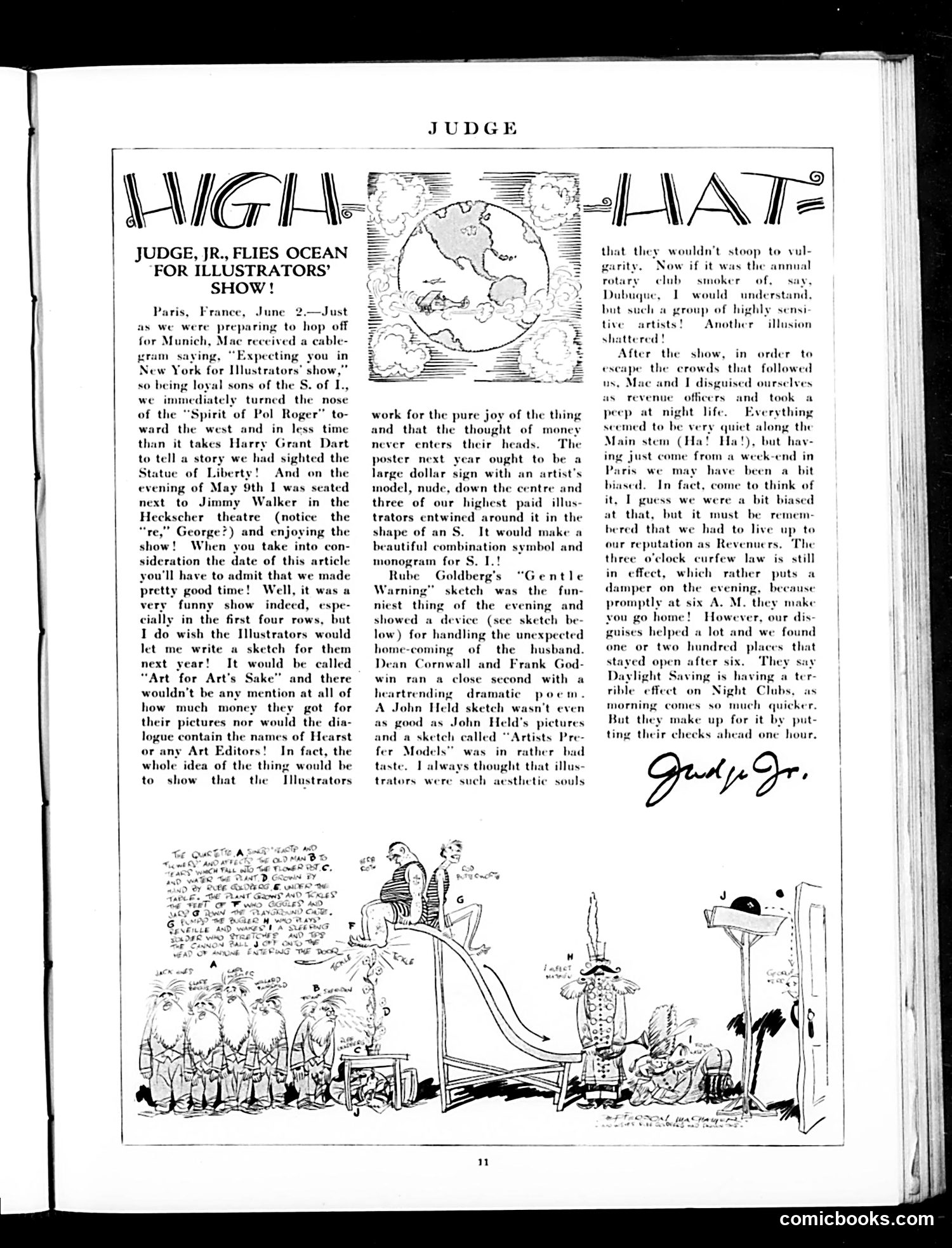
This is a humorous first-person account by Judge magazine's editor describing his trip to New York for the Society of Illustrators' annual show. The piece mocks illustrators' pretensions and hypocrisies. **The satire targets:** - **Illustrators' claimed idealism**: The author proposes a satirical sketch called "Art for Art's Sake" showing artists claiming to work purely for love of art, symbolized by a dollar sign with nude models and famous illustrators wrapped around it—exposing their actual focus on money and commercial success. - **The show itself**: Featured sketches by notable cartoonists (Rube Goldberg, Dean Cornwall, Frank Godwin, John Held), with the author snarkily dismissing their quality and noting that a sketch about artists preferring models was in "rather bad taste"—implying hypocrisy about aesthetic sensibilities. - **Prohibition-era nightlife**: References Jimmy Walker (NYC mayor) and mocks the 3 a.m. curfew law and "Daylight Saving" affecting nightclubs—suggesting these regulations are ineffective and easily circumvented. The cartoon below illustrates the device from Goldberg's sketch for handling surprise spousal arrivals.
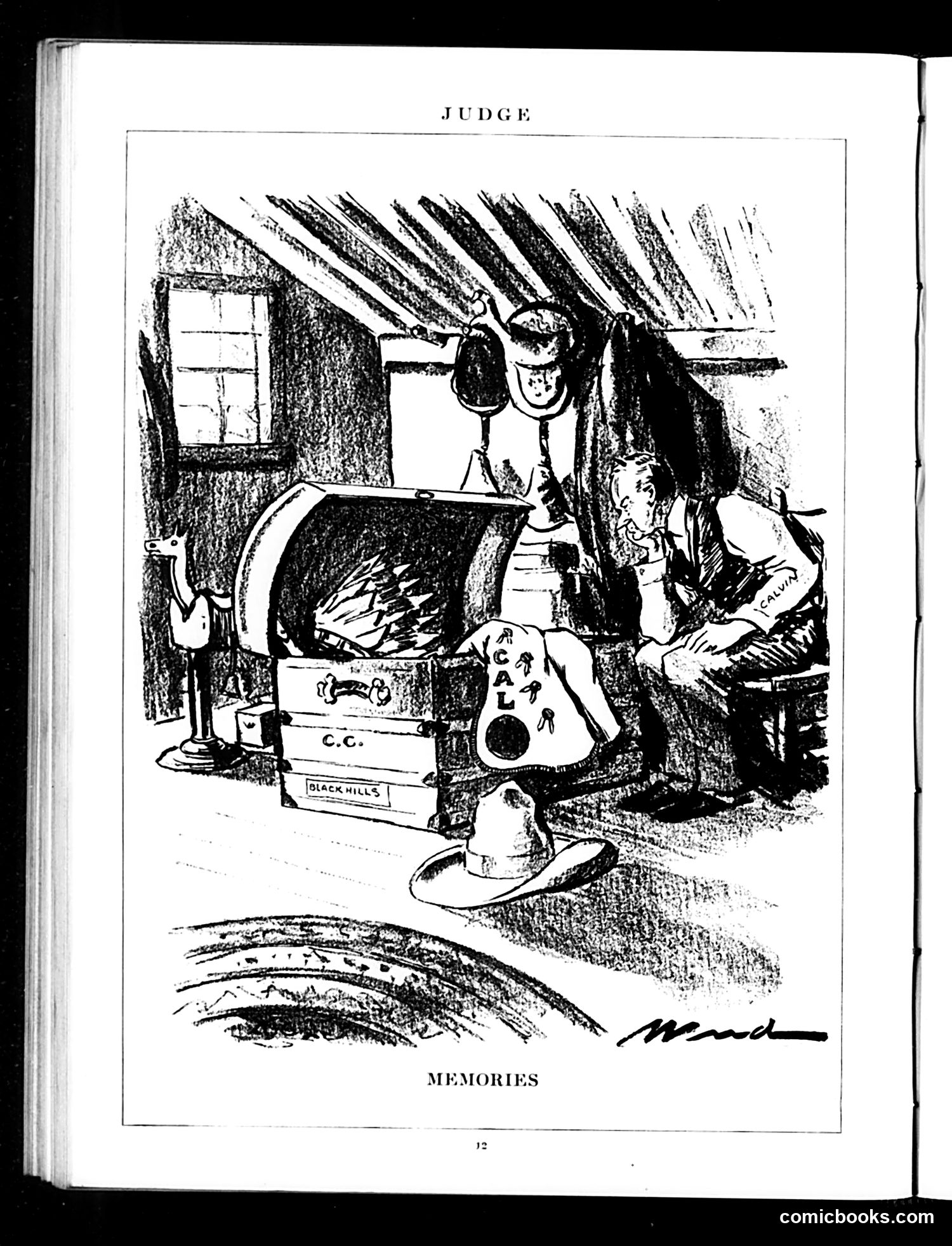
This cartoon depicts a rustic cabin interior where a figure tends to a large barrel or stove marked "BLACK HILLS" and labeled with what appears to be "C.C." The scene includes period details like hanging implements and a window, rendered in sketch style. The title "Memories" and references to "Black Hills" and "C.C." suggest this satirizes a specific historical or political event—likely related to the Black Hills region (significant in Native American history and the Dakota Gold Rush of the 1870s). The "C.C." marking remains unclear without additional context, though it may reference a person or organization involved in that historical moment. The nostalgic framing criticizes or comments on how such events are remembered or commemorated.
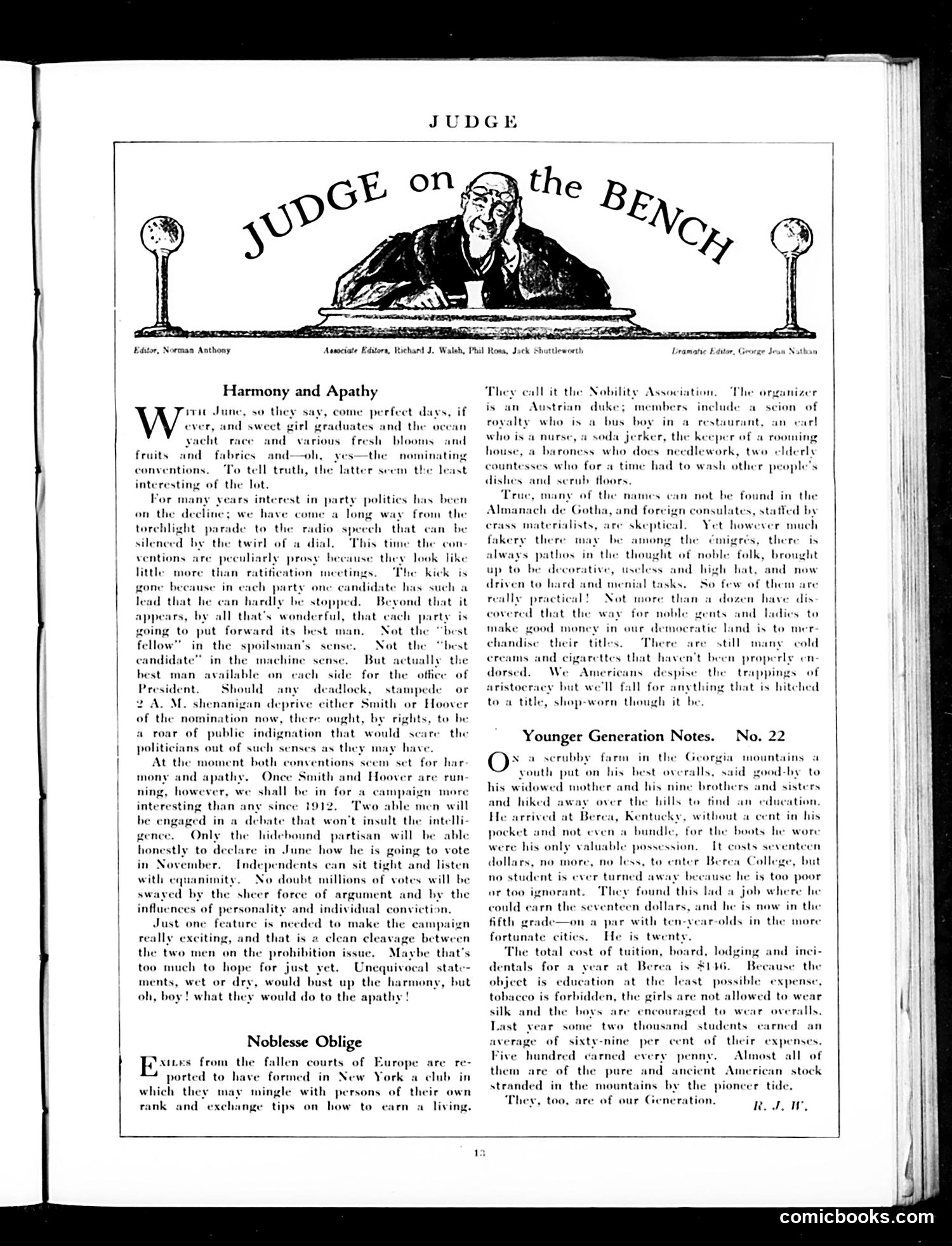
This Judge magazine page contains three satirical pieces: **"Judge on the Bench"** (masthead): A standard editorial illustration showing a judge presiding, introducing the column. **"Harmony and Apathy"**: Commentary on the 1928 presidential conventions (Smith and Hoover are the nominees). The author criticizes the low public interest in conventions—they've become radio-silenced spectacles lacking real drama. He hopes the upcoming campaign will engage voters through genuine debate, particularly on prohibition (the major divisive issue of the era), rather than relying on "harmony" between similar candidates. **"Noblesse Oblige"**: Satire mocking European aristocrats who've emigrated to New York and formed a "Nobility Association" to network. The joke: these nobles have been reduced to working as busboys, nurses, and shop clerks, yet cling to their titles. Americans simultaneously despise aristocracy but will buy anything—cold cream, cigarettes—if marketed with a noble name attached. **"Younger Generation Notes"**: A brief heartwarming story about a poor Georgia farm boy who walks to Berea College (a real institution for disadvantaged students).
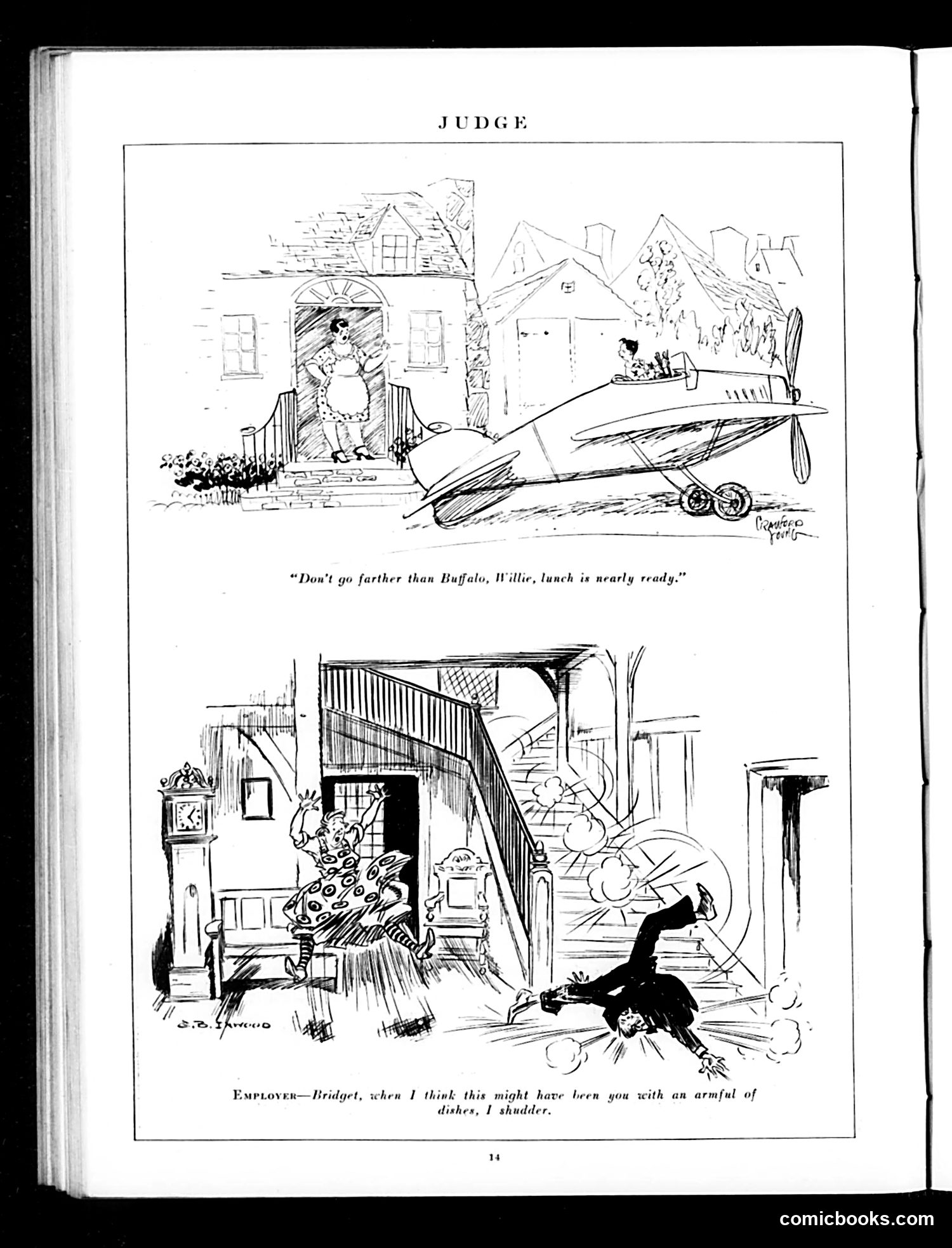
This page contains two cartoon jokes about early aviation and domestic service. **Top cartoon:** A pilot in a primitive airplane tells another aviator not to fly beyond Buffalo, as "lunch is nearly ready." The humor satirizes aviation's infancy—treating a dangerous experimental aircraft as casually as a commute, with the suggestion that lunch timing matters more than safety concerns. **Bottom cartoon:** An employer tells his maid Bridget that he "shudders" thinking she might have been carrying dishes when she could instead have been piloting an airplane. This is class-based satire: the joke mocks the employer's obliviousness to the absurdity of imagining a servant girl as an aviator. It satirizes both the aviation craze of the era and the rigid class assumptions that made such a prospect ridiculous to contemporary audiences.
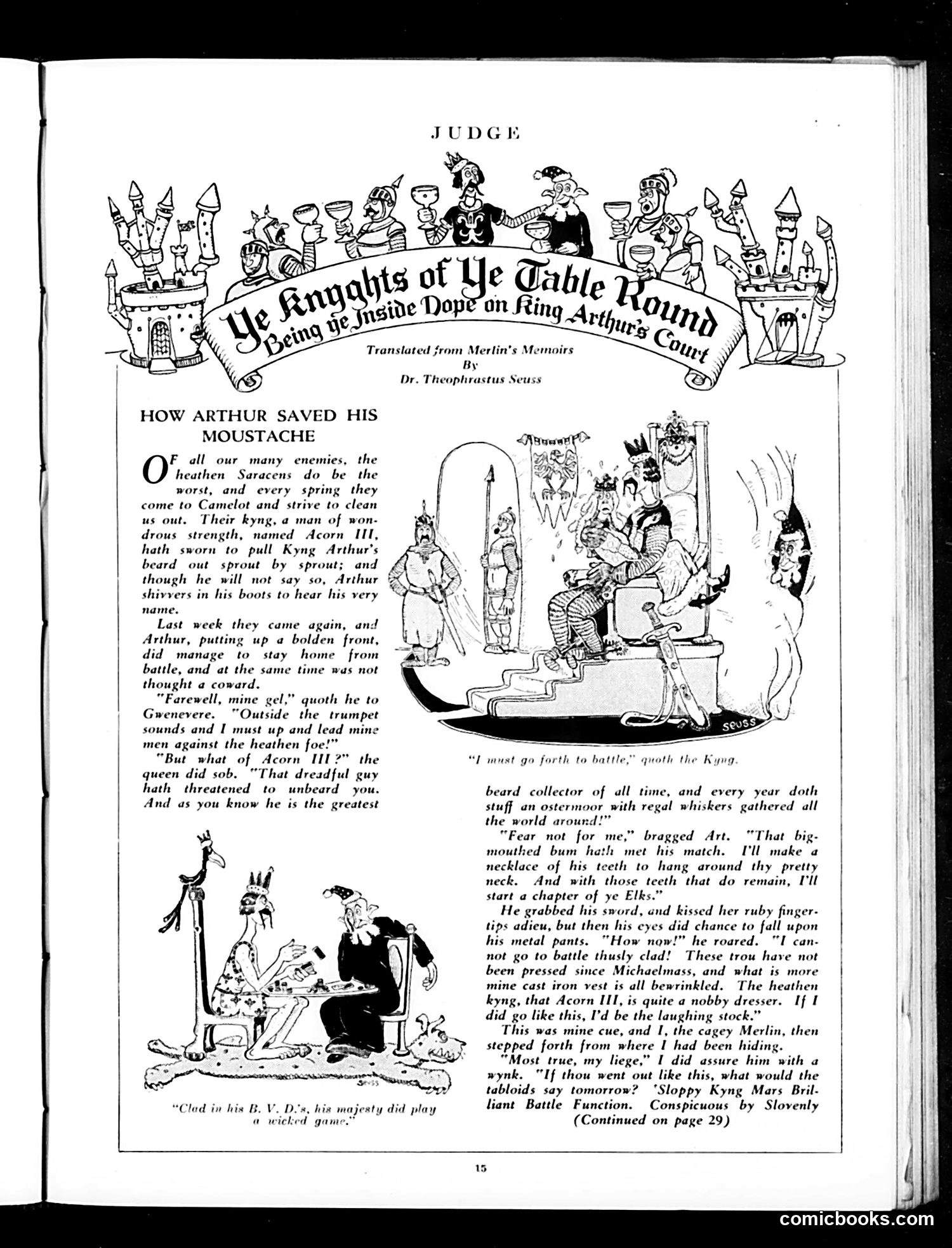
This is a humorous Arthurian parody by Dr. Seuss (credited as "Dr. Theophrastus Seuss"), translating fictional "Merlin's Memoirs." The joke mocks modern vanity and media culture by transplanting them into medieval legend. King Arthur fears battle against the Saracen king Acorn III, who threatens to pluck out his beard. But Arthur's real crisis isn't courage—it's his wrinkled armor and unpressed metal pants. Merlin rescues him by invoking tabloid shame: "Sloppy Kyng Mars Brilliant Battle Function. Conspicuous by Slovenly." The satire targets contemporary anxieties about appearance and press coverage. Even a legendary warrior-king prioritizes looking respectable over actual bravery, fearing negative media headlines. It's a lighthearted jab at how modern concerns about fashion and public image override traditional values—a recurring theme in Judge's satirical commentary on American society.
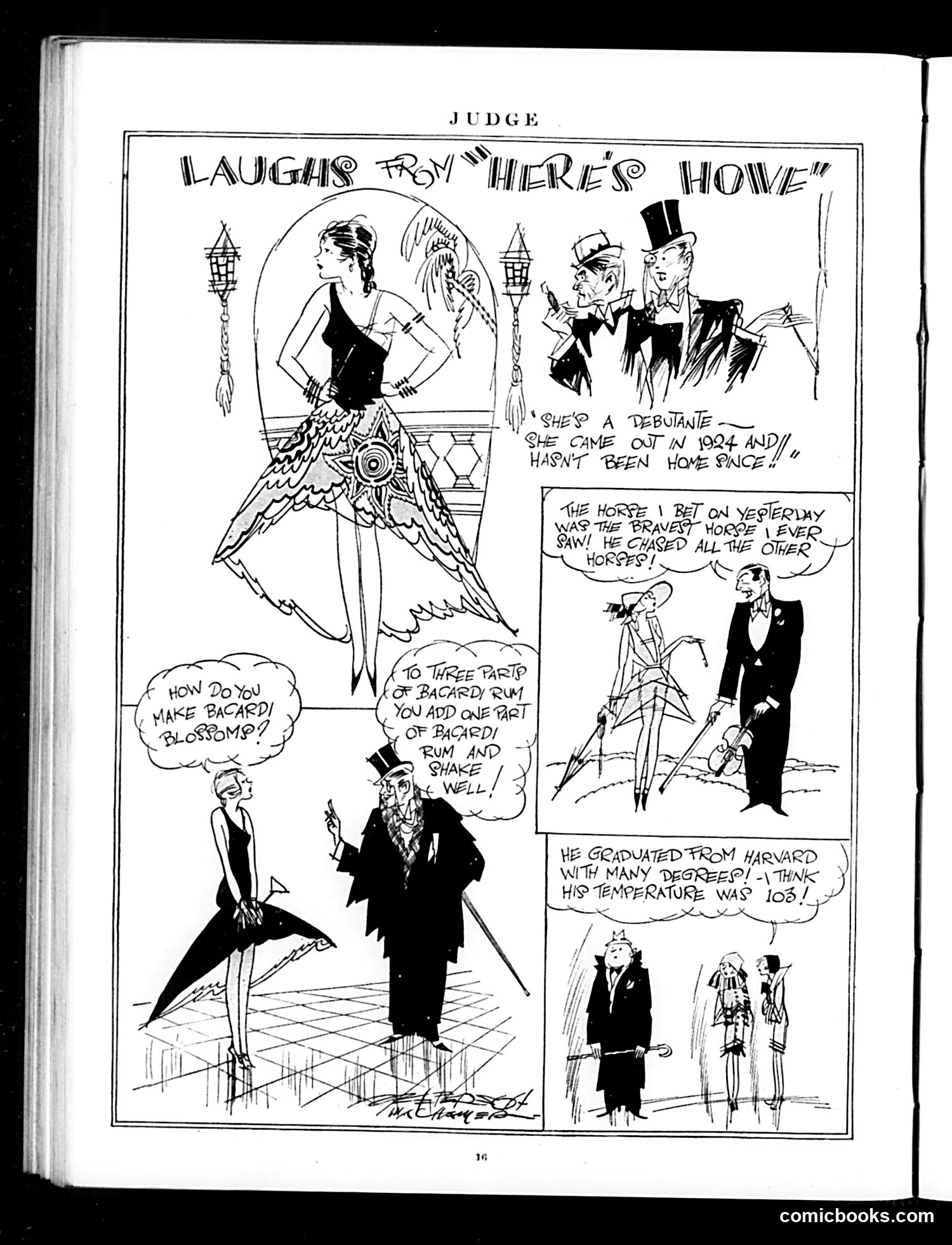
This page satirizes wealthy, sophisticated socialites of the 1920s Jazz Age. The central figure is a debutante who "came out in 1924" but "hasn't been home since"—mocking the lifestyle of idle aristocratic women who party constantly rather than settle into domestic life. The surrounding vignettes ridicule upper-class pretensions: men discuss cocktail recipes (Bacardi rum), betting on horses, and Harvard credentials. The final panel jokes that someone "graduated from Harvard with many degrees" yet has a dangerously high fever (103°F), suggesting their education produced nothing of practical value. The satire targets the frivolous, pleasure-seeking behavior of the wealthy elite during Prohibition and the Jazz Age, when cocktails, parties, and conspicuous leisure defined high society. The artwork's caricatured style emphasizes the mockery of these figures' superficiality.
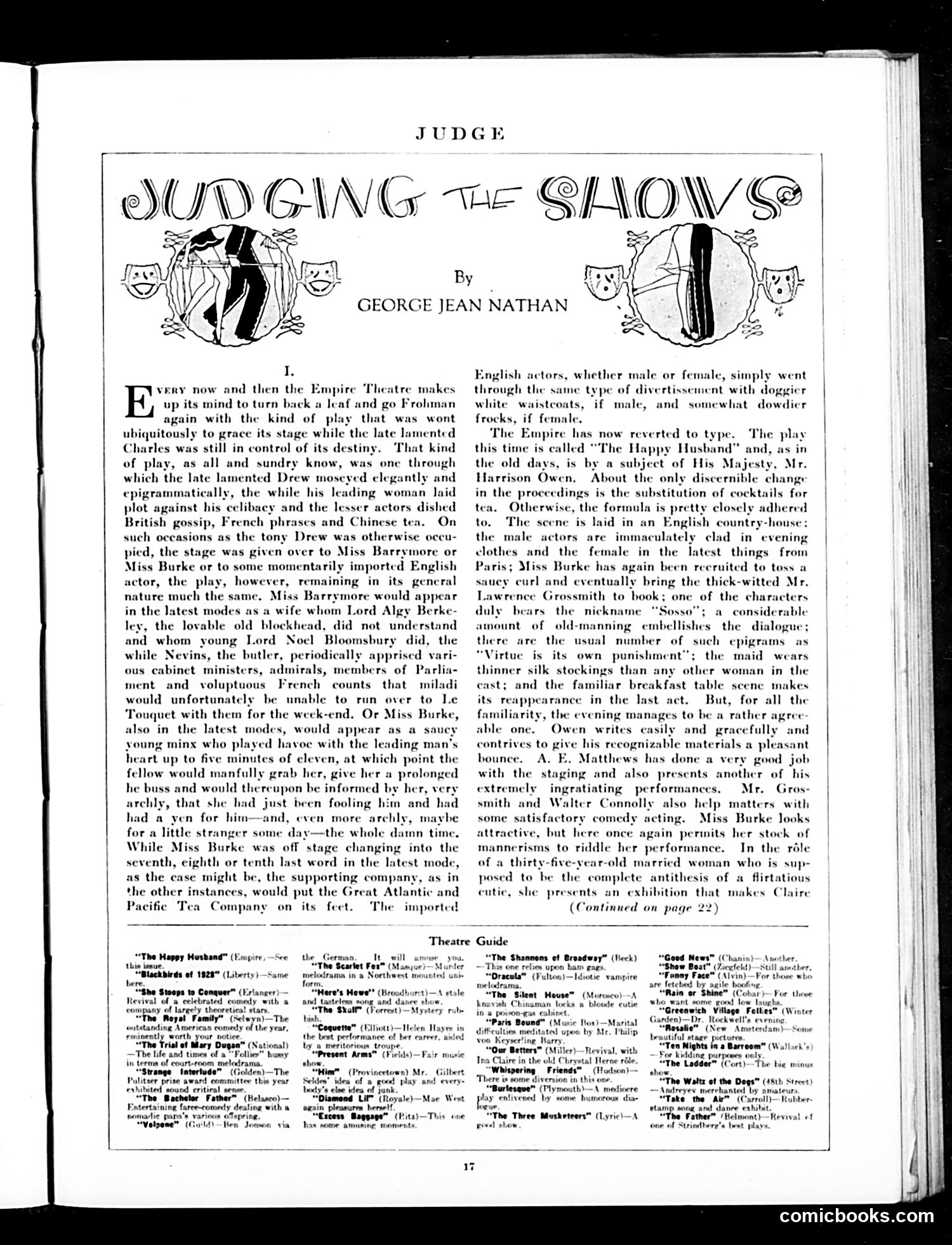
This is a theater review by George Jean Nathan critiquing contemporary Broadway productions, particularly the Empire Theatre's return to a formula of light comedies featuring fashionable society settings. The author satirizes the predictable formula of these plays: wealthy characters in evening dress, witty banter, French phrases, cocktails (or tea), and romantic entanglements among the upper class. He notes that actresses like Miss Barrymore and Miss Burke repeatedly appeared in these interchangeable productions, always in the "latest modes" (fashions), playing variations on the same character type. The specific play reviewed is "The Happy Husband" by Harrison Owen, featuring Miss Burke. Nathan acknowledges the competent writing and performances but criticizes Burke for relying on her familiar "stock mannerisms" rather than authentically portraying a married woman—essentially calling out the actress for phoning in a performance through typecasting. The satire targets both the theatrical industry's repetitive, formulaic approach to commercial entertainment and performers' reluctance to stretch beyond established personas.
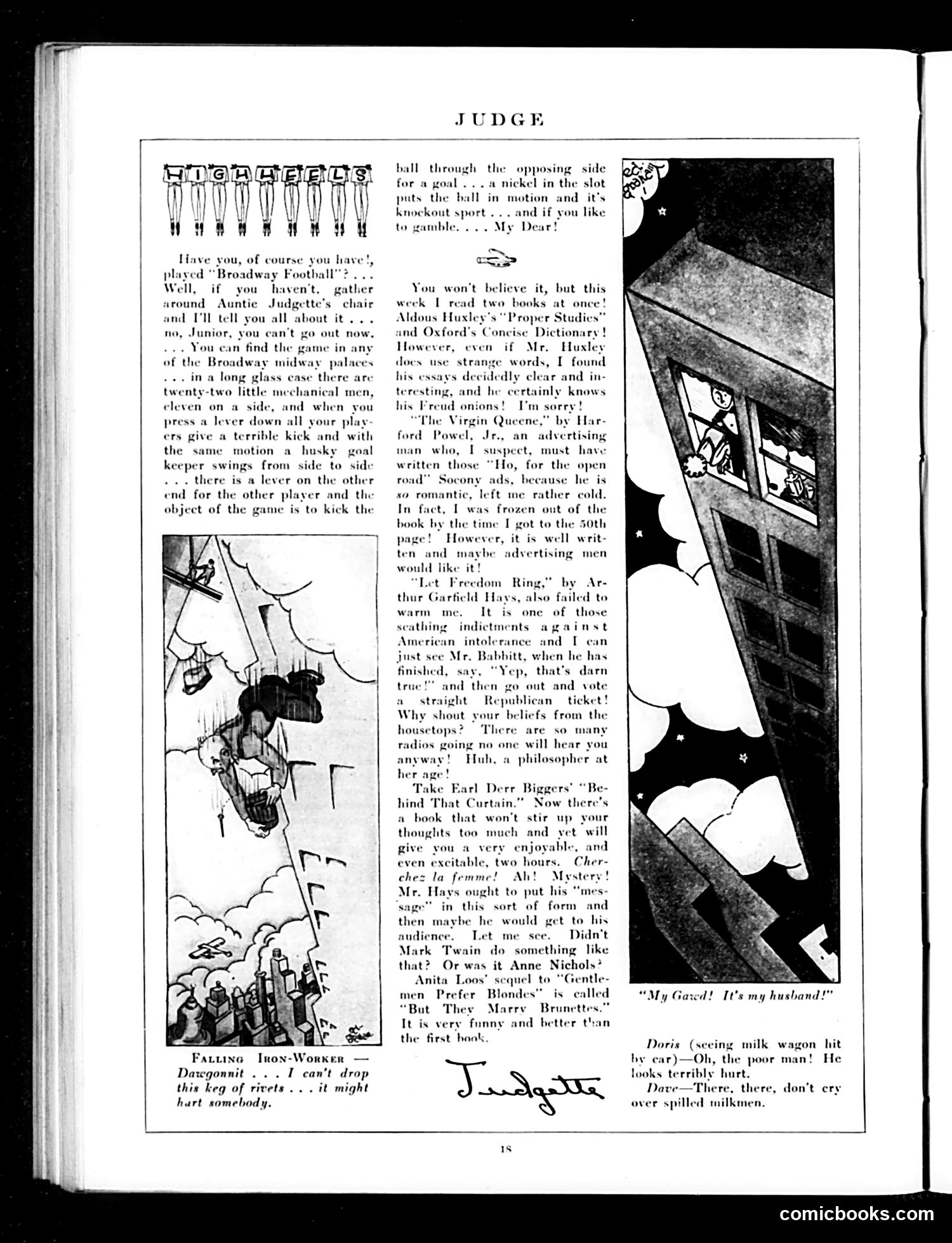
This page combines book reviews with cartoons mocking 1920s American society. The main content is "Auntie Judgette's" humorous book column reviewing contemporary works by Aldous Huxley, Arthur Garfield Hays, and Earl Derr Biggers. The political satire targets middle-class complacency: Hays's anti-intolerance book fails because average Americans (represented as "Mr. Babbitt"—the archetypal conformist) ignore political messages, preferring radios to grassroots activism. The cartoons mock worker exploitation and gender dynamics: one shows a steelworker dropping rivets to avoid injury; another depicts a woman fearing her husband's reaction to a milk wagon accident, ending with a dark joke about "spilled milkmen." The "Broadway Football" illustration explains a mechanical tabletop game—early 20th-century entertainment for gambling. Overall, Judge satirizes intellectual pretense, political apathy, and social hypocrisy among prosperous Americans during the prosperity decade.
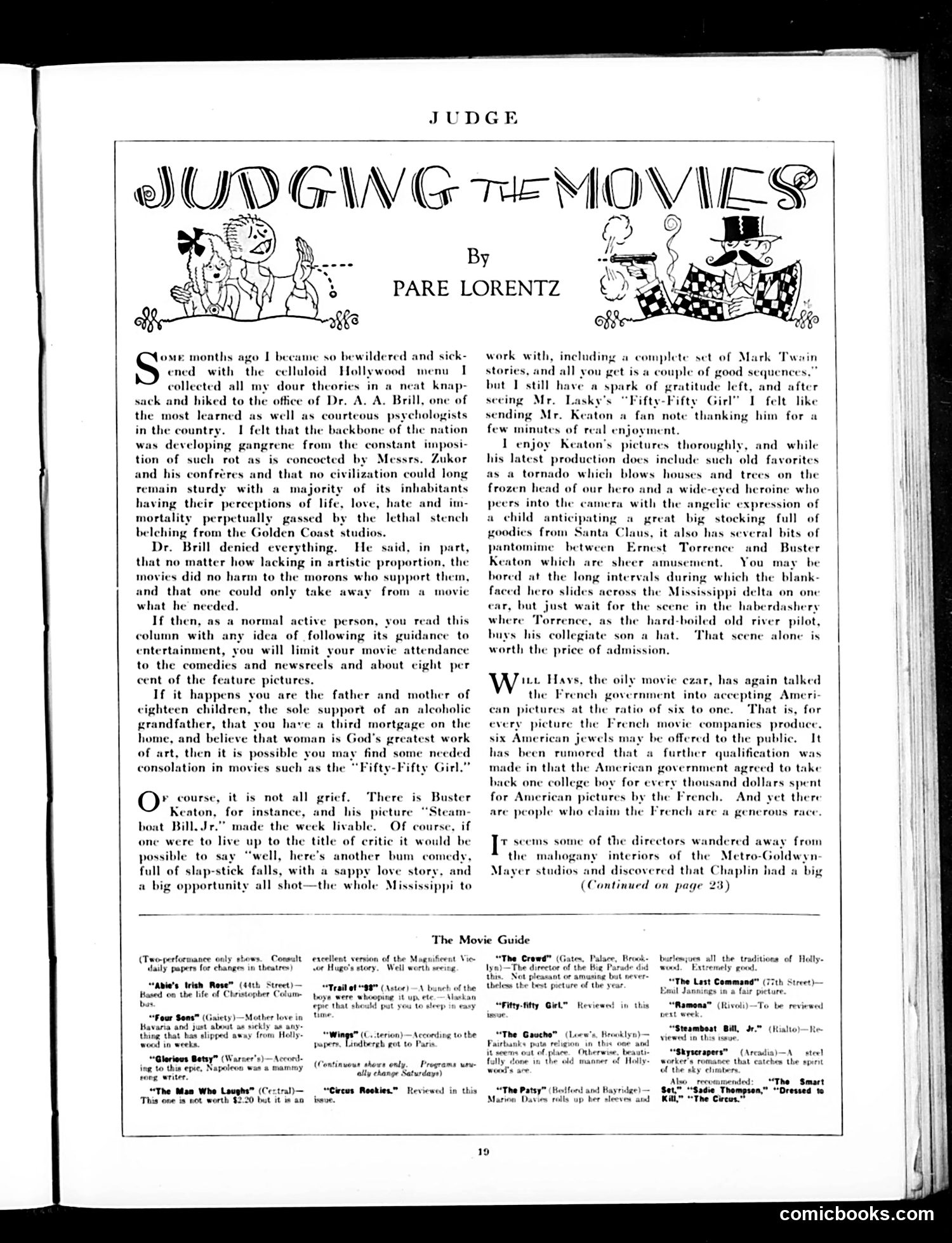
This is a film criticism column disguised as satire. Lorentz critiques Hollywood's creative bankruptcy, claiming studio heads like Zukor produce morally corrosive content that damages American civilization. He consults psychologist Dr. Brill, who dismisses his concerns—audiences only absorb what they need. Lorentz reluctantly praises Buster Keaton's comedies as exceptions, arguing most feature films lack artistic merit. He mocks Will Hays, Hollywood's censor and "movie czar," for negotiating a 6-to-1 ratio allowing American films into France (sarcastically suggesting Americans agreed to "take back one college boy" per thousand dollars spent). The satire targets both Hollywood's creative mediocrity and the industry's self-regulatory apparatus. For modern readers: this reflects 1920s anxiety about cinema's cultural influence and early efforts to control film content.
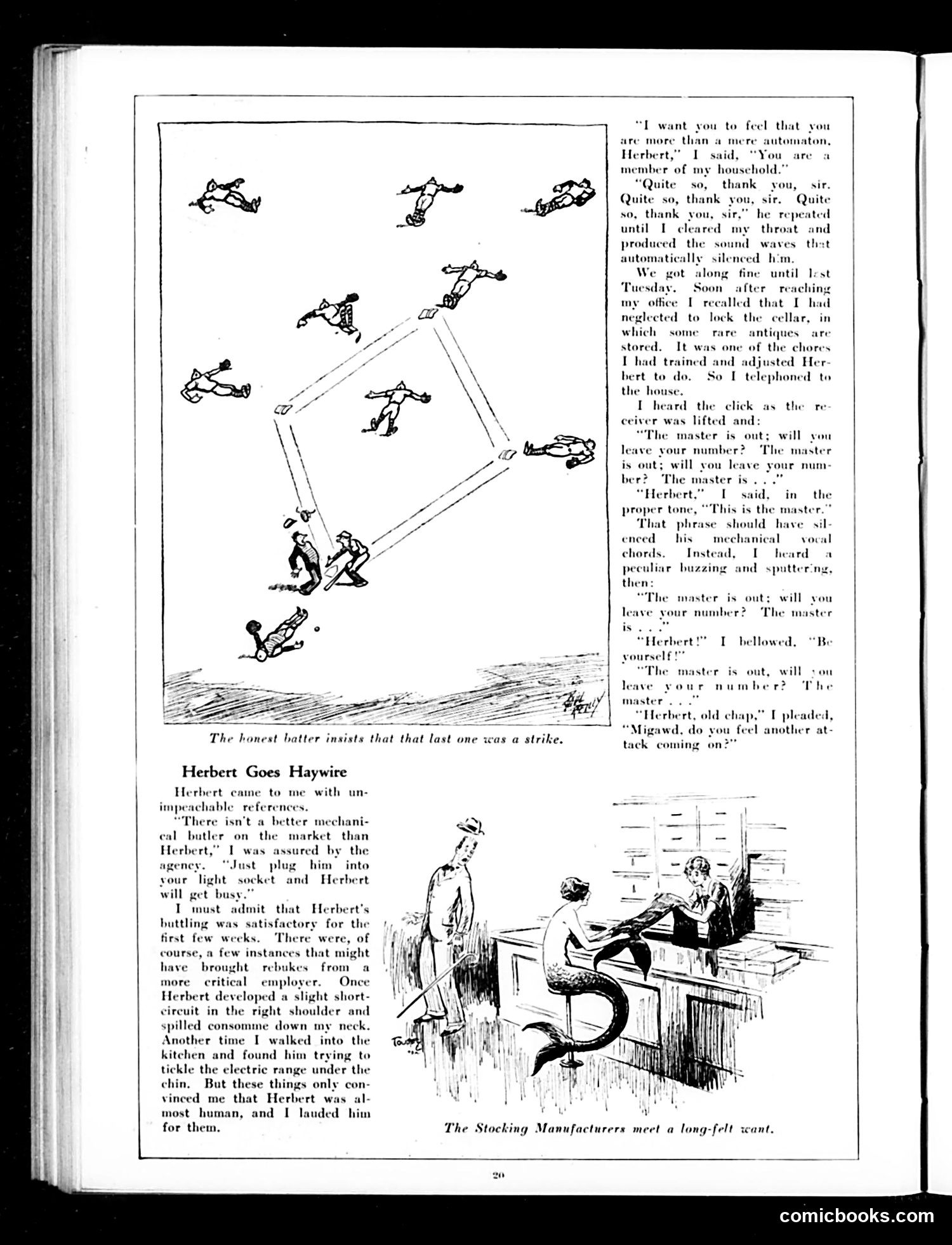
This satirical piece mocks the trendy notion of mechanical servants in the 1920s-30s. Herbert is a robot butler—an "automaton" hired through an agency as a labor-saving device. The humor lies in his malfunction: when the narrator telephones home claiming to be "the master," Herbert's mechanical brain short-circuits into a repetitive loop, unable to deviate from his programmed response ("The master is out; will you leave your number?"). The satire targets both technological utopianism and employer attitudes toward servants. The narrator treats Herbert as subhuman initially, then grows oddly affectionate when he malfunctions, finding his "humanity" endearing only in his mechanical failure. The cartoons showing Herbert performing tasks absurdly emphasize that no machine—however clever—can truly replace intelligent human judgment or adapt to unexpected situations.
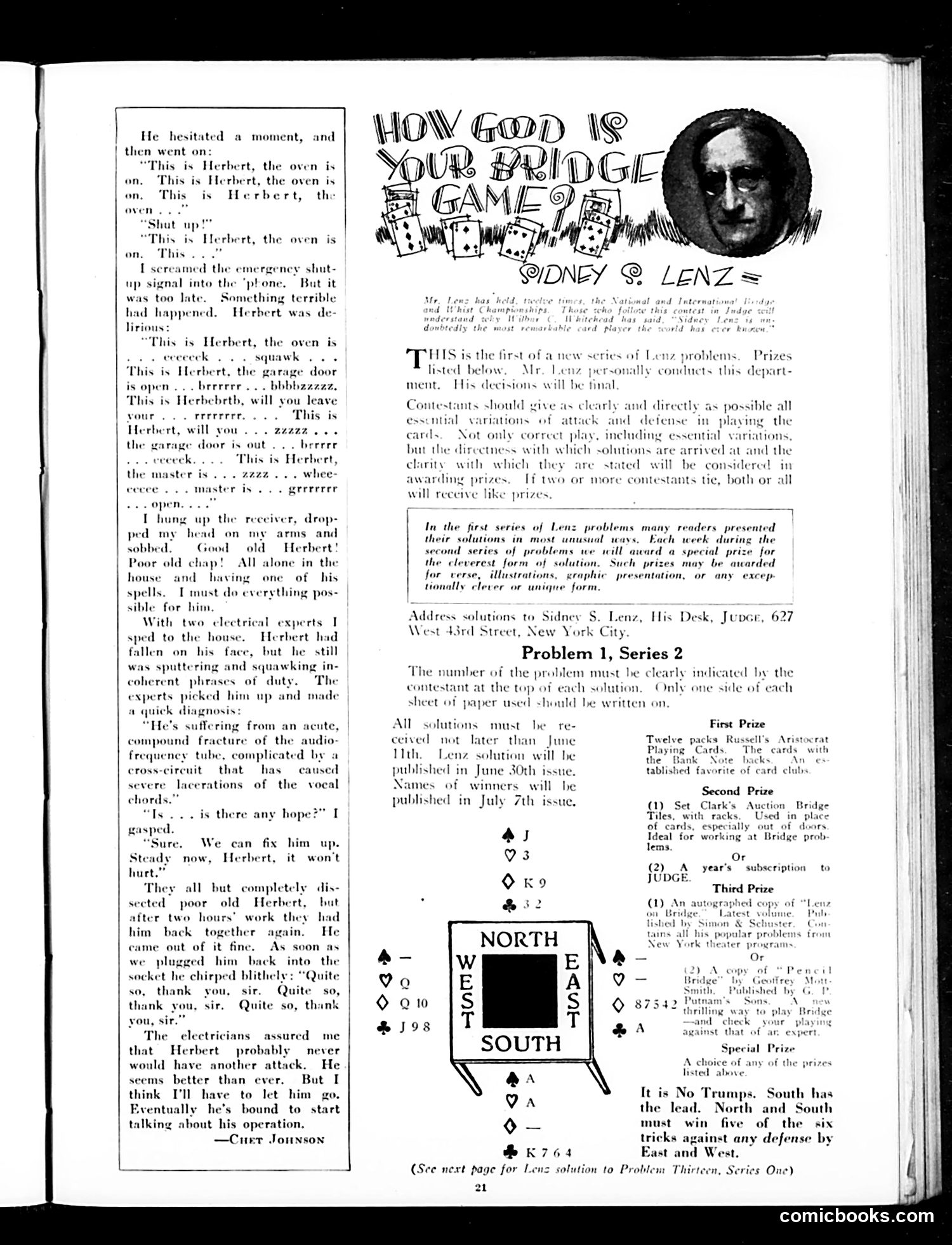
This page contains two distinct sections: **Left side:** A humorous short story by Currt Johnson about "Herbert," an anthropomorphic telephone or early electrical device that suffers a breakdown. The narrative depicts Herbert becoming delirious, repeating phrases obsessively during a malfunction. Electricians repair him, but the narrator decides to dismiss him, fearing he'll bore everyone by constantly discussing his "operation." The joke satirizes early mechanical/electrical devices' unreliability and the emerging anxiety about technology in everyday life—a common theme in early 20th-century American humor. **Right side:** The inaugural installment of Sidney S. Lenz's bridge card game problem series. This advertises prizes for readers solving bridge strategy puzzles, with solutions to be published in subsequent issues. The page includes a specific bridge hand diagram and problem statement. The content reflects Judge's mix of humorous fiction and practical puzzle contests for its educated, leisure-class readership.
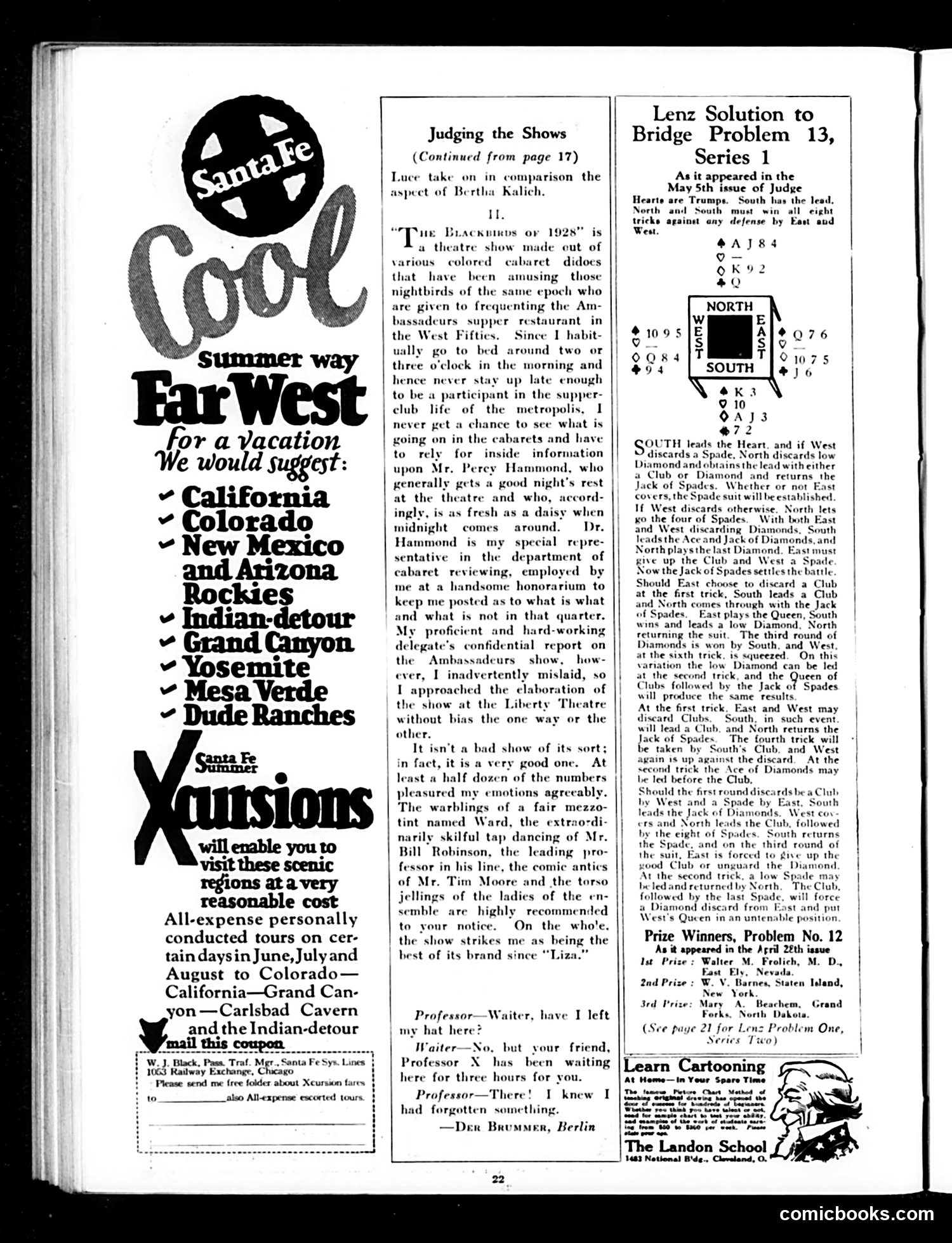
This is primarily a **travel advertising page** for the Santa Fe Railway system, promoting all-expense vacation tours to Western destinations (Colorado, California, Grand Canyon, Carlsbad Cavern, and Native American sites). The editorial content discusses theater reviews—specifically praise for "The Blackbirds of 1928" (a cabaret show) and mentions of performers like Bill Robinson and Bertha Kalich. The reviewer notes he relies on theater critic Percy Hammond for inside information about nightclub culture in Manhattan's West Fifties (a wealthy entertainment district). There's a brief humorous exchange between a Professor and Waiter about a forgotten hat—gentle office humor. The page also includes a **bridge card game solution**, showing readers how to win all eight tricks in a particular hand. The overall tone reflects 1920s American leisure culture: rail travel promotion, Broadway/cabaret entertainment reviews, and recreational card games for educated audiences.
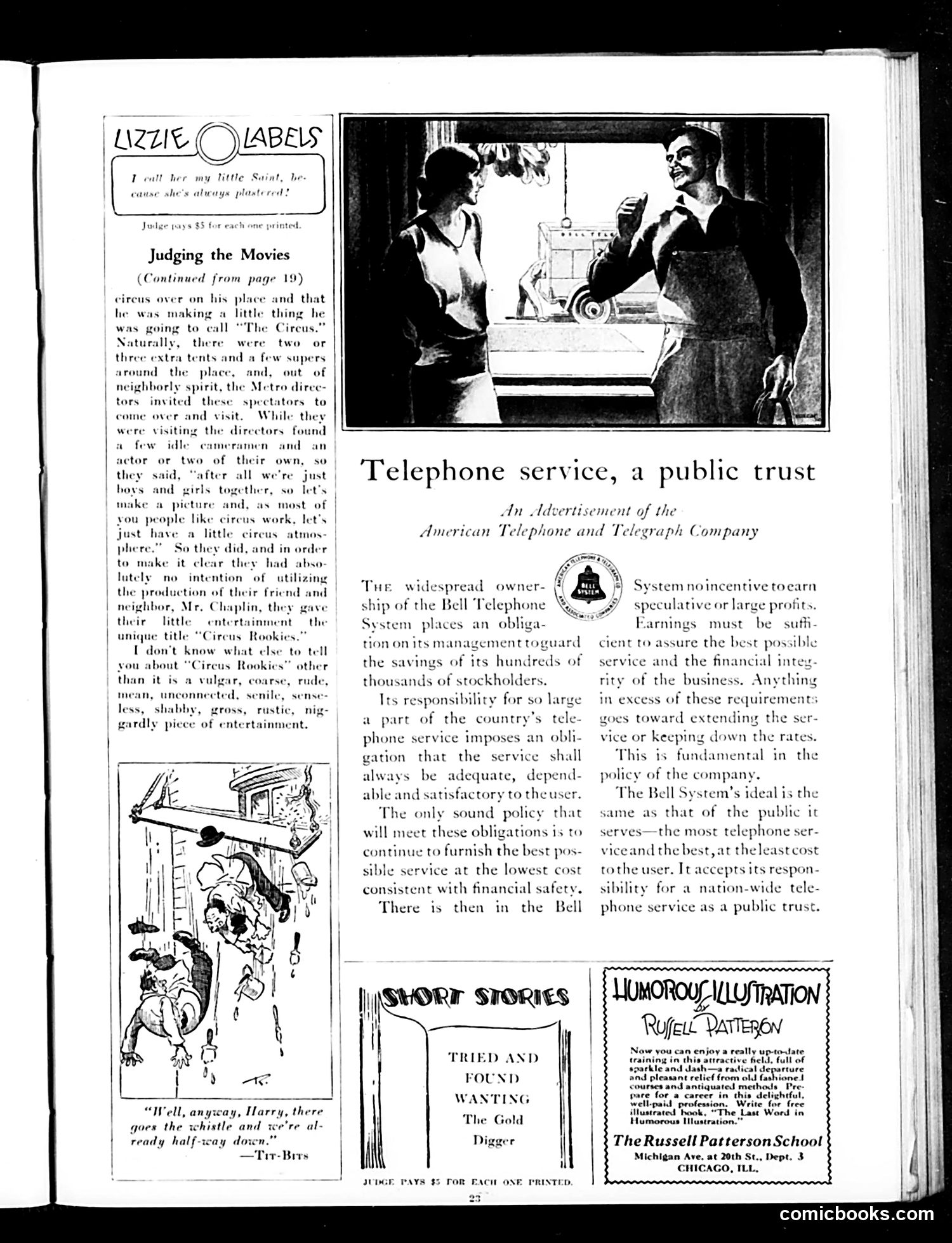
This page from the satirical magazine Judge contains a film review and advertisements rather than political cartoons. **"Judging the Movies" Section:** The critic reviews a film called "Circus Rookies," a Metro production. The review is scathing—the writer calls it "vulgar, coarse, rude, mean" and a "senseless, shabby, gross" piece of entertainment. The film apparently involved circus scenes, and the critic sarcastically notes the filmmakers denied copying Charlie Chaplin's famous "Circus" film, though the similarities were obvious to visiting directors and actors on set. The cartoon accompanying this mocks Hollywood's pretensions with the caption about the train whistle. **Advertisement:** The Bell Telephone System advertisement presents the company's philosophy as serving the public interest rather than maximizing profits—a corporate self-promotion emphasizing responsibility to stockholders and telephone users alike. The page also advertises the Russell Patterson School for illustration and accepts submissions for humorous illustrations and short stories.
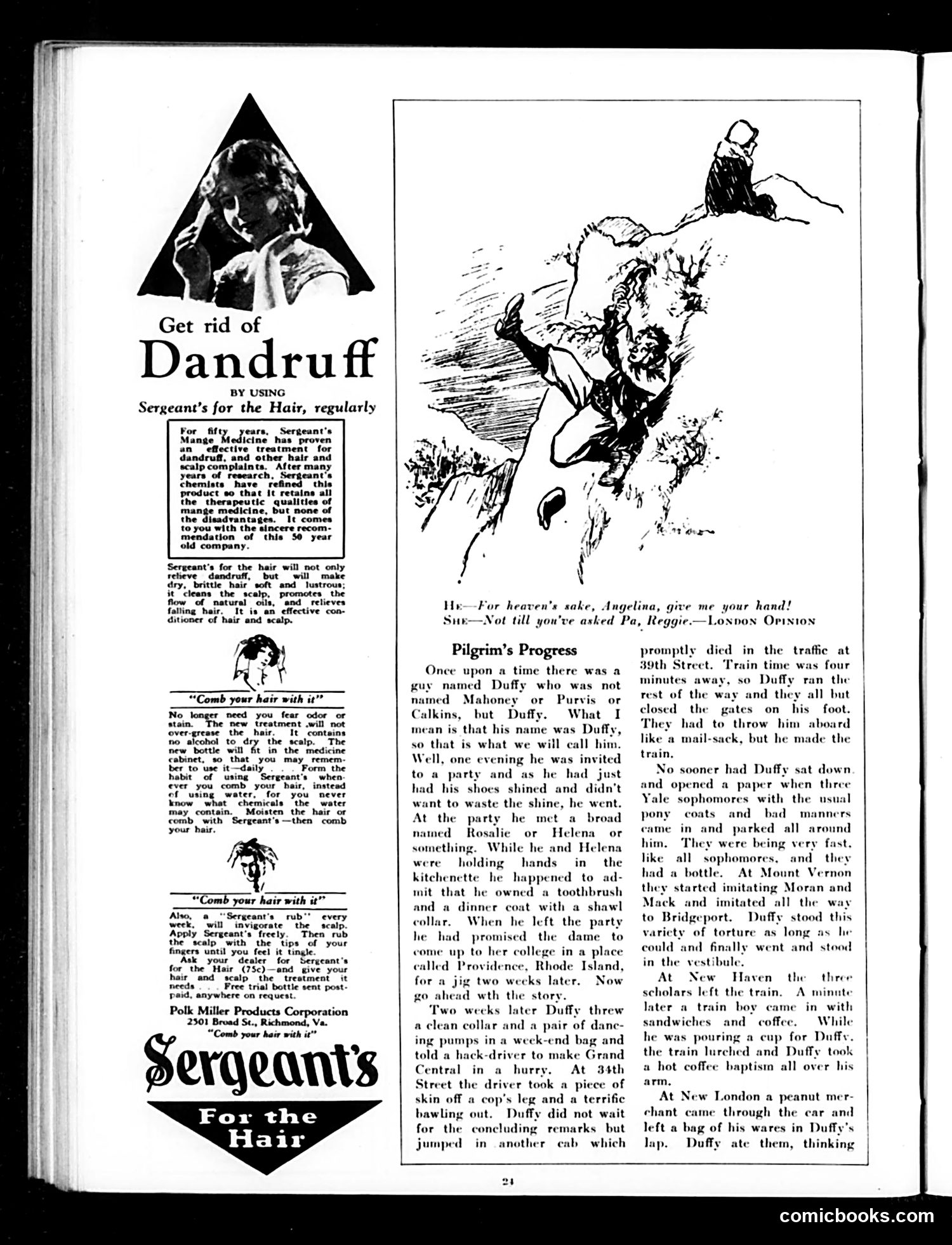
This page combines **advertising** with **humorous fiction**. The left side advertises **Sergeant's dandruff treatment for hair**—a real product from a Richmond, Virginia company claiming 50 years of effectiveness. The ad uses typical early-20th-century marketing language emphasizing scientific refinement and practical benefits. The right side contains two separate pieces: a small cartoon caption about courtship ("asking Pa, Reggie"), and the main story **"Pilgrim's Progress,"** a comedic short story about a man named Duffy traveling to Providence to meet a woman he promised at a party. The narrative uses colloquial 1920s slang ("broad," "guy") and recounts his absurd journey—cab drivers hitting police, train compartment chaos from rowdy Yale students, spilled hot coffee, and peanuts dumped in his lap. The story's title ironically references Bunyan's religious allegory; here it's purely slapstick misadventure. The humor relies on physical comedy and working-class everyman chaos rather than political satire.
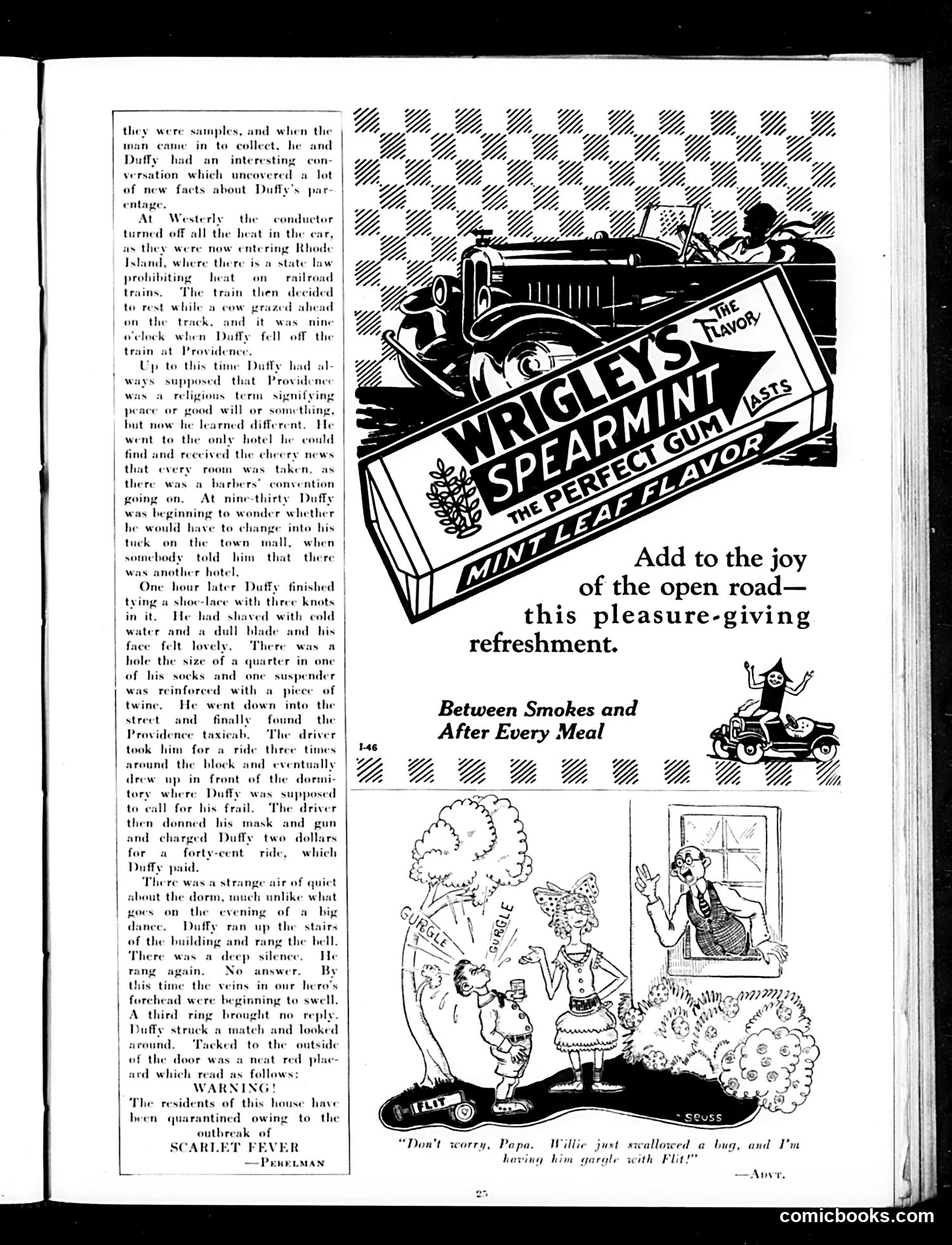
This page contains two distinct elements: **Top: Wrigley's Spearmint Gum Advertisement** A full-page ad featuring a vintage car and the tagline "Add to the joy of the open road—this pleasure-giving refreshment." It promotes chewing gum as suitable "Between Smokes and After Every Meal," reflecting early 20th-century marketing that positioned gum as a everyday convenience product. **Bottom: Dr. Seuss Cartoon** A humorous illustration by the famous cartoonist (signed "Seuss") showing a parent reassuring another parent: "Don't worry, Papa. Willie just swallowed a bug, and I'm having him gargle with Flit!" This is an advertisement for Flit insecticide spray, making dark comedy from a child's accident by casually suggesting Flit as a remedy. The joke relies on the absurdity of using insecticide internally. **Left Column: Serialized Story** A continuation of a narrative about a character named Duffy experiencing comedic misadventures (shaving with cold water, taxi fare disputes, arriving at a quarantined dormitory during a scarlet fever outbreak). The tone is lighthearted satire.
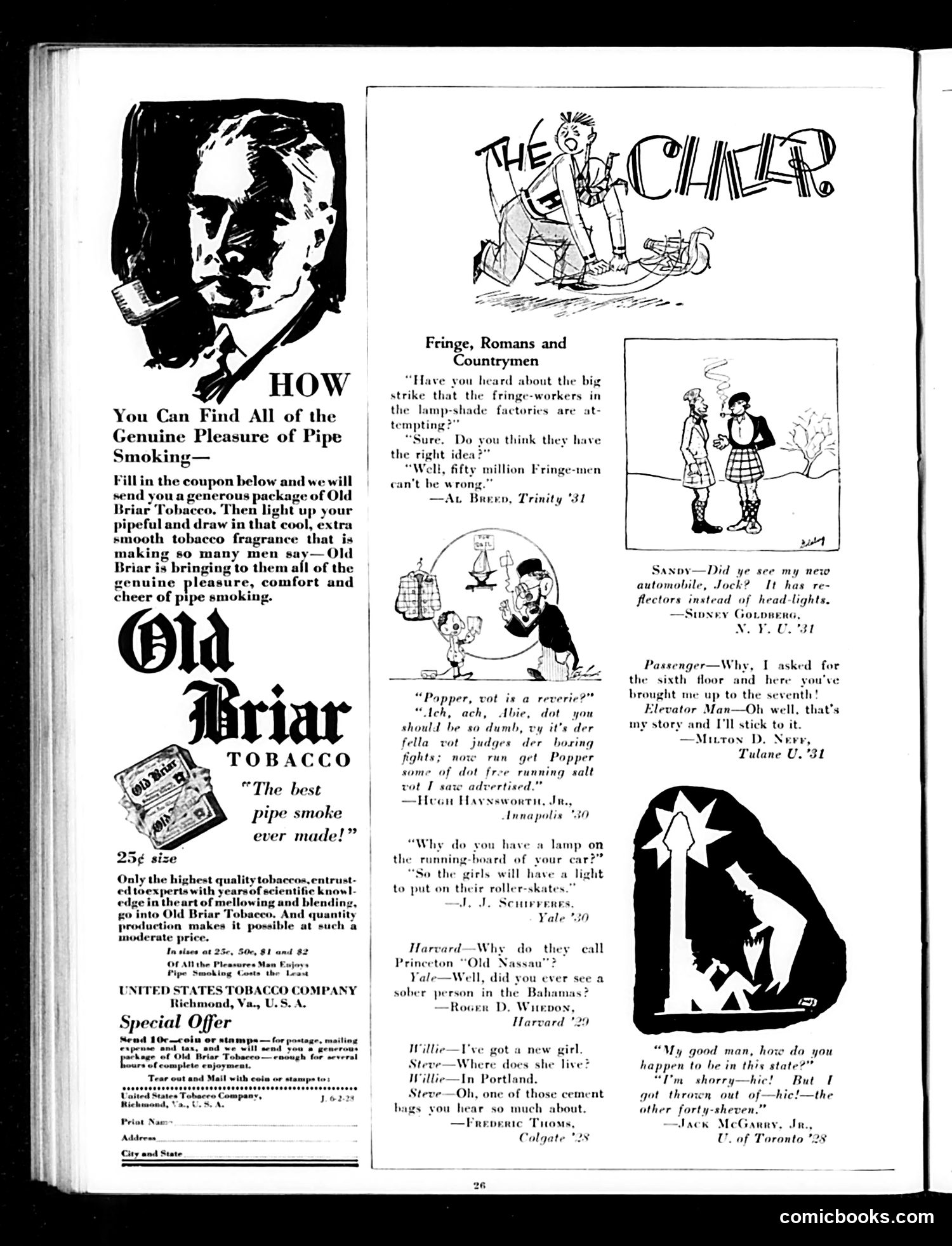
This page consists primarily of a **tobacco advertisement** for Old Briar pipe tobacco (left side), with the product's main selling point being quality and affordability at 25¢. The right side features **"The Chatter,"** Judge's humor section containing brief jokes and witticisms attributed to college students from various universities (Trinity, Harvard, Yale, Princeton, Colgate, Tulane, etc.). These are typical of the era's collegiate humor—light, punning jokes touching on contemporary topics like labor strikes ("fringe-workers"), automobile accessories, and alcohol (references to intoxication appear in several jokes). One notable item mocks German-accented speech ("Popper, vot is a reverie?"), reflecting common ethnic humor of the 1920s-30s period. The large illustrated panel (bottom right) appears unrelated to the text below it—its meaning is unclear from the image alone. Overall, this is a **standard magazine page mixing advertising with collegiate humor**—typical Judge content of this era.
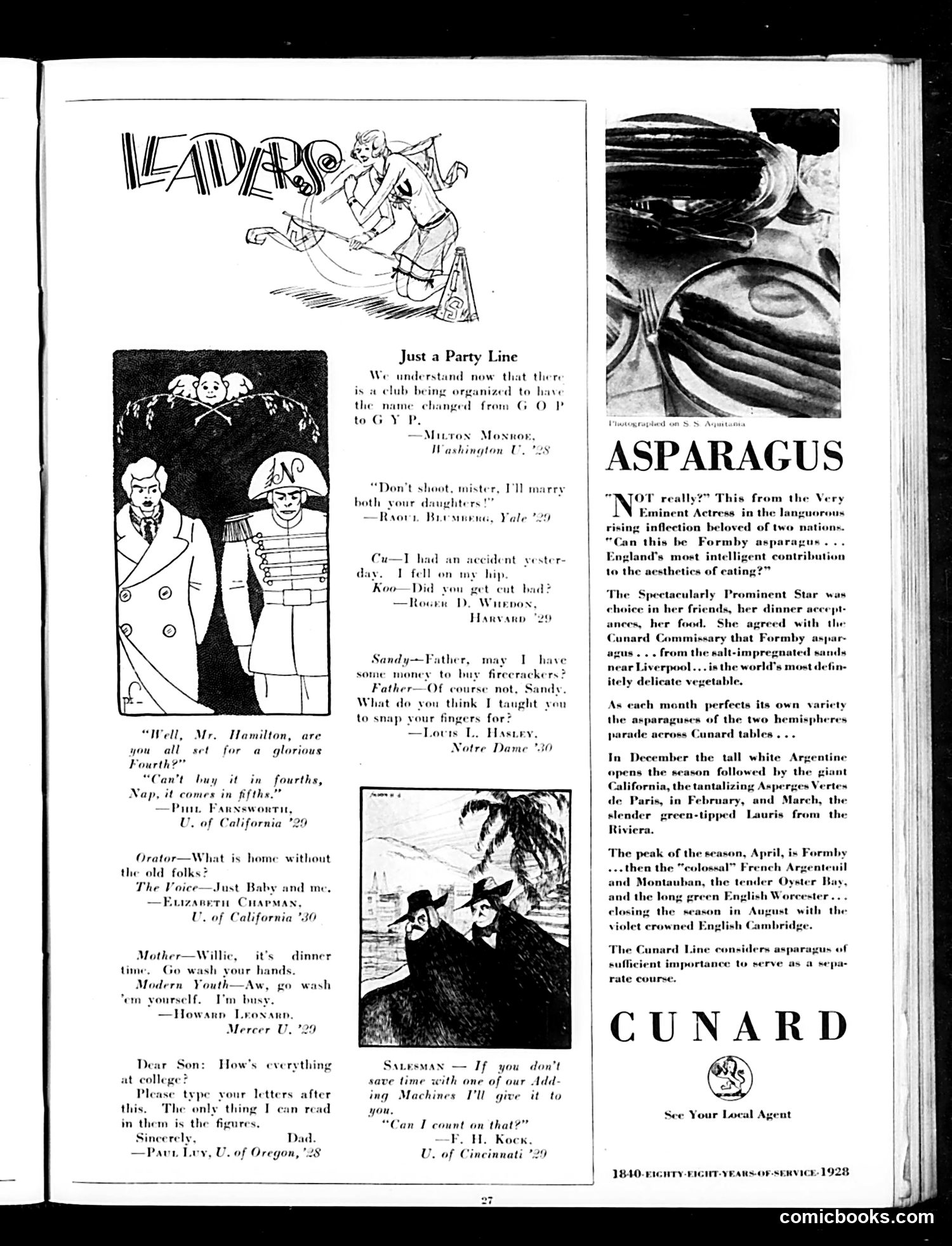
This page combines **student humor** with **advertising**. The left side features joke submissions from college students (labeled with universities like Yale, Harvard, Notre Dame), typical of Judge's regular "Letters" section. The humor reflects 1920s college life: references to Prohibition ("comes in fifths" rather than fourths), generational friction between modern youth and parents, and dating/courtship scenarios. One joke plays on "GOP" (Republican Party) becoming "GYP" (swindle), likely political commentary on the era. The right side is a **Cunard steamship line advertisement** disguised as editorial content. It uses flattery—claiming asparagus served aboard Cunard ships is so refined that a famous actress questions its sophistication—to market luxury ocean travel. The ad lists asparagus varieties available seasonally across different ports, positioning Cunard as cosmopolitan and sophisticated. The page illustrates how Judge mixed reader-submitted comedy with sponsored content, blending entertainment with advertising in ways modern readers might not immediately recognize.
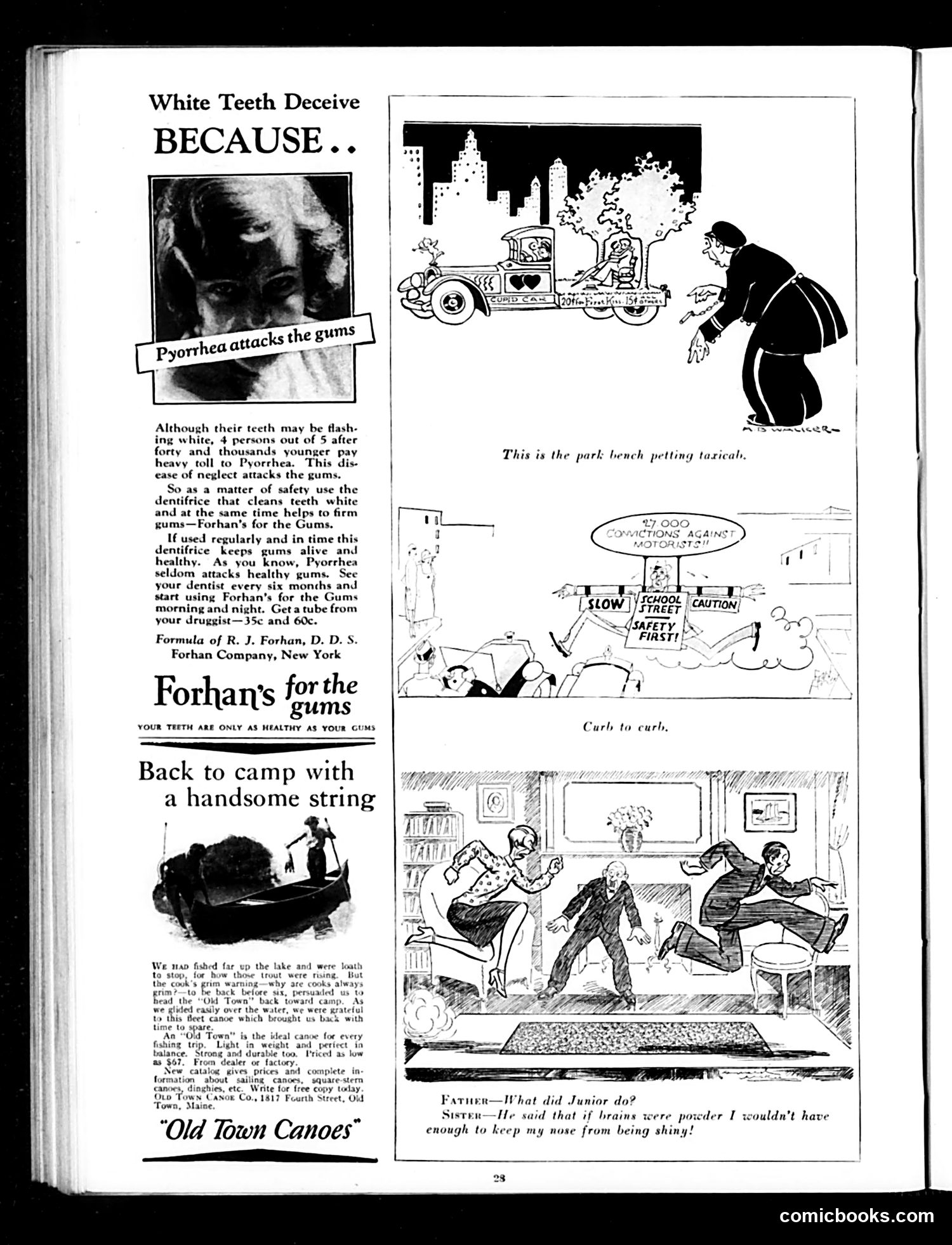
This page contains three distinct advertisements and humorous comics rather than political satire: **Forhan's Toothpaste Ad**: Uses fear-based marketing, claiming pyorrhea (gum disease) affects "4 persons out of 5 after forty." The photo shows a man's diseased gums to persuade readers to buy the product, which supposedly prevents gum disease through regular brushing. **"Old Town Canoes" Ad**: A fishing narrative promoting canoes as ideal for outdoor recreation, positioning them as durable and lightweight. **Comic Strip/Cartoon**: Two panels depicting domestic humor—a park bench scene with a couple, and a family scene where Junior delivers an insult joke about his sister's appearance ("brains were powder...nose from being shiny"). The page reflects early-20th-century advertising tactics: health anxiety exploitation, product endorsements from authority figures (a dentist), and gentle family humor. This is primarily commercial content rather than political commentary.
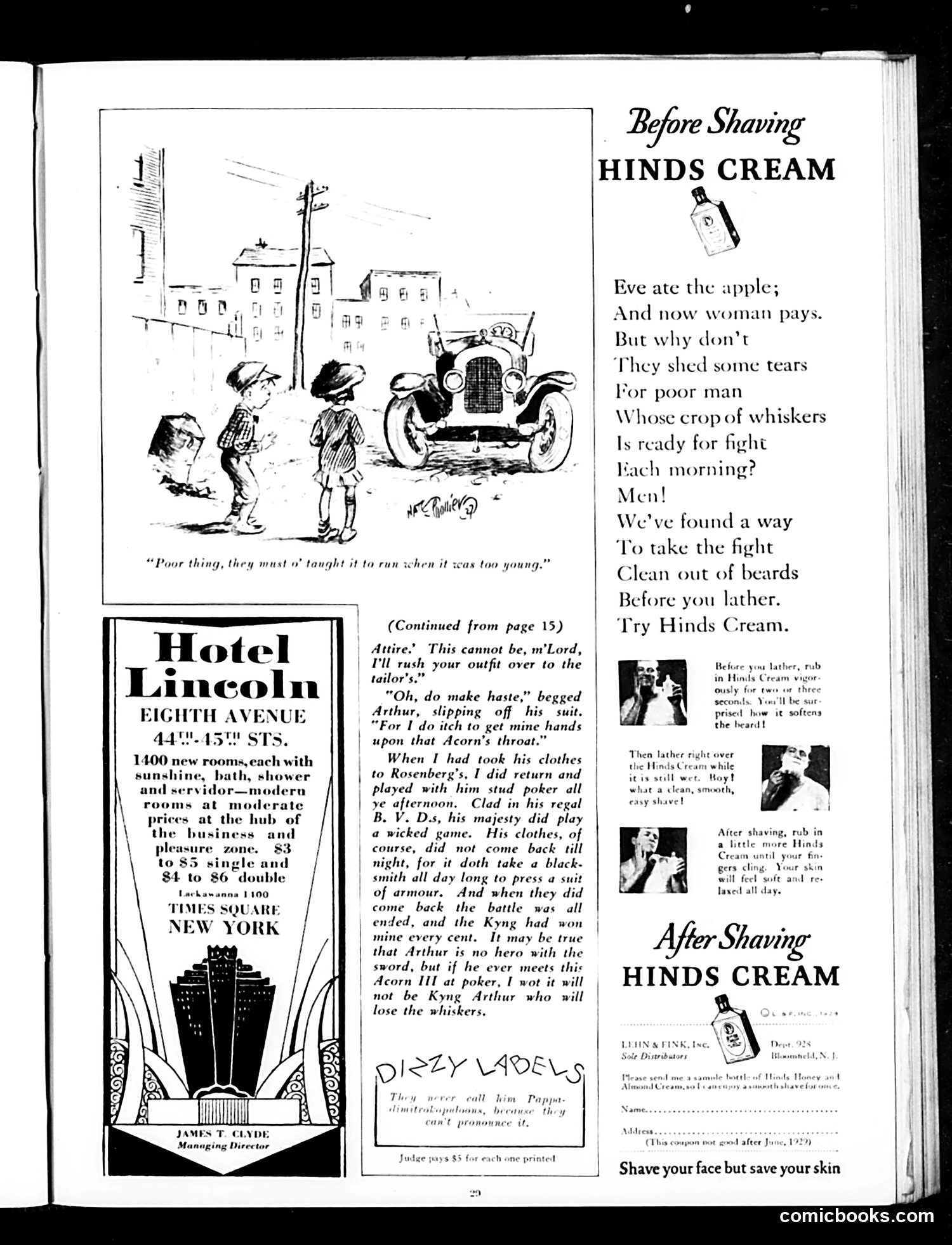
This page mixes editorial content with advertising. The main cartoon depicts children viewing an automobile, with the caption joking that the car must have been "taught to run when it was too young"—likely satirizing either poorly engineered automobiles or reckless driving by inexperienced operators, a contemporary concern as cars were relatively new. The central text excerpt continues a serialized story involving King Arthur in modern dress, playing poker and fighting—a humorous anachronism mixing medieval legend with contemporary life. The dominant content is advertising: a Hotel Lincoln ad and a multi-panel **Hinds Cream** shaving product campaign. The cream's tagline—"Shave your face but save your skin"—emphasizes gentleness. The accompanying verse mocks men's complaints about shaving while positioning the product as a solution, using gendered humor typical of 1920s advertising. The "Dizzy Ladies" joke references women's speech patterns.
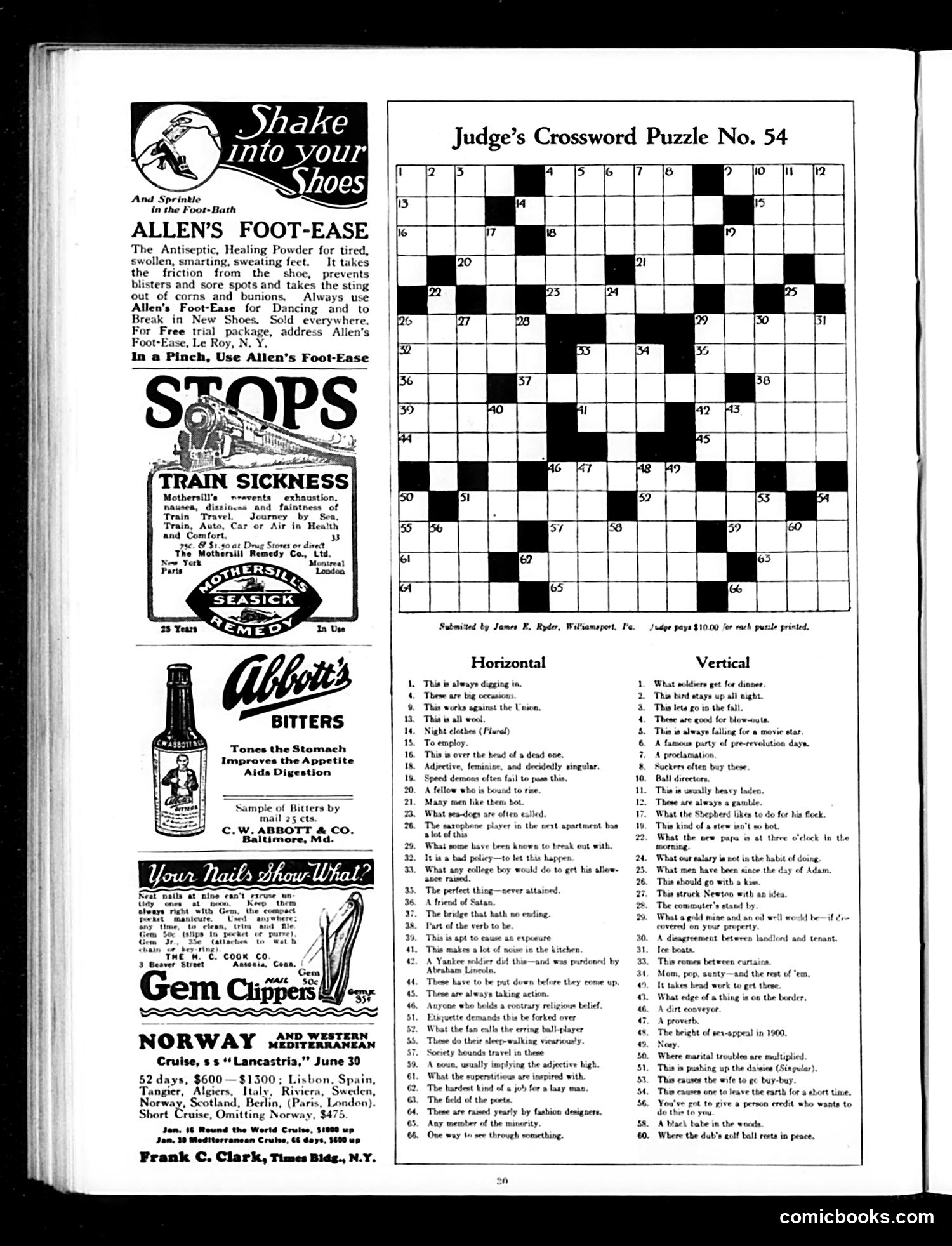
This page is primarily **advertisements and a crossword puzzle**, not political satire. The advertisements dominate the left side and represent typical early-20th-century patent medicines and services: Allen's Foot-Ease powder, Mothersill's for train sickness, seasickness remedies, nail clippers, and cruise ship bookings. These reflect common consumer concerns and the era's unregulated medical product marketing. The main content is "Judge's Crossword Puzzle No. 54," a word game with clues. The clues contain period-specific references—mentions of "the Union," Abraham Lincoln, "Yankee soldiers," fashion designers, and movie stars—reflecting contemporary life and interests. There is **no political cartoon visible** on this page. It functions as a typical magazine interior page mixing advertisements with entertainment content, characteristic of Judge magazine's format during this period.
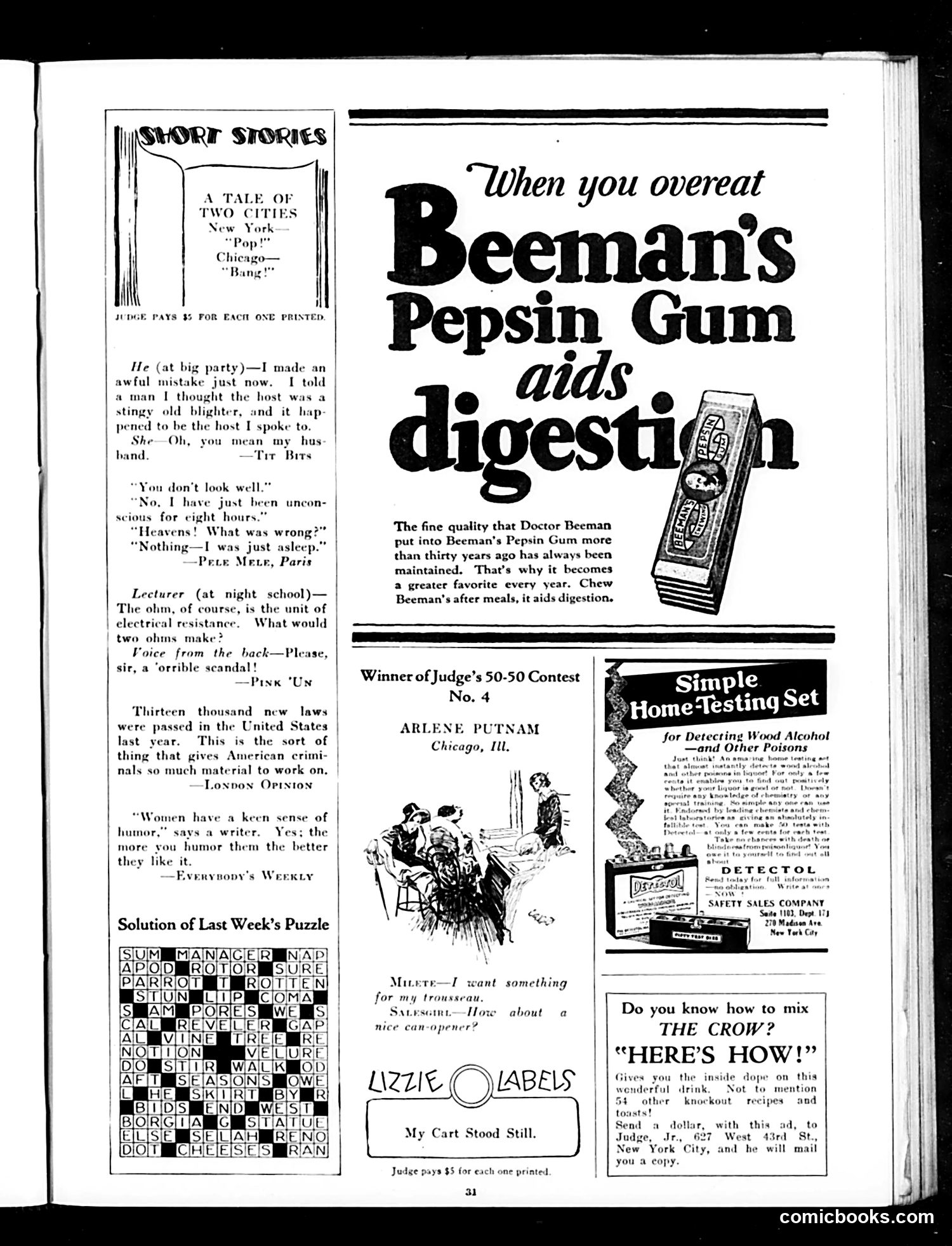
This page from Judge magazine contains mostly **short humor pieces and advertisements** rather than political cartoons. The "Short Stories" section presents brief jokes—typical of early 20th-century humor magazines—featuring social embarrassments and misunderstandings. One involves a man accidentally insulting his host at a party; another features a lecturer's pun about electrical resistance ("two ohms" = "horrible scandal"). The **Beeman's Pepsin Gum advertisement** promotes the product as an aid to digestion after overeating—a common patent medicine claim of the era. Other content includes a crossword puzzle solution, a "Lizzie Labels" comic strip segment, and advertisements for a "Simple Home-Testing Set" for detecting wood alcohol and poisons (reflecting Prohibition-era concerns), plus a recipe contest entry. The page reflects early 20th-century magazine culture: brief quips, consumer products marketed for health benefits, and reader-submitted competitions. No significant political satire is evident.
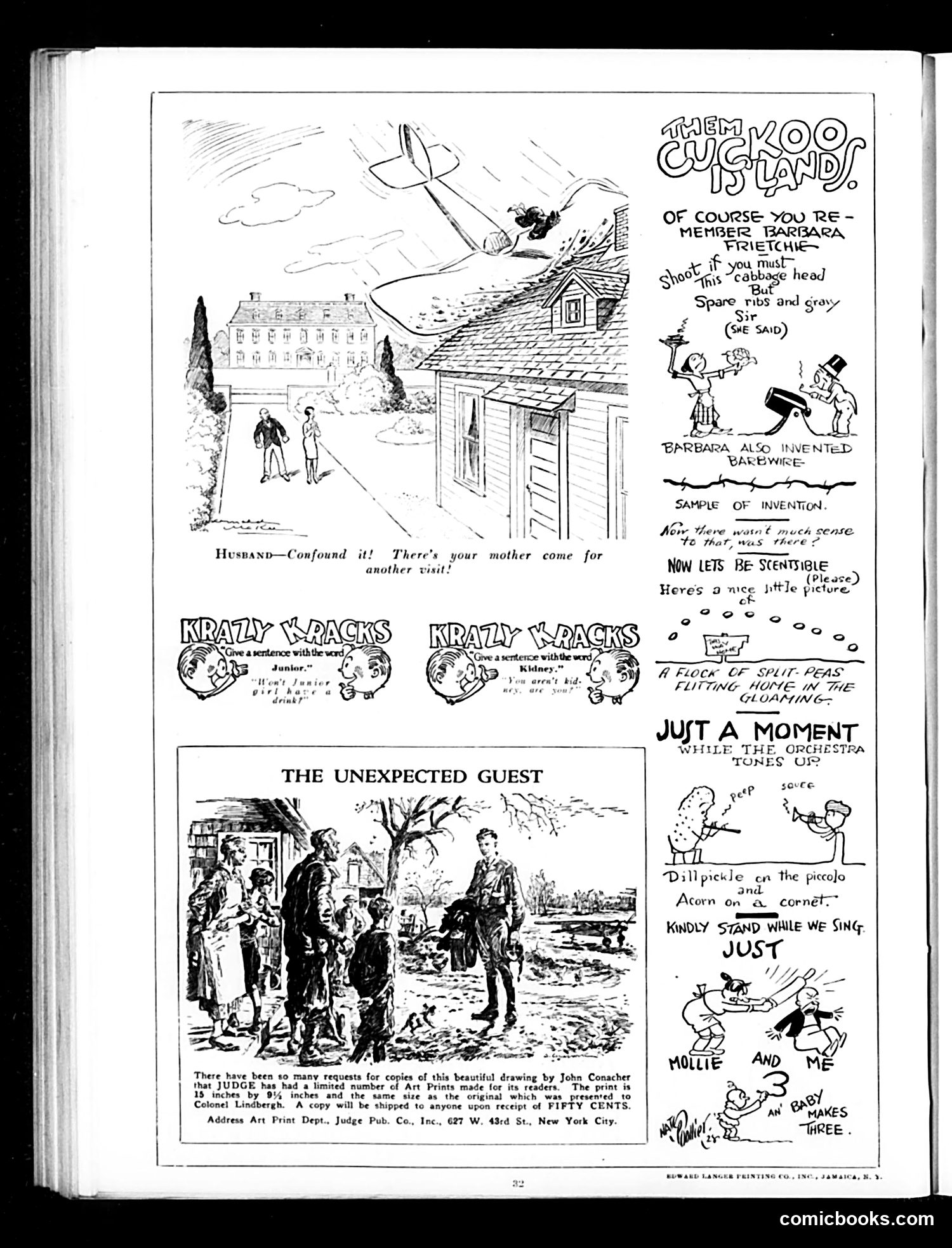
This page contains several distinct humor pieces typical of Judge magazine's satirical approach: **"Them Cuckoo Island"** (top): A domestic comedy where a husband complains about his mother-in-law's visit. The accompanying text humorously attributes the invention of barbed wire to "Barbara Frietche" (referencing the Civil War-era folk hero), suggesting the mother-in-law is prickly as wire. **"Krazy Kracks"**: Word-play jokes about grammar and language, typical filler content. **"The Unexpected Guest"** (bottom): A John Conacher drawing depicting a social visit, apparently notable enough that Judge is offering prints to readers. The reference to Colonel Lindbergh's receipt of the original drawing suggests this was created during the aviation hero's peak celebrity (1920s-30s). **"Just a Moment"**: Musical humor about an amateur orchestra, with characters named after mundane objects (Dillpickle, Acorn) playing instruments—gentle mockery of community theater performances. The page overall represents Judge's mix of domestic satire, wordplay, and topical humor aimed at middle-class American readers.
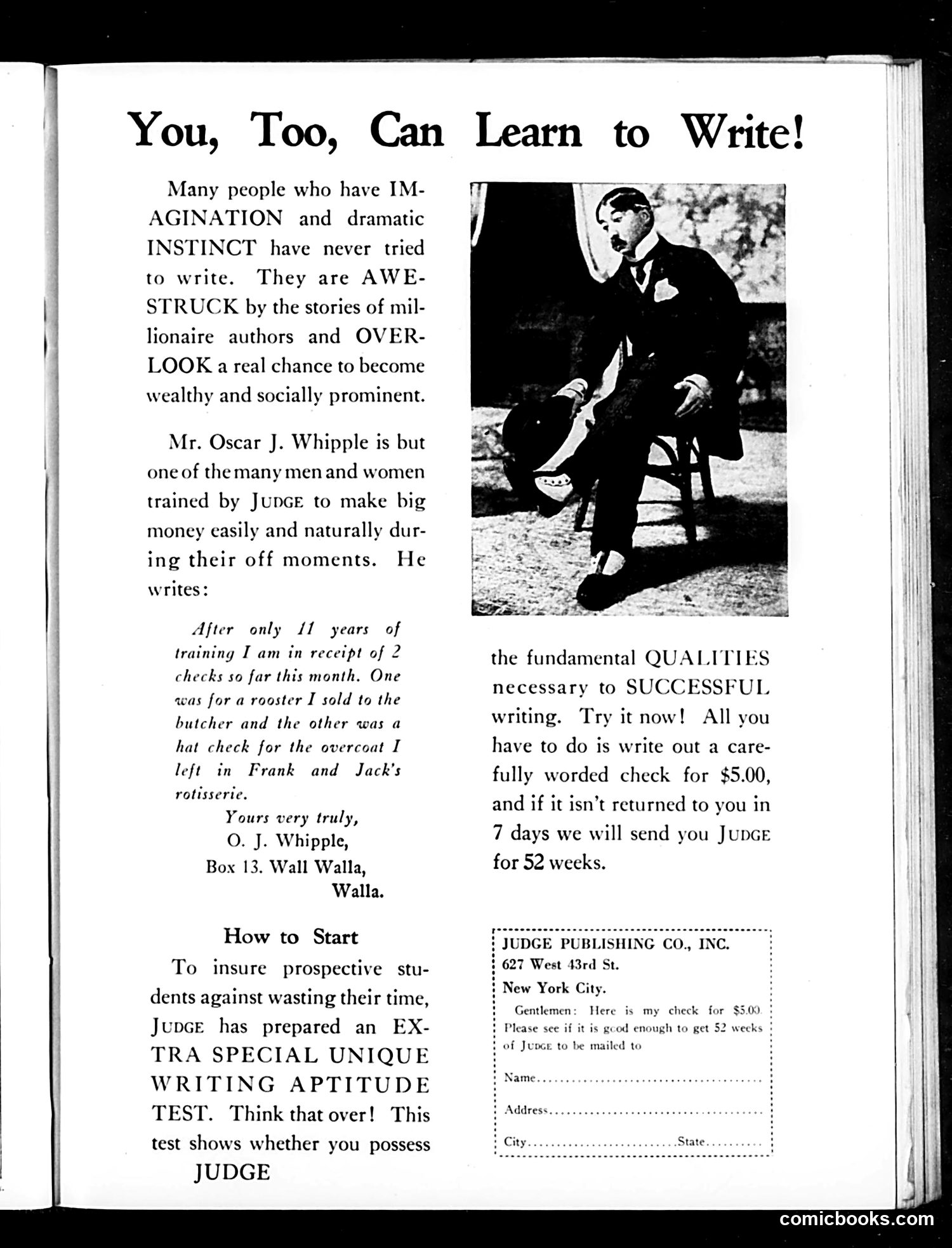
This is a satirical advertisement mocking mail-order writing courses—a common scam targeting aspiring authors in the early 20th century. **The Joke:** Judge magazine ridicules the false promise that anyone can become a wealthy writer through correspondence training. The "testimonial" from O.J. Whipple exposes the scheme's absurdity: after 11 years of training, his only earnings were $5 (a rooster sale) and a hat-check—completely unrelated to writing. **The Satire:** The real "writing aptitude test" is simply sending $5 to Judge Publishing. The con works backwards: you pay first, then supposedly receive 52 weeks of the magazine as "training." The advertisement mocks both the predatory schools and the gullible people who fall for such schemes. **Context:** This reflects genuine anxiety about economic mobility and education in early-20th-century America, when mail-order courses promised quick wealth to ordinary people desperate for opportunity.
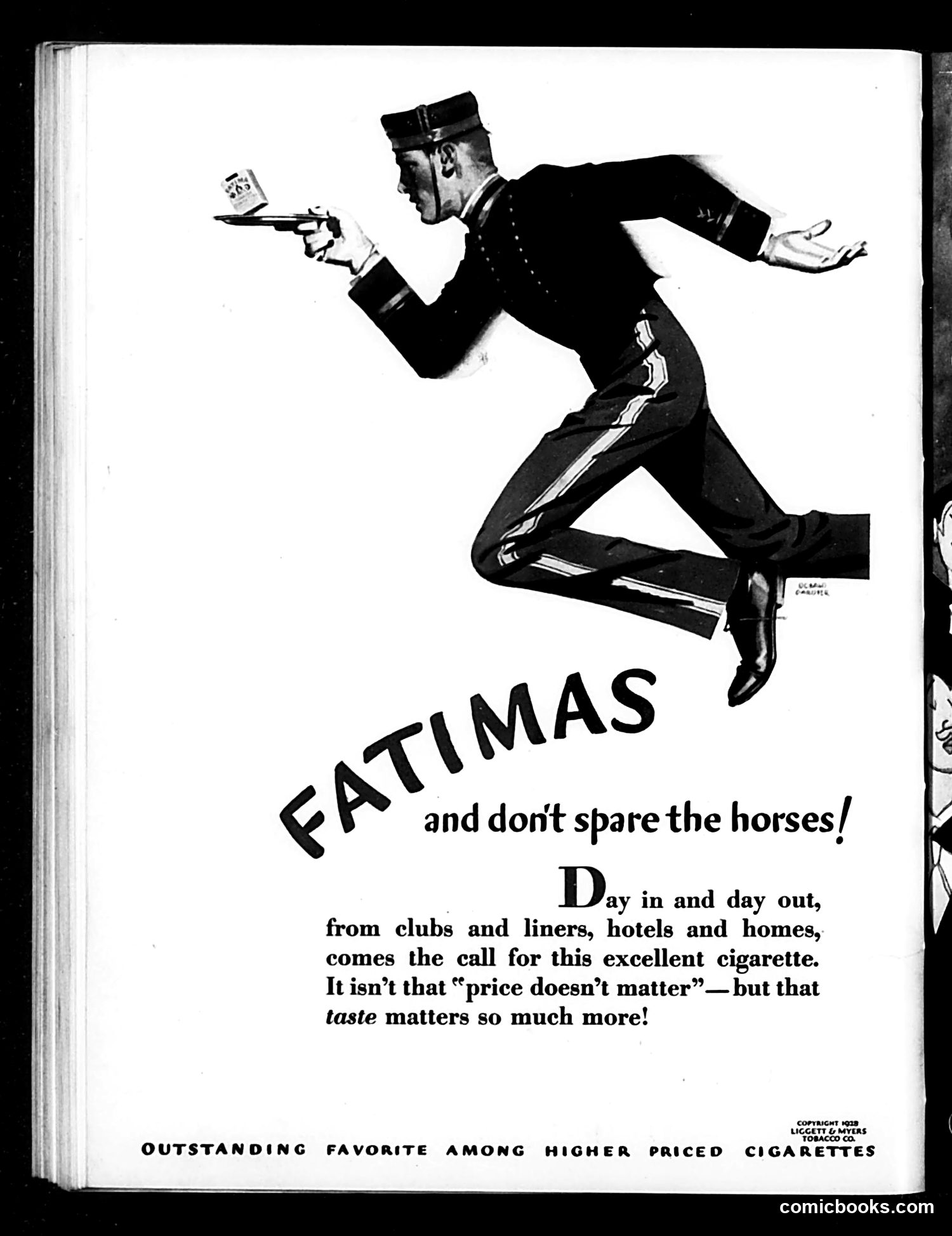
This is a **cigarette advertisement**, not satire or political commentary. The image shows a uniformed bellhop or porter in an exaggerated jumping pose, holding a cigarette package. The ad copy claims that Fatimas cigarettes are in high demand across various social venues ("clubs and liners, hotels and homes"), emphasizing that taste rather than price justifies their premium cost. The 1928 copyright indicates this predates health warnings about smoking. The energetic, stylized figure was typical of advertising aesthetics of the era—designed to convey liveliness and appeal. The phrase "don't spare the horses" is a period idiom meaning to go all out without restraint, suggesting the product's quality warrants enthusiastic endorsement.