
Judge, 1928-06-02 · page 19 of 36
Judge — June 2, 1928 — page 19: what you’re looking at
What you’re looking at
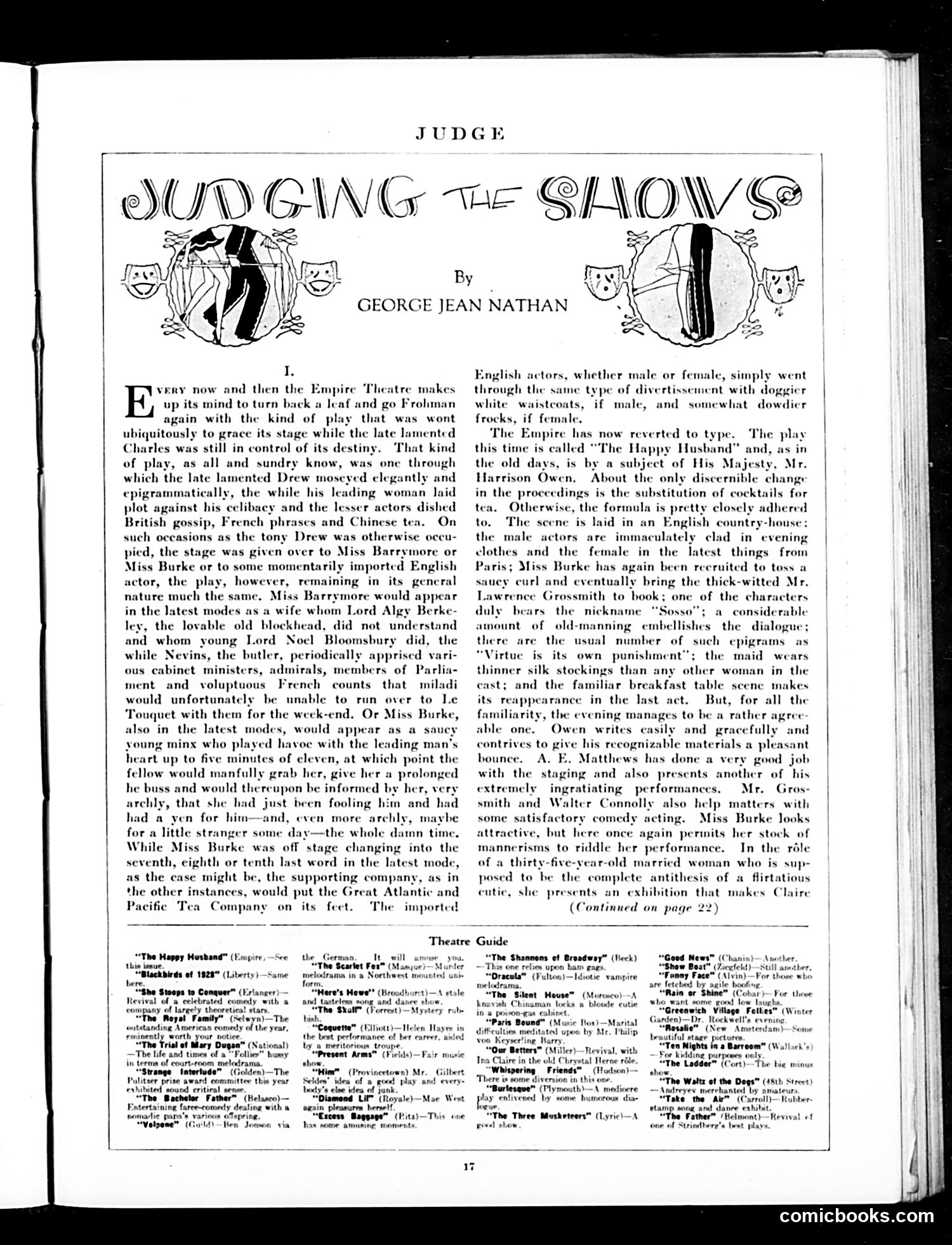
This is a theater review by George Jean Nathan critiquing contemporary Broadway productions, particularly the Empire Theatre's return to a formula of light comedies featuring fashionable society settings. The author satirizes the predictable formula of these plays: wealthy characters in evening dress, witty banter, French phrases, cocktails (or tea), and romantic entanglements among the upper class. He notes that actresses like Miss Barrymore and Miss Burke repeatedly appeared in these interchangeable productions, always in the "latest modes" (fashions), playing variations on the same character type. The specific play reviewed is "The Happy Husband" by Harrison Owen, featuring Miss Burke. Nathan acknowledges the competent writing and performances but criticizes Burke for relying on her familiar "stock mannerisms" rather than authentically portraying a married woman—essentially calling out the actress for phoning in a performance through typecasting. The satire targets both the theatrical industry's repetitive, formulaic approach to commercial entertainment and performers' reluctance to stretch beyond established personas.
📄 Transcribed text from this page (OCR, searchable)
Machine-transcribed from the original scan — historical spelling and the odd misread are preserved.
and then the Empire Theatre makes s mind to turn back a leaf and go Frohman n with the kind of play that was wont ubiquitously to grace its stage while the late lamented Charles was still in control of its destiny. That kind of play, as all and sundry know, was one through vhich the late lamented Drew mose epigrammatically, the while his leading woman 1 plot against his and the lesser actors dished British gossip, French phrases and Chinese tea. On such occasions as the tony Drew was otherwise occu- pied, the stage was given over to Miss Barrymore or Miss Burke or to some momentarily imported English ctor, the play, however, remaining in its general ature much the same. Miss Barrymore would appear in the latest modes as a wife whom Lord Algy Berke- ley, the lovable old blockhead, did not understand and whom young Lord Noel Bloomsbury did, the while Nevins, the butler, periodically apprised vari- ous cabinet ministers, admirals, members of Par ment and voluptuous French counts that miladi would unfortunately be unable to run over to Le Touquet with them for the week-end, Or Miss Burke, also in the latest modes, would appear as a saucy ninxs who played havoc with the leading man’s he buss and would thereupon be informed by her, very archly, that she had just been fooling him and had had a yen for hi and, eve for a little stranger some a: E While Miss Burke was off stage changing into th seventh, eighth or tenth last word in the latest mode, as the case might be, the supporting company, as in the other instances, would put the Great Atlantic and Pacific Tea Company feet. The more y—the whole on its imported whether m: through the same type of dive white waistcoats, if male, frocks, if fem: The Empire has now reverted to type. ‘The play this time is called “The Happy Husband” and, as in the old days, is by a subject of His Majesty, Mr. Harrison Owen, About the only discernible chang: in the proceedings is the substitution of cocktails for tea. Otherwise, the formula is pretty closely adhered The scene is laid in an English count the male actors are immaculately clad in evening jothes and the le in the latest things from aris; Miss Burke has again been reeruited to toss a iucy curl and eventually bring the thick-witted Mr. L ce Grossmith to book ; of the characters duly bears the osso'; a considerable int of old-manning embellishes the dialogue; the usual number of such epigrams is its own punishment”; the maid wears thinner silk stockings than any other woman in the and the familiar breakfast table ppearance in the last act. But, f ity, the evening manages to be able one. Owen writes easily and gracefully and contrives to give his recognizable materials a pleasant bounce. A. E. Matthews has done a very good job with the staging and also presents another of his extremely ingratiating performances. Mr. smith and Walter Connolly also help matters with some satisfactory comedy acting. Miss Burke looks attractive, but here once again permits her stock « mannerisms to riddle her performance In the réle of a thirty-five-y jd married woman who is sup- posed to be the complete antithesis of a flirtati cutie, she presents an exhibition that makes Cls (Continued on page 22) ish actors, or female, simply went tissement with dog nd somewhat dowdier to, one nickname are “Virtue as makes I the rather agree seenc for Gros- Theatre Guide “The Happy Husband” (Empire this imue. be Bisehibirds of 1828" (Liberty) “She Stoops to Conquer” (Hriancer evival of a celebrated comedy with a pany of lareely theoretical vtar. Royal Fi (Selwyn) —The See the German. It, will amuse he Scarlet Fer” (Mas ue tnelodrama in a Northwe “Here's Howe’? (Broadhurst)—A stale and tasteless song and di “The Skull” (Forrest) —Mystery rub- M yee standing American comedy of the year, “Coquette” (Kiliott)—Helen Haye “The Shannens et —This one relies upon seals” (Fulton)— melodrama. “The Silent Heuse™ (Mormco) —A knavish Chinaman locks » bloude cutie ina sean cabinet aris Bound” (M wsie Uiffculties meditated upon by adway” (Heck) nie vampire “Good News” (Chanin “Show Boat™ (Zscxfeld) “Fanay Face® (Alvin) are fetched Uy seile boo “Rain er Shine” For f her career, —The life and times of a Follies “Present Ar air musie in terms of coart-reom melodrama, age Interlude” (Golden) —The Giltert play and every- “The Bachelor Father” (Helasco)— Entertaining faree-comedy dealing with a rive Jomon via Mae West ise idea of junk “Diamend Lif” (Ioyale) it 2)—This one voo Keyser!ing Harry jer Betters™ (Miller) Ina Claire in the Revival, with irystal Herne réte. Frienés” (Hudson) — ‘There is some diversion in this ove. “Burl (Plymouth}—A medioere enlivened by some humerous dis ‘The Three Musketeers” (Lyric)—A greed show ful stage pictures Ten Nights fo 8 Barreom™ (Wallaeh's ~ For kidding purposes oly “The Ladder (Cort)—The bie “The Waltz of the Dogs” (48! Si merehanted by “Toke the Ai” (Carr stamp song and danre exhibit. “The Father” ‘ Belmont) one of Strindbere’s lest plays Rubber. Revival of comicbooks.com