
Judge, 1928-06-02 · page 8 of 36
Judge — June 2, 1928 — page 8: what you’re looking at
What you’re looking at
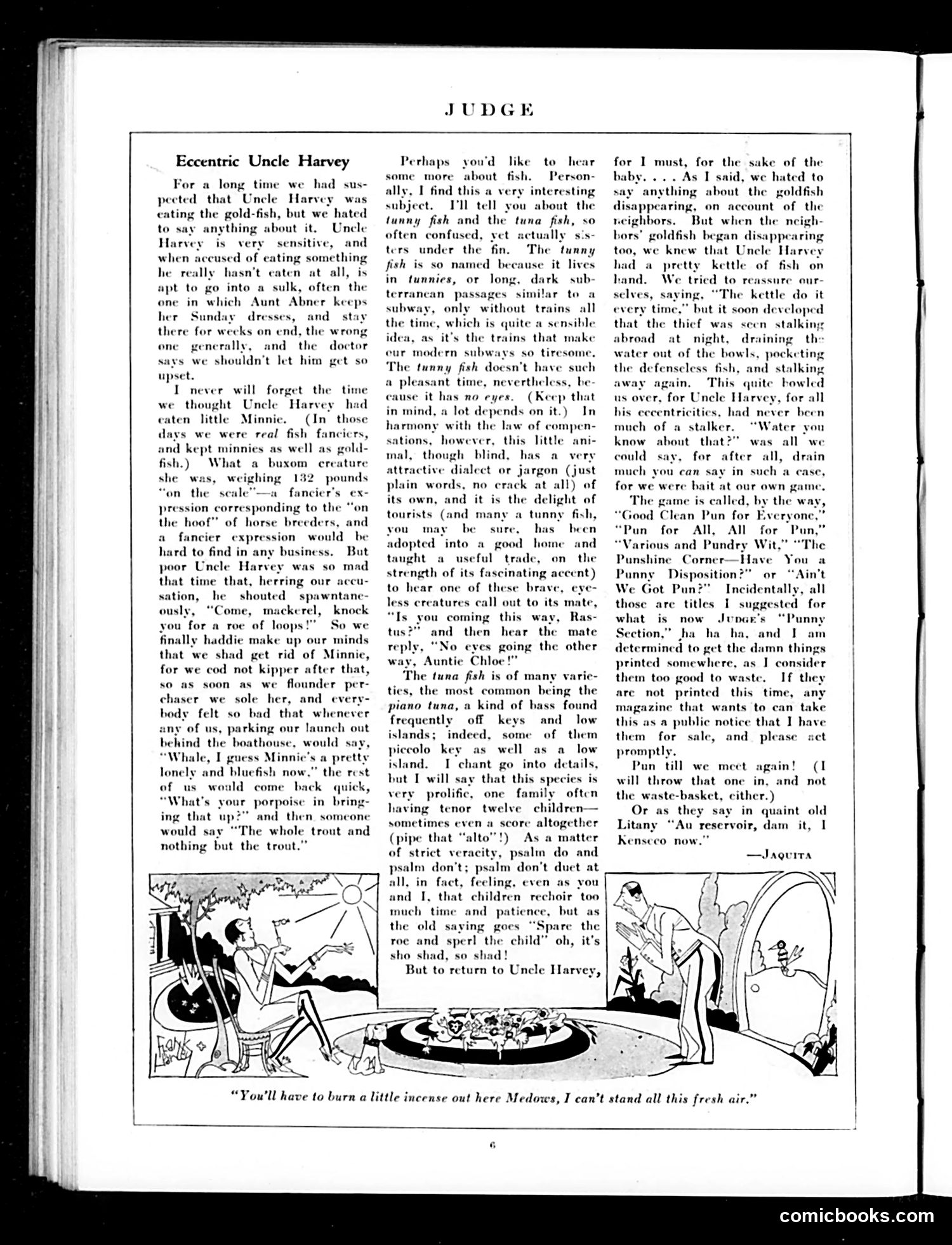
This is a humorous short story titled "Eccentric Uncle Harvey" from *Judge* magazine, a satirical publication. The narrative is largely a fish-themed pun-fest rather than political satire. The basic plot: Uncle Harvey, a sensitive eccentric relative, is suspected of eating the family's goldfish. When accused, he reacts so poorly that the family avoids confronting him. Later, when neighbors' goldfish also disappear and are found stolen at night, the family realizes Uncle Harvey is the culprit—but describe him as a "stalker" rather than a thief, playing on the word "stalk." The bulk of the text consists of elaborate fishing puns (tuna/tunny fish wordplay, references to "mackerel," "kipper," "flounder," etc.) that are clearly meant to demonstrate the author's wit through extensive fish-related double entendre. The cartoon at bottom shows the family trying to conceal fish odors by burning incense indoors—the visual punchline to Uncle Harvey's ongoing aquatic thievery. The humor relies entirely on puns and absurdist character comedy, not contemporary political commentary.
📄 Transcribed text from this page (OCR, searchable)
Machine-transcribed from the original scan — historical spelling and the odd misread are preserved.
Eccentric Uncle Harvey For a long time we had sus- pected that Uncle Harvey was eating the gold-fish, but we hated vthing about it. Uncle is very sensitive, and used of eating something really hasn't eaten at all, i apt to go into a sulk, often the one in which Aunt Abner keeps her Sunday dresses, and stay there for weeks on end, the wrong one generally, and the doctor says we shouldn't let him get so upset. I never will we thought ten little ys we forget the time Uncle Harvey had Minn (In’ those real fish fancicrs, d- buxom creature 132 pounds “on the sea fancier’s ex- pression corresponding to the “on se breeders, and a fancier expression would be hard to find in any business. But poor Uncle Harvey was so mad time that, herring our accu- sation, he shouted —spawntane- ously, “Come, mackerel, knock you for a roe of loops!” So we finally haddie make up our minds that we shad get rid of Minnie, for we cod not kipper after that, soon as we flounder per- chaser we sole her, and every- body felt so bad that whenever any of us, parking our launch out behind the boathouse, would hale, I guess Minnic’s a pretiy d bluefish now,” the rest uld come back i were fish.) she was, so as ing that up?” and then someone would The whole trout and JUDGE Perhaps you'd like to hear some more about fish. Person- ally, I find this a very interesting subject. I'M tell you about the funny fish and the tuna fish, so often confused, yet actually ters under the fin. The tunny fish is so named because it lives in tunnies, or long. sub: passages ur toa y, only without trains all the time, which is quite a sensible idea, as it’s the trains that make cur modern subways so tiresome, The tunny fish doesn’t have such a pleasant time, nevertheless, be cause it has no eyes. (Keep that in mind, a lot depends on it.) In harmony with the sations, however, this mal, though blind, attractive dialect or plain words, sis- terranean sim subw » of compen- little ani- has avery argon (just at all) of delight of tunny fish, no cr: its own, and it is th tourists (and many you ma be sur has been adopted into a good home and taught a useful trade, on the strength of its fascinating accent) to hear one of these C ires call out to its n ou coming this way, Ras- then hear the mate reply, “No eyes going the other way, Auntie Chloe!” The tuna fish is of many varie- ties, the most common being the piano tuna, a kind of bass found frequently off keys and low islands; indeed, some of them piccolo key as well as a low island. I chant go into details, but I will say that this species is y prolific, one family often havi tenor twelve children— sometimes even a score altogether (pipe that “alto"!) As a matter of strict veracity, psalm do and psalm don’t; psalm don’t duet at all, in fact, feeling, even as you and I, that children rechoir too much t the s roe and sperl tie child sho shad, so shad! But to return to Uncle Harvey, brave and for I must, for the sake of the baby... . As I said, we hated to say anything about the goldfish disappearing, on account of the neighbors. But when the ni bors’ goldfish began disappe: too, we knew that Uncle Harvey had a pretty kettle of fish on hand. We tried to reassure ou selves, saying, The kettle do every time,” but it soon develop. that the thief was seen stalkin abroad at night, draining th water out of the bowls, pocketing the de fenscless fish, and stalking . This quite bowled . for Unele Harvey, for all his cecentricities, had never been much of a stalker. “W. know about us ove er you that?" was all we could say, for after all, drain much you can say in such a case, for we were bait at our own gat The game is called, by the way “Good Clean Pun for Everyone “Pun for All, All for Pun “Various and Pundry Wit,” “The Punshine Corner—Have You a Punny Disposition?" or “Ain't We Got Pun?” Incidentally, all those are titles 1 suggested for what is now Jupce's “Punny Section,” ha ha ha, and Tam determined to get the damn things printed somewhere, as I consider them too good to If they are not printed this time, any magazine that wants to can take this as a public notice that I have them for sale, and please act promptly. Pun till we meet again! (1 will throw that one in, and not the waste-basket, cither.) Or as they say in quaint old Litany “Au reservoir, dam it, I Kenseco now.” —Jaguita comicbooks.com