
A complete issue · 36 pages · 1928
Judge — April 14, 1928
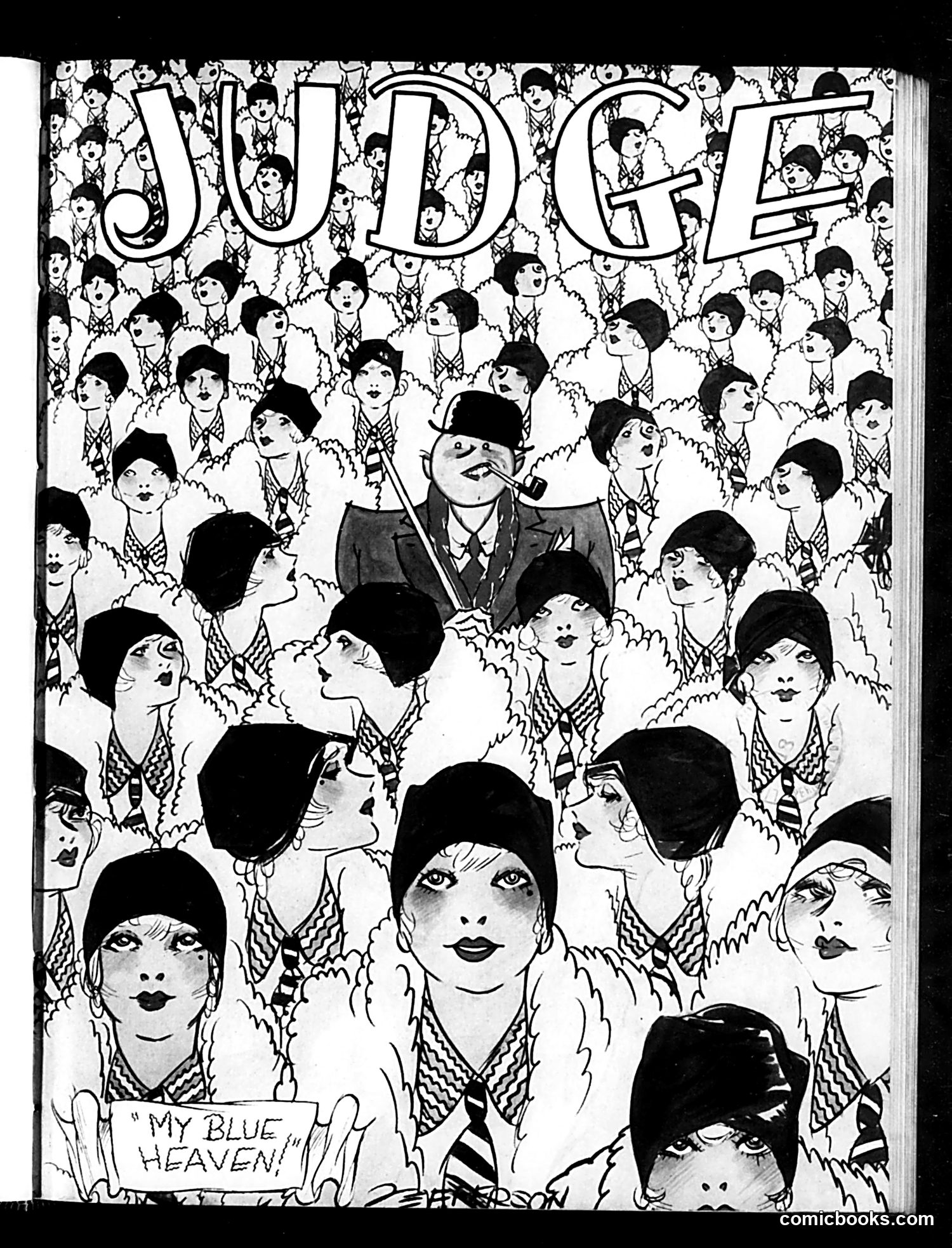
This page satirizes the 1920s fashion trend of women's bobbed hair and androgynous "flapper" styling. The title "JUDGE" dominates ornate letters filled with nearly identical young women wearing cloche hats, short hair, and patterned clothing—the uniform of modern youth. The central figure, a man in a top hat smoking a pipe, appears bewildered or disapproving among the sea of identical-looking women. One woman holds a sign reading "MY BLUE HEAVEN," likely referencing a popular 1927 song. The satire mocks how mass-produced fashion made individuals indistinguishable and critiques the perceived loss of feminine identity during the Jazz Age. The composition suggests conformity overriding individuality—a common conservative critique of 1920s women's liberation and changing social norms.
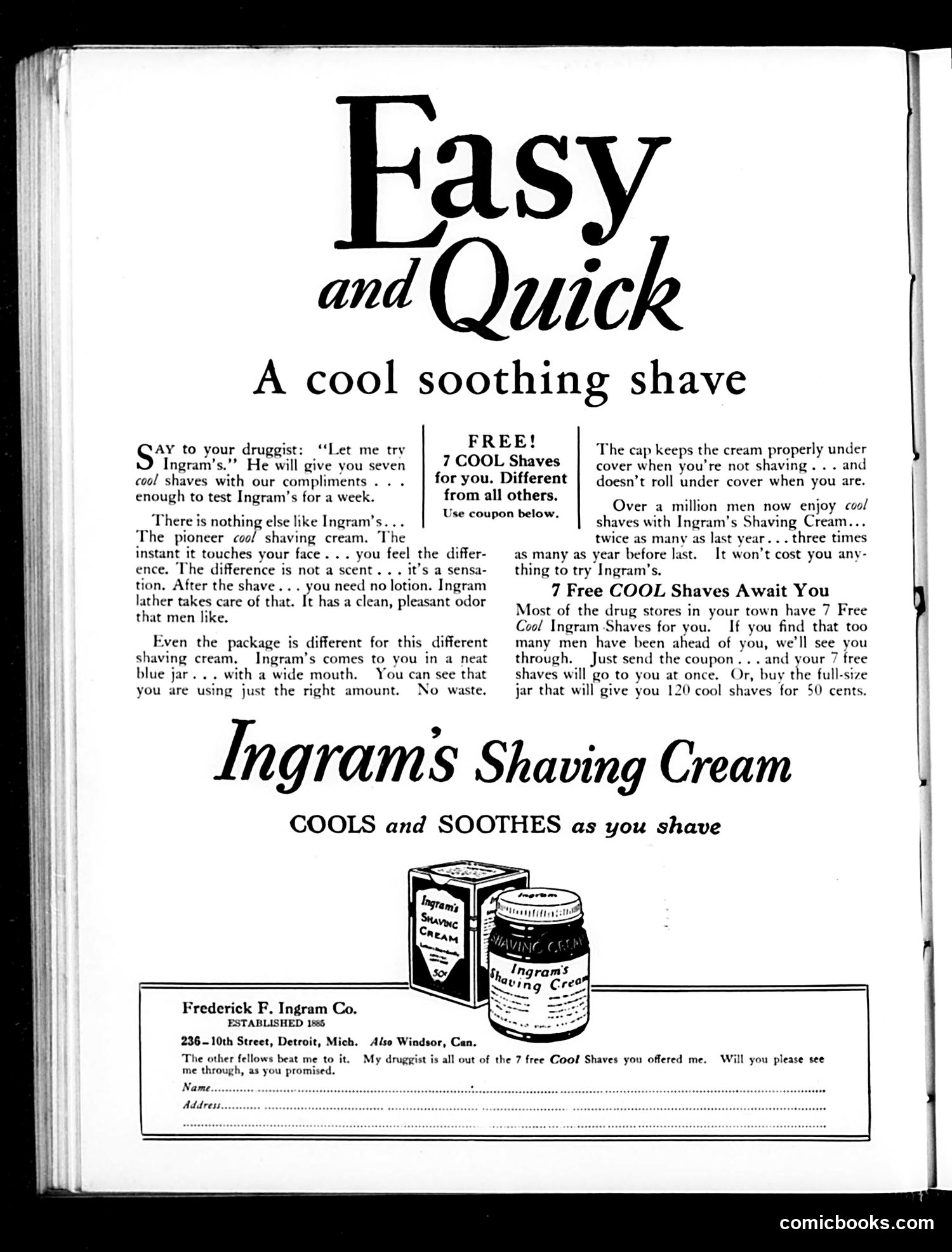
This page is **primarily an advertisement**, not satirical content. It promotes Ingram's Shaving Cream, a product marketed as providing a "cool soothing shave." The ad emphasizes that Ingram's is "different from all others"—the pioneer "cool" shaving cream. Key selling points include: no need for lotion after shaving, pleasant odor, and efficient packaging with no waste. The promotion offers readers seven free "Cool Shaves" via coupon, or a full-size jar for fifty cents (120 shaves). The company, Frederick F. Ingram Co., was based in Detroit with a Canadian branch in Windsor. There is **no political satire or caricature** on this page—it's straightforward vintage advertising emphasizing product novelty and value to consumers.
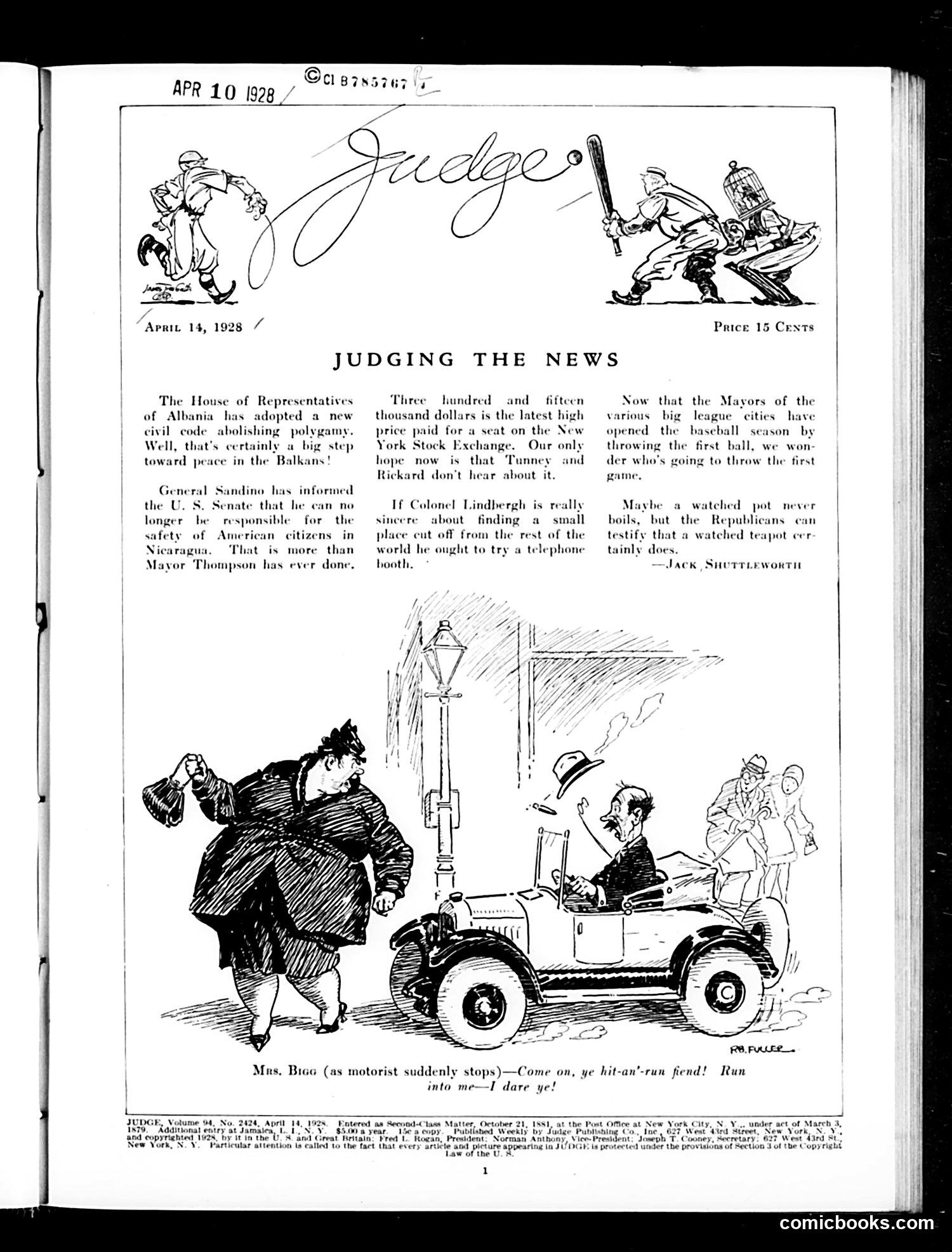
This satirical page critiques contemporary 1928 events: **Top section** comments on three political topics: Alabama's new civil code abolishing polygamy (presented as overdue progress); General Sandino's assurance to the U.S. Senate about protecting American citizens in Nicaragua; and Colonel Lindbergh's difficulty finding solitude after his famous transatlantic flight. **Main cartoon** depicts "Mrs. Bigg (as motorist suddenly stops)" encountering a pedestrian, with the motorist urging him to "Run into me—I dare ye!" This satirizes reckless automobile culture and possibly frivolous litigation trends of the era, when hit-and-run incidents and insurance fraud were emerging social problems. The cartoons mock political hypocrisy, celebrity intrusion, and dangerous modern driving habits.
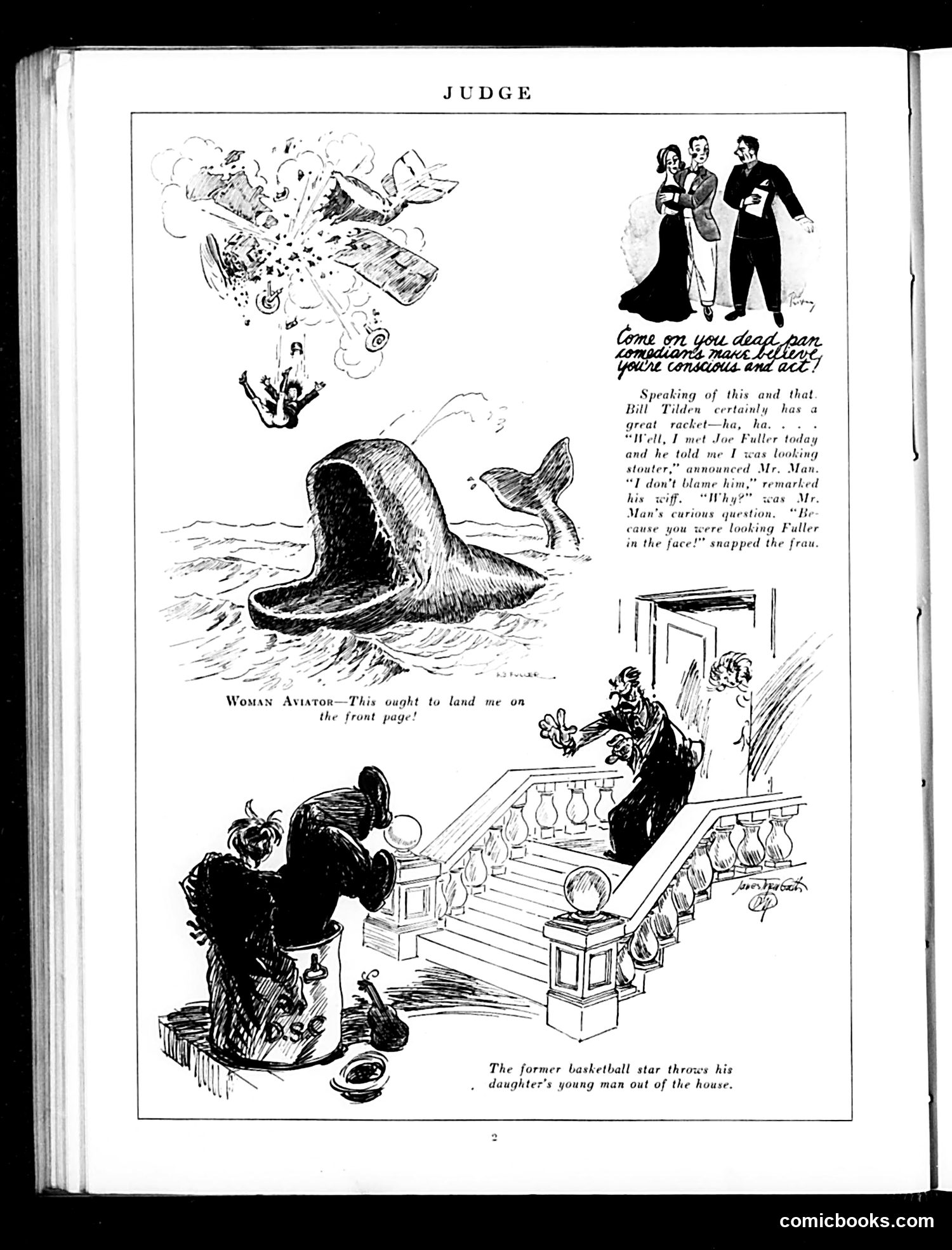
This page contains three satirical cartoons mocking social situations: 1. **"Woman Aviator"**: References early aviation's novelty and gender politics. A woman pilot has crash-landed in a whale's mouth, with the caption suggesting she should have landed on the front page (of newspapers). This plays on contemporary fascination with female aviators as sensational news. 2. **Upper right**: Depicts a couple with a third man, joking about a woman's "conscious" appearance, with dialogue mentioning "Bill Tilden" and "Joe Fuller." The reference to Tilden (likely the tennis champion) suggests celebrity gossip about romantic scandals. 3. **Bottom**: Shows a father ejecting his daughter's boyfriend from the house, captioned as "the former basketball star." This depicts the standard parental disapproval of unsuitable suitors. All three cartoons satirize modern courtship anxieties and celebrity culture.
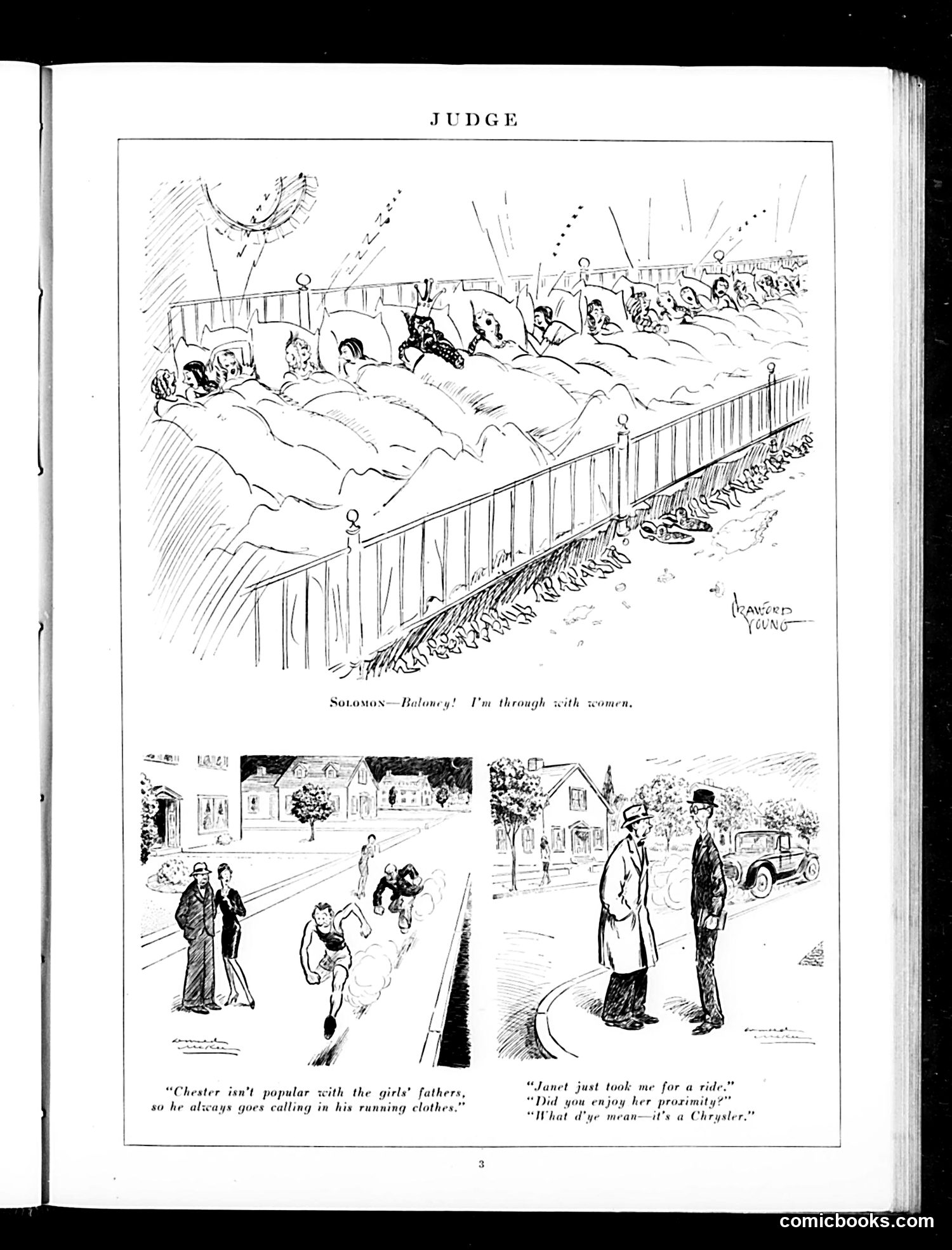
This page contains three separate cartoons satirizing early 20th-century social attitudes, particularly regarding women and dating. The main cartoon depicts men at what appears to be a beach or resort, with the caption "Solomon—Balanc'! I'm through with women," suggesting a man overwhelmed by female companionship. The lower cartoons mock both male and female behavior: one ridicules a man named Chester for being unpopular with girls' fathers due to his "running clothes," implying inappropriate casual dress. The second cartoon jokes about a woman named Janet taking a man for a car ride in a Chrysler, with the punchline that such "proximity" in an automobile represents modern dating behavior worth remarking upon—reflecting contemporary anxieties about unsupervised interactions between unmarried couples.
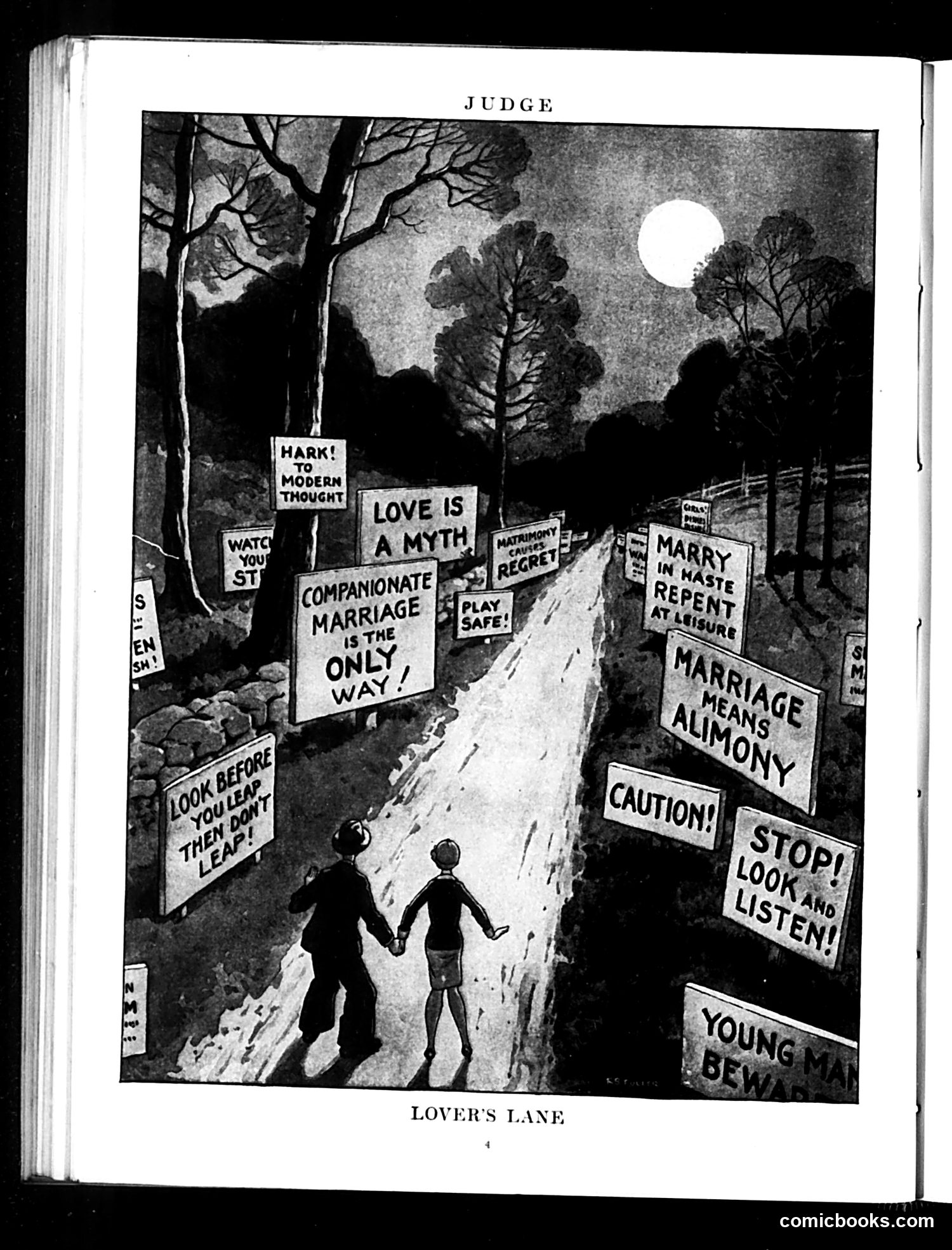
This cartoon satirizes modern attitudes toward marriage and romance through exaggerated warning signs lining a moonlit path. The signs present conflicting advice: "Love is a Myth," "Companionate Marriage is the Only Way," "Marriage Means Alimony," and "Play Safe!" juxtaposed against romantic imagery (the moon, trees, a couple walking). The satire targets 1920s-era social commentary about marriage—likely referencing "companionate marriage" (a then-contemporary concept emphasizing companionship over tradition) and rising divorce rates with alimony concerns. By crowding the romantic lane with cautionary, cynical messages, the cartoon mocks how modern skepticism about marriage contradicts romance itself. The young couple appears oblivious to the chaos of competing ideological warnings surrounding them.
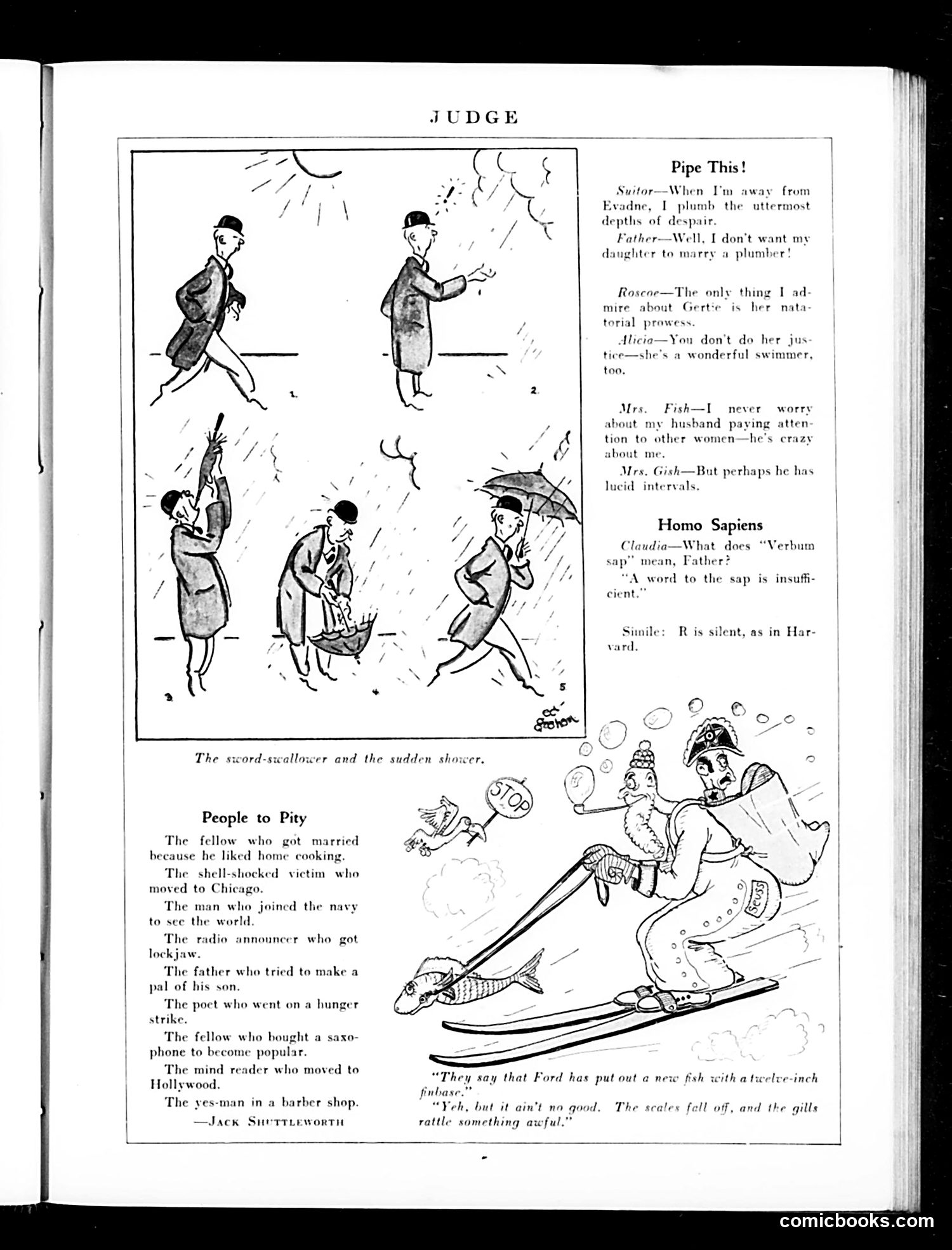
**Top Cartoon ("Pipe This!"):** Depicts five figures in rain scenes showing contrasting reactions to weather. The dialogue satirizes class attitudes: a suitor abandons courtship because the father is a plumber; a woman brags about a suitor's admiration; a husband's infidelity is dismissed casually by his wife. The satire mocks social snobbery about working-class professions (plumbing) and the double standards regarding marital fidelity among the wealthy. **"Homo Sapiens" Section:** A brief etymological joke where "Verbum" (Latin for word) is humorously defined as insufficient—wordplay mockery of pretentious vocabulary. **Bottom Section ("People to Pity"):** A list of unfortunate situations (failed marriages, job losses, family conflicts). Includes a skiing cartoon about a new Ford fishing lure with defects, likely mocking Ford automobiles or fishing product design.
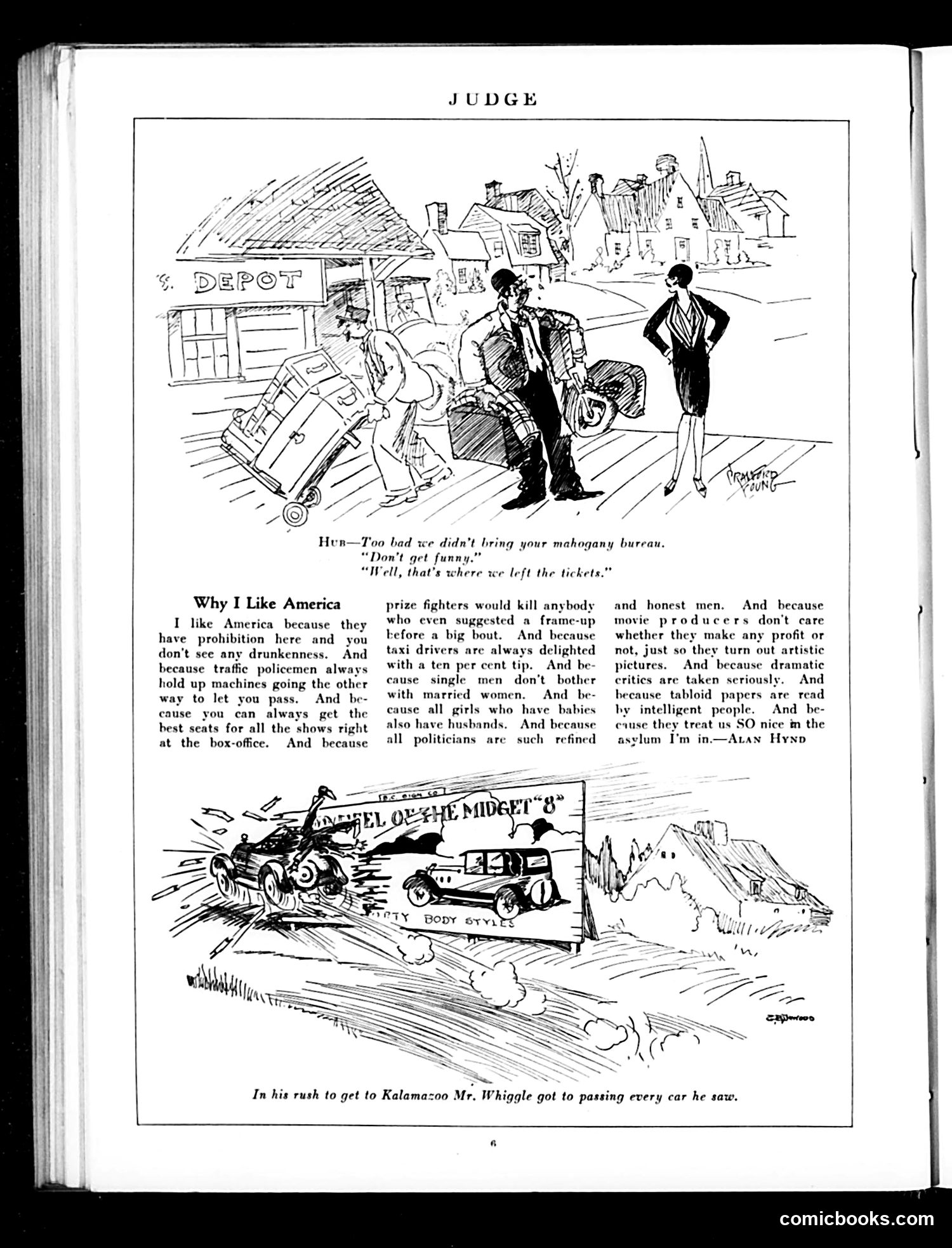
**Top Cartoon**: A domestic scene at a train depot shows a couple with luggage. The woman's sarcastic line about the "mahogany bureau" and the man's irritated response about tickets suggests marital discord over travel preparations—likely satirizing middle-class couples' arguing over vacation details. **"Why I Like America" Essay**: This is heavy ironic satire by Alan Hynd. The author claims to love America while listing obviously false or cynical observations: that prohibition eliminated drunkenness, traffic cops are fair, theater tickets are always available, boxers are honest, taxi drivers appreciate tips, single men don't pursue married women, unwed mothers don't exist, and politicians are refined. The closing joke—that he appreciates American kindness "in the asylum I'm in"—reveals the entire list as sardonic criticism of American society's pretensions and hypocrisy. **Bottom Cartoon**: "Mr. Whiggle" recklessly passes every car rushing to Kalamazoo, causing a multi-car collision. This satirizes dangerous driving habits, likely commenting on 1920s traffic safety or reckless motorists.
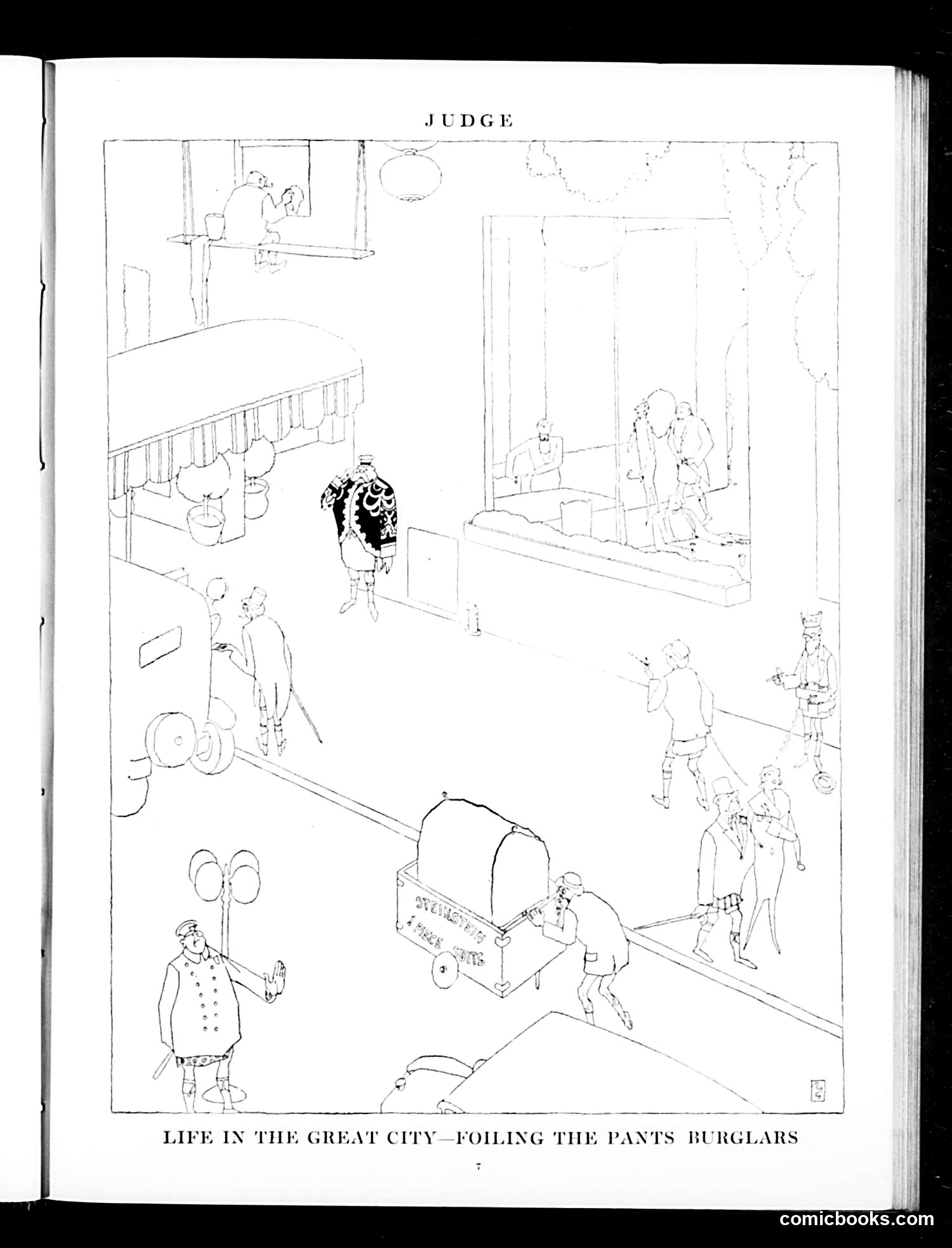
This Judge cartoon satirizes a specific urban crime problem: thieves who stole clothing, particularly pants, from clotheslines in tenement neighborhoods. The illustration depicts a street scene where residents have installed elaborate anti-theft devices—including what appear to be mechanical traps, wire systems, and a covered wagon-like cage—to protect their laundry. The humor targets both the prevalence of this petty crime in crowded city neighborhoods and the absurd defensive measures people deployed in response. The central figure in formal dress (likely a judge or authority figure, given the magazine's title) observes the ridiculous scene, perhaps commenting on urban decay and crime. This reflects late-19th/early-20th-century concerns about poverty-driven theft in American industrial cities.
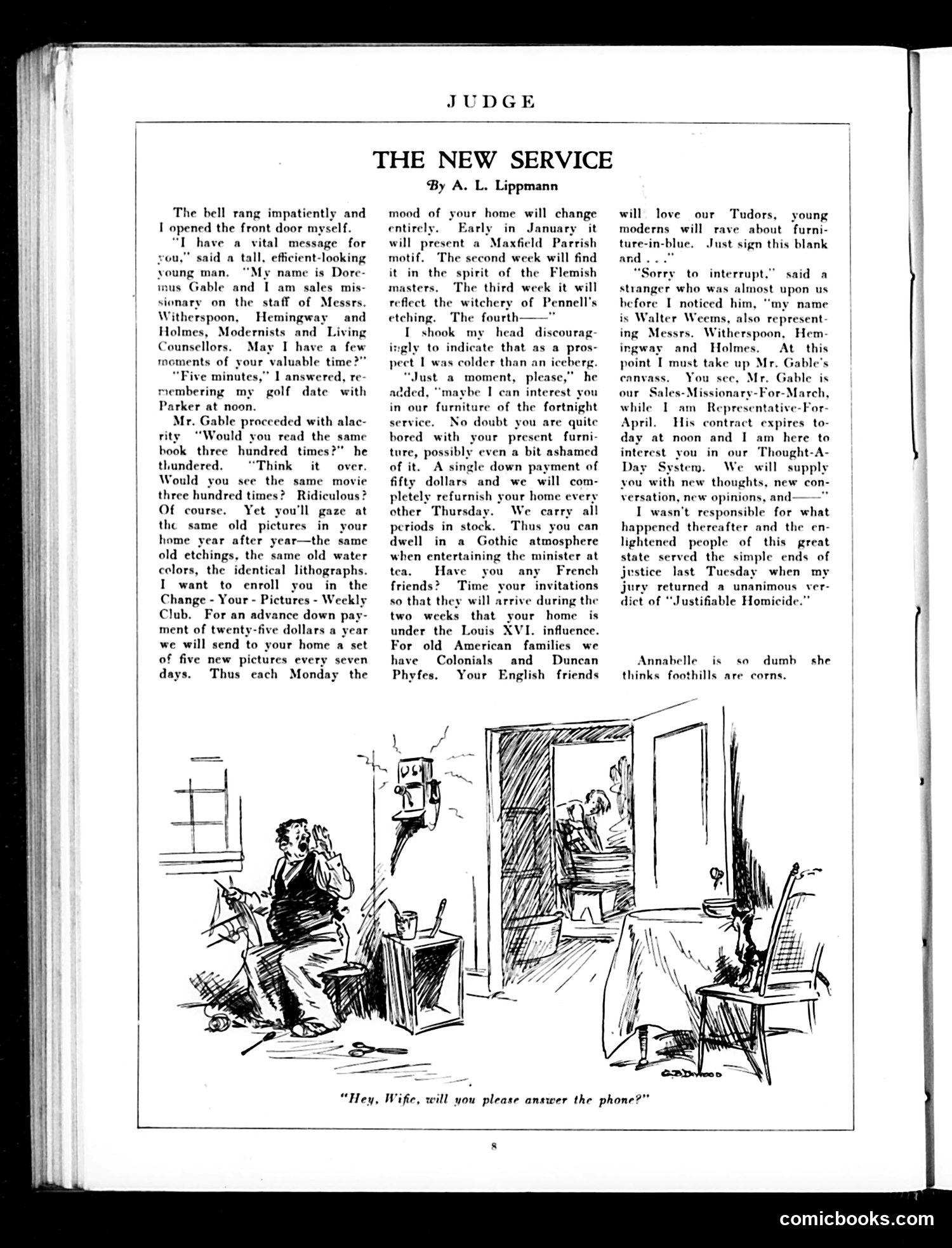
This satirical story mocks the aggressive salesmen and subscription services proliferating in early 20th-century consumer culture. Two representatives from "Witherspoon, Hemingway and Holmes, Modernists and Living Counsellors" pitch absurd rental schemes: rotating artwork weekly and furniture every two weeks so homes constantly reflect different aesthetic styles (Maxfield Parrish, Gothic, Louis XVI, Colonial, etc.). The joke escalates when a third salesman arrives peddling "Thought-A-Day"—renting new opinions and conversation. The narrator's exasperation culminates in violence, with a jury returning a "Justifiable Homicide" verdict, suggesting readers will sympathize with killing intrusive salesmen. The cartoon (captioned "Hey, Wife, will you please answer the phone?") shows domestic chaos—likely illustrating how such services disrupt home life. The satire critiques consumerism's invasion of private space and the era's relentless marketing culture treating everything—even thoughts—as purchasable commodities.
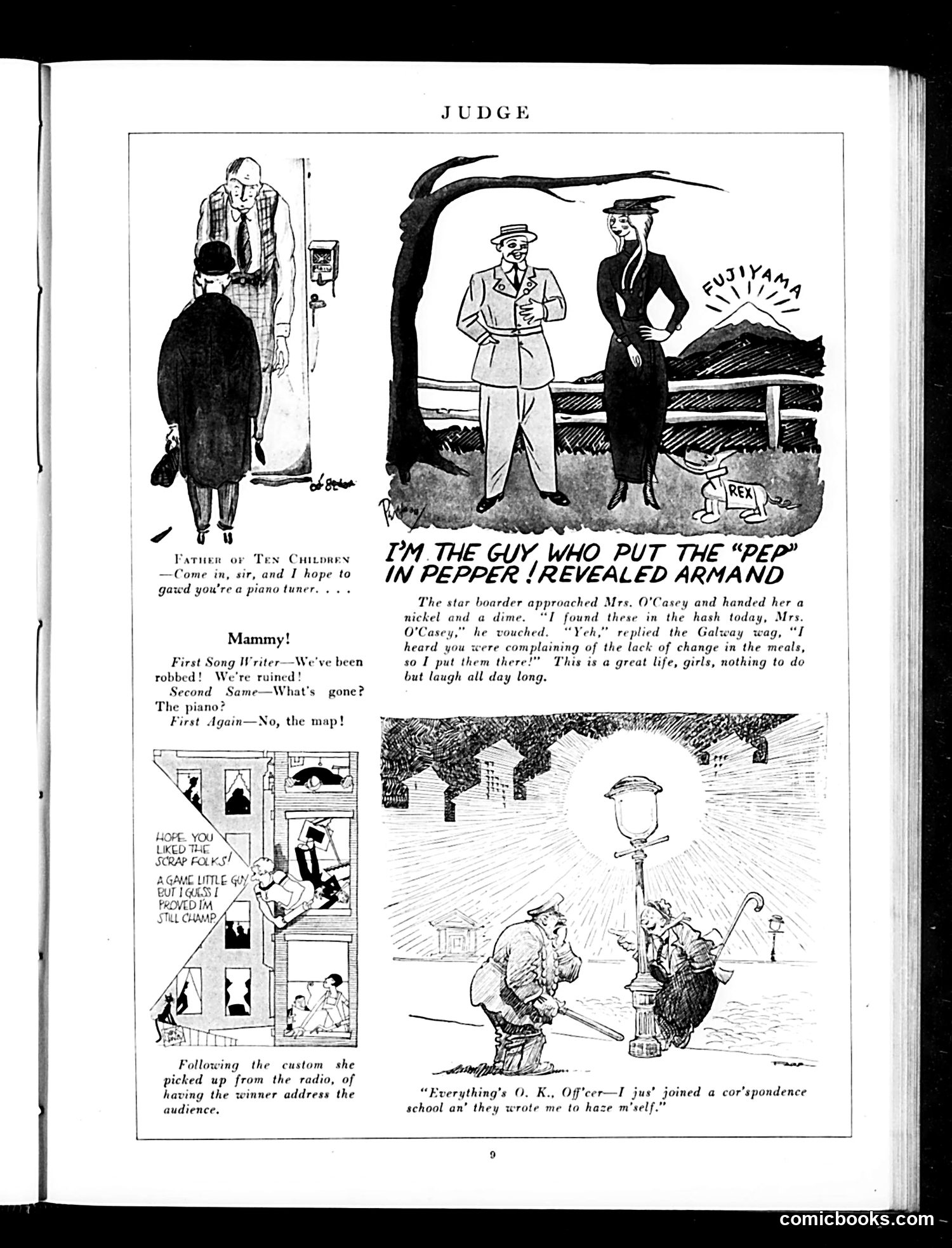
This page contains several unrelated satirical cartoons typical of Judge magazine's humor: 1. **"Father of Ten Children"**: A man hoping the visitor is a piano tuner, suggesting the chaos of a large family. 2. **"Mammy!"**: Songwriters discover their stolen "map"—likely a musical score or composition—rather than a piano, commenting on plagiarism in Tin Pan Alley. 3. **"Pep in Pepper"**: A boarding house joke where a tenant finds coins in his food. The landlady admits she planted them after he complained about inadequate meal portions, a darkly comic jab at cheap boarding house conditions. 4. **Radio/Correspondence School gag**: Two brief jokes—one about radio show customs, another about a correspondence school hazing incident. The humor targets domestic life, struggling musicians, poor boarding conditions, and emerging media of the era. The cartoons reflect early 20th-century urban American anxieties and social satire without apparent political messaging.
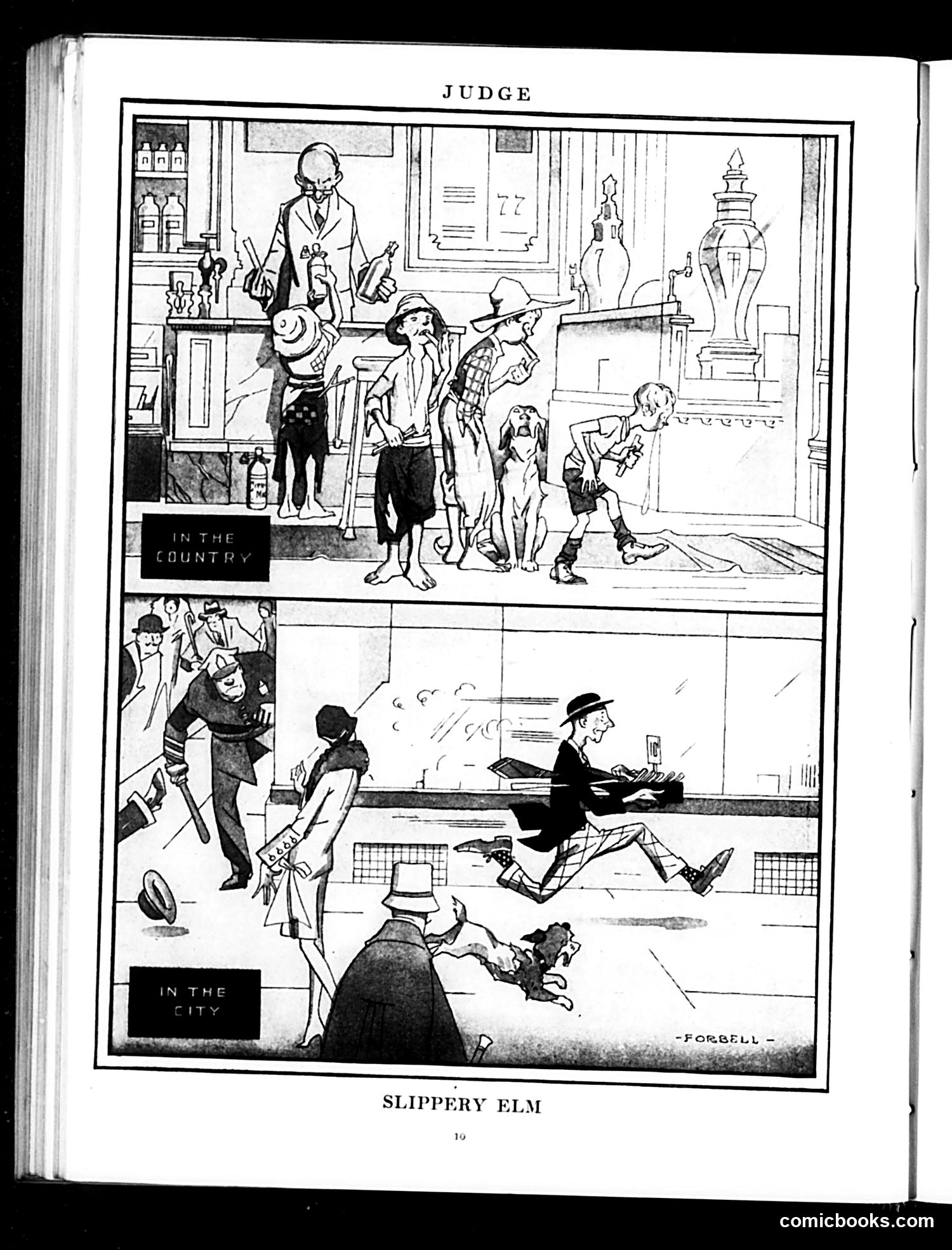
This two-panel satirical cartoon titled "Slippery Elm" contrasts judicial authority "In the Country" versus "In the City." **Top panel**: A stern judge presides over a country courtroom where citizens—including people with dogs—show respect and deference to legal proceedings. **Bottom panel**: The same scenario in the city descends into chaos. A man runs away from pursuing figures, a woman appears to lose her shoe, and general pandemonium erupts. A man at a desk (likely the judge) is overwhelmed. The satire suggests that urban courts lacked the order and respect commanded by rural judges. City dwellers allegedly treated the legal system with irreverence, contrasting sharply with orderly country justice. The title "Slippery Elm" appears to reference something elusive or difficult to grasp—perhaps the rule of law itself in urban settings.
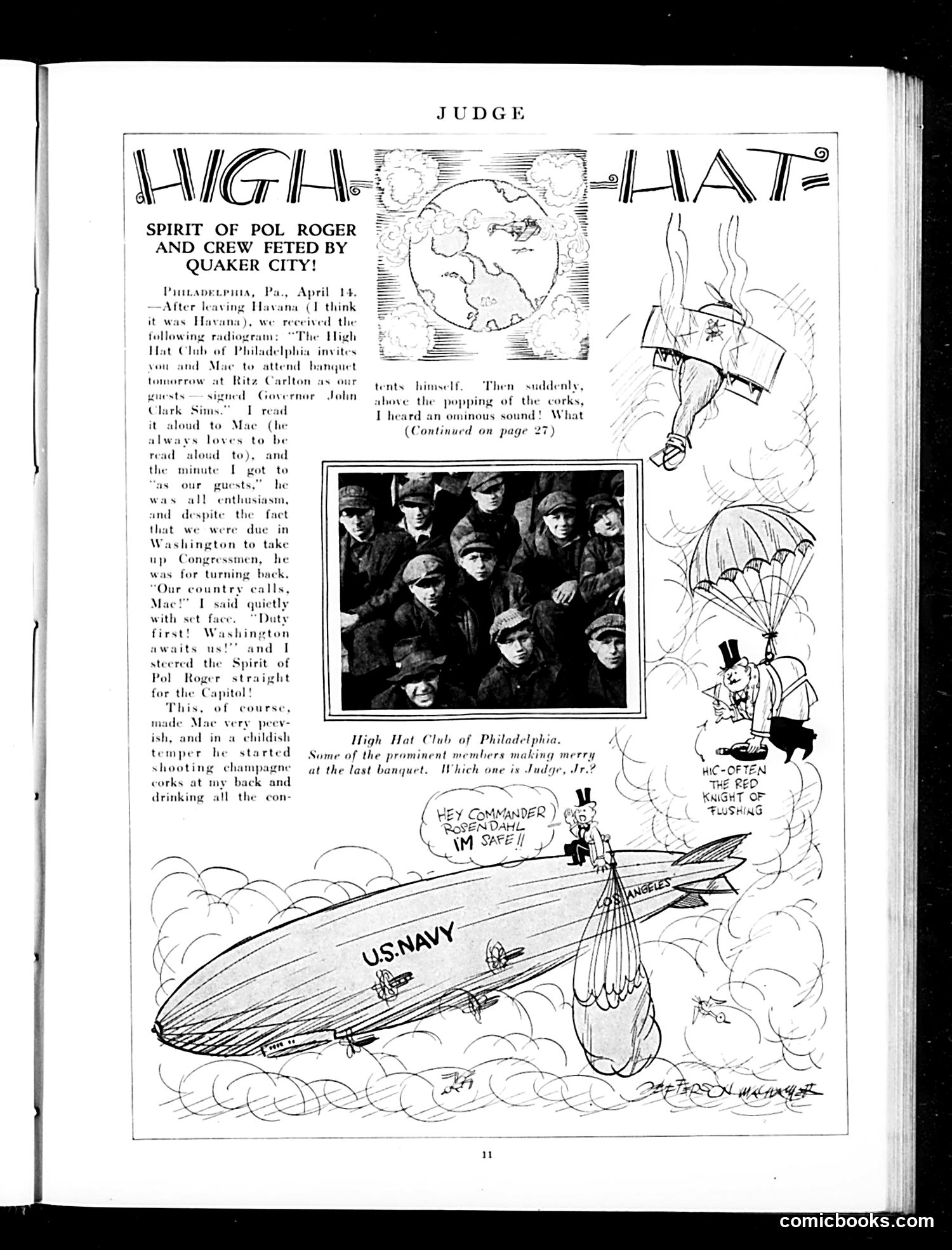
This page satirizes the "Spirit of Pol Roger," apparently a notable person or vessel that has visited Havana and is now being feted in Philadelphia by the exclusive "High Hat Club." The narrative mocks the protagonist's theatrical patriotism—he claims duty to Washington calls him away, yet the story implies this is performative posturing while he actually enjoys champagne-fueled celebration. The cartoon below depicts a U.S. Navy airship/dirigible in clouds with a parachutist, captioned with dialogue about "Commander Rosenthal" being "safe." This likely references an actual naval incident or rescue, playing on contemporary airship technology and military happenings. The photograph shows prominent Philadelphia club members at a banquet. The humor derives from contrasting high-society pretension with crude behavior (shooting champagne corks) and questioning who among these respectable-looking gentlemen is actually "Judge, Jr."—likely a member known for questionable conduct. The satire targets nouveau-riche social climbing and false patriotic performance.
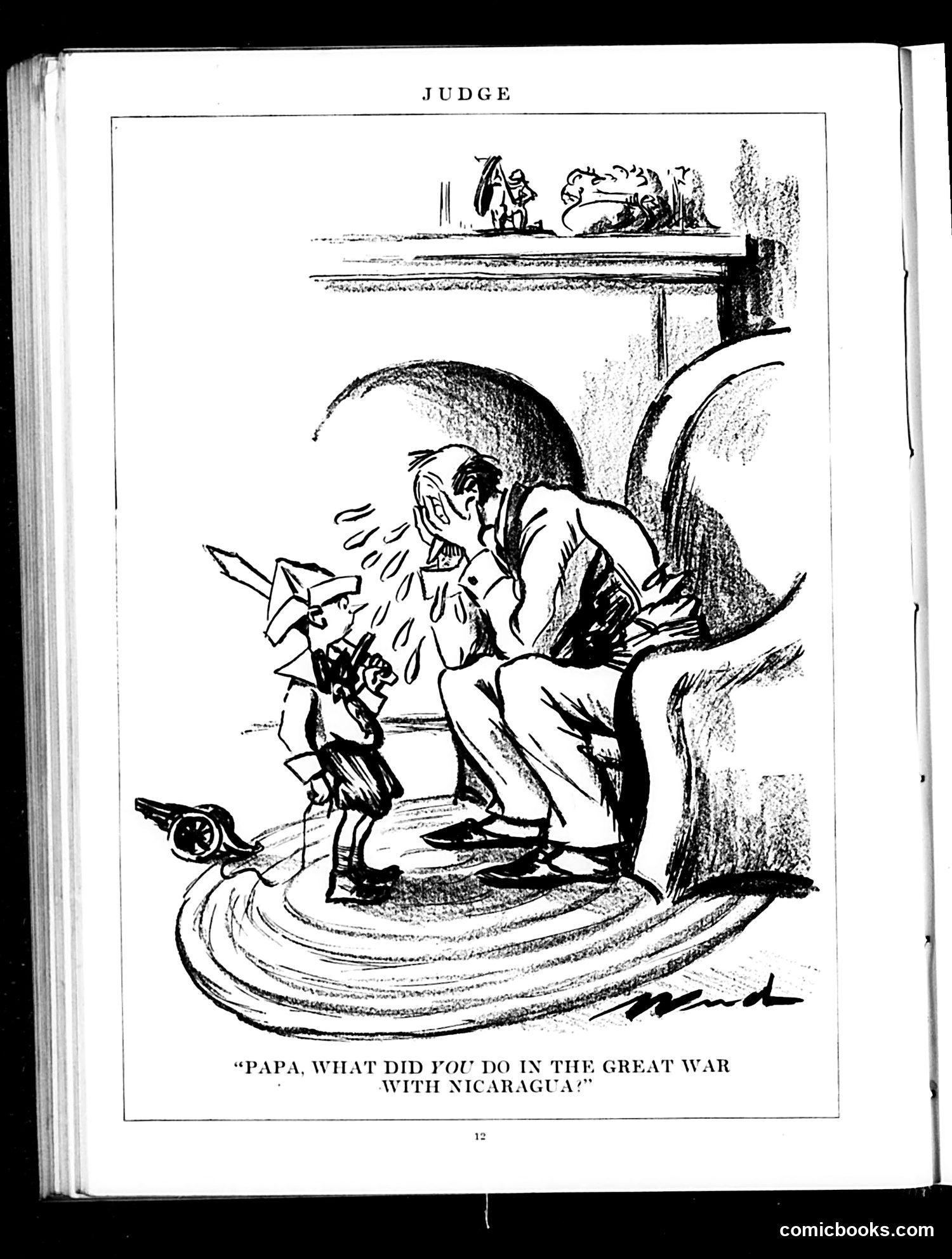
This Judge magazine cartoon satirizes American military intervention in Nicaragua during World War I. A child asks their father what he did in "the Great War with Nicaragua," implying the U.S. involvement there was as significant as WWI itself. The humor lies in the absurdist comparison: while Americans fought in Europe's massive conflict (1917-1918), the U.S. was simultaneously conducting military operations in Nicaragua—a far smaller, regional affair. The cartoon mocks either American overreach in Central America or suggests that Nicaragua hardly merits comparison to genuine great-power warfare. The caricatured "papa" figure appears embarrassed or evasive, suggesting he may have little honorable to report about such interventions. This reflects Progressive-era skepticism about U.S. imperial adventurism in the Western Hemisphere.
This page contains two satirical pieces: **"He Never Made a Speech"** mocks Americans' obsession with public speaking by celebrating Thomas Jefferson's refusal to speechify, despite his major accomplishments (Declaration of Independence, Louisiana Purchase, etc.). The satire's target is contemporary American culture: tabloid press, catchword debates, radio-fueled demagoguery, and endless conferences. Judge ironically proposes founding a "Jeffersonian Society for the Suppression of Speech Making"—then admits it would need a national lecture tour, contradicting the premise. The joke: we're so addicted to talk we can't stop even when advocating silence. **"For Speeding Up Golf"** humorously offers "rule suggestions" for accelerating golf games, particularly targeting slow foursomes ahead of the golfer. The absurd penalties (counting branches falling on players, abandoning lost golf balls quickly) satirize both golf's tedious pace and Americans' frustration with leisurely pastimes. Both pieces reflect 1920s-30s anxieties about modern life's increasing pace and communication excess.
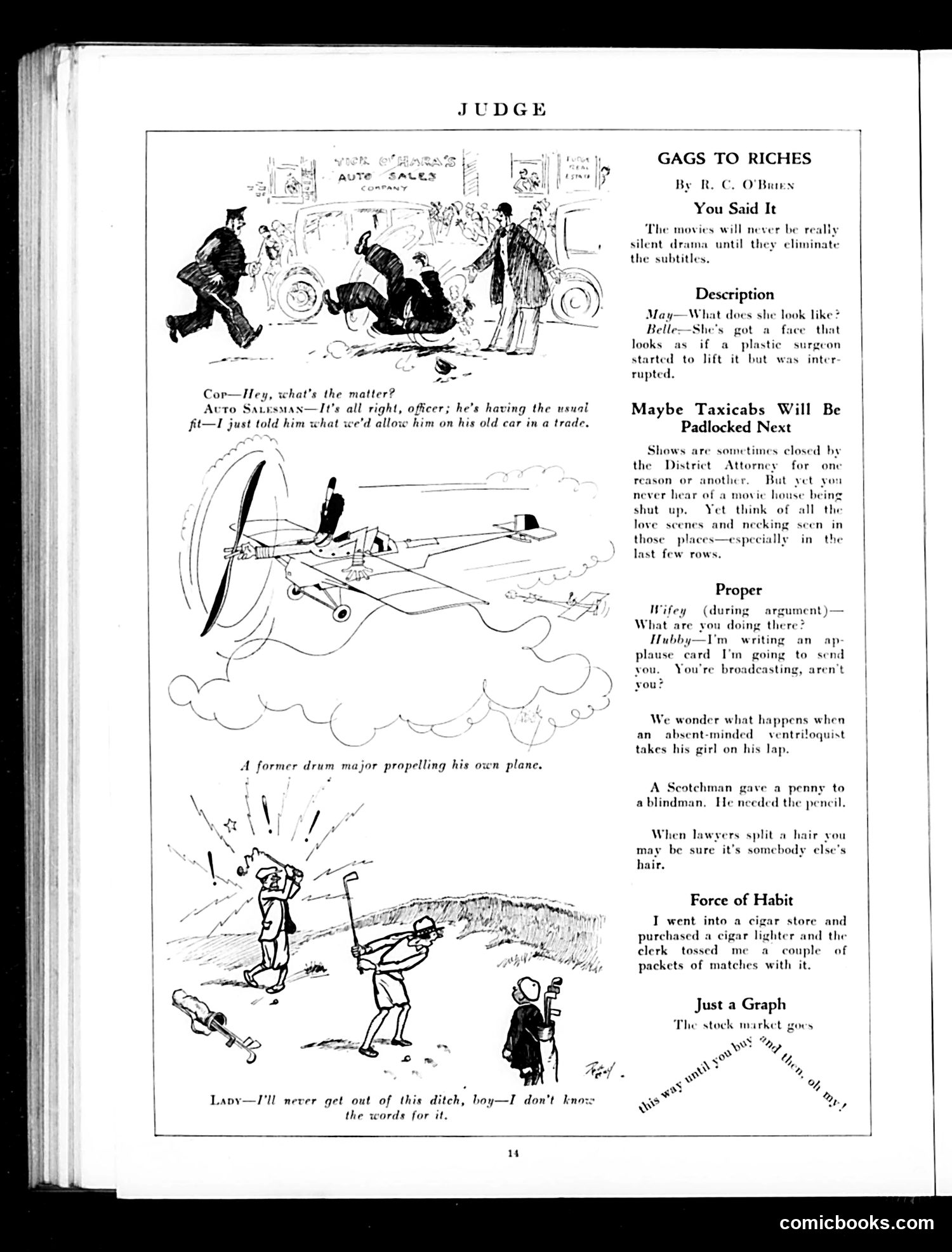
This is a humor column mixing short jokes and cartoon gags. The top cartoons satirize 1920s-era concerns: 1. **Auto trade-in scene**: A salesman has just told a customer the pitiful allowance on his old car, causing the customer to have a fit. The joke mocks the poor value dealers offered for used vehicles. 2. **Airplane scene**: A "former drum major" attempts to propel his homemade plane, satirizing amateur aviation stunts and the eccentric confidence of early aviation enthusiasts. 3. **Golf/ditch scene**: A woman stuck in a ditch claims she doesn't know "the words for it"—implying she can't curse enough to express her frustration, a gentle joke about women's propriety. The right column contains brief one-liners satirizing silent films, plastic surgery, movie-theater behavior, ventriloquism, Scottish frugality, lawyers, and sales practices—typical light social satire of the era. Overall, harmless period humor targeting consumer culture and emerging modern anxieties.
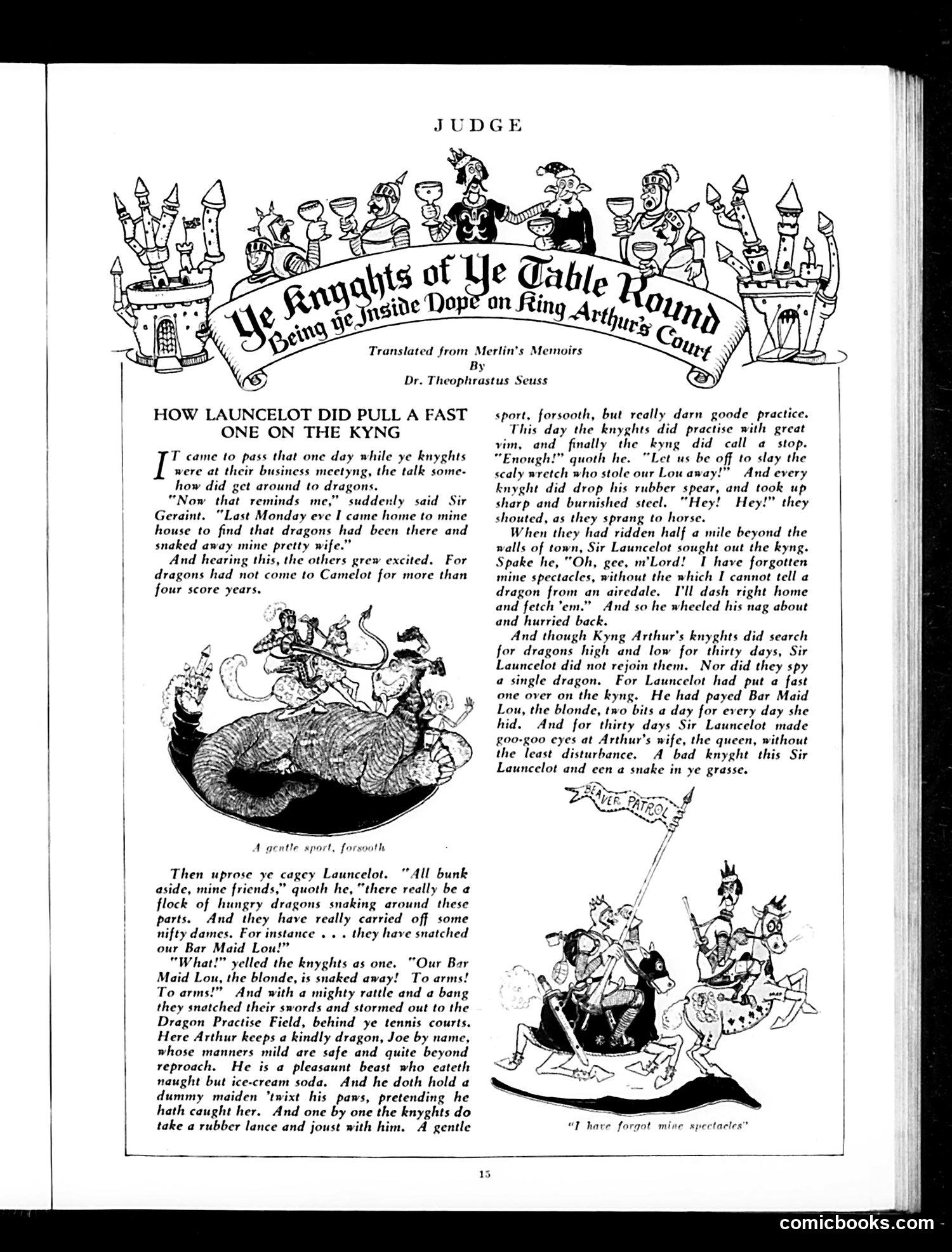
This is a humorous Arthurian legend parody by Dr. Seuss, using medieval language to mock 1920s office culture. The joke: Sir Launcelot orchestrates an elaborate scheme to distract King Arthur and the knights by falsely claiming dragons have kidnapped "Bar Maid Lou, the blonde." While the knights waste thirty days searching, Launcelot pays Lou two bits daily to hide and uses the opportunity to flirt with Queen Guinevere undisturbed. The satire contrasts chivalric ideals with workplace shenanigans—knights conducting "business meetings" and practicing with rubber lances on a tame, ice-cream-eating dragon. The "fast one" (a con) exposes the gap between noble pretense and actual behavior: a supposedly honorable knight cheats his king for romantic dalliance. The medieval framing makes modern office deception absurdly quaint and humorous.
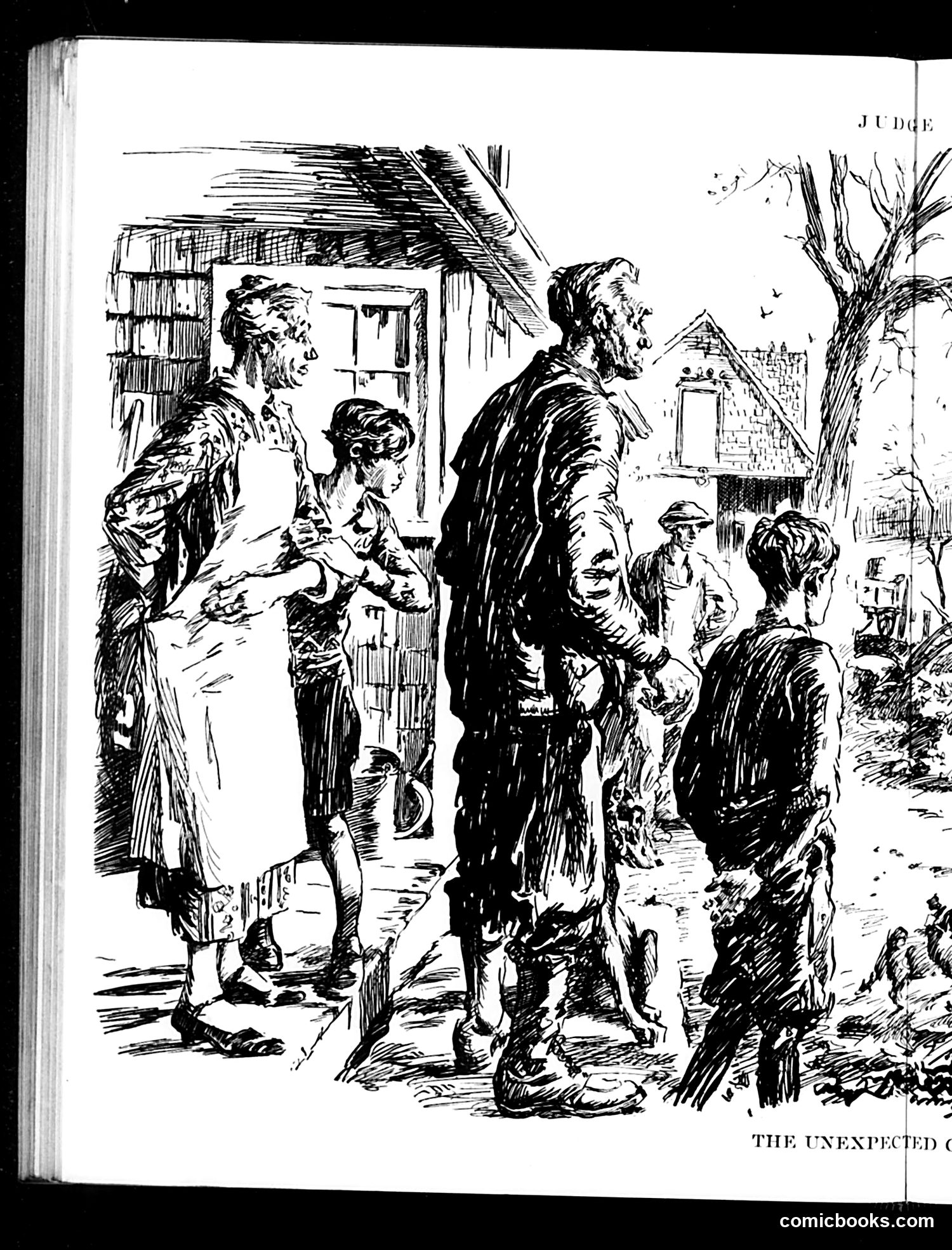
This appears to be a page from *Judge* magazine showing an illustration titled "The Unexpected" (text cut off). The sketch depicts what seems to be a rural or village scene outside a cottage, with several figures including adults and children gathered together. The image quality and OCR text are insufficient to identify specific political figures or determine the exact satirical point. The scene could represent a social commentary on rural life, poverty, or domestic circumstances common to Gilded Age America, but without clearer text or additional context, I cannot specify which contemporary event, person, or social issue this cartoon satirizes. The artistic style is consistent with late 19th-century *Judge* illustrations, but the specific subject matter remains unclear from this page alone.
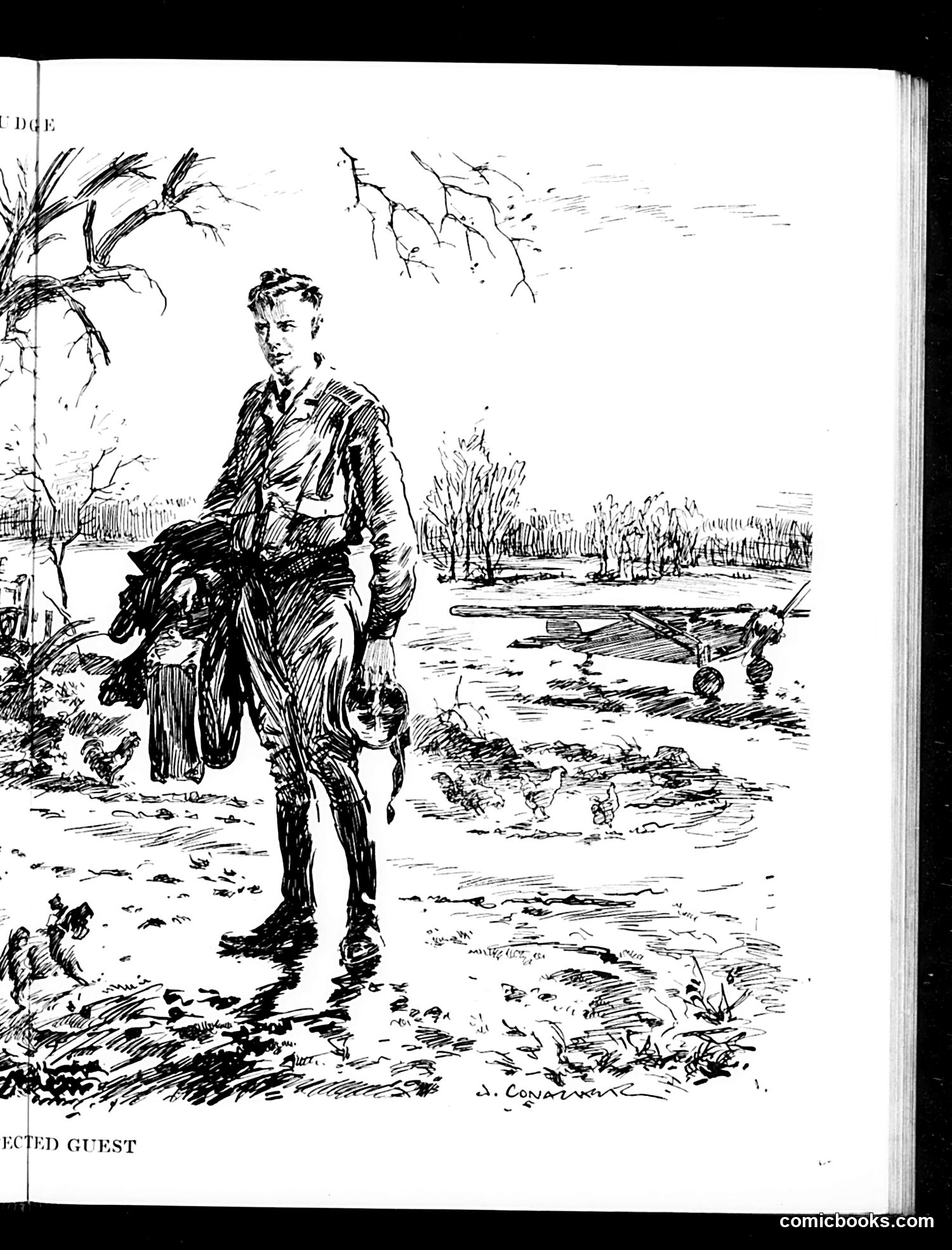
This appears to be an illustration titled "Unexpected Guest" from *Judge* magazine, signed by what looks like "A. Conainnne" (artist signature unclear). The sketch shows a man in work clothes standing in a rural wetland setting, holding what appears to be hunting equipment or a gun. Dead birds lie at his feet. The marshy landscape with bare trees and water suggests waterfowl hunting season. Without clearer OCR text or publication date, the specific satirical point is unclear. It likely comments on hunting practices, game laws, or rural life in early 20th-century America, but the exact political or social critique the cartoonist intended cannot be determined from the image alone.
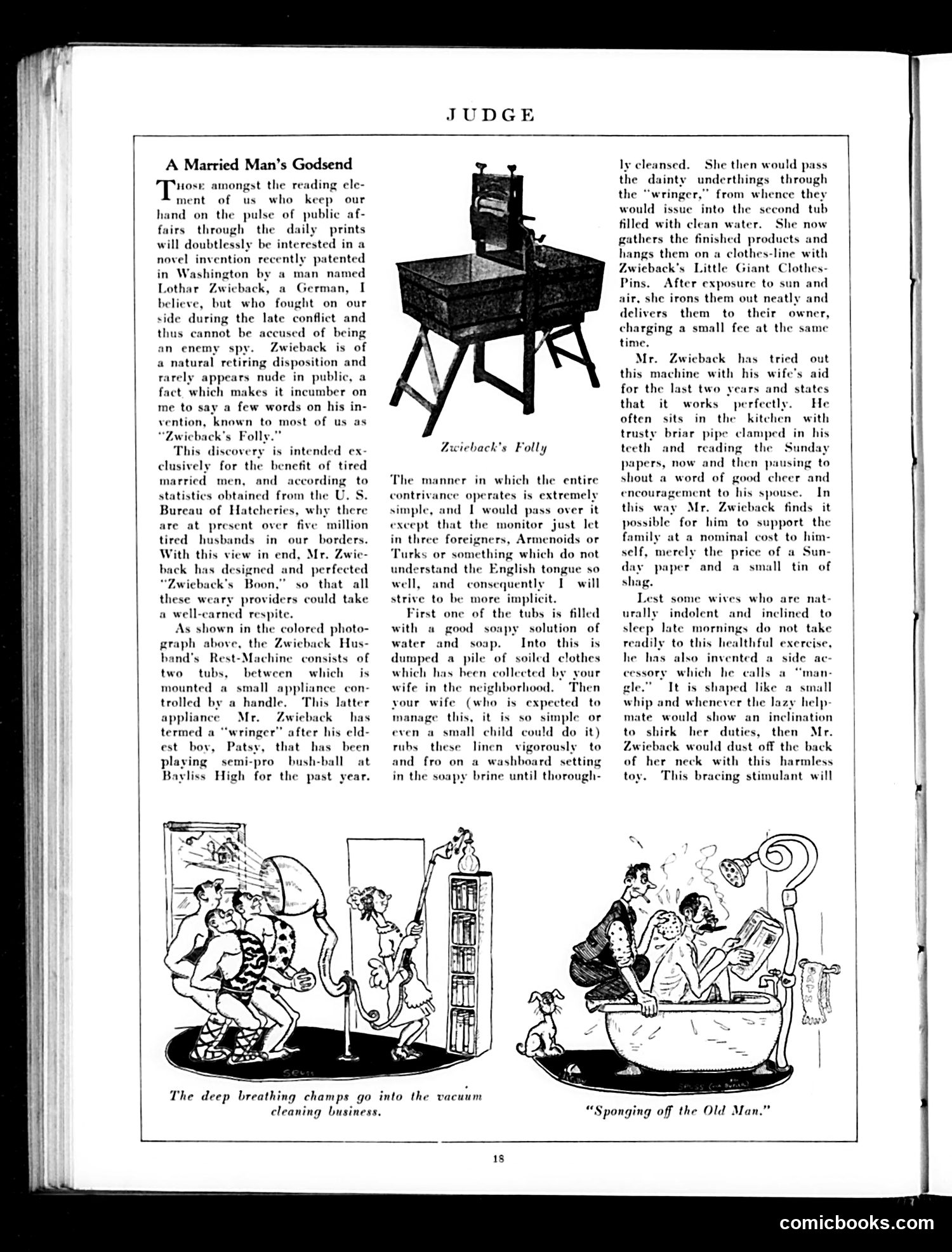
This satirical article mocks both a dubious labor-saving invention and lazy husbands exploiting their wives. Lothar Zwieback (likely a fictional German-American name) allegedly patents the "Zwieback's Folly"—a washing machine that doesn't actually reduce women's labor, merely reorganizing it: wives still scrub clothes vigorously by hand on washboards, then feed them through a wringer. The satire's target: husbands who claim to "support the family" while their wives do all physical work. Zwieback sits reading newspapers, occasionally shouting encouragement—or worse, using a whip-like "stimulant" to keep his wife working. The accompanying cartoons mock both vacuum-cleaning and spousal laziness. Judge uses this invention as a vehicle to expose how marriage often meant wives subsidizing husbands' leisure through unpaid domestic labor—a critique dressed as humor about modern "progress."
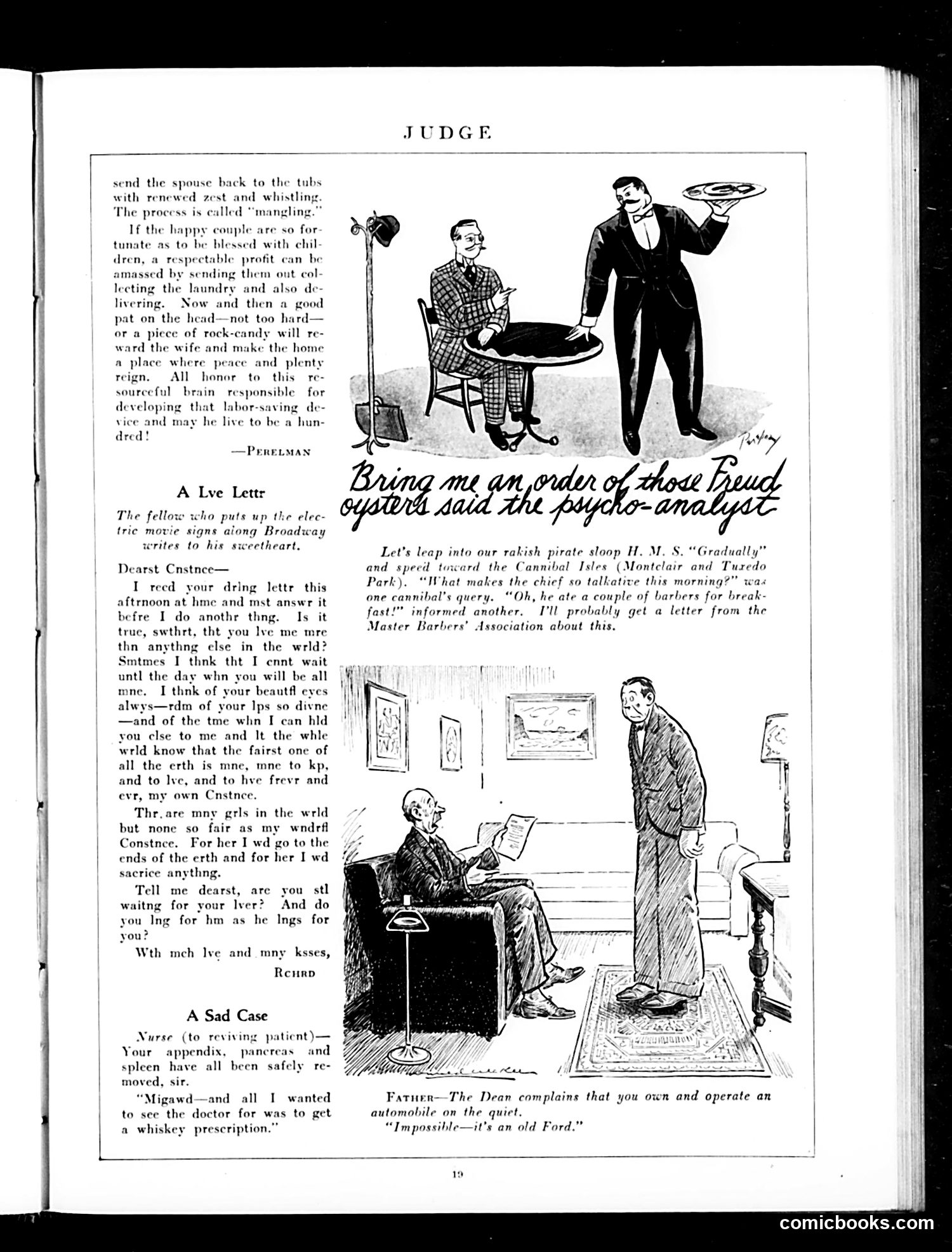
This page contains several satirical pieces typical of early 20th-century humor: **Top cartoon**: Mocks domestic life by depicting a husband serving his wife oysters while a waiter presents food. The caption suggests the "psycho-analyst" recommends treating wives like patients—rewarding them with small treats and gentle punishment to maintain household peace. It satirizes both Freudian psychology (then trendy) and patronizing attitudes toward women. **"A Live Letter"**: Parodies romantic correspondence written in extremely abbreviated text ("dring" for "during," "mne" for "mine"). The exaggerated, overwrought declarations mock sentimental love letters, suggesting emotional excess among courting couples. **"A Sad Case"**: Dark humor about a patient recovering from surgery who reveals his real motivation—he only visited the doctor hoping to obtain a whiskey prescription, presumably to circumvent Prohibition laws. **"Impossible"**: A brief joke mocking Ford automobiles as so unreliable that owning one quietly (without drawing attention) seems impossible. The page reflects early-1900s concerns: evolving psychology, Prohibition, marital dynamics, and consumer goods.
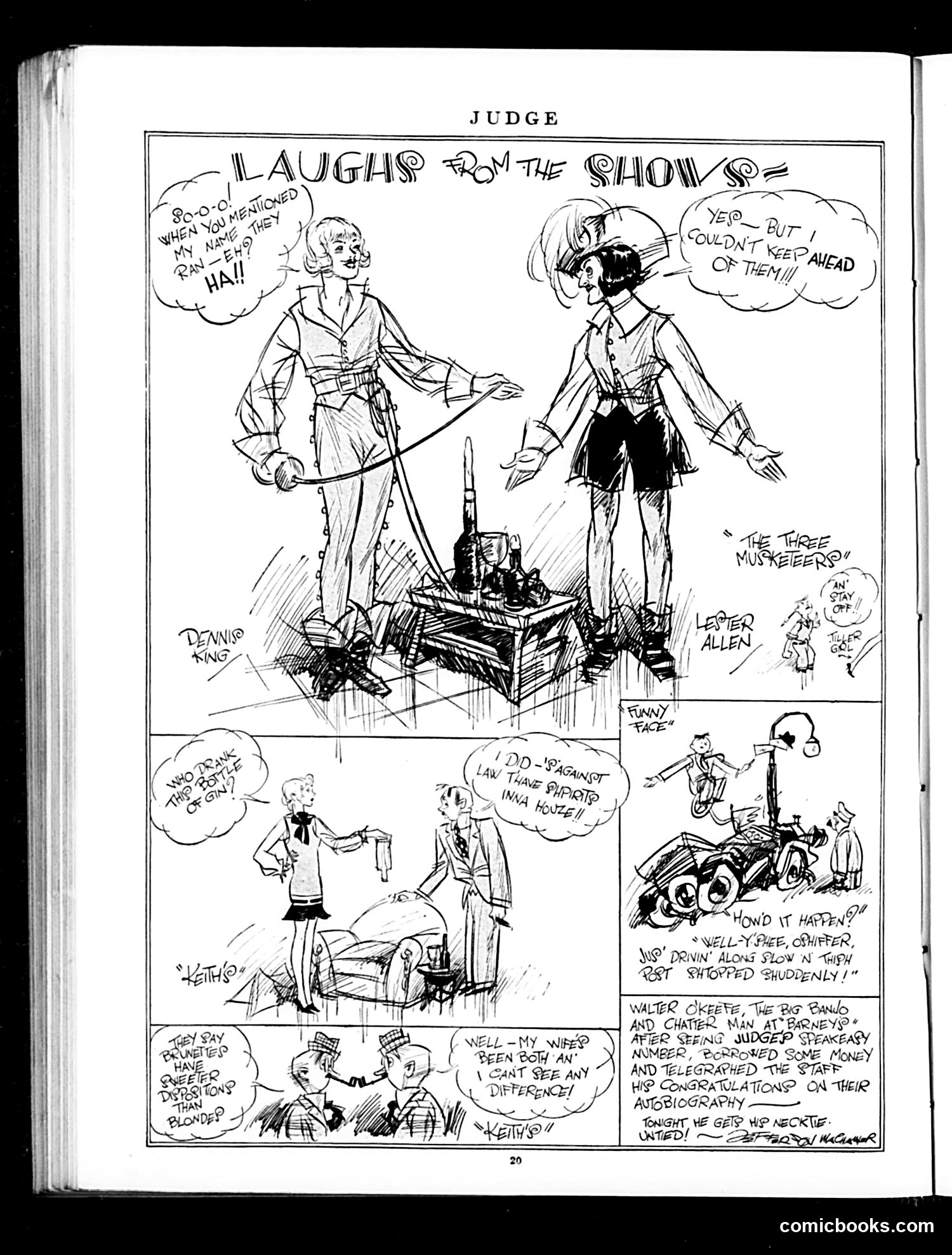
This Judge magazine page satirizes celebrity culture and Prohibition-era speakeasy scandals. The main cartoon features two women (drawn as caricatures) standing over what appear to be entertainment figures or performers. The dialogue mocks how people in show business claim differences that don't actually exist—a jab at theatrical pretension. The lower panels reference specific scandals: Walter Okeefe (a radio personality) visiting an illegal speakeasy, borrowing money, and subsequently telegraphing staff congratulations on their "autobiography"—suggesting he's profiting from or publicizing illegal activity for attention. The overall satire criticizes entertainers for hypocrisy during Prohibition: publicly respectable while privately patronizing illegal bars, then shamelessly exploiting such scandals for publicity and profit. The "Judge" heading indicates this is moral social commentary typical of the magazine's approach.
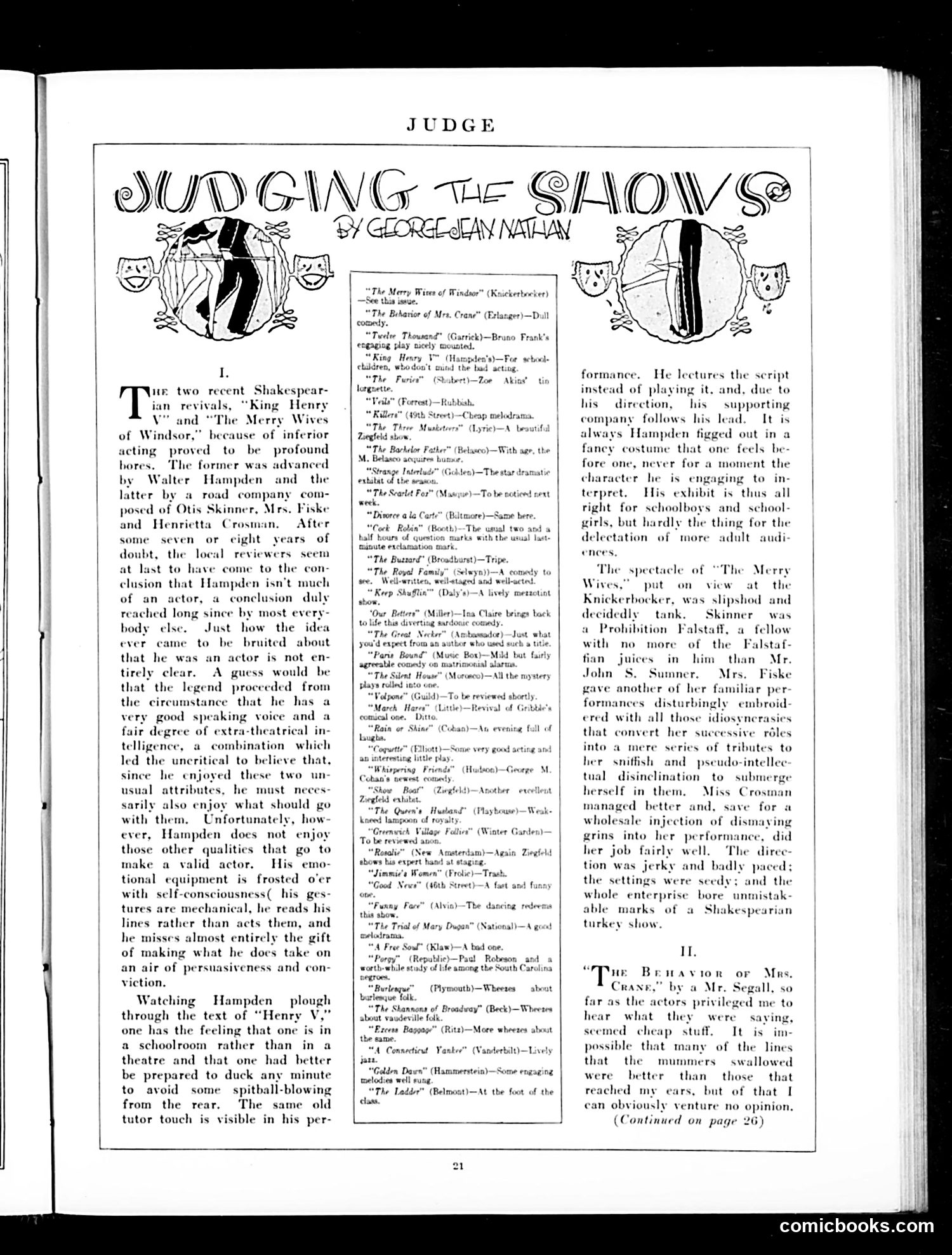
This is a theater criticism column by George Jean Nathan reviewing recent Broadway productions. The page contains no political cartoons—it's a written critique of Shakespeare revivals and contemporary plays. Nathan dismisses Walter Hampden's production of "Henry V" as a profound bore, arguing Hampden is fundamentally not a skilled actor despite possessing a good speaking voice and theatrical presence. He criticizes Hampden for lecturing the script rather than inhabiting characters, appearing self-conscious and mechanical. He's somewhat kinder to competing productions featuring Otis Skinner, Mrs. Fiske, and Henrietta Crosman in "The Merry Wives of Windsor," though still finding it a mediocre "Shakespearian turkey show." He praises Fiske's familiar performance style while criticizing Ina Claire's affected mannerisms and pseudo-intellectual distance from her roles. The column exemplifies early 20th-century Broadway criticism's frank dismissiveness toward established actors.
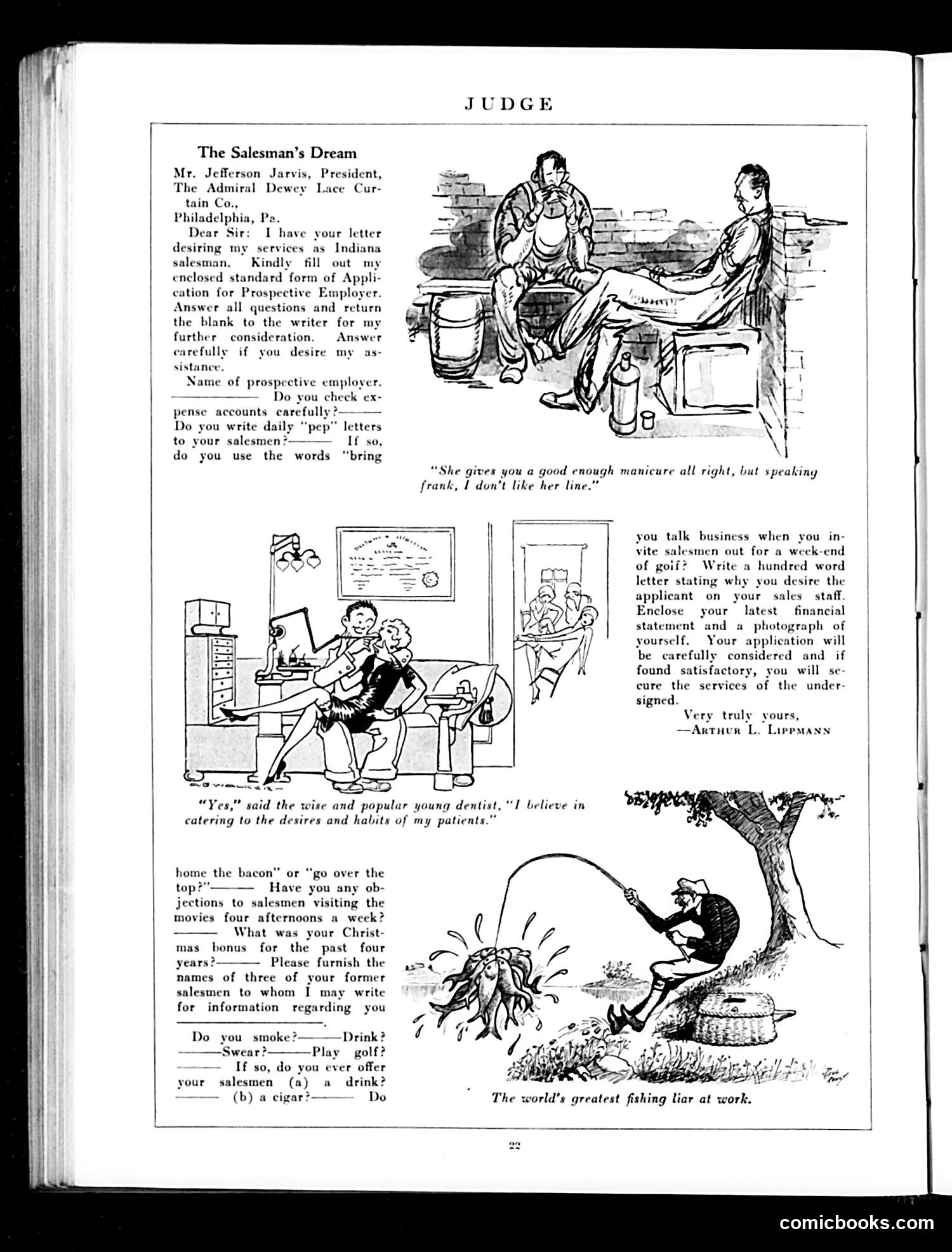
This page satirizes early 20th-century sales culture through role reversal. Typically, employers screen job applicants with invasive questionnaires. Here, a prospective salesman (Arthur L. Lippmann) turns the tables, demanding an employer fill out an extensive application asking about expense-account practices, "pep talks," movie attendance policies, Christmas bonuses, and personal habits (smoking, drinking, golfing). The satire mocks both aggressive sales tactics and corporate paternalism. The accompanying cartoons reinforce the theme: one shows a dentist pandering to patients' desires; another depicts "the world's greatest fishing liar"—suggesting salesmen are fundamentally dishonest. The joke's bite lies in exposing how salesmen are treated as interchangeable, managed through manipulative motivational language ("bring home the bacon," "go over the top") and surveillance of their leisure time. By flipping the power dynamic, the cartoonist exposes the absurdity of corporate control over workers' personal lives.
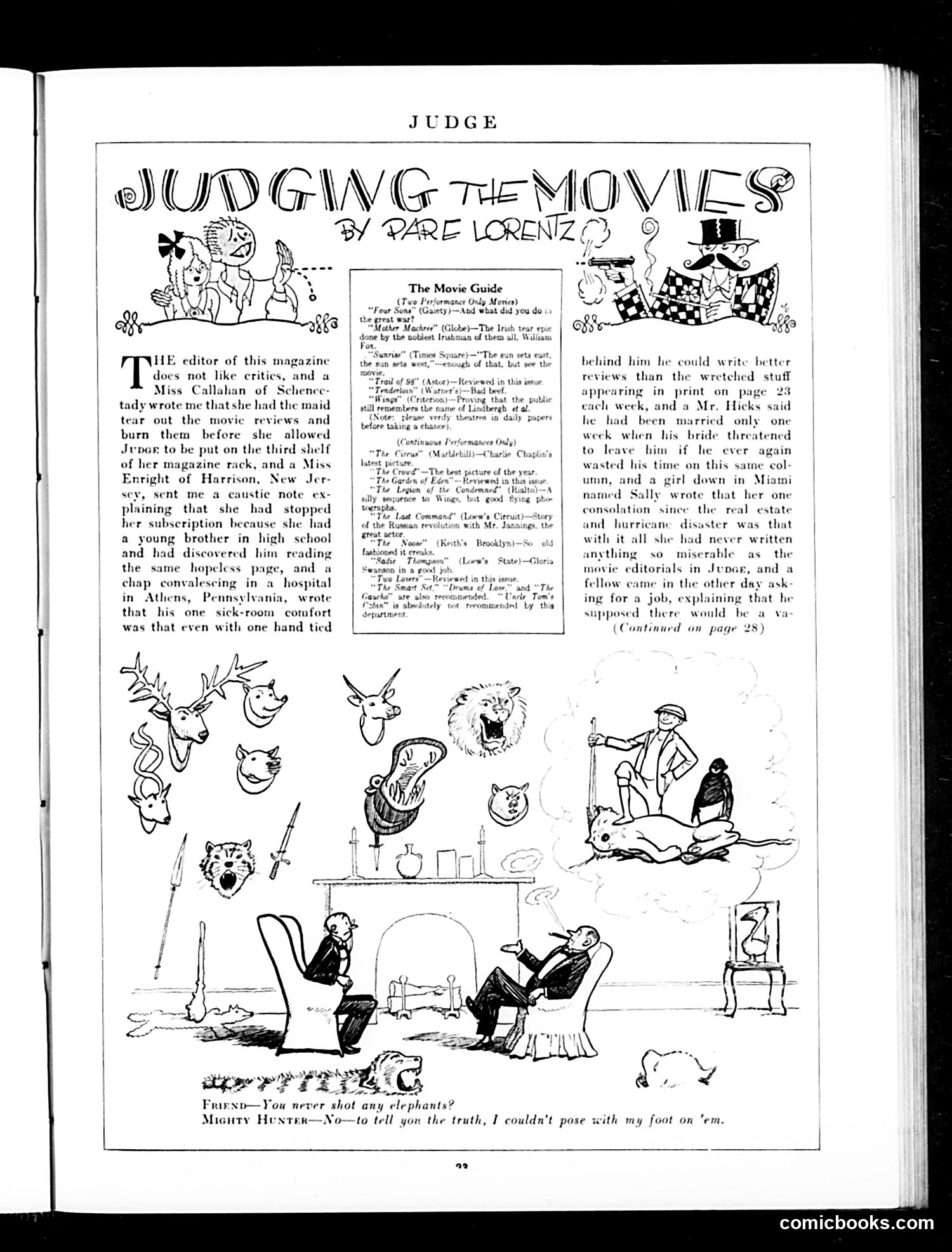
This page from *Judge* magazine features "Judging the Movies," a column by Pare Lorenz that reviews current films. The main joke at the bottom shows two men in conversation: a "Friend" asks if a "Mighty Hunter" has shot any elephants, and the hunter replies he couldn't because he couldn't pose with his foot on them—a satirical jab at the popular practice of trophy hunting photos where hunters posed victoriously over dead animals. The column's header includes editorial complaints from readers who found the movie reviews so bad they removed them from the magazine or stopped subscribing. One reader even claims her brother in high school was harmed by reading them. This is satirizing both the column's poor quality and readers' dramatic overreactions to entertainment criticism. The decorative illustrations show various animal heads and hunting/theatrical scenes, reinforcing the satirical tone about entertainment and hunting culture.
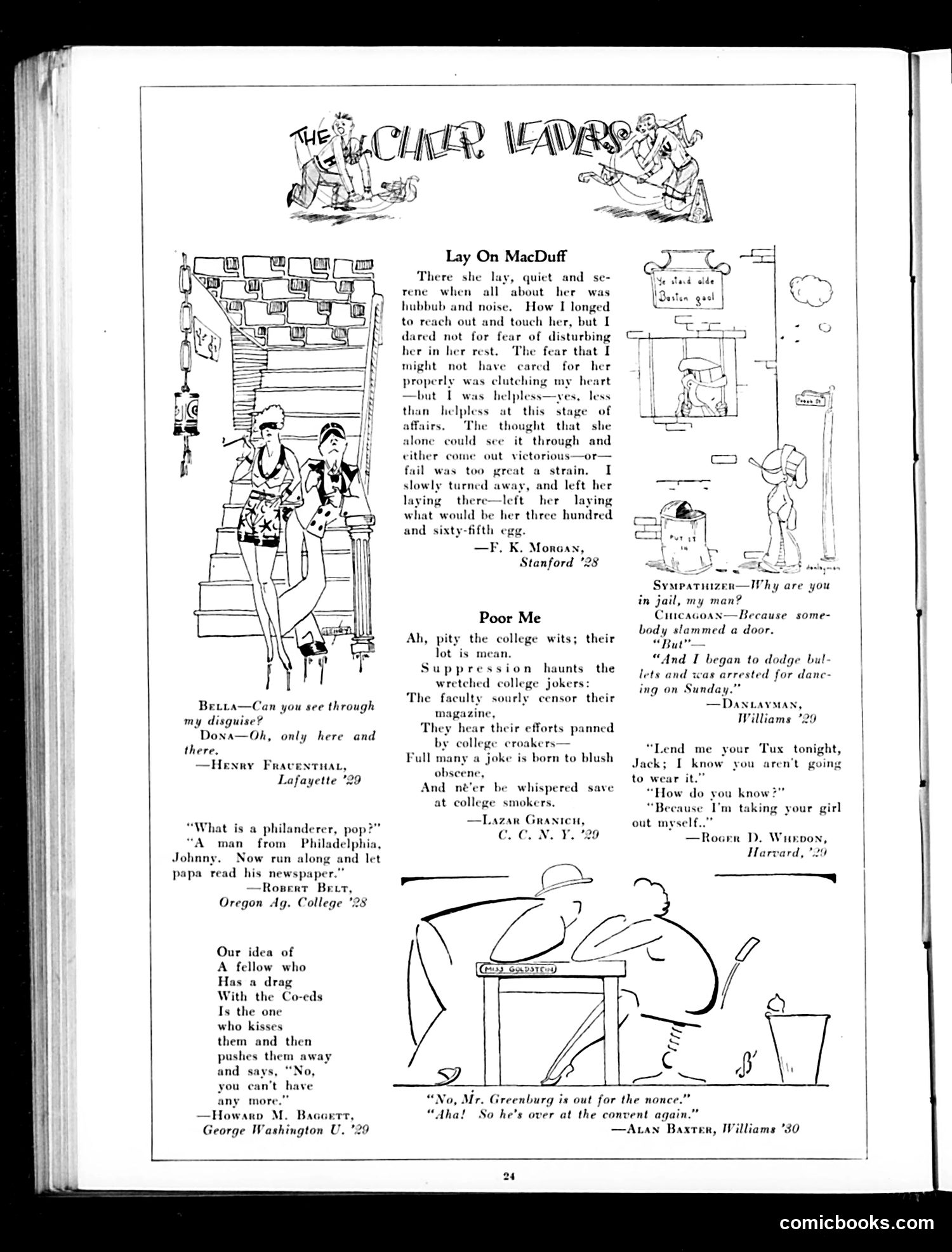
This page from *Judge* magazine collects college humor and jokes submitted by students from various universities (Stanford, Lafayette, Oregon Agricultural, George Washington, Williams, Harvard, etc.), circa 1928-1930. The content satirizes college life through student-submitted quips: - **"Lay On MacDuff"** jokes about a chicken's egg-laying, playing on the famous Macbeth line - **"Poor Me"** mocks faculty censorship of college humor magazines and student publications - Various one-liners target college dating culture, including double entendres about "drags" (dates) with coeds and the social awkwardness of courtship - A pun equates "philanderer" with "Philadelphia" - The final cartoons depict college mischief: avoiding work, evading convent visits (suggesting inappropriate behavior) The page reflects 1920s college culture anxieties: administrative control of student expression, courtship conventions, and the tension between youthful rebellion and institutional authority. The humor is relatively mild by modern standards—mostly clean puns and observational jokes about academic life.
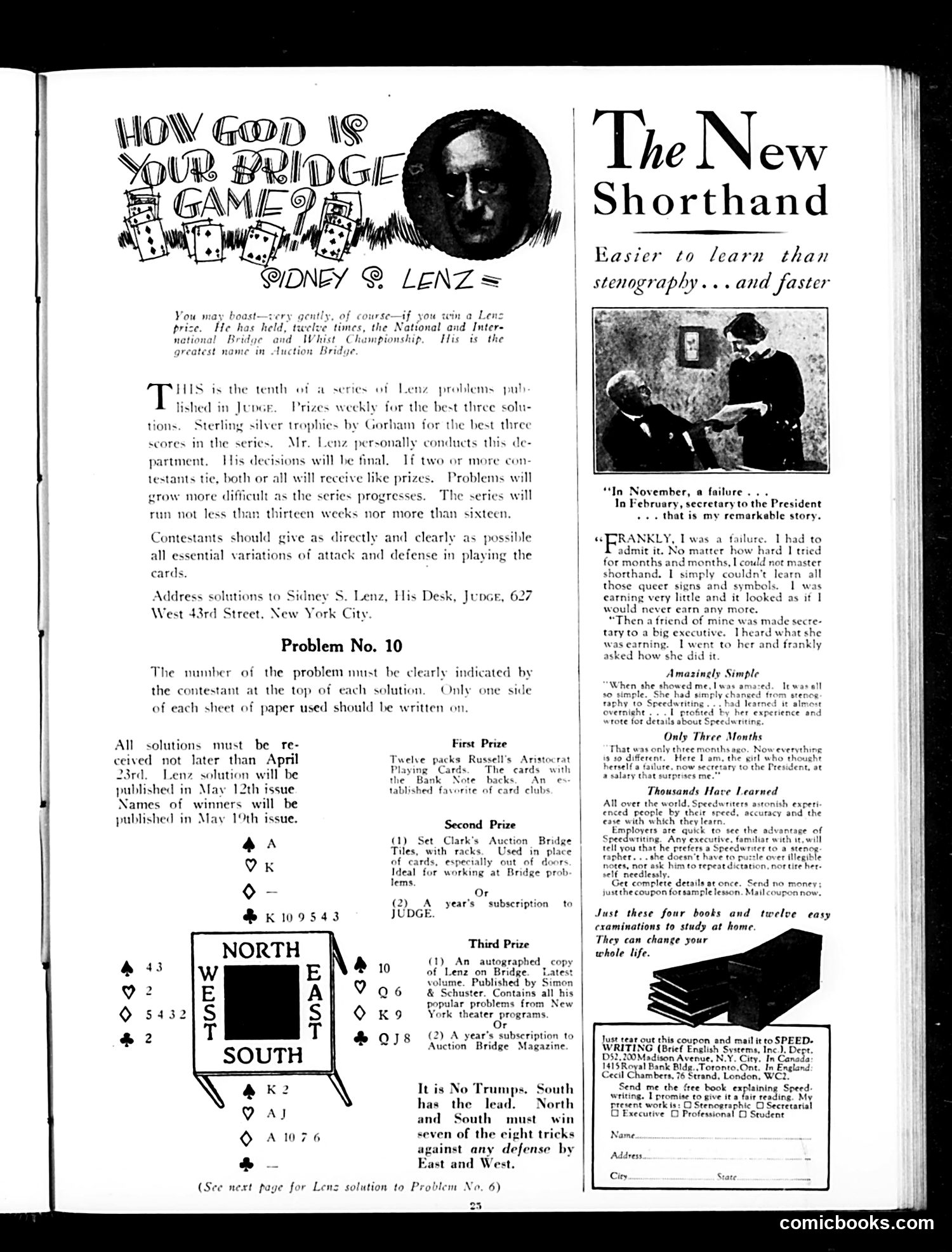
This page combines bridge competition content with advertising. The main feature is **Problem No. 10**, a bridge card game puzzle by Sidney S. Lenz, a famous bridge champion of the era. The cartoon at top left humorously references bridge's popularity—depicted with playing cards and the caption "How Good Is Your Bridge Game?" Lenz's competition invited readers to solve bridge problems for prizes (silver trophies, card sets, and subscriptions to *Judge* magazine). This reflects bridge's status as a major leisure activity for educated Americans in the early 20th century. The right page advertises **Speedwriting**, a shorthand system claiming superiority to stenography. The testimonial features a woman who became "secretary to the President" after learning Speedwriting in three months—remarkable claims suggesting the system's supposed ease and career advancement potential. Together, the page reflects 1920s-30s American interests: intellectual games for the leisure class and commercial self-improvement products targeting women entering the workforce.
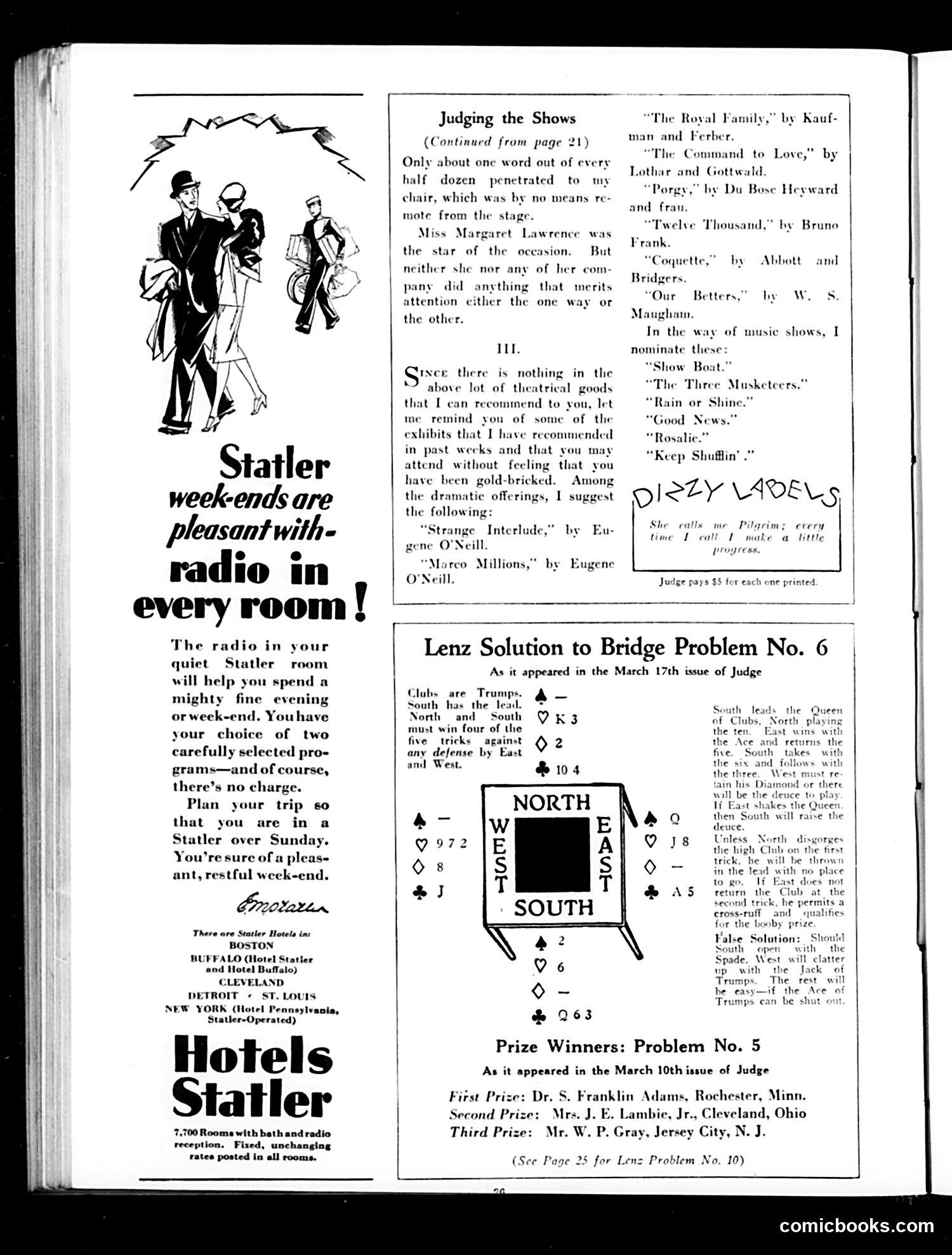
This page is primarily **advertising and puzzle content**, not political satire. The **Statler Hotels advertisement** (left side) promotes their chain by emphasizing a modern luxury amenity: radios in every guest room. This was cutting-edge technology in the late 1920s, when radio was relatively new. The ad's pitch—that guests can enjoy free radio programming during their stay—appeals to leisure travelers seeking comfort and entertainment. The **illustration** shows well-dressed figures in formal attire, typical of period advertising depicting upscale hotel clientele. The remainder of the page contains theater reviews (referencing contemporary Broadway shows and playwrights like Eugene O'Neill), a humor caption, and **bridge problem solutions**—Judge magazine regularly featured card game puzzles as reader engagement content. There is no political cartoon or satire present on this page. It reflects 1920s consumer culture and leisure activities of affluent Americans.
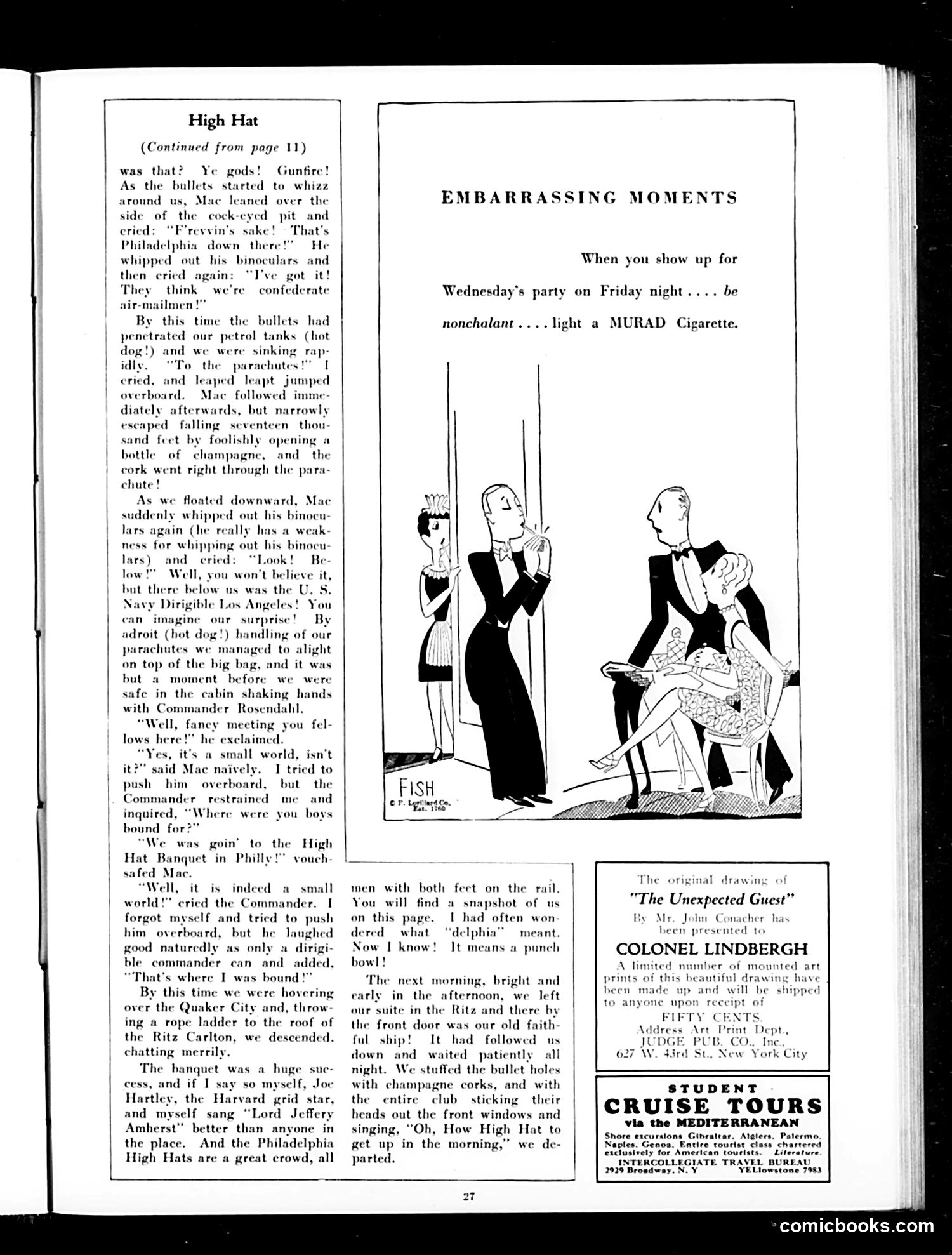
This page contains two distinct elements: **Left side:** A humorous serialized story titled "High Hat" (continued from page 11) describing an absurdly exaggerated adventure. Two pilots claim to have been shot at near Philadelphia, parachuted onto a U.S. Navy dirigible (airship) commanded by "Commander Rosendahl," and attended a High Hat banquet in Philadelphia. The humor derives from the tall tale's escalating implausibility and casual name-dropping of real figures like Commander Rosendahl (who led actual Navy airship operations in the 1920s-30s). **Right side:** An advertisement for MURAD cigarettes presented as satirical advice on how to appear "nonchalant" when arriving late to a party—simply light a cigarette. The accompanying cartoon illustrates three men in formal wear, with one woman seated. Below are ads for art prints and student Mediterranean cruise tours. The overall tone is typical 1920s-30s satirical humor: absurdist storytelling and consumer product satire.
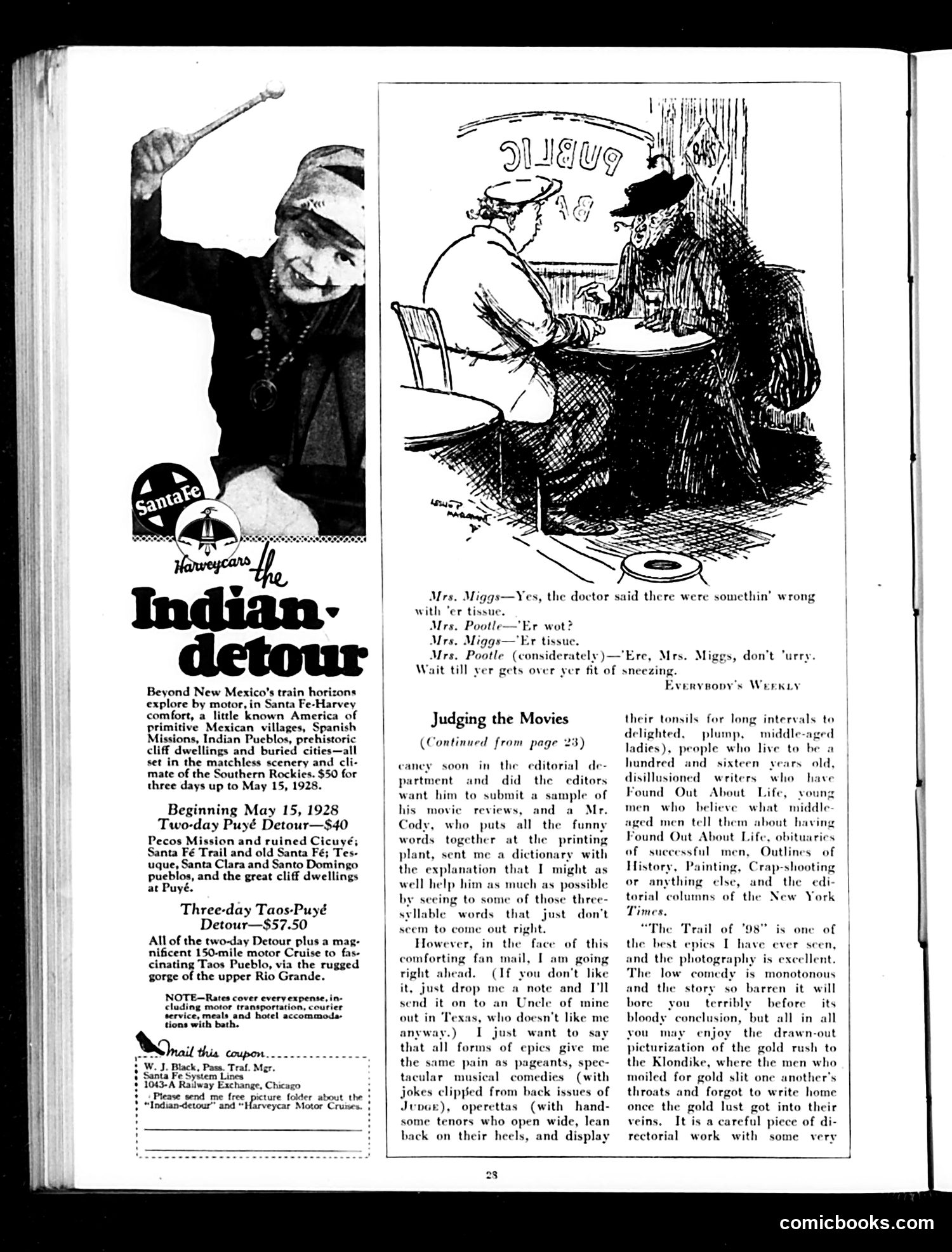
This page contains **primarily advertising and a humor column**, not political satire. The left side features a Santa Fe Railway ad for "Indian-detour" motor tours through New Mexico, promoting visits to pueblos, missions, and cliff dwellings—reflecting 1920s tourism marketing that exoticized Native American sites as tourist attractions. The right side contains two unrelated items: a brief comic dialogue between working-class British women (Mrs. Miggs and Mrs. Pootle) playing on a pun—"tissue" misheard as "her wot" during a sneezing fit—and a film review column ("Judging the Movies") critiquing movie genres and tropes with sardonic humor about overwrought epics and melodramas. The content reflects 1920s popular entertainment: tourist commercialization of Indigenous cultures, British music-hall style humor, and contemporary film criticism. There is **no significant political satire** on this particular page.
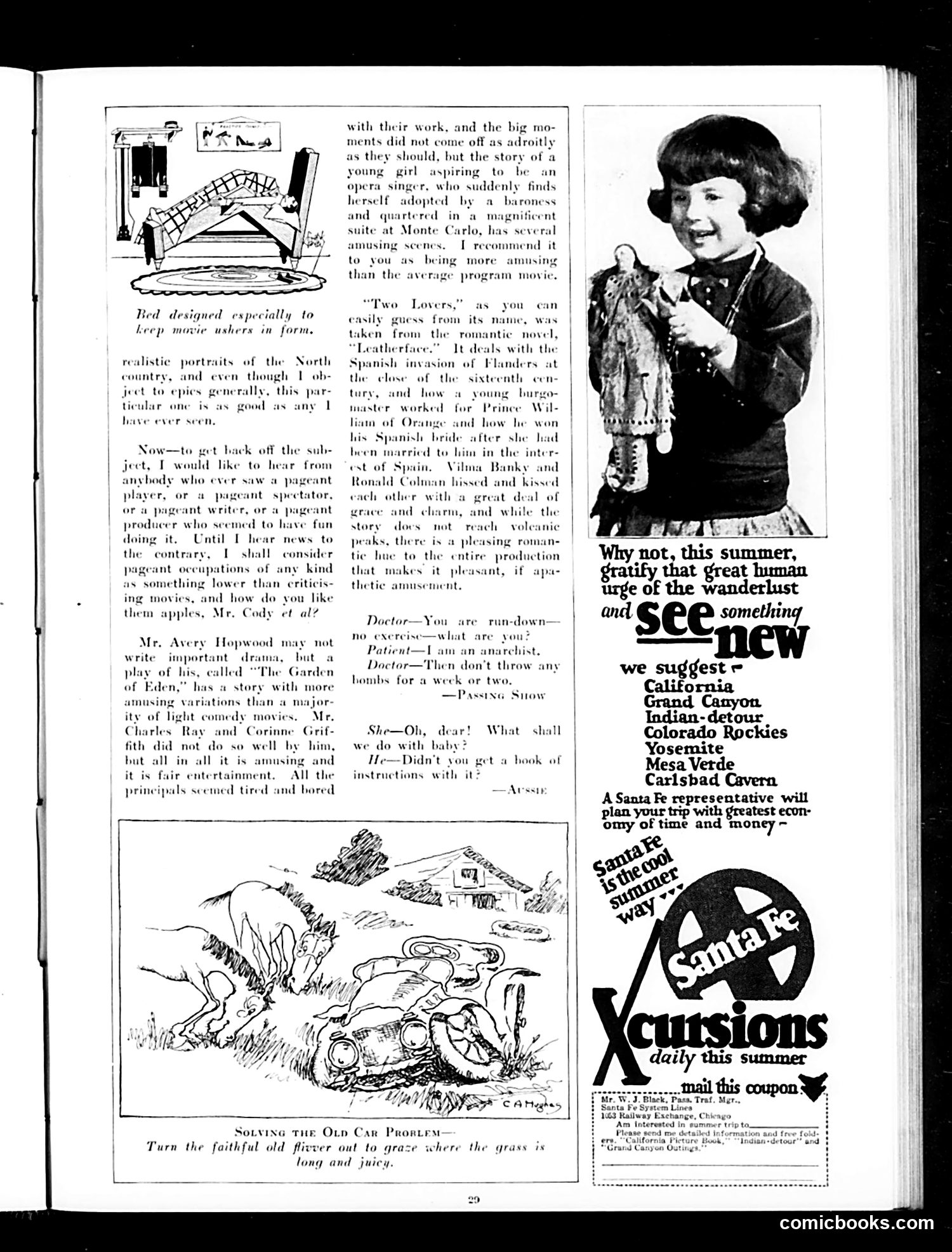
This page contains film reviews and light humor typical of 1920s Judge magazine. The main content critiques several movies: "The Garden of Eden" (praised as more entertaining than typical light comedies), "Two Lovers" (a Spanish historical romance), and others featuring actors like Charles Ray, Corinne Griffith, Vilma Banky, and Ronald Colman. The cartoons are brief comedic exchanges: one mocks pageant writers/performers as tedious, and another presents a doctor-patient joke about an anarchist avoiding bomb-throwing. A third jokes about baby instruction manuals. The bottom cartoon, "Solving the Old Car Problem," depicts an abandoned automobile deteriorating outdoors—likely satirizing the Model T "flivver" as unreliable or disposable. The right side features a Santa Fe railway advertisement promoting summer travel destinations (Grand Canyon, Colorado Rockies, Yosemite, etc.), typical of period magazine advertising. The page reflects 1920s popular entertainment criticism and commercial promotion rather than political satire.
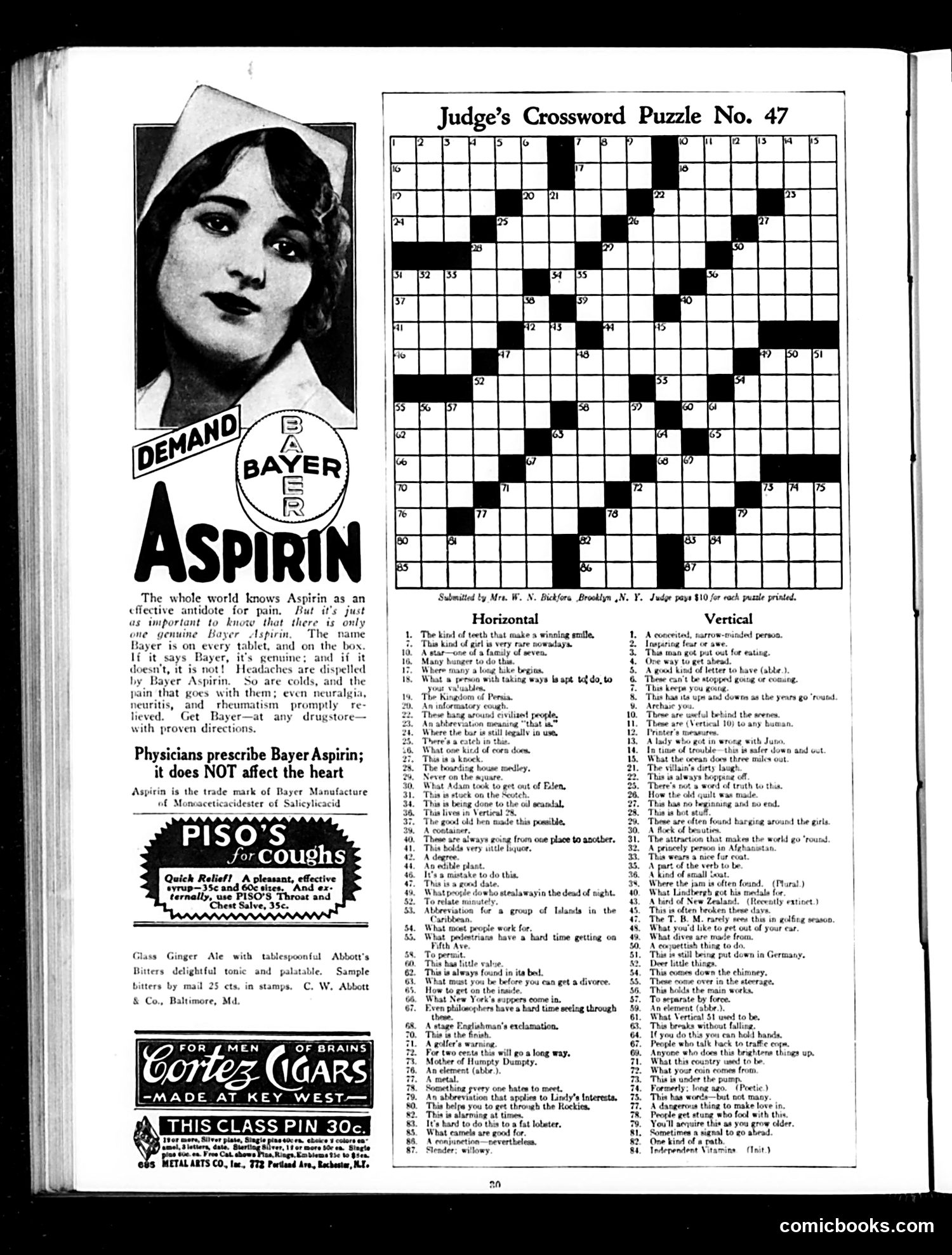
This page is primarily **advertising and a crossword puzzle**, not a political cartoon. The main content is "Judge's Crossword Puzzle No. 47," submitted by Mrs. W.N. Bickford of Brooklyn. The page features advertisements for Bayer Aspirin (emphasizing it's the genuine product), Piso's cough syrup, Cortez cigars, and other patent medicines—typical of 1920s Judge magazine. A woman's portrait appears at top left, likely the puzzle's original submitter or a generic illustration. The crossword itself contains standard wordplay clues from that era ("A star—one of a family of seven," "What most people work for"). The puzzle reflects 1920s American culture references: mentions of Lindbergh, Fifth Avenue, the Rockies, and contemporary slang. **This is not satirical content but rather filler material**—Judge monetized space through reader-submitted puzzles while surrounding them with lucrative pharmaceutical and consumer product advertisements. The page represents how early 20th-century magazines sustained themselves.
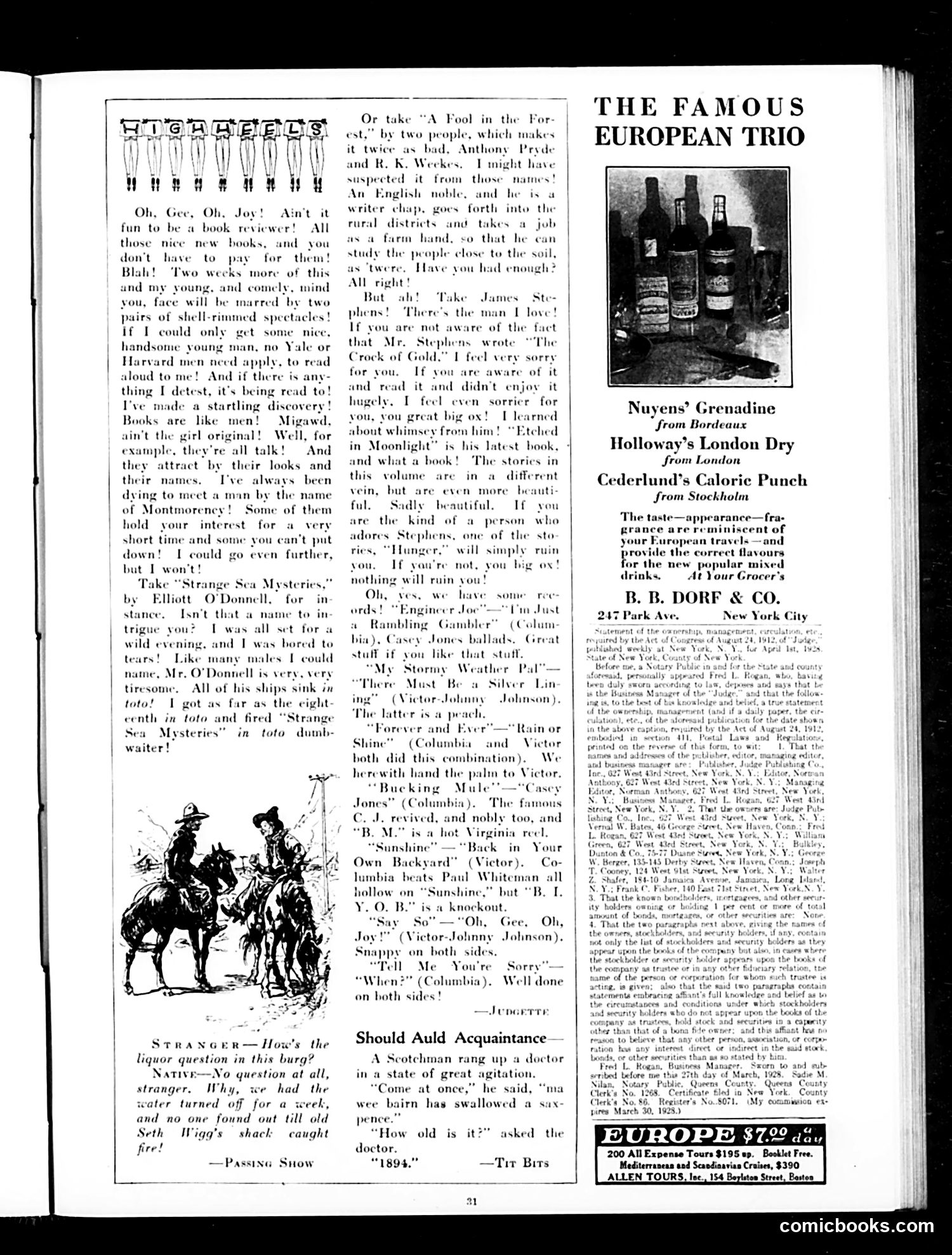
This page contains **book and music reviews** disguised as social commentary, plus advertisements. The main cartoon (left) depicts a **female book reviewer** complaining humorously about her job. She mocks authors by their names and works—praising James Stephens' *"The Crock of Gold"* as genuinely witty, while dismissing other volumes as tedious (particularly Elliott O'Donnell's *"Strange Sea Mysteries"*, where "all his ships sink in toto"). The satire targets how readers judge books superficially by authors' names and reputations rather than actual merit. The bottom cartoon is a brief **Scottish dialect joke**: a Scotsman calls a doctor in distress because his baby swallowed a sixpence, but when asked the child's age, replies "1894"—implying the "baby" is actually an adult, making the father's panic absurd. The right side advertises **European liqueurs and spirits** (Nuyens' Grenadine, Holloway's London Dry, Cederland's Caloric Punch) and European tour packages, reflecting post-WWI American fascination with continental sophistication.
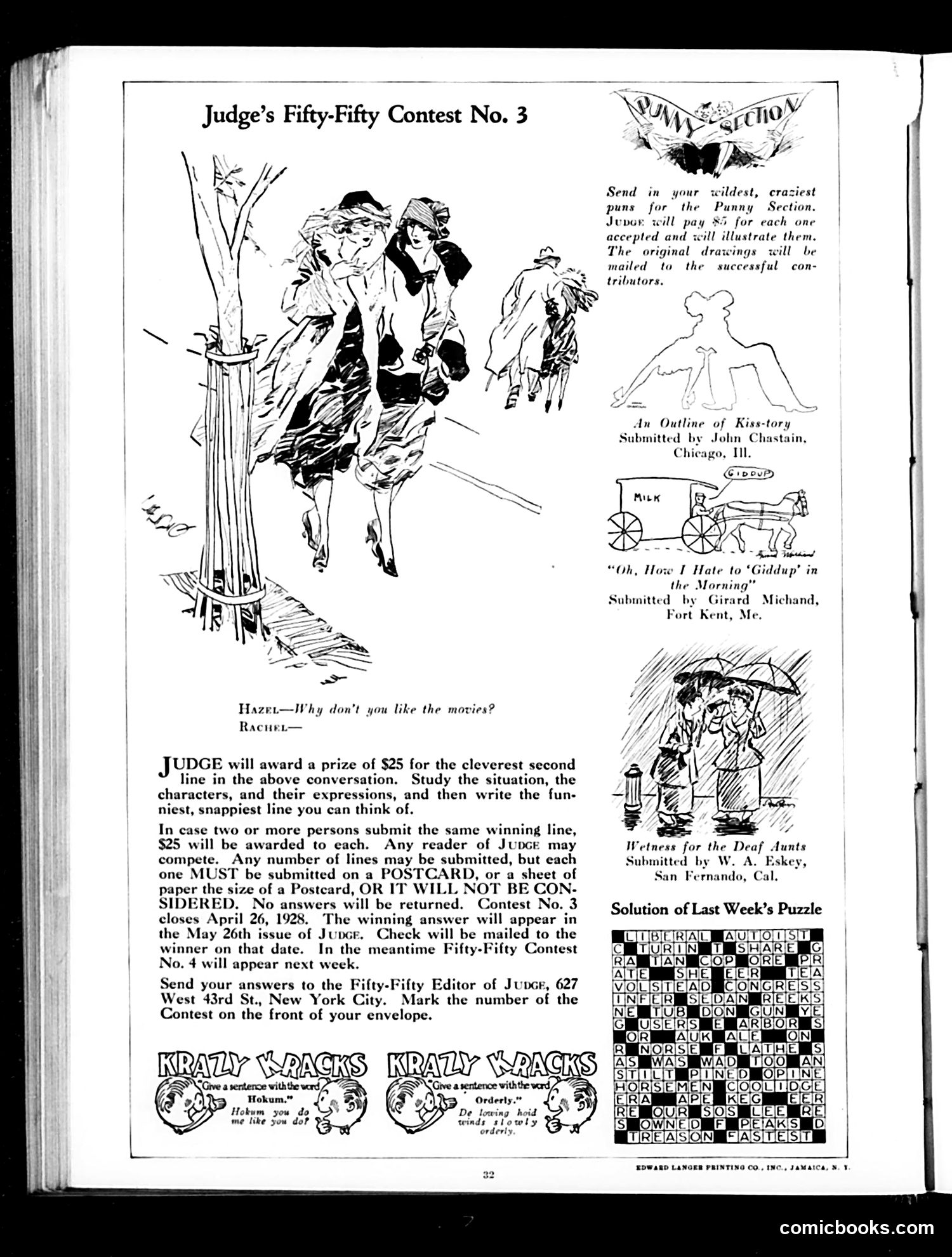
This page features Judge's "Fifty-Fifty Contest No. 3," a humor competition where readers submit the cleverest second line to an incomplete joke. The setup shows two figures—"Hazel" and "Rachel"—discussing movies, with Hazel asking why Rachel dislikes them. Readers compete for a $25 prize by providing Rachel's witty response. The page also showcases winning entries from previous contests, including visual gags about kissing, milk delivery complaints, and deaf communication. A "Krazy Whacks" section offers puns for submission. This reflects 1920s magazine culture: Judge entertained readers through participatory contests while crowdsourcing comic material. The emphasis on brevity ("snappiest line") and the movie reference suggest early cinema was already a common cultural touchstone for humor. The contest format was economical for publishers—readers generated content for modest prizes.
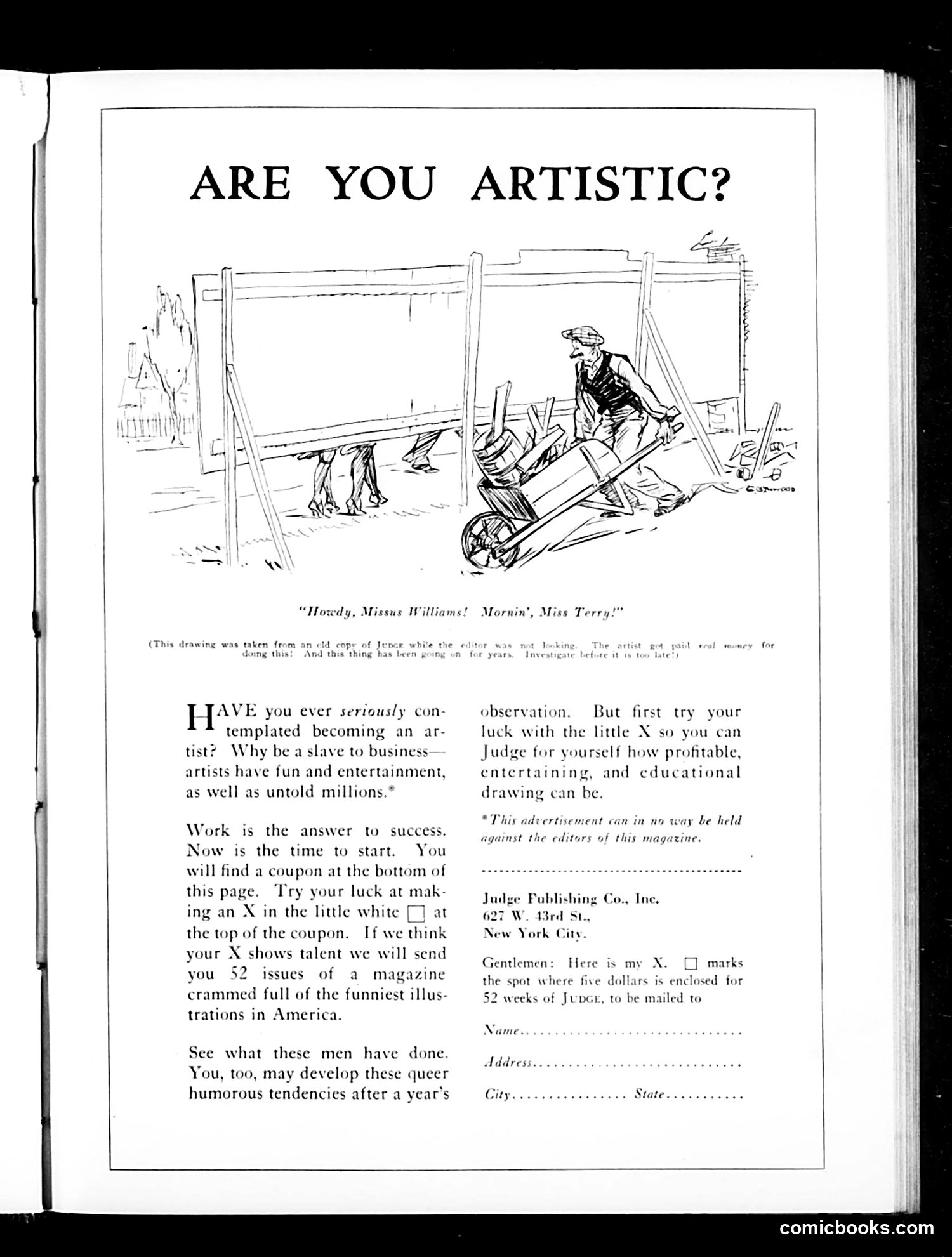
This is a satirical advertisement (self-consciously labeled as such) promoting Judge magazine subscriptions. The cartoon depicts a man sprawled on the ground after apparently falling or being knocked down, with onlookers nearby—a scene of physical mishap presented as "artistic" observation. The joke critiques both aspiring artists and Judge itself: the text ironically claims that becoming an artist is profitable and fun, contrasting sharply with the visual chaos. Readers are invited to "test their talent" by marking an X on a coupon; if Judge deems it talented, they receive 52 issues. The humor is self-aware—the asterisk disclaimer notes the advertisement cannot be held against the editors, acknowledging the absurdity. It's essentially Judge mocking its own subscription solicitation while poking fun at people who might seriously consider art careers, using slapstick misfortune as the supposed exemplary "artistic observation" worth studying.
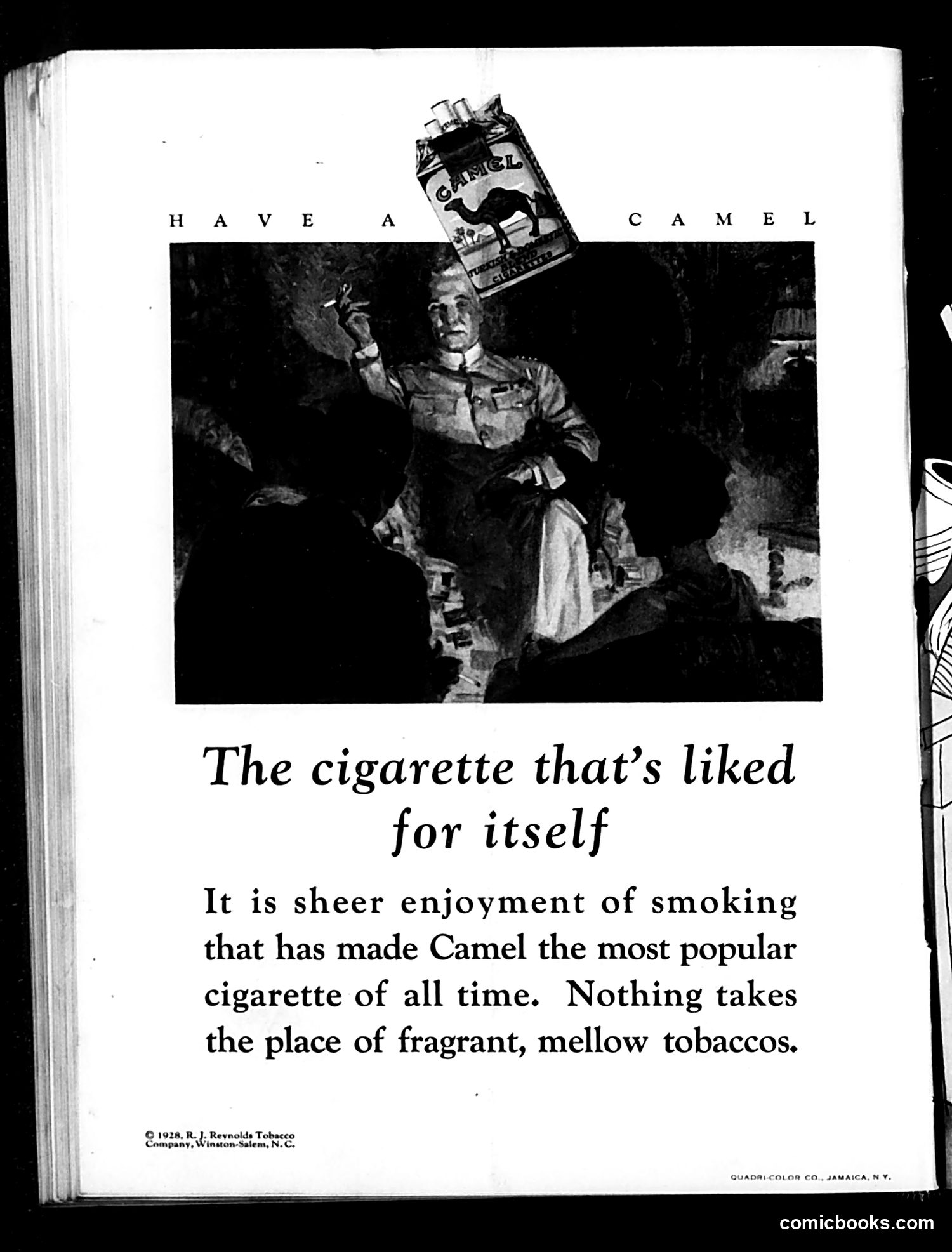
This is a **Camel cigarette advertisement**, not satire or political content. Published in 1928, it features a man in formal attire (appearing to be dressed as a doorman or hotel staff) holding a large Camel cigarette package aloft. The ad uses the tagline "The cigarette that's liked for itself," emphasizing the product's inherent quality rather than external endorsements or trends. The copywriting highlights "fragrant, mellow tobaccos" as the reason for Camel's popularity. This reflects early 20th-century advertising strategy before tobacco health warnings—marketing cigarettes purely on taste and enjoyment grounds. The formal servant figure likely suggests sophistication and genteel consumption. By modern standards, this advertisement is notable primarily as a historical artifact showing pre-regulation tobacco marketing.