
A complete issue · 36 pages · 1928
Judge — April 7, 1928
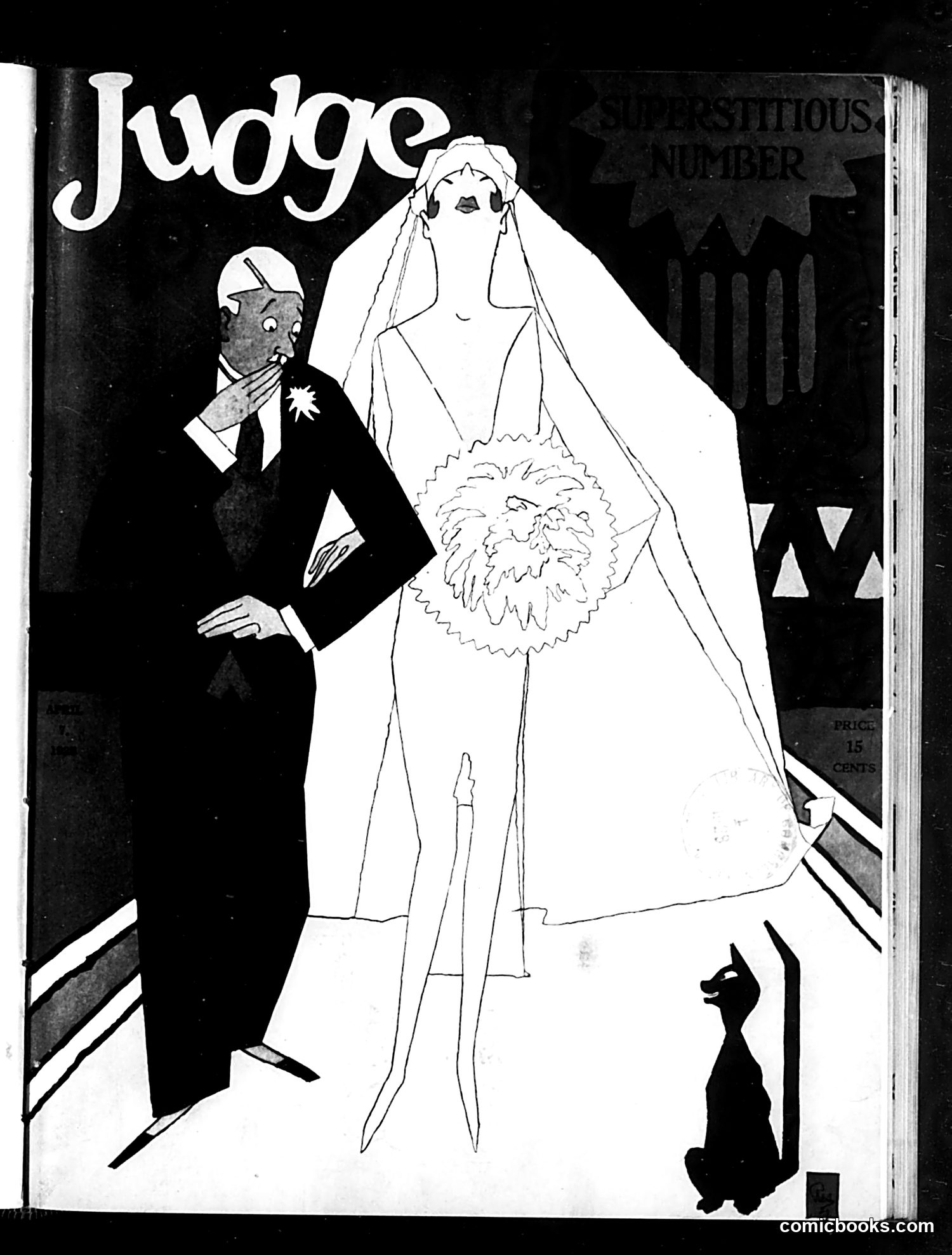
This appears to be a Judge magazine cover titled "Judge" featuring a satirical wedding scene. The illustration shows a shocked man in formal attire reacting with his hand to his mouth, facing a bride in an elaborate white wedding dress and veil. A black cat sits in the lower right corner, traditionally associated with bad luck or superstition. The satire likely comments on marriage anxieties or concerns about the bride's character or background—suggested by the groom's expression of dismay. The black cat reinforces the "bad luck" theme. Without additional context or OCR text clarifying the specific reference, the exact political or social target remains unclear, though the imagery suggests commentary on matrimonial fears or deception that would have resonated with Judge's contemporary audience.
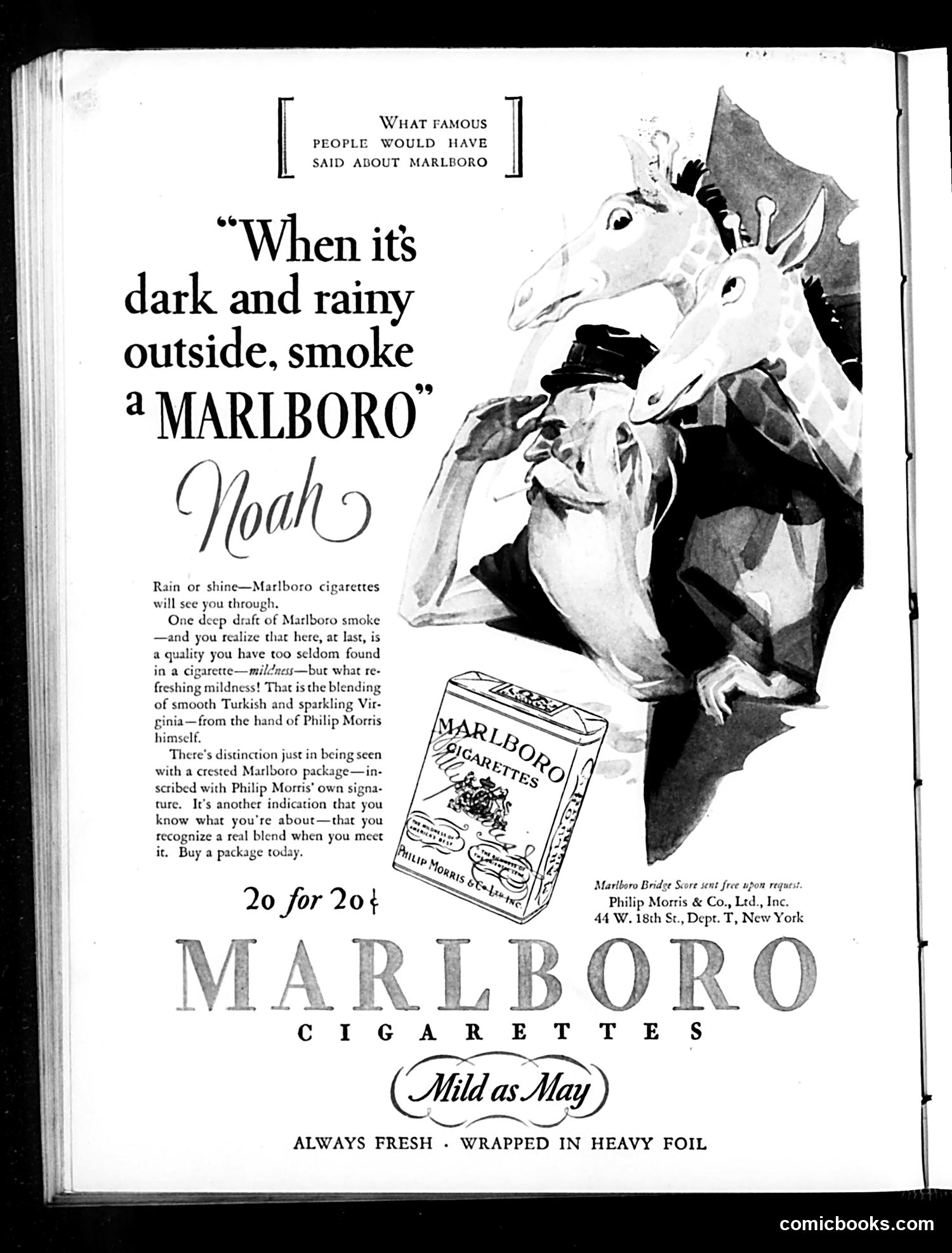
This page is **primarily a cigarette advertisement**, not political satire. It features a Marlboro cigarettes ad attributed to the biblical figure Noah, with the tagline: "When it's dark and rainy outside, smoke a MARLBORO." The humor relies on a visual pun: Noah is depicted with two goats (rather than animals from the famous ark story), creating a playful misidentification. The ad uses Noah's association with rain and weather as a setup for the product pitch. The advertisement emphasizes Marlboro's quality—describing the "blending of smooth Turkish and sparkling Virginia" tobacco—and notes the price (20 for 20¢). The "Mild as May" slogan appears at the bottom. This reflects early 20th-century advertising's use of historical/biblical figures for brand endorsement, a common marketing practice of the era.
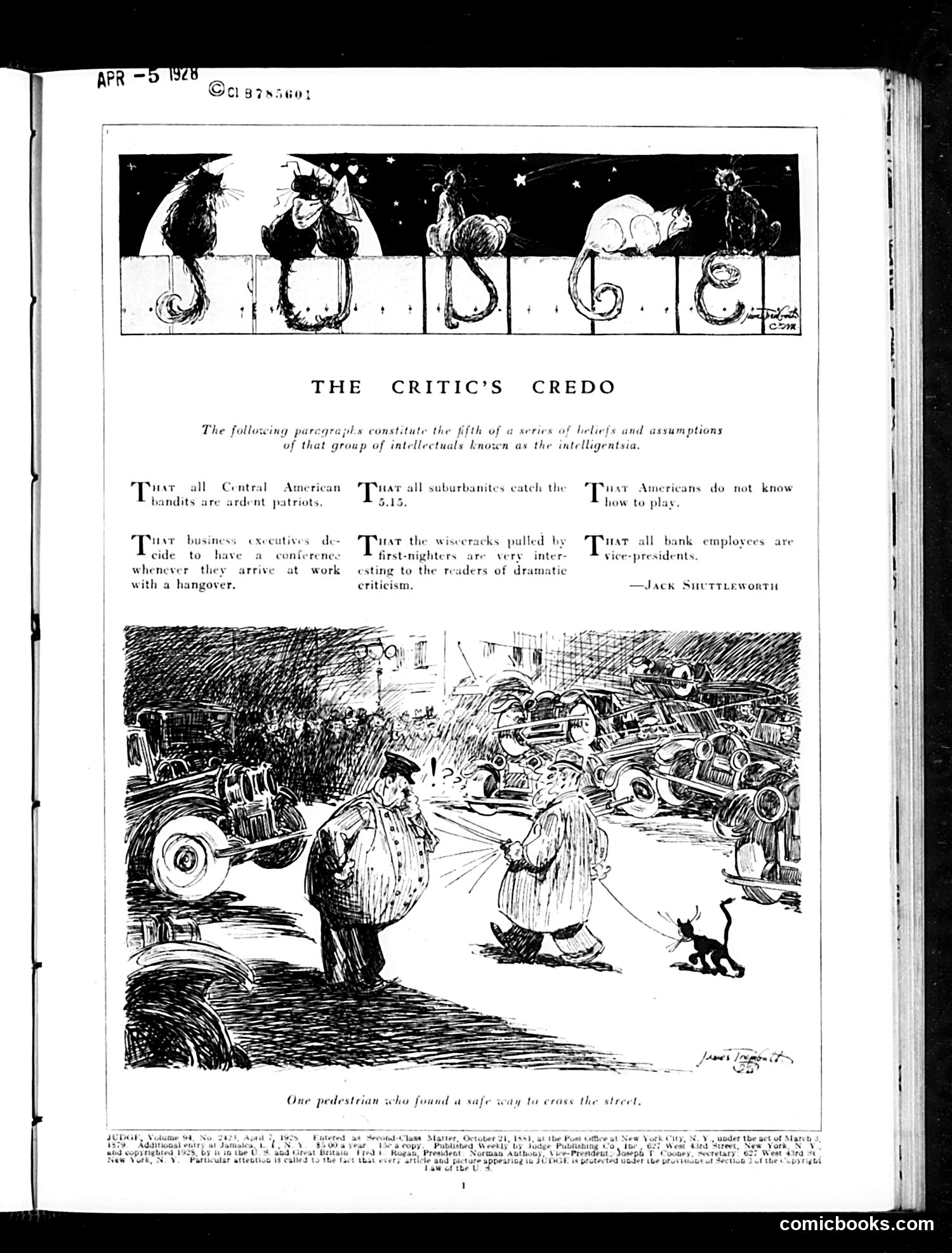
This satire mocks intellectuals and critics by listing absurd, contradictory stereotypes they supposedly believe. Examples include claims that "all Central American bandits are ardent patriots," "Americans do not know how to play," and "all bank employees are vice-presidents." The cartoon below illustrates one such pretension: "One pedestrian who found a safe way to cross the street." The sketch shows a woman with an umbrella navigating through a chaotic junkyard of automobiles, accompanied by a small dog. The joke appears to satirize both the critic's presumed out-of-touch observations about ordinary life and, possibly, the growing chaos of 1920s automobile traffic in cities. The attribution to "Jack Shuttleworth" suggests this was a recurring satirical column.
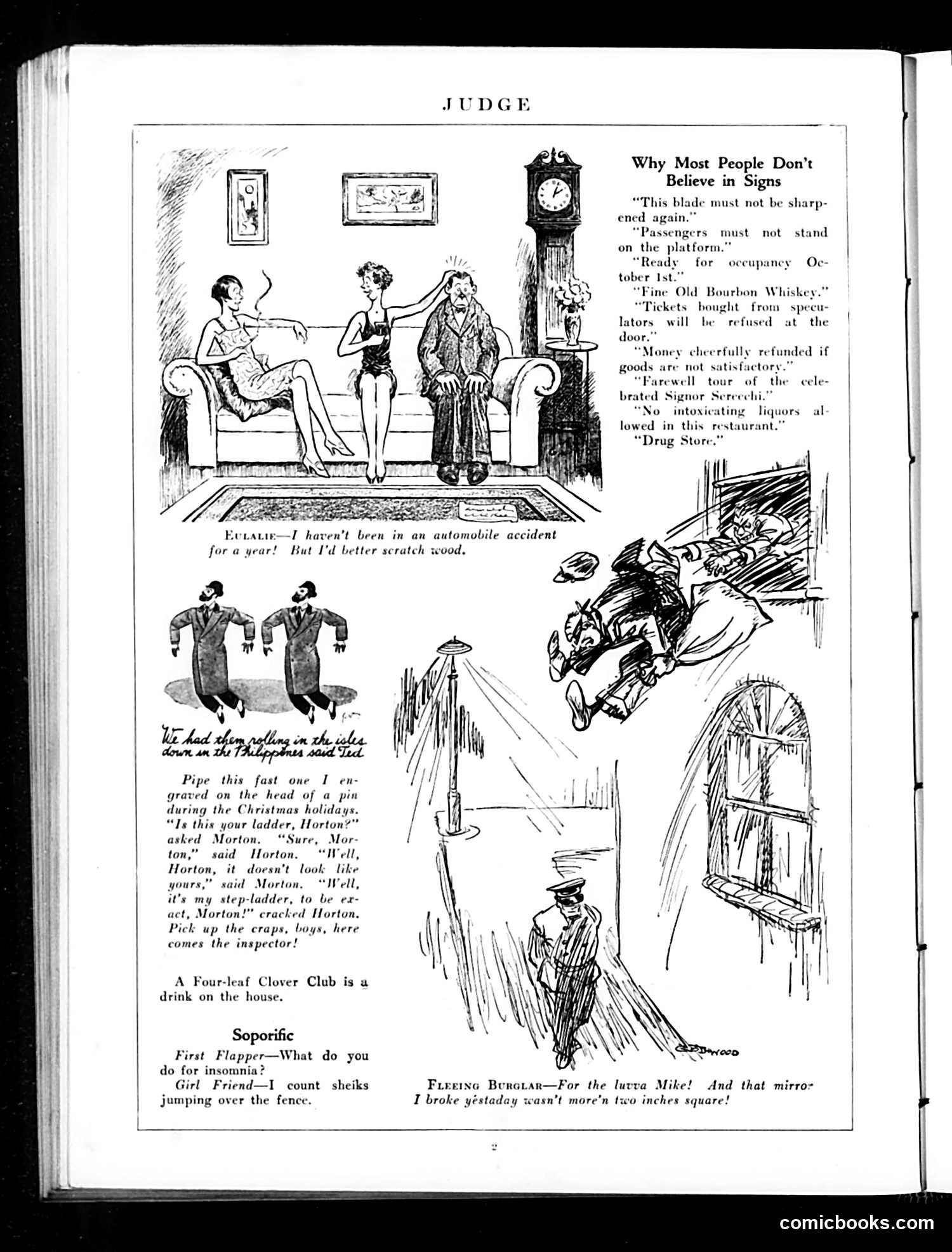
This page contains several unrelated humor pieces typical of Judge's format: **Top cartoon** satirizes superstitious belief in signs and omens—mocking people who read meaning into random events. The woman's comment about scratching wood instead of surviving a car accident ridicules magical thinking. **Middle cartoons** are brief joke illustrations with minimal political content: one references slipping hazards in Philippine/tropical settings; another is wordplay about a Christmas ladder accident. **Bottom section** includes a "Soporific" (sleep-inducing) joke about insomnia remedies and a "Fleeing Burglar" cartoon showing a thief escaping through a window, breaking a mirror—again playing on superstition about bad luck. The page primarily offers social satire targeting everyday American anxieties and superstitions rather than specific political figures or events. The advertising notices ("Drug Store," "Four-leaf Clover Club") reinforce the commercial satirical format.
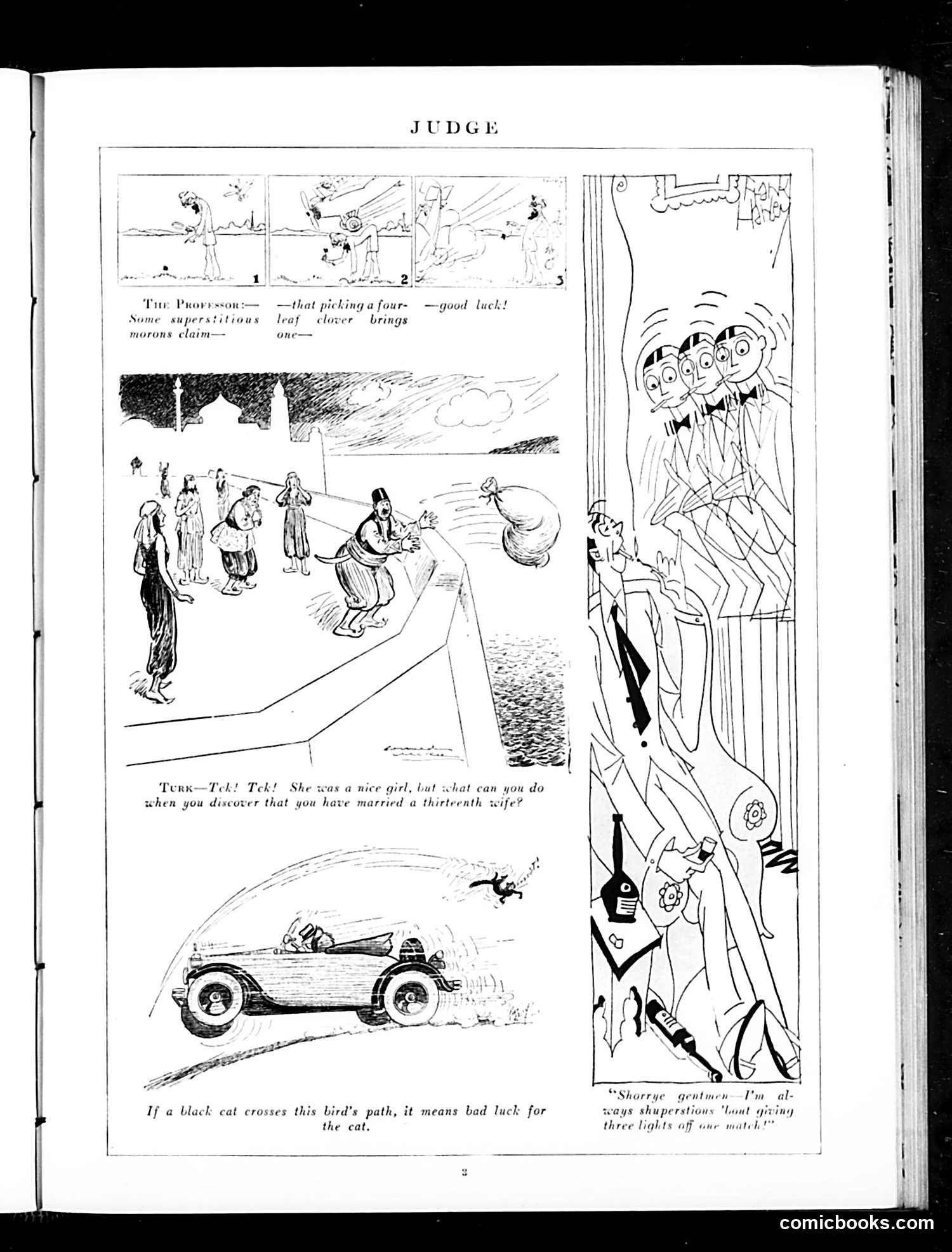
This page contains humor comics typical of early-to-mid 20th century American satire. The top strip shows superstitious beliefs about luck—four-leaf clovers and similar folk superstitions. The middle cartoon depicts a marital quarrel, with caption "Turk—Tsk! Tsk! She was a nice girl, but what can you do when you discover that you have married a thirteenth wife?"—satirizing either serial marriage or possibly someone's infidelity. The bottom cartoon illustrates the superstition that a black cat crossing a bird's path brings bad luck to the cat. The right panel shows what appears to be a social gathering with the caption about "Shortage gentlemen" and superstitious behavior regarding lights. These represent common superstitions of the era being mocked for satirical humor rather than political commentary. The cartoons rely on audiences' familiarity with contemporary folk beliefs and domestic comedy conventions.
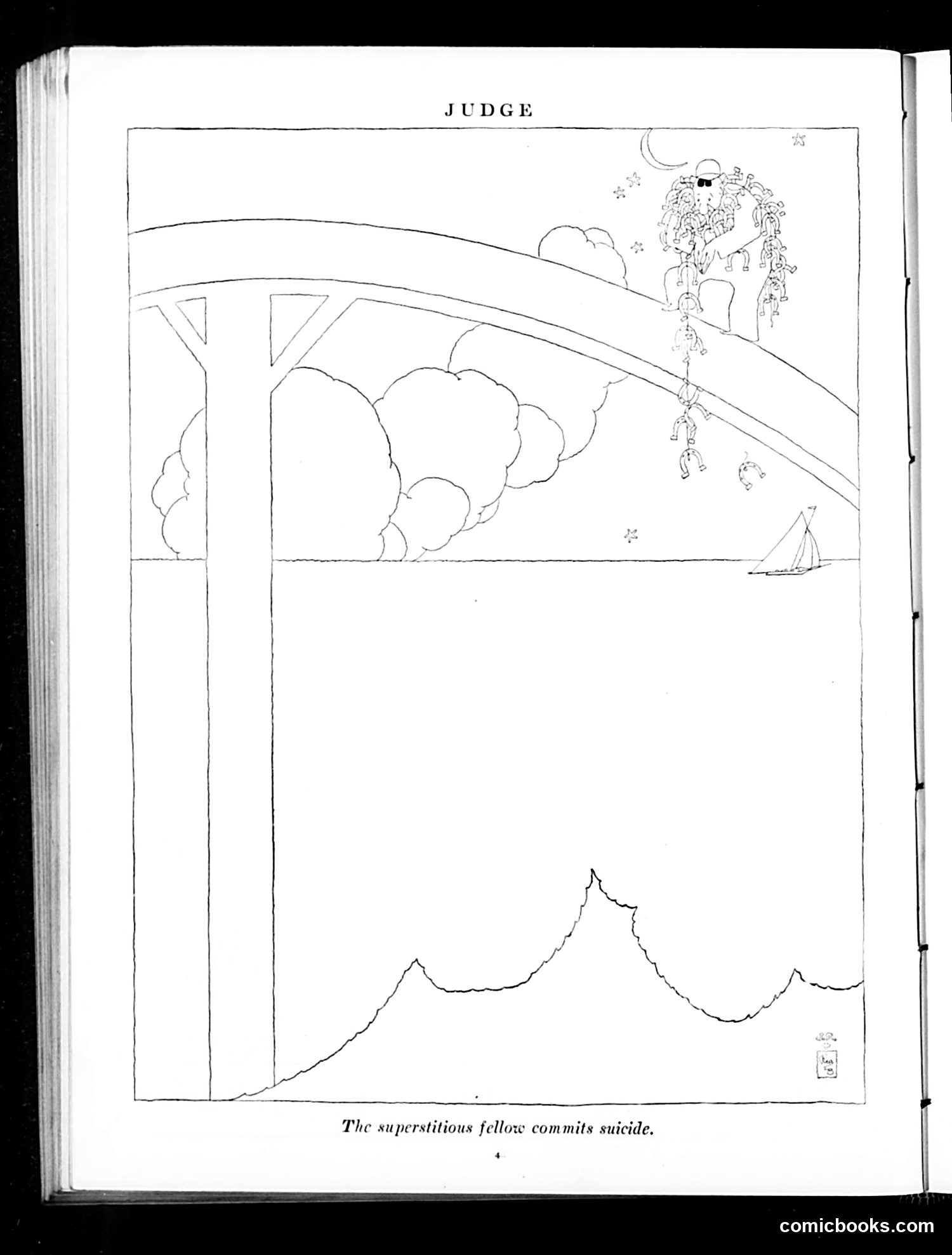
This page from *Judge* magazine shows a single cartoon titled "The superstitious fellow commits suicide." The image depicts a nighttime seaside scene viewed from a covered structure or pier. A figure appears on the right edge, seemingly about to jump into the water below. Hanging wisteria or similar drooping foliage is visible on the right, along with a crescent moon and stars above. A small sailboat appears in the distance. The cartoon's meaning is unclear without additional context. It may satirize superstition-based behavior (perhaps referencing specific contemporary beliefs or events), but the precise target—whether a particular person, social group, or cultural practice—cannot be determined from the image alone. The title suggests dark humor about someone's irrational beliefs leading to self-harm.
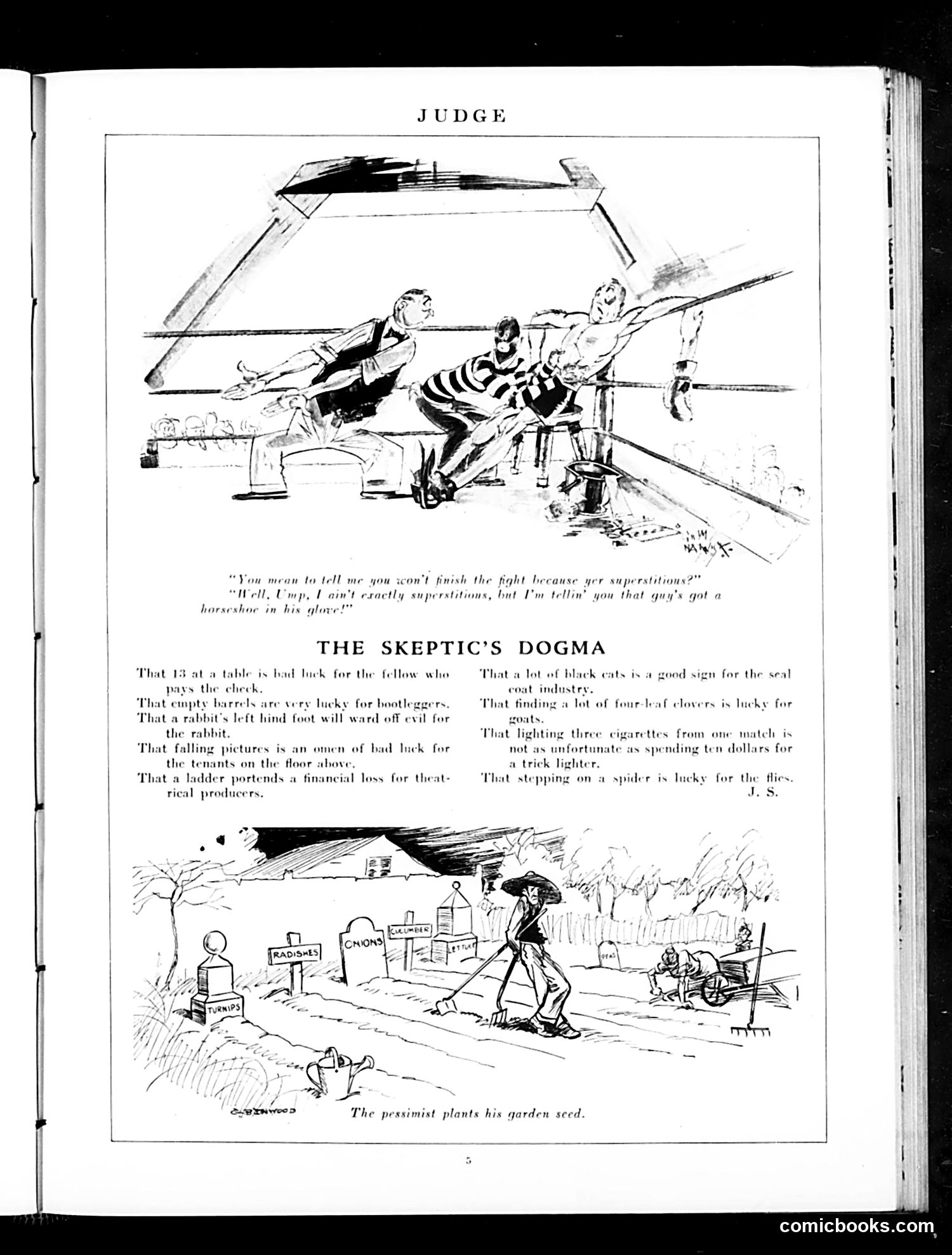
**Top Cartoon:** Shows three men in a boxing ring. One accuses another of not finishing the fight "because yer superstitious." The response: "Well, Ump, I ain't exactly superstitious, but I'm tellin' you that guy's got a horseshoe in his glove!" This satirizes superstitions about luck in boxing—a fighter claiming his opponent has a lucky charm rather than accepting defeat. It's a humorous jab at athletes who blame external factors for losing. **"The Skeptic's Dogma":** Lists ironic superstitions presented as fact—13 at a table brings bad luck, empty barrels are lucky for bootleggers, black cats signify seal coat industry success, etc. The satirical point: even skeptics hold contradictory, absurd beliefs. It mocks how superstition persists universally. **Bottom cartoon:** Shows a pessimistic gardener planting seeds, captioned "The pessimist plants his garden seed"—likely commenting on defeatist attitudes during uncertain times.
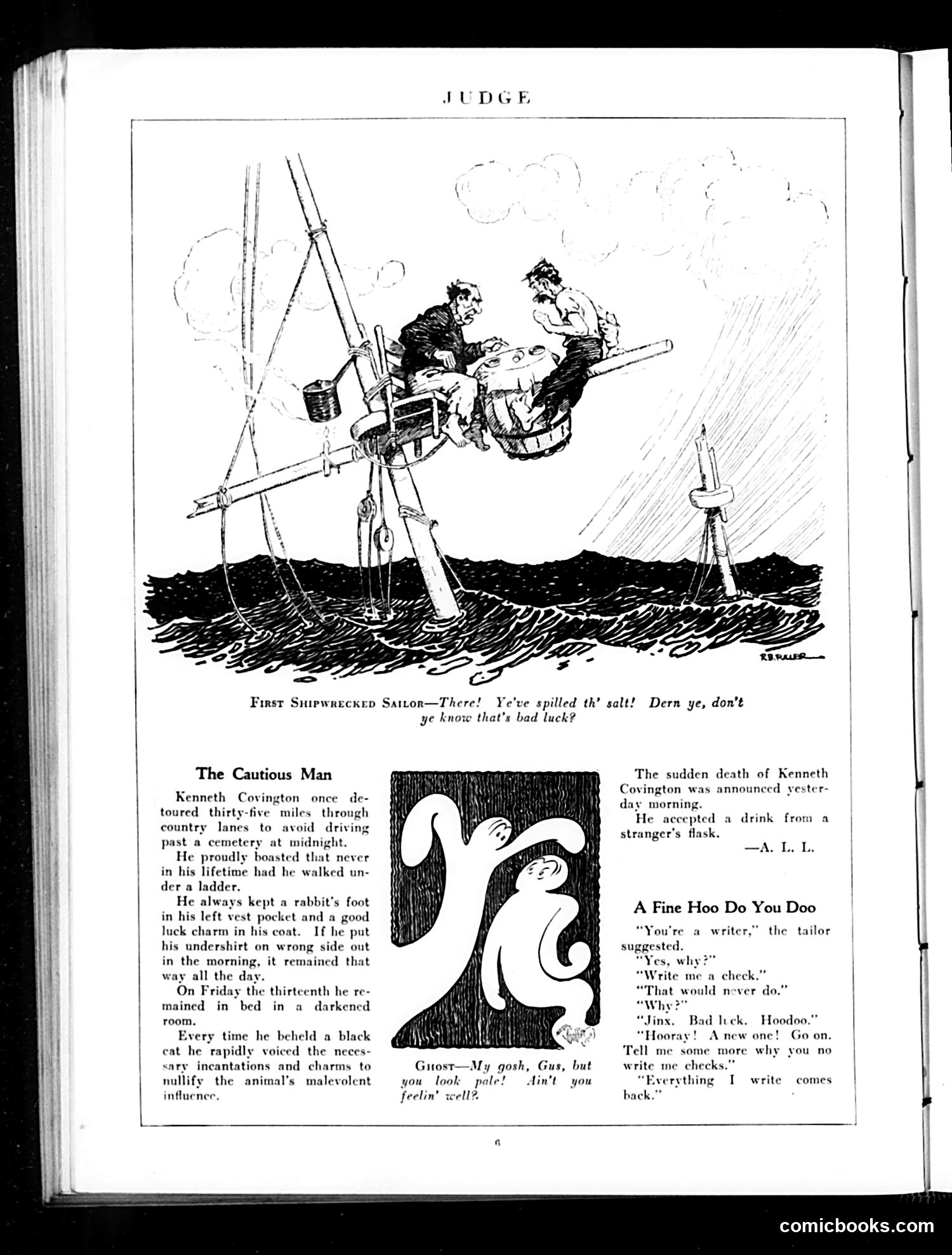
This page satirizes superstition and magical thinking through dark humor. **"The Cautious Man"** mocks Kenneth Covington, a man obsessed with avoiding bad luck—he detours around cemeteries, won't walk under ladders, carries rabbit's feet, and stays in bed on Friday the 13th. The bitter punchline: despite all precautions, he dies from accepting a drink from a stranger—a risk his superstitions never addressed. The joke is that paranoid avoidance of imaginary dangers leaves one vulnerable to *real* ones. **The top cartoon** depicts shipwrecked sailors atop wreckage. One complains about spilled salt (bad luck), missing the absurdity: they're already shipwrecked, so salt superstitions are pointless. **"A Fine Hoo Do You Doo"** presents a tailor asking a writer for a check. The writer refuses, claiming he's jinxed—everything he writes "comes back." The tailor mocks this, suggesting superstition prevents honest payment. The magazine ridicules how people cling to irrational beliefs even when circumstances prove such thinking useless.
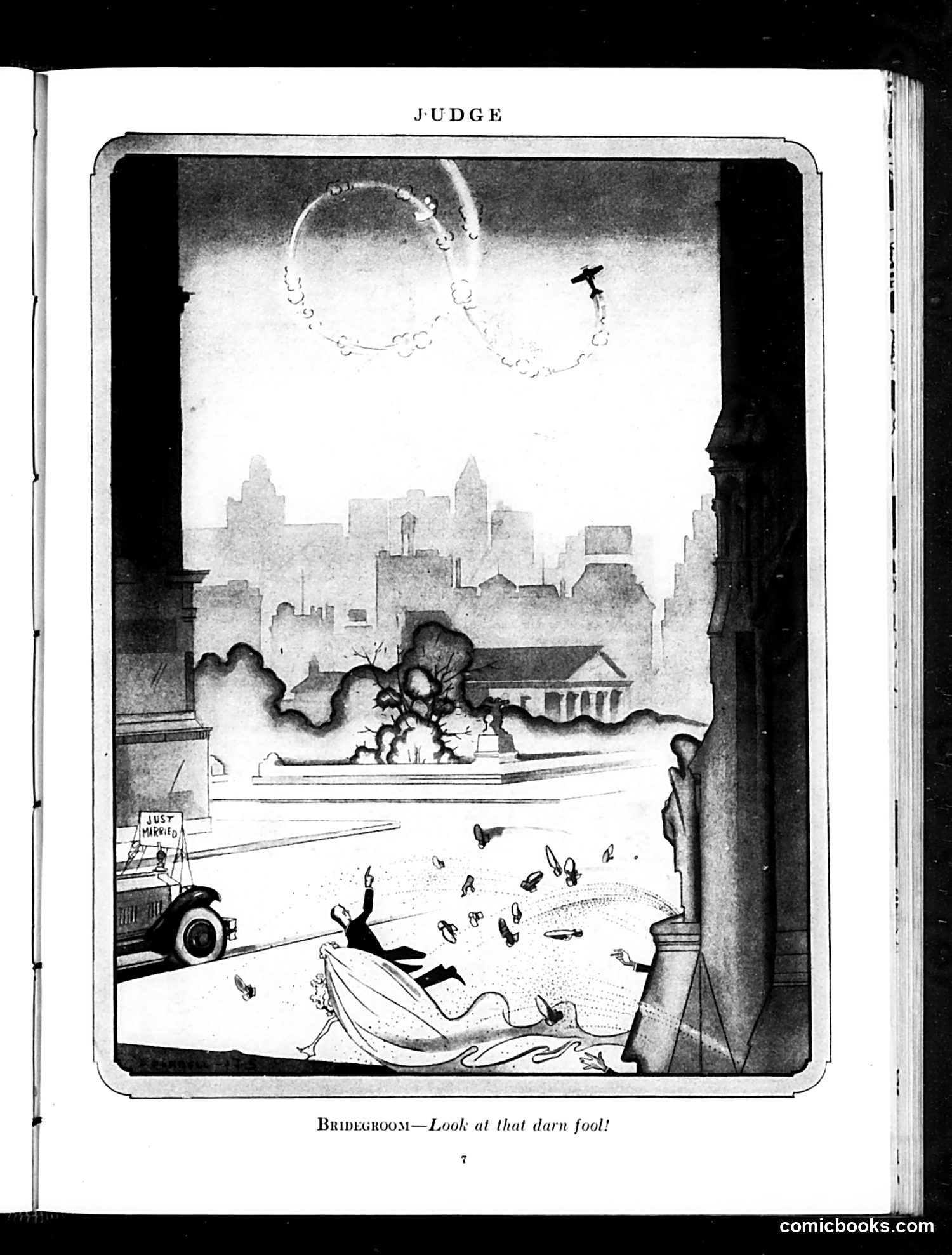
This Judge magazine cartoon depicts a bridegroom observing someone engaged in reckless behavior—apparently someone driving or operating a vehicle dangerously in an urban setting, with the cityscape visible behind them. The bridegroom's exasperated exclamation suggests commentary on public safety or traffic dangers, likely from the early automotive era when reckless driving was becoming a social concern. The cartoon appears to be satirizing dangerous driving habits, using the bridegroom's perspective to frame the criticism. The setting suggests this addresses contemporary urban traffic problems. Without additional context, the specific identity of "that darn fool" remains unclear, though the joke centers on public disapproval of dangerous vehicular behavior as a social problem worthy of ridicule.
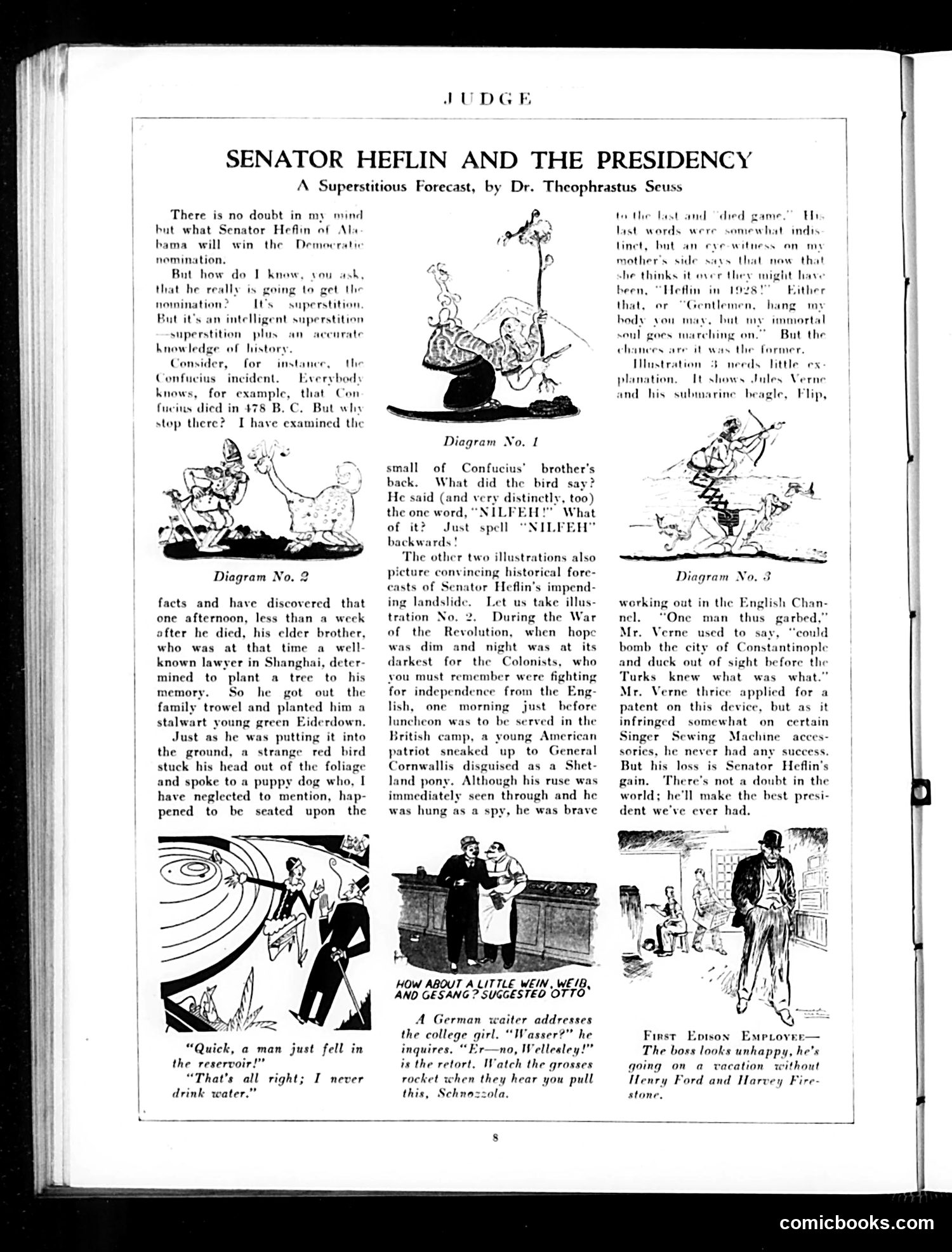
This Judge magazine page satirizes Senator J. Thomas Heflin of Alabama through absurdist "superstitious forecasts" predicting his presidential nomination. The humor relies on ridiculous pseudo-historical "evidence": a backward-spelled Chinese bird prophecy, a Revolutionary War anecdote about a patriot disguised as a pony, and Jules Verne's submarine invention. The satire mocks both Heflin's actual candidacy prospects and the superstitious reasoning some voters employed. The scattered jokes about water-drinking, German waiters, and vacations appear unrelated, suggesting the piece targets Heflin's implausibility as a serious contender through absurdist non-sequiturs rather than direct political critique. The page exemplifies Judge's humorous approach: instead of reasoned argument, Dr. Seuss presents deliberately ridiculous "logic" to undermine confidence in Heflin's viability.
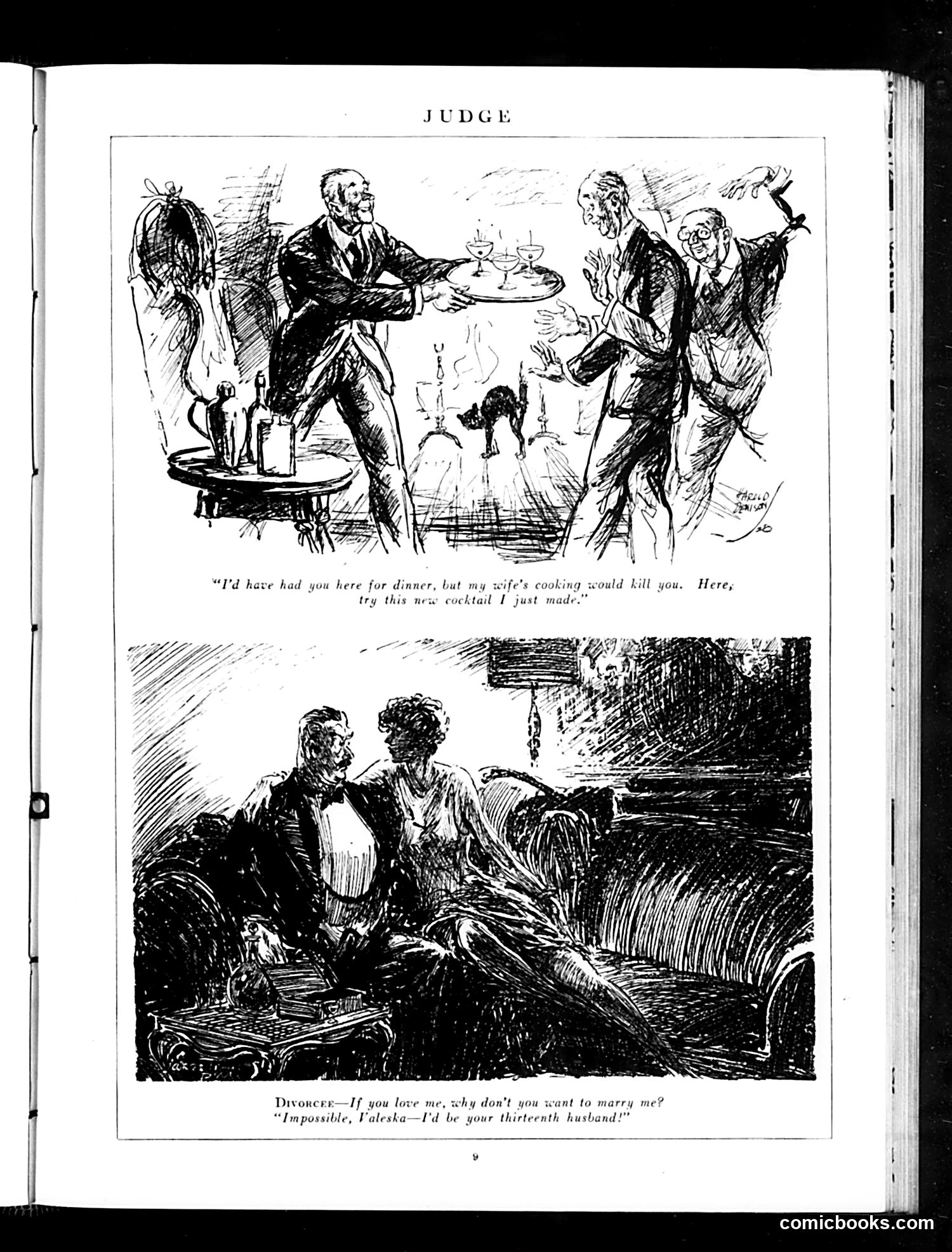
This page contains two separate satirical cartoons about marriage and relationships. The **top cartoon** jokes about domestic life: a host offers a guest a homemade cocktail instead of his wife's cooking, implying her food is so bad it's dangerous. This reflects early 20th-century humor about wives' cooking abilities. The **bottom cartoon** satirizes divorce culture. A man named Valeska refuses marriage to her lover, claiming he'd be her *thirteenth husband*—mocking her serial marriages and divorces. The "thirteenth" reference suggests superstition about bad luck, darkly joking that becoming her next husband would be doomed. Both cartoons reflect Judge magazine's satirical commentary on changing social attitudes toward marriage and the emerging phenomenon of divorce becoming more common and socially visible in American society.
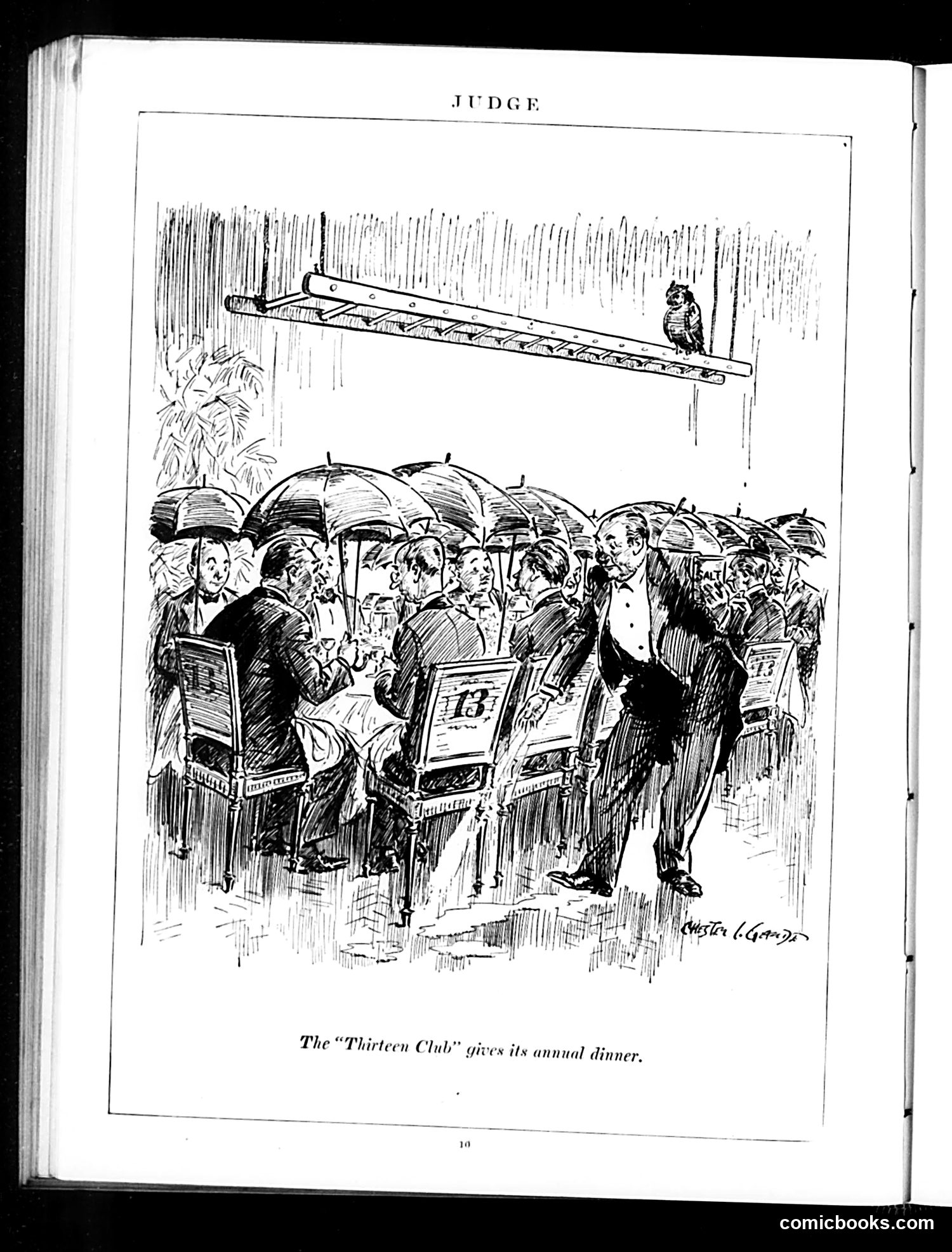
This cartoon satirizes the "Thirteen Club," a real organization of superstition-defiers who deliberately flouted bad-luck beliefs, particularly the notion that thirteen was unlucky. The club members held annual dinners on the 13th, often with thirteen guests. The joke shows well-dressed club members huddled under umbrellas indoors during their dinner—suggesting that despite their brave skepticism about superstition, they still behave superstitiously by taking protective measures. A bird perches ominously overhead, possibly hinting at further "bad luck" befalling them. The cartoon mocks the contradiction between the club's stated purpose (dismissing superstition) and their actual paranoid behavior, suggesting humans cannot truly escape their fear-based beliefs.
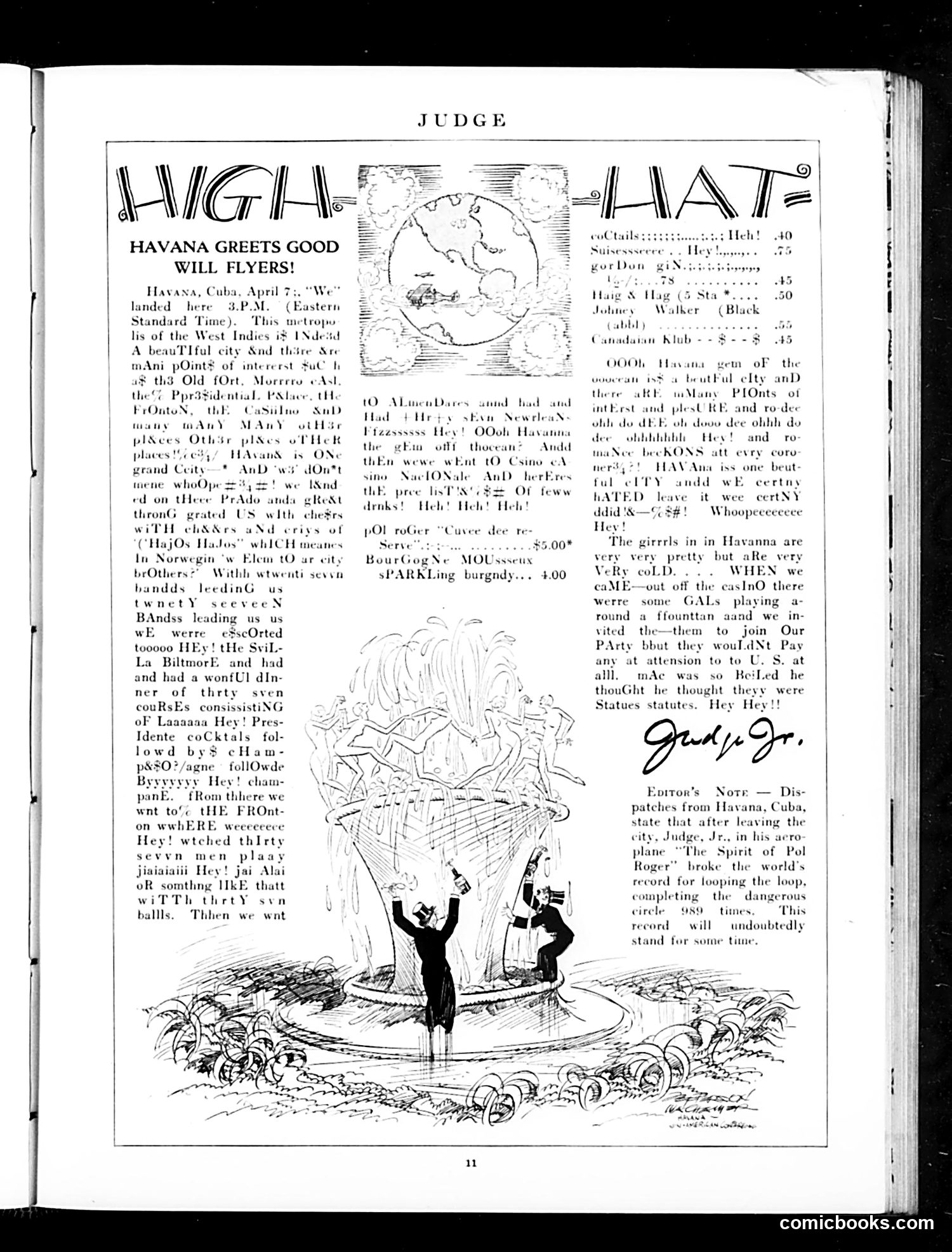
This page satirizes the famous 1927 goodwill flight to Havana by American aviators (likely referencing the "Spirit of St. Louis" era of aviation enthusiasm). The deliberately garbled, drunken text mimics the slurred rambling of an intoxicated correspondent reporting on the pilots' reception in Cuba. The satire targets American excess and poor behavior abroad: the visitor obsesses over alcohol (listing cocktails, champagne, and liqueurs), objectifies Cuban women ("very pretty but...very coLD"), and displays American arrogance (assuming the women would join their party). The editorial note mentions a world looping record—likely referencing actual aviation stunts of the period. The cartoon below shows figures in formal dress beneath a fountain—probably depicting the lavish reception and drunken revelry. The satire mocks both American tourists' behavior and contemporary celebration of aviation pioneers as cultural heroes.
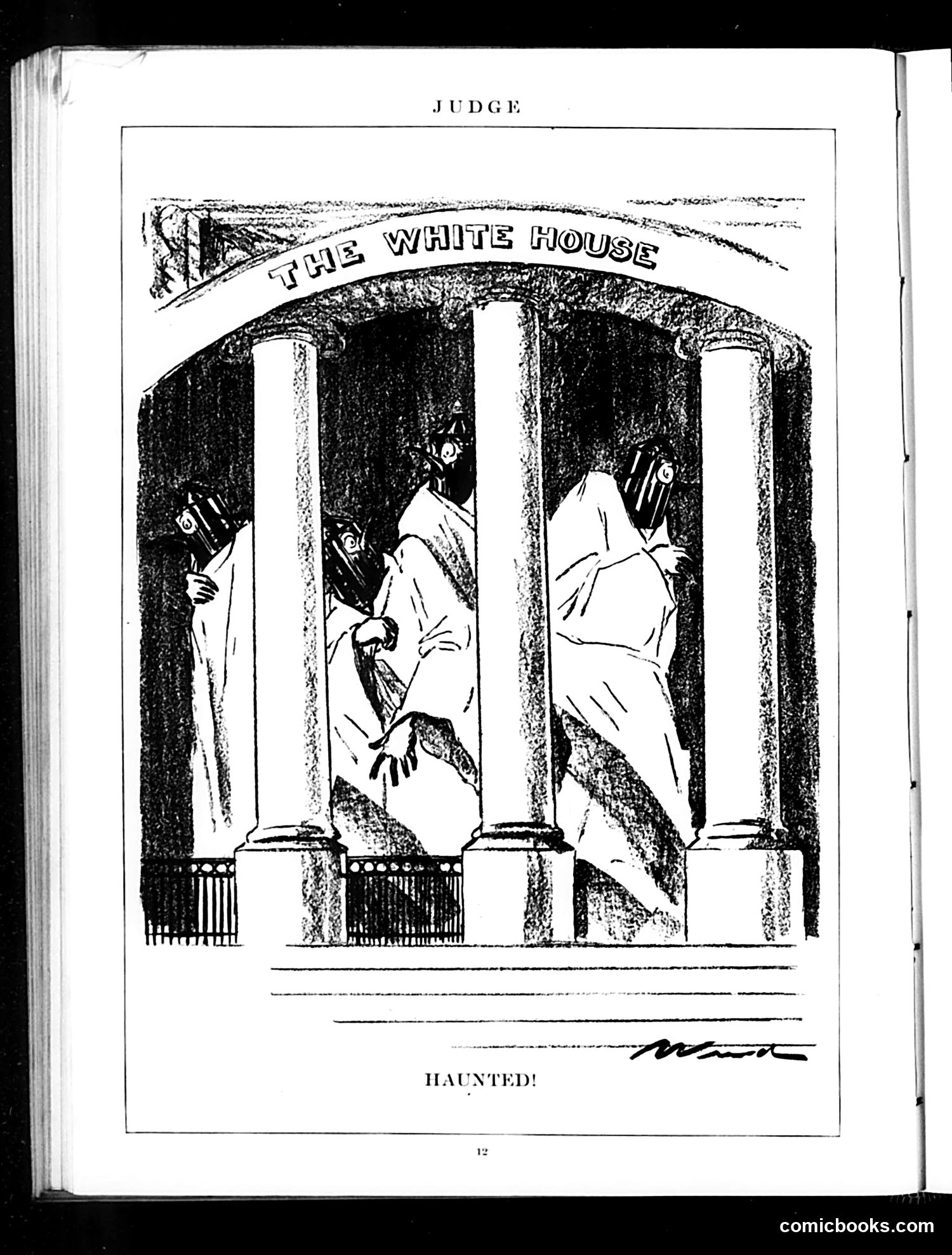
This is a political cartoon from *Judge* magazine titled "Haunted!" depicting three ghostly figures visible through the White House's classical columns. The cartoon is satirizing the White House as inhabited by unwanted presences or failed policies. Without dating information, the specific identities of these "ghosts" are unclear, but the cartoon's satirical point is that the White House is metaphorically "haunted" by past administrations, controversial decisions, or political failures that continue to influence current governance. The use of spectral imagery suggests these issues persist as troubling legacies. The formal architectural setting—the iconic columns and portico—contrasts sharply with the supernatural chaos within, emphasizing the discord between the building's dignified appearance and the turmoil it represents.
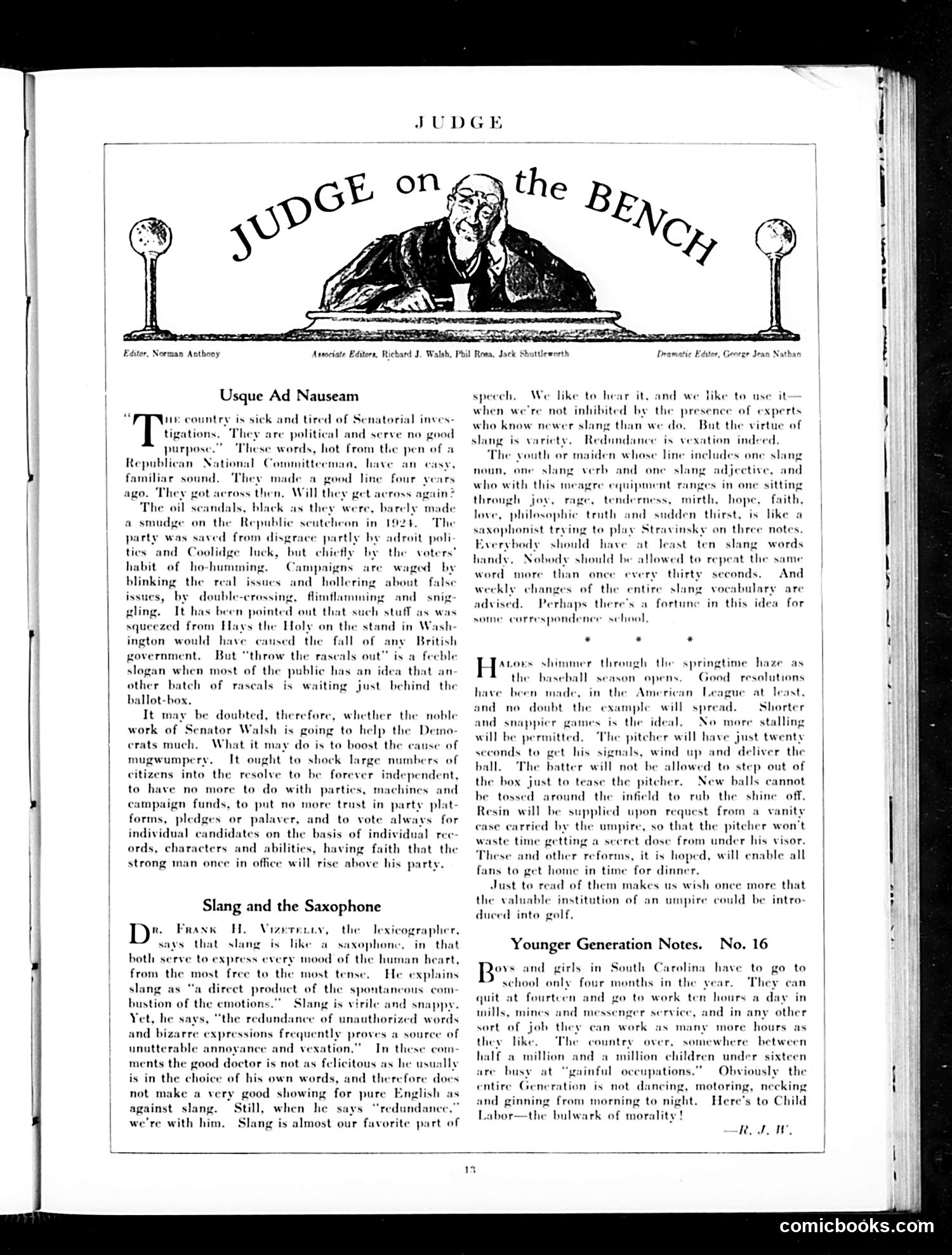
This page from *Judge* contains two satirical essays addressing American politics and culture. **"Usque Ad Nauseam"** attacks Republican complacency about senatorial investigations (likely the Teapot Dome scandal investigations by Senator Thomas Walsh). The author mocks the GOP's strategy of dismissing scandals through public apathy and "ho-humming" rather than reform. He criticizes voters' cynicism—the belief that replacing one set of corrupt politicians with another solves nothing—and suggests that only independent, character-based voting could break this cycle. **"Slang and the Saxophone"** praises slang's vitality while mocking Dr. Frank Vizitelly's lexicographic critique of it. The author defends slang as emotionally expressive, comparing it to jazz saxophone. The satire suggests that overusing limited slang is like playing Stravinsky on three saxophone notes—more vocabulary variety is needed for genuine expression. Both essays critique American institutional failures: political corruption and linguistic pretension respectively.
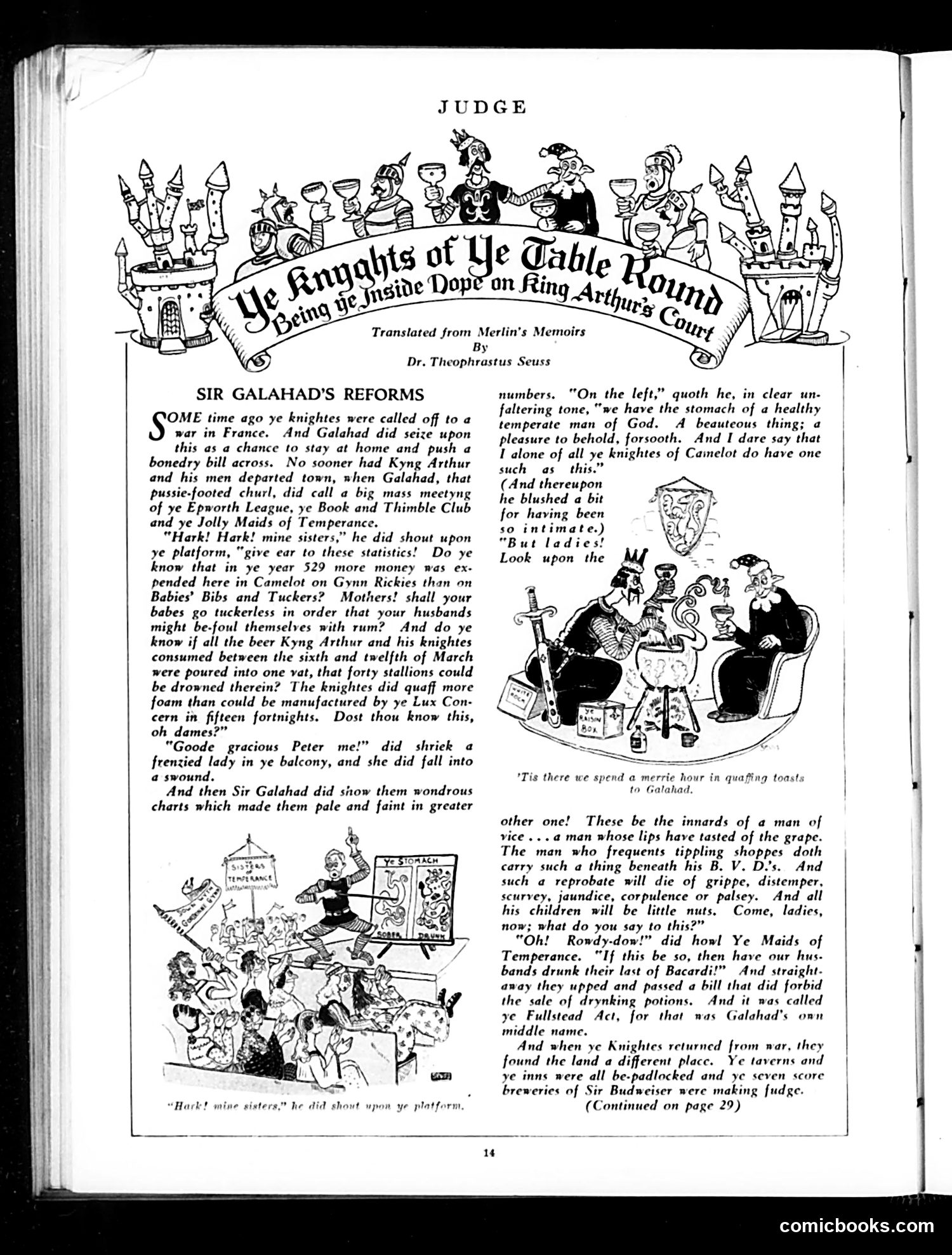
This is a satirical attack on Prohibition and the temperance movement, disguised as a medieval Arthurian legend. Sir Galahad represents a self-righteous temperance crusader who exploits the absence of King Arthur (appearing to represent established male authority) to mobilize women's organizations—the Epworth League, Book and Thimble Club, and Maids of Temperance—through fear-mongering statistics about alcohol consumption. The satire mocks the movement's emotional manipulation: Galahad presents exaggerated claims (comparing beer consumption to drowning horses) paired with grotesque medical charts showing the "innards" of drinkers versus temperate men. The women respond hysterically, immediately passing "ye Fullstead Act" (a pun on Galahad's middle name), banning alcohol sales. The punchline criticizes the real-world consequence: returning soldiers find breweries converted to making fudge—portraying Prohibition as absurd waste. The satire suggests temperance advocates were hypocritical, manipulative, and had dangerous social power.
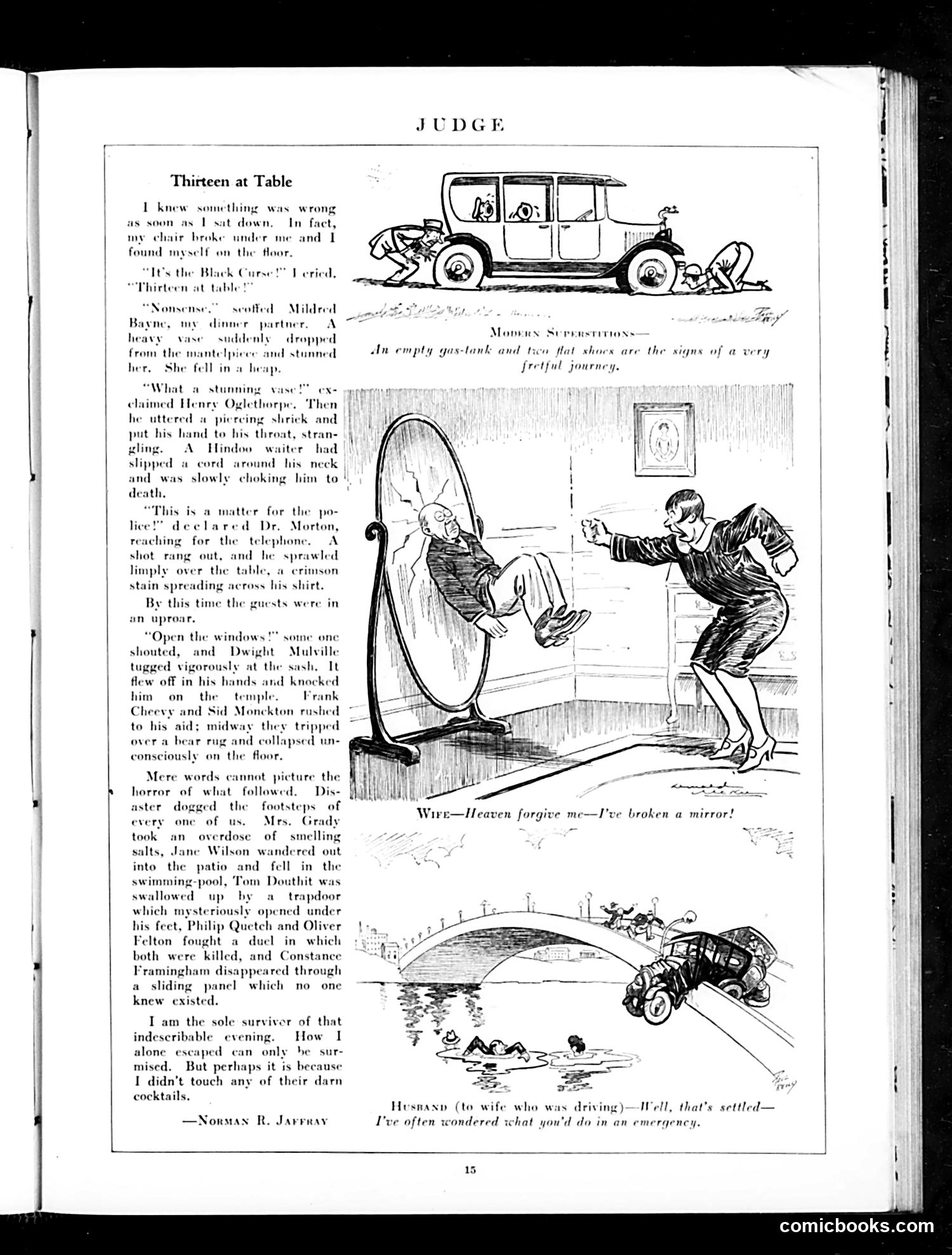
This is a humorous short story illustrated with comic panels, playing on the Western superstition that having thirteen people at a dinner table brings bad luck. **The Satire:** The narrator dismisses the superstition as "nonsense," but every guest subsequently suffers absurd, escalating catastrophes—a chair breaks, a vase falls, a waiter strangles someone with a cord, a doctor is shot, guests trip over a rug, one falls in a pool, another vanishes through a trapdoor, two kill each other in a duel. The joke is that the "Black Curse" proves horrifyingly real, validating the superstition the dinner host mocked. **The Illustrations:** Two cartoon panels show slapstick domestic chaos—a woman breaking a large mirror while a man cowers, and a car careening off a bridge (unrelated "modern superstitions" vignette). **Author:** Norman R. Jayray (byline at bottom) The piece mocks both superstition and rationalist dismissal of it through escalating dark comedy—a typical Judge satirical approach blending social commentary with absurdist humor.
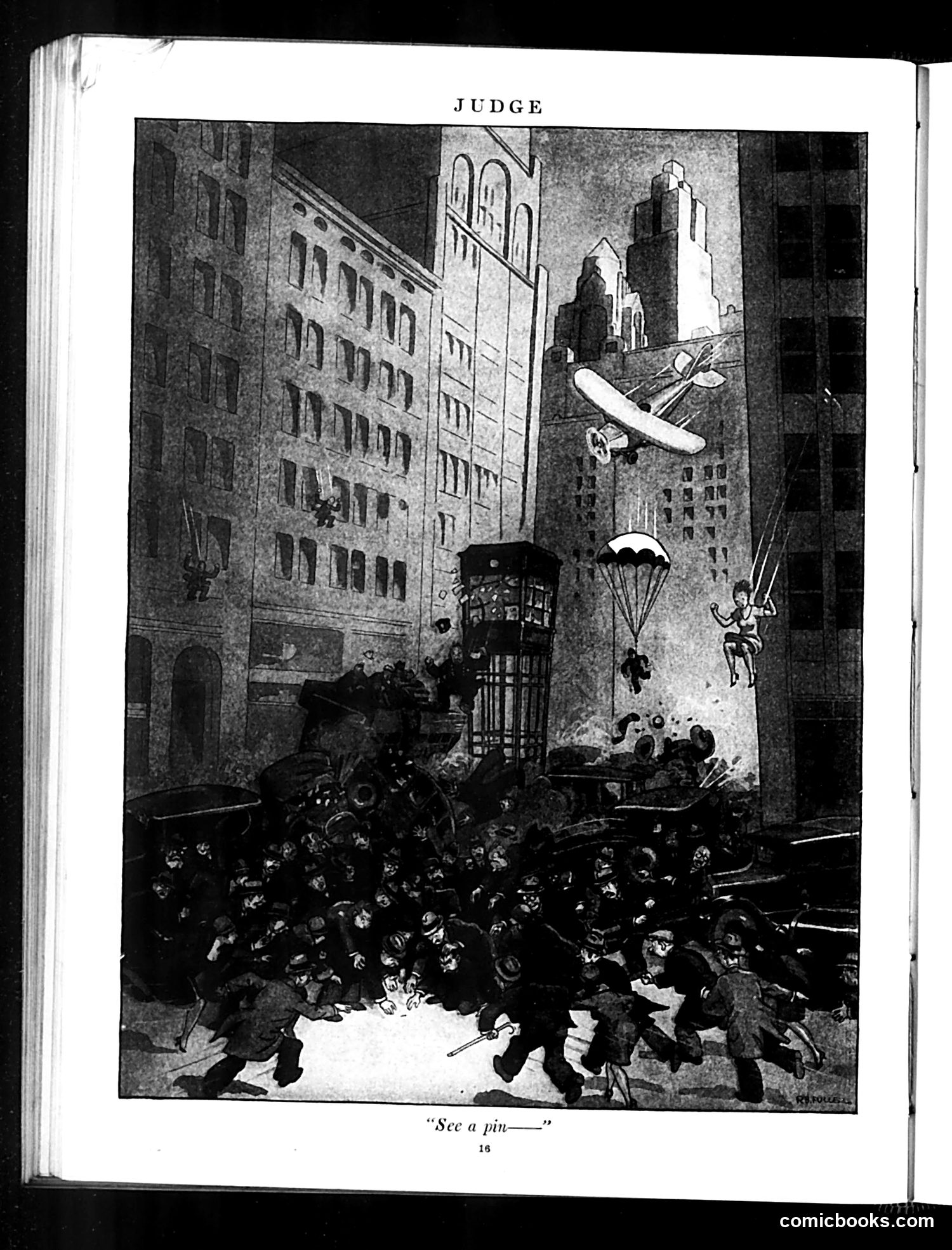
This political cartoon from *Judge* magazine depicts urban chaos centered on a tall building (likely a courthouse or government building, given the page header "JUDGE"). The scene shows a massive crowd of small figures at street level, with an airplane overhead, people parachuting, and what appears to be destruction or mayhem around a central tower structure. The caption "See a pin—" suggests a reference to the children's rhyme "See a pin, pick it up," implying that small, seemingly trivial matters can trigger large-scale consequences. The cartoon likely satirizes how minor legal or political issues can escalate into citywide disorder and public panic, reflecting anxieties about modern urban instability or bureaucratic mismanagement. The specific historical context remains unclear without additional dating information.
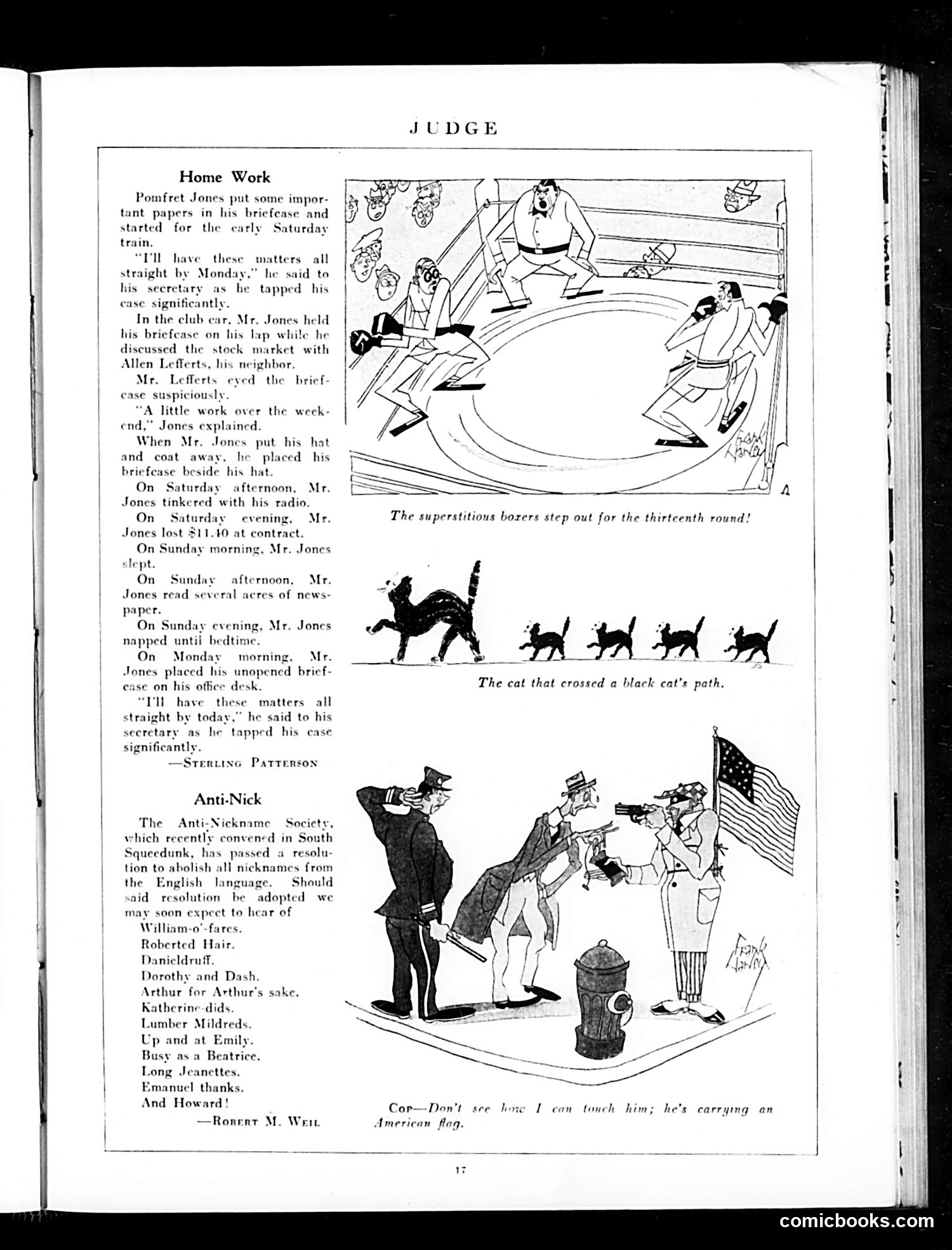
**"Home Work"** (Sterling Patterson): A satirical story about Pomfret Jones, who ostentatiously carries an important briefcase to work on Saturday, claiming he'll resolve matters by Monday. The joke: he spends the weekend relaxing—tinkering with radio, gambling, sleeping, reading newspapers—and arrives Monday with the briefcase still unopened, making the same claim. The satire mocks businessmen who perform busyness while avoiding actual work. **"Anti-Nick"** (Robert M. Weil): Lists humorous results if an "Anti-Nickname Society" successfully banned nicknames from English. Examples play on common nicknames by literalizing them: "William-o'-fares" (Bill), "Roberted Hair" (Bob), "Danieldruff" (Dan), etc. It's wordplay satire criticizing the society's absurd proposal. **Bottom cartoons**: "The superstitious boxers step out for the thirteenth round" shows fighters avoiding the ring (bad luck). "The cat that crossed a black cat's path" depicts a cat followed by black cats (reversing the superstition). The final cartoon appears to reference diplomatic tension (American flag visible) but context is unclear from this page alone.
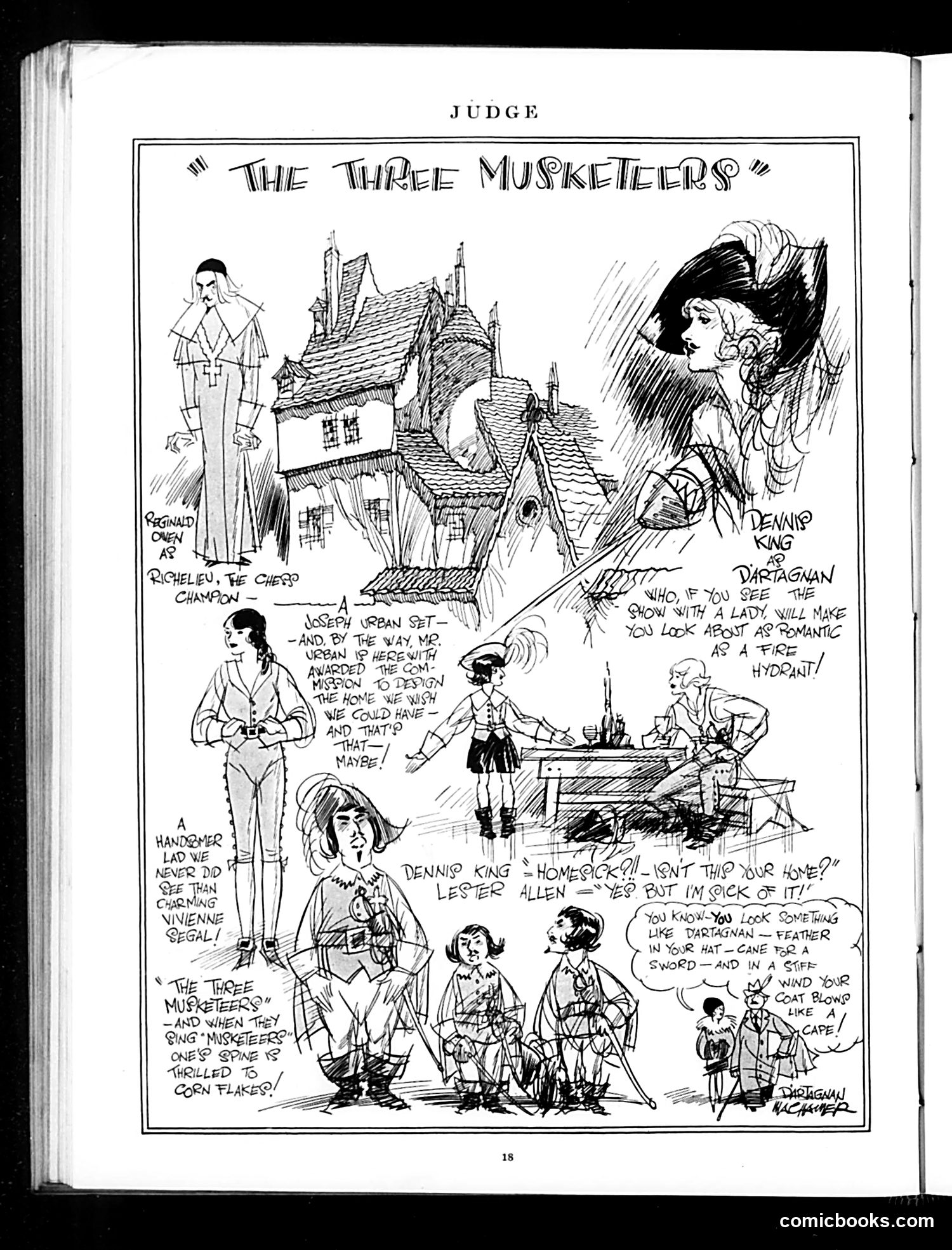
This page satirizes a theatrical production of Alexandre Dumas's classic novel "The Three Musketeers." The cartoon features various theatrical figures discussing the show's design and casting. **Key figures identified:** - Reginald Owen (left), labeled as "The Cheero Champion" - Joseph Urban (center), the set designer, credited with the ornate castle set - Dennis King and Lester Allen (lower section), cast members - D'Artagnan character referenced (right) **The satire:** The joke centers on the theatrical production's attempt at grandeur—Urban's elaborate architectural set design—while the dialogue suggests the actors are more interested in comedic "corn flakes" appeal than dramatic authenticity. Characters discuss how d'Artagnan should look "romantic" and swashbuckling, but the overall tone mocks the gap between pretentious production design and lightweight entertainment value. The humor lies in this contrast between ambitious stage design and the lighter, more vaudeville-influenced performance the actors apparently deliver.
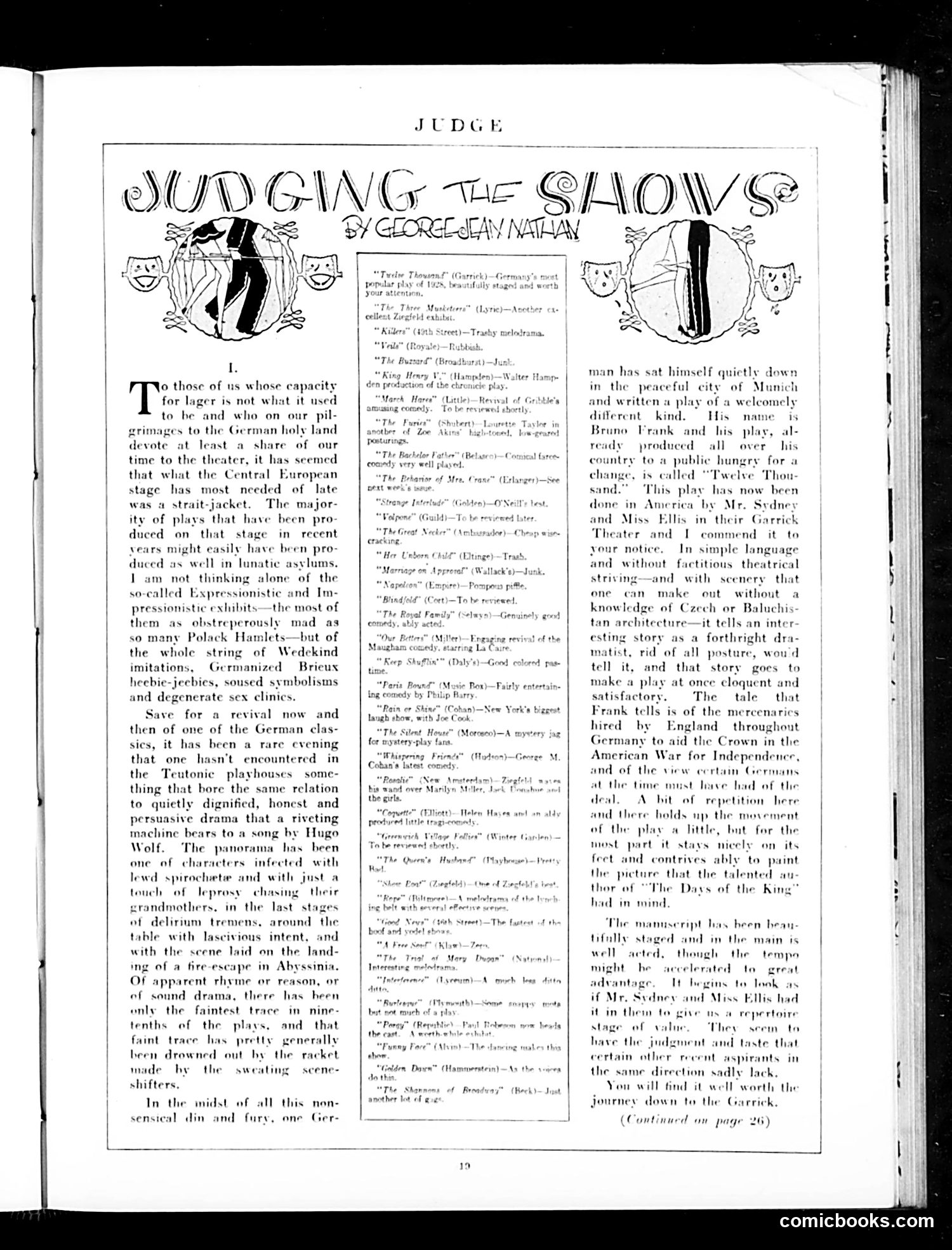
This article reviews "Twelve Thousand," a play by Bruno Frank, performed in America at the Garrick Theater by Sydney Ellis and Miss Ellis. The author criticizes contemporary German theatre as aesthetically bankrupt—dominated by derivative Expressionism, imitative works, sexual dysfunction narratives, and symbolic excess with no coherent dramatic purpose. He compares such plays to "a riveting machine" compared to a Hugo Wolf song: mechanically jarring rather than artful. Frank's play stands out favorably: it tells a straightforward historical drama about English mercenaries hired during the American Revolutionary War, presented without pretension or theatrical gimmickry. The author praises its accessible storytelling, appropriate scenery, and emotional coherence. The review suggests Ellis and Miss Ellis may develop into serious repertory producers—a rare accomplishment the author implies other recent theatrical aspirants lack.
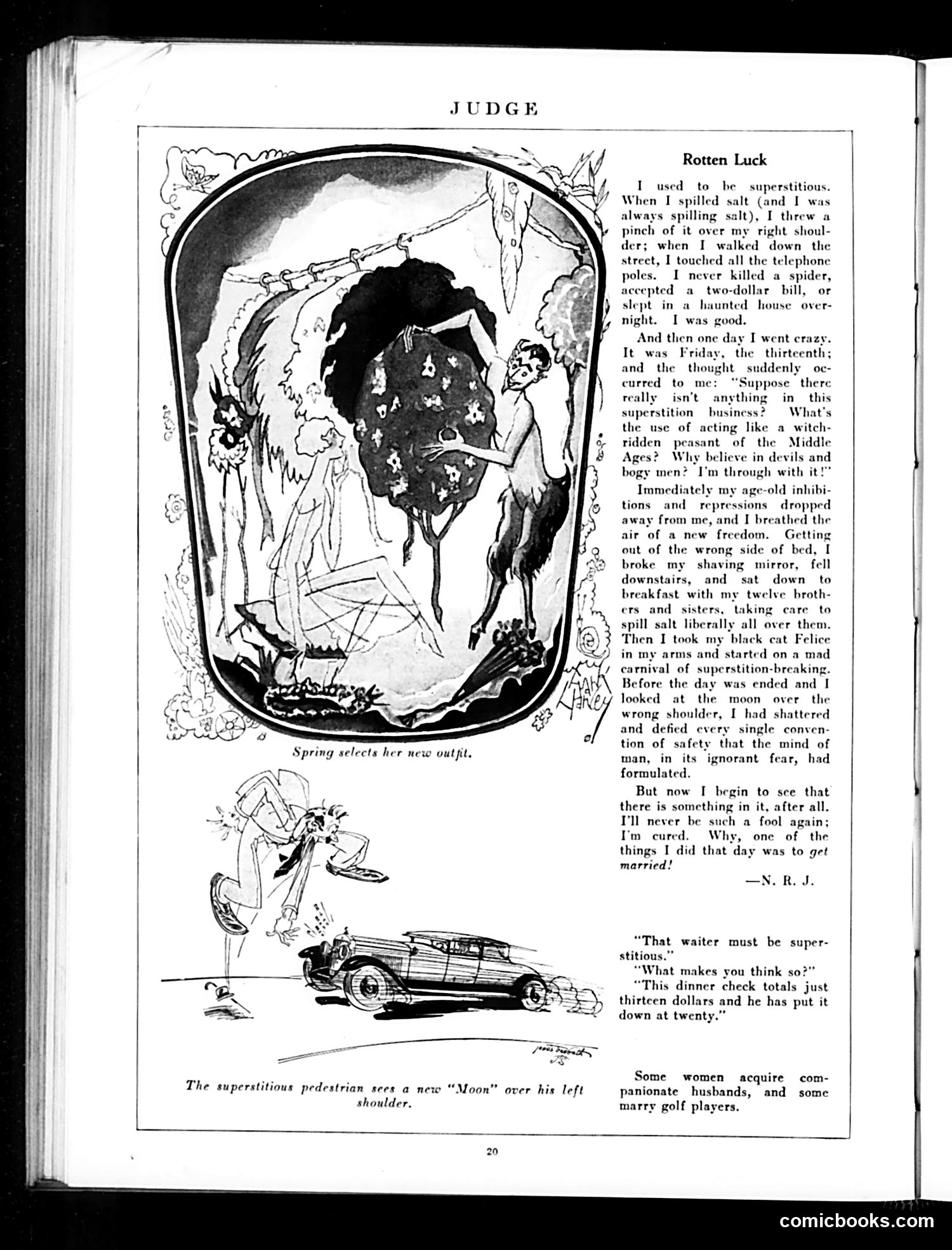
This page satirizes superstition through a first-person narrative. The protagonist abandons superstitious beliefs (avoiding salt spills, touching telephone poles, refusing two-dollar bills) after deciding superstition is irrational. He then spends Friday the 13th deliberately breaking every superstitious taboo—walking on the wrong side of bed, breaking mirrors, spilling salt, carrying a black cat. The joke's punchline: his day becomes genuinely disastrous, culminating in **getting married**—presented as the ultimate bad luck consequence. This suggests marriage itself is humorously framed as superstition's worst possible curse. The secondary jokes include a waiter padding a $13 dinner bill to $20 (treating the unlucky number seriously), and a closing quip about women marrying golfers versus "companionate" husbands. The cartoons show the protagonist's mishaps and a pedestrian viewing the moon (a superstition-related image). The satire mocks both superstition and, more sharply, marriage itself as a cautionary outcome.
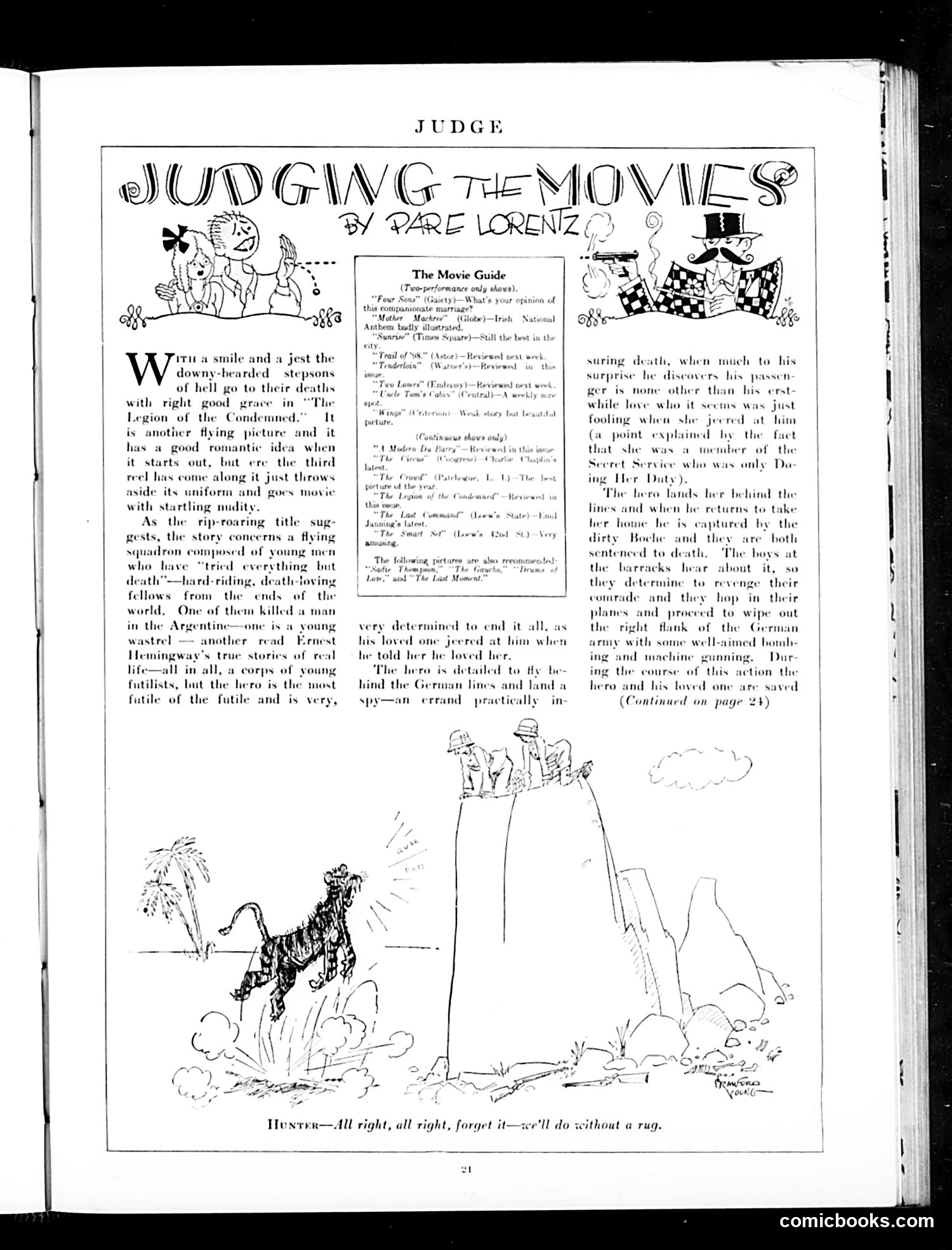
This is a film review column satirizing a war movie called "The Legion of the Condemned." The reviewer mocks the film's melodramatic plot: young "futilists" (purposeless men) form a flying squadron, including a hero so suicidal he volunteers for a suicide mission behind German lines. He discovers his passenger is his estranged lover, secretly working as a spy. After they're both captured by "the dirty Boehe" (derogatory term for Germans), their squadron rescues them through aerial bombing. The review ridicules the film's romantic clichés and plot contrivances—particularly how the heroine's betrayal is conveniently explained as patriotic duty. The bottom cartoon shows a hunter with a dog, captioned "All right, all right, forget it—we'll do without a rug," offering unrelated comic relief typical of Judge's format.
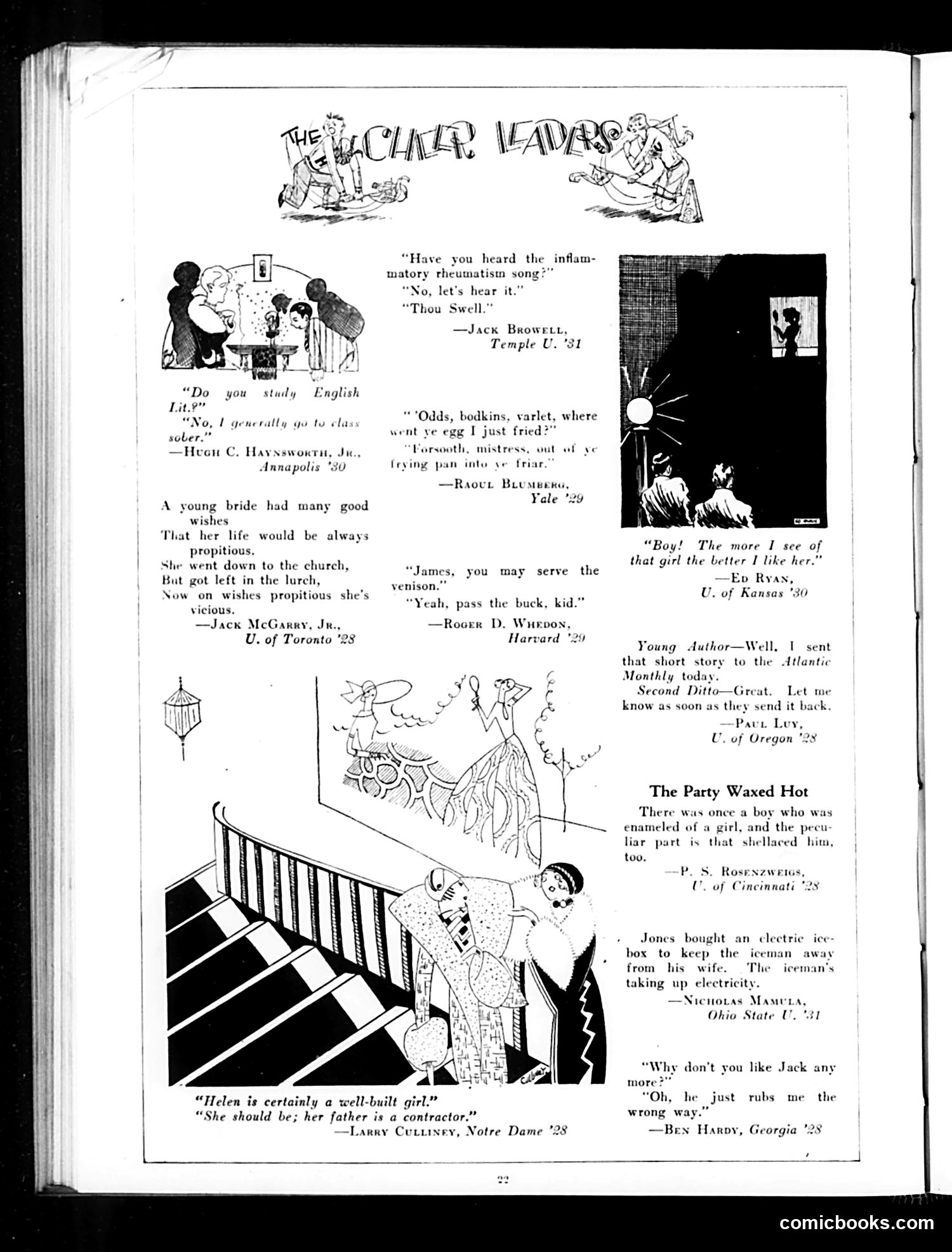
This is a humor page from Judge featuring college jokes and witty quotes attributed to students at various universities (Temple U., Notre Dame, Yale, Harvard, etc.). The content reflects 1920s-30s collegiate humor. The jokes target familiar subjects: a bride abandoned at the altar, a girl whose physique is attributed to her contractor father, classical language mishaps, and romantic entanglements. One references "pass the buck" and another puns on "shellaced" (drunk). The "Party Waxed Hot" section uses archaic language for comedy. The "Young Author" joke mocks rejection from *The Atlantic Monthly*. The illustrations are simple pen drawings depicting domestic scenes and college life. There's no overt political satire here—this is social satire aimed at collegiate audiences, poking fun at dating, marriage, ambition, and youthful pretension through wordplay and gentle mockery of student life conventions.
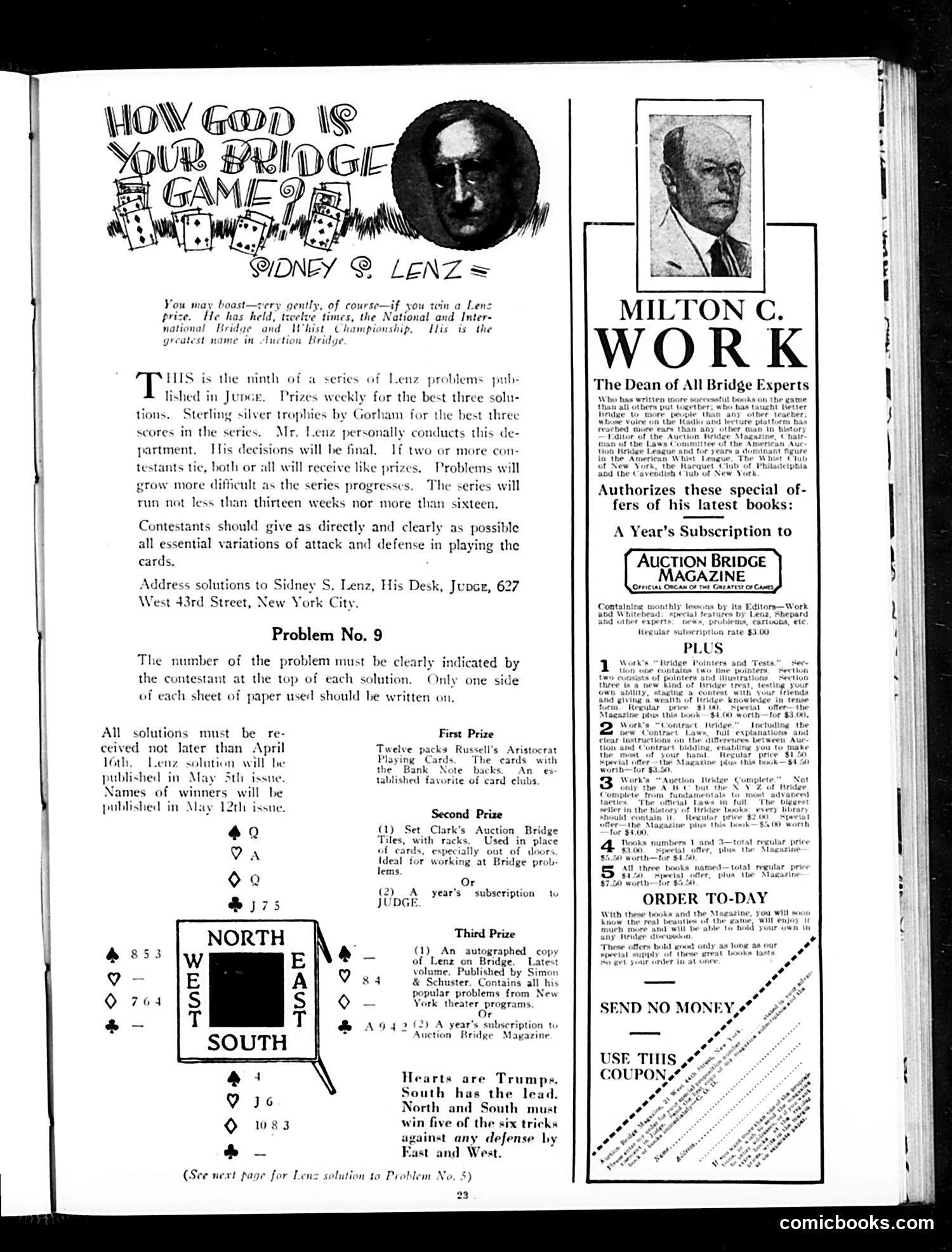
This page from *Judge* magazine features a bridge card game problem series sponsored by Sidney S. Lenz, identified as "the greatest name in auction Bridge." The content is primarily instructional and promotional rather than satirical. The page presents "Problem No. 9" of an ongoing series, inviting readers to solve bridge hands for weekly prizes (silver trophies and books). Lenz was apparently a famous bridge expert and champion whose name carried enough prestige to merit this branded competition. The right side advertises Milton C. Work's bridge books and Lenz-related materials, offering subscription packages to *Auction Bridge Magazine*. This appears to be leveraging the bridge game's popularity in early 20th-century leisure culture. The satire, if present, is subtle—essentially poking fun at how seriously bridge enthusiasts took their game, making it a vehicle for intellectual competition and professional expertise.
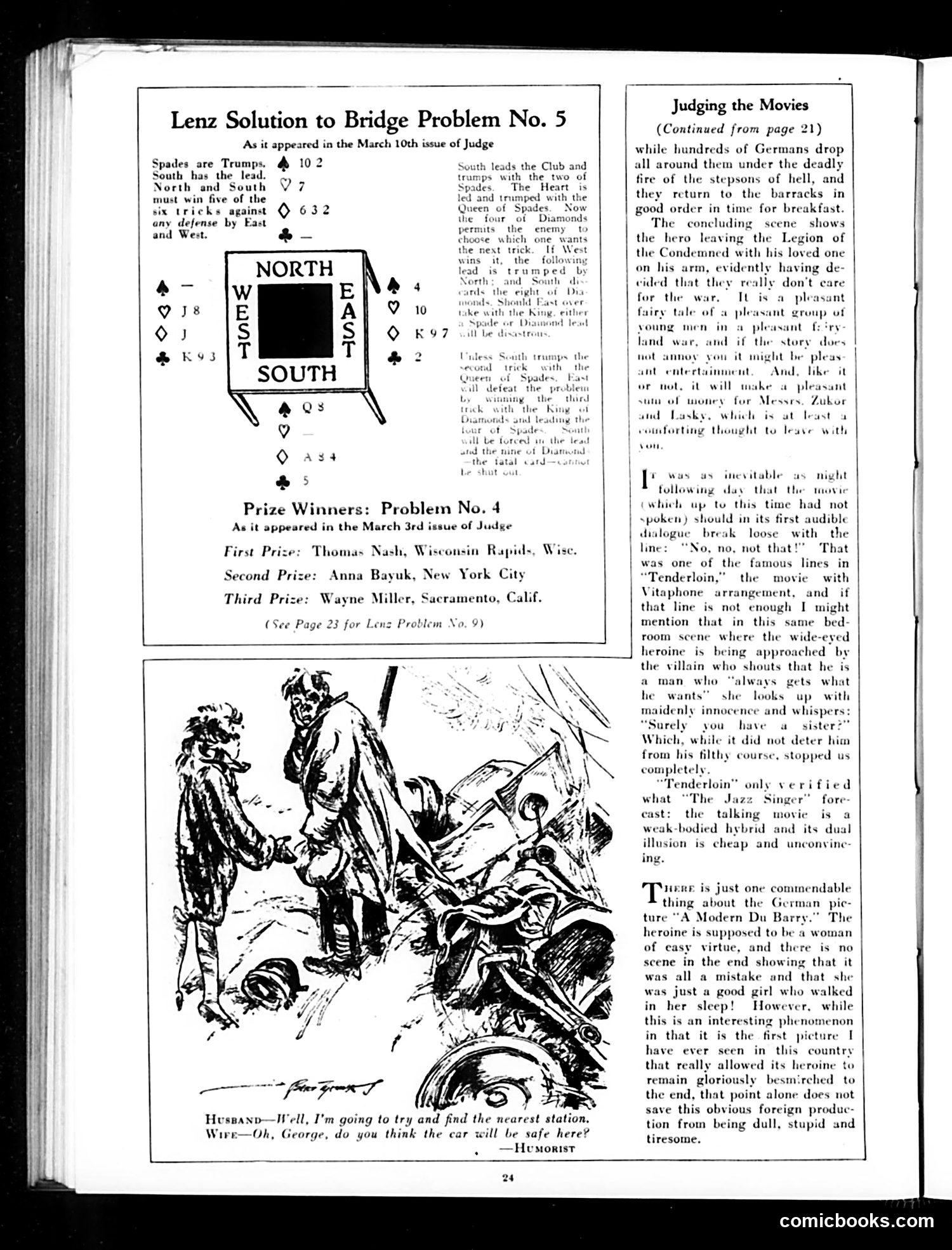
This page contains three distinct elements: ## Bridge Problem Solution The top section presents a contract bridge puzzle solution, a recurring feature in Judge. Bridge was a popular parlor game among educated audiences of this era. ## Movie Reviews The right column continues film criticism (from page 21), discussing three movies: a German war film "Legion of the Condemned," "Tenderloin," and "A Modern Du Barry." The reviewer critiques their artistic merit and dialogue, sarcastically noting that while "Tenderloin" features a famous line ("No, no, not that!"), the overall execution is weak. The only praise goes to "A Modern Du Barry" for allowing its morally compromised female character to remain so—a rare occurrence in American cinema of this period, which typically required redemption arcs for "fallen women." ## Cartoon The lower illustration, captioned "Husband—Well, I'm going to try and find the nearest station. Wife—Oh, George, do you think the car will be safe here?" depicts a couple viewing what appears to be an accident or wreckage. The humor satirizes automotive safety concerns and spousal anxiety typical of early automobile-era anxieties.
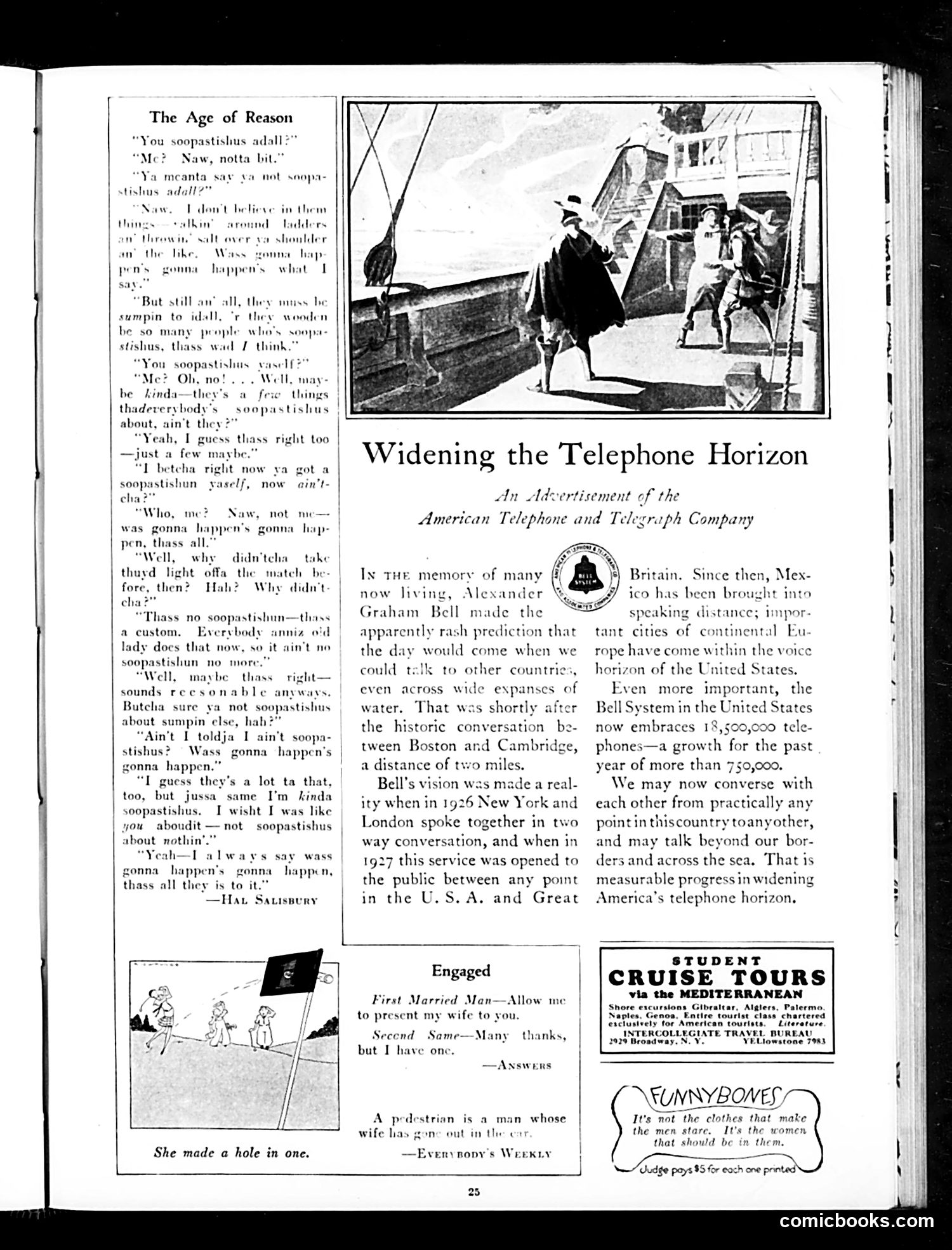
**"The Age of Reason"** (left column): This dialect-heavy comic depicts working-class characters debating superstition versus rationality. The joke hinges on irony: one character claims not to believe in superstition, yet admits to avoiding lighting three cigarettes with one match—a common superstition. The humor satirizes ordinary people who pride themselves on being "modern" and rational while still harboring irrational beliefs. The thick phonetic dialect ("soopastishus," "naw") marks these speakers as unsophisticated, a common Judge magazine technique. **"Widening the Telephone Horizon"** (right): This is a paid advertisement for the American Telephone and Telegraph Company celebrating technological progress. It traces telephone history from Bell's early Boston-Cambridge calls (two miles) to 1927 transatlantic service and expansion to Mexico and Europe. The ad emphasizes 18.5 million U.S. phones and 750,000 new connections annually as proof of American modernity and progress—typical 1920s boosterism linking commercial growth with national advancement. The small cartoons below are unrelated humor items.
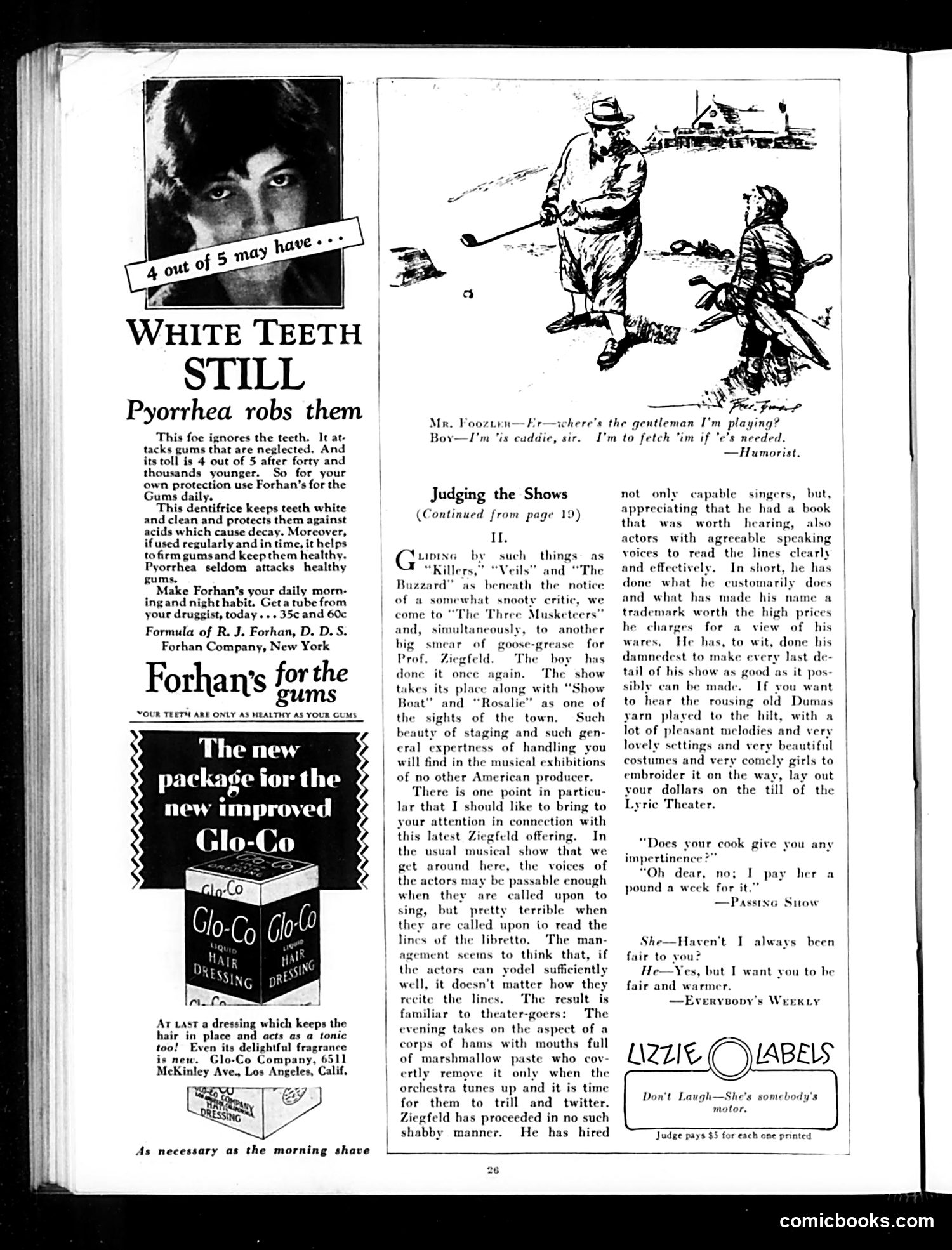
This page contains **advertisements and theatrical criticism** rather than political satire. The **top section** advertises Forhan's toothpaste and Glo-Co hair dressing—typical early 20th-century patent medicine ads making health claims (Forhan's promises to prevent pyorrhea, a gum disease). The **cartoon** shows a golf scene where a boy explains he's a caddie "to fetch 'im if 'e's needed"—a simple visual gag about the caddie's humble role. The **main article**, "Judging the Shows," reviews theatrical productions, praising producer Florenz Ziegfeld's staging of "The Three Musketeers." The critic commends Ziegfeld for hiring quality actors who can *speak* dialogue clearly, not just sing—contrasting his professionalism against other producers who cast "hams" who muddle their lines. The **bottom section** contains brief humor snippets ("Lizzie Labels") about domestic and romantic situations, typical of period magazines. This is primarily a **magazine interior page** featuring entertainment criticism and advertising—not satirical commentary on politics or current events.
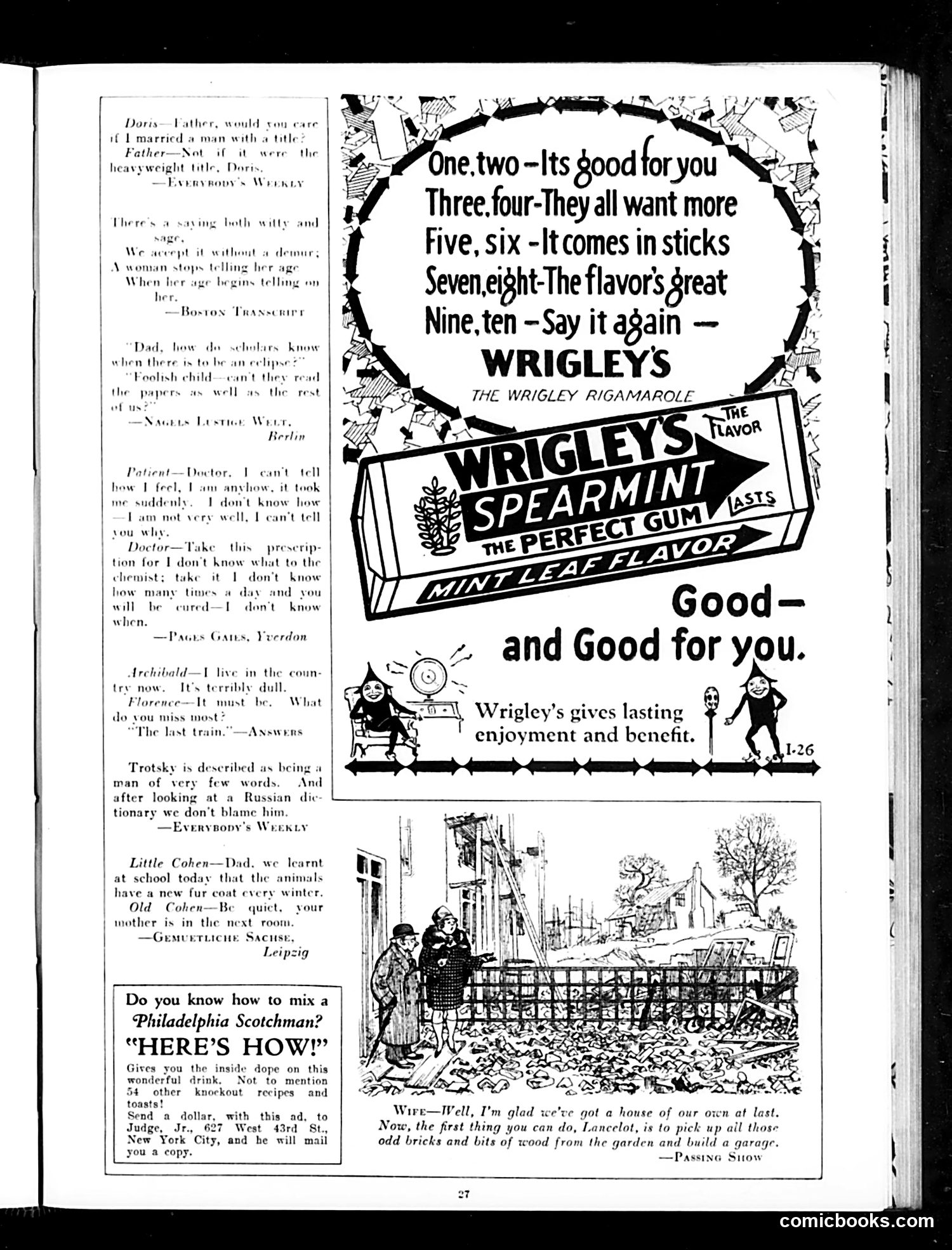
This page from *Judge* magazine contains primarily humorous one-liner jokes and advertisements rather than political cartoons. The jokes mock various social absurdities: a father's indifference to his daughter marrying unless the suitor has a boxing title; a father assuming children read newspapers to learn about eclipses; a doctor prescribing medicine while admitting ignorance of dosage and duration; and a man finding country life dull because he misses trains. The dominant feature is a Wrigley's Spearmint gum advertisement using a jingle ("One, two—it's good for you..."). A single cartoon at page bottom shows a wife instructing her new husband to clear garden debris to build a garage—a gentle jab at newlywed domesticity. The page also advertises a "Philadelphia Scotchman" cocktail recipe booklet. Overall, this reflects 1920s-era light humor and consumer advertising rather than pointed political satire.
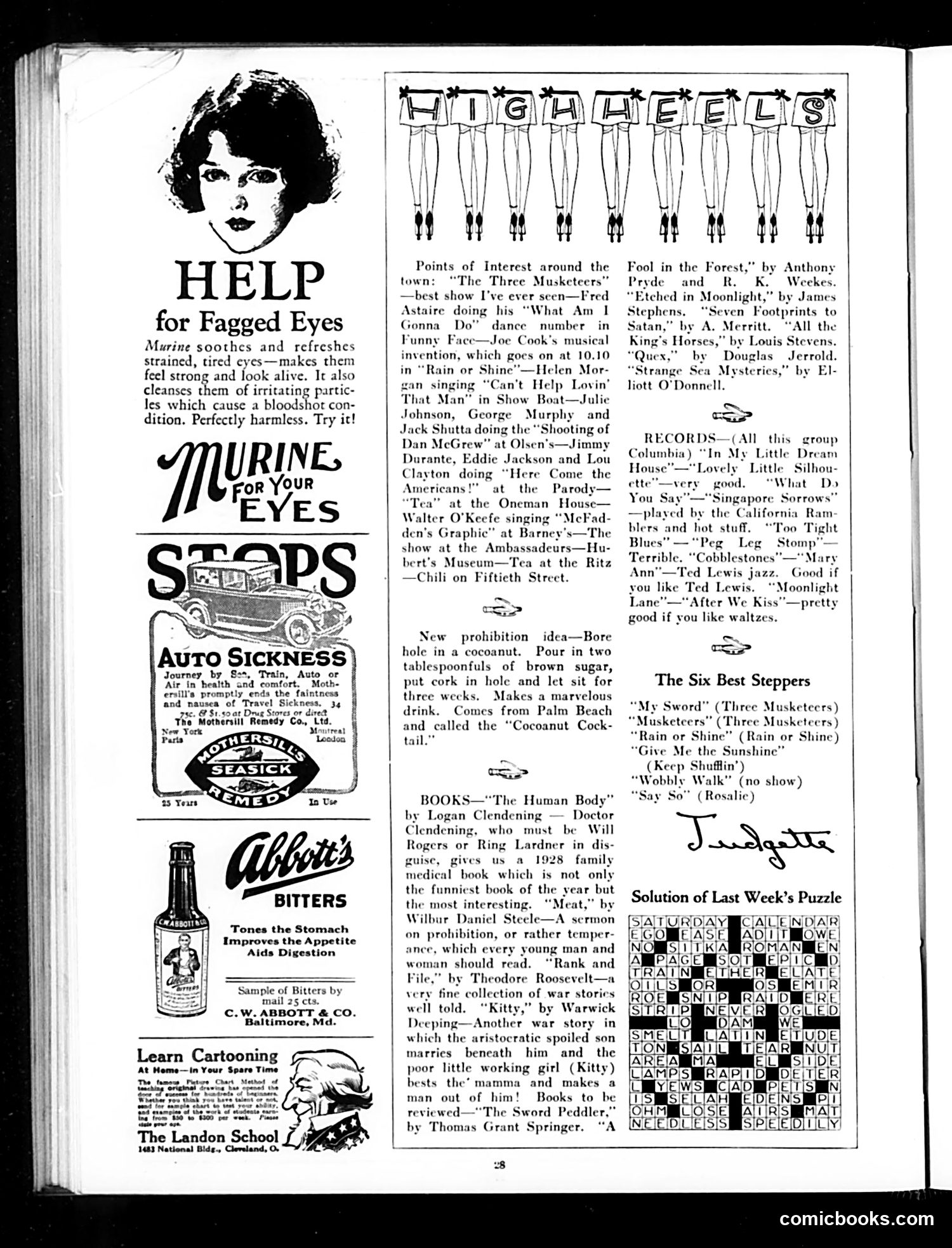
This page is primarily **advertising and entertainment listings**, not political satire. The main content includes: **Advertisements** for patent medicines ("Murine" eye drops, "Mothersill's" for travel sickness, Abbott's Bitters) and a cartooning correspondence school—typical 1920s-era ads making dubious health claims. **Entertainment section** listing popular Broadway shows and performers of the era (Fred Astaire, Helen Morgan, Jimmy Durante) and phonograph records, reflecting contemporary cultural interests. **A humor section** includes a prohibition-era joke about making homemade "Cocoanut Cocktail" and book reviews of contemporary fiction. The illustration at top shows a woman's face labeled "HELP for Fagged Eyes"—"fagged" meaning tired/exhausted, not the slur; this reflects period vocabulary. The page reflects 1920s consumer culture and entertainment rather than political commentary.
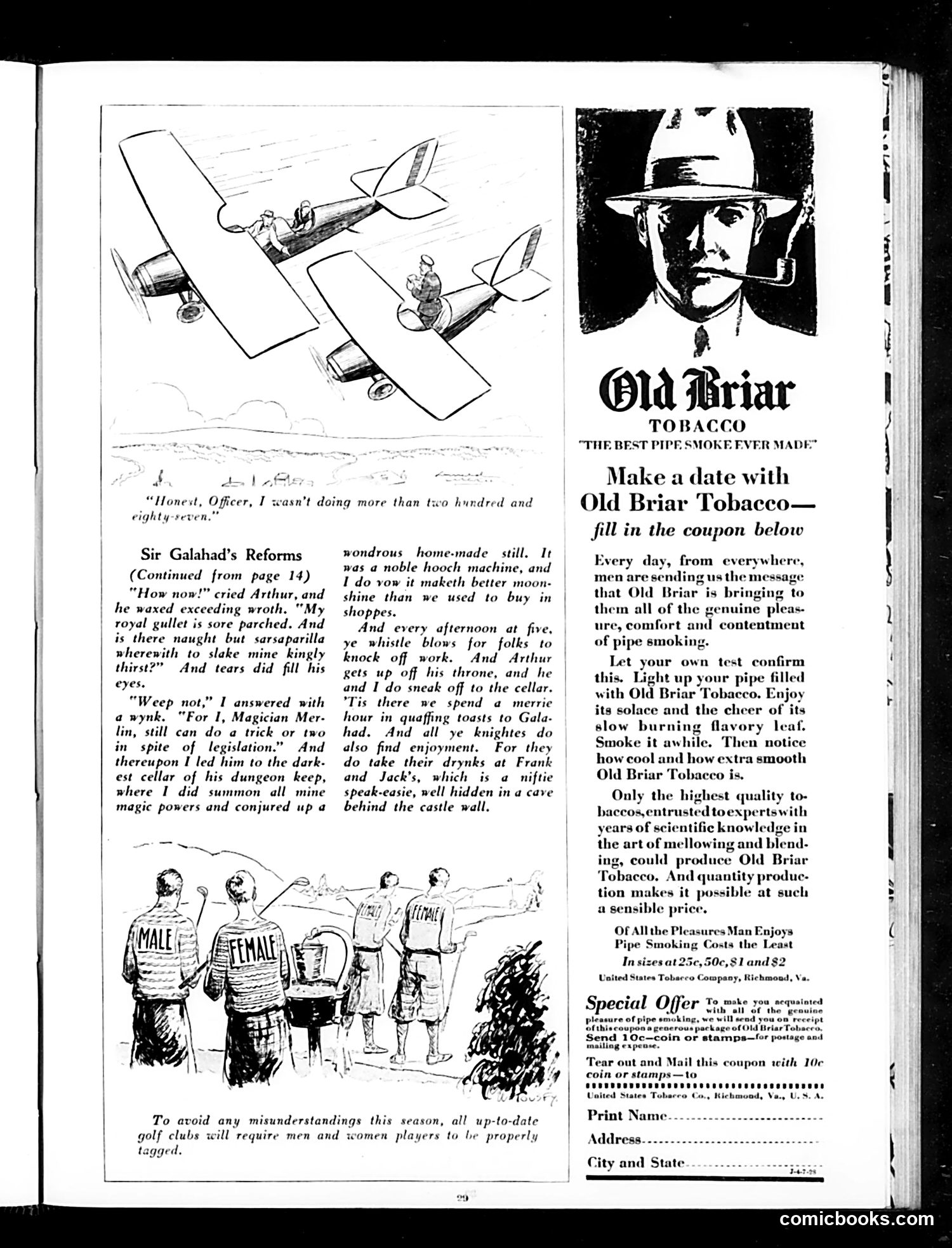
This page contains two distinct elements: a satirical story continuation and a tobacco advertisement. **"Sir Galahad's Reforms" (left side):** This is a Prohibition-era satire. The story mocks the alcohol ban by depicting King Arthur's wizard Merlin secretly operating a home-made still in the castle cellar. The humor lies in showing that despite laws against liquor, even royalty can't resist obtaining it illegally. Knights frequent hidden "speak-easies" (illegal bars), and the entire court conspires to circumvent Prohibition—suggesting the law is unenforceable and universally ignored. The casual attitude toward lawbreaking reflects 1920s skepticism about Prohibition's feasibility. **Advertisement (right side):** A full-page Old Briar Tobacco advertisement featuring a mustachioed man in a hat, marketing pipe tobacco as "the best pipe smoke ever made" and emphasizing comfort and quality. The juxtaposition is ironic: while the story jokes about breaking alcohol laws, the facing page advertises another legal recreational substance—tobacco.
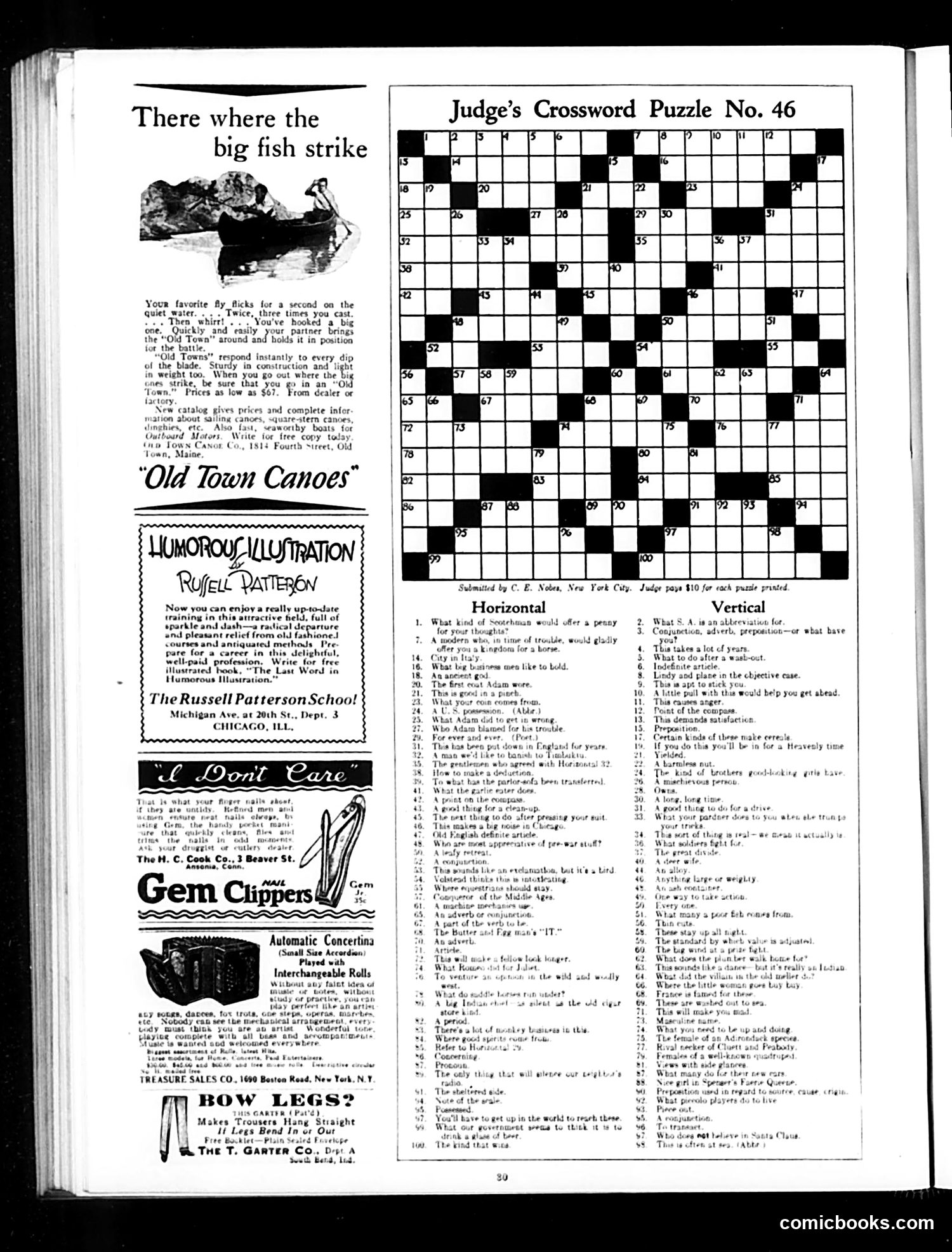
This page is primarily **advertisements and a crossword puzzle**, not satirical content requiring historical context. The left side features ads for practical products: Old Town Canoes (fishing/recreation), The Russell Patterson School (art training), Gem Clippers (personal grooming), Automatic Centerina (musical instrument), and T. Garter Co. (leg braces). These reflect early 20th-century consumer goods and services. The centerpiece is "Judge's Crossword Puzzle No. 46"—a straightforward word puzzle with horizontal and vertical clues. Crossword puzzles were a popular entertainment format of this era. The only illustrated content is a small fishing scene accompanying the canoe advertisement, captioned "There where the big fish strike," depicting recreational leisure activities. **No political satire or caricature is present on this page.** It represents Judge magazine functioning as a general-interest publication mixing humor, puzzles, and advertising rather than exclusively political commentary.
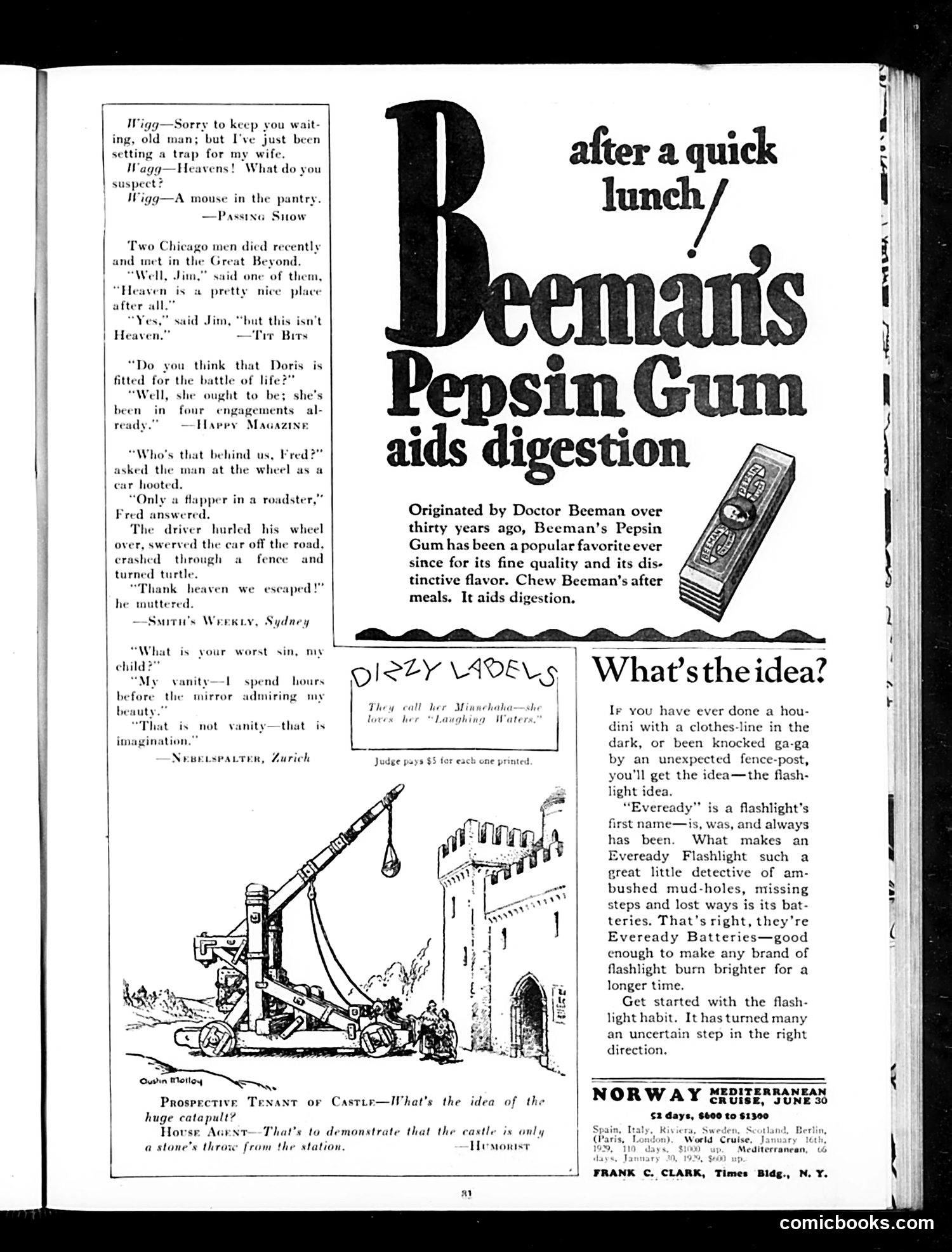
This page contains several short jokes and advertisements typical of 1920s-era humor magazines. **The Jokes:** Multiple brief comedic pieces rely on wordplay and situational irony—a husband setting a mousetrap for his wife (implying marital discord), two deceased men comparing heavens, and a driver swerving to avoid a "flapper" (young woman in fashionable dress) only to crash. The flapper reference reflects contemporary anxiety about modern women's independence and behavior. **The Advertisements:** The Beeman's Pepsin Gum ad claims digestive benefits (a common medical claim of the era before modern FDA regulations). The Eveready Batteries ad humorously frames flashlights as solutions to everyday mishaps. A Norway cruise advertisement appears below. **The Cartoon:** A sketch depicts a catapult aimed at a castle with caption explaining it demonstrates distance—gentle absurdist humor. The overall tone reflects 1920s satirical magazine sensibilities: brief gags, product endorsements with health claims now considered dubious, and social commentary on modern life through humor rather than explicit editorial stance.
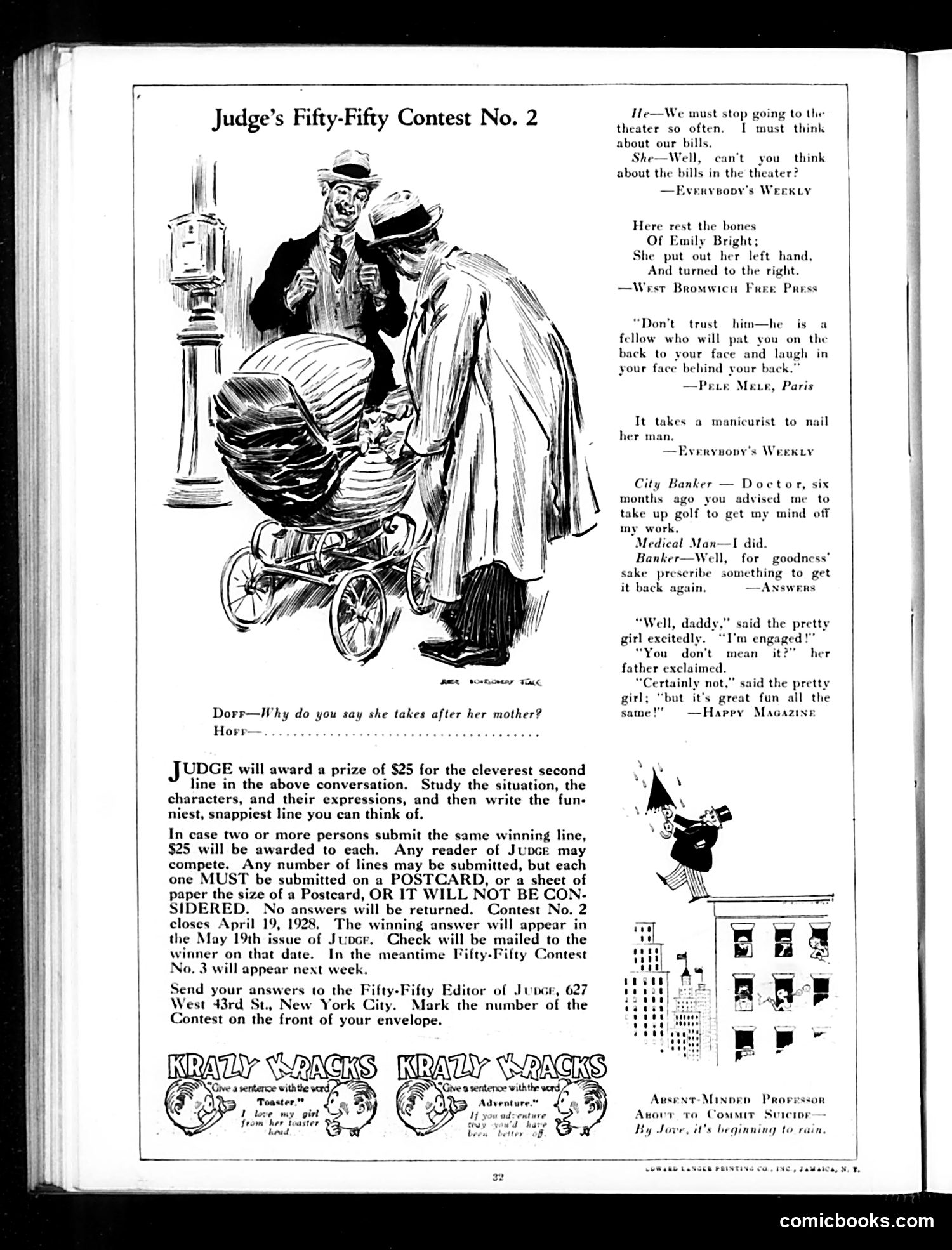
This page features **Judge's Fifty-Fifty Contest No. 2**, a reader participation competition. The main cartoon shows two well-dressed men confronting a woman with a baby carriage on a city street. The setup joke reads: "Dorf—Why do you say she takes after her mother?" Readers are invited to submit the cleverest second line (punchline) for a $25 prize, with entries due April 19, 1928. The page also includes miscellaneous humor: witticisms about theater bills, marriage advice, a manicurist joke, and anecdotes from various publications. At the bottom are "Krazy Kracks"—brief, crude visual gags about a toaster and adventure. This represents typical 1920s magazine humor: urban sophistication, gender humor focused on appearance and marriage, and reader-participation contests designed to boost engagement and circulation.
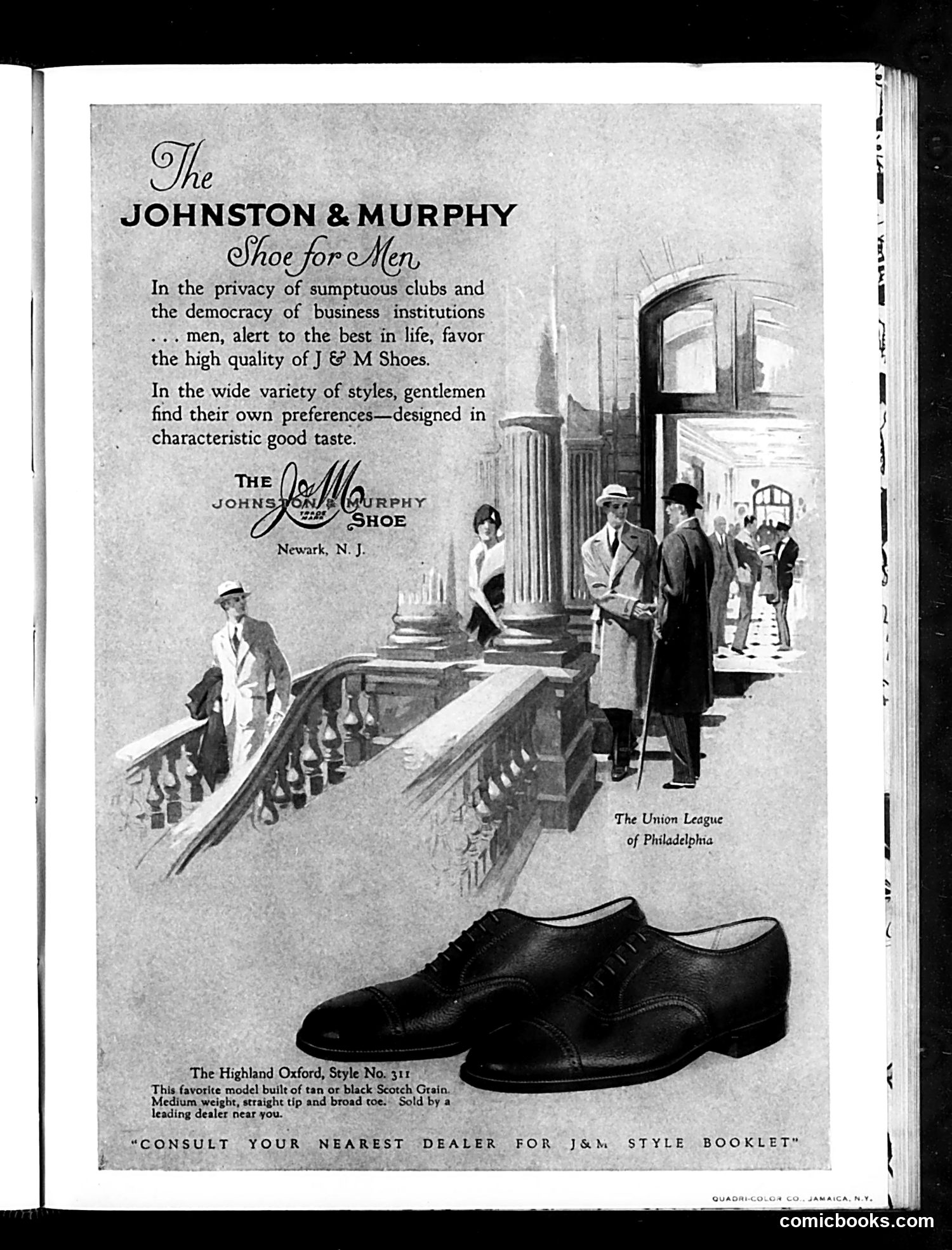
This is **not a cartoon or satire**—it's a straightforward advertisement for Johnston & Murphy men's shoes, positioned as a luxury product. The ad appeals to upper-class male consumers by referencing "sumptuous clubs" and "the democracy of business institutions," suggesting the shoes are worn by successful, refined gentlemen. The illustration depicts well-dressed men in what appears to be an exclusive club or business setting, reinforcing aspirational messaging. The specific shoe model shown—the Highland Oxford, Style No. 311—is presented as a hallmark of "characteristic good taste." The Union League of Philadelphia reference adds prestige through association with an actual elite organization. This reflects early 20th-century advertising strategy: positioning consumer goods as markers of social status and personal refinement. There is no political satire present on this page.
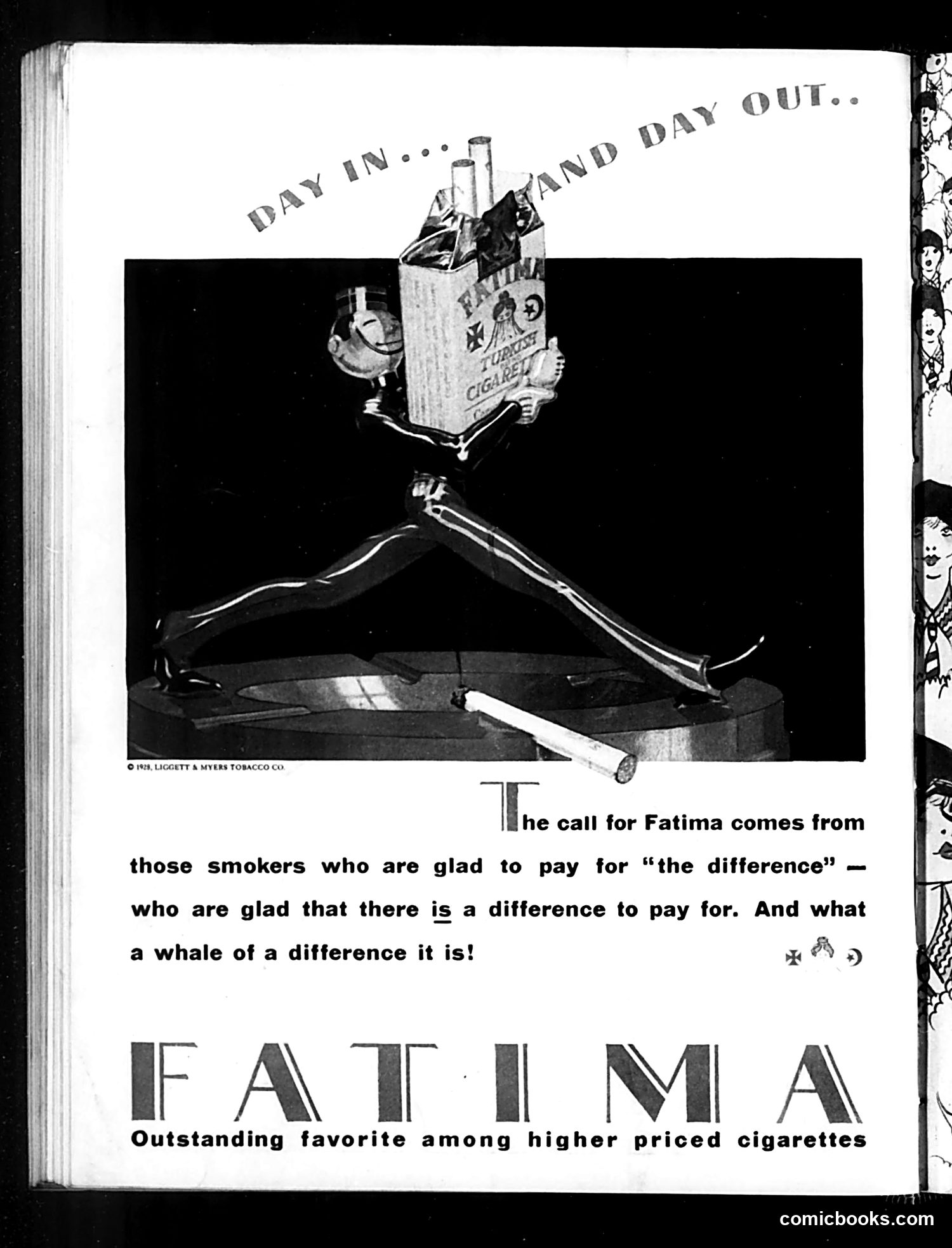
This is a **cigarette advertisement**, not political satire. The page promotes Fatima brand cigarettes as a premium product positioned for affluent consumers willing to pay more for superior quality. The imagery shows an acrobatic figure balancing a Fatima cigarette package overhead—a visual metaphor for the product's superior quality and the "difference" consumers pay for. The accompanying text emphasizes that Fatima appeals to smokers who recognize and appreciate quality distinctions, framing premium pricing as evidence of excellence rather than mere markup. Published in 1928 by Liggett & Myers Tobacco Company, this reflects the pre-regulation era when tobacco companies openly advertised in mainstream publications. The ad targets middle-to-upper-class readers of Judge magazine, positioning Fatima within a hierarchy of cigarette brands.