
Judge, 1928-04-07 · page 21 of 36
Judge — April 7, 1928 — page 21: what you’re looking at
What you’re looking at
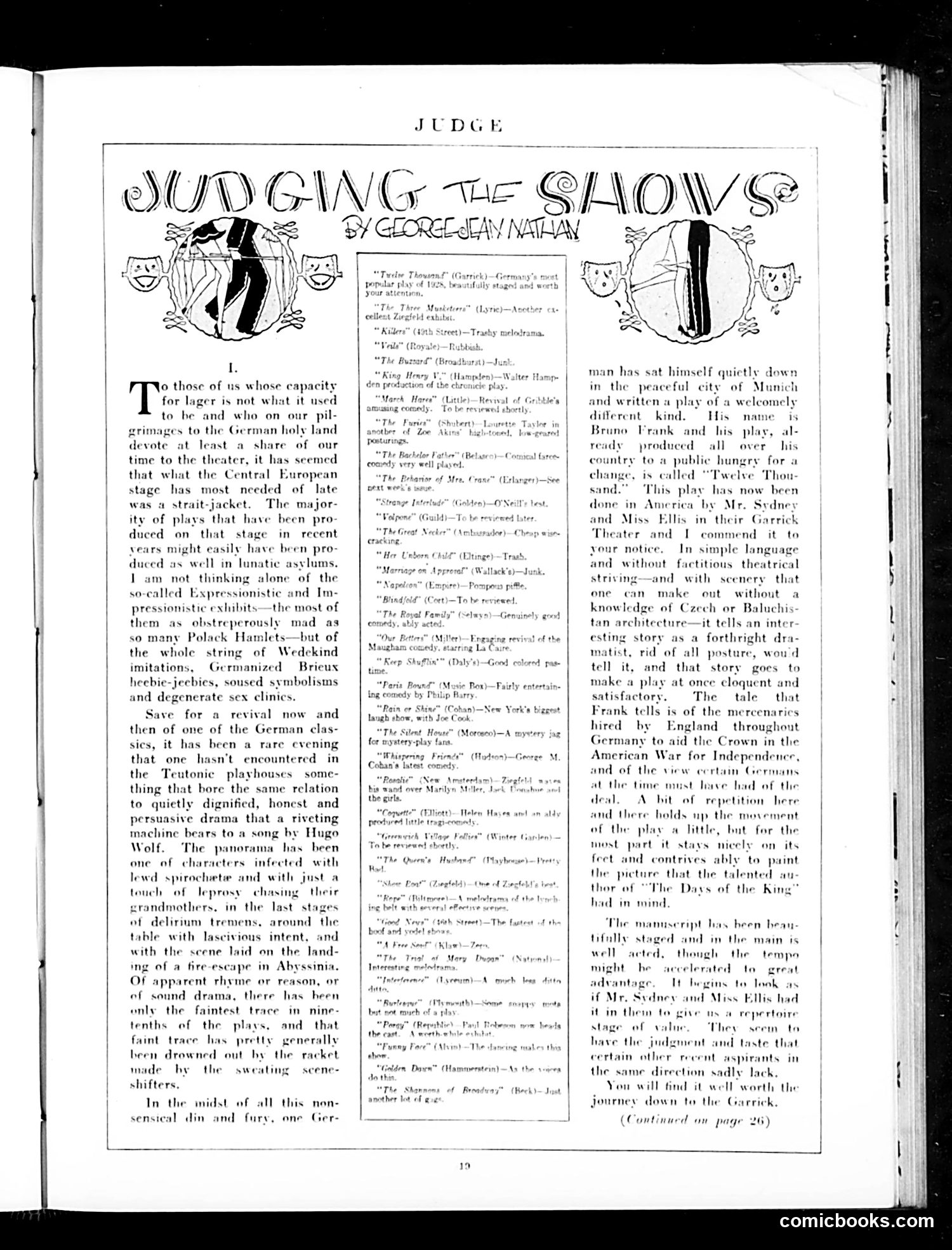
This article reviews "Twelve Thousand," a play by Bruno Frank, performed in America at the Garrick Theater by Sydney Ellis and Miss Ellis. The author criticizes contemporary German theatre as aesthetically bankrupt—dominated by derivative Expressionism, imitative works, sexual dysfunction narratives, and symbolic excess with no coherent dramatic purpose. He compares such plays to "a riveting machine" compared to a Hugo Wolf song: mechanically jarring rather than artful. Frank's play stands out favorably: it tells a straightforward historical drama about English mercenaries hired during the American Revolutionary War, presented without pretension or theatrical gimmickry. The author praises its accessible storytelling, appropriate scenery, and emotional coherence. The review suggests Ellis and Miss Ellis may develop into serious repertory producers—a rare accomplishment the author implies other recent theatrical aspirants lack.
📄 Transcribed text from this page (OCR, searchable)
Machine-transcribed from the original scan — historical spelling and the odd misread are preserved.
JUDG 0 those of us whose r | for lager is not what it used to he and who on our pil- rrimages to the German holy land devote at least share of our time to the theater, it has seemed that what the Central European stage has most needed of late was a strait-jacket. The major- ity of plays that have been pro duced on that stag years might easily have been pro- in recent duced as well in lunatic 1 am not thinking alone so-called Expressionistic asylums. of the and Im- pressionistic exhibits—the most of them as obstreperously mad as so many Polack Hamlets—but of the whole string of Wedekind imitations, Germanized Brieux heebie-jeebies, soused symbolisms and degenerate sex clinics. Save for a revival now and then of one of the German clas- sics, it has been a rare evening that one hasn't encountered in the Teutonic playhouses thing that bore the same relation to quietly dignified, honest and persuasive drama that a riveting machine bears to a song by Hugo Wolf. The panorama has been one of characters infected with some- lewd spirochwete and with just a touch of chasi grandmothers. in the last st of delirium tremens, around the table with lascivious intent, and with the scene laid on the land- ing of a fire-escape in: Abyssinia. leprosy Of apparent rhyme or reason, or ef sound drama, there has heen only the faintest trace in nine- the plays, and that has pretty tenths ¢ faint tra generally been drowned out by the racket made hy the seene- shifters, In the sensieal din and fury. one Ge sweating midst of all this nen- comedy very well pla The pet laugh show: “The Si mystery-play fans man has sat himself quietly down the peaceful city of and written a play of a welcomely different: kind. His name is Bruno Frank and his play, al- ready produced all over his country to a public hungry for a + is called Thow This play has now been chan sand. done in America by Mr. Sydne and Miss Ellis in their Garrick Theater and I your notice. and without factitious theatrical striving—and with scenery that one can make out without a knowledge of Czech or Baluchis tan architectu it tells an inter esting story as a forthright dra- matist, rid of all posture, tell it, and that story goes to make a play at once eloquent and isfactory. The tale that Frank tells is of the mercenaries hired by England throughout Germany to aid the Crown in the American War for Independence, and of the view certaim Germans “Twelve commend it to In simple language woud at the time must lowe bad of the deal A hit: of and there holds up the movement of the play a little, but for the Most part it stays nicely on its repetition here feet and contrives ably to paint the picture that the talented au thor of “The Days of the Kir had in mind The manuseript hay been bean fifally staged and in the main is well ed, th vecelerated ta advantage. Ht hegins to look as if Mr. Svdnew and Miss Ellis had if in them to give us a repertoire nigh the might great stage of value. ‘Chey have the ju seem te ment and taste that certain other recent aspirants in the same direction sadly lack. You will find it well worth the journey down to the Garrick. i { t io} ‘ comicbooks.com