
A complete issue · 36 pages · 1928
Judge — March 24, 1928
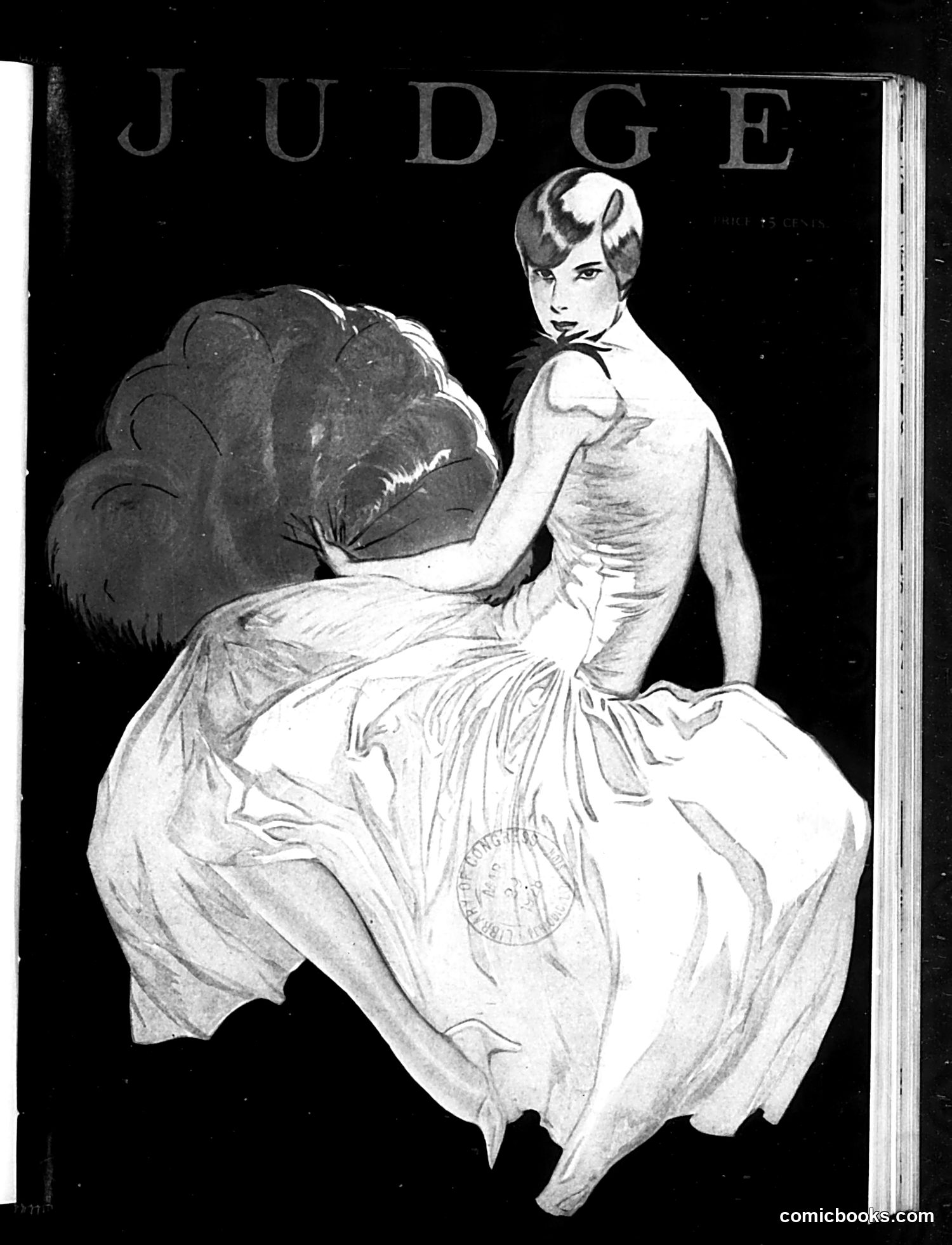
This appears to be a cover from **Judge magazine**, an American satirical publication. The image shows a woman in an elegant, flowing dress holding large feathers, drawn in an Art Deco style typical of early 20th-century illustration. Without clear OCR text or additional context clues visible on the page, I cannot definitively identify the specific political or social satire intended. The woman's pose and fashionable attire suggest commentary on **women's fashion, vanity, or social pretension** — common Judge targets. The large feathers might reference **feathered hat trends** that were controversial for animal welfare reasons during this era. The title "JUDGE" at top confirms the source, but without readable accompanying text or date, I cannot specify the exact satirical point or whom this figure represents.
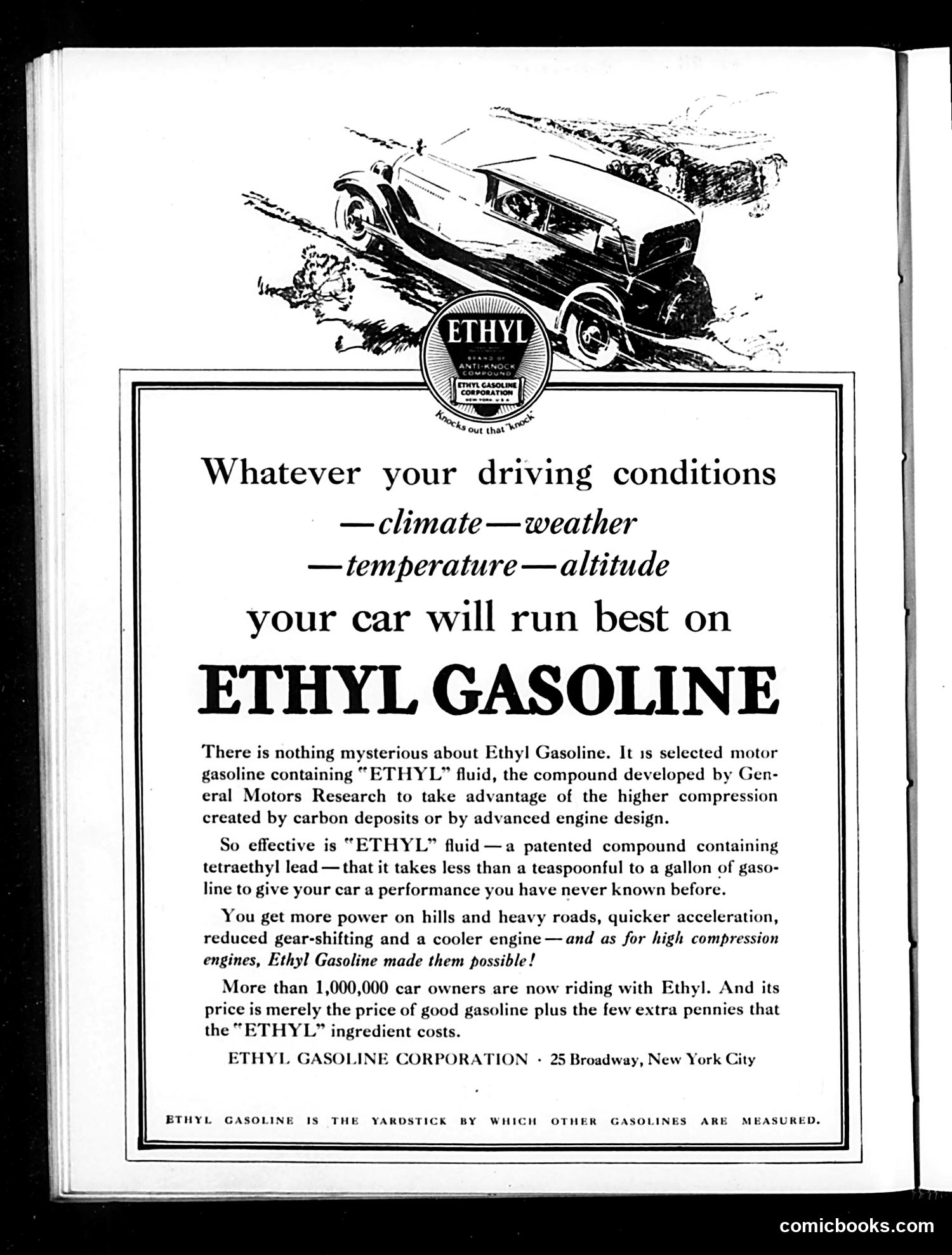
This is primarily a **commercial advertisement**, not satire. It promotes Ethyl Gasoline, a fuel additive containing **tetraethyl lead** developed by General Motors Research. The ad claims Ethyl improves performance across all driving conditions through higher engine compression. It emphasizes the product's widespread adoption (over 1,000,000 users) and minimal cost premium. **Historical context**: This advertisement is now infamous because tetraethyl lead was later proven highly toxic, causing severe environmental and public health damage before being banned decades later. Contemporary readers saw only promised performance benefits; they couldn't foresee the poisoning of generations through atmospheric lead contamination. The ad's casual mention of "tetraethyl lead" reveals how openly dangerous compounds were marketed before modern toxicology awareness.
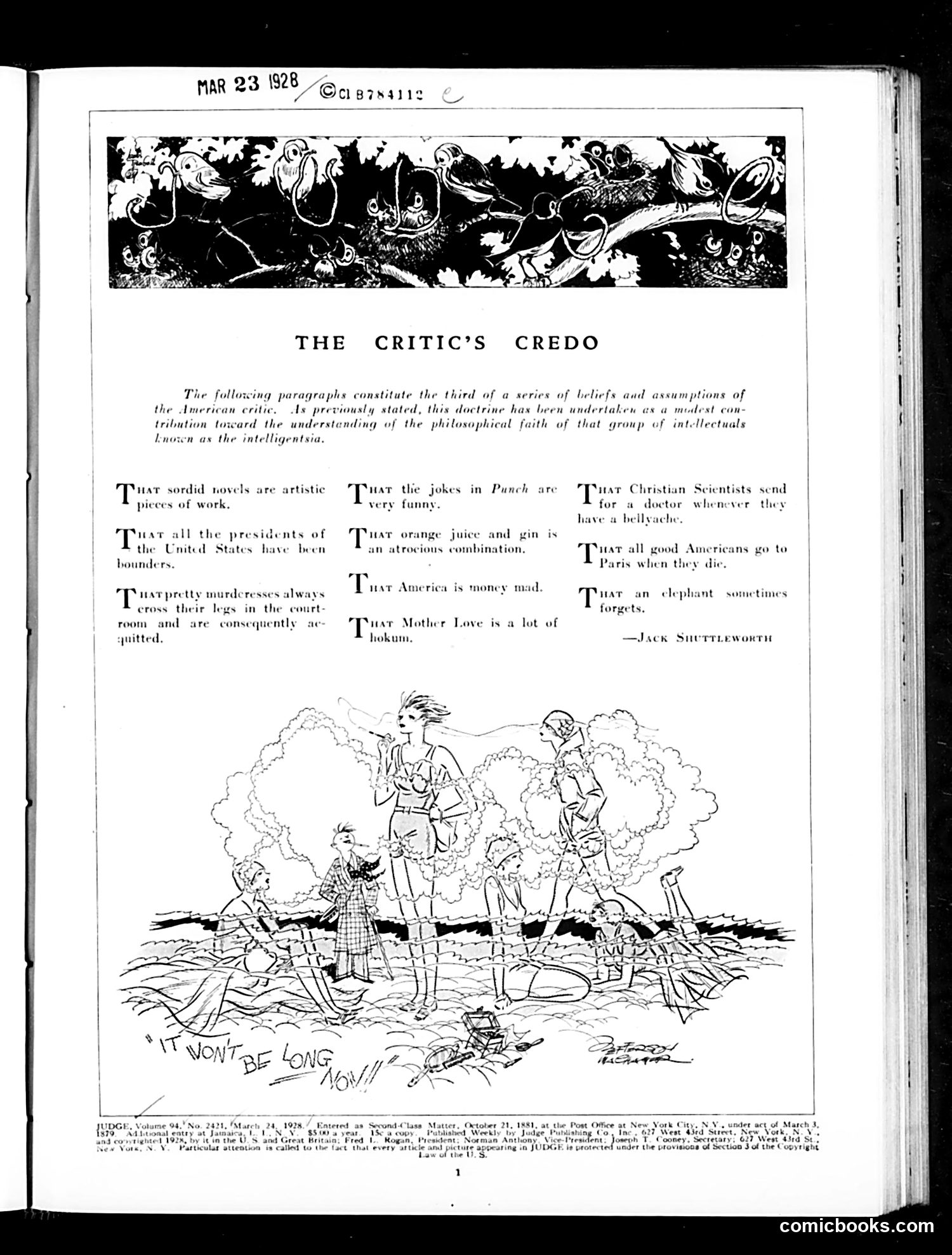
This page satirizes intellectual pretension and absurd critical assumptions. "The Critic's Credo" lists supposedly held beliefs by American critics—including that sordid novels are artistic, that all U.S. presidents were founders, that murderers deserve courtroom quotes, and that Christian Scientists inexplicably seek doctors for headaches. The cartoon below depicts people standing amid destruction with the caption "It Won't Be Long Now!"—likely satirizing contemporary anxieties about social collapse or apocalyptic predictions. The figures appear optimistic despite chaos, mocking both doomsayers and the public's apathetic acceptance of dire warnings. The page attacks critical hypocrisy and shallow thinking while poking fun at popular anxieties of the 1920s, a period of social uncertainty beneath Jazz Age prosperity.
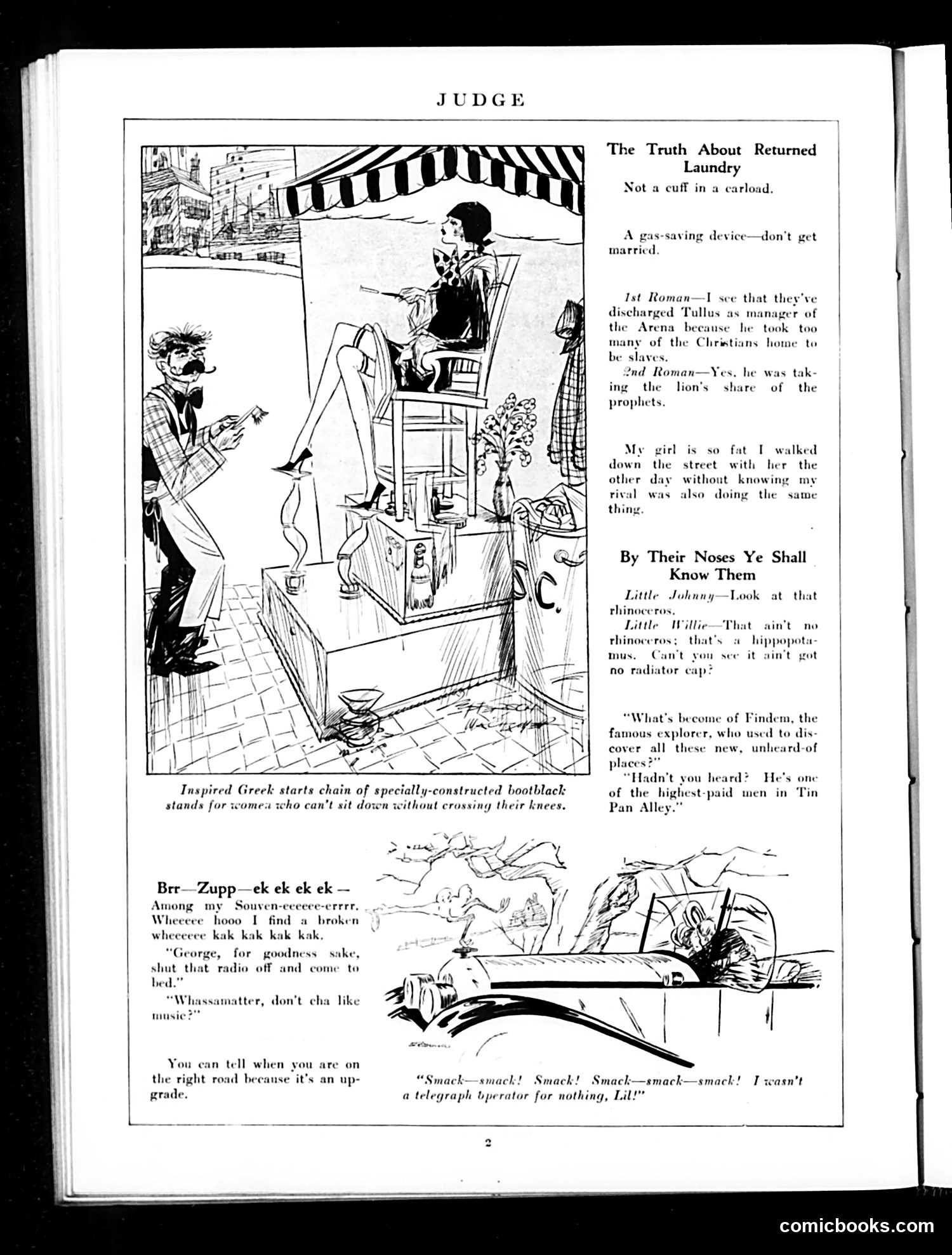
This page contains several humor pieces satirizing early 20th-century American life. The main cartoon depicts a woman sitting under a striped awning, likely at a beach or park, with men ogling her. The caption references "specially-constructed bootblack stands for women who can't sit down without crossing their knees"—satirizing both women's restrictive fashion (corsets making sitting difficult) and male voyeurism. The text sections mock various social absurdities: a laundry service's false promises, a woman's weight, and the high earnings of explorers in "Tin Pan Alley" (the music industry). The bottom cartoon shows someone in a car repeatedly saying "Smack!" complaining they "can't work a telegraph operator for nothing"—likely mocking early automotive noise or horn malfunctions as frustrating and unprofitable.
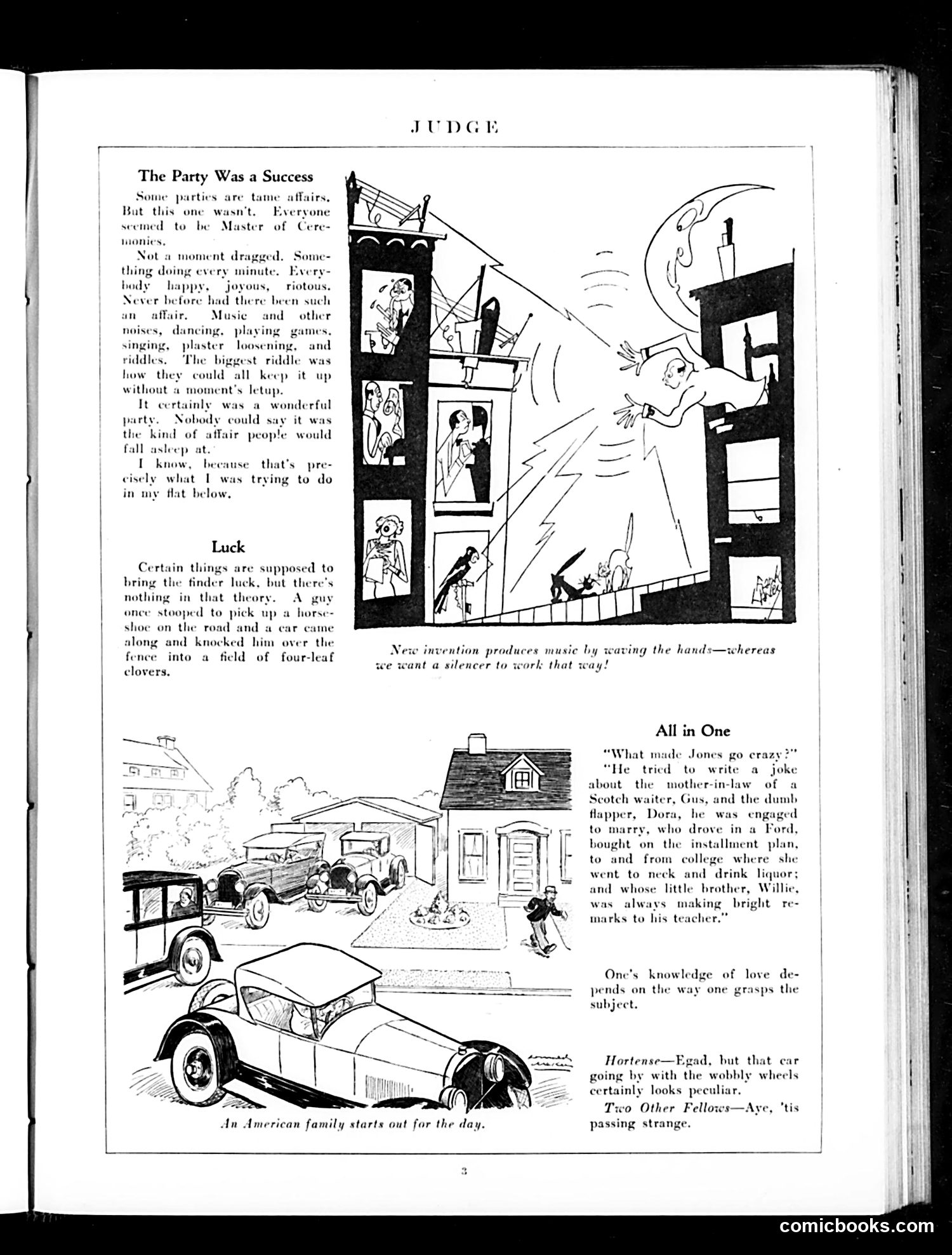
This page contains three separate humorous pieces: 1. **"The Party Was a Success"**: A cartoon depicting a chaotic apartment party where guests are extremely rowdy—dancing, singing, and causing mayhem. The joke is that the narrator successfully threw a lively party, though the destruction suggests "success" is subjective. 2. **"Luck"**: A brief anecdote about a man being knocked over by a horse-drawn car, illustrating ironic "luck." 3. **"All in One"**: A satirical story about Jones, described as a joke about a Scottish waiter and various family members' scandals (infidelity, drinking, poor grades). The accompanying illustration shows an American family departure in automobiles. The satire appears to mock the complexity of modern family dysfunction compressed into one narrative. The page reflects 1920s American social commentary and domestic life.
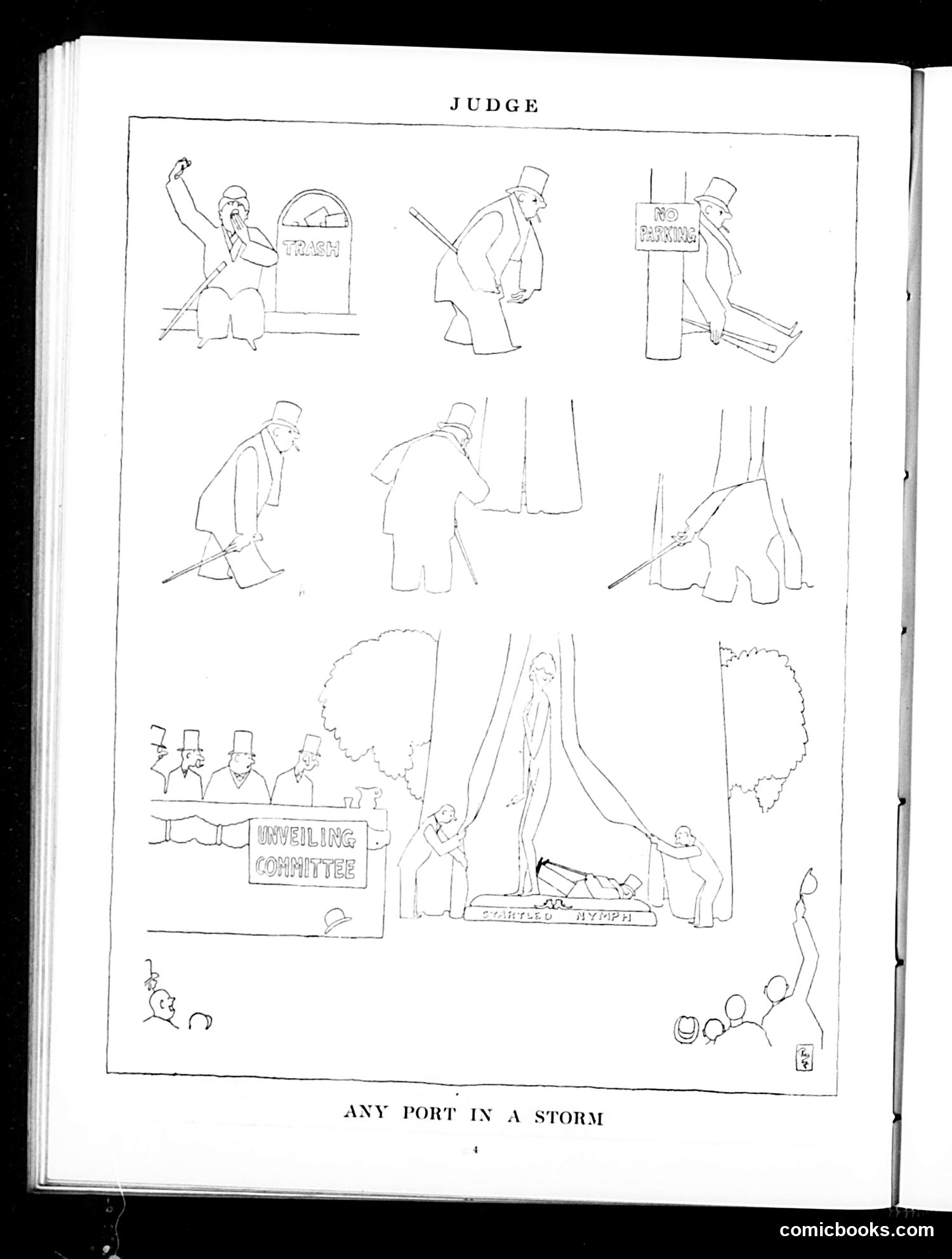
This Judge cartoon satirizes political opportunism during uncertain times. The title "Any Port in a Storm" suggests politicians will accept support from any source when desperate. The sequential panels show gentlemen (likely politicians or judges, given the page title "JUDGE") engaging in various undignified activities—digging, sweeping, working with trash barrels—suggesting they've abandoned their dignity or principles. The "Unveiling Committee" panel shows officials gathered formally, contrasting with their degraded labor elsewhere. The central large panel depicts a tree with what appears to be an "Exiled Nymph" sculpture or figure, surrounded by figures in top hats, suggesting an absurd or compromised public works project or scandal. The cartoon mocks how public officials compromise their integrity and engage in questionable practices when facing political difficulty, accepting any available "port" of refuge regardless of principle.
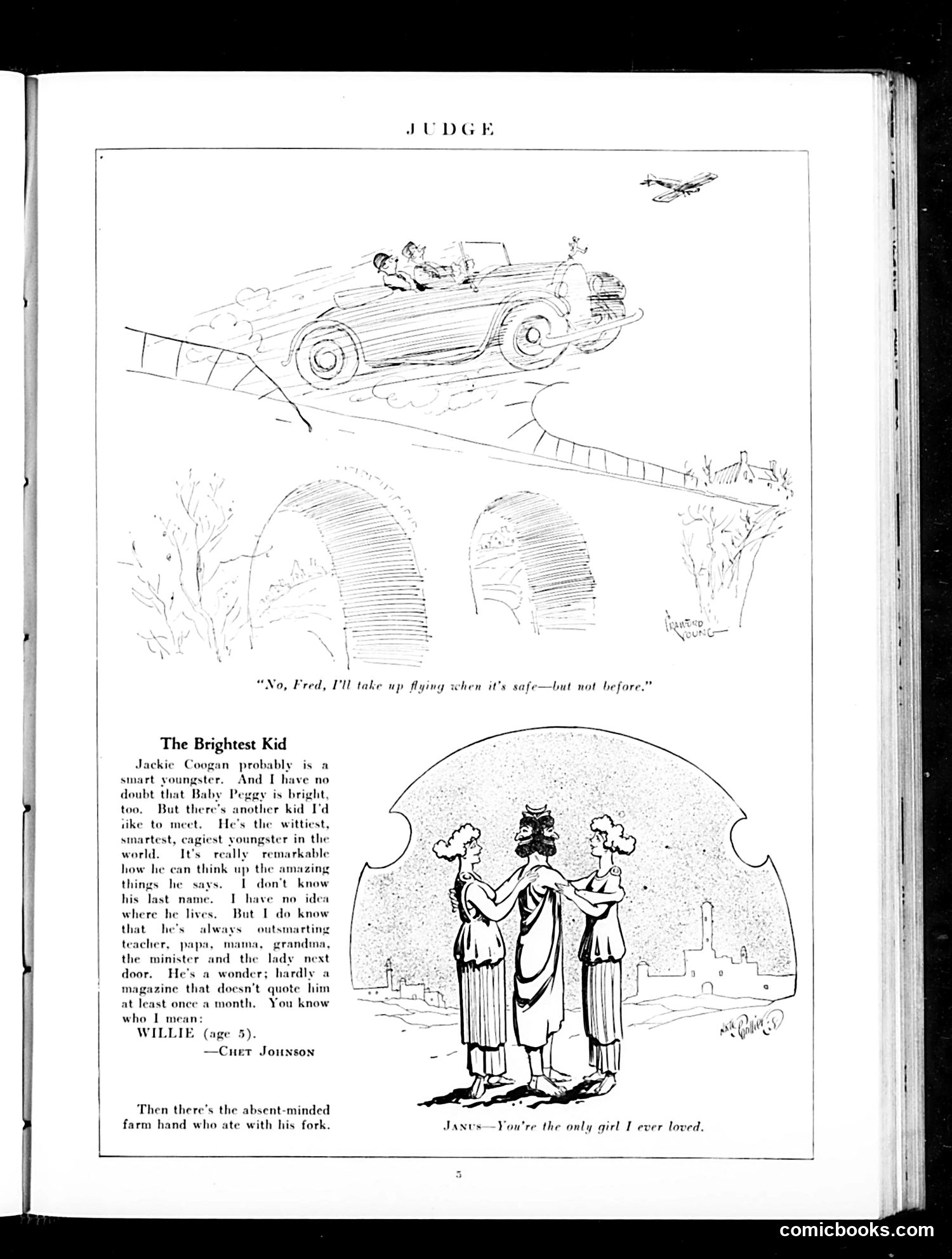
This page contains three separate cartoons and commentary from Judge magazine. **Top cartoon**: Shows a car flying off a cliff while an airplane passes overhead. The caption reads, "No, Fred, I'll take up flying when it's safe—but not before." This satirizes the relative safety concerns of early aviation versus automobiles, suggesting that cars were considered MORE dangerous than planes at this time. **"The Brightest Kid" section**: Commentary praising a child named Willie (age 5), described as exceptionally clever and quotable. Chet Johnsonidentifies him as the "brightest" kid, more impressive than the famous children Jackie Coogan and Baby Peggy. **Bottom cartoon**: Shows a man with two women, captioned "JANE—You're the only girl I ever loved." This is a standard romantic humor gag about insincere flattery.
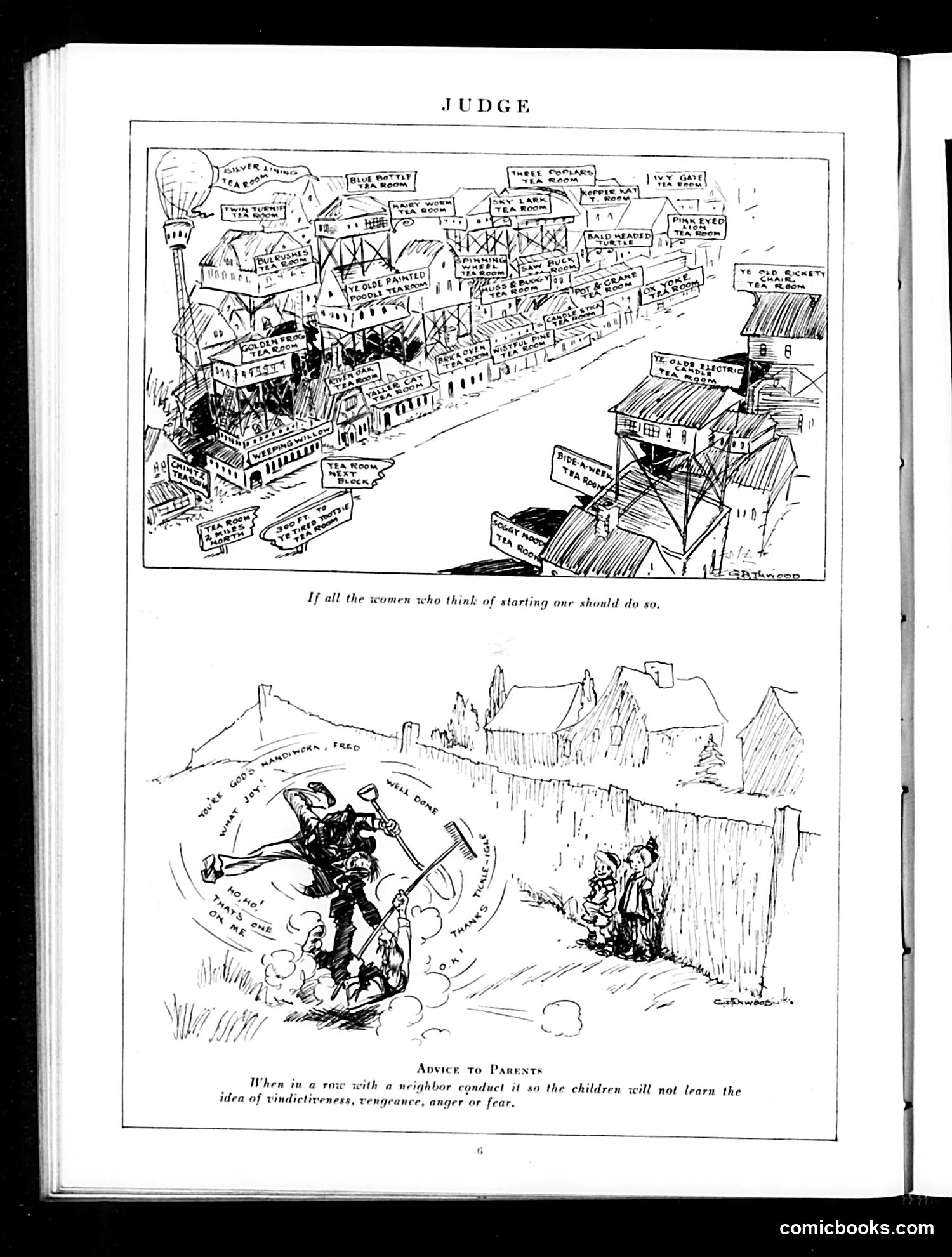
**Top cartoon:** A satirical cityscape labeled with various businesses and rooms, captioned "If all the women who think of starting one should do so." This appears to mock women's entrepreneurship or independence—suggesting if all women who contemplated starting businesses actually did, the resulting economic activity would be absurdly chaotic. The dense, overlapping structures humorously exaggerate the premise. **Bottom cartoon:** Titled "Advice to Parents," it depicts an adult and child in a rural setting, with the adult apparently engaged in angry conflict (shown through dynamic, aggressive posture). The caption advises parents to conduct disputes with neighbors out of children's view, to prevent teaching vindictiveness or fear. Both cartoons reflect early 20th-century anxieties: skepticism about female economic independence and concerns about proper child-rearing and moral instruction—common themes in Judge's satirical commentary on contemporary social issues.
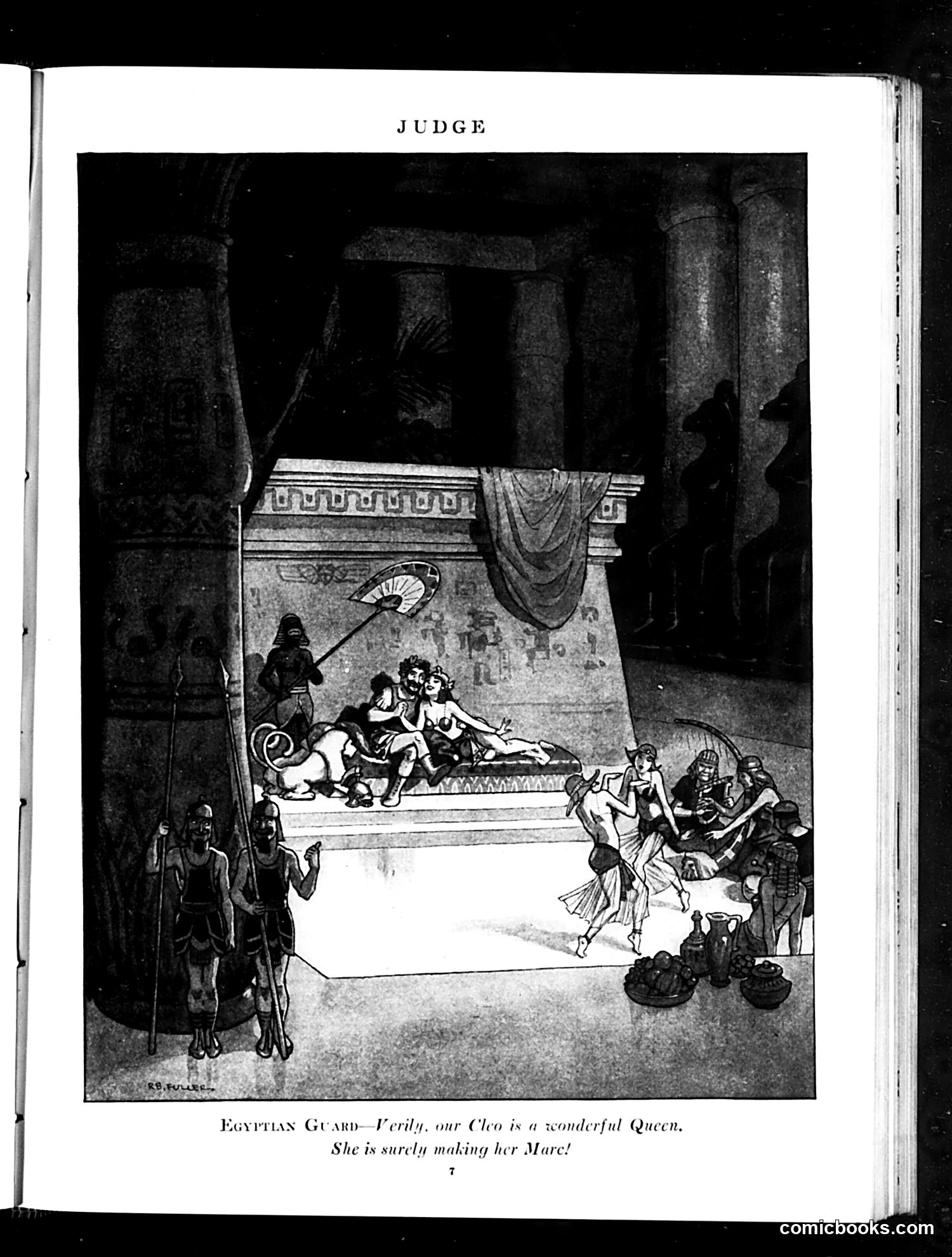
This page from *Judge* magazine contains a single illustration titled "Egyptian Guard—Verily, our Cleo is a wonderful Queen. She is surely making her Mare!" The cartoon depicts an Egyptian palace scene with guards, attendants, and a central female figure (Cleopatra) on an elevated throne. The joke appears to be a pun on "Mare"—playing on the homophone with "mark" (making her mark/reputation) while referencing the Egyptian setting where horses and mares would be familiar. The satire likely mocks contemporary female celebrity or political figures by comparing them to Cleopatra, using the historical Egyptian queen as a vehicle for commentary on women's ambition or notoriety. Without additional context about the publication date, the specific target figure remains unclear, though the irreverent tone toward female power is typical of *Judge*'s satirical approach.
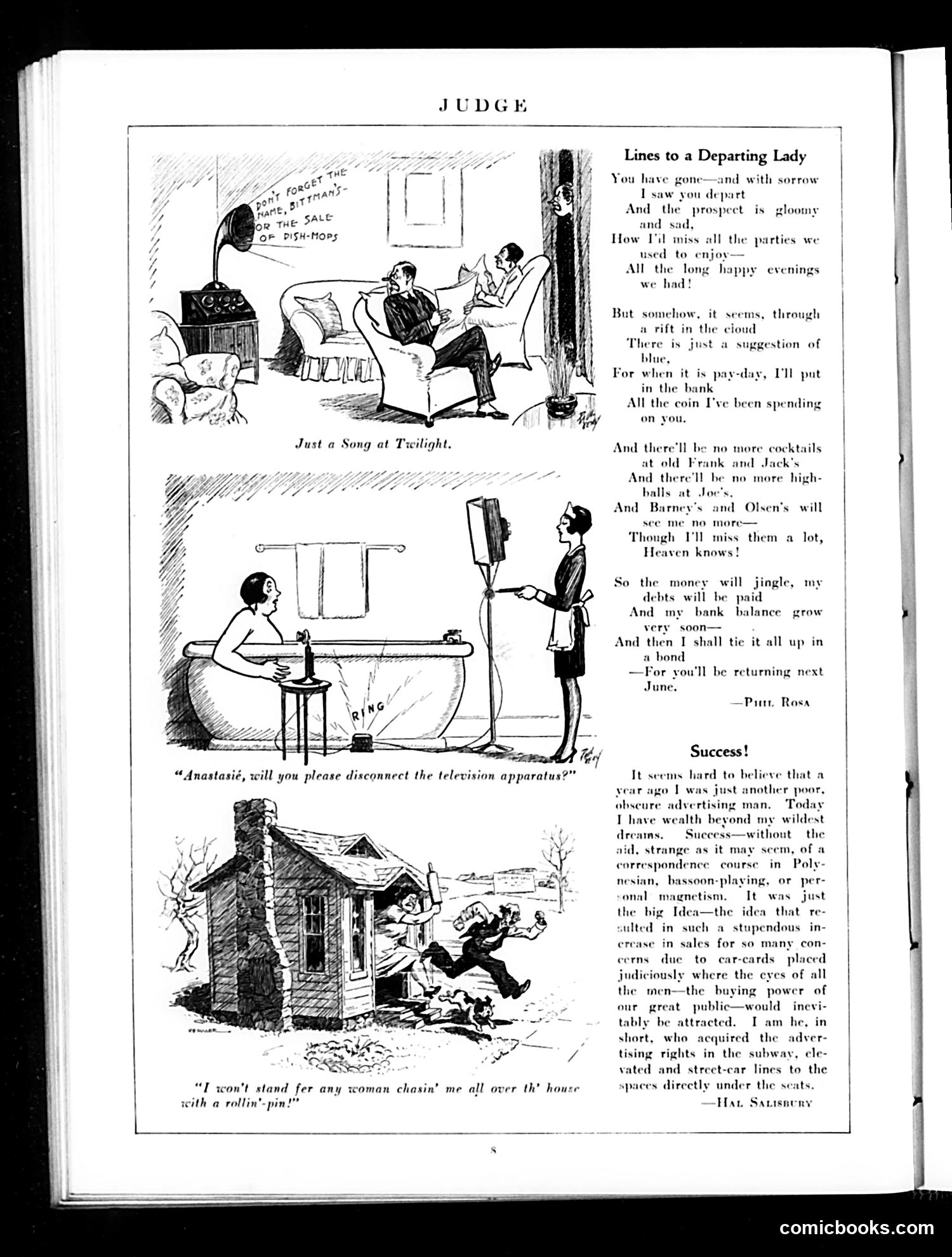
This page contains three distinct satirical pieces: **"Lines to a Departing Lady"** (signed Pitt Rosa): A humorous poem about a man's relief at a woman's departure. The joke is cynical—he claims to miss the social gatherings but is secretly delighted to stop spending money on her entertainment (cocktails at Frank and Jack's, highballs at Joe's). He'll save his wages and reinvest the money in bonds, expecting her return in June. The satire mocks both male financial anxiety and the transactional nature of social relationships. **"Anastasié, will you please disconnect the television apparatus?"** (top cartoon): Shows someone asking to disconnect a TV. This appears to satirize early television technology, treating it as a novelty device that's become intrusive or annoying. **Bottom cartoon and "Success!" essay** (signed Hal Salisbury): Celebrates an advertising man's fortune from placing "car-cards" (advertisements) in subways and streetcars positioned at eye-level for commuters. The satire praises this seemingly simple but profitable idea, mocking how advertising exploitation of captive audiences generates wealth.
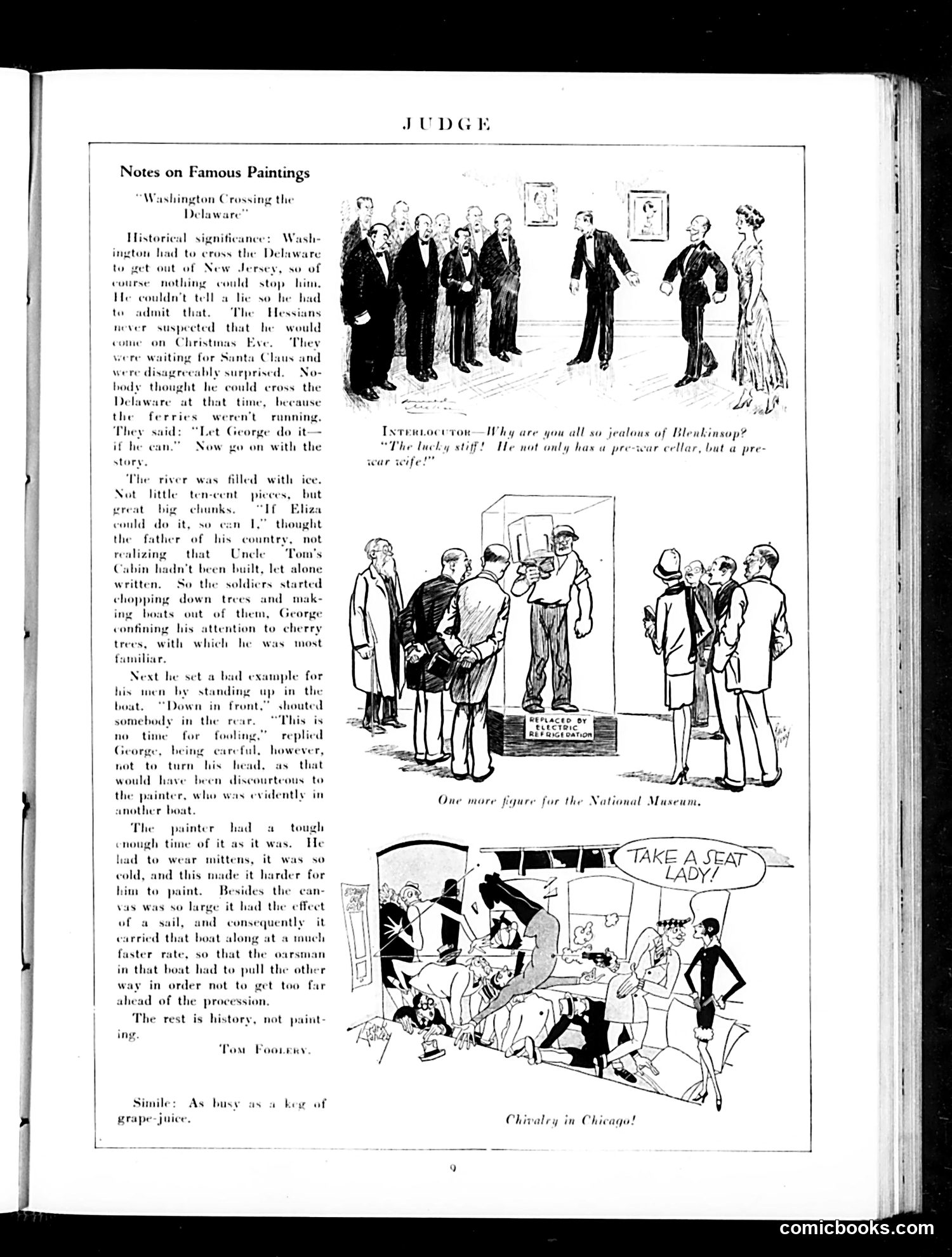
This page contains satirical commentary on Emanuel Leutze's famous 1851 painting "Washington Crossing the Delaware." **The Main Satire:** Tom Fooleary humorously deconstructs the painting's historical logistics and artistic challenges. He mocks the heroic narrative—noting Washington couldn't actually be stopped, so crossing was inevitable—while focusing on absurd practical details: soldiers chopping trees into boats, the massive canvas acting like a sail and causing the painter's boat to lag behind, and the painter's frozen fingers making it difficult to work. **The Supporting Cartoons:** - The top cartoon depicts men discussing "Blenkinsop," who apparently has a "pre-war cellar" and "pre-war wife"—a Prohibition-era joke about pre-1920s luxuries now illegal or depleted. - The bottom cartoon, "Chivalry in Chicago," shows crowded public transportation with men ignoring women's need for seats. Both cartoons satirize contemporary social issues: alcohol prohibition and declining gentility in public behavior.
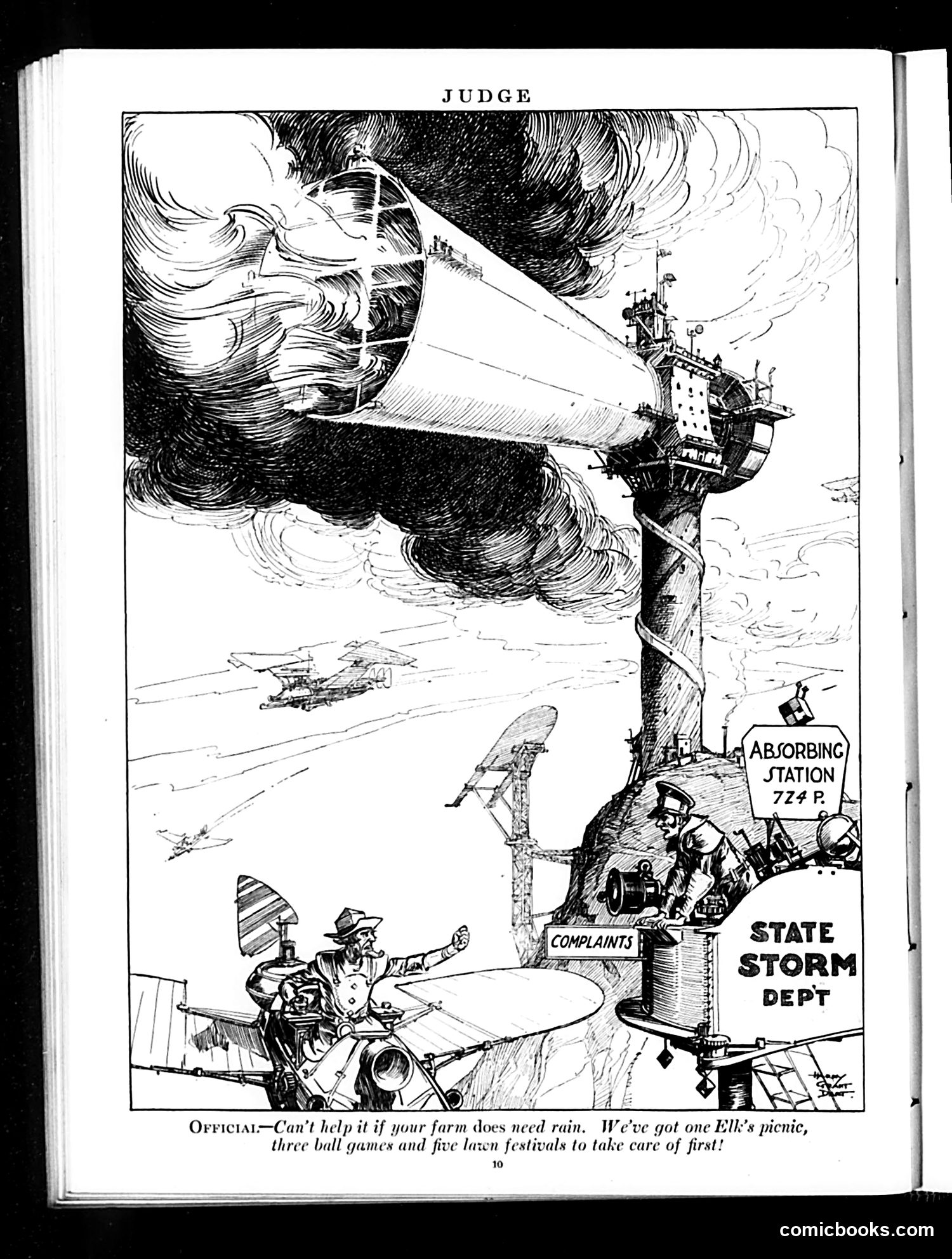
This satirical cartoon critiques the priorities of a state weather or agricultural department official. The "State Storm Dept" representative dismisses a farmer's rain request, claiming they're too busy with recreational events: an Elk's picnic, baseball games, and lawn festivals. The satire targets bureaucratic indifference to farmers' genuine needs during drought conditions. The towering, menacing storm clouds above contrast sharply with the official's casual dismissal, emphasizing the absurdity of prioritizing social events over agricultural emergencies. The "Abobing Station" and "Complaints" desk labels suggest the department's ineffectiveness and how complaints are processed but ignored. This likely reflects Depression-era or early 20th-century frustrations with government inefficiency and neglect of farming communities' critical needs.
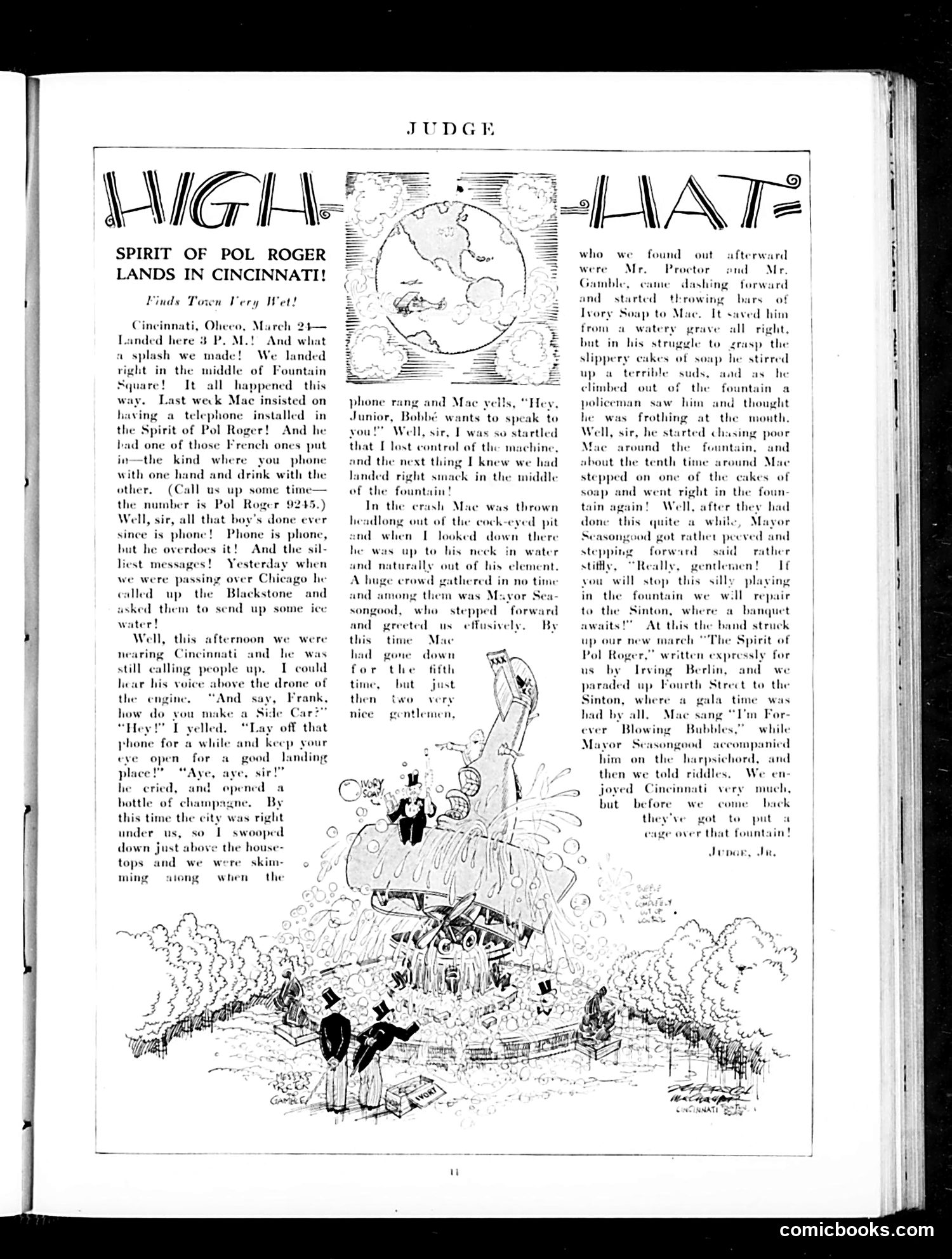
This Judge cartoon satirizes **Pol Roger champagne** through a fictional account of the brand's "spirit" causing chaos in Cincinnati. The humor centers on a telephone installation gone wrong—when a caller reaches the wrong number, the resulting confusion causes someone (likely representing the product) to crash into a public fountain. The satire includes product placement gags: **Proctor and Gamble** (Ivory Soap makers) appear as rescuers throwing soap bars, while **Irving Berlin** supposedly composed a march called "Spirit of Pol Roger." Mayor Seasongood features as a bewildered authority figure. The joke conflates drunken behavior with champagne consumption—the "spirit" creates literal chaos and foam (from soap), while authorities struggle to restore order. It's essentially an elaborate advertisement disguised as mockery, typical of Judge's advertiser-friendly satire that promoted consumer goods through comedic scenarios.
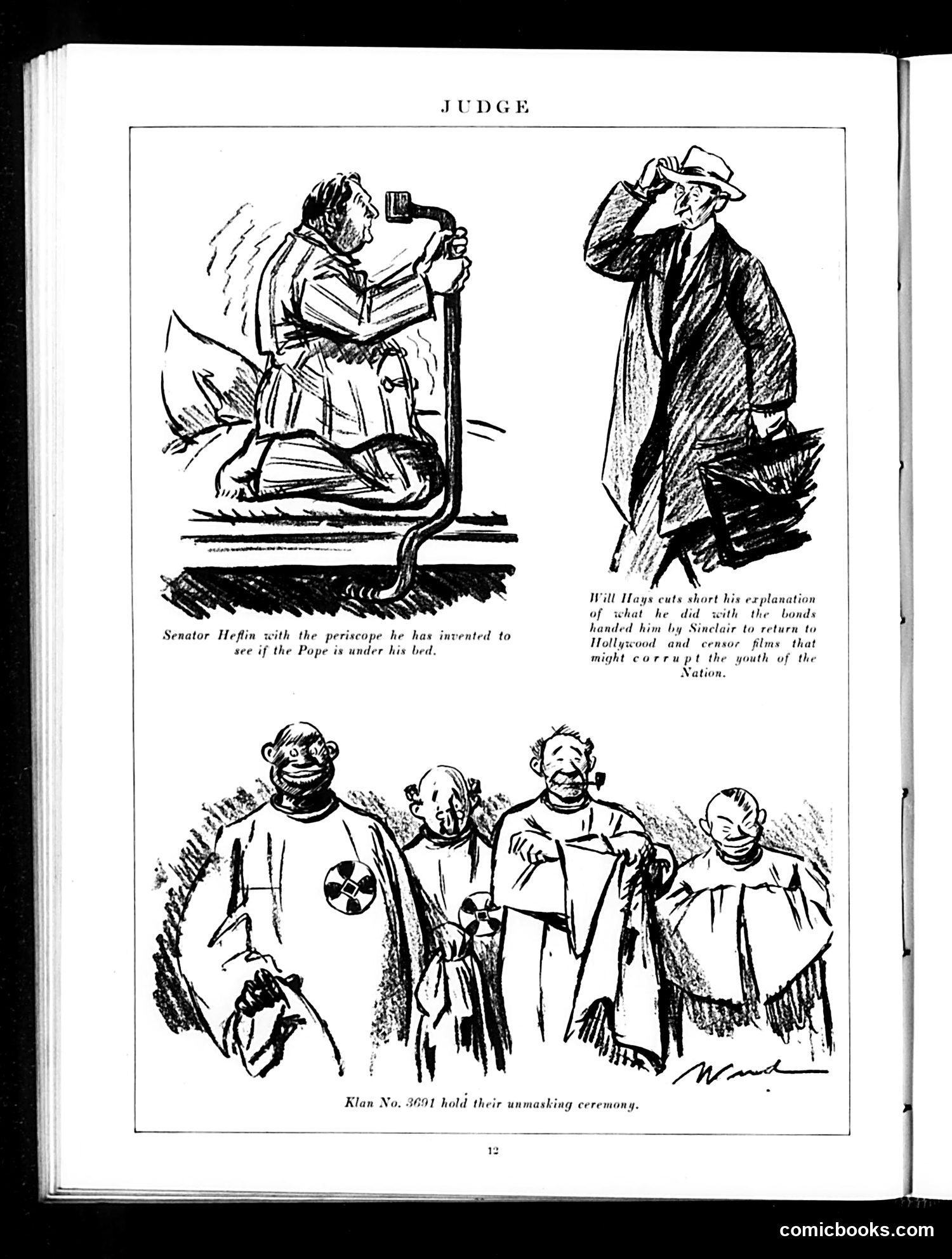
This page contains three satirical cartoons mocking prominent figures: 1. **Top left**: Senator Heflin with a periscope, ridiculing his alleged paranoia about Catholic/papal influence in America—a reference to anti-Catholic sentiment of the era. 2. **Top right**: Will Hays, Hollywood's chief censor, depicted fleeing to impose film censorship while allegedly involved in a scandal involving bonds from Sinclair (likely oil magnate Harry Sinclair of the Teapot Dome scandal). The satire suggests Hays prioritizes controlling public morality while being personally compromised. 3. **Bottom**: KKK members in robes holding an "unmasking ceremony," likely mocking the organization's secrecy and hypocrisy while commenting on the era's broader moral contradictions. The page satirizes American power brokers' selective moralism.
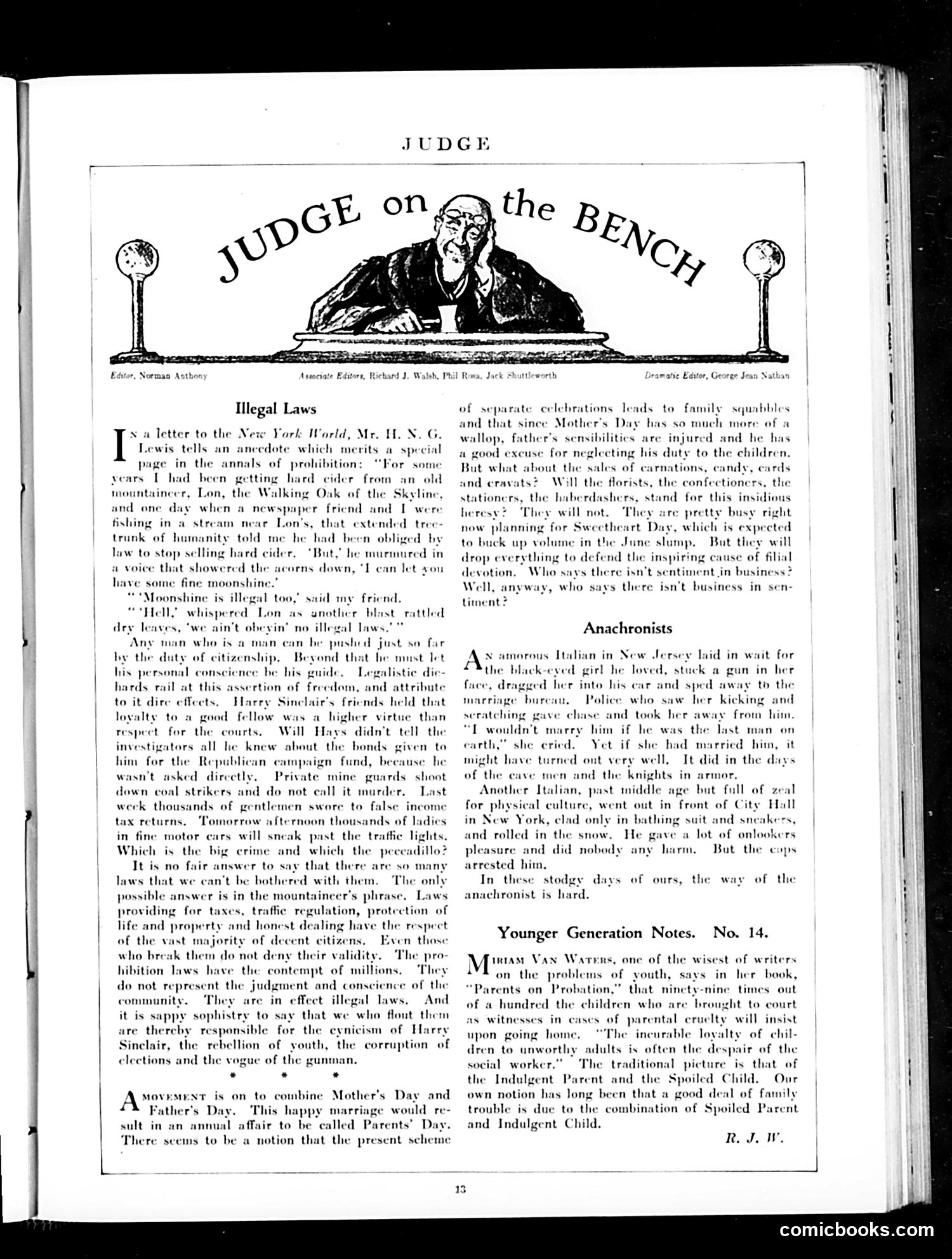
This page from *Judge* satirizes Prohibition-era hypocrisy through two main articles. **"Illegal Laws"** critiques the legitimacy of Prohibition itself. It argues that when laws (like bans on alcohol) lose public consent, citizens feel justified breaking them. The anecdote of "Lon" the moonshiner illustrates this: faced with laws he views as unjust, he refuses to obey them. The piece extends this logic broadly—if Prohibition lacks moral authority, why should citizens respect *any* law? It cites examples of wealthy figures (Harry Sinclair, Will Hays) ignoring legal/ethical obligations, suggesting that "sappy" laws breed cynicism and corruption throughout society. **"Anachronists"** uses two Italian immigrant cases to mock outdated attitudes toward women and courtship. One woman rejects a suitor's violent abduction; another resists physical coercion. The title suggests these men are relics—their behavior belongs to "cave men and knights," not modern times. The satire targets both immigrant cultural attitudes and broader resistance to evolving social norms. The page overall reflects Progressive-era anxieties about law, consent, and social change.
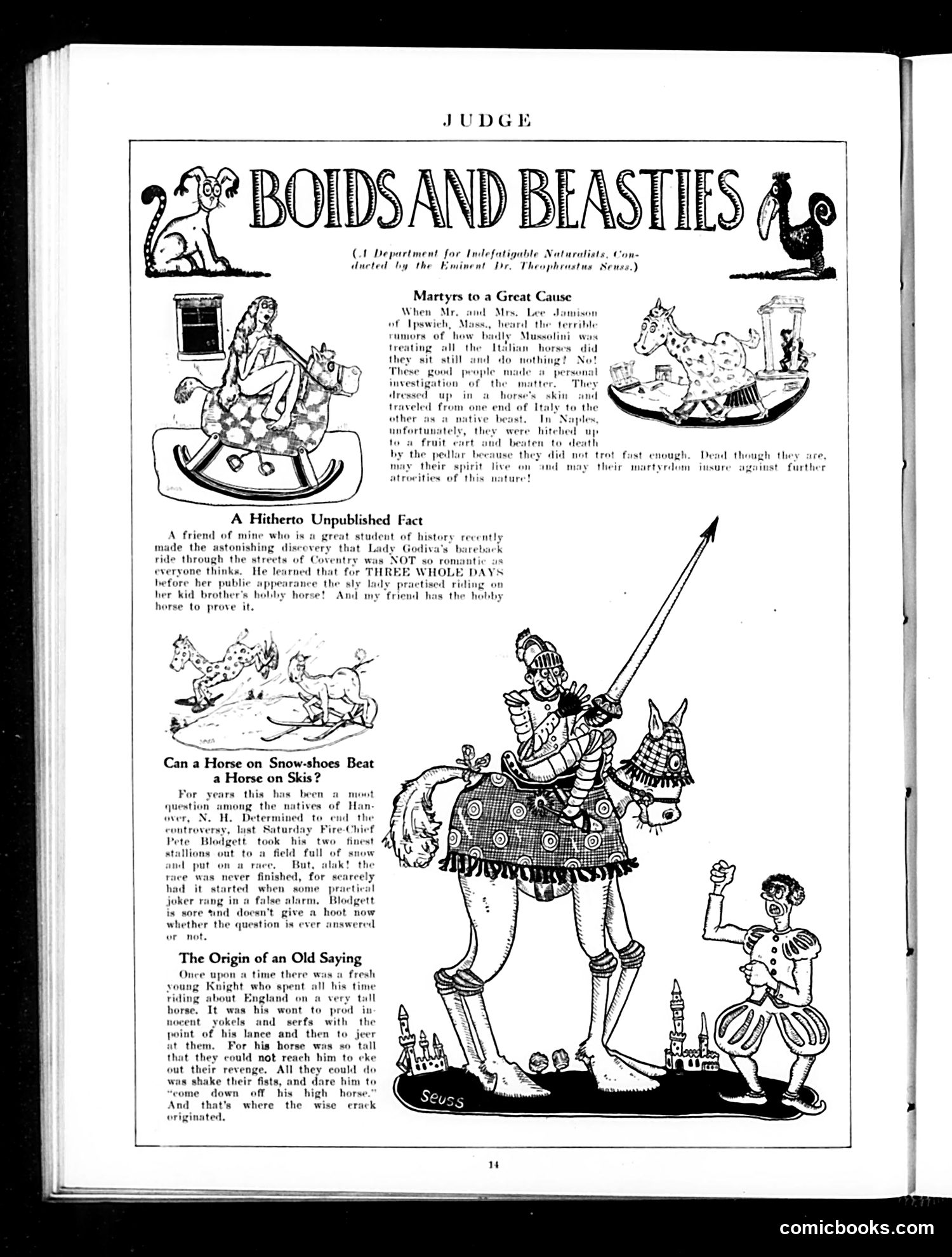
This is a satirical column called "Boids and Beasties" featuring humorous tall tales about horses and animals. The page contains three absurdist stories: 1. **"Martyrs to a Great Cause"**: A couple dressed as horses to investigate Mussolini's alleged mistreatment of Italian horses, only to be beaten to death by a cart driver—satirizing misguided activism. 2. **"A Hitherto Unpublished Fact"**: Claims Lady Godiva rode naked for three days on a hobby horse, mocking historical revisionism. 3. **"Can a Horse on Snow-shoes Beat a Horse on Skis?"** and **"The Origin of an Old Saying"**: Absurd origin stories explaining common phrases through ridiculous horse-related scenarios. The column parodies pseudointellectual "factual" columns while poking fun at overzealous do-gooders and dubious historical claims. The crude woodcut illustrations emphasize the absurdist humor. The satire appears gentle rather than biting—Entertainment masquerading as education.
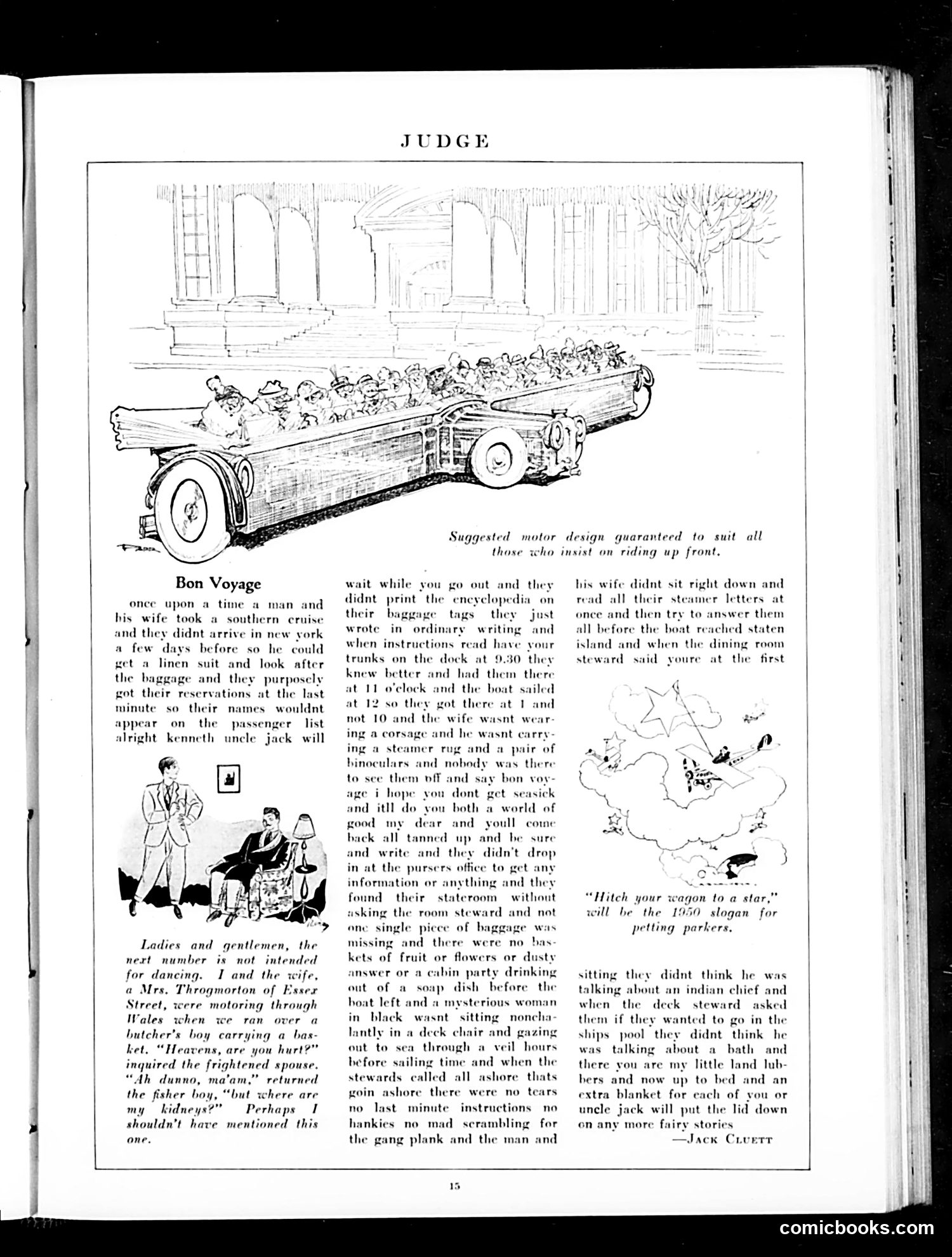
This page contains a humorous story by Jack Clevett mocking the pretensions of wealthy cruise passengers. The narrative describes a couple who deliberately avoid the conspicuous rituals of ocean travel—they skip the passenger list, don't use porters, arrive late, receive no send-off, unpack without ceremony. The satire targets middle-class social anxiety: the husband and wife are *trying* to appear unaffectedly wealthy by rejecting the showy conventions (flowers, steamer rugs, mysterious women, tearful farewells, gossip) that mark aspiring travelers. The joke is that their studied avoidance of clichéd cruise-ship behavior is itself another form of pretension. The cartoon at top shows a comically oversized motor vehicle packed with passengers—likely satirizing automobile tourism as a vulgar alternative to "proper" cruise travel. A secondary anecdote about a fisher boy and missing kidneys provides crude humor typical of the era.
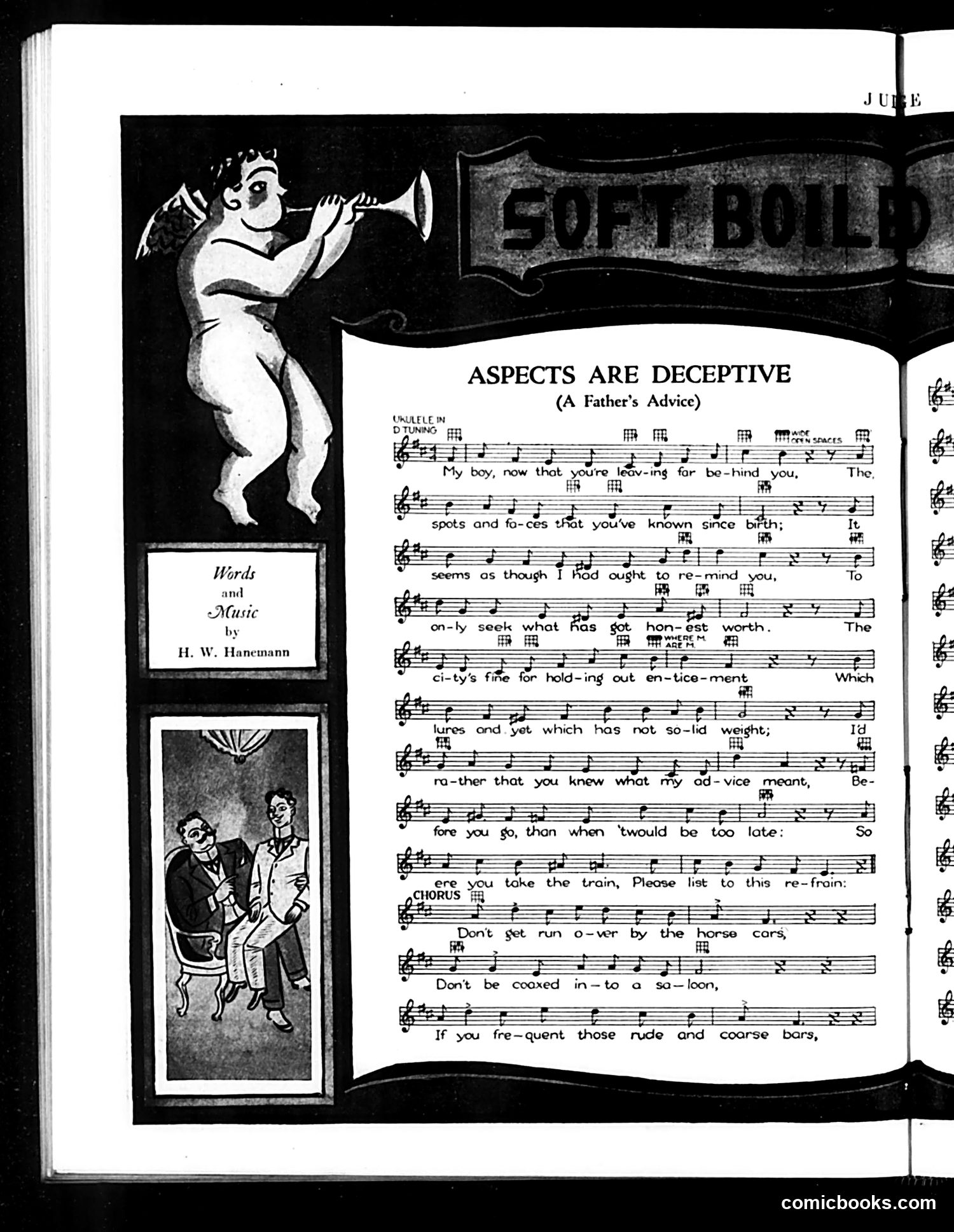
This page presents a song with fatherly advice set to music by H.W. Hanemann. The cartoon illustrates a father warning his son about urban dangers and moral pitfalls before the boy leaves home (likely taking a train). The song's chorus warns against specific 19th-century vices: being struck by streetcars (horse-drawn), entering saloons, and frequenting "rude and coarse bars"—establishments associated with drinking and lower-class vice. The father cautions that appearances can be deceptive, advising his son to look beyond surface attractions to the "honest worth" of things. The accompanying illustrations show a cherub-like figure and two gentlemen in conversation, visualizing the generational transmission of moral guidance. This represents typical Victorian-era paternalism: the protective middle-class father steering his son away from working-class temptations and urban corruption.
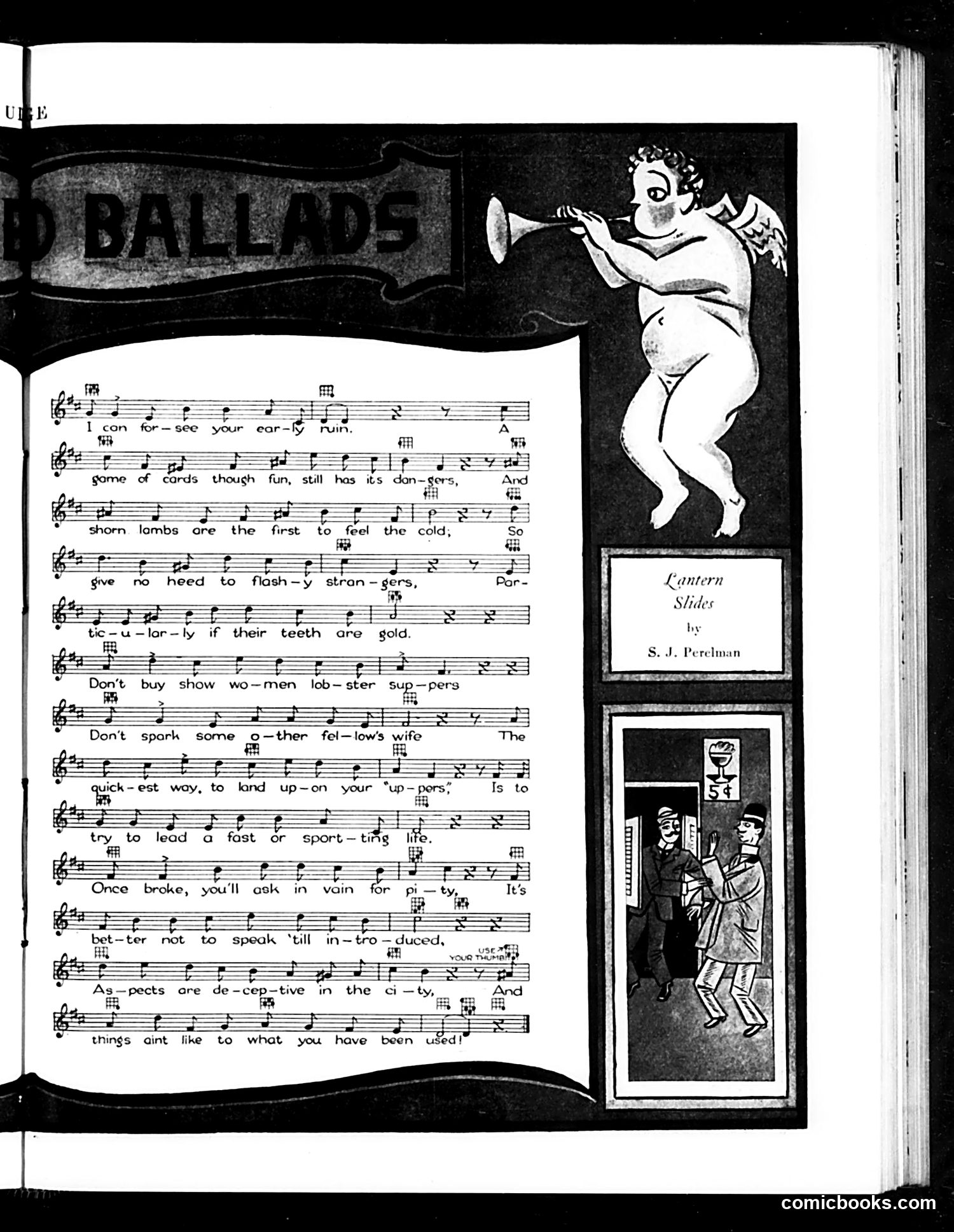
This page presents sheet music for a cautionary ballad titled "Ballads," likely from the early 20th century. The song is a moralistic warning to men about the dangers of city life and temptation. The lyrics warn against various urban vices: don't buy lobster suppers for show women, don't flirt with other men's wives, and avoid a "fast or sporting life." The refrain emphasizes that once morally "broken," one cannot recover respectability. The satire targets both working-class men vulnerable to city temptations and the hypocritical moral panic of the era. The accompanying illustrations—a cherub blowing a trumpet and a scene with two men and a woman—reinforce the melodramatic, preachy tone. S.J. Perelman is credited, suggesting this is humorous social commentary disguised as earnest moral instruction. It mockingly presents Victorian-era anxieties about urban corruption of innocent rural or working-class virtue.
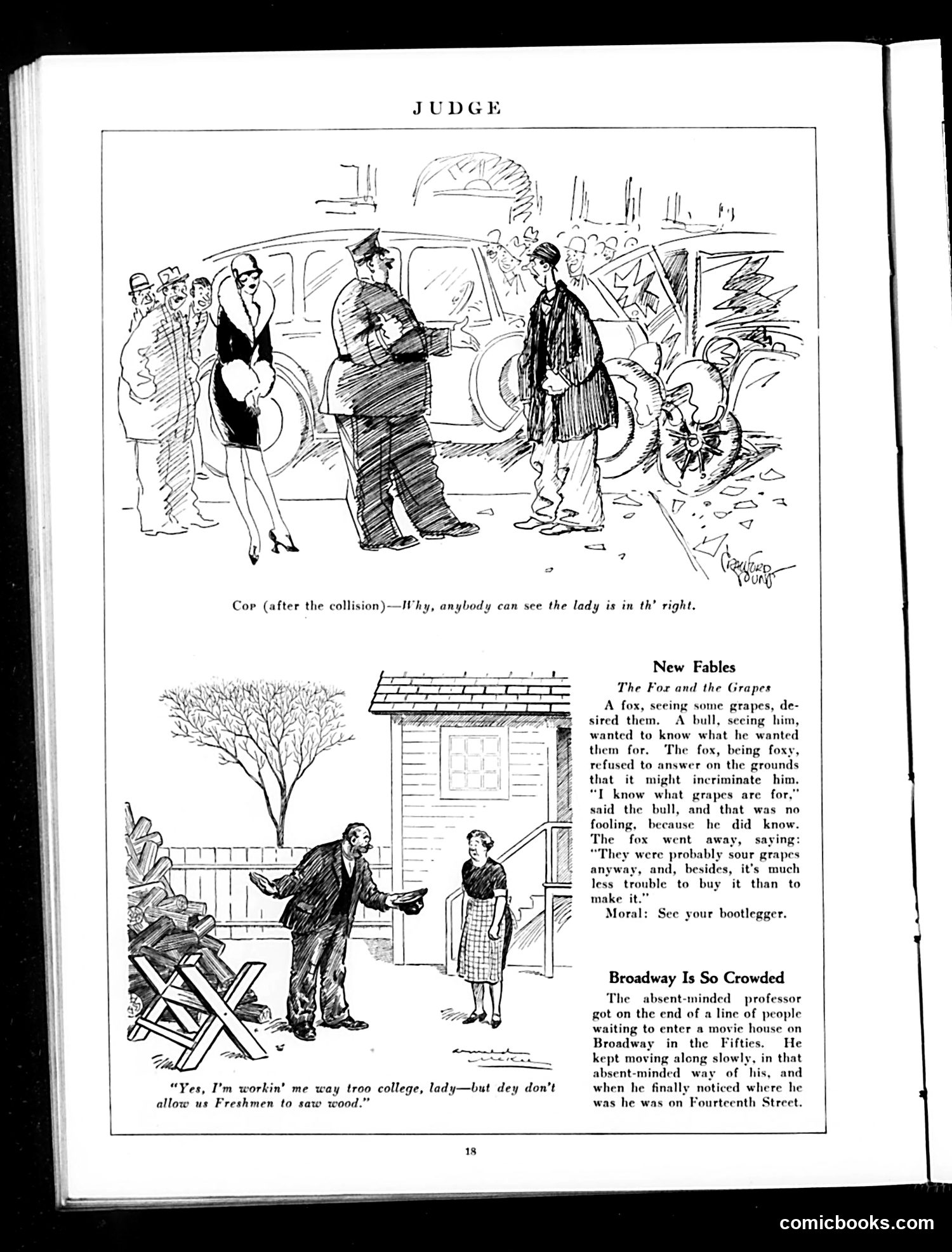
This page contains three satirical pieces from Judge magazine (appears to be 1920s-30s era based on style): **Top cartoon**: A cop at a car accident declares the lady is "in th' right"—satirizing police who reflexively blame women drivers, a common stereotype of the era. **"The Fox and the Grapes"**: A modernized Aesop's fable mocking Prohibition-era hypocrisy. The fox refuses to answer what grapes are for "on grounds that it might incriminate him," then rationalize buying ready-made wine from a "bootlegger" rather than making it himself. The satire targets people who publicly opposed Prohibition while secretly purchasing illegal alcohol. **"Broadway Is So Crowded"**: A brief anecdote about an absent-minded professor who walks from one end of a movie line to the other without noticing he's traveled from Fifteenth Street to Fourteenth Street—satirizing urban congestion and absent-mindedness. **Bottom cartoon**: A man claims to be "workin' me way through college" by sawing wood, but freshmen aren't allowed to. This likely mocks working-class college students or college hazing traditions.
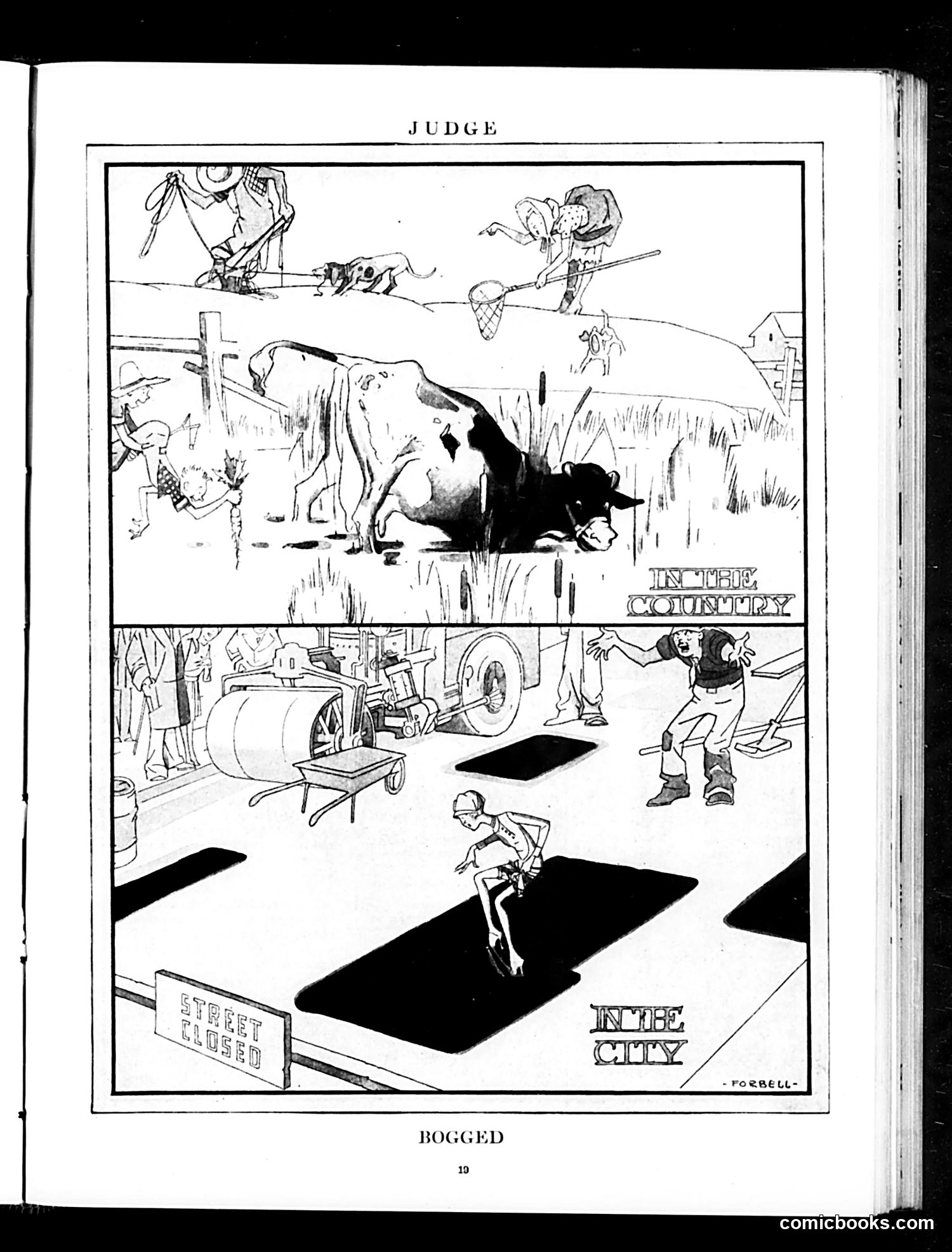
This two-panel cartoon contrasts rural and urban life. The top panel labeled "IN THE COUNTRY" shows a farmer stuck in mud with his cow, depicting rural hardship and poor road conditions. The bottom panel labeled "IN THE CITY" shows an urban street scene with a woman stuck in mud on a "STREET CLOSED" area, surrounded by construction equipment and workers. The satire appears to criticize infrastructure problems affecting both countryside and city—muddy, impassable conditions plague Americans regardless of location. The titled word "BOGGED" reinforces that progress and development are literally stuck. This likely references early 20th-century American infrastructure complaints, when roads remained primitive and city construction frequently disrupted traffic. The cartoon suggests that modern development hasn't solved fundamental problems of mobility and cleanliness.
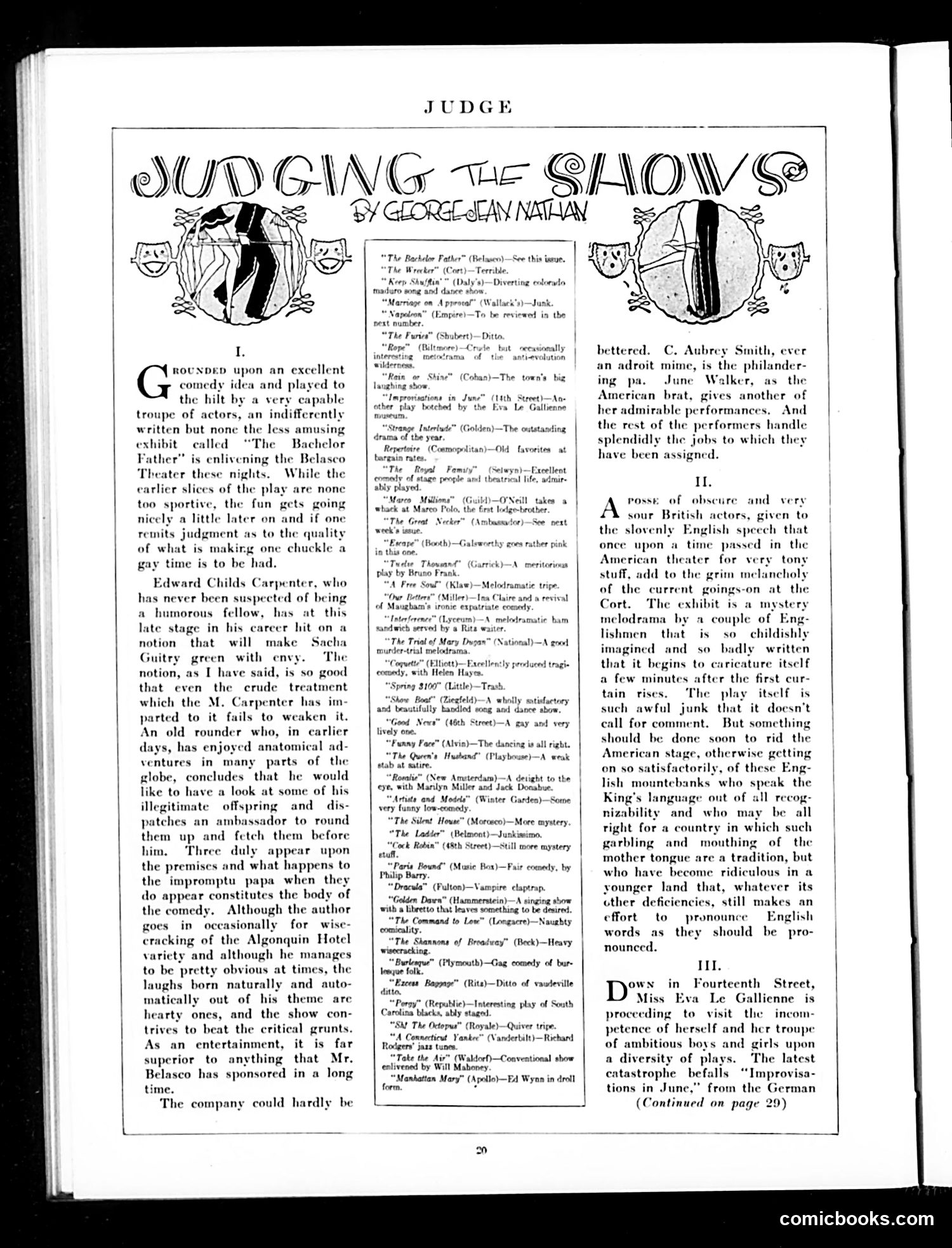
This is a theater review column by George Jean Nathan, a prominent drama critic of the 1920s. The main text critiques "The Bachelor Father," a play at the Belasco Theater about an aging libertine who summons his illegitimate children to meet him. Nathan praises the premise as clever but notes the script is mediocre, yet the capable cast and natural humor make it entertaining. The lengthy sidebar lists current Broadway shows with brief dismissive or complimentary assessments—typical of Judge's satirical approach to theater criticism. Shows are rated as "terrible," "junk," "melodramatic tripe," or occasionally "excellent." This reflects the magazine's acerbic humor: Nathan and Judge mocked both theatrical pretension and genuine mediocrity with equal vigor, making theater-going a subject for sophisticated urban readers.
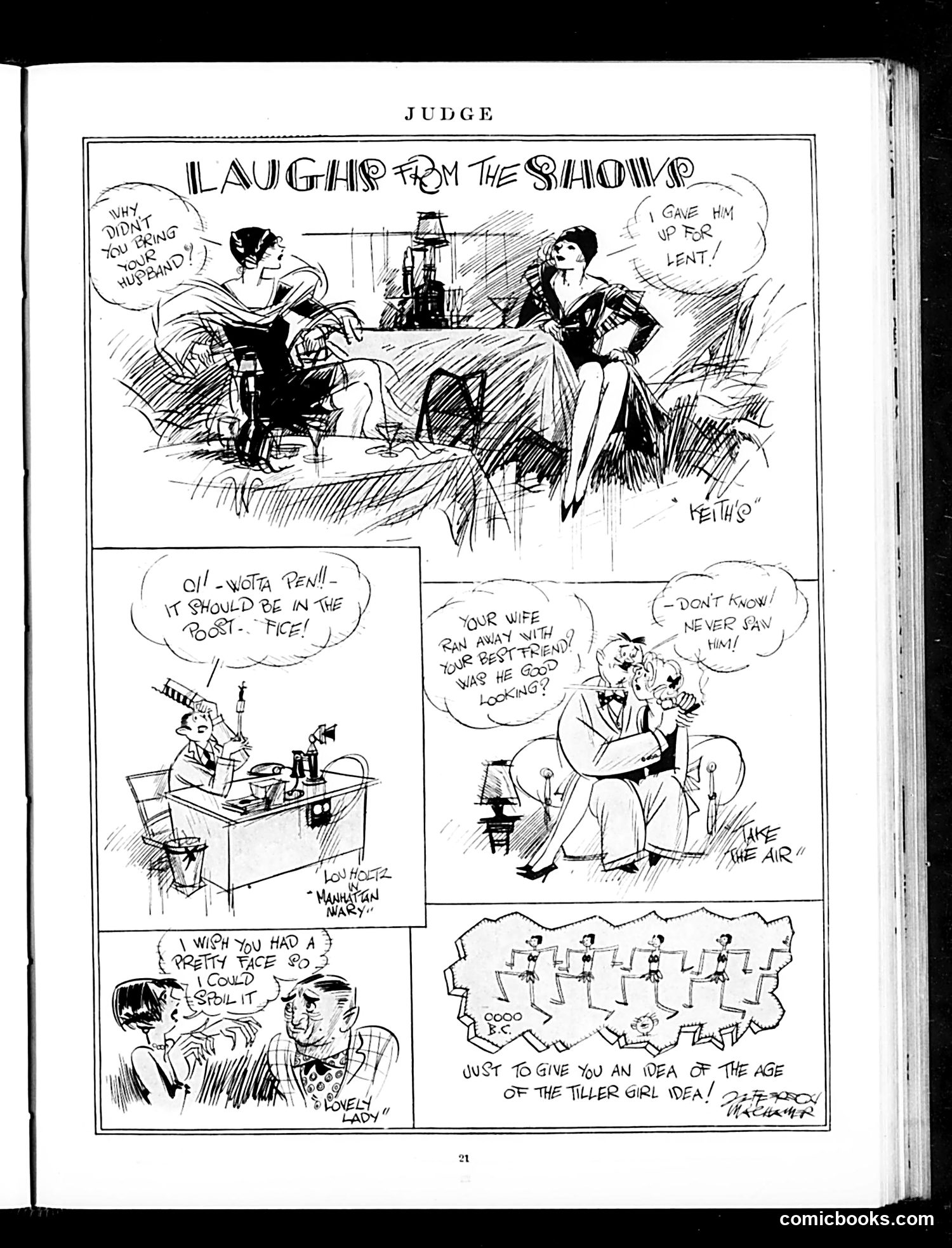
This multi-panel comic satirizes 1920s social attitudes about women and marriage. The top panel shows two women discussing husbands—one complaining she "gave him up for Lent" (a religious sacrifice joke). The lower panels mock male perspectives: a man wishes his wife had a "pretty face," another discusses his wife running away with her "best friend" (implying infidelity or scandal), and a couple jokes about the "tiller girl idea"—a reference to the "flapper" or modern, independent young woman of that era. The satire targets contemporary anxieties about changing gender roles and women's increasing independence during the Jazz Age. The crude characterizations and men's shallow comments ridicule both male attitudes toward women and the emerging "modern girl" phenomenon itself, reflecting the period's conflicted social commentary on femininity and marriage.
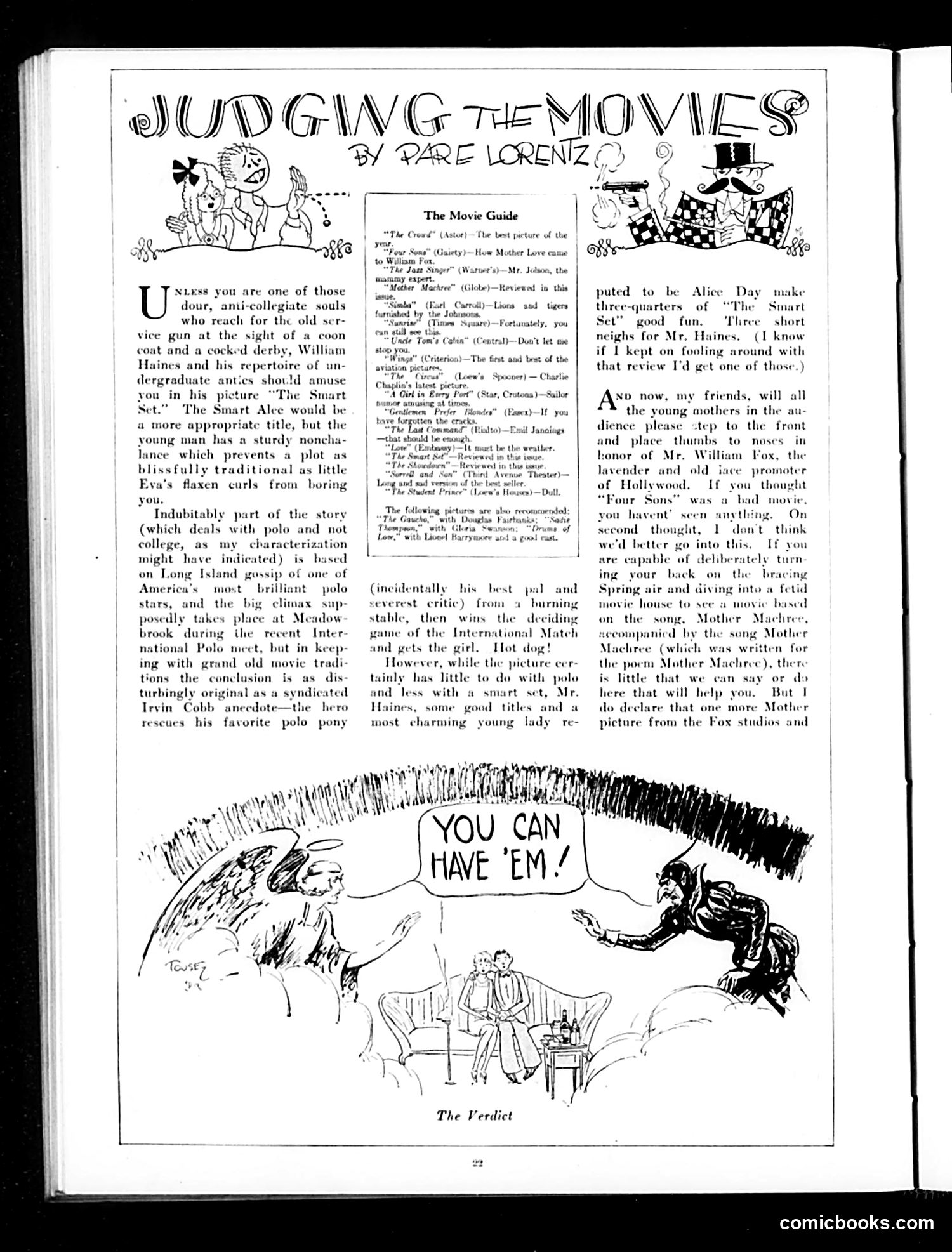
This page reviews contemporary silent films for Judge magazine's readers. Critic Pare Lorentz discusses William Haines in "The Smart Set," praising Haines's comedic timing despite the film's thin plot. He notes the movie inappropriately uses polo and aristocratic settings as mere backdrop. The cartoon's verdict—"You Can Have 'Em!"—depicts two figures (likely representing good taste and the devil/temptation) arguing over movie reels, satirizing audiences' willingness to watch mediocre films. Lorentz particularly mocks William Fox studio's repeated "Mother Machree" formula films, sarcastically suggesting viewers would endure bad movies just to hear the same sentimental song again. His tone suggests 1920s audiences' appetite for formulaic sentimentality despite poor quality—a criticism that resonates across entertainment history.
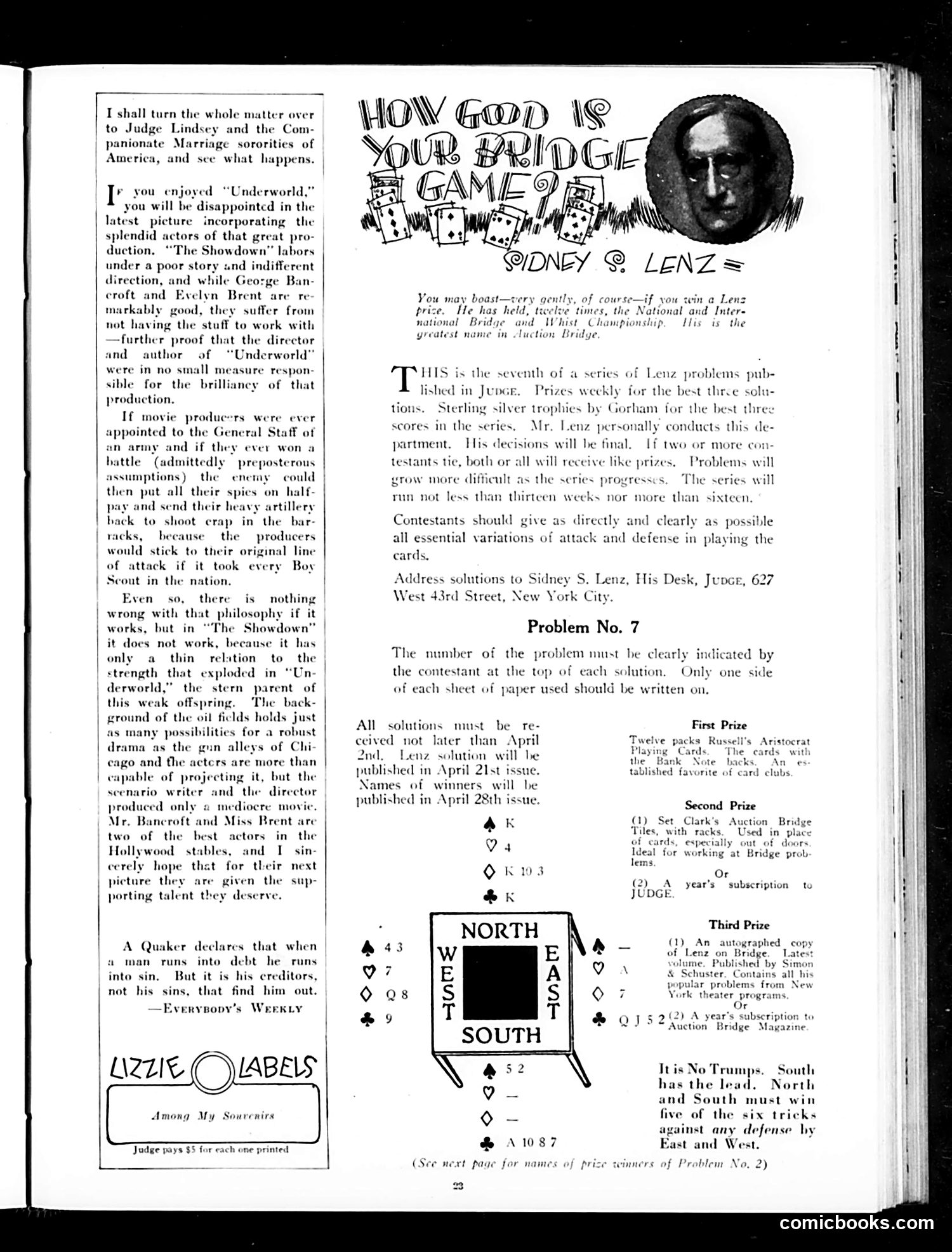
This page contains **film criticism** and a **bridge card game competition**. The top section critiques "The Showdown," a 1928 film starring George Bancroft and Evelyn Brent. The reviewer argues the film fails despite talented actors because it lacks the strong direction and screenplay of their previous success, "Underworld." The extended military metaphor—comparing producers to generals—suggests that strategic consistency matters in filmmaking, though this philosophy only works when executed well. The bulk of the page announces **Problem No. 7 of a bridge competition** series in Judge magazine, sponsored by renowned bridge champion Sidney S. Lenz. Contestants submit solutions for prizes including silver trophies and subscriptions. This was a legitimate puzzle competition; bridge was enormously popular among educated American audiences in the 1920s-30s. The page also includes a humorous quote about Quaker ethics and debt, plus an advertisement for "Lizzie Labels."
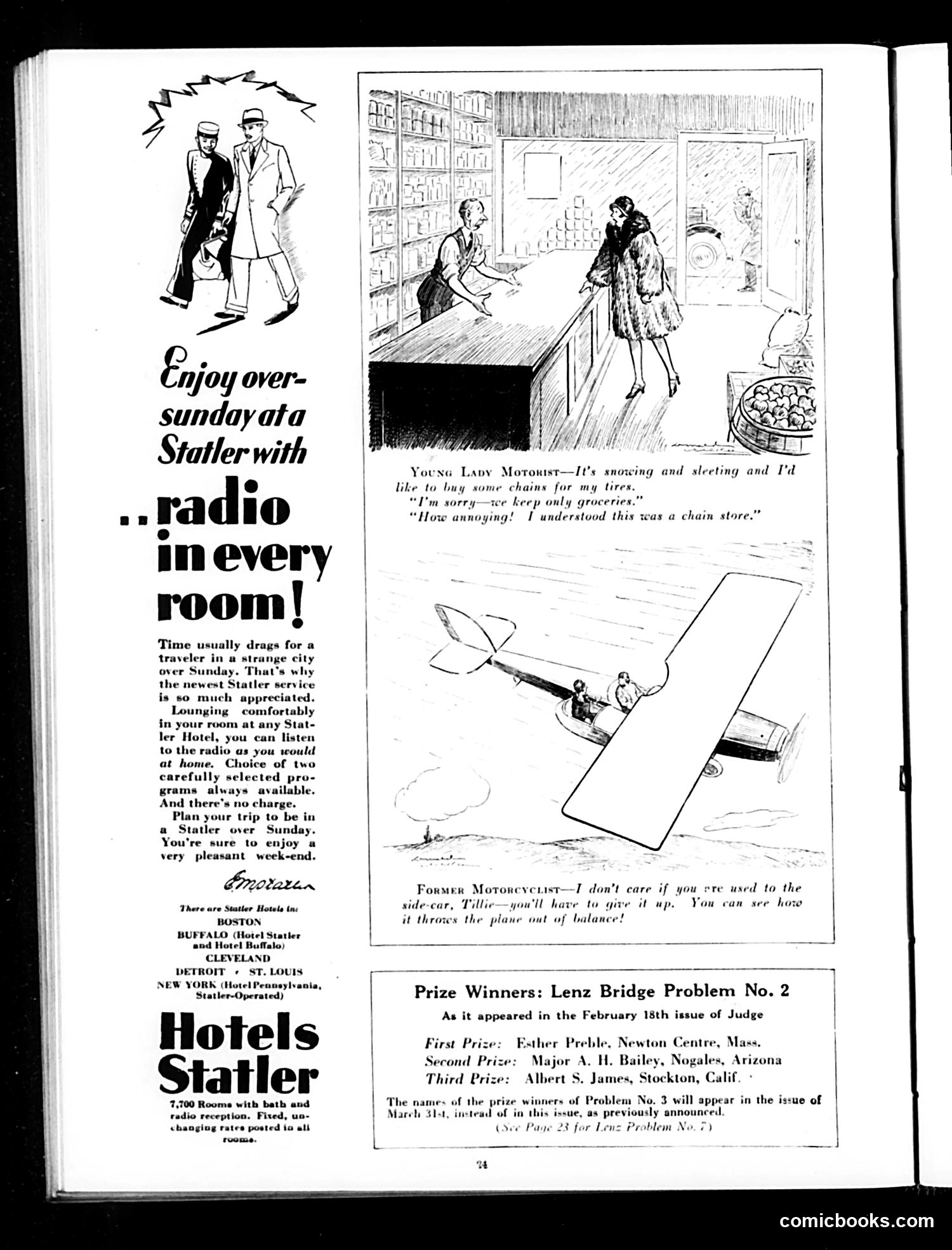
This page contains **three distinct jokes** rather than political cartoons: 1. **"Chain Store" pun**: A young woman entering a grocery store during winter asks to buy tire chains, misunderstanding "chain store" as a store that sells chains. The humor relies on this literal/figurative wordplay. 2. **"Motorcyclist" joke**: A former motorcycle sidecar rider must abandon the sidecar when transitioning to airplane travel, as it throws off the plane's balance. The absurdist humor comes from applying motorcycle logic to aviation. 3. **Statler Hotels advertisement**: The left side promotes Statler Hotels' new radio service in guest rooms, featuring two well-dressed men. **Context for modern readers**: These jokes reflect 1920s-30s concerns—winter tire chains were essential equipment, motorcycles with sidecars were common vehicles, and radio in hotel rooms was a novel luxury feature. The humor is gentle wordplay and situational comedy typical of Judge magazine's style, with no political intent.
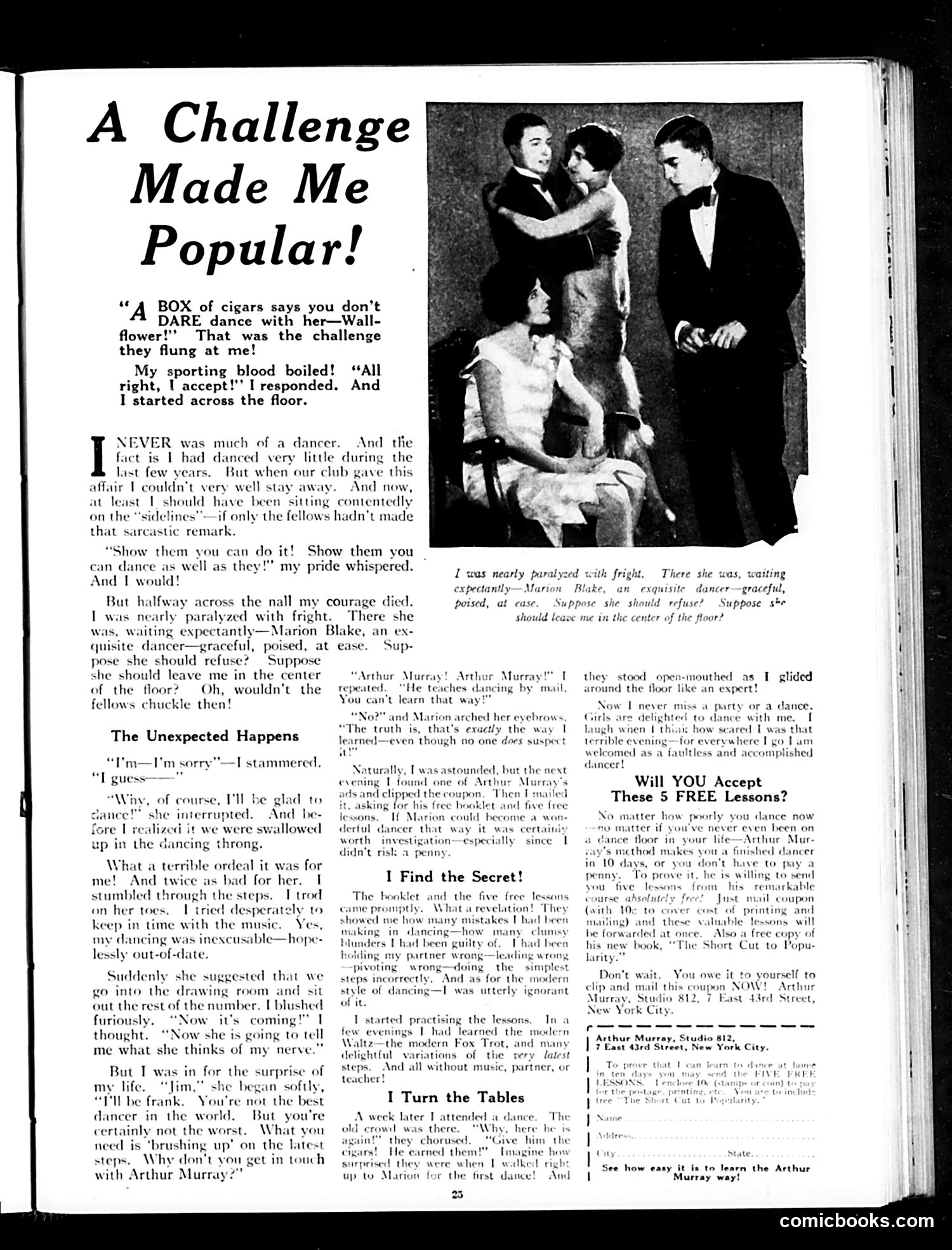
This page is primarily **advertising disguised as narrative fiction** for Arthur Murray dance studios. The illustrated story describes a man challenged to dance with an attractive woman (Marion Blake) at a club social event. Initially terrified of his outdated dancing skills, he stumbles through the dance but impresses her anyway. The narrative then pivots to **product placement**: Marion reveals she learned through Arthur Murray's mail-order dance course. The man subsequently enrolls and claims rapid improvement. The **satire targets** the vanity of social climbing and romantic anxiety among middle-class men, while simultaneously exploiting those insecurities to sell dance lessons. The "challenge" framing (peer pressure, proving masculinity, impressing women) was marketing psychology designed to appeal to insecure men. The accompanying coupon offers "5 FREE LESSONS" to entice reader response—a standard early 20th-century direct-mail advertising technique.
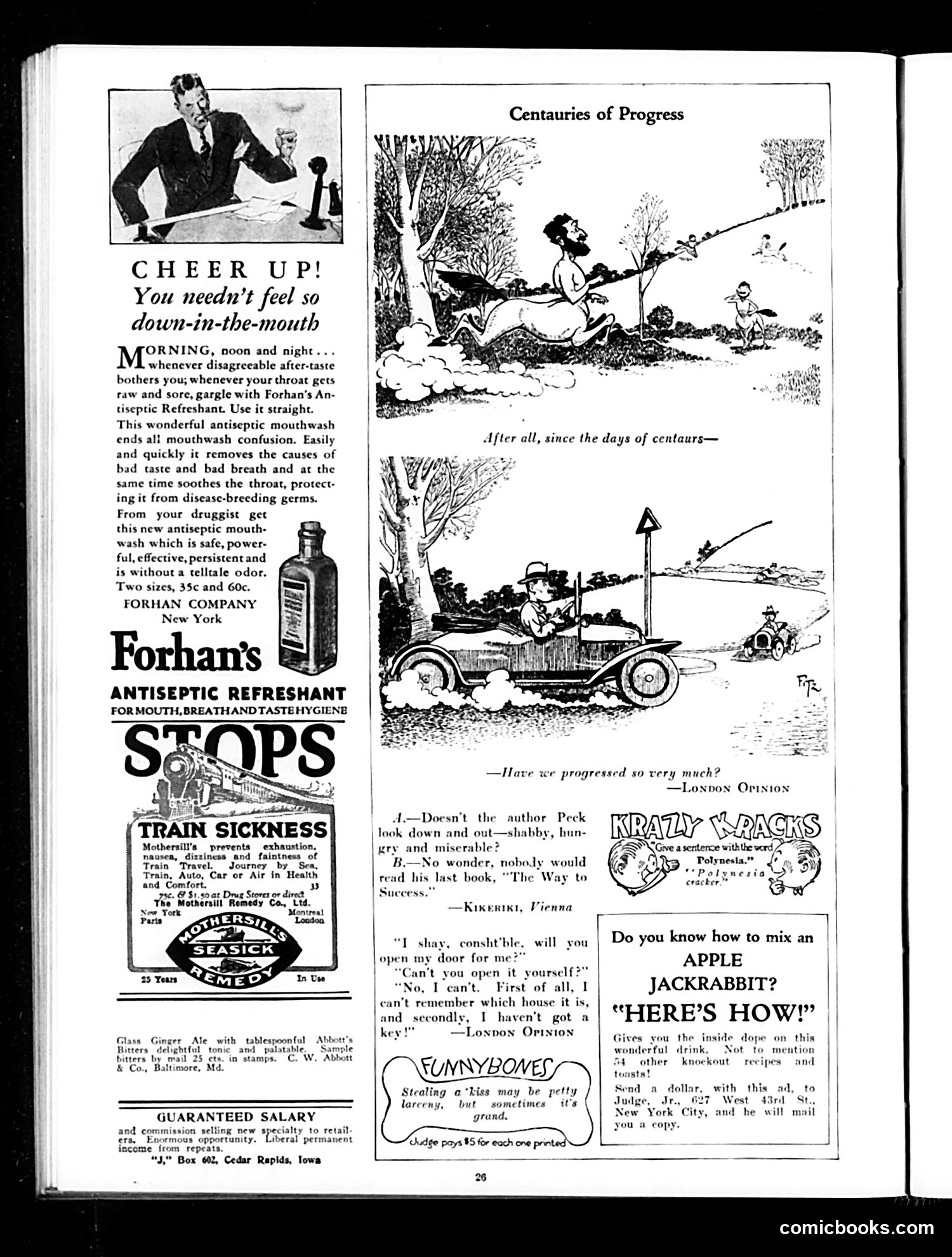
This page is primarily **advertising** interspersed with brief humorous content. The main cartoon, "Centuries of Progress," uses simple line drawings to contrast primitive life (people in nature) with modern automotive progress (a man driving a car), with the caption asking "Have we progressed so very much?" — a **satirical jab at modern "progress,"** suggesting that despite technological advancement, humanity may not have fundamentally improved. The page features multiple product advertisements (Forhan's mouthwash, Mothersill's train sickness remedy) and humor columns like "Funnybones" with London Opinion reprints. The "Apple Jackrabbit" recipe advertisement appears to be a humorous novelty item. Overall, this reflects **early 20th-century American satirical magazine content**: mixing social commentary about modernity with consumer advertising and light comedy, typical of Judge magazine's blend of satire and commerce.
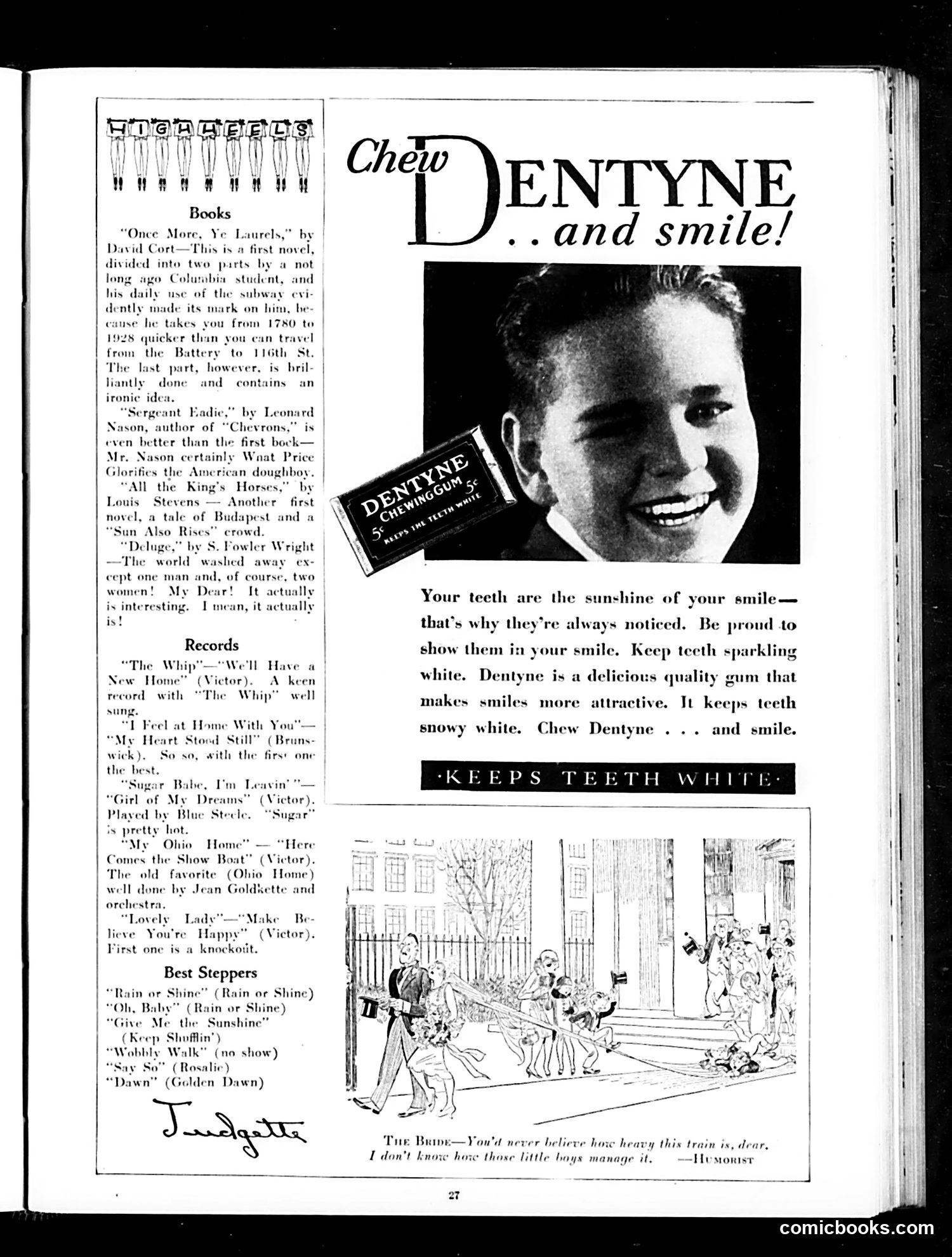
This page is primarily a **Dentyne gum advertisement** occupying roughly half the space, with book and music reviews on the left side. The main ad features a man's smiling face next to a Dentyne package, with copy emphasizing that teeth are "the sunshine of your smile" and promoting the gum's whitening properties. Below the ad is a **single-panel cartoon** (credited to "Humorist") showing a bride commenting on a toy train: "You'd never believe how heavy this train is, dear. I don't know how those little boys manage it." The joke is straightforward domestic humor—a new bride is innocently puzzled by the weight of a child's toy train, not realizing it's designed for children to operate. It's gentle, non-political satire typical of *Judge* magazine's lighter content. The cartoon simply illustrates a relatable misunderstanding between newlyweds.
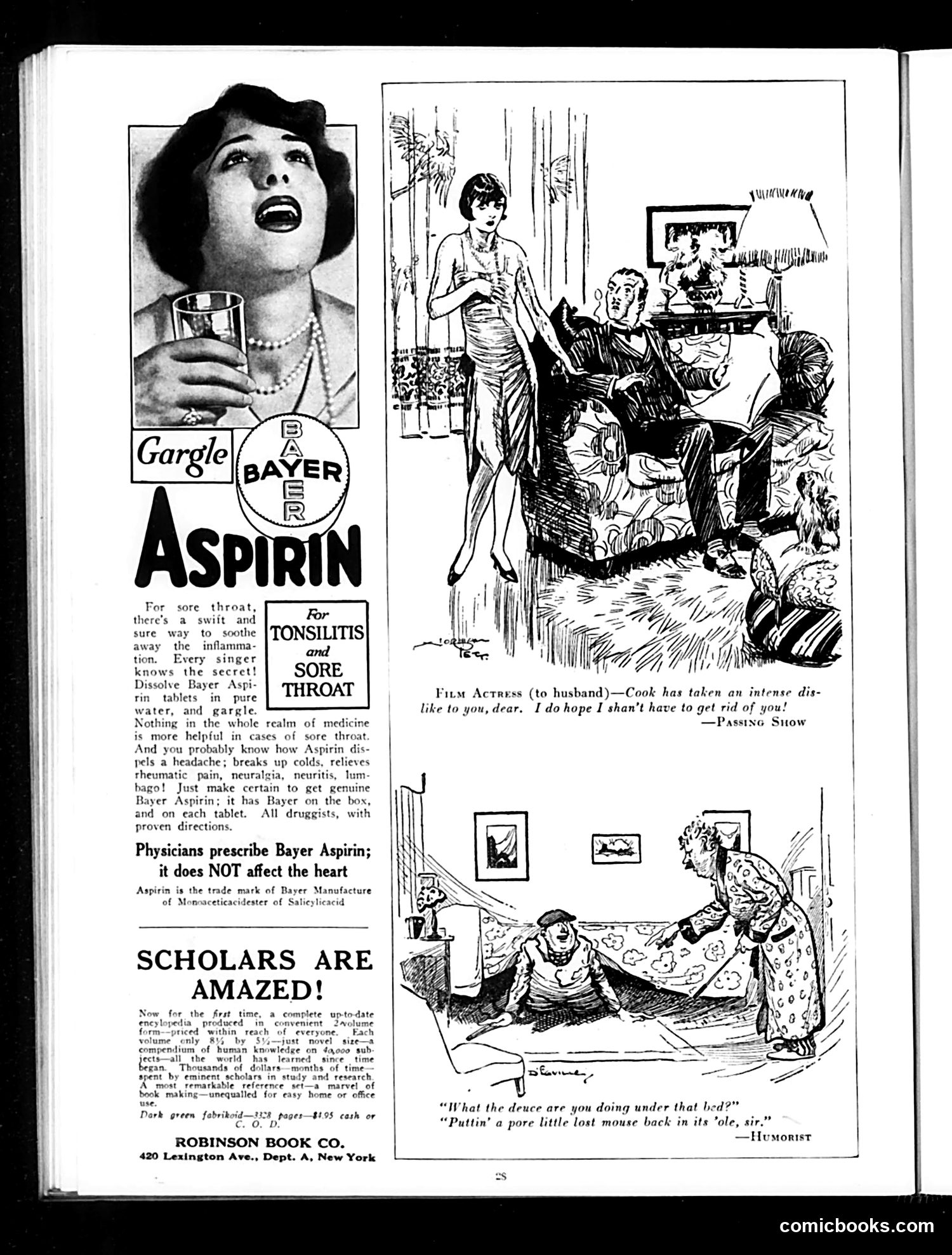
This page contains **advertisements and two cartoons** from an early 20th-century satirical magazine. The **Bayer Aspirin ad** (left) promotes the drug for sore throats and various ailments, featuring a woman gargling. It's notable for claiming aspirin "does NOT affect the heart"—likely responding to contemporary medical concerns about the drug's safety. The two cartoons are domestic humor: 1. **"Passing Show"** depicts a wife telling her husband the cook dislikes him so much she might have to fire the *husband* instead. The joke relies on class dynamics—servants wielded genuine household power. 2. **"Humorist"** shows a servant discovering a man under a bed, explaining he's returning a lost mouse to its hole. The humor comes from the servant's innocent misinterpretation of what appears to be compromising behavior. Both cartoons mock upper-class domestic life through servant perspectives, a common Judge trope. The **Robinson Book Company ad** promotes an affordable home encyclopedia—suggesting aspirational middle-class self-improvement.
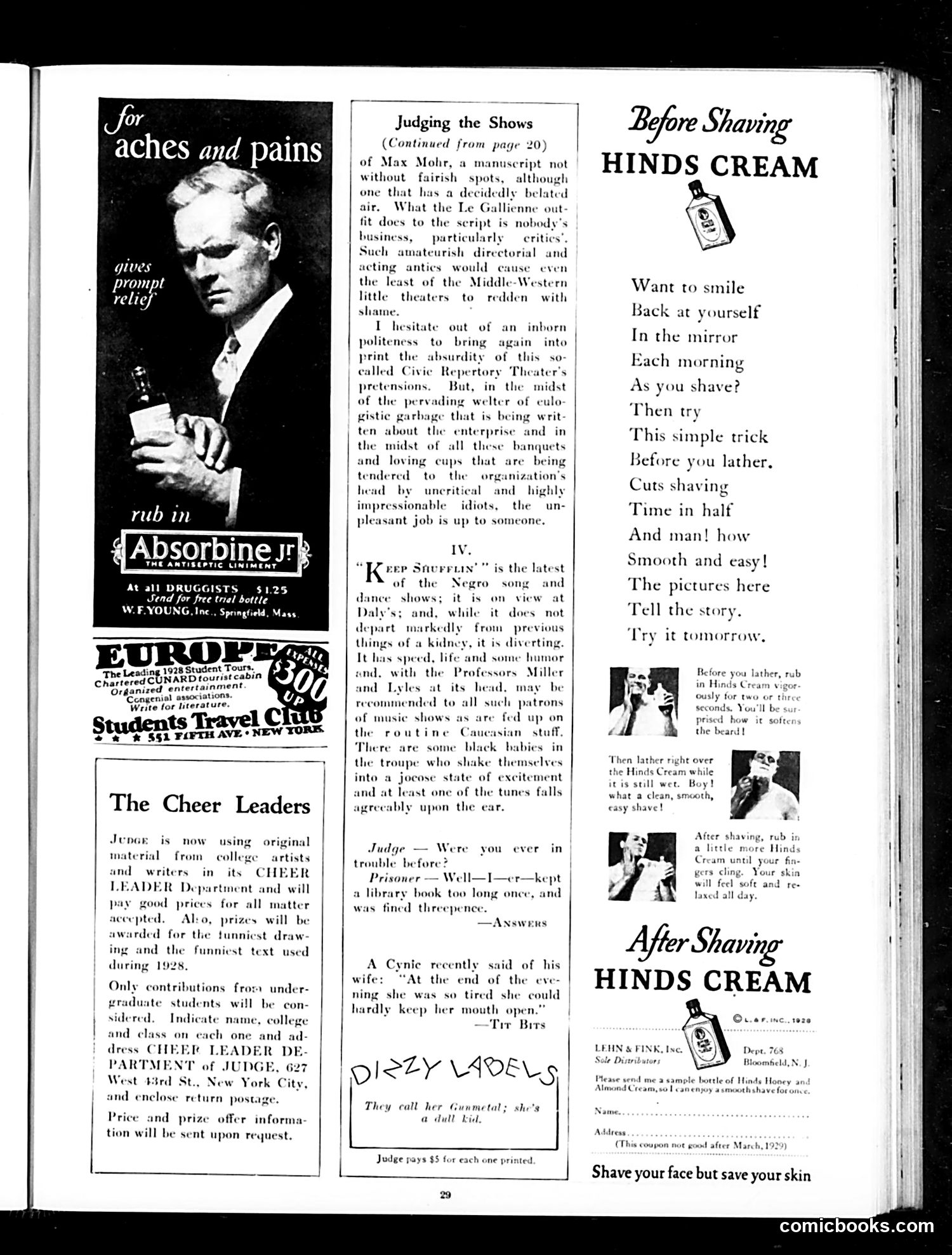
This page is primarily **advertising and filler content** rather than satire or editorial cartoons. The dominant content includes: 1. **Product Advertisements**: Absorbine Jr. (pain relief liniment), Hinds Cream (shaving product with instructional photos), and the Studebaker travel club. 2. **"The Cheer Leaders" Section**: Judge's call for college student submissions—original artwork and humorous writing—with prize money offered. This was a recurring feature encouraging undergraduate contributions. 3. **Theater Review ("Judging the Shows")**: Continued criticism of civic theater productions, particularly dismissing a modernist play and favorably reviewing "Keep Shufflin'," a Black musical revue with performers Miller and Lyles. 4. **Brief Humor Items**: Small jokes about a cynic's wife and a prisoner's innocence, typical filler for the era. The page contains **no political cartoons or identifiable caricatures**. It reflects 1928 magazine economics: editorial content subsidized by advertising revenue and reader-submitted material.
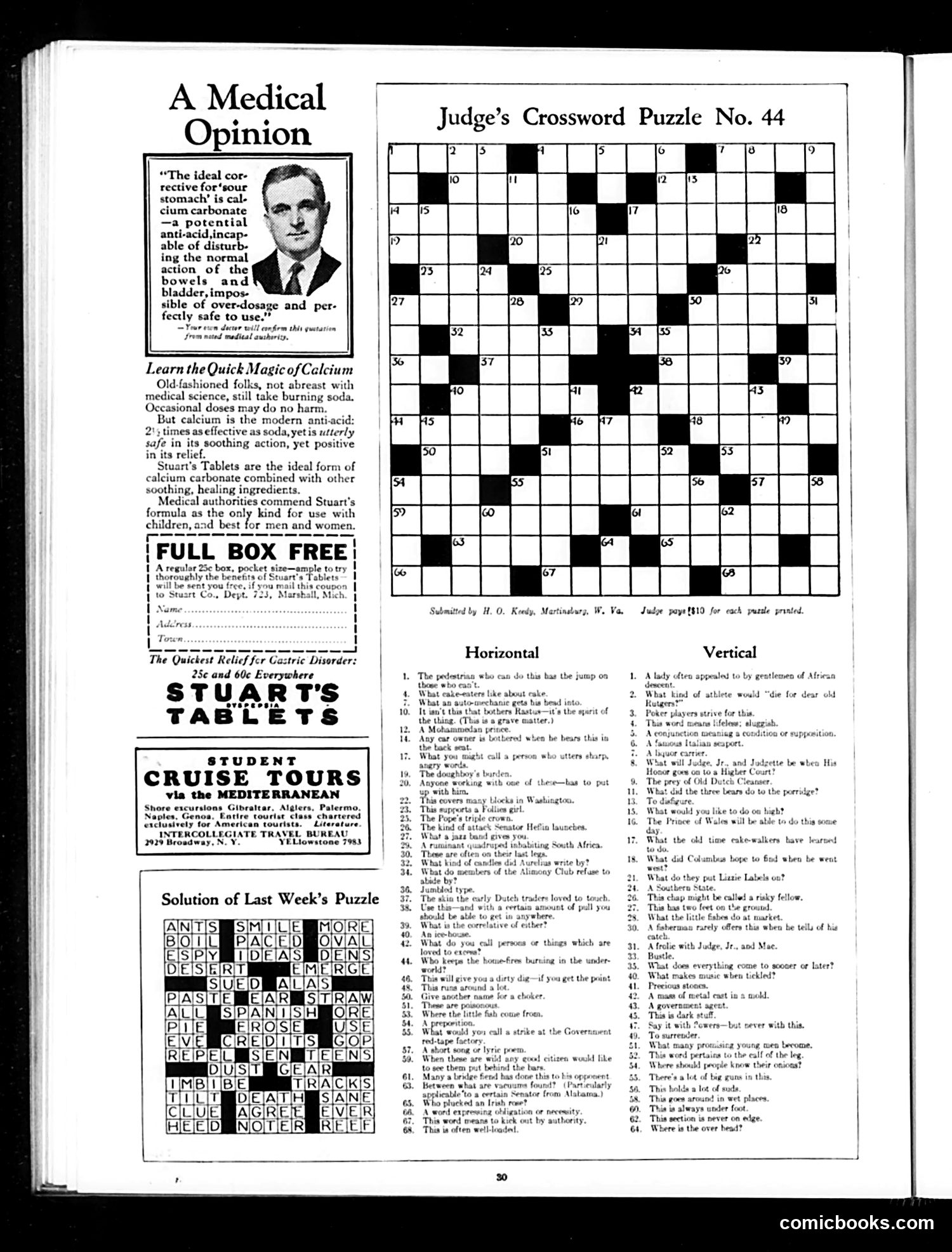
This page is primarily **advertising and puzzle content**, not political satire. The main elements are: **"A Medical Opinion"** section: An advertisement for Stuart's Tablets, a calcium carbonate antacid. It features a doctor's testimonial endorsing calcium carbonate over baking soda for treating "sour stomach" (acid reflux). The pitch emphasizes modern medical science versus "old-fashioned folks" who still use burning soda—a common early 20th-century marketing trope positioning new commercial products as scientifically superior to home remedies. **Supporting advertisements**: Student cruise tours via the Mediterranean and other travel/education services typical of Judge's readership. **"Judge's Crossword Puzzle No. 44"** and its solution from the previous week. The satirical magazine here functions primarily as a **vehicle for advertising to affluent readers** rather than delivering political commentary. The medical opinion represents period marketing rhetoric about digestive health products.
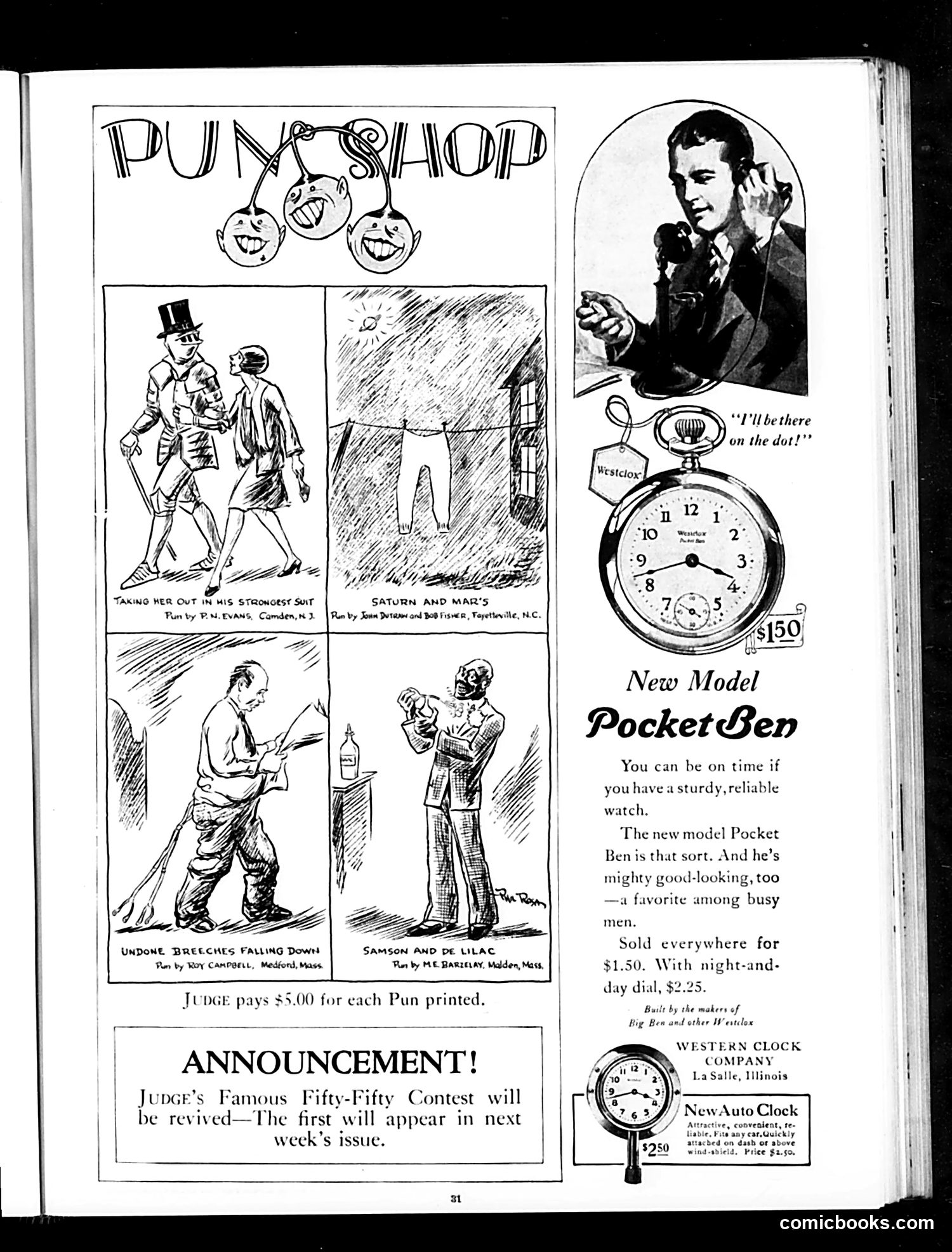
This page mixes humor content with advertising from what appears to be the early 20th century. **The "Pun Shop" cartoons** are visual puns—four comic panels where the captions create double meanings from the illustrations. Examples include "Taking Her Out in His Strongest Suit" (showing a man and woman, playing on card suits) and "Saturn and Mars" (mythological references). Judge paid $5 per pun submitted by readers, making this a participatory humor feature. **The announcement** promotes Judge's "Fifty-Fifty Contest," a popular reader-submission contest being revived. **The advertising** dominates the right side, promoting "Pocket Ben" pocket watches ($1.50-$2.25) made by Western Clock Company. The ad uses a photo of a man pointing at a watch with "I'll be there on the dot!" - appealing to busy professionals who needed reliable timekeeping. The page reflects early 1900s American humor: accessible wordplay, reader participation, and ads targeting working men concerned with punctuality and respectability.
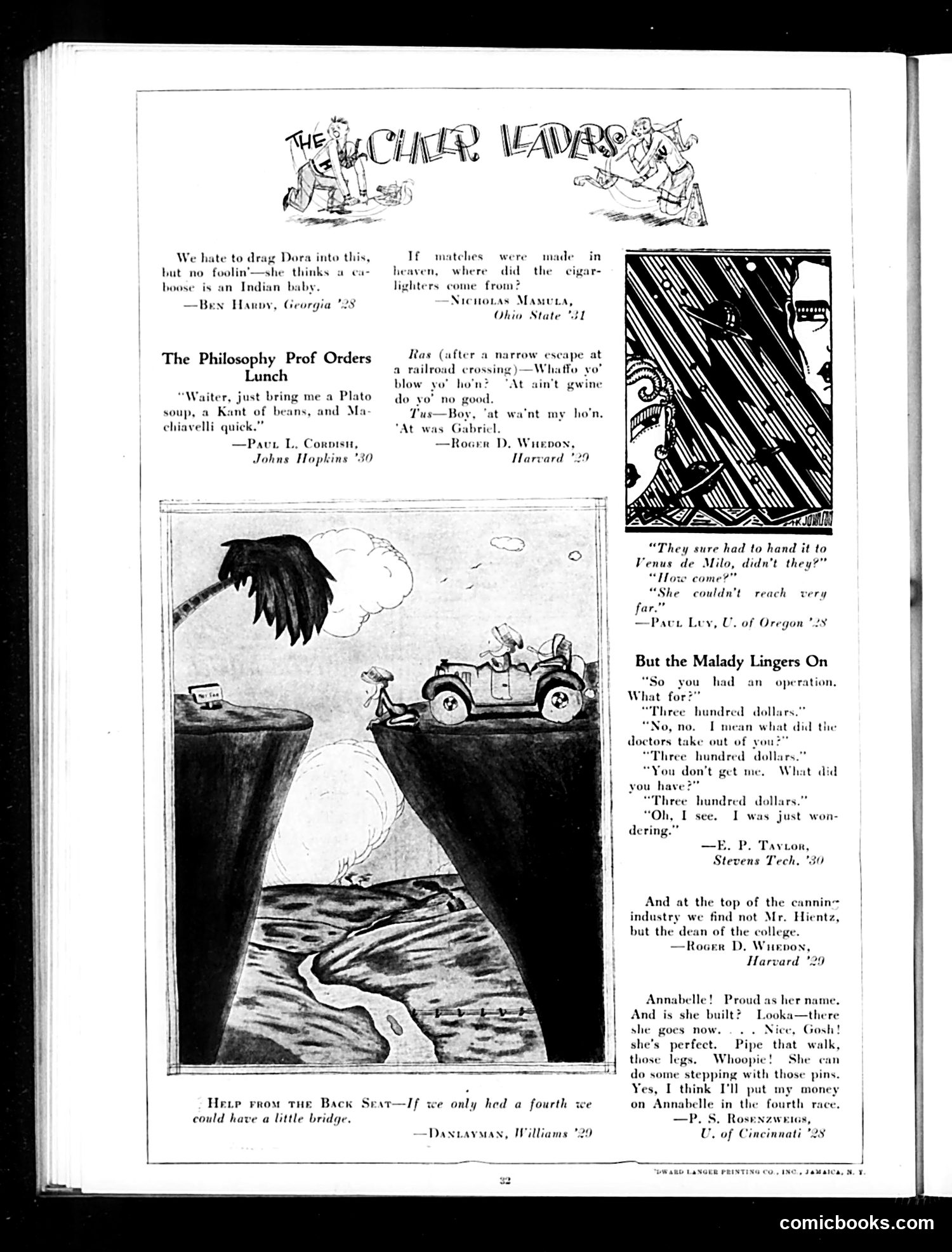
This is a humor page collecting brief jokes and anecdotes submitted by college students, identified by their schools and graduation years (mostly late 1920s-early 1930s). The large cartoon depicts a dramatic scene: a figure in a car teetering on a cliff edge above a chasm, with a vulture circling overhead. The caption jokes about needing "a fourth" person to build a bridge—dark humor about a dangerous situation. The surrounding text consists of student-submitted one-liners and short comedic scenarios: - Philosophy professor ordering lunch using academic jargon - Confusion about where matches/cigarette lighters originate - A dialect joke about a railroad crossing - A doctor charging $300 without explaining what he removed - A comment about a college dean running a canning factory - A student comparing a woman named Annabelle to a racehorse These are collegiate jokes typical of the era—wordplay, philosophy humor, and somewhat crude observations about women. The page reflects 1920s-30s college culture and the type of humor Judge's target audience found amusing.
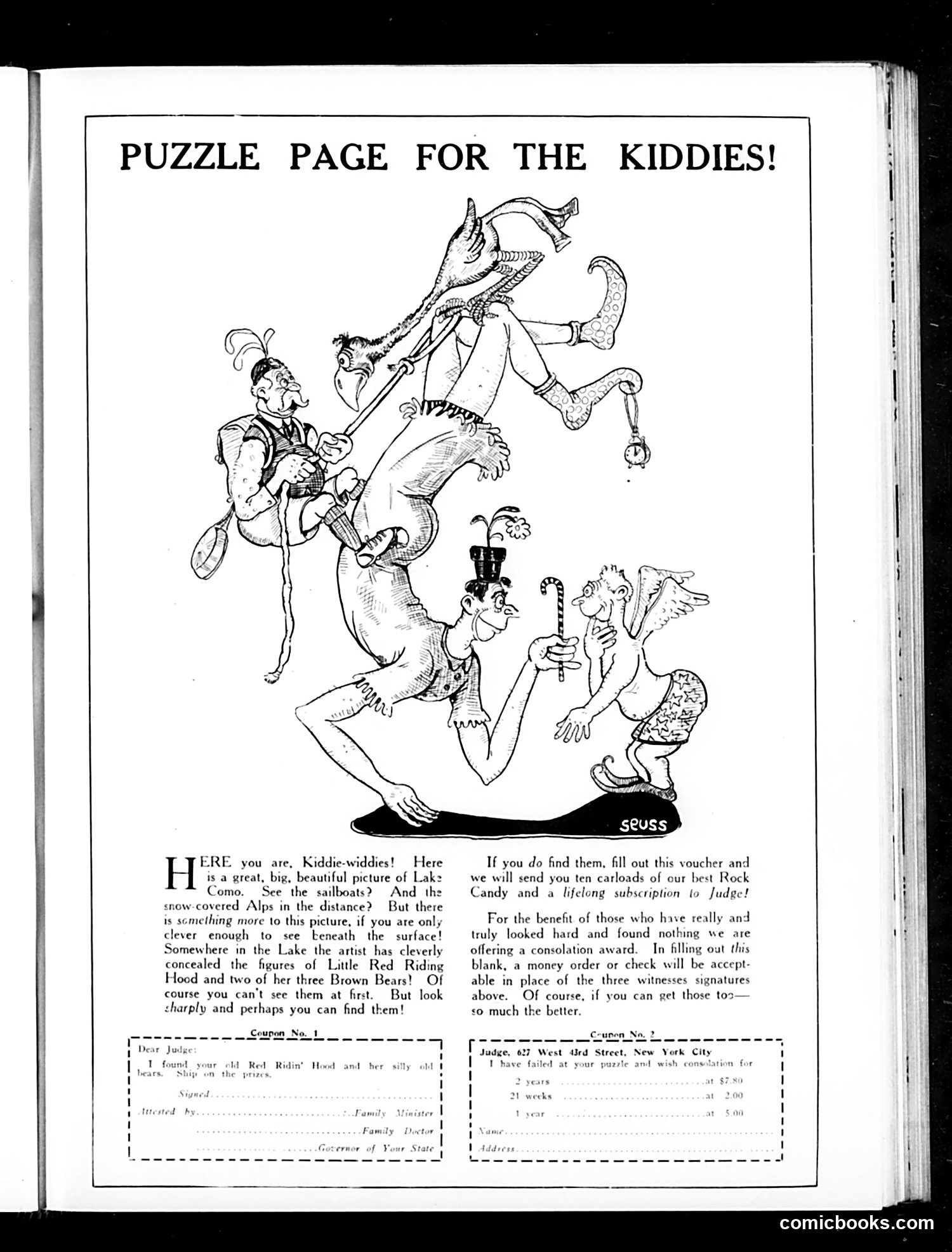
This is a "hidden picture" puzzle page for children, illustrated by Dr. Seuss (signature visible). The main cartoon depicts a wildly exaggerated figure juggling and dancing above Lake Como with the Alps in the background—a surreal, characteristically Seussian scene. The puzzle challenges children to find Little Red Riding Hood and two of her three Brown Bears concealed within the landscape. The satirical point appears to be a gentle jab at children's puzzle competitions themselves: the text humorously offers prizes (candy and a Judge subscription) for solving it, but then adds a telling "consolation award" for those who find nothing—payment is acceptable instead of witness signatures, mocking the dubious legitimacy of such contests. This is essentially satire of children's puzzle marketing and potentially rigged prize schemes disguised as innocent games.
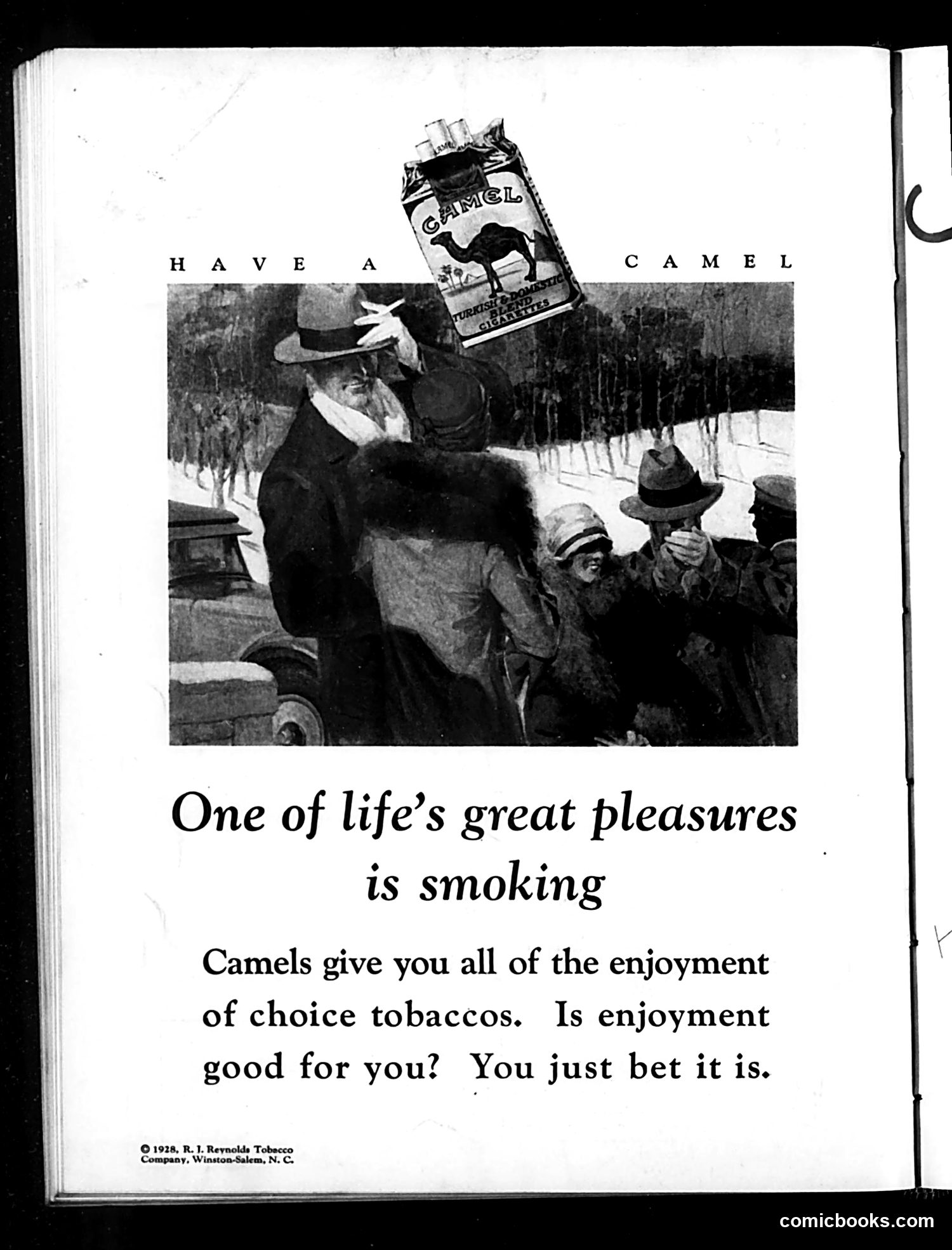
This is a **Camel cigarette advertisement**, not satire or political commentary. The image shows a well-dressed man in a hat presenting a large Camel cigarette package to children in a snowy setting. The ad's tagline—"One of life's great pleasures is smoking"—directly promotes smoking enjoyment. The rhetorical question "Is enjoyment good for you? You just bet it is" represents **1920s advertising's casual attitude toward health claims**. The ad's targeting of the scene (with children present) reflects the era's lack of restrictions on tobacco marketing to minors. By modern standards, this advertisement is shocking for its explicit promotion of smoking as wholesome pleasure and its apparent indifference to age-appropriate marketing—practices that would face legal prohibition by the late 20th century.