
Judge, 1928-03-24 · page 11 of 36
Judge — March 24, 1928 — page 11: what you’re looking at
What you’re looking at
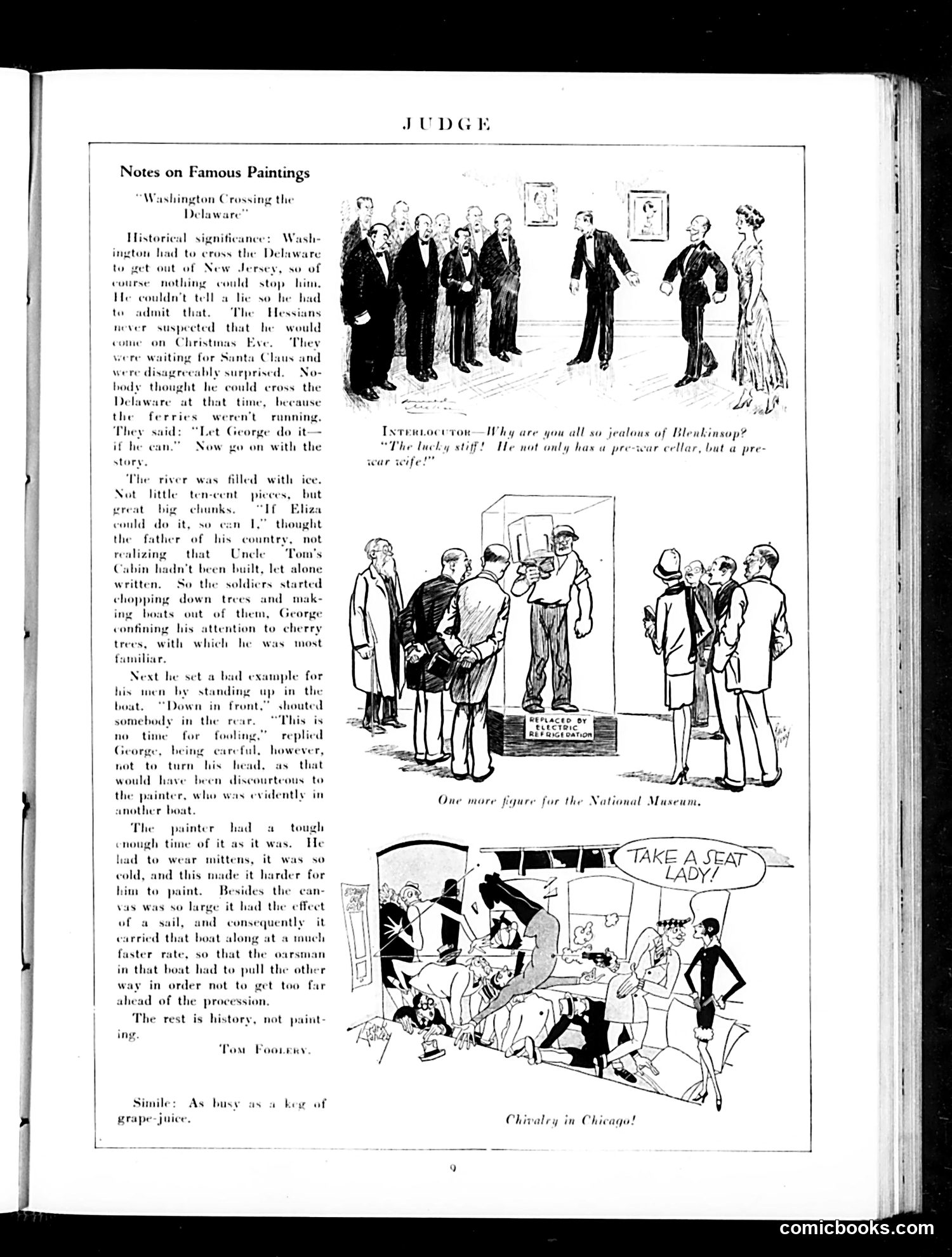
This page contains satirical commentary on Emanuel Leutze's famous 1851 painting "Washington Crossing the Delaware." **The Main Satire:** Tom Fooleary humorously deconstructs the painting's historical logistics and artistic challenges. He mocks the heroic narrative—noting Washington couldn't actually be stopped, so crossing was inevitable—while focusing on absurd practical details: soldiers chopping trees into boats, the massive canvas acting like a sail and causing the painter's boat to lag behind, and the painter's frozen fingers making it difficult to work. **The Supporting Cartoons:** - The top cartoon depicts men discussing "Blenkinsop," who apparently has a "pre-war cellar" and "pre-war wife"—a Prohibition-era joke about pre-1920s luxuries now illegal or depleted. - The bottom cartoon, "Chivalry in Chicago," shows crowded public transportation with men ignoring women's need for seats. Both cartoons satirize contemporary social issues: alcohol prohibition and declining gentility in public behavior.
📄 Transcribed text from this page (OCR, searchable)
Machine-transcribed from the original scan — historical spelling and the odd misread are preserved.
Notes on Famous Paintings | Washington Crossing the Delaware” Historical significance: Wash- ington had to cross the Delaware to get out of New Jersey, so of course nothing could) stop him. He couldn't tell a lie so he had | te admit that. never suspected that he would come on Christnnas Eve. ‘They were waiting for Santa Claus and were dis bly surprised. No- body thought he could cross the Delaware at that time, bees to runn the ferries we They said: “Let George do if he Now yo on with the stor, | The river was filled with ice. Not little ten-cent picees, but great big chunks. “If Eliza could do it, so can 1,” thought the father of his country, not realizing that — Uncle Cabin hadn't been built, let alone written. So the soldicrs started chopping down trees and mak- ‘om's ing boats out of them, George confining his attention to cherry trees, with which he was most familiar. Next he set a bad example for his men by standing up ine the be | nin front,” shouted somebody in the rear. * his is replied no time for fool George, being careful, however, not to turn his head. as) that would have been discourteous to the painter, who was evidently in nother boat. The painter had a tough cnough time of it as it was. He had to wear mittens, it was so cold, and this made it harder for him to paint. Besides the can- vas was so large it had the effeet of a sail, and consequently it carried that boat along at a much faster rate, so that the oarsman in that boat had to pull the other way order not to get too far ahead of the procession. The rest is history, not paint ing. ‘Tom Pootrky Simile: grape-juice. As busy as oa key of Ixrenocuton—Why are you all su jealous of Blenkinsop? “The lucky stiff! He not only has a pre-war cellar, but a pre- war wife!" One mare figure for the Chivalry in Chicago! National Museum, comicbooks.com