
A complete issue · 36 pages · 1928
Judge — February 11, 1928
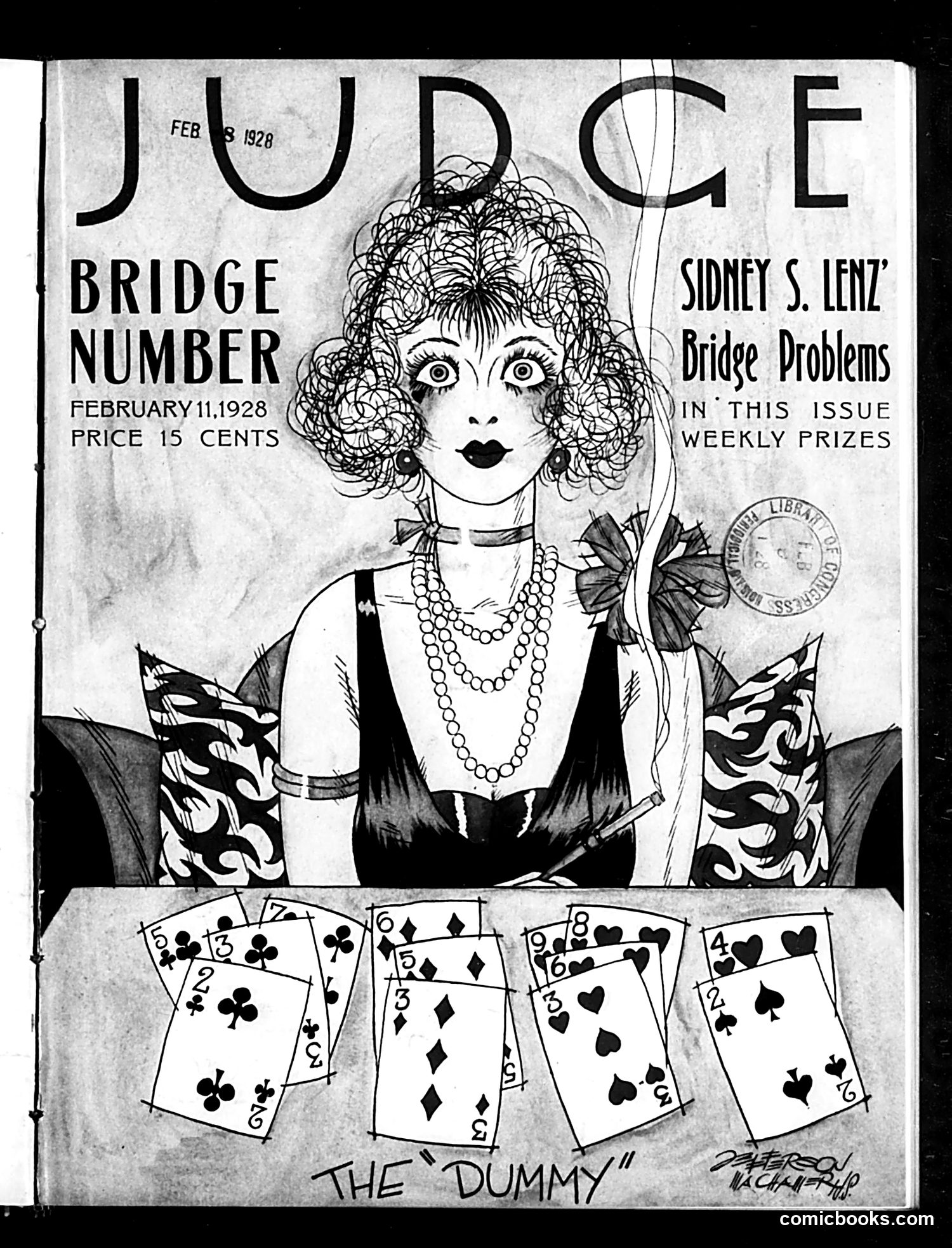
This is the "Bridge Number" issue of Judge, a satirical weekly priced at 15 cents. The cover features a stylized 1920s woman with dramatic curled hair, pearl necklaces, and decorative fans—embodying the "flapper" aesthetic of the Jazz Age. Below her image are four groups of playing cards labeled "THE 'DUMMY'"—a reference to bridge card game terminology. The cover advertises Sidney S. Lenz's "Bridge Problems" featured in this issue, with weekly prizes offered. The satire likely jokes about bridge's social prominence among well-to-do Americans during the 1920s, while the glamorous female figure represents the modern woman associated with the era's cultural transformations. The "dummy" reference plays on both card game terminology and period social commentary.
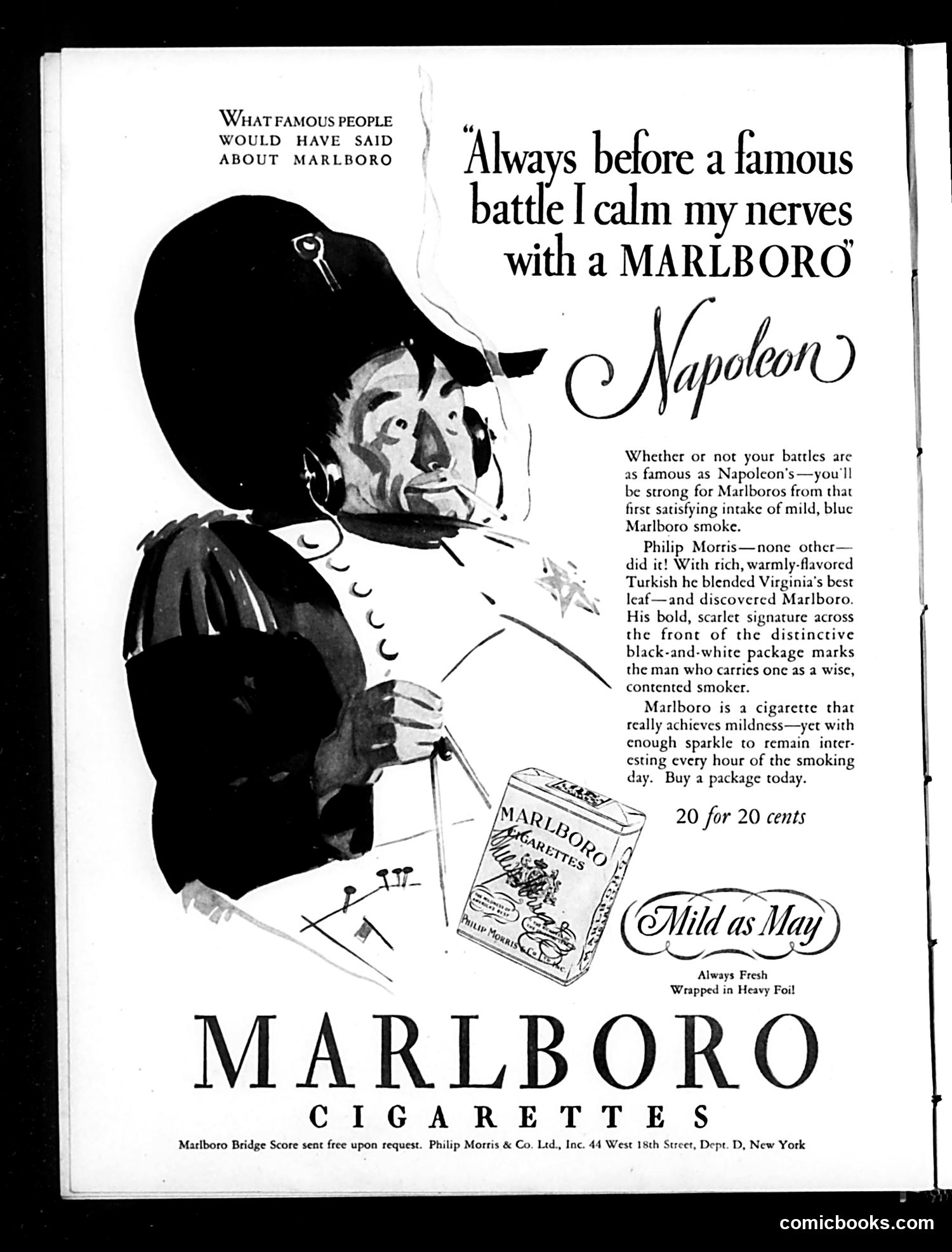
This is primarily a **cigarette advertisement**, not political satire. The page features a caricatured figure in Napoleonic military dress smoking a Marlboro, with the quote: "Always before a famous battle I calm my nerves with a MARLBORO." The ad attributes the quote to Napoleon, humorously suggesting the French military leader used Marlboros to steel himself before combat. This is obviously anachronistic—Marlboros didn't exist in Napoleon's era (early 1800s). The advertisement exploits Napoleon's legendary confidence and authority to market cigarettes as a calming, confidence-boosting product. The tagline "Mild as May" emphasizes the cigarettes' smoothness. Priced at "20 for 20 cents," this appears to be vintage advertising, likely from the early-to-mid 20th century.
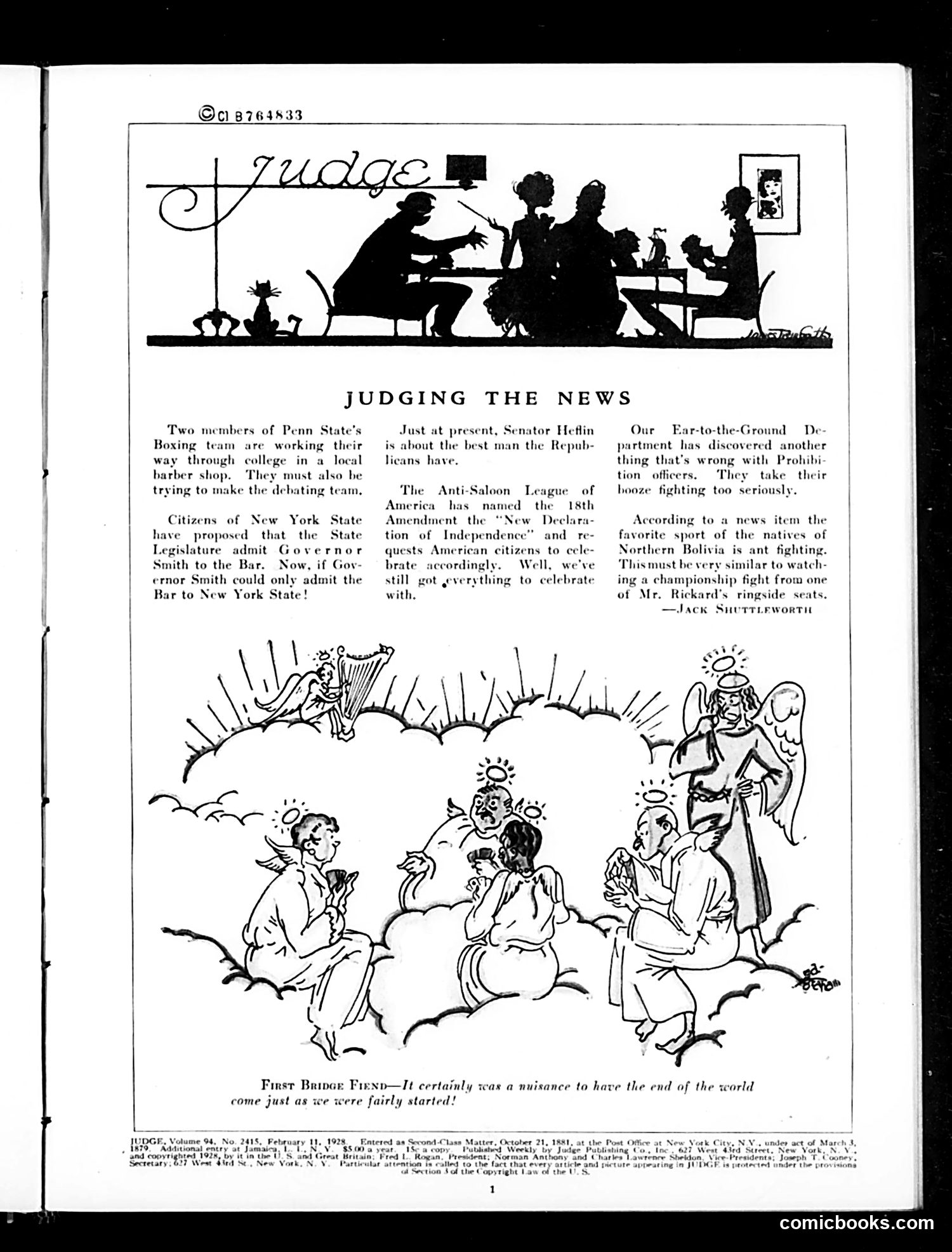
This February 1928 page satirizes contemporary news through commentary and cartoon. The top silhouette depicts a social gathering where someone (likely a judge or authority figure) presides over discussion—fitting the "Judging the News" column format. The main cartoon shows figures in heaven observing earthly events, with the caption mocking that "the end of the world" arriving wouldn't be particularly disruptive since things are "fairly started" in chaos already. This reflects 1920s anxiety about social disorder. The text references Penn State boxers working barbershop jobs, proposals to admit Governor Smith to the New York bar, the Anti-Saloon League's 18th Amendment celebration, and Prohibition enforcement struggles—all contemporary 1928 social and political issues Judge's readers would recognize as worthy of satirical commentary.
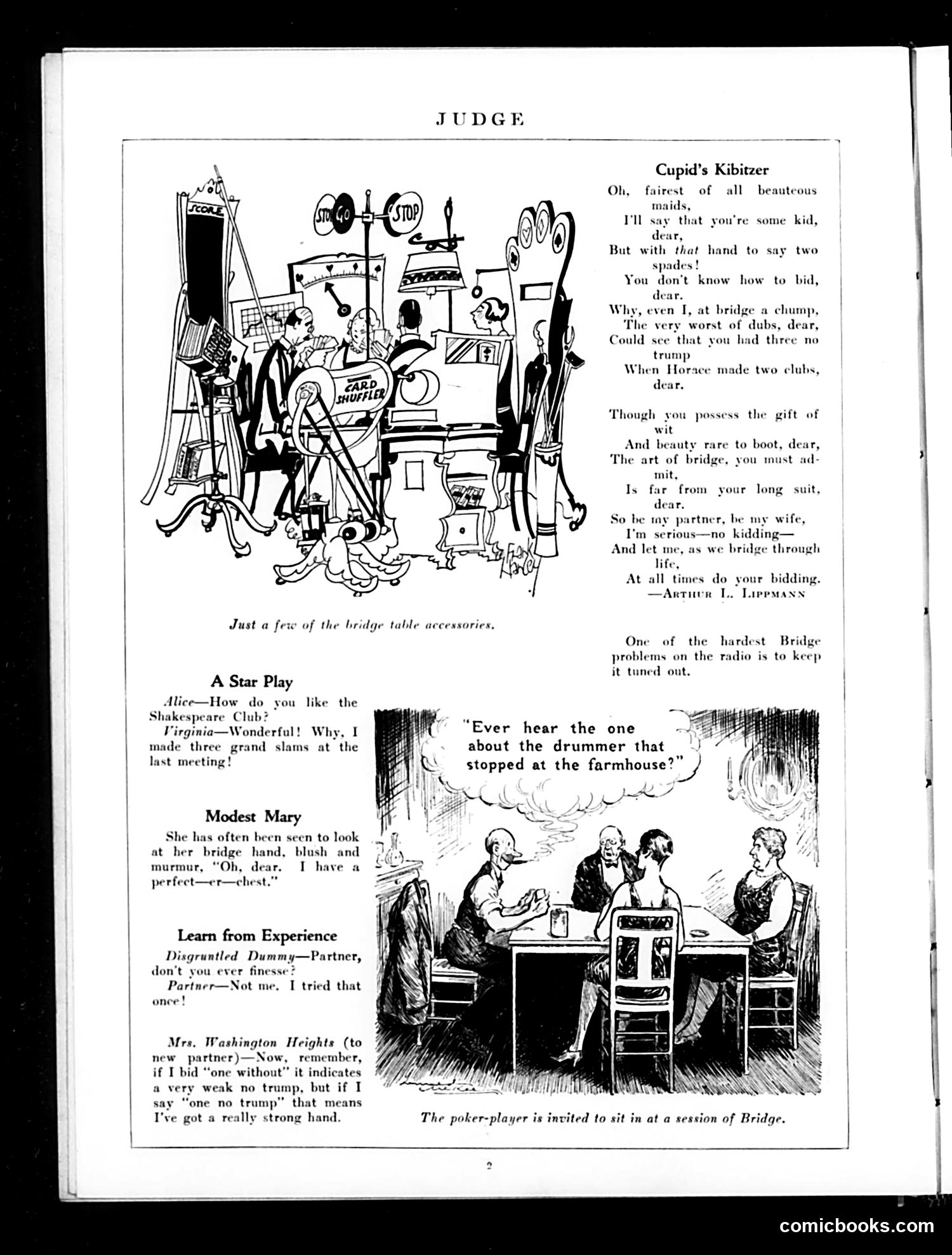
This Judge page satirizes bridge, the card game that was enormously popular among upper-class Americans in the early 20th century. **"Cupid's Kibitzer"** (the poem by Arthur L. Lippmann) jokes that while the addressee is witty and attractive, they're a terrible bridge player who doesn't understand basic bidding strategy. The satire suggests marriage to this person would mean enduring their incompetence at bridge—treating card-playing as a serious marital concern. The accompanying illustrations mock bridge culture: "A Star Play" features players discussing the game, while the lower cartoon shows men at a table, with the caption about a drummer stopping at a farmhouse, likely a setup for a joke about poker versus bridge. The overall message: bridge obsession among the wealthy had become culturally dominant enough to be satirized as life-defining.
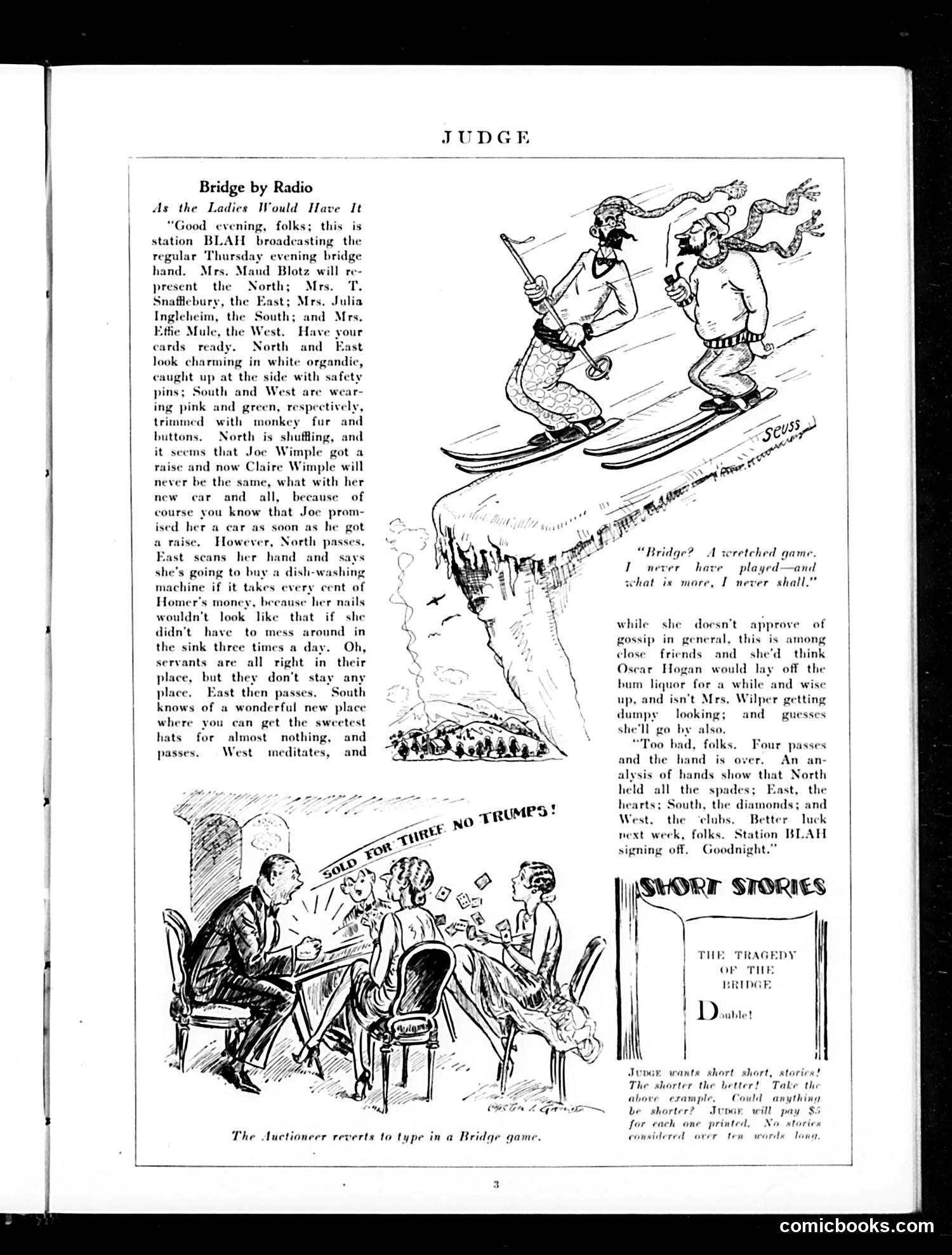
This page contains two satirical cartoons about bridge (the card game): **"Bridge by Radio"** depicts a radio broadcast of bridge instruction. The cartoon mocks how listeners follow the game while physically separated—women skiing while listening to station BLAH broadcast bridge hands. The satire critiques the absurdity of playing cards while engaged in completely unrelated activities. **"Sold for Three No Trumps!"** shows an auctioneer at a bridge game table, with the caption suggesting bridge players are so obsessed they'd auction off their possessions during play. This satirizes the game's addictive nature among 1920s-30s society. The page also advertises a short story contest about bridge ("The Tragedy of the Bridge"). Overall, these cartoons mock the period's bridge mania among upper-class Americans.
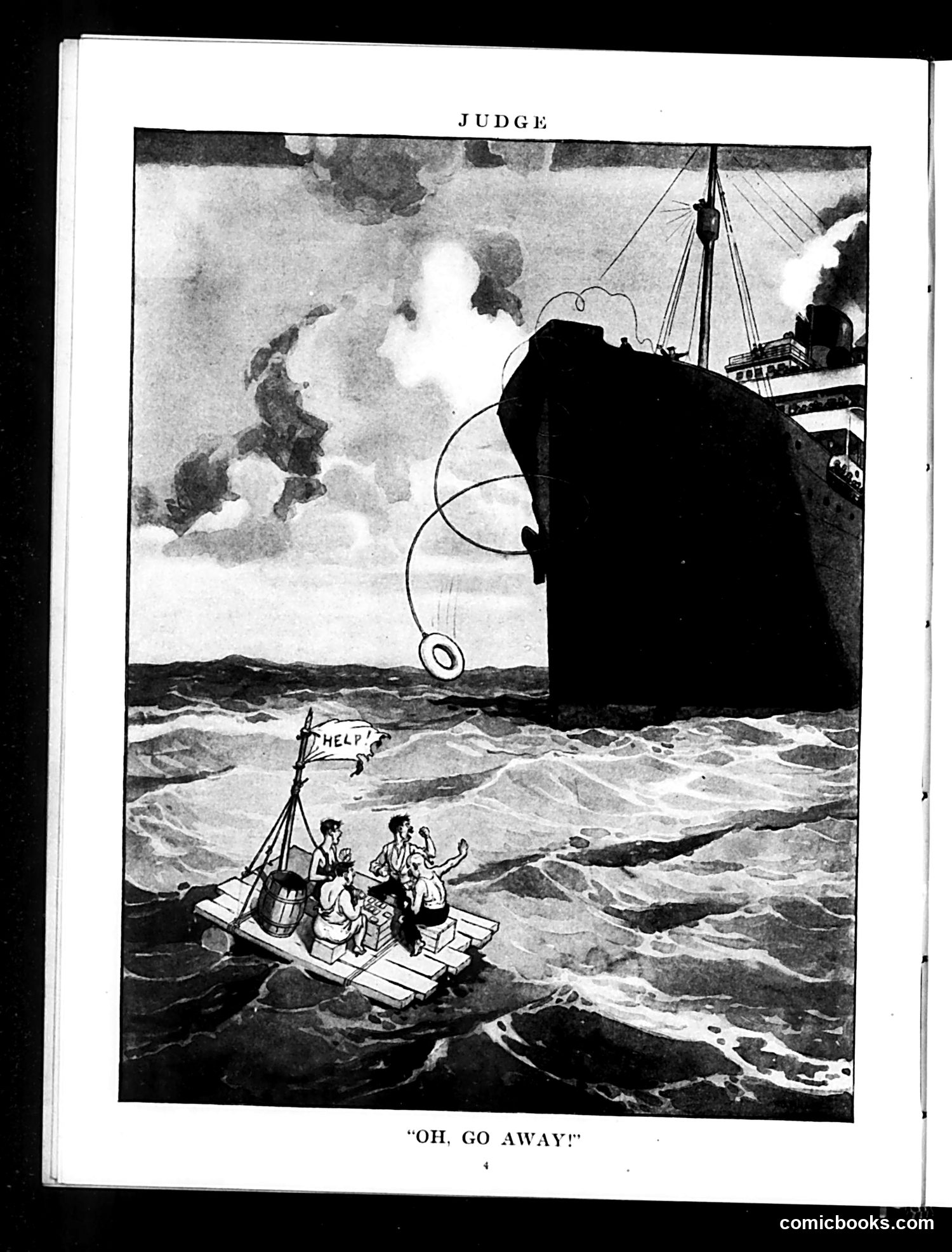
This satirical cartoon depicts a maritime disaster scenario. A large ship (likely representing a nation or government entity) looms menacingly over a small lifeboat containing desperate figures holding a "HELP" flag. The cartoon's title, "OH, GO AWAY!" suggests the ship is callously dismissing or ignoring the drowning people's pleas for assistance. The image likely satirizes governmental indifference to human suffering or crisis—possibly referencing a specific maritime disaster, immigration policy, or foreign relations issue of the era. The stark contrast between the massive, powerful vessel and the vulnerable lifeboat emphasizes the power imbalance and moral failure of those in authority to aid the desperate below. Without additional context or dates, the specific historical event referenced remains unclear.
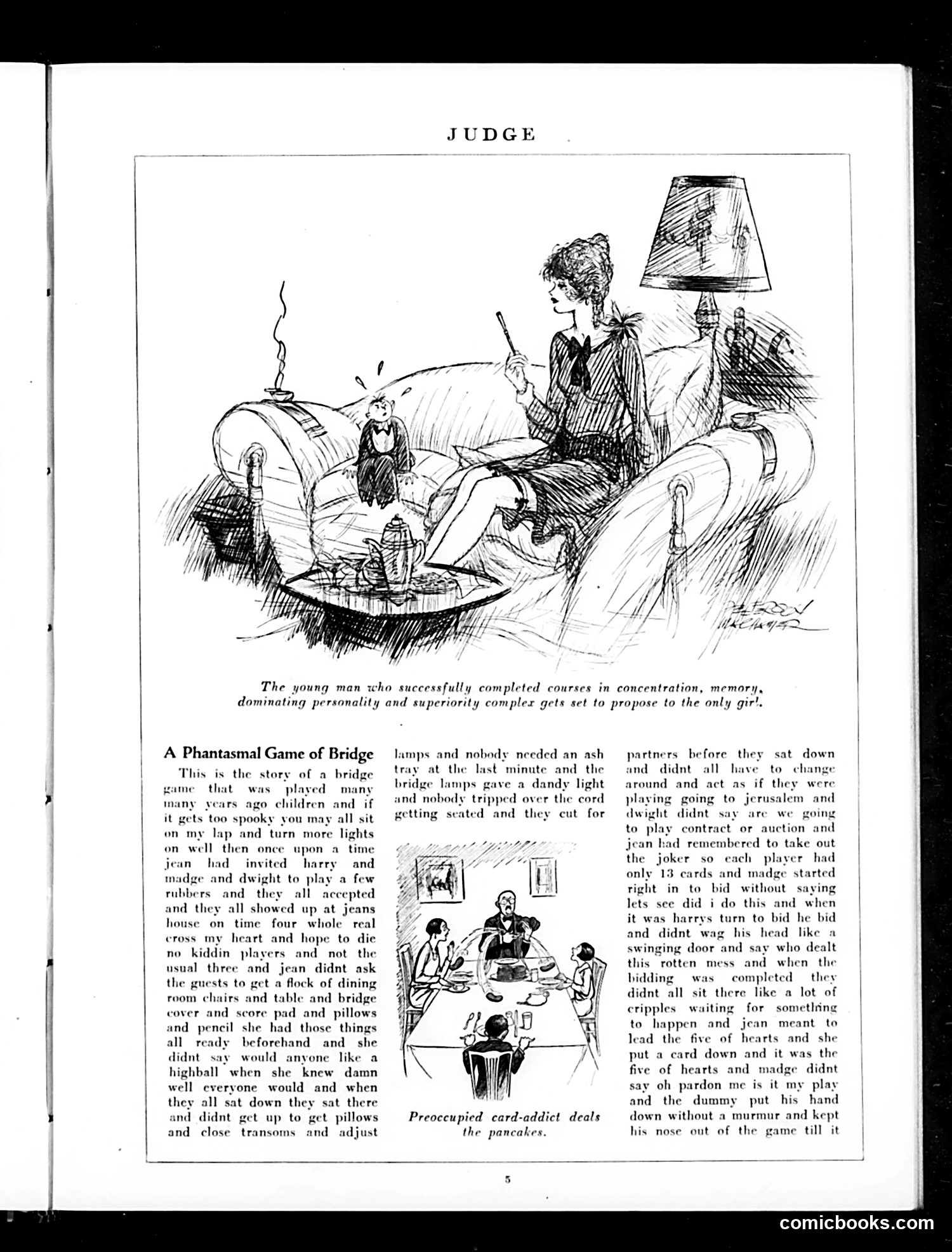
This page contains two pieces of social satire about leisure activities among the wealthy. The top illustration mocks a young man who has "successfully completed courses in concentration, memory, dominating personality and superiority complex" and now proposes marriage to "the only girl"—satirizing self-help courses and the arrogance they supposedly instill. The bottom section, "A Phantasmal Game of Bridge," humorously describes an elaborate bridge game where guests are so comfortable they won't leave to adjust pillows or fetch dining room items. The accompanying sketch shows card players at a table. The second illustration, "Preoccupied card-addict deals the pancakes," depicts someone so obsessed with cards they're dealing while cooking—mocking bridge's grip on social life among the leisure class during this era.
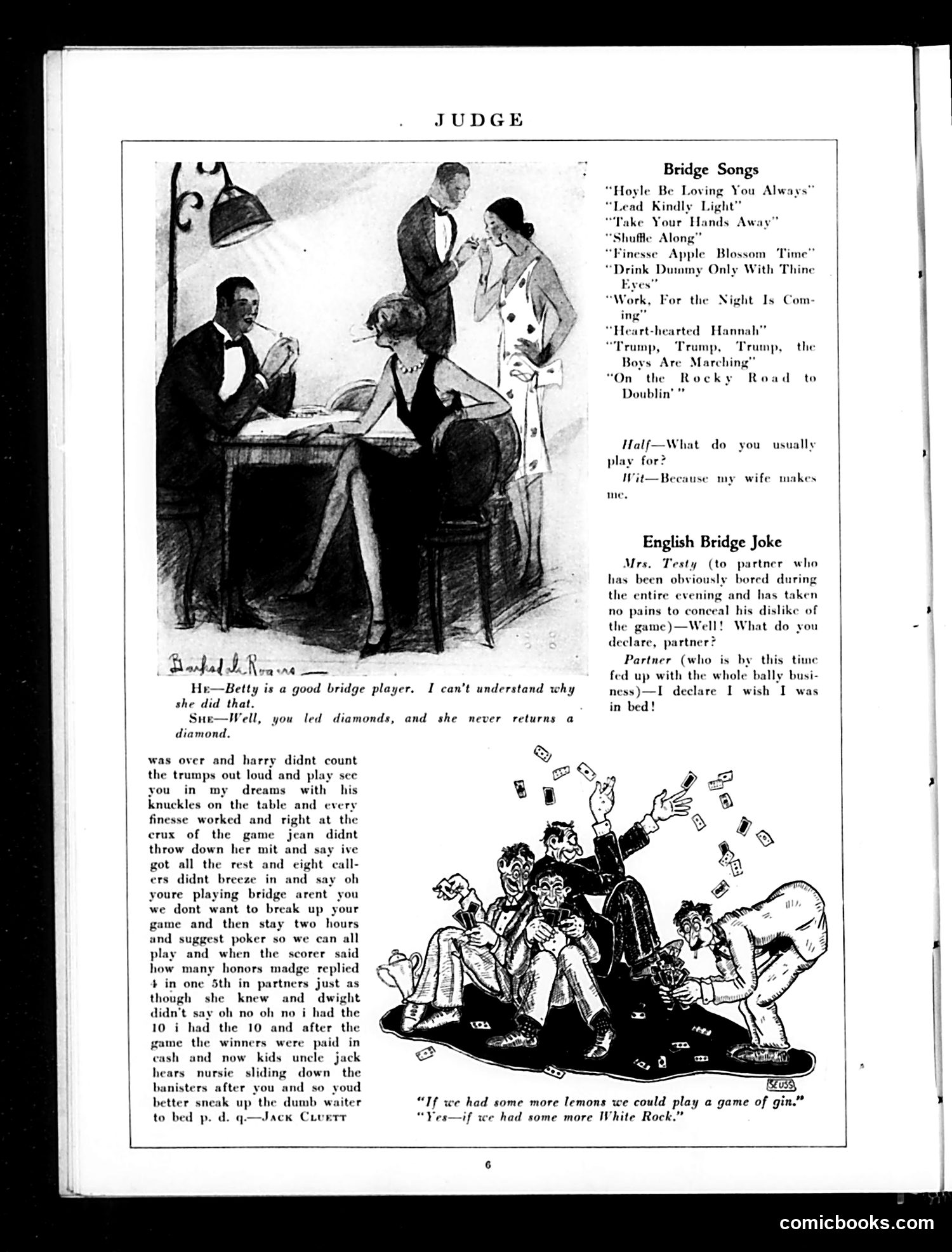
This page satirizes the social phenomenon of bridge playing in early 20th-century America. The top section lists popular song titles cleverly reworded to reference bridge terminology and gameplay—a humorous commentary on how pervasive bridge had become in entertainment and culture. The main cartoons mock bridge players and the game's social dynamics. One joke depicts a woman's poor play (failing to return her partner's led suit), illustrating common frustrations. The "English Bridge Joke" shows an exasperated partner who's endured hours of tedious play, expressing his wish to escape to bed rather than continue. The lengthy anecdote by Jack Cluett humorously catalogs all the interruptions and social disruptions that plague a bridge game—uninvited guests staying too long, suggestions to switch to poker, endless post-game analysis. The bottom cartoon depicts intoxicated players, with the caption joking they need "lemons" or "White Rock" (a ginger ale brand) to play gin rummy instead—a pun suggesting both literal mixers for drinks and the card game itself. Overall, the page satirizes bridge as an obsessive social pastime that monopolizes leisure time despite its tedium.
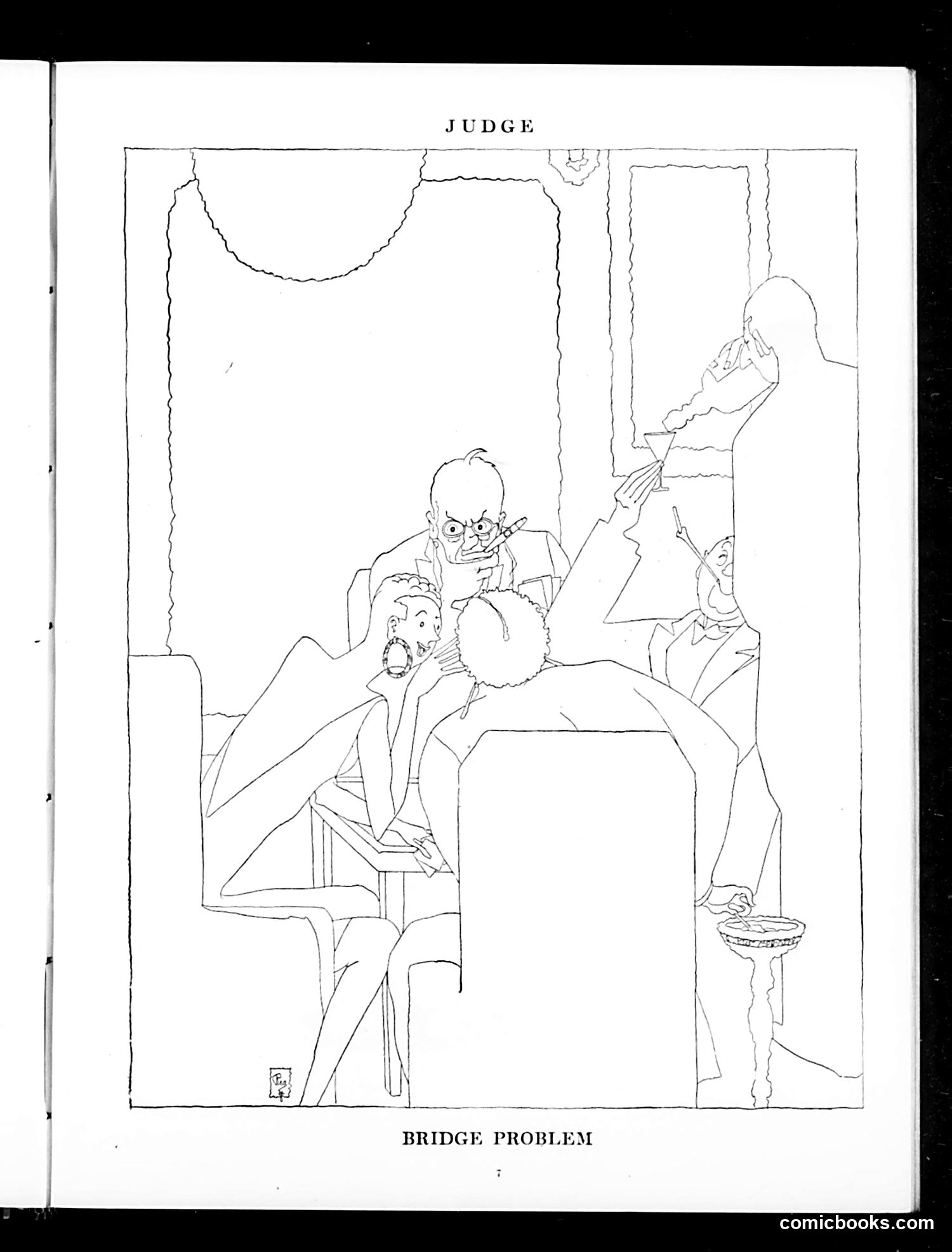
This cartoon depicts a courtroom scene titled "Bridge Problem," likely satirizing legal disputes over bridge construction or management—a common infrastructure controversy in early 20th-century America. A stern judge presides over the bench while what appears to be opposing parties argue their case before him. The figures seem agitated, suggesting heated testimony or arguments. The "bridge problem" likely references a specific contemporary infrastructure dispute, possibly involving municipal contracts, engineering disagreements, or financial conflicts over bridge projects. Without clearer identification of the specific figures or date, the exact political/legal reference remains unclear, but the cartoon mocks the adversarial nature of courtroom proceedings over practical infrastructure matters.
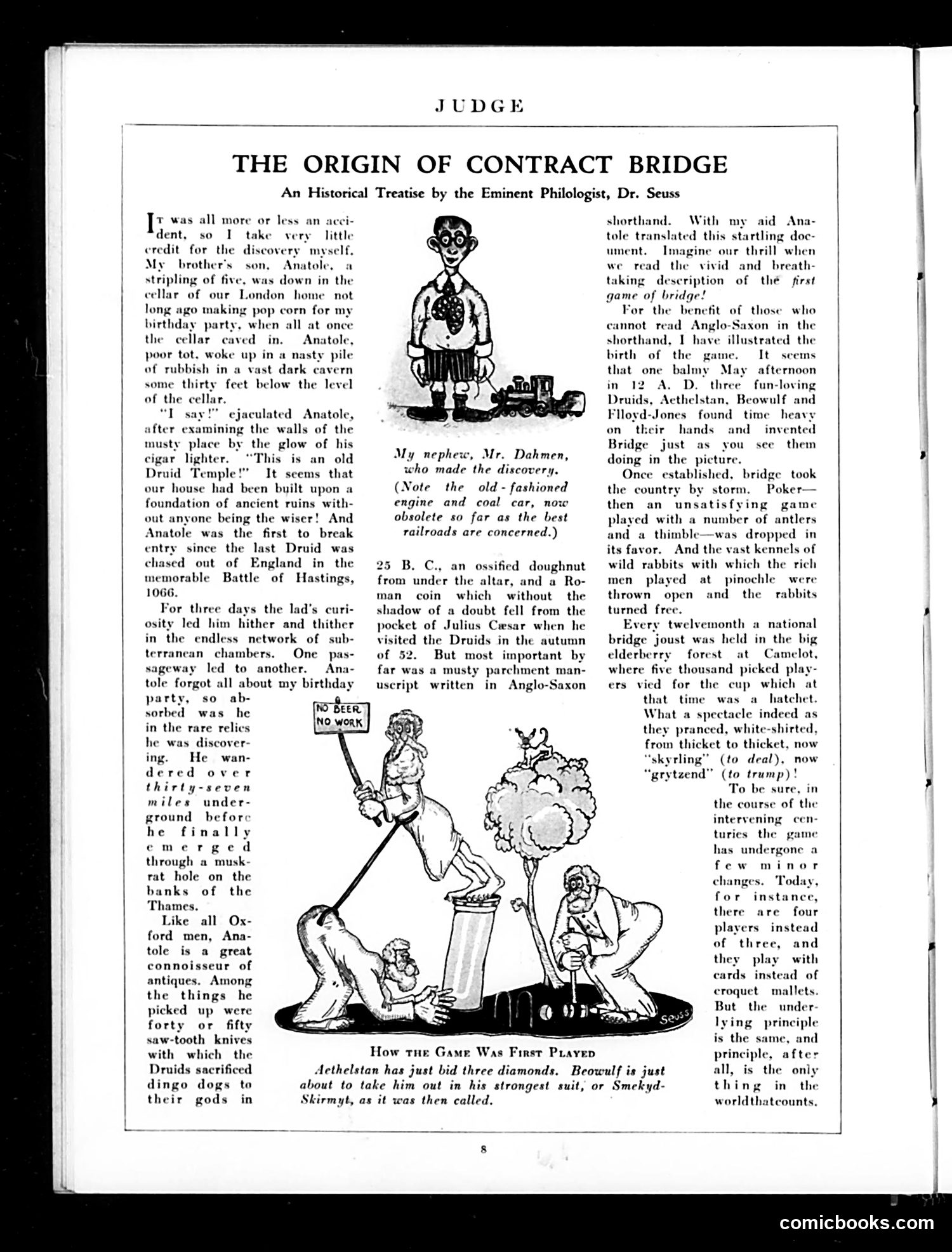
This is a humorous article by Dr. Seuss (the famous children's author) in *Judge* magazine, satirizing the card game Contract Bridge by inventing a fake historical origin story. **The Satire:** The piece mocks the game's popularity and pretensions by claiming it was invented by ancient Anglo-Saxon Druids (Aethelstan, Beowulf, and Floyd-Jones) around 12 A.D., discovered by a boy named Anatole in London caverns beneath his house. It includes absurd "historical evidence" like Roman coins and ancient manuscripts. **The Point:** Bridge had recently become extremely fashionable among upper-class players, often replacing poker. Seuss is ridiculing both the game's sudden trendiness and society's obsession with it—treating an actual modern parlor game with mock-scholarly reverence, as if it were an ancient tradition worthy of archaeological study. **Visual Jokes:** The illustrations show Druids playing bridge with "the strongest suit" (pun on card suits), and the caption notes modern railroad technology has become "obsolete"—emphasizing the farcical anachronism of the entire historical narrative.
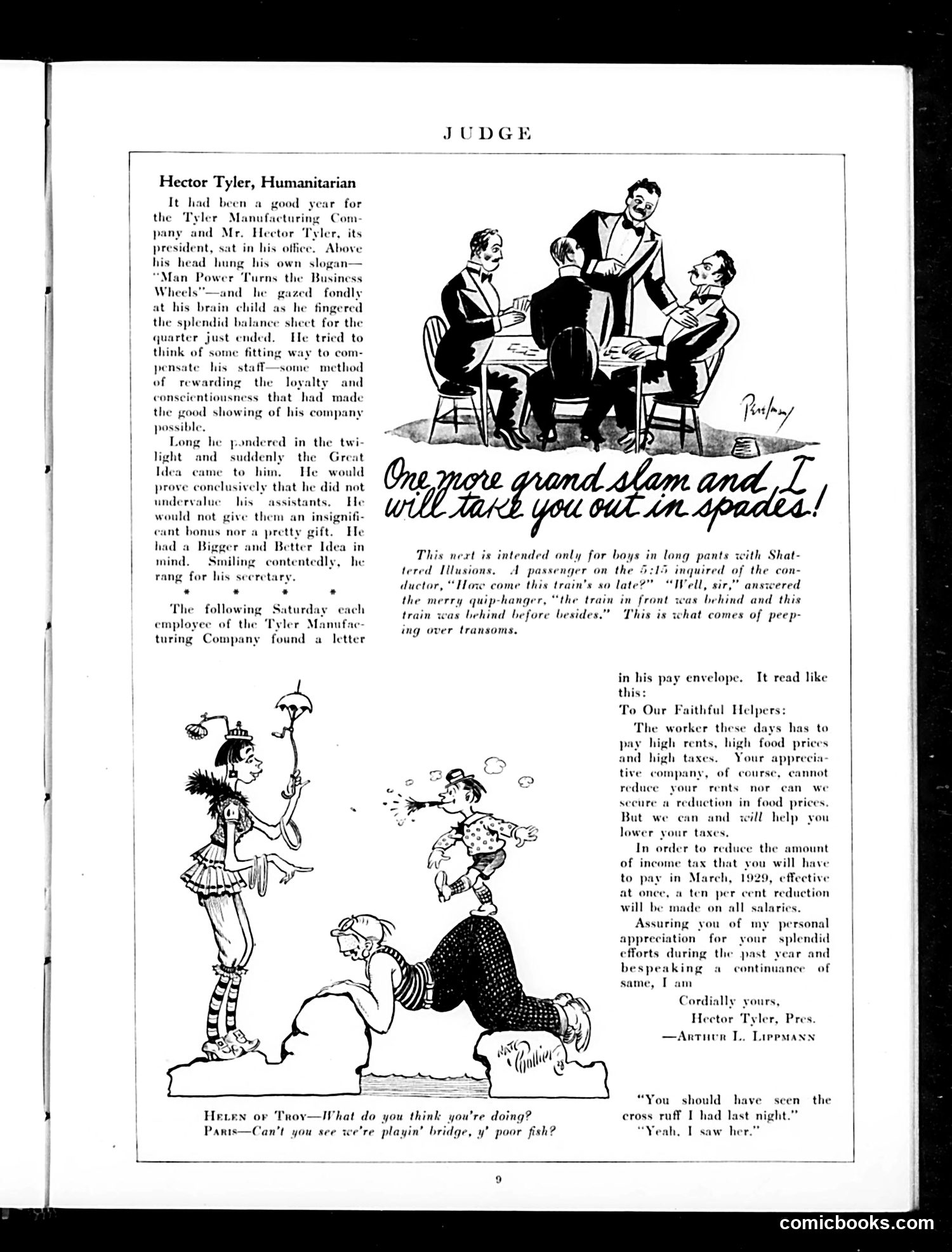
This satirical piece mocks a business owner's self-serving "generosity." Hector Tyler, president of Tyler Manufacturing Company, plans to reward his loyal staff but ultimately gives them a 10% pay cut disguised as a tax-reduction measure (effective March 1929). The "humanitarian" gesture is presented as Tyler's brilliant solution to workers' struggles with high rents, food prices, and taxes—problems the company claims it cannot directly address. Instead of a bonus or gift, Tyler reduces salaries, framing it as helping employees "lower your taxes." The satire targets corporate paternalism and deception: Tyler congratulates himself for generosity while actually cutting workers' income. The cartoon exposes how employers dressed up wage reductions in noble language, exploiting workers' financial desperation while maintaining the appearance of benevolence.
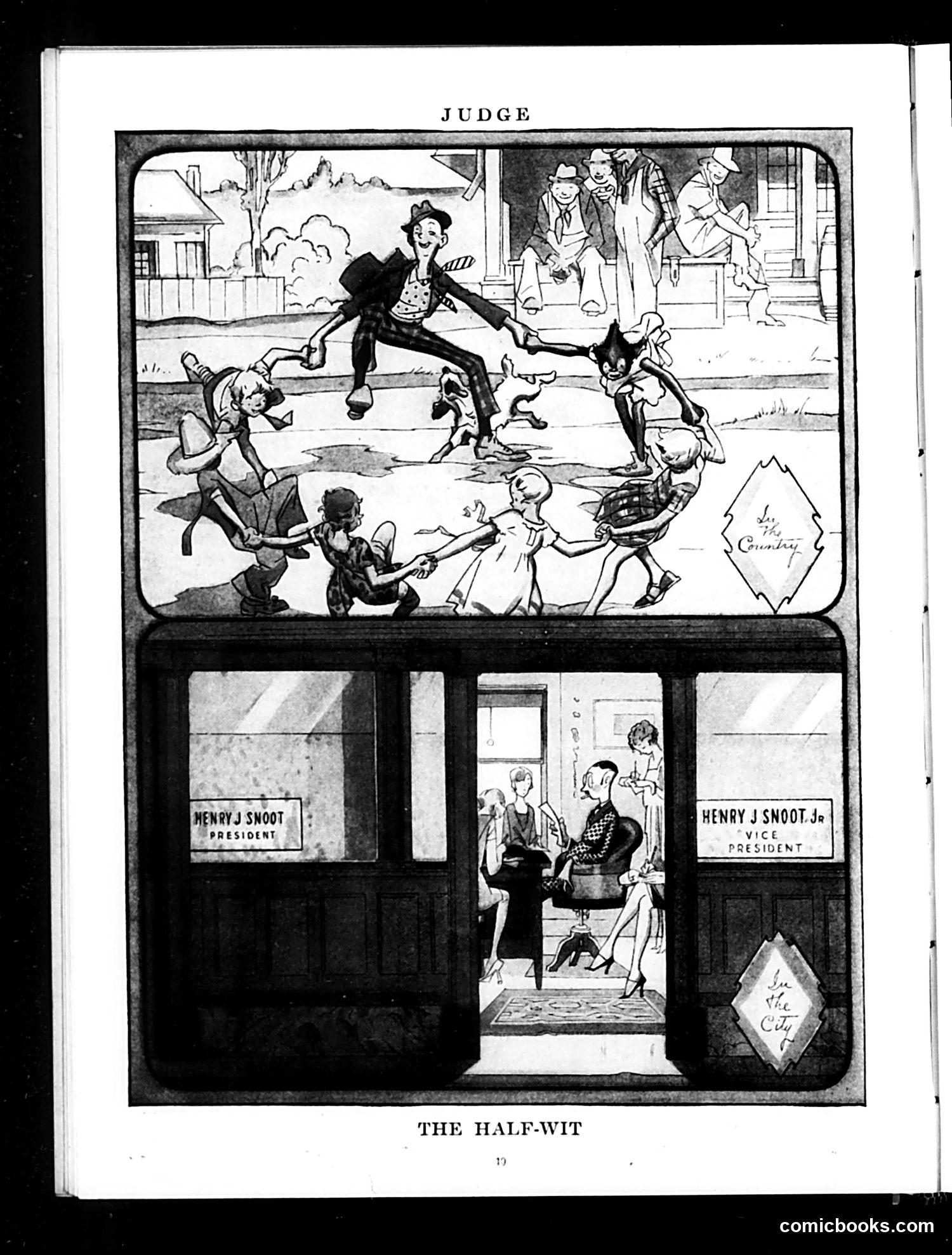
This political cartoon satirizes what appears to be a mayoral or city administration. The top panel shows children playing in a street while adults (likely city officials) watch from a porch. The bottom panel reveals two office doors labeled "HENRY J SNOOT PRESIDENT" and "HENRY J SNOOT JR VICE PRESIDENT," suggesting nepotistic leadership. The title "The Half-Wit" appears to mock the competence of these officials. The contrast between children's chaotic street play and the official offices implies government ineptitude or neglect—the administration is so ineffective it's as though run by incompetent amateurs. The father-son succession in the offices reinforces the critique of political corruption and favoritism in early 20th-century American city government.
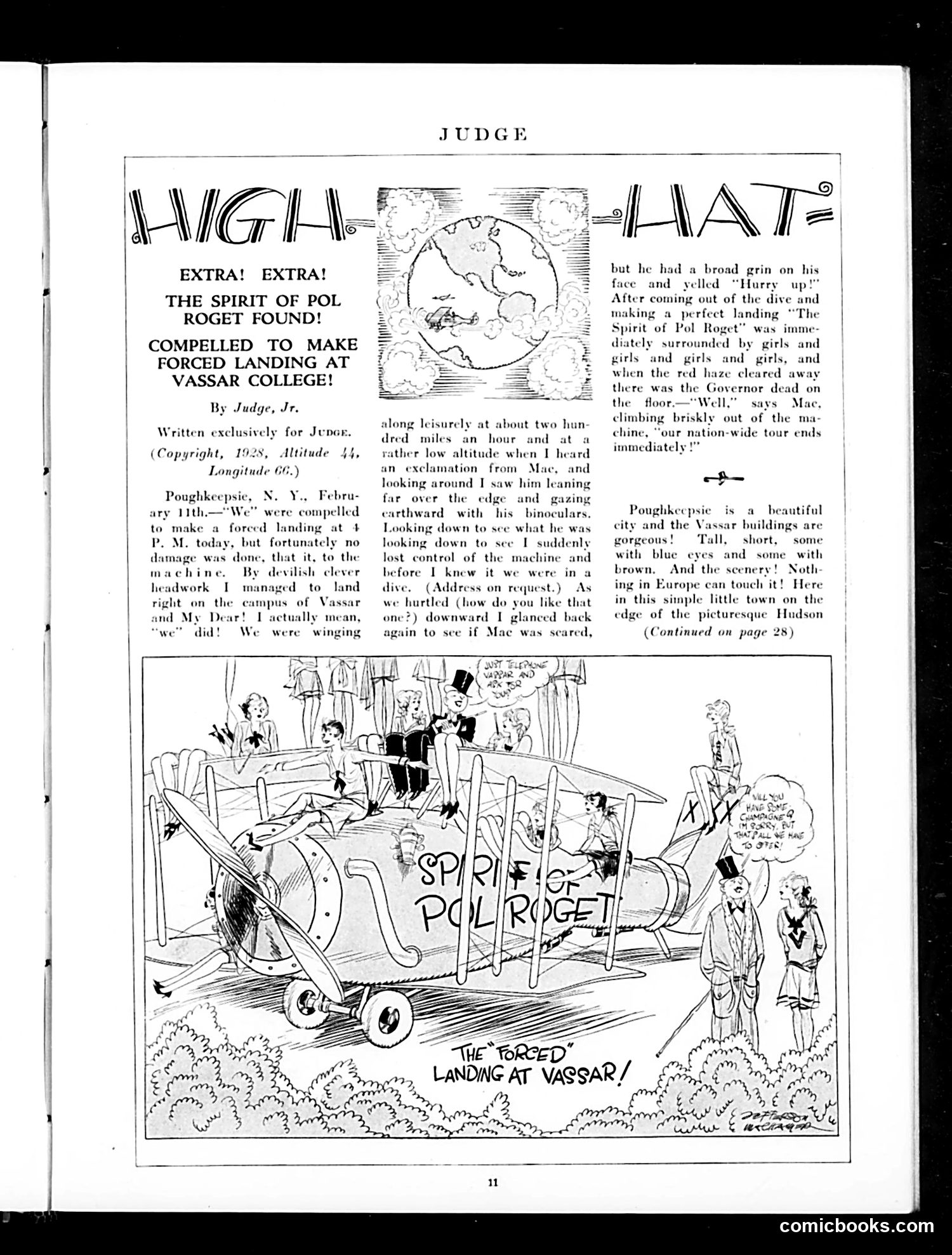
This 1928 *Judge* magazine article satirizes the famous aviator **Charles Lindbergh** (referenced as "the Spirit of Pol Roget"—a playful pun on his aircraft "Spirit of St. Louis"). The piece humorously describes a forced landing at **Vassar College**, an all-female institution. The satire operates on multiple levels: it mocks Lindbergh's celebrity status and the media frenzy surrounding him, while also poking fun at the all-female college environment and the expected reaction of young women to an aviation celebrity. The cartoon shows the aircraft surrounded by admiring female students, with the Governor present. The joke relies on 1920s cultural attitudes: Lindbergh was a genuine national hero whose every move attracted intense public attention, and the notion of his crash-landing at an elite women's college would be considered absurd and comedic fodder. The breathless "EXTRA! EXTRA!" headline mimics sensationalist newspaper coverage of the era.
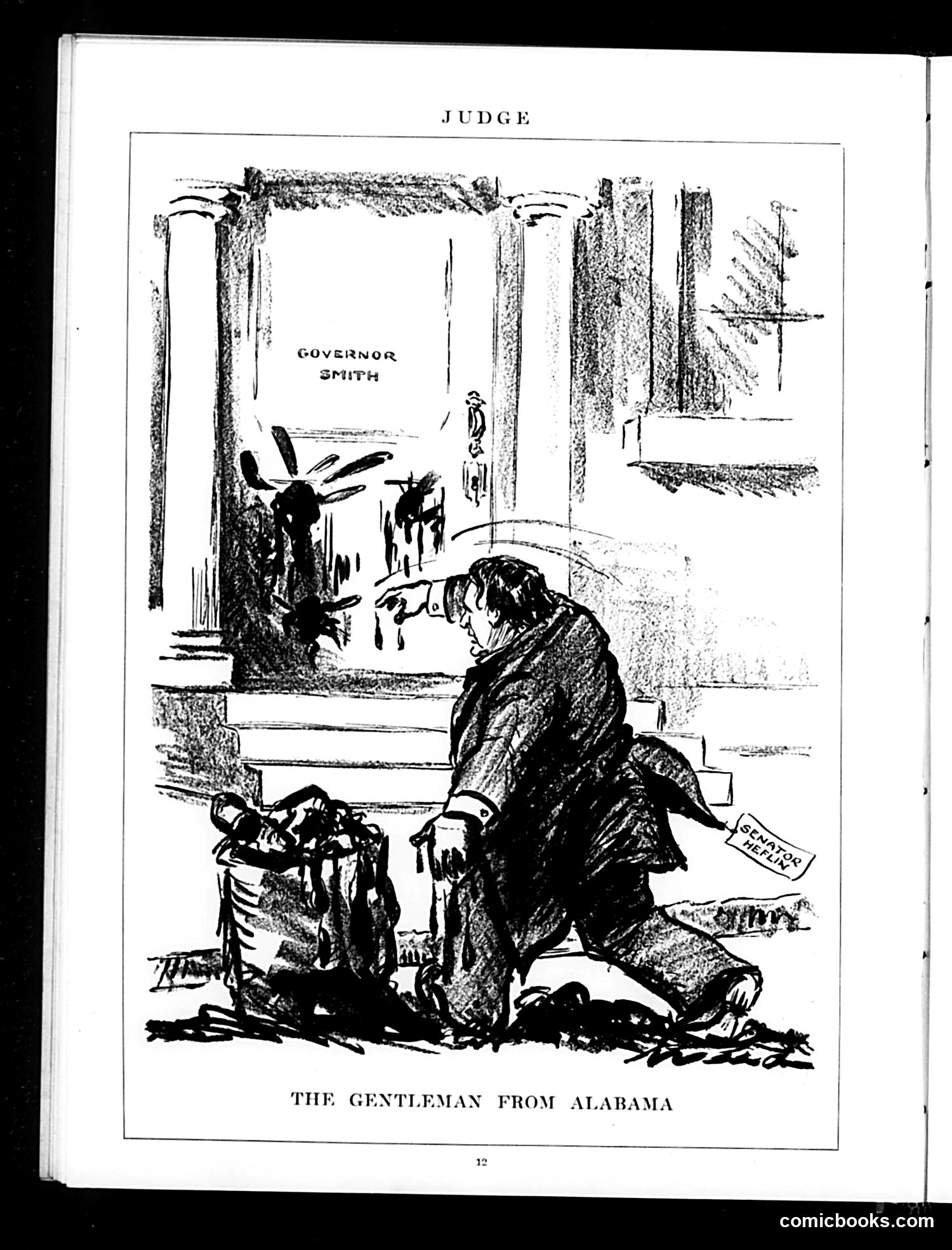
This political cartoon from *Judge* magazine satirizes "The Gentleman from Alabama"—likely a U.S. Senator or Representative from that state. The figure sits outside Governor Smith's office, appearing disheveled and holding what seems to be a senator's badge or credentials. The satire appears to mock either the politician's character, his business before the governor, or his diminished status/importance. The caricatured style emphasizes his shabby appearance, suggesting criticism of his integrity or influence. Without knowing the specific date and political context, the exact target remains unclear, but the cartoon ridicules this Alabama politician's credibility or moral standing, implying he's unfit for his position or has compromised his dignity.
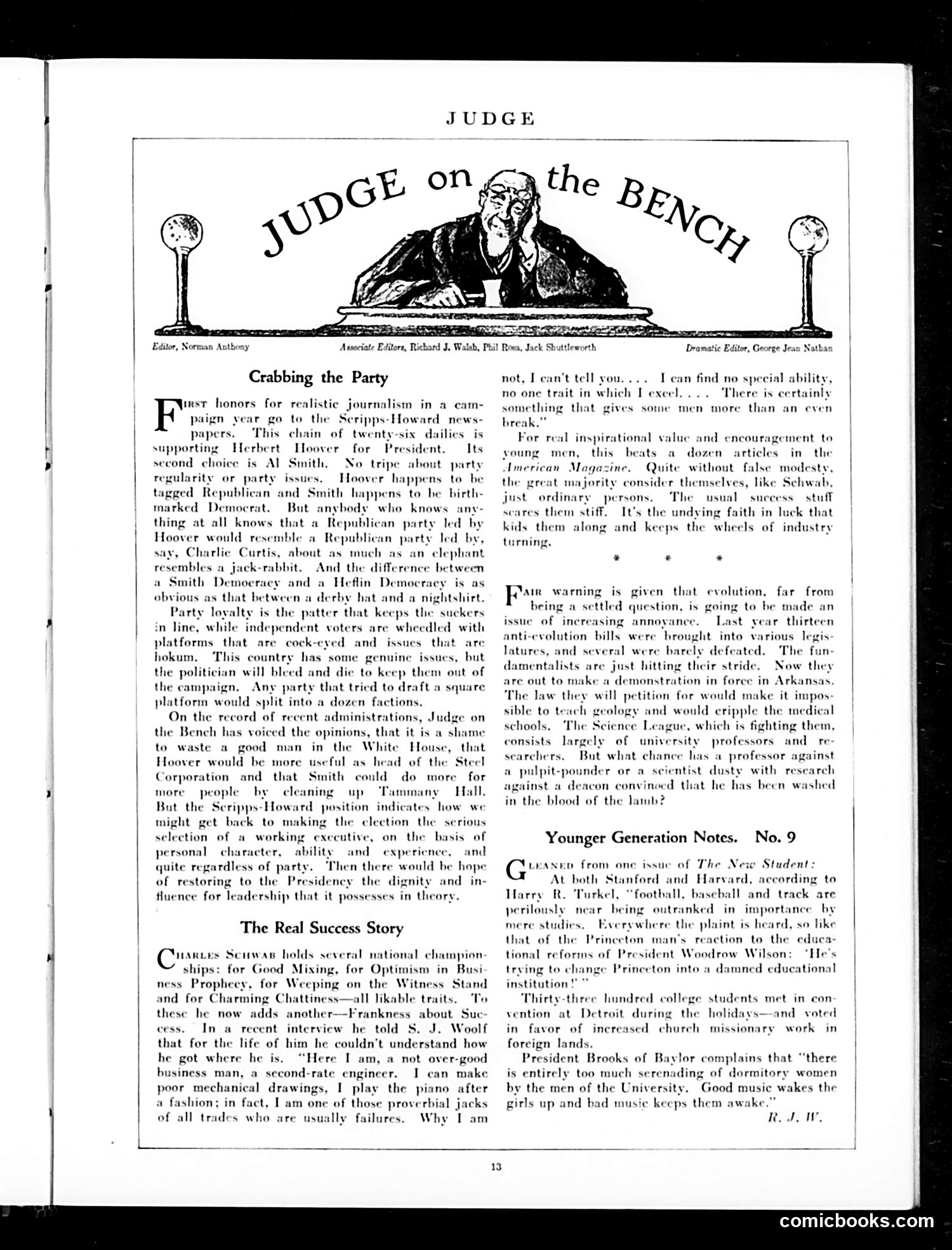
This page from Judge magazine contains satirical political commentary from a presidential election year (appears to be 1928, given references to Herbert Hoover and Al Smith). **"Crabbing the Party"** criticizes both major political parties for lacking genuine ideological differences. The author argues that Republicans and Democrats are indistinguishable—comparing them to "a derby hat and a nightshirt." He praises the Scripps-Howard newspapers for supporting candidates (Hoover and Smith) based on merit rather than party loyalty, and advocates for elections focused on executive competence rather than partisan platforms. **"The Real Success Story"** profiles Charles Schwab, a steel magnate, praising his candid admission that he succeeded despite being an "ordinary" person through faith and persistence—presented as inspirational messaging for readers. **"Younger Generation Notes"** warns about anti-evolution legislation gaining traction in state legislatures, particularly in Arkansas, threatening science education. It expresses concern about fundamentalist activism against teaching geology. The cartoonist's identity remains unclear from this image alone.
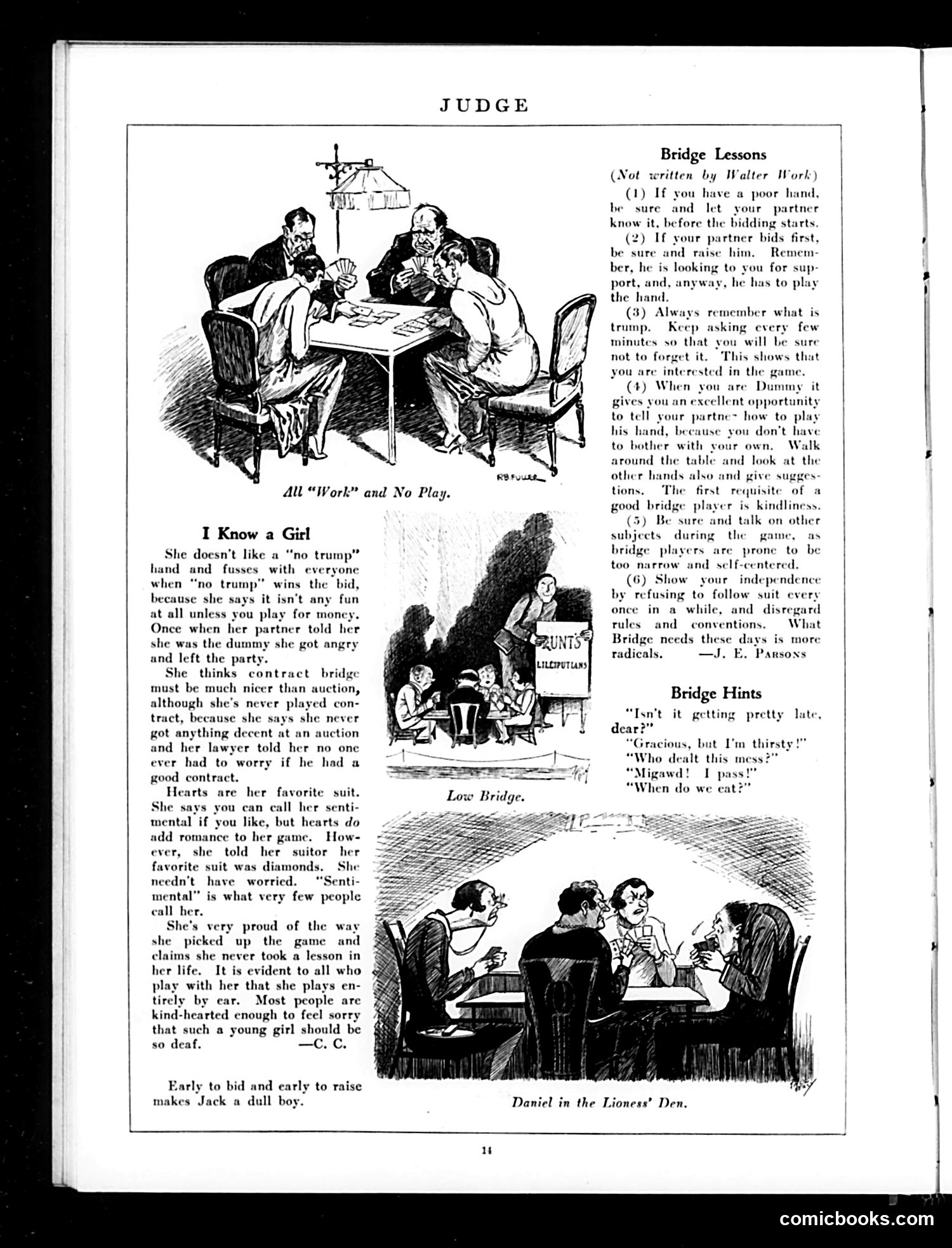
This page satirizes bridge players and the game's social dynamics circa the early 20th century. **"All 'Work' and No Play"** depicts serious bridge players hunched over cards—the title suggests they're so focused on the game they neglect leisure and conversation. **"I Know a Girl"** mocks a female bridge player's contradictions: she demands money stakes yet complains about results, gets angry when assigned the "dummy" role (a non-playing position), and claims self-taught expertise while playing "entirely by ear" (poorly). The author humorously suggests she's "deaf" to bridge principles. **"Bridge Lessons"** offers mock-serious, deliberately bad advice: announce weak hands, backseat drive your partner, repeatedly ask what's trump, kibitz while dummy, discuss unrelated topics, and break rules to show "independence." **"Bridge Hints"** captures overheard complaints at tables—comments about lateness, thirst, poor dealing, and mealtimes—suggesting bridge sessions consumed entire evenings with petty grievances. Overall, the satire targets bridge's obsessive popularity among middle/upper-class Americans, depicting players as competitive, self-absorbed, and socially awkward despite the game's reputation as genteel entertainment.
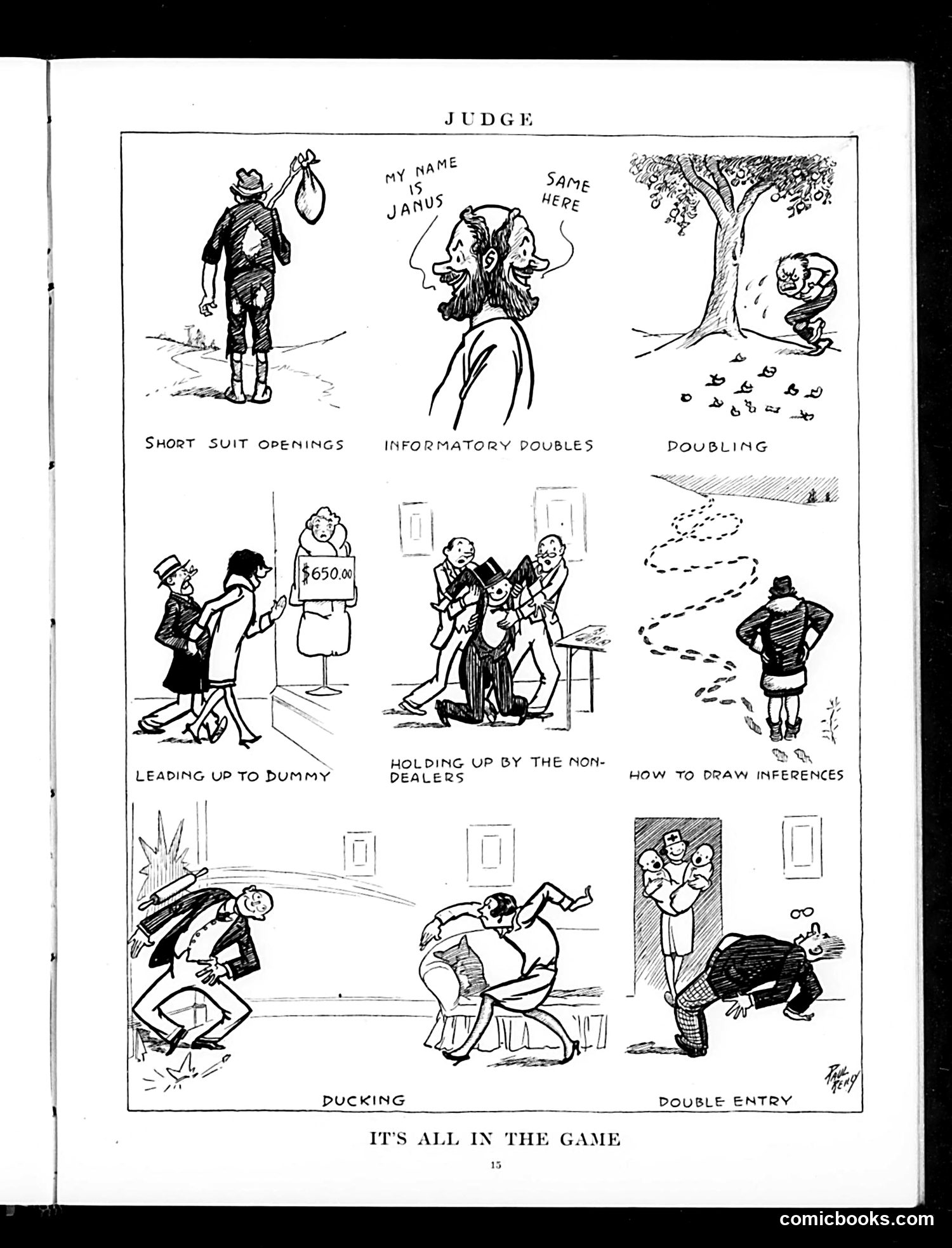
This page satirizes contract bridge, the card game that was enormously popular in early-to-mid 20th century America. The title "It's All in the Game" suggests bridge encompasses various dubious tactics. The cartoons mock cheating and sharp practices: "Informatory Doubles" shows a two-faced figure (deception); "Leading Up to Dummy" depicts financial manipulation ($650); "Holding Up by the Non-Dealers" shows collusion; "Doubling" involves an accomplice under a tree; "How to Draw Inferences" shows trailing someone; "Ducking" and "Double Entry" depict evasive moves. The satire criticizes both bridge players' alleged dishonesty and the game's complexity enabling fraud. Bridge had become associated with high society and gambling, making it ripe for Judge's satirical treatment of social vice disguised as genteel recreation.
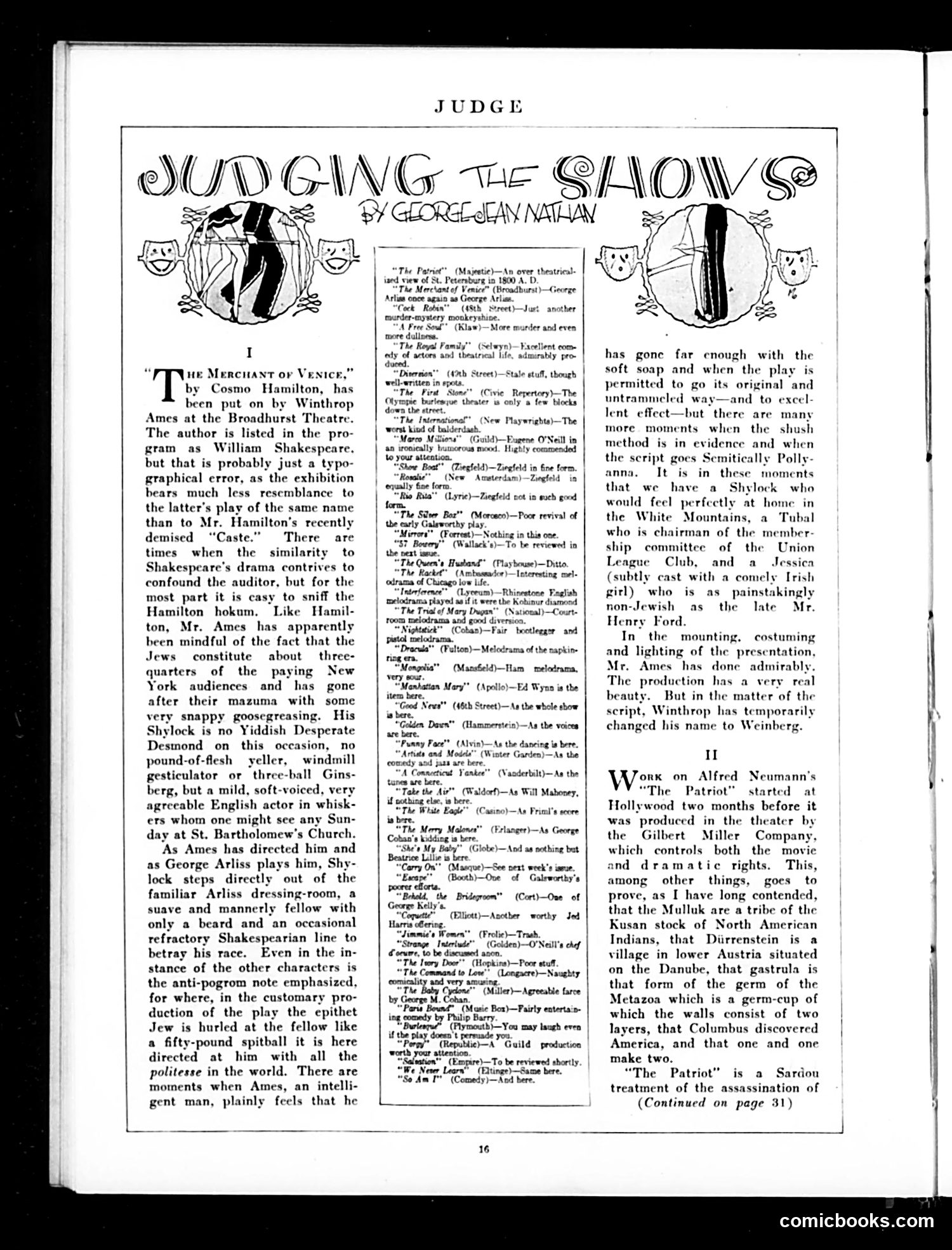
This is a theater review column by George Jean Nathan in Judge magazine. The page critiques current Broadway productions, primarily focusing on a production of *The Merchant of Venice* starring George Arliss at the Broadhurst Theatre. **The Satire's Point:** Nathan sarcastically attacks director Winthrop Ames and producer George Arliss for sanitizing Shakespeare's play to appeal to Jewish theatergoers (who Nathan notes comprise "about three-quarters of the paying New York audiences"). Instead of portraying Shylock as a stereotypical Jewish character, Arliss plays him as a refined English gentleman—removing the play's traditionally antisemitic elements and what Nathan calls the "anti-pogrom note." Nathan's complaint is that the production credits "William Shakespeare" when it's really Cosmo Hamilton's reworking, and he mocks what he sees as cynical pandering ("goosegreasing") for Jewish ticket-buyers' money ("mazuma"). **The Implication:** The review exposes early-20th-century theatrical antisemitism and the entertainment industry's commercial calculation around Jewish audiences—revealing both prejudiced assumptions and how commercial interests could drive cultural change.
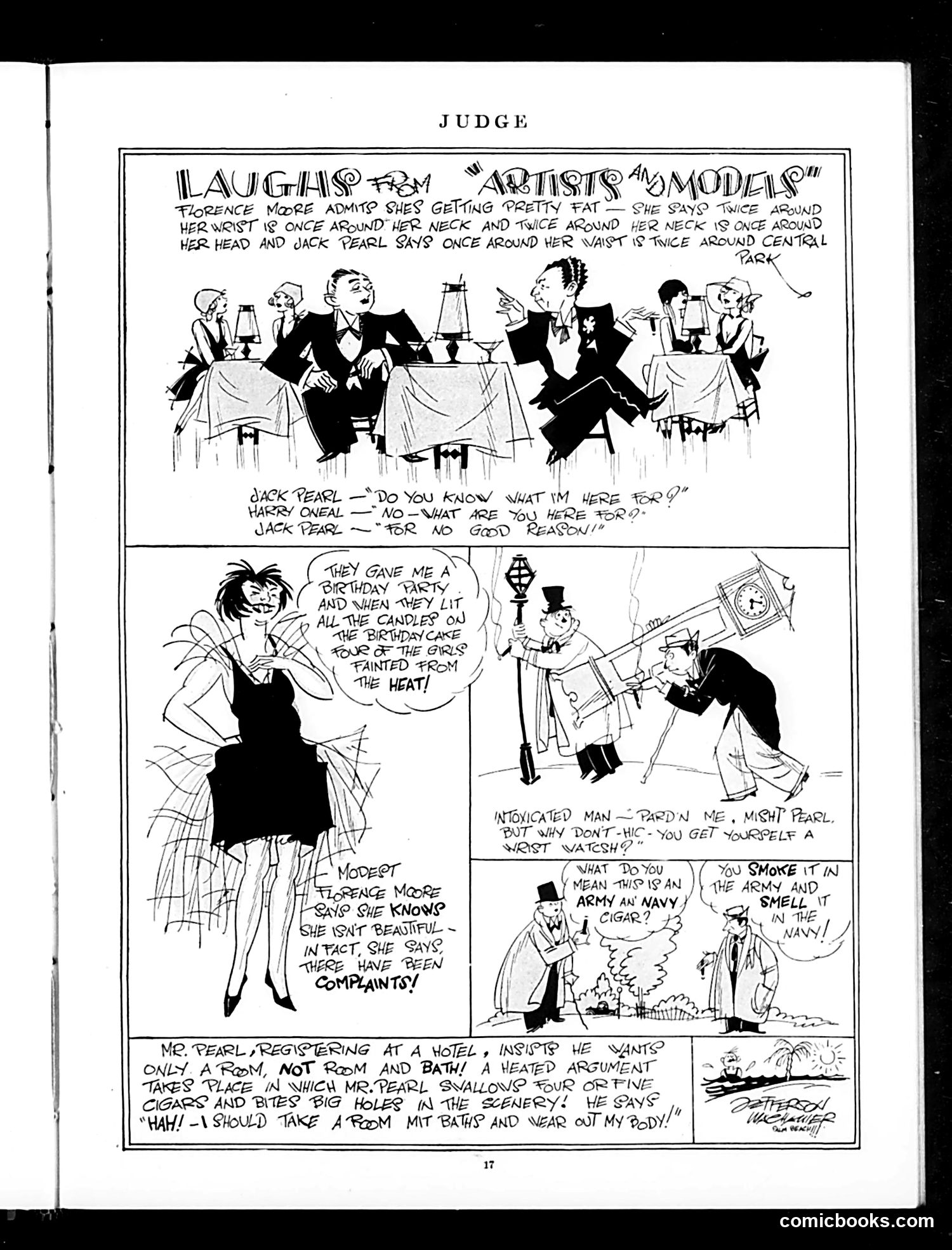
This page features multiple jokes centered on **Jack Pearl**, a popular 1930s comedian known for his character "Baron Munchausen," who spoke with a fake German accent and told tall tales. The satire targets Pearl's weight gain and vanity. Florence Moore (likely a contemporary actress) supposedly jokes about his expanding waistline using exaggerated measurements. The hotel registration scene mocks Pearl's destructive behavior—he's so bothered by the room's lack of a bathtub that he angrily smokes cigars and literally bites holes in the scenery rather than tolerate minor discomfort. Additional jokes involve: - A drunk man's confusion about "wrist watch" (mishearing) - A cigar brand confusion joke - General ribaldry about excess and poor behavior The humor relies on recognizing Pearl as a celebrity figure whose personal habits and ego were apparently fodder for public ridicule in 1930s satirical magazines.
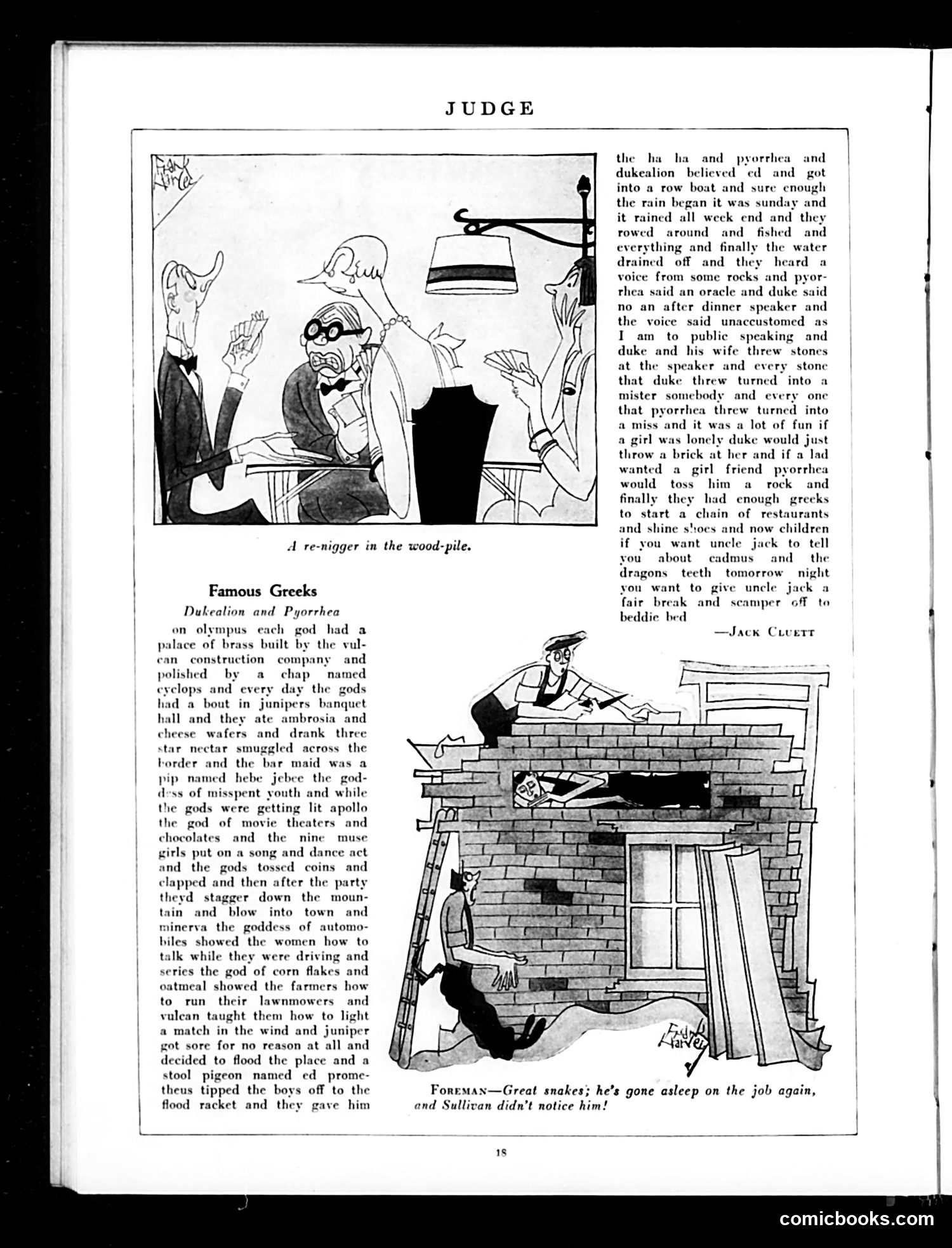
This page contains two satirical pieces from Judge magazine: **Top cartoon ("A re-nigger in the wood-pile")**: The title uses a period racial slur in a phrase meaning "a hidden problem or catch." The cartoon depicts figures in formal dress appearing to discover something troublesome, likely mocking some contemporary scandal or hypocrisy. **"Famous Greeks" article**: A humorous retelling of Greek mythology that substitutes classical gods with modern American references—Apollo as a movie theater god, Minerva as goddess of automobiles, gods teaching lawnmower operation. It's absurdist satire deflating classical mythology by making it mundane and contemporary. The lower cartoon shows a foreman discovering a sleeping worker ("Sullivan"), a straightforward workplace joke about negligent employees. Both pieces exemplify Judge's satirical style: irreverent, mixing classical/high culture with crude modern American life. The racial slur in the title reflects period publication standards now considered offensive.
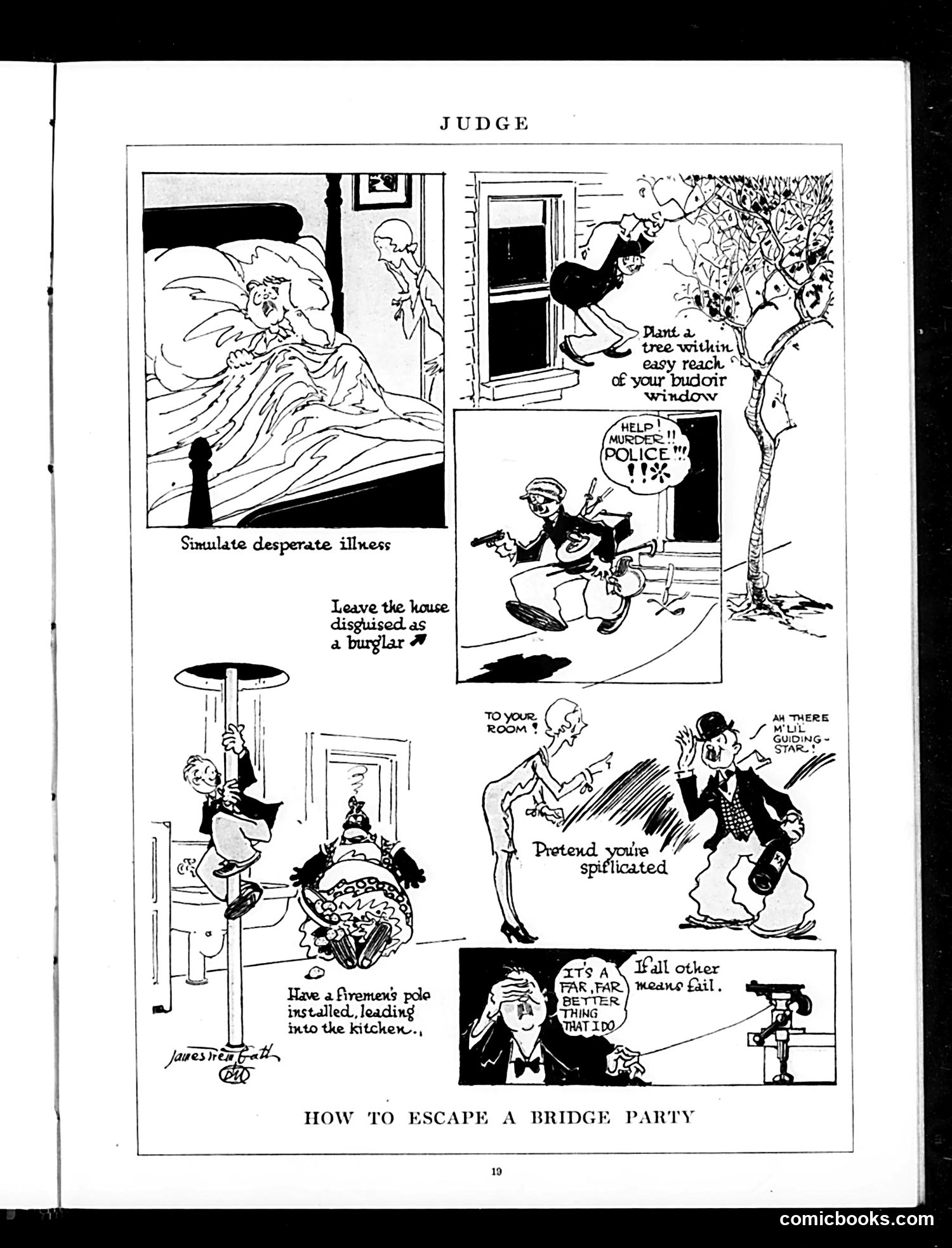
This humorous instructional cartoon satirizes the social obligation of attending bridge parties—popular card game gatherings in early-to-mid 20th century America, particularly among middle and upper-class women and couples. The comic presents absurd escape methods: - Simulate desperate illness in bed - Leave disguised as a burglar - Install a fireman's pole into the kitchen - Pretend sophistication/aloofness - Stage a fake "mean fall" The satire targets the tedium of mandatory social events and the desperation people feel to avoid them. Bridge parties were considered obligatory social participation for respectable people, yet apparently unbearable enough to warrant elaborate fictional escape schemes. The joke relies on readers recognizing both the social pressure to attend and the universal desire to escape such gatherings.
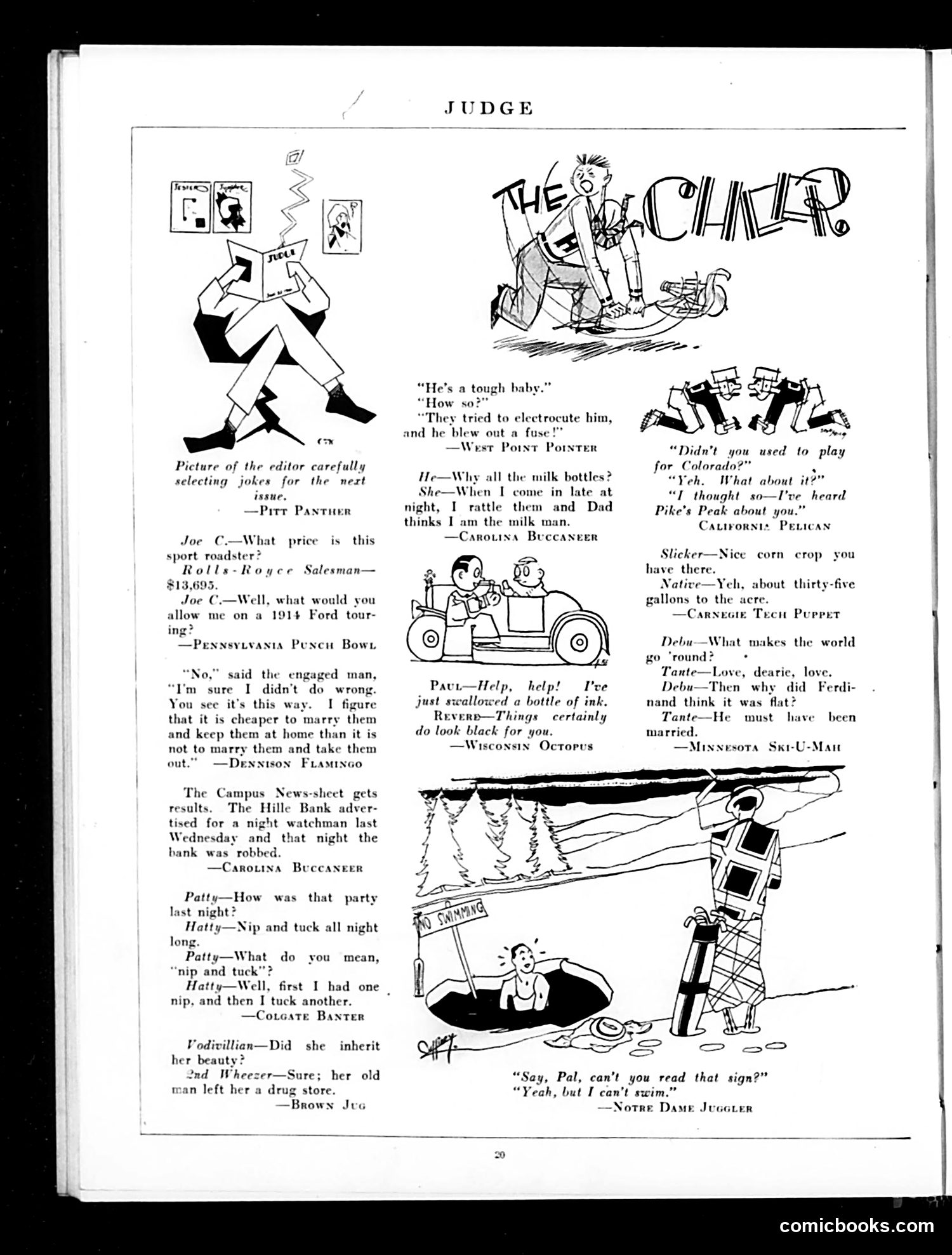
This is a humor page from *Judge*, featuring various unrelated jokes and cartoons typical of the magazine's satirical format. The content includes: **Visual gags**: A cartoon editor selecting jokes; "The Cuckler" (appears to be slapstick); a camping/drowning scene with a sign reading difficulty joke. **Conversational jokes** on topics including: - Engagement/marriage economics (sarcastically defending not marrying to avoid expenses) - Prohibition-era humor (references to "nip and tuck"—drinking) - College pranks (bank robbery following a "help wanted" ad) - Dating/courtship mishaps - Ford automobiles and pricing (referencing the affordable 1914 Model T) **The satire targets**: Working-class anxieties about marriage costs, youthful drinking culture, and commercial advertising's unintended consequences. The humor is gentle, family-friendly wordplay rather than sharp political commentary. The page reflects 1910s-1920s American middle-class concerns and humor conventions now largely opaque without historical context.
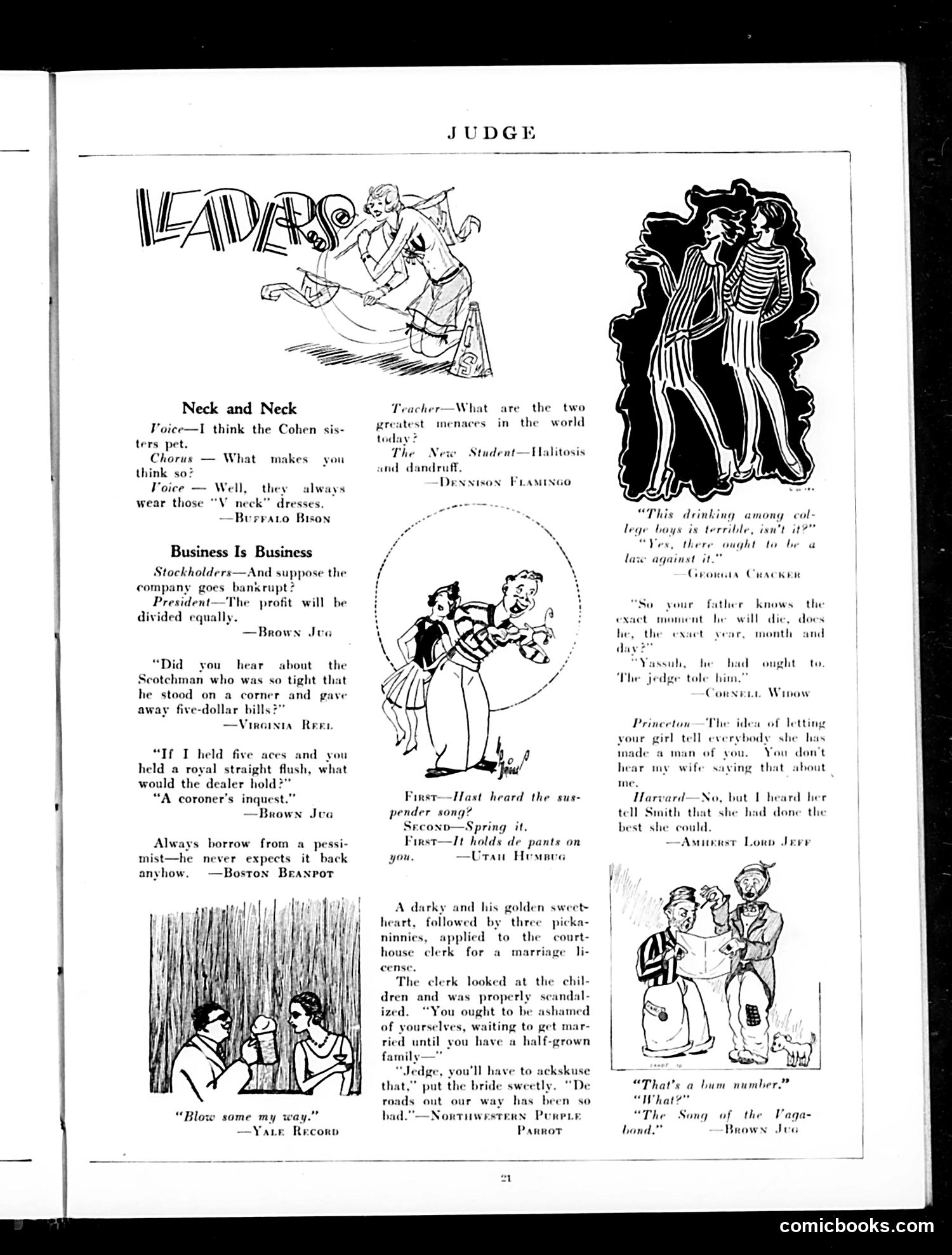
This page contains various short jokes and satirical quips typical of early 20th-century Judge magazine. The humor relies on ethnic and racial stereotypes common to that era: **Key content:** - "Neck and Neck" makes a pun on "V-neck" dresses and the Cohen sisters (Jewish caricature) - "Business Is Business" jokes about corporate greed and bankruptcy - "New Student" joke pairs halitosis and dandruff as life's worst problems - The longest piece describes a Black man and woman seeking marriage with three children, with the clerk scandalized. The dialect and "pickaninnies" reflect deeply racist depictions standard in period humor - College drinking joke and Ivy League banter about relationships **Context:** This represents Judge's satirical approach mixing class commentary, ethnic humor, and sexual innuendo. The racism and stereotyping that saturate this page reflect attitudes normalized in American popular media of this era, making it historically significant but morally objectionable by modern standards.
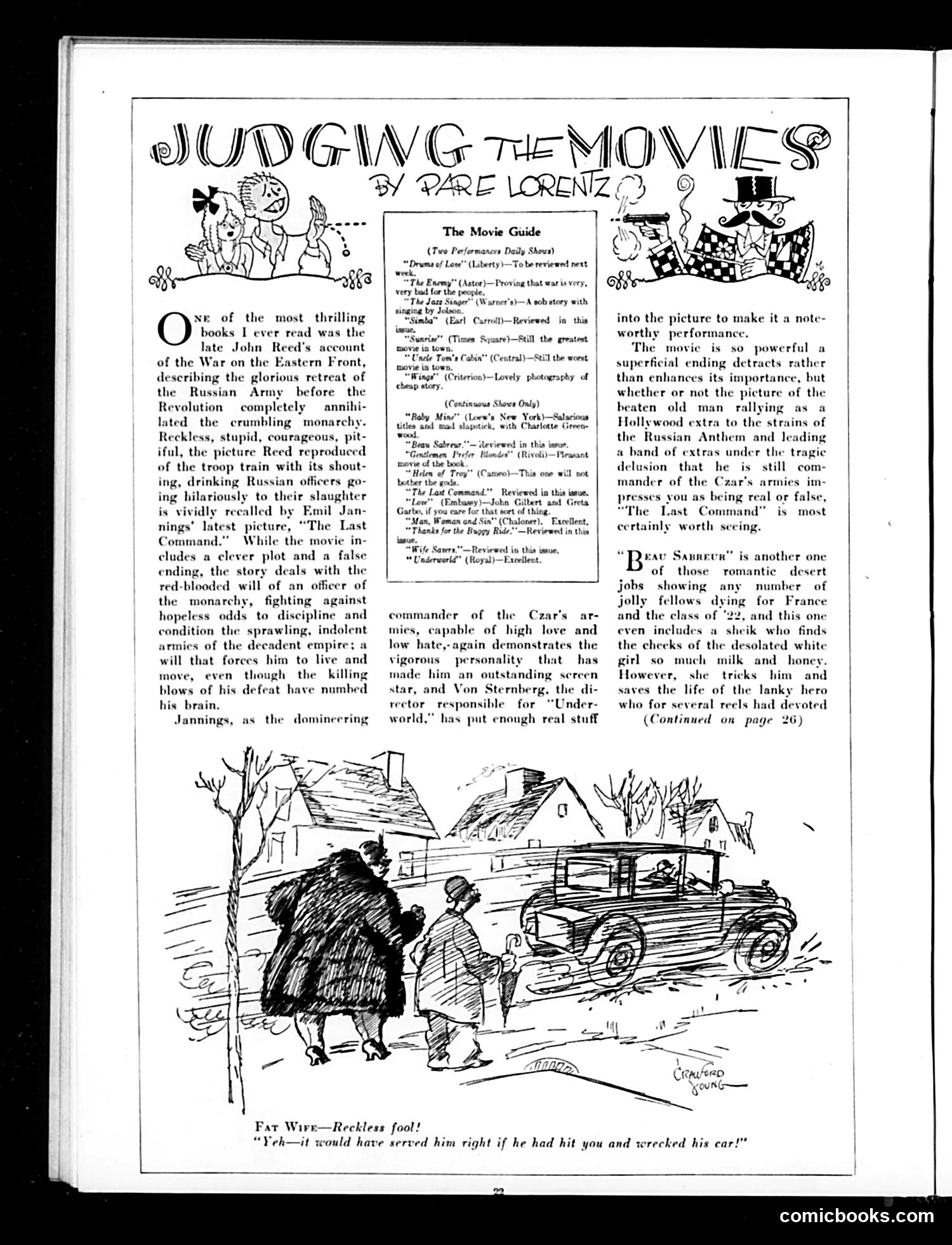
This is a film review column by Pare Lorentz critiquing contemporary movies, particularly Emil Jannings' "The Last Command." The piece discusses a Russian Imperial officer fighting to maintain discipline in the Czar's crumbling army during WWI and the Revolution—a theme inspired by John Reed's firsthand account of the Eastern Front. The cartoon caption below illustrates a domestic accident: a reckless driver has nearly hit a woman, and she sarcastically suggests he should have hit her harder and wrecked his car too—dark humor about traffic safety and reckless motorists, a growing social concern in 1920s America. The "Movie Guide" sidebar lists current theatrical releases with brief reviews, typical of entertainment journalism of the era. The overall page represents Judge magazine's blend of satirical commentary on contemporary culture, film criticism, and social observation.
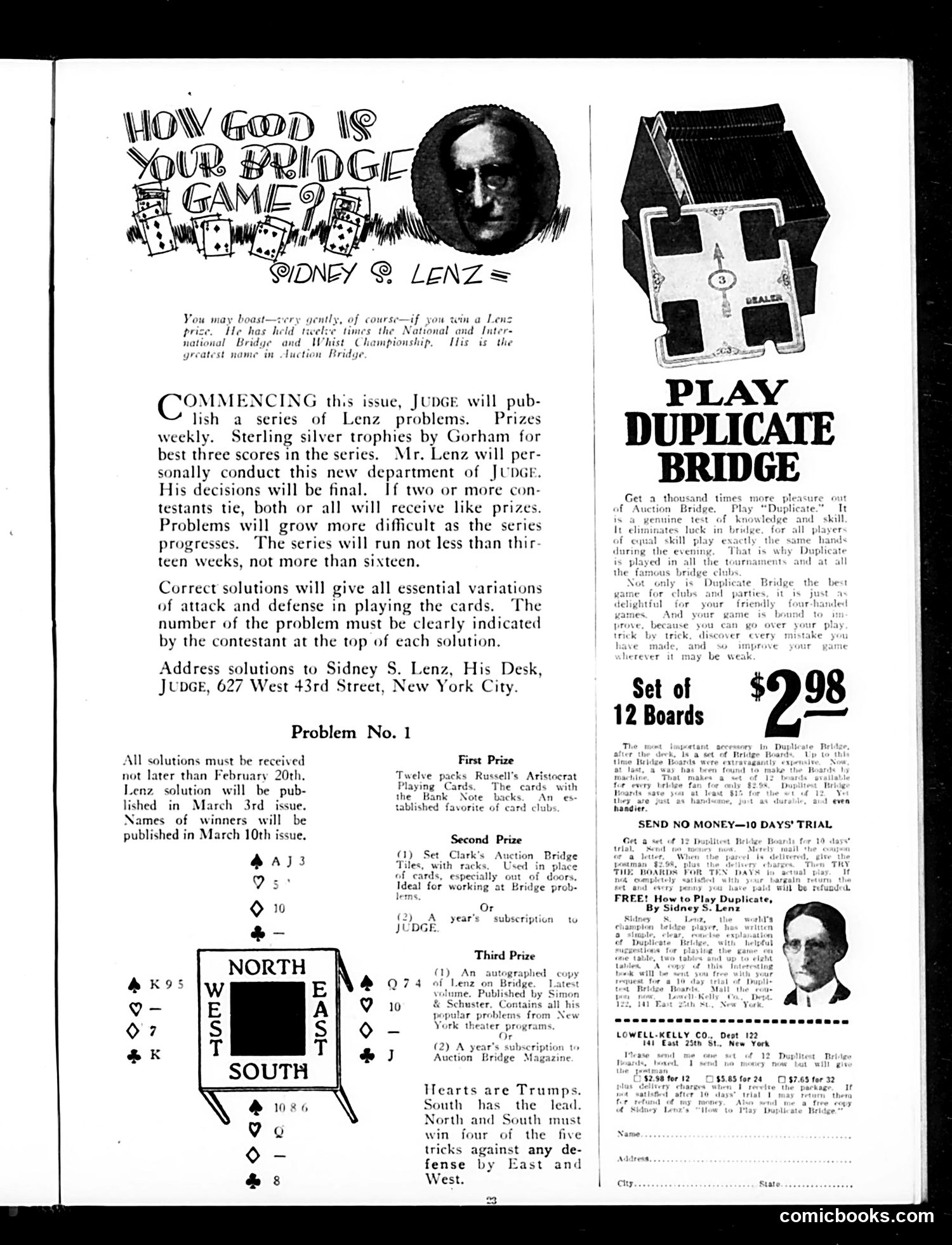
This page announces a new feature in *Judge* magazine: a weekly bridge problem series sponsored by Sidney S. Lenz, presented as a contest with prizes. **The Context:** Sidney Lenz was a famous bridge player and champion of the early 20th century. Bridge was enormously popular during this era—a fashionable parlor game among the middle and upper classes. *Judge* was capitalizing on this craze by featuring Lenz problems for readers to solve competitively. **The Satire/Humor:** The opening illustration plays on bridge's social prestige: "How good is your bridge game?" with Lenz's portrait suggests that mastering bridge signals cultural refinement and status. The accompanying advertisements for "Duplicate Bridge" boards and instructional materials further mock the game's commercialization and the aspirations of amateur players wanting to improve. **The Joke:** For modern readers, the humor lies in the breathless promotion of what now seems a quaint Victorian pastime, treated with the gravitas typically reserved for serious intellectual pursuits.
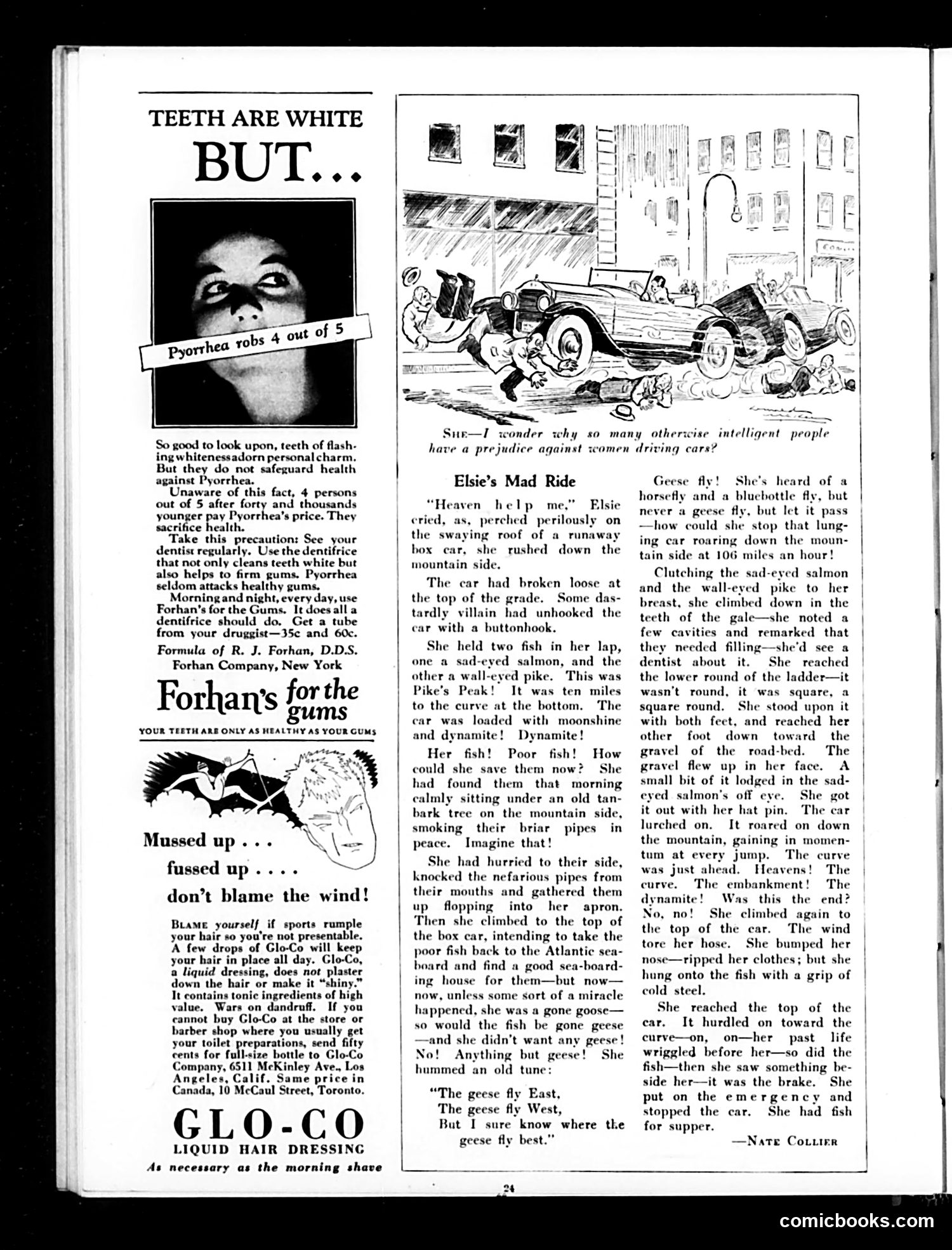
This page combines product advertisements with satirical humor typical of early-20th-century Judge magazine. **Left side**: Three ads (Forhan's toothpaste, Glo-Co hair dressing) use fear-based marketing common to the era—pyorrhea and unkempt appearance as social threats. **Right side**: "Elsie's Mad Ride" is absurdist satire mocking pulp adventure fiction. The opening frame questions gender bias against women drivers—a contemporary social debate. The story then deliberately descends into ridiculous melodrama: a runaway boxcar loaded with dynamite, two fish smoking pipes, a salmon with a gravel-lodged eye requiring dental care. The satire targets overwrought serialized fiction through increasingly nonsensical plot details. The fish characters and their briar pipes, the "square round" ladder, the concern about dental cavities amid catastrophe—these are parodies of overwrought adventure storytelling. By author Nate Collier, it's social comedy critiquing both pulp literature conventions and, perhaps, dismissive attitudes toward women's competence.
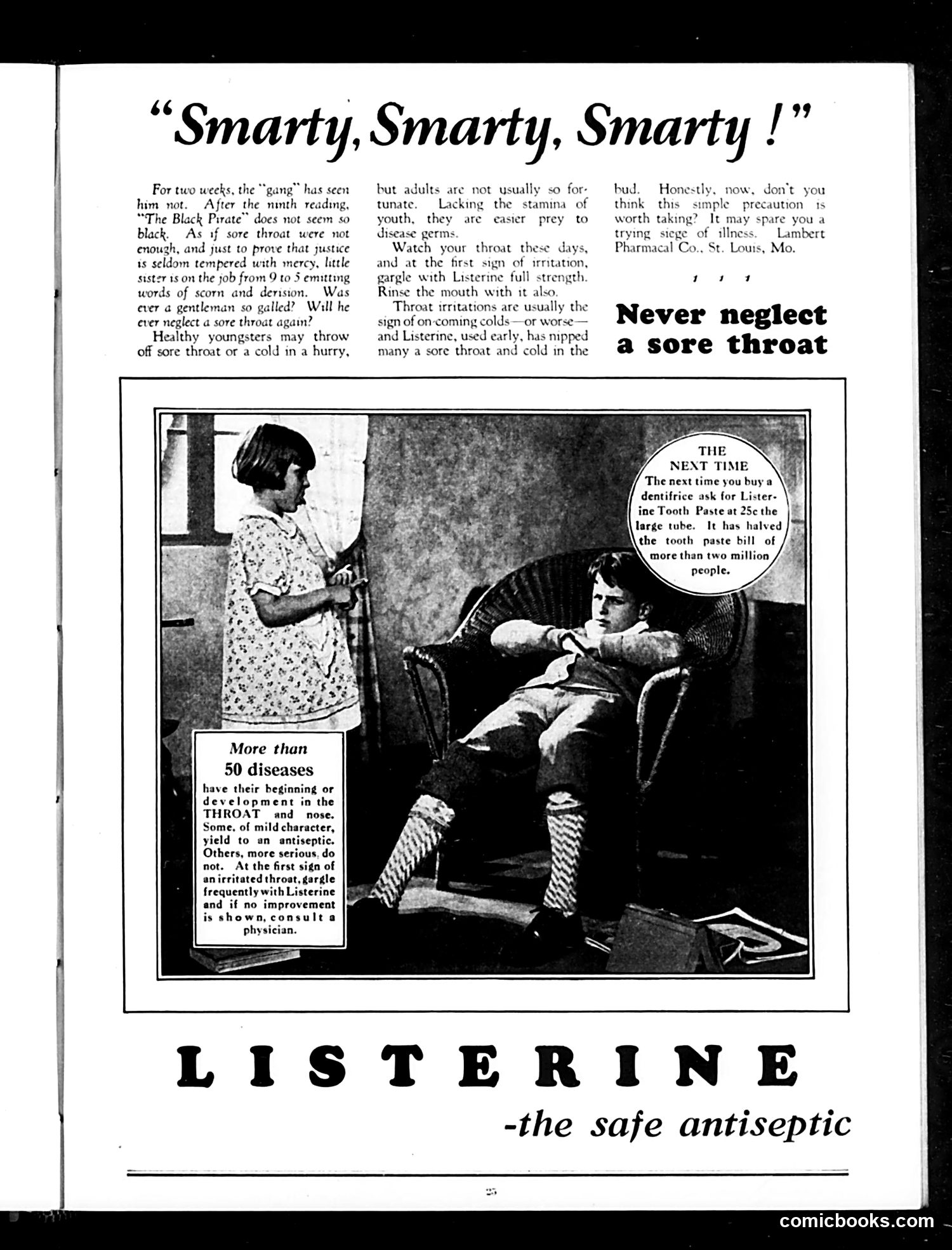
This is primarily a **Listerine advertisement** rather than political satire. The page uses a domestic humor scenario to promote the antiseptic mouthwash. **The "cartoon"** depicts a sick man confined indoors for two weeks, unable to see his social circle (the "gang"). His younger sister torments him with mockery ("Smarty, Smarty, Smarty!") while he's bedridden. The implied joke: even worse than illness is being stuck at home where annoying family members can ridicule you. **The sales pitch** contrasts healthy children (who recover quickly from throat ailments) with vulnerable adults. The ad claims over 50 diseases originate in the throat and nose, positioning Listerine as preventive medicine. It warns that sore throats signal oncoming colds and recommends gargling with full-strength Listerine. **The context**: This reflects early-20th-century anxieties about contagion and germ theory, combined with promotional advertising disguised as health advice. The "safe antiseptic" tagline and mention of Lambert Pharmacal Co. establish credibility through scientific-sounding language typical of that era's patent medicine marketing.
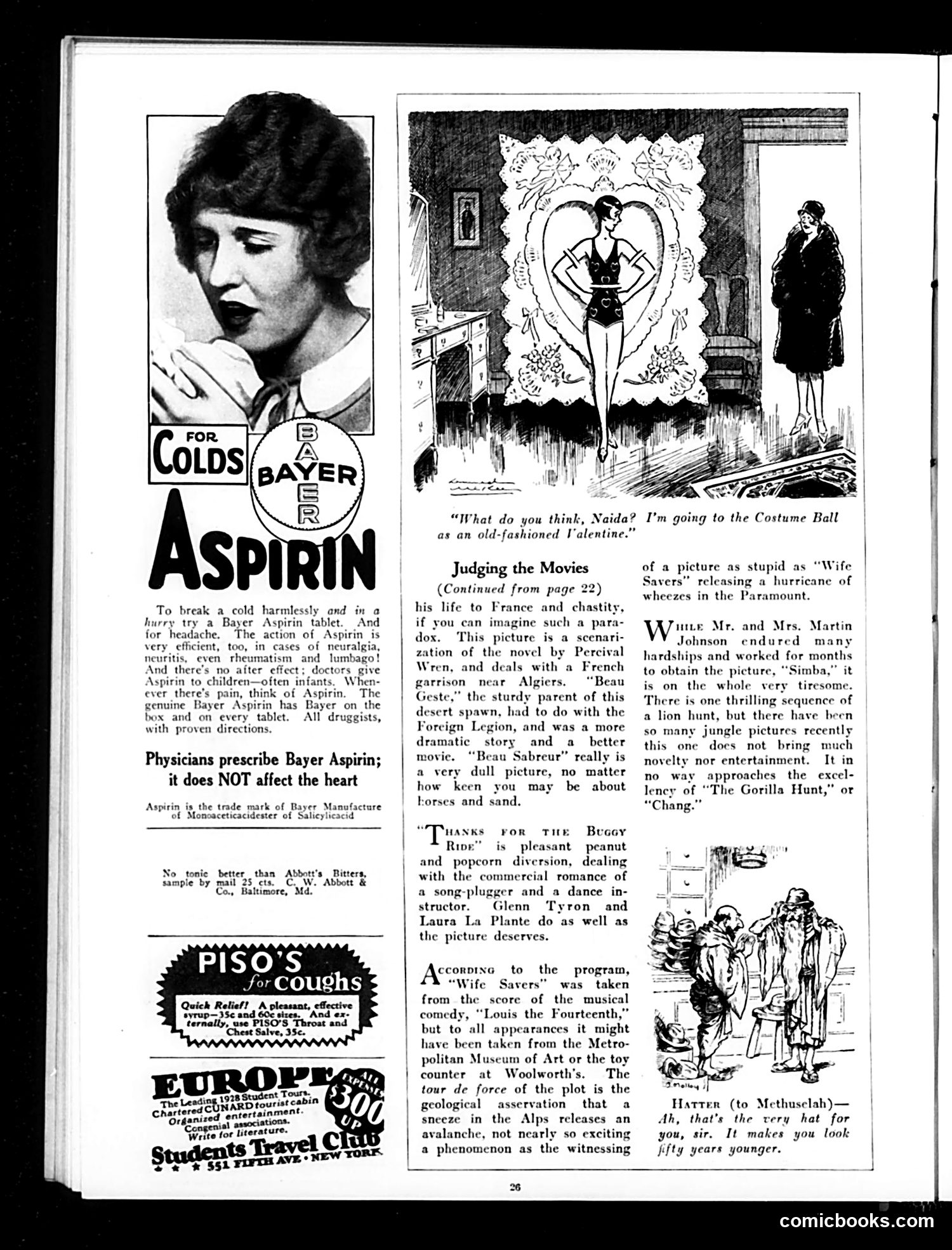
This page combines **advertisements** (Bayer Aspirin, Piso's cough medicine, student travel) with a **movie review column** titled "Judging the Movies." The cartoon at top shows a woman planning to attend a costume ball dressed as "an old-fashioned Valentine"—a mild social satire about fashion and dating customs of the 1920s era. The film reviews critique recent movies: "Beau Sabreur" is dismissed as dull despite its desert/Foreign Legion setting. "Thanks for the Buggy Ride" is called pleasant but forgettable entertainment. "Wife Savers" is harshly mocked as stupid, with a ridiculous plot device (a sneeze causing an avalanche). "Simba," a jungle picture, is criticized as tedious, noting that similar animal-adventure films have become formulaic. The bottom cartoon jokes that a particular hat makes someone look "fifty years younger"—a simple compliment gag. The page reflects 1920s popular entertainment standards and the reviewer's somewhat cynical assessment of contemporary cinema's quality.
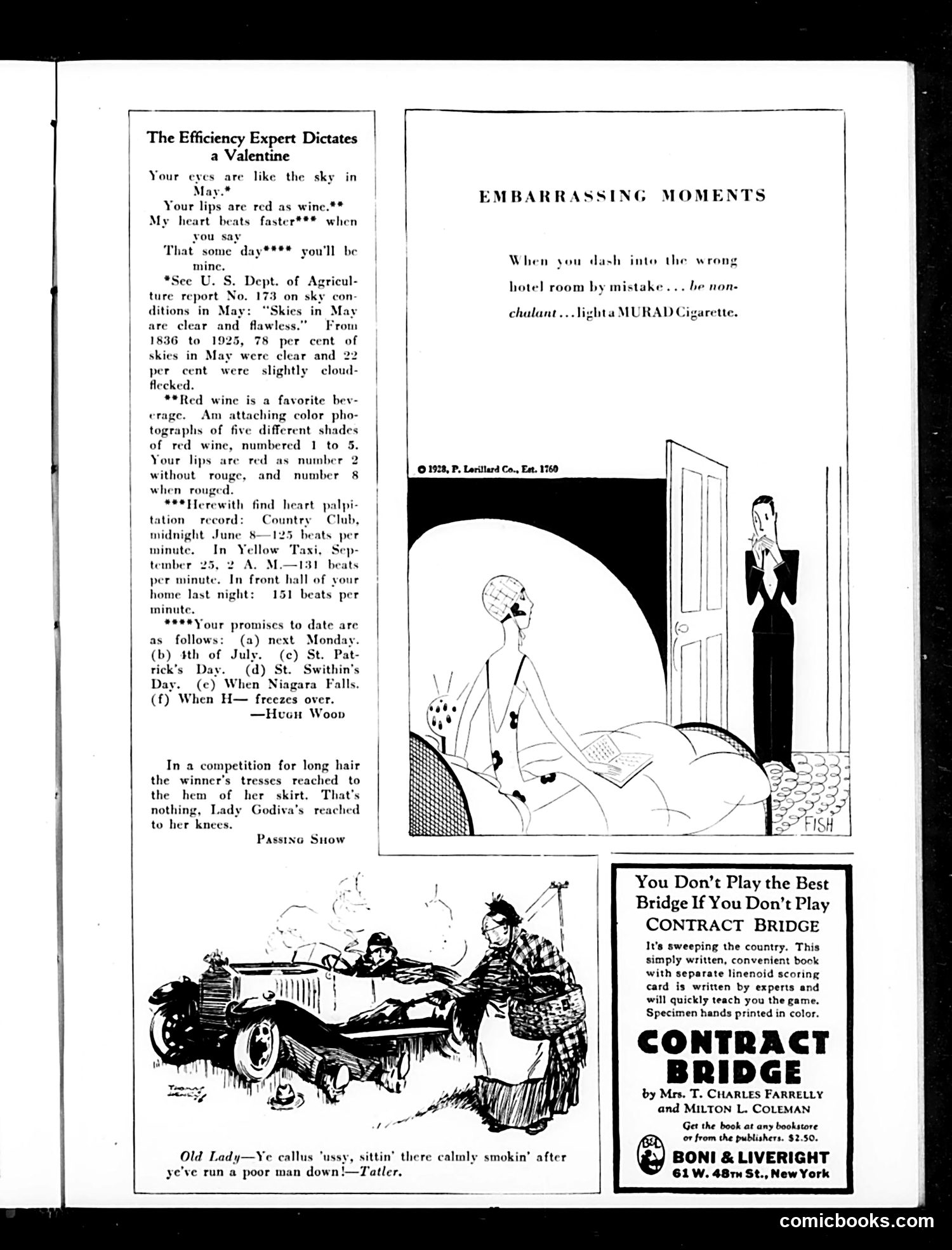
This page satirizes early 20th-century business culture and contains period advertisements. **"The Efficiency Expert Dictates a Valentine"** mocks the obsession with "efficiency experts"—consultants who applied scientific management to every aspect of life. The joke: a romantic valentine gets destroyed by excessive data and footnotes citing agricultural reports, wine-color charts, and heart-rate measurements. Romance becomes absurdly quantified and joyless. **"Embarrassing Moments"** shows a woman entering the wrong hotel room; the advertisement suggests lighting a Murad cigarette to seem nonchalant and recover dignity—implying smoking conveys sophistication. **The cartoon below** depicts an elderly woman calling a motorist "ussy" (hussy) for smoking calmly after hitting a poor man with her car. It satirizes how wealthy or privileged people dismiss serious wrongs with casual indifference. The page also advertises "Contract Bridge," a newly popular card game, and other period products. Overall, Judge critiques modern efficiency obsession, class indifference, and consumer culture.
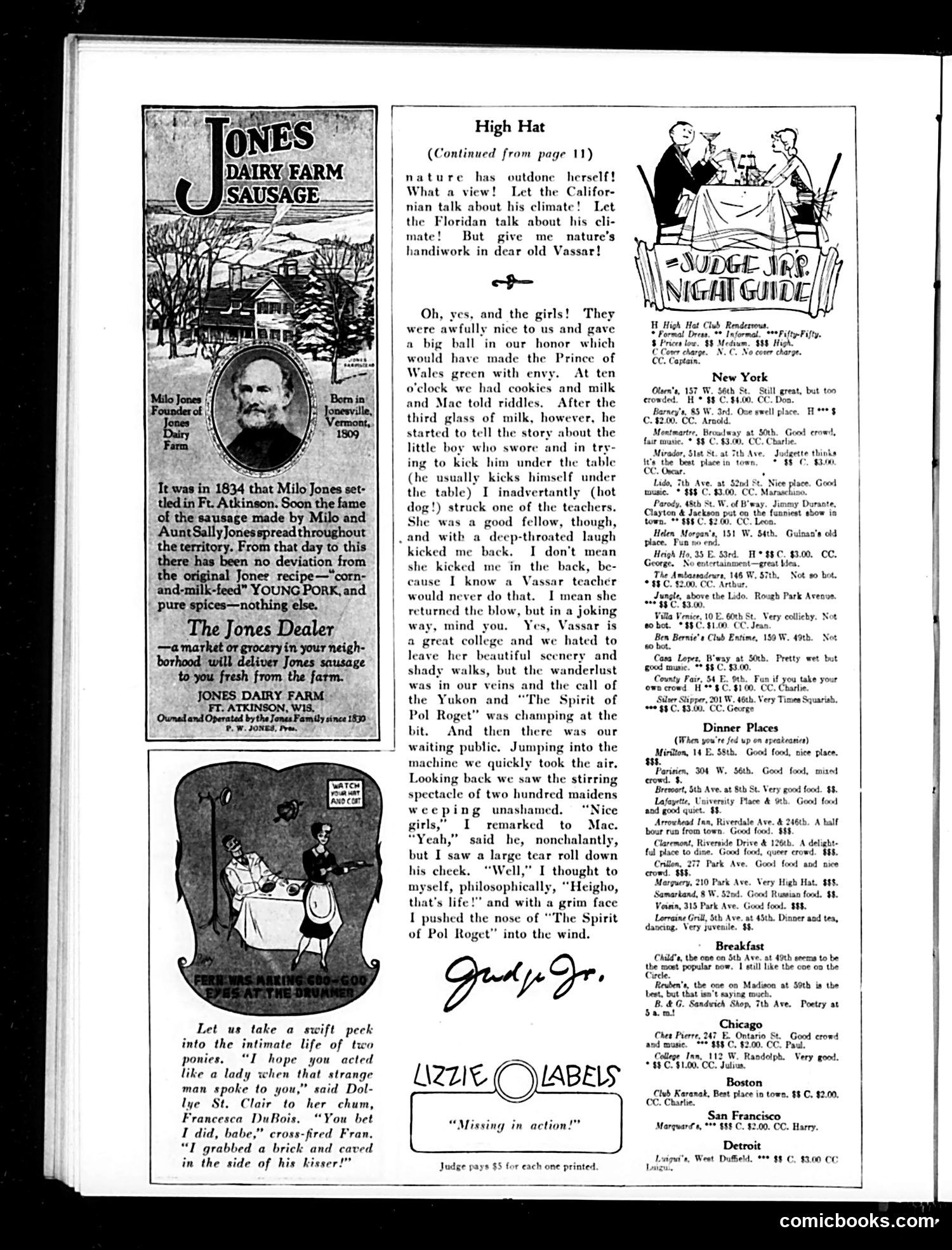
This Judge magazine page mixes advertising with humor columns. The main content is "High Hat," a satirical travel narrative about a visit to Vassar College. The narrator describes the institution's natural beauty, the female students' hospitality (a ball in their honor), and a comedic incident where he accidentally kicks a teacher while attempting to kick another student under the table during milk and cookies. The piece gently mocks both the pretentiousness of Vassar women and the narrator's own self-importance. References to "the Yukon and 'The Spirit of Pol Roget'" suggest wanderlust and adventure-seeking. The page also includes a "Lizzie Labels" cartoon about two ponies discussing feminine decorum—a joke about women claiming propriety while actually committing violence ("I grabbed a brick and caved in the side of his kisser"). Additionally, there's a Jones Dairy Farm sausage advertisement and a listing guide for New York nightclubs, reflecting 1920s-era leisure culture.
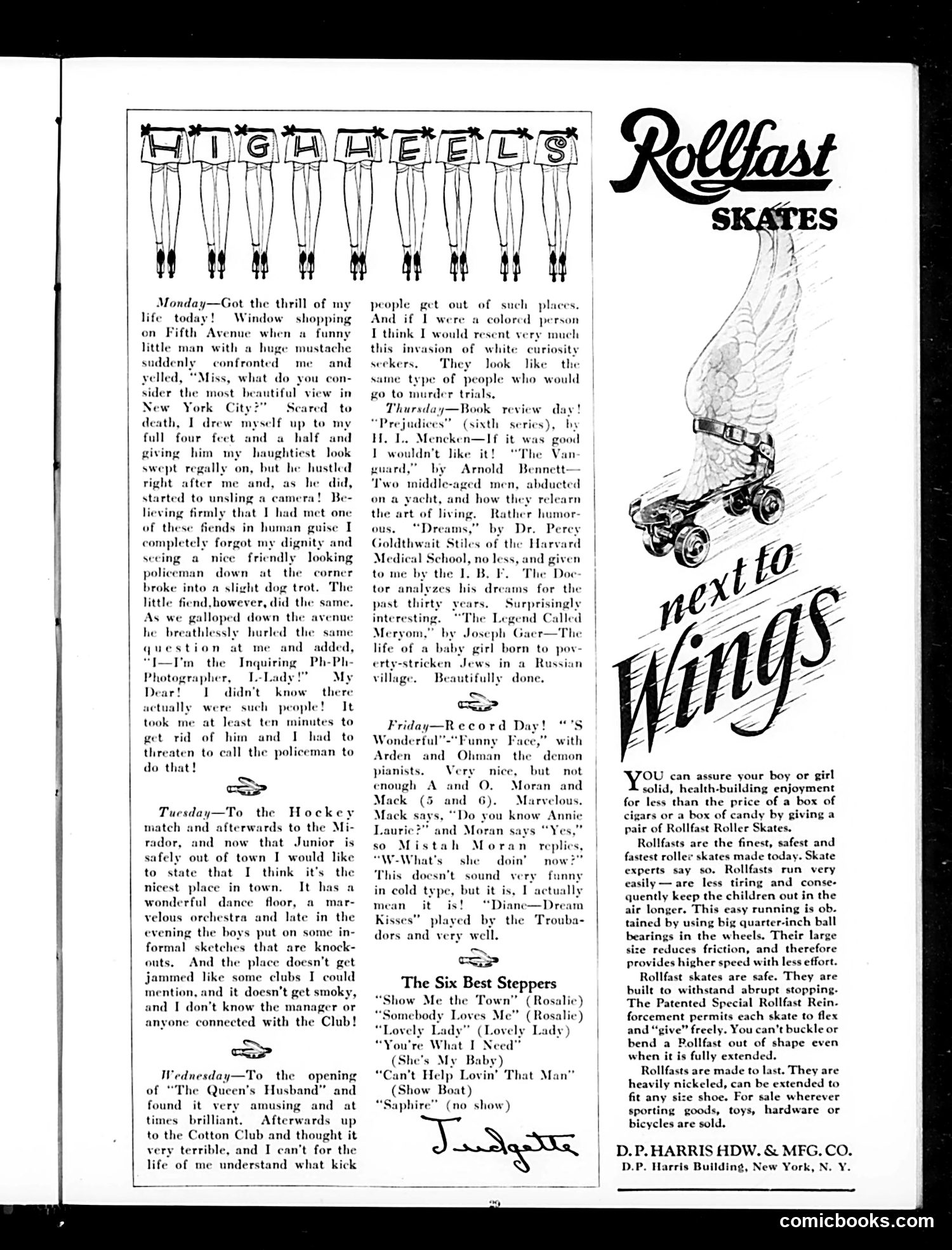
This page contains a humorous **diary column** (left) and a **roller skate advertisement** (right). The diary recounts a week in the life of a society woman, mixing observations of 1920s Manhattan leisure culture with mild social commentary. Key references include: - The **"Inquiring Photographer"** (Monday)—a real recurring newspaper feature that ambushed unsuspecting pedestrians with questions - **Fifth Avenue window shopping** and the **Cotton Club**—markers of wealth and fashionable Manhattan life - **The Queen's Husband** and **Prejudices by H.L. Mencken**—contemporary Broadway shows and intellectual works - A subtle critique of the **Cotton Club** (a famous Harlem nightclub) where the diarist notes white curiosity-seekers invading a Black venue and questions whether colored people resent this The humor is light social satire about upper-class Manhattan life. The advertisement uses the diary format's aspirational tone to market Rollfast skates as wholesome children's entertainment—a sales strategy positioning the product as sophisticated and health-conscious rather than frivolous.
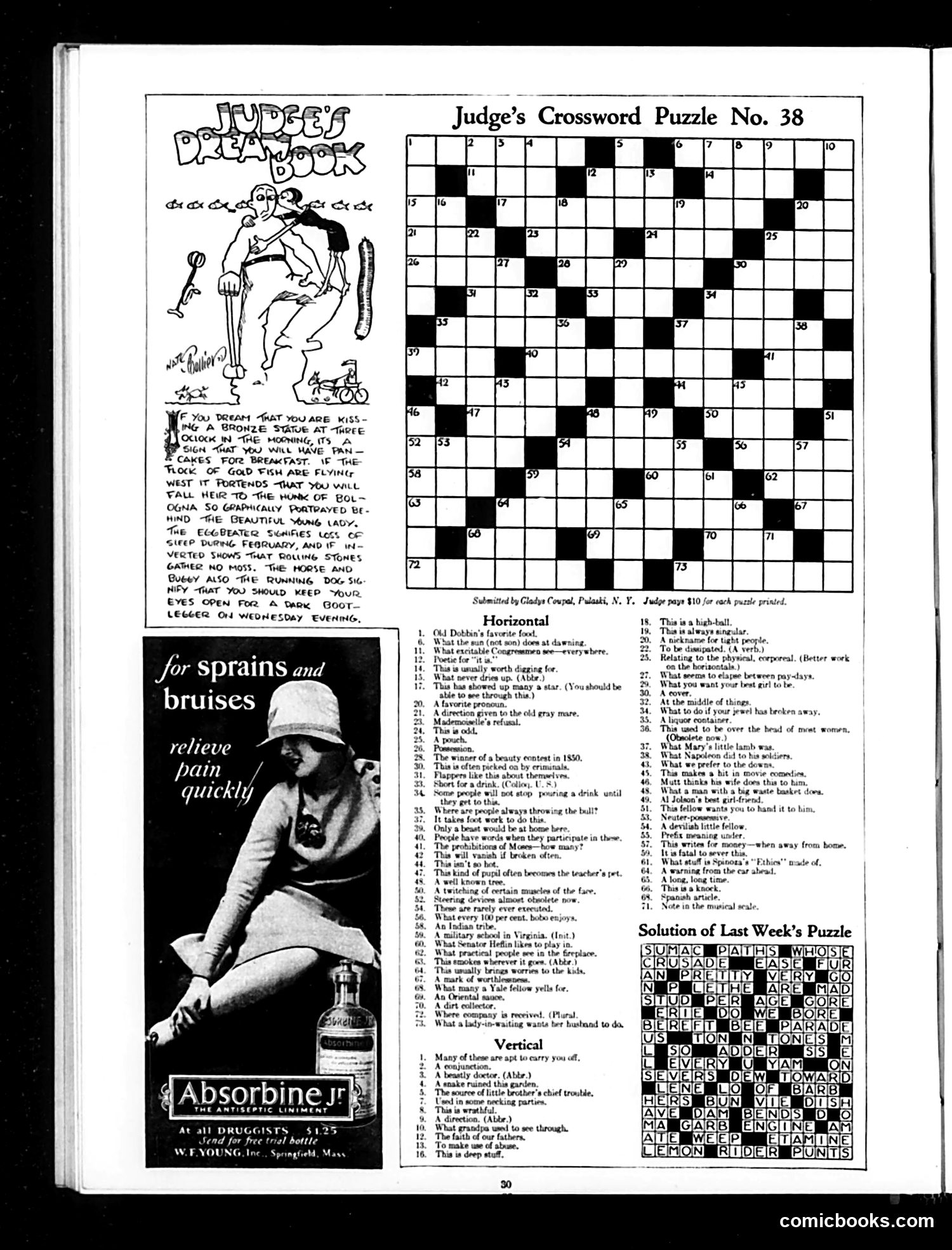
This page contains **two unrelated items**: **1. The "Judge's Dream Book" Cartoon** (top left): A humorous fortune-telling guide presenting dream interpretations in absurdist fashion. The joke satirizes the popular early-20th-century trend of dream interpretation books—claiming that dreaming of kissing a bronze statue means pancakes for breakfast, or that flying fish portend inheriting bologna. It mocks the pseudoscientific claims of fortune-telling as nonsensical entertainment. **2. Advertisement and Crossword Puzzle**: The page primarily features a crossword puzzle and an advertisement for **Absorbine Jr.**, a topical pain reliever marketed for "sprains and bruises." The ad uses a nurse or medical figure to establish credibility during an era when such remedies had minimal regulation. The crossword clues reference 1920s cultural touchstones (prohibition, "flappers," Yale traditions, Senator Heflin) but are otherwise generic wordplay puzzles typical of the period.
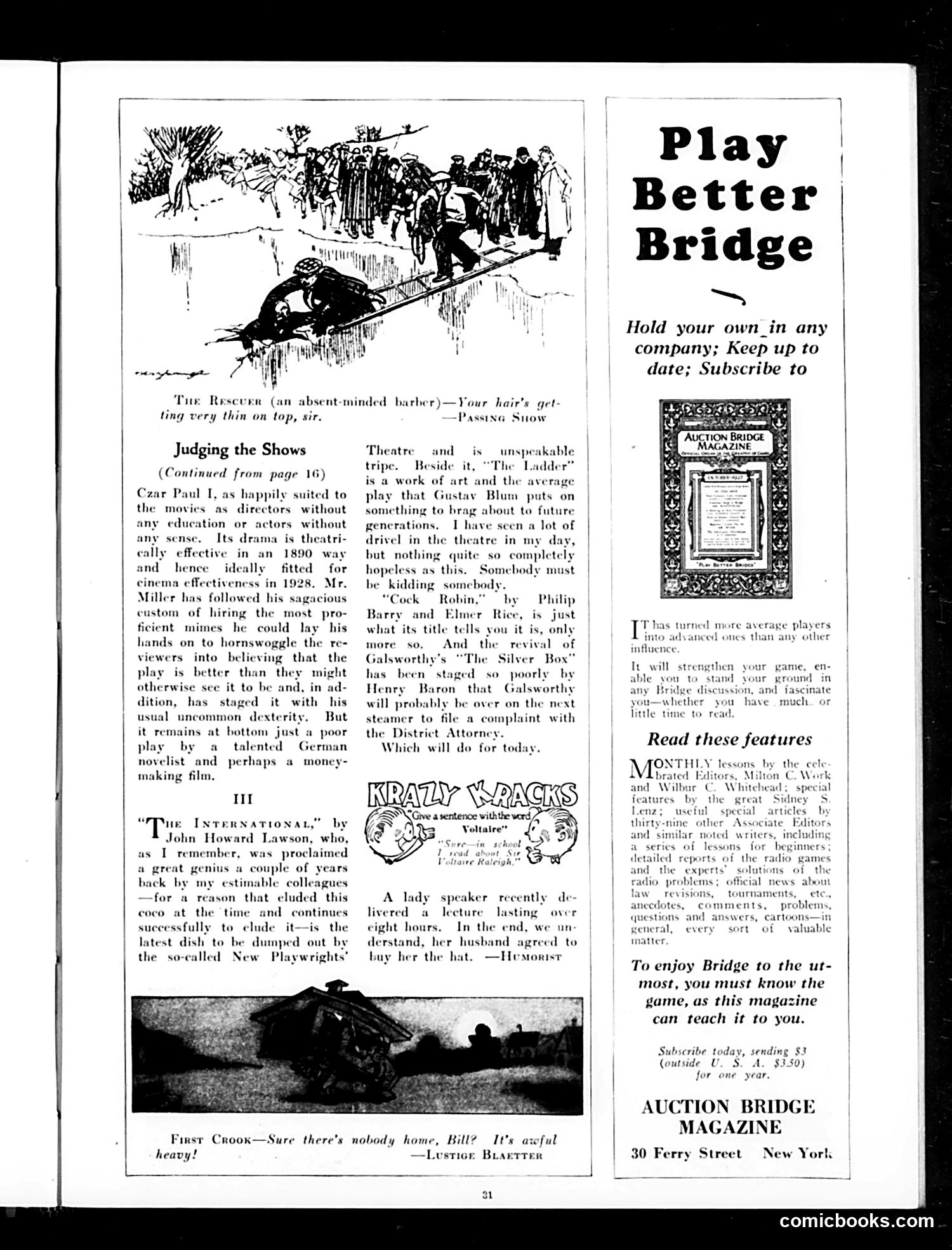
This page contains theater criticism and advertising rather than political cartoons. The main content critiques 1928 Broadway plays, including productions directed by Paul Bern and works by playwrights like John Howard Lawson (associated with the "New Playwrights" movement). The small cartoon labeled "Krazy Kracks" appears to be a brief joke about a woman speaker delivering an eight-hour lecture; her frustrated husband finally agrees to buy her a hat to make her stop talking—a standard domestic humor trope mocking verbose women. The page's primary purpose is promoting *Auction Bridge Magazine*, a publication for bridge card players. The advertisement emphasizes that to play bridge well competitively, readers must study the game systematically through the magazine's lessons and expert analysis. The barber cartoon at top ("The Rescuer") is an unrelated visual joke about hair loss—a common topic in period humor.
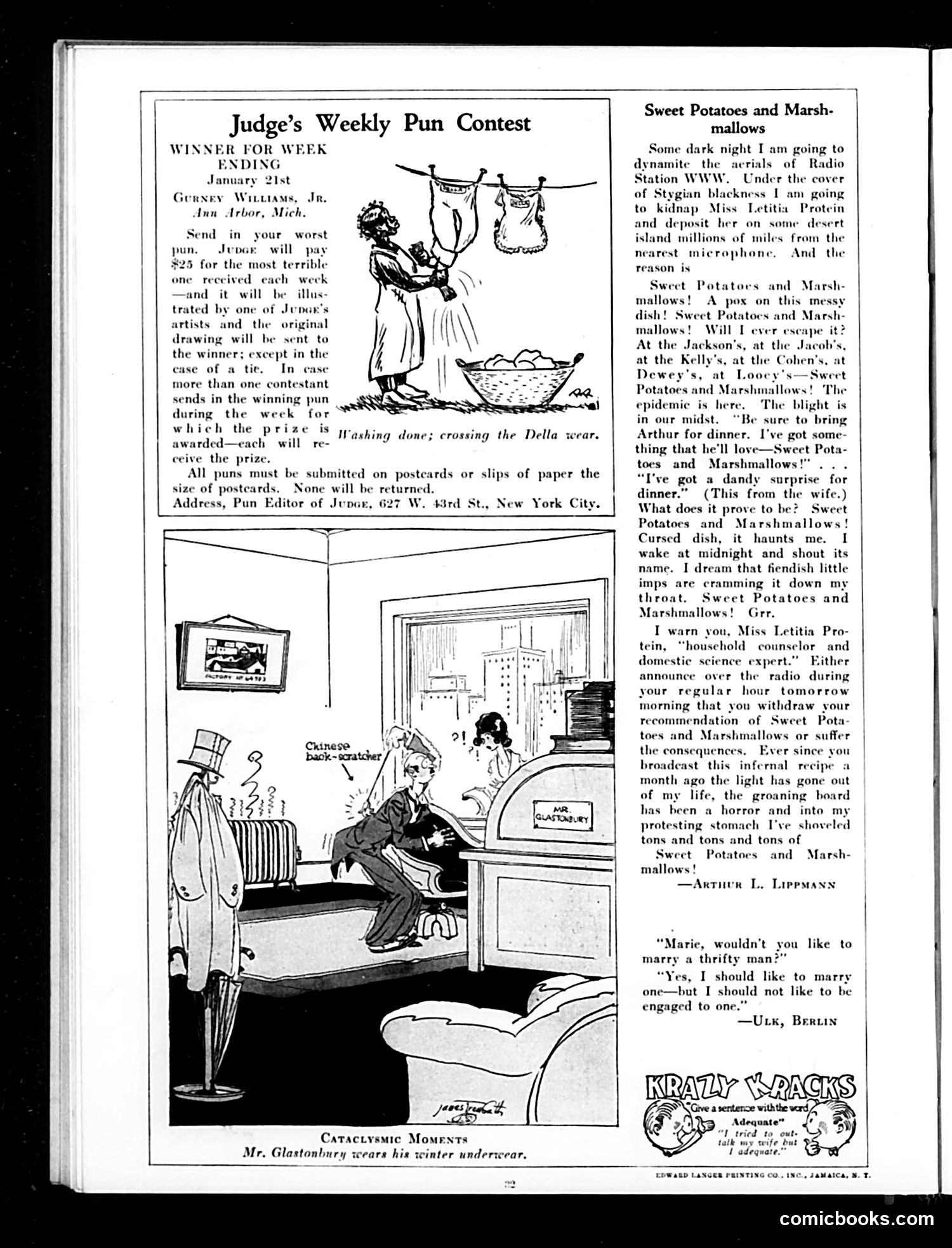
This page contains three distinct pieces of early 20th-century humor: **"Judge's Weekly Pun Contest"** announces a $25 weekly prize for submitted puns, with the winning entry illustrated by staff artists. The example pun plays on laundry terminology: "Washing done; crossing the Della wear" (Delaware). **"Cataclysmic Moments"** cartoon depicts a domestic scene where Mr. Glastonbury wears winter underwear—likely a visual gag about men's embarrassment or discomfort with visible undergarments. **"Sweet Potatoes and Marshmallows"** is a satirical rant attributed to Arthur L. Lippmann, mocking a radio personality named "Miss Letitia Protein" (a domestic science/cooking expert). The piece ridicules how this broadcaster's recipe recommendation has become ubiquitous at dinner parties, appearing everywhere and driving the narrator to mock-threaten kidnapping her to stop the trend. The page reflects 1920s-30s consumer culture anxiety—how mass media (radio) and advice columnists could create food fads that permeated social life.
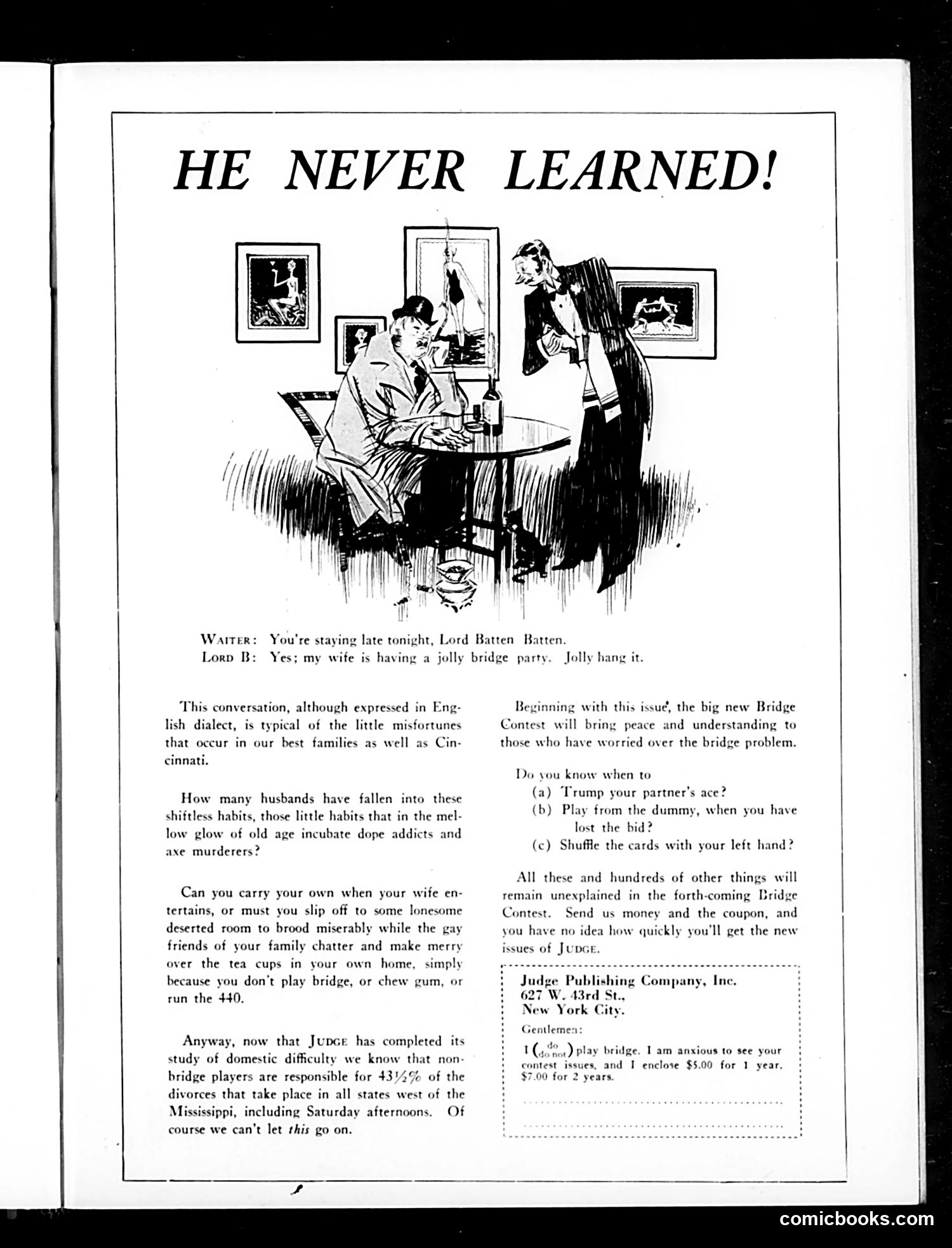
This Judge magazine page satirizes the social friction caused by bridge—the card game that was enormously popular among upper-class Americans in the early 20th century. The cartoon depicts "Lord Batten Batten" staying out late specifically to avoid his wife's bridge party at home. The satire's premise: non-bridge players are social liabilities who cause marital discord. The text humorously escalates this, claiming bridge non-players account for over 43% of divorces west of the Mississippi. The joke mocks both the obsessive social dominance of bridge and the anxiety it created among those who didn't play. Judge then launches a "Bridge Contest" (essentially a subscription pitch), advertising it as a solution to the "bridge problem"—though the contest deliberately won't explain actual bridge rules, making the self-aware satire complete. It's commentary on how a leisure activity became socially mandatory among the elite.
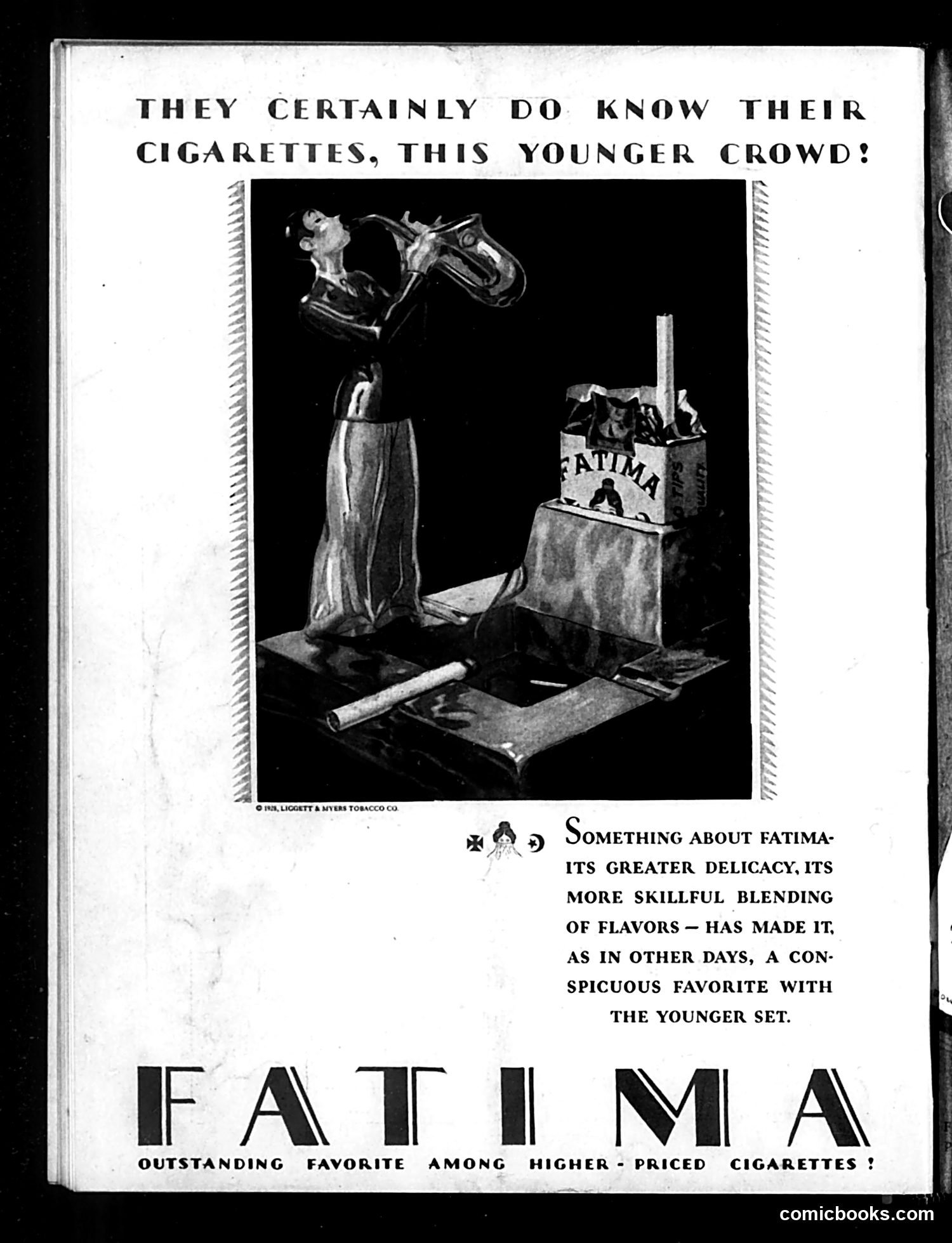
This is primarily a **cigarette advertisement** for Fatima brand, not political satire. The 1908 Liggett & Myers ad uses a staged photograph showing a young woman in elegant dress examining cigarettes, with a Fatima box displayed prominently. The "satire" element is minimal—the headline's tone ("They certainly do know their cigarettes, this younger crowd!") employs gentle mockery of youth consumer sophistication, but this is really marketing language. The ad emphasizes that Fatima's "greater delicacy" and "skillful blending" appeals to "the younger set," positioning the brand as a sophisticated choice among higher-priced cigarettes. The image itself appears designed to associate Fatima with elegance and feminine refinement—a common advertising strategy of the era. No specific political figures or events are referenced; this is purely commercial promotion.