
Judge, 1928-02-11 · page 10 of 36
Judge — February 11, 1928 — page 10: what you’re looking at
What you’re looking at
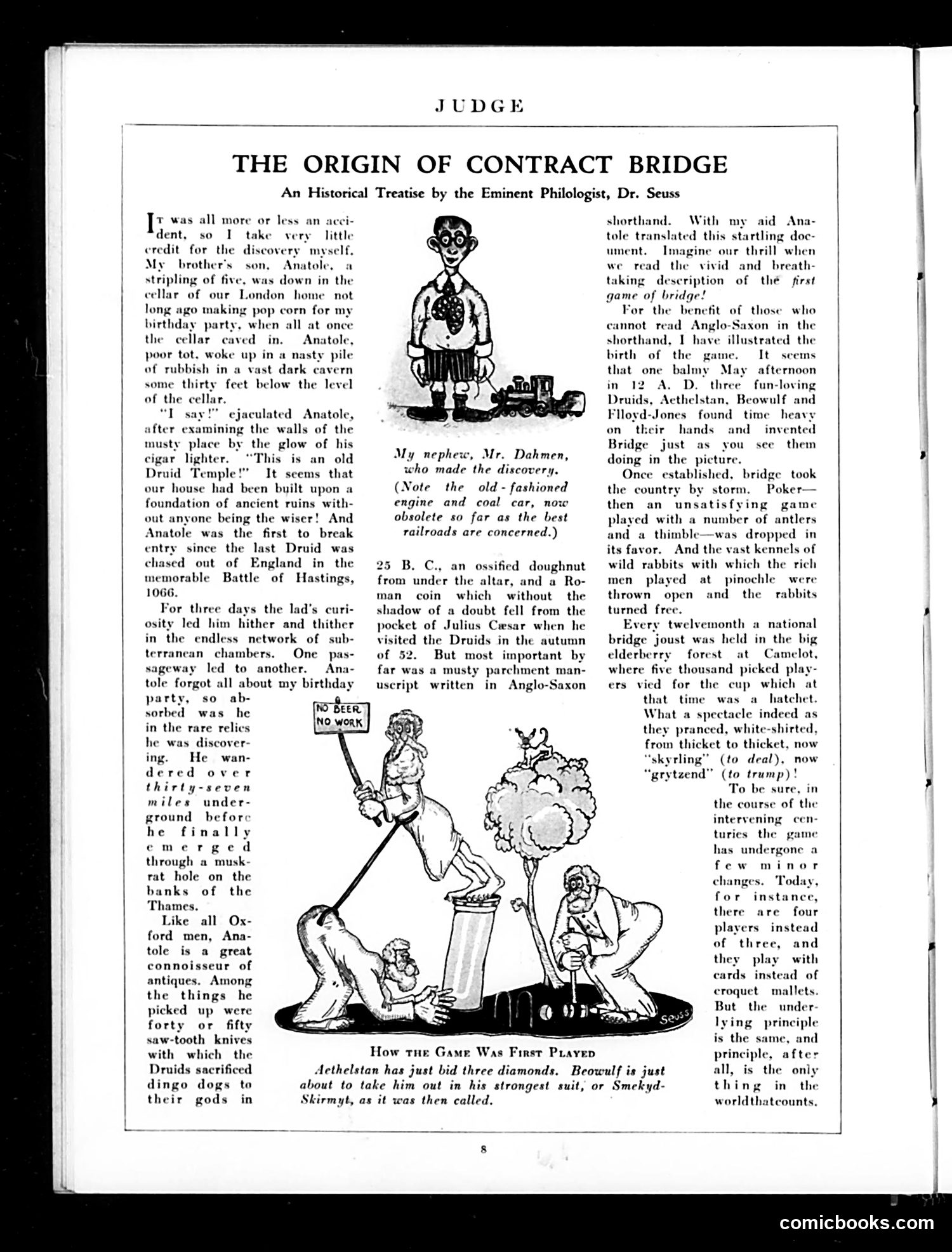
This is a humorous article by Dr. Seuss (the famous children's author) in *Judge* magazine, satirizing the card game Contract Bridge by inventing a fake historical origin story. **The Satire:** The piece mocks the game's popularity and pretensions by claiming it was invented by ancient Anglo-Saxon Druids (Aethelstan, Beowulf, and Floyd-Jones) around 12 A.D., discovered by a boy named Anatole in London caverns beneath his house. It includes absurd "historical evidence" like Roman coins and ancient manuscripts. **The Point:** Bridge had recently become extremely fashionable among upper-class players, often replacing poker. Seuss is ridiculing both the game's sudden trendiness and society's obsession with it—treating an actual modern parlor game with mock-scholarly reverence, as if it were an ancient tradition worthy of archaeological study. **Visual Jokes:** The illustrations show Druids playing bridge with "the strongest suit" (pun on card suits), and the caption notes modern railroad technology has become "obsolete"—emphasizing the farcical anachronism of the entire historical narrative.
📄 Transcribed text from this page (OCR, searchable)
Machine-transcribed from the original scan — historical spelling and the odd misread are preserved.
JUDGE THE ORIGIN OF CONTRACT BRIDGE An Historical Treatise by the Eminent Philologist, Dr. Seuss T was all more or less an acci- dent, so 1 take very little it for the discover: f. My brother's son, Anatole. a stripling of five, was down in the cellar of our London home not long ago making pop corn for my birthday party, whe: a the cellar caved in. poor tot, woke up in ¢ of rubbish in a vast dark cavern some thirty feet below the level ejaculated Anatole, after examining the walls of the musty place by the glow of his cigar lighter. “This is an old Druid Temple!” It seems that our house had been built upon a foundation of ancient ruins with- out anyone being the wiser! And Anatole was the first to break entry since the last Druid was chased out of England in the memorable Battle of Hastings, 1066. For three ys the lad’s curi- osity led him her and thither in the endless network of sub- terrancan chambers. One pas- sageway led to another. Ana- tole forgot all about my birthday party, so ab- G sorbed was he in the rare relics he was discover- ing. He wan- dered over thirty-seven miles under- ground beforc he finally emerged through a musk- rat hole on the banks of the Thames. Like all Ox- ford men, Ana- tole is a great connoisseur of antiques. Among the things he picked up were forty or fifty saw-tooth knives with which the Druids sacrificed dingo dogs to their gods in Aethelstan has just bid three diamonds. about to take him out in his strongest suit, or Smekyd- Skirmyt, as it was then called. My nephew, Mr. Dahmen, who made the discovery. (Note the old - fashioned engine and coal car, now obsolete so far as the best railroads are concerned.) 25 B. C., an ossified doughnut from under the a and a Ro- man coin which without the shadow of a doubt fell from the pocket of Julius Cesar when he visited the Druids in the autumn of But most important by far w musty parchment man- uscript written in Anglo-Saxon How tne Game Was First Prayep shorthand. With my aid Ana- tole translated this startling doc- ument. Imagine our thrill when we read the vivid and breath- taking description of the first game of bridge! For the benefit of those who cannot read Anglo-Saxon in the shorthand, I have illustrated the birth of the game. It seems that one balmy May afternoon in 12 A, D. three fun-loving Druids, Aethelstan, Beowulf and Flloyd s found time heavy on r 1 invented Bridge just see them doing in the picture. Once established, bridge took the country by storm. Poker— then an unsatisfying game played with a number of antlers and a thimble—was dropped in its favor. And the vast kennels of wild rabbits with which the rich men played at pinochle were thrown open and the rabbits turned free. Every twelvemonth a national bridge joust was held in the big elderberry forest at Camelot, where five thousand picked play- ers vied for the cup which at that time was a hatchet. What a spectacle indeed as they pranced, white-shirted, from thicket to thicket, now “skyrling” (to deal), now “grytzend” (to trump)! To be sure, in the course of the intervening cen- turies the game has undergon a few minor changes. Today, for instan there are four players instead of three, and they play with cards instead of croquet mallets. But the under- lying principle is the + and after Beowulf is just all, is the only thing in the worldthateounts. comicbooks.com