
A complete issue · 36 pages · 1927
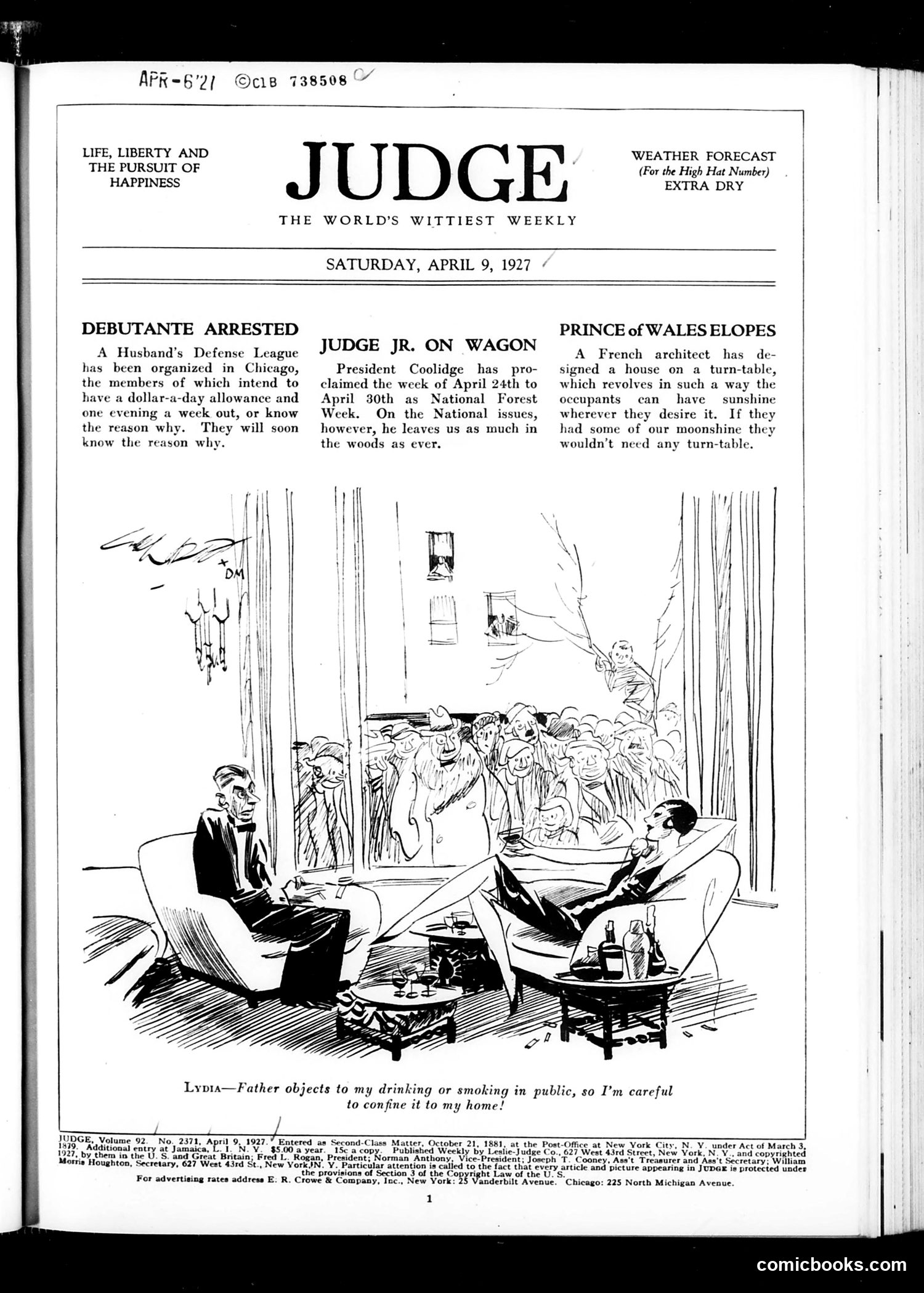
Judge — April 9, 1927
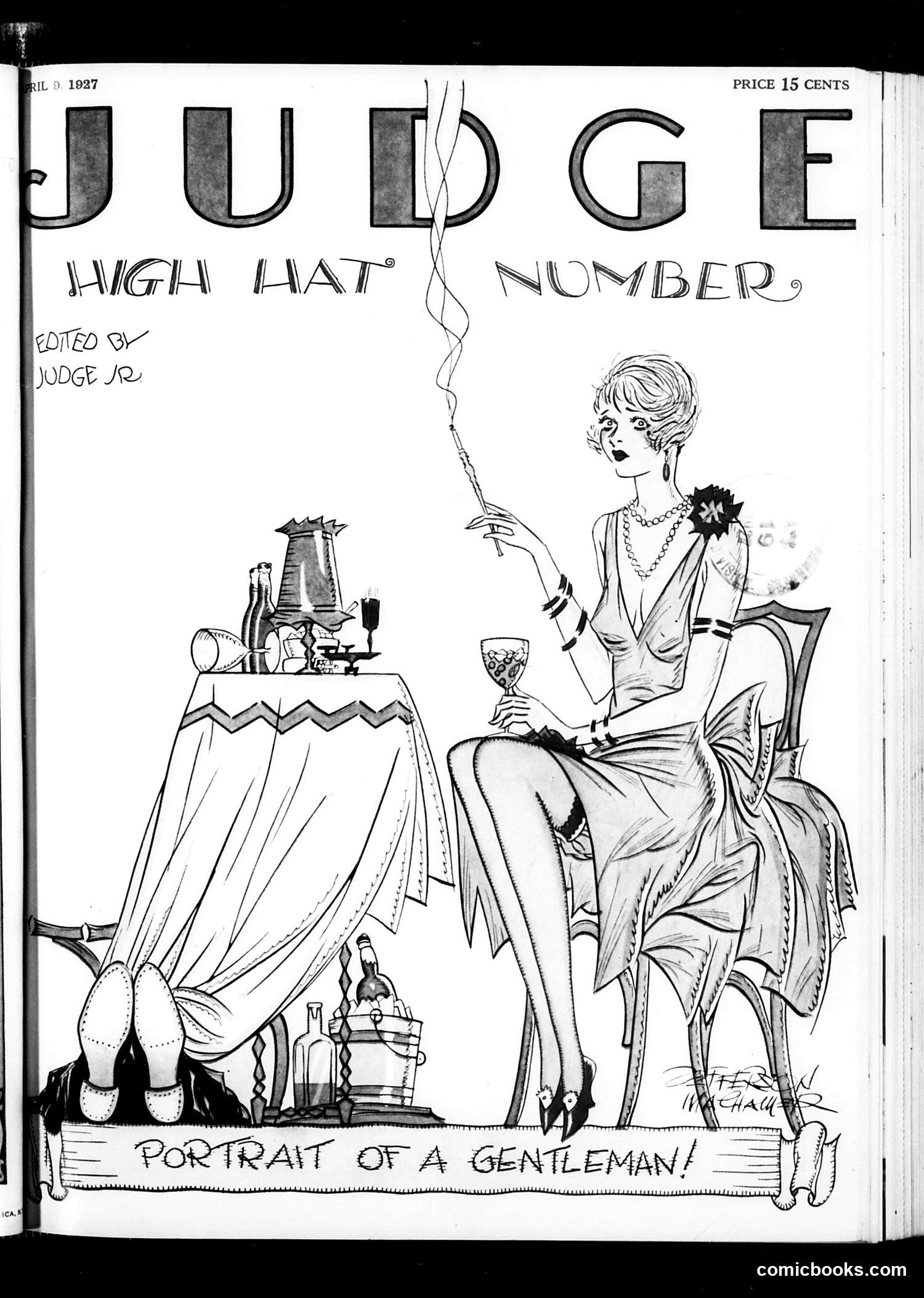
This is the cover of Judge's "High Hat Number" issue. The illustration depicts a fashionably dressed woman in 1920s attire (bobbed hair, pearl necklace, elegant dress) lounging in a chair while smoking from a long cigarette holder. Beside her sits a small table with what appears to be cocktail glasses and a bottle—likely referencing Prohibition-era illegal drinking. The caption reads "Portrait of a Gentleman," which is satirical irony: the "gentleman" is actually a woman engaging in behavior typically associated with upper-class male sophistication or rakishness. This mocks both the "new woman" of the Jazz Age and the pretensions of high society during Prohibition. The humor targets changing gender roles and the flouting of alcohol laws among the wealthy elite.
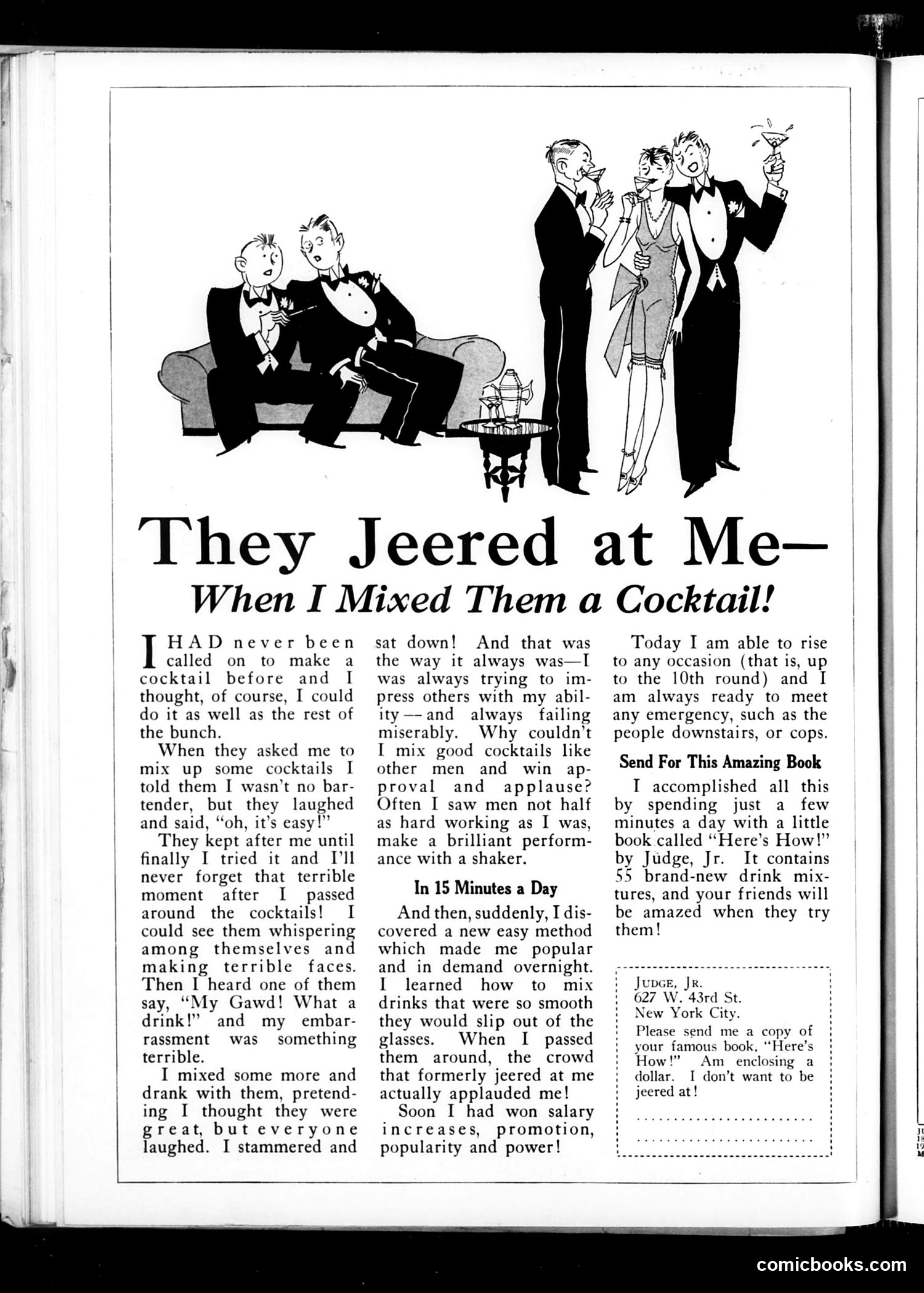
This is primarily **advertising content**, not political satire. The page promotes a bartending instruction book called "Here's How!" by Judge Jr. The narrative describes a social climber who couldn't make cocktails and was mocked by peers. After learning mixing techniques from the book, he became popular and gained professional advancement through this newfound skill. The illustration shows the social humiliation (left: two men laughing at him on a couch) contrasted with his redemption (right: men and a woman applauding his cocktail prowess). This reflects **Prohibition-era culture** (1920s-1930s) when bartending knowledge was socially valuable despite legal alcohol sales being banned. The ad targets men seeking social status through entertaining skills.
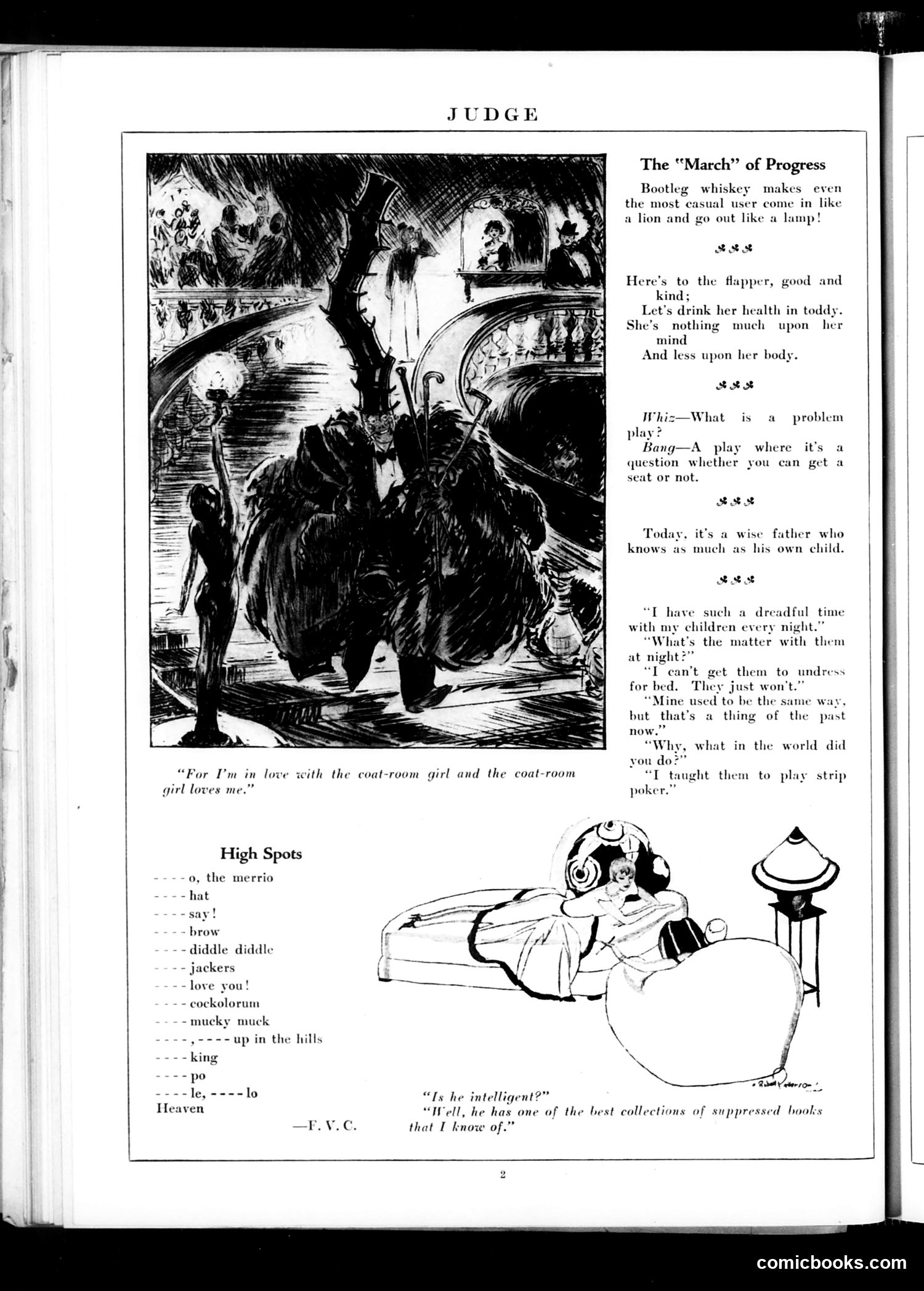
This page contains social humor typical of early 20th-century Judge magazine. **"The 'March' of Progress"** cartoon depicts people in what appears to be a speakeasy or illicit drinking establishment, satirizing Prohibition-era bootlegging culture. The title ironically contrasts "progress" with the illegal alcohol consumption shown. **The dialogue exchanges** mock modern social behavior—a flapper toast, confusion about theatrical "problems," parenting challenges, and a father teaching strip poker to children. These sketch jokes target contemporary anxieties about changing social norms, particularly youth behavior and parental authority during the Jazz Age. **"High Spots"** is a word-association game (comic wordplay). The bottom cartoon appears to mock intellectual pretension, showing someone with "suppressed books"—likely referencing censorship debates of the era. The humor relies on readers understanding 1920s social anxieties about Prohibition, flappers, and generational conflict.
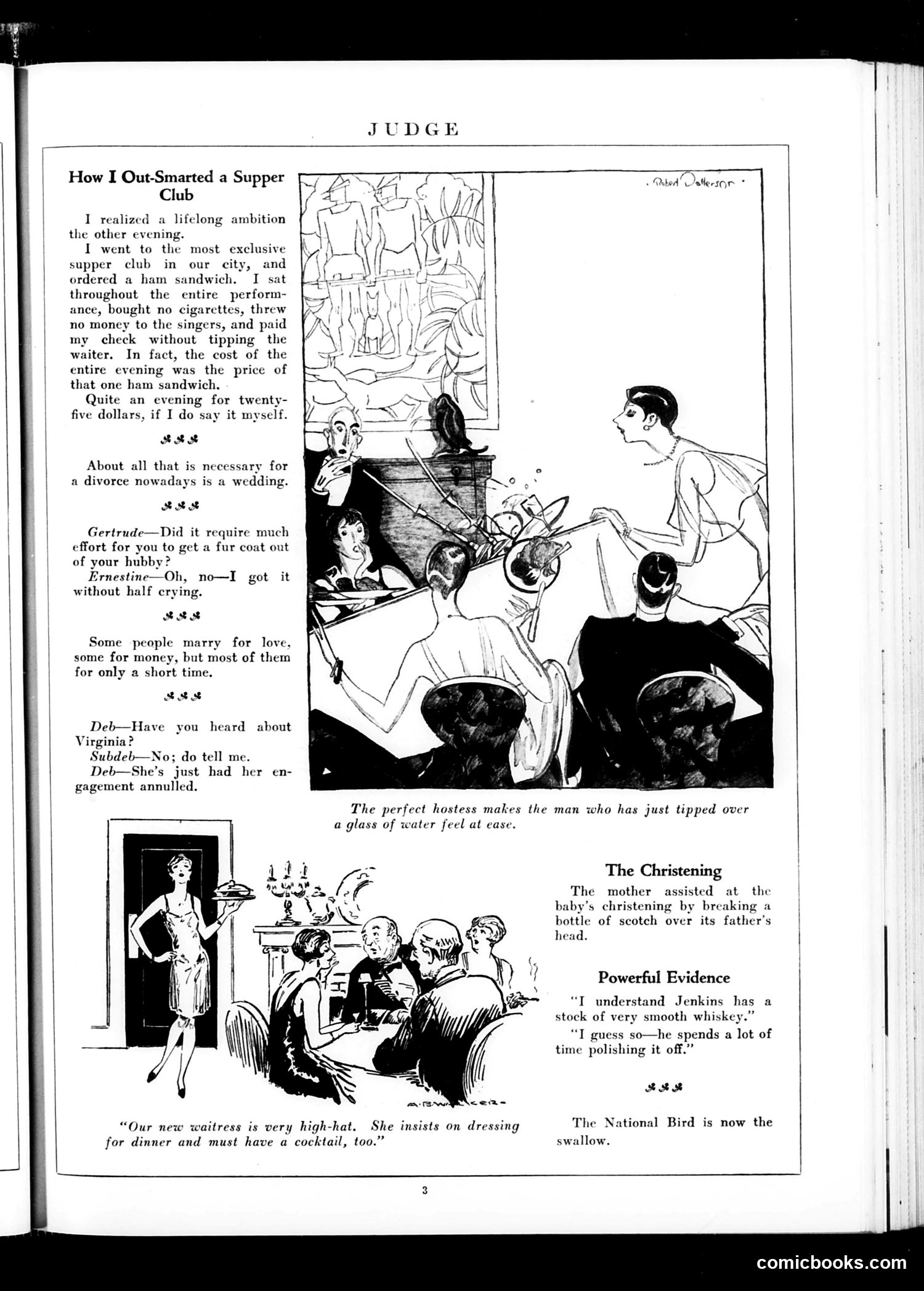
This page from *Judge* contains humor pieces targeting 1920s-30s social conventions: **"How I Out-Smarted a Supper Club"** describes someone who economized at an expensive nightclub by ordering only a ham sandwich—spending just the sandwich's price while avoiding drinks, cigarettes, and tips. The satire mocks both the exclusivity of upscale venues and the author's penny-pinching pretension. **The dialogue snippets** joke about divorce being easier than marriage, and reference Virginia's annulment laws. **The lower illustrations** mock domestic service standards and apparently satirize someone named Jenkins's drinking habits ("smooth whiskey"). The overall tone reflects Jazz Age anxieties about class, spending, and marital instability—treating serious social changes (easy divorce, servant expectations) as material for light ridicule rather than serious critique.
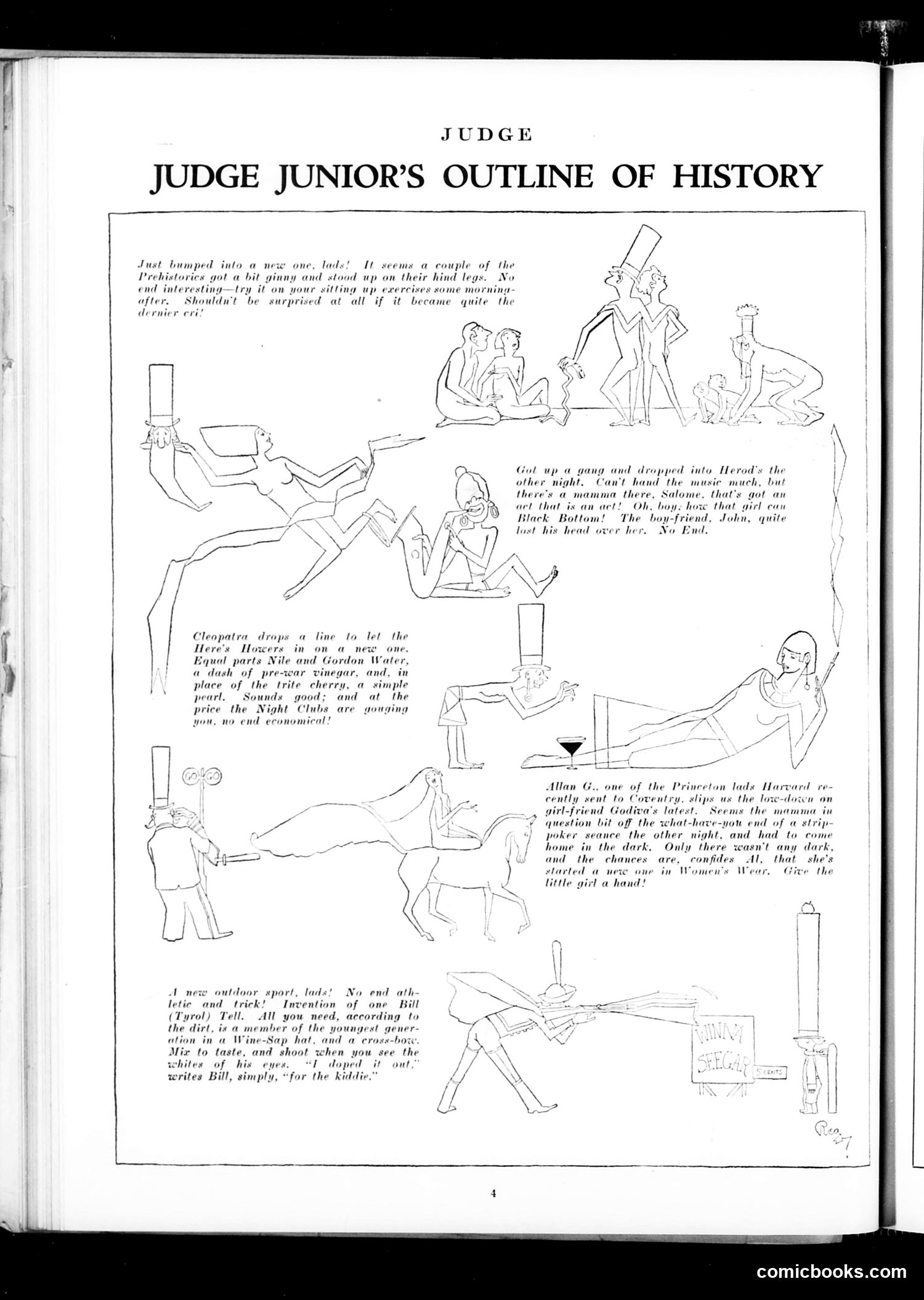
This is a humorous satirical page presenting exaggerated "historical" scenarios through comedic vignettes. Rather than depicting actual historical events, it appears to mock contemporary social behaviors and trends by reframing them as "history lessons." The sketches show various scenes—including people in social situations, someone with a horse, and recreational activities—with accompanying witty captions that humorously "explain" these mundane modern moments as if they were significant historical occurrences. The satire targets how people mythologize or dramatize everyday life. By treating contemporary social activities (parties, sports, fashion) as worthy of historical documentation, the cartoonist mocks both current society's self-importance and the tendency to find significance in trivial matters.
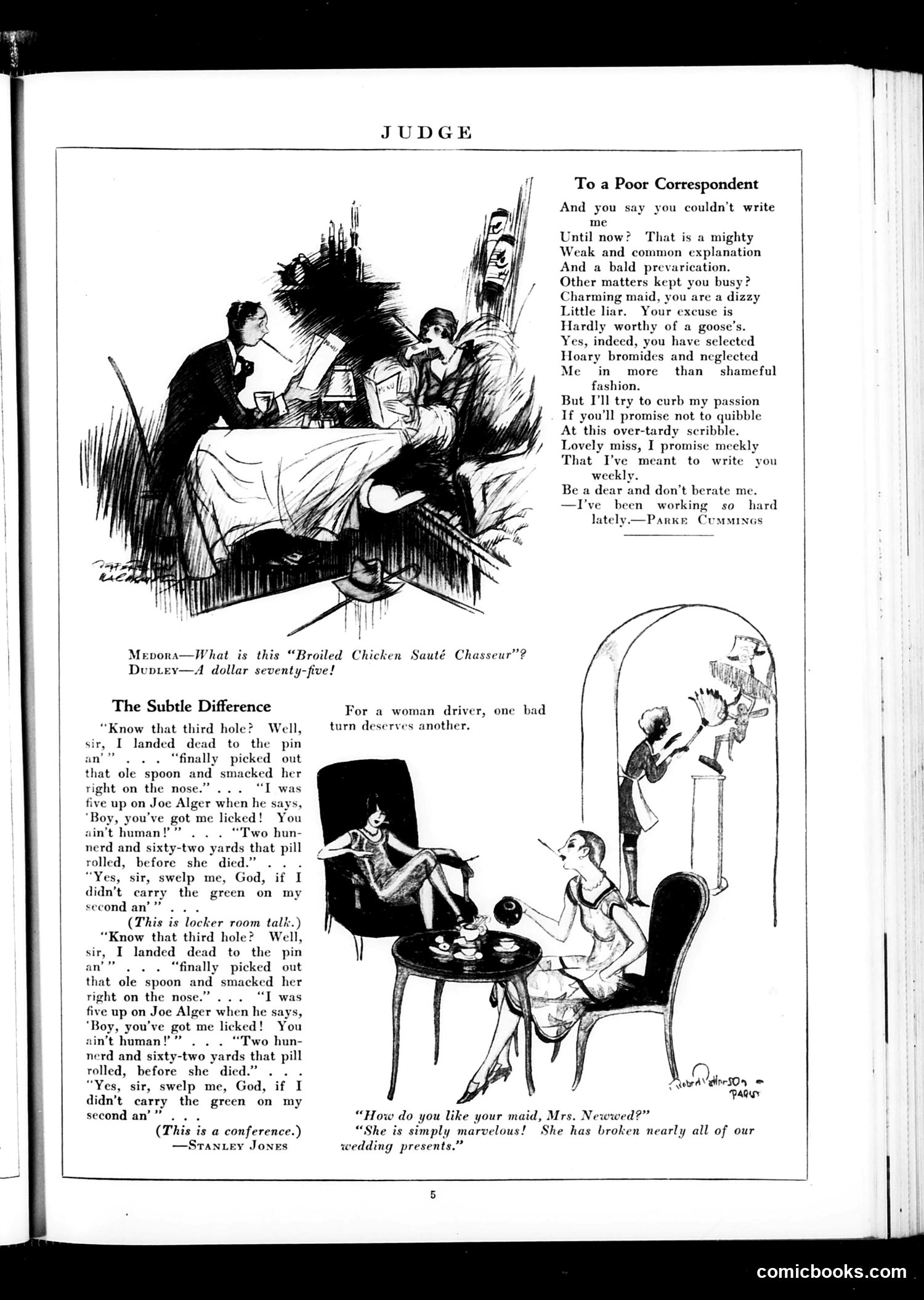
This page contains three humorous pieces: 1. **"To a Poor Correspondent"** — A poem by Pádraig Cummings sarcastically addressing someone who hasn't written, mocking their excuses as weak. 2. **"The Subtle Difference"** — A locker-room anecdote by Stanley Jones contrasting two golf stories. Both involve landing near the third hole and hitting someone with a golf ball, but the storyteller emphasizes how his version differs from another man's—suggesting the humor lies in male boasting and how men recount the same experience differently. 3. **"For a woman driver, one had turn deserves another"** — A cartoon mocking women drivers, depicting a collision or traffic incident, playing on contemporary stereotypes about women's driving abilities. The page reflects early 20th-century satirical humor typical of Judge magazine, mixing literary pieces with illustrations targeting contemporary social subjects.
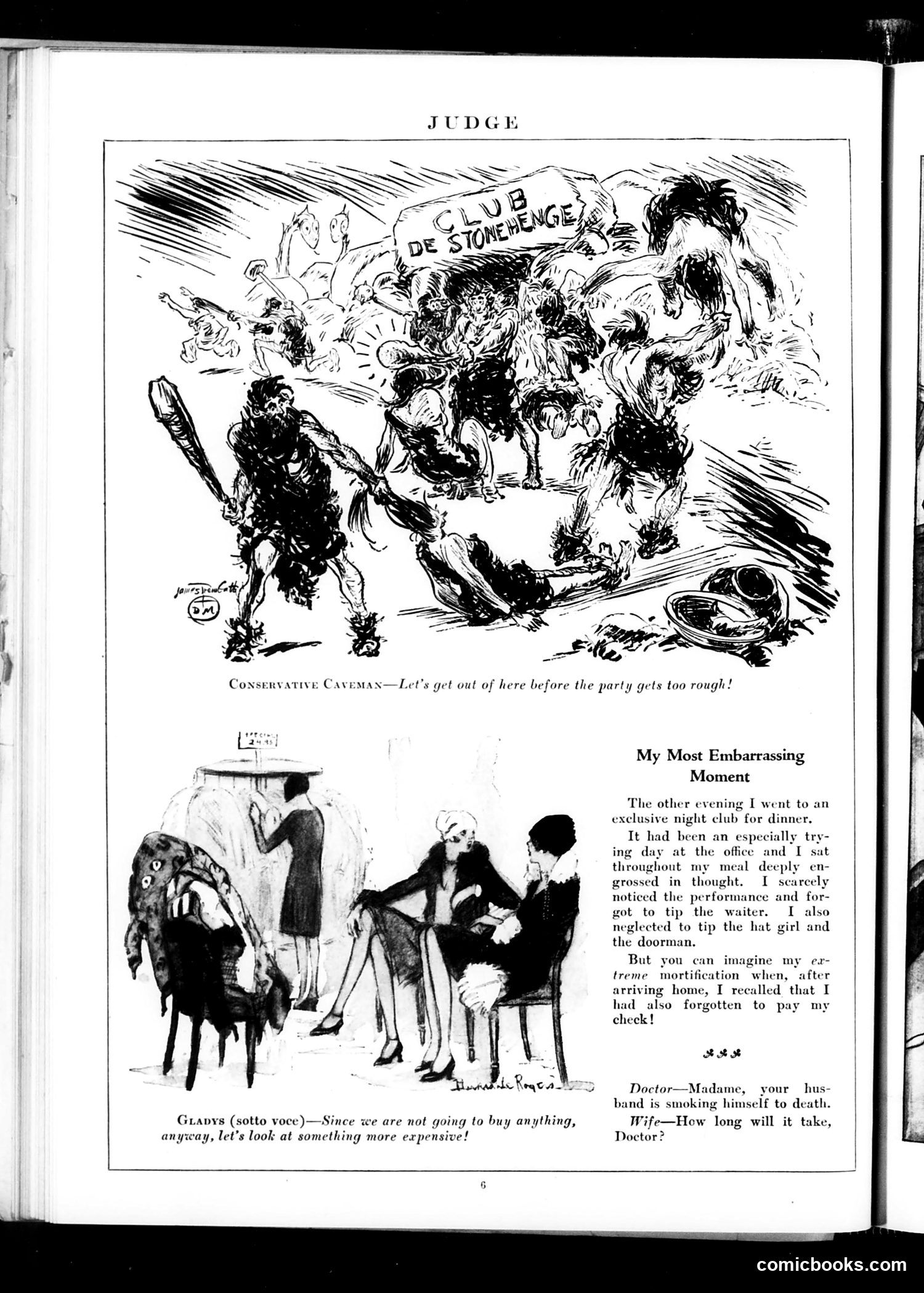
This page contains three distinct satirical pieces mocking upper-class social anxieties: 1. **"Conservative Cavemen" cartoon (top)**: Depicts well-dressed cavemen at a "Club de Stonehenge," satirizing how wealthy conservatives cling to primitive traditions while maintaining modern pretenses. The humor lies in the contradiction between "civilized" dress and barbaric behavior. 2. **"My Most Embarrassing Moment" (middle-right)**: A humorous anecdote about a distracted diner who forgot to tip waitstaff—then realized he never paid the bill at all. The joke mocks self-absorbed wealthy diners who obsess over social etiquette while committing actual financial fraud. 3. **"Gladys" scene (bottom-left)**: Shows a couple browsing expensive items while explicitly stating they won't buy anything, wanting only to window-shop at luxury goods. This satirizes conspicuous consumption and the pretense of affluence without actual purchasing power—common during economic uncertainty. All three pieces ridicule upper-class vanity, financial irresponsibility, and hollow social positioning.
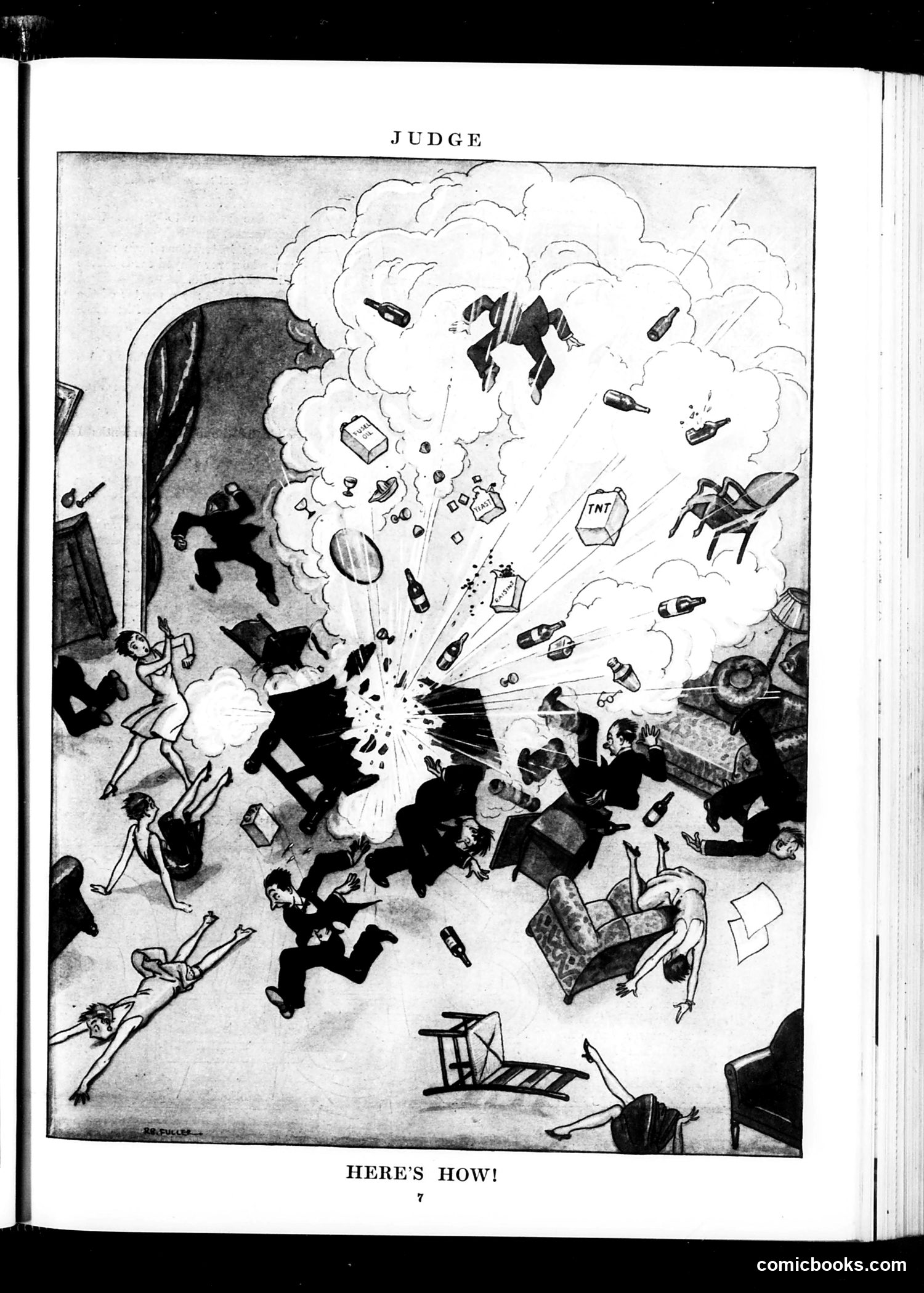
This political cartoon titled "HERE'S HOW!" depicts a massive explosion in what appears to be a courtroom or legal setting. Figures in suits and formal attire are being violently thrown about by the blast, along with scattered documents, bottles, and debris marked "TNT." The cartoon satirizes judicial corruption or legal misconduct—likely referencing a specific scandal or trial. The explosion represents the dramatic exposure or collapse of a case, with the legal system literally "blown apart." The bottles and TNT suggest either criminal activity (bootlegging, given Prohibition-era Judge magazine) or deliberate destruction of evidence. Without additional context about the magazine's publication date, identifying specific judges or cases remains uncertain, though the satire clearly mocks the legal establishment's incompetence or corruption.
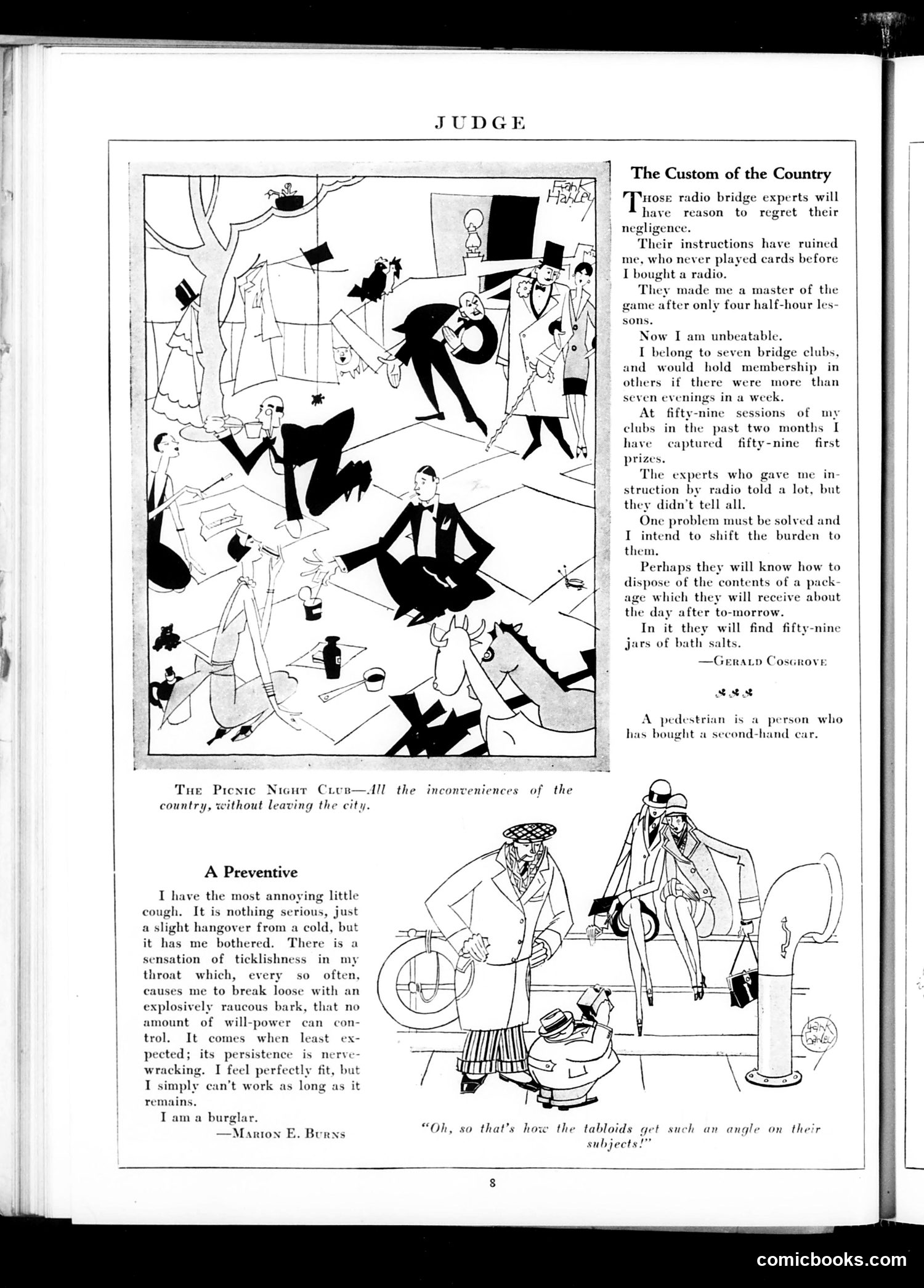
This page contains three separate satirical pieces mocking 1920s-30s trends: **"The Custom of the Country"** (top cartoon): Ridicules radio bridge instruction crazes. The joke: radio lessons made the narrator so skilled at bridge he now dominates seven clubs and has won 59 consecutive first prizes in two months—suspiciously perfect. His revenge: he's mailing the radio experts 59 jars of bath salts, suggesting they've somehow scammed him or the whole thing is absurdly rigged. **"A Preventive"** (middle): A burglar complains his persistent cough prevents work. Dark humor plays on the incongruity of a criminal worried about productivity—he wants sympathy for a minor ailment while admitting his profession. **Bottom cartoon**: Shows a photographer awkwardly positioning a woman on a bicycle, with the caption about "tabloids" getting unusual angles on subjects—likely mocking sensationalist journalism's intrusive photography tactics. Each piece uses exaggeration and ironic confessions to satirize contemporary social issues: gullibility toward new media, crime, and invasive press culture.
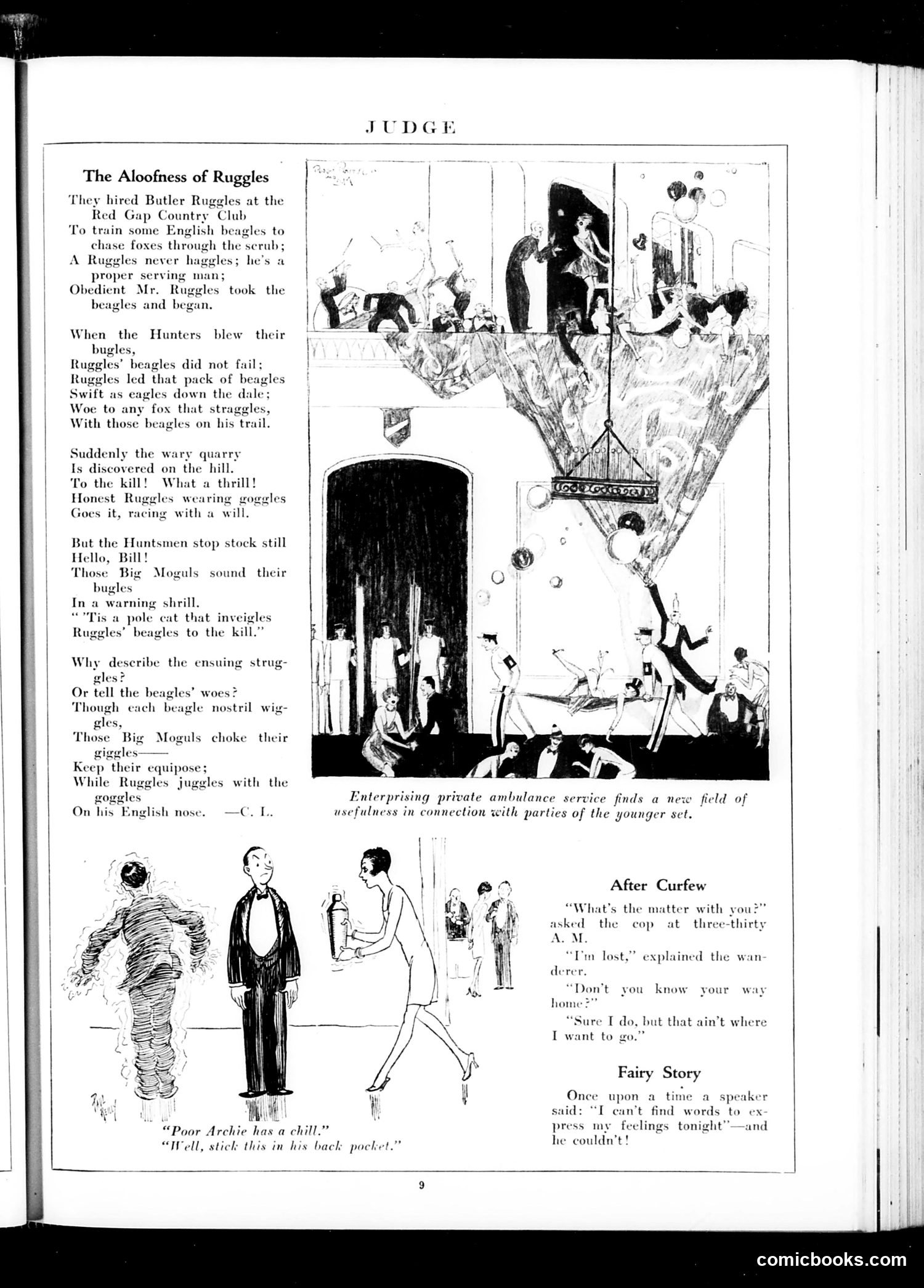
This page contains three unrelated humor pieces typical of Judge magazine's satirical format. The main feature, "The Aloofness of Ruggles," is a narrative poem about a dignified English butler hired to train hunting dogs at a country club. The joke centers on a mistaken identity: Ruggles pursues what he believes is a fox but is actually a polecat, causing chaos among the wealthy hunters ("Big Moguls") who must call him off. The satire mocks both the pretensions of nouveau-riche country club members and the stuffy formality of English servants. The smaller cartoons below address contemporary social concerns: an "enterprising private ambulance service" exploiting young people (likely transporting drunk youth), a police officer confronting a curfew violator, and a joke about a long-winded speaker. The humor relies on class distinctions, servants' dignity, and early 20th-century social anxieties about youth and urban disorder—now-obscure references requiring historical context.
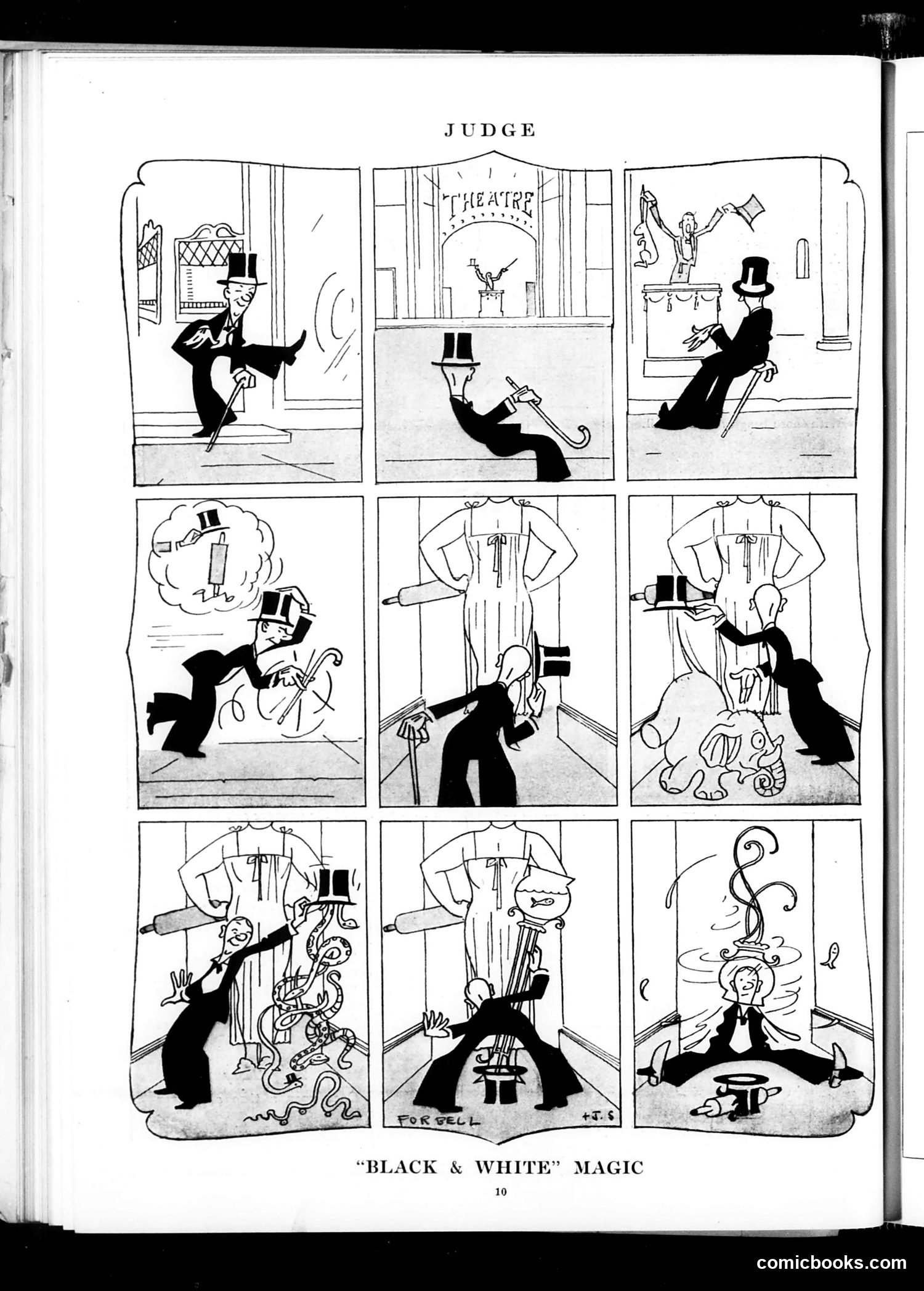
This nine-panel comic strip depicts a magician in formal attire (top hat and tails) performing increasingly chaotic stage illusions. The sequence progresses from simple tricks—producing objects, manipulating a woman assistant—to increasingly absurd situations where the magic spirals into disaster, with tangled props, confused assistants, and the magician seemingly losing control of his own act. The title "Black & White Magic" appears to be a pun on stage magic terminology. The humor derives from slapstick physical comedy: the contrast between the magician's composed demeanor and the catastrophic results of his tricks. This appears to be straightforward entertainment satire rather than political commentary, mocking stage magicians' pretensions by showing their illusions literally falling apart.
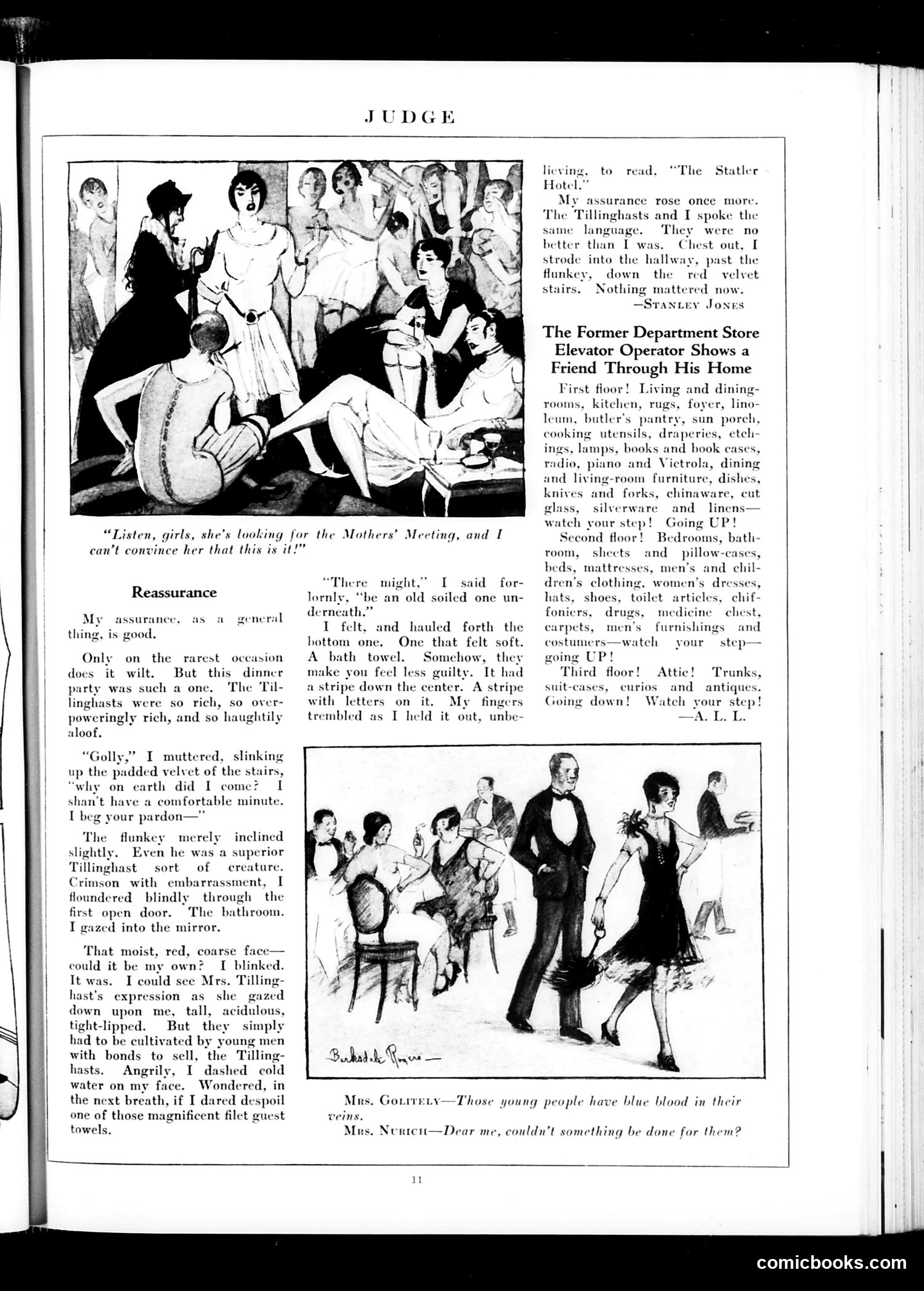
This page contains two satirical pieces targeting American class anxieties in the early 20th century. **"Reassurance"** mocks social climbing and snobbery. A nervous guest at an elite Tillinghast dinner party finds a Statler Hotel towel in the bathroom—a mass-market hotel chain. This humble discovery that his rich hosts use ordinary hotel linens reassures him they're not truly superior, restoring his confidence. The satire targets both the pretentious wealthy and the insecure social-climber desperate for validation. **"The Former Department Store Elevator Operator"** celebrates upward mobility through consumer goods. An elevator operator now owns a home he tours like a department store inventory—proudly listing every possession (rugs, piano, Victrola, clothing). The joke satirizes how material accumulation defines American success, with even humble workers measuring their worth by what they own rather than who they are. Both pieces reflect 1920s anxieties about class, consumerism, and the American dream's promise that anyone could climb the social ladder through wealth and goods acquisition.
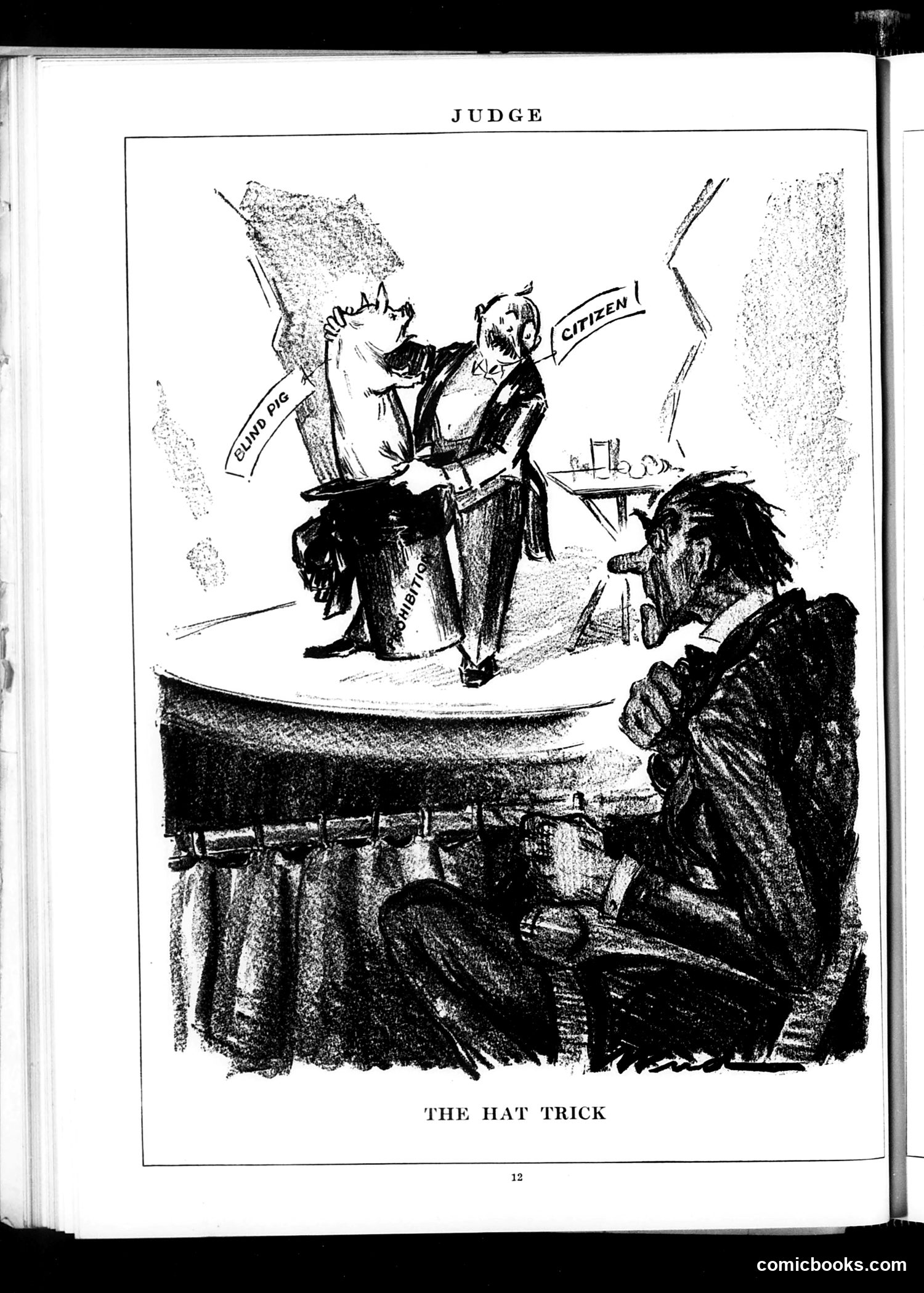
This political cartoon depicts a courtroom scene titled "The Hat Trick." A judge sits elevated on the bench while a well-dressed man in the center manipulates two figures labeled "Dumb Pig" and "Citizen"—pulling them like puppets with strings. The judge observes from above, suggesting judicial complicity or blindness to the manipulation occurring below. The satire appears to critique judicial corruption or the manipulation of justice through deception—the "hat trick" being a sleight-of-hand illusion that dupes observers. The cartoon suggests that judges allow or fail to prevent the exploitation of ordinary citizens ("Citizen") through fraudulent schemes, with the legal system itself serving as cover for such deception.
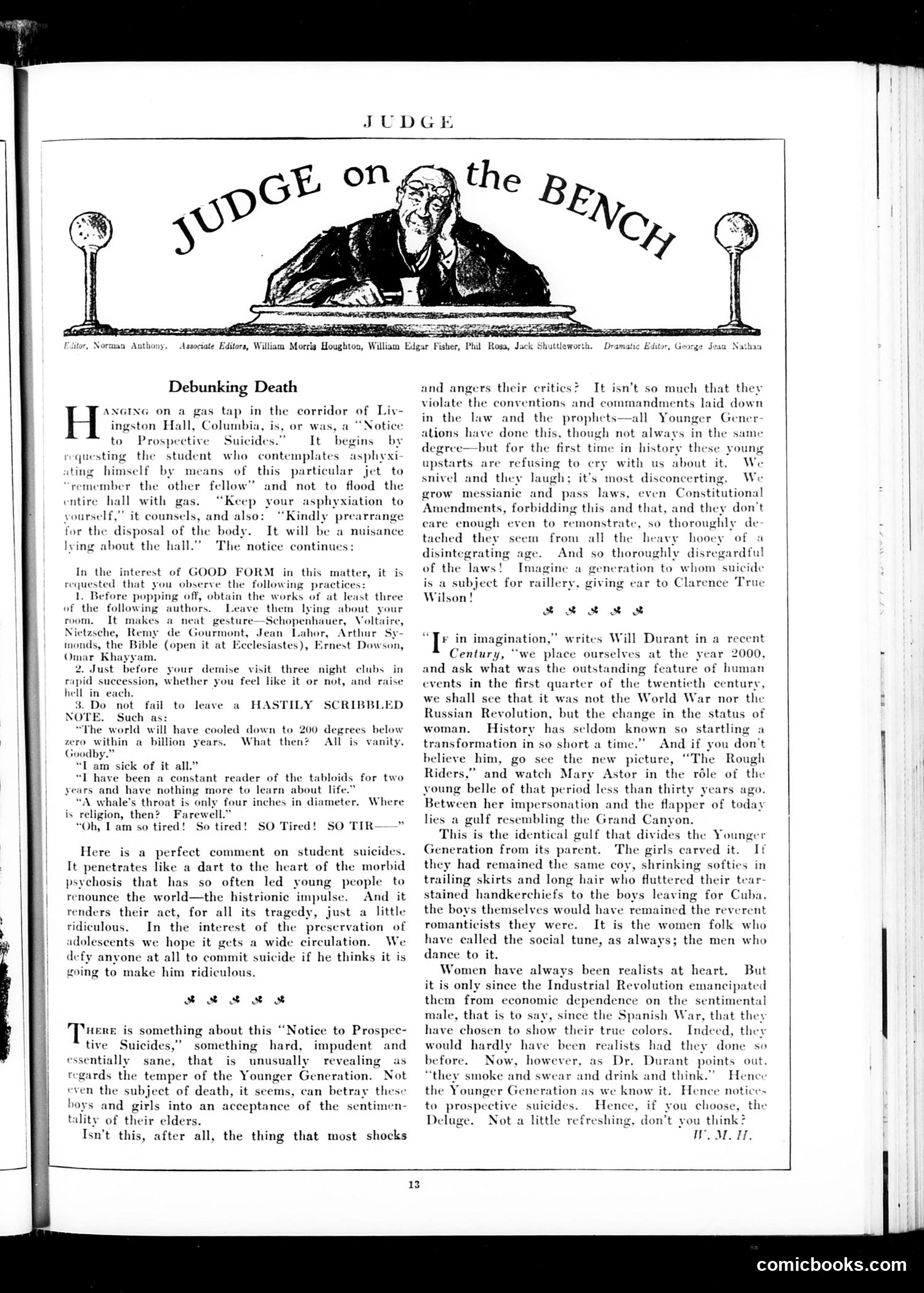
This page satirizes student suicides at Columbia University through a fake "Notice to Prospective Suicides" posted at Livingston Hall. The satire mocks both the histrionic impulse behind student suicides and the overly sentimental, moralistic response from older generations. The notice parodies suicide notes by prescribing absurd pre-death rituals: reading pessimistic philosophers (Schopenhauer, Nietzsche), visiting nightclubs, and leaving literary props. The editorial argues this mockery is socially valuable—it strips suicide of its romantic drama and renders the act ridiculous, potentially deterring it. The broader commentary critiques the "Younger Generation" for their refusal to share their elders' emotional investment in life's meaning. Unlike previous generations, these youth neither embrace nor dramatically rebel against conventional morality; they simply laugh at it—deeply unsettling to concerned adults.
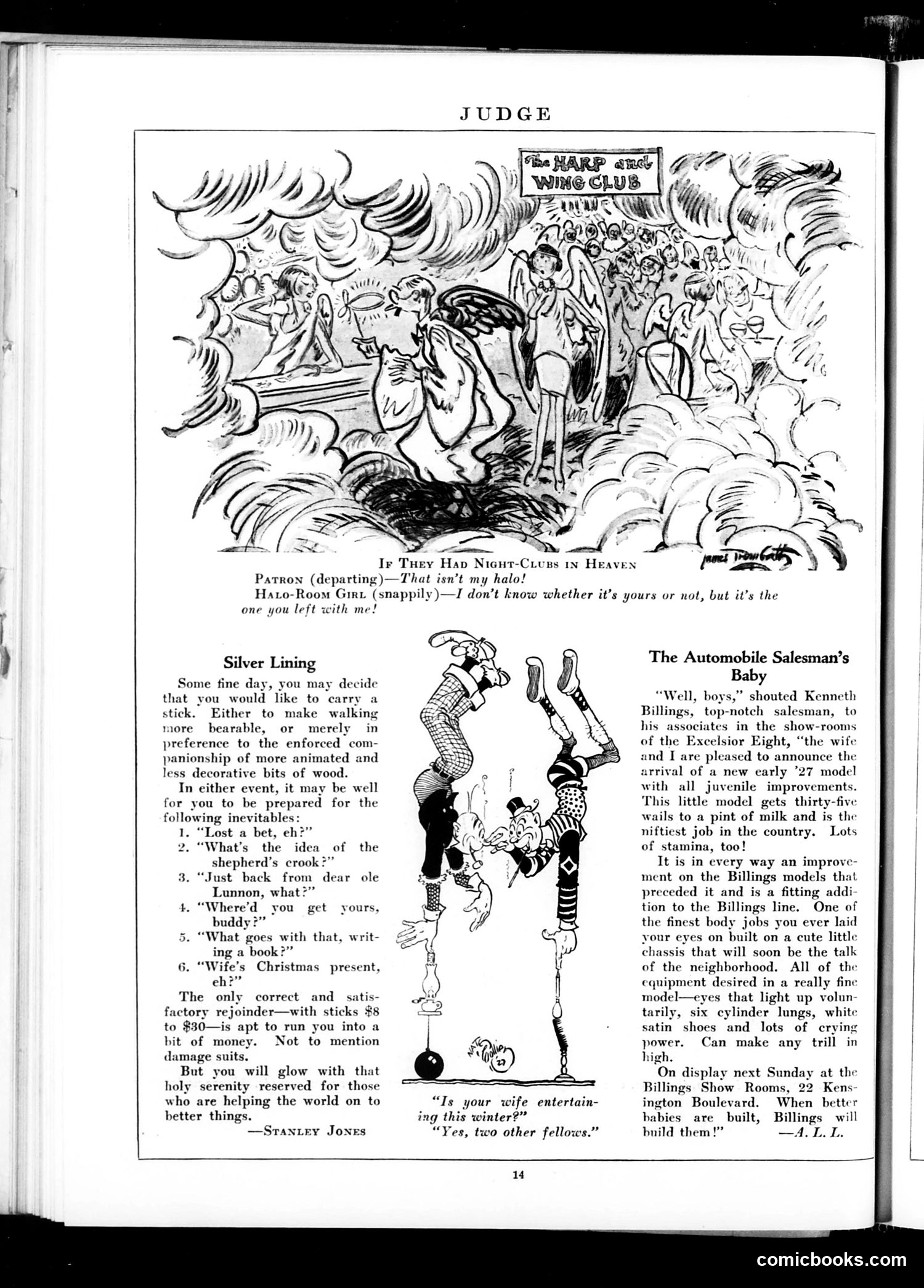
This page contains two unrelated pieces of early 1920s satire: **Top cartoon**: "If They Had Night-Clubs in Heaven" depicts a heavenly nightclub scene where a departing patron and a "halo-room girl" have a suggestive exchange—he's lost his halo, she claims ignorance about whose it is. This jokes about infidelity and moral hypocrisy among the wealthy nightclub set during Prohibition. **"Silver Lining"** (left): Stanley Jones humorously lists predictable jokes people make when seeing someone carry a walking stick, suggesting it signals either a lost bet, affectation, or recent travel. The humor lies in the clichéd responses. **"The Automobile Salesman's Baby"** (right): A satirical advertisement where a car salesman boasts about his newborn using automobile sales language—describing the baby's efficiency (35 "waits" per pint of milk), features ("six cylinder lungs"), and crying power as if selling a vehicle. This mocks both aggressive 1920s sales tactics and consumerist excess. All reflect Jazz Age social attitudes: nightlife scandals, class pretension, and commercial materialism.
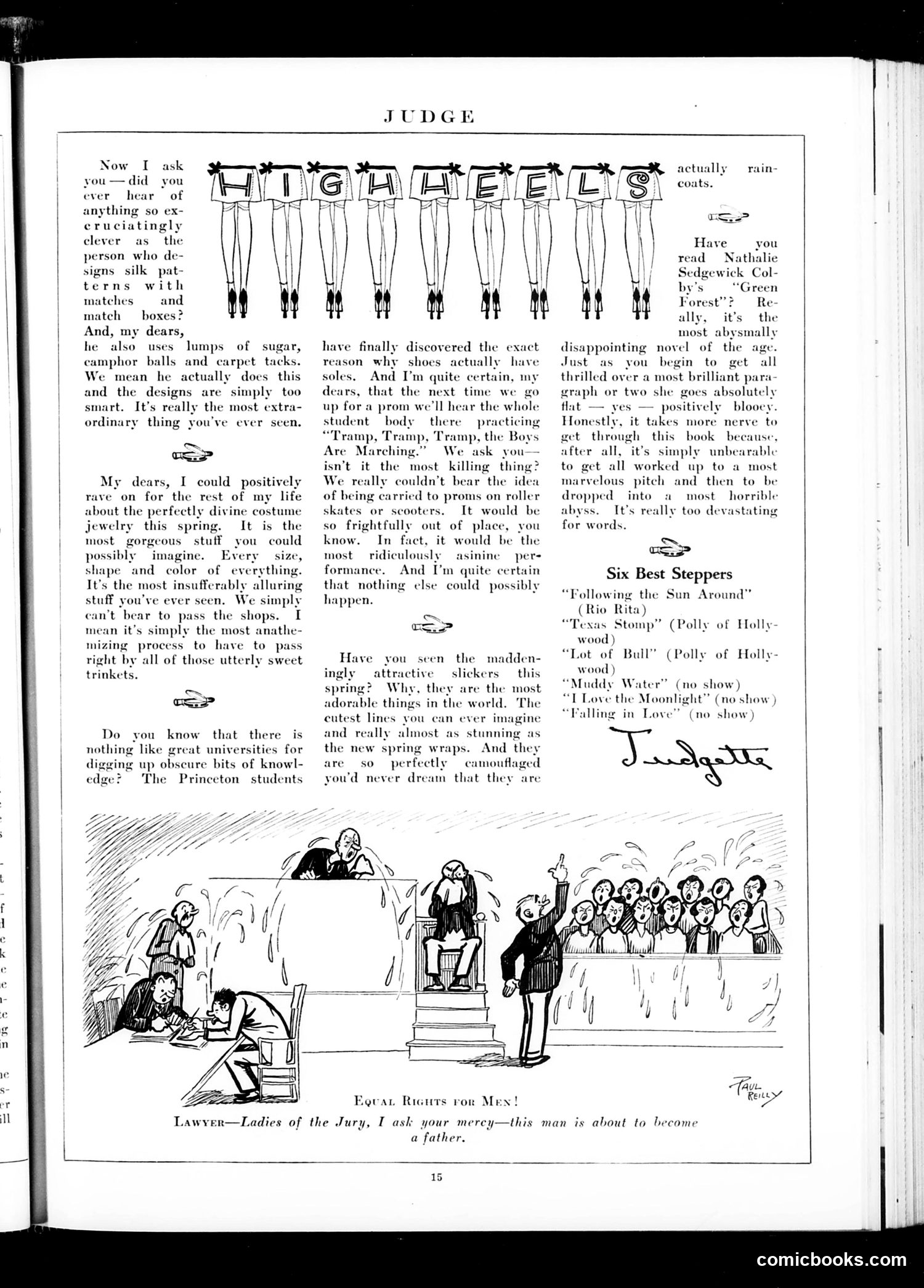
This Judge magazine page contains two distinct sections: **Upper Content:** Fashion and entertainment commentary presented as gossipy monologue. The writer satirizes wealthy socialites who obsess over trivial luxury goods—designer silk patterns, costume jewelry, and raincoats disguised as fashionable "slickers." The tone mocks their breathless enthusiasm for expensive frivolities and name-dropping. A brief reference ridicules Princeton students for discovering shoes have soles, with a joke about hearing marching songs at proms. **Bottom Cartoon:** Titled "Equal Rights for Men!" This depicts a courtroom scene where a lawyer pleads for mercy toward a man "about to become a father." The satire targets contemporary debates about gender equality and family law—suggesting that fatherhood should exempt men from legal consequences, ironically reversing feminist arguments about women's legal disabilities. The jury of women reacts with apparent skepticism to this plea. Both sections employ sarcasm to critique upper-class pretension and contemporary social attitudes about gender and law.
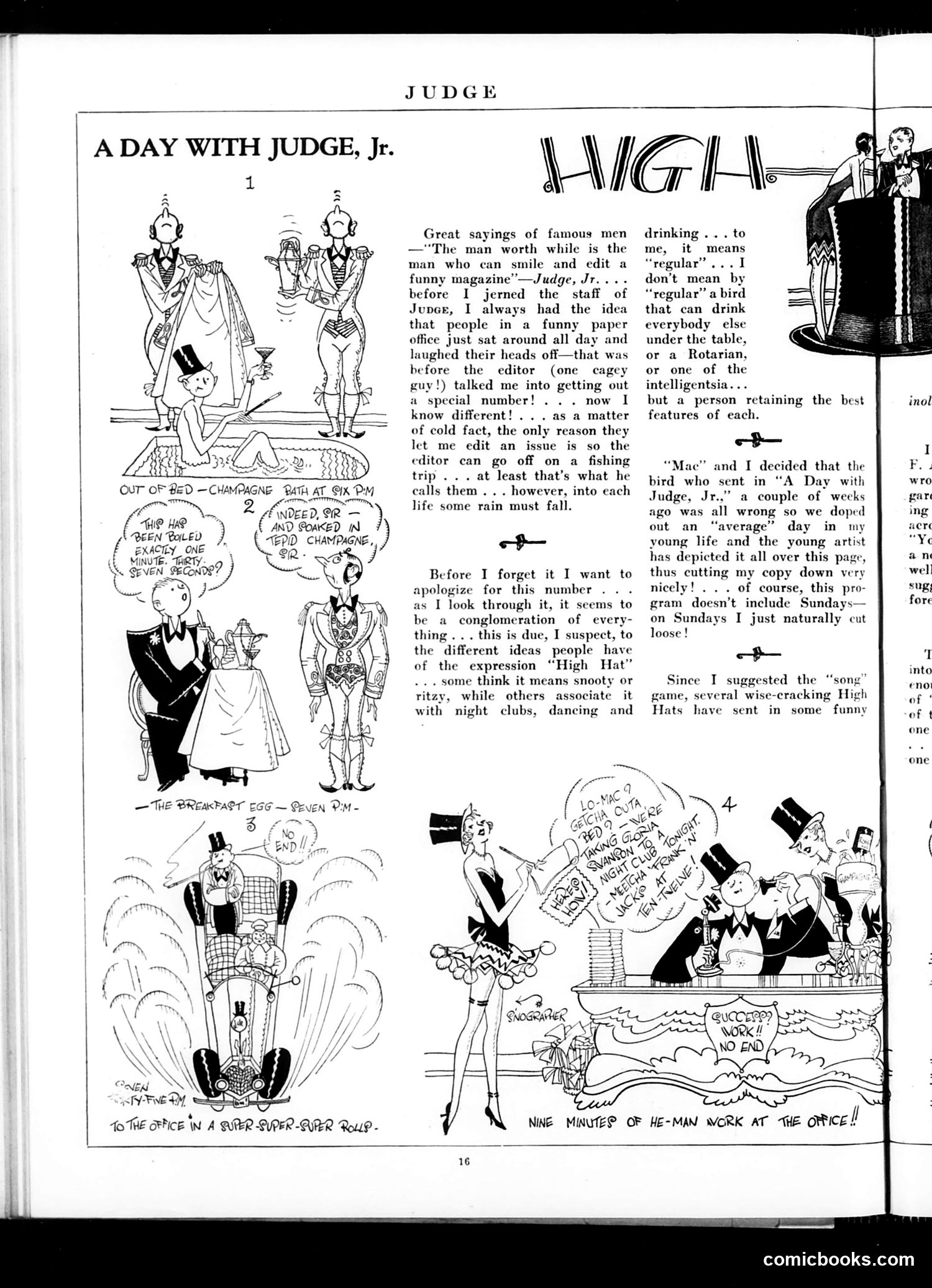
This is a humorous editorial piece by Judge magazine's junior editor, depicting an exaggerated "average day" in his life. The cartoons mock the romanticized notion that working at a funny magazine involves leisure and laughter. **The Satire:** The editor deflates readers' assumptions that magazine offices are carefree places where staff "laugh their heads off all day." Instead, he reveals the actual tedium: champagne baths and leisure activities (panels 1-3) are the editor's perks when *leaving* for fishing trips, while the junior editor does the actual work—nine minutes of "he-man work" produces chaos (panel 4). **Key References:** - "High Hat" (the issue's theme) means "regular" or unpretentious, though people mistakenly associate it with snooty behavior or nightclubs - The editor apologizes the issue is disjointed because he cut his own copy to fit the artist's illustrations **The Point:** Self-deprecating humor about editorial life's unglamorous reality versus public perception, typical of insider magazine humor.
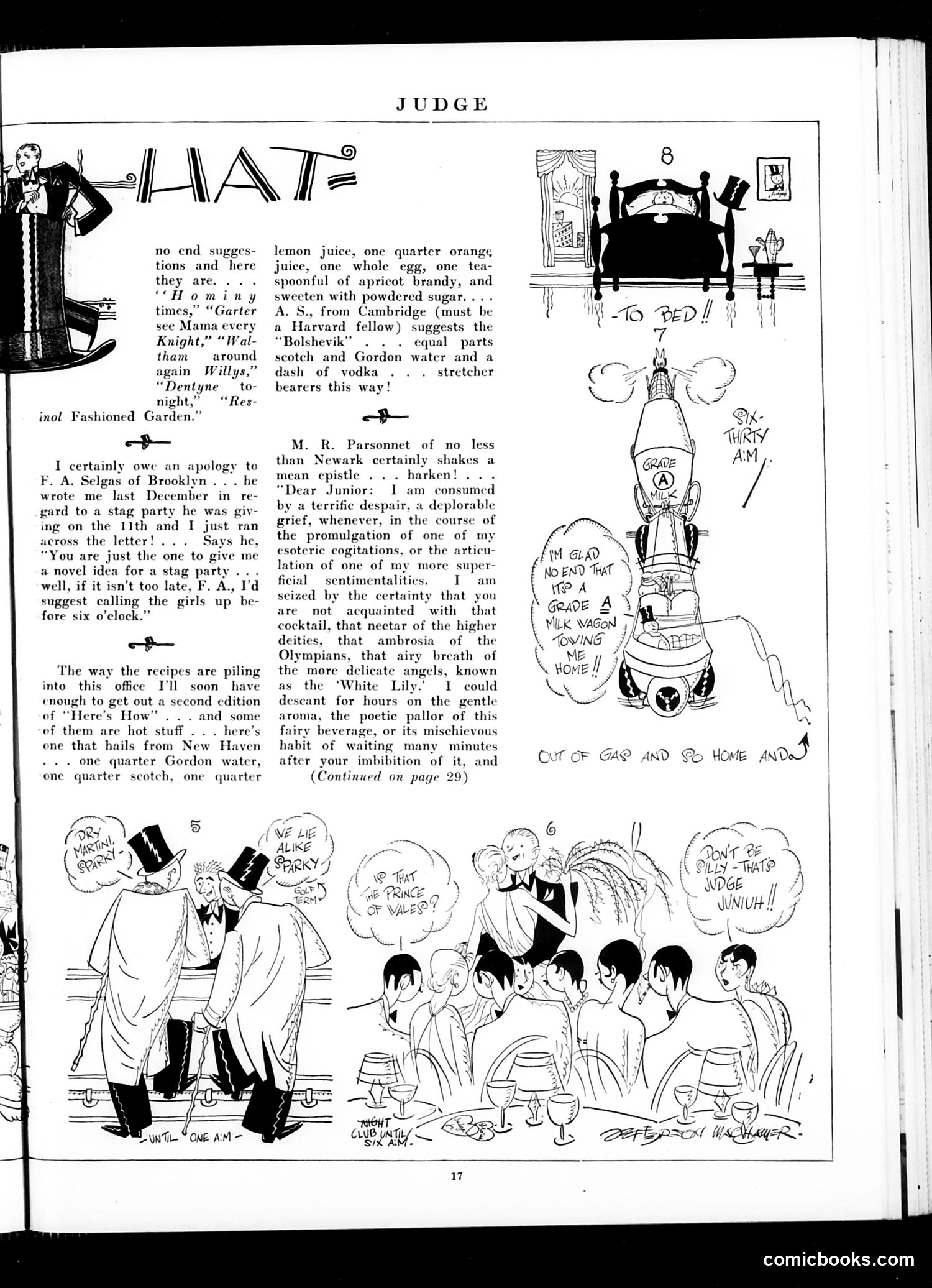
This page from **Judge** magazine contains humorous reader submissions about cocktail recipes and stag party advice, interspersed with cartoon vignettes. The content reflects 1920s-era entertainment and social life. References to products like "Hominy," "Garter Knight," "Waltham," "Willys," "Dentyne," and "Resinol" are branded product placements typical of period magazines. The cartoons (numbered 5-8) depict men in formal wear at social gatherings—likely depicting stag parties and gentlemen's clubs. One cartoon shows a car with text about "out of gas and so home," suggesting comedic mishaps. The elaborate, affected letter from "M.R. Parsonnet" humorously parodies overly intellectual discourse about cocktails, mock-seriously praising a "White Lily" drink with flowery language about "ambrosia" and "Olympians." Overall, this page satirizes upper-middle-class male social rituals, Prohibition-era drinking culture, and the affectation of sophisticated tastes—common Judge magazine targets during the 1920s.
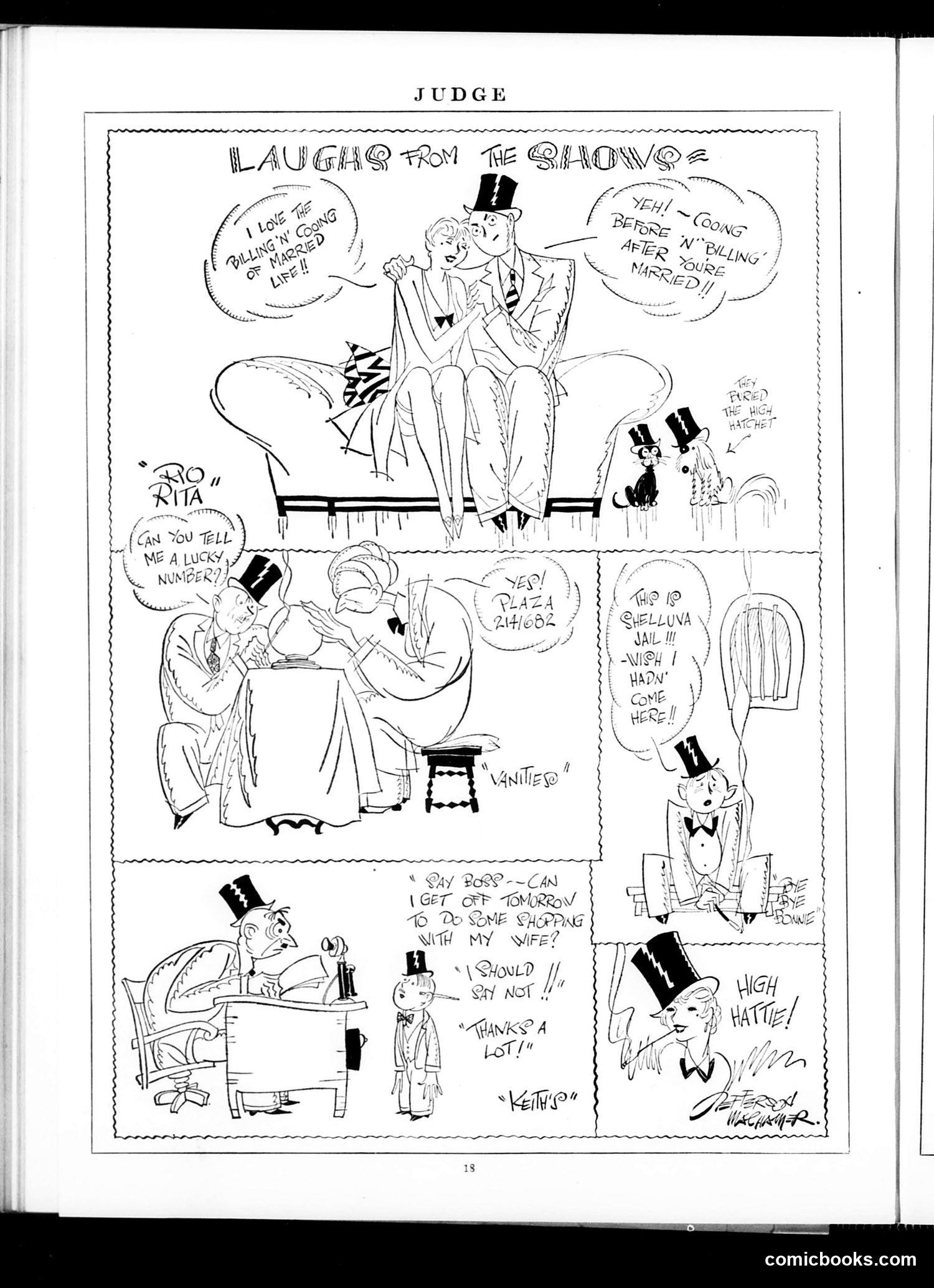
This page presents comic sketches satirizing theatrical entertainment and domestic life. The central joke involves a magician or entertainer performing on stage, with audience members requesting tricks—including requests for "lucky numbers" and marriage advice. The humor trades on the contrast between the magician's stage persona and the mundane domestic problems audience members want solved. The lower panels shift to office and home scenarios, with running gags about husbands seeking permission for shopping trips or time away, and wives' skeptical responses ("Should she not!!"). The repeated appearance of top-hatted figures suggests vaudeville performers or wealthy gentlemen. The satire targets both showbiz entertainment culture and the era's marital dynamics—humorously depicting husbands as needing spousal approval for basic freedoms, which likely resonated with early-20th-century audiences familiar with this domestic power dynamic.
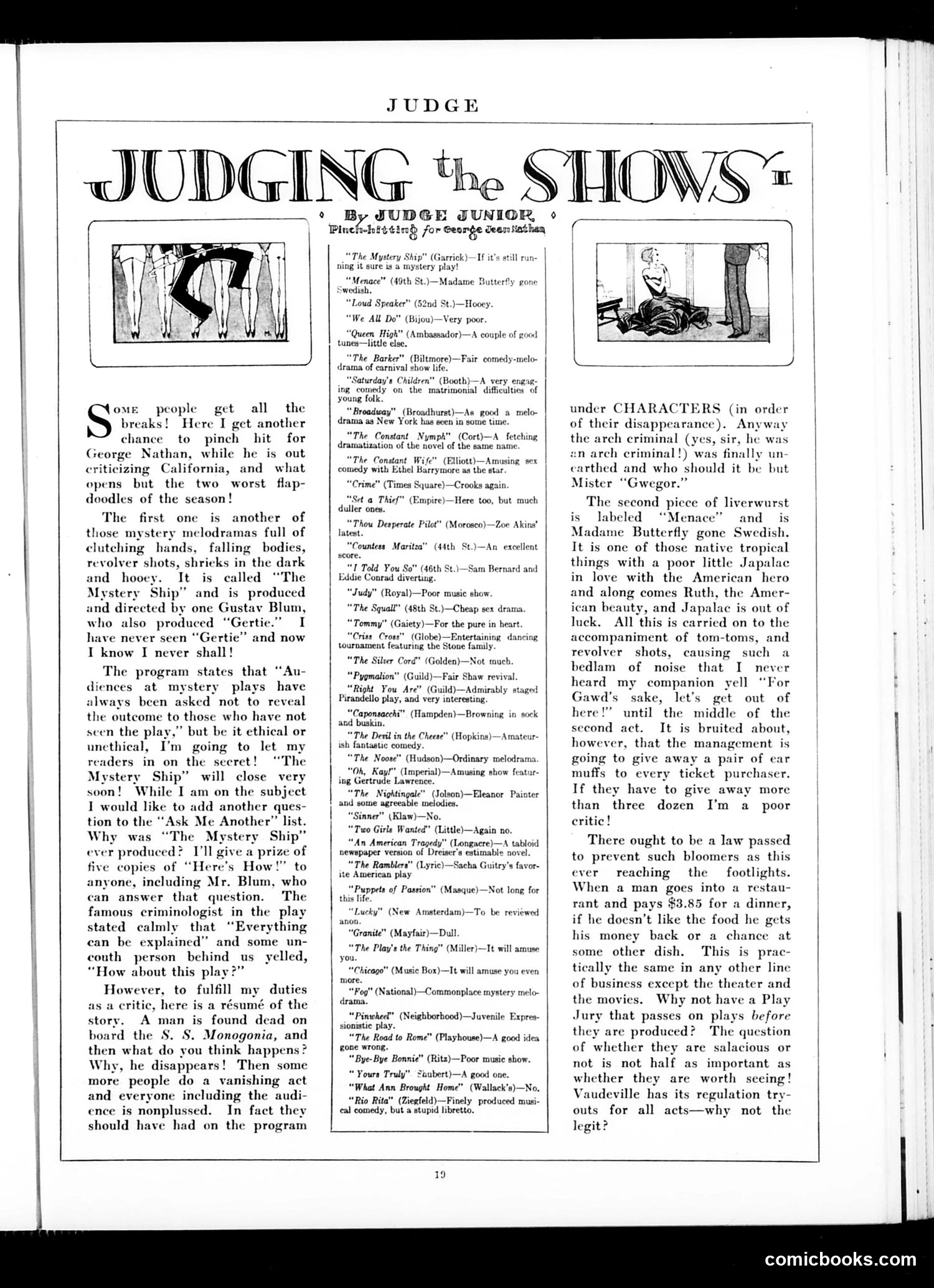
This is a theater review column by "Judge Junior" (substituting for George Nathan) critiquing Broadway productions. The humor relies on sharp dismissal of weak plays. The main target is *The Mystery Ship*, a mystery melodrama the critic savagely pans. He jokes that revealing its ending won't matter since it will close soon anyway, and sardonically asks readers to answer "Why was it ever produced?"—offering a prize to anyone who can explain this baffling decision. The reviewer mocks the film's implausible plot (a man found dead then disappears) and absurd dialogue, with a dig at an audience member yelling "How about this play?" when a character claims "everything can be explained." The page lists brief capsule reviews of other Broadway shows, mostly dismissive ("Hooey," "Very poor," "Cheap sex drama"). The satire targets theatrical mediocrity and poor productions cluttering Broadway during what appears to be the 1920s theater season.
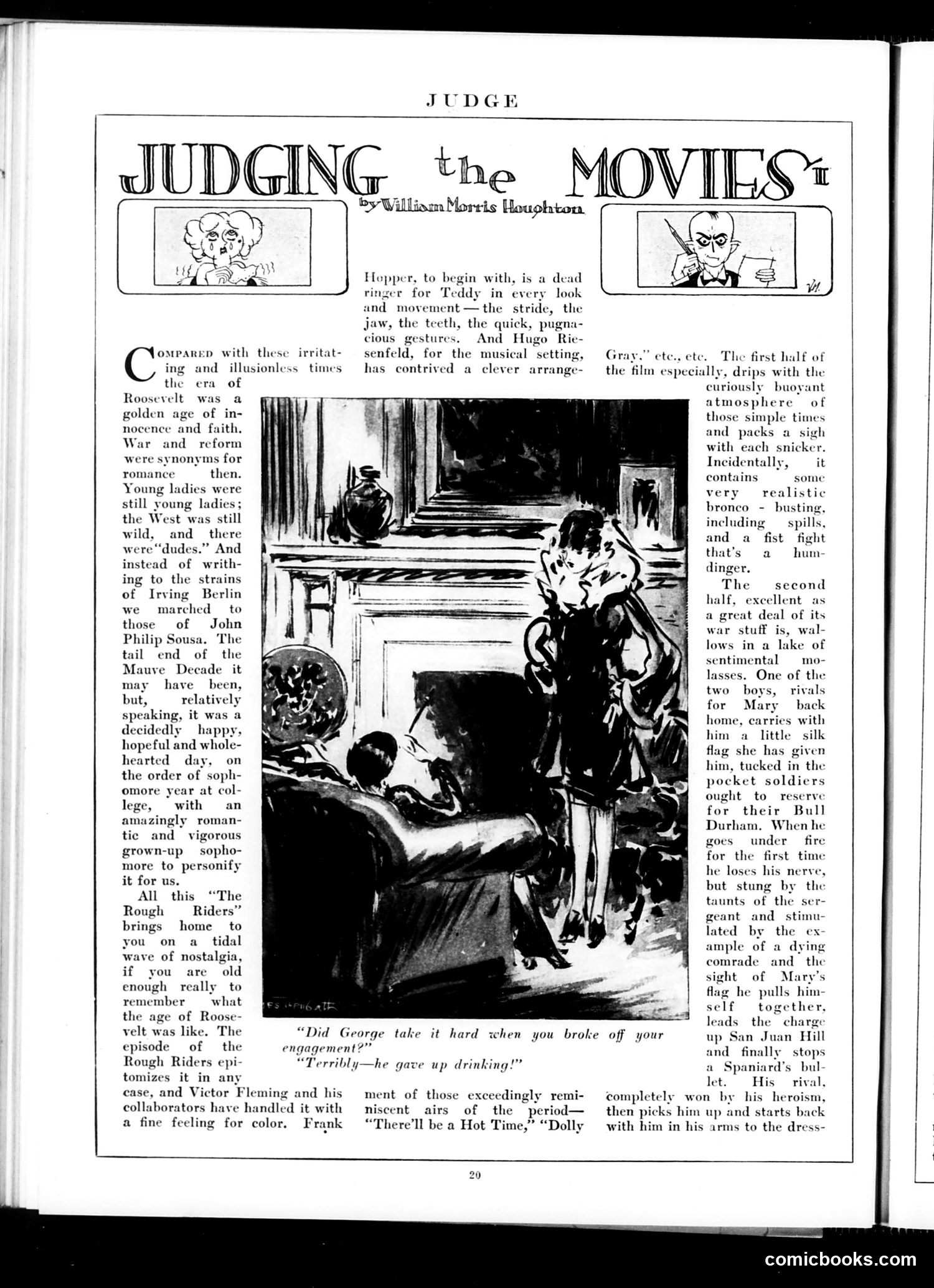
This is a film review by William Morris Houghton critiquing a movie adaptation of Theodore Roosevelt's famous Rough Riders unit from the Spanish-American War. **The Film's Appeal:** The review argues the movie succeeds by nostalgically recreating Roosevelt's era—described as a time of "innocence and faith" contrasting with the "irritating and illusionless times" (the 1920s present). Actor Hopper apparently physically resembles Teddy Roosevelt and captures his mannerisms convincingly. **The Plot:** The narrative follows two soldiers rivals for a girl back home. One boy carries a silk flag from his sweetheart; during combat he initially loses courage but regains it witnessing a comrade's death and his flag. He leads a charge up San Juan Hill and is shot, ultimately redeemed through heroism. His rival is "completely won by his heroism." **The Critique:** The first half effectively captures the period's atmosphere with authentic music and bronco-busting scenes. The second half descends into "sentimental molasses" but ultimately delivers patriotic drama.
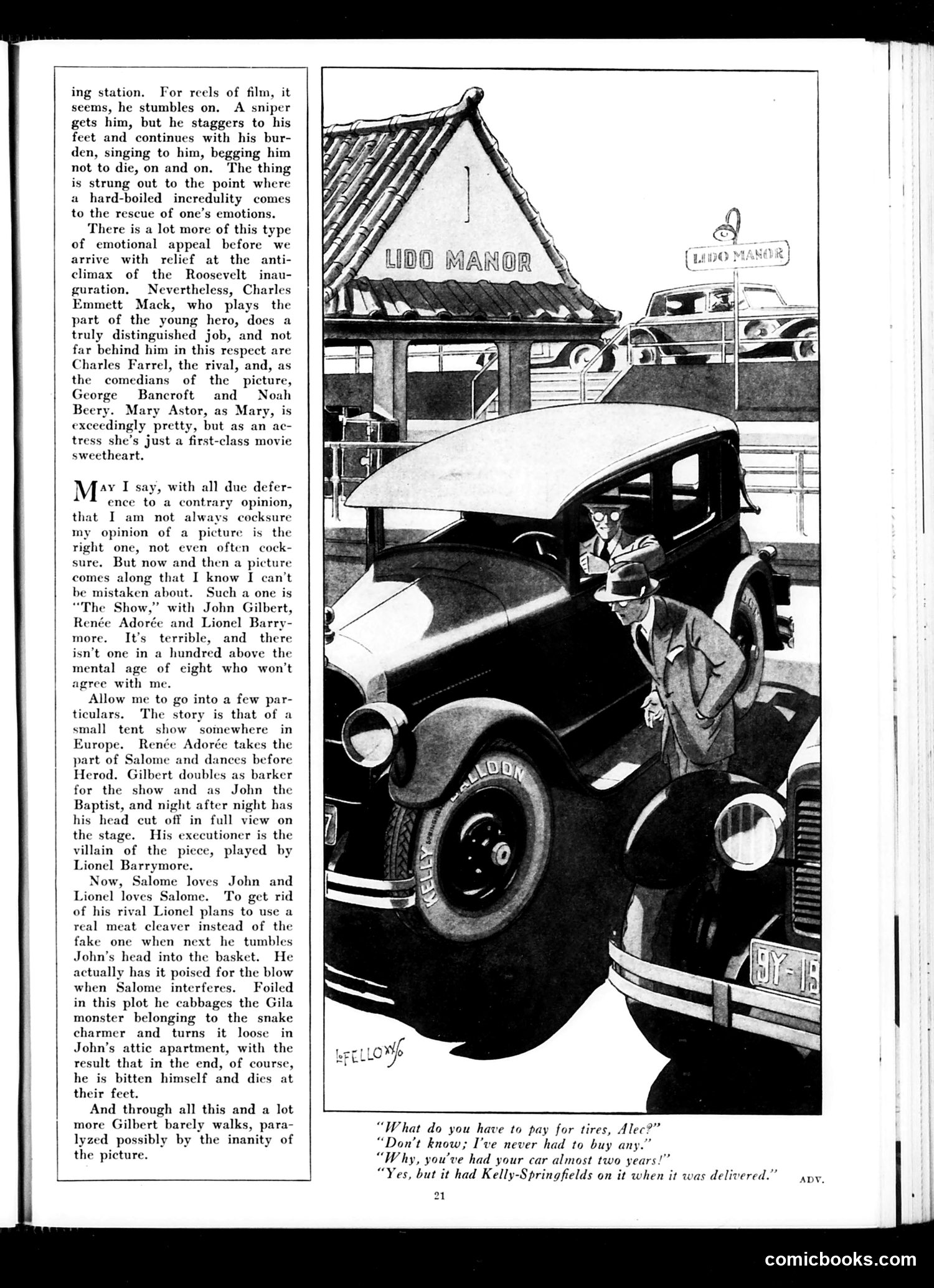
This page contains a film review of "The Show" (starring John Gilbert, Renée Adorée, and Lionel Barrymore) alongside a Kelly-Springfields tire advertisement. The review is brutally negative. The critic dismisses the film's plot—a circus/tent-show melodrama involving a barker, a dancer performing as Salome, and a villain who attempts murder using a real meat cleaver and later a Gila monster—as absurdly contrived and emotionally manipulative. The critic particularly mocks the implausible plot devices and claims Gilbert's performance suggests he's paralyzed by the material's stupidity. The final jab: only those with the mental age of eight would enjoy it. The accompanying advertisement uses a comedic dialogue to promote tire durability: a car owner boasts his vehicle still has its original Kelly-Springfields after two years, never requiring replacement—implying exceptional tire quality and longevity.
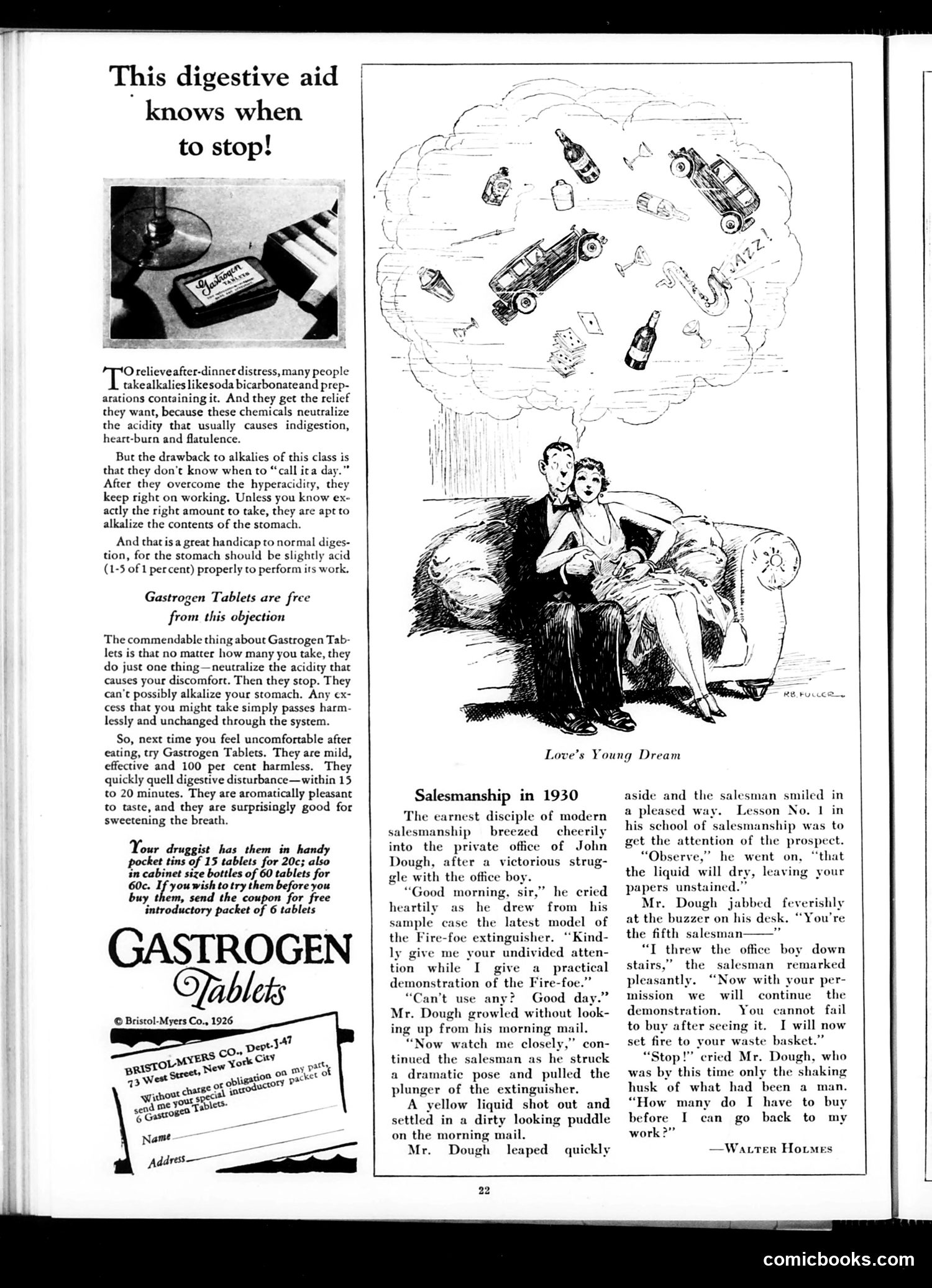
This page contains two distinct items: **Left side: Gastrogen Tablets advertisement (1926)** — A pharmaceutical ad promoting antacid tablets that claim to neutralize stomach acid but then "stop working," unlike competing alkaline products that continue neutralizing and over-alkalize the stomach. The ad plays on consumer anxiety about taking the wrong amount of medicine and suffering unintended consequences. **Right side: "Salesmanship in 1930" satirical story** — A humorous piece about an aggressive fire-extinguisher salesman who physically harms his way into a businessman's office (throwing the office boy down stairs) and deliberately ruins the client's morning mail with the product to "get attention." The satire mocks high-pressure 1930s sales tactics and their obliviousness to customer harm or consent. The exhausted businessman eventually surrenders and buys the product just to end the ordeal—depicting salesmanship as coercive rather than persuasive.
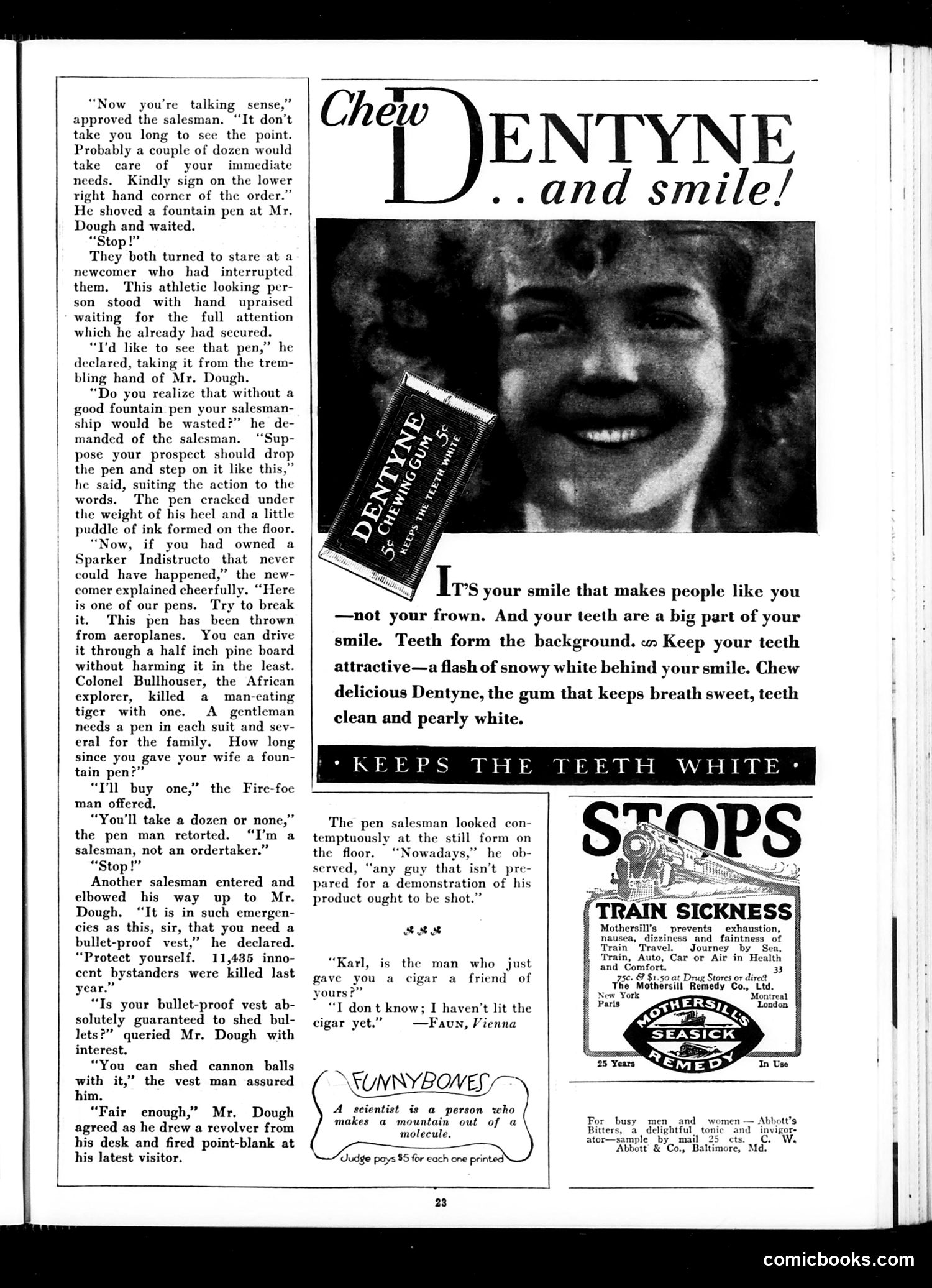
This page satirizes aggressive, high-pressure salesmanship common in the early 20th century. The main cartoon depicts a succession of pushy salesmen interrupting each other to sell increasingly absurd products to a customer named Mr. Dough—first fountain pens, then an "indestructible" pen (demonstrated by stepping on it), then a bullet-proof vest. The humor escalates when Mr. Dough actually shoots the vest salesman to "test" it, whereupon the pen salesman dismisses the dead man as unprepared for his own product demonstration. The satire mocks the era's cutthroat sales tactics: exaggerated product claims, interrupting competitors, refusing orders unless customers buy in bulk, and manufacturing crises to justify purchases. The absurdist conclusion—shooting someone over product reliability—reflects genuine frustration with relentless commercial pressure. The page also contains period advertisements (Dentyne gum, Mothersill's travel remedy) and a "Funny Bones" joke section typical of Judge's format.
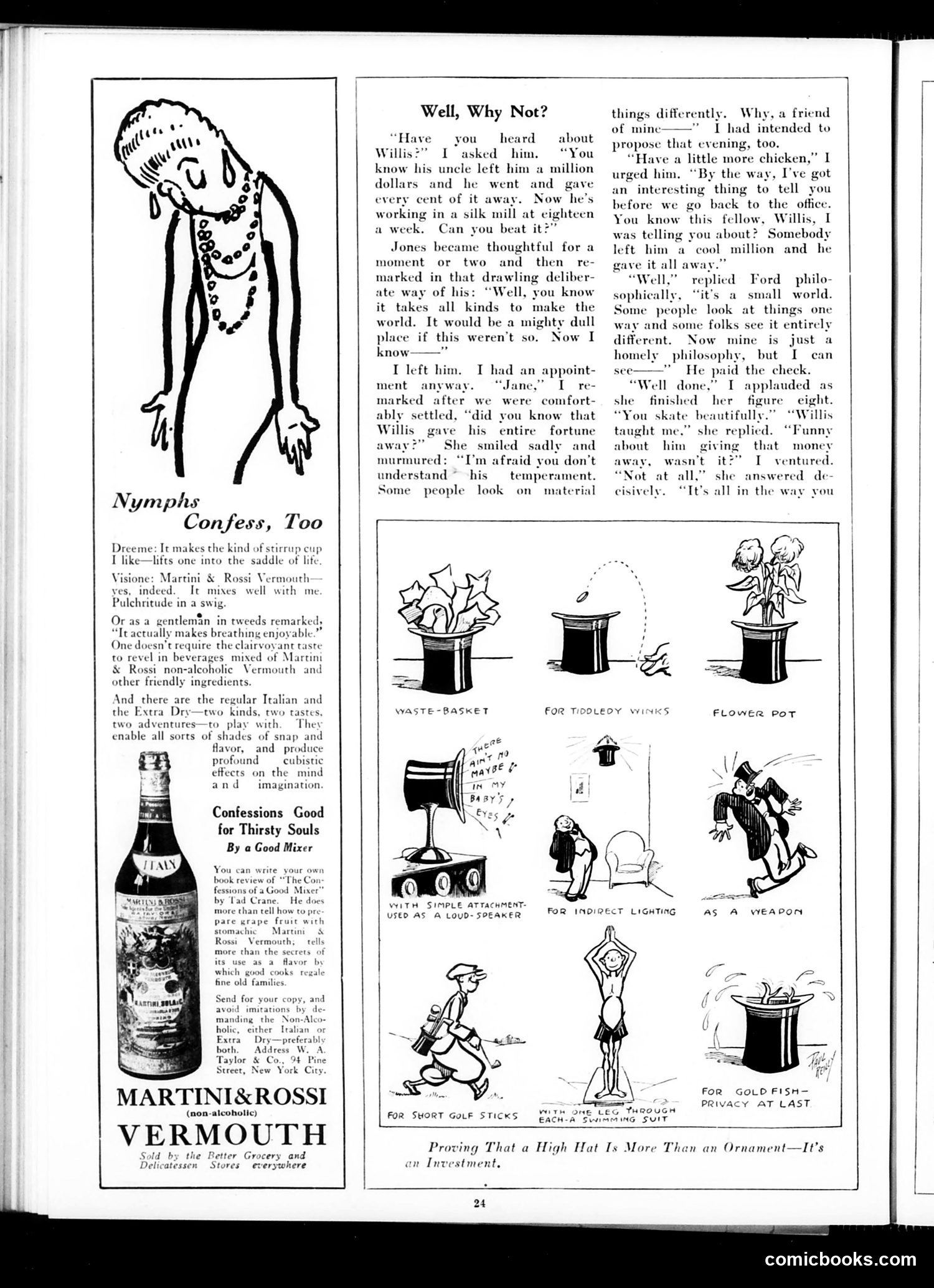
This page combines advertisements and satirical content typical of early 20th-century humor magazines. The main story, "Well, Why Not?," satirizes wealthy philanthropists. A man named Willis inherits a million dollars and gives it all away to work in a silk mill, earning eighteen dollars weekly. The narrator repeatedly tries telling different people (Jones, Jane, Ford, and a skater) about Willis's apparent foolishness, expecting shock or moral judgment. Instead, each listener responds philosophically about accepting different life choices—frustrating the gossip-minded narrator. The joke targets both the wealthy eccentric and gossipers: Willis appears admirably principled (though eccentric), while his acquaintances' bland acceptance of his choice deflates the scandal the narrator seeks. The right panel offers absurdist "uses" for top hats—waste baskets, flower pots, etc.—as a visual pun on "investment." The left side contains a Martini & Rossi vermouth advertisement targeting upscale readers, positioning the drink as sophisticated and refined.
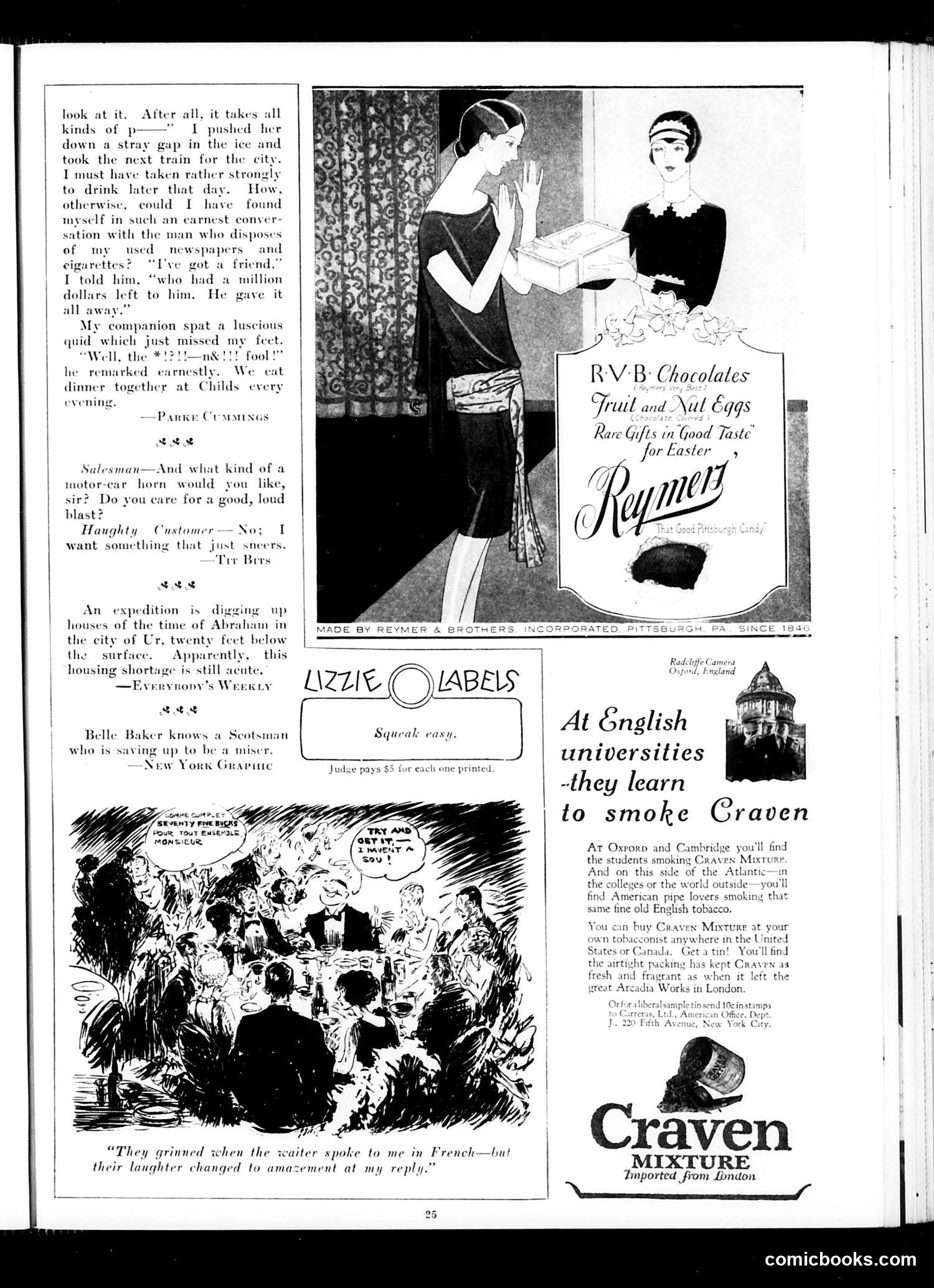
This page contains mostly **short humor pieces and advertisements** rather than political cartoons. The main comic depicts a dinner scene with the caption about a waiter speaking French. The joke plays on a common trope of the era: an American's embarrassment at not understanding French, followed by surprising competence ("their laughter changed to amazement at my reply"). This reflects early 20th-century anxiety about appearing cultured or cosmopolitan. The text snippets are brief satirical jokes typical of Judge's format: - A man gives away a million dollars; a working-class character calls him a fool - Housing shortage joke referencing archaeological digs at ancient Ur - A customer wanting a car horn that "sneers" rather than blasts The advertisements (Reymer chocolates, Lizzie Labels, Craven tobacco) are period-appropriate, with the Craven ad humorously suggesting English university students learn to smoke as part of their education. No specific political figures or events are referenced. The humor is general social satire about American manners, class, and consumerism.
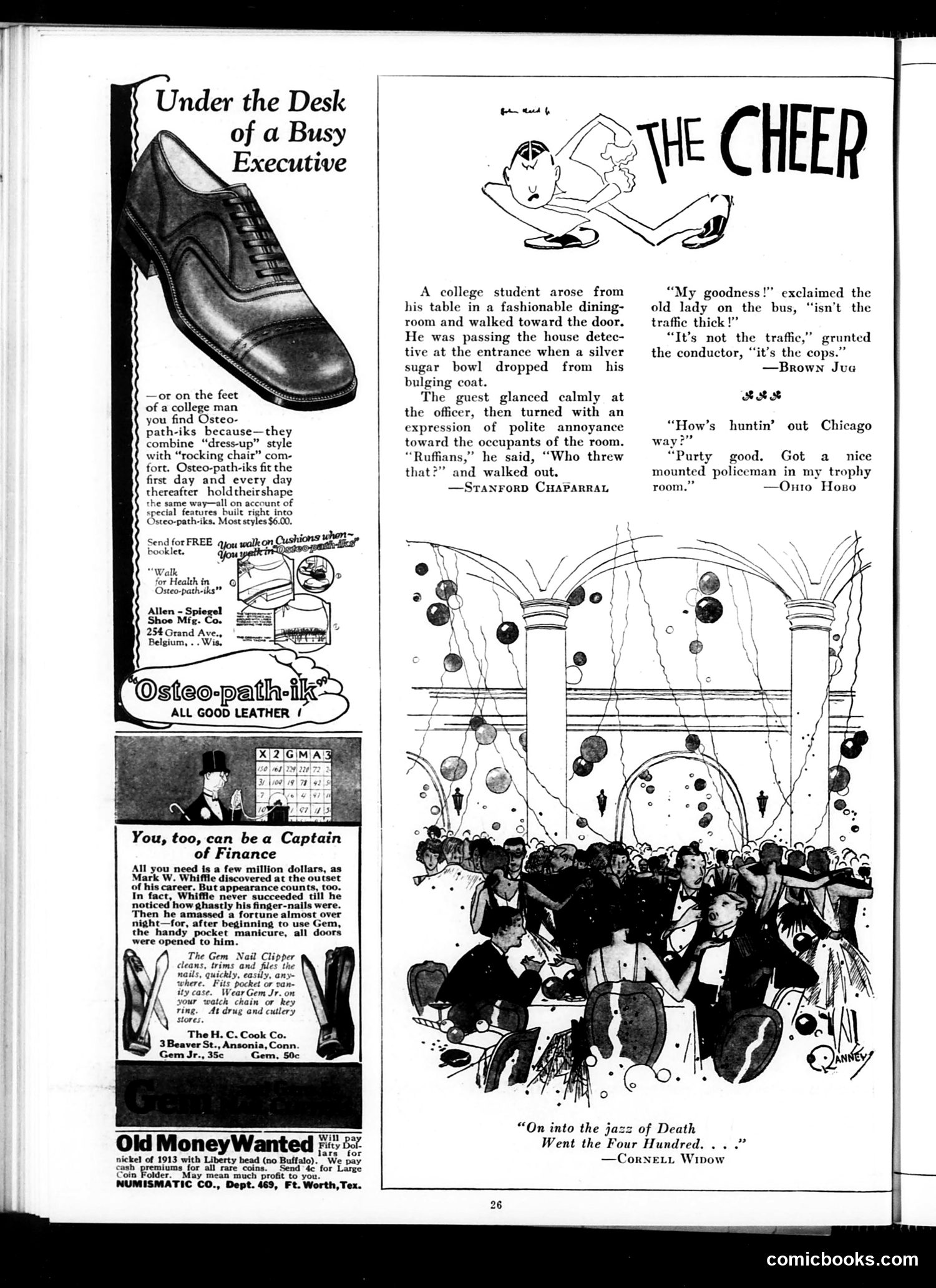
This page contains three brief humorous anecdotes satirizing early 1920s social behavior, plus period advertisements. **The Main Cartoon:** A college student steals a silver sugar bowl from a fancy dining room. When caught by a house detective, he walks out brazenly, and when confronted by other guests, he insults *them* ("Ruffians") rather than addressing his own theft. The humor lies in his audacious nerve—responding to accusation with indignation and social superiority. **The Three Jokes:** The accompanying quips mock social pretension and Prohibition-era concerns. One references heavy police presence (likely relating to alcohol enforcement), another jokes about a mounted policeman as a trophy (suggesting wealth-based status), and a third plays on thick traffic in Chicago. **The Advertisements** include shoe ads, a manicure tool pitch (humorously suggesting appearance matters more than actual financial skill), and numismatic coin collecting—typical 1920s commerce aimed at upwardly mobile readers. The overall tone reflects *Judge*'s satirical stance on American class consciousness and social affectation of the period.
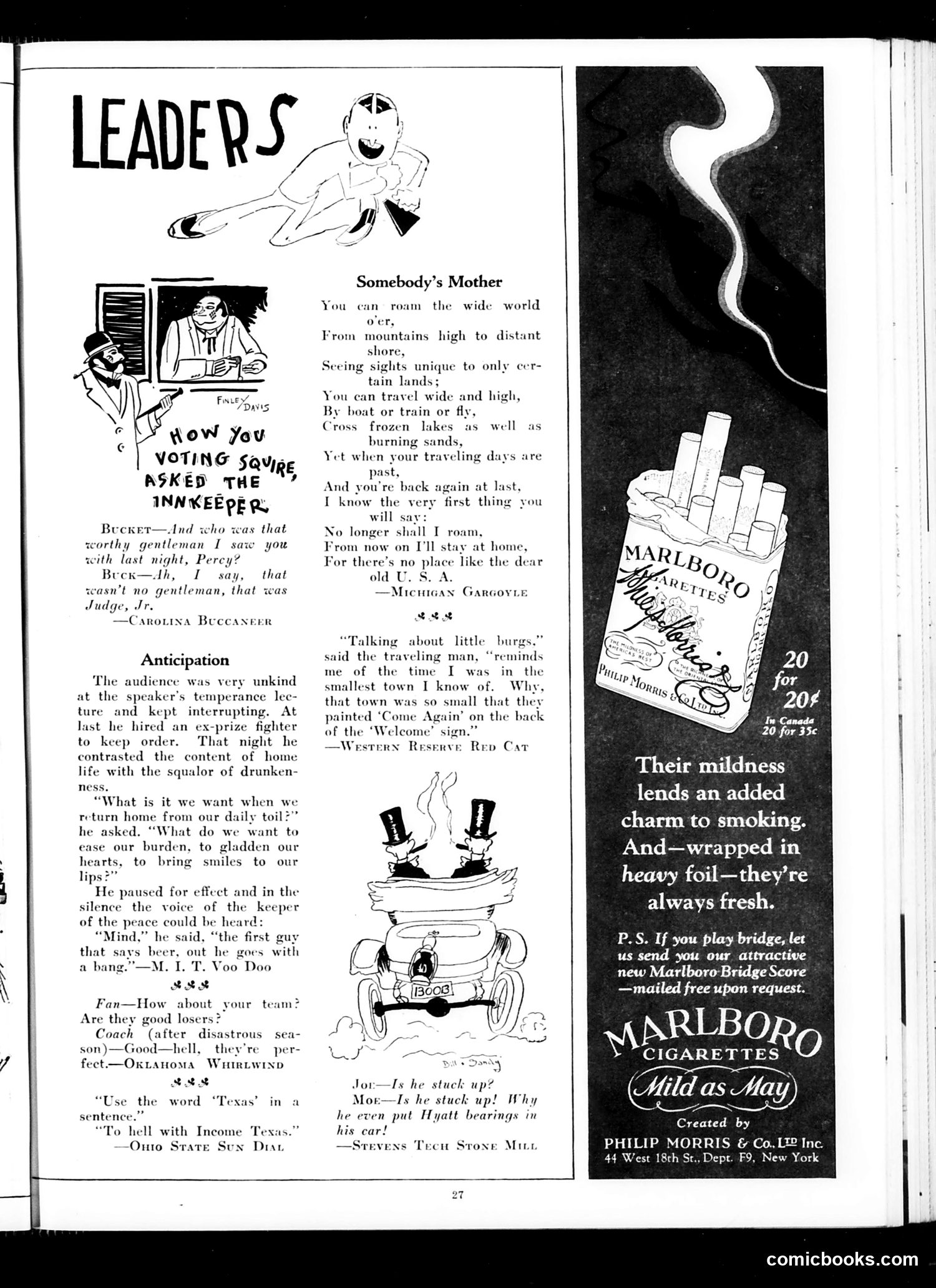
This page contains light humor and advertising typical of Judge magazine's satirical content. **The cartoons** feature brief jokes about social situations: a man mistaken for a gentleman at an inn; a temperance speaker whose hired "peace keeper" ironically contradicts the message by removing beer drinkers; sports coaches accepting losses gracefully; and small-town boasting. **"Somebody's Mother"** is sentimental verse about travel and homecoming—a patriotic poem concluding that despite worldly adventure, "there's no place like the dear old U.S.A." **"Talking about little burgs"** is a traveling salesman joke about a town so small it painted "Come Again" on the back of its "Welcome" sign. **The advertisement** occupies the right half, promoting Marlboro cigarettes as mild and fresh. This reflects 1930s-era tobacco marketing before health warnings. The page blends gentle satirical humor with patriotic sentiment and period advertising—typical Judge content aimed at middle-class American readers.
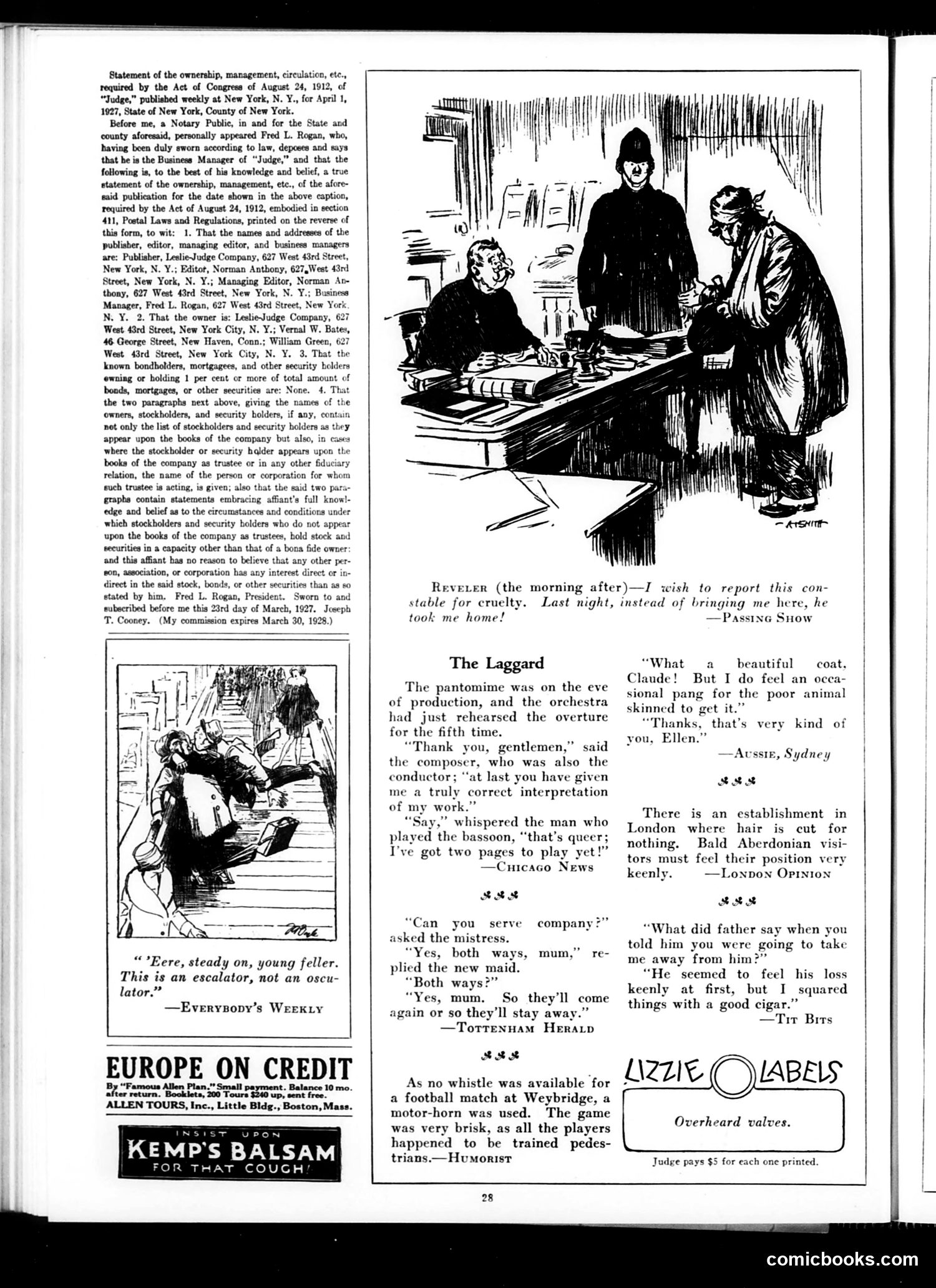
This page is primarily a **legal/administrative document**—the required federal statement of ownership and circulation for the magazine *Judge*, filed under the 1912 Act of Congress. It lists the publication's publisher (Leslie-Judge Company), editors (Norman Anthony), and business manager (Fred L. Rogan). The page includes several **cartoon jokes**: 1. **"Reveler"**: A hungover man reports a police officer for "cruelty" because the officer took him home instead of to jail—implying the man expected arrest and preferred it to facing his home situation. 2. **"The Laggard"**: A orchestra composer praises musicians for finally playing his work correctly, only to be told by the bassoonist he still has two pages left to play—a joke about incomplete rehearsal or the composer's poor listening. 3. **"Escalator" joke**: A man mistakes an escalator for an "osculator" (kisser), humorously conflating the similar-sounding words. The page also contains period advertisements for travel tours and cough medicine, typical of 1920s magazine content.
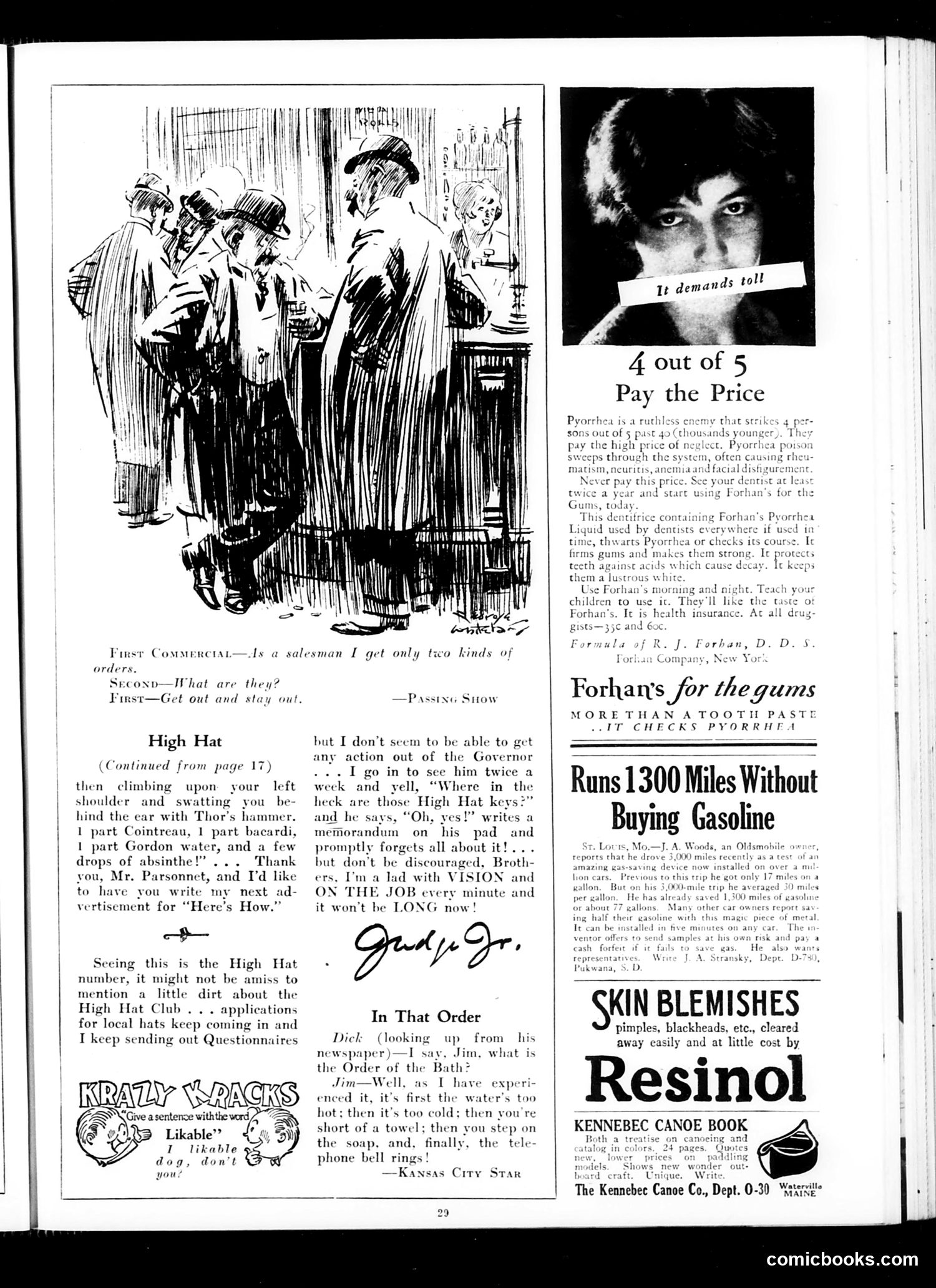
This page contains two distinct humor pieces and period advertisements. **"High Hat" (top left):** A continuation of a serialized humor column about a salesman struggling to get action from the Governor regarding "High Hat keys." The joke satirizes bureaucratic incompetence—the salesman visits twice weekly, the Governor acknowledges the request but immediately forgets it. The accompanying cocktail recipe parody mocks elaborate drink-making. A "High Hat Club" social organization is mentioned, suggesting exclusivity culture. **"In That Order" (bottom left):** A brief comic dialogue from the Kansas City Star. Dick asks Jim about the formal "Order of the Bath" (a British honors system); Jim responds with a literal, practical interpretation—describing the typical frustrations of taking a bath (temperature problems, missing towels, soap mishaps, phone interruptions). The humor relies on the double meaning of "order." **Advertisements (right side):** Various period products including Forhan's toothpaste (for pyorrhea/gum disease), automobile accessories, skin treatments, and canoe equipment—typical early 20th-century consumer goods marketing. The page reflects 1920s social commentary and consumer culture.
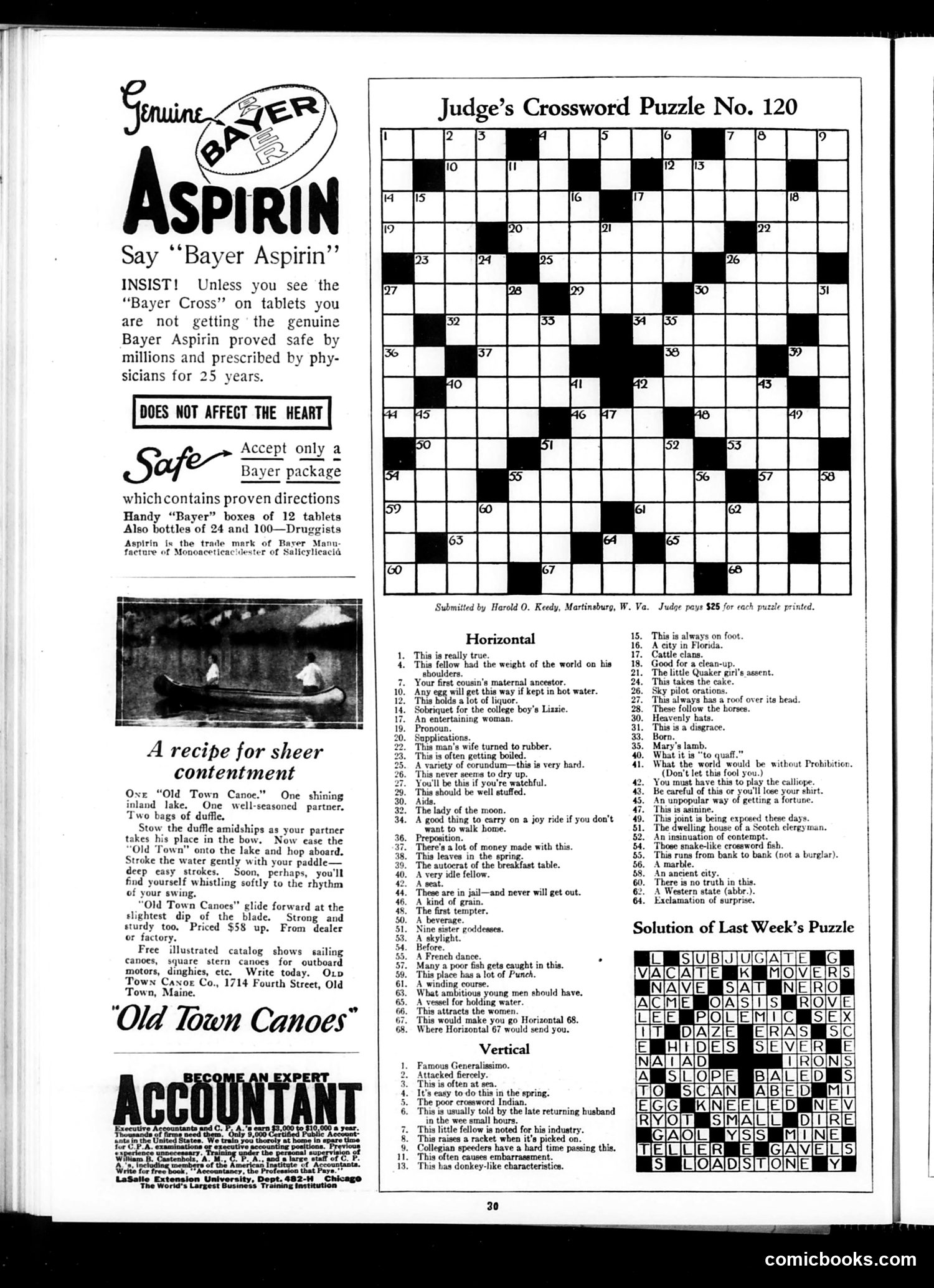
This page is primarily **advertising and entertainment content**, not political satire. It features: **Main Content:** - Judge's Crossword Puzzle No. 120 with clues (horizontal and vertical) - Solution to the previous week's puzzle **Advertisements:** 1. **Bayer Aspirin** - emphasizes buying only genuine "Bayer Cross" branded aspirin, claiming 25 years of safe medical use. This reflects early 20th-century patent/trademark concerns when aspirin was still a proprietary Bayer product. 2. **Old Town Canoes** - a lifestyle advertisement romanticizing leisure canoeing ("sheer contentment") for affluent readers. 3. **Accountant Training** - a correspondence school ad for vocational education. **Context:** The aspirin ad's insistence on brand authenticity reflects the era before aspirin became genericized (1917), when Bayer controlled the trademark. The canoe ad targets Judge's affluent readership. This page represents Judge's business model: premium advertising alongside intellectual entertainment for educated, middle-to-upper-class readers.
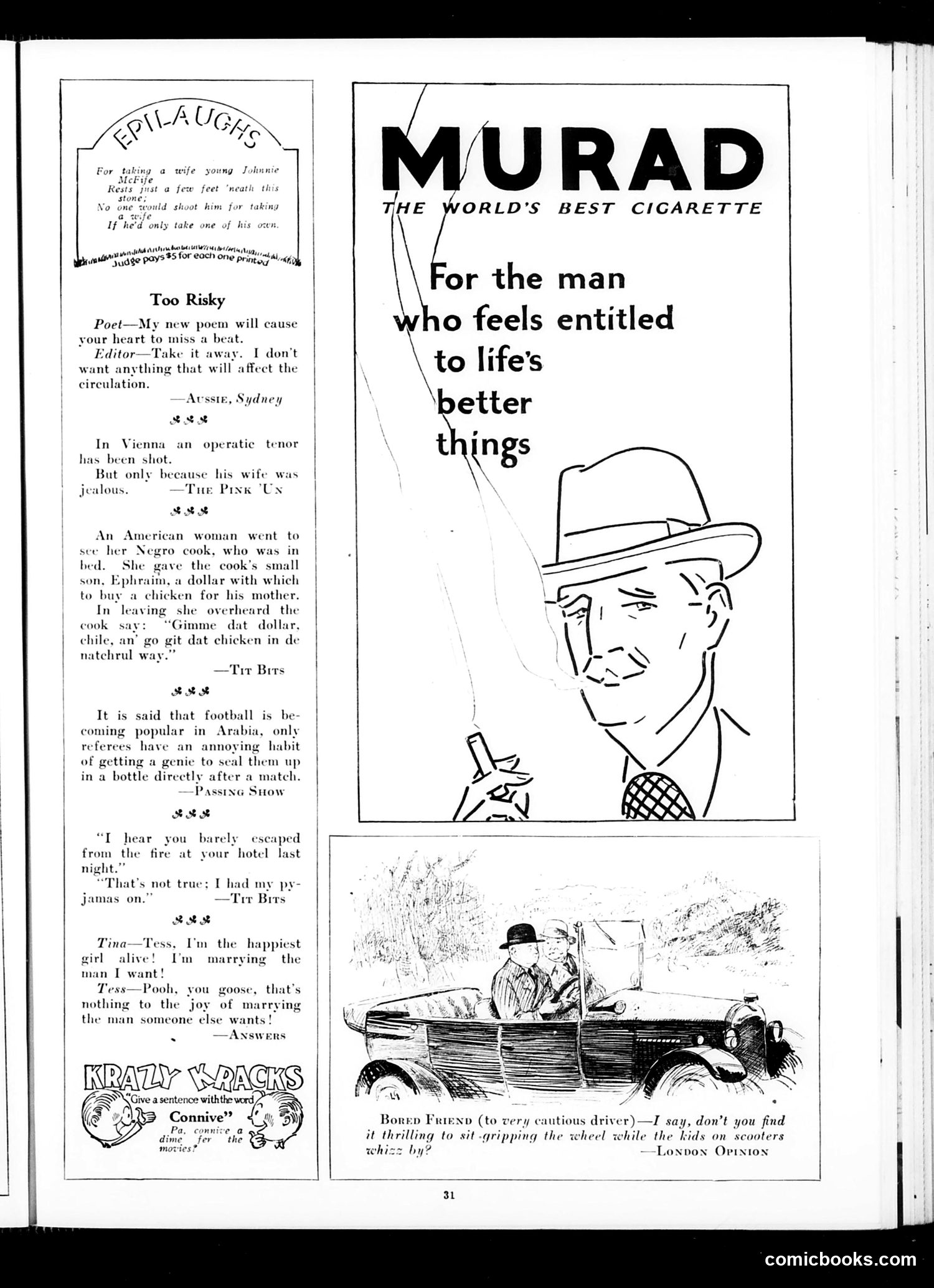
This page from *Judge* contains several brief humor pieces typical of early 20th-century satirical magazines: **"Too Risky"** jokes about editorial timidity—a poet's work is rejected not for quality but because the editor fears it might affect newspaper circulation, satirizing commercial over artistic concerns. **Ethnic humor pieces** include crude racial stereotypes common to the era: jokes about a "Negro cook" and references to Arabs, reflecting period attitudes. **"Krazy Wracks"** is a word-game feature asking readers to construct sentences. **The Murad cigarette advertisement** (right side) is the page's commercial content, depicting a confident man in a hat—typical luxury-goods marketing of the period targeting affluent males. **The car cartoon** (bottom) satirizes reckless driving, with a "Bored Friend" mocking overly cautious drivers, reflecting anxieties about early automobiles and traffic safety. The page illustrates *Judge's* mix of advertising, wordplay, and social satire aimed at educated, middle-class readers.
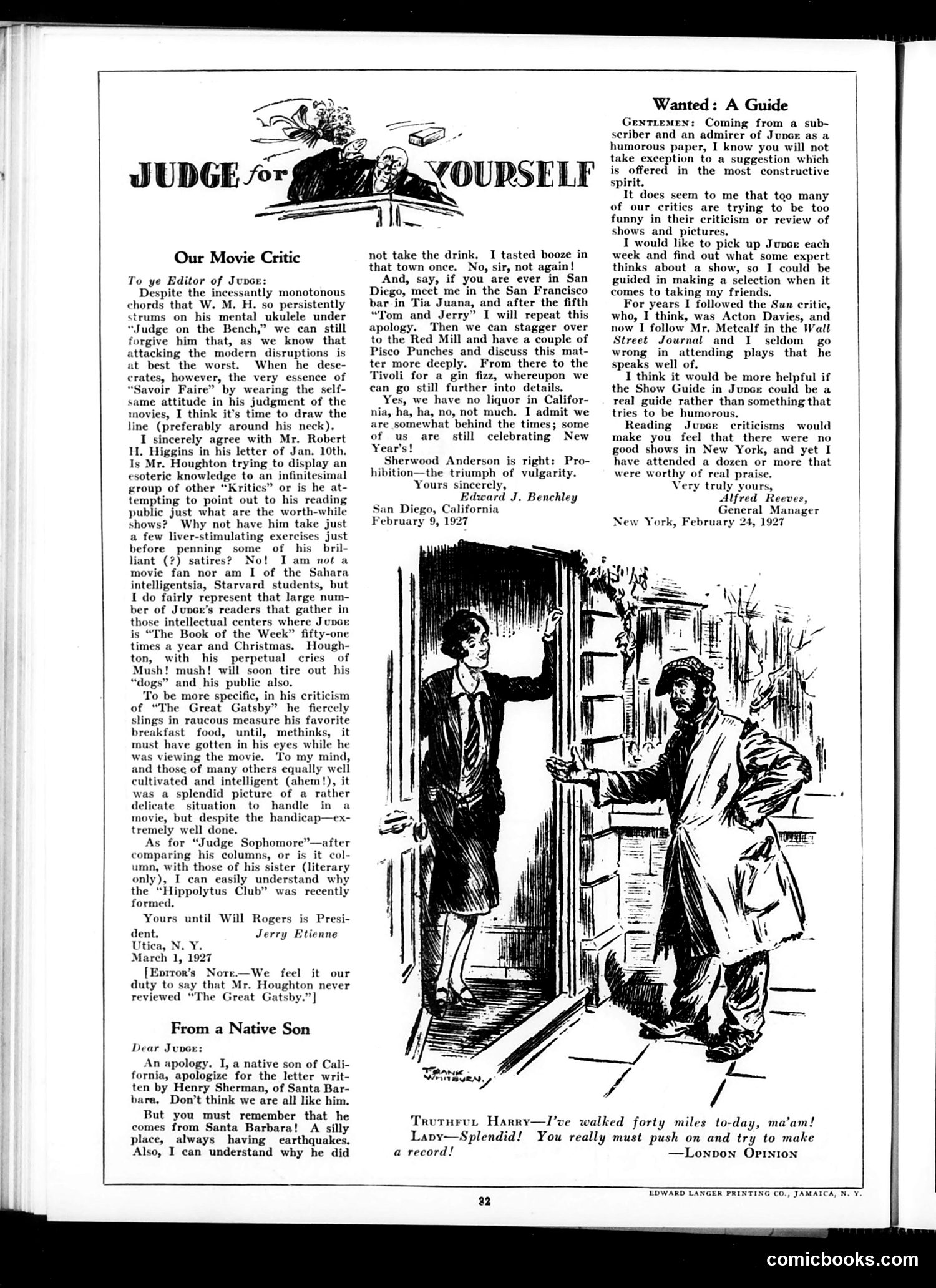
This page contains letters to Judge magazine's editor critiquing the magazine's movie reviewer (identified in the editor's note as "Mr. Houghton"). **The Main Complaint:** Readers argue the critic is pretentious and unhelpful. He uses obscure language and harsh judgments rather than genuinely guiding readers toward worthwhile films. One writer calls him out for attacking "The Great Gatsby" unfairly—the critic apparently used flowery insults ("breakfast food" imagery) that obscured actual analysis. **The Satire's Target:** Judge's own movie critic, who appears to prioritize clever wordplay and intellectual posturing over practical film recommendations. The readers represent ordinary Judge subscribers wanting useful guidance, not literary showing-off. **Historical Context:** This reflects 1920s debates about film legitimacy—critics were still establishing whether movies deserved serious attention or were "lowbrow" entertainment. The complaint about elitism versus accessibility was common. **The Illustration:** Shows what appears to be a doorway scene, likely related to one of the films discussed.
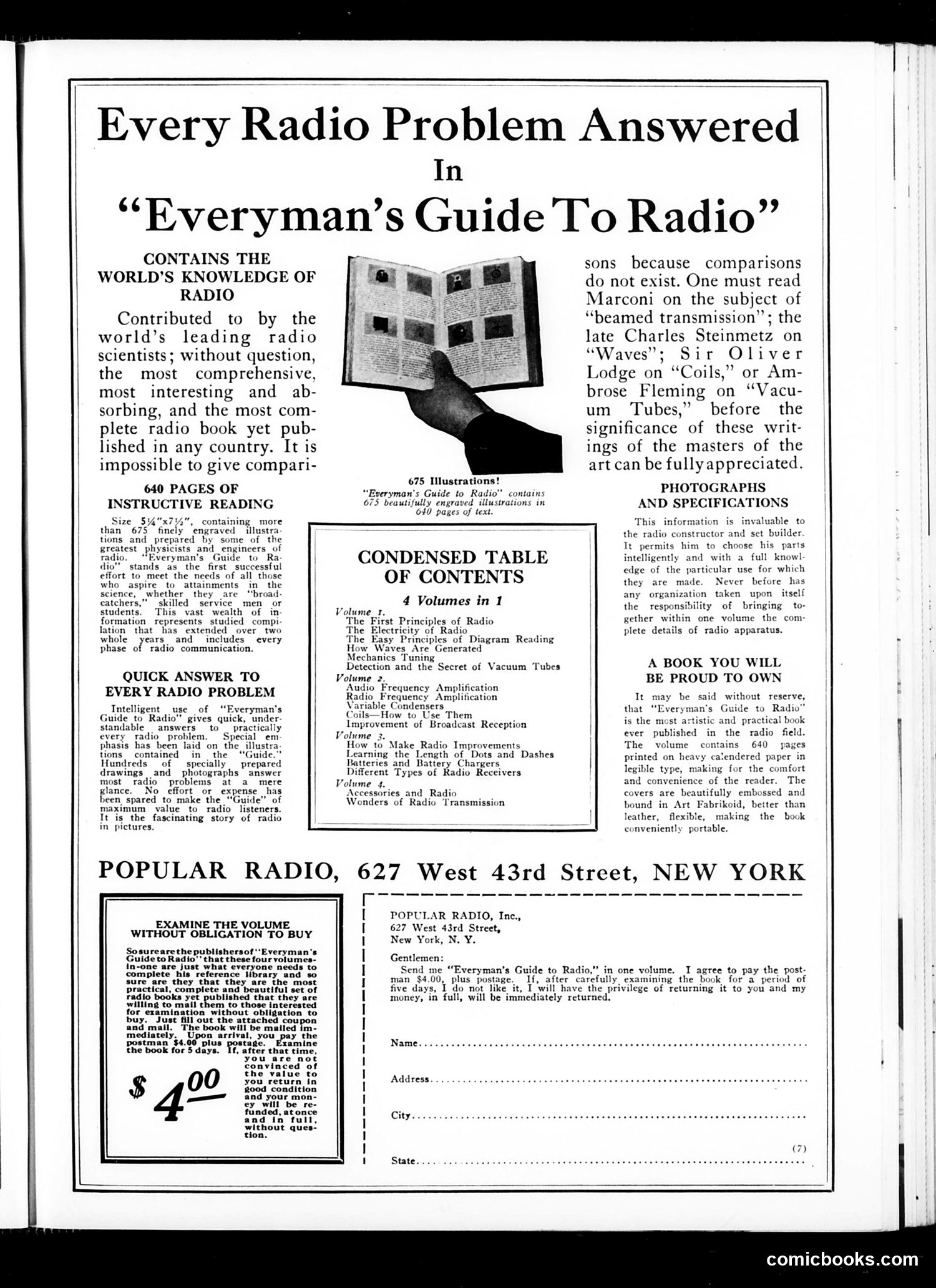
This page is primarily **advertising copy**, not a cartoon or satirical content. It promotes "Everyman's Guide to Radio," a comprehensive 640-page reference book published by Popular Radio, Inc. in New York. The advertisement targets early radio enthusiasts—a significant audience in the 1920s-30s when radio technology was rapidly evolving and accessible to amateur builders and listeners. The promotional text emphasizes the book's authority (contributions from "world's leading radio scientists"), comprehensiveness (675 illustrations, four volumes in one), and practical value for both casual listeners and skilled technicians. The price of $4.00 plus postage was substantial for the era. Notably, the ad includes a mail-in coupon offering a five-day examination period before purchase—a common sales tactic of the period. There is **no political satire or social commentary** visible on this page. It's a straightforward product advertisement typical of Judge magazine's revenue model.
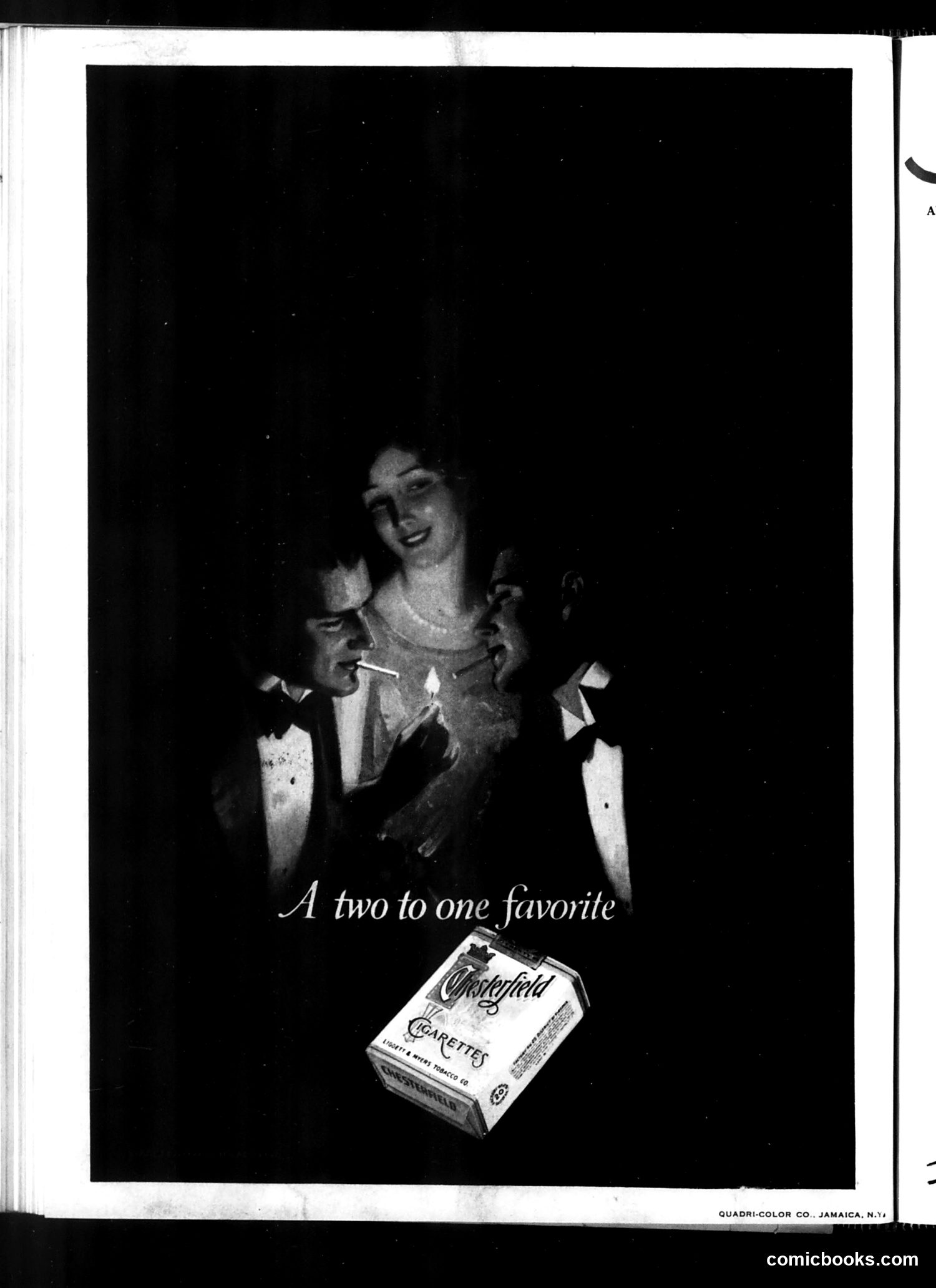
This is a cigarette advertisement for Chesterfield brand, not political satire. The image shows a woman in 1920s-30s formal attire (evening gown) flanked by two men in tuxedos, all smiling. The tagline reads "A two to one favorite," playing on the numerical odds while depicting a social scenario of romantic interest. The ad uses a common advertising trope of its era: associating smoking with sophistication, glamour, and social desirability. The "two to one" phrasing suggests the woman is preferred or sought-after, implying that smoking Chesterfields enhances one's attractiveness or social status. This reflects period advertising that marketed cigarettes to both men and women as markers of elegance and social success.