
Judge, 1927-04-09 · page 22 of 36
Judge — April 9, 1927 — page 22: what you’re looking at
What you’re looking at
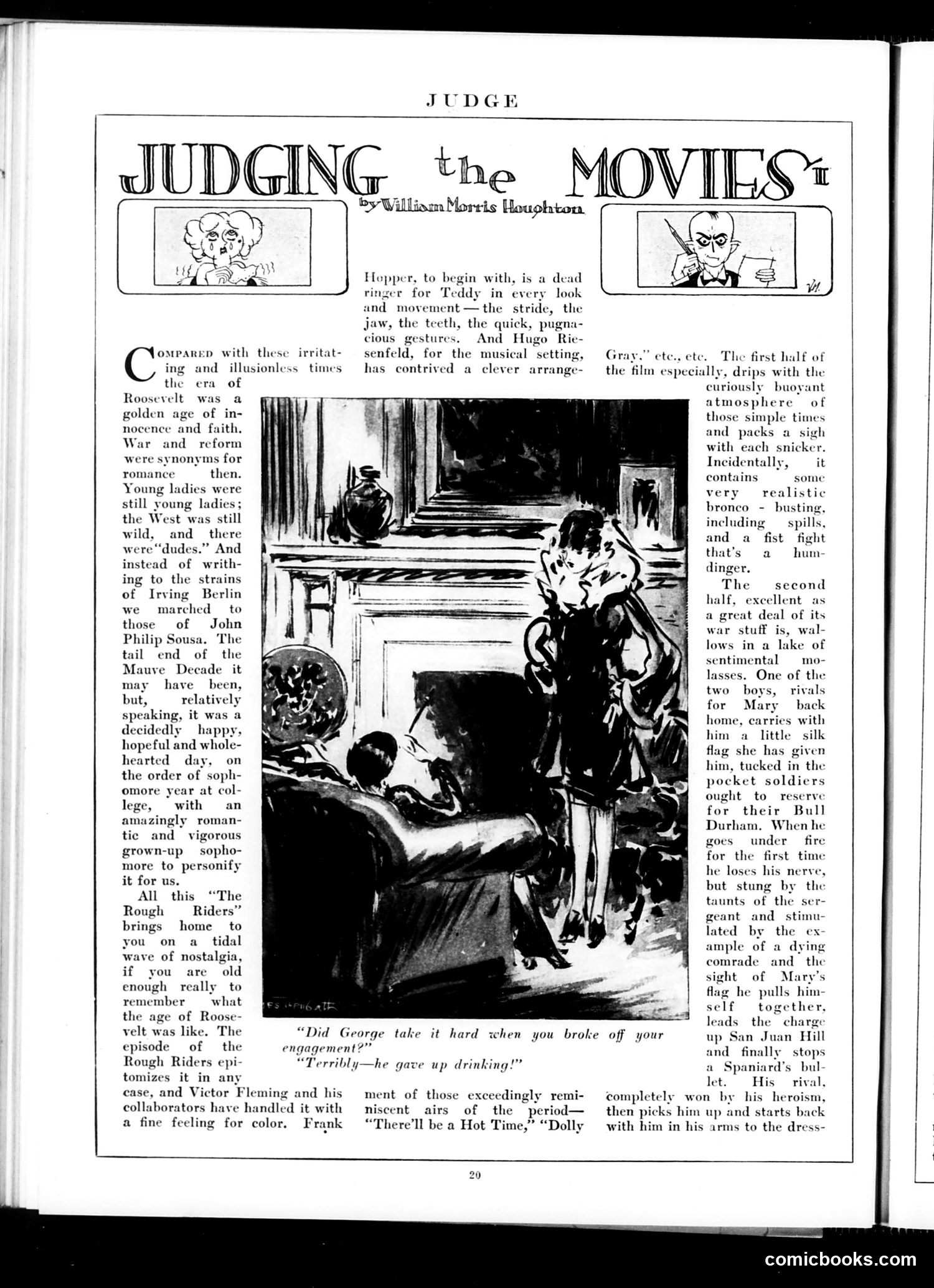
This is a film review by William Morris Houghton critiquing a movie adaptation of Theodore Roosevelt's famous Rough Riders unit from the Spanish-American War. **The Film's Appeal:** The review argues the movie succeeds by nostalgically recreating Roosevelt's era—described as a time of "innocence and faith" contrasting with the "irritating and illusionless times" (the 1920s present). Actor Hopper apparently physically resembles Teddy Roosevelt and captures his mannerisms convincingly. **The Plot:** The narrative follows two soldiers rivals for a girl back home. One boy carries a silk flag from his sweetheart; during combat he initially loses courage but regains it witnessing a comrade's death and his flag. He leads a charge up San Juan Hill and is shot, ultimately redeemed through heroism. His rival is "completely won by his heroism." **The Critique:** The first half effectively captures the period's atmosphere with authentic music and bronco-busting scenes. The second half descends into "sentimental molasses" but ultimately delivers patriotic drama.
📄 Transcribed text from this page (OCR, searchable)
Machine-transcribed from the original scan — historical spelling and the odd misread are preserved.
JUDGE | JUDGING. the the era ompareED with these irritat- ing and illusionless times of Roosevelt was a golden age of in- nocence and faith, War and reform were synonyms for romance then. Young ladies were still young ladies; the West was still wild, and _ there were “dudes.” And instead of writh- ing to the strains of Irving Berlin we marched to those of John The the Decade it may have _ been, but, relat speaking, it wa decidedly happy, hopeful and whole- hearted day, on the order of soph- r at col- with an ingly roman- and vigorous grown-up sopho- more to personify it for us. All this “The Rough Riders” brings home to you on a_ tidal wave of nostalgia, if you are old enough really to remember — what the age of Roose- velt was like. The episode of the Rough Riders epi- tomizes it in any case, and Victor Fleming and his collaborators have handled it with a fine feeling for color. Frank Philip Sousa. of tail end Mauve omore j lege. “Did George engagement?” “Terribly—he gave up drinking!” bY Villa Mortis Houghton. Hopper, to begin with, is a dead ringer for Teddy in every look and movement —the stride, the jaw, the teeth, the quick, pugn: cious gestures. And Hugo Rie- senfeld, for the musical setting, has contrived a arrange- clever take it hard when you ment of those exceedingly remi- niscent airs of the period— “There'll be a Hot Time,” “Dolly MOVIES broke Gray.” the film especially, drips with the off completely won by then picks him up and starts back with him in his arms to the dress- ete., et aa your c. The first half of curiously buoyant atmosphere of those simple times and packs with each snic! Incidentally, it contains very realistic bronco - busting, including spills, and a fist fight that’ a hum- dinger. The second half, excellent as a great deal of its war stuff is, wal- lows in a lake of sentimental — mo- lasses. One of the two boys, rivals for Mary back home, carries with him tle silk flag she given him, tucked in the pocket soldiers ought to reserve for their Bull Durham. When he goes under fire for the first time he loses his nerve, but stung by the taunts of the ser- geant and stimu- lated by the ample of a dying comrade and the sight of Mary’s flag he pulls him- self together, leads the charge up San Juan Hill and finally stops a Spaniard’s bul- let. His rival, his heroism, ex- comicbooks.com