
Judge, 1927-04-09 · page 15 of 36
Judge — April 9, 1927 — page 15: what you’re looking at
What you’re looking at
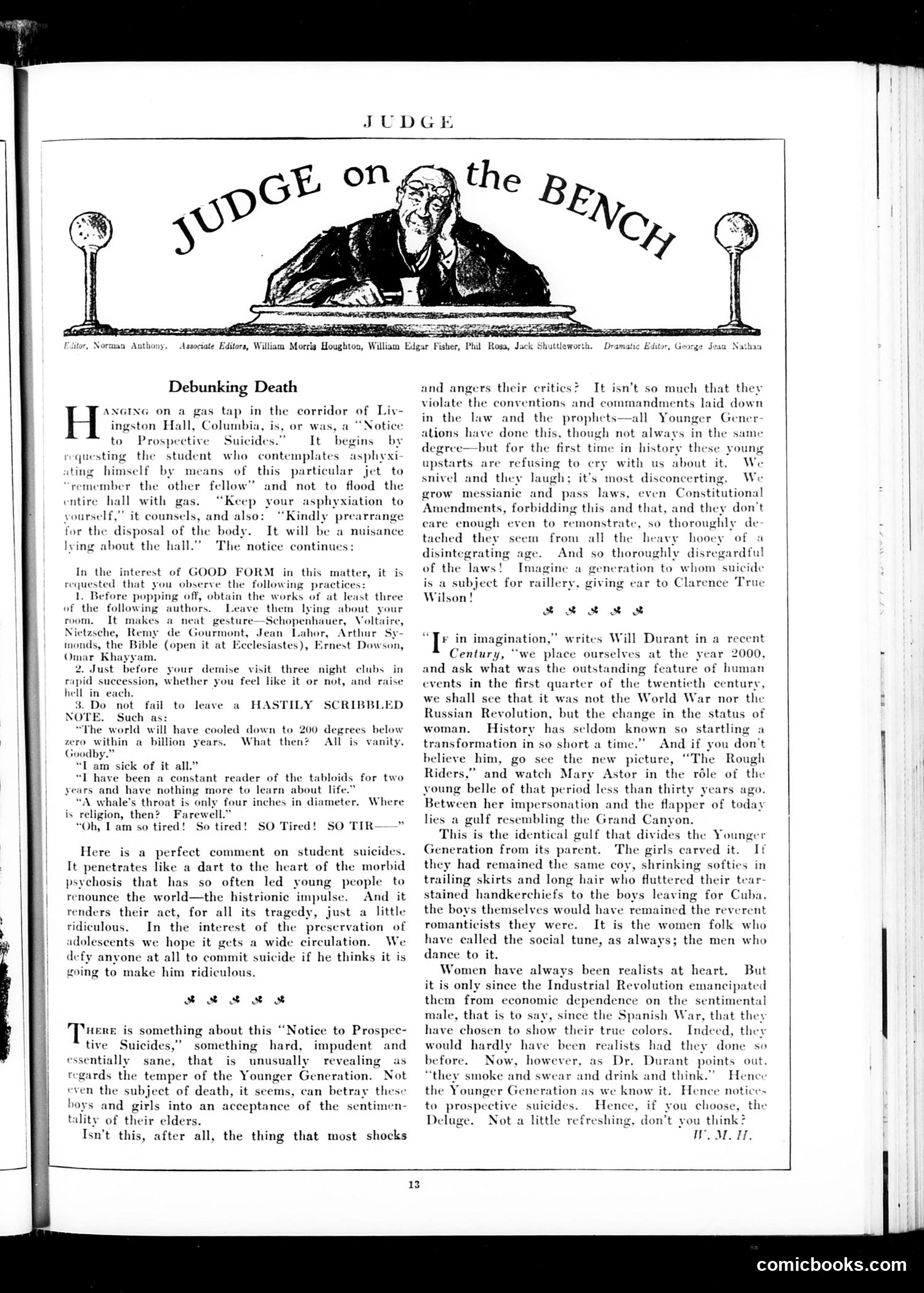
This page satirizes student suicides at Columbia University through a fake "Notice to Prospective Suicides" posted at Livingston Hall. The satire mocks both the histrionic impulse behind student suicides and the overly sentimental, moralistic response from older generations. The notice parodies suicide notes by prescribing absurd pre-death rituals: reading pessimistic philosophers (Schopenhauer, Nietzsche), visiting nightclubs, and leaving literary props. The editorial argues this mockery is socially valuable—it strips suicide of its romantic drama and renders the act ridiculous, potentially deterring it. The broader commentary critiques the "Younger Generation" for their refusal to share their elders' emotional investment in life's meaning. Unlike previous generations, these youth neither embrace nor dramatically rebel against conventional morality; they simply laugh at it—deeply unsettling to concerned adults.
📄 Transcribed text from this page (OCR, searchable)
Machine-transcribed from the original scan — historical spelling and the odd misread are preserved.
JUDGE Debunking Death ANGING on a gas tap in the corridor of Liv- ingston Hall, Columbia, is, or was, a “Notice to Prospective Suicides.” It be s by questing the student who contemplates asphyxi iting himself by means of this particular jet to remember the other fellow” and not to flood the entire hall with gas. ‘ep your asphyxiation to yourself,” it counsels, and also: “Kindly prearrange for the disposal of the body. It will be a nuisance lying about the hall.” The notice continues: In the interest of GOOD FORM in this mi requested that you observe the following y 1. Before popping off, obtain the works of ist three of the following authors. Leave them lying about your room. It makes a neat gesture—Schopenhauer, Voltaire, Nietzsche, yy de Gourmont, Je ahor, Arthur Sy monds, the Bible (open it at Ecclesiastes), Ernest Dowson, Omar Khayyam. Just before your demise visit three night clubs in rapid succession, whether you feel like it or not, and raise hell in each. Do not f. NOT Such a “The world will have cooled down to 200 degrees below zero within a billion years. What then? All is vanity. Goodby. “I am sick of it all.” “I have been a constant reader of the tabloids for two vars and have nothing more to learn about life. whale’s throat is only four inches in diameter. Where ion, the: Farew “Oh, Lam so tired! So tired! SO Tired! SO TIR ” il to leave a HASTILY SCRIBBLED is rel Here is a perfect comment on student suicides. It penetrates like a dart to the heart of the morbid psychosis that has so often led young people to renounce the world—the histrionic impulse. And it renders their act, for all its tragedy, just a little ridiculous. In the interest of the preservation of adolescents we hope it gets a wide circulation. We defy anyone at all to commit suicide if he thinks it is going to make him ridiculous. 28 2 ss T 1ERE is something about this “Notice to Prospec- tive Suicides,” something hard, impudent and essentially sane, that is unusually revealing as regards the temper of the Younger Generation. Not even the subject of death, it seems, can betray these boys and girls into an acceptance of the sentimen- tality of their elders. Isn't this, after all, the thing that most shocks huttleworth. Dramatic Editor, George Jean Nathaa and angers their critics? It isn’t so much that they violate the conventions and commandments laid down in the law and the prophets—all Younger Gener ations h: done this, though not always in the same degree—but for the first time in history these young upstarts are refusing to cry with us about it. We snivel and they laugh; it’s most disconcerting. We grow messianic and pass laws, even Constitutional Amendments, forbidding this and that, and they don't care enough even to remonstrate, so thoroughly de tached they seem from all the heavy hooey of a disintegrating age. And so thoroughly disregardful of the laws! Imagine a generation to whom suicide is a subject for raillery, giving ear to Clarence True Wilson! Ce ee oe I in imagination,” writes Will Durant in a recent Century, “we place ourselves the year 2000, and ask what was the outstanding feature of human events in the first quarter of the twentieth century, we shall see tl t was not the World War nor the Russian Revolution, but the change in the status of woman. History has seldom known so startling a transformation in so short a time.” And if you don’t believe him, go see the new picture, “The Rough Riders,” and watch Mary Astor in the réle of the young belle of that period less than thirty years ago. Between her impersonation and the flapper of today lies a gulf resembling the Grand Canyon. This is the identical gulf that divides the Younger Generation from its parent. The girls carved it. I! they had remained the same coy, shrinking softies in trailing skirts and long hair who fluttered their tear stained handkerchiefs to the boys leaving for Cuba, the boys themselves would have remained the reverent romanticists they were. It is the women folk who have called the social tune, as alw. ; the men who dance to it. Women have alw. been realists at heart. But it is only since the Industrial Revolution emancipated them from economic dependence on the sentimental male, that is to say, since the Spanish War, that they have chosen to show their true colors. Indeed, they would hardly have been realists had they done so before. Now, however, as Dr. Durant points out, “they smoke and swear and drink and think.” Hene: the Younger Generation as we know Hence notices to prospective suicides. Hence, if you choose, the Deluge. Not a little refreshing, don’t you think? WM, | | comicbooks.com