
Judge, 1927-04-09 · page 21 of 36
Judge — April 9, 1927 — page 21: what you’re looking at
What you’re looking at
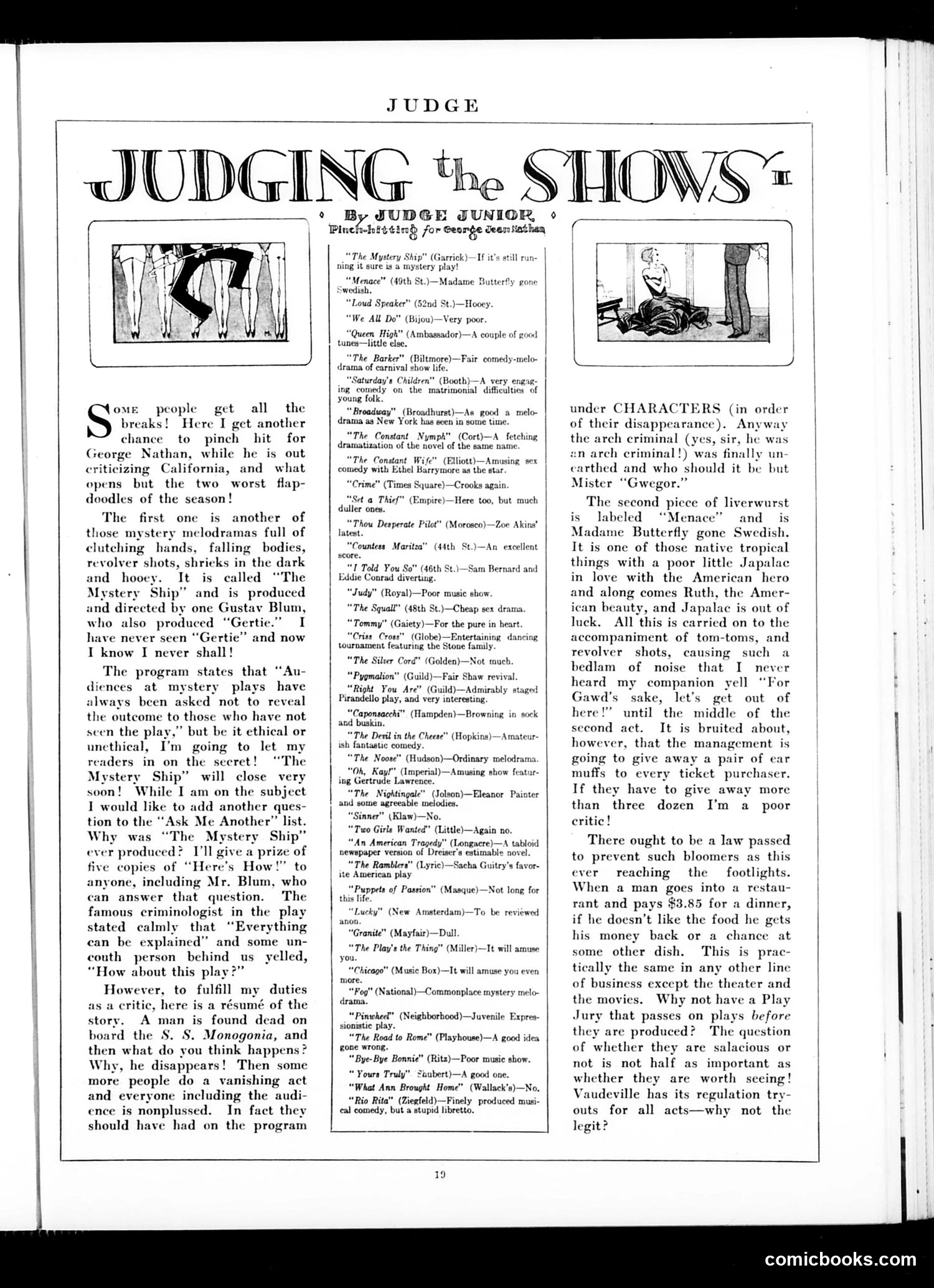
This is a theater review column by "Judge Junior" (substituting for George Nathan) critiquing Broadway productions. The humor relies on sharp dismissal of weak plays. The main target is *The Mystery Ship*, a mystery melodrama the critic savagely pans. He jokes that revealing its ending won't matter since it will close soon anyway, and sardonically asks readers to answer "Why was it ever produced?"—offering a prize to anyone who can explain this baffling decision. The reviewer mocks the film's implausible plot (a man found dead then disappears) and absurd dialogue, with a dig at an audience member yelling "How about this play?" when a character claims "everything can be explained." The page lists brief capsule reviews of other Broadway shows, mostly dismissive ("Hooey," "Very poor," "Cheap sex drama"). The satire targets theatrical mediocrity and poor productions cluttering Broadway during what appears to be the 1920s theater season.
📄 Transcribed text from this page (OCR, searchable)
Machine-transcribed from the original scan — historical spelling and the odd misread are preserved.
JUDGE ome people get all the breaks! Here I get another chance to pinch hit for George Nathan, while he is out criticizing California, and what opens but the two worst flap- doodles of the season! The first one is another of those mystery melodramas full of clutching hands, falling bodies, revolver shots, shrieks in the dark and hooe It is called he Mystery Ship” and is produced and directed by one Gustav Blum, who also produced “Gertie.” I have never seen “Gertie” and now I know I never shall! The program states that “Au- diences at mystery plays have always been asked not to reveal the outcome to those who have not seen the pl but be it ethical or unethical, I'm going to let my readers in on the secret! ‘The Mystery Ship” will close very soon! While I am on the subject I would like to add another ques tion to the “Ask Me Another” 1 Why was “The Mystery Ship” ever produced? I'll give a prize of five cop’ of “Here’s How!” to anyone, including Mr. Blum, who n answer that question. The famous criminologist in the play stated calmly that “Everything can be explained” and some un- couth person behind us yelled, “How about this play?” However, to fulfill my duties as a critic, here is a résumé of the story. A man is found dead on board the S. S. Monogonia, and then what do you think happens? Why, he di ppears ! Then some more people do a vanishing act and everyone including the audi- ence is nonplussed. In fact they should have had on the program G the SHOWS” iy SUDGE SUNIOR Pinel soeing for George deentiathan “The Mystery Ship (Garrick)—If it's still run- ig it sure is a mystery play! “Menace” (49th St.)—Madame Butterfly gone Swedish. “Loud Speaker” (52nd St.)—Hooey. “We All Do” (Bijou)—Very poor. “Queen High” (Ambassador)—A couple of good tunes—little else. ‘he Barker” (Biltmore)—Fair comedy-melo- drama of carnival show life. “Saturday's Children” (Booth ing comedy on the matrimor young folk. “Broadway” (Broadhurst)—As good a melo- drama as New York has seen in some time. “The Constant Nymph” (Cort)—A fetching dramatization of the novel of the same name. "he Constant Wife” (Elliott)—Amusing sex iedy with Ethel Barrymore as the star: A very engag- difficulties of rime” (Times Square)—Crooks again | “Set a Thief” (Empire)—Here too, but much duller ones. “Thou Desperate Pilot” (Morosco)—Zoe Akins’ latest. “Countess Maritza” (44th St.)—An excellent score. “I Told You So” (46th St.)\—Sam Bernard and Eddie Conrad diverting. “Judy” (Royal)—Poor music show “The Squall” (48th St.)—Cheap sex drama. “Tommy” (Gaiety)—For the pure in heart, “Criss Cross” (Globe)—Entertaining dancing tournament featuring the Stone family “The Siler Cord” (Golden)—Not much. “Pygmalion” (Guild)—Fair Shaw revival. “Right You Are” (Guild)—Admirably staged Pirandello play, and very interesting “Caponsacchi" (Hampden)—Browning in sock and buskin. “The Devil in the Cheese” (Hopkins)—Amateur- ish fantastic comedy. “The Note” (Hudson)—Ordinary melodrama “Oh, Kay?” (Imperial) —Amusing show fea ing Gertrude Lawrence. “The Nightingale” (Jolson)—Eleanor Painter \d some agreeable melodies. inner” (Klaw)—No. “Two Girls Wanted” (Little)—Again no. “An American Tragedy” (Longacte)—A tabloid paper version of Dreiser's estimable novel. The Ramblers” (Lyric)—Sacha Guitry's favor- ite American play net 4 {Puppet of Passion” (Masque)—Not long for this life. “Lucky” (New Amaterdam)—To be reviewed anon. “Granite” (Mayfair) —Dull. “The Play's the Thing” (Mille you. “Chicago” (Music Box)—It will amuse you even more. —It will amuse “Pog” (National) Commonplace mystery melo- drama. “Pinwheel” (Neighborhood)—Juvenile Expres- sionistic play. “The Road to Rome” (Playhouse)—A good idea gone wrong. “ Bye-Bye Bonnie” (Ritz)—Poor music show. "Yours Truly” Suubert)—A good one. “What Ann Brought Home” (Wallack's)—No. “Rio Rita” (Ziegfeld)—Finely produced musi- cal comedy, but a stupid libretto. ° = under CHARACTERS (in order of their disappearance). Anyway the arch criminal (yes, sir, he was en arch criminal!) was finally un earthed and who should it be but Mister “Gwegor.” The second piece of liverwurst is labeled “Menace” and _ is Madame Butterfly gone Swedish. It is one of those native tropical things with a poor little alac in love with the American hero and along comes Ruth, the Amer- ican beauty, and Japalae is out of luck. All this is carried on to the accompaniment of tom-toms, and revolver shots, causing such a bedlam of noise that I never heard my companion yell ‘For Gawd’s sake, let’s get out of here!” until the middle of the second act. It is bruited about, however, that the management is going to give away a pair of ear muffs to every ticket purchaser. If they have to give away more than three dozen I’m a_ poor critic! There ought to be a law passed prevent such bloomers this ever reaching the —footlights. When a man goes into a re: rant and pays $3.85 for a dinner, if he doesn’t like the food he gets his money back or a chance at some other dish. This is prac- tically the same in any other line of business except the theater and the movies. Why not have a Play Jury that passes on plays before they are produced? The question of whether they e salacious or not is not half important as whether they are worth seeing! Vaudeville has its regulation try- outs for all acts—why not the legit? comicbooks.com