
A complete issue · 36 pages · 1927
Judge — January 29, 1927
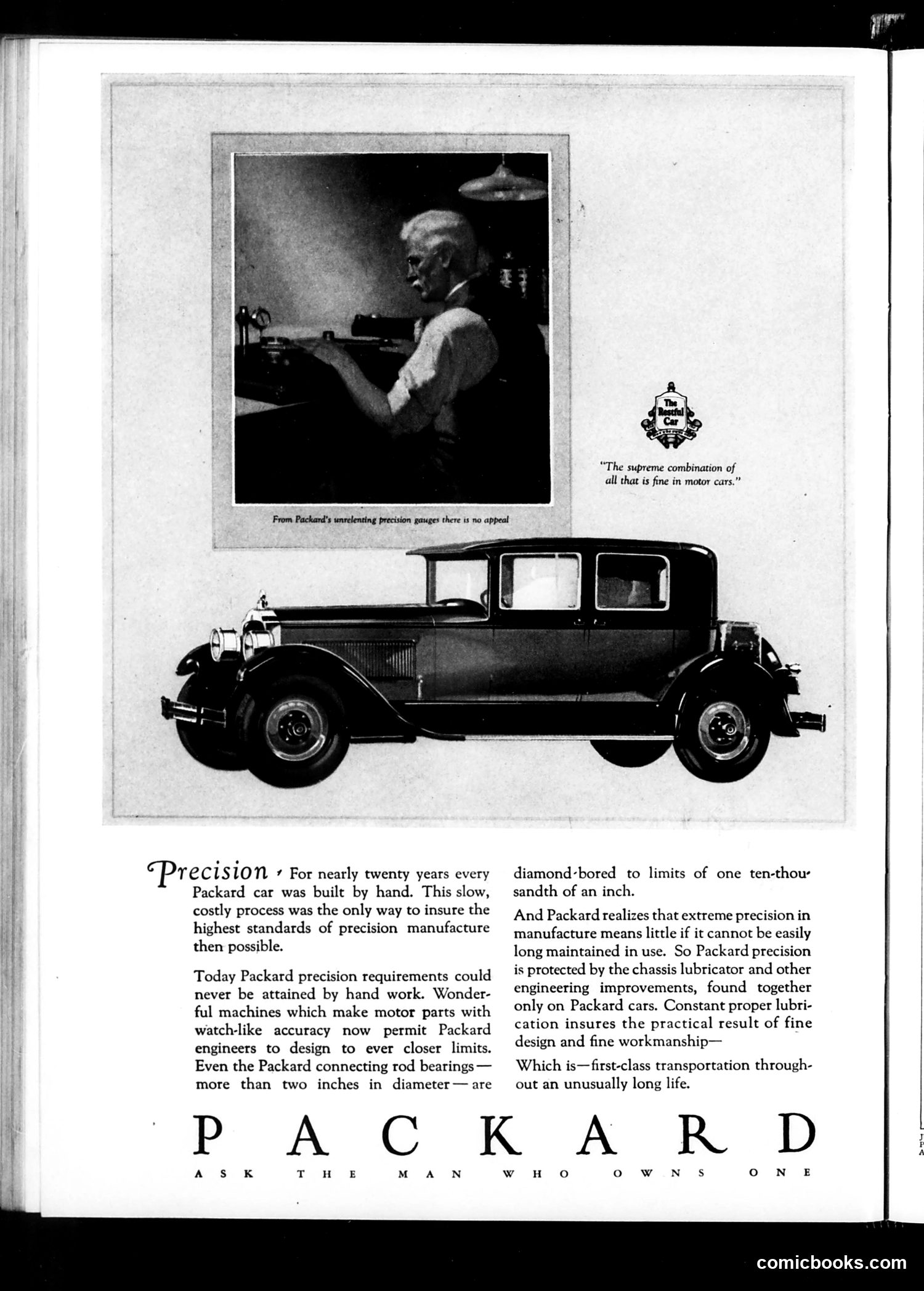
This page is primarily a Packard automobile advertisement, not a political cartoon. It features a photograph of an elderly man (likely a precision engineer or designer) working at a gauge, presented as validation of Packard's manufacturing standards. The ad emphasizes that Packard cars were hand-built for nearly twenty years with extreme precision—parts manufactured "diamond-bored to limits of one ten-thousandth of an inch." The text argues this precision manufacturing, combined with superior engineering and lubrication systems, ensures long-term reliability. The tagline "Ask the man who owns one" was Packard's famous advertising slogan. The page represents luxury automotive marketing from the pre-Depression era, targeting affluent buyers who valued craftsmanship and durability as status symbols.
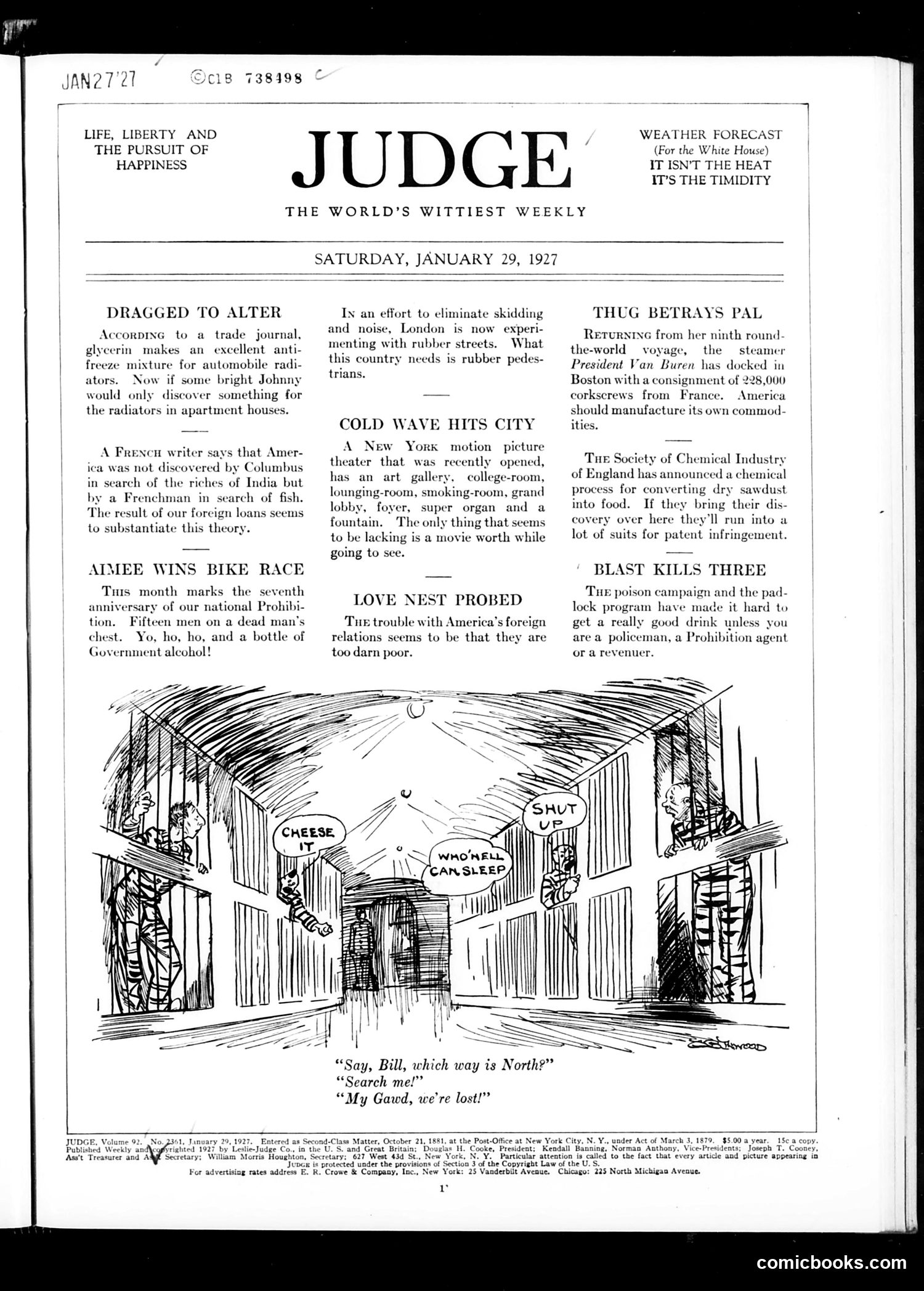
The main cartoon depicts two figures on opposite rooftops calling across a snowy street at night. One shouts "Cheese it!" another "Shut up!" and a third "Who'll can sleep" — suggesting noisy neighbors in winter quarters, likely during Prohibition enforcement. The caption "Say, Bill, which way is North?" / "Search me!" / "My Gawd, we're lost!" implies the figures are disoriented or possibly fleeing—a common satirical trope during Prohibition about bootleggers or those evading authorities. The surrounding brief articles mock contemporary issues: rubber pavements for noise reduction in London, a movie theater's elaborate amenities, and Prohibition's ineffectiveness ("hard to get a really good drink unless you are a policeman, a Prohibition agent or a revnuer").
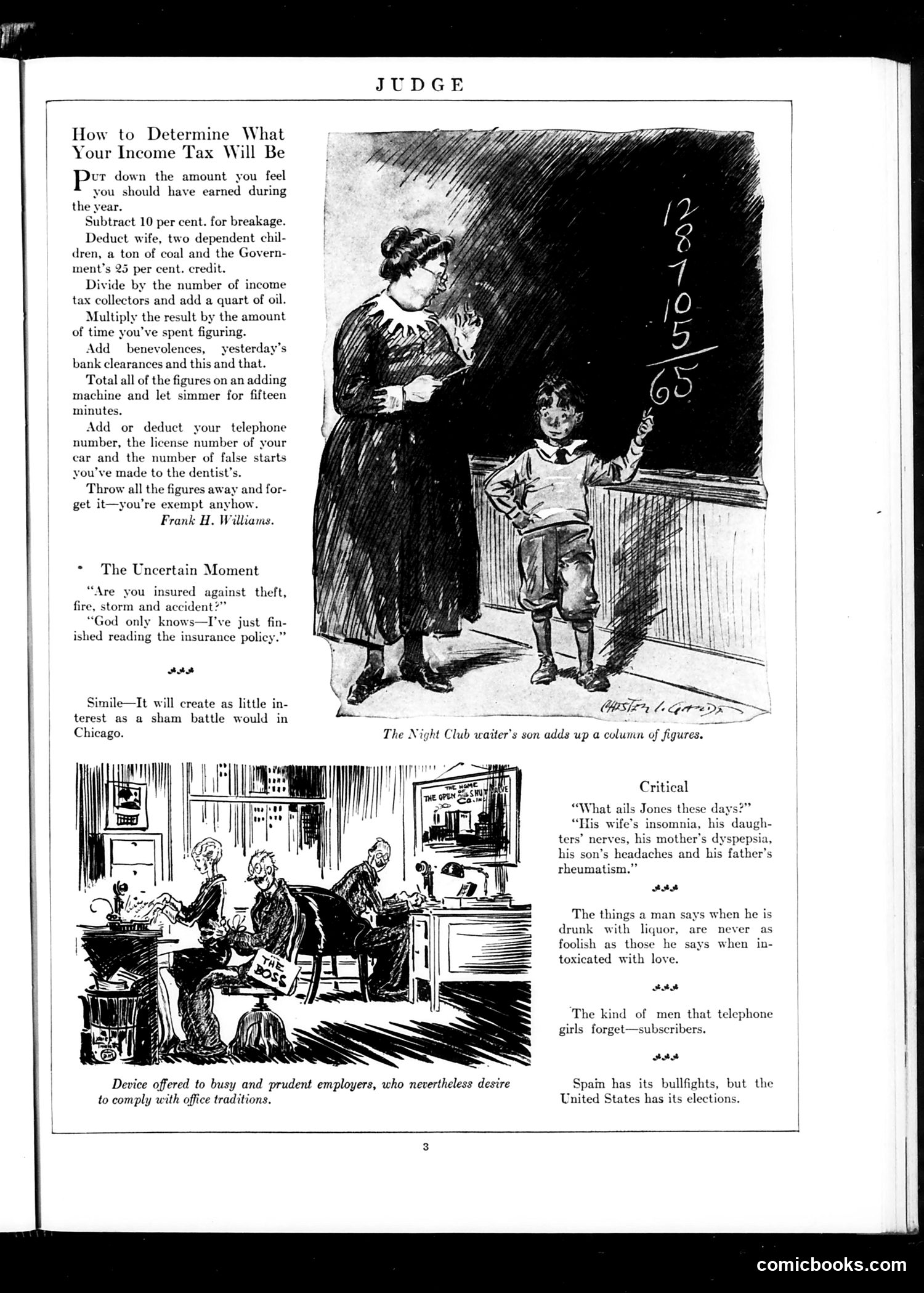
**Main Content:** The top cartoon depicts a night club waiter's young son doing arithmetic on a blackboard—a satirical commentary on how complex income tax calculations had become. The accompanying article "How to Determine What Your Income Tax Will Be" offers deliberately absurd instructions (deduct "a ton of coal," "the Government's 25 per cent credit," etc.), mocking the incomprehensible nature of the tax system itself. **Secondary Material:** Below is a cartoon about office workers seeking medical excuses, captioned as offering "Devices offered to busy and prudent employers, who nevertheless desire to comply with office traditions." The scattered one-liners appear to be typical Judge humor about matrimony, alcohol, and politics—standard satirical fare of the era. The overall page targets taxation complexity and workplace culture.
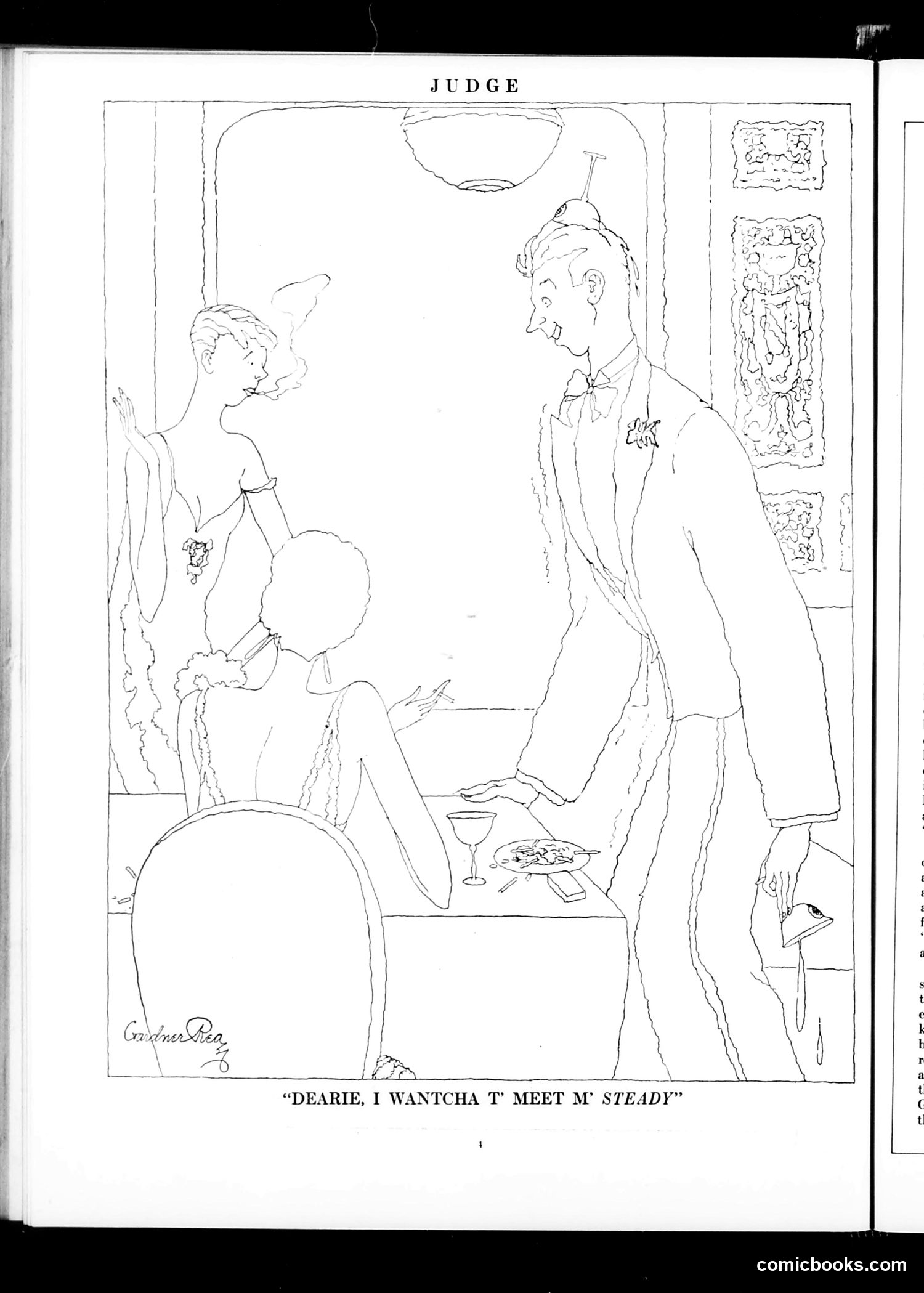
This cartoon depicts a social encounter between a well-dressed man and woman in an elegant interior setting. The caption reads: "DEARIE, I WANTCHA T' MEET M' STEADY." The satire appears to target class pretension and nouveau riche behavior. The woman's exaggerated accent ("WANTCHA T'") and casual speech patterns contrast sharply with the formal, upper-class setting (decorative panels, fine furnishings, cocktails). This linguistic disconnect suggests mockery of someone attempting to appear sophisticated while maintaining working-class speech habits—a common Judge magazine theme satirizing social climbers of the early 20th century. The man's formal attire and the woman's elegant dress indicate they're meant to represent newly wealthy individuals trying to perform respectability without fully embodying it.
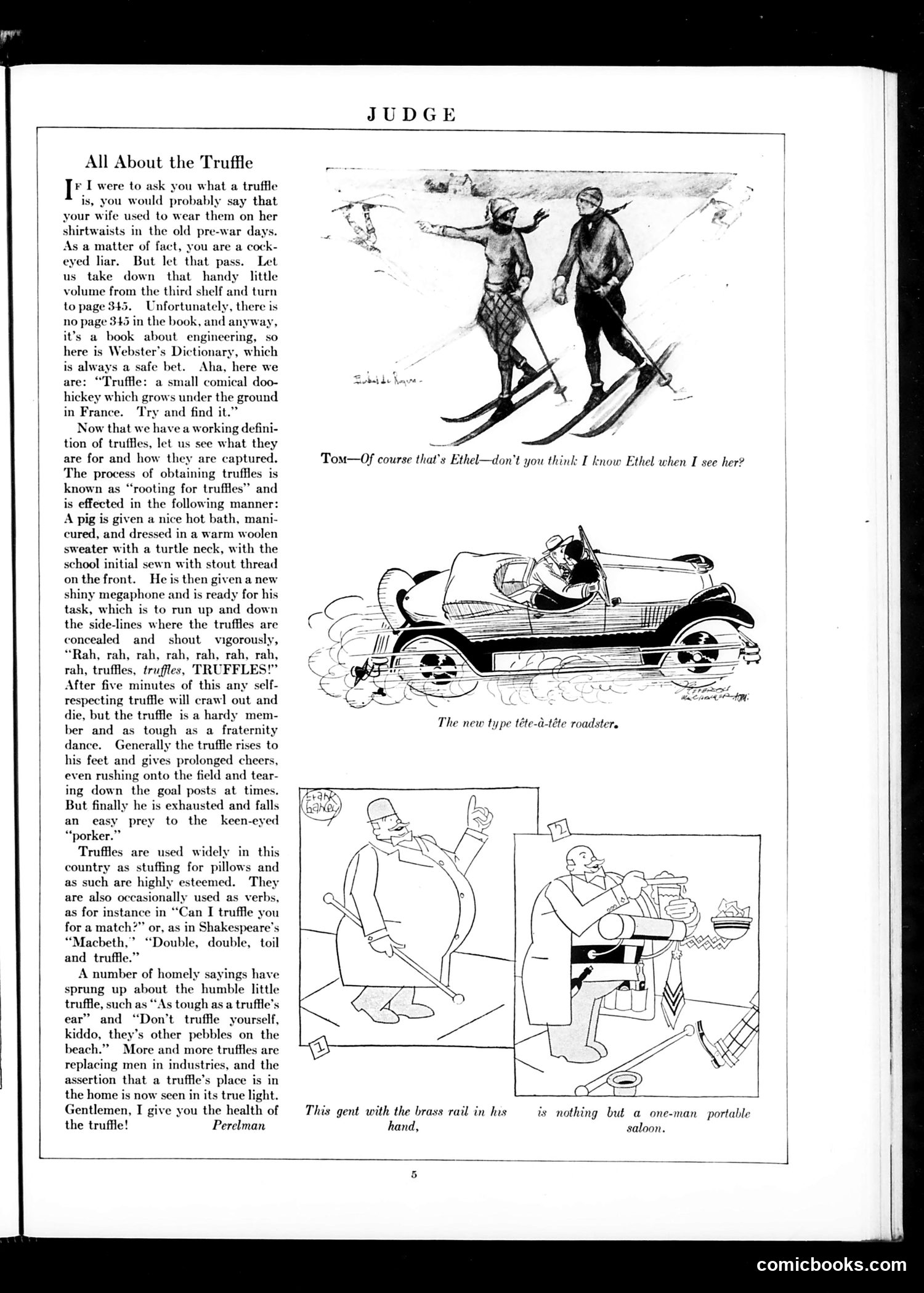
This page satirizes the truffle—a culinary delicacy—through humorous drawings and text. The cartoons mock the pretentiousness surrounding truffles in early 20th-century society. The top illustration shows two men skiing, with dialogue suggesting confusion about identifying someone named "Ethel." The middle cartoon depicts a car labeled "the new type tête-à-tête roadster," parodying automobiles by comparing them to truffles. The bottom panels show absurd uses: a man struggling with a large truffle as furniture, and another using it as a "portable saloon." The article humorously traces the truffle's origins and uses—from pig-hunting to pillow stuffing—mocking both its culinary status and appearance in everyday life. The satire targets upper-class affectation around luxury food items and their cultural pretensions.
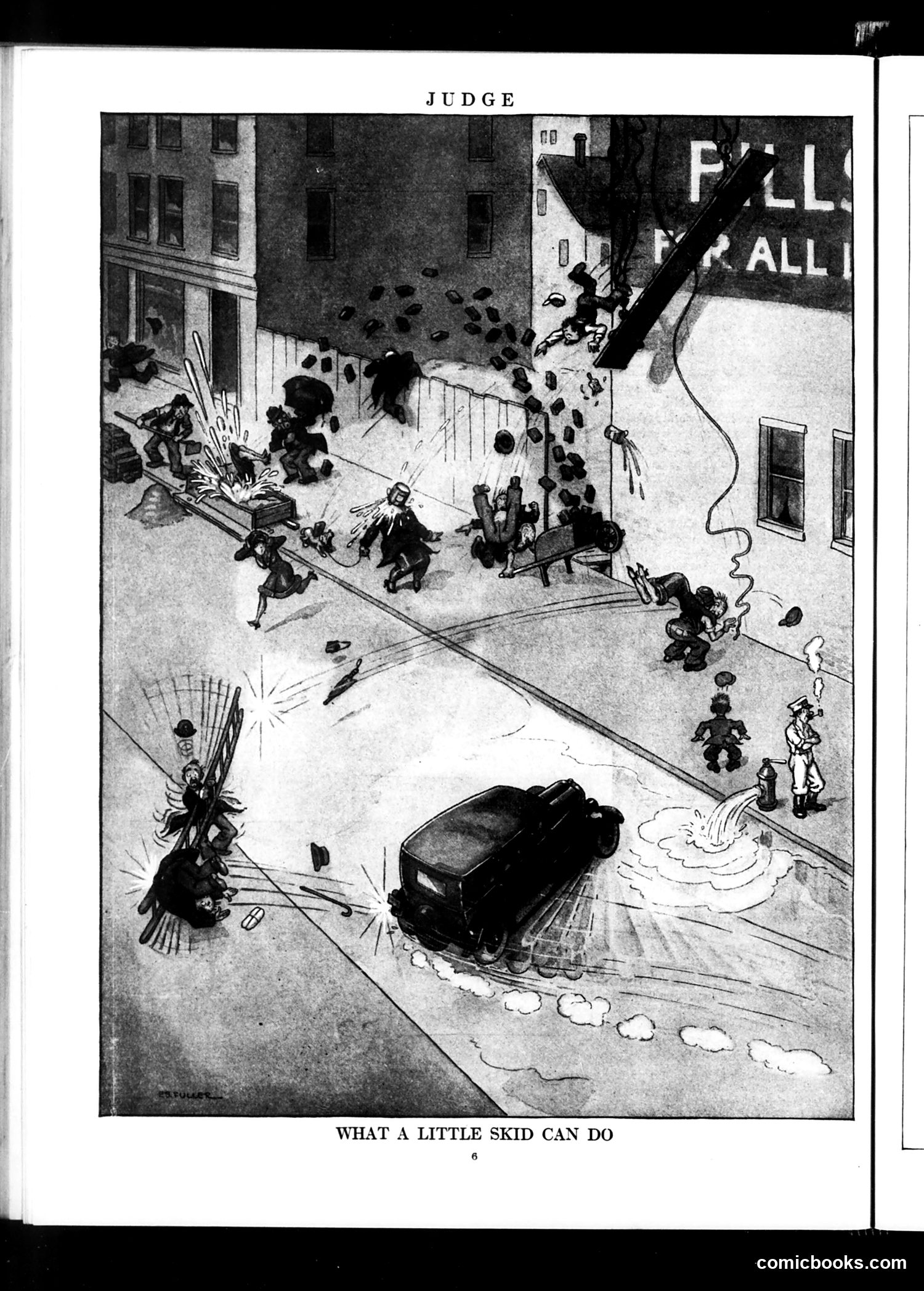
This satirical cartoon depicts a car skidding through an urban street, causing chaos among pedestrians and property. The title "What a Little Skid Can Do" suggests commentary on automobile safety and reckless driving—a growing concern in early 20th-century American cities as cars became more common. The exaggerated destruction shows people fleeing, explosions, and damage to buildings, satirizing how a single vehicle accident could cause disproportionate mayhem in crowded urban areas. The cartoon likely critiques either negligent drivers, inadequate traffic safety regulations, or the general hazards posed by rapid automobile adoption to pedestrian-heavy city streets. The specific identities of figures are unclear, but the point appears to be social commentary on modern transportation dangers rather than partisan politics.
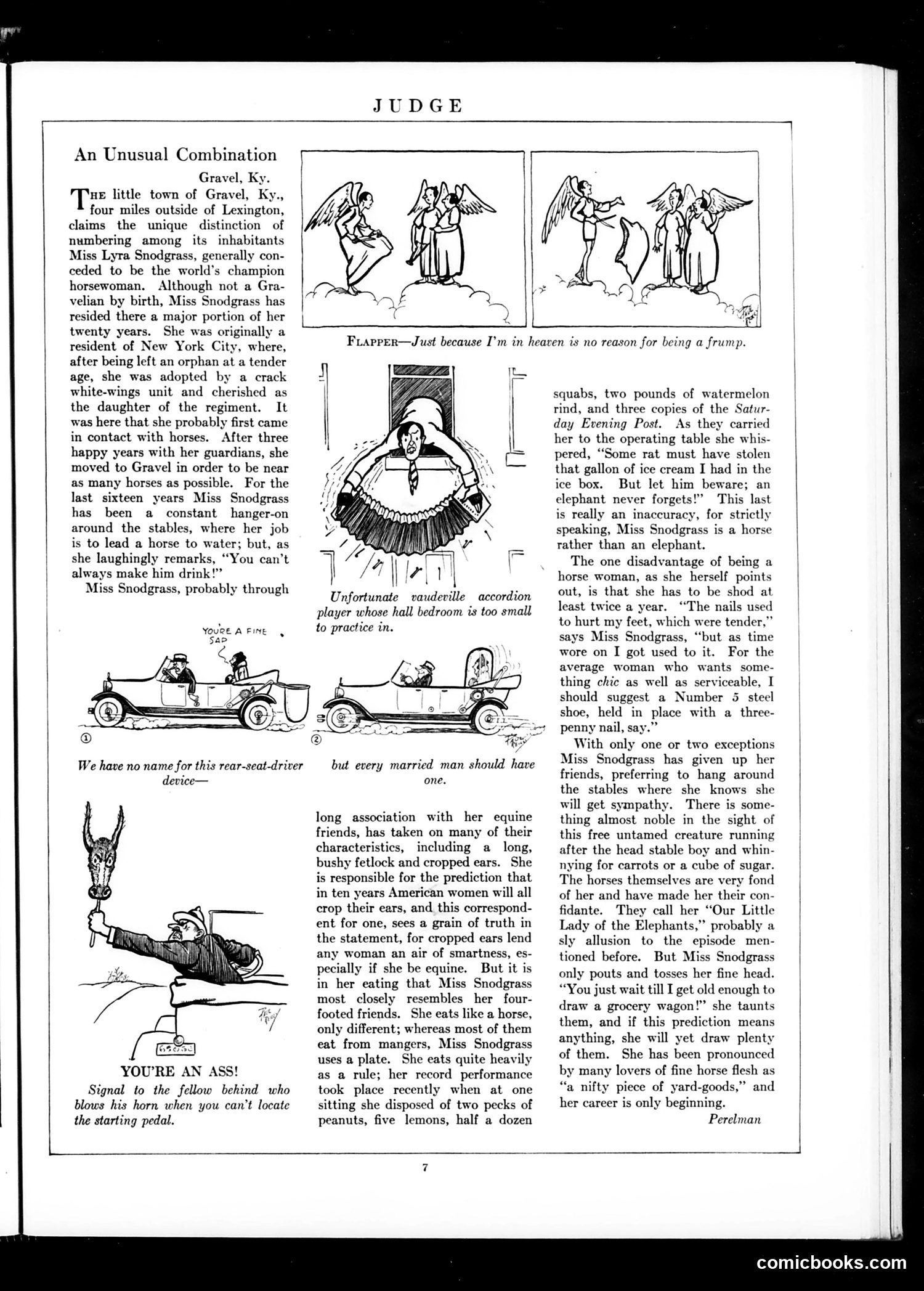
This piece satirizes an eccentric woman, Miss Lyra Snodgrass of Gravel, Kentucky, who has adopted horse-like characteristics after decades living around stables. The satire works through absurdist exaggeration: she allegedly has cropped ears and a "bushy fetlock," eats enormous quantities in one sitting (peanuts, lemons, watermelon rind, and newspapers), requires horseshoes for her feet, and communicates with horses through whinnying. The humor targets both the subject's eccentricity and period attitudes about women's proper roles. The accompanying cartoons mock automotive culture ("rear-seat-driver device," "You're an ass!") and cramped urban living (the accordion player). The piece ridicules unconventional women while mocking modern conveniences and urban life through absurdist exaggeration typical of Judge's satirical style.
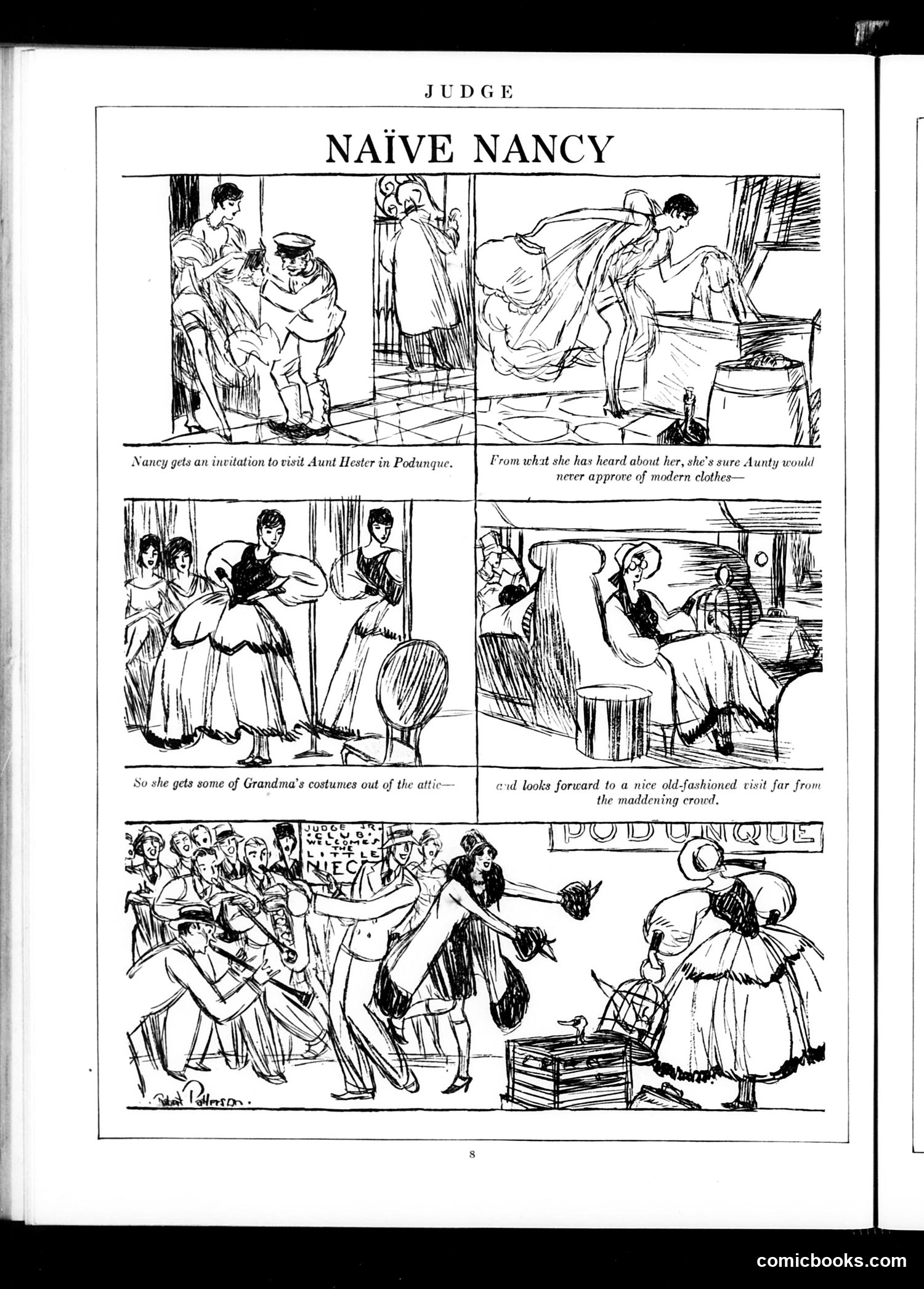
This comic satirizes a young woman's misconceptions about provincial life. Nancy receives an invitation to visit her Aunt Hester in "Podunque" (a fictional small town, the name itself mocking rural simplicity). Assuming her aunt is old-fashioned and disapproving of modern dress, Nancy dons grandmother's vintage costumes from the attic, anticipating a quaint, quiet visit away from city life. The joke's punchline appears in the final panel: Nancy arrives dressed in grandmother's clothes to discover Podunque has transformed into a vibrant, fashionable scene—likely a resort or modern town—where everyone is dressed in current styles and engaging in lively social activities. Her antiquated costume makes her the foolish outsider instead. The satire mocks both Nancy's stereotyping of rural Americans and the rapid modernization of American towns during the early 20th century.
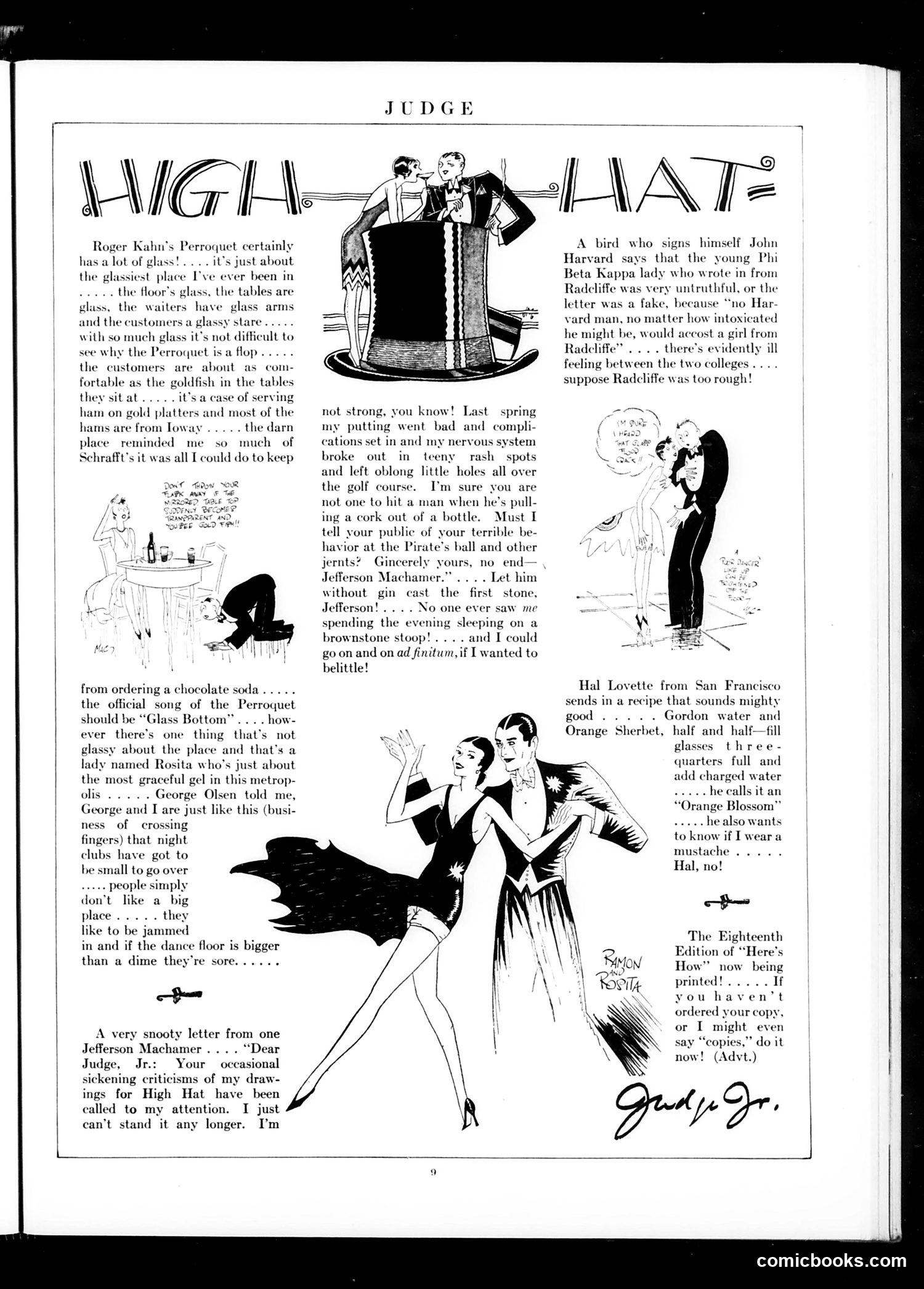
This is a humor column titled "High Hat" featuring social commentary and reader letters from what appears to be the 1920s-30s era. **Main content:** The page mocks Roger Kahn's nightclub "The Perroquet" for being excessively decorated with glass, making it uncomfortable rather than elegant. A separate letter from cartoonist Jefferson Machamer humorously complains about the magazine's criticism of his work, using exaggerated excuses (golf injuries, nervous breakdowns) before the editor deflects with sarcasm. **Social references:** References to Radcliffe and Harvard colleges suggest Ivy League social hierarchies and romantic tensions between institutions. Mentions of nightclubs, golf, and Schrafft's (an upscale restaurant) reflect upper-class leisure activities. **The satire:** The humor targets pretension in upscale establishments and the defensive prickliness of contributors. The tone is playful mockery rather than harsh political critique—typical of Judge's light social commentary on urban sophistication and etiquette.
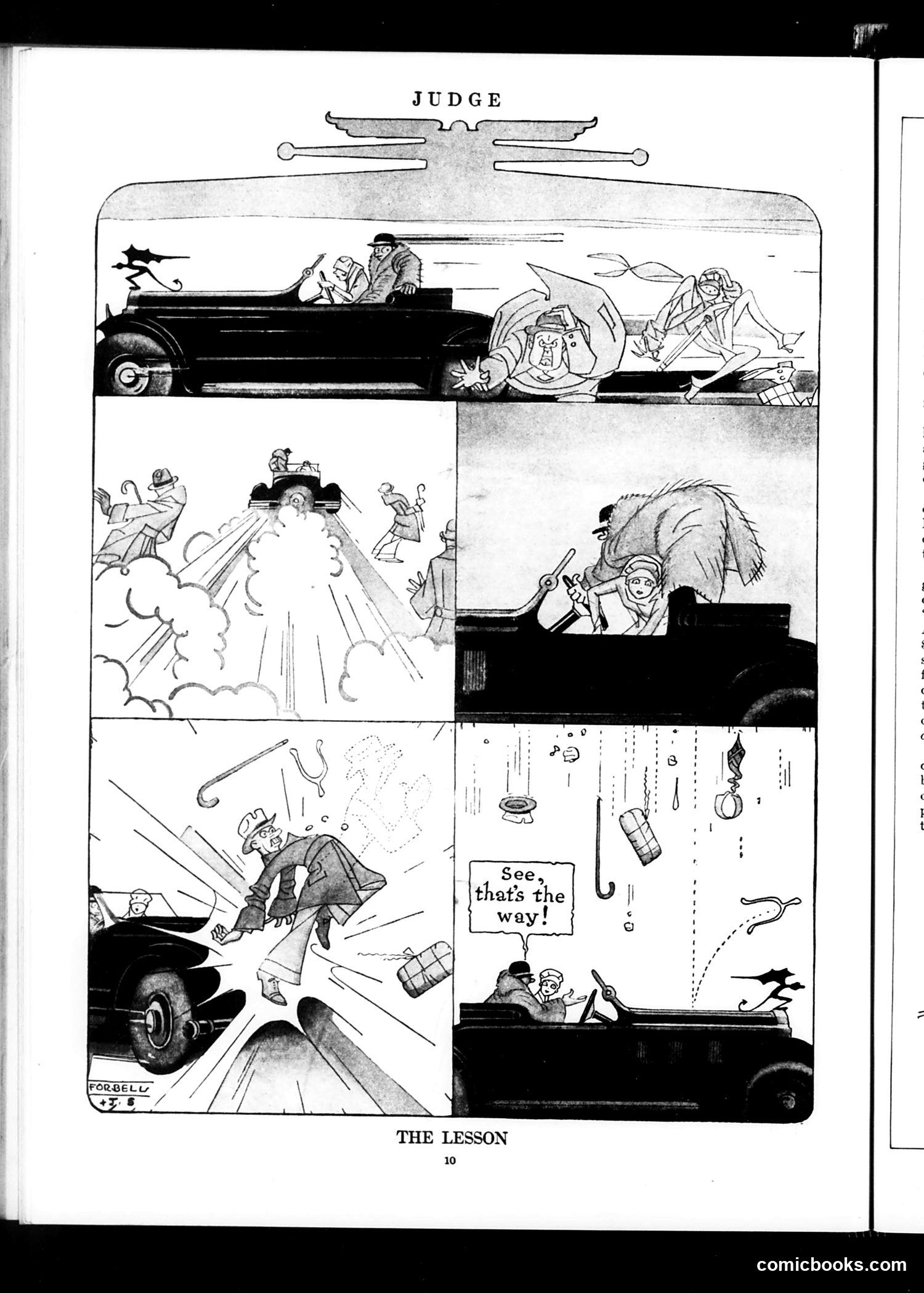
This satirical comic depicts a judge presiding over what appears to be a reckless driving case. The narrative follows a chaotic sequence: a speeding automobile causes mayhem, with pedestrians and objects flying everywhere. The final panel shows the judge instructing the driver to "See, that's the way!"—suggesting the judge is ironically endorsing or demonstrating the dangerous driving behavior rather than punishing it. The satire critiques judicial leniency toward wealthy or connected drivers and the failure of courts to meaningfully punish traffic violations during the automobile age. The judge's backwards "lesson" mocks how the legal system failed to deter or properly penalize reckless motorists, a growing social problem in early 20th-century America as cars became more common.
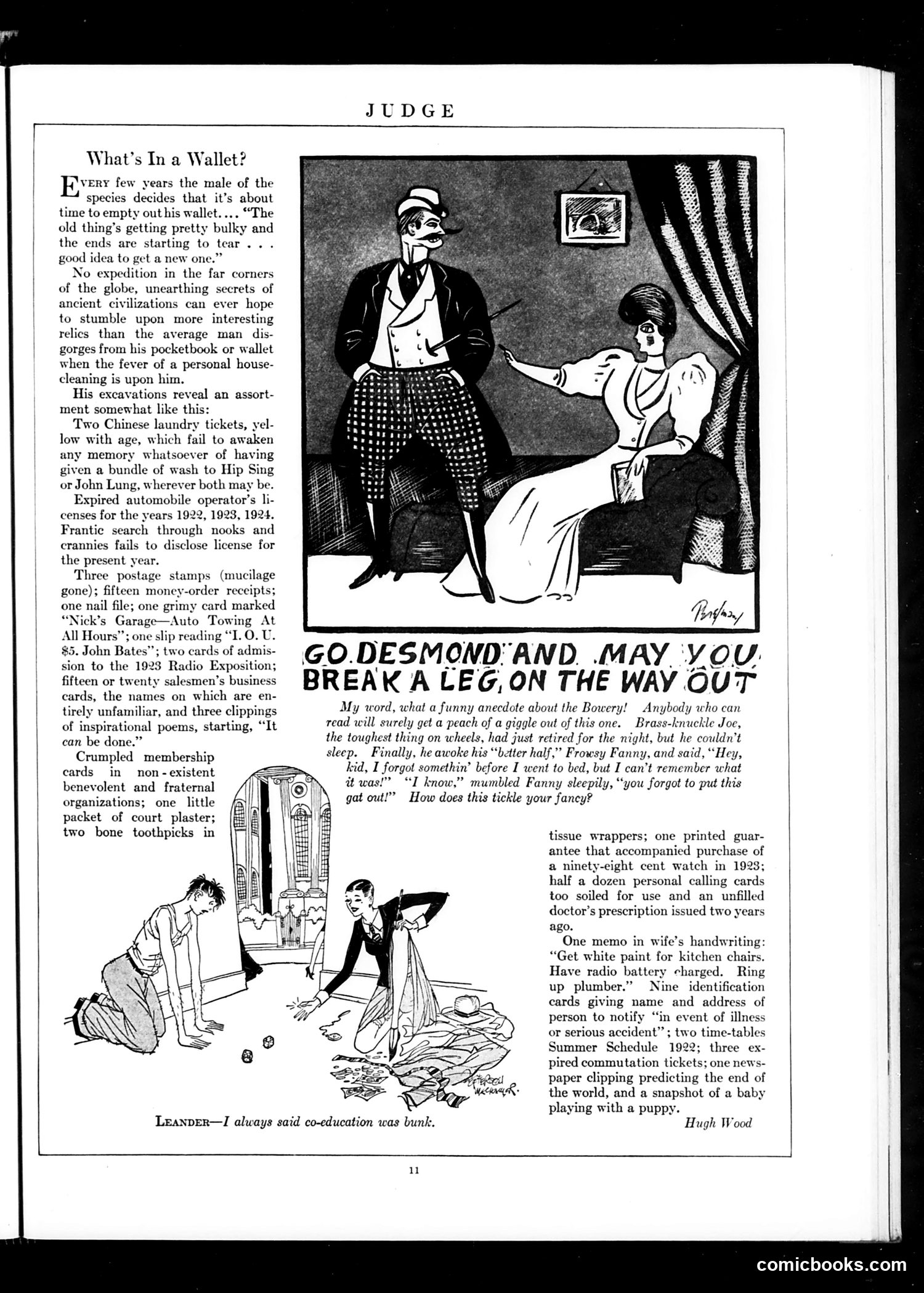
This page humorously catalogs the detritus accumulated in a typical man's wallet—expired licenses, laundry tickets from forgotten Chinese laundries, business cards from salesmen he doesn't remember, old postage stamps, and inspirational poem clippings. The satire mocks masculine packrat behavior and the absurdity of men keeping useless items "just in case." The secondary cartoon shows "co-education" failure: a man and woman literally demolishing furniture together, with the caption "I always said co-education was bunk." This references 1920s anxieties about coeducational institutions producing unladylike, destructive women—a conservative critique of women's changing social roles. The "Go Desmond and May You Break a Leg" anecdote is workplace theater gossip, while the brief Bowery joke depicts working-class urban stereotypes with dated dialect humor. The overall tone reflects 1920s-era social satire about masculine domesticity and changing gender norms.
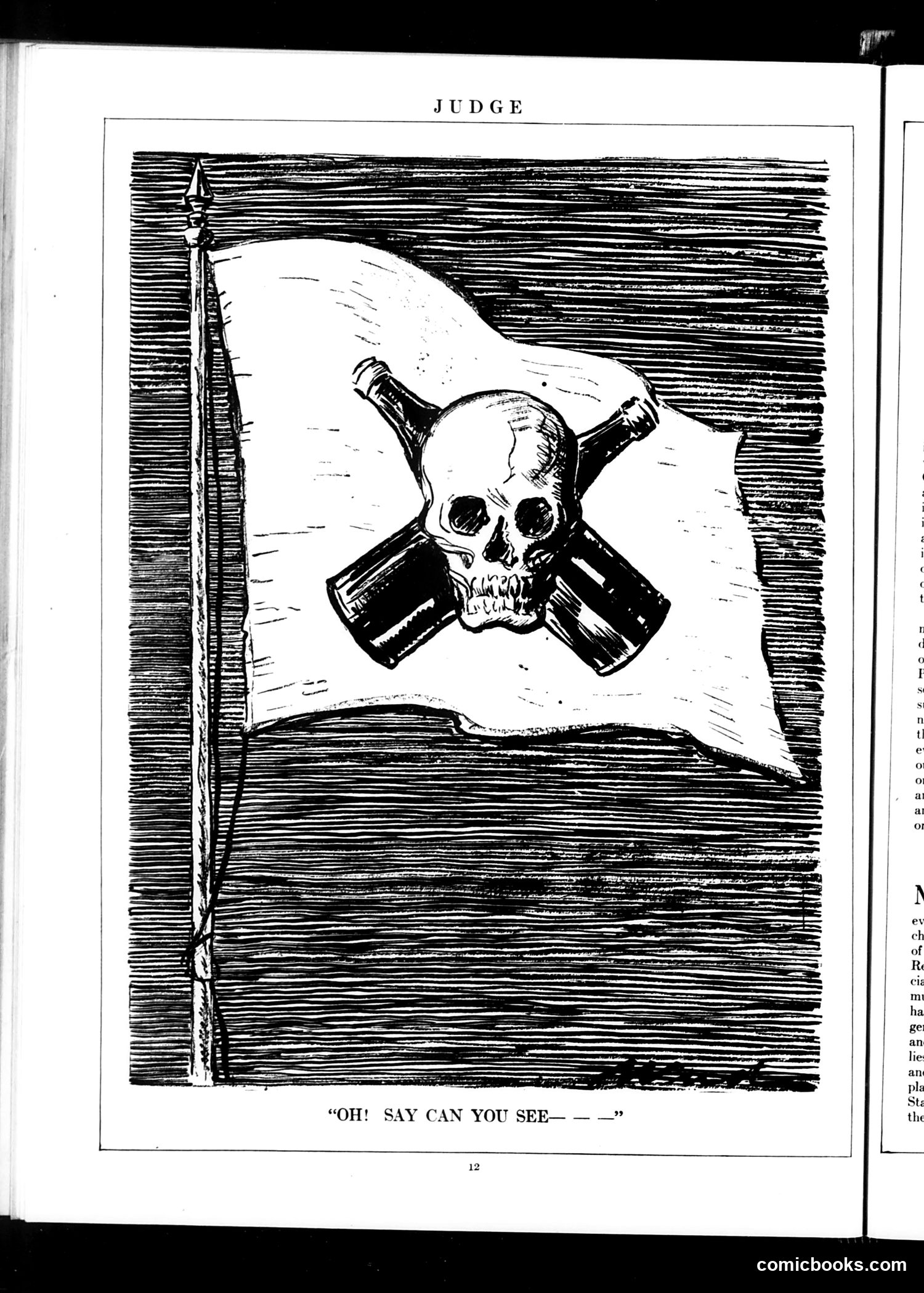
This political cartoon satirizes American patriotism and national symbols. The image shows a pirate flag (skull and crossbones) replacing the expected American flag, paired with the opening words of "The Star-Spangled Banner" ("Oh! say can you see—"). The satire suggests that America's actual conduct—represented by the pirate imagery—contradicts its patriotic ideals. The cartoon implies the nation is engaged in piracy or similarly dishonorable behavior, making a mockery of patriotic rhetoric. The specific historical context is unclear without additional publication information, but Judge magazine frequently critiqued American foreign policy, imperialism, and domestic corruption during the early 20th century. This likely references a particular controversial action or policy the magazine opposed.
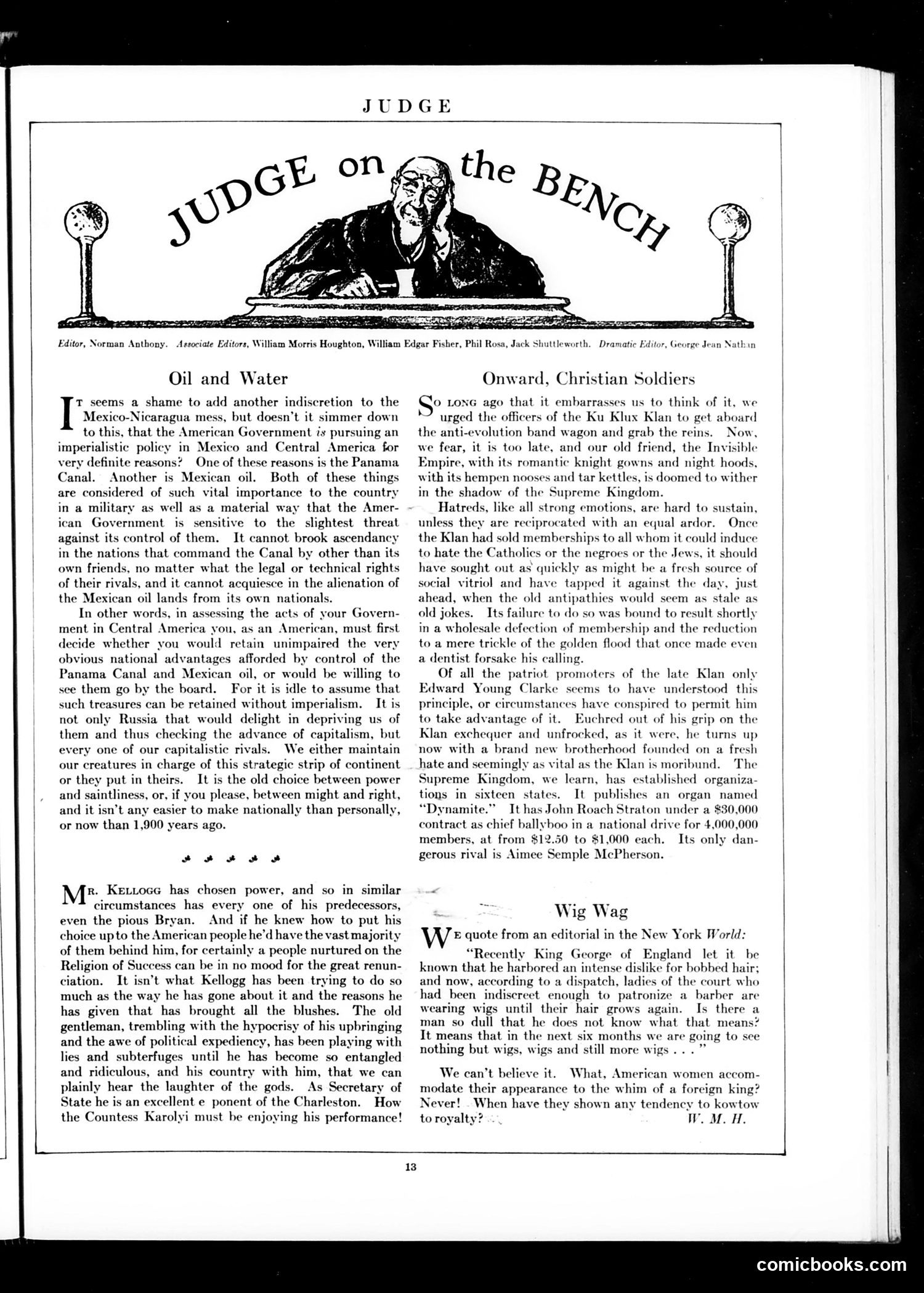
This page contains three distinct editorial pieces critiquing American foreign policy and domestic movements circa the 1920s. **"Oil and Water"** attacks Secretary of State Frank Kellogg's (referenced as "Kellogg") handling of U.S. interventionism in Mexico and Central America, particularly regarding control of the Panama Canal and Mexican oil reserves. The author argues Kellogg has pursued imperialism dishonestly, wrapping capitalist self-interest in moral language—making America "ridiculous" before rivals like the Soviet Union and the European powers. **"Onward, Christian Soldiers"** satirizes the Ku Klux Klan's attempt to ally with anti-evolution movements. Judge predicts the Klan will fail because sustained hatred requires constant new targets; having exhausted hatred against Catholics, African Americans, and Jews, it lacks fresh "social vitriol" to maintain membership momentum. **"Wig Wag"** mocks British King George V's reported baldness and jokes that American women won't adopt wigs to follow royal fashion—a lighthearted contrast to the weightier political commentary above.
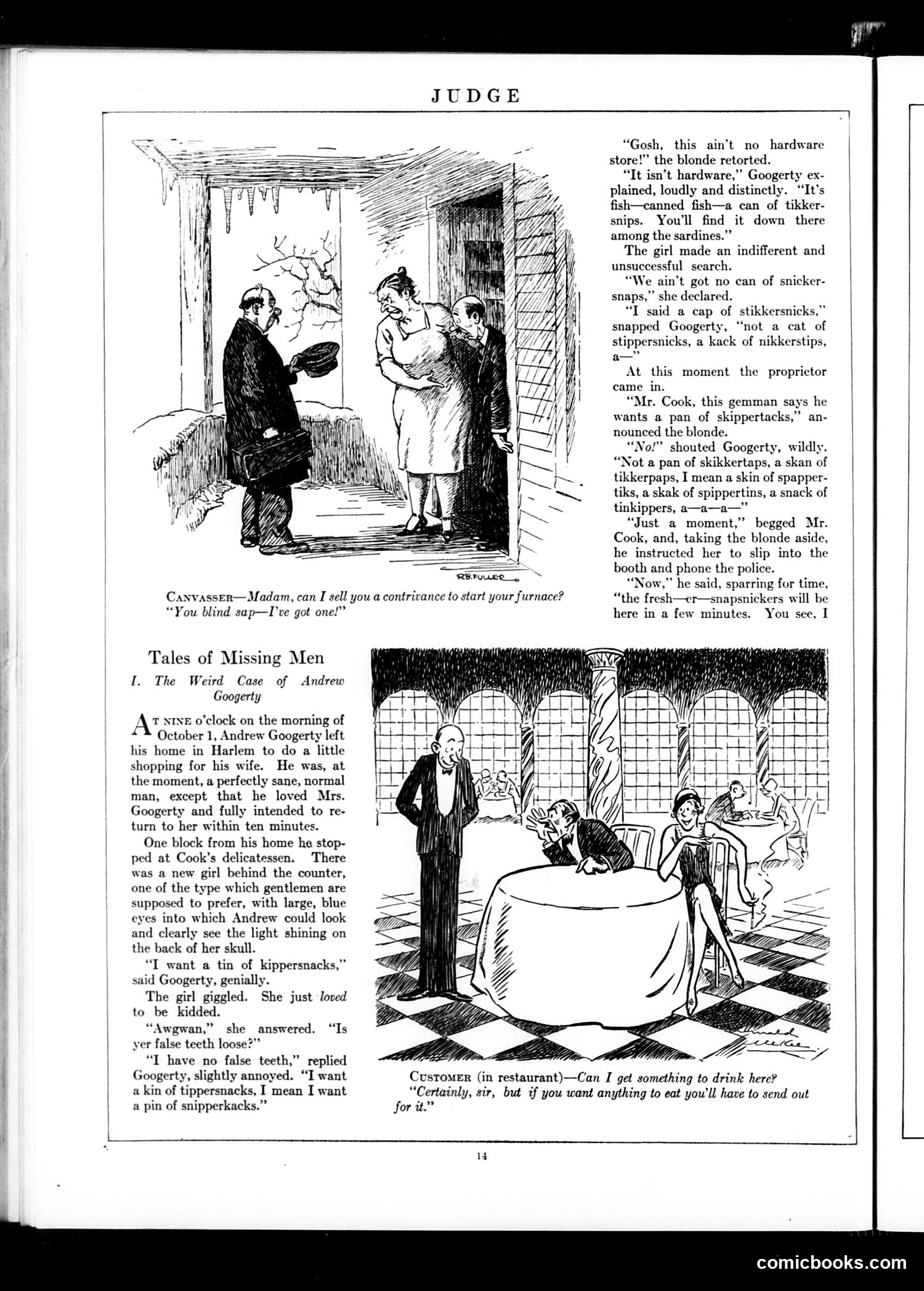
This page from *Judge* contains two unrelated comic scenarios satirizing early-20th-century social absurdities. **Top cartoon:** A man attempts to sell a furnace contraption to a woman, who dismissively retorts "You blind sap—I've got one!" The joke mocks aggressive door-to-door salesmanship of the era. **"Tales of Missing Men" story:** Andrew Googerty enters a delicatessen and requests "kippersnacks" (apparently a nonsense word or malapropism for fish products). A flirtatious clerk repeatedly mishears him, and the increasingly frustrated Googerty mangles his own words in attempts to clarify. The store owner, believing Googerty unstable or criminal, secretly calls police while stalling with conversation. The satire targets both the clerk's willful misunderstanding and the notion that slightly odd behavior warranted police intervention—mocking both customer service indifference and overreaction to eccentricity in everyday commerce. The cartoons use wordplay and misunderstanding as comedic devices reflecting period concerns about urbanization and class dynamics.
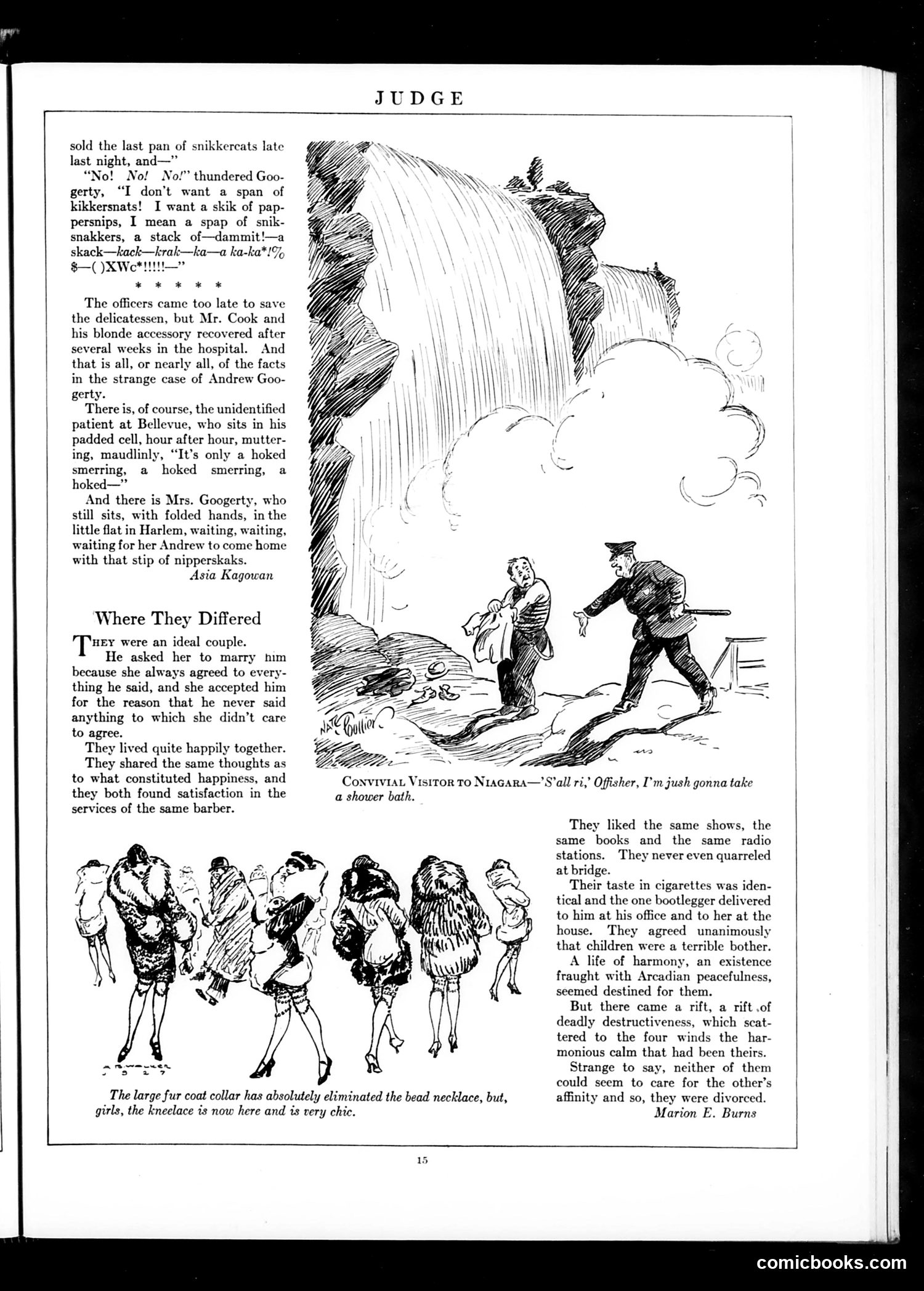
This page contains three distinct satirical pieces typical of 1920s-30s humor: 1. **"Andrew Googerty" story** (top): A nonsensical tale about a man having a verbal breakdown in a delicatessen, apparently unable to properly name food items, culminating in violence. This appears to be absurdist humor satirizing either speech impediments, drunkenness, or mental instability—contemporary audiences would find dark comedy in institutionalization references (Bellevue psychiatric hospital, padded cells). 2. **Niagara Falls cartoon** (middle): A visitor plans to shower in Niagara Falls—likely mocking tourists' naive behavior or prohibition-era bathing customs. 3. **"Where They Differed"** (bottom): A couple divorces despite perfect agreement on everything because they shared identical taste and interests. The satire critiques modern marriage: the joke is that compatibility and harmony aren't enough—apparently, couples need *disagreement* to maintain affection. The fashion note about fur collar collars replacing bead necklaces reflects contemporary style commentary. All reflect Judge's characteristic emphasis on domestic absurdity and social observation.
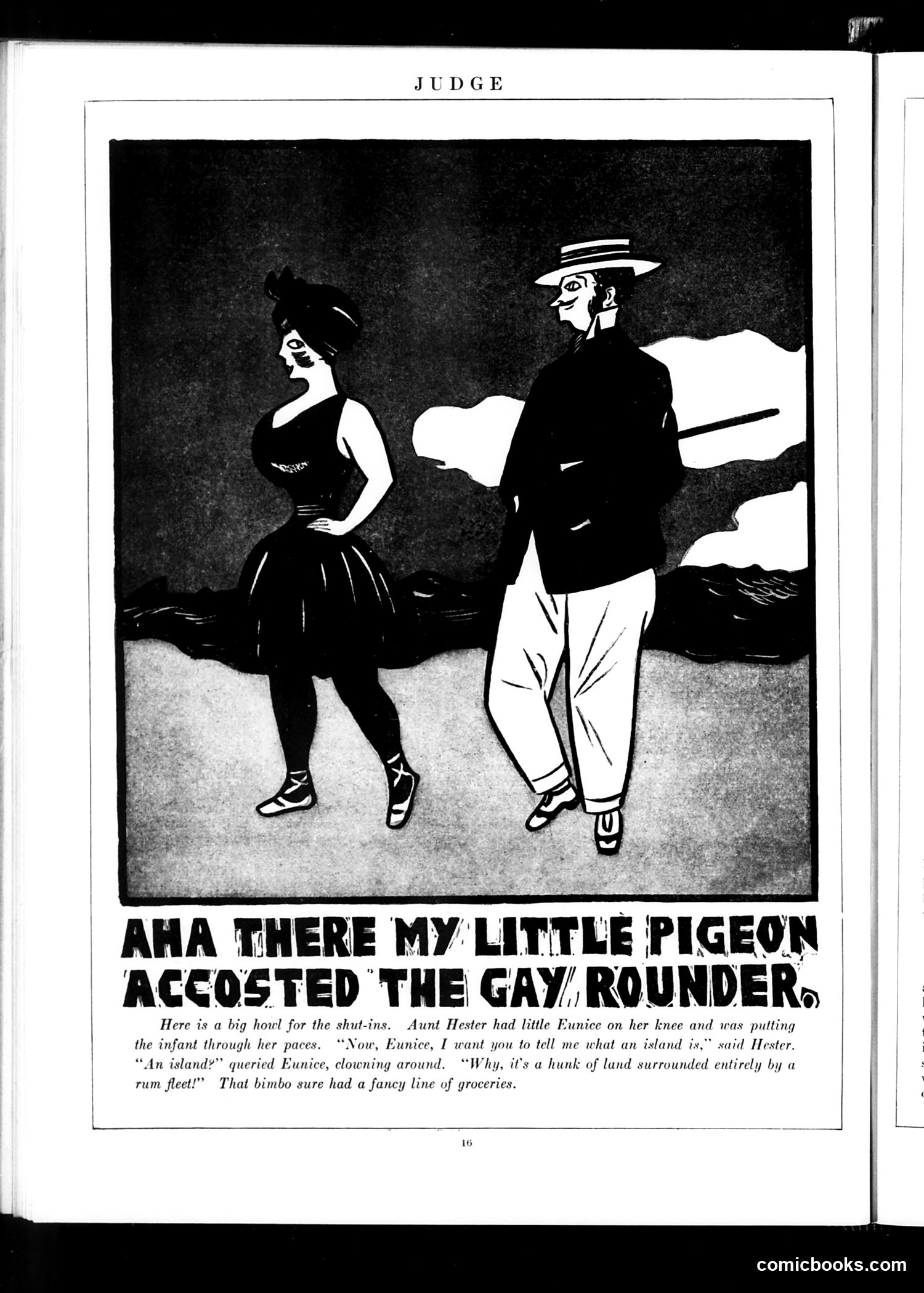
This is a single-panel cartoon satirizing Prohibition-era slang and urban sophistication. The illustration shows two figures in 1920s attire at what appears to be a beach or seaside setting. The humor centers on a child's definition of "island" — not as geography, but as "a hunk of land surrounded entirely by a rum fleet." This jokes about illegal alcohol smuggling during Prohibition, when bootleggers used boats to transport contraband liquor. The caption's reference to "the gay rounder" and "that bimbo" reflects period slang for streetwise, fashionable characters. The cartoon mocks both the sophistication some claimed through Prohibition-era vocabulary and the absurdity of how even children had absorbed this underworld vocabulary into everyday speech. The title "Judge" indicates this was published in the satirical magazine of that name, which frequently lampooned contemporary social trends and prohibition-related culture.
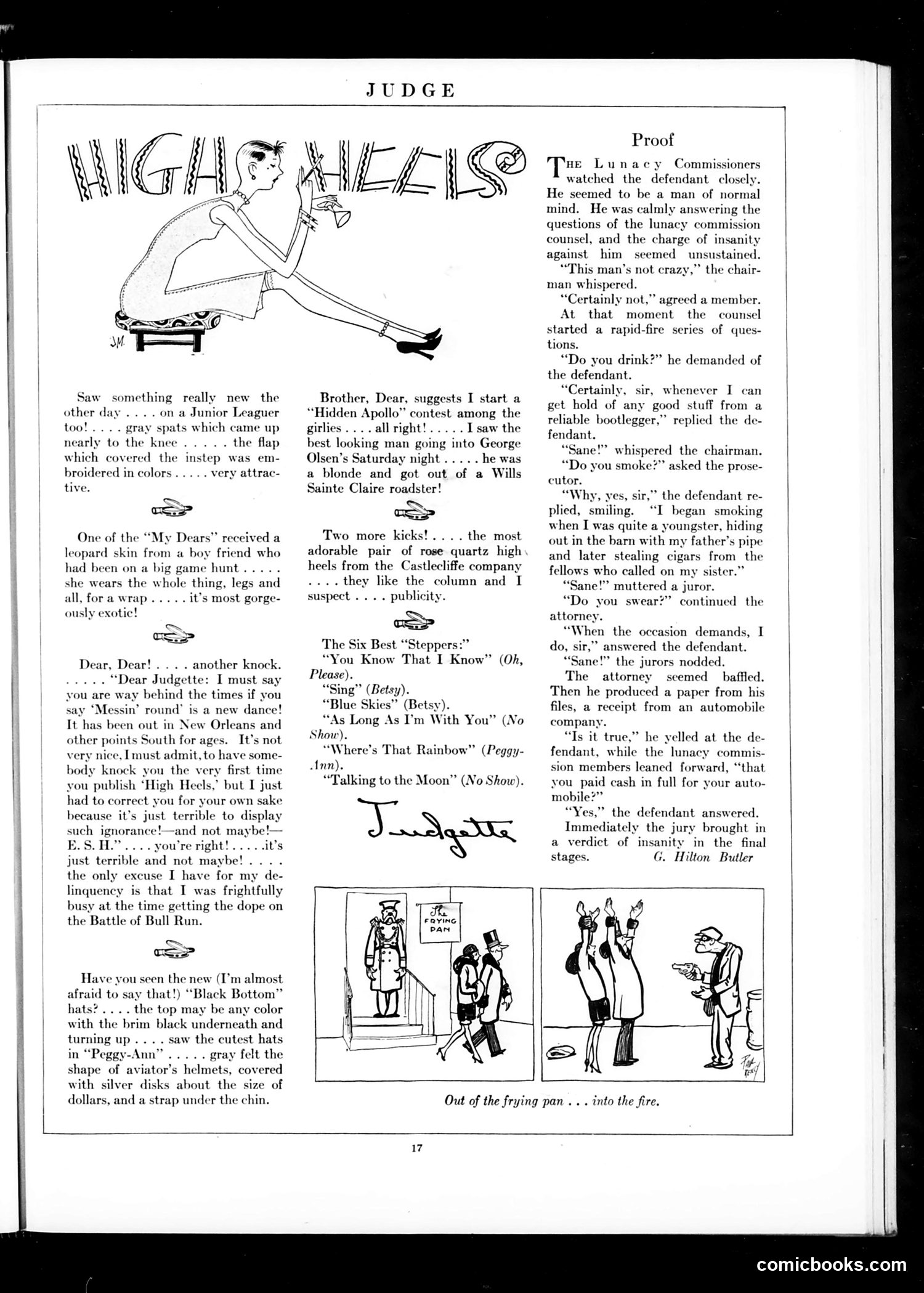
This page contains two distinct pieces of 1920s satire: **"High Heels"** (left): A fashion gossip column mocking contemporary women's fashion trends—Junior League spats, leopard skin wraps, "Black Bottom" hats, and rose quartz heels. It's lighthearted social satire about wealthy young women's conspicuous consumption and fashion obsessions. **"Proof"** (right, main story): A courtroom satire about Prohibition-era morality. A lunacy commission examines a defendant who admits to drinking bootleg liquor, smoking, and swearing—all considered vices. The commissioners deem him sane until he admits paying cash for an automobile, which they declare proof of insanity. The joke satirizes the absurd moral priorities of the era: casual vices are acceptable, but financial irresponsibility (implied recklessness with money) is grounds for declaring someone insane. It's commentary on Prohibition hypocrisy and 1920s economic excess.
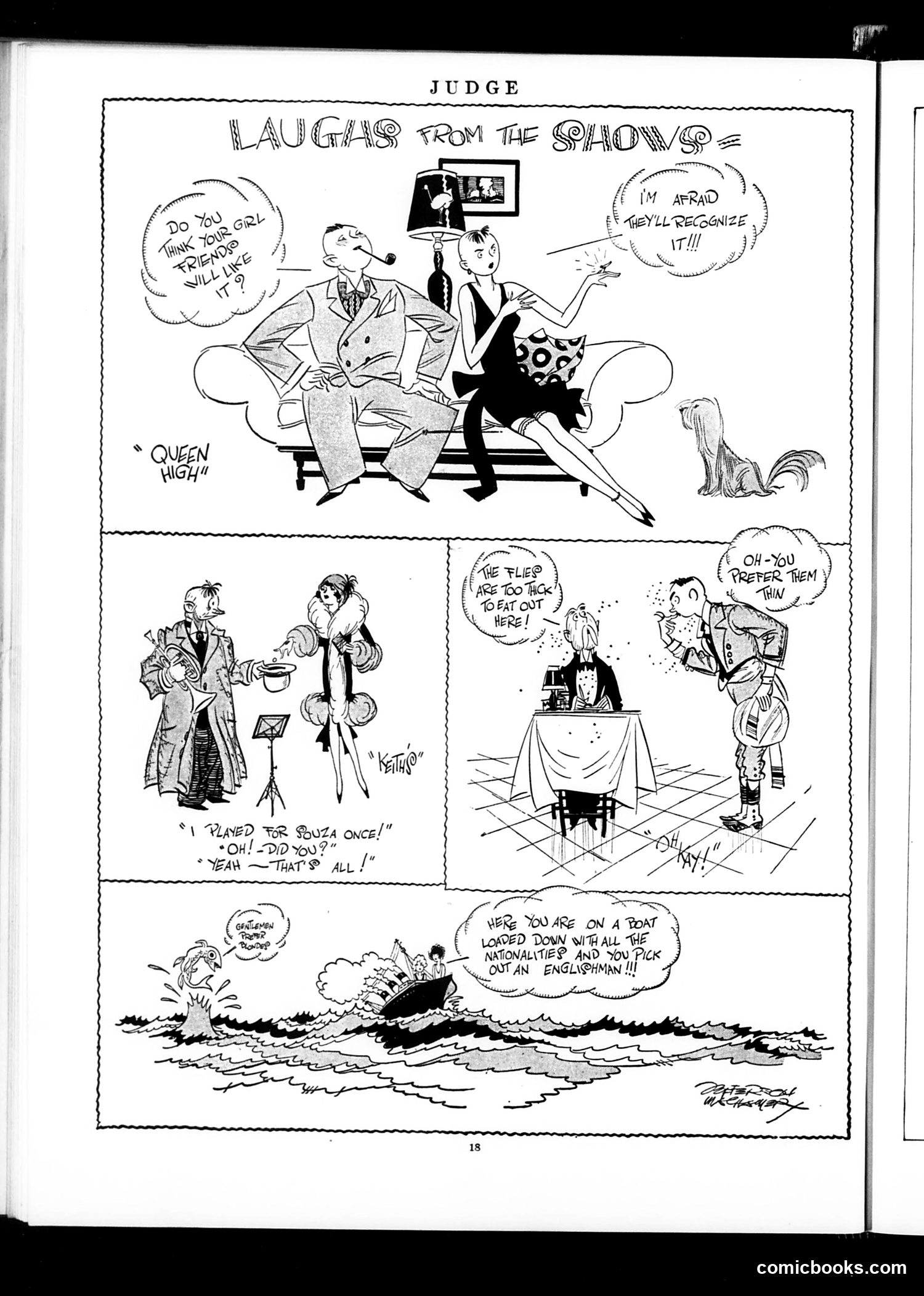
This page contains theatrical satire sketches, likely from the 1920s-30s era. The top panel mocks high society—a woman fears her "disguise" will be recognized at what appears to be an exclusive event ("Queen High," possibly referencing a Broadway show). The middle panels depict romantic/social comedy: a man boasts of romance ("I played for Souza once"), while another scene shows someone complaining about "flies" being "too thick to eat out here." The bottom panel delivers political satire: a boat loaded with people of various nationalities (representing immigration) picks an Englishman, likely satirizing American immigration policy and the preference for Anglo-Saxon immigrants over others during a period of significant immigration debate. The overall message critiques both theatrical pretension and America's selective immigration attitudes.
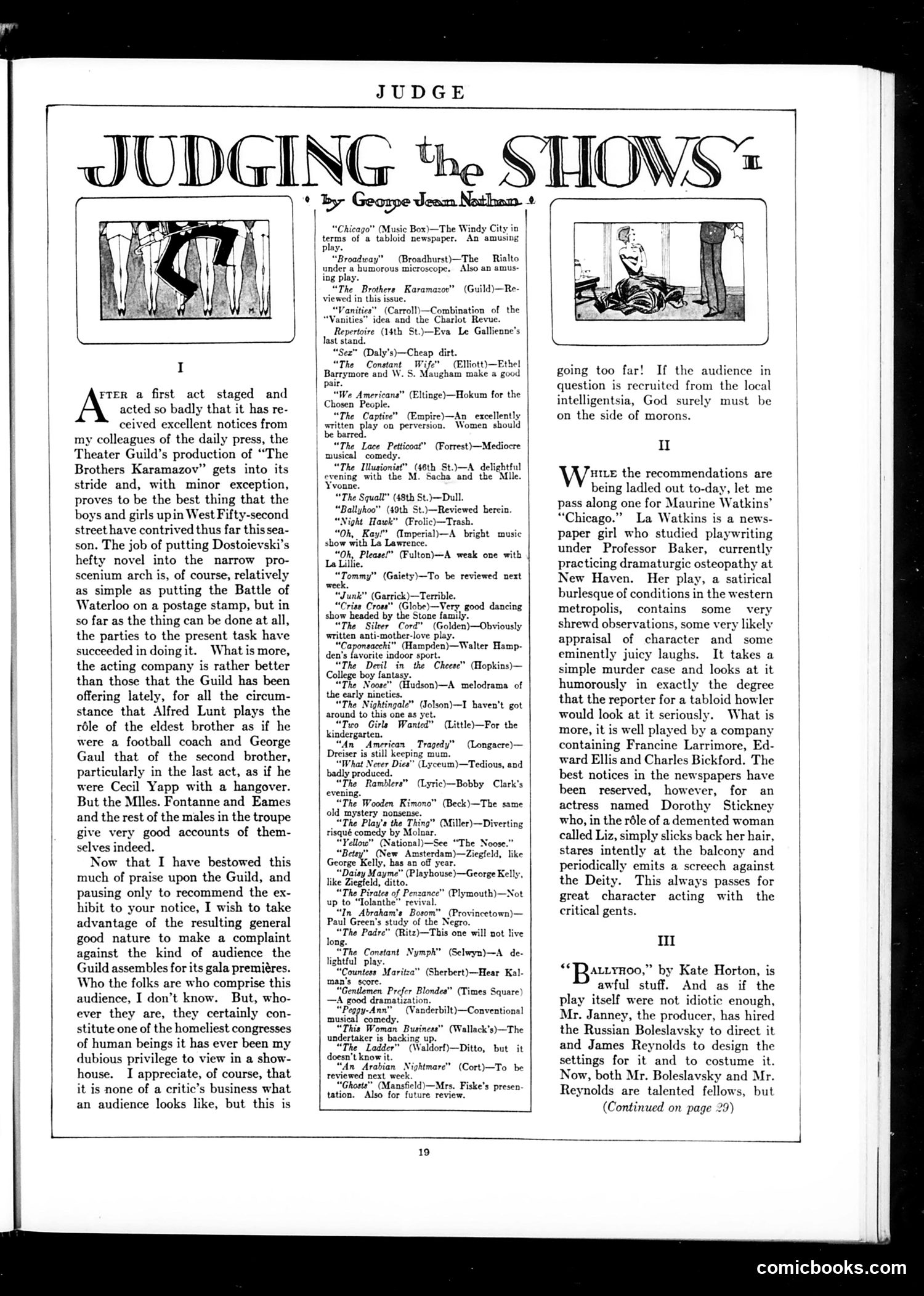
This page from *Judge* magazine contains theater reviews by George Jean Nathan. The main content is **not a political cartoon** but rather **theater criticism**—a column called "Judging the Shows" that reviews Broadway productions. The opening section discusses the Theater Guild's production of *The Brothers Karamazov*, praising the adaptation while criticizing the lead actors Alfred Lunt (compared unfavorably to a football coach) and George Gaul (compared to "Cecil Yapp with a hangover"—likely a contemporary reference). Nathan makes a pointed complaint about the Guild's premiere audiences, describing them as "one of the homeliest congresses of human beings" he's ever seen in a theater—a somewhat catty observation typical of theater criticism of the era. The rest of the page lists brief reviews of various Broadway shows with sharp judgments: *Sex* is called "cheap dirt," *The Captive* involves "perversion" and should bar women, and several shows are dismissed as "dull" or "trash." This represents 1920s theater culture and critical standards.
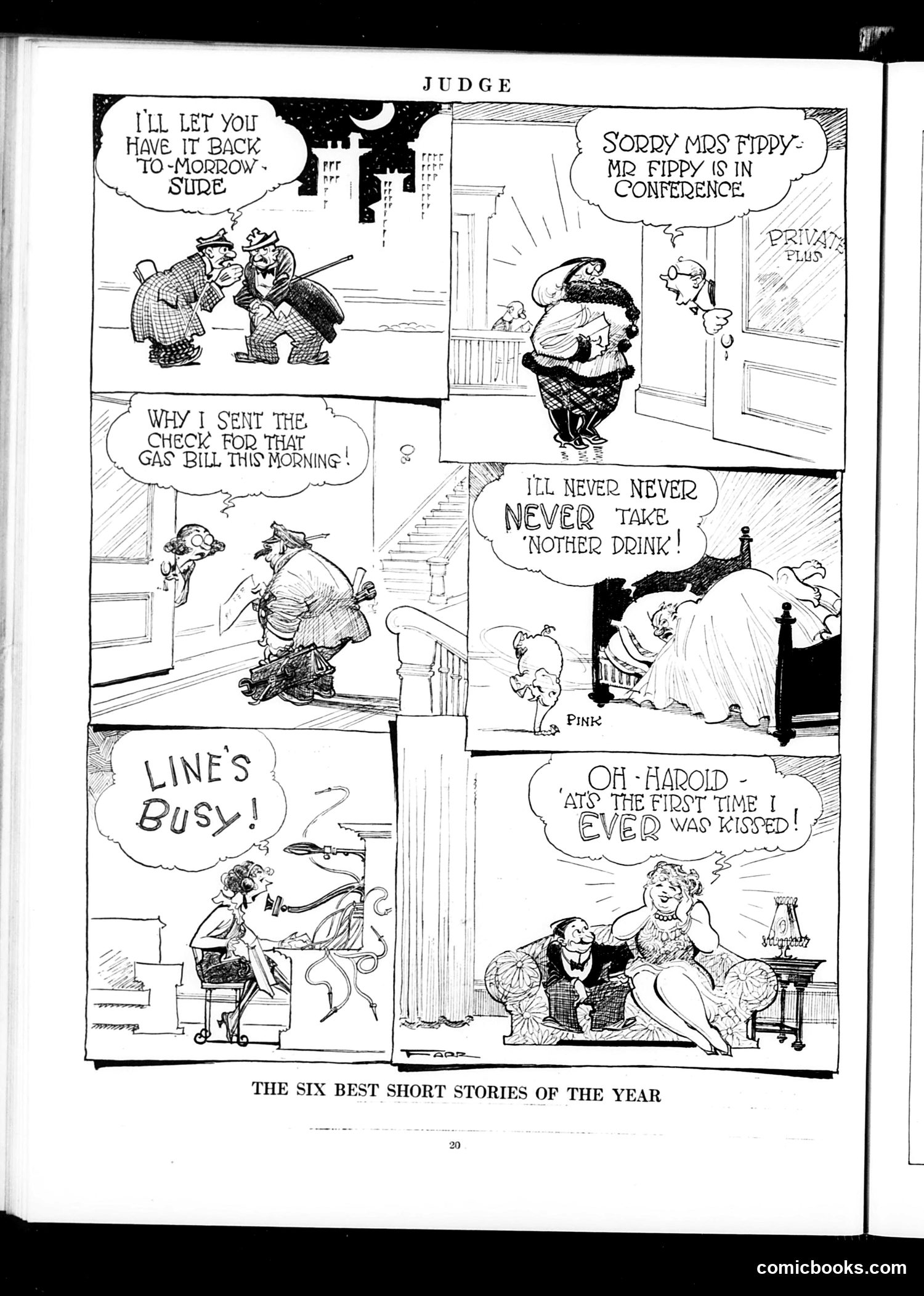
This comic strip satirizes marital conflict and domestic drinking culture. The narrative follows a husband (Mr. Fippy) who postpones returning a borrowed item, claims he sent a gas bill check, and retreats into a "conference" to avoid his wife. The wife's escalating frustration culminates in her discovering him kissing another woman, after which he drunkenly swears off drinking—a hollow promise given the story's trajectory. The humor relies on period stereotypes: henpecked husbands, nagging wives, infidelity, and casual alcoholism. "The Six Best Short Stories of the Year" frames this as one of Judge magazine's humorous tales. The satire targets both marital hypocrisy and the casual acceptance of male misbehavior in early 20th-century American society, presented here as comedic fodder rather than serious social critique.
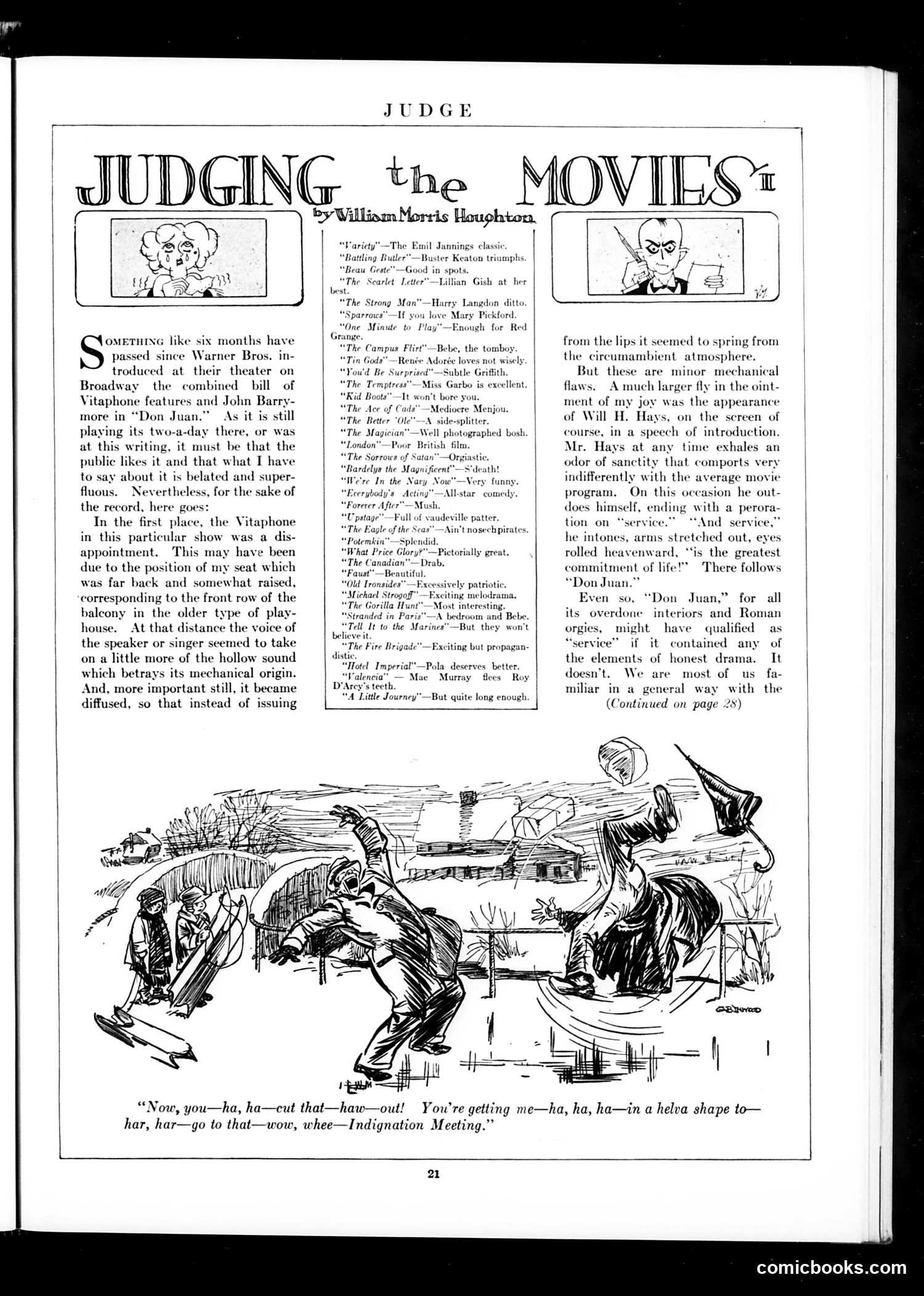
This is a film criticism column by William Morris Houghton reviewing current movies, with a satirical cartoon below. The main target is **Will H. Hays**, the newly appointed Hollywood censor and moral guardian, who appears on screen introducing John Barrymore's "Don Juan." The satire mocks Hays's self-righteous sanctimoniousness—his "odor of sanctity" and pompous speech about "service" (arms stretched, eyes rolled heavenward) feel inappropriately placed before a film about Roman excess and seduction. The reviewer finds this moralizing absurd and hypocritical. The cartoon depicts a slapstick "Indignation Meeting," showing physical comedy and chaos—likely contrasting genuine entertainment with Hays's preachy theatricality. The joke suggests audiences prefer actual entertainment to censorious lectures wrapped in false piety. The column lists contemporary films (Buster Keaton, Mary Pickford, Lillian Gish) for context.
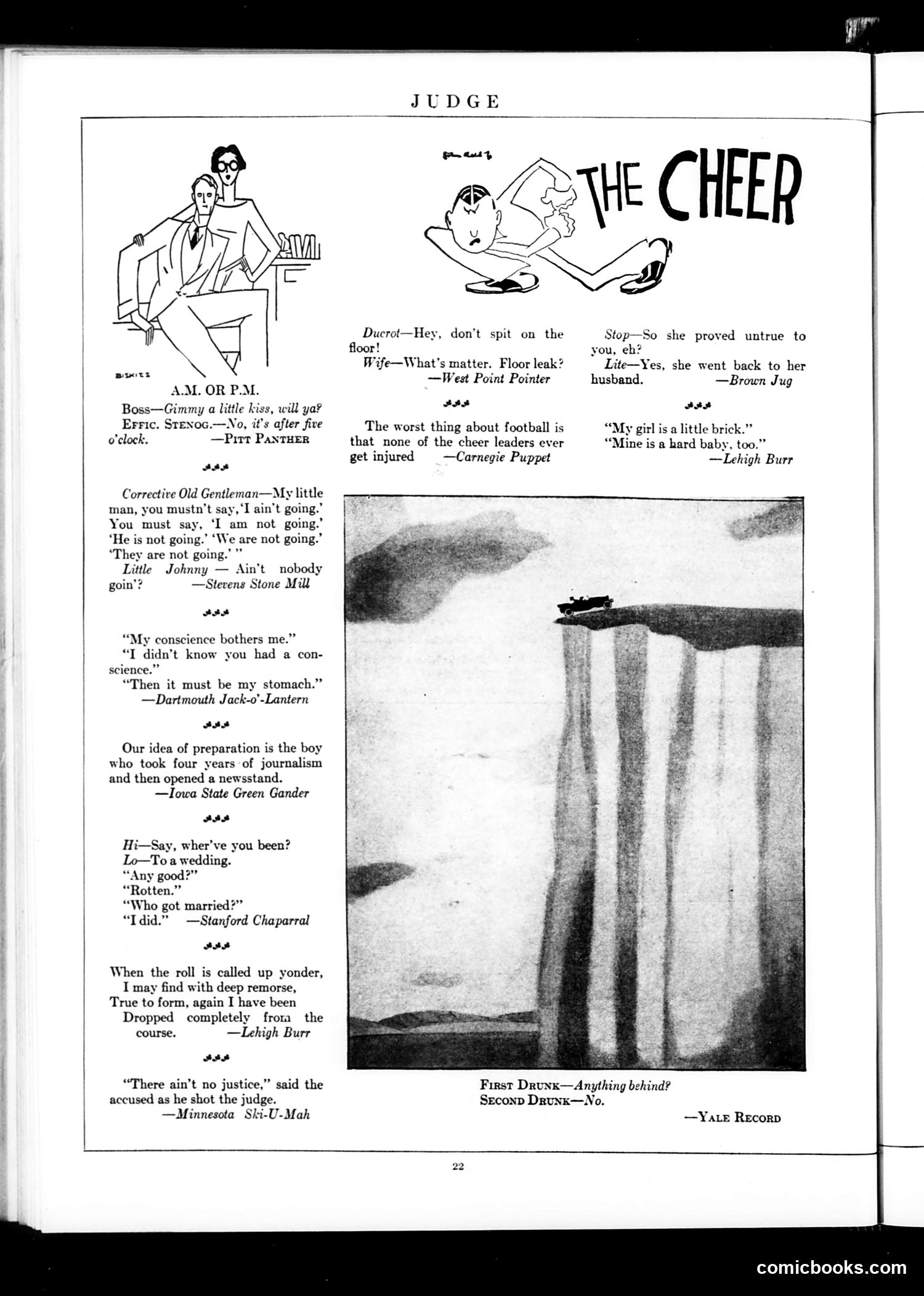
This is a collection of brief jokes and quips sourced from various college humor magazines (Carnegie Puppet, Stanford Chaparral, Lehigh Burr, Yale Record, etc.). The humor reflects early 20th-century college culture and social attitudes. The cartoons and text include workplace dynamics (a boss requesting a kiss after 5 PM), grammar correction, relationship troubles, and observational humor about football cheerleaders never getting injured. One darker joke references shooting a judge ("There ain't no justice"). The photograph shows two people in what appears to be an intimate moment near a window—its caption jokes about drunkenness and what's "behind" them, relying on innuendo typical of the era's humor. Overall, this represents Judge's formula: reprinting collegiate wit emphasizing workplace flirtation, romantic disappointment, and irreverent social commentary aimed at educated readers.
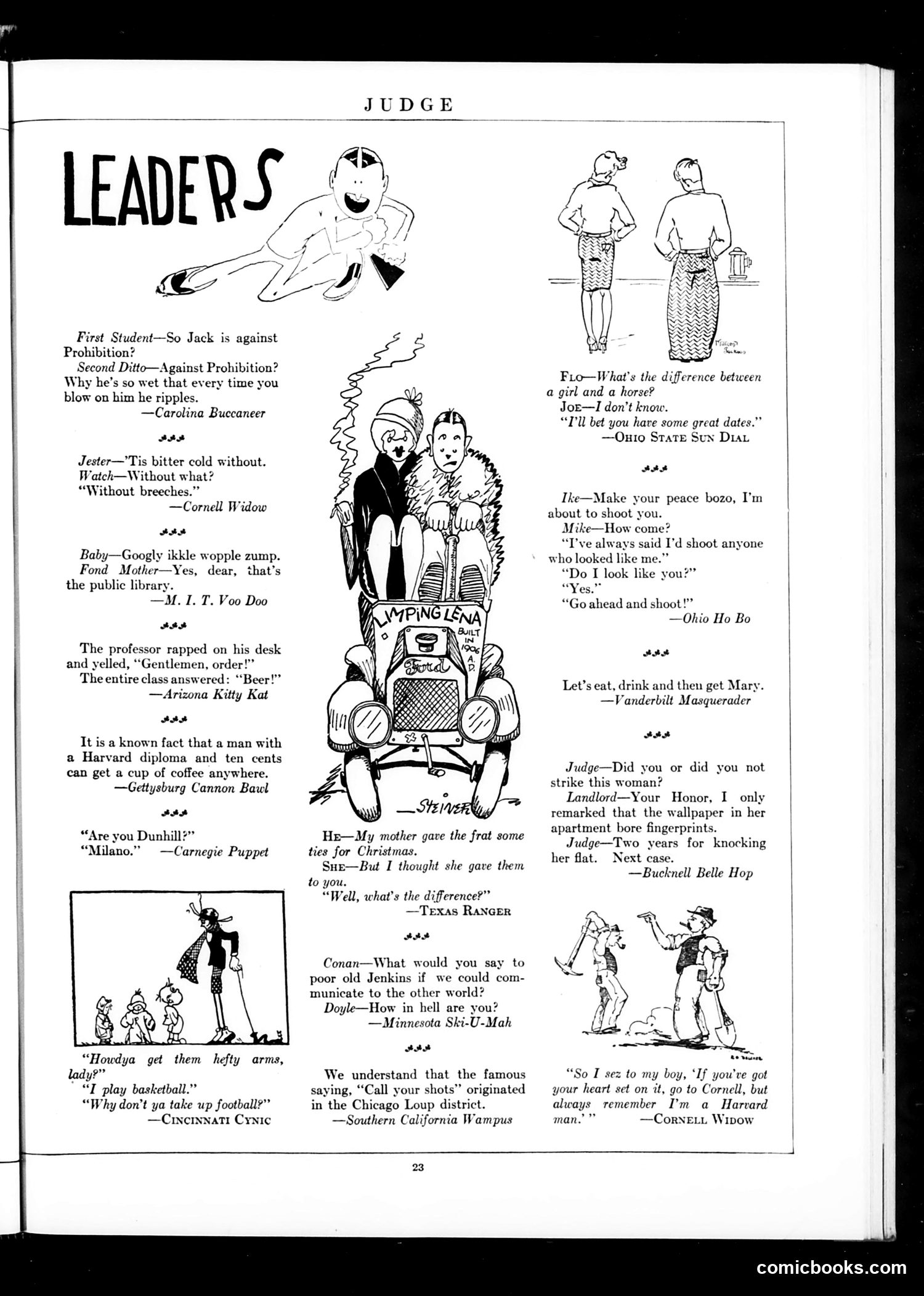
This page collects humorous quotes and jokes from college newspapers, organized by theme ("Leaders"). The cartoons and quips satirize 1920s collegiate and social life. **Key themes:** - **Prohibition satire**: A student so "wet" (anti-Prohibition) he "ripples" when blown on—mocking both the Prohibition debate and excessive drinking. - **College culture mockery**: Jokes about Harvard's prestige ("Harvard diploma and ten cents"), fraternity life, and academic pretension across elite schools (Cornell, M.I.T., Vanderbilt). - **Gender humor**: Crude double entendres about dating and romance typical of the era's comedic style. - **Authority subversion**: A professor demands "order," students shout "Beer!"—mocking both academic authority and Prohibition-era lawlessness. The central cartoon shows a "Spiffy" character driving a car with passengers, illustrating the "flapper" era's youth culture. The sourcing from college publications suggests this was humor aimed at educated, younger readers aware of campus life and current debates like Prohibition.
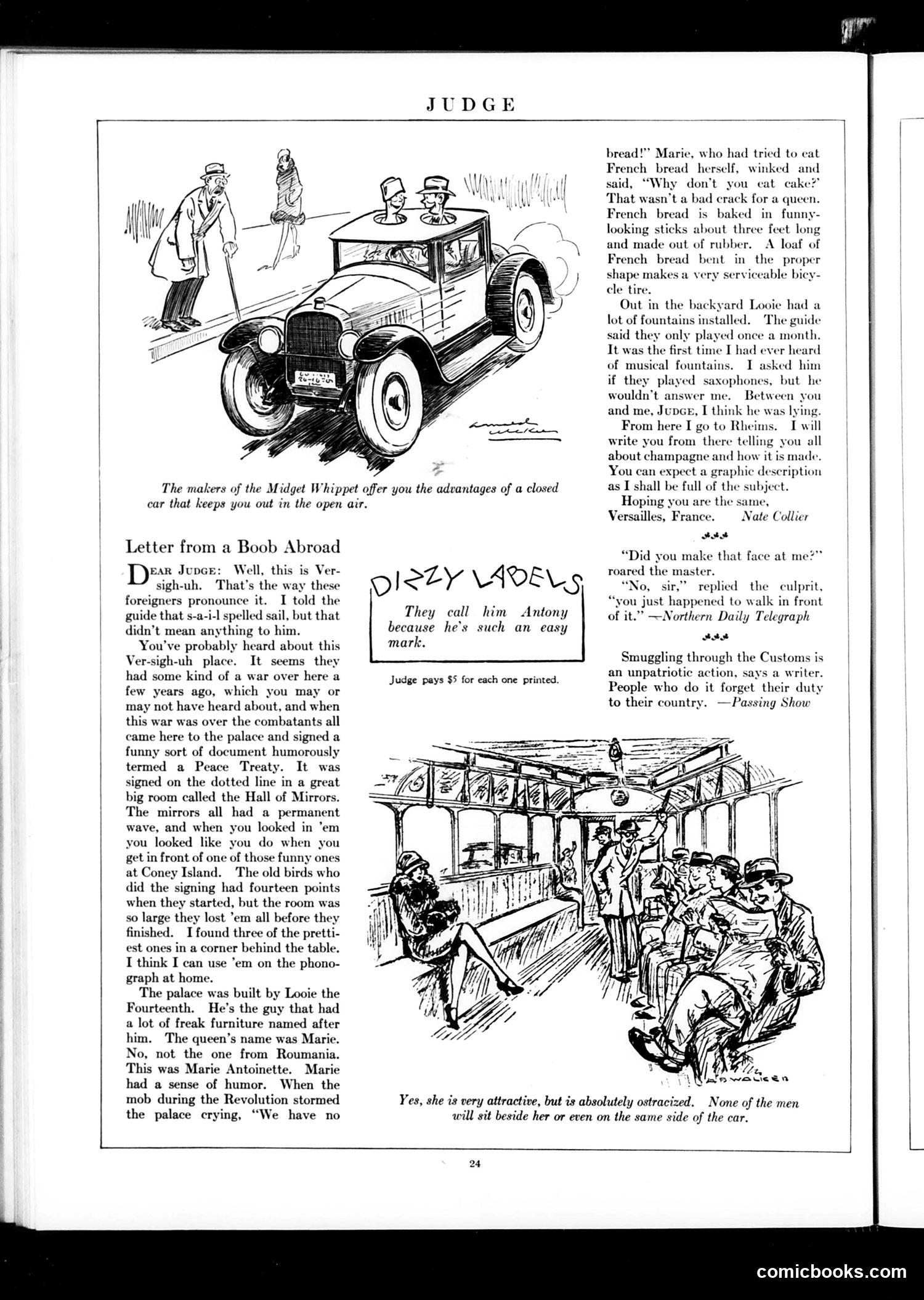
This Judge magazine page contains satirical travel humor and social commentary from the 1920s era. **"Letter from a Boob Abroad"** is a humorous travelogue mocking American tourists abroad. The writer—a self-described "boob"—visits Versailles, France, and makes jokes about mispronouncing French ("Ver-sigh-uh"), misunderstanding French culture (French bread as rubber, musical fountains), and reducing the Treaty of Versailles (ending WWI) to a punchline about lost negotiating "points." The satire targets both American ignorance of European sophistication and post-war politics. The **Marie Antoinette anecdote** references the French Revolution, humorously implying she responded to bread shortages with "cake," though the actual quote's origin is disputed. The bottom cartoon about a woman passenger being **"absolutely ostracized"** by male travelers satirizes social prudishness or scandal—her presence alone was considered so compromising that men refused to share a train compartment with her. The **"Dizzy Aidels"** sidebar jokes about an easy target named "Antony." Overall, the page satirizes American tourists, European pretension, and social conventions of the era.
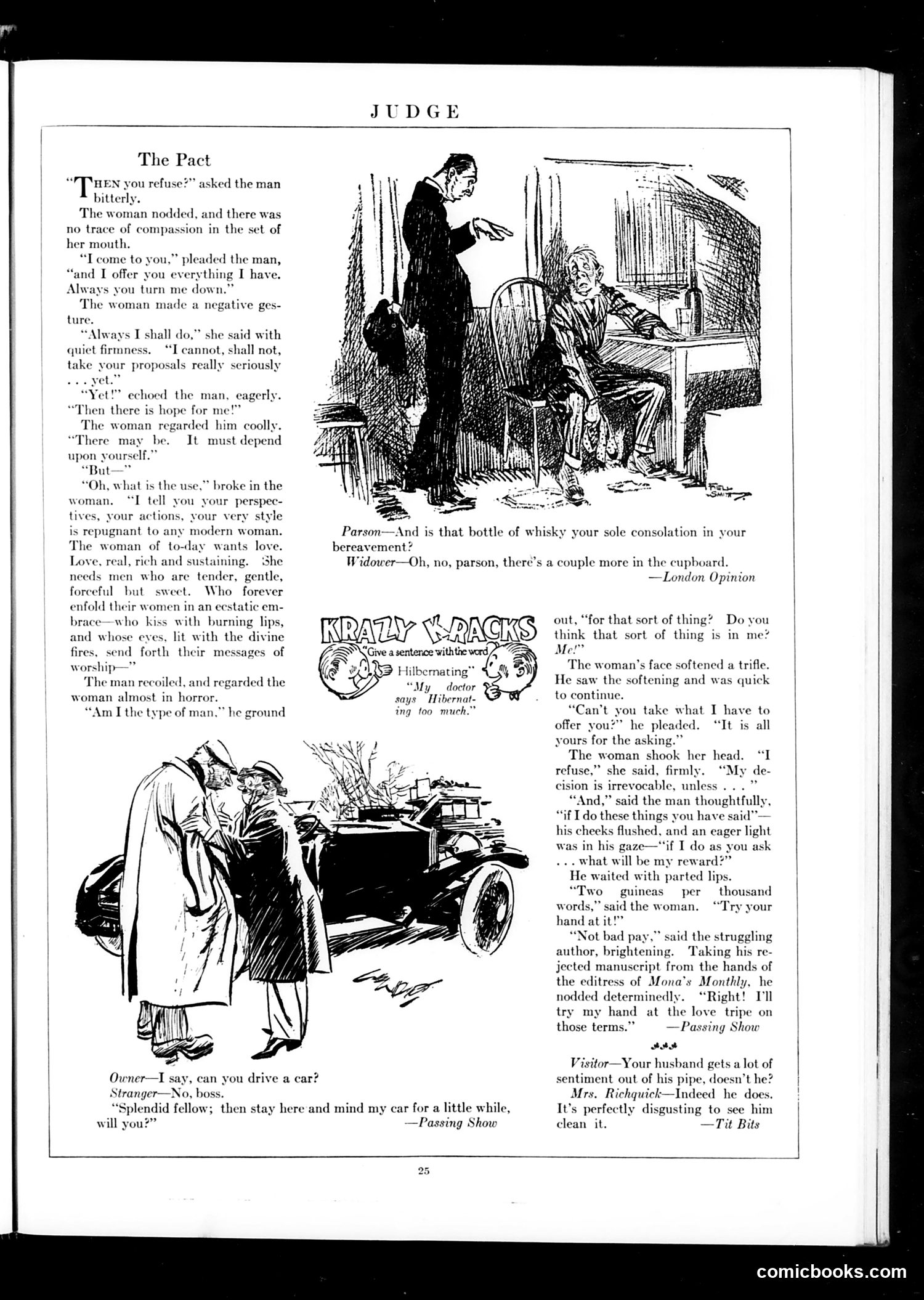
This satirical story mocks struggling male writers of the early 20th century and their romantic pretensions. The central joke: a man desperately courts a woman (the editress of "Mona's Monthly" magazine), offering flowery declarations of love and passion. She repeatedly rejects him—until revealing her true motive: she'll accept his affections *if* he writes romantic fiction for her publication at two guineas per thousand words. The satire targets two things: (1) male writers who produce sentimental "love tripe" for women's magazines, and (2) the mercenary nature of publishing, where romantic sentiment is commodified for profit. The man's sudden brightening when offered payment exposes that his grand romantic gestures were merely professional desperation masked as passion. The accompanying smaller jokes about cars and pipes are unrelated filler humor typical of Judge magazine's format.
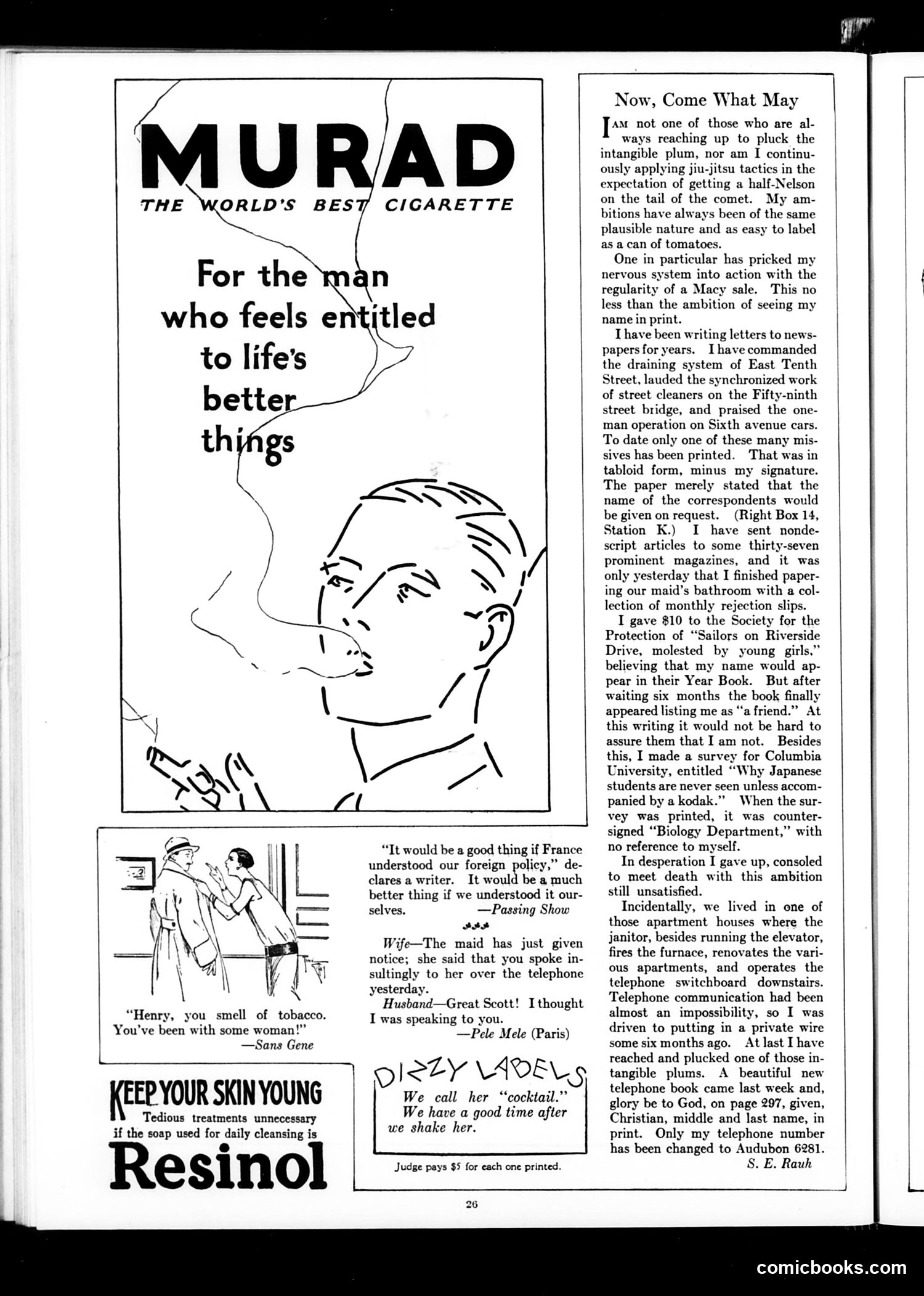
This page contains several short humorous pieces typical of early 20th-century satirical magazines: **Main Cartoon/Jokes:** - A domestic comedy about a husband who insults the maid over the telephone, then claims he thought he was speaking to his wife—the joke being that he insults his wife regularly enough to confuse the two. - A French joke about mistaken identity regarding tobacco smell and infidelity. - A quip about France understanding American foreign policy. - A joke calling a woman "cocktail" because "we shake her." **Major Feature - "Now, Come What May":** A humorous essay by S.E. Rauh about the author's obsessive quest to see his name in print. He describes repeated rejections from newspapers and magazines, donations to charities expecting recognition, and finally achieving his goal: appearing in a telephone directory—only to have his number changed immediately after. **Advertising:** Murad cigarettes ("The World's Best Cigarette") and Resinol soap dominate the page visually. The satire gently mocks vanity and the human desire for public recognition, presented as an amusing complaint rather than serious commentary.
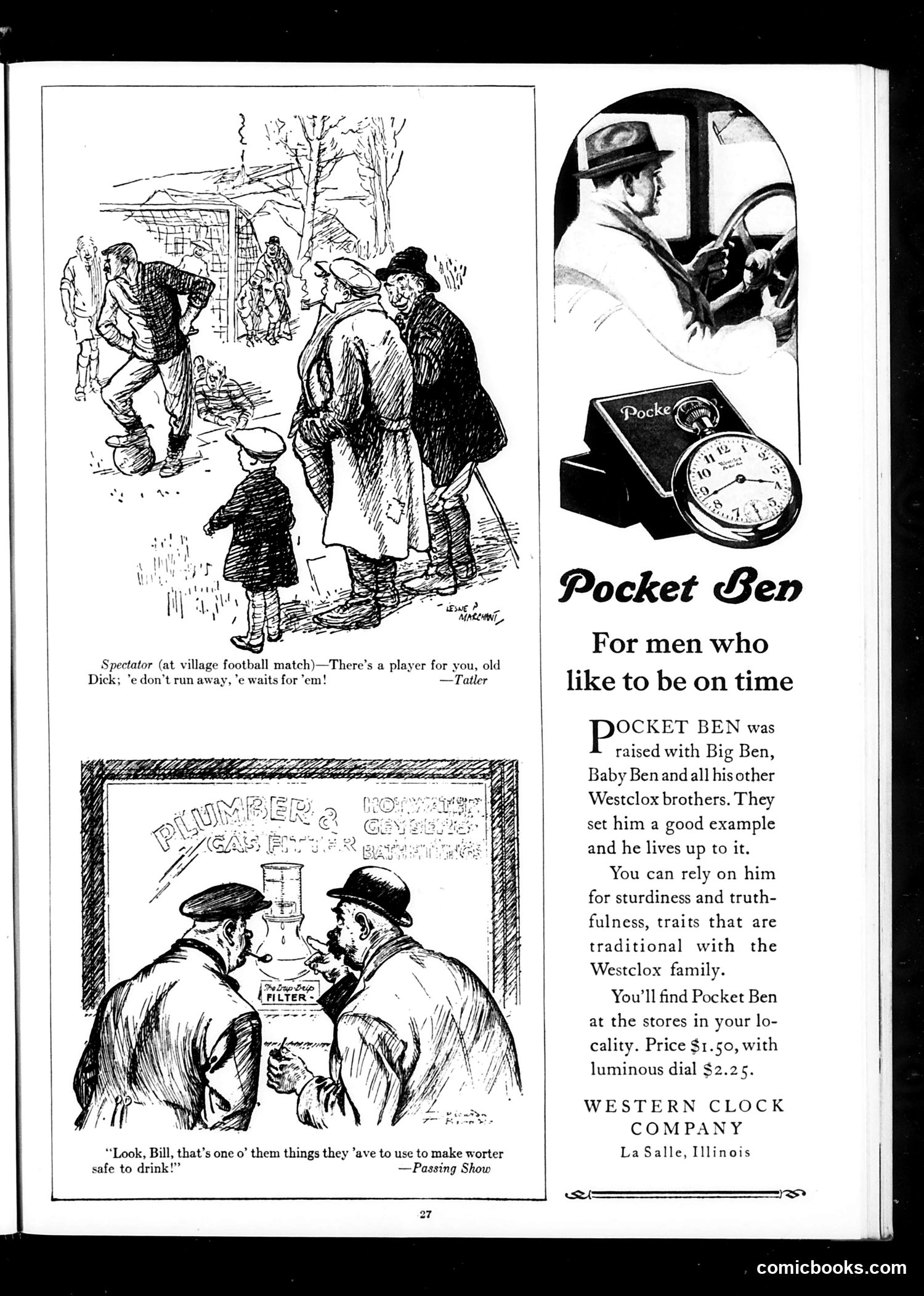
This page contains two unrelated cartoons and a watch advertisement. **Top cartoon** (by Tatler): A village football match scene. A spectator praises an unnamed player to "old Dick," noting the player "don't run away, 'e waits for em!" This appears to be gentle satire about working-class sports enthusiasm—praising a player for courage or steadiness rather than flashy skill. **Bottom cartoon** (by "Passing Show"): Two working men examine a water filter labeled "Plumber & Co's." One tells the other, "that's one o' them things they 'ave to use to make worter safe to drink!" This satirizes contemporary concerns about urban water safety—a real public health issue of the era—by mocking the need for mechanical filtration. **Right side**: An advertisement for "Pocket Ben" watches by Western Clock Company (La Salle, Illinois), priced $1.50. It references the company's other watch lines ("Big Ben," "Baby Ben") and emphasizes reliability and punctuality as virtues. This is straightforward period advertising, not satire.
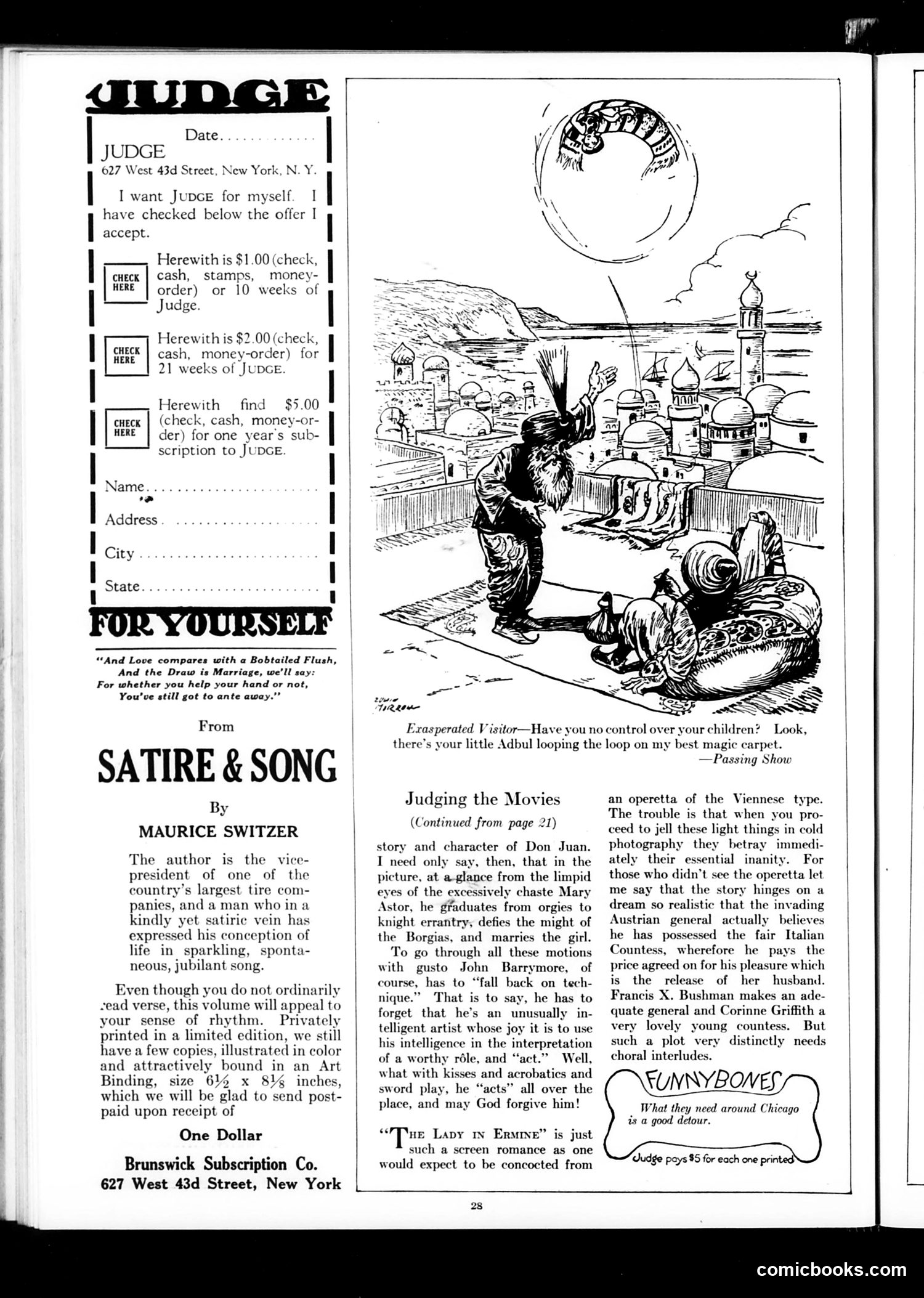
This page contains **magazine advertisements and film criticism** rather than political satire. **Left side:** Subscription offers for *Judge* magazine itself—a satirical publication—with different price tiers ($1, $2, $5) offering varying subscription lengths. There's also an ad for "Satire & Song," a poetry collection by Maurice Switzer. **Right side:** A cartoon captioned "Exasperated Visitor" depicting a child misbehaving at what appears to be a Middle Eastern or colonial setting, with the punchline about disrupting carpets. **Main content:** A film review titled "Judging the Movies" critiques movies featuring John Barrymore and others. The reviewer criticizes Barrymore's over-reliance on physical "technique" and acrobatics in a Don Juan adaptation, and dismisses "The Lady in Ermine" as a failed attempt to translate theatrical operetta to realistic cinema. **Bottom:** A brief joke ("Funny Bones") about Chicago traffic. The page is primarily **trade publication content**—criticism and advertising—rather than political commentary.
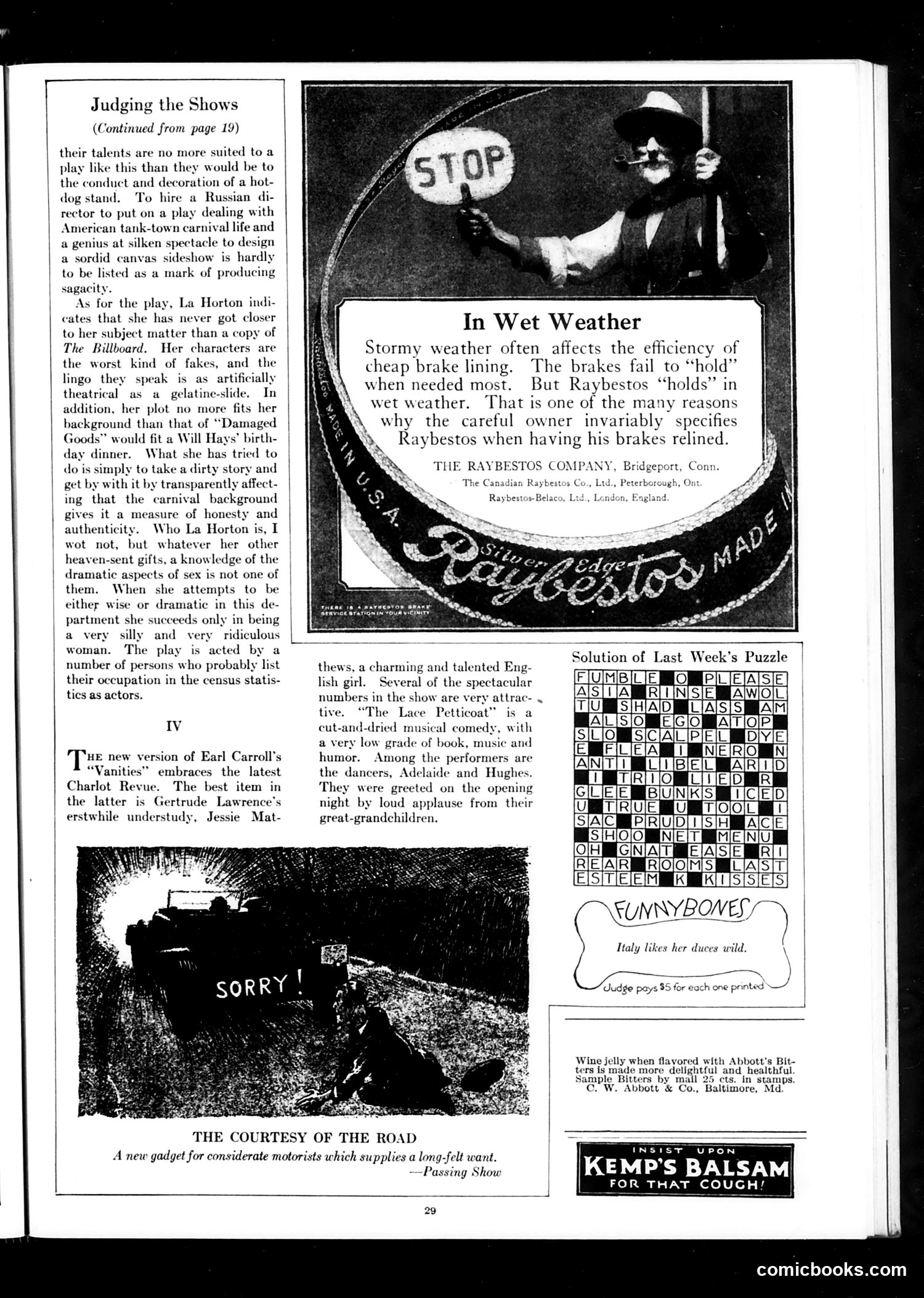
This page contains a theater critic's scathing reviews of Broadway productions from the 1920s era. The main critique targets a play (apparently dealing with carnival life) directed by a Russian director and designed by a Russian spectacle expert. The critic argues that hiring European talent to authentically portray American "tank-town carnival life" is absurd—akin to hiring a Russian to design a hot-dog stand. The playwright, "La Horton," is mocked for relying on *Billboard* magazine rather than genuine understanding, producing fake dialogue and inauthentic characters. The review of Earl Carroll's "Vanities" is more favorable, praising performer Jessie Matthews while dismissing the aging dancers Adelaide and Hughes with cutting sarcasm about their appeal to "great-grandchildren." The page also includes vintage advertisements (Raybestos brake lining, Abbott's Bitters, Kemp's Balsam) typical of 1920s magazines.
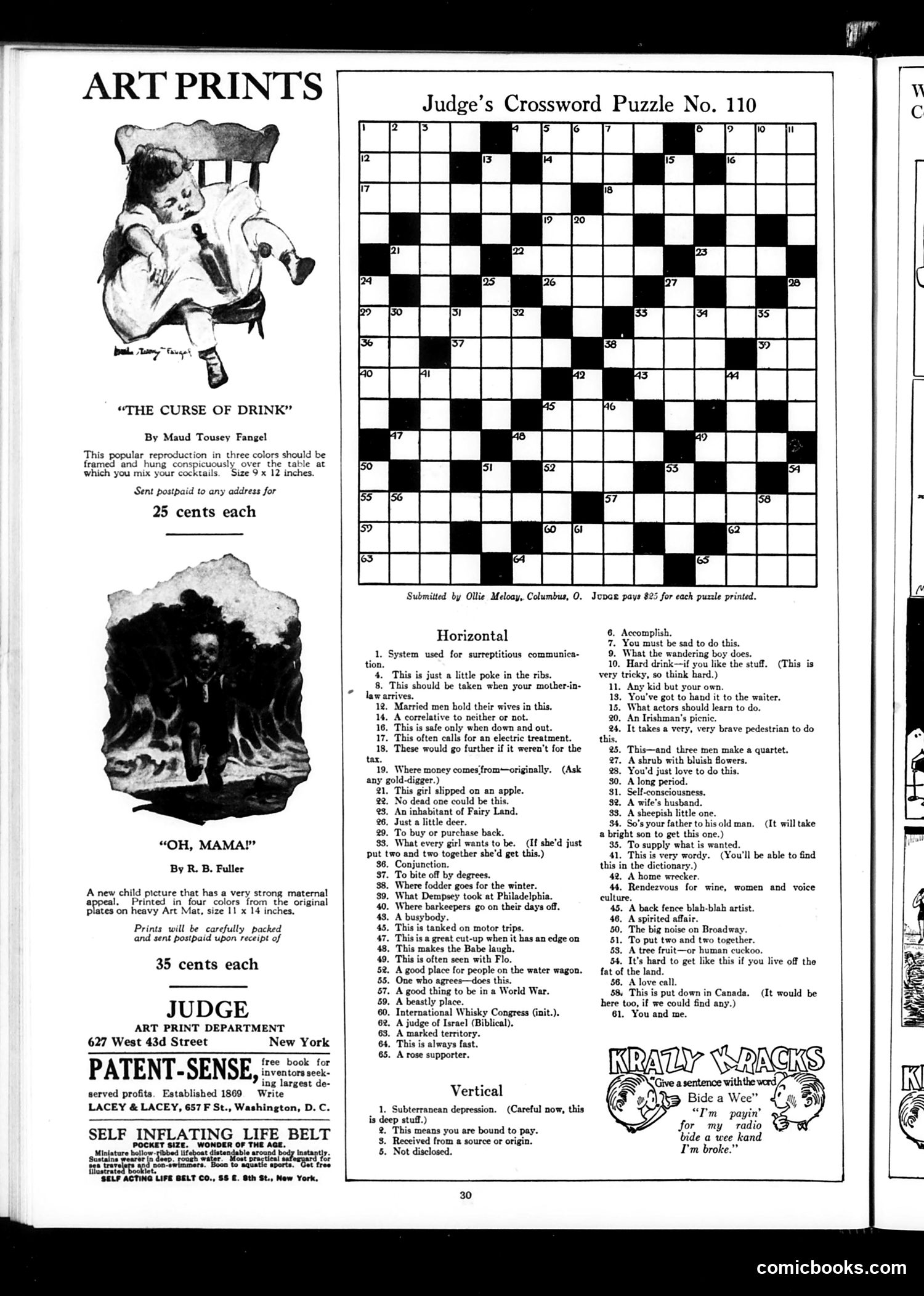
This page is primarily **advertisements and a crossword puzzle**, with minimal political content. The two art prints advertised are sentimental domestic scenes: "The Curse of Drink" (showing a child with alcohol) and "Oh, Mama!" (depicting maternal appeal). These reflect period anxieties about alcohol and family values during Prohibition era America. The crossword puzzle itself contains oblique social commentary typical of Judge's humor—clues reference drinking ("Hard drink—if you like the stuff"), marital dynamics ("Married men hold their wives in this"), and social pretensions. References to "the water wagon" and "International Whisky Congress" suggest Prohibition-era tensions. The remaining content consists of product advertisements (life belts, patent office services), typical of magazine filler. There are no identifiable political figures or explicit satirical cartoons on this page—it's primarily a commercial and puzzle page reflecting 1920s American consumer culture and domestic concerns.
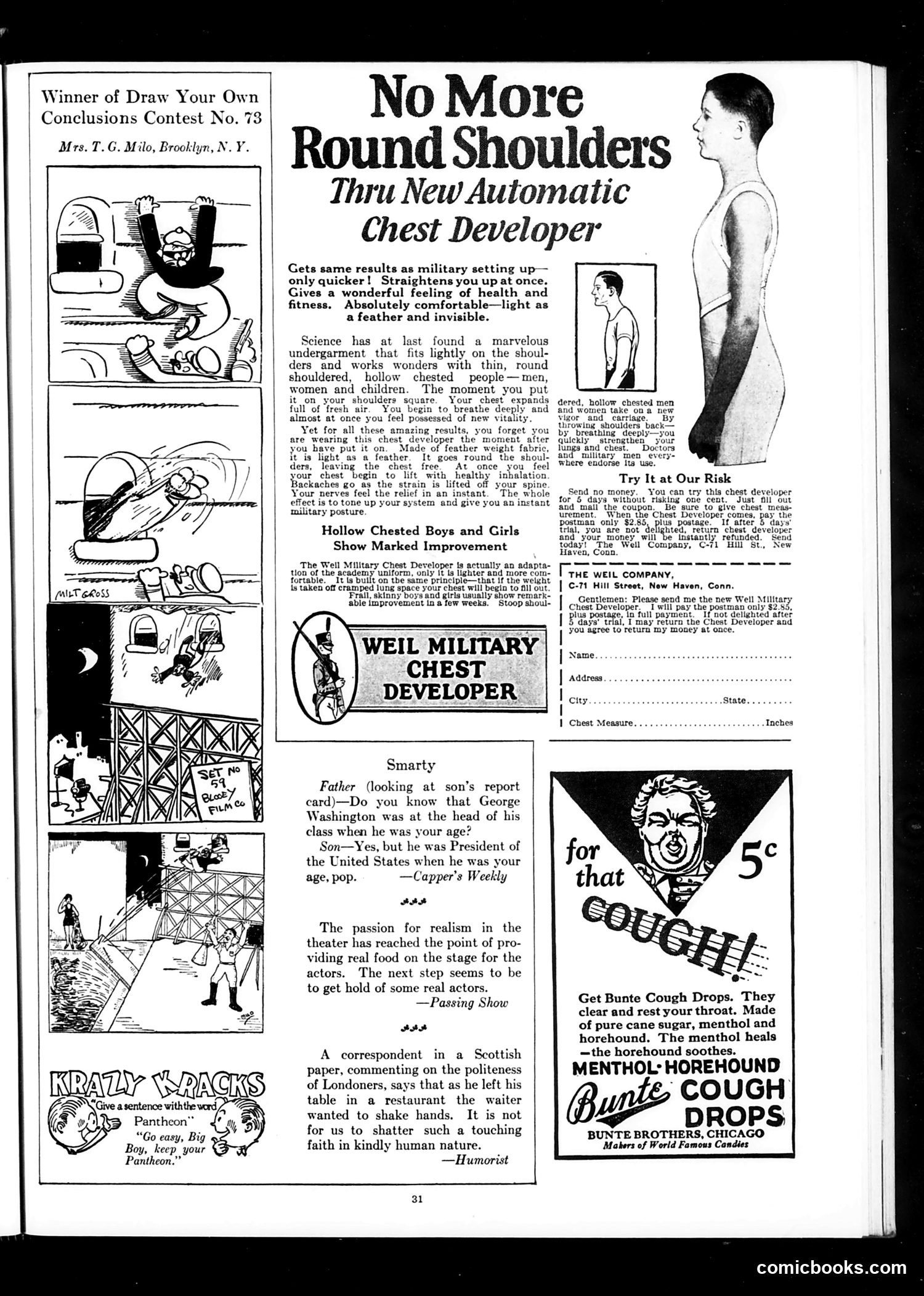
This page from Judge magazine contains mixed content: a winning cartoon contest entry, advertisements, and humor snippets. **The Contest Cartoon** (left side): Mrs. T.G. Milo's entry depicts sequential scenes of what appears to be industrial or domestic mishaps—figures in various predicaments with machinery or structures. The "Draw Your Own Conclusions" format invited readers to interpret the narrative themselves, a popular Judge feature. **Main Advertisement**: The "Weil Military Chest Developer" dominates the center—a mail-order garment claiming to cure poor posture and build chest muscles. It's pitched as a "feather-light" undergarment mimicking military training results. This reflects early-20th-century anxieties about weak, sedentary bodies and the period's enthusiasm for physical improvement devices. **Humor Snippets**: Brief jokes mock classroom comparisons and theater realism trends—light social commentary typical of Judge's satirical voice. **Advertisements**: Bunte Cough Drops and Krazy Klacks (Pantheon candy) appear as period product placements. The page exemplifies Judge's blend of satire, contests, and advertising targeting educated middle-class readers concerned with health, self-improvement, and current social absurdities.
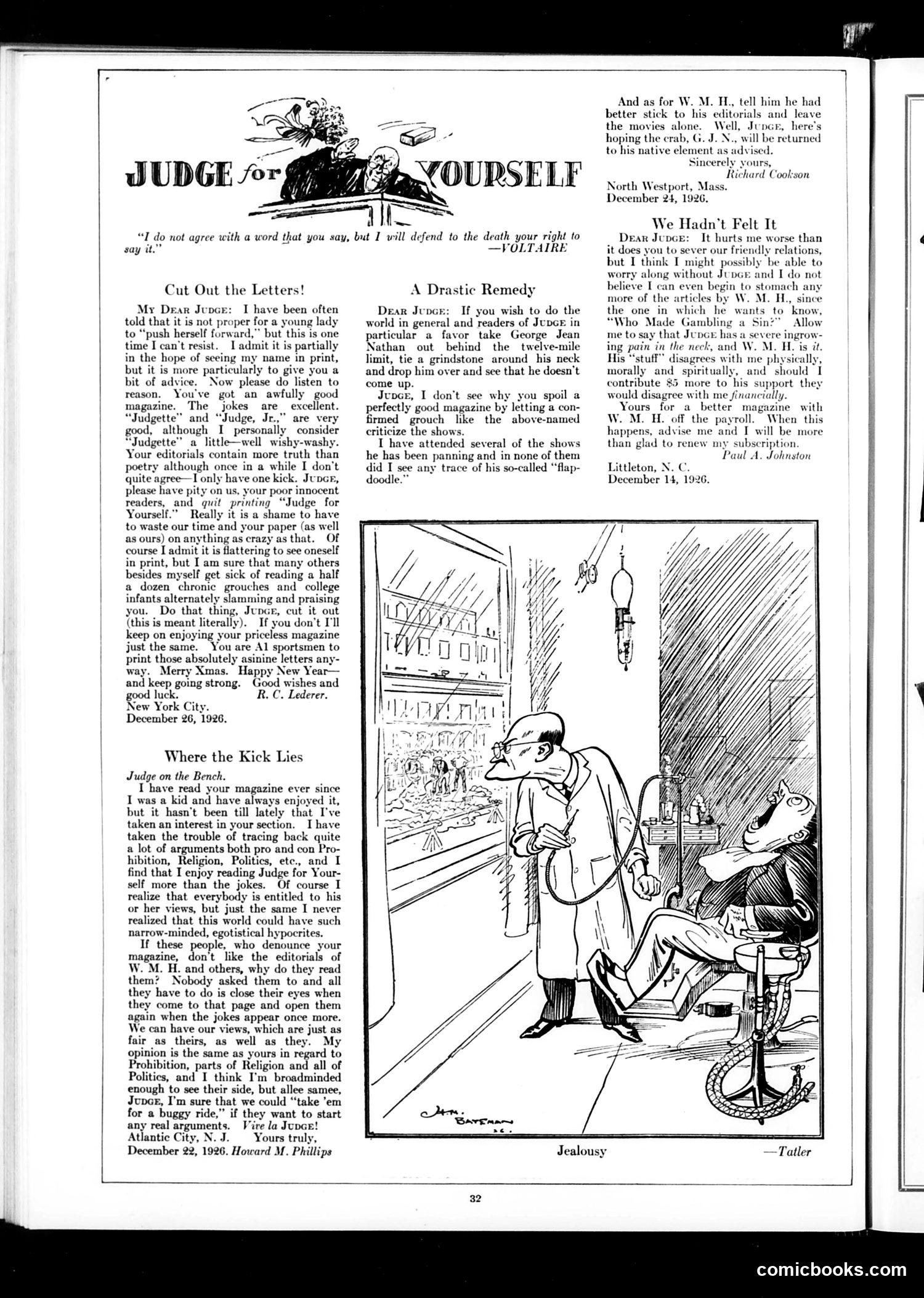
This page showcases reader letters to Judge magazine's opinion section, revealing 1920s cultural tensions. Multiple correspondents debate whether the magazine should print the "Judge for Yourself" letters column at all. The main cartoon (credited to Taller) depicts "Jealousy"—a man on a bicycle confronting another man, illustrating petty rivalry, likely connected to the letters' contentious tone. The letters themselves reveal the real satire: readers argue heatedly about Prohibition, religion, and theater criticism. One writer attacks theater critic George Jean Nathan viciously, while others defend the magazine's editorial positions on controversial topics. The letters exemplify exactly what the first correspondent criticizes—"chronic grouches" using the column to air grievances. The opening Voltaire quote about defending free speech ironically frames this debate: readers simultaneously demand the column's elimination while passionately using it. The page satirizes how even in a satirical magazine, readers weaponize "opinion" sections against each other.
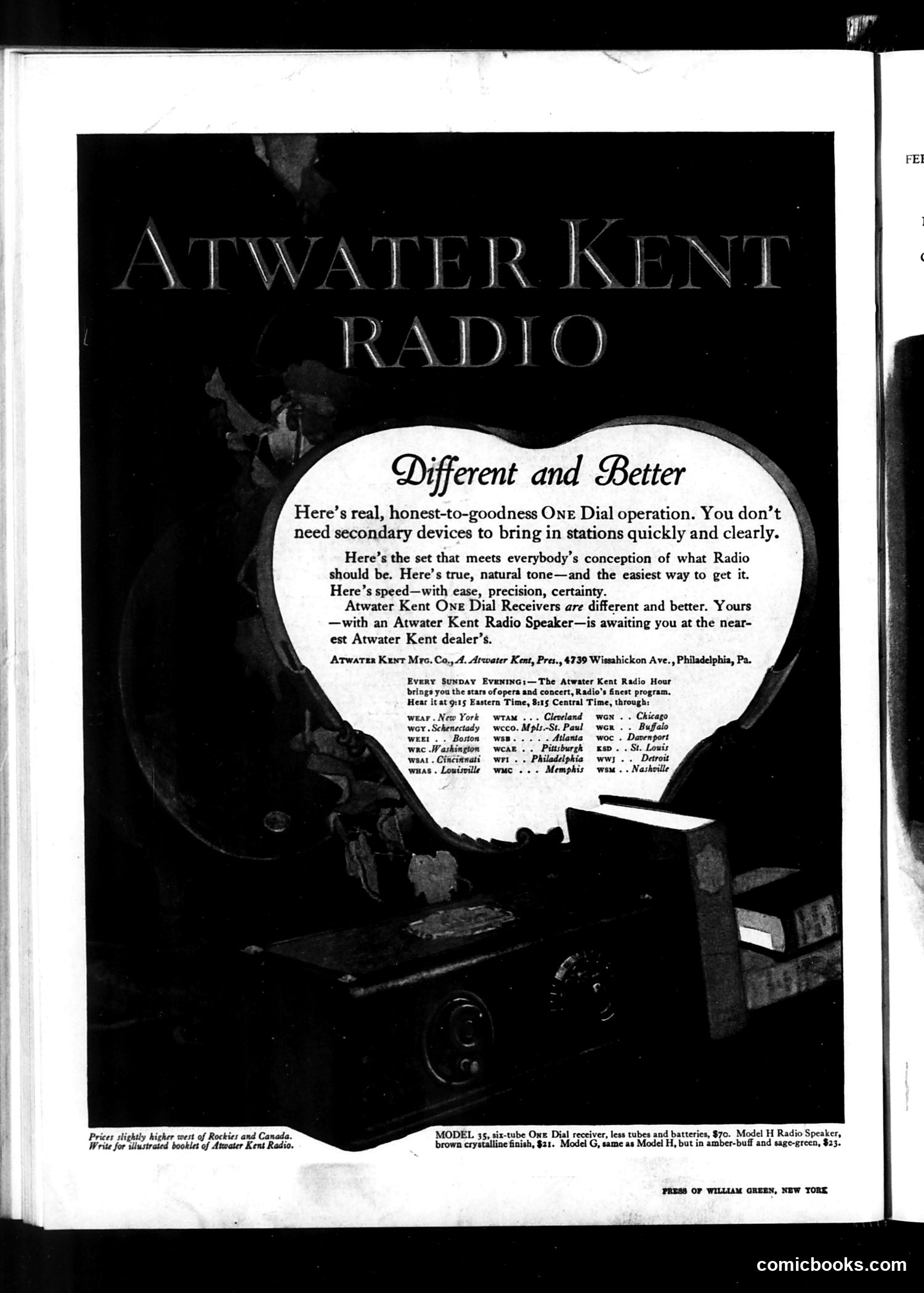
This is **not a cartoon or satire**—it's a full-page advertisement for Atwater Kent radios, a major early radio manufacturer. The page promotes their "One Dial" receiver technology as superior to competitors' multi-dial systems. The ad emphasizes ease of use ("One Dial operation"), sound quality ("true, natural tone"), and speed in tuning stations. It highlights their sponsored program, "The Atwater Kent Radio Hour," broadcast Sunday evenings across numerous affiliate stations listed by call letters. The image shows an actual radio set with a large speech bubble explaining the product's benefits. At the bottom, specific model numbers and prices are listed ($70-$23 range). For modern readers: this reflects the 1920s radio boom when manufacturers competed fiercely on technical features and sponsored programming was a key marketing tool. The "honest-to-goodness" language targets consumers skeptical of radio technology's reliability and complexity.