
Judge, 1927-01-29 · page 17 of 36
Judge — January 29, 1927 — page 17: what you’re looking at
What you’re looking at
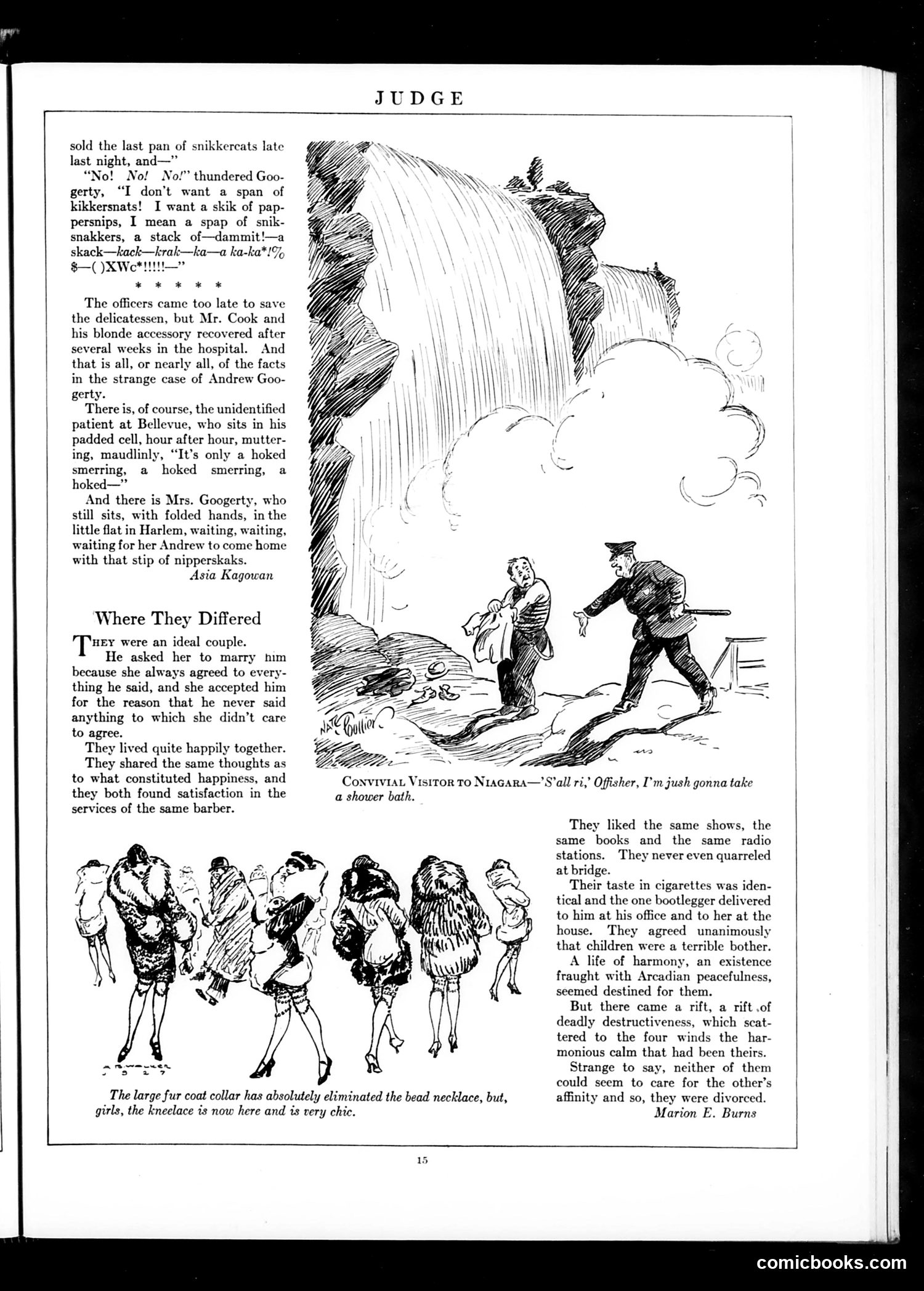
This page contains three distinct satirical pieces typical of 1920s-30s humor: 1. **"Andrew Googerty" story** (top): A nonsensical tale about a man having a verbal breakdown in a delicatessen, apparently unable to properly name food items, culminating in violence. This appears to be absurdist humor satirizing either speech impediments, drunkenness, or mental instability—contemporary audiences would find dark comedy in institutionalization references (Bellevue psychiatric hospital, padded cells). 2. **Niagara Falls cartoon** (middle): A visitor plans to shower in Niagara Falls—likely mocking tourists' naive behavior or prohibition-era bathing customs. 3. **"Where They Differed"** (bottom): A couple divorces despite perfect agreement on everything because they shared identical taste and interests. The satire critiques modern marriage: the joke is that compatibility and harmony aren't enough—apparently, couples need *disagreement* to maintain affection. The fashion note about fur collar collars replacing bead necklaces reflects contemporary style commentary. All reflect Judge's characteristic emphasis on domestic absurdity and social observation.
📄 Transcribed text from this page (OCR, searchable)
Machine-transcribed from the original scan — historical spelling and the odd misread are preserved.
JUDGE sold the last pan of snikkercats late last night, and—” “No! No! No!” thundered Goo- gerty, “I don’t want a span of kikkersnats! I want a skik of pap- persnips, I mean a spap of snik- snakkers, a stack of—dammit!—a skack—kack—hkrak—ka—a ka-ka*!% ee kK KK The officers came too late to save the delicatessen, but Mr. Cook and his blonde accessory recovered after several weeks in the hospital. And that is all, or nearly all, of the facts in the strange case of Andrew Goo- gerty. There is, of course, the unidentified patient at Bellevue, who sits in his padded cell, hour after hour, mutter- ing, maudlinly, “It’s only a hoked smerring, a hoked smerring, a hoked—” And there is Mrs. Googerty, who still sits, with folded hands, in the little flat in Harlem, waiting, waiting, waiting for her Andrew to come home with that stip of nipperskaks. Asia Kagowan Where They Differed T= were an ideal couple. He asked her to marry him because she always agreed to every- thing he said, and she accepted him for the reason that he never said anything to which she didn’t care to agree. ake They lived quite happily together. Z ae They shared the same thoughts as LZ - to what constituted happiness, and . NESS Convivtat Visitor To NiaGara—’S'all ri,’ Offisher, I’m jush gonna take they both found satisfaction in the a@ shower bath. services of the same barber. They liked the same shows, the same books and the same radio stations. They never even quarreled at bridge. Their taste in cigarettes was iden- tical and the one bootlegger delivered to him at his office and to her at the house. They agreed unanimously that children were a terrible bother. A life of harmony, an existence fraught with Arcadian peacefulness, seemed destined for them. But there came a rift, a rift ,of deadly destructiveness, which scat- tered to the four winds the har- monious calm that had been theirs. Strange to say, neither of them could seem to care for the other’s The large fur coat collar has absolutely eliminated the bead necklace, but, affinity and so, they were divorced. girls, the kneelace is now here and is very chic. Marion E. Burns comicbooks.com