
Judge, 1927-01-29 · page 21 of 36
Judge — January 29, 1927 — page 21: what you’re looking at
What you’re looking at
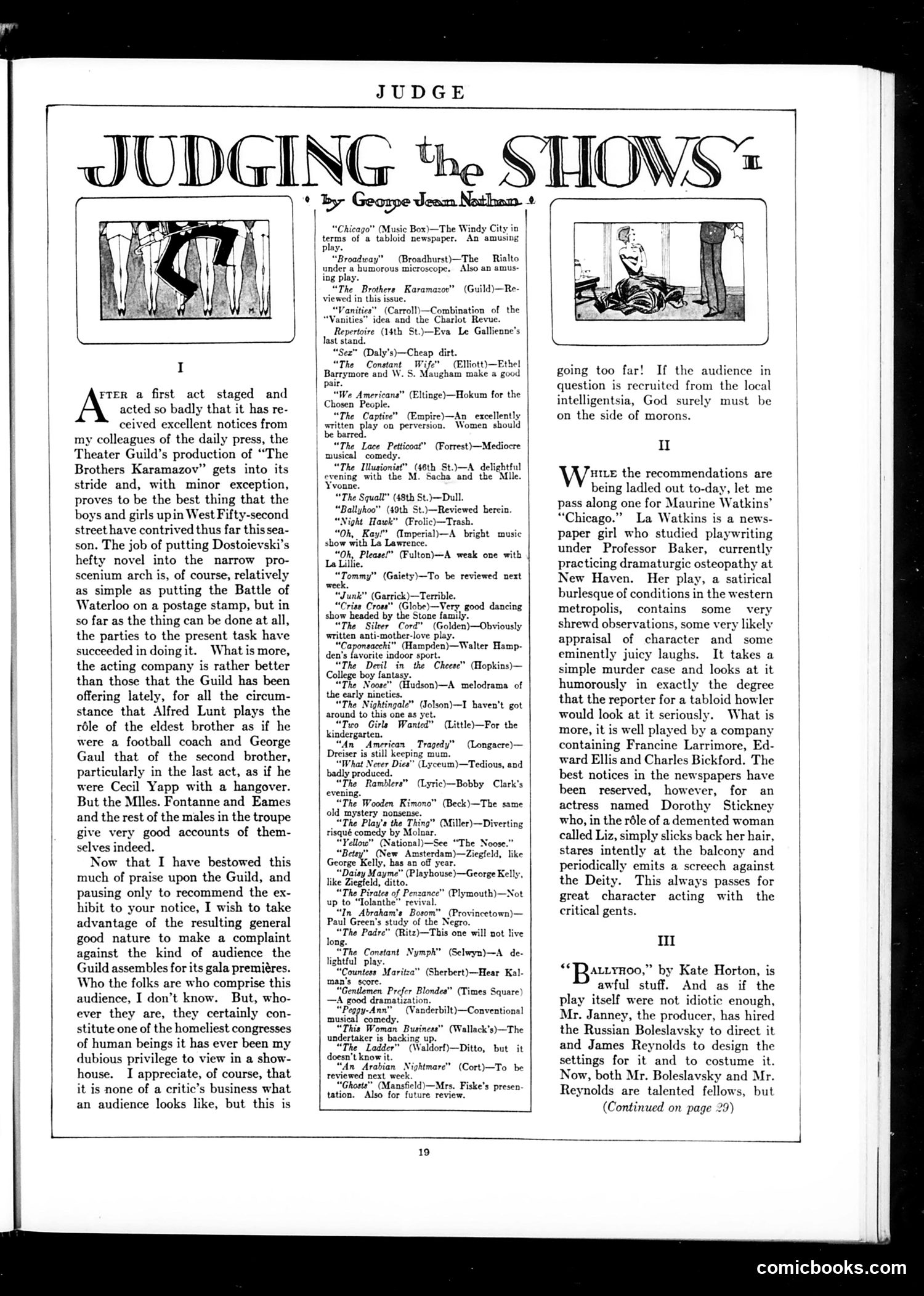
This page from *Judge* magazine contains theater reviews by George Jean Nathan. The main content is **not a political cartoon** but rather **theater criticism**—a column called "Judging the Shows" that reviews Broadway productions. The opening section discusses the Theater Guild's production of *The Brothers Karamazov*, praising the adaptation while criticizing the lead actors Alfred Lunt (compared unfavorably to a football coach) and George Gaul (compared to "Cecil Yapp with a hangover"—likely a contemporary reference). Nathan makes a pointed complaint about the Guild's premiere audiences, describing them as "one of the homeliest congresses of human beings" he's ever seen in a theater—a somewhat catty observation typical of theater criticism of the era. The rest of the page lists brief reviews of various Broadway shows with sharp judgments: *Sex* is called "cheap dirt," *The Captive* involves "perversion" and should bar women, and several shows are dismissed as "dull" or "trash." This represents 1920s theater culture and critical standards.
📄 Transcribed text from this page (OCR, searchable)
Machine-transcribed from the original scan — historical spelling and the odd misread are preserved.
JUDGE FTER a first act staged and A acted so badly that it has re- ceived excellent notices from my colleagues of the daily press, the Theater Guild’s production of “The Brothers Karamazov” gets into its stride and, with minor exception, proves to be the best thing that the boys and girls upin West Fifty-second street have contrived thus far this sea- son. The job of putting Dostoievski’s hefty novel into the narrow pro- scenium arch is, of course, relatively as simple as putting the Battle of Waterloo on a postage stamp, but in so far as the thing can be done at all, the parties to the present task have succeeded in doing it. What is more, the acting company is rather better than those that the Guild has been offering lately, for all the circum- stance that Alfred Lunt plays the réle of the eldest brother as if he were a football coach and George Gaul that of the second brother, particularly in the last act, as if he were Cecil Yapp with a hangover. But the Mlles. Fontanne and Eames and the rest of the males in the troupe give very good accounts of them- selves indeed. Now that I have bestowed this much of praise upon the Guild, and pausing only to recommend the ex- hibit to your notice, I wish to take advantage of the resulting general good nature to make a complaint against the kind of audience the Guild assembles for its gala premiéres. Who the folks are who comprise this audience, I don’t know. But, who- ever they are, they certainly con- stitute one of the homeliest congresses of human beings it has ever been my dubious privilege to view in a show- house. I appreciate, of course, that it is none of a critic’s business what an audience looks like, but this is JUDGING ‘he SHOWS'= by Georpe Jeam Nathan + “Chicago” (Music Box)—The Windy City in terms of a tabloid newspaper. An amusing play. “Broadway” under a hiorpus microscope. ing play. “The Brothere Karamazot” viewed in this issue. * (Carroll)—Combination of the idea and the Charlot Revue. Repertoire (14th St.)\—Eva Le Gallienne’s hast stand. “Sex” (Daly's)—Cheap dirt. “The Constant Wife” (Elliott)—Ethel Barrymore and W. S. Maugham make a good (Broadhurst)—The Rialto Also an amus- (Guild)—Re- “We Americans” (Eltinge)—Hokum for the | Chosen “People. “The Captive” (Empire)—An excellently written play on perversion. Women should be barred, “The Lace Petticoat” (Forrest)—Mediocre musical comedy. “The Illusionist” (40th St.)—A delightful evening with the M. Sacha and the Mlle. vonne. “The Squall” (48th St.)—Dull. “Ballykoo” (49th St.)—Reviewed herein. ht Hawk” (Frolic)—Trash. “Oh, Kay!” (mperial)—A bright music show with La Lawrence. Please!” (Fulton)—A weak one with LaLillie. “Tommy” (Gaiety)—To be reviewed next week. “unk Pte ae eerie. ua “Criss Cross" (Globe)—Ver lancin, show headed by the Stone pathy . “The Sileer Cord” (Golden)—Obviously written anti-mother-love play. “Caponsacchi” (Hampden)—Walter Hamp- den’s favorite indoor sport. “The Devil in the Cheese" (Hopkins)— College boy fantasy. “The Noose” (Hudson)—A melodrama of the early nineties. “The Nightingale” Gebonr=r haven't got around to this one as ye “Two Girls Wanted” (Little)—For the kindergarten. “An American Tragedy” Dreiser is still keeping mum. “What Never Dies” (Lyceum) produced. “The Ramblers” (Lyric)—Bobby Clark's evening. “The Wooden Kimono” (Beck)—The same old mystery nonsense. “The Play's the Thing” (Miller)—Diverting risqué comedy by Molnar. “Yellow” tional)—See “The Noose.” “Betsy” (New Amsterdam)—Ziegfeld, like George Kelly, has an off year. “Daisy Mayme” (Playhouse)—George Kelly, like Ziegfeld, ditto. “The Pirates of Penzance” (Plymouth)—Not up to “Tolanthe” revival. “In_ Abraham's Bosom” (Provincetown)— Paul Green's study of the Negro. “The Padre” (Ritz)—This one will not live long. “The Constant Nymph” (Selwyn)—A de- lightful_ play. cate ee Maritza” (Sherbert)—Hear Kal- Nenemen Prefer Blondes” (Times Square) A good dramatization. Peqgy-Ann” — (Vanderbilt)—Conventional musical comedy. “This Woman Busines” (Wallack's)—The undertaker is backing uj (Longacre)— \—Tedious, and “The Ladder” (Waldorf)—Ditto, but it doesn’t know it. “An Arabian Nightmare” (Cort)—To be reviewed next week. “Ghosts” (Mansfield)—Mrs. Fiske's presen tation. Also for future review. If the audience in going too far! question is recruited from the local intelligentsia, God surely must be on the side of morons. Il HILE the recommendations are being ladled out to-day, let me pass along one for Maurine Watkins’ “Chicago.” La Watkins is a news- paper girl who studied playwriting under Professor Baker, currently practicing dramaturgic osteopathy at New Haven. Her play, a satirical burlesque of conditions in the western metropolis, contains some very shrewd observations, some very likely appraisal of character and some eminently juicy laughs. It takes a simple murder case and looks at it humorously in exactly the degree that the reporter for a tabloid howler would look at it seriously. What is more, it is well played by a company containing Francine Larrimore, Ed- ward Ellis and Charles Bickford. The best notices in the newspapers have been reserved, however, for an actress named Dorothy Stickney who, in the réle of a demented woman called Liz, simply slicks back her hair, stares intently at the balcony and periodically emits a screech against the Deity. This always passes for great character acting with the critical gents. Tl ALLYHOO,” by Kate Horton, is awful stuff. And as if the play itself were not idiotic enough, Mr. Janney, the producer, has hired the Russian Boleslavsky to direct it and James Reynolds to design the settings for it and to costume it. Now, both Mr. Boleslavsky and Mr. Reynolds are talented fellows, but (Continued on page 29) comicbooks.com