
A complete issue · 36 pages · 1926
Judge — December 18, 1926
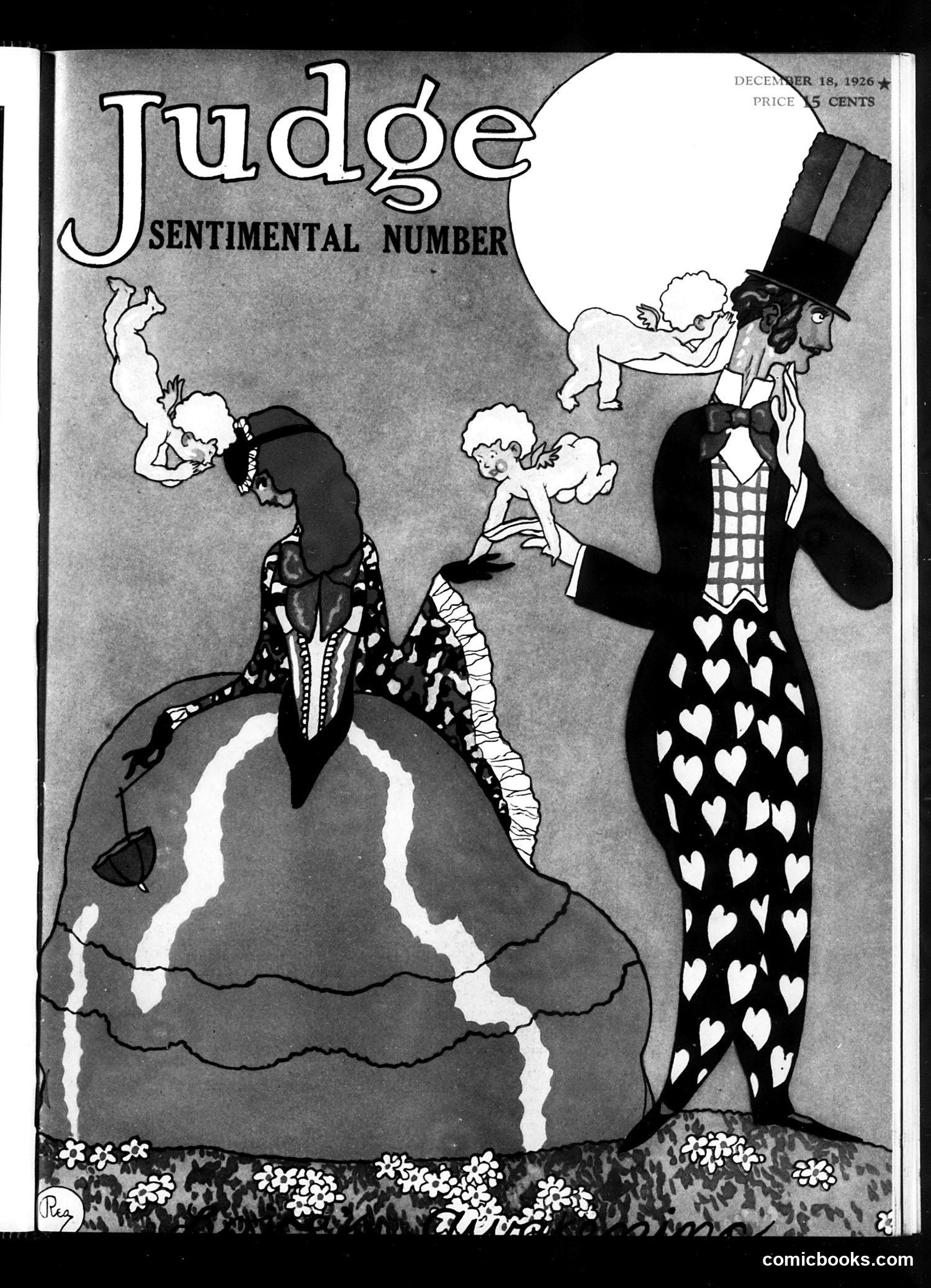
**December 18, 1926 | "Sentimental Number"** This cover depicts romantic/sentimental themes typical of holiday-season satire. A well-dressed gentleman in formal attire (top hat, heart-patterned trousers) appears to be a romantic figure—possibly representing an idealized suitor or "Cupid" character given the cherubs playing above. The woman in an elaborate, voluminous dress suggests the fashionable flapper era. The "Sentimental Number" subtitle indicates this issue focused on romance, love, and holiday sentiment—common Judge magazine themes. The ornate styling, cherubs, flowers, and heart motifs all reinforce romantic comedy themes. The satire likely mocks overly sentimental holiday romance or the era's evolving dating customs. Without additional context, specific figure identification remains unclear, though the imagery clearly targets 1920s romantic conventions for humorous commentary.
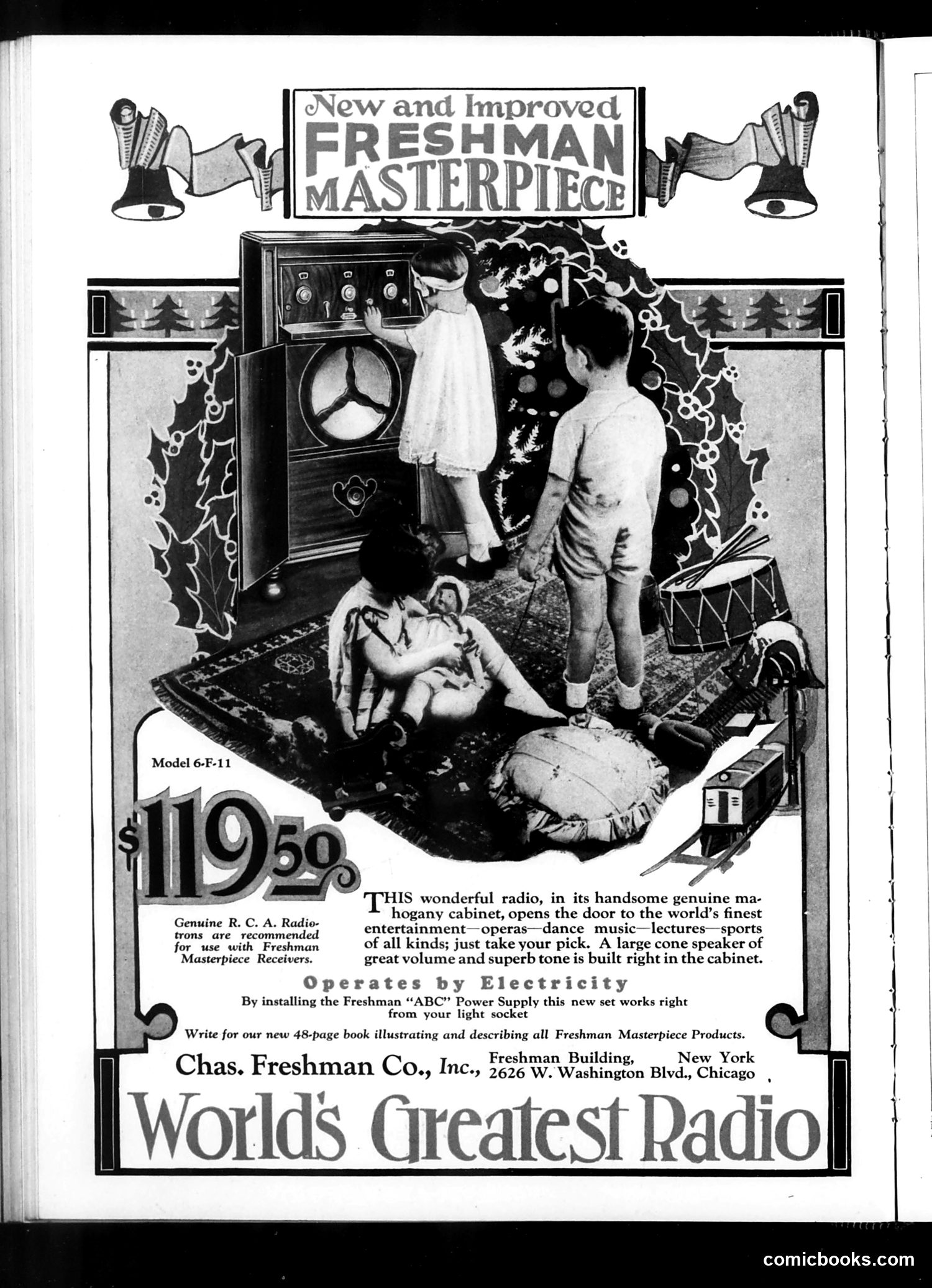
This page is primarily **a commercial advertisement, not satire or political commentary**. It advertises the Freshman "Masterpiece" radio (Model 6-F-11) manufactured by Chas. Freshman Co., Inc. of Chicago, priced at $119.50. The ad uses a domestic scene showing children gathered around a large wooden radio cabinet, with decorative holiday garlands visible. The copy emphasizes the radio's entertainment value—"operas—dance music—lectures—sports"—and its technical features: genuine mahogany cabinet, large speaker, and operation by electricity from a standard light socket. The "Fresh**man** Masterpiece" branding plays on the company name. This is typical 1920s-era consumer advertising targeting family entertainment during the radio boom era. There is no evident political satire or social commentary present.
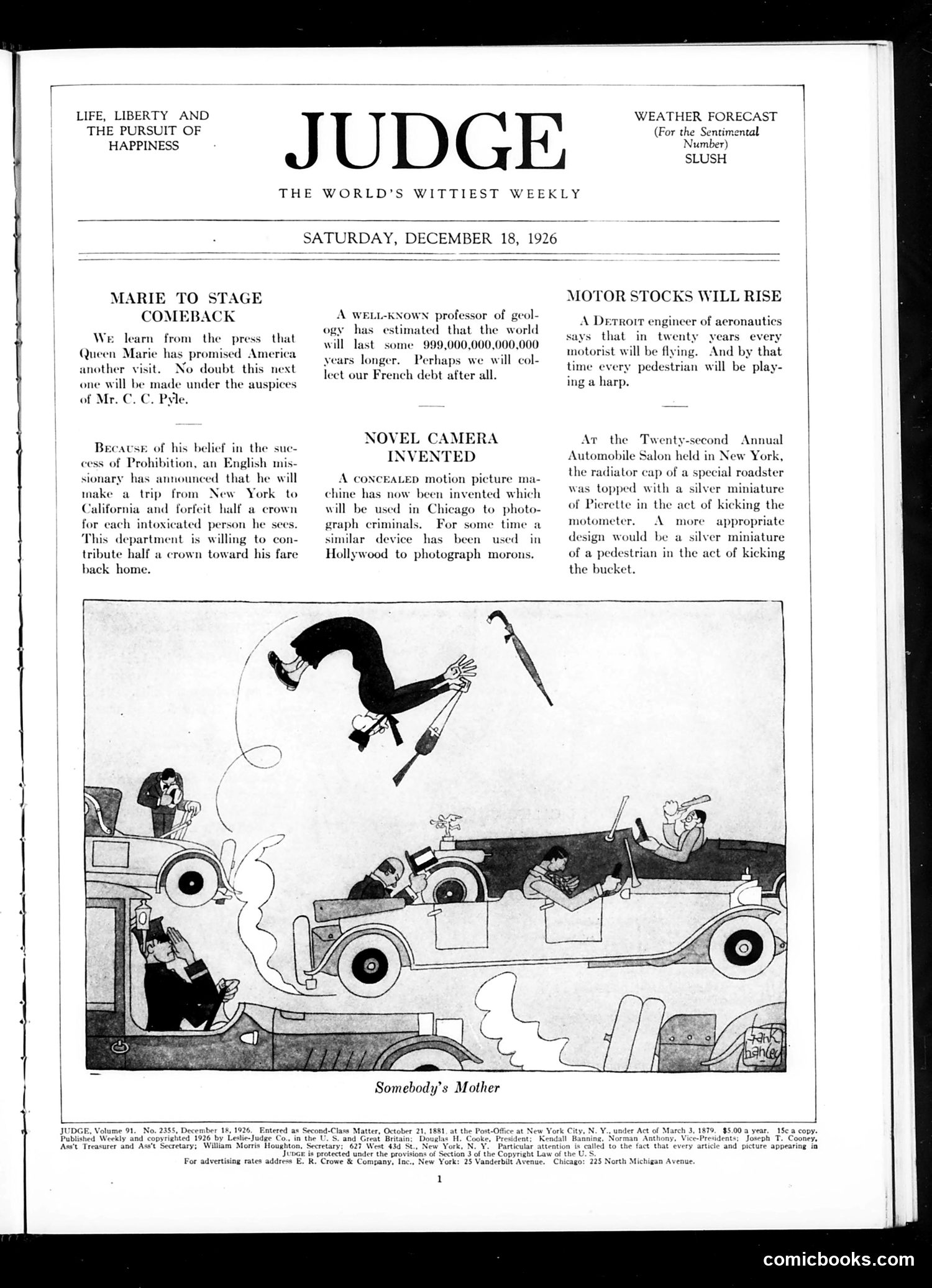
This cartoon satirizes dangerous driving practices of the 1920s. The illustration shows multiple automobiles in chaotic collision, with a figure flying through the air—likely depicting a pedestrian or another driver caught in the mayhem. The title "Somebody's Mother" suggests the victim is an elderly woman, emphasizing the human cost of reckless motorism. The cartoon critiques how motorists endangered vulnerable pedestrians, particularly the elderly, during an era when automobiles were rapidly proliferating but traffic safety remained largely unregulated. The surrounding text discusses motor stocks rising and aeronautics, contextualizing society's embrace of new technology. The cartoon serves as social commentary on the disconnect between technological enthusiasm and public safety concerns in the 1920s.
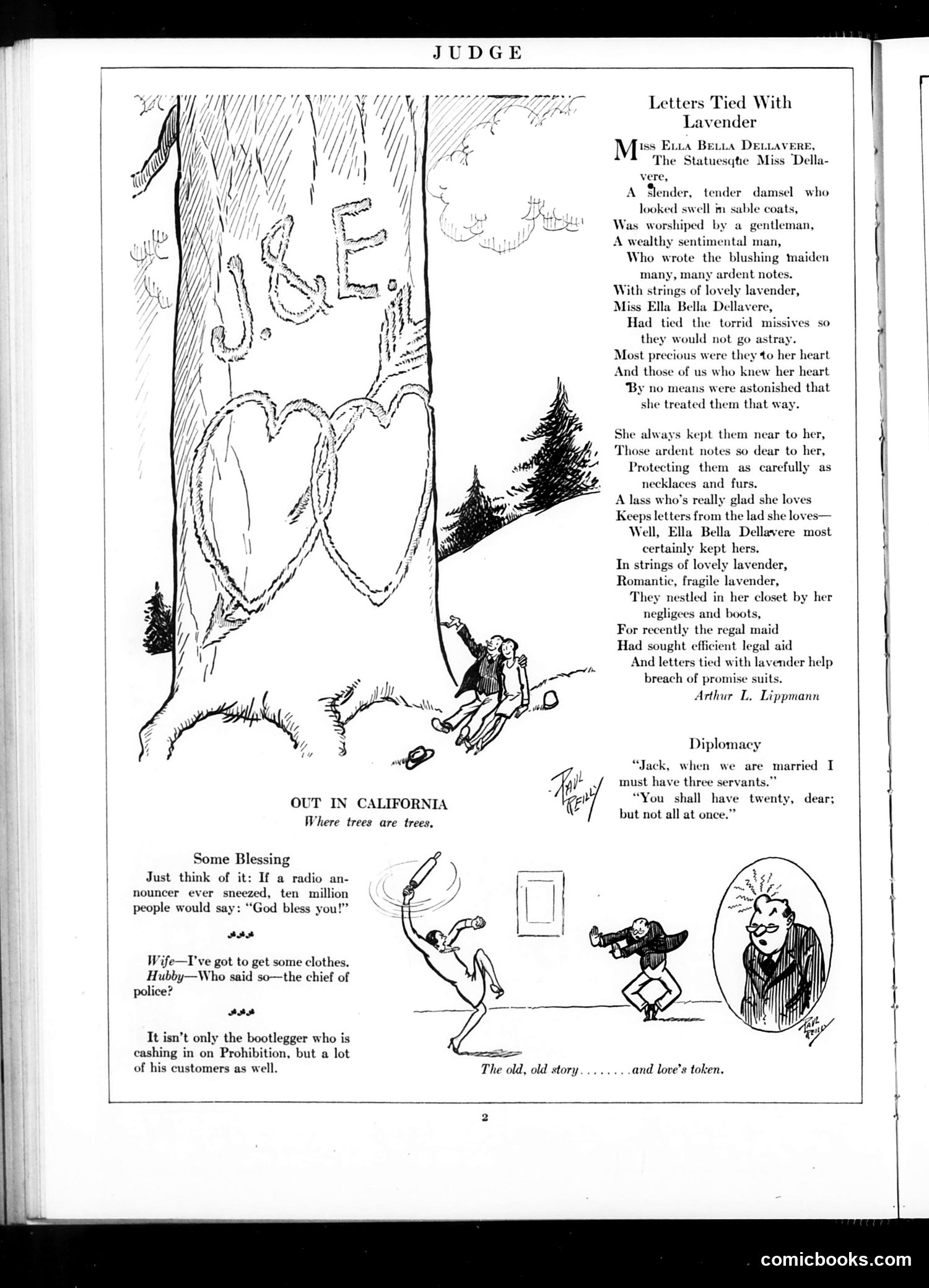
This page contains several unrelated humor pieces rather than a unified political cartoon: **"Letters Tied With Lavender"** is a sentimental poem by Arthur L. Lippmann about Miss Ella Bella Dellavere, a woman who preserves love letters from a gentleman admirer. The poem celebrates romantic sentiment and female virtue—typical of early 20th-century Judge content. **"Out in California"** is a brief nature joke about California's famous giant trees. **"Some Blessing"** and the marriage dialogue ("Diplomacy") are short, gentle domestic humor pieces common to the era—one about radio announcers, another about marital negotiations over servants. The bottom illustration shows a couple dancing with an elderly observer, captioned "The old, old story...and love's token," reinforcing the romantic theme. These pieces reflect Judge's mix of sentimental and comedic content aimed at middle-class readers.
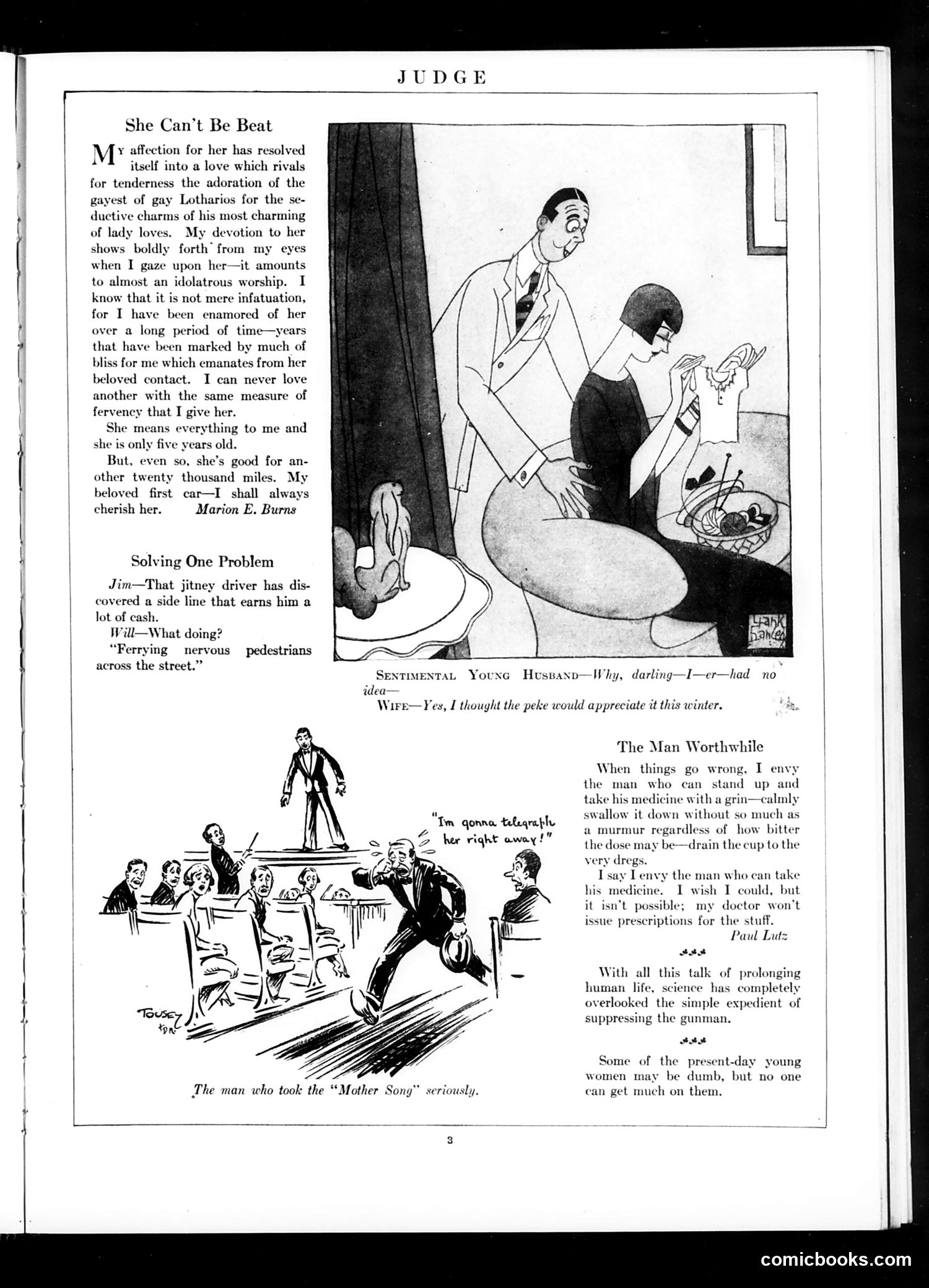
This page contains three distinct humor pieces from Judge magazine: 1. **"She Can't Be Beat"**: A sentimental piece where a man expresses devotion to a woman, credited to Marion E. Burns. The accompanying illustration shows a couple in an intimate domestic scene. 2. **"Solving One Problem"**: A brief joke about a jitney (shared taxi) driver who discovers a profitable side business ferrying nervous pedestrians across streets—satirizing both early automobile culture and urban hazards. 3. **"The Man Worthwhile"**: A philosophical piece by Paul Lutz about envying men who can take medicine stoically, contrasting with complaints about modern life extension and noting present-day young women's resilience. The lower cartoon depicts a man conducting an orchestra, captioned about taking the "Mother Song" seriously—likely satirizing overly earnest artistic interpretation.
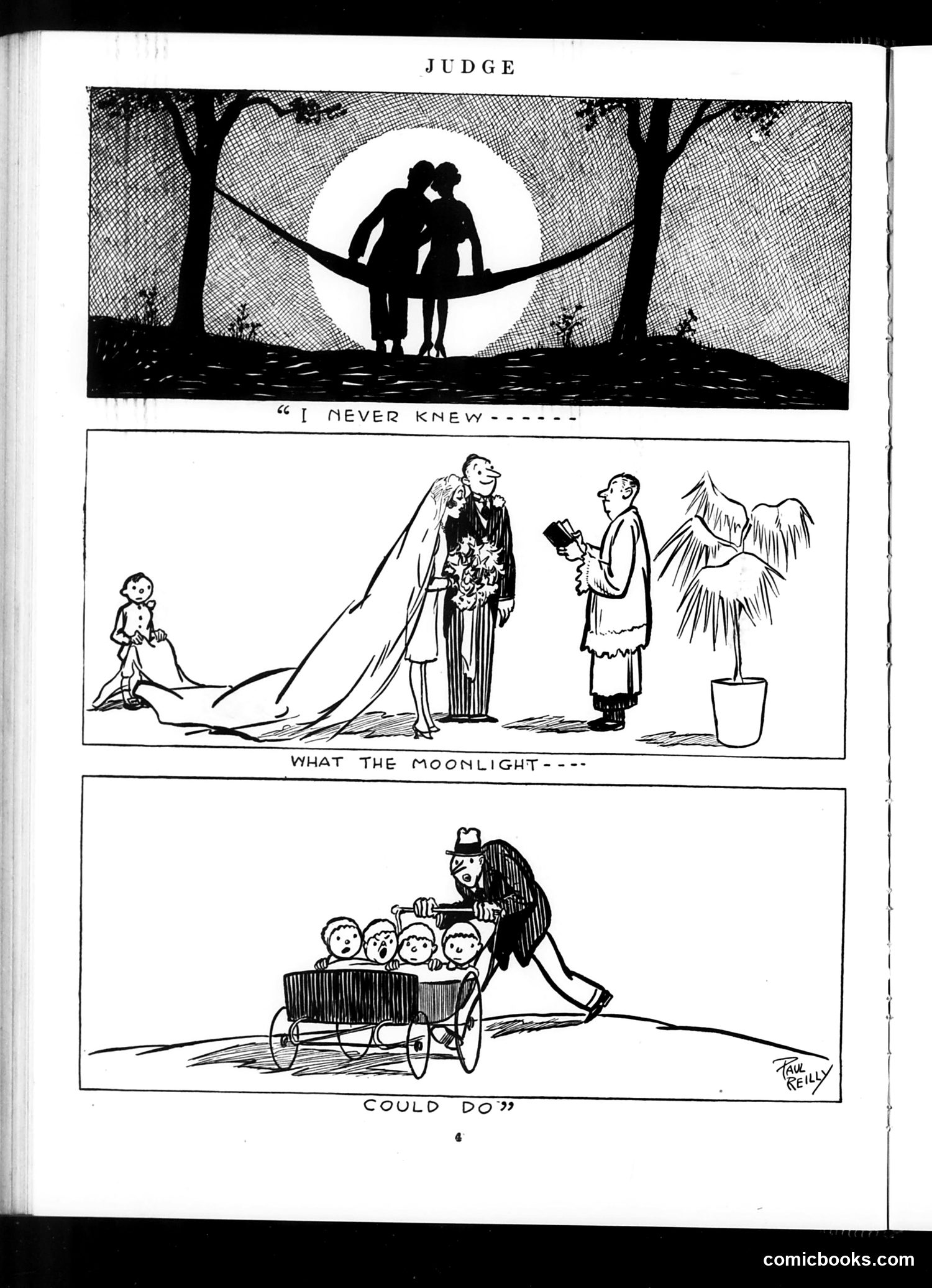
This three-panel satirical cartoon titled "I Never Knew—What the Moonlight—Could Do" critiques the disconnect between romantic idealization and harsh social reality. The top panel shows a silhouetted couple embracing under moonlight—the romantic ideal. The middle panel depicts a wedding ceremony with bride, groom, clergy, and potted plant, representing the "moonlight" promise. The final panel reveals the reality: a man pulling a baby carriage loaded with multiple children, suggesting the cartoon warns against naïve romanticism about marriage and family life. The satire targets sentimental notions of romance that ignore practical consequences—overpopulation, financial burden, and lost freedom. This reflects early-to-mid 20th century anxieties about birth rates and domestic responsibility, presented with dark humor typical of Judge magazine's social commentary.
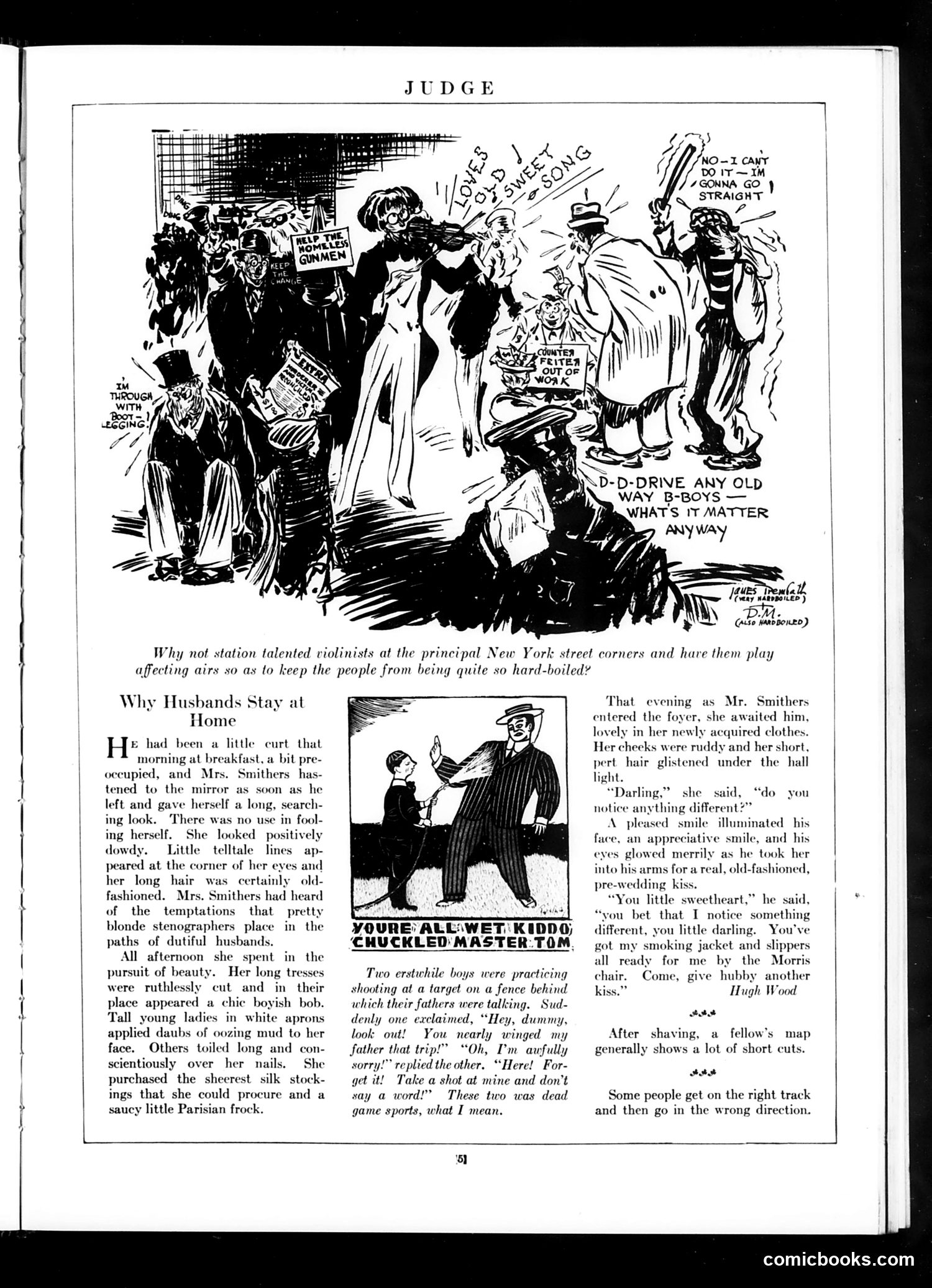
**Top Cartoon:** Satirizes New York City street noise and congestion. The sketch proposes ironically that "talented violinists" should be stationed at busy intersections playing "affecting airs" to calm irritable pedestrians—a sarcastic critique of the city's chaotic conditions and heated tempers during rush hour. **"Why Husbands Stay at Home" Story:** This satirical domestic narrative mocks women's vanity and spending habits. Mrs. Smithers obsesses over appearance, purchases expensive stockings and a "saucy little Parisian frock," and employs beauty treatments. The story suggests husbands prefer staying home to witnessing their wives' frivolous consumption and constant primping—a common period trope lampooning female materialism and vanity as reasons for marital discord.
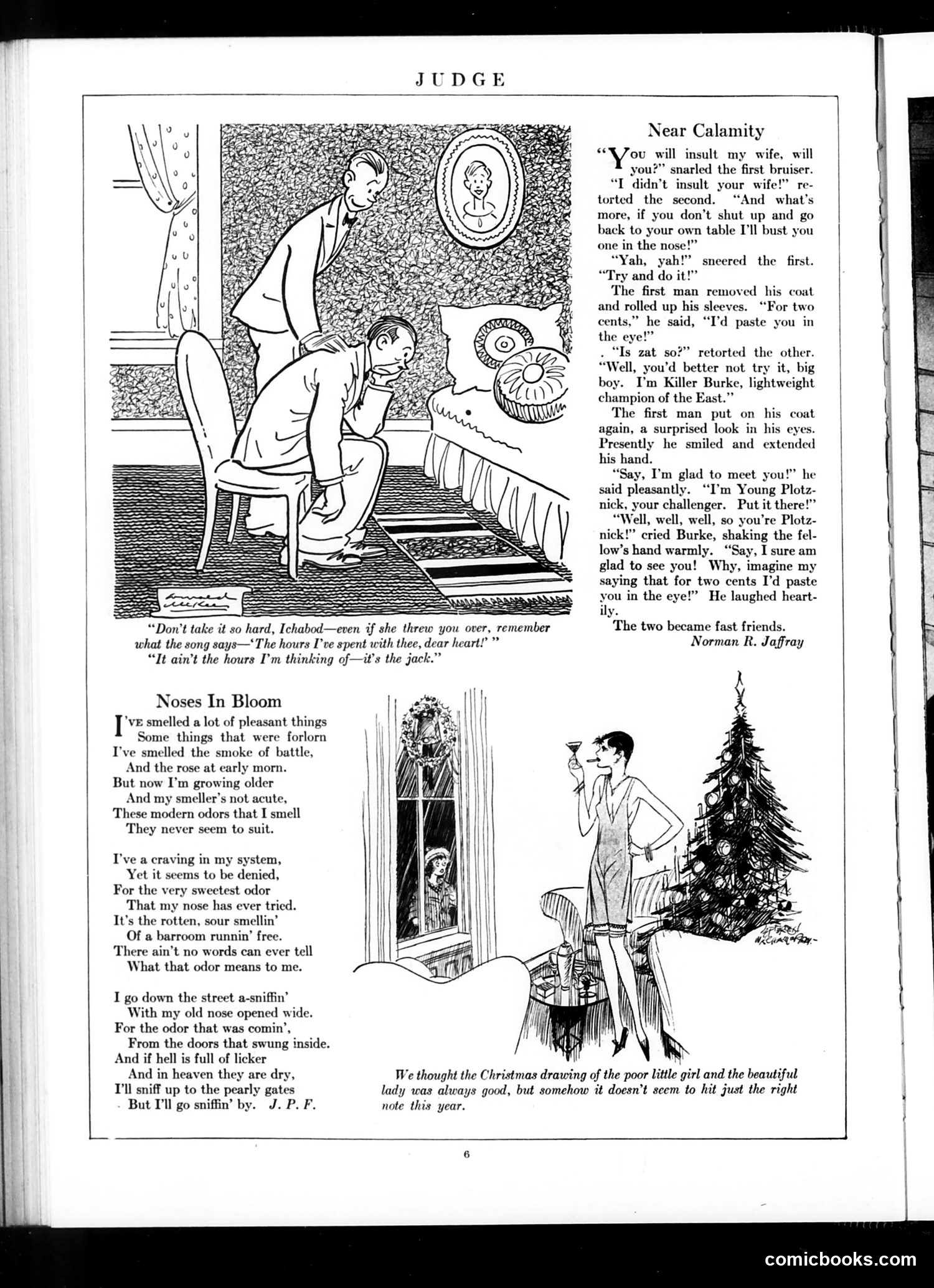
This page contains two distinct pieces of humor: **"Near Calamity"** is a comic narrative about two men nearly fighting in what appears to be a restaurant or bar. One insults the other's wife, escalating toward violence—until the aggressor claims to be "Killer Burke, lightweight champion of the East." The first man, revealed as "Young Plotznik," is Burke's challenger, and they immediately become friendly rivals, laughing off their near-brawl. The satire mocks the performative masculinity and ego of professional boxers: their sudden shift from hostile strangers to cordial friends once professional status is established, and the absurdity that celebrity status alone defuses genuine conflict. **"Noses In Bloom"** is a nostalgic poem by J.P.F. lamenting the loss of old saloon smells—specifically the "rotten, sour smellin' / Of a barroom runnin' free." The speaker yearns for pre-Prohibition barroom odors, suggesting this was written during or shortly after Prohibition (1920-1933), when such establishments were illegal. The humor lies in romanticizing what most would consider unpleasant smells.
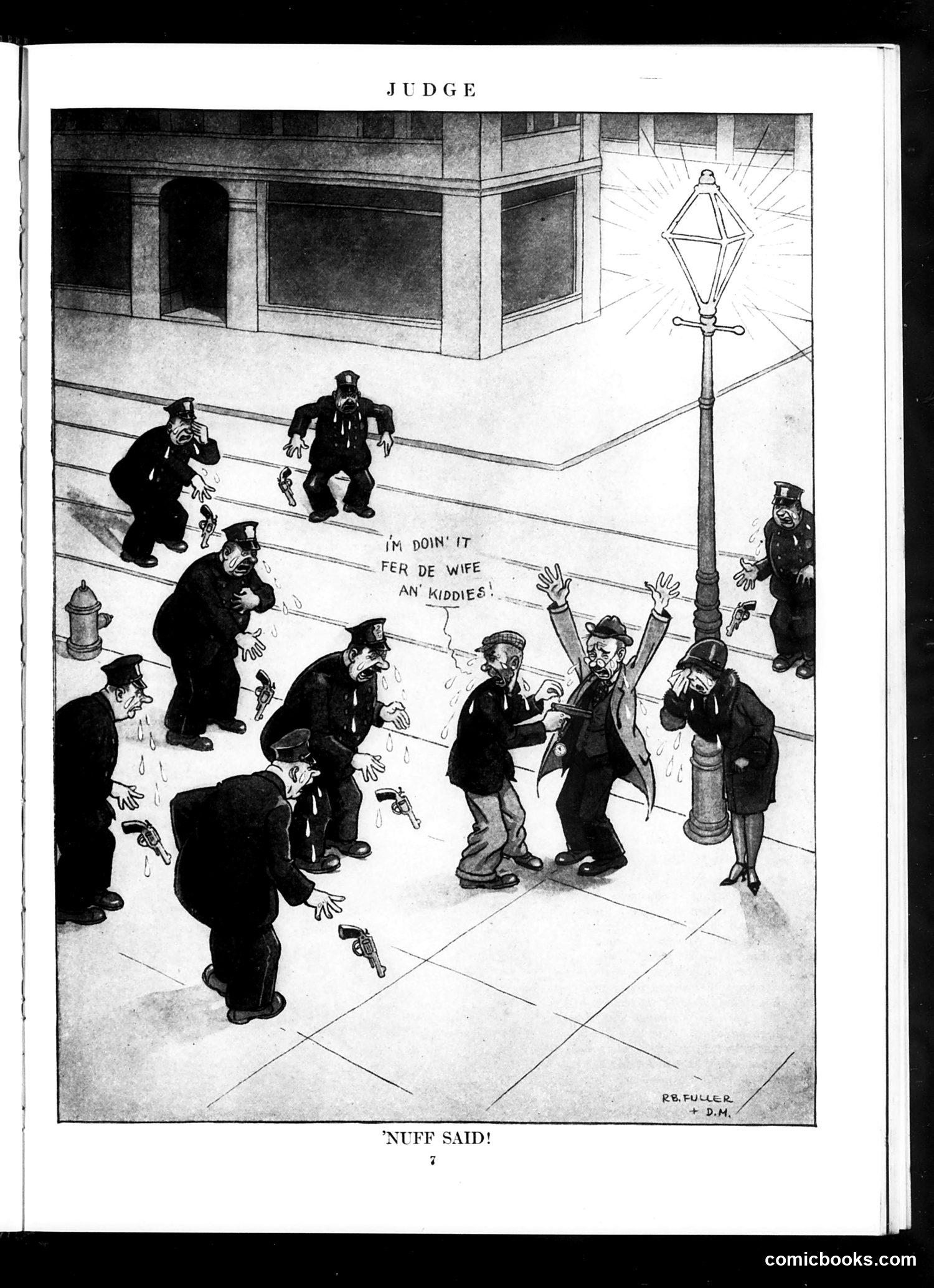
This single-panel cartoon satirizes police corruption, specifically regarding payoffs to officers. The scene shows multiple policemen on a city street, with one figure in the center displaying money and declaring "I'm doin' it fer de wife an' kiddies!"—suggesting he's justifying bribery or graft as necessary family support. The title "'NUFF SAID!" indicates the joke requires no explanation: contemporary readers would immediately understand the reference to endemic police corruption of the era. The cartoon mocks how officers rationalized accepting bribes by framing it as dutiful provision for their families. This reflects early 20th-century concerns about urban police forces rife with corruption—a common theme in American satirical magazines like Judge. The exaggerated ethnic dialect and caricatured appearance emphasize the working-class officer accepting illicit money.
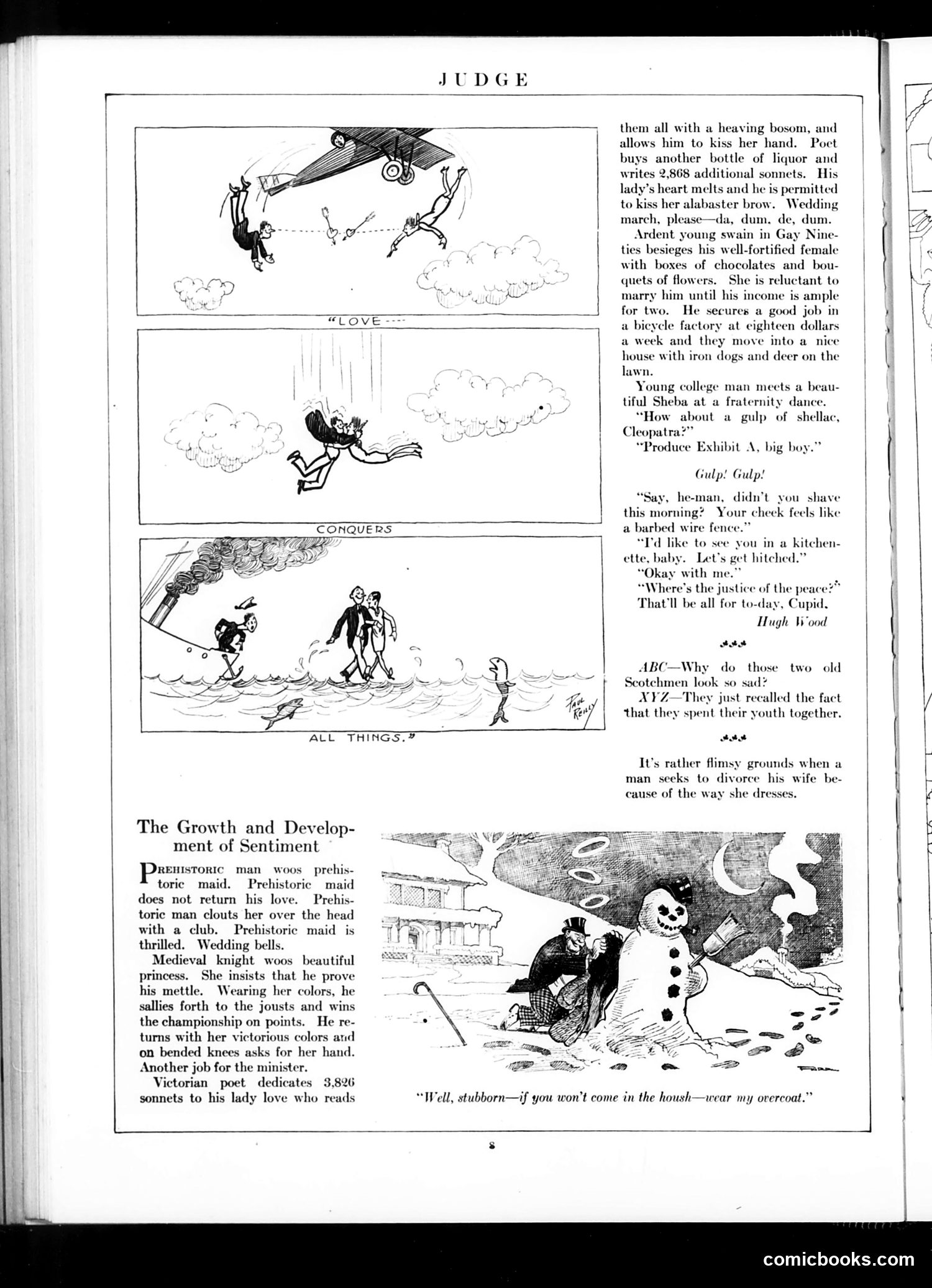
This page satirizes the "evolution" of courtship across historical eras. The main article, "The Growth and Development of Sentiment," traces romantic pursuit from prehistoric times to the "Gay Nineties" (1890s). The progression mocks changing social conventions: prehistoric man uses brute force (clubbing); medieval knights prove worth through chivalric deeds; Victorian poets deploy endless sonnets; Gay Nineties suitors offer chocolates and secure stable employment; modern college men use crude slang ("shellac"—likely slang for alcohol during Prohibition era) and demand quick marriage. The satire suggests that despite civilization's veneer of "development," courtship remains fundamentally transactional. Modern courtship appears most cynical—the woman demands proof of income, the man uses crude pickup lines, and marriage happens almost as an afterthought. The scattered jokes below mock marital discontent and dated gender relations typical of the era's humor. The snowman cartoon illustrates a husband's domestic exasperation.
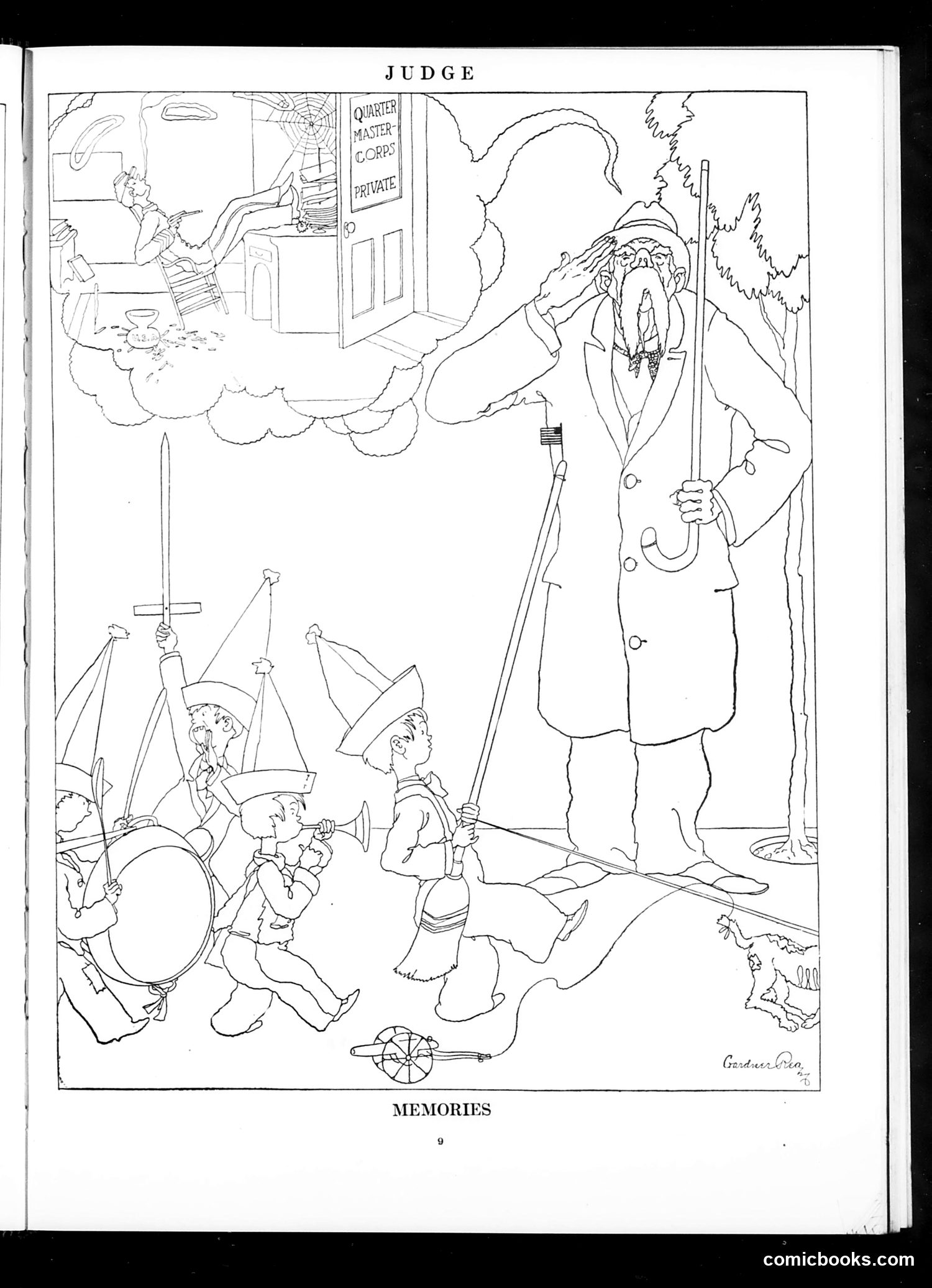
This is a political cartoon titled "Judge" depicting a stern military or government official confronting a group of small soldiers or military personnel. The figure on the right appears to be a commanding officer or judge-like authority, holding what looks like a swagger stick or riding crop, wearing a long coat and hat. The smaller figures below carry drums and flags with crosses, suggesting military or religious symbolism. The cartoon's meaning is unclear without additional context or date information. It may satirize military hierarchy, discipline, or possibly religious/military authority. The title "Memories" suggests nostalgia or historical reflection. Without knowing when this was published or identifying the specific figures, I cannot definitively explain the political reference or satire intended. The crude caricature style typical of Judge magazine suggests social commentary, but the exact target remains ambiguous from the image alone.
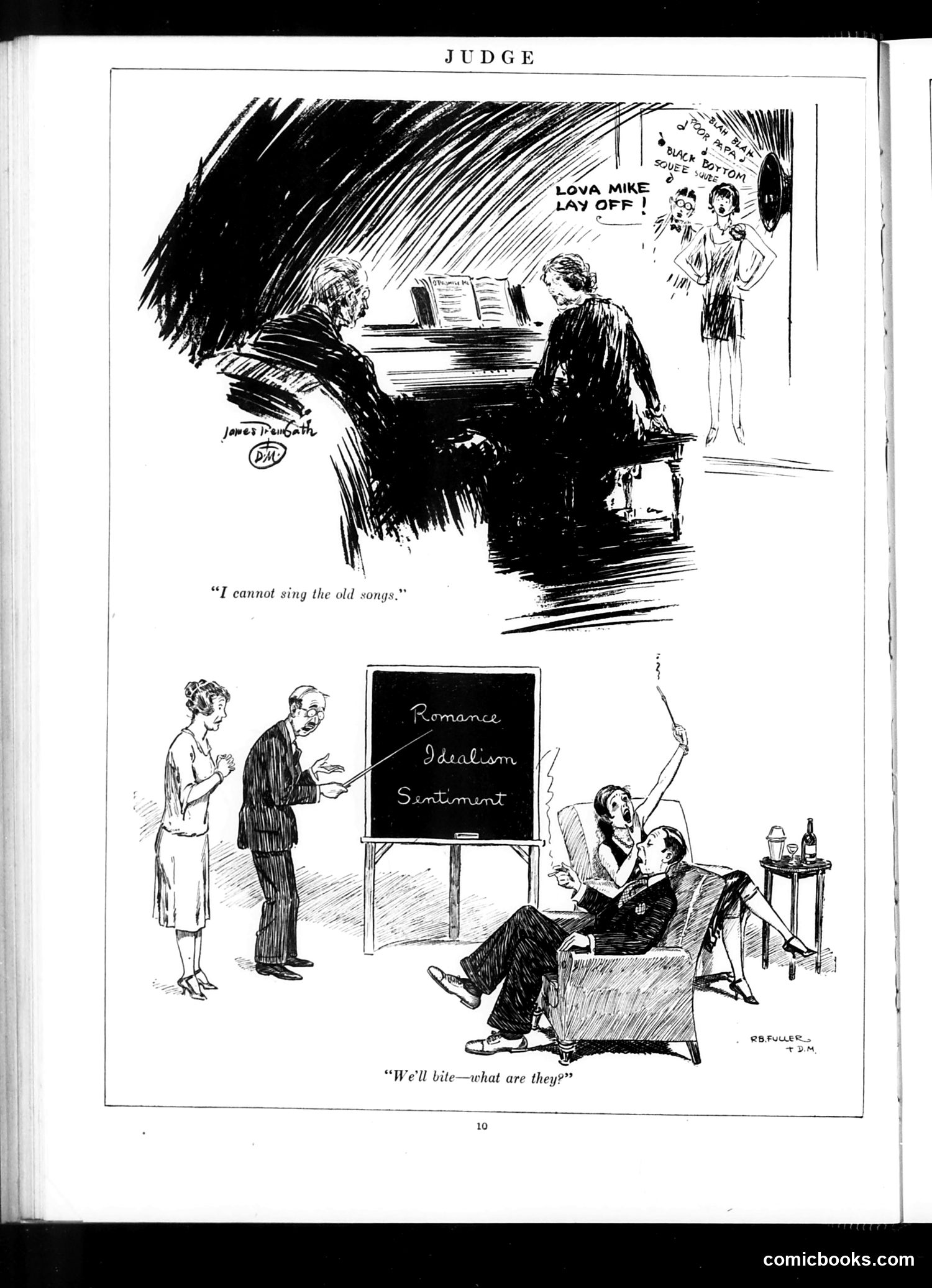
This page contains two satirical cartoons commenting on romantic and social ideals. **Top cartoon:** A piano teacher and student are shown with sheet music while a woman calls out "Lova Mike Lay Off!" The caption reads "I cannot sing the old songs," suggesting generational conflict over romantic traditions—the implication being that modern courtship practices have displaced sentimental Victorian-era love songs. **Bottom cartoon:** Shows a couple on a sofa while another couple discusses them near a blackboard listing "Romance, Idealism, Sentiment." The caption "We'll bite—what are they?" is a humorous commentary on the apparent absence of these qualities in contemporary relationships, satirizing the decline of romantic idealism in modern dating practices. Both cartoons reflect early-20th-century anxiety about how modern attitudes were replacing traditional courtship values and emotional expression.
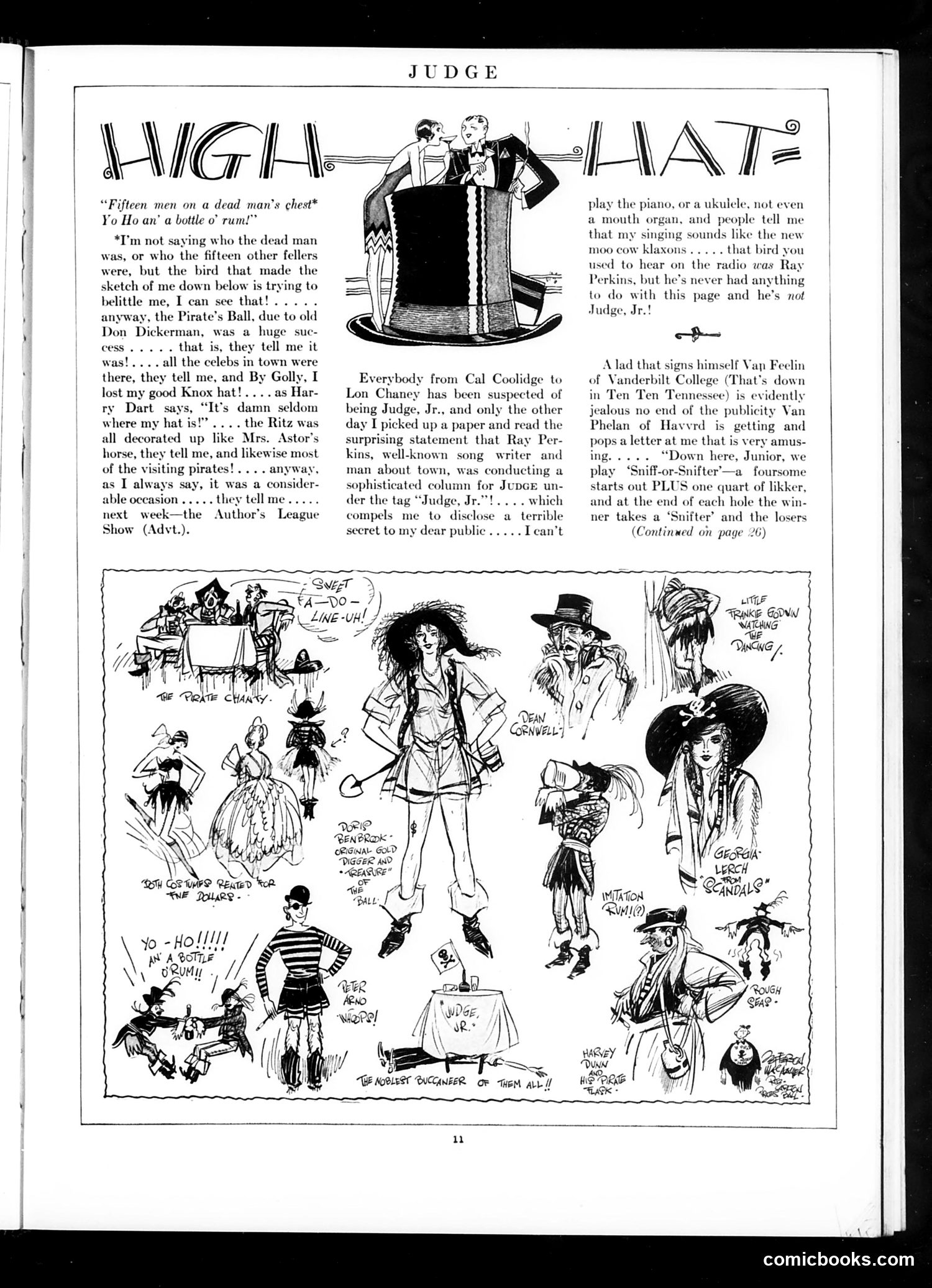
This page spoofs the identity mystery surrounding "Judge, Jr.," a sophisticated gossip columnist. The author humorously denies being Judge Jr., clarifying that Ray Perkins (a real songwriter and man-about-town) writes the column, not him—despite widespread speculation that everyone from Calvin Coolidge to actor Lon Chaney might be behind the pseudonym. The lower section is a costume sketch for the "Pirate's Ball," a high-society event in 1920s New York. It depicts various fashionable attendees in pirate-themed attire with satirical labels like "The Tragedy Chanty" and character names. The satire targets 1920s celebrity gossip culture and the public's obsession with unmasking anonymous columnists. The pirate-ball sketches mock fashionable society's theatrical self-presentation. The Pirate's Ball appears to have been an actual social event, making this both entertainment commentary and society-page coverage typical of Judge magazine's satirical approach.
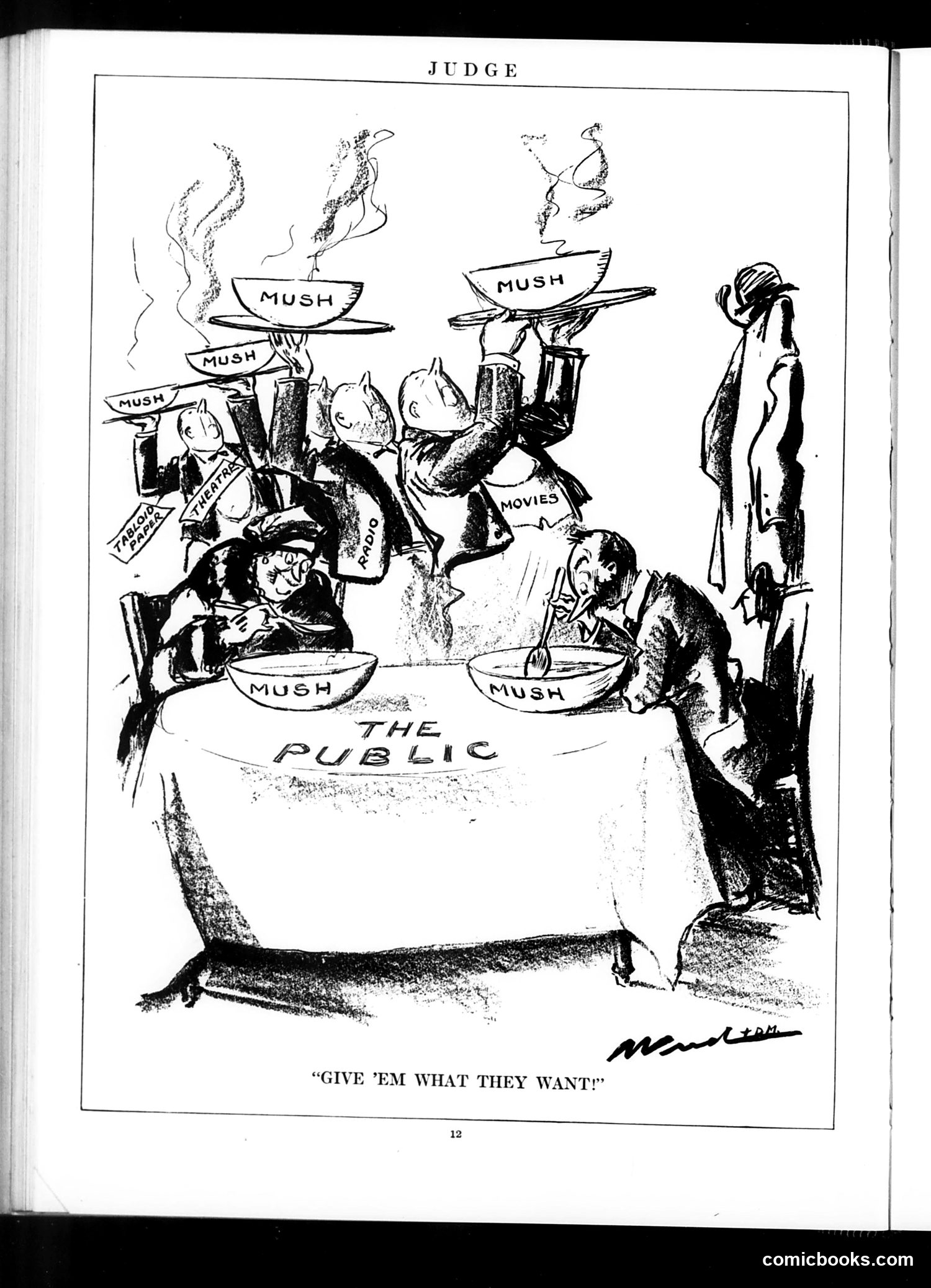
This political cartoon from Judge magazine satirizes how entertainment industries cater to public demand. The central figure labeled "THE PUBLIC" sits at a table being served bowls of "MUSH" by various industry representatives holding serving trays. The figures wear labels including "MOVIES," "VAUDEVILLE," and appear to represent entertainment producers. The satire suggests that entertainment moguls, rather than elevating public taste, simply feed audiences lowest-common-denominator content—literal "mush"—because that's what sells. The caption "GIVE 'EM WHAT THEY WANT" implies cynical profiteering: producers know the public will consume cheap, simplistic entertainment, so they supply it rather than invest in quality. This critiques both the entertainment industry's commercial priorities and implicitly, popular taste itself.
This page contains editorial commentary on two major American scandals/issues of the 1920s: **The Hall-Mills Murder Case**: The lead article criticizes Senator Simpson's calls for "mistrial" in a sensational murder investigation. Judge argues that while the delayed prosecution was poorly handled, resurrecting it as a newspaper sensation for political gain undermines "law and order." The article praises Willie Stevens's dignified courtroom behavior, which embarrassed the aggressive prosecutor—a "triumph of simplicity over sneers." **"Our National Vice"**: The second piece attacks American sentimentality as destructive to society. Judge argues that sentimental exploitation in movies—cloaking sex appeal in false morality rather than honestly addressing it—is symptomatic of a broader national weakness. This sentimentality supposedly enables lynchings, the Ku Klux Klan, divorce, and threatens war. The satirical "Judge" persona (illustrated at top) delivers these critiques with sardonic tone, mocking hypocrisy and emotional manipulation in both law and entertainment.
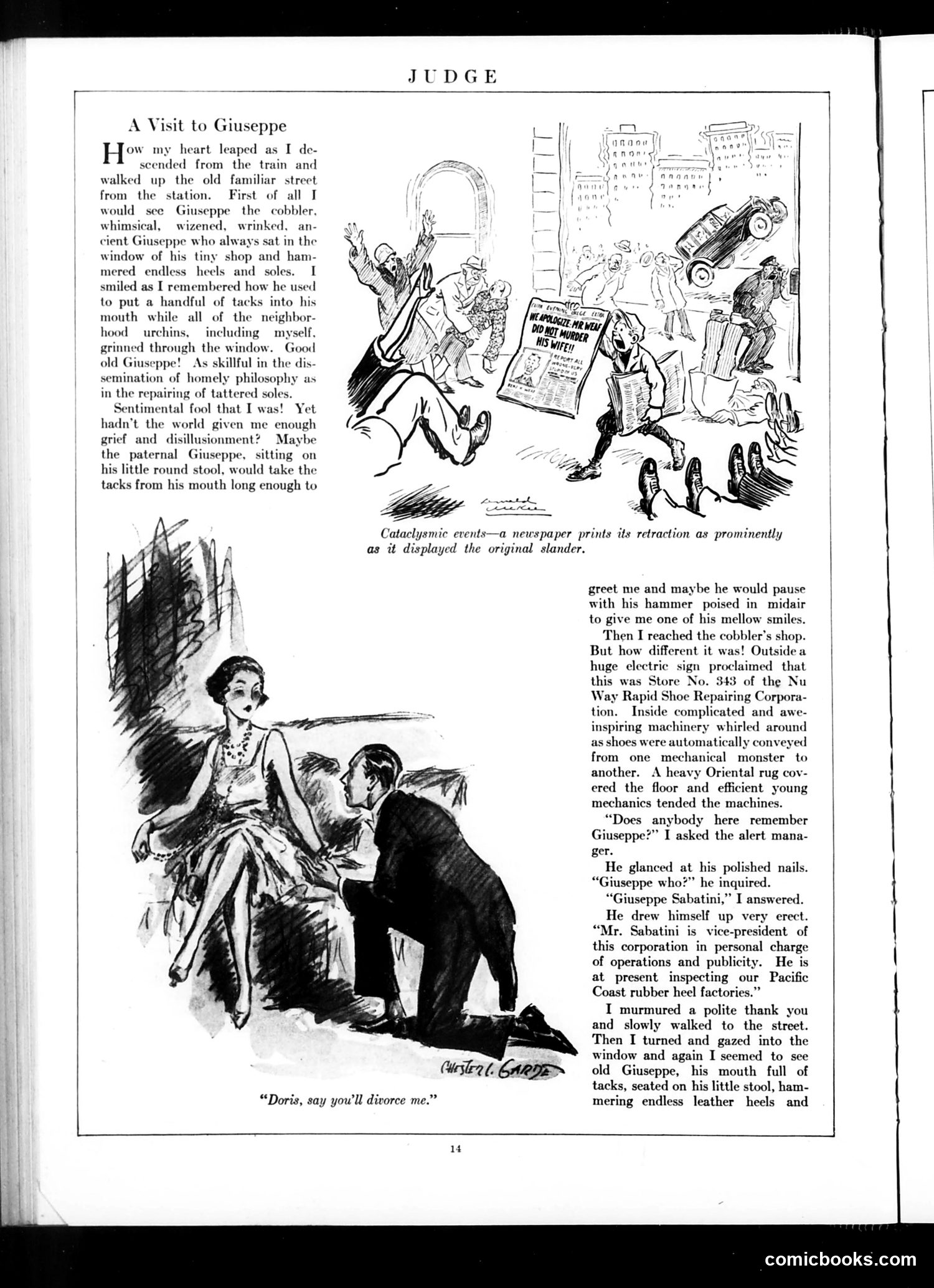
This story satirizes American modernization and the loss of traditional immigrant culture. The narrator visits his old neighborhood expecting to find Giuseppe, a beloved Italian cobbler who embodied old-world craftsmanship and wisdom—famously holding tacks in his mouth while working. Instead, Giuseppe's tiny shop has been replaced by "Nu Way Rapid Shoe Repairing Corporation," a mechanized factory with conveyor belts and efficient young workers. Giuseppe himself has become "Mr. Sabatini," a corporate vice-president disconnected from his humble origins. The satire critiques how rapid industrialization and corporate consolidation erased immigrant artisans and their human-centered trades. The narrator's nostalgia emphasizes what was lost: personal connection, folk wisdom, and craftsmanship replaced by soulless machinery and corporate hierarchy. The cartoon (showing the transformation) underscores this contrast between the old cobbler's intimate shop and the sterile modern operation.
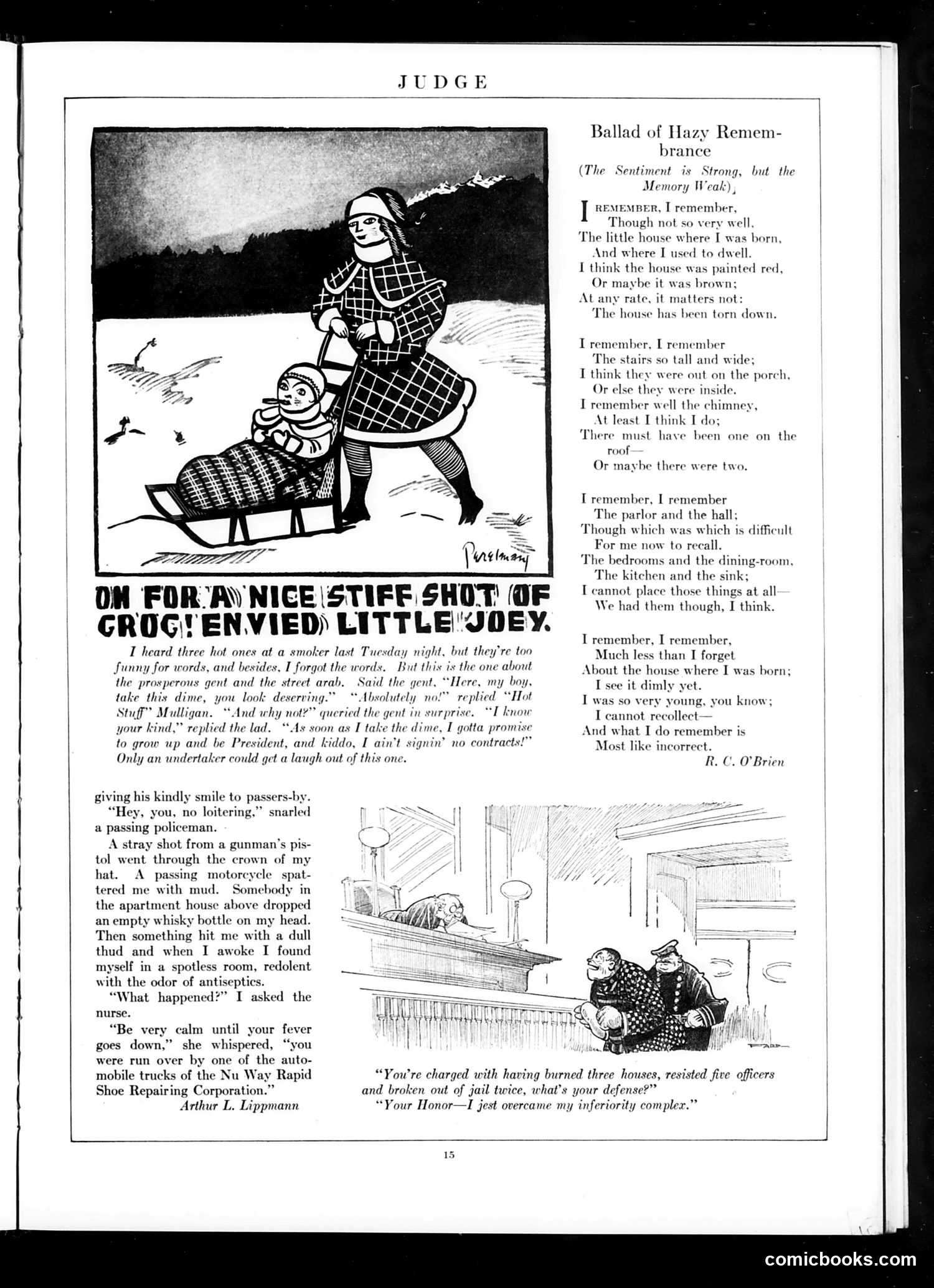
This page contains two distinct satirical pieces: **"Ballad of Hazy Remembrance"** (top): A poem mocking unreliable nostalgia. The speaker claims to remember his childhood home but admits uncertainty about nearly every detail—its color, the stairs' location, how many chimneys existed. The satire targets sentimental reminiscence: the impulse to romanticize the past despite actual memory being vague or false. This was likely commentary on adults' tendency to idealize their origins. **"On for a Nice Stiff Shot of Grog! (Envied) Little Joey"** (bottom): A humorous anecdote about a street urchin ("hot stuff" Mulligan) who refuses a dime from a wealthy man, claiming that accepting it obligates him to "grow up and be President"—satirizing the rags-to-riches American myth. The second story, about a man's unfortunate day ending in a hospital, contains a defense joke about overcoming an "inferiority complex," likely poking fun at emerging psychological terminology of the era.
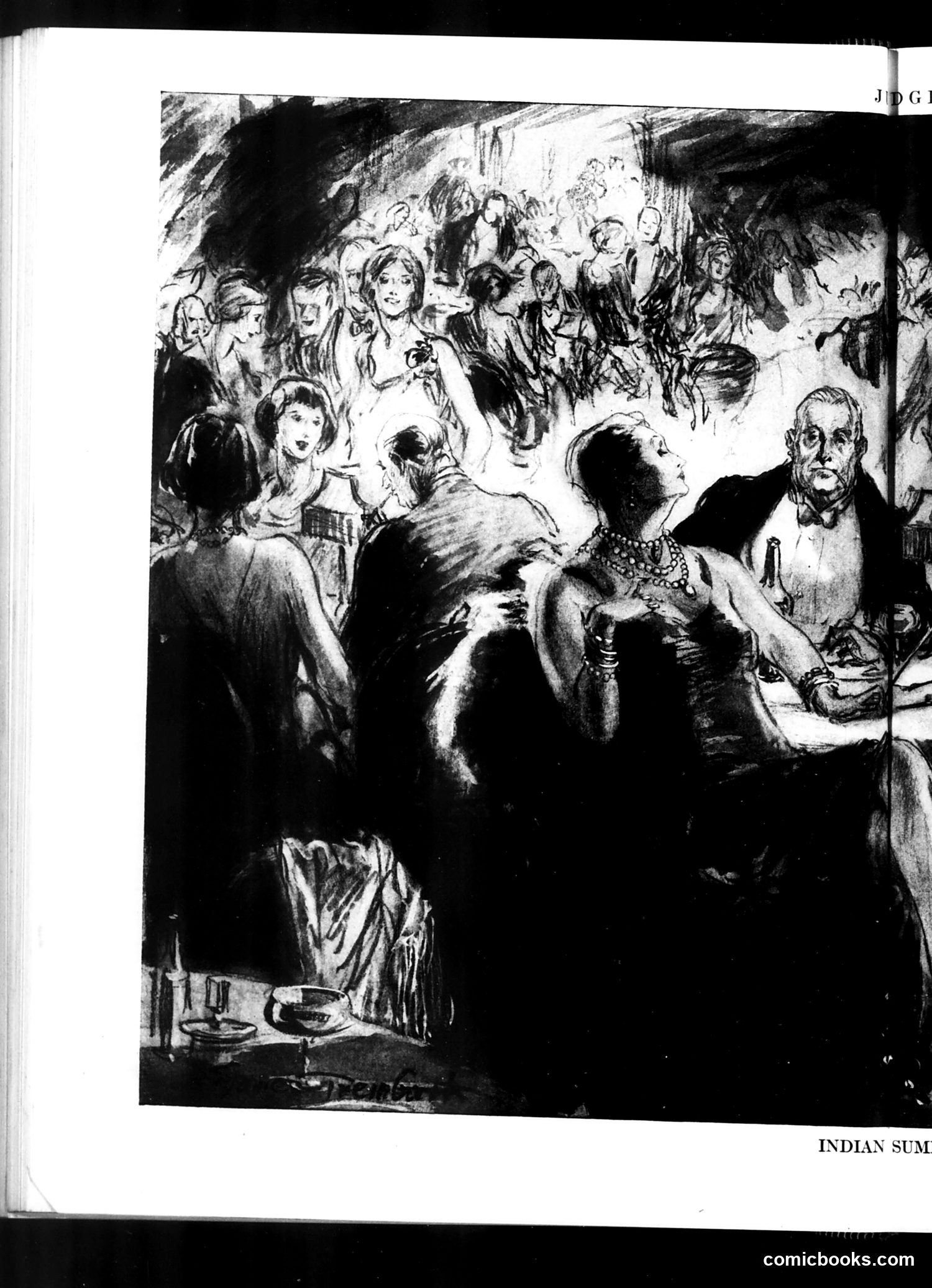
This appears to be a satirical illustration titled "Indian Sum" from *Judge* magazine. The sketch depicts an indoor social gathering—likely a fancy dinner or reception—with numerous well-dressed figures in formal attire. The composition uses dramatic chiaroscuro (strong light and shadow contrasts) typical of editorial illustration. The title "Indian Sum" suggests a pun or wordplay, possibly referencing "Indian summer" (unseasonably warm autumn weather) while depicting a contemporary social scene. Without additional context or visible byline, the specific satirical target remains unclear. The crowd scene and formal setting suggest commentary on high society, though the exact political or social critique the cartoonist intended is not evident from the image alone.
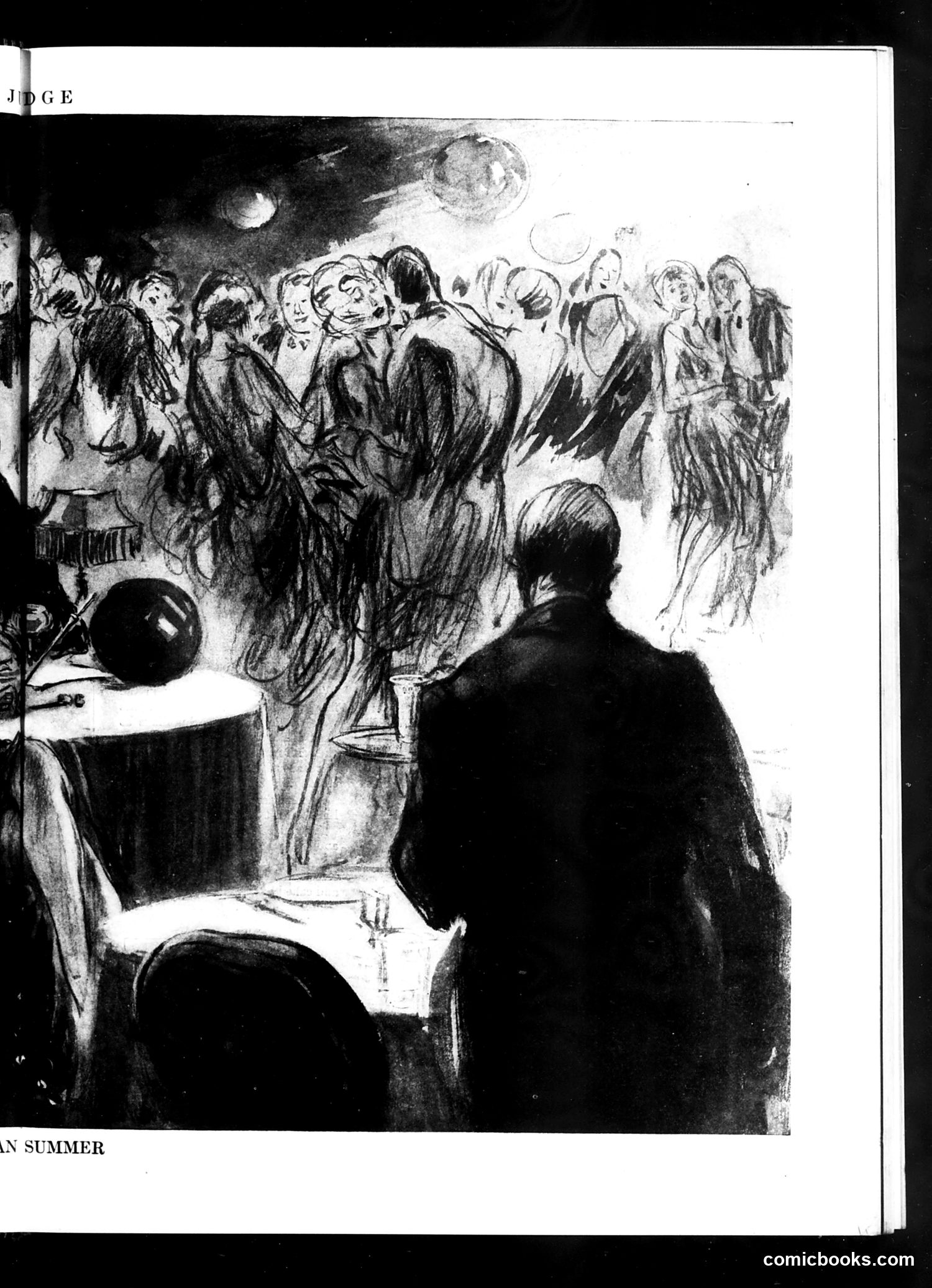
This appears to be a Judge magazine illustration titled "An Summer" (possibly "An Indian Summer" with text cut off). The cartoon depicts a formal social gathering or party, with a well-dressed man in dark clothing viewed from behind observing a crowd of elaborately dressed women and figures in the background. The scene uses heavy shadow and sketchy linework typical of early-to-mid 20th century satirical illustration. Without clearer text or identifying labels visible in the image, I cannot definitively identify the specific political figures or social commentary intended. The cartoon likely satirizes upper-class social conventions or seasonal entertainment, but the exact satirical point remains unclear from the visible portion of this page.
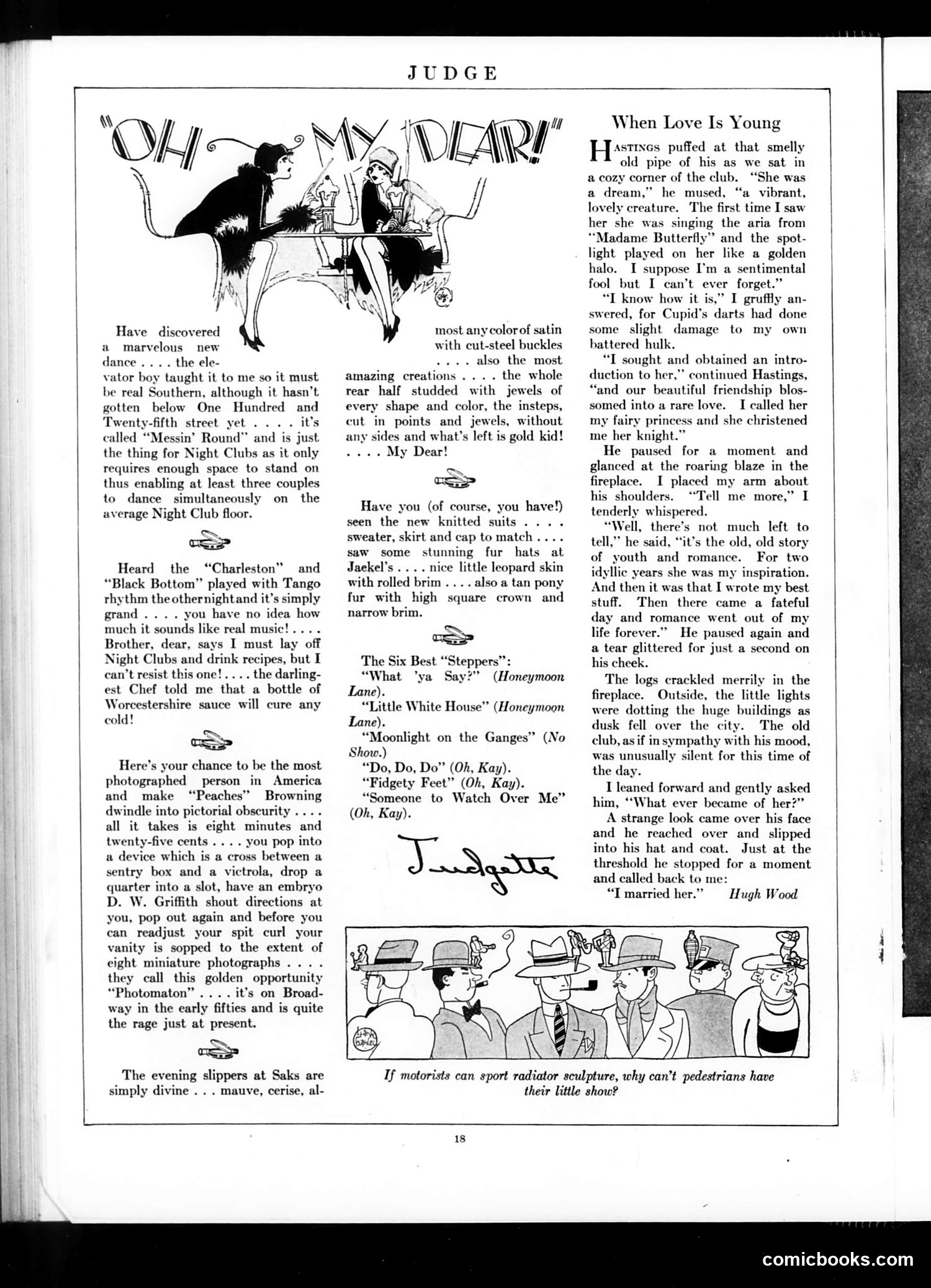
This Judge magazine page (appears to be 1920s) contains social commentary on contemporary fads and fashion, plus a romantic short story. **The Gossip Column** (left side): A society writer breathlessly describes new Jazz Age trends—the "Messin' Round" dance, the Charleston and Black Bottom, the new "Photomaton" (photo booth) on Broadway, and high-fashion evening slippers. The satire targets the obsessive frivolity of wealthy socialites and their breathless adoption of every passing trend, from dances to automatic photography devices to knitted suits. **References**: "Peaches" Browning was a famous 1920s socialite involved in a scandalous marriage; the Charleston and Black Bottom were actual dances of the era; D.W. Griffith was a famous film director. **The Story** (right): "When Love Is Young" is sentimental romantic fiction—two men in a club discussing a lost love, complete with melodramatic pauses and tears. It's likely satirizing overwrought romantic sentiment in popular literature. **The Cartoon** (bottom): Shows various hat styles, with a caption joking that if motorists can decorate cars, why can't pedestrians wear decorated hats—poking fun at fashion excess.
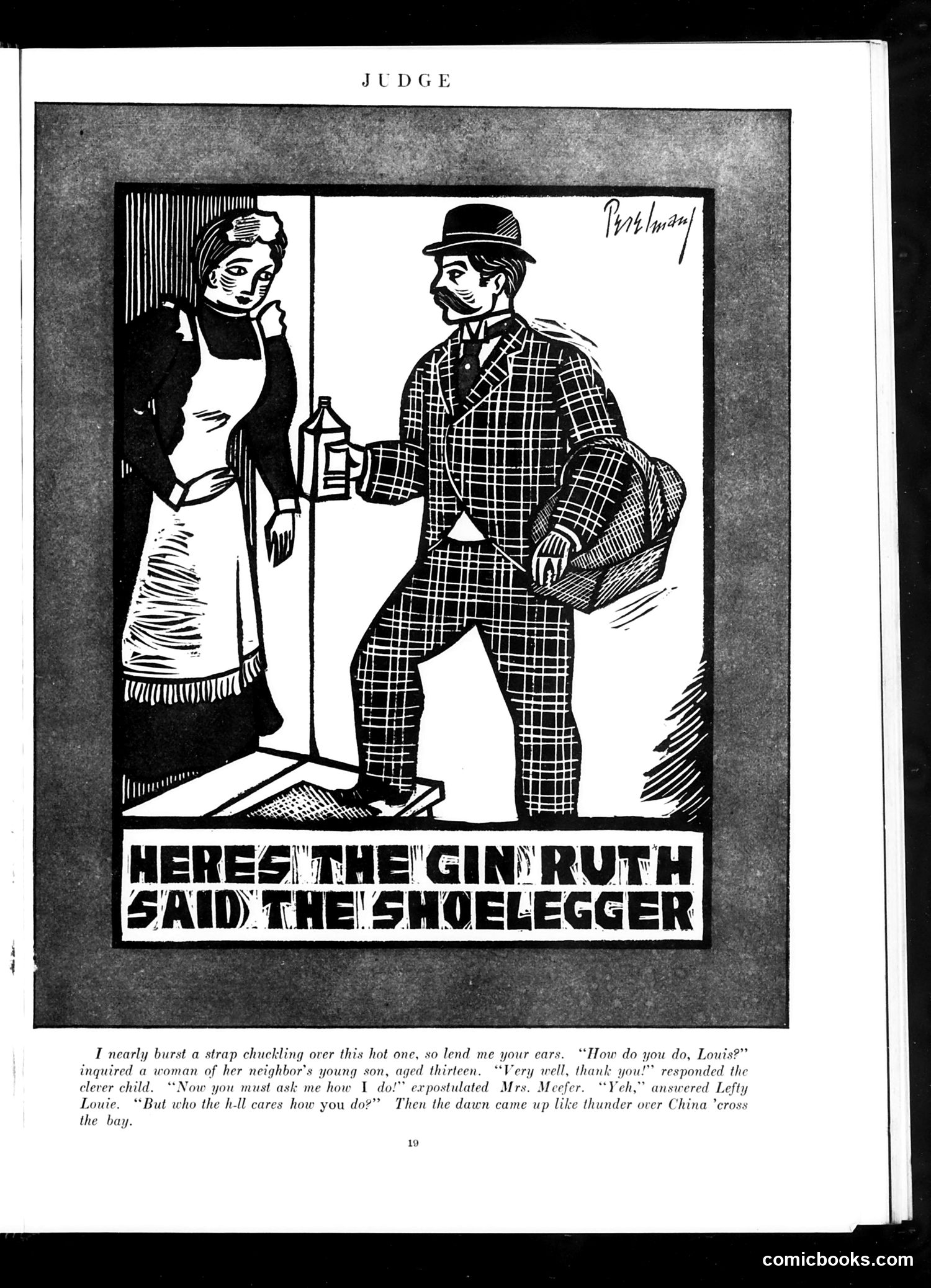
This is a joke cartoon from Judge magazine satirizing Prohibition-era bootleggers. The title "Here's the Gin Ruth Said the Shoelegger" plays on the name Babe Ruth (famous baseball player) while "shoelegger" is slang for a small-time bootlegger (someone who hides liquor in shoe-tops). The cartoon depicts a woman (Mrs. Meefer) opening her door to a man in a checkered suit holding a bottle—a bootlegger making a delivery. The accompanying joke describes a rude thirteen-year-old boy ("Lefty Louie") being corrected for his impudence by an adult. The humor conflates two things: the risqué idea of a woman inviting in a bootlegger, and a child's crude rejection of adult social courtesy. The final line ("Then the dawn came up like thunder over China cross the bay") is a literary reference, suggesting this is satirical mockery of both Prohibition-era vice and generational rudeness.
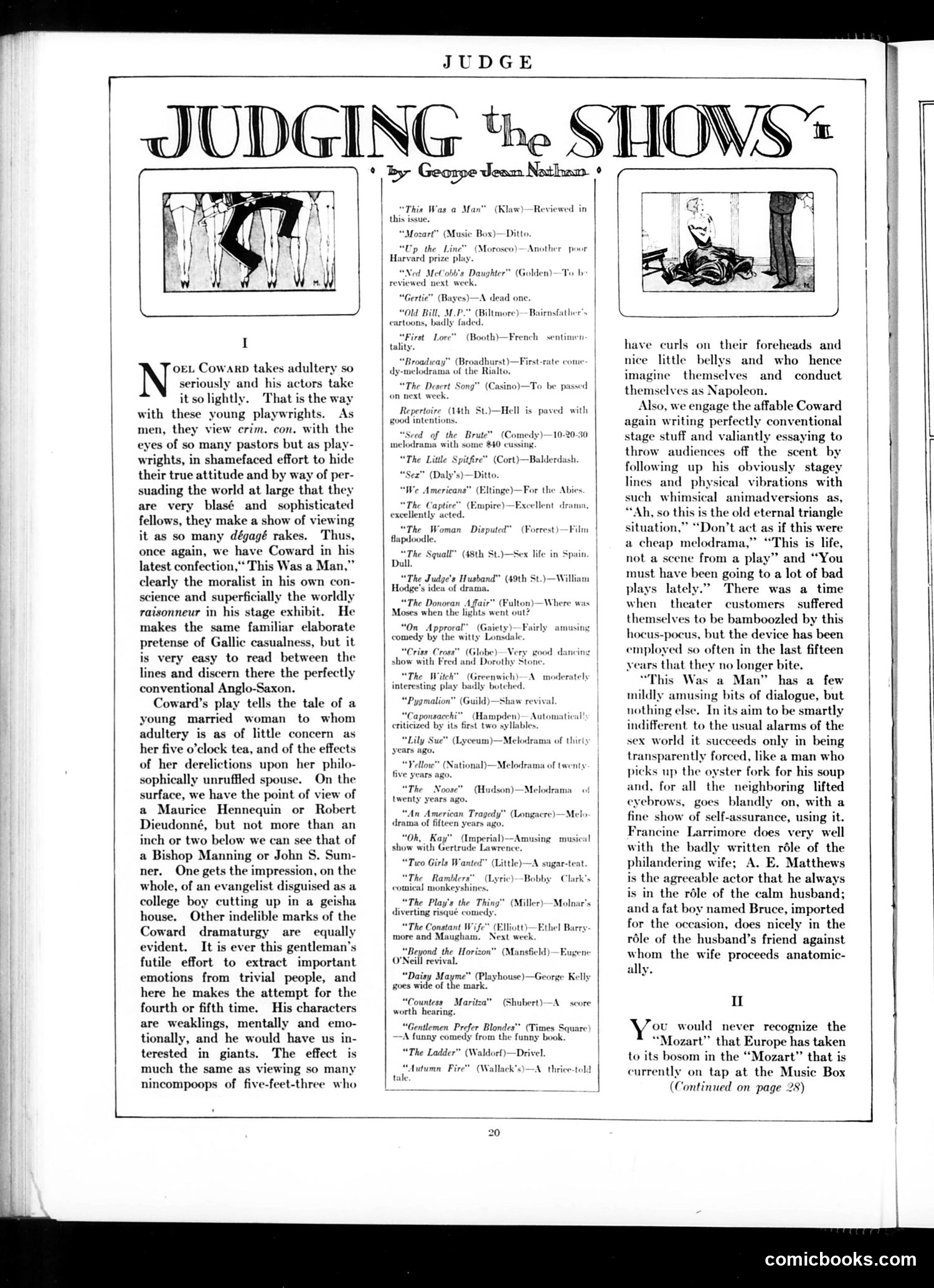
This page presents George Jean Nathan's theatre reviews, with particular focus on Noel Coward's play "This Was a Man." Nathan argues that Coward, though presenting himself as a sophisticated, morally indifferent dramatist (adopting Continental casualness about adultery), actually reveals conventional Anglo-Saxon values beneath the surface—comparing him to Bishop Manning and other moral authorities. The satire targets young playwrights generally: they adopt a blasé, "worldly" persona to seem avant-garde while remaining fundamentally conservative. Nathan criticizes Coward's recurring attempt to extract profound emotions from trivial characters, likening the effect to watching "nincompoops of five-feet-three" pretending to be giants. The page is primarily a theatrical column listing contemporary Broadway shows with brief critical assessments, though the Coward critique dominates.
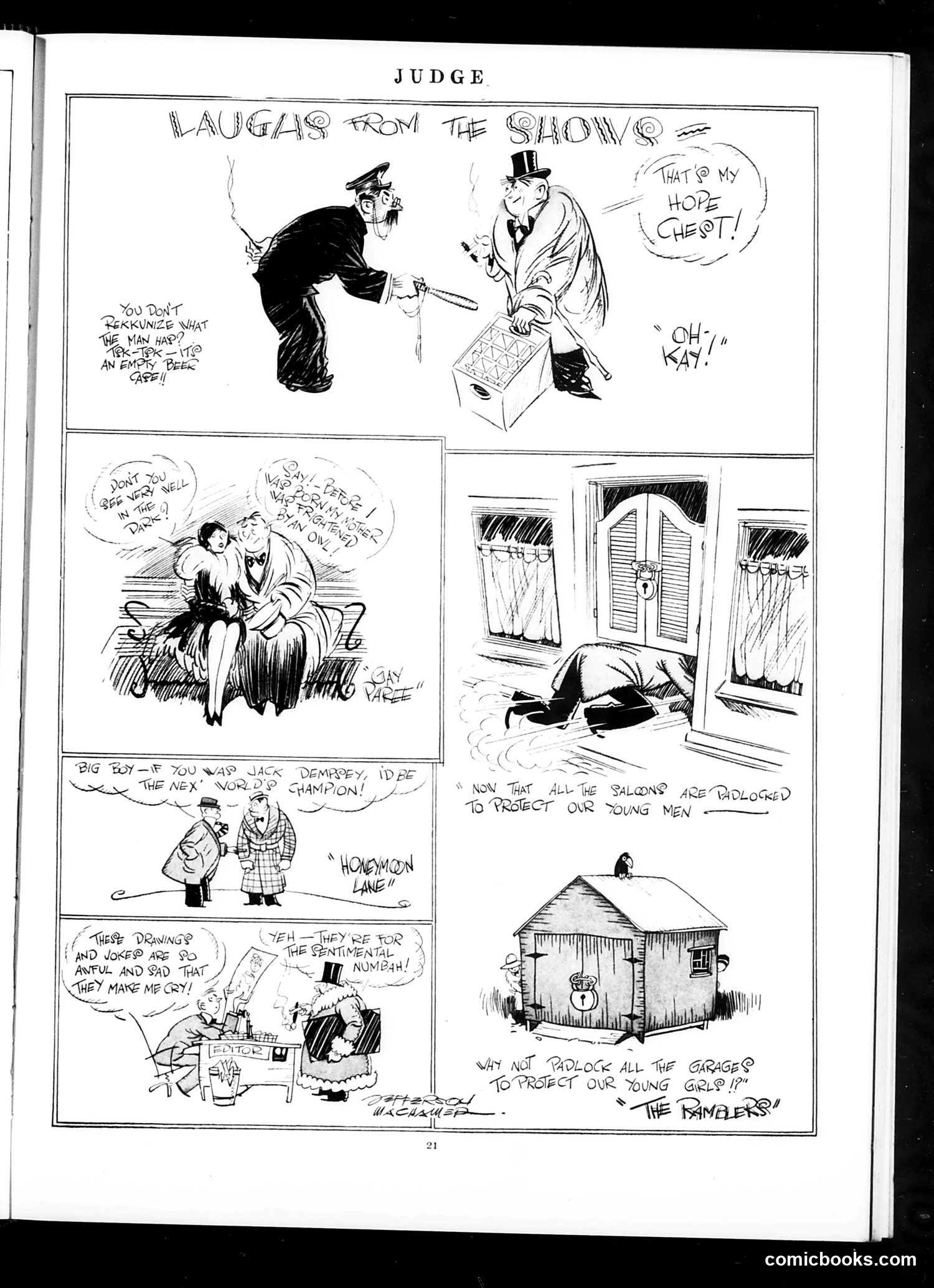
This page presents comic sketches satirizing early 20th-century American social concerns. The top panel mocks a magician's act with hollow patriotic rhetoric. The middle sections reference **Jack Dempsey**, the famous heavyweight boxer and world champion, appearing in what seems to be vaudeville or theatrical promotion—suggesting celebrity culture's superficiality. The central narrative concerns **young men's safety and protection**, with dialogue about "saloons" being "padlocked" and garages needing locks. This likely references **Prohibition-era concerns** about vice and the protection of youth from drinking establishments. The bottom panels show adults expressing sentimental nostalgia while ironically failing to protect young people through practical measures (like locking garages), suggesting hypocrisy: Americans wax poetic about safeguarding youth while neglecting concrete protective action. The satire critiques gap between rhetorical concern and actual vigilance during a period of significant social reform efforts.
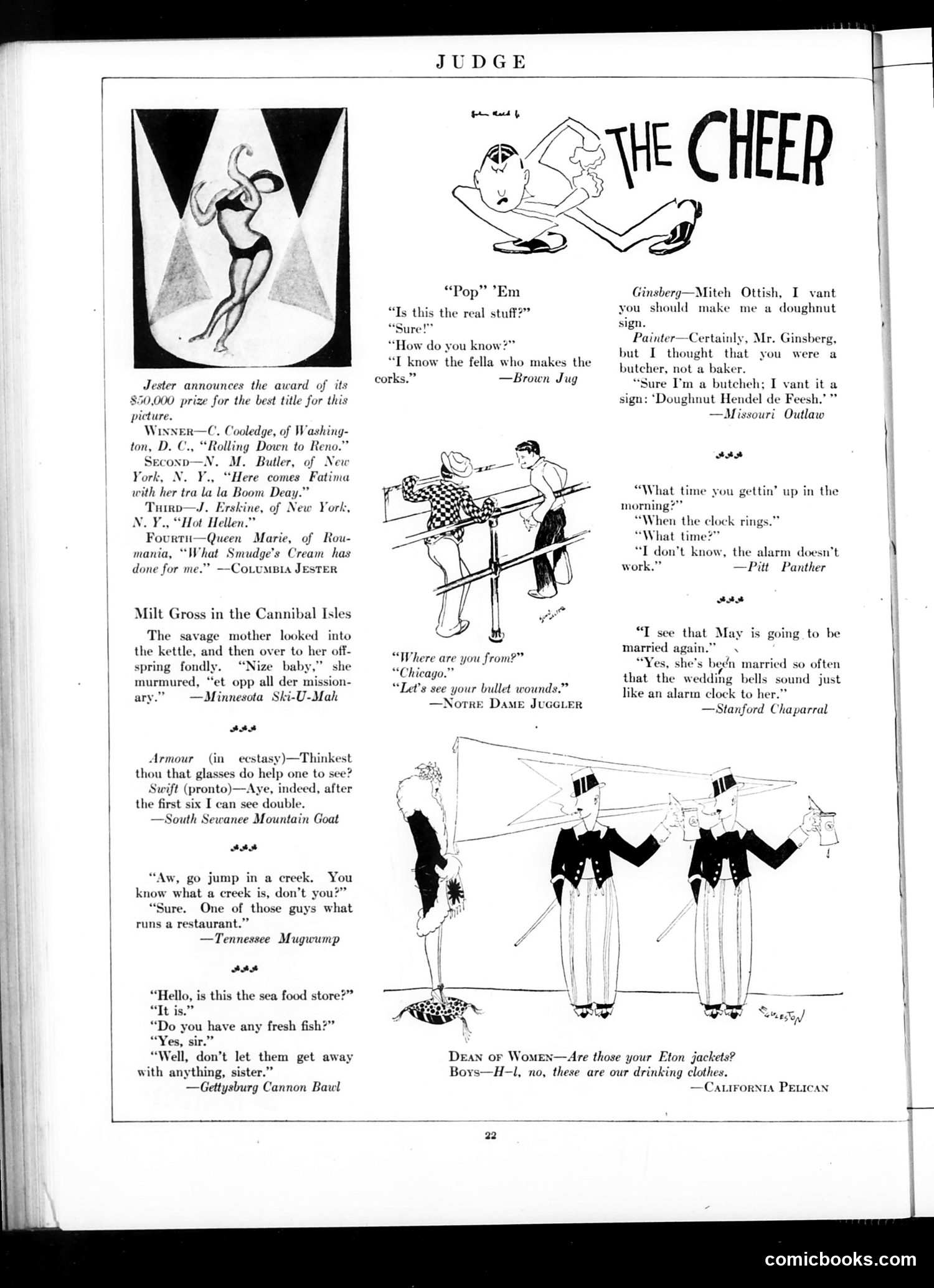
This page from *Judge* contains multiple brief humorous sketches and jokes typical of 1920s American satirical magazines. The main content includes: **"The Cheer"** section features short quips and cartoons poking fun at various targets: immigrants (Ginsberg and Miteh Ottish discussing a doughnut sign in Yiddish-inflected English), marriage (May's repeated weddings making wedding bells sound like alarm clocks), and college life (boys claiming their formal "drinking clothes" are Eton jackets). **Other sketches** mock regional dialects, prohibition-era alcohol humor, and period-specific references like "Reno" (divorce destination) and "Fatima" (likely a belly-dancer reference). The page's humor relies heavily on ethnic stereotypes, slapstick, and wordplay. A contest announces winners for captioning an illustration about "Rolling Down to Reno," indicating audience participation in the magazine's comedic content. The overall tone reflects 1920s American popular culture: irreverent, ethnically coded, and focused on domestic situations and social pretension.
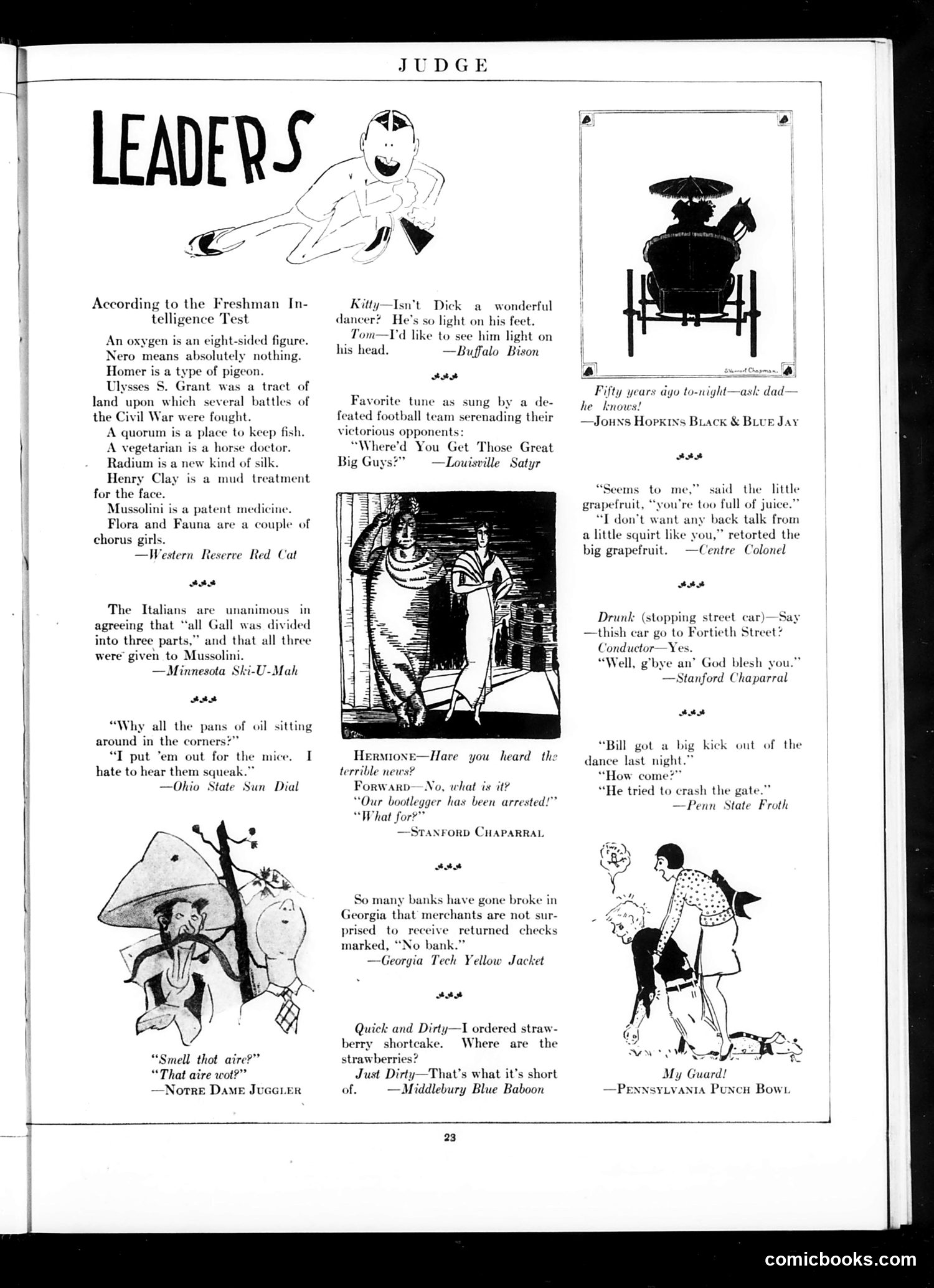
This is a humor page featuring short jokes and cartoons from college newspapers, typical of Judge's "Leaders" section satirizing student life and current events. **Key content:** The "Freshman Intelligence Test" mockingly presents absurd definitions (oxygen as "eight-sided," Homer as "a type of pigeon"), satirizing educational standardization tests popular in the 1920s-30s. A running joke targets **Mussolini**, calling him "a patent medicine" and referencing fascist Italy's colonial ambitions ("all Gaul was divided into three parts"—a historical reference implying Italy's imperial expansion. **College humor** dominates: jokes about prohibition-era bootleggers, failed romantic escapades ("tried to crash the gate"), and stock characters like overly-talkative grapefruit. The cartoons are simplistic line drawings accompanying puns and mild social commentary. One depicts a figure fishing for mice ("I hate to hear them squeak"), another shows romantic couples. **Overall**: This reflects interwar American campus humor—lighthearted, sometimes crude, occasionally topical (Mussolini reference), centered on dating, prohibition, and educational absurdities.
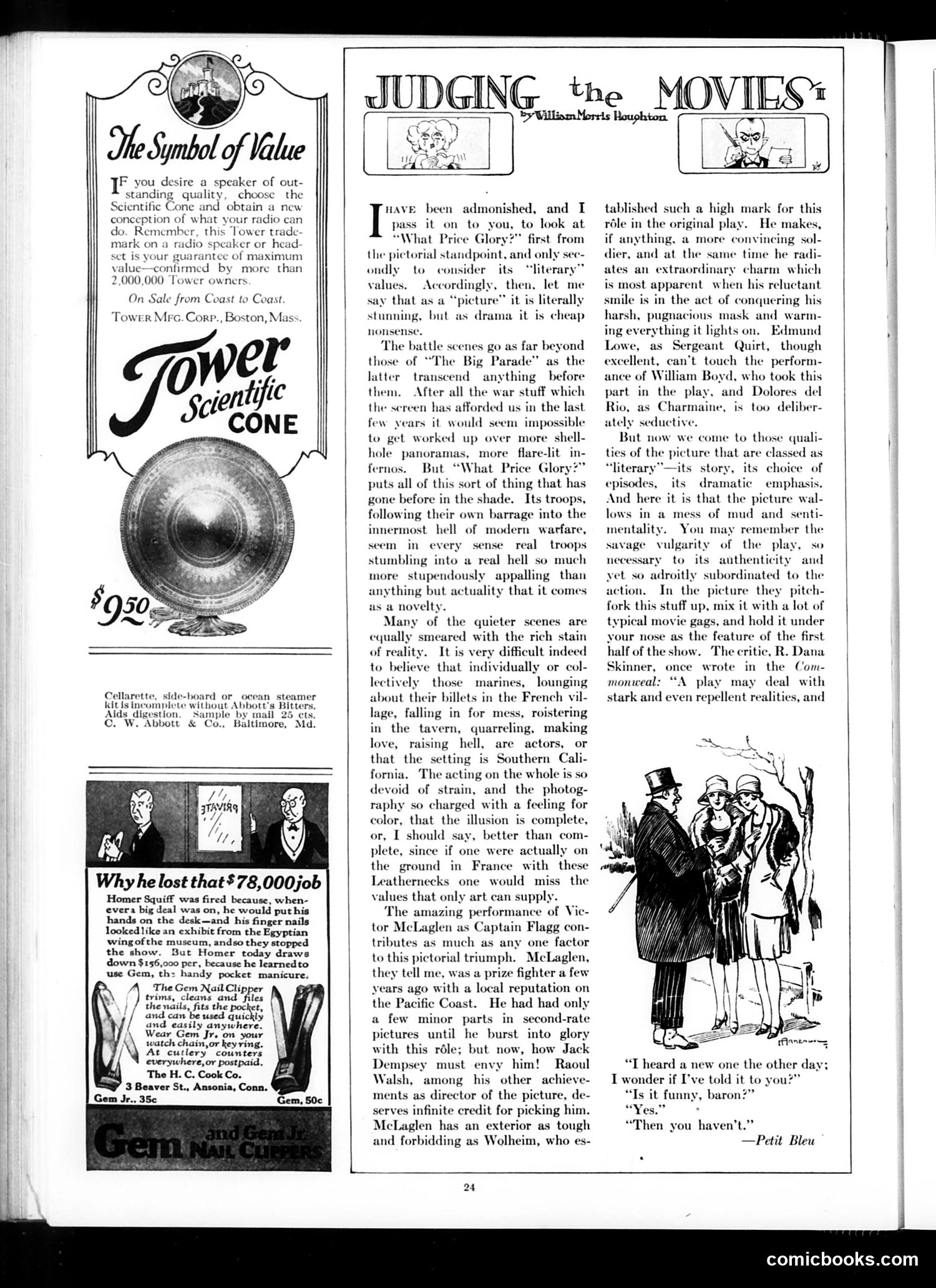
This is primarily a movie review by William Morris Houghton of the 1926 film *What Price Glory?*, with advertisements surrounding it. **The main content:** Houghton praises the film's visual realism—particularly its battle scenes and depiction of Marines in France—while criticizing its dramatic narrative as "cheap nonsense." He distinguishes between the picture's aesthetic power and its story's artistic merit. **Key figures:** Victor McLaglen (former prizefighter turned actor) plays Captain Flagg and receives high praise for his "tough and forbidding" exterior and "extraordinary charm." Director Raoul Walsh is credited for discovering him. Houghton compares McLaglen favorably to Wolheim, who originated the role on stage. **The satire/point:** The review exemplifies 1920s film criticism's tension between cinema's visual/photographic realism and traditional theatrical drama—suggesting movies could be stunning spectacles while remaining narratively shallow. **Surrounding ads** sell radio speakers, nail clippers, and digestive bitters—typical period advertising.
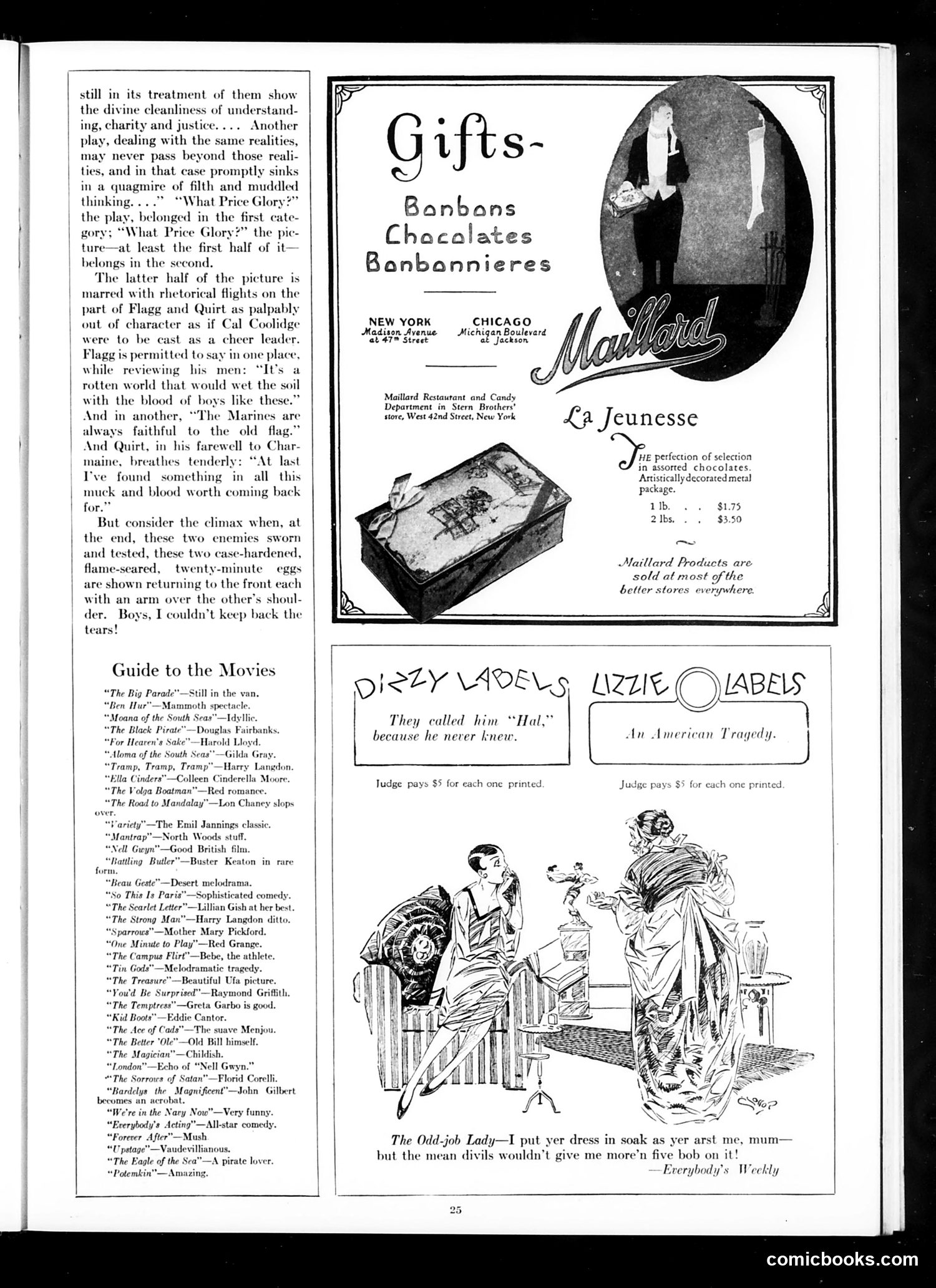
This page (circa mid-1920s) contains mixed content: a film review, advertisements, and two cartoon captions. ## The Film Review The text critiques "What Price Glory?"—a 1926 war film about soldiers Flagg and Quirt. The reviewer praises the play's gritty realism but faults the film for inserting sentimental, out-of-character speeches about honor and sacrifice. The climax—showing hardened enemies reconciling with arms around each other—is criticized as emotionally manipulative and unconvincing. ## The Cartoons Two single-panel gags appear below: - "They called him 'Hal,' because he never knew"—humor unclear without fuller context - "The Odd-job Lady"—depicts working-class London slang; a woman complains that pawnbrokers ("mean divils") offered only five shillings for a dress she pawned ## Advertising Maillard chocolates and candy are promoted as luxury gifts, with prices ($1.75–$3.50) and retail locations listed. The page reflects 1920s consumer culture alongside middlebrow entertainment criticism.
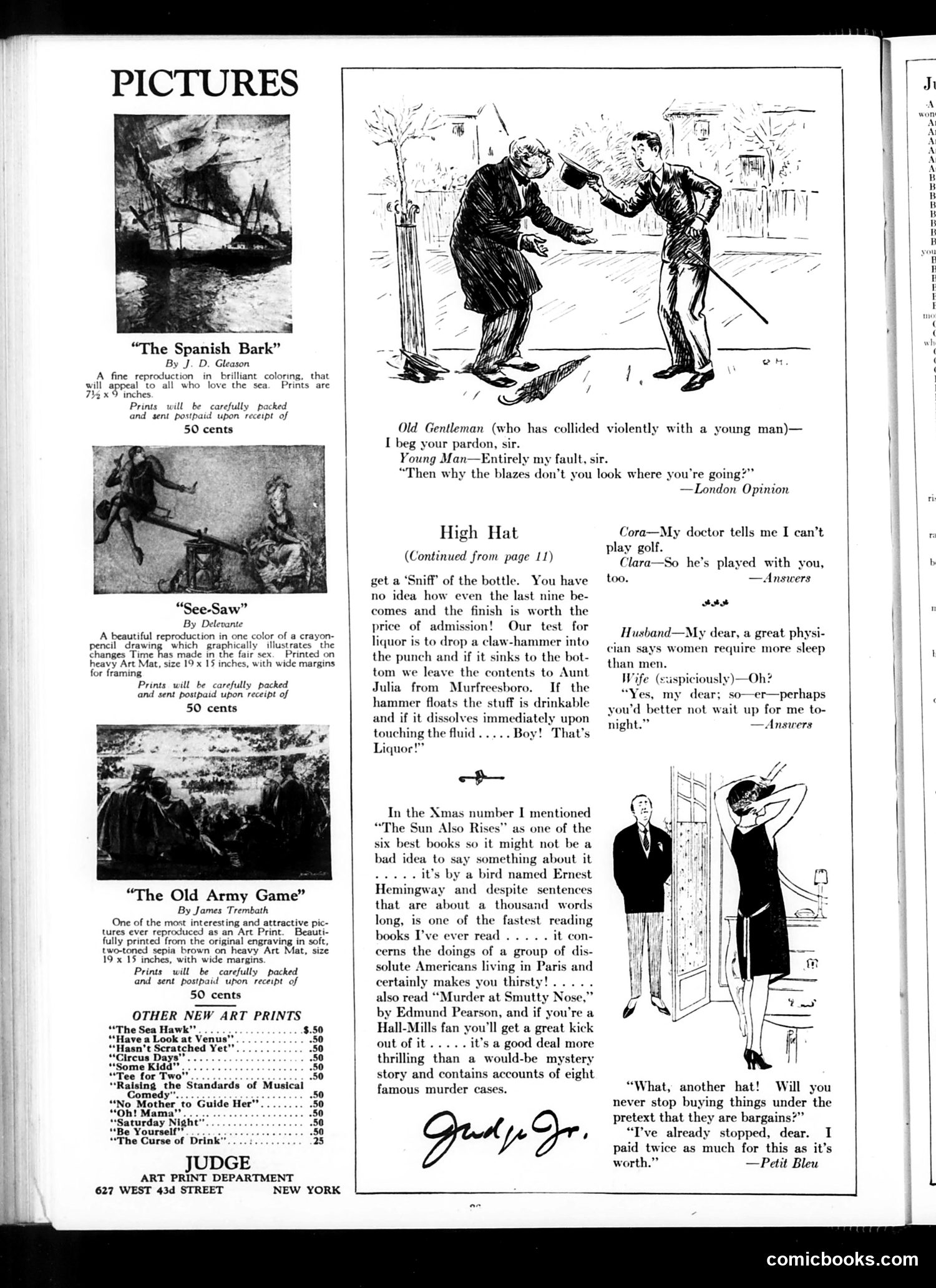
This page is primarily **advertising for art prints** sold by Judge's Art Print Department, with several unrelated joke cartoons interspersed. **The main cartoon** (top right) shows two men who've collided—an elderly gentleman and a younger man. It illustrates a joke about British politeness: both apologize, but the old man then absurdly demands the young man explain why he wasn't looking where he was going. The caption attributes it to *London Opinion*, indicating this is reprinted humor. **The other jokes** are brief, disconnected quips about everyday life: - A doctor refusing to play golf (implying the patient played poorly) - A husband claiming women need more sleep, as an excuse to stay out late - A woman justifying excessive hat purchases as "bargains" These represent typical 1920s-era domestic humor—light jabs at marriage, consumerism, and social conventions. None reference specific political figures or events; instead, they mock universal human foibles like vanity and marital bickering, which would resonate with Judge's middle-class readership. The page is essentially a catalog with comedic filler.
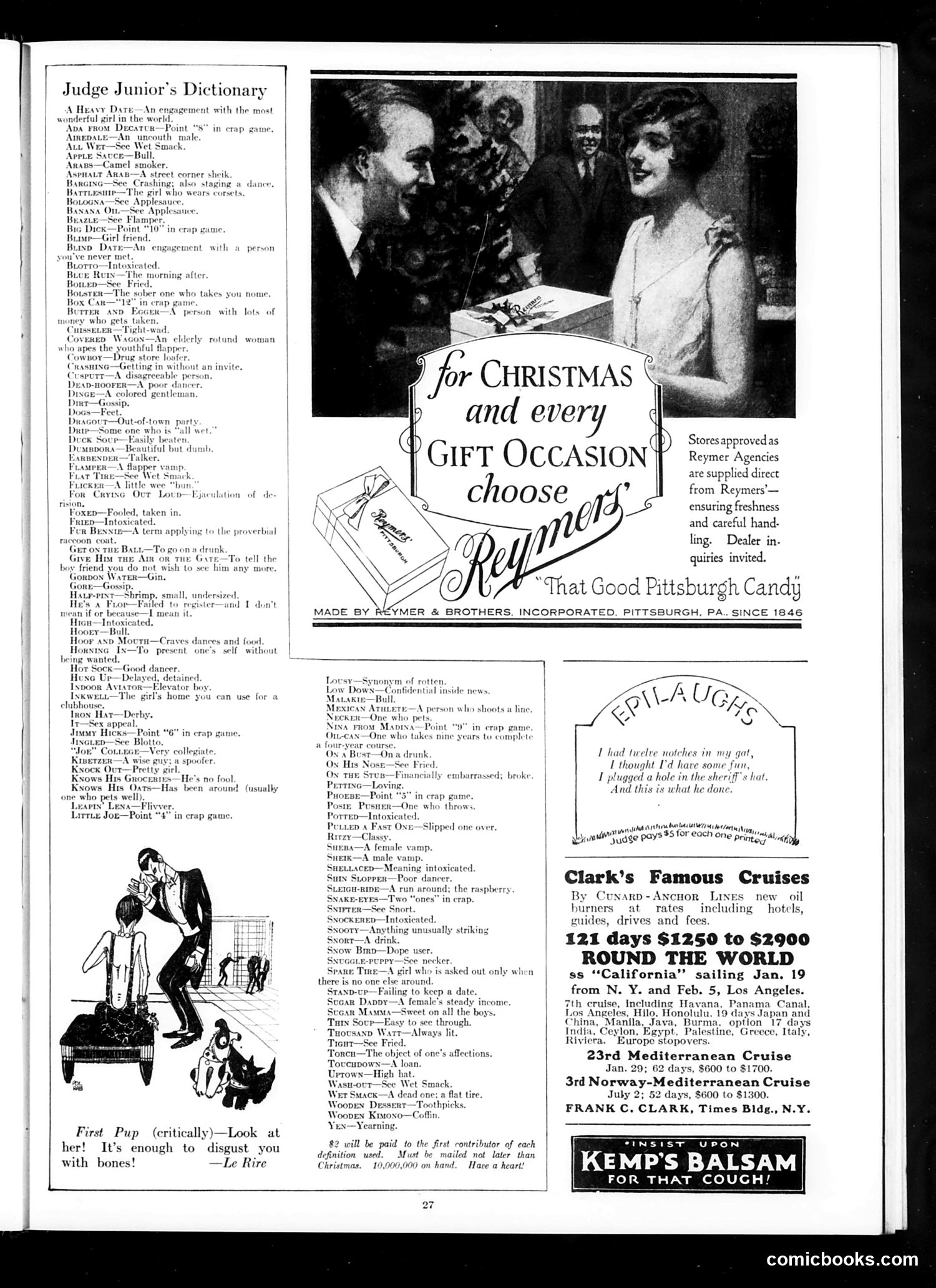
This page is primarily a **"Judge Junior's Dictionary"** — a satirical glossary of 1920s slang terms, likely mocking the youth culture and linguistic innovations of the Jazz Age. Terms like "Flapper," "Wet Smack," "Necking," and "Petting" reference the period's moral anxieties about modern young people's behavior and dating customs. The cartoon at bottom left ("First Pup") shows disapproval of youth culture — a father figure disgusted by his daughter's modern ways ("bones" likely referring to her thin flapper silhouette). The main advertisements promote **Reymer's candy** and **Clark's cruise lines**, typical period commerce. The satire targets generational conflict: Judge presents this slang dictionary both to entertain and to mock younger Americans' "corrupted" speech and loose social morals — a common conservative complaint during the 1920s about flappers, jazz culture, and post-WWI social upheaval.
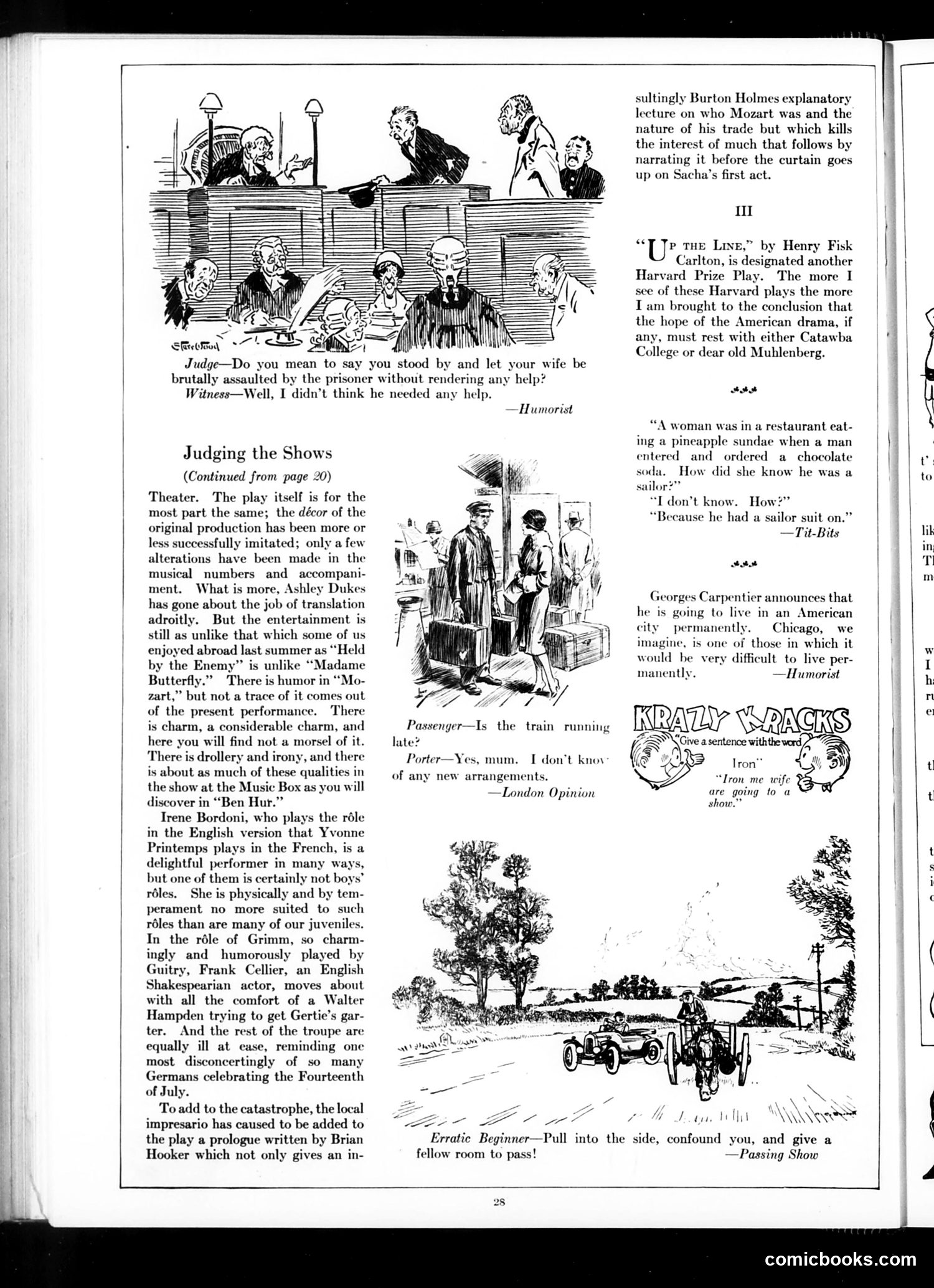
This theater review critiques the English production of "Mozart," adapted by Ashley Dukes from a French original starring Yvonne Printemps. The critic praises the set design but faults the performance for lacking the humor, charm, and irony of the original French version. The casting of Irene Bordoni is deemed unsuitable—she's described as physically and temperamentally mismatched for the role, like "a Walter Hampden trying to get Gertie's garter" (an odd-fit comparison). The English actors appear uncomfortable overall. Most damningly, a new prologue by Brian Hooker—a Burton Holmes-style explanatory lecture on Mozart—kills dramatic interest by revealing plot before the curtain rises. The review is scathing about adaptation quality and performer miscasting.
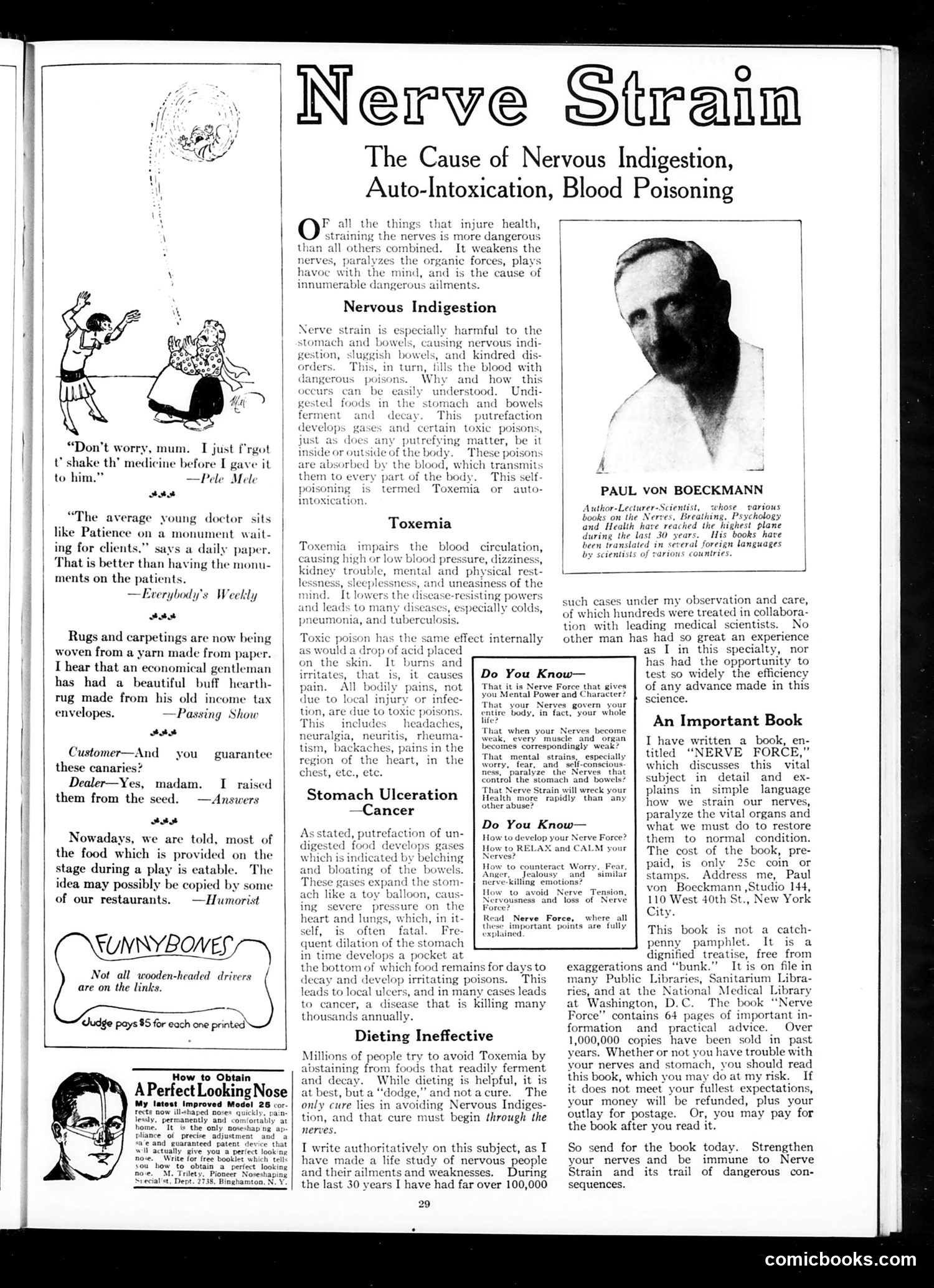
This page combines satirical humor with medical advertising, typical of early 20th-century publications. **The Cartoons:** Three brief jokes mock incompetent professionals—a forgetful servant giving medicine, a young doctor idly waiting for patients, and a canary seller claiming he raised birds "from the seed." These mock medical and professional incompetence. **The Main Content:** A lengthy advertisement by "Paul von Boeckmann," a self-described scientist-lecturer, promoting his book on "Nerve Force." He claims expertise in treating "Nerve Strain," which he attributes to causing nervous indigestion, auto-intoxication, and blood poisoning through undigested food putrefaction. **The Appeal:** This exploits period anxieties about modern nervous exhaustion ("neurasthenia"), digestive problems, and self-poisoning—common health preoccupations of the era. The pseudo-scientific explanation using toxemia reflects early-1900s medical theories later discredited. **The Satire:** Judge's placement of these incompetence jokes alongside Boeckmann's grandiose medical claims suggests skepticism toward dubious health remedies marketed to anxious readers—a recurring Judge theme mocking medical quackery.
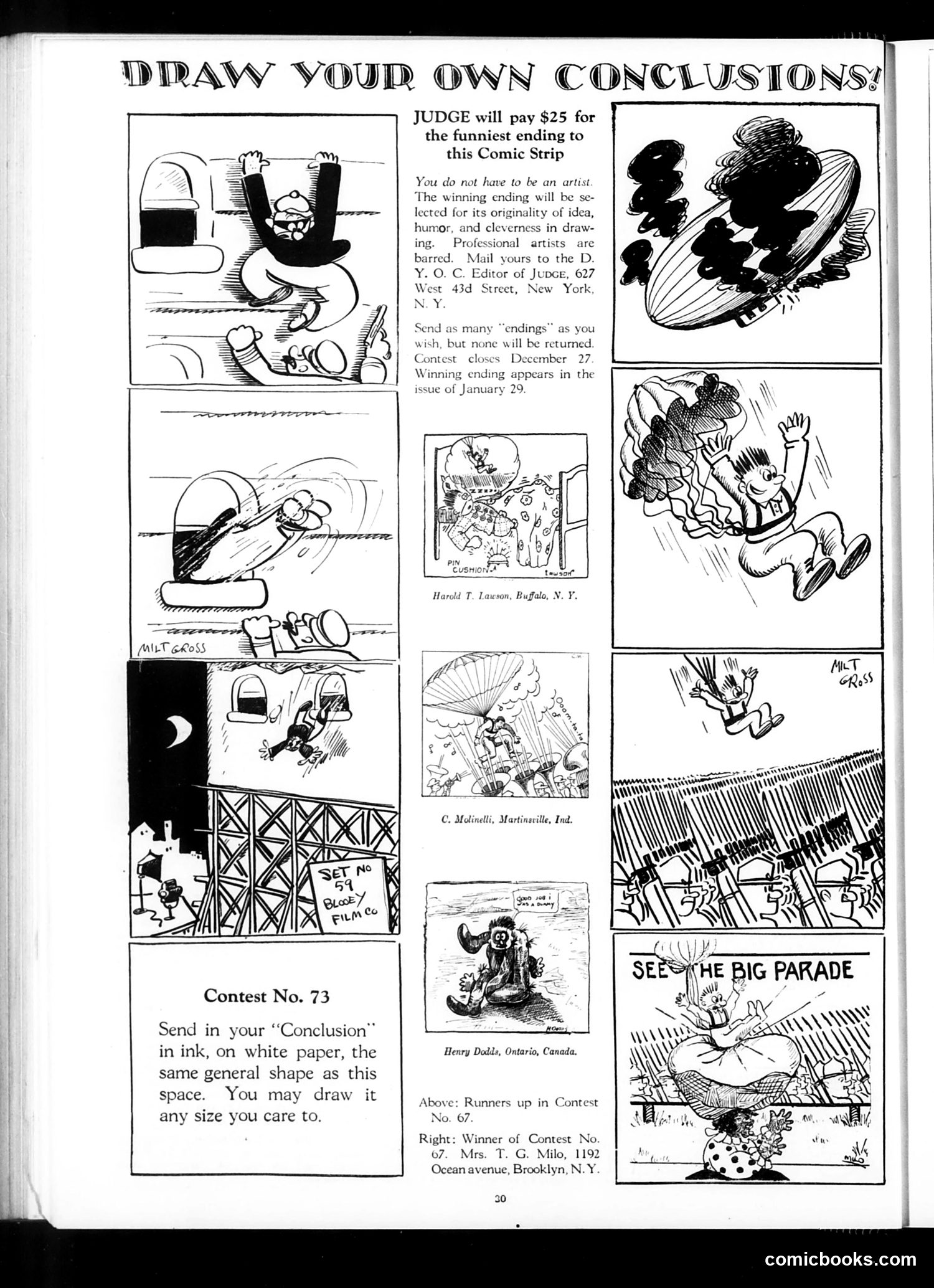
This page features two reader-participation contests from Judge magazine. The main content (Contest No. 73) shows an incomplete comic strip depicting slapstick domestic chaos—a figure in a basket, someone upended, objects flying—and invites readers to draw their own humorous "conclusion" to the story for a $25 prize. The page also displays winning and runner-up entries from an earlier contest (No. 67), showcasing amateur comic submissions featuring various gags: characters in perilous situations, slapstick scenarios, and visual punchlines. These contests reveal Judge's editorial strategy: crowdsourcing humor from ordinary readers while barring professional artists, democratizing comedy creation. The emphasis on "originality of idea, humor, and cleverness" over artistic skill reflects early 20th-century magazine culture's engagement with reader participation as both entertainment and cost-effective content generation.
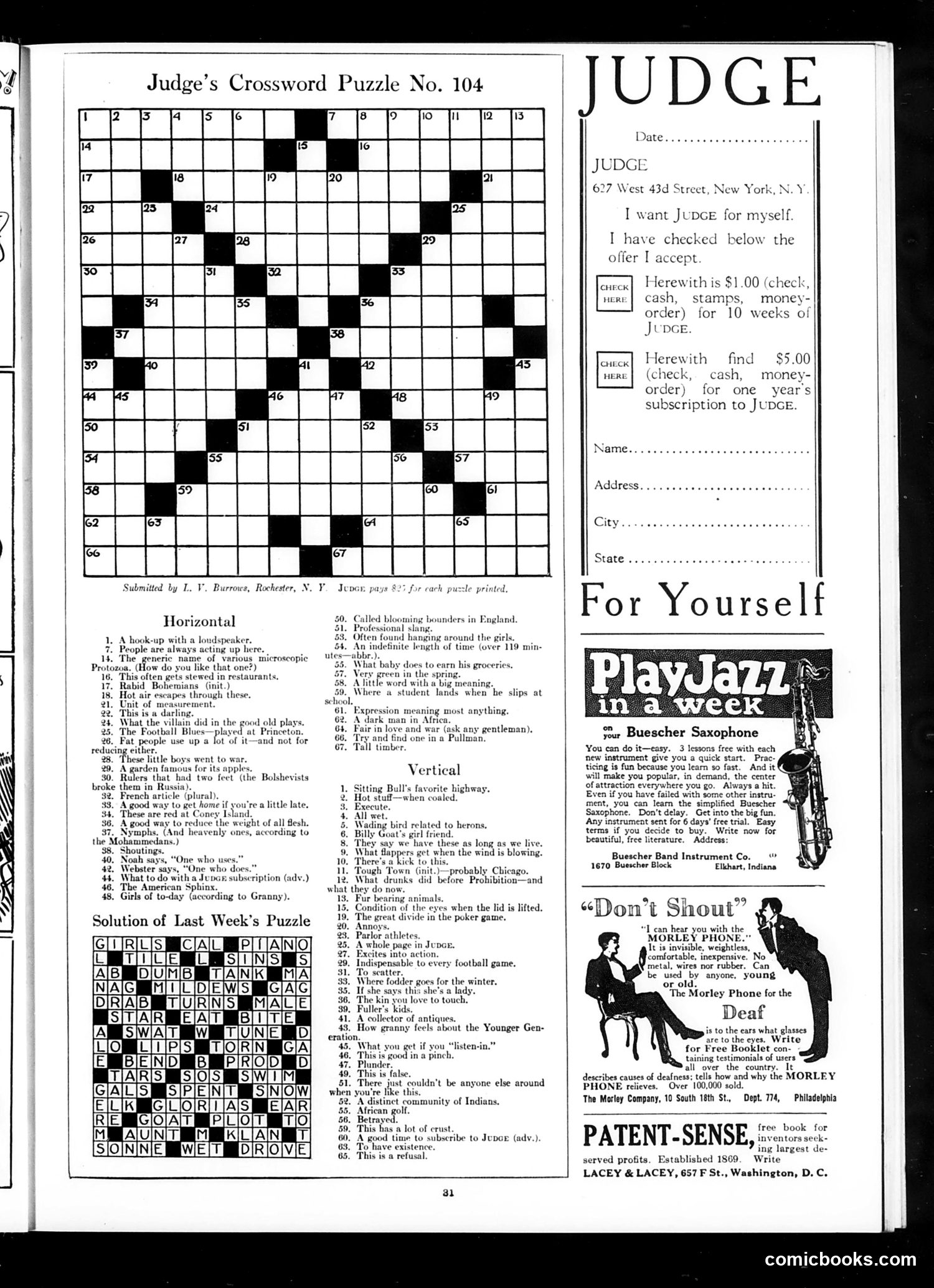
This page is primarily **advertising and subscription material**, not editorial cartoons or satire requiring historical context. The left side displays a crossword puzzle with clues referencing 1920s-era slang and cultural references ("Sitting Bull's favorite highway," "Tough Town...probably Chicago," references to Prohibition). The clues reflect contemporary social commentary typical of Judge's humor. The right side contains **four advertisements**: 1. **Judge subscription offers** ($1 for 10 weeks, $5 for one year) 2. **Buescher Saxophone** — promoting an affordable musical instrument with easy payment terms 3. **Morley Phone for the Deaf** — an assistive listening device claiming invisibility and effectiveness 4. **Patent-Sense** — a free invention services book These ads target middle-class readers seeking self-improvement, entertainment, and practical solutions. The saxophone ad's emphasis on social popularity ("Always a hit") reflects 1920s consumer culture aspirations during the Jazz Age. No specific political figures or events are caricatured on this page.
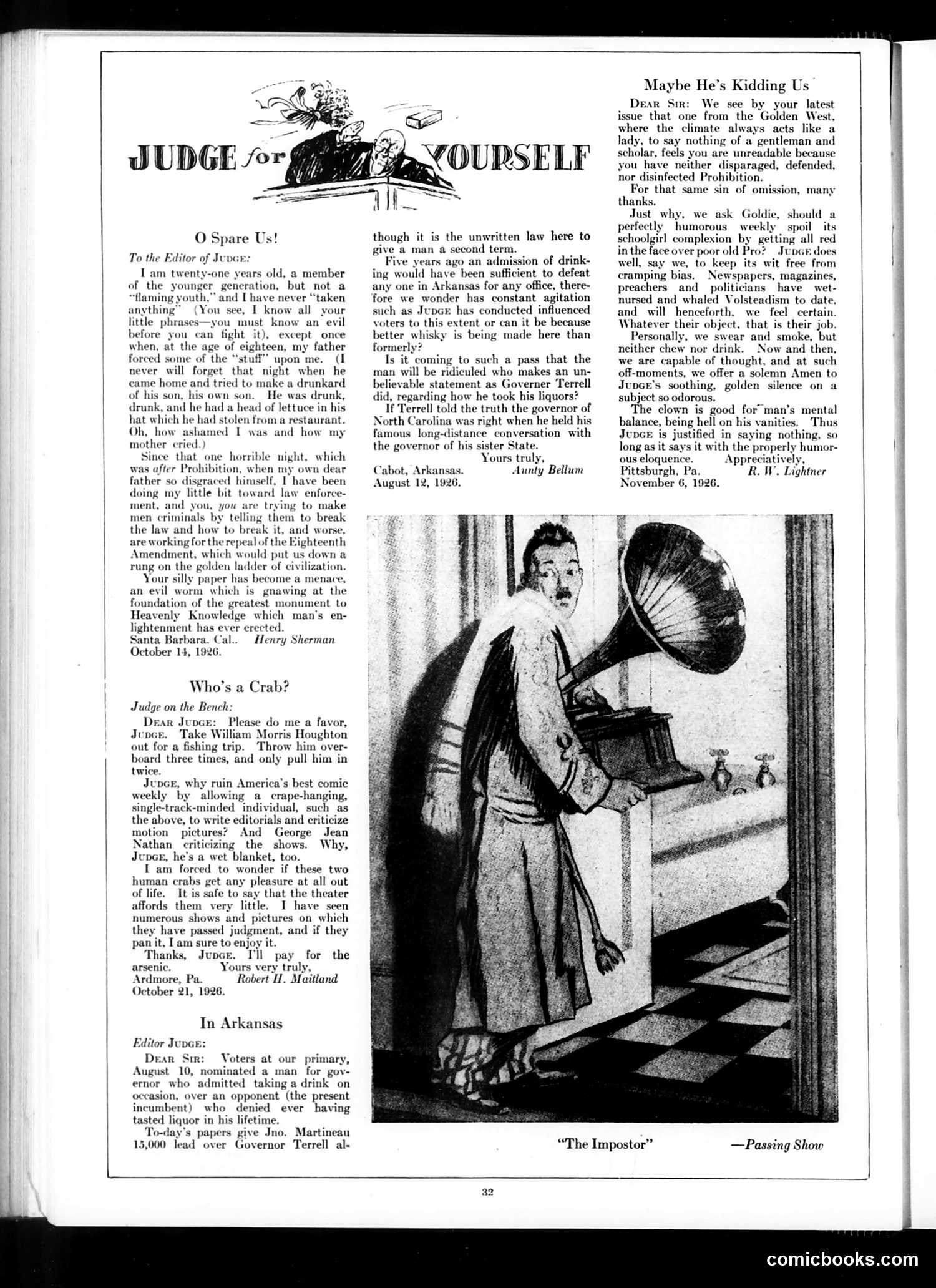
This page from *Judge* (November 6, 1926) contains reader letters debating Prohibition and the magazine's editorial stance on alcohol. **Key Content:** The letters attack *Judge* for not sufficiently supporting Prohibition enforcement. A Santa Barbara reader (Henry Sherman) claims the magazine undermines law enforcement by mocking Prohibition. An Arkansas reader (Aunty Bellum) expresses surprise that voters nominated a gubernatorial candidate who admitted drinking—suggesting changing attitudes toward alcohol. **The Cartoon:** "The Impostor" (credited to *Passing Show*) depicts a character in theatrical dress, likely satirizing someone pretending to be something they're not—possibly relating to the Prohibition hypocrisy theme (people claiming sobriety while drinking). **Historical Context:** This reflects the heated Prohibition debate of the 1920s. *Judge*'s satirical tone apparently angered dry-law supporters who wanted stricter editorial enforcement of Prohibition messaging, while the magazine preferred humor over advocacy.
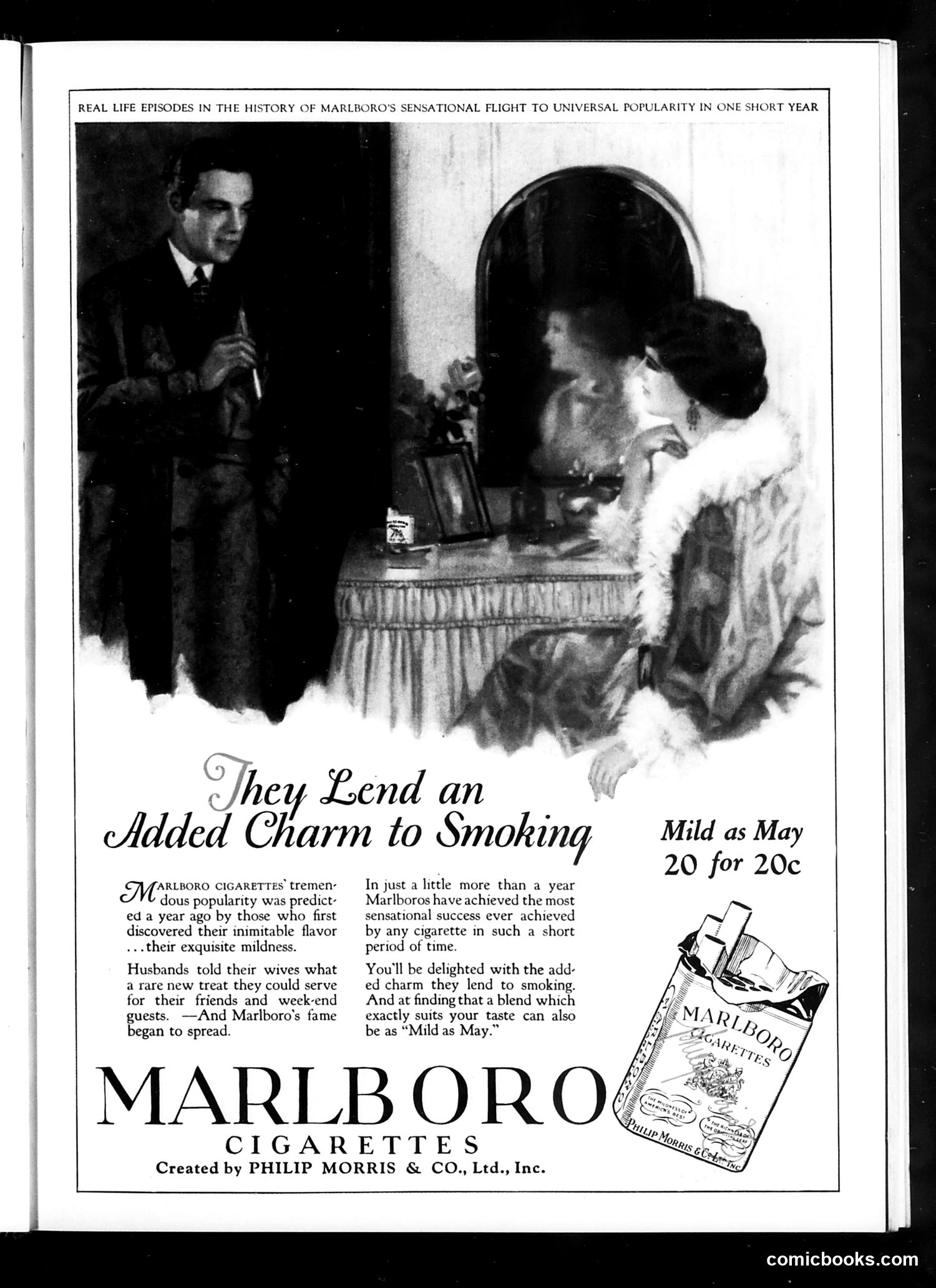
This is primarily a **Marlboro cigarette advertisement**, not political satire. The page uses a framing device from *Judge* magazine's "Real Life Episodes" series to present a marketing narrative. The illustration shows a well-dressed man and woman in what appears to be an elegant interior, depicting a social scene where the cigarettes create "added charm to smoking." The ad claims Marlboro achieved "sensational success" in just one year through word-of-mouth—husbands telling wives about the product's "inimitable flavor" and "exquisite mildness." The key selling point: Marlboro cigarettes are "Mild as May" while maintaining quality taste—a common early 20th-century marketing claim positioning cigarettes as pleasant rather than harsh. Priced at 20 cigarettes for 20 cents, this was positioned as an affordable luxury product. There is **no political commentary or satirical critique** visible here—it's straightforward vintage advertising using aspirational imagery of genteel social settings to market the product.
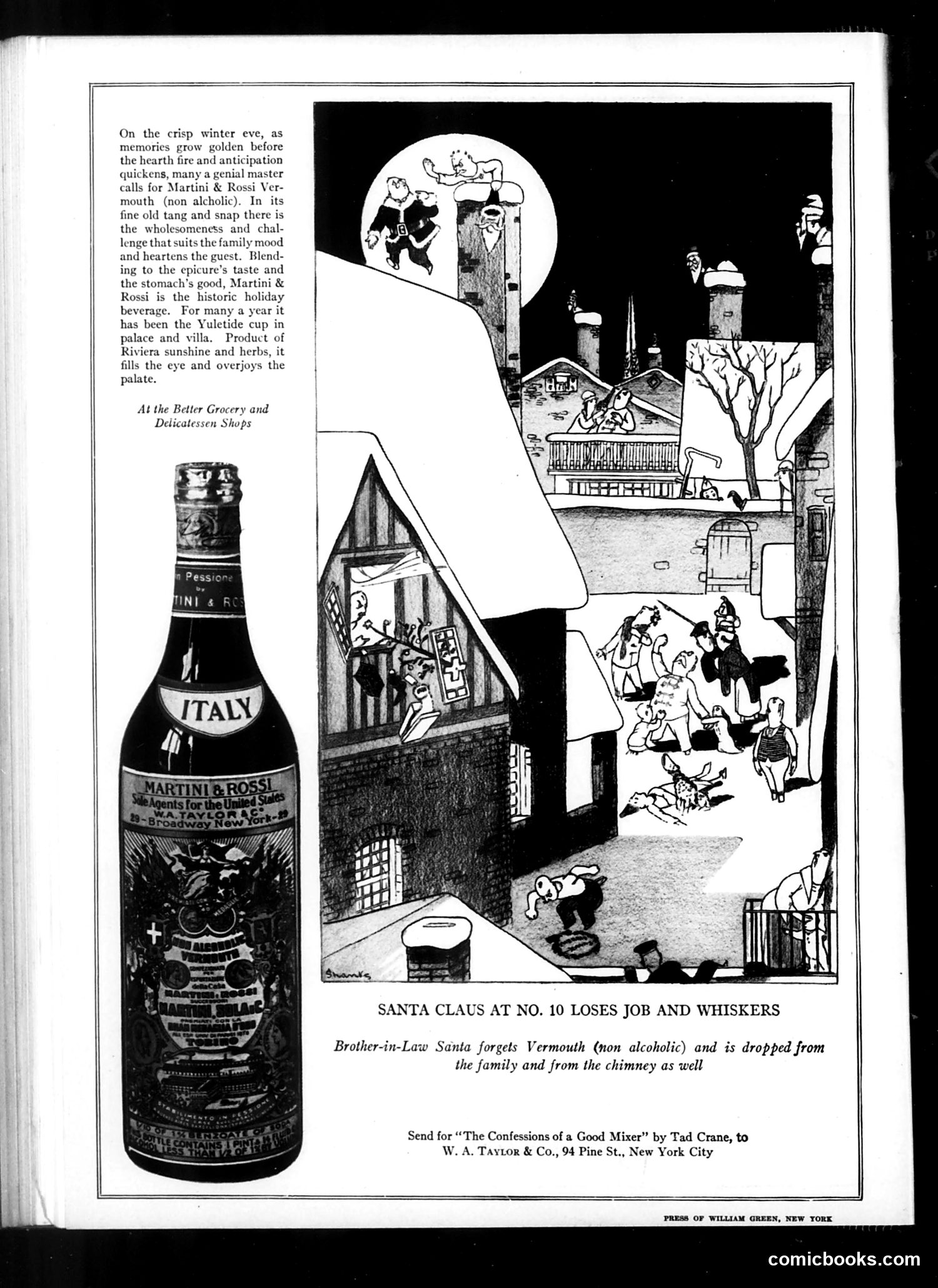
This is a **Martini & Rossi vermouth advertisement** disguised as satirical editorial content in *Judge* magazine. The main cartoon depicts a humorous domestic scene where a brother-in-law playing Santa Claus is ejected from the family gathering—literally dropping down a chimney—because he forgot to bring the advertised vermouth (non-alcoholic). The satire exploits Prohibition-era anxieties: by promoting "non-alcoholic" vermouth, the ad sidesteps legal restrictions on alcohol sales while still marketing an aperitif product. The joke frames the drink as so essential to holiday tradition that a family member loses his position for forgetting it. The accompanying text romanticizes vermouth's place in family gatherings, positioning it as a civilized, wholesome beverage suitable for respectable households. This advertisement-as-editorial approach was common in early 20th-century magazines, blending commerce with editorial voice.