
Judge, 1926-12-18 · page 15 of 36
Judge — December 18, 1926 — page 15: what you’re looking at
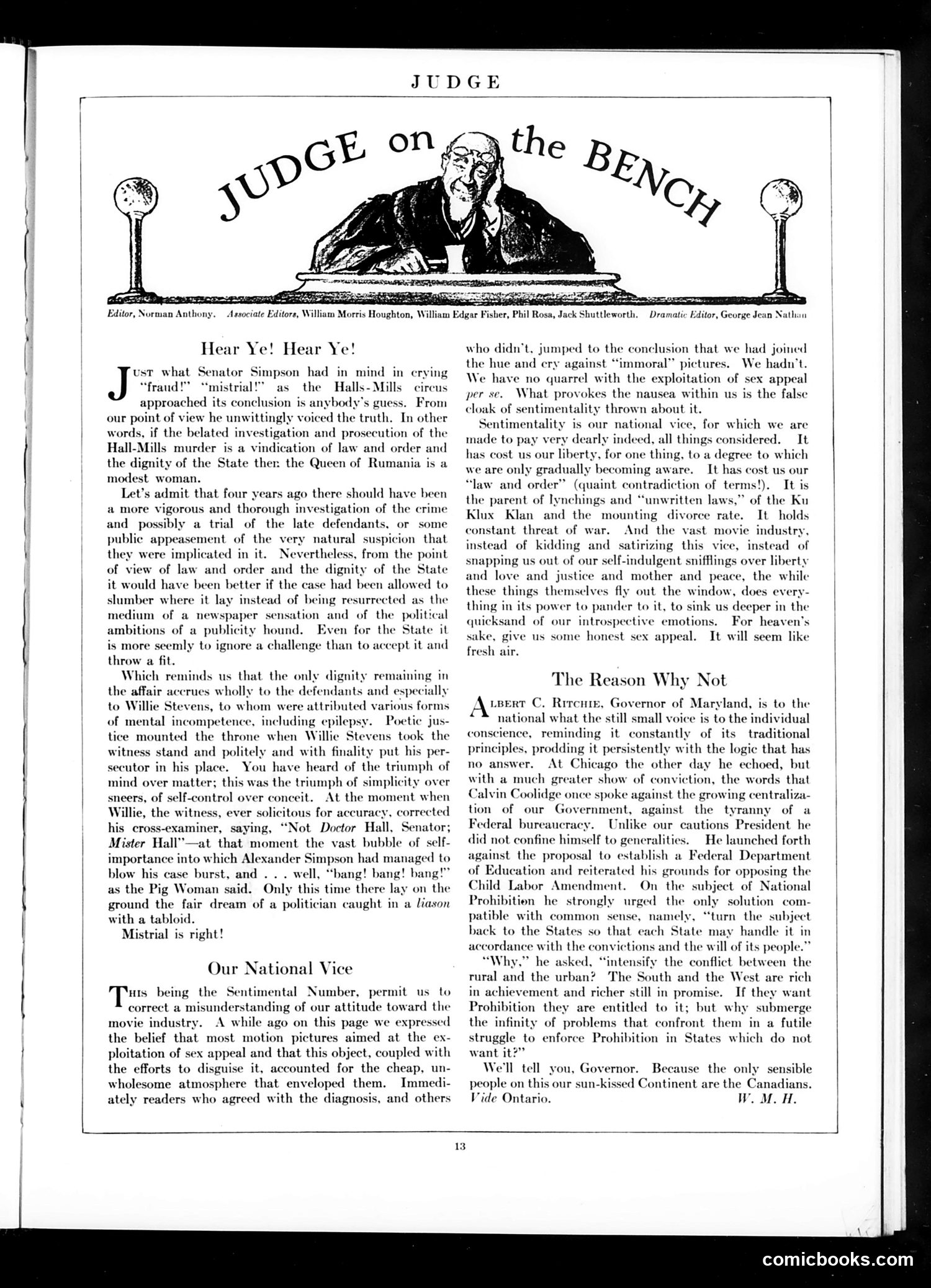
What you’re looking at
This page contains editorial commentary on two major American scandals/issues of the 1920s: **The Hall-Mills Murder Case**: The lead article criticizes Senator Simpson's calls for "mistrial" in a sensational murder investigation. Judge argues that while the delayed prosecution was poorly handled, resurrecting it as a newspaper sensation for political gain undermines "law and order." The article praises Willie Stevens's dignified courtroom behavior, which embarrassed the aggressive prosecutor—a "triumph of simplicity over sneers." **"Our National Vice"**: The second piece attacks American sentimentality as destructive to society. Judge argues that sentimental exploitation in movies—cloaking sex appeal in false morality rather than honestly addressing it—is symptomatic of a broader national weakness. This sentimentality supposedly enables lynchings, the Ku Klux Klan, divorce, and threatens war. The satirical "Judge" persona (illustrated at top) delivers these critiques with sardonic tone, mocking hypocrisy and emotional manipulation in both law and entertainment.
📄 Transcribed text from this page (OCR, searchable)
Machine-transcribed from the original scan — historical spelling and the odd misread are preserved.
JUDGE Editor, Norman Anthony. Hear Ye! Hear Ye! st what Senator Simpson had in mind in erying fraud!" “mistrial!” the Halls- Mills cireus approached its conclusion is anybody's guess. From our point of view he unwittingly voiced the truth. In other words, if the belated investigation and prosecution of the Hall-Mills murder is a vindication of law and order and the dignity of the State ther the Queen of Rumania is a modest woman. Let’s admit that four years ago there should have been a more vigorous and thorough investigation of the crime and possibly a trial of the late defendants, or some public appeasement of the very natural suspicion that they were implicated in it. Nevertheless, from the point of view of law and order and the dignity of the State it would have been better if the case had been allowed to slumber where it lay instead of being resurrected as the medium of a newspaper sensation and of the politic ambitions of a publicity hound. Even for the S is more scemly to ignore a challenge than to accept it and throw a fit. Which reminds us that the only dignity remaining in the affair accrues wholly to the defendants and especially to Willie Stevens, to whom were attributed various forms of mental incompetence, including epilepsy. Poetic jus- tice mounted the throne when Willie Stevens took the witness stand and politely and with finality put his per- secutor in his place. You have heard of the triumph of mind over matter; this was the triumph of simplicity over At the moment when as sneers, of self-control over conceit. Willie, the witness, ever solicitous for accuracy, corrected his cross-examiner, saying, “Not Doctor 1, Senator; Mister Hall”—at that moment the vast bubble of self- importance into which Alexander Simpson had managed to blow his case burst, and . . . well, “bang! bang! bang!” as the Pig Woman said. Only this time there lay on the ground the fair dream of a politician caught in a Liason with a tabloid. Mistrial is right! Our National Vice His being the Sentimental Number, permit us to correct a misunderstanding of our attitude toward the movie industry. A while ago on this page we expressed the belief that most motion pictures aimed at the ex- ploitation of sex appeal and that this object, coupled with the efforts to disguise it, accounted for the cheap, un- wholesome atmosphere that enveloped them. Immedi- ately readers who agreed with the diagnosis, and others Associate Editors, William Morris Houghton, William Edgar Fisher, Phil Rosa, Jack Shuttleworth, Dramatic Editor, George Jean Nathan who didn’t, jumped to the conclusion that we had joined the hue and ery against “immoral” pictures. We hadn't. We have no quarrel with the exploitation of sex appeal per se. What provokes the nausea within us is the false cloak of sentimentality thrown about it. Sentimentality is our national vice, for which we are made to pay very dearly indeed, all things considered. It has cost us our liberty, for one thing, to a degree to which we are only gradually becoming aware. It has cost us our “law and order” (quaint contradiction of terms!). It is the parent of lynchings and “unwritten laws,” of the Ku Klux Klan and the mounting divorce rate. It holds constant threat of war. And the vast movie industry, instead of kidding and irizing this vice, instead of snapping us out of our self-indulgent snifflings over liberty and love and justice and mother and peace, the while these things themselves fly out the window, does every- thing in its power to pander to it, to sink us deeper in the quicksand of our introspective emotions. sake, give us some honest sex appeal. fresh air. For heaven's It will seem like The Reason Why Not Bert C. Rrrcuie, Governor of Maryland, is to the national what the still small voice is to the individual conscience, reminding it constantly of its traditional principles, prodding it persistently with the logic that has no answer. At Chicago the other day he echoed, but with a much greater show of conviction, the words that Calvin Coolidge once spoke against the growing centraliza- tion of our Government, against the tyranny of a Federal bureaucracy. Unlike our cautions President he did not confine himself to generalities. He launched forth against the proposal to establish a Federal Department of Education and reiterated his grounds for opposing the Child Labor Amendment. On the subject of National Prohibition he strongly urged the only solution com- patible with common sense, nam “turn the subject back to the States so that each State may handle it in accordance with the convictions and the will of its people.” “Why,” he asked, “intensify the conflict between the rural and the urban? The South and the West are rich in achievement and richer still in promise. If they want Prohibition they are entitled to it; but why submerge the infinity of problems that confront them in a futile struggle to enforce Prohibition in States which do not want it?” We'll tell you, Governor. Because the only sensible people on this our sun-kissed Continent are the Canadians. Vide Ontario. W.M. H. v comicbooks.com