
Judge, 1926-12-18 · page 26 of 36
Judge — December 18, 1926 — page 26: what you’re looking at
What you’re looking at
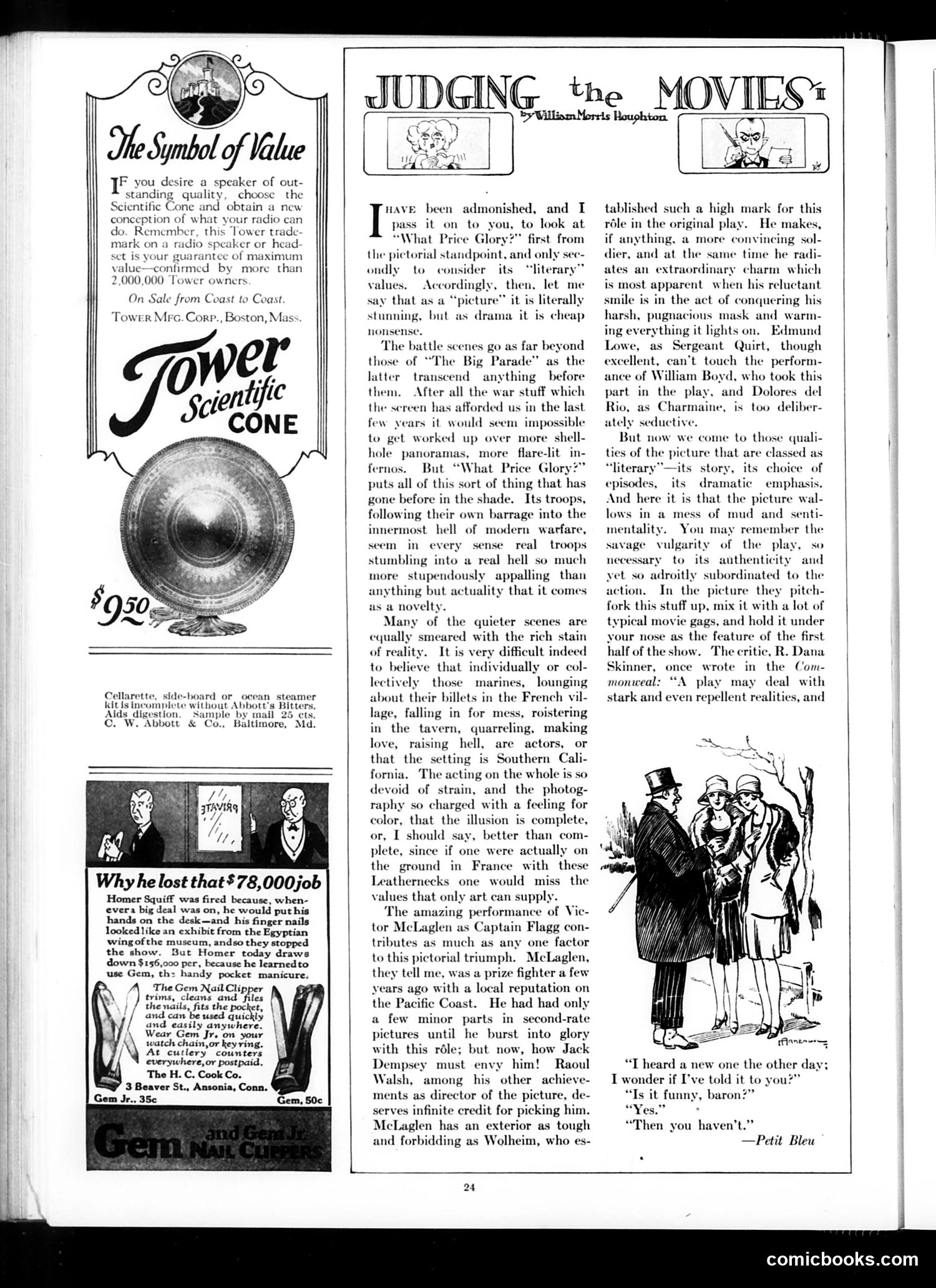
This is primarily a movie review by William Morris Houghton of the 1926 film *What Price Glory?*, with advertisements surrounding it. **The main content:** Houghton praises the film's visual realism—particularly its battle scenes and depiction of Marines in France—while criticizing its dramatic narrative as "cheap nonsense." He distinguishes between the picture's aesthetic power and its story's artistic merit. **Key figures:** Victor McLaglen (former prizefighter turned actor) plays Captain Flagg and receives high praise for his "tough and forbidding" exterior and "extraordinary charm." Director Raoul Walsh is credited for discovering him. Houghton compares McLaglen favorably to Wolheim, who originated the role on stage. **The satire/point:** The review exemplifies 1920s film criticism's tension between cinema's visual/photographic realism and traditional theatrical drama—suggesting movies could be stunning spectacles while remaining narratively shallow. **Surrounding ads** sell radio speakers, nail clippers, and digestive bitters—typical period advertising.
📄 Transcribed text from this page (OCR, searchable)
Machine-transcribed from the original scan — historical spelling and the odd misread are preserved.
Me Symbol of Value JF you desire a speaker of out- standing quality, choose the Scientific Cone and obtain a new conception of what your radio can do. Remember, this Tower trade- mark on a radio speaker or head. set is your guarantee of maximum value—confirmed by more than 2,000,000 Tower owners On Sale from Coast to Coast Tower Mec. Corp., Boston, Mass Cella . side-board or oc steamer kitis incomplete without Abbott's Bitters. Aids digestion. Sample by mail 25 cts. Cc. W. Abbott & Co., Baltimore, Md. Why he lost that*78,000job Homer Squiff was fired because, when- evera big deal was on, he would put his hands on the desk—and his finger nails looked like an exhibit from the Egyptian wing ofthe museum, andso they stopped the show. But Homer today draws down $156,000 per, because he learnedto use Gem, th: handy pocket manicure. The Gem Nail Clip, trims, cleans and files / the nails, fits the pocket, and canbe used quickly and easily anywhere. Wear Gem Jr. on your watch chain,or key ring. At cutlery counters everywhere, or postpaid. The H. C. Cook Co. 3 Beaver St., Ansonia, Conn. Gem Jr.. 35¢ JUDGING pass it on to you, to look at “What Price Glory?” first from the pictorial standpoint, and only ondly to. consider’ its. “literary values. Accordingly, then, let me say that as a “picture” it is literally stunning, but as drama it is cheap [= been admonished, and I nonsense. The battle scenes go as far beyond those of “The Big Parade” as the latter transcend anything before them. After all the war stuff which the sereen has afforded us in the ars it would seem impossible to get worked up over more shell- ast few y hole panoramas, more flare-lit in- fernos. But “What Price Glory?” puts all of this sort of thing that has gone before in the shade. Its troops, following their own barrage into the innermost hell of modern warfare, seem in every sense real troops stumbling into a real hell so much more stupendously appalling than vthing but actuality that it comes us a novelty. Many of the quieter scenes are equally smeared with the rich stain of reality. It is very difficult indeed to believe that individually or col- lectively those marines, lounging about their billets in the French vil- lage, falling in for mess, roistering in the tavern, quarreling, making love, raising hell, are actors, or that the setting is Southern Cali- fornia. The acting on the whole is so devoid of strain, and the photog- raphy so charged with a feeling for color, that the illusion is complete, or, I should say, better than com- plete, since if one were actually on the ground in France with these Leathernecks one would miss the values that only art can supply. The amazing performance of Vic- tor McLaglen as Captain Flagg con- tributes as much as any one factor to this pictorial triumph. McLaglen, they tell me, was a prize fighter a few years ago with a local reputation on the Pacific Coast. He had had only a few minor parts in second-rate pictures until he burst into glory with this réle; but now, how Jack Dempsey must envy him! Raoul Walsh, among his other achieve- ments as director of the picture, de- serves infinite credit for picking him. McLaglen an exterior as tough and forbidding as Wolheim, who es- by WVilliomMorris tom. the MOVIES* tablished such a high mark for this réle in the original play. He makes, if anything, a more convincing sol- dier, and at the same time he radi- ates an extraordinary charm which is most apparent when his reluctant smile is in the act of conquering his harsh, pugnacious mask and warm- ing everything it lights on. Edmund Low rgeant Quirt, though excellent, can’t touch the perform- ance of William Boyd, who took this part in the play, and Dolores del Rio, as Charmaine, is too deliber- ately seductive. But now we come to those quali- ties of the picture that are classed as “literary’—its story, its choice of episodes, its dramatic emphasis. And here it is that the picture wal- lows in a mess of mud and senti- as mentality. You may remember the ge vulgarity of the play, so sssary to its authenticity and yet so adroitly subordinated to the In the picture they pitch- fork this stuff up, mix it with a lot of typical movie and hold it under your nose as the feature of the first half of the show. The critic, R. Dana Skinner, once wrote in the Com- monweal: “A play may deal with stark and even repellent realities, and ne “T heard a new one the other day; I wonder if I’ve told it to you?” baron?” “Ye. 7 “Then you haven't.” —Petit Bleu comicbooks.com