
Judge, 1926-12-18 · page 22 of 36
Judge — December 18, 1926 — page 22: what you’re looking at
What you’re looking at
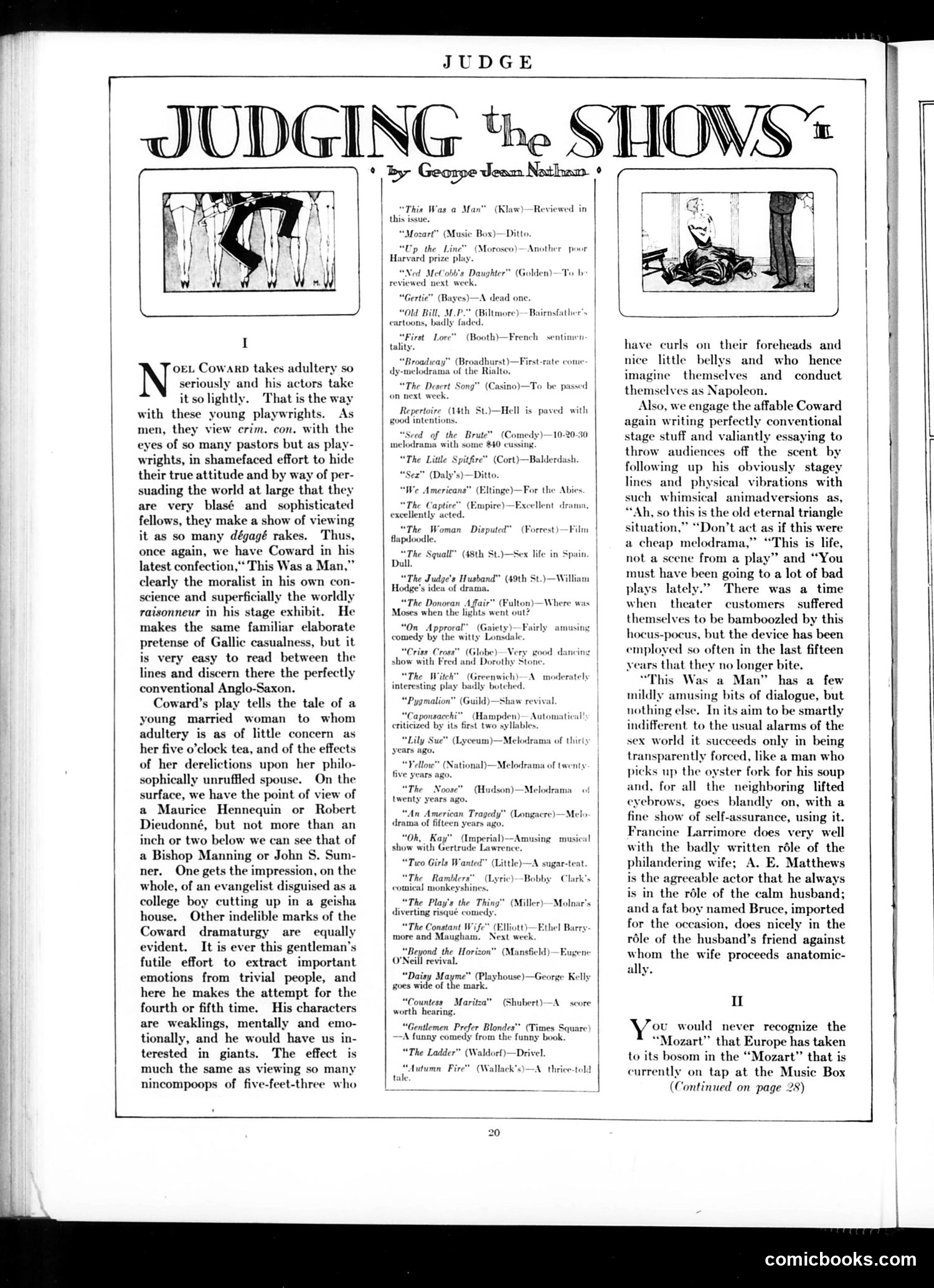
This page presents George Jean Nathan's theatre reviews, with particular focus on Noel Coward's play "This Was a Man." Nathan argues that Coward, though presenting himself as a sophisticated, morally indifferent dramatist (adopting Continental casualness about adultery), actually reveals conventional Anglo-Saxon values beneath the surface—comparing him to Bishop Manning and other moral authorities. The satire targets young playwrights generally: they adopt a blasé, "worldly" persona to seem avant-garde while remaining fundamentally conservative. Nathan criticizes Coward's recurring attempt to extract profound emotions from trivial characters, likening the effect to watching "nincompoops of five-feet-three" pretending to be giants. The page is primarily a theatrical column listing contemporary Broadway shows with brief critical assessments, though the Coward critique dominates.
📄 Transcribed text from this page (OCR, searchable)
Machine-transcribed from the original scan — historical spelling and the odd misread are preserved.
JUDGE UDGING ‘he SHOWS”: oe Cowarp take: seriously and his itso lightly. That is the way with these young playwrights. As men, they view crim. con. with the ultery so ‘tors take eyes of so many pastors but as play- wrights, in shamefaced effort to hide their true attitude and by way of per- suading the world at large that they are very blasé and _ sophisticated fellows, they make a show of viewing it as so many dégagé rakes. Thus, once again, we have Coward in his latest confection,“ This Was a Man,” clearly the moralist in his own con- ce and superficially the worldly raisonneur in his stage exhibit. He makes the same familiar elaborate pret ense of Gallic casualness, but it is very easy to read between the lines and discern there the perfectly conventional Anglo-Saxon. Coward’s play tells the tale of a young married woman to whom adultery is as of little concern as her five o’clock tea, and of the effects of her derelictions upon her phi sophically unruffled spouse. On the surface, we have the point of view of a Maurice Hennequin or Robert Dieudonné, but not more than an inch or two below we can see that of a Bishop Manning or John S. Sum- ner. One gets the impression, on the whole, of an evange college boy cutting up uised as a a geisha house. Other indelible wiahls of the Coward dramaturgy are equally evident. It is ever this gentleman's futile effort to extract important emotions from trivial people, and here he makes the attempt for the fourth or fifth time. His characters are weaklings, mentally and emo- tionally, and he would have us i terested in giants. The effect is much the same as viewing so many nincompoops of five-feet-three who * by Geoxpe Jean Nathan “This Was a Man™ this issue. “Mozart” (Music Box) “Up the Line” Harvard prize play. Mclobb's Daughter” reviewed next week. “Gertie” (Ba d one. “Old Bill, M.-P.” (Biltmore cartoons, badly faded. “First Lore” (Booth) tality. (Klaw)—Reviewed in Ditto. (Morosco)—Another poor (Golde res)—A dei Bairnsfather's French sentimen roadiay"” (Broadhurst) —First-rate come pelodrama of the Rialto, the Desert Song” ext week. (Casino)—To be passed Repertoire (14th St.)\—Hell is paved with good intentions. “Seed of the Bri (Comedy) I ama with some 840 cussing. rhe Little Spitfire” (Cort)—Balderdash “Sez” (Daly's) —Ditto. “We Americans’ inge)—For the Abies. 10-20-30 the Captire” (Empire)—Excellent drama excellently acted. Dull. “The Judge's Husband” (49th St.)—William Hodge's idea of dran “The Donoran Affair” (Fulton Moses when the lights went out? “On Approcal” (Gaiety)—Fairly comedy by the witty Lonsdale. “Criss Cross” (G show with Fred and “The W: interesting pl he) —Very good dancing Jorothy Stone. * (Greenwich)—A_ moderately y badly botched. “Pygmalion” (Guild)—Shaw revival. “Caponsacchi” (Hampden) ~ Automatical criticized by its first two syllables (Lyceum)—Melodrama of thir Yellow" (National)- five years aj The Noose y years Melodrama of twenty (Hudson)—Melodrama An American Tragedy” (Long: rears ago (Imperial): ertrude La -Amusing musical show with ence. “Tuo Girls Wanted” (Little)—A sugar-teat. “The Ramblers” (Lyric) Bobby Clark's comical monkeyshines. The Play's the Thing” (Miller)—Molnar’s diverting risqué comedy The Constant Wife” (Elliott) —Ethel Barry more and Maugham. N “Beyond the Horizon’ O'Neill revival. (Mansfield Eugene “Daisy Mayme” (Playhouse)—George Kelly goes wide of the mark. “Countess Marit worth hearing. “Gentlemen Prefer Blondes’ (Times Square —A funny comedy from the funny book. “The Ladder” (Waldorf)—Drivel. (Wallack’s)—A. thriee-told (Shubert)—A score “Autumn Fire” tale “The Woman Disputed” (Forrest) —Film | flapdoodle, “The Squall” (48th St.)—Sex life in Spain Where was | have curls on their foreheads and nice little bellys and who hence imagine themselves and conduct themselves as Napoleon. Also, we engage the affable Coward again writing perfectly conventional stage stuff and valiantly essaying to throw audiences off the scent by following up hi 5 lines and phys such whimsical animadversions as, “Ah, so this is the old eternal triangle situation,” “Don’t act as if this were a cheap melodrama,” “This is life, not a scene from a play” and “You must have been going to a lot of bad plays lately.” There was a time when theater customers suffered themselves to be bamboozled by this hocus-pocus, but the device has been employed so often in the last fifteen years that they no longer bite. “This Was a Man” has a few mildly amusing bits of dialogue, but nothing else. In its aim to be smartly indifferent to the usual alarms of the sex world it succeeds only in being transparently forced, like a man who picks up the oys rk for his and, for all the neighboring lifted eyebrows, goes blandly on, with a fine show of self-assurance, using it. Francine Larrimore does very well with the badly written réle of the philandering wife; A. E. Matthews is the agreeable actor that he always in the réle of the calm husband; and a fat boy named Bruce, imported for the occasion, does nicely in the role of the husband’s friend against whom the wife proceeds anatomic- ally. Il You would never recognize the “Mozart” that Europe has taken to its bosom in the “Mozart” that is currently on tap at the Music Box (Continued on page 28) comicbooks.com =