
A complete issue · 36 pages · 1926
Judge — November 13, 1926
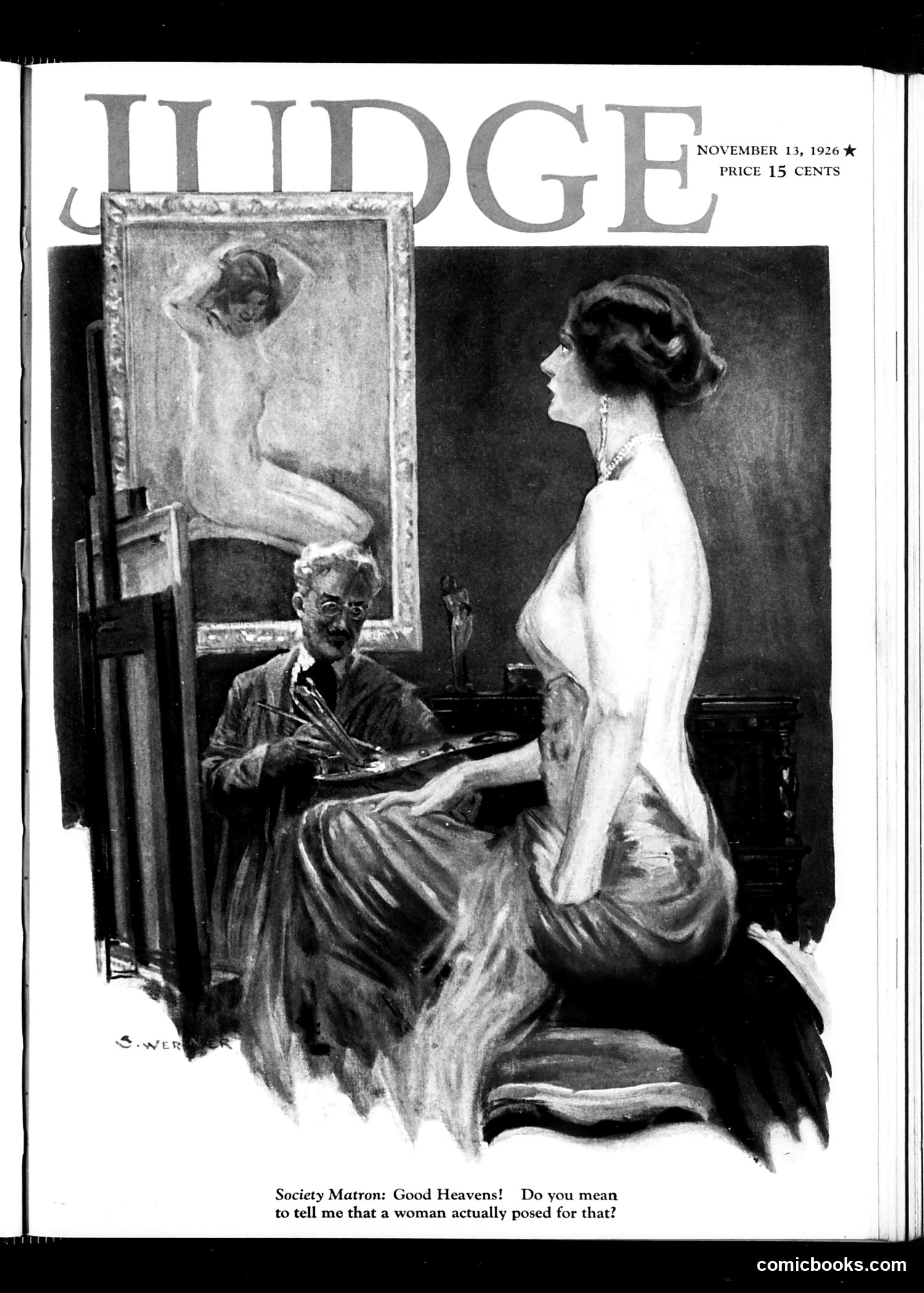
This cartoon satirizes the modeling profession and artistic propriety of the 1920s. A shocked "Society Matron" observes an artist painting a partially nude female model, expressing disbelief that a woman would pose unclothed for an artwork. The joke reflects class anxiety: respectable society women were scandalized by the bohemian practices of artists and their models. The cartoon mocks the matron's prudish reaction while implicitly criticizing the loosening moral standards of the Jazz Age—when artistic modernism and changing gender roles challenged Victorian propriety. The "S. Wer" signature indicates the cartoonist. The piece captures 1920s tensions between traditional morality and avant-garde artistic freedom, using the matron's outrage as the vehicle for satire.
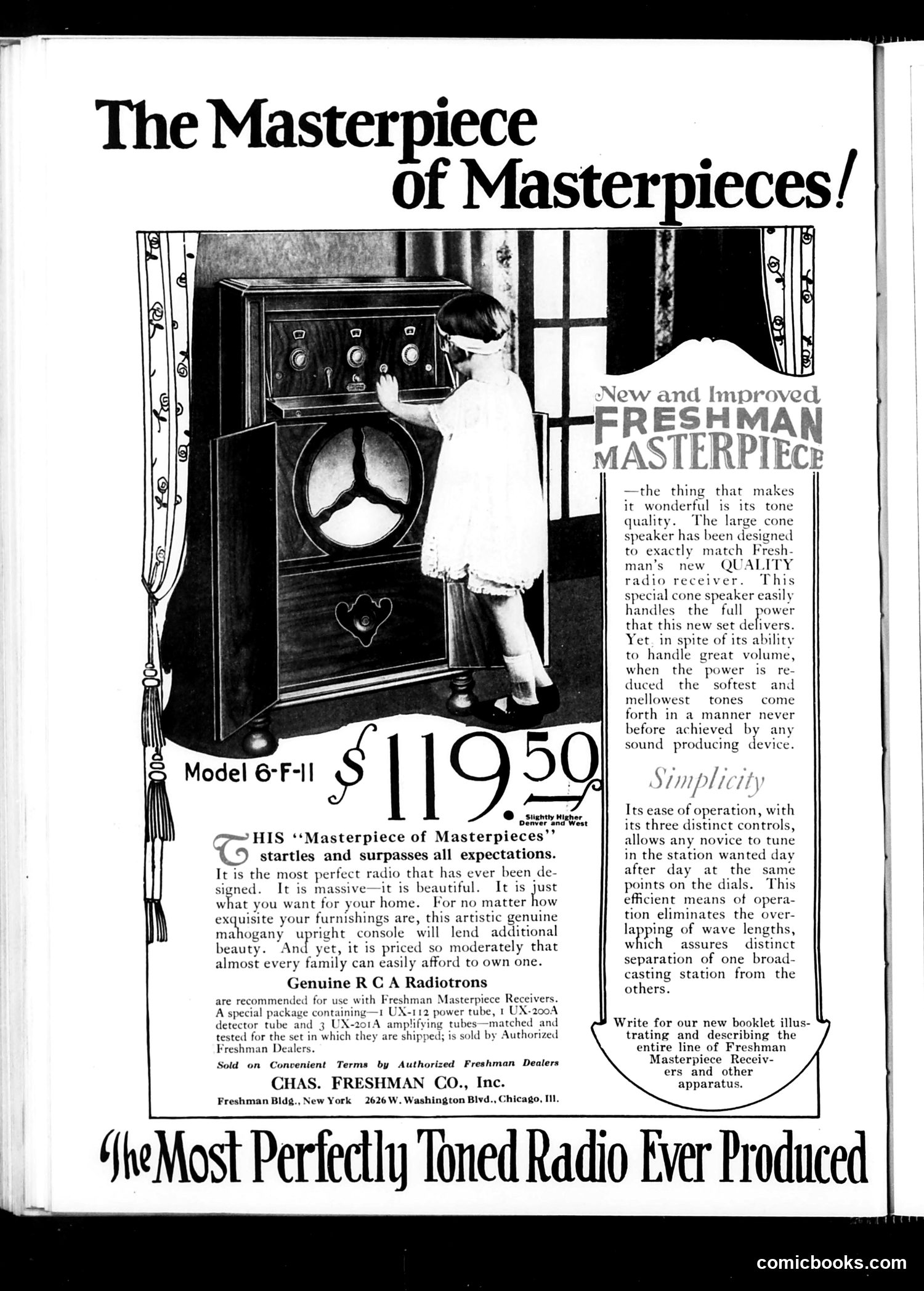
This page is primarily a **product advertisement**, not political satire. It promotes the Freshman Company's "Masterpiece of Masterpieces" radio receiver (Model 6-F-11, priced at $119.50). The ad emphasizes the radio's superior tone quality, featuring a large cone speaker designed to handle the new receiver's power output while delivering "softest and mellowest tones." It highlights **simplicity of operation**—three controls allow easy tuning without expertise. The image shows a woman in 1920s-era dress operating the mahogany console radio. The advertisement targets middle-class homeowners, positioning the expensive radio as both an artistic furniture piece and an affordable luxury ("almost every family can easily afford to own one"). This reflects the 1920s radio boom when high-quality receivers were status symbols for modern households.
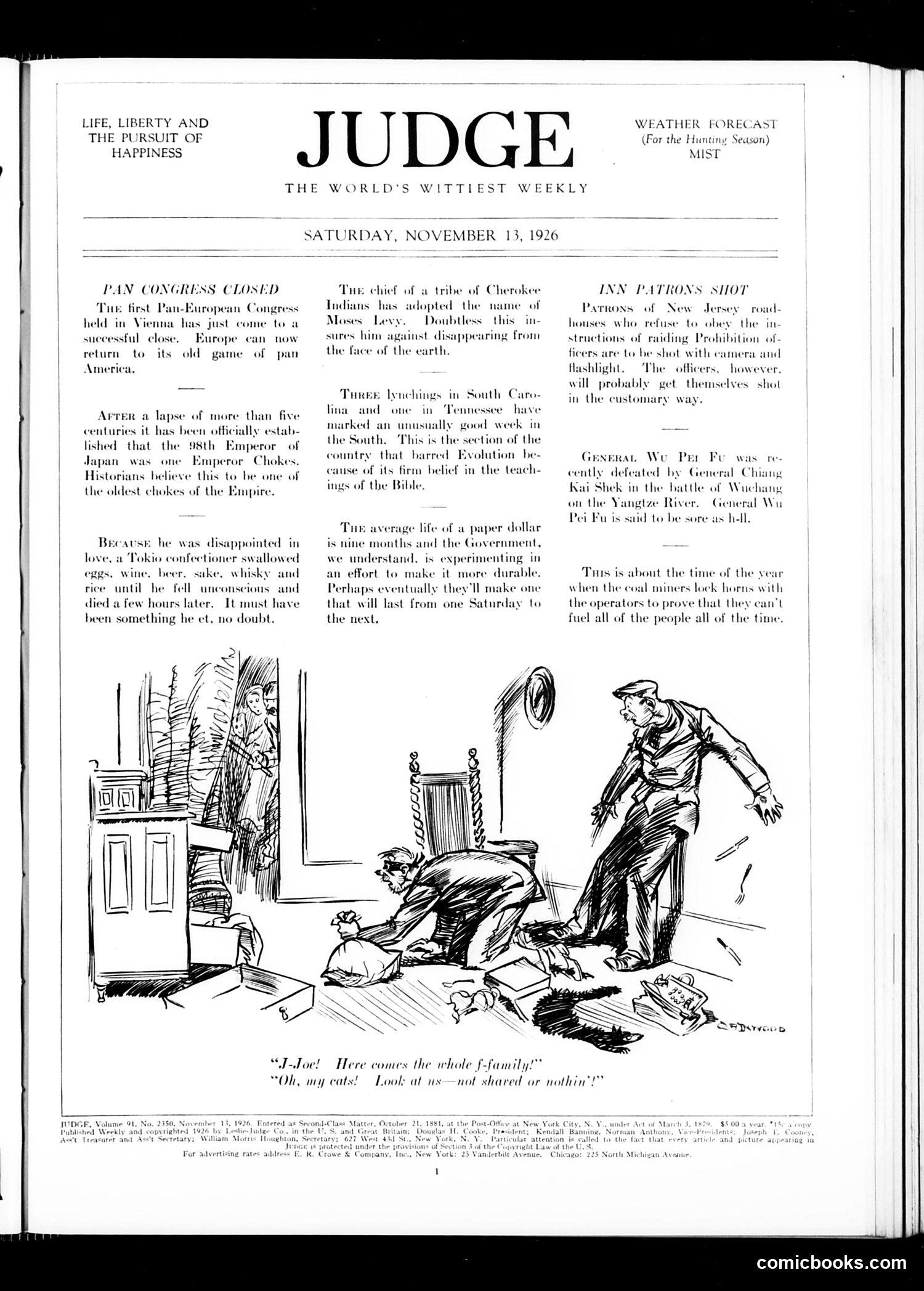
The main cartoon depicts a domestic scene of chaos—a man arrives home to find his wife, children, and furniture in disarray. The caption reads: "Help! Here comes the whole f-family!" and "Oh, my cats! Look at us—not shaved or nothin'!" This appears to be a **Prohibition-era humor piece** satirizing household disorder and marital comedy. The disheveled state suggests either a wild party or general neglect while the husband was away—likely drinking illegally during Prohibition. The joke plays on the husband's embarrassment at unexpected family arrival catching them unprepared. The surrounding text covers unrelated news items (Pan-European Congress, Cherokee chief adoption, lynchings). This was typical Judge format: satirical commentary mixed with miscellaneous current events.
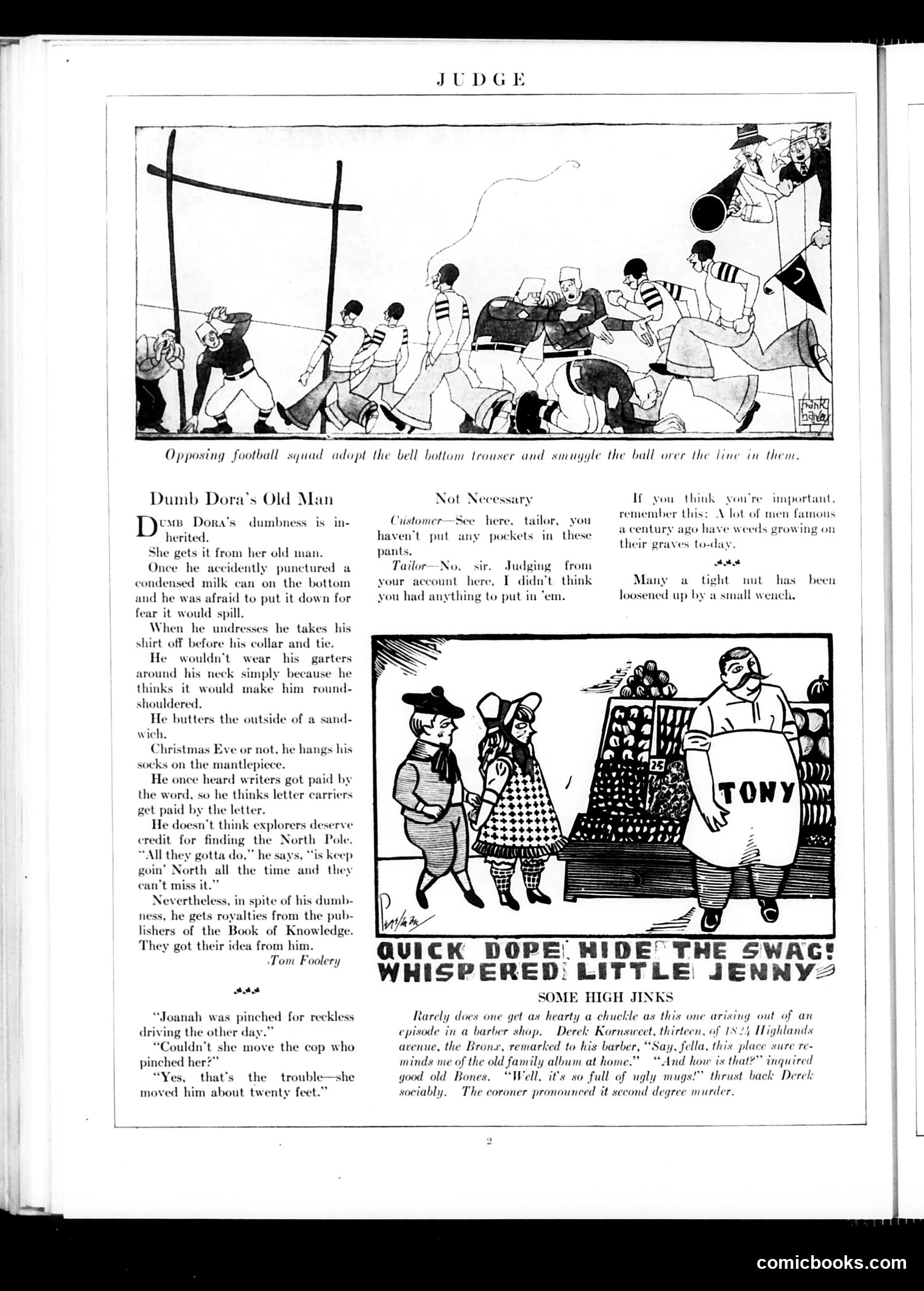
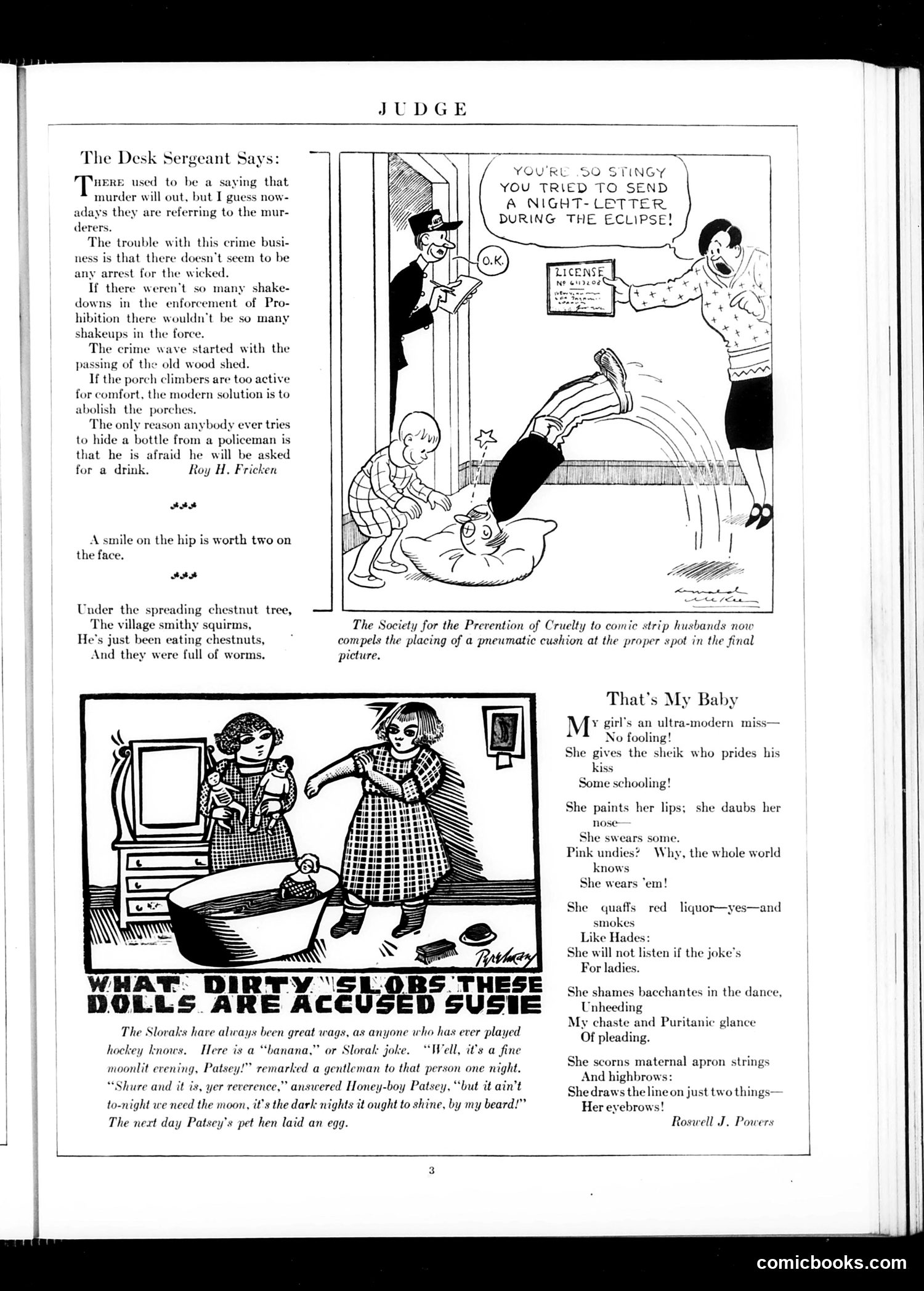
This page contains three distinct sections of social satire: **"The Desk Sergeant Says"** offers cynical commentary on crime and Prohibition-era enforcement, suggesting murders go unreported and hiding bottles from police is common—reflecting public frustration with Prohibition laws. **The eclipse cartoon** mocks overzealous rule-enforcement, showing officials citing a couple for sending a "night-letter" during an eclipse, likely satirizing government bureaucracy and absurd technicalities. **"That's My Baby"** is a poem mocking ultra-modern women who smoke, drink liquor, wear short dresses ("Pink undies"), and generally violate traditional feminine propriety—reflecting Jazz Age anxieties about changing women's behavior and independence. The "dirty slobs" cartoon below references hockey player Susie and social gossip about modern female behavior. Overall, the page reflects 1920s concerns about Prohibition enforcement, changing social norms, and women's liberation.
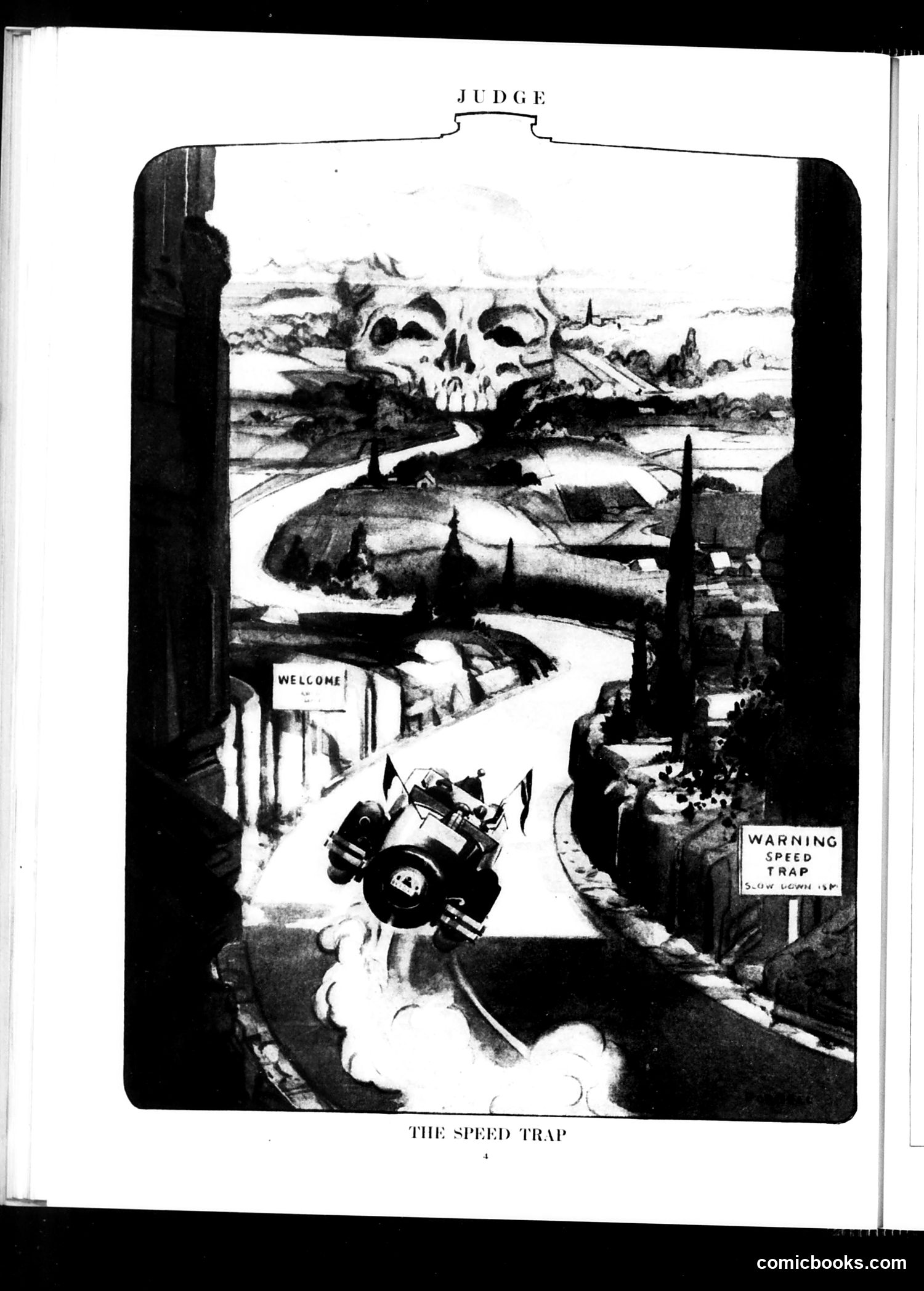
This cartoon satirizes the danger of speeding automobiles in early 20th-century America. A car labeled with a "Warning Speed Trap" sign speeds toward a massive skull overlooking a landscape of destruction—wrecked vehicles, damaged buildings, and death. The "Judge" heading indicates this is a cautionary editorial cartoon warning against reckless driving. The skull represents death, while the "Welcome" and "Speed Trap" signs suggest that drivers ignoring safety warnings face fatal consequences. This reflects growing public concern about automobile safety as cars became more common and faster. The cartoon uses memento mori (skull imagery) to moralize about the deadly consequences of ignoring traffic warnings—a common Progressive Era approach to social reform through visual shock and moral persuasion.
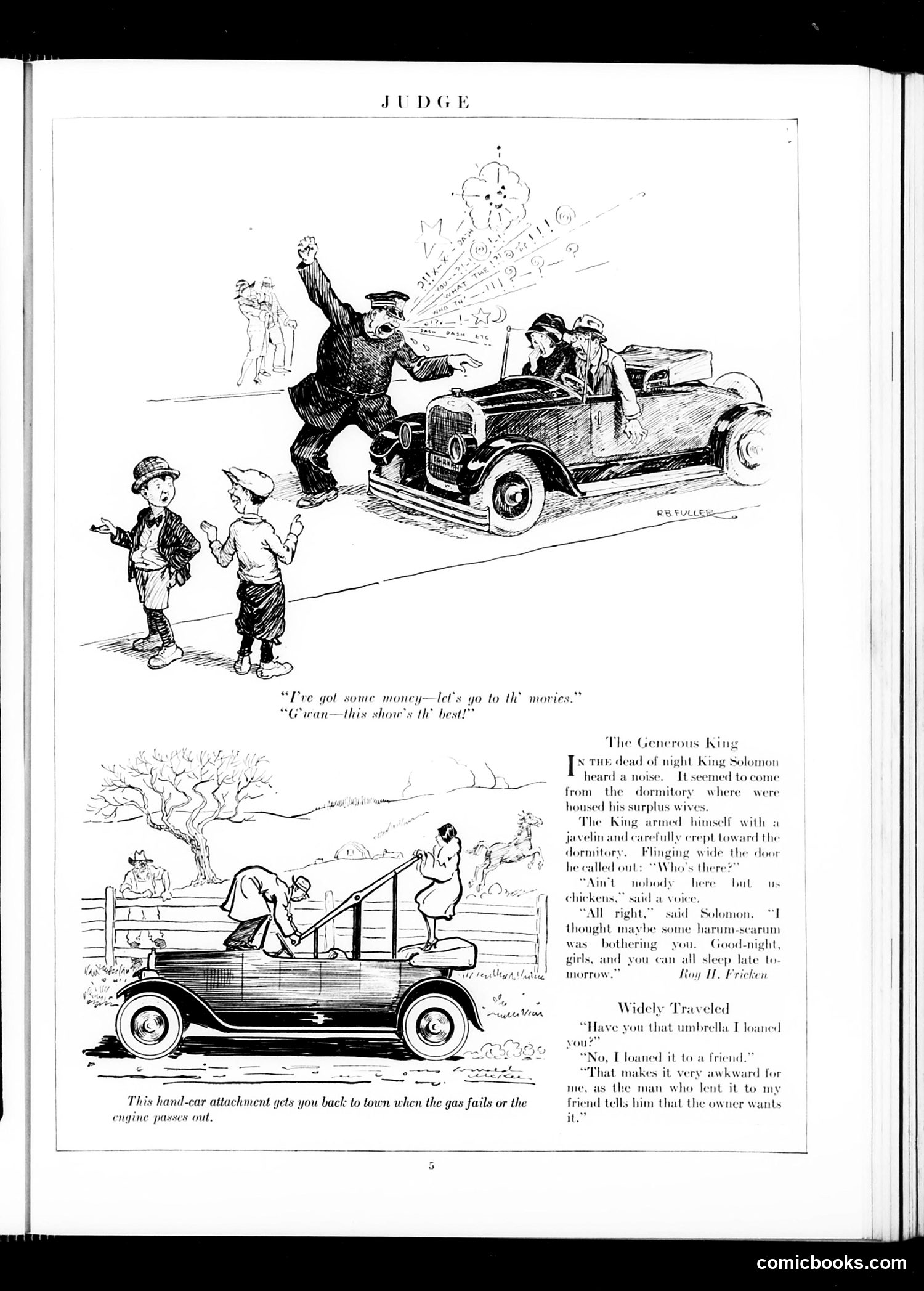
This page contains two cartoon vignettes satirizing early automotive culture and social etiquette: **Top cartoon**: A large figure (possibly a traffic officer or authority figure) confronts a car full of people, with mathematical equations spraying from his gestures. The caption references going "to th' movies," suggesting satire about traffic enforcement or reckless driving interfering with entertainment plans. **Bottom section**: "The Generous King" and "Widely Traveled" are brief humorous stories about automobiles. One involves King Solomon and a dormitory invasion; the other concerns a borrowed umbrella creating awkward social situations. The car illustrations show a "hand-car attachment" device—apparently a period automotive accessory. The humor targets early-1900s automobile culture, social mishaps, and the novelty of motorized transportation competing with traditional leisure activities.
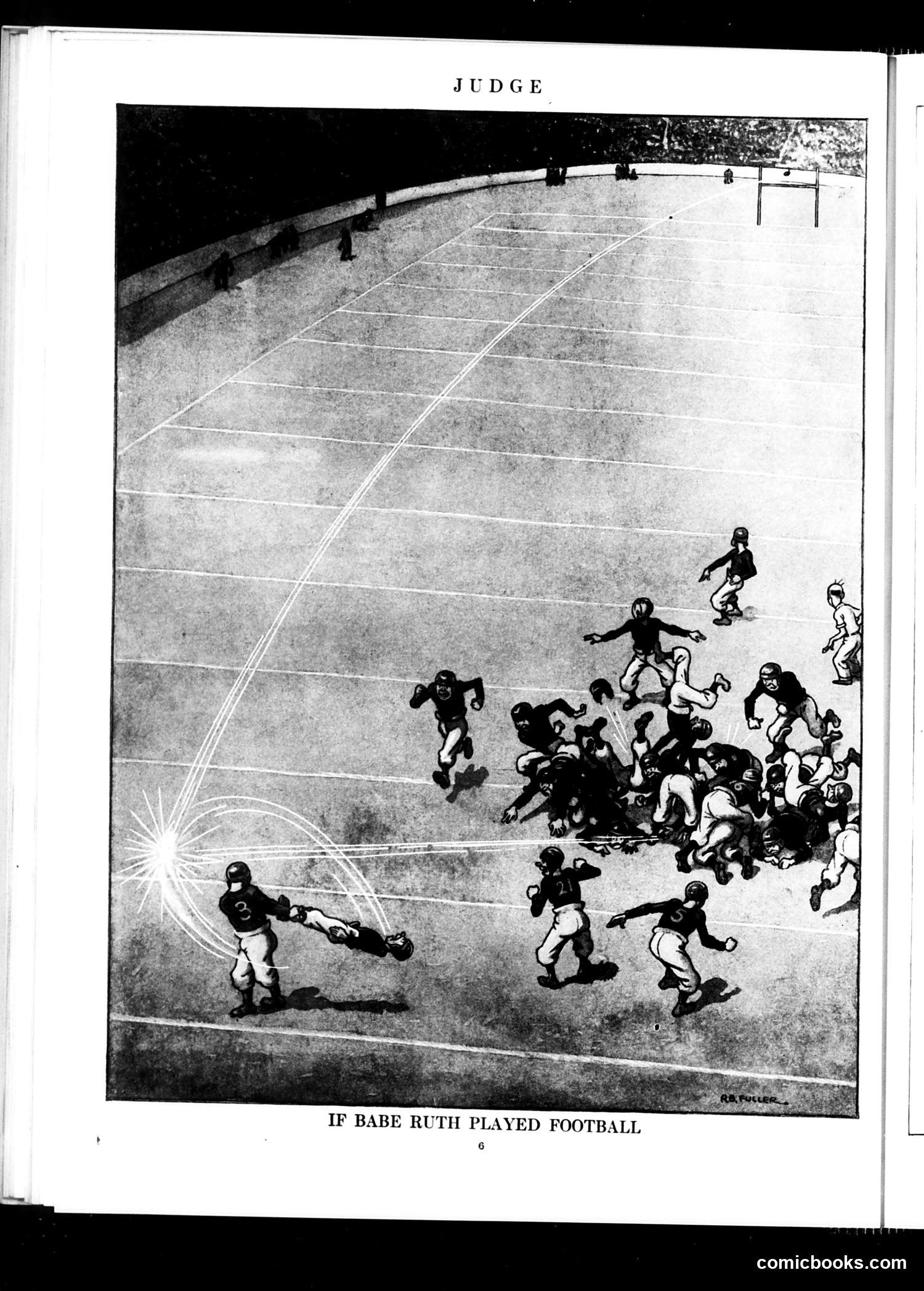
This is a humorous fantasy illustration imagining what would happen if Babe Ruth—the legendary baseball star—played football instead. The cartoon depicts Ruth as a player on a football field, shown making an explosive impact in the center of action, with other players scattered around him in chaotic positions, some appearing knocked down or displaced by his presence. The joke relies on Ruth's real-world fame and reputation for powerful, game-changing performance in baseball. By transplanting him to football, Judge magazine creates absurdist humor: his legendary strength and dominance would presumably be so overwhelming that he'd single-handedly disrupt the entire sport. The exaggerated chaos and violence of the imagery emphasizes the comedic premise that Ruth was simply too powerful an athlete to be contained by normal athletic competition.
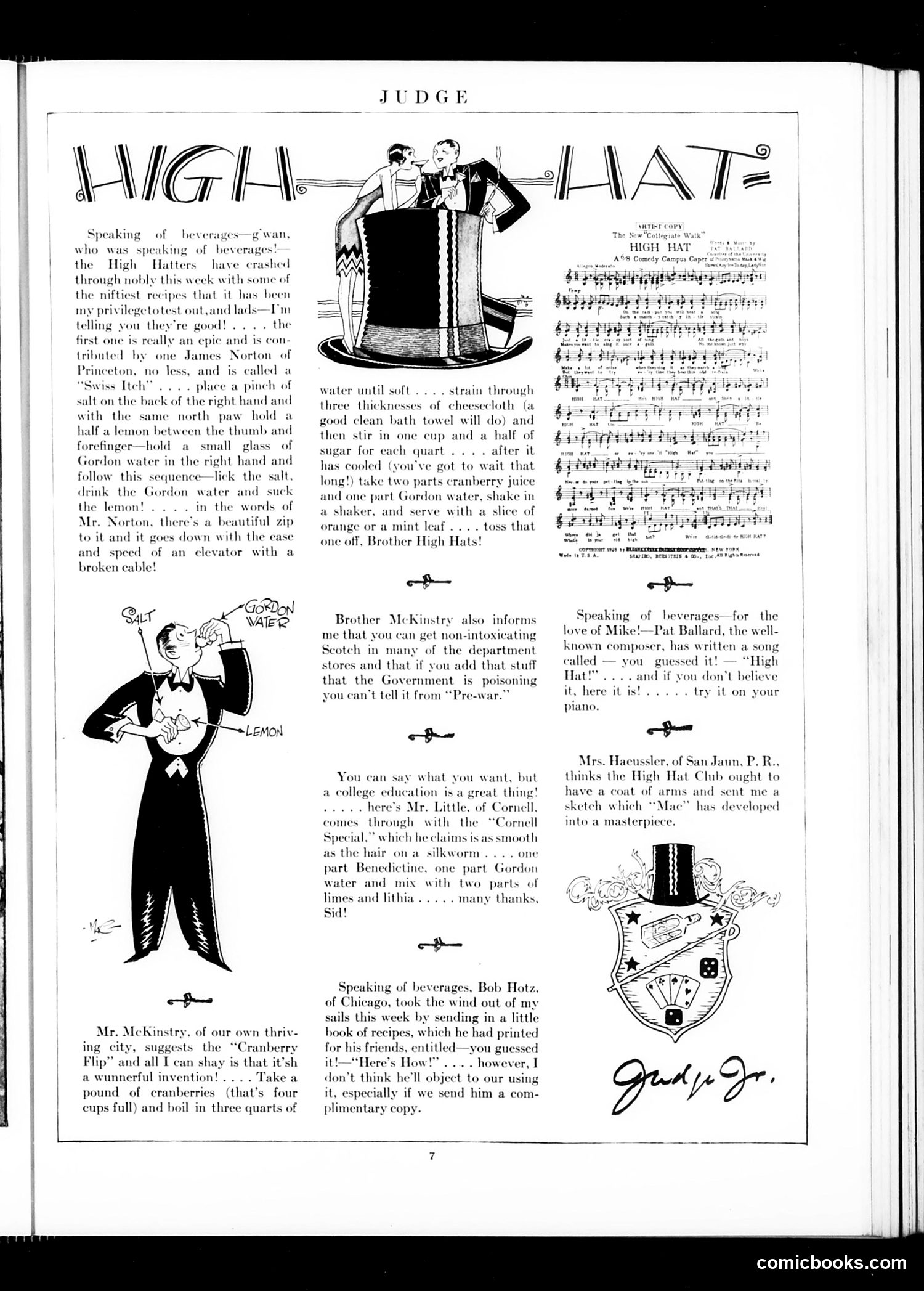
This page celebrates cocktail recipes submitted by readers during Prohibition—when alcohol sales were illegal but consumption continued. The satire targets the era's hypocrisy: "Gordon water" and "non-intoxicating Scotch" are transparent euphemisms for banned liquor, while the government "is poisoning" alcohol (adding denaturants to industrial supplies to discourage drinking). The "High Hatters" are sophisticated drinkers maintaining upper-class pretense despite breaking the law. References to Cornell and Princeton signal educated, privileged contributors. A composer even wrote a song celebrating the club, underscoring how openly defiant the wealthy were toward Prohibition. The cartoon mocks both government futility and the era's knowing wink-wink culture: everyone understood the code words, but polite society maintained the fiction of compliance. The humor lies in Judge's barely-concealed celebration of lawbreaking among respectable people.
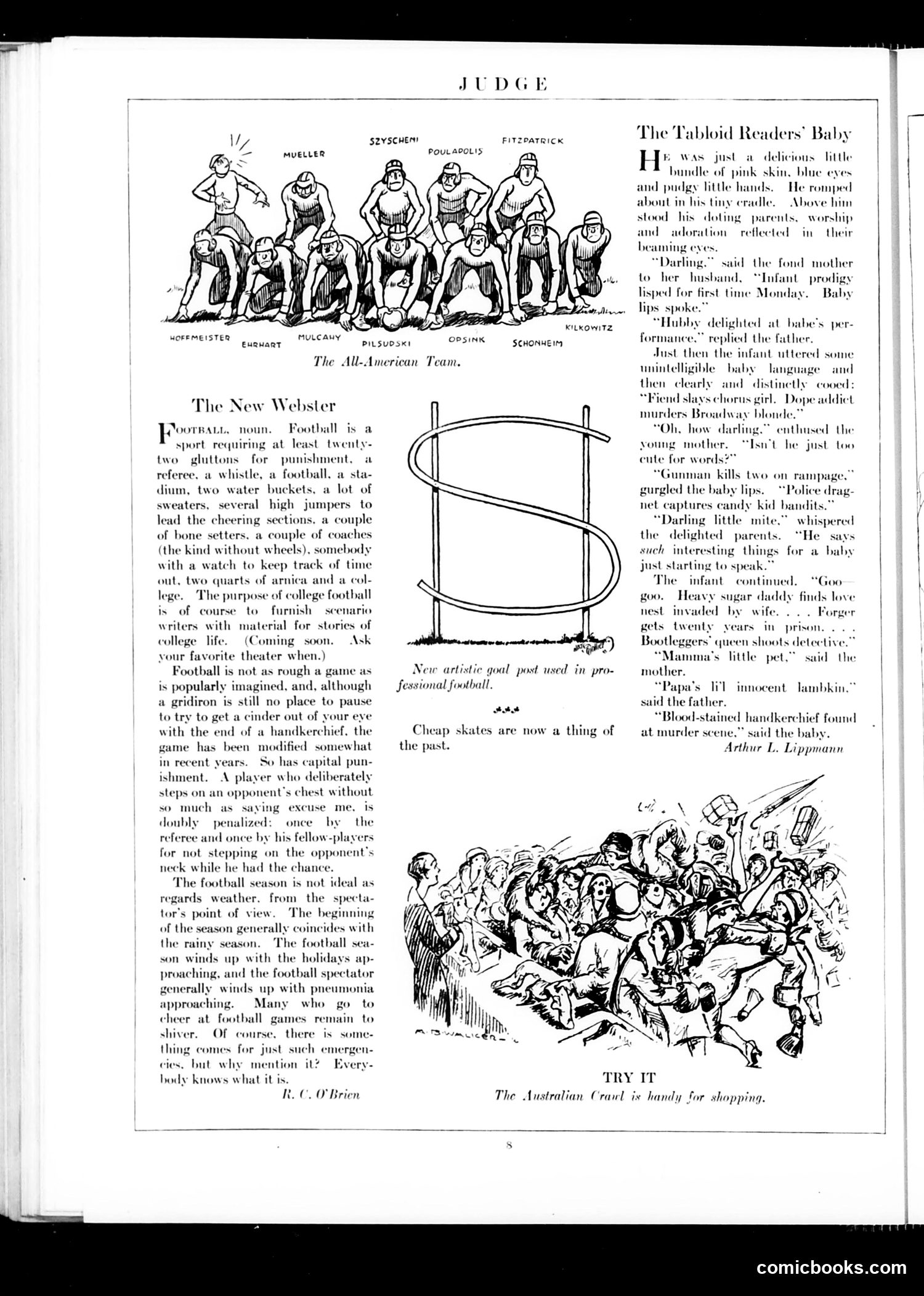
**Top Section - "The All-American Team":** A roster of football players with ethnic-sounding names (Hoffmeister, Euswart, Szyschen, Poulapoils, etc.). This appears to satirize early 20th-century American football's composition, likely mocking the prevalence of immigrant or ethnic players dominating the sport. **"The New Webster":** A humorous dictionary definition of football by R.C. O'Brien that mock-seriously describes the sport's brutality and chaos—equipment needs, the acceptability of violence ("stepping on opponent's chest"), and associated injuries (pneumonia from attending games in cold weather). It's satirizing football's actual violence while maintaining a deadpan tone. **"The Tabloid Readers' Baby":** A satirical story about an infant whose first articulate words are crime headlines ("Fiend slays chorus girl," "Gunman kills two"). Parents find this delightful rather than horrifying. The satire targets tabloid newspapers' sensationalist crime coverage and, implicitly, parents who expose children to such lurid content. The byline attributes this to Arthur L. Lippmann.
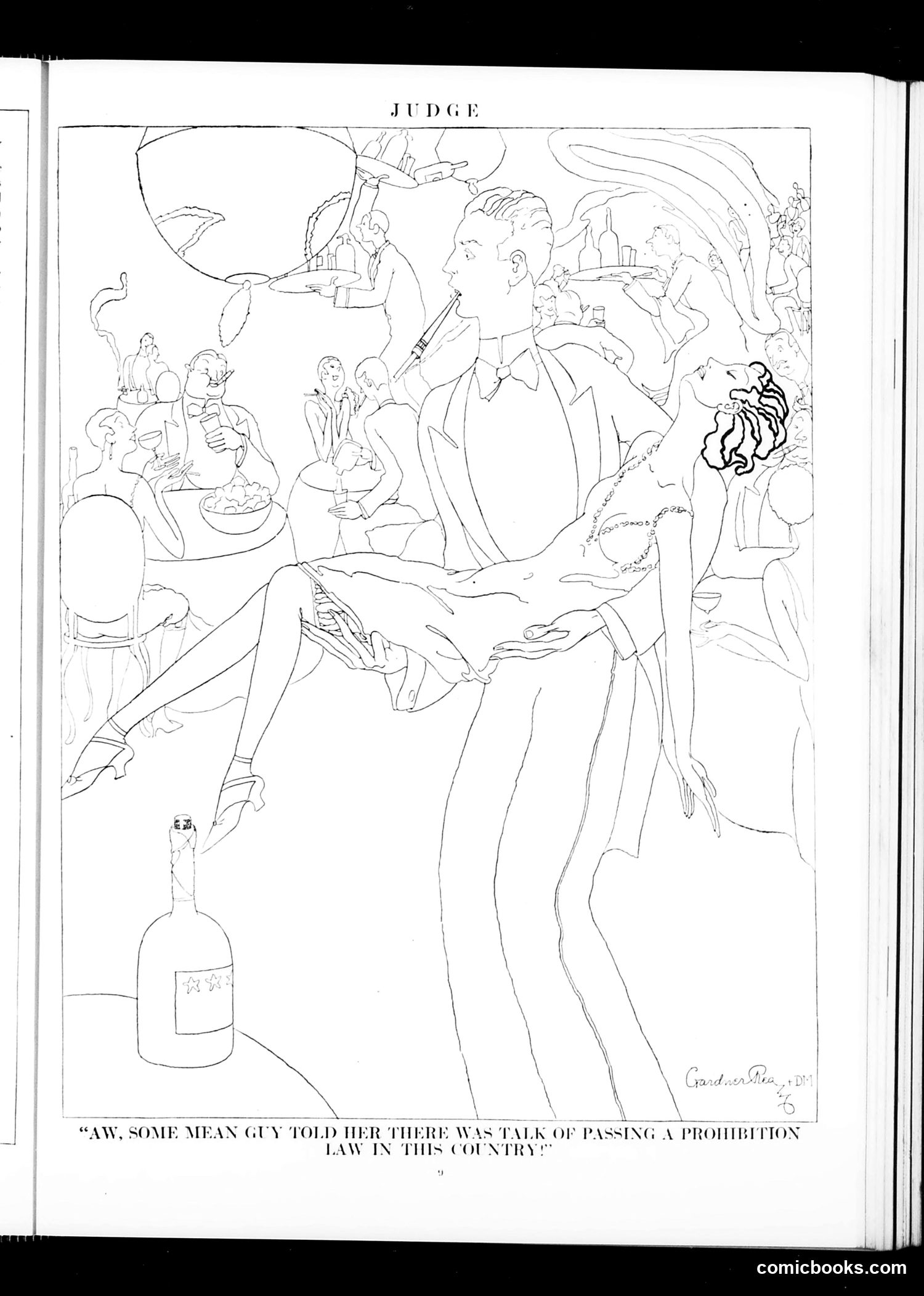
This cartoon satirizes early 20th-century Prohibition debates. A glamorous woman in an elegant dress appears distressed, having heard rumors about potential prohibition legislation banning alcohol. The scene depicts a sophisticated party with well-dressed guests, wine bottles, and servers—representing the social world threatened by proposed alcohol restrictions. The woman's exaggerated distress at the mere *talk* of prohibition suggests Judge magazine's satirical view of the Prohibition movement as something absurd or overly alarming to the leisure class. The cartoon mocks both the woman's shallow concerns and—implicitly—the intensity of anti-prohibition sentiment among wealthy Americans who enjoyed social drinking. It captures the pre-Prohibition era's anxieties about potential alcohol legislation that would eventually pass in 1920.
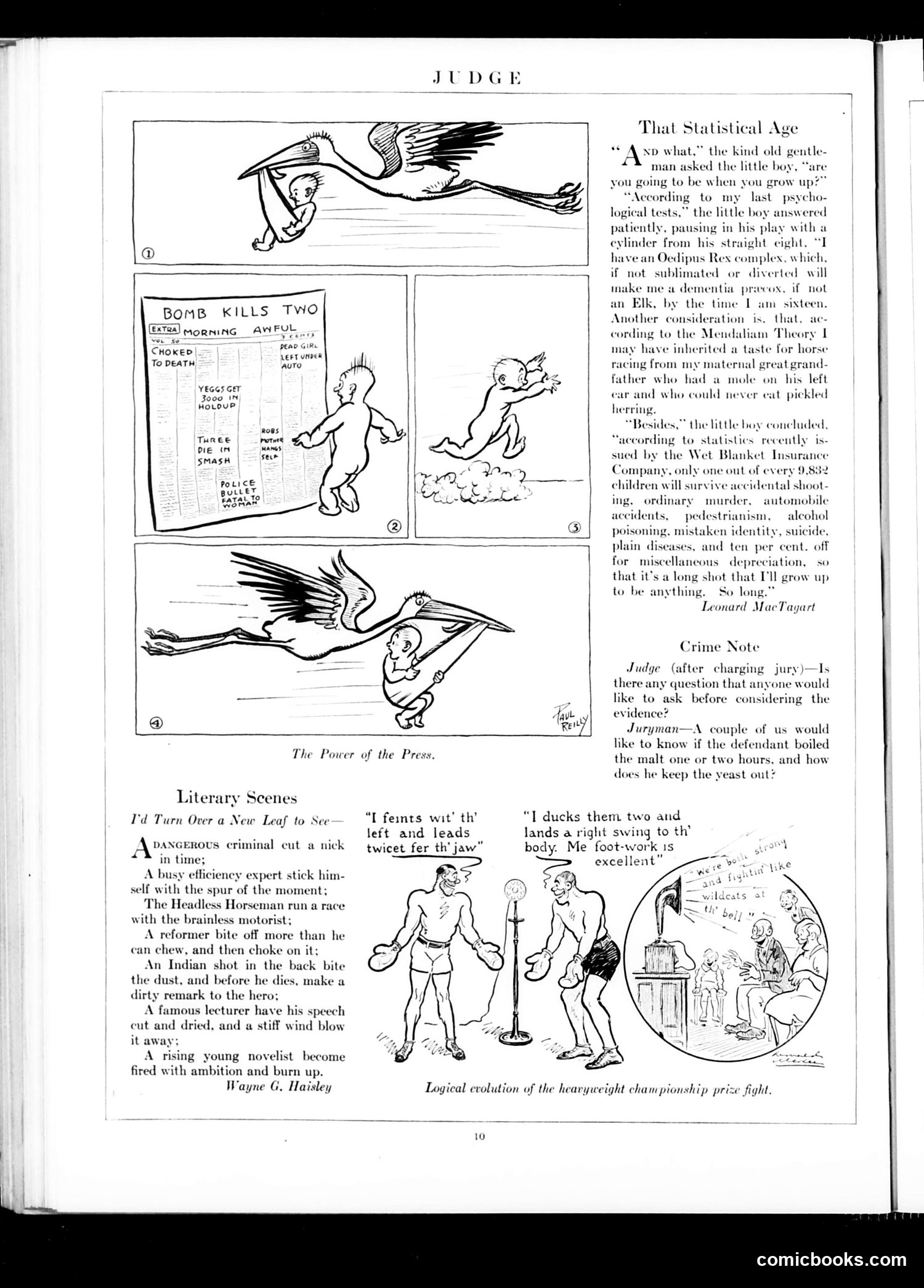
This page satirizes early 20th-century America's obsession with scientific measurement and psychological terminology. The title piece mocks how modern psychology and statistics infiltrate even childhood—a boy explains his future prospects using Freudian concepts (Oedipus complex, dementia praecox) and insurance actuarial data, concluding life's odds make success virtually impossible. The "Crime Note" cartoon jokes about jury comprehension: the judge instructs jurors on evidence, but they're preoccupied with brewing beer—referencing Prohibition-era concerns about alcohol production, suggesting jurors' real interests lie elsewhere. "Literary Scenes" presents absurdist vignettes of literary tropes exaggerated to ridiculous extremes (criminals dying with dramatic last words, etc.). The boxing cartoon satirizes contemporary sportswriting's pseudo-scientific language about championship fights reduced to mechanical descriptions of punches. The overall message: American culture drowns in jargon, statistics, and pseudo-intellectual language obscuring simple truths.
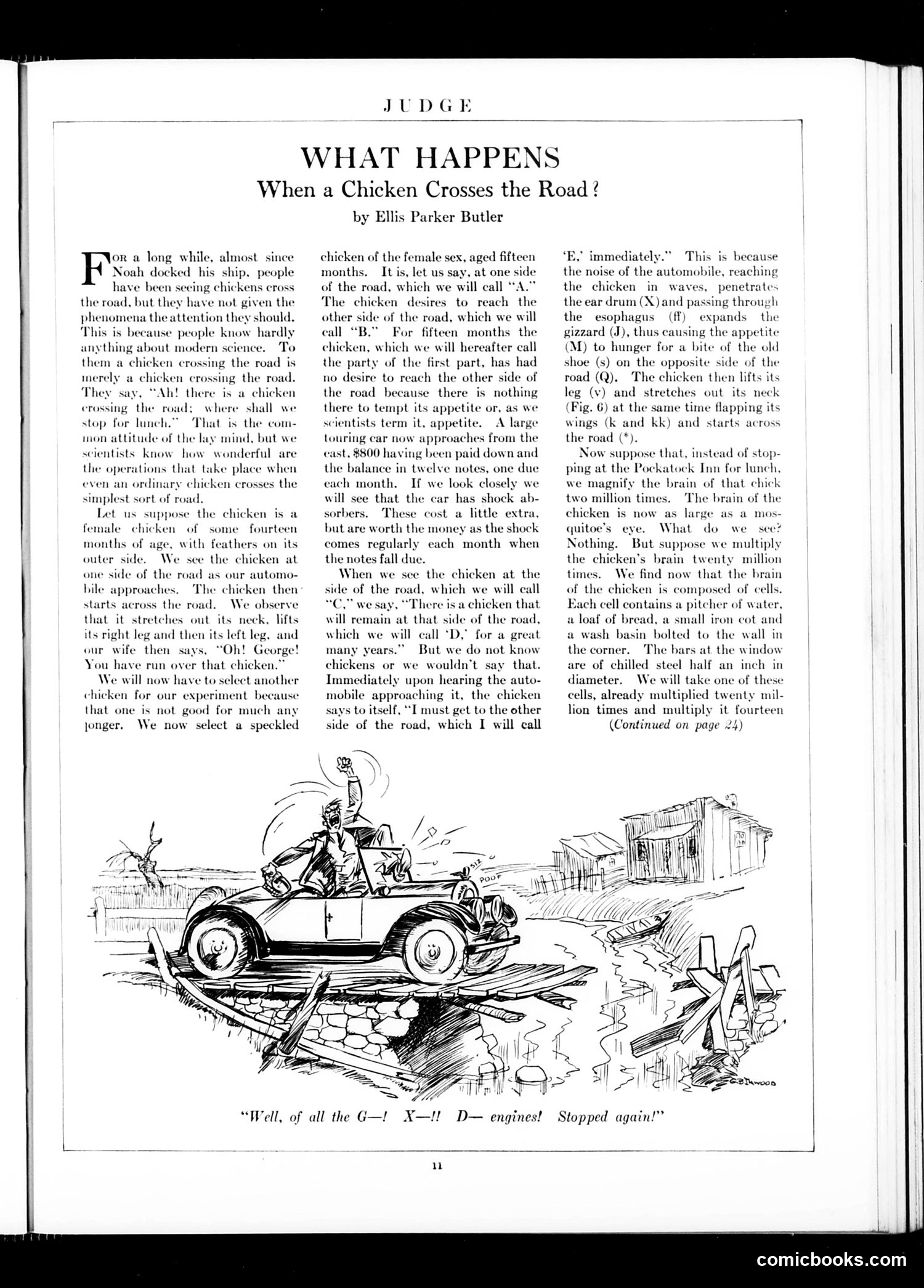
This is a humorous scientific satire by Ellis Parker Butler mocking the pretensions of modern science and intellectualism. The article absurdly "explains" the simple act of a chicken crossing a road through elaborate pseudo-scientific jargon—invoking anatomical terms (esophagus, gizzard), Latin labels (points A, B, D, E), and microscopic examination of brain cells. The accompanying cartoon shows a car hitting a chicken, with the frustrated driver exclaiming about engine trouble—ironically undercutting the entire scientific buildup with ordinary, mundane reality. The satire targets how scientists and intellectuals overcomplicate simple observations with grandiose terminology and methodology, treating trivial phenomena as profound mysteries worthy of intense technical analysis. It's a gentle mockery of academic pomposity and the gap between scientific pretense and actual usefulness.
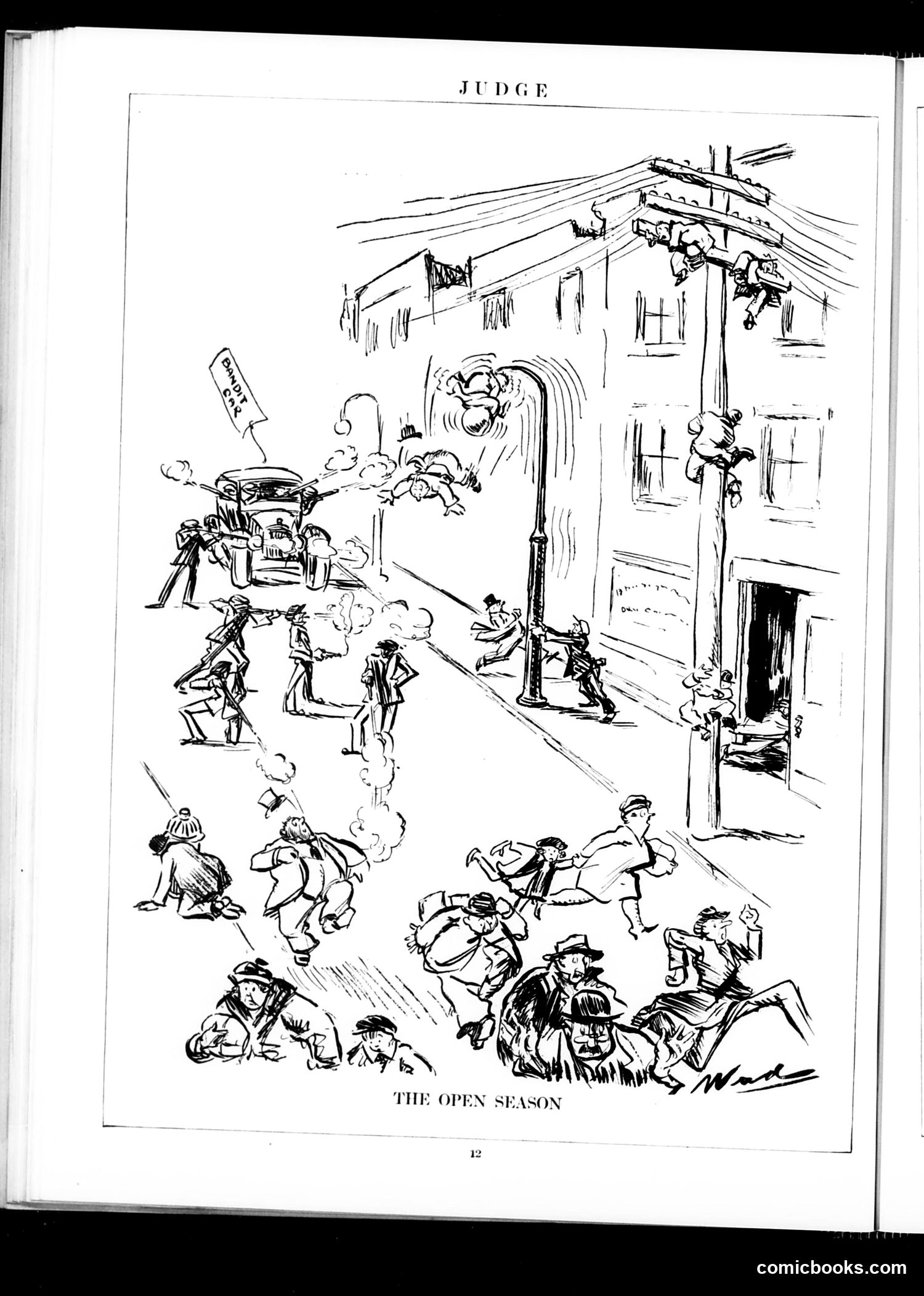
This satirical cartoon depicts a chaotic hunting scene titled "The Open Season," likely referencing legal prosecution or political attacks. The building resembles a courthouse, with figures hunting other men like game animals. The signpost reading "OPEN SEASON" suggests a period when certain targets became fair game for attack. The cartoon satirizes what appears to be a period of widespread litigation, political persecution, or legal harassment—depicted as hunters pursuing their prey. The frantic activity and multiple pursuers suggest either a legal crackdown affecting many people or a competitive rush to prosecute/attack someone influential. Without additional context about the specific publication date, the exact political target remains unclear, but the imagery effectively mocks the violence of legal or political persecution by literalizing it as a hunting expedition.
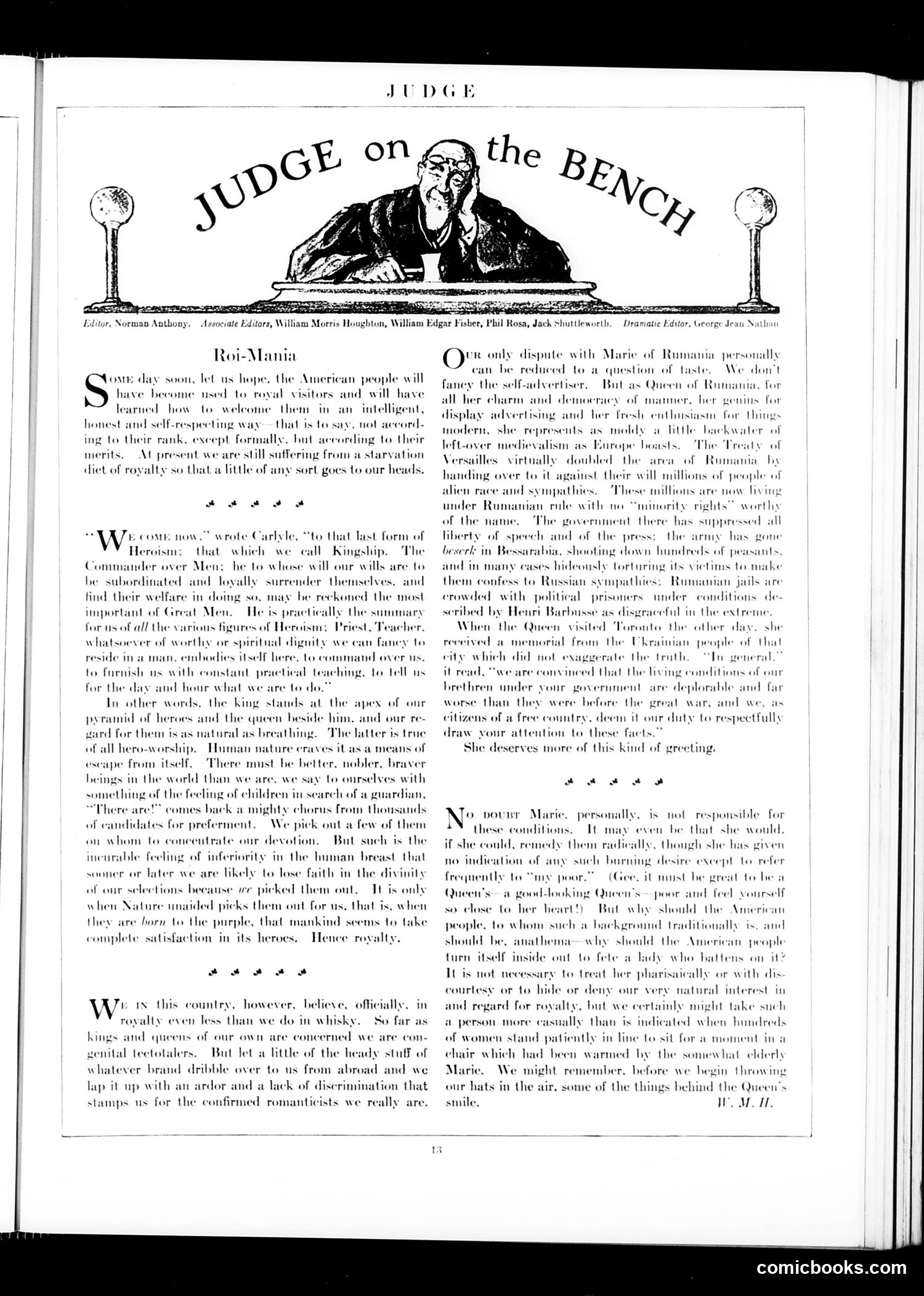
This editorial satirizes American fascination with European royalty, specifically Queen Marie of Romania's visit to Toronto. The illustration shows a stern judge presiding over the nation's "infatuation." The article argues Americans claim to reject monarchy yet fawn over royal visitors—a contradiction the author calls "Roi-Mania" (royal mania). The piece quotes Carlyle on kingship's appeal, then pivots to critique: while Marie presents herself as modern and democratic, Romania actually represents "moldy medievalism." The satire's real target is Romania's authoritarian practices: suppression of press freedom, persecution of political prisoners, torture of suspected Russian sympathizers, and denial of minority rights to newly conquered territories (acquired through the Treaty of Versailles). Marie's charitable image masks governmental brutality. The author argues Americans should recognize this hypocrisy—we shouldn't romanticize a ruler whose government contradicts the democratic values we claim to champion.
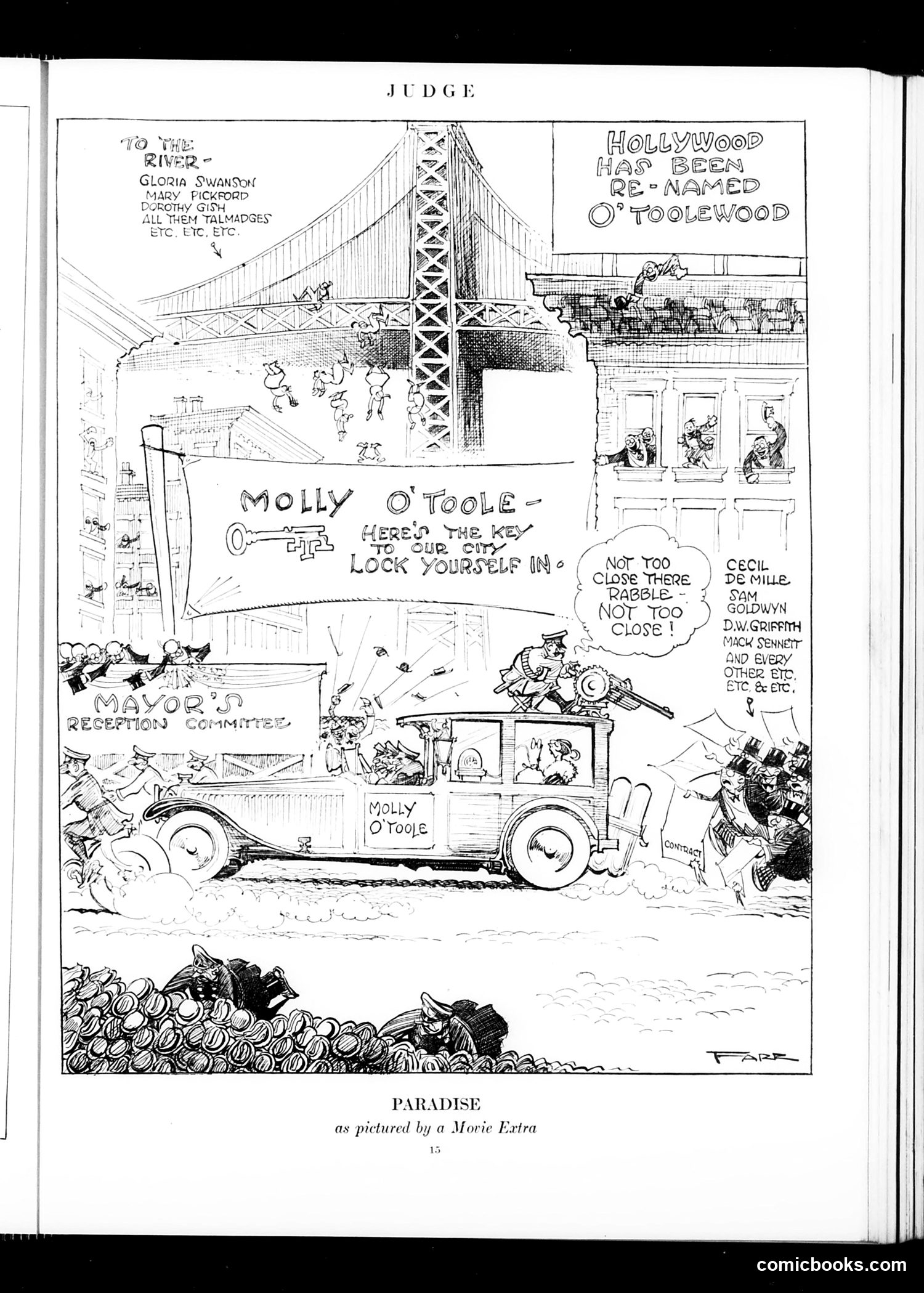
This Judge cartoon satirizes Hollywood's inflated self-importance circa the 1920s. The joke: Hollywood has renamed itself "Toolewood" (a pun suggesting the industry's superficiality) and presents a key to the city—but the accompanying advice is "lock yourself in," implying Hollywood is a prison or insular bubble. The cartoon lists major silent-film stars and directors of the era (Gloria Swanson, Mary Pickford, D.W. Griffith, Cecil B. DeMille, Mack Sennett, Sam Goldwyn), presented as the city's elite. The visual gag shows Molly O'Toole arriving by truck labeled "Molly O'Toole" while a "Mayor's Reception Committee" appears chaotic—suggesting Hollywood's tendency to elevate unknowns or minor figures to celebrity status. The satire mocks Hollywood's self-aggrandizement and its disconnection from reality, presenting it as a closed system obsessed with its own importance.
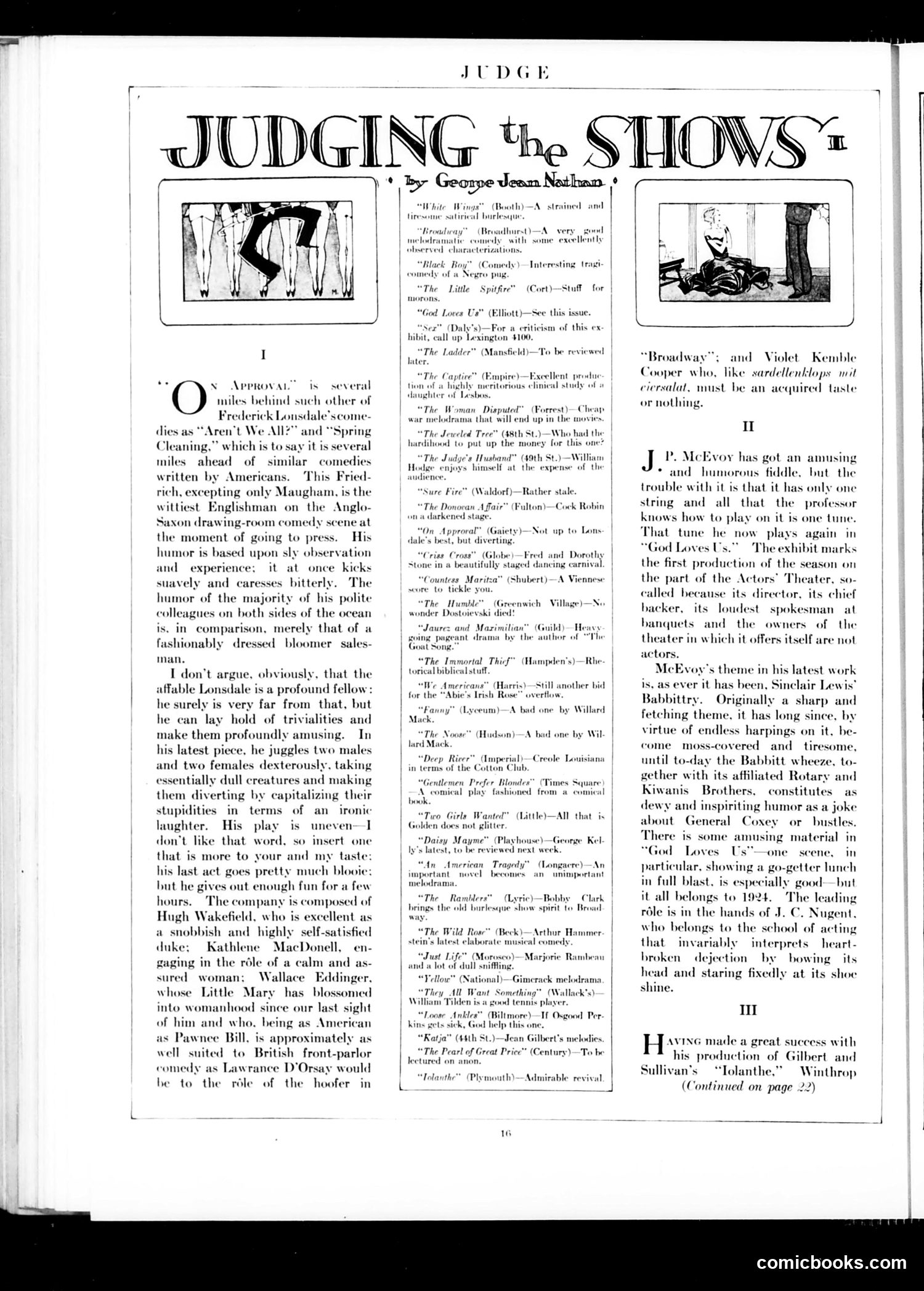
This page reviews Broadway productions through the lens of dramatic criticism rather than political satire. The main article praises English playwright Frederick Lonsdale's comedic writing style—witty, observant, and sophisticated—as superior to most American comedies of the era. Nathan contrasts Lonsdale's "polite colleagues" with American playwrights, suggesting American humor lacks the subtlety and intelligence of British drawing-room comedy. The right column contains brief capsule reviews of current shows, using Nathan's characteristic snark to dismiss inferior productions (labeling some "stale," "heavy going pageant drama," or "unimportant melodrama"). The reviews reference specific theaters and actors like Hugh Wakefield and Wallace Eddinger, indicating this addresses Judge's sophisticated theater-going audience interested in Broadway's current offerings rather than broader political commentary.
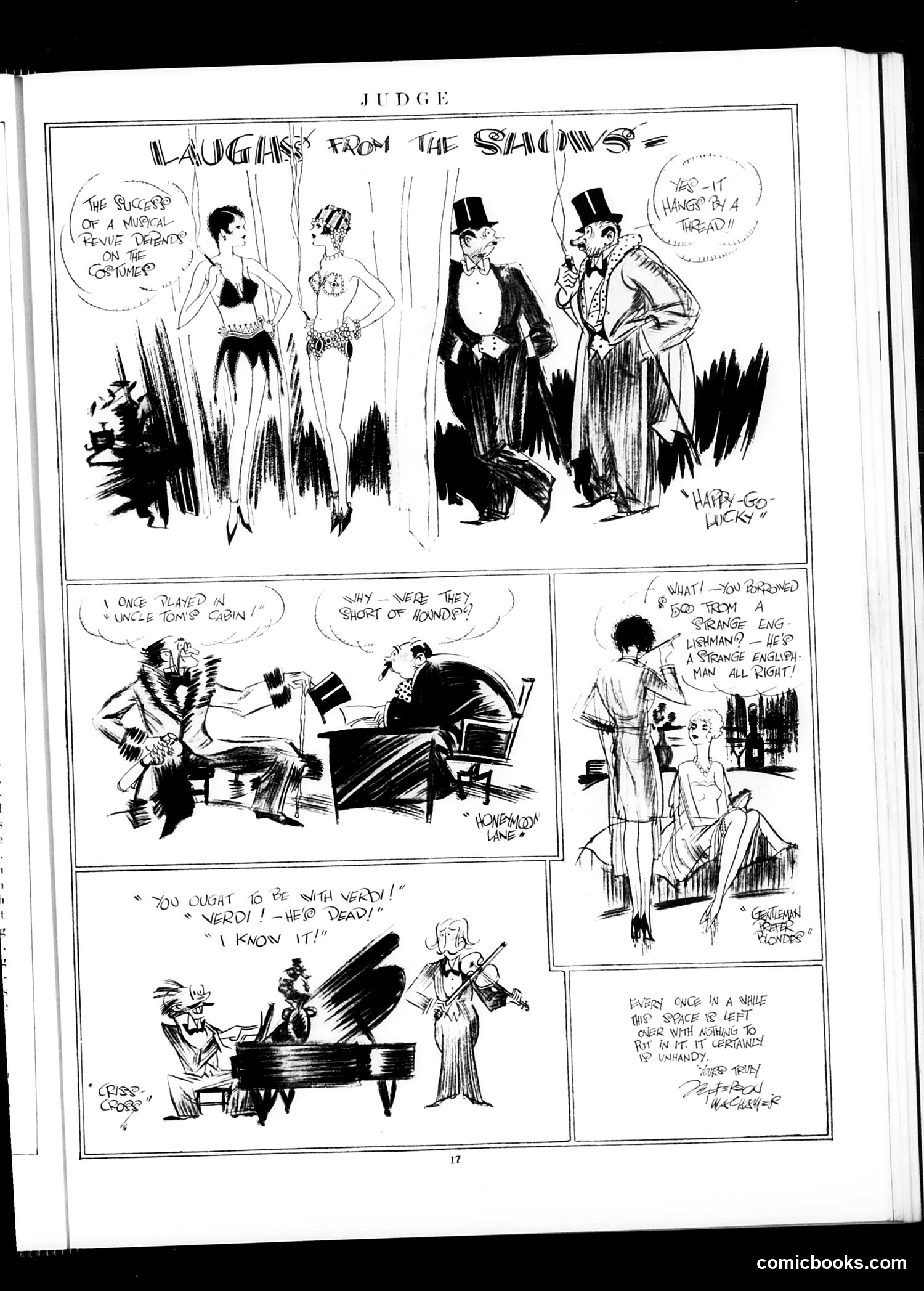
This page satirizes theatrical productions and performers of the era, specifically mocking opera and classical music performances. The top panel shows two well-dressed men in top hats commenting on stage performers, with one calling it "the success of a musical where everybody depends on the composer"—a jab at how operas rely entirely on the composer's work rather than performers' talents. The subsequent panels feature musical performance scenarios: a pianist and violinist, with dialogue about "Uncle Tom's Cabin" (likely referencing overwrought dramatic adaptations), and a final scene with a conductor and violinist where someone claims to have "performed a strange English librarian"—appearing to mock pretentious or absurdly avant-garde musical performances. The cartoons ridicule both the pretentiousness of classical music circles and performers who overstate their artistic importance or deliver bizarre interpretations of standard works.
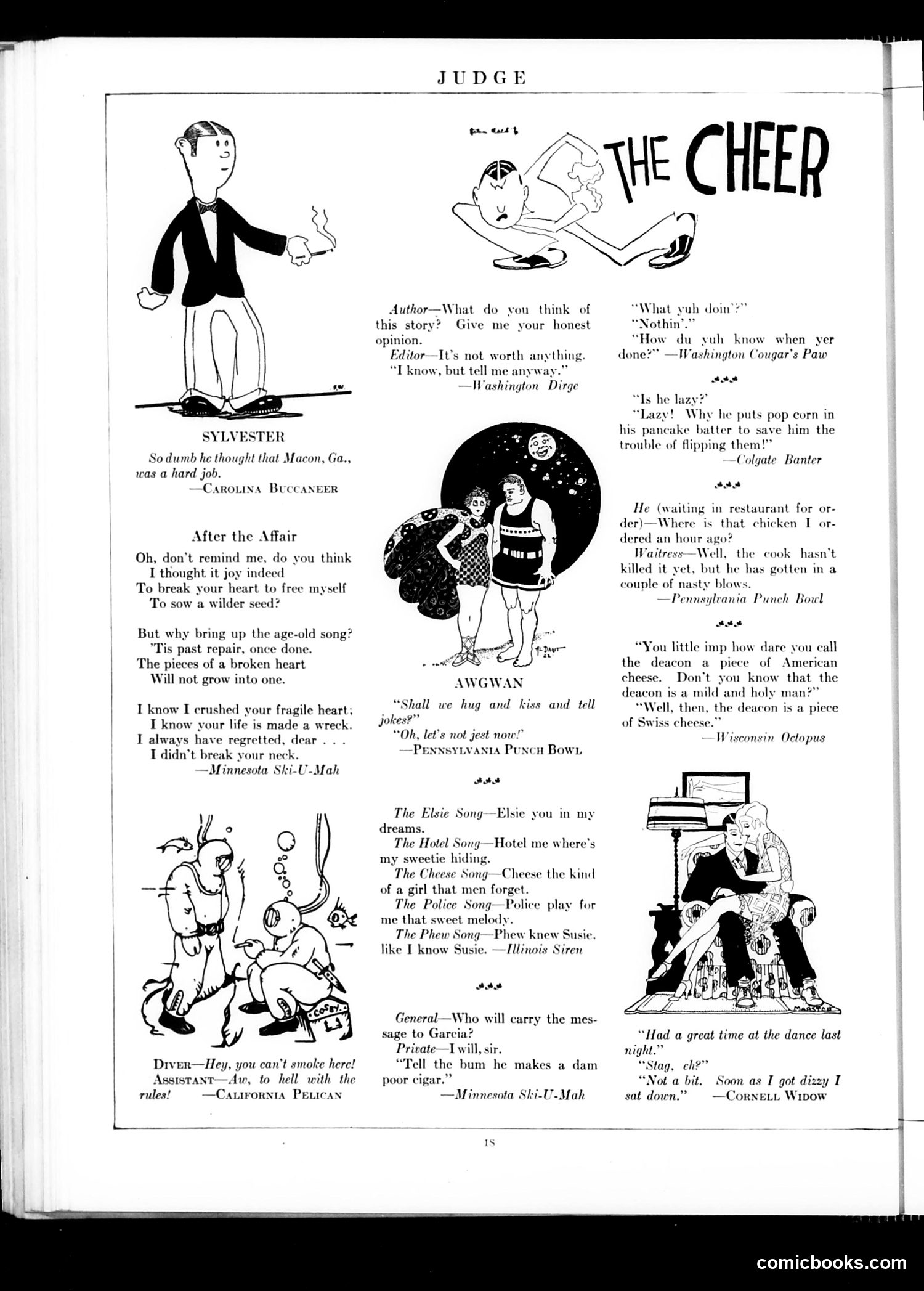
This is a humor compilation page from *Judge*, featuring jokes and witty observations submitted by college humor magazines (noted by campus attributions like "Minnesota Ski-U-Mah," "Wisconsin Octopus," etc.). The cartoons include: **"Sylvester"** - A man labeled as so unintelligent he couldn't manage a job in Macon, Georgia (implying it's an easy task). **"After the Affair"** - A sentimental poem about romantic regret, with dark humor in the final line about not breaking a lover's neck. **"Awgwan"** - A couple discussing whether to engage in romantic banter. The page also contains sight gags (the diving/smoking rule violation) and references to contemporary popular songs ("The Elsie Song," "The Police Song"), plus various short jokes about laziness, restaurant service delays, and religious hypocrisy. The humor relies on college-era comedic styles: sarcasm, romantic cynicism, and mild social satire typical of early 20th-century American college publications.
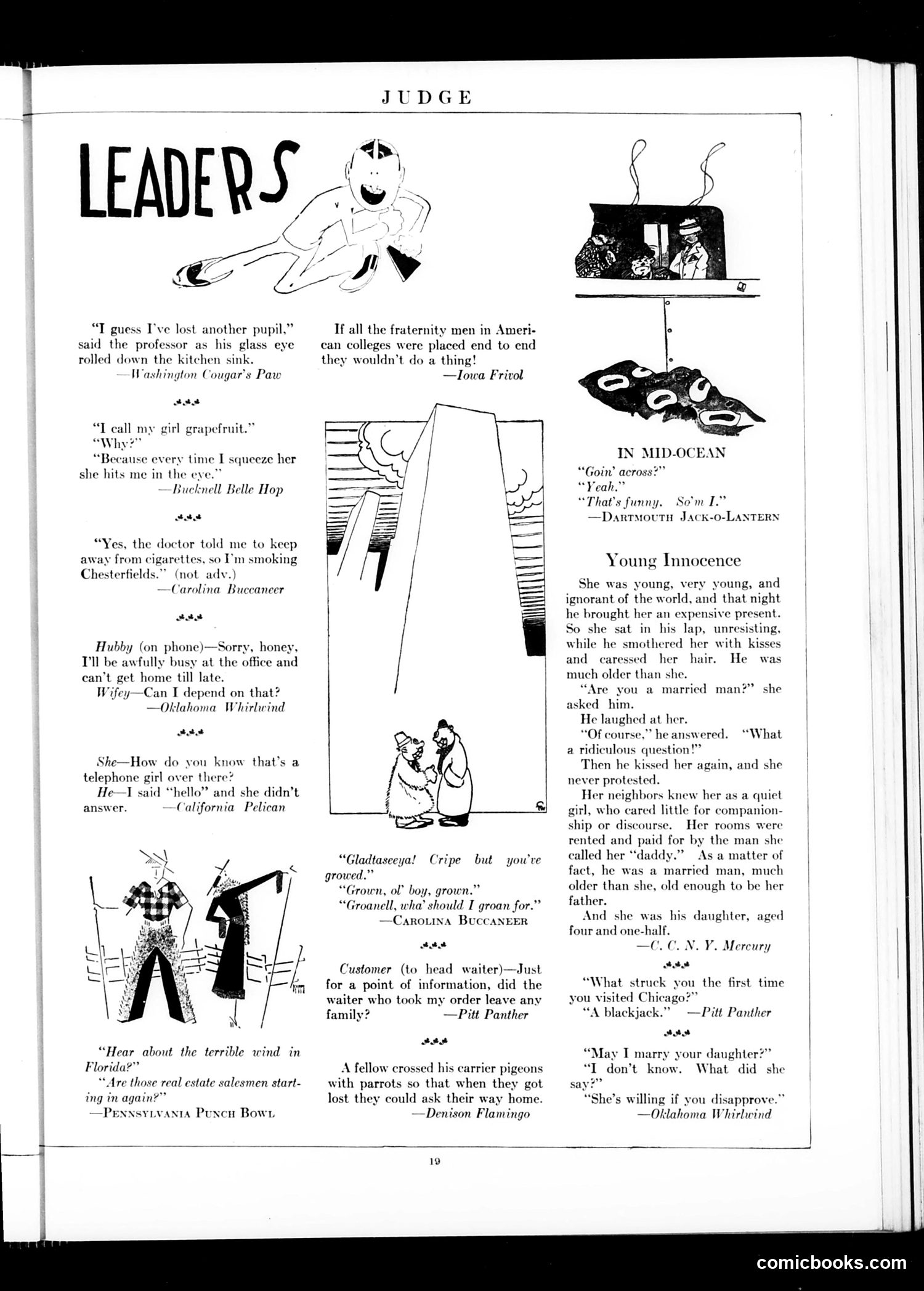
This is a humor/joke compilation page from *Judge*, circa early 20th century. The cartoons and quips satirize contemporary American social attitudes through exaggeration. Key humor relies on period stereotypes: a professor losing his glass eye (slapstick absurdity), jokes about controlling girlfriends, doctors' health warnings about cigarettes, marital phone-call excuses, and telephone operators' perceived aloofness. The "Young Innocence" narrative is notably darker—it describes a young, naive girl in a relationship with a much older married man paying for her expenses. The final revelation that she's four-and-a-half years old reframes the entire story as satire on exploitation, though presented in the publication's blunt satirical style. Other jokes mock fraternity culture, Florida real estate salesmen (suggesting a period land boom), dialect humor, and marital dynamics. The Denison Flamingo item uses absurdist logic typical of college humor magazines. The cartoons employ simple line drawings accompanying these quips, standard for *Judge's* editorial format.
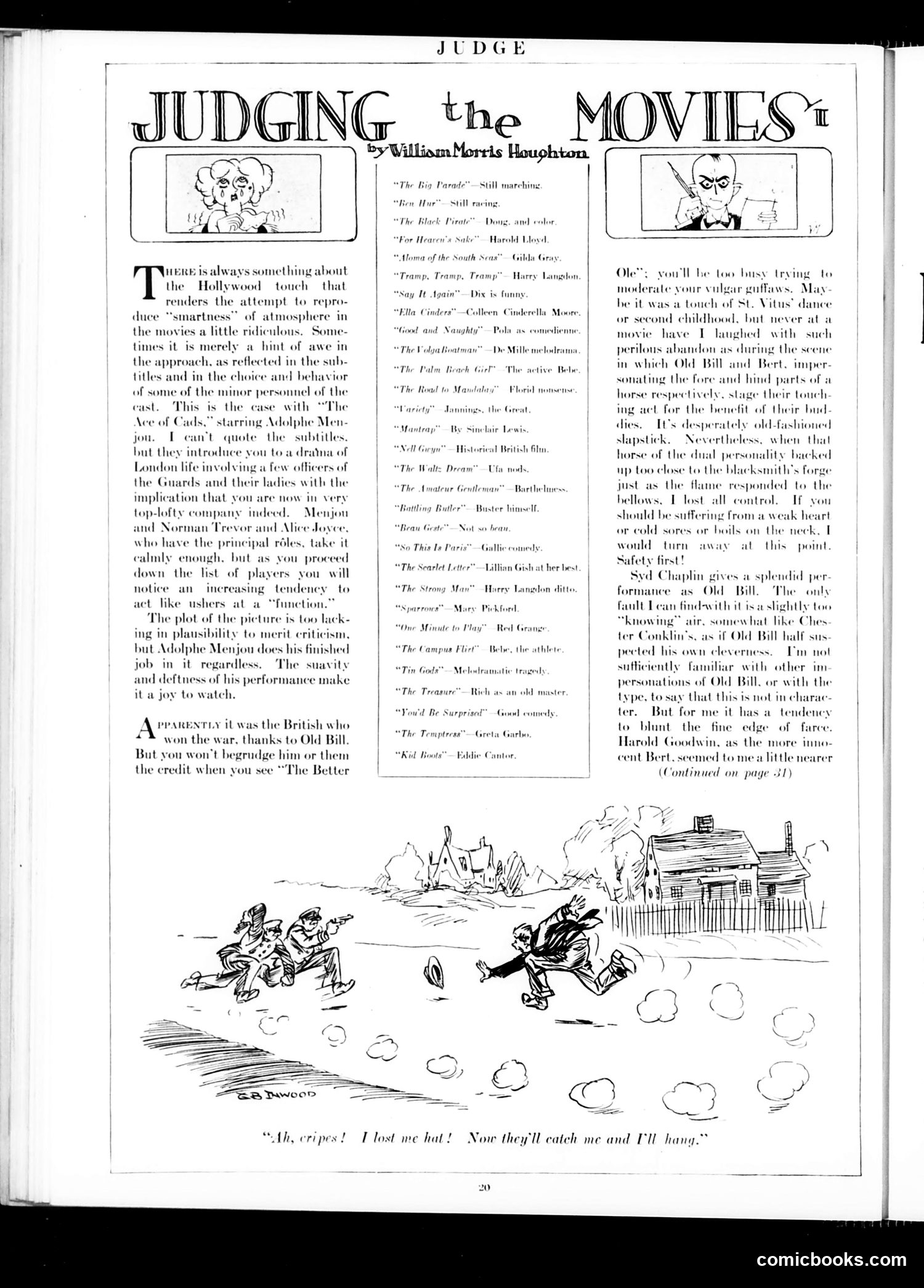
This is a film criticism column by William Morris Houghton reviewing recent movies, particularly focusing on comedies and dramatic films from the early 1920s. The main review discusses "The Ace of Cads," starring Adolphe Menjou, criticizing Hollywood's affected attempt at recreating British upper-class sophistication. The author notes the film's implausible plot but praises Menjou's polished performance. The highlighted review concerns "The Better 'Ole," featuring characters "Old Bill" and "Bert"—likely based on Bruce Bairnsfather's famous WWI comic strip characters. The reviewer praises Syd Chaplin's comedic performance as Old Bill but finds his acting slightly too self-aware. A cartoon illustration shows these two characters in a slapstick scene involving a horse costume, captioned with physical comedy dialogue about being chased. The column exemplifies 1920s film criticism, mixing professional analysis with enthusiastic audience reactions to early cinema's emerging comedic conventions.
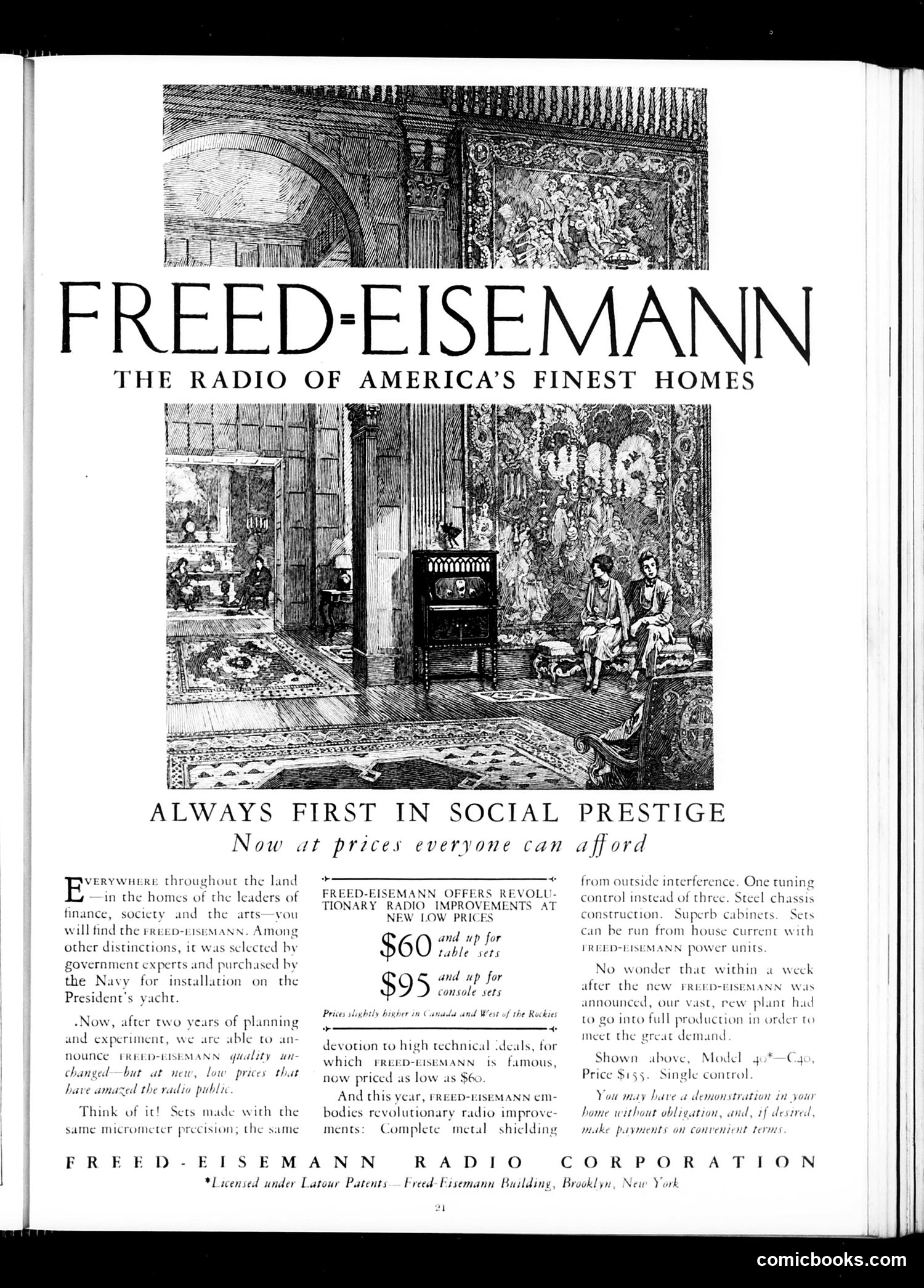
This is **not a cartoon or satire page**—it's a full-page advertisement for Freed-Eisemann radios from what appears to be the 1920s or early 1930s. The ad uses social prestige marketing, claiming the radios were selected by government experts and installed on the President's yacht. It emphasizes that despite maintaining the same quality as expensive models, prices now start at $60, making luxury "affordable." The illustrated vignette shows an elegant interior with well-dressed people gathered around a radio—depicting the aspirational lifestyle associated with owning one. This was typical period advertising: positioning a consumer product as a marker of refined taste and social standing. There is no political satire here. The page simply demonstrates how *Judge* magazine monetized its upscale readership through luxury goods advertising, which aligned with the magazine's target audience of wealthy, educated Americans.
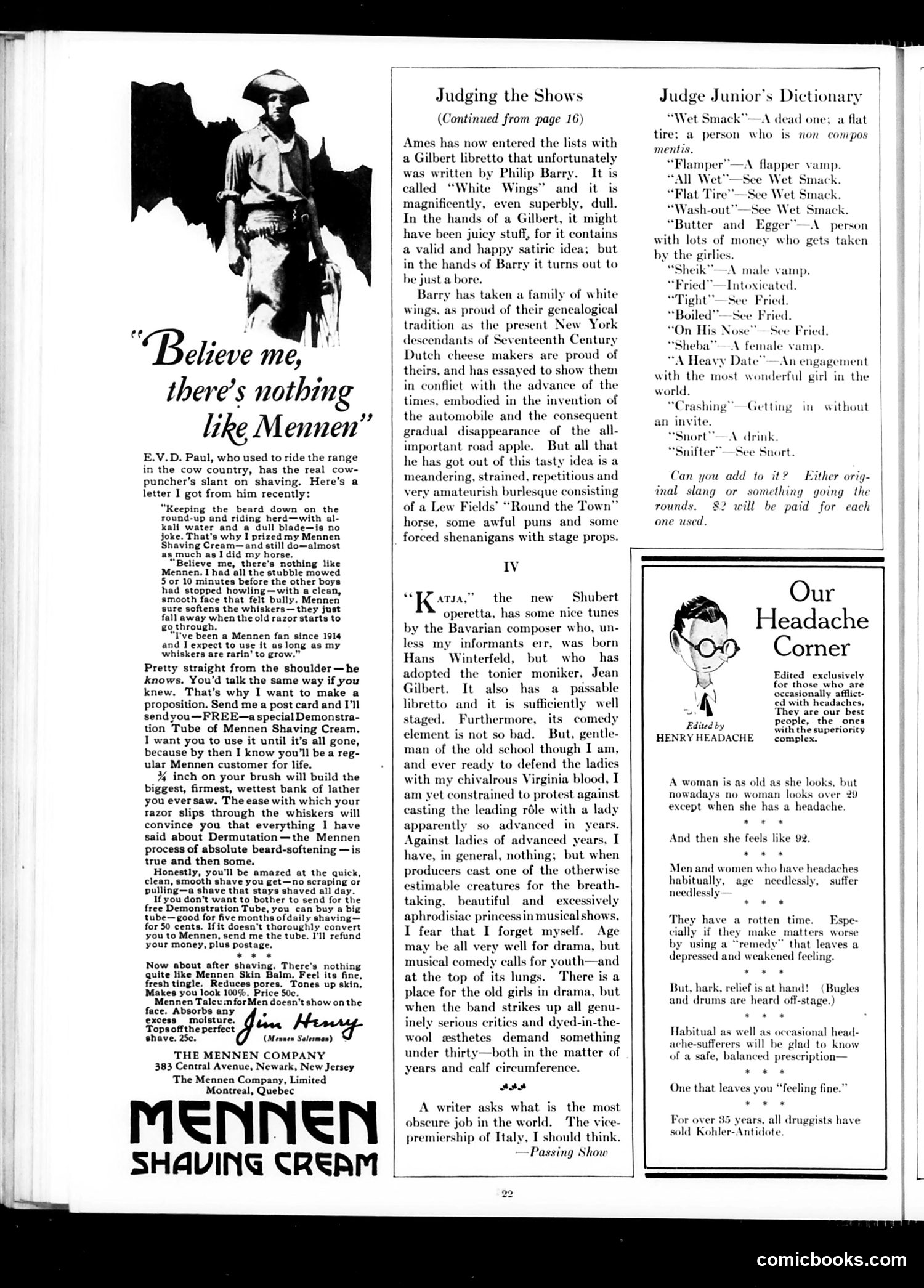
This page contains primarily **advertising** for Mennen Shaving Cream (left side) and theater criticism titled "Judging the Shows" (right side). The advertisement features a testimonial from "E.V.D. Paul," presented as a former cowboy endorsing the product's superiority for shaving under harsh frontier conditions. This appeals to masculine ideals of rugged authenticity and practicality. The theater criticism discusses recent Broadway productions: a Gilbert-and-Sullivan-style operetta called "White Wings" (criticized as dull despite a promising satirical premise about street-sweepers resisting modernization), and "Kata," a Shubert operetta by composer Jean Gilbert, which receives mixed but slightly more favorable reviews. The page also includes "Our Headache Corner"—a health advice column addressing headaches, and "Judge Junior's Dictionary," defining slang terms. The overall content reflects 1920s entertainment and consumer culture aimed at educated middle-class readers.
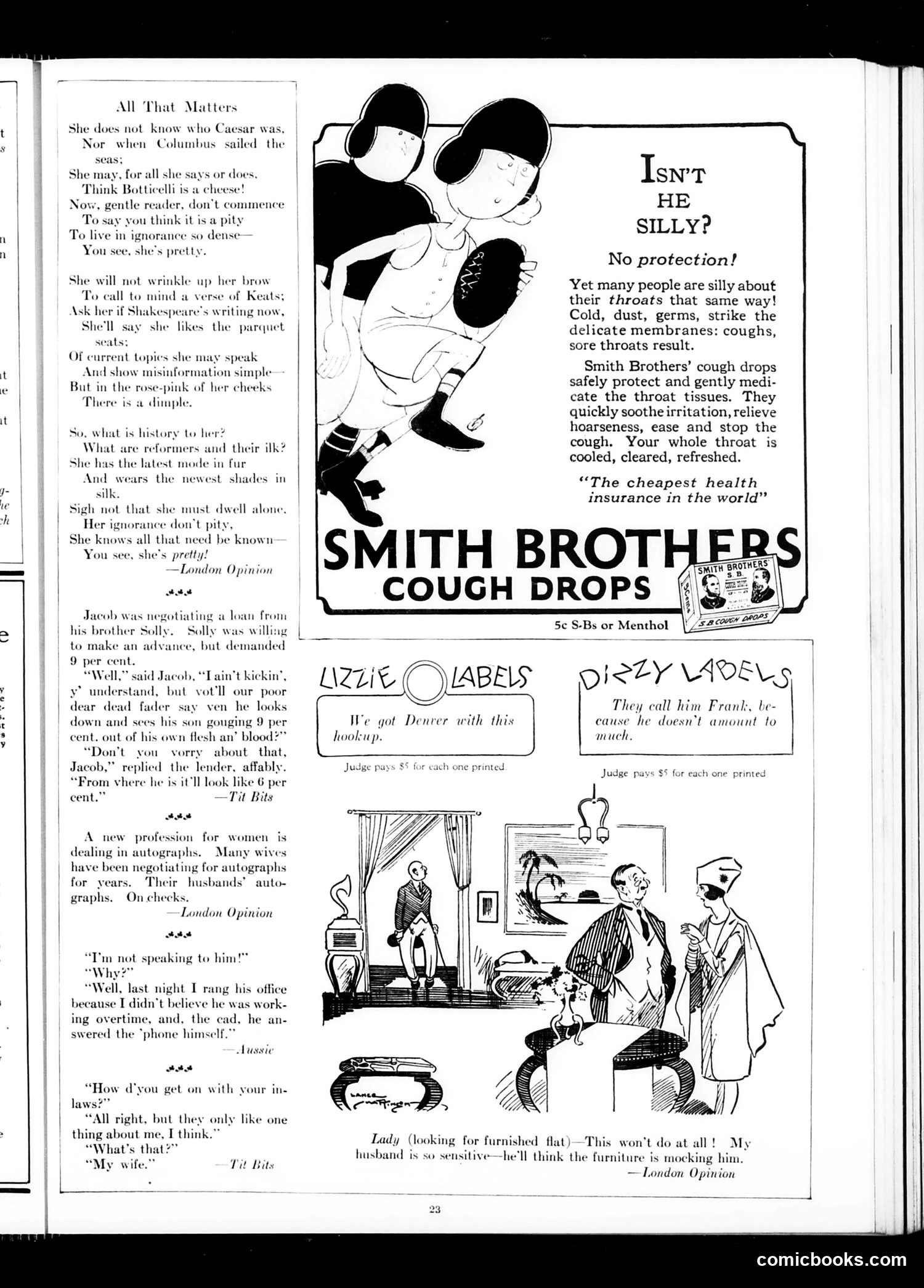
This page contains primarily **humorous anecdotes and advertisements** rather than political cartoons. The main content includes: 1. **"All That Matters"** (poem)—A satire on pretty but intellectually vapid women who know nothing of history, literature, or culture yet face no social consequences due to their appearance. The piece mocks society's acceptance of female ignorance. 2. **Short jokes** using ethnic stereotypes (Jewish characters negotiating loans) and domestic humor—typical of the era's casual prejudice in satirical magazines. 3. **Smith Brothers Cough Drops advertisement**—The large illustrated ad showing a woman without throat protection, promoting the product as "the cheapest health insurance in the world." This reflects early 20th-century patent medicine marketing. 4. **"Dizzy Labels" and miscellaneous jokes** about autographs, in-laws, and furnished apartments—conventional domestic humor with no deeper satirical intent. The page reflects Judge's focus: lighthearted social observation and advertising rather than sharp political commentary. The gender and ethnic stereotyping was mainstream for this era's humor publications.
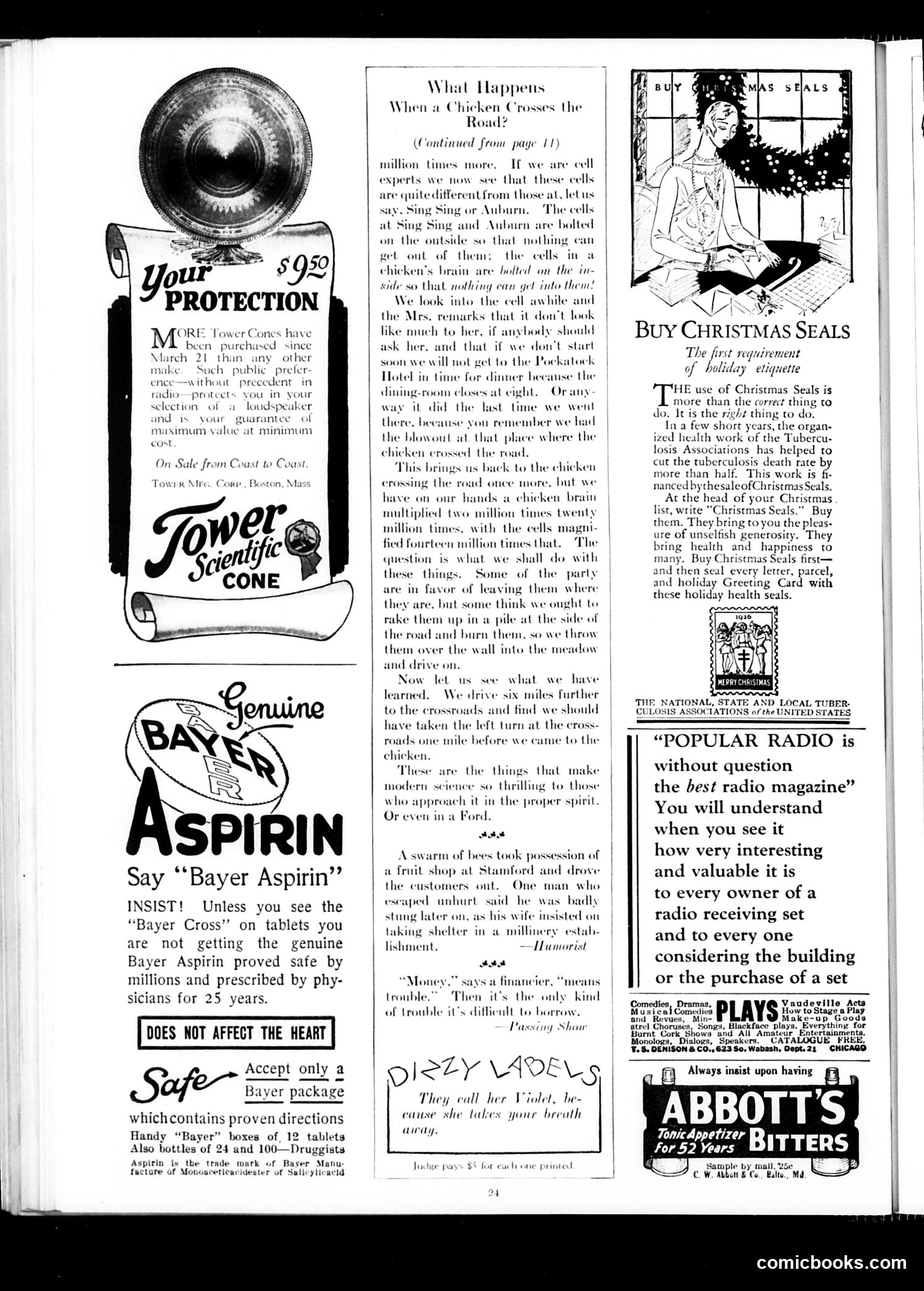
This page is primarily **advertising** with one substantial satirical article. The main content is "What Happens When a Chicken Crosses the Road?" — a lengthy absurdist parody of scientific writing. The author takes the classic joke premise and elaborates it into mock-serious scientific explanation about chicken brain cells, prison cells, and driving directions. The humor lies in treating a simple children's joke with overwrought scientific jargon and tangential observations (bee attacks, millinery establishments, financial puns). It's satirizing both pseudo-intellectual writing and the era's fascination with "science" explanations for everything. The page is otherwise filled with period advertisements: Bayer Aspirin (emphasizing genuine product authenticity—common concern then), Tower radio cones, Christmas Seals (tuberculosis prevention campaign), Abbott's Bitters, and Popular Radio magazine. For modern readers: the "chicken crossing the road" joke was already established enough to parody, scientific jargon was considered inherently funny/pretentious, and advertisers heavily emphasized brand authenticity to combat counterfeit medicines—a real consumer problem in the 1920s-30s.
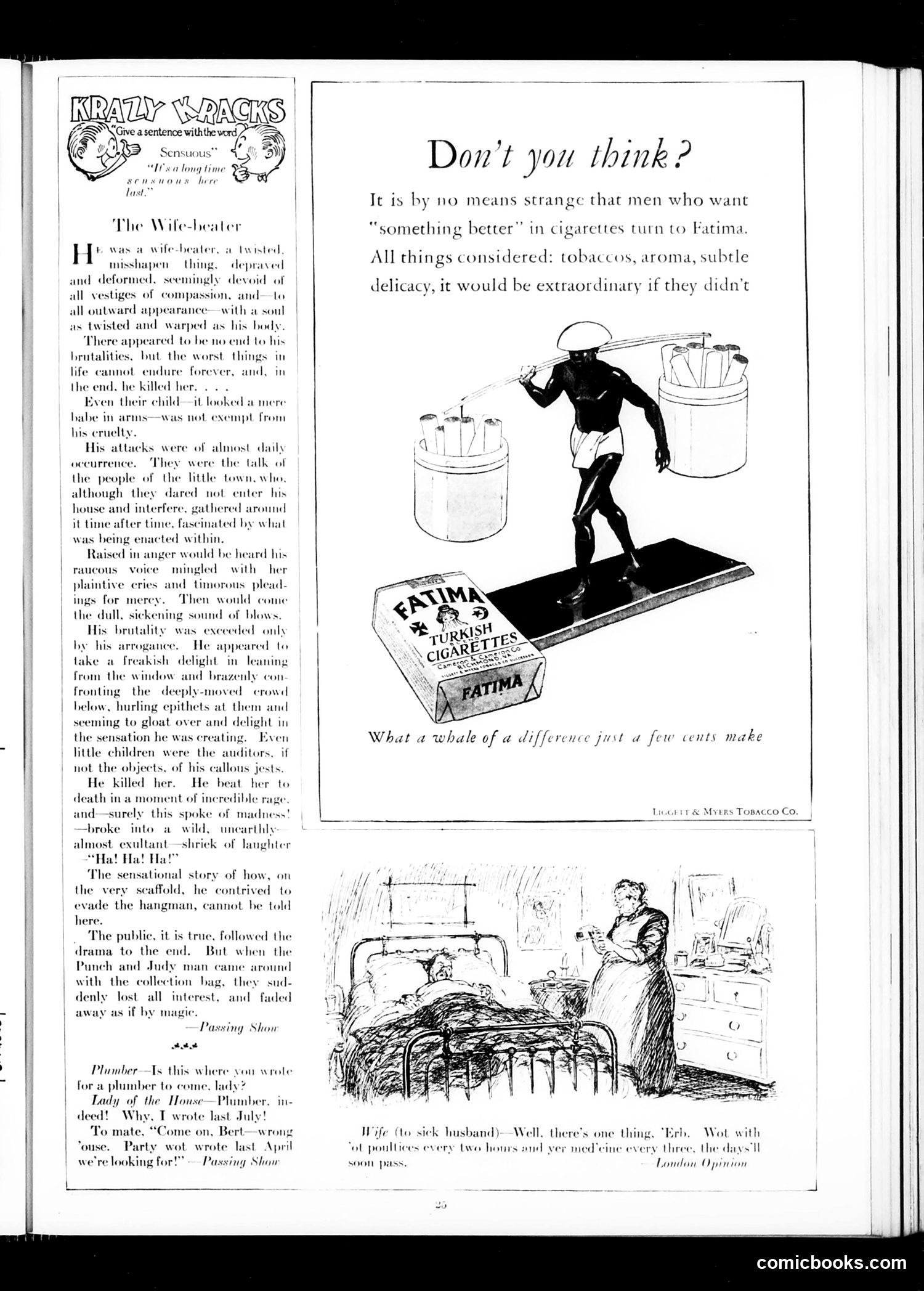
This Judge magazine page contains **multiple unrelated satirical pieces**: **"The Wife-beater"** (left): A dark fictional narrative depicting domestic violence—a man brutally abusing his wife and child. The story concludes with his execution. This appears designed to shock readers with its unflinching portrayal of spousal abuse, treating it as sensational entertainment rather than social commentary. **Fatima Cigarettes ad** (center): Uses an illustration of a figure balancing cigarette boxes, claiming Fatima offers superior quality at low cost—typical early 20th-century tobacco marketing emphasizing value and subtle flavor. **Comic exchanges** (bottom): Two brief humorous dialogues—one about a plumber's delayed arrival, another about a wife managing her sick husband's medicines. These are mild domestic humor typical of the era. The page mixes entertainment (dark drama, advertisements, light comedy) without apparent thematic connection, reflecting Judge's format as a humor and satire magazine blending sensationalism with commercial content.
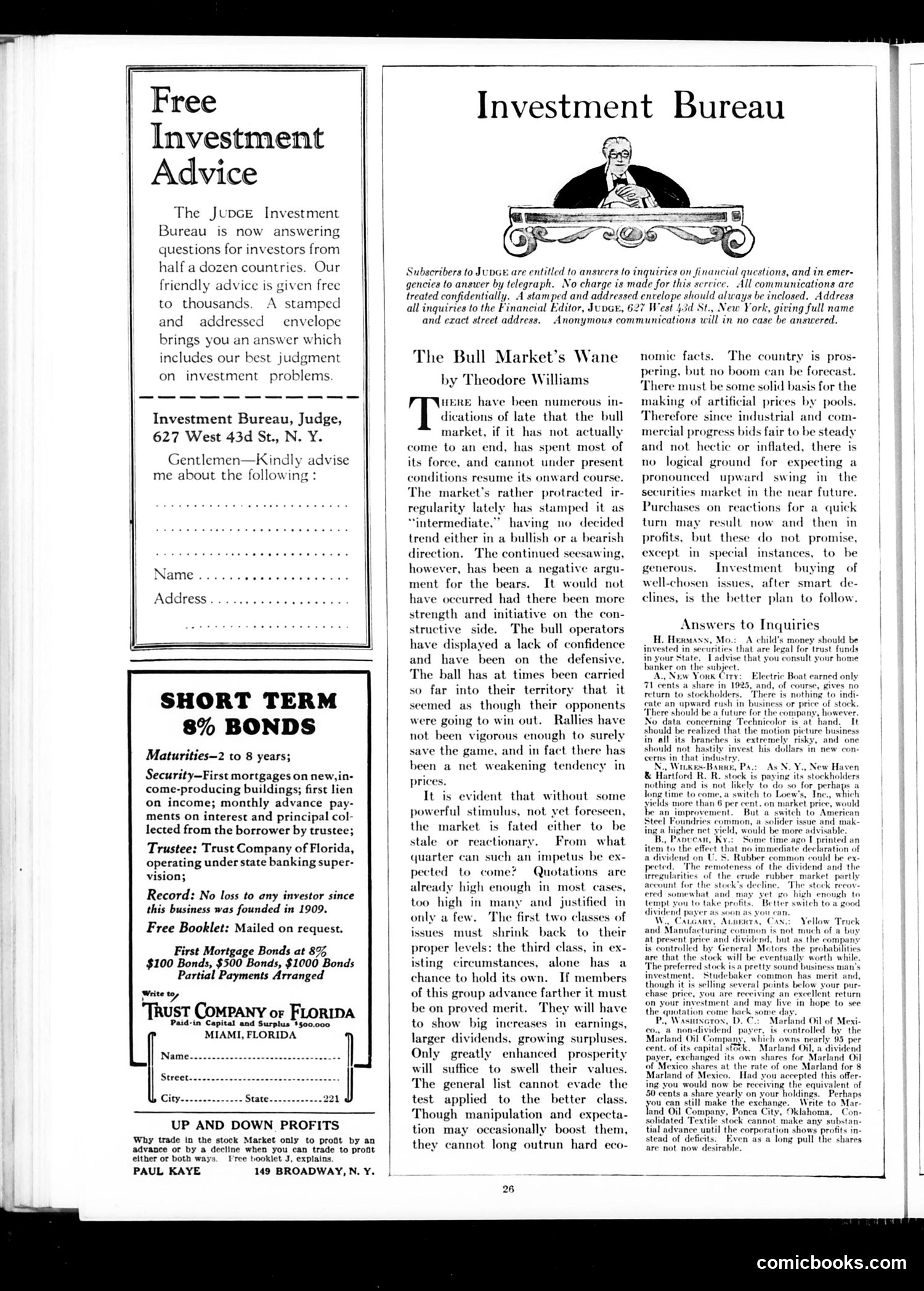
This Judge magazine page (circa 1920s) contains investment advice and advertising alongside a financial commentary article. **The Main Content:** Theodore Williams's article "The Bull Market's Wane" warns that the stock market boom is losing momentum. He argues that stock prices have risen too high relative to actual earnings and that without genuine economic growth, prices cannot sustain themselves. Williams uses sports metaphors—the "bull" is being pushed back into "their territory"—to describe weakening market confidence. **Historical Context:** This appears to be from the 1920s bull market preceding the 1929 crash. Williams's caution about inflated prices disconnected from "hard economic facts" and artificial price manipulation proved prescient. **The Satire:** The irony lies in Judge placing speculative bond and stock advertisements alongside Williams's warnings about overvalued securities—essentially profiting from the very market excess he critiques. **For Modern Readers:** Replace "bull market" with any current bubble (crypto, meme stocks), and the argument remains timeless: markets eventually correct when prices exceed fundamental value.
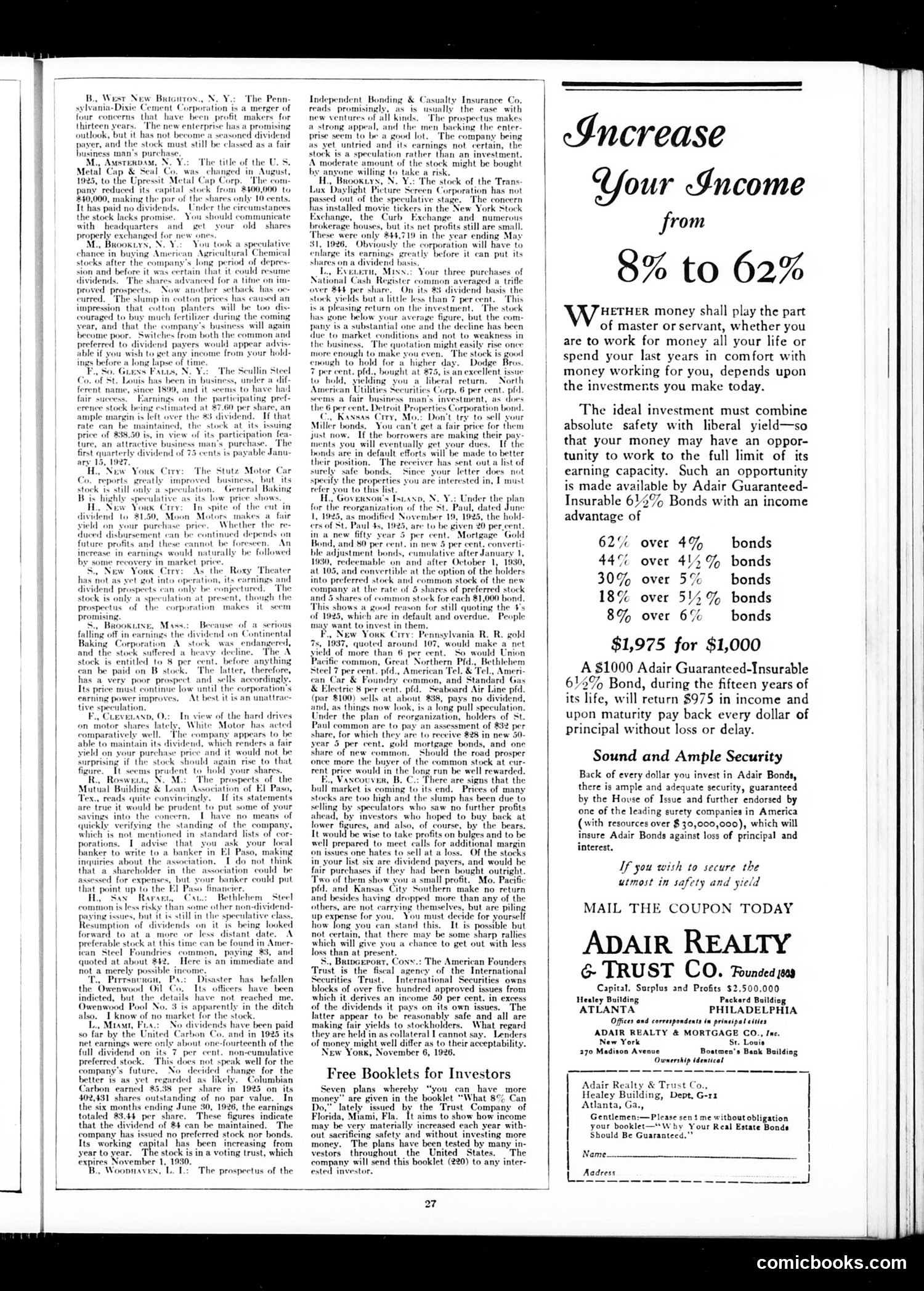
This page is primarily **financial advice and investment advertising**, not political satire. It consists of: 1. **Left column**: A financial advice column answering reader questions about various stocks and bonds (Steel companies, cement corporations, theatrical ventures). The responses evaluate whether investments are sound, speculative, or risky—typical for 1920s investment guidance. 2. **Right side**: An advertisement for Adair Realty & Trust Co. promoting "Gold-Guaranteed-Insurable 6½% Bonds" with income yields ranging from 8% to 62%. The ad targets middle-class savers seeking reliable returns. **Historical context**: This reflects the 1920s investment boom preceding the 1929 crash. The emphasis on "absolute safety with liberal yield" and guaranteed bonds shows how pre-Crash publications promoted investments that would soon prove disastrous. **For modern readers**: This demonstrates how financial advertising and advice operated before securities regulation, offering returns that seem impossibly high by today's standards—a cautionary historical document rather than satire.
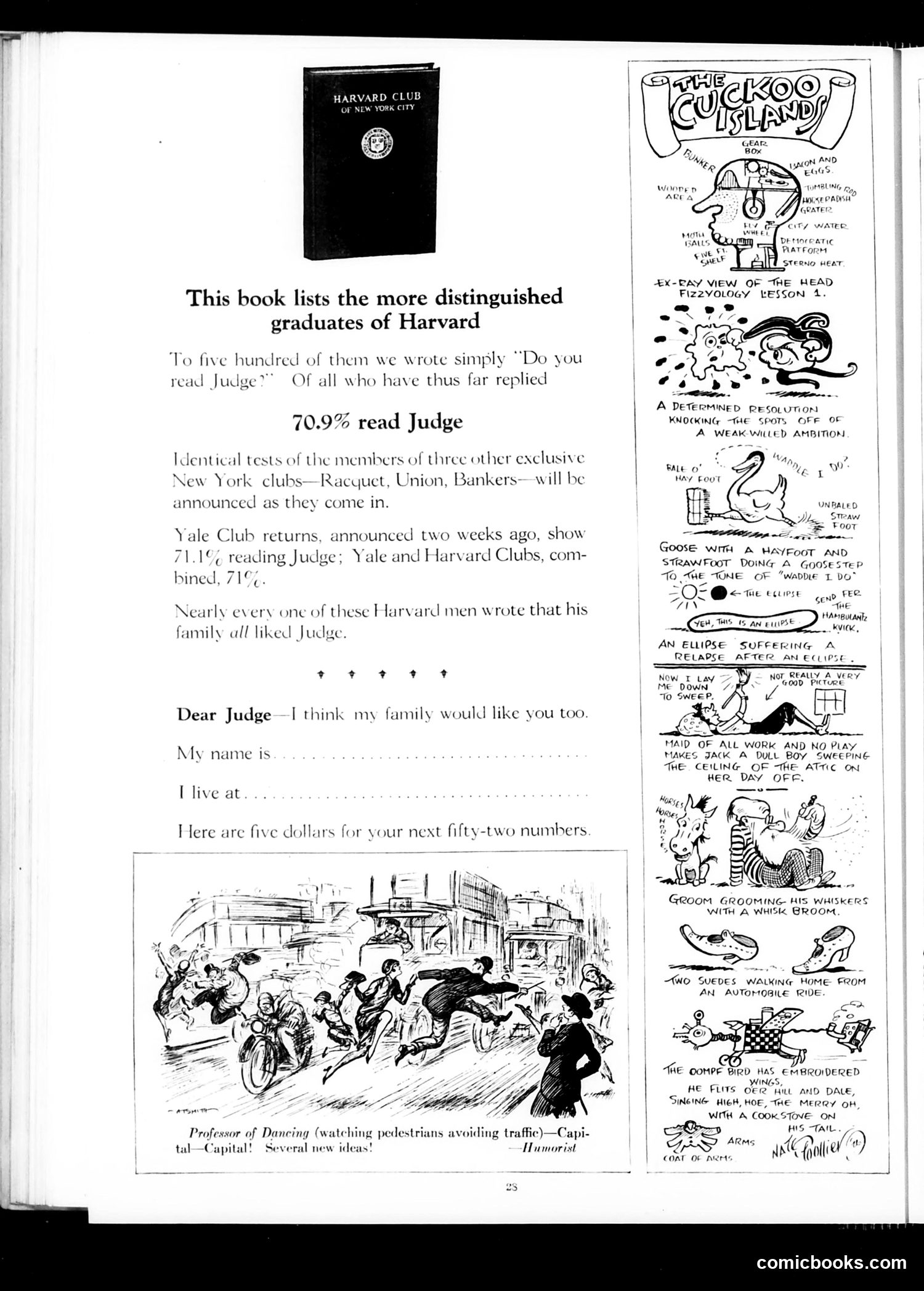
This page functions primarily as **advertising for Judge magazine itself**, using social prestige and reading statistics. The main content claims that 70.9% of distinguished Harvard graduates read Judge, with similar tests promised for other exclusive NYC clubs (Yale, Racquet, Union, Bankers). This is a circulation-building advertisement disguised as market research—appealing to the magazine's target audience of wealthy, educated men. The "Dear Judge" section invites readers to subscribe, humorously suggesting they write in to promote the magazine to their families. **The cartoons** on the right appear to be humorous illustrations from Judge's content—including "Cuckoo Island" (top), various animals and domestic scenes, and sketches with absurdist captions. The bottom cartoon shows a "Professor of Dancing" observing pedestrians dodging traffic, captioned as demonstrating "several new ideas"—satirizing how New York City traffic chaos has become accidentally educational. These cartoons exemplify Judge's style: satirical, often absurdist humor targeting urban middle-class and upper-class life.
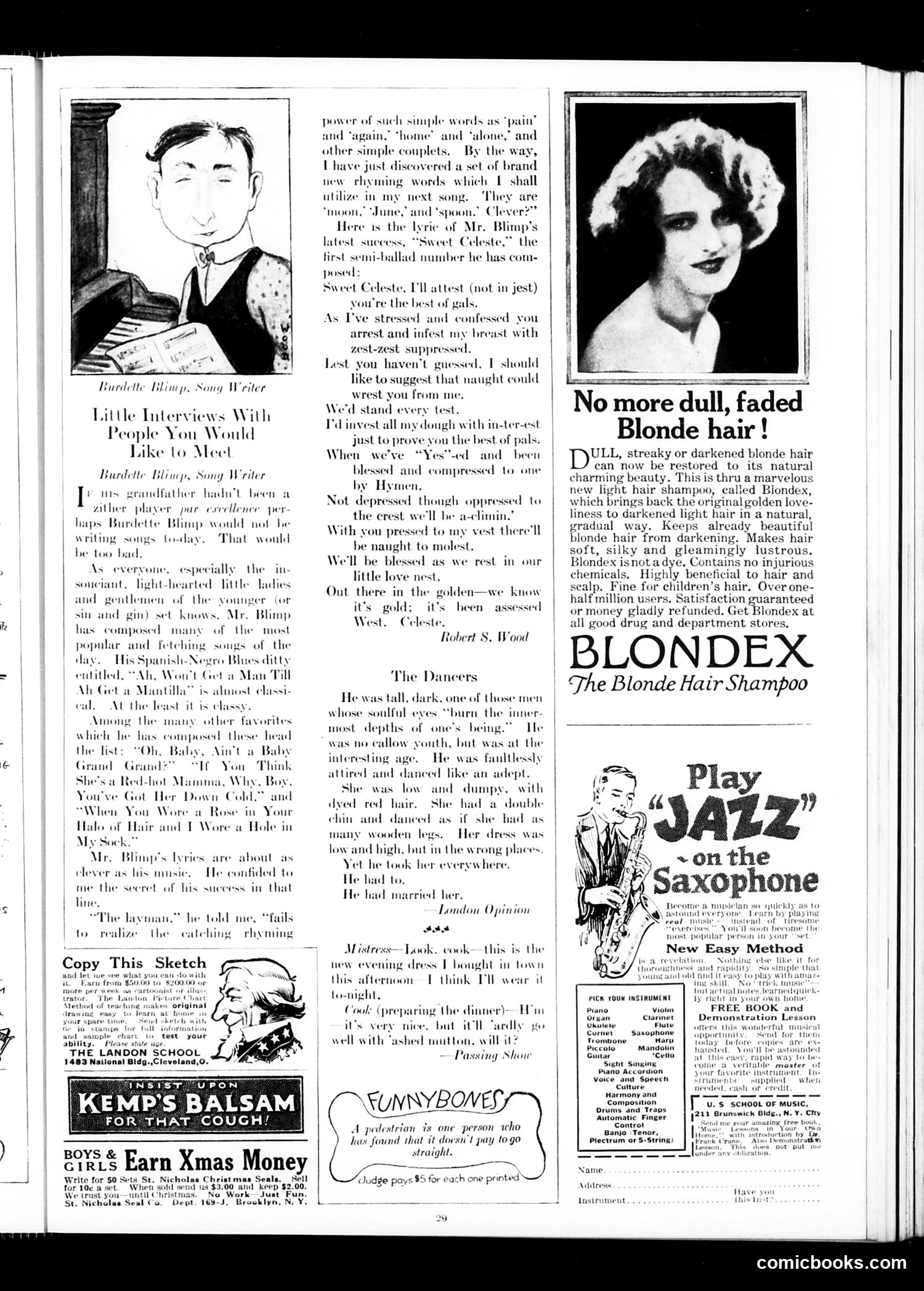
This page is primarily **advertising and miscellaneous content** rather than political satire. The main features are: **"Little Interviews with People You Would Like to Meet"** profiles **Burdette Blimp, Song Writer**—a figure who appears to be a satirical stand-in for popular Tin Pan Alley songwriters of the era. The satire mocks the formulaic nature of contemporary popular songs, highlighting Blimp's reliance on simple, repetitive rhyme schemes ("pain"/"again," "June"/"spoon"). His lyrics are intentionally clumsy and overwrought, exemplifying the low artistic standards of commercial songwriting. **"The Dancers"** is a brief humorous anecdote about a man married to an unattractive woman—satirizing the compromises men make in matrimony. The remaining content consists of **period advertisements** (Blondex hair shampoo, saxophone lessons, Kemp's Balsam cough remedy) and fillers like "Funny Bones" jokes.
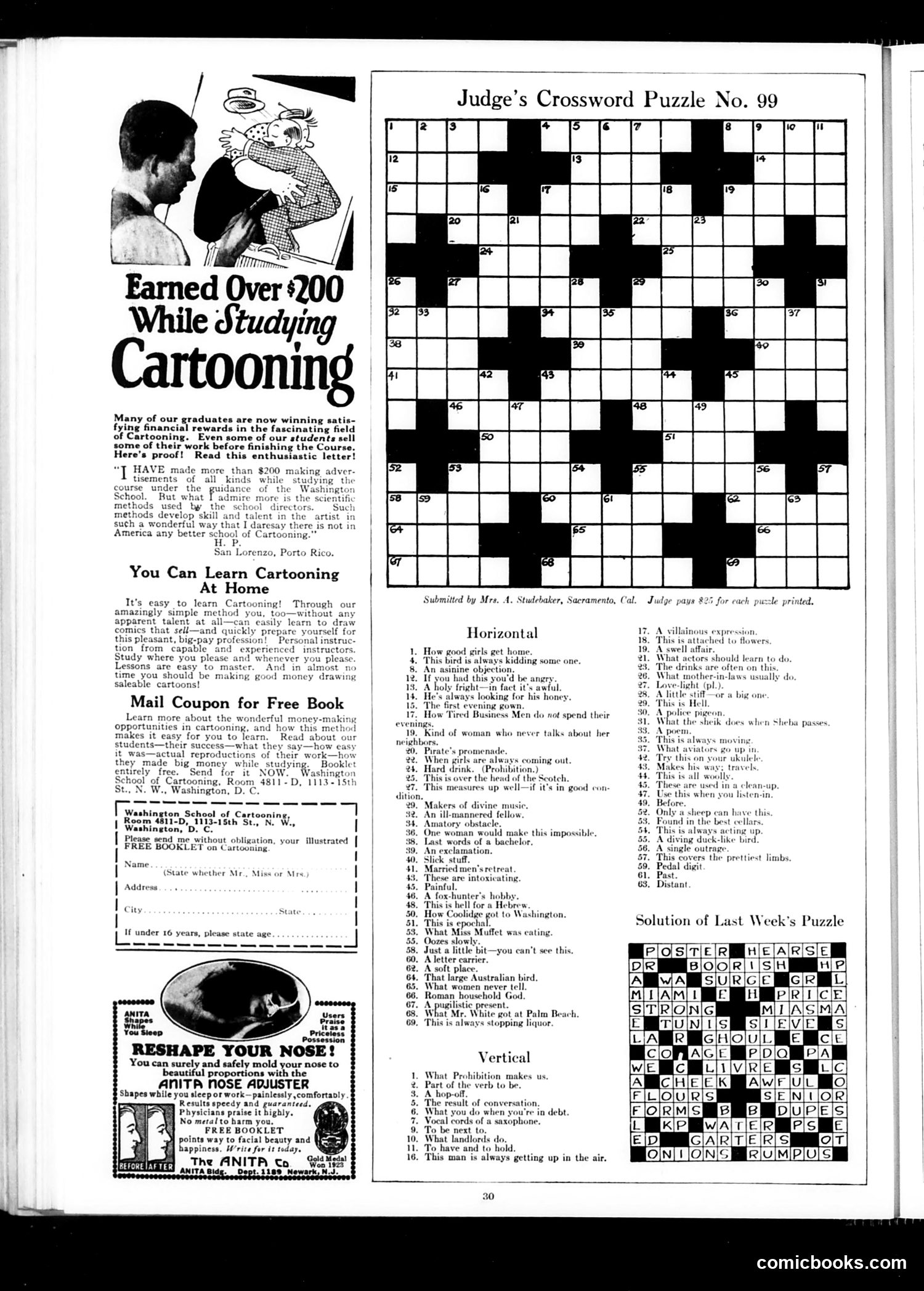
This page is primarily **advertising and puzzle content**, not political satire. The main elements are: **Advertisements:** - A "Washington School of Cartooning" mail-order course promoting the lucrative field of cartoon-making, featuring a testimonial from a student in Puerto Rico who earned over $200 - An "Anita Nose Adjuster" device—a quack medical product claiming to reshape noses painlessly while you sleep **Content:** The bulk of the page features "Judge's Crossword Puzzle No. 99" with horizontal and vertical clues, plus the solution to the previous week's puzzle. **Historical Context:** The cartooning school ad reflects early-20th-century optimism about commercial art careers and the growing market for comics. The nose adjuster represents the era's proliferation of dubious beauty-enhancement devices marketed directly to consumers—predating modern FDA regulations. The page demonstrates how magazines monetized space through instructional advertising and puzzles alongside editorial content.
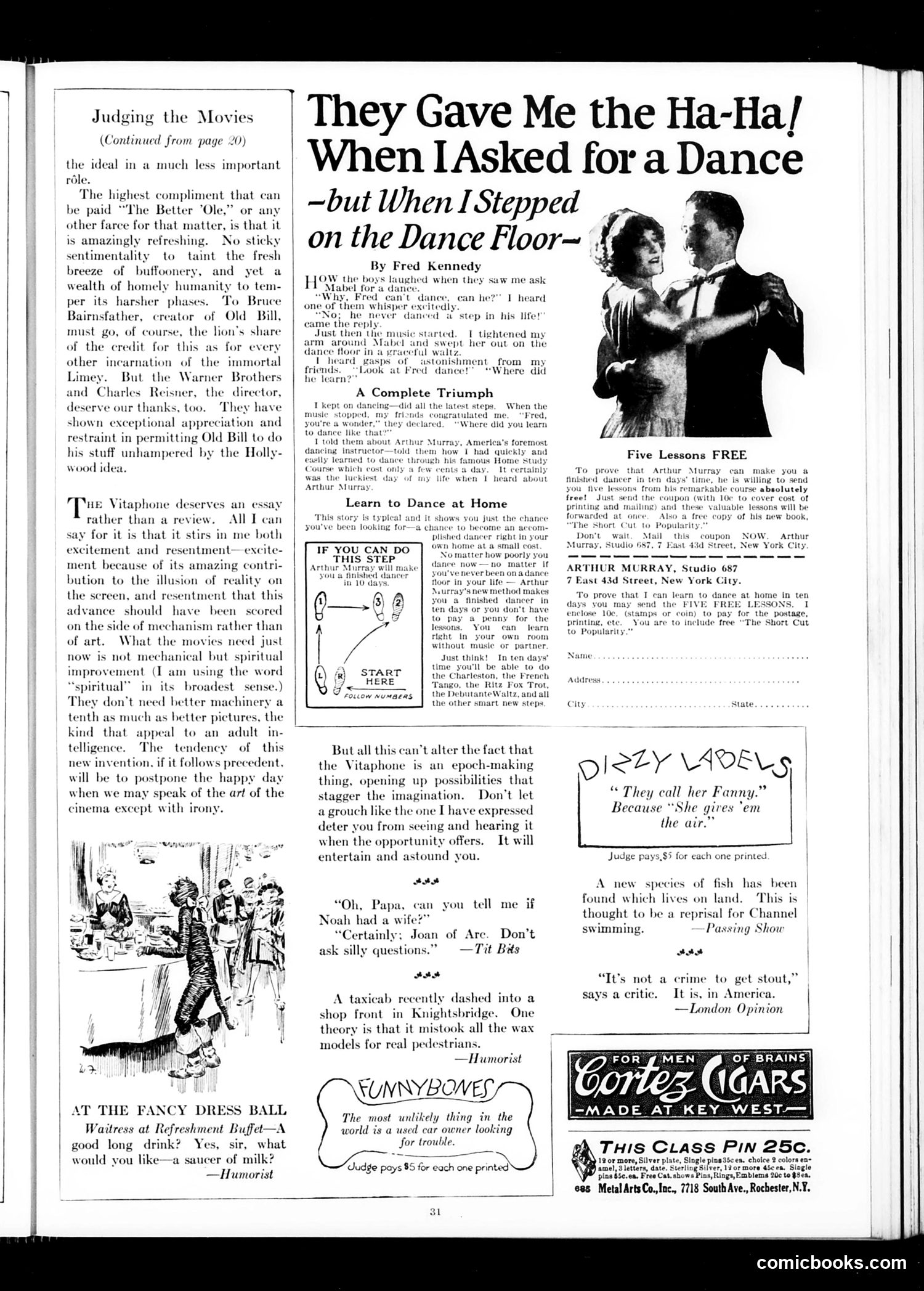
This page primarily contains **advertising and instructional content** rather than political satire. The main feature is an article by Fred Kennedy about learning to dance, paired with a prominent **Arthur Murray dance lesson advertisement**. The humor operates on a simple level: Kennedy claims he couldn't dance ("never danced a step in his life"), but after taking Arthur Murray's correspondence course, he impresses his friends with his newfound ability on the dance floor. This is essentially an extended testimonial advertisement disguised as a personal anecdote. The sidebar jokes ("Funnybones," "Dizzy Doras") are generic period humor unrelated to politics or current events. The film review section discusses movie quality rather than satire. Overall, this appears to be a typical Judge magazine page from the 1920s where advertising and light entertainment dominated editorial content—reflecting the publication's commercial rather than strictly satirical focus during this era.
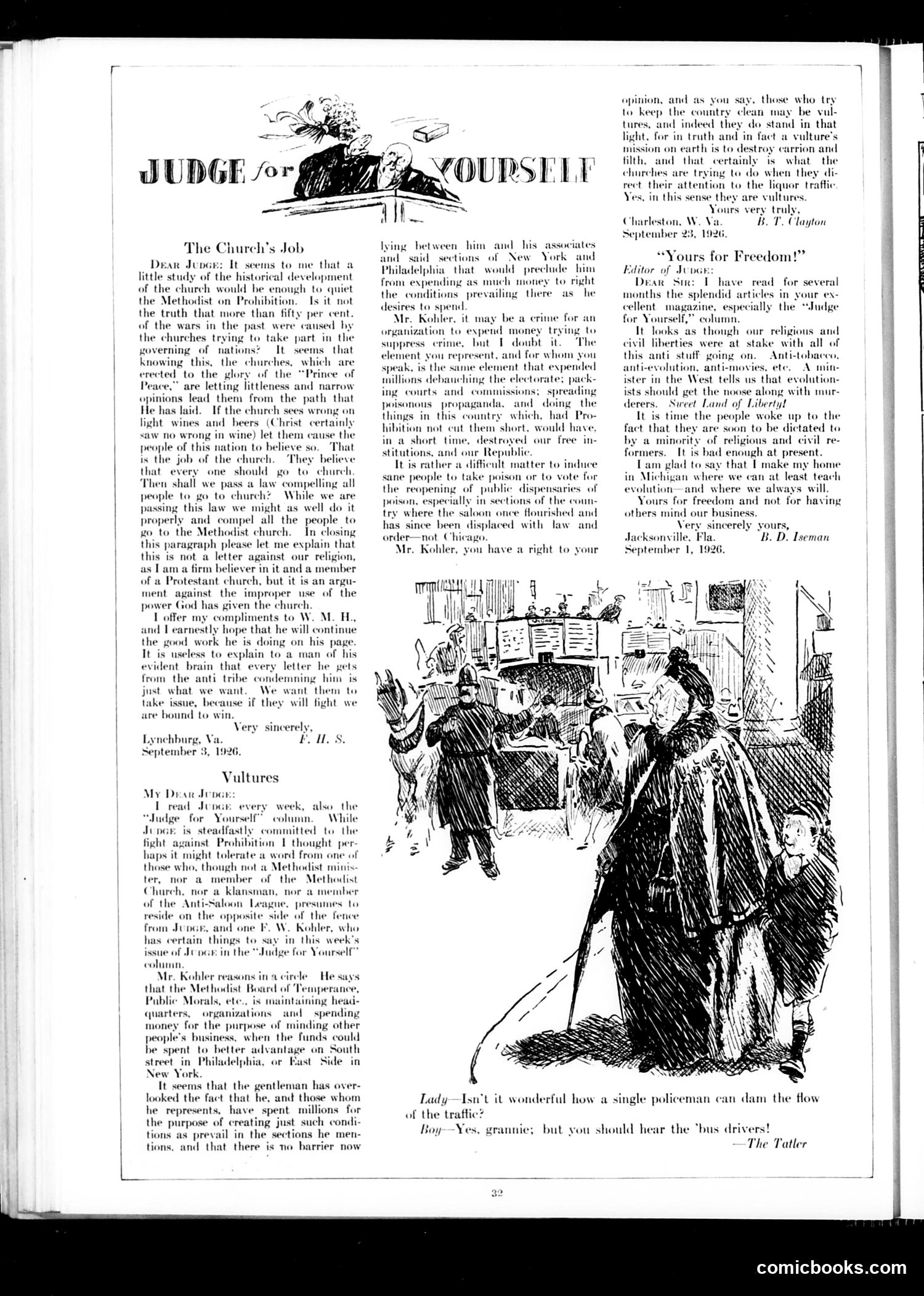
This page from Judge magazine (circa September 1926) features reader letters debating Prohibition and the church's role in enforcing it. **The Main Satire:** The cartoon depicts a traffic cop struggling to control vehicular chaos, with the caption joking that "a single policeman can dam the flow" while bus drivers create mayhem. This illustrates the broader letter debate: whether institutions (churches, government) should legislate morality. **The Letters' Argument:** Readers clash over whether Methodist churches and the Anti-Saloon League properly fight alcohol or overreach by "minding other people's business." One writer defends prohibition efforts against saloon-era corruption; another argues churches historically caused wars by mixing governance with religion, urging them to persuade rather than compel. **Historical Context:** This reflects 1920s Prohibition-era tensions between religious institutions enforcing moral codes versus individual liberty advocates. The debate centers on whether government should legislate morality or if voluntary persuasion is the church's proper role.
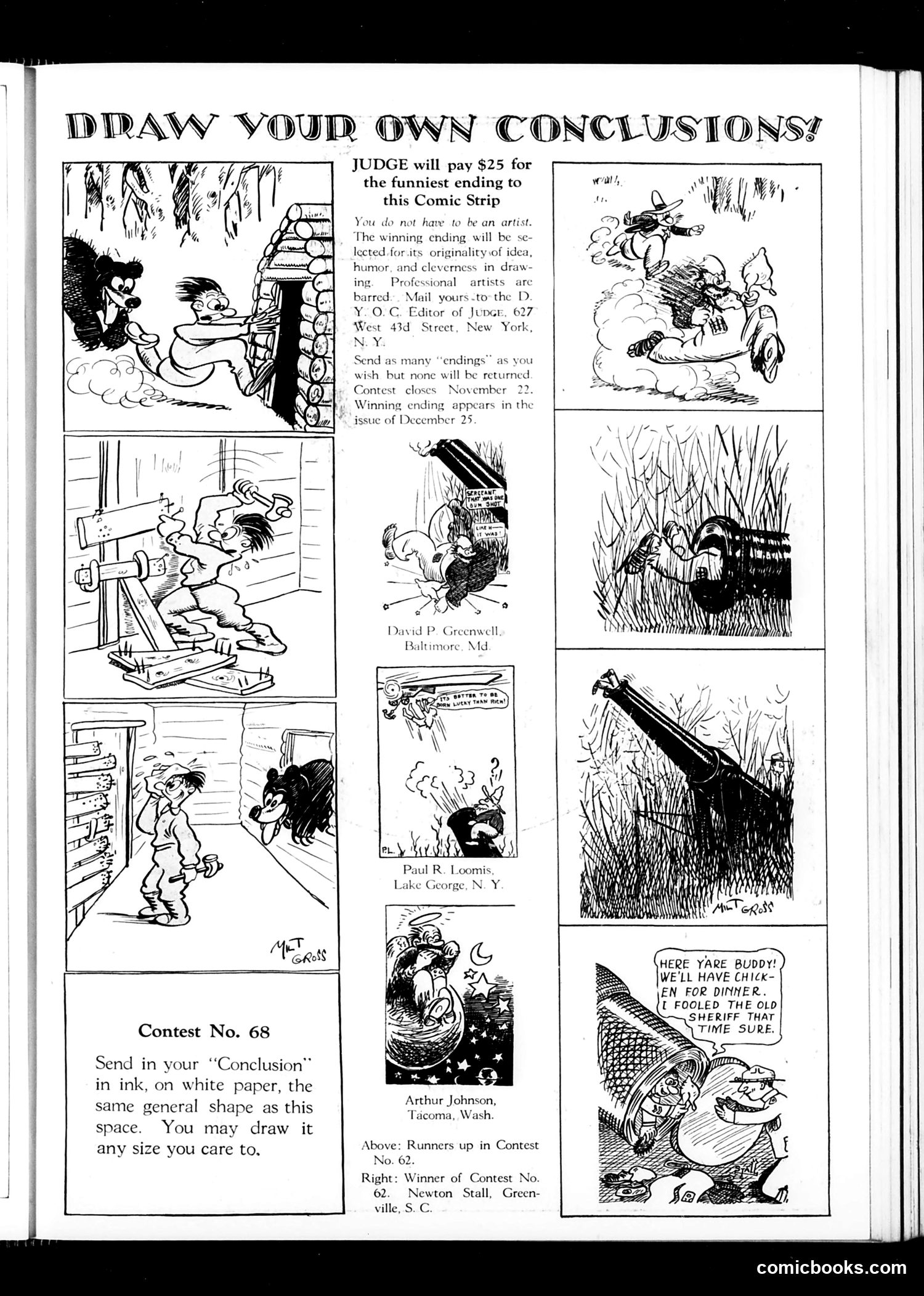
This is a **reader participation contest page** from *Judge* magazine. Rather than presenting finished cartoons, it invites non-professional readers to complete an unfinished comic strip by drawing or writing a humorous ending. The page shows several completed contest entries as examples—cartoons depicting everyday scenarios with comedic twists: a character at a fireplace, someone using gym equipment, a person at a refrigerator, hunters, and a dinner scene with characters outwitting a sheriff. The contest prizes $25 for the wittiest conclusion, judged on originality, humor, and drawing cleverness. Professional artists are excluded to keep competition fair for amateurs. Entries close November 22, with winners published December 25. This reflects *Judge's* early 20th-century role as an interactive, reader-engaged humor magazine where audience participation was central to its appeal and content generation.
This is a Lucky Strike cigarette advertisement, not political satire. The page features a circular photograph showing a hand holding a lit cigarette over what appears to be a tobacco pipe or smoking implement, surrounded by an ornate decorative border. The ad's tagline emphasizes that toasting develops "hidden flavors of the world's finest tobaccos." This references Lucky Strike's actual marketing campaign from the early-to-mid 20th century, which promoted their "toasting" process as a unique selling point that improved tobacco flavor. The ornate border design adds aesthetic prestige to the product. This represents typical early cigarette advertising that emphasized quality and refinement, predating modern tobacco health warnings.