
Judge, 1926-11-13 · page 15 of 36
Judge — November 13, 1926 — page 15: what you’re looking at
What you’re looking at
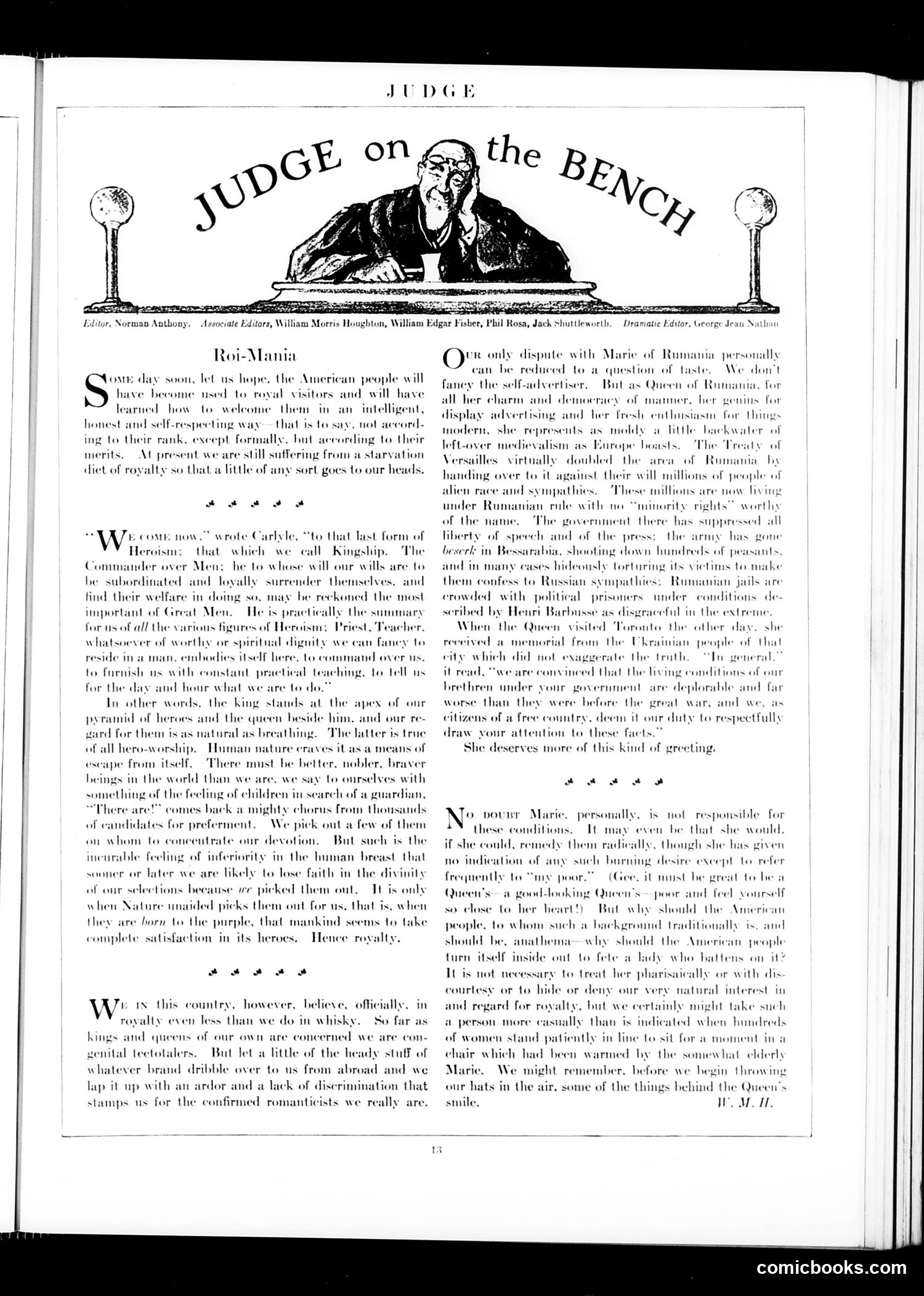
This editorial satirizes American fascination with European royalty, specifically Queen Marie of Romania's visit to Toronto. The illustration shows a stern judge presiding over the nation's "infatuation." The article argues Americans claim to reject monarchy yet fawn over royal visitors—a contradiction the author calls "Roi-Mania" (royal mania). The piece quotes Carlyle on kingship's appeal, then pivots to critique: while Marie presents herself as modern and democratic, Romania actually represents "moldy medievalism." The satire's real target is Romania's authoritarian practices: suppression of press freedom, persecution of political prisoners, torture of suspected Russian sympathizers, and denial of minority rights to newly conquered territories (acquired through the Treaty of Versailles). Marie's charitable image masks governmental brutality. The author argues Americans should recognize this hypocrisy—we shouldn't romanticize a ruler whose government contradicts the democratic values we claim to champion.
📄 Transcribed text from this page (OCR, searchable)
Machine-transcribed from the original scan — historical spelling and the odd misread are preserved.
Roi-Mania ome day soon, let us hope, the American people will S have become used to royal visitors and will have | ne them in an intelligent, honest and self-respecting w ing to their rank, except formally. but according to their merits. At present we are still suffering from a starvation diet of royalty so that a little of any sort goes to our heads, ned how to wel yo that is to say. not accord. Weow now.” wrote Carlyle, “to that last form of Heroism: that which we call Kingship. ‘The Commander Men: he to whose will our wills are to be subordinated and loyally surrender themselves, and find their welfare in doing so. may be reckoned the most He is practically the summary important of Great Men Feacher, for us of al/ the various figures of Heroism: Pric whatsoever of worthy or spiritual dignity: we can faney to reside ina man, embodies itself here, to command over us. ching. Lo tell us to furnish us with constant practies for the day and hour what we are to de In other words, the king stands at the apex of our pyramid of heroes and the queen beside him, and our re- gard for them is as natural as breathing. ‘The latter is trac of all hero-worship. Human nature craves it as. a means of pe from itself. There must be better, nobler, braver beings in the world than we are, we say to ourselves with something of the feeling of children in search of a guardian, “There are! comes back a mighty chorus from thousands We pick out a few of them on whom to concentri But such is the incurable feeling of inferiority in the human breast that of candidates for preferment. © our devotion. sr we are likely to lose faith in the divinity sooner or ta of our selections because ie picked them out. Tis only when Nature unaided picks them out for us, that is, when they are born to the purple, that mankind seems to take tion in its heroes. Hence royalty. complete. satisfy W' IN this country, however, believe, officially, in royalty even less than we do in whisky. So far as kings and queens of our own are concerned we are con- But Jet a little of the heady stuff of 1 and we lap it up witl tion that stamps us for the confirmed romanticists we really are. genital tectotalers. whatever brand dribble over to us from abr of diseriming ardor and a lack CD only dispute with Marie of Rumania personally can be reduced to a question of taste. We : But as Queen of Rumania. for faney th dvertiser. all her of manner, her genius for and demvoc rdvertising and her fresh enthusiasm for things display modern, she represents as moldy a little backwater of left-over medievalism as Europe boasts. The Treaty. of Versailles virtually doubled the area of Rumania by handing over to it against t) will millions of people of hies. These millions are now living alien race and sympa under Rumanian rule with no “minority rights” of the name. ‘The government there has suppressed. all worthy liberty of speech and of the press shooting down hundreds of peasants beserl: in Bessarabi and in many cases hideously torturing its victims to make them confess to Russian sympathies: Rumanian jails are crowded with political prisoners under conditions de- seribed by Henri Barbusse as disgraceful in the extreme When the Qu received a memorial from the Ukrainian people of that rale the trath, “En general ed that the livin sn visited Toronto the other day. she city which did not exa conditions of our it read, “we are convit brethren under your government are deplorable and far rd we, ats fore the great war, worse than they were citizens of a free country, deen: it our duty to respectfully draw your attention to these facts.” She deserves more of this kind of greeting. No pounr Marie, personally, is not responsible for 48 these conditions. Tt may even be that she would, if she could, remedy them radically, though she has given fer no indication of any such burning desire except to frequently to “my poor.” (Gees it must be great to be a Queen’s— a good-looking Queen’s— poor and feel yourself art!) But why should the A people, to whom such a background traditionally is. and rerican so close to her hi should be, anathema—why should the American peopl turn itself inside out to fete a lady who battens on it? It is not necessary to treat her pharisaically or with dis courtesy or to hide or deny our very natural interest in inly might take such and regard for royalty, but we c¢ a# person more casually than is indicated when hundreds iently in line to sit for a moment ina of women stand pi chair which had been warmed by the somewhat elderly Marie. We might remember, before we begin throwing our hats in the air, some of the things behind the Queen's WM, smile. comicbooks.com