
Judge, 1926-11-13 · page 18 of 36
Judge — November 13, 1926 — page 18: what you’re looking at
What you’re looking at
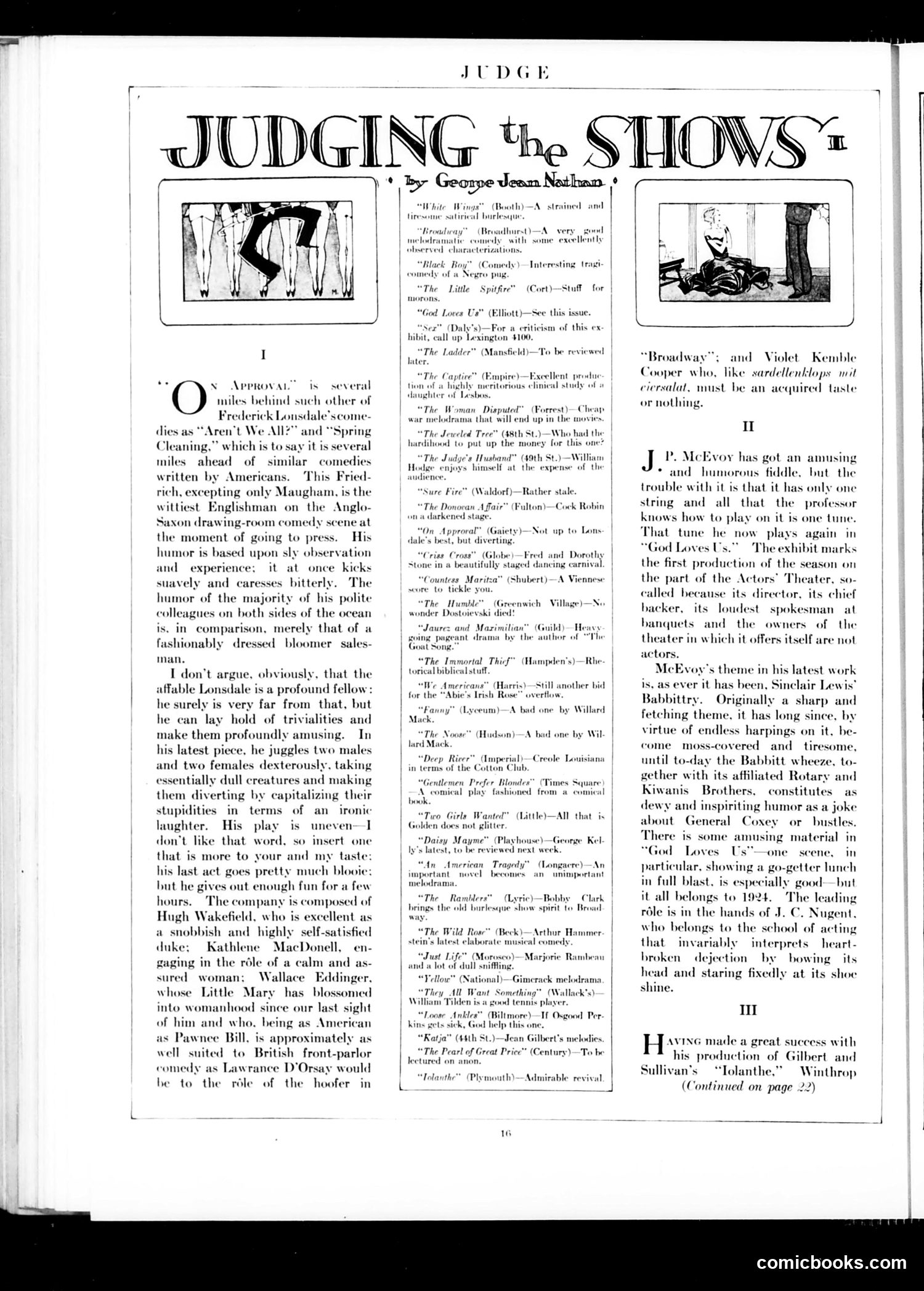
This page reviews Broadway productions through the lens of dramatic criticism rather than political satire. The main article praises English playwright Frederick Lonsdale's comedic writing style—witty, observant, and sophisticated—as superior to most American comedies of the era. Nathan contrasts Lonsdale's "polite colleagues" with American playwrights, suggesting American humor lacks the subtlety and intelligence of British drawing-room comedy. The right column contains brief capsule reviews of current shows, using Nathan's characteristic snark to dismiss inferior productions (labeling some "stale," "heavy going pageant drama," or "unimportant melodrama"). The reviews reference specific theaters and actors like Hugh Wakefield and Wallace Eddinger, indicating this addresses Judge's sophisticated theater-going audience interested in Broadway's current offerings rather than broader political commentary.
📄 Transcribed text from this page (OCR, searchable)
Machine-transcribed from the original scan — historical spelling and the odd misread are preserved.
JUDG oJ UDGING ‘he SHOWS" ee x Approvan” is several O miles behind such other of Frederick Lousdale’scome- dies as “Aren’t We All? Cleaning,” miles ahead of similar comedies written by Americans. This Fried- rich, excepting only Maugham, is the wittiest Englishman on the Anglo- Saxon drawing-room comedy scene at and “Spring which is to say it is several the moment of going to press. His ed upon sly observation once kicks suavely and caresses bitterly. ‘The humor of the majority of his polite humor is ba and experience; it at colleagues on both sides of the ocean is, in comparison, merely that of a fashionably dressed bloomer sales- man. I don’t argue, obviously, that the affable Lonsdale is a profound fellow: very far from that, but y hold of trivialities and he surely he can la make them profoundly amusing. In his latest piece, he juggles two males and two fe taking essentially dull creatures and making them diverting by capitalizing their stupidities in terms of an laughter. His. play is don’t like that word, that is more to your and my taste: his last act goes pretty much blooie: les dexterously. ironic uneven—I so insert one but he gives out enough fun for a few hours. The company is composed of Hugh Wakefield, who is excellent as a snobbish and highly: self-satisfied duke: Kathlene MacDonell, en- gaging in the role of a calm and sured woman: Wallace Eddinger, Little Mary has blossomed into womanhood since of him and who. being as American as Pawnee Bill, is approximately : well suited to British front-parlor comedy as Lawrance D’Orsay would he to the rile of the whose our last sight hoofer in “Wh wth) —A strained and Wings” we satirical burl Broadhurst) —A tie comedy. with s6 characterizations. “Black Boy’ (Comedy) —Tn uly of a Negro pug | The Litlle Spitfire” (Cort)—Stut for | | morons. | “God Loves Us™ Daly’s)—For a criti al up Lexington $100. ¢ Ladder” (Mansfield) resting tragi- | (Elliott) —See this issue. of this ex be reviewed ada ¢ Captive” (t " a highly meritorious eli daughter of The Woman Disputed” (Forrest) — Cheap war melodrama that will end up in the movies “The Jeweled Tree” (48th St.) —Who had the hardihood to put up the money for this one? “The Judge's Hushanc f enjoys himself at (49th St.) Wil (Waldorf) “The Donovan Affair” on a darkened stage Rather stale. Cock Robin “Sure Fire” Fulton) In Approval” ty)—Not up to Lons dale’s best, but di (Globe utifully staged Fred and Dorothy | acing carnival A Viennese “Criss Cro Stone in a be (Shubert) “The Humbl wonder Dost ‘Jaurez and Mazimilian™ ( wg pageant drama by the Song. “The Immortal Thief” (Hampden's)—Rhe torical biblical stuff | We Americans” (Harris)—Still another bid the “Abie's Irish Rose” overtlow. Village) —Ni ski died! nild) — Heavy sthor of The “Fanny” (Lyceum)—A bad one by Willard Mack | “The Noose” (Hud A bad one by Wile | lard Mack “Deep River (Imperial)—Creole Louisiana in terms of the Cotton “Gentlemen Prefer A comical play fas! bool “Two Girls Wanted” (Little) Golden does not glitter All that is | “Daisy Mayme” (Playhouse) —George Kel ly’s latest, to be reviewed next week. | “An American Tragedy" (Lon | Important novel becomes an” unimport melodrama | “The Ramblers" (Lyric) —Bobby Clark brings the ald burlesque show spirit to Brod The Wild Roar* (Beck)—Arthur Hammer s lat musical comedy »)—Marjorie Rambeau | How” (National)—Gimerack melodrama “They AU Want Something” (Wallack’s) William Tilden is a good tennis player, “Loose Ankles” (Biltmore) —If Osgood Per. kins gets sick, God help this one, ja" (44th St.) —Jean Gilbert's melodies “The Pearl of Great Price” To be lectured (Century) | able revivul J} and) Violet) Kemble Cooper who, like sardellenklops. mit “Broadway” crersalat, must be an acquired taste or nothing. Il J P. McEvoy has got an amusing * and humorous fiddle, but the trouble with it is that it has only one string and all that the professor knows how to play on it is one tune. That tune he now plays again in “God Loves Us.” The exhibit marks the first production of the season on the part of the Actors’ The called because its director, ker, its loudest) spokesman at ha and the f the theater in which it offers itself are not actors. McEvoy’s theme in his latest work is, as ever it has been, Sinclair Lewis’ Babbittry. Originally a sharp and fetching theme, it has long since, by virtue of endless harpings on it, be- its chief nquets owners ¢-moss-covered and tiresome, until to-day the Babbitt wheeze, to- gether with its affiliated Rotary and Kiwanis Brothers, constitutes as dewy and inspiriting humor as a joke about General Coxey or bustles. There is some amusing material in yod Loves Us"—one seene, in particular, showing a go-getter lunch in full blast. Hy good—but it all belongs to 1924. ‘The leading role is in the hands of J. C. Nugent. who belongs to the school of acting that invariably heart- broken is espe interprets. dejection by bowing its head and staring fixedly at its shoe shine. Tl H AVING made a great success with his production of Gilbert and Winthrop (Continued on page 22) Sullivan's “Tolanthe,” comicbooks.com