
Judge, 1926-11-13 · page 13 of 36
Judge — November 13, 1926 — page 13: what you’re looking at
What you’re looking at
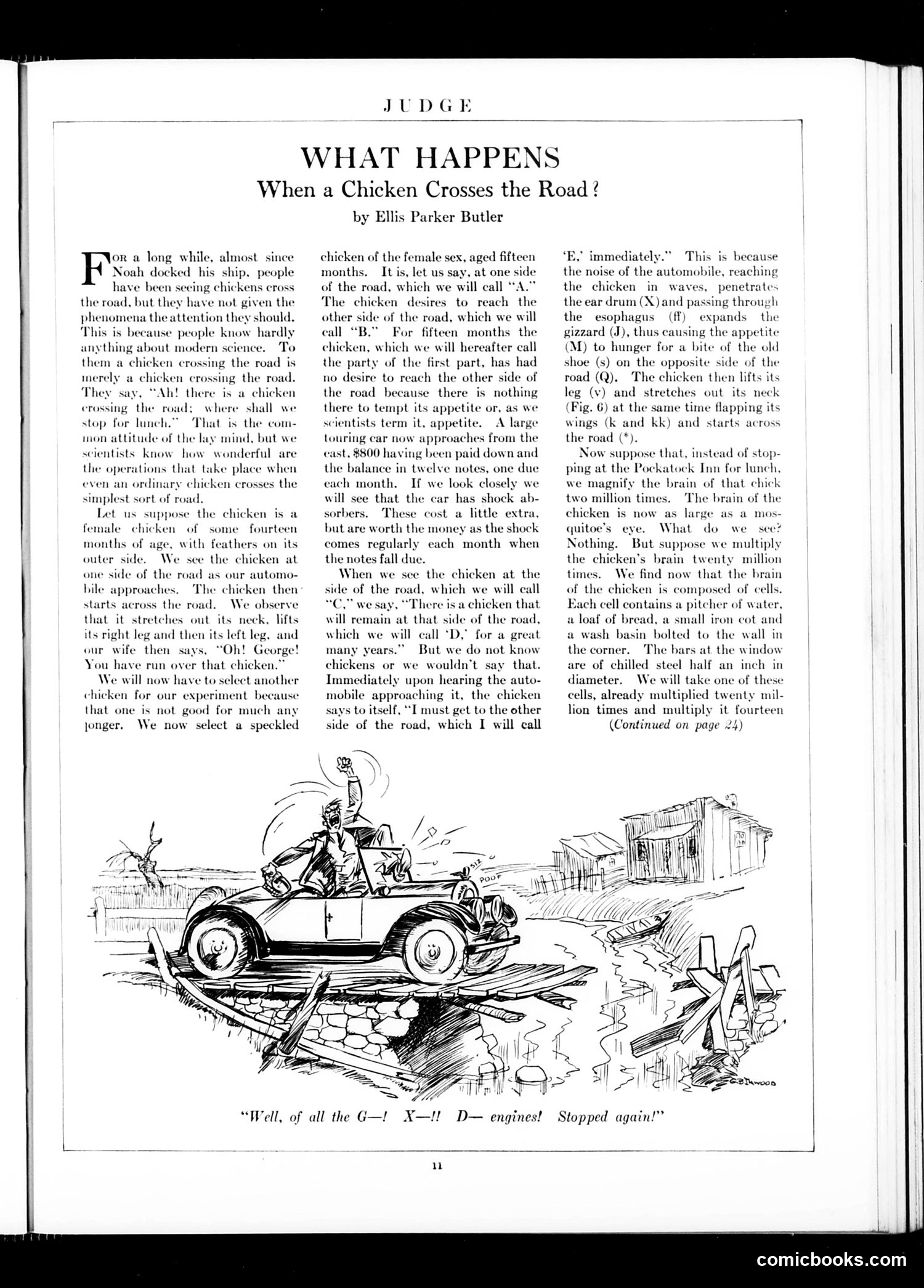
This is a humorous scientific satire by Ellis Parker Butler mocking the pretensions of modern science and intellectualism. The article absurdly "explains" the simple act of a chicken crossing a road through elaborate pseudo-scientific jargon—invoking anatomical terms (esophagus, gizzard), Latin labels (points A, B, D, E), and microscopic examination of brain cells. The accompanying cartoon shows a car hitting a chicken, with the frustrated driver exclaiming about engine trouble—ironically undercutting the entire scientific buildup with ordinary, mundane reality. The satire targets how scientists and intellectuals overcomplicate simple observations with grandiose terminology and methodology, treating trivial phenomena as profound mysteries worthy of intense technical analysis. It's a gentle mockery of academic pomposity and the gap between scientific pretense and actual usefulness.
📄 Transcribed text from this page (OCR, searchable)
Machine-transcribed from the original scan — historical spelling and the odd misread are preserved.
JUDGE WHAT HAPPENS When a Chicken Crosses the Road ? or a long while, almost since Noah docked his ship, people have been seeing chickens cross the road, but they have not given the phenomena the attention they should. This is because people know hardly anything about modern science. To them a chicken crossing the road is merely a chicken crossing the road. They say, “Ah! there is a chicken crossing the road: stop for lune where shall we That is the com- mon attitude of the lay mind, but we scientists know wonderful are the operations that take place when even an ordinary chicken crosses the simplest sort of road. Let us suppose the chicken is a female chicken of fourteen months of age, with feathers on its outer side. We see the chicken at one side of the ro: how some 1 as our automo- The chicken then starts across the road. We observe that it stretches out its neck, lifts its right leg and then its left leg. and our wife then says, “Oh! G You have run over that chic We will now have to select another chicken for our experiment: because bile approaches. that one is not good for much any jonger. We now select a speckled by Ellis Parker Butler chicken of the female sex, aged fifteen months. It is, let us say, at one sid of the road, which we will call The chicken desires to reach the other side of the road, which we will call “B.” For fifteen months the chicken, which we will hereafter call the party of the first part, has had no desire to reach the other side of the road because there is nothing there to tempt its appetite or, as we scientists term it, appetite. A large touring car now approaches from the cast, $800 having been paid down and the ice in twelve notes, one due each month. If we look closely we will see that the car has shock ab- sorbers. These cost a little extra, but are worth the money as the shock comes regularly each month when the notes fall due. When we see the chicken at the side of the road, which we will call y. There is a chicken that will remain at that side of the road, which we will call “D,’ for a great many years.” But we do not know chickens or we wouldn't say that. Immediately upon hearing the auto- mobile approaching it, the chicken says to itself, “I must get to the other side of the road, which I will call D— engines! ly." This is because the noise of the automobile, reaching the chicken in waves, penetrates the ear drum (X) and passing through the esophagus (ff) expands the gizzard (J), thus causing the appetite (M) to hunger for a bite of the old shoe (s) on the opposite side of the road (Q). The chicken then lifts its leg (v) and stretches out its neck (Fig. 6) at the same time flapping its wings (k and kk) and starts across the road (*). Now suppose that, instead of stop- ping at the Pockatock Inn for lunch, we magnify the brain of that chick two million times. The brain of the chicken is now as large as a mos- quitoe’s eye. What do we Nothing. But suppose we multiply the chicken’ ‘E,’ immediate’ see? 's brain twenty million We find now that the brain of the chicken is composed of cells. ch cell contains a pitcher of water, a loaf of bread, a small iron cot and a wash basin bolted to the wall in the corner. The bars at the window are of chilled steel half an inch in diameter. We will take one of these cells, already multiplied twenty mil- lion times and multiply it fourteen (Continued on page 24) times. Stopped again!” comicbooks.com