
A complete issue · 36 pages · 1926
Judge — October 23, 1926
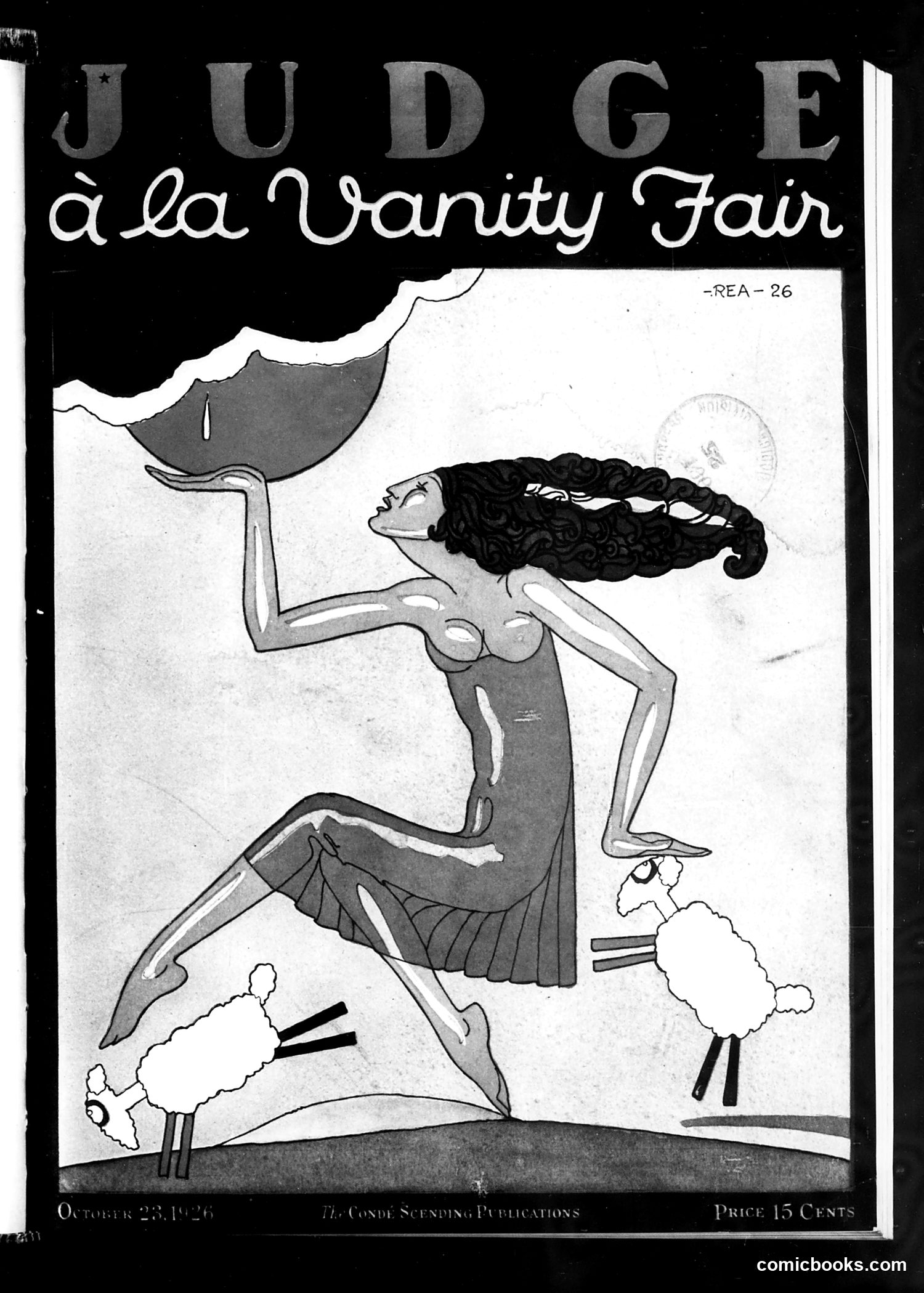
This October 1926 *Judge* magazine cover titled "Judge à la Vanity Fair" satirizes the fashion and lifestyle aspirations of the Jazz Age. The illustration depicts a stylized woman in an exaggerated, theatrical pose wearing a short skirt and elaborate headpiece, surrounded by cherubic figures holding cigarettes and cosmetics. The satire targets the "modern woman" of the 1920s—specifically the flapper lifestyle and her pursuit of vanity through beauty products and smoking. The cherubs (traditionally symbols of innocence) ironically hold cigarettes and makeup, mocking how consumer culture marketed these "sophisticated" vices to women as signs of liberation and fashionability. The title's reference to *Vanity Fair* magazine suggests criticism of how lifestyle publications promoted materialism and shallow values during this era of excess.
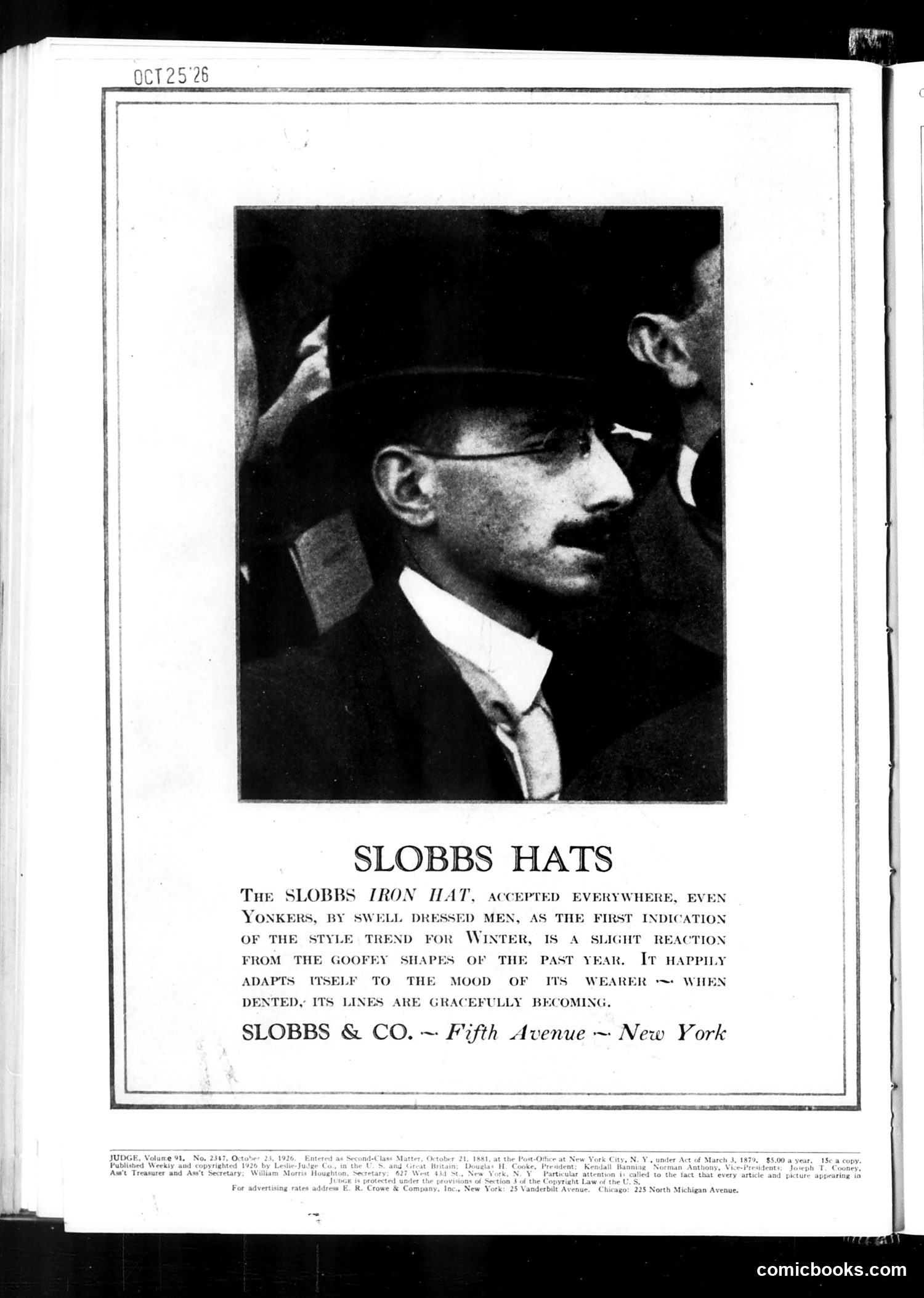
This page is primarily a **fashion advertisement**, not political satire. It promotes Slobbs & Co.'s iron hat from their Fifth Avenue New York store. The advertisement features a formal portrait photograph of a man wearing the "Slobbs Iron Hat"—a structured, formal hat style. The text describes it as "accepted everywhere, even Yonkers, by swell dressed men" and notes it represents a departure from "goofy shapes of the past year," adapting gracefully to the wearer's mood when its lines are "dented." The humor is mild and commercial rather than political: it's gentle mockery of previous overly-elaborate hat fashions, positioning Slobbs's more refined design as the modern choice for well-dressed gentlemen. The mention of "Yonkers" adds a touch of snobbish humor, suggesting even suburban men appreciate quality millinery.
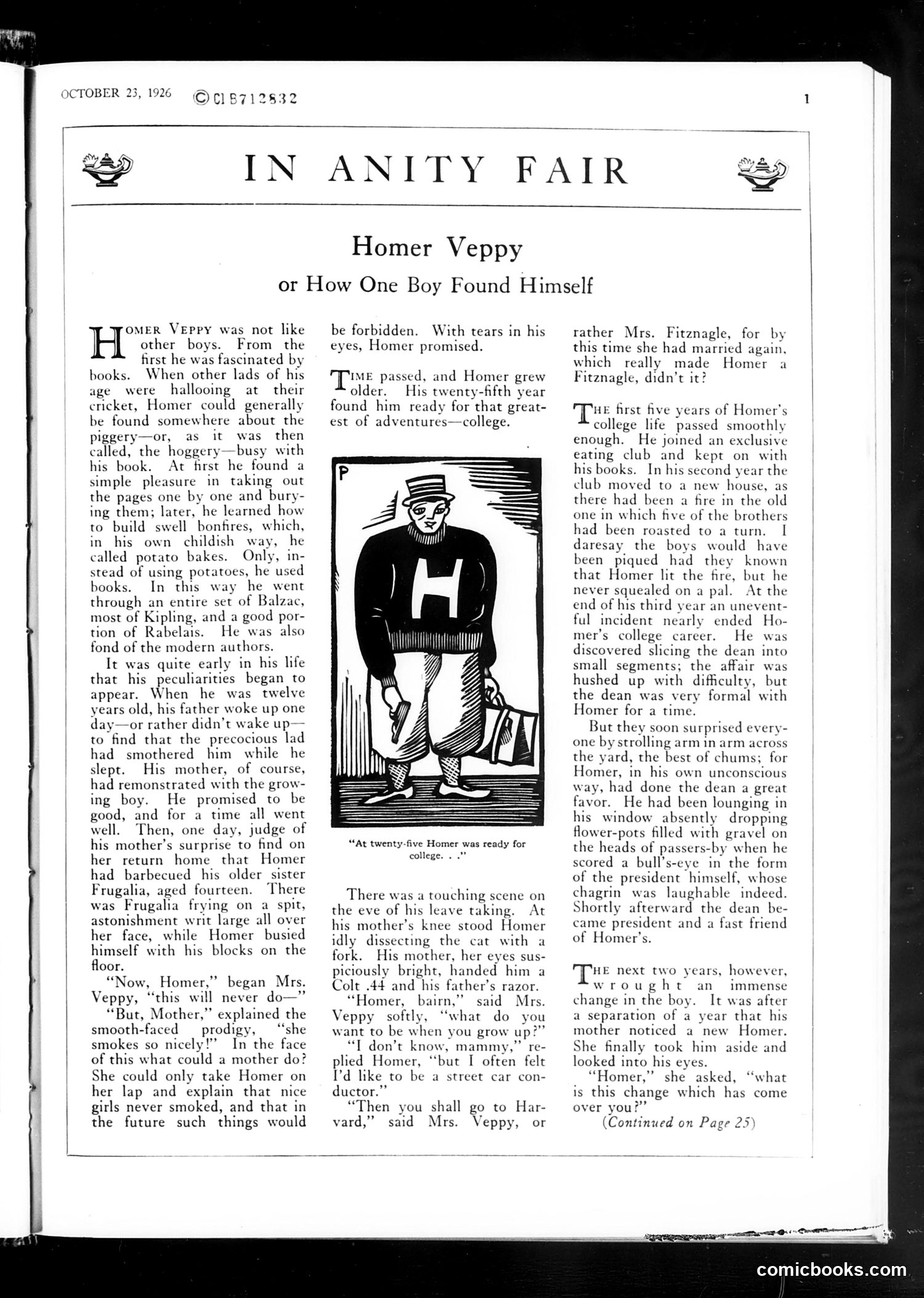
This page presents "Homer Veppy or How One Boy Found Himself," a serialized fiction story rather than political satire. The narrative follows Homer from childhood through college, depicting his unconventional personality—he preferred reading to typical boyish activities and found pleasure in domestic tasks like "potato bakes" rather than cricket. The accompanying illustration shows Homer at twenty-five, dressed formally with an "H" on his sweater, apparently ready for college adventures. The story emphasizes his individuality and intellectual pursuits, contrasting him with conventional peers. This appears to be a lighthearted coming-of-age tale in *Judge* magazine (October 23, 1926), focusing on personal development and self-discovery rather than political commentary or satire.
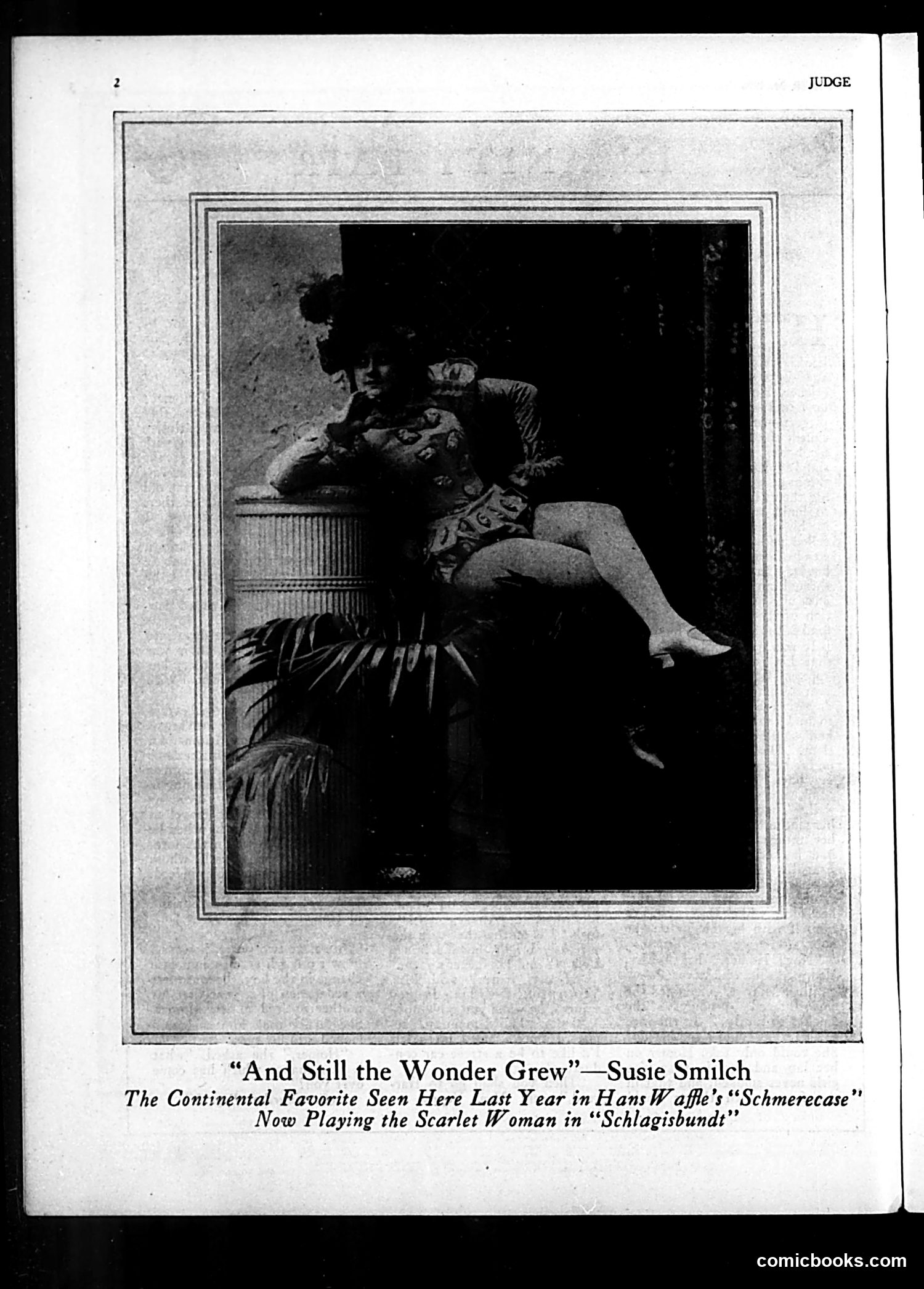
This page features a photograph rather than a cartoon—a promotional image of actress Susie Smilch in a dramatic pose. The caption "And Still the Wonder Grew" references her career trajectory. The text notes she previously appeared in Hans Waffles's film "Schmerecase" and is now performing in "Schlagisbundt." These appear to be fictional or deliberately absurd film titles, likely satirizing continental European cinema or its pretentious naming conventions that were fashionable among American audiences of the era. The satire seems directed at the mystique surrounding European actresses and films—suggesting Smilch's growing fame is somewhat artificially constructed through association with exotic-sounding (but possibly meaningless) European productions. The humor lies in the contrast between serious theatrical presentation and the ridiculous titles.
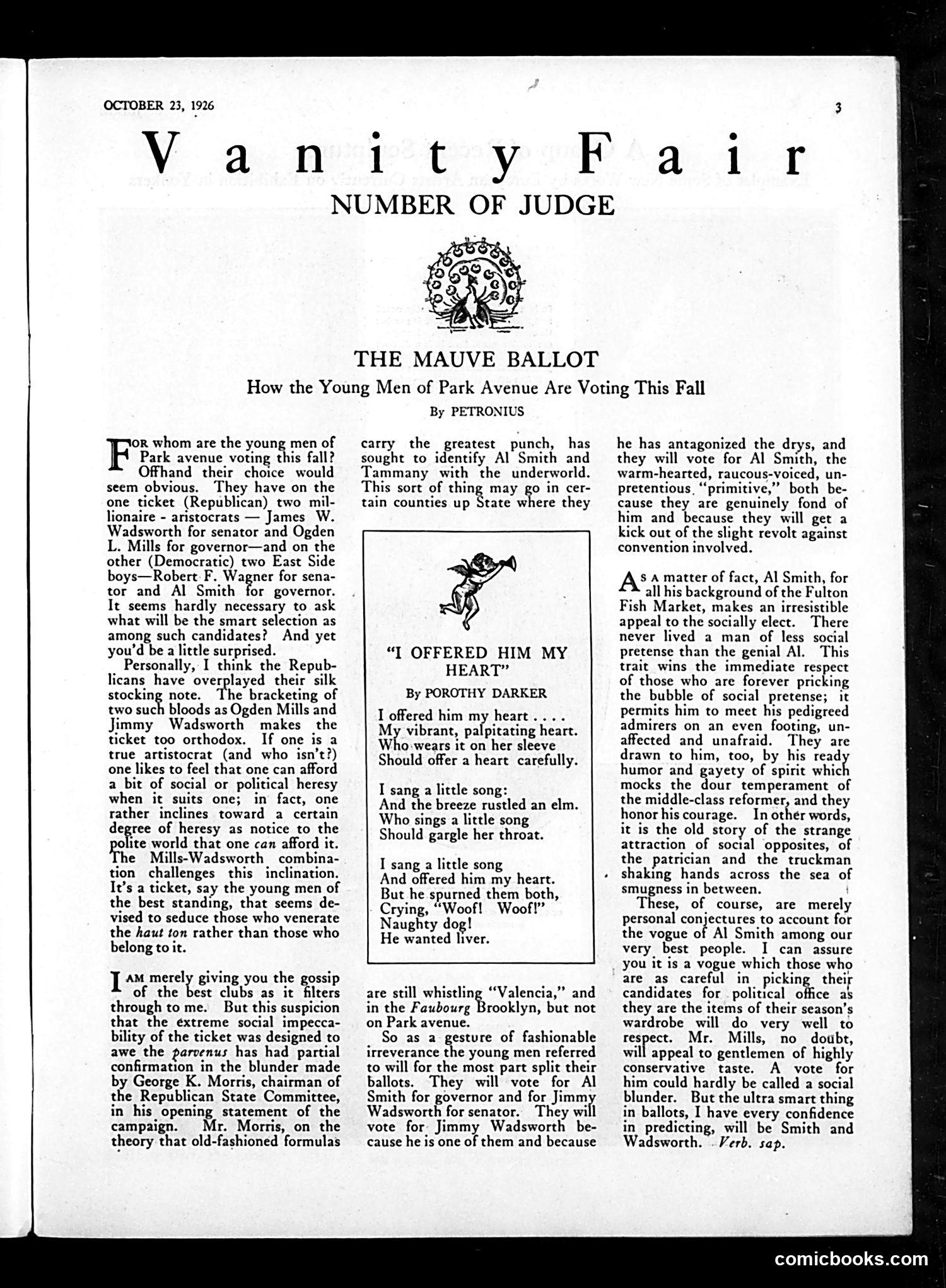
This Judge magazine page (October 23, 1926) satirizes young, upper-class voters on Park Avenue deciding between Republican and Democratic candidates. The article mocks their indecision regarding: - **Republican ticket**: Wadsworth for senator, Ogden L. Mills for governor - **Democratic ticket**: Al Smith for governor, Jimmy Wadsworth for senator The satirist (Petronius) ridicules these wealthy voters' tendency to split tickets based on social respectability rather than principle. The poem "I Offered Him My Heart" (by Dorothy Parker) appears to be mock-romantic commentary on their shallow political engagement. The piece suggests these "smart" Park Avenue types are really just fashionable fence-sitters, concerned more with social standing than genuine political conviction—a common Judge critique of elite indifference to serious governance.
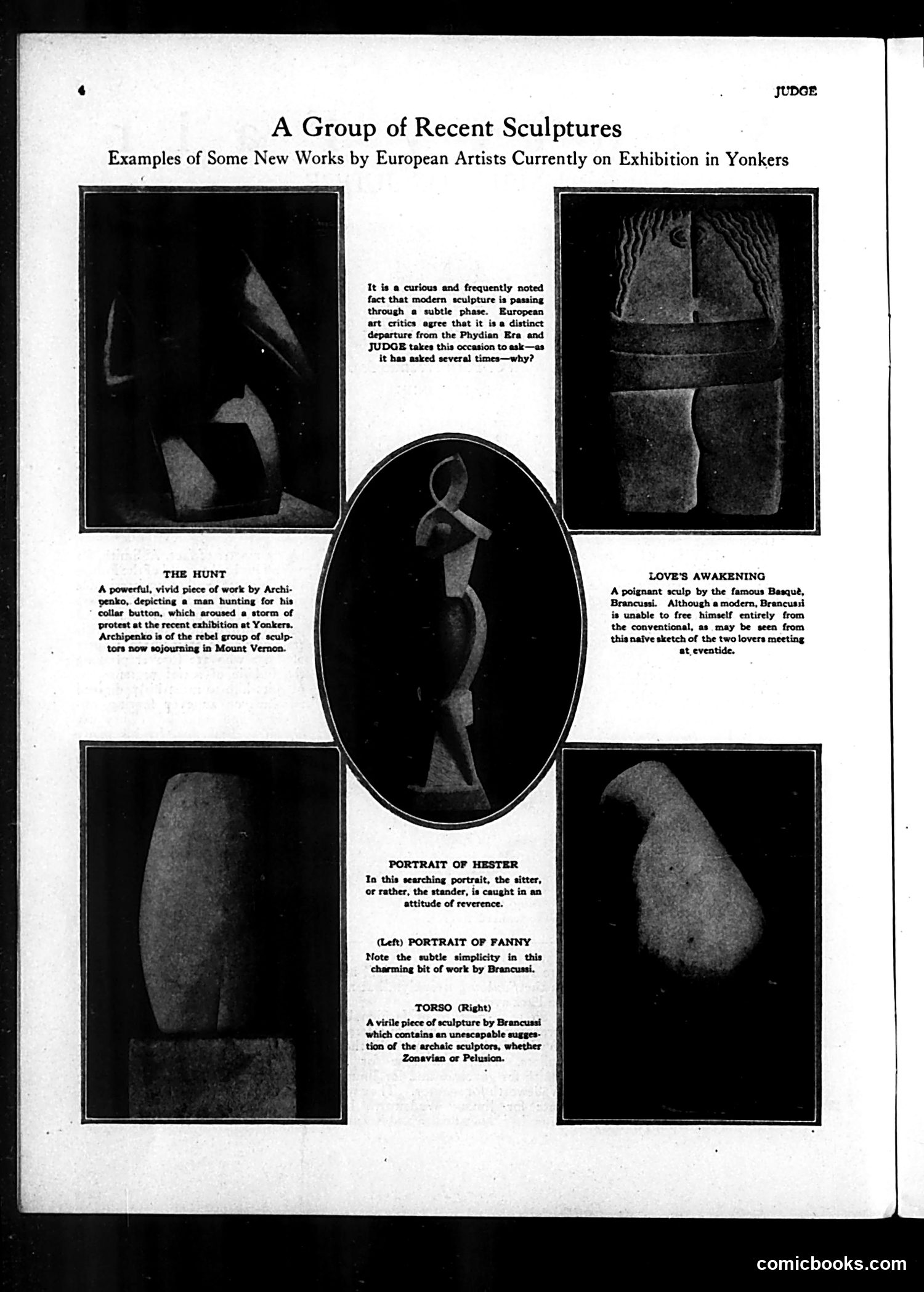
This page showcases contemporary European sculpture, likely from the 1920s-1930s based on the modernist style. Rather than political satire, it's an art criticism piece examining modern sculpture's "subtle phase." The featured works include: - **"The Hunt"** by Archipenko (depicting man hunting, noted as a "protest" piece) - **"Love's Awakening"** by Brancusi (described as modern yet unconventional) - **"Portrait of Hester"** (central oval image, showing reverent posture) - **"Portrait of Fanny"** and **"Torso"** (both by Brancusi, praised for "noble simplicity") The editorial note questions why modern sculpture is undergoing a "subtle phase," suggesting Judge's readers may have found avant-garde work puzzling or unduly abstract compared to traditional representational sculpture.
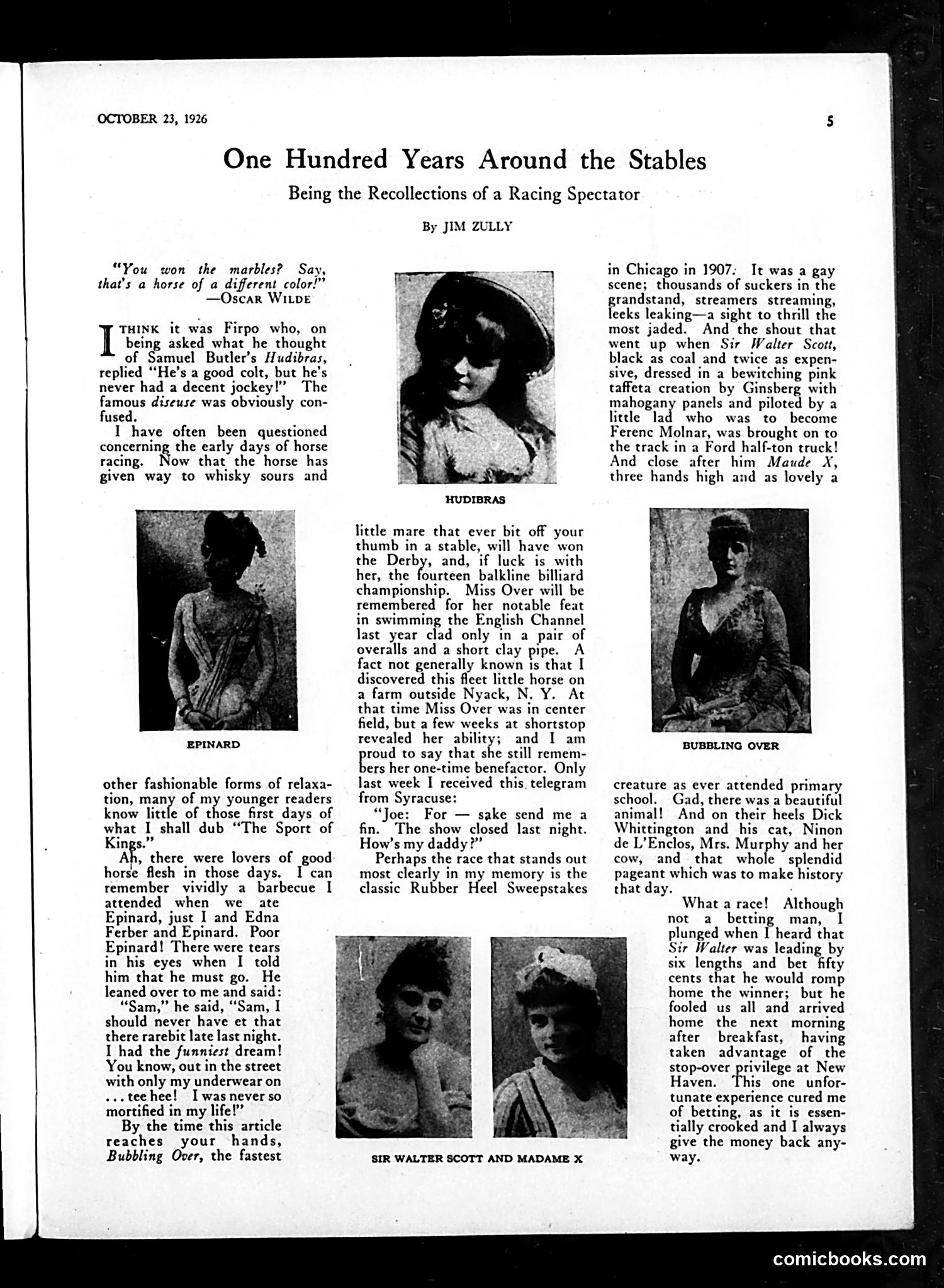
This is an article by Jim Zully about early horse racing history, not a political cartoon. It recounts anecdotes from racing in the early 1900s, featuring photographs of notable horses like **Hudibras**, **Epinard**, and **Bubbling Over**. The piece nostalgically describes famous racehorses and memorable racing moments, including an anecdote about **Sir Walter Scott** (a horse, not the author) winning a race in Chicago in 1907. It also mentions **Miss Over**, a horse notable for swimming the English Channel in overalls and a clay pipe. This is lighthearted sporting journalism presenting horse racing history to Judge's readers, not satire or political commentary.
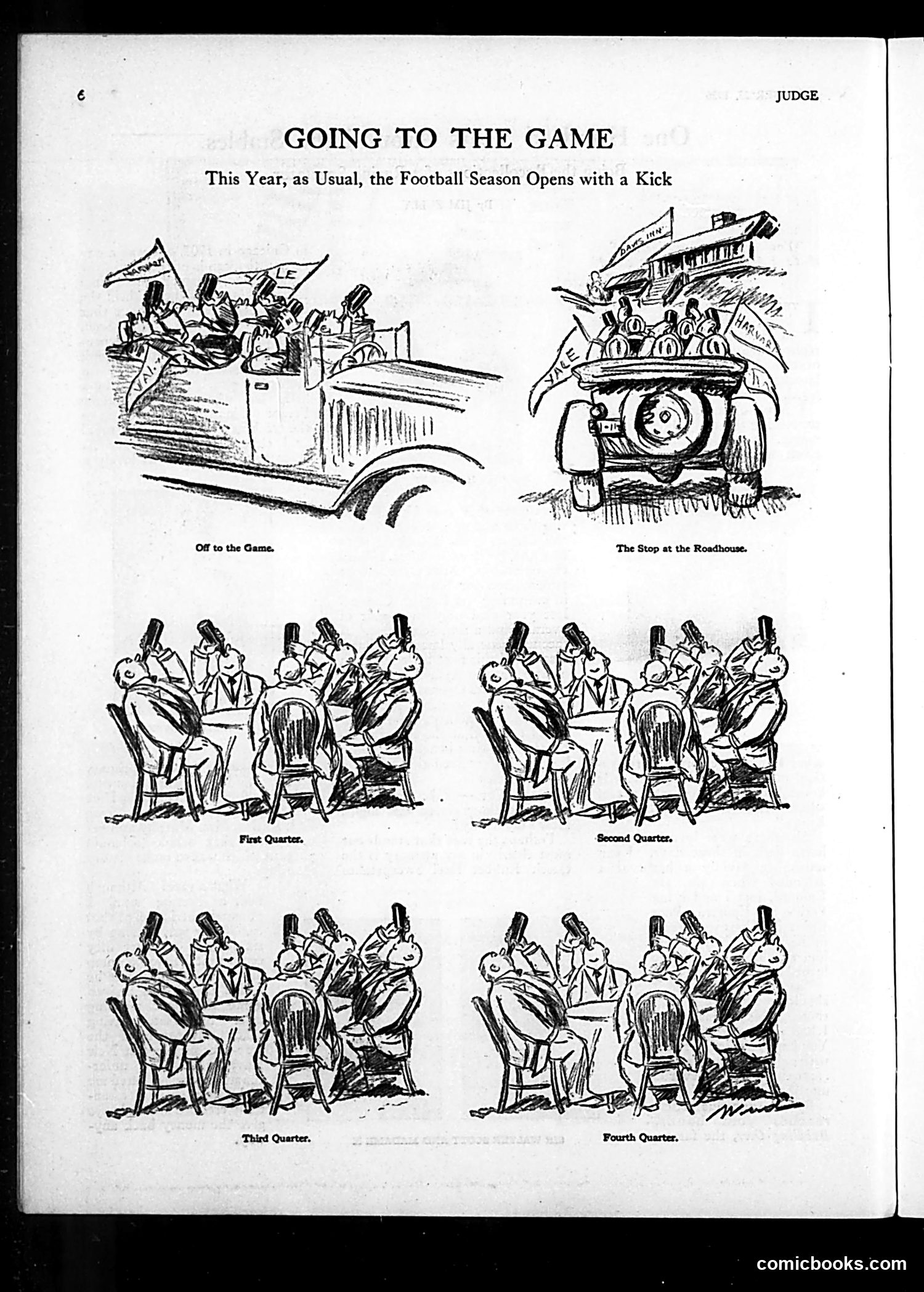
This is a humorous piece about attending a football game, structured as a journey with four quarters. The top panels show the expedition itself: fans enthusiastically departing "Off to the Game" in an overloaded vehicle, then stopping at a roadhouse. The four lower panels depict the same group of spectators at each quarter, showing their progressive deterioration—they appear increasingly disheveled and exhausted as the game proceeds. The satire mocks the experience of attending live football: fans arrive energetic and well-dressed, but by the fourth quarter they're worn out, dirty, and spent. This reflects common complaints about the tedium and discomfort of sitting through an entire football game, transforming what should be entertainment into an endurance test. The repetitive imagery emphasizes how little changes during the game itself except the fans' declining condition.
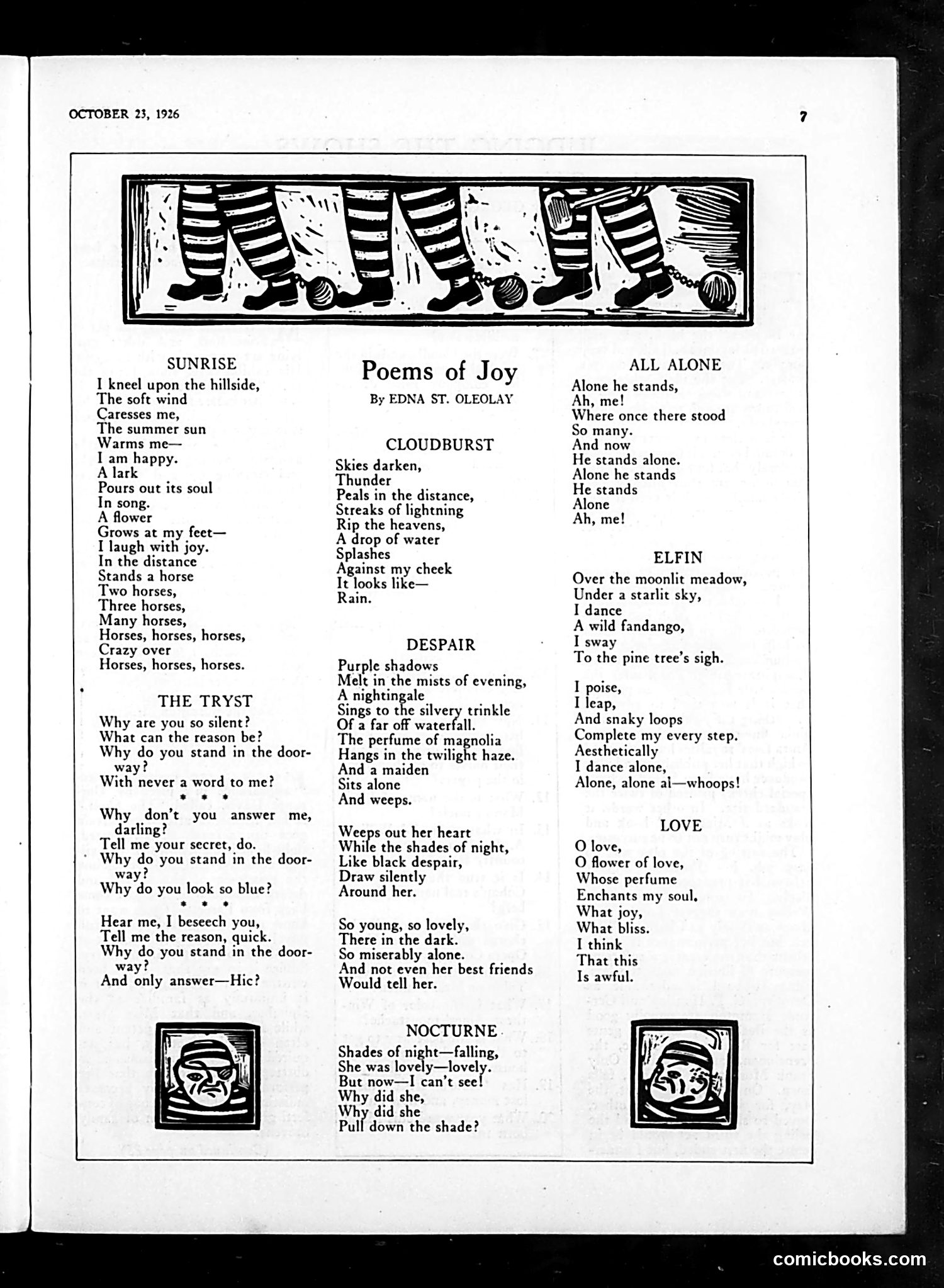
This page contains **poetry parodies**, not political cartoons. The collection, "Poems of Joy" by "Edna St. Oleolay" (a joke name—read aloud, it sounds like "Edna, steal away"), satirizes overwrought Romantic poetry popular in the 1920s. The satire mocks: - **Excessive sentimentality**: poems about nature that build dramatic tension over trivial events ("It looks like—Rain") - **Self-indulgent melancholy**: characters suffering profoundly from minor circumstances - **Purple prose**: flowery language describing nightingales, magnolias, and moonlit meadows - **Anticlimactic punchlines**: "The Tryst" ends with hiccups; "Love" concludes "Is awful" The decorative woodcut borders show dancing figures, matching the collection's title, but add no satirical meaning. This targets the genteel poetry magazines of the era and readers who took such overwrought verse seriously—a common Judge tactic of deflating artistic pretension through absurdist humor.
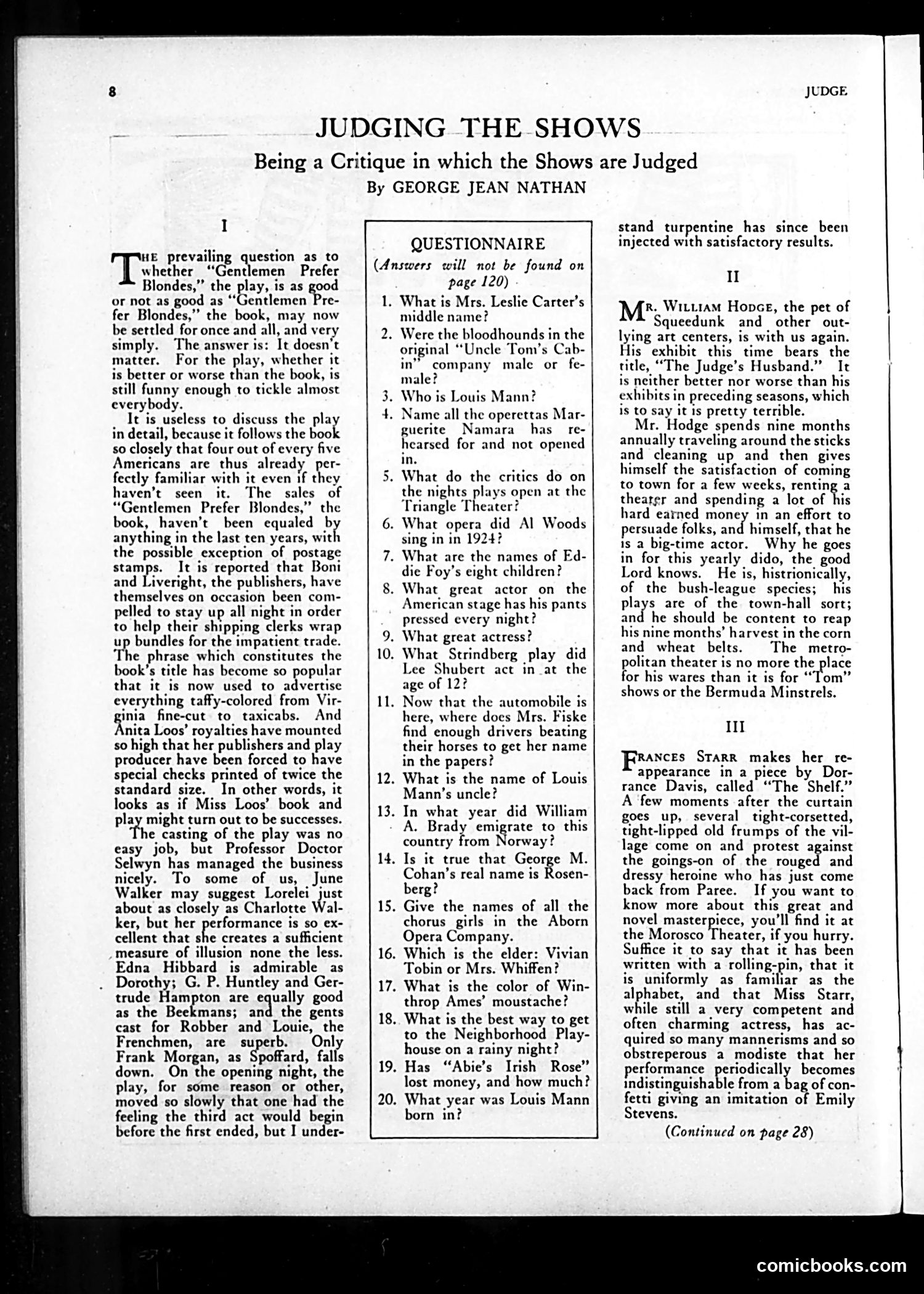
This page from Judge contains a theater review by George Jean Nathan critiquing the stage adaptation of "Gentlemen Prefer Blondes." Nathan argues the play-versus-book debate is irrelevant since the play is funny enough regardless. He praises the casting (especially June Walker as Lorelei) and the production's commercial success, noting the book's unprecedented popularity—its royalties are so massive the publisher needed oversized checks printed. The accompanying "Questionnaire" is satirical humor: it lists absurdly unanswerable trivia questions about theater personalities (Eddie Foy's eight children, George M. Cohan's real name, etc.), mocking both theater gossip columns and the public's obsession with show-business minutiae. The joke is that these questions are deliberately impossible or ridiculous, poking fun at entertainment journalism's trivial focus.
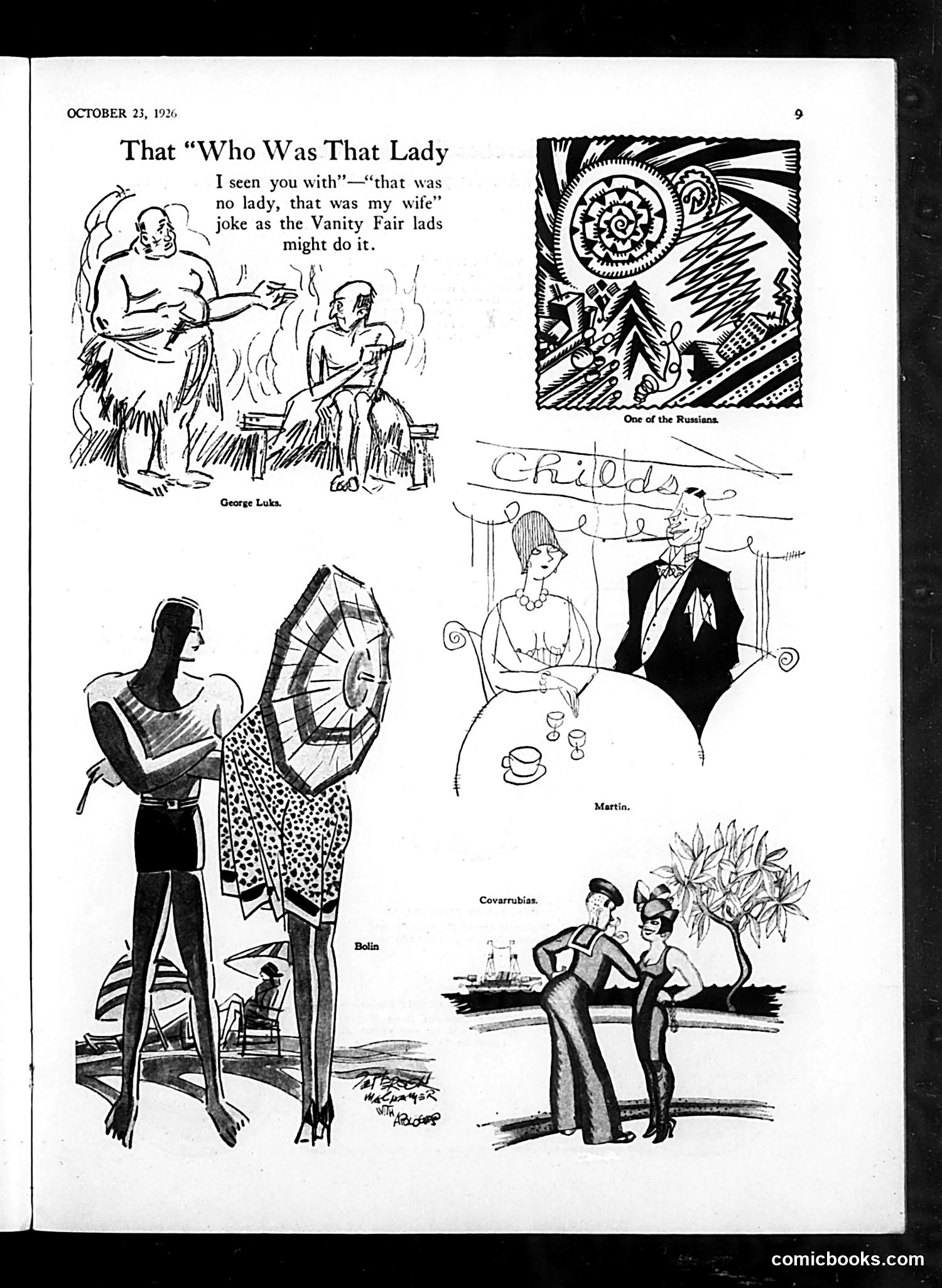
This page presents a collection of satirical cartoons and jokes typical of Judge magazine's social humor. The main feature parodies a popular joke format ("Who was that lady I saw you with?"), reimagining it as Vanity Fair would present it—suggesting more sophisticated or urbane humor. The page includes several illustrations labeled "George Luks," "Bolia," "Marilo," and "Coveyrubias" (likely artist attributions). These depict fashionable 1920s figures in various scenarios: Egyptian-styled fashion, formal dining, and flirtation—all reflecting Jazz Age preoccupations with style, sophistication, and romantic intrigue. The satire targets upper-class social pretensions and the period's obsession with fashionable appearance and witty banter. The reference to Vanity Fair (a rival satirical magazine) suggests inter-publication rivalry in commenting on contemporary society.
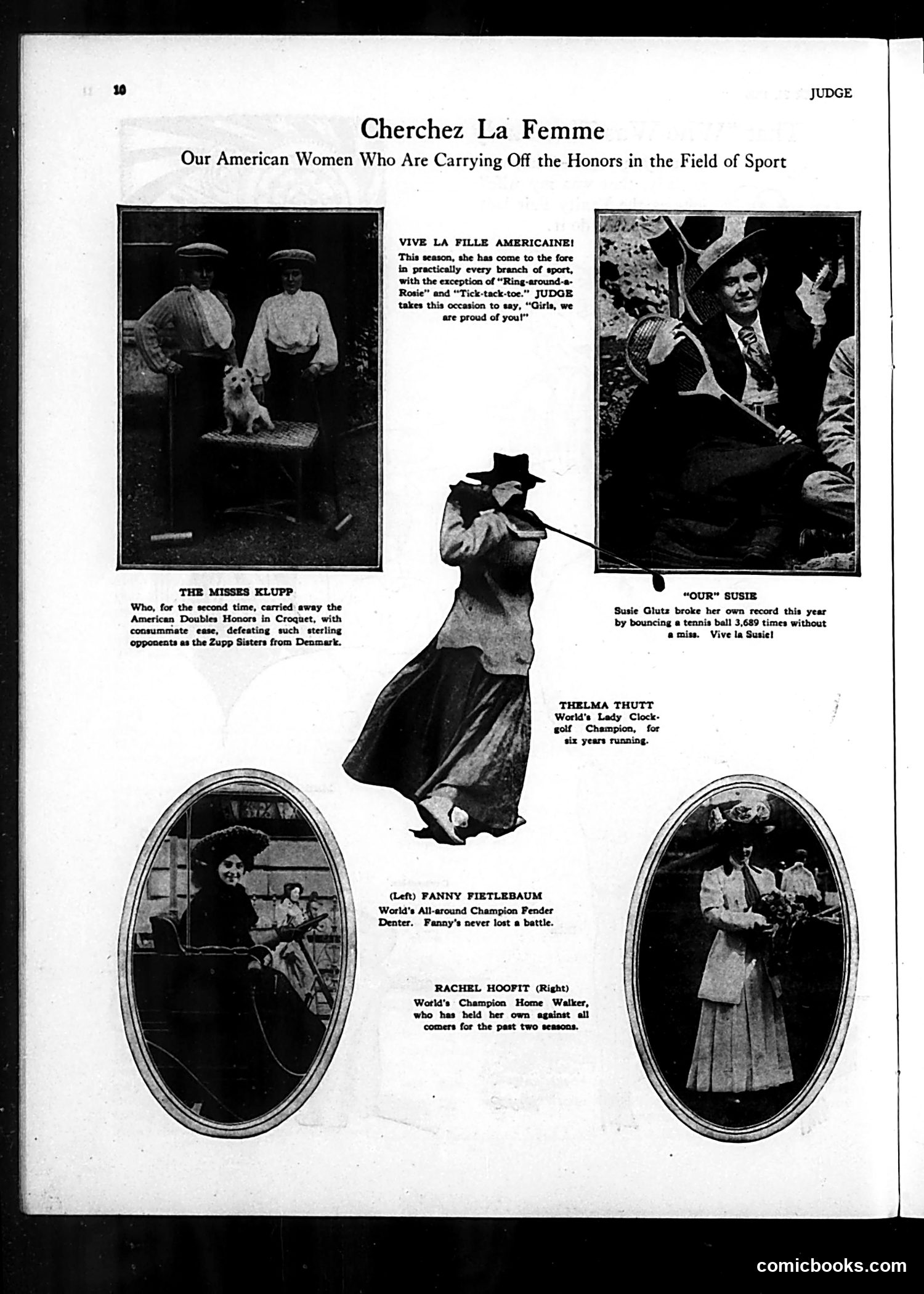
This is a celebratory feature, not satire, showcasing American women excelling in various sports. The headline references the French phrase "Look for the woman," inverting its typical use as a dismissive cliché about female involvement in scandals. The page profiles several female athletes with absurdist humor: the Klupp sisters won croquet doubles; "Susie Glutz" holds a tennis ball-bouncing record (3,689 times); Thelma Thutt dominates "clock-golf" (a putting game); Fanny Fietlebaum is an all-around "fender denter"; and Rachel Hoofit leads in competitive home-walking. The satire lies in treating trivial or invented "sports" with the same gravitas as legitimate athletic achievement. Judge is mock-seriously praising women's athletic participation while ironically suggesting their accomplishments are in comically minor activities—a backhanded compliment reflecting early 20th-century attitudes about women in sport.
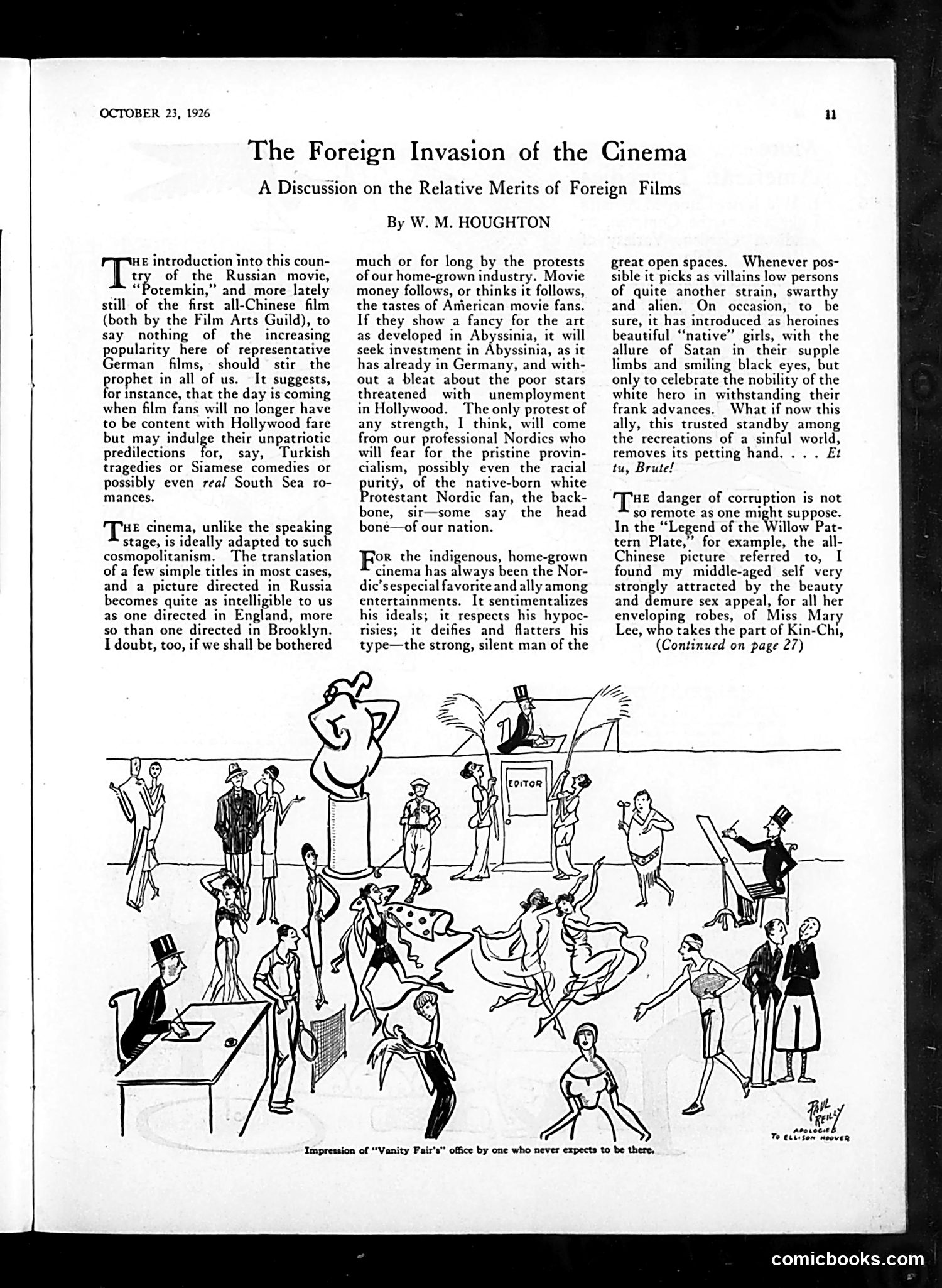
This article and accompanying cartoon satirize American anxieties about foreign films entering the U.S. market. Author W.M. Houghton discusses the arrival of Russian ("Potemkin"), Chinese, and German films, noting they're intelligible despite subtitles. The satire targets two groups: (1) Hollywood's financial interests, who will follow audience demand regardless of national pride, and (2) white Protestant "Nordics" who fear foreign cinema corrupts American values. Houghton mocks their concern that these films—particularly a Chinese production featuring actress Mary Lee—might seduce viewers with "swarthy and alien" characters, threatening the heroic white Protestant male archetype Hollywood traditionally celebrated. The cartoon impression of a chaotic "Vanity Fair office" likely exaggerates the frenzy surrounding this cultural debate. The piece combines cultural elitism with xenophobic anxiety typical of 1920s nativism, presenting these concerns as worthy of ridicule.
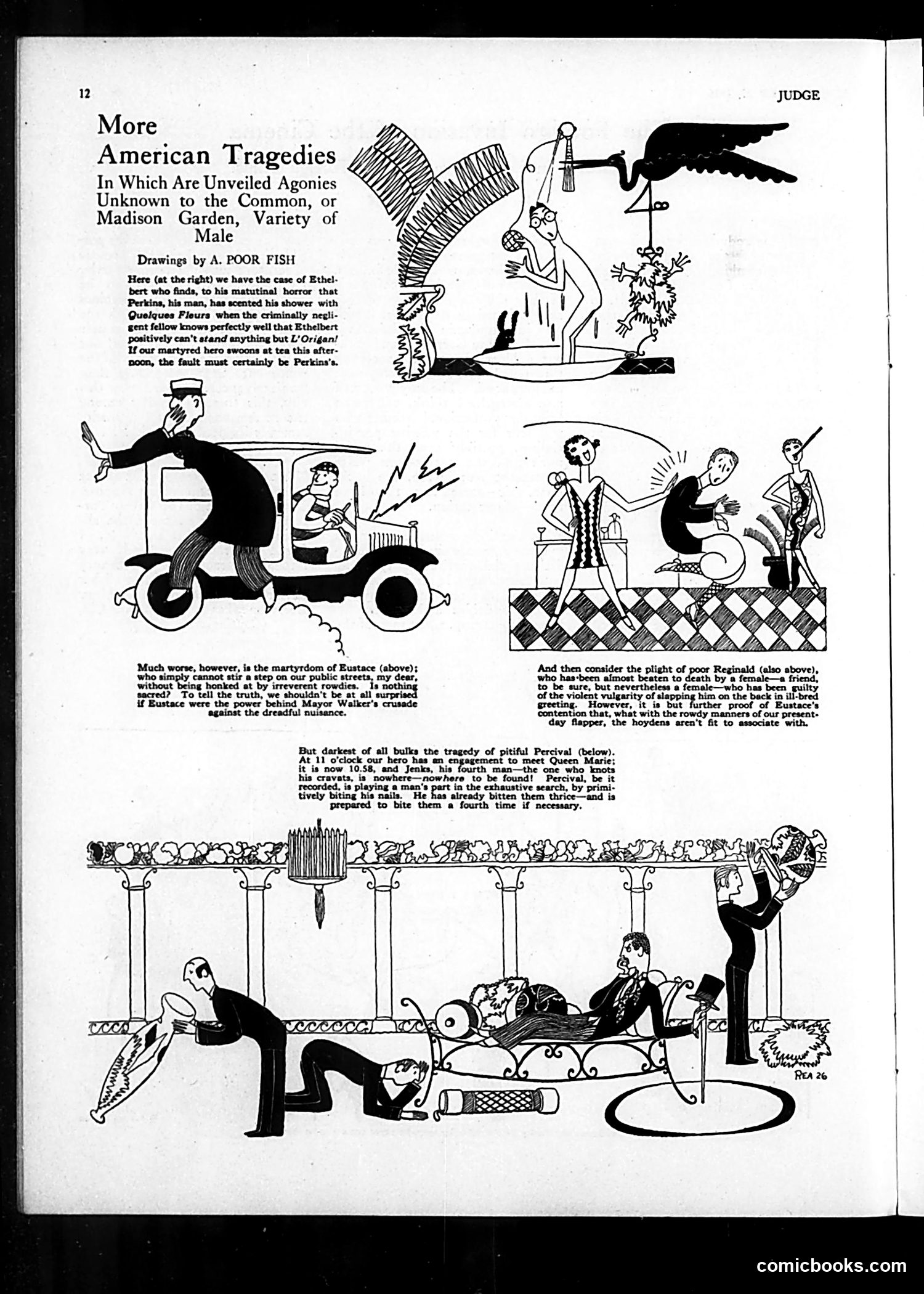
This satirical piece mocks upper-class male complaints about modern urban life and social changes, particularly the rise of independent women ("flappers"). **The three tragedies depicted:** 1. **Ethelbert**: A man distressed that his morning tea lacks a specific perfume (L'Origan), presented as an absurd hardship. 2. **Eustace**: Cannot walk city streets without being honked at by "irreverent rowdies"—a complaint about urban noise and disrespect for gentlemen. 3. **Reginald**: Beaten by a female friend for his inappropriate behavior, yet blames women's "rowdy manners" and unfitness for society. 4. **Percival** (main cartoon): Nervously biting his nails while preparing to meet Queen Marie, his anxiety presented as comedic overwrought masculinity. The satire targets privileged men who view minor inconveniences and women's newfound social freedom as genuine tragedies, while remaining oblivious to their own poor behavior. The exaggerated drawings emphasize the absurdity of their complaints.
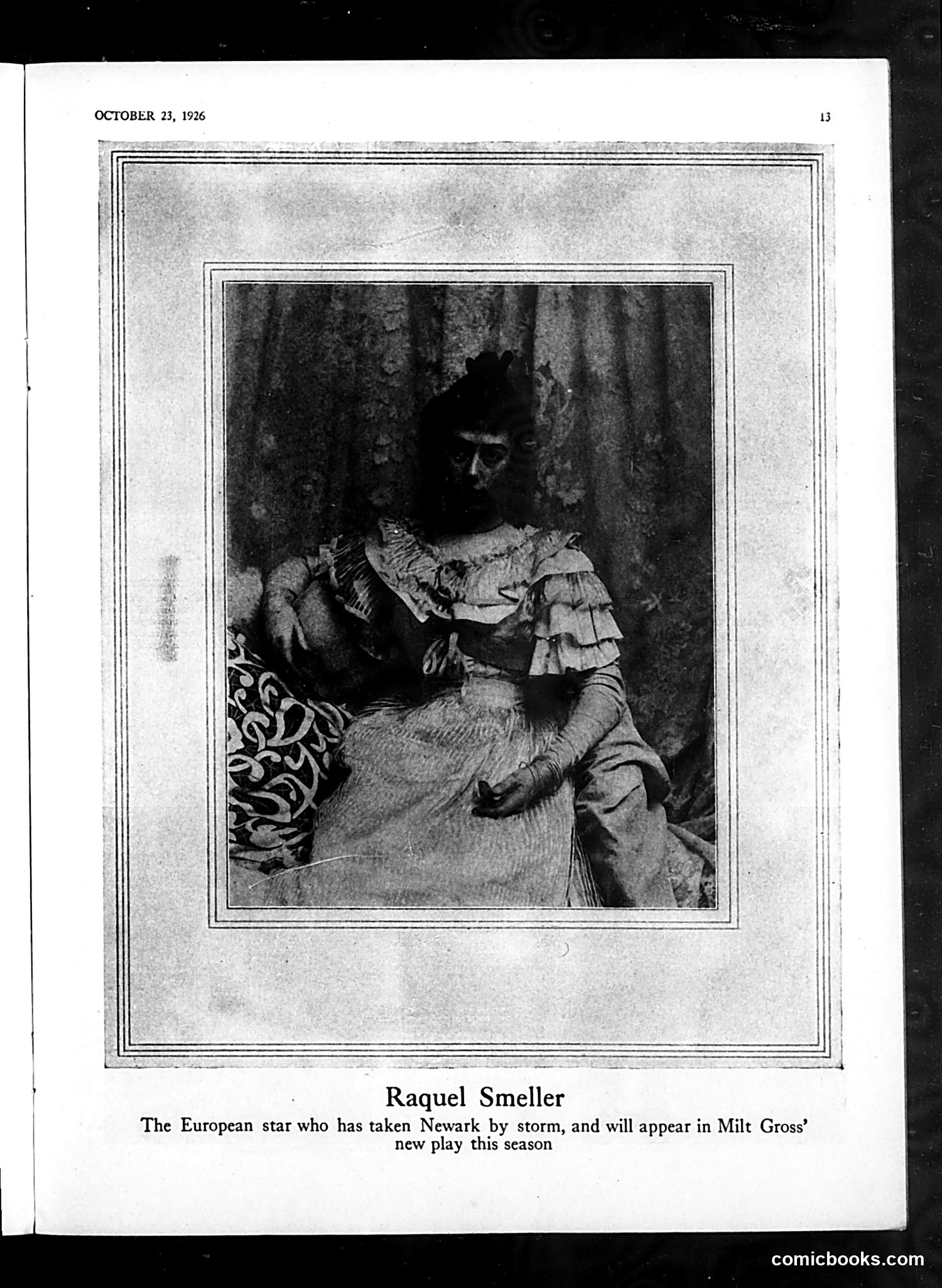
This is a portrait photograph, not a cartoon. The page features **Raquel Smeller**, identified as a European theatrical star who had achieved popularity in Newark and was set to appear in a new play by Milt Gross (a cartoonist and playwright). The caption's phrasing—"taken Newark by storm"—suggests she was a notable actress generating significant public interest. The photograph shows her in theatrical costume with ruffled sleeves, typical of 1920s stage fashion. This appears to be an entertainment/celebrity feature rather than political satire. Judge magazine, while satirical, regularly included theatrical notices and celebrity profiles. The notation of her European origin and upcoming theatrical work simply announces her arrival as a notable performer to American audiences.
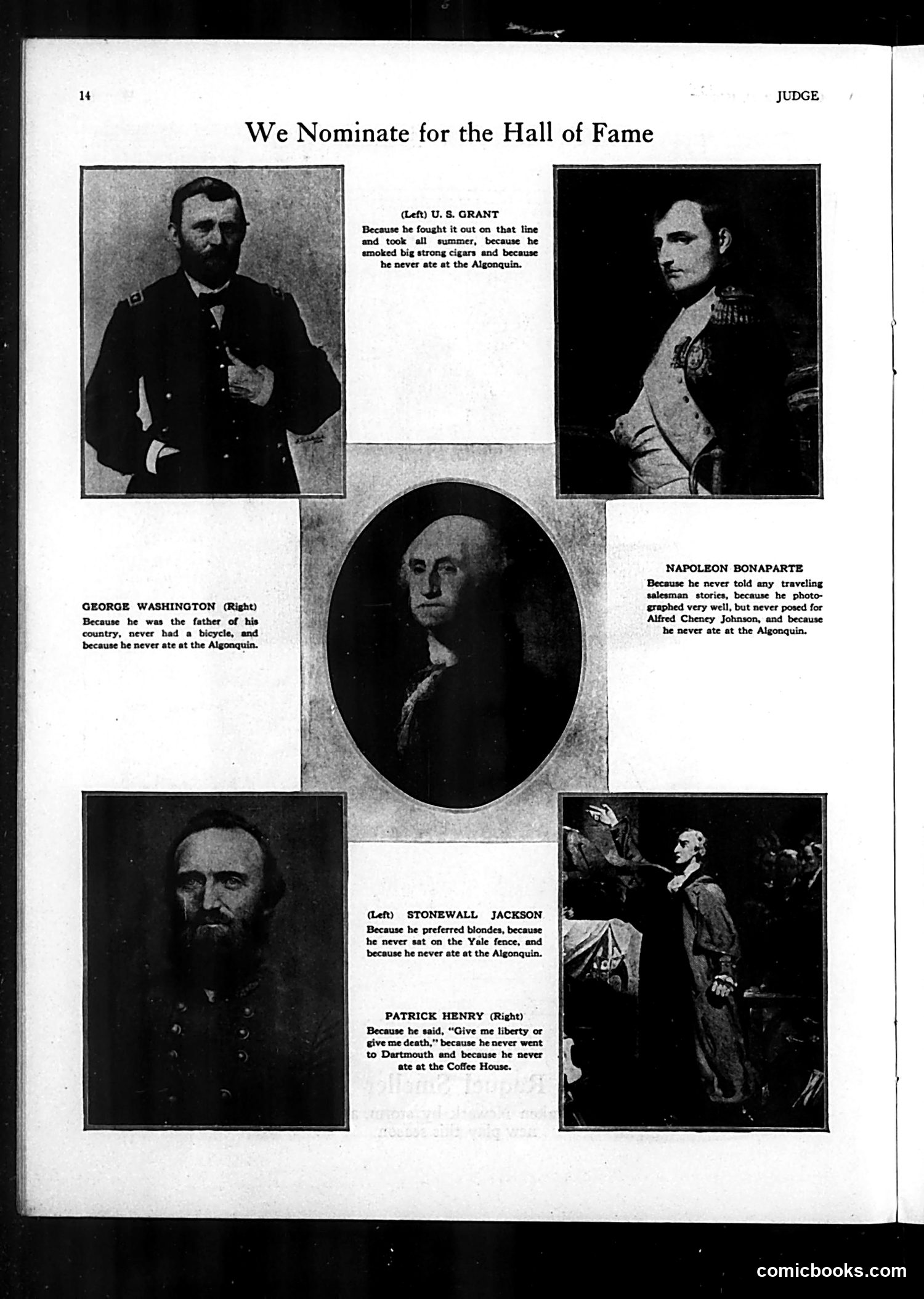
This page satirizes the pretensions of New York's elite social establishments, particularly the Algonquin Hotel and Club, which was famous as a gathering place for Manhattan's intelligentsia and literati. The joke inverts logic: five historical figures are "nominated" for a Hall of Fame based on absurd criteria mixing genuine accomplishments with petty negations. The recurring punchline—that none of them "ate at the Algonquin"—mocks the club's self-importance by suggesting exclusion from this fashionable venue is actually a point of pride for history's greatest figures. Secondary jokes target other elite institutions: Washington "never had a bicycle" (anachronistic), Grant smoked "big strong cigars" (his known habit), Jackson "never sat on the Yale fence" (unclear reference), and Henry "never went to Dartmouth" (rival institution snob). The satire suggests that the Algonquin's members were pompous social climbers who overestimated their venue's significance compared to genuine historical achievement.
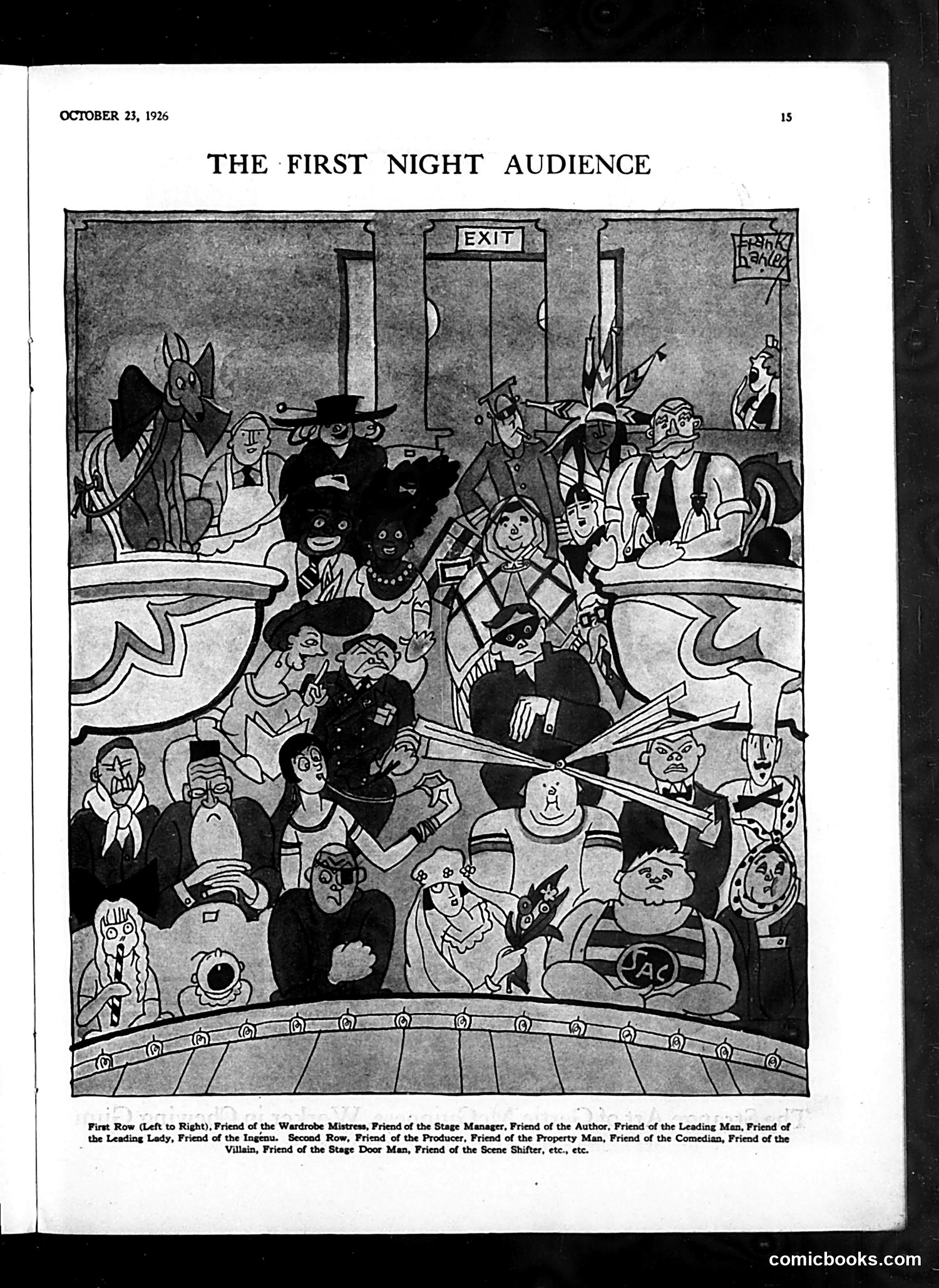
This cartoon satirizes theater opening nights by depicting an audience composed entirely of people with obvious connections to the production—not paying patrons, but rather friends, relatives, and hangers-on of cast and crew members. The caption's repetitive structure ("Friend of the...") humorously catalogs these various insider relationships: friends of actors, the author, producer, stagehands, and even the "Stage Door Man." The satire targets the Broadway custom of comp tickets going to connected parties rather than genuine theater enthusiasts, suggesting that opening-night audiences are less about critical evaluation and more about personal obligation and nepotism. The diverse character types crammed into the theater boxes visually emphasize the chaotic, self-interested nature of this insider-heavy crowd.
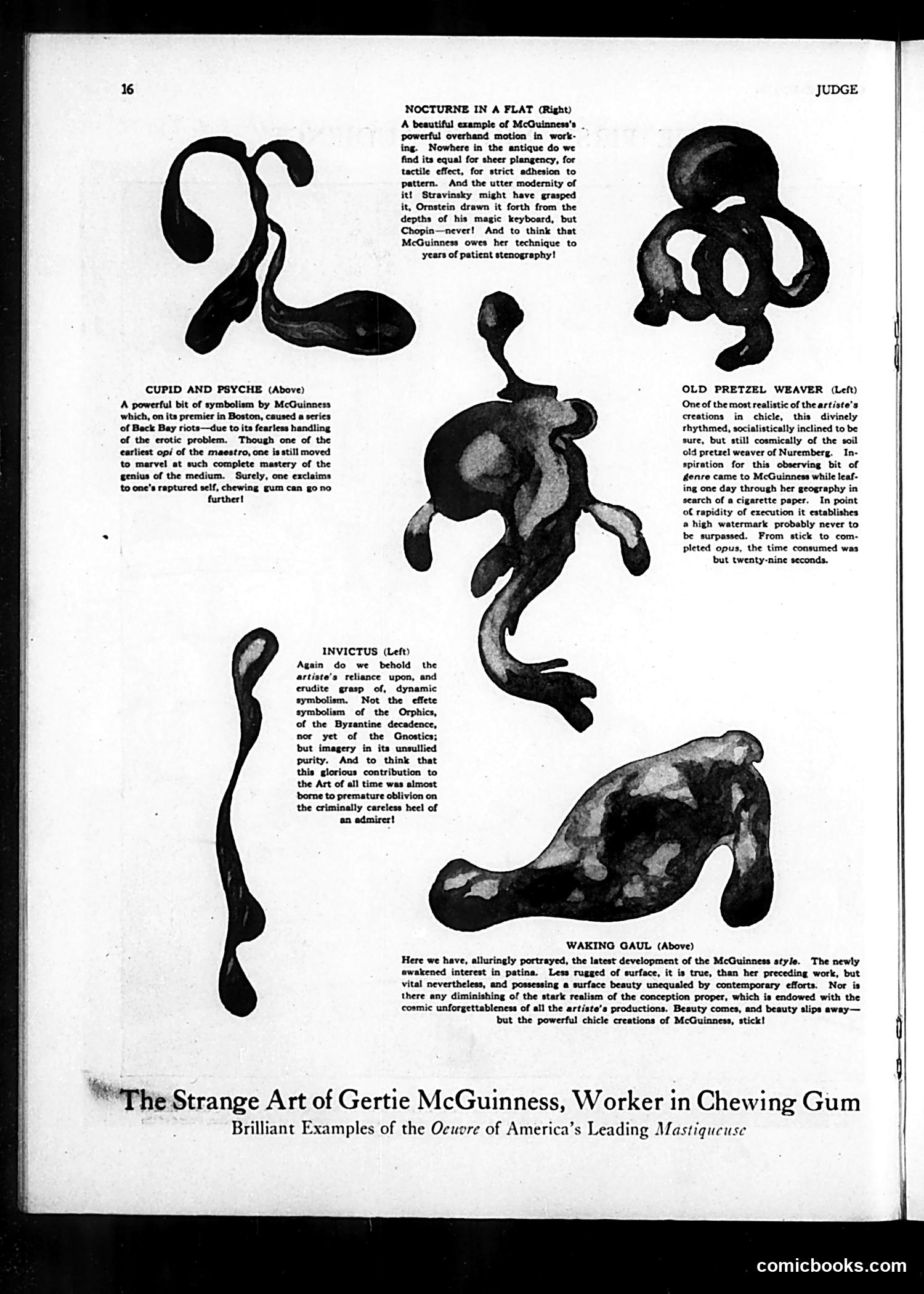
This is a **satirical mockery of pretentious art criticism**. Judge magazine ridicules Gertie McGuinness, who apparently creates sculptures from chewing gum—a deliberately absurd medium chosen to lampoon overwrought artistic pretension. The text employs grandiose, pseudo-intellectual language typically reserved for serious fine art ("dynamic symbolism," "stark realism," "cosmic unforgettableness"), applying it mockingly to gum sculptures with titles like "Cupid and Psyche" and "Invictus." The joke targets both: - **Ridiculous artists** working in frivolous materials while claiming deep significance - **Pompous art critics** who use ornate language to elevate worthless work, referencing obscure movements (Orphics, Byzantine, Gnostics) and comparing her to composers like Stravinsky and Chopin The reference to "Back Bay riots" in Boston pokes fun at critics treating trivial matters as culturally significant. The phrase "mastiqueuse" (female chewer) is a joking French neologism. This satirizes early 20th-century modernism's tendency toward obscurantist criticism and artists' claims of profundity for experimental work.
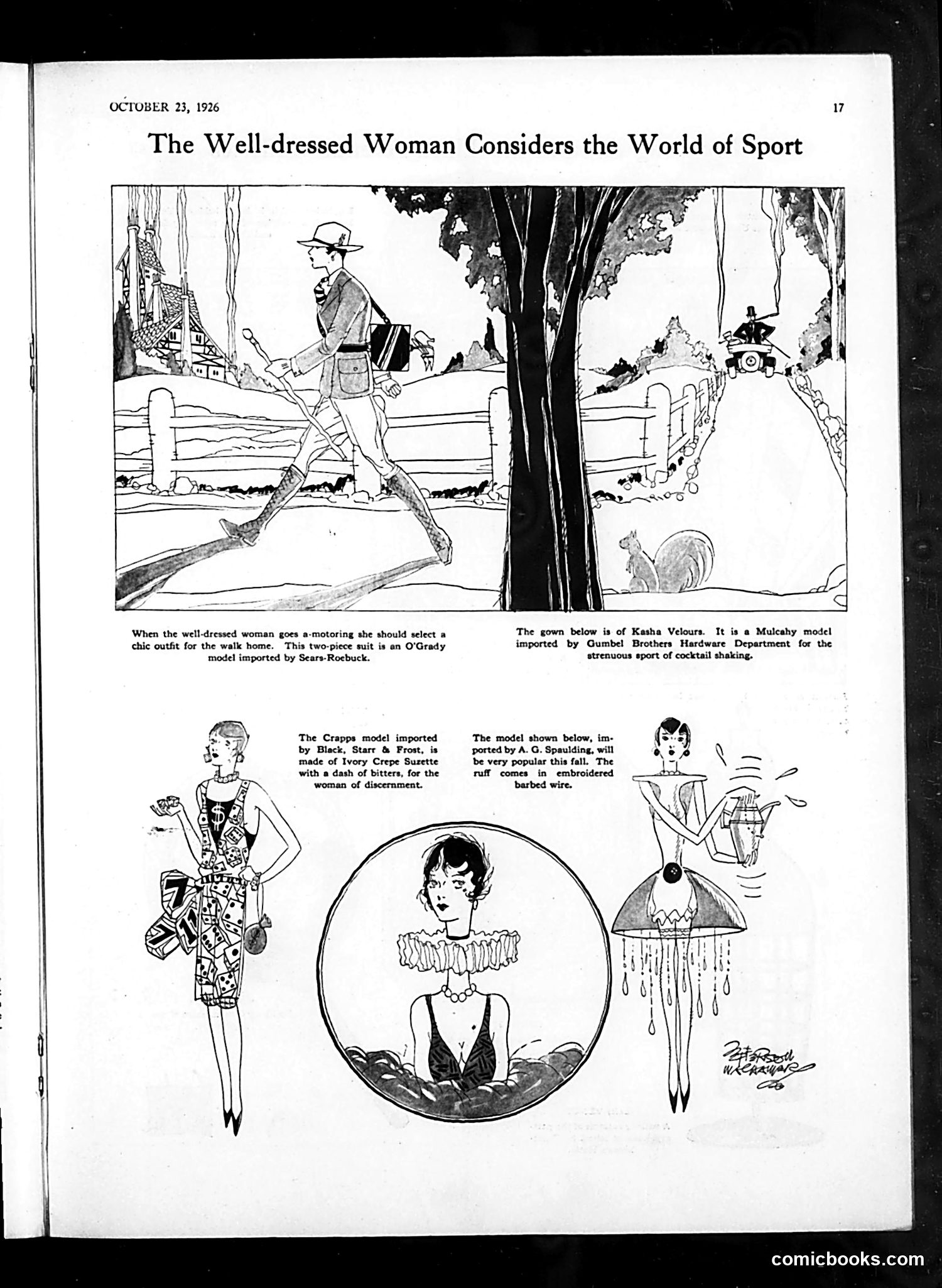
This 1926 Judge page satirizes women's fashion and the social contradictions of the Jazz Age. The headline promises sports attire advice, but the "sports" referenced are absurd: motoring, "cocktail shaking," and other non-athletic activities. The satire works through fake designer credits and ridiculous materials. Outfits are supposedly made from "Ivory Crepe Suzette with a dash of bitters" (cocktail ingredients) and feature "embroidered barbed wire"—mocking how fashion designers treated mundane or even dangerous items as exotic materials. The top illustration shows a woman in practical sportswear, but the bottom three fashion sketches present increasingly impractical, ornate gowns despite claiming they're for "strenuous sport." The joke: wealthy women's idea of "sport" was social activity and drinking (Prohibition era), not actual athletics. The elaborate, restrictive fashions shown contradict any genuine athletic purpose, satirizing the gap between women's claimed modernity and their actual leisure pursuits.
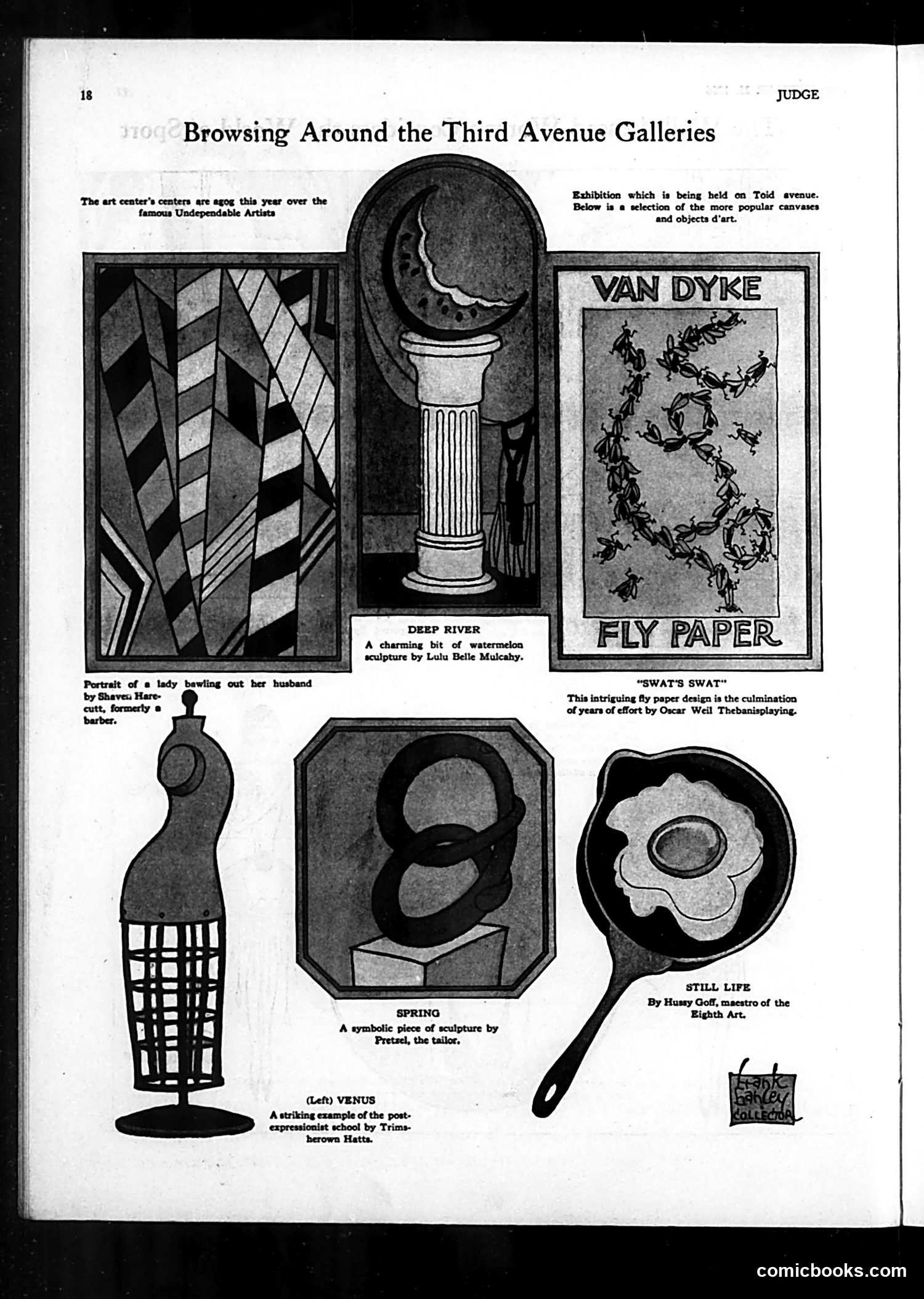
This page satirizes a contemporary art exhibition on Third Avenue, mocking both the artworks and artists on display. The satire targets modernist and avant-garde art movements through exaggerated titles and absurd descriptions. Notable pieces include: - **"Deep River"**: A racist caricature—a watermelon sculpture attributed to "Lulu Belle Mulcahy," invoking stereotypes about Black Americans and watermelons. - **"Venus"** and **"Spring"**: Abstract/post-expressionist sculptures presented as intentionally obscure or pretentious. - **"Swat's Swat"**: A fly-paper design mockingly presented as serious artistic achievement. The humor relies on presenting lowbrow or ridiculous objects as high art, reflecting widespread 1920s-era skepticism toward modernism. The racist imagery reflects the era's casual prejudice in mainstream publications.
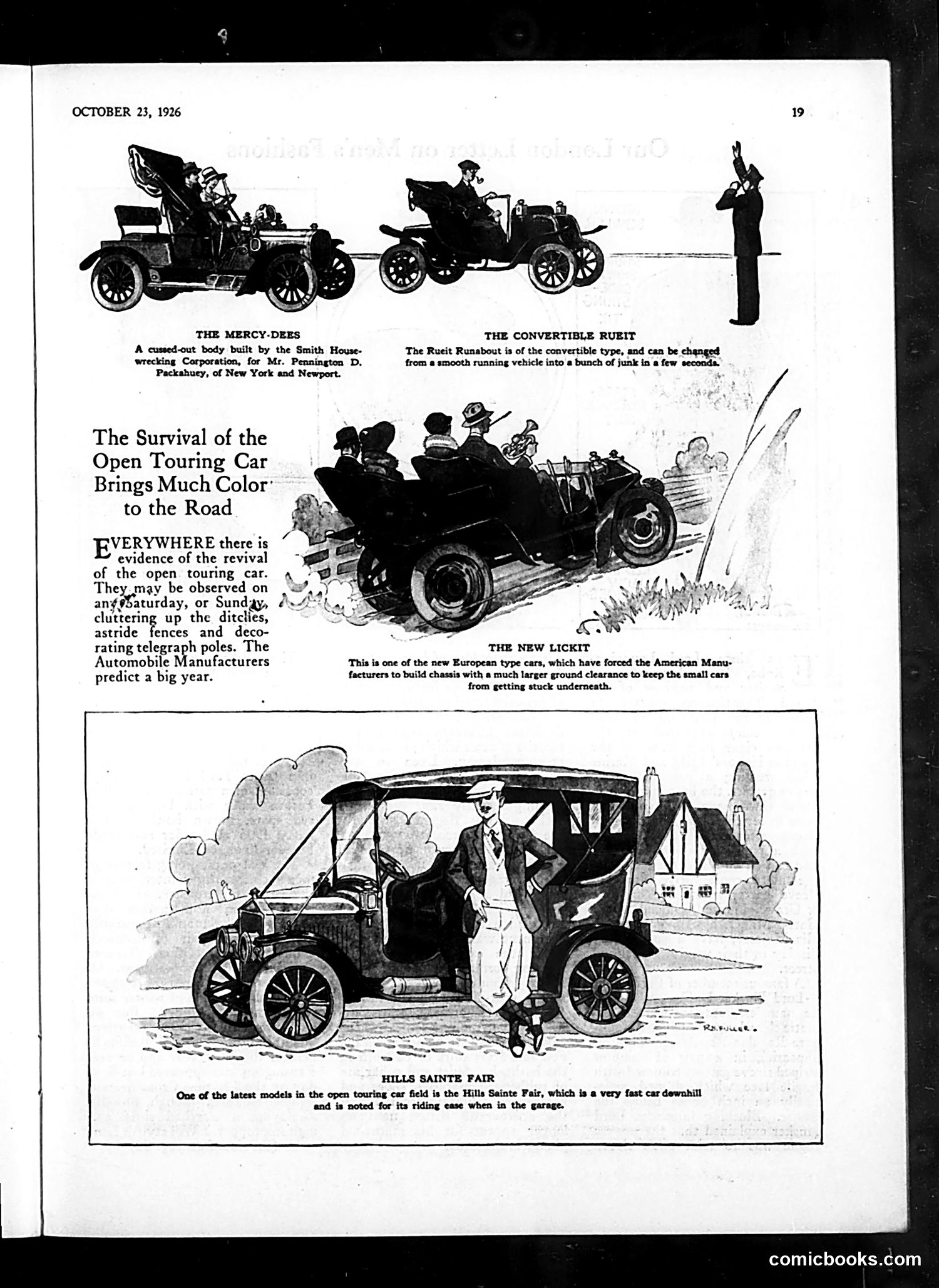
This page satirizes the 1920s automobile market and the revival of open-air touring cars. The humor targets both car manufacturers' optimistic sales predictions and the actual poor condition of many vehicles on roads. The captions mock specific car models through absurdist descriptions: the "Mercy-Dees" is a "cussed-out body" from a wrecking company; the "Convertible Rueit" transforms from a functioning vehicle into "junk in a few seconds"; the "New Lickit" requires excessive ground clearance to avoid getting stuck under larger cars. The article's opening jab—that open touring cars can be "observed" cluttering ditches, astride fences, and "decorating telegraph poles"—sarcastically suggests these vehicles end up wrecked rather than successfully driven. The overall message mocks both manufacturer optimism about revival sales and the reality of poorly-built, unreliable automobiles that dominated the era. Modern readers should understand this reflects genuine frustration with early automotive quality and durability.
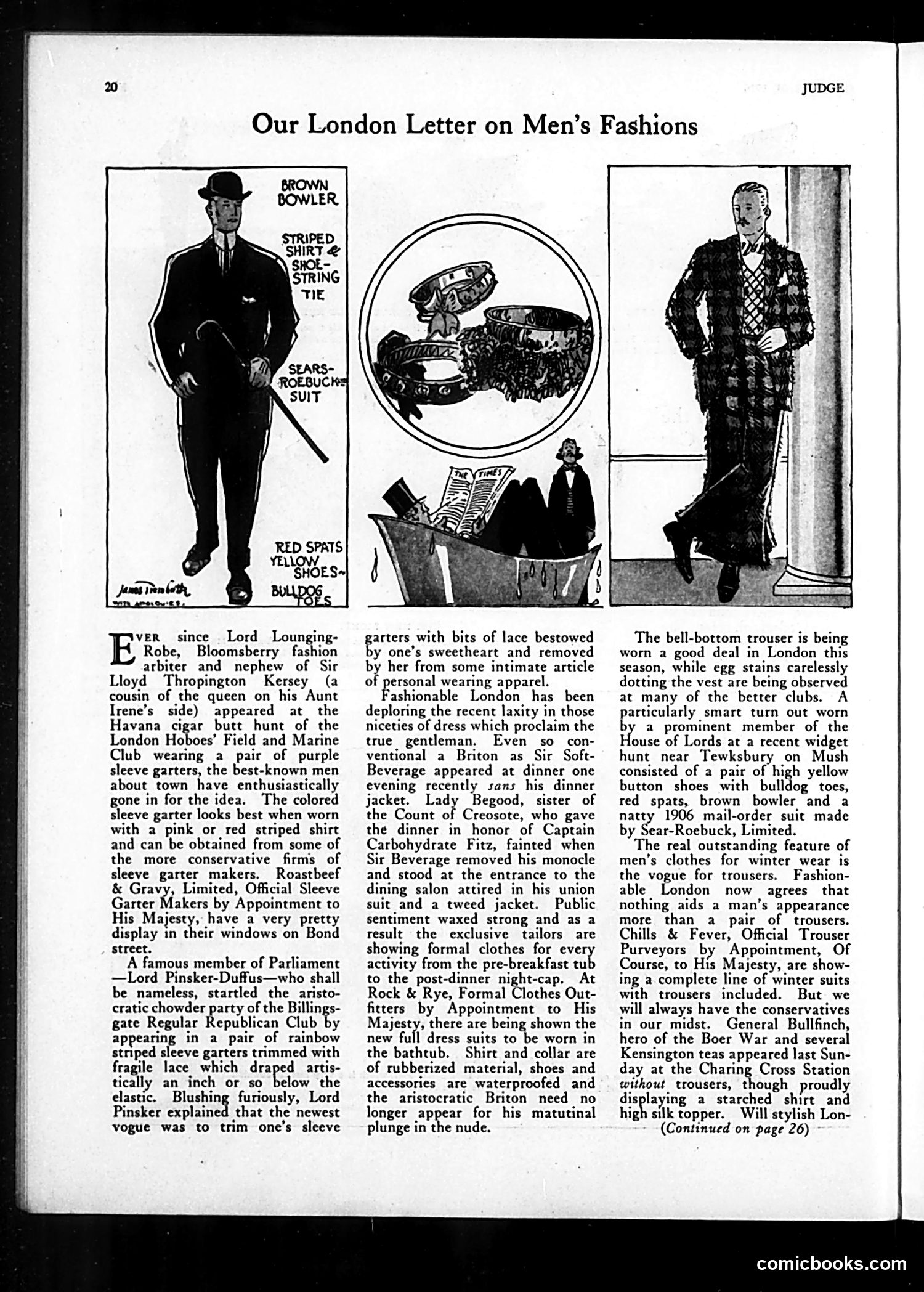
This is a humorous "London Letter" satirizing British high society's obsession with trivial fashion trends. The piece mocks aristocratic pretension by inventing absurd fictional fashions and ridiculous nobles adopting them uncritically. The satire targets: **Fashion absurdities**: Colored sleeve garters trimmed with lace (supposedly gifts from sweethearts), bell-bottom trousers, waterproofed formal wear for bathtub use, and—most ridiculously—trousers themselves, treated as a revolutionary innovation. **Social snobbery**: Invented "Official" tailors with royal appointments, and named aristocrats (Lord Pinsker-Duffus, Sir Soft-Beverage, Captain Carbohydrate Fitz) with deliberately silly names emphasizing their vacuousness. **Class anxiety**: The piece suggests the British upper class will adopt any fashion without question if presented as prestigious, and that minor dress code violations cause hysteria (fainting over missing a monocle). The joke is that Judge's readers would recognize this exaggerated mockery of how London society mindlessly follows fashion trends set by aristocratic influencers.
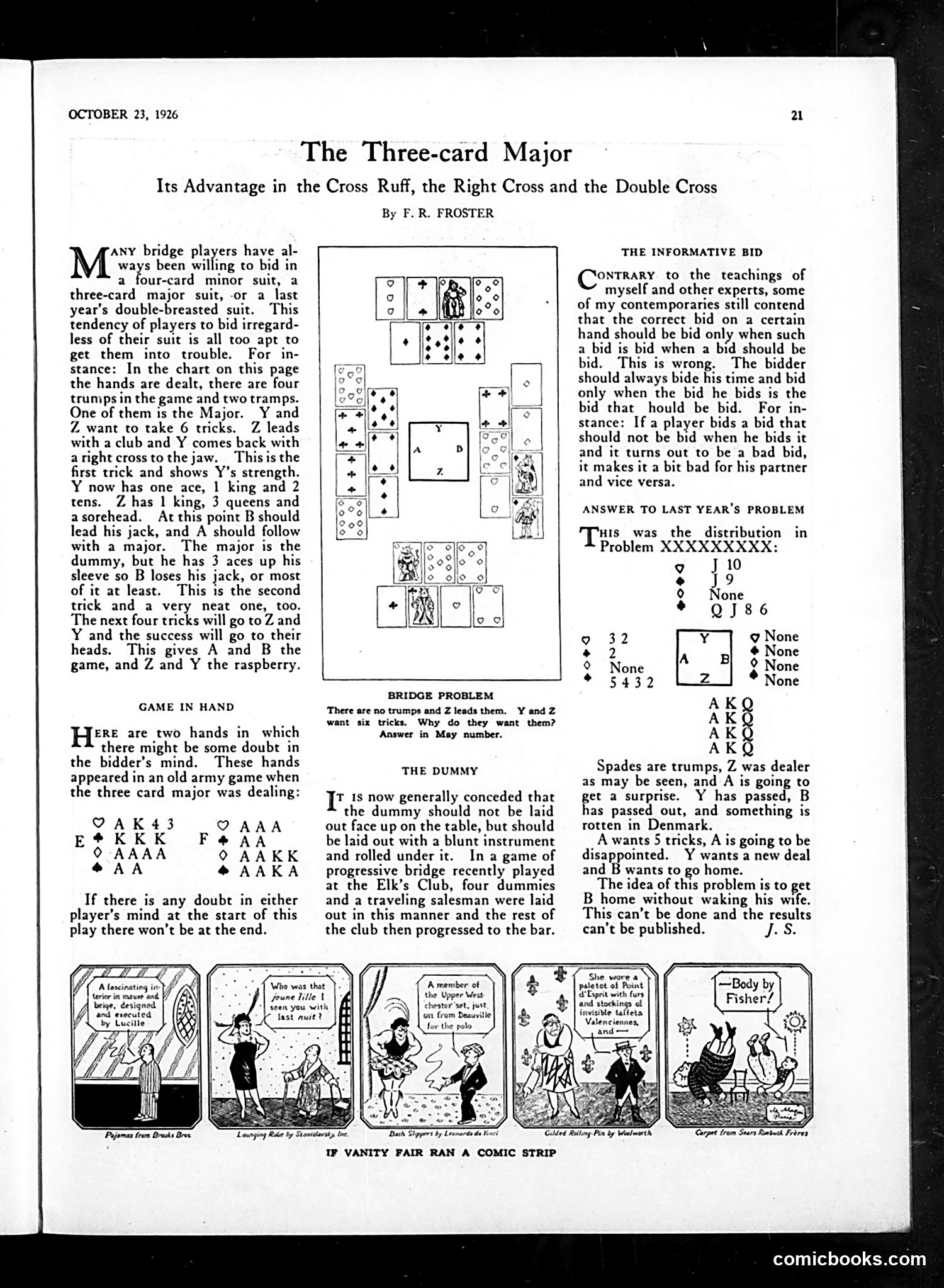
This page is primarily a **bridge card game instruction article** by F.R. Froster, not political satire. The content teaches bridge strategy through humorous exaggeration rather than social commentary. The humor derives from treating bridge—a serious game—with absurd logic. For example, the dummy player should be "laid out with a blunt instrument and rolled under it," and a "traveling salesman were laid out" alongside card dummies at an Elk's Club game before "the rest of the club then progressed to the bar." This is simple physical comedy about drunken card players. The five small cartoons at bottom appear unrelated—they're labeled "If Vanity Fair Ran a Comic Strip" and show various social situations (pyramid schemes, socialites, polo players, fashion) with captions. These mock *Vanity Fair* magazine's gossipy society coverage. The page is essentially **bridge instruction disguised as comedic satire**—typical of 1920s Judge magazine's blend of practical advice and absurdist humor.
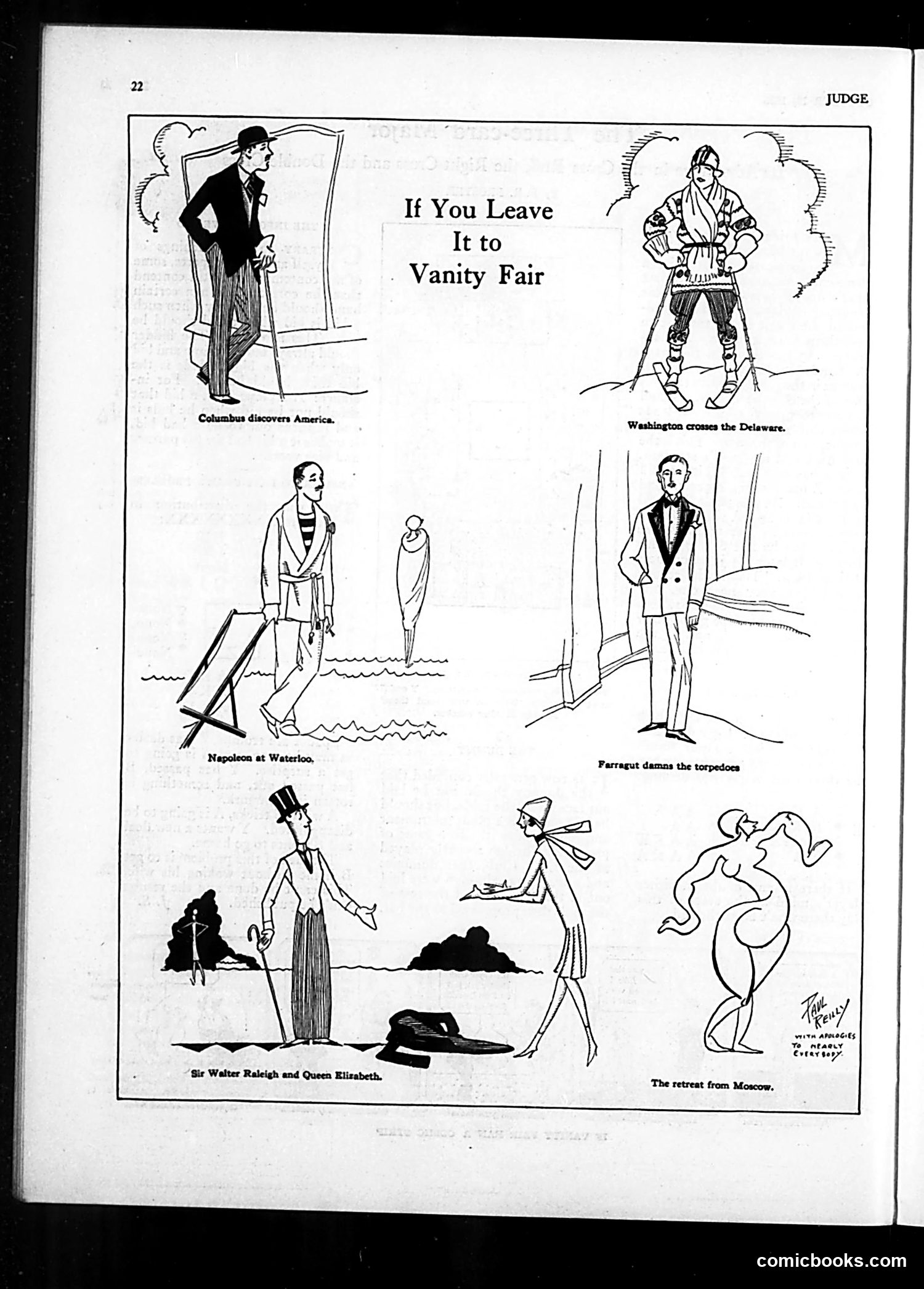
This satirical cartoon criticizes *Vanity Fair* magazine by suggesting that if readers entrust their cultural knowledge to it, they'll learn distorted versions of history. Each panel presents a famous historical scene rendered absurdly or incorrectly: - Columbus discovering America (shown as mere vanity) - Washington crossing the Delaware (depicted trivially) - Napoleon at Waterloo, Farragut and naval battles, Sir Walter Raleigh and Queen Elizabeth, and the Moscow retreat—all presented as frivolous rather than historically significant. The final figure appears to represent *Vanity Fair* itself. The joke targets the magazine's reputation for prioritizing style and celebrity gossip over substantive content, making it an unreliable source for serious historical understanding. This reflects early 20th-century criticism of *Vanity Fair's* focus on entertainment and fashion over journalistic rigor.
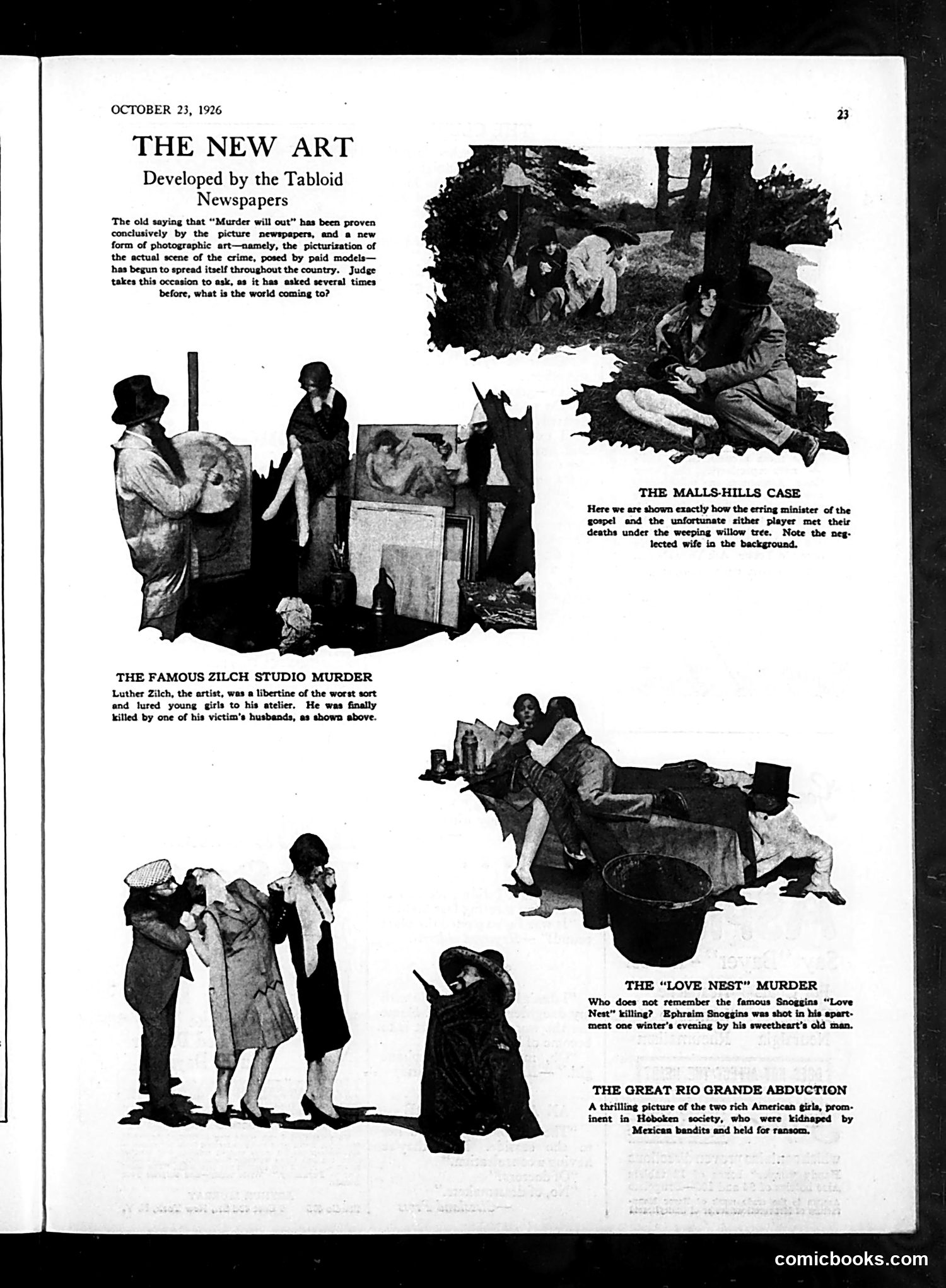
This page satirizes tabloid newspapers' sensationalist practice of recreating famous crimes using paid actors and models for photographs. Judge criticizes this as a degrading "new art form" that exploits real tragedies for circulation. The four mock crime scenes shown—the Mills-Hills case, Zilch Studio murder, "Love Nest" killing, and Rio Grande abduction—appear to reference actual 1920s scandals that tabloids heavily covered. Judge's sarcastic tone ("what is the world coming to?") mocks both the newspapers' lurid approach and readers' appetite for such content. The satire targets the sensationalism and staging inherent in tabloid journalism: real crimes are reconstructed with actors, turning tragedy into entertainment spectacle. This was a common critique of tabloid excess during the Jazz Age.
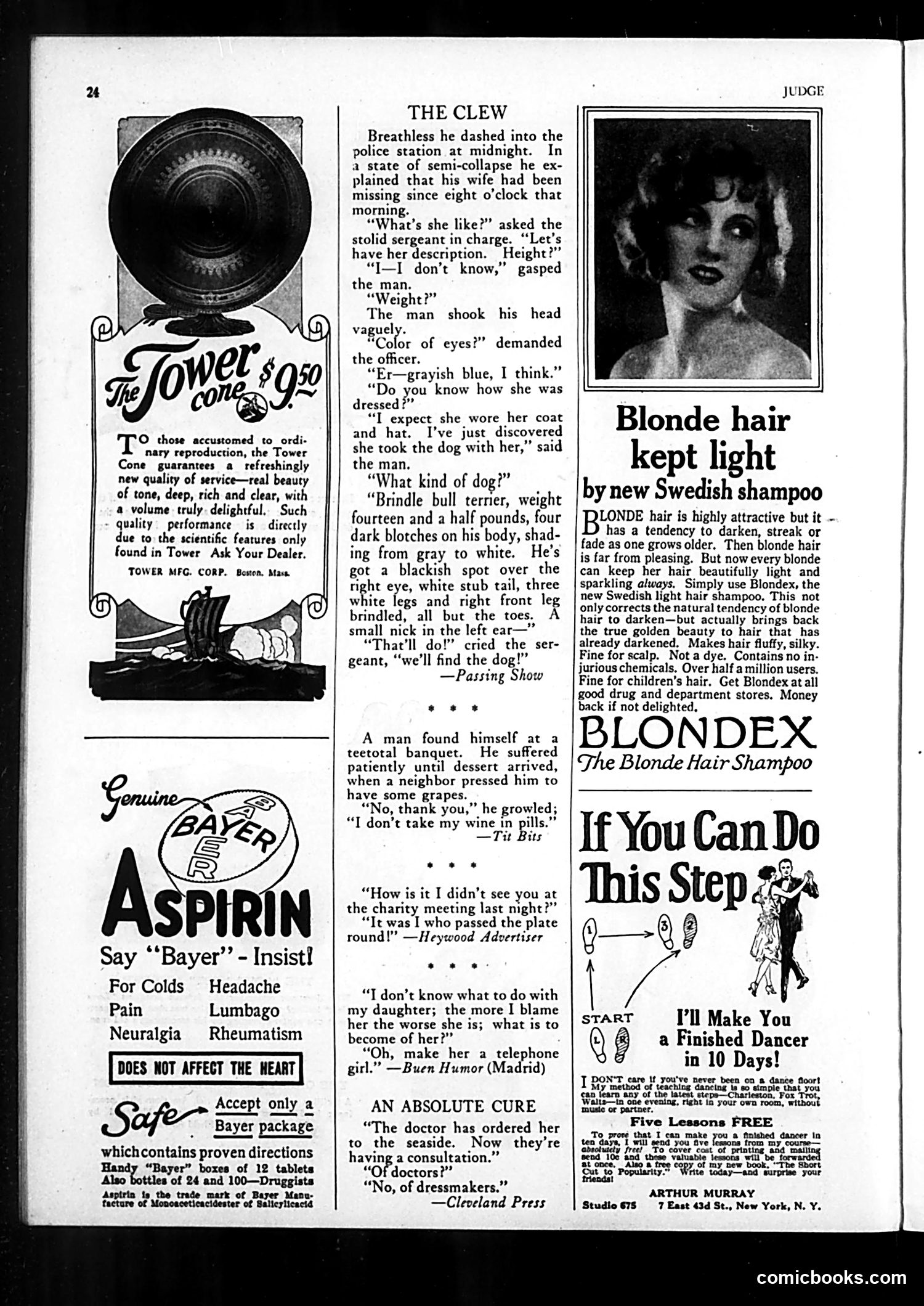
This page is primarily **advertisements** with one humor piece. "The Clew" (a play on "clue") is a satirical short story, not a political cartoon. **The Satire:** A husband reports his wife missing to police but cannot describe her—height, weight, exact eye color, or clothing are all vague. However, when asked about the dog she took, he provides *exhaustive* detail: breed, exact weight, specific markings, spot locations, tail description, leg coloring. The sergeant's response—"we'll find the dog!"—delivers the joke's punch line. **The Point:** This satirizes husbands' indifference to their wives' appearances, suggesting men notice and care far more about dogs than about the women they marry. It's a commentary on domestic relationships and male priorities, presented as gentle humor rather than biting social criticism. The page's advertisements (Bayer Aspirin, Tower phonographs, Blondex shampoo, Arthur Murray dance lessons) are typical 1920s magazine content.
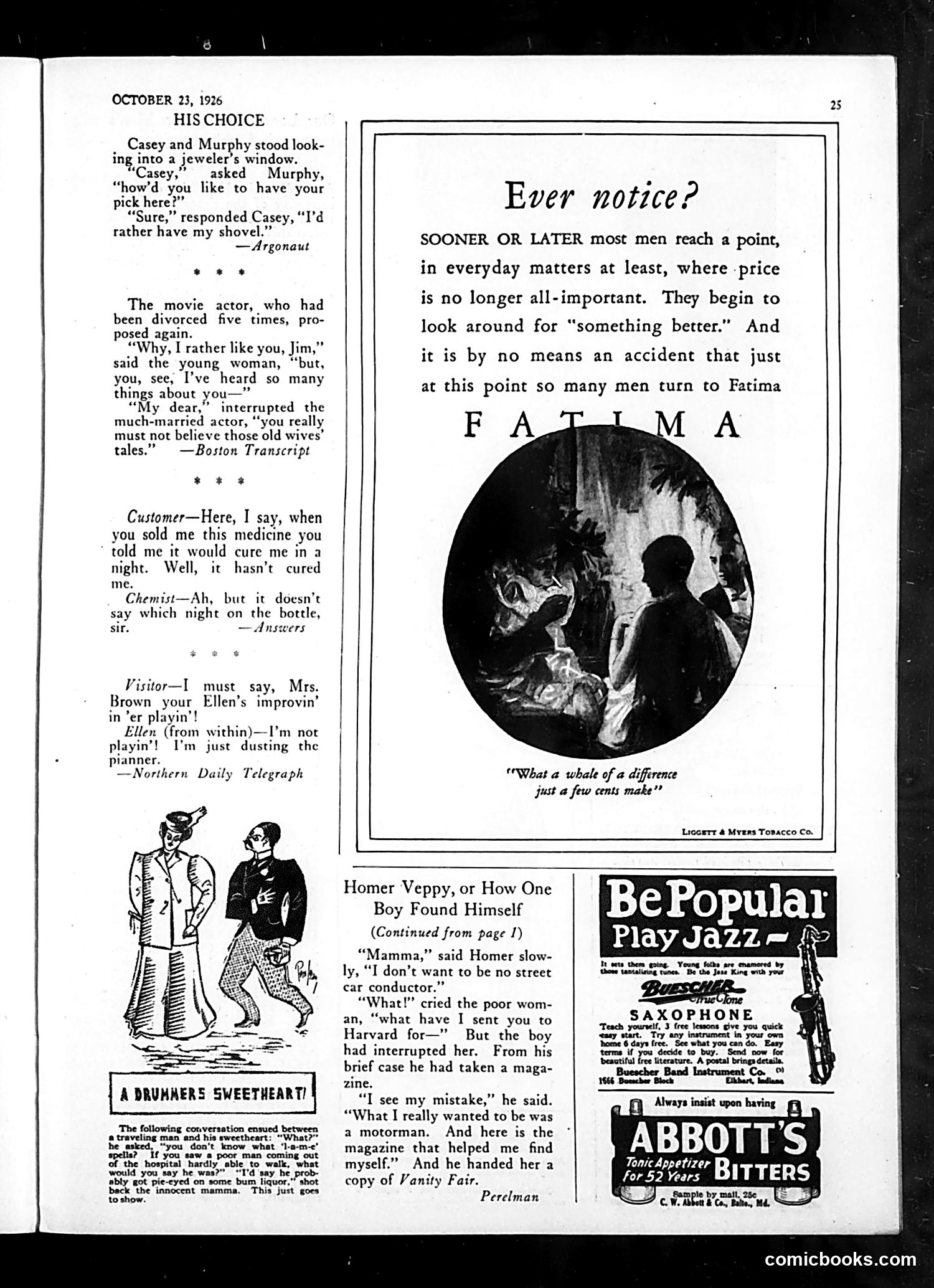
This page contains multiple short humor pieces typical of Judge's satirical format: **"His Choice"**: A joke about working-class Irish immigrants (Casey and Murphy, suggested by names) preferring practical tools to jewelry—satirizing either their materialism or lack of refinement. **Movie Actor Joke**: Mocks Hollywood's serial marriages. A five-times-divorced actor dismisses his fiancée's concerns about his reputation as "old wives' tales"—the humor lies in his shameless hypocrisy. **Medicine Chemist**: A con-man pharmacist exploits a loophole—the bottle doesn't specify *which* night the cure works, implying the medicine is worthless. **Piano Playing**: A servant girl creates noise while "dusting the piano," fooling her employer about her musical incompetence. The page is primarily **advertising**, featuring Fatima cigarettes (emphasizing value), a saxophone correspondence course, and Abbott's Bitters tonic. The "Homer Veppy" serial continues from page 1, joking that Harvard graduates choose motorman jobs after reading *Vanity Fair* magazine.
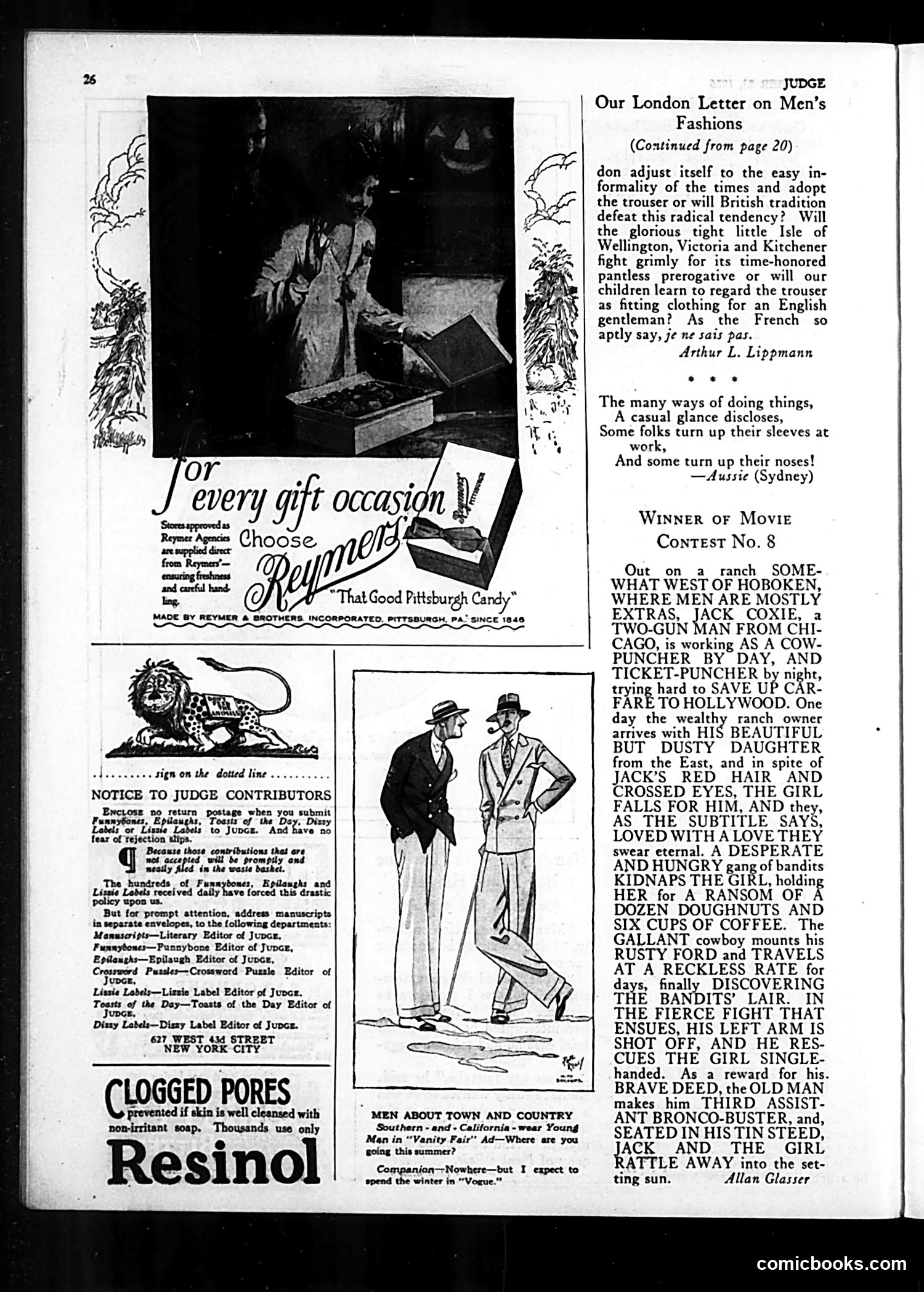
This page is primarily **administrative and advertising content** with minimal editorial cartoons. The main notable element is Arthur L. Lippmann's "London Letter on Men's Fashions," a humorous commentary on whether British men will adopt modern trousers or cling to traditional "pantless" formal wear—a satirical jab at British conservatism versus modernity. The page also features: - **Notice to Judge contributors**: Editorial housekeeping rejecting poorly-submitted material - **Movie Contest winner**: A parody film synopsis mocking Hollywood westerns, featuring absurd plot elements (a one-armed hero, ransom demands for doughnuts) - **Advertisements**: Resinol soap and Reymer candy The humor targets British cultural rigidity and Hollywood's formulaic, overwrought melodramas. There are no political cartoons or caricatures of identified figures on this page.
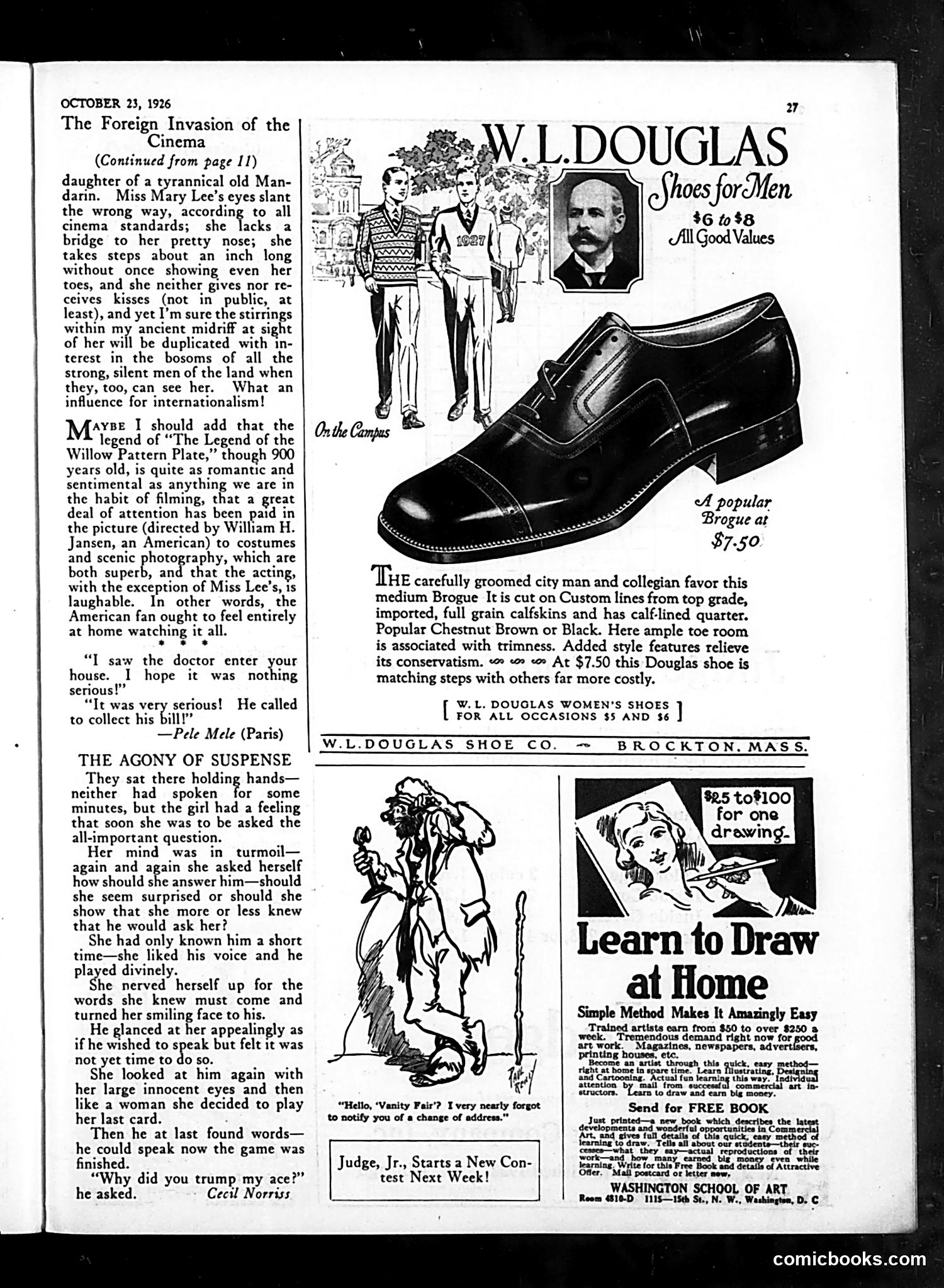
This page contains two main pieces: **The Foreign Invasion of the Cinema** (article continued from previous page) critiques a film featuring actress Mary Lee, apparently of Asian descent. The critic sarcastically praises her despite her not conforming to "cinema standards"—she has eyes that "slant the wrong way," doesn't bare her legs, and avoids public kissing. The piece ironically calls her presence "an influence for internationalism," suggesting American anxiety about foreign performers gaining popularity in Hollywood. The underlying criticism appears to be xenophobic resistance to Asian actors in American cinema. **The Agony of Suspense** (comic vignette) is a humorous short story about a couple's romantic tension. The reader expects a marriage proposal, but the dramatic conclusion reveals the man was only asking why she trumped his ace at cards—a mundane card-game dispute masquerading as romantic drama. The rest of the page contains period advertisements for W.L. Douglas shoes and a correspondence drawing course.
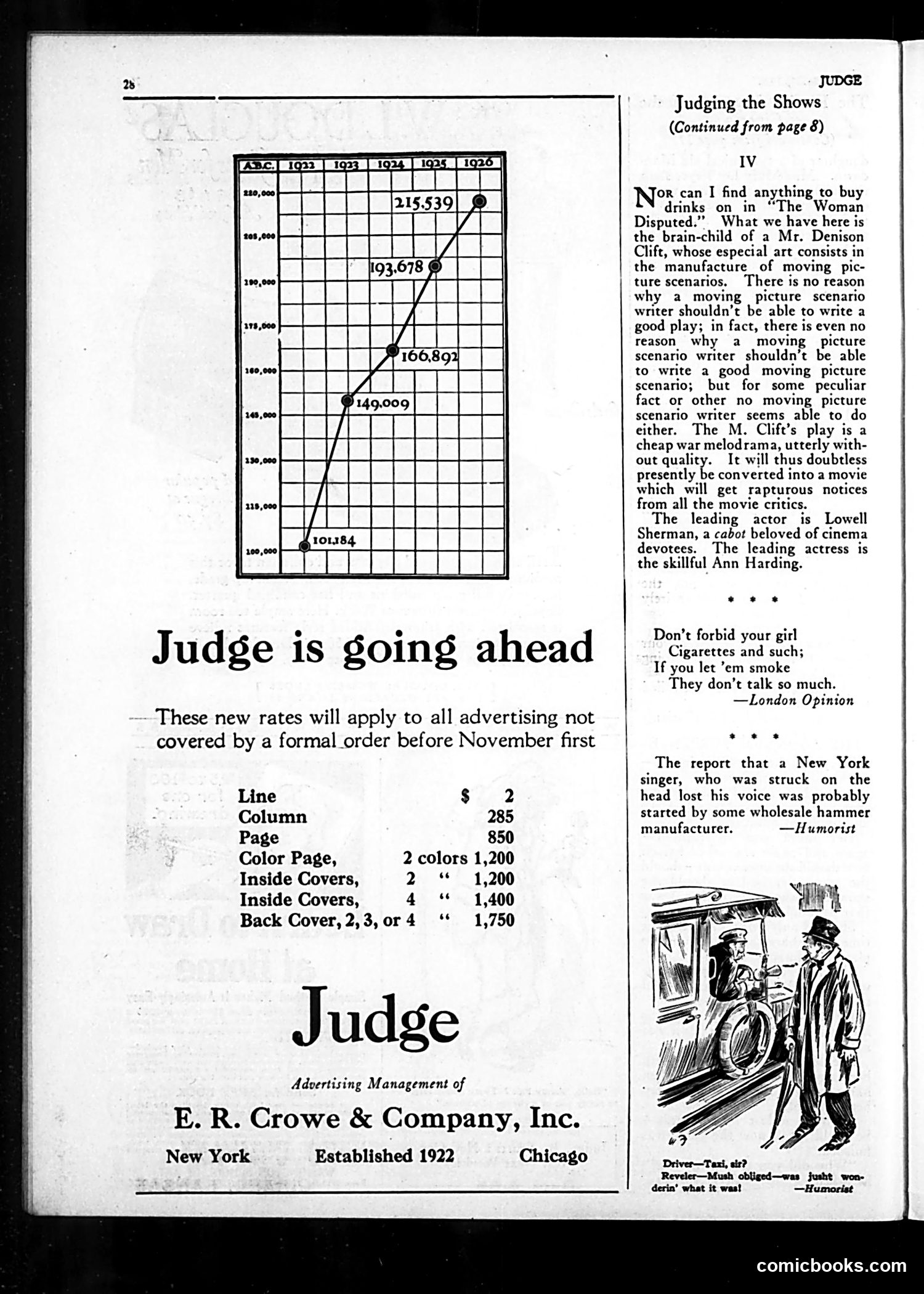
This page from Judge magazine (established 1922) contains theater criticism and advertising rather than political cartoons. The main content is a scathing review of "The Woman Disputed," a stage play written by scenario writer Denison Clift. The critic argues that while moving picture scenario writers *could* write good plays, Clift's effort is merely "a cheap war melodrama, utterly without quality." The satire suggests it will inevitably become a successful film because movie critics give uncritical praise to poor material. The review mentions stars Lowell Sherman and Ann Harding. The page also includes two unrelated humor items: a London Opinion quote discouraging smoking by women, and a joke about a New York singer who lost his voice (sarcastically attributed to a "wholesale hammer manufacturer"). The bottom advertises Judge's advertising rates and management company, with a small cartoon showing taxi/delivery personnel—likely generic workplace humor unrelated to the page's other content.
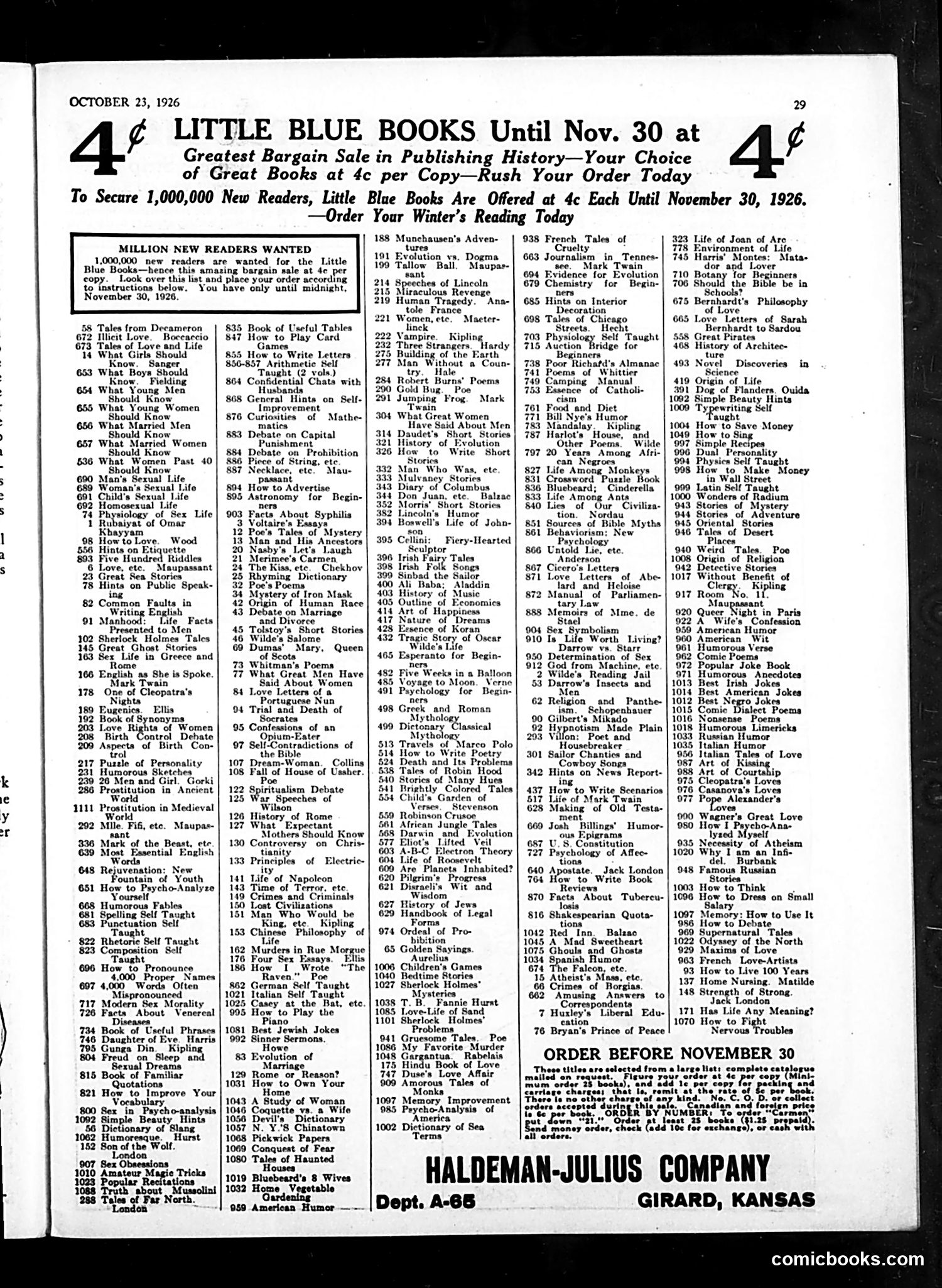
This page is primarily a **book catalog advertisement** rather than political satire or a cartoon. It announces a massive bargain sale of "Little Blue Books"—inexpensive paperback reprints—at 4 cents each through November 30, 1926. The catalog lists approximately 1,000 titles across diverse subjects: classic literature (Poe, Kipling, Voltaire), practical guides (etiquette, writing, pronunciation), and notably, sex education and reproductive health books (birth control, venereal disease, sexual relations). This last category is significant—such frank discussion of sexuality in 1926 would have been considered progressive or even controversial for mainstream publishing. The framing emphasizes reaching "1,000,000 new readers," suggesting a democratization of knowledge through affordable access. The Haldeman-Julius Company, based in Girard, Kansas, was known for populist, educational publishing. There is no visible cartoon on this page—it is a commercial advertisement typical of Judge magazine's revenue model.
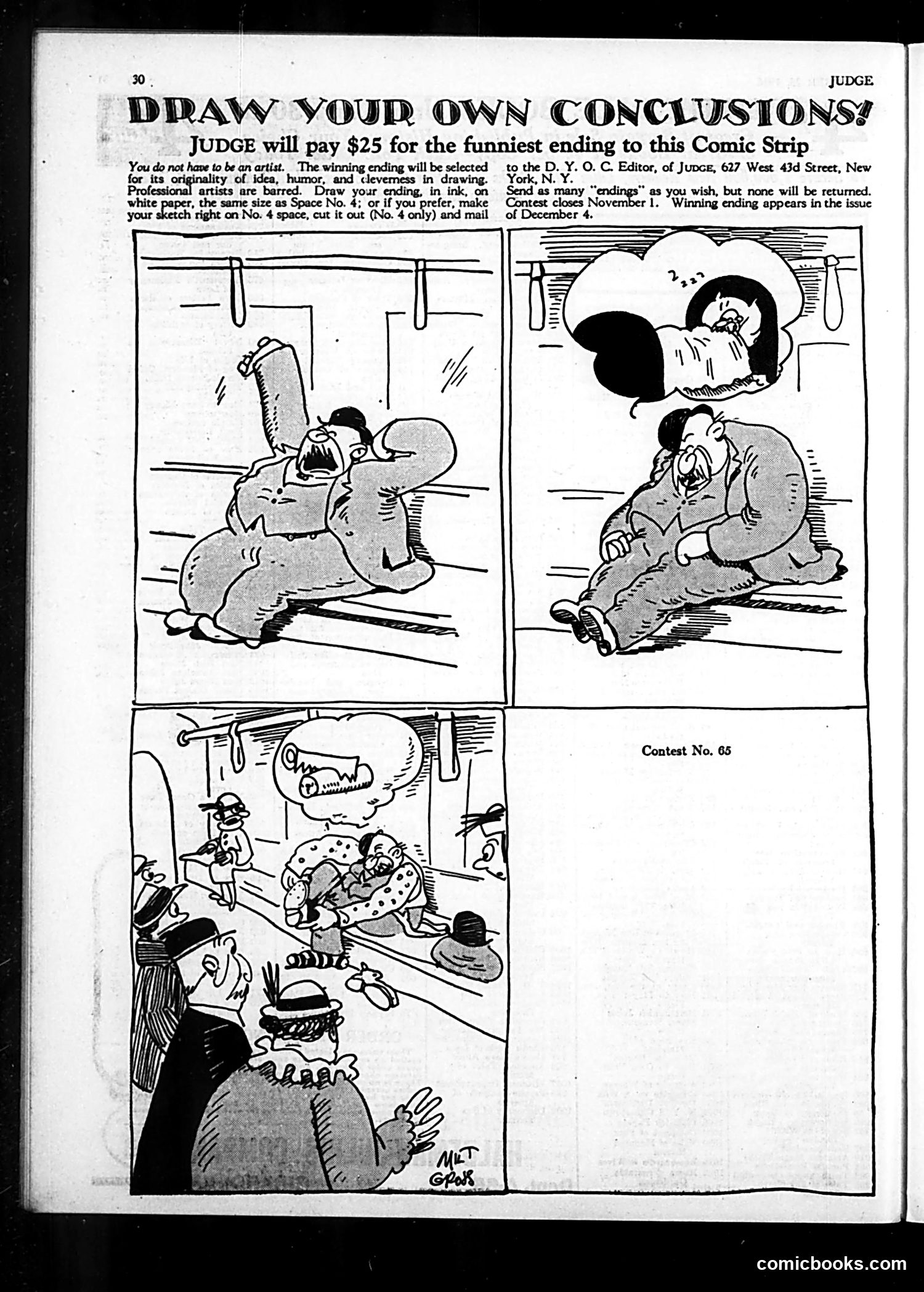
This is a **reader participation contest** from Judge magazine (Contest No. 65). The page shows an incomplete three-panel comic strip featuring a rotund man in what appears to be a subway or train car. In the first two panels, he's reacting with exaggerated distress to something unseen. The third panel shows a chaotic scene with multiple small figures (appearing to be monkeys or apes) causing mayhem in the car, with well-dressed passengers reacting in alarm. Readers were invited to **submit funny endings or captions** for the incomplete fourth panel (left blank), with Judge paying $25 for the funniest submission. The satirical humor likely plays on the gentleman's pompous appearance contrasted with the absurd monkey invasion—a common comedic device of the era. The joke's full impact depended on reader creativity to complete the scenario.
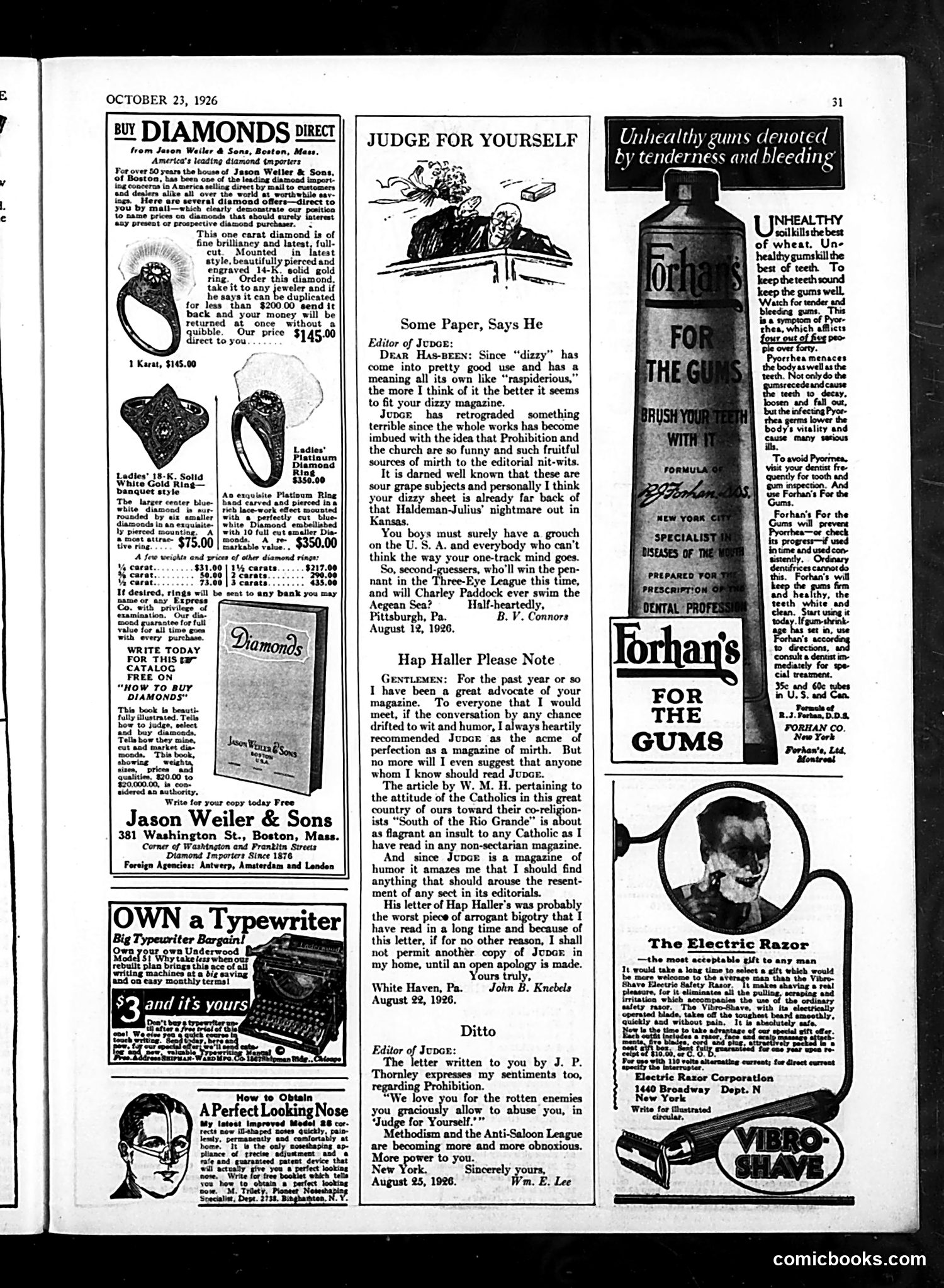
This page consists primarily of **reader letters and advertisements** rather than satirical cartoons. The "Judge for Yourself" section contains **three complaint letters** criticizing Judge magazine itself for recent editorial content. Readers object to: 1. **B.V. Connors** attacks Judge for becoming obsessed with mocking Prohibition and the church, calling the magazine "dizzy" and "far back" in quality. 2. **John B. Knebels** condemns an article by W.M.H. about Catholics' attitudes toward Latin America as "a flagrant insult" and bigoted, threatening to cancel his subscription. 3. **Wm. E. Lee** echoes this complaint about anti-Catholic sentiment. These letters reveal that **Judge faced internal criticism in 1926** for editorial choices perceived as religiously intolerant and increasingly cynical. The letters suggest the magazine's satirical edge had shifted toward targets—particularly Prohibition and organized religion—that alienated readers seeking gentler humor. The surrounding advertisements (diamonds, typewriters, razors, gum treatment) are standard commercial content unrelated to the satire.
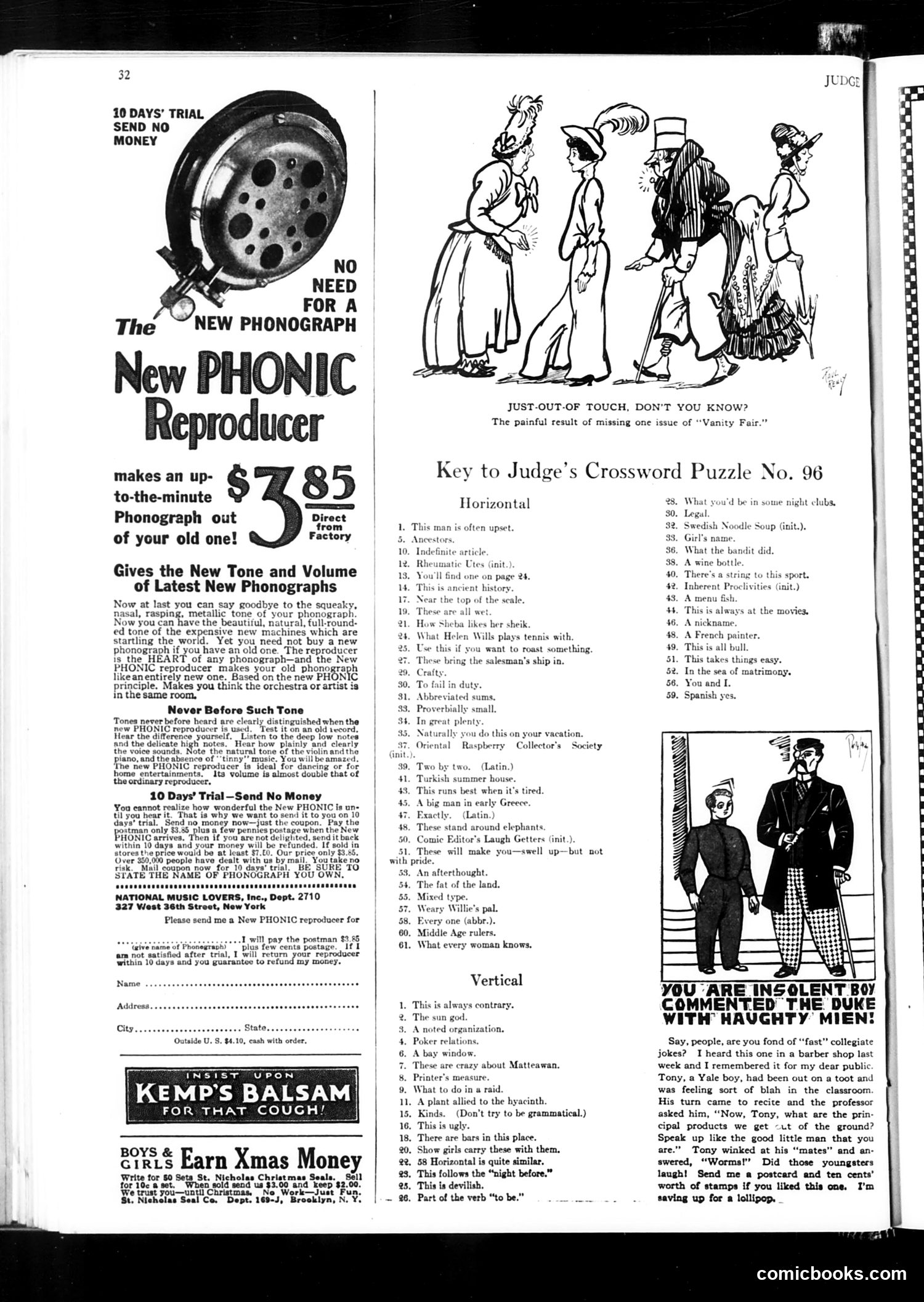
This page is primarily **advertising and puzzles**, not political satire. The main cartoon shows fashionably dressed people looking disapprovingly at two figures—one appears to be a poorly dressed man and woman. The caption reads "JUST-OUT-OF TOUCH, DON'T YOU KNOW? The painful result of missing one issue of 'Vanity Fair.'" **The joke:** The cartoon satirizes *Vanity Fair* magazine readers as status-conscious elites so obsessed with keeping current on fashion and social trends that missing a single issue causes them to become social pariahs—literally out of fashion and therefore "out of touch." The poorly dressed couple represents what happens when you fall behind on the latest style dictates. This reflects 1920s consumer culture anxieties about social standing tied to fashion awareness. The satire targets both the magazine's pretensions and its readers' superficiality—equating missing one issue with becoming a social embarrassment.
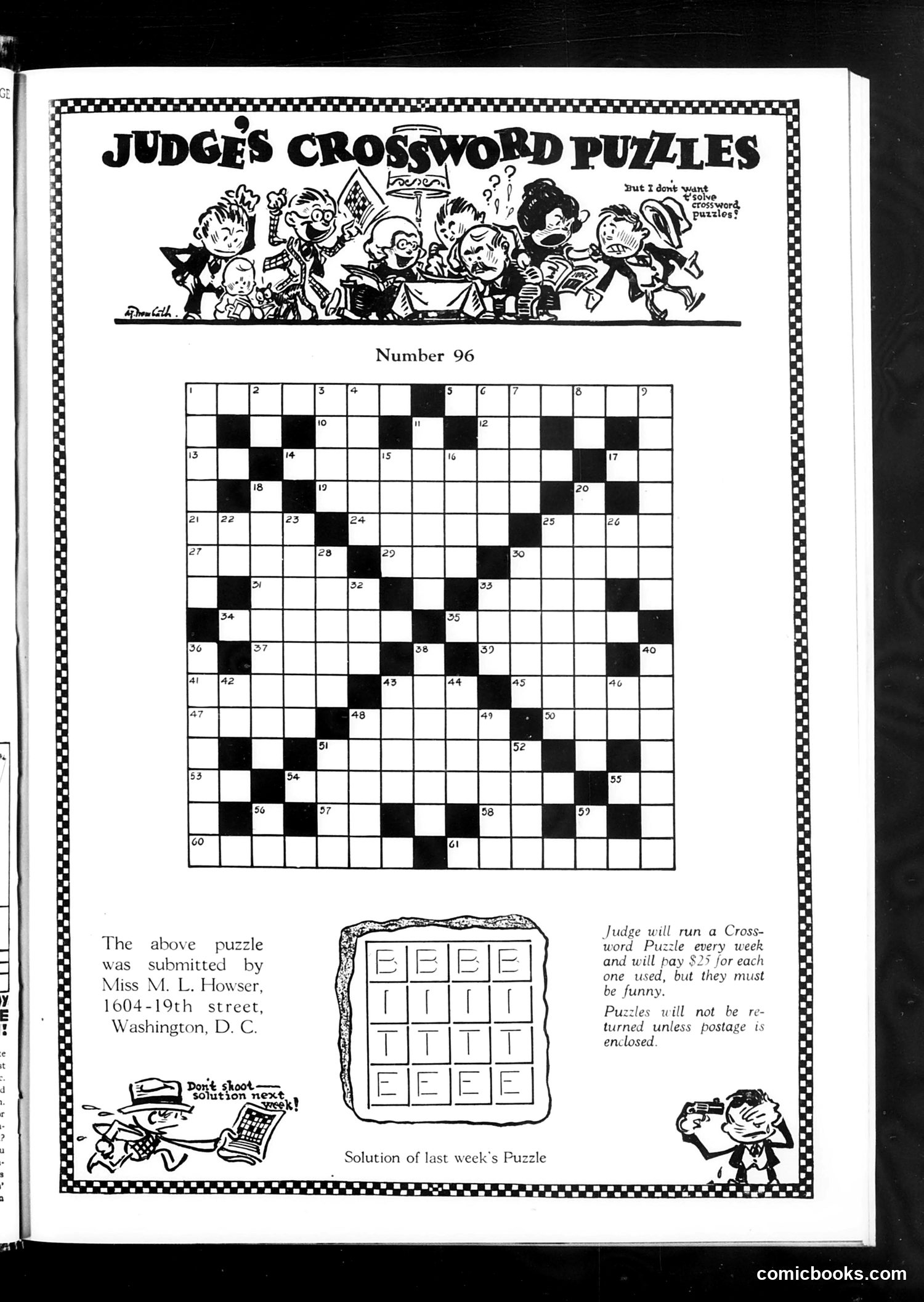
This page features a crossword puzzle competition rather than political satire. Judge magazine ran weekly crossword puzzles and paid $25 for submissions—a substantial sum in the early 20th century. The puzzle shown here was submitted by a contributor from Washington, D.C. The cartoon elements are purely decorative: playful illustrations of characters complaining about crosswords ("But I don't want to solve a crossword puzzle!") and a character saying "Don't shoot—solution next week!" These reflect the era's popular frustration with the newly trendy crossword puzzle craze. The page's main function is recreational: offering puzzle entertainment while soliciting reader submissions. The only notable requirement is that puzzles "must be funny"—indicating Judge's expectation that even word games should align with the magazine's satirical, humorous mission.
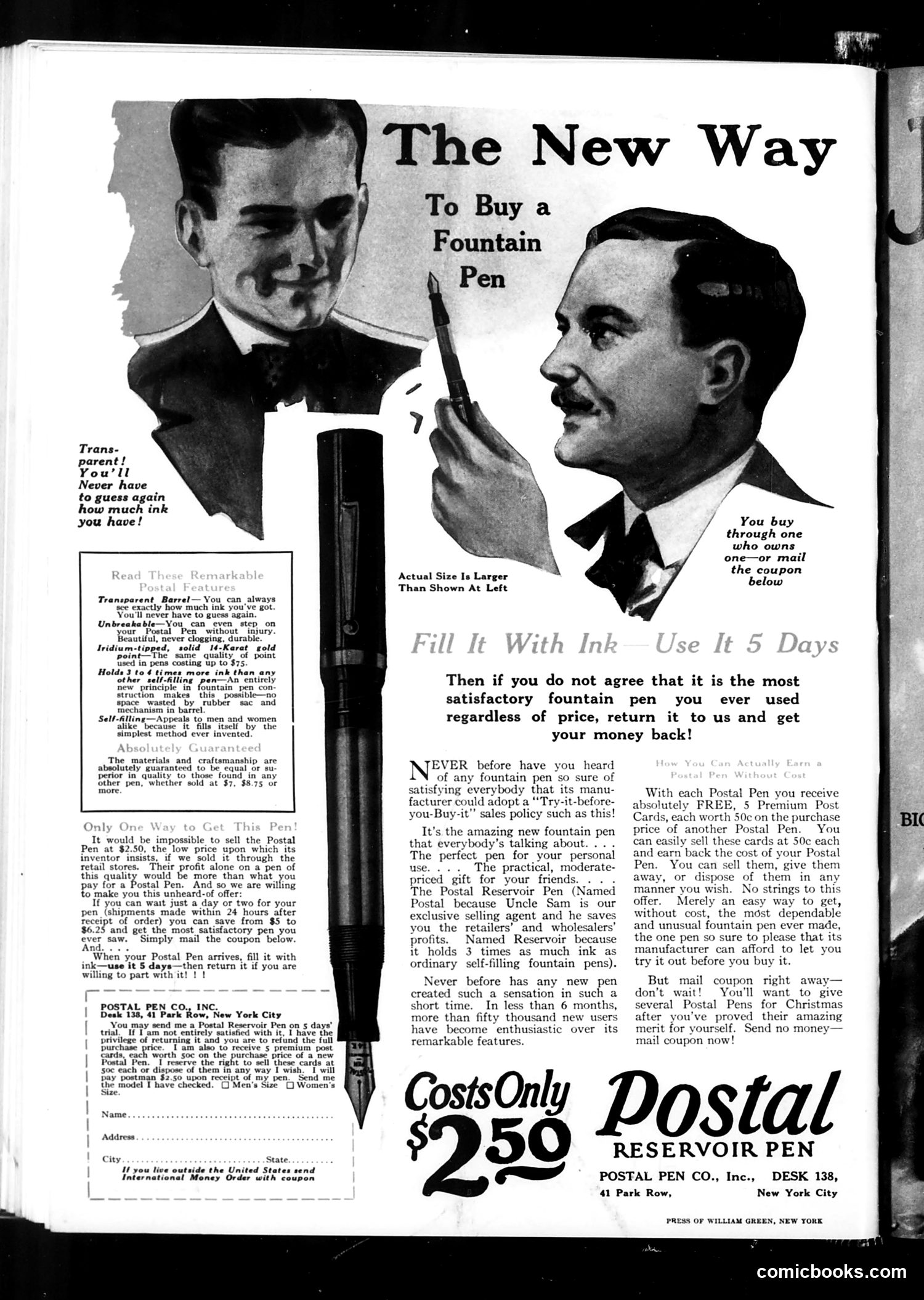
This page is primarily a **product advertisement** for the Postal Reservoir Pen, priced at $2.50. The two illustrated male figures at the top are not political caricatures but rather generic businessmen used to present the pen's sales concept. The "New Way to Buy" refers to the innovative **mail-order, try-before-you-buy sales model**: customers receive the pen, test it for five days, and return it if unsatisfied for a full refund. This was novel marketing for the era. The advertisement emphasizes the pen's features (transparent barrel, unbreakable, gold-tipped, holds three times more ink than competitors) and includes a unique incentive: each pen comes with five $0.50 premium postcards, allowing buyers to recoup their cost by selling the cards. The text stresses direct-to-consumer sales bypass retailer markups, making the quality-to-price ratio exceptional. There is **no political satire** on this page—it's straightforward consumer advertising from a commercial company seeking mail orders.