
Judge, 1926-10-23 · page 3 of 36
Judge — October 23, 1926 — page 3: what you’re looking at
What you’re looking at
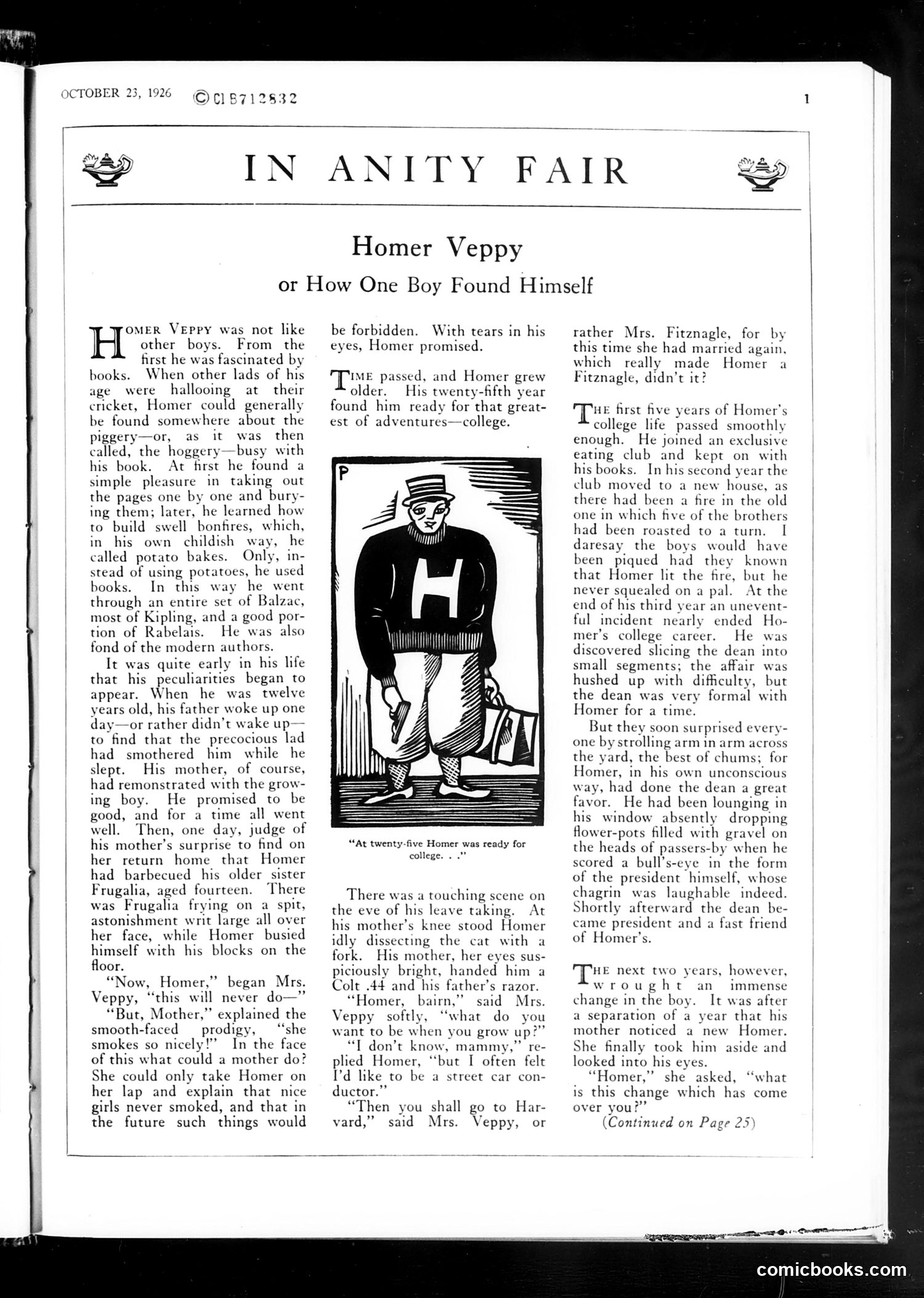
This page presents "Homer Veppy or How One Boy Found Himself," a serialized fiction story rather than political satire. The narrative follows Homer from childhood through college, depicting his unconventional personality—he preferred reading to typical boyish activities and found pleasure in domestic tasks like "potato bakes" rather than cricket. The accompanying illustration shows Homer at twenty-five, dressed formally with an "H" on his sweater, apparently ready for college adventures. The story emphasizes his individuality and intellectual pursuits, contrasting him with conventional peers. This appears to be a lighthearted coming-of-age tale in *Judge* magazine (October 23, 1926), focusing on personal development and self-discovery rather than political commentary or satire.
📄 Transcribed text from this page (OCR, searchable)
Machine-transcribed from the original scan — historical spelling and the odd misread are preserved.
OCTOBER 23, 1926 IN S ANITY FAIR Homer Veppy or How One Boy Found Himself omER Veppy was not like H other boys. From the first he was fascinated by books. When other lads of his age were hallooing at_ their cricket, Homer could generally be found somewhere about the piggery—or, as it was then called, the hoggery—busy vat his book. At first he found a simple pleasure in taking out the pages one by one and bury- ing them; later, he learned how to build swell bonfires, which, in his own childish way, he called potato bakes. Only, i stead of using potatoes, he books. In this way he went through an entire set of Balzac, most of Kipling, and a good por- tion of Rabelais. He was also fond of the modern authors. It was quite early in his life that his peculiarities began to appear. When he was twelve years old, his father woke up one day—or rather didn’t wake up— to find that the precocious lad had smothered him while he slept. His mother, of course, had remonstrated with the grow- ing boy. He promised to be good, and for a time all went well. Then, one day his mother’s surprise to find on her return home that Homer had barbecued his older sister Frugalia, aged fourteen. There was Frugalia frying on a spit, astonishment writ large all over her face, while Homer busied himself with his blocks on the floor. “Now, Homer,” began Mrs. Veppy, “this will never do—” “But, Mother,” explained the smooth-faced prodigy, ‘‘she smokes so nicely!’ In the face of this what could a mother do? She could only take Homer on her lap and explain that nice girls never smoked, and that in the future such things would judge of be forbidden. With tears in his eyes, Homer promised. IME passed, and Homer grew older. His twenty-fifth year found him ready for that great- est of adventures—college. “At twenty-five Homer was ready for college. . .”” There was a touching scene on e eve of his leave taking. At mother’s knee stood Homer y dissecting the cat with a His mother, her eyes sus iciously bright, handed him a Colt 44 and his father’s razor. “Homer, bairn,”” said Mrs. Veppy softly, “what do you want to be when you grow up?” “T don’t know, mammy,” re- plied Homer, “but I often felt I'd like to be a street car con- ductor.” “Then you shall go to Har- vard,” said Mrs. Veppy, or rather Mrs. anagle, for by this time she had married again, which really made Homer a Fitznagle, didn’t it? HE first five years of Homer's college life passed smoothly enough. He joined an exclusive eating club and kept on with his books. In his second year the club moved to a new house, as there had been a fire in the old one in which five of the brothers had been roasted to a turn. I daresay the boys would have been piqued had they known that Homer lit the fire, but he never squealed on a pal. At the end of his third year an unevent- ful incident nearly ended Ho- mer’s college career. He was discovered slicing the dean into small segments; the affair was hushed up with difficulty, but the dean was very formal with Homer for a time. But they soon surprised every- one by strolling arm in arm across the yard, the best of chums; for Homer, in his own unconscious way, had done the dean a gr favor. He had been lounging in his window absently dropping lower-pots filled with gravel on he heads of passers-by when he scored a bull’s-eye in the form of the president himself, whose chagrin was laughable indeed. Shortly afterward the dean be- came president and a fast friend of Homer's. T next two years, however, wrought an hange in the boy. It was after a separation of a year that his mother noticed a new Homer. She finally took him aside and looked into his ey “Homer,” she asked, “what is this change which has come over you?” (Continued on Page 25) immense comicbooks.com