
Judge, 1926-10-23 · page 13 of 36
Judge — October 23, 1926 — page 13: what you’re looking at
What you’re looking at
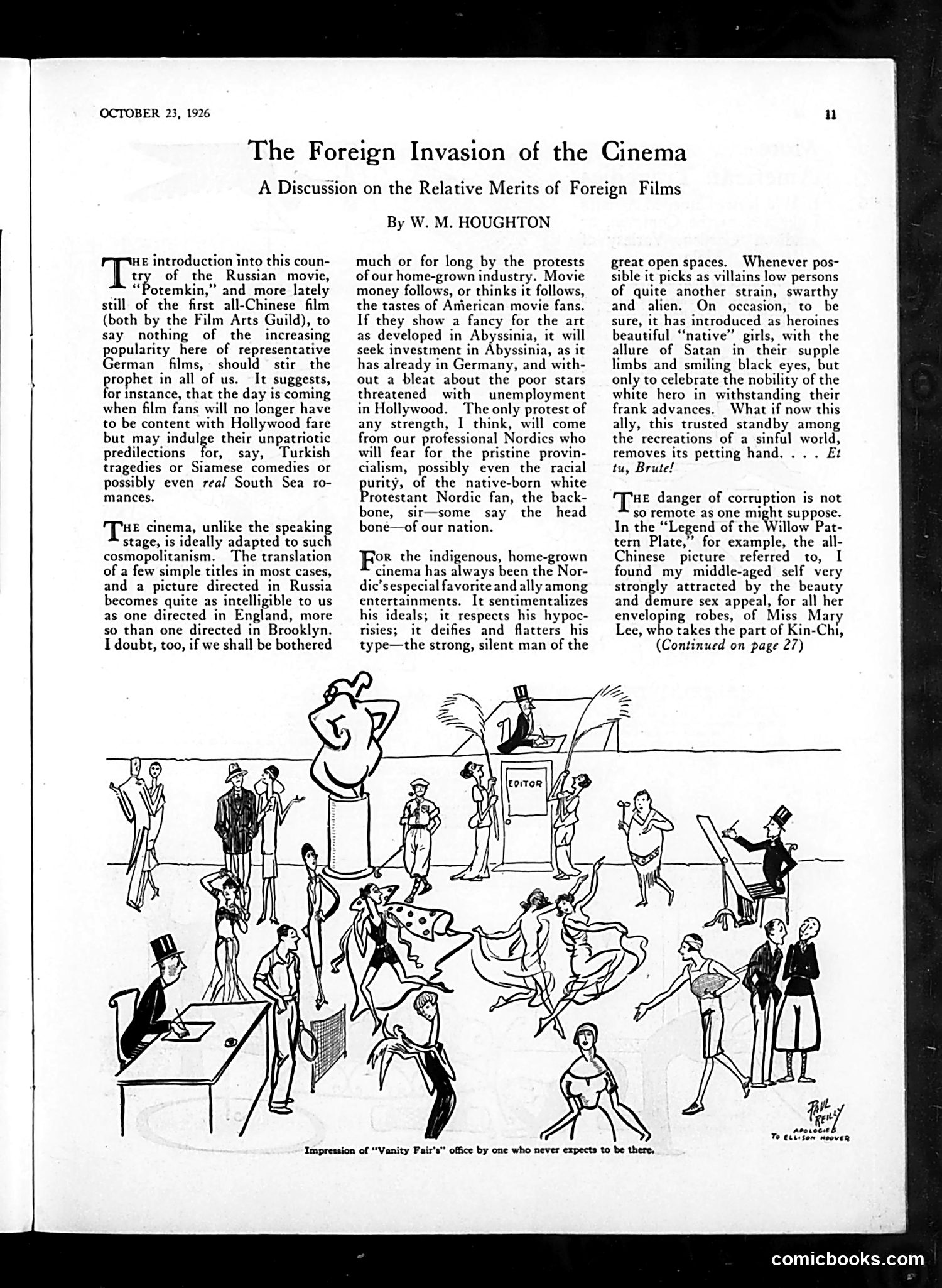
This article and accompanying cartoon satirize American anxieties about foreign films entering the U.S. market. Author W.M. Houghton discusses the arrival of Russian ("Potemkin"), Chinese, and German films, noting they're intelligible despite subtitles. The satire targets two groups: (1) Hollywood's financial interests, who will follow audience demand regardless of national pride, and (2) white Protestant "Nordics" who fear foreign cinema corrupts American values. Houghton mocks their concern that these films—particularly a Chinese production featuring actress Mary Lee—might seduce viewers with "swarthy and alien" characters, threatening the heroic white Protestant male archetype Hollywood traditionally celebrated. The cartoon impression of a chaotic "Vanity Fair office" likely exaggerates the frenzy surrounding this cultural debate. The piece combines cultural elitism with xenophobic anxiety typical of 1920s nativism, presenting these concerns as worthy of ridicule.
📄 Transcribed text from this page (OCR, searchable)
Machine-transcribed from the original scan — historical spelling and the odd misread are preserved.
OCTOBER 23, 1926 n The Foreign Invasion of the Cinema A Discussion on the Relative Merits of Foreign Films HE introduction into this coun- [ t of the Russian movie, “Potemkin,” and more lately still of the first all-Chinese film (both by the Film Arts Guild), to say nothing of the increasing popularity here of representative German films, should stir the rophet in all of us. It suggests, ‘or instance, that the day is coming when film fans will no longer have to be content with Hollywood fare but may indulge their unpatriotic predilections bp say, Turkish tragedies or Siamese comedies or possibly even real South Sea ro- mances. HE cinema, unlike the speakin, stage, is ideally adapted to ‘ich cosmopolitanism. The translation of a few simple titles in most cases, and a picture directed in Russia becomes quite as intelligible to us as one directed in England, more so than one directed in Brooklyn. I doubt, too, if we shall be bothered Impression of “Vanity Fair's” office by one who never expects to be there, By W. M. HOUGHTON much or for long by the protests of our home-grown industry. Movie money follows, or thinks it follows, the tastes of American movie fans. If they show a fancy for the art as developed in Abyssinia, it will seek investment in Abyssinia, as it has already in Germany, and with- out a bleat about the poor stars threatened with unemployment in Hollywood. The only protest of any strength, I think, will come from our professional Nordics who will fear for the pristine provin- cialism, possibly even the racial urity, of the native-born white rotestant Nordic fan, the back- bone, sir—some say the head bone—of our nation. Fer the indigenous, home-grown cinema has always been the Nor- dic’s especial favorite and ally among entertainments. It sentimentalizes his ideals; it respects his hypoc- risies; it deifies and flatters his type—the strong, silent man of the great open spaces. Whenever pos- sible it picks as villains low persons of quite another strain, swarthy and alien. On occasion, to be sure, it has introduced as heroines beautiful ‘“‘native” girls, with the allure of Satan in their supple limbs and smiling black eyes, but only to celebrate the nobility of the white hero in withstanding their frank advances. What if now this ally, this trusted standby among the recreations of a sinful world, removes its petting hand... . Et tu, Brute! THe danger of corruption is not so remote as one might suppose. In the “Legend of the Willow Pat- tern Plate,” for example, the all- Chinese picture referred to, found my middle-aged self very strongly attracted by the beauty and demure sex appeal, for all her enveloping robes, of Miss Mary Lee, who takes the part of Kin-Chi, (Continued on page 27) Aresec: To eclisom weoven comicbooks.com