
Judge, 1926-10-23 · page 10 of 36
Judge — October 23, 1926 — page 10: what you’re looking at
What you’re looking at
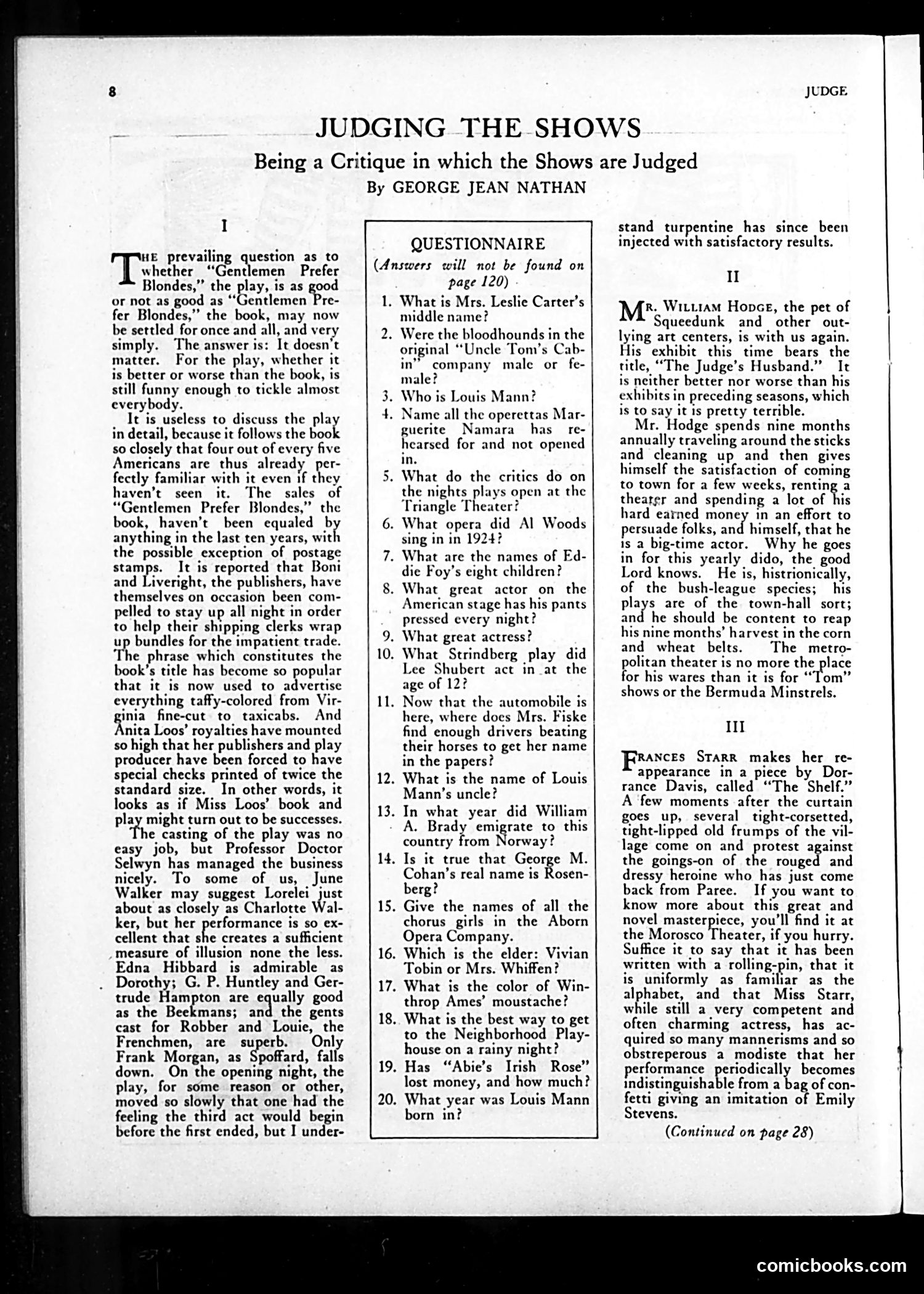
This page from Judge contains a theater review by George Jean Nathan critiquing the stage adaptation of "Gentlemen Prefer Blondes." Nathan argues the play-versus-book debate is irrelevant since the play is funny enough regardless. He praises the casting (especially June Walker as Lorelei) and the production's commercial success, noting the book's unprecedented popularity—its royalties are so massive the publisher needed oversized checks printed. The accompanying "Questionnaire" is satirical humor: it lists absurdly unanswerable trivia questions about theater personalities (Eddie Foy's eight children, George M. Cohan's real name, etc.), mocking both theater gossip columns and the public's obsession with show-business minutiae. The joke is that these questions are deliberately impossible or ridiculous, poking fun at entertainment journalism's trivial focus.
📄 Transcribed text from this page (OCR, searchable)
Machine-transcribed from the original scan — historical spelling and the odd misread are preserved.
JUDGING THE SHOWS Being a Critique in which the Shows are Judged I HE prevailing question as to I whether “Gentlemen Prefer Blondes,” the play, is as good or not as good as “Gentlemen Pre- fer Blondes,” the book, may now be settled for once and all, and very simply. The answer is: It doesn’t matter. For the play, whether it is better or worse than the book, is still funny enough to tickle almost everybody. It is useless to discuss the pla in detail, because it follows the boo! so closely that four out of every five Americans are thus already per- fectly familiar with it even if they haven’t seen it. The sales of “Gentlemen Prefer Blondes,” the k, haven’t been equaled b anything in the last ten years, with the possible exception of postage stamps. It is reported that Boni and Liveright, the publishers, have themselves on occasion been com- pelled to stay up all night in order to help their shipping clerks wrap up bundles for the impatient trade. the phrase which constitutes the book’s title has become so popular that it is now used to advertise everything taffy-colored from Vir- inia fine-cut to taxicabs. And nita Loos’ royalties have mounted so high that her publishers and play producer have been forced to have special checks printed of twice the standard size. In other words, it looks as if Miss Loos’ book and play might turn out to be successes. The casting of the play was no easy job, but Professor Doctor Selwyn has managed the business nicely. To some of us, June Walker may suggest Lorelei just about as closely as Charlotte Wal- ker, but her performance is so ex- cellent that she creates a sufficient measure of illusion none the less. Edna Hibbard is admirable as Dorothy; G. P. Huntley and Ger- trude Hampton are equally good as the Beekmans; Pal the gents cast for Robber and Louie, the Frenchmen, are superb. Only Frank Morgan, as Spoffard, falls down. On the opening night, the play, for some reason or other, moved so slowly that one had the feeling the third act would begin before the first ended, but I under- By GEORGE JEAN NATHAN QUESTIONNAIRE (Answers will not be found on 1, Ze uw 12. 13. 14. 15. 16. 17. 18. 19. 20. page 120) What is Mrs. Leslie Carter’s middle name? Were the bloodhounds in the original “Uncle Tom’s Cab- in” company male or fe- male? « Who is Louis Mann? . Name all the operettas Mar- guerite Namara has re- hearsed for and not opened in. . What do the critics do on the nights plays pen at the Triangle Thea . What opera did Al Woods sing in in 1924? . What are the names of Ed- die Foy’s eight children? . What great actor on the American stage has his pants pressed every night? . What great actress? . What Strindberg play did Lee Shubert act in at the age of 12? . Now that the automobile is here, where does Mrs. Fiske find enough drivers beating their horses to get her name in the papers? What is the name of Louis Mann’s uncle? In what year did William A. Brady emigrate to this country from Norway? Is it true that George M. Cohan’s real name is Rosen- berg? Give the names of all the chorus girls in the Aborn Opera Company. Which is the elder: Vivian Tobin or Mrs. Whiffen? What is the color of Win- throp Ames’ moustache? What is the best way to get to the Neighborhood Play- house on a rainy night? Has “Abie’s Irish Rose” lost money, and how much? What year was Louis Mann born in? stand turpentine has since been injected with satisfactory results. II rR. WittiaM Hopce, the pet of Squeedunk and other out- lying art centers, is with us again. His exhibit this time bears the title, “The Judge’s Husband.” Ir is neither better nor worse than his exhibits in preceding seasons, which is to say it is pretty terrible. Mr. Hodge spends nine months annually traveling around the sticks and cleaning up and then gives himself the satisfaction of coming to town for a few weeks, renting a theargr and spending a lot of ‘his hard earned money in an effort to persuade folks, and himself, that he 1s a big-time actor. Why he goes in for this yearly dido, the good Lord knows. He is, histrionically, of the bush-league species; his plays are of the town-hall sort; and he should be content to reap his nine months’ harvest in the corn and wheat belts. The metro- politan theater is no more the place for his wares than it is for “Tom” shows or the Bermuda Minstrels. Ill Frrearces Starr makes her_re- appearance in a piece by Dor- rance Davis, called “The Shelf.” A few moments after the curtain goes up, several tight-corsetted, tight-lipped old frumps of the vil- lage come on and protest against the goings-on of the rouged and dressy heroine who has just come back from Paree. If you want to know more about this great and novel masterpiece, you'll find it at the Morosco Theater, if you hurry. Suffice it to say that it has been written with a rolling-pin, that it is uniformly as familiar as the alphabet, and that Miss Starr, while still a very competent and often charming actress, has ac- quired so many mannerisms and so obstreperous a modiste that her performance periodically becomes indistinguishable from a bag of con- fetti giving an imitation of Emily Stevens. (Continued on page 28) comicbooks.com