
Judge, 1926-10-23 · page 23 of 36
Judge — October 23, 1926 — page 23: what you’re looking at
What you’re looking at
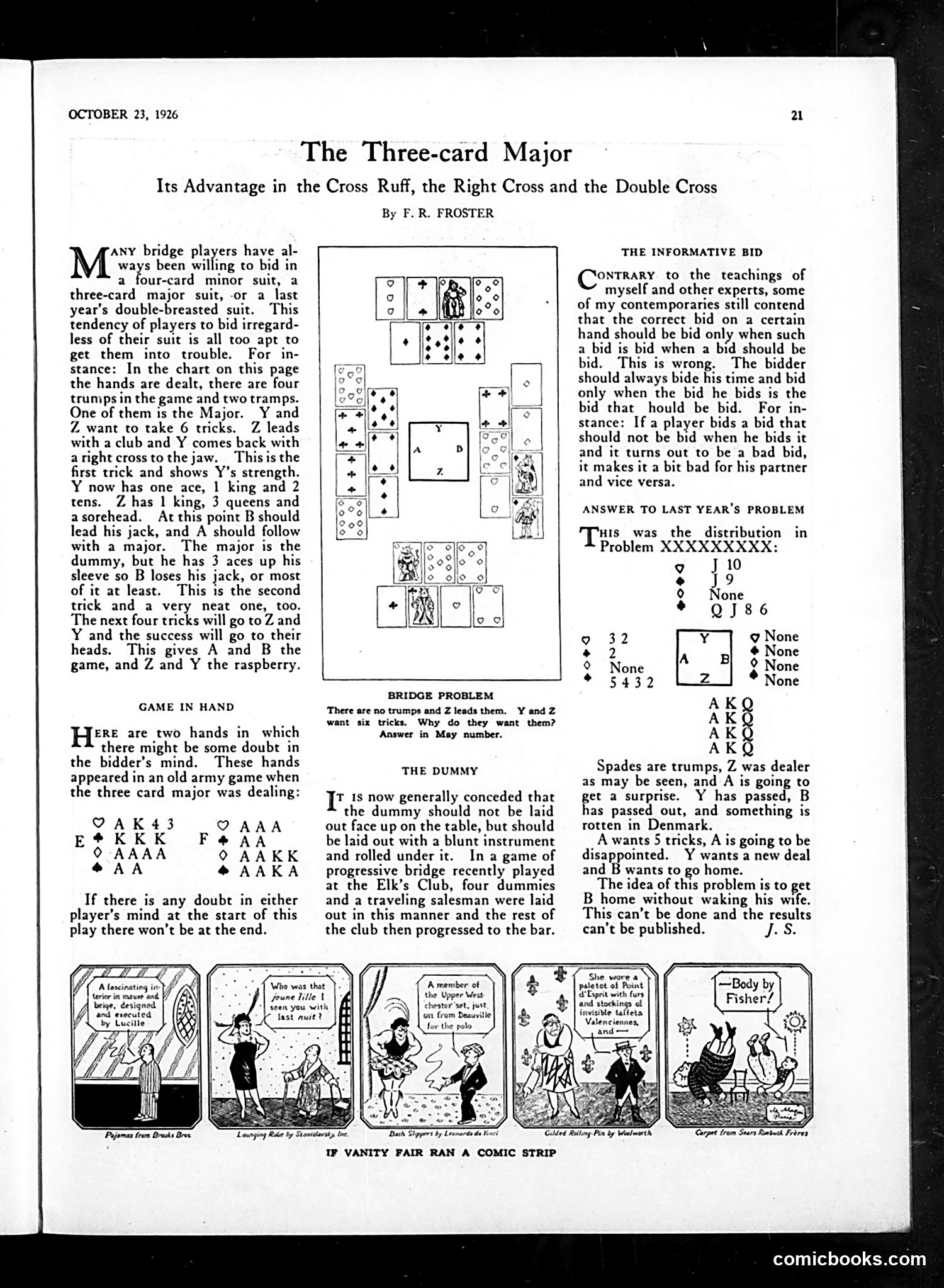
This page is primarily a **bridge card game instruction article** by F.R. Froster, not political satire. The content teaches bridge strategy through humorous exaggeration rather than social commentary. The humor derives from treating bridge—a serious game—with absurd logic. For example, the dummy player should be "laid out with a blunt instrument and rolled under it," and a "traveling salesman were laid out" alongside card dummies at an Elk's Club game before "the rest of the club then progressed to the bar." This is simple physical comedy about drunken card players. The five small cartoons at bottom appear unrelated—they're labeled "If Vanity Fair Ran a Comic Strip" and show various social situations (pyramid schemes, socialites, polo players, fashion) with captions. These mock *Vanity Fair* magazine's gossipy society coverage. The page is essentially **bridge instruction disguised as comedic satire**—typical of 1920s Judge magazine's blend of practical advice and absurdist humor.
📄 Transcribed text from this page (OCR, searchable)
Machine-transcribed from the original scan — historical spelling and the odd misread are preserved.
OCTOBER 23, 1926 The Three-card Major Its Advantage in the Cross Ruff, the Right Cross and the Double Cross By F.R. FROSTER ‘ANY bridge players have al- M ways been willing to bid in a four-card minor suit, a three-card major suit, or a last year’s double-breasted suit. This tendency of players to bid irregard- less of their suit is all too apt to get them into trouble. For in- stance: In the chart on this page the hands are dealt, there are four trumps in the game and two tramps. One of them is the Major. Y and Z want to take 6 tricks. Z leads with a club and Y comes back with aright cross to the jaw. Thisis the first trick and shows Y’s strength. Y now has one ace, 1 king and 2 tens. Z has 1 king, 3 queens and asorehead. At this point B should lead his jack, and A should follow with a major. The major is the dummy, but he has 3 aces up his sleeve so B loses his jack, or most of it at least. This is the second trick and a very neat one, too. The next four tricks will go to Z and Y and the success will go to their heads. This gives A and B the game, and Z and Y the raspberry. GAME IN HAND Here are two hands in which there might be some doubt in the bidder’s mind. These hands appeared in an old army game when the three card major was dealing: QAAA Fe AA o AAKK @AAKA If there is any doubt in either player’s mind at the start of this play there won’t be at the end. BRIDGE PROBLEM There are no trumps and Z leads them. Y and Z want six tricks, Why do they want them? Answer in May number. THE DUMMY T Is now generally conceded that the dummy should not be laid out face up on the table, but should be laid out with a blunt instrument and rolled under it. In a game of progressive bridge recently played at the Elk’s Club, four dummies and a traveling salesman were laid out in this manner and the rest of the club then progressed to the bar. ‘Who was that feune Tille | : A member of | df | the Upper Wess | | a a chester set. just, | | on from Deauville for the polo seen you wit last nuit? At IF VANITY FAIR RAN A COMIC STRIP THE INFORMATIVE BID Costrary to the teachings of myself and other experts, some of my contemporaries still contend that the correct bid on a certain hand should be bid only when such a bid is bid when a bid should be bid. This is wrong. The bidder should always bide his time and bid only when the bid he bids is the bid that hould be bid. For in- stance: If a player bids a bid that should not be bid when he bids it and it turns out to be a bad bid, it makes it a bit bad for his partner and vice versa. ANSWER TO LAST YEAR'S PROBLEM HIS was the distribution in Problem XXXXXXXXX: J 10 29. None QjJse6é g None @ None 3 None None Spades are trumps, Z was dealer as may be seen, and A is going to et a surprise. Y has seeds B as passed out, and something is rotten in Denmark. A wants 5 tricks, A is going to be disappointed. Y wants a new deal and B wants to go home. The idea of this problem is to get B home without waking his wife. This can’t be done and the results can’t be published. paletot of Point | | ~—Body by invisible taffeta Valenciennes, comicbooks.com